EP1981000A2 - Image display method, apparatus, and program - Google Patents
Image display method, apparatus, and program Download PDFInfo
- Publication number
- EP1981000A2 EP1981000A2 EP08007214A EP08007214A EP1981000A2 EP 1981000 A2 EP1981000 A2 EP 1981000A2 EP 08007214 A EP08007214 A EP 08007214A EP 08007214 A EP08007214 A EP 08007214A EP 1981000 A2 EP1981000 A2 EP 1981000A2
- Authority
- EP
- European Patent Office
- Prior art keywords
- image
- dimensional structure
- cross
- dimensional
- range
- Prior art date
- Legal status (The legal status is an assumption and is not a legal conclusion. Google has not performed a legal analysis and makes no representation as to the accuracy of the status listed.)
- Withdrawn
Links
Images




Classifications
-
- G—PHYSICS
- G06—COMPUTING OR CALCULATING; COUNTING
- G06T—IMAGE DATA PROCESSING OR GENERATION, IN GENERAL
- G06T19/00—Manipulating three-dimensional [3D] models or images for computer graphics
-
- G—PHYSICS
- G06—COMPUTING OR CALCULATING; COUNTING
- G06T—IMAGE DATA PROCESSING OR GENERATION, IN GENERAL
- G06T2207/00—Indexing scheme for image analysis or image enhancement
- G06T2207/10—Image acquisition modality
- G06T2207/10072—Tomographic images
-
- G—PHYSICS
- G06—COMPUTING OR CALCULATING; COUNTING
- G06T—IMAGE DATA PROCESSING OR GENERATION, IN GENERAL
- G06T2207/00—Indexing scheme for image analysis or image enhancement
- G06T2207/10—Image acquisition modality
- G06T2207/10072—Tomographic images
- G06T2207/10088—Magnetic resonance imaging [MRI]
-
- G—PHYSICS
- G06—COMPUTING OR CALCULATING; COUNTING
- G06T—IMAGE DATA PROCESSING OR GENERATION, IN GENERAL
- G06T2207/00—Indexing scheme for image analysis or image enhancement
- G06T2207/30—Subject of image; Context of image processing
- G06T2207/30004—Biomedical image processing
- G06T2207/30101—Blood vessel; Artery; Vein; Vascular
Definitions
- the present invention relates to an image display method, apparatus, and program for displaying a three-dimensional configuration of a tubular structure extracted from a three-dimensional image of a subject in an easy-to-observe manner. More specifically, the invention is directed to an image display method, apparatus, and program for displaying a three-dimensional configuration of a luminal structure, such as blood vessel, intestine, bronchial tube, or the like in a manner useful for observation.
- a luminal structure such as blood vessel, intestine, bronchial tube, or the like in a manner useful for observation.
- processing for extracting a three-dimensional structure such as a core line representing structural information of an observation target luminal structure from a three-dimensional medical image of a subject obtained by CT equipment, MRI machine, ultrasonic diagnostic equipment, or the like and displaying the structure in a form useful for observation is performed, in order to facilitate observation of a three-dimensional configuration of the luminal structure of the subject, such as blood vessel, intestine, bronchial tube, or the like.
- a method of simultaneously displaying an image, such as a volume rendering image in which the entirety of a three-dimensional structure of extracted core line or the like is rendered in superimposed manner, and a multi planar reconstruction (MPR) image that orthogonally intersects the three-dimensional image at a specified arbitrary position thereof with an indicator, such as a marker or the like, attached to the intersecting position is proposed as described, for example, in Patent Document 1.
- an image such as a volume rendering image in which the entirety of a three-dimensional structure of extracted core line or the like is rendered in superimposed manner
- MPR multi planar reconstruction
- a method for providing, for example, an image I 2 shown in Figure 11 is also known, in which the entirety of the extracted three-dimensional image S is superimposed on each of the cross-sectional images, and an indicator, such as a marker or the like, is attached to the intersecting position to enable an observer to easily understand to which position on the three-dimensional structure each cross-sectional image corresponds.
- the entirety of the extracted three-dimensional structure is superimposed on each cross-sectional image with an indicator, such as a marker or the like attached to the intersecting position, so that as the length of the extracted three-dimensional structure becomes long, or as the structure of the three-dimensional structure becomes complicated, the three-dimensional structure displayed in a superimposed manner becomes large, which hinders observation of a region of interest and observability is degraded.
- an indicator such as a marker or the like attached to the intersecting position
- an object of the present invention to provide an image display method and apparatus capable of improving observability of the three-dimensional configuration of a target object. It is a further obj ect of the present invention to provide a computer program product therefor.
- a first image display method of the present invention is a method including the steps of:
- a second image display method of the present invention is a method including the steps of:
- a range of a predetermined thickness from a cross-section represented by the cross-sectional image means a range of a predetermined distance in the directions orthogonal to the cross-section
- a range of a predetermined distance from a position where the three-dimensional structure is intersecting the cross-sectional image means a range of a predetermined distance in all directions from the intersecting position.
- First and second image display apparatuses of the present invention include a structure extraction means, a projection image generation means, and a display means respectively for performing the first and second image display methods respectively.
- First and second image display programs of the present invention are programs for causing a computer to perform the first and second image display method respectively.
- the step of generating a projection image may be a step of generating a projection image by projecting only a part of the entirety of the portion of the three-dimensional structure located within the range of the predetermined thickness or distance, the part continuing from a section of the three-dimensional structure intersecting the cross-sectional image within the range.
- a luminal or line-like three-dimensional structure is extracted from a three-dimensional image of a target object, then a projection image is generated by projecting a portion of the entirety of the three-dimensional structure on a cross-sectional image of the target object intersecting the three-dimensional structure, the portion being a portion located within a range of a predetermined thickness from a cross-section represented by the cross-sectional image or a portion located within a range of a predetermined distance from a position where the three-dimensional structure is intersecting the cross-sectional image, and the generated projection image is displayed.
- this may provide a more suitable image for observation, in which only a limited region of interest of the three-dimensional structure is superimposed, which may improve observability of the three-dimensional configuration of a target object.
- Figure 1 is a hardware configuration diagram of a three-dimensional medical image processing system, illustrating an overview thereof. As illustrated, the system includes a modality 1, an image storage server 2, and an image processing workstation 3, which are communicatably connected with each other through a network 9.
- the modality 1 is used for obtaining a three-dimensional medical image V representing a subject, which is, more specifically, CT equipment, MRI machine, ultrasonic diagnostic equipment, or the like.
- the image storage server 2 is a computer for storing a three-dimensional medical image V obtained by the modality 1 and a medical image generated through image processing in the image processing workstation 3 in an image database and managing them.
- the image storage server 2 includes a large capacity external storage device, and database management software (e.g., ORDB (Object Relational Database) management software).
- database management software e.g., ORDB (Object Relational Database) management software.
- the image processing workstation 3 is a computer for performing image processing on a three-dimensional medical image V obtained from the modality 1 or the image storage server 2, and displaying the generated image in response to a request from a radiological reader.
- the image processing workstation 3, in particular, includes an input device, such as a keyboard, a mouse, or the like, for inputting a request from a radiological reader, a main storage unit having a sufficient capacity for storing the obtained three-dimensional medical image V, and a display for displaying the generated image.
- the image data storage format and communication between each unit through the network 9 are based on a protocol, such as DICOM (Digital Imaging and Communications in Medicine) or the like.
- DICOM Digital Imaging and Communications in Medicine
- FIG. 2 is a schematic block diagram of the image processing workstation 3, illustrating a schematic configuration thereof.
- the image processing workstation 3 includes an image obtaining means 10 for obtaining a three-dimensional medical image V including a target object (luminal structure) having a luminal structure, such as blood vessel, intestine, or bronchial tube from the modality 1 or image storage server 2 in response to a request from a radiological reader, a structure extraction means 20 for extracting a luminal or a line-like three-dimensional structure S of the target object from the obtained three-dimensional medical image V, a projection image generation means 30 for generating a projection image I by projecting a portion Sp of the entirety of the three-dimensional structure S located within a predetermined range R on a cross-sectional image P of the target object intersecting the three-dimensional structure S, and an image display means 40 for displaying the generated projection image I.
- a target object luminal structure
- a luminal structure such as blood vessel, intestine, or bronchial tube
- the image obtaining means 10 obtains a three-dimensional medical image V of a target patient for radiological reading which includes a target object (luminal structure) having a luminal structure, such as blood vessel, intestine, bronchial tube, or the like, from the modality 1 or image storage server 2 in response to a request from a radiological reader.
- the three-dimensional medical image V is constituted by multi slice images which are divided into voxels and arranged in a three-dimensional coordinate space.
- the structure extraction means 20 extracts a line-like or luminal three-dimensional structure S, such as a core line or an interface from the target object (luminal structure) having a luminal structure, such as blood vessel, intestine, bronchial tube, or the like, included in the three-dimensional image V.
- a line-like or luminal three-dimensional structure S such as a core line or an interface from the target object (luminal structure) having a luminal structure, such as blood vessel, intestine, bronchial tube, or the like, included in the three-dimensional image V.
- the search start point a determination is made as to whether or not each voxel within a region adjacent to the search point represents the target object, and with each voxel determined to represent the target object as a new search point, the search is performed in succession, thereby a smoothly curved area of the target object is obtained. Then, by thinning the obtained target object area or extracting the core line by the core line extraction method as described in Patent Document 1 described above, a line-like three-dimensional structure of the target object is extracted.
- the three-dimensional structure for example, may be a luminal structure that can be obtained by extracting an interface of the target object.
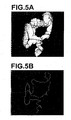
- Figures 3 , 4 , and 5 Examples of three-dimensional structures obtained through extraction by the structure extraction means 20 are shown in Figures 3 , 4 , and 5 .
- Figure 3B illustrates a three-dimensional structure of the coronary artery shown in Figure 3A
- Figure 4B illustrates a three-dimensional structure of the bronchial tubes shown in Figure 4A
- Figure 5B illustrates a three-dimensional structure of the large intestine shown in Figure 5A .
- an arbitrary cross-sectional image P intersecting the three-dimensional structure S is obtained.
- a cross-sectional image orthogonally intersecting the three-dimensional structure S obtained by MPR (Multi Planar Reconstruction) method at an arbitrary point C on the three-dimensional structure S specified by a radiological reader through the input device, such as a keyboard or a mouse, may be used as the cross-sectional image P.
- a projection image I is generated, in which a portion Sp of the entirety of the three-dimensional structure S located within a predetermined range R is projected on the obtained cross-sectional image P. More specifically, as shown in Figure 7 , a portion Sp of the entire three-dimensional structure S located within a range R 1 of a predetermined thickness t from the cross-section represented by the cross-sectional image P is projected on the cross-sectional image P to generate the projection image I. Alternatively, as shown in Figure 8 , a portion Sp of the entirety of the three-dimensional structure S located within a range R 2 of a predetermined distance from the position C where the three-dimensional structure is intersecting the cross-sectional image P is projected on the cross-sectional image P to generate the projection image I.
- the thickness t or the distance r is used for determining the range of the three-dimensional structure S to be projected and superimposed on the cross-sectional image P, and can be arbitrarily set according to a desired size of projection range of the three-dimensional structure S.
- the appropriate value of the range R 1 is a thickness t around 1 cm including the cross-sectional image P.
- the value of the thickness t or the distance r may be set such that the greater the diameter of the three-dimensional structure at the position C where the three-dimensional structure S and the cross-section image P are intersecting with each other, the greater the value.
- an image more clearly showing the continuity of the three-dimensional structure of the target object may be provided by, for example, in the following manner. That is, as shown in Figure 9 , of the entirety of the portion of the three-dimensional structure S located within a predetermined range R (a predetermined thickness range R1 or a predetermined distance range R2), only a part Sq continuing from a section of the three-dimensional structure S intersecting the cross-sectional image P within the range R is projected on the cross-sectional image P to generate a projection image I and the generated projection image I is displayed.
- a predetermined range R a predetermined thickness range R1 or a predetermined distance range R2
- the projection image I generated in the projection image generation means 30 is displayed on the display of the image processing workstation 3 by the image display means 40.
- a luminal or line-like three-dimensional structure S is extracted from a three-dimensional image V of a target object, then a projection image is generated by projecting a portion of the entirety of the three-dimensional structure on a cross-sectional image P of the target object intersecting the three-dimensional structure, the portion being a portion located within a range R 1 of a predetermined thickness from a cross-section represented by the cross-sectional image P, or a portion of the entirety of three-dimensional structure located within a range R 2 of a predetermined distance from a position where the three-dimensional structure is intersecting the cross-sectional image, and the generated projection image I is displayed.
- Figure 10 illustrates an example projection image I 2 displayed by the image display method of the present invention.
- Figure 10 clearly shows that the image I 2 is more suitable for observing a portion adjacent to the intersecting position between the three-dimensional structure and the cross-sectional image indicated by the marker in comparison with the image I 1 shown in Figure 11 , which is displayed by the conventional image display method in which the entirety of an extracted three-dimensional structure is superimposed on a cross-sectional image, since the portion adjacent to the intersecting position is not blocked by the superimposed three-dimensional structure in the image I 2 while it is blocked in the image I 1 .
- a projection image obtained by the present invention is displayed together with an image on which the entirety of a three-dimensional structure is superimposed which is generated by a volume rendering method or a maximum intensity projection method, and the intersecting state between the three-dimensional structure of the target object and a cross-sectional image is observed by referring to the entire shape of the three-dimensional structure.
Landscapes
- Engineering & Computer Science (AREA)
- General Physics & Mathematics (AREA)
- Computer Hardware Design (AREA)
- General Engineering & Computer Science (AREA)
- Software Systems (AREA)
- Physics & Mathematics (AREA)
- Computer Graphics (AREA)
- Theoretical Computer Science (AREA)
- Apparatus For Radiation Diagnosis (AREA)
- Magnetic Resonance Imaging Apparatus (AREA)
- Image Generation (AREA)
- Ultra Sonic Daignosis Equipment (AREA)
- Image Processing (AREA)
- Image Analysis (AREA)
Abstract
Description
- The present invention relates to an image display method, apparatus, and program for displaying a three-dimensional configuration of a tubular structure extracted from a three-dimensional image of a subject in an easy-to-observe manner. More specifically, the invention is directed to an image display method, apparatus, and program for displaying a three-dimensional configuration of a luminal structure, such as blood vessel, intestine, bronchial tube, or the like in a manner useful for observation.
- In the medical field, processing for extracting a three-dimensional structure, such as a core line representing structural information of an observation target luminal structure from a three-dimensional medical image of a subject obtained by CT equipment, MRI machine, ultrasonic diagnostic equipment, or the like and displaying the structure in a form useful for observation is performed, in order to facilitate observation of a three-dimensional configuration of the luminal structure of the subject, such as blood vessel, intestine, bronchial tube, or the like.
- A method of simultaneously displaying an image, such as a volume rendering image in which the entirety of a three-dimensional structure of extracted core line or the like is rendered in superimposed manner, and a multi planar reconstruction (MPR) image that orthogonally intersects the three-dimensional image at a specified arbitrary position thereof with an indicator, such as a marker or the like, attached to the intersecting position is proposed as described, for example, in Patent Document 1.
- When sequentially displaying MPR images of cross-sections intersecting at respective positions of an extracted three-dimensional structure along the structure, a method for providing, for example, an image I2 shown in
Figure 11 is also known, in which the entirety of the extracted three-dimensional image S is superimposed on each of the cross-sectional images, and an indicator, such as a marker or the like, is attached to the intersecting position to enable an observer to easily understand to which position on the three-dimensional structure each cross-sectional image corresponds. - But, when attentively observing the intersecting state between an extracted three-dimensional structure and each cross-sectional image, for example, when checking extraction state of a three-dimensional structure of a blood vessel by sequentially observing the three-dimensional structure at each of the positions where a plurality of cross-sectional images is intersecting in the advancement direction of the structure, the conventional technique described above gives rise to the following problem. That is, in the conventional technique, the entirety of the extracted three-dimensional structure is superimposed on each cross-sectional image with an indicator, such as a marker or the like attached to the intersecting position, so that as the length of the extracted three-dimensional structure becomes long, or as the structure of the three-dimensional structure becomes complicated, the three-dimensional structure displayed in a superimposed manner becomes large, which hinders observation of a region of interest and observability is degraded.
- In view of the circumstances described above, it is an object of the present invention to provide an image display method and apparatus capable of improving observability of the three-dimensional configuration of a target object. It is a further obj ect of the present invention to provide a computer program product therefor.
- A first image display method of the present invention is a method including the steps of:
- extracting a luminal or line-like three-dimensional structure from a three-dimensional image of a target object;
- generating a projection image by projecting a portion of the entirety of the three-dimensional structure on a cross-sectional image of the target object intersecting the three-dimensional structure, the portion being a portion located within a range of a predetermined thickness from a cross-section represented by the cross-sectional image; and
- displaying the generated projection image.
- A second image display method of the present invention is a method including the steps of:
- extracting a luminal or line-like three-dimensional structure from a three-dimensional image of a target object;
- generating a projection image by projecting a portion of the entirety of the three-dimensional structure on a cross-sectional image of the target object intersecting the three-dimensional structure, the portion being a portion located within a range of a predetermined distance from a position where the three-dimensional structure is intersecting the cross-sectional image; and
- displaying the generated projection image.
- The term "a range of a predetermined thickness from a cross-section represented by the cross-sectional image" as used herein means a range of a predetermined distance in the directions orthogonal to the cross-section, and the term "a range of a predetermined distance from a position where the three-dimensional structure is intersecting the cross-sectional image" as used herein means a range of a predetermined distance in all directions from the intersecting position.
- First and second image display apparatuses of the present invention include a structure extraction means, a projection image generation means, and a display means respectively for performing the first and second image display methods respectively.
- First and second image display programs of the present invention are programs for causing a computer to perform the first and second image display method respectively.
- The step of generating a projection image may be a step of generating a projection image by projecting only a part of the entirety of the portion of the three-dimensional structure located within the range of the predetermined thickness or distance, the part continuing from a section of the three-dimensional structure intersecting the cross-sectional image within the range.
- According to the image display method, apparatus, and program of the present invention, a luminal or line-like three-dimensional structure is extracted from a three-dimensional image of a target object, then a projection image is generated by projecting a portion of the entirety of the three-dimensional structure on a cross-sectional image of the target object intersecting the three-dimensional structure, the portion being a portion located within a range of a predetermined thickness from a cross-section represented by the cross-sectional image or a portion located within a range of a predetermined distance from a position where the three-dimensional structure is intersecting the cross-sectional image, and the generated projection image is displayed. When attentively observing the intersecting state between the three-dimensional structure and the cross-sectional image, this may provide a more suitable image for observation, in which only a limited region of interest of the three-dimensional structure is superimposed, which may improve observability of the three-dimensional configuration of a target object.
- Hereinafter, an exemplary embodiment of the present invention will be described with reference to the accompanying drawings.
Figure 1 is a hardware configuration diagram of a three-dimensional medical image processing system, illustrating an overview thereof. As illustrated, the system includes a modality 1, animage storage server 2, and animage processing workstation 3, which are communicatably connected with each other through a network 9. - The modality 1 is used for obtaining a three-dimensional medical image V representing a subject, which is, more specifically, CT equipment, MRI machine, ultrasonic diagnostic equipment, or the like.
- The
image storage server 2 is a computer for storing a three-dimensional medical image V obtained by the modality 1 and a medical image generated through image processing in theimage processing workstation 3 in an image database and managing them. Theimage storage server 2 includes a large capacity external storage device, and database management software (e.g., ORDB (Object Relational Database) management software). - The
image processing workstation 3 is a computer for performing image processing on a three-dimensional medical image V obtained from the modality 1 or theimage storage server 2, and displaying the generated image in response to a request from a radiological reader. Theimage processing workstation 3, in particular, includes an input device, such as a keyboard, a mouse, or the like, for inputting a request from a radiological reader, a main storage unit having a sufficient capacity for storing the obtained three-dimensional medical image V, and a display for displaying the generated image. - The image data storage format and communication between each unit through the network 9 are based on a protocol, such as DICOM (Digital Imaging and Communications in Medicine) or the like.
-
Figure 2 is a schematic block diagram of theimage processing workstation 3, illustrating a schematic configuration thereof. As illustrated, theimage processing workstation 3 includes animage obtaining means 10 for obtaining a three-dimensional medical image V including a target object (luminal structure) having a luminal structure, such as blood vessel, intestine, or bronchial tube from the modality 1 orimage storage server 2 in response to a request from a radiological reader, a structure extraction means 20 for extracting a luminal or a line-like three-dimensional structure S of the target object from the obtained three-dimensional medical image V, a projection image generation means 30 for generating a projection image I by projecting a portion Sp of the entirety of the three-dimensional structure S located within a predetermined range R on a cross-sectional image P of the target object intersecting the three-dimensional structure S, and an image display means 40 for displaying the generated projection image I. - Next, a processing flow of the medical image processing system, in particular, a processing flow of the
image processing workstation 3 for generating and displaying a projection image provided for improving observability of a three-dimensional configuration of a target object will be described. - First, the image obtaining means 10 obtains a three-dimensional medical image V of a target patient for radiological reading which includes a target object (luminal structure) having a luminal structure, such as blood vessel, intestine, bronchial tube, or the like, from the modality 1 or
image storage server 2 in response to a request from a radiological reader. The three-dimensional medical image V is constituted by multi slice images which are divided into voxels and arranged in a three-dimensional coordinate space. - Next, the structure extraction means 20 extracts a line-like or luminal three-dimensional structure S, such as a core line or an interface from the target object (luminal structure) having a luminal structure, such as blood vessel, intestine, bronchial tube, or the like, included in the three-dimensional image V. More specifically, with an internal point of the target object in the three-dimensional medical image V specified by the radiological reader through the input device, such as a keyboard or a mouse, as a search start point, a determination is made as to whether or not each voxel within a region adjacent to the search point represents the target object, and with each voxel determined to represent the target object as a new search point, the search is performed in succession, thereby a smoothly curved area of the target object is obtained. Then, by thinning the obtained target object area or extracting the core line by the core line extraction method as described in Patent Document 1 described above, a line-like three-dimensional structure of the target object is extracted. As for the three-dimensional structure, for example, may be a luminal structure that can be obtained by extracting an interface of the target object.
- Examples of three-dimensional structures obtained through extraction by the structure extraction means 20 are shown in
Figures 3 ,4 , and5 .Figure 3B illustrates a three-dimensional structure of the coronary artery shown inFigure 3A ,Figure 4B illustrates a three-dimensional structure of the bronchial tubes shown inFigure 4A , andFigure 5B illustrates a three-dimensional structure of the large intestine shown inFigure 5A . - Next, a processing flow of the projection image generation means 30 for generating a projection image I by projecting a portion Sp of the entirety of a three-dimensional structure S located within a predetermined range R on a cross-sectional image P of the target object intersecting the three-dimensional structure S will be described.
- As shown in
Figure 6 , an arbitrary cross-sectional image P intersecting the three-dimensional structure S is obtained. For example, a cross-sectional image orthogonally intersecting the three-dimensional structure S obtained by MPR (Multi Planar Reconstruction) method at an arbitrary point C on the three-dimensional structure S specified by a radiological reader through the input device, such as a keyboard or a mouse, may be used as the cross-sectional image P. - Then, a projection image I is generated, in which a portion Sp of the entirety of the three-dimensional structure S located within a predetermined range R is projected on the obtained cross-sectional image P. More specifically, as shown in
Figure 7 , a portion Sp of the entire three-dimensional structure S located within a range R1 of a predetermined thickness t from the cross-section represented by the cross-sectional image P is projected on the cross-sectional image P to generate the projection image I. Alternatively, as shown inFigure 8 , a portion Sp of the entirety of the three-dimensional structure S located within a range R2 of a predetermined distance from the position C where the three-dimensional structure is intersecting the cross-sectional image P is projected on the cross-sectional image P to generate the projection image I. - Here, the thickness t or the distance r is used for determining the range of the three-dimensional structure S to be projected and superimposed on the cross-sectional image P, and can be arbitrarily set according to a desired size of projection range of the three-dimensional structure S. For example, when a three-dimensional structure of a coronary artery is projected and displayed on a cross-section image P with a thickness of 2.5 mm to check the extraction state of the blood vessel, the appropriate value of the range R1 is a thickness t around 1 cm including the cross-sectional image P. Further, the value of the thickness t or the distance r may be set such that the greater the diameter of the three-dimensional structure at the position C where the three-dimensional structure S and the cross-section image P are intersecting with each other, the greater the value.
- If a three-dimensional structure S of a target object has a complicated tree structure, an image more clearly showing the continuity of the three-dimensional structure of the target object may be provided by, for example, in the following manner. That is, as shown in
Figure 9 , of the entirety of the portion of the three-dimensional structure S located within a predetermined range R (a predetermined thickness range R1 or a predetermined distance range R2), only a part Sq continuing from a section of the three-dimensional structure S intersecting the cross-sectional image P within the range R is projected on the cross-sectional image P to generate a projection image I and the generated projection image I is displayed. - Then, the projection image I generated in the projection image generation means 30 is displayed on the display of the
image processing workstation 3 by the image display means 40. - As described above, in the three-dimensional medical image processing system, which is an embodiment of the image processing of the present invention, a luminal or line-like three-dimensional structure S is extracted from a three-dimensional image V of a target object, then a projection image is generated by projecting a portion of the entirety of the three-dimensional structure on a cross-sectional image P of the target object intersecting the three-dimensional structure, the portion being a portion located within a range R1 of a predetermined thickness from a cross-section represented by the cross-sectional image P, or a portion of the entirety of three-dimensional structure located within a range R2 of a predetermined distance from a position where the three-dimensional structure is intersecting the cross-sectional image, and the generated projection image I is displayed. When attentively observing the intersecting state between the three-dimensional structure and the cross-sectional image, this may provide an image on which only a limited portion of interest of the three-dimensional structure is superimposed, which is more suitable for observation, thus observability of the three-dimensional configuration of a target object may be improved. For example,
Figure 10 illustrates an example projection image I2 displayed by the image display method of the present invention.Figure 10 clearly shows that the image I2 is more suitable for observing a portion adjacent to the intersecting position between the three-dimensional structure and the cross-sectional image indicated by the marker in comparison with the image I1 shown inFigure 11 , which is displayed by the conventional image display method in which the entirety of an extracted three-dimensional structure is superimposed on a cross-sectional image, since the portion adjacent to the intersecting position is not blocked by the superimposed three-dimensional structure in the image I2 while it is blocked in the image I1. - Further, an arrangement may be adopted in which a projection image obtained by the present invention is displayed together with an image on which the entirety of a three-dimensional structure is superimposed which is generated by a volume rendering method or a maximum intensity projection method, and the intersecting state between the three-dimensional structure of the target object and a cross-sectional image is observed by referring to the entire shape of the three-dimensional structure.
-
-
Figure 1 is a schematic configuration diagram of a three-dimensional medical image processing system according to an embodiment of the present invention. -
Figure 2 is a block diagram illustrating the image processing workstation shown inFigure 1 . -
Figure 3A illustrates an example coronary artery extracted from a three-dimensional medical image. -
Figure 3B illustrates an example three-dimensional structure of the coronary artery inFigure 3A extracted by the structure extraction means 20. -
Figure 4A illustrates example bronchial tubes extracted from a three-dimensional medical image. -
Figure 4B illustrates an example three-dimensional structure of the bronchial tubes inFigure 4A extracted by the structure extraction means 20. -
Figure 5A illustrates an example large intestine extracted from a three-dimensional medical image. -
Figure 5B illustrates an example three-dimensional structure of the large intestine inFigure 5A extracted by the structure extraction means 20. -
Figure 6 is a drawing for explaining the processing of the projection image generation means 30 for generating a projection image. -
Figure 7 is a drawing for explaining the processing of the projection image generation means 30 for generating a projection image. -
Figure 8 is a drawing for explaining the processing of the projection image generation means 30 for generating a projection image. -
Figure 9 is a drawing for explaining the processing of the projection image generation means 30 for generating a projection image. -
Figure 10 illustrates an example image displayed by the image display method of the present invention. -
Figure 11 illustrates an example image displayed by the conventional image display method.
Claims (6)
- An image display method comprising the steps of:extracting a luminal or line-like three-dimensional structure (S) from a three-dimensional image of a target object;generating a projection image (I) by projecting a portion of the entirety of the three-dimensional structure (S) on a cross-sectional image (P) of the target object intersecting the three-dimensional structure (S), the portion being a portion located within a range of a predetermined thickness from a cross-section represented by the cross-sectional image (P) or a portion located within a range of a predetermined distance from a position where the three-dimensional structure (S) is intersecting the cross-sectional image (P); anddisplaying the generated projection image (I).
- The image display method according to claim 1, characterized in that the step of generating a projection image is a step of generating a projection image (I) by projecting only a part of the entirety of the portion of the three-dimensional structure (S) located within the range of the predetermined thickness or distance, the part continuing from a section of the three-dimensional structure (S) intersecting the cross-sectional image (P) within the range.
- An image display apparatus comprising:a structure extraction means (20) for extracting a luminal or line-like three-dimensional structure (S) from a three-dimensional image of a target object;a projection image generation means (30) for generating a projection image (I) by projecting a portion of the entirety of the three-dimensional structure (S) on a cross-sectional image (P) of the target object intersecting the three-dimensional structure (S), the portion being a portion located within a range of a predetermined thickness from a cross-section represented by the cross-sectional image (P) or a portion located within a range of a predetermined distance from a position where the three-dimensional structure (S) is intersecting the cross-sectional image (P); anda display means (40) for displaying the generated projection image (I).
- The image display apparatus according to claim 3,
characterized in that the projection image generation means (40) is a means for generating a projection image (I) by projecting only a part of the entirety of the portion of the three-dimensional structure (S) located within the range of the predetermined thickness or distance, the part continuing from a section of the three-dimensional structure (S) intersecting the cross-sectional image (P) within the range. - A computer readable recording medium on which a program for causing a computer to perform the following steps:extracting a luminal or line-like three-dimensional structure (S) from a three-dimensional image of a target object;generating a projection image (I) by projecting a portion of the entirety of the three-dimensional structure (S) on a cross-sectional image (P) of the target object intersecting the three-dimensional structure (S), the portion being a portion located within a range of a predetermined thickness from a cross-section represented by the cross-sectional image (P) or a portion located within a range of a predetermined distance from a position where the three-dimensional structure (S) is intersecting the cross-sectional image (P); anddisplaying the generated projection image (I).
- The computer readable recording medium according to claim 5, characterized in that the step of generating a projection image is a step of generating a projection image (I) by projecting only a part of the entirety of the portion of the three-dimensional structure (S) located within the range of the predetermined thickness or distance, the part continuing from a section of the three-dimensional structure (S) intersecting the cross-sectional image (P) within the range.
Applications Claiming Priority (1)
| Application Number | Priority Date | Filing Date | Title |
|---|---|---|---|
| JP2007105271A JP4545169B2 (en) | 2007-04-12 | 2007-04-12 | Image display method, apparatus and program |
Publications (2)
| Publication Number | Publication Date |
|---|---|
| EP1981000A2 true EP1981000A2 (en) | 2008-10-15 |
| EP1981000A3 EP1981000A3 (en) | 2010-02-03 |
Family
ID=39650677
Family Applications (1)
| Application Number | Title | Priority Date | Filing Date |
|---|---|---|---|
| EP08007214A Withdrawn EP1981000A3 (en) | 2007-04-12 | 2008-04-11 | Image display method, apparatus, and program |
Country Status (3)
| Country | Link |
|---|---|
| US (1) | US8170328B2 (en) |
| EP (1) | EP1981000A3 (en) |
| JP (1) | JP4545169B2 (en) |
Cited By (1)
| Publication number | Priority date | Publication date | Assignee | Title |
|---|---|---|---|---|
| EP2930695A1 (en) * | 2014-03-28 | 2015-10-14 | Fujifilm Corporation | Three dimensional orientation configuration apparatus, method and program |
Families Citing this family (19)
| Publication number | Priority date | Publication date | Assignee | Title |
|---|---|---|---|---|
| JPWO2010055816A1 (en) * | 2008-11-14 | 2012-04-12 | 株式会社日立メディコ | Ultrasound diagnostic apparatus and standard image data generation method for ultrasonic diagnostic apparatus |
| EP2377095B1 (en) * | 2008-12-10 | 2016-05-25 | Koninklijke Philips N.V. | Vessel analysis |
| JP5366713B2 (en) * | 2009-08-25 | 2013-12-11 | 株式会社東芝 | Gastrointestinal tract image display device and control program for displaying GI tract image data |
| JP5606832B2 (en) * | 2010-03-05 | 2014-10-15 | 富士フイルム株式会社 | Image diagnosis support apparatus, method, and program |
| JP5537261B2 (en) * | 2010-05-25 | 2014-07-02 | 株式会社東芝 | Medical image diagnostic apparatus, image information processing apparatus, and treatment support data display control program |
| JPWO2012063653A1 (en) * | 2010-11-12 | 2014-05-12 | 株式会社日立メディコ | Medical image display device and medical image display method |
| EP3164048B1 (en) | 2014-07-02 | 2022-11-16 | Covidien LP | Real-time automatic registration feedback |
| US9603668B2 (en) | 2014-07-02 | 2017-03-28 | Covidien Lp | Dynamic 3D lung map view for tool navigation inside the lung |
| US9770216B2 (en) | 2014-07-02 | 2017-09-26 | Covidien Lp | System and method for navigating within the lung |
| US9530219B2 (en) | 2014-07-02 | 2016-12-27 | Covidien Lp | System and method for detecting trachea |
| US9754367B2 (en) | 2014-07-02 | 2017-09-05 | Covidien Lp | Trachea marking |
| CN106659453B (en) | 2014-07-02 | 2020-05-26 | 柯惠有限合伙公司 | System and method for segmenting lungs |
| US20160000414A1 (en) | 2014-07-02 | 2016-01-07 | Covidien Lp | Methods for marking biopsy location |
| US10643371B2 (en) | 2014-08-11 | 2020-05-05 | Covidien Lp | Treatment procedure planning system and method |
| JP6293619B2 (en) | 2014-08-28 | 2018-03-14 | ジーイー・メディカル・システムズ・グローバル・テクノロジー・カンパニー・エルエルシー | Image processing method, apparatus, and program |
| US10986990B2 (en) | 2015-09-24 | 2021-04-27 | Covidien Lp | Marker placement |
| US10709352B2 (en) | 2015-10-27 | 2020-07-14 | Covidien Lp | Method of using lung airway carina locations to improve ENB registration |
| US11224392B2 (en) | 2018-02-01 | 2022-01-18 | Covidien Lp | Mapping disease spread |
| US12089902B2 (en) | 2019-07-30 | 2024-09-17 | Coviden Lp | Cone beam and 3D fluoroscope lung navigation |
Citations (1)
| Publication number | Priority date | Publication date | Assignee | Title |
|---|---|---|---|---|
| WO2006127875A2 (en) * | 2005-05-26 | 2006-11-30 | Siemens Corporate Research, Inc. | Method and system for guided two dimensional colon screening |
Family Cites Families (16)
| Publication number | Priority date | Publication date | Assignee | Title |
|---|---|---|---|---|
| US5170347A (en) * | 1987-11-27 | 1992-12-08 | Picker International, Inc. | System to reformat images for three-dimensional display using unique spatial encoding and non-planar bisectioning |
| US5734384A (en) * | 1991-11-29 | 1998-03-31 | Picker International, Inc. | Cross-referenced sectioning and reprojection of diagnostic image volumes |
| US5782762A (en) * | 1994-10-27 | 1998-07-21 | Wake Forest University | Method and system for producing interactive, three-dimensional renderings of selected body organs having hollow lumens to enable simulated movement through the lumen |
| US6151404A (en) | 1995-06-01 | 2000-11-21 | Medical Media Systems | Anatomical visualization system |
| FR2795207B1 (en) * | 1999-06-21 | 2001-08-17 | Ge Medical Syst Sa | METHOD FOR VIEWING A PART OF A THREE-DIMENSIONAL IMAGE |
| US6643533B2 (en) | 2000-11-28 | 2003-11-04 | Ge Medical Systems Global Technology Company, Llc | Method and apparatus for displaying images of tubular structures |
| JP4675509B2 (en) * | 2001-07-04 | 2011-04-27 | 株式会社日立メディコ | Apparatus and method for extracting and displaying specific region of organ |
| CN101219058B (en) * | 2002-03-14 | 2012-01-11 | Netkisr有限公司 | System and method for analyzing and displaying computed tomography data |
| JP4129375B2 (en) * | 2002-08-13 | 2008-08-06 | 株式会社東芝 | Medical image diagnostic apparatus and image region designation support method |
| JP2004105256A (en) * | 2002-09-13 | 2004-04-08 | Fuji Photo Film Co Ltd | Image display device |
| JP4421203B2 (en) * | 2003-03-20 | 2010-02-24 | 株式会社東芝 | Luminous structure analysis processing device |
| WO2005055147A1 (en) | 2003-12-02 | 2005-06-16 | Philips Intellectual Property & Standards Gmbh | Method of determining a structure of a moving object |
| JP4497965B2 (en) * | 2004-03-17 | 2010-07-07 | 株式会社日立メディコ | Medical image display device |
| JP2006246941A (en) * | 2005-03-08 | 2006-09-21 | Toshiba Corp | Image processing apparatus and tube travel tracking method |
| US7586501B2 (en) * | 2005-05-24 | 2009-09-08 | Siemens Medical Solutions Usa, Inc. | Simultaneous projection of multi-branched vessels and their context on a single image |
| JP5085031B2 (en) * | 2005-11-10 | 2012-11-28 | 株式会社東芝 | X-ray angiography equipment |
-
2007
- 2007-04-12 JP JP2007105271A patent/JP4545169B2/en active Active
-
2008
- 2008-04-10 US US12/100,860 patent/US8170328B2/en active Active
- 2008-04-11 EP EP08007214A patent/EP1981000A3/en not_active Withdrawn
Patent Citations (1)
| Publication number | Priority date | Publication date | Assignee | Title |
|---|---|---|---|---|
| WO2006127875A2 (en) * | 2005-05-26 | 2006-11-30 | Siemens Corporate Research, Inc. | Method and system for guided two dimensional colon screening |
Cited By (1)
| Publication number | Priority date | Publication date | Assignee | Title |
|---|---|---|---|---|
| EP2930695A1 (en) * | 2014-03-28 | 2015-10-14 | Fujifilm Corporation | Three dimensional orientation configuration apparatus, method and program |
Also Published As
| Publication number | Publication date |
|---|---|
| EP1981000A3 (en) | 2010-02-03 |
| US20080253630A1 (en) | 2008-10-16 |
| JP4545169B2 (en) | 2010-09-15 |
| US8170328B2 (en) | 2012-05-01 |
| JP2008259702A (en) | 2008-10-30 |
Similar Documents
| Publication | Publication Date | Title |
|---|---|---|
| US8170328B2 (en) | Image display method, apparatus, and program | |
| US7620225B2 (en) | Method for simple geometric visualization of tubular anatomical structures | |
| JP5572440B2 (en) | Diagnosis support system, diagnosis support program, and diagnosis support method | |
| US8189888B2 (en) | Medical reporting system, apparatus and method | |
| US8786601B2 (en) | Generating views of medical images | |
| US8994720B2 (en) | Diagnosis assisting apparatus, diagnosis assisting program, and diagnosis assisting method | |
| US8306292B2 (en) | Image display device and image display program storage medium | |
| US20130195339A1 (en) | Image processing apparatus, imaging system, and image processing method | |
| WO2011122035A1 (en) | Projection image generation device, projection image generation programme, and projection image generation method | |
| HK1216049A1 (en) | Method and system for displaying to a user a transition between a first rendered projection and a second rendered projection | |
| JP2017051591A (en) | Information processing device and method thereof, information processing system, and computer program | |
| JP2019103848A (en) | Medical image processing method, medical image processing device, medical image processing system, and medical image processing program | |
| EP2495700A1 (en) | Image-based diagnosis assistance apparatus, its operation method and program | |
| US9530238B2 (en) | Image processing apparatus, method and program utilizing an opacity curve for endoscopic images | |
| JP2013052245A (en) | Information processing device and information processing method | |
| EP2272427B1 (en) | Image processing device and method, and program | |
| EP2433570A1 (en) | Ultrasound system for displaying slice of object and method thereof | |
| US20190197762A1 (en) | Cpr image generation apparatus, method, and program | |
| JP5923067B2 (en) | Diagnosis support apparatus, diagnosis support method, and diagnosis support program | |
| EP2823764B1 (en) | Medical image processing device, method, and program | |
| JP5518970B2 (en) | Image display device | |
| JP5701208B2 (en) | Medical image display device and medical image display method | |
| JP5491237B2 (en) | Medical image display device and medical image display method | |
| US20060103678A1 (en) | Method and system for interactive visualization of locally oriented structures | |
| JP2017023834A (en) | Picture processing apparatus, imaging system, and picture processing method |
Legal Events
| Date | Code | Title | Description |
|---|---|---|---|
| PUAI | Public reference made under article 153(3) epc to a published international application that has entered the european phase |
Free format text: ORIGINAL CODE: 0009012 |
|
| AK | Designated contracting states |
Kind code of ref document: A2 Designated state(s): AT BE BG CH CY CZ DE DK EE ES FI FR GB GR HR HU IE IS IT LI LT LU LV MC MT NL NO PL PT RO SE SI SK TR |
|
| AX | Request for extension of the european patent |
Extension state: AL BA MK RS |
|
| PUAL | Search report despatched |
Free format text: ORIGINAL CODE: 0009013 |
|
| AK | Designated contracting states |
Kind code of ref document: A3 Designated state(s): AT BE BG CH CY CZ DE DK EE ES FI FR GB GR HR HU IE IS IT LI LT LU LV MC MT NL NO PL PT RO SE SI SK TR |
|
| AX | Request for extension of the european patent |
Extension state: AL BA MK RS |
|
| 17P | Request for examination filed |
Effective date: 20100802 |
|
| AKX | Designation fees paid |
Designated state(s): DE NL |
|
| 17Q | First examination report despatched |
Effective date: 20120330 |
|
| STAA | Information on the status of an ep patent application or granted ep patent |
Free format text: STATUS: THE APPLICATION IS DEEMED TO BE WITHDRAWN |
|
| 18D | Application deemed to be withdrawn |
Effective date: 20121010 |