EP1979293B1 - Coating system for cement composite articles - Google Patents
Coating system for cement composite articles Download PDFInfo
- Publication number
- EP1979293B1 EP1979293B1 EP20070710405 EP07710405A EP1979293B1 EP 1979293 B1 EP1979293 B1 EP 1979293B1 EP 20070710405 EP20070710405 EP 20070710405 EP 07710405 A EP07710405 A EP 07710405A EP 1979293 B1 EP1979293 B1 EP 1979293B1
- Authority
- EP
- European Patent Office
- Prior art keywords
- meth
- acrylate
- article
- coating
- coating system
- Prior art date
- Legal status (The legal status is an assumption and is not a legal conclusion. Google has not performed a legal analysis and makes no representation as to the accuracy of the status listed.)
- Revoked
Links
Images
Classifications
-
- C—CHEMISTRY; METALLURGY
- C04—CEMENTS; CONCRETE; ARTIFICIAL STONE; CERAMICS; REFRACTORIES
- C04B—LIME, MAGNESIA; SLAG; CEMENTS; COMPOSITIONS THEREOF, e.g. MORTARS, CONCRETE OR LIKE BUILDING MATERIALS; ARTIFICIAL STONE; CERAMICS; REFRACTORIES; TREATMENT OF NATURAL STONE
- C04B41/00—After-treatment of mortars, concrete, artificial stone or ceramics; Treatment of natural stone
- C04B41/45—Coating or impregnating, e.g. injection in masonry, partial coating of green or fired ceramics, organic coating compositions for adhering together two concrete elements
- C04B41/46—Coating or impregnating, e.g. injection in masonry, partial coating of green or fired ceramics, organic coating compositions for adhering together two concrete elements with organic materials
- C04B41/48—Macromolecular compounds
- C04B41/483—Polyacrylates
-
- C—CHEMISTRY; METALLURGY
- C04—CEMENTS; CONCRETE; ARTIFICIAL STONE; CERAMICS; REFRACTORIES
- C04B—LIME, MAGNESIA; SLAG; CEMENTS; COMPOSITIONS THEREOF, e.g. MORTARS, CONCRETE OR LIKE BUILDING MATERIALS; ARTIFICIAL STONE; CERAMICS; REFRACTORIES; TREATMENT OF NATURAL STONE
- C04B41/00—After-treatment of mortars, concrete, artificial stone or ceramics; Treatment of natural stone
- C04B41/009—After-treatment of mortars, concrete, artificial stone or ceramics; Treatment of natural stone characterised by the material treated
-
- C—CHEMISTRY; METALLURGY
- C04—CEMENTS; CONCRETE; ARTIFICIAL STONE; CERAMICS; REFRACTORIES
- C04B—LIME, MAGNESIA; SLAG; CEMENTS; COMPOSITIONS THEREOF, e.g. MORTARS, CONCRETE OR LIKE BUILDING MATERIALS; ARTIFICIAL STONE; CERAMICS; REFRACTORIES; TREATMENT OF NATURAL STONE
- C04B41/00—After-treatment of mortars, concrete, artificial stone or ceramics; Treatment of natural stone
- C04B41/45—Coating or impregnating, e.g. injection in masonry, partial coating of green or fired ceramics, organic coating compositions for adhering together two concrete elements
- C04B41/52—Multiple coating or impregnating multiple coating or impregnating with the same composition or with compositions only differing in the concentration of the constituents, is classified as single coating or impregnation
-
- C—CHEMISTRY; METALLURGY
- C04—CEMENTS; CONCRETE; ARTIFICIAL STONE; CERAMICS; REFRACTORIES
- C04B—LIME, MAGNESIA; SLAG; CEMENTS; COMPOSITIONS THEREOF, e.g. MORTARS, CONCRETE OR LIKE BUILDING MATERIALS; ARTIFICIAL STONE; CERAMICS; REFRACTORIES; TREATMENT OF NATURAL STONE
- C04B41/00—After-treatment of mortars, concrete, artificial stone or ceramics; Treatment of natural stone
- C04B41/60—After-treatment of mortars, concrete, artificial stone or ceramics; Treatment of natural stone of only artificial stone
- C04B41/61—Coating or impregnation
- C04B41/62—Coating or impregnation with organic materials
- C04B41/63—Macromolecular compounds
-
- C—CHEMISTRY; METALLURGY
- C04—CEMENTS; CONCRETE; ARTIFICIAL STONE; CERAMICS; REFRACTORIES
- C04B—LIME, MAGNESIA; SLAG; CEMENTS; COMPOSITIONS THEREOF, e.g. MORTARS, CONCRETE OR LIKE BUILDING MATERIALS; ARTIFICIAL STONE; CERAMICS; REFRACTORIES; TREATMENT OF NATURAL STONE
- C04B41/00—After-treatment of mortars, concrete, artificial stone or ceramics; Treatment of natural stone
- C04B41/60—After-treatment of mortars, concrete, artificial stone or ceramics; Treatment of natural stone of only artificial stone
- C04B41/61—Coating or impregnation
- C04B41/70—Coating or impregnation for obtaining at least two superposed coatings having different compositions
- C04B41/71—Coating or impregnation for obtaining at least two superposed coatings having different compositions at least one coating being an organic material
-
- E—FIXED CONSTRUCTIONS
- E04—BUILDING
- E04C—STRUCTURAL ELEMENTS; BUILDING MATERIALS
- E04C2/00—Building elements of relatively thin form for the construction of parts of buildings, e.g. sheet materials, slabs, or panels
- E04C2/02—Building elements of relatively thin form for the construction of parts of buildings, e.g. sheet materials, slabs, or panels characterised by specified materials
- E04C2/04—Building elements of relatively thin form for the construction of parts of buildings, e.g. sheet materials, slabs, or panels characterised by specified materials of concrete or other stone-like material; of asbestos cement; of cement and other mineral fibres
- E04C2/06—Building elements of relatively thin form for the construction of parts of buildings, e.g. sheet materials, slabs, or panels characterised by specified materials of concrete or other stone-like material; of asbestos cement; of cement and other mineral fibres reinforced
-
- C—CHEMISTRY; METALLURGY
- C04—CEMENTS; CONCRETE; ARTIFICIAL STONE; CERAMICS; REFRACTORIES
- C04B—LIME, MAGNESIA; SLAG; CEMENTS; COMPOSITIONS THEREOF, e.g. MORTARS, CONCRETE OR LIKE BUILDING MATERIALS; ARTIFICIAL STONE; CERAMICS; REFRACTORIES; TREATMENT OF NATURAL STONE
- C04B2111/00—Mortars, concrete or artificial stone or mixtures to prepare them, characterised by specific function, property or use
- C04B2111/20—Resistance against chemical, physical or biological attack
- C04B2111/29—Frost-thaw resistance
-
- Y—GENERAL TAGGING OF NEW TECHNOLOGICAL DEVELOPMENTS; GENERAL TAGGING OF CROSS-SECTIONAL TECHNOLOGIES SPANNING OVER SEVERAL SECTIONS OF THE IPC; TECHNICAL SUBJECTS COVERED BY FORMER USPC CROSS-REFERENCE ART COLLECTIONS [XRACs] AND DIGESTS
- Y10—TECHNICAL SUBJECTS COVERED BY FORMER USPC
- Y10T—TECHNICAL SUBJECTS COVERED BY FORMER US CLASSIFICATION
- Y10T428/00—Stock material or miscellaneous articles
- Y10T428/249921—Web or sheet containing structurally defined element or component
- Y10T428/249924—Noninterengaged fiber-containing paper-free web or sheet which is not of specified porosity
- Y10T428/249932—Fiber embedded in a layer derived from a water-settable material [e.g., cement, gypsum, etc.]
-
- Y—GENERAL TAGGING OF NEW TECHNOLOGICAL DEVELOPMENTS; GENERAL TAGGING OF CROSS-SECTIONAL TECHNOLOGIES SPANNING OVER SEVERAL SECTIONS OF THE IPC; TECHNICAL SUBJECTS COVERED BY FORMER USPC CROSS-REFERENCE ART COLLECTIONS [XRACs] AND DIGESTS
- Y10—TECHNICAL SUBJECTS COVERED BY FORMER USPC
- Y10T—TECHNICAL SUBJECTS COVERED BY FORMER US CLASSIFICATION
- Y10T428/00—Stock material or miscellaneous articles
- Y10T428/31504—Composite [nonstructural laminate]
- Y10T428/31551—Of polyamidoester [polyurethane, polyisocyanate, polycarbamate, etc.]
-
- Y—GENERAL TAGGING OF NEW TECHNOLOGICAL DEVELOPMENTS; GENERAL TAGGING OF CROSS-SECTIONAL TECHNOLOGIES SPANNING OVER SEVERAL SECTIONS OF THE IPC; TECHNICAL SUBJECTS COVERED BY FORMER USPC CROSS-REFERENCE ART COLLECTIONS [XRACs] AND DIGESTS
- Y10—TECHNICAL SUBJECTS COVERED BY FORMER USPC
- Y10T—TECHNICAL SUBJECTS COVERED BY FORMER US CLASSIFICATION
- Y10T428/00—Stock material or miscellaneous articles
- Y10T428/31504—Composite [nonstructural laminate]
- Y10T428/31815—Of bituminous or tarry residue
-
- Y—GENERAL TAGGING OF NEW TECHNOLOGICAL DEVELOPMENTS; GENERAL TAGGING OF CROSS-SECTIONAL TECHNOLOGIES SPANNING OVER SEVERAL SECTIONS OF THE IPC; TECHNICAL SUBJECTS COVERED BY FORMER USPC CROSS-REFERENCE ART COLLECTIONS [XRACs] AND DIGESTS
- Y10—TECHNICAL SUBJECTS COVERED BY FORMER USPC
- Y10T—TECHNICAL SUBJECTS COVERED BY FORMER US CLASSIFICATION
- Y10T428/00—Stock material or miscellaneous articles
- Y10T428/31504—Composite [nonstructural laminate]
- Y10T428/31855—Of addition polymer from unsaturated monomers
Definitions
- the present invention relates to a coated article comprising a cement fiberboard substrate and a radiation-curable coating system applied to the substrate, and to a method for making such a coated article.
- Cement composite articles are becoming more and more common for use in building materials. Many of these articles are prepared from inexpensive materials, such as cement, wood (cellulose) fibers, natural (glass) fibers and polymers. These articles usually are prepared in the form of cement fiberboard substrates such as siding panels and boards. The substrate or articles can be made using methods such as extrusion or using a Hatschek machine.
- the present invention provides in one aspect a coated article comprising a cement fiberboard substrate and a radiation-curable coating system applied to the substrate, wherein the coating system includes an aqueous dispersion of polymer particles and one or more olefinic compounds, as described in claim 1.
- the disclosed coating system includes one or more coating compositions that may be applied in one or more layers, wherein each of the coating compositions is preferably an aqueous composition, or can be mixed with another composition ( e.g ., on the substrate) to form an aqueous composition.
- the coating systems may optionally include a photoinitiator system.
- the invention provides a method for preparing a coated article, which method comprises providing a cement fiberboard substrate, coating at least a portion of the substrate with the above-described coating system and radiation-curing the coating.
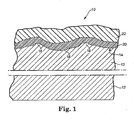
- Fig. 1 is a schematic cross-sectional view of a coated fiber cement article.
- a “latex" polymer means a dispersion or emulsion of polymer particles formed in the presence of water and one or more secondary dispersing or emulsifying agents (e.g., a surfactant, alkali-soluble polymer or mixtures thereof) whose presence is required to form the dispersion or emulsion.
- the secondary dispersing or emulsifying agent is typically separate from the polymer after polymer formation.
- a reactive dispersing or emulsifying agent may become part of the polymer particles as they are formed.
- a "water-dispersible" polymer means a polymer which is capable of being combined by itself with water, without requiring the use of a secondary dispersing or emulsifying agent, to obtain an aqueous dispersion or emulsion of polymer particles having at least a one month shelf stability at normal storage temperatures.
- compositions comprising a wax compound means that the composition includes one or more wax compounds.
- acrylate esters and “methacrylate esters” refer to esters of acrylic acid and esters of methacrylic acid, respectively. They may be referred to as (meth)acrylates or (meth)acrylate esters.
- olefinic compound refers to any monomer, oligomer or polymer containing reactive ethylenic unsaturation, such as vinyls, (meth)acrylates, vinyl ethers, allyl ethers, vinyl esters, unsaturated oils (including mono, di and triglycerides), unsaturated fatty acids, and the like.
- olefinic group refers to the reactive ethylenic unsaturated functional group in an olefinic compound.
- the present invention provides a coating system for a cement fiberboard substrate, such as a cement fiberboard siding product or other cement composite article.
- the coating system is a radiation-curable coating system applied to the substrate, wherein the coating system includes an aqueous dispersion of polymer particles (e.g., a latex polymer, water-dispersible polymer, or mixtures thereof), and one or more olefinic compounds.
- the coating system includes one or more coating compositions that may be applied in one or more layers, wherein each of the one or more coating compositions is preferably an aqueous composition or can be mixed with another composition (e.g., on the substrate) to form an aqueous composition.
- a coated article 10 of the present invention is shown in schematic cross-sectional view.
- Article 10 includes a cement fiberboard substrate 12.
- Substrate 12 typically is quite heavy and may for example have a density of 1 to 1.6 g/cm 3 or more.
- the first major surface 14 of substrate 12 may be embossed with small peaks or ridges 16 and valleys 18, e.g., so as to resemble roughsawn wood.
- Major surface 14 may have a variety of other surface configurations, and may resemble a variety of building materials other than roughsawn wood.
- Layer or layers 20 of the disclosed coating system lie atop and partially penetrate surface 14, and desirably are applied to article 10 at the location where article 10 is manufactured.
- Layers 20 help to protect substrate 12 against one or more of exposure to moisture, freeze-thaw cycles, UV exposure or atmospheric carbon dioxide. Layers 20 also may provide a firmly-adhered base layer upon which one or more firmly-adhered layers of final topcoat 22 may be formed. Final topcoat 22 desirably is both decorative and weather-resistant, and may be applied to article 10 at the location where article 10 is manufactured or after article 10 has been attached to a building or other surface.
- a variety of cement fiberboard substrates may be employed in the disclosed articles.
- the disclosed substrates typically include cement and a filler.
- Exemplary fillers include wood, fiberglass, polymers or mixtures thereof.
- the substrates can be made using methods such as, extrusion, the Hatschek method, or other methods known in the art. See, e.g ., U.S. Patent Application No. 2005/0208285 A1 (corresponds to International Patent Application No. WO 2005/071179 A1 ); Australian Patent Application No. 2005100347 ; International Patent Application No. WO 01/68547 A1 ; International Patent Application No. WO 98/45222 A1 ; U.S. Patent Application No. 2006/0288909 A1 ; and Australian Patent Application No.
- Non-limiting examples of such substrates include siding products, boards and the like, for uses including fencing, roofing, flooring, wall boards, shower boards, lap siding, vertical siding, soffit panels, trim boards, shaped edge shingle replicas and stone or stucco replicas.
- One or both major surfaces of the substrate may be profiled or embossed to look like a grained or roughsawn wood or other building product, or scalloped or cut to resemble singles.
- the uncoated substrate surface typically contains a plurality of pores with micron- or submicron-scale cross-sectional dimensions.
- fiber cement substrates are commercially available.
- fiber cement siding products are available from James Hardie Building Products Inc. of Mission Viejo, CA, including those sold as HARDIEHOMETM siding, HARDIPANELTM vertical siding, HARDIPLANKTM lap siding, HARDIESOFFITTM panels, HARDITRIMTM planks and HARDISHINGLETM siding. These products are available with an extended warranty, and are said to resist moisture damage, to require only low maintenance, to not crack, rot or delaminate, to resist damage from extended exposure to humidity, rain, snow, salt air and termites, to be non-combustible, and to offer the warmth of wood and the durability of fiber cement.
- Fiber cement siding substrates include AQUAPANELTM cement board products from Knauf USG Systems GmbH & Co. KG of Iserlohn, Germany, CEMPLANKTM, CEMPANELTM and CEMTRIMTM cement board products from Cemplank of Mission Viejo, CA; WEATHERBOARDSTM cement board products from CertainTeed Corporation of Valley Forge, PA; MAXITILETM, MAXISHAKETM AND MAXISLATETM cement board products from MaxiTile Inc. of Carson, CA; BRESTONETM, CINDERSTONETM, LEDGESTONETM, NEWPORT BRICKTM, SIERRA PREMIUMTM and VINTAGE BRICKTM cement board products from Nichiha U.S.A., Inc. of Norcross, GA, EVERNICETM cement board products from Zhangjiagang Evernice Building Materials Co., Ltd. of China and E BOARDTM cement board products from Everest Industries Ltd. of India.
- the disclosed articles may be coated on one or more surfaces with the disclosed radiation-curable coating system.
- the coating system includes one or more coating compositions that may be applied in one or more layers.
- the coating systems may be provided in a variety of embodiments.
- the coating system includes a latex polymer.
- Exemplary coating compositions for this embodiment include: (i) at least one latex polymer and at least one olefinic compound; or (ii) at least one latex polymer, at least one olefinic compound and at least one water-soluble silicate salt.
- the coating system includes at least one water-dispersible polymer.
- Exemplary coating compositions for this embodiment include: (iii) at least one water-dispersible polymer and at least one olefinic compound; or (iv) at least one water-dispersible polymer, at least one olefinic compound and at least one water-soluble silicate salt
- the coating system includes at least one latex polymer and at least one water-dispersible polymer.
- Exemplary coating compositions for this embodiment include: (v) at least one latex polymer, at least one water-dispersible polymer and at least one olefinic compound; or (vi) at least one latex polymer, at least one water-dispersible polymer, at least one olefinic compound and at least one water-soluble silicate salt.
- the coating system includes a first coating composition that includes at least one olefinic compound, and a second coating composition that includes at least one latex polymer.
- the two coating compositions may be applied to the substrate sequentially or concurrently and sequentially or simultaneously cured using radiation.
- the coating system includes a first coating composition that includes at least one olefinic compound, and a second coating composition that includes at least one water-dispersible polymer.
- the two coating compositions may be applied to the substrate sequentially or concurrently and sequentially or simultaneously cured using radiation.
- the coating system includes a first coating composition that includes at least one olefinic compound, and a second coating composition that includes at least one latex polymer and at least one water-dispersible polymer.
- the two coating compositions may be applied to the substrate sequentially or concurrently and sequentially or simultaneously cured using radiation.
- any of the above-mentioned first and second coating compositions may contain a water-soluble silicate salt.
- the olefinic compound in the disclosed coating systems appears to function as a reactive penetrant. This may be better appreciated by observing the coating system after it is applied to the substrate but before radiation curing is performed.
- the olefinic compound appears to improve wetting or penetration, and may help draw at least a portion of the aqueous dispersion of polymer particles into pores in the substrate.
- the olefmic compound also appears to help the cured coating adhere to the substrate following care.
- Preferred coating systems may also include one or more of the following additional features:
- a variety of polymeric materials may be employed in the disclosed aqueous dispersions of polymer particles including (meth)acrylics, vinyls, oil-modified polymers, polyesters, polyurethanes, polyamides, chlorinated polyolefins, and mixtures or copolymers thereof.
- Latex polymers are readily synthesized at modest cost and provide a preferred class of aqueous dispersions of polymer particles. Latex polymers are typically prepared through chain-growth polymerization, using one or more olefinic compounds (preferably monomers).
- Non-limiting examples of olefinic compounds which may be used to prepare latex polymers include ethylene, butadiene, propene, butene, iso-butene, acrylic acid, methacrylic acid, methyl acrylate, ethyl acrylate, propyl acrylate, butyl acrylate, 2-ethylhexyl acrylate, methyl methacrylate, ethyl methacrylate, propyl methacrylate, butyl methacrylate, 2-ethylhexyl methacrylate, hydroxyethyl acrylate, hydroxyethyl methacrylate, hydroxypropyl acrylate, hydroxybutyl acrylate, hydroxybutyl methacrylate, glycidyl methacrylate, 4-hydroxybutyl acrylate glycidylether, acrylamide, methylacrylamide, styrene, ⁇ -methyl styrene, vinyl toluene, vinyl
- the latex polymers are typically stabilized using one or more nonionic or anionic emulsifiers ( viz ., surfactants), used either alone or together.
- nonionic emulsifiers include tert-octylphenoxyethylpoly(39)-ethoxyethanol, dodecyloxypoly(10)ethoxyethanol, -nonylphenoxyethyl-poly(40)ethoxyethanol, polyethylene glycol 2000 monooleate, ethoxylated castor oil, fluorinated alkyl esters and alkoxylates, polyoxyethylene (20) sorbitan monolaurate, sucrose monococoate, di(2-butyl)phenoxypoly(20)ethoxyethanol, hydroxyethylcellulosepolybutyl acrylate graft copolymer, dimethyl silicone polyalkylene oxide graft copolymer, poly(ethylene oxide)poly(butyl acrylate) block copolymer, block
- anionic emulsifiers include sodium lauryl sulfate, sodium dodecylbenzenesulfonate, potassium stearate, sodium dioctyl sulfosuccinate, sodium dodecyldiphenyloxide disulfonate, nonylphenoxyethylpoly(1)ethoxyethyl sulfate ammonium salt, sodium styrene sulfonate, sodium dodecyl allyl sulfosuccinate, linseed oil fatty acid, sodium or ammonium salts of phosphate esters of ethoxylated nonylphenol, sodium octoxynol-3-sulfonate, sodium cocoyl sarcocinate, sodium 1-alkoxy-2-hydroxypropyl sulfonate, sodium alpha-olefin (C 14 -C 16 ) sulfonate, sulfates of hydroxyalkanols
- the latex polymers may be stabilized with an alkali-soluble polymer.
- Alkali-soluble polymers may be prepared by making a polymer with acrylic or methacrylic acid or other polymerizable acid monomer (usually greater than 10%) and solubilizing the polymer by addition of ammonia or other base. See, e.g ., U.S. Patent Application Serial Nos. 11/300,070 and 11/342,412 .
- alkali-soluble polymers include JONCRYL TM 675 and JONCRYL 678.
- One exemplary process for preparing alkali soluble polymers is outlined in US Patent 5,962,571 .
- a water-soluble free radical initiator is typically used in the polymerization of a latex polymer. Exemplary water-soluble free radical initiators are described below.
- the amount of initiator is preferably from 0.01 wt. % to 3 wt. %, based on the total amount of monomer.
- the amount of reducing agent is preferably from 0.01 wt. % to 3 wt. %, based on the total amount of monomer.
- the reaction temperature may be in the range of 10°C to 100°C.
- Exemplary commercially available latex polymers include AIRFLEX TM EF811 (available from Air Products), EPS 2505 (available from EPS/CCA) and NEOCAR TM 2300, NEOCAR 820 and NEOCAR 2535 (available from Dow Chemical Co.).
- Other exemplary latex polymers include the latex polymers described in copending U.S. Patent Application Serial No. 11/560,329 filed November 15, 2006 .
- the latex polymer may optionally also be functionalized with olefinic groups or other crosslinkable groups where it is desired to enable the latex polymer to participate in radiation curing.
- exemplary functionalized latex polymers include ROSHIELD TM 3120 (available from Rohm & Haas) and the AAEM-functional latex polymers disclosed in U.S. Patent Application Serial Nos. 11/300,070 filed December 14, 2005 and 11/342,412 filed January 30, 2006 , and in the above-mentioned Application Serial No. 11/560,329 .
- water-dispersible polymers may also be used in the disclosed coating systems.
- Exemplary water-dispersible polymers include polyurethanes, polyamides, chlorinated polyolefins, (meth)acrylics, vinyls, oil-modified polymers, polyesters, and mixtures or copolymers thereof.
- the water-dispersible polymer typically will include as a part of the polymer a group or groups which render the polymer dispersible by itself in water.
- the water-dispersible polymer is a water-dispersible polyurethane.
- Water-dispersible polyurethanes may be made in a variety of ways.
- One method for preparing water-dispersible polyurethanes involves reacting one or more isocyanates with one or more hydroxy compounds that include an appropriate functional group.
- exemplary such functional groups include salt-forming groups.
- basic salt forming groups can be introduced by reacting a suitable compound (e.g ., a polyisocyanate) with a compound containing active hydrogen groups and active basic groups neutralized with an acid.
- a suitable compound e.g ., a polyisocyanate
- exemplary compounds having active hydrogen groups and active basic groups include aliphatic, cycloaliphatic and heterocyclic amino alcohols, diols and triols, amine, diamines, triamines, tetramines and amides.
- Exemplary neutralizing acids include organic acids such as formic acid and acetic acid and inorganic acids such as hydrochloric acid and sulfuric acid.
- Polyurethanes can also be made water-dispersible by incorporating amine or acid functionality.
- Water-based anionically stabilized polyurethane polymers can be prepared by reacting polyols and dihydroxy carboxylic acid compounds with an excess of diisocyanate to provide a carboxylic acid functional prepolymer having NCO terminal groups. The acid groups can be neutralized with tertiary amines to provide salt groups and the neutralized prepolymer can be dispersed in water.
- the anionic stabilizing group of the water-dispersible polyurethane polymers may be replaced with a cationic stabilizing group or a nonionic stabilizing group, to facilitate water dispersibility.
- a polyurethane may be rendered water-dispersible by ionic stabilization using either an acid or a base.
- cationic stabilizing groups or nonionic stabilizing groups to facilitate combination of a water-dispersible polymer with water is not the same as a requirement to use a secondary dispersing or emulsifying agent to form an aqueous latex polymer.
- the water-dispersible polymer may also be functionalized with olefinic groups or other crosslinkable groups where it is desired to enable the water-dispersible polymer to participate in radiation curing.
- olefinic groups may be introduced into a water-dispersible polyurethane by reacting a hydroxy-functional (meth)acrylate, hydroxy-functional allyl ether, hydroxy-functional vinyl ether, monoglycerides or diglycerides with the aforementioned isocyanate, or by reacting an ester polyol or oil-modified polymer (including alkyd oil-modified polymers) containing auto-oxidative carbon-carbon double bonds with the aforementioned isocyanate.
- Preferred olefinic groups include (meth)acrylate groups and groups containing auto-oxidative carbon-carbon double bonds.
- Exemplary isocyanates include diisocyanates, triisocyanates and other polyisocyanates.
- Preferred polyisocyanates have 4 to 25 carbon atoms and 2 to 4 isocyanate groups per molecule, and include aliphatic, cycloaliphatic and aromatic isocyanates, and mixtures thereof.
- Exemplary hydroxy-functional (meth)acrylates include alkyl and cycloalkyl hydroxy-functional (meth)acrylates, such as 2-hydroxyethyl (meth)acrylates, 3-hydroxypropyl (meth)acrylates, 4-hydroxybutyl (meth)acrylates, 2-hydroxy-2-methylethyl (meth)acrylates, and 4-hydroxycyclohexyl (meth)acrylates, as well as other similar hydroxy-functional aliphatic (meth)acrylates.
- alkyl and cycloalkyl hydroxy-functional (meth)acrylates such as 2-hydroxyethyl (meth)acrylates, 3-hydroxypropyl (meth)acrylates, 4-hydroxybutyl (meth)acrylates, 2-hydroxy-2-methylethyl (meth)acrylates, and 4-hydroxycyclohexyl (meth)acrylates, as well as other similar hydroxy-functional aliphatic (meth)acrylates.
- hydroxy-functional (meth)acrylates include hydroxy-functional (meth)acrylate polyesters such as caprolactone 2-((meth)acryloyloxy)ethyl esters, dicaprolactone 2-((meth)acryloyloxy)ethyl esters, higher molecular weight caprolactone homologues and hydroxy-functional (meth)acrylate polyethers.
- Exemplary hydroxy-functional (meth)allyl ethers contain at least one hydroxyl group and one or more allyl ether groups, such as hydroxyethyl allyl ether, hydroxypropyl allyl ether, trimethylolpropane monoallyl ether, trimethylolpropane diallyl ether, trimethylolethane monoallyl ether, trimethylolpropane dimethallyl ether (TMPDE), and the like.
- allyl ether groups such as hydroxyethyl allyl ether, hydroxypropyl allyl ether, trimethylolpropane monoallyl ether, trimethylolpropane diallyl ether, trimethylolethane monoallyl ether, trimethylolpropane dimethallyl ether (TMPDE), and the like.
- Exemplary hydroxy-functional vinyl ether compounds contain at least one hydroxyl group and one or more vinyl ether groups, such as 4-hydroxybutyl vinyl ether, cyclohexanedimethanol monovinyl ether, ethylene glycol monovinyl ether, diethylene glycol monovinyl ether, and the like.
- Exemplary ester polyols containing auto-oxidative carbon-carbon double bonds may be made by reaction of an aromatic or aliphatic polyol containing at least two hydroxyl groups per molecule with an unsaturated fatty acid containing auto-oxidative carbon-carbon double bonds.
- Exemplary polyols include ethylene glycol, propylene glycol, 1,3-propane diol, 1,3-butylene glycol, 1,4-butane diol, bisphenol A, trimethylol propane, trimethylol ethane, pentaerythritol, glycerin, neopentyl glycol, cyclohexane dimethanol, and mixtures thereof.
- Exemplary unsaturated fatty acids include linoleic, palmitoleic, linolenic, eleostearic, arachidonic, ricinoleic, 10,12-octadecadienoic acid, and mixtures thereof.
- Water-dispersible polyurethanes containing olefinic groups can also be prepared by utilizing the reaction product formed via transesterification of an oil containing auto-oxidative carbon-carbon double bonds with an aromatic or aliphatic polyol containing at least two hydroxyl groups per molecule.
- oils include linseed oil, soybean oil, safflower oil, tall oil, sunflower oil, dehydrated caster oil, castor oil, ricine oil, tung oil, sardine oil, olive oil, cottonseed oil and mixtures thereof.
- Exemplary polyols include ethylene glycol, propylene glycol, 1,3-propane diol, 1,3-butylene glycol, 1,4-butane diol, bisphenol A, trimethylol propane, trimethylol ethane, pentaerythritol, glycerin, neopentyl glycol, cyclohexane dimethanol, and mixtures thereof.
- Oil-modified polymers may also be used as latex polymers or if appropriately stabilized as water-dispersible polymers.
- oil-modified polymers include polymers that contain oils or oil based derivatives such as glyceride oils (monoglycerides, diglycerides, and the like), fatty acids, fatty amines, and mixtures thereof.
- oils or oil based derivatives such as glyceride oils (monoglycerides, diglycerides, and the like), fatty acids, fatty amines, and mixtures thereof.
- examples of such oil-modified polymers include alkyds, oil-modified polyurethanes, oil-modified polyamides, oil-modified acrylics, and mixtures or copolymers thereof.
- the oil-modified polymer is an oil-modified polyurethane or an alkyd. Oil-modified polymers are readily synthesized and can be made to be water-dispersible if desired using conventional techniques.
- the disclosed coating systems or coating compositions preferably contain 90 to 30 % by weight of the aqueous dispersion of polymer particles based on the total weight of the non-volatile components in the coating system, more preferably 80 to 35 % by weight and most preferably 70 to 40 % by weight If both a latex polymer and a water-dispersible polymer are employed, the amount of latex polymer may be less than or more than the amount of water-dispersible polymer.
- olefinic compounds may be used in the disclosed coating systems.
- the olefinic compounds are distinct from the aqueous dispersion of polymer particles, and are carbon-containing compounds having at least one site of unsaturation which can react, optionally in the presence of an initiator, to provide polymeric or crosslinked products.
- Non-limiting examples of olefinic compounds include monomers such as (meth)acrylates, vinyls, vinyl ethers, allyl ethers, vinyl esters, unsaturated oils (including mono-, di- and tri-glycerides), unsaturated fatty acids, and the like or mixtures thereof.
- the olefinic compounds also include oligomers or polymers having at least one site of unsaturation which can react, optionally in the presence of an initiator, to provide polymeric or crosslinked products.
- Exemplary olefinic monomers include (meth)acrylate esters of unsubstituted or substituted C 1 -C 15 alcohols such as tripropylene glycol, isobornyl alcohol, isodecyl alcohol, phenoxyethyl alcohol, tris-hydroxyethyl isocyanurate, trimethylolpropane ethoxylate (TMPTA), ditrilnethylolpropane ethoxylate (diTMPTA), hexanediol, ethoxylated neopentyl glycol, propoxylated neopentyl glycol, ethoxylated phenol, polyethylene glycol, bisphenol A ethoxylate, trimethylolpropane, propoxylated glycerol, pentaerythritol, tetrahydrofurfuryl alcohol, ⁇ -carboxyethyl alcohol, or combination thereof.
- TMPTA trimethylolpropan
- the olefinic monomer may be isobornyl (meth)acrylate, isodecyl (meth)acrylate, phenoxyethyl (meth)acrylate, trimethylolpropane tri(meth)acrylate, alkoxylated cyclohexane dimethanol di(meth)acrylate, trimethylolpropane ethoxylate tri(meth)acrylate, dipropylene glycol di(meth)acrylate, tripropylene glycol di(meth)acrylate, hexanediol di(meth)acrylate, tetrahydrofurfuryl (meth)acrylate, pentaerythritol tri(meth)acrylate, pentaerythritol tetra(meth)acrylate, di-(trimethylolpropane tetra(meth)acrylate), propoxylated glycerol tri(meth)acrylate, beta-carboxyethyl
- the olefinic monomer may contain a (C 1 -C 15 ) alcohol radical such as hydroxymethyl, 1-hydroxyethyl, 2-hydroxyethyl, 1-hydroxypropyl, 2-hydroxypropyl, 3-hydroxypropyl, 1-hydroxybutyl, 4-hydroxybutyl, 1-hydroxypentyl, 5-hydroxypentyl, 1-hydroxyhexyl, 6-hydroxyhexyl, 1,6-dihydroxyhexyl, 1,4-dihydroxybutyl, and the like.
- a (C 1 -C 15 ) alcohol radical such as hydroxymethyl, 1-hydroxyethyl, 2-hydroxyethyl, 1-hydroxypropyl, 2-hydroxypropyl, 3-hydroxypropyl, 1-hydroxybutyl, 4-hydroxybutyl, 1-hydroxypentyl, 5-hydroxypentyl, 1-hydroxyhexyl, 6-hydroxyhexyl, 1,6-dihydroxyhexyl, 1,4-dihydroxybutyl, and the like.
- Exemplary allyl ether monomers contain one or more allyl ether groups which typically are bonded to a core structural group which can be based on a wide variety of polyhydric alcohols.
- suitable polyhydric alcohols include neopentyl glycol, trimethylolpropane, ethylene glycol, propylene glycol, butylene glycol, diethylene glycol, trimethylene glycol, triethylene glycol, trimethylolethane, pentaerythritol, glycerol, diglycerol, 1,4-butanediol, 1,6-hexanediol, 1,4-cyclohexanedimethanol, and any of the other polyols mentioned above in connection with the (meth)acrylate esters.
- exemplary allyl ether monomers include hydroxyethyl allyl ether, hydroxypropyl allyl ether, trimethylolpropane monoallyl ether, trimethylolpropane diallyl ether, trimethylolethane monoallyl ether, trimethylolethane diallyl ether, glycerol monoallyl ether, glycerol diallyl ether, pentaerythritol monoallyl ether, pentaerythritol diallyl ether, pentaerythritol triallyl ether, 1,2,6-hexanetriol monoallyl ether, 1,2,6-hexanetriol diallyl ether, and the like.
- Preferred allyl ethers include poly propoxylated and ethoxylated forms of allyl ethers.
- Exemplary vinyl ether monomers contain one or more vinyl ether groups and include 4-hydroxybutyl vinyl ether, 1,4-cyclohexanedimethanol monovinyl ether, 1,4-cyclohexanedimethanol divinyl ether, ethylene glycol monovinyl ether, ethylene glycol divinyl ether, diethylene glycol monovinyl ether, diethylene glycol divinyl ether, triethylene glycol divinyl ether, and the like.
- Preferred vinyl ether monomers include propoxylated or ethoxylated forms of vinyl ether monomers.
- the disclosed coating systems or coating compositions preferably contain 2 to 50 % by weight separate olefinic compounds based on the total weight of the non-volatile components in the coating system, more preferably 5 to 40 % by weight and most preferably 10 to 35 % by weight.
- a subset of the previously mentioned olefinic compounds e.g ., hexanediol di(meth)acrylate, trimethylolpropane tri(meth)acrylate and di-trimethyolpropane tetra(meth)acrylate
- These monomers or oligomers can function as crosslinking agents.
- Crosslinking can also occur when the aqueous dispersion of polymer particles has been functionalized so that the polymer can participate in radiation curing.
- the term "reactive sites" or “active groups” refers to a group that can react to form a covalent bond linking or otherwise chemically joining two or more molecules.
- the disclosed coating systems may include one or more optional water-soluble silicate salts.
- silicate salts include lithium silicate, potassium silicate, sodium silicate, ammonium silicate and the like.
- the amount of silicate salt is from 2 to 50 % by weight, more preferably from 5 to 40 % by weight and most preferably from 10 to 35 % by weight, based on the total weight of the non-volatile components.
- Silicate salts are available through a variety of chemical suppliers.
- sodium silicate (sometimes referred to as waterglass) is available in a variety of forms including sodium orthosilicate (Na 4 SiO 4 ), sodium metasilicate (Na 2 SiO 3 ), sodium polysilicate ((Na 2 SiO 3 )n) and sodium pyrosilicate (Na 6 Si 2 O 7 ).
- sodium silicate and potassium silicate (sometimes referred to as potassium waterglass) are available from PQ Corporation, Valley Forge, PA.
- a Wet Adhesion Test maybe carried out as follows to evaluate adhesion of the coating system after a coated cement fiberboard substrate has been saturated with water. According to this test procedure, coated substrates (e.g., fiber cement boards) are soaked in room temperature water for 24 hours. After soaking, the boards are removed from the water and kept at room temperature for 24 hours. A six-inch (15.24 cm) length of 3M HD 250 tape is applied to the surface of the board with the long axis of the tape in the direction of any embossing patterns that may be present. The tape is firmly pressed onto the board ensuring full contact.
- coated substrates e.g., fiber cement boards
- the tape is then removed by quickly pulling it off at a 90-degree angle to the board.
- "Wet Adhesion" performance is rated based on the percent of coating removed from the cement board. Performance is further assessed by noting where any failure occurs. For example, failure may occur between interfacial coating layers, between the coating and the surface of the board, or within the board itself. Preferred coating systems or coating compositions typically have less than 25% coating removal, more preferably less than 15% coating removal. In addition, the failure preferably is within the board as indicated by a significant amount of fiber from the board adhering to the removed coating.
- Preferred coated articles can withstand at least 30 freeze-thaw cycles, when tested according to ASTM D6944-03, Test Method A. As written, this ASTM test method recites a 30-cycle sequence. However, rather than simply grade a specimen as a "pass" at the end of 30 cycles, the test desirably is lengthened to include additional cycles. More preferably, the coated articles can withstand at least 75 freeze-thaw cycles, most preferably at least 125 freeze-thaw cycles and optimally at least 175 freeze-thaw cycles.
- the disclosed coating systems or coating compositions preferably have improved, viz., lower, volatile organic content (VOC).
- VOC volatile organic content
- the coating systems or coating compositions desirably have a VOC of less than 5 %, based on the total weight of the coating system, preferably a VOC of less than 2 %, more preferably a VOC of less than 0.5 %.
- the olefinic compounds are curable by radiation, e.g., visible light, ultra violet light, electron beam, and the like.
- An initiator system is not required for electron beam curing but for other radiation sources typically will be chosen based on the particular type of curing energy (e.g., UV, visible light or other energy) and curing mechanism (e.g ., free-radical, cationic or other curing mechanism) employed.
- the coating system is electron beam curable and does not require an initiator.
- the coating system is UV curable and free-radically polymerizable, and includes a UV photoinitiator system which generates free radicals in response to UV light and thereby cures the coating.
- Non-limiting examples of initiators include peroxide compounds, azo compounds, cationic-generating initiators, cleavage-type initiators, hydrogen abstraction-type initiators, and the like.
- Exemplary peroxide compounds include t-butyl perbenzoate, t-amyl perbenzoate, cumene hydroperoxide, t-amyl peroctoate, methyl ethyl ketone peroxide, benzoyl peroxide, cyclohexanone peroxide, 2,4-pentanedione peroxide, di-t-butyl peroxide, t-butyl hydroperoxide and di-(2-ethylhexyl)-peroxydicarbonate.
- the curing agent is t-butyl perbenzoate, methyl ethyl ketone peroxide, or cumene hydroperoxide.
- Methyl ethyl ketone peroxide conveniently is employed as a solution in dimethyl phthalate, e.g., LUPERSOL TM DDM-9 from Ato-Chem.
- Exemplary azo compounds include 2,2-azo bis-(2,4-dimethylpentanenitrile), 2,2-azo bis-(2-methylbutanenitrile) and 2,2-azo bis-(2-methylpropanenitrile).
- Exemplary cationic-generating photoinitiators include super acid-generating photoinitiators such as triaryliodonium salts, triarylsulfonium salts and the like.
- a preferred triarylsulfonium salt is triphenyl sulfonium hexafluorophosphate.
- Exemplary cleavage-type photoinitiators include ⁇ , ⁇ -diethoxyacetophenone (DEAP); dimethoxyphenylacetophenone (IRGACURE TM 651); hydroxycyclo-hexylphenylketone (IRGACURE TM 184); 2-hydroxy-2-methyl-1-phenylpropan-1-one (DAROCUR TM 1173); a 25:75 blend of bis-(2,6-dimethoxybenzoyl)-2,4,4-trimethylpentyl phosphine oxide and 2-hydroxy-2-methyl-1-phenylpropan-1-one (IRGACURE TM 1700), a 50:50 blend of hydroxycyclo-hexylphenylketone and benzophenone (IRGACURE TM 500), 50:50 blend of 2,4,6-trimethylbenzoyl-diphenyl-phosphineoxide and 2-hydroxy-2-methyl-1-phenyl-propan-1-one (DAROCUR TM 4265), bis acryl
- cleavage-type initiators include 2,4,6-trimethylbenzoyl-diphenylphosphine oxide (LUCIRIN TM TPO) from BASF Corporation and a 70:30 blend of oligo 2-hydroxy-2-methyl-[4-(1-methylvinyl)phenyl]propan-1-one and 2-hydroxy-2-methyl-1-phenylpropan-1-one (KIP TM 100) available from Sartomer (Exton, Pa.).
- LOCIRIN TM TPO 2,4,6-trimethylbenzoyl-diphenylphosphine oxide
- KIP TM 100 2-hydroxy-2-methyl-1-phenylpropan-1-one
- Preferred cleavage-type photoinitiators are hydroxycyclo-hexylphenylketone, 2-hydroxy-2-methyl-1-phenylpropan-1-one, benzophenone, 2,4,6-trimethylbenzoyl-diphenylphosphine oxide bis acryl phosphine and a 70:30 blend of 2-hydroxy-2-methyl-[4-(1-methylvinyl)phenyl]propan-1-one and 2-hydroxy-2-methyl-1-phenylpropan-1-one.
- Non-limiting examples of hydrogen abstraction-type photoinitiators include benzophenone, substituted benzophenones (e.g ., ESCACURE TM TZT of Fratelli-Lamberti) and other diaryl ketones such as xanthones, thioxanthones, Michler's ketone, benzil, quinones and substituted derivatives of all of the above.
- Camphorquinone is an example of a compound that may be used when one desires to cure a coating composition with visible light
- a combination of curing procedures can be used.
- a coating composition having a latex polymer, a (meth)acrylate and a vinyl ether functional group typically may include an ⁇ -cleavage-type or hydrogen abstraction type photoinitiator for polymerization of the (meth)acrylate groups and a cationic-generating photoinitiator for polymerization of the vinyl ether groups.
- the coating composition or system may also include a co-initiator or photoinitiator synergist.
- co-initiators include (1) tertiary aliphatic amines such as methyl diethanol amine and triethanol amine; (2) aromatic amines such as amylparadimethylaminobenzoate, 2-n-butoxyethyl-4-(dimethylamino) benzoate, 2-(dimethylamino)ethylbenzoate, ethyl-4-(dimethylamino)benzoate and 2-ethylhexyl-4-(dimethylamino)benzoate; (3) (meth)acrylated amines such as EBECRYL TM 7100 and UVECRYL TM P104 and P115, all from UCB RadCure Specialties; and (4) amino-functional acrylate or methacrylate resin or oligomer blends such as EBECRYL TM 3600 or EBECRY
- the preferred amount of photoinitiator present in the coating systems can be from 0.2 to 15 wt. % of the non-volatile components. More preferably the photoinitiator can be from 0.5 to 10 wt. %, and most preferably the photoinitiator can be from 0.75 to 5 wt. % of the non-volatile components.
- Such other curing methods include heat cure, chemical cure, anaerobic cure, moisture cure, oxidative cure, and the like. Such methods may require inclusion of a corresponding curing initiator or curing agent in the composition.
- heat cure can be induced by peroxides
- metal curing packages can induce an oxidative cure
- multifunctional amines for example isophorone diamine
- can effect a chemical crosslinking cure through Michael addition of amine groups onto acrylate reactive unsaturated groups If these additional initiators are present in the coating system they typically make up 0.1-12% by weight of the curable coating system. Means for effecting cures by such methods are known to those of skill in the art or can be determined using standard methods.
- Typical performance enhancing additives include surface active agents, pigments, colorants, dyes, surfactants, dispersants, defoamers, thickeners, heat stabilizers, leveling agents, coalescents, biocides, mildewcides, anti-cratering agents, curing indicators, plasticizers, fillers, sedimentation inhibitors, ultraviolet light absorbers, optical brighteners, and the like to modify properties.
- the coating systems may also contain an optional coalescent and many coalescents are known in the art.
- the optional coalescent is preferably a low VOC coalescent such as is described in U.S. Pat. No. 6,762,230 .
- Compositions including a latex polymer will also include a secondary dispersing or emulsifying agent, such as a nonionic or anionic surfactant, as described above.
- a secondary dispersing or emulsifying agent such as a nonionic or anionic surfactant, as described above.
- the secondary dispersing or emulsifying agent may also assist in combining an olefinic compound with the latex polymer.
- Exemplary coating compositions that can be used in the coating systems are listed below. This is not intended to be an exhaustive list of examples of aqueous based coating compositions.
- the examples include the following compositions: A Olefinic compound and an optional initiator (e.g ., a UV photoinitiator) B1 Latex polymer; B2 Latex polymer and water-dispersible polymer (e.g ., a polyurethane dispersion); B3 Latex polymer and water-soluble silicate salt; B4 Latex polymer, water-dispersible polymer and water-soluble silicate salt; B5 Water-dispersible polymer; B6 Water-dispersible polymer and water-soluble silicate salt; and C1-C6
- the above compositions B1-B6 further comprising one or more olefinic compounds and an optional initiator (e.g ., a UV photoinitiator).
- composition A An example of a coating composition for use in the coating system includes one or more olefinic compounds and an optional initiator.
- Monomeric and oligomeric olefinic compounds are preferred with monomeric olefinic compounds being most preferred.
- An exemplary preferred monomeric olefinic compound is trimethylolpropane tri-acrylate (TMPTA) (available from Sartomer).
- An exemplary preferred initiator is 2-hydroxy-2-methyl-1-phenylpropan-1-one (DAROCUR TM 1173, available from Ciba).
- Composition B 1 - Another example of a coating composition for use in the coating system includes an aqueous latex polymer (e.g ., EPS 2505, EPS 2502, EPS 2520 or EPS 2568 latex polymer; available from EPS) or AIRFLEX EF811 (available from Air Products) or ROSHIELD 3120 (available from Rohm & Haas) or NEOCAR 2535 latex polymer (available from Dow) or the polymers described in the above-mentioned U.S. Patent Nos. US 2006-0135684 A1 , US 2006 - 0135686 A1 and US 2007-110981 A1 ( U.S. Patent Application Serial Nos. 11/300,070 , 11/342,412 and 11/560,329 ).
- aqueous latex polymer e.g EPS 2505, EPS 2502, EPS 2520 or EPS 2568 latex polymer; available from EPS
- AIRFLEX EF811 available from Air Products
- Composition B2 - Another example of a coating composition for use in the coating system includes an aqueous mixture of (i) latex polymer (e.g ., those used in Composition B1); and (ii) water-dispersible polymer (e.g ., a polyurethane dispersion such as EPS 4208 (available from EPS) or LUX 399 (available from Alberdink Boley)).
- EPS 4208 available from EPS
- LUX 399 available from Alberdink Boley
- Composition B3 - Another example of a coating composition for use in the coating system includes an aqueous mixture of (i) latex polymer (e.g ., those used in Composition B1); and (ii) a water-soluble silicate salt such as described above (e.g ., potassium silicate).
- a water-soluble silicate salt such as described above (e.g ., potassium silicate).
- Composition B4 Another example of a coating composition for use in the coating system includes an aqueous mixture of (i) latex polymer (e.g ., those used in Composition B1); (ii) water-dispersible polymer (e.g ., those used in Composition B2); and (iii) a water-soluble silicate salt (e.g ., potassium silicate).
- latex polymer e.g ., those used in Composition B1
- water-dispersible polymer e.g ., those used in Composition B2
- a water-soluble silicate salt e.g ., potassium silicate
- Composition B5 Another example of a coating composition for use in the coating system includes a water-dispersible polymer (e.g ., those used in Composition B2).
- composition B6 Another example of a coating composition for use in the coating system includes an aqueous mixture of (i) water-dispersible polymer (e.g ., those used in Composition B2) and (ii) a water-soluble silicate salt (e.g ., potassium silicate).
- a water-soluble silicate salt e.g ., potassium silicate
- compositions C1 to C6 The aforementioned exemplary coating compositions B1 to B6 respectively further comprising one or more olefinic compounds and an optional initiator (e.g., those used in Composition A).
- the coating system can be applied as multiple applications of more than one coating composition which collectively contain at least one aqueous dispersion of polymer particles and at least one olefinic compound, or as a single application of a coating composition containing at least one aqueous dispersion of polymer particles and at least one olefinic compound.
- Application of a coating composition containing at least one olefinic compound followed by application of a coating composition containing at least one aqueous dispersion of polymer particles is preferred.
- Other modes or orders of application of the selected coating compositions can be readily determined by a person skilled in the art. Exemplary descriptions of several coating systems are provided below.
- An example of a coating system that may be used to prepare a coated article includes a latex polymer, one or more olefinic monomers and an optional initiator. This system includes the application of coating composition B 1 to the article, followed by or preceded by application of coating composition A to the article.
- Another example of a coating system that may be used to prepare a coated article includes a latex polymer, one or more olefinic monomers and an optional initiator. This system includes the application of coating composition C1 to the article.
- This system includes the application of coating composition B1 to the article, followed by or preceded by application of coating composition C2 to the article.
- This system includes the application of coating composition B 1 to the article, followed or preceded by application of coating composition C5 to the article.
- This system includes the application of coating composition C2 to the article, followed or preceded by application of coating composition B3 to the article.
- Another example of a coating system that may be used to prepare a coated article includes a water-dispersible polymer, one or more olefinic oligomers and an optional initiator. This system includes the application of coating composition C5 to the article.
- a variety of application routes may be employed for preparing the coated articles. Specific application routes include:
- the articles can be prepared by applying the coating system as a single coating composition or the coating system can be applied as multiple compositions.
- the applied coating composition(s) can be dried (to remove at least a portion of the water) prior to curing or addition of one or more additional coating compositions, or (ii) the coating composition(s) can be applied prior to drying the previously applied coating composition(s), thus allowing the coating compositions to mix at an interface.
- the disclosed aqueous coating composition(s) are preferably applied at 5 to 50 % solids by weight and more preferably at 10 to 40 % solids.
- Preferred coating composition(s) contain less than 5 % volatile organic compounds based on the total composition weight, more preferably less than 0.5 %.
- the coating systems may be applied by any number of application techniques including but not limited to brushing (e.g., using a brush coater), direct roll coating, reverse roll coating, flood coating, vacuum coating, curtain coating and spraying.
- the various techniques each offer a unique set of advantages and disadvantages depending upon the substrate profile, morphology and tolerable application efficiencies. Lower viscosities facilitate uniform film control.
- the applied film thickness may be controlled for example by varying the application rate.
- the disclosed coating systems may for example be applied to a cement fiberboard substrate by roll coating.
- a dry film thickness (DFT) of the coating system on the cement fiberboard substrate may for example be in the range of, but not limited to, 0.2 to 4 mil (0.005 to 0.1 mm), more preferably 0.3 to 3 mil (0.008 to 0.08 mm).
- the coated articles are coated on at least one major surface with the coating system. More preferably, the coated articles are coated on a major surface and up to four minor surfaces including any edges. Most preferably, the coated articles are coated on all (e.g., both) major surfaces, and up to four minor surfaces including any edges.
- a topcoat may be applied directly to the coating system.
- the coating systems and coating compositions described herein may be used in place of or in addition to coatings that the prior art has categorized as “sealers,” “primers” and “topcoats.” However, the systems and compositions may not fit neatly into any category per se and such terms should not be limiting.
- Example 1a In a mixing vessel the following components are added under agitation: DAROCUR 1173 1.9 grams TMPTA 9.5 grams
- the coating system After mixing for 30 minutes, the coating system is allowed to de-air. The coating system is then applied to a fiber cement article at a dry film thickness of 0.5 to 0.7 mils, and a portion of the water is removed, either by air drying, a heated drying stage or by application to a warm substrate ( ⁇ 38 °C). The resulting mixture will cure upon exposure to ultraviolet light Application of a topcoat as described in the abovemention US. Patent Nos. US 2006 - 0135 684 A1 , US 2006 - 0135 686 A1 and US 2007 - 0110981 A1 ( U.S. Patent Application Serial Nos. 11/300,070 , 11/342,412 and 11/560,329 ) should provide an improved freeze thaw and wet adhesion coating system for fiber cement.
- Example 1b The above procedure maybe repeated, but without using the photoinitiator.
- the resulting mixture should cure upon exposure to electron beam radiation, and application of a topcoat as described in the above-mentioned US. Patent Nos. US 2006 - 0135 684 A1 , US 2006 - 0135 686 A1 and US 2007 - 0110981 A1 ( U.S. Patent Application Serial Nos. 11/300,070 , 11/342,412 and 11/560,329 ) should provide an improved freeze thaw and wet adhesion coating system for fiber cement
- Example 2a In a mixing vessel the following components are added under agitation: DAROCUR 1173 1.9 grams TMPTA 9.5 grams
- the coating system After mixing for 30 minutes, the coating system is allowed to de-air. The coating system is then applied to a fiber cement article at a dry film thickness of 0.5 to 0.7 mils, and a portion of the water is removed, either by air drying, a heated drying stage or by application to a warm substrate ( ⁇ 38 °C). The resulting mixture will cure upon exposure to ultraviolet light.
- Application of a topcoat as described in the abovementioned U.S. Patent Nos. US 2006 - 0135 684 A1 , US 2006 - 0135 686 A1 and US 2007 - 0110 981 A1 U.S. Patent Application Serial Nos. 11/300,070 , 11/342,412 and 11/560,329 ) should provide an improved freeze thaw and wet adhesion coating system for fiber cement.
- Example 2b The above procedure may be repeated, but without using the photoinitiator.
- the resulting mixture should cure upon exposure to electron beam radiation, and application of a topcoat as described in the above-mentioned U.S. Patent Nos. US 2006 - 0135 684 A1 , US 2006 - 0135 686 A1 and US 2007 - 0110 981 A1 ( U.S. Patent Application Serial Nos. 11/300,070 , 11/342,412 and 11/560,329 ) should provide an improved freeze thaw and wet adhesion coating system for fiber cement
- Example 3a In a mixing vessel the following components were added under agitation: DAROCUR 1173 1.9 grams TMPTA 9.5 grams
- the coating system was allowed to de-air.
- the coating system was applied to a fiber cement article at a dry film thickness of 0.5 to 0.7 mils.
- the coated article was heated in an oven at 300°F (148.9°C) until the surface of the article was 160°F (71.1°C).
- the resulting coating system was cured using ultraviolet light.
- topcoat as described in the above-mentioned U.S. Patent Nos. US 2006 - 0135684 A1 , US 2006 - 0135 686 A1 and US 2007 - 0110 981 A1 ( U.S. Patent Application Serial Nos. 11/300,070 , 11/342,412 and 111560,329 ) should provide an improved freeze thaw and wet adhesion coating system for fiber cement.
- Example 3b The above procedure may be repeated, but without using the photoinitiator.
- the resulting mixture should cure upon exposure to electron beam radiation and application of a topcoat as described in the above-mentioned U.S. Patent Nos. US 2006 - 0135684 A1 , US 2006 - 0135 686 A1 and US 2007 - 0110 981 A1 ( U.S. Patent Application Serial Nos. 11/300,070 , 11/342,412 and 11/660,329 ) should provide an improved freeze thaw and wet adhesion coating system for fiber cement
- Example 4a In a mixing vessel the following components are added under agitation: DAROCUR 1173 1.5 grams DiTMPTA grams
- the coating system After mixing for 30 minutes, the coating system is allowed to de-air. The coating system is then applied to a fiber cement article at a dry film thickness of 0.5 to 0.7 mils, and a portion of the water is removed, either by air drying, a heated drying stage or by application to a warm substrate ( ⁇ 38 °C). The resulting mixture will cure upon exposure to ultraviolet light.
- Application of a topcoat as described in the abovementioned U.S. Patent Nos. US 2006-0135684 A1 , US 2006-0135 686 A1 and US 2007 - 0110981 A1 U.S. Patent Application Serial Nos. 11/300,070 , 11/342,412 and 11/560,329 ) should provide an improved freeze thaw and wet adhesion coating system for fiber cement.
- Example 4b The above procedure may be repeated, but without using the photoinitiator.
- the resulting mixture should cure upon exposure to electron beam radiation and application of a topcoat as described in the above-mention U.S. Patent Nos. US 2006-0135684 A1 , US 2006-0135 686 A1 and US 2007 - 0110981 A1 ( U.S. Patent Application Serial Nos. 11/300,070 , 11/342,412 and 11/560,329 ) should provide an improved freeze thaw and wet adhesion coating system for fiber cement.
Landscapes
- Chemical & Material Sciences (AREA)
- Engineering & Computer Science (AREA)
- Ceramic Engineering (AREA)
- Structural Engineering (AREA)
- Materials Engineering (AREA)
- Organic Chemistry (AREA)
- Architecture (AREA)
- Civil Engineering (AREA)
- Paints Or Removers (AREA)
- Application Of Or Painting With Fluid Materials (AREA)
Description
- The present invention relates to a coated article comprising a cement fiberboard substrate and a radiation-curable coating system applied to the substrate, and to a method for making such a coated article.
- Cement composite articles are becoming more and more common for use in building materials. Many of these articles are prepared from inexpensive materials, such as cement, wood (cellulose) fibers, natural (glass) fibers and polymers. These articles usually are prepared in the form of cement fiberboard substrates such as siding panels and boards. The substrate or articles can be made using methods such as extrusion or using a Hatschek machine.
- In northern climates, damage from repeated freezing and thawing of water absorbed into the cement fiberboard substrate represents a significant problem. Continued exposure to moisture, freeze-thaw cycles; UV exposure and atmospheric carbon dioxide can cause physical and chemical changes in articles made from cement fiberboard compositions over time. Coating systems or coating compositions can prevent exposure to the elements such as UV light, carbon dioxide and water, or can help reduce the damage that can occur due to exposure to these elements. Several such systems are available for protecting cement fiberboard articles. However, there is a need for coating systems and coating compositions that provide a superior seal, have the ability to cure rapidly or can provide improved results when an article coated with the composition is submitted to wet adhesion testing and multiple freeze-thaw cycles.
- The present invention provides in one aspect a coated article comprising a cement fiberboard substrate and a radiation-curable coating system applied to the substrate, wherein the coating system includes an aqueous dispersion of polymer particles and one or more olefinic compounds, as described in claim 1. The disclosed coating system includes one or more coating compositions that may be applied in one or more layers, wherein each of the coating compositions is preferably an aqueous composition, or can be mixed with another composition (e.g., on the substrate) to form an aqueous composition. The coating systems may optionally include a photoinitiator system.
- In another aspect, the invention provides a method for preparing a coated article, which method comprises providing a cement fiberboard substrate, coating at least a portion of the substrate with the above-described coating system and radiation-curing the coating.
- The description that follows more particularly exemplifies illustrative embodiments. In several places throughout the application, guidance is provided through lists of examples, which examples can be used in various combinations. In each instance, the recited list serves only as a representative group and should not be interpreted as an exclusive list.
- The details of one or more embodiments of the invention are set forth in the accompanying drawing and the description below. Other features, objects, and advantages of the invention will be apparent from the description and drawings, and from the claims.
-
Fig. 1 is a schematic cross-sectional view of a coated fiber cement article. - Like reference symbols in the various figures of the drawing indicate like elements. The elements in the drawing are not to scale.
- A "latex" polymer means a dispersion or emulsion of polymer particles formed in the presence of water and one or more secondary dispersing or emulsifying agents (e.g., a surfactant, alkali-soluble polymer or mixtures thereof) whose presence is required to form the dispersion or emulsion. The secondary dispersing or emulsifying agent is typically separate from the polymer after polymer formation. In some embodiments a reactive dispersing or emulsifying agent may become part of the polymer particles as they are formed.
- A "water-dispersible" polymer means a polymer which is capable of being combined by itself with water, without requiring the use of a secondary dispersing or emulsifying agent, to obtain an aqueous dispersion or emulsion of polymer particles having at least a one month shelf stability at normal storage temperatures.
- The terms "a," "an," "the," "at least one," and "one or more" are used interchangeably.
- The recitation of numerical ranges by endpoints includes all numbers subsumed within that range (e.g., 1 to 5 includes 1, 1.5, 2, 2.75, 3, 3.80, 4, 5, etc.).
- The term "comprises" and variations thereof does not have a limiting meaning where such term appears in the description or claims. Thus, for example, a composition comprising a wax compound means that the composition includes one or more wax compounds.
- The terms "acrylate esters" and "methacrylate esters" refer to esters of acrylic acid and esters of methacrylic acid, respectively. They may be referred to as (meth)acrylates or (meth)acrylate esters.
- The term "olefinic compound" refers to any monomer, oligomer or polymer containing reactive ethylenic unsaturation, such as vinyls, (meth)acrylates, vinyl ethers, allyl ethers, vinyl esters, unsaturated oils (including mono, di and triglycerides), unsaturated fatty acids, and the like. The term "olefinic group" refers to the reactive ethylenic unsaturated functional group in an olefinic compound.
- The present invention provides a coating system for a cement fiberboard substrate, such as a cement fiberboard siding product or other cement composite article. The coating system is a radiation-curable coating system applied to the substrate, wherein the coating system includes an aqueous dispersion of polymer particles (e.g., a latex polymer, water-dispersible polymer, or mixtures thereof), and one or more olefinic compounds. The coating system includes one or more coating compositions that may be applied in one or more layers, wherein each of the one or more coating compositions is preferably an aqueous composition or can be mixed with another composition (e.g., on the substrate) to form an aqueous composition.
- Referring to
Fig. 1 , a coatedarticle 10 of the present invention is shown in schematic cross-sectional view.Article 10 includes acement fiberboard substrate 12.Substrate 12 typically is quite heavy and may for example have a density of 1 to 1.6 g/cm3 or more. The firstmajor surface 14 ofsubstrate 12 may be embossed with small peaks orridges 16 andvalleys 18, e.g., so as to resemble roughsawn wood.Major surface 14 may have a variety of other surface configurations, and may resemble a variety of building materials other than roughsawn wood. Layer orlayers 20 of the disclosed coating system lie atop and partially penetratesurface 14, and desirably are applied toarticle 10 at the location wherearticle 10 is manufactured.Layers 20 help to protectsubstrate 12 against one or more of exposure to moisture, freeze-thaw cycles, UV exposure or atmospheric carbon dioxide.Layers 20 also may provide a firmly-adhered base layer upon which one or more firmly-adhered layers offinal topcoat 22 may be formed.Final topcoat 22 desirably is both decorative and weather-resistant, and may be applied toarticle 10 at the location wherearticle 10 is manufactured or afterarticle 10 has been attached to a building or other surface. - A variety of cement fiberboard substrates may be employed in the disclosed articles. The disclosed substrates typically include cement and a filler. Exemplary fillers include wood, fiberglass, polymers or mixtures thereof. The substrates can be made using methods such as, extrusion, the Hatschek method, or other methods known in the art. See, e.g.,
U.S. Patent Application No. 2005/0208285 A1 (corresponds to International Patent Application No.WO 2005/071179 A1 ); Australian Patent Application No.2005100347 WO 01/68547 A1 WO 98/45222 A1 U.S. Patent Application No. 2006/0288909 A1 ; and Australian Patent Application No.198060655 A1 - A variety of suitable fiber cement substrates are commercially available. For example, several preferred fiber cement siding products are available from James Hardie Building Products Inc. of Mission Viejo, CA, including those sold as HARDIEHOME™ siding, HARDIPANEL™ vertical siding, HARDIPLANK™ lap siding, HARDIESOFFIT™ panels, HARDITRIM™ planks and HARDISHINGLE™ siding. These products are available with an extended warranty, and are said to resist moisture damage, to require only low maintenance, to not crack, rot or delaminate, to resist damage from extended exposure to humidity, rain, snow, salt air and termites, to be non-combustible, and to offer the warmth of wood and the durability of fiber cement. Other suitable fiber cement siding substrates include AQUAPANEL™ cement board products from Knauf USG Systems GmbH & Co. KG of Iserlohn, Germany, CEMPLANK™, CEMPANEL™ and CEMTRIM™ cement board products from Cemplank of Mission Viejo, CA; WEATHERBOARDS™ cement board products from CertainTeed Corporation of Valley Forge, PA; MAXITILE™, MAXISHAKE™ AND MAXISLATE™ cement board products from MaxiTile Inc. of Carson, CA; BRESTONE™, CINDERSTONE™, LEDGESTONE™, NEWPORT BRICK™, SIERRA PREMIUM™ and VINTAGE BRICK™ cement board products from Nichiha U.S.A., Inc. of Norcross, GA, EVERNICE™ cement board products from Zhangjiagang Evernice Building Materials Co., Ltd. of China and E BOARD™ cement board products from Everest Industries Ltd. of India.
- The disclosed articles may be coated on one or more surfaces with the disclosed radiation-curable coating system. The coating system includes one or more coating compositions that may be applied in one or more layers. The coating systems may be provided in a variety of embodiments. In one embodiment, the coating system includes a latex polymer. Exemplary coating compositions for this embodiment include: (i) at least one latex polymer and at least one olefinic compound; or (ii) at least one latex polymer, at least one olefinic compound and at least one water-soluble silicate salt. In another embodiment, the coating system includes at least one water-dispersible polymer. Exemplary coating compositions for this embodiment include: (iii) at least one water-dispersible polymer and at least one olefinic compound; or (iv) at least one water-dispersible polymer, at least one olefinic compound and at least one water-soluble silicate salt In yet another embodiment, the coating system includes at least one latex polymer and at least one water-dispersible polymer. Exemplary coating compositions for this embodiment include: (v) at least one latex polymer, at least one water-dispersible polymer and at least one olefinic compound; or (vi) at least one latex polymer, at least one water-dispersible polymer, at least one olefinic compound and at least one water-soluble silicate salt. These various embodiments may be applied to the substrate and cured using radiation (e.g., electron beam or UV light).
- In another embodiment, the coating system includes a first coating composition that includes at least one olefinic compound, and a second coating composition that includes at least one latex polymer. The two coating compositions may be applied to the substrate sequentially or concurrently and sequentially or simultaneously cured using radiation.
- In another embodiment, the coating system includes a first coating composition that includes at least one olefinic compound, and a second coating composition that includes at least one water-dispersible polymer. The two coating compositions may be applied to the substrate sequentially or concurrently and sequentially or simultaneously cured using radiation.
- In another embodiment, the coating system includes a first coating composition that includes at least one olefinic compound, and a second coating composition that includes at least one latex polymer and at least one water-dispersible polymer. The two coating compositions may be applied to the substrate sequentially or concurrently and sequentially or simultaneously cured using radiation.
- Persons having ordinary skill in the art will appreciate that other embodiments may be envisioned, such as a coating system including a first coating composition that includes at least one latex polymer and at least one olefinic compound, and a second coating composition that includes at least one water-dispersible polymer; or a first coating composition that includes at least one water-dispersible polymer and at least one olefinic compound, and a second coating composition that includes at least one latex polymer. Also, any of the above-mentioned first and second coating compositions may contain a water-soluble silicate salt.
- The olefinic compound in the disclosed coating systems appears to function as a reactive penetrant. This may be better appreciated by observing the coating system after it is applied to the substrate but before radiation curing is performed. The olefinic compound appears to improve wetting or penetration, and may help draw at least a portion of the aqueous dispersion of polymer particles into pores in the substrate. The olefmic compound also appears to help the cured coating adhere to the substrate following care. Preferred coating systems may also include one or more of the following additional features:
- increasing the resistance of the article to water uptake (into the article);
- improving or promoting adhesion of additional coatings to the article surface (e.g., topcoats);
- increasing the surface integrity of the article (e.g., by acting to reinforce the fiber and cement matrix much like binder in other composite materials);
- protecting against expansion of the article under freeze/thaw conditions; or
- increasing the integrity of the edges of the article by binding the fiber layers together.
- A variety of polymeric materials may be employed in the disclosed aqueous dispersions of polymer particles including (meth)acrylics, vinyls, oil-modified polymers, polyesters, polyurethanes, polyamides, chlorinated polyolefins, and mixtures or copolymers thereof. Latex polymers are readily synthesized at modest cost and provide a preferred class of aqueous dispersions of polymer particles. Latex polymers are typically prepared through chain-growth polymerization, using one or more olefinic compounds (preferably monomers). Non-limiting examples of olefinic compounds which may be used to prepare latex polymers include ethylene, butadiene, propene, butene, iso-butene, acrylic acid, methacrylic acid, methyl acrylate, ethyl acrylate, propyl acrylate, butyl acrylate, 2-ethylhexyl acrylate, methyl methacrylate, ethyl methacrylate, propyl methacrylate, butyl methacrylate, 2-ethylhexyl methacrylate, hydroxyethyl acrylate, hydroxyethyl methacrylate, hydroxypropyl acrylate, hydroxybutyl acrylate, hydroxybutyl methacrylate, glycidyl methacrylate, 4-hydroxybutyl acrylate glycidylether, acrylamide, methylacrylamide, styrene, α-methyl styrene, vinyl toluene, vinyl acetate, vinyl propionate, allyl methacrylate, acetoacetyl ethyl methacrylate (AAEM), diacetone acrylamide, dimethylaminomethacrylate, dimethylaminomethacrylate, N-hydroxy(meth)acrylamide, vinyl ether maleate, vinyl esters of VERSATIC™ acid (VERSATIC acid is a synthetic saturated monocarboxylic acid of highly branched structure containing 5 to 10 carbon atoms), and mixtures thereof. Preferably, the latex polymer is a (meth)acrylic polymer.
- The latex polymers are typically stabilized using one or more nonionic or anionic emulsifiers (viz., surfactants), used either alone or together. Examples of nonionic emulsifiers include tert-octylphenoxyethylpoly(39)-ethoxyethanol, dodecyloxypoly(10)ethoxyethanol, -nonylphenoxyethyl-poly(40)ethoxyethanol, polyethylene glycol 2000 monooleate, ethoxylated castor oil, fluorinated alkyl esters and alkoxylates, polyoxyethylene (20) sorbitan monolaurate, sucrose monococoate, di(2-butyl)phenoxypoly(20)ethoxyethanol, hydroxyethylcellulosepolybutyl acrylate graft copolymer, dimethyl silicone polyalkylene oxide graft copolymer, poly(ethylene oxide)poly(butyl acrylate) block copolymer, block copolymers of propylene oxide and ethylene oxide, 2,4,7,9-tetramethyl-5-decyne-4,7-diol ethoxylated with 30 moles of ethylene oxide, N-polyoxyethylene(20)lauramide, N-lauryl-N-polyoxyethylene(3)amine and poly(10)ethylene glycol dodecyl thioether. Examples of anionic emulsifiers include sodium lauryl sulfate, sodium dodecylbenzenesulfonate, potassium stearate, sodium dioctyl sulfosuccinate, sodium dodecyldiphenyloxide disulfonate, nonylphenoxyethylpoly(1)ethoxyethyl sulfate ammonium salt, sodium styrene sulfonate, sodium dodecyl allyl sulfosuccinate, linseed oil fatty acid, sodium or ammonium salts of phosphate esters of ethoxylated nonylphenol, sodium octoxynol-3-sulfonate, sodium cocoyl sarcocinate, sodium 1-alkoxy-2-hydroxypropyl sulfonate, sodium alpha-olefin (C14 -C16) sulfonate, sulfates of hydroxyalkanols, tetrasodium N-(1,2-dicarboxy ethyl)-N-octadecylsulfosuccinamate, disodium N-octadecylsulfosuccinamate, disodium alkylamido polyethoxy sulfosuccinate, disodium ethoxylated nonylphenol half ester of sulfosuccinic acid and the sodium salt of tert-octylphenoxyethoxypoly(39)ethoxyethyl sulfate and the like. In addition, combinations of emulsifiers can be used.
- If desired, the latex polymers may be stabilized with an alkali-soluble polymer. Alkali-soluble polymers may be prepared by making a polymer with acrylic or methacrylic acid or other polymerizable acid monomer (usually greater than 10%) and solubilizing the polymer by addition of ammonia or other base. See, e.g.,
U.S. Patent Application Serial Nos. 11/300,070 and11/342,412 US Patent 5,962,571 . - A water-soluble free radical initiator is typically used in the polymerization of a latex polymer. Exemplary water-soluble free radical initiators are described below. The amount of initiator is preferably from 0.01 wt. % to 3 wt. %, based on the total amount of monomer. In a redox system the amount of reducing agent is preferably from 0.01 wt. % to 3 wt. %, based on the total amount of monomer. The reaction temperature may be in the range of 10°C to 100°C.
- Exemplary commercially available latex polymers include AIRFLEX™ EF811 (available from Air Products), EPS 2505 (available from EPS/CCA) and NEOCAR™ 2300, NEOCAR 820 and NEOCAR 2535 (available from Dow Chemical Co.). Other exemplary latex polymers include the latex polymers described in copending
U.S. Patent Application Serial No. 11/560,329 filed November 15, 2006 - The latex polymer may optionally also be functionalized with olefinic groups or other crosslinkable groups where it is desired to enable the latex polymer to participate in radiation curing. Exemplary functionalized latex polymers include ROSHIELD™ 3120 (available from Rohm & Haas) and the AAEM-functional latex polymers disclosed in
U.S. Patent Application Serial Nos. 11/300,070 filed December 14, 2005 11/342,412 filed January 30, 2006 11/560,329 - A variety of water-dispersible polymers may also be used in the disclosed coating systems. Exemplary water-dispersible polymers include polyurethanes, polyamides, chlorinated polyolefins, (meth)acrylics, vinyls, oil-modified polymers, polyesters, and mixtures or copolymers thereof. The water-dispersible polymer typically will include as a part of the polymer a group or groups which render the polymer dispersible by itself in water. Preferably, the water-dispersible polymer is a water-dispersible polyurethane.
- Water-dispersible polyurethanes may be made in a variety of ways. One method for preparing water-dispersible polyurethanes involves reacting one or more isocyanates with one or more hydroxy compounds that include an appropriate functional group. Exemplary such functional groups include salt-forming groups. For example, basic salt forming groups can be introduced by reacting a suitable compound (e.g., a polyisocyanate) with a compound containing active hydrogen groups and active basic groups neutralized with an acid. Exemplary compounds having active hydrogen groups and active basic groups include aliphatic, cycloaliphatic and heterocyclic amino alcohols, diols and triols, amine, diamines, triamines, tetramines and amides. Exemplary neutralizing acids include organic acids such as formic acid and acetic acid and inorganic acids such as hydrochloric acid and sulfuric acid. Polyurethanes can also be made water-dispersible by incorporating amine or acid functionality. Water-based anionically stabilized polyurethane polymers can be prepared by reacting polyols and dihydroxy carboxylic acid compounds with an excess of diisocyanate to provide a carboxylic acid functional prepolymer having NCO terminal groups. The acid groups can be neutralized with tertiary amines to provide salt groups and the neutralized prepolymer can be dispersed in water. The anionic stabilizing group of the water-dispersible polyurethane polymers may be replaced with a cationic stabilizing group or a nonionic stabilizing group, to facilitate water dispersibility. Thus, a polyurethane may be rendered water-dispersible by ionic stabilization using either an acid or a base.
- It should be noted that the use of cationic stabilizing groups or nonionic stabilizing groups to facilitate combination of a water-dispersible polymer with water is not the same as a requirement to use a secondary dispersing or emulsifying agent to form an aqueous latex polymer.
- The water-dispersible polymer may also be functionalized with olefinic groups or other crosslinkable groups where it is desired to enable the water-dispersible polymer to participate in radiation curing. For example, olefinic groups may be introduced into a water-dispersible polyurethane by reacting a hydroxy-functional (meth)acrylate, hydroxy-functional allyl ether, hydroxy-functional vinyl ether, monoglycerides or diglycerides with the aforementioned isocyanate, or by reacting an ester polyol or oil-modified polymer (including alkyd oil-modified polymers) containing auto-oxidative carbon-carbon double bonds with the aforementioned isocyanate. Preferred olefinic groups include (meth)acrylate groups and groups containing auto-oxidative carbon-carbon double bonds. Exemplary isocyanates include diisocyanates, triisocyanates and other polyisocyanates. Preferred polyisocyanates have 4 to 25 carbon atoms and 2 to 4 isocyanate groups per molecule, and include aliphatic, cycloaliphatic and aromatic isocyanates, and mixtures thereof.
- Exemplary hydroxy-functional (meth)acrylates include alkyl and cycloalkyl hydroxy-functional (meth)acrylates, such as 2-hydroxyethyl (meth)acrylates, 3-hydroxypropyl (meth)acrylates, 4-hydroxybutyl (meth)acrylates, 2-hydroxy-2-methylethyl (meth)acrylates, and 4-hydroxycyclohexyl (meth)acrylates, as well as other similar hydroxy-functional aliphatic (meth)acrylates. Other hydroxy-functional (meth)acrylates include hydroxy-functional (meth)acrylate polyesters such as caprolactone 2-((meth)acryloyloxy)ethyl esters, dicaprolactone 2-((meth)acryloyloxy)ethyl esters, higher molecular weight caprolactone homologues and hydroxy-functional (meth)acrylate polyethers..
- Exemplary hydroxy-functional (meth)allyl ethers contain at least one hydroxyl group and one or more allyl ether groups, such as hydroxyethyl allyl ether, hydroxypropyl allyl ether, trimethylolpropane monoallyl ether, trimethylolpropane diallyl ether, trimethylolethane monoallyl ether, trimethylolpropane dimethallyl ether (TMPDE), and the like.
- Exemplary hydroxy-functional vinyl ether compounds contain at least one hydroxyl group and one or more vinyl ether groups, such as 4-hydroxybutyl vinyl ether, cyclohexanedimethanol monovinyl ether, ethylene glycol monovinyl ether, diethylene glycol monovinyl ether, and the like.
- Exemplary ester polyols containing auto-oxidative carbon-carbon double bonds may be made by reaction of an aromatic or aliphatic polyol containing at least two hydroxyl groups per molecule with an unsaturated fatty acid containing auto-oxidative carbon-carbon double bonds. Exemplary polyols include ethylene glycol, propylene glycol, 1,3-propane diol, 1,3-butylene glycol, 1,4-butane diol, bisphenol A, trimethylol propane, trimethylol ethane, pentaerythritol, glycerin, neopentyl glycol, cyclohexane dimethanol, and mixtures thereof. Exemplary unsaturated fatty acids include linoleic, palmitoleic, linolenic, eleostearic, arachidonic, ricinoleic, 10,12-octadecadienoic acid, and mixtures thereof.
- Water-dispersible polyurethanes containing olefinic groups can also be prepared by utilizing the reaction product formed via transesterification of an oil containing auto-oxidative carbon-carbon double bonds with an aromatic or aliphatic polyol containing at least two hydroxyl groups per molecule. Exemplary oils include linseed oil, soybean oil, safflower oil, tall oil, sunflower oil, dehydrated caster oil, castor oil, ricine oil, tung oil, sardine oil, olive oil, cottonseed oil and mixtures thereof. Exemplary polyols include ethylene glycol, propylene glycol, 1,3-propane diol, 1,3-butylene glycol, 1,4-butane diol, bisphenol A, trimethylol propane, trimethylol ethane, pentaerythritol, glycerin, neopentyl glycol, cyclohexane dimethanol, and mixtures thereof.
- Oil-modified polymers may also be used as latex polymers or if appropriately stabilized as water-dispersible polymers. As used herein, oil-modified polymers include polymers that contain oils or oil based derivatives such as glyceride oils (monoglycerides, diglycerides, and the like), fatty acids, fatty amines, and mixtures thereof. Examples of such oil-modified polymers include alkyds, oil-modified polyurethanes, oil-modified polyamides, oil-modified acrylics, and mixtures or copolymers thereof. Preferably, the oil-modified polymer is an oil-modified polyurethane or an alkyd. Oil-modified polymers are readily synthesized and can be made to be water-dispersible if desired using conventional techniques.
- The disclosed coating systems or coating compositions preferably contain 90 to 30 % by weight of the aqueous dispersion of polymer particles based on the total weight of the non-volatile components in the coating system, more preferably 80 to 35 % by weight and most preferably 70 to 40 % by weight If both a latex polymer and a water-dispersible polymer are employed, the amount of latex polymer may be less than or more than the amount of water-dispersible polymer.
- A variety of olefinic compounds may be used in the disclosed coating systems. The olefinic compounds are distinct from the aqueous dispersion of polymer particles, and are carbon-containing compounds having at least one site of unsaturation which can react, optionally in the presence of an initiator, to provide polymeric or crosslinked products. Non-limiting examples of olefinic compounds include monomers such as (meth)acrylates, vinyls, vinyl ethers, allyl ethers, vinyl esters, unsaturated oils (including mono-, di- and tri-glycerides), unsaturated fatty acids, and the like or mixtures thereof. The olefinic compounds also include oligomers or polymers having at least one site of unsaturation which can react, optionally in the presence of an initiator, to provide polymeric or crosslinked products.
- Exemplary olefinic monomers include (meth)acrylate esters of unsubstituted or substituted C1-C15 alcohols such as tripropylene glycol, isobornyl alcohol, isodecyl alcohol, phenoxyethyl alcohol, tris-hydroxyethyl isocyanurate, trimethylolpropane ethoxylate (TMPTA), ditrilnethylolpropane ethoxylate (diTMPTA), hexanediol, ethoxylated neopentyl glycol, propoxylated neopentyl glycol, ethoxylated phenol, polyethylene glycol, bisphenol A ethoxylate, trimethylolpropane, propoxylated glycerol, pentaerythritol, tetrahydrofurfuryl alcohol, β-carboxyethyl alcohol, or combination thereof. For example, the olefinic monomer may be isobornyl (meth)acrylate, isodecyl (meth)acrylate, phenoxyethyl (meth)acrylate, trimethylolpropane tri(meth)acrylate, alkoxylated cyclohexane dimethanol di(meth)acrylate, trimethylolpropane ethoxylate tri(meth)acrylate, dipropylene glycol di(meth)acrylate, tripropylene glycol di(meth)acrylate, hexanediol di(meth)acrylate, tetrahydrofurfuryl (meth)acrylate, pentaerythritol tri(meth)acrylate, pentaerythritol tetra(meth)acrylate, di-(trimethylolpropane tetra(meth)acrylate), propoxylated glycerol tri(meth)acrylate, beta-carboxyethyl (meth)acrylate, bisphenol A ethoxylate di(meth)acrylate, ethoxylated neopentyl glycol di(meth)acrylate, propoxylated neopentyl glycol di(meth)acrylate, or combination thereof Preferred olefinic monomers include trimethylolpropane tri(meth)acrylate, bisphenol A ethoxylate di(meth)acrylate, propoxylated glycerol tri(meth)acrylate, trimethylolpropane ethoxylate tri(meth)acrylate, di-(trimethyolpropane tetra(meth)acrylate), or combination thereof. The olefinic monomer may contain a (C1-C15) alcohol radical such as hydroxymethyl, 1-hydroxyethyl, 2-hydroxyethyl, 1-hydroxypropyl, 2-hydroxypropyl, 3-hydroxypropyl, 1-hydroxybutyl, 4-hydroxybutyl, 1-hydroxypentyl, 5-hydroxypentyl, 1-hydroxyhexyl, 6-hydroxyhexyl, 1,6-dihydroxyhexyl, 1,4-dihydroxybutyl, and the like.
- Exemplary allyl ether monomers contain one or more allyl ether groups which typically are bonded to a core structural group which can be based on a wide variety of polyhydric alcohols. Non-limiting examples of suitable polyhydric alcohols include neopentyl glycol, trimethylolpropane, ethylene glycol, propylene glycol, butylene glycol, diethylene glycol, trimethylene glycol, triethylene glycol, trimethylolethane, pentaerythritol, glycerol, diglycerol, 1,4-butanediol, 1,6-hexanediol, 1,4-cyclohexanedimethanol, and any of the other polyols mentioned above in connection with the (meth)acrylate esters. Other exemplary allyl ether monomers include hydroxyethyl allyl ether, hydroxypropyl allyl ether, trimethylolpropane monoallyl ether, trimethylolpropane diallyl ether, trimethylolethane monoallyl ether, trimethylolethane diallyl ether, glycerol monoallyl ether, glycerol diallyl ether, pentaerythritol monoallyl ether, pentaerythritol diallyl ether, pentaerythritol triallyl ether, 1,2,6-hexanetriol monoallyl ether, 1,2,6-hexanetriol diallyl ether, and the like. Preferred allyl ethers include poly propoxylated and ethoxylated forms of allyl ethers.
- Exemplary vinyl ether monomers contain one or more vinyl ether groups and include 4-hydroxybutyl vinyl ether, 1,4-cyclohexanedimethanol monovinyl ether, 1,4-cyclohexanedimethanol divinyl ether, ethylene glycol monovinyl ether, ethylene glycol divinyl ether, diethylene glycol monovinyl ether, diethylene glycol divinyl ether, triethylene glycol divinyl ether, and the like. Preferred vinyl ether monomers include propoxylated or ethoxylated forms of vinyl ether monomers.
- The disclosed coating systems or coating compositions preferably contain 2 to 50 % by weight separate olefinic compounds based on the total weight of the non-volatile components in the coating system, more preferably 5 to 40 % by weight and most preferably 10 to 35 % by weight.
- A subset of the previously mentioned olefinic compounds (e.g., hexanediol di(meth)acrylate, trimethylolpropane tri(meth)acrylate and di-trimethyolpropane tetra(meth)acrylate) have multiple (e.g., two or more) reactive groups. These monomers or oligomers can function as crosslinking agents. Crosslinking can also occur when the aqueous dispersion of polymer particles has been functionalized so that the polymer can participate in radiation curing. As used herein, the term "reactive sites" or "active groups" refers to a group that can react to form a covalent bond linking or otherwise chemically joining two or more molecules.
- The disclosed coating systems may include one or more optional water-soluble silicate salts. Visual observation of coating compositions containing such silicate salts indicated that inclusion of the silicate salt led to improved absorption of the coating composition into cement fiberboard substrates. Examples of silicate salts include lithium silicate, potassium silicate, sodium silicate, ammonium silicate and the like. In preferred embodiments, the amount of silicate salt is from 2 to 50 % by weight, more preferably from 5 to 40 % by weight and most preferably from 10 to 35 % by weight, based on the total weight of the non-volatile components. Silicate salts are available through a variety of chemical suppliers. For example, sodium silicate (sometimes referred to as waterglass) is available in a variety of forms including sodium orthosilicate (Na4SiO4), sodium metasilicate (Na2SiO3), sodium polysilicate ((Na2SiO3)n) and sodium pyrosilicate (Na6Si2O7). Sodium silicate and potassium silicate (sometimes referred to as potassium waterglass) are available from PQ Corporation, Valley Forge, PA.
- Wet adhesion testing and "freeze-thaw" cycles have been shown, under laboratory conditions, to simulate long-term outdoor exposure encountered in northern climates. A Wet Adhesion Test maybe carried out as follows to evaluate adhesion of the coating system after a coated cement fiberboard substrate has been saturated with water. According to this test procedure, coated substrates (e.g., fiber cement boards) are soaked in room temperature water for 24 hours. After soaking, the boards are removed from the water and kept at room temperature for 24 hours. A six-inch (15.24 cm) length of 3M HD 250 tape is applied to the surface of the board with the long axis of the tape in the direction of any embossing patterns that may be present. The tape is firmly pressed onto the board ensuring full contact. The tape is then removed by quickly pulling it off at a 90-degree angle to the board. "Wet Adhesion" performance is rated based on the percent of coating removed from the cement board. Performance is further assessed by noting where any failure occurs. For example, failure may occur between interfacial coating layers, between the coating and the surface of the board, or within the board itself. Preferred coating systems or coating compositions typically have less than 25% coating removal, more preferably less than 15% coating removal. In addition, the failure preferably is within the board as indicated by a significant amount of fiber from the board adhering to the removed coating.
- Preferred coated articles can withstand at least 30 freeze-thaw cycles, when tested according to ASTM D6944-03, Test Method A. As written, this ASTM test method recites a 30-cycle sequence. However, rather than simply grade a specimen as a "pass" at the end of 30 cycles, the test desirably is lengthened to include additional cycles. More preferably, the coated articles can withstand at least 75 freeze-thaw cycles, most preferably at least 125 freeze-thaw cycles and optimally at least 175 freeze-thaw cycles.
- The disclosed coating systems or coating compositions preferably have improved, viz., lower, volatile organic content (VOC). The coating systems or coating compositions desirably have a VOC of less than 5 %, based on the total weight of the coating system, preferably a VOC of less than 2 %, more preferably a VOC of less than 0.5 %.
- The olefinic compounds are curable by radiation, e.g., visible light, ultra violet light, electron beam, and the like. An initiator system is not required for electron beam curing but for other radiation sources typically will be chosen based on the particular type of curing energy (e.g., UV, visible light or other energy) and curing mechanism (e.g., free-radical, cationic or other curing mechanism) employed. Thus in one preferred embodiment, the coating system is electron beam curable and does not require an initiator. In another preferred embodiment, the coating system is UV curable and free-radically polymerizable, and includes a UV photoinitiator system which generates free radicals in response to UV light and thereby cures the coating.
- Non-limiting examples of initiators include peroxide compounds, azo compounds, cationic-generating initiators, cleavage-type initiators, hydrogen abstraction-type initiators, and the like. Exemplary peroxide compounds include t-butyl perbenzoate, t-amyl perbenzoate, cumene hydroperoxide, t-amyl peroctoate, methyl ethyl ketone peroxide, benzoyl peroxide, cyclohexanone peroxide, 2,4-pentanedione peroxide, di-t-butyl peroxide, t-butyl hydroperoxide and di-(2-ethylhexyl)-peroxydicarbonate. Preferably, the curing agent is t-butyl perbenzoate, methyl ethyl ketone peroxide, or cumene hydroperoxide. Methyl ethyl ketone peroxide conveniently is employed as a solution in dimethyl phthalate, e.g., LUPERSOL™ DDM-9 from Ato-Chem.
- Exemplary azo compounds include 2,2-azo bis-(2,4-dimethylpentanenitrile), 2,2-azo bis-(2-methylbutanenitrile) and 2,2-azo bis-(2-methylpropanenitrile).
- Exemplary cationic-generating photoinitiators include super acid-generating photoinitiators such as triaryliodonium salts, triarylsulfonium salts and the like. A preferred triarylsulfonium salt is triphenyl sulfonium hexafluorophosphate.
- Exemplary cleavage-type photoinitiators include α,α-diethoxyacetophenone (DEAP); dimethoxyphenylacetophenone (IRGACURE™ 651); hydroxycyclo-hexylphenylketone (IRGACURE™ 184); 2-hydroxy-2-methyl-1-phenylpropan-1-one (DAROCUR™ 1173); a 25:75 blend of bis-(2,6-dimethoxybenzoyl)-2,4,4-trimethylpentyl phosphine oxide and 2-hydroxy-2-methyl-1-phenylpropan-1-one (IRGACURE™ 1700), a 50:50 blend of hydroxycyclo-hexylphenylketone and benzophenone (IRGACURE™ 500), 50:50 blend of 2,4,6-trimethylbenzoyl-diphenyl-phosphineoxide and 2-hydroxy-2-methyl-1-phenyl-propan-1-one (DAROCUR™ 4265), bis acryl phosphine (IRGACURE™ 819) and phosphine oxide (IRGACURE™ 2100), all available from Ciba Corporation, Ardsley, N.Y. Other cleavage-type initiators include 2,4,6-trimethylbenzoyl-diphenylphosphine oxide (LUCIRIN™ TPO) from BASF Corporation and a 70:30 blend of oligo 2-hydroxy-2-methyl-[4-(1-methylvinyl)phenyl]propan-1-one and 2-hydroxy-2-methyl-1-phenylpropan-1-one (KIP™100) available from Sartomer (Exton, Pa.). Preferred cleavage-type photoinitiators are hydroxycyclo-hexylphenylketone, 2-hydroxy-2-methyl-1-phenylpropan-1-one, benzophenone, 2,4,6-trimethylbenzoyl-diphenylphosphine oxide bis acryl phosphine and a 70:30 blend of 2-hydroxy-2-methyl-[4-(1-methylvinyl)phenyl]propan-1-one and 2-hydroxy-2-methyl-1-phenylpropan-1-one.
- Non-limiting examples of hydrogen abstraction-type photoinitiators include benzophenone, substituted benzophenones (e.g., ESCACURE™ TZT of Fratelli-Lamberti) and other diaryl ketones such as xanthones, thioxanthones, Michler's ketone, benzil, quinones and substituted derivatives of all of the above. Camphorquinone is an example of a compound that may be used when one desires to cure a coating composition with visible light
- For coating compositions or systems having an aqueous dispersion of polymer particles and an olefinic compound including a mixture of two or more of a (meth)acrylate, an allyl ether and a vinyl ether functional group, a combination of curing procedures can be used. For example, a coating composition having a latex polymer, a (meth)acrylate and a vinyl ether functional group typically may include an α-cleavage-type or hydrogen abstraction type photoinitiator for polymerization of the (meth)acrylate groups and a cationic-generating photoinitiator for polymerization of the vinyl ether groups.
- If desired, the coating composition or system may also include a co-initiator or photoinitiator synergist. Non-limiting examples of co-initiators include (1) tertiary aliphatic amines such as methyl diethanol amine and triethanol amine; (2) aromatic amines such as amylparadimethylaminobenzoate, 2-n-butoxyethyl-4-(dimethylamino) benzoate, 2-(dimethylamino)ethylbenzoate, ethyl-4-(dimethylamino)benzoate and 2-ethylhexyl-4-(dimethylamino)benzoate; (3) (meth)acrylated amines such as EBECRYL™ 7100 and UVECRYL™ P104 and P115, all from UCB RadCure Specialties; and (4) amino-functional acrylate or methacrylate resin or oligomer blends such as EBECRYL™ 3600 or EBECRYL™ 3703, both from UCB RadCure Specialties. Combinations of the above four categories of co-initiators may also be used.
- In the case of visible or UV radiation curing systems, the preferred amount of photoinitiator present in the coating systems can be from 0.2 to 15 wt. % of the non-volatile components. More preferably the photoinitiator can be from 0.5 to 10 wt. %, and most preferably the photoinitiator can be from 0.75 to 5 wt. % of the non-volatile components.
- Other methods for curing the coating systems can be used in combination with methods described herein Such other curing methods include heat cure, chemical cure, anaerobic cure, moisture cure, oxidative cure, and the like. Such methods may require inclusion of a corresponding curing initiator or curing agent in the composition. For example, heat cure can be induced by peroxides, metal curing packages can induce an oxidative cure, or multifunctional amines (for example isophorone diamine) can effect a chemical crosslinking cure through Michael addition of amine groups onto acrylate reactive unsaturated groups. If these additional initiators are present in the coating system they typically make up 0.1-12% by weight of the curable coating system. Means for effecting cures by such methods are known to those of skill in the art or can be determined using standard methods.
- Other optional components for use in the coating systems herein are described in Koleske et al., Paint and Coatings Industry, April, 2003, pages 12-86. Typical performance enhancing additives that may be employed include surface active agents, pigments, colorants, dyes, surfactants, dispersants, defoamers, thickeners, heat stabilizers, leveling agents, coalescents, biocides, mildewcides, anti-cratering agents, curing indicators, plasticizers, fillers, sedimentation inhibitors, ultraviolet light absorbers, optical brighteners, and the like to modify properties.
- The coating systems may also contain an optional coalescent and many coalescents are known in the art. The optional coalescent is preferably a low VOC coalescent such as is described in
U.S. Pat. No. 6,762,230 . - Compositions including a latex polymer will also include a secondary dispersing or emulsifying agent, such as a nonionic or anionic surfactant, as described above. In addition to dispersing or emulsifying the latex polymer particles in water, the secondary dispersing or emulsifying agent may also assist in combining an olefinic compound with the latex polymer.
- Exemplary coating compositions that can be used in the coating systems are listed below. This is not intended to be an exhaustive list of examples of aqueous based coating compositions. The examples include the following compositions:
A Olefinic compound and an optional initiator (e.g., a UV photoinitiator) B1 Latex polymer; B2 Latex polymer and water-dispersible polymer (e.g., a polyurethane dispersion); B3 Latex polymer and water-soluble silicate salt; B4 Latex polymer, water-dispersible polymer and water-soluble silicate salt; B5 Water-dispersible polymer; B6 Water-dispersible polymer and water-soluble silicate salt; and C1-C6 The above compositions B1-B6 further comprising one or more olefinic compounds and an optional initiator (e.g., a UV photoinitiator). - Composition A - An example of a coating composition for use in the coating system includes one or more olefinic compounds and an optional initiator. Monomeric and oligomeric olefinic compounds are preferred with monomeric olefinic compounds being most preferred. An exemplary preferred monomeric olefinic compound is trimethylolpropane tri-acrylate (TMPTA) (available from Sartomer). An exemplary preferred initiator is 2-hydroxy-2-methyl-1-phenylpropan-1-one (DAROCUR™ 1173, available from Ciba).
- Composition B 1 - Another example of a coating composition for use in the coating system includes an aqueous latex polymer (e.g., EPS 2505, EPS 2502, EPS 2520 or EPS 2568 latex polymer; available from EPS) or AIRFLEX EF811 (available from Air Products) or ROSHIELD 3120 (available from Rohm & Haas) or NEOCAR 2535 latex polymer (available from Dow) or the polymers described in the above-mentioned U.S. Patent Nos.
US 2006-0135684 A1 ,US 2006 - 0135686 A1 andUS 2007-110981 A1 (U.S. Patent Application Serial Nos. 11/300,070 ,11/342,412 11/560,329 - Composition B2 - Another example of a coating composition for use in the coating system includes an aqueous mixture of (i) latex polymer (e.g., those used in Composition B1); and (ii) water-dispersible polymer (e.g., a polyurethane dispersion such as EPS 4208 (available from EPS) or LUX 399 (available from Alberdink Boley)).
- Composition B3 - Another example of a coating composition for use in the coating system includes an aqueous mixture of (i) latex polymer (e.g., those used in Composition B1); and (ii) a water-soluble silicate salt such as described above (e.g., potassium silicate).
- Composition B4 -- Another example of a coating composition for use in the coating system includes an aqueous mixture of (i) latex polymer (e.g., those used in Composition B1); (ii) water-dispersible polymer (e.g., those used in Composition B2); and (iii) a water-soluble silicate salt (e.g., potassium silicate).
- Composition B5 -- Another example of a coating composition for use in the coating system includes a water-dispersible polymer (e.g., those used in Composition B2).
- Composition B6 -- Another example of a coating composition for use in the coating system includes an aqueous mixture of (i) water-dispersible polymer (e.g., those used in Composition B2) and (ii) a water-soluble silicate salt (e.g., potassium silicate).
- Compositions C1 to C6 - The aforementioned exemplary coating compositions B1 to B6 respectively further comprising one or more olefinic compounds and an optional initiator (e.g., those used in Composition A).
- The coating system can be applied as multiple applications of more than one coating composition which collectively contain at least one aqueous dispersion of polymer particles and at least one olefinic compound, or as a single application of a coating composition containing at least one aqueous dispersion of polymer particles and at least one olefinic compound. Application of a coating composition containing at least one olefinic compound followed by application of a coating composition containing at least one aqueous dispersion of polymer particles is preferred. Other modes or orders of application of the selected coating compositions can be readily determined by a person skilled in the art. Exemplary descriptions of several coating systems are provided below.
- An example of a coating system that may be used to prepare a coated article includes a latex polymer, one or more olefinic monomers and an optional initiator. This system includes the application of coating composition B 1 to the article, followed by or preceded by application of coating composition A to the article.
- Another example of a coating system that may be used to prepare a coated article includes a latex polymer, one or more olefinic oligomers and an optional initiator. This system includes the application of coating composition B 1 to the article, followed or preceded by application of coating composition C1 to the article.
- Another example of a coating system that may be used to prepare a coated article includes a latex polymer, one or more olefinic monomers and an optional initiator. This system includes the application of coating composition C1 to the article.
- Another example of a coating system that may be used to prepare a coated article includes a latex polymer, a water-dispersible polymer, one or more olefinic monomers and an optional initiator. This system includes the application of coating composition B1 to the article, followed by or preceded by application of coating composition C2 to the article.
- Another example of a coating system that may be used to prepare a coated article includes a latex polymer, a water-dispersible polymer, one or more olefinic monomers and an optional initiator. This system includes the application of coating composition B 1 to the article, followed or preceded by application of coating composition C5 to the article.
- Another example of a coating system that may be used to prepare a coated article includes a latex polymer, a water-dispersible polymers one or more olefinic monomers and an optional initiator. This system includes the application of coating composition B2 to the article, followed or preceded by application of coating composition C2 to the article.
- Another example of a coating system that may be used to prepare a coated article includes a latex polymer, one or more olefinic monomers, a water-soluble silicate salt and an optional initiator. This system includes the application of coating composition C3 to the article.
- Another example of a coating system that may be used to prepare a coated article includes a latex polymer, a water-dispersible polymer, one or more olefinic oligomers, a water-soluble silicate salt and an optional initiator. This system includes the application of coating composition C2 to the article, followed or preceded by application of coating composition B3 to the article.
- Another example of a coating system that may be used to prepare a coated article includes a latex polymer, one or more olefinic monomers, a water-soluble silicate salt and an optional initiator. This system includes the application of coating composition B3 to the article, followed or preceded by application of coating composition C3 to the article.
- Another example of a coating system that may be used to prepare a coated article includes a water-dispersible polymer, one or more olefinic oligomers and an optional initiator. This system includes the application of coating composition C5 to the article.
- Other variations will be apparent to persons having ordinary skill in the art.
- A variety of application routes may be employed for preparing the coated articles. Specific application routes include:
- Apply a coating composition, dry to remove at least a portion of the water and subject the coating system to a radiation cure (e.g., electron beam or UV cure);
- Apply a coating composition, apply one or more additional coating composition(s), dry to remove at least a portion of the water and subject the coating system to radiation cure (e.g., electron beam or UV cure); and
- Apply a coating composition and dry to remove at least a portion of the water, apply one or more additional coating composition(s), dry to remove at least a portion of the water and subject the coating system to radiation cure (e.g., electron beam or UV cure).
- Accordingly, the articles can be prepared by applying the coating system as a single coating composition or the coating system can be applied as multiple compositions. In coating systems using multiple coating compositions, (i) the applied coating composition(s) can be dried (to remove at least a portion of the water) prior to curing or addition of one or more additional coating compositions, or (ii) the coating composition(s) can be applied prior to drying the previously applied coating composition(s), thus allowing the coating compositions to mix at an interface.
- The disclosed aqueous coating composition(s) are preferably applied at 5 to 50 % solids by weight and more preferably at 10 to 40 % solids. Preferred coating composition(s) contain less than 5 % volatile organic compounds based on the total composition weight, more preferably less than 0.5 %.
- The coating systems may be applied by any number of application techniques including but not limited to brushing (e.g., using a brush coater), direct roll coating, reverse roll coating, flood coating, vacuum coating, curtain coating and spraying. The various techniques each offer a unique set of advantages and disadvantages depending upon the substrate profile, morphology and tolerable application efficiencies. Lower viscosities facilitate uniform film control. The applied film thickness may be controlled for example by varying the application rate.
- The disclosed coating systems may for example be applied to a cement fiberboard substrate by roll coating. A dry film thickness (DFT) of the coating system on the cement fiberboard substrate may for example be in the range of, but not limited to, 0.2 to 4 mil (0.005 to 0.1 mm), more preferably 0.3 to 3 mil (0.008 to 0.08 mm).
- It is preferred that the coated articles are coated on at least one major surface with the coating system. More preferably, the coated articles are coated on a major surface and up to four minor surfaces including any edges. Most preferably, the coated articles are coated on all (e.g., both) major surfaces, and up to four minor surfaces including any edges.
- A topcoat may be applied directly to the coating system. The coating systems and coating compositions described herein may be used in place of or in addition to coatings that the prior art has categorized as "sealers," "primers" and "topcoats." However, the systems and compositions may not fit neatly into any category per se and such terms should not be limiting.
- The invention will be described by the following non-limiting examples.
- List of ingredients:
- AIRFLEX EF811 - A vinyl acetate-ethylene (VAE) latex emulsion (Air Products, Allentown, PA)
- DAROCUR 1173 - 2-Hydroxy-2-methyl-1-phenylpropan-1-one (Ciba, Ardsley, N.Y.)
- DiTMPTA - Trimethylolpropane triacrylate (Sartomer, Exton, PA)
- EPS 2505 - A styrene acrylic latex (Engineered Polymer Solutions, Marengo, IL)
- FOAMMASTER™ 111 - (Cognis Cincinnati, OH)
- LUX 399 - A (meth)acrylate modified polyurethane (Alberdink Boley, Greensboro, N.C.)
- NEOCAR 2535 - A vinyl ester acrylic latex (Dow, Midland, MI)
- Potassium silicate (PQ Corporation, Valley Forge, PA)
- TMPTA- Trimethylolpropane triacrylate (Sartorner, Exton, PA)
- Example 1a: In a mixing vessel the following components are added under agitation:
DAROCUR 1173 1.9 grams TMPTA 9.5 grams - In a second mixing vessel, the above mixture is then added under agitation to a mixture of:
EPS 2505 87.5 grams Deionized water 250 grams FOAMMASTER 111 0.25 grams - After mixing for 30 minutes, the coating system is allowed to de-air. The coating system is then applied to a fiber cement article at a dry film thickness of 0.5 to 0.7 mils, and a portion of the water is removed, either by air drying, a heated drying stage or by application to a warm substrate (∼38 °C). The resulting mixture will cure upon exposure to ultraviolet light Application of a topcoat as described in the abovemention US. Patent Nos.
US 2006 - 0135 684 A1 ,US 2006 - 0135 686 A1 andUS 2007 - 0110981 A1 (U.S. Patent Application Serial Nos. 11/300,070 ,11/342,412 11/560,329 - Example 1b: The above procedure maybe repeated, but without using the photoinitiator. The resulting mixture should cure upon exposure to electron beam radiation, and application of a topcoat as described in the above-mentioned US. Patent Nos.
US 2006 - 0135 684 A1 ,US 2006 - 0135 686 A1 andUS 2007 - 0110981 A1 (U.S. Patent Application Serial Nos. 11/300,070 ,11/342,412 11/560,329 - Example 2a: In a mixing vessel the following components are added under agitation:
DAROCUR 1173 1.9 grams TMPTA 9.5 grams - In a second mixing vessel, the above mixture is then added under agitation to a mixture of
NEOCAR 2535 87.5 grams Deionized water 296 grams FOAMMASTER 111 0.25 grams Potassium silicate 60 grams - After mixing for 30 minutes, the coating system is allowed to de-air. The coating system is then applied to a fiber cement article at a dry film thickness of 0.5 to 0.7 mils, and a portion of the water is removed, either by air drying, a heated drying stage or by application to a warm substrate (∼38 °C). The resulting mixture will cure upon exposure to ultraviolet light. Application of a topcoat as described in the abovementioned U.S. Patent Nos.
US 2006 - 0135 684 A1 ,US 2006 - 0135 686 A1 andUS 2007 - 0110 981 A1 (U.S. Patent Application Serial Nos. 11/300,070 ,11/342,412 11/560,329 - Example 2b: The above procedure may be repeated, but without using the photoinitiator. The resulting mixture should cure upon exposure to electron beam radiation, and application of a topcoat as described in the above-mentioned U.S. Patent Nos.
US 2006 - 0135 684 A1 ,US 2006 - 0135 686 A1 andUS 2007 - 0110 981 A1 (U.S. Patent Application Serial Nos. 11/300,070 ,11/342,412 11/560,329 - Example 3a: In a mixing vessel the following components were added under agitation:
DAROCUR 1173 1.9 grams TMPTA 9.5 grams - In a second mixing vessel, the mixture above was then added under agitation to a mixture of:
AIRFLEX EF811 87.5 grams Deionized water 250 grams FOAMMASTER 111 0.25 grams - After mixing for 30 minutes, the coating system was allowed to de-air. The coating system was applied to a fiber cement article at a dry film thickness of 0.5 to 0.7 mils. The coated article was heated in an oven at 300°F (148.9°C) until the surface of the article was 160°F (71.1°C). The resulting coating system was cured using ultraviolet light.
- Application of a topcoat as described in the above-mentioned U.S. Patent Nos.
US 2006 - 0135684 A1 ,US 2006 - 0135 686 A1 andUS 2007 - 0110 981 A1 (U.S. Patent Application Serial Nos. 11/300,070 ,11/342,412 111560,329 ) should provide an improved freeze thaw and wet adhesion coating system for fiber cement. - Example 3b: The above procedure may be repeated, but without using the photoinitiator. The resulting mixture should cure upon exposure to electron beam radiation and application of a topcoat as described in the above-mentioned U.S. Patent Nos.
US 2006 - 0135684 A1 ,US 2006 - 0135 686 A1 andUS 2007 - 0110 981 A1 (U.S. Patent Application Serial Nos. 11/300,070 ,11/342,412 11/660,329 - Example 4a: In a mixing vessel the following components are added under agitation:
DAROCUR 1173 1.5 grams DiTMPTA grams - In a second mixing vessel, the mixture above is then added under agitation to a mixture of:
EPS 2505 87.5 grams Deionized water 281 grams LUX 399 27 grams FOAMMASTER 111 0.25 grams - After mixing for 30 minutes, the coating system is allowed to de-air. The coating system is then applied to a fiber cement article at a dry film thickness of 0.5 to 0.7 mils, and a portion of the water is removed, either by air drying, a heated drying stage or by application to a warm substrate (∼38 °C). The resulting mixture will cure upon exposure to ultraviolet light. Application of a topcoat as described in the abovementioned U.S. Patent Nos.
US 2006-0135684 A1 ,US 2006-0135 686 A1 andUS 2007 - 0110981 A1 (U.S. Patent Application Serial Nos. 11/300,070 ,11/342,412 11/560,329 - Example 4b: The above procedure may be repeated, but without using the photoinitiator. The resulting mixture should cure upon exposure to electron beam radiation and application of a topcoat as described in the above-mention U.S. Patent Nos.
US 2006-0135684 A1 ,US 2006-0135 686 A1 andUS 2007 - 0110981 A1 (U.S. Patent Application Serial Nos. 11/300,070 ,11/342,412 11/560,329 - It is also noted that the disclosed coating systems and coating compositions can be used with other coating compositions such as those disclosed in the following applications:
U.S. Provisional Application Serial Nos. 60/764,044 (WO 2007/089913 )60/764,131 WO 2007/090132 ) and60/764,242 WO 2007/089807 ) (each filed January 31, 2006) and60/802,185 filed May 19, 2006 WO 2007/089913 ). - The invention has been described with reference to various specific and preferred embodiments and techniques. However, it should be understood that many variations and modifications may be made while remaining within the invention as defined in the claims.
Claims (27)
- A coated article comprising:a cement fiberboard substrate; anda radiation-curable coating system applied to the substrate;wherein the coating system comprises:an aqueous dispersion of polymer particles which have been functionalized so that the polymer can participate in radiation curing; andone or more olefinic compounds; andwherein the coating system includes one or more coating compositions that may be applied in one or more layers.
- The article of claim 1, wherein the coating system further comprises a UV photoinitiator system.
- The article of claims 1 or 2, wherein the coating system comprises a latex polymer.
- The article of claims 1 or 2, wherein the coating system comprises a water-dispersible polymer.
- The article of any preceding claim, wherein the aqueous dispersion of functionalized polymer particles comprises a polyurethane dispersion.
- The article of any preceding claim, wherein the coating system comprises a first composition that includes one or more olefinic compounds and a second composition that includes a latex polymer and water and wherein the coating system is cured using radiation.
- The article of any preceding claim, wherein the one or more olefinic compounds comprise a (meth)acrylate, vinyl, vinyl ether, allyl ether, vinyl ester, unsaturated oil, unsaturated fatty acid, or combination thereof.
- The article of any preceding claim, wherein the one or more olefinic compounds comprise isobornyl (meth)acrylate, isodecyl (meth)acrylate, phenoacyethyl (meth)acrylate, trimethylolpropane tri(meth)acrylate, alkoxylated cyclohexane dimethanol di(meth)acrylate, trimethylolpropane ethoxylate tri(meth)acrylate, dipropylene glycol di(meth)acrylate, tripropylene glycol di(meth)acrylate, hexanediol di(meth)acrylate, tetrahydrofurfuryl (meth)acrylate, pentaerythritol tri(meth)acrylate, pentaerythritol tetra(meth)acrylate, di-(trimethylolpropane tetra(meth)acrylate), propoxylated glycerol tri(meth)acrylate, beta-carboxyethyl (meth)acrylate, bisphenol A ethoxylate di(meth)acrylate, ethoxylated neopentyl glycol di(meth)acrylate, propoxylated neopentyl glycol di(meth)acrylate, or combination thereof.
- The article of any preceding claim, wherein the one or more olefinic compounds comprise trimethylolpropane tri(meth)acrylate, bisphenol A ethoxylate di(meth)acrylate, propoxylated glycerol tri(meth)acrylate, trimethylolpropane ethoxylate tri(meth)acrylate, di-(trimethylolpropane tetra(meth)acrylate), or combination thereof.
- The article of any preceding claim, wherein at least one of the coating compositions is UV curable.
- The article of any preceding claim, wherein at least one of the coating compositions is electron beam curable.
- The article of any of claims 3 or 6 to 9, wherein the latex polymer is derived from at least one (meth)acrylate monomer.
- The article of any of claims 3, 6 to 9 or 12, wherein the latex polymer is derived from at least one styrene monomer.
- The article of any of claims 3, 6 to 9, 12 or 13, wherein the latex polymer is derived from vinyl acetate.
- The article of any of claims 3, 6 to 9 or 12 to 14, wherein the latex polymer is derived from a vinyl ester of a saturated monocarboxylic acid containing about 5 to about 10 carbon atoms.
- The article of any of claims 3, 6 to 9 or 12 to 15, wherein the latex polymer is derived from acetoacetyl ethyl methacrylate.
- The article of any preceding claim, wherein the coating system further comprises a water-soluble silicate salt
- The article of claim 17, wherein the coating composition comprises potassium silicate, and wherein a topcoat is applied over the coating system.
- The article of any preceding claim, wherein the cement fiberboard substrate is in the form of a siding product.
- The article of any preceding claim, wherein the coated article when radiation cured can withstand at least 30 freeze-thaw cycles when tested according to ASTM D6944-03, Test Method A.
- The article of claim 20, wherein the coated article can withstand at least 175 freeze-thaw cycles.
- The article of any preceding claim, wherein the coating system has a VOC of less than 5 % based on the total weight of the coating system.
- The article of any preceding claim, wherein the coating system has a VOC of less than 0.5 % based on the total weight of the coating system.
- The coated article of claim 1, comprising:a cement fiberboard substrate; anda radiation-curable coating system applied to the substrate;wherein the coating system comprises:an aqueous dispersion of polymer particles wherein the dispersion comprises a latex polymer dispersion and a polyurethane dispersion and wherein at least some of the particles have been functionalized so that the polymer can participate in radiation curing; andone or more olefinic compounds;wherein the coating system includes one or more coating compositions that may be applied in one or more layers; and wherein at least one of the one or more coating compositions is an aqueous composition.
- A method for making a coated article, which method comprises:providing a cement fiberboard substrate;coating at least a portion of the substrate with a radiation-curable coating system of any preceding claim; andradiation-curing the coating.
- A method according to claim 25 comprising coating the substrate with a first coating composition comprising the one or more olefinic compounds followed by a second coating composition comprising the aqueous dispersion of polymer particles.
- A coated article prepared according to the method of claim 25.
Priority Applications (1)
| Application Number | Priority Date | Filing Date | Title |
|---|---|---|---|
| PL07710405T PL1979293T3 (en) | 2006-01-31 | 2007-01-30 | Coating system for cement composite articles |
Applications Claiming Priority (2)
| Application Number | Priority Date | Filing Date | Title |
|---|---|---|---|
| US76410306P | 2006-01-31 | 2006-01-31 | |
| PCT/US2007/061326 WO2007090131A1 (en) | 2006-01-31 | 2007-01-30 | Coating system for cement composite articles |
Publications (2)
| Publication Number | Publication Date |
|---|---|
| EP1979293A1 EP1979293A1 (en) | 2008-10-15 |
| EP1979293B1 true EP1979293B1 (en) | 2013-03-06 |
Family
ID=37964784
Family Applications (1)
| Application Number | Title | Priority Date | Filing Date |
|---|---|---|---|
| EP20070710405 Revoked EP1979293B1 (en) | 2006-01-31 | 2007-01-30 | Coating system for cement composite articles |
Country Status (7)
| Country | Link |
|---|---|
| US (2) | US8293361B2 (en) |
| EP (1) | EP1979293B1 (en) |
| CN (1) | CN101379007B (en) |
| AU (1) | AU2007211045B2 (en) |
| CA (1) | CA2636435C (en) |
| PL (1) | PL1979293T3 (en) |
| WO (1) | WO2007090131A1 (en) |
Families Citing this family (42)
| Publication number | Priority date | Publication date | Assignee | Title |
|---|---|---|---|---|
| US6796522B2 (en) * | 2002-01-23 | 2004-09-28 | Cindy R. Braun | Reel-less line retriever |
| EP1833933B2 (en) * | 2004-12-17 | 2013-12-11 | Valspar Sourcing, Inc. | Aqueous coating compositions containing acetoacetyl-functional polymers, coatings, and methods |
| US8609762B2 (en) | 2004-12-17 | 2013-12-17 | Valspar Sourcing, Inc. | Aqueous coating compositions containing acetoacetyl-functional polymers, coatings, and methods |
| US7758954B2 (en) * | 2005-08-18 | 2010-07-20 | James Hardie Technology Limited | Coated substrate having one or more cross-linked interfacial zones |
| WO2007059516A1 (en) | 2005-11-15 | 2007-05-24 | Valspar Sourcing, Inc. | Crush resistant latex topcoat composition for fiber cement substrates |
| US9783622B2 (en) | 2006-01-31 | 2017-10-10 | Axalta Coating Systems Ip Co., Llc | Coating system for cement composite articles |
| EP1979426A1 (en) | 2006-01-31 | 2008-10-15 | Valspar Sourcing, Inc. | Coating system for cement composite articles |
| EP1979293B1 (en) * | 2006-01-31 | 2013-03-06 | Valspar Sourcing, Inc. | Coating system for cement composite articles |
| CN101374787B (en) | 2006-01-31 | 2013-12-11 | 威士伯采购公司 | Method for coating a cement fiberboard article |
| CA2653048C (en) | 2006-05-19 | 2014-12-09 | Valspar Sourcing, Inc. | Coating system for cement composite articles |
| EP2035516B2 (en) | 2006-06-02 | 2017-01-04 | Valspar Sourcing, Inc. | High performance aqueous coating compositions |
| US7812090B2 (en) * | 2006-06-02 | 2010-10-12 | Valspar Sourcing, Inc. | High performance aqueous coating compositions |
| US20070287824A1 (en) * | 2006-06-08 | 2007-12-13 | Johnson Mitchell T | Waterbased polyurethane floor coating composition |
| US8932718B2 (en) | 2006-07-07 | 2015-01-13 | Valspar Sourcing, Inc. | Coating systems for cement composite articles |
| US8202581B2 (en) | 2007-02-16 | 2012-06-19 | Valspar Sourcing, Inc. | Treatment for cement composite articles |
| EP2160439A4 (en) * | 2007-06-28 | 2013-12-04 | Hardie James Technology Ltd | Paint formulation for building material |
| AU2008269996B2 (en) * | 2007-06-29 | 2014-06-12 | James Hardie Technology Limited | Multifunctional primers |
| WO2009152481A1 (en) * | 2008-06-12 | 2009-12-17 | Avery Dennison Corporation | Material and method for producing the same |
| US9790343B2 (en) | 2008-06-12 | 2017-10-17 | Avery Dennison Corporation | Porous material and method for producing the same |
| BRPI0917455B1 (en) | 2008-08-15 | 2018-11-21 | Valspar Sourcing Inc | coating composition, method for preparing a coated article, and coated article |
| AU2009316285A1 (en) | 2008-11-24 | 2010-05-27 | Valspar Sourcing, Inc. | Coating system for cement composite articles |
| US9382352B2 (en) | 2009-11-12 | 2016-07-05 | Ndsu Research Foundation | Polymers derived from plant oil |
| EP2499171A4 (en) * | 2009-11-12 | 2014-06-18 | Ndsu Res Foundation | Polymers derived from plant oil |
| CN102211430B (en) | 2010-04-09 | 2014-06-04 | 威士伯采购公司 | Waterborne autoweldable shop primer |
| CN102094514A (en) * | 2010-12-31 | 2011-06-15 | 圣戈班研发(上海)有限公司 | Sealing agent composition and application thereof to self-leveling ground product |
| MY160310A (en) | 2011-03-08 | 2017-02-28 | Valspar Sourcing Inc | Water-based coating compositions and systems with improved sag resistance, and related methods |
| CN104169078A (en) * | 2012-03-14 | 2014-11-26 | 威士伯采购公司 | Modified crush-resistant latex topcoat composition for fiber cement substrates |
| CN104245856B (en) | 2012-04-20 | 2016-08-24 | 威士伯采购公司 | Prepare TiO 2 pigment grinding distribution body and the method for paint |
| AU2013248980B2 (en) | 2012-04-20 | 2016-07-07 | Swimc Llc | Titanium dioxide pigment grind dispersion and paint |
| EP2850120A4 (en) | 2012-05-18 | 2016-02-10 | Ndsu Res Foundation | POLYMERS BASED ON FUNCTIONALIZED AMPHIPHILIC PLANTS |
| US9631040B2 (en) | 2012-05-18 | 2017-04-25 | Ndsu Research Foundation | Functionalized amphiphilic plant-based polymers |
| ES2909735T3 (en) | 2012-08-21 | 2022-05-10 | Vertera Inc | Method for manufacturing porous articles |
| WO2014113326A2 (en) | 2013-01-15 | 2014-07-24 | Ndsu Research Foundation | Plant oil-based materials |
| EP3024867A1 (en) | 2013-07-22 | 2016-06-01 | Basf Se | A coating system |
| DK3318612T3 (en) | 2013-08-23 | 2021-02-01 | Swimc Llc | Water-based coating material |
| US9498922B2 (en) | 2014-06-26 | 2016-11-22 | Vertera, Inc. | Apparatus and process for producing porous devices |
| US9504550B2 (en) | 2014-06-26 | 2016-11-29 | Vertera, Inc. | Porous devices and processes for producing same |
| US9517593B2 (en) | 2014-06-26 | 2016-12-13 | Vertera, Inc. | Apparatus and process for producing porous devices |
| US9085665B1 (en) | 2014-12-31 | 2015-07-21 | Vertera, Inc. | Method for producing porous material |
| EP3106448A1 (en) * | 2015-06-15 | 2016-12-21 | Eternit AG | Coated fiber cement products and methods for the production thereof |
| USD815281S1 (en) | 2015-06-23 | 2018-04-10 | Vertera, Inc. | Cervical interbody fusion device |
| DE212020000765U1 (en) * | 2019-11-05 | 2022-08-15 | Comptoir Du Batiment Nv | Composite building materials with a textured surface |
Family Cites Families (226)
| Publication number | Priority date | Publication date | Assignee | Title |
|---|---|---|---|---|
| US2128961A (en) | 1936-06-08 | 1938-09-06 | Du Pont | Coated product and process whereby prepared |
| US2356542A (en) | 1943-08-26 | 1944-08-22 | Du Pont | Process of rendering massive inorganic bodies hydrophobic |
| US2674775A (en) | 1946-07-03 | 1954-04-13 | Corwin D Willson | Making molded panels |
| NL173809B (en) * | 1951-11-17 | Rca Corp | IMAGE RECORDING DEVICE WITH COLOR CODING STRIP FILTER SYSTEM. | |
| US2730517A (en) | 1952-01-15 | 1956-01-10 | Pittsburgh Plate Glass Co | Modification of polyester bodies |
| US2727012A (en) | 1953-02-09 | 1955-12-13 | Dow Chemical Co | Latex coating compositions containing zinc phosphate-modified zinc oxide |
| US3010919A (en) | 1956-11-01 | 1961-11-28 | Union Carbide Corp | Trimethylolphenol-polyol thermosetting copolymers |
| US3091551A (en) * | 1959-01-26 | 1963-05-28 | Wyandotte Chemicals Corp | Process of spraying a polyether-based polyurethane foam |
| NL253370A (en) | 1959-07-03 | |||
| US3219467A (en) | 1960-09-09 | 1965-11-23 | Johns Manville | Manufacture of asbestos-cement products |
| US3380831A (en) * | 1964-05-26 | 1968-04-30 | Du Pont | Photopolymerizable compositions and elements |
| FR1488895A (en) | 1965-08-09 | 1900-01-01 | ||
| US3655423A (en) | 1970-03-03 | 1972-04-11 | Hooker Chemical Corp | Pretreatment of plastic surfaces before the application of an adherent organic coating |
| US3935364A (en) * | 1970-10-30 | 1976-01-27 | Eternit-Werke Ludwig Hatschek & Ucb,S.A. | Porous, heat-sensitive substrates coated with synthetic resins |
| JPS5131261B1 (en) | 1971-02-26 | 1976-09-06 | ||
| BE789223A (en) | 1971-09-28 | 1973-03-26 | Wacker Chemie Gmbh | VINYL POLYMER DISPERSIONS |
| US3899611A (en) | 1972-05-22 | 1975-08-12 | Scm Corp | Curing by actinic radiation |
| US4211848A (en) | 1972-06-14 | 1980-07-08 | Blount David H | Process for the production of polyisocyanate-polyester-silicate plastic |
| US3970628A (en) | 1972-07-14 | 1976-07-20 | Canadian Industries, Ltd. | Aqueous dispersions of thermosettable synthetic addition polymers with 1,2-epoxy resin plasticizer |
| JPS5430431B2 (en) * | 1973-03-22 | 1979-10-01 | ||
| GB1461597A (en) * | 1973-05-15 | 1977-01-13 | Ucb Sa | Unsaturated compounds and compositions containing them |
| US4015040A (en) | 1973-07-04 | 1977-03-29 | Akitoshi Yoshida | Construction material with calcium silicate monohydrate produced thereon in situ and composition therefor |
| US3991136A (en) | 1975-04-02 | 1976-11-09 | Monsanto Company | Method of producing ABS polyblends having a low residual monomer content |
| US4113893A (en) | 1975-07-01 | 1978-09-12 | Ppg Industries, Inc. | Radiation cure of coating compositions containing diacrylate monomer and hiding pigment |
| US4028294A (en) | 1975-11-10 | 1977-06-07 | Mobil Oil Corporation | Epoxy modified acrylic latices and method of producing same |
| US4132526A (en) | 1976-11-12 | 1979-01-02 | Betz Laboratories, Inc. | Process for protecting asbestos-cement bearing surfaces in recirculating cooling water systems |
| US4197389A (en) * | 1977-07-18 | 1980-04-08 | Hoechst Aktiengesellschaft | Hardening agent for aqueous epoxy resin compositions |
| US4228761A (en) | 1978-09-14 | 1980-10-21 | Raychem Corporation | Method for coating a polymeric article with a thermochromic paint |
| JPS5626961A (en) | 1979-07-06 | 1981-03-16 | Toyo Seikan Kaisha Ltd | Metal can paint having excellent adhesiveness with time |
| SU833892A1 (en) | 1979-10-12 | 1981-05-30 | Предприятие П/Я А-7924 | Composition for impregnating asbestos-cement articles |
| US4385152A (en) * | 1979-11-06 | 1983-05-24 | Boyack Robert M | Acrylic polymer emulsion |
| DE3166237D1 (en) | 1980-03-03 | 1984-10-31 | Scott Bader Co | Ceramic tile adhesives |
| DE3009104C2 (en) | 1980-03-10 | 1990-10-04 | Odenwald-Chemie GmbH, 6901 Schönau | Use of an epoxy resin for the production of fire-retardant layers or coatings and processes for the production of the same |
| US4522962A (en) * | 1980-09-08 | 1985-06-11 | Scm Corporation | Epoxy modified emulsion polymers |
| DE3133319A1 (en) | 1981-03-14 | 1982-09-30 | Hoechst Ag, 6000 Frankfurt | WATER-DISCOVERABLE POLYESTER, METHOD FOR THE PRODUCTION AND USE THEREOF |
| DE3231500C1 (en) * | 1982-08-25 | 1983-10-20 | Fulgurit GmbH & Co KG, 3050 Wunstorf | Components bonded with organic and / or inorganic binders |
| DE3235610A1 (en) | 1982-09-25 | 1984-03-29 | Bayer Ag, 5090 Leverkusen | RADIATION-BASED PRIMER AND ITS USE |
| US4408018A (en) | 1982-10-29 | 1983-10-04 | Rohm And Haas Company | Acetoacetate functionalized polymers and monomers useful for crosslinking formulations |
| DE3302767A1 (en) | 1983-01-27 | 1984-08-02 | Wacker-Chemie GmbH, 8000 München | PRIMER AND ITS USE |
| US4598108A (en) | 1984-07-06 | 1986-07-01 | Akzo Nv | Water reducible composition based on an epoxy resin |
| US4742121A (en) * | 1985-04-29 | 1988-05-03 | The Glidden Company | Acrylate resin gel coat composition |
| IT1190360B (en) * | 1985-05-24 | 1988-02-16 | Enichem Polimeri | PROCESS FOR THE PREPARATION OF POLYBUTADIENE SEAMED WITH STYRENE AND ACRYLONITRILE WITH VERY LOW FINAL CONTENT OF RESIDUAL NON-REACTED Monomers |
| US4719419A (en) * | 1985-07-15 | 1988-01-12 | Harris Graphics Corporation | Apparatus for detecting a rotary position of a shaft |
| US4916004A (en) * | 1986-02-20 | 1990-04-10 | United States Gypsum Company | Cement board having reinforced edges |
| US4719149A (en) * | 1986-02-28 | 1988-01-12 | Minnesota Mining And Manufacturing Company | Method for priming hard tissue |
| US4908229A (en) | 1986-03-11 | 1990-03-13 | Union Oil Of California | Method for producing an article containing a radiation cross-linked polymer and the article produced thereby |
| US4782109A (en) | 1986-06-26 | 1988-11-01 | Lindsay Finishes, Incorporated | Latex paint formulations and methods |
| US4737577A (en) * | 1986-12-31 | 1988-04-12 | Minnesota Mining And Manufacturing Company | Method for removing monomer from an acrylate adhesive by reaction with a scavenger monomer |
| US5569686A (en) | 1987-05-15 | 1996-10-29 | The Dow Chemical Company | Polymeric adhesion promoter and latexes; and polymeric adhesion promoter, epoxy resins and latexes are used to improve adherence between various substrates |
| US4880660A (en) | 1987-08-28 | 1989-11-14 | Minnesota Mining And Manufacturing Company | Method for priming hard tissue |
| JP2559599B2 (en) | 1987-10-12 | 1996-12-04 | 関西ペイント株式会社 | Method for producing aqueous dispersion |
| US4852316A (en) | 1987-11-13 | 1989-08-01 | Composite Panel Manufacturing | Exterior wall panel |
| US4822828A (en) * | 1987-11-23 | 1989-04-18 | Hoechst Celanese Corporation | Radiation curable coating composition based on a silica/vinyl-functional silanol dispersion |
| DE3803450A1 (en) * | 1988-02-05 | 1989-08-17 | Hoechst Ag | EMISSIONS OF DISPERSION PAINT, PAINT PAINT, AND PLASTIC DISPERSION SPOUSE, AND METHOD OF MANUFACTURING THEM |
| US4904522A (en) | 1988-07-26 | 1990-02-27 | Mobay Corporation | Process for the production of fiberglass mats |
| DE3829587A1 (en) | 1988-09-01 | 1990-03-15 | Bayer Ag | COATING AGENT, A PROCESS FOR THE PRODUCTION THEREOF, AND THE USE OF SELECTED TWO-COMPONENT POLYURETHANE SYSTEMS AS BINDER FOR SUCH COATING AGENTS |
| DE3835041A1 (en) * | 1988-10-14 | 1990-04-19 | Basf Ag | AS SEALANTS OR ADHESIVES SUITABLE FOR CERAMIC TILES, WAITER PREPARATIONS |
| US5017632A (en) | 1989-12-14 | 1991-05-21 | Rohm And Haas Company | Water-based composites with superior cure in thick films, and chemical and shock resistance |
| DE69112453T2 (en) | 1990-02-23 | 1996-02-29 | Nat Starch Chem Invest | Emulsion polymerization. |
| ATE148146T1 (en) * | 1990-12-21 | 1997-02-15 | Rohm & Haas | AIR CURING POLYMER COMPOSITION |
| US5221710A (en) | 1991-03-28 | 1993-06-22 | Miles Inc. | Process for preparing and optionally chain extending aqueous polyisocyanate dispersions using static mixers |
| US5212230A (en) * | 1991-03-28 | 1993-05-18 | Miles Inc. | Aqueous polyurea dispersions prepared by an emulsion polymerization process |
| US5236994A (en) | 1991-03-28 | 1993-08-17 | Miles Inc. | Process for sealing and/or priming concrete with aqueous polyisocyanate dispersions and the concrete obtained by this process |
| US5191012A (en) | 1991-03-28 | 1993-03-02 | Miles Inc. | Aqueous dispersions of encapsulated polyisocyanates |
| DE4123860A1 (en) | 1991-07-18 | 1993-01-21 | Herberts Gmbh | WAFER TRANSFER AND ITS USE |
| US5157074A (en) | 1991-07-23 | 1992-10-20 | Miles Inc. | Aqueous compositions containing an at least partially blocked polyisocyanates and a trimerization catalyst and coatings and binders prepared therefrom |
| US5296530A (en) * | 1992-07-28 | 1994-03-22 | Rohm And Haas Company | Method for light-assisted curing of coatings |
| US5356716A (en) | 1992-09-04 | 1994-10-18 | Patel Pratim R | Waterproofing sealer/repellent compositions for concrete, masonry and porous surfaces |
| WO1994007674A1 (en) | 1992-10-05 | 1994-04-14 | Cook Composites And Polymers | Process for molding articles having a durable high strength high gloss gel coat |
| ATE232225T1 (en) * | 1992-10-21 | 2003-02-15 | Air Prod & Chem | IONIC EMULSION POLYMERS AND THEIR PRODUCTION |
| US5262444A (en) | 1992-11-30 | 1993-11-16 | Borden, Inc. | Porous plastic film product, useful as a breathable wall covering or filters |
| DE4241714A1 (en) * | 1992-12-10 | 1994-06-16 | Wacker Chemie Gmbh | Compsn. resistant to pollutants, contg. salt of organo-polysiloxane contg. basic nitrogen - organo:silicon cpd. opt. contg. basic nitrogen, swellable clay mineral and hydraulic binder, for sealing walls and linings for waste deposits |
| US5501830A (en) | 1993-03-01 | 1996-03-26 | Aristech Chemical Corporation | Laminating resins having low organic emissions |
| US5571863A (en) | 1993-03-01 | 1996-11-05 | Aristech Chemical Corporation | Laminating resins having low organic emissions (II) |
| DE4306831A1 (en) * | 1993-03-04 | 1994-09-08 | Wacker Chemie Gmbh | Core-shell copolymer dispersions whose shell contains hydrolyzable, organosilicon comonomers |
| US5461125A (en) | 1993-04-30 | 1995-10-24 | Minnesota Mining And Manufacturing Company | Waterborne core-shell latex polymers |
| AU5939894A (en) | 1993-05-07 | 1994-11-10 | Rohm And Haas Company | Use of a multi-staged latex and a process for making the multi-staged latex |
| US5371148A (en) | 1993-06-23 | 1994-12-06 | Union Carbide Chemicals & Plastics Technology Corporation | Reactive polymers having pendant flexible side chains prepared from ethylenically unsaturated carbodiimides |
| US5407783A (en) * | 1993-07-22 | 1995-04-18 | E. I. Du Pont De Nemours And Company | Photoimageable compositions containing substituted 1, 2 dihalogenated ethanes for enhanced printout image |
| US5426142A (en) | 1993-08-25 | 1995-06-20 | Rohm And Haas Company | Single package ambient curing polymers |
| DE4329089A1 (en) | 1993-08-30 | 1995-03-02 | Huels Chemische Werke Ag | Process for the preparation of aqueous silanol group-modified plastic dispersions |
| DE4332322A1 (en) | 1993-09-23 | 1995-03-30 | Bayer Ag | Water-soluble or water-dispersible polyisocyanate preparation |
| US5414041A (en) | 1994-04-08 | 1995-05-09 | Rohm And Haas Company | Waterborne coating composition |
| CA2180839C (en) | 1994-04-20 | 2000-08-08 | Toyoaki Yamauchi | Aqueous silicone-modified acrylate polymer emulsion |
| GB9408725D0 (en) | 1994-05-03 | 1994-06-22 | Zeneca Resins Bv | Production of aqueous polymer compositions |
| US5534310A (en) | 1994-08-17 | 1996-07-09 | Rohm And Haas Company | Method of improving adhesive of durable coatings on weathered substrates |
| US5536784A (en) | 1994-10-06 | 1996-07-16 | Air Products And Chemicals, Inc. | Water borne crosslinkable compositions |
| JP2740943B2 (en) | 1994-10-31 | 1998-04-15 | 大日本印刷株式会社 | Cosmetic material with wear resistance |
| US5500457A (en) * | 1994-11-18 | 1996-03-19 | Minnesota Mining And Manufacturing Company | Water based toner receptive core/shell latex compositions |
| US5679721A (en) | 1995-02-27 | 1997-10-21 | Domco Industries Ltd. | Curable coating composition for sheet goods |
| US5869590A (en) | 1995-04-12 | 1999-02-09 | Eastman Chemical Company | Waterborne polymers having pendant allyl groups |
| US5688867A (en) | 1995-05-01 | 1997-11-18 | Ferro Corporation | Low VOC unsaturated polyester systems and uses thereof |
| JP3279872B2 (en) | 1995-05-29 | 2002-04-30 | ニチハ株式会社 | Wood cement board and method for producing the same |
| DE19526278A1 (en) | 1995-07-19 | 1997-01-23 | Bayer Ag | Paints with polyisocyanates |
| US5718943A (en) | 1995-07-20 | 1998-02-17 | Rohm And Haas Company | Method for producing efflorescence resistant coating on cementitious substrate |
| US6045873A (en) | 1995-08-23 | 2000-04-04 | Kansai Paint Company, Limited | One-pack epoxy resin composition, one-pack corrosion resistant paint composition, and coating method using said compositions |
| AUPN504095A0 (en) * | 1995-08-25 | 1995-09-21 | James Hardie Research Pty Limited | Cement formulation |
| US5814397A (en) | 1995-09-13 | 1998-09-29 | The United States Of America As Represented By The Administrator Of The National Aeronautics And Space Administration | Method for waterproofing ceramic materials |
| US5672379A (en) | 1995-09-22 | 1997-09-30 | Rohm And Haas Company | Method of producing wear resistant traffic markings |
| AU735778B2 (en) | 1996-02-26 | 2001-07-12 | Rohm And Haas Company | Latex compositions having improved drying speed |
| AU708172B2 (en) | 1996-02-26 | 1999-07-29 | Rohm And Haas Company | Dual-cure latex compositions |
| US5681385A (en) | 1996-04-18 | 1997-10-28 | Beckenhauer; Thomas | Method for retarding efflorescence in building materials and building material that exhibits reduced efflorescence |
| ES2166079T3 (en) | 1996-05-10 | 2002-04-01 | Du Pont | ACRYLIC POLYMER COMPOUNDS. |
| US6162511A (en) | 1996-05-20 | 2000-12-19 | Ballina Pty. Ltd. | Method of coating and compositions for use therein |
| US6417267B1 (en) | 1996-05-28 | 2002-07-09 | Eastman Chemical Company | Adhesive compositions containing stable amino-containing polymer latex blends |
| DE69709865T2 (en) | 1996-05-29 | 2002-09-05 | Windsor Technologies Ltd., Nassau | METHOD FOR POWDER COATING A LIGNOCELLULOSE-CONTAINING RAIL |
| IL120846A0 (en) * | 1996-06-07 | 1997-09-30 | Rohm & Haas | Method of producing opaque adherent coating on a surface |
| TW328153B (en) * | 1996-08-09 | 1998-03-11 | United Microelectronics Corp | The manufacturing method for improving property of salicide |
| JP3898256B2 (en) | 1996-08-28 | 2007-03-28 | 大日本印刷株式会社 | Decorative sheet |
| US5973068A (en) | 1996-11-07 | 1999-10-26 | Shin-Etsu Chemical Co., Ltd. | Silicone resin-containing emulsion composition, method for making same, and article having a cured film of same |
| DE19654429A1 (en) | 1996-12-24 | 1998-06-25 | Bayer Ag | Water-dispersible polyisocyanate mixtures as additives for concrete |
| US5777053A (en) | 1997-01-17 | 1998-07-07 | Gencorp Inc. | In-mold coating compositions suitable as is for an end use application |
| US6048471A (en) * | 1997-07-18 | 2000-04-11 | Richard G. Henry | Zero volatile organic compound compositions based upon organic solvents which are negligibly reactive with hydroxyl radical and do not contribute appreciably to the formation of ground based ozone |
| GB9707036D0 (en) | 1997-04-07 | 1997-05-28 | Zeneca Resins Bv | Aqueous crosslinkable coating compositions |
| AUPO612097A0 (en) | 1997-04-10 | 1997-05-08 | James Hardie Research Pty Limited | Building products |
| DE19718948A1 (en) * | 1997-05-05 | 1998-11-12 | Basf Ag | Aqueous, radiation-curable coating materials |
| US5997952A (en) | 1997-05-23 | 1999-12-07 | The Dow Chemical Company | Fast-setting latex coating and formulations |
| DE19732621A1 (en) | 1997-07-29 | 1999-02-04 | Basf Ag | Use of radiation-curable preparations for coating mineral moldings |
| US6485601B1 (en) | 1997-08-13 | 2002-11-26 | Basf Corporation | Water based construction adhesive having improved moisture resistance useful for binding two substrates |
| DE19736409A1 (en) | 1997-08-21 | 1999-02-25 | Wacker Chemie Gmbh | Storage-stable, silane-modified core-shell copolymers |
| US6649679B1 (en) | 1997-09-18 | 2003-11-18 | Eastman Chemical Company | Stable waterborne polymer compositions containing poly(alkylenimines) |
| US6063864A (en) | 1998-04-22 | 2000-05-16 | Isp Investments Inc. | Curable, unsaturated polyester compositions |
| ES2209274T3 (en) | 1998-05-22 | 2004-06-16 | Bayer Aktiengesellschaft | MIXED POLYISOCIANATE MODIFIED THROUGH AVAILABLE POLYETERS. |
| DE19835206A1 (en) | 1998-08-04 | 2000-02-17 | Basf Coatings Ag | Aqueous powder clearcoat dispersion |
| FI982256L (en) | 1998-10-19 | 2000-04-20 | Neste Oyj | Unsaturated polyester resins |
| ES2228176T3 (en) | 1998-11-20 | 2005-04-01 | The Sherwin-Williams Company | CURABLE COMPOSITIONS THAT INCLUDE ACETOACETOXI AND IMINA FUNCTIONALITY. |
| US6177024B1 (en) | 1999-02-18 | 2001-01-23 | Christopher Paul Sandoval | Coated roofing insulation and roofing systems including such insulations |
| WO2000050495A1 (en) | 1999-02-22 | 2000-08-31 | Toray Industries, Inc. | Prepreg and fiber-reinforced rubber materials |
| US6492450B1 (en) | 1999-03-05 | 2002-12-10 | Rohm And Haas Company | Use of polymers in gypsum wallboard |
| JP4798848B2 (en) | 1999-03-16 | 2011-10-19 | ハンツマン アドバンスト マテリアルズ (スイッツァランド) ゲーエムベーハー | Curable composition having a special combination of properties |
| GB9906619D0 (en) * | 1999-03-23 | 1999-05-19 | Zeneca Resins Bv | Compositions |
| US6235228B1 (en) | 1999-04-08 | 2001-05-22 | Morton International, Inc. | Method for on-mold coating molded articles with a coating powder as a liquid gel coat replacement |
| DE19924340A1 (en) * | 1999-05-27 | 2000-11-30 | Basf Ag | Process for the selective hydrogenation of ethylenically unsaturated double bonds in polymers |
| WO2000077105A1 (en) | 1999-06-16 | 2000-12-21 | Nihon Yamamura Glass Co., Ltd. | Coating composition |
| US20020009622A1 (en) * | 1999-08-03 | 2002-01-24 | Goodson David M. | Sprayable phosphate cementitious coatings and a method and apparatus for the production thereof |
| US6509389B1 (en) * | 1999-11-05 | 2003-01-21 | Uv Specialties, Inc. | UV curable compositions for producing mar resistant coatings and method for depositing same |
| US6475556B1 (en) | 1999-11-25 | 2002-11-05 | Rohm And Haas Company | Method for producing fast drying multi-component waterborne coating compositions |
| CA2387803C (en) | 1999-12-09 | 2010-02-09 | Valspar Sourcing, Inc. | Abrasion resistant coatings |
| US6534176B2 (en) * | 1999-12-10 | 2003-03-18 | Asahi Glass Company, Limited | Scaly silica particles and hardenable composition containing them |
| JP2001200129A (en) | 2000-01-18 | 2001-07-24 | Jsr Corp | Composite particle, dispersion thereof, method for producing dispersion, and coating material |
| JP2001207584A (en) * | 2000-01-31 | 2001-08-03 | Nichiha Corp | Colored building board and method for manufacturing |
| GB0005612D0 (en) * | 2000-03-09 | 2000-05-03 | Avecia Bv | Aqueous polymer compositions |
| MXPA02008921A (en) | 2000-03-14 | 2004-10-15 | James Hardie Res Pty Ltd | Fiber cement building materials with low density additives. |
| DE10022992A1 (en) | 2000-05-11 | 2001-12-06 | Wacker Polymer Systems Gmbh | Functionalized copolymers for the production of coating materials |
| DE10027295A1 (en) | 2000-06-02 | 2001-12-06 | Basf Coatings Ag | Effect pigments containing powder coatings and powder coating dispersions (powder slurries) |
| DE10031258A1 (en) | 2000-06-27 | 2002-01-10 | Basf Ag | Curable aqueous polyurethane dispersions |
| AU5398101A (en) | 2000-07-05 | 2002-01-17 | Rohm And Haas Company | Wear-resistant coating composition and method for producing coating |
| EP1332187A1 (en) | 2000-09-05 | 2003-08-06 | John Lyndon Garnett | Radiation polymerisable compositions having accelerated cure |
| KR100887460B1 (en) * | 2000-10-10 | 2009-03-10 | 제임스 하디 인터내셔널 파이낸스 비.브이. | Composite building materials |
| US20050126430A1 (en) * | 2000-10-17 | 2005-06-16 | Lightner James E.Jr. | Building materials with bioresistant properties |
| US6458250B1 (en) | 2000-10-26 | 2002-10-01 | E. I. Du Pont De Nemours And Company | Process for the application of powder coatings to non-metallic substrates |
| WO2002036524A1 (en) * | 2000-11-01 | 2002-05-10 | Valspar Sourcing, Inc. | Abrasion resistant coating for stacks of fiber cement siding |
| DE10058870A1 (en) | 2000-11-27 | 2002-06-06 | Basf Coatings Ag | Aqueous coating material, process for its preparation and its use |
| US6544596B2 (en) * | 2000-11-29 | 2003-04-08 | Pacific Northwest Coatings | Method of coating a substrate using a thermosetting basecoat composition and a thermoplastic top coat composition |
| FR2819520B1 (en) * | 2001-01-18 | 2004-10-22 | Atofina | APPLICATION OF LATEX CARRIERS OF ACID FUNCTION TO THE IMPREGNATION OF POROUS SUBSTRATE |
| US6762230B2 (en) | 2001-02-22 | 2004-07-13 | Valspar Sourcing, Inc. | Coating compositions containing low VOC compounds |
| HUP0303345A3 (en) | 2001-03-02 | 2004-05-28 | James Hardie Int Finance Bv | A method and apparatus for forming a laminated sheet material by spattering |
| US7141303B2 (en) | 2001-03-06 | 2006-11-28 | 3M Innovative Properties Company | Protective articles |
| DE10112431A1 (en) * | 2001-03-15 | 2002-10-02 | Clariant Gmbh | Aqueous plastic dispersions, processes for their preparation and their use |
| US6638998B2 (en) | 2001-04-18 | 2003-10-28 | Basf Ag | Use of surfactants for improving the compatibility of inorganic pigments in aqueous coating compositions |
| US6660386B2 (en) | 2001-05-21 | 2003-12-09 | Polymer Ventures, L.L.C. | Flame activated primer for polyolefinic coatings |
| DE10125139A1 (en) | 2001-05-22 | 2002-12-05 | Basf Ag | Thermally curable binders |
| WO2002096637A1 (en) | 2001-05-31 | 2002-12-05 | Weiss Prestaining Inc | Removable protective coating method and apparatus |
| DE10126652A1 (en) | 2001-06-01 | 2002-12-12 | Basf Coatings Ag | Coating powder, e.g. for painting cars, obtained by mixing liquid components in a static mixer, emulsifying with an aqueous solution of special emulsifier in a disperser, cooling, and isolating the solid particles |
| DE10129875A1 (en) | 2001-06-21 | 2003-01-09 | Basf Coatings Ag | Coated medium density fiberboard, process for its production and its use |
| GB0119728D0 (en) | 2001-08-14 | 2001-10-03 | Avecia Bv | Aqueous crosslinkable coating compositions |
| DE10143630A1 (en) * | 2001-09-06 | 2003-03-27 | Bayer Ag | Urethane acrylate for coating materials, e.g. paper, prepared from diisocyanate and/or polyisocyanate, and hydroxyfunctional partial ester which is product of acrylic acid and/or methacrylic acid with oxalkylated polyols |
| EP2258760B1 (en) | 2001-09-25 | 2014-06-25 | ExxonMobil Chemical Patents Inc. | Plasticised polyvinyl chloride |
| EP1302515B1 (en) * | 2001-10-01 | 2008-08-06 | Rohm And Haas Company | Coating composition based on a bimodal emulsion copolymer, methods of blocking stains, improving hiding, improving block resistance and improving shear stability |
| GB0124280D0 (en) | 2001-10-10 | 2001-11-28 | Avecia Bv | Aqueous Coating Compositions |
| AU2002301310B2 (en) | 2001-10-17 | 2007-12-20 | Rohm And Haas Company | Polymer composition |
| KR100731563B1 (en) | 2002-02-04 | 2007-06-22 | 아사히 가세이 케미칼즈 가부시키가이샤 | Anti-fouling waterborne coating composition |
| JP2003226835A (en) | 2002-02-07 | 2003-08-15 | Kansai Paint Co Ltd | Top coating composition |
| JP4034579B2 (en) | 2002-03-05 | 2008-01-16 | 日本ペイント株式会社 | High durability multi-layer coating film, method for forming the same and exterior building material |
| CN100379831C (en) | 2002-03-08 | 2008-04-09 | 瓦尔斯帕供应公司 | Polymerization of reactive diluents in the presence of amine-cured epoxy materials and coating compositions prepared therefrom |
| US20040002559A1 (en) | 2002-04-10 | 2004-01-01 | Malisa Troutman | Flame retardant coatings |
| US6893722B2 (en) | 2002-04-29 | 2005-05-17 | Exxonmobil Oil Corporation | Cationic, amino-functional, adhesion-promoting polymer for curable inks and other plastic film coatings, and plastic film comprising such polymer |
| US7008979B2 (en) | 2002-04-30 | 2006-03-07 | Hydromer, Inc. | Coating composition for multiple hydrophilic applications |
| US20030224184A1 (en) | 2002-05-07 | 2003-12-04 | Hermes Ann Robertson | Method of producing wear resistant traffic markings |
| AU2003231863C1 (en) | 2002-05-29 | 2010-03-25 | Valspar Sourcing, Inc. | Low-hap and zero-hap polyester systems and articles |
| US20030224166A1 (en) | 2002-06-04 | 2003-12-04 | Solomon Robert David | Aqueous polymer blend composition |
| JP3988544B2 (en) | 2002-06-10 | 2007-10-10 | 東洋インキ製造株式会社 | Aqueous dispersion of polymer and coating agent containing the dispersion |
| JP4406360B2 (en) * | 2002-07-16 | 2010-01-27 | ジェイムズ ハーディー インターナショナル ファイナンス ベスローテン フェンノートシャップ | Packaging of prefinished fiber cement products |
| AU2003901529A0 (en) * | 2003-03-31 | 2003-05-01 | James Hardie International Finance B.V. | A durable high performance fibre cement product and method of making the same |
| US7993570B2 (en) | 2002-10-07 | 2011-08-09 | James Hardie Technology Limited | Durable medium-density fibre cement composite |
| DE10351964B4 (en) * | 2002-11-20 | 2008-01-17 | Elotex Ag | Mortar formulation and method of removing a layer of the set mortar formulation |
| BRPI0400138A (en) | 2003-02-13 | 2004-12-28 | Rohm & Haas | Aqueous composition, and method of preparing a non-yellowing crosslinked coating |
| US6916505B2 (en) | 2003-03-04 | 2005-07-12 | Air Products And Chemicals, Inc. | Mannich based adducts as water based epoxy curing agents with fast cure capabilities for green concrete application |
| AU2005100347B4 (en) | 2003-03-31 | 2005-06-02 | James Hardie Technology Limited | An engineered fibre cement product |
| US7235603B2 (en) | 2003-04-07 | 2007-06-26 | Rohm And Haas Company | Ambient curable polymer |
| US7148270B2 (en) | 2003-05-15 | 2006-12-12 | Rohm And Haas Company | Polymer-modified fiber-cement composition |
| US20050053797A1 (en) | 2003-06-27 | 2005-03-10 | Rumph Scott W. | Systems and methods for manufacturing, treating, and selling raw building materials |
| EP1496091A1 (en) * | 2003-07-08 | 2005-01-12 | Rohm And Haas Company | Aqueous polymer composition |
| US7354876B2 (en) | 2003-07-09 | 2008-04-08 | Saint-Gobain Technical Fabrics Canada Ltd. | Fabric reinforcement and cementitious boards faced with same |
| US20050027079A1 (en) | 2003-07-29 | 2005-02-03 | Rosemarie Palmer Lauer | Aqueous multistage emulsion polymer composition |
| JP4145261B2 (en) * | 2003-08-04 | 2008-09-03 | ローム アンド ハース カンパニー | Water-based traffic paint and application method |
| US20050079780A1 (en) | 2003-10-14 | 2005-04-14 | Rowe Richard E. | Fiber wear layer for resilient flooring and other products |
| AU2005206522B2 (en) | 2004-01-12 | 2010-03-11 | James Hardie Technology Limited | Composite fiber cement article with radiation curable component |
| EP1713870A1 (en) | 2004-01-22 | 2006-10-25 | Nuplex Resins B.V. | Stain blocking water borne coating composition |
| DE602005003249T2 (en) | 2004-03-09 | 2008-09-18 | Rohm And Haas Co. | Aqueous dispersion of polymer particles |
| DE102004012902A1 (en) | 2004-03-17 | 2005-10-06 | Bayer Materialscience Ag | Production of new radiation-curing binders |
| JP2005307161A (en) | 2004-03-22 | 2005-11-04 | Kansai Paint Co Ltd | Anionic electrodeposition coating material and coated artice |
| EP1589083A3 (en) * | 2004-04-13 | 2006-01-25 | Eternit Ag | Coating of fibruous cement boards |
| US7998571B2 (en) * | 2004-07-09 | 2011-08-16 | James Hardie Technology Limited | Composite cement article incorporating a powder coating and methods of making same |
| CA2578219C (en) * | 2004-09-02 | 2011-12-20 | Ppg Industries Ohio, Inc. | Multi-component coatings that include polyurea coating layers |
| WO2006028774A2 (en) * | 2004-09-03 | 2006-03-16 | Cardinal Cg Company | Coater having interrupted conveyor system |
| US7641961B2 (en) | 2004-10-20 | 2010-01-05 | Hewlett-Packard Development Company, L.P. | Ink solvent assisted heat sealable media |
| JP2006117812A (en) | 2004-10-22 | 2006-05-11 | Daicel Chem Ind Ltd | Water dispersible resin composition for inorganic board |
| DE602005022914D1 (en) | 2004-11-22 | 2010-09-23 | Valspar Sourcing Inc | COATING COMPOSITION AND METHOD |
| EP1833933B2 (en) | 2004-12-17 | 2013-12-11 | Valspar Sourcing, Inc. | Aqueous coating compositions containing acetoacetyl-functional polymers, coatings, and methods |
| US8609762B2 (en) * | 2004-12-17 | 2013-12-17 | Valspar Sourcing, Inc. | Aqueous coating compositions containing acetoacetyl-functional polymers, coatings, and methods |
| US7758954B2 (en) | 2005-08-18 | 2010-07-20 | James Hardie Technology Limited | Coated substrate having one or more cross-linked interfacial zones |
| WO2007059516A1 (en) | 2005-11-15 | 2007-05-24 | Valspar Sourcing, Inc. | Crush resistant latex topcoat composition for fiber cement substrates |
| US7795343B2 (en) | 2005-12-13 | 2010-09-14 | Rohm And Haas Company | Polymer composition |
| AU2006246467B2 (en) | 2005-12-13 | 2011-11-10 | Rohm And Haas Company | Polymer composition |
| EP1963394A2 (en) | 2005-12-22 | 2008-09-03 | Lubrizol Advanced Materials, Inc. | Latex with isocyanate crosslinker as binder for fibrous substrates |
| EP1976809B9 (en) | 2006-01-31 | 2010-10-27 | Valspar Sourcing, Inc. | Coating system for cement composite articles |
| EP1979426A1 (en) | 2006-01-31 | 2008-10-15 | Valspar Sourcing, Inc. | Coating system for cement composite articles |
| CN101374787B (en) | 2006-01-31 | 2013-12-11 | 威士伯采购公司 | Method for coating a cement fiberboard article |
| EP1979293B1 (en) * | 2006-01-31 | 2013-03-06 | Valspar Sourcing, Inc. | Coating system for cement composite articles |
| CN101410349B (en) | 2006-01-31 | 2013-02-13 | 威士伯采购公司 | Multi-component coating method for porous substrates |
| CA2653048C (en) | 2006-05-19 | 2014-12-09 | Valspar Sourcing, Inc. | Coating system for cement composite articles |
| US7812090B2 (en) | 2006-06-02 | 2010-10-12 | Valspar Sourcing, Inc. | High performance aqueous coating compositions |
| EP2035516B2 (en) | 2006-06-02 | 2017-01-04 | Valspar Sourcing, Inc. | High performance aqueous coating compositions |
| US8932718B2 (en) | 2006-07-07 | 2015-01-13 | Valspar Sourcing, Inc. | Coating systems for cement composite articles |
| US8415009B2 (en) | 2006-12-13 | 2013-04-09 | James Hardie Technology Limited | Engineered composite building materials and methods of making same |
-
2007
- 2007-01-30 EP EP20070710405 patent/EP1979293B1/en not_active Revoked
- 2007-01-30 WO PCT/US2007/061326 patent/WO2007090131A1/en not_active Ceased
- 2007-01-30 US US11/669,131 patent/US8293361B2/en active Active
- 2007-01-30 CN CN2007800041457A patent/CN101379007B/en not_active Expired - Fee Related
- 2007-01-30 PL PL07710405T patent/PL1979293T3/en unknown
- 2007-01-30 AU AU2007211045A patent/AU2007211045B2/en not_active Ceased
- 2007-01-30 CA CA2636435A patent/CA2636435C/en not_active Expired - Fee Related
- 2007-01-30 US US11/669,134 patent/US8277934B2/en active Active
Also Published As
| Publication number | Publication date |
|---|---|
| EP1979293A1 (en) | 2008-10-15 |
| CN101379007A (en) | 2009-03-04 |
| CN101379007B (en) | 2013-03-27 |
| CA2636435C (en) | 2013-10-22 |
| US8293361B2 (en) | 2012-10-23 |
| CA2636435A1 (en) | 2007-08-09 |
| AU2007211045A1 (en) | 2007-08-09 |
| WO2007090131A1 (en) | 2007-08-09 |
| US20070259166A1 (en) | 2007-11-08 |
| US8277934B2 (en) | 2012-10-02 |
| US20070259188A1 (en) | 2007-11-08 |
| PL1979293T3 (en) | 2013-08-30 |
| AU2007211045B2 (en) | 2012-03-08 |
Similar Documents
| Publication | Publication Date | Title |
|---|---|---|
| US8293361B2 (en) | Coating system for cement composite articles | |
| EP1976809B1 (en) | Coating system for cement composite articles | |
| US8057864B2 (en) | Method for coating a cement fiberboard article | |
| CA2656689C (en) | Coating systems for cement composite articles | |
| US8057893B2 (en) | Coating system for cement composite articles | |
| MX2008014749A (en) | Coating system for cement composite articles. | |
| US20160185998A1 (en) | Coating system for cement composite articles | |
| US9783622B2 (en) | Coating system for cement composite articles | |
| MX2008009773A (en) | Coating system for cement composite articles |
Legal Events
| Date | Code | Title | Description |
|---|---|---|---|
| PUAI | Public reference made under article 153(3) epc to a published international application that has entered the european phase |
Free format text: ORIGINAL CODE: 0009012 |
|
| 17P | Request for examination filed |
Effective date: 20080331 |
|
| AK | Designated contracting states |
Kind code of ref document: A1 Designated state(s): AT BE BG CH CY CZ DE DK EE ES FI FR GB GR HU IE IS IT LI LT LU LV MC NL PL PT RO SE SI SK TR |
|
| 17Q | First examination report despatched |
Effective date: 20081204 |
|
| RAP1 | Party data changed (applicant data changed or rights of an application transferred) |
Owner name: VALSPAR SOURCING, INC. |
|
| DAX | Request for extension of the european patent (deleted) | ||
| GRAP | Despatch of communication of intention to grant a patent |
Free format text: ORIGINAL CODE: EPIDOSNIGR1 |
|
| GRAS | Grant fee paid |
Free format text: ORIGINAL CODE: EPIDOSNIGR3 |
|
| GRAA | (expected) grant |
Free format text: ORIGINAL CODE: 0009210 |
|
| AK | Designated contracting states |
Kind code of ref document: B1 Designated state(s): AT BE BG CH CY CZ DE DK EE ES FI FR GB GR HU IE IS IT LI LT LU LV MC NL PL PT RO SE SI SK TR |
|
| REG | Reference to a national code |
Ref country code: GB Ref legal event code: FG4D |
|
| REG | Reference to a national code |
Ref country code: AT Ref legal event code: REF Ref document number: 599514 Country of ref document: AT Kind code of ref document: T Effective date: 20130315 Ref country code: CH Ref legal event code: EP |
|
| REG | Reference to a national code |
Ref country code: IE Ref legal event code: FG4D |
|
| REG | Reference to a national code |
Ref country code: DE Ref legal event code: R096 Ref document number: 602007028870 Country of ref document: DE Effective date: 20130502 |
|
| REG | Reference to a national code |
Ref country code: AT Ref legal event code: MK05 Ref document number: 599514 Country of ref document: AT Kind code of ref document: T Effective date: 20130306 |
|
| PG25 | Lapsed in a contracting state [announced via postgrant information from national office to epo] |
Ref country code: SE Free format text: LAPSE BECAUSE OF FAILURE TO SUBMIT A TRANSLATION OF THE DESCRIPTION OR TO PAY THE FEE WITHIN THE PRESCRIBED TIME-LIMIT Effective date: 20130306 Ref country code: BG Free format text: LAPSE BECAUSE OF FAILURE TO SUBMIT A TRANSLATION OF THE DESCRIPTION OR TO PAY THE FEE WITHIN THE PRESCRIBED TIME-LIMIT Effective date: 20130606 Ref country code: ES Free format text: LAPSE BECAUSE OF FAILURE TO SUBMIT A TRANSLATION OF THE DESCRIPTION OR TO PAY THE FEE WITHIN THE PRESCRIBED TIME-LIMIT Effective date: 20130617 Ref country code: AT Free format text: LAPSE BECAUSE OF FAILURE TO SUBMIT A TRANSLATION OF THE DESCRIPTION OR TO PAY THE FEE WITHIN THE PRESCRIBED TIME-LIMIT Effective date: 20130306 Ref country code: LT Free format text: LAPSE BECAUSE OF FAILURE TO SUBMIT A TRANSLATION OF THE DESCRIPTION OR TO PAY THE FEE WITHIN THE PRESCRIBED TIME-LIMIT Effective date: 20130306 |
|
| REG | Reference to a national code |
Ref country code: NL Ref legal event code: VDEP Effective date: 20130306 |
|
| REG | Reference to a national code |
Ref country code: LT Ref legal event code: MG4D |
|
| PG25 | Lapsed in a contracting state [announced via postgrant information from national office to epo] |
Ref country code: GR Free format text: LAPSE BECAUSE OF FAILURE TO SUBMIT A TRANSLATION OF THE DESCRIPTION OR TO PAY THE FEE WITHIN THE PRESCRIBED TIME-LIMIT Effective date: 20130607 Ref country code: FI Free format text: LAPSE BECAUSE OF FAILURE TO SUBMIT A TRANSLATION OF THE DESCRIPTION OR TO PAY THE FEE WITHIN THE PRESCRIBED TIME-LIMIT Effective date: 20130306 Ref country code: LV Free format text: LAPSE BECAUSE OF FAILURE TO SUBMIT A TRANSLATION OF THE DESCRIPTION OR TO PAY THE FEE WITHIN THE PRESCRIBED TIME-LIMIT Effective date: 20130306 Ref country code: SI Free format text: LAPSE BECAUSE OF FAILURE TO SUBMIT A TRANSLATION OF THE DESCRIPTION OR TO PAY THE FEE WITHIN THE PRESCRIBED TIME-LIMIT Effective date: 20130306 |
|
| REG | Reference to a national code |
Ref country code: PL Ref legal event code: T3 |
|
| PG25 | Lapsed in a contracting state [announced via postgrant information from national office to epo] |
Ref country code: BE Free format text: LAPSE BECAUSE OF FAILURE TO SUBMIT A TRANSLATION OF THE DESCRIPTION OR TO PAY THE FEE WITHIN THE PRESCRIBED TIME-LIMIT Effective date: 20130306 |
|
| PG25 | Lapsed in a contracting state [announced via postgrant information from national office to epo] |
Ref country code: IS Free format text: LAPSE BECAUSE OF FAILURE TO SUBMIT A TRANSLATION OF THE DESCRIPTION OR TO PAY THE FEE WITHIN THE PRESCRIBED TIME-LIMIT Effective date: 20130706 Ref country code: EE Free format text: LAPSE BECAUSE OF FAILURE TO SUBMIT A TRANSLATION OF THE DESCRIPTION OR TO PAY THE FEE WITHIN THE PRESCRIBED TIME-LIMIT Effective date: 20130306 Ref country code: CZ Free format text: LAPSE BECAUSE OF FAILURE TO SUBMIT A TRANSLATION OF THE DESCRIPTION OR TO PAY THE FEE WITHIN THE PRESCRIBED TIME-LIMIT Effective date: 20130306 Ref country code: RO Free format text: LAPSE BECAUSE OF FAILURE TO SUBMIT A TRANSLATION OF THE DESCRIPTION OR TO PAY THE FEE WITHIN THE PRESCRIBED TIME-LIMIT Effective date: 20130306 Ref country code: SK Free format text: LAPSE BECAUSE OF FAILURE TO SUBMIT A TRANSLATION OF THE DESCRIPTION OR TO PAY THE FEE WITHIN THE PRESCRIBED TIME-LIMIT Effective date: 20130306 Ref country code: PT Free format text: LAPSE BECAUSE OF FAILURE TO SUBMIT A TRANSLATION OF THE DESCRIPTION OR TO PAY THE FEE WITHIN THE PRESCRIBED TIME-LIMIT Effective date: 20130708 Ref country code: NL Free format text: LAPSE BECAUSE OF FAILURE TO SUBMIT A TRANSLATION OF THE DESCRIPTION OR TO PAY THE FEE WITHIN THE PRESCRIBED TIME-LIMIT Effective date: 20130306 |
|
| PG25 | Lapsed in a contracting state [announced via postgrant information from national office to epo] |
Ref country code: CY Free format text: LAPSE BECAUSE OF FAILURE TO SUBMIT A TRANSLATION OF THE DESCRIPTION OR TO PAY THE FEE WITHIN THE PRESCRIBED TIME-LIMIT Effective date: 20130306 |
|
| PLBI | Opposition filed |
Free format text: ORIGINAL CODE: 0009260 |
|
| 26 | Opposition filed |
Opponent name: BASF SE Effective date: 20131205 |
|
| PLAX | Notice of opposition and request to file observation + time limit sent |
Free format text: ORIGINAL CODE: EPIDOSNOBS2 |
|
| PG25 | Lapsed in a contracting state [announced via postgrant information from national office to epo] |
Ref country code: DK Free format text: LAPSE BECAUSE OF FAILURE TO SUBMIT A TRANSLATION OF THE DESCRIPTION OR TO PAY THE FEE WITHIN THE PRESCRIBED TIME-LIMIT Effective date: 20130306 |
|
| REG | Reference to a national code |
Ref country code: DE Ref legal event code: R026 Ref document number: 602007028870 Country of ref document: DE Effective date: 20131205 |
|
| PG25 | Lapsed in a contracting state [announced via postgrant information from national office to epo] |
Ref country code: IT Free format text: LAPSE BECAUSE OF FAILURE TO SUBMIT A TRANSLATION OF THE DESCRIPTION OR TO PAY THE FEE WITHIN THE PRESCRIBED TIME-LIMIT Effective date: 20130306 |
|
| PLAF | Information modified related to communication of a notice of opposition and request to file observations + time limit |
Free format text: ORIGINAL CODE: EPIDOSCOBS2 |
|
| PLAF | Information modified related to communication of a notice of opposition and request to file observations + time limit |
Free format text: ORIGINAL CODE: EPIDOSCOBS2 |
|
| PLBB | Reply of patent proprietor to notice(s) of opposition received |
Free format text: ORIGINAL CODE: EPIDOSNOBS3 |
|
| PG25 | Lapsed in a contracting state [announced via postgrant information from national office to epo] |
Ref country code: LU Free format text: LAPSE BECAUSE OF FAILURE TO SUBMIT A TRANSLATION OF THE DESCRIPTION OR TO PAY THE FEE WITHIN THE PRESCRIBED TIME-LIMIT Effective date: 20140130 Ref country code: MC Free format text: LAPSE BECAUSE OF FAILURE TO SUBMIT A TRANSLATION OF THE DESCRIPTION OR TO PAY THE FEE WITHIN THE PRESCRIBED TIME-LIMIT Effective date: 20130306 |
|
| REG | Reference to a national code |
Ref country code: CH Ref legal event code: PL |
|
| PG25 | Lapsed in a contracting state [announced via postgrant information from national office to epo] |
Ref country code: LI Free format text: LAPSE BECAUSE OF NON-PAYMENT OF DUE FEES Effective date: 20140131 Ref country code: CH Free format text: LAPSE BECAUSE OF NON-PAYMENT OF DUE FEES Effective date: 20140131 |
|
| REG | Reference to a national code |
Ref country code: FR Ref legal event code: ST Effective date: 20140930 |
|
| REG | Reference to a national code |
Ref country code: IE Ref legal event code: MM4A |
|
| PG25 | Lapsed in a contracting state [announced via postgrant information from national office to epo] |
Ref country code: FR Free format text: LAPSE BECAUSE OF NON-PAYMENT OF DUE FEES Effective date: 20140131 |
|
| PG25 | Lapsed in a contracting state [announced via postgrant information from national office to epo] |
Ref country code: IE Free format text: LAPSE BECAUSE OF NON-PAYMENT OF DUE FEES Effective date: 20140130 |
|
| PLCK | Communication despatched that opposition was rejected |
Free format text: ORIGINAL CODE: EPIDOSNREJ1 |
|
| PG25 | Lapsed in a contracting state [announced via postgrant information from national office to epo] |
Ref country code: HU Free format text: LAPSE BECAUSE OF FAILURE TO SUBMIT A TRANSLATION OF THE DESCRIPTION OR TO PAY THE FEE WITHIN THE PRESCRIBED TIME-LIMIT; INVALID AB INITIO Effective date: 20070130 Ref country code: TR Free format text: LAPSE BECAUSE OF FAILURE TO SUBMIT A TRANSLATION OF THE DESCRIPTION OR TO PAY THE FEE WITHIN THE PRESCRIBED TIME-LIMIT Effective date: 20130306 |
|
| APBM | Appeal reference recorded |
Free format text: ORIGINAL CODE: EPIDOSNREFNO |
|
| APBP | Date of receipt of notice of appeal recorded |
Free format text: ORIGINAL CODE: EPIDOSNNOA2O |
|
| APAH | Appeal reference modified |
Free format text: ORIGINAL CODE: EPIDOSCREFNO |
|
| APBQ | Date of receipt of statement of grounds of appeal recorded |
Free format text: ORIGINAL CODE: EPIDOSNNOA3O |
|
| PGFP | Annual fee paid to national office [announced via postgrant information from national office to epo] |
Ref country code: GB Payment date: 20180129 Year of fee payment: 12 Ref country code: DE Payment date: 20180129 Year of fee payment: 12 |
|
| PGFP | Annual fee paid to national office [announced via postgrant information from national office to epo] |
Ref country code: PL Payment date: 20180104 Year of fee payment: 12 |
|
| REG | Reference to a national code |
Ref country code: DE Ref legal event code: R064 Ref document number: 602007028870 Country of ref document: DE Ref country code: DE Ref legal event code: R103 Ref document number: 602007028870 Country of ref document: DE |
|
| APBU | Appeal procedure closed |
Free format text: ORIGINAL CODE: EPIDOSNNOA9O |
|
| RDAF | Communication despatched that patent is revoked |
Free format text: ORIGINAL CODE: EPIDOSNREV1 |
|
| STAA | Information on the status of an ep patent application or granted ep patent |
Free format text: STATUS: PATENT REVOKED |
|
| RDAG | Patent revoked |
Free format text: ORIGINAL CODE: 0009271 |
|
| 27W | Patent revoked |
Effective date: 20180724 |
|
| GBPR | Gb: patent revoked under art. 102 of the ep convention designating the uk as contracting state |
Effective date: 20180724 |
|
| REG | Reference to a national code |
Ref country code: GB Ref legal event code: 732E Free format text: REGISTERED BETWEEN 20190404 AND 20190410 |
|
| REG | Reference to a national code |
Ref country code: GB Ref legal event code: 732E Free format text: REGISTERED BETWEEN 20190411 AND 20190417 |