EP1978270A1 - Method for manufacturing hub unit and hub unit - Google Patents
Method for manufacturing hub unit and hub unit Download PDFInfo
- Publication number
- EP1978270A1 EP1978270A1 EP07706965A EP07706965A EP1978270A1 EP 1978270 A1 EP1978270 A1 EP 1978270A1 EP 07706965 A EP07706965 A EP 07706965A EP 07706965 A EP07706965 A EP 07706965A EP 1978270 A1 EP1978270 A1 EP 1978270A1
- Authority
- EP
- European Patent Office
- Prior art keywords
- inner ring
- small diameter
- hub unit
- shaft portion
- diameter shaft
- Prior art date
- Legal status (The legal status is an assumption and is not a legal conclusion. Google has not performed a legal analysis and makes no representation as to the accuracy of the status listed.)
- Granted
Links
- 238000004519 manufacturing process Methods 0.000 title claims description 46
- 238000000034 method Methods 0.000 title claims description 10
- 230000002093 peripheral effect Effects 0.000 claims abstract description 84
- 238000005096 rolling process Methods 0.000 claims description 29
- 239000004519 grease Substances 0.000 claims description 27
- 230000036316 preload Effects 0.000 claims description 9
- 230000002265 prevention Effects 0.000 claims description 2
- 238000005259 measurement Methods 0.000 description 27
- 238000010276 construction Methods 0.000 description 3
- 239000000463 material Substances 0.000 description 3
- 239000000853 adhesive Substances 0.000 description 2
- 230000001070 adhesive effect Effects 0.000 description 2
- 230000006835 compression Effects 0.000 description 2
- 238000007906 compression Methods 0.000 description 2
- 230000003247 decreasing effect Effects 0.000 description 2
- 230000001186 cumulative effect Effects 0.000 description 1
- 238000002474 experimental method Methods 0.000 description 1
- 238000000605 extraction Methods 0.000 description 1
- 230000000414 obstructive effect Effects 0.000 description 1
- 230000000717 retained effect Effects 0.000 description 1
- 238000004904 shortening Methods 0.000 description 1
- 238000003466 welding Methods 0.000 description 1
Images




Classifications
-
- F—MECHANICAL ENGINEERING; LIGHTING; HEATING; WEAPONS; BLASTING
- F16—ENGINEERING ELEMENTS AND UNITS; GENERAL MEASURES FOR PRODUCING AND MAINTAINING EFFECTIVE FUNCTIONING OF MACHINES OR INSTALLATIONS; THERMAL INSULATION IN GENERAL
- F16C—SHAFTS; FLEXIBLE SHAFTS; ELEMENTS OR CRANKSHAFT MECHANISMS; ROTARY BODIES OTHER THAN GEARING ELEMENTS; BEARINGS
- F16C43/00—Assembling bearings
- F16C43/04—Assembling rolling-contact bearings
-
- B—PERFORMING OPERATIONS; TRANSPORTING
- B60—VEHICLES IN GENERAL
- B60B—VEHICLE WHEELS; CASTORS; AXLES FOR WHEELS OR CASTORS; INCREASING WHEEL ADHESION
- B60B27/00—Hubs
- B60B27/0005—Hubs with ball bearings
-
- B—PERFORMING OPERATIONS; TRANSPORTING
- B60—VEHICLES IN GENERAL
- B60B—VEHICLE WHEELS; CASTORS; AXLES FOR WHEELS OR CASTORS; INCREASING WHEEL ADHESION
- B60B27/00—Hubs
- B60B27/0094—Hubs one or more of the bearing races are formed by the hub
-
- F—MECHANICAL ENGINEERING; LIGHTING; HEATING; WEAPONS; BLASTING
- F16—ENGINEERING ELEMENTS AND UNITS; GENERAL MEASURES FOR PRODUCING AND MAINTAINING EFFECTIVE FUNCTIONING OF MACHINES OR INSTALLATIONS; THERMAL INSULATION IN GENERAL
- F16C—SHAFTS; FLEXIBLE SHAFTS; ELEMENTS OR CRANKSHAFT MECHANISMS; ROTARY BODIES OTHER THAN GEARING ELEMENTS; BEARINGS
- F16C19/00—Bearings with rolling contact, for exclusively rotary movement
- F16C19/02—Bearings with rolling contact, for exclusively rotary movement with bearing balls essentially of the same size in one or more circular rows
- F16C19/14—Bearings with rolling contact, for exclusively rotary movement with bearing balls essentially of the same size in one or more circular rows for both radial and axial load
- F16C19/18—Bearings with rolling contact, for exclusively rotary movement with bearing balls essentially of the same size in one or more circular rows for both radial and axial load with two or more rows of balls
- F16C19/181—Bearings with rolling contact, for exclusively rotary movement with bearing balls essentially of the same size in one or more circular rows for both radial and axial load with two or more rows of balls with angular contact
- F16C19/183—Bearings with rolling contact, for exclusively rotary movement with bearing balls essentially of the same size in one or more circular rows for both radial and axial load with two or more rows of balls with angular contact with two rows at opposite angles
- F16C19/184—Bearings with rolling contact, for exclusively rotary movement with bearing balls essentially of the same size in one or more circular rows for both radial and axial load with two or more rows of balls with angular contact with two rows at opposite angles in O-arrangement
- F16C19/186—Bearings with rolling contact, for exclusively rotary movement with bearing balls essentially of the same size in one or more circular rows for both radial and axial load with two or more rows of balls with angular contact with two rows at opposite angles in O-arrangement with three raceways provided integrally on parts other than race rings, e.g. third generation hubs
-
- F—MECHANICAL ENGINEERING; LIGHTING; HEATING; WEAPONS; BLASTING
- F16—ENGINEERING ELEMENTS AND UNITS; GENERAL MEASURES FOR PRODUCING AND MAINTAINING EFFECTIVE FUNCTIONING OF MACHINES OR INSTALLATIONS; THERMAL INSULATION IN GENERAL
- F16C—SHAFTS; FLEXIBLE SHAFTS; ELEMENTS OR CRANKSHAFT MECHANISMS; ROTARY BODIES OTHER THAN GEARING ELEMENTS; BEARINGS
- F16C2226/00—Joining parts; Fastening; Assembling or mounting parts
- F16C2226/30—Material joints
- F16C2226/36—Material joints by welding
-
- F—MECHANICAL ENGINEERING; LIGHTING; HEATING; WEAPONS; BLASTING
- F16—ENGINEERING ELEMENTS AND UNITS; GENERAL MEASURES FOR PRODUCING AND MAINTAINING EFFECTIVE FUNCTIONING OF MACHINES OR INSTALLATIONS; THERMAL INSULATION IN GENERAL
- F16C—SHAFTS; FLEXIBLE SHAFTS; ELEMENTS OR CRANKSHAFT MECHANISMS; ROTARY BODIES OTHER THAN GEARING ELEMENTS; BEARINGS
- F16C2226/00—Joining parts; Fastening; Assembling or mounting parts
- F16C2226/50—Positive connections
- F16C2226/60—Positive connections with threaded parts, e.g. bolt and nut connections
-
- F—MECHANICAL ENGINEERING; LIGHTING; HEATING; WEAPONS; BLASTING
- F16—ENGINEERING ELEMENTS AND UNITS; GENERAL MEASURES FOR PRODUCING AND MAINTAINING EFFECTIVE FUNCTIONING OF MACHINES OR INSTALLATIONS; THERMAL INSULATION IN GENERAL
- F16C—SHAFTS; FLEXIBLE SHAFTS; ELEMENTS OR CRANKSHAFT MECHANISMS; ROTARY BODIES OTHER THAN GEARING ELEMENTS; BEARINGS
- F16C2229/00—Setting preload
-
- F—MECHANICAL ENGINEERING; LIGHTING; HEATING; WEAPONS; BLASTING
- F16—ENGINEERING ELEMENTS AND UNITS; GENERAL MEASURES FOR PRODUCING AND MAINTAINING EFFECTIVE FUNCTIONING OF MACHINES OR INSTALLATIONS; THERMAL INSULATION IN GENERAL
- F16C—SHAFTS; FLEXIBLE SHAFTS; ELEMENTS OR CRANKSHAFT MECHANISMS; ROTARY BODIES OTHER THAN GEARING ELEMENTS; BEARINGS
- F16C2326/00—Articles relating to transporting
- F16C2326/01—Parts of vehicles in general
- F16C2326/02—Wheel hubs or castors
-
- Y—GENERAL TAGGING OF NEW TECHNOLOGICAL DEVELOPMENTS; GENERAL TAGGING OF CROSS-SECTIONAL TECHNOLOGIES SPANNING OVER SEVERAL SECTIONS OF THE IPC; TECHNICAL SUBJECTS COVERED BY FORMER USPC CROSS-REFERENCE ART COLLECTIONS [XRACs] AND DIGESTS
- Y10—TECHNICAL SUBJECTS COVERED BY FORMER USPC
- Y10T—TECHNICAL SUBJECTS COVERED BY FORMER US CLASSIFICATION
- Y10T29/00—Metal working
- Y10T29/49—Method of mechanical manufacture
- Y10T29/49481—Wheel making
- Y10T29/49492—Land wheel
- Y10T29/49533—Hub making
- Y10T29/49535—Hub making with assembling
-
- Y—GENERAL TAGGING OF NEW TECHNOLOGICAL DEVELOPMENTS; GENERAL TAGGING OF CROSS-SECTIONAL TECHNOLOGIES SPANNING OVER SEVERAL SECTIONS OF THE IPC; TECHNICAL SUBJECTS COVERED BY FORMER USPC CROSS-REFERENCE ART COLLECTIONS [XRACs] AND DIGESTS
- Y10—TECHNICAL SUBJECTS COVERED BY FORMER USPC
- Y10T—TECHNICAL SUBJECTS COVERED BY FORMER US CLASSIFICATION
- Y10T29/00—Metal working
- Y10T29/49—Method of mechanical manufacture
- Y10T29/49636—Process for making bearing or component thereof
- Y10T29/49643—Rotary bearing
- Y10T29/49679—Anti-friction bearing or component thereof
- Y10T29/4968—Assembling of race, cage, and rolling anti-friction members
-
- Y—GENERAL TAGGING OF NEW TECHNOLOGICAL DEVELOPMENTS; GENERAL TAGGING OF CROSS-SECTIONAL TECHNOLOGIES SPANNING OVER SEVERAL SECTIONS OF THE IPC; TECHNICAL SUBJECTS COVERED BY FORMER USPC CROSS-REFERENCE ART COLLECTIONS [XRACs] AND DIGESTS
- Y10—TECHNICAL SUBJECTS COVERED BY FORMER USPC
- Y10T—TECHNICAL SUBJECTS COVERED BY FORMER US CLASSIFICATION
- Y10T29/00—Metal working
- Y10T29/49—Method of mechanical manufacture
- Y10T29/49636—Process for making bearing or component thereof
- Y10T29/49643—Rotary bearing
- Y10T29/49679—Anti-friction bearing or component thereof
- Y10T29/49682—Assembling of race and rolling anti-friction members
-
- Y—GENERAL TAGGING OF NEW TECHNOLOGICAL DEVELOPMENTS; GENERAL TAGGING OF CROSS-SECTIONAL TECHNOLOGIES SPANNING OVER SEVERAL SECTIONS OF THE IPC; TECHNICAL SUBJECTS COVERED BY FORMER USPC CROSS-REFERENCE ART COLLECTIONS [XRACs] AND DIGESTS
- Y10—TECHNICAL SUBJECTS COVERED BY FORMER USPC
- Y10T—TECHNICAL SUBJECTS COVERED BY FORMER US CLASSIFICATION
- Y10T29/00—Metal working
- Y10T29/49—Method of mechanical manufacture
- Y10T29/49636—Process for making bearing or component thereof
- Y10T29/49643—Rotary bearing
- Y10T29/49679—Anti-friction bearing or component thereof
- Y10T29/49682—Assembling of race and rolling anti-friction members
- Y10T29/49684—Assembling of race and rolling anti-friction members with race making
-
- Y—GENERAL TAGGING OF NEW TECHNOLOGICAL DEVELOPMENTS; GENERAL TAGGING OF CROSS-SECTIONAL TECHNOLOGIES SPANNING OVER SEVERAL SECTIONS OF THE IPC; TECHNICAL SUBJECTS COVERED BY FORMER USPC CROSS-REFERENCE ART COLLECTIONS [XRACs] AND DIGESTS
- Y10—TECHNICAL SUBJECTS COVERED BY FORMER USPC
- Y10T—TECHNICAL SUBJECTS COVERED BY FORMER US CLASSIFICATION
- Y10T29/00—Metal working
- Y10T29/49—Method of mechanical manufacture
- Y10T29/49636—Process for making bearing or component thereof
- Y10T29/49643—Rotary bearing
- Y10T29/49679—Anti-friction bearing or component thereof
- Y10T29/49689—Race making
-
- Y—GENERAL TAGGING OF NEW TECHNOLOGICAL DEVELOPMENTS; GENERAL TAGGING OF CROSS-SECTIONAL TECHNOLOGIES SPANNING OVER SEVERAL SECTIONS OF THE IPC; TECHNICAL SUBJECTS COVERED BY FORMER USPC CROSS-REFERENCE ART COLLECTIONS [XRACs] AND DIGESTS
- Y10—TECHNICAL SUBJECTS COVERED BY FORMER USPC
- Y10T—TECHNICAL SUBJECTS COVERED BY FORMER US CLASSIFICATION
- Y10T29/00—Metal working
- Y10T29/49—Method of mechanical manufacture
- Y10T29/49636—Process for making bearing or component thereof
- Y10T29/49702—Lubricating
-
- Y—GENERAL TAGGING OF NEW TECHNOLOGICAL DEVELOPMENTS; GENERAL TAGGING OF CROSS-SECTIONAL TECHNOLOGIES SPANNING OVER SEVERAL SECTIONS OF THE IPC; TECHNICAL SUBJECTS COVERED BY FORMER USPC CROSS-REFERENCE ART COLLECTIONS [XRACs] AND DIGESTS
- Y10—TECHNICAL SUBJECTS COVERED BY FORMER USPC
- Y10T—TECHNICAL SUBJECTS COVERED BY FORMER US CLASSIFICATION
- Y10T29/00—Metal working
- Y10T29/49—Method of mechanical manufacture
- Y10T29/49764—Method of mechanical manufacture with testing or indicating
- Y10T29/49771—Quantitative measuring or gauging
Definitions
- the present invention relates to a hub unit manufacturing method and a hub unit and, in particular, to the third-generation hub unit manufacturing method for mounting an inner ring on one end side of a shaft placed inside the inner periphery of an outer ring and the third-generation hub unit.
- Patent Document 1 JP H02-159536 A
- a particular object of the present invention is to provide a hub unit manufacturing method capable of remarkably improving the accuracy in axial gap.
- a hub unit manufacturing method for manufacturing a hub unit comprising:
- the first distance and the second distance are measured in a state in which the shaft, the outer ring, the first rolling element and the second rolling element are assembled, and the size in the axial direction of the inner ring is adjusted in accordance with the first distance and the second distance. Therefore, even if there are dimensional variations of the shaft, dimensional variations of the outer ring, dimensional variations of the first rolling element itself and dimensional variations of the second rolling element itself, the axial gap of the hub unit can be correctly set by adjusting the size in the axial direction of the inner ring.
- the axial gap of the hub unit can be correctly set by adjusting the size in the axial direction of the inner ring. Therefore, variations in the axial gap of the hub unit can be reduced more remarkably than variations in the conventional case. And the axial gap can be correctly set to the prescribed value as well as the durability of the hub unit and the performance of the load capacity and so on can be remarkably improved.
- the dimensional measurement of the shaft it is not necessary to carry out the dimensional measurement of the shaft, the dimensional measurement of the inner ring and the dimensional measurement of the outer ring or the target size can be made wide. Therefore, the production time of the hub unit can be remarkably reduced.
- the method comprises calculating an interference between the small diameter shaft portion of the shaft and the inner ring by measuring an inside diameter of the inner ring and an outside diameter of the small diameter shaft portion of the shaft; and adjusting the size in the axial direction of the inner ring in accordance with the calculated interference.
- the inside diameter of the inner ring and the outside diameter of the small diameter shaft portion of the shaft are measured, the interference between the shaft and the inner ring is calculated, and the size in the axial direction of the inner ring is adjusted in accordance with the calculated interference. Therefore, even if the axial gap of the hub unit fluctuates depending on the magnitude of interference, i.e., even if the axial gap of the hub unit fluctuates depending on the strength of press fitting of the inner ring, the axial gap of the hub unit can be correctly set by adjusting the size in the axial direction of-the inner ring. Therefore, the axial gap of the hub unit can be brought closer to the prescribed value.
- the method comprises measuring temperatures of the shaft, the inner ring and the outer ring before the hub unit is assembled; and adjusting the size in the axial direction of the inner ring in accordance with the temperatures of the shaft, the inner ring and the outer ring.
- the size in the axial direction of the inner ring is adjusted in accordance with the temperatures of the parts. Therefore, even if the sizes of the parts are varied by thermal expansion, the axial gap of the hub unit can be correctly set by adjusting the size in the axial direction of the inner ring. Therefore, the axial gap of the hub unit can be brought closer to the prescribed value.
- the size in the axial direction of the inner ring is adjusted in accordance with variations in an axial gap of the hub unit due to calking effected on an end surface in the inner ring side of the shaft in order to fix the inner ring to the shaft, after the shaft, the inner ring, the first rolling element, the second rolling element and the outer ring are assembled.
- the size in the axial direction of the inner ring is adjusted in accordance with the valuations in the axial gap due to calking effected on the end surface in the inner ring side of the shaft, after the shaft, the inner ring, the first rolling elements, the second rolling elements and the outer ring are assembled. Therefore, even if the axial gap of the hub unit fluctuates due to calking effected on the end surface in the inner ring side of the shaft, the axial gap of the hub unit can be correctly set by adjusting the size in the axial direction of the inner ring. Therefore, the axial gap of the hub unit can be brought closer to the prescribed value.
- the method comprises charging a grease in between the first rolling element and the second rolling element in a space between the shaft and the outer ring after the first distance and the second distance are measured; and fitting the inner ring of which the size in the axial direction has been adjusted to the small diameter shaft portion of the shaft after the grease is charged.
- grease is charged in between the first rolling element and the second rolling element between the shaft and the outer ring after the first distance and the second distance are measured, and the inner ring of which the size in the axial direction has been adjusted is fit to the shaft after the grease is charged. Therefore, the grease exerts no influence on the measurements of the first distance and the second distance. Therefore, the axial gap of the hub unit can be accurately adjusted to the prescribed value.
- a hub unit manufacturing method for manufacturing a hub unit comprising a shaft having a small diameter shaft portion and a large diameter shaft portion that connects to the small diameter shaft portion via a stepped portion and has an outside diameter larger than an outside diameter of the small diameter shaft portion; and an inner ring that is fit to the small diameter shaft portion of the shaft, the method comprising fastening a screw engagement portion formed in a first place on an inner peripheral surface of the inner ring to a screw engagement portion formed in a first place of an outer peripheral surface of the small diameter shaft portion in screw engagement as well as fitting a fitting portion formed in a second place of the inner peripheral surface of the inner ring to a fitting portion formed in a second place of the outer peripheral surface of the small diameter shaft portion by interference fit; adjusting a preload or an axial gap by adjusting a screw engagement depth of the screw engagement portion of the small diameter shaft portion in relation to the screw engagement portion of the inner ring by relative
- the present invention not only the burden of high-accuracy size control of the members can be reduced but also the steps of the measurement of the members and the steps of the matching of the members can be eliminated. Therefore, the number of assembling steps can be reduced, the assembly cycle time can be shorted and the production yield can be made higher.
- a hub unit comprising:
- the fitting portion of the small diameter shaft portion and the inner ring as a fixed portion for fixing the small diameter shaft portion of the shaft to the inner ring or to provide a fixed portion by welding or bonding aside from the fitting portion of the small diameter shaft portion and the inner ring.
- the required preload or axial gap can be set.
- the screw engagement portion of the inner ring is situated axially closer to the large diameter shaft portion side than the outer peripheral raceway surface and the fitting portion of the inner ring.
- the screw engagement portion of the inner ring should desirably be formed in a position axially displaced from the outer peripheral raceway surface of the inner ring. More concretely, it is desirable to provide the screw engagement portion closer to the large diameter shaft portion side (inner end side in the axial direction) than the outer peripheral raceway surface in the inner ring and to form the fitting portion closer to the outer end side (opposite from the large diameter shaft portion side of the screw engagement portion) in the axial direction than the screw engagement portion.
- the screw engagement portion of the inner ring is situated in the position axially displaced from the outer peripheral raceway surface of the inner ring, the influence that the screw engagement portion exerts on the outer peripheral raceway surface of the inner ring becomes extremely small.
- the processing sizes of the members need not be highly accurate or it is not necessary to carry out the dimensional measurement of the shaft, the dimensional measurement of the inner ring and the dimensional measurement of the outer ring. Therefore, the prescribed preload or the axial gap can easily be set, the number of assembling steps can be reduced and the assembly cycle time to be reduced. Moreover, the manufacturing yield can be increased.
- FIGS. 1A through 1F are views for explaining the hub unit manufacturing method of one embodiment of the present invention.
- FIGS. 1A through 1F The hub unit manufacturing method of the one embodiment of the present invention is described below with reference to FIGS. 1A through 1F .
- 101 indicates a shaft
- 102 indicates an inner ring
- 103 indicates a first ball as one example of the first rolling element
- 104 indicates a second ball as one example of the second rolling element
- 105 indicates an outer ring.
- a subassembly step is carried out.
- the shaft 101, the outer ring 105, the first ball 103 and the second ball 104 are assembled so that the first ball 103 is assembled in between the outer peripheral raceway surface of the shaft 101 and a first inner peripheral raceway surface of the outer ring 105, and the second ball 104 is placed in between the outer peripheral surface of the shaft 101 and a second inner peripheral raceway surface of the outer ring 105.
- FIG. 1A an assembly having the shaft 101, the outer ring 105, the first ball 103 and the second ball 104 is assembled.
- a first distance measuring step and a second distance measuring step are carried out. It is noted that a temperature measuring step is carried out immediately before each of the measuring steps. In the temperature measuring step, temperatures of the shaft 101, the inner ring 102, the first ball 103, the second ball 104 and the outer ring 105 are measured, and the atmospheric temperature is measured. In the first distance measuring step and the second distance measuring step, after inserting a measuring jig (not shown) from an opening in the second ball 104 side located between the shaft 101 and the outer ring 105 in the assembly shown in FIG.
- a first distance “a” from a plane “q” generally perpendicular to a first central axis “p” to the second ball 104 and a second distance “b” from the plane “q” to a stepped portion 107 of the shaft 101 are measured by using a distance measuring device such as a dial gauge as shown in FIG. 1B . It is acceptable to assemble the second ball 104 and measure the first distance “a” after measuring the first distance "b". At this time, measurement variations can be reduced when the distances "a” and "b” are measured while rotating the shaft 101 (or the outer ring 105).
- an inner ring size measuring step is carried out.
- a ball 110 this may be a jig corresponding to the second ball 104 although not described in detail
- a third distance "c” from a plane “s” generally perpendicular to the central axis "r” of the inner ring 102 to the ball 110 and a fourth distance “d” from the plane "s" to a small end surface 111 of the inner ring 101 are measured.
- an interference measuring step is carried out.
- the interference measuring step the outside diameter "e” of a small diameter shaft portion (shaft portion on the fitting side of the inner ring 102) of the shaft 101 of the assembly shown in FIG. 1B is measured by using a measuring instrument such as a dial gauge, and the inside diameter "f" of the inner ring 102 shown in FIG. 1C is measured by using a measuring instrument such as a dial gauge. Then, an interference (e - f) is detected.
- an inner ring size adjusting step is carried out.
- the size in the axial direction of the inner ring 102 is adjusted in accordance with a difference (b - a) between the second distance "b" and the first distance "a", the third distance "c", the fourth distance "d”, a dimensional change of the shaft 101 based on the measurement temperature of the shaft 101, a dimensional change of the inner ring 102 based on the measurement temperature of the inner ring 102, a dimensional change of the first ball 103 based on the measurement temperature of the first ball 103, a dimensional change of the second ball 104 based on the measurement temperature of the second ball 104, a dimensional change of the outer ring 105 based on the measurement temperature of the outer ring 105, the temperature in which the customer used the hub unit, the atmospheric temperature (the atmospheric temperature is used in a case where time from the manufacturing of the assembly shown in FIG.
- the small end surface 111 of the inner ring 102 is brought in contact with a rotating grindstone 113 while rotating the inner ring 102.
- the small end surface 111 of the inner ring 102 is ground so that the size in the axial direction of the inner ring 102 is accurately adjusted to a size that is uniquely determined by the various factors described above.
- the adjustment of the size in the axial direction of the inner ring 102 is performed on the basis of the difference (b - a) between the second distance "b" and the first distance "a” which includes the total of those cumulative errors.
- the size in the axial direction of the inner ring 102 is increased by decreasing the amount of grinding of the small end surface 111 of the inner ring 102 when the difference (b - a) between the second distance "b" and the first distance “a” is large, while the size in the axial direction of the inner ring 102 is decreased by increasing the amount of grinding of the small end surface 111 of the inner ring 102 when the difference (b - a) between the second distance "b” and the first distance "a” is small.
- the negative gap (compression size) of the assembled hub unit varies depending on the materials of the parts such as the shaft and the inner ring and depending on the size of the hub unit.
- the variation value is calculated for each of the materials of the parts such as the shaft and the inner ring and is calculated for the size of the hub unit and stored in a data base.
- the variations in the axial gap of the hub unit depending on the calking means the variation value in the negative gap of the hub unit calculated for each of the materials of the parts such as the shaft and the inner ring and calculated for the size of the hub unit.
- the size in the axial direction of the inner ring is adjusted based on (c + t - d) obtained by subtracting the fourth distance "d" from (c + t) obtained by adding the diameter "t" of the ball 110 to the third distance "c" (see FIG. 1C ) and (b - a) (in the present embodiment, the fluctuations in the axial gap attributed to the temperatures of the parts, interference and calking are compensated, and the method is not adopted).
- a grease charging step is carried out.
- a grease charging step as shown in FIG. 1E , by using a grease charger 116 that has an elongate nozzle 115, a grease 117 is charged in between the first ball 103 and the second ball 104 in the space between the shaft 101 and the outer ring 105 in the assembly shown in FIG. 1A .
- an inner ring fitting step is carried out.
- the inner peripheral surface of the inner ring 2 of which the size in the axial direction has been correctly adjusted is fitted to the outside of shaft 1 of the assembly charged with the grease shown in FIG. 1E by press fitting. In this way, the inner ring 2 is attached to the assembly charged with the grease.
- a calking step is carried out.
- part of the shaft 101 is overlapped part of the end surface of the inner ring 102 as shown in FIG. 1F by calking the end surface in the inner ring 102 side of the shaft 101.
- the inner ring 102 is firmly fixed to the shaft 101 and the assembly of the hub unit is finished.
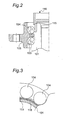
- FIG. 2 is a partially enlarged view of the grease charging device 116 used in the grease charging step
- FIG. 3 is a sectional view in a radial direction that crosses the center of the second ball 104. It is noted that the reference numeral 118 denotes the inner peripheral surface of a retainer in FIG. 3 .
- the size in the radial direction of the nozzle 115 of the grease charging device 116 is smaller than a radial gap between the second ball 104 and the shaft 101. Moreover, the size in the axial direction of the nozzle 115 of the grease charging device 116 has a length approximately equivalent to a length from the end surface in the inner ring 102 side of the shaft 101 to the space between the first ball 103 and the second ball 104.
- At least part of the outer peripheral surface in the circumferential direction of the nozzle 115 has a surface configuration that generally corresponds to a surface defined by the second balls 104 and the retainer that is retaining the second balls 104.
- the configuration of the outer peripheral surface of the nozzle 115 is the surface configuration generally corresponding to the surface defined by the second ball 104 and the retainer that is retaining the second ball 104, grease can easily be charged into the space between the first ball 103 and the second ball 104.
- the portion of the nozzle 115 corresponding to the retainer has a radial size larger than that of the portion of the nozzle 115b generally corresponding to the second ball 104, a large amount of grease can be charged from the portion of the nozzle 115 corresponding to the retainer.
- the nozzle may have an annular configuration throughout the entire circumference in the circumferential direction or may exist only partially in the circumferential direction. When the nozzle has an annular configuration, the grease can be charged generally uniformly in the circumferential direction, and seizure of the parts such as the first ball and the second ball can reliably be prevented.
- the first distance "a” and the second distance “b” are measured in the state in which the shaft 101, the outer ring 105, the first ball 103 and the second ball 104 are assembled, and the size in the axial direction of the inner ring 102 is adjusted in accordance with the first distance "a" and the second distance "b". Therefore, even if there are dimensional variations of the shaft 101, dimensional variations of the outer ring 105, dimensional variations of the first ball 103 and dimensional variations of the second ball 104, the axial gap of the hub unit can be correctly set by adjusting the size in the axial direction of the inner ring 102.
- the axial gap of the hub unit can be correctly set by adjusting the size in the axial direction of the inner ring 102. Therefore, the variations in the axial gap of the hub unit can be reduced more remarkably than in the conventional case, and the axial gap can be correctly set to the prescribed value. And in regards to the hub unit, the durability, the performance of the load capacity and further capability can be remarkably improved. Moreover, since the gap variations can be reduced, a compact lightweight hub unit can be achieved.
- the hub unit manufacturing method of the above embodiment it is not necessary to carry out the dimensional measurement of the shaft 101, the dimensional measurement of the inner ring 102 and the dimensional measurement of the outer ring 105. Therefore, the production time of the hub unit can be remarkably shortened.
- the interference between the shaft 101 and the inner ring 102 is calculated by measuring the inside diameter of the inner ring 102 and the outside diameter of the small diameter shaft portion of the shaft 101 and the size in the axial direction of the inner ring 102 is adjusted in accordance with the calculated interference. Therefore, even if the axial gap of the hub unit varies depending on the magnitude of interference, i.e., even if the axial gap of the hub unit varies depending on the strength of press fitting of the inner ring 102, the axial gap of the hub unit can be correctly set by adjusting the size in the axial direction of the inner ring 102. Therefore, the axial gap of the hub unit can be brought closer to the prescribed value.
- the size in the axial direction of the inner ring 102 is adjusted in accordance with the temperatures of the shaft 101, the inner ring 102, the first ball 103, the second ball 104 and the outer ring 105. Therefore, even if the sizes of the parts are varied by thermal expansion, the axial gap of the hub unit can be correctly set by adjusting the size in the axial direction of the inner ring 102. Therefore, the axial gap of the hub unit can be brought closer to the prescribed value.
- the size in the axial direction of the inner ring 102 is adjusted in accordance with the variations in the axial gap due to calking effected on the end surface in the inner ring 102 side of the shaft 101, after the shaft 101, the inner ring 102, the first ball 103, the second ball 104 and the outer ring 105 are assembled. Therefore, even if the axial gap of the hub unit varies due to calking effected on the end surface in the inner ring 102 side of the shaft 101, the axial gap of the hub unit can be correctly set by adjusting the size in the axial direction of the inner ring 102. Therefore, the axial gap of the hub unit can be brought closer to the prescribed value.
- the hub unit manufacturing method of the above embodiment since the parts assembled once need not be disassembled for the charging of the grease, time to manufacture the hub unit can be shortened, and the manufacturing cost of the hub unit can be reduced.
- FIG. 4 is a half sectional view of a hub unit of one embodiment of the present invention
- FIG. 5 is an enlarged sectional view showing the essential part of the hub unit of FIG. 4 in a disassembled style.
- the hub unit is a double row angular contact ball bearing device type, which includes an outer ring 1, a shaft (inner shaft) 2, an inner ring 3 and balls 4 and 5 as rolling elements.
- the outer ring 1 has a flange portion 11 on the it's outer peripheral surface to fix to a member situated in the vehicle body side and has inner peripheral raceway surfaces 1a and 1b arranged axially in double rows on its inner peripheral surface.
- the shaft 2 has a large diameter portion 21 located on one axial side (left-hand side in FIG. 4 ) and a small diameter shaft portion 22 located on the other axial side (right-hand side in FIG. 4 ).
- On the outer peripheral surface of the large diameter portion 21 are provided a flange portion 23 which is directed radially outwardly and to which a wheel is fixed as well as an outer peripheral raceway surface 2a of a single row opposite to one inner peripheral raceway surface 1a of the outer ring 1.
- the inner ring 3 is mounted on the outer periphery of the small diameter shaft portion 22.
- the inner ring 3 has an outer peripheral raceway surface 3b of a single row opposite to the other inner peripheral raceway surface 1b of the outer ring 1.
- a plurality of balls 4 and 5 are retained by retainers 6 and 7, respectively.
- a plurality of balls 4 and 5 are placed between one inner peripheral raceway surface 1a of the outer ring 1 and the outer peripheral raceway surface 2a of the shaft 2 and between the other inner peripheral raceway surface 1b of the outer ring 1 and the outer peripheral raceway surface 3b of the inner ring 3, respectively.
- Seals 8 and 9 are provided between one axial side of the outer ring 1 and the shaft 2 and between the other axial side of the outer ring 1 and the inner ring 3, respectively.
- Screw engagement portions 12 and 13 for enabling the adjustment of the axial position of the inner ring 3 by screw rotation of the inner ring 3 with respect to the shaft 2 are provided on a mounting contact surface between the small diameter shaft portion 22 of the shaft 2 and the inner ring 3.
- the screw engagement portion 12 located in the small diameter shaft portion 22 is constructed of a male screw and is formed on the outer peripheral surface of the small diameter shaft portion 22 from a stepdown portion 2c of the small diameter shaft portion 22 to a position in the neighborhood of the center of the small diameter shaft portion 22.
- the screw engagement portion 13 located on the inner ring 3 is constructed of a female screw and is formed on the inner peripheral surface of inner ring 3 in a position located axially closer to the inside end side than the outer peripheral raceway surface 3b.
- the hub unit of the present invention is also characterized in that fitting portions 14 and 15 are provided.
- the fitting portions 14 and 15 are used to concentrically couple the inner ring 3 with the small diameter shaft portion 22 of the shaft 2 by interference fit on the mounting contact surface between the small diameter shaft portion 22 of the shaft 2 and the inner ring 3.
- the fitting portions 14 and 15 are located in a position axially on the axial outer end side of the hub unit with respect to the screw engagement portions 12 and 13.
- the outside diameter of the outer peripheral surface of the fitting portion 14 is smaller than the outside diameter of the screw engagement portion 12 and the inside diameter of the fitting portion 15 is smaller than the inside diameter of the screw engagement portion 13.
- the fitting portion 14 located in the small diameter shaft portion 22 is constructed of a cylindrical outer peripheral surface.
- the fitting portion 14 is formed in a position located axially closer to the outer end side than the screw engagement portion 12 on the outer periphery of the small diameter shaft portion 22.
- the fitting portion 15 located on the inner ring 3 is constructed of a cylindrical inner peripheral surface.
- the fitting portion 15 is formed in a position located axially on the outer end side than the screw engagement portion 13 on the inner periphery of the inner ring 3. Its axial position overlaps the axial position of the outer peripheral raceway surface 3b of the inner ring 3. As shown in FIG.
- the fitting portion 15 located on the inner ring 3 has an inside diameter d15 that is slightly smaller (about 5 to 20 ⁇ m in concrete) than the outside diameter D14 of the fitting portion 14 on the small diameter shaft portion 22 side (D14 > d15) so as to be engaged with the fitting portion 14 located in the small diameter shaft portion 22 with a negative gap.
- Recess portions 16 to be engaged with a jig for screw rotation operation are formed in several places in the circumferential direction on the outer end surface of the inner ring 3.
- the screw engagement portion 13 located on the inner ring 3 is screwed together with the screw engagement portion 12 located in the small diameter shaft portion 22 as well as the fitting of the fitting portion 15 located on the inner ring 3 is fitted the fitting portion 14 located in the small diameter shaft portion 22.
- the inner ring 3 is mounted on the small diameter shaft portion 22.
- the outer end portion of the thus-mounted inner ring 3 is welded to the outer end portion of the small diameter shaft portion 22.
- the inner ring 3 is firmly fixed to the small diameter shaft portion 22 by using the welded portion 17.
- the rigidity reduction of the inner ring 3 and the misalignment of the outer peripheral raceway surface 3b of the inner ring 3, which are caused by the screw engagement between the small diameter shaft portion 22 of the shaft 2 and the inner ring 3, are prevented or suppressed by the fitting of the fitting portions 14 and 15, and the inner ring 3 is fixed concentrically integrally to the small diameter shaft portion 22 of the shaft 2.
- the screw engagement portion 13 exerts almost no influence on the outer peripheral raceway surface 3b, and the misalignment of the outer peripheral raceway surface 3b can be reliably prevented.
- FIG. 6 is a sectional view of the essential part of a hub unit according to another embodiment of the present invention.
- the screw engagement portion 13 located on the inner ring 3 is screwed together with the screw engagement portion 12 located in the small diameter shaft portion 22 as well as the fitting of the fitting portion 15 located on the inner ring 3 is fitted the fitting portion 14 located in the small diameter shaft portion 22.
- the inner ring 3 is mounted on the small diameter shaft portion 22. Thereafter by expanding the diameter of a cylindrical portion 22a in the axial outer side of the small diameter shaft portion 22 by axially thrusting a tapered diameter expansion jig G, the inner ring 3 is firmly fix to the small diameter shaft portion 22 of the shaft 2.
- the diameter expansion jig G is only required to have a small angle of, for example, an expansion angle of not greater than 10 degrees.
- the amount of diameter expansion of the cylindrical portion 22a of the small diameter shaft portion 22 is adjusted by correctly setting the thrusting depth in the axial direction of the diameter expansion jig G.
- an adhesive can be charged in the screw engagement portion.
- the fitting portions 14 and 15 of the small diameter shaft portion 22 and the inner ring 3 may be had a role as fixing portions fixing the small diameter shaft portion 22 to the inner ring 3.
- the positional relation between the screw engagement portions 12 and 13 and the fitting portions 14 and 15 is not limited to the illustrated example, and the fitting portions 14 and 15 are formed in an axially inward position than the screw engagement portions 12 and 13 with a diameter smaller than that of the fitting portions 14 and 15. Moreover, a configuration obtained by combining both of them is acceptable.
- the present invention can be applied to a hub unit for a driving wheel such that a drive shaft is put through and fixed to an axial hole located in a center portion of the shaft.
- the invention is not limited to the hub unit of the ball bearing device type but allowed to be applied also to a hub unit of another type that employs, for example, tapered rollers.
Landscapes
- Engineering & Computer Science (AREA)
- Mechanical Engineering (AREA)
- General Engineering & Computer Science (AREA)
- Rolling Contact Bearings (AREA)
Abstract
Description
- The present invention relates to a hub unit manufacturing method and a hub unit and, in particular, to the third-generation hub unit manufacturing method for mounting an inner ring on one end side of a shaft placed inside the inner periphery of an outer ring and the third-generation hub unit.
- Conventionally, when a hub unit is manufactured by assembling a shaft, an inner ring, balls and an outer ring, it is necessary to measure the sizes of the each part in order to cope with variations in the measurement accuracy of the shaft, variations in the measurement accuracy of the inner ring, variations in the measurement accuracy of the outer ring, variations in the size of the balls within specifications thereof, changes in the inner ring raceway size due to press fitting of the inner ring to the shaft, dimensional changes depending on the temperature of each of the shaft, inner ring, balls and outer ring and so on. So, a great deal of time is necessary for the measurements and there is obstructive in shortening the production time of the hub unit and reducing the manufacturing cost.
- Patent Document 1:
JP H02-159536 A - It is an object of the present invention to provide a hub unit manufacturing method and a hub unit, which is able to easily set a prescribed preload or an axial gap even when the manufacturing size of the parts are not highly accurate and has a small number of assembling steps, a small assembly cycle time and a large extraction rate. A particular object of the present invention is to provide a hub unit manufacturing method capable of remarkably improving the accuracy in axial gap.
- In order to accomplish the above object, there is provided, according to a first aspect of the present invention, a hub unit manufacturing method for manufacturing a hub unit, the hub unit comprising:
- a shaft having a small diameter shaft portion and a large diameter shaft portion that connects to the small diameter shaft portion via a stepped portion and has an outside diameter larger than an outside diameter of the small diameter shaft portion and an outer peripheral raceway surface;
- an inner ring that is fit to the small diameter shaft portion of the shaft and has an outer peripheral raceway surface;
an outer ring having a first inner peripheral raceway surface and a second inner peripheral raceway surface; - a first rolling element placed in between the first inner peripheral raceway surface and the outer peripheral raceway surface of the shaft; and
- a second rolling element placed in between the second inner peripheral raceway surface and the outer peripheral raceway surface of the inner ring,
- the method comprising:
- placing the second rolling element in between the second inner peripheral raceway surface and an outer peripheral surface of the small diameter shaft portion as well as assembling the first rolling element in between the first inner peripheral raceway surface and the outer peripheral raceway surface of the large diameter shaft portion;
- measuring a first distance from a plane generally perpendicular to a central axis of the shaft to the second rolling element and a second distance from the plane to the stepped portion of the shaft; and
- adjusting a size in an axial direction of the inner ring based on a difference between the first distance and the second distance.
- According to the present invention, the first distance and the second distance are measured in a state in which the shaft, the outer ring, the first rolling element and the second rolling element are assembled, and the size in the axial direction of the inner ring is adjusted in accordance with the first distance and the second distance. Therefore, even if there are dimensional variations of the shaft, dimensional variations of the outer ring, dimensional variations of the first rolling element itself and dimensional variations of the second rolling element itself, the axial gap of the hub unit can be correctly set by adjusting the size in the axial direction of the inner ring. Moreover, even if there are similarly shaft measurement variations of the measuring instrument for measuring the size of the shaft and outer ring measurement variations of the measuring instrument for measuring the size of the outer ring, the axial gap of the hub unit can be correctly set by adjusting the size in the axial direction of the inner ring. Therefore, variations in the axial gap of the hub unit can be reduced more remarkably than variations in the conventional case. And the axial gap can be correctly set to the prescribed value as well as the durability of the hub unit and the performance of the load capacity and so on can be remarkably improved.
- Moreover, according to the present invention, it is not necessary to carry out the dimensional measurement of the shaft, the dimensional measurement of the inner ring and the dimensional measurement of the outer ring or the target size can be made wide. Therefore, the production time of the hub unit can be remarkably reduced.
- In one embodiment, the method comprises calculating an interference between the small diameter shaft portion of the shaft and the inner ring by measuring an inside diameter of the inner ring and an outside diameter of the small diameter shaft portion of the shaft; and
adjusting the size in the axial direction of the inner ring in accordance with the calculated interference. - According to the above embodiment, the inside diameter of the inner ring and the outside diameter of the small diameter shaft portion of the shaft are measured, the interference between the shaft and the inner ring is calculated, and the size in the axial direction of the inner ring is adjusted in accordance with the calculated interference. Therefore, even if the axial gap of the hub unit fluctuates depending on the magnitude of interference, i.e., even if the axial gap of the hub unit fluctuates depending on the strength of press fitting of the inner ring, the axial gap of the hub unit can be correctly set by adjusting the size in the axial direction of-the inner ring. Therefore, the axial gap of the hub unit can be brought closer to the prescribed value.
- In one embodiment, the method comprises measuring temperatures of the shaft, the inner ring and the outer ring before the hub unit is assembled; and
adjusting the size in the axial direction of the inner ring in accordance with the temperatures of the shaft, the inner ring and the outer ring. - According to the above embodiment, the size in the axial direction of the inner ring is adjusted in accordance with the temperatures of the parts. Therefore, even if the sizes of the parts are varied by thermal expansion, the axial gap of the hub unit can be correctly set by adjusting the size in the axial direction of the inner ring. Therefore, the axial gap of the hub unit can be brought closer to the prescribed value.
- In one embodiment, the size in the axial direction of the inner ring is adjusted in accordance with variations in an axial gap of the hub unit due to calking effected on an end surface in the inner ring side of the shaft in order to fix the inner ring to the shaft, after the shaft, the inner ring, the first rolling element, the second rolling element and the outer ring are assembled.
- According to the above embodiment, the size in the axial direction of the inner ring is adjusted in accordance with the valuations in the axial gap due to calking effected on the end surface in the inner ring side of the shaft, after the shaft, the inner ring, the first rolling elements, the second rolling elements and the outer ring are assembled. Therefore, even if the axial gap of the hub unit fluctuates due to calking effected on the end surface in the inner ring side of the shaft, the axial gap of the hub unit can be correctly set by adjusting the size in the axial direction of the inner ring. Therefore, the axial gap of the hub unit can be brought closer to the prescribed value.
- In one embodiment, the method comprises charging a grease in between the first rolling element and the second rolling element in a space between the shaft and the outer ring after the first distance and the second distance are measured; and
fitting the inner ring of which the size in the axial direction has been adjusted to the small diameter shaft portion of the shaft after the grease is charged. - According to the above embodiment, grease is charged in between the first rolling element and the second rolling element between the shaft and the outer ring after the first distance and the second distance are measured, and the inner ring of which the size in the axial direction has been adjusted is fit to the shaft after the grease is charged. Therefore, the grease exerts no influence on the measurements of the first distance and the second distance. Therefore, the axial gap of the hub unit can be accurately adjusted to the prescribed value.
- Moreover, according to the above embodiment, since the parts assembled once need not be disassembled for the charging of the grease, time to manufacture the hub unit can be shortened, and the manufacturing cost of the hub unit can be reduced.
- In order to accomplish the above object, there is provided, according to an another aspect of the present invention, a hub unit manufacturing method for manufacturing a hub unit, the hub unit comprising
a shaft having a small diameter shaft portion and a large diameter shaft portion that connects to the small diameter shaft portion via a stepped portion and has an outside diameter larger than an outside diameter of the small diameter shaft portion; and
an inner ring that is fit to the small diameter shaft portion of the shaft,
the method comprising
fastening a screw engagement portion formed in a first place on an inner peripheral surface of the inner ring to a screw engagement portion formed in a first place of an outer peripheral surface of the small diameter shaft portion in screw engagement as well as fitting a fitting portion formed in a second place of the inner peripheral surface of the inner ring to a fitting portion formed in a second place of the outer peripheral surface of the small diameter shaft portion by interference fit;
adjusting a preload or an axial gap by adjusting a screw engagement depth of the screw engagement portion of the small diameter shaft portion in relation to the screw engagement portion of the inner ring by relative screw rotation of the inner ring to the small diameter shaft portion; and
effecting prevention of rigidity reduction of the inner ring due to fastening the screw engagement portion of the inner ring to the screw engagement portion of the small diameter shaft portion in screw engagement as well as jointing aligning of an outer peripheral raceway surface formed on an outer peripheral surface of the inner ring, by fitting of the fitting portion of the small diameter shaft portion to the fitting portion of the inner ring. - According to the present invention, not only the burden of high-accuracy size control of the members can be reduced but also the steps of the measurement of the members and the steps of the matching of the members can be eliminated. Therefore, the number of assembling steps can be reduced, the assembly cycle time can be shorted and the production yield can be made higher.
- In order to accomplish the above object, there is provided, according to an another aspect of the present invention, a hub unit comprising:
- a shaft having a small diameter shaft portion and a large diameter shaft portion that connects to the small diameter shaft portion via a stepped portion and has an outside diameter larger than an outside diameter of the small diameter shaft portion; and
- an inner ring having an outer peripheral raceway surface, wherein
- the small diameter shaft portion has a screw engagement portion and a fitting portion as well as the inner ring has a screw engagement portion and a fitting portion,
- the screw engagement portion of the inner ring is put in screw engagement with the screw engagement portion of the small diameter shaft portion so that a position in an axial direction of the inner ring can be adjusted with respect to the shaft, and
- the fitting portion of the inner ring is fit to the fitting portion of the small diameter shaft portion by interference fit so that the inner ring is concentrically coupled with the small diameter shaft portion.
- It is acceptable to provide the fitting portion of the small diameter shaft portion and the inner ring as a fixed portion for fixing the small diameter shaft portion of the shaft to the inner ring or to provide a fixed portion by welding or bonding aside from the fitting portion of the small diameter shaft portion and the inner ring. Moreover, it is acceptable to fix the small diameter shaft portion of the shaft to the inner ring by expanding the diameter of the cylindrical portion of the outer end of the small diameter shaft portion of the inner ring.
- According to the hub unit of the present invention, by adjusting the screw engagement depth of the screw engagement portion by screw rotation of the inner ring with respect to the small diameter shaft portion of the shaft, the required preload or axial gap can be set.
- Moreover, reduction in the rigidity of the inner ring caused by backlash at the screw engagement portion and misalignment from central axis for the outer peripheral raceway surface of the inner ring can be prevented or suppressed by the fitting portion. The need for the conventionally performed preload management, i.e., the high-accuracy management of the pitch between the double row tracks on the outer ring side, the matching of the selection of ball diameter with respect to the inner and outer rings, the calking of the shaft end for giving the preload and so on, can be removed. As a consequence of which the number of assembling steps can be remarkably reduced and the manufacturing cost can be reduced.
- In one embodiment, the screw engagement portion of the inner ring is situated axially closer to the large diameter shaft portion side than the outer peripheral raceway surface and the fitting portion of the inner ring.
- In the hub unit of the present invention, the screw engagement portion of the inner ring should desirably be formed in a position axially displaced from the outer peripheral raceway surface of the inner ring. More concretely, it is desirable to provide the screw engagement portion closer to the large diameter shaft portion side (inner end side in the axial direction) than the outer peripheral raceway surface in the inner ring and to form the fitting portion closer to the outer end side (opposite from the large diameter shaft portion side of the screw engagement portion) in the axial direction than the screw engagement portion. When the screw engagement portion of the inner ring is situated in the position axially displaced from the outer peripheral raceway surface of the inner ring, the influence that the screw engagement portion exerts on the outer peripheral raceway surface of the inner ring becomes extremely small.
- According to the hub unit and the hub unit manufacturing method of the present invention, the processing sizes of the members need not be highly accurate or it is not necessary to carry out the dimensional measurement of the shaft, the dimensional measurement of the inner ring and the dimensional measurement of the outer ring. Therefore, the prescribed preload or the axial gap can easily be set, the number of assembling steps can be reduced and the assembly cycle time to be reduced. Moreover, the manufacturing yield can be increased.
-
-
FIG. 1A is a view for explaining a hub unit manufacturing method according to one embodiment of the present invention; -
FIG. 1B is a view for explaining a hub unit manufacturing method according to one embodiment of the present invention; -
FIG. 1C is a view for explaining a hub unit manufacturing method according to one embodiment of the present invention; -
FIG. 1D is a view for explaining a hub unit manufacturing method according to one embodiment of the present invention; -
FIG. 1E is a view for explaining a hub unit manufacturing method according to one embodiment of the present invention; -
FIG. 1F is a view for explaining a hub unit manufacturing method according to one embodiment of the present invention; -
FIG. 2 is a partially enlarged view of a grease charging device being used in a grease charging step; -
FIG. 3 is a sectional view in a radial direction that penetrates the center of the second ball; -
FIG. 4 is a half sectional view of a hub unit of one embodiment of the present invention; -
FIG. 5 is an enlarged sectional view showing the essential part of the hub unit of the one embodiment in a disassembled style; and -
FIG. 6 is a sectional view of the essential part of a hub unit of another embodiment of the present invention. - The present invention will be described in detail below by the embodiments shown in the drawings.
-
FIGS. 1A through 1F are views for explaining the hub unit manufacturing method of one embodiment of the present invention. - The hub unit manufacturing method of the one embodiment of the present invention is described below with reference to
FIGS. 1A through 1F . InFIGS. 1A through 1F , 101 indicates a shaft, 102 indicates an inner ring, 103 indicates a first ball as one example of the first rolling element, 104 indicates a second ball as one example of the second rolling element and 105 indicates an outer ring. - First of all, a subassembly step is carried out. In the subassembly step, the
shaft 101, theouter ring 105, thefirst ball 103 and thesecond ball 104 are assembled so that thefirst ball 103 is assembled in between the outer peripheral raceway surface of theshaft 101 and a first inner peripheral raceway surface of theouter ring 105, and thesecond ball 104 is placed in between the outer peripheral surface of theshaft 101 and a second inner peripheral raceway surface of theouter ring 105. In this way, as shown inFIG. 1A , an assembly having theshaft 101, theouter ring 105, thefirst ball 103 and thesecond ball 104 is assembled. - Subsequently, a first distance measuring step and a second distance measuring step are carried out. It is noted that a temperature measuring step is carried out immediately before each of the measuring steps. In the temperature measuring step, temperatures of the
shaft 101, theinner ring 102, thefirst ball 103, thesecond ball 104 and theouter ring 105 are measured, and the atmospheric temperature is measured. In the first distance measuring step and the second distance measuring step, after inserting a measuring jig (not shown) from an opening in thesecond ball 104 side located between theshaft 101 and theouter ring 105 in the assembly shown inFIG. 1A , bringing thesecond ball 104 in contact with the second inner peripheral raceway surface of theouter ring 105 and making it stationary on the second inner peripheral raceway surface, a first distance "a" from a plane "q" generally perpendicular to a first central axis "p" to thesecond ball 104 and a second distance "b" from the plane "q" to a steppedportion 107 of theshaft 101 are measured by using a distance measuring device such as a dial gauge as shown inFIG. 1B . It is acceptable to assemble thesecond ball 104 and measure the first distance "a" after measuring the first distance "b". At this time, measurement variations can be reduced when the distances "a" and "b" are measured while rotating the shaft 101 (or the outer ring 105). - Subsequently, an inner ring size measuring step is carried out. In the inner ring size measuring step, as shown in
FIG. 1C , after a ball 110 (this may be a jig corresponding to thesecond ball 104 although not described in detail) of the same type (of the same specifications) as that of thesecond ball 104 is placed on the outer peripheral raceway surface of theinner ring 102, a third distance "c" from a plane "s" generally perpendicular to the central axis "r" of theinner ring 102 to theball 110 and a fourth distance "d" from the plane "s" to asmall end surface 111 of theinner ring 101 are measured. - Subsequently, an interference measuring step is carried out. In the interference measuring step, the outside diameter "e" of a small diameter shaft portion (shaft portion on the fitting side of the inner ring 102) of the
shaft 101 of the assembly shown inFIG. 1B is measured by using a measuring instrument such as a dial gauge, and the inside diameter "f" of theinner ring 102 shown inFIG. 1C is measured by using a measuring instrument such as a dial gauge. Then, an interference (e - f) is detected. - Next, an inner ring size adjusting step is carried out. In the inner ring size adjusting step, the size in the axial direction of the
inner ring 102 is adjusted in accordance with a difference (b - a) between the second distance "b" and the first distance "a", the third distance "c", the fourth distance "d", a dimensional change of theshaft 101 based on the measurement temperature of theshaft 101, a dimensional change of theinner ring 102 based on the measurement temperature of theinner ring 102, a dimensional change of thefirst ball 103 based on the measurement temperature of thefirst ball 103, a dimensional change of thesecond ball 104 based on the measurement temperature of thesecond ball 104, a dimensional change of theouter ring 105 based on the measurement temperature of theouter ring 105, the temperature in which the customer used the hub unit, the atmospheric temperature (the atmospheric temperature is used in a case where time from the manufacturing of the assembly shown inFIG. 1A to the measurement of the first distance and the second distance is long, and the temperatures of theshaft 101, theinner ring 102, thefirst ball 103, thesecond ball 104 and theouter ring 105 are considered to be equal to the atmospheric temperature), variations in the axial gap of the hub unit depending on the interference (expansion due to press fitting) (described below) and variations in the axial gap of the hub unit depending on the calking (described below). - In detail, as shown in
FIG. 1D , thesmall end surface 111 of theinner ring 102 is brought in contact with arotating grindstone 113 while rotating theinner ring 102. In this way, thesmall end surface 111 of theinner ring 102 is ground so that the size in the axial direction of theinner ring 102 is accurately adjusted to a size that is uniquely determined by the various factors described above. According to the method of the present embodiment, regardless of the size errors of theindividual shaft 101,first ball 103,second ball 104 andouter ring 105, the adjustment of the size in the axial direction of theinner ring 102 is performed on the basis of the difference (b - a) between the second distance "b" and the first distance "a" which includes the total of those cumulative errors. In detail, the size in the axial direction of theinner ring 102 is increased by decreasing the amount of grinding of thesmall end surface 111 of theinner ring 102 when the difference (b - a) between the second distance "b" and the first distance "a" is large, while the size in the axial direction of theinner ring 102 is decreased by increasing the amount of grinding of thesmall end surface 111 of theinner ring 102 when the difference (b - a) between the second distance "b" and the first distance "a" is small. By this operation, the desired axial gap can be set simply accurately. - It has been confirmed through experiments that a negative gap (compression size) of the assembled hub unit is reduced when the value of the interference is increased. The variations in the axial gap of the hub unit depending on the interference means variations in the negative gap with respect to the interference.
- Moreover, if the calking described later is performed, the negative gap (compression size) of the assembled hub unit varies depending on the materials of the parts such as the shaft and the inner ring and depending on the size of the hub unit. The variation value is calculated for each of the materials of the parts such as the shaft and the inner ring and is calculated for the size of the hub unit and stored in a data base. The variations in the axial gap of the hub unit depending on the calking means the variation value in the negative gap of the hub unit calculated for each of the materials of the parts such as the shaft and the inner ring and calculated for the size of the hub unit.
- When the influences of the temperatures of the parts, interference and calking are ignored, the size in the axial direction of the inner ring is adjusted based on (c + t - d) obtained by subtracting the fourth distance "d" from (c + t) obtained by adding the diameter "t" of the
ball 110 to the third distance "c" (seeFIG. 1C ) and (b - a) (in the present embodiment, the fluctuations in the axial gap attributed to the temperatures of the parts, interference and calking are compensated, and the method is not adopted). - Next, a grease charging step is carried out. In the grease charging step, as shown in
FIG. 1E , by using agrease charger 116 that has anelongate nozzle 115, agrease 117 is charged in between thefirst ball 103 and thesecond ball 104 in the space between theshaft 101 and theouter ring 105 in the assembly shown inFIG. 1A . - Thereafter, an inner ring fitting step is carried out. In the inner ring fitting step, the inner peripheral surface of the
inner ring 2 of which the size in the axial direction has been correctly adjusted is fitted to the outside ofshaft 1 of the assembly charged with the grease shown inFIG. 1E by press fitting. In this way, theinner ring 2 is attached to the assembly charged with the grease. - Finally, a calking step is carried out. In the calking step, part of the
shaft 101 is overlapped part of the end surface of theinner ring 102 as shown inFIG. 1F by calking the end surface in theinner ring 102 side of theshaft 101. In this way, theinner ring 102 is firmly fixed to theshaft 101 and the assembly of the hub unit is finished. -
FIG. 2 is a partially enlarged view of thegrease charging device 116 used in the grease charging step, andFIG. 3 is a sectional view in a radial direction that crosses the center of thesecond ball 104. It is noted that thereference numeral 118 denotes the inner peripheral surface of a retainer inFIG. 3 . - As shown in
FIG. 2 , the size in the radial direction of thenozzle 115 of thegrease charging device 116 is smaller than a radial gap between thesecond ball 104 and theshaft 101. Moreover, the size in the axial direction of thenozzle 115 of thegrease charging device 116 has a length approximately equivalent to a length from the end surface in theinner ring 102 side of theshaft 101 to the space between thefirst ball 103 and thesecond ball 104. - Moreover, as shown in
FIG. 3 , at least part of the outer peripheral surface in the circumferential direction of thenozzle 115 has a surface configuration that generally corresponds to a surface defined by thesecond balls 104 and the retainer that is retaining thesecond balls 104. As described above, since the configuration of the outer peripheral surface of thenozzle 115 is the surface configuration generally corresponding to the surface defined by thesecond ball 104 and the retainer that is retaining thesecond ball 104, grease can easily be charged into the space between thefirst ball 103 and thesecond ball 104. Moreover, since the portion of thenozzle 115 corresponding to the retainer has a radial size larger than that of the portion of the nozzle 115b generally corresponding to thesecond ball 104, a large amount of grease can be charged from the portion of thenozzle 115 corresponding to the retainer. It is noted that the nozzle may have an annular configuration throughout the entire circumference in the circumferential direction or may exist only partially in the circumferential direction. When the nozzle has an annular configuration, the grease can be charged generally uniformly in the circumferential direction, and seizure of the parts such as the first ball and the second ball can reliably be prevented. - According to the hub unit manufacturing method of the above embodiment, the first distance "a" and the second distance "b" are measured in the state in which the
shaft 101, theouter ring 105, thefirst ball 103 and thesecond ball 104 are assembled, and the size in the axial direction of theinner ring 102 is adjusted in accordance with the first distance "a" and the second distance "b". Therefore, even if there are dimensional variations of theshaft 101, dimensional variations of theouter ring 105, dimensional variations of thefirst ball 103 and dimensional variations of thesecond ball 104, the axial gap of the hub unit can be correctly set by adjusting the size in the axial direction of theinner ring 102. Moreover, even if there are similarly shaft measurement variations of the measuring instrument for measuring the size of theshaft 101 and outer ring measurement variations of the measuring instrument for measuring the size of theouter ring 105, the axial gap of the hub unit can be correctly set by adjusting the size in the axial direction of theinner ring 102. Therefore, the variations in the axial gap of the hub unit can be reduced more remarkably than in the conventional case, and the axial gap can be correctly set to the prescribed value. And in regards to the hub unit, the durability, the performance of the load capacity and further capability can be remarkably improved. Moreover, since the gap variations can be reduced, a compact lightweight hub unit can be achieved. - Moreover, according to the hub unit manufacturing method of the above embodiment, it is not necessary to carry out the dimensional measurement of the
shaft 101, the dimensional measurement of theinner ring 102 and the dimensional measurement of theouter ring 105. Therefore, the production time of the hub unit can be remarkably shortened. - Moreover, according to the hub unit manufacturing method of the above embodiment, the interference between the
shaft 101 and theinner ring 102 is calculated by measuring the inside diameter of theinner ring 102 and the outside diameter of the small diameter shaft portion of theshaft 101 and the size in the axial direction of theinner ring 102 is adjusted in accordance with the calculated interference. Therefore, even if the axial gap of the hub unit varies depending on the magnitude of interference, i.e., even if the axial gap of the hub unit varies depending on the strength of press fitting of theinner ring 102, the axial gap of the hub unit can be correctly set by adjusting the size in the axial direction of theinner ring 102. Therefore, the axial gap of the hub unit can be brought closer to the prescribed value. - Moreover, according to the hub unit manufacturing method of the above embodiment, the size in the axial direction of the
inner ring 102 is adjusted in accordance with the temperatures of theshaft 101, theinner ring 102, thefirst ball 103, thesecond ball 104 and theouter ring 105. Therefore, even if the sizes of the parts are varied by thermal expansion, the axial gap of the hub unit can be correctly set by adjusting the size in the axial direction of theinner ring 102. Therefore, the axial gap of the hub unit can be brought closer to the prescribed value. - Moreover, according to the hub unit manufacturing method of the above embodiment, the size in the axial direction of the
inner ring 102 is adjusted in accordance with the variations in the axial gap due to calking effected on the end surface in theinner ring 102 side of theshaft 101, after theshaft 101, theinner ring 102, thefirst ball 103, thesecond ball 104 and theouter ring 105 are assembled. Therefore, even if the axial gap of the hub unit varies due to calking effected on the end surface in theinner ring 102 side of theshaft 101, the axial gap of the hub unit can be correctly set by adjusting the size in the axial direction of theinner ring 102. Therefore, the axial gap of the hub unit can be brought closer to the prescribed value. - Moreover, according to the hub unit manufacturing method of the above embodiment, grease is charged in between the
first ball 103 and thesecond ball 104 in the space between theshaft 101 and theouter ring 105 after the first distance "a" and the second distance "b" are measured and theinner ring 102 of which the size in the axial direction has been adjusted is fit to theshaft 101 after the grease is charged. Therefore, the grease exerts no influence on the measurements of the first distance "a" and the second distance "b" and the axial gap of the hub unit can be accurately adjusted to the prescribed value. - Moreover, according to the hub unit manufacturing method of the above embodiment, since the parts assembled once need not be disassembled for the charging of the grease, time to manufacture the hub unit can be shortened, and the manufacturing cost of the hub unit can be reduced.
-
FIG. 4 is a half sectional view of a hub unit of one embodiment of the present invention, andFIG. 5 is an enlarged sectional view showing the essential part of the hub unit ofFIG. 4 in a disassembled style. - As shown in
FIG. 4 , the hub unit is a double row angular contact ball bearing device type, which includes anouter ring 1, a shaft (inner shaft) 2, aninner ring 3 andballs - The
outer ring 1 has aflange portion 11 on the it's outer peripheral surface to fix to a member situated in the vehicle body side and has innerperipheral raceway surfaces shaft 2 has alarge diameter portion 21 located on one axial side (left-hand side inFIG. 4 ) and a smalldiameter shaft portion 22 located on the other axial side (right-hand side inFIG. 4 ). On the outer peripheral surface of thelarge diameter portion 21 are provided aflange portion 23 which is directed radially outwardly and to which a wheel is fixed as well as an outerperipheral raceway surface 2a of a single row opposite to one innerperipheral raceway surface 1a of theouter ring 1. Theinner ring 3 is mounted on the outer periphery of the smalldiameter shaft portion 22. Theinner ring 3 has an outerperipheral raceway surface 3b of a single row opposite to the other innerperipheral raceway surface 1b of theouter ring 1. - A plurality of
balls retainers balls peripheral raceway surface 1a of theouter ring 1 and the outerperipheral raceway surface 2a of theshaft 2 and between the other innerperipheral raceway surface 1b of theouter ring 1 and the outerperipheral raceway surface 3b of theinner ring 3, respectively.Seals 8 and 9 are provided between one axial side of theouter ring 1 and theshaft 2 and between the other axial side of theouter ring 1 and theinner ring 3, respectively. -
Screw engagement portions inner ring 3 by screw rotation of theinner ring 3 with respect to theshaft 2 are provided on a mounting contact surface between the smalldiameter shaft portion 22 of theshaft 2 and theinner ring 3. As clearly shown inFIG. 5 , thescrew engagement portion 12 located in the smalldiameter shaft portion 22 is constructed of a male screw and is formed on the outer peripheral surface of the smalldiameter shaft portion 22 from astepdown portion 2c of the smalldiameter shaft portion 22 to a position in the neighborhood of the center of the smalldiameter shaft portion 22. Thescrew engagement portion 13 located on theinner ring 3 is constructed of a female screw and is formed on the inner peripheral surface ofinner ring 3 in a position located axially closer to the inside end side than the outerperipheral raceway surface 3b. - In the construction in which the small
diameter shaft portion 22 of theshaft 2 and theinner ring 3 are joined together in screw engagement by using thescrew engagement portions inner ring 3 might become cranky, rigidity might descend or misalignment of the center axis of the outerperipheral raceway surface 3b of theinner ring 3 with respect to the center axis of theshaft 2 might occur. Accordingly, the hub unit of the present invention is also characterized in thatfitting portions fitting portions inner ring 3 with the smalldiameter shaft portion 22 of theshaft 2 by interference fit on the mounting contact surface between the smalldiameter shaft portion 22 of theshaft 2 and theinner ring 3. Thefitting portions screw engagement portions fitting portion 14 is smaller than the outside diameter of thescrew engagement portion 12 and the inside diameter of thefitting portion 15 is smaller than the inside diameter of thescrew engagement portion 13. - The
fitting portion 14 located in the smalldiameter shaft portion 22 is constructed of a cylindrical outer peripheral surface. Thefitting portion 14 is formed in a position located axially closer to the outer end side than thescrew engagement portion 12 on the outer periphery of the smalldiameter shaft portion 22. Thefitting portion 15 located on theinner ring 3 is constructed of a cylindrical inner peripheral surface. Thefitting portion 15 is formed in a position located axially on the outer end side than thescrew engagement portion 13 on the inner periphery of theinner ring 3. Its axial position overlaps the axial position of the outerperipheral raceway surface 3b of theinner ring 3. As shown inFIG. 5 , thefitting portion 15 located on theinner ring 3 has an inside diameter d15 that is slightly smaller (about 5 to 20 µm in concrete) than the outside diameter D14 of thefitting portion 14 on the smalldiameter shaft portion 22 side (D14 > d15) so as to be engaged with thefitting portion 14 located in the smalldiameter shaft portion 22 with a negative gap.Recess portions 16 to be engaged with a jig for screw rotation operation are formed in several places in the circumferential direction on the outer end surface of theinner ring 3. - The
screw engagement portion 13 located on theinner ring 3 is screwed together with thescrew engagement portion 12 located in the smalldiameter shaft portion 22 as well as the fitting of thefitting portion 15 located on theinner ring 3 is fitted thefitting portion 14 located in the smalldiameter shaft portion 22. In this way, theinner ring 3 is mounted on the smalldiameter shaft portion 22. Then, the outer end portion of the thus-mountedinner ring 3 is welded to the outer end portion of the smalldiameter shaft portion 22. Theinner ring 3 is firmly fixed to the smalldiameter shaft portion 22 by using the weldedportion 17. - In the hub unit of the above construction, by screw rotation of the
inner ring 3 in relation to thesmall diameter portion 22 in a state in which theinner ring 3 is in screw engagement with the smalldiameter shaft portion 22 of theshaft 2, the screw engagement depth of both thescrew engagement portions inner ring 3 is finely tuned and the preload or the axial gap is set to the prescribed value. After the preload or the axial gap is set, theinner ring 3 is firmly fix to the smalldiameter shaft portion 22 of theshaft 2. - Moreover, the rigidity reduction of the
inner ring 3 and the misalignment of the outerperipheral raceway surface 3b of theinner ring 3, which are caused by the screw engagement between the smalldiameter shaft portion 22 of theshaft 2 and theinner ring 3, are prevented or suppressed by the fitting of thefitting portions inner ring 3 is fixed concentrically integrally to the smalldiameter shaft portion 22 of theshaft 2. - As described in the above embodiment, with the construction in which the
fitting portion 15 is positioned inside the outerperipheral raceway surface 3b of theinner ring 3, thescrew engagement portion 13 exerts almost no influence on the outerperipheral raceway surface 3b, and the misalignment of the outerperipheral raceway surface 3b can be reliably prevented. -
FIG. 6 is a sectional view of the essential part of a hub unit according to another embodiment of the present invention. In the present embodiment, thescrew engagement portion 13 located on theinner ring 3 is screwed together with thescrew engagement portion 12 located in the smalldiameter shaft portion 22 as well as the fitting of thefitting portion 15 located on theinner ring 3 is fitted thefitting portion 14 located in the smalldiameter shaft portion 22. In this way, theinner ring 3 is mounted on the smalldiameter shaft portion 22. Thereafter by expanding the diameter of acylindrical portion 22a in the axial outer side of the smalldiameter shaft portion 22 by axially thrusting a tapered diameter expansion jig G, theinner ring 3 is firmly fix to the smalldiameter shaft portion 22 of theshaft 2. The diameter expansion jig G is only required to have a small angle of, for example, an expansion angle of not greater than 10 degrees. The amount of diameter expansion of thecylindrical portion 22a of the smalldiameter shaft portion 22 is adjusted by correctly setting the thrusting depth in the axial direction of the diameter expansion jig G. - Besides the above, in order to fix the
inner ring 3 to the smalldiameter shaft portion 22 of theshaft 2, it is acceptable to use an adhesive. For example, an adhesive can be charged in the screw engagement portion. Also, thefitting portions diameter shaft portion 22 and theinner ring 3 may be had a role as fixing portions fixing the smalldiameter shaft portion 22 to theinner ring 3. - The positional relation between the
screw engagement portions fitting portions fitting portions screw engagement portions fitting portions - The present invention can be applied to a hub unit for a driving wheel such that a drive shaft is put through and fixed to an axial hole located in a center portion of the shaft. Moreover, the invention is not limited to the hub unit of the ball bearing device type but allowed to be applied also to a hub unit of another type that employs, for example, tapered rollers.
Claims (8)
- A hub unit manufacturing method for manufacturing a hub unit, the hub unit comprising:a shaft having a small diameter shaft portion and a large diameter shaft portion that connects to the small diameter shaft portion via a stepped portion and has an outside diameter larger than an outside diameter of the small diameter shaft portion and an outer peripheral raceway surface;an inner ring that is fit to the small diameter shaft portion of the shaft and has an outer peripheral raceway surface;an outer ring having a first inner peripheral raceway surface and a second inner peripheral raceway surface;a first rolling element placed in between the first inner peripheral raceway surface and the outer peripheral raceway surface of the shaft; anda second rolling element placed in between the second inner peripheral raceway surface and the outer peripheral raceway surface of the inner ring,the method comprising:placing the second rolling element in between the second inner peripheral raceway surface and an outer peripheral surface of the small diameter shaft portion as well as assembling the first rolling element in between the first inner peripheral raceway surface and the outer peripheral raceway surface of the large diameter shaft portion;measuring a first distance from a plane generally perpendicular to a central axis of the shaft to the second rolling element and a second distance from the plane to the stepped portion of the shaft; andadjusting a size in an axial direction of the inner ring based on a difference between the first distance and the second distance.
- The hub unit manufacturing method as claimed in claim 1 comprising
calculating an interference between the small diameter shaft portion of the shaft and the inner ring by measuring an inside diameter of the inner ring and an outside diameter of the small diameter shaft portion of the shaft; and
adjusting the size in the axial direction of the inner ring in accordance with the calculated interference. - The hub unit manufacturing method as claimed in claim 1 comprising
measuring temperatures of the shaft, the inner ring and the outer ring before the hub unit is assembled; and
adjusting the size in the axial direction of the inner ring in accordance with the temperatures of the shaft, the inner ring and the outer ring. - The hub unit manufacturing method as claimed in claim 1, wherein
the size in the axial direction of the inner ring is adjusted in accordance with variations in an axial gap of the hub unit due to calking effected on an end surface in the inner ring side of the shaft in order to fix the inner ring to the shaft, after the shaft, the inner ring, the first rolling element, the second rolling element and the outer ring are assembled. - The hub unit manufacturing method as claimed in claim 1 comprising
charging a grease in between the first rolling element and the second rolling element in a space between the shaft and the outer ring after the first distance and the second distance are measured; and
fitting the inner ring of which the size in the axial direction has been adjusted to the small diameter shaft portion of the shaft after the grease is charged. - A hub unit manufacturing method for manufacturing a hub unit, the hub unit comprising:a shaft having a small diameter shaft portion and a large diameter shaft portion that connects to the small diameter shaft portion via a stepped portion and has an outside diameter larger than an outside diameter of the small diameter shaft portion; andan inner ring that is fit to the small diameter shaft portion of the shaft,
the method comprising:fastening a screw engagement portion formed in a first place on an inner peripheral surface of the inner ring to a screw engagement portion formed in a first place of an outer peripheral surface of the small diameter shaft portion in screw engagement as well as fitting a fitting portion formed in a second place of the inner peripheral surface of the inner ring to a fitting portion formed in a second place of the outer peripheral surface of the small diameter shaft portion by interference fit;adjusting a preload or an axial gap by adjusting a screw engagement depth of the screw engagement portion of the small diameter shaft portion in relation to the screw engagement portion of the inner ring by relative screw rotation of the inner ring to the small diameter shaft portion; andeffecting prevention of rigidity reduction of the inner ring due to fastening the screw engagement portion of the inner ring to the screw engagement portion of the small diameter shaft portion in screw engagement as well as jointing aligning of an outer peripheral raceway surface formed on an outer peripheral surface of the inner ring, by fitting of the fitting portion of the small diameter shaft portion to the fitting portion of the inner ring. - A hub unit comprising:a shaft having a small diameter shaft portion and a large diameter shaft portion that connects to the small diameter shaft portion via a stepped portion and has an outside diameter larger than an outside diameter of the small diameter shaft portion; andan inner ring having an outer peripheral raceway surface, whereinthe small diameter shaft portion has a screw engagement portion and a fitting portion as well as the inner ring has a screw engagement portion and a fitting portion,the screw engagement portion of the inner ring is put in screw engagement with the screw engagement portion of the small diameter shaft portion so that a position in an axial direction of the inner ring can be adjusted with respect to the shaft, andthe fitting portion of the inner ring is fit to the fitting portion of the small diameter shaft portion by interference fit so that the inner ring is concentrically coupled with the small diameter shaft portion.
- The hub unit as claimed in claim 7, wherein
the screw engagement portion of the inner ring is axially located closer to the large diameter shaft portion side than the outer peripheral raceway surface and the fitting portion of the inner ring.
Applications Claiming Priority (3)
| Application Number | Priority Date | Filing Date | Title |
|---|---|---|---|
| JP2006012776 | 2006-01-20 | ||
| JP2006013277 | 2006-01-23 | ||
| PCT/JP2007/050661 WO2007083688A1 (en) | 2006-01-20 | 2007-01-18 | Method for manufacturing hub unit and hub unit |
Publications (3)
| Publication Number | Publication Date |
|---|---|
| EP1978270A1 true EP1978270A1 (en) | 2008-10-08 |
| EP1978270A4 EP1978270A4 (en) | 2011-12-21 |
| EP1978270B1 EP1978270B1 (en) | 2012-12-26 |
Family
ID=38287640
Family Applications (1)
| Application Number | Title | Priority Date | Filing Date |
|---|---|---|---|
| EP20070706965 Ceased EP1978270B1 (en) | 2006-01-20 | 2007-01-18 | Method for manufacturing hub unit and hub unit |
Country Status (3)
| Country | Link |
|---|---|
| US (1) | US8429823B2 (en) |
| EP (1) | EP1978270B1 (en) |
| WO (1) | WO2007083688A1 (en) |
Cited By (5)
| Publication number | Priority date | Publication date | Assignee | Title |
|---|---|---|---|---|
| ITTO20110949A1 (en) * | 2011-10-19 | 2013-04-20 | Skf Ab | HUB-WHEEL BEARING UNIT |
| ITTO20121055A1 (en) * | 2012-12-07 | 2014-06-08 | Skf Ab | HUB-BEARING UNIT FOR A WHEEL OF A VEHICLE |
| ITTO20121053A1 (en) * | 2012-12-07 | 2014-06-08 | Skf Ab | HUB-BEARING UNIT FOR A WHEEL OF A VEHICLE |
| ITTO20121054A1 (en) * | 2012-12-07 | 2014-06-08 | Skf Ab | HUB-BEARING UNIT FOR A WHEEL OF A VEHICLE |
| EP2722548A4 (en) * | 2011-06-14 | 2015-02-18 | Ntn Toyo Bearing Co Ltd | METHOD FOR PRODUCING A WHEEL BEARING DEVICE |
Families Citing this family (3)
| Publication number | Priority date | Publication date | Assignee | Title |
|---|---|---|---|---|
| CN102466013A (en) * | 2010-11-11 | 2012-05-23 | 上银科技股份有限公司 | Nut rotation type ball screw with prepressing structure |
| IT201800004734A1 (en) * | 2018-04-20 | 2019-10-20 | FLANGED WHEEL HUB GROUP AND ASSEMBLY PROCEDURE | |
| JP6880137B2 (en) * | 2019-10-08 | 2021-06-02 | Ntn株式会社 | Axial clearance measurement method for wheel bearing devices |
Family Cites Families (23)
| Publication number | Priority date | Publication date | Assignee | Title |
|---|---|---|---|---|
| US1550671A (en) * | 1919-12-01 | 1925-08-25 | Standard Steel And Bearings In | Gauge |
| US1722494A (en) * | 1927-03-23 | 1929-07-30 | Hess Bright Mfg Co | Art of forming matchable bearings |
| US2223799A (en) * | 1937-09-04 | 1940-12-03 | Firm Roulements A Billes Minia | Machining method of the races of ball bearings |
| US2551471A (en) * | 1949-07-15 | 1951-05-01 | Int Harvester Co | Taper bearing race gauge |
| US2784485A (en) * | 1950-07-01 | 1957-03-12 | Sheffield Corp | Process for assembling ball bearings |
| US4454640A (en) * | 1982-09-13 | 1984-06-19 | Ntn Toyo Bearing Co., Ltd. | Method of producing bearing devices for driving wheels of automobiles |
| JPH02159536A (en) | 1988-12-12 | 1990-06-19 | Toyota Motor Corp | Measurement of pre-pressure value for bearing |
| US5022267A (en) * | 1990-01-16 | 1991-06-11 | The Torrington Company | Bearing roller gauge |
| US6105251A (en) * | 1997-10-20 | 2000-08-22 | General Motors Corporation | Integrally retained bearing race with improved twisting resistance |
| EP1473474B2 (en) * | 1998-08-18 | 2009-08-12 | Nsk Ltd | A hub unit for an automobile |
| JP4178612B2 (en) * | 1998-08-18 | 2008-11-12 | 日本精工株式会社 | Assembly method of double row tapered roller bearing |
| JP2001018604A (en) * | 1999-07-06 | 2001-01-23 | Ntn Corp | Wheel bearing device |
| JP4262851B2 (en) * | 2000-01-11 | 2009-05-13 | Ntn株式会社 | Wheel bearing device |
| US6694797B2 (en) * | 2000-05-10 | 2004-02-24 | Ilmar Luik | Dial indicator calibration apparatus |
| JP4543549B2 (en) * | 2000-12-21 | 2010-09-15 | 日本精工株式会社 | Assembly method for automotive hub unit |
| JP2002340922A (en) * | 2001-01-25 | 2002-11-27 | Nsk Ltd | Wheel rotation detector |
| JP4471150B2 (en) * | 2003-11-05 | 2010-06-02 | Ntn株式会社 | Wheel bearing device and manufacturing method thereof |
| JP2005325899A (en) * | 2004-05-13 | 2005-11-24 | Nsk Ltd | Wheel support bearing device |
| JP4603304B2 (en) * | 2004-07-20 | 2010-12-22 | Ntn株式会社 | Sealed rolling bearing |
| US20070289385A1 (en) * | 2004-09-16 | 2007-12-20 | Nsk Ltd. | Ultrasonic Flaw Detection Method For Roller Bearing, And Method For Detecting Flaws |
| JP4643237B2 (en) * | 2004-12-02 | 2011-03-02 | Ntn株式会社 | Wheel bearing device |
| JP2006305715A (en) * | 2005-03-30 | 2006-11-09 | Nsk Ltd | Wheel support bearing unit and manufacturing method thereof |
| JP5752351B2 (en) * | 2009-12-02 | 2015-07-22 | Ntn株式会社 | Processing method and bearing |
-
2007
- 2007-01-18 US US12/161,382 patent/US8429823B2/en not_active Expired - Fee Related
- 2007-01-18 EP EP20070706965 patent/EP1978270B1/en not_active Ceased
- 2007-01-18 WO PCT/JP2007/050661 patent/WO2007083688A1/en not_active Ceased
Non-Patent Citations (2)
| Title |
|---|
| No further relevant documents disclosed * |
| See also references of WO2007083688A1 * |
Cited By (6)
| Publication number | Priority date | Publication date | Assignee | Title |
|---|---|---|---|---|
| EP2722548A4 (en) * | 2011-06-14 | 2015-02-18 | Ntn Toyo Bearing Co Ltd | METHOD FOR PRODUCING A WHEEL BEARING DEVICE |
| ITTO20110949A1 (en) * | 2011-10-19 | 2013-04-20 | Skf Ab | HUB-WHEEL BEARING UNIT |
| EP2583836A1 (en) * | 2011-10-19 | 2013-04-24 | Aktiebolaget SKF | A method for assembling a wheel hub bearing unit |
| ITTO20121055A1 (en) * | 2012-12-07 | 2014-06-08 | Skf Ab | HUB-BEARING UNIT FOR A WHEEL OF A VEHICLE |
| ITTO20121053A1 (en) * | 2012-12-07 | 2014-06-08 | Skf Ab | HUB-BEARING UNIT FOR A WHEEL OF A VEHICLE |
| ITTO20121054A1 (en) * | 2012-12-07 | 2014-06-08 | Skf Ab | HUB-BEARING UNIT FOR A WHEEL OF A VEHICLE |
Also Published As
| Publication number | Publication date |
|---|---|
| US8429823B2 (en) | 2013-04-30 |
| US20100220950A1 (en) | 2010-09-02 |
| WO2007083688A1 (en) | 2007-07-26 |
| EP1978270A4 (en) | 2011-12-21 |
| EP1978270B1 (en) | 2012-12-26 |
Similar Documents
| Publication | Publication Date | Title |
|---|---|---|
| US8429823B2 (en) | Hub unit manufacturing method and hub unit | |
| US7617610B2 (en) | Method of measuring a clearance of a hub bearing for vehicles | |
| US20150337901A1 (en) | Rolling bearing retainer and method for manufacturing such retainer | |
| US8801294B2 (en) | Bearing device for a wheel | |
| EP1079125B1 (en) | Bearing device | |
| US5597965A (en) | Method and apparatus for measuring the preload gap of a double row rolling bearing | |
| US9512883B2 (en) | Method for manufacturing a wheel bearing apparatus | |
| JP3178328B2 (en) | Measuring method and assembling method of double row angular contact ball bearing | |
| EP1063437B1 (en) | Axial force controlling method and bearing apparatus | |
| US20050097976A1 (en) | Index table assembly | |
| US5863136A (en) | Method of reducing axial runout of a rolling bearing unit and a rolling bearing unit in which axial runout has been reduced | |
| JPH11320295A (en) | Method of manufacturing double-row rolling bearing device with preload applied | |
| KR20100095856A (en) | Method for measuring clearance of multi-rows bearing | |
| CN115789103A (en) | Method for assembling at least one ring cooperating by shrinkage with a shrink-fit surface of a component | |
| EP1630433A2 (en) | Rolling bearing unit | |
| JP4962014B2 (en) | Manufacturing method of hub unit | |
| US8167498B2 (en) | Bearing apparatus for axle and method of manufacturing the same | |
| US20200347884A1 (en) | Seal assembly device and seal assembly method | |
| JP7290086B2 (en) | HUB UNIT BEARING AND MANUFACTURING METHOD THEREOF | |
| CN110385941B (en) | Wheel hub unit with flange and assembly method | |
| JP2007218427A (en) | Rolling bearing device and method for assembling the same | |
| JP2000192977A (en) | Manufacturing method of bearing unit | |
| JP4840246B2 (en) | Method for manufacturing rolling bearing device with sensor | |
| JPH08254211A (en) | Preloaded ball bearing and method of manufacturing the same |
Legal Events
| Date | Code | Title | Description |
|---|---|---|---|
| PUAI | Public reference made under article 153(3) epc to a published international application that has entered the european phase |
Free format text: ORIGINAL CODE: 0009012 |
|
| 17P | Request for examination filed |
Effective date: 20080805 |
|
| AK | Designated contracting states |
Kind code of ref document: A1 Designated state(s): DE FR |
|
| DAX | Request for extension of the european patent (deleted) | ||
| RBV | Designated contracting states (corrected) |
Designated state(s): DE FR |
|
| A4 | Supplementary search report drawn up and despatched |
Effective date: 20111117 |
|
| RIC1 | Information provided on ipc code assigned before grant |
Ipc: F16C 43/04 20060101AFI20111111BHEP Ipc: F16C 19/18 20060101ALI20111111BHEP Ipc: B60B 35/02 20060101ALI20111111BHEP Ipc: B60B 27/00 20060101ALI20111111BHEP |
|
| GRAP | Despatch of communication of intention to grant a patent |
Free format text: ORIGINAL CODE: EPIDOSNIGR1 |
|
| RIC1 | Information provided on ipc code assigned before grant |
Ipc: F16C 19/18 20060101ALI20120627BHEP Ipc: F16C 43/04 20060101AFI20120627BHEP Ipc: B60B 27/00 20060101ALI20120627BHEP Ipc: B60B 35/02 20060101ALI20120627BHEP |
|
| GRAS | Grant fee paid |
Free format text: ORIGINAL CODE: EPIDOSNIGR3 |
|
| GRAA | (expected) grant |
Free format text: ORIGINAL CODE: 0009210 |
|
| AK | Designated contracting states |
Kind code of ref document: B1 Designated state(s): DE FR |
|
| REG | Reference to a national code |
Ref country code: DE Ref legal event code: R096 Ref document number: 602007027609 Country of ref document: DE Effective date: 20130307 |
|
| PLBE | No opposition filed within time limit |
Free format text: ORIGINAL CODE: 0009261 |
|
| STAA | Information on the status of an ep patent application or granted ep patent |
Free format text: STATUS: NO OPPOSITION FILED WITHIN TIME LIMIT |
|
| 26N | No opposition filed |
Effective date: 20130927 |
|
| REG | Reference to a national code |
Ref country code: DE Ref legal event code: R097 Ref document number: 602007027609 Country of ref document: DE Effective date: 20130927 |
|
| REG | Reference to a national code |
Ref country code: FR Ref legal event code: PLFP Year of fee payment: 10 |
|
| REG | Reference to a national code |
Ref country code: FR Ref legal event code: PLFP Year of fee payment: 11 |
|
| REG | Reference to a national code |
Ref country code: FR Ref legal event code: PLFP Year of fee payment: 12 |
|
| PGFP | Annual fee paid to national office [announced via postgrant information from national office to epo] |
Ref country code: FR Payment date: 20221208 Year of fee payment: 17 |
|
| PGFP | Annual fee paid to national office [announced via postgrant information from national office to epo] |
Ref country code: DE Payment date: 20221130 Year of fee payment: 17 |
|
| REG | Reference to a national code |
Ref country code: DE Ref legal event code: R119 Ref document number: 602007027609 Country of ref document: DE |
|
| PG25 | Lapsed in a contracting state [announced via postgrant information from national office to epo] |
Ref country code: DE Free format text: LAPSE BECAUSE OF NON-PAYMENT OF DUE FEES Effective date: 20240801 |
|
| PG25 | Lapsed in a contracting state [announced via postgrant information from national office to epo] |
Ref country code: FR Free format text: LAPSE BECAUSE OF NON-PAYMENT OF DUE FEES Effective date: 20240131 |
|
| PG25 | Lapsed in a contracting state [announced via postgrant information from national office to epo] |
Ref country code: FR Free format text: LAPSE BECAUSE OF NON-PAYMENT OF DUE FEES Effective date: 20240131 Ref country code: DE Free format text: LAPSE BECAUSE OF NON-PAYMENT OF DUE FEES Effective date: 20240801 |