EP1975992A1 - Selbstunterstützendes fotovoltaisches passives kühlschrankmodul - Google Patents
Selbstunterstützendes fotovoltaisches passives kühlschrankmodul Download PDFInfo
- Publication number
- EP1975992A1 EP1975992A1 EP06841761A EP06841761A EP1975992A1 EP 1975992 A1 EP1975992 A1 EP 1975992A1 EP 06841761 A EP06841761 A EP 06841761A EP 06841761 A EP06841761 A EP 06841761A EP 1975992 A1 EP1975992 A1 EP 1975992A1
- Authority
- EP
- European Patent Office
- Prior art keywords
- photovoltaic
- self
- supporting
- cells
- module
- Prior art date
- Legal status (The legal status is an assumption and is not a legal conclusion. Google has not performed a legal analysis and makes no representation as to the accuracy of the status listed.)
- Withdrawn
Links
Images


Classifications
-
- H—ELECTRICITY
- H10—SEMICONDUCTOR DEVICES; ELECTRIC SOLID-STATE DEVICES NOT OTHERWISE PROVIDED FOR
- H10F—INORGANIC SEMICONDUCTOR DEVICES SENSITIVE TO INFRARED RADIATION, LIGHT, ELECTROMAGNETIC RADIATION OF SHORTER WAVELENGTH OR CORPUSCULAR RADIATION
- H10F77/00—Constructional details of devices covered by this subclass
- H10F77/60—Arrangements for cooling, heating, ventilating or compensating for temperature fluctuations
- H10F77/63—Arrangements for cooling directly associated or integrated with photovoltaic cells, e.g. heat sinks directly associated with the photovoltaic cells or integrated Peltier elements for active cooling
-
- H—ELECTRICITY
- H10—SEMICONDUCTOR DEVICES; ELECTRIC SOLID-STATE DEVICES NOT OTHERWISE PROVIDED FOR
- H10W—GENERIC PACKAGES, INTERCONNECTIONS, CONNECTORS OR OTHER CONSTRUCTIONAL DETAILS OF DEVICES COVERED BY CLASS H10
- H10W74/00—Encapsulations, e.g. protective coatings
- H10W74/01—Manufacture or treatment
-
- H—ELECTRICITY
- H02—GENERATION; CONVERSION OR DISTRIBUTION OF ELECTRIC POWER
- H02S—GENERATION OF ELECTRIC POWER BY CONVERSION OF INFRARED RADIATION, VISIBLE LIGHT OR ULTRAVIOLET LIGHT, e.g. USING PHOTOVOLTAIC [PV] MODULES
- H02S40/00—Components or accessories in combination with PV modules, not provided for in groups H02S10/00 - H02S30/00
- H02S40/40—Thermal components
- H02S40/42—Cooling means
-
- H—ELECTRICITY
- H10—SEMICONDUCTOR DEVICES; ELECTRIC SOLID-STATE DEVICES NOT OTHERWISE PROVIDED FOR
- H10F—INORGANIC SEMICONDUCTOR DEVICES SENSITIVE TO INFRARED RADIATION, LIGHT, ELECTROMAGNETIC RADIATION OF SHORTER WAVELENGTH OR CORPUSCULAR RADIATION
- H10F19/00—Integrated devices, or assemblies of multiple devices, comprising at least one photovoltaic cell covered by group H10F10/00, e.g. photovoltaic modules
- H10F19/50—Integrated devices comprising at least one photovoltaic cell and other types of semiconductor or solid-state components
-
- H—ELECTRICITY
- H10—SEMICONDUCTOR DEVICES; ELECTRIC SOLID-STATE DEVICES NOT OTHERWISE PROVIDED FOR
- H10F—INORGANIC SEMICONDUCTOR DEVICES SENSITIVE TO INFRARED RADIATION, LIGHT, ELECTROMAGNETIC RADIATION OF SHORTER WAVELENGTH OR CORPUSCULAR RADIATION
- H10F19/00—Integrated devices, or assemblies of multiple devices, comprising at least one photovoltaic cell covered by group H10F10/00, e.g. photovoltaic modules
- H10F19/80—Encapsulations or containers for integrated devices, or assemblies of multiple devices, having photovoltaic cells
-
- H—ELECTRICITY
- H10—SEMICONDUCTOR DEVICES; ELECTRIC SOLID-STATE DEVICES NOT OTHERWISE PROVIDED FOR
- H10F—INORGANIC SEMICONDUCTOR DEVICES SENSITIVE TO INFRARED RADIATION, LIGHT, ELECTROMAGNETIC RADIATION OF SHORTER WAVELENGTH OR CORPUSCULAR RADIATION
- H10F71/00—Manufacture or treatment of devices covered by this subclass
-
- H—ELECTRICITY
- H10—SEMICONDUCTOR DEVICES; ELECTRIC SOLID-STATE DEVICES NOT OTHERWISE PROVIDED FOR
- H10F—INORGANIC SEMICONDUCTOR DEVICES SENSITIVE TO INFRARED RADIATION, LIGHT, ELECTROMAGNETIC RADIATION OF SHORTER WAVELENGTH OR CORPUSCULAR RADIATION
- H10F77/00—Constructional details of devices covered by this subclass
- H10F77/50—Encapsulations or containers
-
- H—ELECTRICITY
- H10—SEMICONDUCTOR DEVICES; ELECTRIC SOLID-STATE DEVICES NOT OTHERWISE PROVIDED FOR
- H10W—GENERIC PACKAGES, INTERCONNECTIONS, CONNECTORS OR OTHER CONSTRUCTIONAL DETAILS OF DEVICES COVERED BY CLASS H10
- H10W74/00—Encapsulations, e.g. protective coatings
- H10W74/40—Encapsulations, e.g. protective coatings characterised by their materials
-
- Y—GENERAL TAGGING OF NEW TECHNOLOGICAL DEVELOPMENTS; GENERAL TAGGING OF CROSS-SECTIONAL TECHNOLOGIES SPANNING OVER SEVERAL SECTIONS OF THE IPC; TECHNICAL SUBJECTS COVERED BY FORMER USPC CROSS-REFERENCE ART COLLECTIONS [XRACs] AND DIGESTS
- Y02—TECHNOLOGIES OR APPLICATIONS FOR MITIGATION OR ADAPTATION AGAINST CLIMATE CHANGE
- Y02E—REDUCTION OF GREENHOUSE GAS [GHG] EMISSIONS, RELATED TO ENERGY GENERATION, TRANSMISSION OR DISTRIBUTION
- Y02E10/00—Energy generation through renewable energy sources
- Y02E10/50—Photovoltaic [PV] energy
Definitions
- This invention relates to a photovoltaic module consiting of an encapsulant that is located on the rear part of the cells that is a self-supporting passive refrigerator.
- the material that is used as a rear encapsulant for the photovoltaic module is made of aluminium that is subjected to an electrolytic oxidation process, which ensures that the aluminium is not an electricity conductor while at the same time it still maintains sufficient thermal transmittance.
- the invention is applied to improving the efficiency of devices that are used to produce electricity with the aid of photovoltaic cells and to extend the use of commercial polycrystalline and monocrystalline silicon cells to solar radiation concentration devices and to architectural integration.
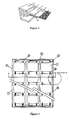
- the crystalline silicon photovoltaic module consists of a set of solar photovoltaic cells (1) that are connected to each other encapsulated at the front by a glass (1.2) with a gasket (1.3) and a flexible material (generally EVA) (1.1) and, at the rear, it is also encapsulated with the same flexible material (generally EVA) and an opaque flexible sheet (generally Tedlar) (1.5), with an aluminium frame (1.4). Glass is the element that makes the assembly rigid ( Figure 1 ).
- modules also mount the cells between two pieces of glass, such as the module SOLARWATT of the BLACKLINE type, manufactured by the company Solarwatt, and also with rear encapsulants made of plastic or polymers, such as the module manufactured by the company Solardachstien, which encapsulates the cells from the manufacturer Photowatt in a plastic material, which is referred to as polymatrix.
- the company Sunny Tile for example, encapsulates with resins, with its star unit module.
- This outer refrigeration is provided by means of water with an exchanger, which means that it is necessary to use a hydraulic circuit with a circulation pump, which makes the installation considerably more expensive and complicated.
- Another option for limiting the temperature of the cells for these devices is to reduce the concentration of solar radiation when a maximum temperature is exceeded.
- the installations lose effectiveness and efficiency, in view of the fact that they do not make the most of all the solar radiation that the cells are subjected to.
- electrolytic oxidation processes are well known for treating aluminium in order to protect it from the environmental conditions, and the same applies to their use in windows, doors, etc., but they are not required because of their electrical isolation and heat transmittance properties.
- the present invention is a self-supporting, photovoltaic passive refrigerator module, which is characterised by the fact that it has a high thermal transmittance, it is rigid and the total cost involved in producing the module is similar to or cheaper than the cost of those products that are currently available on the market.
- the material that is used as rear encapsulant for the photovoltaic cells is aluminium that has been subjected to a chemical process of electrolytic oxidation in which the aluminium is the anode. This process ensures that the aluminium is not a conductor of electricity and that it has a strong thermal transmittance.
- the encapsulant is obtained in the form of aluminium strips that have been extruded by means of a previously designed mould with slits conducive to the connections between the cells and the anodized aluminium.
- the mechanical and thermal characteristics of the photovoltaic module are a result of a combination of the length of the extruded part and the thickness of the aluminium, which provide the module with its mechanical strength, as well as by the way the mould for extrusion is designed and provided with flaps that dissipate the heat, generally improving the heat transmittance of the module.
- Another possibility involves directly using sheets of aluminium into which slits have been made before subjecting them to the same surface treatment as the strips of aluminium obtained by extrusion.
- the encapsulant is then subjected to a chemical process of electrolytic oxidation, which is applied to the surface that comes into contact with the cells, thereby ensuring that the aluminium is not a conductor of electricity.
- the electrical resistance depends on how long the electrolytic oxidation process lasts: the greater the oxidation, the greater the resistance owing to the greater thickness of the oxidised layer. This treatment ensures that there will be no short circuit between the cells that are connected to each other.
- the interconnected cells are laid upon the aluminium encapsulant and a flexible resin is preferably laid upon the cells. Furthermore, airtight boxes are provided that serve as a means for connecting up the different encapsulants where the connectors run in and out linking the cells that belong to each encapsulant.
- the whole assembly can be subjected to a vacuum heat process to guarantee that the cells are insulated against heat from the exterior and that they are isolated from an electrical perspective, although flexible front linings are currently available that guarantee both insulation and isolation without the vacuum process being required, such as for example, using adhesive.
- the front surface of the cells is protected from the exterior with transparent material (flexible resin, Tedlar, very fine glass, etc.), it not being necessary to use glass with the current thicknesses because the rigidity of the assembly is guaranteed with the rear encapsulant that is the object of the invention.
- transparent material flexible resin, Tedlar, very fine glass, etc.
- the photovoltaic module that is the object of the invention serves as a construction element because it can be used as a facade, an enclosure, a ledge, a cornice or roofing of any type, guaranteeing not only the creation but also the separation of zones, thanks to its high level of mechanical resistance and its air tightness qualities. Furthermore, if the rear encapsulant is equipped with flaps, as in the case of the mould designed for extrusion, and if it is thought desirable to do so, it is possible to make the most of the heat released by the flaps.
- the self-supporting, photovoltaic passive refrigerator module that is the object of the invention, is formed by a rear encapsulant made of aluminium that is subjected to a process of electrolytic oxidation, with a view to preventing it from being a conductor of electricity and to guarantee the thermal transmittance quality of the encapsulant.
- the encapsulant is obtained in the following way:
- aluminium strips are cut to the required length, before being subjected to a process of electrolytic oxidation, especially on the surface where the slits have been made.
- Another possibility involves directly using aluminium sheets in which slits are made, and are subjected to exactly the same surface treatment.
- connection sections 10 on the strip itself. Every module will consist of one or several central strips (4), one right-hand strip (5) and one left-hand strip (6). One single module with one single strip could also be made.
- the photovoltaic cells already connected up to each other, are then placed on each one of the strips of the rear encapsulant with the connecting wire between cells (11) laid over the slits.
- a means for protection is placed at the top, which in a preferred embodiment will be a flexible transparent resin (2) that is subjected to a heat process so that the resin can be made to stick to the photovoltaic cells (1) and to the rear encapsulant (4, 5 and 6). Another way of doing this is to stick this transparent resin (2) to the cells and to the rear encapsulant. Either of these two options serves to protect the cells from the exterior.
- the positive and negative terminals are connected to some airtight boxes (10) that are placed on the upper and lower sections of the module (12).
Landscapes
- Engineering & Computer Science (AREA)
- Photovoltaic Devices (AREA)
- Manufacturing & Machinery (AREA)
- Life Sciences & Earth Sciences (AREA)
- Sustainable Development (AREA)
- Sustainable Energy (AREA)
- Microelectronics & Electronic Packaging (AREA)
Applications Claiming Priority (2)
| Application Number | Priority Date | Filing Date | Title |
|---|---|---|---|
| ES200600057A ES2277788B2 (es) | 2006-01-04 | 2006-01-04 | Modulo fotovoltaico refrigerador pasivo y autoportante. |
| PCT/ES2006/000709 WO2007077277A1 (es) | 2006-01-04 | 2006-12-26 | Módulo fotovoltaico refrigerador pasivo y autoportante |
Publications (1)
| Publication Number | Publication Date |
|---|---|
| EP1975992A1 true EP1975992A1 (de) | 2008-10-01 |
Family
ID=38227938
Family Applications (1)
| Application Number | Title | Priority Date | Filing Date |
|---|---|---|---|
| EP06841761A Withdrawn EP1975992A1 (de) | 2006-01-04 | 2006-12-26 | Selbstunterstützendes fotovoltaisches passives kühlschrankmodul |
Country Status (3)
| Country | Link |
|---|---|
| EP (1) | EP1975992A1 (de) |
| ES (1) | ES2277788B2 (de) |
| WO (1) | WO2007077277A1 (de) |
Families Citing this family (1)
| Publication number | Priority date | Publication date | Assignee | Title |
|---|---|---|---|---|
| AT506684A1 (de) * | 2008-05-05 | 2009-11-15 | Mario Paul Stojec | Photovoltaik-modul |
Family Cites Families (5)
| Publication number | Priority date | Publication date | Assignee | Title |
|---|---|---|---|---|
| AU676330B2 (en) * | 1993-06-11 | 1997-03-06 | Isovolta Osterreichische Isolierstoffwerke Aktiengesellschaft | Process and device for manufacturing photovoltaic modules |
| EP0969521A1 (de) * | 1998-07-03 | 2000-01-05 | ISOVOLTAÖsterreichische IsolierstoffwerkeAktiengesellschaft | Fotovoltaischer Modul sowie ein Verfahren zu dessen Herstellung |
| ES2153796B1 (es) * | 1999-08-24 | 2001-10-01 | Fritta S L | Revestimiento generador de energia fotovoltaica. |
| US20030000568A1 (en) * | 2001-06-15 | 2003-01-02 | Ase Americas, Inc. | Encapsulated photovoltaic modules and method of manufacturing same |
| JP2004327850A (ja) * | 2003-04-25 | 2004-11-18 | Matsushita Electric Ind Co Ltd | 集積型太陽電池 |
-
2006
- 2006-01-04 ES ES200600057A patent/ES2277788B2/es not_active Expired - Fee Related
- 2006-12-26 WO PCT/ES2006/000709 patent/WO2007077277A1/es not_active Ceased
- 2006-12-26 EP EP06841761A patent/EP1975992A1/de not_active Withdrawn
Non-Patent Citations (1)
| Title |
|---|
| See references of WO2007077277A1 * |
Also Published As
| Publication number | Publication date |
|---|---|
| WO2007077277A1 (es) | 2007-07-12 |
| ES2277788A1 (es) | 2007-07-16 |
| ES2277788B2 (es) | 2008-06-16 |
Similar Documents
| Publication | Publication Date | Title |
|---|---|---|
| US6791024B2 (en) | Power converter, and photovoltaic element module and power generator using the same | |
| JP7071387B2 (ja) | 光起電屋根タイルをパッケージするためのシステムおよび方法 | |
| US20090084570A1 (en) | Low Profile Photovoltaic (LPPV) Box | |
| US5071491A (en) | Frame for solar cell devices | |
| US20100275976A1 (en) | Photovoltaic module with edge access to pv strings, interconnection method, apparatus, and system | |
| US20110308566A1 (en) | Photovoltaic module and the way of connecting photovoltaic modules in a photovoltaic system | |
| US20090038674A1 (en) | Photovoltaic Module | |
| TW201349529A (zh) | 背接觸型太陽能電池模組 | |
| WO2009012128A2 (en) | System and method utilizing re-deployable insulated self-ballasted photovoltaic assemblies | |
| US20120133012A1 (en) | Composite system for photovoltaic modules | |
| US10425035B2 (en) | Module connector for flexible photovoltaic module | |
| JP2009033130A (ja) | 太陽電池モジュール及び太陽電池モジュールの製造方法 | |
| CN120051931A (zh) | 光伏热模块 | |
| US20140182651A1 (en) | Integrated junction insulation for photovoltaic module | |
| EP3163629A1 (de) | Semielastisches fotovoltaikmodul | |
| CN215934771U (zh) | 一种建筑一体化光伏组件 | |
| EP1975992A1 (de) | Selbstunterstützendes fotovoltaisches passives kühlschrankmodul | |
| US12170504B2 (en) | Solar module, connection system and solar module system | |
| JP4206265B2 (ja) | 太陽電池モジュール | |
| JP4432247B2 (ja) | 太陽電池モジュール | |
| JP2002138636A (ja) | 太陽電池モジュールおよび太陽光発電装置、および建築物 | |
| CN223075445U (zh) | 太阳能窗帘和户用光伏系统 | |
| TW202333446A (zh) | 太陽能模組 | |
| JP3733236B2 (ja) | 太陽電池モジュール、それを用いた太陽電池アレイ及び太陽光発電装置、並びに太陽電池モジュールの製造方法及び取り付け方法 | |
| CN114270553A (zh) | 均质透明涂覆温室发电装置以及内部和外部电互连 |
Legal Events
| Date | Code | Title | Description |
|---|---|---|---|
| PUAI | Public reference made under article 153(3) epc to a published international application that has entered the european phase |
Free format text: ORIGINAL CODE: 0009012 |
|
| 17P | Request for examination filed |
Effective date: 20080730 |
|
| AK | Designated contracting states |
Kind code of ref document: A1 Designated state(s): AT BE BG CH CY CZ DE DK EE ES FI FR GB GR HU IE IS IT LI LT LU LV MC NL PL PT RO SE SI SK TR |
|
| DAX | Request for extension of the european patent (deleted) | ||
| STAA | Information on the status of an ep patent application or granted ep patent |
Free format text: STATUS: THE APPLICATION IS DEEMED TO BE WITHDRAWN |
|
| 18D | Application deemed to be withdrawn |
Effective date: 20130702 |