EP1973598B1 - Apparatus for light-activated drug therapy - Google Patents
Apparatus for light-activated drug therapy Download PDFInfo
- Publication number
- EP1973598B1 EP1973598B1 EP07718240.0A EP07718240A EP1973598B1 EP 1973598 B1 EP1973598 B1 EP 1973598B1 EP 07718240 A EP07718240 A EP 07718240A EP 1973598 B1 EP1973598 B1 EP 1973598B1
- Authority
- EP
- European Patent Office
- Prior art keywords
- light
- transurethral
- drug therapy
- support member
- therapy device
- Prior art date
- Legal status (The legal status is an assumption and is not a legal conclusion. Google has not performed a legal analysis and makes no representation as to the accuracy of the status listed.)
- Not-in-force
Links
Images


Classifications
-
- A—HUMAN NECESSITIES
- A61—MEDICAL OR VETERINARY SCIENCE; HYGIENE
- A61N—ELECTROTHERAPY; MAGNETOTHERAPY; RADIATION THERAPY; ULTRASOUND THERAPY
- A61N5/00—Radiation therapy
- A61N5/06—Radiation therapy using light
- A61N5/0613—Apparatus adapted for a specific treatment
- A61N5/062—Photodynamic therapy, i.e. excitation of an agent
-
- A—HUMAN NECESSITIES
- A61—MEDICAL OR VETERINARY SCIENCE; HYGIENE
- A61K—PREPARATIONS FOR MEDICAL, DENTAL OR TOILETRY PURPOSES
- A61K41/00—Medicinal preparations obtained by treating materials with wave energy or particle radiation ; Therapies using these preparations
- A61K41/0057—Photodynamic therapy with a photosensitizer, i.e. agent able to produce reactive oxygen species upon exposure to light or radiation, e.g. UV or visible light; photocleavage of nucleic acids with an agent
- A61K41/0071—PDT with porphyrins having exactly 20 ring atoms, i.e. based on the non-expanded tetrapyrrolic ring system, e.g. bacteriochlorin, chlorin-e6, or phthalocyanines
-
- A—HUMAN NECESSITIES
- A61—MEDICAL OR VETERINARY SCIENCE; HYGIENE
- A61N—ELECTROTHERAPY; MAGNETOTHERAPY; RADIATION THERAPY; ULTRASOUND THERAPY
- A61N5/00—Radiation therapy
- A61N5/06—Radiation therapy using light
- A61N5/0601—Apparatus for use inside the body
-
- A—HUMAN NECESSITIES
- A61—MEDICAL OR VETERINARY SCIENCE; HYGIENE
- A61N—ELECTROTHERAPY; MAGNETOTHERAPY; RADIATION THERAPY; ULTRASOUND THERAPY
- A61N5/00—Radiation therapy
- A61N5/06—Radiation therapy using light
- A61N5/0601—Apparatus for use inside the body
- A61N5/0603—Apparatus for use inside the body for treatment of body cavities
-
- A—HUMAN NECESSITIES
- A61—MEDICAL OR VETERINARY SCIENCE; HYGIENE
- A61N—ELECTROTHERAPY; MAGNETOTHERAPY; RADIATION THERAPY; ULTRASOUND THERAPY
- A61N5/00—Radiation therapy
- A61N5/06—Radiation therapy using light
- A61N5/067—Radiation therapy using light using laser light
-
- A—HUMAN NECESSITIES
- A61—MEDICAL OR VETERINARY SCIENCE; HYGIENE
- A61B—DIAGNOSIS; SURGERY; IDENTIFICATION
- A61B17/00—Surgical instruments, devices or methods
- A61B2017/00017—Electrical control of surgical instruments
- A61B2017/00022—Sensing or detecting at the treatment site
- A61B2017/00084—Temperature
-
- A—HUMAN NECESSITIES
- A61—MEDICAL OR VETERINARY SCIENCE; HYGIENE
- A61B—DIAGNOSIS; SURGERY; IDENTIFICATION
- A61B17/00—Surgical instruments, devices or methods
- A61B17/00234—Surgical instruments, devices or methods for minimally invasive surgery
- A61B2017/00238—Type of minimally invasive operation
- A61B2017/00274—Prostate operation, e.g. prostatectomy, turp, bhp treatment
-
- A—HUMAN NECESSITIES
- A61—MEDICAL OR VETERINARY SCIENCE; HYGIENE
- A61B—DIAGNOSIS; SURGERY; IDENTIFICATION
- A61B17/00—Surgical instruments, devices or methods
- A61B17/22—Implements for squeezing-off ulcers or the like on inner organs of the body; Implements for scraping-out cavities of body organs, e.g. bones; for invasive removal or destruction of calculus using mechanical vibrations; for removing obstructions in blood vessels, not otherwise provided for
- A61B2017/22051—Implements for squeezing-off ulcers or the like on inner organs of the body; Implements for scraping-out cavities of body organs, e.g. bones; for invasive removal or destruction of calculus using mechanical vibrations; for removing obstructions in blood vessels, not otherwise provided for with an inflatable part, e.g. balloon, for positioning, blocking, or immobilisation
- A61B2017/22065—Functions of balloons
- A61B2017/22068—Centering
-
- A—HUMAN NECESSITIES
- A61—MEDICAL OR VETERINARY SCIENCE; HYGIENE
- A61B—DIAGNOSIS; SURGERY; IDENTIFICATION
- A61B18/00—Surgical instruments, devices or methods for transferring non-mechanical forms of energy to or from the body
- A61B2018/00053—Mechanical features of the instrument of device
- A61B2018/00273—Anchoring means for temporary attachment of a device to tissue
- A61B2018/00279—Anchoring means for temporary attachment of a device to tissue deployable
- A61B2018/00285—Balloons
-
- A—HUMAN NECESSITIES
- A61—MEDICAL OR VETERINARY SCIENCE; HYGIENE
- A61B—DIAGNOSIS; SURGERY; IDENTIFICATION
- A61B18/00—Surgical instruments, devices or methods for transferring non-mechanical forms of energy to or from the body
- A61B2018/00315—Surgical instruments, devices or methods for transferring non-mechanical forms of energy to or from the body for treatment of particular body parts
- A61B2018/00547—Prostate
-
- A—HUMAN NECESSITIES
- A61—MEDICAL OR VETERINARY SCIENCE; HYGIENE
- A61B—DIAGNOSIS; SURGERY; IDENTIFICATION
- A61B18/00—Surgical instruments, devices or methods for transferring non-mechanical forms of energy to or from the body
- A61B2018/00636—Sensing and controlling the application of energy
- A61B2018/00773—Sensed parameters
- A61B2018/00791—Temperature
- A61B2018/00821—Temperature measured by a thermocouple
-
- A—HUMAN NECESSITIES
- A61—MEDICAL OR VETERINARY SCIENCE; HYGIENE
- A61B—DIAGNOSIS; SURGERY; IDENTIFICATION
- A61B18/00—Surgical instruments, devices or methods for transferring non-mechanical forms of energy to or from the body
- A61B18/18—Surgical instruments, devices or methods for transferring non-mechanical forms of energy to or from the body by applying electromagnetic radiation, e.g. microwaves
- A61B18/20—Surgical instruments, devices or methods for transferring non-mechanical forms of energy to or from the body by applying electromagnetic radiation, e.g. microwaves using laser
- A61B18/22—Surgical instruments, devices or methods for transferring non-mechanical forms of energy to or from the body by applying electromagnetic radiation, e.g. microwaves using laser the beam being directed along or through a flexible conduit, e.g. an optical fibre; Couplings or hand-pieces therefor
- A61B2018/2255—Optical elements at the distal end of probe tips
- A61B2018/2261—Optical elements at the distal end of probe tips with scattering, diffusion or dispersion of light
-
- A—HUMAN NECESSITIES
- A61—MEDICAL OR VETERINARY SCIENCE; HYGIENE
- A61N—ELECTROTHERAPY; MAGNETOTHERAPY; RADIATION THERAPY; ULTRASOUND THERAPY
- A61N5/00—Radiation therapy
- A61N5/06—Radiation therapy using light
- A61N5/0601—Apparatus for use inside the body
- A61N2005/0602—Apparatus for use inside the body for treatment of blood vessels
-
- A—HUMAN NECESSITIES
- A61—MEDICAL OR VETERINARY SCIENCE; HYGIENE
- A61N—ELECTROTHERAPY; MAGNETOTHERAPY; RADIATION THERAPY; ULTRASOUND THERAPY
- A61N5/00—Radiation therapy
- A61N5/06—Radiation therapy using light
- A61N5/0601—Apparatus for use inside the body
- A61N5/0603—Apparatus for use inside the body for treatment of body cavities
- A61N2005/061—Bladder and/or urethra
-
- A—HUMAN NECESSITIES
- A61—MEDICAL OR VETERINARY SCIENCE; HYGIENE
- A61N—ELECTROTHERAPY; MAGNETOTHERAPY; RADIATION THERAPY; ULTRASOUND THERAPY
- A61N5/00—Radiation therapy
- A61N5/06—Radiation therapy using light
- A61N2005/063—Radiation therapy using light comprising light transmitting means, e.g. optical fibres
-
- A—HUMAN NECESSITIES
- A61—MEDICAL OR VETERINARY SCIENCE; HYGIENE
- A61N—ELECTROTHERAPY; MAGNETOTHERAPY; RADIATION THERAPY; ULTRASOUND THERAPY
- A61N5/00—Radiation therapy
- A61N5/06—Radiation therapy using light
- A61N2005/065—Light sources therefor
- A61N2005/0651—Diodes
- A61N2005/0652—Arrays of diodes
Definitions
- the present invention relates generally to a prostate treatment system for treating prostatic tissue in combination with a photoactive agent, and more specifically a transurethral device in combination with a light-activated drug for use in treating benign prostatic hyperplasia (BPH).
- BPH benign prostatic hyperplasia
- Benign prostatic hyperplasia BPH
- prostate cancer are common conditions in the older male population.
- the enlarged prostate can compress the urethra causing obstruction of the urine pathway, which results in difficulty urinating.
- the enlarged prostate can also cause urethral stones, inflammation, infection and in some instances, kidney failure.
- Major treatment methods for BPH include surgical treatment such as a prostatectomy or transurethral resection of the prostate. These treatments require the patient to be hospitalized, which can be a financial burden to the patient. Additionally, surgical procedures can result in significant side effects such as bleeding, infection, residual urethral obstruction or stricture, retrograde ejaculation, and/or incontinence or impotence. Patients who are too old or who have weak cardiovascular functions are not good candidates for receiving these treatment methods.
- Photodynamic treatment (PDT) methods are new methods for treating cancers.
- light-activated drug therapy also known as PDT
- light of a specific wavelength or waveband is directed toward a target cell or cells that have been rendered photosensitive through the administration of a photoreactive, photoinitiating, or photosensitizing agent.
- the drug is commonly administered to the patient via intravenous injection, oral administration, or by local delivery to the treatment site.
- a light source emitting certain wavelength or waveband can be used to irradiate the cancerous tumor or the enlarged tissue by activating the photosensitizer to produce a strong oxidizing agent that can kill the cancerous tumor or enlarged tissues.
- the light-activated drug therapy is minimally invasive, less costly, and has a lower risk of complications.
- One type of light delivery system used for light-activated drug therapy comprises the delivery of light from a light source, such as a laser, to the targeted cells using an optical fiber delivery system with special light-diffusing tips on the fibers.
- This type of light delivery system may further include optical fiber cylindrical diffusers, spherical diffusers, micro-lensing systems, an over-the-wire cylindrical diffusing multi-optical fiber catheter, and a light-diffusing optical fiber guide wire.
- This light delivery system generally employs a remotely located high-powered laser, or solid-state laser diode array, coupled to optical fibers for delivery of the light to the targeted cells.
- the light source for the light delivery system used for light-activated drug therapy may also be light emitting diodes (LEDs) or solid-state laser diodes (LDs). LEDs or LDs may be arrayed in an elongated device to form a "light bar" for the light delivery system.
- the LEDs or LDs may be either wire bonded or electrically coupled utilizing a "flip chip” technique that is used in arranging other types of semiconductor chips on a conductive substrate.
- Various arrangements and configurations of LEDs or LDs are described in U.S. Patent Nos. 5,445,608 ; 6,958,498 ; 6,784,460 ; and 6,445,011 .
- the largest diameter of the light bar is defined by human anatomy and the smallest diameter is defined by the size of the light emitters that emit light of a desired wavelength or waveband at a sufficient energy level, and the fragility of the bar as its thickness is reduced, which increases the risk of breaking in the patient.
- US 5 445 608 A discloses a flexible elongated member, within which an array of LEDs are placed, which are used for PDT.
- the translucent elongated body with the LEDs is inserted through a lumen of a catheter and protrudes from a distal side of the catheter.
- US 5 800 478 A discloses a catheter having a flexible polymer material, in which an array of LEDs is provided. The LED array is used for PDT.
- a catheter which comprises a balloon that is fixed in the bladder is disclosed in WO 93/04727 A1 .
- a similar catheter is disclosed in US 5 456 661 A .
- a catheter having a balloon, which is placed in the esophagus is known from US 6 146 409 A .
- the balloon disclosed in said document has a coated side and a treatment window.
- transurethral light-activated drug therapy device having the features defined in claim 1. Further preferred embodiments are defined in the dependent claims.
- a transurethral treatment device can include an elongated support member configured to pass through the urethra, a light delivery device, and a positioning element carried by the support member.
- the support member can be a catheter having at least one lumen, or in other embodiments the support member can be a generally closed body without a lumen.
- the light delivery device can have a light generator along the support member and a light emitting region configured to be positioned within the urethra at least proximate to a treatment site.
- the light generator is configured to generate light at a preselected wavelength or waveband in the range of an activation waveband of a photoactive composition.
- the positioning element is configured to locate the light emitting region within the urethra at least proximate to the treatment site.
- the positioning element for example, can be a balloon or indicators on the support member.
- a transurethral treatment device comprises a light delivery device positionable within or along an elongated support member for treatment of benign prostatic hyperplasia (BPH).
- the light delivery system may include light emitting diodes (LEDs), laser diodes (LDs), or may include a diffusion quartz fiber tip connected to an internal source of light energy.
- the treatment device may further include a temperature monitoring system for monitoring the temperature at the treatment site and a urine drainage system.
- the treatment device has a light delivery device positioned within a catheter-like device, such as a Foley catheter or a conventional balloon catheter.
- a light bar sized to fit into a standard or custom optically clear Foley catheter, is inserted into the catheter which has been placed via the urethra at the prostate.
- the device can be used in a sterile Foley catheter or can be delivered in a sterile pack kit prepackaged with the catheter and/or an appropriate photoactive agent dose so that it is convenient for prostatic procedures, and thus facilitates treatment in a non-surgical environment leading to potential reduction in costs and medical complications.
- the transurethral treatment device can have an outer diameter of about 0.8 mm to about 10 mm (e.g, 2.5 mm).
- the light source may have a cross-sectional dimension of about 0.5 mm to about 1.5 mm, but in other embodiments it can be larger.
- the size of an LED for example, can be approximately 0.25 mm to 1 mm.
- the transurethral treatment device, light source and LEDs can have other cross-sectional dimensions.
- the light bar may further include an encapsulant made from a flexible polymeric material with an appropriate refractive index to ensure efficient light coupling into the body.
- the encapsulant can also be made from opaque or reflective material to direct the light to the targeted tissues and to protect other tissues.
- non-LED light sources such as laser diodes (LDs) can be used. Generated light can be transmitted to the treatment site via optical fibers.
- the light delivery system may further include a diffusion quartz fiber tip connected to a source of light.
- the light emitting region of the treatment device is fixed in place in the elongated support member.
- the light emitting region of the light delivery device is movable within or along the elongated support member. For example, at the end of the treatment the light delivery device may be removed and the elongated support member left in place to act as a urine drain.
- the treatment device may further include printed markings or indicia on the catheter to aid in placement of the light bar within the catheter.
- the catheter has a selective coating to control where light transmits to the prostatic tissue thus directing the light activate drug therapy and reducing the potential to treat adjacent tissue.
- a Y-connection with a leakage control valve is included to allow the light delivery device to be inserted into the elongated support member through a separate lumen from a urine collection lumen.
- the elongated support member may include one or more lumens as needed to provide light transmission source manipulation and placement.
- the elongated support member may include a balloon to further aid in positioning the light delivery device proximate to the prostate using non-incision type methods.
- the catheter may include a retractable fixation device such as balloon, umbrella, tines, disk or other means for fixation and placement within the bladder.
- the elongated support member and light bar may include echogenic material to reflect highfrequency sound waves and thus be imageable by ultrasound techniques. Echogenic material will aid in proper placement of the elongated support member and the light bar in operation.
- the light delivery system also includes temperature sensors which are electrically connected to temperature monitors for monitoring temperature at the treatment site.
- the treatment device may be used to treat prostate cancer, prostatits, cystitis, bladder cancer, hypertrophic trigone, and hypertrophic urethral sphincter.
- the present invention utilizes light-activated drug therapy to minimally-invasively treat BPH or prostate cancer via the urethra. As a result, patients with BPH or prostate cancer can be treated using the present invention without being admitted to a hospital, undergo general anesthesia and blood transfusion, and thus have lower risk of complications.
- a photosensitizer is administered intravenously before activating the light delivery device.
- the light activates the photosensitizer to promote cell death in the prostatic tissue.
- the device provides a minimally invasive transurethral method for treating BPH, prostate cancer or other prostatic conditions.
- This type of light-activated drug therapy would treat prostatic tissue, for example, by causing cell death in the prostatic tissue. Such cell death and the absorption of the tissue by the patient's body would create an opening for urine to flow from the bladder out the urethra.
- the method includes identifying a location of tissue to be treated in the prostate; inserting an elongated support member into the urethral tract to position a light emitting region at least proximate to the location of the targeted tissue; and administering an effective dose of a photoactive composition to the targeted tissue.
- the method may include confirming placement of the light source prior to treatment.
- the method further includes treating the targeted tissue with light-activated drug therapy for a predetermined period of treatment.
- the light-activated drug is mono-L-aspartyl chlorine e 6 , also referred to herein as Talaporfin Sodium.
- This compound's absorption spectrum has several absorption bands: 400-420 nm (e.g., peak of about 411 nm), 500-520 nm (e.g., peak of about 507 nm), and 655-670 nm (e.g., peak of about 664nm).
- the drug could be excited at any of these bands.
- Alternative light-activated drugs of suitable excitation wavelengths may also be used as is known in the art.
- a transurethral light-activated drug therapy device for the treatment of prostate diseases comprising:
- the transurethral light-activated drug therapy device may comprise a monitoring device electrically coupled to the temperature sensor.
- the monitoring device may include an output device, wherein the output device provides a visual indicator, audible indicator or other temperature indicator for the temperature at the treatment site.
- the catheter may have a selective coating to control where light emits from the distal end.
- the transurethral light-activated drug therapy device may comprise a second lumen in which the array of LEDs or LDs is contained and can move axially within the catheter.
- the array of LEDs or LDs may be fixed at a selected location within the catheter during treatment.
- the transurethral light-activated drug therapy device may comprise a fixation device for releasably retaining the catheter in the urethra tract during treatment.
- the fixation device may be a balloon, umbrella, tines, and/or disk.
- the fixation device may be retractable.
- the transurethral light-activated drug therapy device may comprise echogenic markings on the distal end of the catheter or on the light source or both.
- the transurethral light-activated drug therapy device may comprise positioning indicia on the proximal end of the catheter.
- Also disclosed is a method for light-activated drug therapy of benign prostate hyperplasia comprising:
- the method may comprise monitoring the temperature of the treatment site with a temperature sensor.
- the method may comprise modifying the administration of light therapy based on the temperature at the treatment site.
- the method may comprise releasably fixing the support member prior to administering the light therapy.
- the method may comprise monitoring echogenic marking on a distal end of the support member to position the support member in the urethra tract.
- the method may comprise moving the light emitting region during administration of the light therapy.
- the method may comprise controlling the emission of light from the light generator according to a predetermined pattern.
- the support member may comprise a catheter
- the method may comprise moving the light generator and the light emitting region along the catheter to position the light emitting region at least proximate to the treatment site.
- the light generator and the light emitting region may be fixed to the support member, and the method may comprise moving the support member within the urethra to position the light emitting region at least proximate to the treatment site.
- a prostate treatment system can include a transurethral treatment device having a light delivery device positioned within or along an elongated support member for treatment of benign prostate hyperplasia (BPH) and other prostate conditions.
- the treatment device includes a light delivery device disposed on the surface of the elongated support member, or in other embodiments, the light delivery device is within a lumen of the elongated support member.
- the light generator can be optically connected to a light emitting region via optical fibers or light guides. Alternatively, the light generator and the light emitting region may be positioned together at the distal end of the elongated member at least proximate to a treatment site.
- the light generator may include a laser, an LED, a thin plastic sheet material which produces light at a selected wavelength or waveband, or other suitable light sources that can be transmitted to or placed at the treatment site.
- the transurethral treatment device also includes temperature sensors which are electrically connected to temperature monitors.
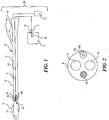
- Figure 1 illustrates a prostate treatment system 20 including a power supply 1 and a transurethral treatment device 21 having an elongated support member 2 and a light delivery device 6 positioned along or within the support member 2.
- the transurethral treatment device 20 may further includes a balloon 3 or other type of positioning element carried by the elongated support member 2.
- the support member 2 can be a catheter having a lumen 4, or the support member 2 can be a closed body without a lumen.
- the support member 2 has a total length of 400 to 450 mm and has an outer diameter of 3.327 mm, and the balloon 3 at the distal end of the support member 2 has a volume of 10 to 30 ml and is used to position and fix the light delivery device 6 proximate to the treatment site such as the prostate.
- the light delivery device 6 can have a light generator 6a and a light emitting region 6b.
- the light generator 6a and the light emitting region 6b are at approximately the same location of the elongated member, but in other embodiments shown below, the light generator 6a may not be coincident with the light emitting region 6b.
- the light generator 6a may be located towards the proximal end of the support member 2.
- the support member 2 is a catheter with a lumen 4
- the light delivery device 6 can move within the lumen to be positioned relative to the treatment site.
- the light delivery device 6 can be disposed on the surface of the catheter 2 below the balloon 3 or other type of positioning element.
- the power for the light generator can be transmitted to the light delivery device 6 via a lead wire 7 coupled to the power source 1.
- light could be emitted by a light emitting diode (LED), a laser diode, light-emitting polymer, or a quartz fiber tip optically coupled to another internal source of light energy.
- LED light emitting diode
- laser diode laser diode
- quartz fiber tip optically coupled to another internal source of light energy
- the support member 2 can include a plurality of lumens therein.
- the balloon 3 is connected to a fluid inlet 5 via lumen 4. Gas or liquid can be pumped into inlet 5 and through lumen 4 to inflate balloon 3.
- the transurethral treatment device 21 can optionally have a urine aperture 11 positioned at the distal end of the support member 2 that is connected to a urine collection bag 13 via a urine lumen 12. The urine aperture 11 can be used to collect the patient's urine during treatment.
- the transurethral treatment device 21 can also optionally include a temperature measuring system having at least one of a temperature sensor 8 and a temperature monitor 10.
- the temperature sensor 8 can be a thermocouple or other sensor as is known in the art.
- the temperature sensor 8 is disposed on or thermally coupled to a surface of the support member 2 and is electrically connected to the temperature monitor 10 via wires 9 disposed within the support member 2.
- the temperature sensor 8 measures a temperature at the treatment site, for example, proximate to the prostate during treatment.
- a control loop (not shown) may further be connected to the temperature monitor 10 to automatically shut the treatment device off in the event that the temperature at the treatment site exceeds a predetermined value.
- the temperature monitor 10 may further include a warning device (not shown), such as a visual indicator or audible indicator, to provide an operator with a warning that a predetermined temperature has been reached or is being exceeded during treatment.
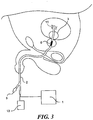
- the treatment device is positioned transurethrally to allow access to the prostate, followed by administration of a photoactive drug, by injection, intravenously, or orally.
- the transurethral treatment device 21, and more specifically a portion of the support member 2 can be directed into the urethra under topical anesthesia.
- 4 to 10 ml of saline or air can be pumped into the balloon 3 via the air pumping channel 4 to inflate the balloon 3.
- the support member 2 can be pulled slightly proximally such that the balloon 3 can be fixed at the inner opening of the urethra .
- the light delivery device 6 can be positioned at least proximate to or within the prostate.
- the photoactive drug can then be administered to the patient, and the light generator 6b can be activated.
- the support member 2 has a proximal portion and a distal portion relative to a power controller.
- the distal portion of support member 2 includes the light delivery device 6.
- the light delivery device comprises a plurality of LEDs in electrical communication with the power supply via lead wires 7 as shown in Figure 1 .
- the lead wires may be selected from any suitable conductor that can be accommodated within the dimensions of the support member, for example: a bus bar that electronically couples the LEDs to the controller; flexible wires; a conductive film or ink applied to a substrate, and the like.
- the light delivery device may include Bragg reflectors to better control the wavelength of the light that is to be transmitted to the target cells.
- a power controller 1 may be programmed to activate and deactivate LEDs of a light delivery device in a pulsed sequence or a continuous sequence.
- the LEDs may form two halves of the light array that may be turned on and off independently from each other.
- the system may be programmed to selectively activate and deactivate (e.g., address) different selected individual or groups of LEDs along the length of the bar.
- a treatment protocol for example causing the LEDs to be lit in a certain sequence or at a particular power level for a selected period of time, may be programmed into the controller. Therefore, by selectively timing the pulses and/or location of the light, the system delivers light in accordance with a selected program.
- LEDs can be powered by DC continuously.
- Examples of addressable light transmission arrays are disclosed in U.S. Patent No. 6,096,066 .
- Exemplary light transmission arrays which include shielding or distal protection are disclosed in U.S. Patent Nos. US 2005/0228260 A1 and US 2005/0131510 A1 .
- the efficacy of the light-activated drug therapy is improved, given that the treated tissue is allowed to reoxygenate during the cycles when the light is off.
- tissue oxygenation during therapy is improved by using a lower frequency.
- the operational frequency is 50 Hz - 5 kHz, and in one embodiment, is 50 - 70 Hz.
- the treatment device may further include a temperature monitoring system for monitoring the temperature at the treatment site.
- the support member 2 is a Foley catheter and the light delivery device 6 is disposed in the Foley catheter.
- the treatment device has a light delivery device disposed in a conventional balloon catheter.
- Foley catheters are available in several sub-types, for example, a Coude catheter has a 45° bend at the tip to allow easier passage through an enlarged prostate.
- Council tip catheters have a small hole at the tip which allows them to be passed over a wire.
- Three-way catheters are used primarily after bladder, prostate cancer or prostate surgery to allow an irrigant to pass to the tip of the catheter through a small separate channel into the bladder. This serves to wash away blood and small clots through the primary arm that drains into a collection device.
- Figure 4 is a cross-sectional view of still another embodiment of a transurethral treatment device 21.
- the light delivery device includes a light generator 6a along the support member 2 at a location that is either within or external (shown) to the patient.
- the light delivery device can further include a light emitting region 6b positioned at least proximate to the treatment site and a light transmitting region 6c (e.g., fiber optic) between the light generator 6a and the light emitting region 6b.
- the support member 2 can be a catheter through which the light delivery device 6 can be moved for positioning, or the support member can be a closed body to which the light delivery device 6 is attached (e.g., fixed at a set position).
- Figures 5-7 are cross-sectional views showing additional embodiments of portions of transurethral treatment devices.
- Figure 5 more specifically, shows a device having a closed body support member 2 and a light delivery device fixed to the support member 2.
- the light delivery device has a light generator 6a, a light emitting region spaced apart from the light generator 6a distally along the support member 2, and a light transmitting region 6c between the light generator 6a and the light emitting region 6b.
- the light transmitting region 6c conducts light from the light generator 6a to the light emitting region 6b.
- Figure 6 illustrates a device having a solid or otherwise lumen-less support member 2 and a light delivery device 6 with a light generator 6a and a light emitting region 6b at the same location longitudinally along the support member 2.
- the light generator is within the support member 2.
- Figure 7 shows still another embodiment in which the light delivery device is on a surface of the support member. More specifically, the light delivery device 6 has the light generator 6a and the light emitting region 6b disposed on an external surface of the support member.
- a light delivery system that is sized to fit into a standard or custom optically clear Foley catheter is inserted into that catheter which has been placed via the urethra at the prostate.
- the light delivery device can be used with a sterile Foley catheter or can be delivered in a sterile pack kit prepackaged with the catheter and/or an appropriate photoactive agent dose so that it is convenient for prostatic procedures.
- the light bar or light array may include a plurality of LEDs contained in a catheter assembly or otherwise attached to a closed elongated support member.
- the support member 2 may have an outer diameter of about 0.8 to about 10 mm.
- Example of LED arrays are disclosed in U.S. Patent No. US 2007/0260295 A1 entitled “Light Transmission system for Photo-reactive Therapy,” and U.S. Patent No. US 2007/0002582 A1 entitled “Medical Apparatus Employing Flexible Light Structures and Methods for Manufacturing Same,".
- Additional embodiments have a power controller drive circuit capable of producing constant current D.C., A.C., square wave and pulsed wave drive signals. This is accomplished by combining a constant source with a programmable current steering network allowing the controller to selectively change the drive wave form. For example, the steering network may be modulated to achieve the various functions described above, for example, producing the desired impedance to fully discharge the battery.
- use of an A.C. drive allows for a two-wire connection to the LEDs, thereby reducing the cross-sectional diameter of the catheter, while still permitting use of two back-to-back emission sources, that when combined, produce a cylindrical light source emission pattern.
- the transurethral treatment device 21 can comprise a unitary, single use disposable system for light-activated drug therapy. It should be noted that in certain embodiments the catheter is fused to the power controller to form an integrated single unit. Any attempt to disconnect the support member in this embodiment results in damage to either the catheter, or module, or both.
- the prostate treatment system can be used in connection with any light-activated drug of which there are many known in the art and some of which are listed in U.S. Patent No. 7,015,240 .
- the light-activated drug is Talaporfin Sodium.
- Talaporfin Sodium is a chemically synthesized photosensitizer, having an absorption spectrum that exhibits a maximum peak at 664 nm.
- the Talaporfin Sodium is presented as a lyophilized powder for reconstitution. One hundred milligrams of Talaporfin Sodium is reconstituted with 4 milliliters of 0.9% isotonic sterile sodium chloride solution, to give a solution at a concentration of 25 mg/ml.
- the drug must be activated with light, and light energy is measured here in Joules (J) per centimeter of length of the light transmitting array. Likewise the fluence of light is measured in milli-watts (mW) per centimeter of length of the light emitting array.
- J Joules
- mW milli-watts
- the fluence may be delivered for only a fraction of the treatment time, because the light array may be pulsed, for example in a frequency such as 60 kHz, or may be controlled by a timing pattern.
- a timing pattern is that the array is at full fluence for 20 seconds, then off for 10 seconds in a repetitive cycle.
- the control module may further be programmable in embodiments for such fractionated light delivery.
- light energy in the range from about 50 to about 1000 J/cm of light array fluence in the range from about 5 to about 50 mW/cm of light array is delivered to the treatment site.
- the equation discussed above relating energy time and fluence plays a role in selection of the fluence and energy delivered.
- a certain time period may be selected as suitable.
- the nature of treatment might dictate the energy required.
- the light array should be capable of providing that fluence in the allotted time period. For example, if a total of 200 J/cm of light array must be delivered to the treatment site at 20 mW/cm of light array, then the treatment period is approximately 2.8 hours.
- the support member further has a selective coating to control where light transmits to the prostatic tissue thus directing the light activate drug therapy and reducing the potential to treat adjacent tissue.
- the light delivery device is fixed in place in the catheter.
- the light delivery device is movable within the catheter.
- the treatment device may further include printed markings or indicia on the catheter to aid in placement of the light bar within the catheter.
- the light delivery device can also have asymmetric light delivery to protect the colon or rectum.
- the light deliver device can be double sided and/or shielded so that one side of the light bar emits light at a higher intensity than another side. Exemplary light delivery devices are disclosed in U.S. Patent No. 5,876,427 .
- a Y-connection with a leakage control valve is included to allow the light transmission source to be inserted into the catheter through a separate lumen from a urine collection lumen.
- the catheter may include two or more lumens as needed to provide light transmission source manipulation and placement.
- the catheter includes a balloon or other positional element to further aid in positioning the light source transmission end proximate to the prostate using non-incision type methods.
- the catheter may include a retractable fixation device such as balloon, umbrella, tines, disk or other means for fixation and placement within the bladder.
- the light source catheter and/or the light bar may include echogenic material to reflect highfrequency sound waves and thus be imageable by ultrasound techniques. In operation, echogenic material will aid in proper placement of the catheter and the light source.
- the light transmission source also includes temperature sensors which are electrically connected to temperature monitors.
- the prostate treatment systems are expected to provide highly efficient, low cost, and minimally-invasive treatment of prostate conditions.
- the treatment device may be used to treat prostate cancer, prostatis, cystitis, bladder cancer, hypertrophic trigone, and hypertrophic urethral sphincter.
- the present invention allows for utilization of light-activated drug therapy methods to minimally-invasively treat BPH or prostate cancer via the urethra. As a result patients with BPH or prostate cancer can be treated using the present invention without being hospitalized, undergo general anesthesia and blood transfusion, and thus have lower risk of complications.
- the method includes identifying a location of tissue to be treated in the prostate; inserting a catheter into the urethra tract; inserting a light delivery device at least proximate to the location of the targeted tissue; and administering an effective dose of a photoactive drug.
- the method may include confirming placement of the light source prior to treatment.
- the method further includes treating the targeted tissue by activating the light delivery device for a predetermined period of treatment.
- the light-activated drug is mono-L-aspartyl chlorine e 6 , also referred to herein as Talaporfin Sodium.
- compositions and methods of making Talaporfin Sodium are disclosed and taught in co-pending U.S. Patent No. US 2008/0021210 A1 entitled "Compositions and Methods of Making a Photoactive Agent”.
- This compound has an absorption spectrum that exhibits several peaks, including one with the excitation wavelength of 664 nm, which is the wavelength favored when it is used in photoreactive therapy.
- Alternative light-activated drugs of suitable excitation wavelengths may also be used as is known in the art.
- the method further includes monitoring a temperature at treatment site.
- the temperature measuring system includes a temperature sensor for monitoring the temperature at the treatment site.
- the temperature sensor may be a thermal couple or any suitable device for providing temperature information at the treatment site.
- the temperature sensor may be disposed at the surface of the support member and is further electrically connected to the temperature monitor via wires. Alternatively, the temperature sensor may be wirelessly connected to the temperature monitor.
- the temperature sensor provides the temperature proximate to the treatment site during treatment to ensure safe operating temperatures during the treatment at the treatment site.
Landscapes
- Health & Medical Sciences (AREA)
- Engineering & Computer Science (AREA)
- Biomedical Technology (AREA)
- Life Sciences & Earth Sciences (AREA)
- General Health & Medical Sciences (AREA)
- Veterinary Medicine (AREA)
- Public Health (AREA)
- Animal Behavior & Ethology (AREA)
- Radiology & Medical Imaging (AREA)
- Nuclear Medicine, Radiotherapy & Molecular Imaging (AREA)
- Pathology (AREA)
- Chemical & Material Sciences (AREA)
- Biophysics (AREA)
- Pharmacology & Pharmacy (AREA)
- Medicinal Chemistry (AREA)
- Molecular Biology (AREA)
- Epidemiology (AREA)
- Biochemistry (AREA)
- Physics & Mathematics (AREA)
- Optics & Photonics (AREA)
- Radiation-Therapy Devices (AREA)
- Thermotherapy And Cooling Therapy Devices (AREA)
- Media Introduction/Drainage Providing Device (AREA)
Description
- The present invention relates generally to a prostate treatment system for treating prostatic tissue in combination with a photoactive agent, and more specifically a transurethral device in combination with a light-activated drug for use in treating benign prostatic hyperplasia (BPH).
- Benign prostatic hyperplasia (BPH) and prostate cancer are common conditions in the older male population. For people with BPH, the enlarged prostate can compress the urethra causing obstruction of the urine pathway, which results in difficulty urinating. The enlarged prostate can also cause urethral stones, inflammation, infection and in some instances, kidney failure.
- Major treatment methods for BPH include surgical treatment such as a prostatectomy or transurethral resection of the prostate. These treatments require the patient to be hospitalized, which can be a financial burden to the patient. Additionally, surgical procedures can result in significant side effects such as bleeding, infection, residual urethral obstruction or stricture, retrograde ejaculation, and/or incontinence or impotence. Patients who are too old or who have weak cardiovascular functions are not good candidates for receiving these treatment methods.
- Photodynamic treatment (PDT) methods are new methods for treating cancers. In light-activated drug therapy, also known as PDT, light of a specific wavelength or waveband is directed toward a target cell or cells that have been rendered photosensitive through the administration of a photoreactive, photoinitiating, or photosensitizing agent. The drug is commonly administered to the patient via intravenous injection, oral administration, or by local delivery to the treatment site. A light source emitting certain wavelength or waveband can be used to irradiate the cancerous tumor or the enlarged tissue by activating the photosensitizer to produce a strong oxidizing agent that can kill the cancerous tumor or enlarged tissues. As compared to surgical alternatives, the light-activated drug therapy is minimally invasive, less costly, and has a lower risk of complications.
- One type of light delivery system used for light-activated drug therapy comprises the delivery of light from a light source, such as a laser, to the targeted cells using an optical fiber delivery system with special light-diffusing tips on the fibers. This type of light delivery system may further include optical fiber cylindrical diffusers, spherical diffusers, micro-lensing systems, an over-the-wire cylindrical diffusing multi-optical fiber catheter, and a light-diffusing optical fiber guide wire. This light delivery system generally employs a remotely located high-powered laser, or solid-state laser diode array, coupled to optical fibers for delivery of the light to the targeted cells.
- The light source for the light delivery system used for light-activated drug therapy may also be light emitting diodes (LEDs) or solid-state laser diodes (LDs). LEDs or LDs may be arrayed in an elongated device to form a "light bar" for the light delivery system. The LEDs or LDs may be either wire bonded or electrically coupled utilizing a "flip chip" technique that is used in arranging other types of semiconductor chips on a conductive substrate. Various arrangements and configurations of LEDs or LDs are described in
U.S. Patent Nos. 5,445,608 ;6,958,498 ;6,784,460 ; and6,445,011 . - One of the challenges in design and production of light bars relates to size. The largest diameter of the light bar is defined by human anatomy and the smallest diameter is defined by the size of the light emitters that emit light of a desired wavelength or waveband at a sufficient energy level, and the fragility of the bar as its thickness is reduced, which increases the risk of breaking in the patient.
- Presently, there exists a need for an apparatus for light-activated drug therapy for effectively treating prostate via the urethra that is cost effective, less invasive than other treatments, and has less risk of complications. Accordingly, there is a need for smaller LEDs or LDs and other light sources that are safe for use in a urethra tract introduced via a catheter-like device.
- Further catheters are known from
US 5 800 478 A ,US 5 445 608 A ,WO 93/04727 A1 US 5 456 661 A andUS 6 146 409 A . In particular,US 5 445 608 A discloses a flexible elongated member, within which an array of LEDs are placed, which are used for PDT. The translucent elongated body with the LEDs is inserted through a lumen of a catheter and protrudes from a distal side of the catheter.US 5 800 478 A discloses a catheter having a flexible polymer material, in which an array of LEDs is provided. The LED array is used for PDT. - A catheter, which comprises a balloon that is fixed in the bladder is disclosed in
WO 93/04727 A1 US 5 456 661 A . A catheter having a balloon, which is placed in the esophagus is known fromUS 6 146 409 A . The balloon disclosed in said document has a coated side and a treatment window. - In order to solve the aforementioned problems, the present invention provides transurethral light-activated drug therapy device having the features defined in
claim 1. Further preferred embodiments are defined in the dependent claims. - The invention describes devices, methods and systems for light-activated drug therapy for treating the prostate transurethrally. One embodiment of a transurethral treatment device can include an elongated support member configured to pass through the urethra, a light delivery device, and a positioning element carried by the support member. The support member can be a catheter having at least one lumen, or in other embodiments the support member can be a generally closed body without a lumen. The light delivery device can have a light generator along the support member and a light emitting region configured to be positioned within the urethra at least proximate to a treatment site. The light generator is configured to generate light at a preselected wavelength or waveband in the range of an activation waveband of a photoactive composition. The positioning element is configured to locate the light emitting region within the urethra at least proximate to the treatment site. The positioning element, for example, can be a balloon or indicators on the support member.
- In other embodiments a transurethral treatment device comprises a light delivery device positionable within or along an elongated support member for treatment of benign prostatic hyperplasia (BPH). The light delivery system may include light emitting diodes (LEDs), laser diodes (LDs), or may include a diffusion quartz fiber tip connected to an internal source of light energy. The treatment device may further include a temperature monitoring system for monitoring the temperature at the treatment site and a urine drainage system.
- According to another embodiment of the invention, the treatment device has a light delivery device positioned within a catheter-like device, such as a Foley catheter or a conventional balloon catheter. In one embodiment, a light bar, sized to fit into a standard or custom optically clear Foley catheter, is inserted into the catheter which has been placed via the urethra at the prostate. The device can be used in a sterile Foley catheter or can be delivered in a sterile pack kit prepackaged with the catheter and/or an appropriate photoactive agent dose so that it is convenient for prostatic procedures, and thus facilitates treatment in a non-surgical environment leading to potential reduction in costs and medical complications.
- In additional embodiments, the transurethral treatment device can have an outer diameter of about 0.8 mm to about 10 mm (e.g, 2.5 mm). The light source may have a cross-sectional dimension of about 0.5 mm to about 1.5 mm, but in other embodiments it can be larger. The size of an LED, for example, can be approximately 0.25 mm to 1 mm. In other embodiment, the transurethral treatment device, light source and LEDs can have other cross-sectional dimensions. The light bar may further include an encapsulant made from a flexible polymeric material with an appropriate refractive index to ensure efficient light coupling into the body. The encapsulant can also be made from opaque or reflective material to direct the light to the targeted tissues and to protect other tissues.
- In additional embodiments, non-LED light sources such as laser diodes (LDs) can be used. Generated light can be transmitted to the treatment site via optical fibers. The light delivery system may further include a diffusion quartz fiber tip connected to a source of light.
- In additional embodiments, the light emitting region of the treatment device is fixed in place in the elongated support member. In yet another embodiment, the light emitting region of the light delivery device is movable within or along the elongated support member. For example, at the end of the treatment the light delivery device may be removed and the elongated support member left in place to act as a urine drain. The treatment device may further include printed markings or indicia on the catheter to aid in placement of the light bar within the catheter.
- In additional embodiments, the catheter has a selective coating to control where light transmits to the prostatic tissue thus directing the light activate drug therapy and reducing the potential to treat adjacent tissue.
- According to still further embodiments, a Y-connection with a leakage control valve is included to allow the light delivery device to be inserted into the elongated support member through a separate lumen from a urine collection lumen. The elongated support member may include one or more lumens as needed to provide light transmission source manipulation and placement. In additional embodiments, the elongated support member may include a balloon to further aid in positioning the light delivery device proximate to the prostate using non-incision type methods. In additional embodiments, the catheter may include a retractable fixation device such as balloon, umbrella, tines, disk or other means for fixation and placement within the bladder.
- In additional embodiments, to make the light bar visible to ultrasound, the elongated support member and light bar may include echogenic material to reflect highfrequency sound waves and thus be imageable by ultrasound techniques. Echogenic material will aid in proper placement of the elongated support member and the light bar in operation. In additional embodiments, the light delivery system also includes temperature sensors which are electrically connected to temperature monitors for monitoring temperature at the treatment site.
- Several embodiments of the present invention are expected to provide efficient, low cost, and minimally-invasive treatments of prostate conditions. The treatment device may be used to treat prostate cancer, prostatits, cystitis, bladder cancer, hypertrophic trigone, and hypertrophic urethral sphincter. The present invention utilizes light-activated drug therapy to minimally-invasively treat BPH or prostate cancer via the urethra. As a result, patients with BPH or prostate cancer can be treated using the present invention without being admitted to a hospital, undergo general anesthesia and blood transfusion, and thus have lower risk of complications.
- For many of the described embodiments, a photosensitizer is administered intravenously before activating the light delivery device. The light activates the photosensitizer to promote cell death in the prostatic tissue. The device provides a minimally invasive transurethral method for treating BPH, prostate cancer or other prostatic conditions. This type of light-activated drug therapy would treat prostatic tissue, for example, by causing cell death in the prostatic tissue. Such cell death and the absorption of the tissue by the patient's body would create an opening for urine to flow from the bladder out the urethra. Also disclosed are methods of administering light-activated drug therapy to treat targeted tissue of a human or non-human patient. In one embodiment, the method includes identifying a location of tissue to be treated in the prostate; inserting an elongated support member into the urethral tract to position a light emitting region at least proximate to the location of the targeted tissue; and administering an effective dose of a photoactive composition to the targeted tissue. The method may include confirming placement of the light source prior to treatment. The method further includes treating the targeted tissue with light-activated drug therapy for a predetermined period of treatment.
- In some embodiments, the light-activated drug is mono-L-aspartyl chlorine e6, also referred to herein as Talaporfin Sodium. This compound's absorption spectrum has several absorption bands: 400-420 nm (e.g., peak of about 411 nm), 500-520 nm (e.g., peak of about 507 nm), and 655-670 nm (e.g., peak of about 664nm). The drug could be excited at any of these bands. Alternative light-activated drugs of suitable excitation wavelengths may also be used as is known in the art. Also disclosed is a transurethral light-activated drug therapy device for the treatment of prostate diseases comprising:
- a transurethral catheter having a proximal end, a distal end, and a first lumen, wherein the distal end is sized to be inserted in the urethra of a patient;
- a balloon at the distal end of the catheter, wherein the balloon is sized to insert in the bladder of a patient in a deflated configuration;
- a drain aperture at a distal end of the catheter and open to the first lumen; and
- an array of light emitting diodes (LEDs) or solid-state laser diodes (LDs) carried by the catheter, wherein the array of LEDs or LDs light source produces light at a preselected wavelength or waveband in the range of an activation waveband of a photoactive composition.
- The transurethral light-activated drug therapy device may comprise a monitoring device electrically coupled to the temperature sensor.
- The monitoring device may include an output device, wherein the output device provides a visual indicator, audible indicator or other temperature indicator for the temperature at the treatment site.
- The catheter may have a selective coating to control where light emits from the distal end. The transurethral light-activated drug therapy device may comprise a second lumen in which the array of LEDs or LDs is contained and can move axially within the catheter.
- The array of LEDs or LDs may be fixed at a selected location within the catheter during treatment.
- The transurethral light-activated drug therapy device may comprise a fixation device for releasably retaining the catheter in the urethra tract during treatment.
- The fixation device may be a balloon, umbrella, tines, and/or disk.
- The fixation device may be retractable.
- The transurethral light-activated drug therapy device may comprise echogenic markings on the distal end of the catheter or on the light source or both.
- The transurethral light-activated drug therapy device may comprise positioning indicia on the proximal end of the catheter.
- Also disclosed is a method for light-activated drug therapy of benign prostate hyperplasia, comprising:
- positioning a support member of a transurethral treatment device in the urethra such that a light emitting region of the transurethral treatment device is at least proximate to a treatment site;
- providing a photoreactive agent to the treatment site; and
- generating light from a light generator along the support member of the transurethral treatment device and passing the light through the light emitting region, wherein the light has one or more wavelengths or wavebands substantially equal to a waveband of absorption of the photoreactive agent.
- The method may comprise monitoring the temperature of the treatment site with a temperature sensor.
- The method may comprise modifying the administration of light therapy based on the temperature at the treatment site.
- The method may comprise releasably fixing the support member prior to administering the light therapy.
- The method may comprise monitoring echogenic marking on a distal end of the support member to position the support member in the urethra tract.
- The method may comprise moving the light emitting region during administration of the light therapy.
- The method may comprise controlling the emission of light from the light generator according to a predetermined pattern.
- In the method, the support member may comprise a catheter, and the method may comprise moving the light generator and the light emitting region along the catheter to position the light emitting region at least proximate to the treatment site.
- In the method, the light generator and the light emitting region may be fixed to the support member, and the method may comprise moving the support member within the urethra to position the light emitting region at least proximate to the treatment site.
- The following drawings are intended as an aid to an understanding of the invention to present examples of the invention, but do not limit the scope of the invention as described and claimed herein. In the drawings, identical reference numbers identify similar elements or acts. The sizes and relative positions of elements in the drawings are not necessarily drawn to scale. For example, the shapes of various elements and angles are not drawn to scale, and some of these elements are arbitrarily enlarged and positioned to improve drawing legibility. Further, the particular shapes of the elements as drawn, are not intended to convey any information regarding the actual shape of the particular elements, and have been solely selected for ease of recognition in the drawings.
-
Figure 1 is an elevational side view of a prostate treatment system having a transurethral treatment device according to one embodiment of the invention. -
Figure 2 is a cross-sectional view taken along line 2-2 ofFigure 1 illustrating one embodiment of lumens in the transurethral treatment device. -
Figure 3 is side view of a transurethral treatment device positioned in the urethra tract of a patient according to an embodiment of the invention. -
Figure 4 is a cross-sectional view of a transurethral treatment device in accordance with another embodiment of the invention. -
Figure 5 is a cross-sectional view of a transurethral treatment device in accordance with yet another embodiment of the invention. -
Figure 6 is a cross-sectional view of a transurethral treatment device in accordance with still another embodiment of the invention. -
Figure 7 is a cross-sectional view of a transurethral treatment device in accordance with another embodiment of the invention. - In the following description, certain specific details are set forth in order to provide a thorough understanding of various embodiments of the invention. However, one skilled in the relevant art will recognize that the invention may be practiced without one or more of these specific details, or with other methods, components, materials, etc. In other instances, well-known structures associated with light sources, catheters and/or treatment devices have not been shown or described in detail to avoid unnecessarily obscuring descriptions of the embodiments of the invention.
- Generally, a prostate treatment system can include a transurethral treatment device having a light delivery device positioned within or along an elongated support member for treatment of benign prostate hyperplasia (BPH) and other prostate conditions. In one embodiment, the treatment device includes a light delivery device disposed on the surface of the elongated support member, or in other embodiments, the light delivery device is within a lumen of the elongated support member. The light generator can be optically connected to a light emitting region via optical fibers or light guides. Alternatively, the light generator and the light emitting region may be positioned together at the distal end of the elongated member at least proximate to a treatment site. Thus, the light generator may include a laser, an LED, a thin plastic sheet material which produces light at a selected wavelength or waveband, or other suitable light sources that can be transmitted to or placed at the treatment site. According to a further embodiment of the invention, the transurethral treatment device also includes temperature sensors which are electrically connected to temperature monitors.
-
Figure 1 illustrates aprostate treatment system 20 including apower supply 1 and atransurethral treatment device 21 having anelongated support member 2 and a light delivery device 6 positioned along or within thesupport member 2. Thetransurethral treatment device 20 may further includes aballoon 3 or other type of positioning element carried by theelongated support member 2. Thesupport member 2 can be a catheter having alumen 4, or thesupport member 2 can be a closed body without a lumen. According to an embodiment, thesupport member 2 has a total length of 400 to 450 mm and has an outer diameter of 3.327 mm, and theballoon 3 at the distal end of thesupport member 2 has a volume of 10 to 30 ml and is used to position and fix the light delivery device 6 proximate to the treatment site such as the prostate. - The light delivery device 6 can have a
light generator 6a and alight emitting region 6b. In the embodiment shown inFigure 1 , thelight generator 6a and thelight emitting region 6b are at approximately the same location of the elongated member, but in other embodiments shown below, thelight generator 6a may not be coincident with thelight emitting region 6b. As shown below, thelight generator 6a may be located towards the proximal end of thesupport member 2. When thesupport member 2 is a catheter with alumen 4, the light delivery device 6 can move within the lumen to be positioned relative to the treatment site. In other embodiments, the light delivery device 6 can be disposed on the surface of thecatheter 2 below theballoon 3 or other type of positioning element. The power for the light generator can be transmitted to the light delivery device 6 via alead wire 7 coupled to thepower source 1. According to an embodiment of the invention, light could be emitted by a light emitting diode (LED), a laser diode, light-emitting polymer, or a quartz fiber tip optically coupled to another internal source of light energy. - As illustrated in
Figure 2 , thesupport member 2 can include a plurality of lumens therein. For example, theballoon 3 is connected to a fluid inlet 5 vialumen 4. Gas or liquid can be pumped into inlet 5 and throughlumen 4 to inflateballoon 3. Referring toFigures 1 and 2 together, thetransurethral treatment device 21 can optionally have aurine aperture 11 positioned at the distal end of thesupport member 2 that is connected to aurine collection bag 13 via aurine lumen 12. Theurine aperture 11 can be used to collect the patient's urine during treatment. - The
transurethral treatment device 21 can also optionally include a temperature measuring system having at least one of atemperature sensor 8 and atemperature monitor 10. Thetemperature sensor 8 can be a thermocouple or other sensor as is known in the art. Thetemperature sensor 8 is disposed on or thermally coupled to a surface of thesupport member 2 and is electrically connected to the temperature monitor 10 viawires 9 disposed within thesupport member 2. Thetemperature sensor 8 measures a temperature at the treatment site, for example, proximate to the prostate during treatment. A control loop (not shown) may further be connected to the temperature monitor 10 to automatically shut the treatment device off in the event that the temperature at the treatment site exceeds a predetermined value. Alternatively, the temperature monitor 10 may further include a warning device (not shown), such as a visual indicator or audible indicator, to provide an operator with a warning that a predetermined temperature has been reached or is being exceeded during treatment. - As illustrated in
Figure 3 , the treatment device is positioned transurethrally to allow access to the prostate, followed by administration of a photoactive drug, by injection, intravenously, or orally. Thetransurethral treatment device 21, and more specifically a portion of thesupport member 2, can be directed into the urethra under topical anesthesia. Once the support member is positioned, 4 to 10 ml of saline or air can be pumped into theballoon 3 via theair pumping channel 4 to inflate theballoon 3. After inflation of theballoon 3, thesupport member 2 can be pulled slightly proximally such that theballoon 3 can be fixed at the inner opening of the urethra . Accordingly, the light delivery device 6 can be positioned at least proximate to or within the prostate. The photoactive drug can then be administered to the patient, and thelight generator 6b can be activated. - The
support member 2 has a proximal portion and a distal portion relative to a power controller. The distal portion ofsupport member 2 includes the light delivery device 6. In one embodiment, the light delivery device comprises a plurality of LEDs in electrical communication with the power supply vialead wires 7 as shown inFigure 1 . The lead wires may be selected from any suitable conductor that can be accommodated within the dimensions of the support member, for example: a bus bar that electronically couples the LEDs to the controller; flexible wires; a conductive film or ink applied to a substrate, and the like. Additionally or alternatively, the light delivery device may include Bragg reflectors to better control the wavelength of the light that is to be transmitted to the target cells. - A
power controller 1 may be programmed to activate and deactivate LEDs of a light delivery device in a pulsed sequence or a continuous sequence. For example, the LEDs may form two halves of the light array that may be turned on and off independently from each other. Alternatively, the system may be programmed to selectively activate and deactivate (e.g., address) different selected individual or groups of LEDs along the length of the bar. In this manner, a treatment protocol, for example causing the LEDs to be lit in a certain sequence or at a particular power level for a selected period of time, may be programmed into the controller. Therefore, by selectively timing the pulses and/or location of the light, the system delivers light in accordance with a selected program. Alternatively, LEDs can be powered by DC continuously. Examples of addressable light transmission arrays are disclosed inU.S. Patent No. 6,096,066 . Exemplary light transmission arrays which include shielding or distal protection are disclosed in U.S. Patent Nos.US 2005/0228260 A1 andUS 2005/0131510 A1 . - Without being bound by any theory, applicants believe that by delivering light in pulses, the efficacy of the light-activated drug therapy is improved, given that the treated tissue is allowed to reoxygenate during the cycles when the light is off. Applicants further believe that tissue oxygenation during therapy is improved by using a lower frequency. In one embodiment the operational frequency is 50 Hz - 5 kHz, and in one embodiment, is 50 - 70 Hz.
- According to a further embodiment of the invention, the treatment device may further include a temperature monitoring system for monitoring the temperature at the treatment site.
- In one embodiment, the
support member 2 is a Foley catheter and the light delivery device 6 is disposed in the Foley catheter. Alternatively, the treatment device has a light delivery device disposed in a conventional balloon catheter. Foley catheters are available in several sub-types, for example, a Coude catheter has a 45° bend at the tip to allow easier passage through an enlarged prostate. Council tip catheters have a small hole at the tip which allows them to be passed over a wire. Three-way catheters are used primarily after bladder, prostate cancer or prostate surgery to allow an irrigant to pass to the tip of the catheter through a small separate channel into the bladder. This serves to wash away blood and small clots through the primary arm that drains into a collection device. -
Figure 4 is a cross-sectional view of still another embodiment of atransurethral treatment device 21. In this embodiment, the light delivery device includes alight generator 6a along thesupport member 2 at a location that is either within or external (shown) to the patient. The light delivery device can further include alight emitting region 6b positioned at least proximate to the treatment site and alight transmitting region 6c (e.g., fiber optic) between thelight generator 6a and thelight emitting region 6b. InFigure 4 , thesupport member 2 can be a catheter through which the light delivery device 6 can be moved for positioning, or the support member can be a closed body to which the light delivery device 6 is attached (e.g., fixed at a set position). -
Figures 5-7 are cross-sectional views showing additional embodiments of portions of transurethral treatment devices.Figure 5 , more specifically, shows a device having a closedbody support member 2 and a light delivery device fixed to thesupport member 2. The light delivery device has alight generator 6a, a light emitting region spaced apart from thelight generator 6a distally along thesupport member 2, and alight transmitting region 6c between thelight generator 6a and thelight emitting region 6b. Thelight transmitting region 6c conducts light from thelight generator 6a to thelight emitting region 6b.Figure 6 illustrates a device having a solid or otherwiselumen-less support member 2 and a light delivery device 6 with alight generator 6a and alight emitting region 6b at the same location longitudinally along thesupport member 2. InFigure 5 and 6 , the light generator is within thesupport member 2.Figure 7 shows still another embodiment in which the light delivery device is on a surface of the support member. More specifically, the light delivery device 6 has thelight generator 6a and thelight emitting region 6b disposed on an external surface of the support member. - In one embodiment, a light delivery system that is sized to fit into a standard or custom optically clear Foley catheter is inserted into that catheter which has been placed via the urethra at the prostate. The light delivery device can be used with a sterile Foley catheter or can be delivered in a sterile pack kit prepackaged with the catheter and/or an appropriate photoactive agent dose so that it is convenient for prostatic procedures.
- The light bar or light array may include a plurality of LEDs contained in a catheter assembly or otherwise attached to a closed elongated support member. The
support member 2 may have an outer diameter of about 0.8 to about 10 mm. Example of LED arrays are disclosed in U.S. Patent No.US 2007/0260295 A1 entitled "Light Transmission system for Photo-reactive Therapy," and U.S. Patent No.US 2007/0002582 A1 entitled "Medical Apparatus Employing Flexible Light Structures and Methods for Manufacturing Same,". - Additional embodiments have a power controller drive circuit capable of producing constant current D.C., A.C., square wave and pulsed wave drive signals. This is accomplished by combining a constant source with a programmable current steering network allowing the controller to selectively change the drive wave form. For example, the steering network may be modulated to achieve the various functions described above, for example, producing the desired impedance to fully discharge the battery. Furthermore, use of an A.C. drive allows for a two-wire connection to the LEDs, thereby reducing the cross-sectional diameter of the catheter, while still permitting use of two back-to-back emission sources, that when combined, produce a cylindrical light source emission pattern.
- Therefore, as discussed above, the
transurethral treatment device 21 can comprise a unitary, single use disposable system for light-activated drug therapy. It should be noted that in certain embodiments the catheter is fused to the power controller to form an integrated single unit. Any attempt to disconnect the support member in this embodiment results in damage to either the catheter, or module, or both. - The prostate treatment system can be used in connection with any light-activated drug of which there are many known in the art and some of which are listed in
U.S. Patent No. 7,015,240 . In one particular embodiment, the light-activated drug is Talaporfin Sodium. Talaporfin Sodium is a chemically synthesized photosensitizer, having an absorption spectrum that exhibits a maximum peak at 664 nm. In one embodiment, the Talaporfin Sodium is presented as a lyophilized powder for reconstitution. One hundred milligrams of Talaporfin Sodium is reconstituted with 4 milliliters of 0.9% isotonic sterile sodium chloride solution, to give a solution at a concentration of 25 mg/ml. - The drug must be activated with light, and light energy is measured here in Joules (J) per centimeter of length of the light transmitting array. Likewise the fluence of light is measured in milli-watts (mW) per centimeter of length of the light emitting array. Clearly, the amount of energy delivered will depend on several factors, among them: the photoactive agent used, the dose administered, the type of tissue being treated, the proximity of the light array to the tissue being treated, among others. The energy (E) delivered is the product of the fluence (F) and the time period (T) over which the fluence is delivered: E=FxT. The fluence may be delivered for only a fraction of the treatment time, because the light array may be pulsed, for example in a frequency such as 60 kHz, or may be controlled by a timing pattern. An example of a timing pattern is that the array is at full fluence for 20 seconds, then off for 10 seconds in a repetitive cycle. Of course, any pattern and cycle that is expected to be useful in a particular procedure may be used. The control module may further be programmable in embodiments for such fractionated light delivery.
- In accordance with an embodiment, fifteen minutes to one hour following Talaporfin Sodium administration, light energy in the range from about 50 to about 1000 J/cm of light array fluence in the range from about 5 to about 50 mW/cm of light array is delivered to the treatment site. As may be expected, the equation discussed above relating energy time and fluence plays a role in selection of the fluence and energy delivered. For example, depending upon the patient, a certain time period may be selected as suitable. In addition, the nature of treatment might dictate the energy required. Thus, fluence F is then determined by F=E/T. The light array should be capable of providing that fluence in the allotted time period. For example, if a total of 200 J/cm of light array must be delivered to the treatment site at 20 mW/cm of light array, then the treatment period is approximately 2.8 hours.
- In additional embodiments, the support member further has a selective coating to control where light transmits to the prostatic tissue thus directing the light activate drug therapy and reducing the potential to treat adjacent tissue.
- In another embodiment, the light delivery device is fixed in place in the catheter. In yet another embodiment, the light delivery device is movable within the catheter. According to this embodiment, the treatment device may further include printed markings or indicia on the catheter to aid in placement of the light bar within the catheter. The light delivery device can also have asymmetric light delivery to protect the colon or rectum. For example, the light deliver device can be double sided and/or shielded so that one side of the light bar emits light at a higher intensity than another side. Exemplary light delivery devices are disclosed in
U.S. Patent No. 5,876,427 . - In additional embodiments, a Y-connection with a leakage control valve is included to allow the light transmission source to be inserted into the catheter through a separate lumen from a urine collection lumen. The catheter may include two or more lumens as needed to provide light transmission source manipulation and placement.
- In additional embodiments, the catheter includes a balloon or other positional element to further aid in positioning the light source transmission end proximate to the prostate using non-incision type methods. In additional embodiments, the catheter may include a retractable fixation device such as balloon, umbrella, tines, disk or other means for fixation and placement within the bladder.
- In additional embodiments, to make the light bar visible to ultrasound, the light source catheter and/or the light bar may include echogenic material to reflect highfrequency sound waves and thus be imageable by ultrasound techniques. In operation, echogenic material will aid in proper placement of the catheter and the light source.
- In additional embodiments, the light transmission source also includes temperature sensors which are electrically connected to temperature monitors.
- Several embodiments of the prostate treatment systems are expected to provide highly efficient, low cost, and minimally-invasive treatment of prostate conditions. The treatment device may be used to treat prostate cancer, prostatis, cystitis, bladder cancer, hypertrophic trigone, and hypertrophic urethral sphincter. The present invention allows for utilization of light-activated drug therapy methods to minimally-invasively treat BPH or prostate cancer via the urethra. As a result patients with BPH or prostate cancer can be treated using the present invention without being hospitalized, undergo general anesthesia and blood transfusion, and thus have lower risk of complications.
- Also disclosed are methods of administering photoactive therapy to treat targeted tissue of a human or non-human patient. In one embodiment, the method includes identifying a location of tissue to be treated in the prostate; inserting a catheter into the urethra tract; inserting a light delivery device at least proximate to the location of the targeted tissue; and administering an effective dose of a photoactive drug. The method may include confirming placement of the light source prior to treatment. The method further includes treating the targeted tissue by activating the light delivery device for a predetermined period of treatment. In some embodiments, the light-activated drug is mono-L-aspartyl chlorine e6, also referred to herein as Talaporfin Sodium. Compositions and methods of making Talaporfin Sodium are disclosed and taught in co-pending U.S. Patent No.
US 2008/0021210 A1 entitled "Compositions and Methods of Making a
Photoactive Agent". This compound has an absorption spectrum that exhibits several peaks, including one with the excitation wavelength of 664 nm, which is the wavelength favored when it is used in photoreactive therapy. Alternative light-activated drugs of suitable excitation wavelengths may also be used as is known in the art. - The method further includes monitoring a temperature at treatment site. The temperature measuring system includes a temperature sensor for monitoring the temperature at the treatment site. The temperature sensor may be a thermal couple or any suitable device for providing temperature information at the treatment site. The temperature sensor may be disposed at the surface of the support member and is further electrically connected to the temperature monitor via wires. Alternatively, the temperature sensor may be wirelessly connected to the temperature monitor. The temperature sensor provides the temperature proximate to the treatment site during treatment to ensure safe operating temperatures during the treatment at the treatment site.
- The above description of illustrated embodiments, including what is described in the Abstract, is not intended to be exhaustive or to limit the invention to the precise forms disclosed. Although specific embodiments of and examples are described herein for illustrative purposes, various equivalent modifications can be made without departing from the spirit and scope of the invention, as will be recognized by those skilled in the relevant art. The teachings provided herein of the invention can be applied to light sources, catheters and/or treatment devices, not necessarily the exemplary light sources, catheters and/or treatment devices generally described above.
- Unless the context requires otherwise, throughout the specification and claims which follow, the word "comprise" and variations thereof, such as, "comprises" and "comprising" are to be construed in an open, inclusive sense that is as "including, but not limited to."
- Reference throughout this specification to "one embodiment" or "an embodiment" means that a particular feature, structure or characteristic described in connection with the embodiment is included in at least one embodiment of the present invention. Thus, the appearances of the phrases "in one embodiment" or "in an embodiment" in various places throughout this specification are not necessarily all referring to the same embodiment. Further more, the particular features, structures, or characteristics may be combined in any suitable manner in one or more embodiments. The headings provided herein are for convenience only and do not interpret the scope or meaning of the claimed invention.
- The various embodiments described above can be combined to provide further embodiments. Embodiments of the invention can be modified, if necessary, to employ systems, circuits and concepts of the various patents, applications and publications to provide yet further embodiments of the invention.
- These and other changes can be made to the invention in light of the above-detailed description. In general, in the following claims, the terms used should not be construed to limit the invention to the specific embodiments disclosed in the specification and the claims, but should be construed to include all catheters, light transmission sources and treatment devices that operate in accordance with the claims. Accordingly, the invention is not limited by the disclosure, but instead its scope is to be determined entirely by the following claims.
- From the foregoing, it will be appreciated that specific embodiments of the invention have been described herein for purposes of illustration, but that various modifications may be made without deviating from the scope of the invention. Accordingly, the invention is not limited except as by the appended claims.
Claims (16)
- A transurethral light activate drug therapy device (20) for the treatment of prostate conditions comprising:an elongated support member (2) configured to pass through the urethra, the elongated support member having a proximal end and a distal end;a light delivery device (6) having a light generator (6a) along the support member and a light emitting region (6b) configured to be positioned within the urethra at least proximate to a treatment site, wherein the light generator is configured to generate light at a preselected wavelength or waveband in the range of an activation waveband of a photoactive composition;a positioning element (3) carried by the support member which positioning element is adapted to be fixed and located within the bladder of a patient, wherein the positioning element is configured to locate the light emitting region (6b)within the urethra; and wherein the support member is a catheter having at least one lumen (4) and a selective coating to control where light transmits to the prostatic tissue.
- The transurethral light-activated therapy device of claim 1, wherein the light generator comprises at least one or more of a light emitting diode (LED), solid state laser diode (LD), a light-emitting polymer, a laser, a light-emitting transistor, or another light source transmitting fiber through which light can be conducted.
- The transurethral light-activated drug therapy device of claim 1 wherein the light generator comprises an array of LEDs having a size from about .25mm to about 1 mm.
- The transurethral light-activated drug therapy device of claim 1 wherein the light generator comprises an array of LEDs having a size from about 1 mm to about 5 mm.
- The transurethral light-activated drug therapy device of claim 3 or 4 wherein the array of LEDs is configured to provide from about 5 mW to about 50 mW per centimeter of array length.
- The transurethral light-activated drug therapy device of claim 3 or 4, further comprising a power controller (1) configured to pulse the array according to a frequency or according to a timed pattern.
- The transurethral light-activated drug therapy device of claim 3 or 4 wherein the array of LEDs has an operational frequency in the range from about 50 Hz to about 5 kHz.
- The transurethral light-activated drug therapy device of claim 1 wherein the light generator comprises a laser configured to generate light from along the support member and a light channel configured to transmit the light to the light emitting region.
- The transurethral light-activated drug therapy device of claim 7 wherein the light delivery device further includes a diffusion quartz fiber tip.
- The transurethral light-activated drug therapy device of claim 1, further comprising a temperature sensor (8) and a temperature monitor (10) electrically coupled to said temperature sensor (8).
- The transurethral light-activated drug therapy device of claim 10 wherein the temperature monitor includes a visual indicator, audible indicator and/or an automatic shutoff when the temperature rises above a preselected value.
- The transurethral light-activated drug therapy device of claim 1 wherein the support member comprises a catheter having a first lumen in which the light delivery system is positionable and a second lumen adapted for transmitting a fluid between a location inside a body of a patient to a location outside the body of a patient.
- The transurethral light-activated drug therapy device of claim 1, further comprising echogenic material on or in a fixed relation to the light delivery device in predetermined locations to provide positional information about the light delivery device.
- The transurethral light-activated drug therapy device of claim 10 wherein the temperature sensor is a thermocouple electrically connected to a control loop, wherein the temperature sensor is adapted to measure temperature at the treatment site during treatment.
- The transurethral light-activated drug therapy device of claim 1 wherein the light delivery device is fixed to the support member.
- The transurethral light-activated drug therapy device of claim 1 wherein the positioning element includes a balloon at the distal end of the catheter.
Priority Applications (2)
| Application Number | Priority Date | Filing Date | Title |
|---|---|---|---|
| PL07718240T PL1973598T3 (en) | 2006-01-18 | 2007-01-18 | Apparatus for light-activated drug therapy |
| SI200732049T SI1973598T1 (en) | 2006-01-18 | 2007-01-18 | Apparatus for light-activated drug therapy |
Applications Claiming Priority (2)
| Application Number | Priority Date | Filing Date | Title |
|---|---|---|---|
| CNU2006200889878U CN2885311Y (en) | 2006-01-18 | 2006-01-18 | Via urethra prostate therapeutic equipment using photodynamic therapy |
| PCT/US2007/001324 WO2007084608A2 (en) | 2006-01-18 | 2007-01-18 | Method and apparatus for light-activated drug therapy |
Publications (3)
| Publication Number | Publication Date |
|---|---|
| EP1973598A2 EP1973598A2 (en) | 2008-10-01 |
| EP1973598A4 EP1973598A4 (en) | 2015-07-01 |
| EP1973598B1 true EP1973598B1 (en) | 2018-05-16 |
Family
ID=37960404
Family Applications (1)
| Application Number | Title | Priority Date | Filing Date |
|---|---|---|---|
| EP07718240.0A Not-in-force EP1973598B1 (en) | 2006-01-18 | 2007-01-18 | Apparatus for light-activated drug therapy |
Country Status (13)
| Country | Link |
|---|---|
| US (3) | US20090216300A1 (en) |
| EP (1) | EP1973598B1 (en) |
| JP (2) | JP5548849B2 (en) |
| CN (2) | CN2885311Y (en) |
| CY (1) | CY1120623T1 (en) |
| DK (1) | DK1973598T3 (en) |
| ES (1) | ES2673181T3 (en) |
| HU (1) | HUE039930T2 (en) |
| LT (1) | LT1973598T (en) |
| PL (1) | PL1973598T3 (en) |
| PT (1) | PT1973598T (en) |
| SI (1) | SI1973598T1 (en) |
| WO (1) | WO2007084608A2 (en) |
Families Citing this family (53)
| Publication number | Priority date | Publication date | Assignee | Title |
|---|---|---|---|---|
| CN2885311Y (en) | 2006-01-18 | 2007-04-04 | 郑成福 | Via urethra prostate therapeutic equipment using photodynamic therapy |
| US8109981B2 (en) | 2005-01-25 | 2012-02-07 | Valam Corporation | Optical therapies and devices |
| US7645286B2 (en) | 2005-05-20 | 2010-01-12 | Neotract, Inc. | Devices, systems and methods for retracting, lifting, compressing, supporting or repositioning tissues or anatomical structures |
| US8628542B2 (en) | 2005-05-20 | 2014-01-14 | Neotract, Inc. | Median lobe destruction apparatus and method |
| US10195014B2 (en) | 2005-05-20 | 2019-02-05 | Neotract, Inc. | Devices, systems and methods for treating benign prostatic hyperplasia and other conditions |
| US8668705B2 (en) | 2005-05-20 | 2014-03-11 | Neotract, Inc. | Latching anchor device |
| US10925587B2 (en) | 2005-05-20 | 2021-02-23 | Neotract, Inc. | Anchor delivery system |
| US9549739B2 (en) | 2005-05-20 | 2017-01-24 | Neotract, Inc. | Devices, systems and methods for treating benign prostatic hyperplasia and other conditions |
| US7758594B2 (en) | 2005-05-20 | 2010-07-20 | Neotract, Inc. | Devices, systems and methods for treating benign prostatic hyperplasia and other conditions |
| US8603106B2 (en) | 2005-05-20 | 2013-12-10 | Neotract, Inc. | Integrated handle assembly for anchor delivery system |
| WO2013049491A1 (en) | 2011-09-30 | 2013-04-04 | Ohio Urologic Research, Llc | Medical device and method for internal healing and antimicrobial purposes |
| US9687669B2 (en) | 2011-11-09 | 2017-06-27 | John Stephan | Wearable light therapy apparatus |
| US10292801B2 (en) | 2012-03-29 | 2019-05-21 | Neotract, Inc. | System for delivering anchors for treating incontinence |
| US9808647B2 (en) * | 2012-04-05 | 2017-11-07 | Veritas Medical, L.L.C. | Methods and apparatus to inactivate infectious agents on a catheter residing in a body cavity |
| US10130353B2 (en) | 2012-06-29 | 2018-11-20 | Neotract, Inc. | Flexible system for delivering an anchor |
| US9593138B2 (en) | 2012-10-05 | 2017-03-14 | Wayne State University | Nitrile-containing enzyme inhibitors and ruthenium complexes thereof |
| US10589120B1 (en) | 2012-12-31 | 2020-03-17 | Gary John Bellinger | High-intensity laser therapy method and apparatus |
| AU2014214802B2 (en) * | 2013-02-07 | 2018-05-17 | Rocomp Global, Llc | Electromagnetic radiation targeting devices, assemblies, systems and methods |
| US20140276101A1 (en) * | 2013-03-14 | 2014-09-18 | Boston Scientific Scimed, Inc. | Medical device for detecting a target and related methods of use |
| US9820690B1 (en) * | 2014-07-16 | 2017-11-21 | Verily Life Sciences Llc | Analyte detection system |
| WO2016014999A1 (en) * | 2014-07-24 | 2016-01-28 | John Schwartz | Lighted endoscopy for identifying anatomical locations |
| US9956040B1 (en) * | 2014-09-30 | 2018-05-01 | Emilio F. Lastarria | Laser surgery system with safety control of non-target tissue temperature and method of use |
| JP2016067697A (en) * | 2014-09-30 | 2016-05-09 | テルモ株式会社 | Urethral stenosis treatment device and urethral stenosis treatment method |
| US20190083809A1 (en) | 2016-07-27 | 2019-03-21 | Z2020, Llc | Componentry and devices for light therapy delivery and methods related thereto |
| WO2018061201A1 (en) * | 2016-09-30 | 2018-04-05 | 株式会社島津製作所 | Phototherapy system |
| JP7203738B2 (en) * | 2017-01-25 | 2023-01-13 | デンツプライ シロナ インコーポレイテッド | light curing dental system |
| IT201700048421A1 (en) * | 2017-05-04 | 2018-11-04 | Materias S R L | DEVICE FOR THE TRANSDERMIC ADMINISTRATION OF ACTIVE MOLECULES, USES OF SUCH A DEVICE AND METHODS OF PRODUCTION OF SUCH A DEVICE AND OF ITS COMPONENTS |
| US11191976B2 (en) * | 2017-05-19 | 2021-12-07 | Prometheus Therapeutics Inc. | Devices and methods for repair of a selected blood vessel or part thereof and rapid healing of injured internal body cavity walls |
| CN107706306B (en) * | 2017-10-26 | 2020-02-04 | 京东方科技集团股份有限公司 | An organic light emitting diode display substrate, a manufacturing method thereof, and a display device |
| WO2019126718A1 (en) | 2017-12-23 | 2019-06-27 | Neotract, Inc. | Expandable tissue engagement apparatus and method |
| JP2021166563A (en) * | 2018-05-15 | 2021-10-21 | オリンパス株式会社 | Optical treatment device and optical treatment method |
| WO2020090057A1 (en) * | 2018-10-31 | 2020-05-07 | オリンパス株式会社 | Phototherapy system and balloon catheter |
| US12440301B2 (en) | 2018-11-07 | 2025-10-14 | Teleflex Life Sciences Llc | System for delivery of a fiducial marker |
| JP7326021B2 (en) | 2019-05-16 | 2023-08-15 | 朝日インテック株式会社 | Light irradiation device and light irradiation system |
| JP7326020B2 (en) | 2019-05-16 | 2023-08-15 | 朝日インテック株式会社 | Light irradiation system, catheter, and light irradiation device |
| DE102019212201A1 (en) * | 2019-08-14 | 2021-02-18 | Richard Wolf Gmbh | Light applicator |
| DE102019212199A1 (en) * | 2019-08-14 | 2021-02-18 | Richard Wolf Gmbh | Light applicator |
| JP7433013B2 (en) * | 2019-10-07 | 2024-02-19 | 朝日インテック株式会社 | Catheter and light irradiation device |
| DE102020000934A1 (en) | 2020-02-14 | 2021-08-19 | Albert-Ludwigs-Universität Freiburg | Transurethral catheter with antimicrobial effect |
| GB202004616D0 (en) | 2020-03-30 | 2020-05-13 | Clean Blue Ltd | Self-sterilising urinary catheter |
| WO2022040258A1 (en) | 2020-08-21 | 2022-02-24 | University Of Washington | Disinfection method and apparatus |
| US11529153B2 (en) | 2020-08-21 | 2022-12-20 | University Of Washington | Vaccine generation |
| US11425905B2 (en) | 2020-09-02 | 2022-08-30 | University Of Washington | Antimicrobial preventive netting |
| WO2022103775A1 (en) | 2020-11-12 | 2022-05-19 | Singletto Inc. | Microbial disinfection for personal protection equipment |
| US20220219008A1 (en) * | 2021-01-09 | 2022-07-14 | Nancy B. Lipko | Photobiomodulation delivery devices for intracorporeal illumination via natural or surgically created orifices. |
| CN113304036B (en) * | 2021-05-06 | 2023-04-07 | 重庆医科大学附属第三医院(捷尔医院) | Bladder constant pressure oxygen therapy system for improving symptoms of LUTS (Luts urine storage period) |
| KR20240011794A (en) * | 2021-08-17 | 2024-01-26 | 보스톤 싸이엔티픽 싸이메드 인코포레이티드 | Devices, systems and methods for activation of photoactivators |
| US20230218919A1 (en) * | 2022-01-10 | 2023-07-13 | The Research Foundation For The State University Of New York | Therapeutic lighted catheters |
| CN119173301A (en) * | 2022-05-04 | 2024-12-20 | 皇家飞利浦有限公司 | Light-stimulated treatment of tissue and associated devices, systems, and methods |
| US12359369B2 (en) | 2022-08-11 | 2025-07-15 | Singletto Inc. | Skin protection against microbial particles |
| JP2025529905A (en) * | 2022-08-23 | 2025-09-09 | ベクトン・ディキンソン・アンド・カンパニー | Ultraviolet disinfection probe for indwelling catheters |
| CN118267092B (en) * | 2022-12-30 | 2026-04-21 | 华科精准(北京)医疗设备股份有限公司 | Method for detecting the fiber optic light output direction of a magnetic resonance-guided laser interstitial hyperthermia device |
| KR102881461B1 (en) * | 2023-07-17 | 2025-11-06 | (재)예수병원유지재단 | Foley catheter device for treatment of urinary tract infection |
Citations (1)
| Publication number | Priority date | Publication date | Assignee | Title |
|---|---|---|---|---|
| US6146409A (en) * | 1996-05-20 | 2000-11-14 | Bergein F. Overholt | Therapeutic methods and devices for irradiating columnar environments |
Family Cites Families (211)
| Publication number | Priority date | Publication date | Assignee | Title |
|---|---|---|---|---|
| US4128173A (en) | 1975-10-28 | 1978-12-05 | Harrison Lazarus | Peritoneal fluid treatment apparatus, package and method |
| US4408263A (en) | 1981-12-14 | 1983-10-04 | Wonder Corporation Of America | Disposable flashlight |
| US4470407A (en) | 1982-03-11 | 1984-09-11 | Laserscope, Inc. | Endoscopic device |
| US4423725A (en) | 1982-03-31 | 1984-01-03 | Baran Ostap E | Multiple surgical cuff |
| US4445892A (en) | 1982-05-06 | 1984-05-01 | Laserscope, Inc. | Dual balloon catheter device |
| US5370675A (en) * | 1992-08-12 | 1994-12-06 | Vidamed, Inc. | Medical probe device and method |
| US4545390A (en) | 1982-09-22 | 1985-10-08 | C. R. Bard, Inc. | Steerable guide wire for balloon dilatation procedure |
| US4773899A (en) | 1982-11-23 | 1988-09-27 | The Beth Israel Hospital Association | Method of treatment of artherosclerosis and balloon catheter the same |
| US4538622A (en) | 1983-11-10 | 1985-09-03 | Advanced Cardiovascular Systems, Inc. | Guide wire for catheters |
| US4627436A (en) | 1984-03-01 | 1986-12-09 | Innoventions Biomedical Inc. | Angioplasty catheter and method for use thereof |
| US4522302A (en) | 1984-03-05 | 1985-06-11 | Sterling Drug Inc. | Pre-sterilized medical procedure kit packages |
| US4693885A (en) | 1984-07-18 | 1987-09-15 | Nippon Petrochemicals Co., Ltd. | Tetrapyrrole therapeutic agents |
| US4675338A (en) | 1984-07-18 | 1987-06-23 | Nippon Petrochemicals Co., Ltd. | Tetrapyrrole therapeutic agents |
| US5226430A (en) | 1984-10-24 | 1993-07-13 | The Beth Israel Hospital | Method for angioplasty |
| US4799479A (en) | 1984-10-24 | 1989-01-24 | The Beth Israel Hospital Association | Method and apparatus for angioplasty |
| US5019075A (en) | 1984-10-24 | 1991-05-28 | The Beth Israel Hospital | Method and apparatus for angioplasty |
| US5104392A (en) | 1985-03-22 | 1992-04-14 | Massachusetts Institute Of Technology | Laser spectro-optic imaging for diagnosis and treatment of diseased tissue |
| ATE111711T1 (en) | 1985-03-22 | 1994-10-15 | Massachusetts Inst Technology | CATHETER FOR LASER ANGIO SURGERY. |
| US5066274A (en) | 1985-04-30 | 1991-11-19 | Nippon Petrochemicals Company, Ltd. | Tetrapyrrole therapeutic agents |
| US4656186A (en) | 1985-04-30 | 1987-04-07 | Nippon Petrochemicals Co., Ltd. | Tetrapyrrole therapeutic agents |
| US4977177A (en) | 1985-04-30 | 1990-12-11 | Nippon Petrochemicals Company, Ltd. | Tetrapyrrole polyaminomonocarboxylic acid therapeutic agents |
| US4763654A (en) | 1986-09-10 | 1988-08-16 | Jang G David | Tandem independently inflatable/deflatable multiple diameter balloon angioplasty catheter systems and method of use |
| US4961738A (en) | 1987-01-28 | 1990-10-09 | Mackin Robert A | Angioplasty catheter with illumination and visualization within angioplasty balloon |
| US4832023A (en) | 1987-06-03 | 1989-05-23 | Mcm Laboratories, Inc. | Method and apparatus for reducing blockage in body channels |
| US4820349A (en) | 1987-08-21 | 1989-04-11 | C. R. Bard, Inc. | Dilatation catheter with collapsible outer diameter |
| US5129889A (en) | 1987-11-03 | 1992-07-14 | Hahn John L | Synthetic absorbable epidural catheter |
| US4906241A (en) | 1987-11-30 | 1990-03-06 | Boston Scientific Corporation | Dilation balloon |
| US5004811A (en) | 1987-12-24 | 1991-04-02 | Nippon Petrochemicals Company, Ltd. | Tetrapyrrole aminocarboxylic acids |
| US5372138A (en) | 1988-03-21 | 1994-12-13 | Boston Scientific Corporation | Acousting imaging catheters and the like |
| US5178616A (en) | 1988-06-06 | 1993-01-12 | Sumitomo Electric Industries, Ltd. | Method and apparatus for intravascular laser surgery |
| US5090958A (en) | 1988-11-23 | 1992-02-25 | Harvinder Sahota | Balloon catheters |
| US5160321A (en) | 1988-11-23 | 1992-11-03 | Harvinder Sahota | Balloon catheters |
| US4983167A (en) | 1988-11-23 | 1991-01-08 | Harvinder Sahota | Balloon catheters |
| US5147377A (en) | 1988-11-23 | 1992-09-15 | Harvinder Sahota | Balloon catheters |
| US5019042A (en) | 1988-11-23 | 1991-05-28 | Harvinder Sahota | Balloon catheters |
| JPH02185269A (en) | 1989-01-12 | 1990-07-19 | Olympus Optical Co Ltd | Photochemical treatment device |
| US5246447A (en) * | 1989-02-22 | 1993-09-21 | Physical Sciences, Inc. | Impact lithotripsy |
| US5176619A (en) | 1989-05-05 | 1993-01-05 | Jacob Segalowitz | Heart-assist balloon pump with segmented ventricular balloon |
| JPH0394780A (en) * | 1989-09-08 | 1991-04-19 | Olympus Optical Co Ltd | Treating device |
| US5034001A (en) | 1989-09-08 | 1991-07-23 | Advanced Cardiovascular Systems, Inc. | Method of repairing a damaged blood vessel with an expandable cage catheter |
| US4997639A (en) | 1989-11-27 | 1991-03-05 | Nippon Petrochemicals Company, Limited | Method for detecting cholesterol deposited in bodies of mammals |
| JPH0394780U (en) | 1990-01-12 | 1991-09-26 | ||
| US5514153A (en) | 1990-03-02 | 1996-05-07 | General Surgical Innovations, Inc. | Method of dissecting tissue layers |
| US5071407A (en) | 1990-04-12 | 1991-12-10 | Schneider (U.S.A.) Inc. | Radially expandable fixation member |
| US5169395A (en) | 1991-04-26 | 1992-12-08 | Pdt Cardiovascular, Inc. | Laser delivery system |
| JP3154742B2 (en) | 1991-04-30 | 2001-04-09 | 日本石油化学株式会社 | Remedy for mammalian atherosclerosis |
| GB9118670D0 (en) | 1991-08-30 | 1991-10-16 | Mcnicholas Thomas A | Surgical devices and uses thereof |
| US5196005A (en) | 1991-11-26 | 1993-03-23 | Pdt Systems, Inc. | Continuous gradient cylindrical diffusion tip for optical fibers and method for making |
| US5267959A (en) | 1991-11-29 | 1993-12-07 | Schneider, Inc. | Laser bonding of angioplasty balloon catheters |
| DE69225812T2 (en) | 1992-01-13 | 1998-10-01 | Schneider Usa Inc | CUTTING DEVICE FOR ATHEREECTOMY CATHETER |
| US5304214A (en) * | 1992-01-21 | 1994-04-19 | Med Institute, Inc. | Transurethral ablation catheter |
| US5683448A (en) | 1992-02-21 | 1997-11-04 | Boston Scientific Technology, Inc. | Intraluminal stent and graft |
| US5217456A (en) | 1992-02-24 | 1993-06-08 | Pdt Cardiovascular, Inc. | Device and method for intra-vascular optical radial imaging |
| US5413588A (en) * | 1992-03-06 | 1995-05-09 | Urologix, Inc. | Device and method for asymmetrical thermal therapy with helical dipole microwave antenna |
| US5700243A (en) | 1992-10-30 | 1997-12-23 | Pdt Systems, Inc. | Balloon perfusion catheter |
| US5383467A (en) | 1992-11-18 | 1995-01-24 | Spectrascience, Inc. | Guidewire catheter and apparatus for diagnostic imaging |
| US5417653A (en) | 1993-01-21 | 1995-05-23 | Sahota; Harvinder | Method for minimizing restenosis |
| US5409483A (en) * | 1993-01-22 | 1995-04-25 | Jeffrey H. Reese | Direct visualization surgical probe |
| JP3565442B2 (en) | 1993-04-22 | 2004-09-15 | 新日本石油化学株式会社 | Diagnostic and / or therapeutic agent for mammalian arthritis |
| DE69412474T2 (en) | 1993-04-28 | 1998-12-17 | Focal, Inc., Lexington, Mass. | DEVICE, PRODUCT AND USE REGARDING INTRALUMINAL PHOTOTHERMO MOLDING |
| US5445608A (en) * | 1993-08-16 | 1995-08-29 | James C. Chen | Method and apparatus for providing light-activated therapy |
| US5634921A (en) | 1993-08-23 | 1997-06-03 | Hood; Larry | Method and apparatus for modifications of visual acuity by thermal means |
| US5514669A (en) | 1993-09-29 | 1996-05-07 | Medical College Of Ohio | Use of photodynamic therapy to treat prostatic tissue |
| JPH0795986A (en) | 1993-09-30 | 1995-04-11 | S L T Japan:Kk | Laser balloon catheter |
| US5415654A (en) | 1993-10-05 | 1995-05-16 | S.L.T. Japan Co., Ltd. | Laser balloon catheter apparatus |
| US5454794A (en) | 1993-10-15 | 1995-10-03 | Pdt Systems, Inc. | Steerable light diffusing catheter |
| US5456661A (en) * | 1994-03-31 | 1995-10-10 | Pdt Cardiovascular | Catheter with thermally stable balloon |
| US5406960A (en) | 1994-04-13 | 1995-04-18 | Cordis Corporation | Guidewire with integral core and marker bands |
| ATE196742T1 (en) | 1994-06-24 | 2000-10-15 | Schneider Europ Gmbh | MEDICINAL DEVICE FOR THE TREATMENT OF A PART OF A BODY VESSEL USING IONIZATION RADIATION |
| US5672171A (en) | 1994-06-30 | 1997-09-30 | American Medical Systems, Inc. | Apparatus and method for interstitial laser treatment |
| US5582171A (en) | 1994-07-08 | 1996-12-10 | Insight Medical Systems, Inc. | Apparatus for doppler interferometric imaging and imaging guidewire |
| US5441497A (en) | 1994-07-14 | 1995-08-15 | Pdt Cardiovascular, Inc. | Light diffusing guidewire |
| US8025661B2 (en) | 1994-09-09 | 2011-09-27 | Cardiofocus, Inc. | Coaxial catheter instruments for ablation with radiant energy |
| US6423055B1 (en) | 1999-07-14 | 2002-07-23 | Cardiofocus, Inc. | Phototherapeutic wave guide apparatus |
| US5698866A (en) * | 1994-09-19 | 1997-12-16 | Pdt Systems, Inc. | Uniform illuminator for phototherapy |
| US5723040A (en) | 1994-09-22 | 1998-03-03 | Stone & Webster Engineering Corporation | Fluid catalytic cracking process and apparatus |
| DE4443964C1 (en) * | 1994-12-09 | 1996-04-04 | Schwarzmaier Hans Joachim Dr | Laser appts. for irradiation of human body tissue |
| US5643334A (en) * | 1995-02-07 | 1997-07-01 | Esc Medical Systems Ltd. | Method and apparatus for the diagnostic and composite pulsed heating and photodynamic therapy treatment |
| WO1996029943A1 (en) | 1995-03-28 | 1996-10-03 | Eli Lilly And Company | Photodynamic therapy system and method |
| US5607419A (en) | 1995-04-24 | 1997-03-04 | Angiomedics Ii Inc. | Method and apparatus for treating vessel wall with UV radiation following angioplasty |
| US5645528A (en) * | 1995-06-06 | 1997-07-08 | Urologix, Inc. | Unitary tip and balloon for transurethral catheter |
| US5775331A (en) * | 1995-06-07 | 1998-07-07 | Uromed Corporation | Apparatus and method for locating a nerve |
| JPH0938220A (en) | 1995-07-28 | 1997-02-10 | Yasuo Hashimoto | Cancer treatment device |
| JP2961074B2 (en) | 1995-09-06 | 1999-10-12 | 明治製菓株式会社 | Neovascular occlusive agents for photochemotherapy |
| US5947958A (en) | 1995-09-14 | 1999-09-07 | Conceptus, Inc. | Radiation-transmitting sheath and methods for its use |
| JPH09112424A (en) | 1995-10-17 | 1997-05-02 | Matsushita Electric Ind Co Ltd | Electrical component protection device |
| JP3845469B2 (en) | 1996-02-21 | 2006-11-15 | 明治製菓株式会社 | Administration agent for occlusion of neovascularization of the fundus |
| US5800478A (en) | 1996-03-07 | 1998-09-01 | Light Sciences Limited Partnership | Flexible microcircuits for internal light therapy |
| US6254571B1 (en) | 1996-04-18 | 2001-07-03 | Applied Medical Resources Corporation | Remote clot management |
| US6013053A (en) * | 1996-05-17 | 2000-01-11 | Qlt Photo Therapeutics Inc. | Balloon catheter for photodynamic therapy |
| US5876426A (en) | 1996-06-13 | 1999-03-02 | Scimed Life Systems, Inc. | System and method of providing a blood-free interface for intravascular light delivery |
| US5798523A (en) * | 1996-07-19 | 1998-08-25 | Theratechnologies Inc. | Irradiating apparatus using a scanning light source for photodynamic treatment |
| US5709653A (en) | 1996-07-25 | 1998-01-20 | Cordis Corporation | Photodynamic therapy balloon catheter with microporous membrane |
| US5814008A (en) | 1996-07-29 | 1998-09-29 | Light Sciences Limited Partnership | Method and device for applying hyperthermia to enhance drug perfusion and efficacy of subsequent light therapy |
| US5830210A (en) | 1996-10-21 | 1998-11-03 | Plc Medical Systems, Inc. | Catheter navigation apparatus |
| US6058323A (en) | 1996-11-05 | 2000-05-02 | Lemelson; Jerome | System and method for treating select tissue in a living being |
| CA2270558C (en) | 1996-11-06 | 2006-08-15 | Meiji Seika Kaisha, Ltd. | Treatment of autoimmune diseases by photochemotherapy |
| EP0984727A4 (en) | 1996-11-08 | 2000-05-24 | Thomas J Fogarty | TRANSMYOCARDIAL VASCULARIZATION METHOD AND DEVICE |
| EP0981393B1 (en) | 1996-11-21 | 2008-07-09 | Boston Scientific Limited | Device for mucosal ablation using light |
| US5851221A (en) | 1996-12-05 | 1998-12-22 | Medtronic Inc. | Attachment apparatus and method for an implantable medical device |
| US5779731A (en) | 1996-12-20 | 1998-07-14 | Cordis Corporation | Balloon catheter having dual markers and method |
| US5782896A (en) | 1997-01-29 | 1998-07-21 | Light Sciences Limited Partnership | Use of a shape memory alloy to modify the disposition of a device within an implantable medical probe |
| US5876427A (en) * | 1997-01-29 | 1999-03-02 | Light Sciences Limited Partnership | Compact flexible circuit configuration |
| US5997569A (en) | 1997-01-29 | 1999-12-07 | Light Sciences Limited Partnership | Flexible and adjustable grid for medical therapy |
| US5913853A (en) | 1997-01-30 | 1999-06-22 | Cardiodyne, Inc. | Laser energy device and procedure for forming a channel within tissue |
| US6575965B1 (en) | 1997-03-06 | 2003-06-10 | The Regents Of The University Of California | Medical devices utilizing optical fibers for simultaneous power, communications and control |
| US5827186A (en) | 1997-04-11 | 1998-10-27 | Light Sciences Limited Partnership | Method and PDT probe for minimizing CT and MRI image artifacts |
| US6024740A (en) | 1997-07-08 | 2000-02-15 | The Regents Of The University Of California | Circumferential ablation device assembly |
| US5779697A (en) | 1997-05-28 | 1998-07-14 | Linvatec Corporation | Arthroscopic cannula with fluid seals |
| US5951543A (en) * | 1997-06-30 | 1999-09-14 | Clinicon Corporation | Delivery system and method for surgical laser |
| US6096030A (en) | 1997-09-23 | 2000-08-01 | Pharmacyclics, Inc. | Light delivery catheter and PDT treatment method |
| US6261246B1 (en) | 1997-09-29 | 2001-07-17 | Scimed Life Systems, Inc. | Intravascular imaging guidewire |
| US6193676B1 (en) | 1997-10-03 | 2001-02-27 | Intraluminal Therapeutics, Inc. | Guide wire assembly |
| US5865840A (en) | 1997-10-22 | 1999-02-02 | Light Sciences Limited Partnership | Enhancement of light activation effect by immune augmentation |
| US6162214A (en) | 1997-10-30 | 2000-12-19 | Eclipse Surgical Technologies, Inc. | Corning device for myocardial revascularization |
| CA2450927C (en) | 1997-11-07 | 2007-11-06 | Salviac Limited | An embolic protection device |
| US5997571A (en) | 1997-12-17 | 1999-12-07 | Cardiofocus, Inc. | Non-occluding phototherapy probe stabilizers |
| AU1922799A (en) | 1997-12-19 | 1999-07-12 | Cordis Corporation | Catheter system having fullerenes and method |
| US6175669B1 (en) | 1998-03-30 | 2001-01-16 | The Regents Of The Universtiy Of California | Optical coherence domain reflectometry guidewire |
| RU2145247C1 (en) * | 1998-04-10 | 2000-02-10 | Жаров Владимир Павлович | Photomatrix therapeutic device for treatment of extended pathologies |
| US6290668B1 (en) | 1998-04-30 | 2001-09-18 | Kenton W. Gregory | Light delivery catheter and methods for the use thereof |
| US6416531B2 (en) | 1998-06-24 | 2002-07-09 | Light Sciences Corporation | Application of light at plural treatment sites within a tumor to increase the efficacy of light therapy |
| ATE255583T1 (en) | 1998-07-10 | 2003-12-15 | Meiji Seika Kaisha | METAL COMPLEXES OF CHLORINE DERIVATIVES FOR SHIELDING X-RAYS |
| US20020004053A1 (en) | 1998-08-25 | 2002-01-10 | Biel Merrill A. | Cellular or acellular organism eradication via photodynamic activation of a cellular or acellular organism specific immunological response |
| US6096066A (en) * | 1998-09-11 | 2000-08-01 | Light Sciences Limited Partnership | Conformal patch for administering light therapy to subcutaneous tumors |
| US6355030B1 (en) | 1998-09-25 | 2002-03-12 | Cardiothoracic Systems, Inc. | Instruments and methods employing thermal energy for the repair and replacement of cardiac valves |
| US6605030B2 (en) | 1998-11-09 | 2003-08-12 | The Trustees Of Columbia University In The City Of New York | Apparatus and method for treating a disease process in a luminal structure |
| US20010049502A1 (en) | 1998-11-25 | 2001-12-06 | Light Sciences Corporation | Guide sheath for repeated placement of a device |
| US6344050B1 (en) | 1998-12-21 | 2002-02-05 | Light Sciences Corporation | Use of pegylated photosensitizer conjugated with an antibody for treating abnormal tissue |
| EP1131100B1 (en) | 1999-01-15 | 2003-03-12 | Light Sciences Corporation | Therapeutic compositions for metabolic bone disorders or bone metastases comprising a photosensitizer and a bisphosphonate |
| US6602274B1 (en) | 1999-01-15 | 2003-08-05 | Light Sciences Corporation | Targeted transcutaneous cancer therapy |
| US6454789B1 (en) * | 1999-01-15 | 2002-09-24 | Light Science Corporation | Patient portable device for photodynamic therapy |
| WO2000041726A2 (en) | 1999-01-15 | 2000-07-20 | Light Sciences Corporation | Noninvasive vascular therapy |
| US6159236A (en) | 1999-01-28 | 2000-12-12 | Advanced Photodynamic Technologies, Inc. | Expandable treatment device for photodynamic therapy and method of using same |
| JP4296644B2 (en) * | 1999-01-29 | 2009-07-15 | 豊田合成株式会社 | Light emitting diode |
| US6203537B1 (en) * | 1999-02-04 | 2001-03-20 | Sorin Adrian | Laser-driven acoustic ablation catheter |
| US6299599B1 (en) | 1999-02-19 | 2001-10-09 | Alsius Corporation | Dual balloon central venous line catheter temperature control system |
| US6210408B1 (en) | 1999-02-24 | 2001-04-03 | Scimed Life Systems, Inc. | Guide wire system for RF recanalization of vascular blockages |
| US6273904B1 (en) | 1999-03-02 | 2001-08-14 | Light Sciences Corporation | Polymer battery for internal light device |
| US6245012B1 (en) | 1999-03-19 | 2001-06-12 | Nmt Medical, Inc. | Free standing filter |
| US6240925B1 (en) | 1999-03-23 | 2001-06-05 | Cynosure, Inc. | Photothermal vascular targeting with bioreductive agents |
| US6161049A (en) | 1999-03-26 | 2000-12-12 | Urologix, Inc. | Thermal therapy catheter |
| US6689380B1 (en) | 1999-05-17 | 2004-02-10 | Kevin S. Marchitto | Remote and local controlled delivery of pharmaceutical compounds using electromagnetic energy |
| US6210425B1 (en) | 1999-07-08 | 2001-04-03 | Light Sciences Corporation | Combined imaging and PDT delivery system |
| US6238426B1 (en) | 1999-07-19 | 2001-05-29 | Light Sciences Corporation | Real-time monitoring of photodynamic therapy over an extended time |
| US6575966B2 (en) | 1999-08-23 | 2003-06-10 | Cryocath Technologies Inc. | Endovascular cryotreatment catheter |
| US20030114434A1 (en) | 1999-08-31 | 2003-06-19 | James Chen | Extended duration light activated cancer therapy |
| JP4388180B2 (en) | 1999-11-08 | 2009-12-24 | 川澄化学工業株式会社 | Laser fiber guide catheter |
| FR2800984B1 (en) | 1999-11-17 | 2001-12-14 | Jacques Seguin | DEVICE FOR REPLACING A HEART VALVE PERCUTANEOUSLY |
| US6319273B1 (en) | 1999-12-16 | 2001-11-20 | Light Sciences Corporation | Illuminating device for treating eye disease |
| US6540767B1 (en) | 2000-02-08 | 2003-04-01 | Scimed Life Systems, Inc. | Recoilable thrombosis filtering device and method |
| US6984655B1 (en) | 2000-02-17 | 2006-01-10 | Meiji Seika Kaisha, Ltd. | Photodynamic therapy for selectively closing neovasa in eyeground tissue |
| US20020156033A1 (en) | 2000-03-03 | 2002-10-24 | Bratzler Robert L. | Immunostimulatory nucleic acids and cancer medicament combination therapy for the treatment of cancer |
| DE60126585T2 (en) | 2000-03-10 | 2007-12-06 | Anthony T. Bakersfield Don Michael | Device for the prevention of vascular embolism |
| US6749623B1 (en) | 2000-03-31 | 2004-06-15 | Richard A Hsi | Method and apparatus for catheter phototherapy with dose sensing |
| US6508784B1 (en) | 2000-05-19 | 2003-01-21 | Yan-Ho Shu | Balloon catheter having adjustable centering capabilities and methods thereof |
| EP1292214A4 (en) | 2000-05-19 | 2007-07-04 | Bard Inc C R | Guidewire with viewing capability |
| US6656174B1 (en) | 2000-07-20 | 2003-12-02 | Scimed Life Systems, Inc. | Devices and methods for creating lesions in blood vessels without obstructing blood flow |
| US6811562B1 (en) | 2000-07-31 | 2004-11-02 | Epicor, Inc. | Procedures for photodynamic cardiac ablation therapy and devices for those procedures |
| US20020107281A1 (en) | 2000-09-22 | 2002-08-08 | Photogen, Inc. | Phototherapeutic and chemotherapeutic immunotherapy against tumors |
| US20030130649A1 (en) * | 2000-12-15 | 2003-07-10 | Murray Steven C. | Method and system for treatment of benign prostatic hypertrophy (BPH) |
| US20020127224A1 (en) | 2001-03-02 | 2002-09-12 | James Chen | Use of photoluminescent nanoparticles for photodynamic therapy |
| US6562058B2 (en) | 2001-03-02 | 2003-05-13 | Jacques Seguin | Intravascular filter system |
| US6661167B2 (en) | 2001-03-14 | 2003-12-09 | Gelcore Llc | LED devices |
| AU2002348477A1 (en) | 2001-05-01 | 2002-12-23 | The General Hospital Corporation | Photoimmunotherapies for cancer using photosensitizer immunoconjugates and combination therapies |
| JP4194771B2 (en) * | 2001-06-29 | 2008-12-10 | オリンパス株式会社 | Heat treatment device |
| US6599891B2 (en) * | 2001-07-20 | 2003-07-29 | Qlt Inc. | Treatment of macular edema |
| US6872715B2 (en) | 2001-08-06 | 2005-03-29 | Kosan Biosciences, Inc. | Benzoquinone ansamycins |
| US6962584B1 (en) | 2001-09-06 | 2005-11-08 | Stone Gregg W | Electromagnetic photonic catheter for reducing restenosis |
| US6634765B2 (en) | 2001-11-30 | 2003-10-21 | Chien-Yao Lin | Light strip bendable to form various pattern |
| US7048756B2 (en) * | 2002-01-18 | 2006-05-23 | Apasara Medical Corporation | System, method and apparatus for evaluating tissue temperature |
| EP1467760A2 (en) * | 2002-01-23 | 2004-10-20 | Light Sciences Corporation | Systems and methods for photodynamic therapy |
| CA2478047C (en) | 2002-03-01 | 2014-01-21 | Immunomedics, Inc. | Rs7 antibodies |
| EP1526888A2 (en) * | 2002-08-05 | 2005-05-04 | Miravant Medical Technologies | Light delivery catheter |
| US6958498B2 (en) * | 2002-09-27 | 2005-10-25 | Emcore Corporation | Optimized contact design for flip-chip LED |
| US6784460B2 (en) * | 2002-10-10 | 2004-08-31 | Agilent Technologies, Inc. | Chip shaping for flip-chip light emitting diode |
| US20040122419A1 (en) | 2002-12-18 | 2004-06-24 | Ceramoptec Industries, Inc. | Medical device recognition system with write-back feature |
| AU2003900176A0 (en) | 2003-01-16 | 2003-01-30 | Rofin Australia Pty Ltd | Photodynamic therapy light source |
| CN2607149Y (en) * | 2003-01-28 | 2004-03-24 | 深圳市微创医学科技有限公司 | Semiconductor laser photodynamic therapeutic apparatus |
| US7297154B2 (en) * | 2003-02-24 | 2007-11-20 | Maxwell Sensors Inc. | Optical apparatus for detecting and treating vulnerable plaque |
| US20080269846A1 (en) | 2003-03-14 | 2008-10-30 | Light Sciences Oncology, Inc. | Device for treatment of blood vessels using light |
| CN2885311Y (en) | 2006-01-18 | 2007-04-04 | 郑成福 | Via urethra prostate therapeutic equipment using photodynamic therapy |
| WO2004082736A2 (en) | 2003-03-14 | 2004-09-30 | Light Sciences Corporation | Light generating device to intravascular use |
| JPWO2004105597A1 (en) * | 2003-05-29 | 2006-07-20 | 学校法人慶應義塾 | Diagnosis of vulnerable plaque by active temperature measurement |
| US20060282132A1 (en) | 2003-06-20 | 2006-12-14 | Keio University | Photodynamic therapy equipment, method for controlling photodynamic therapy equipment and method of photodynamic method |
| CA2531532A1 (en) * | 2003-07-08 | 2005-01-20 | Light Sciences Corporation | Light generating device that self centers within a lumen to render photodynamic therapy |
| CA2537235A1 (en) * | 2003-07-09 | 2005-01-27 | Light Sciences Corporation | Device for distal protection and treatment of blood vessels |
| US20050013812A1 (en) | 2003-07-14 | 2005-01-20 | Dow Steven W. | Vaccines using pattern recognition receptor-ligand:lipid complexes |
| EP1670512A2 (en) | 2003-09-23 | 2006-06-21 | Light Sciences Corporation | Singlet oxygen photosensitizers activated by target binding enhancing the selectivity of targeted pdt agents |
| US20050085455A1 (en) | 2003-10-16 | 2005-04-21 | Light Sciences Corporation | Photodynamic therapy for local adipocyte reduction |
| US7914517B2 (en) * | 2003-10-31 | 2011-03-29 | Trudell Medical International | System and method for manipulating a catheter for delivering a substance to a body cavity |
| US7261730B2 (en) * | 2003-11-14 | 2007-08-28 | Lumerx, Inc. | Phototherapy device and system |
| US7118564B2 (en) | 2003-11-26 | 2006-10-10 | Ethicon Endo-Surgery, Inc. | Medical treatment system with energy delivery device for limiting reuse |
| CA2554816A1 (en) * | 2004-02-13 | 2005-08-25 | Qlt Inc. | Photodynamic therapy for the treatment of prostatic conditions |
| US7052167B2 (en) | 2004-02-25 | 2006-05-30 | Vanderschuit Carl R | Therapeutic devices and methods for applying therapy |
| US7273452B2 (en) | 2004-03-04 | 2007-09-25 | Scimed Life Systems, Inc. | Vision catheter system including movable scanning plate |
| US20050279354A1 (en) | 2004-06-21 | 2005-12-22 | Harvey Deutsch | Structures and Methods for the Joint Delivery of Fluids and Light |
| US20060067889A1 (en) | 2004-09-27 | 2006-03-30 | Light Sciences Corporation | Singlet oxygen photosensitizers activated by target binding enhancing the selectivity of targeted PDT agents |
| US20060079947A1 (en) | 2004-09-28 | 2006-04-13 | Tankovich Nikolai I | Methods and apparatus for modulation of the immune response using light-based fractional treatment |
| AU2005322876A1 (en) * | 2004-12-30 | 2006-07-13 | Light Sciences Oncology, Inc. | Medical apparatus employing flexible light structures and methods for manufacturing same |
| AU2006214202A1 (en) | 2005-02-17 | 2006-08-24 | Light Sciences Oncology, Inc. | Photoreactive system and methods for prophylactic treatment of atherosclerosis |
| US20060265031A1 (en) | 2005-05-20 | 2006-11-23 | Medtronic, Inc. | Operation indicator for a portable therapy delivery device |
| GB0510390D0 (en) | 2005-05-20 | 2005-06-29 | Novartis Ag | Organic compounds |
| US7515957B2 (en) | 2005-06-23 | 2009-04-07 | Medtronic Vascular, Inc. | Catheter-based, dual balloon photopolymerization system |
| WO2007047892A1 (en) | 2005-10-20 | 2007-04-26 | Light Sciences Oncology, Inc. | External wearable light therapy treatment systems |
| WO2007056498A2 (en) | 2005-11-07 | 2007-05-18 | Light Sciences Oncology, Inc | Light delivery apparatus |
| US8057464B2 (en) | 2006-05-03 | 2011-11-15 | Light Sciences Oncology, Inc. | Light transmission system for photoreactive therapy |
| US7943562B2 (en) | 2006-06-19 | 2011-05-17 | Samsung Electronics Co., Ltd. | Semiconductor substrate cleaning methods, and methods of manufacture using same |
| KR101456839B1 (en) * | 2006-06-30 | 2014-11-03 | 유로-셀티큐 에스.에이. | A method for preparing a photoactive agent composition |
| US7993640B2 (en) | 2008-08-06 | 2011-08-09 | Light Sciences Oncology, Inc. | Enhancement of light activated therapy by immune augmentation using anti-CTLA-4 antibody |
| US20110008372A1 (en) | 2009-07-08 | 2011-01-13 | Light Sciences Oncology, Inc. | Enhancement of light activated drug therapy through combination with other therapeutic agents |
-
2006
- 2006-01-18 CN CNU2006200889878U patent/CN2885311Y/en not_active Expired - Fee Related
-
2007
- 2007-01-18 LT LTEP07718240.0T patent/LT1973598T/en unknown
- 2007-01-18 SI SI200732049T patent/SI1973598T1/en unknown
- 2007-01-18 ES ES07718240.0T patent/ES2673181T3/en active Active
- 2007-01-18 PL PL07718240T patent/PL1973598T3/en unknown
- 2007-01-18 CN CN2007800095033A patent/CN101404949B/en not_active Expired - Fee Related
- 2007-01-18 JP JP2008551389A patent/JP5548849B2/en not_active Expired - Fee Related
- 2007-01-18 HU HUE07718240A patent/HUE039930T2/en unknown
- 2007-01-18 US US12/161,323 patent/US20090216300A1/en not_active Abandoned
- 2007-01-18 EP EP07718240.0A patent/EP1973598B1/en not_active Not-in-force
- 2007-01-18 PT PT77182400T patent/PT1973598T/en unknown
- 2007-01-18 DK DK07718240.0T patent/DK1973598T3/en active
- 2007-01-18 WO PCT/US2007/001324 patent/WO2007084608A2/en not_active Ceased
-
2013
- 2013-12-26 JP JP2013269064A patent/JP5753573B2/en not_active Expired - Fee Related
-
2016
- 2016-04-05 US US15/091,270 patent/US20160213945A1/en not_active Abandoned
-
2017
- 2017-01-13 US US15/406,057 patent/US10307610B2/en active Active
-
2018
- 2018-08-10 CY CY181100841T patent/CY1120623T1/en unknown
Patent Citations (1)
| Publication number | Priority date | Publication date | Assignee | Title |
|---|---|---|---|---|
| US6146409A (en) * | 1996-05-20 | 2000-11-14 | Bergein F. Overholt | Therapeutic methods and devices for irradiating columnar environments |
Also Published As
| Publication number | Publication date |
|---|---|
| CN2885311Y (en) | 2007-04-04 |
| HUE039930T2 (en) | 2019-02-28 |
| JP2014087682A (en) | 2014-05-15 |
| CY1120623T1 (en) | 2019-12-11 |
| ES2673181T3 (en) | 2018-06-20 |
| LT1973598T (en) | 2018-10-10 |
| US20160213945A1 (en) | 2016-07-28 |
| CN101404949B (en) | 2013-07-24 |
| JP2009523549A (en) | 2009-06-25 |
| WO2007084608A3 (en) | 2008-01-31 |
| JP5753573B2 (en) | 2015-07-22 |
| US20170128741A1 (en) | 2017-05-11 |
| US10307610B2 (en) | 2019-06-04 |
| CN101404949A (en) | 2009-04-08 |
| DK1973598T3 (en) | 2018-07-23 |
| SI1973598T1 (en) | 2018-11-30 |
| EP1973598A4 (en) | 2015-07-01 |
| WO2007084608A2 (en) | 2007-07-26 |
| EP1973598A2 (en) | 2008-10-01 |
| US20090216300A1 (en) | 2009-08-27 |
| PL1973598T3 (en) | 2019-01-31 |
| PT1973598T (en) | 2018-07-05 |
| JP5548849B2 (en) | 2014-07-16 |
Similar Documents
| Publication | Publication Date | Title |
|---|---|---|
| US10307610B2 (en) | Method and apparatus for light-activated drug therapy | |
| ES2252578T3 (en) | PHOTODYNAMIC THERAPY DEVICE. | |
| JP3648555B2 (en) | Improved phototherapy device for irradiating a columnar environment | |
| US5405369A (en) | Photochemical ablation of gastro-intestinal tissue for augmentation of an organ | |
| USRE47491E1 (en) | Light transmission system for photoreactive therapy | |
| JP2009523549A5 (en) | ||
| KR20180095587A (en) | Apparatus for photodynamic therapy | |
| US20050228260A1 (en) | Light generating device to intravascular use | |
| CN102553084B (en) | Phototherapy device | |
| JP2007528754A (en) | Light generator that automatically aligns in the lumen for photodynamic therapy | |
| CN101002698A (en) | Apparatus for treating prostate diseases, and its making method | |
| HK1122230B (en) | Apparatus for light-activated drug therapy | |
| HK1122230A (en) | Apparatus for light-activated drug therapy | |
| Spinelli et al. | Endoscopic photodynamic therapy: clinical aspects |
Legal Events
| Date | Code | Title | Description |
|---|---|---|---|
| PUAI | Public reference made under article 153(3) epc to a published international application that has entered the european phase |
Free format text: ORIGINAL CODE: 0009012 |
|
| 17P | Request for examination filed |
Effective date: 20080718 |
|
| AK | Designated contracting states |
Kind code of ref document: A2 Designated state(s): AT BE BG CH CY CZ DE DK EE ES FI FR GB GR HU IE IS IT LI LT LU LV MC NL PL PT RO SE SI SK TR |
|
| RIC1 | Information provided on ipc code assigned before grant |
Ipc: A61M 31/00 20060101AFI20081104BHEP Ipc: A61B 18/18 20060101ALI20081104BHEP |
|
| RIN1 | Information on inventor provided before grant (corrected) |
Inventor name: HAGSTROM, S., ERIK Inventor name: CHEN, JAMES, C. Inventor name: KELTNER, LLEW Inventor name: ZHENG, FRANK Inventor name: HOBBS, JOSEPH. M. Inventor name: WINSHIP, JAY |
|
| REG | Reference to a national code |
Ref country code: HK Ref legal event code: DE Ref document number: 1122230 Country of ref document: HK |
|
| RAP1 | Party data changed (applicant data changed or rights of an application transferred) |
Owner name: LIGHT SCIENCES ONCOLOGY, INC. |
|
| DAX | Request for extension of the european patent (deleted) | ||
| RAP1 | Party data changed (applicant data changed or rights of an application transferred) |
Owner name: EURO-CELTIQUE S.A. |
|
| A4 | Supplementary search report drawn up and despatched |
Effective date: 20150603 |
|
| RIC1 | Information provided on ipc code assigned before grant |
Ipc: A61N 5/06 20060101AFI20150528BHEP Ipc: A61B 18/00 20060101ALN20150528BHEP |
|
| STAA | Information on the status of an ep patent application or granted ep patent |
Free format text: STATUS: REQUEST FOR EXAMINATION WAS MADE |
|
| R17P | Request for examination filed (corrected) |
Effective date: 20080718 |
|
| STAA | Information on the status of an ep patent application or granted ep patent |
Free format text: STATUS: EXAMINATION IS IN PROGRESS |
|
| 17Q | First examination report despatched |
Effective date: 20170322 |
|
| REG | Reference to a national code |
Ref country code: DE Ref legal event code: R079 Ref document number: 602007054845 Country of ref document: DE Free format text: PREVIOUS MAIN CLASS: A61M0031000000 Ipc: A61N0005060000 |
|
| GRAP | Despatch of communication of intention to grant a patent |
Free format text: ORIGINAL CODE: EPIDOSNIGR1 |
|
| STAA | Information on the status of an ep patent application or granted ep patent |
Free format text: STATUS: GRANT OF PATENT IS INTENDED |
|
| RIC1 | Information provided on ipc code assigned before grant |
Ipc: A61N 5/06 20060101AFI20171114BHEP Ipc: A61B 18/00 20060101ALN20171114BHEP |
|
| INTG | Intention to grant announced |
Effective date: 20171213 |
|
| RIN1 | Information on inventor provided before grant (corrected) |
Inventor name: KELTNER, LLEW Inventor name: WINSHIP, JAY Inventor name: HAGSTROM, S., ERIK Inventor name: CHEN, JAMES, C. Inventor name: ZHENG, FRANK Inventor name: HOBBS, JOSEPH. M. |
|
| GRAS | Grant fee paid |
Free format text: ORIGINAL CODE: EPIDOSNIGR3 |
|
| GRAA | (expected) grant |
Free format text: ORIGINAL CODE: 0009210 |
|
| STAA | Information on the status of an ep patent application or granted ep patent |
Free format text: STATUS: THE PATENT HAS BEEN GRANTED |
|
| AK | Designated contracting states |
Kind code of ref document: B1 Designated state(s): AT BE BG CH CY CZ DE DK EE ES FI FR GB GR HU IE IS IT LI LT LU LV MC NL PL PT RO SE SI SK TR |
|
| REG | Reference to a national code |
Ref country code: GB Ref legal event code: FG4D |
|
| REG | Reference to a national code |
Ref country code: CH Ref legal event code: EP |
|
| REG | Reference to a national code |
Ref country code: IE Ref legal event code: FG4D |
|
| REG | Reference to a national code |
Ref country code: DE Ref legal event code: R096 Ref document number: 602007054845 Country of ref document: DE |
|
| REG | Reference to a national code |
Ref country code: AT Ref legal event code: REF Ref document number: 998998 Country of ref document: AT Kind code of ref document: T Effective date: 20180615 |
|
| REG | Reference to a national code |
Ref country code: ES Ref legal event code: FG2A Ref document number: 2673181 Country of ref document: ES Kind code of ref document: T3 Effective date: 20180620 |
|
| REG | Reference to a national code |
Ref country code: RO Ref legal event code: EPE |
|
| REG | Reference to a national code |
Ref country code: PT Ref legal event code: SC4A Ref document number: 1973598 Country of ref document: PT Date of ref document: 20180705 Kind code of ref document: T Free format text: AVAILABILITY OF NATIONAL TRANSLATION Effective date: 20180629 |
|
| REG | Reference to a national code |
Ref country code: DK Ref legal event code: T3 Effective date: 20180717 |
|
| REG | Reference to a national code |
Ref country code: NL Ref legal event code: FP |
|
| REG | Reference to a national code |
Ref country code: SE Ref legal event code: TRGR |
|
| REG | Reference to a national code |
Ref country code: CH Ref legal event code: NV Representative=s name: BOVARD AG PATENT- UND MARKENANWAELTE, CH |
|
| REG | Reference to a national code |
Ref country code: EE Ref legal event code: FG4A Ref document number: E015892 Country of ref document: EE Effective date: 20180814 |
|
| REG | Reference to a national code |
Ref country code: SK Ref legal event code: T3 Ref document number: E 28280 Country of ref document: SK |
|
| REG | Reference to a national code |
Ref country code: DE Ref legal event code: R097 Ref document number: 602007054845 Country of ref document: DE |
|
| REG | Reference to a national code |
Ref country code: HU Ref legal event code: AG4A Ref document number: E039930 Country of ref document: HU |
|
| REG | Reference to a national code |
Ref country code: GR Ref legal event code: EP Ref document number: 20180402394 Country of ref document: GR Effective date: 20190225 |
|
| PLBE | No opposition filed within time limit |
Free format text: ORIGINAL CODE: 0009261 |
|
| STAA | Information on the status of an ep patent application or granted ep patent |
Free format text: STATUS: NO OPPOSITION FILED WITHIN TIME LIMIT |
|
| 26N | No opposition filed |
Effective date: 20190219 |
|
| REG | Reference to a national code |
Ref country code: AT Ref legal event code: UEP Ref document number: 998998 Country of ref document: AT Kind code of ref document: T Effective date: 20180516 |
|
| REG | Reference to a national code |
Ref country code: DK Ref legal event code: EBP Effective date: 20190131 |
|
| REG | Reference to a national code |
Ref country code: NL Ref legal event code: MM Effective date: 20190201 |
|
| GBPC | Gb: european patent ceased through non-payment of renewal fee |
Effective date: 20190118 |
|
| PG25 | Lapsed in a contracting state [announced via postgrant information from national office to epo] |
Ref country code: LU Free format text: LAPSE BECAUSE OF NON-PAYMENT OF DUE FEES Effective date: 20190118 |
|
| REG | Reference to a national code |
Ref country code: BE Ref legal event code: MM Effective date: 20190131 |
|
| PG25 | Lapsed in a contracting state [announced via postgrant information from national office to epo] |
Ref country code: FI Free format text: LAPSE BECAUSE OF NON-PAYMENT OF DUE FEES Effective date: 20190118 Ref country code: NL Free format text: LAPSE BECAUSE OF NON-PAYMENT OF DUE FEES Effective date: 20190201 Ref country code: FR Free format text: LAPSE BECAUSE OF NON-PAYMENT OF DUE FEES Effective date: 20190131 Ref country code: SE Free format text: LAPSE BECAUSE OF NON-PAYMENT OF DUE FEES Effective date: 20190119 |
|
| PG25 | Lapsed in a contracting state [announced via postgrant information from national office to epo] |
Ref country code: LV Free format text: LAPSE BECAUSE OF NON-PAYMENT OF DUE FEES Effective date: 20190118 Ref country code: BE Free format text: LAPSE BECAUSE OF NON-PAYMENT OF DUE FEES Effective date: 20190131 |
|
| PG25 | Lapsed in a contracting state [announced via postgrant information from national office to epo] |
Ref country code: IS Free format text: LAPSE BECAUSE OF FAILURE TO SUBMIT A TRANSLATION OF THE DESCRIPTION OR TO PAY THE FEE WITHIN THE PRESCRIBED TIME-LIMIT Effective date: 20190801 Ref country code: GB Free format text: LAPSE BECAUSE OF NON-PAYMENT OF DUE FEES Effective date: 20190118 |
|
| PG25 | Lapsed in a contracting state [announced via postgrant information from national office to epo] |
Ref country code: PT Free format text: LAPSE BECAUSE OF NON-PAYMENT OF DUE FEES Effective date: 20191018 Ref country code: DK Free format text: LAPSE BECAUSE OF NON-PAYMENT OF DUE FEES Effective date: 20190131 |
|
| PG25 | Lapsed in a contracting state [announced via postgrant information from national office to epo] |
Ref country code: IT Free format text: LAPSE BECAUSE OF NON-PAYMENT OF DUE FEES Effective date: 20190118 |
|
| REG | Reference to a national code |
Ref country code: ES Ref legal event code: FD2A Effective date: 20200310 |
|
| PG25 | Lapsed in a contracting state [announced via postgrant information from national office to epo] |
Ref country code: ES Free format text: LAPSE BECAUSE OF NON-PAYMENT OF DUE FEES Effective date: 20190119 |
|
| REG | Reference to a national code |
Ref country code: DE Ref legal event code: R082 Ref document number: 602007054845 Country of ref document: DE Representative=s name: GRUENECKER PATENT- UND RECHTSANWAELTE PARTG MB, DE Ref country code: DE Ref legal event code: R081 Ref document number: 602007054845 Country of ref document: DE Owner name: LIGHT SCIENCES ONCOLOGY, INC., BELLEVUE, US Free format text: FORMER OWNER: EURO-CELTIQUE S.A., LUXEMBOURG, LU |
|
| PG25 | Lapsed in a contracting state [announced via postgrant information from national office to epo] |
Ref country code: CY Free format text: LAPSE BECAUSE OF NON-PAYMENT OF DUE FEES Effective date: 20200118 |
|
| PGFP | Annual fee paid to national office [announced via postgrant information from national office to epo] |
Ref country code: SK Payment date: 20220623 Year of fee payment: 16 Ref country code: RO Payment date: 20220622 Year of fee payment: 16 Ref country code: MC Payment date: 20220628 Year of fee payment: 16 Ref country code: LT Payment date: 20220627 Year of fee payment: 16 Ref country code: IE Payment date: 20220624 Year of fee payment: 16 Ref country code: HU Payment date: 20220626 Year of fee payment: 16 Ref country code: DE Payment date: 20220622 Year of fee payment: 16 Ref country code: CZ Payment date: 20220623 Year of fee payment: 16 |
|
| PGFP | Annual fee paid to national office [announced via postgrant information from national office to epo] |
Ref country code: SI Payment date: 20220623 Year of fee payment: 16 Ref country code: PL Payment date: 20220623 Year of fee payment: 16 Ref country code: GR Payment date: 20220630 Year of fee payment: 16 Ref country code: CH Payment date: 20220630 Year of fee payment: 16 Ref country code: AT Payment date: 20220627 Year of fee payment: 16 |
|
| PGFP | Annual fee paid to national office [announced via postgrant information from national office to epo] |
Ref country code: EE Payment date: 20220705 Year of fee payment: 16 Ref country code: BG Payment date: 20220629 Year of fee payment: 16 |
|
| REG | Reference to a national code |
Ref country code: DE Ref legal event code: R119 Ref document number: 602007054845 Country of ref document: DE |
|
| REG | Reference to a national code |
Ref country code: LT Ref legal event code: MM4D Effective date: 20230118 |
|
| REG | Reference to a national code |
Ref country code: EE Ref legal event code: MM4A Ref document number: E015892 Country of ref document: EE Effective date: 20230131 |
|
| REG | Reference to a national code |
Ref country code: CH Ref legal event code: PL |
|
| REG | Reference to a national code |
Ref country code: SK Ref legal event code: MM4A Ref document number: E 28280 Country of ref document: SK Effective date: 20230118 |
|
| REG | Reference to a national code |
Ref country code: AT Ref legal event code: MM01 Ref document number: 998998 Country of ref document: AT Kind code of ref document: T Effective date: 20230118 |
|
| PG25 | Lapsed in a contracting state [announced via postgrant information from national office to epo] |
Ref country code: RO Free format text: LAPSE BECAUSE OF NON-PAYMENT OF DUE FEES Effective date: 20230118 Ref country code: LI Free format text: LAPSE BECAUSE OF NON-PAYMENT OF DUE FEES Effective date: 20230131 Ref country code: EE Free format text: LAPSE BECAUSE OF NON-PAYMENT OF DUE FEES Effective date: 20230131 Ref country code: DE Free format text: LAPSE BECAUSE OF NON-PAYMENT OF DUE FEES Effective date: 20230801 Ref country code: CZ Free format text: LAPSE BECAUSE OF NON-PAYMENT OF DUE FEES Effective date: 20230118 Ref country code: CH Free format text: LAPSE BECAUSE OF NON-PAYMENT OF DUE FEES Effective date: 20230131 Ref country code: AT Free format text: LAPSE BECAUSE OF NON-PAYMENT OF DUE FEES Effective date: 20230118 |
|
| PG25 | Lapsed in a contracting state [announced via postgrant information from national office to epo] |
Ref country code: SK Free format text: LAPSE BECAUSE OF NON-PAYMENT OF DUE FEES Effective date: 20230118 Ref country code: SI Free format text: LAPSE BECAUSE OF NON-PAYMENT OF DUE FEES Effective date: 20230119 Ref country code: LT Free format text: LAPSE BECAUSE OF NON-PAYMENT OF DUE FEES Effective date: 20230118 Ref country code: HU Free format text: LAPSE BECAUSE OF NON-PAYMENT OF DUE FEES Effective date: 20230119 Ref country code: GR Free format text: LAPSE BECAUSE OF NON-PAYMENT OF DUE FEES Effective date: 20230804 |
|
| REG | Reference to a national code |
Ref country code: SI Ref legal event code: KO00 Effective date: 20231017 |
|
| PG25 | Lapsed in a contracting state [announced via postgrant information from national office to epo] |
Ref country code: IE Free format text: LAPSE BECAUSE OF NON-PAYMENT OF DUE FEES Effective date: 20230118 |
|
| PG25 | Lapsed in a contracting state [announced via postgrant information from national office to epo] |
Ref country code: MC Free format text: LAPSE BECAUSE OF NON-PAYMENT OF DUE FEES Effective date: 20230131 |
|
| PG25 | Lapsed in a contracting state [announced via postgrant information from national office to epo] |
Ref country code: MC Free format text: LAPSE BECAUSE OF NON-PAYMENT OF DUE FEES Effective date: 20230131 |
|
| PG25 | Lapsed in a contracting state [announced via postgrant information from national office to epo] |
Ref country code: PL Free format text: LAPSE BECAUSE OF NON-PAYMENT OF DUE FEES Effective date: 20230118 |
|
| PG25 | Lapsed in a contracting state [announced via postgrant information from national office to epo] |
Ref country code: PL Free format text: LAPSE BECAUSE OF NON-PAYMENT OF DUE FEES Effective date: 20230118 |
|
| PG25 | Lapsed in a contracting state [announced via postgrant information from national office to epo] |
Ref country code: TR Free format text: LAPSE BECAUSE OF NON-PAYMENT OF DUE FEES Effective date: 20190118 |
|
| PG25 | Lapsed in a contracting state [announced via postgrant information from national office to epo] |
Ref country code: BG Free format text: LAPSE BECAUSE OF NON-PAYMENT OF DUE FEES Effective date: 20230118 |
|
| PG25 | Lapsed in a contracting state [announced via postgrant information from national office to epo] |
Ref country code: BG Free format text: LAPSE BECAUSE OF NON-PAYMENT OF DUE FEES Effective date: 20230118 |