EP1970239A1 - Hybrid-Antriebssystem - Google Patents
Hybrid-Antriebssystem Download PDFInfo
- Publication number
- EP1970239A1 EP1970239A1 EP08003768A EP08003768A EP1970239A1 EP 1970239 A1 EP1970239 A1 EP 1970239A1 EP 08003768 A EP08003768 A EP 08003768A EP 08003768 A EP08003768 A EP 08003768A EP 1970239 A1 EP1970239 A1 EP 1970239A1
- Authority
- EP
- European Patent Office
- Prior art keywords
- coupled
- wet
- drive system
- hybrid drive
- running multi
- Prior art date
- Legal status (The legal status is an assumption and is not a legal conclusion. Google has not performed a legal analysis and makes no representation as to the accuracy of the status listed.)
- Granted
Links
Images
Classifications
-
- F—MECHANICAL ENGINEERING; LIGHTING; HEATING; WEAPONS; BLASTING
- F16—ENGINEERING ELEMENTS AND UNITS; GENERAL MEASURES FOR PRODUCING AND MAINTAINING EFFECTIVE FUNCTIONING OF MACHINES OR INSTALLATIONS; THERMAL INSULATION IN GENERAL
- F16D—COUPLINGS FOR TRANSMITTING ROTATION; CLUTCHES; BRAKES
- F16D25/00—Fluid-actuated clutches
- F16D25/06—Fluid-actuated clutches in which the fluid actuates a piston incorporated in, i.e. rotating with the clutch
- F16D25/062—Fluid-actuated clutches in which the fluid actuates a piston incorporated in, i.e. rotating with the clutch the clutch having friction surfaces
- F16D25/063—Fluid-actuated clutches in which the fluid actuates a piston incorporated in, i.e. rotating with the clutch the clutch having friction surfaces with clutch members exclusively moving axially
- F16D25/0635—Fluid-actuated clutches in which the fluid actuates a piston incorporated in, i.e. rotating with the clutch the clutch having friction surfaces with clutch members exclusively moving axially with flat friction surfaces, e.g. discs
- F16D25/0638—Fluid-actuated clutches in which the fluid actuates a piston incorporated in, i.e. rotating with the clutch the clutch having friction surfaces with clutch members exclusively moving axially with flat friction surfaces, e.g. discs with more than two discs, e.g. multiple lamellae
-
- B—PERFORMING OPERATIONS; TRANSPORTING
- B60—VEHICLES IN GENERAL
- B60K—ARRANGEMENT OR MOUNTING OF PROPULSION UNITS OR OF TRANSMISSIONS IN VEHICLES; ARRANGEMENT OR MOUNTING OF PLURAL DIVERSE PRIME-MOVERS IN VEHICLES; AUXILIARY DRIVES FOR VEHICLES; INSTRUMENTATION OR DASHBOARDS FOR VEHICLES; ARRANGEMENTS IN CONNECTION WITH COOLING, AIR INTAKE, GAS EXHAUST OR FUEL SUPPLY OF PROPULSION UNITS IN VEHICLES
- B60K6/00—Arrangement or mounting of plural diverse prime-movers for mutual or common propulsion, e.g. hybrid propulsion systems comprising electric motors and internal combustion engines
- B60K6/20—Arrangement or mounting of plural diverse prime-movers for mutual or common propulsion, e.g. hybrid propulsion systems comprising electric motors and internal combustion engines the prime-movers consisting of electric motors and internal combustion engines, e.g. HEVs
- B60K6/22—Arrangement or mounting of plural diverse prime-movers for mutual or common propulsion, e.g. hybrid propulsion systems comprising electric motors and internal combustion engines the prime-movers consisting of electric motors and internal combustion engines, e.g. HEVs characterised by apparatus, components or means specially adapted for HEVs
- B60K6/26—Arrangement or mounting of plural diverse prime-movers for mutual or common propulsion, e.g. hybrid propulsion systems comprising electric motors and internal combustion engines the prime-movers consisting of electric motors and internal combustion engines, e.g. HEVs characterised by apparatus, components or means specially adapted for HEVs characterised by the motors or the generators
-
- B—PERFORMING OPERATIONS; TRANSPORTING
- B60—VEHICLES IN GENERAL
- B60K—ARRANGEMENT OR MOUNTING OF PROPULSION UNITS OR OF TRANSMISSIONS IN VEHICLES; ARRANGEMENT OR MOUNTING OF PLURAL DIVERSE PRIME-MOVERS IN VEHICLES; AUXILIARY DRIVES FOR VEHICLES; INSTRUMENTATION OR DASHBOARDS FOR VEHICLES; ARRANGEMENTS IN CONNECTION WITH COOLING, AIR INTAKE, GAS EXHAUST OR FUEL SUPPLY OF PROPULSION UNITS IN VEHICLES
- B60K6/00—Arrangement or mounting of plural diverse prime-movers for mutual or common propulsion, e.g. hybrid propulsion systems comprising electric motors and internal combustion engines
- B60K6/20—Arrangement or mounting of plural diverse prime-movers for mutual or common propulsion, e.g. hybrid propulsion systems comprising electric motors and internal combustion engines the prime-movers consisting of electric motors and internal combustion engines, e.g. HEVs
- B60K6/22—Arrangement or mounting of plural diverse prime-movers for mutual or common propulsion, e.g. hybrid propulsion systems comprising electric motors and internal combustion engines the prime-movers consisting of electric motors and internal combustion engines, e.g. HEVs characterised by apparatus, components or means specially adapted for HEVs
- B60K6/38—Arrangement or mounting of plural diverse prime-movers for mutual or common propulsion, e.g. hybrid propulsion systems comprising electric motors and internal combustion engines the prime-movers consisting of electric motors and internal combustion engines, e.g. HEVs characterised by apparatus, components or means specially adapted for HEVs characterised by the driveline clutches
- B60K6/387—Actuated clutches, i.e. clutches engaged or disengaged by electric, hydraulic or mechanical actuating means
-
- B—PERFORMING OPERATIONS; TRANSPORTING
- B60—VEHICLES IN GENERAL
- B60K—ARRANGEMENT OR MOUNTING OF PROPULSION UNITS OR OF TRANSMISSIONS IN VEHICLES; ARRANGEMENT OR MOUNTING OF PLURAL DIVERSE PRIME-MOVERS IN VEHICLES; AUXILIARY DRIVES FOR VEHICLES; INSTRUMENTATION OR DASHBOARDS FOR VEHICLES; ARRANGEMENTS IN CONNECTION WITH COOLING, AIR INTAKE, GAS EXHAUST OR FUEL SUPPLY OF PROPULSION UNITS IN VEHICLES
- B60K6/00—Arrangement or mounting of plural diverse prime-movers for mutual or common propulsion, e.g. hybrid propulsion systems comprising electric motors and internal combustion engines
- B60K6/20—Arrangement or mounting of plural diverse prime-movers for mutual or common propulsion, e.g. hybrid propulsion systems comprising electric motors and internal combustion engines the prime-movers consisting of electric motors and internal combustion engines, e.g. HEVs
- B60K6/22—Arrangement or mounting of plural diverse prime-movers for mutual or common propulsion, e.g. hybrid propulsion systems comprising electric motors and internal combustion engines the prime-movers consisting of electric motors and internal combustion engines, e.g. HEVs characterised by apparatus, components or means specially adapted for HEVs
- B60K6/40—Arrangement or mounting of plural diverse prime-movers for mutual or common propulsion, e.g. hybrid propulsion systems comprising electric motors and internal combustion engines the prime-movers consisting of electric motors and internal combustion engines, e.g. HEVs characterised by apparatus, components or means specially adapted for HEVs characterised by the assembly or relative disposition of components
- B60K6/405—Housings
-
- B—PERFORMING OPERATIONS; TRANSPORTING
- B60—VEHICLES IN GENERAL
- B60K—ARRANGEMENT OR MOUNTING OF PROPULSION UNITS OR OF TRANSMISSIONS IN VEHICLES; ARRANGEMENT OR MOUNTING OF PLURAL DIVERSE PRIME-MOVERS IN VEHICLES; AUXILIARY DRIVES FOR VEHICLES; INSTRUMENTATION OR DASHBOARDS FOR VEHICLES; ARRANGEMENTS IN CONNECTION WITH COOLING, AIR INTAKE, GAS EXHAUST OR FUEL SUPPLY OF PROPULSION UNITS IN VEHICLES
- B60K6/00—Arrangement or mounting of plural diverse prime-movers for mutual or common propulsion, e.g. hybrid propulsion systems comprising electric motors and internal combustion engines
- B60K6/20—Arrangement or mounting of plural diverse prime-movers for mutual or common propulsion, e.g. hybrid propulsion systems comprising electric motors and internal combustion engines the prime-movers consisting of electric motors and internal combustion engines, e.g. HEVs
- B60K6/42—Arrangement or mounting of plural diverse prime-movers for mutual or common propulsion, e.g. hybrid propulsion systems comprising electric motors and internal combustion engines the prime-movers consisting of electric motors and internal combustion engines, e.g. HEVs characterised by the architecture of the hybrid electric vehicle
- B60K6/48—Parallel type
-
- F—MECHANICAL ENGINEERING; LIGHTING; HEATING; WEAPONS; BLASTING
- F16—ENGINEERING ELEMENTS AND UNITS; GENERAL MEASURES FOR PRODUCING AND MAINTAINING EFFECTIVE FUNCTIONING OF MACHINES OR INSTALLATIONS; THERMAL INSULATION IN GENERAL
- F16H—GEARING
- F16H45/00—Combinations of fluid gearings for conveying rotary motion with couplings or clutches
-
- F—MECHANICAL ENGINEERING; LIGHTING; HEATING; WEAPONS; BLASTING
- F16—ENGINEERING ELEMENTS AND UNITS; GENERAL MEASURES FOR PRODUCING AND MAINTAINING EFFECTIVE FUNCTIONING OF MACHINES OR INSTALLATIONS; THERMAL INSULATION IN GENERAL
- F16H—GEARING
- F16H45/00—Combinations of fluid gearings for conveying rotary motion with couplings or clutches
- F16H2045/002—Combinations of fluid gearings for conveying rotary motion with couplings or clutches comprising a clutch between prime mover and fluid gearing
-
- Y—GENERAL TAGGING OF NEW TECHNOLOGICAL DEVELOPMENTS; GENERAL TAGGING OF CROSS-SECTIONAL TECHNOLOGIES SPANNING OVER SEVERAL SECTIONS OF THE IPC; TECHNICAL SUBJECTS COVERED BY FORMER USPC CROSS-REFERENCE ART COLLECTIONS [XRACs] AND DIGESTS
- Y02—TECHNOLOGIES OR APPLICATIONS FOR MITIGATION OR ADAPTATION AGAINST CLIMATE CHANGE
- Y02T—CLIMATE CHANGE MITIGATION TECHNOLOGIES RELATED TO TRANSPORTATION
- Y02T10/00—Road transport of goods or passengers
- Y02T10/60—Other road transportation technologies with climate change mitigation effect
- Y02T10/62—Hybrid vehicles
Definitions
- the present invention relates to a hybrid drive system for a motor vehicle.
- a hydrodynamic torque converter is used as a starting element between the two drives and the following part of a drive train, in which case a dry-running friction clutch is used as a separating clutch between the electric machine and a drive unit.
- a wet-running friction clutch as a separating clutch with a built-in gear starting clutch is known.
- a hybrid drive system comprising a wet-running multi-plate clutch with an input to be coupled to a drive unit input area and a housing of a hydrodynamic torque converter to be coupled or coupled output range and an electric machine with a stator and a rotor assembly, wherein the rotor assembly with the output range of the wet-running multi-plate clutch is coupled for common rotation about an axis of rotation.
- the present invention combines the advantage of the low mass moment of inertia of a wet-running multi-disc clutch as a separating clutch between an electric machine and a drive unit with the high torque capacity of a hydrodynamic torque converter as a starting element upstream of a transmission.
- the input region of the wet-running multi-plate clutch is to be coupled via a Torsionsschwingungsdämpferanssen with the drive unit. In this way, the introduction of torque oscillations in the hybrid drive system is already avoided or reduced on the drive side.
- the output range of the wet-running multi-plate clutch can be transmitted via a transmission link to the housing of the hydrodynamic torque converter be coupled or coupled, wherein preferably then the rotor assembly of the electric machine is coupled by means of this transmission member with the output range of the wet-running multi-plate clutch.
- the various rotating components can be kept defined with respect to a rotation axis, it is proposed that the transmission member is rotatably mounted on a support assembly.
- the support assembly with the transfer member a rotary feedthrough for supply / removal of fluid to / from the wet running multi-plate clutch forms.
- wet-running multi-plate clutch Since the wet-running multi-plate clutch is under certain circumstances to operate even when the hydrodynamic torque converter does not rotate, for example, to start an internal combustion engine, it is proposed that an independent of the operating state of the hydrodynamic torque converter working fluid pump for supplying / discharging fluid to / from the wet running multi-plate clutch is provided.
- a simple coupling of the transmission member with the hydrodynamic torque converter can be realized, that the housing of the hydrodynamic torque converter is coupled to the transmission member by axial connector or to couple.
- a particularly space-saving arrangement can be obtained in that the electric machine is an internal rotor machine. It can preferably be provided that the electric machine overlaps the wet-running multi-plate clutch axially.
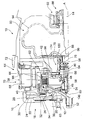
- FIG. 1 shows a partial longitudinal sectional view of a hybrid drive system according to the invention.
- a hybrid drive system in the Fig. 1 is a hybrid drive system according to the invention generally designated 10.
- This hybrid drive system 10 establishes a torque transmission connection between a drive shaft 12, that is, for example, a crankshaft of an internal combustion engine, and a transmission input shaft 14, for example, an automatic transmission.
- a torsional vibration damper assembly 16 of the hybrid drive system 10 is connected to a primary side 18 by a plurality of bolts 20 to the drive shaft 12.
- the primary side 18 comprises two cover disk elements 22, 24, of which the cover disk element 22 is connected to the drive shaft 12 via an elastic arrangement 26, for example leaf springs or the like.
- an elastic arrangement 26 for example leaf springs or the like.
- a central disk element 28 engages a secondary side 30.
- damper elements, such as damper springs or the like the primary side 18 and the secondary side 30 are coupled for rotation about the axis of rotation A, but can also rotate under compression of these springs in the circumferential direction with respect to each other.
- central disk element 28 Radially inside the central disk element 28 is fixedly connected to an internally toothed coupling element 32, for example by riveting.
- a negative feedback element 34 is in mesh produced by axial insertion with this coupling element 32.
- the negative feedback element 34 is fixedly connected to a housing 36 of a generally designated 38 wet-running friction coupling by riveting or the like.
- the hub portion 46 of the inner disk carrier 42 which may of course be designed as an independent component, is in rotary coupling engagement with a transmission member 48.
- the transmission member 48 engages with its axial end portion in a recess 50 of a housing hub 52 of the housing 36 of the multi-plate clutch 38 and is there rotatable and stored to produce a fluid-tight seal.
- This housing hub 52 itself is in turn rotatably mounted in the drive shaft 12, for example via a pilot bearing.
- the hub region 46 of the inner disk carrier 42 is axially supported via a thrust bearing 54 on this housing hub 52.
- the housing 36 is radially supported by a bearing 58 via a support element 56 on the transmission element 48.
- a fluid-tight closure of the interior of the housing 36 is provided by a sealing arrangement 60 on this side.
- a bearing connection between the housing 36 and the transmission member 48 which realizes a fluid-tight encapsulation of the interior of the housing 36, but at the same time permits rotatability between these two assemblies with respect to each other.
- Axial then to the housing 36 of the multi-plate clutch 38 is connected to the Transmission member 48, for example by welding a rotor assembly 62 of an electric machine 64 rotatably connected.
- a rotor interaction region 66 of the rotor assembly 62 lies radially within a stator interaction region 68 of a stator assembly 70 of the electric machine 64.
- the stator assembly 70 may be fixedly supported on a stationary assembly, such as a transmission housing 72 or the like.
- this transmission member 48 is rotatably supported on a fixed, for example, also the housing 72 supported support assembly 74 by means of an effective near the end of the transmission member 48 radial bearing 76.
- this support assembly 74 not only a defined storage of the transfer member 48 and thus the entire multi-disc clutch 38 is obtained, but this support assembly 74 forms in connection with the transfer member 48, a rotary feedthrough 78 for the supply and discharge of fluid into and out of the housing 36 of multi-plate clutch.
- a plurality of fluid channels 80 are formed in the transmission member 58, by which on the one hand fluid can be conveyed into a gap 82 to urge the piston 46 to engage the multi-plate clutch 38, and on the other hand to introduce fluid into the outer lamellae 40 and the inner fins 44 containing interior or subtract from there.
- These channels are open to the outer periphery of the transfer member 48 by radially emerging from the transfer member 48 branch channels and are corresponding channels in the Support assembly 74 thus opposite. Sealing arrangements 84, 86 are provided on both sides of these mutually opposite, open channels, which ensure a fluid-tight closure of the rotary leadthrough 78.
- the measures provided for in the support assembly 74 channels, via which so fluid can be promoted in the multi-plate clutch 38 and can be withdrawn from this, are related to a in the Fig. 1
- This is, possibly alternatively or in addition to the drive by a hydrodynamic torque converter 90, to be activated by an electric motor drive 92 shown on the right and, for example, in a transmission.
- the fluid pump 88 may be activated to engage the multi-plate clutch 38, for example.
- This is particularly necessary when a vehicle is out of service and an engine is to be started, which generally occurs in a state in which the hydrodynamic torque converter 90 is not rotating and thus can not drive the pump 88 either.
- it can be ensured by a one-way freewheel arrangement that when the hydrodynamic torque converter 90 also rotates, the drive of the fluid pump 88 is then supplied by the latter and the electric motor drive 92 does not have to be activated.
- the hydrodynamic torque converter 90 has a housing 94 in a known manner, which is coupled on its side facing the drive unit with the transmission member 48 for common rotation. This may be accomplished, for example, by an axial and externally toothed lug 96 provided on the housing 94 which engages a corresponding internally threaded opening 98 at the axial end of the transmission member 48. It is thus possible to integrate the hydrodynamic torque converter 90 on the one hand and the electric machine 64 with the wet-running multi-disc clutch 38 on the other hand as separate assemblies in the assembly of a drive train.
- the multi-plate clutch 38 which is then already assembled in this state with the transmission member 48 and the rotor assembly 62, are axially brought to the Torsionsschwingungsdämpferantechnischigan 16 to realize the coupling engagement between the coupling element 32 and the negative feedback element 34.
- the hydrodynamic torque converter 90 can be axially advanced and rotationally engaged with the transfer member 48.
- the hybrid drive system 10 described above combines various advantages.
- a wet-running multi-plate clutch 38 a very compact and provided with low moment of inertia separating clutch between the two drives, so a drive unit and the electric machine 64 is provided. Since this multi-plate clutch 38 is already coupled via a torsional vibration damper assembly 16 to the drive shaft 12, the hydrodynamic torque converter 90 can then be formed without its own torsional vibration damper.
- the compactness of the system is further supported by the fact that the electric machine 64 and the multi-plate clutch 38 almost completely overlap one another in the axial direction, wherein at the same time the electric machine 64 is also designed as an internal rotor machine.
- the hydrodynamic torque converter 90 which is essentially also serves as a starting element, is suitable due to its design and functionality especially for high-torque drive systems, as found for example in upper class sedans, off-road vehicles and the like. Since, furthermore, the fluid pump 88, which also supplies the hydrodynamic torque converter 90 with fluid, can optionally be operated with a separate electromotive drive 92, the multi-disc clutch 38 does not depend on the operating state of the hydrodynamic torque converter 90 and can thus also be at standstill of the system, ie with a non-rotating housing 94 of the hydrodynamic torque converter 90, are engaged and disengaged. It also makes it possible, especially in the start phase, to fill the various fluid-filled interior spaces in the hydrodynamic torque converter 90 and in the multi-plate clutch 38 even at low speed quickly with fluid.
- the rotary feedthrough 78 can not be realized by radially opposing components, but on axially opposing components. It is also possible to permanently fill the multi-plate clutch 38 with fluid, ie not to provide a fluid exchange of the interior, since its thermal load will be comparatively low due to the specific area of use. It is then only a fluid supply or - removal to move the piston member 146 is required.
Landscapes
- Engineering & Computer Science (AREA)
- Mechanical Engineering (AREA)
- General Engineering & Computer Science (AREA)
- Chemical & Material Sciences (AREA)
- Combustion & Propulsion (AREA)
- Transportation (AREA)
- Arrangement Of Transmissions (AREA)
- Hybrid Electric Vehicles (AREA)
- Control Of Multiple Motors (AREA)
- Seal Device For Vehicle (AREA)
Abstract
Description
- Die vorliegende Erfindung betrifft ein Hybrid-Antriebssystem für ein Kraftfahrzeug.
- Bei derartigen Hybrid-Antriebssystemen sind im Allgemeinen zwei Bereiche vorhanden, in welchen eine Drehmomentübertragungsverbindung hergestellt bzw. unterbrochen werden kann. Zum einen ist ein als "Trennkupplung" wirkender Bereich vorhanden, welcher eine Entkopplung einer Elektromaschine von einem Antriebsaggregat, also z.B. einer Brennkraftmaschine, realisieren kann, um wahlweise mit einem der beiden Antriebe zu arbeiten. In dem zweiten Bereich wird folgend auf die Antriebe die Drehmomentübertragungsverbindung zum weiteren Bereich des Antriebsstrangs unterbrochen bzw. hergestellt, beispielsweise um Gänge schalten zu können.
- Bei bekannten Systemen wird dazu als Anfahrelement zwischen den beiden Antrieben und dem folgenden Teil eines Antriebsstrangs beispielsweise ein hydrodynamischer Drehmomentwandler eingesetzt, wobei dann als Trennkupplung zwischen der Elektromaschine und einem Antriebsaggregat eine trockenlaufende Reibungskupplung eingesetzt wird. Auch die Kombination einer nasslaufenden Reibungskupplung als Trennkupplung mit einer in ein Getriebe integrierten Anfahrkupplung ist bekannt.
- Bei den bekannten Anordnungen führt insbesondere der Einsatz einer trockenen Reibungskupplung als Trennelement zu einem hohen Massenträgheitsmoment. Überdies erfordert eine derartige Kupplung große Betätigungskräfte und eine entsprechend groß dimensionierte Betätigungseinrichtung. Der Einsatz einer in ein Getriebe integrierten Anfahrkupplung in Verbindung mit einer nasslaufenden Reibungskupplung als Trennkupplung führt zwar zum Vorteil eines geringeren Bauraumbedarfs und eines niedrigen Massenträgheitsmoments. Die Belastbarkeit der in ein Getriebe integrierten Anfahrkupplung ist jedoch nur beschränkt und reicht für schwere Fahrzeuge, wie z.B. Oberklasselimousinen, im Allgemeinen nicht aus.
- Es ist die Aufgabe der vorliegenden Erfindung ein Hybrid-Antriebssystem vorzusehen, das bei reduziertem Massenträgheitsmoment eine höhere Belastbarkeit aufweist.
- Erfindungsgemäß wird diese Aufgabe gelöst durch ein Hybrid-Antriebssystem, umfassend eine nasslaufende Lamellenkupplung mit einem mit einem Antriebsaggregat zu koppelnden Eingangsbereich und einem mit einem Gehäuse eines hydrodynamischen Drehmomentwandlers zu koppelnden oder gekoppelten Ausgangsbereich sowie eine Elektromaschine mit einer Statoranordnung und einer Rotoranordnung, wobei die Rotoranordnung mit dem Ausgangsbereich der nasslaufenden Lamellenkupplung zur gemeinsamen Drehung um eine Drehachse gekoppelt ist.
- Die vorliegende Erfindung kombiniert den Vorteil des geringen Massenträgheitsmoments einer nasslaufenden Lamellenkupplung als Trennkupplung zwischen einer Elektromaschine und einem Antriebsaggregat mit der hohen Drehmomentenbelastbarkeit eines hydrodynamischen Drehmomentwandlers als ein einem Getriebe vorgeschaltetes Anfahrelement.
- Dabei kann beispielsweise vorgesehen sein, dass der Eingangsbereich der nasslaufenden Lamellenkupplung über eine Torsionsschwingungsdämpferanordnung mit dem Antriebsaggregat zu koppeln ist. Auf diese Art und Weise wird bereits antriebsseitig die Einleitung von Drehmomentschwingungen in das Hybrid-Antriebssystem vermieden bzw. reduziert.
- Der Ausgangsbereich der nasslaufenden Lamellenkupplung kann über ein Übertragungsglied mit dem Gehäuse des hydrodynamischen Drehmomentwandlers gekoppelt oder zu koppeln sein, wobei vorzugsweise dann auch die Rotoranordnung der Elektromaschine vermittels dieses Übertragungsglieds mit dem Ausgangsbereich der nasslaufenden Lamellenkupplung gekoppelt ist.
- Um dafür zu sorgen, dass bei dem erfindungsgemäßen Hybrid-Antriebssystem die verschiedenen rotierenden Komponenten bezüglich einer Drehachse definiert gehalten werden können, wird vorgeschlagen, dass das Übertragungsglied an einer Stützanordnung drehbar gelagert ist.
- Da die nasslaufende Lamellenkupplung zur Durchführung von Ein- und Auskuppelvorgängen mit Fluid zu versorgen ist und auch der Innenraum dieser Kupplung zur Wärmeabfuhr von Fluid durchströmt wird, wird vorgeschlagen, dass die Stützanordnung mit dem Übertragungsglied eine Drehdurchführung zur Zufuhr/Abfuhr von Fluid zu/von der nasslaufenden Lamellenkupplung bildet.
- Da die nasslaufende Lamellenkupplung unter Umständen auch dann zu betätigen ist, wenn der hydrodynamische Drehmomentwandler nicht rotiert, beispielsweise um eine Brennkraftmaschine zu starten, wird vorgeschlagen, dass eine unabhängig von dem Betriebszustand des hydrodynamischen Drehmomentwandlers arbeitende Fluidpumpe zum Zuführen/Abführen von Fluid zu/von der nasslaufenden Lamellenkupplung vorgesehen ist.
- Eine einfache Koppelbarkeit des Übertragungslieds mit dem hydrodynamischen Drehmomentwandler ist dadurch realisierbar, dass das Gehäuse des hydrodynamischen Drehmomentwandlers mit dem Übertragungsglied durch Axialsteckverbindung gekoppelt oder zu koppeln ist.
- Eine besonders platzsparende Anordnung kann dadurch erhalten werden, dass die Elektromaschine eine Innenläufermaschine ist. Dabei kann vorzugsweise vorgesehen sein, dass die Elektromaschine die nasslaufende Lamellenkupplung axial überlappt.
- Die vorliegende Erfindung wird nachfolgend mit Bezug auf die beiliegende
Fig. 1 beschrieben, welche eine Teil-Längsschnittansicht eines erfindungsgemäßen Hybrid-Antriebssystems zeigt. - In der
Fig. 1 ist ein erfindungsgemäßes Hybrid-Antriebssystem allgemein mit 10 bezeichnet. Dieses Hybrid-Antriebssystem 10 stellt eine Drehmomentübertragungsverbindung zwischen einer Antriebswelle 12, also beispielsweise einer Kurbelwelle einer Brennkraftmaschine, und einer Getriebeeingangswelle 14, beispielsweise eines Automatikgetriebes, her. - Eine Torsionsschwingungsdämpferanordnung 16 des Hybrid-Antriebssystems 10 ist mit einer Primärseite 18 durch eine Mehrzahl von Schraubbolzen 20 an die Antriebswelle 12 angebunden. Die Primärseite 18 umfasst zwei Deckscheibenelemente 22, 24, von welchen das Deckscheibenelement 22 über eine elastische Anordnung 26, beispielsweise Blattfedern oder dergleichen, an die Antriebswelle 12 angebunden ist. Auf diese Art und Weise können Achsversätze bzw. Achsneigungen der beiden zu koppelnden Wellen 12, 14 kompensiert werden bzw. werden Taumelbewegungen grundsätzlich ermöglicht. Zwischen die beiden Deckscheibenelemente 22, 24 greift ein Zentralscheibenelement 28 einer Sekundärseite 30 ein. Über nicht dargestellte Dämpferelemente, beispielsweise Dämpferfedern oder dergleichen, sind die Primärseite 18 und die Sekundärseite 30 zur Drehung um die Drehachse A gekoppelt, können sich jedoch auch unter Kompression dieser Federn in Umfangsrichtung bezüglich einander verdrehen.
- Radial innen ist das Zentralscheibenelement 28 mit einem mit Innenverzahnung versehenen Kopplungselement 32 beispielsweise durch Vernietung fest verbunden. Ein Gegenkopplungselement 34 steht in durch axiales Einschieben hergestelltem Kämmeingriff mit diesem Kopplungselement 32. Das Gegenkopplungselement 34 ist mit einem Gehäuse 36 einer allgemein mit 38 bezeichneten nasslaufenden Reibungskopplung durch Vernietung oder dergleichen fest verbunden.
- Im Innenraum des Gehäuses 36, das einen Eingangsbereich und einen Außenlamellenträger für die Lamellenkupplung 38 bildet, sind mit diesem Gehäuse 36 drehfest gekoppelte Außenlamellen 40 sowie mit einem Innenlamellenträger 42 gekoppelte Innenlamellen 44 vorgesehen. Der Innenlamellenträger 42 bildet mit einem Nabenbereich 46 desselben einen Ausgangsbereich der nasslaufenden Lamellenkupplung 38. Durch ein axial verschiebbares Kolbenelement 146 können die Außenlamellen 40 und die Innenlamellen 44 in Reibeingriff gebracht werden und somit die Lamellenkupplung 38 in einen Drehmomentübertragungszustand gebracht werden.
- Der Nabenbereich 46 des Innenlamellenträgers 42, der selbstverständlich auch als eigenständiges Bauteil ausgeführt sein kann, steht in Drehkopplungseingriff mit einem Übertragungsglied 48. Das Übertragungsglied 48 greift mit seinem axialen Endbereich in eine Aussparung 50 einer Gehäusenabe 52 des Gehäuses 36 der Lamellenkupplung 38 ein und ist dort drehbar und unter Herstellung eines fluiddichten Abschlusses gelagert. Diese Gehäusenabe 52 selbst ist wiederum in der Antriebswelle 12 beispielsweise über ein Pilotlager drehbar gelagert. Der Nabenbereich 46 des Innenlamellenträgers 42 ist über ein Axiallager 54 an dieser Gehäusenabe 52 axial abgestützt. An seiner von der Gehäusenabe 52 entfernten axialen Seite ist das Gehäuse 36 über ein Abstützelement 56 an dem Übertragungsglied 48 durch ein Lager 58 radial gelagert. Ferner ist durch eine Dichtungsanordnung 60 auf dieser Seite für einen fluiddichten Abschluss des Innenraums des Gehäuses 36 gesorgt. Somit besteht an zwei axial in Abstand zueinander liegenden Positionen eine Lagerungsverbindung zwischen dem Gehäuse 36 und dem Übertragungsglied 48, welche eine fluiddichte Abkapselung des Innenraums des Gehäuses 36 realisiert, gleichzeitig jedoch eine Verdrehbarkeit zwischen diesen beiden Baugruppen bezüglich einander zulässt.
- Axial anschließend an das Gehäuse 36 der Lamellenkupplung 38 ist mit dem Übertragungsglied 48 beispielsweise durch Verschweißung eine Rotoranordnung 62 einer Elektromaschine 64 drehfest verbunden. Ein Rotorwechselwirkungsbereich 66 der Rotoranordnung 62 liegt radial innerhalb eines Statorwechselwirkungsbereichs 68 einer Statoranordnung 70 der Elektromaschine 64. Die Statoranordnung 70 kann an einer feststehenden Baugruppe, beispielsweise einem Getriebegehäuse 72 oder dergleichen, feststehend getragen sein.
- Durch das Übertragungsglied 48 ist eine Drehverbindung zwischen dem Ausgangsbereich der Lamellenkupplung 38, also dem Innenlamellenträger 42 derselben, und der Rotoranordnung 62 der Elektromaschine 64 geschaffen. Dies bedeutet, dass im eingerückten Zustand der Lamellenkupplung 38 ein Drehmoment von der Elektromaschine 64 auf die Welle 12 übertragen werden kann, um auf diese Art und Weise beispielsweise eine Brennkraftmaschine zu starten.
- Axial anschließend an die drehfeste Verbindung der Rotoranordnung 62 mit dem Übertragungsglied 48 ist dieses Übertragungsglied 48 an einer feststehenden, beispielsweise ebenfalls dem Gehäuse 72 getragenen Stützanordnung 74 vermittels eines nahe dem Endbereich des Übertragungsglieds 48 wirksamen Radiallagers 76 drehbar gelagert. Durch diese Stützanordnung 74 wird nicht nur eine definierte Lagerung des Übertragungsglieds 48 und somit auch der gesamten Lamellenkupplung 38 erhalten, sondern diese Stützanordnung 74 bildet in Verbindung mit dem Übertragungsglied 48 eine Drehdurchführung 78 für die Zufuhr und Abfuhr von Fluid in und aus dem Gehäuse 36 der Lamellenkupplung. Hierzu sind in dem Übertragungsglied 58 mehrere Fluidkanäle 80 ausgebildet, durch welche einerseits Fluid in einen Zwischenraum 82 gefördert werden kann, um den Kolben 46 zum Einrücken der Lamellenkupplung 38 zu beaufschlagen, und andererseits Fluid in den die Außenlamellen 40 und die Innenlamellen 44 enthaltenden Innenraum einzuleiten bzw. von dort abzuziehen. Diese Kanäle sind durch radial aus dem Übertragungsglied 48 austretende Stichkanäle zum Außenumfang des Übertragungsglieds 48 offen und liegen entsprechenden Kanälen in der Stützanordnung 74 somit gegenüber. Beidseits dieser einander gegenüberliegenden, offenen Kanäle sind Dichtungsanordnungen 84, 86 vorgesehen, die für einen fluiddichten Abschluss der Drehdurchführung 78 sorgen. Die in der Stützanordnung 74 vorgesehenen Kanäle, über welche also Fluid in die Lamellenkupplung 38 gefördert werden kann und von dieser abgezogen werden kann, stehen in Verbindung mit einer in der
Fig. 1 rechts gezeigten und beispielsweise in einem Getriebe angeordneten Fluidpumpe 88. Diese ist, möglicherweise alternativ oder zusätzlich zu dem Antrieb durch einen noch zu beschreibenden hydrodynamischen Drehmomentwandler 90, durch einen elektromotorischen Antrieb 92 aktivierbar. Somit kann unabhängig davon, ob der hydrodynamische Drehmomentwandler 90 rotiert oder nicht, die Fluidpumpe 88 aktiviert werden, um beispielsweise die Lamellenkupplung 38 einzurücken. Dies ist insbesondere dann erforderlich, wenn ein Fahrzeug außer Betrieb ist und eine Brennkraftmaschine gestartet werden soll, was im Allgemeinen in einem Zustand passiert, in welchem der hydrodynamische Drehmomentwandler 90 nicht rotiert und somit die Pumpe 88 auch nicht antreiben kann. Beispielsweise kann durch eine einseitig wirkende Freilaufanordnung dafür gesorgt werden, dass dann, wenn der hydrodynamische Drehmomentwandler 90 auch rotiert, der Antrieb der Fluidpumpe 88 dann von diesem geliefert wird und der elektromotorische Antrieb 92 nicht mehr aktiviert werden muss. - Der hydrodynamische Drehmomentwandler 90 weist in bekannter Weise ein Gehäuse 94 auf, das an seiner dem Antriebsaggregat zugewandten Seite mit dem Übertragungsglied 48 zur gemeinsamen Drehung gekoppelt ist. Dies kann beispielsweise durch einen am Gehäuse 94 vorgesehenen axialen und mit Außenverzahnung versehenen Ansatz 96 erfolgen, der in eine entsprechende mit Innengewinde versehene Öffnung 98 am axialen Ende des Übertragungsglieds 48 eingreift. Es wird somit möglich, den hydrodynamischen Drehmomentwandler 90 einerseits und die Elektromaschine 64 mit der nasslaufenden Lamellenkupplung 38 andererseits als separate Baugruppen beim Zusammenbau eines Antriebsstrangs einzugliedern. Dabei kann zunächst, nachdem die Torsionsschwingungsdämpferanordnung 16 an der Antriebswelle 12 festgelegt worden ist, die Lamellenkupplung 38, die in diesem Zustand dann bereits mit dem Übertragungsglied 48 und der Rotoranordnung 62 zusammengefügt ist, axial an die Torsionsschwingungsdämpferanordnung 16 herangeführt werden, um den Kopplungseingriff zwischen dem Kupplungselement 32 und dem Gegenkopplungselement 34 zu realisieren. Darauf folgend kann dann, beispielsweise wenn auch die Stützanordnung 74 und die Statoranordnung 70 angefügt worden sind, der hydrodynamische Drehmomentwandler 90 axial herangeführt und in Drehkopplungseingriff mit dem Übertragungsglied 48 gebracht werden.
- Es sei hier darauf hingewiesen, dass selbstverständlich die Drehkopplung auch über eine in der
Fig. 1 angedeutete flexible Platte 100 erfolgen kann, so dass auch in diesem Bereich Taumelbewegungen kompensiert bzw. zugelassen werden können. Diese ist dann radial außen an das Gehäuse 94 und radial innen an den Ansatz 96 angebunden. - Das vorangehend beschriebene Hybrid-Antriebssystem 10 vereinigt verschiedene Vorteile. So ist zum Beispiel mit dem Einsatz einer nasslaufenden Lamellenkupplung 38 eine sehr kompakte und mit geringem Massenträgheitsmoment versehene Trennkupplung zwischen den beiden Antrieben, also einem Antriebsaggregat und der Elektromaschine 64 vorgesehen. Da diese Lamellenkupplung 38 bereits über eine Torsionsschwingungsdämpferanordnung 16 an die Antriebswelle 12 angekoppelt ist, kann der hydrodynamische Drehmomentwandler 90 dann ohne eigenen Torsionsschwingungsdämpfer ausgebildet werden.
- Die Kompaktheit des Systems wird dadurch noch unterstützt, dass die Elektromaschine 64 und die Lamellenkupplung 38 einander in axialer Richtung nahezu vollständig überlappen, wobei gleichzeitig auch die Elektromaschine 64 noch als Innenläufermaschine ausgebildet ist.
- Der hydrodynamische Drehmomentwandler 90, der im Wesentlichen auch als Anfahrelement dient, ist auf Grund seiner Bauweise bzw. Funktionalität insbesondere für drehmomentenstarke Antriebssysteme geeignet, wie sie beispielsweise in Oberklasselimousinen, Geländefahrzeugen und dergleichen Anwendung finden. Da weiterhin die auch den hydrodynamischen Drehmomentwandler 90 mit Fluid versorgende Fluidpumpe 88 zumindest wahlweise mit einem eigenständigen elektromotorischen Antrieb 92 betrieben werden kann, wird die Lamellenkupplung 38 unabhängig vom Betriebszustand des hydrodynamischen Drehmomentwandlers 90 und kann somit auch im Stillstand des Systems, also bei nicht rotierendem Gehäuse 94 des hydrodynamischen Drehmomentwandlers 90, eingerückt und ausgerückt werden. Auch wird es damit möglich, insbesondere in der Startphase die verschiedenen mit Fluid zu befüllenden Innenräume im hydrodynamischen Drehmomentwandler 90 und in der Lamellenkupplung 38 auch bei geringer Drehzahl schnell mit Fluid zu befüllen.
- Es ist selbstverständlich möglich, bei dem vorangehend beschriebenen System Variationen im Umfang der vorliegenden Erfindung vorzunehmen. So kann beispielsweise die Drehdurchführung 78 nicht durch radial sich gegenüberliegende Bauteile, sondern an axial sich gegenüberliegenden Bauteilen realisiert sein. Auch ist es möglich, die Lamellenkupplung 38 permanent mit Fluid zu füllen, also einen Fluidaustausch des Innenraums nicht vorzusehen, da dessen thermische Belastung auf Grund des speziellen Einsatzbereichs vergleichsweise gering sein wird. Es ist dann lediglich eine Fluidzufuhr bzw. - abfuhr zum Verschieben des Kolbenelementes 146 erforderlich.
Claims (10)
- Hybrid-Antriebssystem, umfassend eine nasslaufende Lamellenkupplung (38) mit einem mit einem Antriebsaggregat zu koppelnden Eingangsbereich (36) und einem mit einem Gehäuse (94) eines hydrodynamischen Drehmomentwandlers (90) zu koppelnden oder gekoppelten Ausgangsbereich (42, 44), sowie eine Elektromaschine (64) mit einer Statoranordnung (70) und einer Rotoranordnung (62), wobei die Rotoranordnung (62) mit dem Ausgangsbereich (42, 44) der nasslaufenden Lamellenkupplung (38) zur gemeinsamen Drehung um eine Drehachse (A) gekoppelt ist.
- Hybrid-Antriebssystem nach Anspruch 1,
dadurch gekennzeichnet, dass der Eingangsbereich (36) der nasslaufenden Lamellenkupplung (38) über eine Torsionsschwingungsdämpferanordnung (16) mit dem Antriebsaggregat zu koppeln ist. - Hybrid-Antriebssystem nach Anspruch 1 oder 2,
dadurch gekennzeichnet, dass der Ausgangsbereich (42, 44) der nasslaufenden Lamellenkupplung (38) über ein Übertragungsglied (48) mit dem Gehäuse (94) des hydrodynamischen Drehmomentwandlers (90) gekoppelt oder zu koppeln ist. - Hybrid-Antriebssystem nach Anspruch 3,
dadurch gekennzeichnet, dass die Rotoranordnung (62) der Elektromaschine (62) mit dem Ausgangsbereich (42, 44) der nasslaufenden Lamellenkupplung (38) über das Übertragungsglied (48) gekoppelt ist. - Hybrid-Antriebssystem nach Anspruch 3 oder 4,
dadurch gekennzeichnet, dass das Übertragungsglied (48) an einer Stützanordnung (74) drehbar gelagert ist. - Hybrid-Antriebssystem nach Anspruch 5,
dadurch gekennzeichnet, dass die Stützanordnung (74) mit dem Übertragungsglied (48) eine Drehdurchführung (78) zur Zufuhr/Abfuhr von Fluid zu/von der nasslaufenden Lamellenkupplung (38) bildet. - Hybrid-Antriebssystem nach einem der Ansprüche 1 bis 6,
dadurch gekennzeichnet, dass eine unabhängig von dem Betriebszustand des hydrodynamischen Drehmomentwandlers (96) arbeitende Fluidpumpe (88) zum Zuführen/Abführen von Fluid zu/von der nasslaufenden Lamellenkupplung (38) vorgesehen ist. - Hybrid-Antriebssystem nach Anspruch 3 oder einem der Ansprüche 4 bis 7, sofern auf Anspruch 3 rückbezogen,
dadurch gekennzeichnet, dass das Gehäuse (94) des hydrodynamischen, Drehmomentwandlers (90) mit dem Übertragungsglied (48) durch Axialsteckverbindung gekoppelt oder zu koppeln ist. - Hybrid-Antriebssystem nach einem der Ansprüche 1 bis 8,
dadurch gekennzeichnet, dass die Elektromaschine (64) eine Innenläufermaschine ist. - Hybrid-Antriebssystem nach einem der Ansprüche 1 bis 9,
dadurch gekennzeichnet, dass die Elektromaschine (64) die nasslaufende Lamellenkupplung (38) axial überlappt.
Applications Claiming Priority (1)
| Application Number | Priority Date | Filing Date | Title |
|---|---|---|---|
| DE102007012012A DE102007012012A1 (de) | 2007-03-13 | 2007-03-13 | Hybrid-Antriebssystem |
Publications (2)
| Publication Number | Publication Date |
|---|---|
| EP1970239A1 true EP1970239A1 (de) | 2008-09-17 |
| EP1970239B1 EP1970239B1 (de) | 2009-12-30 |
Family
ID=39493880
Family Applications (1)
| Application Number | Title | Priority Date | Filing Date |
|---|---|---|---|
| EP08003768A Not-in-force EP1970239B1 (de) | 2007-03-13 | 2008-02-29 | Hybrid-Antriebssystem |
Country Status (3)
| Country | Link |
|---|---|
| EP (1) | EP1970239B1 (de) |
| AT (1) | ATE453530T1 (de) |
| DE (2) | DE102007012012A1 (de) |
Cited By (5)
| Publication number | Priority date | Publication date | Assignee | Title |
|---|---|---|---|---|
| EP2270351A1 (de) * | 2009-06-24 | 2011-01-05 | ZF Friedrichshafen AG | Kupplungsanordnung, insbesondere für den Antriebsstrang eines Fahrzeugs |
| JP2011051429A (ja) * | 2009-08-31 | 2011-03-17 | Toyota Motor Corp | 動力伝達装置 |
| EP2613954A4 (de) * | 2010-09-10 | 2015-09-02 | Allison Transm Inc | Hybridsystem |
| EP2463135A4 (de) * | 2009-11-19 | 2018-04-18 | Aisin AW Co., Ltd. | Antriebsvorrichtung für ein fahrzeug |
| WO2020103974A1 (de) * | 2018-11-22 | 2020-05-28 | Schaeffler Technologies AG & Co. KG | Hybridmodul sowie antriebsanordnung für ein kraftfahrzeug |
Families Citing this family (1)
| Publication number | Priority date | Publication date | Assignee | Title |
|---|---|---|---|---|
| DE102008042636A1 (de) * | 2008-10-07 | 2010-04-08 | Zf Friedrichshafen Ag | Drehmomentübertragungseinheit für ein Kraftfahrzeug |
Citations (6)
| Publication number | Priority date | Publication date | Assignee | Title |
|---|---|---|---|---|
| US5789823A (en) | 1996-11-20 | 1998-08-04 | General Motors Corporation | Electric hybrid transmission with a torque converter |
| DE10005996A1 (de) * | 1999-03-02 | 2000-09-07 | Mannesmann Sachs Ag | Drehmomentübertragungseinheit |
| WO2002085659A1 (de) * | 2001-04-24 | 2002-10-31 | Voith Turbo Gmbh & Co. Kg | Antriebseinheit mit integriertem elektromotor |
| DE10323283A1 (de) * | 2002-05-31 | 2004-03-25 | Visteon Global Technologies, Inc., Dearborn | Start-Stopp-Strategie für einen Motor mit integriertem Starter-Generator |
| WO2006089376A1 (en) | 2005-02-28 | 2006-08-31 | Nt Consulting International Pty Limited | Drive system with fluid pump |
| EP1710113A1 (de) | 2004-04-28 | 2006-10-11 | Aisin Aw Co., Ltd. | Antriebsvorrichtung für hybridfahrzeug |
-
2007
- 2007-03-13 DE DE102007012012A patent/DE102007012012A1/de not_active Withdrawn
-
2008
- 2008-02-29 DE DE502008000273T patent/DE502008000273D1/de active Active
- 2008-02-29 AT AT08003768T patent/ATE453530T1/de active
- 2008-02-29 EP EP08003768A patent/EP1970239B1/de not_active Not-in-force
Patent Citations (6)
| Publication number | Priority date | Publication date | Assignee | Title |
|---|---|---|---|---|
| US5789823A (en) | 1996-11-20 | 1998-08-04 | General Motors Corporation | Electric hybrid transmission with a torque converter |
| DE10005996A1 (de) * | 1999-03-02 | 2000-09-07 | Mannesmann Sachs Ag | Drehmomentübertragungseinheit |
| WO2002085659A1 (de) * | 2001-04-24 | 2002-10-31 | Voith Turbo Gmbh & Co. Kg | Antriebseinheit mit integriertem elektromotor |
| DE10323283A1 (de) * | 2002-05-31 | 2004-03-25 | Visteon Global Technologies, Inc., Dearborn | Start-Stopp-Strategie für einen Motor mit integriertem Starter-Generator |
| EP1710113A1 (de) | 2004-04-28 | 2006-10-11 | Aisin Aw Co., Ltd. | Antriebsvorrichtung für hybridfahrzeug |
| WO2006089376A1 (en) | 2005-02-28 | 2006-08-31 | Nt Consulting International Pty Limited | Drive system with fluid pump |
Cited By (8)
| Publication number | Priority date | Publication date | Assignee | Title |
|---|---|---|---|---|
| EP2270351A1 (de) * | 2009-06-24 | 2011-01-05 | ZF Friedrichshafen AG | Kupplungsanordnung, insbesondere für den Antriebsstrang eines Fahrzeugs |
| JP2011051429A (ja) * | 2009-08-31 | 2011-03-17 | Toyota Motor Corp | 動力伝達装置 |
| EP2463135A4 (de) * | 2009-11-19 | 2018-04-18 | Aisin AW Co., Ltd. | Antriebsvorrichtung für ein fahrzeug |
| EP2613954A4 (de) * | 2010-09-10 | 2015-09-02 | Allison Transm Inc | Hybridsystem |
| US9358866B2 (en) | 2010-09-10 | 2016-06-07 | Allison Transmission, Inc. | Hybrid system |
| US10023184B2 (en) | 2010-09-10 | 2018-07-17 | Allison Transmission, Inc. | Hybrid system |
| WO2020103974A1 (de) * | 2018-11-22 | 2020-05-28 | Schaeffler Technologies AG & Co. KG | Hybridmodul sowie antriebsanordnung für ein kraftfahrzeug |
| US11472281B2 (en) * | 2018-11-22 | 2022-10-18 | Schaeffler Technologies AG & Co. KG | Hybrid module and drive arrangement for a motor vehicle |
Also Published As
| Publication number | Publication date |
|---|---|
| DE102007012012A1 (de) | 2008-09-18 |
| EP1970239B1 (de) | 2009-12-30 |
| ATE453530T1 (de) | 2010-01-15 |
| DE502008000273D1 (de) | 2010-02-11 |
Similar Documents
| Publication | Publication Date | Title |
|---|---|---|
| EP3558738B1 (de) | Hybridmodul und antriebsanordnung für ein kraftfahrzeug | |
| EP2244899B1 (de) | Antriebsstrangmodul für ein kraftfahrzeug | |
| EP3559494B1 (de) | Hybridmodul und antriebsanordnung für ein kraftfahrzeug | |
| EP1813832B1 (de) | Kupplungssystem mit einer nasslaufenden oder/und hydraulisch betätigbaren Mehrfach-Kupplungseinrichtung | |
| EP3337999B1 (de) | Kupplungseinrichtung für hybridantrieb | |
| WO2008141876A1 (de) | Hybridantriebssystem für ein fahrzeug | |
| EP1174631B1 (de) | Mehrfach-Kupplungseinrichtung | |
| DE102008026426A1 (de) | Hydrodynamische Kopplungsvorrichtung für Hybridfahrzeuge | |
| DE102012022290A1 (de) | Drehmomentübertragungsvorrichtung mit einer Kupplungseinrichtung und einer elektrischen Maschine sowie Antriebsstrang für ein Kraftfahrzeug mit einer solchen Drehmomentübertragungsvorrichtung | |
| EP2655113A2 (de) | Hybridmodul für einen triebstrang eines fahrzeuges | |
| DE102011081909A1 (de) | Doppelkupplung | |
| EP3559491A1 (de) | Kupplungseinrichtung, hybridmodul und antriebsanordnung für ein kraftfahrzeug | |
| EP1970239B1 (de) | Hybrid-Antriebssystem | |
| EP1174633B1 (de) | Mehrfach-Kupplungseinrichtung | |
| DE102012206680A1 (de) | Hybridmodul für einen Triebstrang eines Fahrzeuges | |
| EP1801446B1 (de) | Antriebssystem mit einer Mehrfach-Kupplungseinrichtung, in Kombination mit einer Torsionsschwingungsdämpferanordnung und ggf. einer Elektromaschine | |
| EP1585907A2 (de) | Mehrfach-kupplungseinrichtung, mit zwei zur gemeinsamen drehung verkoppelbaren kupplungsanordnungnen | |
| WO2021213572A1 (de) | Rotorintegrierte trennkupplung und p2-hybridmodul mit einer solchen trennkupplung | |
| DE102005044225A1 (de) | Elektromotorisches Antriebsmodul | |
| EP1174632B1 (de) | Mehrfach-Kupplungseinrichtung in Kombination mit einer Torsionsschwingungsdämpferanordnung oder/und einer Elektromaschine | |
| WO2021213571A1 (de) | Hybridmodul | |
| DE102008050054A1 (de) | Hybridantriebssystem | |
| DE102022129070A1 (de) | Verbesserte nasslaufende Kupplung für ein Antriebsstrangsystem | |
| WO2021213573A1 (de) | Rotorintegrierte trennkupplung und p2-hybridmodul mit einer solchen trennkupplung | |
| DE102025114649A1 (de) | Kraftübertragungsvorrichtung für hybridfahrzeug |
Legal Events
| Date | Code | Title | Description |
|---|---|---|---|
| PUAI | Public reference made under article 153(3) epc to a published international application that has entered the european phase |
Free format text: ORIGINAL CODE: 0009012 |
|
| AK | Designated contracting states |
Kind code of ref document: A1 Designated state(s): AT BE BG CH CY CZ DE DK EE ES FI FR GB GR HR HU IE IS IT LI LT LU LV MC MT NL NO PL PT RO SE SI SK TR |
|
| AX | Request for extension of the european patent |
Extension state: AL BA MK RS |
|
| 17P | Request for examination filed |
Effective date: 20081001 |
|
| 17Q | First examination report despatched |
Effective date: 20081104 |
|
| AKX | Designation fees paid |
Designated state(s): AT BE BG CH CY CZ DE DK EE ES FI FR GB GR HR HU IE IS IT LI LT LU LV MC MT NL NO PL PT RO SE SI SK TR |
|
| GRAP | Despatch of communication of intention to grant a patent |
Free format text: ORIGINAL CODE: EPIDOSNIGR1 |
|
| GRAS | Grant fee paid |
Free format text: ORIGINAL CODE: EPIDOSNIGR3 |
|
| GRAA | (expected) grant |
Free format text: ORIGINAL CODE: 0009210 |
|
| AK | Designated contracting states |
Kind code of ref document: B1 Designated state(s): AT BE BG CH CY CZ DE DK EE ES FI FR GB GR HR HU IE IS IT LI LT LU LV MC MT NL NO PL PT RO SE SI SK TR |
|
| REG | Reference to a national code |
Ref country code: GB Ref legal event code: FG4D Free format text: NOT ENGLISH |
|
| REG | Reference to a national code |
Ref country code: CH Ref legal event code: EP |
|
| REG | Reference to a national code |
Ref country code: IE Ref legal event code: FG4D |
|
| REF | Corresponds to: |
Ref document number: 502008000273 Country of ref document: DE Date of ref document: 20100211 Kind code of ref document: P |
|
| PG25 | Lapsed in a contracting state [announced via postgrant information from national office to epo] |
Ref country code: SE Free format text: LAPSE BECAUSE OF FAILURE TO SUBMIT A TRANSLATION OF THE DESCRIPTION OR TO PAY THE FEE WITHIN THE PRESCRIBED TIME-LIMIT Effective date: 20091230 Ref country code: NO Free format text: LAPSE BECAUSE OF FAILURE TO SUBMIT A TRANSLATION OF THE DESCRIPTION OR TO PAY THE FEE WITHIN THE PRESCRIBED TIME-LIMIT Effective date: 20100330 Ref country code: LT Free format text: LAPSE BECAUSE OF FAILURE TO SUBMIT A TRANSLATION OF THE DESCRIPTION OR TO PAY THE FEE WITHIN THE PRESCRIBED TIME-LIMIT Effective date: 20091230 Ref country code: FI Free format text: LAPSE BECAUSE OF FAILURE TO SUBMIT A TRANSLATION OF THE DESCRIPTION OR TO PAY THE FEE WITHIN THE PRESCRIBED TIME-LIMIT Effective date: 20091230 |
|
| REG | Reference to a national code |
Ref country code: NL Ref legal event code: VDEP Effective date: 20091230 |
|
| LTIE | Lt: invalidation of european patent or patent extension |
Effective date: 20091230 |
|
| PG25 | Lapsed in a contracting state [announced via postgrant information from national office to epo] |
Ref country code: PL Free format text: LAPSE BECAUSE OF FAILURE TO SUBMIT A TRANSLATION OF THE DESCRIPTION OR TO PAY THE FEE WITHIN THE PRESCRIBED TIME-LIMIT Effective date: 20091230 Ref country code: LV Free format text: LAPSE BECAUSE OF FAILURE TO SUBMIT A TRANSLATION OF THE DESCRIPTION OR TO PAY THE FEE WITHIN THE PRESCRIBED TIME-LIMIT Effective date: 20091230 Ref country code: HR Free format text: LAPSE BECAUSE OF FAILURE TO SUBMIT A TRANSLATION OF THE DESCRIPTION OR TO PAY THE FEE WITHIN THE PRESCRIBED TIME-LIMIT Effective date: 20091230 Ref country code: SI Free format text: LAPSE BECAUSE OF FAILURE TO SUBMIT A TRANSLATION OF THE DESCRIPTION OR TO PAY THE FEE WITHIN THE PRESCRIBED TIME-LIMIT Effective date: 20091230 |
|
| REG | Reference to a national code |
Ref country code: IE Ref legal event code: FD4D |
|
| PG25 | Lapsed in a contracting state [announced via postgrant information from national office to epo] |
Ref country code: RO Free format text: LAPSE BECAUSE OF FAILURE TO SUBMIT A TRANSLATION OF THE DESCRIPTION OR TO PAY THE FEE WITHIN THE PRESCRIBED TIME-LIMIT Effective date: 20091230 Ref country code: BG Free format text: LAPSE BECAUSE OF FAILURE TO SUBMIT A TRANSLATION OF THE DESCRIPTION OR TO PAY THE FEE WITHIN THE PRESCRIBED TIME-LIMIT Effective date: 20100330 Ref country code: IS Free format text: LAPSE BECAUSE OF FAILURE TO SUBMIT A TRANSLATION OF THE DESCRIPTION OR TO PAY THE FEE WITHIN THE PRESCRIBED TIME-LIMIT Effective date: 20100430 Ref country code: ES Free format text: LAPSE BECAUSE OF FAILURE TO SUBMIT A TRANSLATION OF THE DESCRIPTION OR TO PAY THE FEE WITHIN THE PRESCRIBED TIME-LIMIT Effective date: 20100410 Ref country code: EE Free format text: LAPSE BECAUSE OF FAILURE TO SUBMIT A TRANSLATION OF THE DESCRIPTION OR TO PAY THE FEE WITHIN THE PRESCRIBED TIME-LIMIT Effective date: 20091230 Ref country code: NL Free format text: LAPSE BECAUSE OF FAILURE TO SUBMIT A TRANSLATION OF THE DESCRIPTION OR TO PAY THE FEE WITHIN THE PRESCRIBED TIME-LIMIT Effective date: 20091230 |
|
| BERE | Be: lapsed |
Owner name: ZF FRIEDRICHSHAFEN A.G. Effective date: 20100228 |
|
| PG25 | Lapsed in a contracting state [announced via postgrant information from national office to epo] |
Ref country code: SK Free format text: LAPSE BECAUSE OF FAILURE TO SUBMIT A TRANSLATION OF THE DESCRIPTION OR TO PAY THE FEE WITHIN THE PRESCRIBED TIME-LIMIT Effective date: 20091230 Ref country code: CZ Free format text: LAPSE BECAUSE OF FAILURE TO SUBMIT A TRANSLATION OF THE DESCRIPTION OR TO PAY THE FEE WITHIN THE PRESCRIBED TIME-LIMIT Effective date: 20091230 |
|
| PG25 | Lapsed in a contracting state [announced via postgrant information from national office to epo] |
Ref country code: MC Free format text: LAPSE BECAUSE OF NON-PAYMENT OF DUE FEES Effective date: 20100331 Ref country code: GR Free format text: LAPSE BECAUSE OF FAILURE TO SUBMIT A TRANSLATION OF THE DESCRIPTION OR TO PAY THE FEE WITHIN THE PRESCRIBED TIME-LIMIT Effective date: 20100331 Ref country code: CY Free format text: LAPSE BECAUSE OF FAILURE TO SUBMIT A TRANSLATION OF THE DESCRIPTION OR TO PAY THE FEE WITHIN THE PRESCRIBED TIME-LIMIT Effective date: 20091230 Ref country code: IE Free format text: LAPSE BECAUSE OF FAILURE TO SUBMIT A TRANSLATION OF THE DESCRIPTION OR TO PAY THE FEE WITHIN THE PRESCRIBED TIME-LIMIT Effective date: 20091230 |
|
| PLBE | No opposition filed within time limit |
Free format text: ORIGINAL CODE: 0009261 |
|
| STAA | Information on the status of an ep patent application or granted ep patent |
Free format text: STATUS: NO OPPOSITION FILED WITHIN TIME LIMIT |
|
| 26N | No opposition filed |
Effective date: 20101001 |
|
| PG25 | Lapsed in a contracting state [announced via postgrant information from national office to epo] |
Ref country code: DK Free format text: LAPSE BECAUSE OF FAILURE TO SUBMIT A TRANSLATION OF THE DESCRIPTION OR TO PAY THE FEE WITHIN THE PRESCRIBED TIME-LIMIT Effective date: 20091230 |
|
| PG25 | Lapsed in a contracting state [announced via postgrant information from national office to epo] |
Ref country code: BE Free format text: LAPSE BECAUSE OF NON-PAYMENT OF DUE FEES Effective date: 20100228 |
|
| PG25 | Lapsed in a contracting state [announced via postgrant information from national office to epo] |
Ref country code: IT Free format text: LAPSE BECAUSE OF FAILURE TO SUBMIT A TRANSLATION OF THE DESCRIPTION OR TO PAY THE FEE WITHIN THE PRESCRIBED TIME-LIMIT Effective date: 20091230 |
|
| PG25 | Lapsed in a contracting state [announced via postgrant information from national office to epo] |
Ref country code: MT Free format text: LAPSE BECAUSE OF FAILURE TO SUBMIT A TRANSLATION OF THE DESCRIPTION OR TO PAY THE FEE WITHIN THE PRESCRIBED TIME-LIMIT Effective date: 20091230 |
|
| PGFP | Annual fee paid to national office [announced via postgrant information from national office to epo] |
Ref country code: FR Payment date: 20120221 Year of fee payment: 5 |
|
| PGFP | Annual fee paid to national office [announced via postgrant information from national office to epo] |
Ref country code: GB Payment date: 20120301 Year of fee payment: 5 |
|
| PG25 | Lapsed in a contracting state [announced via postgrant information from national office to epo] |
Ref country code: HU Free format text: LAPSE BECAUSE OF FAILURE TO SUBMIT A TRANSLATION OF THE DESCRIPTION OR TO PAY THE FEE WITHIN THE PRESCRIBED TIME-LIMIT Effective date: 20100701 Ref country code: LU Free format text: LAPSE BECAUSE OF NON-PAYMENT OF DUE FEES Effective date: 20100228 Ref country code: PT Free format text: LAPSE BECAUSE OF FAILURE TO SUBMIT A TRANSLATION OF THE DESCRIPTION OR TO PAY THE FEE WITHIN THE PRESCRIBED TIME-LIMIT Effective date: 20100530 |
|
| REG | Reference to a national code |
Ref country code: CH Ref legal event code: PL |
|
| PG25 | Lapsed in a contracting state [announced via postgrant information from national office to epo] |
Ref country code: LI Free format text: LAPSE BECAUSE OF NON-PAYMENT OF DUE FEES Effective date: 20120229 Ref country code: TR Free format text: LAPSE BECAUSE OF FAILURE TO SUBMIT A TRANSLATION OF THE DESCRIPTION OR TO PAY THE FEE WITHIN THE PRESCRIBED TIME-LIMIT Effective date: 20091230 Ref country code: CH Free format text: LAPSE BECAUSE OF NON-PAYMENT OF DUE FEES Effective date: 20120229 |
|
| GBPC | Gb: european patent ceased through non-payment of renewal fee |
Effective date: 20130228 |
|
| REG | Reference to a national code |
Ref country code: FR Ref legal event code: ST Effective date: 20131031 |
|
| PG25 | Lapsed in a contracting state [announced via postgrant information from national office to epo] |
Ref country code: FR Free format text: LAPSE BECAUSE OF NON-PAYMENT OF DUE FEES Effective date: 20130228 Ref country code: GB Free format text: LAPSE BECAUSE OF NON-PAYMENT OF DUE FEES Effective date: 20130228 |
|
| REG | Reference to a national code |
Ref country code: AT Ref legal event code: MM01 Ref document number: 453530 Country of ref document: AT Kind code of ref document: T Effective date: 20130301 |
|
| PG25 | Lapsed in a contracting state [announced via postgrant information from national office to epo] |
Ref country code: AT Free format text: LAPSE BECAUSE OF NON-PAYMENT OF DUE FEES Effective date: 20130301 |
|
| PGFP | Annual fee paid to national office [announced via postgrant information from national office to epo] |
Ref country code: DE Payment date: 20200218 Year of fee payment: 13 |
|
| REG | Reference to a national code |
Ref country code: DE Ref legal event code: R119 Ref document number: 502008000273 Country of ref document: DE |
|
| PG25 | Lapsed in a contracting state [announced via postgrant information from national office to epo] |
Ref country code: DE Free format text: LAPSE BECAUSE OF NON-PAYMENT OF DUE FEES Effective date: 20210901 |