EP1965550A2 - Passgangmodulationsserien - Google Patents
Passgangmodulationsserien Download PDFInfo
- Publication number
- EP1965550A2 EP1965550A2 EP07117304A EP07117304A EP1965550A2 EP 1965550 A2 EP1965550 A2 EP 1965550A2 EP 07117304 A EP07117304 A EP 07117304A EP 07117304 A EP07117304 A EP 07117304A EP 1965550 A2 EP1965550 A2 EP 1965550A2
- Authority
- EP
- European Patent Office
- Prior art keywords
- network
- modulation series
- amble
- series
- ieee
- Prior art date
- Legal status (The legal status is an assumption and is not a legal conclusion. Google has not performed a legal analysis and makes no representation as to the accuracy of the status listed.)
- Withdrawn
Links
Images



Classifications
-
- H—ELECTRICITY
- H04—ELECTRIC COMMUNICATION TECHNIQUE
- H04L—TRANSMISSION OF DIGITAL INFORMATION, e.g. TELEGRAPHIC COMMUNICATION
- H04L27/00—Modulated-carrier systems
- H04L27/26—Systems using multi-frequency codes
- H04L27/2601—Multicarrier modulation systems
- H04L27/2602—Signal structure
- H04L27/261—Details of reference signals
- H04L27/2613—Structure of the reference signals
-
- H—ELECTRICITY
- H04—ELECTRIC COMMUNICATION TECHNIQUE
- H04B—TRANSMISSION
- H04B7/00—Radio transmission systems, i.e. using radiation field
- H04B7/14—Relay systems
- H04B7/15—Active relay systems
- H04B7/155—Ground-based stations
-
- H—ELECTRICITY
- H04—ELECTRIC COMMUNICATION TECHNIQUE
- H04L—TRANSMISSION OF DIGITAL INFORMATION, e.g. TELEGRAPHIC COMMUNICATION
- H04L27/00—Modulated-carrier systems
- H04L27/26—Systems using multi-frequency codes
- H04L27/2601—Multicarrier modulation systems
- H04L27/2626—Arrangements specific to the transmitter only
- H04L27/2627—Modulators
- H04L27/2628—Inverse Fourier transform modulators, e.g. inverse fast Fourier transform [IFFT] or inverse discrete Fourier transform [IDFT] modulators
-
- H—ELECTRICITY
- H04—ELECTRIC COMMUNICATION TECHNIQUE
- H04L—TRANSMISSION OF DIGITAL INFORMATION, e.g. TELEGRAPHIC COMMUNICATION
- H04L5/00—Arrangements affording multiple use of the transmission path
- H04L5/003—Arrangements for allocating sub-channels of the transmission path
- H04L5/0048—Allocation of pilot signals, i.e. of signals known to the receiver
-
- H—ELECTRICITY
- H04—ELECTRIC COMMUNICATION TECHNIQUE
- H04B—TRANSMISSION
- H04B7/00—Radio transmission systems, i.e. using radiation field
- H04B7/14—Relay systems
- H04B7/15—Active relay systems
-
- H—ELECTRICITY
- H04—ELECTRIC COMMUNICATION TECHNIQUE
- H04L—TRANSMISSION OF DIGITAL INFORMATION, e.g. TELEGRAPHIC COMMUNICATION
- H04L5/00—Arrangements affording multiple use of the transmission path
- H04L5/0001—Arrangements for dividing the transmission path
- H04L5/0014—Three-dimensional division
- H04L5/0023—Time-frequency-space
-
- H—ELECTRICITY
- H04—ELECTRIC COMMUNICATION TECHNIQUE
- H04L—TRANSMISSION OF DIGITAL INFORMATION, e.g. TELEGRAPHIC COMMUNICATION
- H04L5/00—Arrangements affording multiple use of the transmission path
- H04L5/003—Arrangements for allocating sub-channels of the transmission path
- H04L5/0037—Inter-user or inter-terminal allocation
-
- H—ELECTRICITY
- H04—ELECTRIC COMMUNICATION TECHNIQUE
- H04W—WIRELESS COMMUNICATION NETWORKS
- H04W88/00—Devices specially adapted for wireless communication networks, e.g. terminals, base stations or access point devices
- H04W88/02—Terminal devices
- H04W88/04—Terminal devices adapted for relaying to or from another terminal or user
Definitions
- a base station communicates with a subscriber station (SS).
- SS subscriber station
- MS mobile station
- IEEE 802.16 network is one type of wireless network in which a base station (BS) communicates with a subscriber station (SS).
- IEEE 802.16j is a new addition to the IEEE 802.16 suite of standards, and is currently being defined. IEEE 802.16j governs the behavior of a relay station (RS) operating within an IEEE 802.16e mobile network.
- RS relay station
- An IEEE 802.16e mobile network is often referred to as a "WiMAX" mobile network.
- An IEEE 802.16j network is often referred to as a Mobile Relay System (MRS).
- MRS Mobile Relay System
- a base station that can support at least one relay station is referred to as a mobile relay base station (MR-BS).
- MR-BS mobile relay base station
- the purpose of using relay stations in the network is to extend radio coverage or to increase the throughput of a mobile relay base station (MR-BS).
- a relay station (RS) would typically be a low-cost alternative to a mobile relay base station (MR-BS).
- a relay station (RS) transfers data of active service flows between a mobile relay base station (MR-BS) and subscriber stations (SS), in both an uplink direction and a downlink direction.
- the uplink direction refers to transmissions from the subscriber station (SS) to the relay station (RS), and from the relay station (RS) to the mobile relay base station (MR-BS).
- the downlink direction refers to transmissions from the mobile relay base station (MR-BS) to a relay station (RS), and from a relay station (RS) to a subscriber station (SS).
- Relay stations may be linked together into a chain, forming a so-called multi-hop relay station connection, or a multi-hop relay station branch, in which one relay station (RS) passes data to and from another relay station (RS).
- a downlink transmission is composed of an access zone and one or more relay zones.
- the access zone is used by a subscriber station (SS) to access the network.
- a mobile relay base station (MR-BS) or relay station (RS) transmits data to a subscriber station (SS) directly.
- the relay zones are used by a mobile relay base station (MR-BS) or relay station (RS) to transmit to a subscriber stations (SS) through child relay stations (RSs).
- FIG. 1 is a diagram illustrating a network which includes a mobile relay base station (MR-BS) 20, a relay station (RS) 22 and a subscriber station (SS) 24.
- Subscriber station (SS) 24 might be, for example, a mobile station.
- mobile relay base station (MR-BS) 20 communicates with relay station (RS) 22 in relay zone 26.
- Relay station (RS) 22 communicates directly with subscriber station (SS) 24 in access zone 28.
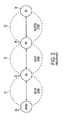
- FIG. 2 is a diagram illustrating a network which includes a multi-hop relay station connection.
- mobile relay base station (MR-BS) 30 communicates with relay station (RS) 32 in relay zone 31.
- Relay station (RS) 32 communicates with relay station (RS) 34 in relay zone 33.
- Relay station (RS) 34 communicates directly with subscriber station (SS) 36 in access zone 35.
- Various embodiments of the present invention are directed to an amble modulation series in a downlink relay zone in an IEEE 802.16 network, the amble modulation series being a reverse version of a preamble modulation series of the network.
- FFT Fast Fourier Transform
- amble modulation series is easily understood when shown in table form.
- IEEE 802.16-2004 IEEE 802.16e-2005, IEEE 802.16-2005, and IEEE 802.16j-06/026r2, which are incorporated herein by reference in their entireties.
- the first symbol of a downlink transmission is referred to as the preamble.
- the preamble is used by a subscriber station (SS) to perform measurements and procedures such as time synchronization, carrier frequency estimation, channel response estimation, cell and sector identification, etc. Performing such measurements and procedures in accordance with the preamble is well-known.
- SS subscriber station
- a similar amble can be introduced into relay zones to achieve the similar objectives as the preambles.
- a set of 114 preamble modulation series are specified in IEEE 802.16e, which is incorporated by reference herein in its entirety. This defined set of preamble modulation series was originally intended to be used in an access zone. More specifically, this defined set of preamble modulation series was originally intended to be used between a base station (BS) and a subscriber station (SS) in networks that do not use relay stations. In such networks, without the use of relay stations, the subscriber station (SS) must be in communication range of the base station (BS).
- BS base station
- SS subscriber station
- One option for a relay zone amble modulation series is to use the same preamble modulation series defined in 802.16e, i.e., the one used in the access zone in mobile relay networks.
- this option could cause problems since subscriber stations (SS) could detect the same preamble twice in one frame.
- FFT Fast Fourier Transform
- the FFT size of the network would be readily known. More specifically, an IEEE 802.16 network has an associated FFT size on which the network is designed. IEEE 802.16 currently specifies the use of networks with an FFT size of, for example, 2048, 1024 or 512. However, the present invention is not limited the networks having an FFT size of 2048, 1024 or 512. Instead, a network could have a different FFT size. The above equation would still apply to networks having different FFT sizes. However, the value of J would be different for different FFT sizes.
- J is equal to 567, 283 and 142 for an 802.16 network with FFT size of 2048, 1024 and 512, respectively.
- the new amble set is the reverse version of the original preamble set can be referred to as an "associated amble modulation series".
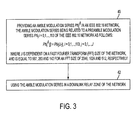
- FIG. 3 is a diagram illustrating the use of an amble modulation series according to an embodiment of the present invention.
- the amble modulation series is used in a downlink relay zone of the network.
- a mobile relay base station MR-BS
- MR-BS mobile relay base station
- RS relay station
- the amble modulation series can then be used by a subordinate relay station (RS) to perform measurements and procedures such as, for example, time synchronization, carrier frequency estimation, channel response estimation, cell and sector identification, etc.
- the present invention is not limited to any specific measurements or procedures being performed. Performing such measurements and procedures in accordance with the amble modulation series is similar to performing such measurements with the preamble, and would be well-understood by a person of ordinary skill in the art in view of the disclosure herein.
- the equation would generate a different amble modulation series for each FFT size. Accordingly, the present invention is not limited to the specific amble modulation series shown in Tables 1, 2 and/or 3.
- a mobile relay base station (MR-BS) or a relay station (RS) could be provided with the specific amble modulation series.
- the mobile relay base station (MR-BS) or a relay station (RS) could be provided with a table, such as Tables 1, 2 or 3, or with information corresponding to that in Tables 1, 2 or 3.
- the mobile relay base station (MR-BS) or a relay station (RS) might be provided with only specific ones of the amble modulation series that are required by the respective mobile relay base station (MR-BS) or the respective relay station (RS).
- Such tables or specific values might reside on the mobile relay base station (MR-BS) or the respective relay station (RS), or might reside elsewhere in the network and be provided to, or obtained by, the respective mobile relay base station (MR-BS) or respective relay station (RS) when needed.
- a mobile relay base station (MR-BS) or relay station (RS) might generate the amble modulation series from the above equation, or be provided with the amble modulation from a different device on the network which generates the amble modulation series from the above equation, and provides the generated amble modulation series to a mobile relay base station (MR-BS) or relay station (RS) when needed.
- embodiments of the present invention are not limited to any particular manner of generating or providing the amble modulation series to a mobile relay base station (MR-BS) or relay station (RS).
- MR-BS mobile relay base station
- RS relay station
- This new amble modulation series has several important properties. For example, there is one and only one associated amble for each preamble defined in IEEE 802.16-2005; hence no extra efforts are required for the new amble planning in the network deployment.
- the associated amble modulation series has the same auto-correlation and cross-correlation performance as the original preamble modulation series. This property make the associated amble set work as well as the original preamble set does.
- the associated amble set has peak-to-average-power-ratio (PAPR) performance better than (or the same as) the corresponding preamble set.
- PAPR peak-to-average-power-ratio
- the cross-correlation between the associated amble modulation series and the original preamble modulation series is low enough for the purpose of the amble in relay zones.
- the associated amble series has a simple relationship with the corresponding preamble series and is easy to be implemented.
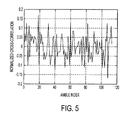
- FIGS. 4 and 5 The performance of the associated amble modulation series is illustrated in FIGS. 4 and 5 .
- the auto-correlation and the cross-correlation of the aggregate amble set i.e. the preamble set (numbered from 0 to 113) and the associated amble set (numbered from 114 to 283), is illustrated in FIG. 4 for FFT size of 1024.
- the normalized (by the auto-correlation, i.e. 284 for a FFT size of 1024) cross-correlation between the associated amble series and the corresponding original preamble series is illustrated in FIG. 5 for amble indexes from 0 to 113.
- the performance of the new amble set appears to be good enough for the purpose of the amble in the downlink (DL) relay zone.
- FIG. 6 is a diagram illustrating a network using an amble modulation series, according to an embodiment of the present invention.
- the network includes a mobile relay base station (MR-BS) 50, a relay station (RS) 52 and a subscriber station (SS) 54.
- Subscriber station (SS) 54 might be, for example, a mobile station.
- the network in FIG. 6 is an example of a two-hop architecture, since there is only one relay station (RS) 52 between mobile relay base station (MR-BS) 50 and subscriber station (SS) 54.
- RS relay station
- SS subscriber station
- the present invention in not limited to a two-hop architecture, or to the specific architecture shown in FIG. 6 .
- Mobile relay base station (MR-BS) 50 includes a code provider 56 providing the amble modulation series.
- Code provider 56 might include memory storing the required amble modulation series.
- code provider 56 might be a processor which generates the amble modulation series based on the above-described equation.
- FIG. 6 shows code provider 56 as being included on mobile relay base station (MR-BS) 50.
- the present invention is not limited to code provider 56 being at any particular location.
- code provider 56 could be provided on a different entity in the network, with the required amble modulation series being provided to mobile relay base station (MR-BS) 50 as needed.
- Mobile relay base station (MR-BS) 50 inserts the amble modulation series into a downlink frame, and transmits the frame to relay station (RS) 52.
- Relay station (RS) 52 includes an amble decoder 57 which decodes the amble modulation series inserted into the downlink frame. Relay station (RS) 52 then performs measurements and tests in accordance with the decoded amble modulation series.
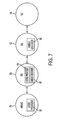
- FIG. 7 is a diagram illustrating a network using an amble modulation series, according to an additional embodiment of the present invention.
- the network includes mobile relay base station (MR-BS) 50, relay stations (RS) 60 and 62, and subscriber station (SS) 54.
- the network in FIG. 7 is an example of a multi-hop architecture, since there are two relay stations (RS) 60 and 62 between mobile relay base station (MR-BS) 50 and subscriber station (SS) 54. In other embodiments, there could be additional relay stations, providing additional hops, between mobile relay base station (MR-BS) 50 and subscriber station (SS) 54.
- the present invention in not limited to a multi-hop architecture, or to the specific architecture shown in FIG. 7 .
- mobile relay base station (MR-BS) 50 includes code provider 56 providing the amble modulation series.
- relay station 60 also includes a code provider 64 and amble decoder 65.
- Relay station 62 includes an amble decoder 66.
- FIG. 7 shows code providers 64 and 66 being included on relay stations (RS) 60 and 66, respectively.
- RS relay stations
- the present invention is not limited to code providers 64 and 66 being at any particular location.
- code providers 64 and 66 could be provided on a different entity in the network, with the required amble modulation series being provided to relay stations as needed.
- Mobile relay base station (MR-BS) 50 inserts the amble modulation series into a downlink frame, and transmits the frame to relay station (RS) 60.
- Amble decoder 65 of relay station (RS) 60 decodes the amble modulation series inserted into the downlink frame.
- Relay station (RS) 60 then performs measurements and tests in accordance with the decoded amble modulation series.
- Relay station (RS) 60 also inserts an amble modulation series into its downlink frame, and transmits the new frame to relay station 62.
- Amble decoder 66 of relay station 62 decodes the amble series and performs measurements and tests in accordance with the decoded amble modulation series.
- FIGS. 6 and 7 show a respective code provider for each mobile relay base station (MR-BS) that requires the amble modulation series.
- MR-BS mobile relay base station
- FIGS. 6 and 7 show a respective code provider for each mobile relay base station (MR-BS) that requires the amble modulation series.
- MR-BS mobile relay base station
- FIGS. 6 and 7 show a respective code provider for each mobile relay base station (MR-BS) that requires the amble modulation series.
- MR-BS mobile relay base station
- the network in FIG. 7 shows only two relay stations between mobile relay base station (MR-BS) 50 and subscriber station (SS) 54. However, in various embodiments of the present invention, there might be additional relay stations (indicating additional hops) between mobile relay base station (MR-BS) 50 and subscriber station (SS) 54. In such embodiments, depending on the configuration, the additional relay stations may need the amble modulation series to transmit a frame in a downlink relay zone.
- Various embodiments of the present invention are applicable to IEEE 802.16 networks, which includes amendments and extensions to IEEE 802.16. Such amendments and extensions include, but are not limited to, IEEE 802.16e and 802.16j. Moreover, the present invention is not limited to IEEE 802.16 networks, and can be applied to other types of networks.
- a subscriber station might be, for example, a fixed station or mobile station. However, there are many different types of subscriber stations, and the present invention is not limited to any particular type of subscriber station.
- MR-BS mobile relay base stations
- RS relay stations
- Networks are described herein has having a FFT size. However, the present invention is not limited to networks having any specific FFT size, and embodiments of the present invention are applicable to networks having an FFT size different than in the examples described herein.
- Table 309-Preamble modulation series per segment and IDcell for the 2k (2048) FFT mode Index IDcell Segment Series to modulate ( W k ) 0 0 0 0xC12B7F736CFFB14B6ABF4EB50A60B7A3B4163EA3360F697 C45075997ACE17BB1512C7C0CEBB34B389D8784553C0FC60B DE4F166CF7B04856442D97539FB915D80820CEDD858483 1 1 0 0xA9F7AC1BD0A4BD694D3EDC2991CC3B2D24BF26A22346F 8DB370202CDA25D382D4119AAC
- the invention also provides a computer program or a computer program product for carrying out any of the methods described herein, and a computer readable medium having stored thereon a program for carrying out any of the methods described herein.
- a computer program embodying the invention may be stored on a computer-readable medium, or it could, for example, be in the form of a signal such as a downloadable data signal provided from an Internet website, or it could be in any other form.
Landscapes
- Engineering & Computer Science (AREA)
- Signal Processing (AREA)
- Computer Networks & Wireless Communication (AREA)
- Mathematical Physics (AREA)
- Discrete Mathematics (AREA)
- General Physics & Mathematics (AREA)
- Physics & Mathematics (AREA)
- Mobile Radio Communication Systems (AREA)
- Radio Relay Systems (AREA)
- Materials For Photolithography (AREA)
- Ink Jet Recording Methods And Recording Media Thereof (AREA)
- Detergent Compositions (AREA)
- Small-Scale Networks (AREA)
Priority Applications (1)
| Application Number | Priority Date | Filing Date | Title |
|---|---|---|---|
| EP10151015.4A EP2175602A3 (de) | 2007-03-02 | 2007-09-26 | Modulations-Ambelsequenz |
Applications Claiming Priority (2)
| Application Number | Priority Date | Filing Date | Title |
|---|---|---|---|
| US89270407P | 2007-03-02 | 2007-03-02 | |
| US11/744,290 US20080212463A1 (en) | 2007-03-02 | 2007-05-04 | Amble modulation series |
Related Child Applications (1)
| Application Number | Title | Priority Date | Filing Date |
|---|---|---|---|
| EP10151015.4 Division-Into | 2010-01-18 |
Publications (2)
| Publication Number | Publication Date |
|---|---|
| EP1965550A2 true EP1965550A2 (de) | 2008-09-03 |
| EP1965550A3 EP1965550A3 (de) | 2013-10-30 |
Family
ID=40079429
Family Applications (2)
| Application Number | Title | Priority Date | Filing Date |
|---|---|---|---|
| EP10151015.4A Withdrawn EP2175602A3 (de) | 2007-03-02 | 2007-09-26 | Modulations-Ambelsequenz |
| EP07117304.1A Withdrawn EP1965550A3 (de) | 2007-03-02 | 2007-09-26 | Passgangmodulationsserien |
Family Applications Before (1)
| Application Number | Title | Priority Date | Filing Date |
|---|---|---|---|
| EP10151015.4A Withdrawn EP2175602A3 (de) | 2007-03-02 | 2007-09-26 | Modulations-Ambelsequenz |
Country Status (5)
| Country | Link |
|---|---|
| US (2) | US20080212463A1 (de) |
| EP (2) | EP2175602A3 (de) |
| JP (1) | JP5125451B2 (de) |
| KR (1) | KR100944832B1 (de) |
| CN (1) | CN101299738B (de) |
Families Citing this family (1)
| Publication number | Priority date | Publication date | Assignee | Title |
|---|---|---|---|---|
| KR101559794B1 (ko) * | 2009-02-17 | 2015-10-13 | 엘지전자 주식회사 | 시퀀스 생성 방법 및 이를 위한 장치 |
Family Cites Families (9)
| Publication number | Priority date | Publication date | Assignee | Title |
|---|---|---|---|---|
| GB8320979D0 (en) * | 1983-08-03 | 1983-09-07 | Multitone Electronics Plc | Decoding arrangements |
| EP0711730A4 (de) | 1994-05-31 | 1996-12-27 | Toto Ltd | Elektrolysevorrichtung und elektrolysemethode für chloridione enthaltendes fliessendes wasser |
| US6567482B1 (en) * | 1999-03-05 | 2003-05-20 | Telefonaktiebolaget Lm Ericsson (Publ) | Method and apparatus for efficient synchronization in spread spectrum communications |
| CA2276971A1 (en) * | 1999-07-06 | 2001-01-06 | Wen Tong | Preamble using golay sequence for access channel in cellular communications systems |
| CN1282372C (zh) * | 2003-09-29 | 2006-10-25 | 凯明信息科技股份有限公司 | 时分同步码分多址系统中检测中导码序列的方法和装置 |
| WO2006023536A2 (en) * | 2004-08-16 | 2006-03-02 | Zte San Diego, Inc. | Fast cell search and accurate sznchronization in wireless communications |
| JP4494134B2 (ja) * | 2004-09-01 | 2010-06-30 | Kddi株式会社 | 無線通信システム、中継局装置および基地局装置 |
| CN101124751B (zh) * | 2005-02-18 | 2011-04-13 | 松下电器产业株式会社 | 无线通信方法、中继站装置和无线发送装置 |
| US7742452B2 (en) * | 2007-01-05 | 2010-06-22 | Motorola, Inc. | System and method for dynamic preamble assignment |
-
2007
- 2007-05-04 US US11/744,290 patent/US20080212463A1/en not_active Abandoned
- 2007-09-26 EP EP10151015.4A patent/EP2175602A3/de not_active Withdrawn
- 2007-09-26 EP EP07117304.1A patent/EP1965550A3/de not_active Withdrawn
- 2007-10-24 KR KR1020070107346A patent/KR100944832B1/ko active Active
- 2007-11-23 CN CN200710187096.7A patent/CN101299738B/zh not_active Expired - Fee Related
- 2007-11-28 JP JP2007307363A patent/JP5125451B2/ja active Active
-
2009
- 2009-12-09 US US12/634,197 patent/US20100085919A1/en not_active Abandoned
Non-Patent Citations (3)
| Title |
|---|
| "C80216j-07_141 ; C80216j-07_141", IEEE DRAFT; C80216J-07_141, IEEE-SA, PISCATAWAY, NJ USA, vol. 802.16j, 8 January 2007 (2007-01-08), pages 1-7, XP017629487, [retrieved on 2007-01-11] * |
| "Relay midamble ; S80216j-06_144", IEEE DRAFT; S80216J-06_144, IEEE-SA, PISCATAWAY, NJ USA, vol. 802.16j, 14 November 2006 (2006-11-14), pages 1-4, XP017629026, [retrieved on 2006-11-14] * |
| "RS 802.16e Preamble Transmission ; C80216j-06_241r1", IEEE DRAFT; C80216J-06_241R1, IEEE-SA, PISCATAWAY, NJ USA, vol. 802.16j, 8 January 2007 (2007-01-08), pages 1-11, XP017629339, [retrieved on 2007-01-11] * |
Also Published As
| Publication number | Publication date |
|---|---|
| EP1965550A3 (de) | 2013-10-30 |
| EP2175602A2 (de) | 2010-04-14 |
| EP2175602A3 (de) | 2013-10-30 |
| JP2008219858A (ja) | 2008-09-18 |
| US20100085919A1 (en) | 2010-04-08 |
| KR100944832B1 (ko) | 2010-03-03 |
| KR20080080897A (ko) | 2008-09-05 |
| JP5125451B2 (ja) | 2013-01-23 |
| CN101299738B (zh) | 2012-01-25 |
| CN101299738A (zh) | 2008-11-05 |
| US20080212463A1 (en) | 2008-09-04 |
Similar Documents
| Publication | Publication Date | Title |
|---|---|---|
| US11943723B2 (en) | Method for receiving SSB according to synchronization raster and user equipment | |
| EP3707846B1 (de) | Verfahren zur präambelpunktierung | |
| US8462676B2 (en) | Frame structure for support of large delay spread deployment scenarios | |
| US20080095195A1 (en) | Device, system, and method for partitioning and framing communication signals in broadband wireless access networks | |
| US20190173628A1 (en) | Method for transceiving broadcast channel signals in a wireless communication system and apparatus thereof | |
| US10849147B2 (en) | Systems and methods for accommodating specific user equipments | |
| CN108737039B (zh) | 随机接入及响应方法、终端设备、网络设备 | |
| CN113949498B (zh) | 系统信息块传输的方法和装置 | |
| US20260032654A1 (en) | Procedures for coreset sharing | |
| EP3767906A1 (de) | Vorrichtung zum konfigurieren von dm-rs für v2x | |
| US8923206B2 (en) | Wireless communication apparatus and wireless communication method | |
| US11800564B2 (en) | Method and apparatus for random access layered preambles | |
| US11595166B2 (en) | Data transmission method and apparatus | |
| US20240389118A1 (en) | Method and apparatus for sidelink positioning reference signal transmission | |
| US20250055610A1 (en) | Method for configuring resources, terminal, and network device | |
| EP1965550A2 (de) | Passgangmodulationsserien | |
| US10524249B2 (en) | Data transmission method and apparatus | |
| CN101764781B (zh) | 导码调制序列 | |
| KR102739914B1 (ko) | 사이드링크 동기화 신호를 보완하는 장치 및 방법 | |
| EP3528446A1 (de) | Empfang von referenzsignalen in einem kommunikationssystem mit verschiedenen fft-längen |
Legal Events
| Date | Code | Title | Description |
|---|---|---|---|
| PUAI | Public reference made under article 153(3) epc to a published international application that has entered the european phase |
Free format text: ORIGINAL CODE: 0009012 |
|
| AK | Designated contracting states |
Kind code of ref document: A2 Designated state(s): AT BE BG CH CY CZ DE DK EE ES FI FR GB GR HU IE IS IT LI LT LU LV MC MT NL PL PT RO SE SI SK TR |
|
| AX | Request for extension of the european patent |
Extension state: AL BA HR MK RS |
|
| RAP1 | Party data changed (applicant data changed or rights of an application transferred) |
Owner name: FUJITSU MICROELECTRONICS LIMITED |
|
| RAP1 | Party data changed (applicant data changed or rights of an application transferred) |
Owner name: FUJITSU SEMICONDUCTOR LIMITED |
|
| PUAL | Search report despatched |
Free format text: ORIGINAL CODE: 0009013 |
|
| AK | Designated contracting states |
Kind code of ref document: A3 Designated state(s): AT BE BG CH CY CZ DE DK EE ES FI FR GB GR HU IE IS IT LI LT LU LV MC MT NL PL PT RO SE SI SK TR |
|
| AX | Request for extension of the european patent |
Extension state: AL BA HR MK RS |
|
| RIC1 | Information provided on ipc code assigned before grant |
Ipc: H04B 7/14 20060101ALI20130923BHEP Ipc: H04L 27/26 20060101AFI20130923BHEP |
|
| 17P | Request for examination filed |
Effective date: 20140328 |
|
| RBV | Designated contracting states (corrected) |
Designated state(s): AT BE BG CH CY CZ DE DK EE ES FI FR GB GR HU IE IS IT LI LT LU LV MC MT NL PL PT RO SE SI SK TR |
|
| AKX | Designation fees paid |
Designated state(s): DE FR GB |
|
| RAP1 | Party data changed (applicant data changed or rights of an application transferred) |
Owner name: SOCIONEXT INC. |
|
| GRAP | Despatch of communication of intention to grant a patent |
Free format text: ORIGINAL CODE: EPIDOSNIGR1 |
|
| INTG | Intention to grant announced |
Effective date: 20150909 |
|
| STAA | Information on the status of an ep patent application or granted ep patent |
Free format text: STATUS: THE APPLICATION IS DEEMED TO BE WITHDRAWN |
|
| 18D | Application deemed to be withdrawn |
Effective date: 20160120 |