EP1964950A2 - Method for chopping unwound filaments and coated chopper blades - Google Patents
Method for chopping unwound filaments and coated chopper blades Download PDFInfo
- Publication number
- EP1964950A2 EP1964950A2 EP20080003625 EP08003625A EP1964950A2 EP 1964950 A2 EP1964950 A2 EP 1964950A2 EP 20080003625 EP20080003625 EP 20080003625 EP 08003625 A EP08003625 A EP 08003625A EP 1964950 A2 EP1964950 A2 EP 1964950A2
- Authority
- EP
- European Patent Office
- Prior art keywords
- diamond
- nitride
- carbide
- titanium
- carbon
- Prior art date
- Legal status (The legal status is an assumption and is not a legal conclusion. Google has not performed a legal analysis and makes no representation as to the accuracy of the status listed.)
- Granted
Links
Images
Classifications
-
- D—TEXTILES; PAPER
- D01—NATURAL OR MAN-MADE THREADS OR FIBRES; SPINNING
- D01G—PRELIMINARY TREATMENT OF FIBRES, e.g. FOR SPINNING
- D01G1/00—Severing continuous filaments or long fibres, e.g. stapling
- D01G1/02—Severing continuous filaments or long fibres, e.g. stapling to form staple fibres not delivered in strand form
- D01G1/04—Severing continuous filaments or long fibres, e.g. stapling to form staple fibres not delivered in strand form by cutting
-
- D—TEXTILES; PAPER
- D01—NATURAL OR MAN-MADE THREADS OR FIBRES; SPINNING
- D01G—PRELIMINARY TREATMENT OF FIBRES, e.g. FOR SPINNING
- D01G1/00—Severing continuous filaments or long fibres, e.g. stapling
- D01G1/06—Converting tows to slivers or yarns, e.g. in direct spinning
- D01G1/10—Converting tows to slivers or yarns, e.g. in direct spinning by cutting
-
- Y—GENERAL TAGGING OF NEW TECHNOLOGICAL DEVELOPMENTS; GENERAL TAGGING OF CROSS-SECTIONAL TECHNOLOGIES SPANNING OVER SEVERAL SECTIONS OF THE IPC; TECHNICAL SUBJECTS COVERED BY FORMER USPC CROSS-REFERENCE ART COLLECTIONS [XRACs] AND DIGESTS
- Y10—TECHNICAL SUBJECTS COVERED BY FORMER USPC
- Y10T—TECHNICAL SUBJECTS COVERED BY FORMER US CLASSIFICATION
- Y10T83/00—Cutting
- Y10T83/04—Processes
- Y10T83/0405—With preparatory or simultaneous ancillary treatment of work
- Y10T83/0443—By fluid application
Definitions
- the present invention involves an improved chopping method for chopping continuous or very long loose items such as fiber, fiber strands, yarn, wire, string, ribbon, tape and the like by pulling the item(s) into the chopper while the loose items are held tightly against the surface of a rotating backup roll and carrying the item(s) on into a nip between a rotating blade roll and the rotating backup roll where they are separated into short pieces.
- the present invention also involves using choppers that wind material on the outside or inside of a rotating blade roll and separate the material into short lengths using one or more pressure rollers running on the wound material, forcing the wound material into the blade edges on the blade roll. More specifically the present invention involves an improved chopping method using an improved blade roll in combination with items to be chopped having water or protective sizings on the surface and having a pH of about 7 or higher.
- the choppers disclosed in these patents comprise a blade roll containing a plurality of spaced apart blades for separating the fibers into short lengths, a backup roll, often or preferably driven, which the blades work against to effect the separation and which pulls the fibers or fiber strands and in some cases, an idler roll to hold the fibers or fiber strands down onto the surface of the backup roll.
- the chopper is often the item most limiting the productivity of the processes. These processes typically operate continuously every day of the year, 24 hours each day, except for furnace rebuilds every 5-10 years. It is also known to use choppers like those disclosed in U.S.
- Patents 4,369,681 and 4,569,264 in which the item(s) are wound continuously on the inside or outside of a rotating blade roll and forced into the blade edges by one or more pressure rolls. These latter types of choppers also use stainless or carbon steel blades and suffer from too short of blade life as disclosed in U.S. Patent 5,398,575 .
- choppers run at speeds such that the surface speed of the backup roll and the edge of the blades move at thousands of feet per minute, i. e. from 2,000 to more than 6,000 feet per minute, such as 7,000 to 10,000 feet per minute.
- the chopping blades and the working layer of the backup roll or cot have a life, depending upon the type of item(s) being separated into short lengths with the chopper.
- the average life of the blades is about 12-24 hours, and this also limits the life of the backup roll or cot to the same life because it is too expensive to have to shut down the chopper before the new blades need changing again to replace the backup roll, working layer or cot.
- variable and short blade life of the cobalt bonded tungsten carbide blades is due to the pH of the chemical protective sizing on the surfaces of the items being chopped. It has been discovered that when the pH of the sizing is less than about 7, especially less than about 5 and most especially less than about 4, the edge of the blade is attacked and deteriorates excessively to properly separate the items within 50 hours of chopping operation or less. If the sizing on the items being chopped is modified to increase the pH to 7 or above, the average chopping life of the tungsten blades is increased substantially, often dramatically to 500 hours or more. It has also been surprisingly discovered that with this higher blade life, the average life of the backup roll, urethane working layer or cot is dramatically increased to at least 100, and more typically at least about 200 hours or more from the previous life of 24 hours or less.
- the present invention is an improved method of separating long lengths of one or more unwound items selected from a group consisting of fibers, fiber strands, wires, strings, tape(s), strip(s) and ribbon(s) into lengths in the range of about 0.07 to about 5 inches long by feeding one or more, preferably a plurality of, long lengths of one or more of the items described above into a chopper in an unwound form at speeds exceeding 500 feet per minute (FPM), more typically at speeds exceeding 1000 or 2000 FPM and separating the items by pressing blades in a blade roll or blades on a cutter roll, each roll containing a plurality of blades into the items, the items having a protective liquid chemical sizing on the surface of the items, the improvement comprising that at least the blade edge portion contains a major portion of tungsten carbide, and the liquid chemical sizing has a pH of at least 7 or greater.
- FPM feet per minute
- the protective sizing will have a pH of 8 or greater and most typically a pH of 8 or higher.
- the blades or at least the edge portions of the blades will have a tungsten carbide content of at least about 90 weight percent, most typically at least about 94 weight percent.
- the blades or blade edge portion also more typically contains a minor portion of a metal like cobalt, more typically at least about 3-15 weight percent, more typically about 3-10-12 wt. percent and most typically about 4-6-10 wt. percent to bond the particles of tungsten carbide together.
- Some types of conventional choppers used in the invention pulls the item(s) into a nip between an elastomer working layer of the backup roll or cot and the chopping portion of the blades of a rotating blade roll or a rotating cutter head, the latter usually having the blades integral with the metal roll of the cutterhead.
- the blade roll or cutterhead and the backup roll are typically outboard of a front of a cabinet that contains the conventional drive and roll biasing members.
- Another type of conventional chopper used in the invention pulls the item(s) continuously onto the inside surface or the outside surface of a rotating blade roll having a plurality of spaced apart blades around the circumference of the blade roll.
- the item(s) are wound onto the blade roll while one or more rotating pressure rolls press against the wound items laying against the sharp edges of the blades causing the wound items to be separated into lengths equal to or about equal to the spacing between the blade edges.
- Still another type of fiber chopper usable in the invention is the chopper disclosed in U.S. Patent No. 6,517,017 ,
- the invention also includes coated blades, and a method of separating long lengths of one or more unwound items selected from a group consisting of fibers, fiber strands, wires, strings, tape(s), strip(s) and ribbon(s) into lengths in the range of about 0.07 to about 5 inches long by feeding one or more, preferably a plurality of, long lengths of one or more of the items described above into a chopper in an unwound form at speeds exceeding 500 FPM and separating the items by pressing the coated blades in a blade roll or coated blades on a cutter roll, each roll containing a plurality of blades into the items, the improvement comprising that the blades are comprised of stainless steel or tungsten carbide or both, and at least the blade edges have a coating to protect the blade material, the coating selected from a group consisting of a major portion of tungsten carbide, titanium nitride, diamond like carbon, polycrystalline diamond, polycrystalline cubic boron nitride, cemented tungsten
- cemented tungsten carbide When the items being chopped having a sizing on their surfaces having a pH of less than 7, cemented tungsten carbide is not desirable unless at least the working portion of the blades are coated.
- One coating suitable for cemented tungsten carbide blades or blade edges for operation in an acidic environment is titanium nitride.
- Other suitable coatings include diamond like carbon, polycrystalline diamond, polycrystalline cubic boron nitride, cemented tungsten carbide, or mixture of two or more of these materials.
- the invention includes blades having at least their working portions or edge portions made from or coated with a material selected from the group consisting of metal oxides, nitrides, carbides, borides, mixtures of a metal and an oxide, nitride or carbide, tungsten carbide, titanium carbonitride, zirconium nitride, titanium aluminum nitride, chromium/boron carbide, chromium/diamond-like carbon, titanium diboride/chromium, titanium diboride/titanium carbo-nitride composite, ceramics containing binders, molybdenum, diamond, diamond-like material, silicon, silicon carbide, vanadium, tantalum, nickel, niobium, niobium/molybdenum alloys, VYDAX, PTFE, chromium, boron carbide, titanium carbide, vanadium carbide, chromium carbide, titanium nitride, chromium nitrid
- the blades made from cobalt bonded tungsten carbide, or carbon steel or stainless steel coated with, one or more of the acid-sensitive materials described or named in the previous paragraph can be protected by coatings of acid resistant materials named above to permit items having chemical sizings on their surfaces having a pH of less than 7 to be chopped without significantly detracting from the blade life achieved on sizings having a pH of greater than about 7.
- Methods of producing coatings like tungsten carbide (without cobalt as a binder), TiN, TiC, TiCN, ZrCN, CrN, diamond-like carbon films and other materials mentioned above include generally known techniques such as chemical vapor deposition (CVD), plasma assisted CVD, physical vapor deposition (PVD), ion beam, laser ablation, RF plasma, microwave, arc discharge, and cathodic arc plasma deposition.
- CVD chemical vapor deposition
- PVD physical vapor deposition
- ion beam laser ablation
- RF plasma RF plasma
- microwave microwave
- arc discharge and cathodic arc plasma deposition
- the coating material may be deposited on the substrate via numerous techniques including sputtering, reactive sputtering, ion beam sputtering, ion plating, electron beam gun evaporation or sublimation, electron beam gun reactive evaporation or sublimation, resistive evaporation, resistive reactive evaporation, cathodic arc evaporation or chemical vapor deposition.
- the invention also includes methods of separating long lengths of one or more unwound items selected from a group consisting of fibers, fiber strands, wires, strings, tape(s), strip(s) and ribbon(s) into lengths in the range of about 0.07 to about 5 inches long by feeding one or more, preferably a plurality of, long lengths of one or more of the items described above into a chopper in an unwound form at speeds exceeding 500 FPM by using the coated blades of the invention.
- working edge portion or “working portion” is used above as part of a chopper blade these terms refers to that portion of the blade that contacts, or will contact, the item(s) being chopped during the life of the blade, including after sharpening.
- the term “at least the edge portion” includes “working edge portion” and even more of the blade up to and including the entire blade.
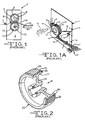
- the chopper illustrated in Figure 1 is like the chopper shown in U.S. Patent No. 3,815,461 , the disclosure of which is incorporated herein by reference.
- the choppers of Figures 1 and 1A are typical of the type of choppers suitable for use with the present invention, but other types of choppers having a blade roll with spaced apart blades that work against an elastomeric working layer of a backup roll are also usable with and in the invention. While these choppers are or will be shown pulling and chopping strands of glass fibers, these and the other suitable choppers can also be used according to the invention to pull and chop individual fibers, fiber strands of materials other than glass, wires, strings, tape(s), strip(s), ribbon(s) and similar items.
- Figures 1 and 1A show a front elevation perspective view of a portion of a prior art chopper 2, of the type shown in U.S. Pat. Nos. 3,815,461 and 4,551,160 respectively, and that are used in making chopped strand glass fiber 15.
- They each comprise a cabinet front 3, a blade roll 4 with spaced apart blades 5 contained in slots and projecting from the periphery of an integrated hub 6, a backup roll 8 and a free-wheeling idler roll 9.
- the blade roll 6, cutter roll can be made entirely of metal, with the blades separate or integral with the roll 6, but can be made using a thermoplastic material to hold spaced apart blades such as the blade rolls shown in U. S. Patent Nos.
- a backup roll 12 is held on a spindle and hub 10.
- the backup roll 12 has an elastomer working layer 13 that is biased against the blade roll 4 until the blades 5 press into the working layer 13 of the backup roll 12 a proper amount forming a nip 14 to break or separate fiber strands 1 into an array of short length or chopped strands 15.
- One or more, usually five or more and up to 14 or more strands 1, such as glass fiber strands, each strand containing 400 - 6000 or more fibers and usually having water and/or an aqueous chemical sizing on their surfaces, are pulled by the backup roll 12 into the chopper 2 and the nip 14.
- the strands 1 first run under a grooved guide roll 7, preferably with one or two strands 1 in each groove, partially around an idler roll 9 and upward and over the elastomeric working surface 13 of the backup roll 12, i.e. the exposed peripheral surface of the backup roll 12 on which the running strands 1 lay against and are supported while being severed by blades 5 on the blade roll 4.
- the working surface of the back up roll 12 is typically wider than the oscillating path of the glass fiber strands 1.
- the strands 1 then pass under the outer surface of the free-wheeling idler roll 9 located to provide sufficient contact of the strands 1 on the surface of the working layer 13 on the backup roll 12 enabling the latter to pull the glass fiber strands 1 into the chopper 2.
- the pulling speed of the pull rolls 21 is ramped up to bring the new strand 18 to at least close to the speed of the strands 1 running into the chopper 2.
- the pivot arm 20 is pivoted counterclockwise to start the new strand 18 into the chopper 2 in the manner disclosed in U.S. Pat. No. 4,551,160 .
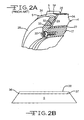
- FIG. 2 shows a typical blade roll wheel 23 for a blade roll 4, without the blades 5.
- a portion of the blade roll 23 is cut away to better illustrate the blade roll assembly.
- the blade roll 4 is typically comprised of a hub supporting a rim 17.
- the rim 17 holds an elastomeric working layer that the chopper blades 5 work against.
- the blades 5 usually must penetrate the top surface 25 a desired distance as is well known to chop all the fibers or other items.
- the chopping blades 5 sit in slots 26 that extend part of the way through the thickness of the working layer 24, usually half way or more through the thickness of the working layer 24, and rest on the bottom of the slots 27.
- the working layer 24 can be most any elastomeric material having a hardness sufficient to hold the blades and typically is a polyurethane or rubber material.
- Figure 2A a partial perspective view of the same blade roll wheel 23 as shown in Figure 2 , has blades 5 in some or all of the slots 24 of the working layer 24 and a blade retention ring 28 held in place on the blade roll wheel 23 with bolts 30 that screw into threaded holes 31 in the rim 17 of the blade roll wheel 23.
- the blades 5 are held securely in place as the blade retention rings 28 (the blade retention ring on the backside of the backup roll 4 is not shown, but is just like the front blade retention ring 28 that is shown) with a cushion ring 29 of compressible material as shown and described in U.S. Patent No. 4,249,441 , the disclosure thereof being incorporated herein by reference.
- the cushion ring 29 is held in place with an annular bead 32 that fits into an annular groove 33 in an inner face of the blade retention ring 28.
- FIG 2B shows a typical blade 5 used in the choppers shown in Figures 1, 1A and 1B .
- This is one suitable shape used, but the shape or size of the blades is not critical as many shapes and sizes can be used in various blade roll designs as is well known. In the past these blades have been made from razor blade quality stainless or carbon steel and this has been the standard for many years.
- the top edge 36 of the blade is ground to a sharp edge, starting from a short distance back from the edge at 37, normally at least a distance in the range of about 1 to about 12 mm , more typically about 2 - 7 mm, and having a tapered portion 36 ending at the sharp edge 38.
- the edge of the blades that contact the item to be separated is razor blade sharp when the blade is new.
- the worn tungsten carbide containing blades can be resharpened by grinding in a conventional manner and that the re-sharpened blades cost only about 0.33 times the original blade cost. There is a limit to how many times the W2C blades can be resharpened, but they can be sharpened at least about 5 times.
- the invention includes blades having their working portions coated with a material selected from the group consisting of metal oxides, nitrides, carbides, borides, mixtures of a metal and an oxide, nitride or carbide, tungsten carbide, titanium carbonitride, zirconium nitride, titanium aluminum nitride, chromium/boron carbide, chromium/diamond-like carbon, titanium diboride/chromium, titanium diboride/titanium carbo-nitride composite, ceramics containing binders, molybdenum, diamond, diamond-like material, silicon, silicon carbide, vanadium, tantalum, nickel, niobium, niobium/molybdenum alloys, VYDAX, PTFE, chromium, boron carbide, titanium carbide, vanadium carbide, chromium carbide, titanium nitride, chromium nitride, boron nit
- the blades made from cobalt bonded tungsten carbide, or carbon steel or stainless steel coated with, one or more of the acid-sensitive materials described or named in the previous paragraph can be protected by coatings of acid resistant materials named above to permit items having chemical sizings on their surfaces having a pH of less than 7 to be chopped without significantly detracting from the blade life achieved on sizings having a pH of greater than about 7.
- Methods of producing coatings like tungsten carbide (without cobalt as a binder), TiN, TiC, TiCN, ZrCN, CrN, diamond-like carbon films and other materials mentioned above include known techniques such as chemical vapor deposition (CVD), plasma assisted CVD, physical vapor deposition (PVD), ion beam, laser ablation, RF plasma, microwave, arc discharge, and cathodic arc plasma deposition.
- CVD chemical vapor deposition
- PVD physical vapor deposition
- ion beam laser ablation
- RF plasma RF plasma
- microwave microwave
- arc discharge and cathodic arc plasma deposition
- the coating material may be deposited on the substrate via numerous techniques including sputtering, reactive sputtering, ion beam sputtering, ion plating, electron beam gun evaporation or sublimation, electron beam gun reactive evaporation or sublimation, resistive evaporation, resistive reactive evaporation, cathodic arc evaporation or chemical vapor deposition.
Landscapes
- Engineering & Computer Science (AREA)
- Textile Engineering (AREA)
- Preliminary Treatment Of Fibers (AREA)
- Inorganic Fibers (AREA)
- Treatment Of Fiber Materials (AREA)
Abstract
Improved chopping life is achieved by using blades, or at least blade edges of cemented tungsten carbide, and selecting the liquid chemical sizings having a pH of about 7 or greater to apply to the surfaces of the items being chopped. Also disclosed are blades having at least the sharp edges of the chopping blades coated with various materials including a material selected from a group consisting of tungsten carbide, titanium nitride, diamond like carbon, polycrystalline diamond, polycrystalline cubic boron nitride, cemented tungsten carbide, or mixture of two or more of these materials. These coated blades can be used to separate items having both neutral, basic and acidic sizings thereon
Description
- The present invention involves an improved chopping method for chopping continuous or very long loose items such as fiber, fiber strands, yarn, wire, string, ribbon, tape and the like by pulling the item(s) into the chopper while the loose items are held tightly against the surface of a rotating backup roll and carrying the item(s) on into a nip between a rotating blade roll and the rotating backup roll where they are separated into short pieces. The present invention also involves using choppers that wind material on the outside or inside of a rotating blade roll and separate the material into short lengths using one or more pressure rollers running on the wound material, forcing the wound material into the blade edges on the blade roll. More specifically the present invention involves an improved chopping method using an improved blade roll in combination with items to be chopped having water or protective sizings on the surface and having a pH of about 7 or higher.
- It has long been known to chop continuous fibers or fiber strands into lengths of about 1-5 inches or shorter. Billions of pounds of such product including chopped glass fibers and fiber strands are produced each year in process and chopping apparatus such as disclosed in
U. S. Patents 5,970,837 ,4,551,160 ,4,398,934 ,3,508,461 , and3,869,268 , the disclosures of which are incorporated herein by reference. The choppers disclosed in these patents comprise a blade roll containing a plurality of spaced apart blades for separating the fibers into short lengths, a backup roll, often or preferably driven, which the blades work against to effect the separation and which pulls the fibers or fiber strands and in some cases, an idler roll to hold the fibers or fiber strands down onto the surface of the backup roll. In the chopped fiber processes disclosed in these patents, the chopper is often the item most limiting the productivity of the processes. These processes typically operate continuously every day of the year, 24 hours each day, except for furnace rebuilds every 5-10 years. It is also known to use choppers like those disclosed inU.S. Patents 4,369,681 and4,569,264 in which the item(s) are wound continuously on the inside or outside of a rotating blade roll and forced into the blade edges by one or more pressure rolls. These latter types of choppers also use stainless or carbon steel blades and suffer from too short of blade life as disclosed inU.S. Patent 5,398,575 . - Many of the above choppers use a blade roll made using an elastomeric material layer such a rubber, polyurethane, or other material having similar elastomeric properties, for holding spaced apart blades in spaced apart slots in the elastomeric layer, see
U. S. Patent Nos. 4,083,279 and4,287,799 . In a large operation, many blade rolls must be inventoried to service a plurality of choppers making several different products at any one time, one of the differences in the chopped products being length of the chopped product desired. In making up the blade rolls, blades, usually stainless steel or carbon steel blades having razor sharp edges, are placed only in the slots appropriate for making the chopped length desired for the product to be produced with those blade rolls. - These choppers run at speeds such that the surface speed of the backup roll and the edge of the blades move at thousands of feet per minute, i. e. from 2,000 to more than 6,000 feet per minute, such as 7,000 to 10,000 feet per minute. The chopping blades and the working layer of the backup roll or cot have a life, depending upon the type of item(s) being separated into short lengths with the chopper. When chopping wet, sized glass fiber strands, the average life of the blades is about 12-24 hours, and this also limits the life of the backup roll or cot to the same life because it is too expensive to have to shut down the chopper before the new blades need changing again to replace the backup roll, working layer or cot. As the blades wear, deeper engagement with the back-up roll becomes necessary to compensate for the lost blade material and larger radius edge. This increased engagement results in premature back-up roll failure. These shutdowns to replace the backup and/or blade rolls take from 2-10 minutes, sometimes longer. While the chopper is down for replacing the blade roll, and or backup roll, working layer or cot, all of the fibers from all of the fiberizing bushings serviced by the chopper, usually at least 6- 10 bushings, go to scrap, i.e. shutdowns for blade replacement significantly reduces productivity and is very expensive when considering that a typical fiber manufacturing operation contains 15 or more operating choppers.
- Due to the expense and lost production caused by short blade life, much searching for a better blade than stainless razor blade type blades has been undertaken. One type of blade that offered promise was a cobalt cemented tungsten carbide blade. Although this type of blade is much more expensive than stainless steel or carbon steel blades, it was thought it might provide a long enough life due to the hardness and known wear resistance of tungsten carbide that the higher cost would be more than offset by a longer chopping life, however tests resulted in blade life that, although better, was excessively variable and too short to justify the higher blade cost. It is known to use cemented tungsten carbide as fiber chopper elements as disclosed in
U.S. Patent No. 6,517,017 . - It has now been discovered that the variable and short blade life of the cobalt bonded tungsten carbide blades is due to the pH of the chemical protective sizing on the surfaces of the items being chopped. It has been discovered that when the pH of the sizing is less than about 7, especially less than about 5 and most especially less than about 4, the edge of the blade is attacked and deteriorates excessively to properly separate the items within 50 hours of chopping operation or less. If the sizing on the items being chopped is modified to increase the pH to 7 or above, the average chopping life of the tungsten blades is increased substantially, often dramatically to 500 hours or more. It has also been surprisingly discovered that with this higher blade life, the average life of the backup roll, urethane working layer or cot is dramatically increased to at least 100, and more typically at least about 200 hours or more from the previous life of 24 hours or less.
- The present invention is an improved method of separating long lengths of one or more unwound items selected from a group consisting of fibers, fiber strands, wires, strings, tape(s), strip(s) and ribbon(s) into lengths in the range of about 0.07 to about 5 inches long by feeding one or more, preferably a plurality of, long lengths of one or more of the items described above into a chopper in an unwound form at speeds exceeding 500 feet per minute (FPM), more typically at speeds exceeding 1000 or 2000 FPM and separating the items by pressing blades in a blade roll or blades on a cutter roll, each roll containing a plurality of blades into the items, the items having a protective liquid chemical sizing on the surface of the items, the improvement comprising that at least the blade edge portion contains a major portion of tungsten carbide, and the liquid chemical sizing has a pH of at least 7 or greater. More typically the protective sizing will have a pH of 8 or greater and most typically a pH of 8 or higher. Also, more typically the blades or at least the edge portions of the blades will have a tungsten carbide content of at least about 90 weight percent, most typically at least about 94 weight percent. The blades or blade edge portion also more typically contains a minor portion of a metal like cobalt, more typically at least about 3-15 weight percent, more typically about 3-10-12 wt. percent and most typically about 4-6-10 wt. percent to bond the particles of tungsten carbide together.
- Some types of conventional choppers used in the invention pulls the item(s) into a nip between an elastomer working layer of the backup roll or cot and the chopping portion of the blades of a rotating blade roll or a rotating cutter head, the latter usually having the blades integral with the metal roll of the cutterhead. The blade roll or cutterhead and the backup roll are typically outboard of a front of a cabinet that contains the conventional drive and roll biasing members. Another type of conventional chopper used in the invention pulls the item(s) continuously onto the inside surface or the outside surface of a rotating blade roll having a plurality of spaced apart blades around the circumference of the blade roll. The item(s) are wound onto the blade roll while one or more rotating pressure rolls press against the wound items laying against the sharp edges of the blades causing the wound items to be separated into lengths equal to or about equal to the spacing between the blade edges. Still another type of fiber chopper usable in the invention is the chopper disclosed in
U.S. Patent No. 6,517,017 , - The invention also includes coated blades, and a method of separating long lengths of one or more unwound items selected from a group consisting of fibers, fiber strands, wires, strings, tape(s), strip(s) and ribbon(s) into lengths in the range of about 0.07 to about 5 inches long by feeding one or more, preferably a plurality of, long lengths of one or more of the items described above into a chopper in an unwound form at speeds exceeding 500 FPM and separating the items by pressing the coated blades in a blade roll or coated blades on a cutter roll, each roll containing a plurality of blades into the items, the improvement comprising that the blades are comprised of stainless steel or tungsten carbide or both, and at least the blade edges have a coating to protect the blade material, the coating selected from a group consisting of a major portion of tungsten carbide, titanium nitride, diamond like carbon, polycrystalline diamond, polycrystalline cubic boron nitride, cemented tungsten carbide, or mixture of two or more of these materials. When the items being chopped having a sizing on their surfaces having a pH of less than 7, cemented tungsten carbide is not desirable unless at least the working portion of the blades are coated. One coating suitable for cemented tungsten carbide blades or blade edges for operation in an acidic environment is titanium nitride. Other suitable coatings include diamond like carbon, polycrystalline diamond, polycrystalline cubic boron nitride, cemented tungsten carbide, or mixture of two or more of these materials.
- The invention includes blades having at least their working portions or edge portions made from or coated with a material selected from the group consisting of metal oxides, nitrides, carbides, borides, mixtures of a metal and an oxide, nitride or carbide, tungsten carbide, titanium carbonitride, zirconium nitride, titanium aluminum nitride, chromium/boron carbide, chromium/diamond-like carbon, titanium diboride/chromium, titanium diboride/titanium carbo-nitride composite, ceramics containing binders, molybdenum, diamond, diamond-like material, silicon, silicon carbide, vanadium, tantalum, nickel, niobium, niobium/molybdenum alloys, VYDAX, PTFE, chromium, boron carbide, titanium carbide, vanadium carbide, chromium carbide, titanium nitride, chromium nitride, boron nitride, hafnium nitride, carbon nitride, alumina, silicon dioxide, titanium dioxide, zirconia, chromium oxide, hafnium, titanium, tungsten, hafnium/diamond-like carbon, niobium/diamond-like carbon, molybdenum/diamond-like carbon, vanadium/diamond-like carbon, silicon/diamond-like carbon, tantalum/diamond-like carbon, silicon carbide/diamond-like carbon, titanium or mixtures thereof, and the use of such blades to chop, break or cut items having a chemical sizing with a pH greater than 7 on their surfaces can also be used with the type of choppers disclosed in
U.S. Patent Nos. 4,369,681 ,4,569,264 , and6,517,017 and also inEP 305,057 A3 - It is also believed that the blades made from cobalt bonded tungsten carbide, or carbon steel or stainless steel coated with, one or more of the acid-sensitive materials described or named in the previous paragraph can be protected by coatings of acid resistant materials named above to permit items having chemical sizings on their surfaces having a pH of less than 7 to be chopped without significantly detracting from the blade life achieved on sizings having a pH of greater than about 7.
- Methods of producing coatings like tungsten carbide (without cobalt as a binder), TiN, TiC, TiCN, ZrCN, CrN, diamond-like carbon films and other materials mentioned above include generally known techniques such as chemical vapor deposition (CVD), plasma assisted CVD, physical vapor deposition (PVD), ion beam, laser ablation, RF plasma, microwave, arc discharge, and cathodic arc plasma deposition. The coating material may be deposited on the substrate via numerous techniques including sputtering, reactive sputtering, ion beam sputtering, ion plating, electron beam gun evaporation or sublimation, electron beam gun reactive evaporation or sublimation, resistive evaporation, resistive reactive evaporation, cathodic arc evaporation or chemical vapor deposition.
- The invention also includes methods of separating long lengths of one or more unwound items selected from a group consisting of fibers, fiber strands, wires, strings, tape(s), strip(s) and ribbon(s) into lengths in the range of about 0.07 to about 5 inches long by feeding one or more, preferably a plurality of, long lengths of one or more of the items described above into a chopper in an unwound form at speeds exceeding 500 FPM by using the coated blades of the invention.
- When the term "working edge portion" or "working portion" is used above as part of a chopper blade these terms refers to that portion of the blade that contacts, or will contact, the item(s) being chopped during the life of the blade, including after sharpening. The term "at least the edge portion" includes "working edge portion" and even more of the blade up to and including the entire blade.
- When the word "about" is used herein it is meant that the amount or condition it modifies can vary some beyond that so long as the advantages of the invention are realized. Practically, there is rarely the time or resources available to very precisely determine the limits of all the parameters of one's invention because to do so would require an effort far greater than can be justified at the time the invention is being developed to a commercial reality. The skilled artisan understands this and expects that the disclosed results of the invention might extend, at least somewhat, beyond one or more of the limits disclosed. Later, having the benefit of the inventors disclosure and understanding the inventive concept and embodiments disclosed including the best mode known to the inventor, the inventor and others can, without inventive effort, explore beyond the limits disclosed to determine if the invention is realized beyond those limits and, when embodiments are found to be without unexpected characteristics, those embodiments are within the meaning of the term about as used herein. It is not difficult for the skilled artisan or others to determine whether such an embodiment is either as might be expected or, because of either a break in the continuity of results or one or more features that are significantly better than reported by the inventor, is surprising and thus an unobvious teaching leading to a further advance in the art.
-
-
Figure 1 is a front view of a portion of a prior art chopper useful in the method of the invention. -
Figure 1A is an elevational perspective view of a portion of a different prior art chopper useful in the method of the invention. -
Figure 2 is a partial perspective view of one prior art blade holder for a blade roll usable in the choppers shown inFigures 1 and 1A . -
Figure 2A is a partial perspective view of an assembled prior art blade roll of the type used in the choppers shown inFigures 1 and 1A containing chopper blades. -
Figure 2B is a front view of a typical chopper blade of the invention used in the blade roll shown inFigure 2A . - The chopper illustrated in
Figure 1 , is like the chopper shown inU.S. Patent No. 3,815,461 , the disclosure of which is incorporated herein by reference. The choppers ofFigures 1 and 1A are typical of the type of choppers suitable for use with the present invention, but other types of choppers having a blade roll with spaced apart blades that work against an elastomeric working layer of a backup roll are also usable with and in the invention. While these choppers are or will be shown pulling and chopping strands of glass fibers, these and the other suitable choppers can also be used according to the invention to pull and chop individual fibers, fiber strands of materials other than glass, wires, strings, tape(s), strip(s), ribbon(s) and similar items. -
Figures 1 and 1A show a front elevation perspective view of a portion of aprior art chopper 2, of the type shown inU.S. Pat. Nos. 3,815,461 and4,551,160 respectively, and that are used in making choppedstrand glass fiber 15. They each comprise acabinet front 3, ablade roll 4 with spaced apartblades 5 contained in slots and projecting from the periphery of an integrated hub 6, abackup roll 8 and a free-wheelingidler roll 9. The blade roll 6, cutter roll, can be made entirely of metal, with the blades separate or integral with the roll 6, but can be made using a thermoplastic material to hold spaced apart blades such as the blade rolls shown inU. S. Patent Nos. 4,083,279 ,4,249,441 ,4,287,799 and5,894,773 , the disclosures of which are herein incorporated by reference. Abackup roll 12 is held on a spindle andhub 10. Thebackup roll 12 has anelastomer working layer 13 that is biased against theblade roll 4 until theblades 5 press into the workinglayer 13 of the backup roll 12 a proper amount forming a nip 14 to break or separate fiber strands 1 into an array of short length or choppedstrands 15. - One or more, usually five or more and up to 14 or more strands 1, such as glass fiber strands, each strand containing 400 - 6000 or more fibers and usually having water and/or an aqueous chemical sizing on their surfaces, are pulled by the
backup roll 12 into thechopper 2 and thenip 14. The strands 1 first run under a grooved guide roll 7, preferably with one or two strands 1 in each groove, partially around anidler roll 9 and upward and over theelastomeric working surface 13 of thebackup roll 12, i.e. the exposed peripheral surface of thebackup roll 12 on which the running strands 1 lay against and are supported while being severed byblades 5 on theblade roll 4. The working surface of the back uproll 12 is typically wider than the oscillating path of the glass fiber strands 1. The strands 1 then pass under the outer surface of the free-wheelingidler roll 9 located to provide sufficient contact of the strands 1 on the surface of the workinglayer 13 on thebackup roll 12 enabling the latter to pull the glass fiber strands 1 into thechopper 2. - When a
new strand 18 is ready to be started into theprior art chopper 2 shown inFigure 1A , it is pulled to the front of thechopper 2 by the operator and pulled under the separator roll 7 and theidler roll 9 and up over a fixed, preferablynon-freewheeling starter roll 19 attached to the end of a pivotingarm 20 and down between a nip of a pair of driven pull rolls 21 that pull thenew strand 18 at a first low speed and deliver the new strand into a conventional scrap processing system, scrap bin or scrap basement. After thenew strand 18 is being pulled by thepull roll assembly 21 at a low initial speed, the pulling speed of the pull rolls 21 is ramped up to bring thenew strand 18 to at least close to the speed of the strands 1 running into thechopper 2. When that speed is reached, thepivot arm 20 is pivoted counterclockwise to start thenew strand 18 into thechopper 2 in the manner disclosed inU.S. Pat. No. 4,551,160 . -
Figure 2 shows a typicalblade roll wheel 23 for ablade roll 4, without theblades 5. A portion of theblade roll 23 is cut away to better illustrate the blade roll assembly. Theblade roll 4 is typically comprised of a hub supporting arim 17. Therim 17 holds an elastomeric working layer that thechopper blades 5 work against. Theblades 5 usually must penetrate the top surface 25 a desired distance as is well known to chop all the fibers or other items. Thechopping blades 5 sit inslots 26 that extend part of the way through the thickness of the workinglayer 24, usually half way or more through the thickness of the workinglayer 24, and rest on the bottom of theslots 27. The workinglayer 24 can be most any elastomeric material having a hardness sufficient to hold the blades and typically is a polyurethane or rubber material.Figure 2A , a partial perspective view of the sameblade roll wheel 23 as shown inFigure 2 , hasblades 5 in some or all of theslots 24 of the workinglayer 24 and ablade retention ring 28 held in place on theblade roll wheel 23 withbolts 30 that screw into threaded holes 31 in therim 17 of theblade roll wheel 23. Theblades 5 are held securely in place as the blade retention rings 28 (the blade retention ring on the backside of thebackup roll 4 is not shown, but is just like the frontblade retention ring 28 that is shown) with acushion ring 29 of compressible material as shown and described inU.S. Patent No. 4,249,441 , the disclosure thereof being incorporated herein by reference. Thecushion ring 29 is held in place with anannular bead 32 that fits into anannular groove 33 in an inner face of theblade retention ring 28. - It is very costly and storage space intensive to inventory slotted blade rolls 4 for every length of item that will be produced in a reasonable period of time, particularly considering the life of a blade roll, about 4-36 hours, usually averaging about 12-24 hours, depending on the item and type of product being produced, and the large number of choppers required for a typical manufacturing company, typically about 4-50 choppers or more, usually more than 10-20 choppers. The product lengths of the separated items, and therefore the center to center distance between the
slots 26, will typically include about 25-26 mm, about 30-35 mm and about 40-55 mm and greater, but other chopped lengths are also frequently required. -
Figure 2B shows atypical blade 5 used in the choppers shown inFigures 1, 1A and 1B . This is one suitable shape used, but the shape or size of the blades is not critical as many shapes and sizes can be used in various blade roll designs as is well known. In the past these blades have been made from razor blade quality stainless or carbon steel and this has been the standard for many years. Thetop edge 36 of the blade is ground to a sharp edge, starting from a short distance back from the edge at 37, normally at least a distance in the range of about 1 to about 12 mm , more typically about 2 - 7 mm, and having a taperedportion 36 ending at thesharp edge 38. The edge of the blades that contact the item to be separated is razor blade sharp when the blade is new. - Work has been done to find a blade that would last considerably longer than the average 12-24 hours of the stainless or carbon steel blades. Tungsten carbide is a very hard material and has been used extensively in metal machining and other applications where severe wear problems occur. But, when blades containing about 90-95 tungsten carbide particles an bonded together with a cobalt matrix amounting to about 5-10 wt. percent, and manufactured by Turmond of Via Lanzo, Italy and named Turmond - H, were trialed in choppers like those shown in
Figure 1 chopping wet glass fiber having a chemical sizing on their surfaces, the life of the blades, although greater than the life of stainless steel, was not sufficient to justify the much higher cost of these blades compared to the much less expensive stainless steel blades. - It has now been discovered that the reason the life of the Turmond-H blades was not longer was due to acid attack on the blade edges. The acid attack was due to the chemical sizing on the fiber, the chemical sizing had a pH of less than 4. When the chemical sizing was modified to have a pH of greater than 7, and the Turmond - H blades retrialed, the life of the blades rose to more than 500 hours. Also, the life of the
polyurethane working layer 13 of thebackup roll 12 also doubled and tripled. More trials confirmed these initial results. With the longer blade life and longer polyurethane working layer life of the backup rolls, the higher cost of the tungsten carbide-cobalt bonded blades is now economical. - The worn tungsten carbide containing blades can be resharpened by grinding in a conventional manner and that the re-sharpened blades cost only about 0.33 times the original blade cost. There is a limit to how many times the W2C blades can be resharpened, but they can be sharpened at least about 5 times.
- The invention includes blades having their working portions coated with a material selected from the group consisting of metal oxides, nitrides, carbides, borides, mixtures of a metal and an oxide, nitride or carbide, tungsten carbide, titanium carbonitride, zirconium nitride, titanium aluminum nitride, chromium/boron carbide, chromium/diamond-like carbon, titanium diboride/chromium, titanium diboride/titanium carbo-nitride composite, ceramics containing binders, molybdenum, diamond, diamond-like material, silicon, silicon carbide, vanadium, tantalum, nickel, niobium, niobium/molybdenum alloys, VYDAX, PTFE, chromium, boron carbide, titanium carbide, vanadium carbide, chromium carbide, titanium nitride, chromium nitride, boron nitride, hafnium nitride, carbon nitride, alumina, silicon dioxide, titanium dioxide, zirconia, chromium oxide, hafnium, titanium, tungsten, hafnium/diamond-like carbon, niobium/diamond-like carbon, molybdenum/diamond-like carbon, vanadium/diamond-like carbon, silicon/diamond-like carbon, tantalum/diamond-like carbon, silicon carbide/diamond-like carbon, titanium or mixtures thereof, to chop, break or cut items having a chemical sizing with a pH of 7 or greater than 7 on their surfaces. These coated blades can also be used with the type of choppers disclosed in
U.S. Patent Nos. 4,369,681 ,4,569,264 , and6,517,017 and also inEP 305,057 A3 - It is also believed that the blades made from cobalt bonded tungsten carbide, or carbon steel or stainless steel coated with, one or more of the acid-sensitive materials described or named in the previous paragraph can be protected by coatings of acid resistant materials named above to permit items having chemical sizings on their surfaces having a pH of less than 7 to be chopped without significantly detracting from the blade life achieved on sizings having a pH of greater than about 7.
- Methods of producing coatings like tungsten carbide (without cobalt as a binder), TiN, TiC, TiCN, ZrCN, CrN, diamond-like carbon films and other materials mentioned above include known techniques such as chemical vapor deposition (CVD), plasma assisted CVD, physical vapor deposition (PVD), ion beam, laser ablation, RF plasma, microwave, arc discharge, and cathodic arc plasma deposition. The coating material may be deposited on the substrate via numerous techniques including sputtering, reactive sputtering, ion beam sputtering, ion plating, electron beam gun evaporation or sublimation, electron beam gun reactive evaporation or sublimation, resistive evaporation, resistive reactive evaporation, cathodic arc evaporation or chemical vapor deposition.
- Different embodiments employing the concept and teachings of the invention will be apparent and obvious to those of ordinary skill in this art and these embodiments are likewise intended to be within the scope of the claims. The inventor does not intend to abandon any disclosed inventions that are reasonably disclosed but do not appear to be literally claimed below, but rather intends those embodiments to be included in the broad claims either literally or as equivalents to the embodiments that are literally included.
Claims (20)
- A method of separating long lengths of one or more unwound items selected from a group consisting of fibers, fiber strands, wires, strings, tape(s), strip(s) and ribbon(s) into lengths in the range of about 0.07 to about 5 inches long by feeding one or more, preferably a plurality of, long lengths of one or more of the items described above into a chopper in an unwound form at speeds exceeding 500 FPM and separating the items by pressing blades in a blade roll or blades on a cutter roll, each roll containing a plurality of blades into the items, the items having a protective liquid chemical sizing on the surface of the items, the improvement comprising that the blade edges contain a material selected from a group consisting of a major portion of tungsten carbide, titanium nitride, diamond like carbon, polycrystalline diamond, polycrystalline cubic boron nitride, cemented tungsten carbide, or mixture of two or more of these materials, and the liquid chemical sizing is selected having a pH of 7 or greater.
- The method as described in claim 1 wherein the liquid chemical sizing has a pH of about 8 or greater.
- The method as described in claim 1 wherein the liquid chemical sizing has a pH of about 9 or greater.
- The method of claim 1 wherein the blade edges have a tungsten carbide content of at least about 90 weight percent.
- The method of claims 1 to 3 wherein the edges of the blades have a tungsten carbide content of at least about 94 weight percent.
- The method of claim 4 wherein the edges of the blades have a cobalt content of about 5-10 wt. percent.
- The method of claim 5 wherein the edges of the blades have a cobalt content of about 4-6 wt. percent.
- The method as described in claim 1 or 2 in which the items enter the chopper at a speed of at least 1000 FPM.
- The method as described in claim 1 or 2 in which the items enter the chopper at a speed of at least 2000 FPM.
- A method of separating long lengths of one or more unwound items selected from a group consisting of fibers, fiber strands, wires, strings, tape(s), strip(s) and ribbon(s) into lengths in the range of about 0.07 to about 5 inches long by feeding one or more, preferably a plurality of, long lengths of one or more of the items described above into a chopper in an unwound form at speeds exceeding 500 FPM and separating the items by pressing blades in a blade roll or blades on a cutter roll, each roll containing a plurality of blades into the items, the items having a protective liquid chemical sizing on the surface of the items, the improvement comprising that at least the working blade edge has a coating to protect the blade working edge, the coating material selected from a group consisting of
metal oxides, nitrides, carbides, borides, mixtures of a metal and an oxide, nitride or carbide, tungsten carbide, titanium carbonitride, zirconium nitride, titanium aluminum nitride, chromium/boron carbide, chromium/diamond-like carbon, titanium diboride/chromium, titanium diboride/titanium carbo-nitride composite, ceramics containing binders, molybdenum, diamond, diamond-like material, silicon, silicon carbide, vanadium, tantalum, nickel, niobium, niobium/molybdenum alloys, VYDAX, PTFE, chromium, boron carbide, titanium carbide, vanadium carbide, chromium carbide, titanium nitride, chromium nitride, boron nitride, hafnium nitride, carbon nitride, alumina, silicon dioxide, titanium dioxide, zirconia, chromium oxide, hafnium, titanium, tungsten, hafnium/diamond-like carbon, niobium/diamond-like carbon, molybdenum/diamond-like carbon, vanadium/diamond-like carbon, silicon/diamond-like carbon, tantalum/diamond-like carbon, silicon carbide/diamond-like carbon, titanium or mixtures thereof. - The method of claim 10 wherein a major portion of the blade is tungsten carbide and the coating is selected from the group consisting of titanium nitride, diamond like carbon, polycrystalline diamond, polycrystalline cubic boron nitride, cemented tungsten carbide, or mixture of two or more of these materials, and the liquid chemical sizing is selected having a pH of less than 7.
- The method of claim 10 wherein the coating contains titanium nitride.
- The method of claim 11 wherein the pH is less than 5 and the coating contains titanium nitride.
- The method of claim 10 wherein the coating contains diamond like carbide.
- The method of claim 11 wherein the pH is less than 5 and the coating contains diamond like carbide.
- A blade having a sharp edge along one side for separating long lengths of one or more unwound items selected from a group consisting of fibers, fiber strands, wires, strings, tape(s), strip(s) and ribbon(s) into lengths in the range of about 0.07 to about 5 inches long with the long lengths moving at a speed of at least about 500 FPM, the blade having at least its working portion coated with a material selected from the group consisting of metal oxide, nitride, carbide, boride, mixtures of a metal and an oxide, nitride or carbide, tungsten carbide, titanium carbonitride, zirconium nitride, titanium aluminum nitride, chromium/boron carbide, chromium/diamond-like carbon, titanium diboride/chromium, titanium diboride/titanium carbo-nitride composite, ceramics containing binders, molybdenum, diamond, diamond-like material, silicon, silicon carbide, vanadium, tantalum, nickel, niobium, niobium/molybdenum alloys, VYDAX, PTFE, chromium, boron carbide, titanium carbide, vanadium carbide, chromium carbide, titanium nitride, chromium nitride, boron nitride, hafnium nitride, carbon nitride, alumina, silicon dioxide, titanium dioxide, zirconia, chromium oxide, hafnium, titanium, tungsten, hafnium/diamond-like carbon, niobium/diamond-like carbon, molybdenum/diamond-like carbon, vanadium/diamond-like carbon, silicon/diamond-like carbon, tantalum/diamond-like carbon, silicon carbide/diamond-like carbon, titanium or mixtures thereof.
- The blade of claim 16 wherein a major portion of the working portion of the blade is tungsten carbide and the coating is selected from the group consisting of titanium nitride, diamond like carbon, polycrystalline diamond, polycrystalline cubic boron nitride, cemented tungsten carbide, or mixture of two or more of these materials.
- The blade of claim 16 or 17 wherein the coating contains titanium nitride.
- The blade of claim 16 or 17 wherein the coating contains diamond like carbide.
- The blade of claim 17 to 19 wherein the working portion of the blade material contains about 3 to about 10 wt. percent of cobalt.
Priority Applications (2)
| Application Number | Priority Date | Filing Date | Title |
|---|---|---|---|
| SI200831483T SI1964950T1 (en) | 2007-03-02 | 2008-02-28 | Method for chopping unwound filaments and coated chopper blades |
| PL08003625T PL1964950T3 (en) | 2007-03-02 | 2008-02-28 | Method for chopping unwound filaments and coated chopper blades |
Applications Claiming Priority (1)
| Application Number | Priority Date | Filing Date | Title |
|---|---|---|---|
| US11/713,428 US20080210066A1 (en) | 2007-03-02 | 2007-03-02 | Method for chopping unwound items and coated chopper blades |
Publications (3)
| Publication Number | Publication Date |
|---|---|
| EP1964950A2 true EP1964950A2 (en) | 2008-09-03 |
| EP1964950A3 EP1964950A3 (en) | 2009-12-09 |
| EP1964950B1 EP1964950B1 (en) | 2015-06-10 |
Family
ID=39495763
Family Applications (1)
| Application Number | Title | Priority Date | Filing Date |
|---|---|---|---|
| EP08003625.4A Active EP1964950B1 (en) | 2007-03-02 | 2008-02-28 | Method for chopping unwound filaments and coated chopper blades |
Country Status (4)
| Country | Link |
|---|---|
| US (1) | US20080210066A1 (en) |
| EP (1) | EP1964950B1 (en) |
| PL (1) | PL1964950T3 (en) |
| SI (1) | SI1964950T1 (en) |
Families Citing this family (10)
| Publication number | Priority date | Publication date | Assignee | Title |
|---|---|---|---|---|
| DE102007045383A1 (en) * | 2007-09-22 | 2008-07-17 | Bohle Ag | Production of cutting wheels for producing notched predetermined breaking points comprises forming a toothed structure using a laser beam to partially remove the peripheral region of the wheel in a specified region |
| DE202007013307U1 (en) * | 2007-09-22 | 2008-04-24 | Bohle Ag | cutting wheel |
| US8951317B1 (en) * | 2009-04-27 | 2015-02-10 | Us Synthetic Corporation | Superabrasive elements including ceramic coatings and methods of leaching catalysts from superabrasive elements |
| US9352447B2 (en) * | 2009-09-08 | 2016-05-31 | Us Synthetic Corporation | Superabrasive elements and methods for processing and manufacturing the same using protective layers |
| US8435324B2 (en) | 2010-12-21 | 2013-05-07 | Halliburton Energy Sevices, Inc. | Chemical agents for leaching polycrystalline diamond elements |
| JP6417227B2 (en) | 2015-01-27 | 2018-10-31 | 株式会社ディスコ | Cutting blade, cutting apparatus, and wafer processing method |
| JP6462422B2 (en) * | 2015-03-03 | 2019-01-30 | 株式会社ディスコ | Cutting apparatus and wafer processing method |
| EP3383808A1 (en) * | 2015-12-02 | 2018-10-10 | OCV Intellectual Capital, LLC | Chopper assembly and method for manufacturing chopped fibers |
| EP3405440B1 (en) | 2016-01-19 | 2020-09-09 | OCV Intellectual Capital, LLC | Chopper assembly for and method of manufacturing chopped fibers |
| CN112522818A (en) * | 2020-11-20 | 2021-03-19 | 湖南康宝源科技实业有限公司 | Feed arrangement is used in cellucotton processing |
Citations (15)
| Publication number | Priority date | Publication date | Assignee | Title |
|---|---|---|---|---|
| US3508461A (en) | 1967-10-04 | 1970-04-28 | Owens Corning Fiberglass Corp | Chopper for glass strands |
| US3815461A (en) | 1972-10-26 | 1974-06-11 | Johns Manville | Apparatus for chopping strand |
| US3869268A (en) | 1973-12-11 | 1975-03-04 | Ppg Industries Inc | Method and apparatus for chopping fibers |
| US4083279A (en) | 1976-05-10 | 1978-04-11 | Johns-Manville Corporation | Apparatus for chopping strand |
| US4249441A (en) | 1979-03-09 | 1981-02-10 | Johns-Manville Corporation | Apparatus for chopping strand |
| US4287799A (en) | 1976-07-20 | 1981-09-08 | Nitto Boseki Co., Ltd. | Roller apparatus for cutting glass fibers |
| US4369681A (en) | 1980-11-19 | 1983-01-25 | Lummus Industries, Inc. | Inside-out cutter for elongated material such as tow |
| US4398934A (en) | 1978-11-24 | 1983-08-16 | Tba Industrial Products Ltd. | Manufacture of staple glass fibers |
| US4551160A (en) | 1984-10-22 | 1985-11-05 | Owens-Corning Fiberglas Corporation | Method and apparatus for forming glass filaments |
| US4569264A (en) | 1984-11-29 | 1986-02-11 | Lummus Industries, Inc. | Apparatus for cutting elongated material into shorter lengths |
| EP0305057A2 (en) | 1987-08-28 | 1989-03-01 | Lummus Industries, Inc. | Apparatus for cutting elongate fibres |
| US5398575A (en) | 1992-02-08 | 1995-03-21 | Hoechst Aktiengesellschaft | Apparatus for continuously cutting up material in sliver or strand form |
| US5894773A (en) | 1996-08-30 | 1999-04-20 | Owens Corning Fiberglas Technology, Inc. | System for forming and cutting a mineral fiber tow |
| US5970837A (en) | 1996-12-18 | 1999-10-26 | Johns Manville International, Inc. | Chopper for cutting fiber continuously, and method |
| US6517017B1 (en) | 2001-08-07 | 2003-02-11 | Masco Corporation | End mill fiber chopper |
Family Cites Families (21)
| Publication number | Priority date | Publication date | Assignee | Title |
|---|---|---|---|---|
| US3320164A (en) * | 1965-07-14 | 1967-05-16 | Brunel Henri | Non-corrosive, lubricating, cutting and cooling additives |
| US3684470A (en) * | 1970-06-08 | 1972-08-15 | Owens Corning Fiberglass Corp | Method for treating glass fibers |
| US4043779A (en) * | 1976-03-08 | 1977-08-23 | Ppg Industries, Inc. | Apparatus for chopping coated glass fibers |
| US4626289A (en) * | 1982-09-24 | 1986-12-02 | Ppg Industries, Inc. | Treated glass fibers and aqueous dispersion and nonwoven mat of glass fibers |
| US4696352A (en) * | 1986-03-17 | 1987-09-29 | Gte Laboratories Incorporated | Insert for a drilling tool bit and a method of drilling therewith |
| US4964891A (en) * | 1988-11-13 | 1990-10-23 | Ppg Industries, Inc. | Programmably controlled fiber glass strand feeders and improved methods for making glass fiber mats |
| US4995892A (en) * | 1989-12-19 | 1991-02-26 | Ppg Industries, Inc. | Process and apparatus for controlling the thermal environment of glass fiber forming |
| US5511587A (en) * | 1990-09-28 | 1996-04-30 | Citizen Watch Co., Ltd. | Wear-resistant reed for a high-speed loom |
| US5437928A (en) * | 1993-10-29 | 1995-08-01 | Ppg Industries, Inc. | Glass fiber size and mat |
| US5824413A (en) * | 1996-07-15 | 1998-10-20 | Ppg Industries, Inc. | Secondary coating for fiber strands, coated strand reinforcements, reinforced polymeric composites and a method of reinforcing a polymeric material |
| US5804313A (en) * | 1996-07-15 | 1998-09-08 | Ppg Industries, Inc. | Polyamide and acrylic polymer coated glass fiber reinforcements, reinforced polymeric composites and a method of reinforcing a polymeric material |
| PY970104A (en) * | 1996-08-30 | 2001-12-03 | Monsanto Co | NEW WATER-SOLUBLE FLUIDS FOR METALWORKING |
| US5868982A (en) * | 1997-04-01 | 1999-02-09 | Owens-Corning Fiberglas Technology, Inc. | System for preparing glass fiber pellets |
| US6139955A (en) * | 1997-05-08 | 2000-10-31 | Ppg Industris Ohio, Inc. | Coated fiber strands reinforced composites and geosynthetic materials |
| DE19818046B4 (en) * | 1998-04-22 | 2004-07-08 | Johns Manville Europe Gmbh | Sizing and use of the sizing |
| US6228281B1 (en) * | 1998-10-30 | 2001-05-08 | Owens Corning Fiberglas Technology | Sizing for glass fibers having low nonionic and cationic lubricant content |
| US6365272B1 (en) * | 1999-12-29 | 2002-04-02 | Owens Corning Fiberglas Technology, Inc. | System for preparing glass fiber pellets having low discoloration |
| EP1306150B1 (en) * | 2000-07-12 | 2012-03-21 | Sumitomo Electric Industries, Ltd. | Coated cutting tool |
| JP2006255822A (en) * | 2005-03-16 | 2006-09-28 | Nippon Electric Glass Co Ltd | Fiber cutting blade and cutting device equipped therewith |
| EP1847346A1 (en) * | 2006-03-28 | 2007-10-24 | Precicarb | Carbid cutting tool and process of manufacturing such a tool |
| EP1920846A1 (en) * | 2006-11-10 | 2008-05-14 | Precicarb SA | Counter-cutter for rotating cutting tool in a granulating device |
-
2007
- 2007-03-02 US US11/713,428 patent/US20080210066A1/en not_active Abandoned
-
2008
- 2008-02-28 EP EP08003625.4A patent/EP1964950B1/en active Active
- 2008-02-28 PL PL08003625T patent/PL1964950T3/en unknown
- 2008-02-28 SI SI200831483T patent/SI1964950T1/en unknown
Patent Citations (15)
| Publication number | Priority date | Publication date | Assignee | Title |
|---|---|---|---|---|
| US3508461A (en) | 1967-10-04 | 1970-04-28 | Owens Corning Fiberglass Corp | Chopper for glass strands |
| US3815461A (en) | 1972-10-26 | 1974-06-11 | Johns Manville | Apparatus for chopping strand |
| US3869268A (en) | 1973-12-11 | 1975-03-04 | Ppg Industries Inc | Method and apparatus for chopping fibers |
| US4083279A (en) | 1976-05-10 | 1978-04-11 | Johns-Manville Corporation | Apparatus for chopping strand |
| US4287799A (en) | 1976-07-20 | 1981-09-08 | Nitto Boseki Co., Ltd. | Roller apparatus for cutting glass fibers |
| US4398934A (en) | 1978-11-24 | 1983-08-16 | Tba Industrial Products Ltd. | Manufacture of staple glass fibers |
| US4249441A (en) | 1979-03-09 | 1981-02-10 | Johns-Manville Corporation | Apparatus for chopping strand |
| US4369681A (en) | 1980-11-19 | 1983-01-25 | Lummus Industries, Inc. | Inside-out cutter for elongated material such as tow |
| US4551160A (en) | 1984-10-22 | 1985-11-05 | Owens-Corning Fiberglas Corporation | Method and apparatus for forming glass filaments |
| US4569264A (en) | 1984-11-29 | 1986-02-11 | Lummus Industries, Inc. | Apparatus for cutting elongated material into shorter lengths |
| EP0305057A2 (en) | 1987-08-28 | 1989-03-01 | Lummus Industries, Inc. | Apparatus for cutting elongate fibres |
| US5398575A (en) | 1992-02-08 | 1995-03-21 | Hoechst Aktiengesellschaft | Apparatus for continuously cutting up material in sliver or strand form |
| US5894773A (en) | 1996-08-30 | 1999-04-20 | Owens Corning Fiberglas Technology, Inc. | System for forming and cutting a mineral fiber tow |
| US5970837A (en) | 1996-12-18 | 1999-10-26 | Johns Manville International, Inc. | Chopper for cutting fiber continuously, and method |
| US6517017B1 (en) | 2001-08-07 | 2003-02-11 | Masco Corporation | End mill fiber chopper |
Also Published As
| Publication number | Publication date |
|---|---|
| US20080210066A1 (en) | 2008-09-04 |
| SI1964950T1 (en) | 2015-10-30 |
| PL1964950T3 (en) | 2015-11-30 |
| EP1964950B1 (en) | 2015-06-10 |
| EP1964950A3 (en) | 2009-12-09 |
Similar Documents
| Publication | Publication Date | Title |
|---|---|---|
| EP1964950A2 (en) | Method for chopping unwound filaments and coated chopper blades | |
| US4653373A (en) | Knife blade and method for making same | |
| US8904650B2 (en) | Cutting tool with blade made of fine-crystalline diamond | |
| EP2323819B2 (en) | Razor blades | |
| EP2527492B1 (en) | Cutting edge structure for cutting tool, and cutting tool with the cutting edge structure | |
| EP1487619B1 (en) | Self-sharpening cutting tool with hard coating | |
| EP2379262B1 (en) | End mill for orbital drilling | |
| US20070072008A1 (en) | Metal strip product | |
| WO1999054520A1 (en) | Parts of a paper/board or finishing machine that are subjected to intensive wear and method for manufacture of such parts | |
| WO2009111234A1 (en) | Ring strander knife assembly and method of use | |
| US7871026B2 (en) | Method of chopping unwound items | |
| EP0809559A1 (en) | Knife blades | |
| EP3031982B1 (en) | A long life cermet coated crêping blade | |
| US3890706A (en) | Roving cutter for fiber reinforced synthetic resin sprayers | |
| US6527211B1 (en) | Blade and spring fiber chopper | |
| JP2001269896A (en) | Die-cut roll and cutting device using the same | |
| CN115279562B (en) | Circular blade and cutting device | |
| CN210819745U (en) | Device is vertically cut to glass fiber felt | |
| JP2000177032A (en) | Processing roll | |
| JP4639852B2 (en) | Rotary die cutter | |
| JP4771693B2 (en) | Glass fiber strand cutting equipment | |
| WO2007061004A1 (en) | Cutter of glass fiber strand | |
| US8573103B2 (en) | Fiber chopper | |
| JPH11171583A (en) | Fiber cutter roller | |
| JPH1142590A (en) | Knife and cutting method using it |
Legal Events
| Date | Code | Title | Description |
|---|---|---|---|
| PUAI | Public reference made under article 153(3) epc to a published international application that has entered the european phase |
Free format text: ORIGINAL CODE: 0009012 |
|
| AK | Designated contracting states |
Kind code of ref document: A2 Designated state(s): AT BE BG CH CY CZ DE DK EE ES FI FR GB GR HR HU IE IS IT LI LT LU LV MC MT NL NO PL PT RO SE SI SK TR |
|
| AX | Request for extension of the european patent |
Extension state: AL BA MK RS |
|
| PUAL | Search report despatched |
Free format text: ORIGINAL CODE: 0009013 |
|
| AK | Designated contracting states |
Kind code of ref document: A3 Designated state(s): AT BE BG CH CY CZ DE DK EE ES FI FR GB GR HR HU IE IS IT LI LT LU LV MC MT NL NO PL PT RO SE SI SK TR |
|
| AX | Request for extension of the european patent |
Extension state: AL BA MK RS |
|
| 17P | Request for examination filed |
Effective date: 20100528 |
|
| AKX | Designation fees paid |
Designated state(s): AT BE BG CH CY CZ DE DK EE ES FI FR GB GR HR HU IE IS IT LI LT LU LV MC MT NL NO PL PT RO SE SI SK TR |
|
| 17Q | First examination report despatched |
Effective date: 20110912 |
|
| GRAP | Despatch of communication of intention to grant a patent |
Free format text: ORIGINAL CODE: EPIDOSNIGR1 |
|
| INTG | Intention to grant announced |
Effective date: 20150109 |
|
| GRAS | Grant fee paid |
Free format text: ORIGINAL CODE: EPIDOSNIGR3 |
|
| GRAA | (expected) grant |
Free format text: ORIGINAL CODE: 0009210 |
|
| AK | Designated contracting states |
Kind code of ref document: B1 Designated state(s): AT BE BG CH CY CZ DE DK EE ES FI FR GB GR HR HU IE IS IT LI LT LU LV MC MT NL NO PL PT RO SE SI SK TR |
|
| REG | Reference to a national code |
Ref country code: GB Ref legal event code: FG4D |
|
| REG | Reference to a national code |
Ref country code: CH Ref legal event code: EP |
|
| REG | Reference to a national code |
Ref country code: AT Ref legal event code: REF Ref document number: 730950 Country of ref document: AT Kind code of ref document: T Effective date: 20150715 |
|
| REG | Reference to a national code |
Ref country code: DE Ref legal event code: R096 Ref document number: 602008038479 Country of ref document: DE |
|
| REG | Reference to a national code |
Ref country code: IE Ref legal event code: FG4D |
|
| REG | Reference to a national code |
Ref country code: NL Ref legal event code: T3 |
|
| PG25 | Lapsed in a contracting state [announced via postgrant information from national office to epo] |
Ref country code: NO Free format text: LAPSE BECAUSE OF FAILURE TO SUBMIT A TRANSLATION OF THE DESCRIPTION OR TO PAY THE FEE WITHIN THE PRESCRIBED TIME-LIMIT Effective date: 20150910 Ref country code: LT Free format text: LAPSE BECAUSE OF FAILURE TO SUBMIT A TRANSLATION OF THE DESCRIPTION OR TO PAY THE FEE WITHIN THE PRESCRIBED TIME-LIMIT Effective date: 20150610 Ref country code: ES Free format text: LAPSE BECAUSE OF FAILURE TO SUBMIT A TRANSLATION OF THE DESCRIPTION OR TO PAY THE FEE WITHIN THE PRESCRIBED TIME-LIMIT Effective date: 20150610 |
|
| REG | Reference to a national code |
Ref country code: SK Ref legal event code: T3 Ref document number: E 19088 Country of ref document: SK |
|
| REG | Reference to a national code |
Ref country code: AT Ref legal event code: MK05 Ref document number: 730950 Country of ref document: AT Kind code of ref document: T Effective date: 20150610 |
|
| PG25 | Lapsed in a contracting state [announced via postgrant information from national office to epo] |
Ref country code: BG Free format text: LAPSE BECAUSE OF FAILURE TO SUBMIT A TRANSLATION OF THE DESCRIPTION OR TO PAY THE FEE WITHIN THE PRESCRIBED TIME-LIMIT Effective date: 20150910 Ref country code: GR Free format text: LAPSE BECAUSE OF FAILURE TO SUBMIT A TRANSLATION OF THE DESCRIPTION OR TO PAY THE FEE WITHIN THE PRESCRIBED TIME-LIMIT Effective date: 20150911 Ref country code: LV Free format text: LAPSE BECAUSE OF FAILURE TO SUBMIT A TRANSLATION OF THE DESCRIPTION OR TO PAY THE FEE WITHIN THE PRESCRIBED TIME-LIMIT Effective date: 20150610 |
|
| REG | Reference to a national code |
Ref country code: PL Ref legal event code: T3 |
|
| PG25 | Lapsed in a contracting state [announced via postgrant information from national office to epo] |
Ref country code: EE Free format text: LAPSE BECAUSE OF FAILURE TO SUBMIT A TRANSLATION OF THE DESCRIPTION OR TO PAY THE FEE WITHIN THE PRESCRIBED TIME-LIMIT Effective date: 20150610 |
|
| REG | Reference to a national code |
Ref country code: FR Ref legal event code: PLFP Year of fee payment: 9 |
|
| PG25 | Lapsed in a contracting state [announced via postgrant information from national office to epo] |
Ref country code: RO Free format text: LAPSE BECAUSE OF NON-PAYMENT OF DUE FEES Effective date: 20150610 Ref country code: IS Free format text: LAPSE BECAUSE OF FAILURE TO SUBMIT A TRANSLATION OF THE DESCRIPTION OR TO PAY THE FEE WITHIN THE PRESCRIBED TIME-LIMIT Effective date: 20151010 Ref country code: AT Free format text: LAPSE BECAUSE OF FAILURE TO SUBMIT A TRANSLATION OF THE DESCRIPTION OR TO PAY THE FEE WITHIN THE PRESCRIBED TIME-LIMIT Effective date: 20150610 Ref country code: PT Free format text: LAPSE BECAUSE OF FAILURE TO SUBMIT A TRANSLATION OF THE DESCRIPTION OR TO PAY THE FEE WITHIN THE PRESCRIBED TIME-LIMIT Effective date: 20151012 |
|
| REG | Reference to a national code |
Ref country code: DE Ref legal event code: R097 Ref document number: 602008038479 Country of ref document: DE |
|
| PLBE | No opposition filed within time limit |
Free format text: ORIGINAL CODE: 0009261 |
|
| STAA | Information on the status of an ep patent application or granted ep patent |
Free format text: STATUS: NO OPPOSITION FILED WITHIN TIME LIMIT |
|
| PG25 | Lapsed in a contracting state [announced via postgrant information from national office to epo] |
Ref country code: DK Free format text: LAPSE BECAUSE OF FAILURE TO SUBMIT A TRANSLATION OF THE DESCRIPTION OR TO PAY THE FEE WITHIN THE PRESCRIBED TIME-LIMIT Effective date: 20150610 Ref country code: IT Free format text: LAPSE BECAUSE OF FAILURE TO SUBMIT A TRANSLATION OF THE DESCRIPTION OR TO PAY THE FEE WITHIN THE PRESCRIBED TIME-LIMIT Effective date: 20150610 |
|
| 26N | No opposition filed |
Effective date: 20160311 |
|
| PG25 | Lapsed in a contracting state [announced via postgrant information from national office to epo] |
Ref country code: LU Free format text: LAPSE BECAUSE OF FAILURE TO SUBMIT A TRANSLATION OF THE DESCRIPTION OR TO PAY THE FEE WITHIN THE PRESCRIBED TIME-LIMIT Effective date: 20160228 Ref country code: MC Free format text: LAPSE BECAUSE OF FAILURE TO SUBMIT A TRANSLATION OF THE DESCRIPTION OR TO PAY THE FEE WITHIN THE PRESCRIBED TIME-LIMIT Effective date: 20150610 |
|
| REG | Reference to a national code |
Ref country code: CH Ref legal event code: PL |
|
| GBPC | Gb: european patent ceased through non-payment of renewal fee |
Effective date: 20160228 |
|
| PG25 | Lapsed in a contracting state [announced via postgrant information from national office to epo] |
Ref country code: LI Free format text: LAPSE BECAUSE OF NON-PAYMENT OF DUE FEES Effective date: 20160229 Ref country code: CH Free format text: LAPSE BECAUSE OF NON-PAYMENT OF DUE FEES Effective date: 20160229 |
|
| REG | Reference to a national code |
Ref country code: IE Ref legal event code: MM4A |
|
| PG25 | Lapsed in a contracting state [announced via postgrant information from national office to epo] |
Ref country code: IE Free format text: LAPSE BECAUSE OF NON-PAYMENT OF DUE FEES Effective date: 20160228 Ref country code: GB Free format text: LAPSE BECAUSE OF NON-PAYMENT OF DUE FEES Effective date: 20160228 |
|
| REG | Reference to a national code |
Ref country code: FR Ref legal event code: PLFP Year of fee payment: 10 |
|
| PG25 | Lapsed in a contracting state [announced via postgrant information from national office to epo] |
Ref country code: SE Free format text: LAPSE BECAUSE OF FAILURE TO SUBMIT A TRANSLATION OF THE DESCRIPTION OR TO PAY THE FEE WITHIN THE PRESCRIBED TIME-LIMIT Effective date: 20150610 |
|
| PG25 | Lapsed in a contracting state [announced via postgrant information from national office to epo] |
Ref country code: MT Free format text: LAPSE BECAUSE OF FAILURE TO SUBMIT A TRANSLATION OF THE DESCRIPTION OR TO PAY THE FEE WITHIN THE PRESCRIBED TIME-LIMIT Effective date: 20150610 |
|
| REG | Reference to a national code |
Ref country code: FR Ref legal event code: PLFP Year of fee payment: 11 |
|
| PG25 | Lapsed in a contracting state [announced via postgrant information from national office to epo] |
Ref country code: CY Free format text: LAPSE BECAUSE OF FAILURE TO SUBMIT A TRANSLATION OF THE DESCRIPTION OR TO PAY THE FEE WITHIN THE PRESCRIBED TIME-LIMIT Effective date: 20150610 Ref country code: HU Free format text: LAPSE BECAUSE OF FAILURE TO SUBMIT A TRANSLATION OF THE DESCRIPTION OR TO PAY THE FEE WITHIN THE PRESCRIBED TIME-LIMIT; INVALID AB INITIO Effective date: 20080228 |
|
| PG25 | Lapsed in a contracting state [announced via postgrant information from national office to epo] |
Ref country code: HR Free format text: LAPSE BECAUSE OF FAILURE TO SUBMIT A TRANSLATION OF THE DESCRIPTION OR TO PAY THE FEE WITHIN THE PRESCRIBED TIME-LIMIT Effective date: 20150610 Ref country code: MT Free format text: LAPSE BECAUSE OF FAILURE TO SUBMIT A TRANSLATION OF THE DESCRIPTION OR TO PAY THE FEE WITHIN THE PRESCRIBED TIME-LIMIT Effective date: 20160229 |
|
| REG | Reference to a national code |
Ref country code: DE Ref legal event code: R082 Ref document number: 602008038479 Country of ref document: DE |
|
| PGFP | Annual fee paid to national office [announced via postgrant information from national office to epo] |
Ref country code: DE Payment date: 20250227 Year of fee payment: 18 |
|
| PGFP | Annual fee paid to national office [announced via postgrant information from national office to epo] |
Ref country code: FI Payment date: 20250225 Year of fee payment: 18 |
|
| PGFP | Annual fee paid to national office [announced via postgrant information from national office to epo] |
Ref country code: SI Payment date: 20250130 Year of fee payment: 18 Ref country code: BE Payment date: 20250227 Year of fee payment: 18 |
|
| PGFP | Annual fee paid to national office [announced via postgrant information from national office to epo] |
Ref country code: PL Payment date: 20250203 Year of fee payment: 18 Ref country code: FR Payment date: 20250225 Year of fee payment: 18 Ref country code: CZ Payment date: 20250205 Year of fee payment: 18 |
|
| PGFP | Annual fee paid to national office [announced via postgrant information from national office to epo] |
Ref country code: SK Payment date: 20250131 Year of fee payment: 18 |
|
| PGFP | Annual fee paid to national office [announced via postgrant information from national office to epo] |
Ref country code: TR Payment date: 20250205 Year of fee payment: 18 |
|
| PGFP | Annual fee paid to national office [announced via postgrant information from national office to epo] |
Ref country code: NL Payment date: 20260226 Year of fee payment: 19 |