EP1963309B1 - Method for producing metal salts of losartan - Google Patents
Method for producing metal salts of losartan Download PDFInfo
- Publication number
- EP1963309B1 EP1963309B1 EP05825006A EP05825006A EP1963309B1 EP 1963309 B1 EP1963309 B1 EP 1963309B1 EP 05825006 A EP05825006 A EP 05825006A EP 05825006 A EP05825006 A EP 05825006A EP 1963309 B1 EP1963309 B1 EP 1963309B1
- Authority
- EP
- European Patent Office
- Prior art keywords
- losartan
- metal salt
- free acid
- basic metal
- solvent
- Prior art date
- Legal status (The legal status is an assumption and is not a legal conclusion. Google has not performed a legal analysis and makes no representation as to the accuracy of the status listed.)
- Expired - Lifetime
Links
- ANTSJGPIQMYZAC-PHFAQUBZSA-N CCC(C)c(cc1)cc(-c2nnn[nH]2)c1-c1ccc(C[n]2c(CCC/C(/C)=C\C=C\C)nc(Cl)c2CO)cc1 Chemical compound CCC(C)c(cc1)cc(-c2nnn[nH]2)c1-c1ccc(C[n]2c(CCC/C(/C)=C\C=C\C)nc(Cl)c2CO)cc1 ANTSJGPIQMYZAC-PHFAQUBZSA-N 0.000 description 1
Classifications
-
- C—CHEMISTRY; METALLURGY
- C07—ORGANIC CHEMISTRY
- C07D—HETEROCYCLIC COMPOUNDS
- C07D403/00—Heterocyclic compounds containing two or more hetero rings, having nitrogen atoms as the only ring hetero atoms, not provided for by group C07D401/00
- C07D403/02—Heterocyclic compounds containing two or more hetero rings, having nitrogen atoms as the only ring hetero atoms, not provided for by group C07D401/00 containing two hetero rings
- C07D403/10—Heterocyclic compounds containing two or more hetero rings, having nitrogen atoms as the only ring hetero atoms, not provided for by group C07D401/00 containing two hetero rings linked by a carbon chain containing aromatic rings
Definitions
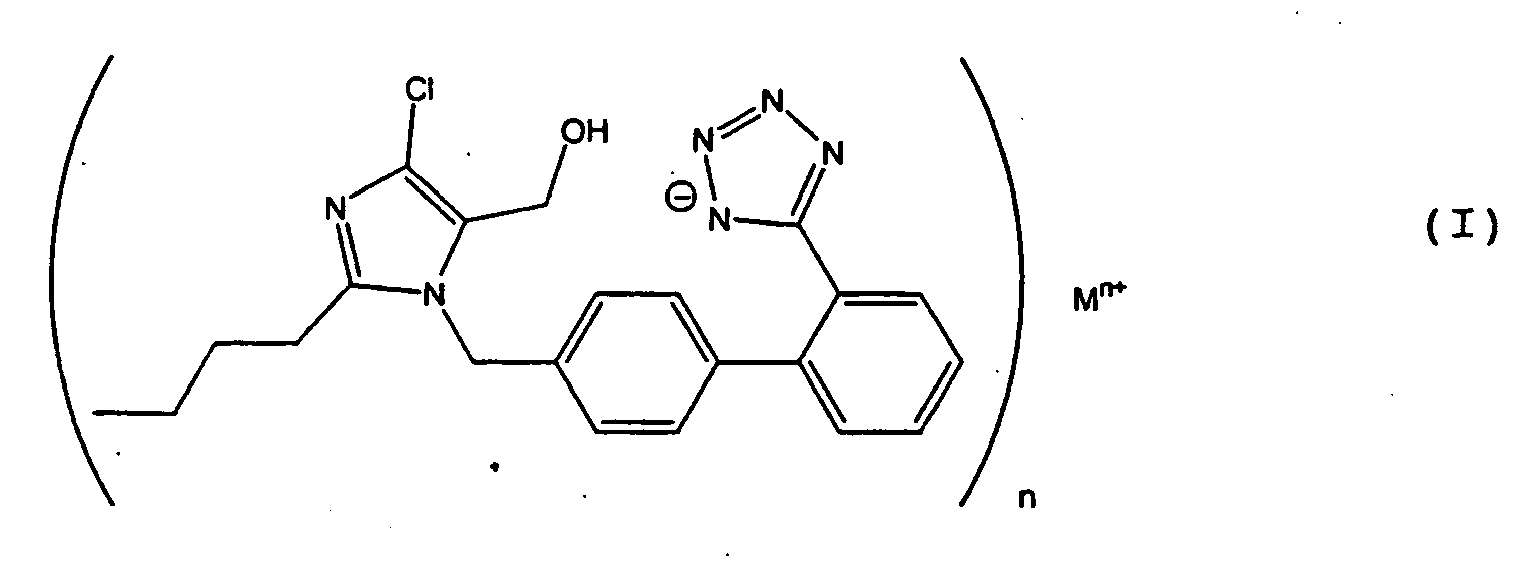
- the present invention relates to a method for producing metal salts of Losartan of the following formula wherein M is any metal and n is an integer, comprising treating Losartan free acid with a basic metal salt in a solvent.
- Losartan is a member of a group of pharmacologically active compounds which are generally referred to as "sartans". These compounds are anti-hypertensive agents used to reduce blood pressure. They work by blocking the action of Angiotensin II on its receptor. Angiotensin II mediates among others smooth muscle contraction especially in blood vessels. Angiotensin 11 receptor antagonists block the Angiotensin II receptor and thereby counteract muscle contraction especially in blood vessels. Angiotensin II receptor antagonists therefore act as powerful vasodilators.
- Losartan is generally administered in the form of a metal salt.
- Losartan free acid is treated with a basic metal salt in a solvent.
- the conversion of Losartan free acid to Losartan potassium and the subsequent precipitation can be achieved in a 85 % yield. While 85 % can be considered an acceptable yield, there is always an interest in improving the yield, especially when dealing with high value compounds such as those used in pharmaceuticals.
- Losartan free acid is dissolved in an excess of solvent of which part has to be removed in order to precipitate the desired Losartan potassium.
- Such an extra step of removing excess solvent is time and energy consuming as well as wasteful in resources.
- WO 2004/066997 discloses a method for producing a potassium salt of Losartan by treating Losartan free acid with potassium hydroxide in the presence of isopropanol, water and n-heptane.
- the solvent comprises a mixture of isopropyl alcohol and t -butyl methyl ether significant improvements in the yield can be achieved. Furthermore the reaction can be performed at a higher initial concentration of Losartan free acid compared to the state of the art. The metal salt of Losartan will therefore precipitate from the solvent without the need to remove some of the solvent.
- the object is therefore achieved by a method for producing metal salts of Losartan by treating Losartan free acid with a basic metal salt in a solvent wherein the solvent comprises a mixture of isopropyl alcohol and t -butyl methyl ether.
- basic metal salt as it is used herein comprises all compounds, which are able to deprotonate Losartan and comprise at least one metal ion.
- Non-limiting examples for such compounds include metal hydroxides and metal alkoxides.
- the basic metal salt is selected from the basic alkali and basic earth alkali metal salts.
- the basic metal salt is selected from the metal hydroxides and in particular is potassium hydroxide.
- metal hydroxides has the advantage that the only byproduct of their reaction with Losartan free acid is water. Therefore no extra step of purifying the resulting product is necessary.
- potassium hydroxide is particularly preferred, since this forms Losartan potassium which has been shown to be the preferred metal salt of Losartan.
- the solvent comprises at least 25 % by volume of t -butyl methyl ether, preferably it comprises 25 to 75 % by volume, particularly preferable 35 to 65 % by volume and especially 45 to 55 % by volume of t -butyl methyl ether.
- the solvent comprises water, particularly 0.5 to 2.5 % by volume and especially 0.75 to 1.5 % by volume of water.
- Losartan free acid is treated with the basic metal salt at a temperature from 35 to 75°C, preferably at a temperature from 45 to 65°C and especially at a temperature from 50 to 60°C.
- Losartan free acid is added to a mixture comprising isopropyl alcohol, t -butyl methyl ether and optionally a small quantity of water.
- the resulting suspension is optionally heated to 35 to 75°C.
- a basic metal salt is added to isopropyl alcohol and the mixture is heated in order to dissolve the basic metal salt.
- the solution of the basic metal salt is filtered and added to the suspension of Losartan while stirring.
- the solvent preferably comprises at least 25 % t -butyl methyl ether.
- the reaction is stirred for 1 hour at up to 75°C and then if necessary cooled to room temperature.
- the stirring is continued for 1 to 3 hours at room temperature as the desired metal salt of Losartan precipitates.
- the resulting solid is collected by filtration and dried to yield the desired metal salt of Losartan.
Landscapes
- Chemical & Material Sciences (AREA)
- Organic Chemistry (AREA)
- Plural Heterocyclic Compounds (AREA)
- Pharmaceuticals Containing Other Organic And Inorganic Compounds (AREA)
- Organic Low-Molecular-Weight Compounds And Preparation Thereof (AREA)
- Saccharide Compounds (AREA)
- Transition And Organic Metals Composition Catalysts For Addition Polymerization (AREA)
- Furan Compounds (AREA)
Abstract
Description
- The present invention relates to a method for producing metal salts of Losartan of the following formula
- Losartan is a member of a group of pharmacologically active compounds which are generally referred to as "sartans". These compounds are anti-hypertensive agents used to reduce blood pressure. They work by blocking the action of Angiotensin II on its receptor. Angiotensin II mediates among others smooth muscle contraction especially in blood vessels. Angiotensin 11 receptor antagonists block the Angiotensin II receptor and thereby counteract muscle contraction especially in blood vessels. Angiotensin II receptor antagonists therefore act as powerful vasodilators.
- Losartan is generally administered in the form of a metal salt. In order to produce such metal salts, Losartan free acid is treated with a basic metal salt in a solvent.
- It is for example known from
WO 03/093262 - According to this document the conversion of Losartan free acid to Losartan potassium and the subsequent precipitation can be achieved in a 85 % yield. While 85 % can be considered an acceptable yield, there is always an interest in improving the yield, especially when dealing with high value compounds such as those used in pharmaceuticals.
- Furthermore in the method according to
WO 03/093262 -
WO 2004/066997 discloses a method for producing a potassium salt of Losartan by treating Losartan free acid with potassium hydroxide in the presence of isopropanol, water and n-heptane. - It is therefore an object of this invention to describe a new method for producing metal salts of Losartan which results in a high yield, is quick to perform as well as more economical in terms of resource and energy use.
- It was now surprisingly found that if the solvent comprises a mixture of isopropyl alcohol and t-butyl methyl ether significant improvements in the yield can be achieved. Furthermore the reaction can be performed at a higher initial concentration of Losartan free acid compared to the state of the art. The metal salt of Losartan will therefore precipitate from the solvent without the need to remove some of the solvent.
- The object is therefore achieved by a method for producing metal salts of Losartan by treating Losartan free acid with a basic metal salt in a solvent wherein the solvent comprises a mixture of isopropyl alcohol and t-butyl methyl ether.
- With this method yields of 90 % and more can be achieved and the desired metal salt precipitates directly from the initial solution therefore making the step of removing parts of the solvent superfluous. Therefore the new process does not only increase the yield but is also quicker as well as more economical with regards to energy and resources used.
- The expression "basic metal salt" as it is used herein comprises all compounds, which are able to deprotonate Losartan and comprise at least one metal ion. Non-limiting examples for such compounds include metal hydroxides and metal alkoxides.
- In an embodiment of the invention the basic metal salt is selected from the basic alkali and basic earth alkali metal salts.
- The use of basic alkali and basic earth alkali metal salts is preferred since they are usually cheaply available and they result in metal salts of Losartan, which have been shown to be generally well tolerated.
- In an embodiment of the invention the basic metal salt is selected from the metal hydroxides and in particular is potassium hydroxide.
- The use of metal hydroxides has the advantage that the only byproduct of their reaction with Losartan free acid is water. Therefore no extra step of purifying the resulting product is necessary. The use of potassium hydroxide is particularly preferred, since this forms Losartan potassium which has been shown to be the preferred metal salt of Losartan.
- In an embodiment of the invention the solvent comprises at least 25 % by volume of t-butyl methyl ether, preferably it comprises 25 to 75 % by volume, particularly preferable 35 to 65 % by volume and especially 45 to 55 % by volume of t-butyl methyl ether.
- When reacting Losartan free acid with a basic metal salt a balance must be struck between the solubility of Losartan free acid which is more soluble in the less polar t-butyl methyl ether and the solubility of the basic metal salt which is more soluble in the more polar isopropyl alcohol. The above-mentioned mixture ranges form a good balance between those two conflicting solubilities therefore resulting in particularly high yields.
- In a further embodiment of the invention the solvent comprises water, particularly 0.5 to 2.5 % by volume and especially 0.75 to 1.5 % by volume of water.
- It has been shown that the addition of small quantities of water further improves the yield. It is believed that this is due to the fact that small quantities of water are effective in improving the solubility of the basic metal salt while at the same time not significantly affecting the solubility of Losartan.
- In an embodiment of the invention Losartan free acid is treated with the basic metal salt at a temperature from 35 to 75°C, preferably at a temperature from 45 to 65°C and especially at a temperature from 50 to 60°C.
- When reacting large and potentially unstable organic compounds such as Losartan free acid with basic metal salts a balance must be found between the fact that at high temperatures those compounds have the tendency to degrade, resulting in a lower yield and the necessity that the temperature is high enough that the reaction proceeds within a reasonable period of time.
- It has been found in the above-mentioned temperature ranges high yields can be achieved in about 5 hours.
- In an embodiment of the invention 1.0 to 1.1 molar equivalents of the basic metal salt based on Losartan free acid are used.
- When deprotonating larger organic molecules such as Losartan free acid with a basic metal salt a balance must be struck between using enough of the basic metal salt in order to fully deprotonate the large organic molecule and the fact that at high concentrations of the basic metal salt is degraded by an excess of the basic metal salt.
- Furthermore if excesses of the basic metal salt are used they can precipitate together with the metal salt of Losartan from the solution thereby leading to an impure product. Any additional purification steps necessitated by this render the process less economical and can lead to significant losses in yield.
- At the above named ratio particularly pure products with good to excellent yields can be recovered.
- It is understood that the above features and the features described below can be used not only in their described combination but also in other combinations or in isolation without departing from the scope of the invention.
- The invention is now further illustrated by means of examples. These examples are not intended to limit the scope of the invention in any way.
-

- Losartan free acid is added to a mixture comprising isopropyl alcohol, t-butyl methyl ether and optionally a small quantity of water. The resulting suspension is optionally heated to 35 to 75°C. In a second flask a basic metal salt is added to isopropyl alcohol and the mixture is heated in order to dissolve the basic metal salt. The solution of the basic metal salt is filtered and added to the suspension of Losartan while stirring. After the addition of the solution of the basic metal salt the solvent preferably comprises at least 25 % t-butyl methyl ether. The reaction is stirred for 1 hour at up to 75°C and then if necessary cooled to room temperature. The stirring is continued for 1 to 3 hours at room temperature as the desired metal salt of Losartan precipitates. The resulting solid is collected by filtration and dried to yield the desired metal salt of Losartan.
-
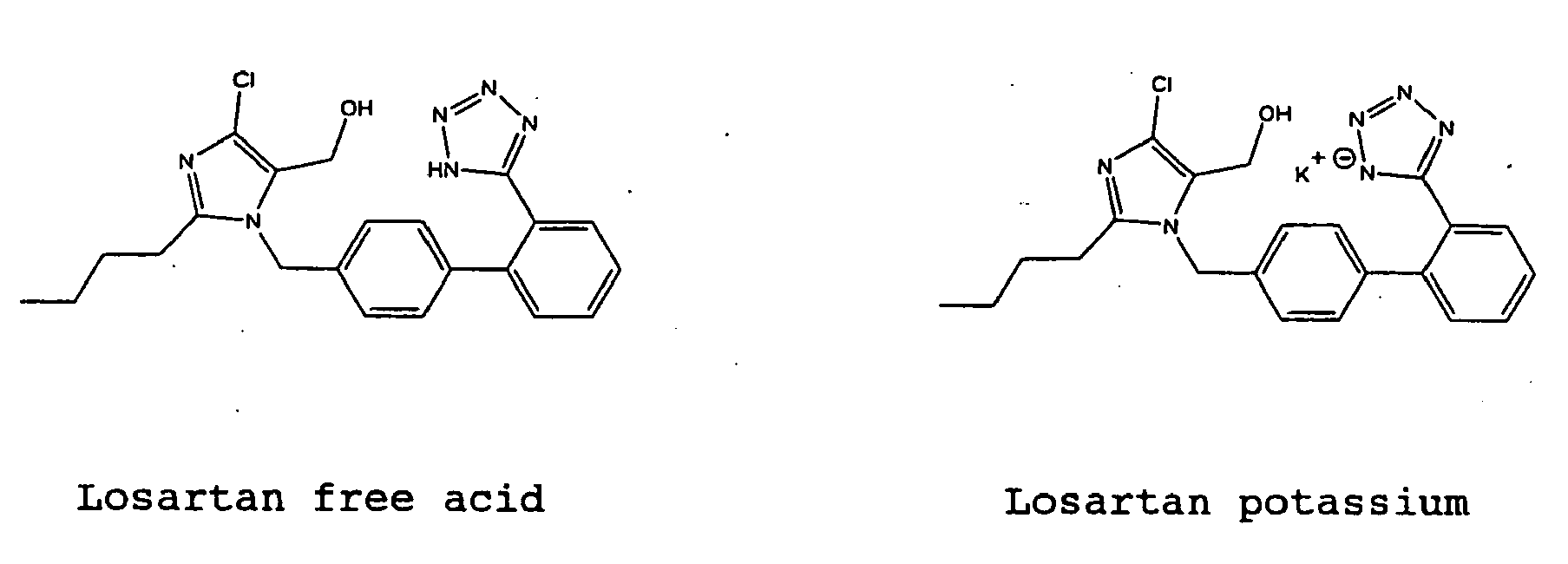
- A 850 ml flask equipped with a magnetic stirrer bar, a thermometer and a reflux condenser was charged with 20 ml of isopropyl alcohol, 80 ml of t-butyl methyl ether and 20 g (47.3 mmols) of Losartan free acid at room temperature to give a suspension. In a second flask 3.24 g (49.6 mmols) of KOH were dissolved in 60 ml isopropyl alcohol by heating. The KOH solution was filtered and added to above suspension while stirring. At this point the solvent is approximately a 50:50 mixture of isopropyl alcohol and t-butyl methyl ether. After the addition was complete the reaction mixture was stirred for 3 hours at room temperature. White crystals started to precipitate which were collected by filtration and dried to yield 19 g (87 % yield) of Losartan potassium with a relative purity of 99 % (HPLC).
- A 250 ml flask equipped with a magnetic stirrer bar, a thermometer and a reflux condenser was charged with 20 ml of isopropyl alcohol, 80 ml of t-butyl methyl ether, 1 ml of water and 20 g (47.3 mmols) of Losartan free acid at room temperature to give a suspension. In a second flask 3.24 g (49.6 mmols) of KOH were dissolved in 60 ml of isopropyl alcohol by heating. The KOH solution was filtered and added to the above suspension while stirring. After the addition was complete the reaction mixture was stirred for 3 hours at room temperature. White crystals started to precipitate which were collected by filtration and dried to yield 20 g (92 % yield) of Losartan potassium with a relative purity of 99.9 % (HPLC). Compared to EXAMPLE 1, the addition of small amounts of water increases the yield.
- A 850 ml flask equipped with a magnetic stirrer bar, a thermometer and a reflux condenser was charged with 10 ml of isopropyl alcohol, 40 ml of t-butyl methyl ether, 0.5 ml of water and 10 g (23.6 mmols) of Losartan free acid and the resulting suspension was heated to 55°C. In a second flask 1.62 g (24.8 mmols) of KOH were dissolved in 30 ml of isopropyl alcohol by heating. The KOH solution was filtered and added to the above suspension while stirring. After the addition was complete, the reaction mixture was stirred for 1 hour at 55°C. The reaction mixture was cooled to room temperature over about 1 hour and stirred over night at this temperature. The precipitated white crystals were collected by filtration and dried to yield 10.14 g (93 % yield) of Losartan potassium with a relative purity of 99 % (HPLC).
- A 850 ml flask equipped with a magnetic stirrer bar, a thermometer and a reflux condenser was charged with 10 ml of isopropyl alcohol, 13.3 ml of t-butyl methyl ether, 0.5 ml of water and 10 g (23.6 mmols) of Losartan free acid at room temperature and the resulting suspension was heated to 55°C. In a second flask 1.62 g (24.8 mmols) of KOH were dissolved in 30 ml of isopropyl alcohol by heating. The KOH solution was filtered and then added to the above suspension while stirring. At this point the solvent is approximately a 75:25 mixture of isopropyl alcohol and t-butyl methyl ether. After the addition was complete the reaction mixture was stirred for 1 hour at 55°C. The reaction mixture was cooled to room temperature over about 1 hour and stirred over night at this temperature. The precipitated white crystals were collected by filtration and dried to yield 9.9 g (91 % yield) of Losartan potassium with a relative purity of 99.9 % (HPLC).
Claims (15)
- Method for producing metal salts of Losartan of the following formula

comprising treating Losartan free acid with a basic metal salt in a solvent,
characterized in that the solvent comprises a mixture of isopropyl alcohol and t-butyl methyl ether. - Method according to claim 1, characterized that the basic metal salt is selected from the basic alkali and basic earth alkali metal salts.
- Method according to claim 1 or 2, characterized that the basic metal salt is selected from the metal hydroxides.
- Method according to claim 3, characterized in that the basic metal salt is potassium hydroxide.
- Method according to any one of claims 1 to 4, characterized in that the solvent comprises at least 25% by volume of t-butyl methyl ether.
- Method according to claim 5, characterised in that the solvent comprises 25 to 75 % by volume of t-butyl methyl ether.
- Method according to claim 6, characterized in that the solvent comprises 35 to 65 % by volume of t-butyl methyl ether.
- Method according to claim 7, characterized in that the solvent comprises 45 to 55 % by volume of t-butyl methyl ether.
- Method according to any one of claims 1 to 8, characterized in that the solvent further comprises water.
- Method according to claim 9, characterized in that the solvent comprises 0.5 to 2.5 % by volume of water.
- Method according to claim 10, characterized in that the solvent comprises 0.75 to 1.5 % by volume of water.
- Method according to any one of claims 1 to 11, characterized in that Losartan free acid is treated with the basic metal salt at a temperature from 35 to 75°C.
- Method according to claim 12, characterized in that Losartan free acid is treated with the basic metal salt at a temperature from 45 to 65°C.
- Method according to claim 13, characterized in that Losartan free acid is treated with the basic metal salt at a temperature from 50 to 60°C.
- Method according to any one of claims 1 to 14, characterized in that 1.0 to 1.1 molar equivalents of the basic metal salt based on Losartan free acid are used.
Applications Claiming Priority (1)
| Application Number | Priority Date | Filing Date | Title |
|---|---|---|---|
| PCT/EP2005/012793 WO2007062675A1 (en) | 2005-12-01 | 2005-12-01 | Method for producing metal salts of losartan |
Publications (2)
| Publication Number | Publication Date |
|---|---|
| EP1963309A1 EP1963309A1 (en) | 2008-09-03 |
| EP1963309B1 true EP1963309B1 (en) | 2010-11-10 |
Family
ID=36452950
Family Applications (1)
| Application Number | Title | Priority Date | Filing Date |
|---|---|---|---|
| EP05825006A Expired - Lifetime EP1963309B1 (en) | 2005-12-01 | 2005-12-01 | Method for producing metal salts of losartan |
Country Status (4)
| Country | Link |
|---|---|
| EP (1) | EP1963309B1 (en) |
| AT (1) | ATE487711T1 (en) |
| DE (1) | DE602005024726D1 (en) |
| WO (1) | WO2007062675A1 (en) |
Family Cites Families (2)
| Publication number | Priority date | Publication date | Assignee | Title |
|---|---|---|---|---|
| DE60304175T2 (en) * | 2002-04-29 | 2007-03-15 | Teva Pharmaceutical Industries Ltd. | METHOD FOR PRODUCING LOSARTAN AND LOSARTAN CALIUM SALT |
| EP1589966B1 (en) * | 2003-01-30 | 2010-11-10 | LEK Pharmaceuticals d.d. | Preparation of new pharmaceutically suitable salt of losartan and forms thereof with new purification and isolation methods |
-
2005
- 2005-12-01 AT AT05825006T patent/ATE487711T1/en not_active IP Right Cessation
- 2005-12-01 DE DE602005024726T patent/DE602005024726D1/en not_active Expired - Lifetime
- 2005-12-01 WO PCT/EP2005/012793 patent/WO2007062675A1/en not_active Ceased
- 2005-12-01 EP EP05825006A patent/EP1963309B1/en not_active Expired - Lifetime
Also Published As
| Publication number | Publication date |
|---|---|
| DE602005024726D1 (en) | 2010-12-23 |
| WO2007062675A1 (en) | 2007-06-07 |
| EP1963309A1 (en) | 2008-09-03 |
| ATE487711T1 (en) | 2010-11-15 |
Similar Documents
| Publication | Publication Date | Title |
|---|---|---|
| US9550716B2 (en) | Process for treprostinil salt preparation | |
| EA004633B1 (en) | Process for the synthesis of tetrazol derivatives | |
| EP1963309B1 (en) | Method for producing metal salts of losartan | |
| EP3881848B1 (en) | Method for producing orotic acid derivative | |
| KR100809159B1 (en) | Improved Manufacturing Method of Rosatan | |
| JP4922152B2 (en) | Method for producing fluorinated proline derivative | |
| JP2001278867A (en) | Production of cyclic acids | |
| US10626102B2 (en) | Process for the synthesis of efinaconazol | |
| JP3899626B2 (en) | Preparation of 2-mercaptothiazol | |
| CN115572747B (en) | Topiroxostat preparation method | |
| EP3986869B1 (en) | A process for the synthesis of lofexidine | |
| WO2023100110A1 (en) | Process for preparing brivaracetam | |
| JP4587139B2 (en) | A method for producing an aminoalkoxycarbostyril derivative. | |
| US20040106829A1 (en) | Process for the synthesis of modafinil | |
| JP2813008B2 (en) | Method for producing pyrazinamines | |
| JP3539152B2 (en) | Production of cytosine | |
| JP4925518B2 (en) | Method for producing substituted alkylamine derivative | |
| WO2021206132A1 (en) | Improved method for producing o-methylisourea sulfate | |
| JP2714868B2 (en) | Method for producing 2-methylthiosemicarbazide | |
| JPS5993059A (en) | Production method of cytosines | |
| CN117858866A (en) | Process for preparing tryptamine derivatives | |
| JP3539153B2 (en) | Production method of cytosine | |
| KR100958678B1 (en) | Method for preparing cis-dimecrotinic acid and salts thereof | |
| JP4739695B2 (en) | Process for producing 5-amino-1-substituted-1,2,4-triazole, and triazole derivative obtained by the process | |
| KR20100044458A (en) | Preparation method of losartan |
Legal Events
| Date | Code | Title | Description |
|---|---|---|---|
| PUAI | Public reference made under article 153(3) epc to a published international application that has entered the european phase |
Free format text: ORIGINAL CODE: 0009012 |
|
| 17P | Request for examination filed |
Effective date: 20080625 |
|
| AK | Designated contracting states |
Kind code of ref document: A1 Designated state(s): AT BE BG CH CY CZ DE DK EE ES FI FR GB GR HU IE IS IT LI LT LU LV MC NL PL PT RO SE SI SK TR |
|
| AX | Request for extension of the european patent |
Extension state: AL BA HR MK YU |
|
| GRAP | Despatch of communication of intention to grant a patent |
Free format text: ORIGINAL CODE: EPIDOSNIGR1 |
|
| GRAS | Grant fee paid |
Free format text: ORIGINAL CODE: EPIDOSNIGR3 |
|
| GRAA | (expected) grant |
Free format text: ORIGINAL CODE: 0009210 |
|
| AK | Designated contracting states |
Kind code of ref document: B1 Designated state(s): AT BE BG CH CY CZ DE DK EE ES FI FR GB GR HU IE IS IT LI LT LU LV MC NL PL PT RO SE SI SK TR |
|
| AX | Request for extension of the european patent |
Extension state: AL BA HR MK YU |
|
| REG | Reference to a national code |
Ref country code: GB Ref legal event code: FG4D |
|
| REG | Reference to a national code |
Ref country code: CH Ref legal event code: EP |
|
| REG | Reference to a national code |
Ref country code: IE Ref legal event code: FG4D |
|
| REF | Corresponds to: |
Ref document number: 602005024726 Country of ref document: DE Date of ref document: 20101223 Kind code of ref document: P |
|
| REG | Reference to a national code |
Ref country code: NL Ref legal event code: VDEP Effective date: 20101110 |
|
| LTIE | Lt: invalidation of european patent or patent extension |
Effective date: 20101110 |
|
| PG25 | Lapsed in a contracting state [announced via postgrant information from national office to epo] |
Ref country code: LT Free format text: LAPSE BECAUSE OF FAILURE TO SUBMIT A TRANSLATION OF THE DESCRIPTION OR TO PAY THE FEE WITHIN THE PRESCRIBED TIME-LIMIT Effective date: 20101110 |
|
| PG25 | Lapsed in a contracting state [announced via postgrant information from national office to epo] |
Ref country code: IS Free format text: LAPSE BECAUSE OF FAILURE TO SUBMIT A TRANSLATION OF THE DESCRIPTION OR TO PAY THE FEE WITHIN THE PRESCRIBED TIME-LIMIT Effective date: 20110310 Ref country code: AT Free format text: LAPSE BECAUSE OF FAILURE TO SUBMIT A TRANSLATION OF THE DESCRIPTION OR TO PAY THE FEE WITHIN THE PRESCRIBED TIME-LIMIT Effective date: 20101110 Ref country code: NL Free format text: LAPSE BECAUSE OF FAILURE TO SUBMIT A TRANSLATION OF THE DESCRIPTION OR TO PAY THE FEE WITHIN THE PRESCRIBED TIME-LIMIT Effective date: 20101110 Ref country code: BG Free format text: LAPSE BECAUSE OF FAILURE TO SUBMIT A TRANSLATION OF THE DESCRIPTION OR TO PAY THE FEE WITHIN THE PRESCRIBED TIME-LIMIT Effective date: 20110210 Ref country code: LV Free format text: LAPSE BECAUSE OF FAILURE TO SUBMIT A TRANSLATION OF THE DESCRIPTION OR TO PAY THE FEE WITHIN THE PRESCRIBED TIME-LIMIT Effective date: 20101110 Ref country code: SE Free format text: LAPSE BECAUSE OF FAILURE TO SUBMIT A TRANSLATION OF THE DESCRIPTION OR TO PAY THE FEE WITHIN THE PRESCRIBED TIME-LIMIT Effective date: 20101110 Ref country code: PT Free format text: LAPSE BECAUSE OF FAILURE TO SUBMIT A TRANSLATION OF THE DESCRIPTION OR TO PAY THE FEE WITHIN THE PRESCRIBED TIME-LIMIT Effective date: 20110310 Ref country code: SI Free format text: LAPSE BECAUSE OF FAILURE TO SUBMIT A TRANSLATION OF THE DESCRIPTION OR TO PAY THE FEE WITHIN THE PRESCRIBED TIME-LIMIT Effective date: 20101110 Ref country code: FI Free format text: LAPSE BECAUSE OF FAILURE TO SUBMIT A TRANSLATION OF THE DESCRIPTION OR TO PAY THE FEE WITHIN THE PRESCRIBED TIME-LIMIT Effective date: 20101110 Ref country code: CY Free format text: LAPSE BECAUSE OF FAILURE TO SUBMIT A TRANSLATION OF THE DESCRIPTION OR TO PAY THE FEE WITHIN THE PRESCRIBED TIME-LIMIT Effective date: 20101110 |
|
| PG25 | Lapsed in a contracting state [announced via postgrant information from national office to epo] |
Ref country code: GR Free format text: LAPSE BECAUSE OF FAILURE TO SUBMIT A TRANSLATION OF THE DESCRIPTION OR TO PAY THE FEE WITHIN THE PRESCRIBED TIME-LIMIT Effective date: 20110211 |
|
| PG25 | Lapsed in a contracting state [announced via postgrant information from national office to epo] |
Ref country code: ES Free format text: LAPSE BECAUSE OF FAILURE TO SUBMIT A TRANSLATION OF THE DESCRIPTION OR TO PAY THE FEE WITHIN THE PRESCRIBED TIME-LIMIT Effective date: 20110221 Ref country code: EE Free format text: LAPSE BECAUSE OF FAILURE TO SUBMIT A TRANSLATION OF THE DESCRIPTION OR TO PAY THE FEE WITHIN THE PRESCRIBED TIME-LIMIT Effective date: 20101110 Ref country code: CZ Free format text: LAPSE BECAUSE OF FAILURE TO SUBMIT A TRANSLATION OF THE DESCRIPTION OR TO PAY THE FEE WITHIN THE PRESCRIBED TIME-LIMIT Effective date: 20101110 Ref country code: BE Free format text: LAPSE BECAUSE OF FAILURE TO SUBMIT A TRANSLATION OF THE DESCRIPTION OR TO PAY THE FEE WITHIN THE PRESCRIBED TIME-LIMIT Effective date: 20101110 Ref country code: MC Free format text: LAPSE BECAUSE OF NON-PAYMENT OF DUE FEES Effective date: 20101231 |
|
| REG | Reference to a national code |
Ref country code: CH Ref legal event code: PL |
|
| PG25 | Lapsed in a contracting state [announced via postgrant information from national office to epo] |
Ref country code: PL Free format text: LAPSE BECAUSE OF FAILURE TO SUBMIT A TRANSLATION OF THE DESCRIPTION OR TO PAY THE FEE WITHIN THE PRESCRIBED TIME-LIMIT Effective date: 20101110 Ref country code: SK Free format text: LAPSE BECAUSE OF FAILURE TO SUBMIT A TRANSLATION OF THE DESCRIPTION OR TO PAY THE FEE WITHIN THE PRESCRIBED TIME-LIMIT Effective date: 20101110 Ref country code: RO Free format text: LAPSE BECAUSE OF FAILURE TO SUBMIT A TRANSLATION OF THE DESCRIPTION OR TO PAY THE FEE WITHIN THE PRESCRIBED TIME-LIMIT Effective date: 20101110 Ref country code: DK Free format text: LAPSE BECAUSE OF FAILURE TO SUBMIT A TRANSLATION OF THE DESCRIPTION OR TO PAY THE FEE WITHIN THE PRESCRIBED TIME-LIMIT Effective date: 20101110 |
|
| PLBE | No opposition filed within time limit |
Free format text: ORIGINAL CODE: 0009261 |
|
| STAA | Information on the status of an ep patent application or granted ep patent |
Free format text: STATUS: NO OPPOSITION FILED WITHIN TIME LIMIT |
|
| 26N | No opposition filed |
Effective date: 20110811 |
|
| GBPC | Gb: european patent ceased through non-payment of renewal fee |
Effective date: 20110210 |
|
| PG25 | Lapsed in a contracting state [announced via postgrant information from national office to epo] |
Ref country code: LI Free format text: LAPSE BECAUSE OF NON-PAYMENT OF DUE FEES Effective date: 20101231 Ref country code: CH Free format text: LAPSE BECAUSE OF NON-PAYMENT OF DUE FEES Effective date: 20101231 Ref country code: IE Free format text: LAPSE BECAUSE OF NON-PAYMENT OF DUE FEES Effective date: 20101201 |
|
| REG | Reference to a national code |
Ref country code: DE Ref legal event code: R119 Ref document number: 602005024726 Country of ref document: DE Effective date: 20110701 |
|
| PG25 | Lapsed in a contracting state [announced via postgrant information from national office to epo] |
Ref country code: DE Free format text: LAPSE BECAUSE OF NON-PAYMENT OF DUE FEES Effective date: 20110701 |
|
| PG25 | Lapsed in a contracting state [announced via postgrant information from national office to epo] |
Ref country code: IT Free format text: LAPSE BECAUSE OF FAILURE TO SUBMIT A TRANSLATION OF THE DESCRIPTION OR TO PAY THE FEE WITHIN THE PRESCRIBED TIME-LIMIT Effective date: 20101110 |
|
| REG | Reference to a national code |
Ref country code: FR Ref legal event code: ST Effective date: 20111125 |
|
| PG25 | Lapsed in a contracting state [announced via postgrant information from national office to epo] |
Ref country code: FR Free format text: LAPSE BECAUSE OF NON-PAYMENT OF DUE FEES Effective date: 20110110 |
|
| PG25 | Lapsed in a contracting state [announced via postgrant information from national office to epo] |
Ref country code: GB Free format text: LAPSE BECAUSE OF NON-PAYMENT OF DUE FEES Effective date: 20110210 |
|
| PG25 | Lapsed in a contracting state [announced via postgrant information from national office to epo] |
Ref country code: HU Free format text: LAPSE BECAUSE OF FAILURE TO SUBMIT A TRANSLATION OF THE DESCRIPTION OR TO PAY THE FEE WITHIN THE PRESCRIBED TIME-LIMIT Effective date: 20110511 Ref country code: LU Free format text: LAPSE BECAUSE OF NON-PAYMENT OF DUE FEES Effective date: 20101201 |
|
| PG25 | Lapsed in a contracting state [announced via postgrant information from national office to epo] |
Ref country code: TR Free format text: LAPSE BECAUSE OF FAILURE TO SUBMIT A TRANSLATION OF THE DESCRIPTION OR TO PAY THE FEE WITHIN THE PRESCRIBED TIME-LIMIT Effective date: 20101110 |