EP1960410B1 - Nanoparticules d'un compose a transition de spin - Google Patents
Nanoparticules d'un compose a transition de spin Download PDFInfo
- Publication number
- EP1960410B1 EP1960410B1 EP06841859A EP06841859A EP1960410B1 EP 1960410 B1 EP1960410 B1 EP 1960410B1 EP 06841859 A EP06841859 A EP 06841859A EP 06841859 A EP06841859 A EP 06841859A EP 1960410 B1 EP1960410 B1 EP 1960410B1
- Authority
- EP
- European Patent Office
- Prior art keywords
- nanoparticles
- oil
- solution
- preparation
- surfactant
- Prior art date
- Legal status (The legal status is an assumption and is not a legal conclusion. Google has not performed a legal analysis and makes no representation as to the accuracy of the status listed.)
- Not-in-force
Links
- 239000002105 nanoparticle Substances 0.000 title claims abstract description 41
- 150000001875 compounds Chemical class 0.000 title claims abstract description 29
- 230000007704 transition Effects 0.000 title abstract description 18
- 150000001450 anions Chemical group 0.000 claims abstract description 39
- 239000000463 material Substances 0.000 claims abstract description 39
- 239000003446 ligand Substances 0.000 claims abstract description 31
- IJGRMHOSHXDMSA-UHFFFAOYSA-N Atomic nitrogen Chemical compound N#N IJGRMHOSHXDMSA-UHFFFAOYSA-N 0.000 claims abstract description 11
- 125000000217 alkyl group Chemical group 0.000 claims abstract description 11
- 229910052751 metal Inorganic materials 0.000 claims abstract description 10
- NSPMIYGKQJPBQR-UHFFFAOYSA-N 4H-1,2,4-triazole Chemical compound C=1N=CNN=1 NSPMIYGKQJPBQR-UHFFFAOYSA-N 0.000 claims abstract description 9
- 239000002184 metal Substances 0.000 claims abstract description 9
- 125000001424 substituent group Chemical group 0.000 claims abstract description 8
- 230000003287 optical effect Effects 0.000 claims abstract description 6
- 229910052757 nitrogen Inorganic materials 0.000 claims abstract description 5
- 238000013500 data storage Methods 0.000 claims abstract description 4
- 239000000049 pigment Substances 0.000 claims abstract description 4
- 239000002872 contrast media Substances 0.000 claims abstract description 3
- 239000000243 solution Substances 0.000 claims description 59
- XEEYBQQBJWHFJM-UHFFFAOYSA-N iron Substances [Fe] XEEYBQQBJWHFJM-UHFFFAOYSA-N 0.000 claims description 56
- 239000000203 mixture Substances 0.000 claims description 36
- 239000004094 surface-active agent Substances 0.000 claims description 27
- 238000000034 method Methods 0.000 claims description 23
- IMNFDUFMRHMDMM-UHFFFAOYSA-N N-Heptane Chemical compound CCCCCCC IMNFDUFMRHMDMM-UHFFFAOYSA-N 0.000 claims description 21
- 239000002245 particle Substances 0.000 claims description 21
- 239000002904 solvent Substances 0.000 claims description 19
- 238000002360 preparation method Methods 0.000 claims description 18
- VYPSYNLAJGMNEJ-UHFFFAOYSA-N Silicium dioxide Chemical compound O=[Si]=O VYPSYNLAJGMNEJ-UHFFFAOYSA-N 0.000 claims description 16
- 239000007864 aqueous solution Substances 0.000 claims description 16
- 150000003839 salts Chemical class 0.000 claims description 14
- CIWBSHSKHKDKBQ-JLAZNSOCSA-N Ascorbic acid Chemical compound OC[C@H](O)[C@H]1OC(=O)C(O)=C1O CIWBSHSKHKDKBQ-JLAZNSOCSA-N 0.000 claims description 13
- 230000008569 process Effects 0.000 claims description 13
- 239000000839 emulsion Substances 0.000 claims description 12
- 239000004530 micro-emulsion Substances 0.000 claims description 11
- 239000002243 precursor Substances 0.000 claims description 9
- 239000002244 precipitate Substances 0.000 claims description 8
- 239000000377 silicon dioxide Substances 0.000 claims description 8
- 238000002156 mixing Methods 0.000 claims description 7
- PMVSDNDAUGGCCE-TYYBGVCCSA-L Ferrous fumarate Chemical class [Fe+2].[O-]C(=O)\C=C\C([O-])=O PMVSDNDAUGGCCE-TYYBGVCCSA-L 0.000 claims description 6
- 229960005070 ascorbic acid Drugs 0.000 claims description 6
- 235000010323 ascorbic acid Nutrition 0.000 claims description 6
- 239000011668 ascorbic acid Substances 0.000 claims description 6
- 125000004432 carbon atom Chemical group C* 0.000 claims description 6
- 238000002604 ultrasonography Methods 0.000 claims description 6
- 239000000047 product Substances 0.000 claims description 5
- 238000003756 stirring Methods 0.000 claims description 5
- 238000005406 washing Methods 0.000 claims description 5
- CWYNVVGOOAEACU-UHFFFAOYSA-N Fe2+ Chemical class [Fe+2] CWYNVVGOOAEACU-UHFFFAOYSA-N 0.000 claims description 4
- BOTDANWDWHJENH-UHFFFAOYSA-N Tetraethyl orthosilicate Chemical group CCO[Si](OCC)(OCC)OCC BOTDANWDWHJENH-UHFFFAOYSA-N 0.000 claims description 4
- 238000001556 precipitation Methods 0.000 claims description 4
- 206010028980 Neoplasm Diseases 0.000 claims description 2
- 201000011510 cancer Diseases 0.000 claims description 2
- 229910001914 chlorine tetroxide Inorganic materials 0.000 claims description 2
- 238000001704 evaporation Methods 0.000 claims description 2
- 230000008020 evaporation Effects 0.000 claims description 2
- 238000000605 extraction Methods 0.000 claims description 2
- MSRJTTSHWYDFIU-UHFFFAOYSA-N octyltriethoxysilane Chemical compound CCCCCCCC[Si](OCC)(OCC)OCC MSRJTTSHWYDFIU-UHFFFAOYSA-N 0.000 claims description 2
- VLTRZXGMWDSKGL-UHFFFAOYSA-M perchlorate Chemical compound [O-]Cl(=O)(=O)=O VLTRZXGMWDSKGL-UHFFFAOYSA-M 0.000 claims description 2
- 239000012429 reaction media Substances 0.000 claims description 2
- FZMJEGJVKFTGMU-UHFFFAOYSA-N triethoxy(octadecyl)silane Chemical compound CCCCCCCCCCCCCCCCCC[Si](OCC)(OCC)OCC FZMJEGJVKFTGMU-UHFFFAOYSA-N 0.000 claims description 2
- 125000001181 organosilyl group Chemical group [SiH3]* 0.000 claims 2
- 238000001514 detection method Methods 0.000 claims 1
- 229910052748 manganese Inorganic materials 0.000 claims 1
- 229910052759 nickel Inorganic materials 0.000 claims 1
- 229910052725 zinc Inorganic materials 0.000 claims 1
- LFQSCWFLJHTTHZ-UHFFFAOYSA-N EtOH Substances CCO LFQSCWFLJHTTHZ-UHFFFAOYSA-N 0.000 description 17
- XLYOFNOQVPJJNP-UHFFFAOYSA-N water Substances O XLYOFNOQVPJJNP-UHFFFAOYSA-N 0.000 description 14
- 239000003921 oil Substances 0.000 description 12
- RTZKZFJDLAIYFH-UHFFFAOYSA-N Diethyl ether Chemical compound CCOCC RTZKZFJDLAIYFH-UHFFFAOYSA-N 0.000 description 8
- 230000015572 biosynthetic process Effects 0.000 description 8
- 238000003786 synthesis reaction Methods 0.000 description 8
- 230000008859 change Effects 0.000 description 7
- 239000000693 micelle Substances 0.000 description 7
- 230000005291 magnetic effect Effects 0.000 description 6
- FMCUPJKTGNBGEC-UHFFFAOYSA-N 1,2,4-triazol-4-amine Chemical compound NN1C=NN=C1 FMCUPJKTGNBGEC-UHFFFAOYSA-N 0.000 description 5
- 230000002441 reversible effect Effects 0.000 description 5
- 238000003860 storage Methods 0.000 description 5
- 238000013019 agitation Methods 0.000 description 4
- -1 alkyl radical Chemical class 0.000 description 4
- 238000005119 centrifugation Methods 0.000 description 4
- 239000011248 coating agent Substances 0.000 description 4
- 238000000576 coating method Methods 0.000 description 4
- 229920000642 polymer Polymers 0.000 description 4
- 229910020366 ClO 4 Inorganic materials 0.000 description 3
- 229910002651 NO3 Inorganic materials 0.000 description 3
- NHNBFGGVMKEFGY-UHFFFAOYSA-N Nitrate Chemical compound [O-][N+]([O-])=O NHNBFGGVMKEFGY-UHFFFAOYSA-N 0.000 description 3
- DGEZNRSVGBDHLK-UHFFFAOYSA-N [1,10]phenanthroline Chemical compound C1=CN=C2C3=NC=CC=C3C=CC2=C1 DGEZNRSVGBDHLK-UHFFFAOYSA-N 0.000 description 3
- 125000004429 atom Chemical group 0.000 description 3
- 230000000694 effects Effects 0.000 description 3
- 238000001914 filtration Methods 0.000 description 3
- 238000004519 manufacturing process Methods 0.000 description 3
- 239000000843 powder Substances 0.000 description 3
- 150000003852 triazoles Chemical class 0.000 description 3
- 125000001376 1,2,4-triazolyl group Chemical group N1N=C(N=C1)* 0.000 description 2
- AHYVTIGFFGLKHA-UHFFFAOYSA-N 1-propyltetrazole Chemical compound CCCN1C=NN=N1 AHYVTIGFFGLKHA-UHFFFAOYSA-N 0.000 description 2
- WOXFMYVTSLAQMO-UHFFFAOYSA-N 2-Pyridinemethanamine Chemical compound NCC1=CC=CC=N1 WOXFMYVTSLAQMO-UHFFFAOYSA-N 0.000 description 2
- VTLYFUHAOXGGBS-UHFFFAOYSA-N Fe3+ Chemical compound [Fe+3] VTLYFUHAOXGGBS-UHFFFAOYSA-N 0.000 description 2
- 150000001412 amines Chemical class 0.000 description 2
- XLJKHNWPARRRJB-UHFFFAOYSA-N cobalt(2+) Chemical compound [Co+2] XLJKHNWPARRRJB-UHFFFAOYSA-N 0.000 description 2
- 238000001816 cooling Methods 0.000 description 2
- 230000005292 diamagnetic effect Effects 0.000 description 2
- 230000006870 function Effects 0.000 description 2
- 238000011065 in-situ storage Methods 0.000 description 2
- 150000002505 iron Chemical class 0.000 description 2
- 239000007788 liquid Substances 0.000 description 2
- 239000007791 liquid phase Substances 0.000 description 2
- 239000011159 matrix material Substances 0.000 description 2
- 239000011859 microparticle Substances 0.000 description 2
- 239000002086 nanomaterial Substances 0.000 description 2
- 230000005298 paramagnetic effect Effects 0.000 description 2
- 239000012071 phase Substances 0.000 description 2
- 238000010587 phase diagram Methods 0.000 description 2
- 238000000527 sonication Methods 0.000 description 2
- 239000006228 supernatant Substances 0.000 description 2
- 239000011701 zinc Substances 0.000 description 2
- 0 C[C@]1C*=CC1 Chemical compound C[C@]1C*=CC1 0.000 description 1
- VEQPNABPJHWNSG-UHFFFAOYSA-N Nickel(2+) Chemical compound [Ni+2] VEQPNABPJHWNSG-UHFFFAOYSA-N 0.000 description 1
- 240000008042 Zea mays Species 0.000 description 1
- PTFCDOFLOPIGGS-UHFFFAOYSA-N Zinc dication Chemical compound [Zn+2] PTFCDOFLOPIGGS-UHFFFAOYSA-N 0.000 description 1
- 238000000862 absorption spectrum Methods 0.000 description 1
- 239000002253 acid Substances 0.000 description 1
- 238000000149 argon plasma sintering Methods 0.000 description 1
- 150000001502 aryl halides Chemical class 0.000 description 1
- 238000006243 chemical reaction Methods 0.000 description 1
- 230000007423 decrease Effects 0.000 description 1
- 238000010586 diagram Methods 0.000 description 1
- FBELJLCOAHMRJK-UHFFFAOYSA-L disodium;2,2-bis(2-ethylhexyl)-3-sulfobutanedioate Chemical compound [Na+].[Na+].CCCCC(CC)CC(C([O-])=O)(C(C([O-])=O)S(O)(=O)=O)CC(CC)CCCC FBELJLCOAHMRJK-UHFFFAOYSA-L 0.000 description 1
- 239000002019 doping agent Substances 0.000 description 1
- 230000002349 favourable effect Effects 0.000 description 1
- 238000000227 grinding Methods 0.000 description 1
- 238000010438 heat treatment Methods 0.000 description 1
- 238000001093 holography Methods 0.000 description 1
- 229910052739 hydrogen Inorganic materials 0.000 description 1
- 239000001257 hydrogen Substances 0.000 description 1
- 125000002887 hydroxy group Chemical group [H]O* 0.000 description 1
- 230000001788 irregular Effects 0.000 description 1
- 238000010907 mechanical stirring Methods 0.000 description 1
- 229910021645 metal ion Inorganic materials 0.000 description 1
- 239000011234 nano-particulate material Substances 0.000 description 1
- 239000004033 plastic Substances 0.000 description 1
- 229920003023 plastic Polymers 0.000 description 1
- 229920006254 polymer film Polymers 0.000 description 1
- 150000003254 radicals Chemical class 0.000 description 1
- 238000002310 reflectometry Methods 0.000 description 1
- 230000004044 response Effects 0.000 description 1
- 239000000758 substrate Substances 0.000 description 1
- 238000000015 thermotherapy Methods 0.000 description 1
- 125000005490 tosylate group Chemical class 0.000 description 1
- 239000002966 varnish Substances 0.000 description 1
- 238000003260 vortexing Methods 0.000 description 1
- 239000007762 w/o emulsion Substances 0.000 description 1
- 238000010792 warming Methods 0.000 description 1
Images

Classifications
-
- C—CHEMISTRY; METALLURGY
- C07—ORGANIC CHEMISTRY
- C07F—ACYCLIC, CARBOCYCLIC OR HETEROCYCLIC COMPOUNDS CONTAINING ELEMENTS OTHER THAN CARBON, HYDROGEN, HALOGEN, OXYGEN, NITROGEN, SULFUR, SELENIUM OR TELLURIUM
- C07F15/00—Compounds containing elements of Groups 8, 9, 10 or 18 of the Periodic Table
- C07F15/02—Iron compounds
- C07F15/025—Iron compounds without a metal-carbon linkage
-
- C—CHEMISTRY; METALLURGY
- C09—DYES; PAINTS; POLISHES; NATURAL RESINS; ADHESIVES; COMPOSITIONS NOT OTHERWISE PROVIDED FOR; APPLICATIONS OF MATERIALS NOT OTHERWISE PROVIDED FOR
- C09K—MATERIALS FOR MISCELLANEOUS APPLICATIONS, NOT PROVIDED FOR ELSEWHERE
- C09K9/00—Tenebrescent materials, i.e. materials for which the range of wavelengths for energy absorption is changed as a result of excitation by some form of energy
- C09K9/02—Organic tenebrescent materials
-
- C—CHEMISTRY; METALLURGY
- C09—DYES; PAINTS; POLISHES; NATURAL RESINS; ADHESIVES; COMPOSITIONS NOT OTHERWISE PROVIDED FOR; APPLICATIONS OF MATERIALS NOT OTHERWISE PROVIDED FOR
- C09K—MATERIALS FOR MISCELLANEOUS APPLICATIONS, NOT PROVIDED FOR ELSEWHERE
- C09K2211/00—Chemical nature of organic luminescent or tenebrescent compounds
- C09K2211/18—Metal complexes
- C09K2211/187—Metal complexes of the iron group metals, i.e. Fe, Co or Ni
-
- Y—GENERAL TAGGING OF NEW TECHNOLOGICAL DEVELOPMENTS; GENERAL TAGGING OF CROSS-SECTIONAL TECHNOLOGIES SPANNING OVER SEVERAL SECTIONS OF THE IPC; TECHNICAL SUBJECTS COVERED BY FORMER USPC CROSS-REFERENCE ART COLLECTIONS [XRACs] AND DIGESTS
- Y10—TECHNICAL SUBJECTS COVERED BY FORMER USPC
- Y10T—TECHNICAL SUBJECTS COVERED BY FORMER US CLASSIFICATION
- Y10T428/00—Stock material or miscellaneous articles
- Y10T428/29—Coated or structually defined flake, particle, cell, strand, strand portion, rod, filament, macroscopic fiber or mass thereof
- Y10T428/2982—Particulate matter [e.g., sphere, flake, etc.]
-
- Y—GENERAL TAGGING OF NEW TECHNOLOGICAL DEVELOPMENTS; GENERAL TAGGING OF CROSS-SECTIONAL TECHNOLOGIES SPANNING OVER SEVERAL SECTIONS OF THE IPC; TECHNICAL SUBJECTS COVERED BY FORMER USPC CROSS-REFERENCE ART COLLECTIONS [XRACs] AND DIGESTS
- Y10—TECHNICAL SUBJECTS COVERED BY FORMER USPC
- Y10T—TECHNICAL SUBJECTS COVERED BY FORMER US CLASSIFICATION
- Y10T428/00—Stock material or miscellaneous articles
- Y10T428/29—Coated or structually defined flake, particle, cell, strand, strand portion, rod, filament, macroscopic fiber or mass thereof
- Y10T428/2982—Particulate matter [e.g., sphere, flake, etc.]
- Y10T428/2991—Coated
- Y10T428/2993—Silicic or refractory material containing [e.g., tungsten oxide, glass, cement, etc.]
-
- Y—GENERAL TAGGING OF NEW TECHNOLOGICAL DEVELOPMENTS; GENERAL TAGGING OF CROSS-SECTIONAL TECHNOLOGIES SPANNING OVER SEVERAL SECTIONS OF THE IPC; TECHNICAL SUBJECTS COVERED BY FORMER USPC CROSS-REFERENCE ART COLLECTIONS [XRACs] AND DIGESTS
- Y10—TECHNICAL SUBJECTS COVERED BY FORMER USPC
- Y10T—TECHNICAL SUBJECTS COVERED BY FORMER US CLASSIFICATION
- Y10T428/00—Stock material or miscellaneous articles
- Y10T428/29—Coated or structually defined flake, particle, cell, strand, strand portion, rod, filament, macroscopic fiber or mass thereof
- Y10T428/2982—Particulate matter [e.g., sphere, flake, etc.]
- Y10T428/2991—Coated
- Y10T428/2993—Silicic or refractory material containing [e.g., tungsten oxide, glass, cement, etc.]
- Y10T428/2995—Silane, siloxane or silicone coating
Definitions
- the present invention relates to a material consisting of particles having nanometric dimensions essentially comprising a spin transition compound, a method for the preparation of said material, as well as various applications of the material.
- Such compounds can be, in particular, coordination complexes containing one or more metal centers having a 3d 4 , 3d 6 or 3d 7 configuration, one or more nitrogen ligands, and one or more anions, as described, for example, in EP-0 543 465 , EP-0 666 561 , EP-0 745 986 and EP-0 842 988 .
- EP-0 666 561 discloses spin-transition compounds which have the formula Fe (II) (H-Trz) 3 (X) 2 wherein Trz is 1,2,4-triazole, (X) 2 represents the anion (BF) 4 - ) 2 , (ClO 4 - ) 2 , (Br - ) 2 , (Cl - ) 2 or (CO 3 2- ). These compounds have two crystalline phases each having spin transitions associated with a color change (white / pink) and whose temperatures T 1/2 ⁇ and T 1/2 ⁇ are, respectively, lower and higher than the ambient temperature. The preparation process is similar to that described in EP-0 543 465 above.
- EP-0 745 986 describes compounds having a formula similar to that of EP-0 543 465 wherein M is a metal ion in the d5, d6 or d7 configuration, the ligand is a dialkylaminotriazole, the anion has a sulfitoaryl, sulfitoalkyl, sulfito aryl halide or alkyl group.
- M is a metal ion in the d5, d6 or d7 configuration
- the ligand is a dialkylaminotriazole
- the anion has a sulfitoaryl, sulfitoalkyl, sulfito aryl halide or alkyl group.
- These particular compounds have a hysteresis range greater than 70 ° C, and a bistability region centered around exactly the ambient temperature. Said compounds are pink in the BS state and white in the HS state.
- EP-0 842 988 discloses spin transition chemical compounds and their use in temperature threshold override display devices.
- the compounds are formed by a network consisting of molecules each formed by a metal-ligand complex and by an anion, and they comprise at least one water molecule bound to the ligand by hydrogen bonding.
- the metal is selected from those having a d4, d5, d6 or d7 configuration.
- the ligand is 1,2,4-triazole bearing a substituent R comprising an OH group.
- Anions are derivatives of tosylate and nitrate. Compounds meeting this definition have a temperature T1 / 2 ⁇ of between 80 and 95 ° C and T1 / 2 ⁇ of -170 ° C.
- the compounds can be used in particular in devices intended to detect an accidentally high storage temperature (of the order of 80 ° C) in storage buildings or transport vehicles.
- the compounds are prepared by mixing a precursor of the metal center and a precursor of the ligand at room temperature and removing the solvent by filtration after obtaining a precipitate.
- the compound is obtained in powder form.
- thermochromic pigments in polymer films having a micrometric thickness or as a data carrier in microsystems, the supports having to remain transparent.
- the object of the present invention is to provide a method for directly obtaining nanoparticles of iron complexes, a triazole ligand and at least one anion.
- the subject of the present invention is therefore a material in the form of nanoparticles of complexes, a process for obtaining said material, as well as applications of said material.
- nanometric particles particles which have a mean diameter between 1 nm and 500 nm, more particularly between 1 and 100 nm. When w is 3, 300 or 1500 respectively, the average particle size is about 1 nm, 100 nm or 500 nm, respectively.
- a compound that meets the above definition is capable of reversibly changing spin state upon warming and cooling, with a color change associated with each spin change.
- a substituent R is an alkyl group, it is preferably chosen from alkyl groups having from 1 to 8 carbon atoms, more particularly from 1 to 4 carbon atoms.
- R 1 and R 2 represent, independently of one another, preferably H or an alkyl group having from 1 to 8 carbon atoms, more particularly from 1 to 4 carbon atoms.
- Each of the X and Y anions can be a monovalent anion or a divalent anion.
- the monovalent anion is selected from BF 4 - , ClO 4 - , Br - , Cl - and NO 3 - .
- the divalent anion is preferably selected from SO 4 2- and CO 3 2- The choice of anions to control the spin transition (including the abruptness, the presence of hysteresis and the position of the transition).
- M plays the role of dopant of the spin transition phenomenon of the compound [(Fe 1 -y M y L 3 ) w L 3 ] [X 2 / x ] w .
- An increase in y decreases the abrupt nature of the transition and the intensity of the pink color corresponding to the low spin state.
- metal M mention may be made of Zinc (II), Magnanippoe (II), Nickel (II) and Cobalt (II) ions.
- z ⁇ 0.
- anions X and Y makes it possible to adjust the spin transition temperature and to play on the abrupt nature of the spin transition.
- mixture of anions mention may be made of the pair BF 4 and NO 3 , the pair Br and NO 3 , the pair Cl and NO 3 .
- the complex nanoparticles are coated with a silica film.
- the proposed material is obtained from a solution of Fe (II) salt and optionally a precursor of the metal M in a solvent or a mixture of solvents, and a solution of ligand R-Trz in a solvent or a mixture of solvents.
- composition of the oil type with surfactant properties can be either a composition obtained by addition of a surfactant to an oil, or a single product having both surfactant and oil properties (such as the products sold under the names Lauropal ®, Tergitol ® or Ifralan ®).
- the size of the particles formed can be controlled in particular by the choice of the reaction temperature and / or the contact time of the two microemulsions prepared respectively during steps a) and b). Other things being equal, an increase in the duration and / or the temperature favors an increase in the size of the final particles.
- the proportions of solvent, surfactant and oil required to obtain a microemulsion are determined from the phase diagram of the ternary mixture.
- the ternary phase diagram is available in the literature for many solvent / oil / surfactant groups. The determination of a particular ternary diagram is within the abilities of those skilled in the art.
- a silylated derivative is added to the reaction medium, before denaturing the micelle or the microparticle.
- emulsion that is to say before step d) in the two embodiments described above.
- silylated derivative mention may be made of tetraethoxysilane, n-octadecyltriethoxysilane and n-octyltriethoxysilane.
- the nanoparticulate material of the present invention is particularly useful as a thermochromic pigment.
- a varnish is often carried out in the form of a layer of a few microns thick.
- the nanoparticles proposed can be incorporated directly into a polymer matrix which will be applied to a substrate in the form of a layer of micrometric thickness, whereas in the prior art, a preliminary step of grinding microparticles of material with a transition to spin is needed.
- Nanoparticles constitute a real "molecular memory” using the spin transition phenomenon. A bit of information can be stored in each nanoparticle.
- the perfect transparency of a disk consisting of a polymer matrix doped with these bistable nanoparticles makes it possible to envisage applications in the field of bulk data storage (holography).
- the significant change in color (ie the absorption spectrum) associated with the spin transition phenomenon results in a change in the refractive index of the material between the low spin state and the high state. spin.
- the respective refractive indices of the two states can be adapted to make the medium transparent when the molecules are in the HS state.
- the photoinduced effects can cause switching from the HS state to the BS state, and thus induce a variation of the refractive index.
- the initially transparent medium then becomes opaque. This phenomenon allows the use of nanoparticles in the field of optical limiters, as well as as an optical carrier for data storage.
- Nanoparticles of a material whose magnetic response changes with temperature, from a diamagnetic form (BS state) to paramagnetic (HS state), can be used for the preparation of thermosensitive contrast agents for thermotherapy processes.
- Nanoparticles, placed in situ, would track the crossing of a temperature threshold, such as that which discriminates healthy cells of cancer cells.
- MRI magnetic resonance image
- a material was prepared by inverse emulsion synthesis according to the following operational mode.
- the compounds are dissolved by mechanical stirring in a water bath at 50 ° C. Then, 5 g of surfactant (Lauropal 205 or Ifralan D205, or Tergitol which play both the role of surfactant and oily phase) are added.
- surfactant Liscosorbal 205 or Ifralan D205, or Tergitol which play both the role of surfactant and oily phase
- Balloons A and B are then vortexed, which generates intense mechanical agitation favorable to the formation of micelles.
- the two inverse micelles thus obtained are thermodynamically stable for a few minutes.
- the contents of the balloon B are quickly added to the contents of the balloon A, then the whole is vortexed for a few minutes to promote the micellar exchange.
- the particles are finally obtained by adding diethyl ether which has the effect of denaturing the reverse micelle. Diethyl ether solubilizes the surfactant and not the complex formed. After centrifugation and removal of the liquid phase, the washing operation is repeated 3 to 4 more times until the supernatant liquid is perfectly clear.
- Table 1 summarizes the particular conditions under which several samples were prepared. ⁇ b> Table 1 ⁇ / b> Ech. Ball A Ball B 1 Salt of Fe (II) m 1 Water m 3 Ascorbic acid m 2 Surfactant m 5 Ligand m 4 Water m 3 Surfactant m 5 2 FeBr 2 0.23 g 0.8 g 0.03 g Ifralan 4.2 g NH 2 Trz 0.27 g 0.8 g Ifralan 4.2 g 3 FeCl 2 0.21 g 0.8 g 0.03 g Ifralan 4.2 g NH 2 Trz 0.27 g 0.8 g Ifralan 4.2 g 4 Fe (BF 4 ) 2 0.36 g 0.8 g 0.03 g Ifralan 4.5 g NH 2 Trz 0.27 g 0.8 g Ifralan 4.5 g 5 Fe (NO 3 ) 2 2.3 mL 0.03 g Ifralan 8.9 g NH 2 Trz 0.27 g 2.3 g Ifralan 8.9
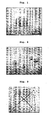
- Figures 1, 2 and 3 are TEM nanoparticles of complex [Fe (NH 2 trz) 3 ] (Br) 2 obtained in test n ° 1.
- Figures 1 and 2 show a very regular structuring of nanoparticles in spherical form. This structure results from the fact that the synthesis reaction is confined in nano-droplets.
- the particle size is of the order of 100 nm, which typically corresponds to a value of 300 for w in formula (I).
- the figure 3 highlights the transparency of a polymer doped with nanoscale particles.
- a complex was prepared according to the method of the prior art, from the same precursors.
- the mixture of the precursors was carried out at room temperature, and the precipitate formed was separated by filtration.
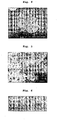
- the Figures 4, 5 and 6 represents MET images of the precipitate obtained.
- the Figures 4 and 5 show that the spin-transition particles synthesized by the process of the prior art do not have a regular structuring. The grains are irregular and have a size of the order of 60 microns.
- the figure 6 shows the opacity generated by the introduction of micrometric particles (even in small proportions) in a structuring polymer (PVA type) originally transparent.
- PVA type structuring polymer
- a material was prepared by a microemulsion synthesis under the following conditions.
- the particles are finally obtained by adding ethanol which has the effect of denaturing the inverse microemulsion. Ethanol solubilizes the surfactant and not the complex formed. After centrifugation and removal of the liquid phase, the washing operation is repeated 3 to 4 times until the supernatant liquid is perfectly clear.
- Nanoparticles were prepared from a precursor of Fe and a precursor of M by an inverse emulsion synthesis under the conditions of the test No. 3 given in Table 1, introducing into the flask A 0.116 g. FeCl 2 and 0.124 g of ZnCl 2 instead of 0.21 g of FeCl 2 . Nanoparticles formed by the Fe 0.5 Zn 0.5 Cl 2 complex were obtained.
- the particle size is of the order of 100 nm, typically a w of 300.
- Example 2 The procedure of Example 2 was repeated, replacing the FeBr 2 solution with a solution of FeCl 2 and ZnCl 2 . Nanoparticles formed by the Fe 0.5 Zn 0.5 Cl 2 complex were obtained.
- the particle size is of the order of 100 nm, typically a w of 300.
- Example 1 The procedure of Example 1 was repeated under the following conditions by dissolving Fe (BF 4 ) 2 in Fe (NO 3 ) 2 solution .
- Ball A Ball B Salt of Fe (II) m 1 Water m 3 Ascorbic acid 2 m
- Surfactant m 5 Ligand m 4
- Water m 3 Surfactant m 5 Fe (NO 3 ) 1.7 (BF 4 ) 0.3 Fe (NO 3 ) 1.96 mL Fe (BF 4 ) 2 0.054 g 0.03 g Ifralan 8.5 g NH 2 Trz 0.27 g 1.96 g Ifralan 8.5 g
- Nanoparticles of complex [Fe (NH 2 TrZ) 3 (NO 3 ) 1.7 (BF 4 ) 0.3 ] were obtained.
- the particle size is of the order of 100 nm, typically a w of 300.
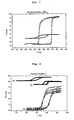
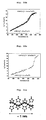
- the Figure 7 shows the evolution of the reflectivity signal R as a function of the temperature T for the complex of the present example (curve b) and for the material of the same formula obtained in traditional synthesis (curve a).
- a material was prepared with a silica coating by inverse micelle synthesis according to the procedure of Example 1 carried out with the FeBr 2 precursor.
- the difference with Example 1 is that after mixing the two micellar solutions and vortexing for a few minutes, 2 mL of tetraethoxysilane (TEOS) was added.
- TEOS tetraethoxysilane
- the figure 8 shows the evolution of the reflectance R as a function of the temperature T for the Fe (NH 2 Trz) 3 (NO 3 ) 2 derivative synthesized by the traditional route (a), by the reverse micelle route (b) (test no. Table 1) and reverse micellar with silica coating (c).
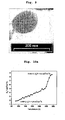
- the Figure 9 represents the TEM shot of a silica coating around a spin-transition nano-particle. This silica shell, a few nanometers, results in a diffuse coating around the particle.
- solution A A solution of m 1 g of FeBr 2 in 0.342 g of water and a solution of 0.8 g of AOT in 23 ml of n-heptane were prepared, then the two solutions were mixed and mixture thus obtained with ultrasound until a clear solution, called solution A, is obtained.
- solution B A solution of m 2 g of NH 2 Trz in 0.342 g of water and a solution of 0.8 g of AOT in 23 ml of n-heptane were prepared, then the two solutions were mixed and mixture thus obtained with ultrasound until a clear solution, called solution B, is obtained.
- the Figures 10a, b and c show the evolution of the magnetic signal, expressed in product ⁇ M T, respectively for samples 7 (1), 7 (2) and 7 (3).
- the molar magnetic susceptibility ⁇ M , in cm 3 mol -1 , multiplied by the temperature T, in degree K, is given on the ordinate and the temperature T, in degree K, is given on the abscissa, for the materials for which w 3
- the curves confirm the presence of a gradual spin transition for the three nanomaterials around 300 K.
- the figure 10 represents the structural formula of each of the materials constituting the samples 7 (1), 7 (2) and 7 (3).
Landscapes
- Chemical & Material Sciences (AREA)
- Organic Chemistry (AREA)
- Engineering & Computer Science (AREA)
- Materials Engineering (AREA)
- Compounds Of Iron (AREA)
- Inorganic Compounds Of Heavy Metals (AREA)
- Manufacturing Of Micro-Capsules (AREA)
- Medicines Containing Antibodies Or Antigens For Use As Internal Diagnostic Agents (AREA)
- Luminescent Compositions (AREA)
Applications Claiming Priority (2)
| Application Number | Priority Date | Filing Date | Title |
|---|---|---|---|
| FR0512476A FR2894581B1 (fr) | 2005-12-08 | 2005-12-08 | Nanoparticules d'un compose a transition de spin |
| PCT/FR2006/002651 WO2007065996A1 (fr) | 2005-12-08 | 2006-12-05 | Nanoparticules d'un compose a transition de spin |
Publications (2)
| Publication Number | Publication Date |
|---|---|
| EP1960410A1 EP1960410A1 (fr) | 2008-08-27 |
| EP1960410B1 true EP1960410B1 (fr) | 2010-03-03 |
Family
ID=36763025
Family Applications (1)
| Application Number | Title | Priority Date | Filing Date |
|---|---|---|---|
| EP06841859A Not-in-force EP1960410B1 (fr) | 2005-12-08 | 2006-12-05 | Nanoparticules d'un compose a transition de spin |
Country Status (9)
| Country | Link |
|---|---|
| US (2) | US20080311401A1 (enExample) |
| EP (1) | EP1960410B1 (enExample) |
| JP (1) | JP5340740B2 (enExample) |
| AT (1) | ATE459632T1 (enExample) |
| CA (1) | CA2632704C (enExample) |
| DE (1) | DE602006012730D1 (enExample) |
| ES (1) | ES2342563T3 (enExample) |
| FR (1) | FR2894581B1 (enExample) |
| WO (1) | WO2007065996A1 (enExample) |
Families Citing this family (15)
| Publication number | Priority date | Publication date | Assignee | Title |
|---|---|---|---|---|
| FR2917410B1 (fr) * | 2007-06-12 | 2012-09-07 | Centre Nat Rech Scient | Compose a transition de spin. |
| FR2937561B1 (fr) * | 2008-10-23 | 2010-12-31 | Centre Nat Rech Scient | Procede de delimitation d'une aire de sport ou de jeu au moyen d'un materiau a transition de spin thermochrome |
| FR2941458B1 (fr) * | 2009-01-28 | 2011-02-25 | Centre Nat Rech Scient | Nouveau materiau a transition de spin, son procede de preparation |
| US9145514B2 (en) * | 2010-03-31 | 2015-09-29 | Nichiyu Giken Kogyo Co., Ltd. | Temperature management indicator and structure having the same attached |
| FR2963015B1 (fr) * | 2010-07-22 | 2012-09-07 | Centre Nat Rech Scient | Procede de photocommutation thermique de materiaux a transition de spin et applications |
| FR2963016B1 (fr) * | 2010-07-22 | 2013-09-27 | Centre Nat Rech Scient | Traitement d'impression d'une surface par une encre reversible. |
| FR2971364B1 (fr) * | 2011-02-07 | 2013-02-15 | Centre Nat Rech Scient | Agencement optimise de particules de triazole |
| FR2993888B1 (fr) * | 2012-07-30 | 2015-11-27 | Inst Polytechnique Bordeaux | Materiau composite thermochrome et procede de fabrication d'un tel article |
| FR3017209B1 (fr) | 2014-02-03 | 2017-04-28 | Univ Bordeaux | Procede et systeme de visualisation d'un rayonnement electromagnetique infrarouge emis par une source |
| EP3173455A1 (fr) | 2015-11-30 | 2017-05-31 | The Swatch Group Research and Development Ltd. | Élément d'habillage avec capteur de température |
| FR3060598B1 (fr) | 2016-12-19 | 2020-12-11 | Airbus Group Sas | Revetement piezochrome reversible a matrice polymerique pour la detection d'impacts sur substrats composites |
| US10453310B2 (en) * | 2017-09-29 | 2019-10-22 | Konami Gaming, Inc. | Gaming system and methods of operating gaming machines to provide skill-based wagering games to players |
| EP3501324A1 (fr) * | 2017-12-21 | 2019-06-26 | The Swatch Group Research and Development Ltd | Élément d'habillage pour pièce d'horlogerie ou de bijouterie |
| EP3789761B1 (en) * | 2019-09-05 | 2024-03-20 | Fundación Imdea Nanociencia | Colorimetric detector |
| CN114395133B (zh) * | 2021-12-03 | 2023-07-21 | 常州大学 | 一种同多钒酸配位聚合物催化剂及其制备方法和应用 |
Family Cites Families (10)
| Publication number | Priority date | Publication date | Assignee | Title |
|---|---|---|---|---|
| US5618514A (en) * | 1983-12-21 | 1997-04-08 | Nycomed Imaging As | Diagnostic and contrast agent |
| US5582900A (en) * | 1991-11-22 | 1996-12-10 | U.S. Philips Corporation | Spin-transition compounds and their use for storing, processing and/or displaying information |
| US6043008A (en) * | 1991-11-22 | 2000-03-28 | U.S. Philips Corporation | Spin-transition parent compounds and devices having means for writing, storing and erasing, which comprise an active medium containing at least one of said compounds |
| FR2684238A1 (fr) * | 1991-11-22 | 1993-05-28 | Philips Electronique Lab | Composes chimiques a transition de spin, et leur utilisation pour le stockage, le traitement d'information et/ou l'affichage de donnees. |
| US6200730B1 (en) * | 1992-11-20 | 2001-03-13 | U.S. Philips Corporation | Spin-transition parent compounds |
| EP0666561A1 (fr) * | 1994-02-03 | 1995-08-09 | Laboratoires D'electronique Philips S.A.S. | Composés chimiques de départ à transition de spin et dispositifs munis de moyens d'inscription, mémorisation et effaçage comprenant un milieu actif incluant au moins un de ces composés |
| FR2734824A1 (fr) * | 1995-05-31 | 1996-12-06 | Philips Electronique Lab | Composes chimiques de depart a transition de spin et dispositifs munis de moyens d'inscription, memorisation et effacage comprenant un milieu actif incluant au moins un de ces composes |
| FR2755697A1 (fr) * | 1996-11-14 | 1998-05-15 | Philips Electronics Nv | Composes chimiques a transition de spin et dispositifs d'affichage de depassement de seuil de temperature comprenant un milieu actif incluant au moins un de ces composes |
| AUPP004497A0 (en) * | 1997-10-28 | 1997-11-20 | University Of Melbourne, The | Stabilized particles |
| US7795355B2 (en) * | 2004-03-05 | 2010-09-14 | Carnegie Mellon University | Preparation of functional polymers |
-
2005
- 2005-12-08 FR FR0512476A patent/FR2894581B1/fr not_active Expired - Lifetime
-
2006
- 2006-12-05 AT AT06841859T patent/ATE459632T1/de not_active IP Right Cessation
- 2006-12-05 CA CA2632704A patent/CA2632704C/fr active Active
- 2006-12-05 JP JP2008543864A patent/JP5340740B2/ja not_active Expired - Fee Related
- 2006-12-05 WO PCT/FR2006/002651 patent/WO2007065996A1/fr not_active Ceased
- 2006-12-05 DE DE602006012730T patent/DE602006012730D1/de active Active
- 2006-12-05 EP EP06841859A patent/EP1960410B1/fr not_active Not-in-force
- 2006-12-05 ES ES06841859T patent/ES2342563T3/es active Active
- 2006-12-05 US US12/096,746 patent/US20080311401A1/en not_active Abandoned
-
2012
- 2012-09-14 US US13/619,187 patent/US8753743B2/en active Active
Also Published As
| Publication number | Publication date |
|---|---|
| US8753743B2 (en) | 2014-06-17 |
| CA2632704A1 (fr) | 2007-06-14 |
| EP1960410A1 (fr) | 2008-08-27 |
| US20080311401A1 (en) | 2008-12-18 |
| CA2632704C (fr) | 2013-10-22 |
| JP2009519879A (ja) | 2009-05-21 |
| WO2007065996A1 (fr) | 2007-06-14 |
| JP5340740B2 (ja) | 2013-11-13 |
| FR2894581B1 (fr) | 2008-02-22 |
| DE602006012730D1 (de) | 2010-04-15 |
| FR2894581A1 (fr) | 2007-06-15 |
| US20130011680A1 (en) | 2013-01-10 |
| ES2342563T3 (es) | 2010-07-08 |
| ATE459632T1 (de) | 2010-03-15 |
Similar Documents
| Publication | Publication Date | Title |
|---|---|---|
| EP1960410B1 (fr) | Nanoparticules d'un compose a transition de spin | |
| Gural'skiy et al. | Synthesis of Spin‐Crossover Nano‐and Micro‐objects in Homogeneous Media | |
| Shi et al. | Aggregation‐induced emission of copper nanoclusters | |
| CA2690138C (fr) | Materiau de complexe de fer a transition de spin | |
| Takeuchi et al. | Colloidal stability of gold nanoparticles in 2-propanol under laser irradiation | |
| ES2673013T3 (es) | Síntesis universal de una única reacción y realizable a gran escala de nanopartículas codificadas con SERS | |
| JP2007154198A (ja) | フォトクロミックナノ粒子の製法及び該製法により調製されるフォトクロミックナノ粒子 | |
| Fornasieri et al. | Magnetism and photomagnetism of prussian blue analogue nanoparticles embedded in porous metal oxide ordered nanostructures | |
| JP2008522032A (ja) | 金属ナノ構造を製造する方法 | |
| Alnafisah et al. | Light-assisted synthesis of silver and gold nanoparticles by new benzophenone derivatives | |
| JP2009519879A5 (enExample) | ||
| Valero et al. | Ternary naproxen: β-cyclodextrin: polyethylene glycol complex formation | |
| Yang et al. | Preparation of uniform rhodamine B-doped SiO2/TiO2 composite microspheres | |
| Tarnavchyk et al. | Reactive hydrogel networks for the fabrication of metal–polymer nanocomposites | |
| WO2010086550A1 (fr) | Nouveau materiau a transition de spin, son procede de preparation | |
| Liu et al. | Synthesis of nanometer-sized poly (methyl methacrylate) polymer network by gold nanoparticle template | |
| Lv et al. | Shape Transformation via Etching and Regrowth: A Systematic Study of Pd Nanocrystals with Different Shapes and Twin Structures | |
| EP0842988A1 (fr) | Composés chimiques à transition de spin et dispositifs d'affichage de dépassement de seuil de température comprenant un milieu actif incluant au moins un de ces composés | |
| Yan et al. | From coordination polymers to hierarchical self-assembled structures | |
| Wang et al. | A strategy for prompt phase transfer of upconverting nanoparticles through surface oleate-mediated supramolecular assembly of amino-β-cyclodextrin | |
| Oikawa et al. | New class materials of organic–inorganic hybridized nanocrystals/nanoparticles, and their assembled micro-and nano-structure toward photonics | |
| Hammarberg et al. | Laux‐type Oxidation of In0 Nanoparticles to In2O3 Retaining Particle Size and Colloidal Stability | |
| El-Nahass et al. | Tunable Photophysical Behavior of a Novel Fluorescent Probe by Silver/Gold and Core–Shell NPs | |
| Chen | Silver and Silver-Gold Nanoparticles Synthesis and its Application on SERS | |
| Gavilán‐Rubio et al. | Thiol‐Functionalized IGEPAL® Surfactants as Novel Fluorescent Ligands for the Silica Coating of Gold Nanoparticles |
Legal Events
| Date | Code | Title | Description |
|---|---|---|---|
| PUAI | Public reference made under article 153(3) epc to a published international application that has entered the european phase |
Free format text: ORIGINAL CODE: 0009012 |
|
| 17P | Request for examination filed |
Effective date: 20080613 |
|
| AK | Designated contracting states |
Kind code of ref document: A1 Designated state(s): AT BE BG CH CY CZ DE DK EE ES FI FR GB GR HU IE IS IT LI LT LU LV MC NL PL PT RO SE SI SK TR |
|
| DAX | Request for extension of the european patent (deleted) | ||
| GRAP | Despatch of communication of intention to grant a patent |
Free format text: ORIGINAL CODE: EPIDOSNIGR1 |
|
| GRAS | Grant fee paid |
Free format text: ORIGINAL CODE: EPIDOSNIGR3 |
|
| GRAA | (expected) grant |
Free format text: ORIGINAL CODE: 0009210 |
|
| AK | Designated contracting states |
Kind code of ref document: B1 Designated state(s): AT BE BG CH CY CZ DE DK EE ES FI FR GB GR HU IE IS IT LI LT LU LV MC NL PL PT RO SE SI SK TR |
|
| REG | Reference to a national code |
Ref country code: GB Ref legal event code: FG4D Free format text: NOT ENGLISH |
|
| REG | Reference to a national code |
Ref country code: CH Ref legal event code: EP |
|
| REG | Reference to a national code |
Ref country code: IE Ref legal event code: FG4D |
|
| REF | Corresponds to: |
Ref document number: 602006012730 Country of ref document: DE Date of ref document: 20100415 Kind code of ref document: P |
|
| REG | Reference to a national code |
Ref country code: NL Ref legal event code: VDEP Effective date: 20100303 |
|
| REG | Reference to a national code |
Ref country code: ES Ref legal event code: FG2A Ref document number: 2342563 Country of ref document: ES Kind code of ref document: T3 |
|
| PG25 | Lapsed in a contracting state [announced via postgrant information from national office to epo] |
Ref country code: LT Free format text: LAPSE BECAUSE OF FAILURE TO SUBMIT A TRANSLATION OF THE DESCRIPTION OR TO PAY THE FEE WITHIN THE PRESCRIBED TIME-LIMIT Effective date: 20100303 |
|
| LTIE | Lt: invalidation of european patent or patent extension |
Effective date: 20100303 |
|
| PG25 | Lapsed in a contracting state [announced via postgrant information from national office to epo] |
Ref country code: PL Free format text: LAPSE BECAUSE OF FAILURE TO SUBMIT A TRANSLATION OF THE DESCRIPTION OR TO PAY THE FEE WITHIN THE PRESCRIBED TIME-LIMIT Effective date: 20100303 Ref country code: FI Free format text: LAPSE BECAUSE OF FAILURE TO SUBMIT A TRANSLATION OF THE DESCRIPTION OR TO PAY THE FEE WITHIN THE PRESCRIBED TIME-LIMIT Effective date: 20100303 Ref country code: LV Free format text: LAPSE BECAUSE OF FAILURE TO SUBMIT A TRANSLATION OF THE DESCRIPTION OR TO PAY THE FEE WITHIN THE PRESCRIBED TIME-LIMIT Effective date: 20100303 Ref country code: AT Free format text: LAPSE BECAUSE OF FAILURE TO SUBMIT A TRANSLATION OF THE DESCRIPTION OR TO PAY THE FEE WITHIN THE PRESCRIBED TIME-LIMIT Effective date: 20100303 Ref country code: SI Free format text: LAPSE BECAUSE OF FAILURE TO SUBMIT A TRANSLATION OF THE DESCRIPTION OR TO PAY THE FEE WITHIN THE PRESCRIBED TIME-LIMIT Effective date: 20100303 |
|
| REG | Reference to a national code |
Ref country code: IE Ref legal event code: FD4D |
|
| PG25 | Lapsed in a contracting state [announced via postgrant information from national office to epo] |
Ref country code: SE Free format text: LAPSE BECAUSE OF FAILURE TO SUBMIT A TRANSLATION OF THE DESCRIPTION OR TO PAY THE FEE WITHIN THE PRESCRIBED TIME-LIMIT Effective date: 20100303 Ref country code: RO Free format text: LAPSE BECAUSE OF FAILURE TO SUBMIT A TRANSLATION OF THE DESCRIPTION OR TO PAY THE FEE WITHIN THE PRESCRIBED TIME-LIMIT Effective date: 20100303 Ref country code: NL Free format text: LAPSE BECAUSE OF FAILURE TO SUBMIT A TRANSLATION OF THE DESCRIPTION OR TO PAY THE FEE WITHIN THE PRESCRIBED TIME-LIMIT Effective date: 20100303 Ref country code: IE Free format text: LAPSE BECAUSE OF FAILURE TO SUBMIT A TRANSLATION OF THE DESCRIPTION OR TO PAY THE FEE WITHIN THE PRESCRIBED TIME-LIMIT Effective date: 20100303 Ref country code: CY Free format text: LAPSE BECAUSE OF FAILURE TO SUBMIT A TRANSLATION OF THE DESCRIPTION OR TO PAY THE FEE WITHIN THE PRESCRIBED TIME-LIMIT Effective date: 20100303 Ref country code: EE Free format text: LAPSE BECAUSE OF FAILURE TO SUBMIT A TRANSLATION OF THE DESCRIPTION OR TO PAY THE FEE WITHIN THE PRESCRIBED TIME-LIMIT Effective date: 20100303 |
|
| PG25 | Lapsed in a contracting state [announced via postgrant information from national office to epo] |
Ref country code: IS Free format text: LAPSE BECAUSE OF FAILURE TO SUBMIT A TRANSLATION OF THE DESCRIPTION OR TO PAY THE FEE WITHIN THE PRESCRIBED TIME-LIMIT Effective date: 20100703 Ref country code: CZ Free format text: LAPSE BECAUSE OF FAILURE TO SUBMIT A TRANSLATION OF THE DESCRIPTION OR TO PAY THE FEE WITHIN THE PRESCRIBED TIME-LIMIT Effective date: 20100303 Ref country code: BG Free format text: LAPSE BECAUSE OF FAILURE TO SUBMIT A TRANSLATION OF THE DESCRIPTION OR TO PAY THE FEE WITHIN THE PRESCRIBED TIME-LIMIT Effective date: 20100603 Ref country code: SK Free format text: LAPSE BECAUSE OF FAILURE TO SUBMIT A TRANSLATION OF THE DESCRIPTION OR TO PAY THE FEE WITHIN THE PRESCRIBED TIME-LIMIT Effective date: 20100303 |
|
| PLBE | No opposition filed within time limit |
Free format text: ORIGINAL CODE: 0009261 |
|
| STAA | Information on the status of an ep patent application or granted ep patent |
Free format text: STATUS: NO OPPOSITION FILED WITHIN TIME LIMIT |
|
| PG25 | Lapsed in a contracting state [announced via postgrant information from national office to epo] |
Ref country code: DK Free format text: LAPSE BECAUSE OF FAILURE TO SUBMIT A TRANSLATION OF THE DESCRIPTION OR TO PAY THE FEE WITHIN THE PRESCRIBED TIME-LIMIT Effective date: 20100303 Ref country code: PT Free format text: LAPSE BECAUSE OF FAILURE TO SUBMIT A TRANSLATION OF THE DESCRIPTION OR TO PAY THE FEE WITHIN THE PRESCRIBED TIME-LIMIT Effective date: 20100705 |
|
| 26N | No opposition filed |
Effective date: 20101206 |
|
| BERE | Be: lapsed |
Owner name: CENTRE NATIONAL DE LA RECHERCHE SCIENTIFIQUE Effective date: 20101231 |
|
| PG25 | Lapsed in a contracting state [announced via postgrant information from national office to epo] |
Ref country code: MC Free format text: LAPSE BECAUSE OF NON-PAYMENT OF DUE FEES Effective date: 20101231 |
|
| REG | Reference to a national code |
Ref country code: CH Ref legal event code: PL |
|
| PG25 | Lapsed in a contracting state [announced via postgrant information from national office to epo] |
Ref country code: BE Free format text: LAPSE BECAUSE OF NON-PAYMENT OF DUE FEES Effective date: 20101231 |
|
| PG25 | Lapsed in a contracting state [announced via postgrant information from national office to epo] |
Ref country code: CH Free format text: LAPSE BECAUSE OF NON-PAYMENT OF DUE FEES Effective date: 20101231 Ref country code: LI Free format text: LAPSE BECAUSE OF NON-PAYMENT OF DUE FEES Effective date: 20101231 |
|
| PG25 | Lapsed in a contracting state [announced via postgrant information from national office to epo] |
Ref country code: LU Free format text: LAPSE BECAUSE OF NON-PAYMENT OF DUE FEES Effective date: 20101205 Ref country code: HU Free format text: LAPSE BECAUSE OF FAILURE TO SUBMIT A TRANSLATION OF THE DESCRIPTION OR TO PAY THE FEE WITHIN THE PRESCRIBED TIME-LIMIT Effective date: 20100904 |
|
| PG25 | Lapsed in a contracting state [announced via postgrant information from national office to epo] |
Ref country code: TR Free format text: LAPSE BECAUSE OF FAILURE TO SUBMIT A TRANSLATION OF THE DESCRIPTION OR TO PAY THE FEE WITHIN THE PRESCRIBED TIME-LIMIT Effective date: 20100303 |
|
| PG25 | Lapsed in a contracting state [announced via postgrant information from national office to epo] |
Ref country code: GR Free format text: LAPSE BECAUSE OF FAILURE TO SUBMIT A TRANSLATION OF THE DESCRIPTION OR TO PAY THE FEE WITHIN THE PRESCRIBED TIME-LIMIT Effective date: 20100303 |
|
| REG | Reference to a national code |
Ref country code: FR Ref legal event code: PLFP Year of fee payment: 10 |
|
| REG | Reference to a national code |
Ref country code: FR Ref legal event code: PLFP Year of fee payment: 11 |
|
| REG | Reference to a national code |
Ref country code: FR Ref legal event code: PLFP Year of fee payment: 12 |
|
| PGFP | Annual fee paid to national office [announced via postgrant information from national office to epo] |
Ref country code: DE Payment date: 20211210 Year of fee payment: 16 Ref country code: GB Payment date: 20211220 Year of fee payment: 16 Ref country code: FR Payment date: 20211231 Year of fee payment: 16 |
|
| PGFP | Annual fee paid to national office [announced via postgrant information from national office to epo] |
Ref country code: IT Payment date: 20211213 Year of fee payment: 16 |
|
| PGFP | Annual fee paid to national office [announced via postgrant information from national office to epo] |
Ref country code: ES Payment date: 20220104 Year of fee payment: 16 |
|
| REG | Reference to a national code |
Ref country code: DE Ref legal event code: R119 Ref document number: 602006012730 Country of ref document: DE |
|
| GBPC | Gb: european patent ceased through non-payment of renewal fee |
Effective date: 20221205 |
|
| PG25 | Lapsed in a contracting state [announced via postgrant information from national office to epo] |
Ref country code: GB Free format text: LAPSE BECAUSE OF NON-PAYMENT OF DUE FEES Effective date: 20221205 Ref country code: DE Free format text: LAPSE BECAUSE OF NON-PAYMENT OF DUE FEES Effective date: 20230701 |
|
| PG25 | Lapsed in a contracting state [announced via postgrant information from national office to epo] |
Ref country code: FR Free format text: LAPSE BECAUSE OF NON-PAYMENT OF DUE FEES Effective date: 20221231 |
|
| REG | Reference to a national code |
Ref country code: ES Ref legal event code: FD2A Effective date: 20240126 |
|
| PG25 | Lapsed in a contracting state [announced via postgrant information from national office to epo] |
Ref country code: IT Free format text: LAPSE BECAUSE OF NON-PAYMENT OF DUE FEES Effective date: 20221205 |
|
| PG25 | Lapsed in a contracting state [announced via postgrant information from national office to epo] |
Ref country code: ES Free format text: LAPSE BECAUSE OF NON-PAYMENT OF DUE FEES Effective date: 20221206 |
|
| PG25 | Lapsed in a contracting state [announced via postgrant information from national office to epo] |
Ref country code: ES Free format text: LAPSE BECAUSE OF NON-PAYMENT OF DUE FEES Effective date: 20221206 |