EP1945944B1 - Verfahren zur verlängerung und/oder steuerung der lebensdauer eines oder mehrerer wärmeerzeugender und/oder passiver bauteile in einer windturbine, windturbine und ihre verwendung - Google Patents
Verfahren zur verlängerung und/oder steuerung der lebensdauer eines oder mehrerer wärmeerzeugender und/oder passiver bauteile in einer windturbine, windturbine und ihre verwendung Download PDFInfo
- Publication number
- EP1945944B1 EP1945944B1 EP05799113.5A EP05799113A EP1945944B1 EP 1945944 B1 EP1945944 B1 EP 1945944B1 EP 05799113 A EP05799113 A EP 05799113A EP 1945944 B1 EP1945944 B1 EP 1945944B1
- Authority
- EP
- European Patent Office
- Prior art keywords
- temperature
- heat generating
- passive components
- wind turbine
- controlling
- Prior art date
- Legal status (The legal status is an assumption and is not a legal conclusion. Google has not performed a legal analysis and makes no representation as to the accuracy of the status listed.)
- Expired - Lifetime
Links
Images


Classifications
-
- F—MECHANICAL ENGINEERING; LIGHTING; HEATING; WEAPONS; BLASTING
- F03—MACHINES OR ENGINES FOR LIQUIDS; WIND, SPRING, OR WEIGHT MOTORS; PRODUCING MECHANICAL POWER OR A REACTIVE PROPULSIVE THRUST, NOT OTHERWISE PROVIDED FOR
- F03D—WIND MOTORS
- F03D80/00—Details, components or accessories not provided for in groups F03D1/00 - F03D17/00
- F03D80/60—Cooling or heating of wind motors
-
- F—MECHANICAL ENGINEERING; LIGHTING; HEATING; WEAPONS; BLASTING
- F03—MACHINES OR ENGINES FOR LIQUIDS; WIND, SPRING, OR WEIGHT MOTORS; PRODUCING MECHANICAL POWER OR A REACTIVE PROPULSIVE THRUST, NOT OTHERWISE PROVIDED FOR
- F03D—WIND MOTORS
- F03D9/00—Adaptations of wind motors for special use; Combinations of wind motors with apparatus driven thereby; Wind motors specially adapted for installation in particular locations
- F03D9/20—Wind motors characterised by the driven apparatus
- F03D9/25—Wind motors characterised by the driven apparatus the apparatus being an electrical generator
-
- F—MECHANICAL ENGINEERING; LIGHTING; HEATING; WEAPONS; BLASTING
- F05—INDEXING SCHEMES RELATING TO ENGINES OR PUMPS IN VARIOUS SUBCLASSES OF CLASSES F01-F04
- F05B—INDEXING SCHEME RELATING TO WIND, SPRING, WEIGHT, INERTIA OR LIKE MOTORS, TO MACHINES OR ENGINES FOR LIQUIDS COVERED BY SUBCLASSES F03B, F03D AND F03G
- F05B2260/00—Function
- F05B2260/80—Diagnostics
-
- F—MECHANICAL ENGINEERING; LIGHTING; HEATING; WEAPONS; BLASTING
- F05—INDEXING SCHEMES RELATING TO ENGINES OR PUMPS IN VARIOUS SUBCLASSES OF CLASSES F01-F04
- F05B—INDEXING SCHEME RELATING TO WIND, SPRING, WEIGHT, INERTIA OR LIKE MOTORS, TO MACHINES OR ENGINES FOR LIQUIDS COVERED BY SUBCLASSES F03B, F03D AND F03G
- F05B2270/00—Control
- F05B2270/10—Purpose of the control system
- F05B2270/109—Purpose of the control system to prolong engine life
- F05B2270/1091—Purpose of the control system to prolong engine life by limiting temperatures
-
- F—MECHANICAL ENGINEERING; LIGHTING; HEATING; WEAPONS; BLASTING
- F05—INDEXING SCHEMES RELATING TO ENGINES OR PUMPS IN VARIOUS SUBCLASSES OF CLASSES F01-F04
- F05B—INDEXING SCHEME RELATING TO WIND, SPRING, WEIGHT, INERTIA OR LIKE MOTORS, TO MACHINES OR ENGINES FOR LIQUIDS COVERED BY SUBCLASSES F03B, F03D AND F03G
- F05B2270/00—Control
- F05B2270/30—Control parameters, e.g. input parameters
- F05B2270/303—Temperature
-
- Y—GENERAL TAGGING OF NEW TECHNOLOGICAL DEVELOPMENTS; GENERAL TAGGING OF CROSS-SECTIONAL TECHNOLOGIES SPANNING OVER SEVERAL SECTIONS OF THE IPC; TECHNICAL SUBJECTS COVERED BY FORMER USPC CROSS-REFERENCE ART COLLECTIONS [XRACs] AND DIGESTS
- Y02—TECHNOLOGIES OR APPLICATIONS FOR MITIGATION OR ADAPTATION AGAINST CLIMATE CHANGE
- Y02E—REDUCTION OF GREENHOUSE GAS [GHG] EMISSIONS, RELATED TO ENERGY GENERATION, TRANSMISSION OR DISTRIBUTION
- Y02E10/00—Energy generation through renewable energy sources
- Y02E10/70—Wind energy
- Y02E10/72—Wind turbines with rotation axis in wind direction
Definitions
- the invention relates to a method for prolonging and/or controlling the life of one or more heat generating and/or passive components in a wind turbine, a wind turbine, and use hereof.
- a wind turbine known in the art comprises a wind turbine tower and a wind turbine nacelle positioned on top of the tower.
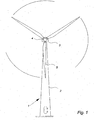
- a wind turbine rotor with three wind turbine blades is connected to the nacelle through a low speed shaft, which extends out of the nacelle front as illustrated on figure 1 .
- Thermal stress basically originates from two factors - High temperature and more importantly varying temperatures. Examples for controlling thermal stress are disclosed in WO 2004/085816 or US 6,212,871 .
- Varying temperatures in heat generating and/or passive components is a big problem, mainly because of the fact that different materials have different coefficients of thermal expansion, but also because e.g. lubricants and interacting mechanical components are made to work optimally at a specific temperature.
- An object of the invention is therefore to provide a temperature control system for heat generating and/or passive, components in or at a wind turbine without the mentioned disadvantages.
- the invention provides for a method for prolonging and/or controlling the life of one or more heat generating and/or passive components in a wind turbine, with the features of claim 1.
- the wind turbine was equipped with a temperature control system with a cooling capacity, making it able to control the temperature of the heat generating and/or passive components when their temperature rises, the temperature of the components would not be rising in the first place. But such a temperature control system would be big, heavy and expensive. However when the cooling capacity exceeds the overall heat output, the temperature of the components will start to drop and this process can be controlled by a wind turbine temperature control system of the same size and capacity as an ordinary temperature control system. Even though this control of the components temperature most often will maintain the components temperature at level higher that necessary during the cooling down process (which potentially reduces the components life), it is still advantageous in that, the number of temperature fluctuations is reduced in a way which most often will prolong the total life of the heat generating and/or passive components.
- heat generating ... components components, which produce heat e.g. because they conduct electrical power, because they are in motion or other. This could e.g. be an electrically active motherboard, an entire electrically active power converter or a rotating bearing.
- ... passive components components which does not produce heat themselves, but they could still be under the influence of e.g. the radiation of heat from neighbouring heat generating components and the ambient temperature in general. This could e.g. a motherboard which is turned off; meaning it does not conduct any electrical power, it could be stagnant oil in the oil sump of a gear or a hydraulic system or another component which temporarily or permanently does not generate heat.
- the heat generating and/or passive components not necessarily have to be located inside the wind turbine e.g. in the tower or in the nacelle. They could also be located in a cabinet, a shed or a house outside the wind turbine.
- An aspect of the invention provides for a method which comprises the steps of, monitoring the temperature of said one or more of said heat generating and/or passive components, detecting peaks in said one or more heat generating and/or passive components temperature, and controlling the temperature of said one or more heat generating and/or passive components by means of one or more temperature control systems including heating and cooling means, in relation to the latest temperature peak.
- peak is to be understood as the point where the temperature shifts from rising to declining.
- An aspect of the invention provides for a method wherein said temperature of said one or more heat generating and/or passive components, is controlled according to a predefined reference curve.
- the components temperature is advantageous to control according to a predefined reference curve, in that it enables the possibility of controlling the life of the components.
- the components life is among other things depending on the number of temperature fluctuations it is exposed to during its life. If e.g. the cooling curve declines fast it will potentially lead to more temperature fluctuations than if it declines slowly, whereby shortening the components life.
- An aspect of the invention provides for a method wherein said temperature of said one or more heat generating and/or passive components (8), is controlled according to a linear or substantially linear reference curve.
- An aspect of the invention provides for a method wherein said temperature of said one or more heat generating and/or passive components, is controlled by lowering said temperature of said one or more of said heat generating and/or passive components in steps.
- An aspect of the invention provides for a method wherein said temperature of said one or more heat generating and/or passive components, is controlled by lowering said temperature of said one or more heat generating and/or passive components until a predefined lowest operational temperature is reached.
- An aspect of the invention provides for a method wherein said temperature of said one or more heat generating and/or passive components, is controlled by lowering said temperature until said temperature rises and a new temperature peak occurs.
- An aspect of the invention provides for a method wherein said temperature of said one or more heat generating and/or passive components, is controlled by lowering said temperature of said one or more heat generating and/or passive components averagely 1° C between every 10 minutes to 1440 minutes, preferably 60 minutes to 720 minutes and most preferred 180 minutes to 540 minutes.
- the present ranges provides for an advantageous relation between the thermal stress produced by high temperatures and varying temperatures.
- An aspect of the invention provides for a method wherein said temperature of said one or more heat generating and/or passive components, is controlled by controlling the temperature of the air in and/or surrounding one or more of said heat generating and/or passive components and/or controlling the temperature of a fluid mean for internal temperature control of one or more of said heat generating and/or passive components.
- An aspect of the invention provides for a method wherein said temperature of said one or more heat generating and/or passive components, is controlled by means at least one refrigerant such as substantially frost-proof water, brine, ammoniac, CO2 and/or Freon gases.
- refrigerant such as substantially frost-proof water, brine, ammoniac, CO2 and/or Freon gases.
- Using a refrigerant is a simple, cost efficient and well proven way of transporting heat in a temperature control system.
- An aspect of the invention provides for a method wherein said heating and cooling means comprise means for heating or cooling said refrigerant.
- Heating or cooling the refrigerant by means of the heating and cooling means is at simple and well proven way of controlling the temperature in a temperature control system.
- An aspect of the invention provides for a method wherein said heat generating and/or passive components are power handling equipment and/or mechanical components such as power converters, generators, switches, inverters, resistors, hydraulic systems, gears, transformers and control systems.
- said heat generating and/or passive components are power handling equipment and/or mechanical components such as power converters, generators, switches, inverters, resistors, hydraulic systems, gears, transformers and control systems.
- An aspect of the invention provides for a method wherein said method further include the step of lowering said temperature of said one or more of said heat generating and/or passive components controlled from said peak temperature.
- An aspect of the invention provides for a method wherein said method further includes the step of positioning said means for controlling the temperature of the air in and/or surrounding one or more of said heat generating and/or passive components inside said heat generating and/or passive components.
- the means for controlling the temperature of the air in and/or surrounding the heat generating and/or passive components inside the heat generating and/or passive components, in that it enables the possibility of cooling/heating the air by circulating the air inside the component through the means for controlling the temperature of the air.
- air-exchange with the surroundings can be avoided, which is advantageous, in that the outside air can have varying humidity, it can contain bugs or other things potentially harmful for the component.
- An aspect of the invention provides for a method wherein said method further includes the step of controlling the temperature of said means for controlling the temperature, of the air in and/or surrounding one or more of said heat generating and/or passive components, by means of said refrigerant.
- Using the refrigerant to control the temperature of the air in or around the components is advantageous, in that it enables the possibility of using the same refrigerant to control the temperature of the air and to flow through the fluid cooled/heated components. This is advantageous in that it ensures a relatively low and constant temperature difference between the air surrounding a component and the refrigerant flowing through the component, hereby reducing the thermal stress on the component.
- An aspect of the invention provides for a method wherein said temperature of said one or more heat generating and/or passive components, is controlled by varying the output of said heating and cooling means.
- An aspect of the invention provides for a method wherein said temperature of said one or more heat generating and/or passive components, is controlled by turning said heating and cooling means on and off.
- the invention further provides for a wind turbine comprising the features of claim 19.
- Controlling the cooling down procedure of the heat generating and/or passive components in a wind turbine is advantageous, in that it enables the possibility of reducing the number of temperature fluctuations and calculating, predicting or estimating the number of temperature fluctuations rather accurately, whereby making it possible to prolong and control the life of the heat generating and/or passive components in a wind turbine.
- An aspect of the invention provides for a wind turbine, wherein said means comprise, one or more temperature control systems including heating and cooling means, means for monitoring the temperature of one or more of said heat generating and/or passive components, means for detecting peaks in said one or more heat generating and/or passive components temperature, and means for controlling the temperature of said one or more heat generating and/or passive components by means of said one or more temperature control systems in relation to the latest temperature peak.
- said means comprise, one or more temperature control systems including heating and cooling means, means for monitoring the temperature of one or more of said heat generating and/or passive components, means for detecting peaks in said one or more heat generating and/or passive components temperature, and means for controlling the temperature of said one or more heat generating and/or passive components by means of said one or more temperature control systems in relation to the latest temperature peak.
- An aspect of the invention provides for a wind turbine, wherein said means lowers the temperature of said one or more heat generating and/or passive components, according to a predefined reference curve.
- An aspect of the invention provides for a wind turbine, wherein said predefined reference curve provides for substantially linearly lowering of said temperature.
- An aspect of the invention provides for a wind turbine, wherein said predefined reference curve provides for lowering of said temperature in steps.
- An aspect of the invention provides for a wind turbine, wherein said means lowers the temperature of said one or more heat generating and/or passive components until a predefined lowest operational temperature is reached or until said temperature rises and a new temperature peak occurs.
- An aspect of the invention provides for a wind turbine, wherein said means lowers the temperature of said one or more heat generating and/or passive components averagely 1° C between every 10 minutes to 1440 minutes, preferably 60 minutes to 720 minutes and most preferred 180 minutes to 540 minutes.
- An aspect of the invention provides for a wind turbine, wherein said means further comprise at least one refrigerant such as substantially frost-proof water, brine, ammoniac, CO2 and/or Freon gases.
- refrigerant such as substantially frost-proof water, brine, ammoniac, CO2 and/or Freon gases.
- An aspect of the invention provides for a wind turbine, wherein said heating and cooling means comprise means for heating or cooling said refrigerant.
- An aspect of the invention provides for a wind turbine, wherein said heat generating and/or passive components are power handling equipment and/or mechanical components such as power converters, generators, switches, inverters, resistors, hydraulic systems, gears, transformers and control systems.
- said heat generating and/or passive components are power handling equipment and/or mechanical components such as power converters, generators, switches, inverters, resistors, hydraulic systems, gears, transformers and control systems.
- An aspect of the invention provides for a wind turbine, wherein said means lowers the temperature of said one or more heat generating and/or passive components controlled from said peak temperature.
- An aspect of the invention provides for a wind turbine, wherein means controls the temperature of said one or more heat generating and/or passive components by varying the output of said heating and cooling means.
- An aspect of the invention provides for a wind turbine, wherein said means controls the temperature of said one or more heat generating and/or passive components by turning said heating and cooling means on and off.
- An aspect of the invention provides for a wind turbine, wherein said means comprise means for controlling the temperature of the air in and/or surrounding one or more of said heat generating and/or passive components and/or fluid means for internal temperature control of one or more of said heat generating and/or passive components.
- An aspect of the invention provides for a wind turbine, wherein said means for controlling the temperature of the air in and/or surrounding one or more of said heat generating and/or passive components are positioned inside said heat generating and/or passive components.
- An aspect of the invention provides for a wind turbine, wherein said means controls the temperature of said means for controlling the temperature, of the air in and/or surrounding one or more of said heat generating and/or passive components, by means of said refrigerant.
- the invention further provides for a wind turbine according to any of claims 20 to 35, wherein said wind turbine is a variable speed pitch controlled wind turbine.
- Fig. 1 illustrates a wind turbine 1, comprising a tower 2 and a wind turbine nacelle 3 positioned on top of the tower 2.
- the wind turbine rotor 4 comprising two wind turbine blades 5, is connected to the nacelle 3 through the low speed shaft 6 which extends out of the nacelle 3 front.
- Fig. 2 illustrates an embodiment of a traditional temperature control system 26 for controlling the temperature of heat generating and/or passive components 8 in a wind turbine 1.
- the illustrated heat generating and/or passive component 8 could be a power converter 9 comprising different kind of power handling equipment 10 such as power resistors 11, motherboards 12 and other.
- the motherboards 12 is air cooled
- the power resistors 11 is both air and fluid cooled.
- a main radiator 6 with a fan 7 is mounted outside the power converter 9 properly in a location enabling free air inlet from the outside of the wind turbine 1.
- a refrigerant flows through a bidirectional valve 13 and through a pump 14 which creates the flow of the refrigerant.
- the pump 14 the refrigerant flows through the equipment 11 in the power converter 9 which demands fluid cooling. The possibly heated refrigerant then returns to the main radiator 6 to be cooled again.
- the refrigerants temperature is measured by a refrigerant thermometer 16 and this temperature is compared with predefined maximum and minimum reference temperatures in a controller 25. If the refrigerants temperature is above the maximum reference temperature the controller 25 starts the fan 7 on the main radiator 6. When the refrigerants temperature drops below the minimum reference temperature, the controller 25 stops the fan 6 again.
- the power converter 9 also contains equipment 12 which only can or needs to be air cooled.
- the cabinet surrounding the power converter 9 is therefore provided with at least one cabinet fan 15 driven air inlets 18.
- An air thermometer 17 can measure the air temperature and compare it to maximum and minimum reference temperatures in the controller 25. If the air temperature is below the minimum reference temperature the cabinet fan 15 stops. When the air temperature inside the cabinet rise above the maximum reference temperature, the fan 15 starts again.
- the wind turbine 1 If the wind turbine 1 is placed in a cold environment and the weather is calm making the power production, and thereby most of the internal heat emission, stop, it can be necessary to heat the power handling equipment 10 in the power converter 9. This can be done by activating the bidirectional valve 13 changing the direction of the refrigerant flow and making it circulate inside the power converter 9 and pass a refrigerant heater 19.
- the equipment in the wind turbine 1 could produce so much heat, that the temperature rises above a certain level which makes some of the equipment shut down to protect them from being damaged by the high temperature. This will make most or the entire power production stop, and thereby also stop most of the internal heat production.
- Fig. 3 illustrates an embodiment of a temperature control system 26 for heat generating and/or passive components 8 in a wind turbine 1 according to the invention.
- the illustrated heat generating and/or passive component 8 could, as also illustrated in fig. 2 , be a power converter 9 comprising different kind of power handling equipment 10. Some of the equipment 10 is air cooled, and some is both air and fluid cooled.
- a main radiator 6 with a fan 7 is mounted outside the power converter 9 ensuring proper heat-exchange with the surroundings.
- the refrigerant flows through a bidirectional valve 13 and through a pump 14 which creates the flow of the refrigerant.
- the pump 14 the refrigerant flows through an internal radiator 20 provided with an internal fan 21.
- the radiator 20 and the fan 21 blows cooled air on and past the components that needs air cooling such as the motherboards 12 or it ensures a flow of air inside the cabinet.
- the refrigerant flows through the equipment 11 in the power converter 9 which demands fluid cooling.
- the possibly heated refrigerant then returns to the main radiator 6 to be cooled again.
- the temperature control system 26 is provided with a controller 25 which attempts to keep the system temperature on a constant level by maintaining the temperature of the refrigerant constant. This is mainly done by starting and stopping the main radiator fan 7, but it could also be done varying the rotation speed of the fan 7, by varying the speed of the pump 14 or even by starting and stopping the pump 14.
- the temperature can off course not be kept absolutely constant because of the systems inertia, but the fluctuation of the temperature can be kept as little as possible, such as +/- 0,3° C.
- the controller 25 After a preset time, such as 6 hours, the controller 25 lowers the system temperature by e.g. 1° C, or the controller 25 could lower the temperature e.g. 1° C over e.g. 6 hours making the temperature drop linearly. This gradual lowering of the temperature is continued until one of two things happens. The most common scenario is that the temperature is lowered until the systems heat output exceeds the temperature control systems 26 cooling capacity, making the refrigerant and thereby the component 8 temperature rise and reach a new peak level, from where the temperature is gradually lowered again. This relatively slow lowering of the temperature will then continue until the heat output exceeds the temperature control systems cooling capacity again, which creates a new temperature peak and a new controlled lowering starts.
- the controller could gradually lower the temperature until a preset lowest operating temperature, e.g. 0° C, is reached. The temperature would then be maintained constant on this level until the first scenario happens.
- the air temperature in the cabinet could be controlled in the same way as in traditional temperature control systems 26, as explained under fig. 2 , but in this embodiment of the invention, the power converter 9 is provided with an internal radiator 20 and fan 21 which functions as means for controlling the temperature of the equipment 12 in the power converter 9 which only can or needs to be air cooled.
- the air temperature is controlled by the same refrigerant that are used for fluid cooling of some of the equipment 12 in the power converter 9, which makes the temperature difference between the refrigerant and the air surrounding the equipment 12 small and relatively constant.
- the system can keep the equipment on a lowest operating temperature by heating the power handling equipment 10 in the power converter 9. Like in traditional systems this can be done by activating the bidirectional valve 13 changing the direction of the refrigerant flow and making it circulate inside the power converter 9 and passes a refrigerant heater 19.
- the order of the components in the system is not in any way limited to the illustrated order.
- the components of the temperature control system could be placed differently e.g. the refrigerant thermometer 16, the pump 14 and other could be placed after the refrigerant cooled equipment.
- the number of the different component can vary within the scoop of the invention, and some of the components such as pumps 14, refrigerant heaters 19, bidirectional valves 13 and other could be placed outside the power converter 9 or the other heat generating and/or passive components 8 of the wind turbine 1, in which the temperature control system according to the invention is applied.
- Different heat generating and/or passive components 8 of the wind turbine 1 could also share different components of the temperature control system e.g. one main radiator 6 could be attached to different or the same temperature control systems 26 in different heat generating and/or passive components 8 or a single controller 25 could control all the temperature control systems 26 in or at the wind turbine 1.
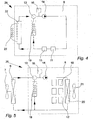
- Fig. 4 illustrates an embodiment of a temperature control system 26 for e.g. a gear, a hydraulic system or other heat generating and/or passive components 8 of a wind turbine 1.
- the heat generating and/or passive component 8 is equipped with an active cooling device 22 comprising a compressor.
- the active cooling device 8 could be of the type generally known from refrigerators and freezers.
- the cooling pipes 23 of the active cooling device 22 are placed outside the heat generating and/or passive component 8 and possibly even outside the wind turbine 1.
- the heat generating and/or passive component 8 contains no equipment that needs air cooling.
- the refrigerant flows from the active cooling device 22 through a bidirectional valve 13, a pump 12 and through the parts of the heat generating and/or passive component that need cooling or heating. If the refrigerant flows through e.g. the oil sump of a gear or a hydraulic system the thermometer 16 could be placed on the respective oil flow system making the system 26 control the temperature based on the gears or the hydraulic systems oil temperature.
- the previously described refrigerant could be the oil of e.g. a gear or a hydraulic system.
- the heated or cooled refrigerant returns to the active cooling device 22 or to the refrigerant heater 19.
- the temperature control system 26 is controlled by a controller 25 which is not shown in this figure.
- Fig. 5 illustrates an embodiment of the invention where only air cooling is needed.
- the heat generating and/or passive component could in this embodiment be a cabinet comprising controllers or other power handling equipment.
- the refrigerant flows through an internal radiator 20 which cools or heats the air.
- a controller (not shown) could start and stop both the main fan 7 and the internal fan 21 or it could vary the speed of the fans or the pump 14.
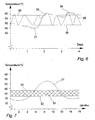
- Fig. 6 illustrates an embodiment of a heat generating and/or passive components 8 temperature curve 28 in a traditional temperature control system 26, and temperature curve 28 in a system according to the invention as seen over four days.
- the solid curve 27 illustrates, that from the start of day one the temperature of the heat generating and/or passive component 8 (as seen on the vertical axis) is lowered 1° C each six hours. This gradual lowering of the temperature goes on for one and a half day, until the ambient temperature and the internal heat production get so high that it exceeds the capacity of the cooling system. This makes the temperature of the heat generating and/or passive component rise until it reaches a peak 24 from where the temperature again is lowered 1 ° C each six hours. This lowering then continues for about a day when a new peak 24 occurs which starts a new gradual lowering of the temperature.
- the curve shown in dotted line 28 illustrates a possible temperature curve 28 for a heat generating and/or passive component 8 in a traditional temperature control system 26. Most often in traditional temperature control systems 26 the temperature will rise until an upper temperature level 29 is reached. This triggers a cooling process, which makes the temperature of the heat generating and/or passive component 8 drop, until a lower temperature level 30 is reached, where the cooling process stops, and the temperature of the heat generating and/or passive component 8 starts to rise again.
- the curves 27, 28 also indicates that the number of temperature fluctuations in a traditional temperature control system 26 is far greater, that in a system 26 according to the invention.
- a controller 25 in a temperature control system 26 could be preset in a controller 25 in a temperature control system 26 according to the invention. It could be as values (e.g. 2° C every 10 hours) or it could be as a predefined reference curve allowing for more complex lowering of the temperature (e.g. linearly or faster just after a peak 24 and then gradually slower or other). In another embodiment of the invention this controller 25 could operate with different temperature steps or different intervals for different times of the day, different times of the year, different ambient temperatures or other.
- N use N test ⁇ ⁇ T test ⁇ ⁇ T use m
- ⁇ Ttest and ⁇ Tuse are the peak-to-peak temperature excursions of the heat generating and/or passive components 8 or component parts in the laboratory and in use in the field, respectively; and Ntest and Nuse are the corresponding number of cycles to failure in the laboratory and in use in an operating wind turbine 1.
- m is a constant, typical value for a given failure mechanism or it is derived from empirical data. E.g. the m value for solder is approximately 2.
- the Coffin-Manson model can be used to define the minimum acceptable number of cycles to failure in an accelerated qualification test.
- Fig. 7 illustrates an embodiment of a heat generating and/or passive components 8 temperature curve 27 as seen over sixteen months. As the solid curve illustrates, the temperature of the heat generating and/or passive components 8 follows the general seasonal changes in the temperature. The curve 27 further illustrates that the average temperature of a heat generating and/or passive component 8 varies over time making it follow the ambient temperature and the wind load on the wind turbine 1.
- the hatched area 31 substantially illustrates the area 31 wherein the component 8 temperature in a traditional temperature control system 26 fluctuates. This fluctuation area 31 is limited by an upper temperature level 29 and a lower temperature level 30.
Landscapes
- Engineering & Computer Science (AREA)
- Life Sciences & Earth Sciences (AREA)
- Sustainable Development (AREA)
- Sustainable Energy (AREA)
- Chemical & Material Sciences (AREA)
- Combustion & Propulsion (AREA)
- Mechanical Engineering (AREA)
- General Engineering & Computer Science (AREA)
- Physics & Mathematics (AREA)
- Thermal Sciences (AREA)
- Power Engineering (AREA)
- Wind Motors (AREA)
Claims (36)
- Verfahren zum Verlängern und/oder Steuern der Lebensdauer eines oder mehrerer wärmeerzeugender und/oder passiver Bauteile (8) in einer Windturbine (1) über das Steuern der Abkühlprozedur des einen oder der mehreren wärmeerzeugenden und/oder passiven Bauteile (8), über das schrittweise Absenken der Temperatur des einen oder der mehreren wärmeerzeugenden und/oder passiven Bauteile (8), zum Verringern der Zahl der Temperaturfluktuationen der wärmeerzeugenden und/oder passiven Bauteile (8).
- Verfahren nach Anspruch 1, wobei das Verfahren die folgenden Schritte aufweist:Überwachen der Temperatur des einen oder der mehreren wärmeerzeugenden und/oder passiven Bauteile (8),Erkennen von Temperaturspitzen (24) des einen oder der mehreren wärmeerzeugenden und/oder passiven Bauteile (8), undRegeln der Temperatur des einen oder der mehreren wärmeerzeugenden und/oder passiven Bauteile (8) mittels eines oder mehrerer Temperaturregelsysteme (26), aufweisend Aufheiz- und Abkühlmittel (6, 7, 15, 19, 20, 21, 22), in Abhängigkeit von der letzten erkannten Temperaturspitze (24).
- Verfahren nach Anspruch 1 oder 2, wobei die Temperatur des einen oder der mehreren wärmeerzeugenden und/oder passiven Bauteile (8) gemäß einer vorbestimmten Referenzkurve geregelt wird.
- Verfahren nach einem der vorstehenden Ansprüche, wobei die Temperatur des einen oder der mehreren wärmeerzeugenden und/oder passiven Bauteile (8) gemäß einer linearen oder im Wesentlichen linearen Referenzkurve geregelt wird.
- Verfahren nach einem der vorstehenden Ansprüche, wobei die Temperatur des einen oder der mehreren wärmeerzeugenden und/oder passiven Bauteile (8) durch Absenken der Temperatur des einen oder der mehreren wärmeerzeugenden und/oder passiven Bauteile (8) in Schritten geregelt wird.
- Verfahren nach einem der vorstehenden Ansprüche, wobei die Temperatur des einen oder der mehreren wärmeerzeugenden und/oder passiven Bauteile (8) durch Absenken der Temperatur des einen oder der mehreren wärmeerzeugenden und/oder passiven Bauteile (8) geregelt wird, bis eine vorbestimmte niedrigste Betriebstemperatur erreicht ist.
- Verfahren nach einem der vorstehenden Ansprüche, wobei die Temperatur des einen oder der mehreren wärmeerzeugenden und/oder passiven Bauteile (8) durch Absenken der Temperatur geregelt wird, bis diese Temperatur ansteigt und eine neue Temperaturspitze (24) auftritt.
- Verfahren nach einem der vorstehenden Ansprüche, wobei die Temperatur des einen oder der mehreren wärmeerzeugenden und/oder passiven Bauteile (8) geregelt wird durch Absenken der Temperatur des einen oder der mehreren wärmeerzeugenden und/oder passiven Bauteile (8) um durchschnittlich 1 °C zwischen alle 10 Minuten bis alle 1.440 Minuten, vorzugsweise alle 60 Minuten bis alle 720 Minuten und am stärksten bevorzugt alle 180 Minuten bis alle 540 Minuten.
- Verfahren nach einem der vorstehenden Ansprüche, wobei die Temperatur des einen oder der mehreren wärmeerzeugenden und/oder passiven Bauteile (8) geregelt wird durch Regeln der Lufttemperatur in dem/den und/oder in der Umgebung des einen oder der mehreren wärmeerzeugenden und/oder passiven Bauteile (8) und/oder durch Regeln der Temperatur eines Fluidmittels zur internen Temperaturregelung von einem oder mehreren wärmeerzeugenden und/oder passiven Bauteilen (8).
- Verfahren nach einem der vorstehenden Ansprüche, wobei die Temperatur des einen oder der mehreren wärmeerzeugenden und/oder passiven Bauteile (8) geregelt wird mittels mindestens eines Kühlmittels wie beispielsweise im Wesentlichen frostsicheres Wasser, Sole, Ammoniak, CO2 und/oder Freon-Gase.
- Verfahren nach einem der vorstehenden Ansprüche, wobei die Aufheiz- und Abkühlmittel Mittel zum Erwärmen oder Abkühlen des Kühlmittels aufweisen.
- Verfahren nach einem der vorstehenden Ansprüche, wobei die wärmeerzeugenden und/oder passiven Bauteile (8) Stromversorgungseinrichtungen (10) und/oder mechanische Bauteile sind wie z. B. Leistungswandler (9), Generatoren, Schalter, Inverter, Widerstände (11), Hydrauliksysteme, Zahnräder, Transformatoren und Steuersysteme.
- Verfahren nach einem der Ansprüche 2 bis 12, wobei das Verfahren weiter den Schritt des über die Temperatur der Spitze (24) geregelten Absenkens der Temperatur des einen oder der mehreren wärmeerzeugenden und/oder passiven Bauteile (8) aufweist.
- Verfahren nach einem der Ansprüche 2 bis 13, wobei das Verfahren weiter den Schritt des Positionierens der Mittel (20, 21) zum Regeln der Lufttemperatur in dem/den und/oder in der Umgebung des einen oder der mehreren wärmeerzeugenden und/oder passiven Bauteile (8) innerhalb der wärmeerzeugenden und/oder passiven Bauteile (8) aufweist.
- Verfahren nach einem der Ansprüche 2 bis 14, wobei das Verfahren weiter den Schritt des Regelns der Temperatur der Mittel zur Temperaturregelung (20, 21) der Luft in dem/den und/oder in der Umgebung des einen oder der mehreren wärmeerzeugenden und/oder passiven Bauteile (8) mittels des Kühlmittels aufweist.
- Verfahren nach einem der Ansprüche 2 bis 15, wobei die Temperatur des einen oder der mehreren wärmeerzeugenden und/oder passiven Bauteile (8) geregelt wird über das Variieren der Ausgabe der Aufheiz- und Abkühlmittel (6, 7, 15, 19, 20, 21, 22).
- Verfahren nach einem der Ansprüche 2 bis 16, wobei die Temperatur des einen oder der mehreren wärmeerzeugenden und/oder passiven Bauteile (8) geregelt wird über das Ein- und Ausschalten der Aufheiz- und Abkühlmittel (6, 7, 15, 19, 20, 21, 22).
- Verfahren nach einem der vorstehenden Ansprüche, wobei das Verfahren weiter das Abschätzen der Lebensdauer der Bauteile (8) über den Einsatz von einem oder mehreren Lebensdauer-Vorhersagemodellen wie z. B. dem Coffin-Manson-Modell aufweist.
- Windturbine (1), aufweisend Mittel zum Verlängern und/oder Steuern der Lebensdauer eines oder mehrerer wärmeerzeugender und/oder passiver Bauteile (8) über das Steuern der Abkühlprozedur des einen oder der mehreren wärmeerzeugenden und/oder passiven Bauteile (8), über das schrittweise Absenken der Temperatur des einen oder der mehreren wärmeerzeugenden und/oder passiven Bauteile (8), zum Verringern der Zahl der Temperaturfluktuationen der wärmeerzeugenden und/oder passiven Bauteile (8).
- Windturbine (1) nach Anspruch 19, wobei die Mittel Folgendes aufweisen:ein oder mehrere Temperaturregelsysteme (26), aufweisend Aufheiz- und Abkühlmittel (6, 7, 15, 19, 20, 21, 22),Mittel zum Überwachen der Temperatur (16. 17) des einen oder der mehreren wärmeerzeugenden und/oder passiven Bauteile (8),Mittel zum Erkennen von Temperaturspitzen (24) des einen oder der mehreren wärmeerzeugenden und/oder passiven Bauteile (8), undMittel zum Regeln der Temperatur des einen oder der mehreren wärmeerzeugenden und/oder passiven Bauteile (8) mittels eines oder mehrerer Temperaturregelsysteme (26) in Abhängigkeit von der letzten erkannten Temperaturspitze (24).
- Windturbine (1) nach Anspruch 19 oder 20, wobei die Mittel die Temperatur des einen oder der mehreren wärmeerzeugenden und/oder passiven Bauteile (8) gemäß einer vorbestimmten Referenzkurve absenken.
- Windturbine (1) nach Anspruch 21, wobei die vorbestimmte Referenzkurve ein im Wesentlichen lineares Absenken der Temperatur bereitstellt.
- Windturbine (1) nach Anspruch 21, wobei die vorbestimmte Referenzkurve ein schrittweises Absenken der Temperatur bereitstellt.
- Windturbine (1) nach einem der Ansprüche 19 bis 23, wobei die Mittel die Temperatur des einen oder der mehreren wärmeerzeugenden und/oder passiven Bauteile absenken, bis eine vorbestimmte niedrigste Betriebstemperatur erreicht ist oder bis die Temperatur ansteigt und eine neue Temperaturspitze (24) auftritt.
- Windturbine (1) nach einem der Ansprüche 19 bis 24, wobei die Mittel die Temperatur des einen oder der mehreren wärmeerzeugenden und/oder passiven Bauteile (8) absenken um durchschnittlich 1 °C zwischen alle 10 Minuten bis alle 1.440 Minuten, vorzugsweise alle 60 Minuten bis alle 720 Minuten und am stärksten bevorzugt alle 180 Minuten bis alle 540 Minuten.
- Windturbine (1) nach einem der Ansprüche 19 bis 25, wobei die Mittel weiter mindestens ein Kühlmittel aufweisen wie beispielsweise im Wesentlichen frostsicheres Wasser, Sole, Ammoniak, CO2 und/oder Freon-Gase.
- Windturbine (1) nach einem der Ansprüche 19 bis 26, wobei die Aufheiz- und Abkühlmittel Mittel zum Erwärmen oder Abkühlen des Kühlmittels aufweisen.
- Windturbine (1) nach einem der Ansprüche 19 bis 27, wobei die wärmeerzeugenden und/oder passiven Bauteile (8)
Stromversorgungseinrichtungen (10) und/oder mechanische Bauteile sind wie z. B. Leistungswandler (9), Generatoren, Schalter, Inverter, Widerstände (11), Hydrauliksysteme, Zahnräder, Transformatoren und Steuersysteme. - Windturbine (1) nach einem der Ansprüche 20 bis 28, wobei die Mittel die Temperatur des einen oder der mehreren wärmeerzeugenden und/oder passiven Bauteile (8) über die Spitzentemperatur (24) geregelt absenken.
- Windturbine (1) nach einem der Ansprüche 20 bis 29, wobei die Mittel die Temperatur des einen oder der mehreren wärmeerzeugenden und/oder passiven Bauteile (8) regeln über das Variieren der Ausgabe der Aufheiz- und Abkühlmittel (6, 7, 15, 19, 20, 21, 22).
- Windturbine (1) nach einem der Ansprüche 20 bis 30, wobei die Mittel die Temperatur des einen oder der mehreren wärmeerzeugenden und/oder passiven Bauteile (8) regeln über das Ein- und Ausschalten der Aufheiz- und Abkühlmittel (6, 7, 15, 19, 20, 21, 22).
- Windturbine (1) nach einem der Ansprüche 20 bis 31, wobei die Mittel weiter Mittel aufweisen zum Regeln der Lufttemperatur in dem/den und/oder in der Umgebung des einen oder der mehreren wärmeerzeugenden und/oder passiven Bauteile (8) und/oder Fluidmittel zur internen Temperaturregelung von einem oder mehreren wärmeerzeugenden und/oder passiven Bauteilen (8).
- Windturbine (1) nach Anspruch 32, wobei die Mittel zum Regeln der Lufttemperatur (20, 21) in dem/den und/oder in der Umgebung des einen oder der mehreren wärmeerzeugenden und/oder passiven Bauteile (8) innerhalb der wärmeerzeugenden und/oder passiven Bauteile (8) positioniert sind.
- Windturbine (1) nach einem der Ansprüche 20 bis 33, wobei die Mittel die Temperatur der Mittel zur Lufttemperaturregelung (20, 21) in dem/den und/oder in der Umgebung des einen oder der mehreren wärmeerzeugenden und/oder passiven Bauteile (8) mittels des Kühlmittels regeln.
- Windturbine (1) nach einem der Ansprüche 19 bis 34, wobei die Windturbine (1) eine drehzahlvariable pitchgeregelte Windturbine ist.
- Gebrauch der Windturbine (1) nach einem der Ansprüche 19 bis 34 in Verbindung mit einem Verfahren nach Anspruch 1 bis 18.
Applications Claiming Priority (1)
| Application Number | Priority Date | Filing Date | Title |
|---|---|---|---|
| PCT/DK2005/000698 WO2007051464A1 (en) | 2005-11-01 | 2005-11-01 | A method for prolonging and/or controlling the life of one or more heat generating and/or passive components in a wind turbine, a wind turbine, and use thereof |
Publications (2)
| Publication Number | Publication Date |
|---|---|
| EP1945944A1 EP1945944A1 (de) | 2008-07-23 |
| EP1945944B1 true EP1945944B1 (de) | 2015-04-15 |
Family
ID=36190693
Family Applications (1)
| Application Number | Title | Priority Date | Filing Date |
|---|---|---|---|
| EP05799113.5A Expired - Lifetime EP1945944B1 (de) | 2005-11-01 | 2005-11-01 | Verfahren zur verlängerung und/oder steuerung der lebensdauer eines oder mehrerer wärmeerzeugender und/oder passiver bauteile in einer windturbine, windturbine und ihre verwendung |
Country Status (8)
| Country | Link |
|---|---|
| US (1) | US7955045B2 (de) |
| EP (1) | EP1945944B1 (de) |
| CN (1) | CN101300420B (de) |
| AU (1) | AU2005337986B2 (de) |
| BR (1) | BRPI0520632A2 (de) |
| CA (1) | CA2627904C (de) |
| ES (1) | ES2536740T3 (de) |
| WO (1) | WO2007051464A1 (de) |
Cited By (1)
| Publication number | Priority date | Publication date | Assignee | Title |
|---|---|---|---|---|
| DE102017120284A1 (de) * | 2017-09-04 | 2019-03-07 | Innogy Se | Verfahren zum Überwachen des Zustands mindestens eines während des Betriebs einer Windkraftanlage belasteten Bauteils |
Families Citing this family (31)
| Publication number | Priority date | Publication date | Assignee | Title |
|---|---|---|---|---|
| EP2153064B1 (de) * | 2007-04-30 | 2017-12-13 | Vestas Wind Systems A/S | Windenergieanlage und verfahren zur regelung der temperatur eines fluids in einem temperaturregelsystem |
| JP4796009B2 (ja) * | 2007-05-18 | 2011-10-19 | 三菱重工業株式会社 | 風力発電装置 |
| DE102007045410A1 (de) * | 2007-09-21 | 2009-04-09 | Innovative Windpower Ag | Verfahren zum Anfahren einer Windenergieanlage |
| DE102007049599A1 (de) * | 2007-10-15 | 2009-05-07 | Innovative Windpower Ag | Temperaturregelung von aneinandergekoppeltem Getriebe und Generator bei einer Windenergieanlage |
| WO2009076955A1 (en) * | 2007-12-14 | 2009-06-25 | Vestas Wind Systems A/S | Lifetime optimization of a wind turbine generator by controlling the generator temperature |
| ATE511605T1 (de) * | 2007-12-21 | 2011-06-15 | Vestas Wind Sys As | Windturbinengenerator mit wärmetauscher |
| EP2208888A3 (de) * | 2008-11-18 | 2012-02-22 | Vestas Wind Systems A/S | Windturbine mit einem Kühlsystem und Verfahren zur Bereitstellung von Kühlung einer wärmeerzeugenden Komponente in einer Gondel für eine Windturbine |
| US8504213B2 (en) * | 2009-06-26 | 2013-08-06 | General Electric Company | Regulation of generating plant |
| EP2449487A1 (de) * | 2009-07-01 | 2012-05-09 | European Aeronautic Defence And Space Company Eads France | Verfahren zur schätzung der lebensdauer einer elektronischen integrierten deep-submicron-schaltung |
| EP2309122B1 (de) | 2009-10-06 | 2012-02-22 | Siemens Aktiengesellschaft | Verfahren zur Steuerung einer Windturbine bei thermischen Überlastungen |
| WO2011067290A1 (en) * | 2009-12-01 | 2011-06-09 | Vestas Wind Systems A/S | A wind turbine nacelle comprising a heat exchanger assembly |
| JP5072994B2 (ja) * | 2010-03-17 | 2012-11-14 | 三菱重工業株式会社 | 風力発電装置 |
| EP2421130A1 (de) * | 2010-08-20 | 2012-02-22 | Siemens Aktiengesellschaft | Verfahren und Ermittlungseinheit zur Ermittlung eines aktuellen Beanspruchungsindikatorwerts eines elektrischen und/oder elektronischen Bauteils in einer Windkraftanlage |
| ES2553277T3 (es) * | 2010-08-31 | 2015-12-07 | Vestas Wind Systems A/S | Turbina eólica con un sistema de transferencia de calor |
| DE102010051675A1 (de) * | 2010-11-17 | 2012-05-24 | Repower Systems Ag | Windenergieanlage und Verfahren zum Betreiben einer Windenergieanlage mit Temperaturüberwachung des Transformators |
| US9127642B2 (en) | 2011-03-29 | 2015-09-08 | General Electric Company | Methods for adjusting the power output of a wind turbine |
| EP2520797B1 (de) * | 2011-05-03 | 2015-10-21 | Siemens Aktiengesellschaft | Getriebelose Windturbine mit thermischem Regelsystem |
| US9160172B2 (en) * | 2011-10-12 | 2015-10-13 | General Electric Company | Systems and methods for adaptive possible power determinaton in power generating systems |
| US8624411B2 (en) * | 2011-10-14 | 2014-01-07 | General Electric Company | Power generation system including predictive control apparatus to reduce influences of weather-varying factors |
| JP5308547B2 (ja) * | 2012-01-12 | 2013-10-09 | 三菱重工業株式会社 | 風力発電装置用ファン装置および風力発電装置 |
| EP2700815B1 (de) * | 2012-08-24 | 2016-04-20 | Siemens Aktiengesellschaft | Betrieb einer Windturbine mit mehreren Temperatursensoren |
| CN104937263B (zh) * | 2013-01-25 | 2017-11-28 | 维斯塔斯风力系统有限公司 | 风轮机的控制 |
| GB2510824B (en) * | 2013-02-13 | 2016-05-04 | Romax Tech Ltd | Lubricant heating and cooling system for a wind or water turbine |
| US9593670B2 (en) * | 2014-04-30 | 2017-03-14 | General Electric Company | System and methods for reducing wind turbine noise |
| DE102014112458B4 (de) | 2014-08-29 | 2018-10-11 | Sma Solar Technology Ag | Verfahren zur Steuerung einer Kühlvorrichtung zur Lebensdauererhöhung Abwärme erzeugender Komponenten und Kühlvorrichtung |
| ES1149337Y (es) * | 2015-12-23 | 2016-04-12 | Zheng Ye | Dispositivo de refrigeracion para componentes de aerogeneradores |
| DE102015122855A1 (de) * | 2015-12-28 | 2017-06-29 | Wobben Properties Gmbh | Windenergieanlage und Kühlvorrichtung für eine Windenergieanlage |
| NL2016384B1 (en) * | 2016-03-08 | 2017-09-27 | Univ Delft Tech | Wind turbine. |
| CN106686956B (zh) * | 2017-02-23 | 2019-03-01 | 阳光电源股份有限公司 | 风能变流器散热方法、散热装置和散热系统 |
| CN109779835B (zh) * | 2017-11-14 | 2020-06-16 | 新疆金风科技股份有限公司 | 风力发电机组的功率控制方法和装置 |
| EP4160009A1 (de) * | 2021-10-01 | 2023-04-05 | Siemens Gamesa Renewable Energy A/S | Verfahren zur steuerung einer windturbine |
Family Cites Families (8)
| Publication number | Priority date | Publication date | Assignee | Title |
|---|---|---|---|---|
| US5142860A (en) * | 1990-06-18 | 1992-09-01 | United Technologies Corporation | Constant thrust retention turbine temperature limit system |
| DE19624171C1 (de) * | 1996-06-18 | 1998-01-08 | Mtu Muenchen Gmbh | Verfahren zur Regelung eines Turbo-Strahltriebwerks |
| US5732546A (en) * | 1996-07-19 | 1998-03-31 | General Electric Company | Transient turbine overtemperature control |
| JP3361053B2 (ja) * | 1998-05-14 | 2003-01-07 | 株式会社日立製作所 | 発電プラントの負荷制御装置 |
| US6212871B1 (en) * | 1999-03-11 | 2001-04-10 | Alm Development, Inc. | Method of operation of a gas turbine engine and a gas turbine engine |
| ATE250721T1 (de) * | 1999-07-14 | 2003-10-15 | Aloys Wobben | Windenergieanlage mit einem geschlossenen kühlkreislauf |
| WO2003062617A1 (en) * | 2002-01-21 | 2003-07-31 | Ebara Corporation | Gas turbine apparatus |
| WO2004085816A1 (de) * | 2003-03-28 | 2004-10-07 | Siemens Aktiengesellschaft | TEMPERATURMESSEINRICHTUNG UND REGELUNG FÜR DIE HEIßGASTEMPERATUR EINER GASTURBINE |
-
2005
- 2005-11-01 EP EP05799113.5A patent/EP1945944B1/de not_active Expired - Lifetime
- 2005-11-01 BR BRPI0520632-4A patent/BRPI0520632A2/pt not_active IP Right Cessation
- 2005-11-01 CN CN200580051978XA patent/CN101300420B/zh not_active Expired - Fee Related
- 2005-11-01 CA CA2627904A patent/CA2627904C/en not_active Expired - Fee Related
- 2005-11-01 AU AU2005337986A patent/AU2005337986B2/en not_active Ceased
- 2005-11-01 ES ES05799113.5T patent/ES2536740T3/es not_active Expired - Lifetime
- 2005-11-01 WO PCT/DK2005/000698 patent/WO2007051464A1/en not_active Ceased
-
2008
- 2008-04-30 US US12/112,987 patent/US7955045B2/en not_active Expired - Fee Related
Cited By (1)
| Publication number | Priority date | Publication date | Assignee | Title |
|---|---|---|---|---|
| DE102017120284A1 (de) * | 2017-09-04 | 2019-03-07 | Innogy Se | Verfahren zum Überwachen des Zustands mindestens eines während des Betriebs einer Windkraftanlage belasteten Bauteils |
Also Published As
| Publication number | Publication date |
|---|---|
| EP1945944A1 (de) | 2008-07-23 |
| AU2005337986B2 (en) | 2010-12-23 |
| AU2005337986A1 (en) | 2007-05-10 |
| WO2007051464A1 (en) | 2007-05-10 |
| BRPI0520632A2 (pt) | 2009-05-19 |
| CA2627904C (en) | 2013-08-20 |
| CN101300420A (zh) | 2008-11-05 |
| CN101300420B (zh) | 2013-02-13 |
| US7955045B2 (en) | 2011-06-07 |
| US20080298964A1 (en) | 2008-12-04 |
| CA2627904A1 (en) | 2007-05-10 |
| ES2536740T3 (es) | 2015-05-28 |
Similar Documents
| Publication | Publication Date | Title |
|---|---|---|
| EP1945944B1 (de) | Verfahren zur verlängerung und/oder steuerung der lebensdauer eines oder mehrerer wärmeerzeugender und/oder passiver bauteile in einer windturbine, windturbine und ihre verwendung | |
| US11231729B2 (en) | Direct-drive fan system with variable process control | |
| EP2153064B1 (de) | Windenergieanlage und verfahren zur regelung der temperatur eines fluids in einem temperaturregelsystem | |
| CN104937263B (zh) | 风轮机的控制 | |
| US10975844B2 (en) | Methods and systems for generating wind turbine control schedules | |
| US10928816B2 (en) | Methods and systems for generating wind turbine control schedules | |
| US10871146B2 (en) | Methods and systems for generating wind turbine control schedules | |
| US20180187649A1 (en) | Methods and systems for generating wind turbine control schedules | |
| US10746160B2 (en) | Methods and systems for generating wind turbine control schedules | |
| US20200378360A1 (en) | Methods and systems for generating wind turbine control schedules | |
| CN103053103A (zh) | 用于适配风力发电设备中的电和/或电子组件的负荷的方法和系统 | |
| EP4651662A2 (de) | Adaptive thermische steuerung eines datenzentrums und it-ausrüstung | |
| US20100252643A1 (en) | Electrical Generator and Method for Operating a Cooling Circuit of an Electrical Generator | |
| WO2011147417A2 (en) | A method for thermal conditioning of a wind turbine nacelle | |
| US9228568B2 (en) | Methods for scheduling the replacement of wind turbine batteries and related systems | |
| JP6534038B2 (ja) | 需要電力制御装置および需要電力制御方法 | |
| CN113915513A (zh) | 一种自动精确控制的油路冷却系统及其控制方法 | |
| KR20250174289A (ko) | Pid 제어 기반 해상풍력발전기 열컨트롤 냉각시스템 | |
| EP3889697A1 (de) | Verfahren zum betrieb einer windturbine mit gesteuertem betrieb von sensoren | |
| JP2023160199A (ja) | 冷却設備の運転制御方法 | |
| Culver | Performance evaluation of Ormat unit at Wabuska, Nevada. Final report |
Legal Events
| Date | Code | Title | Description |
|---|---|---|---|
| PUAI | Public reference made under article 153(3) epc to a published international application that has entered the european phase |
Free format text: ORIGINAL CODE: 0009012 |
|
| 17P | Request for examination filed |
Effective date: 20080331 |
|
| AK | Designated contracting states |
Kind code of ref document: A1 Designated state(s): AT BE BG CH CY CZ DE DK EE ES FI FR GB GR HU IE IS IT LI LT LU LV MC NL PL PT RO SE SI SK TR |
|
| RAP1 | Party data changed (applicant data changed or rights of an application transferred) |
Owner name: VESTAS WIND SYSTEMS A/S |
|
| DAX | Request for extension of the european patent (deleted) | ||
| GRAP | Despatch of communication of intention to grant a patent |
Free format text: ORIGINAL CODE: EPIDOSNIGR1 |
|
| INTG | Intention to grant announced |
Effective date: 20141030 |
|
| GRAP | Despatch of communication of intention to grant a patent |
Free format text: ORIGINAL CODE: EPIDOSNIGR1 |
|
| INTG | Intention to grant announced |
Effective date: 20150123 |
|
| GRAS | Grant fee paid |
Free format text: ORIGINAL CODE: EPIDOSNIGR3 |
|
| GRAA | (expected) grant |
Free format text: ORIGINAL CODE: 0009210 |
|
| AK | Designated contracting states |
Kind code of ref document: B1 Designated state(s): AT BE BG CH CY CZ DE DK EE ES FI FR GB GR HU IE IS IT LI LT LU LV MC NL PL PT RO SE SI SK TR |
|
| REG | Reference to a national code |
Ref country code: GB Ref legal event code: FG4D Ref country code: CH Ref legal event code: EP |
|
| REG | Reference to a national code |
Ref country code: IE Ref legal event code: FG4D |
|
| REG | Reference to a national code |
Ref country code: AT Ref legal event code: REF Ref document number: 722149 Country of ref document: AT Kind code of ref document: T Effective date: 20150515 Ref country code: CH Ref legal event code: PCOW Free format text: NEW ADDRESS: HEDEAGER 42, 8200 AARHUS N (DK) |
|
| REG | Reference to a national code |
Ref country code: DE Ref legal event code: R096 Ref document number: 602005046348 Country of ref document: DE Effective date: 20150528 Ref country code: ES Ref legal event code: FG2A Ref document number: 2536740 Country of ref document: ES Kind code of ref document: T3 Effective date: 20150528 |
|
| RAP2 | Party data changed (patent owner data changed or rights of a patent transferred) |
Owner name: VESTAS WIND SYSTEMS A/S |
|
| REG | Reference to a national code |
Ref country code: NL Ref legal event code: VDEP Effective date: 20150415 |
|
| REG | Reference to a national code |
Ref country code: AT Ref legal event code: MK05 Ref document number: 722149 Country of ref document: AT Kind code of ref document: T Effective date: 20150415 |
|
| REG | Reference to a national code |
Ref country code: LT Ref legal event code: MG4D |
|
| PG25 | Lapsed in a contracting state [announced via postgrant information from national office to epo] |
Ref country code: NL Free format text: LAPSE BECAUSE OF FAILURE TO SUBMIT A TRANSLATION OF THE DESCRIPTION OR TO PAY THE FEE WITHIN THE PRESCRIBED TIME-LIMIT Effective date: 20150415 |
|
| PG25 | Lapsed in a contracting state [announced via postgrant information from national office to epo] |
Ref country code: FI Free format text: LAPSE BECAUSE OF FAILURE TO SUBMIT A TRANSLATION OF THE DESCRIPTION OR TO PAY THE FEE WITHIN THE PRESCRIBED TIME-LIMIT Effective date: 20150415 Ref country code: LT Free format text: LAPSE BECAUSE OF FAILURE TO SUBMIT A TRANSLATION OF THE DESCRIPTION OR TO PAY THE FEE WITHIN THE PRESCRIBED TIME-LIMIT Effective date: 20150415 Ref country code: PT Free format text: LAPSE BECAUSE OF FAILURE TO SUBMIT A TRANSLATION OF THE DESCRIPTION OR TO PAY THE FEE WITHIN THE PRESCRIBED TIME-LIMIT Effective date: 20150817 |
|
| PG25 | Lapsed in a contracting state [announced via postgrant information from national office to epo] |
Ref country code: GR Free format text: LAPSE BECAUSE OF FAILURE TO SUBMIT A TRANSLATION OF THE DESCRIPTION OR TO PAY THE FEE WITHIN THE PRESCRIBED TIME-LIMIT Effective date: 20150716 Ref country code: IS Free format text: LAPSE BECAUSE OF FAILURE TO SUBMIT A TRANSLATION OF THE DESCRIPTION OR TO PAY THE FEE WITHIN THE PRESCRIBED TIME-LIMIT Effective date: 20150815 Ref country code: LV Free format text: LAPSE BECAUSE OF FAILURE TO SUBMIT A TRANSLATION OF THE DESCRIPTION OR TO PAY THE FEE WITHIN THE PRESCRIBED TIME-LIMIT Effective date: 20150415 Ref country code: AT Free format text: LAPSE BECAUSE OF FAILURE TO SUBMIT A TRANSLATION OF THE DESCRIPTION OR TO PAY THE FEE WITHIN THE PRESCRIBED TIME-LIMIT Effective date: 20150415 |
|
| REG | Reference to a national code |
Ref country code: FR Ref legal event code: PLFP Year of fee payment: 11 |
|
| REG | Reference to a national code |
Ref country code: DE Ref legal event code: R097 Ref document number: 602005046348 Country of ref document: DE |
|
| PG25 | Lapsed in a contracting state [announced via postgrant information from national office to epo] |
Ref country code: EE Free format text: LAPSE BECAUSE OF FAILURE TO SUBMIT A TRANSLATION OF THE DESCRIPTION OR TO PAY THE FEE WITHIN THE PRESCRIBED TIME-LIMIT Effective date: 20150415 Ref country code: DK Free format text: LAPSE BECAUSE OF FAILURE TO SUBMIT A TRANSLATION OF THE DESCRIPTION OR TO PAY THE FEE WITHIN THE PRESCRIBED TIME-LIMIT Effective date: 20150415 |
|
| PLBE | No opposition filed within time limit |
Free format text: ORIGINAL CODE: 0009261 |
|
| STAA | Information on the status of an ep patent application or granted ep patent |
Free format text: STATUS: NO OPPOSITION FILED WITHIN TIME LIMIT |
|
| PG25 | Lapsed in a contracting state [announced via postgrant information from national office to epo] |
Ref country code: RO Free format text: LAPSE BECAUSE OF NON-PAYMENT OF DUE FEES Effective date: 20150415 Ref country code: CZ Free format text: LAPSE BECAUSE OF FAILURE TO SUBMIT A TRANSLATION OF THE DESCRIPTION OR TO PAY THE FEE WITHIN THE PRESCRIBED TIME-LIMIT Effective date: 20150415 Ref country code: SK Free format text: LAPSE BECAUSE OF FAILURE TO SUBMIT A TRANSLATION OF THE DESCRIPTION OR TO PAY THE FEE WITHIN THE PRESCRIBED TIME-LIMIT Effective date: 20150415 Ref country code: PL Free format text: LAPSE BECAUSE OF FAILURE TO SUBMIT A TRANSLATION OF THE DESCRIPTION OR TO PAY THE FEE WITHIN THE PRESCRIBED TIME-LIMIT Effective date: 20150415 |
|
| PGFP | Annual fee paid to national office [announced via postgrant information from national office to epo] |
Ref country code: FR Payment date: 20151130 Year of fee payment: 11 |
|
| 26N | No opposition filed |
Effective date: 20160118 |
|
| PG25 | Lapsed in a contracting state [announced via postgrant information from national office to epo] |
Ref country code: IT Free format text: LAPSE BECAUSE OF FAILURE TO SUBMIT A TRANSLATION OF THE DESCRIPTION OR TO PAY THE FEE WITHIN THE PRESCRIBED TIME-LIMIT Effective date: 20150415 |
|
| PG25 | Lapsed in a contracting state [announced via postgrant information from national office to epo] |
Ref country code: SI Free format text: LAPSE BECAUSE OF FAILURE TO SUBMIT A TRANSLATION OF THE DESCRIPTION OR TO PAY THE FEE WITHIN THE PRESCRIBED TIME-LIMIT Effective date: 20150415 |
|
| REG | Reference to a national code |
Ref country code: DE Ref legal event code: R119 Ref document number: 602005046348 Country of ref document: DE |
|
| PG25 | Lapsed in a contracting state [announced via postgrant information from national office to epo] |
Ref country code: LU Free format text: LAPSE BECAUSE OF FAILURE TO SUBMIT A TRANSLATION OF THE DESCRIPTION OR TO PAY THE FEE WITHIN THE PRESCRIBED TIME-LIMIT Effective date: 20151101 Ref country code: MC Free format text: LAPSE BECAUSE OF FAILURE TO SUBMIT A TRANSLATION OF THE DESCRIPTION OR TO PAY THE FEE WITHIN THE PRESCRIBED TIME-LIMIT Effective date: 20150415 |
|
| REG | Reference to a national code |
Ref country code: CH Ref legal event code: PL |
|
| GBPC | Gb: european patent ceased through non-payment of renewal fee |
Effective date: 20151101 |
|
| PG25 | Lapsed in a contracting state [announced via postgrant information from national office to epo] |
Ref country code: LI Free format text: LAPSE BECAUSE OF NON-PAYMENT OF DUE FEES Effective date: 20151130 Ref country code: CH Free format text: LAPSE BECAUSE OF NON-PAYMENT OF DUE FEES Effective date: 20151130 |
|
| REG | Reference to a national code |
Ref country code: IE Ref legal event code: MM4A |
|
| PG25 | Lapsed in a contracting state [announced via postgrant information from national office to epo] |
Ref country code: BE Free format text: LAPSE BECAUSE OF FAILURE TO SUBMIT A TRANSLATION OF THE DESCRIPTION OR TO PAY THE FEE WITHIN THE PRESCRIBED TIME-LIMIT Effective date: 20150415 |
|
| PG25 | Lapsed in a contracting state [announced via postgrant information from national office to epo] |
Ref country code: GB Free format text: LAPSE BECAUSE OF NON-PAYMENT OF DUE FEES Effective date: 20151101 Ref country code: IE Free format text: LAPSE BECAUSE OF NON-PAYMENT OF DUE FEES Effective date: 20151101 Ref country code: DE Free format text: LAPSE BECAUSE OF NON-PAYMENT OF DUE FEES Effective date: 20160601 |
|
| REG | Reference to a national code |
Ref country code: ES Ref legal event code: FD2A Effective date: 20161229 |
|
| PG25 | Lapsed in a contracting state [announced via postgrant information from national office to epo] |
Ref country code: ES Free format text: LAPSE BECAUSE OF NON-PAYMENT OF DUE FEES Effective date: 20151102 |
|
| PG25 | Lapsed in a contracting state [announced via postgrant information from national office to epo] |
Ref country code: HU Free format text: LAPSE BECAUSE OF FAILURE TO SUBMIT A TRANSLATION OF THE DESCRIPTION OR TO PAY THE FEE WITHIN THE PRESCRIBED TIME-LIMIT; INVALID AB INITIO Effective date: 20051101 Ref country code: BG Free format text: LAPSE BECAUSE OF FAILURE TO SUBMIT A TRANSLATION OF THE DESCRIPTION OR TO PAY THE FEE WITHIN THE PRESCRIBED TIME-LIMIT Effective date: 20150415 |
|
| PG25 | Lapsed in a contracting state [announced via postgrant information from national office to epo] |
Ref country code: SE Free format text: LAPSE BECAUSE OF FAILURE TO SUBMIT A TRANSLATION OF THE DESCRIPTION OR TO PAY THE FEE WITHIN THE PRESCRIBED TIME-LIMIT Effective date: 20150415 Ref country code: CY Free format text: LAPSE BECAUSE OF FAILURE TO SUBMIT A TRANSLATION OF THE DESCRIPTION OR TO PAY THE FEE WITHIN THE PRESCRIBED TIME-LIMIT Effective date: 20150415 |
|
| REG | Reference to a national code |
Ref country code: FR Ref legal event code: ST Effective date: 20170731 |
|
| PG25 | Lapsed in a contracting state [announced via postgrant information from national office to epo] |
Ref country code: TR Free format text: LAPSE BECAUSE OF FAILURE TO SUBMIT A TRANSLATION OF THE DESCRIPTION OR TO PAY THE FEE WITHIN THE PRESCRIBED TIME-LIMIT Effective date: 20150415 |
|
| PG25 | Lapsed in a contracting state [announced via postgrant information from national office to epo] |
Ref country code: FR Free format text: LAPSE BECAUSE OF NON-PAYMENT OF DUE FEES Effective date: 20161130 |