EP1941334B1 - Unmanned air vehicle interoperability agent - Google Patents
Unmanned air vehicle interoperability agent Download PDFInfo
- Publication number
- EP1941334B1 EP1941334B1 EP06814471A EP06814471A EP1941334B1 EP 1941334 B1 EP1941334 B1 EP 1941334B1 EP 06814471 A EP06814471 A EP 06814471A EP 06814471 A EP06814471 A EP 06814471A EP 1941334 B1 EP1941334 B1 EP 1941334B1
- Authority
- EP
- European Patent Office
- Prior art keywords
- mobile platform
- packet
- information
- specific information
- uav
- Prior art date
- Legal status (The legal status is an assumption and is not a legal conclusion. Google has not performed a legal analysis and makes no representation as to the accuracy of the status listed.)
- Active
Links
Images




Classifications
-
- H—ELECTRICITY
- H04—ELECTRIC COMMUNICATION TECHNIQUE
- H04L—TRANSMISSION OF DIGITAL INFORMATION, e.g. TELEGRAPHIC COMMUNICATION
- H04L43/00—Arrangements for monitoring or testing data switching networks
-
- H—ELECTRICITY
- H04—ELECTRIC COMMUNICATION TECHNIQUE
- H04W—WIRELESS COMMUNICATION NETWORKS
- H04W72/00—Local resource management
- H04W72/50—Allocation or scheduling criteria for wireless resources
- H04W72/56—Allocation or scheduling criteria for wireless resources based on priority criteria
- H04W72/566—Allocation or scheduling criteria for wireless resources based on priority criteria of the information or information source or recipient
- H04W72/569—Allocation or scheduling criteria for wireless resources based on priority criteria of the information or information source or recipient of the traffic information
-
- H—ELECTRICITY
- H04—ELECTRIC COMMUNICATION TECHNIQUE
- H04L—TRANSMISSION OF DIGITAL INFORMATION, e.g. TELEGRAPHIC COMMUNICATION
- H04L1/00—Arrangements for detecting or preventing errors in the information received
-
- H—ELECTRICITY
- H04—ELECTRIC COMMUNICATION TECHNIQUE
- H04L—TRANSMISSION OF DIGITAL INFORMATION, e.g. TELEGRAPHIC COMMUNICATION
- H04L12/00—Data switching networks
- H04L12/54—Store-and-forward switching systems
- H04L12/56—Packet switching systems
-
- H—ELECTRICITY
- H04—ELECTRIC COMMUNICATION TECHNIQUE
- H04L—TRANSMISSION OF DIGITAL INFORMATION, e.g. TELEGRAPHIC COMMUNICATION
- H04L49/00—Packet switching elements
- H04L49/90—Buffering arrangements
-
- H—ELECTRICITY
- H04—ELECTRIC COMMUNICATION TECHNIQUE
- H04W—WIRELESS COMMUNICATION NETWORKS
- H04W72/00—Local resource management
- H04W72/12—Wireless traffic scheduling
- H04W72/1221—Wireless traffic scheduling based on age of data to be sent
-
- H—ELECTRICITY
- H04—ELECTRIC COMMUNICATION TECHNIQUE
- H04W—WIRELESS COMMUNICATION NETWORKS
- H04W72/00—Local resource management
- H04W72/50—Allocation or scheduling criteria for wireless resources
- H04W72/54—Allocation or scheduling criteria for wireless resources based on quality criteria
- H04W72/543—Allocation or scheduling criteria for wireless resources based on quality criteria based on requested quality, e.g. QoS
Definitions
- the present invention relates to aircraft communication systems, and, more particularly, to a communication system for controlling unmanned aircraft vehicles.
- UAVs Unmanned Air Vehicles
- the present invention relates to a method and apparatus for communicating with and receiving data from a plurality of UAVs in a coordinated manner. Further, a common language is provided which allows for communication between the various types and configurations of unmanned air vehicles and a single user or command personnel: A control device is provided for the user or command personnel. The control device is in communication with an interoperability agent, which is in further communication with the plurality of UAVs.
- the user enters a common command, which is part of a common command language, to be carried out by the UAVs into the control device.
- These common commands may cover a wide variety of standard tasks for the plurality of UAVs, such as flying to a specific location, or utilizing weapons, sensors, or any other devices that may be aboard the UAV.
- the control device then forwards the common command to the interoperability agent.
- the standardized common commands are helpful due to the wide variety of platforms produced by the various UAV manufacturers.
- the interoperability agent then converts the common command to a UAV-specific command, and forwards the command to the proper UAV(s).
- UAV-specific data object may be data from the UAV requested by the user, a confirmation of commands the user sent to the UAV, or any other data that may be necessary for the UAV to transmit to the user.
- the interoperability agent converts the UAV-specific data object to a common language data object which can be understood by the control device and, subsequently, the user. The interoperability agent then forwards the converted data object to the control device for collection and interpretation by the user.
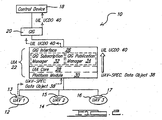
- FIG. 1 is a schematic diagram of a preferred embodiment of a forward/command link of a UAV communication system according to the principles of the present invention
- FIG. 1A is a schematic diagram of one embodiment of a user control device according to the principles of the present invention.
- FIG. 2 is a schematic diagram of the system of FIG. 1 being used to form a return/data link for a UAV communication system;
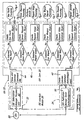
- FIG. 3 is a command process flowchart of a UAV communication system according to the principles of the present invention.
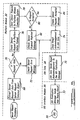
- FIG. 4 is a New Route sub-chart for the command process flowchart of FIG. 3 ;
- FIG. 5 is a Sensor Request sub-chart for the command process flowchart of FIG. 3 ;
- FIG. 6 is an Image Request sub-chart for the command process flowchart of FIG. 3 ;
- FIG. 7 is a Drop Weapon Request sub-chart for the command process flowchart of FIG. 3 ;
- FIG. 8 is a Video Request sub-chart for the command process flowchart of FIG. 3 ;
- FIG. 9 is a Jammer Request sub-chart for the command process flowchart of FIG. 3 .
- a system 10 in accordance with a preferred embodiment of the present invention implements a forward/command link communication system, which provides synchronous control for a plurality of Unmanned Air Vehicles (UAVs) 12, 14, 16.
- Control device 18 is in communication with Global Information Grid (GIG) 20 via any means well known in the art, including a wireless connection.
- GIG 20 is in further communication with a translating subsystem commonly known as an Unmanned Air Vehicle “Interoperability Agent" (UIA) 22.
- UAV Unmanned Air Vehicle
- UIA 22 communicates with the plurality of UAVs 12, 14, 16.
- UAVs 12, 14, 16 are shown, it is to be understood that any number of UAVs may be in communication with UIA 22 without being beyond the scope of the present invention.
- the universal commands and data which are sent between control device 18 and UAVs 12, 14, 16 are in accordance with a UAV Interoperability Language (UIL).
- UIL is comprised of UIL Common Commands (UCCs) and UIL Common Data Objects (UCDOs).
- UCCs generally represent commands, while UCDOs represent data.
- the UIL provides a common means of communication between the user and the plurality of various UAV platforms and configurations so that various commands and data are communicated in a synchronized fashion, without interference or confusion between the various UAVs 12, 14 and 16.
- UCCs and UCDOs may be transmitted in either direction between control device 18 and UAVs 12, 14, 16.
- UCCs may also be transmitted from UAVs 12, 14, 16 to control device 18 as necessary for communication and coordination of UAVs 12, 14, 16.
- UCDO transmission may be transmitted from UAVs 12, 14, 16 to control device 18
- UCCs and UCDOs will generally be transmitted back and forth between control device 18 and UAVs 12, 14, 16, and are not limited to being transmitted solely in the directions specifically described herein.
- a user interfaces with control device 18 to input a command intended for one or more of the UAVs 12, 14, 16.
- This command may be any kind of command typically associated with the intended UAV platforms, such as a Sensor Request, Drop Weapon Request, or instruction to fly to a given location.
- Control device 18 subsequently sends this command to the UIA 22 in the form of a UIL Common Command (UCC).
- UICC UIL Common Command
- Control device 18 which converts a readable text command into UCC 24 is shown.
- Control device 18 is comprised of user input 18a and UCC XML Code Reader/Writer 19.
- a system of UCC's which define the commands for the UAV system are preferably initially specified in an Industry Open XML Schema, which is input to, as an example, a Java JAXB code generator 19a. Java code that can create the predetermined number of UCC's from each readable text input is thus generated by Java JAXB schema generator 19a, and this code is input to the UCC XML Code Reader/Writer 19.
- Java JAXB code generator 19a may be disconnected once UCC XML Code Rerader/Writer 19 has been programmed with the java code. To execute a command, UCC XML Code Writer/Reader 19 generates UCC 24 from the readable text input from control device 18, using the java code. UCC 24 is then published to GIG 20.
- UIA 22 is comprised of a GIG interface 26, UIA core 28, and platform module 30.
- GIG interface 26 is in direct communication with GIG 20 so as to be able to communicate commands and data bi-directionally between the GIG 20 and the GIG interface 26.
- GIG interface 26 is comprised of GIG subscription manager 32, which accesses data provided to GIG 20, and GIG publication manager 34, which publishes data to GIG 20 for communication to the user.
- GIG interface 26 allows for UIA 22 to be deployed in a variety of geographical locations where access to the GIG 20 is possible.
- UIA 22 facilitates the exchange of commands and data between GIG 20 and the UAVs 12, 14, 16.
- the general methodology will now be first explained, with specific command examples following thereafter.
- UCC 24 is received at GIG interface 26 and sent to UIA core 28.
- UIA core 28 coordinates all activities of UIA 22 and handles all interactions between GIG interface 26 and platform module 30. As such, UIA core 28 sends UCC 24 to platform module 30.
- Platform module 30 is configured to communicate with the one or more UAV platforms to which a particular UIA 22 is connected. Platform module 30 handles the transmission of information in the form of UCC 24, as an example, between UIA 22 and UAVs 12, 14, 16. Platform module 30 also allows for the physical or network connection between UIA 22 and UAVs 12, 14, 16. Once platform module 30 receives UCC 24, it converts or translates UCC 24 into one or more UAV-specific commands 36, which can be understood by UAVs 12, 14, 16.
- UAVs 12, 14, 16 may be configured differently or have different native languages, the conversion of UCC 24 to UAV-specific command 36 may be different for each of UAVs 12, 14, 16.
- UAV-specific command 36 is subsequently sent to a platform mission execution system 13, 15, 17 of UAVs 12, 14, 16, respectively. This transmission can be accomplished via a data link such as a wireless or network connection, or any other means convenient for sending data from UIA 22 to UAVs 12, 14, 16.
- Platform mission execution system 13, 15, 17 may be comprised of autonomous software onboard a complex UAV, or an operator station for a UAV that is primarily manually commanded by a user or command personnel.
- the various UAVs 12, 14, 16 thus receive and carry out UAV-specific command 36.
- UCC 24 By converting UCC 24 into UAV-specific command 36, the various platforms and configurations of UAVs 12, 14, 16 can uniformly understand and synchronously carry out the commands of the user or military personnel.
- the return/data communication operation provides, in addition to the control functions described above, a synchronized manner of assembling and collecting various data from the UAVs 12, 14, 16.
- the UAVs 12, 14, 16 collect data and carry out commands according to the instructions provided by the user or command personnel, as described above. As these commands are carried out, UAVs 12, 14, 16 will collect data as the subject of those commands in the form of UAV-specific data objects 38. UAV-specific data objects 38 are generally in a format specific to each of the plurality of UAVs 12, 14, 16. In addition, UAVs 12, 14, 16 otherwise communicate with the user or command personnel in the form of UCCs or UCDOs in response to commands sent to UAVs 12, 14, 16 through the forward/command link operation illustrated in FIG. 1 as described above.
- the UAVs 12, 14, 16 forward each UAV-specific data object 38 to UIA 22, where it is received at platform module 30.
- Platform module 30 converts or translates UAV-specific data object 38 from platform mission execution system 13, 15, 17 into a UAV interoperability language Uniform Common Data Object (UCDO) 40.
- Platform module 30 subsequently sends UCDO 40 to UIA core 28, which forwards UCDO 40 to GIG interface 26.
- GIG interface 26 forwards UCDO 40 to GIG 20 by way of GIG publication manager 34.
- GIG 20 subsequently forwards UCDO 40 to control device 18 for interpretation by the user or command personnel.
- UCDO Uniform Common Data Object
- UIA 22 thus provides for the translation of UCCs 24 and UCDOs 40 between the control device 18 and the UAVs 12, 14, 16, such that the variety of configurations of UAVs can be synchronously deployed by a user or command personnel.
- UIA 22 converts all UAV-specific language objects to common language objects such that a single user can assimilate the various actions and reports of the UAVs 12, 14, 16.
- UIA 22 can be used to distribute any type of command or data that could be associated with UAVs 12, 14, 16. Examples of several commands are provided herein, but are not to be construed as limiting the scope of the invention solely to the examples provided.
- UCC 24 is first sent to GIG 20 as described above, and is then forwarded on to GIG interface 26. As shown at operation 42, UCC 24 is received by GIG subscription manager 32 within GIG interface 26. UCC 24 is then forwarded on to UIA core 28, which parses UCC 24 at operation 44. Once UCC 24 is parsed it is sent along to an internal command query 46 where a series of decision operations determine what command is to be processed. Any number of commands typically carried out by a UAV may be part of internal command query 46, and the examples provided herein are not to be construed as limiting the scope of the present invention.
- Internal command query 46 is shown as having a first query for a New Route command. If the answer is positive (i.e., UCC 24 relates to a command for a new route for the UAV), a new UCDO 40' is sent along to platform module 30 for distribution to the plurality of UAVs 12, 14, 16. If the answer is negative, the next command is queried, until a positive answer is found. Should all command queries be negative, UIA core 28 creates an Unknown Command acknowledgement at operation 48, and GIG publication manager 34 publishes the acknowledgement for GIG 20 at operation 50. Virtually any form of command may be used with the UAVs 12, 14, 16.
- FIG. 4 a New Route sub-chart for the command process flowchart of FIG. 3 is illustrated. Whenever a New Route UCDO 40' is created by UIA 22 (see FIG. 3 ), it is forwarded on to the platform module 30 as described above. The waypoint is first extracted from UCDO 40' at operation 52, and is then converted to a UAV-specific format at operation 54.
- platform module 30 forwards the waypoints to the platform mission execution system(s) of the relevant UAV(s) at operation 58.
- the command can thus be coordinated amongst a plurality of different UAV configurations.
- query operation 60 checks whether the new route is accepted by the UAV 12. Thus, if the UAV 12 is disabled or otherwise unavailable, the route will not be accepted, and a rejection message is created at operation 62. On the other hand, if UAV 12 is available and ready, an acceptance message is created at operation 64. Either acknowledgement is forwarded back to UIA core 28 at operation 65. UIA core 28 then sends the acknowledgement to GIG publication manager 34 at operation 66. The acknowledgement is subsequently published for GIG 20 for the user or command personnel at operation 67.
- FIG. 5 a Sensor Request sub-chart for the command process flowchart of FIG. 3 is illustrated.
- the Sensor Request query returns a positive result at internal command query 46 (see FIG. 3 )
- the data for the sensor request is extracted from UCDO 40 at operation 68.
- the request is first validated at operation 70. If the request is found invalid (for example, the request was improperly formatted or unclearly transmitted), a sensor request error message is created at operation 72. This result is then forwarded back to UIA. core 28 at operation 74.
- UIA core 28 forwards this acknowledgement to GIG publication manager 34 of GIG interface 26 at operation 75.
- GIG publication manager 34 then publishes the acknowledgement to GIG 20 at operation 77.
- the sensor request is created in the native format of the relevant UAV(s) 12, 14, 16 (see FIGS. 1 , 2 ), as shown at operation 76, and sent to the platform mission execution system(s) of the relevant UAV(s) 12, 14, 16 ( FIGS. 1 , 2 ) as shown at operation 78.
- the acceptance of the request is then verified at operation 80, forwarding either a request rejection message (if the UAV(s) 12, 14, 16 ( FIGS. 1 , 2 ) are inoperable or otherwise unavailable) at operation 82 or a request accepted message at operation 84.
- This result acknowledgement is then published on GIG 20 as described above for the request invalidity message.
- an Image Request sub-chart for the command process flowchart of FIG. 3 is shown.
- an extract image data request common object is created and sent to platform module 30.
- Operation 85 extracts several parameters of data from the extract image data request common object.
- Operation 86 subsequently queries whether the request is valid (i.e., whether the relevant UAV has the requisite image capability). If the request is invalid, an invalid image request error message is created at operation 88, which is sent to UIA core 28 at operation 90.
- UIA core 28 forwards this error message to GIG publication manager 34 at operation 92, which sends the error message to GIG 20 at operation 94.
- platform module 30 next queries whether the image target is within range of the relevant UAV platform at operation 96. If not, a Target Out Of Range message is created at operation 98 and forwarded to GIG 20 in the same manner as the invalid image request message described above. If the target is determined to be in range, an image request is created in the native format of the relevant UAV platform at operation 100. This image request is forwarded on to the platform mission execution system(s) of the relevant UAV(s) 12, 14, 16 (see FIGS. 1 , 2 ) at operation 102. Operation 104 then queries whether the request is accepted by the relevant UAV.
- an image request rejection message is created at operation 106 and forwarded back to GIG 20 in the same manner as the invalid image request message. If instead the image request is accepted, an image acceptance message is created at operation 108, and forwarded to GIG 20 in the same manner as the other data described in this paragraph.
- FIG. 7 a Drop Weapon Request sub-chart for the command process flowchart of FIG. 3 is shown.
- a Drop Weapon Request common object is created and sent to platform module 30.
- platform module 30 receives the common object, the target data is extracted from the common object at operation 110.
- An authorization query is made at operation 112, which checks the common object for proper security protocols. If the common object fails this query, an unauthorized error message is created at operation 114 and sent to UIA core 28 at operation 116.
- UIA core 28 forwards a result acknowledgement to GIG publication manager 34 at operation 118, and GIG publication manager 34 subsequently publishes a Drop Weapon request result to GIG 20 at operation 120. If the Drop Weapon common object meets security protocol, on the other hand, a weapon type validity query is next performed on the Drop Weapon common object at operation 121. A negative result forces a weapon invalid type error message at operation 122, which is forwarded to GIG 20 in the manner described above regarding the authorization query. A positive reply results in a weapons remaining query at operation 124, which checks the inventory of the relevant UAV(s) 12, 14, 16 (see FIGS. 1 , 2 ) for the proper number of weapons requested.
- a negative result creates a Weapon Not Available error message at operation 126, which is published to GIG 20 in the same manner as the other drop weapon messages discussed above.
- a positive reply results in a Target Within Range query at operation 128.
- a negative result for this query results in the creation of a Target Out Of Range error message at operation 130, which is published to GIG 20 in the same manner as the other drop weapon messages discussed above.
- a positive result forces a Weapon Drop Request created in the UAV platform-specific format at operation 132, which is forwarded to the platform mission execution system(s) of the relevant UAV(s) 12, 14, 16 ( FIGS. 1 , 2 ) at operation 134.
- a request acceptance query is then performed at operation 135. If the request is accepted by the relevant UAV(s) 12, 14, 16 ( FIGS.
- a Drop Weapon Request acceptance message is created at operation 136, and forwarded back to GIG 20. If the request is rejected (i.e., malfunction or other inability of UAV(s) 12, 14, 16 ( FIGS. 1 , 2 ) to complete the requested command), a Drop Weapon Request Rejected message is created at operation 138, which is published to GIG 20 is the manner described above.
- FIG. 8 a Video Request sub-chart for the command process flowchart of FIG. 3 is shown.
- a Video Request common object is created and sent to platform module 30.
- platform module 30 receives the common object, the video request data is extracted from the common object at operation 140.
- a video capability query is made at operation 142 that checks the video capability of the relevant UAV(s) 12, 14, 16 (see FIGS. 1 , 2 ) and compares with the common object data. If the common object fails this query, a No Video error message is created at operation 144 and sent to UIA core 28 at operation 146.
- UIA core 28 forwards a result acknowledgement to GIG publication manager 34 at operation 148, and GIG publication manager 34 subsequently sends a video request result to GIG 20 at operation 150.
- a Video Target Range query is next performed on the Video Request common object at operation 151.
- a negative result forces a Video Target Not Reachable error message at operation 152, which is forwarded to GIG 20 in the manner described above regarding the video availability query.
- a positive result forces a video request to be created in the UAV platform-specific format at operation 154, which is forwarded to the platform mission execution system(s) of the relevant UAV(s) 12, 14, 16 ( FIGS. 1 , 2 ) at operation 156.
- a request acceptance query is then performed at operation 157.
- a Video Request acceptance message is created at operation 158, and forwarded back to GIG 20. If the request is rejected (i.e., malfunction or other inability of UAV(s) 12, 14, 16 ( FIGS. 1 , 2 ) to complete the requested command), a Video Request Rejected message is created at operation 160 that is forwarded to GIG 20 in the manner described above.
- FIG. 9 a Jammer Request sub-chart for the command process flowchart of FIG. 3 is shown.
- a Jammer Request common object is created and sent to platform module 30.
- the jammer request data is extracted from the common object at operation 162.
- An authorization query is made at operation 164 that checks the common object for proper security protocols. If the common object fails this query, an unauthorized error message is created at operation 166, and sent to UIA core 28 at operation 168.
- UIA core 28 forwards a result acknowledgement to GIG publication manager 34 at operation 170, and GIG publication manager 34 subsequently sends a Jammer Request result to GIG 20 at operation 172.
- a jammer capability query is next performed on the Jammer Request common object at operation 173.
- a negative result i.e., no jammer capability is available from the relevant UAV(s) 12, 14, 16 (see FIGS. 1 , 2 )
- a positive result forces a Jammer Request to be created in the UAV platform-specific format at operation 176.
- a time period for the jammer is set at operation 178, depending on the data extracted from the Jammer Request common object.
- the jammer request is then forwarded to the platform mission execution system(s) of the relevant UAV(s) 12, 14, 16 ( FIGS. 1 , 2 ) at operation 180.
- a request acceptance query is then forced at operation 182. If the request is accepted by the relevant UAV, a Jammer Request Acceptance message is created at operation 186, and forwarded back to GIG 20. If the request is rejected (i.e., malfunction or other inability of UAV to complete the requested command), a Jammer Request Rejected message is created at operation 184, which is published to GIG 20 in the manner described above.
Landscapes
- Engineering & Computer Science (AREA)
- Computer Networks & Wireless Communication (AREA)
- Signal Processing (AREA)
- Mobile Radio Communication Systems (AREA)
- Data Exchanges In Wide-Area Networks (AREA)
- Computer And Data Communications (AREA)
Abstract
Description
- The present invention relates to aircraft communication systems, and, more particularly, to a communication system for controlling unmanned aircraft vehicles.
- A variety of Unmanned Air Vehicles (UAVs) have been developed by the United States and international partner militaries, with more currently under development. These diverse systems range from reconnaissance planes to combat-ready sensor and weapons platforms, and are being developed by various defense contractors and manufacturers. These UAVs have the potential to revolutionize defense measures by providing low cost means for carrying out military action without risking troops or aircrews.
- These various and diverse UAVs must be integrated with each other in order to provide synchronized responses to the commands of military personnel. This is problematic due to the many different types of UAVs, and the number of manufacturers involved with producing these UAVs. The multitude of UAV configurations requires a method for communicating swiftly in a coordinated manner with the military personnel in control of the UAVs, and with each other.
- As such, there is a need in the relevant art to provide a method of communicating with and coordinating the actions of military fleets comprised of UAVs having multiple and diverse configurations.
- The present invention relates to a method and apparatus for communicating with and receiving data from a plurality of UAVs in a coordinated manner. Further, a common language is provided which allows for communication between the various types and configurations of unmanned air vehicles and a single user or command personnel: A control device is provided for the user or command personnel. The control device is in communication with an interoperability agent, which is in further communication with the plurality of UAVs.
- In one preferred implementation, the user enters a common command, which is part of a common command language, to be carried out by the UAVs into the control device. These common commands may cover a wide variety of standard tasks for the plurality of UAVs, such as flying to a specific location, or utilizing weapons, sensors, or any other devices that may be aboard the UAV. The control device then forwards the common command to the interoperability agent. The standardized common commands are helpful due to the wide variety of platforms produced by the various UAV manufacturers. The interoperability agent then converts the common command to a UAV-specific command, and forwards the command to the proper UAV(s).
- Data is transmitted from the UAV to the user in a similar fashion. The UAV first transmits a UAV-specific data object back to the interoperability agent. This UAV-specific data object may be data from the UAV requested by the user, a confirmation of commands the user sent to the UAV, or any other data that may be necessary for the UAV to transmit to the user. The interoperability agent converts the UAV-specific data object to a common language data object which can be understood by the control device and, subsequently, the user. The interoperability agent then forwards the converted data object to the control device for collection and interpretation by the user.
- The present invention will become more fully understood from the detailed description and the accompanying drawings, wherein:
-
FIG. 1 is a schematic diagram of a preferred embodiment of a forward/command link of a UAV communication system according to the principles of the present invention; -
FIG. 1A is a schematic diagram of one embodiment of a user control device according to the principles of the present invention; -
FIG. 2 is a schematic diagram of the system ofFIG. 1 being used to form a return/data link for a UAV communication system; -
FIG. 3 is a command process flowchart of a UAV communication system according to the principles of the present invention; -
FIG. 4 is a New Route sub-chart for the command process flowchart ofFIG. 3 ; -
FIG. 5 is a Sensor Request sub-chart for the command process flowchart ofFIG. 3 ; -
FIG. 6 is an Image Request sub-chart for the command process flowchart ofFIG. 3 ; -
FIG. 7 is a Drop Weapon Request sub-chart for the command process flowchart ofFIG. 3 ; -
FIG. 8 is a Video Request sub-chart for the command process flowchart ofFIG. 3 ; and -
FIG. 9 is a Jammer Request sub-chart for the command process flowchart ofFIG. 3 . - The following description of the preferred embodiment(s) is merely exemplary in nature and is in no way intended to limit the invention, its application, or uses.
- With reference to
FIG. 1 , asystem 10 in accordance with a preferred embodiment of the present invention is shown. Thesystem 10 inFIG. 1 implements a forward/command link communication system, which provides synchronous control for a plurality of Unmanned Air Vehicles (UAVs) 12, 14, 16.Control device 18 is in communication with Global Information Grid (GIG) 20 via any means well known in the art, including a wireless connection. GIG 20 is in further communication with a translating subsystem commonly known as an Unmanned Air Vehicle "Interoperability Agent" (UIA) 22. UIA 22, in turn, communicates with the plurality ofUAVs UAVs - The universal commands and data which are sent between
control device 18 andUAVs various UAVs control device 18 andUAVs control device 18 toUAVs UAVs device 18 as necessary for communication and coordination ofUAVs UAVs device 18, UCDOs may be transmitted fromcontrol device 18 toUAVs control device 18 andUAVs - A user (not shown) interfaces with
control device 18 to input a command intended for one or more of theUAVs Control device 18 subsequently sends this command to the UIA 22 in the form of a UIL Common Command (UCC). - Turning to
FIG. 1A , one embodiment ofcontrol device 18 which converts a readable text command intoUCC 24 is shown.Control device 18 is comprised ofuser input 18a and UCC XML Code Reader/Writer 19. A system of UCC's which define the commands for the UAV system are preferably initially specified in an Industry Open XML Schema, which is input to, as an example, a Java JAXB code generator 19a. Java code that can create the predetermined number of UCC's from each readable text input is thus generated by Java JAXB schema generator 19a, and this code is input to the UCC XML Code Reader/Writer 19. Java JAXB code generator 19a may be disconnected once UCC XML Code Rerader/Writer 19 has been programmed with the java code. To execute a command, UCC XML Code Writer/Reader 19 generates UCC 24 from the readable text input fromcontrol device 18, using the java code. UCC 24 is then published to GIG 20. - UIA 22 is comprised of a
GIG interface 26, UIAcore 28, andplatform module 30.GIG interface 26 is in direct communication withGIG 20 so as to be able to communicate commands and data bi-directionally between theGIG 20 and theGIG interface 26.GIG interface 26 is comprised ofGIG subscription manager 32, which accesses data provided to GIG 20, andGIG publication manager 34, which publishes data to GIG 20 for communication to the user.GIG interface 26 allows forUIA 22 to be deployed in a variety of geographical locations where access to theGIG 20 is possible. - Generally,
UIA 22 facilitates the exchange of commands and data betweenGIG 20 and theUAVs -
UCC 24 is received atGIG interface 26 and sent toUIA core 28.UIA core 28 coordinates all activities ofUIA 22 and handles all interactions betweenGIG interface 26 andplatform module 30. As such,UIA core 28 sendsUCC 24 toplatform module 30.Platform module 30 is configured to communicate with the one or more UAV platforms to which aparticular UIA 22 is connected.Platform module 30 handles the transmission of information in the form ofUCC 24, as an example, betweenUIA 22 andUAVs Platform module 30 also allows for the physical or network connection betweenUIA 22 andUAVs platform module 30 receivesUCC 24, it converts or translatesUCC 24 into one or more UAV-specific commands 36, which can be understood byUAVs UAVs UCC 24 to UAV-specific command 36 may be different for each ofUAVs specific command 36 is subsequently sent to a platformmission execution system UAVs UIA 22 toUAVs mission execution system - The
various UAVs specific command 36. By convertingUCC 24 into UAV-specific command 36, the various platforms and configurations ofUAVs - Turning now to
FIG. 2 , thesystem 10 is illustrated implementing a return/data link communication operation. The return/data communication operation provides, in addition to the control functions described above, a synchronized manner of assembling and collecting various data from theUAVs - The
UAVs UAVs UAVs UAVs UAVs FIG. 1 as described above. - In this example, the
UAVs UIA 22, where it is received atplatform module 30.Platform module 30 converts or translates UAV-specific data object 38 from platformmission execution system Platform module 30 subsequently sends UCDO 40 toUIA core 28, which forwards UCDO 40 to GIGinterface 26.GIG interface 26 forwards UCDO 40 to GIG 20 by way ofGIG publication manager 34.GIG 20 subsequently forwards UCDO 40 to controldevice 18 for interpretation by the user or command personnel. -
UIA 22 thus provides for the translation ofUCCs 24 andUCDOs 40 between thecontrol device 18 and theUAVs UIA 22 converts all UAV-specific language objects to common language objects such that a single user can assimilate the various actions and reports of theUAVs -
UIA 22 can be used to distribute any type of command or data that could be associated withUAVs - Turning now to
FIG. 3 , an exemplary command process flowchart of a UAV communication system according to the principles of the present invention is illustrated.UCC 24 is first sent to GIG 20 as described above, and is then forwarded on to GIGinterface 26. As shown atoperation 42,UCC 24 is received byGIG subscription manager 32 withinGIG interface 26.UCC 24 is then forwarded on toUIA core 28, which parsesUCC 24 atoperation 44. OnceUCC 24 is parsed it is sent along to aninternal command query 46 where a series of decision operations determine what command is to be processed. Any number of commands typically carried out by a UAV may be part ofinternal command query 46, and the examples provided herein are not to be construed as limiting the scope of the present invention. Each possible command is queried sequentially, in any order as may be determined beneficial.Internal command query 46 is shown as having a first query for a New Route command. If the answer is positive (i.e.,UCC 24 relates to a command for a new route for the UAV), anew UCDO 40' is sent along toplatform module 30 for distribution to the plurality ofUAVs UIA core 28 creates an Unknown Command acknowledgement atoperation 48, andGIG publication manager 34 publishes the acknowledgement forGIG 20 atoperation 50. Virtually any form of command may be used with theUAVs - In further explanation of the command examples that are provided, sub-charts of these commands are provided to explain the interaction of a UIA with a plurality of
UAVs FIGS. 1 ,2 ) with more specificity. Turning toFIG. 4 , a New Route sub-chart for the command process flowchart ofFIG. 3 is illustrated. Whenever aNew Route UCDO 40' is created by UIA 22 (seeFIG. 3 ), it is forwarded on to theplatform module 30 as described above. The waypoint is first extracted fromUCDO 40' atoperation 52, and is then converted to a UAV-specific format atoperation 54. After more waypoints are queried atquery operation 56,platform module 30 forwards the waypoints to the platform mission execution system(s) of the relevant UAV(s) atoperation 58. The command can thus be coordinated amongst a plurality of different UAV configurations. After sending the waypoint data,query operation 60 checks whether the new route is accepted by theUAV 12. Thus, if theUAV 12 is disabled or otherwise unavailable, the route will not be accepted, and a rejection message is created atoperation 62. On the other hand, ifUAV 12 is available and ready, an acceptance message is created atoperation 64. Either acknowledgement is forwarded back toUIA core 28 atoperation 65.UIA core 28 then sends the acknowledgement to GIGpublication manager 34 atoperation 66. The acknowledgement is subsequently published forGIG 20 for the user or command personnel atoperation 67. - Turning now to
FIG. 5 , a Sensor Request sub-chart for the command process flowchart ofFIG. 3 is illustrated. Once the Sensor Request query returns a positive result at internal command query 46 (seeFIG. 3 ), the data for the sensor request is extracted fromUCDO 40 atoperation 68. The request is first validated atoperation 70. If the request is found invalid (for example, the request was improperly formatted or unclearly transmitted), a sensor request error message is created atoperation 72. This result is then forwarded back to UIA.core 28 atoperation 74.UIA core 28 forwards this acknowledgement to GIGpublication manager 34 ofGIG interface 26 atoperation 75.GIG publication manager 34 then publishes the acknowledgement to GIG 20 atoperation 77. If the request is valid, then the sensor request is created in the native format of the relevant UAV(s) 12, 14, 16 (seeFIGS. 1 ,2 ), as shown atoperation 76, and sent to the platform mission execution system(s) of the relevant UAV(s) 12, 14, 16 (FIGS. 1 ,2 ) as shown atoperation 78. The acceptance of the request is then verified atoperation 80, forwarding either a request rejection message (if the UAV(s) 12, 14, 16 (FIGS. 1 ,2 ) are inoperable or otherwise unavailable) atoperation 82 or a request accepted message atoperation 84. This result acknowledgement is then published onGIG 20 as described above for the request invalidity message. - Turning now to
FIG. 6 , an Image Request sub-chart for the command process flowchart ofFIG. 3 is shown. Once the Image Request query returns a positive result at internal command query 46 (seeFIG. 3 ), an extract image data request common object is created and sent toplatform module 30.Operation 85 extracts several parameters of data from the extract image data request common object.Operation 86 subsequently queries whether the request is valid (i.e., whether the relevant UAV has the requisite image capability). If the request is invalid, an invalid image request error message is created atoperation 88, which is sent toUIA core 28 atoperation 90.UIA core 28 forwards this error message to GIGpublication manager 34 atoperation 92, which sends the error message to GIG 20 atoperation 94. If, on the other hand, the request is valid,platform module 30 next queries whether the image target is within range of the relevant UAV platform atoperation 96. If not, a Target Out Of Range message is created atoperation 98 and forwarded to GIG 20 in the same manner as the invalid image request message described above. If the target is determined to be in range, an image request is created in the native format of the relevant UAV platform atoperation 100. This image request is forwarded on to the platform mission execution system(s) of the relevant UAV(s) 12, 14, 16 (seeFIGS. 1 ,2 ) atoperation 102.Operation 104 then queries whether the request is accepted by the relevant UAV. If not, an image request rejection message is created atoperation 106 and forwarded back toGIG 20 in the same manner as the invalid image request message. If instead the image request is accepted, an image acceptance message is created atoperation 108, and forwarded to GIG 20 in the same manner as the other data described in this paragraph. - Turning now to
FIG. 7 , a Drop Weapon Request sub-chart for the command process flowchart ofFIG. 3 is shown. Once the Drop Weapon Request query returns a positive result at internal command query 46 (seeFIG. 3 ), a Drop Weapon Request common object is created and sent toplatform module 30. Onceplatform module 30 receives the common object, the target data is extracted from the common object atoperation 110. An authorization query is made atoperation 112, which checks the common object for proper security protocols. If the common object fails this query, an unauthorized error message is created atoperation 114 and sent toUIA core 28 atoperation 116.UIA core 28 forwards a result acknowledgement to GIGpublication manager 34 atoperation 118, andGIG publication manager 34 subsequently publishes a Drop Weapon request result to GIG 20 atoperation 120. If the Drop Weapon common object meets security protocol, on the other hand, a weapon type validity query is next performed on the Drop Weapon common object atoperation 121. A negative result forces a weapon invalid type error message atoperation 122, which is forwarded to GIG 20 in the manner described above regarding the authorization query. A positive reply results in a weapons remaining query atoperation 124, which checks the inventory of the relevant UAV(s) 12, 14, 16 (seeFIGS. 1 ,2 ) for the proper number of weapons requested. A negative result creates a Weapon Not Available error message atoperation 126, which is published to GIG 20 in the same manner as the other drop weapon messages discussed above. A positive reply results in a Target Within Range query atoperation 128. A negative result for this query results in the creation of a Target Out Of Range error message atoperation 130, which is published to GIG 20 in the same manner as the other drop weapon messages discussed above. A positive result forces a Weapon Drop Request created in the UAV platform-specific format atoperation 132, which is forwarded to the platform mission execution system(s) of the relevant UAV(s) 12, 14, 16 (FIGS. 1 ,2 ) atoperation 134. A request acceptance query is then performed atoperation 135. If the request is accepted by the relevant UAV(s) 12, 14, 16 (FIGS. 1 ,2 ), a Drop Weapon Request acceptance message is created atoperation 136, and forwarded back toGIG 20. If the request is rejected (i.e., malfunction or other inability of UAV(s) 12, 14, 16 (FIGS. 1 ,2 ) to complete the requested command), a Drop Weapon Request Rejected message is created atoperation 138, which is published to GIG 20 is the manner described above. - Turning now to
FIG. 8 , a Video Request sub-chart for the command process flowchart ofFIG. 3 is shown. Once the Video Request query returns a positive result at internal command query 46 (seeFIG. 3 ), a Video Request common object is created and sent toplatform module 30. Onceplatform module 30 receives the common object, the video request data is extracted from the common object atoperation 140. A video capability query is made atoperation 142 that checks the video capability of the relevant UAV(s) 12, 14, 16 (seeFIGS. 1 ,2 ) and compares with the common object data. If the common object fails this query, a No Video error message is created atoperation 144 and sent toUIA core 28 atoperation 146.UIA core 28 forwards a result acknowledgement to GIGpublication manager 34 atoperation 148, andGIG publication manager 34 subsequently sends a video request result to GIG 20 atoperation 150. If the requested video capability is available, on the other hand, a Video Target Range query is next performed on the Video Request common object atoperation 151. A negative result forces a Video Target Not Reachable error message atoperation 152, which is forwarded to GIG 20 in the manner described above regarding the video availability query. A positive result forces a video request to be created in the UAV platform-specific format atoperation 154, which is forwarded to the platform mission execution system(s) of the relevant UAV(s) 12, 14, 16 (FIGS. 1 ,2 ) atoperation 156. A request acceptance query is then performed at operation 157. If the request is accepted by the relevant UAV(s) 12, 14, 16 (FIGS. 1 ,2 ), a Video Request acceptance message is created atoperation 158, and forwarded back toGIG 20. If the request is rejected (i.e., malfunction or other inability of UAV(s) 12, 14, 16 (FIGS. 1 ,2 ) to complete the requested command), a Video Request Rejected message is created atoperation 160 that is forwarded to GIG 20 in the manner described above. - Turning now to
FIG. 9 , a Jammer Request sub-chart for the command process flowchart ofFIG. 3 is shown. Once the Jammer Request query returns a positive result at internal command query 46 (seeFIG. 3 ), a Jammer Request common object is created and sent toplatform module 30. Onceplatform module 30 receives the common object, the jammer request data is extracted from the common object atoperation 162. An authorization query is made atoperation 164 that checks the common object for proper security protocols. If the common object fails this query, an unauthorized error message is created atoperation 166, and sent toUIA core 28 atoperation 168.UIA core 28 forwards a result acknowledgement to GIGpublication manager 34 atoperation 170, andGIG publication manager 34 subsequently sends a Jammer Request result to GIG 20 atoperation 172. If the Jammer Request common object meets security protocol, on the other hand, a jammer capability query is next performed on the Jammer Request common object atoperation 173. A negative result (i.e., no jammer capability is available from the relevant UAV(s) 12, 14, 16 (seeFIGS. 1 ,2 )) forces a Jammer Capability Not Available error message atoperation 174, which is forwarded to GIG 20 in the manner described above regarding the jammer authorization query. A positive result forces a Jammer Request to be created in the UAV platform-specific format atoperation 176. A time period for the jammer is set atoperation 178, depending on the data extracted from the Jammer Request common object. The jammer request is then forwarded to the platform mission execution system(s) of the relevant UAV(s) 12, 14, 16 (FIGS. 1 ,2 ) atoperation 180. A request acceptance query is then forced atoperation 182. If the request is accepted by the relevant UAV, a Jammer Request Acceptance message is created atoperation 186, and forwarded back toGIG 20. If the request is rejected (i.e., malfunction or other inability of UAV to complete the requested command), a Jammer Request Rejected message is created atoperation 184, which is published to GIG 20 in the manner described above.
Claims (9)
- A method for communicating between one as a plurality of mobile platforms (12, 14, 16) having different communication languages and a remote system (18), comprising:generating a packet of mobile platform specific information (38) at said mobile platform (12, 14, 16);sending said packet of mobile platform specific information (38) from said mobile platform (12, 14, 16) to an intermediate translating subsystem (22);using said intermediate translating subsystem (22) to convert said packet of mobile platform specific information (38) to a packet of common language information (40) understandable by said remote system (18); andsending said packet of common language information (40) from said intermediate translating subsystem (22) to said remote system (18).
- The method of claim 1, further comprising using the remote system (18) to generate information (24) that is transmitted to, and converted by, said intermediate translating system (22), into an additional packet of mobile platform specific information (36) understandable by said mobile platform (12, 14, 16).
- The method of claim 2, wherein generating said mobile platform information (24) comprises generating at least one of a common language command and common language data.
- The method of claim 2, wherein said additional packet of mobile platform specific information (36) instructs said mobile platform (12, 14, 16) to fly to a predetermined location.
- The method of claim 1, wherein generating said packet of mobile platform specific information (38) comprises generating sensor data collected by said mobile platform (12, 14, 16).
- The method of claim 1, further comprising using said remote system (18) to generate an initial packet of mobile platform specific information (24) that instructs said mobile platform (12, 14, 16) to send said packet of mobile platform specific information (38) to said intermediate translating subsystem (22), said packet of mobile platform specific information (38) comprising image data collected by said mobile platform (12, 14, 16).
- The method of claim 1, further comprising using said remote system (18) to generate an initial packet of mobile platform specific information (24) that instructs said mobile platform (12, 14, 16) to send said packet of mobile platform specific information (38) to said intermediate translating subsystem (22), said packet of mobile platform specific information (38) comprising video data collected by said mobile platform (12, 14, 16).
- The method of claim 1, further comprising using said remote system (18) to generate an initial packet of mobile platform specific information (24) that instructs said mobile platform (12, 14, 16) to initiate an electromagnetic jamming signal from said mobile platform (12, 14, 16).
- A system (22) for enabling communication between a user and a plurality of mobile platforms (12, 14, 16) operating with differing communication languages, the system (22) comprising:an information network interface (26) in communication with a universal information network (20) at one of a plurality of connection points associated with said universal information network, said universal information network (20) adapted for transmitting information from the user to said information network interface (26);a translating subsystem (28) in communication with said information network interface (26), said translating subsystem (28) adapted for translating said information into mobile platform specific information (36) understandable by at least one of the plurality of mobile platforms (12, 14, 16); anda mobile platform communication module (30) in communication with said translating subsystem (22) and said at least one of the plurality of mobile platforms (12, 14, 16), said mobile platform communication module (30) being adapted for transmitting said mobile platform specific information (36) to said at least one of the plurality of mobile platforms (12, 14, 16).
Applications Claiming Priority (2)
| Application Number | Priority Date | Filing Date | Title |
|---|---|---|---|
| US11/235,625 US20070070894A1 (en) | 2005-09-26 | 2005-09-26 | Method to determine a scheduling priority value for a user data connection based on a quality of service requirement |
| PCT/US2006/035379 WO2007037969A1 (en) | 2005-09-26 | 2006-09-12 | Unmanned air vehicle interoperability agent |
Publications (2)
| Publication Number | Publication Date |
|---|---|
| EP1941334A1 EP1941334A1 (en) | 2008-07-09 |
| EP1941334B1 true EP1941334B1 (en) | 2010-11-10 |
Family
ID=37699381
Family Applications (1)
| Application Number | Title | Priority Date | Filing Date |
|---|---|---|---|
| EP06814471A Active EP1941334B1 (en) | 2005-09-26 | 2006-09-12 | Unmanned air vehicle interoperability agent |
Country Status (7)
| Country | Link |
|---|---|
| US (1) | US20070070894A1 (en) |
| EP (1) | EP1941334B1 (en) |
| CN (1) | CN101273586A (en) |
| DE (1) | DE112006002491T5 (en) |
| GB (3) | GB2465927B (en) |
| TW (1) | TW200715792A (en) |
| WO (2) | WO2007040698A2 (en) |
Cited By (1)
| Publication number | Priority date | Publication date | Assignee | Title |
|---|---|---|---|---|
| RU2457531C1 (en) * | 2011-01-13 | 2012-07-27 | Евгений Владимирович Шароварин | Method of using unmanned aircraft and control apparatus |
Families Citing this family (72)
| Publication number | Priority date | Publication date | Assignee | Title |
|---|---|---|---|---|
| US7218948B2 (en) * | 2003-02-24 | 2007-05-15 | Qualcomm Incorporated | Method of transmitting pilot tones in a multi-sector cell, including null pilot tones, for generating channel quality indicators |
| US9661519B2 (en) * | 2003-02-24 | 2017-05-23 | Qualcomm Incorporated | Efficient reporting of information in a wireless communication system |
| US8811348B2 (en) * | 2003-02-24 | 2014-08-19 | Qualcomm Incorporated | Methods and apparatus for generating, communicating, and/or using information relating to self-noise |
| US9544860B2 (en) * | 2003-02-24 | 2017-01-10 | Qualcomm Incorporated | Pilot signals for use in multi-sector cells |
| CA2582328A1 (en) | 2004-10-14 | 2006-04-27 | Qualcomm Flarion Technologies, Inc. | Methods and apparatus for determining, communicating and using information which can be used for interference control purposes |
| US20060092881A1 (en) * | 2004-10-14 | 2006-05-04 | Rajiv Laroia | Methods and apparatus for determining, communicating and using information which can be used for interference control purposes |
| US8503938B2 (en) | 2004-10-14 | 2013-08-06 | Qualcomm Incorporated | Methods and apparatus for determining, communicating and using information including loading factors which can be used for interference control purposes |
| WO2006109131A2 (en) * | 2005-04-11 | 2006-10-19 | Nokia Corporation, | Method and apparatus to facilitate real-time packet scheduling in a wireless communications system |
| US8989084B2 (en) | 2005-10-14 | 2015-03-24 | Qualcomm Incorporated | Methods and apparatus for broadcasting loading information corresponding to neighboring base stations |
| US9191840B2 (en) * | 2005-10-14 | 2015-11-17 | Qualcomm Incorporated | Methods and apparatus for determining, communicating and using information which can be used for interference control |
| KR100749847B1 (en) * | 2005-11-11 | 2007-08-16 | 한국전자통신연구원 | Forward packet scheduling apparatus and method in base station of portable internet system |
| US20070116007A1 (en) * | 2005-11-18 | 2007-05-24 | Weimin Xiao | Method and system for scheduling and resource allocation in a data communication network |
| US20070149132A1 (en) * | 2005-12-22 | 2007-06-28 | Junyl Li | Methods and apparatus related to selecting control channel reporting formats |
| US9137072B2 (en) * | 2005-12-22 | 2015-09-15 | Qualcomm Incorporated | Methods and apparatus for communicating control information |
| US9148795B2 (en) * | 2005-12-22 | 2015-09-29 | Qualcomm Incorporated | Methods and apparatus for flexible reporting of control information |
| US8514771B2 (en) * | 2005-12-22 | 2013-08-20 | Qualcomm Incorporated | Methods and apparatus for communicating and/or using transmission power information |
| US9125093B2 (en) * | 2005-12-22 | 2015-09-01 | Qualcomm Incorporated | Methods and apparatus related to custom control channel reporting formats |
| US9473265B2 (en) | 2005-12-22 | 2016-10-18 | Qualcomm Incorporated | Methods and apparatus for communicating information utilizing a plurality of dictionaries |
| US9125092B2 (en) * | 2005-12-22 | 2015-09-01 | Qualcomm Incorporated | Methods and apparatus for reporting and/or using control information |
| US9338767B2 (en) | 2005-12-22 | 2016-05-10 | Qualcomm Incorporated | Methods and apparatus of implementing and/or using a dedicated control channel |
| US9572179B2 (en) * | 2005-12-22 | 2017-02-14 | Qualcomm Incorporated | Methods and apparatus for communicating transmission backlog information |
| US20070249287A1 (en) * | 2005-12-22 | 2007-10-25 | Arnab Das | Methods and apparatus for selecting between a plurality of dictionaries |
| US8437251B2 (en) | 2005-12-22 | 2013-05-07 | Qualcomm Incorporated | Methods and apparatus for communicating transmission backlog information |
| US9119220B2 (en) * | 2005-12-22 | 2015-08-25 | Qualcomm Incorporated | Methods and apparatus for communicating backlog related information |
| US9451491B2 (en) | 2005-12-22 | 2016-09-20 | Qualcomm Incorporated | Methods and apparatus relating to generating and transmitting initial and additional control information report sets in a wireless system |
| FI20055703A0 (en) * | 2005-12-28 | 2005-12-28 | Nokia Corp | Package controller in radio system |
| JP4619311B2 (en) * | 2006-03-20 | 2011-01-26 | 株式会社エヌ・ティ・ティ・ドコモ | Base station, mobile station, and radio channel state notification method |
| US20070243882A1 (en) * | 2006-04-12 | 2007-10-18 | Qualcomm Incorporated | Method and apparatus for locating a wireless local area network associated with a wireless wide area network |
| US8612570B1 (en) | 2006-09-18 | 2013-12-17 | Emc Corporation | Data classification and management using tap network architecture |
| US10394849B2 (en) * | 2006-09-18 | 2019-08-27 | EMC IP Holding Company LLC | Cascaded discovery of information environment |
| US20080112318A1 (en) * | 2006-11-13 | 2008-05-15 | Rejean Groleau | Traffic shaping and scheduling in a network |
| US7768923B2 (en) * | 2007-02-09 | 2010-08-03 | Cisco Technology, Inc. | Packet aging in a wireless network |
| US20090103488A1 (en) * | 2007-06-28 | 2009-04-23 | University Of Maryland | Practical method for resource allocation for qos in ofdma-based wireless systems |
| US8868720B1 (en) | 2007-09-28 | 2014-10-21 | Emc Corporation | Delegation of discovery functions in information management system |
| US8522248B1 (en) | 2007-09-28 | 2013-08-27 | Emc Corporation | Monitoring delegated operations in information management systems |
| US9461890B1 (en) | 2007-09-28 | 2016-10-04 | Emc Corporation | Delegation of data management policy in an information management system |
| US9141658B1 (en) | 2007-09-28 | 2015-09-22 | Emc Corporation | Data classification and management for risk mitigation |
| US8548964B1 (en) | 2007-09-28 | 2013-10-01 | Emc Corporation | Delegation of data classification using common language |
| US9323901B1 (en) | 2007-09-28 | 2016-04-26 | Emc Corporation | Data classification for digital rights management |
| TWI408935B (en) * | 2007-12-21 | 2013-09-11 | Inst Information Industry | System, method and recording medium for scheduling packet to be transmitted |
| US7974197B2 (en) * | 2008-01-25 | 2011-07-05 | Alcatel-Lucent Usa Inc. | Method of prioritizing user throughput and user throughput limits for best-effort application in cdma2000 1xEV-DO wireless communication system |
| US8345691B2 (en) | 2008-05-15 | 2013-01-01 | Cellco Partnership | Scheduling with quality of service support in wireless system |
| CN102224470B (en) * | 2008-11-24 | 2015-11-25 | Abb研究有限公司 | For providing the system and method for control and automation services |
| TWI407731B (en) * | 2008-12-23 | 2013-09-01 | Ind Tech Res Inst | Scheduling device, mobile station using the scheduling device, and scheduling method thereof |
| EP2391953A4 (en) * | 2009-01-30 | 2012-08-08 | Movik Networks | Application, usage&radio link aware transport network scheduler |
| US8964551B2 (en) | 2009-03-19 | 2015-02-24 | Telefonaktiebolaget L M Ericsson (Publ) | HSPA relative bit-rate AIMD-based QoS profiling |
| US8594031B2 (en) * | 2009-10-09 | 2013-11-26 | Qualcomm Incorporated | Method and apparatus for providing quality of service for similar priority logical channels |
| US8755405B2 (en) * | 2009-11-09 | 2014-06-17 | Movik Networks, Inc. | Burst packet scheduler for improved ran efficiency in UMTS/HSPA networks |
| WO2011115965A1 (en) * | 2010-03-15 | 2011-09-22 | Movik Networks | Adaptive chunked and content-aware pacing of multi-media delivery over http transport and network controlled bit rate selection |
| JP5581489B2 (en) * | 2010-09-29 | 2014-09-03 | 株式会社Pfu | Node monitoring apparatus, node monitoring method, and node monitoring program |
| US8595374B2 (en) * | 2010-12-08 | 2013-11-26 | At&T Intellectual Property I, L.P. | Method and apparatus for capacity dimensioning in a communication network |
| US8526307B2 (en) * | 2011-03-04 | 2013-09-03 | Ntt Docomo, Inc. | Proportional-fair radio resource management |
| CN102202411B (en) * | 2011-06-01 | 2013-10-09 | 上海华为技术有限公司 | Business data scheduling method and related equipment |
| WO2013024529A1 (en) * | 2011-08-15 | 2013-02-21 | 富士通株式会社 | Wireless communication system, base station, mobile station, and wireless communication method |
| US9456387B2 (en) * | 2011-10-05 | 2016-09-27 | Alcatel Lucent | Method and apparatus for improving adaptive streaming video quality by optimizing resource allocation |
| EP2749108B1 (en) * | 2011-12-05 | 2016-06-15 | Telefonaktiebolaget LM Ericsson (publ) | A method and arrangements for scheduling wireless resources in a wireless network |
| KR20130074077A (en) * | 2011-12-26 | 2013-07-04 | 삼성전자주식회사 | Method and apparatus for allocating resource of base station in wireless communication system |
| US20130188564A1 (en) * | 2012-01-20 | 2013-07-25 | Telefonaktiebolaget L M Ericsson (Publ) | Resource allocation in an orthogonal frequency division multiplexing system |
| US9325585B1 (en) * | 2012-07-10 | 2016-04-26 | The Boeing Company | Mission-driven autonomous and adaptive resource management |
| GB2506181A (en) * | 2012-09-25 | 2014-03-26 | Ibm | Generating customised program logic for hardware devices |
| US9231843B2 (en) * | 2012-11-29 | 2016-01-05 | International Business Machines Corporation | Estimating available bandwith in cellular networks |
| CN103931262B (en) * | 2013-01-30 | 2018-09-21 | 华为技术有限公司 | A data scheduling method and device |
| US9846921B2 (en) * | 2014-09-29 | 2017-12-19 | The Boeing Company | Dynamic image masking system and method |
| KR102363164B1 (en) * | 2015-01-19 | 2022-02-15 | 삼성전자 주식회사 | Method and apparatus for scheduling terminal based on terminal level in mobile communication system |
| CN105025014B (en) * | 2015-06-18 | 2019-02-26 | 顺丰科技有限公司 | UAV activation method, system and device |
| CN107787046A (en) * | 2016-08-31 | 2018-03-09 | 珠海市魅族科技有限公司 | Communication means, communicator, website and the access point of WLAN |
| US10542454B2 (en) * | 2017-02-10 | 2020-01-21 | Mediatek Inc. | Control and management of reflective QoS |
| EP3721669B1 (en) * | 2017-12-05 | 2023-03-29 | Telefonaktiebolaget LM Ericsson (publ) | Downlink scheduling of terminal devices |
| US20190372897A1 (en) * | 2018-05-31 | 2019-12-05 | T-Mobile Usa, Inc. | Systems and methods for congestion measurements in data networks via qos availability |
| US11490414B2 (en) * | 2020-02-14 | 2022-11-01 | Qualcomm Incorporated | Techniques for intra-user equipment and inter-user equipment cancelation of overlapping communications |
| CN112243255B (en) * | 2020-10-14 | 2023-06-09 | 中国联合网络通信集团有限公司 | Method and device for determining scheduling priority |
| CN116880401B (en) * | 2023-07-28 | 2024-09-20 | 江苏道达智能科技有限公司 | Automatic stereoscopic warehouse control system and method |
Family Cites Families (48)
| Publication number | Priority date | Publication date | Assignee | Title |
|---|---|---|---|---|
| SE508284C2 (en) * | 1996-03-15 | 1998-09-21 | Ericsson Telefon Ab L M | Method and device for flow control in packet switching networks |
| US6028842A (en) * | 1996-12-23 | 2000-02-22 | Nortel Networks Corporation | Dynamic traffic conditioning |
| US6335922B1 (en) * | 1997-02-11 | 2002-01-01 | Qualcomm Incorporated | Method and apparatus for forward link rate scheduling |
| US5999963A (en) * | 1997-11-07 | 1999-12-07 | Lucent Technologies, Inc. | Move-to-rear list scheduling |
| US6064678A (en) * | 1997-11-07 | 2000-05-16 | Qualcomm Incorporated | Method for assigning optimal packet lengths in a variable rate communication system |
| JP3447543B2 (en) * | 1998-02-02 | 2003-09-16 | 東芝トランスポートエンジニアリング株式会社 | Power converter |
| US6721325B1 (en) * | 1998-04-23 | 2004-04-13 | Alcatel Canada Inc. | Fair share scheduling of multiple service classes with prioritized shaping |
| US6112221A (en) * | 1998-07-09 | 2000-08-29 | Lucent Technologies, Inc. | System and method for scheduling web servers with a quality-of-service guarantee for each user |
| US6449490B1 (en) * | 1999-05-24 | 2002-09-10 | Qualcomm Incorporated | Transmitter directed code division multiple access system using path diversity to equitably maximize throughput |
| US7155246B2 (en) * | 1999-06-30 | 2006-12-26 | Qualcomm, Incorporated | Transmitter directed code division multiple access system using multi-users diversity to maximize throughput while equitably providing access to users |
| EP1069736B1 (en) * | 1999-07-15 | 2012-09-05 | TELEFONAKTIEBOLAGET LM ERICSSON (publ) | Scheduling and admission control of packet data traffic |
| DE10085287T1 (en) * | 1999-12-08 | 2003-03-27 | Univ British Columbia | Scheduler for a weighted fair queue operation |
| DE10059948A1 (en) * | 2000-12-02 | 2002-06-20 | Conti Temic Microelectronic | Bus controller for a motor vehicle safety system where a number of devices of different generations or versions can be connected together using different protocols and effectively controlled using the same central controller |
| AU2002242067A1 (en) * | 2001-01-30 | 2002-08-12 | Nomadix, Inc. | Methods and systems providing fair queuing and priority scheduling to enhance quality of service in a network |
| FR2823037B1 (en) * | 2001-03-27 | 2003-06-20 | Thomson Csf | METHOD FOR OPTIMIZING THE MANAGEMENT OF THE BANDWIDTH OF A DIGITAL TRANSMISSION CHANNEL |
| US6901046B2 (en) * | 2001-04-03 | 2005-05-31 | Nokia Corporation | Method and apparatus for scheduling and modulation and coding selection for supporting quality of service in transmissions on forward shared radio channels |
| US7099273B2 (en) * | 2001-04-12 | 2006-08-29 | Bytemobile, Inc. | Data transport acceleration and management within a network communication system |
| US6657980B2 (en) * | 2001-04-12 | 2003-12-02 | Qualcomm Incorporated | Method and apparatus for scheduling packet data transmissions in a wireless communication system |
| US7263063B2 (en) * | 2001-07-06 | 2007-08-28 | Sri International | Per hop behavior for differentiated services in mobile ad hoc wireless networks |
| KR100841296B1 (en) * | 2001-07-10 | 2008-06-25 | 엘지전자 주식회사 | Shared channel scheduler device in wireless packet communication system and shared channel scheduling method using same |
| US7027392B2 (en) * | 2001-08-14 | 2006-04-11 | Qualcomm, Incorporated | Method and apparatus for scheduling packet data transmissions in a wireless communication system |
| US7099275B2 (en) * | 2001-09-21 | 2006-08-29 | Slt Logic Llc | Programmable multi-service queue scheduler |
| DE50214634D1 (en) * | 2001-10-04 | 2010-10-14 | Nokia Siemens Networks Gmbh | DISTRIBUTED TRANSMISSION OF TRAFFIC STREAMS IN COMMUNICATION NETWORKS |
| US6985462B2 (en) * | 2001-10-05 | 2006-01-10 | Telefonaktiebolaget Lm Ericsson (Publ) | System and method for user scheduling in a communication network |
| US6788687B2 (en) * | 2001-10-30 | 2004-09-07 | Qualcomm Incorporated | Method and apparatus for scheduling packet data transmissions in a wireless communication system |
| AU2002336720A1 (en) * | 2001-11-05 | 2003-05-19 | Advanced Technology Materials, Inc. | Monitoring and controlling independent systems in a factory |
| US7103350B2 (en) * | 2001-11-16 | 2006-09-05 | Nortel Networks Limited | Scheduler with fairness control and quality of service support |
| CN1173500C (en) * | 2001-12-05 | 2004-10-27 | 华为技术有限公司 | Method for supporting services with different quality of service in high-speed downlink data packet access system |
| US7130915B1 (en) * | 2002-01-11 | 2006-10-31 | Compuware Corporation | Fast transaction response time prediction across multiple delay sources |
| JP3828431B2 (en) * | 2002-01-31 | 2006-10-04 | 株式会社エヌ・ティ・ティ・ドコモ | Base station, control apparatus, communication system, and communication method |
| JP3898965B2 (en) * | 2002-03-06 | 2007-03-28 | 株式会社エヌ・ティ・ティ・ドコモ | Radio resource allocation method and base station |
| DE10211939A1 (en) * | 2002-03-18 | 2003-10-02 | Sick Ag | Coupling device for coupling devices to a bus system |
| US7421273B2 (en) * | 2002-11-13 | 2008-09-02 | Agere Systems Inc. | Managing priority queues and escalation in wireless communication systems |
| US7542440B2 (en) * | 2002-11-18 | 2009-06-02 | Samsung Electronics Co., Ltd. | Apparatus and method for providing quality of service for mixed traffic in a wireless network base station |
| EP1471694B1 (en) * | 2003-04-25 | 2008-03-05 | Siemens Aktiengesellschaft | Method for dimensioning bandwidth in voice-over-IP networks |
| KR100964670B1 (en) * | 2003-05-12 | 2010-06-22 | 엘지전자 주식회사 | How to generate data rate control information in mobile communication system |
| KR100585713B1 (en) * | 2003-05-20 | 2006-06-07 | 엘지전자 주식회사 | Forward Scheduling Method of High Speed Wireless Data Communication System |
| CN1567869B (en) * | 2003-06-30 | 2010-05-05 | 叶启祥 | Interference control method capable of avoiding interference damage and increasing space reuse rate |
| US7058039B2 (en) * | 2004-03-30 | 2006-06-06 | Motorola, Inc. | Method and apparatus for selecting a modulation and coding scheme in a wireless communication system |
| US7174180B2 (en) * | 2004-07-21 | 2007-02-06 | Lucent Technologies Inc. | Methods and apparatus for transmission scheduling in wireless networks |
| US7955742B2 (en) * | 2004-07-28 | 2011-06-07 | American Power Conversion Corporation | Fuel cell housing and fuel cell assemblies |
| KR100660054B1 (en) * | 2004-09-01 | 2006-12-20 | 한국전자통신연구원 | Downlink Packet Scheduling Using Service Delay Time and Channel Status |
| ES2330459T3 (en) * | 2004-11-11 | 2009-12-10 | Koninklijke Philips Electronics N.V. | PRIORITY PROCEDURE BASED ON TAILS AND ASSEMBLY OF DATA PACKAGES. |
| EP1842332B1 (en) * | 2004-12-23 | 2009-02-18 | Corvil Limited | A method and apparatus for calculating bandwidth requirements |
| US8300575B2 (en) * | 2004-12-29 | 2012-10-30 | Telefonaktiebolaget L M Ericsson (Publ) | Priority bearers in a mobile telecommunication network |
| US7715341B2 (en) * | 2005-01-28 | 2010-05-11 | Nortel Networks Limited | Optimized scheduling method for delay-sensitive traffic on high speed shared packet data channels |
| US7418317B2 (en) * | 2005-03-10 | 2008-08-26 | Aai Corporation | System and method for controlling and communicating with a vehicle |
| US20070116007A1 (en) * | 2005-11-18 | 2007-05-24 | Weimin Xiao | Method and system for scheduling and resource allocation in a data communication network |
-
2005
- 2005-09-26 US US11/235,625 patent/US20070070894A1/en not_active Abandoned
-
2006
- 2006-06-30 GB GB1004968A patent/GB2465927B/en not_active Expired - Fee Related
- 2006-06-30 DE DE112006002491T patent/DE112006002491T5/en not_active Withdrawn
- 2006-06-30 GB GB1004967A patent/GB2465926B/en not_active Expired - Fee Related
- 2006-06-30 WO PCT/US2006/025902 patent/WO2007040698A2/en not_active Ceased
- 2006-06-30 CN CNA2006800354230A patent/CN101273586A/en active Pending
- 2006-06-30 GB GB0804399A patent/GB2444001B/en not_active Expired - Fee Related
- 2006-07-18 TW TW095126230A patent/TW200715792A/en unknown
- 2006-09-12 EP EP06814471A patent/EP1941334B1/en active Active
- 2006-09-12 WO PCT/US2006/035379 patent/WO2007037969A1/en not_active Ceased
Cited By (1)
| Publication number | Priority date | Publication date | Assignee | Title |
|---|---|---|---|---|
| RU2457531C1 (en) * | 2011-01-13 | 2012-07-27 | Евгений Владимирович Шароварин | Method of using unmanned aircraft and control apparatus |
Also Published As
| Publication number | Publication date |
|---|---|
| US20070070894A1 (en) | 2007-03-29 |
| WO2007040698A2 (en) | 2007-04-12 |
| GB2465926A (en) | 2010-06-09 |
| GB201004967D0 (en) | 2010-05-12 |
| GB2465927B (en) | 2010-10-27 |
| EP1941334A1 (en) | 2008-07-09 |
| DE112006002491T5 (en) | 2008-07-10 |
| GB0804399D0 (en) | 2008-04-23 |
| GB2444001B (en) | 2010-10-27 |
| GB2465926B (en) | 2010-10-27 |
| GB2444001A (en) | 2008-05-21 |
| CN101273586A (en) | 2008-09-24 |
| WO2007037969A1 (en) | 2007-04-05 |
| TW200715792A (en) | 2007-04-16 |
| GB201004968D0 (en) | 2010-05-12 |
| WO2007040698A3 (en) | 2007-10-04 |
| GB2465927A (en) | 2010-06-09 |
Similar Documents
| Publication | Publication Date | Title |
|---|---|---|
| EP1941334A1 (en) | Unmanned air vehicle interoperability agent | |
| US8918540B2 (en) | Unmanned air vehicle interoperability agent | |
| US7418317B2 (en) | System and method for controlling and communicating with a vehicle | |
| US6430164B1 (en) | Communications involving disparate protocol network/bus and device subsystems | |
| Si-Mohammed et al. | Supporting unmanned aerial vehicle services in 5G networks: New high-level architecture integrating 5G with U-space | |
| Gonzales et al. | Designing unmanned systems with greater autonomy: using a federated, partially open systems architecture approach | |
| US7149660B2 (en) | Sensor application integration framework (SAIF) | |
| US20080068144A1 (en) | Control system | |
| JP2008536453A (en) | Secure network processor | |
| US12505749B2 (en) | Systems and methods for bi-directional communication between one or more vehicles and a cloud based computing system | |
| WO2026056139A1 (en) | On-orbit real-time task processing system, method and apparatus based on multi-satellite collaborative computing | |
| CN106658401A (en) | Out-of-control unmanned aerial vehicle initiative retrieving method and system | |
| US20190304333A1 (en) | Systems and methods for remotely operated machine training | |
| US20190155467A1 (en) | Avionics Device and Method for Sending a Data Message to at Least One Receiving Electronic Device, Receiving Electronic Device, Associated Receiving Method and Computer Program | |
| WO2005059778A2 (en) | Systems and methods for aggregating information exchange requirements | |
| US7564347B2 (en) | Dynamically tasking one or more surveillance resources | |
| US12379722B1 (en) | System and methods with a multimodal interface for command and control (inputs) and monitoring (outputs) of unmanned systems | |
| US20050282527A1 (en) | Methods and systems for providing information network access to a host agent via a guardian agent | |
| KR101037200B1 (en) | A device for generating a mission of an unmanned robot, and a method of generating a mission of an unmanned robot | |
| US11757631B2 (en) | Apparatus, system, and method for releasing received command data | |
| US7627456B2 (en) | Dynamically tasking one or more surveillance resources | |
| CN115866020B (en) | A communication method, device, equipment and system | |
| Hochstrasser et al. | Model-based implementation of an onboard stanag 4586 vehicle specific module for an air vehicle | |
| Wu et al. | UAV information detection and processing system based on DTN algorithm | |
| KR102884463B1 (en) | Test equipment and method for verifying communication based on korean unmanned aerial vehicle standard protocol |
Legal Events
| Date | Code | Title | Description |
|---|---|---|---|
| PUAI | Public reference made under article 153(3) epc to a published international application that has entered the european phase |
Free format text: ORIGINAL CODE: 0009012 |
|
| 17P | Request for examination filed |
Effective date: 20080409 |
|
| AK | Designated contracting states |
Kind code of ref document: A1 Designated state(s): AT BE BG CH CY CZ DE DK EE ES FI FR GB GR HU IE IS IT LI LT LU LV MC NL PL PT RO SE SI SK TR |
|
| 17Q | First examination report despatched |
Effective date: 20091005 |
|
| GRAP | Despatch of communication of intention to grant a patent |
Free format text: ORIGINAL CODE: EPIDOSNIGR1 |
|
| DAX | Request for extension of the european patent (deleted) | ||
| GRAS | Grant fee paid |
Free format text: ORIGINAL CODE: EPIDOSNIGR3 |
|
| GRAA | (expected) grant |
Free format text: ORIGINAL CODE: 0009210 |
|
| AK | Designated contracting states |
Kind code of ref document: B1 Designated state(s): AT BE BG CH CY CZ DE DK EE ES FI FR GB GR HU IE IS IT LI LT LU LV MC NL PL PT RO SE SI SK TR |
|
| REG | Reference to a national code |
Ref country code: GB Ref legal event code: FG4D |
|
| REG | Reference to a national code |
Ref country code: CH Ref legal event code: EP |
|
| REG | Reference to a national code |
Ref country code: IE Ref legal event code: FG4D |
|
| REF | Corresponds to: |
Ref document number: 602006018177 Country of ref document: DE Date of ref document: 20101223 Kind code of ref document: P |
|
| REG | Reference to a national code |
Ref country code: NL Ref legal event code: VDEP Effective date: 20101110 |
|
| LTIE | Lt: invalidation of european patent or patent extension |
Effective date: 20101110 |
|
| PG25 | Lapsed in a contracting state [announced via postgrant information from national office to epo] |
Ref country code: LT Free format text: LAPSE BECAUSE OF FAILURE TO SUBMIT A TRANSLATION OF THE DESCRIPTION OR TO PAY THE FEE WITHIN THE PRESCRIBED TIME-LIMIT Effective date: 20101110 |
|
| PG25 | Lapsed in a contracting state [announced via postgrant information from national office to epo] |
Ref country code: CY Free format text: LAPSE BECAUSE OF FAILURE TO SUBMIT A TRANSLATION OF THE DESCRIPTION OR TO PAY THE FEE WITHIN THE PRESCRIBED TIME-LIMIT Effective date: 20101110 Ref country code: IS Free format text: LAPSE BECAUSE OF FAILURE TO SUBMIT A TRANSLATION OF THE DESCRIPTION OR TO PAY THE FEE WITHIN THE PRESCRIBED TIME-LIMIT Effective date: 20110310 Ref country code: BG Free format text: LAPSE BECAUSE OF FAILURE TO SUBMIT A TRANSLATION OF THE DESCRIPTION OR TO PAY THE FEE WITHIN THE PRESCRIBED TIME-LIMIT Effective date: 20110210 Ref country code: AT Free format text: LAPSE BECAUSE OF FAILURE TO SUBMIT A TRANSLATION OF THE DESCRIPTION OR TO PAY THE FEE WITHIN THE PRESCRIBED TIME-LIMIT Effective date: 20101110 Ref country code: PT Free format text: LAPSE BECAUSE OF FAILURE TO SUBMIT A TRANSLATION OF THE DESCRIPTION OR TO PAY THE FEE WITHIN THE PRESCRIBED TIME-LIMIT Effective date: 20110310 Ref country code: LV Free format text: LAPSE BECAUSE OF FAILURE TO SUBMIT A TRANSLATION OF THE DESCRIPTION OR TO PAY THE FEE WITHIN THE PRESCRIBED TIME-LIMIT Effective date: 20101110 Ref country code: SI Free format text: LAPSE BECAUSE OF FAILURE TO SUBMIT A TRANSLATION OF THE DESCRIPTION OR TO PAY THE FEE WITHIN THE PRESCRIBED TIME-LIMIT Effective date: 20101110 Ref country code: SE Free format text: LAPSE BECAUSE OF FAILURE TO SUBMIT A TRANSLATION OF THE DESCRIPTION OR TO PAY THE FEE WITHIN THE PRESCRIBED TIME-LIMIT Effective date: 20101110 Ref country code: NL Free format text: LAPSE BECAUSE OF FAILURE TO SUBMIT A TRANSLATION OF THE DESCRIPTION OR TO PAY THE FEE WITHIN THE PRESCRIBED TIME-LIMIT Effective date: 20101110 Ref country code: FI Free format text: LAPSE BECAUSE OF FAILURE TO SUBMIT A TRANSLATION OF THE DESCRIPTION OR TO PAY THE FEE WITHIN THE PRESCRIBED TIME-LIMIT Effective date: 20101110 |
|
| PG25 | Lapsed in a contracting state [announced via postgrant information from national office to epo] |
Ref country code: GR Free format text: LAPSE BECAUSE OF FAILURE TO SUBMIT A TRANSLATION OF THE DESCRIPTION OR TO PAY THE FEE WITHIN THE PRESCRIBED TIME-LIMIT Effective date: 20110211 |
|
| PG25 | Lapsed in a contracting state [announced via postgrant information from national office to epo] |
Ref country code: CZ Free format text: LAPSE BECAUSE OF FAILURE TO SUBMIT A TRANSLATION OF THE DESCRIPTION OR TO PAY THE FEE WITHIN THE PRESCRIBED TIME-LIMIT Effective date: 20101110 Ref country code: EE Free format text: LAPSE BECAUSE OF FAILURE TO SUBMIT A TRANSLATION OF THE DESCRIPTION OR TO PAY THE FEE WITHIN THE PRESCRIBED TIME-LIMIT Effective date: 20101110 Ref country code: BE Free format text: LAPSE BECAUSE OF FAILURE TO SUBMIT A TRANSLATION OF THE DESCRIPTION OR TO PAY THE FEE WITHIN THE PRESCRIBED TIME-LIMIT Effective date: 20101110 Ref country code: ES Free format text: LAPSE BECAUSE OF FAILURE TO SUBMIT A TRANSLATION OF THE DESCRIPTION OR TO PAY THE FEE WITHIN THE PRESCRIBED TIME-LIMIT Effective date: 20110221 |
|
| PG25 | Lapsed in a contracting state [announced via postgrant information from national office to epo] |
Ref country code: PL Free format text: LAPSE BECAUSE OF FAILURE TO SUBMIT A TRANSLATION OF THE DESCRIPTION OR TO PAY THE FEE WITHIN THE PRESCRIBED TIME-LIMIT Effective date: 20101110 Ref country code: RO Free format text: LAPSE BECAUSE OF FAILURE TO SUBMIT A TRANSLATION OF THE DESCRIPTION OR TO PAY THE FEE WITHIN THE PRESCRIBED TIME-LIMIT Effective date: 20101110 Ref country code: DK Free format text: LAPSE BECAUSE OF FAILURE TO SUBMIT A TRANSLATION OF THE DESCRIPTION OR TO PAY THE FEE WITHIN THE PRESCRIBED TIME-LIMIT Effective date: 20101110 Ref country code: SK Free format text: LAPSE BECAUSE OF FAILURE TO SUBMIT A TRANSLATION OF THE DESCRIPTION OR TO PAY THE FEE WITHIN THE PRESCRIBED TIME-LIMIT Effective date: 20101110 |
|
| PLBE | No opposition filed within time limit |
Free format text: ORIGINAL CODE: 0009261 |
|
| STAA | Information on the status of an ep patent application or granted ep patent |
Free format text: STATUS: NO OPPOSITION FILED WITHIN TIME LIMIT |
|
| 26N | No opposition filed |
Effective date: 20110811 |
|
| REG | Reference to a national code |
Ref country code: DE Ref legal event code: R097 Ref document number: 602006018177 Country of ref document: DE Effective date: 20110811 |
|
| PG25 | Lapsed in a contracting state [announced via postgrant information from national office to epo] |
Ref country code: IT Free format text: LAPSE BECAUSE OF FAILURE TO SUBMIT A TRANSLATION OF THE DESCRIPTION OR TO PAY THE FEE WITHIN THE PRESCRIBED TIME-LIMIT Effective date: 20101110 |
|
| PG25 | Lapsed in a contracting state [announced via postgrant information from national office to epo] |
Ref country code: MC Free format text: LAPSE BECAUSE OF NON-PAYMENT OF DUE FEES Effective date: 20110930 |
|
| REG | Reference to a national code |
Ref country code: CH Ref legal event code: PL |
|
| REG | Reference to a national code |
Ref country code: IE Ref legal event code: MM4A |
|
| PG25 | Lapsed in a contracting state [announced via postgrant information from national office to epo] |
Ref country code: LI Free format text: LAPSE BECAUSE OF NON-PAYMENT OF DUE FEES Effective date: 20110930 Ref country code: CH Free format text: LAPSE BECAUSE OF NON-PAYMENT OF DUE FEES Effective date: 20110930 Ref country code: IE Free format text: LAPSE BECAUSE OF NON-PAYMENT OF DUE FEES Effective date: 20110912 |
|
| PG25 | Lapsed in a contracting state [announced via postgrant information from national office to epo] |
Ref country code: LU Free format text: LAPSE BECAUSE OF NON-PAYMENT OF DUE FEES Effective date: 20110912 |
|
| PG25 | Lapsed in a contracting state [announced via postgrant information from national office to epo] |
Ref country code: TR Free format text: LAPSE BECAUSE OF FAILURE TO SUBMIT A TRANSLATION OF THE DESCRIPTION OR TO PAY THE FEE WITHIN THE PRESCRIBED TIME-LIMIT Effective date: 20101110 |
|
| PG25 | Lapsed in a contracting state [announced via postgrant information from national office to epo] |
Ref country code: HU Free format text: LAPSE BECAUSE OF FAILURE TO SUBMIT A TRANSLATION OF THE DESCRIPTION OR TO PAY THE FEE WITHIN THE PRESCRIBED TIME-LIMIT Effective date: 20101110 |
|
| REG | Reference to a national code |
Ref country code: FR Ref legal event code: PLFP Year of fee payment: 11 |
|
| REG | Reference to a national code |
Ref country code: FR Ref legal event code: PLFP Year of fee payment: 12 |
|
| REG | Reference to a national code |
Ref country code: FR Ref legal event code: PLFP Year of fee payment: 13 |
|
| P01 | Opt-out of the competence of the unified patent court (upc) registered |
Effective date: 20230516 |
|
| PGFP | Annual fee paid to national office [announced via postgrant information from national office to epo] |
Ref country code: DE Payment date: 20250929 Year of fee payment: 20 |
|
| PGFP | Annual fee paid to national office [announced via postgrant information from national office to epo] |
Ref country code: GB Payment date: 20250929 Year of fee payment: 20 |
|
| PGFP | Annual fee paid to national office [announced via postgrant information from national office to epo] |
Ref country code: FR Payment date: 20250925 Year of fee payment: 20 |