EP1939854A1 - Method of producing parts for woodwind and brass musical instruments using briarwood - Google Patents
Method of producing parts for woodwind and brass musical instruments using briarwood Download PDFInfo
- Publication number
- EP1939854A1 EP1939854A1 EP05808169A EP05808169A EP1939854A1 EP 1939854 A1 EP1939854 A1 EP 1939854A1 EP 05808169 A EP05808169 A EP 05808169A EP 05808169 A EP05808169 A EP 05808169A EP 1939854 A1 EP1939854 A1 EP 1939854A1
- Authority
- EP
- European Patent Office
- Prior art keywords
- years
- mouthpiece
- woodwind
- musical instruments
- months
- Prior art date
- Legal status (The legal status is an assumption and is not a legal conclusion. Google has not performed a legal analysis and makes no representation as to the accuracy of the status listed.)
- Withdrawn
Links
Images



Classifications
-
- G—PHYSICS
- G10—MUSICAL INSTRUMENTS; ACOUSTICS
- G10D—STRINGED MUSICAL INSTRUMENTS; WIND MUSICAL INSTRUMENTS; ACCORDIONS OR CONCERTINAS; PERCUSSION MUSICAL INSTRUMENTS; AEOLIAN HARPS; SINGING-FLAME MUSICAL INSTRUMENTS; MUSICAL INSTRUMENTS NOT OTHERWISE PROVIDED FOR
- G10D7/00—General design of wind musical instruments
-
- G—PHYSICS
- G10—MUSICAL INSTRUMENTS; ACOUSTICS
- G10D—STRINGED MUSICAL INSTRUMENTS; WIND MUSICAL INSTRUMENTS; ACCORDIONS OR CONCERTINAS; PERCUSSION MUSICAL INSTRUMENTS; AEOLIAN HARPS; SINGING-FLAME MUSICAL INSTRUMENTS; MUSICAL INSTRUMENTS NOT OTHERWISE PROVIDED FOR
- G10D9/00—Details of, or accessories for, wind musical instruments
- G10D9/02—Mouthpieces; Reeds; Ligatures
-
- G—PHYSICS
- G10—MUSICAL INSTRUMENTS; ACOUSTICS
- G10D—STRINGED MUSICAL INSTRUMENTS; WIND MUSICAL INSTRUMENTS; ACCORDIONS OR CONCERTINAS; PERCUSSION MUSICAL INSTRUMENTS; AEOLIAN HARPS; SINGING-FLAME MUSICAL INSTRUMENTS; MUSICAL INSTRUMENTS NOT OTHERWISE PROVIDED FOR
- G10D9/00—Details of, or accessories for, wind musical instruments
- G10D9/02—Mouthpieces; Reeds; Ligatures
- G10D9/035—Reeds
-
- G—PHYSICS
- G10—MUSICAL INSTRUMENTS; ACOUSTICS
- G10D—STRINGED MUSICAL INSTRUMENTS; WIND MUSICAL INSTRUMENTS; ACCORDIONS OR CONCERTINAS; PERCUSSION MUSICAL INSTRUMENTS; AEOLIAN HARPS; SINGING-FLAME MUSICAL INSTRUMENTS; MUSICAL INSTRUMENTS NOT OTHERWISE PROVIDED FOR
- G10D9/00—Details of, or accessories for, wind musical instruments
- G10D9/08—Material for manufacturing wind musical instruments; Treatment of the material
Definitions
- the present invention relates to a mouthpiece of the type used in woodwind and brass-wind musical instruments and other components of those instruments.
- the present invention concerns mouthpiece manufacture in root and branch of briar boiled and dried in different duration, and 6 months of curing, up to two years and more than two years, with a waxed finish, for the coupling thereof in any woodwind and brass-wind musical instrument, accordingly, in addition to other components of those instruments, manufactured in the same material.
- the mouthpiece fundamental component of the musical instruments treated herein, is used in the saxophone, clarinet, transverse flute, recorder, etc., for the production of sound by forced conduction of the air expelled by the player into the body of the instrument.
- the practice is to use mouthpieces of ebonite in diverse shapes and sizes, in terms of the pitch and tone it is sought to obtain.
- ebonite mouthpieces have certain disadvantages. For example; they can cause allergy problems; their changeability for excessive cold or heat, which produces mistuning of the instrument; excessive taste and smell of a synthetic product; excessive diversity in opening and depth measurements of the mouthpieces for the production of different pitches, which entails a certain difficulty for a proper selection and excessive effort from the players for producing the sound, more so for beginners. With reference to the sound, this does not manage to be as enveloping and balanced as could be desired, producing very irregular waves in the same note, of different length and depth, at the same time as undesirable harmonics.
- the mouthpiece herein disclosed is manufactured in a single size for each type of instrument, in briar wood, either root or branch thereof, moistened from the extraction or cutting thereof until its boiling in water, for 16 hours; drying under anaerobic conditions for a minimum period of 6 months and cured under cover, in normal environmental conditions, for 6 months, up to two years and more than two years, with a final wax-based finish. It goes without saying that the longer the curing time, the better the sound quality.
- the invention provides a mouthpiece and other components of the aforementioned instruments that are unalterable, unaffected by humidity and do not suffer from expansion or contraction. It also provides a natural hard high-density product, and therefore a better producer and conductor of sound and at the same time flexible, a most appreciated characteristic in the reeds which produces a natural and enveloping sound, and what is greatly appreciated by the musicians, that a given mouthpiece, or reed, in the event, with minimum effort, facilitates a wide range of sounds, jazz, classic, soloist, orchestra and band.
- the length of this mouthpiece is between 6 and 10 mm more than the length of the range of tenor saxophone mouthpieces. And the thickness is between 0.1 and 0.2 mm more than the thickness of those mentioned.
Landscapes
- Engineering & Computer Science (AREA)
- Physics & Mathematics (AREA)
- Acoustics & Sound (AREA)
- Multimedia (AREA)
- Manufacturing & Machinery (AREA)
- Stringed Musical Instruments (AREA)
- Auxiliary Devices For Music (AREA)
Abstract
Description
- The present invention relates to a mouthpiece of the type used in woodwind and brass-wind musical instruments and other components of those instruments.
- The present invention concerns mouthpiece manufacture in root and branch of briar boiled and dried in different duration, and 6 months of curing, up to two years and more than two years, with a waxed finish, for the coupling thereof in any woodwind and brass-wind musical instrument, accordingly, in addition to other components of those instruments, manufactured in the same material.
- The mouthpiece, fundamental component of the musical instruments treated herein, is used in the saxophone, clarinet, transverse flute, recorder, etc., for the production of sound by forced conduction of the air expelled by the player into the body of the instrument. Both in the woodwind and brass-wind instruments the practice is to use mouthpieces of ebonite in diverse shapes and sizes, in terms of the pitch and tone it is sought to obtain.
- The only advantage that is obtained with the ebonite mouthpiece is the specialty of its sound, jazz, classic, etc., obtained with standard different measures of opening and depth of the mouthpiece.
- In spite of that advantage, ebonite mouthpieces have certain disadvantages. For example; they can cause allergy problems; their changeability for excessive cold or heat, which produces mistuning of the instrument; excessive taste and smell of a synthetic product; excessive diversity in opening and depth measurements of the mouthpieces for the production of different pitches, which entails a certain difficulty for a proper selection and excessive effort from the players for producing the sound, more so for beginners. With reference to the sound, this does not manage to be as enveloping and balanced as could be desired, producing very irregular waves in the same note, of different length and depth, at the same time as undesirable harmonics.
- The mouthpiece herein disclosed is manufactured in a single size for each type of instrument, in briar wood, either root or branch thereof, moistened from the extraction or cutting thereof until its boiling in water, for 16 hours; drying under anaerobic conditions for a minimum period of 6 months and cured under cover, in normal environmental conditions, for 6 months, up to two years and more than two years, with a final wax-based finish. It goes without saying that the longer the curing time, the better the sound quality.
- The invention provides a mouthpiece and other components of the aforementioned instruments that are unalterable, unaffected by humidity and do not suffer from expansion or contraction. It also provides a natural hard high-density product, and therefore a better producer and conductor of sound and at the same time flexible, a most appreciated characteristic in the reeds which produces a natural and enveloping sound, and what is greatly appreciated by the musicians, that a given mouthpiece, or reed, in the event, with minimum effort, facilitates a wide range of sounds, jazz, classic, soloist, orchestra and band.
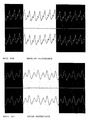
- To complete the description of the invention and the scope thereof, the descriptive specification is accompanied with a set of drawings and the graphical transcript of the natural musical notes, DOH, RAY, ME, FAH, SOH, LAH, TE, obtained from the same tenor saxophone, using an ebonite mouthpiece and a briar mouthpiece for the comparison thereof.
-
-
Figure 1 . - (page 1). Shows an inverted profile of the tenor saxophone mouthpiece. -
Figure 2 . - (page 2). Shows the plan view of the same mouthpiece. - The length of this mouthpiece is between 6 and 10 mm more than the length of the range of tenor saxophone mouthpieces. And the thickness is between 0.1 and 0.2 mm more than the thickness of those mentioned.
- As for the comparative study, it can be observed in the transcript of the note DOH, page 2, the waves in this note, produced with an ebonite mouthpiece offer a clearly toothed appearance, with more marked differences in the amplitude of the waves. However, with the briar mouthpiece, although offering the same succession of waves of different amplitude, in no way is the appearance sawtoothed and the difference in the amplitude of the wave pairs is less perceptible.
- In the comparison of the note RAY, page 3, although no notable differences are perceived between the notes produced by the different mouthpieces, it can be appreciated that the regularity of the amplitude of the wave pairs is more accused with the briar mouthpiece.
- In the transcript of the note ME, page 4, although the wave is less toothed with the ebonite mouthpiece than the note DOH, with the briar mouthpiece it attains a purity and regularity in sound, comparable with that of the tuning fork.
- As it can be observed in the transcript of the note FAH, page 5, although the ebonite mouthpiece improves with regard to the other notes, with the briar mouthpiece perfection is almost reached in the proportionality between the wave length and amplitude.
- From the mere observation of the note SOH, page 6, the difference in sound is clearly deduced, much more regular with the briar mouthpiece, without that toothed aspect of the wave corresponding to the ebonite mouthpiece.
- And this is how the note LAH, page 7, is observed for the ebonite mouthpiece, in the upper part of the wave it is shown toothed, which does not occur with the briar mouthpiece which surpasses the former in regularity.
- And to conclude with the note TE, page 8, here the differences in wave morphology are less perceptible, although the difference in wave amplitude gives an idea of a substantial difference as regards the sound range amplitude.
Claims (5)
- - (MAIN) A mouthpiece for the coupling thereof to all kinds of woodwind and brass-wind musical instruments, characterized in that it is manufactured in briar wood, with minimum curing of six months, up to two years and more than two years.
- - A reed for the coupling thereof to all kinds of woodwind musical instruments that require it, characterized in that it is manufactured in briar wood, with minimum curing of six months, up to two years and more than two years.
- - A small barrel for the coupling thereof to all kinds of clarinets, characterized in that it is manufactured in briar wood, with minimum curing of six months, up to two years and more than two years.
- - A bell for the coupling thereof to all kinds of woodwind musical instruments that require it, manufactured in briar wood, with minimum curing of six months, up to two years and more than two years.
- - A flute head for the coupling thereof to recorder and transversal flute, manufactured with briar branch, with minimum curing of six months, up to two years and more than two years.
Applications Claiming Priority (1)
| Application Number | Priority Date | Filing Date | Title |
|---|---|---|---|
| PCT/ES2005/000562 WO2007045698A1 (en) | 2005-10-21 | 2005-10-21 | Method of producing parts for woodwind and brass musical instruments using briarwood |
Publications (2)
| Publication Number | Publication Date |
|---|---|
| EP1939854A1 true EP1939854A1 (en) | 2008-07-02 |
| EP1939854A4 EP1939854A4 (en) | 2014-02-19 |
Family
ID=37962215
Family Applications (1)
| Application Number | Title | Priority Date | Filing Date |
|---|---|---|---|
| EP05808169.6A Withdrawn EP1939854A4 (en) | 2005-10-21 | 2005-10-21 | Method of producing parts for woodwind and brass musical instruments using briarwood |
Country Status (5)
| Country | Link |
|---|---|
| US (1) | US7741549B2 (en) |
| EP (1) | EP1939854A4 (en) |
| JP (1) | JP2009512888A (en) |
| CA (1) | CA2625682C (en) |
| WO (1) | WO2007045698A1 (en) |
Families Citing this family (5)
| Publication number | Priority date | Publication date | Assignee | Title |
|---|---|---|---|---|
| FR2978369B1 (en) * | 2011-07-29 | 2014-05-02 | Opinel | KNIFE HAVING A MEDIUM SOUND TRANSMITTER BY AIR PASSAGE |
| KR101410824B1 (en) * | 2013-12-20 | 2014-06-23 | 조돈진 | method of wood-wind instrument mouthpiece and wood-wind instrument mouthpiece |
| US10157598B2 (en) * | 2016-05-19 | 2018-12-18 | Leto R&D Corporation | Mouthpiece cap for a musical instrument |
| USD793469S1 (en) * | 2016-05-20 | 2017-08-01 | Leto R&D Corporation | Musical instrument mouthpiece cap |
| US9779704B1 (en) * | 2017-03-14 | 2017-10-03 | Shun-Hwa Chang | Apparatus providing teeth location guide for use with single-reed woodwind instruments |
Family Cites Families (2)
| Publication number | Priority date | Publication date | Assignee | Title |
|---|---|---|---|---|
| US2890614A (en) * | 1955-05-17 | 1959-06-16 | Ward O Fearn | Wooden mouthpieces for brass wind musical instruments |
| US3494368A (en) * | 1968-04-19 | 1970-02-10 | Richard M Keenan | Device for breaking in smoking pipes |
-
2005
- 2005-10-21 JP JP2008536065A patent/JP2009512888A/en active Pending
- 2005-10-21 CA CA2625682A patent/CA2625682C/en not_active Expired - Fee Related
- 2005-10-21 EP EP05808169.6A patent/EP1939854A4/en not_active Withdrawn
- 2005-10-21 WO PCT/ES2005/000562 patent/WO2007045698A1/en not_active Ceased
- 2005-10-21 US US11/992,952 patent/US7741549B2/en not_active Expired - Fee Related
Also Published As
| Publication number | Publication date |
|---|---|
| WO2007045698A1 (en) | 2007-04-26 |
| US20090126552A1 (en) | 2009-05-21 |
| EP1939854A4 (en) | 2014-02-19 |
| CA2625682A1 (en) | 2007-04-26 |
| US7741549B2 (en) | 2010-06-22 |
| JP2009512888A (en) | 2009-03-26 |
| CA2625682C (en) | 2012-01-10 |
Similar Documents
| Publication | Publication Date | Title |
|---|---|---|
| Wegst | Bamboo and wood in musical instruments | |
| JP4567494B2 (en) | Whistle | |
| CA2625682C (en) | Method of producing parts for woodwind and brass musical instruments using briar-wood | |
| JP2005316419A5 (en) | ||
| Waltham et al. | Construction of wooden musical instruments | |
| US11538447B2 (en) | Instrument mouthpiece with air flow disruption apparatus | |
| US11749235B2 (en) | Instrument mouthpiece with curvilinear air flow disruption apparatus | |
| Sandu | The traditional aerophone instruments, past and future | |
| US11257470B1 (en) | String instrument with superior tonal qualities | |
| RU66102U1 (en) | CANE TO BASS | |
| US20050045022A1 (en) | Single-reed wind instrument | |
| CN109119049A (en) | A kind of variable tone color, sound is limpid, noise-free mongolia four-stringed Chinese fiddle | |
| Gambill | The Perfect Reed: A Comparative Analysis of Four Gouge and Profile Combinations for Bassoon Reeds | |
| US9865237B1 (en) | Mouthpiece for wind musical instrument | |
| Angelov | Some aspects in the making of folk musical instruments in the Republic of North Macedonia | |
| WO2025079636A1 (en) | Musical instrument-use resin structure and method for manufacturing musical instrument-use resin structure | |
| JP2974652B2 (en) | Reed instrument reed | |
| EP3278329B1 (en) | Bridge and production method in the violin family | |
| KR20230120870A (en) | Wind instruments mounting tone hole hardwood key button | |
| Agos-Esparza et al. | ACOUSTIC SPECTRUM AND TIMBRE VARIATION OVER THE ATTACK IN THE TXISTU | |
| Dalmont et al. | The irish Uillean pipe: a story of lore, hell and hard D | |
| Isac et al. | The Sound of the Stradivari Violin–between Tradition and Modernism | |
| Levesque | Compositional resources for the modern valve horn | |
| Daffern et al. | Spectral characteristics of the baroque trumpet: a case study | |
| Atsalis | The 18th Century Bassoon: Performance Feasibility of WA Mozart's Wind Sextets |
Legal Events
| Date | Code | Title | Description |
|---|---|---|---|
| PUAI | Public reference made under article 153(3) epc to a published international application that has entered the european phase |
Free format text: ORIGINAL CODE: 0009012 |
|
| 17P | Request for examination filed |
Effective date: 20080318 |
|
| AK | Designated contracting states |
Kind code of ref document: A1 Designated state(s): AT BE BG CH CY CZ DE DK EE ES FI FR GB GR HU IE IS IT LI LT LU LV MC NL PL PT RO SE SI SK TR |
|
| DAX | Request for extension of the european patent (deleted) | ||
| A4 | Supplementary search report drawn up and despatched |
Effective date: 20140117 |
|
| RIC1 | Information provided on ipc code assigned before grant |
Ipc: G10D 9/02 20060101ALI20140113BHEP Ipc: G10D 7/00 20060101ALI20140113BHEP Ipc: G10D 9/00 20060101AFI20140113BHEP |
|
| STAA | Information on the status of an ep patent application or granted ep patent |
Free format text: STATUS: THE APPLICATION IS DEEMED TO BE WITHDRAWN |
|
| 18D | Application deemed to be withdrawn |
Effective date: 20170503 |