EP1938309B1 - Method for suppressing receiver audio regeneration - Google Patents
Method for suppressing receiver audio regeneration Download PDFInfo
- Publication number
- EP1938309B1 EP1938309B1 EP06814107A EP06814107A EP1938309B1 EP 1938309 B1 EP1938309 B1 EP 1938309B1 EP 06814107 A EP06814107 A EP 06814107A EP 06814107 A EP06814107 A EP 06814107A EP 1938309 B1 EP1938309 B1 EP 1938309B1
- Authority
- EP
- European Patent Office
- Prior art keywords
- pitch
- audio signal
- signal
- volume
- shifting
- Prior art date
- Legal status (The legal status is an assumption and is not a legal conclusion. Google has not performed a legal analysis and makes no representation as to the accuracy of the status listed.)
- Active
Links
Images




Classifications
-
- G—PHYSICS
- G10—MUSICAL INSTRUMENTS; ACOUSTICS
- G10L—SPEECH ANALYSIS TECHNIQUES OR SPEECH SYNTHESIS; SPEECH RECOGNITION; SPEECH OR VOICE PROCESSING TECHNIQUES; SPEECH OR AUDIO CODING OR DECODING
- G10L21/00—Speech or voice signal processing techniques to produce another audible or non-audible signal, e.g. visual or tactile, in order to modify its quality or its intelligibility
- G10L21/02—Speech enhancement, e.g. noise reduction or echo cancellation
-
- H—ELECTRICITY
- H04—ELECTRIC COMMUNICATION TECHNIQUE
- H04R—LOUDSPEAKERS, MICROPHONES, GRAMOPHONE PICK-UPS OR LIKE ACOUSTIC ELECTROMECHANICAL TRANSDUCERS; ELECTRIC HEARING AIDS; PUBLIC ADDRESS SYSTEMS
- H04R3/00—Circuits for transducers
- H04R3/02—Circuits for transducers for preventing acoustic reaction, i.e. acoustic oscillatory feedback
-
- G—PHYSICS
- G10—MUSICAL INSTRUMENTS; ACOUSTICS
- G10L—SPEECH ANALYSIS TECHNIQUES OR SPEECH SYNTHESIS; SPEECH RECOGNITION; SPEECH OR VOICE PROCESSING TECHNIQUES; SPEECH OR AUDIO CODING OR DECODING
- G10L21/00—Speech or voice signal processing techniques to produce another audible or non-audible signal, e.g. visual or tactile, in order to modify its quality or its intelligibility
- G10L21/003—Changing voice quality, e.g. pitch or formants
- G10L21/007—Changing voice quality, e.g. pitch or formants characterised by the process used
- G10L21/013—Adapting to target pitch
Definitions
- This invention relates in general to methods and systems that transmit and receive audio and more particularly, to high audio speaker phone systems.
- RF modulator can reside within a transmitter unit on a portable device to modulate base-band signals to communication signal frequencies for transmission whereby the communication signals are broadcast to other portable units with a RF modulator at the receiver unit capable of demodulating the signals back down to base-band.
- the base-band signals can be decoded into an audio signal and broadcast through a speaker to a user of the receiving portable electronic device.
- the portable handset devices include a high-audio speaker to play the audio signal at higher volume levels.
- a power amplifier is generally coupled to the speaker to amplify the signal sufficiently such that the user can adequately hear the output audio.
- the high audio speaker is generally a transducer which converts electrical signals to mechanical movements through the electro-magnetic coupling of a permanent magnet and voice coil attached to a diaphragm. The movement of the diaphragm moves air and thereby creates pressure differences which produce an acoustic signal.
- the speaker needs to move a large amount of air to produce a high volume audio signal where the pressure level is proportional to acceleration of the air. Accordingly, a large amount of force is required to move the air at the diaphragm where the amount of force is a function of the size of the diaphragm and the size of the magnet.
- the forceful movement of the diaphragm at high audio levels can also push air into and out of the handset creating pressure which accordingly produces vibrations in the handset device.
- the internal acoustic pressure can leak to other compartments within the handset. The problem is exacerbated when the speaker is in close proximity to the electrical board components. All devices and components internal to the handset can be subject to these vibrations. These vibrations can induce bending of component boards such as those that house the RF modulation circuitry.
- the electro-mechanical-acoustical stress and strain bending of the boards can change the electrical properties of the integrated circuits which can in turn alter the behavior properties of the device.
- an RF component such as a Voltage Control Oscillator (VCO)
- VCO Voltage Control Oscillator
- the mechanical bending can vary the voltage, and, the VCO frequency deviates in relation to the bending.
- the deviation effectively superimposes properties of the acoustic signal onto the demodulated signal.
- the physical bending can modulate the behavior of the demodulator where the result can be regeneration of the output audio on top of the demodulated signal.
- This behavior is a feedback loop which can oscillate and go unstable when the signals become highly correlated, or in phase.
- the regenerative audio feedback acts as a parasitic modulation that gets demodulated and amplified over and over causing oscillatory feedback, commonly called 'microphonics'.
- the internal pressure is inversely proportional to the internal air volume.
- a smaller handset can go unstable at high volumes which causes a howling effect as a result of receiver audio regeneration.
- Solutions to avoid the bending of the circuit boards include material padding to absorb the sound, mechanical ribs or clips to limit the allowable degree of mechanical bending, and non-piezoelectric capacitors.
- the current approaches attempt to minimize the acoustic pressure build-up and/or isolate the acoustic coupling. They rely on mechanical solutions that can not fully resolve the howling problem caused by the regenerative audio feedback.
- system engineers set a specification margin for certain parameters in shipping radios to account for tolerances in parts and variances in temperature. However, this lowers the overall volume gain of the handset.
- the present embodiments herein concern a method for suppressing receiver audio regeneration, such as defined in claim 1.
- the method includes the steps of receiving a communication signal, at a Radio Frequency (RF) unit, demodulating the communication signal to an audio signal, monitoring a volume level of the audio signal, and shifting the pitch of the audio signal when the volume level reaches a predetermined threshold.
- the amount of pitch-shifting can be a function of the volume level. Playing the pitch-shifted audio signal out of a speaker produces a pitch-shifted acoustic signal.
- the method can shift the pitch of the audio signal to produce the pitch-shifted acoustic signal with signal properties suppressing regeneration of the acoustic signal onto the audio signal at the RF unit.
- the audio signal can be an analog or digitally sampled signal.
- the step of monitoring the volume level includes estimating an acoustic signal volume for at least a portion of the time-based samples of the audio signal, and based on the estimating step, generating a volume contour of the acoustic signal.
- the pitch of the audio signal can be shifted when the volume contour exceeds a predetermined volume level threshold, where the amount of pitch-shifting can be a function of the volume level of the acoustic signal. Additionally, shifting the pitch can be done by one of increasing and decreasing the pitch of the audio signal, and the amount of pitch shifting can be within a predetermined range.
- the method can also include the steps of detecting speech activity on the audio signal, and, when detecting speech on the audio signal, determining whether the volume contour exceeds a predetermined threshold. For example, if no speech is detected on the audio signal, the method can include predicting the amount of pitch shifting. Accordingly, the level of pitch shifting applied can remain constant during a pause in the speech. Accordingly, the pitch-shifting of the audio signal can suppress the RF unit from entering unstable oscillation. For example, the pitch shifting can reduce the correlation between the high level audio acoustic output and the demodulated audio signal and suppress the handset from entering feedback and howling.
- the method can also include the steps of evaluating a gain margin and/or phase margin; and updating the predetermined threshold level based on the gain margin and/or phase margin. In one arrangement, the predetermined threshold sets an allowable gain headroom. For example, the gain margin and/or phase margin can describe the allowable extent of pitch shifting before unstable oscillation.
- FIG. 1 illustrates a mobile communication device in accordance with an embodiment of the inventive arrangements
- FIG. 2 illustrates a handset volume graph in accordance with an embodiment of the inventive arrangements
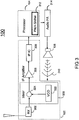
- FIG. 3 illustrates a block diagram of a receiver system in accordance with an embodiment of the inventive arrangements
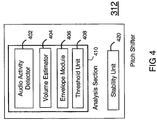
- FIG. 4 illustrates components within a pitch-shifter in accordance with an embodiment of the inventive arrangements
- FIG. 5 illustrates a method of pitch shifting in accordance with an embodiment of the inventive arrangements
- FIG. 6 illustrates a flowchart method of pitch shifting in accordance with an embodiment of the inventive arrangements.
- FIG. 7 illustrates a graph for pitch shifting as a function of volume level in accordance with an embodiment of the inventive arrangements.
- a or an, as used herein, are defined as one or more than one.
- the term plurality, as used herein, is defined as two or more than two.
- the term another, as used herein, is defined as at least a second or more.
- the terms including and/or having, as used herein, are defined as comprising (i.e., open language).
- the term coupled, as used herein, is defined as connected, although not necessarily directly, and not necessarily mechanically.
- program, software application, and the like as used herein, are defined as a sequence of instructions designed for execution on a computer system.
- a program, computer program, or software application may include a subroutine, a function, a procedure, an object method, an object implementation, an executable application, an applet, a servlet, a source code, an object code, a shared library/dynamic load library and/or other sequence of instructions designed for execution on a computer system.
- a communication system can transmit a communication signal to a receiving mobile communication device.
- the mobile device can demodulate the communication signal to an audio signal and monitor a volume level of the audio signal as it is played out a high audio speaker.
- the mobile device can shift the pitch of the audio signal as a function of the volume level when the volume level reaches a predetermined threshold.
- the device can play the pitch-shifted audio signal out of a speaker to produce a pitch-shifted acoustic signal with signal properties suppressing regeneration of the acoustic signal onto the audio signal at the RF unit, thereby suppressing feedback and microphonic howling.
- the mobile communication device 100 can include a Radio Frequency (RF) unit 102, a processor 104, and a speaker 106.
- the RF unit can receive a communication signal, containing data such as voice or audio, from another such mobile communication device.
- the mobile communication device 100 can be a two-way radio, a cellular phone, a handset, a personal digital assistant, a portable computing device, or other similar devices.
- the mobile communication device 100 can also transmit communication signals.
- the RF unit 102 can be cooperatively connected to the processor 104 which can be coupled to the speaker 106.
- the RF unit 102 can pass a demodulated base-band signal, such as voice or audio, to the processor 104.
- the processor 104 can apply various signal processing techniques to put the signal in proper form to be played out a speaker, such techniques include echo suppression, noise suppression, compression, automatic gain adjustment, and volume control for example.
- the speaker 106 can output the audio signal at a high signal level to produce an acoustic signal which can be heard by a user of the mobile communication device 100.
- the OLG graph describes the resulting volume level of the device as measured across the audible frequency spectrum during open loop gain measurement.
- the open-loop gain of an amplifier can be described as the gain obtained when no feedback is used in the circuit.
- Open-loop gain is generally high for an operational amplifier and can rapidly decrease with increasing frequency.
- OLG levels can describe the point at which Microphonic feedback begins.
- the acoustic output 108 can be of sufficient volume level to cause the mobile device to enter microphonic feedback and cause howling. The howling can be a function of excessive gain in the feedback loop.
- the speaker acoustic output 108 can cause the mobile communication device 100 to enter feedback when an open loop gain given on the y-axis reaches a level causing unstable oscillation.
- the open loop gain can reveal the volume level at which the system will enter oscillation.
- FIG. 2 also reveals that the gain margin is frequency dependent.
- the OLG spec gain is representative of an approximate frequency range between 700Hz and 1.3KHz.
- a voice signal can have an average bandwidth between 200Hz to 4KHz which falls within this OLG bandwidth.
- a voice signal played out by the speaker at sufficiently high volume levels within this bandwidth can cause the mobile communication device 100 to go unstable, and enter oscillation.
- the receiver audio's self regeneration i.e. unstable feedback
- the RF unit 102 can contain a receiver (RX) 302 that can receive a communication signal and a demodulator 320 that demodulates the received communication signal.
- the demodulator 320 can include a mixer 324 and a Voltage Controlled Oscillator (VCO) 322 that together can demodulate the communication signal.
- VCO Voltage Controlled Oscillator
- the RF unit 102 can also include an Intermediate Frequency (IF) amplifier 306 and IF integrated circuit 308.
- the IF amplifier 306 can increase the signal fidelity (signal to noise ratio) to improve the demodulation at the secondary IF IC 308.
- an IF stage 306-308 can utilize high quality crystals and circuits to demodulate a high frequency signal down to base-band. It should also be noted that the particular embodiment of the IF section 306-308 can be included or excluded without affecting the scope of the claimed embodiments of the invention. Accordingly, the demodulator 320 can demodulate the communication signal directly to an audio signal without going through an IF stage 306-308.
- the processor 104 can include a pitch shifter 312 that can pitch shift an audio signal.
- the processor 104 can be cooperatively connected to an audio power amplifier (PA) 314 which can be cooperatively connected to a speaker 106.
- PA audio power amplifier
- the pitch shifter can reside inside or outside the processor 104 as an independent module.
- the processor can receive an audio signal from the RF unit 102 and place the audio signal in form such that the power amplifier 314 can play the audio signal out the speaker 106.
- the pitch shifter 312 can shift the pitch of the audio signal prior to being amplified by the audio PA 314.
- the high audio acoustic signal 316 generated by the speaker 106 can feedback into the RF unit 102 internally through the housing or externally through the air.
- the pitch shifting unit 312 includes an analysis section 410 and a stability unit 420.
- the analysis section 410 monitors a volume level of the audio signal, and when the volume level exceeds a predetermined volume level threshold, the pitch-shifter 312 shifts the pitch of the audio signal by an amount that can be a function of the volume level of the acoustic signal.
- the analysis section can include an audio activity detector 402 for detecting activity of the audio signal, a volume estimator block 404 to estimate the acoustic signal volume 316 during audio activity for at least a portion of the time-based samples of the audio signal, an envelope module 406 cooperatively connected to the estimator block 404 to generate a volume contour of the acoustic signal based on the volume estimation, and a threshold unit 408 to determine when the volume contour exceeds the predetermined threshold when the speech detector detects speech on the audio signal.
- an audio activity detector 402 for detecting activity of the audio signal
- a volume estimator block 404 to estimate the acoustic signal volume 316 during audio activity for at least a portion of the time-based samples of the audio signal
- an envelope module 406 cooperatively connected to the estimator block 404 to generate a volume contour of the acoustic signal based on the volume estimation
- a threshold unit 408 to determine when the volume contour exceeds the predetermined threshold when the speech detector detects speech on the audio signal.
- the stability unit 420 can evaluate at least one of a gain margin and phase margin, and, based on at least one of the gain margin and phase margin, update the predetermined threshold to set an allowable gain headroom.
- the margin margin can reveal an allowable extent of pitch shifting before the mobile communication device 100 enters unstable oscillation.
- FIG. 5 a method for suppressing receiver audio regeneration is shown.
- the method 500 can be practiced in any other suitable system or device. Further note that the method 500 is not limited to the order in which the steps are listed. In addition, the method 500 can contain a greater or a fewer number of steps than those shown in FIG. 5 .
- a communication signal is received.
- the communication signal is demodulated to an audio signal.
- the RX unit 302 receives a communication signal.
- the RF unit 320 which includes the mixer 324 and VCO 322, demodulates the communication signal to a base-band signal.
- the IF Amplifier 306 and IF IC 308 can further demodulate the base-band signal to an audio signal.
- the RF unit can demodulate the communication signal directly down to an audio signal.
- the volume level of the audio signal is monitored.
- the pitch of the audio signal is shifted when the volume level reaches a predetermined threshold, where the amount of pitch-shifting is a function of the volume level.
- the Processor 104 determines when a volume level of the audio signal exceeds a threshold.
- the processor 104 can include a pitch-shifter 312 which shifts the pitch of the audio signal when the processor determines the volume level has been exceeded.
- the step of monitoring the volume level can further include detecting speech activity on the audio signal, and when detecting speech on the audio signal, determining whether the volume contour exceeds the predetermined threshold.
- the audio activity detector 402 detects voice and audio activity on the audio signal.
- the volume estimator 404 estimates the audio level volume and the envelope module 406 estimates a volume contour.
- the threshold unit 408 determines when a volume threshold has been exceeded.
- the pitch-shifted audio signal is played out of a speaker to produce a pitch-shifted acoustic signal.
- the audio PA 314 amplifies the pitch shifted signal and plays it out the speaker 314.
- the method 500 additionally includes evaluating at least one of a gain margin and phase margin, and updating a predetermined threshold level based on the margin, where the updating sets an allowable gain headroom, and the margin reveals an allowable extent of pitch shifting before unstable oscillation.
- the stability unit 420 determines the amount of gain and phase margin of the RF unit 102.
- FIG. 6 a flowchart method for suppressing receiver audio regeneration is shown which can inherently include the steps of method 500.
- the method 600 reference will also be made to FIGS. 3 and 4 , although it must be noted that the method can be practiced in any other suitable system or device. Moreover, the method is not limited to the order in which the steps are listed in the method 600. In addition, the method 600 can contain a greater or a fewer number of steps than those shown in FIG. 6 .
- a user changes the volume level of the mobile communication device 100, hereto referred to as the handset 100.
- the user can turn a volume control knob or depress a volume button on the handset to increase or decrease the volume level.
- the volume level can be the SPL level of the acoustic signal 316 measured at the speaker 106 or an SPL level associated with the volume step.
- volume step 1 on the handset can have a 1kHz reference volume level SPL of 76 dB, and a 1 kHz reference volume level SPL of 104 dB at volume step 7.
- the SPL at kHz can be one point of an SPL curve across frequency.
- a volume step increase can increase the acoustic signal level 316, and accordingly increase the vibration of the RF unit 102.
- the increased vibration can lead to howling if the volume level is higher than a predetermined amount, i.e. the "volume threshold".
- a volume threshold of 94dB can be associated with the OLG spec margin of -10 dB SPL at location 210. Accordingly, a volume level measured at 104dB can exceed the 94dB volume threshold which can cause the handset 100 to howl.
- the audio activity detector 402 identifies periods of active audio or voice, and uses various approaches to determine audio activity such as energy level, periodicity, and spectral shape for example.
- the volume estimator 404 estimates the volume level SPL of the acoustic signal 316 output by the speaker 106. For example, the volume estimator 404 measures the SPL of the acoustic output signal 316 using a microphone to capture the output acoustic signal. This would be a closed loop configuration. Alternatively, an open loop configuration can be employed for which the volume estimator 404 measures the volume level by mapping volume step settings on the handset to SPL values. This mapping function is different from the mapping function of FIG 6 .
- volume step 7 can correspond to an overall volume level but have an associated set of SPL values on a curve across frequency, i.e. frequency spectrum.
- the volume estimator 404 can calculate the volume level from the SPL curve in the frequency domain.
- the volume level can be a frequency weighted summation of the SPL points along the SPL curve.
- the envelope module 406 generates a simpler time-based volume contour of the acoustic signal 316 from volume level measurements by the volume estimator 404 across time.
- a simple first order moving average filter is used to generate the time-based volume contour from measured volume levels.
- the SPL curve is representative of a portion of an audio segment at a particular moment in time, such as a frequency spectrum.
- the SPL curve can be a discrete or continuous set of. points across frequency to the particular time segment.
- the volume contour is the overall SPL volume level encompassing all frequencies at each point, and where the contour denotes a representation of the individual volume levels across time.
- the volume level is compared against a volume threshold. If the volume level is greater than the volume threshold the audio signal is shifted in pitch by an amount specified in Equation 1 within FIG. 6 (Vol_is short for Volume).
- Pitch_shift pitch_shift_max ⁇ Vol_level - Vol_threshold Vol_max - Vol_threshold
- the threshold unit 408 determines when the volume contour exceeds the predetermined threshold. If it does, the pitch shifter 312 shifts the pitch of the audio signal by an amount that is a function of the volume level of the acoustic signal. Recall from FIG 3 , that the VCO's 322 fundamental frequency can unintentionally vary causing howling due to mechanical vibrations of the board as a result of high audio acoustic pressure from the acoustic signal 316 produced by the speaker 106.
- the audio signal is pitch shifted by an amount to suppress regeneration of the acoustic signal onto the audio signal, and where the amount of pitch-shifting is a function of the volume level.
- the pitch-shifter 312 shifts the pitch of the audio signal to suppress unstable oscillation in the RF unit 102.
- the pitch shifter 312 changes the pitch of high volume level acoustic signals to suppress phase reinforcement and the associated howling characteristic of oscillatory behavior.
- the amount of pitch shift applied can be a linear function of the audio level.
- the x-axis presents the measured volume level provided by the volume estimator 404.
- the y-axis presents the amount of pitch shifting that can be applied as a function of the measured volume level.
- the piecewise linear function represents the relationship between volume level and pitch shifting. For example, until the measured volume level exceeds a volume threshold 706, there is no pitch shifting applied to the audio signal, as seen along the straight line 720,. Once the measured volume exceeds the volume threshold 706, the audio signal can be shifted in pitch in accordance with the values of the straight line 740.
- the pitch shifter 312 can evaluate Equation 1 to calculate the required amount of pitch shifting to be applied to the audio signal.
- Equation 1 is the slope (dy/dx) of the line at 740 weighted by a pitch_shift_max term, where the slope of the line 740 reveals the linear extent of pitch shifting.
- the pitch shifter 312 can use any suitable compression algorithm where one particular example of a compression curve is the piece-wise linear relationship shown in FIG. 7 .
- the sloped line at 740 represents a linear mapping function from a range of volumes (vol_threshold to vol_max) to an extent of pitch shifting.
- the threshold unit 408 determines that the volume level equals the volume_max at 708, the pitch shifter 312 can apply the pitch_shift_max amount.
- the system designer can set pitch_shift_max at 20%, which allows the pitch shifter 312 to apply a 20% pitch shifting of the audio signal when maximum volume is detected.
- the audio signal can be pitch shifted upwards by 10% to correspond to a maximum volume level or it can be shifted down by 10% to correspond to the maximum volume level.
- the max pitch_shift_max can be any level or set of levels that the system designer determines suppresses or limits unstable oscillation.
- the system designer can create any linear or non-linear mapping function relating the volume level to a percentage (amount) of pitch shifting.
- the pitch shifter 312 causes the audio to return at slightly different frequencies each time it passes through the microphonics loop. Eventually the regenerative audio feedback will fall out of the microphonics band and no phase alignment will occur. For instance, the pitch shifter 312 shifts a portion of the audio spectrum away from its original location to avoid creating a resonance condition. For example, referring to FIGS. 2 and 3 the pitch shifter 312 shifts a band of voice energy out of a higher OLG gain region 220 to a lower OLG region 230 where the handset 100 is below specification margin and less sensitive to regenerative audio feedback howling.
- the pitch shifter 312 can implement a time domain or frequency domain approach to shift the pitch of the audio signal.
- a pitch shifter changes the fundamental frequency of audio or voice without changing the time representation.
- Various methods of pitch shifting are possible including changing the sampling rate. More sophisticated methods such as time or frequency decomposition methods allow for non-integer sampling rate changes which provide a smoother pitch interpolation between speech frame boundaries and doing so without adjusting the time scale.
Landscapes
- Engineering & Computer Science (AREA)
- Signal Processing (AREA)
- Acoustics & Sound (AREA)
- Physics & Mathematics (AREA)
- Health & Medical Sciences (AREA)
- Quality & Reliability (AREA)
- General Health & Medical Sciences (AREA)
- Computational Linguistics (AREA)
- Otolaryngology (AREA)
- Audiology, Speech & Language Pathology (AREA)
- Human Computer Interaction (AREA)
- Multimedia (AREA)
- Telephone Function (AREA)
- Circuits Of Receivers In General (AREA)
- Input Circuits Of Receivers And Coupling Of Receivers And Audio Equipment (AREA)
Abstract
Description
- This invention relates in general to methods and systems that transmit and receive audio and more particularly, to high audio speaker phone systems.
- In recent years, portable electronic devices, such as cellular telephones and personal digital assistants, have become commonplace. Many of these devices include a Radio Frequency (RF) modulator section. The RF modulator can reside within a transmitter unit on a portable device to modulate base-band signals to communication signal frequencies for transmission whereby the communication signals are broadcast to other portable units with a RF modulator at the receiver unit capable of demodulating the signals back down to base-band. The base-band signals can be decoded into an audio signal and broadcast through a speaker to a user of the receiving portable electronic device.
- Many of the portable handset devices include a high-audio speaker to play the audio signal at higher volume levels. A power amplifier is generally coupled to the speaker to amplify the signal sufficiently such that the user can adequately hear the output audio. The high audio speaker is generally a transducer which converts electrical signals to mechanical movements through the electro-magnetic coupling of a permanent magnet and voice coil attached to a diaphragm. The movement of the diaphragm moves air and thereby creates pressure differences which produce an acoustic signal.
- The speaker needs to move a large amount of air to produce a high volume audio signal where the pressure level is proportional to acceleration of the air. Accordingly, a large amount of force is required to move the air at the diaphragm where the amount of force is a function of the size of the diaphragm and the size of the magnet. The forceful movement of the diaphragm at high audio levels can also push air into and out of the handset creating pressure which accordingly produces vibrations in the handset device. Also, when the handset is not properly enclosed or sealed, the internal acoustic pressure can leak to other compartments within the handset. The problem is exacerbated when the speaker is in close proximity to the electrical board components. All devices and components internal to the handset can be subject to these vibrations. These vibrations can induce bending of component boards such as those that house the RF modulation circuitry.
- The electro-mechanical-acoustical stress and strain bending of the boards can change the electrical properties of the integrated circuits which can in turn alter the behavior properties of the device. For an RF component such as a Voltage Control Oscillator (VCO), the mechanical bending can vary the voltage, and, the VCO frequency deviates in relation to the bending. The deviation effectively superimposes properties of the acoustic signal onto the demodulated signal. In effect, the physical bending can modulate the behavior of the demodulator where the result can be regeneration of the output audio on top of the demodulated signal. This behavior is a feedback loop which can oscillate and go unstable when the signals become highly correlated, or in phase. In effect, the regenerative audio feedback acts as a parasitic modulation that gets demodulated and amplified over and over causing oscillatory feedback, commonly called 'microphonics'. The internal pressure is inversely proportional to the internal air volume. And, as handsets become smaller the microphonics problem can continue to increase. Accordingly, a smaller handset can go unstable at high volumes which causes a howling effect as a result of receiver audio regeneration.
- Solutions to avoid the bending of the circuit boards include material padding to absorb the sound, mechanical ribs or clips to limit the allowable degree of mechanical bending, and non-piezoelectric capacitors. The current approaches attempt to minimize the acoustic pressure build-up and/or isolate the acoustic coupling. They rely on mechanical solutions that can not fully resolve the howling problem caused by the regenerative audio feedback. In addition, system engineers set a specification margin for certain parameters in shipping radios to account for tolerances in parts and variances in temperature. However, this lowers the overall volume gain of the handset. A final recourse, when the mechanical solutions are insufficiently capable of mitigating the howling behavior, is to lower the level of high audio speaker output by setting a maximum volume level corresponding to a gain specification level below which howling occurs. Accordingly, the handset is shipped with a reduced loudness gain to meet the gain specification margin. However, this reduces the overall loudness level which users expect from a high audio speaker handset. In a public safety environment, or other high ambient noise condition, such restriction may not be acceptable
DocumentEP0467499 discloses a different technique whereby the frequency of a feedback audiosignal is varied by means of a pitch converter to suppress howling. - The present embodiments herein concern a method for suppressing receiver audio regeneration, such as defined in
claim 1. The method includes the steps of receiving a communication signal, at a Radio Frequency (RF) unit, demodulating the communication signal to an audio signal, monitoring a volume level of the audio signal, and shifting the pitch of the audio signal when the volume level reaches a predetermined threshold. The amount of pitch-shifting can be a function of the volume level. Playing the pitch-shifted audio signal out of a speaker produces a pitch-shifted acoustic signal. The method can shift the pitch of the audio signal to produce the pitch-shifted acoustic signal with signal properties suppressing regeneration of the acoustic signal onto the audio signal at the RF unit. - As an example, the audio signal can be an analog or digitally sampled signal. In one arrangement, the step of monitoring the volume level includes estimating an acoustic signal volume for at least a portion of the time-based samples of the audio signal, and based on the estimating step, generating a volume contour of the acoustic signal. In another arrangement, the pitch of the audio signal can be shifted when the volume contour exceeds a predetermined volume level threshold, where the amount of pitch-shifting can be a function of the volume level of the acoustic signal. Additionally, shifting the pitch can be done by one of increasing and decreasing the pitch of the audio signal, and the amount of pitch shifting can be within a predetermined range.
- The method can also include the steps of detecting speech activity on the audio signal, and, when detecting speech on the audio signal, determining whether the volume contour exceeds a predetermined threshold. For example, if no speech is detected on the audio signal, the method can include predicting the amount of pitch shifting. Accordingly, the level of pitch shifting applied can remain constant during a pause in the speech. Accordingly, the pitch-shifting of the audio signal can suppress the RF unit from entering unstable oscillation. For example, the pitch shifting can reduce the correlation between the high level audio acoustic output and the demodulated audio signal and suppress the handset from entering feedback and howling. The method can also include the steps of evaluating a gain margin and/or phase margin; and updating the predetermined threshold level based on the gain margin and/or phase margin. In one arrangement, the predetermined threshold sets an allowable gain headroom. For example, the gain margin and/or phase margin can describe the allowable extent of pitch shifting before unstable oscillation.
- The features of the embodiments which are believed to be novel, are set forth with particularity in the appended claims. The embodiments may best be understood by reference to the following description, taken in conjunction with the accompanying drawings, in the several figures of which like reference numerals identify like elements, and in which:
-
FIG. 1 illustrates a mobile communication device in accordance with an embodiment of the inventive arrangements; -
FIG. 2 illustrates a handset volume graph in accordance with an embodiment of the inventive arrangements; -
FIG. 3 illustrates a block diagram of a receiver system in accordance with an embodiment of the inventive arrangements; -
FIG. 4 illustrates components within a pitch-shifter in accordance with an embodiment of the inventive arrangements; -
FIG. 5 illustrates a method of pitch shifting in accordance with an embodiment of the inventive arrangements; -
FIG. 6 illustrates a flowchart method of pitch shifting in accordance with an embodiment of the inventive arrangements; and -
FIG. 7 illustrates a graph for pitch shifting as a function of volume level in accordance with an embodiment of the inventive arrangements. - While the specification concludes with claims defining the features of the embodiments in accordance with the invention that are regarded as novel, it is believed that the embodiments will be better understood from a consideration of the following description in conjunction with the drawing figures, in which like reference numerals are carried forward.
- As required, detailed embodiments are disclosed herein; however, it is to be understood that the disclosed embodiments can be embodied in various forms. Therefore, specific structural and functional details disclosed herein are not to be interpreted as limiting, but merely as a basis for the claims and as a representative basis for teaching one skilled in the art to variously employ the embodiments in virtually any appropriately detailed structure. Further, the terms and phrases used herein are not intended to be limiting but rather to provide an understandable description of the invention.
- The terms a or an, as used herein, are defined as one or more than one. The term plurality, as used herein, is defined as two or more than two. The term another, as used herein, is defined as at least a second or more. The terms including and/or having, as used herein, are defined as comprising (i.e., open language). The term coupled, as used herein, is defined as connected, although not necessarily directly, and not necessarily mechanically. The terms program, software application, and the like as used herein, are defined as a sequence of instructions designed for execution on a computer system. A program, computer program, or software application may include a subroutine, a function, a procedure, an object method, an object implementation, an executable application, an applet, a servlet, a source code, an object code, a shared library/dynamic load library and/or other sequence of instructions designed for execution on a computer system.
- The embodiments herein present a method for suppressing receiver audio regeneration. For example, a communication system can transmit a communication signal to a receiving mobile communication device. The mobile device can demodulate the communication signal to an audio signal and monitor a volume level of the audio signal as it is played out a high audio speaker. The mobile device can shift the pitch of the audio signal as a function of the volume level when the volume level reaches a predetermined threshold. The device can play the pitch-shifted audio signal out of a speaker to produce a pitch-shifted acoustic signal with signal properties suppressing regeneration of the acoustic signal onto the audio signal at the RF unit, thereby suppressing feedback and microphonic howling.
- Referring to
FIG. 1 amobile communication device 100 is shown. Themobile communication device 100 can include a Radio Frequency (RF)unit 102, aprocessor 104, and aspeaker 106. In one arrangement, the RF unit can receive a communication signal, containing data such as voice or audio, from another such mobile communication device. Themobile communication device 100 can be a two-way radio, a cellular phone, a handset, a personal digital assistant, a portable computing device, or other similar devices. Themobile communication device 100 can also transmit communication signals. - In one arrangement, the
RF unit 102 can be cooperatively connected to theprocessor 104 which can be coupled to thespeaker 106. TheRF unit 102 can pass a demodulated base-band signal, such as voice or audio, to theprocessor 104. Theprocessor 104 can apply various signal processing techniques to put the signal in proper form to be played out a speaker, such techniques include echo suppression, noise suppression, compression, automatic gain adjustment, and volume control for example. Thespeaker 106 can output the audio signal at a high signal level to produce an acoustic signal which can be heard by a user of themobile communication device 100. - Referring to
FIG. 2 , a graph characteristic of the open -loop gain (OLG) for amobile communication device 100 is shown. The OLG graph describes the resulting volume level of the device as measured across the audible frequency spectrum during open loop gain measurement. The open-loop gain of an amplifier can be described as the gain obtained when no feedback is used in the circuit. Open-loop gain is generally high for an operational amplifier and can rapidly decrease with increasing frequency. For example, OLG levels can describe the point at which Microphonic feedback begins. Referring toFIG. 1 , for example, theacoustic output 108 can be of sufficient volume level to cause the mobile device to enter microphonic feedback and cause howling. The howling can be a function of excessive gain in the feedback loop. As another example of microphonic behavior, it is known in the art that when the output of a speaker is fed back into the same microphone producing the speaker output, the system will encounter feedback due to the perpetual amplification of the signal as it amplifies back on itself. Similarly, the speakeracoustic output 108 can cause themobile communication device 100 to enter feedback when an open loop gain given on the y-axis reaches a level causing unstable oscillation. The open loop gain can reveal the volume level at which the system will enter oscillation. - System designers use the graph of
FIG. 2 to determine the maximum volume level they can allow within themobile communication device 100 before reaching instability, i.e. howling. For example, at 210, an OLG specification margin of -10dB can be imposed to ensure that the handset has 10dB of headroom gain before instability. Headroom gain can be compromised for loudness, thereby making the volume louder without going unstable but at a cost of more distortion. They can expect users to tolerate a certain amount of distortion to preserve volume loudness. Accordingly, the maximum volume level can be reduced to achieve the gain OLG spec margin by sacrificing overall maximum loudness.FIG 2 . also reveals that the gain margin is frequency dependent. For example, at 220, the OLG spec gain is representative of an approximate frequency range between 700Hz and 1.3KHz. For example, a voice signal can have an average bandwidth between 200Hz to 4KHz which falls within this OLG bandwidth. Hence, a voice signal played out by the speaker at sufficiently high volume levels within this bandwidth can cause themobile communication device 100 to go unstable, and enter oscillation. The receiver audio's self regeneration (i.e. unstable feedback) can occur in a limited frequency band as seen at 220 within the 300-kHz pass band. - Referring to
FIG. 3 a more detailed block diagram of themobile communication device 100 is shown. In one arrangement, theRF unit 102 can contain a receiver (RX) 302 that can receive a communication signal and ademodulator 320 that demodulates the received communication signal. In one arrangement, thedemodulator 320 can include amixer 324 and a Voltage Controlled Oscillator (VCO) 322 that together can demodulate the communication signal. - The
RF unit 102 can also include an Intermediate Frequency (IF)amplifier 306 and IFintegrated circuit 308. TheIF amplifier 306 can increase the signal fidelity (signal to noise ratio) to improve the demodulation at thesecondary IF IC 308. As is known in the art, an IF stage 306-308 can utilize high quality crystals and circuits to demodulate a high frequency signal down to base-band. It should also be noted that the particular embodiment of the IF section 306-308 can be included or excluded without affecting the scope of the claimed embodiments of the invention. Accordingly, thedemodulator 320 can demodulate the communication signal directly to an audio signal without going through an IF stage 306-308. - In one arrangement, the
processor 104 can include apitch shifter 312 that can pitch shift an audio signal. Theprocessor 104 can be cooperatively connected to an audio power amplifier (PA) 314 which can be cooperatively connected to aspeaker 106. The pitch shifter can reside inside or outside theprocessor 104 as an independent module. Briefly, the processor can receive an audio signal from theRF unit 102 and place the audio signal in form such that thepower amplifier 314 can play the audio signal out thespeaker 106. Thepitch shifter 312 can shift the pitch of the audio signal prior to being amplified by theaudio PA 314. Notably, the high audioacoustic signal 316 generated by thespeaker 106 can feedback into theRF unit 102 internally through the housing or externally through the air. - Referring to
FIG 4 , a more detailed block diagram of thepitch shifting unit 312 is shown. In one arrangement, thepitch shifting unit 312 includes ananalysis section 410 and astability unit 420. Briefly, theanalysis section 410 monitors a volume level of the audio signal, and when the volume level exceeds a predetermined volume level threshold, the pitch-shifter 312 shifts the pitch of the audio signal by an amount that can be a function of the volume level of the acoustic signal. - In one arrangement, the analysis section can include an
audio activity detector 402 for detecting activity of the audio signal, a volume estimator block 404 to estimate theacoustic signal volume 316 during audio activity for at least a portion of the time-based samples of the audio signal, anenvelope module 406 cooperatively connected to theestimator block 404 to generate a volume contour of the acoustic signal based on the volume estimation, and athreshold unit 408 to determine when the volume contour exceeds the predetermined threshold when the speech detector detects speech on the audio signal. - The
stability unit 420 can evaluate at least one of a gain margin and phase margin, and, based on at least one of the gain margin and phase margin, update the predetermined threshold to set an allowable gain headroom. For example, the margin margin can reveal an allowable extent of pitch shifting before themobile communication device 100 enters unstable oscillation. - Referring to
FIG. 5 , a method for suppressing receiver audio regeneration is shown. When describing themethod 500, reference will be made toFIGS. 3 and4 , although it must be noted that the method can be practiced in any other suitable system or device. Further note that themethod 500 is not limited to the order in which the steps are listed. In addition, themethod 500 can contain a greater or a fewer number of steps than those shown inFIG. 5 . - At
step 502, a communication signal is received. Atstep 504, the communication signal is demodulated to an audio signal. For example, referring toFIG 3 ., theRX unit 302 receives a communication signal. TheRF unit 320, which includes themixer 324 andVCO 322, demodulates the communication signal to a base-band signal. TheIF Amplifier 306 andIF IC 308 can further demodulate the base-band signal to an audio signal. Alternatively, the RF unit can demodulate the communication signal directly down to an audio signal. - At
step 506, the volume level of the audio signal is monitored. Atstep 508, the pitch of the audio signal is shifted when the volume level reaches a predetermined threshold, where the amount of pitch-shifting is a function of the volume level. For example, referring toFIG. 3 , theProcessor 104 determines when a volume level of the audio signal exceeds a threshold. Theprocessor 104 can include a pitch-shifter 312 which shifts the pitch of the audio signal when the processor determines the volume level has been exceeded. Additionally, the step of monitoring the volume level can further include detecting speech activity on the audio signal, and when detecting speech on the audio signal, determining whether the volume contour exceeds the predetermined threshold. For example, referring toFIG. 4 , theaudio activity detector 402 detects voice and audio activity on the audio signal. Thevolume estimator 404 estimates the audio level volume and theenvelope module 406 estimates a volume contour. And, thethreshold unit 408 determines when a volume threshold has been exceeded. - At
step 510, the pitch-shifted audio signal is played out of a speaker to produce a pitch-shifted acoustic signal. For example, referring toFIG. 3 , theaudio PA 314 amplifies the pitch shifted signal and plays it out thespeaker 314. Themethod 500 additionally includes evaluating at least one of a gain margin and phase margin, and updating a predetermined threshold level based on the margin, where the updating sets an allowable gain headroom, and the margin reveals an allowable extent of pitch shifting before unstable oscillation. For example, referring toFIG. 3 and4 , thestability unit 420 determines the amount of gain and phase margin of theRF unit 102. - Referring to
FIG. 6 , a flowchart method for suppressing receiver audio regeneration is shown which can inherently include the steps ofmethod 500. When describing themethod 600, reference will also be made toFIGS. 3 and4 , although it must be noted that the method can be practiced in any other suitable system or device. Moreover, the method is not limited to the order in which the steps are listed in themethod 600. In addition, themethod 600 can contain a greater or a fewer number of steps than those shown inFIG. 6 . - At
step 602, a user changes the volume level of themobile communication device 100, hereto referred to as thehandset 100. For instance, the user can turn a volume control knob or depress a volume button on the handset to increase or decrease the volume level. Referring toFIG. 3 , the volume level can be the SPL level of theacoustic signal 316 measured at thespeaker 106 or an SPL level associated with the volume step. For example,volume step 1 on the handset can have a 1kHz reference volume level SPL of 76 dB, and a 1 kHz reference volume level SPL of 104 dB at volume step 7. The SPL at kHz can be one point of an SPL curve across frequency. Those skilled in the art can appreciate that there can be a SPL curve across frequency at varying levels for each volume step. Referring toFIG. 3 , a volume step increase can increase theacoustic signal level 316, and accordingly increase the vibration of theRF unit 102. The increased vibration can lead to howling if the volume level is higher than a predetermined amount, i.e. the "volume threshold". For example, referring toFIG. 2 , a volume threshold of 94dB can be associated with the OLG spec margin of -10 dB SPL atlocation 210. Accordingly, a volume level measured at 104dB can exceed the 94dB volume threshold which can cause thehandset 100 to howl. - Referring to
FIGS. 3 and4 , theaudio activity detector 402, identifies periods of active audio or voice, and uses various approaches to determine audio activity such as energy level, periodicity, and spectral shape for example. When theactivity detector 402 determines audio activity, thevolume estimator 404 estimates the volume level SPL of theacoustic signal 316 output by thespeaker 106. For example, thevolume estimator 404 measures the SPL of theacoustic output signal 316 using a microphone to capture the output acoustic signal. This would be a closed loop configuration. Alternatively, an open loop configuration can be employed for which thevolume estimator 404 measures the volume level by mapping volume step settings on the handset to SPL values. This mapping function is different from the mapping function ofFIG 6 . - For example, volume step 7 can correspond to an overall volume level but have an associated set of SPL values on a curve across frequency, i.e. frequency spectrum. And, the
volume estimator 404 can calculate the volume level from the SPL curve in the frequency domain. For example, the volume level can be a frequency weighted summation of the SPL points along the SPL curve. Accordingly, theenvelope module 406 generates a simpler time-based volume contour of theacoustic signal 316 from volume level measurements by thevolume estimator 404 across time. As an example, a simple first order moving average filter is used to generate the time-based volume contour from measured volume levels. It should be noted that the SPL curve is representative of a portion of an audio segment at a particular moment in time, such as a frequency spectrum. The SPL curve can be a discrete or continuous set of. points across frequency to the particular time segment. Whereas, the volume contour is the overall SPL volume level encompassing all frequencies at each point, and where the contour denotes a representation of the individual volume levels across time. - Referring back to
FIG. 6 , atdecision block 604, the volume level is compared against a volume threshold. If the volume level is greater than the volume threshold the audio signal is shifted in pitch by an amount specified inEquation 1 withinFIG. 6 (Vol_is short for Volume).
- For example, referring to
FIGS. 3 and4 , thethreshold unit 408 determines when the volume contour exceeds the predetermined threshold. If it does, thepitch shifter 312 shifts the pitch of the audio signal by an amount that is a function of the volume level of the acoustic signal. Recall fromFIG 3 , that the VCO's 322 fundamental frequency can unintentionally vary causing howling due to mechanical vibrations of the board as a result of high audio acoustic pressure from theacoustic signal 316 produced by thespeaker 106. - At
decision block 606, the audio signal is pitch shifted by an amount to suppress regeneration of the acoustic signal onto the audio signal, and where the amount of pitch-shifting is a function of the volume level.
Briefly, referring toFIG 3 ., the pitch-shifter 312 shifts the pitch of the audio signal to suppress unstable oscillation in theRF unit 102. Thepitch shifter 312 changes the pitch of high volume level acoustic signals to suppress phase reinforcement and the associated howling characteristic of oscillatory behavior. - The amount of pitch shift applied can be a linear function of the audio level. For example, referring to
FIG. 7 , the x-axis presents the measured volume level provided by thevolume estimator 404. The y-axis presents the amount of pitch shifting that can be applied as a function of the measured volume level. The piecewise linear function represents the relationship between volume level and pitch shifting. For example, until the measured volume level exceeds avolume threshold 706, there is no pitch shifting applied to the audio signal, as seen along thestraight line 720,. Once the measured volume exceeds thevolume threshold 706, the audio signal can be shifted in pitch in accordance with the values of thestraight line 740. For example, thepitch shifter 312 can evaluateEquation 1 to calculate the required amount of pitch shifting to be applied to the audio signal. For instance,Equation 1 is the slope (dy/dx) of the line at 740 weighted by a pitch_shift_max term, where the slope of theline 740 reveals the linear extent of pitch shifting. One skilled in the art can appreciate that any line or curve can be drawn to represent the amount of pitch shifting as a function of the volume level. Accordingly, thepitch shifter 312 can use any suitable compression algorithm where one particular example of a compression curve is the piece-wise linear relationship shown inFIG. 7 . - For example, the sloped line at 740 represents a linear mapping function from a range of volumes (vol_threshold to vol_max) to an extent of pitch shifting. For example, referring to
FIG 4 ., when thethreshold unit 408 determines that the volume level equals the volume_max at 708, thepitch shifter 312 can apply the pitch_shift_max amount. For instance, the system designer can set pitch_shift_max at 20%, which allows thepitch shifter 312 to apply a 20% pitch shifting of the audio signal when maximum volume is detected. As another example, the audio signal can be pitch shifted upwards by 10% to correspond to a maximum volume level or it can be shifted down by 10% to correspond to the maximum volume level. Accordingly, the max pitch_shift_max, ormapping function 704, can be any level or set of levels that the system designer determines suppresses or limits unstable oscillation. One skilled in the art can recognize that the system designer can create any linear or non-linear mapping function relating the volume level to a percentage (amount) of pitch shifting. - Briefly, the
pitch shifter 312 causes the audio to return at slightly different frequencies each time it passes through the microphonics loop. Eventually the regenerative audio feedback will fall out of the microphonics band and no phase alignment will occur. For instance, thepitch shifter 312 shifts a portion of the audio spectrum away from its original location to avoid creating a resonance condition. For example, referring toFIGS. 2 and3 thepitch shifter 312 shifts a band of voice energy out of a higherOLG gain region 220 to alower OLG region 230 where thehandset 100 is below specification margin and less sensitive to regenerative audio feedback howling. - Those skilled in the art can appreciate that the
pitch shifter 312 can implement a time domain or frequency domain approach to shift the pitch of the audio signal. Briefly, a pitch shifter changes the fundamental frequency of audio or voice without changing the time representation. Various methods of pitch shifting are possible including changing the sampling rate. More sophisticated methods such as time or frequency decomposition methods allow for non-integer sampling rate changes which provide a smoother pitch interpolation between speech frame boundaries and doing so without adjusting the time scale. - While the preferred embodiments of the invention have been illustrated and described, it will be clear that the invention is not so limited. Numerous modifications, changes, variations, substitutions and equivalents will occur to those skilled in the art without departing from the scope of the appended claims.
Claims (10)
- A method for suppressing receiver audio regeneration, comprising the steps of:receiving a communication signal;at a Radio Frequency (RF) unit, demodulating the communication signal to an audio signal;monitoring a volume level of the audio signal;shifting a pitch of the audio signal when the volume level reaches a predetermined threshold to produce a pitch shifted audio signal, wherein the amount of pitch-shifting of the audio signal is a function of the volume level; andplaying the pitch-shifted audio signal out of a speaker to produce a pitch-shifted acoustic signal;wherein the amount of pitch-shifting applied to the audio signal produces a pitch-shifted acoustic signal with signal properties suppressing regeneration of the acoustic signal onto the audio signal at the RF unit.
- The method according to claim 1, wherein the step of monitoring the volume level comprises the steps of:estimating an acoustic signal volume for at least a portion of the time-based samples of the audio signal; andbased on the estimating step, generating a volume contour of the acoustic signal.
- The method according to claim 2, wherein the pitch of the audio signal is shifted when the volume contour exceeds the predetermined threshold, wherein the amount of pitch-shifting of the audio signal is a function of the volume level of the acoustic signal
- The method according to claim 1, wherein shifting the pitch can be done by one of increasing and decreasing the pitch of the audio signal, wherein the step of shifting the pitch can be on one of a linear and non-linear scale.
- The method according to claim 1, wherein the amount of pitch shifting is within 20% of the audio signal.
- The method according to claim 2, wherein the step of monitoring the volume level further comprises the steps of:detecting speech activity on the audio signal; andwhen detecting speech on the audio signal, determining whether the volume contour exceeds the predetermined threshold.
- The method according to claim 6, wherein if no speech is detected on the audio signal, the method further comprises predicting the amount of pitch shift.
- The method according to claim 1, wherein the pitch-shifting of the audio signal suppresses the RF unit from entering unstable oscillation.
- The method according to claim 1, further comprising the steps of:evaluating a margin; andupdating the predetermined threshold level based on the margin, wherein the updating sets an allowable gain headroom;wherein the margin can be one of a gain margin and phase margin that reveals an allowable extent of pitch shifting before unstable oscillation.
- The method according to claim 1, wherein the demodulating the communication signal further comprises demodulating to an intermediate frequency signal, followed by demodulating the intermediate frequency signal to the audio signal.
Applications Claiming Priority (2)
| Application Number | Priority Date | Filing Date | Title |
|---|---|---|---|
| US11/241,351 US7280958B2 (en) | 2005-09-30 | 2005-09-30 | Method and system for suppressing receiver audio regeneration |
| PCT/US2006/034352 WO2007040884A2 (en) | 2005-09-30 | 2006-09-02 | Method and system for suppressing receiver audio regeneration |
Publications (3)
| Publication Number | Publication Date |
|---|---|
| EP1938309A2 EP1938309A2 (en) | 2008-07-02 |
| EP1938309A4 EP1938309A4 (en) | 2011-02-23 |
| EP1938309B1 true EP1938309B1 (en) | 2012-05-16 |
Family
ID=37902923
Family Applications (1)
| Application Number | Title | Priority Date | Filing Date |
|---|---|---|---|
| EP06814107A Active EP1938309B1 (en) | 2005-09-30 | 2006-09-02 | Method for suppressing receiver audio regeneration |
Country Status (5)
| Country | Link |
|---|---|
| US (1) | US7280958B2 (en) |
| EP (1) | EP1938309B1 (en) |
| AU (1) | AU2006297543B2 (en) |
| CA (1) | CA2623704C (en) |
| WO (1) | WO2007040884A2 (en) |
Families Citing this family (133)
| Publication number | Priority date | Publication date | Assignee | Title |
|---|---|---|---|---|
| US8645137B2 (en) | 2000-03-16 | 2014-02-04 | Apple Inc. | Fast, language-independent method for user authentication by voice |
| US8677377B2 (en) | 2005-09-08 | 2014-03-18 | Apple Inc. | Method and apparatus for building an intelligent automated assistant |
| US9318108B2 (en) | 2010-01-18 | 2016-04-19 | Apple Inc. | Intelligent automated assistant |
| US8977255B2 (en) | 2007-04-03 | 2015-03-10 | Apple Inc. | Method and system for operating a multi-function portable electronic device using voice-activation |
| EP2007167A3 (en) * | 2007-06-21 | 2013-01-23 | Funai Electric Advanced Applied Technology Research Institute Inc. | Voice input-output device and communication device |
| US9330720B2 (en) | 2008-01-03 | 2016-05-03 | Apple Inc. | Methods and apparatus for altering audio output signals |
| JP2009206629A (en) * | 2008-02-26 | 2009-09-10 | Sony Corp | Audio output device, and audio outputting method |
| US20090253457A1 (en) * | 2008-04-04 | 2009-10-08 | Apple Inc. | Audio signal processing for certification enhancement in a handheld wireless communications device |
| US8996376B2 (en) | 2008-04-05 | 2015-03-31 | Apple Inc. | Intelligent text-to-speech conversion |
| US10496753B2 (en) | 2010-01-18 | 2019-12-03 | Apple Inc. | Automatically adapting user interfaces for hands-free interaction |
| US20100030549A1 (en) | 2008-07-31 | 2010-02-04 | Lee Michael M | Mobile device having human language translation capability with positional feedback |
| US8189429B2 (en) * | 2008-09-30 | 2012-05-29 | Apple Inc. | Microphone proximity detection |
| US8401178B2 (en) | 2008-09-30 | 2013-03-19 | Apple Inc. | Multiple microphone switching and configuration |
| US20100080379A1 (en) * | 2008-09-30 | 2010-04-01 | Shaohai Chen | Intelligibility boost |
| WO2010067118A1 (en) | 2008-12-11 | 2010-06-17 | Novauris Technologies Limited | Speech recognition involving a mobile device |
| US10241752B2 (en) | 2011-09-30 | 2019-03-26 | Apple Inc. | Interface for a virtual digital assistant |
| US10706373B2 (en) | 2011-06-03 | 2020-07-07 | Apple Inc. | Performing actions associated with task items that represent tasks to perform |
| US9858925B2 (en) | 2009-06-05 | 2018-01-02 | Apple Inc. | Using context information to facilitate processing of commands in a virtual assistant |
| US10241644B2 (en) | 2011-06-03 | 2019-03-26 | Apple Inc. | Actionable reminder entries |
| US9431006B2 (en) | 2009-07-02 | 2016-08-30 | Apple Inc. | Methods and apparatuses for automatic speech recognition |
| KR101007592B1 (en) * | 2009-11-09 | 2011-01-14 | 조선대학교산학협력단 | Hybrid friction stir welding device |
| US10276170B2 (en) | 2010-01-18 | 2019-04-30 | Apple Inc. | Intelligent automated assistant |
| US10705794B2 (en) | 2010-01-18 | 2020-07-07 | Apple Inc. | Automatically adapting user interfaces for hands-free interaction |
| US10553209B2 (en) | 2010-01-18 | 2020-02-04 | Apple Inc. | Systems and methods for hands-free notification summaries |
| US10679605B2 (en) | 2010-01-18 | 2020-06-09 | Apple Inc. | Hands-free list-reading by intelligent automated assistant |
| DE202011111062U1 (en) | 2010-01-25 | 2019-02-19 | Newvaluexchange Ltd. | Device and system for a digital conversation management platform |
| US8682667B2 (en) | 2010-02-25 | 2014-03-25 | Apple Inc. | User profiling for selecting user specific voice input processing information |
| US10762293B2 (en) | 2010-12-22 | 2020-09-01 | Apple Inc. | Using parts-of-speech tagging and named entity recognition for spelling correction |
| US9262612B2 (en) | 2011-03-21 | 2016-02-16 | Apple Inc. | Device access using voice authentication |
| US10057736B2 (en) | 2011-06-03 | 2018-08-21 | Apple Inc. | Active transport based notifications |
| US8994660B2 (en) | 2011-08-29 | 2015-03-31 | Apple Inc. | Text correction processing |
| US8837748B2 (en) | 2011-11-29 | 2014-09-16 | Motorola Solutions, Inc. | Method and apparatus for receiving and playing a signal in a radio receiver |
| US10134385B2 (en) | 2012-03-02 | 2018-11-20 | Apple Inc. | Systems and methods for name pronunciation |
| US9483461B2 (en) | 2012-03-06 | 2016-11-01 | Apple Inc. | Handling speech synthesis of content for multiple languages |
| US9280610B2 (en) | 2012-05-14 | 2016-03-08 | Apple Inc. | Crowd sourcing information to fulfill user requests |
| US9721563B2 (en) | 2012-06-08 | 2017-08-01 | Apple Inc. | Name recognition system |
| US9495129B2 (en) | 2012-06-29 | 2016-11-15 | Apple Inc. | Device, method, and user interface for voice-activated navigation and browsing of a document |
| US9576574B2 (en) | 2012-09-10 | 2017-02-21 | Apple Inc. | Context-sensitive handling of interruptions by intelligent digital assistant |
| US9547647B2 (en) | 2012-09-19 | 2017-01-17 | Apple Inc. | Voice-based media searching |
| EP4560630A3 (en) | 2013-02-07 | 2025-08-06 | Apple Inc. | Voice trigger for a digital assistant |
| US9368114B2 (en) | 2013-03-14 | 2016-06-14 | Apple Inc. | Context-sensitive handling of interruptions |
| WO2014144579A1 (en) | 2013-03-15 | 2014-09-18 | Apple Inc. | System and method for updating an adaptive speech recognition model |
| CN105027197B (en) | 2013-03-15 | 2018-12-14 | 苹果公司 | Training at least partly voice command system |
| WO2014197334A2 (en) | 2013-06-07 | 2014-12-11 | Apple Inc. | System and method for user-specified pronunciation of words for speech synthesis and recognition |
| US9582608B2 (en) | 2013-06-07 | 2017-02-28 | Apple Inc. | Unified ranking with entropy-weighted information for phrase-based semantic auto-completion |
| WO2014197336A1 (en) | 2013-06-07 | 2014-12-11 | Apple Inc. | System and method for detecting errors in interactions with a voice-based digital assistant |
| WO2014197335A1 (en) | 2013-06-08 | 2014-12-11 | Apple Inc. | Interpreting and acting upon commands that involve sharing information with remote devices |
| US10176167B2 (en) | 2013-06-09 | 2019-01-08 | Apple Inc. | System and method for inferring user intent from speech inputs |
| EP3008641A1 (en) | 2013-06-09 | 2016-04-20 | Apple Inc. | Device, method, and graphical user interface for enabling conversation persistence across two or more instances of a digital assistant |
| HK1220313A1 (en) | 2013-06-13 | 2017-04-28 | 苹果公司 | System and method for emergency calls initiated by voice command |
| US10791216B2 (en) | 2013-08-06 | 2020-09-29 | Apple Inc. | Auto-activating smart responses based on activities from remote devices |
| US9620105B2 (en) | 2014-05-15 | 2017-04-11 | Apple Inc. | Analyzing audio input for efficient speech and music recognition |
| US10592095B2 (en) | 2014-05-23 | 2020-03-17 | Apple Inc. | Instantaneous speaking of content on touch devices |
| US9502031B2 (en) | 2014-05-27 | 2016-11-22 | Apple Inc. | Method for supporting dynamic grammars in WFST-based ASR |
| US9430463B2 (en) | 2014-05-30 | 2016-08-30 | Apple Inc. | Exemplar-based natural language processing |
| US10170123B2 (en) | 2014-05-30 | 2019-01-01 | Apple Inc. | Intelligent assistant for home automation |
| US9842101B2 (en) | 2014-05-30 | 2017-12-12 | Apple Inc. | Predictive conversion of language input |
| US9966065B2 (en) | 2014-05-30 | 2018-05-08 | Apple Inc. | Multi-command single utterance input method |
| US9760559B2 (en) | 2014-05-30 | 2017-09-12 | Apple Inc. | Predictive text input |
| US9715875B2 (en) | 2014-05-30 | 2017-07-25 | Apple Inc. | Reducing the need for manual start/end-pointing and trigger phrases |
| US9633004B2 (en) | 2014-05-30 | 2017-04-25 | Apple Inc. | Better resolution when referencing to concepts |
| US10078631B2 (en) | 2014-05-30 | 2018-09-18 | Apple Inc. | Entropy-guided text prediction using combined word and character n-gram language models |
| US9734193B2 (en) | 2014-05-30 | 2017-08-15 | Apple Inc. | Determining domain salience ranking from ambiguous words in natural speech |
| US9785630B2 (en) | 2014-05-30 | 2017-10-10 | Apple Inc. | Text prediction using combined word N-gram and unigram language models |
| US10289433B2 (en) | 2014-05-30 | 2019-05-14 | Apple Inc. | Domain specific language for encoding assistant dialog |
| US9338493B2 (en) | 2014-06-30 | 2016-05-10 | Apple Inc. | Intelligent automated assistant for TV user interactions |
| US10659851B2 (en) | 2014-06-30 | 2020-05-19 | Apple Inc. | Real-time digital assistant knowledge updates |
| US10446141B2 (en) | 2014-08-28 | 2019-10-15 | Apple Inc. | Automatic speech recognition based on user feedback |
| US9818400B2 (en) | 2014-09-11 | 2017-11-14 | Apple Inc. | Method and apparatus for discovering trending terms in speech requests |
| US10789041B2 (en) | 2014-09-12 | 2020-09-29 | Apple Inc. | Dynamic thresholds for always listening speech trigger |
| CN104362994B (en) * | 2014-09-15 | 2017-11-21 | 陕西烽火电子股份有限公司 | It is a kind of to tremble the interphone volume acquisition method of function with disappearing |
| US9606986B2 (en) | 2014-09-29 | 2017-03-28 | Apple Inc. | Integrated word N-gram and class M-gram language models |
| US10074360B2 (en) | 2014-09-30 | 2018-09-11 | Apple Inc. | Providing an indication of the suitability of speech recognition |
| US9886432B2 (en) | 2014-09-30 | 2018-02-06 | Apple Inc. | Parsimonious handling of word inflection via categorical stem + suffix N-gram language models |
| US9646609B2 (en) | 2014-09-30 | 2017-05-09 | Apple Inc. | Caching apparatus for serving phonetic pronunciations |
| US10127911B2 (en) | 2014-09-30 | 2018-11-13 | Apple Inc. | Speaker identification and unsupervised speaker adaptation techniques |
| US9668121B2 (en) | 2014-09-30 | 2017-05-30 | Apple Inc. | Social reminders |
| US10552013B2 (en) | 2014-12-02 | 2020-02-04 | Apple Inc. | Data detection |
| US9711141B2 (en) | 2014-12-09 | 2017-07-18 | Apple Inc. | Disambiguating heteronyms in speech synthesis |
| US9865280B2 (en) | 2015-03-06 | 2018-01-09 | Apple Inc. | Structured dictation using intelligent automated assistants |
| US9721566B2 (en) | 2015-03-08 | 2017-08-01 | Apple Inc. | Competing devices responding to voice triggers |
| US9886953B2 (en) | 2015-03-08 | 2018-02-06 | Apple Inc. | Virtual assistant activation |
| US10567477B2 (en) | 2015-03-08 | 2020-02-18 | Apple Inc. | Virtual assistant continuity |
| US9899019B2 (en) | 2015-03-18 | 2018-02-20 | Apple Inc. | Systems and methods for structured stem and suffix language models |
| US9842105B2 (en) | 2015-04-16 | 2017-12-12 | Apple Inc. | Parsimonious continuous-space phrase representations for natural language processing |
| US10083688B2 (en) | 2015-05-27 | 2018-09-25 | Apple Inc. | Device voice control for selecting a displayed affordance |
| US10127220B2 (en) | 2015-06-04 | 2018-11-13 | Apple Inc. | Language identification from short strings |
| US10101822B2 (en) | 2015-06-05 | 2018-10-16 | Apple Inc. | Language input correction |
| US9578173B2 (en) | 2015-06-05 | 2017-02-21 | Apple Inc. | Virtual assistant aided communication with 3rd party service in a communication session |
| US10186254B2 (en) | 2015-06-07 | 2019-01-22 | Apple Inc. | Context-based endpoint detection |
| US11025565B2 (en) | 2015-06-07 | 2021-06-01 | Apple Inc. | Personalized prediction of responses for instant messaging |
| US10255907B2 (en) | 2015-06-07 | 2019-04-09 | Apple Inc. | Automatic accent detection using acoustic models |
| US10747498B2 (en) | 2015-09-08 | 2020-08-18 | Apple Inc. | Zero latency digital assistant |
| US10671428B2 (en) | 2015-09-08 | 2020-06-02 | Apple Inc. | Distributed personal assistant |
| US9590580B1 (en) | 2015-09-13 | 2017-03-07 | Guoguang Electric Company Limited | Loudness-based audio-signal compensation |
| US9697820B2 (en) | 2015-09-24 | 2017-07-04 | Apple Inc. | Unit-selection text-to-speech synthesis using concatenation-sensitive neural networks |
| US11010550B2 (en) | 2015-09-29 | 2021-05-18 | Apple Inc. | Unified language modeling framework for word prediction, auto-completion and auto-correction |
| US10366158B2 (en) | 2015-09-29 | 2019-07-30 | Apple Inc. | Efficient word encoding for recurrent neural network language models |
| US11587559B2 (en) | 2015-09-30 | 2023-02-21 | Apple Inc. | Intelligent device identification |
| US10691473B2 (en) | 2015-11-06 | 2020-06-23 | Apple Inc. | Intelligent automated assistant in a messaging environment |
| US10049668B2 (en) | 2015-12-02 | 2018-08-14 | Apple Inc. | Applying neural network language models to weighted finite state transducers for automatic speech recognition |
| US10223066B2 (en) | 2015-12-23 | 2019-03-05 | Apple Inc. | Proactive assistance based on dialog communication between devices |
| CN105785855A (en) * | 2016-02-26 | 2016-07-20 | 中国航空工业集团公司上海航空测控技术研究所 | Interphone control box |
| US10446143B2 (en) | 2016-03-14 | 2019-10-15 | Apple Inc. | Identification of voice inputs providing credentials |
| US9934775B2 (en) | 2016-05-26 | 2018-04-03 | Apple Inc. | Unit-selection text-to-speech synthesis based on predicted concatenation parameters |
| US9972304B2 (en) | 2016-06-03 | 2018-05-15 | Apple Inc. | Privacy preserving distributed evaluation framework for embedded personalized systems |
| US10249300B2 (en) | 2016-06-06 | 2019-04-02 | Apple Inc. | Intelligent list reading |
| US10049663B2 (en) | 2016-06-08 | 2018-08-14 | Apple, Inc. | Intelligent automated assistant for media exploration |
| DK179588B1 (en) | 2016-06-09 | 2019-02-22 | Apple Inc. | Intelligent automated assistant in a home environment |
| US10192552B2 (en) | 2016-06-10 | 2019-01-29 | Apple Inc. | Digital assistant providing whispered speech |
| US10067938B2 (en) | 2016-06-10 | 2018-09-04 | Apple Inc. | Multilingual word prediction |
| US10490187B2 (en) | 2016-06-10 | 2019-11-26 | Apple Inc. | Digital assistant providing automated status report |
| US10586535B2 (en) | 2016-06-10 | 2020-03-10 | Apple Inc. | Intelligent digital assistant in a multi-tasking environment |
| US10509862B2 (en) | 2016-06-10 | 2019-12-17 | Apple Inc. | Dynamic phrase expansion of language input |
| DK179049B1 (en) | 2016-06-11 | 2017-09-18 | Apple Inc | Data driven natural language event detection and classification |
| DK201670540A1 (en) | 2016-06-11 | 2018-01-08 | Apple Inc | Application integration with a digital assistant |
| DK179343B1 (en) | 2016-06-11 | 2018-05-14 | Apple Inc | Intelligent task discovery |
| DK179415B1 (en) | 2016-06-11 | 2018-06-14 | Apple Inc | Intelligent device arbitration and control |
| US10043516B2 (en) | 2016-09-23 | 2018-08-07 | Apple Inc. | Intelligent automated assistant |
| US11281993B2 (en) | 2016-12-05 | 2022-03-22 | Apple Inc. | Model and ensemble compression for metric learning |
| US10593346B2 (en) | 2016-12-22 | 2020-03-17 | Apple Inc. | Rank-reduced token representation for automatic speech recognition |
| DK201770383A1 (en) | 2017-05-09 | 2018-12-14 | Apple Inc. | User interface for correcting recognition errors |
| DK201770439A1 (en) | 2017-05-11 | 2018-12-13 | Apple Inc. | Offline personal assistant |
| DK179745B1 (en) | 2017-05-12 | 2019-05-01 | Apple Inc. | SYNCHRONIZATION AND TASK DELEGATION OF A DIGITAL ASSISTANT |
| DK201770428A1 (en) | 2017-05-12 | 2019-02-18 | Apple Inc. | Low-latency intelligent automated assistant |
| DK179496B1 (en) | 2017-05-12 | 2019-01-15 | Apple Inc. | USER-SPECIFIC Acoustic Models |
| DK201770431A1 (en) | 2017-05-15 | 2018-12-20 | Apple Inc. | Optimizing dialogue policy decisions for digital assistants using implicit feedback |
| DK201770432A1 (en) | 2017-05-15 | 2018-12-21 | Apple Inc. | Hierarchical belief states for digital assistants |
| DK179549B1 (en) | 2017-05-16 | 2019-02-12 | Apple Inc. | Far-field extension for digital assistant services |
| CN110191398B (en) * | 2019-05-17 | 2021-09-24 | 深圳市湾区通信技术有限公司 | Howling suppression method, howling suppression device and computer readable storage medium |
| CN111464930B (en) * | 2020-05-12 | 2022-02-25 | 歌尔智能科技有限公司 | Howling detection method, detection device and storage medium of earphone |
| KR20220034516A (en) * | 2020-09-11 | 2022-03-18 | 삼성전자주식회사 | Apparatus and controlling method thereof |
| US20250168548A1 (en) * | 2023-11-20 | 2025-05-22 | Motorola Solutions, Inc. | Device, system and method for microphonic noise compensation |
Family Cites Families (10)
| Publication number | Priority date | Publication date | Assignee | Title |
|---|---|---|---|---|
| US3624298A (en) * | 1969-03-05 | 1971-11-30 | Ltv Ling Altec Inc | Sound-improving means and method |
| JPS6028399A (en) * | 1983-07-27 | 1985-02-13 | Hitachi Ltd | public address system |
| US5043970A (en) * | 1988-01-06 | 1991-08-27 | Lucasarts Entertainment Company | Sound system with source material and surround timbre response correction, specified front and surround loudspeaker directionality, and multi-loudspeaker surround |
| AU653736B2 (en) * | 1990-06-13 | 1994-10-13 | Sabine Musical Manufacturing Company, Inc. | Method and apparatus for adaptive audio resonant frequency filtering |
| JPH0477093A (en) * | 1990-07-16 | 1992-03-11 | Pioneer Electron Corp | Acoustic equipment provided with howling preventing function |
| US5644677A (en) * | 1993-09-13 | 1997-07-01 | Motorola, Inc. | Signal processing system for performing real-time pitch shifting and method therefor |
| US5999631A (en) * | 1996-07-26 | 1999-12-07 | Shure Brothers Incorporated | Acoustic feedback elimination using adaptive notch filter algorithm |
| US20040151332A1 (en) * | 1998-10-07 | 2004-08-05 | Finn Danielsen | Feedback management for hearing aid |
| EP1499271A4 (en) * | 2002-04-26 | 2006-09-13 | Univ East Carolina | METHOD AND DEVICES FOR TREATING LANGUAGE INTERFERENCE WITHOUT STOTTERS OCCASION OF DELAYED AUDITORIAL FEEDBACK |
| US7627129B2 (en) * | 2002-11-21 | 2009-12-01 | Fraunhofer-Gesellschaft Zur Foerderung Der Angewandten Forschung E.V. | Apparatus and method for suppressing feedback |
-
2005
- 2005-09-30 US US11/241,351 patent/US7280958B2/en not_active Expired - Lifetime
-
2006
- 2006-09-02 AU AU2006297543A patent/AU2006297543B2/en not_active Ceased
- 2006-09-02 EP EP06814107A patent/EP1938309B1/en active Active
- 2006-09-02 WO PCT/US2006/034352 patent/WO2007040884A2/en not_active Ceased
- 2006-09-02 CA CA2623704A patent/CA2623704C/en active Active
Also Published As
| Publication number | Publication date |
|---|---|
| US7280958B2 (en) | 2007-10-09 |
| EP1938309A4 (en) | 2011-02-23 |
| WO2007040884A3 (en) | 2007-09-27 |
| AU2006297543A1 (en) | 2007-04-12 |
| EP1938309A2 (en) | 2008-07-02 |
| US20070078647A1 (en) | 2007-04-05 |
| CA2623704A1 (en) | 2007-04-12 |
| AU2006297543B2 (en) | 2010-03-18 |
| CA2623704C (en) | 2012-01-31 |
| WO2007040884A2 (en) | 2007-04-12 |
Similar Documents
| Publication | Publication Date | Title |
|---|---|---|
| AU2006297543B2 (en) | Method and system for suppressing receiver audio regeneration | |
| JP6208792B2 (en) | Adjusting ear response detection and adaptive response in noise cancellation of personal audio devices | |
| US8588430B2 (en) | Controlling an adaptation of a behavior of an audio device to a current acoustic environmental condition | |
| EP3008916B1 (en) | Systems and methods for detection and cancellation of narrow-band noise | |
| US5771297A (en) | Electronic audio device and method of operation | |
| EP0763888B1 (en) | Method and circuit arrangement for processing audio signal | |
| US8886525B2 (en) | System and method for adaptive intelligent noise suppression | |
| US20060126865A1 (en) | Method and apparatus for adaptive sound processing parameters | |
| WO2009136953A1 (en) | Method and device for acoustic management control of multiple microphones | |
| EP2444966A1 (en) | Audio signal processing device and audio signal processing method | |
| US20260041587A1 (en) | Ear-worn device and reproduction method | |
| US10681458B2 (en) | Techniques for howling detection | |
| US9271089B2 (en) | Voice control device and voice control method | |
| US7536022B2 (en) | Method to determine a feedback threshold in a hearing device | |
| JPH04278796A (en) | External environment adaptive type sound volume adjusting method | |
| US20060217068A1 (en) | Systems and methods for adjustable audio operation in a mobile communication device | |
| JP2008522511A (en) | Method and apparatus for adaptive speech processing parameters | |
| JP2007512767A (en) | Method and device for generating a paging signal based on acoustic metrics of a noise signal | |
| JP5298769B2 (en) | Noise estimation device, communication device, and noise estimation method | |
| US9247076B2 (en) | Portable terminal device and method of controlling portable terminal device | |
| KR101482420B1 (en) | Sound Controller of a Cellular Phone for Deafness and its method | |
| JP2001188599A (en) | Audio signal decoding device | |
| JP2586847B2 (en) | Electronic telephone | |
| JP2002300687A (en) | Electronics | |
| JP2586845B2 (en) | Telephone and its frequency characteristic control method |
Legal Events
| Date | Code | Title | Description |
|---|---|---|---|
| PUAI | Public reference made under article 153(3) epc to a published international application that has entered the european phase |
Free format text: ORIGINAL CODE: 0009012 |
|
| 17P | Request for examination filed |
Effective date: 20080331 |
|
| AK | Designated contracting states |
Kind code of ref document: A2 Designated state(s): DE FR GB |
|
| DAX | Request for extension of the european patent (deleted) | ||
| RBV | Designated contracting states (corrected) |
Designated state(s): DE FR GB |
|
| A4 | Supplementary search report drawn up and despatched |
Effective date: 20110124 |
|
| RIC1 | Information provided on ipc code assigned before grant |
Ipc: H04R 3/02 20060101ALI20110118BHEP Ipc: G10L 21/02 20060101AFI20110118BHEP |
|
| RAP1 | Party data changed (applicant data changed or rights of an application transferred) |
Owner name: MOTOROLA SOLUTIONS, INC. |
|
| REG | Reference to a national code |
Ref country code: DE Ref legal event code: R079 Ref document number: 602006029565 Country of ref document: DE Free format text: PREVIOUS MAIN CLASS: G10L0011040000 Ipc: G10L0021020000 |
|
| RIC1 | Information provided on ipc code assigned before grant |
Ipc: H04R 3/02 20060101ALI20110913BHEP Ipc: G10L 21/02 20060101AFI20110913BHEP |
|
| RTI1 | Title (correction) |
Free format text: METHOD FOR SUPPRESSING RECEIVER AUDIO REGENERATION |
|
| GRAP | Despatch of communication of intention to grant a patent |
Free format text: ORIGINAL CODE: EPIDOSNIGR1 |
|
| GRAS | Grant fee paid |
Free format text: ORIGINAL CODE: EPIDOSNIGR3 |
|
| GRAA | (expected) grant |
Free format text: ORIGINAL CODE: 0009210 |
|
| AK | Designated contracting states |
Kind code of ref document: B1 Designated state(s): DE FR GB |
|
| REG | Reference to a national code |
Ref country code: GB Ref legal event code: FG4D |
|
| REG | Reference to a national code |
Ref country code: DE Ref legal event code: R096 Ref document number: 602006029565 Country of ref document: DE Effective date: 20120719 |
|
| REG | Reference to a national code |
Ref country code: DE Ref legal event code: R082 Ref document number: 602006029565 Country of ref document: DE Representative=s name: SCHUMACHER & WILLSAU PATENTANWALTSGESELLSCHAFT, DE |
|
| PLBE | No opposition filed within time limit |
Free format text: ORIGINAL CODE: 0009261 |
|
| STAA | Information on the status of an ep patent application or granted ep patent |
Free format text: STATUS: NO OPPOSITION FILED WITHIN TIME LIMIT |
|
| 26N | No opposition filed |
Effective date: 20130219 |
|
| REG | Reference to a national code |
Ref country code: DE Ref legal event code: R097 Ref document number: 602006029565 Country of ref document: DE Effective date: 20130219 |
|
| REG | Reference to a national code |
Ref country code: FR Ref legal event code: PLFP Year of fee payment: 11 |
|
| REG | Reference to a national code |
Ref country code: DE Ref legal event code: R082 Ref document number: 602006029565 Country of ref document: DE Representative=s name: SCHUMACHER & WILLSAU PATENTANWALTSGESELLSCHAFT, DE Ref country code: DE Ref legal event code: R081 Ref document number: 602006029565 Country of ref document: DE Owner name: MOTOROLA SOLUTIONS, INC., CHICAGO, US Free format text: FORMER OWNER: MOTOROLA SOLUTIONS, INC., SCHAUMBURG, ILL., US |
|
| REG | Reference to a national code |
Ref country code: FR Ref legal event code: PLFP Year of fee payment: 12 |
|
| REG | Reference to a national code |
Ref country code: FR Ref legal event code: CA Effective date: 20180105 |
|
| REG | Reference to a national code |
Ref country code: FR Ref legal event code: PLFP Year of fee payment: 13 |
|
| P01 | Opt-out of the competence of the unified patent court (upc) registered |
Effective date: 20230523 |
|
| PGFP | Annual fee paid to national office [announced via postgrant information from national office to epo] |
Ref country code: FR Payment date: 20240820 Year of fee payment: 19 |
|
| PGFP | Annual fee paid to national office [announced via postgrant information from national office to epo] |
Ref country code: DE Payment date: 20250820 Year of fee payment: 20 |
|
| PGFP | Annual fee paid to national office [announced via postgrant information from national office to epo] |
Ref country code: GB Payment date: 20250820 Year of fee payment: 20 |
|
| REG | Reference to a national code |
Ref country code: DE Ref legal event code: R082 Ref document number: 602006029565 Country of ref document: DE Representative=s name: PUSCHMANN BORCHERT KAISER KLETTNER PATENTANWAE, DE Ref country code: DE Ref legal event code: R082 Ref document number: 602006029565 Country of ref document: DE Representative=s name: PATCARE PATENTANWAELTE PARTNERSCHAFT MBB, DE |