EP1918895A2 - Apparatus and method for providing traffic information - Google Patents
Apparatus and method for providing traffic information Download PDFInfo
- Publication number
- EP1918895A2 EP1918895A2 EP20080101854 EP08101854A EP1918895A2 EP 1918895 A2 EP1918895 A2 EP 1918895A2 EP 20080101854 EP20080101854 EP 20080101854 EP 08101854 A EP08101854 A EP 08101854A EP 1918895 A2 EP1918895 A2 EP 1918895A2
- Authority
- EP
- European Patent Office
- Prior art keywords
- route
- vehicle
- time
- recommended
- economic
- Prior art date
- Legal status (The legal status is an assumption and is not a legal conclusion. Google has not performed a legal analysis and makes no representation as to the accuracy of the status listed.)
- Withdrawn
Links
- 238000000034 method Methods 0.000 title claims abstract description 51
- 238000004364 calculation method Methods 0.000 claims abstract description 44
- 238000003860 storage Methods 0.000 claims abstract description 13
- 239000011159 matrix material Substances 0.000 claims description 65
- 239000000523 sample Substances 0.000 claims description 30
- 230000005540 biological transmission Effects 0.000 claims description 3
- 238000004590 computer program Methods 0.000 claims description 3
- 239000000446 fuel Substances 0.000 claims description 3
- 238000007619 statistical method Methods 0.000 claims description 3
- 230000036962 time dependent Effects 0.000 abstract description 9
- 238000004422 calculation algorithm Methods 0.000 description 9
- 230000000694 effects Effects 0.000 description 7
- 206010039203 Road traffic accident Diseases 0.000 description 6
- 238000010200 validation analysis Methods 0.000 description 5
- 238000004458 analytical method Methods 0.000 description 4
- 238000012935 Averaging Methods 0.000 description 3
- 230000001413 cellular effect Effects 0.000 description 3
- 230000001953 sensory effect Effects 0.000 description 3
- 125000003394 beta-D-GalNAc-(1->4)-beta-D-GlcNAc-yl group Chemical group C(C)(=O)N[C@H]1[C@@H](O[C@@H]([C@@H]([C@@H]1O)O)CO)O[C@H]1[C@@H]([C@H](C(O[C@@H]1CO)*)NC(C)=O)O 0.000 description 2
- 230000015572 biosynthetic process Effects 0.000 description 2
- 238000013480 data collection Methods 0.000 description 2
- 230000001934 delay Effects 0.000 description 2
- 238000012545 processing Methods 0.000 description 2
- 230000004044 response Effects 0.000 description 2
- 238000004088 simulation Methods 0.000 description 2
- 238000012795 verification Methods 0.000 description 2
- 238000006424 Flood reaction Methods 0.000 description 1
- 230000004931 aggregating effect Effects 0.000 description 1
- 238000004891 communication Methods 0.000 description 1
- 230000003111 delayed effect Effects 0.000 description 1
- 238000011161 development Methods 0.000 description 1
- 230000018109 developmental process Effects 0.000 description 1
- 238000006073 displacement reaction Methods 0.000 description 1
- 238000009826 distribution Methods 0.000 description 1
- 230000009977 dual effect Effects 0.000 description 1
- 238000009499 grossing Methods 0.000 description 1
- 230000007774 longterm Effects 0.000 description 1
- 238000004519 manufacturing process Methods 0.000 description 1
- 238000013507 mapping Methods 0.000 description 1
- 238000012986 modification Methods 0.000 description 1
- 230000004048 modification Effects 0.000 description 1
- 238000012360 testing method Methods 0.000 description 1
- 238000012546 transfer Methods 0.000 description 1
- XLYOFNOQVPJJNP-UHFFFAOYSA-N water Substances O XLYOFNOQVPJJNP-UHFFFAOYSA-N 0.000 description 1
Images









Classifications
-
- G—PHYSICS
- G01—MEASURING; TESTING
- G01C—MEASURING DISTANCES, LEVELS OR BEARINGS; SURVEYING; NAVIGATION; GYROSCOPIC INSTRUMENTS; PHOTOGRAMMETRY OR VIDEOGRAMMETRY
- G01C21/00—Navigation; Navigational instruments not provided for in groups G01C1/00 - G01C19/00
- G01C21/26—Navigation; Navigational instruments not provided for in groups G01C1/00 - G01C19/00 specially adapted for navigation in a road network
- G01C21/34—Route searching; Route guidance
- G01C21/3453—Special cost functions, i.e. other than distance or default speed limit of road segments
- G01C21/3492—Special cost functions, i.e. other than distance or default speed limit of road segments employing speed data or traffic data, e.g. real-time or historical
-
- G—PHYSICS
- G01—MEASURING; TESTING
- G01C—MEASURING DISTANCES, LEVELS OR BEARINGS; SURVEYING; NAVIGATION; GYROSCOPIC INSTRUMENTS; PHOTOGRAMMETRY OR VIDEOGRAMMETRY
- G01C21/00—Navigation; Navigational instruments not provided for in groups G01C1/00 - G01C19/00
- G01C21/26—Navigation; Navigational instruments not provided for in groups G01C1/00 - G01C19/00 specially adapted for navigation in a road network
- G01C21/34—Route searching; Route guidance
- G01C21/3453—Special cost functions, i.e. other than distance or default speed limit of road segments
- G01C21/3469—Fuel consumption; Energy use; Emission aspects
-
- G—PHYSICS
- G08—SIGNALLING
- G08G—TRAFFIC CONTROL SYSTEMS
- G08G1/00—Traffic control systems for road vehicles
- G08G1/01—Detecting movement of traffic to be counted or controlled
- G08G1/0104—Measuring and analyzing of parameters relative to traffic conditions
-
- G—PHYSICS
- G08—SIGNALLING
- G08G—TRAFFIC CONTROL SYSTEMS
- G08G1/00—Traffic control systems for road vehicles
- G08G1/09—Arrangements for giving variable traffic instructions
- G08G1/0962—Arrangements for giving variable traffic instructions having an indicator mounted inside the vehicle, e.g. giving voice messages
- G08G1/0967—Systems involving transmission of highway information, e.g. weather, speed limits
- G08G1/096708—Systems involving transmission of highway information, e.g. weather, speed limits where the received information might be used to generate an automatic action on the vehicle control
- G08G1/096716—Systems involving transmission of highway information, e.g. weather, speed limits where the received information might be used to generate an automatic action on the vehicle control where the received information does not generate an automatic action on the vehicle control
-
- G—PHYSICS
- G08—SIGNALLING
- G08G—TRAFFIC CONTROL SYSTEMS
- G08G1/00—Traffic control systems for road vehicles
- G08G1/09—Arrangements for giving variable traffic instructions
- G08G1/0962—Arrangements for giving variable traffic instructions having an indicator mounted inside the vehicle, e.g. giving voice messages
- G08G1/0968—Systems involving transmission of navigation instructions to the vehicle
- G08G1/096805—Systems involving transmission of navigation instructions to the vehicle where the transmitted instructions are used to compute a route
- G08G1/096811—Systems involving transmission of navigation instructions to the vehicle where the transmitted instructions are used to compute a route where the route is computed offboard
-
- G—PHYSICS
- G08—SIGNALLING
- G08G—TRAFFIC CONTROL SYSTEMS
- G08G1/00—Traffic control systems for road vehicles
- G08G1/09—Arrangements for giving variable traffic instructions
- G08G1/0962—Arrangements for giving variable traffic instructions having an indicator mounted inside the vehicle, e.g. giving voice messages
- G08G1/0968—Systems involving transmission of navigation instructions to the vehicle
- G08G1/096805—Systems involving transmission of navigation instructions to the vehicle where the transmitted instructions are used to compute a route
- G08G1/096811—Systems involving transmission of navigation instructions to the vehicle where the transmitted instructions are used to compute a route where the route is computed offboard
- G08G1/096822—Systems involving transmission of navigation instructions to the vehicle where the transmitted instructions are used to compute a route where the route is computed offboard where the segments of the route are transmitted to the vehicle at different locations and times
-
- G—PHYSICS
- G08—SIGNALLING
- G08G—TRAFFIC CONTROL SYSTEMS
- G08G1/00—Traffic control systems for road vehicles
- G08G1/09—Arrangements for giving variable traffic instructions
- G08G1/0962—Arrangements for giving variable traffic instructions having an indicator mounted inside the vehicle, e.g. giving voice messages
- G08G1/0968—Systems involving transmission of navigation instructions to the vehicle
- G08G1/096833—Systems involving transmission of navigation instructions to the vehicle where different aspects are considered when computing the route
- G08G1/096838—Systems involving transmission of navigation instructions to the vehicle where different aspects are considered when computing the route where the user preferences are taken into account or the user selects one route out of a plurality
-
- G—PHYSICS
- G08—SIGNALLING
- G08G—TRAFFIC CONTROL SYSTEMS
- G08G1/00—Traffic control systems for road vehicles
- G08G1/09—Arrangements for giving variable traffic instructions
- G08G1/0962—Arrangements for giving variable traffic instructions having an indicator mounted inside the vehicle, e.g. giving voice messages
- G08G1/0968—Systems involving transmission of navigation instructions to the vehicle
- G08G1/096833—Systems involving transmission of navigation instructions to the vehicle where different aspects are considered when computing the route
- G08G1/096844—Systems involving transmission of navigation instructions to the vehicle where different aspects are considered when computing the route where the complete route is dynamically recomputed based on new data
-
- G—PHYSICS
- G08—SIGNALLING
- G08G—TRAFFIC CONTROL SYSTEMS
- G08G1/00—Traffic control systems for road vehicles
- G08G1/09—Arrangements for giving variable traffic instructions
- G08G1/0962—Arrangements for giving variable traffic instructions having an indicator mounted inside the vehicle, e.g. giving voice messages
- G08G1/0968—Systems involving transmission of navigation instructions to the vehicle
- G08G1/096855—Systems involving transmission of navigation instructions to the vehicle where the output is provided in a suitable form to the driver
- G08G1/096861—Systems involving transmission of navigation instructions to the vehicle where the output is provided in a suitable form to the driver where the immediate route instructions are output to the driver, e.g. arrow signs for next turn
-
- G—PHYSICS
- G08—SIGNALLING
- G08G—TRAFFIC CONTROL SYSTEMS
- G08G1/00—Traffic control systems for road vehicles
- G08G1/09—Arrangements for giving variable traffic instructions
- G08G1/0962—Arrangements for giving variable traffic instructions having an indicator mounted inside the vehicle, e.g. giving voice messages
- G08G1/0968—Systems involving transmission of navigation instructions to the vehicle
- G08G1/096877—Systems involving transmission of navigation instructions to the vehicle where the input to the navigation device is provided by a suitable I/O arrangement
- G08G1/096883—Systems involving transmission of navigation instructions to the vehicle where the input to the navigation device is provided by a suitable I/O arrangement where input information is obtained using a mobile device, e.g. a mobile phone, a PDA
-
- G—PHYSICS
- G08—SIGNALLING
- G08G—TRAFFIC CONTROL SYSTEMS
- G08G1/00—Traffic control systems for road vehicles
- G08G1/09—Arrangements for giving variable traffic instructions
- G08G1/0962—Arrangements for giving variable traffic instructions having an indicator mounted inside the vehicle, e.g. giving voice messages
- G08G1/0968—Systems involving transmission of navigation instructions to the vehicle
- G08G1/096877—Systems involving transmission of navigation instructions to the vehicle where the input to the navigation device is provided by a suitable I/O arrangement
- G08G1/096888—Systems involving transmission of navigation instructions to the vehicle where the input to the navigation device is provided by a suitable I/O arrangement where input information is obtained using learning systems, e.g. history databases
-
- G—PHYSICS
- G08—SIGNALLING
- G08G—TRAFFIC CONTROL SYSTEMS
- G08G1/00—Traffic control systems for road vehicles
- G08G1/20—Monitoring the location of vehicles belonging to a group, e.g. fleet of vehicles, countable or determined number of vehicles
Definitions
- Traffic congestion at the same location and same time which is repeated either on consecutive days of the week or the same day of the week, is by its nature forecastable and can be accounted for in traffic planning.
- forecasting based on such repeated congestion does not take account of unpredictable congestion, and thus does not accurately relate the speed of a vehicle to an actual road length at a specific time of day.
- the most accurate traffic information system currently available is the individual vehicle tracking and tracing system, which uses a vehicle fitted with a global positioning system (GPS) probe to detect the vehicle location.
- GPS global positioning system
- the vehicle's speed is determined based upon a number of location readings over time.
- the vehicle probe has a memory device which records time, data, location and speed at specific time intervals.
- the collection of such information is known as the "floating vehicle data" (FVD TM ) technique.
- GSM cellular mobile telephone system
- FVD TM floating vehicle data
- This data is both specific and customized to particular vehicles (operated by those requiring the traffic data), and timely insofar as the data can be collected either in real-time or historically.
- the recommended most economic route may be further determined by determining: a set of local decision nodes comprising a first local decision node, for the origin point, and a second local decision node, for the destination point; and a set of network decision nodes comprising a first network decision node, for the origin point, and a second network decision node, for the destination point; wherein the set of local decision nodes corresponds to links on the second network, and the set of network decision nodes corresponds to key transportation links on the second network; and wherein the origin point and destination point are specified with reference to geographical boundaries on the first network.
- the geographical boundaries may comprise a set of postcodes.
- the recommended most economic route may minimise a journey distance, time, or cost between the origin point and the destination point.
- a computer program product comprising program code means adapted to control the methods of any of the preceding embodiments.
- the route matrix elements may further comprise entries for a plurality of possible vehicle types.
- the system may further comprise means for determining each shortest distance string by: determining a first distance between the origin point and the first local decision node; determining a second distance between the first local decision node and the first network decision node; determining a third distance between the first network decision node and the second network decision node; determining a fourth distance between the second network decision node and the second local decision node; determining a fifth distance between the second local decision node and the destination point; and summing the first distance, the second distance, the third distance, the fourth distance, and the fifth distance to produce the shortest distance string.
- the matrix processor comprises means for determining the second recommended most economic route matrix by determining a route having a shortest time between at least one pairing of origin point and destination point.
- the system may further comprise a forecast delay processor for calculating a forecast delay by comparing the shortest time on the second recommended most economic route matrix with a corresponding time from the first recommended most economic route matrix.
- a method for providing traffic information for a journey comprises performing time-dependent journey planning based on a plurality of successive route sections each having an associated vehicle speed, wherein the vehicle speed depends on the time of day at which it is predicted the route section will be traversed on the journey.
- a computer program product comprises program code means adapted to control the method of the preceding embodiment.
- a system for providing traffic information for a journey comprises a route planning processor for performing time-dependent journey planning based on a plurality of successive route sections each having an associated vehicle speed, wherein the vehicle speed depends on the time of day at which it is predicted the route section will be traversed on the journey.
- the vehicle probe data is used as live (real time) data identifying the speed of current vehicle movements on a particular road length.
- This traffic information is particularly valuable to current (or potential) travelers who are either in an area of traffic congestion or approaching an area of traffic congestion. In both instances travelers will be able, by a number of alternative communication means, to obtain the reason for the traffic congestion and the current speed of vehicle types in the congested area; and to either determine a new estimated time of arrival using their current route, or to forecast whether an alternative route will enable them to arrive at their destination at an earlier time.
- the present invention has three separate types of output. Firstly, output for "journey planning" either by individuals or traffic planners where such output could be provided by electronic form by means of a CD ROM, e-mail or the web access and up-dated on a regular basis. Such output would be used by individuals for determining the best journey route and time or by commercial traffic planners as an input to vehicle routing and scheduling systems. Secondly, output for "real-time" on route (or before journey) route changes could be provided by means of web access, allowing customers to avoid, where possible, current and potential traffic congestion including known unpredictable incidents such as traffic accidents at the time of their journey.
- the third type of output is a forecast of traffic patterns based upon simulation of new (or hypothetical) data. Examples of such an output are the impact of opening a new road on the travel speeds from one or more location to others; or the impact of additional traffic due to a specific event (for example a sporting fixture) on the travel speeds on various roads. Simulation output is used for traffic planning purposes, such as planning where to locate emergency service vehicles in order to achieve the required response time throughout the territory during a major sporting fixture, which attracts substantial additional traffic volumes and congestion on the local road network.
- the Road Timetable TM module 160 in the embodiment of Fig. 1 provides a matrix comprising the route with the shortest distance between two points and the route with the lowest time - two points starting at particular times of the day on a particular day of the week using forecast vehicle speeds from the road speed matrix module 150 for each type of vehicle.
- the Road Timetable TM module 160 uses a digital image of a street level map provided by digital map module 100 (which are commercially available for many counties).
- Digital map module 100 identifies each type of road (motorways, arterial roads, other A roads, B roads and others) and provides nodal points at variable distances along each road. Typically a nodal point is a position (defined by latitude and longitude) of a road junction, bridge or other specific road feature. For each route length the digital map could be expected to include additional data such as type of road, distance and significant features such as low bridges (with height defined in meters).
- the Road Timetable TM module 160 of the embodiment of Fig. 1 uses data derived from a calculation framework 110 and an adapted shortest path algorithm module 180 to derive a matrix of the shortest distances and associated time between the OP (Origin Point) and DP (Destination Point) or lowest times between the OP and DP.
- a customer request 140 for the shortest forecast time and associated distance from an OP to a DP may not be included in the matrix provided by the Road Timetable TM 160 module. In such a case, further calculations may be required using the calculation matrix 110 to provide an accurate solution.
- the problem of determining both the distance and the alternative timings from one point to another is structured in the manner described in the embodiments of Figs. 4 and 5 .
- the "ORIGIN POINT" (OP) 410 and 510 is described as a postcode (alternatively zip code or other similar means), which is converted into a latitude and longitude by means of currently available mapping software.
- the "LOCAL DECISION NODE” (LDN) 420, 450,520 and 550 of Figs. 4 and 5 is the nearest recognised nodal point to the OP or DP in the direction of travel.
- LDN will be selected from A road junctions, railheads, distribution centers, manufacturing centers or retail parks.
- the shortest distance and time between the OP and DP is calculated as shown in the embodiment of Fig. 6 .
- both "OP" 610 and "DP" 660 are recognized as postcodes (or equivalent) and translated into latitudes and longitudes (by means of software).
- a validation process is conducted to check the postcodes given.
- the direction of travel from the OP 610 to the DP 660 is calculated in degrees (where North equals both 0° and 360°).
- the LDN database is then searched to determine all LDNs in the OP 610 postcode and adjacent postcodes, and the nearest LDN 620 to the OP 610 in the direction of travel (based upon straight line distance) is selected.
- the "forecast distance" from the OP 610 to the selected LDN 620 is calculated by multiplying the straight line distance by a "wiggle factor," shown on a postcode database and calculated as the average from a sample of actual data collected for each postcode.
- the "forecast time" from the OP 610 to the selected LDN 620 is calculated by determining a speed per mile for each "forecast mile,” where the speed is defined in the postcode database for each time bucket by day of the week for each postcode, and is calculated from a sample of actual data collected for each postcode.
- the first NDN 630 is selected from the NDN database, from amongst those NDNs that are linked to the LDN 620 by the direction of travel.
- the actual distance from LDN 620 to the NDN 630 is determined using the database and the mapping software.
- the forecast time from the LDN 620 to the NDN 630 is calculated for the road type (by means of the mapping software), vehicle type and time bucket, by day of the week, from an estimated start time.
- the LDN 650 and NDN 640 for the DP 660 is determined, and the forecast distance and forecast time are calculated by the same means as described above for the OP distance and time calculations.
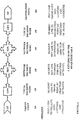
- the distance between the nearest NDN to the OP 630 and the nearest NDN to the DP 640 is calculated by means of the "shortest path algorithm" - an example of which is shown in Fig. 7A .
- the calculation routine uses the time buckets in such a manner that as the route is built up, the time buckets selected represent the time bucket in which the vehicle is traveling. Thus, from a defined start time, it is possible to accurately reflect the journey time based upon the data sets in the road speed matrix 150 for each time bucket.
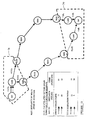
- Fig. 7B shows calculation of a journey time using time buckets in such a manner, in accordance with an embodiment of the invention.
- a different time zone is used (Time Zone 1 through Time Zone 5) for performing the relevant time-dependent calculations for each time division that will occur during the route.
- the time of day corresponding to Time Zone 1 is used for calculating how long it will take for the journey between the OP and the first LDN; then the time of day corresponding to Time Zone 2 is used for calculating how long it will take for the journey between NDN1 and NDN2; then Time Zone 3, Time Zone 4, and Time Zone 5, in a similar fashion.
- the lowest cost route may be calculated in a similar fashion.
- the calculated costs may include the fixed cost associated with the vehicle (e.g. road fund license); the variable costs associated with the vehicle (e.g. fuel costs); the drivers costs; and any costs associated with the route taken (e.g. road tolls, bridge tolls, or congestion charges).
- the route with the shortest distance will also be the route with the shortest time, but if timings differ for alternative sections of road length, where all the timings are below the maximum legally permitted travel speed, then the route with the forecast fastest journey time may not be the route with the shortest distance.
- a key element is the accuracy of the data provided, particularly the forecast time for the route.
- An essential element of an embodiment according to the invention is therefore the manner in which accurate forecast travel times are obtained and maintained for each route.
- three elements of the Road Timetable TM module are linked together, in an embodiment according to the invention, to achieve different customer goals.
- the customer request data 820 (for a distance and time from an OP 610 to a DP 660) can be calculated quickly using a look-up table provided by the Benchmark Road Timetable TM module.
- the matrix containing route data from one NDN to all other NDNs requires considerable computer-based computation time, and the calculation of OP to DP may be undertaken quickly if these calculations are undertaken and stored in a look-up table.
- any other rapid access means may be used, i.e. any memory means capable of storing the results of the matrix calculation. Precalculating these results and storing them in a rapid access means may considerably reduce computation time.
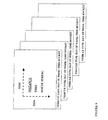
- the Benchmark Road Timetable TM module can provide a database structure, as shown in the embodiment of Fig. 9 , giving the distance (miles or kilometers), travel time (minutes) and the route description (by road number and direction) from one NDN to all other NDNs on the network.
- This database can also be presented by vehicle type, day of the week, and time bucket.
- Vehicle Types can include, but are not limited to, such definitions as cars, light vans, medium vans, light commercials, heavy goods vehicles, and coaches.
- Days of the week can include, but are not limited to, such definitions as Sunday, Monday, Tuesday, Wednesday, Thursday, Friday, Saturday, Bank Holiday, Day before Bank Holiday, and Day after Bank Holiday.
- “Time buckets” can include, but are not limited to, any combination of a 5 minute interval throughout the day - such that, for example, an equal volume of 15 minute intervals throughout the day gives 96 time buckets per day.
- the accuracy of the database provided by the Benchmark Road Timetable TM module is maintained by re-processing the look-up table.
- Such re-processing may be performed, firstly, when the road network or digital map data 870 is updated (because the Benchmark Road Timetable TM module seeks to present a distance based solution, and therefore relies on accurate digital map distances).
- the look-up table may also be re-processed when more FVD is available that changes the data in any individual time bucket by more than 5% (in order to update specific speed calculations).
- the accuracy of the database provided by the Benchmark Road Timetable TM module is further improved, as shown in the embodiment of Fig. 10 , by use of the Congestion Scheduler TM 1020, which updates route times and offers the shortest time journey between the OP 610 and the DP 660; and by use of the Traffic Alert Generator TM 1050, which updates the route in real time over the WWW (World Wide Web) based upon local traffic flash reports and real time FVD TM data.
- the Congestion Scheduler TM 1020 which updates route times and offers the shortest time journey between the OP 610 and the DP 660
- the Traffic Alert Generator TM 1050 which updates the route in real time over the WWW (World Wide Web) based upon local traffic flash reports and real time FVD TM data.
- the Traffic Patterns Bank TM is a record of vehicle speeds in each time bucket over particular stretches of road that define vehicle flow characteristics and type of congestion that has occurred. Roads with similar characteristics are selected to determine the data from the Traffic Pattern Bank TM
- each issue may be defined by effect into one or more categories.
- the categories may be as follows: CATEGORY CONGESTION EFFECT DESCRIPTION One 50% of maximum legal speed limit for type of vehicle per defined road length Congested Two 30% of maximum legal speed limit for type of vehicle over defined road length Slow Three 20% of maximum legal sped limit for type of vehicle over defined road length Very Slow Four Less than 3mph over defined road length Stationary Five Defined road length not available to traffic Closed
- the Congestion Scheduler TM improves the accuracy of the forecast speed in the Road Timetable TM and provides the first alternative time based routes.
- the process starts with the Benchmark Road Timetable TM module 1210 and tests the selected shortest path for congestion 1220 by means of the list of congestion issues 1230 or the Traffic Pattern Bank TM 1240. All data collection means 1250 are used to verify and validate traffic congestion in historic terms 1260 to use in a shortest time algorithm module 1270 which, by means of digital map data 1240, provides a shortest time route from an OP 610 to a DP 660 and an alternative time based Road Timetable TM 1280.
- the alternative time based Road Timetable TM is also presented as a database - see the embodiment of Fig. 13 - in a similar manner to the Benchmark Road Timetable TM . However, in this instance shorter travel time is the dominant factor in the matrix.
- An embodiment of the invention also considers the impact of severe congestion on one route length with traffic patterns on adjacent roads. Thus, any routes passing on adjacent routes to known traffic congestion will have their route speed down graded to allow for the transfer of traffic from one road to another.
- the Traffic Pattern Bank TM selects all potential routes which could be affected in the event of congestion.
- the Traffic Alert Generator TM described in the embodiment of Fig. 14 , addresses real-time traffic issues and allows up-to-date traffic information to be used for a real-time Road Timetable TM offered over the WWW.
- the Traffic Alert Generator TM collects lists of potential short-term incidents 1400, from police or other sources (for example, Automobile Association patrol staff); and from data in the public domain 1430, from such sources as broadcasts on local or national radio.
- vehicle probes and other sensory data 1410 are used to verify the reports and establish the current speed of traffic on the road length affected.
- the combination of such information is consolidated as a traffic incident description 1420, and again the congestion effect may be used to give a short description of known traffic congestion, for example: "A6 at Westhoughton a traffic accident in the last hour has led to stationary traffic in both directions 2 miles northbound towards Chorley and 4 miles southbound towards Swinton".
- the dissemination of this information in real-time either through RDS-TMC (Radio Data System - Traffic Messaging Channel) or direct to a mobile telephone or computer by GSM (Global Systems for Mobiles) or GPRS (General Packet Radio Services) is known as the Traffic Alert Generation 1440.
- the information is also reported into the real-time Road Timetable TM in order to re-calculate either the time to be taken to undertake and complete a Benchmark Road Timetable TM route, or to determine the shortest time route given the traffic incidents.
- Fig. 15 describes the application of the Traffic Alert Generator TM for real-time reporting of the Road Timetable TM , in accordance with an embodiment of the invention.
- the process starts with the alternative (time-based) Road Timetable TM 1510, which is tested for real-time data on congestion 1520.
- Data in terms of traffic incident descriptions 1550 is collected locally and converted to real-time data 1560 to recognize routes affected by real-time issues and passed to the Traffic Alert Generator TM 1530.
- a validation process checks with FVD TM 1500 that current traffic speeds have substantially deteriorated otherwise data is taken from the Traffic Patterns Bank TM 1540 to replace historic data.
- a shortest time algorithm 1570 and digital map data 1590 are used to calculate a line time based Road Timetable TM 1580 which is immediately available on the Worldwide Web.
- This on-line (WWW) Road Timetable TM 1580 is continuously up-dated for short-term local congestion issues; then, when through the FVD TM 1500 vehicle speeds are returned to normal (the historic average), the incident is disregarded. However, a database of such short-term local issues is maintained as part of the Traffic Patterns Bank TM 1540 for use on other occasions should a similar situation arise.
Landscapes
- Engineering & Computer Science (AREA)
- Radar, Positioning & Navigation (AREA)
- Remote Sensing (AREA)
- Physics & Mathematics (AREA)
- General Physics & Mathematics (AREA)
- Automation & Control Theory (AREA)
- Mathematical Physics (AREA)
- Databases & Information Systems (AREA)
- Chemical & Material Sciences (AREA)
- Analytical Chemistry (AREA)
- Life Sciences & Earth Sciences (AREA)
- Atmospheric Sciences (AREA)
- Traffic Control Systems (AREA)
- Management, Administration, Business Operations System, And Electronic Commerce (AREA)
- Navigation (AREA)
Abstract
Description
- This invention relates to systems and methods for providing traffic information, and in particular to systems and methods for responding to user requests regarding the most economic route between an origin point and a destination point.
- Traffic and travel information is significant in calculating journey times, and avoiding congestion that delays individual route completion. There are a number of ways of obtaining traffic information and calculating travel time.
- In the simplest form travel time is calculated mathematically by dividing the distance to be travelled (either estimated or taken from a map) by the average travel speed (either estimated or taken from an analysis of tachograph data in the case of heavy goods vehicles). Journey time and estimated time of arrival are not particularly accurate, and there is no real consideration of potential traffic congestion of either a long-term nature (for example, road works) or a short-term nature (for example, traffic accidents).
- Commercial operations require a greater degree of accuracy to forecast travel times, particularly when using vehicle routing and scheduling techniques to plan vehicle journeys. As a result, traffic planners may use estimated speeds for different types of vehicles over different types of roads (for example, motorways, urban dual carriageways or road surge carriageway arterial roads). Computer based maps with algorithms which determine the shortest path between two points subsequently divides the route into road lengths by type of road and applies estimated speeds to obtain a journey time. Further developments of this technique have, where traffic congestion is known to occur, applied congestion parameters in the form of percentage achievement of the estimated journey time between specific times of the day for particular types of road (for example, urban motorways between 07.30 am and 10.00 am should be 60% of the estimated journey time). However, commercial operators who undertake comparisons of "planned" and "actual" journey times from the tachograph analysis still show significant differences, which are retrospectively found to be caused by traffic congestion.
- Traffic congestion at the same location and same time, which is repeated either on consecutive days of the week or the same day of the week, is by its nature forecastable and can be accounted for in traffic planning. However, forecasting based on such repeated congestion does not take account of unpredictable congestion, and thus does not accurately relate the speed of a vehicle to an actual road length at a specific time of day.
- Real time traffic information is also required by both drivers and commercial vehicle operators in order to avoid delays caused by unforecastable events such as traffic accidents. There are a number of different ways in which real time traffic information is obtained. The most reliable real time traffic information system is the "incident spotter," which may be a designated traffic incident reporter (for example, an Automobile Association traffic reporter on a motorbike) reporting traffic congestion to a central control, or a member of the general public (a driver located in traffic congestion) reporting incidents to a radio station by mobile telephone. Local radio stations may consolidate local traffic data from incident spotters, taxi firms, bus companies and the general public to enable them to broadcast real-time traffic information. Such information is normally vetted by means of many reports on the same incident then disseminated to the public by such means as traffic reports on the radio or by means of traffic information reports by cellular telephones. Such a system only reports incidents as they occur and the information is limited to the immediate vicinity of the incident. In addition the radio reports often continue to be broadcast long after the incident is cleared and traffic is proceeding normally because there is often no real verification process after the initial reports. Users may, based upon the information given, make their own informed choice to divert to an alternative route even when it may not be necessary to do so.
- More accurate real-time systems use detectors, which are either sensors on road and bridges or cameras alongside the road that are linked to a local traffic reporting (or control) facility, thereby allowing the dissemination of real-time traffic information. Such detectors are normally located at potential traffic congestion points in order that early warning may be issued by the traffic control authority. Such information is often validated by the police or "incident spotters" and passed on to radio stations or organizations providing traffic information by means of cellular telephones. These systems tend to be geographically limited and again, information on an incident may be communicated well after it is cleared and traffic proceeding normally - unless there is a verification procedure which up-dates the situation on a regular basis.
- Vehicles fitted with radio data systems with traffic messaging channels (RDS - TMC sytems) may also obtain local messaging and be able to process alternative routes through the vehicle navigation system, but this generally only occurs when the original route is either "closed" or "severely delayed".
- The most accurate traffic information system currently available is the individual vehicle tracking and tracing system, which uses a vehicle fitted with a global positioning system (GPS) probe to detect the vehicle location. The vehicle's speed is determined based upon a number of location readings over time. In addition, the vehicle probe has a memory device which records time, data, location and speed at specific time intervals. The collection of such information, either in real-time using a cellular mobile telephone system (GSM) or GPRS, or after the event by radio data download, is known as the "floating vehicle data" (FVD ™) technique. This data is both specific and customized to particular vehicles (operated by those requiring the traffic data), and timely insofar as the data can be collected either in real-time or historically. The extensive data may be analysed by type of vehicle, location (road length), time of day and day of the week. The greatest drawback with FVD ™ that is data only, is that it does not give the reason for any traffic congestion encountered. Such information is instead often available from other conventional sources in the public domain.
- According to one aspect of the present invention, there is provided a method for providing traffic information.
- In one embodiment according to the invention a method comprises, for each segment of a route between an origin point and a destination point, performing a time-dependent journey planning calculation, based on a time during which a vehicle is predicted to be travelling through the segment, to produce a segment result; forming at least one route result, the at least one route result being formed based on a plurality of the segment results; storing the at least one route result in a digital storage means; and accessing the rapid access means for use in responding to a user request for traffic information for a journey between the origin point and the destination point. Performing the time-dependent journey planning calculation for each segment may comprise determining a segment duration for traversing the segment based on a predicted vehicle speed for the segment at the time during which the vehicle is predicted to be travelling through the segment; or determining a predicted vehicle speed for traversing the segment based on the time during which the vehicle is predicted to be travelling through the segment. Forming the at least one route result may comprise summing a plurality of segment durations to produce an overall route duration; or averaging a plurality of predicted vehicle speeds, each corresponding to a segment, to produce an overall predicted route speed. Performing the time-dependent journey planning calculation may be based on a time of day and a day of the week during which the vehicle is predicted to be travelling through the segment; and the day of the week may be selected from a group comprising Bank Holiday, Day before Bank Holiday, Day after Bank Holiday, Sunday, Monday, Tuesday, Wednesday, Thursday, Friday, and Saturday.
- In another embodiment according to the invention, a method comprises pre-determining at least a portion of a recommended most economic route between an origin point and a destination point; storing the pre-determined portion of the recommended most economic route in a rapid access means in a digital storage means; and accessing the rapid access means for use in responding to a user request for traffic information for a journey between the origin point and the destination point. The pre-determined portion of the recommended most economic route may comprise a route between a first network decision node, for the origin point, and a second network decision node, for the destination point; and the first and second network decision nodes may be nodes, of a network of digital map nodes, that correspond to key transportation links. The rapid access means may comprise a look-up table. Pre-determining at least a portion of the most economic route may comprise determining a shortest time route and/or a shortest distance router between the origin point and the destination point.
- In a further related embodiment, the method comprises receiving real time data relating to real time vehicle location from a plurality of vehicle-bound probes; and creating a matrix of vehicle speeds relative to at least a plurality of time of day divisions and a plurality of routes, based on the real time vehicle location data. The plurality of vehicle-bound probes may include at least one mobile telephone. The method may further comprise creating a first matrix of recommended most economic routes relative to at least a plurality of time of day divisions and a plurality of routes, based on the matrix of vehicle speeds. In creating the first matrix of recommended most economic routes, outlier vehicle speeds, and vehicle speeds related to unforecastable events, may be removed from the matrix of vehicle speeds using statistical analysis. The first matrix of recommended most economic routes may comprise a plurality of route matrix elements, each route matrix element corresponding to a pairing of an origin point with a destination point, and comprising: a route string, a shortest distance corresponding to the route string, a time corresponding to the route string, and a cost corresponding to the route string. The route matrix elements may further comprise entries for a plurality of possible vehicle types. Each shortest distance string may be determined by: determining a first distance between the origin point and the first local decision node; determining a second distance between the first local decision node and the first network decision node; determining a third distance between the first network decision node and the second network decision node; determining a fourth distance between the second network decision node and the second local decision node; determining a fifth distance between the second local decision node and the destination node; and summing the first distance, the second distance, the third distance, the fourth distance, and the fifth distance to produce the shortest distance string. Determining the third distance may comprise summing a plurality of distances corresponding to distances between successive members of the set of network decision nodes, wherein the set of network decision nodes comprises further network decision nodes in addition to the first and second network decision nodes.
- In a further related embodiment, the method may comprise identifying, in real time, an area of traffic congestion between the origin point and the destination point; and determining an alternative, second matrix of recommended most economic routes based on the identified area of traffic congestion. The area of traffic congestion may be identified using both public domain data and non-public domain data, or a database of traffic patterns; or by determining whether real time vehicle location data from a plurality of vehicle-bound probes correspond to a pre-determined level of variance from historic real time vehicle speeds. The method may further comprise transmitting a message to a user identifying a cause of the area of traffic congestion.
- In a further related embodiment, the second recommended most economic route matrix is determined by determining a route having a shortest time between at least one pairing of origin point and destination point. The method may further comprise calculating a forecast delay by comparing the shortest time on the second recommended most economic route matrix with a corresponding time from the first recommended most economic route matrix.
- In a further related embodiment, the method comprises transmitting traffic alert information to a user in real time, the transmission comprising at least one of: a traffic messaging channel on a radio data system; a message to a mobile telephone; or a display of data over the Internet.
- In another embodiment according to the invention, a method comprises determining, with reference to a first network of geographical boundaries and a second network of digital map nodes, a recommended most economic route between an origin point and a destination point; and transmitting the recommended most economic route to a user. The recommended most economic route may be further determined by determining: a set of local decision nodes comprising a first local decision node, for the origin point, and a second local decision node, for the destination point; and a set of network decision nodes comprising a first network decision node, for the origin point, and a second network decision node, for the destination point; wherein the set of local decision nodes corresponds to links on the second network, and the set of network decision nodes corresponds to key transportation links on the second network; and wherein the origin point and destination point are specified with reference to geographical boundaries on the first network. The geographical boundaries may comprise a set of postcodes. The recommended most economic route may minimise a journey distance, time, or cost between the origin point and the destination point. The set of network decision nodes may comprise further network decision nodes in addition to the first and second network decision nodes. At least one of the origin point, the destination point, and a member of the set of local decision nodes may also be a member of the set of network decision nodes.
- According to another aspect of the present invention, there is provided a computer program product comprising program code means adapted to control the methods of any of the preceding embodiments.
- According to another aspect of the present invention, there is provided a system for providing traffic information.
- In one embodiment according to the invention, a system comprises a route segment processor for performing, for each segment of a route between an origin point and a destination point, a time-dependent journey planning calculation, based on a time during which a vehicle is predicted to be travelling through the segment, to produce a segment result; a route result formation means for forming at least one route result, the at least one route result being formed based on a plurality of the segment results; a rapid access means, in a digital storage means, for storing the at least one route result; and a user request processor for accessing the rapid access means for use in responding to a user request for traffic information for a journey between the origin point and the destination point. The route segment processor may comprise means for determining a segment duration for traversing each segment, based on a predicted vehicle speed for the segment at the time during which the vehicle is predicted to be travelling through the segment; or means for determining a predicted vehicle speed for traversing the segment based on the time during which the vehicle is predicted to be travelling through the segment. The route result formation means may comprise means for summing a plurality of segment durations to produce an overall route duration; or means for averaging a plurality of predicted vehicle speeds, each corresponding to a segment, to produce an overall predicted route speed. The route segment processor may comprise means for performing the time-dependent journey planning calculation based on a time of day and a day of the week during which the vehicle is predicted to be travelling through the segment. The day of the week may be selected from a group comprising Bank Holiday, Day before Bank Holiday, Day after Bank Holiday, Sunday, Monday, Tuesday, Wednesday, Thursday, Friday, and Saturday.
- In another embodiment according to the invention, a system comprises a route pre-determination processor for pre-determining at least a portion of a recommended most economic route between an origin point and a destination point; a rapid access means in a digital storage means, for storing the pre-determined portion of the recommended most economic route; and a user request processor for accessing the rapid access means for use in responding to a user request for traffic information for a journey between the origin point and the destination point. The pre-determined portion of the recommended most economic route may comprise a route between a first network decision node, for the origin point, and a second network decision node, for the destination point; and the first and second network decision nodes may be nodes, of a network of digital map nodes, that correspond to key transportation links. The rapid access means may comprise a look-up table. The route pre-determination processor may comprise means for determining a shortest time route or a shortest distance route between the origin point and the destination point.
- In a further related embodiment, the system comprises a real time data receiver for receiving real time data relating to real time vehicle location from a plurality of vehicle-bound probes; and a matrix, in a digital storage means, relating vehicle speeds to at least a plurality of time of day divisions and a plurality of routes, based on the real time vehicle location data. The plurality of vehicle-bound probes may include at least one mobile telephone. The system may further comprise a first matrix of recommended most economic routes, in a digital storage medium, relating a plurality of recommended most economic routes to at least a plurality of time of day divisions, based on the matrix of vehicle speeds. The first matrix of recommended most economic routes may be based on the matrix of vehicle speeds with outlier vehicle speeds, and vehicle speeds related to unforecastable events, removed using statistical analysis. The first matrix of recommended most economic routes may comprise a plurality of route matrix elements, each route matrix element corresponding to a pairing of an origin point with a destination point, and comprising: a route string, a shortest distance corresponding to the route string, a time corresponding to the route string, and a cost corresponding to the route string.
- The route matrix elements may further comprise entries for a plurality of possible vehicle types. The system may further comprise means for determining each shortest distance string by: determining a first distance between the origin point and the first local decision node; determining a second distance between the first local decision node and the first network decision node; determining a third distance between the first network decision node and the second network decision node; determining a fourth distance between the second network decision node and the second local decision node; determining a fifth distance between the second local decision node and the destination point; and summing the first distance, the second distance, the third distance, the fourth distance, and the fifth distance to produce the shortest distance string. The system may further comprise means for determining the third distance by summing a plurality of distances corresponding to distances between successive members of the set of network decision nodes, wherein the set of network decision nodes comprises further network decision nodes in addition to the first and second network decision nodes.
- In a further, related embodiment, a system comprises a congestion scheduler for identifying, in real time, an area of traffic congestion between the origin point and the destination point; and a matrix processor for determining an alternative, second matrix of recommend most economic routes based on the identified area of traffic congestion. The congestion scheduler may comprise means for identifying the area of traffic congestion using both public domain data and non-public domain data, or a database of traffic patterns; or may comprise means for identifying the area of traffic congestion by determining whether real time vehicle location data from a plurality of vehicle-bound probes correspond to a pre-determined level of variance from historic real time vehicle speeds. The system may further comprise a transmitter for transmitting a message to a user identifying a cause of the area of traffic congestion.
- In a further related embodiment, the matrix processor comprises means for determining the second recommended most economic route matrix by determining a route having a shortest time between at least one pairing of origin point and destination point. The system may further comprise a forecast delay processor for calculating a forecast delay by comparing the shortest time on the second recommended most economic route matrix with a corresponding time from the first recommended most economic route matrix.
- In a further related embodiment, the system comprises a traffic alert generator for transmitting traffic alert information to a user in real time, the transmission comprising at least one of: a traffic messaging channel on a radio data system; a message to a mobile telephone; or a display of data over the Internet.
- In another embodiment according to the invention, a system comprises a route determination processor for determining, with reference to a first network of geographical boundaries and a second network of digital map nodes, a recommended most economic route between an origin point and a destination point; and a transmitter for transmitting the recommended most economic route to a user. The route determination processor may comprise means for determining the recommended most economic route by determining: a set of local decision nodes comprising a first local decision node, for the origin point, and a second local decision nodes, for the destination point; and a set of network decision nodes comprising a first network decision node, for the origin point, and a second network decision node, for the destination point; wherein the set of local decision nodes corresponds to links on the second network, and the set of network decision nodes corresponds to key transportation links on the second network; and wherein the origin point and destination point are specified with reference to geographical boundaries on the first network. The geographical boundaries may comprise a set of postcodes. The recommended most economic route may minimise a journey distance, time, or cost between the origin point and the destination point. The set of network decision nodes may comprise further network decision nodes in addition to the first and second network decision nodes. At least one of the origin point, the destination point, and a member of the set of local decision nodes may also be a member of the set of network decision nodes.
- In another embodiment according to the invention, a method for providing traffic information for a journey comprises performing time-dependent journey planning based on a plurality of successive route sections each having an associated vehicle speed, wherein the vehicle speed depends on the time of day at which it is predicted the route section will be traversed on the journey. In a further related embodiment, a computer program product comprises program code means adapted to control the method of the preceding embodiment. In another further related embodiment, a system for providing traffic information for a journey comprises a route planning processor for performing time-dependent journey planning based on a plurality of successive route sections each having an associated vehicle speed, wherein the vehicle speed depends on the time of day at which it is predicted the route section will be traversed on the journey.
- Additional objects, advantages, and novel features of the invention will be set forth in part in the description that follows, and in part will become apparent to those skilled in the art upon examination of the following and the accompanying drawings, or may be learned by practice of the invention.
- For a better understanding of the present invention, and to show how the same may be carried into effect, reference will now be made, by way of example only, to the accompanying drawings, in which:
-
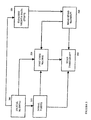
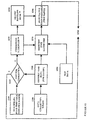
Fig. 1 illustrates the components of the Road Timetable ™, according to an embodiment of the invention; -
Fig. 2 describes the initial data collection, according to an embodiment of the invention; -
Fig. 3 describes the database support structure, according to an embodiment of the invention; -
Fig. 4 provides the definitions for the calculation routine, according to an embodiment of the invention; -
Fig. 5 provides the scope of the key elements in the calculation routine, according to an embodiment of the invention; -
Fig. 6 identifies the characteristics of distance and speed in the calculation routine, according to an embodiment of the invention; -
Fig. 7A outlines the shortest path algorithm, according to an embodiment of the invention; -
Fig. 7B shows calculation of a journey time using time buckets, according to an embodiment of the invention; -
Fig. 7C shows information stored in a matrix as a result of journey calculations, in accordance with an embodiment of the invention; -
Fig. 7D shows merger of multiple nodes into a single network decision node, according to an embodiment of the invention; -
Fig. 8 outlines the Benchmark (distance based) Road Timetable ™ process, according to an embodiment of the invention; -
Fig. 9 describes the Benchmark (distance based) Road Timetable ™ database structure, according to an embodiment of the invention; -
Fig. 10 describes the variations of the Road Timetable ™ by scope, according to an embodiment of the invention; -
Fig. 11 describes the Congestion Scheduler ™, according to an embodiment of the invention; -
Fig. 12 describes the Alternative (time based) Road Timetable ™ process, according to an embodiment of the invention; -
Fig. 13 describes the Alternative (time based) Road Timetable ™ database structure, according to an embodiment of the invention; -
Fig. 14 describes the Traffic Alert Generator ™ data flow, according to an embodiment of the invention; and -
Fig. 15 describes the On-line (www) Road Timetable ™ process, according to an embodiment of the invention. - This invention relates to the provision of forecast travel speeds for different types of road vehicle; including forecasts for specific road lengths at particular times of day, and for specific journeys throughout the day. However, it may also be applied to shipping operations, aircraft, and rail journeys; and to multi-modal journeys that combine movement in two or more modes of transport.
- In accordance with one embodiment of the invention, there is provided a means for determining customized data, for more than one vehicle type. Such customized data may be used, firstly, for forecasting journey times accurately before a journey, in order to select the quickest rather than the shortest route; and secondly, in the event of traffic congestion, for offering journey information and re-routing in real-time during the journey.
- More broadly, an embodiment according to the invention determines a most economic route between an origin point and a destination point. The most economic route may be defined by the user and may include, but is not limited to: the shortest route in distance; the quickest route in time; the lowest cost route; or any combination of these.
- The preferred embodiment of the present invention uses traffic data collected from a number of sources, but particularly from probes in individual road vehicles. These vehicle-bound probes obtain the speed of different types of vehicles over specific road lengths at particular short time intervals throughout the day on each day of the week. Data is collected from the probes to generate a database of actual vehicle speeds over a period of time. The vehicle-bound probes may include mobile phones of the vehicles' drivers, the location of which may be sensed in a manner known to those of skill in the art; or may be other types of vehicle probes.
- In accordance with an embodiment of the invention, the vehicle probe data is used in two forms.
- Firstly, the vehicle probe data is used as historic data from which to forecast the speed of a defined vehicle type, either on a particular road length at a particular time, or upon a particular journey (origin to destination) at any time of day. This data is valuable information to the individual traveler, the commercial vehicle route planner, and the traffic authorities, because it offers a substantial degree of accuracy above any other current means. The forecast road speed data allows the calculation of the fastest route for a particular journey starting at different times of day, where the fastest route may not necessarily be the shortest distance due to forecast traffic congestion in one or more road lengths making up the shortest route.
- Secondly, the vehicle probe data is used as live (real time) data identifying the speed of current vehicle movements on a particular road length. This traffic information is particularly valuable to current (or potential) travelers who are either in an area of traffic congestion or approaching an area of traffic congestion. In both instances travelers will be able, by a number of alternative communication means, to obtain the reason for the traffic congestion and the current speed of vehicle types in the congested area; and to either determine a new estimated time of arrival using their current route, or to forecast whether an alternative route will enable them to arrive at their destination at an earlier time.
- An embodiment according to the present invention provides a system for producing traffic information by means of:
- collecting accurate historic traffic movement data for specific vehicle types on particular route lengths at specific time periods throughout each day of the week;
- determining potential areas of traffic congestion together with reasons and the forecast of traffic speed;
- providing a database of forecast traffic speeds over particular route lengths at specific times of each day of the week;
- providing a means of up-dating the database of traffic speeds both by new data and a forecast traffic pattern in the event of known activities (for example, new road works on a particular route length);
- providing journey plans (routes) with forecast travel times for travelling at different times of the day (and on different days of the week) identifying either the route with the shortest distance or the route with the shortest travel time;
- integrating real time data to estimate a delay time at a particular traffic congestion event;
- integrating real time data to estimate time of arrival before or during a particular journey; and
- integrating real time data to determine the quickest route before or during a particular journey.
- An objective of an embodiment of the present invention is to provide realistic journey times from any start point to any destination point, for different types of vehicles at different time intervals in the day, by means of selecting both the route with the shortest distance and the route with the shortest travel time. These routes may be different due to forecast travel times over particular road lengths that make up the route. These realistic journey times will take account of predictable traffic congestion due to such factors as road works or volume of traffic on a particular road length.
- An embodiment according to the present invention is known as the Road Timetable ™.
- A first aspect of the Road Timetable™ embodiment is the definition of a calculation framework upon which to undertake the distance and time calculation from the Origin Point (OP) to the Destination Point (DP). This calculation framework uses a combination of standard geographical boundaries (such as post codes) and nodal points which are standard to current digital mapping processes. The calculation framework defines the structure of both the database and the algorithm which make up the Road Timetable ™.
- A second aspect of the Road Timetable™ embodiment is that initial vehicle speed data is collected from FVD ™ probes which initially provide data sets on latitude and longitude at a reported time. From two or more such data sets, including the location and direction, it is possible to calculate the speed of a vehicle. Such historic data is accurate and may be stored in a database where the practical lowest level of detail is the speed of a particular type of vehicle on a specific road length at a particular time of a particular day and day of the week. Sufficient historic data at the lowest level of detail may be aggregated and after validation used to forecast trends and create predictions of future vehicle speeds. This is achieved by means of standard statistical averaging and forecasting techniques (such as exponential smoothing, which in a time services analysis gives greater weight to the most recent data collected).
- A third aspect of the Road Timetable™ embodiment is that the FVD™ will be validated and cleansed before being added to the database. The validation process ensures that input to the database records are reasonable and are the time data created only when sufficient raw data is available to statistically validate the sample size. The cleansing process take out the "outliers"(errors in reading data) and those data sets which relate to unforeseen and unforecastable events (for example, traffic accidents or security incidents). The data sets used are therefore particularly accurate reflections of forecastable events.
- A fourth aspect of the Road Timetable™ embodiment is the algorithm that calculates both the distance and time from OP to DP for each time period, and creates a matrix comprising distance, time, and route strings for both the shortest route and the quickest route in each time period. The creation of the distance and time matrix is an important feature of the Road Timetable ™, and is necessary because customers require "immediate" answers, and generally cannot wait for extensive computing time for calculation routines to be undertaken. It is the immediate answer (under 30 seconds on the computer screen from execution), together with the accuracy of the answer, which is an important feature of the Road Timetable ™ as compared with other journey planning products.
- In the preferred embodiment, the present invention has three separate types of output. Firstly, output for "journey planning" either by individuals or traffic planners where such output could be provided by electronic form by means of a CD ROM, e-mail or the web access and up-dated on a regular basis. Such output would be used by individuals for determining the best journey route and time or by commercial traffic planners as an input to vehicle routing and scheduling systems. Secondly, output for "real-time" on route (or before journey) route changes could be provided by means of web access, allowing customers to avoid, where possible, current and potential traffic congestion including known unpredictable incidents such as traffic accidents at the time of their journey.
- The third type of output, in accordance with an embodiment of the invention, is a forecast of traffic patterns based upon simulation of new (or hypothetical) data. Examples of such an output are the impact of opening a new road on the travel speeds from one or more location to others; or the impact of additional traffic due to a specific event (for example a sporting fixture) on the travel speeds on various roads. Simulation output is used for traffic planning purposes, such as planning where to locate emergency service vehicles in order to achieve the required response time throughout the territory during a major sporting fixture, which attracts substantial additional traffic volumes and congestion on the local road network.
- An embodiment according to the present invention is particularly accurate in its forecast of travel speeds on particular road lengths, and relies heavily upon the constant and regular inflow of initial data from vehicle probes in order to regularly up-date the matrix in the Road Timetable ™. It is this regular up-dating process that ensures and maintains the accuracy of the predicted journey planning distances and times for the Road Timetable ™.
- A preferred embodiment of the present invention will now be described, by way of example only using the accompanying drawings. Embodiments of this invention may be used for the provision of forecast travel speeds for all modes of transport including, but not limited to, short sea ferries, rail, air and any combination of such modes of transport.
- The components of the Road Timetable ™, which is the preferred embodiment, are outlined in
Fig. 1 , and include adigital map module 100, acalculation framework 110,source data 120,supplementary data 130, a roadspeed matrix module 150, and an algorithm-implementingmodule 180 to calculate the solutions oroutput 170 in response to thecustomer request 140. - The Road
Speed Matrix module 150 in the embodiment ofFig. 1 provides a record of the aggregate speed of each type of vehicle over each road length for each defined time bucket, where a road length is defined by the distance between two nodal points defined on a digital map. The RoadSpeed Matrix module 150 will provide validated speeds (that is, after the data has been cleaned) and separate road speeds for each direction of travel for each vehicle type. Vehicle speeds are recorded with specific times of day and the speeds are divided into separate time buckets throughout the day where each time bucket may be a five or fifteen minute interval or whatever time interval is appropriate. - The Road Timetable ™ module 160 in the embodiment of
Fig. 1 provides a matrix comprising the route with the shortest distance between two points and the route with the lowest time - two points starting at particular times of the day on a particular day of the week using forecast vehicle speeds from the roadspeed matrix module 150 for each type of vehicle. The Road Timetable ™ module 160 uses a digital image of a street level map provided by digital map module 100 (which are commercially available for many counties).Digital map module 100 identifies each type of road (motorways, arterial roads, other A roads, B roads and others) and provides nodal points at variable distances along each road. Typically a nodal point is a position (defined by latitude and longitude) of a road junction, bridge or other specific road feature. For each route length the digital map could be expected to include additional data such as type of road, distance and significant features such as low bridges (with height defined in meters). - The
primary source data 120 of the embodiment ofFig. 1 is date, time, latitude and longitude collected from moving vehicles by means of a probe, the sum of the information being known as floating vehicle data (FVD™). From thisprimary source data 120 it is possible to calculate the speed of a particular type of vehicle travelling between two or more nodes on a particular road type. Thus, by aggregating this data, specific vehicle type travel speeds may be obtained in selected time buckets for particular road lengths - as provided by the roadspeed matrix module 150. - The
supplementary data 130 of the embodiment ofFig. 1 is, for example, information on road works over particular road lengths, which are in the public domain and available from a number of sources. Thissupplementary data 130 identifies reasons for changes from one day to another in specific vehicle type travel speeds over selected road lengths in similar time buckets. Thesupplementary data 130 also assists with the validation of the primary source data. - The Road Timetable ™ module 160 of the embodiment of
Fig. 1 uses data derived from acalculation framework 110 and an adapted shortestpath algorithm module 180 to derive a matrix of the shortest distances and associated time between the OP (Origin Point) and DP (Destination Point) or lowest times between the OP and DP. However, acustomer request 140 for the shortest forecast time and associated distance from an OP to a DP may not be included in the matrix provided by theRoad Timetable ™ 160 module. In such a case, further calculations may be required using thecalculation matrix 110 to provide an accurate solution. - Solutions or outputs 170 of the embodiment of
Fig. 1 include a list of alternative routes between the OP and DP at a defined start time, identifying forecast journey time, distance, route (in terms of a journey plan) and a forecast of alternative journey times if starting at alternative times (for example, start 30 minutes later). - In accordance with an embodiment of the invention, the ability to forecast traffic speeds is based upon the collection, interpretation, analysis and presentation of historic traffic speeds collected by means of "floating vehicle data" (FVD ™). The embodiment of
Fig. 2 describes how positional and speed data is both collected and verified for the Road Timetable ™ module 270. Floating vehicle data probes 210 are fitted to either a vehicle or a trailer (or any other transport mode) and theseprobes 210 collect data on both time and position (defined as latitude and longitude) the latter by means of the GPS (Global Positioning System)satellite system 220. Such data is store on board in amemory unit 230 and downloaded to a computer memory by either GSM or radio data download means 240. From such data is it possible to calculate both the direction of travel and speed of travel of an individual vehicle type over a particular section of road between two or more nodal points. The FVD™ data collected is verified by means of correlation with other historic data and othersensory information 250 in the public domain such as road speeds and traffic volumes from overhead sensors on the bridges, cameras on the road side or traffic spotters. Verified data is presented using the roadspeed matrix module 260. - The embodiment of
Fig. 3 shows the inter-relationship of the key database requirements before undertaking a distance and time calculation from an origin to a destination. Initially adigital map module 300 is required, which provides a representation of nodal points (road junctions or key positions on the road), potentially down to street level detail. From this, specific nodal points may be selected, and the links from each nodal point to others both identified and described 310. Such descriptions of each link (or road length) include, but are not limited to: links to other nodal points; type of road; distance; direction of travel; restrictions (for example, bridge heights, or weight restrictions); speed limits; and special features (for example, road tolls). - In the embodiment of
Fig. 3 , there is also a requirement for a postcode matrix module 320, which gives the background for estimated road distance, for roads not defined by the nodal points. Such estimates are calculated by means of the straight line distance multiplied by a "wiggle factor," where the "wiggle factor" is taken from a random sample of FVD™ containing distance calculations from actual data of vehicles travelling in the post code sector on roads that are not included in the nodal network. The post code matrix should include, in the UK for example, the following information: post code (at sector level, for example BL1 5); list of adjacent post codes; all nodal points in the post code; "wiggle factor" in the post code (ratio of the average distance of each route length divided by the as-the-crow-flies displacement between the two endpoints - for example, 1.24); and the speed for each type of vehicle in the post code for each time bucket and day of the week - The
FVD ™ 330 of the embodiment ofFig. 3 defines the average speed of each vehicle type between nodal points in each time bucket collected from the individual vehicles. The time buckets selected represent a practical means to sum of data collected into relevant groupings to simplify the calculation and minimize the computing time. The data is verified and presented using the roadspeed matrix module 340. - In the preferred embodiment of this invention, the problem of determining both the distance and the alternative timings from one point to another is structured in the manner described in the embodiments of
Figs. 4 and5 . InFigs. 4 and5 , the "ORIGIN POINT" (OP) 410 and 510 is described as a postcode (alternatively zip code or other similar means), which is converted into a latitude and longitude by means of currently available mapping software. The "LOCAL DECISION NODE" (LDN) 420, 450,520 and 550 ofFigs. 4 and5 is the nearest recognised nodal point to the OP or DP in the direction of travel. Typically a LDN will be selected from A road junctions, railheads, distribution centers, manufacturing centers or retail parks. In some instances users may wish to set up their own LDN structure (for example, a retailer may define its warehouses and each of its retail stores as LDNs). The "NETWORK DECISION NODE" (NDN) 430, 440, 530 and 540 ofFigs. 4 and5 is the nearest key road link (motorway link, primary route link or specially selected link) to the OP or DP by direction of travel. The "DESTINATION POINT" (DP) 460 and 560 ofFigs. 4 and5 is described as a postcode (alternatively zip code or other similar means), which is converted into latitude and longitude by means of currently available mapping software. - Based upon the structure of the embodiments of
Figs. 4 and5 , the shortest distance and time between the OP and DP is calculated as shown in the embodiment ofFig. 6 . First, both "OP" 610 and "DP" 660 are recognized as postcodes (or equivalent) and translated into latitudes and longitudes (by means of software). A validation process is conducted to check the postcodes given. Next, the direction of travel from theOP 610 to theDP 660 is calculated in degrees (where North equals both 0° and 360°). The LDN database is then searched to determine all LDNs in theOP 610 postcode and adjacent postcodes, and thenearest LDN 620 to theOP 610 in the direction of travel (based upon straight line distance) is selected. Next, the "forecast distance" from theOP 610 to the selectedLDN 620 is calculated by multiplying the straight line distance by a "wiggle factor," shown on a postcode database and calculated as the average from a sample of actual data collected for each postcode. Next, the "forecast time" from theOP 610 to the selectedLDN 620 is calculated by determining a speed per mile for each "forecast mile," where the speed is defined in the postcode database for each time bucket by day of the week for each postcode, and is calculated from a sample of actual data collected for each postcode. Next, thefirst NDN 630 is selected from the NDN database, from amongst those NDNs that are linked to theLDN 620 by the direction of travel. Next, the actual distance fromLDN 620 to theNDN 630 is determined using the database and the mapping software. Next, the forecast time from theLDN 620 to theNDN 630 is calculated for the road type (by means of the mapping software), vehicle type and time bucket, by day of the week, from an estimated start time. Next, theLDN 650 andNDN 640 for theDP 660 is determined, and the forecast distance and forecast time are calculated by the same means as described above for the OP distance and time calculations. Next, the distance between the nearest NDN to theOP 630 and the nearest NDN to theDP 640 is calculated by means of the "shortest path algorithm" - an example of which is shown inFig. 7A . Next, the forecast time for the shortest path between the nearest NDN to theOP 630 and the nearest NDN to theDP 640 is calculated, based on the vehicle type and the sum of actual speeds (determined from FVD™ data), for each road length, in each relevant time bucket, by day of the week. Next, the forecast distances and forecast times from theOP 610 to theDP 660 are summed to provide thesolution 170. - An important feature of an embodiment according to the present invention is that the calculation routine uses the time buckets in such a manner that as the route is built up, the time buckets selected represent the time bucket in which the vehicle is traveling. Thus, from a defined start time, it is possible to accurately reflect the journey time based upon the data sets in the
road speed matrix 150 for each time bucket. -
Fig. 7B shows calculation of a journey time using time buckets in such a manner, in accordance with an embodiment of the invention. As shown inFig. 7B , as the route between the OP and the DP is calculated, a different time zone is used (Time Zone 1 through Time Zone 5) for performing the relevant time-dependent calculations for each time division that will occur during the route. Thus, for example, the time of day corresponding toTime Zone 1 is used for calculating how long it will take for the journey between the OP and the first LDN; then the time of day corresponding toTime Zone 2 is used for calculating how long it will take for the journey between NDN1 and NDN2; thenTime Zone 3,Time Zone 4, andTime Zone 5, in a similar fashion. In each case, floating vehicle data for a given route segment is looked up using the time of day corresponding to the Time Zone that the vehicle will be in when it has reached that point in the journey. Thus, calculations of journey times will be correctly built up based on changing traffic congestion patterns on the route segments as the journey progresses. -
Fig. 7C shows how both ashortest distance route 71 and ashortest time route 72 may be built up by such calculations, in accordance with an embodiment of the invention. As shown inFig. 7C , after the calculations are performed, the following information may be stored in a rapid access matrix, for later consultation in performing journey computations: the shortestdistance route string 71 and its corresponding distance D1, time T1, and cost C1; and the shortesttime route string 72 and its corresponding distance D2, time T2, and cost C2. - In addition, the lowest cost route may be calculated in a similar fashion. Regardless of the type of route calculated, the calculated costs may include the fixed cost associated with the vehicle (e.g. road fund license); the variable costs associated with the vehicle (e.g. fuel costs); the drivers costs; and any costs associated with the route taken (e.g. road tolls, bridge tolls, or congestion charges).
- As shown in the embodiment of
Fig. 7D , it should also be noted that links on the calculated route need not be designated exclusively as an origin or destination point, a local decision node, or a network decision node; nor must all such categories of links be used in calculating a route. Instead, for example, an OP or DP, an LDN, or more than one of such points, may be merged into asingle node network decision node - From similar calculation routines it is possible, in accordance with an embodiment of the invention, to select either the route with the shortest distance or the lowest time from the
OP 610 to theDP 660. In some instances the route with the shortest distance will also be the route with the shortest time, but if timings differ for alternative sections of road length, where all the timings are below the maximum legally permitted travel speed, then the route with the forecast fastest journey time may not be the route with the shortest distance. - It is recognised that for commercial applications of the Road Timetable ™, in accordance with an embodiment of the invention, a key element is the accuracy of the data provided, particularly the forecast time for the route. An essential element of an embodiment according to the invention is therefore the manner in which accurate forecast travel times are obtained and maintained for each route. In order to ensure accuracy, three elements of the Road Timetable ™ module are linked together, in an embodiment according to the invention, to achieve different customer goals. The three elements are, first, the Benchmark Road Timetable ™ module, for a shortest distance based solution with an associated travel time; second, the Road Timetable ™ module with Congestion Scheduler ™ for alternative time based solutions considering traffic data in the public domain; and third, the Road Timetable ™ module with "Traffic Alert Generator"™ for "real time" live time based solutions that consider traffic data available in real time from local sources.
- The Benchmark Road Timetable ™ module is presented in the embodiment of
Fig. 8 . This version of the Road Timetable ™ module recognizes that the majority of both the distance and time on each route will be from the NDN nearest theOP 630 to the NDN nearest theDP 640. The Benchmark Road Timetable ™ module therefore uses FVD ™ data 830 and sorts this into selected time buckets for each route length of an NDN to theadjacent NDNs 840. Then, by the combination of thedigital map data 870 and theshortest distance algorithm 850, it is possible to calculate a Road Timetable ™ matrix containing the shortest distance and a given speed between all NDNs in the road network. - In accordance with an embodiment of the invention, based upon data for
separate counties 800 andseparate vehicle types 810, the customer request data 820 (for a distance and time from anOP 610 to a DP 660) can be calculated quickly using a look-up table provided by the Benchmark Road Timetable ™ module. The matrix containing route data from one NDN to all other NDNs requires considerable computer-based computation time, and the calculation of OP to DP may be undertaken quickly if these calculations are undertaken and stored in a look-up table. Instead of a look-up table, any other rapid access means may be used, i.e. any memory means capable of storing the results of the matrix calculation. Precalculating these results and storing them in a rapid access means may considerably reduce computation time. - To ensure accuracy, the Benchmark Road Timetable ™ module can provide a database structure, as shown in the embodiment of
Fig. 9 , giving the distance (miles or kilometers), travel time (minutes) and the route description (by road number and direction) from one NDN to all other NDNs on the network. This database can also be presented by vehicle type, day of the week, and time bucket. "Vehicle Types" can include, but are not limited to, such definitions as cars, light vans, medium vans, light commercials, heavy goods vehicles, and coaches. "Days of the week" can include, but are not limited to, such definitions as Sunday, Monday, Tuesday, Wednesday, Thursday, Friday, Saturday, Bank Holiday, Day before Bank Holiday, and Day after Bank Holiday. "Time buckets" can include, but are not limited to, any combination of a 5 minute interval throughout the day - such that, for example, an equal volume of 15 minute intervals throughout the day gives 96 time buckets per day. - In accordance with an embodiment of the invention, the accuracy of the database provided by the Benchmark Road Timetable™ module is maintained by re-processing the look-up table. Such re-processing may be performed, firstly, when the road network or
digital map data 870 is updated (because the Benchmark Road Timetable ™ module seeks to present a distance based solution, and therefore relies on accurate digital map distances). The look-up table may also be re-processed when more FVD is available that changes the data in any individual time bucket by more than 5% (in order to update specific speed calculations). - The accuracy of the database provided by the Benchmark Road Timetable ™ module is further improved, as shown in the embodiment of
Fig. 10 , by use of theCongestion Scheduler ™ 1020, which updates route times and offers the shortest time journey between theOP 610 and theDP 660; and by use of theTraffic Alert Generator ™ 1050, which updates the route in real time over the WWW (World Wide Web) based upon local traffic flash reports and real time FVD ™ data. - In accordance with an embodiment of the invention, the Congestion Scheduler™ forecasts potential traffic congestion on particular lengths of road at particular times of the day, and particular days of the week, and estimates travel speed for each type of vehicle. The Congestion Scheduler ™ is built up of many elements, as shown in the embodiment of
Fig. 11 , and is based upon the record of the definition ofpotential congestion issues 1150. Such issues are identified by means of traffic data in the public domain 1110 (such as actual road works over a stretch of road); or by means of data not in the public domain 1120 (such as information that a wide load is travelling over a particular road length that is known to the police authority and "quoted" by the police as a potential problem); or by means of FVD™ data 1140 selected because current readings offer a substantial variance from the average recorded historically. Actual vehicle speeds over the particular road length identified as a potential congestion issue are obtained and verified from a combination of vehicle probes and othersensory data 1130. - In accordance with the embodiment of
Fig. 11 , where no actual vehicle speeds are available to determine the speed of each vehicle type through the potential congestion issue in each time bucket, then an approximation of vehicle speed is used from the Traffic Patterns Bank™. The Traffic Patterns Bank™ is a record of vehicle speeds in each time bucket over particular stretches of road that define vehicle flow characteristics and type of congestion that has occurred. Roads with similar characteristics are selected to determine the data from the Traffic Pattern Bank ™ - In the embodiment of
Fig. 11 , the Congestion Scheduler ™ defines the type of incident on a road length from one NDN to alladjacent NDNs 1170 and forecasts the travel speed of each vehicle type in eachtime bucket 1150 by day of the week. Typical issues resulting in traffic congestion may include, but are not limited to, peak traffic volumes, school start and finish times, road works, events (particularly sporting and cultural), and weather (floods or high winds). - In accordance with an embodiment of the invention, for simplicity of reporting severity of congestion on a particular road length (one NDN to an adjacent NDN or another NDN), each issue may be defined by effect into one or more categories. For example, the categories may be as follows:
CATEGORY CONGESTION EFFECT DESCRIPTION One 50% of maximum legal speed limit for type of vehicle per defined road length Congested Two 30% of maximum legal speed limit for type of vehicle over defined road length Slow Three 20% of maximum legal sped limit for type of vehicle over defined road length Very Slow Four Less than 3mph over defined road length Stationary Five Defined road length not available to traffic Closed - By combining the congestion issue, effect, and a single or series of time buckets by day of the week, it is possible, in accordance with an embodiment of the invention, to give a short description of any potential traffic congestion; for example:
"A6 at Westhoughton road works from 0700 hrs to 1600 hrs today may lead to very slow traffic in both directions". - Congestion issues, therefore, may be defined by location (NDN to NDN), type of issue, time, day of the week, effect and direction of travel affected.
- In accordance with an embodiment of the invention, the Congestion Scheduler™ improves the accuracy of the forecast speed in the Road Timetable ™ and provides the first alternative time based routes. The process, as described in the embodiment of
Fig. 12 , starts with the Benchmark Road Timetable ™ module 1210 and tests the selected shortest path forcongestion 1220 by means of the list ofcongestion issues 1230 or theTraffic Pattern Bank ™ 1240. All data collection means 1250 are used to verify and validate traffic congestion inhistoric terms 1260 to use in a shortesttime algorithm module 1270 which, by means ofdigital map data 1240, provides a shortest time route from anOP 610 to aDP 660 and an alternative time basedRoad Timetable ™ 1280. - The alternative time based Road Timetable ™ is also presented as a database - see the embodiment of
Fig. 13 - in a similar manner to the Benchmark Road Timetable ™. However, in this instance shorter travel time is the dominant factor in the matrix. - By means of comparison of the "time" solution from the Benchmark Road Timetable ™ module and the "time" solution from the second Road Time Table™ with the Congestion Scheduler™ it is possible to calculate the "forecast delay," in accordance with an embodiment of the invention. Some radio stations prefer to describe traffic congestion in terms of "forecast delay" in minutes to assist those currently traveling or potentially traveling along a route which includes the congested area.
- An embodiment of the invention also considers the impact of severe congestion on one route length with traffic patterns on adjacent roads. Thus, any routes passing on adjacent routes to known traffic congestion will have their route speed down graded to allow for the transfer of traffic from one road to another. The Traffic Pattern Bank™ selects all potential routes which could be affected in the event of congestion.
- In accordance with an embodiment of the invention, even greater additional accuracy is required for real-time traffic forecasting insofar as short-term influences such as weather (for example, fog), traffic accidents or damage to the road surface (for example, a burst water main) may have a profound impact upon traffic speeds. The Traffic Alert Generator ™, described in the embodiment of
Fig. 14 , addresses real-time traffic issues and allows up-to-date traffic information to be used for a real-time Road Timetable ™ offered over the WWW. - In the embodiment of
Fig. 14 , the Traffic Alert Generator ™ collects lists of potential short-term incidents 1400, from police or other sources (for example, Automobile Association patrol staff); and from data in thepublic domain 1430, from such sources as broadcasts on local or national radio. In addition, vehicle probes and othersensory data 1410 are used to verify the reports and establish the current speed of traffic on the road length affected. The combination of such information is consolidated as atraffic incident description 1420, and again the congestion effect may be used to give a short description of known traffic congestion, for example:
"A6 at Westhoughton a traffic accident in the last hour has led to stationary traffic in bothdirections 2 miles northbound towards Chorley and 4 miles southbound towards Swinton". - The dissemination of this information in real-time either through RDS-TMC (Radio Data System - Traffic Messaging Channel) or direct to a mobile telephone or computer by GSM (Global Systems for Mobiles) or GPRS (General Packet Radio Services) is known as the
Traffic Alert Generation 1440. The information is also reported into the real-time Road Timetable ™ in order to re-calculate either the time to be taken to undertake and complete a Benchmark Road Timetable ™ route, or to determine the shortest time route given the traffic incidents. -
Fig. 15 describes the application of the Traffic Alert Generator ™ for real-time reporting of the Road Timetable ™, in accordance with an embodiment of the invention. The process starts with the alternative (time-based)Road Timetable ™ 1510, which is tested for real-time data oncongestion 1520. Data in terms oftraffic incident descriptions 1550 is collected locally and converted to real-time data 1560 to recognize routes affected by real-time issues and passed to theTraffic Alert Generator ™ 1530. A validation process checks withFVD ™ 1500 that current traffic speeds have substantially deteriorated otherwise data is taken from theTraffic Patterns Bank ™ 1540 to replace historic data. Ashortest time algorithm 1570 anddigital map data 1590 are used to calculate a line time basedRoad Timetable ™ 1580 which is immediately available on the Worldwide Web. This on-line (WWW)Road Timetable ™ 1580 is continuously up-dated for short-term local congestion issues; then, when through theFVD ™ 1500 vehicle speeds are returned to normal (the historic average), the incident is disregarded. However, a database of such short-term local issues is maintained as part of theTraffic Patterns Bank ™ 1540 for use on other occasions should a similar situation arise. - The various apparatus modules described herein may be implemented using general purpose or application specific computer apparatus. The hardware and software configurations indicated for the purpose of explaining the preferred embodiment should not be limiting. Similarly, the software processes running on them may be arranged, configured, or distributed in any manner suitable for performing the invention as defined in the claims.
- A skilled reader will appreciate that, while the foregoing has described what is considered to be the best mode, and where appropriate, other modes of performing the invention, the invention should not be limited to the specific apparatus configurations or method steps disclosed in this description of the preferred embodiment. Those skilled in the art will also recognize that the invention has a broad range of applications, and the embodiments admit of a wide range of modifications without departing from the inventive concepts.
Claims (43)
- A method for providing traffic information, the method comprising:pre-determining at least a portion of a recommended most economic route for a vehicle between an origin point and a destination point;storing the pre-determined portion of the recommended most economic route in a rapid access means in a digital storage means; andaccessing the rapid access digital storage means for use in responding to a user request for traffic information for a journey between the origin point and the destination point, wherein the recommended most economic route minimises a journey cost between the origin point and the destination point.
- A method according to claim 1, wherein the most economic route includes the lowest cost route.
- A method according to claim 2, wherein determining the lowest cost route comprises a calculation including data on fixed costs associated with the vehicle.
- A method according to claim 3, wherein a fixed cost associated with the vehicle comprises a road fund licence cost.
- A method according to any of claims 2 to 4, wherein determining the lowest cost route comprises a calculation including data on variable costs associated with the vehicle.
- A method according to claim 5, wherein a variable cost associated with the vehicle comprises a fuel cost.
- A method according to any of claims 2 to 6, wherein determining the lowest cost route comprises a calculation including data on driver costs.
- A method according to any of claims 2 to 7, wherein determining the lowest cost route comprises a calculation including data on costs associated with a route available for the vehicle.
- A method according to claim 8, wherein costs associated with a route available for the vehicle comprise one or more of: a road toll; a bridge toll; a congestion charge.
- A method according to claim 1, wherein the pre-determined portion of the recommended most economic route comprises a route between a first network decision node, for the origin point, and a second network decision node, for the destination point;
and wherein the first and second network decision nodes are nodes, of a network of digital map nodes, that correspond to key transportation links. - A method according to claim 1, wherein the rapid access means comprises a look-up table.
- A method according to claim 1, wherein pre-determining at least a portion of the recommended most economic route comprises determining a shortest time route between the origin point and the destination point.
- A method according to claim 1 or 12, wherein pre-determining at least a portion of the recommended most economic route comprises determining a shortest distance route between the origin point and the destination point.
- A system for providing traffic information, the system comprising:a route determination processor for determining, with reference to a first network of geographical boundaries and a second network of digital map nodes, a recommended most economic route for a vehicle between an origin point and a destination point; wherein the recommended most economic route is defined by the lowest cost route between the origin point and the destination point;a rapid access matrix comprising a shortest distance route string with a corresponding distance, time, and cost and a shortest time route string with a corresponding time, distance and cost.
anda transmitter for transmitting the recommended most economic route to a user. - A system according to claim 14, wherein information stored to enable lowest cost route calculations comprises data on fixed costs associated with the vehicle.
- A system according to claim 15, wherein a fixed cost associated with the vehicle comprises a road fund licence cost.
- A system according to any of claims 14 to 16, wherein information stored to enable lowest cost route calculations comprises data on variable costs associated with the vehicle.
- A system according to claim 17, wherein a variable cost associated with the vehicle comprises a fuel cost.
- A system according to any of claims 14 to 18, wherein determining the lowest cost route comprises a calculation including data on driver costs.
- A system according to any of claims 14 to 19, wherein information stored to enable lowest cost route calculations comprises data on costs associated with a route available for the vehicle.
- A system according to claim 20, wherein a costs associated with a route available for the vehicle comprise one or more of: a road toll; a bridge toll; a congestion charge.
- A system according to claim 14, wherein the route determination processor comprises means for determining the recommended most economic route by determining: a set of local decision nodes comprising a first local decision node, for the origin point, and a second local decision node, for the destination point; and a set of network decision nodes comprising a first network decision node, for the origin point, and a second network decision node, for the destination point;
wherein the set of local decision nodes corresponds to links on the second network, and the set of network decision nodes corresponds to key transportation links on the second network;
and wherein the origin point and destination point are specified with reference to geographical boundaries on the first network. - A system according to claim 14, wherein the geographical boundaries comprise a set of postcodes.
- A system according to claim 14, wherein the recommended most economic route minimises a journey distance between the origin point and the destination point.
- A system according to claim 14 or 23, wherein the recommended most economic route minimises a journey time between the origin point and the destination point.
- A system according to claim 22, wherein the set of network decision nodes comprises further network decision nodes in addition to the first and second network decision nodes.
- A system according to claim 22, wherein at least one of the origin point, the destination point, and a member of the set of local decision nodes is also a member of the set of network decision nodes.
- A system according to claim 22, further comprising:a route pre-determination processor for pre-determining at least a portion of a recommended most economic route between an origin point and a destination point;a rapid access means in a digital storage means, for storing the pre-determined portion of the recommended most economic route; anda user request processor for accessing the rapid access means for use in responding to a user request for traffic information for a journey between the origin point and the destination point.
- A system according to claim 27, wherein the rapid access means comprises a look-up table.
- A system according to claim 22, further comprising:a real time data receiver for receiving real time data relating to real time vehicle location from a plurality of vehicle-bound probes; anda matrix, in a digital storage means, relating vehicle speeds to at least a plurality of time of day divisions and a plurality of routes, based on the real time vehicle location data.
- A system according to claim 30, wherein the plurality of vehicle-bound probes includes at least one mobile telephone.
- A system according to claim 30, further comprising:a first matrix of recommended most economic routes, in a digital storage medium, relating a plurality of recommended most economic routes to at least a plurality of time of day divisions, based on the matrix of vehicle speeds.
- A system according to claim 32, wherein the first matrix of recommended most economic routes is based on the matrix of vehicle speeds with outlier vehicle speeds, and vehicle speeds related to unforecastable events, removed using statistical analysis.
- A system according to claim 32, wherein the first matrix of recommended most economic routes comprises a plurality of route matrix elements, each route matrix element corresponding to a pairing of an origin point with a destination point, and comprising: a route string, a shortest distance corresponding to the route string, a time corresponding to the route string, and a cost corresponding to the route string.
- A system according to claim 34, wherein the route matrix elements further comprise entries for a plurality of possible vehicle types.
- A system according to claim 32, further comprising:a congestion scheduler for identifying, in real time, an area of traffic congestion between the origin point and the destination point; anda matrix processor for determining an alternative, second matrix of recommend most economic routes based on the identified area of traffic congestion.
- A system according to claim 36, wherein the congestion scheduler comprises means for identifying the area of traffic congestion using both public domain data and non-public domain data.
- A system according to claim 36, wherein the congestion scheduler comprises means for identifying the area of traffic congestion using a database of traffic patterns.
- A system according to claim 36, wherein the congestion scheduler comprises means for identifying the area of traffic congestion by determining whether real time vehicle location data from a plurality of vehicle-bound probes correspond to a pre-determined level of variance from historic real time vehicle speeds.
- A system according to claim 36, further comprising a transmitter for transmitting a message to a user identifying a cause of the area of traffic congestion.
- A system according to claim 36, wherein the matrix processor comprises means for determining the second recommended most economic route matrix by determining a route having a shortest time between at least one pairing of origin point and destination point.
- A system according to claim 34, further comprising a traffic alert generator for transmitting traffic alert information to a user in real time, the transmission comprising at least one of: a traffic messaging channel on a radio data system; a message to a mobile telephone; or a display of data over the Internet.
- A computer program product comprising program code means adapted to control the method of claim 1.
Applications Claiming Priority (3)
| Application Number | Priority Date | Filing Date | Title |
|---|---|---|---|
| GBGB0220062.4A GB0220062D0 (en) | 2002-08-29 | 2002-08-29 | Traffic scheduling system |
| GBGB0308188.2A GB0308188D0 (en) | 2002-08-29 | 2003-04-09 | Apparatus and method for providing traffic information |
| EP03791018A EP1532600B1 (en) | 2002-08-29 | 2003-08-27 | Apparatus and method for providing traffic information |
Related Parent Applications (1)
| Application Number | Title | Priority Date | Filing Date |
|---|---|---|---|
| EP03791018A Division EP1532600B1 (en) | 2002-08-29 | 2003-08-27 | Apparatus and method for providing traffic information |
Publications (2)
| Publication Number | Publication Date |
|---|---|
| EP1918895A2 true EP1918895A2 (en) | 2008-05-07 |
| EP1918895A3 EP1918895A3 (en) | 2008-10-29 |
Family
ID=9943150
Family Applications (3)
| Application Number | Title | Priority Date | Filing Date |
|---|---|---|---|
| EP03791017A Ceased EP1532602A2 (en) | 2002-08-29 | 2003-08-27 | Traffic scheduling system |
| EP09172372.6A Expired - Lifetime EP2136184B1 (en) | 2002-08-29 | 2003-08-27 | Traffic scheduling system |
| EP20080101854 Withdrawn EP1918895A3 (en) | 2002-08-29 | 2003-08-27 | Apparatus and method for providing traffic information |
Family Applications Before (2)
| Application Number | Title | Priority Date | Filing Date |
|---|---|---|---|
| EP03791017A Ceased EP1532602A2 (en) | 2002-08-29 | 2003-08-27 | Traffic scheduling system |
| EP09172372.6A Expired - Lifetime EP2136184B1 (en) | 2002-08-29 | 2003-08-27 | Traffic scheduling system |
Country Status (7)
| Country | Link |
|---|---|
| US (1) | US20060089787A1 (en) |
| EP (3) | EP1532602A2 (en) |
| AU (1) | AU2003259356A1 (en) |
| DE (1) | DE60319993T2 (en) |
| ES (2) | ES2546211T3 (en) |
| GB (2) | GB0220062D0 (en) |
| WO (1) | WO2004021306A2 (en) |
Cited By (9)
| Publication number | Priority date | Publication date | Assignee | Title |
|---|---|---|---|---|
| WO2010074668A1 (en) * | 2008-12-22 | 2010-07-01 | Tele Atlas North America, Inc. | Methods, devices and map databases for green routing |
| EP2290633A1 (en) * | 2009-08-31 | 2011-03-02 | Accenture Global Services GmbH | Computer-implemented method for ensuring the privacy of a user, computer program product, device |
| US9355560B2 (en) | 2014-01-31 | 2016-05-31 | Here Global B.V. | Differentiation of probe reports based on quality |
| WO2018036759A1 (en) * | 2016-08-23 | 2018-03-01 | Siemens Aktiengesellschaft | Prediction of the run of a train |
| FR3057951A1 (en) * | 2016-10-25 | 2018-04-27 | IFP Energies Nouvelles | METHOD FOR DETERMINING AN ITINERARY MINIMIZING THE ENERGY EXPENSE OF A VEHICLE USING AN ADDITIONAL GRAPH |
| CN109961162A (en) * | 2017-12-22 | 2019-07-02 | 株式会社日立制作所 | Paths planning method and path planning apparatus |
| US11274935B2 (en) | 2017-12-05 | 2022-03-15 | Google Llc | Landmark-assisted navigation |
| US11441918B2 (en) * | 2017-12-05 | 2022-09-13 | Google Llc | Machine learning model for predicting speed based on vehicle type |
| CN119358983A (en) * | 2024-12-25 | 2025-01-24 | 万和通物流集团有限公司 | A vehicle dispatching management method and system based on logistics orders |
Families Citing this family (108)
| Publication number | Priority date | Publication date | Assignee | Title |
|---|---|---|---|---|
| US8452526B2 (en) * | 2003-12-15 | 2013-05-28 | Gary Ignatin | Estimation of roadway travel information based on historical travel data |
| DE50310628D1 (en) * | 2003-12-19 | 2008-11-20 | Bayerische Motoren Werke Ag | EXPERIENCED |
| DE102004031933A1 (en) * | 2004-06-27 | 2006-02-09 | Stiftung Alfred-Wegener-Institut Für Polar- Und Meeresforschung | Computer-aided planning process for a travel plan |
| US7698055B2 (en) * | 2004-11-16 | 2010-04-13 | Microsoft Corporation | Traffic forecasting employing modeling and analysis of probabilistic interdependencies and contextual data |
| US7831532B2 (en) | 2004-11-16 | 2010-11-09 | Microsoft Corporation | Precomputation and transmission of time-dependent information for varying or uncertain receipt times |
| US7519564B2 (en) * | 2004-11-16 | 2009-04-14 | Microsoft Corporation | Building and using predictive models of current and future surprises |
| US7908080B2 (en) | 2004-12-31 | 2011-03-15 | Google Inc. | Transportation routing |
| US7444237B2 (en) * | 2005-01-26 | 2008-10-28 | Fujitsu Limited | Planning a journey that includes waypoints |
| US7809500B2 (en) * | 2005-02-07 | 2010-10-05 | Microsoft Corporation | Resolving discrepancies between location information and route data on a navigation device |
| US10121212B1 (en) * | 2005-03-25 | 2018-11-06 | University Of South Florida | System and method for transportation demand management |
| DE102005024620A1 (en) * | 2005-05-30 | 2006-12-07 | Liebherr-Werk Nenzing Gmbh, Nenzing | Guidance system for manually guided vehicles |
| GB0520576D0 (en) | 2005-10-10 | 2005-11-16 | Applied Generics Ltd | Using traffic monitoring information to provide better driver route planning |
| US8712650B2 (en) * | 2005-11-17 | 2014-04-29 | Invent.Ly, Llc | Power management systems and designs |
| US20070208498A1 (en) | 2006-03-03 | 2007-09-06 | Inrix, Inc. | Displaying road traffic condition information and user controls |
| US7912628B2 (en) | 2006-03-03 | 2011-03-22 | Inrix, Inc. | Determining road traffic conditions using data from multiple data sources |
| US8700296B2 (en) | 2006-03-03 | 2014-04-15 | Inrix, Inc. | Dynamic prediction of road traffic conditions |
| US7813870B2 (en) | 2006-03-03 | 2010-10-12 | Inrix, Inc. | Dynamic time series prediction of future traffic conditions |
| US8014936B2 (en) | 2006-03-03 | 2011-09-06 | Inrix, Inc. | Filtering road traffic condition data obtained from mobile data sources |
| US7899611B2 (en) | 2006-03-03 | 2011-03-01 | Inrix, Inc. | Detecting anomalous road traffic conditions |
| US7706965B2 (en) | 2006-08-18 | 2010-04-27 | Inrix, Inc. | Rectifying erroneous road traffic sensor data |
| US7831380B2 (en) | 2006-03-03 | 2010-11-09 | Inrix, Inc. | Assessing road traffic flow conditions using data obtained from mobile data sources |
| US7912627B2 (en) | 2006-03-03 | 2011-03-22 | Inrix, Inc. | Obtaining road traffic condition data from mobile data sources |
| US9376971B2 (en) * | 2006-03-20 | 2016-06-28 | General Electric Company | Energy management system and method for vehicle systems |
| US20070250257A1 (en) * | 2006-04-20 | 2007-10-25 | Sbc Knowledge Ventures, L.P. | Geopositional reminder updating |
| US20130302132A1 (en) * | 2012-05-14 | 2013-11-14 | Kiva Systems, Inc. | System and Method for Maneuvering a Mobile Drive Unit |
| US8538692B2 (en) | 2006-06-19 | 2013-09-17 | Amazon Technologies, Inc. | System and method for generating a path for a mobile drive unit |
| US8220710B2 (en) | 2006-06-19 | 2012-07-17 | Kiva Systems, Inc. | System and method for positioning a mobile drive unit |
| US7873469B2 (en) * | 2006-06-19 | 2011-01-18 | Kiva Systems, Inc. | System and method for managing mobile drive units |
| US8649899B2 (en) | 2006-06-19 | 2014-02-11 | Amazon Technologies, Inc. | System and method for maneuvering a mobile drive unit |
| US7920962B2 (en) | 2006-06-19 | 2011-04-05 | Kiva Systems, Inc. | System and method for coordinating movement of mobile drive units |
| US7912574B2 (en) | 2006-06-19 | 2011-03-22 | Kiva Systems, Inc. | System and method for transporting inventory items |
| US7610151B2 (en) | 2006-06-27 | 2009-10-27 | Microsoft Corporation | Collaborative route planning for generating personalized and context-sensitive routing recommendations |
| US8793066B2 (en) | 2006-06-27 | 2014-07-29 | Microsoft Corporation | Route monetization |
| US7706964B2 (en) | 2006-06-30 | 2010-04-27 | Microsoft Corporation | Inferring road speeds for context-sensitive routing |
| US7739040B2 (en) | 2006-06-30 | 2010-06-15 | Microsoft Corporation | Computation of travel routes, durations, and plans over multiple contexts |
| US7617042B2 (en) | 2006-06-30 | 2009-11-10 | Microsoft Corporation | Computing and harnessing inferences about the timing, duration, and nature of motion and cessation of motion with applications to mobile computing and communications |
| US8126641B2 (en) | 2006-06-30 | 2012-02-28 | Microsoft Corporation | Route planning with contingencies |
| US7908076B2 (en) * | 2006-08-18 | 2011-03-15 | Inrix, Inc. | Representative road traffic flow information based on historical data |
| US7609172B2 (en) * | 2006-10-12 | 2009-10-27 | Garmin Ltd. | System and method for providing real-time traffic information |
| US9047384B1 (en) | 2007-01-12 | 2015-06-02 | University Of South Florida | System and method for automatically determining purpose information for travel behavior |
| JP4725535B2 (en) * | 2007-02-27 | 2011-07-13 | アイシン・エィ・ダブリュ株式会社 | Map information update system |
| KR20080097320A (en) * | 2007-05-01 | 2008-11-05 | 엘지전자 주식회사 | Driving route selection method and terminal |
| KR101467557B1 (en) | 2007-05-02 | 2014-12-10 | 엘지전자 주식회사 | Select a driving route |
| JP5315353B2 (en) * | 2007-10-26 | 2013-10-16 | トムトム インターナショナル ベスローテン フエンノートシャップ | Method for processing position determination data, machine configured to process position determination data, and storage medium |
| US8855909B2 (en) * | 2008-01-07 | 2014-10-07 | Harman International Industries, Inc. | Route determining system for a vehicle with navigation system |
| JP5024134B2 (en) * | 2008-03-14 | 2012-09-12 | アイシン・エィ・ダブリュ株式会社 | Travel information creation device, travel information creation method and program |
| DE102008025753A1 (en) * | 2008-05-29 | 2009-12-10 | Siemens Aktiengesellschaft | A method of detecting anomalies in object streams via the group velocity phantom |
| AU2008358268A1 (en) | 2008-06-25 | 2009-12-30 | Tomtom International B.V. | Navigation apparatus and method of detection that a parking facility is sought |
| US8416067B2 (en) | 2008-09-09 | 2013-04-09 | United Parcel Service Of America, Inc. | Systems and methods for utilizing telematics data to improve fleet management operations |
| US11482058B2 (en) | 2008-09-09 | 2022-10-25 | United Parcel Service Of America, Inc. | Systems and methods for utilizing telematics data to improve fleet management operations |
| US8150611B2 (en) * | 2008-09-30 | 2012-04-03 | International Business Machines Corporation | System and methods for providing predictive traffic information |
| GR1006698B (en) * | 2008-12-22 | 2010-02-05 | Method and system for the collection, processing and distribution of traffic data for optimizing routing in satellite navigation systems of vehicles. | |
| CN102460534B (en) | 2009-04-22 | 2014-10-29 | 因瑞克斯有限公司 | Computer implementation method of predicting expected road traffic conditions based on historical and current data and computing system |
| CN101922936B (en) * | 2009-06-16 | 2012-07-25 | 纬创资通股份有限公司 | Navigation optimization method, navigation optimization device and navigation device |
| CN102473347B (en) * | 2009-09-24 | 2014-06-11 | 三菱电机株式会社 | Travel pattern generation device |
| WO2011067811A1 (en) | 2009-12-02 | 2011-06-09 | 三菱電機株式会社 | Navigation device |
| US10956999B2 (en) | 2010-03-02 | 2021-03-23 | International Business Machines Corporation | Service class prioritization within a controllable transit system |
| US20110218835A1 (en) * | 2010-03-02 | 2011-09-08 | International Business Machines Corporation | Changing priority levels within a controllable transit system |
| US8825255B2 (en) * | 2010-03-02 | 2014-09-02 | International Business Machines Corporation | Reconciling service class-based routing affecting user service within a controllable transit system |
| US20110218833A1 (en) * | 2010-03-02 | 2011-09-08 | International Business Machines Corporation | Service class prioritization within a controllable transit system |
| US20110246067A1 (en) * | 2010-03-30 | 2011-10-06 | General Electric Company | System and method for dynamic routing |
| GB2484085B (en) * | 2010-09-28 | 2014-05-07 | Cassidian Ltd | Telecommunications network routing |
| GB201113112D0 (en) * | 2011-02-03 | 2011-09-14 | Tomtom Dev Germany Gmbh | Method of generating expected average speeds of travel |
| US9953468B2 (en) | 2011-03-31 | 2018-04-24 | United Parcel Service Of America, Inc. | Segmenting operational data |
| US9070100B2 (en) | 2011-03-31 | 2015-06-30 | United Parcel Service Of America, Inc. | Calculating speed and travel times with travel delays |
| US9117190B2 (en) | 2011-03-31 | 2015-08-25 | United Parcel Service Of America, Inc. | Calculating speed and travel times with travel delays |
| US9208626B2 (en) | 2011-03-31 | 2015-12-08 | United Parcel Service Of America, Inc. | Systems and methods for segmenting operational data |
| GB2492369B (en) * | 2011-06-29 | 2014-04-02 | Itis Holdings Plc | Method and system for collecting traffic data |
| US8892240B1 (en) | 2011-06-29 | 2014-11-18 | Amazon Technologies, Inc. | Modular material handling system for order fulfillment |
| US9958280B2 (en) | 2011-08-16 | 2018-05-01 | Inrix, Inc. | Assessing inter-modal passenger travel options |
| US8831984B2 (en) | 2011-10-19 | 2014-09-09 | Amazon Technologies, Inc. | System and method for inventory management using mobile drive units |
| US20130132434A1 (en) * | 2011-11-22 | 2013-05-23 | Inrix, Inc. | User-assisted identification of location conditions |
| EP2788929A4 (en) | 2011-12-09 | 2015-07-22 | Exxonmobil Upstream Res Co | Method for developing a long-term strategy for allocating a supply of liquefied natural gas |
| KR20130100549A (en) * | 2012-03-02 | 2013-09-11 | 삼성전자주식회사 | Apparatus and method for providing navigation service in electronic device |
| US20130332076A1 (en) * | 2012-06-11 | 2013-12-12 | Reagan Inventions, Llc | Storing a route and sharing the route |
| US8868340B1 (en) | 2012-06-15 | 2014-10-21 | Google Inc. | Proposing transit points by analyzing travel patterns |
| GB201211614D0 (en) * | 2012-06-29 | 2012-08-15 | Tomtom Dev Germany Gmbh | Generating alternative routes |
| US10346784B1 (en) | 2012-07-27 | 2019-07-09 | Google Llc | Near-term delivery system performance simulation |
| US9098995B2 (en) * | 2012-12-20 | 2015-08-04 | Amadeus S.A.S. | Determining real-time delay of transport |
| KR20150100619A (en) * | 2012-12-20 | 2015-09-02 | 아마데우스 에스.에이.에스. | Determining real-time delay of transportation means |
| US9805521B1 (en) | 2013-12-03 | 2017-10-31 | United Parcel Service Of America, Inc. | Systems and methods for assessing turns made by a vehicle |
| US9244650B2 (en) * | 2014-01-15 | 2016-01-26 | Microsoft Technology Licensing, Llc | Post-drive summary with tutorial |
| US9536424B2 (en) * | 2014-02-10 | 2017-01-03 | Here Global B.V. | Adaptive traffic dynamics prediction |
| EP3140804A4 (en) | 2014-05-07 | 2017-11-01 | Exxonmobil Upstream Research Company | Method of generating an optimized ship schedule to deliver liquefied natural gas |
| GB201408474D0 (en) | 2014-05-13 | 2014-06-25 | Tomtom Int Bv | Methods and systems for detecting a partial closure of a navigable element |
| US9327740B2 (en) | 2014-07-31 | 2016-05-03 | General Electric Company | Method and system for communicating data with vehicles |
| US10175054B2 (en) * | 2015-01-11 | 2019-01-08 | Microsoft Technology Licensing, Llc | Predicting and utilizing variability of travel times in mapping services |
| US10309788B2 (en) | 2015-05-11 | 2019-06-04 | United Parcel Service Of America, Inc. | Determining street segment headings |
| US9869561B2 (en) * | 2015-11-23 | 2018-01-16 | Here Global B.V. | Method and apparatus for providing traffic event notifications |
| WO2017105343A1 (en) * | 2015-12-18 | 2017-06-22 | Hitachi, Ltd. | Model determination devices and model determination methods |
| US20170278064A1 (en) * | 2016-03-25 | 2017-09-28 | Jusda International Logistics (TAIWAN) CO.,LTD | Method, system, and device for distribution network |
| CN107293113B (en) * | 2016-03-31 | 2020-09-11 | 阿里巴巴(中国)有限公司 | Method and device for calculating regional congestion delay index |
| US10198941B2 (en) * | 2016-07-27 | 2019-02-05 | Here Global B.V. | Method and apparatus for evaluating traffic approaching a junction at a lane level |
| US10147315B2 (en) | 2016-07-27 | 2018-12-04 | Here Global B.V. | Method and apparatus for determining split lane traffic conditions utilizing both multimedia data and probe data |
| US10607192B2 (en) | 2016-08-25 | 2020-03-31 | Ford Global Technologies, Llc | Methods and apparatus for autonomous vehicle scheduling |
| CN106600030B (en) * | 2016-11-02 | 2019-11-29 | 浙江大学 | A kind of trip based on road network Travel Time Reliability is set aside some time calculation method |
| KR101927182B1 (en) * | 2016-11-15 | 2018-12-10 | 현대자동차 주식회사 | Apparatus and computer readable recording medium for warning dangerous situation |
| US20180150925A1 (en) * | 2016-11-30 | 2018-05-31 | Corelogic Solutions, Llc | Computer-based control of timing with which property review orders are processed |
| CN106781468B (en) * | 2016-12-09 | 2018-06-15 | 大连理工大学 | Link Travel Time Estimation method based on built environment and low frequency floating car data |
| US10769946B1 (en) * | 2017-04-24 | 2020-09-08 | Ronald M Harstad | Incentive-compatible, asymmetric-information, real-time traffic-routing differential-advice |
| JP6692324B2 (en) * | 2017-06-19 | 2020-05-13 | 三菱重工業株式会社 | Control device, control system, moving body, control method and program |
| US11521155B2 (en) * | 2018-07-13 | 2022-12-06 | Blackberry Limited | Method and system for detecting duration and cause of border delays |
| CN111445052B (en) * | 2019-01-17 | 2023-06-09 | 阿里巴巴集团控股有限公司 | Vehicle information processing method and device and electronic equipment |
| CN113129582B (en) * | 2019-12-31 | 2023-05-09 | 阿里巴巴集团控股有限公司 | A traffic state prediction method and device |
| CN112613672B (en) * | 2020-12-28 | 2024-08-02 | 北京易控智驾科技有限公司 | Vehicle scheduling method and device for strip mine, storage medium and electronic equipment |
| KR102880902B1 (en) * | 2021-01-29 | 2025-11-03 | 현대자동차주식회사 | Method for operating cell based mobility production system |
| CN113487112B (en) * | 2021-08-03 | 2023-10-31 | 南京行者易智能交通科技有限公司 | Method and device for detecting abnormal running line of vehicle based on big data and terminal equipment |
| GB2636200A (en) * | 2023-12-05 | 2025-06-11 | R24 International Ltd | Method and system for journey support |
Citations (2)
| Publication number | Priority date | Publication date | Assignee | Title |
|---|---|---|---|---|
| EP0703436A2 (en) * | 1994-09-22 | 1996-03-27 | Aisin Aw Co., Ltd. | Navigation system for vehicles |
| US6317686B1 (en) * | 2000-07-21 | 2001-11-13 | Bin Ran | Method of providing travel time |
Family Cites Families (27)
| Publication number | Priority date | Publication date | Assignee | Title |
|---|---|---|---|---|
| US5187810A (en) * | 1988-06-10 | 1993-02-16 | Oki Electric Industry Co., Ltd. | Route guidance system for provding a mobile station with optimum route data in response to a guidance request together with base station data indicative of an identification of a base station |
| US5122959A (en) * | 1988-10-28 | 1992-06-16 | Automated Dispatch Services, Inc. | Transportation dispatch and delivery tracking system |
| US5031104A (en) * | 1988-12-05 | 1991-07-09 | Sumitomo Electric Industries, Ltd. | Adaptive in-vehicle route guidance system |
| US5182555A (en) * | 1990-07-26 | 1993-01-26 | Farradyne Systems, Inc. | Cell messaging process for an in-vehicle traffic congestion information system |
| US5845227A (en) * | 1991-02-01 | 1998-12-01 | Peterson; Thomas D. | Method and apparatus for providing shortest elapsed time route and tracking information to users |
| US5272638A (en) * | 1991-05-31 | 1993-12-21 | Texas Instruments Incorporated | Systems and methods for planning the scheduling travel routes |
| US5465289A (en) * | 1993-03-05 | 1995-11-07 | E-Systems, Inc. | Cellular based traffic sensor system |
| US5539645A (en) * | 1993-11-19 | 1996-07-23 | Philips Electronics North America Corporation | Traffic monitoring system with reduced communications requirements |
| WO1995027964A1 (en) * | 1994-04-12 | 1995-10-19 | Qualcomm Incorporated | Method and apparatus for freight transportation using a satellite navigation system |
| US5724243A (en) * | 1995-02-10 | 1998-03-03 | Highwaymaster Communications, Inc. | Method and apparatus for determining expected time of arrival |
| EP0815547B2 (en) * | 1995-03-23 | 2006-08-30 | T-Mobile Deutschland GmbH | Method and system for determining dynamic traffic information |
| US5732383A (en) * | 1995-09-14 | 1998-03-24 | At&T Corp | Traffic information estimation and reporting system |
| GB9608543D0 (en) * | 1996-04-25 | 1996-07-03 | Philips Electronics Nv | Determining routes in a network comprising nodes and links |
| US5968109A (en) * | 1996-10-25 | 1999-10-19 | Navigation Technologies Corporation | System and method for use and storage of geographic data on physical media |
| DE19805869A1 (en) * | 1998-02-13 | 1999-08-26 | Daimler Chrysler Ag | Method and device for determining the traffic situation on a traffic network |
| EP2009608A3 (en) * | 1998-11-23 | 2009-09-23 | Integrated Transport Information Services Limited | Instantaneous traffic monitoring system |
| CA2266208C (en) * | 1999-03-19 | 2008-07-08 | Wenking Corp. | Remote road traffic data exchange and intelligent vehicle highway system |
| DE19933639A1 (en) * | 1999-07-17 | 2001-01-18 | Bosch Gmbh Robert | Procedure for calculating a route from a start to a destination |
| US6256577B1 (en) * | 1999-09-17 | 2001-07-03 | Intel Corporation | Using predictive traffic modeling |
| US6341255B1 (en) * | 1999-09-27 | 2002-01-22 | Decell, Inc. | Apparatus and methods for providing route guidance to vehicles |
| US6490519B1 (en) * | 1999-09-27 | 2002-12-03 | Decell, Inc. | Traffic monitoring system and methods for traffic monitoring and route guidance useful therewith |
| US6480783B1 (en) * | 2000-03-17 | 2002-11-12 | Makor Issues And Rights Ltd. | Real time vehicle guidance and forecasting system under traffic jam conditions |
| US6411897B1 (en) * | 2000-07-10 | 2002-06-25 | Iap Intermodal, Llc | Method to schedule a vehicle in real-time to transport freight and passengers |
| DE10037827B4 (en) * | 2000-08-03 | 2008-01-10 | Daimlerchrysler Ag | Vehicle autonomous traffic information system |
| US6587781B2 (en) * | 2000-08-28 | 2003-07-01 | Estimotion, Inc. | Method and system for modeling and processing vehicular traffic data and information and applying thereof |
| US20030040944A1 (en) * | 2001-08-22 | 2003-02-27 | Hileman Ryan M. | On-demand transportation system |
| US7062379B2 (en) * | 2002-07-09 | 2006-06-13 | General Motors Corporation | Receiving traffic update information and reroute information in a mobile vehicle |
-
2002
- 2002-08-29 GB GBGB0220062.4A patent/GB0220062D0/en not_active Ceased
-
2003
- 2003-04-09 GB GBGB0308188.2A patent/GB0308188D0/en not_active Ceased
- 2003-08-27 DE DE60319993T patent/DE60319993T2/en not_active Expired - Lifetime
- 2003-08-27 EP EP03791017A patent/EP1532602A2/en not_active Ceased
- 2003-08-27 US US10/526,037 patent/US20060089787A1/en not_active Abandoned
- 2003-08-27 ES ES09172372.6T patent/ES2546211T3/en not_active Expired - Lifetime
- 2003-08-27 EP EP09172372.6A patent/EP2136184B1/en not_active Expired - Lifetime
- 2003-08-27 WO PCT/GB2003/003701 patent/WO2004021306A2/en not_active Ceased
- 2003-08-27 AU AU2003259356A patent/AU2003259356A1/en not_active Abandoned
- 2003-08-27 EP EP20080101854 patent/EP1918895A3/en not_active Withdrawn
- 2003-08-27 ES ES03791018T patent/ES2303910T3/en not_active Expired - Lifetime
Patent Citations (2)
| Publication number | Priority date | Publication date | Assignee | Title |
|---|---|---|---|---|
| EP0703436A2 (en) * | 1994-09-22 | 1996-03-27 | Aisin Aw Co., Ltd. | Navigation system for vehicles |
| US6317686B1 (en) * | 2000-07-21 | 2001-11-13 | Bin Ran | Method of providing travel time |
Cited By (19)
| Publication number | Priority date | Publication date | Assignee | Title |
|---|---|---|---|---|
| US10175058B2 (en) | 2008-12-22 | 2019-01-08 | Tomtom Global Content B.V. | Methods, devices and map databases for green routing |
| WO2010074668A1 (en) * | 2008-12-22 | 2010-07-01 | Tele Atlas North America, Inc. | Methods, devices and map databases for green routing |
| EP2290633A1 (en) * | 2009-08-31 | 2011-03-02 | Accenture Global Services GmbH | Computer-implemented method for ensuring the privacy of a user, computer program product, device |
| WO2011023284A1 (en) * | 2009-08-31 | 2011-03-03 | Accenture Global Services Limited | Computer-implemented method for ensuring the privacy of a user, computer program product, device |
| US8406988B2 (en) | 2009-08-31 | 2013-03-26 | Accenture Global Services Limited | Computer-implemented method for ensuring the privacy of a user, computer program product, device |
| AU2010288952B2 (en) * | 2009-08-31 | 2014-04-10 | Accenture Global Services Limited | Computer-implemented method for ensuring the privacy of a user, computer program product, device |
| US8825358B2 (en) | 2009-08-31 | 2014-09-02 | Accenture Global Services Limited | Computer-implemented method for ensuring the privacy of a user, computer program product, device |
| US9355560B2 (en) | 2014-01-31 | 2016-05-31 | Here Global B.V. | Differentiation of probe reports based on quality |
| WO2018036759A1 (en) * | 2016-08-23 | 2018-03-01 | Siemens Aktiengesellschaft | Prediction of the run of a train |
| FR3057951A1 (en) * | 2016-10-25 | 2018-04-27 | IFP Energies Nouvelles | METHOD FOR DETERMINING AN ITINERARY MINIMIZING THE ENERGY EXPENSE OF A VEHICLE USING AN ADDITIONAL GRAPH |
| EP3315913A3 (en) * | 2016-10-25 | 2018-08-08 | IFP Energies nouvelles | Method for determining an itinerary minimising the energy consumption of a vehicle by means of an adjunct graph |
| US11215469B2 (en) | 2016-10-25 | 2022-01-04 | IFP Energies Nouvelles | Method of determining a route minimizing the energy consumption of a vehicle using a line graph |
| US11274935B2 (en) | 2017-12-05 | 2022-03-15 | Google Llc | Landmark-assisted navigation |
| US11441918B2 (en) * | 2017-12-05 | 2022-09-13 | Google Llc | Machine learning model for predicting speed based on vehicle type |
| US11920945B2 (en) | 2017-12-05 | 2024-03-05 | Google Llc | Landmark-assisted navigation |
| CN109961162A (en) * | 2017-12-22 | 2019-07-02 | 株式会社日立制作所 | Paths planning method and path planning apparatus |
| US11176497B2 (en) * | 2017-12-22 | 2021-11-16 | Hitachi, Ltd. | Routing method and routing device |
| CN109961162B (en) * | 2017-12-22 | 2023-04-07 | 株式会社日立制作所 | Path planning method and path planning device |
| CN119358983A (en) * | 2024-12-25 | 2025-01-24 | 万和通物流集团有限公司 | A vehicle dispatching management method and system based on logistics orders |
Also Published As
| Publication number | Publication date |
|---|---|
| EP1532602A2 (en) | 2005-05-25 |
| EP2136184B1 (en) | 2015-06-03 |
| GB0220062D0 (en) | 2002-10-09 |
| DE60319993T2 (en) | 2009-04-09 |
| GB0308188D0 (en) | 2003-05-14 |
| EP1918895A3 (en) | 2008-10-29 |
| ES2546211T3 (en) | 2015-09-21 |
| EP2136184A2 (en) | 2009-12-23 |
| DE60319993D1 (en) | 2008-05-08 |
| WO2004021306A2 (en) | 2004-03-11 |
| EP2136184A3 (en) | 2010-06-30 |
| US20060089787A1 (en) | 2006-04-27 |
| AU2003259356A8 (en) | 2004-03-19 |
| ES2303910T3 (en) | 2008-09-01 |
| WO2004021306A3 (en) | 2004-06-24 |
| AU2003259356A1 (en) | 2004-03-19 |
Similar Documents
| Publication | Publication Date | Title |
|---|---|---|
| EP1532600B1 (en) | Apparatus and method for providing traffic information | |
| EP1918895A2 (en) | Apparatus and method for providing traffic information | |
| US10928209B2 (en) | Assessing inter-modal passenger travel options | |
| Choe et al. | Freeway performance measurement system: operational analysis tool | |
| US6317686B1 (en) | Method of providing travel time | |
| CN102289936B (en) | Assessing road traffic conditions using data from mobile data sources | |
| CN102890869B (en) | Vehicle route predicting and notifying method and mobile intelligent terminal | |
| KR20140128063A (en) | Traffic prediction system | |
| KR20120049846A (en) | Predicting expected road traffic conditions based on historical and current data | |
| US20200020232A1 (en) | Method, apparatus, and computer program product for evaluating public transportation use | |
| CN107702729A (en) | A kind of automobile navigation method and system for considering expected road conditions | |
| EP1582841A1 (en) | Road information providing server, road information providing system, road information providing method, route search server, route search system, and route search method | |
| Gong et al. | Developing a systematic method for identifying and ranking freeway bottlenecks using vehicle probe data | |
| KR100820467B1 (en) | Section Traffic Prediction System and Method Considering Road Lane Types | |
| CN113901109B (en) | Method for calculating total number of people and time distribution of passenger and truck travel modes on intercity highway | |
| EP4152292B1 (en) | Snap to road, popular routes, popular stops, predicting roadway speed, and contiguous region identification | |
| Alomari et al. | Evaluation of travel time reliability in urban areas using mobile navigation applications in Jordan | |
| WO2002089089A1 (en) | Method of determination of travel times and travel time forecasts in a traffic network using the positioning of mobile telephones and system for the implementation thereof | |
| HK1112524A (en) | Apparatus and method for providing traffic information | |
| Nnamani et al. | Model for Estimating Travel Time on Dynamic Highway Networks in Akure, Ondo State Nigeria | |
| Nalubega | Development of a Floating Car Data (FCD) model to evaluate traffic congestion: a case of Kampala, Uganda | |
| Ali | Modelling Long Haul Truck Route Choice in Ontario | |
| Alexiadis | Integrated Corridor Management Analysis, Modeling and Simulation (AMS) Methodology | |
| Ansari | Analysis and Comparison of Travel Times Using Multiple Data Sources: A Case Study in Metro Phoenix | |
| Ahsan | A generalized procedure for determining when street maintenance activities should be allowed |
Legal Events
| Date | Code | Title | Description |
|---|---|---|---|
| PUAI | Public reference made under article 153(3) epc to a published international application that has entered the european phase |
Free format text: ORIGINAL CODE: 0009012 |
|
| 17P | Request for examination filed |
Effective date: 20080221 |
|
| AC | Divisional application: reference to earlier application |
Ref document number: 1532600 Country of ref document: EP Kind code of ref document: P |
|
| AK | Designated contracting states |
Kind code of ref document: A2 Designated state(s): AT BE BG CH CY CZ DE DK EE ES FI FR GB GR HU IE IT LI LU MC NL PT RO SE SI SK TR |
|
| REG | Reference to a national code |
Ref country code: HK Ref legal event code: DE Ref document number: 1112524 Country of ref document: HK |
|
| PUAL | Search report despatched |
Free format text: ORIGINAL CODE: 0009013 |
|
| AK | Designated contracting states |
Kind code of ref document: A3 Designated state(s): AT BE BG CH CY CZ DE DK EE ES FI FR GB GR HU IE IT LI LU MC NL PT RO SE SI SK TR |
|
| 17Q | First examination report despatched |
Effective date: 20090513 |
|
| AKX | Designation fees paid |
Designated state(s): AT BE BG CH CY CZ DE DK EE ES FI FR GB GR HU IE IT LI LU MC NL PT RO SE SI SK TR |
|
| RAP1 | Party data changed (applicant data changed or rights of an application transferred) |
Owner name: INRIX HOLDINGS LIMITED |
|
| RAP1 | Party data changed (applicant data changed or rights of an application transferred) |
Owner name: INRIX UK LIMITED |
|
| REG | Reference to a national code |
Ref country code: HK Ref legal event code: WD Ref document number: 1112524 Country of ref document: HK |
|
| STAA | Information on the status of an ep patent application or granted ep patent |
Free format text: STATUS: THE APPLICATION IS DEEMED TO BE WITHDRAWN |
|
| 18D | Application deemed to be withdrawn |
Effective date: 20160205 |