EP1911957A2 - Hydrogen engine system - Google Patents
Hydrogen engine system Download PDFInfo
- Publication number
- EP1911957A2 EP1911957A2 EP07019436A EP07019436A EP1911957A2 EP 1911957 A2 EP1911957 A2 EP 1911957A2 EP 07019436 A EP07019436 A EP 07019436A EP 07019436 A EP07019436 A EP 07019436A EP 1911957 A2 EP1911957 A2 EP 1911957A2
- Authority
- EP
- European Patent Office
- Prior art keywords
- hydrogen
- engine
- liquid fuel
- feed unit
- engine system
- Prior art date
- Legal status (The legal status is an assumption and is not a legal conclusion. Google has not performed a legal analysis and makes no representation as to the accuracy of the status listed.)
- Granted
Links
Images

Classifications
-
- F—MECHANICAL ENGINEERING; LIGHTING; HEATING; WEAPONS; BLASTING
- F02—COMBUSTION ENGINES; HOT-GAS OR COMBUSTION-PRODUCT ENGINE PLANTS
- F02M—SUPPLYING COMBUSTION ENGINES IN GENERAL WITH COMBUSTIBLE MIXTURES OR CONSTITUENTS THEREOF
- F02M21/00—Apparatus for supplying engines with non-liquid fuels, e.g. gaseous fuels stored in liquid form
- F02M21/02—Apparatus for supplying engines with non-liquid fuels, e.g. gaseous fuels stored in liquid form for gaseous fuels
- F02M21/0218—Details on the gaseous fuel supply system, e.g. tanks, valves, pipes, pumps, rails, injectors or mixers
- F02M21/0287—Details on the gaseous fuel supply system, e.g. tanks, valves, pipes, pumps, rails, injectors or mixers characterised by the transition from liquid to gaseous phase ; Injection in liquid phase; Cooling and low temperature storage
-
- C—CHEMISTRY; METALLURGY
- C01—INORGANIC CHEMISTRY
- C01B—NON-METALLIC ELEMENTS; COMPOUNDS THEREOF; METALLOIDS OR COMPOUNDS THEREOF NOT COVERED BY SUBCLASS C01C
- C01B3/00—Hydrogen; Gaseous mixtures containing hydrogen; Separation of hydrogen from mixtures containing it; Purification of hydrogen; Reversible storage of hydrogen
- C01B3/02—Production of hydrogen; Production of gaseous mixtures containing hydrogen
- C01B3/22—Production of hydrogen; Production of gaseous mixtures containing hydrogen by decomposition of gaseous or liquid organic compounds
-
- F—MECHANICAL ENGINEERING; LIGHTING; HEATING; WEAPONS; BLASTING
- F02—COMBUSTION ENGINES; HOT-GAS OR COMBUSTION-PRODUCT ENGINE PLANTS
- F02B—INTERNAL-COMBUSTION PISTON ENGINES; COMBUSTION ENGINES IN GENERAL
- F02B43/00—Engines characterised by operating on gaseous fuels; Plants including such engines
- F02B43/10—Engines or plants characterised by use of other specific gases, e.g. acetylene, oxyhydrogen
-
- F—MECHANICAL ENGINEERING; LIGHTING; HEATING; WEAPONS; BLASTING
- F02—COMBUSTION ENGINES; HOT-GAS OR COMBUSTION-PRODUCT ENGINE PLANTS
- F02D—CONTROLLING COMBUSTION ENGINES
- F02D19/00—Controlling engines characterised by their use of non-liquid fuels, pluralities of fuels, or non-fuel substances added to the combustible mixtures
- F02D19/02—Controlling engines characterised by their use of non-liquid fuels, pluralities of fuels, or non-fuel substances added to the combustible mixtures peculiar to engines working with gaseous fuels
- F02D19/021—Control of components of the fuel supply system
- F02D19/022—Control of components of the fuel supply system to adjust the fuel pressure, temperature or composition
-
- F—MECHANICAL ENGINEERING; LIGHTING; HEATING; WEAPONS; BLASTING
- F02—COMBUSTION ENGINES; HOT-GAS OR COMBUSTION-PRODUCT ENGINE PLANTS
- F02M—SUPPLYING COMBUSTION ENGINES IN GENERAL WITH COMBUSTIBLE MIXTURES OR CONSTITUENTS THEREOF
- F02M21/00—Apparatus for supplying engines with non-liquid fuels, e.g. gaseous fuels stored in liquid form
- F02M21/02—Apparatus for supplying engines with non-liquid fuels, e.g. gaseous fuels stored in liquid form for gaseous fuels
- F02M21/0203—Apparatus for supplying engines with non-liquid fuels, e.g. gaseous fuels stored in liquid form for gaseous fuels characterised by the type of gaseous fuel
- F02M21/0206—Non-hydrocarbon fuels, e.g. hydrogen, ammonia or carbon monoxide
-
- F—MECHANICAL ENGINEERING; LIGHTING; HEATING; WEAPONS; BLASTING
- F02—COMBUSTION ENGINES; HOT-GAS OR COMBUSTION-PRODUCT ENGINE PLANTS
- F02M—SUPPLYING COMBUSTION ENGINES IN GENERAL WITH COMBUSTIBLE MIXTURES OR CONSTITUENTS THEREOF
- F02M21/00—Apparatus for supplying engines with non-liquid fuels, e.g. gaseous fuels stored in liquid form
- F02M21/02—Apparatus for supplying engines with non-liquid fuels, e.g. gaseous fuels stored in liquid form for gaseous fuels
- F02M21/0218—Details on the gaseous fuel supply system, e.g. tanks, valves, pipes, pumps, rails, injectors or mixers
- F02M21/0296—Manufacturing or assembly; Materials, e.g. coatings
-
- F—MECHANICAL ENGINEERING; LIGHTING; HEATING; WEAPONS; BLASTING
- F02—COMBUSTION ENGINES; HOT-GAS OR COMBUSTION-PRODUCT ENGINE PLANTS
- F02M—SUPPLYING COMBUSTION ENGINES IN GENERAL WITH COMBUSTIBLE MIXTURES OR CONSTITUENTS THEREOF
- F02M21/00—Apparatus for supplying engines with non-liquid fuels, e.g. gaseous fuels stored in liquid form
- F02M21/02—Apparatus for supplying engines with non-liquid fuels, e.g. gaseous fuels stored in liquid form for gaseous fuels
- F02M21/06—Apparatus for de-liquefying, e.g. by heating
-
- C—CHEMISTRY; METALLURGY
- C01—INORGANIC CHEMISTRY
- C01B—NON-METALLIC ELEMENTS; COMPOUNDS THEREOF; METALLOIDS OR COMPOUNDS THEREOF NOT COVERED BY SUBCLASS C01C
- C01B2203/00—Integrated processes for the production of hydrogen or synthesis gas
- C01B2203/02—Processes for making hydrogen or synthesis gas
- C01B2203/0266—Processes for making hydrogen or synthesis gas containing a decomposition step
-
- C—CHEMISTRY; METALLURGY
- C01—INORGANIC CHEMISTRY
- C01B—NON-METALLIC ELEMENTS; COMPOUNDS THEREOF; METALLOIDS OR COMPOUNDS THEREOF NOT COVERED BY SUBCLASS C01C
- C01B2203/00—Integrated processes for the production of hydrogen or synthesis gas
- C01B2203/06—Integration with other chemical processes
-
- C—CHEMISTRY; METALLURGY
- C01—INORGANIC CHEMISTRY
- C01B—NON-METALLIC ELEMENTS; COMPOUNDS THEREOF; METALLOIDS OR COMPOUNDS THEREOF NOT COVERED BY SUBCLASS C01C
- C01B2203/00—Integrated processes for the production of hydrogen or synthesis gas
- C01B2203/08—Methods of heating or cooling
- C01B2203/0805—Methods of heating the process for making hydrogen or synthesis gas
- C01B2203/0833—Heating by indirect heat exchange with hot fluids, other than combustion gases, product gases or non-combustive exothermic reaction product gases
-
- C—CHEMISTRY; METALLURGY
- C01—INORGANIC CHEMISTRY
- C01B—NON-METALLIC ELEMENTS; COMPOUNDS THEREOF; METALLOIDS OR COMPOUNDS THEREOF NOT COVERED BY SUBCLASS C01C
- C01B2203/00—Integrated processes for the production of hydrogen or synthesis gas
- C01B2203/12—Feeding the process for making hydrogen or synthesis gas
- C01B2203/1205—Composition of the feed
- C01B2203/1211—Organic compounds or organic mixtures used in the process for making hydrogen or synthesis gas
-
- C—CHEMISTRY; METALLURGY
- C01—INORGANIC CHEMISTRY
- C01B—NON-METALLIC ELEMENTS; COMPOUNDS THEREOF; METALLOIDS OR COMPOUNDS THEREOF NOT COVERED BY SUBCLASS C01C
- C01B2203/00—Integrated processes for the production of hydrogen or synthesis gas
- C01B2203/12—Feeding the process for making hydrogen or synthesis gas
- C01B2203/1205—Composition of the feed
- C01B2203/1211—Organic compounds or organic mixtures used in the process for making hydrogen or synthesis gas
- C01B2203/1235—Hydrocarbons
-
- C—CHEMISTRY; METALLURGY
- C01—INORGANIC CHEMISTRY
- C01B—NON-METALLIC ELEMENTS; COMPOUNDS THEREOF; METALLOIDS OR COMPOUNDS THEREOF NOT COVERED BY SUBCLASS C01C
- C01B2203/00—Integrated processes for the production of hydrogen or synthesis gas
- C01B2203/12—Feeding the process for making hydrogen or synthesis gas
- C01B2203/1205—Composition of the feed
- C01B2203/1211—Organic compounds or organic mixtures used in the process for making hydrogen or synthesis gas
- C01B2203/1235—Hydrocarbons
- C01B2203/1247—Higher hydrocarbons
-
- C—CHEMISTRY; METALLURGY
- C01—INORGANIC CHEMISTRY
- C01B—NON-METALLIC ELEMENTS; COMPOUNDS THEREOF; METALLOIDS OR COMPOUNDS THEREOF NOT COVERED BY SUBCLASS C01C
- C01B2203/00—Integrated processes for the production of hydrogen or synthesis gas
- C01B2203/12—Feeding the process for making hydrogen or synthesis gas
- C01B2203/1205—Composition of the feed
- C01B2203/1211—Organic compounds or organic mixtures used in the process for making hydrogen or synthesis gas
- C01B2203/1235—Hydrocarbons
- C01B2203/1252—Cyclic or aromatic hydrocarbons
-
- C—CHEMISTRY; METALLURGY
- C01—INORGANIC CHEMISTRY
- C01B—NON-METALLIC ELEMENTS; COMPOUNDS THEREOF; METALLOIDS OR COMPOUNDS THEREOF NOT COVERED BY SUBCLASS C01C
- C01B2203/00—Integrated processes for the production of hydrogen or synthesis gas
- C01B2203/12—Feeding the process for making hydrogen or synthesis gas
- C01B2203/1288—Evaporation of one or more of the different feed components
-
- C—CHEMISTRY; METALLURGY
- C01—INORGANIC CHEMISTRY
- C01B—NON-METALLIC ELEMENTS; COMPOUNDS THEREOF; METALLOIDS OR COMPOUNDS THEREOF NOT COVERED BY SUBCLASS C01C
- C01B2203/00—Integrated processes for the production of hydrogen or synthesis gas
- C01B2203/12—Feeding the process for making hydrogen or synthesis gas
- C01B2203/1288—Evaporation of one or more of the different feed components
- C01B2203/1294—Evaporation by heat exchange with hot process stream
-
- Y—GENERAL TAGGING OF NEW TECHNOLOGICAL DEVELOPMENTS; GENERAL TAGGING OF CROSS-SECTIONAL TECHNOLOGIES SPANNING OVER SEVERAL SECTIONS OF THE IPC; TECHNICAL SUBJECTS COVERED BY FORMER USPC CROSS-REFERENCE ART COLLECTIONS [XRACs] AND DIGESTS
- Y02—TECHNOLOGIES OR APPLICATIONS FOR MITIGATION OR ADAPTATION AGAINST CLIMATE CHANGE
- Y02E—REDUCTION OF GREENHOUSE GAS [GHG] EMISSIONS, RELATED TO ENERGY GENERATION, TRANSMISSION OR DISTRIBUTION
- Y02E20/00—Combustion technologies with mitigation potential
- Y02E20/14—Combined heat and power generation [CHP]
-
- Y—GENERAL TAGGING OF NEW TECHNOLOGICAL DEVELOPMENTS; GENERAL TAGGING OF CROSS-SECTIONAL TECHNOLOGIES SPANNING OVER SEVERAL SECTIONS OF THE IPC; TECHNICAL SUBJECTS COVERED BY FORMER USPC CROSS-REFERENCE ART COLLECTIONS [XRACs] AND DIGESTS
- Y02—TECHNOLOGIES OR APPLICATIONS FOR MITIGATION OR ADAPTATION AGAINST CLIMATE CHANGE
- Y02E—REDUCTION OF GREENHOUSE GAS [GHG] EMISSIONS, RELATED TO ENERGY GENERATION, TRANSMISSION OR DISTRIBUTION
- Y02E60/00—Enabling technologies; Technologies with a potential or indirect contribution to GHG emissions mitigation
- Y02E60/30—Hydrogen technology
- Y02E60/32—Hydrogen storage
-
- Y—GENERAL TAGGING OF NEW TECHNOLOGICAL DEVELOPMENTS; GENERAL TAGGING OF CROSS-SECTIONAL TECHNOLOGIES SPANNING OVER SEVERAL SECTIONS OF THE IPC; TECHNICAL SUBJECTS COVERED BY FORMER USPC CROSS-REFERENCE ART COLLECTIONS [XRACs] AND DIGESTS
- Y02—TECHNOLOGIES OR APPLICATIONS FOR MITIGATION OR ADAPTATION AGAINST CLIMATE CHANGE
- Y02P—CLIMATE CHANGE MITIGATION TECHNOLOGIES IN THE PRODUCTION OR PROCESSING OF GOODS
- Y02P20/00—Technologies relating to chemical industry
- Y02P20/10—Process efficiency
- Y02P20/129—Energy recovery, e.g. by cogeneration, H2recovery or pressure recovery turbines
-
- Y—GENERAL TAGGING OF NEW TECHNOLOGICAL DEVELOPMENTS; GENERAL TAGGING OF CROSS-SECTIONAL TECHNOLOGIES SPANNING OVER SEVERAL SECTIONS OF THE IPC; TECHNICAL SUBJECTS COVERED BY FORMER USPC CROSS-REFERENCE ART COLLECTIONS [XRACs] AND DIGESTS
- Y02—TECHNOLOGIES OR APPLICATIONS FOR MITIGATION OR ADAPTATION AGAINST CLIMATE CHANGE
- Y02P—CLIMATE CHANGE MITIGATION TECHNOLOGIES IN THE PRODUCTION OR PROCESSING OF GOODS
- Y02P20/00—Technologies relating to chemical industry
- Y02P20/10—Process efficiency
- Y02P20/133—Renewable energy sources, e.g. sunlight
-
- Y—GENERAL TAGGING OF NEW TECHNOLOGICAL DEVELOPMENTS; GENERAL TAGGING OF CROSS-SECTIONAL TECHNOLOGIES SPANNING OVER SEVERAL SECTIONS OF THE IPC; TECHNICAL SUBJECTS COVERED BY FORMER USPC CROSS-REFERENCE ART COLLECTIONS [XRACs] AND DIGESTS
- Y02—TECHNOLOGIES OR APPLICATIONS FOR MITIGATION OR ADAPTATION AGAINST CLIMATE CHANGE
- Y02T—CLIMATE CHANGE MITIGATION TECHNOLOGIES RELATED TO TRANSPORTATION
- Y02T10/00—Road transport of goods or passengers
- Y02T10/10—Internal combustion engine [ICE] based vehicles
- Y02T10/30—Use of alternative fuels, e.g. biofuels
-
- Y—GENERAL TAGGING OF NEW TECHNOLOGICAL DEVELOPMENTS; GENERAL TAGGING OF CROSS-SECTIONAL TECHNOLOGIES SPANNING OVER SEVERAL SECTIONS OF THE IPC; TECHNICAL SUBJECTS COVERED BY FORMER USPC CROSS-REFERENCE ART COLLECTIONS [XRACs] AND DIGESTS
- Y10—TECHNICAL SUBJECTS COVERED BY FORMER USPC
- Y10S—TECHNICAL SUBJECTS COVERED BY FORMER USPC CROSS-REFERENCE ART COLLECTIONS [XRACs] AND DIGESTS
- Y10S123/00—Internal-combustion engines
- Y10S123/12—Hydrogen
Definitions
- the present invention relates to a hydrogen engine system, and more particular, to a hydrogen engine system on which a medium for generating hydrogen from organic hydride owing to dehydrogenation is mounted.
- a planar flow passage, a catalyst layer, hydrogen separation means, and a flow port are formed integrally in a dispersed power source and a small-sized, efficient hydrogen storage/feed unit used in automobiles.
- JP-A-2005-126315 The unit described in JP-A-2005-126315 is difficult to generate a large amount of hydrogen gases and so can neither reduce CO 2 discharge as far as possible in an engine of an automobile nor discharge CO 2 . Also, the system described in JP-A-2005-147124 discharges CO 2 when gasoline or hydrogenated gasoline is fed as a fuel to an engine.
- dehydrogenation of organic hydride such as methylcyclohexane, decalin, etc. is an endothermic reaction (68 kJ/mol) and reaction temperature is as high as 250°C or higher, so that a whole system becomes large in size since an electric source must be mounted separately when a heater or the like is used to heat a dehydrogenation reactor.
- the invention provides a hydrogen engine system including a hydrogen feed unit, which generates hydrogen from organic hydride owing to dehydrogenation, and driving an engine with hydrogen gases as a fuel
- the hydrogen engine system comprising: a hydrogenated liquid fuel tank, which holds a hydrogenated liquid fuel in a liquid phase; a preheater, to which the hydrogenated liquid fuel and a dehydrogenated fuel from the hydrogen feed unit are transported and which preheats the hydrogenated liquid fuel owing to heat exchange; an vaporizer, to which the hydrogenated liquid fuel as preheated and exhaust gases of the engine are transported and which heats the hydrogenated liquid fuel to put the same in a vapor phase; and the hydrogen feed unit, to which the hydrogenated liquid fuel as vaporized and exhaust gases of the engine are transported and which generates hydrogen gases owing to dehydrogenation to transport the same to the engine.
- a hydrogenated liquid fuel is preheated by a dehydrogenated fuel from the hydrogen feed unit and vaporized making use of exhaust gases of an engine to generate hydrogen gases, so that it is possible to generate a large amount of hydrogen gases efficiently and to make a whole system small in size.
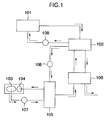
- Fig. 1 shows an outline of a hydrogen engine system according to an embodiment, and the hydrogen engine system comprises: an engine 101, in which hydrogen gases are used as a fuel; a hydrogen feed unit 102, in which hydrogen is generated from organic hydride owing to dehydrogenation; a hydrogenated liquid fuel tank 103, which holds a hydrogenated liquid fuel; a dehydrogenated fuel tank 104; a preheater 105, which preheats the hydrogenated liquid fuel; an vaporizer 106 for vaporization of the preheated hydrogenated liquid fuel; pumps (107, 108, 109) for transportation of a hydrogenated liquid fuel, a fuel after dehydrogenation, hydrogen gases, respectively; and a piping for transportation, etc.
- an engine 101 in which hydrogen gases are used as a fuel
- a hydrogen feed unit 102 in which hydrogen is generated from organic hydride owing to dehydrogenation
- a hydrogenated liquid fuel tank 103 which holds a hydrogenated liquid fuel
- a dehydrogenated fuel tank 104 a
- the hydrogenated liquid fuel comprises a hydrocarbon fuel such as gasoline, light gas oil, kerosine, heavy fuel oil, decalin, cyclohexane, methylcyclohexane, naphthalene, benzene, and toluene, a mixed fuel thereof, peroxide, ammonia, nitrogen, oxygen, etc., which can store/emit hydrogen chemically.
- a hydrocarbon fuel such as gasoline, light gas oil, kerosine, heavy fuel oil, decalin, cyclohexane, methylcyclohexane, naphthalene, benzene, and toluene
- Methylcyclohexane held in a liquid phase in the hydrogenated liquid fuel tank 103 at room temperature is transported to the preheater 105 by the pump 107.
- a dehydrogenated fuel that is, toluene is transported to the preheater 105 from the hydrogen feed unit 102 by the pump 108.
- Heat exchange is performed by a temperature difference between the both media transported to the preheater 105, so that methylcyclohexane is preheated. At this time, the temperature of toluene is 250°C or lower.
- the preheater 105 is preferably arranged close to the hydrogen feed unit 102.
- methylcyclohexane as preheated is transported to the vaporizer 106 mounted to an exhaust pipe from the engine 101. Also, exhaust gases from the engine 101 are transported to the vaporizer 106 through the hydrogen feed unit 102 arranged upstream as viewed from the engine 101.
- Heat exchange is performed by a temperature difference between the both media transported to the vaporizer 106. Methylcyclohexane preheated to room temperature or higher is further heated in the vaporizer 106 to change into a vapor phase state. Methylcyclohexane as vaporized is transported to the hydrogen feed unit 102 to generate hydrogen owing to dehydrogenation.
- Hydrogen gases as generated are transported to the engine 101 by the pump 109 to serve as a fuel to drive the engine 101.
- a quantity of hydrogen gases needed for the engine 101 is determined according to the operating state of the engine 101, that is, according to engine estimated torque and engine speed.
- the respective pumps 107, 108, 109 are controlled by an electronic controller (not shown).
- the hydrogen feed unit 102 makes use of the quantity of heat obtained from high temperature exhaust gases discharged from and immediately after the engine 101, the hydrogen feed unit 102 generates hydrogen, so that it is possible to obtain a large amount of hydrogen as generated.
- temperature T1 of toluene charged into the preheater 250°C
- temperature T2 of toluene discharged from the preheater 100°C
- temperature t1 of methylcyclohexane charged into the preheater 25°C
- specific heat capacity C pt of toluene 1.85 kJ/kgK
- specific heat capacity C pm of methylcyclohexane 1.84 kJ/kgK
- heat exchanger effectiveness is 45 %
- temperature t2 of methylcyclohexane discharged from the preheater is found from the following formula.
- Gr ⁇ C pg ⁇ T ⁇ 1 - T ⁇ 2 Gr ⁇ C pm ⁇ t ⁇ 1 - t ⁇ 2
- temperature t2 of methylcyclohexane discharged from the preheater rises to 92.8°C.
- methylcyclohexane since methylcyclohexane has a boiling point of 100°C, methylcyclohexane is maintained in a liquid phase within the preheater. Thereafter, methylcyclohexane is charged into the vaporizer 106 to be vaporized through heat exchange with exhaust gases, which pass through the hydrogen feed unit 102.
- a hydrogen feed unit described in JP-A-2005-147124 consumes a total heat quantity 100 kJ/mol of sensible heat, specific latent heat (32 kJ/mol), and dehydrogenation (endothermic reaction 68 kJ/mol) since methylcyclohexane in a liquid phase at room temperature is charged directly into the hydrogen feed unit.
- dehydrogenation endothermic reaction 68 kJ/mol
- heat quantity charged into the hydrogen feed unit is increased by 32 % and an amount of hydrogen as generated is correspondingly increased assuming that heat quantities charged into the hydrogen feed unit are the same.
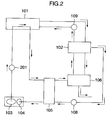
- methylcyclohexane in a liquid phase at room temperature is transported to a water jacket (not shown) provided on a cylinder outer periphery of the engine 101 by a pump 201 before it is transported to the preheater 105 in the hydrogen engine system shown in Fig. 1.
- the engine 101 is cooled by methylcyclohexane and heat exchange at that time heats methylcyclohexane. Thereafter, methylcyclohexane as heated is transported to the preheater 105 to be further heated.
- methylcyclohexane is transported to the hydrogen feed unit 102, it is fed in a state of higher temperature than that in the shown in Fig. 1 and so methylcyclohexane in a state of high temperature can be fed to the hydrogen feed unit 102, so that an increase in amount of hydrogen as generated is resulted.
- a heat recovery plate 301 for recovery of heat discharged from an engine is arranged around an outer periphery of the engine 101, refrigerant is used to recover heat, and a heat pump 302 compresses the refrigerant to release high temperature heat to a hydrogen feed unit 102.
- a heat pump 302 compresses the refrigerant to release high temperature heat to a hydrogen feed unit 102.
- aluminum, copper, or the like having a relatively high thermal conductivity is desirable as a material for the heat recovery plate 301.
- HFC134a, or the like is preferable for the refrigerant. Thereby, it is possible to give a larger quantity of heat to the hydrogen feed unit 102, so that generation of hydrogen is increased.
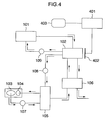
- a hydrogen engine system shown in Fig. 4 comprises an engine system for automobiles to convert regenerative energy, which is generated at the time of automobile deceleration, into electric energy in the case where hydrogen is used as a fuel to drive an automobile, and is made an electric source for a heating heater 402 mounted to the hydrogen feed unit 102. That is, in an automobile with a regenerative brake, electricity generated by the regenerative brake 403 is stored in a battery 401 mounted on the automobile and the heating heater 402 mounted to the hydrogen feed unit 102 is operated at need on the basis of an amount of hydrogen gases needed for the engine according to the operating state of the engine, that is, engine estimated torque and engine speed. Thereby, it is possible to give a larger quantity of heat to the hydrogen feed unit 102, thus enabling an increase in amount of hydrogen as generated.
Landscapes
- Engineering & Computer Science (AREA)
- Chemical & Material Sciences (AREA)
- Combustion & Propulsion (AREA)
- General Engineering & Computer Science (AREA)
- Mechanical Engineering (AREA)
- General Chemical & Material Sciences (AREA)
- Oil, Petroleum & Natural Gas (AREA)
- Chemical Kinetics & Catalysis (AREA)
- Organic Chemistry (AREA)
- Manufacturing & Machinery (AREA)
- Health & Medical Sciences (AREA)
- General Health & Medical Sciences (AREA)
- Inorganic Chemistry (AREA)
- Hydrogen, Water And Hydrids (AREA)
- Output Control And Ontrol Of Special Type Engine (AREA)
- Cooling, Air Intake And Gas Exhaust, And Fuel Tank Arrangements In Propulsion Units (AREA)
Abstract
Description
- The present invention relates to a hydrogen engine system, and more particular, to a hydrogen engine system on which a medium for generating hydrogen from organic hydride owing to dehydrogenation is mounted.
- In a situation, in which global warming is becoming serious due to carbon dioxide, etc., attention is paid to hydrogen as an energy source, which bears the next generation in place of fossil fuel. It has been studied how to construct those systems for transportation, storage, and feeding of hydrogen, which are essential in using hydrogen as a fuel. That is, hydrogen is gaseous at room temperature and so difficult to store and transport as compared with liquids and solids. Besides, hydrogen is a combustible substance to involve a danger of explosion when mixed with an air at a predetermined mixing ratio. Therefore, as described in, for example,
JP-A-2005-126315 - Also, as described in, for example,
JP-A-2005-147124 - The unit described in
JP-A-2005-126315 JP-A-2005-147124 - Further, dehydrogenation of organic hydride such as methylcyclohexane, decalin, etc. is an endothermic reaction (68 kJ/mol) and reaction temperature is as high as 250°C or higher, so that a whole system becomes large in size since an electric source must be mounted separately when a heater or the like is used to heat a dehydrogenation reactor.
- It is an object of the invention to solve the problems in the related art to efficiently generate a large amount of hydrogen gases and to achieve miniaturization of a whole system to make the same appropriate for instaling on an automobile and for use as a power source such as cogeneration, combined system, various power plants, boiler facility, etc.
- In order to solve such problems, the invention provides a hydrogen engine system including a hydrogen feed unit, which generates hydrogen from organic hydride owing to dehydrogenation, and driving an engine with hydrogen gases as a fuel, the hydrogen engine system comprising: a hydrogenated liquid fuel tank, which holds a hydrogenated liquid fuel in a liquid phase; a preheater, to which the hydrogenated liquid fuel and a dehydrogenated fuel from the hydrogen feed unit are transported and which preheats the hydrogenated liquid fuel owing to heat exchange; an vaporizer, to which the hydrogenated liquid fuel as preheated and exhaust gases of the engine are transported and which heats the hydrogenated liquid fuel to put the same in a vapor phase; and the hydrogen feed unit, to which the hydrogenated liquid fuel as vaporized and exhaust gases of the engine are transported and which generates hydrogen gases owing to dehydrogenation to transport the same to the engine.
- According to the invention, a hydrogenated liquid fuel is preheated by a dehydrogenated fuel from the hydrogen feed unit and vaporized making use of exhaust gases of an engine to generate hydrogen gases, so that it is possible to generate a large amount of hydrogen gases efficiently and to make a whole system small in size.
- Other objects, features and advantages of the invention will become apparent from the following description of the embodiments of the invention taken in conjunction with the accompanying drawings.
Embodiments of the invention may implement single features or several features in combination. -
- Fig. 1 is a block diagram of a hydrogen engine system according to an embodiment of the invention;
- Fig. 2 is a block diagram of a hydrogen engine system according to another embodiment of the invention;
- Fig. 3 is a block diagram of a hydrogen engine system according to a further embodiment of the invention; and
- Fig. 4 is a block diagram of a hydrogen engine system according to a still further embodiment of the invention.
- Fig. 1 shows an outline of a hydrogen engine system according to an embodiment, and the hydrogen engine system comprises: an
engine 101, in which hydrogen gases are used as a fuel; ahydrogen feed unit 102, in which hydrogen is generated from organic hydride owing to dehydrogenation; a hydrogenatedliquid fuel tank 103, which holds a hydrogenated liquid fuel; adehydrogenated fuel tank 104; apreheater 105, which preheats the hydrogenated liquid fuel; anvaporizer 106 for vaporization of the preheated hydrogenated liquid fuel; pumps (107, 108, 109) for transportation of a hydrogenated liquid fuel, a fuel after dehydrogenation, hydrogen gases, respectively; and a piping for transportation, etc. - Arrows in the drawing indicate directions, in which a hydrogenated liquid fuel, a fuel after dehydrogenation, hydrogen gases, and exhaust gases are transported. The hydrogenated liquid fuel comprises a hydrocarbon fuel such as gasoline, light gas oil, kerosine, heavy fuel oil, decalin, cyclohexane, methylcyclohexane, naphthalene, benzene, and toluene, a mixed fuel thereof, peroxide, ammonia, nitrogen, oxygen, etc., which can store/emit hydrogen chemically.
- A description will be given below assuming that the hydrogenated liquid fuel is methylcyclohexane.
- Methylcyclohexane held in a liquid phase in the hydrogenated
liquid fuel tank 103 at room temperature is transported to thepreheater 105 by thepump 107. A dehydrogenated fuel, that is, toluene is transported to thepreheater 105 from thehydrogen feed unit 102 by thepump 108. Heat exchange is performed by a temperature difference between the both media transported to thepreheater 105, so that methylcyclohexane is preheated. At this time, the temperature of toluene is 250°C or lower. In order to recover a large quantity of heat from toluene, thepreheater 105 is preferably arranged close to thehydrogen feed unit 102. - Subsequently, methylcyclohexane as preheated is transported to the
vaporizer 106 mounted to an exhaust pipe from theengine 101. Also, exhaust gases from theengine 101 are transported to thevaporizer 106 through thehydrogen feed unit 102 arranged upstream as viewed from theengine 101. - Heat exchange is performed by a temperature difference between the both media transported to the
vaporizer 106. Methylcyclohexane preheated to room temperature or higher is further heated in thevaporizer 106 to change into a vapor phase state. Methylcyclohexane as vaporized is transported to thehydrogen feed unit 102 to generate hydrogen owing to dehydrogenation. - Hydrogen gases as generated are transported to the
engine 101 by thepump 109 to serve as a fuel to drive theengine 101. At this time, a quantity of hydrogen gases needed for theengine 101 is determined according to the operating state of theengine 101, that is, according to engine estimated torque and engine speed. Based on the quantity, therespective pumps - As described above, making use of the quantity of heat obtained from high temperature exhaust gases discharged from and immediately after the
engine 101, thehydrogen feed unit 102 generates hydrogen, so that it is possible to obtain a large amount of hydrogen as generated. - Subsequently, an effect in case of using a preheater will be described on the basis of calculation of thermal balance.
- Assuming that temperature T1 of toluene charged into the preheater is 250°C, temperature T2 of toluene discharged from the preheater is 100°C, temperature t1 of methylcyclohexane charged into the preheater is 25°C, specific heat capacity Cpt of toluene is 1.85 kJ/kgK, specific heat capacity Cpm of methylcyclohexane is 1.84 kJ/kgK, and heat exchanger effectiveness is 45 %, temperature t2 of methylcyclohexane discharged from the preheater is found from the following formula.

- According to the calculation, temperature t2 of methylcyclohexane discharged from the preheater rises to 92.8°C. At this time, since methylcyclohexane has a boiling point of 100°C, methylcyclohexane is maintained in a liquid phase within the preheater. Thereafter, methylcyclohexane is charged into the
vaporizer 106 to be vaporized through heat exchange with exhaust gases, which pass through thehydrogen feed unit 102. - A hydrogen feed unit described in
JP-A-2005-147124 - In a hydrogen engine system shown in Fig. 2, methylcyclohexane in a liquid phase at room temperature is transported to a water jacket (not shown) provided on a cylinder outer periphery of the
engine 101 by apump 201 before it is transported to thepreheater 105 in the hydrogen engine system shown in Fig. 1. - Thereby, the
engine 101 is cooled by methylcyclohexane and heat exchange at that time heats methylcyclohexane. Thereafter, methylcyclohexane as heated is transported to thepreheater 105 to be further heated. When methylcyclohexane is transported to thehydrogen feed unit 102, it is fed in a state of higher temperature than that in the shown in Fig. 1 and so methylcyclohexane in a state of high temperature can be fed to thehydrogen feed unit 102, so that an increase in amount of hydrogen as generated is resulted. - In a hydrogen engine system shown in Fig. 3, a
heat recovery plate 301 for recovery of heat discharged from an engine is arranged around an outer periphery of theengine 101, refrigerant is used to recover heat, and aheat pump 302 compresses the refrigerant to release high temperature heat to ahydrogen feed unit 102. At this time, aluminum, copper, or the like having a relatively high thermal conductivity is desirable as a material for theheat recovery plate 301. HFC134a, or the like is preferable for the refrigerant. Thereby, it is possible to give a larger quantity of heat to thehydrogen feed unit 102, so that generation of hydrogen is increased. - A hydrogen engine system shown in Fig. 4 comprises an engine system for automobiles to convert regenerative energy, which is generated at the time of automobile deceleration, into electric energy in the case where hydrogen is used as a fuel to drive an automobile, and is made an electric source for a
heating heater 402 mounted to thehydrogen feed unit 102. That is, in an automobile with a regenerative brake, electricity generated by theregenerative brake 403 is stored in abattery 401 mounted on the automobile and theheating heater 402 mounted to thehydrogen feed unit 102 is operated at need on the basis of an amount of hydrogen gases needed for the engine according to the operating state of the engine, that is, engine estimated torque and engine speed. Thereby, it is possible to give a larger quantity of heat to thehydrogen feed unit 102, thus enabling an increase in amount of hydrogen as generated. - It should be further understood by those skilled in the art that although the foregoing description has been made on embodiments of the invention, the invention is not limited thereto and various changes and modifications may be made without departing from the spirit of the invention and the scope of the appended claims.
Claims (6)
- A hydrogen engine system including a hydrogen feed unit (102), which generates hydrogen from organic hydride owing to dehydrogenation, and driving an engine (101) with hydrogen gases as a fuel, the hydrogen engine system comprising:a hydrogenated liquid fuel tank (103), which holds a hydrogenated liquid fuel in a liquid phase;a preheater (105), to which the hydrogenated liquid fuel and a dehydrogenated fuel from the hydrogen feed unit (102) are transported and which preheats the hydrogenated liquid fuel owing to heat exchange;a vaporizer (106), to which the hydrogenated liquid fuel as preheated and exhaust gases of the engine are transported and which heats the hydrogenated liquid fuel to put the same in a vapor phase; andthe hydrogen feed unit (102), to which the hydrogenated liquid fuel as vaporized and exhaust gases of the engine are transported and which generates hydrogen gases owing to dehydrogenation to transport the same to the engine.
- The hydrogen engine system according to claim 1, wherein the hydrogen feed unit (102) is arranged upstream of exhaust gases from the engine and the vaporizer (106) is arranged downstream of exhaust gases from the engine.
- The hydrogen engine system according to any of claims 1 and 2, wherein the hydrogenated liquid fuel is transported to a water jacket provided on the engine before being transported to the preheater (105), and heated.
- The hydrogen engine system according to any of claims 1 to 3, further comprising a heat recovery plate (301) arranged on an outer periphery of the engine to recover released heat and to release heat to the hydrogen feed unit (102).
- The hydrogen engine system according to any of claims 1 to 4, wherein said hydrogen engine system comprises an engine system for automobiles, and regenerative energy, which is generated at the time of automobile deceleration, is converted into electric energy and stored in a battery (401) to heat the hydrogen feed unit (102).
- The hydrogen engine system according to any of claims 1 to 5, wherein said hydrogen engine system comprises an engine system for automobiles, and regenerative energy, which is generated at the time of automobile deceleration, is converted into electric energy and stored in a battery to heat the hydrogen feed unit (102) in relation to an operating state of the engine.
Applications Claiming Priority (1)
| Application Number | Priority Date | Filing Date | Title |
|---|---|---|---|
| JP2006272400A JP4737023B2 (en) | 2006-10-04 | 2006-10-04 | Hydrogen engine system |
Publications (3)
| Publication Number | Publication Date |
|---|---|
| EP1911957A2 true EP1911957A2 (en) | 2008-04-16 |
| EP1911957A3 EP1911957A3 (en) | 2010-11-17 |
| EP1911957B1 EP1911957B1 (en) | 2013-12-25 |
Family
ID=39018346
Family Applications (1)
| Application Number | Title | Priority Date | Filing Date |
|---|---|---|---|
| EP07019436.0A Ceased EP1911957B1 (en) | 2006-10-04 | 2007-10-04 | Hydrogen engine system |
Country Status (3)
| Country | Link |
|---|---|
| US (1) | US7654232B2 (en) |
| EP (1) | EP1911957B1 (en) |
| JP (1) | JP4737023B2 (en) |
Cited By (1)
| Publication number | Priority date | Publication date | Assignee | Title |
|---|---|---|---|---|
| IT201600079717A1 (en) * | 2016-07-28 | 2018-01-28 | Amico | HYBRID PROPULSION MOTOR FOR AEREONAUTICAL VEHICLES |
Families Citing this family (26)
| Publication number | Priority date | Publication date | Assignee | Title |
|---|---|---|---|---|
| JP4033163B2 (en) * | 2004-04-12 | 2008-01-16 | トヨタ自動車株式会社 | Internal combustion engine using hydrogen |
| JP4737023B2 (en) * | 2006-10-04 | 2011-07-27 | 株式会社日立製作所 | Hydrogen engine system |
| JP4990110B2 (en) | 2007-11-30 | 2012-08-01 | 株式会社日立製作所 | Engine system |
| JP4523978B2 (en) | 2008-03-28 | 2010-08-11 | 株式会社日立製作所 | Engine system |
| JP4637200B2 (en) | 2008-04-04 | 2011-02-23 | 株式会社日立製作所 | Engine system |
| US8336508B2 (en) * | 2008-09-17 | 2012-12-25 | Timothy Huttner | System and method for use with a combustion engine |
| JP5049947B2 (en) | 2008-11-19 | 2012-10-17 | 日立造船株式会社 | Ammonia engine system |
| JP2013087820A (en) * | 2011-10-14 | 2013-05-13 | Jx Nippon Oil & Energy Corp | Hydrogen station |
| JP5982253B2 (en) * | 2012-10-24 | 2016-08-31 | 株式会社日立製作所 | Cogeneration system |
| TWI526655B (en) | 2013-07-23 | 2016-03-21 | 財團法人工業技術研究院 | Waste heat recovery apparatus and waste heat recovery method |
| JP2015120617A (en) * | 2013-12-24 | 2015-07-02 | エイディシーテクノロジー株式会社 | Hydrogen supply apparatus |
| JP2016000678A (en) * | 2014-06-12 | 2016-01-07 | Jx日鉱日石エネルギー株式会社 | Hydrogen production apparatus and hydrogen production method |
| CN104675580B (en) * | 2015-02-13 | 2017-01-11 | 王海斌 | Novel automobile engine hydrogen and ammonia blended fuel supply device |
| US10428713B2 (en) | 2017-09-07 | 2019-10-01 | Denso International America, Inc. | Systems and methods for exhaust heat recovery and heat storage |
| DE102019004905A1 (en) | 2019-07-13 | 2021-01-14 | Man Truck & Bus Se | Method and device for supplying a hydrogen internal combustion engine of a motor vehicle with hydrogen |
| CN112594056A (en) * | 2021-01-06 | 2021-04-02 | 张志坚 | Hydrogen-burning engine capable of decomposing hydrogen-containing compound by waste heat |
| CN114837857B (en) * | 2022-01-17 | 2023-06-13 | 中车青岛四方机车车辆股份有限公司 | A hydrogen internal combustion power system, vehicle and control method |
| CN114738111B (en) * | 2022-03-08 | 2025-05-02 | 湖北文理学院 | Hydrogen fuel power system and hydrogen fuel vehicle |
| CN115217621A (en) * | 2022-04-14 | 2022-10-21 | 广州汽车集团股份有限公司 | Internal combustion engine and internal combustion engine control method |
| CN115489294B (en) * | 2022-09-13 | 2025-09-26 | 西安交通大学 | A vehicle-mounted hybrid system based on liquid organic hydrogen carrier hydrogen storage technology |
| US11873768B1 (en) | 2022-09-16 | 2024-01-16 | General Electric Company | Hydrogen fuel system for a gas turbine engine |
| US11898495B1 (en) | 2022-09-16 | 2024-02-13 | General Electric Company | Hydrogen fuel system for a gas turbine engine |
| US11905884B1 (en) | 2022-09-16 | 2024-02-20 | General Electric Company | Hydrogen fuel system for a gas turbine engine |
| CN116446986A (en) * | 2023-04-21 | 2023-07-18 | 中氢源安(北京)科技有限公司 | Method for recycling and dehydrogenating waste heat of hydrogen-burning engine |
| CN116878892A (en) * | 2023-06-25 | 2023-10-13 | 清华大学 | Aeroengine simulation system and method |
| GB2634736A (en) * | 2023-10-17 | 2025-04-23 | Phinia Delphi Luxembourg Sarl | Method for operating a gaseous fuel engine |
Family Cites Families (22)
| Publication number | Priority date | Publication date | Assignee | Title |
|---|---|---|---|---|
| JPS5831468B2 (en) * | 1978-12-28 | 1983-07-06 | 日産自動車株式会社 | Alcohol engine starting device |
| US4318369A (en) * | 1979-06-06 | 1982-03-09 | Cronyn Marshall W | Recyclable-fuel engine system |
| US4418653A (en) * | 1982-06-07 | 1983-12-06 | Conoco Inc. | Alcohol fuel dual-catalyst treatment apparatus and method |
| US5180560A (en) * | 1987-09-03 | 1993-01-19 | Mohamed Nasser | Apparatus for dehydrogenation of liquid hydrides |
| US5275000A (en) * | 1992-08-17 | 1994-01-04 | General Electric Company | Reducing thermal deposits in endothermic fuel reactors of propulsion systems |
| US6186126B1 (en) * | 1999-07-19 | 2001-02-13 | The United States Of America As Represented By The Administrator Of The United States Environmental Protection Agency | Phase change heat engine |
| US7578911B2 (en) * | 2001-03-14 | 2009-08-25 | Christian Osita Nweke | Hydrogen injection powered automobile engine |
| JP2004189585A (en) * | 2002-11-26 | 2004-07-08 | Toyota Motor Corp | Hydrogen gas generator |
| JP4212885B2 (en) * | 2002-12-24 | 2009-01-21 | 株式会社ニッキ | Engine positive pressure gas fuel supply method |
| JP2005022939A (en) * | 2003-07-02 | 2005-01-27 | Sekisui Chem Co Ltd | Hydrogen supply system reactor and hydrogen supply system |
| JP4578867B2 (en) * | 2003-09-30 | 2010-11-10 | 株式会社日立製作所 | Hydrogen storage / supply device and system thereof, distributed power source using the same, and automobile |
| FR2860455B1 (en) * | 2003-10-03 | 2007-10-26 | Renault Sa | SYSTEM FOR PRODUCING HYDROGEN ABOARD A VEHICLE BY USING THE DEHYDROGENATION OF ORGANIC COMPOUNDS |
| JP4039383B2 (en) * | 2003-10-21 | 2008-01-30 | トヨタ自動車株式会社 | Internal combustion engine using hydrogen |
| JP2005214011A (en) * | 2004-01-27 | 2005-08-11 | Nikki Co Ltd | Regulator for LPG |
| JP2005302491A (en) * | 2004-04-09 | 2005-10-27 | Toyota Motor Corp | Fuel cell system |
| EP1786725A2 (en) * | 2004-06-11 | 2007-05-23 | Nuvera Fuel Cells, Inc. | Fuel fired hydrogen generator |
| JP4662534B2 (en) * | 2004-10-01 | 2011-03-30 | 株式会社新エネルギー研究所 | Hydrogen gas generator |
| JP2006248814A (en) | 2005-03-09 | 2006-09-21 | Hitachi Ltd | Hydrogen supply apparatus and hydrogen supply method |
| JP2007091035A (en) | 2005-09-29 | 2007-04-12 | Hitachi Ltd | Car drive system and car |
| JP4737023B2 (en) * | 2006-10-04 | 2011-07-27 | 株式会社日立製作所 | Hydrogen engine system |
| JP2008267268A (en) * | 2007-04-20 | 2008-11-06 | Nissan Motor Co Ltd | Fuel supply device for internal combustion engine |
| JP4523978B2 (en) * | 2008-03-28 | 2010-08-11 | 株式会社日立製作所 | Engine system |
-
2006
- 2006-10-04 JP JP2006272400A patent/JP4737023B2/en not_active Expired - Fee Related
-
2007
- 2007-10-03 US US11/866,464 patent/US7654232B2/en not_active Expired - Fee Related
- 2007-10-04 EP EP07019436.0A patent/EP1911957B1/en not_active Ceased
Non-Patent Citations (1)
| Title |
|---|
| None |
Cited By (1)
| Publication number | Priority date | Publication date | Assignee | Title |
|---|---|---|---|---|
| IT201600079717A1 (en) * | 2016-07-28 | 2018-01-28 | Amico | HYBRID PROPULSION MOTOR FOR AEREONAUTICAL VEHICLES |
Also Published As
| Publication number | Publication date |
|---|---|
| JP4737023B2 (en) | 2011-07-27 |
| US20080110420A1 (en) | 2008-05-15 |
| JP2008088922A (en) | 2008-04-17 |
| EP1911957A3 (en) | 2010-11-17 |
| US7654232B2 (en) | 2010-02-02 |
| EP1911957B1 (en) | 2013-12-25 |
Similar Documents
| Publication | Publication Date | Title |
|---|---|---|
| EP1911957B1 (en) | Hydrogen engine system | |
| US20220403775A1 (en) | Systems and methods for processing ammonia | |
| US6282900B1 (en) | Calcium carbide power system with waste energy recovery | |
| US6878353B2 (en) | Hydrogen storage bed system including an integrated thermal management system | |
| US8161748B2 (en) | Water combustion technology—methods, processes, systems and apparatus for the combustion of hydrogen and oxygen | |
| US8096269B2 (en) | Engine system | |
| CN101332761B (en) | Engine system | |
| US6833118B2 (en) | Hydrogen storage bed system including an integrated thermal management system | |
| US20140356738A1 (en) | Ammonia based system to prepare and utilize hydrogen to produce electricity | |
| US9234482B2 (en) | Ultra-high efficiency alcohol engines using optimized exhaust heat recovery | |
| US6620537B2 (en) | Hydrocarbon fueled hydrogen fuel generator system and apparatus in combination with hydrogen fuel cells | |
| US8555640B2 (en) | Waste heat auxiliary power unit | |
| JP2002083624A (en) | Fuel cell system with thermally integrated isothermal CO cleaning subsystem | |
| US20030077497A1 (en) | Waste heat recovery means for fuel cell power system | |
| US20040101722A1 (en) | Fuel cell system with heat exchanger for heating a reformer and vehicle containing same | |
| JP2003187845A (en) | Fuel cell device | |
| CN100423340C (en) | Heating device and method for hydrogen storage container | |
| Hovland et al. | Water and heat balance in a fuel cell vehicle with a sodium borohydride hydrogen fuel processor | |
| GB2388465A (en) | A fuel cell plant | |
| Tamura et al. | Development of the Nissan Fuel Cell Vehicle | |
| Wang et al. | Marine Scheme and Experimental Study of Liquid Organic Hydrogen Carrier Technology | |
| Otoguro et al. | Design of a Fuel-Cell Electric Vehicle with a Hydrogen Generation System Fueled with Ammonia | |
| Kindler et al. | Method and system for storing and generating hydrogen | |
| JP2001010805A (en) | Vaporizer for reformer |
Legal Events
| Date | Code | Title | Description |
|---|---|---|---|
| PUAI | Public reference made under article 153(3) epc to a published international application that has entered the european phase |
Free format text: ORIGINAL CODE: 0009012 |
|
| AK | Designated contracting states |
Kind code of ref document: A2 Designated state(s): AT BE BG CH CY CZ DE DK EE ES FI FR GB GR HU IE IS IT LI LT LU LV MC MT NL PL PT RO SE SI SK TR |
|
| AX | Request for extension of the european patent |
Extension state: AL BA HR MK RS |
|
| PUAL | Search report despatched |
Free format text: ORIGINAL CODE: 0009013 |
|
| AK | Designated contracting states |
Kind code of ref document: A3 Designated state(s): AT BE BG CH CY CZ DE DK EE ES FI FR GB GR HU IE IS IT LI LT LU LV MC MT NL PL PT RO SE SI SK TR |
|
| AX | Request for extension of the european patent |
Extension state: AL BA HR MK RS |
|
| RIC1 | Information provided on ipc code assigned before grant |
Ipc: F02M 21/02 20060101AFI20080213BHEP Ipc: C01B 3/24 20060101ALI20101012BHEP |
|
| 17P | Request for examination filed |
Effective date: 20110517 |
|
| AKX | Designation fees paid |
Designated state(s): DE FR |
|
| 17Q | First examination report despatched |
Effective date: 20110721 |
|
| GRAP | Despatch of communication of intention to grant a patent |
Free format text: ORIGINAL CODE: EPIDOSNIGR1 |
|
| INTG | Intention to grant announced |
Effective date: 20130715 |
|
| RIN1 | Information on inventor provided before grant (corrected) |
Inventor name: MIYAMOTO, TETSURO Inventor name: ISHIKAWA, TAKAO Inventor name: SHIMADA, ATSUSHI Inventor name: SUGIMASA, MASATOSHI Inventor name: ISHIMARU, HIROTOSHI |
|
| GRAS | Grant fee paid |
Free format text: ORIGINAL CODE: EPIDOSNIGR3 |
|
| GRAA | (expected) grant |
Free format text: ORIGINAL CODE: 0009210 |
|
| AK | Designated contracting states |
Kind code of ref document: B1 Designated state(s): DE FR |
|
| REG | Reference to a national code |
Ref country code: DE Ref legal event code: R096 Ref document number: 602007034393 Country of ref document: DE Effective date: 20140213 |
|
| REG | Reference to a national code |
Ref country code: DE Ref legal event code: R097 Ref document number: 602007034393 Country of ref document: DE |
|
| PLBE | No opposition filed within time limit |
Free format text: ORIGINAL CODE: 0009261 |
|
| STAA | Information on the status of an ep patent application or granted ep patent |
Free format text: STATUS: NO OPPOSITION FILED WITHIN TIME LIMIT |
|
| 26N | No opposition filed |
Effective date: 20140926 |
|
| REG | Reference to a national code |
Ref country code: DE Ref legal event code: R097 Ref document number: 602007034393 Country of ref document: DE Effective date: 20140926 |
|
| REG | Reference to a national code |
Ref country code: FR Ref legal event code: PLFP Year of fee payment: 10 |
|
| REG | Reference to a national code |
Ref country code: FR Ref legal event code: PLFP Year of fee payment: 11 |
|
| REG | Reference to a national code |
Ref country code: FR Ref legal event code: PLFP Year of fee payment: 12 |
|
| PGFP | Annual fee paid to national office [announced via postgrant information from national office to epo] |
Ref country code: FR Payment date: 20180913 Year of fee payment: 12 |
|
| PGFP | Annual fee paid to national office [announced via postgrant information from national office to epo] |
Ref country code: DE Payment date: 20180918 Year of fee payment: 12 |
|
| REG | Reference to a national code |
Ref country code: DE Ref legal event code: R119 Ref document number: 602007034393 Country of ref document: DE |
|
| PG25 | Lapsed in a contracting state [announced via postgrant information from national office to epo] |
Ref country code: DE Free format text: LAPSE BECAUSE OF NON-PAYMENT OF DUE FEES Effective date: 20200501 |
|
| PG25 | Lapsed in a contracting state [announced via postgrant information from national office to epo] |
Ref country code: FR Free format text: LAPSE BECAUSE OF NON-PAYMENT OF DUE FEES Effective date: 20191031 |