EP1909221A1 - Stauplan für ein Containerschiff - Google Patents
Stauplan für ein Containerschiff Download PDFInfo
- Publication number
- EP1909221A1 EP1909221A1 EP06388057A EP06388057A EP1909221A1 EP 1909221 A1 EP1909221 A1 EP 1909221A1 EP 06388057 A EP06388057 A EP 06388057A EP 06388057 A EP06388057 A EP 06388057A EP 1909221 A1 EP1909221 A1 EP 1909221A1
- Authority
- EP
- European Patent Office
- Prior art keywords
- cargo
- allocation
- plan
- cargo items
- vessel
- Prior art date
- Legal status (The legal status is an assumption and is not a legal conclusion. Google has not performed a legal analysis and makes no representation as to the accuracy of the status listed.)
- Pending
Links
Images



Classifications
-
- G—PHYSICS
- G06—COMPUTING OR CALCULATING; COUNTING
- G06Q—INFORMATION AND COMMUNICATION TECHNOLOGY [ICT] SPECIALLY ADAPTED FOR ADMINISTRATIVE, COMMERCIAL, FINANCIAL, MANAGERIAL OR SUPERVISORY PURPOSES; SYSTEMS OR METHODS SPECIALLY ADAPTED FOR ADMINISTRATIVE, COMMERCIAL, FINANCIAL, MANAGERIAL OR SUPERVISORY PURPOSES, NOT OTHERWISE PROVIDED FOR
- G06Q10/00—Administration; Management
- G06Q10/08—Logistics, e.g. warehousing, loading or distribution; Inventory or stock management
-
- G—PHYSICS
- G06—COMPUTING OR CALCULATING; COUNTING
- G06Q—INFORMATION AND COMMUNICATION TECHNOLOGY [ICT] SPECIALLY ADAPTED FOR ADMINISTRATIVE, COMMERCIAL, FINANCIAL, MANAGERIAL OR SUPERVISORY PURPOSES; SYSTEMS OR METHODS SPECIALLY ADAPTED FOR ADMINISTRATIVE, COMMERCIAL, FINANCIAL, MANAGERIAL OR SUPERVISORY PURPOSES, NOT OTHERWISE PROVIDED FOR
- G06Q10/00—Administration; Management
- G06Q10/06—Resources, workflows, human or project management; Enterprise or organisation planning; Enterprise or organisation modelling
- G06Q10/067—Enterprise or organisation modelling
-
- G—PHYSICS
- G06—COMPUTING OR CALCULATING; COUNTING
- G06Q—INFORMATION AND COMMUNICATION TECHNOLOGY [ICT] SPECIALLY ADAPTED FOR ADMINISTRATIVE, COMMERCIAL, FINANCIAL, MANAGERIAL OR SUPERVISORY PURPOSES; SYSTEMS OR METHODS SPECIALLY ADAPTED FOR ADMINISTRATIVE, COMMERCIAL, FINANCIAL, MANAGERIAL OR SUPERVISORY PURPOSES, NOT OTHERWISE PROVIDED FOR
- G06Q10/00—Administration; Management
- G06Q10/10—Office automation; Time management
- G06Q10/103—Workflow collaboration or project management
Definitions
- a container vessel In modern container transport, a container vessel typically serves/calls a sequence of ports, typically a cyclic sequence of ports. Such a cyclic sequence of ports that a vessel calls will also be referred to as a string, and each voyage of the vessel is referred to as a round-trip (or rotation ) through the ports.
- a container vessel typically accepts containers at each port of call which are destined for respective ones of the other ports of call that the ship is due to visit. At each port of call, the vessel discharges all of the containers destined for that port and it loads all the containers which are destined for other ports of call which the ship is due to visit.
- Non-standard containers include 45' containers that are 45' long, high-cube containers that are 9'6" high, and several types of pallet-wide containers that are a few centimetres wider to accommodate standard pallets inside.
- reefer containers need power supply, out-of-gauge containers (OOG) may have cargo sticking out of one of the gates, and open-top containers may have cargo out of the top.
- Containers with dangerous goods are handled according to IMO rules that define legal ways to store these containers.
- a container vessel typically includes a number of bays where single rows of 40' or 45' containers or double rows of 20' containers can be stacked in respective stacks.
- a number of hatch covers divide the bays into under and over deck positions.
- the levels of containers in a vertical direction within a stack are generally referred to as tiers.
- a stowage plan is an allocation plan that allocates/assigns containers to be loaded at a port to positions on the vessel.
- position is intended to refer to a position on a vessel suitable for receiving a cargo item, such as a container.
- a valid stowage plan should satisfy certain constraints including the packing rules of the vessel. Examples of such packing rules include physical constraints for the packing of containers, safety constraints, and support constraints, e.g. with respect to reefer containers which typically require a position with power supply.
- a non-hierarchical method uses a single fine-grained representation of the problem corresponding to its physical concrete representation.
- Early work based mainly on operation research techniques belong to this group (e.g. Botter & Brinita, Stowage Container Planning: a Model for Getting an Optimal Solution, Computer Application in the Automation of Shipyard Operation and Ship Design, VII-C, 217-229, 1992 ), but also recent approaches based on genetic algorithms (e.g., Dubrovsky, Levitin, & Penn, A Genetic Algorithm with Compact Solution Encoding for the Container Ship Stowage Problem, Journal of Heuristics, 8, 585-599, 2002 and International patent application WO 97/35266 ) and case-based reasoning (e.g., published German patent application DE102004031977A1 ) fall into this category.
- Non-hierarchical methods are only fast enough to be used in practice by coordinators for small feeder vessels of a few hundred TEU. The reason seems to be that it is difficult for them to handle essential high-level constraints such as makespan minimization because they only represent and manipulate a low-level representation of the problem.
- Embodiments of the present invention are based on the realisation that container vessel stowage planning is indeed tractable by a computer-implemented method and - despite the beliefs expressed in the prior art - does not necessarily become harder with the vessel size. There are several reasons for this: Firstly, it is the density of constraints rather than the size of the combinatorial space that determines how hard a combinatorial problem is. Secondly, the NP-hardness result of Avrial et al. 2000 (ibid.) does not cover situations where there are as many stacks available as destination ports for stowing containers. Thus, the inventors believe the fact that the number of stacks in modern container vessels continue to grow may lower the computational complexity rather than increasing it. Finally, human coordinators are able to find stowage plans with reasonably high quality within a couple of hours. This defines a natural upper bound on the complexity of the problem.
- embodiments of the present invention provide an efficient computer-implemented automated method for determining an allocation plan for a cargo stowage problem.
- a computer-implemented method for determining an allocation plan for a cargo stowage problem of allocating a set of cargo items to a set of cargo item positions of a vessel, each cargo item position being suitable for receiving a cargo item.
- the method comprises:
- the iterative update/refinement of the cost functions thus allows the use of standard optimization techniques to be applied to cargo stowage problems with complicated constraints, thereby providing an efficient method for generating an allocation plan which results in allocation plans of high quality even for large vessels, different types of containers, and a large number of constraints.
- the expression and cost function may be represented by any suitable data structure.
- an at least approximate optimization of a non-linear cost function is achieved by iterating over a linear cost function, e.g. a linear function including coefficients that depend on the current allocation plan and are re-calculated during each iteration.
- a linear cost function is constructed in each iteration such that the cost function defines the relative cost of changing a current assignment to a new one. The current assignment is updated with respect to this cost function and a new cost function relative to the new current assignment is computed. This is repeated until the quality of the current assignment is sufficiently high.
- a computer-implemented method for determining an allocation plan for a cargo stowage problem of allocating a set of cargo items to a set of cargo item positions of a vessel, each cargo item position being suitable for receiving a cargo item.
- the method comprises:
- embodiments of the method described herein utilise a hierarchical decomposition of the allocation problem where containers or other cargo items are first distributed according to their respective cargo class to storage areas on the vessel in a coarse-grained phase. In a subsequent fine-grained phase, the cargo items are assigned to actual positions on the vessel.
- embodiments of the method described herein avoid the over-constrained approach of distributing specific containers to storage areas. Instead, only the number of containers of each class of a set of container classes to be loaded in respective storage areas is determined in the first phase. In this way, the present invention merely deduces additional constraints to which storage areas containers can be assigned rather than assigning specific containers to each storage area. Hence, in embodiments of the method described herein, the subsequent assignment of specific containers to storage areas remains interrelated. In this way, low-level constraints considered in a subsequent phase are easier to solve due to the higher degrees of freedom at the subsequent phase. For example, it is possible in a subsequent phase to satisfy a low-level constraint like a reefer requirement or a stress limit by reassigning a container to another storage area.
- the cargo classes may be determined based on one or more attributes associated with the cargo items, e.g. their physical dimensions, weight, etc, their type, supply requirements, and/or the like.
- the storage areas typically include a plurality of positions.
- each storage are may include one or more bays or one or more parts/sections of one or more bays of a vessel.
- the determination of the preliminary distribution plan is performed by solving an allocation problem using the technique of iteratively updating a cost function, e.g. a linear approximation of a non-linear cost function, as described herein.
- a cost function e.g. a linear approximation of a non-linear cost function
- the method further comprises determining a refined allocation plan as an at least approximate solution of an allocation problem, said refined allocation plan being indicative of an allocation of individual cargo items to respective cargo item positions, said allocation problem including a first set of constraints, said first set of constraints including the preliminary distribution plan. Nevertheless, when during the coarse distribution stage only the number of cargo items of respective cargo classes are determined rather than assigning individual containers or sets of containers to storage areas, the storage areas are still interrelated during the generation of the refined allocation plan, because individual cargo items may still be allocated to one of a set of storage areas as long the constraints including the constraints on the distribution of numbers of cargo items of each class are fulfilled.
- the refined allocation may be performed using a variety of methods.
- determining the refined allocation plan includes:
- the subsets of cargo items are sorted according to a predetermined priority assigned to each subset. Furthermore, heuristics for allocating said subsets can be efficiently implemented.
- determining the refined allocation plan includes:
- Some embodiments of the method described herein include accurate and efficient models of constraints and objectives of the stowage planning problem.
- high-quality allocation plans may be achieved when the constraints and/or objectives include makespan minimization, constraints on containers that require certain supply connections, e.g. reefer constraints, and future port optimization: Makespan minimization seeks to minimize the time at berth for the vessel to which all important costs such as crane utilization, total number of loads and unloads, average speed of vessel between ports etc. are tied.
- reefer positions often are at the bottom of the stacks, they tend to be occupied by non-reefer containers.
- Reefer constraints seek to avoid occupation of reefer positions by non-reefer containers.
- Reefer containers i.e. containers that provide a temperature-controlled (e.g. refrigerated) storage space, are an example of containers that require external connections when loaded on a vessel, e.g. electricity, fluids, such as gas, liquids, e.g. cooling fluids, and/or the like.
- cargo items scheduled to be loaded at future ports are considered at the initial coarse grain stage, while the subsequent generation of a refined allocation plan is limited to allocating cargo items to be loaded at a current port, thereby providing an efficient decomposition of the stowage problem.
- a computer-implemented method for generating a refined allocation plan from an input allocation plan for a vessel comprises:
- embodiments of the method described herein provide an optimization of an existing stowage plan without breaking the constraints that the stowage plan satisfies. In embodiments of this method this is achieved by iteratively swapping the position of containers that are equivalent with respect to these constraints so as to improve a refined cost function and obtaining a refined allocation plan with a cost less or equal to the cost of the input allocation plan.
- computing a refined allocation plan includes computing respective refined sub-allocation plans by swapping cargo items within each corresponding sub-allocation plan, wherein each sub-allocation plan is indicative of the allocation of a corresponding sub-set of cargo items.
- the input allocation plan is partitioned into sub-allocation plans such that two cargo items belonging to two distinct sub-plans violates the packing rules of said vessel if their positions are swapped, and each said sub-allocation plan is improved independently by swapping pairs of cargo items, thereby introducing a divide-and-conquer approach in order to reduce the computational complexity of the method.
- processing means comprises any suitable general-or special-purpose programmable microprocessor, Digital Signal Processor (DSP), Application Specific Integrated Circuit (ASIC), Programmable Logic Array (PLA), Field Programmable Gate Array (FPGA), special purpose electronic circuits, etc., or a combination thereof.
- DSP Digital Signal Processor
- ASIC Application Specific Integrated Circuit
- PDA Programmable Logic Array
- FPGA Field Programmable Gate Array
- Embodiments of the present invention can be implemented in different ways, including the methods described above and in the following, a suitably configured data processing system, and further product means, each yielding one or more of the benefits and advantages described in connection with the first-mentioned methods, and each having one or more embodiments corresponding to the embodiments described in connection with the first-mentioned methods and/or disclosed in the dependent claims.
- the invention further relates to a data processing system configured to perform the steps of one or more of the methods described above and in the following.
- the data processing system may comprise a suitably programmed computer, e.g. a personal computer.
- the data processing system may comprise a plurality of computers, e.g. one or more server computers and one or more client computers suitably connected via a computer network.
- the data processing system comprises a central server system and a number of client systems.
- the client systems and the server system are configured to communicate with each other via a suitable communications link, e.g. a via a computer network, such as a local area network, a wide area network, an internet, or any other suitable communications network, or combination thereof.
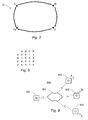
- FIG. 1 schematically illustrates an example of storage areas and cargo item positions on a vessel.
- a container vessel 1 typically includes of a number of bays 2 where single rows of 40' or 45' containers or double rows of 20' containers can be stacked (these may be referred to as 20' and 40' bays, respectively).
- position 4 can hold a single 40' or 45' container or two 20' containers as illustrated by reference numerals 4a and 4b.
- Fig 1a shows a typical numbering of the container stacks in the bays where even numbers are used for 40' bays while odd numbers are used for 20' bays.
- a number of hatch covers 3a-c divide the bays into under and over deck positions.
- Fig. 1 b shows a schematic view of an example of the positions of a bay 2. This example assumes that there are three hatch covers 3a-c: one in the centre 3b and one in each side. It will be understood, however, that the number and arrangement of hatch covers may vary from vessel to vessel.
- Each level of containers is called
- a possible way of representing the physical layout of the vessel is to use matrices.
- the bay positions shown in Fig. 1 b can be arranged in a matrix B such that element b ij at row i and column j in B corresponds to the position at tier i and stack j.
- a matrix with Boolean values can be used to define whether a position exists in a bay or whether the position can hold containers of a particular type (e.g., reefer, 20', 40', or 45').
- a matrix with integer values in the range ⁇ 0,1,2 ⁇ can denote the TEU capacities of the positions, e.g. as illustrated in fig. 1c.
- Fig. 1c shows a 4x7 matrix representing the TEU capacities of the positions under deck in Fig. 1 b.
- the packing rules may include some or all of the following examples of constraints:
- Fig. 2 schematically illustrates an example of a route of a cargo vessel.
- the typical operation of a container vessel includes a voyage along a cyclic route connecting a sequence of ports also referred to as a string.
- Fig. 2 illustrates an example of a string 10 consisting of four ports A, B, C, and D.
- the vessel cyclicly serves these ports in the order A, B, C, D. From port D, the vessel sails to port A and proceeds with the next rotation.
- the vessel will accept containers for port B, C, and D.
- the vessel if the vessel is at port C, it will accept containers for port D, A, and B.
- the vessel calls four ports.
- a container vessel may call any number of ports during one round-trip. In addition, it may call the same port several times on a rotation.
- Fig. 3 shows an overall flow diagram of an example of a method of determining an allocation plan for a cargo stowage problem.
- the method comprises three linked optimizer stages L1, L2, and L3 that each solves the allocation problem at an increasingly finer level of granularity.
- the input to the method (101) is
- L1 partitions the containers into a range of container classes and defines a set of main storage areas of the vessel. L1 then determines the number of containers of each container class to load in each storage area. To foresee future needs, the allocation is done not only for the current port but also for the future ports on the rotation.
- L2 uses the number of containers of each class to store in each storage area in the current port computed by L1 to assign containers to be loaded in the current port to specific positions on the vessel. The result is a stowage plan for the current port.
- L3 performs a post-optimization of the stowage plan generated by L2.
- L3 improves the stowage plan by iteratively swapping the position of a pair of containers belonging to the same container class.
- the output from the method 105 is a stowage plan for the current port assigning the containers to be loaded at the current port to specific positions on the vessel.
- the allocation process may include the L1 stage alone, or the L1 stage combined with the L2 stage, or the L1 stage followed by the L2 stage and a different form of post-processing, or a different combination of the stages described herein, optionally with one or more pre- and/or post-processing stages.
- Fig. 4 shows a flow diagram of an example of the L1 stage of a method of determining an allocation plan for a cargo stowage problem.
- the input to L1, 201 is the same as the input to the overall process shown in fig. 3:
- the lists in c) and d) may include the discharge port, length, height, and width of each container, and whether it is a reefer.
- L1 solves a generalised version of the allocation problem. L1 both generalises the set of containers to load on the vessel and the set of positions that containers are assigned to.
- Each container class represents containers that have at least one attribute out of a predetermined set of attributes in common. Examples of such attributes include length attributes (e.g., 20', 40', and 45') and a reefer attribute. It will be appreciated that additional or alternative attributes may be used to define further container classes, for instance height attributes (e.g., high-cube), weight attributes (e.g., heavy and light), pallet-wide attributes (e.g., PW-class- x ), out-of-gauge attribute (e.g., top-OOG, side-OOG, and front-OOG), and IMO attributes (e.g., IMO-class- x ).
- height attributes e.g., high-cube
- weight attributes e.g., heavy and light
- pallet-wide attributes e.g., PW-class- x
- out-of-gauge attribute e.g., top-OOG, side-OOG, and front-OOG
- IMO attributes e.g., IMO
- the set of positions of bays over and under deck are partitioned into a number of storage areas.
- An example of storage areas of a single bay is shown in Fig. 1 b.
- fig. 1 b shows the positions of each container stack of a bay. Notice that each position either can hold a long 40' or 45' container or two 20' containers.
- the stacks form six storage areas 5a-f, three over deck and three under deck, designated 5a-c and 5d-f, respectively.
- the three pairs of storage areas (designated 5a,d; 5b,e; 5c,f, respectively) over and under deck are separated by respective hatch covers 3a-c.
- L1 determines how many containers of each class that each storage area holds. To foresee space needs in future ports, L1 not only computes this allocation for the containers to load in the current port (given by input c), but also for the expected containers to load in future ports (given by input d). Any concrete stowage plan must satisfy the constraints generated by L1 about how many containers to allocate of each class in each storage area. So long as these rules are satisfied, however, a specific container can be placed in any desired storage area. In this way, L1 generates a flexible generalised solution that can accommodate a wide range of concrete solutions.
- L1 defines a variable vector x to represent the solution space. For each storage area s and each container class c there is a variable in x for each possible load port i and discharge port j such that the value x csij of the variable defines how many containers of class c are loaded to the storage area s in port i and unloaded from s in port j.
- x is a real valued vector even though only integer solutions are valid.
- L1 computes a matrix A and a vector b such that the constraints of the optimization problem are given by the set of linear inequalities Ax ⁇ b.
- the inequalities include the following constraints
- a vessel on the string A, B, C, D as shown in Fig. 2.
- the ports are numbered lexicographically such that port A is the first port, port B is the second port etc.
- the x csij variables of a particular container class c and storage area s can be regarded as forming a load-discharge matrix X cs , where row i and column j contains variable x csij .
- the value of variable ( i,j ) in X cs is equal to the number of containers of class c loaded in port i and discharged in port j for storage area s .
- the sum of the row and column variables of a port p defines how many containers to load and discharge at the port, respectively.
- Another example is the onboard ( O p ) pattern for port p.
- the sum of the variables in O p is the number of onboard containers when the vessel departures from port p .
- a pattern can be defined by a characteristic matrix E where an element e ij equals 1 if and only if the variable index pair ( i,j ) belongs to the pattern.
- Fig. 5 shows an example of the characteristic matrix of the onboard pattern for port B (i.e., O 2 ). Notice that containers loaded in port i and discharged in port j ⁇ i roll over to the next rotation.
- the single "1" designated by reference numeral 8 in row 4 of column 3 of O 2 refers to containers loaded in the previous rotation.
- linear expressions above can be transformed to linear inequalities on the form Ax ⁇ b using standard techniques from mathematical programming.
- L1 computes an initial current value x * of x based on the containers on board the vessel at arrival at the current port (given by input b).
- L1 computes a linear cost function on x.
- the cost function is given by a vector c such that the cost of a solution is given by the scalar product cx.
- the cost function depends on the current value of x.
- c ( x* ) denote the vector function that defines c for the current value x* of x.
- the product c ( x* ) x then defines a linear cost function on x relative to x*.
- the cost function is an approximation to the real cost of changing x*.
- the real cost function is non-continuous due to discrete cost elements (e.g., overstows and crane-sets) and therefore nonlinear.
- the cost function is defined by a weighted sum of the following cost elements
- linear expressions of the soft constraint can be transformed to linear inequalities using standard techniques from mathematical programming such that both soft and hard constraints can be expressed in the form Ax ⁇ b.
- the cost function is a linear expression on x that depends on the current value x * of x. It is a weighted sum of each of the cost elements described under bullet a) to d) above w a ⁇ c a x + w a ⁇ c a x + w a ⁇ c a x * ⁇ x + w a ⁇ c a x * ⁇ x .
- the linear expression of costs element c can be defined by distributing the cost of moving a quay crane to a bay on the containers moved to and from the bay.
- the crane-set cost for a container loaded to a bay in port i and discharged in port j in a new solution is the inverse of the number of moves for the bay in the load port plus the inverse of the number of moves for the bay in the discharge port of the current solution x*.
- This is a fairly accurate approximation to the true crane-set cost so long as the new value of x is close to x*.
- B denotes the set of bays of the vessel and that S b is the set of storage areas of bay b .
- the linear expression of cost element d can be defined by introducing a cost for any containers assigned to a storage area that may overstow containers stored in the storage area by x*.
- H(l,d) denote the characteristic matrix of the pattern of variables that potentially overstow containers loaded in port l and discharged in port d.
- h(l,d) i,j 1 if and only if, i is a port after l but before d, and j is a port after d.
- Z s denote the index set of active load and discharge ports in x* for storage area s
- Z s i ⁇ j
- L1 It is an interesting property of L1 that an optimal solution to the approximated cost function can be computed fast using an off-the-shelf linear programming solver (LP-solver) like COIN or CPLEX.
- LP-solver off-the-shelf linear programming solver
- L1 computes a new value of x * that is the optimal solutions to the problem: minimize c ( x *) x subject to Ax ⁇ b.
- the problem is solved using an LP-solver.
- the fourth and fifth step of L1 is repeated until x* does not change or until a bound on the number of iterations is reached.
- IP Integer Programming problem
- L1 extracts and returns the part of x* that involves the current port.
- Information about the distribution of containers in future ports is not passed to L2 and L3, 207.
- L2 generates a complete stowage plan for the current port that respects the distribution of container classes on storage areas as computed by L1.
- L2A is a hybrid optimization method combining a concrete heuristic and a linear assignment problem for placing containers to be loaded at the current port to specific positions on the vessel. It places groups of containers on the vessel such that the number of containers of each class assigned to each storage area respects the limits computed by L1.
- L2B is an optimization method combining two assignment problems.
- the first assigns containers to storage areas such that the number of containers of each class respects the limits computed by L1.
- the second is used to allocate containers assigned to each storage area to specific positions within the storage area. It will be appreciated that other optimization methods may be used at the L2 stage. In some embodiments, the results of the L1 stage may even be forwarded directly to a human stowage coordinator who then performs the subsequent stowage planning manually or in a semi-automated fashion.
- Fig. 6 shows a flow diagram of an example of the L2 stage of a method of determining an allocation plan for a cargo stowage problem.
- this embodiment will be referred to as L2A.
- the input to L2A, 301 is the same as for L1 except that L2A does not consider containers expected to be loaded in future ports. Instead L2A takes as input the number of containers of each class for each storage area at the current port generated by L1, i.e. x csij for a given i.
- L2A In the first step, 302, L2A generates a prioritized list W of the containers to be loaded in the current port.
- the priority of a container increases linearly with the distance the container is shipped. Since containers are filled bottom-up in the vessel (due to the objective function), this ordering ensures that no loaded containers overstow each other. Containers to the same discharge port are sub-prioritized according to how hard they are to place in the vessel. This prioritization defines a placement heuristic. Since L2A does not reassign positions, the ordering ensures that hard containers have more freedom in how they can be placed than easy containers.
- this sub-prioritization can reflect that a) reefer containers are placed before non-reefers since there are a restricted number of reefer positions, b) heavy containers are place before light containers since they affect the stability and stress factors more and use a higher proportion of the weight capacity of stacks and bays, and c) 20' containers are place before 40' and 45' containers to avoid illegal placements of 20' containers on top of 40' or 45' containers.
- L2A defines an initially empty stowage plan T for the current port.
- the stowage plan is completed during the iterations of the main loop of L2A.
- L2A enters the main loop and removes a chunk K' of containers from the top of W with the same priority.
- the containers in K' are shipped to the same discharge port and have the same reefer and length attributes.
- L2A In the fourth step, 305, L2A generates a set of possible positions O K' on the vessel for the containers in K '.
- O K' may span several storage areas but must respect the number of containers of each class assigned to storage areas by L1. Moreover, O K' can not contain any occupied positions in the current stowage plan T .
- L2A computes a
- cost matrix A [ a ij ], where a ij is the cost of assigning container k i in K' to position o j in O K ,.
- the cost function is a weighted sum of the following objectives
- L2A solves the linear assignment problem defined by A .
- the assignments are further constrained such that the number of containers assigned to each storage area does not exceed the maximum number of containers to the discharge port computed by L1.
- Off-the-shelf solvers like COIN and CPLEX are sufficiently strong to get low computation times in practice.
- L2A returns the completed stowage plan T for the current port, 308. Otherwise, L2A loops back to the third step, 304, and removes the next chunk of containers from W .
- Fig. 7 shows a flow diagram of an example of the L2 stage of a method of determining an allocation plan for a cargo stowage problem.
- this embodiment will be referred to as L2B.
- the input to L2B, 401, is the same as for L2A.
- L2B defines a variable vector x to represent assignments of containers to storage areas. For each container k in K and each storage area s in S there is a variable in x ks in x. The value of x ks is between 0 and 1. It is 1 if container k is assigned to storage area s.
- L2B computes a
- the inequalities include the following constraints
- the constraint described under bullet a) is already on linear form.
- Standard techniques from mathematical programming can be used to transform these linear expressions into the format Ax ⁇ b.
- L2B computes a linear cost function on x.
- the cost function is given by a vector c such that the cost of assignments is given by cx.
- the cost function includes the following objectives that are weighted according to their importance
- Each of the objectives can be represented by soft constraints. Recall from L1 that a hard constraint ax ⁇ b can be translated to a soft constraint by adding an auxiliary variable x' to x associated with a cost per unit in c for breaking the constraint and changing the constraint to ax - x' ⁇ b.
- This technique can be used to formulate the objectives described under bullet a) to c).
- it may be an advantage to translate the objective described under bullet d) to the format ax - Mx' ⁇ b, where M is a constant such that M > ax for any value of x (big- M format). In this way, a one-time cost for breaking the constraint can be modelled if x' is integer.
- L1 standard mathematical programming techniques can be used to formulate the linear inequalities Ax ⁇ b of the linear expressions of the soft constraints above.
- the variable vector x has been extended with the auxiliary variables xa, xb ps , xc cs , and xd s .
- the cost vector c has all zero elements except for the auxiliary variables for which the associated cost elements ca, cb ps , cc cs , cd s are equal to the weights of the objectives w a , w b , W c , and w d .
- the weights can be calibrated experimentally or estimated from real costs of breaking the soft constraints.
- L2B computes an optimal solution x * to the linear optimization problem: minimize cx subject to Ax ⁇ b.
- This problem can be solved efficiently using of-the-shelf LP/IP solvers such as COIN and CPLEX.
- Some values of decision variables in x * may not be integral. In practice, however, good integral solutions can be found by rounding off x * .
- L2B enters its iterative phase where the containers assigned to each storage area are given specific positions in the storage area. L2B initializes this phase by instantiating the stowage plan T to empty and setting the set S of storage areas to process to equal the total set of storage areas on the vessel.
- L2B removes a storage area s from S.
- L2B formulates and solves the assignment problem minimize c s ⁇ x s subject to A s ⁇ x s ⁇ b s for storage area s .
- the optimal solution x s * to the optimization problem can be computed using an of-the-shelf LP/IP solver such as COIN or CPLEX. Again, it may be necessary to round off x s * to get integral values.
- K and O denote the containers assigned to s by x * and the positions in storage area s, respectively.
- the value of the decision variable x ko of x s is 1 if container k is assigned to position o .
- the parameters c s , A s , and b s define the constraints and objectives of the problem. They are constructed in the same way as the corresponding parameters in the first assignment problem solved by L2B.
- the A s and b s parameters include the following hard constraints
- step 404 includes examples of how to make linear expressions of the constraints described under bullet b) and c).
- the constraints described under bullet d) and e) assume
- the cost function c s includes the following weighted objectives
- objectives or modifications of the defined objectives generally known in the container shipping industry or described in the literature can be added (e.g., to load bays from center and out to achieve better balance, to load every second bay port side first to achieve better balance, to avoid 40' and 45' in same stack over deck, to avoid 20' and 40/45' in same stack over deck to minimize the risk of placing 20' containers above 40/45' containers, to minimize IMO rule conflicts, and to satisfy placement constraints of special containers such as open-top and out-of-gauge containers).
- Many of these objectives may be modelled using techniques similar to the ones described below.
- Each of the objectives described under bullet a) to d) has a weighted contribution to the cost vector c s . Again, these weights may be calibrated experimentally or estimated based on real costs associated with the objectives.
- the objectives described under bullet a) and b) can be modelled in the same way as the objectives described under bullet b) and c) in step 306 of L2A.
- the objective described under bullet e) can be modelled as a soft constraint using big-M format and integer auxiliary variables as shown for the similar objective described under bullet d) in step 404 of L2B.
- L2B adds the assignment of containers to positions in storage area s given by x s * to the stowage plan T . If s is the last storage area, L2B returns T which then is a complete stowage plan for the current port (411). Otherwise, L2B considers the next storage area by looping back to the fifth step.
- Fig. 8 shows a flow diagram of an example of the L3 stage of a method of determining an allocation plan for a cargo stowage problem.
- the main input to L3 is a complete stowage plan T (e.g., generated by L2), 501.
- L3 is fine-grained iterative improvement optimizer that in each iteration swaps the position of a single pair of containers with same discharge port and attributes such that the altered stowage plan still satisfies the main constraints and optimization criteria of L1 and L2.
- the purpose of L3 is to make a post-optimization of the stowage plan where refined stability, stress, and makespan requirements are optimized.
- L3 partitions the containers in the stowage plan T into a set ⁇ of sets of containers with same discharge port and reefer and length attributes. Thus, swapping containers within each of these partitions will not break any constraints on these attributes.
- L3 removes a set D from ⁇ .
- L3 computes a
- matrix A [ a ij ], where a ij is the cost a stowage plan where the position of container d i and d j in D is swapped minus the cost of the current stowage plan.
- Virtual or "air" containers may also be added to D such that it is possible to swap containers to empty positions.
- the cost function includes a weighted sum of the following objectives
- the weights w a , w b , and w c can be calibrated experimentally or estimated from the real costs associated with the objectives.
- L3 swaps the position of the containers in D and T with the most negative entry in A and loops back to the third step to recompute A for the new configuration of containers.
- L3 breaks out of the iterative improvement of the positions of the containers in D because no negative entry is found in A . This indicates that a local minimum of the cost function has been found for the placement of this set of containers. If no further sets exist in the partitioning, L3 returns the resulting stowage plan for the current port, 507. Otherwise, L3 loops back to the second step and considers the next set in the partitioning.
- Fig. 9 schematically illustrates a data processing system 900 for determining an allocation plan for a cargo stowage problem.
- the data processing system 900 includes a central server system 901 and client systems 902 at each port of a string. Even though fig. 9 shows an example with three ports A, B, C, it will be appreciated that the system may be implemented with any suitable number of ports.
- the server systems 901 is connected to each of the client systems 902 via a communications network 903.
- the server system 901 and each of the client systems 902 may be any suitable computer or other data processing system, e.g. a PC, a workstation, a server computer, etc. It will be appreciated that some or all of the client systems may be portable computers, such as laptop computers, PDAs, and/or the like. It will further be appreciated that the server system 901 may be integrated with one of the client systems 902.
- the communications network 903 may include any network or combination of networks suitable for data communications, e.g. a computer network, such as a wide area network, an internet, a virtual private network, or the like. Further examples of communications networks include telecommunications networks, such as wireless telecommunications networks.
- the system 900 is configured to perform the stowage planning in a centralised manner:
- the server system 901 receives information about the containers that are scheduled to be loaded at the respective ports.
- the server system may receive this information from the client systems 902 or from another data processing system, e.g. a logistics scheduling system.
- the server system then performs the L1 stage of the allocation planning as described herein and generates a preliminary distribution plan.
- the server system may also perform one or more of the subsequent refinement stages, e.g. the stages L2 and L3 described herein, so as to generate final allocation plans for one or more of the ports A, B, and C.
- the server system then communicates the stowage plan(s) via communications network 903 to the respective client systems 902, where they are used for the actual stowing of the containers onto the vessel.
- the stowage plan may be displayed on the client system for a stowage coordinator to review or manually modify.
- the plan may also be loaded into an automated stowage system for the automatic scheduling of cranes and other machines in the port.
- the server system may communicate the preliminary distribution plan generated by the L1 stage of the process described herein to the client systems.
- each client system may be configured to perform one or more of the refinement stages L2 and L3.
- each client system may perform the entire allocation planning process, thus avoiding the need for a central server system.
- the methods described herein have mainly been described with reference to a cyclic voyage of a vessel. However, it will be appreciated that the method described herein may also be applicable in connection with other operations of a vessel, e.g. a non-cyclic operation, or an operation where not all ports are called during each rotation.
- Embodiments of the method described herein can be implemented by means of hardware comprising several distinct elements, and by means of a suitably programmed microprocessor.
- several of these means can be embodied by one and the same item of hardware, e.g. a suitably programmed microprocessor, one or more digital signal processor, or the like.
- a suitably programmed microprocessor one or more digital signal processor, or the like.
Landscapes
- Business, Economics & Management (AREA)
- Engineering & Computer Science (AREA)
- Human Resources & Organizations (AREA)
- Strategic Management (AREA)
- Economics (AREA)
- Entrepreneurship & Innovation (AREA)
- Tourism & Hospitality (AREA)
- Operations Research (AREA)
- Quality & Reliability (AREA)
- Marketing (AREA)
- Physics & Mathematics (AREA)
- General Business, Economics & Management (AREA)
- General Physics & Mathematics (AREA)
- Theoretical Computer Science (AREA)
- Development Economics (AREA)
- Data Mining & Analysis (AREA)
- Educational Administration (AREA)
- Game Theory and Decision Science (AREA)
- Management, Administration, Business Operations System, And Electronic Commerce (AREA)
- Loading Or Unloading Of Vehicles (AREA)
- Ship Loading And Unloading (AREA)
Priority Applications (3)
| Application Number | Priority Date | Filing Date | Title |
|---|---|---|---|
| EP06388057A EP1909221A1 (de) | 2006-10-06 | 2006-10-06 | Stauplan für ein Containerschiff |
| PCT/DK2007/000424 WO2008040351A1 (en) | 2006-10-06 | 2007-10-03 | Container vessel stowage planning |
| US12/444,458 US8352404B2 (en) | 2006-10-06 | 2007-10-03 | Container vessel stowage planning |
Applications Claiming Priority (1)
| Application Number | Priority Date | Filing Date | Title |
|---|---|---|---|
| EP06388057A EP1909221A1 (de) | 2006-10-06 | 2006-10-06 | Stauplan für ein Containerschiff |
Publications (1)
| Publication Number | Publication Date |
|---|---|
| EP1909221A1 true EP1909221A1 (de) | 2008-04-09 |
Family
ID=37999019
Family Applications (1)
| Application Number | Title | Priority Date | Filing Date |
|---|---|---|---|
| EP06388057A Pending EP1909221A1 (de) | 2006-10-06 | 2006-10-06 | Stauplan für ein Containerschiff |
Country Status (3)
| Country | Link |
|---|---|
| US (1) | US8352404B2 (de) |
| EP (1) | EP1909221A1 (de) |
| WO (1) | WO2008040351A1 (de) |
Cited By (13)
| Publication number | Priority date | Publication date | Assignee | Title |
|---|---|---|---|---|
| CN103198360A (zh) * | 2012-01-10 | 2013-07-10 | 招商局国际信息技术有限公司 | 一种集装箱船舶自动配载方法及系统 |
| ITMI20121162A1 (it) * | 2012-07-02 | 2014-01-03 | Venice Newport Container And Logist Ics S P A | Metodo e sistema per la gestione della movimentazione via acqua di container |
| US8682808B2 (en) | 2010-01-29 | 2014-03-25 | International Business Machines Corporation | Method and apparatus for processing logistic information |
| US9990602B2 (en) | 2012-12-20 | 2018-06-05 | Oracle International Corporation | Cost and latency reductions through dynamic updates of order movement through a transportation network |
| US10007889B2 (en) | 2012-12-20 | 2018-06-26 | Oracle International Corporation | Finding minimum cost transportation routes for orders through a transportation network |
| CN108475418A (zh) * | 2015-12-09 | 2018-08-31 | Eizo株式会社 | 图像处理装置及程序 |
| CN108885734A (zh) * | 2016-03-28 | 2018-11-23 | 开利公司 | 虚拟货物混合管理器 |
| CN113361005A (zh) * | 2021-05-20 | 2021-09-07 | 中国海洋大学 | 多功能全回转起重船调拨配载控制方法及起重船 |
| WO2022012727A1 (en) * | 2020-07-13 | 2022-01-20 | Portchain Aps | Method of operating a container carrier terminal |
| EP4070255A1 (de) * | 2019-12-02 | 2022-10-12 | MacGregor Finland Oy | Stauplanung für ein schiff |
| CN116910481A (zh) * | 2023-07-27 | 2023-10-20 | 中国舰船研究设计中心 | 一种基于遗传算法的船舶任务系统装载弹量优化方法 |
| CN117371621A (zh) * | 2023-12-06 | 2024-01-09 | 湖北浩蓝智造科技有限公司 | 基于改进果蝇优化算法的库位分配方法、系统及介质 |
| CN118115057A (zh) * | 2024-02-29 | 2024-05-31 | 中远海运特种运输股份有限公司 | 一种纸浆船的单类纸浆配载方法、系统、设备及介质 |
Families Citing this family (30)
| Publication number | Priority date | Publication date | Assignee | Title |
|---|---|---|---|---|
| US8812338B2 (en) * | 2008-04-29 | 2014-08-19 | Sas Institute Inc. | Computer-implemented systems and methods for pack optimization |
| US8515835B2 (en) | 2010-08-30 | 2013-08-20 | Sas Institute Inc. | Systems and methods for multi-echelon inventory planning with lateral transshipment |
| US8452527B2 (en) * | 2010-10-11 | 2013-05-28 | Containertrac, Inc. | Method of automatic positioning for loading and unloading of container ships in container terminals |
| US8788315B2 (en) | 2011-01-10 | 2014-07-22 | Sas Institute Inc. | Systems and methods for determining pack allocations |
| US8688497B2 (en) | 2011-01-10 | 2014-04-01 | Sas Institute Inc. | Systems and methods for determining pack allocations |
| US20120323641A1 (en) * | 2011-06-20 | 2012-12-20 | Accenture Global Services Limited | Terminal performance analytical computer system |
| US9495657B1 (en) | 2012-07-24 | 2016-11-15 | Ports America Group, Inc. | Systems and methods involving features of terminal operation including TOS-agnostic and/or other features |
| CA2919151A1 (en) * | 2012-07-24 | 2014-01-30 | Ports America Group, Inc. | Systems and methods involving features of terminal operation including user interface and/or other features |
| US9923950B1 (en) | 2012-07-24 | 2018-03-20 | Ports America Group, Inc. | Systems and methods involving features of terminal operation including TOS-agnostic and/or other features |
| JP2014055037A (ja) * | 2012-09-11 | 2014-03-27 | International Business Maschines Corporation | 積載操作方法、システム及びコンピュータ・プログラム。 |
| CN103218667A (zh) * | 2012-11-26 | 2013-07-24 | 天津工业大学 | 一种基于禁忌搜索的集装箱码头装船计划优化方法 |
| JP6158938B2 (ja) * | 2013-10-02 | 2017-07-05 | 株式会社日立製作所 | 物流拠点配置案算出装置及びプログラム |
| USD814657S1 (en) * | 2016-08-12 | 2018-04-03 | Kwikspace Guam | Container facility |
| USD816245S1 (en) * | 2016-09-21 | 2018-04-24 | Kwikspace Guam | Container facility |
| USD815755S1 (en) * | 2016-09-21 | 2018-04-17 | Kwikspace Guam | Container facility |
| EP3794508A1 (de) * | 2018-05-15 | 2021-03-24 | Sealytix APS | Verfahren zur berechnung von ladungssicherungskräften |
| CN109388848B (zh) * | 2018-08-30 | 2023-06-20 | 大连海事大学 | 一种基于双四十英尺岸桥的集装箱船舶配载方法 |
| JP2020046813A (ja) * | 2018-09-18 | 2020-03-26 | 株式会社Jls | 積層体形成装置 |
| CN111382894B (zh) * | 2018-12-29 | 2023-12-01 | 顺丰科技有限公司 | 一种订舱规划方法、装置、设备和存储设备 |
| CN110175405B (zh) * | 2019-05-27 | 2021-09-28 | 上海维祥信息技术有限公司 | 车辆装载优化方法及系统 |
| CN110704882B (zh) * | 2019-09-07 | 2021-11-09 | 创新奇智(青岛)科技有限公司 | 一种用于管状物体的三维智能装载方法 |
| CN111125878A (zh) * | 2019-11-20 | 2020-05-08 | 深圳蓝胖子机器人有限公司 | 装箱方法、系统和计算机可读存储介质 |
| JP7188619B2 (ja) * | 2020-01-20 | 2022-12-13 | 日本電気株式会社 | コンテナ積載計画装置、方法、および、プログラム |
| CN112340020B (zh) * | 2020-11-17 | 2022-02-22 | 中国人民解放军95795部队 | 一种弹药箱空投重心调整方法及系统 |
| KR102380374B1 (ko) * | 2021-11-22 | 2022-04-01 | 한국해양과학기술원 | 컨테이너 적재 시스템 및 그 방법 |
| JP7577097B2 (ja) * | 2022-09-06 | 2024-11-01 | 三菱ロジスネクスト株式会社 | 計画装置、計画方法及びプログラム |
| JP7588625B2 (ja) * | 2022-09-06 | 2024-11-22 | 三菱ロジスネクスト株式会社 | 計画装置、計画方法及びプログラム |
| CN116090220B (zh) * | 2023-01-28 | 2023-07-11 | 广东原尚物流股份有限公司 | 一种汽车零部件物流模拟配载方法 |
| CN118071122B (zh) * | 2024-04-19 | 2024-07-05 | 海博泰科技(青岛)有限公司 | 一种流程化堆场指垛模型的降维线性化方法 |
| CN118378861B (zh) * | 2024-06-24 | 2024-09-17 | 山东港口日照港集团有限公司 | 一种船舶智能配载方法及系统 |
Citations (1)
| Publication number | Priority date | Publication date | Assignee | Title |
|---|---|---|---|---|
| WO1997035266A1 (en) * | 1996-03-20 | 1997-09-25 | Schema Ltd. | A method for determining a vessel stowage plan |
Family Cites Families (1)
| Publication number | Priority date | Publication date | Assignee | Title |
|---|---|---|---|---|
| DE102004031977A1 (de) | 2004-06-25 | 2006-01-19 | Setyo Nugroho | Verfahren zur Erstellung eines Stauplanes für Containerschiffe |
-
2006
- 2006-10-06 EP EP06388057A patent/EP1909221A1/de active Pending
-
2007
- 2007-10-03 US US12/444,458 patent/US8352404B2/en not_active Expired - Fee Related
- 2007-10-03 WO PCT/DK2007/000424 patent/WO2008040351A1/en not_active Ceased
Patent Citations (1)
| Publication number | Priority date | Publication date | Assignee | Title |
|---|---|---|---|---|
| WO1997035266A1 (en) * | 1996-03-20 | 1997-09-25 | Schema Ltd. | A method for determining a vessel stowage plan |
Non-Patent Citations (1)
| Title |
|---|
| I.D. WILSON AND P.A. ROACH: "Principles of Combinatorial Optimization Applied to Container-Ship Stowage Planning", JOURNAL OF HEURISTICS, December 1999 (1999-12-01), Netherlands, XP002433040, Retrieved from the Internet <URL:http://www.springerlink.com/content/l361n3581616722q> [retrieved on 20070510] * |
Cited By (20)
| Publication number | Priority date | Publication date | Assignee | Title |
|---|---|---|---|---|
| US8682808B2 (en) | 2010-01-29 | 2014-03-25 | International Business Machines Corporation | Method and apparatus for processing logistic information |
| CN103198360A (zh) * | 2012-01-10 | 2013-07-10 | 招商局国际信息技术有限公司 | 一种集装箱船舶自动配载方法及系统 |
| CN103198360B (zh) * | 2012-01-10 | 2016-09-07 | 招商局国际信息技术有限公司 | 一种集装箱船舶自动配载方法及系统 |
| ITMI20121162A1 (it) * | 2012-07-02 | 2014-01-03 | Venice Newport Container And Logist Ics S P A | Metodo e sistema per la gestione della movimentazione via acqua di container |
| WO2014006555A1 (en) * | 2012-07-02 | 2014-01-09 | Venice Newport Container And Logistics S.P.A. | Method and system for managing the movement via water of containers |
| US10007889B2 (en) | 2012-12-20 | 2018-06-26 | Oracle International Corporation | Finding minimum cost transportation routes for orders through a transportation network |
| US10043150B2 (en) | 2012-12-20 | 2018-08-07 | Oracle International Corporation | Cost and latency reductions through dynamic updates of order movement through a transportation network |
| US9990602B2 (en) | 2012-12-20 | 2018-06-05 | Oracle International Corporation | Cost and latency reductions through dynamic updates of order movement through a transportation network |
| CN108475418A (zh) * | 2015-12-09 | 2018-08-31 | Eizo株式会社 | 图像处理装置及程序 |
| CN108475418B (zh) * | 2015-12-09 | 2022-07-29 | Eizo株式会社 | 图像处理装置及记录介质 |
| CN108885734A (zh) * | 2016-03-28 | 2018-11-23 | 开利公司 | 虚拟货物混合管理器 |
| EP4070255A1 (de) * | 2019-12-02 | 2022-10-12 | MacGregor Finland Oy | Stauplanung für ein schiff |
| WO2022012727A1 (en) * | 2020-07-13 | 2022-01-20 | Portchain Aps | Method of operating a container carrier terminal |
| WO2022012725A1 (en) * | 2020-07-13 | 2022-01-20 | Portchain Aps | Method of operating a container carrier terminal |
| CN113361005A (zh) * | 2021-05-20 | 2021-09-07 | 中国海洋大学 | 多功能全回转起重船调拨配载控制方法及起重船 |
| CN116910481A (zh) * | 2023-07-27 | 2023-10-20 | 中国舰船研究设计中心 | 一种基于遗传算法的船舶任务系统装载弹量优化方法 |
| CN116910481B (zh) * | 2023-07-27 | 2024-02-02 | 中国舰船研究设计中心 | 一种基于遗传算法的船舶任务系统装载弹量优化方法 |
| CN117371621A (zh) * | 2023-12-06 | 2024-01-09 | 湖北浩蓝智造科技有限公司 | 基于改进果蝇优化算法的库位分配方法、系统及介质 |
| CN117371621B (zh) * | 2023-12-06 | 2024-02-27 | 湖北浩蓝智造科技有限公司 | 基于改进果蝇优化算法的库位分配方法、系统及介质 |
| CN118115057A (zh) * | 2024-02-29 | 2024-05-31 | 中远海运特种运输股份有限公司 | 一种纸浆船的单类纸浆配载方法、系统、设备及介质 |
Also Published As
| Publication number | Publication date |
|---|---|
| US20100145501A1 (en) | 2010-06-10 |
| WO2008040351A1 (en) | 2008-04-10 |
| US8352404B2 (en) | 2013-01-08 |
| WO2008040351A8 (en) | 2009-05-22 |
Similar Documents
| Publication | Publication Date | Title |
|---|---|---|
| US8352404B2 (en) | Container vessel stowage planning | |
| Parreño et al. | A GRASP algorithm for the container stowage slot planning problem | |
| Sciomachen et al. | A 3D-BPP approach for optimising stowage plans and terminal productivity | |
| Delgado et al. | A constraint programming model for fast optimal stowage of container vessel bays | |
| Wilson et al. | Container stowage pre-planning: using search to generate solutions, a case study | |
| Wilson et al. | Principles of combinatorial optimization applied to container-ship stowage planning | |
| Wilson et al. | Container stowage planning: a methodology for generating computerised solutions | |
| Kang et al. | Stowage planning in maritime container transportation | |
| Expósito-Izquierdo et al. | Pre-marshalling problem: Heuristic solution method and instances generator | |
| Korach et al. | Matheuristics for slot planning of container vessel bays | |
| Bilican et al. | A mathematical model and two-stage heuristic for the container stowage planning problem with stability parameters | |
| KR20130093253A (ko) | 컨테이너 선적 위치 결정 시스템, 그 시스템을 이용한 컨테이너 선적 위치 결정 방법 및 그 방법을 컴퓨터 프로그램으로 기록한 컴퓨터 판독 가능한 기록매체 | |
| Sciomachen et al. | The master bay plan problem: a solution method based on its connection to the three‐dimensional bin packing problem | |
| Ambrosino et al. | A new three-step heuristic for the master bay plan problem | |
| KR20090115274A (ko) | 개별 컨테이너 적하순서 계획 방법 | |
| WO2019101742A1 (en) | A method of containership allocation-based stowage planning | |
| Li et al. | Multi-stage hierarchical decomposition approach for stowage planning problem in inland container liner shipping | |
| CN114074817B (zh) | 信息处理装置、优化方法和非暂态计算机可读存储介质 | |
| Fan et al. | Stowage planning of large containership with tradeoff between crane workload balance and ship stability | |
| Li et al. | An integer linear programming for container stowage problem | |
| Li et al. | Solving inland container ship stowage planning problem on full route through a two-phase approach | |
| Wang et al. | Slot assignment for outbound containers in storage space limited container terminal | |
| Neuenfeldt-Junior et al. | An agent-based approach to simulate the containership stowage problem: A. Neuenfeldt-Júnior, B. de Oliveira | |
| Gumus et al. | A multi-stage decomposition heuristic for the container stowage problem | |
| CN118439410A (zh) | 一种装卸一体机的装箱方法、装置、电子设备、存储介质和程序产品 |
Legal Events
| Date | Code | Title | Description |
|---|---|---|---|
| PUAI | Public reference made under article 153(3) epc to a published international application that has entered the european phase |
Free format text: ORIGINAL CODE: 0009012 |
|
| AK | Designated contracting states |
Kind code of ref document: A1 Designated state(s): AT BE BG CH CY CZ DE DK EE ES FI FR GB GR HU IE IS IT LI LT LU LV MC NL PL PT RO SE SI SK TR |
|
| AX | Request for extension of the european patent |
Extension state: AL BA HR MK RS |
|
| AKX | Designation fees paid | ||
| REG | Reference to a national code |
Ref country code: DE Ref legal event code: 8566 |
|
| D18D | Application deemed to be withdrawn (deleted) | ||
| STAA | Information on the status of an ep patent application or granted ep patent |
Free format text: STATUS: THE APPLICATION IS DEEMED TO BE WITHDRAWN |
|
| 18D | Application deemed to be withdrawn |
Effective date: 20081010 |