EP1908733A1 - Method and plant for joint production of electricity, steam and desalinated water - Google Patents
Method and plant for joint production of electricity, steam and desalinated water Download PDFInfo
- Publication number
- EP1908733A1 EP1908733A1 EP07301391A EP07301391A EP1908733A1 EP 1908733 A1 EP1908733 A1 EP 1908733A1 EP 07301391 A EP07301391 A EP 07301391A EP 07301391 A EP07301391 A EP 07301391A EP 1908733 A1 EP1908733 A1 EP 1908733A1
- Authority
- EP
- European Patent Office
- Prior art keywords
- steam
- turbine
- produced
- unit
- electricity
- Prior art date
- Legal status (The legal status is an assumption and is not a legal conclusion. Google has not performed a legal analysis and makes no representation as to the accuracy of the status listed.)
- Withdrawn
Links
Images
Classifications
-
- C—CHEMISTRY; METALLURGY
- C02—TREATMENT OF WATER, WASTE WATER, SEWAGE, OR SLUDGE
- C02F—TREATMENT OF WATER, WASTE WATER, SEWAGE, OR SLUDGE
- C02F1/00—Treatment of water, waste water, or sewage
- C02F1/02—Treatment of water, waste water, or sewage by heating
- C02F1/04—Treatment of water, waste water, or sewage by heating by distillation or evaporation
- C02F1/16—Treatment of water, waste water, or sewage by heating by distillation or evaporation using waste heat from other processes
-
- F—MECHANICAL ENGINEERING; LIGHTING; HEATING; WEAPONS; BLASTING
- F01—MACHINES OR ENGINES IN GENERAL; ENGINE PLANTS IN GENERAL; STEAM ENGINES
- F01K—STEAM ENGINE PLANTS; STEAM ACCUMULATORS; ENGINE PLANTS NOT OTHERWISE PROVIDED FOR; ENGINES USING SPECIAL WORKING FLUIDS OR CYCLES
- F01K13/00—General layout or general methods of operation of complete plants
- F01K13/02—Controlling, e.g. stopping or starting
-
- F—MECHANICAL ENGINEERING; LIGHTING; HEATING; WEAPONS; BLASTING
- F01—MACHINES OR ENGINES IN GENERAL; ENGINE PLANTS IN GENERAL; STEAM ENGINES
- F01K—STEAM ENGINE PLANTS; STEAM ACCUMULATORS; ENGINE PLANTS NOT OTHERWISE PROVIDED FOR; ENGINES USING SPECIAL WORKING FLUIDS OR CYCLES
- F01K17/00—Using steam or condensate extracted or exhausted from steam engine plant
- F01K17/04—Using steam or condensate extracted or exhausted from steam engine plant for specific purposes other than heating
-
- F—MECHANICAL ENGINEERING; LIGHTING; HEATING; WEAPONS; BLASTING
- F02—COMBUSTION ENGINES; HOT-GAS OR COMBUSTION-PRODUCT ENGINE PLANTS
- F02C—GAS-TURBINE PLANTS; AIR INTAKES FOR JET-PROPULSION PLANTS; CONTROLLING FUEL SUPPLY IN AIR-BREATHING JET-PROPULSION PLANTS
- F02C6/00—Plural gas-turbine plants; Combinations of gas-turbine plants with other apparatus; Adaptations of gas-turbine plants for special use
- F02C6/04—Gas-turbine plants providing heated or pressurised working fluid for other apparatus, e.g. without mechanical power output
-
- F—MECHANICAL ENGINEERING; LIGHTING; HEATING; WEAPONS; BLASTING
- F02—COMBUSTION ENGINES; HOT-GAS OR COMBUSTION-PRODUCT ENGINE PLANTS
- F02C—GAS-TURBINE PLANTS; AIR INTAKES FOR JET-PROPULSION PLANTS; CONTROLLING FUEL SUPPLY IN AIR-BREATHING JET-PROPULSION PLANTS
- F02C6/00—Plural gas-turbine plants; Combinations of gas-turbine plants with other apparatus; Adaptations of gas-turbine plants for special use
- F02C6/04—Gas-turbine plants providing heated or pressurised working fluid for other apparatus, e.g. without mechanical power output
- F02C6/10—Gas-turbine plants providing heated or pressurised working fluid for other apparatus, e.g. without mechanical power output supplying working fluid to a user, e.g. a chemical process, which returns working fluid to a turbine of the plant
-
- C—CHEMISTRY; METALLURGY
- C02—TREATMENT OF WATER, WASTE WATER, SEWAGE, OR SLUDGE
- C02F—TREATMENT OF WATER, WASTE WATER, SEWAGE, OR SLUDGE
- C02F1/00—Treatment of water, waste water, or sewage
- C02F1/44—Treatment of water, waste water, or sewage by dialysis, osmosis or reverse osmosis
- C02F1/441—Treatment of water, waste water, or sewage by dialysis, osmosis or reverse osmosis by reverse osmosis
-
- C—CHEMISTRY; METALLURGY
- C02—TREATMENT OF WATER, WASTE WATER, SEWAGE, OR SLUDGE
- C02F—TREATMENT OF WATER, WASTE WATER, SEWAGE, OR SLUDGE
- C02F2103/00—Nature of the water, waste water, sewage or sludge to be treated
- C02F2103/08—Seawater, e.g. for desalination
-
- Y—GENERAL TAGGING OF NEW TECHNOLOGICAL DEVELOPMENTS; GENERAL TAGGING OF CROSS-SECTIONAL TECHNOLOGIES SPANNING OVER SEVERAL SECTIONS OF THE IPC; TECHNICAL SUBJECTS COVERED BY FORMER USPC CROSS-REFERENCE ART COLLECTIONS [XRACs] AND DIGESTS
- Y02—TECHNOLOGIES OR APPLICATIONS FOR MITIGATION OR ADAPTATION AGAINST CLIMATE CHANGE
- Y02A—TECHNOLOGIES FOR ADAPTATION TO CLIMATE CHANGE
- Y02A20/00—Water conservation; Efficient water supply; Efficient water use
- Y02A20/124—Water desalination
-
- Y—GENERAL TAGGING OF NEW TECHNOLOGICAL DEVELOPMENTS; GENERAL TAGGING OF CROSS-SECTIONAL TECHNOLOGIES SPANNING OVER SEVERAL SECTIONS OF THE IPC; TECHNICAL SUBJECTS COVERED BY FORMER USPC CROSS-REFERENCE ART COLLECTIONS [XRACs] AND DIGESTS
- Y02—TECHNOLOGIES OR APPLICATIONS FOR MITIGATION OR ADAPTATION AGAINST CLIMATE CHANGE
- Y02A—TECHNOLOGIES FOR ADAPTATION TO CLIMATE CHANGE
- Y02A20/00—Water conservation; Efficient water supply; Efficient water use
- Y02A20/124—Water desalination
- Y02A20/131—Reverse-osmosis
-
- Y—GENERAL TAGGING OF NEW TECHNOLOGICAL DEVELOPMENTS; GENERAL TAGGING OF CROSS-SECTIONAL TECHNOLOGIES SPANNING OVER SEVERAL SECTIONS OF THE IPC; TECHNICAL SUBJECTS COVERED BY FORMER USPC CROSS-REFERENCE ART COLLECTIONS [XRACs] AND DIGESTS
- Y02—TECHNOLOGIES OR APPLICATIONS FOR MITIGATION OR ADAPTATION AGAINST CLIMATE CHANGE
- Y02E—REDUCTION OF GREENHOUSE GAS [GHG] EMISSIONS, RELATED TO ENERGY GENERATION, TRANSMISSION OR DISTRIBUTION
- Y02E20/00—Combustion technologies with mitigation potential
- Y02E20/14—Combined heat and power generation [CHP]
Definitions
- the present invention relates to the joint production of electricity, steam and desalinated water.
- the invention relates to desalinated water production sites in which technologies combining heat and / or electricity ("combined heat and / or power" or CHP in English) are also used.
- GB 1,182,021 describes a steam turbine producing electricity, the steam of which is used in an evaporator useful for the production of distilled water from seawater. At the outlet of this evaporator, the steam condensate is introduced into the evaporator. boiler for producing steam for feeding the steam turbine.
- the problem of the sites of the prior art is that they are designed to produce quantities of electricity, desalinated water and / or vapor determined.
- the demand for these raw materials can vary over time, especially the demand for electricity.
- the sites of the prior art do not allow to modulate the three different productions according to their respective demands. And electricity produced in excess of demand can not be stored.
- the purpose of the present invention is therefore to provide a method of joint production of electricity, desalinated water and steam capable of being adapted to variations in demand in these three products and in particular in electricity.
- the method according to the invention comprises the implementation of a steam production unit or boiler.
- a steam production unit or boiler generally consists of a combustion device producing heat to transform water into steam: it comprises a series of heat exchangers, for example coils, in which water circulates and is brought into contact heat produced by combustion.
- the steam produced by this steam generating unit is at high pressure, that is to say at a pressure capable of supplying a steam turbine.
- the value of this pressure also depends on the electrical power required. In general, this pressure depends on the temperature required for the thermal desalination, which corresponds at least to saturated steam at 2 effective bars.
- This steam produced by the steam production unit is used to power a steam turbine: thus, the pressure of the steam produced by the boiler falls back into a steam turbine so as to produce electricity.
- Lower pressure steam is extracted from this steam turbine: if it is a back pressure steam turbine (steam produced at P> Patm), the steam is extracted from its last stage. it is a steam condensing turbine producing hot water (or steam at P ⁇ Patm), the steam is extracted from an intermediate stage.
- the steam turbine has a lower pressure vapor than the inlet one. Preferably, it is a counterpressure steam turbine.
- the steam leaving the steam turbine is then used to vaporize the seawater during the thermal desalinization process of seawater.
- This vaporization is done by means of heat exchangers between this steam and the cold water.
- the evaporation of seawater takes place in a succession of containers, each having a lower pressure than the previous one. As the evaporation temperature decreases as the pressure decreases, vapor evaporated in one vessel can be used to heat the next. Only the first container with the highest pressure requires external heat input; this heat input is provided by steam from the steam turbine.
- the amount of steam produced by the steam generating unit to be supplied to the steam turbine is controlled according to the electricity demand, the desalinated water demand and the steam demand.
- the demand for electricity weakens, a smaller amount of steam is introduced into the steam turbine.
- the portion of steam produced by the steam generating unit that is not supplied to the steam turbine is mixed with the water vapor expanded in the steam turbine.
- the seawater desalination unit produces desalinated water by vaporization of the seawater by heat exchange with this part of the mixture of vapors produced by the unit producing steam and steam produced by the steam turbine.
- the excess steam is not lost, it is valued within the desalination unit of seawater.
- This means of controlling the quantity of steam supplied to the steam turbine may be a bypass placed on the means for supplying the steam produced by the steam production unit to the steam turbine that may deflect part of the steam. produced by the steam production unit.
- This bypass is usually equipped with a valve to control the amount of steam supplied to the steam turbine.
- this bypass deviates a portion of the steam produced by the steam generating unit to the means for supplying at least a portion of the steam produced by the steam turbine to the water desalination unit of
- this bypass is a butterfly valve with an isenthalpic expansion of the steam.
- Isenthalpic expansion allows the gas to increase or decrease its temperature by allowing said gas to relax freely at constant enthalpy (which means that no heat is transferred to the gas or gas, and no external work is extracted (through a turbine, for example)).
- enthalpy which means that no heat is transferred to the gas or gas, and no external work is extracted (through a turbine, for example)
- the vapor relaxes through an expansion valve which must be well insulated to prevent any heat transfer to steam or steam.
- the plant may also include a gas turbine and means for supplying the exhaust gases from the gas turbine to the steam generating unit.
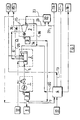
- FIG. 1 illustrates the plant and the process according to the invention.
- This plant comprises a gas turbine 1 fueled by a fuel 12 and producing electricity 9.
- This gas turbine discharges hot exhaust gases 5. These hot gases 5 are introduced into a steam production unit 2.
- unit 2 is supplied with water 13, 14; it burns the fuel 12 to transform the water into high pressure steam 6.
- the high pressure steam 6 is introduced into a steam turbine 3 so as to produce electricity 9.
- the steam turbine 3 discharges low steam pressure 15 and a condensate of steam 16 produced by the condenser of the steam turbine 3; this condensate 16 is used as the feed water 14 of the steam generating unit 2.
- the high pressure steam 6 produced by the steam generating unit 12 and the steam 15 discharged by the steam turbine 3 are mixed.
- Part 7 of this mixture is used in the desalination unit of seawater 4 so as to evaporate the seawater 17 by heat exchange. Following the exchange of heat, this steam 7 is transformed into a condensate 20 which is used as feed water 14 of the production unit of steam 2.
- the desalination unit produces brine 18, drinking water 11 and / or deionized water 13 and / or industrial water 19 of inferior quality to drinking water.
- Demineralized water 13 is used to supply water to the steam generating unit 2 to compensate for losses in the steam production circuit.
- Part of the industrial water 19 supplies the cooling tower 22 intended to supply cold water 23 to the condenser of the steam turbine 3.
- the valve 24 makes it possible to divert a portion of the high-pressure steam 6 produced by the steam production unit 2 before its introduction into the steam turbine 3.
- valve 24 If this valve 24 is closed, all the high pressure steam 6 produced is introduced into the steam turbine 2 which generates a large amount of electricity 9. If the valve 24 is open, a smaller amount of steam 6 is sent to the turbine 3; this one therefore produces less electricity. On the other hand, the industrial site produces more steam. In the valve 24, the high pressure steam undergoes isenthalpic expansion: it is cooled by means of water coming from the water supply of the steam generating unit. 2 so that the steam has the same temperature as the low pressure steam produced by the steam turbine 3.
- the invention makes it possible to improve the thermal and electrical efficiency of a plant by integrating a means of combined production of heat and electricity with a seawater desalination plant using steam in a continuous manner.
- This invention is an energy-efficient solution for responding to rapid changes in demand for steam and / or electricity.
- the use of steam with low energy heat in the desalting evaporators is a way to adjust the heat and electricity output with high efficiency.
- the desalination unit is a flexible and environmentally friendly form of electricity storage since it allows a modulation of the electricity production.
- the desalination unit also produces water with varying degrees of desalination that can be used by municipalities or neighboring industries.
- the salt that is produced can be resold in the chlorine and soda industries.
- the invention makes it possible to adapt production to changes in electricity costs: thus, if the cost of electricity is low, less steam is sent to the turbine and more steam to the desalination unit by means of of the bypass: thus, more desalinated water is produced since more heat is available for the evaporation of seawater (because of the isenthalpic expansion); this water has the advantage of being able to be stored unlike electricity. If demand and electricity prices are high, the plant can produce less desalinated water because less steam is available for the evaporation of seawater, but this economic loss is offset by the high price of water. electricity and the fact that more desalinated water was produced during a period when the cost of electricity was low, the desalinated water being storable.
Landscapes
- Engineering & Computer Science (AREA)
- Chemical & Material Sciences (AREA)
- General Engineering & Computer Science (AREA)
- Mechanical Engineering (AREA)
- Combustion & Propulsion (AREA)
- Environmental & Geological Engineering (AREA)
- Organic Chemistry (AREA)
- Water Supply & Treatment (AREA)
- Life Sciences & Earth Sciences (AREA)
- Hydrology & Water Resources (AREA)
- Chemical Kinetics & Catalysis (AREA)
- General Chemical & Material Sciences (AREA)
- Heat Treatment Of Water, Waste Water Or Sewage (AREA)
- Engine Equipment That Uses Special Cycles (AREA)
Abstract
L'invention concerne un procédé de production d'électricité, de vapeur et d'eau désalinisée au moyen d'une unité de production de vapeur, d'une turbine à vapeur et d'une unité de désalinisation d'eau de mer dans lequel : - l'unité de production de vapeur produit de la vapeur, - la turbine à vapeur utilise au moins une partie de la vapeur produite par l'unité de production de vapeur et produit de l'électricité et de la vapeur, - l'unité de désalinisation d'eau de mer produit de l'eau désalinisée par vaporisation de l'eau de mer par échange de chaleur avec au moins une partie de la vapeur produite par la turbine à vapeur, dans lequel on contrôle la quantité de vapeur produite par l'unité de production de vapeur à fournir à la turbine à vapeur en fonction de la demande en électricité, de la demande en eau désalinisée et de la demande en vapeur.The invention relates to a method for producing electricity, steam and desalinated water by means of a steam generating unit, a steam turbine and a seawater desalination unit in which : - the steam production unit produces steam, the steam turbine uses at least a portion of the steam produced by the steam generating unit and produces electricity and steam, the seawater desalination unit produces desalinated water by vaporizing the seawater by heat exchange with at least a portion of the steam produced by the steam turbine, wherein the amount of steam produced by the steam generating unit to be supplied to the steam turbine is controlled according to the electricity demand, the desalinated water demand and the steam demand.
Description
La présente invention concerne la production conjointe d'électricité, de vapeur et d'eau désalinisée.The present invention relates to the joint production of electricity, steam and desalinated water.
L'invention concerne les sites de production d'eau désalinisée dans lesquels des technologies combinant chaleur et/ou électricité ("combined heat and/or power" ou CHP en anglais) sont également utilisées.The invention relates to desalinated water production sites in which technologies combining heat and / or electricity ("combined heat and / or power" or CHP in English) are also used.
De tels sites sont connus de l'art antérieur.
Le problème des sites de l'art antérieur est qu'ils sont conçus pour produire des quantités d'électricité, d'eau désalinisée et/ou de vapeur déterminées. Or la demande en ces matières premières peut être variable dans le temps, tout particulièrement la demande en électricité. Les sites de l'art antérieur ne permettent pas de moduler les trois différentes productions en fonction de leurs demandes respectives. Et l'électricité produite en excédent par rapport à la demande ne peut être stockée.The problem of the sites of the prior art is that they are designed to produce quantities of electricity, desalinated water and / or vapor determined. The demand for these raw materials can vary over time, especially the demand for electricity. The sites of the prior art do not allow to modulate the three different productions according to their respective demands. And electricity produced in excess of demand can not be stored.
Le but de la présente invention est donc de proposer un procédé de production conjointe d'électricité, d'eau désalinisée et de vapeur susceptible d'être adapté aux variations de demande en ces trois produits et notamment en électricité.The purpose of the present invention is therefore to provide a method of joint production of electricity, desalinated water and steam capable of being adapted to variations in demand in these three products and in particular in electricity.
Dans ce but l'invention concerne un procédé de production d'électricité, de vapeur et d'eau désalinisée au moyen d'une unité de production de vapeur, d'une turbine à vapeur et d'une unité de désalinisation d'eau de mer dans lequel :
- l'unité de production de vapeur produit de la vapeur,
- la turbine à vapeur utilise au moins une partie de la vapeur produite par l'unité de production de vapeur et produit de l'électricité et de la vapeur,
- l'unité de désalinisation d'eau de mer produit de l'eau désalinisée par vaporisation de l'eau de mer par échange de chaleur avec au moins une partie de la vapeur produite par la turbine à vapeur,
- the steam production unit produces steam,
- the steam turbine uses at least a portion of the steam produced by the steam generating unit and produces electricity and steam,
- the seawater desalinization unit produces desalinated water by vaporizing the seawater by heat exchange with at least a portion of the steam produced by the steam turbine,
Le procédé selon l'invention comprend la mise en oeuvre d'une unité de production de vapeur ou chaudière. Une telle unité consiste généralement en un dispositif de combustion produisant de la chaleur pour transformer de l'eau en vapeur : elle comprend une série d'échangeurs de chaleur, par exemple des serpentins, dans lesquels de l'eau circule et est mise au contact de la chaleur produite par la combustion. La vapeur produite par cette unité de production de vapeur est à haute pression, c'est-à-dire à une pression susceptible d'alimenter une turbine à vapeur. La valeur de cette pression dépend aussi de la puissance électrique requise. En général, cette pression dépend de la température requise pour la désalinisation thermique, ce qui correspond au minimum à la vapeur saturée à 2 bar effectifs.The method according to the invention comprises the implementation of a steam production unit or boiler. Such a unit generally consists of a combustion device producing heat to transform water into steam: it comprises a series of heat exchangers, for example coils, in which water circulates and is brought into contact heat produced by combustion. The steam produced by this steam generating unit is at high pressure, that is to say at a pressure capable of supplying a steam turbine. The value of this pressure also depends on the electrical power required. In general, this pressure depends on the temperature required for the thermal desalination, which corresponds at least to saturated steam at 2 effective bars.
Cette vapeur produite par l'unité de production de vapeur est utilisée pour alimenter une turbine à vapeur : ainsi, la pression de la vapeur produite par la chaudière retombe au sein d'une turbine à vapeur de manière à produire de l'électricité. De la vapeur de moindre pression est extraite de cette turbine à vapeur : s'il s'agit d'une turbine à vapeur à contre-pression (vapeur produite à P > Patm), la vapeur est extraite de son dernier étage, s'il s'agit d'une une turbine à condensation de vapeur produisant de l'eau chaude (ou vapeur à P < Patm), la vapeur est extraite d'un étage intermédiaire. Il ressort de la turbine à vapeur une vapeur de pression inférieure à celle qui est entrée. De préférence, il s'agit d'une turbine à vapeur à contre-pression.This steam produced by the steam production unit is used to power a steam turbine: thus, the pressure of the steam produced by the boiler falls back into a steam turbine so as to produce electricity. Lower pressure steam is extracted from this steam turbine: if it is a back pressure steam turbine (steam produced at P> Patm), the steam is extracted from its last stage. it is a steam condensing turbine producing hot water (or steam at P <Patm), the steam is extracted from an intermediate stage. The steam turbine has a lower pressure vapor than the inlet one. Preferably, it is a counterpressure steam turbine.
La vapeur sortant de la turbine à vapeur est ensuite utilisée pour vaporiser l'eau de mer au cours du procédé de désalinisation thermique d'eau de mer. Cette vaporisation se fait au moyen d'échangeurs de chaleur entre cette vapeur et l'eau froide de la mer. En général, l'évaporation de l'eau de mer a lieu dans une succession de récipients, présentant chacun une pression inférieure au précédent. Comme la température d'évaporation diminue au fur et à mesure que la pression décroît, la vapeur évaporée dans un récipient peut être utilisée pour chauffer le suivant. Seul le premier récipient présentant la pression la plus élevée nécessite un apport de chaleur externe ; cet apport de chaleur est fourni par la vapeur provenant de la turbine à vapeur.The steam leaving the steam turbine is then used to vaporize the seawater during the thermal desalinization process of seawater. This vaporization is done by means of heat exchangers between this steam and the cold water. In general, the evaporation of seawater takes place in a succession of containers, each having a lower pressure than the previous one. As the evaporation temperature decreases as the pressure decreases, vapor evaporated in one vessel can be used to heat the next. Only the first container with the highest pressure requires external heat input; this heat input is provided by steam from the steam turbine.
Selon l'invention, on contrôle la quantité de vapeur produite par l'unité de production de vapeur à fournir à la turbine à vapeur en fonction de la demande en électricité, de la demande en eau désalinisée et de la demande en vapeur. Ainsi, si la demande en électricité s'affaiblit, une moindre quantité de vapeur est introduite dans la turbine à vapeur. La partie de vapeur produite par l'unité de production de vapeur qui n'est pas fournie à la turbine à vapeur est mélangée avec la vapeur d'eau détendue dans la turbine à vapeur. Alors, l'unité de désalinisation d'eau de mer produit de l'eau désalinisée par vaporisation de l'eau de mer par échange de chaleur avec cette partie du mélange de vapeurs produite par l'unité de production de vapeur et de vapeur produite par la turbine à vapeur. Ainsi, l'excédent de vapeur n'est pas perdu, il est valorisé au sein de l'unité de désalinisation d'eau de mer.According to the invention, the amount of steam produced by the steam generating unit to be supplied to the steam turbine is controlled according to the electricity demand, the desalinated water demand and the steam demand. Thus, if the demand for electricity weakens, a smaller amount of steam is introduced into the steam turbine. The portion of steam produced by the steam generating unit that is not supplied to the steam turbine is mixed with the water vapor expanded in the steam turbine. Then, the seawater desalination unit produces desalinated water by vaporization of the seawater by heat exchange with this part of the mixture of vapors produced by the unit producing steam and steam produced by the steam turbine. Thus, the excess steam is not lost, it is valued within the desalination unit of seawater.
Et si la demande en électricité augmente, une plus grande quantité de vapeur provenant de l'unité de production de vapeur est introduite dans la turbine à vapeur.And if the demand for electricity increases, a greater amount of steam from the steam generating unit is introduced into the steam turbine.
En général, de manière à optimiser la récupération d'énergie au sein du procédé, on met en oeuvre les options suivantes :
- après avoir vaporisé l'eau de mer, la vapeur produite par la turbine à vapeur devient un condensat de vapeur qui est utilisé comme source d'appoint en eau par l'unité de production de vapeur.
- une partie de l'eau désalinisée est utilisée comme source d'appoint en eau par l'unité de production de vapeur.
- le procédé met en oeuvre une turbine à gaz produisant une partie de l'électricité, l'unité de production de vapeur utilisant la chaleur des gaz d'échappement de la turbine à gaz. On entend par "turbine à gaz" (TAG), un dispositif comprenant au moins un compresseur d'air, une chambre de combustion et une turbine de détente. Dans la turbine à gaz, l'air comprimé produit est introduit avec au moins un combustible dans la chambre de combustion de la turbine et les gaz de combustion produits passent à travers la turbine de détente pour produire de l'électricité au moyen d'un alternateur. Généralement, ces gaz passent ensuite à travers une chaudière de récupération de chaleur pour produire de la vapeur. Le combustible de la turbine à gaz est habituellement du gaz naturel ou un combustible liquide hydrocarboné. L'unité de production de vapeur peut récupérer la chaleur des gaz d'échappement de la turbine à gaz.
- l'unité de désalinisation d'eau de mer peut produire de l'eau désalinisée en partie par une technologie d'osmose inverse utilisant l'électricité produite par la turbine à vapeur.
- after steaming the seawater, the vapor produced by the steam turbine becomes a steam condensate which is used as an additional source of water by the steam generating unit.
- some of the desalinated water is used as a source of extra water by the steam generating unit.
- the method uses a gas turbine producing a portion of the electricity, the steam generating unit using the heat of the gas turbine exhaust gas. The term "gas turbine" (TAG) means a device comprising at least one air compressor, a combustion chamber and an expansion turbine. In the gas turbine, the produced compressed air is introduced with at least one fuel into the combustion chamber of the turbine and the product combustion gases pass through the expansion turbine to produce electricity by means of a compressor. alternator. Generally, these gases then pass through a heat recovery boiler to produce steam. The fuel of the gas turbine is usually natural gas or a hydrocarbon liquid fuel. The steam generating unit can recover heat from the exhaust gases of the gas turbine.
- the seawater desalination unit can produce desalinated water in part by reverse osmosis technology using the electricity produced by the steam turbine.
L'invention concerne également une usine de production d'électricité, de vapeur et d'eau désalinisée comprenant :
- une unité de production de vapeur,
- une turbine à vapeur,
- une unité de désalinisation d'eau de mer ,
- un moyen de fourniture de la vapeur produite par l'unité de production de vapeur à la turbine à vapeur,
- un moyen de fourniture d'au moins une partie de la vapeur produite par la turbine à vapeur à l'unité de désalinisation d'eau de mer,
- a steam production unit,
- a steam turbine,
- a seawater desalination unit,
- means for supplying steam produced by the steam generating unit to the steam turbine,
- means for supplying at least a portion of the steam produced by the steam turbine to the sea water desalination unit,
Ce moyen de contrôle de la quantité de vapeur fournie à la turbine à vapeur peut être une dérivation placée sur le moyen de fourniture de la vapeur produite par l'unité de production de vapeur à la turbine à vapeur susceptible de dévier une partie de la vapeur produite par l'unité de production de vapeur. Cette dérivation est généralement équipée d'une vanne permettant de contrôler la quantité de vapeur fournie à la turbine à vapeur. De préférence, cette dérivation dévie une partie de la vapeur produite par l'unité de production de vapeur vers le moyen de fourniture d'au moins une partie de la vapeur produite par la turbine à vapeur à l'unité de désalinisation d'eau de mer. Selon un mode préféré, cette dérivation est une vanne papillon avec une détente isenthalpique de la vapeur. Une détente isenthalpique permet au gaz d'augmenter ou de diminuer sa température en laissant ledit gaz se détendre librement à enthalpie constante (ce qui signifie qu'aucune chaleur n'est transférée au gaz ou du gaz, et qu'aucun travail extérieur n'est extrait (à travers une turbine, par exemple)). En pratique, pour que la détente isenthalpique s'effectue, il est préférable que la vapeur se détende à travers une vanne de détente qui doit être bien isolée afin d'éviter tout transfert de chaleur à la vapeur ou depuis la vapeur.This means of controlling the quantity of steam supplied to the steam turbine may be a bypass placed on the means for supplying the steam produced by the steam production unit to the steam turbine that may deflect part of the steam. produced by the steam production unit. This bypass is usually equipped with a valve to control the amount of steam supplied to the steam turbine. Preferably, this bypass deviates a portion of the steam produced by the steam generating unit to the means for supplying at least a portion of the steam produced by the steam turbine to the water desalination unit of According to a preferred embodiment, this bypass is a butterfly valve with an isenthalpic expansion of the steam. Isenthalpic expansion allows the gas to increase or decrease its temperature by allowing said gas to relax freely at constant enthalpy (which means that no heat is transferred to the gas or gas, and no external work is extracted (through a turbine, for example)). In practice, for the isenthalpic expansion to take place, it is preferable that the vapor relaxes through an expansion valve which must be well insulated to prevent any heat transfer to steam or steam.
L'usine peut également comprendre une turbine à gaz et un moyen de fourniture des gaz d'échappement de la turbine à gaz à l'unité de production de vapeur.The plant may also include a gas turbine and means for supplying the exhaust gases from the gas turbine to the steam generating unit.
La figure 1 illustre l'usine et le procédé selon l'invention. Cette usine comprend une turbine à gaz 1 alimentée par un combustible 12 et produisant de l'électricité 9. Cette turbine à gaz rejette des gaz d'échappement chauds 5. Ces gaz chauds 5 sont introduits dans une unité de production de vapeur 2. Cette unité 2 est alimentée en eaux 13, 14 ; elle brûle le combustible 12 pour transformer l'eau en vapeur haute pression 6. La vapeur haute pression 6 est introduite dans une turbine à vapeur 3 de manière à produire de l'électricité 9. La turbine à vapeur 3 rejette de la vapeur à basse pression 15 et un condensat de vapeur 16 produit par le condenseur de la turbine à vapeur 3 ; ce condensat 16 est utilisé comme eau d'alimentation 14 de l'unité de production de vapeur 2. La vapeur haute pression 6 produite par l'unité de production de vapeur 12 et la vapeur 15 rejetée par la turbine à vapeur 3 sont mélangées. Une partie 7 de ce mélange est utilisée dans l'unité de désalinisation d'eau de mer 4 de manière à évaporer l'eau de mer 17 par échange de chaleur. Suite à l'échange de chaleur, cette vapeur 7 se transforme en un condensat 20 qui est utilisé comme eau d'alimentation 14 de l'unité de production de vapeur 2. L'unité de désalinisation produit de la saumure 18, de l'eau potable 11 et/ou de l'eau déminéralisée 13 et/ou de l'eau industrielle 19 de qualité inférieure à l'eau potable. L'eau déminéralisée 13 est utilisée pour alimenter en eau l'unité de production de vapeur 2 pour compenser les pertes dans le circuit de production de vapeur. Une partie de l'eau industrielle 19 alimente la tour de refroidissement 22 destinées à fournir de l'eau froide 23 au condenseur de la turbine à vapeur 3. La vanne 24 permet de dériver une partie de la vapeur haute pression 6 produite par l'unité de production de vapeur 2 avant son introduction dans la turbine à vapeur 3. Si cette vanne 24 est fermée, toute la vapeur haute pression 6 produite est introduite dans la turbine à vapeur 2 ce qui génère une importante quantité d'électricité 9. Si la vanne 24 est ouverte, une quantité plus faible de vapeur 6 est envoyée à la turbine 3 ; celle-ci produit donc moins d'électricité. Par contre, le site industriel produit plus de vapeur 10. Dans la vanne 24, la vapeur haute pression subit une détente isenthalpique : elle est refroidie au moyen d'eau 25 provenant de l'alimentation en eau de l'unité de production de vapeur 2 afin que la vapeur présente la même température que la vapeur à basse pression 15 produite par la turbine à vapeur 3.Figure 1 illustrates the plant and the process according to the invention. This plant comprises a
L'invention permet d'améliorer l'efficacité thermique et électrique d'une usine en intégrant un moyen de production combinée de chaleur et d'électricité avec une usine de désalinisation d'eau de mer utilisant de la vapeur de manière continue. Cette invention est une solution énergétiquement rentable pour répondre aux changements rapides de demandes en vapeur et/ou en électricité. L'utilisation de vapeur avec une chaleur de faible énergie dans les évaporateurs de désalinisation est un moyen pour ajuster la production de chaleur et d'électricité avec un rendement élevé. L'unité de désalinisation est une forme flexible et écologique de stockage de l'électricité puisqu'elle permet une modulation de la production d'électricité. L'unité de désalinisation produit également de l'eau à différents degrés de désalinisation utilisables par les municipalités ou les industries avoisinantes. Le sel qui est produit peut être revendu dans des industries du chlore et de la soude. Enfin, presque toute la chaleur produite dans le procédé de l'invention est utilisée puisque la vapeur utilisée dans les évaporateurs de désalinisation est ensuite récupérée en tant que condensat de vapeur dans le dégazeur de l'unité de production de vapeur. Enfin, l'eau déminéralisée produite par désalinisation est utilisée comme eau d'appoint de l'unité de production de vapeur.The invention makes it possible to improve the thermal and electrical efficiency of a plant by integrating a means of combined production of heat and electricity with a seawater desalination plant using steam in a continuous manner. This invention is an energy-efficient solution for responding to rapid changes in demand for steam and / or electricity. The use of steam with low energy heat in the desalting evaporators is a way to adjust the heat and electricity output with high efficiency. The desalination unit is a flexible and environmentally friendly form of electricity storage since it allows a modulation of the electricity production. The desalination unit also produces water with varying degrees of desalination that can be used by municipalities or neighboring industries. The salt that is produced can be resold in the chlorine and soda industries. Finally, almost all the heat produced in the process of the invention is used since the steam used in the desalination evaporators is then recovered as steam condensate in the steam generator's degasser. Finally, the demineralised water produced by desalination is used as makeup water of the steam generating unit.
L'invention permet d'adapter la production aux variations de coûts de l'électricité : ainsi, si le coût de l'électricité est faible, on envoie moins de vapeur à la turbine et plus de vapeur à l'unité de désalinisation au moyen de la dérivation : ainsi, on produit plus d'eau désalinisée puisque plus de chaleur est disponible pour l'évaporation d'eau de mer (à cause de la détente isenthalpique) ; cette eau présente l'avantage de pouvoir être stockée contrairement à l'électricité. Si la demande et le prix en électricité sont élevés, l'usine peut produire moins d'eau désalinisée car on dispose de moins de vapeur pour l'évaporation de l'eau de mer, mais cette perte économique est compensée par le prix élevé de l'électricité et par le fait que plus d'eau désalinisée a été produite au cours d'une période où le coût de l'électricité était faible, l'eau désalinisée étant, elle, stockable.The invention makes it possible to adapt production to changes in electricity costs: thus, if the cost of electricity is low, less steam is sent to the turbine and more steam to the desalination unit by means of of the bypass: thus, more desalinated water is produced since more heat is available for the evaporation of seawater (because of the isenthalpic expansion); this water has the advantage of being able to be stored unlike electricity. If demand and electricity prices are high, the plant can produce less desalinated water because less steam is available for the evaporation of seawater, but this economic loss is offset by the high price of water. electricity and the fact that more desalinated water was produced during a period when the cost of electricity was low, the desalinated water being storable.
Les variations de demande des trois produits - électricité, vapeur et eau désalinisée - suivent de comportements en général très différents en ce qui concerne la fréquence et le gradient de telles variations. Alors que les systèmes habituels ont des difficultés pour s'adapter simultanément à ces variations de demandes, l'invention permet d'accomplir une adaptation efficace, économique, rapide et techniquement souple face à telles scénarios car l'invention possède des éléments qui, en travaillant en coordination, permettent d'absorber et de moduler l'inertie des systèmes d'électricité, de vapeur et d'eau de manière optimale.The demand variations of the three products - electricity, steam and desalinated water - follow generally very different behavior with respect to the frequency and gradient of such variations. While the usual systems have difficulties in adapting simultaneously to these variations in demands, the invention makes it possible to achieve an efficient, economical, fast and technically flexible adaptation to such scenarios because the invention has elements which, in working in coordination, absorb and modulate the inertia of the electricity, steam and water systems in an optimal way.
Claims (13)
Applications Claiming Priority (1)
| Application Number | Priority Date | Filing Date | Title |
|---|---|---|---|
| FR0654043A FR2906529B1 (en) | 2006-10-02 | 2006-10-02 | PROCESS AND PLANT FOR THE JOINT PRODUCTION OF ELECTRICITY, STEAM AND DESALINATED WATER. |
Publications (1)
| Publication Number | Publication Date |
|---|---|
| EP1908733A1 true EP1908733A1 (en) | 2008-04-09 |
Family
ID=37981895
Family Applications (1)
| Application Number | Title | Priority Date | Filing Date |
|---|---|---|---|
| EP07301391A Withdrawn EP1908733A1 (en) | 2006-10-02 | 2007-09-25 | Method and plant for joint production of electricity, steam and desalinated water |
Country Status (4)
| Country | Link |
|---|---|
| EP (1) | EP1908733A1 (en) |
| CN (1) | CN101157486A (en) |
| FR (1) | FR2906529B1 (en) |
| SG (2) | SG160405A1 (en) |
Cited By (10)
| Publication number | Priority date | Publication date | Assignee | Title |
|---|---|---|---|---|
| WO2010052172A1 (en) * | 2008-11-07 | 2010-05-14 | Deutsches Zentrum für Luft- und Raumfahrt e.V. | Method for desalinating water containing salt |
| WO2010151164A3 (en) * | 2009-06-18 | 2011-03-24 | S.C. Hellenic Tiler Invest Srl | Installation and procedure for water desalination |
| WO2011005129A3 (en) * | 2009-06-18 | 2011-11-17 | S.C. Hellenic Tiler Invest Srl | Installation and procedure for the treatment of waste resulting from activities on a ship |
| WO2012052277A1 (en) * | 2010-10-19 | 2012-04-26 | Alstom Technology Ltd | Method for operating a combined-cycle power plant with cogeneration and a combined-cycle power plant for carrying out the method |
| WO2012052276A1 (en) * | 2010-10-19 | 2012-04-26 | Alstom Technology Ltd | Method for operation of a combined-cycle power plant with cogeneration, and a combined-cycle power plant for carrying out the method |
| CN104102197A (en) * | 2014-07-04 | 2014-10-15 | 肇庆宏旺金属实业有限公司 | Desalted water production system and control method thereof |
| GB2513174A (en) * | 2013-04-18 | 2014-10-22 | Ide Technologies Ltd | Pumping apparatus |
| WO2016030029A1 (en) * | 2014-08-29 | 2016-03-03 | Siemens Aktiengesellschaft | Method and arrangement for operating a steam turbine plant in combination with thermal water treatment |
| EP3130383A1 (en) * | 2015-08-14 | 2017-02-15 | Siemens Aktiengesellschaft | A combined power plant and thermal sea water desalination device |
| US11078092B2 (en) | 2013-10-10 | 2021-08-03 | I.D.E. Technologies Ltd. | Water treatment plant |
Families Citing this family (8)
| Publication number | Priority date | Publication date | Assignee | Title |
|---|---|---|---|---|
| CN102060267B (en) * | 2009-11-11 | 2013-07-03 | 中国科学院工程热物理研究所 | Regenerative cycle and low-temperature multi-effect distillation seawater desalinization thermodynamic cycling device and method |
| CN102040258A (en) * | 2010-10-29 | 2011-05-04 | 国家海洋局天津海水淡化与综合利用研究所 | Coproduction method and equipment for thermal power generation and distillation sea water desalinization |
| CN102267777A (en) * | 2011-06-24 | 2011-12-07 | 哈尔滨汽轮机厂辅机工程有限公司 | Condensing-type back pressure machine seawater desalination combined system |
| CN102518478B (en) * | 2011-12-27 | 2015-09-23 | 杭州中能汽轮动力有限公司 | For steam turbine and the controlling method thereof of desalination of sea water |
| CN103370279B (en) * | 2012-02-15 | 2015-11-25 | 三菱重工业株式会社 | Seawater desalination system |
| CN103626250B (en) * | 2013-12-06 | 2015-06-03 | 天津滨瀚海水淡化有限公司 | Comprehensive utilization technology used in seawater power generation and device |
| CN103775150B (en) * | 2014-01-22 | 2016-03-02 | 牟大同 | A kind of electricity-water cogeneration system and method |
| CN107487865A (en) * | 2017-09-12 | 2017-12-19 | 中山大学 | A kind of bioelectrochemistry effectively processing phenolic waste water containing chromium and the method produced electricity |
Citations (5)
| Publication number | Priority date | Publication date | Assignee | Title |
|---|---|---|---|---|
| GB1182021A (en) | 1966-02-18 | 1970-02-25 | Achille Etienne Jean Chocquet | Improvements in and relating to the Evaporation of Liquids |
| US5096543A (en) | 1990-09-27 | 1992-03-17 | Kamyr, Inc. | Carrier gas apparatus for evaporation and condensation |
| US5346592A (en) | 1993-08-11 | 1994-09-13 | Madani Anas A | Combined water purification and power of generating plant |
| US20040219400A1 (en) * | 2003-01-22 | 2004-11-04 | Said Al-Hallaj | Hybrid fuel cell/desalination systems and method for use |
| EP1701006A2 (en) | 2005-02-22 | 2006-09-13 | Kabushiki Kaisha Toshiba | Electric power-generating and desalination combined plant and operation method of the same |
-
2006
- 2006-10-02 FR FR0654043A patent/FR2906529B1/en not_active Expired - Fee Related
-
2007
- 2007-09-25 EP EP07301391A patent/EP1908733A1/en not_active Withdrawn
- 2007-09-25 CN CNA200710161748XA patent/CN101157486A/en active Pending
- 2007-09-27 SG SG201001814-1A patent/SG160405A1/en unknown
- 2007-09-27 SG SG200708916-2A patent/SG141395A1/en unknown
Patent Citations (5)
| Publication number | Priority date | Publication date | Assignee | Title |
|---|---|---|---|---|
| GB1182021A (en) | 1966-02-18 | 1970-02-25 | Achille Etienne Jean Chocquet | Improvements in and relating to the Evaporation of Liquids |
| US5096543A (en) | 1990-09-27 | 1992-03-17 | Kamyr, Inc. | Carrier gas apparatus for evaporation and condensation |
| US5346592A (en) | 1993-08-11 | 1994-09-13 | Madani Anas A | Combined water purification and power of generating plant |
| US20040219400A1 (en) * | 2003-01-22 | 2004-11-04 | Said Al-Hallaj | Hybrid fuel cell/desalination systems and method for use |
| EP1701006A2 (en) | 2005-02-22 | 2006-09-13 | Kabushiki Kaisha Toshiba | Electric power-generating and desalination combined plant and operation method of the same |
Cited By (17)
| Publication number | Priority date | Publication date | Assignee | Title |
|---|---|---|---|---|
| WO2010052172A1 (en) * | 2008-11-07 | 2010-05-14 | Deutsches Zentrum für Luft- und Raumfahrt e.V. | Method for desalinating water containing salt |
| WO2010151164A3 (en) * | 2009-06-18 | 2011-03-24 | S.C. Hellenic Tiler Invest Srl | Installation and procedure for water desalination |
| WO2011005129A3 (en) * | 2009-06-18 | 2011-11-17 | S.C. Hellenic Tiler Invest Srl | Installation and procedure for the treatment of waste resulting from activities on a ship |
| US8984894B2 (en) | 2010-10-19 | 2015-03-24 | Alstom Technology Ltd | Method for operating a combined-cycle power plant with cogeneration, and a combined-cycle power plant for carrying out the method |
| WO2012052277A1 (en) * | 2010-10-19 | 2012-04-26 | Alstom Technology Ltd | Method for operating a combined-cycle power plant with cogeneration and a combined-cycle power plant for carrying out the method |
| WO2012052276A1 (en) * | 2010-10-19 | 2012-04-26 | Alstom Technology Ltd | Method for operation of a combined-cycle power plant with cogeneration, and a combined-cycle power plant for carrying out the method |
| CN103154446A (en) * | 2010-10-19 | 2013-06-12 | 阿尔斯通技术有限公司 | Method for operation of combined-cycle power plant with cogeneration, and combined-cycle power plant for carrying out the method |
| JP2013545915A (en) * | 2010-10-19 | 2013-12-26 | アルストム テクノロジー リミテッド | Method for operating a combined cycle power plant for cogeneration and a combined cycle power plant for implementing the method |
| CN103154446B (en) * | 2010-10-19 | 2015-05-27 | 阿尔斯通技术有限公司 | Method for operation of combined-cycle power plant with cogeneration, and combined-cycle power plant for carrying out the method |
| GB2513174A (en) * | 2013-04-18 | 2014-10-22 | Ide Technologies Ltd | Pumping apparatus |
| US11078092B2 (en) | 2013-10-10 | 2021-08-03 | I.D.E. Technologies Ltd. | Water treatment plant |
| CN104102197A (en) * | 2014-07-04 | 2014-10-15 | 肇庆宏旺金属实业有限公司 | Desalted water production system and control method thereof |
| CN104102197B (en) * | 2014-07-04 | 2017-01-04 | 肇庆宏旺金属实业有限公司 | Desalted water production system and control method thereof |
| WO2016030029A1 (en) * | 2014-08-29 | 2016-03-03 | Siemens Aktiengesellschaft | Method and arrangement for operating a steam turbine plant in combination with thermal water treatment |
| CN106605042A (en) * | 2014-08-29 | 2017-04-26 | 西门子公司 | Method and device for operating a steam turbine plant in combination with a thermal water treatment plant |
| CN106605042B (en) * | 2014-08-29 | 2018-05-11 | 西门子公司 | Method and device for operating a steam turbine plant in combination with a thermal water treatment plant |
| EP3130383A1 (en) * | 2015-08-14 | 2017-02-15 | Siemens Aktiengesellschaft | A combined power plant and thermal sea water desalination device |
Also Published As
| Publication number | Publication date |
|---|---|
| FR2906529B1 (en) | 2009-03-06 |
| FR2906529A1 (en) | 2008-04-04 |
| CN101157486A (en) | 2008-04-09 |
| SG141395A1 (en) | 2008-04-28 |
| SG160405A1 (en) | 2010-04-29 |
Similar Documents
| Publication | Publication Date | Title |
|---|---|---|
| EP1908733A1 (en) | Method and plant for joint production of electricity, steam and desalinated water | |
| JP5026588B2 (en) | LNG regasification and power generation | |
| US8545681B2 (en) | Waste heat driven desalination process | |
| US6539718B2 (en) | Method of and apparatus for producing power and desalinated water | |
| US7037430B2 (en) | System and method for desalination of brackish water from an underground water supply | |
| US7891188B2 (en) | Apparatus for producing power using geothermal liquid | |
| US20120090324A1 (en) | Air vaporizor | |
| EA004324B1 (en) | Water distillation system | |
| NO791777L (en) | METHODS AND SYSTEMS FOR ENERGY TRANSFORMATION | |
| CN109386316A (en) | A kind of LNG cold energy and BOG Combustion Energy joint utilize system and method | |
| US20140060519A1 (en) | Generation Of Steam For Use In An Industrial Process | |
| JP2015206360A (en) | System and method of distillation process and turbine engine intercooler | |
| CN101708871A (en) | Gradient preheating multistage evaporation-type seawater desalination power generation system | |
| US10487695B2 (en) | System and method of interfacing intercooled gas turbine engine with distillation process | |
| CN101102967A (en) | Water Distillation System | |
| KR101741834B1 (en) | Apparatus for recovering VOC | |
| MX2008000503A (en) | Configurations and methods for power generation in lng regasification terminals. | |
| WO2011124806A1 (en) | Seawater desalination plant operating by multiple-effect distillation | |
| FR2636673A1 (en) | INSTALLATION FOR PROVIDING SUPPLY WATER TO A POWER PLANT | |
| JPH0985059A (en) | Seawater desalting apparatus by reverse osmosis membrane | |
| WO2014195882A2 (en) | Method for producing energy by burning materials, and facility for implementing the method | |
| KR102934151B1 (en) | Cold and Hot Power Generation System for Performance Improvement of LNG Evaporation Apparatus | |
| RU2266414C2 (en) | Method of recovery of heat of exhaust gases of gas-turbine engine and heat power-generating plant for implementing the method | |
| CN121162894A (en) | Method and device for recycling waste heat of surface pollution discharge of boiler of thermoelectric unit | |
| CA3231897A1 (en) | Process and steam generating device for generating process steam |
Legal Events
| Date | Code | Title | Description |
|---|---|---|---|
| PUAI | Public reference made under article 153(3) epc to a published international application that has entered the european phase |
Free format text: ORIGINAL CODE: 0009012 |
|
| AK | Designated contracting states |
Kind code of ref document: A1 Designated state(s): AT BE BG CH CY CZ DE DK EE ES FI FR GB GR HU IE IS IT LI LT LU LV MC MT NL PL PT RO SE SI SK TR |
|
| AX | Request for extension of the european patent |
Extension state: AL BA HR MK RS |
|
| RIN1 | Information on inventor provided before grant (corrected) |
Inventor name: GOMEZ-VALERO, JUAN Inventor name: KOH, WEN LI DAPHNE |
|
| 17P | Request for examination filed |
Effective date: 20081009 |
|
| 17Q | First examination report despatched |
Effective date: 20081111 |
|
| AKX | Designation fees paid |
Designated state(s): AT BE BG CH CY CZ DE DK EE ES FI FR GB GR HU IE IS IT LI LT LU LV MC MT NL PL PT RO SE SI SK TR |
|
| STAA | Information on the status of an ep patent application or granted ep patent |
Free format text: STATUS: THE APPLICATION IS DEEMED TO BE WITHDRAWN |
|
| 18D | Application deemed to be withdrawn |
Effective date: 20140401 |