EP1908503A1 - Verfahren und system zur generierung einer datei aus auditierbaren log-eintragungen über spiele unter einsatz von elektronischen mitteln vor ort und abgesetzt - Google Patents
Verfahren und system zur generierung einer datei aus auditierbaren log-eintragungen über spiele unter einsatz von elektronischen mitteln vor ort und abgesetzt Download PDFInfo
- Publication number
- EP1908503A1 EP1908503A1 EP05777972A EP05777972A EP1908503A1 EP 1908503 A1 EP1908503 A1 EP 1908503A1 EP 05777972 A EP05777972 A EP 05777972A EP 05777972 A EP05777972 A EP 05777972A EP 1908503 A1 EP1908503 A1 EP 1908503A1
- Authority
- EP
- European Patent Office
- Prior art keywords
- module
- gaming
- protected
- security module
- records
- Prior art date
- Legal status (The legal status is an assumption and is not a legal conclusion. Google has not performed a legal analysis and makes no representation as to the accuracy of the status listed.)
- Withdrawn
Links
Images



Classifications
-
- G—PHYSICS
- G07—CHECKING-DEVICES
- G07F—COIN-FREED OR LIKE APPARATUS
- G07F17/00—Coin-freed apparatus for hiring articles; Coin-freed facilities or services
- G07F17/32—Coin-freed apparatus for hiring articles; Coin-freed facilities or services for games, toys, sports, or amusements
-
- A—HUMAN NECESSITIES
- A63—SPORTS; GAMES; AMUSEMENTS
- A63F—CARD, BOARD, OR ROULETTE GAMES; INDOOR GAMES USING SMALL MOVING PLAYING BODIES; VIDEO GAMES; GAMES NOT OTHERWISE PROVIDED FOR
- A63F13/00—Video games, i.e. games using an electronically generated display having two or more dimensions
- A63F13/70—Game security or game management aspects
- A63F13/75—Enforcing rules, e.g. detecting foul play or generating lists of cheating players
-
- A—HUMAN NECESSITIES
- A63—SPORTS; GAMES; AMUSEMENTS
- A63F—CARD, BOARD, OR ROULETTE GAMES; INDOOR GAMES USING SMALL MOVING PLAYING BODIES; VIDEO GAMES; GAMES NOT OTHERWISE PROVIDED FOR
- A63F9/00—Games not otherwise provided for
- A63F9/24—Games using electronic circuits not otherwise provided for
-
- G—PHYSICS
- G06—COMPUTING OR CALCULATING; COUNTING
- G06F—ELECTRIC DIGITAL DATA PROCESSING
- G06F21/00—Security arrangements for protecting computers, components thereof, programs or data against unauthorised activity
- G06F21/60—Protecting data
- G06F21/64—Protecting data integrity, e.g. using checksums, certificates or signatures
- G06F21/645—Protecting data integrity, e.g. using checksums, certificates or signatures using a third party
-
- A—HUMAN NECESSITIES
- A63—SPORTS; GAMES; AMUSEMENTS
- A63F—CARD, BOARD, OR ROULETTE GAMES; INDOOR GAMES USING SMALL MOVING PLAYING BODIES; VIDEO GAMES; GAMES NOT OTHERWISE PROVIDED FOR
- A63F1/00—Card games
-
- A—HUMAN NECESSITIES
- A63—SPORTS; GAMES; AMUSEMENTS
- A63F—CARD, BOARD, OR ROULETTE GAMES; INDOOR GAMES USING SMALL MOVING PLAYING BODIES; VIDEO GAMES; GAMES NOT OTHERWISE PROVIDED FOR
- A63F9/00—Games not otherwise provided for
- A63F9/24—Games using electronic circuits not otherwise provided for
- A63F2009/2483—Other characteristics
- A63F2009/2488—Remotely playable
- A63F2009/2489—Remotely playable by radio transmitters, e.g. using RFID
-
- A—HUMAN NECESSITIES
- A63—SPORTS; GAMES; AMUSEMENTS
- A63F—CARD, BOARD, OR ROULETTE GAMES; INDOOR GAMES USING SMALL MOVING PLAYING BODIES; VIDEO GAMES; GAMES NOT OTHERWISE PROVIDED FOR
- A63F2300/00—Features of games using an electronically generated display having two or more dimensions, e.g. on a television screen, showing representations related to the game
- A63F2300/50—Features of games using an electronically generated display having two or more dimensions, e.g. on a television screen, showing representations related to the game characterized by details of game servers
- A63F2300/53—Features of games using an electronically generated display having two or more dimensions, e.g. on a television screen, showing representations related to the game characterized by details of game servers details of basic data processing
- A63F2300/532—Features of games using an electronically generated display having two or more dimensions, e.g. on a television screen, showing representations related to the game characterized by details of game servers details of basic data processing using secure communication, e.g. by encryption, authentication
-
- A—HUMAN NECESSITIES
- A63—SPORTS; GAMES; AMUSEMENTS
- A63F—CARD, BOARD, OR ROULETTE GAMES; INDOOR GAMES USING SMALL MOVING PLAYING BODIES; VIDEO GAMES; GAMES NOT OTHERWISE PROVIDED FOR
- A63F2300/00—Features of games using an electronically generated display having two or more dimensions, e.g. on a television screen, showing representations related to the game
- A63F2300/50—Features of games using an electronically generated display having two or more dimensions, e.g. on a television screen, showing representations related to the game characterized by details of game servers
- A63F2300/55—Details of game data or player data management
- A63F2300/5586—Details of game data or player data management for enforcing rights or rules, e.g. to prevent foul play
-
- G—PHYSICS
- G06—COMPUTING OR CALCULATING; COUNTING
- G06F—ELECTRIC DIGITAL DATA PROCESSING
- G06F2221/00—Indexing scheme relating to security arrangements for protecting computers, components thereof, programs or data against unauthorised activity
- G06F2221/21—Indexing scheme relating to G06F21/00 and subgroups addressing additional information or applications relating to security arrangements for protecting computers, components thereof, programs or data against unauthorised activity
- G06F2221/2101—Auditing as a secondary aspect
-
- G—PHYSICS
- G06—COMPUTING OR CALCULATING; COUNTING
- G06F—ELECTRIC DIGITAL DATA PROCESSING
- G06F2221/00—Indexing scheme relating to security arrangements for protecting computers, components thereof, programs or data against unauthorised activity
- G06F2221/21—Indexing scheme relating to G06F21/00 and subgroups addressing additional information or applications relating to security arrangements for protecting computers, components thereof, programs or data against unauthorised activity
- G06F2221/2109—Game systems
-
- G—PHYSICS
- G06—COMPUTING OR CALCULATING; COUNTING
- G06F—ELECTRIC DIGITAL DATA PROCESSING
- G06F2221/00—Indexing scheme relating to security arrangements for protecting computers, components thereof, programs or data against unauthorised activity
- G06F2221/21—Indexing scheme relating to G06F21/00 and subgroups addressing additional information or applications relating to security arrangements for protecting computers, components thereof, programs or data against unauthorised activity
- G06F2221/2111—Location-sensitive, e.g. geographical location, GPS
Definitions
- the present invention describes a method and a system destined to warrant some characteristics (such as honesty and fairness) related to the trustworthiness of the development of games by electronic means. This objective is achieved by recording the activity occurred during said games and by storing it securely through the use of cryptographic operations. In this way, a file of protected records is generated that enables reliable periodic audits regarding the actions occurred during the games. This brings additional trust to the games.
- the present invention can be applied both to on-site electronic games and to remote (through a communication network) electronic games.
- the system applicable to games by electronic means of the present invention introduces two separate modules or functional parts.
- the first part called the security module
- the second part called the audit module
- the invention allows verifying the honesty and fairness of the games. This is done by reproducing part of what has occurred during the games and using, if needed, the games' logics.
- the invention pretends to avoid interfering in excess in the game dynamics habitually experienced by the players.
- the players participate in game hands by using electronic systems, computers, and/or communication networks.
- the games by electronic means are on-site.
- the player directly interacts with a gaming electronic machine located in a gaming centre or in a certain place where the player must be present to be able to play.
- the games by electronic means are remote.
- the player remotely interacts with the electronic system of gaming, usually through his/her personal computer and an Internet (or equivalent network) connection.
- casino games such as roulette or blackjack, sport books, poker hands, bingo, jackpot machines, etcetera.
- Gaming by electronic means in any of its forms, implies a lack of transparency that may produce suspicions and lack of trust regarding critical aspects of honesty and fairness. In fact, in some occasions the lack of transparency of gaming by electronic means has been successfully utilized to commit fraud. For this reason, the electronic gaming industry has been using two mechanisms to try to ensure the correct development of the games. On one hand, the source code certification of the computer programs that determine the functioning of the electronic games. On the other hand, the audits of the statistics of prizes awarding.
- the certification of the source code of the gaming programs is in fact an inspection of the system done at a given time by an independent testing laboratory. This inspection can ensure that, at that precise time, the system presented a correct design that would therefore lead to an honest behaviour. However, this inspection has no means to prove that the system will keep having, from that moment and on, those correct design and behaviour.
- the programs of an electronic gaming module can be certified today but, perhaps tomorrow they will be altered or substituted, either accidentally or intentionally. Although some procedures to check for changes and manipulations in a computer program do exist, the actual capability to easily and quickly substitute the critical correct modules by the fake ones and vice versa, prevents in practice these procedures from being successful as security measures.
- the identification of players in remote electronic gaming has been up to date supported by the ownership of the credit card used for the money transfers caused by bets and prizes.
- this identification mechanism is clearly insufficient since any person can impersonate another just by having access to the credit card of the latter (which is relatively easy for example in the case of members of the same family or if the credit card was stolen).
- this mechanism is not satisfactory for the management of lists of auto-excluded players or problem gamblers.
- the identification of players based on the ownership of credit cards has been usually combined with the "loginame/password" mechanism. In these cases, the identity of the player is verified by checking that the provided "password" matches the one generated during a previous process of user registration.
- the third trust problem that is still not adequately solved refers to the possibility of inspecting and auditing electronic gaming systems.
- These essential characteristics include the control of players' identities, the honesty of the development of the games, and the fitting of the games with the limitations posed by the regulation or by the account of every player (e.g., with regard to the maximum amount to be wagered monthly).
- the external control of these characteristics relies on audits that depend excessively upon data provided by the games operator itself.
- these data are not adequately protected and, as a result, they could be very easily manipulated.
- US200424321 proposes means for fraud detection by developing the games in two separate machines and monitoring the latter to detect eventual fraud.
- the proposal of invention US2004198494 consists of using a cryptographic apparatus to ensure the security of the gaming module. This is done by preventing the access by non-authorized persons and/or possible manipulations.
- the auditing method proposed by both inventions is not efficient and is not completely secure in real electronic gaming environments. Indeed, these are solutions that need to manage huge amounts of digital data, since they utilize absolutely all the information related to the occurred games. Additionally, these proposals do not provide any mechanisms to ensure that the digital information to be audited has not been manipulated during the games or afterwards.
- the present invention can be applied both to on-site and remote electronic gaming systems.
- the present invention proposes a method and a system that provide electronic gaming systems with the capability to generate trust.
- trust we understand the security or warranty that the development of the games remains fair and honest, among other characteristics.
- This objective is achieved through the creation of a file of protected records that allows the players or a third party (such as a regulator or an auditor) to verify that the different events occurred during the games correspond to an honest development (according to the rules of each game), a fair generation of the randomness (in those games that require it), and a list of imposed restrictions of different types (e.g., regarding the age of players or the maximum amounts to be wagered).
- the present invention introduces the use of two additional modules that work jointly with the gaming module.
- the first additional module called the security module, is responsible for the secure generation of protected records that allow reproducing, later on, what has happened during the development of the games. Furthermore, this security module is responsible for the honest and fair generation of random events (in those cases when they are needed).
- the second additional module introduced by the present invention takes the protected records generated by the security module as input to reliably reproduce the occurred games.
- the audit module generates audit reports regarding the different issues that concern the electronic gaming module's trust and honesty. Providing the players with part of these reports allows them to verify the correct development of the games, even though the method proposed in this invention is transparent to the players during the execution of the games.
- the present invention firstly describes a method to generate auditable and secure records that contain information that allows to reconstruct what has happened during the games, with the objective to verify whether fraud has occurred or not.
- the invention secondly describes the characteristics of the cited security and audit modules associated to a gambling module, which allow the implementation of said method.
- the term "significant event” will mean an action or event that reflects an important happening related to the game which determines the development of a game's hand in its main aspects.
- An objective of the present invention is to generate records of said significant events that typify the development of games, providing said records with adequate protection to prevent manipulations.
- the security module interacts with the gaming module and generates records based on data provided by the gaming module.
- the security module uses cryptographic protocols that protect the records after their generation. All these activities lead to the creation of a file of protected records.
- the security module individually protects every single record using cryptographic measures. It also protects the entire sequence of records to prevent alterations in the ordering of the records or eliminations of parts of the sequence.
- the cryptographic protections developed by the present invention are especially efficient even though they are partly based on the digital signature mechanism (which is considered to be a computationally costly operation).
- the invention introduces the audit module which allows reliable and efficient audits. These audits are done by taking said file of protected records as a basis.
- the cryptographic protection provided by the security module during the generation of the records allows the audit module to verify that the records have been generated by a correct security module and have not been altered afterwards. It also allows to verify that the sequence of records is complete and the ordering of the records is the original one.
- the division of the proposed system into two modules, namely security and audit, is a novel feature that enables controlling the games without too much intrusion in the natural dynamics of the development of the games in the electronic gaming module. All the intelligence related to the games (e.g., the logic of the different types of games or the management of the different variants of the games) is placed on the audit module.
- the general performance of the entire system is improved, as the security module is performing critical tasks in real time that could affect the development of the games.
- the evolution of the games affects only the audit module, which is less sensible for the development of the games in real time.
- the security module is integrated or interconnected with the gaming module, and both are in constant communication with each other.
- the audit module can act completely disconnected from the gaming module. In this way, although an insufficient performance of the security module could affect in a negative way the global performance of the gaming module perceived by the players, it would not happen the same if the audit module underperformed. In the latter case, the development of the games and the interaction between the players and the gaming module would not be affected at all.
- Another objective of the present invention is to allow the security module to actively participate in the determination of random events that are electronically generated (in the case of games of chance). This is achieved either by means of the whole generation of random events by the security module or by a joint generation with the gaming module.
- the present invention has the objective of ensuring a fair development of games and also the capability to audit such fairness. This is a superior objective in relation to those of previous inventions, which are limited to ensuring the fairness of the generation of the base random numbers.
- An important improvement introduced by the present invention in relation to previous inventions is the warranty offered to players regarding the fairness and honesty of the games, without the need to involve them directly in the control process or in the randomness generation process. This feature substantially improves the efficiency of the resulting protocol. It is an objective of the present invention to allow the delegation by the players to a third party with regard to the control of the honesty of the games. The present invention also provides the players with mechanisms to verify that such delegation has lead to an effective and sound control.
- the present invention provides an adequate combination of cryptographic protocols with physical protection measures (through sealed hardware systems). This combination allows maintaining a file of protected records in a regular database that is stored in the premises of the games operator itself, but however leaving no possibilities of manipulation of the records by privileged staff.
- the present invention has an additional objective of supporting the control of the identification of players, with capability of audit by third parties.
- the invention composes in a single system the control of the fairness and honesty of the games with the control of the players' identities.
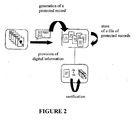
- the method proposed by the present invention is characterized by the following basic steps, performed for a subset or all of the occurred significant gaming events: provision by the gaming module to the security module of digital information containing a significant gaming event; generation in said security module of a protected record for each significant event received in the digital information provided by the gaming module; storage of said protected record, giving place to a file of protected records.
- the method comprises also an additional step of verification of the correct development of the games, which is done in the audit module from the information contained in the file of protected records. This verification step can be done during the games or later on, for example depending on several audit criteria considered.
- the method ensures its detection by means of reliable audits.
- the method considers also the possibility of sending information to players, through different channels, to allow them to verify the correct development of the games by themselves, possibly instantly in real time.
- the method considers three possibilities: individual generation by the gaming module, individual generation by the security module, or joint generation between the gaming module and the security module. In all the cases, the generation process is adequately recorded to enable a subsequent audit.
- the security module used in the system that implements the proposed method comprises, in its most basic form, the following elements: processing means, data input/output means to obtain digital information related to the significant gaming events, and storage means to store the generated protected records.
- the security module in a preferred execution variant, is split into a cryptographic submodule that provides physical security measures and a storage submodule.
- the cryptographic submodule could be implemented as a Hardware Security Module (HSM).
- HSM Hardware Security Module
- the storage submodule could be implemented as a database server.
- the audit module used in the system that implements the proposed method comprises, in its most basic form, the following elements: data input/output means that allow to access the file of protected records stored by the security module, and processing means that allow to process information relative to the protected records contained in said file of protected records.
- some authorized parties have access to the audit information that is generated by the audit module. These authorized parties can conveniently send some kind of report to the players, providing information related to what has happened during the games. This type of reports will allow the player to verify the correctness of what occurred during the games (for example in relation to the fair generation of randomness).
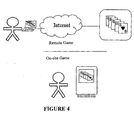
- the present invention refers both to on-site and remote games by electronic means, as it can be seen in Figure 4 .
- Figure 5 shows some of the basic elements that may have a relationship with, or may integrate, the gaming module.
- a registration entity mainly responsible for controlling the identity of the players that access the games, a games operator that represents the owner or manager of the gaming module, a banking entity that provides a payment gateway for the economic transactions related to the games and, finally, an auditing entity responsible for verifying that the games develop or have developed correctly.
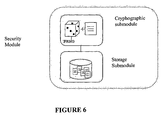
- Figure 6 shows the two submodules that may conform the security module.
- the cryptographic submodule which in a preferred implementation contains a random numbers generator (RNG), and which provides protection to the records generated after the significant events occurred during the games.
- RNG random numbers generator
- the storage submodule which stores the file of protected records.
- said file of protected records is constituted by the succession or sequence of the different protected records previously generated by the security module.
- the present invention proposes the use, together with an -either on-site or remote- electronic gaming module, of an independent unit that allows ensuring the honesty and trustworthiness of the developed gaming operations.
- the independent unit introduced by the present invention is connected to or integrated with the gaming module, and it has the following main goals:
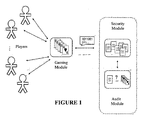
- the present invention introduces two clearly differentiated modules (capable of several degrees of grouping and/or dispersion): a security module and an audit module (see Figures 1 and 3 ). Both modules constitute the cited independent unit.
- the security module is destined to the generation and protection of records referred to the main events that occur during the games.
- the security module preferably includes a cryptographic hardware that can perform this task securely against possible attacks and/or manipulations.
- the security module stores the generated records in a file (namely the file of protected records). This file can be optionally stored on a write-once device that prevents its further manipulation.
- the audit module is destined to the verification of the correct development of the games, taking as the basis the information contained in the file of protected records (to achieve this, the audit module has access to the file of protected records).
- the present invention considers both the possibility that this verification is done in real time throughout the development of the games and the possibility that this verification is done later on, at predetermined times according to some audit reasons. In any case, the present invention always allows the player to verify the honesty and fairness of the games. For this, part of the information generated by the audit module is sent to each of the players, for example by means of a mobile telephony's short message or an email.
- the present invention distributes the computational load of the proposed method to enable reliable audits, among the two cited modules.
- the major computational load (requiring the analysis, sometimes exhaustive, of the protected records) falls on the audit module.
- the security module in constant interaction with the gaming module, is limited to tasks of copying and/or encrypting digital information. All the intelligence referred to the different game logics is shifted to the audit module. This eases the management and the updating of the game logics and the addition of new games, again without interfering the behaviour of the security module and, in consequence, without altering in any way the game dynamics between the gaming module and the players.
- a player or a plurality of players participate in the games by electronic means.
- the games are offered to the player or players by means of a gaming module, either on-site or remotely (see Figure 4 ).
- On-site games allow a direct interaction, in presence, with the players, through systems such as video lottery terminals (VLT) installed in playing rooms or bingo houses.
- remote electronic games allow a distant interaction with the player, through a communication network such as the Internet.
- the gaming module which knows the logics of the games, interacts with the players.
- the gaming module receives information from the players in relation to the decisions they take during the development of the games. Also, the gaming module presents to the players the evolution of the games.
- the gaming module records the operations undertaken during the games.
- the players When needed (specially in the case of remote games), the players usually have an execution platform (for example, a gaming kiosk, a personal computer, a personal digital assistant, or a mobile phone) and/or a set of programs or computer applications that allow them to interact with the gaming module.
- an execution platform for example, a gaming kiosk, a personal computer, a personal digital assistant, or a mobile phone
- the term "player” will refer both to the person that plays and to his/her related programs.
- the main elements or parts that have a relationship with, or that integrate, the gaming module to which the players interact with are (see Figure 5 ):
- the security module introduced by the present invention has also an important relationship with the gaming module.
- the security module is adapted to be integrated or connected with a gaming module.
- the security module consists of a set of programs and/or execution platforms to implement those operations required by the method described in the present invention.
- This security module generates, by means of processing means, protected records after the information provided by the gaming module which is obtained through data input/output means.
- the module stores said protected records in a file, by means of storage means.
- the security module consists of two differentiate submodules: a cryptographic submodule and a storage submodule.
- the cryptographic submodule includes sealed hardware that provides physical protection measures to part of the processing means of the security module.
- the sealed hardware can even store some information if required (therefore providing physical protection also to part of the storage means of the security module).
- HSM Hardware Security Module
- the storage submodule in a preferred implementation of the invention it would be a database server.
- the invention considers also the case in which the storage submodule uses a "write once, read many" (WORM) device.
- the storage submodule could be directly interconnected or integrated with the cryptographic submodule. On the contrary, it could also be physically separated from said cryptographic submodule. In the latter case, both submodules would have data input/output means to allow their interconnection through a communication network such as the Internet.
- the processing means of the security module include, in a preferred implementation, a random numbers generator. It could be a hardware device that generates random numbers. It could also be a software algorithm that generates pseudorandom numbers. It could also be a combination of both. In this latter case, a true random seed would be used to generate a sequence of pseudorandom numbers.
- pseudorandom numbers generators are listed in [FIPS PUB 140-2: Security Requirements for Cryptographic Modules, http://csrc.nist.gov/cryptval/140-2.htm, April 2005] or [Appendix 3 of FIPS PUB 186: Digital Signature Standard, http://csrc.nist.gov/publications/fips/fips186-2/fips186-2-change1.pdf, May 2005] and [RFC 1750: Randomness Recommendations for Security, http://www.ietf.org/rfc/rfc1750.txt, May 2005].
- the security module is also adapted to store at least a key to perform cryptographic operations on the digital information obtained from the gaming module.
- the security module is also adapted to record at least part of the results of said cryptographic operations.
- the gaming module would also be, in a preferred implementation, adapted for the storage of cryptographic keys.
- the present invention considers the possibility that both modules are logically interconnected, preferably by means of an Application Programming Interface (API).
- API Application Programming Interface
- the API enables the dialog between the gaming module's software and the security module's software.
- the API provides the -either on-site or remote- gaming module with a well-defined interface. Through this interface the gaming module can access, easily and in a standardized way, the functionalities offered by the modules claimed by the present invention. This access can take place without having to know the internal details of the modules.
- the API provides high independence regarding future evolutions of the modules.
- the API performs also the tasks of dynamic load balancing when, for performance reasons a single gaming module gets connected to more than one security module.
- the software that constitutes the API is responsible for distributing the requests of the gaming module across the several security modules, according to their respective availability.
- the audit module is adapted to be connected or integrated with the security module.
- the audit module has access, through data input/output means, to the file of protected records stored by the security module.
- the security module is divided into the two previously cited differentiated submodules, the present invention considers the possibility that the audit module has access to the storage submodule in order to obtain information from the file of protected records.
- the audit module consists of a set of programs and/or execution platforms for those operations claimed by the method of the present invention.
- the audit module can verify the correct development of the games thanks to the processing means it has.
- the security module and the audit module are physically apart.
- the audit module has access to the file of protected records, for example by means of a physical support such as a CD-ROM or by means of a remote access through a communication network.
- the audit module would be completely disconnected from the gaming module. However, it could have simultaneous connections with one or more security modules. Likewise, a single security module could have simultaneous connections with one or more gaming modules.
- the present invention also claims a method that allows, when implemented through the previously described system, ensuring a list of trust requirements (such as honesty and fairness) regarding the actions occurred during a game by electronic means, either on-site or remote.
- the foundation of the method is the secure preservation of information related to the significant events of any game, to enable at any moment its analysis and auditing with complete reliability.
- a significant gaming event is any action or event that reflects an important happening related to the game and which determines, in its main aspects, the development of a game's hand. Examples of significant gaming events would be some decisions by players such as to join or to leave a game table, or to place a certain bet.
- significant gaming event in the case of the roulette, the final slot where the ball stops on.
- the significant gaming events can be internally represented by means of digital information, which can be transferred during the games across the different elements that constitute the gaming system.
- the authentication of a player that accesses said gaming module corresponds to a significant event of a game by electronic means.
- This authentication can be done in different ways, depending on the desired security level. For example, access to the games can be granted to a player after validating his/her "loginame" and "password", which are previously associated to him/her.
- a Public Key Infrastructure (PKI) can also be used to provide players with digital certificates, enabling a stronger authentication process.
- biometric patterns are also used to authenticate the players that access some games.
- ID-Based or Identity-Based also make these techniques suitable as a possible authentication method.
- this module can provide the security module with digital information that allows the reproduction of the authentication process.
- the gaming module could also provide additional information, related to the geographic location of the player that accesses the games. In the case of remote electronic gaming, such location would be determined by the situation of the terminal used by the player to remotely access the gaming module through a communication network. This could represent another significant gaming event. In fact, however, the location of a player and his/her authentication at the moment of accessing the game could be joined constituting one single significant gaming event that would comprise both aspects.
- Another significant gaming event would be the beginning of a hand of a certain game, or the incorporation of a player to such hand.
- the description of said significant event would be constituted by the essential characteristics of the hand (such as the game type, the variety of game, and the wager limits, for example).
- Another significant event of importance corresponds to a decision or a game action by a player, such as for example the decision of wagering a certain amount or the action of operating the rolling-pins of a slot machine, or yet the decision of taking an additional card.
- the generation of randomness serves to determine for example where will the ball of a roulette stop, or what is the precise final situation of every card after a deck has been shuffled.
- the generation of randomness is also a significant event of crucial importance.
- the electronic generation of randomness needs in first place to obtain or to generate a pseudorandom number or a true random number. Secondly, the obtained number is scaled to the adequate range, according to the expected type of random event (for example, throwing a dice requires a number from1 to 6, while stopping the ball in the roulette requires a number from 0 to 36). Thirdly, the scaled number is converted to the final random outcome, by applying a predetermined mapping function.
- the present invention considers three different methods to generate random events. Firstly, the individual generation by the gaming module with no intervention from the security module. Secondly, the individual generation by the security module with no intervention from the gaming module, for example by using a random numbers generator located inside the cryptographic submodule. The present invention considers also as a third alternative the option of generating randomness jointly by the gaming and security modules.
- the gaming module is always responsible for leading the development of the games and the interaction with the players. For this reason, in the second and third previous options (generation of randomness by the security module and joint generation of randomness), the gaming module should initiate the process of randomness generation, by means of a request to the security module. The gaming module should always be finally notified of the definite outcome of the generation of random event, in order to be able to proceed with the development of the game. If desired, such notification could be digitally marked to ensure its authenticity and integrity (for example by means of an asymmetric or symmetric digital signature). The protocol would finish, in a preferred implementation, with a final confirmation by the gaming module to the security module.
- a preferred implementation fundamentally uses two cryptographic tools.
- a secret sharing scheme which allows to generate random numbers in a distributed way while preventing any of the involved parties (in this case the gaming module and the security module) from having any information related to the upcoming outcome and from being able to foresee it in any way.
- a commitment protocol which prevents any fraudulent manipulation by any of the parties involved in the joint generation.
- the present invention considers also the use of additional cryptographic tools, such as simple or distributed digital signatures, that would ensure integrity, authenticity and non-repudiation.
- the protected record associated to this significant event of joint generation of randomness will store, in a preferred implementation, the digital information needed to reproduce, later on, in a truthful way, the process of joint generation of randomness. This will allow verifying that the previously mentioned security characteristics are fulfilled.
- significant gaming events There are other types of significant gaming events, which are worth considering during the normal operation of a gaming module and its interactions with the players. For example, the setting or the updating of some parameters relative to the account of a player (such as the maximum amounts to be wagered per hand or some details relative to the payment methods that will be used to pay or to draw bets and prizes). The payment of prizes itself can be considered as a significant gaming event. Also, some communications or notifications by the gaming module to a player can be a significant event (for example, notifications related to the total time elapsed since the player first accessed the games). Finally, a last example of significant event would be the act of quitting a hand or a game by a player.
- the method of the present invention is characterized in that during the game, for every significant gaming event (or at least for every one of the significant events of a set considered to be convenient), the security module generates a record that will allow to accurately reproduce the associated significant event. Moreover, said record is protected to prevent any further manipulation once it has been generated.
- the set of protected records is stored in what is called a file of protected records. This file of protected records will allow the audit module to verify the correct functioning of the games, as it will be specified later.
- an audit module destined to the generation of auditing information, verifies, after at least part of said digital file of protected records, the correct development of the occurred game. Said verification is not necessarily done permanently for each of the significant events that happen throughout the games, but it could be done after a certain number of significant events have occurred. In this way, to do said verification, the audit module takes into account a determined number of said significant events, which are selected according to an audit criterion. This criterion can be conditioned by the logic of the game itself, or it can be determined for example by the specific regulation on the field of electronic gaming. For example,' all the significant gaming events occurred during the last week could be taken into account for the audit.
- Said gaming, security, and audit modules are capable of several degrees of dispersion and/or grouping. And some cryptographic protocols are used for the protection of said records.
- the subset of significant events for which the steps a) to c) are performed will depend on the different implementations. In a preferred implementation, said subset is the totality of the significant events occurred during the development of the games.
- the security module stores the digital file of protected records in a database.
- the protected records can be stored in a write-once device, to increase the physical protection awarded to the records.
- the present invention considers the possibility that the digital file of protected records is kept aside from the gaming module, to increase its independency from it.
- the gaming module Before providing the digital information described in the previous step a), the gaming module optionally can digitally mark said digital information (for example by means of a symmetric or asymmetric digital signature) to ensure the integrity and authenticity of said digital information.
- the security module After the gaming module has provided the security module with digital information related to a significant event, the security module generates a protected record for said significant event.
- the protection of said record can be diverse.
- a preferred implementation uses cryptographic protocols.
- the keys needed by said cryptographic protocols can be stored in the security module itself. In a preferred implementation they would be stored in the cryptographic submodule, to provide them with physical protection (a smartcard or a sealed hardware system offer a very limited access to some areas of their internal memories).
- the protection of the records has the objective of addressing mainly the following threats:
- the second alternative proposes the addition of some additional redundant information to the record (essentially referring to its ordering), and the digital signing of the final result (again, using a symmetric or asymmetric signature).
- the redundant information can consist for example of a simple sequence number or a chained hash value (obtained by means of a one-way hash function performed on the present record and on the succession of several previous records). With this procedure, all the previously mentioned threats are disabled. However, the generation of a digital signature for each of the protected records is still inefficient.
- a proposal is considered that not only guarantees protection before all of the exposed threats, but that it also represents an efficient alternative to be implemented.
- the issue is to keep an internal registry into the security module that stores the result of a chained hash value of the protected records as they are being generated.
- the security module proceeds to digitally sign (using asymmetric or asymmetric signature) the internal registry according to a specified criterion, as it could be after a predetermined number of records or at the expiration of a certain timeout.
- the internal registry, once signed, is stored along with the file of protected records.
- the reports generated by the audit module allow the auditing entity to check the level of accuracy and correctness of the occurred games, according to predetermined criteria. In addition, if large amounts have been won (or lost), additional information can be requested, such as an exhaustive revision of every single movement of money made by any of the players that have participated on the development of the games, or the revision of the identities of the players that have interacted with the gaming module.
- the present invention considers also the possibility that the audit module has a permanent access to the file of protected records, with the objective of setting instant alarms in real time before fraudulent actions. These alarms could be directed to auditors or regulators, for example.
- the audit reports In the case of sending, perhaps partly, the audit reports to the players, this would allow them to verify by themselves that the security module was effectively involved in the control and secure recording of what happened during their game hands.
- This sending of information to the players can be done in real time through the gaming system which the players interact with, to provide them with an instant verification of the correct development of the games.
- the audit information can be sent to the players later on, by means of several external communication channels such as email, mobile telephony's short messages (SMS), or the publication of the audit information on a determined webpage accessible by the players.
- SMS mobile telephony's short messages
Landscapes
- Engineering & Computer Science (AREA)
- Computer Security & Cryptography (AREA)
- Multimedia (AREA)
- Theoretical Computer Science (AREA)
- Physics & Mathematics (AREA)
- General Physics & Mathematics (AREA)
- Computer Hardware Design (AREA)
- General Health & Medical Sciences (AREA)
- Bioethics (AREA)
- Software Systems (AREA)
- General Engineering & Computer Science (AREA)
- Health & Medical Sciences (AREA)
- Business, Economics & Management (AREA)
- General Business, Economics & Management (AREA)
- Pinball Game Machines (AREA)
- Management, Administration, Business Operations System, And Electronic Commerce (AREA)
- Storage Device Security (AREA)
Applications Claiming Priority (1)
| Application Number | Priority Date | Filing Date | Title |
|---|---|---|---|
| PCT/ES2005/000400 WO2007010055A1 (es) | 2005-07-15 | 2005-07-15 | Método y sistema para la generación de un archivo de registros auditables en los juegos por medios electrónicos presenciales y remotos |
Publications (2)
| Publication Number | Publication Date |
|---|---|
| EP1908503A1 true EP1908503A1 (de) | 2008-04-09 |
| EP1908503A4 EP1908503A4 (de) | 2009-12-23 |
Family
ID=37668453
Family Applications (1)
| Application Number | Title | Priority Date | Filing Date |
|---|---|---|---|
| EP05777972A Withdrawn EP1908503A4 (de) | 2005-07-15 | 2005-07-15 | Verfahren und system zur generierung einer datei aus auditierbaren log-eintragungen über spiele unter einsatz von elektronischen mitteln vor ort und abgesetzt |
Country Status (4)
| Country | Link |
|---|---|
| US (1) | US9155959B2 (de) |
| EP (1) | EP1908503A4 (de) |
| GB (1) | GB2418153B (de) |
| WO (1) | WO2007010055A1 (de) |
Cited By (1)
| Publication number | Priority date | Publication date | Assignee | Title |
|---|---|---|---|---|
| WO2011077464A1 (en) * | 2009-12-21 | 2011-06-30 | Betware A Islandi Hf | Generic auditable random generator |
Families Citing this family (22)
| Publication number | Priority date | Publication date | Assignee | Title |
|---|---|---|---|---|
| AU2010220826A1 (en) * | 2009-03-06 | 2011-09-22 | Pro-Active Games Pty Ltd | Tickets and system for lottery games |
| US8443202B2 (en) | 2009-08-05 | 2013-05-14 | Daon Holdings Limited | Methods and systems for authenticating users |
| US8826030B2 (en) | 2010-03-22 | 2014-09-02 | Daon Holdings Limited | Methods and systems for authenticating users |
| US9547957B2 (en) * | 2012-10-11 | 2017-01-17 | Scientific Games International, Inc. | System and method for implementing internet-based games wherein a plurality of different games share a common prize structure |
| US9539501B2 (en) * | 2012-10-11 | 2017-01-10 | Scientific Games International, Inc. | System for implementing internet-based games with a core platform, game modules, and protected game outcome generator |
| US10027487B2 (en) | 2015-05-14 | 2018-07-17 | Sca Promotions, Inc. | System and method for providing auditable secure seeds to random number generators across multiple entities |
| US11069195B2 (en) | 2017-08-09 | 2021-07-20 | Raymond Anthony Joao | Sports betting apparatus and method |
| US12430993B2 (en) | 2017-08-09 | 2025-09-30 | Raymond Anthony Joao | Sports betting apparatus and method |
| US12444266B2 (en) | 2017-08-09 | 2025-10-14 | Raymond Anthony Joao | Sports betting apparatus and method |
| JP6942927B2 (ja) * | 2018-03-07 | 2021-09-29 | 株式会社コナミデジタルエンタテインメント | ゲームシステム、管理サーバのプログラム及びゲーム装置のプログラム |
| US12412451B2 (en) | 2019-03-12 | 2025-09-09 | Raymond Anthony Joao | Sports betting apparatus and method |
| US12424060B2 (en) | 2018-12-01 | 2025-09-23 | Raymond Anthony Joao | Sports betting apparatus and method |
| US12354444B2 (en) | 2019-10-17 | 2025-07-08 | Raymond Anthony Joao | Sports betting apparatus and method |
| US12387568B2 (en) | 2018-03-31 | 2025-08-12 | Raymond Anthony Joao | Sports betting apparatus and method |
| US12387569B2 (en) | 2020-02-25 | 2025-08-12 | Raymond Anthony Joao | Sports betting apparatus and method |
| US10924566B2 (en) * | 2018-05-18 | 2021-02-16 | High Fidelity, Inc. | Use of corroboration to generate reputation scores within virtual reality environments |
| CA3034830A1 (en) | 2018-06-14 | 2019-12-14 | Exfo Inc. | Validation of test results in network testing |
| US12347277B2 (en) | 2018-08-01 | 2025-07-01 | Raymond Anthony Joao | Sports betting apparatus and method |
| US20230024852A1 (en) * | 2019-05-27 | 2023-01-26 | Raymond Anthony Joao | Sports betting apparatus and method |
| US20240386783A1 (en) * | 2019-03-12 | 2024-11-21 | Raymond Anthony Joao | Sports betting apparatus and method |
| US12688752B2 (en) | 2023-12-19 | 2026-07-21 | Igt | Transferring funds between an electronic gaming machine and a financial institution account utilizing a cashless payment terminal |
| US20250315805A1 (en) * | 2024-04-03 | 2025-10-09 | Igt | Gaming establishment device electronic funds transfer audit data distribution |
Family Cites Families (30)
| Publication number | Priority date | Publication date | Assignee | Title |
|---|---|---|---|---|
| US4926327A (en) | 1983-04-05 | 1990-05-15 | Sidley Joseph D H | Computerized gaming system |
| US5038022A (en) | 1989-12-19 | 1991-08-06 | Lucero James L | Apparatus and method for providing credit for operating a gaming machine |
| US6267670B1 (en) * | 1997-03-21 | 2001-07-31 | Walker Digital, Llc | System and method for performing lottery ticket transactions utilizing point-of-sale terminals |
| DE4437277A1 (de) * | 1994-03-11 | 1995-09-14 | Walker Asset Management Ltd | Verbessertes Fernspielsystem |
| US5643086A (en) | 1995-06-29 | 1997-07-01 | Silicon Gaming, Inc. | Electronic casino gaming apparatus with improved play capacity, authentication and security |
| US6117011A (en) | 1995-07-27 | 2000-09-12 | Lvov; Denis Ernestovich | Electronic game system, method of managing and regulating said system |
| GB2307184A (en) | 1995-11-07 | 1997-05-21 | Arthur Jacobs | Gaming network |
| US6264560B1 (en) | 1996-01-19 | 2001-07-24 | Sheldon F. Goldberg | Method and system for playing games on a network |
| TW348349B (en) | 1996-09-16 | 1998-12-21 | Sony Trans Com Inc | Combined digital audio/video on demand and broadcast distribution system |
| US6099408A (en) | 1996-12-31 | 2000-08-08 | Walker Digital, Llc | Method and apparatus for securing electronic games |
| US6203427B1 (en) * | 1997-07-03 | 2001-03-20 | Walker Digital, Llc | Method and apparatus for securing a computer-based game of chance |
| US6030288A (en) | 1997-09-02 | 2000-02-29 | Quixotic Solutions Inc. | Apparatus and process for verifying honest gaming transactions over a communications network |
| US6368219B1 (en) * | 1999-10-15 | 2002-04-09 | Gtech Rhode Island Corporation | System and method for determining whether wagers have been altered after winning game numbers are drawn |
| US6612928B1 (en) | 2001-02-15 | 2003-09-02 | Sierra Design Group | Player identification using biometric data in a gaming environment |
| US6743098B2 (en) | 2001-04-26 | 2004-06-01 | Gamet Technology | Biometric enabled casino gaming system |
| US8147334B2 (en) * | 2003-09-04 | 2012-04-03 | Jean-Marie Gatto | Universal game server |
| US7980937B2 (en) * | 2001-12-13 | 2011-07-19 | Scientific Games International, Inc. | Lottery audit system |
| AU2003252901A1 (en) * | 2002-04-18 | 2003-12-11 | Walker Digital, Llc | Method and Apparatus for Authenticating Data Relating to Usage of a Gaming Device |
| WO2004034223A2 (en) | 2002-10-09 | 2004-04-22 | Legal Igaming, Inc. | System and method for connecting gaming devices to a network for remote play |
| WO2004035159A1 (es) | 2002-10-14 | 2004-04-29 | Scytl Online World Security Sa | Método para la obtención de un resultado imparcial de un juego a través de una red de comunicación y protocolos y programas asociados |
| US6934846B2 (en) * | 2003-01-22 | 2005-08-23 | Walter Szrek | Method of generating unpredictable and auditable random numbers |
| US7867083B2 (en) | 2003-03-25 | 2011-01-11 | Igt | Methods and apparatus for limiting access to games using biometric data |
| US8123616B2 (en) | 2003-03-25 | 2012-02-28 | Igt | Methods and apparatus for limiting access to games using biometric data |
| US7798900B2 (en) | 2003-04-03 | 2010-09-21 | Igt | Secure gaming system |
| US7288027B2 (en) | 2003-05-28 | 2007-10-30 | Microsoft Corporation | Cheater detection in a multi-player gaming environment |
| WO2005006267A1 (en) * | 2003-07-10 | 2005-01-20 | Betware A Islande Hf. | Secure and auditable on-line system |
| WO2005021118A1 (es) | 2003-08-27 | 2005-03-10 | Kroopier Technologies, S.L. | Sistema para la ejecución de un juego de azar a través de una red de comunicación |
| US8047908B2 (en) * | 2005-03-29 | 2011-11-01 | Igt | Methods and systems for determining and selling wagering game outcomes for a plurality of players |
| US7753770B2 (en) * | 2005-03-29 | 2010-07-13 | Igt | Methods and apparatus for determining hybrid wagering game sessions |
| US20080182667A1 (en) * | 2007-01-25 | 2008-07-31 | Igt, Inc. | Method of securing data on a portable gaming device from tampering |
-
2005
- 2005-07-15 EP EP05777972A patent/EP1908503A4/de not_active Withdrawn
- 2005-07-15 WO PCT/ES2005/000400 patent/WO2007010055A1/es not_active Ceased
- 2005-07-15 US US11/995,785 patent/US9155959B2/en active Active
- 2005-10-18 GB GB0521102A patent/GB2418153B/en not_active Expired - Fee Related
Cited By (1)
| Publication number | Priority date | Publication date | Assignee | Title |
|---|---|---|---|---|
| WO2011077464A1 (en) * | 2009-12-21 | 2011-06-30 | Betware A Islandi Hf | Generic auditable random generator |
Also Published As
| Publication number | Publication date |
|---|---|
| US20080287188A1 (en) | 2008-11-20 |
| GB2418153B (en) | 2006-12-06 |
| WO2007010055A1 (es) | 2007-01-25 |
| EP1908503A4 (de) | 2009-12-23 |
| US9155959B2 (en) | 2015-10-13 |
| GB0521102D0 (en) | 2005-11-23 |
| GB2418153A (en) | 2006-03-22 |
Similar Documents
| Publication | Publication Date | Title |
|---|---|---|
| US9155959B2 (en) | Method and system for the generation of a file of auditable records for remote and on-site electronic gaming | |
| US7294056B2 (en) | Enhanced gaming system | |
| CA2302189C (en) | Apparatus and process for verifying honest gaming transactions over a communications network | |
| US6935952B2 (en) | Method and apparatus for remote gaming | |
| US7877798B2 (en) | System and method for connecting gaming devices to a network for remote play | |
| US6099408A (en) | Method and apparatus for securing electronic games | |
| US6962530B2 (en) | Authentication in a secure computerized gaming system | |
| US20170161991A1 (en) | System and method for public verification of a gambling website or gaming event | |
| US20170256128A1 (en) | System and Method for Connecting Gaming Devices to a Network for Remote Play | |
| AU2003282576A1 (en) | System and method for connecting gaming devices to a network for remote play | |
| US20080200225A1 (en) | Methods and apparatus for facilitating game play and generating an authenticatable audit-trail | |
| US20180130280A1 (en) | System and Method for Connecting Gaming Devices to a Network for Remote Play | |
| US20060236400A1 (en) | Secure and auditable on-line system | |
| WO2005006267A1 (en) | Secure and auditable on-line system | |
| EP1669115A1 (de) | System zum spielen eines glücksspiels unter verwendung eines kommunikationsnetzwerks | |
| WO2011077464A1 (en) | Generic auditable random generator |
Legal Events
| Date | Code | Title | Description |
|---|---|---|---|
| PUAI | Public reference made under article 153(3) epc to a published international application that has entered the european phase |
Free format text: ORIGINAL CODE: 0009012 |
|
| 17P | Request for examination filed |
Effective date: 20080128 |
|
| AK | Designated contracting states |
Kind code of ref document: A1 Designated state(s): AT BE BG CH CY CZ DE DK EE ES FI FR GB GR HU IE IS IT LI LT LU LV MC NL PL PT RO SE SI SK TR |
|
| RIN1 | Information on inventor provided before grant (corrected) |
Inventor name: DAZA FERNANDEZ, VANESA Inventor name: RIERA JORBA, ANDREU |
|
| A4 | Supplementary search report drawn up and despatched |
Effective date: 20091125 |
|
| RIC1 | Information provided on ipc code assigned before grant |
Ipc: G06F 21/00 20060101ALI20091119BHEP Ipc: G07F 17/32 20060101ALI20091119BHEP Ipc: A63F 13/12 20060101AFI20070328BHEP |
|
| 17Q | First examination report despatched |
Effective date: 20100322 |
|
| DAX | Request for extension of the european patent (deleted) | ||
| RAP1 | Party data changed (applicant data changed or rights of an application transferred) |
Owner name: SCYTL SECURE ELECTRONIC VOTING, S.A. |
|
| RAP1 | Party data changed (applicant data changed or rights of an application transferred) |
Owner name: KINAMIK DATA INTEGRITY, S.L. |
|
| RAP1 | Party data changed (applicant data changed or rights of an application transferred) |
Owner name: SCYTL SECURE ELECTRONIC VOTING, S.A. |
|
| RIC1 | Information provided on ipc code assigned before grant |
Ipc: G06F 21/64 20130101ALI20180606BHEP Ipc: G07F 17/32 20060101ALI20180606BHEP Ipc: A63F 13/75 20140101AFI20180606BHEP |
|
| GRAP | Despatch of communication of intention to grant a patent |
Free format text: ORIGINAL CODE: EPIDOSNIGR1 |
|
| INTG | Intention to grant announced |
Effective date: 20200103 |
|
| RIN1 | Information on inventor provided before grant (corrected) |
Inventor name: DAZA FERNANDEZ, VANESA Inventor name: RIERA JORBA, ANDREU |
|
| STAA | Information on the status of an ep patent application or granted ep patent |
Free format text: STATUS: THE APPLICATION IS DEEMED TO BE WITHDRAWN |
|
| 18D | Application deemed to be withdrawn |
Effective date: 20200603 |