EP1908407B1 - Device to treat intraluminal bleeding using an adhesive - Google Patents
Device to treat intraluminal bleeding using an adhesive Download PDFInfo
- Publication number
- EP1908407B1 EP1908407B1 EP07253946.3A EP07253946A EP1908407B1 EP 1908407 B1 EP1908407 B1 EP 1908407B1 EP 07253946 A EP07253946 A EP 07253946A EP 1908407 B1 EP1908407 B1 EP 1908407B1
- Authority
- EP
- European Patent Office
- Prior art keywords
- vacuum
- adhesive
- surgical device
- cannula
- tissue
- Prior art date
- Legal status (The legal status is an assumption and is not a legal conclusion. Google has not performed a legal analysis and makes no representation as to the accuracy of the status listed.)
- Not-in-force
Links
- 239000000853 adhesive Substances 0.000 title claims description 77
- 230000001070 adhesive effect Effects 0.000 title claims description 77
- 230000000740 bleeding effect Effects 0.000 title description 18
- 239000008280 blood Substances 0.000 claims description 7
- 210000004369 blood Anatomy 0.000 claims description 7
- 239000003999 initiator Substances 0.000 claims description 7
- 150000001875 compounds Chemical class 0.000 claims description 6
- 239000003795 chemical substances by application Substances 0.000 claims description 5
- 239000000203 mixture Substances 0.000 claims description 4
- 239000000178 monomer Substances 0.000 claims description 4
- -1 1,1-disubstituted ethylene Chemical group 0.000 claims description 3
- 229920001651 Cyanoacrylate Polymers 0.000 claims description 2
- MWCLLHOVUTZFKS-UHFFFAOYSA-N Methyl cyanoacrylate Chemical compound COC(=O)C(=C)C#N MWCLLHOVUTZFKS-UHFFFAOYSA-N 0.000 claims description 2
- FAPWRFPIFSIZLT-UHFFFAOYSA-M Sodium chloride Chemical compound [Na+].[Cl-] FAPWRFPIFSIZLT-UHFFFAOYSA-M 0.000 claims description 2
- 239000011780 sodium chloride Substances 0.000 claims description 2
- 238000009472 formulation Methods 0.000 claims 1
- 239000012985 polymerization agent Substances 0.000 claims 1
- 238000006116 polymerization reaction Methods 0.000 claims 1
- 206010046996 Varicose vein Diseases 0.000 description 30
- 208000027185 varicose disease Diseases 0.000 description 30
- 210000003238 esophagus Anatomy 0.000 description 20
- 208000032843 Hemorrhage Diseases 0.000 description 19
- 210000001519 tissue Anatomy 0.000 description 18
- 208000034158 bleeding Diseases 0.000 description 17
- 239000000463 material Substances 0.000 description 17
- 239000012636 effector Substances 0.000 description 15
- 210000003462 vein Anatomy 0.000 description 13
- 230000004888 barrier function Effects 0.000 description 6
- 230000009977 dual effect Effects 0.000 description 6
- 208000021302 gastroesophageal reflux disease Diseases 0.000 description 6
- 230000001681 protective effect Effects 0.000 description 6
- 210000002784 stomach Anatomy 0.000 description 6
- 210000001367 artery Anatomy 0.000 description 5
- 239000013043 chemical agent Substances 0.000 description 5
- 208000014674 injury Diseases 0.000 description 5
- 238000000034 method Methods 0.000 description 5
- 208000007232 portal hypertension Diseases 0.000 description 5
- 238000001356 surgical procedure Methods 0.000 description 5
- 230000008733 trauma Effects 0.000 description 5
- 206010011224 Cough Diseases 0.000 description 4
- 230000001684 chronic effect Effects 0.000 description 4
- 210000003236 esophagogastric junction Anatomy 0.000 description 4
- 210000003240 portal vein Anatomy 0.000 description 4
- 230000008673 vomiting Effects 0.000 description 4
- WSFSSNUMVMOOMR-UHFFFAOYSA-N Formaldehyde Chemical compound O=C WSFSSNUMVMOOMR-UHFFFAOYSA-N 0.000 description 3
- 206010047700 Vomiting Diseases 0.000 description 3
- 230000017531 blood circulation Effects 0.000 description 3
- 201000010099 disease Diseases 0.000 description 3
- 208000037265 diseases, disorders, signs and symptoms Diseases 0.000 description 3
- 238000003780 insertion Methods 0.000 description 3
- 230000037431 insertion Effects 0.000 description 3
- 210000004185 liver Anatomy 0.000 description 3
- 230000004913 activation Effects 0.000 description 2
- 238000010276 construction Methods 0.000 description 2
- 230000006378 damage Effects 0.000 description 2
- 239000003814 drug Substances 0.000 description 2
- 239000004744 fabric Substances 0.000 description 2
- 230000035876 healing Effects 0.000 description 2
- 208000014617 hemorrhoid Diseases 0.000 description 2
- 238000002347 injection Methods 0.000 description 2
- 239000007924 injection Substances 0.000 description 2
- HLXZNVUGXRDIFK-UHFFFAOYSA-N nickel titanium Chemical compound [Ti].[Ti].[Ti].[Ti].[Ti].[Ti].[Ti].[Ti].[Ti].[Ti].[Ti].[Ni].[Ni].[Ni].[Ni].[Ni].[Ni].[Ni].[Ni].[Ni].[Ni].[Ni].[Ni].[Ni].[Ni] HLXZNVUGXRDIFK-UHFFFAOYSA-N 0.000 description 2
- 229910001000 nickel titanium Inorganic materials 0.000 description 2
- 229920001343 polytetrafluoroethylene Polymers 0.000 description 2
- 230000002787 reinforcement Effects 0.000 description 2
- 230000004044 response Effects 0.000 description 2
- 239000003381 stabilizer Substances 0.000 description 2
- IJVRPNIWWODHHA-UHFFFAOYSA-N 2-cyanoprop-2-enoic acid Chemical compound OC(=O)C(=C)C#N IJVRPNIWWODHHA-UHFFFAOYSA-N 0.000 description 1
- 229920002799 BoPET Polymers 0.000 description 1
- 239000005041 Mylar™ Substances 0.000 description 1
- 208000008589 Obesity Diseases 0.000 description 1
- 239000004830 Super Glue Substances 0.000 description 1
- 239000004809 Teflon Substances 0.000 description 1
- 229920006362 Teflon® Polymers 0.000 description 1
- RTAQQCXQSZGOHL-UHFFFAOYSA-N Titanium Chemical compound [Ti] RTAQQCXQSZGOHL-UHFFFAOYSA-N 0.000 description 1
- 208000027418 Wounds and injury Diseases 0.000 description 1
- 239000002253 acid Substances 0.000 description 1
- 150000007513 acids Chemical class 0.000 description 1
- 230000009471 action Effects 0.000 description 1
- 239000000654 additive Substances 0.000 description 1
- 229910052782 aluminium Inorganic materials 0.000 description 1
- XAGFODPZIPBFFR-UHFFFAOYSA-N aluminium Chemical compound [Al] XAGFODPZIPBFFR-UHFFFAOYSA-N 0.000 description 1
- 229940035674 anesthetics Drugs 0.000 description 1
- 210000000436 anus Anatomy 0.000 description 1
- 239000003124 biologic agent Substances 0.000 description 1
- 239000000872 buffer Substances 0.000 description 1
- 239000003054 catalyst Substances 0.000 description 1
- 230000008859 change Effects 0.000 description 1
- 239000003638 chemical reducing agent Substances 0.000 description 1
- 238000000576 coating method Methods 0.000 description 1
- 239000003086 colorant Substances 0.000 description 1
- 239000003431 cross linking reagent Substances 0.000 description 1
- VYQRBKCKQCRYEE-UHFFFAOYSA-N ctk1a7239 Chemical compound C12=CC=CC=C2N2CC=CC3=NC=CC1=C32 VYQRBKCKQCRYEE-UHFFFAOYSA-N 0.000 description 1
- 229940079593 drug Drugs 0.000 description 1
- 229920001971 elastomer Polymers 0.000 description 1
- 238000002674 endoscopic surgery Methods 0.000 description 1
- 229920003247 engineering thermoplastic Polymers 0.000 description 1
- FGBJXOREULPLGL-UHFFFAOYSA-N ethyl cyanoacrylate Chemical compound CCOC(=O)C(=C)C#N FGBJXOREULPLGL-UHFFFAOYSA-N 0.000 description 1
- 238000000605 extraction Methods 0.000 description 1
- 239000000945 filler Substances 0.000 description 1
- 239000000796 flavoring agent Substances 0.000 description 1
- 235000019634 flavors Nutrition 0.000 description 1
- 239000012530 fluid Substances 0.000 description 1
- 230000002496 gastric effect Effects 0.000 description 1
- 239000003193 general anesthetic agent Substances 0.000 description 1
- 239000003292 glue Substances 0.000 description 1
- 230000036541 health Effects 0.000 description 1
- 230000002262 irrigation Effects 0.000 description 1
- 238000003973 irrigation Methods 0.000 description 1
- 238000002357 laparoscopic surgery Methods 0.000 description 1
- 230000003902 lesion Effects 0.000 description 1
- 239000007788 liquid Substances 0.000 description 1
- 229910052751 metal Inorganic materials 0.000 description 1
- 239000002184 metal Substances 0.000 description 1
- 150000002739 metals Chemical class 0.000 description 1
- 239000011859 microparticle Substances 0.000 description 1
- 230000004048 modification Effects 0.000 description 1
- 238000012986 modification Methods 0.000 description 1
- 210000004877 mucosa Anatomy 0.000 description 1
- 229920003052 natural elastomer Polymers 0.000 description 1
- 229920001194 natural rubber Polymers 0.000 description 1
- 230000002956 necrotizing effect Effects 0.000 description 1
- 125000005245 nitryl group Chemical group [N+](=O)([O-])* 0.000 description 1
- 235000020824 obesity Nutrition 0.000 description 1
- 210000004798 organs belonging to the digestive system Anatomy 0.000 description 1
- 239000003002 pH adjusting agent Substances 0.000 description 1
- 239000002304 perfume Substances 0.000 description 1
- 238000011422 pharmacological therapy Methods 0.000 description 1
- 229920001296 polysiloxane Polymers 0.000 description 1
- 230000035935 pregnancy Effects 0.000 description 1
- 239000003755 preservative agent Substances 0.000 description 1
- 230000002035 prolonged effect Effects 0.000 description 1
- 239000002516 radical scavenger Substances 0.000 description 1
- 238000010992 reflux Methods 0.000 description 1
- 239000005060 rubber Substances 0.000 description 1
- 230000002784 sclerotic effect Effects 0.000 description 1
- 238000007789 sealing Methods 0.000 description 1
- 239000007787 solid Substances 0.000 description 1
- 239000002904 solvent Substances 0.000 description 1
- 238000011477 surgical intervention Methods 0.000 description 1
- 229920003051 synthetic elastomer Polymers 0.000 description 1
- 239000005061 synthetic rubber Substances 0.000 description 1
- 238000002560 therapeutic procedure Methods 0.000 description 1
- 239000002562 thickening agent Substances 0.000 description 1
- 239000013008 thixotropic agent Substances 0.000 description 1
- 230000000451 tissue damage Effects 0.000 description 1
- 231100000827 tissue damage Toxicity 0.000 description 1
- 239000010936 titanium Substances 0.000 description 1
- 229910052719 titanium Inorganic materials 0.000 description 1
- 230000002792 vascular Effects 0.000 description 1
- 210000004916 vomit Anatomy 0.000 description 1
Images





Classifications
-
- A—HUMAN NECESSITIES
- A61—MEDICAL OR VETERINARY SCIENCE; HYGIENE
- A61B—DIAGNOSIS; SURGERY; IDENTIFICATION
- A61B17/00—Surgical instruments, devices or methods
- A61B17/00491—Surgical glue applicators
-
- A—HUMAN NECESSITIES
- A61—MEDICAL OR VETERINARY SCIENCE; HYGIENE
- A61B—DIAGNOSIS; SURGERY; IDENTIFICATION
- A61B17/00—Surgical instruments, devices or methods
- A61B2017/00831—Material properties
- A61B2017/00867—Material properties shape memory effect
-
- A—HUMAN NECESSITIES
- A61—MEDICAL OR VETERINARY SCIENCE; HYGIENE
- A61B—DIAGNOSIS; SURGERY; IDENTIFICATION
- A61B17/00—Surgical instruments, devices or methods
- A61B17/30—Surgical pincettes, i.e. surgical tweezers without pivotal connections
- A61B2017/306—Surgical pincettes, i.e. surgical tweezers without pivotal connections holding by means of suction
- A61B2017/308—Surgical pincettes, i.e. surgical tweezers without pivotal connections holding by means of suction with suction cups
Definitions
- the present invention relates, in general, to devices for the treatment and control of bleeding, and in particular, to devices using adhesives for the treatment of bleeding.
- Variceal bleeding in the esophagus is caused by portal hypertension.
- Portal hypertension is an increase in the pressure within the portal vein (the vein that carries blood from the digestive organs to the liver). This increase in pressure is caused by a blockage in the blood flow throughout the liver.
- Increased pressure in the portal vein causes enlarged veins (varices) to develop across the esophagus and stomach to bypass the blockage.
- the walls of the varices become fragile and can rupture and bleed easily. In some cases this bleeding can result in massive uncontrollable bleeding, which left unchecked, could cause severe health issues. Alternately, surgical trauma or other trauma to the esophageal region could also result in a similar bleeding situation.
- stomach acids can cause thinning or removal of the mucosal lining of the esophagus and could expose the underlying vein or varices structures to the chronic acid reflux. Enlarged veins have thinner walls, and acid reflux exposure can thin them further. In some cases, coughing or vomiting might overload the thinned vein or varices, cause a bleeding cycle to occur, and require surgical treatment.
- Enlarged vein structures or varices are not limited to the esophageal areas and neither are the veinus and arterial stresses induced by coughing, vomiting, trauma, pregnancy, obesity, prolonged standing, hard stools, or other bodily functions.
- varices are found In hemorrhoids, varicoceies, and varicose veins in areas such as the legs, stomach, and feet. Hemorrhages can be found at these sites, but can occur in any arena where small veins and arteries are near the surface of a structure that is being subjected to stresses or trauma.
- a prior art flexible vacuum grabber for holding lesions is known from US2005/0059347A1 .
- a prior art device and method for intersital injection of biologic agents into a tissue is known from WO2007/002227A2 .
- a prior art surgical stabilizer device and method is known from US3005/0021085A1 , which discloses a device according to the preamble of claim 1.
- a prior art patch and glue delivery system for closing tissue opening during surgery Is known from US2002/0026159A1 .
- Enlarged vein structures or varices are found within the body in a variety of locations. These enlarged vein structures can include arteries, and have thinner wall structures that can cause bleeders when subjected to trauma, or disease conditions such as portal hypertension or hemorrhoids. With portal hypertension, the enlarged varices about the esophagus can rupture and cause chronic bleeding into the esophagus. If severe, the condition can require surgical intervention to staunch the bleeding and leave a structure in place that can prevent further damage to the vein or artery.
- FIGS. 1 and 2 illustrates an example of a surgical device 25 capable of stopping the flow of blood with an adhesive 65 at a surgical site such as the esophagus.
- Surgical device 25 can control blood loss by capturing tissue with a tissue acquisition system or vacuum system, and then using an adhesive injection system to inject an adhesive into or onto the captured tissue to staunch blood loss, place a barrier about the varices, and protect the wound site.
- the surgical device 25 as shown In FIG. 1 has a distal portion that is small in cross section so it can be inserted into a working channel 85 of an endoscope 80.
- Endoscope 80 is a common surgical access instrument that has a scope handle 81, a steerable flexible shaft 82, a viewing element 84 at a distal tip 83 to view the surgical site, and the working channel 85 extending from handle 81 to distal tip 83.
- Endoscopes are commonly inserted into the mouth or anus to use natural body orifices to gain access to surgical sites within the patient.
- Surgical device 25 generally extends from a handle 34 to an end effector 30.
- FIG. 1 shows the handle 34 extending from a proximal end of the working channel 85 and the end effector 30 extending from a distal end of the working channel 85.
- the surgical device 25 is positionable with respect to the operative channel 85 of endoscope 80 in rotation, insertion, and extraction.
- a flexible shaft 32 operatively couples end effector 30 to the handle 34.
- the vacuum system 50 of the surgical device 25 has a vacuum source 51 and a vacuum control 56 to control the delivery of vacuum to the handle 34. Vacuum is supplied through a hose 54 extending from vacuum control 56.
- a longitudinally moveable vacuum cannula 52 ( FIG. 2 ) is operably connected to hose 54 and extends from handle 34, through flexible shaft 32, to the end effector 30. Vacuum cannula 52 moves proximally and distally within handle 34 and flexible shaft 32 in response to proximal and distal manipulation of chamber control 53 on handle 34.
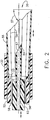
- a conical vacuum chamber 55 attaches to a distal tip of the vacuum cannula 52 and is operably coupled to vacuum source 51 and vacuum control 56 by vacuum cannula 52 and hose 54. As shown in FIG. 2 , vacuum passageways 58 are provided in vacuum cannula 52 to conduct vacuum to vacuum chamber 55.
- Vacuum chamber 55 is best shown in FIGS 1-5 , and is a collapsible and expandable structure. Vacuum chamber 55 has a fully open conical shape of FIGS. 1 and 5 and can be collapsed to a partially closed position of FIG 4 , to the nearly closed position of FIG. 3 , and to a fully closed cylindrical shape with pleats and folds within flexible shaft 32 (not shown). As vacuum chamber 55 is collapsed, a series of pre-induced folds 59 located about the periphery are used to control collapsing, and are best shown in FIGS. 3 and 4 . As shown, vacuum chamber 55 is formed from a spring material that has a naturally open conical shape. In the full open position, the folds 59 could induce local distortion and prevent vacuum chamber 55 from attaining a smooth conical shape.
- Distal and proximal movement of chamber control 53 on handle 34 moves vacuum cannula 52 and attached vacuum chamber 55 distally and proximally relative to flexible shaft 32.
- Distal movement of vacuum cannula 52 moves vacuum chamber 55 out of the confines of flexible shaft 32 and allows the vacuum chamber 55 to expand.
- proximal motion of a fully open vacuum chamber 55 into flexible shaft 32 closes vacuum chamber 55 by bringing vacuum chamber 55 into camming action with an inner surface 33 of flexible shaft 32.
- An angle 57 is cut onto a distal end of vacuum chamber 55 to enhance angular contact of the vacuum chamber 55 with the wall of the esophagus, and to ensure a good vacuum seal.
- Vacuum chamber 55 can be withdrawn fully into flexible shaft 32.
- Vacuum chamber 55 can be constructed from a number of engineering materials such as but not limited to thin sections of engineering thermoplastics such as mylar, silicone, polytetraflouroethylene (Teflon) and the like, or thin sections of metals such as titanium, nitinol or aluminum. Nitinol vacuum chambers 55 could undergo a phase change as they are opened or collapsed. Alternately, by way of example, vacuum chamber 55 can be constructed with an umbrella-like construction as shown in FIG. 5 with a series of ribs 59a joined to a thinner conical section of flexible fabric or film material 59b.
- Film material 59b could also be springy.
- ribs 59a can be constructed as thicker ribs 59a molded onto the film material 59b, rigid separate ribs attached to an opening structure like that used in an umbrella (see FIG. 5 ), or a springy an umbrella type construction with flexible cantilever spring ribs.
- the flexible cantilever spring ribs can be pre-bent to expand into a conical rib structure to open the film material 59b.
- Film material 59b can be materials such as but not limited to rubber compounds such as nitryl, polyethelene, polypropelene, polytetraflouroethylene, papers, and surgical fabrics with or without coatings, or films (not shown) and the like.
- a spring could be provided to open the umbrella shape.
- the adhesive system 60 has an adhesive reservoir 61 containing an adhesive 65 and a pump 62.
- Pump 62 moves adhesive 65 from the adhesive reservoir 61, into an adhesive cannula 63 extending therefrom, and out of an applicator tip 64 at a distal end of adhesive cannula 63.
- Adhesive cannula 63 of surgical instrument 25 extends from adhesive reservoir 61, passes through handle 34, through flexible shaft 32 into end effector 30, and operably attaches to applicator tip 64.
- Adhesive cannula 63 is movable proximally and distally by proximal and distal movement of an applicator control 66 located at a proximal end of handle 34.
- Distal motion of applicator control 66 moves applicator tip 64 distally out of a distal end of flexible shaft 32.
- Proximal motion of applicator control 66 moves applicator tip 64 and adhesive cannula 63 proximally back into the distal end of the flexible shaft 32.
- the extension of vacuum chamber 55 and applicator tip 64 from flexible shaft 32 creates the end effector 30.
- the adhesive system 60 could be a multiple chamber adhesive system 60a containing any number of chambers greater than one. Each chamber can contain contents such as adhesive 65 which can be single or multi-part, an adhesive initiator 68, or alternate chemical agents 69 listed below.
- a multiple chamber adhesive system 60a could have the adhesive reservoir 61 containing an adhesive 65 and a second chemical agent chamber 61 a. Both chambers 61, 61 a are operably attached to pump 62 and an alternate adhesive cannula 63a to dispense the contents of chambers 61 and 61a.
- Alternate adhesive cannula 63 a can comprise a dual or multi-lumen tube that distributes both adhesive 65 and adhesive initiators 68 and/or chemical agents 69 from applicators 64, 122 in any combination.
- a mixer 70 could be placed downstream from pump 62 and pump 62 could contain one or more members operably connected to different chambers.
- a dual chamber syringe could have dual pistons or pumps to dispense the contents from a chamber.
- any type of pump could be used such as but not limited to piston, diaphragm, rotary, and siphon. If desired, the contents of both chambers could be applied neat or mixed from applicators 64, 122 (see below).
- FIG. 2 shows end effector 30 with adhesive cannula 63 slidably moveable in vacuum cannula 52 and surrounded by passageways 58 for the passage of vacuum to vacuum chamber 55.
- Adhesive tip 64 has a sharp 67 on the distal end and is fixedly attached to longitudinally moveable adhesive cannula 63 and moves in response to movement of the applicator control 66. To prevent unwanted tissue damage from the sharp 67 during insertion into the patient and positioning in the body, adhesive tip 64 is moved proximally into flexible shaft 32 to present the blunt end of flexible shaft 32. Distal motion of applicator control 66 moves adhesive tip 64 and sharp 67 distally to pierce tissue. Activation of pump 62 forces adhesive 65 from the sharp 67 of the adhesive tip 64.
- adhesive 65 could be a single part or a dual part adhesive that is a polymerizable and/or cross-linkable material such as but not limited to a cyanoacrylate adhesive.
- the adhesive 65 can be fluid and for example, may be but not limited to a monomeric (including prepolymeric) adhesive composition, a polymeric adhesive composition, or any other natural or artificial blocompatible compound that can adhere to tissue.
- the monomer may be a 1,1-disubstituted ethylene monomer, e.g., an alpha-cyanoacrylate.
- Cross linked adhesive 76a can be a rigid or flexible and can be non-permeable or permeable.
- adhesive 76 can be a single part or dual part adhesive, and/or can contain one or more additives 77.
- Adhesive 65 can be polymerized by moisture, blood, saline or adhesive initiators 68. Adhesive initiators 68 can also be used to set up or polymerize the adhesive 65 and can be but are not limited to base compounds and the like.
- suitable chemical agents 69 include, such as but are not limited to, image enhancement media, anesthetics, sclerotic or necrosing agents plasticizing agents, thixotropic agents, buffers, catalysts, fillers, micro particles, adhesion initiators, thickeners, solvents, drugs, medicaments, natural or synthetic rubbers, stabilizers, pH modifiers, bloactive agents, crosslinking agents, chain transfer agents, fibrous reinforcements, colorants, preservatives, formaldehyde reducing or scavenging agents, flavorants, perfumes, mixtures thereof, and the like.
- Other suitable single part and dual part adhesives 65, adhesion initiators 68, and chemical agents 69 may be found in United States Application 20040190975 by Goodman et al.
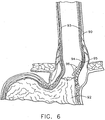
- FIG. 6 shows an esophagus 90, the gastro-esophageal junction 91 and the stomach 92.
- a plurality of vascular structures are located about the esophagus 90.
- the patient has experienced chronic acid reflux which has eroded and thinned the esophagus 90 and a mucosal layer 93 to create a thin area 94 above the gastro-esophageal junction 91 on the right side of the esophagus 90.
- the patient suffers from portal hypertension which is an increase in the pressure within the portal vein caused by a blockage in the blood flow throughout the liver.
- This reduced blood flow results in increased pressure in the portal vein and has caused enlarged veins or varices 95 to develop across the esophagus 90 and stomach 92, with one behind thin area 94.
- the varices 95 are distended and fragile, and can rupture and bleed easily when the patient suffers from severe coughing or vomiting.
- the varices 95 above the gastroesophageal junction 91 have a bleeder 96.
- the thin mucosal layer allows acid reflux to reach and irritate the varices 95 which slows or prevents proper healing, as well as providing reduced reinforcement of varices 95.
- FIG. 7 shows the flexible shaft 82 of the endoscope 80 inserted into the patients esophagus 90.
- the end effector 30 of the surgical device 25 extends from the working channel 85 in distal tip 83 of endoscope 80.
- Viewing element 84 is used to locate the thin area 94 and the bleeders 96 ( FIG. 6 ) in the esophagus 90.
- the end effector 30 of the surgical device has been extended from the working channel 85 of the endoscope 80 and vacuum chamber 55 has been expanded and placed over thin area 94.
- a vacuum is being applied from vacuum source 51 to capture the thin area 94 and varices 95 within vacuum chamber 55.
- FIG. 8 is a cross section of the end effector 30 on the thin area 94 of the esophageal tissue.
- Vacuum chamber 55 is capturing and drawing the thin area 94 comprising mucosa 93 and varices 95 into vacuum chamber 55 with the application of vacuum from vacuum source 51.
- the sharp 67 on applicator tip 64 has been moved distally from flexible shaft 32 and is piercing the mucosal layer 93 and tissue about varices 95.
- FIG. 9 is the cross sectional view of FIG. 8 after the applicator tip 64 is extended further into the esophageal tissue and adhesive 65 has been injected about the varices 95.
- Adhesive 65 emerges from sharp 67 of applicator tip 64 under pressure from pump 62 and has separated mucosal layers 93 about varices 95.
- Adhesive 65 begins to set from bodily moisture to stop or staunch the bleeding and creates a protective cap 97 of adhesive about the varices 95.
- the protective cap 97 is integrated into tissue to prevent falling off, and prevents the patient from experiencing additional chronic bleeding.
- the applicator tip 64 is first withdrawn from tissue, the vacuum is released to de-capture thin area 94 of the esophagus 90, the vacuum chamber 55 is pulled distally to close into the flexible shaft 32, and the endoscope 80 and surgical device 25 are removed from the patient.
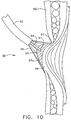
- FIG. 10 shows an alternate method of sealing a bleeder with surgical device 25 and adhesive 65.
- the thin area 94 is drawn into vacuum chamber 55 with vacuum, and adhesive 65 is pumped over the surface of mucosal layer 93.
- adhesive 65 sets from moisture in the tissue, it forms an exterior protective cap 97a within the esophagus 90.
- protective cap 97a is formed, the bleeders are stopped, a protective bandage or barrier is In position to prevent acid reflux irrigation, the barrier promotes healing, and the protective cap 97a re-strengthens the area to prevent varices 95 from protruding into esophagus 90 when the patient coughs or vomits.
- FIG. 11 shows a handheld surgical device 100 having a treatment head 120 suitable for placement at a desired surgical location.
- Treatment head 120 is well suited for use in open surgeries as well as being sized to fit within a laparoscopic trocar cannula or into a small incision for endoscopic or laparoscopic surgeries.
- the surgical device 100 has a flexible or malleable shaft 105 attached to treatment head 120 and a handle 101. Grips 102 are fixedly attached to handle 101 for the surgeon to grasp.
- Vacuum source 51 and vacuum control 66 provide vacuum to treatment head 120 to draw tissue therein, the vacuum conducted through vacuum cannula 52 and shaft 105 to a cylindrical vacuum head 121. Vacuum head 121 Is clear so the surgeon can view inside during use.
- An alternate applicator tip 122 is located within treatment head 120 and is attached to a longitudinally moveable applicator cannula 123. Applicator cannula 123 is operably attached to a longitudinally moveable control 124 such that proximal and distal motion of control 124 results in proximal and distal motion of applicator cannula 123 and alternate applicator tip 122.
- Adhesive system 60 contains adhesive 65 in an adhesive reservoir 61 and is operably attached to applicator cannula 123 by cannula 67. Activation of pump 62 moves adhesive 65 from adhesive reservoir 61 into cannula 67, into applicator cannula 123, and dispenses adhesive 65 from alternate applicator tip 122. A sharp 122a can be placed on a distal end of alternate applicator tip 122. Alternately, by way of example, surgical device 100 could use an expanding and contracting vacuum chamber 55 rather than a fixed vacuum head 121.
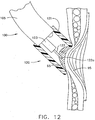
- An example of treatment using surgical device 100 would involve inserting the surgical device 100 into a patient through a trocar cannula. As shown in FIG. 12 , the device is moved to a desired site to treat one of a number of varices 95.
- the vacuum head 121 is placed at the desired site and vacuum is applied from vacuum source 51 to draw tissue therein.
- the surgeon maneuvers the endoscope to view the site through the clear vacuum head 121 (not shown) and has decided to extend the alternate applicator tip 122 close to the tissue rather than pierce the tissue with sharp 122a.
- Adhesive 65 is being applied over the varices 95 to staunch the bleeding.
- the adhesives listed are merely exemplary and many other adhesives and chemical compounds fall within the scope of the present invention.
Landscapes
- Health & Medical Sciences (AREA)
- Life Sciences & Earth Sciences (AREA)
- Surgery (AREA)
- Molecular Biology (AREA)
- Engineering & Computer Science (AREA)
- Biomedical Technology (AREA)
- Heart & Thoracic Surgery (AREA)
- Medical Informatics (AREA)
- Nuclear Medicine, Radiotherapy & Molecular Imaging (AREA)
- Animal Behavior & Ethology (AREA)
- General Health & Medical Sciences (AREA)
- Public Health (AREA)
- Veterinary Medicine (AREA)
- Surgical Instruments (AREA)
- Media Introduction/Drainage Providing Device (AREA)
- Materials For Medical Uses (AREA)
Description
- The present invention relates, in general, to devices for the treatment and control of bleeding, and in particular, to devices using adhesives for the treatment of bleeding.
- There are several clinical situations or disease states that would result in the small hemorrhages from varices, veins and small arteries. One possible use of this invention is the treatment of esophageal variceal bleeding which has not responded to typical endoscopic therapy, pharmacological therapy, or a surgical shunt.
- Variceal bleeding in the esophagus is caused by portal hypertension. Portal hypertension is an increase in the pressure within the portal vein (the vein that carries blood from the digestive organs to the liver). This increase in pressure is caused by a blockage in the blood flow throughout the liver. Increased pressure in the portal vein causes enlarged veins (varices) to develop across the esophagus and stomach to bypass the blockage. The walls of the varices become fragile and can rupture and bleed easily. In some cases this bleeding can result in massive uncontrollable bleeding, which left unchecked, could cause severe health issues. Alternately, surgical trauma or other trauma to the esophageal region could also result in a similar bleeding situation.
- If the patient has gastric reflux disease, the situation can be exacerbated by acid reflux intrusion into the esophagus. This intrusion of stomach acids can cause thinning or removal of the mucosal lining of the esophagus and could expose the underlying vein or varices structures to the chronic acid reflux. Enlarged veins have thinner walls, and acid reflux exposure can thin them further. In some cases, coughing or vomiting might overload the thinned vein or varices, cause a bleeding cycle to occur, and require surgical treatment.
- Enlarged vein structures or varices are not limited to the esophageal areas and neither are the veinus and arterial stresses induced by coughing, vomiting, trauma, pregnancy, obesity, prolonged standing, hard stools, or other bodily functions. As a consequence, varices are found In hemorrhoids, varicoceies, and varicose veins in areas such as the legs, stomach, and feet. Hemorrhages can be found at these sites, but can occur in any arena where small veins and arteries are near the surface of a structure that is being subjected to stresses or trauma.
- Consequently, a significant need exists for a surgical device that can atraumatically acquire the bleeding site, prevent further damage to the vein or artery, and place a barrier at the bleeding site to stop the bleeding, and leave a barrier that is secure to prevent reoccurrence of the bleeding cycle. A prior art flexible vacuum grabber for holding lesions is known from
US2005/0059347A1 . A prior art device and method for intersital injection of biologic agents into a tissue is known fromWO2007/002227A2 . A prior art surgical stabilizer device and method is known fromUS3005/0021085A1 , which discloses a device according to the preamble of claim 1. A prior art patch and glue delivery system for closing tissue opening during surgery Is known fromUS2002/0026159A1 . - In accordance with the present invention, there is provided a surgical device according to claim 1.
- These and other objects and advantages of the present invention shall be made apparent from the accompanying drawings and the description thereof.
- The accompanying drawings, which are incorporated in and constitute a part of this specification, illustrate embodiments of the invention, and, together with the general description of the invention given above, and the detailed description of the embodiments given below, serve to explain the principles of the present invention.
-
FIG. 1 is an isometric view of a surgical device inserted into an endoscope with a vacuum source and a vacuum control and an adhesive system attached. -
FIG. 2 is a cross sectional view of an end effector of the surgical device ofFIG. 1 . -
FIG. 3 is an enlarged isometric view of a distal end of the endoscope with the end effector of the surgical device extending therefrom and an unexpanded vacuum chamber partially extending from the end effector. -
FIG. 4 is an enlarged isometric view of the end effector of the surgical device ofFIG. 3 with the vacuum chamber in a partially opened configuration. -
FIG. 5 is an enlarged isometric view of the end effector of the surgical device ofFIG. 3 with the vacuum chamber in a fully opened configuration. -
FIG. 6 is a cross sectional view of the esophagus and stomach of a patient and showing a varices with small bleeders close to the inner surface of the esophagus and above the gastroesophageal junction. -
FIG. 7 is the cross sectional view ofFIG. 6 with the endoscope and surgical device inserted therein, wherein a fully opened vacuum chamber of the surgical device is placed over the varices. -
FIG. 8 is a side view of the vacuum chamber of the device drawing a vacuum to pull the varices with the bleeders into the vacuum chamber with an applicator tip of an adhesive system piercing the esophageal wall. -
FIG. 9 is the side view ofFIG. 8 showing an adhesive being injected about the varices. -
FIG. 10 illustrates an alternate method to stop the bleeders where an adhesive barrier is being placed over the bleeders and the varices. -
FIG. 11 is an Isometric view of an alternate surgical device that can be used without an endoscope. -
FIG. 12 is a side view of a partial cross section of a vacuum head of the alternate surgical device ofFIG. 11 placing an adhesive on tissue. - The following description of certain examples of the invention should not be used to limit the scope of the present invention. Other examples, features, aspects, embodiments, and advantages of the Invention will become apparent to those skilled in the art from the following description, which Is by way of illustration, one of the best modes contemplated for carrying out the Invention. Accordingly, the drawings and descriptions should be regarded as illustrative In nature and not restrictive.
- Enlarged vein structures or varices are found within the body in a variety of locations. These enlarged vein structures can include arteries, and have thinner wall structures that can cause bleeders when subjected to trauma, or disease conditions such as portal hypertension or hemorrhoids. With portal hypertension, the enlarged varices about the esophagus can rupture and cause chronic bleeding into the esophagus. If severe, the condition can require surgical intervention to staunch the bleeding and leave a structure in place that can prevent further damage to the vein or artery.
-
FIGS. 1 and2 illustrates an example of asurgical device 25 capable of stopping the flow of blood with an adhesive 65 at a surgical site such as the esophagus.Surgical device 25 can control blood loss by capturing tissue with a tissue acquisition system or vacuum system, and then using an adhesive injection system to inject an adhesive into or onto the captured tissue to staunch blood loss, place a barrier about the varices, and protect the wound site. Thesurgical device 25 as shown InFIG. 1 has a distal portion that is small in cross section so it can be inserted into a workingchannel 85 of anendoscope 80.Endoscope 80 is a common surgical access instrument that has ascope handle 81, a steerableflexible shaft 82, aviewing element 84 at adistal tip 83 to view the surgical site, and the workingchannel 85 extending fromhandle 81 todistal tip 83. Endoscopes are commonly inserted into the mouth or anus to use natural body orifices to gain access to surgical sites within the patient.Surgical device 25 generally extends from ahandle 34 to anend effector 30.FIG. 1 shows thehandle 34 extending from a proximal end of theworking channel 85 and theend effector 30 extending from a distal end of the workingchannel 85. Thesurgical device 25 is positionable with respect to theoperative channel 85 ofendoscope 80 in rotation, insertion, and extraction. Aflexible shaft 32 operatively couples endeffector 30 to thehandle 34. - The
vacuum system 50 of thesurgical device 25 has avacuum source 51 and avacuum control 56 to control the delivery of vacuum to thehandle 34. Vacuum is supplied through ahose 54 extending fromvacuum control 56. A longitudinally moveable vacuum cannula 52 (FIG. 2 ) is operably connected tohose 54 and extends fromhandle 34, throughflexible shaft 32, to theend effector 30.Vacuum cannula 52 moves proximally and distally withinhandle 34 andflexible shaft 32 in response to proximal and distal manipulation ofchamber control 53 onhandle 34. Aconical vacuum chamber 55 attaches to a distal tip of thevacuum cannula 52 and is operably coupled tovacuum source 51 andvacuum control 56 byvacuum cannula 52 andhose 54. As shown inFIG. 2 ,vacuum passageways 58 are provided invacuum cannula 52 to conduct vacuum tovacuum chamber 55. -
Vacuum chamber 55 is best shown inFIGS 1-5 , and is a collapsible and expandable structure.Vacuum chamber 55 has a fully open conical shape ofFIGS. 1 and5 and can be collapsed to a partially closed position ofFIG 4 , to the nearly closed position ofFIG. 3 , and to a fully closed cylindrical shape with pleats and folds within flexible shaft 32 (not shown). Asvacuum chamber 55 is collapsed, a series ofpre-induced folds 59 located about the periphery are used to control collapsing, and are best shown inFIGS. 3 and 4 . As shown,vacuum chamber 55 is formed from a spring material that has a naturally open conical shape. In the full open position, thefolds 59 could induce local distortion and preventvacuum chamber 55 from attaining a smooth conical shape. - Distal and proximal movement of
chamber control 53 onhandle 34moves vacuum cannula 52 and attachedvacuum chamber 55 distally and proximally relative toflexible shaft 32. Distal movement ofvacuum cannula 52moves vacuum chamber 55 out of the confines offlexible shaft 32 and allows thevacuum chamber 55 to expand. Alternately, proximal motion of a fullyopen vacuum chamber 55 intoflexible shaft 32 closesvacuum chamber 55 by bringingvacuum chamber 55 into camming action with aninner surface 33 offlexible shaft 32. Anangle 57 is cut onto a distal end ofvacuum chamber 55 to enhance angular contact of thevacuum chamber 55 with the wall of the esophagus, and to ensure a good vacuum seal. To ensure safety and efficacy during insertion into the body and during positioning,vacuum chamber 55 can be withdrawn fully intoflexible shaft 32.Vacuum chamber 55 can be constructed from a number of engineering materials such as but not limited to thin sections of engineering thermoplastics such as mylar, silicone, polytetraflouroethylene (Teflon) and the like, or thin sections of metals such as titanium, nitinol or aluminum.Nitinol vacuum chambers 55 could undergo a phase change as they are opened or collapsed. Alternately, by way of example,vacuum chamber 55 can be constructed with an umbrella-like construction as shown inFIG. 5 with a series ofribs 59a joined to a thinner conical section of flexible fabric orfilm material 59b.Film material 59b could also be springy. Alternately, by way of example,ribs 59a can be constructed asthicker ribs 59a molded onto thefilm material 59b, rigid separate ribs attached to an opening structure like that used in an umbrella (seeFIG. 5 ), or a springy an umbrella type construction with flexible cantilever spring ribs. The flexible cantilever spring ribs can be pre-bent to expand into a conical rib structure to open thefilm material 59b.Film material 59b can be materials such as but not limited to rubber compounds such as nitryl, polyethelene, polypropelene, polytetraflouroethylene, papers, and surgical fabrics with or without coatings, or films (not shown) and the like. Additionally, by way of example, a spring could be provided to open the umbrella shape. - The
adhesive system 60 has anadhesive reservoir 61 containing an adhesive 65 and apump 62.Pump 62 moves adhesive 65 from theadhesive reservoir 61, into anadhesive cannula 63 extending therefrom, and out of anapplicator tip 64 at a distal end ofadhesive cannula 63.Adhesive cannula 63 ofsurgical instrument 25 extends fromadhesive reservoir 61, passes throughhandle 34, throughflexible shaft 32 intoend effector 30, and operably attaches toapplicator tip 64.Adhesive cannula 63 is movable proximally and distally by proximal and distal movement of anapplicator control 66 located at a proximal end ofhandle 34. Distal motion ofapplicator control 66moves applicator tip 64 distally out of a distal end offlexible shaft 32. Proximal motion ofapplicator control 66moves applicator tip 64 andadhesive cannula 63 proximally back into the distal end of theflexible shaft 32. The extension ofvacuum chamber 55 andapplicator tip 64 fromflexible shaft 32 creates theend effector 30. - Additionally, the
adhesive system 60 could be a multiple chamber adhesive system 60a containing any number of chambers greater than one. Each chamber can contain contents such as adhesive 65 which can be single or multi-part, an adhesive initiator 68, or alternate chemical agents 69 listed below. For example, a multiple chamber adhesive system 60a could have theadhesive reservoir 61 containing an adhesive 65 and a second chemical agent chamber 61 a. Bothchambers 61, 61 a are operably attached to pump 62 and an alternate adhesive cannula 63a to dispense the contents ofchambers 61 and 61a. Alternate adhesive cannula 63 a can comprise a dual or multi-lumen tube that distributes both adhesive 65 and adhesive initiators 68 and/or chemical agents 69 fromapplicators pump 62 and pump 62 could contain one or more members operably connected to different chambers. For example, a dual chamber syringe could have dual pistons or pumps to dispense the contents from a chamber. Alternately by way of example, any type of pump could be used such as but not limited to piston, diaphragm, rotary, and siphon. If desired, the contents of both chambers could be applied neat or mixed fromapplicators 64, 122 (see below). - The cross section of
FIG. 2 showsend effector 30 withadhesive cannula 63 slidably moveable invacuum cannula 52 and surrounded bypassageways 58 for the passage of vacuum to vacuumchamber 55.Adhesive tip 64 has a sharp 67 on the distal end and is fixedly attached to longitudinally moveableadhesive cannula 63 and moves in response to movement of theapplicator control 66. To prevent unwanted tissue damage from the sharp 67 during insertion into the patient and positioning in the body,adhesive tip 64 is moved proximally intoflexible shaft 32 to present the blunt end offlexible shaft 32. Distal motion ofapplicator control 66 movesadhesive tip 64 and sharp 67 distally to pierce tissue. Activation ofpump 62 forces adhesive 65 from the sharp 67 of theadhesive tip 64. - By way of example, adhesive 65 could be a single part or a dual part adhesive that is a polymerizable and/or cross-linkable material such as but not limited to a cyanoacrylate adhesive. The adhesive 65 can be fluid and for example, may be but not limited to a monomeric (including prepolymeric) adhesive composition, a polymeric adhesive composition, or any other natural or artificial blocompatible compound that can adhere to tissue. In embodiments, the monomer may be a 1,1-disubstituted ethylene monomer, e.g., an alpha-cyanoacrylate. When cross linked, the cyanoacrylate changes from a liquid to a solid. Cross linked adhesive 76a can be a rigid or flexible and can be non-permeable or permeable. If desired, adhesive 76 can be a single part or dual part adhesive, and/or can contain one or more additives 77.
Adhesive 65 can be polymerized by moisture, blood, saline or adhesive initiators 68. Adhesive initiators 68 can also be used to set up or polymerize the adhesive 65 and can be but are not limited to base compounds and the like. - Examples of suitable chemical agents 69 include, such as but are not limited to, image enhancement media, anesthetics, sclerotic or necrosing agents plasticizing agents, thixotropic agents, buffers, catalysts, fillers, micro particles, adhesion initiators, thickeners, solvents, drugs, medicaments, natural or synthetic rubbers, stabilizers, pH modifiers, bloactive agents, crosslinking agents, chain transfer agents, fibrous reinforcements, colorants, preservatives, formaldehyde reducing or scavenging agents, flavorants, perfumes, mixtures thereof, and the like. Other suitable single part and
dual part adhesives 65, adhesion initiators 68, and chemical agents 69 may be found in United States Application20040190975 by Goodman et al. -
FIG. 6 shows anesophagus 90, the gastro-esophageal junction 91 and thestomach 92. A plurality of vascular structures are located about theesophagus 90. The patient has experienced chronic acid reflux which has eroded and thinned theesophagus 90 and amucosal layer 93 to create athin area 94 above the gastro-esophageal junction 91 on the right side of theesophagus 90. The patient suffers from portal hypertension which is an increase in the pressure within the portal vein caused by a blockage in the blood flow throughout the liver. This reduced blood flow results in increased pressure in the portal vein and has caused enlarged veins orvarices 95 to develop across theesophagus 90 andstomach 92, with one behindthin area 94. Thevarices 95 are distended and fragile, and can rupture and bleed easily when the patient suffers from severe coughing or vomiting. As shown thevarices 95 above thegastroesophageal junction 91 have ableeder 96. The thin mucosal layer allows acid reflux to reach and irritate thevarices 95 which slows or prevents proper healing, as well as providing reduced reinforcement ofvarices 95. -
FIG. 7 shows theflexible shaft 82 of theendoscope 80 inserted into thepatients esophagus 90. Theend effector 30 of thesurgical device 25 extends from the workingchannel 85 indistal tip 83 ofendoscope 80.Viewing element 84 is used to locate thethin area 94 and the bleeders 96 (FIG. 6 ) in theesophagus 90. Theend effector 30 of the surgical device has been extended from the workingchannel 85 of theendoscope 80 andvacuum chamber 55 has been expanded and placed overthin area 94. A vacuum is being applied fromvacuum source 51 to capture thethin area 94 andvarices 95 withinvacuum chamber 55. -
FIG. 8 is a cross section of theend effector 30 on thethin area 94 of the esophageal tissue.Vacuum chamber 55 is capturing and drawing thethin area 94 comprisingmucosa 93 andvarices 95 intovacuum chamber 55 with the application of vacuum fromvacuum source 51. The sharp 67 onapplicator tip 64 has been moved distally fromflexible shaft 32 and is piercing themucosal layer 93 and tissue aboutvarices 95. -
FIG. 9 is the cross sectional view ofFIG. 8 after theapplicator tip 64 is extended further into the esophageal tissue and adhesive 65 has been injected about thevarices 95.Adhesive 65 emerges from sharp 67 ofapplicator tip 64 under pressure frompump 62 and has separatedmucosal layers 93 aboutvarices 95.Adhesive 65 begins to set from bodily moisture to stop or staunch the bleeding and creates aprotective cap 97 of adhesive about thevarices 95. Theprotective cap 97 is integrated into tissue to prevent falling off, and prevents the patient from experiencing additional chronic bleeding. To remove thesurgical device 25, theapplicator tip 64 is first withdrawn from tissue, the vacuum is released to de-capturethin area 94 of theesophagus 90, thevacuum chamber 55 is pulled distally to close into theflexible shaft 32, and theendoscope 80 andsurgical device 25 are removed from the patient. -
FIG. 10 shows an alternate method of sealing a bleeder withsurgical device 25 and adhesive 65. In this view, thethin area 94 is drawn intovacuum chamber 55 with vacuum, and adhesive 65 is pumped over the surface ofmucosal layer 93. When adhesive 65 sets from moisture in the tissue, it forms an exteriorprotective cap 97a within theesophagus 90. Onceprotective cap 97a is formed, the bleeders are stopped, a protective bandage or barrier is In position to prevent acid reflux irrigation, the barrier promotes healing, and theprotective cap 97a re-strengthens the area to preventvarices 95 from protruding intoesophagus 90 when the patient coughs or vomits. - An alternate embodiment of this device could be used for laparoscopic or arthroscopic surgeries rather than with surgeries that require placement into an
endoscope 80.FIG. 11 . shows a handheldsurgical device 100 having atreatment head 120 suitable for placement at a desired surgical location.Treatment head 120 is well suited for use in open surgeries as well as being sized to fit within a laparoscopic trocar cannula or into a small incision for endoscopic or laparoscopic surgeries. Thesurgical device 100 has a flexible ormalleable shaft 105 attached totreatment head 120 and ahandle 101.Grips 102 are fixedly attached to handle 101 for the surgeon to grasp. Vacuumsource 51 andvacuum control 66 provide vacuum totreatment head 120 to draw tissue therein, the vacuum conducted throughvacuum cannula 52 andshaft 105 to acylindrical vacuum head 121.Vacuum head 121 Is clear so the surgeon can view inside during use. Analternate applicator tip 122 is located withintreatment head 120 and is attached to a longitudinallymoveable applicator cannula 123.Applicator cannula 123 is operably attached to a longitudinallymoveable control 124 such that proximal and distal motion ofcontrol 124 results in proximal and distal motion ofapplicator cannula 123 andalternate applicator tip 122.Adhesive system 60 contains adhesive 65 in anadhesive reservoir 61 and is operably attached toapplicator cannula 123 bycannula 67. Activation ofpump 62 moves adhesive 65 fromadhesive reservoir 61 intocannula 67, intoapplicator cannula 123, and dispenses adhesive 65 fromalternate applicator tip 122. A sharp 122a can be placed on a distal end ofalternate applicator tip 122. Alternately, by way of example,surgical device 100 could use an expanding andcontracting vacuum chamber 55 rather than a fixedvacuum head 121. - An example of treatment using
surgical device 100 would involve inserting thesurgical device 100 into a patient through a trocar cannula. As shown inFIG. 12 , the device is moved to a desired site to treat one of a number ofvarices 95. Thevacuum head 121 is placed at the desired site and vacuum is applied fromvacuum source 51 to draw tissue therein. The surgeon maneuvers the endoscope to view the site through the clear vacuum head 121 (not shown) and has decided to extend thealternate applicator tip 122 close to the tissue rather than pierce the tissue with sharp 122a.Adhesive 65 is being applied over thevarices 95 to staunch the bleeding. - It should be appreciated that any patent, publication, or other disclosure material, in whole or in part, that is said to be incorporated by reference herein is incorporated herein only to the extent that the incorporated material does not conflict with existing definitions, statements, or other disclosure material set forth in this disclosure. As such, and to the extent necessary, the disclosure as explicitly set forth herein supersedes any conflicting material incorporated herein by reference. Any material, or portion thereof, that is said to be incorporated by reference herein, but which conflicts with existing definitions, statements, or other disclosure material set forth herein will only be incorporated to the extent that no conflict arises between that incorporated material and the existing disclosure material.
- While the present invention has been illustrated by description of several embodiments and while the illustrative embodiments have been described in considerable detail, it is not the intention of the applicant to restrict or in any way limit the scope of the appended claims to such detail. Additional advantages and modifications may readily appear to those skilled in the art.
- For example, the adhesives listed are merely exemplary and many other adhesives and chemical compounds fall within the scope of the present invention.
Claims (9)
- A surgical device (25) for staunching the flow of blood from tissue comprising:a) an adhesive (65) implantable in a patient's body;b) a vacuum system (50) for capturing tissue therein; the vacuum system (50) comprises a flexible shaft (32) and a vacuum cannula (52), wherein the vacuum cannula (52) is disposed within and runs parallel to the flexible shaft (82); andc) an adhesive system (60) comprising a sharp (67) for piercing tissue and dispensing adhesive (65) into tissue captured within the vacuum system (50) to staunch the flow of blood,characterized in that the sharp is attached to an adhesive cannula (63) disposed within and running parallel to the vacuum cannula (52), wherein the adhesive cannula and sharp are slidably movable within the vacuum cannula along a longitudinal axis of the vacuum cannula.
- The surgical device of claim 1 wherein the adhesive (65) is polymerizable.
- The surgical device of claim 2 wherein the adhesive (65) is one or more selected from the group of:a) a polymerizable monomer,b) a polymerizable 1,1, 1,1-disubstituted ethylene monomer, andc) a cyanoacrylate formulation.
- The surgical device of claim 2 wherein a polymerization agent for the adhesive (65) is one or more of the polymerization agents selected from the group consisting of:a) natural body moisture,b) saline, andc) an adhesion initiator compound.
- The surgical device of claim 1 wherein the vacuum system (50) further comprises a vacuum source (51) attachable to the surgical device (25).
- The surgical device (25) of claim 5 wherein the vacuum system (50) further comprises a vacuum head (121) for contact with tissue, the vacuum head (121) forming a vacuum chamber (55) for the reception of tissue therein.
- The surgical device (25) of claim 6 wherein the vacuum head (121) is transparent.
- The surgical device of claim 6 wherein the vacuum head (121) is an expandable and a collapsible structure.
- The surgical device of claim 8 wherein the vacuum head (121) is a cone in the expanded position.
Priority Applications (2)
| Application Number | Priority Date | Filing Date | Title |
|---|---|---|---|
| PL07253946.3T PL1908407T3 (en) | 2006-10-04 | 2007-10-05 | Device to treat intraluminal bleeding using an adhesive |
| EP07253946.3A EP1908407B1 (en) | 2006-10-04 | 2007-10-05 | Device to treat intraluminal bleeding using an adhesive |
Applications Claiming Priority (2)
| Application Number | Priority Date | Filing Date | Title |
|---|---|---|---|
| US11/538,571 US8603138B2 (en) | 2006-10-04 | 2006-10-04 | Use of an adhesive to treat intraluminal bleeding |
| EP07253946.3A EP1908407B1 (en) | 2006-10-04 | 2007-10-05 | Device to treat intraluminal bleeding using an adhesive |
Publications (2)
| Publication Number | Publication Date |
|---|---|
| EP1908407A1 EP1908407A1 (en) | 2008-04-09 |
| EP1908407B1 true EP1908407B1 (en) | 2016-05-04 |
Family
ID=38814344
Family Applications (1)
| Application Number | Title | Priority Date | Filing Date |
|---|---|---|---|
| EP07253946.3A Not-in-force EP1908407B1 (en) | 2006-10-04 | 2007-10-05 | Device to treat intraluminal bleeding using an adhesive |
Country Status (5)
| Country | Link |
|---|---|
| US (1) | US8603138B2 (en) |
| EP (1) | EP1908407B1 (en) |
| JP (1) | JP5280033B2 (en) |
| CN (1) | CN101156798A (en) |
| PL (1) | PL1908407T3 (en) |
Cited By (1)
| Publication number | Priority date | Publication date | Assignee | Title |
|---|---|---|---|---|
| EP4458399A1 (en) * | 2023-05-04 | 2024-11-06 | FUJIFILM Corporation | Device for applying a therapeutic agent in the form of a fluid |
Families Citing this family (56)
| Publication number | Priority date | Publication date | Assignee | Title |
|---|---|---|---|---|
| US7655004B2 (en) | 2007-02-15 | 2010-02-02 | Ethicon Endo-Surgery, Inc. | Electroporation ablation apparatus, system, and method |
| US8579897B2 (en) | 2007-11-21 | 2013-11-12 | Ethicon Endo-Surgery, Inc. | Bipolar forceps |
| US8568410B2 (en) | 2007-08-31 | 2013-10-29 | Ethicon Endo-Surgery, Inc. | Electrical ablation surgical instruments |
| US8262655B2 (en) | 2007-11-21 | 2012-09-11 | Ethicon Endo-Surgery, Inc. | Bipolar forceps |
| US8480657B2 (en) | 2007-10-31 | 2013-07-09 | Ethicon Endo-Surgery, Inc. | Detachable distal overtube section and methods for forming a sealable opening in the wall of an organ |
| US20090112059A1 (en) | 2007-10-31 | 2009-04-30 | Nobis Rudolph H | Apparatus and methods for closing a gastrotomy |
| US8197507B2 (en) * | 2008-01-14 | 2012-06-12 | Sri International | Sutureless methods for laceration closure |
| US8262680B2 (en) | 2008-03-10 | 2012-09-11 | Ethicon Endo-Surgery, Inc. | Anastomotic device |
| JP5185668B2 (en) * | 2008-03-26 | 2013-04-17 | 東京医研株式会社 | Hemostatic device |
| US8771260B2 (en) | 2008-05-30 | 2014-07-08 | Ethicon Endo-Surgery, Inc. | Actuating and articulating surgical device |
| US8679003B2 (en) | 2008-05-30 | 2014-03-25 | Ethicon Endo-Surgery, Inc. | Surgical device and endoscope including same |
| US8403926B2 (en) | 2008-06-05 | 2013-03-26 | Ethicon Endo-Surgery, Inc. | Manually articulating devices |
| US8361112B2 (en) | 2008-06-27 | 2013-01-29 | Ethicon Endo-Surgery, Inc. | Surgical suture arrangement |
| US8888792B2 (en) | 2008-07-14 | 2014-11-18 | Ethicon Endo-Surgery, Inc. | Tissue apposition clip application devices and methods |
| US8262563B2 (en) | 2008-07-14 | 2012-09-11 | Ethicon Endo-Surgery, Inc. | Endoscopic translumenal articulatable steerable overtube |
| US8211125B2 (en) | 2008-08-15 | 2012-07-03 | Ethicon Endo-Surgery, Inc. | Sterile appliance delivery device for endoscopic procedures |
| US8529563B2 (en) | 2008-08-25 | 2013-09-10 | Ethicon Endo-Surgery, Inc. | Electrical ablation devices |
| US8241204B2 (en) | 2008-08-29 | 2012-08-14 | Ethicon Endo-Surgery, Inc. | Articulating end cap |
| US8480689B2 (en) * | 2008-09-02 | 2013-07-09 | Ethicon Endo-Surgery, Inc. | Suturing device |
| US8409200B2 (en) | 2008-09-03 | 2013-04-02 | Ethicon Endo-Surgery, Inc. | Surgical grasping device |
| US8337394B2 (en) | 2008-10-01 | 2012-12-25 | Ethicon Endo-Surgery, Inc. | Overtube with expandable tip |
| US8157834B2 (en) | 2008-11-25 | 2012-04-17 | Ethicon Endo-Surgery, Inc. | Rotational coupling device for surgical instrument with flexible actuators |
| US8361066B2 (en) | 2009-01-12 | 2013-01-29 | Ethicon Endo-Surgery, Inc. | Electrical ablation devices |
| US9226772B2 (en) * | 2009-01-30 | 2016-01-05 | Ethicon Endo-Surgery, Inc. | Surgical device |
| US8252057B2 (en) | 2009-01-30 | 2012-08-28 | Ethicon Endo-Surgery, Inc. | Surgical access device |
| US20100241163A1 (en) * | 2009-03-23 | 2010-09-23 | Medtronic Vascular, Inc. | Aortic Dissection Treatment System and Method of Use |
| US20100298866A1 (en) * | 2009-05-19 | 2010-11-25 | Tyco Healthcare Group Lp | Wound closure system and method of use |
| US20110098704A1 (en) | 2009-10-28 | 2011-04-28 | Ethicon Endo-Surgery, Inc. | Electrical ablation devices |
| US8608652B2 (en) | 2009-11-05 | 2013-12-17 | Ethicon Endo-Surgery, Inc. | Vaginal entry surgical devices, kit, system, and method |
| DE102009046728A1 (en) * | 2009-11-16 | 2011-05-19 | Herbert Maslanka | Instrument for endoscopically applying e.g. hemostatic agent in gel or gelatine matrix on body tissue surface to endoscopically stop bleeding for treating gastric ulcer, has shield with peripheral edge enclosing chamber in working position |
| US8353487B2 (en) | 2009-12-17 | 2013-01-15 | Ethicon Endo-Surgery, Inc. | User interface support devices for endoscopic surgical instruments |
| US8496574B2 (en) | 2009-12-17 | 2013-07-30 | Ethicon Endo-Surgery, Inc. | Selectively positionable camera for surgical guide tube assembly |
| US9028483B2 (en) | 2009-12-18 | 2015-05-12 | Ethicon Endo-Surgery, Inc. | Surgical instrument comprising an electrode |
| US8506564B2 (en) | 2009-12-18 | 2013-08-13 | Ethicon Endo-Surgery, Inc. | Surgical instrument comprising an electrode |
| US9005198B2 (en) | 2010-01-29 | 2015-04-14 | Ethicon Endo-Surgery, Inc. | Surgical instrument comprising an electrode |
| US10092291B2 (en) | 2011-01-25 | 2018-10-09 | Ethicon Endo-Surgery, Inc. | Surgical instrument with selectively rigidizable features |
| US8911468B2 (en) * | 2011-01-31 | 2014-12-16 | Vatrix Medical, Inc. | Devices, therapeutic compositions and corresponding percutaneous treatment methods for aortic dissection |
| US9314620B2 (en) | 2011-02-28 | 2016-04-19 | Ethicon Endo-Surgery, Inc. | Electrical ablation devices and methods |
| US9233241B2 (en) | 2011-02-28 | 2016-01-12 | Ethicon Endo-Surgery, Inc. | Electrical ablation devices and methods |
| US9254169B2 (en) | 2011-02-28 | 2016-02-09 | Ethicon Endo-Surgery, Inc. | Electrical ablation devices and methods |
| US9049987B2 (en) | 2011-03-17 | 2015-06-09 | Ethicon Endo-Surgery, Inc. | Hand held surgical device for manipulating an internal magnet assembly within a patient |
| CN104520396A (en) * | 2012-01-23 | 2015-04-15 | 汉高知识产权控股有限责任公司 | Two-component cyanoacrylate/free radical curable adhesive system |
| US8986199B2 (en) | 2012-02-17 | 2015-03-24 | Ethicon Endo-Surgery, Inc. | Apparatus and methods for cleaning the lens of an endoscope |
| EP2846709B1 (en) * | 2012-05-10 | 2018-05-02 | Empire Technology Development LLC | Diverticulum inverting device |
| US9427255B2 (en) | 2012-05-14 | 2016-08-30 | Ethicon Endo-Surgery, Inc. | Apparatus for introducing a steerable camera assembly into a patient |
| US9078662B2 (en) | 2012-07-03 | 2015-07-14 | Ethicon Endo-Surgery, Inc. | Endoscopic cap electrode and method for using the same |
| US9545290B2 (en) | 2012-07-30 | 2017-01-17 | Ethicon Endo-Surgery, Inc. | Needle probe guide |
| US9572623B2 (en) | 2012-08-02 | 2017-02-21 | Ethicon Endo-Surgery, Inc. | Reusable electrode and disposable sheath |
| US10314649B2 (en) | 2012-08-02 | 2019-06-11 | Ethicon Endo-Surgery, Inc. | Flexible expandable electrode and method of intraluminal delivery of pulsed power |
| US9277957B2 (en) | 2012-08-15 | 2016-03-08 | Ethicon Endo-Surgery, Inc. | Electrosurgical devices and methods |
| US9119606B2 (en) | 2013-01-21 | 2015-09-01 | Ethicon, Inc. | Sealant delivery device for anastomotic stapler |
| US10098527B2 (en) | 2013-02-27 | 2018-10-16 | Ethidcon Endo-Surgery, Inc. | System for performing a minimally invasive surgical procedure |
| US10610226B2 (en) | 2014-06-10 | 2020-04-07 | Ethicon Endo-Surgery, Inc. | Methods and devices for sealing stapled tissue |
| JP6672182B2 (en) * | 2014-06-10 | 2020-03-25 | エシコン エルエルシーEthicon LLC | Method and apparatus for sealing stapled tissue |
| CN104665897B (en) * | 2015-02-16 | 2017-11-07 | 中国人民解放军第二军医大学 | A kind of ejected wave knife for preventing pneumothorax from occurring follows the trail of label implantation puncture needle |
| US10945713B2 (en) * | 2016-11-23 | 2021-03-16 | C. R. Bard, Inc. | Single insertion multiple sample biopsy apparatus |
Citations (2)
| Publication number | Priority date | Publication date | Assignee | Title |
|---|---|---|---|---|
| WO1999021510A1 (en) * | 1997-10-29 | 1999-05-06 | Kensey Nash Corporation | Transmyocardial revascularization system |
| US20050021085A1 (en) * | 1998-05-11 | 2005-01-27 | Surgical Connections, Inc. | Surgical stabilizer devices and methods |
Family Cites Families (169)
| Publication number | Priority date | Publication date | Assignee | Title |
|---|---|---|---|---|
| US3805793A (en) | 1973-03-21 | 1974-04-23 | S Wright | Anastomotic apparatus |
| US4766898A (en) | 1980-10-20 | 1988-08-30 | American Cyanamid Company | Anastomotic device |
| AT382783B (en) | 1985-06-20 | 1987-04-10 | Immuno Ag | DEVICE FOR APPLICATING A TISSUE ADHESIVE |
| US5154320A (en) | 1985-12-23 | 1992-10-13 | Tri-Point Medical L.P. | Aerosol spray system |
| JP2559041B2 (en) * | 1987-08-19 | 1996-11-27 | 株式会社 トップ | Tube for treatment of esophageal varices |
| JP2559042B2 (en) * | 1987-08-19 | 1996-11-27 | 株式会社 トップ | Tube for treatment of esophageal varices |
| JPH0520335Y2 (en) * | 1987-12-25 | 1993-05-27 | ||
| US4874368A (en) | 1988-07-25 | 1989-10-17 | Micromedics, Inc. | Fibrin glue delivery system |
| EP0386285A1 (en) | 1989-03-07 | 1990-09-12 | Ricerche Biomediche S.R.L. | Improvements in automatic mechanic suturing guns |
| US5226877A (en) | 1989-06-23 | 1993-07-13 | Epstein Gordon H | Method and apparatus for preparing fibrinogen adhesive from whole blood |
| JPH0564642A (en) * | 1991-09-06 | 1993-03-19 | Sumitomo Bakelite Co Ltd | Medical puncture needle tube |
| US5312333A (en) | 1992-04-03 | 1994-05-17 | United States Surgical Corporation | Endoscopic material delivery device |
| US5372585A (en) | 1992-04-09 | 1994-12-13 | Tiefenbrun; Jonathan | Instrument and associated method for applying biologically effective composition during laparoscopic operation |
| US5443481A (en) | 1992-07-27 | 1995-08-22 | Lee; Benjamin I. | Methods and device for percutaneous sealing of arterial puncture sites |
| US5254113A (en) | 1992-08-31 | 1993-10-19 | Wilk Peter J | Anastomosis method |
| DE69324004T3 (en) | 1992-09-26 | 2005-09-01 | Juridical Foundation The Chemo-Sero-Therapeutic Research Institute | APPLICATOR FOR TISSUE ADHESIVE |
| US5690666A (en) | 1992-11-18 | 1997-11-25 | Target Therapeutics, Inc. | Ultrasoft embolism coils and process for using them |
| US5324305A (en) | 1992-12-15 | 1994-06-28 | Ryder International Corporation | Bioadhesive applicator |
| US6004547A (en) | 1997-09-29 | 1999-12-21 | Focal, Inc. | Apparatus and method for local application of polymeric material to tissue |
| US5383899A (en) | 1993-09-28 | 1995-01-24 | Hammerslag; Julius G. | Method of using a surface opening adhesive sealer |
| US5474540A (en) | 1994-03-25 | 1995-12-12 | Micromedics, Inc. | Fluid separation control attachment for physiologic glue applicator |
| US6302898B1 (en) | 1994-06-24 | 2001-10-16 | Advanced Closure Systems, Inc. | Devices for sealing punctures in body vessels |
| BR9508139A (en) | 1994-06-28 | 1999-11-30 | Tri Point Medical Corp | Process, process of regulating a biodegradation rate in vivo of a polymer and of joining together two surfaces in vivo, biocompatible composition, adhesive, sealant and surgical implant and delivery system for a therapeutic agent |
| US5605541A (en) | 1994-12-07 | 1997-02-25 | E. R. Squibb And Sons, Inc. | Fibrin sealant applicatoor |
| EP0716833A3 (en) | 1994-12-14 | 1997-01-29 | Global Therapeutics Inc | Method and apparatus for sealing a body site |
| JP3633032B2 (en) * | 1995-05-26 | 2005-03-30 | 佐々木 寛 | Puncture device |
| US5928611A (en) | 1995-06-07 | 1999-07-27 | Closure Medical Corporation | Impregnated applicator tip |
| US20050147457A1 (en) | 1995-06-07 | 2005-07-07 | Closure Medical Corporation | Adhesive applicators with improved polymerization initiators |
| US6217603B1 (en) | 1997-08-29 | 2001-04-17 | Closure Medical Corporation | Methods of applying monomeric compositions effective as wound closure devices |
| US5981621A (en) | 1996-02-29 | 1999-11-09 | Closure Medical Corporation | Monomeric compositions effective as wound closure devices |
| US6676322B1 (en) | 1995-06-07 | 2004-01-13 | Closure Medical Corporation | Impregnated applicator tip |
| AU7398196A (en) | 1995-10-11 | 1997-04-30 | Fusion Medical Technologies, Inc. | Device and method for sealing tissue |
| US6423704B2 (en) * | 1995-12-20 | 2002-07-23 | Aventis Pharmaceuticals Inc. | Substituted 4-(1H-benzimidazol-2-yl)[1,4]diazepanes useful for the treatment of allergic diseases |
| US5814022A (en) | 1996-02-06 | 1998-09-29 | Plasmaseal Llc | Method and apparatus for applying tissue sealant |
| US5759169A (en) | 1996-03-13 | 1998-06-02 | New York Blood Center Inc. | Fibrin sealant glue-gun |
| DE19627992A1 (en) | 1996-07-11 | 1998-01-22 | Storz Karl Gmbh & Co | Instrument with two independent jaws |
| US6126682A (en) | 1996-08-13 | 2000-10-03 | Oratec Interventions, Inc. | Method for treating annular fissures in intervertebral discs |
| US6113571A (en) | 1996-09-10 | 2000-09-05 | Omrix Biopharmaceuticals S.A. | Applicator device for applying a multiple component fluid |
| DE19636622C1 (en) | 1996-09-10 | 1998-06-10 | Omrix Biopharm Sa | Application device for applying a multi-component tissue adhesive and holder for such an application device |
| US5759171A (en) | 1996-09-27 | 1998-06-02 | Thermogenesis Corp. | Sprayer for fibrin glue |
| US5752965A (en) | 1996-10-21 | 1998-05-19 | Bio-Vascular, Inc. | Apparatus and method for producing a reinforced surgical fastener suture line |
| US5844087A (en) | 1996-11-05 | 1998-12-01 | Bayer Corporation | Method and device for delivering fibrin glue |
| CA2271738C (en) | 1996-11-15 | 2008-06-03 | Bristol-Myers Squibb Company | Devices and methods for applying a mixture of two or more liquid components to form a biomaterial |
| US6010714A (en) | 1996-11-22 | 2000-01-04 | Closure Medical Corporation | Non-thermogenic heat dissipating biomedical adhesive compositions |
| US6613020B1 (en) | 1996-12-06 | 2003-09-02 | Bristol-Myers Squibb Company | Method of applying a mixture of two liquid components as well as a device for carrying out the method |
| US6783514B2 (en) | 1997-01-31 | 2004-08-31 | United States Surgical Corporation | Fibrin sealant applicator |
| DE19709896C1 (en) | 1997-03-11 | 1998-12-24 | Omrix Biopharm Sa | Applicator for applying a single or multi-component fluid and method for spraying such a fluid |
| NZ337922A (en) | 1997-03-27 | 2001-09-28 | Bristol Myers Squibb Co | Laparoscopic sealant applicator having shaft end able to be articulated from handle |
| US6331172B1 (en) | 1997-04-14 | 2001-12-18 | Baxter International Inc. | Applicator for dispensing measured quantities with use of controlled suction |
| ES2227861T3 (en) | 1997-07-11 | 2005-04-01 | United States Surgical Corporation | FIBRINE TAIL APPLICATOR SYSTEM. |
| US6476069B2 (en) * | 1997-09-11 | 2002-11-05 | Provasis Therapeutics Inc. | Compositions for creating embolic agents and uses thereof |
| US6458095B1 (en) | 1997-10-22 | 2002-10-01 | 3M Innovative Properties Company | Dispenser for an adhesive tissue sealant having a housing with multiple cavities |
| EP1047464B8 (en) | 1997-12-19 | 2007-11-21 | United States Surgical Corporation | Two component dispenser system |
| AU746857B2 (en) * | 1997-12-19 | 2002-05-02 | United States Surgical Corporation | Fibrin mixture and dispenser assembly |
| US6055828A (en) | 1997-12-30 | 2000-05-02 | Closure Medical Corporation | Treatment methods for glass medical adhesive applicators |
| US6143805A (en) | 1998-02-18 | 2000-11-07 | Closure Medical Corporation | Electron beam sterilization of liquid adhesive compositions |
| US6174919B1 (en) | 1998-02-18 | 2001-01-16 | Closure Medical Corporation | Cyanoacrylate compositions with vinyl terminated ester groups |
| US6455064B1 (en) | 1998-04-30 | 2002-09-24 | Closure Medical Corporation | Method of applying an adhesive composition over a bioactive polymerization initiator or accelerator |
| US20040137067A1 (en) | 1998-04-30 | 2004-07-15 | Closure Medical Corporation | Adhesive applicator tip with a polymerization initiator, polymerization rate modifier, and/or bioactive material |
| US6461361B1 (en) | 1998-05-01 | 2002-10-08 | Baxter International Inc. | Gas-driven spraying of mixed sealant agents |
| EP1076517A4 (en) | 1998-05-06 | 2003-01-15 | Bristol Myers Squibb Co | Directional endoscopic delivery of material |
| US6475183B1 (en) | 1998-06-03 | 2002-11-05 | Baxter International Inc. | Direct dual filling device for sealing agents |
| US6512023B1 (en) | 1998-06-18 | 2003-01-28 | Closure Medical Corporation | Stabilized monomer adhesive compositions |
| CA2342342A1 (en) | 1998-09-01 | 2000-03-09 | Keith R. D'alessio | Package assembly with applicator and container for adhesive materials |
| US6372313B1 (en) | 1998-09-01 | 2002-04-16 | Closure Medical Corporation | Package assembly with applicator and container for adhesive materials |
| US6471670B1 (en) | 1998-10-05 | 2002-10-29 | Karl Enrenfels | Fibrin sealant applicator system |
| US6280399B1 (en) | 1998-10-06 | 2001-08-28 | Allegiance Corporation | Substance delivery device for use with a procedure performing instrument |
| US6340097B1 (en) | 1998-10-22 | 2002-01-22 | Closure Medical Corporation | Applicator with protective barrier |
| US20030080151A1 (en) | 1998-10-22 | 2003-05-01 | Closure Medical Corporation | Applicator with protective barrier |
| WO2000026284A1 (en) | 1998-10-29 | 2000-05-11 | Closure Medical Corporation | Polymeric containers for 1,1-disubstituted monomer compositions |
| US6251064B1 (en) | 1998-12-11 | 2001-06-26 | Enteric Medical Technologies, Inc. | Method for creating valve-like mechanism in natural body passageway |
| US6283933B1 (en) | 1998-12-23 | 2001-09-04 | Closure Medical Corporation | Applicator for dispensable liquids |
| US6595940B1 (en) | 1998-12-23 | 2003-07-22 | Closure Medical Corporation | Applicator for dispensable liquids |
| JP2000217830A (en) | 1999-01-29 | 2000-08-08 | Senko Medical Instr Mfg Co Ltd | Medical adhesive applicator |
| US6689103B1 (en) * | 1999-05-07 | 2004-02-10 | Scimed Life System, Inc. | Injection array apparatus and method |
| US6432084B1 (en) | 1999-05-07 | 2002-08-13 | Baxter International Inc. | Non-newtonian fluid spray applicator and method |
| US6491201B1 (en) | 2000-02-22 | 2002-12-10 | Power Medical Interventions, Inc. | Fluid delivery mechanism for use with anastomosing, stapling, and resecting instruments |
| US6663639B1 (en) | 1999-06-22 | 2003-12-16 | Ndo Surgical, Inc. | Methods and devices for tissue reconfiguration |
| US6325810B1 (en) | 1999-06-30 | 2001-12-04 | Ethicon, Inc. | Foam buttress for stapling apparatus |
| US6352704B1 (en) | 1999-06-30 | 2002-03-05 | Closure Medical Corporation | Flavored cyanoacrylate compositions |
| US6461367B1 (en) | 1999-07-16 | 2002-10-08 | Loma Linda University Medical Center | Method and device for urethral-vesicle anastomosis |
| US6391038B2 (en) | 1999-07-28 | 2002-05-21 | Cardica, Inc. | Anastomosis system and method for controlling a tissue site |
| US6310166B1 (en) | 1999-08-12 | 2001-10-30 | Closure Medical Corporation | Sterilized cyanoacrylate solutions containing thickeners |
| US6358197B1 (en) * | 1999-08-13 | 2002-03-19 | Enteric Medical Technologies, Inc. | Apparatus for forming implants in gastrointestinal tract and kit for use therewith |
| CA2316554C (en) | 1999-08-25 | 2007-10-23 | Bristol-Myers Squibb Company | Applicator and electro-mechanical applicator drive system |
| KR100349797B1 (en) | 1999-09-13 | 2002-08-22 | 주)녹십자 | Fibrin sealant delivery device |
| JP4418097B2 (en) | 1999-09-24 | 2010-02-17 | 財団法人化学及血清療法研究所 | Auxiliary device for tissue adhesive applicator |
| JP2001190558A (en) | 1999-10-28 | 2001-07-17 | Sumitomo Bakelite Co Ltd | Biological tissue adhesive application tool |
| US6579469B1 (en) | 1999-10-29 | 2003-06-17 | Closure Medical Corporation | Cyanoacrylate solutions containing preservatives |
| US6245933B1 (en) | 1999-11-19 | 2001-06-12 | Closure Medical Corporation | Transesterification method for making cyanoacrylates |
| US6494896B1 (en) * | 1999-11-30 | 2002-12-17 | Closure Medical Corporation | Applicator for laparoscopic or endoscopic surgery |
| US6383198B1 (en) | 1999-12-07 | 2002-05-07 | Scimed Life System, Inc. | Flexible vacuum grabber for holding lesions |
| US6183593B1 (en) | 1999-12-23 | 2001-02-06 | Closure Medical Corporation | 1,1-disubstituted ethylene adhesive compositions containing polydimethylsiloxane |
| US6428234B1 (en) | 2000-01-07 | 2002-08-06 | Closure Medical Corporation | Adhesive applicator tips with improved flow properties |
| US6428233B1 (en) | 2000-01-07 | 2002-08-06 | Closure Medical Corporation | Adhesive applicator tips with improved flow properties |
| US6425704B2 (en) | 2000-01-07 | 2002-07-30 | Closure Medical Corporation | Adhesive applicators with improved applicator tips |
| US7338434B1 (en) * | 2002-08-21 | 2008-03-04 | Medtronic, Inc. | Method and system for organ positioning and stabilization |
| US6488197B1 (en) | 2000-02-22 | 2002-12-03 | Power Medical Interventions, Inc. | Fluid delivery device for use with anastomosing resecting and stapling instruments |
| JP4953540B2 (en) * | 2000-02-24 | 2012-06-13 | ローマ リンダ ユニヴァーシティ メディカル センター | Patch and adhesive delivery system for closing tissue openings during surgery |
| US6802822B1 (en) | 2000-03-31 | 2004-10-12 | 3M Innovative Properties Company | Dispenser for an adhesive tissue sealant having a flexible link |
| US6412639B1 (en) | 2000-04-28 | 2002-07-02 | Closure Medical Corporation | Medical procedure kit having medical adhesive |
| US6896684B2 (en) | 2000-06-12 | 2005-05-24 | Niti Medical Technologies Ltd. | Surgical clip applicator device |
| US6540789B1 (en) | 2000-06-15 | 2003-04-01 | Scimed Life Systems, Inc. | Method for treating morbid obesity |
| US6620846B1 (en) | 2000-08-02 | 2003-09-16 | Closure Medical Corporation | Absorbable adhesive compositions |
| US6607631B1 (en) | 2000-09-08 | 2003-08-19 | Closure Medical Corporation | Adhesive compositions with reduced coefficient of friction |
| US6605667B1 (en) | 2000-09-08 | 2003-08-12 | Closure Medical Corporation | Antioxidant enriched adhesive compositions and storage containers therefor |
| JP2004508140A (en) | 2000-09-11 | 2004-03-18 | クロージャー メディカル コーポレイション | Bronchial obstruction method and device |
| US6439789B1 (en) | 2000-09-27 | 2002-08-27 | Closure Medical Corporation | Polymerizable 1, 1-disubstituted ethylene monomer formulation applicators, applicator tips, applicator kits and methods |
| US6420590B1 (en) | 2000-10-31 | 2002-07-16 | Closure Medical Corporation | Continuous processes and apparatus for forming cyanoacetate and cyanoacrylate |
| US20020165483A1 (en) | 2000-11-10 | 2002-11-07 | Curtis Miller | Gas assisted spray applicator |
| US6756051B1 (en) | 2000-11-15 | 2004-06-29 | Li-Lan H. Chen | Bioadhesive, closed-cell foam film, sustained release, delivery devices and methods of making and using same |
| US7740623B2 (en) | 2001-01-13 | 2010-06-22 | Medtronic, Inc. | Devices and methods for interstitial injection of biologic agents into tissue |
| JP3857059B2 (en) | 2001-02-09 | 2006-12-13 | 住友ベークライト株式会社 | Biological tissue adhesive applicator |
| US6748950B2 (en) | 2001-04-30 | 2004-06-15 | Closure Medical Corporation | Compositions and medical procedure to treat snoring |
| US20020173770A1 (en) | 2001-05-16 | 2002-11-21 | Flory Alan R. | Adhesive delivery system |
| CN1285838C (en) | 2001-05-16 | 2006-11-22 | Esec贸易公司 | Pressure sensor |
| US6779657B2 (en) | 2001-06-06 | 2004-08-24 | Closure Medical Corporation | Single-use applicators, dispensers and methods for polymerizable monomer compound |
| EP1401337B1 (en) | 2001-06-20 | 2011-06-15 | Park Medical, LLC | Anastomotic device |
| US20030031499A1 (en) | 2001-07-03 | 2003-02-13 | Closure Medical Corporation | Quenched foam applicators for polymerizable adhesives, and methods of making and using the same |
| US6746667B2 (en) | 2001-07-05 | 2004-06-08 | Closure Medical Corporation | Adhesive treatment for tinea pedis |
| US6767552B2 (en) | 2001-07-05 | 2004-07-27 | Closure Medical Corporation | Adhesive treatment for oral fungal infection |
| US6602496B2 (en) | 2001-07-05 | 2003-08-05 | Closure Medical Corporation | Adhesive treatment for tinea corporis |
| US6942875B2 (en) | 2001-07-05 | 2005-09-13 | Closure Medical Corporation | Adhesive treatment for skin yeast infections |
| US6585967B2 (en) | 2001-07-05 | 2003-07-01 | Closure Medical Corporation | Adhesive treatment for tinea cruris |
| US6616019B2 (en) | 2001-07-18 | 2003-09-09 | Closure Medical Corporation | Adhesive applicator with improved applicator tip |
| US6811341B2 (en) | 2001-08-16 | 2004-11-02 | Closure Medical Corporation | Multiple-component combining |
| US6547467B2 (en) | 2001-08-29 | 2003-04-15 | Closure Medical Corporation | Microapplicators, delivery systems and methods for adhesives and sealants |
| US20030060380A1 (en) | 2001-09-26 | 2003-03-27 | Closure Medical Corporation | Bio-compatible remover composition for removing medical grade and other adhesives, and kit including the same |
| US20030082116A1 (en) | 2001-09-28 | 2003-05-01 | Closure Medical Corporation | Adhesive compositions containing dual function stabilizers and active agents |
| US6921381B2 (en) | 2001-10-05 | 2005-07-26 | Baxter International Inc. | Laparoscopic spray device and method of use |
| JP2003126268A (en) | 2001-10-22 | 2003-05-07 | Sumitomo Bakelite Co Ltd | Biological tissue adhesive application tool |
| US6896838B2 (en) | 2001-11-21 | 2005-05-24 | Closure Medical Corporation | Halogenated polymeric containers for 1, 1-disubstituted monomer compositions |
| US6863660B2 (en) | 2002-03-27 | 2005-03-08 | Hapio Biotech, Inc. | Fibrin applicator pistol |
| WO2003088845A2 (en) | 2002-04-16 | 2003-10-30 | Tyco Healthcare Group, Lp | Surgical stapler and method |
| AU2003239408B2 (en) | 2002-05-10 | 2008-09-04 | Covidien Lp | Wound closure material applicator and stapler |
| EP1503675B1 (en) | 2002-05-10 | 2010-12-15 | Tyco Healthcare Group LP | Surgical stapling apparatus having a wound closure material applicator assembly |
| US20050256446A1 (en) | 2002-05-17 | 2005-11-17 | Criscuolo Christopher J | Wound closure material applicator |
| US6666873B1 (en) | 2002-08-08 | 2003-12-23 | Jack L. Cassell | Surgical coupler for joining tubular and hollow organs |
| US20040111115A1 (en) | 2002-09-17 | 2004-06-10 | Jennifer Maw | Otologic adhesive applicator |
| US7217254B2 (en) | 2002-09-20 | 2007-05-15 | Genzyme Corporation | Multi-pressure biocompatible agent delivery device and method |
| US7037344B2 (en) | 2002-11-01 | 2006-05-02 | Valentx, Inc. | Apparatus and methods for treatment of morbid obesity |
| US7008442B2 (en) | 2003-01-20 | 2006-03-07 | Medtronic Vascular, Inc. | Vascular sealant delivery device and sheath introducer and method |
| US20040151688A1 (en) | 2003-01-31 | 2004-08-05 | Closure Medical Corporation | Adhesive treatment for epistaxis |
| US20040190975A1 (en) | 2003-02-07 | 2004-09-30 | Closure Medical Corporation | Applicators, dispensers and methods for dispensing and applying adhesive material |
| USD500085S1 (en) | 2003-02-07 | 2004-12-21 | Closure Medical Corporation | Adhesive dispenser/applicator device |
| US8512290B2 (en) * | 2003-03-20 | 2013-08-20 | Boston Scientific Scimed, Inc. | Devices and methods for delivering therapeutic or diagnostic agents |
| US7293562B2 (en) * | 2003-03-27 | 2007-11-13 | Cierra, Inc. | Energy based devices and methods for treatment of anatomic tissue defects |
| US20040223946A1 (en) | 2003-05-05 | 2004-11-11 | Closure Medical Corporation | Adhesive treatment for insect and related bites |
| US20040223932A1 (en) | 2003-05-05 | 2004-11-11 | Closure Medical Corporation | Adhesive treatment for acne |
| US7909808B2 (en) | 2003-06-13 | 2011-03-22 | Medlogic Global Limited | Dual-ended applicator for dispensing two fluids |
| JP4141916B2 (en) | 2003-07-10 | 2008-08-27 | 住友ベークライト株式会社 | Biological tissue adhesive applicator |
| US20050042266A1 (en) | 2003-08-21 | 2005-02-24 | Closure Medical Corporation | Cyanoacrylate compositions containing anti-microbial agent |
| US7406296B2 (en) | 2003-08-22 | 2008-07-29 | Telefonaktiebolaget L M Ericsson (Publ) | Co-located radio operation |
| US20050047846A1 (en) | 2003-08-28 | 2005-03-03 | Closure Medical Corporation | Single-use applicators for adhesive material, packaging systems, methods of use and methods of manufacture |
| US20050070935A1 (en) | 2003-09-30 | 2005-03-31 | Ortiz Mark S. | Single lumen access deployable ring for intralumenal anastomosis |
| US20050070939A1 (en) | 2003-09-30 | 2005-03-31 | Jean Beaupre | Unfolding anastomosis ring device |
| US7608086B2 (en) | 2003-09-30 | 2009-10-27 | Ethicon Endo-Surgery, Inc. | Anastomosis wire ring device |
| US6884232B1 (en) | 2003-10-31 | 2005-04-26 | Baxter International Inc. | Laparoscopic spray device and method of use |
| US8057420B2 (en) | 2003-12-09 | 2011-11-15 | Gi Dynamics, Inc. | Gastrointestinal implant with drawstring |
| EP1550512B1 (en) | 2003-12-12 | 2009-09-16 | Medmix Systems AG | Fluid applying device for a fluid dispensing apparatus |
| US7998220B2 (en) | 2004-02-04 | 2011-08-16 | Murphy Timothy P | Methods for treating obesity |
| US20050182443A1 (en) | 2004-02-18 | 2005-08-18 | Closure Medical Corporation | Adhesive-containing wound closure device and method |
| US7708684B2 (en) | 2004-02-27 | 2010-05-04 | Satiety, Inc. | Methods and devices for reducing hollow organ volume |
| US20060009099A1 (en) | 2004-07-12 | 2006-01-12 | Closure Medical Corporation | Adhesive-containing wound closure device and method |
| EP1883363A4 (en) | 2005-04-05 | 2010-04-21 | Brigham & Womens Hospital | ENDOSCOPIC REPAIR OF FAILURES OF A GASTRIC BRIDGE |
| JP4402648B2 (en) * | 2005-12-16 | 2010-01-20 | オリンパス株式会社 | Intra-subject introduction device |
| US7892220B2 (en) | 2006-10-04 | 2011-02-22 | Ethicon Endo-Surgery, Inc. | Use of an adhesive as an intestinal barrier for bariatrics |
| US7914511B2 (en) | 2006-10-18 | 2011-03-29 | Ethicon Endo-Surgery, Inc. | Use of biosurgical adhesive as bulking agent |
| US8118508B2 (en) | 2006-11-30 | 2012-02-21 | Closure Medical Corporation | Dispenser with a frangible container and a rotating breaking member, for dispensing a polymerizable monomer adhesive |
-
2006
- 2006-10-04 US US11/538,571 patent/US8603138B2/en not_active Expired - Fee Related
-
2007
- 2007-09-29 CN CNA2007101676295A patent/CN101156798A/en active Pending
- 2007-10-03 JP JP2007260159A patent/JP5280033B2/en not_active Expired - Fee Related
- 2007-10-05 EP EP07253946.3A patent/EP1908407B1/en not_active Not-in-force
- 2007-10-05 PL PL07253946.3T patent/PL1908407T3/en unknown
Patent Citations (2)
| Publication number | Priority date | Publication date | Assignee | Title |
|---|---|---|---|---|
| WO1999021510A1 (en) * | 1997-10-29 | 1999-05-06 | Kensey Nash Corporation | Transmyocardial revascularization system |
| US20050021085A1 (en) * | 1998-05-11 | 2005-01-27 | Surgical Connections, Inc. | Surgical stabilizer devices and methods |
Cited By (1)
| Publication number | Priority date | Publication date | Assignee | Title |
|---|---|---|---|---|
| EP4458399A1 (en) * | 2023-05-04 | 2024-11-06 | FUJIFILM Corporation | Device for applying a therapeutic agent in the form of a fluid |
Also Published As
| Publication number | Publication date |
|---|---|
| CN101156798A (en) | 2008-04-09 |
| US20090143818A1 (en) | 2009-06-04 |
| EP1908407A1 (en) | 2008-04-09 |
| JP5280033B2 (en) | 2013-09-04 |
| JP2008155005A (en) | 2008-07-10 |
| US8603138B2 (en) | 2013-12-10 |
| PL1908407T3 (en) | 2016-12-30 |
Similar Documents
| Publication | Publication Date | Title |
|---|---|---|
| US8603138B2 (en) | Use of an adhesive to treat intraluminal bleeding | |
| CA2656388C (en) | Suction clip | |
| US10736627B2 (en) | Anastomotic staple with capillary which expels a bonding agent upon deformation | |
| JP4953540B2 (en) | Patch and adhesive delivery system for closing tissue openings during surgery | |
| CA2428005C (en) | Apparatus and method for deploying a clip to compress body tissue | |
| AU2009228353B2 (en) | Applicator instruments for controlling bleeding at surgical sites and methods therefor | |
| TW510788B (en) | Surgical stabilizer devices and methods | |
| EP2386270A2 (en) | System for diverticulitis treatment | |
| US20110277777A1 (en) | System and Method for Diverticulitis Treatment | |
| US20250352217A1 (en) | Medical devices and assemblies for delivering fluid | |
| US20240366203A1 (en) | Medical devices and related methods for delivering a material | |
| US20200060525A1 (en) | Methods and Medical Devices for Diverticulosis Treatment |
Legal Events
| Date | Code | Title | Description |
|---|---|---|---|
| PUAI | Public reference made under article 153(3) epc to a published international application that has entered the european phase |
Free format text: ORIGINAL CODE: 0009012 |
|
| AK | Designated contracting states |
Kind code of ref document: A1 Designated state(s): AT BE BG CH CY CZ DE DK EE ES FI FR GB GR HU IE IS IT LI LT LU LV MC MT NL PL PT RO SE SI SK TR |
|
| AX | Request for extension of the european patent |
Extension state: AL BA HR MK RS |
|
| 17P | Request for examination filed |
Effective date: 20080916 |
|
| 17Q | First examination report despatched |
Effective date: 20081017 |
|
| AKX | Designation fees paid |
Designated state(s): AT BE BG CH CY CZ DE DK EE ES FI FR GB GR HU IE IS IT LI LT LU LV MC MT NL PL PT RO SE SI SK TR |
|
| GRAP | Despatch of communication of intention to grant a patent |
Free format text: ORIGINAL CODE: EPIDOSNIGR1 |
|
| INTG | Intention to grant announced |
Effective date: 20160107 |
|
| GRAS | Grant fee paid |
Free format text: ORIGINAL CODE: EPIDOSNIGR3 |
|
| GRAA | (expected) grant |
Free format text: ORIGINAL CODE: 0009210 |
|
| AK | Designated contracting states |
Kind code of ref document: B1 Designated state(s): AT BE BG CH CY CZ DE DK EE ES FI FR GB GR HU IE IS IT LI LT LU LV MC MT NL PL PT RO SE SI SK TR |
|
| REG | Reference to a national code |
Ref country code: GB Ref legal event code: FG4D |
|
| REG | Reference to a national code |
Ref country code: CH Ref legal event code: EP |
|
| REG | Reference to a national code |
Ref country code: AT Ref legal event code: REF Ref document number: 796153 Country of ref document: AT Kind code of ref document: T Effective date: 20160515 |
|
| REG | Reference to a national code |
Ref country code: IE Ref legal event code: FG4D |
|
| REG | Reference to a national code |
Ref country code: DE Ref legal event code: R096 Ref document number: 602007046110 Country of ref document: DE |
|
| REG | Reference to a national code |
Ref country code: NL Ref legal event code: MP Effective date: 20160504 |
|
| REG | Reference to a national code |
Ref country code: LT Ref legal event code: MG4D |
|
| REG | Reference to a national code |
Ref country code: FR Ref legal event code: PLFP Year of fee payment: 10 |
|
| PG25 | Lapsed in a contracting state [announced via postgrant information from national office to epo] |
Ref country code: NL Free format text: LAPSE BECAUSE OF FAILURE TO SUBMIT A TRANSLATION OF THE DESCRIPTION OR TO PAY THE FEE WITHIN THE PRESCRIBED TIME-LIMIT Effective date: 20160504 Ref country code: LT Free format text: LAPSE BECAUSE OF FAILURE TO SUBMIT A TRANSLATION OF THE DESCRIPTION OR TO PAY THE FEE WITHIN THE PRESCRIBED TIME-LIMIT Effective date: 20160504 Ref country code: FI Free format text: LAPSE BECAUSE OF FAILURE TO SUBMIT A TRANSLATION OF THE DESCRIPTION OR TO PAY THE FEE WITHIN THE PRESCRIBED TIME-LIMIT Effective date: 20160504 |
|
| REG | Reference to a national code |
Ref country code: AT Ref legal event code: MK05 Ref document number: 796153 Country of ref document: AT Kind code of ref document: T Effective date: 20160504 |
|
| PG25 | Lapsed in a contracting state [announced via postgrant information from national office to epo] |
Ref country code: ES Free format text: LAPSE BECAUSE OF FAILURE TO SUBMIT A TRANSLATION OF THE DESCRIPTION OR TO PAY THE FEE WITHIN THE PRESCRIBED TIME-LIMIT Effective date: 20160504 Ref country code: SE Free format text: LAPSE BECAUSE OF FAILURE TO SUBMIT A TRANSLATION OF THE DESCRIPTION OR TO PAY THE FEE WITHIN THE PRESCRIBED TIME-LIMIT Effective date: 20160504 Ref country code: PT Free format text: LAPSE BECAUSE OF FAILURE TO SUBMIT A TRANSLATION OF THE DESCRIPTION OR TO PAY THE FEE WITHIN THE PRESCRIBED TIME-LIMIT Effective date: 20160905 Ref country code: GR Free format text: LAPSE BECAUSE OF FAILURE TO SUBMIT A TRANSLATION OF THE DESCRIPTION OR TO PAY THE FEE WITHIN THE PRESCRIBED TIME-LIMIT Effective date: 20160805 Ref country code: LV Free format text: LAPSE BECAUSE OF FAILURE TO SUBMIT A TRANSLATION OF THE DESCRIPTION OR TO PAY THE FEE WITHIN THE PRESCRIBED TIME-LIMIT Effective date: 20160504 |
|
| PG25 | Lapsed in a contracting state [announced via postgrant information from national office to epo] |
Ref country code: DK Free format text: LAPSE BECAUSE OF FAILURE TO SUBMIT A TRANSLATION OF THE DESCRIPTION OR TO PAY THE FEE WITHIN THE PRESCRIBED TIME-LIMIT Effective date: 20160504 Ref country code: EE Free format text: LAPSE BECAUSE OF FAILURE TO SUBMIT A TRANSLATION OF THE DESCRIPTION OR TO PAY THE FEE WITHIN THE PRESCRIBED TIME-LIMIT Effective date: 20160504 Ref country code: CZ Free format text: LAPSE BECAUSE OF FAILURE TO SUBMIT A TRANSLATION OF THE DESCRIPTION OR TO PAY THE FEE WITHIN THE PRESCRIBED TIME-LIMIT Effective date: 20160504 Ref country code: SK Free format text: LAPSE BECAUSE OF FAILURE TO SUBMIT A TRANSLATION OF THE DESCRIPTION OR TO PAY THE FEE WITHIN THE PRESCRIBED TIME-LIMIT Effective date: 20160504 Ref country code: RO Free format text: LAPSE BECAUSE OF FAILURE TO SUBMIT A TRANSLATION OF THE DESCRIPTION OR TO PAY THE FEE WITHIN THE PRESCRIBED TIME-LIMIT Effective date: 20160504 |
|
| REG | Reference to a national code |
Ref country code: DE Ref legal event code: R097 Ref document number: 602007046110 Country of ref document: DE |
|
| PG25 | Lapsed in a contracting state [announced via postgrant information from national office to epo] |
Ref country code: BE Free format text: LAPSE BECAUSE OF FAILURE TO SUBMIT A TRANSLATION OF THE DESCRIPTION OR TO PAY THE FEE WITHIN THE PRESCRIBED TIME-LIMIT Effective date: 20160504 Ref country code: AT Free format text: LAPSE BECAUSE OF FAILURE TO SUBMIT A TRANSLATION OF THE DESCRIPTION OR TO PAY THE FEE WITHIN THE PRESCRIBED TIME-LIMIT Effective date: 20160504 |
|
| PLBE | No opposition filed within time limit |
Free format text: ORIGINAL CODE: 0009261 |
|
| STAA | Information on the status of an ep patent application or granted ep patent |
Free format text: STATUS: NO OPPOSITION FILED WITHIN TIME LIMIT |
|
| 26N | No opposition filed |
Effective date: 20170207 |
|
| PG25 | Lapsed in a contracting state [announced via postgrant information from national office to epo] |
Ref country code: SI Free format text: LAPSE BECAUSE OF FAILURE TO SUBMIT A TRANSLATION OF THE DESCRIPTION OR TO PAY THE FEE WITHIN THE PRESCRIBED TIME-LIMIT Effective date: 20160504 |
|
| REG | Reference to a national code |
Ref country code: CH Ref legal event code: PL |
|
| PG25 | Lapsed in a contracting state [announced via postgrant information from national office to epo] |
Ref country code: MC Free format text: LAPSE BECAUSE OF FAILURE TO SUBMIT A TRANSLATION OF THE DESCRIPTION OR TO PAY THE FEE WITHIN THE PRESCRIBED TIME-LIMIT Effective date: 20160504 |
|
| REG | Reference to a national code |
Ref country code: IE Ref legal event code: MM4A |
|
| PG25 | Lapsed in a contracting state [announced via postgrant information from national office to epo] |
Ref country code: LI Free format text: LAPSE BECAUSE OF NON-PAYMENT OF DUE FEES Effective date: 20161031 Ref country code: CH Free format text: LAPSE BECAUSE OF NON-PAYMENT OF DUE FEES Effective date: 20161031 |
|
| PG25 | Lapsed in a contracting state [announced via postgrant information from national office to epo] |
Ref country code: LU Free format text: LAPSE BECAUSE OF NON-PAYMENT OF DUE FEES Effective date: 20161005 |
|
| REG | Reference to a national code |
Ref country code: FR Ref legal event code: PLFP Year of fee payment: 11 |
|
| PG25 | Lapsed in a contracting state [announced via postgrant information from national office to epo] |
Ref country code: IE Free format text: LAPSE BECAUSE OF NON-PAYMENT OF DUE FEES Effective date: 20161005 |
|
| PG25 | Lapsed in a contracting state [announced via postgrant information from national office to epo] |
Ref country code: CY Free format text: LAPSE BECAUSE OF FAILURE TO SUBMIT A TRANSLATION OF THE DESCRIPTION OR TO PAY THE FEE WITHIN THE PRESCRIBED TIME-LIMIT Effective date: 20160504 Ref country code: HU Free format text: LAPSE BECAUSE OF FAILURE TO SUBMIT A TRANSLATION OF THE DESCRIPTION OR TO PAY THE FEE WITHIN THE PRESCRIBED TIME-LIMIT; INVALID AB INITIO Effective date: 20071005 |
|
| PG25 | Lapsed in a contracting state [announced via postgrant information from national office to epo] |
Ref country code: TR Free format text: LAPSE BECAUSE OF FAILURE TO SUBMIT A TRANSLATION OF THE DESCRIPTION OR TO PAY THE FEE WITHIN THE PRESCRIBED TIME-LIMIT Effective date: 20160504 Ref country code: MT Free format text: LAPSE BECAUSE OF NON-PAYMENT OF DUE FEES Effective date: 20161031 Ref country code: IS Free format text: LAPSE BECAUSE OF FAILURE TO SUBMIT A TRANSLATION OF THE DESCRIPTION OR TO PAY THE FEE WITHIN THE PRESCRIBED TIME-LIMIT Effective date: 20160504 |
|
| PG25 | Lapsed in a contracting state [announced via postgrant information from national office to epo] |
Ref country code: BG Free format text: LAPSE BECAUSE OF FAILURE TO SUBMIT A TRANSLATION OF THE DESCRIPTION OR TO PAY THE FEE WITHIN THE PRESCRIBED TIME-LIMIT Effective date: 20160504 |
|
| REG | Reference to a national code |
Ref country code: FR Ref legal event code: PLFP Year of fee payment: 12 |
|
| PGFP | Annual fee paid to national office [announced via postgrant information from national office to epo] |
Ref country code: DE Payment date: 20180925 Year of fee payment: 12 |
|
| REG | Reference to a national code |
Ref country code: DE Ref legal event code: R119 Ref document number: 602007046110 Country of ref document: DE |
|
| PG25 | Lapsed in a contracting state [announced via postgrant information from national office to epo] |
Ref country code: DE Free format text: LAPSE BECAUSE OF NON-PAYMENT OF DUE FEES Effective date: 20200501 |
|
| PGFP | Annual fee paid to national office [announced via postgrant information from national office to epo] |
Ref country code: GB Payment date: 20220901 Year of fee payment: 16 |
|
| PGFP | Annual fee paid to national office [announced via postgrant information from national office to epo] |
Ref country code: PL Payment date: 20220926 Year of fee payment: 16 Ref country code: FR Payment date: 20220908 Year of fee payment: 16 |
|
| PGFP | Annual fee paid to national office [announced via postgrant information from national office to epo] |
Ref country code: IT Payment date: 20220913 Year of fee payment: 16 |
|
| GBPC | Gb: european patent ceased through non-payment of renewal fee |
Effective date: 20231005 |
|
| PG25 | Lapsed in a contracting state [announced via postgrant information from national office to epo] |
Ref country code: GB Free format text: LAPSE BECAUSE OF NON-PAYMENT OF DUE FEES Effective date: 20231005 |
|
| PG25 | Lapsed in a contracting state [announced via postgrant information from national office to epo] |
Ref country code: GB Free format text: LAPSE BECAUSE OF NON-PAYMENT OF DUE FEES Effective date: 20231005 Ref country code: FR Free format text: LAPSE BECAUSE OF NON-PAYMENT OF DUE FEES Effective date: 20231031 |
|
| PG25 | Lapsed in a contracting state [announced via postgrant information from national office to epo] |
Ref country code: IT Free format text: LAPSE BECAUSE OF NON-PAYMENT OF DUE FEES Effective date: 20231005 |
|
| PG25 | Lapsed in a contracting state [announced via postgrant information from national office to epo] |
Ref country code: IT Free format text: LAPSE BECAUSE OF NON-PAYMENT OF DUE FEES Effective date: 20231005 |
|
| PG25 | Lapsed in a contracting state [announced via postgrant information from national office to epo] |
Ref country code: PL Free format text: LAPSE BECAUSE OF NON-PAYMENT OF DUE FEES Effective date: 20231005 |