EP1908401A1 - Verfahren und Vorrichtung zur Ausmessung des Herzschlags bei der Praxis eines rhythmischen Sports - Google Patents
Verfahren und Vorrichtung zur Ausmessung des Herzschlags bei der Praxis eines rhythmischen Sports Download PDFInfo
- Publication number
- EP1908401A1 EP1908401A1 EP06121865A EP06121865A EP1908401A1 EP 1908401 A1 EP1908401 A1 EP 1908401A1 EP 06121865 A EP06121865 A EP 06121865A EP 06121865 A EP06121865 A EP 06121865A EP 1908401 A1 EP1908401 A1 EP 1908401A1
- Authority
- EP
- European Patent Office
- Prior art keywords
- movement
- optical signal
- signal
- fundamental frequency
- frequencies
- Prior art date
- Legal status (The legal status is an assumption and is not a legal conclusion. Google has not performed a legal analysis and makes no representation as to the accuracy of the status listed.)
- Ceased
Links
- 238000000034 method Methods 0.000 title claims abstract description 29
- 230000033001 locomotion Effects 0.000 claims abstract description 59
- 230000003287 optical effect Effects 0.000 claims abstract description 51
- 230000001133 acceleration Effects 0.000 claims abstract description 23
- 230000000694 effects Effects 0.000 claims abstract description 15
- 230000005855 radiation Effects 0.000 claims abstract description 11
- 230000003993 interaction Effects 0.000 claims abstract description 6
- 238000005311 autocorrelation function Methods 0.000 claims description 9
- 238000004364 calculation method Methods 0.000 claims description 6
- 230000000737 periodic effect Effects 0.000 claims description 6
- 230000001020 rhythmical effect Effects 0.000 claims description 6
- 238000001514 detection method Methods 0.000 claims description 5
- 230000010351 cardiac pulsation Effects 0.000 claims 1
- 230000010349 pulsation Effects 0.000 abstract description 7
- 238000004422 calculation algorithm Methods 0.000 description 5
- 238000012545 processing Methods 0.000 description 5
- 230000033764 rhythmic process Effects 0.000 description 5
- 238000004458 analytical method Methods 0.000 description 4
- 230000000747 cardiac effect Effects 0.000 description 4
- 238000001914 filtration Methods 0.000 description 4
- 238000005259 measurement Methods 0.000 description 4
- 238000001228 spectrum Methods 0.000 description 3
- 238000007781 pre-processing Methods 0.000 description 2
- 210000000707 wrist Anatomy 0.000 description 2
- 238000010521 absorption reaction Methods 0.000 description 1
- 230000003044 adaptive effect Effects 0.000 description 1
- 239000008280 blood Substances 0.000 description 1
- 210000004369 blood Anatomy 0.000 description 1
- 238000005314 correlation function Methods 0.000 description 1
- 230000001351 cycling effect Effects 0.000 description 1
- 238000011161 development Methods 0.000 description 1
- 238000010586 diagram Methods 0.000 description 1
- 238000009792 diffusion process Methods 0.000 description 1
- 238000000605 extraction Methods 0.000 description 1
- 239000004744 fabric Substances 0.000 description 1
- 238000009532 heart rate measurement Methods 0.000 description 1
- 238000004519 manufacturing process Methods 0.000 description 1
- 238000012067 mathematical method Methods 0.000 description 1
- 238000012986 modification Methods 0.000 description 1
- 230000004048 modification Effects 0.000 description 1
- 238000013186 photoplethysmography Methods 0.000 description 1
- 230000008569 process Effects 0.000 description 1
- 230000001902 propagating effect Effects 0.000 description 1
- 230000000541 pulsatile effect Effects 0.000 description 1
- 230000009467 reduction Effects 0.000 description 1
- 230000009183 running Effects 0.000 description 1
- 239000000523 sample Substances 0.000 description 1
- 230000035945 sensitivity Effects 0.000 description 1
- 230000003068 static effect Effects 0.000 description 1
- 230000009182 swimming Effects 0.000 description 1
- 238000011426 transformation method Methods 0.000 description 1
- 230000009184 walking Effects 0.000 description 1
Images

Classifications
-
- A—HUMAN NECESSITIES
- A61—MEDICAL OR VETERINARY SCIENCE; HYGIENE
- A61B—DIAGNOSIS; SURGERY; IDENTIFICATION
- A61B5/00—Measuring for diagnostic purposes; Identification of persons
- A61B5/02—Detecting, measuring or recording for evaluating the cardiovascular system, e.g. pulse, heart rate, blood pressure or blood flow
- A61B5/024—Measuring pulse rate or heart rate
- A61B5/02416—Measuring pulse rate or heart rate using photoplethysmograph signals, e.g. generated by infrared radiation
-
- A—HUMAN NECESSITIES
- A61—MEDICAL OR VETERINARY SCIENCE; HYGIENE
- A61B—DIAGNOSIS; SURGERY; IDENTIFICATION
- A61B5/00—Measuring for diagnostic purposes; Identification of persons
- A61B5/02—Detecting, measuring or recording for evaluating the cardiovascular system, e.g. pulse, heart rate, blood pressure or blood flow
- A61B5/024—Measuring pulse rate or heart rate
- A61B5/02438—Measuring pulse rate or heart rate with portable devices, e.g. worn by the patient
-
- A—HUMAN NECESSITIES
- A61—MEDICAL OR VETERINARY SCIENCE; HYGIENE
- A61B—DIAGNOSIS; SURGERY; IDENTIFICATION
- A61B5/00—Measuring for diagnostic purposes; Identification of persons
- A61B5/103—Measuring devices for testing the shape, pattern, colour, size or movement of the body or parts thereof, for diagnostic purposes
- A61B5/11—Measuring movement of the entire body or parts thereof, e.g. head or hand tremor or mobility of a limb
- A61B5/1123—Discriminating type of movement, e.g. walking or running
-
- A—HUMAN NECESSITIES
- A61—MEDICAL OR VETERINARY SCIENCE; HYGIENE
- A61B—DIAGNOSIS; SURGERY; IDENTIFICATION
- A61B5/00—Measuring for diagnostic purposes; Identification of persons
- A61B5/68—Arrangements of detecting, measuring or recording means, e.g. sensors, in relation to patient
- A61B5/6801—Arrangements of detecting, measuring or recording means, e.g. sensors, in relation to patient specially adapted to be attached to or worn on the body surface
- A61B5/6802—Sensor mounted on worn items
- A61B5/681—Wristwatch-type devices
-
- A—HUMAN NECESSITIES
- A61—MEDICAL OR VETERINARY SCIENCE; HYGIENE
- A61B—DIAGNOSIS; SURGERY; IDENTIFICATION
- A61B5/00—Measuring for diagnostic purposes; Identification of persons
- A61B5/72—Signal processing specially adapted for physiological signals or for diagnostic purposes
- A61B5/7203—Signal processing specially adapted for physiological signals or for diagnostic purposes for noise prevention, reduction or removal
- A61B5/7207—Signal processing specially adapted for physiological signals or for diagnostic purposes for noise prevention, reduction or removal of noise induced by motion artifacts
- A61B5/721—Signal processing specially adapted for physiological signals or for diagnostic purposes for noise prevention, reduction or removal of noise induced by motion artifacts using a separate sensor to detect motion or using motion information derived from signals other than the physiological signal to be measured
-
- A—HUMAN NECESSITIES
- A61—MEDICAL OR VETERINARY SCIENCE; HYGIENE
- A61B—DIAGNOSIS; SURGERY; IDENTIFICATION
- A61B2562/00—Details of sensors; Constructional details of sensor housings or probes; Accessories for sensors
- A61B2562/02—Details of sensors specially adapted for in-vivo measurements
- A61B2562/0219—Inertial sensors, e.g. accelerometers, gyroscopes, tilt switches
Definitions
- the present invention relates to the field of signal processing. It relates more particularly to a method and an integrated device for measuring a heartbeat during the practice of a rhythmic type of sports activity.
- the heart rhythm measuring devices generally comprise an external probe, fixed for example to the chest or the ear, and connected to a signal processing and display unit. These devices are relatively bulky and inconvenient.
- integrated device a device consisting of a single module performing, at the same point, the measurement of a signal, its processing and the display of the result.
- Such devices are, for example, worn on the wrist as a watch.
- Their operation is based on an optical technique for measuring a physiological data called photoplethysmography (or PPG).
- PPG photoplethysmography
- An optical source emits infrared radiation propagating inside the human tissues in which it undergoes diffusion and absorption. The interaction between radiation and tissues depends on the type and volume of tissue being passed through.
- An optical detector measures the output signal of the tissues. This signal contains information on the tissues crossed. In the absence of movement of the wearer, it comprises a continuous component, derived from the static tissues, and a periodic component, resulting from pulsatile tissues, typically blood. This last component allows the measurement of the heart rate.
- the devices generally include a three-dimensional accelerometer capable of delivering a signal representative of the movement made at the point where the optical signal is measured.
- the present invention is based on a rigorous analysis of the sports movement to provide a method and a device for heart rate detection simplified, robust and efficient.
- the heart rate measurement method according to the invention can be faster, simpler and more robust.
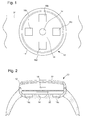
- the integrated device for measuring a heart rate shown schematically in FIGS. 1 and 2 and designated by the general reference 10, conventionally comprises a housing 12 comprising a light source 14 intended to transmit infrared radiation to human tissues, and four photos detectors 16a, 16b, 16c and 16d, such as photodiodes, arranged around the light source 14 so as to receive the infrared radiation after its interaction with the tissues.
- the device 10 also comprises a motion detection system 18, such as a three-dimensional accelerometer, and a processor 20 arranged to receive and process the signals from the photo-detectors 16a, 16b, 16c, 16d, and the accelerometer 18.
- a display module 22, such as an LCD screen, integrated in the housing 12, is intended for displaying the measured physiological parameters, in particular the heart rate.
- the housing 12 is, furthermore, provided with a bracelet 24 for fixing the device 10 to the wrist in the manner of a watch.
- the device 10 is intended for measuring a cardiac rhythm of an athlete practicing a rhythmic type of sport such as walking, running, cycling, swimming etc, or any sport associated with a periodic movement. Its operation is as follows:
- the light source 14 emits infrared radiation that interacts with human tissues.
- the photo-detectors 16a, 16b, 16c and 16d capture an optical signal containing information on the crossed fabrics.
- the accelerometer 18 captures an acceleration signal containing information on the sports movement performed.
- the optical and acceleration signals are processed by the processor 20, in order to extract useful information on a physiological parameter, in particular a heart rate.
- the processor 20 implements an original and efficient signal processing algorithm, based on a careful observation and analysis of the periodic sports movement.
- Such a movement is globally complex. It is formed of a combination of sub-movements: the sub-movements of the legs, arms, torso, etc. It has been observed, in the context of the present invention, that each of these sub-movements is harmonic type, that is to say characterized by a fundamental frequency f 0 , and harmonic frequencies f 1 , f 2 , ... f i , multiples of the fundamental frequency f 0 . Moreover, the sub-movements are not independent of each other: Their fundamental frequencies are themselves multiple of each other, so that the global movement is a harmonic movement of fundamental frequency the smallest of the fundamental frequencies of the various sub -mouvements. Such an observation greatly simplifies the processing of the acceleration signal.
- the algorithm according to the invention is based on the preceding analysis. It comprises three main blocks respectively pretreatment 100, enhancement of the optical signal 200, and estimation of the heartbeat 300, each comprising a number of sub-blocks, and detailed below.
- the optical and acceleration signals respectively coming from the photodetectors 16a, 16b, 16c, 16d, and from the accelerometer 18, are first subjected to a pretreatment, symbolized respectively by two sub-blocks 101 and 102 belonging to the module 100.
- the pretreatment 101 generally consists, for the optical signal, in a first step of removing the DC component of the signal, followed by a second filtering step to reduce the frequency range to values compatible with a heart rate.
- the acceleration signal it is essentially during the preprocessing step 102 to the removal of the DC component. Note that the pretreatment of optical and acceleration signals can be performed in analog or digital mode.
- the module for raising the optical signal 200 comprises a first sub-block 201 for determining the fundamental frequency of the movement from the pre-processed acceleration signal, according to the basic idea of the present invention that the extraction of this single parameter is necessary.
- the autocorrelation function will advantageously be used for estimating the fundamental frequency of the movement.
- the spectrum of the autocorrelation function of a signal is equivalent to the power spectrum of the original signal.
- the sub-block 201 for determining the fundamental frequency thus proceeds, in a first step, to the calculation of the auto-correlation function of the acceleration signal, then, in a second step, to the detection of the maximum of the function. autocorrelation.
- a polynomial approximation of the autocorrelation function around the maximum in order to increase the resolution of the detection of the maximum and the precision of the result, one can perform, within the sub-block 201, a polynomial approximation of the autocorrelation function around the maximum.
- any other mathematical method for determining the fundamental frequency f 0 of the movement is usable.
- transformation methods such as Fourier transform (FFT), cosine transform (DCT), or parametric methods.
- FFT Fourier transform
- DCT cosine transform
- parametric methods are not limited to the calculation of the useful parameter, the fundamental frequency f 0 , but, on the contrary, relate to a large number of parameters. They are inherently heavy, and require considerable computing power. This is why the calculation of the fundamental frequency f 0 by the autocorrelation function is to be preferred.
- a second sub-block 202 relates to the calculation of the harmonics f 1 , f 2 , ... f i . Harmonics are obtained by simple multiplication of the fundamental frequency f 0 by natural numbers (1, 2, 3, ).
- a third sub-block 203 follows the sub-block 202 for calculating harmonics.
- This sub-block 203 relates to the development of a comb filter as illustrated in FIG. 4.
- Such a filter conventionally comprises wide bandwidths 50 and narrow rejection bands 52 centered on the fundamental frequency f 0. of the movement and its harmonics f 1 , f 2 , ... f i .
- the width of the rejection bands is non-zero and fixed by a set of parameters ( ⁇ 0 , ⁇ 1 , ⁇ 2 , ... ⁇ i ).
- the set of parameters ⁇ i is determined for a given activity.
- ⁇ i parameters refer to the joint application entitled 'Method and Integrated Heartbeat Measurement Device' filed on 06 October 2006 on behalf of ETA SA Manufacture Horlogère Suisse.
- a sub-block 204 for filtering the optical signal is connected on the one hand to the block 205 for producing the comb filter and on the other hand to the sub-block 101 for preprocessing the optical signal. It corresponds to the operation of filtering the optical signal using the comb filter developed from the frequencies f i of the movement. After the filtering operation performed at 204, motion related artifacts are removed from the optical signal.
- the enhanced optical signal is filtered using an adaptive bandpass filter or a PCA noise reduction algorithm as described in the patent. US 7,018,338 . Then, the heartbeat is estimated from the filtered enhanced optical signal.
- the zero-crossing method in English terminology, that is to say, the zero crossing method, well known to those skilled in the art.
- a device and a method for measuring a heartbeat whose performance has been increased by means of an optical signal enhancement method based on a thorough analysis of the periodic sports movement have been described.
Landscapes
- Health & Medical Sciences (AREA)
- Life Sciences & Earth Sciences (AREA)
- Engineering & Computer Science (AREA)
- Surgery (AREA)
- General Health & Medical Sciences (AREA)
- Biophysics (AREA)
- Pathology (AREA)
- Veterinary Medicine (AREA)
- Biomedical Technology (AREA)
- Heart & Thoracic Surgery (AREA)
- Medical Informatics (AREA)
- Molecular Biology (AREA)
- Public Health (AREA)
- Animal Behavior & Ethology (AREA)
- Physics & Mathematics (AREA)
- Cardiology (AREA)
- Physiology (AREA)
- Signal Processing (AREA)
- Artificial Intelligence (AREA)
- Computer Vision & Pattern Recognition (AREA)
- Psychiatry (AREA)
- Dentistry (AREA)
- Oral & Maxillofacial Surgery (AREA)
- Measuring Pulse, Heart Rate, Blood Pressure Or Blood Flow (AREA)
Priority Applications (3)
| Application Number | Priority Date | Filing Date | Title |
|---|---|---|---|
| EP06121865A EP1908401A1 (de) | 2006-10-06 | 2006-10-06 | Verfahren und Vorrichtung zur Ausmessung des Herzschlags bei der Praxis eines rhythmischen Sports |
| PCT/EP2007/060467 WO2008040735A1 (fr) | 2006-10-06 | 2007-10-02 | Methode et dispositif de mesure d ' une pulsation cardiaque lors de la pratique d' un sport rythmique |
| TW96137269A TW200833297A (en) | 2006-10-06 | 2007-10-04 | Method and integrated device for measuring a cardiac pulsation for practising a rhythmical sport |
Applications Claiming Priority (1)
| Application Number | Priority Date | Filing Date | Title |
|---|---|---|---|
| EP06121865A EP1908401A1 (de) | 2006-10-06 | 2006-10-06 | Verfahren und Vorrichtung zur Ausmessung des Herzschlags bei der Praxis eines rhythmischen Sports |
Publications (1)
| Publication Number | Publication Date |
|---|---|
| EP1908401A1 true EP1908401A1 (de) | 2008-04-09 |
Family
ID=37873069
Family Applications (1)
| Application Number | Title | Priority Date | Filing Date |
|---|---|---|---|
| EP06121865A Ceased EP1908401A1 (de) | 2006-10-06 | 2006-10-06 | Verfahren und Vorrichtung zur Ausmessung des Herzschlags bei der Praxis eines rhythmischen Sports |
Country Status (3)
| Country | Link |
|---|---|
| EP (1) | EP1908401A1 (de) |
| TW (1) | TW200833297A (de) |
| WO (1) | WO2008040735A1 (de) |
Cited By (8)
| Publication number | Priority date | Publication date | Assignee | Title |
|---|---|---|---|---|
| WO2013038296A1 (en) * | 2011-09-16 | 2013-03-21 | Koninklijke Philips Electronics N.V. | Device and method for estimating the heart rate during motion |
| WO2013128345A1 (en) * | 2012-02-28 | 2013-09-06 | Koninklijke Philips N.V. | Device and method for monitoring vital signs |
| WO2014091382A1 (en) * | 2012-12-14 | 2014-06-19 | Koninklijke Philips N.V. | A system and method to detect significant arrhythmic events through a photoplethysmogram (ppg) and accelerometer |
| WO2015128226A1 (en) * | 2014-02-26 | 2015-09-03 | Koninklijke Philips N.V. | Device for measuring a cycling cadence |
| EP3600013A4 (de) * | 2017-03-23 | 2020-12-09 | Valencell, Inc. | Physiologische überwachungsvorrichtungen und verfahren zur rauschverminderung bei physiologischen signalen auf der basis des personenaktivitätstyps |
| US10945618B2 (en) | 2015-10-23 | 2021-03-16 | Valencell, Inc. | Physiological monitoring devices and methods for noise reduction in physiological signals based on subject activity type |
| US10966662B2 (en) | 2016-07-08 | 2021-04-06 | Valencell, Inc. | Motion-dependent averaging for physiological metric estimating systems and methods |
| US11375902B2 (en) | 2011-08-02 | 2022-07-05 | Valencell, Inc. | Systems and methods for variable filter adjustment by heart rate metric feedback |
Families Citing this family (3)
| Publication number | Priority date | Publication date | Assignee | Title |
|---|---|---|---|---|
| EP2229880A1 (de) * | 2009-03-18 | 2010-09-22 | CSEM Centre Suisse d'Electronique et de Microtechnique SA | Stirnbandintegrierte Überwachungseinheit mit einem Beschleunigungsmesser |
| JP5672709B2 (ja) | 2010-02-04 | 2015-02-18 | セイコーエプソン株式会社 | 生体情報検出器、生体情報測定装置および生体情報検出器における反射部の設計方法 |
| TWI608826B (zh) | 2014-10-31 | 2017-12-21 | 財團法人工業技術研究院 | 光學感測裝置及其量測方法 |
Citations (7)
| Publication number | Priority date | Publication date | Assignee | Title |
|---|---|---|---|---|
| EP0659384A1 (de) * | 1993-12-20 | 1995-06-28 | Seiko Instruments Inc. | Puls - Monitor |
| EP0922433A1 (de) * | 1997-03-17 | 1999-06-16 | Seiko Epson Corporation | Pulsaufnehmer und pulmesser |
| EP0941694A1 (de) * | 1997-09-05 | 1999-09-15 | Seiko Epson Corporation | Lichtreflektionsmesser und messinstrument für biologische daten |
| US20030138763A1 (en) * | 2002-01-23 | 2003-07-24 | Aquatech Fitness Corp. | System for monitoring repetitive movement |
| US20040236233A1 (en) * | 2003-03-19 | 2004-11-25 | Seiko Epson Corporation | Information-gathering device and pulse meter |
| US7018338B2 (en) | 2001-09-28 | 2006-03-28 | Csem Centre Suisse D'electronique Et De Microtechnique Sa | Method and device for pulse rate detection |
| WO2006044677A1 (en) | 2004-10-15 | 2006-04-27 | Pulsetracer Technologies Inc. | Motion cancellation of optical input signals for physiological pulse measurement |
-
2006
- 2006-10-06 EP EP06121865A patent/EP1908401A1/de not_active Ceased
-
2007
- 2007-10-02 WO PCT/EP2007/060467 patent/WO2008040735A1/fr not_active Ceased
- 2007-10-04 TW TW96137269A patent/TW200833297A/zh unknown
Patent Citations (7)
| Publication number | Priority date | Publication date | Assignee | Title |
|---|---|---|---|---|
| EP0659384A1 (de) * | 1993-12-20 | 1995-06-28 | Seiko Instruments Inc. | Puls - Monitor |
| EP0922433A1 (de) * | 1997-03-17 | 1999-06-16 | Seiko Epson Corporation | Pulsaufnehmer und pulmesser |
| EP0941694A1 (de) * | 1997-09-05 | 1999-09-15 | Seiko Epson Corporation | Lichtreflektionsmesser und messinstrument für biologische daten |
| US7018338B2 (en) | 2001-09-28 | 2006-03-28 | Csem Centre Suisse D'electronique Et De Microtechnique Sa | Method and device for pulse rate detection |
| US20030138763A1 (en) * | 2002-01-23 | 2003-07-24 | Aquatech Fitness Corp. | System for monitoring repetitive movement |
| US20040236233A1 (en) * | 2003-03-19 | 2004-11-25 | Seiko Epson Corporation | Information-gathering device and pulse meter |
| WO2006044677A1 (en) | 2004-10-15 | 2006-04-27 | Pulsetracer Technologies Inc. | Motion cancellation of optical input signals for physiological pulse measurement |
Cited By (18)
| Publication number | Priority date | Publication date | Assignee | Title |
|---|---|---|---|---|
| US11375902B2 (en) | 2011-08-02 | 2022-07-05 | Valencell, Inc. | Systems and methods for variable filter adjustment by heart rate metric feedback |
| WO2013038296A1 (en) * | 2011-09-16 | 2013-03-21 | Koninklijke Philips Electronics N.V. | Device and method for estimating the heart rate during motion |
| US10617308B2 (en) | 2011-09-16 | 2020-04-14 | Koninklijke Philips N.V. | Device and method for estimating the heart rate during motion |
| US9770176B2 (en) | 2011-09-16 | 2017-09-26 | Koninklijke Philips N.V. | Device and method for estimating the heart rate during motion |
| JP2015511499A (ja) * | 2012-02-28 | 2015-04-20 | コーニンクレッカ フィリップス エヌ ヴェ | バイタルサインをモニタするためのデバイス及び方法 |
| US10542925B2 (en) | 2012-02-28 | 2020-01-28 | Koninklijke Philips N.V. | Device and method for monitoring vital signs |
| WO2013128345A1 (en) * | 2012-02-28 | 2013-09-06 | Koninklijke Philips N.V. | Device and method for monitoring vital signs |
| CN104168819A (zh) * | 2012-02-28 | 2014-11-26 | 皇家飞利浦有限公司 | 用于监视生命体征的设备和方法 |
| WO2014091382A1 (en) * | 2012-12-14 | 2014-06-19 | Koninklijke Philips N.V. | A system and method to detect significant arrhythmic events through a photoplethysmogram (ppg) and accelerometer |
| RU2655443C2 (ru) * | 2012-12-14 | 2018-05-28 | Конинклейке Филипс Н.В. | Система и способ обнаружения значимых аритмических событий посредством фотоплетизмограммы(ppg) и акселерометра |
| US10524736B2 (en) | 2012-12-14 | 2020-01-07 | Koninklijke Philips N.V. | System and method to detect significant arrhythmic events through a photoplethysmogram (PPG) and accelerometer |
| US9936912B2 (en) | 2014-02-26 | 2018-04-10 | Koninklijke Philips N.V. | Device for measuring a cycling cadence |
| WO2015128226A1 (en) * | 2014-02-26 | 2015-09-03 | Koninklijke Philips N.V. | Device for measuring a cycling cadence |
| JP2017517715A (ja) * | 2014-02-26 | 2017-06-29 | コーニンクレッカ フィリップス エヌ ヴェKoninklijke Philips N.V. | サイクリングケイデンスを測定するデバイス |
| US10945618B2 (en) | 2015-10-23 | 2021-03-16 | Valencell, Inc. | Physiological monitoring devices and methods for noise reduction in physiological signals based on subject activity type |
| US12285244B2 (en) | 2015-10-23 | 2025-04-29 | Yukka Magic Llc | Physiological monitoring devices and methods for noise reduction in physiological signals based on subject activity type |
| US10966662B2 (en) | 2016-07-08 | 2021-04-06 | Valencell, Inc. | Motion-dependent averaging for physiological metric estimating systems and methods |
| EP3600013A4 (de) * | 2017-03-23 | 2020-12-09 | Valencell, Inc. | Physiologische überwachungsvorrichtungen und verfahren zur rauschverminderung bei physiologischen signalen auf der basis des personenaktivitätstyps |
Also Published As
| Publication number | Publication date |
|---|---|
| WO2008040735A1 (fr) | 2008-04-10 |
| TW200833297A (en) | 2008-08-16 |
Similar Documents
| Publication | Publication Date | Title |
|---|---|---|
| WO2008040735A1 (fr) | Methode et dispositif de mesure d ' une pulsation cardiaque lors de la pratique d' un sport rythmique | |
| WO2008040736A1 (fr) | Méthode et dispositif intégré de mesure d'une pulsation cardiaque | |
| EP2605002B1 (de) | Verfahren zur Rekonstruktion der optischen Eigenschaften eines streuenden Mediums unter Verwendung einer Kombination aus einer Vielzahl von Mellin-Laplace Transformationen einer Größe, welche auf einer zeitlichen Verteilung von einem empfangenen Signal basiert, und zugeordnetes Rekonstruktionssystem | |
| EP3238210B1 (de) | Verfahren zur verarbeitung und analyse eines signals und vorrichtung zur implementierung dieses verfahrens | |
| EP2994043B1 (de) | Vorrichtung und verfahren zur bestimmung der ausbreitungsgeschwindigkeit einer pulswelle | |
| Ayesha et al. | Heart rate monitoring using PPG with smartphone camera | |
| EP3305186B1 (de) | Verfahren und system zur stressüberwachung eines benutzers | |
| AU2022350959A1 (en) | Optical coherence tomography angiography method and apparatus, and electronic device and storage medium | |
| CN110292372B (zh) | 检测装置 | |
| FR3017529A1 (fr) | Procede et systeme de surveillance du systeme nerveux autonome d'un sujet | |
| CN106073800B (zh) | 基于绝对差值和提取的动态光谱数据处理方法及其装置 | |
| EP3552545B1 (de) | Verfahren und vorrichtung zur magnetfeldkorrektur in echtzeit | |
| EP3294121B1 (de) | Verfahren und vorrichtung zur bestimmung der charakteristischen parameter einer kardiovaskulären aktivität | |
| FR2549957A1 (fr) | Procede et appareil pour synthetiser un signal continu estime a partir de segments d'un signal gaussien resultant de la mesure doppler par ultra-sons de l'ecoulement d'un fluide | |
| WO2012062997A1 (fr) | Dispositif de détection à capteur, procédé de détection et programme d'ordinateur correspondants | |
| FR2700683A1 (fr) | Dispositif de reconnaissance de phases de sommeil, et application correspondante. | |
| EP0402968B1 (de) | Vorrichtung zum Messen der Fliessgeschwindigkeit von Blut | |
| CH712969B1 (fr) | Méthode de mesure d'une pulsation cardiaque dans le cadre de la pratique d'un sport rythmique. | |
| EP4027874B1 (de) | Verfahren zur bestimmung der atemfrequenz | |
| EP3110322A1 (de) | Verfahren und vorrichtung zur automatischen überprüfung der qualität eines rr-intervalls aus einem herzsignal | |
| EP3422941A1 (de) | Kardiale vorrichtung | |
| EP4018922A1 (de) | Verfahren zur schätzung eines herz- oder atemrhythmus | |
| CA2796172C (fr) | Procede et systeme d'analyse de l'activite cardiaque d'un patient et applications correspondantes | |
| Ferreira et al. | Optical flow sensor as a reference for reduction of motion artefacts in photoplethysmographic measurements | |
| WO2025093422A1 (fr) | Techniques de traitement de données et d'estimation de tension artérielle |
Legal Events
| Date | Code | Title | Description |
|---|---|---|---|
| PUAI | Public reference made under article 153(3) epc to a published international application that has entered the european phase |
Free format text: ORIGINAL CODE: 0009012 |
|
| AK | Designated contracting states |
Kind code of ref document: A1 Designated state(s): AT BE BG CH CY CZ DE DK EE ES FI FR GB GR HU IE IS IT LI LT LU LV MC NL PL PT RO SE SI SK TR |
|
| AX | Request for extension of the european patent |
Extension state: AL BA HR MK RS |
|
| 17P | Request for examination filed |
Effective date: 20081009 |
|
| 17Q | First examination report despatched |
Effective date: 20081120 |
|
| AKX | Designation fees paid |
Designated state(s): AT BE BG CH CY CZ DE DK EE ES FI FR GB GR HU IE IS IT LI LT LU LV MC NL PL PT RO SE SI SK TR |
|
| STAA | Information on the status of an ep patent application or granted ep patent |
Free format text: STATUS: THE APPLICATION HAS BEEN REFUSED |
|
| 18R | Application refused |
Effective date: 20150913 |