EP1905711A1 - Sheet processing apparatus and sheet processing method - Google Patents
Sheet processing apparatus and sheet processing method Download PDFInfo
- Publication number
- EP1905711A1 EP1905711A1 EP07001410A EP07001410A EP1905711A1 EP 1905711 A1 EP1905711 A1 EP 1905711A1 EP 07001410 A EP07001410 A EP 07001410A EP 07001410 A EP07001410 A EP 07001410A EP 1905711 A1 EP1905711 A1 EP 1905711A1
- Authority
- EP
- European Patent Office
- Prior art keywords
- sheets
- established
- determining
- section
- conveying path
- Prior art date
- Legal status (The legal status is an assumption and is not a legal conclusion. Google has not performed a legal analysis and makes no representation as to the accuracy of the status listed.)
- Withdrawn
Links
- 238000003672 processing method Methods 0.000 title claims 7
- 238000009825 accumulation Methods 0.000 claims abstract description 101
- 238000000034 method Methods 0.000 claims description 58
- 230000008569 process Effects 0.000 claims description 54
- 238000005192 partition Methods 0.000 claims description 38
- 230000004308 accommodation Effects 0.000 claims description 23
- 239000000203 mixture Substances 0.000 abstract description 4
- 230000007246 mechanism Effects 0.000 description 29
- 238000007789 sealing Methods 0.000 description 19
- 238000010586 diagram Methods 0.000 description 6
- 230000006870 function Effects 0.000 description 4
- 238000011109 contamination Methods 0.000 description 2
- 230000008030 elimination Effects 0.000 description 2
- 238000003379 elimination reaction Methods 0.000 description 2
- 230000007306 turnover Effects 0.000 description 2
- 230000009467 reduction Effects 0.000 description 1
- 238000000638 solvent extraction Methods 0.000 description 1
- 238000011144 upstream manufacturing Methods 0.000 description 1
Images


Classifications
-
- B—PERFORMING OPERATIONS; TRANSPORTING
- B65—CONVEYING; PACKING; STORING; HANDLING THIN OR FILAMENTARY MATERIAL
- B65H—HANDLING THIN OR FILAMENTARY MATERIAL, e.g. SHEETS, WEBS, CABLES
- B65H7/00—Controlling article feeding, separating, pile-advancing, or associated apparatus, to take account of incorrect feeding, absence of articles, or presence of faulty articles
- B65H7/02—Controlling article feeding, separating, pile-advancing, or associated apparatus, to take account of incorrect feeding, absence of articles, or presence of faulty articles by feelers or detectors
- B65H7/06—Controlling article feeding, separating, pile-advancing, or associated apparatus, to take account of incorrect feeding, absence of articles, or presence of faulty articles by feelers or detectors responsive to presence of faulty articles or incorrect separation or feed
-
- B—PERFORMING OPERATIONS; TRANSPORTING
- B65—CONVEYING; PACKING; STORING; HANDLING THIN OR FILAMENTARY MATERIAL
- B65H—HANDLING THIN OR FILAMENTARY MATERIAL, e.g. SHEETS, WEBS, CABLES
- B65H7/00—Controlling article feeding, separating, pile-advancing, or associated apparatus, to take account of incorrect feeding, absence of articles, or presence of faulty articles
- B65H7/20—Controlling associated apparatus
-
- G—PHYSICS
- G03—PHOTOGRAPHY; CINEMATOGRAPHY; ANALOGOUS TECHNIQUES USING WAVES OTHER THAN OPTICAL WAVES; ELECTROGRAPHY; HOLOGRAPHY
- G03G—ELECTROGRAPHY; ELECTROPHOTOGRAPHY; MAGNETOGRAPHY
- G03G15/00—Apparatus for electrographic processes using a charge pattern
- G03G15/65—Apparatus which relate to the handling of copy material
- G03G15/6538—Devices for collating sheet copy material, e.g. sorters, control, copies in staples form
-
- B—PERFORMING OPERATIONS; TRANSPORTING
- B65—CONVEYING; PACKING; STORING; HANDLING THIN OR FILAMENTARY MATERIAL
- B65H—HANDLING THIN OR FILAMENTARY MATERIAL, e.g. SHEETS, WEBS, CABLES
- B65H2511/00—Dimensions; Position; Numbers; Identification; Occurrences
- B65H2511/10—Size; Dimensions
- B65H2511/13—Thickness
-
- B—PERFORMING OPERATIONS; TRANSPORTING
- B65—CONVEYING; PACKING; STORING; HANDLING THIN OR FILAMENTARY MATERIAL
- B65H—HANDLING THIN OR FILAMENTARY MATERIAL, e.g. SHEETS, WEBS, CABLES
- B65H2511/00—Dimensions; Position; Numbers; Identification; Occurrences
- B65H2511/30—Numbers, e.g. of windings or rotations
-
- B—PERFORMING OPERATIONS; TRANSPORTING
- B65—CONVEYING; PACKING; STORING; HANDLING THIN OR FILAMENTARY MATERIAL
- B65H—HANDLING THIN OR FILAMENTARY MATERIAL, e.g. SHEETS, WEBS, CABLES
- B65H2511/00—Dimensions; Position; Numbers; Identification; Occurrences
- B65H2511/40—Identification
- B65H2511/417—Identification of state of the machine
-
- B—PERFORMING OPERATIONS; TRANSPORTING
- B65—CONVEYING; PACKING; STORING; HANDLING THIN OR FILAMENTARY MATERIAL
- B65H—HANDLING THIN OR FILAMENTARY MATERIAL, e.g. SHEETS, WEBS, CABLES
- B65H2511/00—Dimensions; Position; Numbers; Identification; Occurrences
- B65H2511/50—Occurence
- B65H2511/51—Presence
- B65H2511/512—Marks, e.g. invisible to the human eye; Patterns
-
- B—PERFORMING OPERATIONS; TRANSPORTING
- B65—CONVEYING; PACKING; STORING; HANDLING THIN OR FILAMENTARY MATERIAL
- B65H—HANDLING THIN OR FILAMENTARY MATERIAL, e.g. SHEETS, WEBS, CABLES
- B65H2511/00—Dimensions; Position; Numbers; Identification; Occurrences
- B65H2511/50—Occurence
- B65H2511/52—Defective operating conditions
- B65H2511/528—Jam
-
- B—PERFORMING OPERATIONS; TRANSPORTING
- B65—CONVEYING; PACKING; STORING; HANDLING THIN OR FILAMENTARY MATERIAL
- B65H—HANDLING THIN OR FILAMENTARY MATERIAL, e.g. SHEETS, WEBS, CABLES
- B65H2513/00—Dynamic entities; Timing aspects
- B65H2513/50—Timing
- B65H2513/512—Starting; Stopping
-
- B—PERFORMING OPERATIONS; TRANSPORTING
- B65—CONVEYING; PACKING; STORING; HANDLING THIN OR FILAMENTARY MATERIAL
- B65H—HANDLING THIN OR FILAMENTARY MATERIAL, e.g. SHEETS, WEBS, CABLES
- B65H2553/00—Sensing or detecting means
- B65H2553/40—Sensing or detecting means using optical, e.g. photographic, elements
- B65H2553/43—Bar code reader
-
- B—PERFORMING OPERATIONS; TRANSPORTING
- B65—CONVEYING; PACKING; STORING; HANDLING THIN OR FILAMENTARY MATERIAL
- B65H—HANDLING THIN OR FILAMENTARY MATERIAL, e.g. SHEETS, WEBS, CABLES
- B65H2557/00—Means for control not provided for in groups B65H2551/00 - B65H2555/00
- B65H2557/60—Details of processes or procedures
- B65H2557/64—Details of processes or procedures for detecting type or properties of handled material
-
- B—PERFORMING OPERATIONS; TRANSPORTING
- B65—CONVEYING; PACKING; STORING; HANDLING THIN OR FILAMENTARY MATERIAL
- B65H—HANDLING THIN OR FILAMENTARY MATERIAL, e.g. SHEETS, WEBS, CABLES
- B65H2701/00—Handled material; Storage means
- B65H2701/10—Handled articles or webs
- B65H2701/19—Specific article or web
- B65H2701/1912—Banknotes, bills and cheques or the like
-
- G—PHYSICS
- G03—PHOTOGRAPHY; CINEMATOGRAPHY; ANALOGOUS TECHNIQUES USING WAVES OTHER THAN OPTICAL WAVES; ELECTROGRAPHY; HOLOGRAPHY
- G03G—ELECTROGRAPHY; ELECTROPHOTOGRAPHY; MAGNETOGRAPHY
- G03G2215/00—Apparatus for electrophotographic processes
- G03G2215/00362—Apparatus for electrophotographic processes relating to the copy medium handling
- G03G2215/00535—Stable handling of copy medium
- G03G2215/00548—Jam, error detection, e.g. double feeding
Definitions
- the present invention relates to a sheet processing apparatus and method which collectively processes at least two sheet groups corresponding to a batch processing unit with the sheet groups separated from each other by partition cards.
- Known sheet processing apparatuses collectively process at least two sheet groups corresponding to a batch processing unit with the sheet groups separated from each other by partition cards (see, for example, Jpn. Pat. Appln. KOKAI Publication No. 2004-224481 ).
- Plural types of notes are mixed and all are introduced into a paper money processing apparatus (sheet processing apparatus) at a time without being arranged so that all the notes have a front facing upwards or back facing upwards or have a normal or reversed top/bottom (the patterns on all the notes lie in a normal or reversed top/bottom direction).
- Each of the notes is taken out and conveyed on a conveying path.
- the conveyed notes are accumulated in a temporary accumulation section on the basis of the type of note and whether the note has a front facing upwards or back facing upwards. Then, when all the introduced notes have been classified or the temporary accumulation section becomes full, the notes in the temporary accumulation section are accommodated in an accommodation section.
- the sheet processing apparatus uses header cards as partition cards, it does not perform an accommodation operation every time one batch is completed taking into account a decrease in processing efficiency caused by an accommodation operation performed every time batch operation is completed. Consequently, established notes corresponding to the finished batch processing are mixed with non-established notes corresponding to batch processing in progress.
- the sheet processing apparatus When an operator opens the door of the temporary accumulation section in order to clear a jam, the sheet processing apparatus prints the established and non-established notes in the accumulation section in a log.
- the operator classifies the notes in the temporary accumulation section into the established and non-established notes on the basis of the printed log.
- the established notes are stored, while the non-established notes are re-supplied to the paper money processing apparatus.
- An object of the present invention is to provide a sheet processing apparatus and method in which with established and non-established notes mixed together in a temporary accumulation section, the number of the established notes is subtracted from a count value when the door of the temporary accumulation section is opened, making it possible to simplify an operator's jam processing, that is, to reduce the time and effort required to classify sheets, the apparatus and method further making it possible to prevent a count mismatch resulting from jam processing mis-operation.
- a sheet processing apparatus of the present invention comprises receiving means for receiving a batch processing unit and each comprising an arbitrary number of sheets, the sheet groups being separated from each other by partition cards, taking-out means for sequentially taking out one of the received partition cards or one of the received sheets onto a conveying path as a process medium, first determining means for determining that the process medium taken out by the taking-out means and conveyed along the conveying path is a partition card, second determining means for determining that the process medium taken out by the taking-out means and conveyed along the conveying path is a sheet, classifying means for selectively placing the process medium in one of a plurality of temporary accumulation sections on the basis of the determination by the second determining means, counting means for counting classified sheets in the sheet groups corresponding to the batch processing unit on the basis of the determination of the partition card by the first determining means, accommodation means for, once all the process media received by the receiving means are taken out, accommodating the sheets accumulated in all the temporary accumulation sections, in a corresponding accommodation section, and when one of the temporary accumulation
- a sheet processing apparatus of the present invention comprises receiving means for receiving a batch processing unit and each comprising an arbitrary number of sheets, the sheet groups being separated from each other by partition cards, taking-out means for sequentially taking out one of the received partition cards or one of the received sheets onto a conveying path as a process medium, first determining means for determining that the process medium taken out by the taking-out means and conveyed along the conveying path is a partition card, second determining means for determining that the process medium taken out by the taking-out means and conveyed along the conveying path is a sheet, classifying means for selectively placing the process medium in one of a plurality of temporary accumulation sections on the basis of the determination by the second determining means, sensing means for sensing whether an open-close door provided on an apparatus main body side of each of the temporary accumulation sections is open or closed, counting means for counting classified sheets in the sheet groups corresponding to the batch processing unit on the basis of the determination of the partition card by the first determining means, accommodation means for, once all the process media received by the receiving means
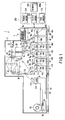
- the present invention can provide a sheet processing apparatus and method which allows jam processing to be achieved without the need to shift sheets among plural batches of sheets separated from each other by partition cards, thus making it possible to improve reliability.
- FIG. 1 shows the general configuration of a paper money processing apparatus (sheet processing apparatus) according to an embodiment of the present invention.
- the paper money processing apparatus is composed of a paper money processing apparatus 1 and an instructing apparatus (superordinate apparatus, teller) 202 that gives instructions to the paper processing apparatus 1.
- the superordinate apparatus 202 may control one or more paper money processing apparatuses.
- the paper money processing apparatus 1 has a function for sealing every predetermined number of notes of only a particular type with a paper band.
- the superordinate apparatus 202 has a function for instructing the paper money processing apparatus 1 to perform a certain operation, for example, indicating, to the paper money processing apparatus 1, the type of notes to be sealed and a function for displaying count data provided by the paper money processing apparatus 1.
- the superordinate apparatus 202 is composed of a personal computer consisting of an input section 203 for setting of the instructions, a display section 204, and a control section 205 for general control.
- the superordinate apparatus 202 has a database 206 such as a magnetic disk.
- the database 206 is provided with a counting table 206a that stores the contents of counting executed by the paper money processing apparatus 1.
- a physical note count, a non-established note count, and an established note count are registered in the counting table 206a.
- the type of notes to be sealed by a sealing device 50 can be changed at any time by an operator via the input section 203.
- the paper money processing apparatus main body 1 has a housing 2 constituting a shell of the apparatus.
- a stage portion located in the right of the housing 2 in the figure is provided with an introducing section 4 into which plural notes P accumulated in their sheet surface direction are collectively introduced so as to have a reversed top/bottom.
- Each of the notes P has a front and back sides and an upper and lower ends extending along its longitudinal direction. The notes P are introduced via the introducing section 4 so that their upper or lower ends face downward.
- Plural batches (corresponding to one processing unit) of notes P separated from each other by header cards Ca and trailer cards Cb are collectively introduced into the paper money processing apparatus 1.
- the paper money processing apparatus 1 then sequentially takes out a sheet and conveys it along a conveying path 12.
- the header card Ca is placed at the leading position of the notes in each batch.
- the trailer card Cb is placed at the trailing position of the notes in each batch.
- Identification codes are provided on the front and back surfaces of each of these cards. To be distinguished from the notes P, each of the cards has a thickness equal to two notes P.
- the introducing section 4 has a stage 4a on which plural batches of notes P separated from each other by the header cards Ca and trailer cards Cb are aligned with one another so that their upper or lower ends contact the stage 4a.
- a backup plate 6 is provided at the right end of the introducing section 4 shown in the figure so as to stand upright in a vertical direction with respect to the stage 4a. The backup plate 6 can be moved leftward in the figure along the stage 4a by the urging force of a spring 8.
- the header cards Ca, trailer cards Cb, and notes P introduced into the introducing section 4 so as to have a reversed top/bottom are urged in their sheet surface direction by the backup plate and moved leftward in the figure. Then, the leftmost note P in the figure is pressed against two takeout rollers 10 (taking-out section) arranged in the left of the paper money introducing section 4 in the figure and adjacent to each other in the vertical direction. Rotating the takeout rollers in a predetermined direction sequentially takes out one of the header cards Ca, trailer cards Cb, and notes P which is located at the leftmost position, onto the conveying path 12. The note P taken out onto the conveying path 12 moves in a latitudinal direction with its upper or lower end located at its leading position. On this occasion, the notes are not arranged so that all of them have a front facing upwards or back facing upwards. In the present embodiment, the notes P are taken out downward from the introducing section 4.
- the conveying path 12 is defined by endless conveying belts 14 and 16 extended above and below the conveying path 12 so that the belts 14 and 16 can travel along a conveying direction.
- the conveying belts 14 and 16 are wound around plural rollers 15 extended across the width (sheet surface direction).
- a sensing section 30 is disposed beyond the conveying path 12 bent upward by the conveying belts 14 and 16 to sense the header cards Ca and trailer cards Cb, the type of the note P, the front or back facing upwards, the normal or reversed top/bottom, and the presence or absence of contamination or damage.
- the sensing section 30 determines the header card Ca and trailer card Cb on the basis of the thickness of the header card Ca and trailer card Cb conveyed along the conveying path 12 as well as read bar codes.
- the sensing section 30 also reads various information from the surface of the note P conveyed along the conveying path 12. The sensing section 30 then logically calculates the read information and compares it with reference information to sense the above characteristics of the note P.
- Plural gates G1, G2, and G3 to G8 are provided on the conveying path 12 extended downstream of the sensing section 30 to selectively switch the conveying direction of the header card Ca, trailer card Cb, and note P on the basis of the sensing results by the sensing section 30.
- the sensing section 30 reads the thickness and bar codes to determine the header card Ca and trailer card Cb, which are then conveyed rightward in the figure via the gate G1 and discharged into a reject box 32.
- notes determined to be unprocessable in the subsequent stages such as notes determined by the sensing section 30 to have been taken out together with another note or to have skewed at a level higher than a predetermined one
- notes not limited to paper money
- the reject box 32 is accessible from outside the housing 1 of the paper money processing apparatus 1.
- notes P determined by the sensing section 30 to be normal and processable are conveyed leftward in the figure toward the gate G2 via the gate G1.
- the notes P having passed through the gate G1 are not arranged so that all of them have a front or back facing upwards and a normal or reversed top/bottom as described above.
- the notes P that are not arranged so that all of them have a front or back facing upwards and a normal or reversed top/bottom are arranged so that all of them have a front or back facing upwards.
- the notes are then classified according to their types and accumulated.
- the conveying path located downstream of the gate G2 branches to two directions. Selectively switching the gate G2 between two positions allows the conveyance of the notes P to be selectively switched between the two directions.
- the turning-over mechanism 34 (turning-over section) is provided on one of the branches of the conveying path located downstream of the gate G2, to turn over the note P.
- the conveying path passing through the turning-over mechanism 34 forms a twisted conveying path rotated around a center axis through 180° between the inlet and outlet of the turning-over mechanism 34.
- Two conveying belts 33 and 35 are provided along the twisted conveying path so as to be twisted and so that their surfaces contact each other.
- the other branch of the conveying path located downstream of the gate G2 constitutes a conveying path 36 that only allows the notes P to pass through.
- Notes P sorted via the gate G2 and conveyed through the twisted conveying path in the turning-over mechanism 34 are, for example, turned over.
- notes (FF notes) carried in the turning-over mechanism 34 with a front facing upwards and a reversed top/bottom are turned over and carried out of the turning-over mechanism 34 as BF notes having a back facing upwards and a reversed top/bottom.
- the notes P are fed into the gate G3 via a joining section 38; the notes include those turned over by passing through the turning-over mechanism 34 and those not having passed through the turning-over mechanism 34 but through the conveying path 36.
- the length of the conveying path 36 is set so that the processing time required for the notes P to reach the joining section 38 via the turning-over mechanism 34 after passing through the gate G2 is equal to the conveying time required for the notes P to reach the joining section 38 after passing through the conveying path 36.
- This allows the notes P conveyed through the turning-over mechanism 34 to pass through the joining section 38 at the same timing as that when the notes P having passed through the conveying path 36 pass the joining section 38. This enables all the notes P to be processed under the same conditions regardless of the processing form.
- the conveying path located downstream of the gate G3 branches to two directions. Selectively switching the gate G3 between two positions allows the conveyance of the notes P to be selectively switched between the two directions.
- One of the branches of the conveying path located downstream of the gate G3 and extending rightward in the figure constitutes a horizontal conveying path 40 extending in a substantially horizontal direction above a plurality of accumulation sections 41a to 46a.
- the five gates G4 to G8 are provided on the horizontal conveying path 40 so that the conveyed note P is sorted and accumulated in one of the six temporary accumulation sections 41a to 46a.
- the note P selectively sorted via the gate G5 is accumulated in the temporary accumulation section 42a.
- the note P selectively sorted via the gate G6 is accumulated in the temporary accumulation section 43a.
- the note P selectively sorted via the gate G7 is accumulated in the temporary accumulation section 44a.
- the note P selectively sorted via the gate G8 is accumulated in the temporary accumulation section 46a.
- Accumulating sections 51 of the sealing device are provided at the terminal of the other branch of the conveying path located downstream of the gate G3 and extending leftward in the figure.
- the sealing device 50 accumulates, for example, 100 notes P and winds a paper band around the notes to form a bundle of notes P.
- the sealing device 50 is composed of the accumulation section 51, a supply section 53, a single sealing section (sealing mechanism) 54, a printing mechanism 55, and a band supplying section 56.
- the accumulation sections 51 accumulate notes P fed via the gate V3 in themselves.
- the sealing section 54 is a single sealing mechanism that seals, with a paper band, 100 notes supplied by the supply section 53 and accumulated in the accumulation section 51.
- the supply section 53 supplies the 100 notes accumulated in the accumulation section 51 to the sealing section 54.
- the printing mechanism 55 prints desired print data on the notes used by the sealing section 54.
- the band supplying section 56 supplies a band used by the sealing section 54.
- Notes P accumulated in the accumulation section 51 via the gate G3 are fed into the sealing section 54 by the supply section 53 and sealed with a paper band supplied by the band supplying section 56.
- the sealed bundle of a predetermined number of notes P is transferred to a conveyor 58 by a transfer mechanism 57.
- the notes P are subsequently carried out of the apparatus via the conveyor 58.
- the sealing section 54 receives the predetermined number notes P accumulated in the accumulation section 51.
- the sealing section 54 winds a paper band around the notes P along the latitudinal direction of the notes P, at a position biased toward one side in the longitudinal direction of the notes P (in the present embodiment, the rear of the paper money processing apparatus main body 1). An end of the band is then bonded to the other end to seal the predetermined number of sheets to form a bundle.
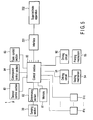
- FIG. 5 shows a block diagram of a control system that controls the operation of the above paper money processing apparatus 1.
- the paper money processing apparatus 1 is composed of a control section 80, a memory 81, a determining section 82, a take-out control section 83, a conveyance control section 84, a gate control section 85, a jam sensing section 86, and driving circuits 91 and 92.
- the control section 80 controls the general operation of the apparatus in accordance with preset operation programs.
- the memory 81 is used to store the operation programs and data such as count data including a physical note count and non-established count data.
- the determining section 82 determines the header card Ca and trailer card Cb as partition cards on the basis of sensing results provided by the sensing section 30.
- the determining section 82 further determines whether or not the note P is recirculatable and whether the note P has a front or back facing upwards and a normal or reversed top/bottom.
- the determining section 82 outputs the determinations to the control section 80.
- the takeout control section 83 rotates the takeout rollers 10 under the control of the control section 80.
- the conveyance control section 84 rotates the conveying rollers, constituting the conveying path 12, under the control of the control section 80.
- the gate control section 85 drives the gates G1 to G9 under the control of the control section 80.
- the jam sensing section 86 senses jamming, an error in the conveyance of conveying media conveyed by the paper money conveying mechanism, under the control of the control section 80.
- the driving circuit 91 drives the sealing mechanism 54 under the control of the control section 80.
- the driving circuit 92 drives the printing mechanism 55 under the control of the control section 80.
- the control section 80 is connected to the superordinate apparatus 202 via an interface 201.
- any of the header card Ca, note P, and trailer card Cb passes by an opposite part of the sensing section 30 as a passing medium.
- the sensing section 30 senses the thickness of the passing medium and reads bar codes from it to sense characteristics such as the type of the note P, the front or back facing upwards, the normal or reversed top/bottom, and contamination or damage.
- the sensing section 30 thus outputs the sensing results and the read bar code contents to the determining section 82.
- the determining section 82 determines whether the passing medium is the header card Ca, the note P, or the trailer card Cb. The determining section 82 further determines whether or not the note P is recirculatable and whether the note has a front or back facing upwards and a normal or reversed top/bottom. The determining section 82 outputs the determinations to the control section 80.
- control section 80 controls sorting of the passing medium. Specifically, the control section 80 controllably sorts the non-recirculatable notes P, header cards Ca, and trailer cards Cb into the reject box 32, while controllably sorting the recirculatable notes P into the temporary accumulation sections 41a to 46a and accumulation sections 51 according to the money type.
- the gate G1 is switched so as to direct the conveying path for the note P to the reject box 32.
- the note P is rejected to the reject box 32.
- the conveying path for the note P is switched from the gate G1 to the direction of the gate G2.
- the gate G2 is switched to the direction of the conveying path 36.
- the gate G2 is switched to the direction of the turning-over mechanism 34 to turn over the note.
- the gate G3 is then switched to the direction of the horizontal conveying path 40.
- the gate G1 is switched to the direction of the gate G3, which is further switched to the direction of the accumulation section 51. Notes all having a front or back facing upwards (in the present embodiment, front facing upwards) and having passed through the joining section 38 are selectively accumulated in the accumulation section 51.
- a predetermined number of notes P accumulated in the accumulation section 51 are fed into the sealing section 54 by the supply section 53 and sealed with a paper band supplied by the band supplying section 56.
- the sealed bundle of a predetermined number of notes P is transferred to the conveyor 58 by the transfer mechanism 57.
- the notes P are subsequently carried out of the apparatus via the conveyor 58.
- Each of the accumulation sections 41 to 46 is provided with a separator mechanism (not shown) serving as partitioning means for separating the current transaction from the previous ones. This enables the temporary accumulation sections 41a to 46a and paper money accumulating cassettes 41d to 46d to be formed between accumulating and taking-out devices (not shown).
- Open-close doors 41b to 46b are provided opposite the temporary accumulation section 41a to 46a and closer to the main body 2.
- the open-close doors 41b to 46b are provided with sensors 41c to 46c that are used for both opening and closing of the door.
- An open-close door 51b is provided opposite the accumulation section 51 and closer to the main body 2.
- Each open-close door 51b is provided with a sensor 51c that is used for both opening and closing of the door.
- the operator uses the superordinate apparatus 202, connected to the paper money processing apparatus 1, to operate the paper money processing apparatus 1.
- a note processed by the paper money processing apparatus 1 is conveyed to any of the temporary accumulation sections 41a to 46a and finally accommodated in any of the paper money accumulating cassettes 41d to 46d.
- the operator sets a counting operation mode via the input section 203 of the superordinate apparatus 202.
- the operator sets plural batches of notes P separated from each other by the header cards Ca and trailer cards Cb, in the paper money introducing section 4 (ST1).
- the operator then instructs a counting operation to be started via the input section 203 of the superordinate apparatus 202 (ST2).
- a counting operation For example, a first batch of 200 notes P and a second batch of 60 notes P are set with the header cards Ca and trailer cards Cb interposed between the batches at appropriate positions.
- a count value managed by the superordinate apparatus 202 is stored in the counting table 206a.
- the counting table 206a has a physical note count of zero, an established note count of zero, and a non-established note count of zero stored in itself.
- control section 80 starts loading notes or the like from the paper money introducing section 4 (ST3).
- the control section 80 performs a counting operation on the basis of the determinations by the determining section 82 and controls conveyance via the paper money conveying mechanism 6 (classification control).
- the determining section 82 determines the header card Ca (ST4) and thus the leading position of the first batch.
- This header card Ca is conveyed rightward in the figure via the gate G1 and then discharged into the reject box 32.
- the determining section 82 subsequently determines the note P, and on the basis of this determination, the control section 80 controls conveyance via the paper money conveying mechanism (classification control).
- control section 80 adds +1 to each of the physical note count and non-established note count in the memory 81 (ST5).
- the determining section 82 determines the trailer card Cb (ST6), and on the basis of this determination, the control section 80 determines that the first batch has been completely counted.
- the trailer card Cb is thus conveyed rightward in the figure via the gate G1 and then discharged into the reject box 32.
- control section 80 transmits the completion of the counting for the first batch as well as the physical note count and non-established note count, the note counts in the memory 81, to the superordinate apparatus 202 (ST7).
- a physical note count of 200, a non-established note count of zero, and an established note count of 200 are stored in the counting table 206a in the superordinate apparatus 202 as counting results for the first batch (ST8).
- the determining section 82 determines the header card Ca (ST9). On the basis of this determination, the control section 80 determines the leading position of the second batch. This header card Ca is conveyed rightward in the figure via the gate G1 and then discharged into the reject box 32.
- the determining section 82 subsequently determines the note P, and on the basis of this determination, the control section 80 controls conveyance via the paper money conveying mechanism 6 (classification control).
- control section 80 adds +1 to each of the physical note count and non-established note count in the memory 81 (ST10).
- the determining section 82 determines the trailer card Cb (ST11), and on the basis of this determination, the control section 80 determines that the second batch has been completely counted.
- the trailer card Cb is thus conveyed rightward in the figure via the gate G1 and then discharged into the reject box 32.
- control section 80 transmits the completion of the counting for the second batch as well as the physical note count and non-established note count, the note counts in the memory 81, to the superordinate apparatus 202 (ST12).
- a physical note count of 260, a non-established note count of zero, and an established note count of 60 are stored in the counting table 206a in the superordinate apparatus 202 as counting results for the first batch (ST13).
- control section 80 determines that no batches of notes or the like have been set in the note introducing section 4, it ends the counting operation and houses all the notes accumulated in the temporary accumulation sections 41a to 46a, in the opposite paper money accumulating cassettes 41d to 46d.
- the control section 80 also transmits the end of counting to the superordinate apparatus 202 (ST14).
- the superordinate apparatus 202 thus shows, on the display section 204, the end of counting, of which the operator is noticed (ST15).
- the operator sets a counting operation mode via the input section 203 of the superordinate apparatus 202.
- the operator sets plural batches of notes P separated from each other by the header cards Ca and trailer cards Cb, in the paper money introducing section 4 (ST1).
- the operator then instructs a counting operation to be started via the input section 203 of the superordinate apparatus 202 (ST2).
- a first batch of 200 notes P and a second batch of 60 notes P are set with the header cards Ca and trailer cards Cb interposed between the batches at appropriate positions.
- the count value managed by the superordinate apparatus 202 is stored in the counting table 206a.
- the counting table 206a has a physical note count of zero, an established note count of zero, and a non-established note count of zero stored in itself.
- control section 80 starts loading notes or the like from the paper money introducing section 4 (ST3).
- the control section 80 performs a counting operation on the basis of the determinations by the determining section 82 and controls conveyance via the paper money conveying mechanism (classification control).
- the determining section 82 determines the header card Ca (ST4) and thus the leading position of the first batch.
- This header card Ca is conveyed rightward in the figure via the gate G1 and then discharged into the reject box 32.
- the determining section 82 subsequently determines the note P, and on the basis of this determination, the control section 80 controls conveyance via the paper money conveying mechanism (classification control).
- control section 80 adds +1 to each of the physical note count and non-established note count in the memory 81 (ST5).
- the determining section 82 determines the trailer card Cb (ST6), and on the basis of this determination, the control section 80 determines that the first batch has been completely counted.
- the trailer card Cb is thus conveyed rightward in the figure via the gate G1 and then discharged into the reject box 32.
- control section 80 transmits the completion of the counting for the first batch as well as the physical note count and non-established note count, the note counts in the memory 81, to the superordinate apparatus 202 (ST7).
- a physical note count of 200, a non-established note count of zero, and an established note count of 200 are stored in the counting table 206a in the superordinate apparatus 202 as counting results for the first batch (ST8).
- the determining section 82 determines the header card Ca (ST9). On the basis of this determination, the control section 80 determines the leading position of the second batch. This header card Ca is conveyed rightward in the figure via the gate G1 and then discharged into the reject box 32.
- the determining section 82 subsequently determines the note P, and on the basis of this determination, the control section 80 controls conveyance via the paper money conveying mechanism 6 (classification control).
- control section 80 adds +1 to each of the physical note count and non-established note count in the memory 81 (ST10).
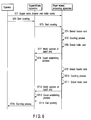
- the control section 80 of the paper money processing apparatus 1 notices the control section 205 of the superordinate apparatuses 202 of jamming (ST23).
- the control section 205 of the superordinate apparatus 202 allows the display section 204 to show, on a screen, that jam is occurring (ST24).
- the operator opens the temporary accumulating doors 41b to 46b of the paper money processing apparatus 1 (ST25).
- the control section 80 of the paper money processing apparatus 1 notices, via sensing signals from the sensors 41c to 46c, the control section 205 of the superordinate apparatuses 202 that the temporary accumulating doors 41b to 46b are open (ST26).
- the control section 205 of the superordinate apparatus 202 clears the physical count and subtracts the established note count from the physical note count. (Counts managed by the superordinate apparatus 202: physical note count of -200, non-established note count of zero, and established note count of 200)
- the operator collects the remaining notes through the temporary accumulating doors 41b to 46b of control section 80 of the paper money processing apparatus 1. The operator then re-supplies all the collected notes to the paper money introducing section 4 (ST28).
- the operator closes the temporary accumulating doors 41b to 46b of control section 80 of the paper money processing apparatus 1 (ST29).
- the control section 80 of the paper money processing apparatus 1 notices the control section 205 of the superordinate apparatuses 202 that the temporary accumulating doors 41b to 46b are closed (ST30).
- the operator instructs jamming to be eliminated, via the input section 203 of the superordinate apparatus 202 (ST31).
- the control section 205 of the superordinate apparatus 202 transmits the jam elimination instruction to the control section 80 of the paper money processing apparatus 1 (ST32).
- the control section 80 of the paper money processing apparatus 1 executes an initializing process in accordance with the jam elimination instruction (ST33).
- the operator subsequently instructs counting to be started, via the input section 203 of the superordinate apparatus 202 (ST34).
- the control section 205 of the superordinate apparatus 202 transmits the counting start instruction to the control section 80 of the paper money processing apparatus 1 (ST35).
- the determining section 82 subsequently determines the note P, and on the basis of this determination, the control section 80 controls conveyance via the paper money conveying mechanism 6 (classification control).
- control section 80 adds +1 to each of the physical note count and non-established note count in the memory 81 (ST36).
- the control section 80 determines, on the basis of this determination, that the counting for the second batch based on the resetting has been completed.
- the trailer card Cb is conveyed rightward in the figure via the gate G1 and then discharged into the reject box 32.
- control section 80 transmits the completion of the counting for the second batch based on the resetting as well as the physical note count and non-established note count, the note counts in the memory 81, to the superordinate apparatus 202 (ST38).
- a physical note count of 260, a non-established note count of 60, and an established note count of 200 are stored in the counting table 206a in the superordinate apparatus 202 as counting results.
- control section 80 determines that no batches of notes or the like have been set in the note introducing section 4, it ends the counting operation and houses all the notes accumulated in the temporary accumulation sections 41a to 46a, in the opposite paper money accumulating cassettes 41d to 46d. This results in a count confirming process of storing a physical note count of 260, a non-established note count of zero, and an established note count of 260 in the counting table 206a in the superordinate apparatus 206 as counting results (ST39).
- the control section 80 of the paper money processing apparatus 1 also transmits the end of counting to the control section 205 of the superordinate apparatus 202 (ST40).
- the control section 205 of the superordinate apparatus 202 thus shows, on the display section 204, the end of counting, of which the operator is noticed (ST41).
- the operator's jam processing can be reduced.
- the operator has only to re-supply all the notes collected from the temporary accumulation sections without considering the mixture of established and non-established notes. This eliminates sorting operations to enable a reduction in the operator's processing.
- the notes accumulated in the temporary accumulation sections 41a to 46a are re-supplied when jam occurs in any of the temporary accumulation sections 41a to 46a or when the temporary accumulating doors 41b to 46b are opened or closed.
- the above embodiment is also applicable to the case in which the notes in the temporary accumulation sections 41a to 46a and accumulation section 51 are re-supplied.
- the notes accumulated in the temporary accumulation sections 41a to 46a are re-supplied when jam occurs in any of the temporary accumulation sections 41a to 46a or when the temporary accumulating doors 41b to 46b are opened or closed.
- the present invention is not limited to this.
- the above embodiment is also applicable to the case in which the notes in the temporary accumulation sections 41a to 46a and accumulation section 51 are re-supplied when jam occurs in any of the temporary accumulation sections 41a to 46a or when the temporary accumulating doors 41b to 46b are opened or closed.
Landscapes
- Physics & Mathematics (AREA)
- General Physics & Mathematics (AREA)
- Pile Receivers (AREA)
- Separation, Sorting, Adjustment, Or Bending Of Sheets To Be Conveyed (AREA)
- Sorting Of Articles (AREA)
- Controlling Sheets Or Webs (AREA)
Abstract
Description
- The present invention relates to a sheet processing apparatus and method which collectively processes at least two sheet groups corresponding to a batch processing unit with the sheet groups separated from each other by partition cards.
- Known sheet processing apparatuses collectively process at least two sheet groups corresponding to a batch processing unit with the sheet groups separated from each other by partition cards (see, for example, Jpn. Pat. Appln. KOKAI Publication
No. 2004-224481 - Plural types of notes are mixed and all are introduced into a paper money processing apparatus (sheet processing apparatus) at a time without being arranged so that all the notes have a front facing upwards or back facing upwards or have a normal or reversed top/bottom (the patterns on all the notes lie in a normal or reversed top/bottom direction). Each of the notes is taken out and conveyed on a conveying path. The conveyed notes are accumulated in a temporary accumulation section on the basis of the type of note and whether the note has a front facing upwards or back facing upwards. Then, when all the introduced notes have been classified or the temporary accumulation section becomes full, the notes in the temporary accumulation section are accommodated in an accommodation section.
- In this case, if the sheet processing apparatus uses header cards as partition cards, it does not perform an accommodation operation every time one batch is completed taking into account a decrease in processing efficiency caused by an accommodation operation performed every time batch operation is completed. Consequently, established notes corresponding to the finished batch processing are mixed with non-established notes corresponding to batch processing in progress.
- Description will be given of conventional processing executed if jamming occurs in the paper money processing apparatus with the established and non-established notes mixed together in the temporary accumulation section.
- When an operator opens the door of the temporary accumulation section in order to clear a jam, the sheet processing apparatus prints the established and non-established notes in the accumulation section in a log.
- The operator classifies the notes in the temporary accumulation section into the established and non-established notes on the basis of the printed log. The established notes are stored, while the non-established notes are re-supplied to the paper money processing apparatus.
- In this case,
- (I) the jam processing requires much time and effort from the operator.
The operator needs to classify the notes collected from the temporary accumulation section through its opened door, into the established and non-established notes on the basis of the printed log. A cash processor has up to 17 temporary accumulation sections. This requires much time and effort from the operator. - (2) Miscounting during classification is likely to result in a count mismatch.
Since the human operator classifies the notes into the established and non-established notes, miscounting (misclassification) is likely to result in a count mismatch (Jpn. Pat. Appln. KOKAI PublicationNo. 2004-224481 No. 2002-334362 - An object of the present invention is to provide a sheet processing apparatus and method in which with established and non-established notes mixed together in a temporary accumulation section, the number of the established notes is subtracted from a count value when the door of the temporary accumulation section is opened, making it possible to simplify an operator's jam processing, that is, to reduce the time and effort required to classify sheets, the apparatus and method further making it possible to prevent a count mismatch resulting from jam processing mis-operation.
- A sheet processing apparatus of the present invention comprises receiving means for receiving a batch processing unit and each comprising an arbitrary number of sheets, the sheet groups being separated from each other by partition cards, taking-out means for sequentially taking out one of the received partition cards or one of the received sheets onto a conveying path as a process medium, first determining means for determining that the process medium taken out by the taking-out means and conveyed along the conveying path is a partition card, second determining means for determining that the process medium taken out by the taking-out means and conveyed along the conveying path is a sheet, classifying means for selectively placing the process medium in one of a plurality of temporary accumulation sections on the basis of the determination by the second determining means, counting means for counting classified sheets in the sheet groups corresponding to the batch processing unit on the basis of the determination of the partition card by the first determining means, accommodation means for, once all the process media received by the receiving means are taken out, accommodating the sheets accumulated in all the temporary accumulation sections, in a corresponding accommodation section, and when one of the temporary accumulation sections becomes full, accommodating sheets accumulated in that accumulation section in a corresponding accommodation section, first processing means for, when a conveyance error occurs on the conveying path with established and non-established notes mixed together in the temporary accumulation section, stopping the conveyance of the process medium executed by the conveying path, setting means for taking out the established and non-established sheets from the temporary accumulation section and resetting the sheets for the receiving means, and second processing means for, during the resetting by the setting means, reversing the positive or negative sign of the count of the established sheets in memory means to restart processing which starts in the receiving means.
- A sheet processing apparatus of the present invention comprises receiving means for receiving a batch processing unit and each comprising an arbitrary number of sheets, the sheet groups being separated from each other by partition cards, taking-out means for sequentially taking out one of the received partition cards or one of the received sheets onto a conveying path as a process medium, first determining means for determining that the process medium taken out by the taking-out means and conveyed along the conveying path is a partition card, second determining means for determining that the process medium taken out by the taking-out means and conveyed along the conveying path is a sheet, classifying means for selectively placing the process medium in one of a plurality of temporary accumulation sections on the basis of the determination by the second determining means, sensing means for sensing whether an open-close door provided on an apparatus main body side of each of the temporary accumulation sections is open or closed, counting means for counting classified sheets in the sheet groups corresponding to the batch processing unit on the basis of the determination of the partition card by the first determining means, accommodation means for, once all the process media received by the receiving means are taken out, accommodating the sheets accumulated in all the temporary accumulation sections, in a corresponding accommodation section, and when one of the temporary accumulation sections becomes full, accommodating sheets accumulated in that accumulation section in a corresponding accommodation section, first processing means for, when the sensing means senses that the open-close door has been opened or closed with established and non-established notes mixed together in the temporary accumulation section, stopping the conveyance of the process medium executed by the conveying path, setting means for taking out the established and non-established sheets from the temporary accumulation section and resetting the sheets for the receiving means, and second processing means for, during the resetting by the setting means, reversing the positive or negative sign of the count of the established sheets in memory means to restart processing which starts in the receiving means.
- As described above, the present invention can provide a sheet processing apparatus and method which allows jam processing to be achieved without the need to shift sheets among plural batches of sheets separated from each other by partition cards, thus making it possible to improve reliability.
- The invention can be more fully understood from the following detailed description when taken in conjunction with the accompanying drawings, in which:
- FIG. 1 is a diagram schematically showing the internal structure of a sheet processing apparatus to describe an embodiment of the present invention;
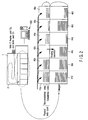
- FIG. 2 is a diagram schematically showing the internal structure of the sheet processing apparatus;
- FIG. 3 is a diagram showing an example of a counting table in which the numbers of sheets are registered;
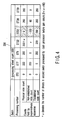
- FIG. 4 is a diagram showing an example of a counting table in which the numbers of sheets are registered;
- FIG. 5 is a block diagram schematically showing a control circuit in the sheet processing apparatus;
- FIG. 6 is a flowchart illustrating a process for collectively counting plural batches of notes P; and
- FIG. 7 is a flowchart illustrating a process executed when a conveyance error occurs during the collective counting for plural batches of notes P.
- FIG. 1 shows the general configuration of a paper money processing apparatus (sheet processing apparatus) according to an embodiment of the present invention.
- As shown in FIGS. 1 and 2, the paper money processing apparatus is composed of a paper money processing apparatus 1 and an instructing apparatus (superordinate apparatus, teller) 202 that gives instructions to the paper processing apparatus 1. The
superordinate apparatus 202 may control one or more paper money processing apparatuses. - Plural types of notes of different sizes are all introduced into the paper money processing apparatus 1 at a time. The notes are classified according to the note type and are accumulated so that all the notes have a front facing upwards or back facing upwards. The paper money processing apparatus 1 has a function for sealing every predetermined number of notes of only a particular type with a paper band.
- The
superordinate apparatus 202 has a function for instructing the paper money processing apparatus 1 to perform a certain operation, for example, indicating, to the paper money processing apparatus 1, the type of notes to be sealed and a function for displaying count data provided by the paper money processing apparatus 1. Thesuperordinate apparatus 202 is composed of a personal computer consisting of aninput section 203 for setting of the instructions, adisplay section 204, and acontrol section 205 for general control. Thesuperordinate apparatus 202 has adatabase 206 such as a magnetic disk. - The
database 206 is provided with a counting table 206a that stores the contents of counting executed by the paper money processing apparatus 1. - As shown in FIGS. 3 and 4, a physical note count, a non-established note count, and an established note count are registered in the counting table 206a.
- The type of notes to be sealed by a
sealing device 50 can be changed at any time by an operator via theinput section 203. - The paper money processing apparatus main body 1 has a
housing 2 constituting a shell of the apparatus. A stage portion located in the right of thehousing 2 in the figure is provided with an introducingsection 4 into which plural notes P accumulated in their sheet surface direction are collectively introduced so as to have a reversed top/bottom. Each of the notes P has a front and back sides and an upper and lower ends extending along its longitudinal direction. The notes P are introduced via the introducingsection 4 so that their upper or lower ends face downward. - Plural batches (corresponding to one processing unit) of notes P separated from each other by header cards Ca and trailer cards Cb are collectively introduced into the paper money processing apparatus 1. The paper money processing apparatus 1 then sequentially takes out a sheet and conveys it along a
conveying path 12. - The header card Ca is placed at the leading position of the notes in each batch. The trailer card Cb is placed at the trailing position of the notes in each batch. Identification codes are provided on the front and back surfaces of each of these cards. To be distinguished from the notes P, each of the cards has a thickness equal to two notes P.
- The introducing
section 4 has astage 4a on which plural batches of notes P separated from each other by the header cards Ca and trailer cards Cb are aligned with one another so that their upper or lower ends contact thestage 4a. A backup plate 6 is provided at the right end of the introducingsection 4 shown in the figure so as to stand upright in a vertical direction with respect to thestage 4a. The backup plate 6 can be moved leftward in the figure along thestage 4a by the urging force of a spring 8. - The header cards Ca, trailer cards Cb, and notes P introduced into the introducing
section 4 so as to have a reversed top/bottom are urged in their sheet surface direction by the backup plate and moved leftward in the figure. Then, the leftmost note P in the figure is pressed against two takeout rollers 10 (taking-out section) arranged in the left of the papermoney introducing section 4 in the figure and adjacent to each other in the vertical direction. Rotating the takeout rollers in a predetermined direction sequentially takes out one of the header cards Ca, trailer cards Cb, and notes P which is located at the leftmost position, onto the conveyingpath 12. The note P taken out onto the conveyingpath 12 moves in a latitudinal direction with its upper or lower end located at its leading position. On this occasion, the notes are not arranged so that all of them have a front facing upwards or back facing upwards. In the present embodiment, the notes P are taken out downward from the introducingsection 4. - The conveying
path 12 is defined by endless conveyingbelts path 12 so that thebelts belts plural rollers 15 extended across the width (sheet surface direction). - A
sensing section 30 is disposed beyond the conveyingpath 12 bent upward by the conveyingbelts sensing section 30 determines the header card Ca and trailer card Cb on the basis of the thickness of the header card Ca and trailer card Cb conveyed along the conveyingpath 12 as well as read bar codes. Thesensing section 30 also reads various information from the surface of the note P conveyed along the conveyingpath 12. Thesensing section 30 then logically calculates the read information and compares it with reference information to sense the above characteristics of the note P. - Plural gates G1, G2, and G3 to G8 are provided on the conveying
path 12 extended downstream of thesensing section 30 to selectively switch the conveying direction of the header card Ca, trailer card Cb, and note P on the basis of the sensing results by thesensing section 30. - The
sensing section 30 reads the thickness and bar codes to determine the header card Ca and trailer card Cb, which are then conveyed rightward in the figure via the gate G1 and discharged into areject box 32. - The following are conveyed rightward in the figure via the gate G1 and discharged into the reject box 32: notes determined to be unprocessable in the subsequent stages, such as notes determined by the
sensing section 30 to have been taken out together with another note or to have skewed at a level higher than a predetermined one, notes (not limited to paper money) such as debit or counterfeit notes which are not determined to be regular recirculatable notes. Thereject box 32 is accessible from outside the housing 1 of the paper money processing apparatus 1. - On the other hand, notes P determined by the
sensing section 30 to be normal and processable are conveyed leftward in the figure toward the gate G2 via the gate G1. The notes P having passed through the gate G1 are not arranged so that all of them have a front or back facing upwards and a normal or reversed top/bottom as described above. Upon selectively passing through a turning-overmechanism 34 described below, the notes P that are not arranged so that all of them have a front or back facing upwards and a normal or reversed top/bottom are arranged so that all of them have a front or back facing upwards. The notes are then classified according to their types and accumulated. - The conveying path located downstream of the gate G2 branches to two directions. Selectively switching the gate G2 between two positions allows the conveyance of the notes P to be selectively switched between the two directions.
- The turning-over mechanism 34 (turning-over section) is provided on one of the branches of the conveying path located downstream of the gate G2, to turn over the note P. The conveying path passing through the turning-over
mechanism 34 forms a twisted conveying path rotated around a center axis through 180° between the inlet and outlet of the turning-overmechanism 34. Two conveyingbelts path 36 that only allows the notes P to pass through. - Notes P sorted via the gate G2 and conveyed through the twisted conveying path in the turning-over
mechanism 34 are, for example, turned over. In this example, notes (FF notes) carried in the turning-overmechanism 34 with a front facing upwards and a reversed top/bottom are turned over and carried out of the turning-overmechanism 34 as BF notes having a back facing upwards and a reversed top/bottom. - Thus, all the notes P are fed into the gate G3 via a joining
section 38; the notes include those turned over by passing through the turning-overmechanism 34 and those not having passed through the turning-overmechanism 34 but through the conveyingpath 36. In this case, the length of the conveyingpath 36 is set so that the processing time required for the notes P to reach the joiningsection 38 via the turning-overmechanism 34 after passing through the gate G2 is equal to the conveying time required for the notes P to reach the joiningsection 38 after passing through the conveyingpath 36. This allows the notes P conveyed through the turning-overmechanism 34 to pass through the joiningsection 38 at the same timing as that when the notes P having passed through the conveyingpath 36 pass the joiningsection 38. This enables all the notes P to be processed under the same conditions regardless of the processing form. - The conveying path located downstream of the gate G3 branches to two directions. Selectively switching the gate G3 between two positions allows the conveyance of the notes P to be selectively switched between the two directions.
- One of the branches of the conveying path located downstream of the gate G3 and extending rightward in the figure constitutes a horizontal conveying
path 40 extending in a substantially horizontal direction above a plurality ofaccumulation sections 41a to 46a. The five gates G4 to G8 are provided on the horizontal conveyingpath 40 so that the conveyed note P is sorted and accumulated in one of the sixtemporary accumulation sections 41a to 46a. - The note P selectively sorted via the gate G4, located on the most upstream side of the horizontal conveying
path 40, is accumulated in thetemporary accumulation section 41a. The note P selectively sorted via the gate G5 is accumulated in thetemporary accumulation section 42a. The note P selectively sorted via the gate G6 is accumulated in thetemporary accumulation section 43a. The note P selectively sorted via the gate G7 is accumulated in thetemporary accumulation section 44a. The note P selectively sorted via the gate G8 is accumulated in thetemporary accumulation section 46a. - Accumulating
sections 51 of the sealing device are provided at the terminal of the other branch of the conveying path located downstream of the gate G3 and extending leftward in the figure. The sealingdevice 50 accumulates, for example, 100 notes P and winds a paper band around the notes to form a bundle of notes P. - Notes P of a particular type to which sealing with a paper band has been assigned are fed into the
accumulation sections 51 of the sealingdevice 50 according to a rule described below. On the other hand, notes P of other types are accumulated in any of the abovetemporary accumulation sections 41 to 46. - As shown in FIG. 1, the sealing
device 50 is composed of theaccumulation section 51, asupply section 53, a single sealing section (sealing mechanism) 54, aprinting mechanism 55, and aband supplying section 56. - The
accumulation sections 51 accumulate notes P fed via the gate V3 in themselves. - The sealing
section 54 is a single sealing mechanism that seals, with a paper band, 100 notes supplied by thesupply section 53 and accumulated in theaccumulation section 51. - The
supply section 53 supplies the 100 notes accumulated in theaccumulation section 51 to thesealing section 54. - The
printing mechanism 55 prints desired print data on the notes used by the sealingsection 54. - The
band supplying section 56 supplies a band used by the sealingsection 54. - Notes P are accumulated in each
accumulation section 51 according to the rule described below. - Notes P accumulated in the
accumulation section 51 via the gate G3 are fed into the sealingsection 54 by thesupply section 53 and sealed with a paper band supplied by theband supplying section 56. The sealed bundle of a predetermined number of notes P is transferred to a conveyor 58 by a transfer mechanism 57. The notes P are subsequently carried out of the apparatus via the conveyor 58. - The sealing
section 54 receives the predetermined number notes P accumulated in theaccumulation section 51. The sealingsection 54 winds a paper band around the notes P along the latitudinal direction of the notes P, at a position biased toward one side in the longitudinal direction of the notes P (in the present embodiment, the rear of the paper money processing apparatus main body 1). An end of the band is then bonded to the other end to seal the predetermined number of sheets to form a bundle. - FIG. 5 shows a block diagram of a control system that controls the operation of the above paper money processing apparatus 1.
- The paper money processing apparatus 1 is composed of a
control section 80, amemory 81, a determiningsection 82, a take-outcontrol section 83, aconveyance control section 84, agate control section 85, a jam sensing section 86, and drivingcircuits - The
control section 80 controls the general operation of the apparatus in accordance with preset operation programs. - The
memory 81 is used to store the operation programs and data such as count data including a physical note count and non-established count data. - The determining
section 82 determines the header card Ca and trailer card Cb as partition cards on the basis of sensing results provided by thesensing section 30. The determiningsection 82 further determines whether or not the note P is recirculatable and whether the note P has a front or back facing upwards and a normal or reversed top/bottom. The determiningsection 82 outputs the determinations to thecontrol section 80. - The
takeout control section 83 rotates thetakeout rollers 10 under the control of thecontrol section 80. - The
conveyance control section 84 rotates the conveying rollers, constituting the conveyingpath 12, under the control of thecontrol section 80. - The
gate control section 85 drives the gates G1 to G9 under the control of thecontrol section 80. - The jam sensing section 86 senses jamming, an error in the conveyance of conveying media conveyed by the paper money conveying mechanism, under the control of the
control section 80. - The driving
circuit 91 drives thesealing mechanism 54 under the control of thecontrol section 80. - The driving
circuit 92 drives theprinting mechanism 55 under the control of thecontrol section 80. - The
control section 80 is connected to thesuperordinate apparatus 202 via aninterface 201. - Now, description will be given of a process executed by the paper money processing apparatus 1 to sort notes.
- First, plural batches of notes P separated by the header cards Ca and trailer cards Cb are collectively introduced into the introducing
section 4. An operator instructs the apparatus to start, via an operation panel (not shown). This instruction causes thecontrol section 80 to control thecontrol section 83 to rotate thetakeout rollers 10. Rotation of thetakeout rollers 10 sequentially takes out the notes in the introducingsection 4 starting with the leftmost header card Ca. The taken-out notes P are conveyed on the conveying path 12 (the notes P are loaded onto the conveying path 12). - During conveyance along the conveying
path 12, any of the header card Ca, note P, and trailer card Cb passes by an opposite part of thesensing section 30 as a passing medium. During the passage, thesensing section 30 senses the thickness of the passing medium and reads bar codes from it to sense characteristics such as the type of the note P, the front or back facing upwards, the normal or reversed top/bottom, and contamination or damage. Thesensing section 30 thus outputs the sensing results and the read bar code contents to the determiningsection 82. - Thus, on the basis of the sensing results and read bar code contents from the
sensing section 30, the determiningsection 82 determines whether the passing medium is the header card Ca, the note P, or the trailer card Cb. The determiningsection 82 further determines whether or not the note P is recirculatable and whether the note has a front or back facing upwards and a normal or reversed top/bottom. The determiningsection 82 outputs the determinations to thecontrol section 80. - Then, on the basis of the determinations, the
control section 80 controls sorting of the passing medium. Specifically, thecontrol section 80 controllably sorts the non-recirculatable notes P, header cards Ca, and trailer cards Cb into thereject box 32, while controllably sorting the recirculatable notes P into thetemporary accumulation sections 41a to 46a andaccumulation sections 51 according to the money type. - When the re-determining operation determines that the note is not recirculatable, the gate G1 is switched so as to direct the conveying path for the note P to the
reject box 32. The note P is rejected to thereject box 32. - When the determining operation determines that the note P is not recirculatable, the conveying path for the note P is switched from the gate G1 to the direction of the gate G2. At this time, if the note P has been determined to be being conveyed with a front facing upwards, the gate G2 is switched to the direction of the conveying
path 36. If the note P has been determined to be being conveyed with a back facing upwards, the gate G2 is switched to the direction of the turning-overmechanism 34 to turn over the note. The gate G3 is then switched to the direction of the horizontal conveyingpath 40. Notes all having a front or back facing upwards (in the present embodiment, front facing upwards) and having passed through the joiningsection 38 are selectively accumulated in theaccumulation section 41 to 46 (temporary accumulation sections 41a to 46a) according to the note types. At this time, the gates G4 to G8 are switched depending on the determined types of the notes P. - If the determining
section 82 determines that the note P is of a particular type, the gate G1 is switched to the direction of the gate G3, which is further switched to the direction of theaccumulation section 51. Notes all having a front or back facing upwards (in the present embodiment, front facing upwards) and having passed through the joiningsection 38 are selectively accumulated in theaccumulation section 51. - A predetermined number of notes P accumulated in the
accumulation section 51 are fed into the sealingsection 54 by thesupply section 53 and sealed with a paper band supplied by theband supplying section 56. The sealed bundle of a predetermined number of notes P is transferred to the conveyor 58 by the transfer mechanism 57. The notes P are subsequently carried out of the apparatus via the conveyor 58. - Each of the
accumulation sections 41 to 46 is provided with a separator mechanism (not shown) serving as partitioning means for separating the current transaction from the previous ones. This enables thetemporary accumulation sections 41a to 46a and papermoney accumulating cassettes 41d to 46d to be formed between accumulating and taking-out devices (not shown). - Open-
close doors 41b to 46b are provided opposite thetemporary accumulation section 41a to 46a and closer to themain body 2. The open-close doors 41b to 46b are provided withsensors 41c to 46c that are used for both opening and closing of the door. - An open-
close door 51b is provided opposite theaccumulation section 51 and closer to themain body 2. Each open-close door 51b is provided with asensor 51c that is used for both opening and closing of the door. - With the above configuration, the operator uses the
superordinate apparatus 202, connected to the paper money processing apparatus 1, to operate the paper money processing apparatus 1. A note processed by the paper money processing apparatus 1 is conveyed to any of thetemporary accumulation sections 41a to 46a and finally accommodated in any of the papermoney accumulating cassettes 41d to 46d. - Now, the operations of normal functions of a paper money processing system will be described in brief with reference to the flowchart shown in FIG. 6 and the stored contents of a counting table 206a during each process stage shown in FIG. 3.
- When a process is started, the operator sets a counting operation mode via the
input section 203 of thesuperordinate apparatus 202. The operator sets plural batches of notes P separated from each other by the header cards Ca and trailer cards Cb, in the paper money introducing section 4 (ST1). The operator then instructs a counting operation to be started via theinput section 203 of the superordinate apparatus 202 (ST2). For example, a first batch of 200 notes P and a second batch of 60 notes P are set with the header cards Ca and trailer cards Cb interposed between the batches at appropriate positions. At this time, a count value managed by thesuperordinate apparatus 202 is stored in the counting table 206a. In this case, the counting table 206a has a physical note count of zero, an established note count of zero, and a non-established note count of zero stored in itself. - Thus, on the basis of the operation mode set by the
superordinate apparatus 202, thecontrol section 80 starts loading notes or the like from the paper money introducing section 4 (ST3). Thecontrol section 80 performs a counting operation on the basis of the determinations by the determiningsection 82 and controls conveyance via the paper money conveying mechanism 6 (classification control). - First, the determining
section 82 determines the header card Ca (ST4) and thus the leading position of the first batch. This header card Ca is conveyed rightward in the figure via the gate G1 and then discharged into thereject box 32. - The determining
section 82 subsequently determines the note P, and on the basis of this determination, thecontrol section 80 controls conveyance via the paper money conveying mechanism (classification control). - Further, on the basis of the determination, the
control section 80 adds +1 to each of the physical note count and non-established note count in the memory 81 (ST5). - The determining
section 82 then determines the trailer card Cb (ST6), and on the basis of this determination, thecontrol section 80 determines that the first batch has been completely counted. The trailer card Cb is thus conveyed rightward in the figure via the gate G1 and then discharged into thereject box 32. - Thus, the
control section 80 transmits the completion of the counting for the first batch as well as the physical note count and non-established note count, the note counts in thememory 81, to the superordinate apparatus 202 (ST7). As a result, a physical note count of 200, a non-established note count of zero, and an established note count of 200 are stored in the counting table 206a in thesuperordinate apparatus 202 as counting results for the first batch (ST8). - After determining the trailer card Cb, the determining
section 82 determines the header card Ca (ST9). On the basis of this determination, thecontrol section 80 determines the leading position of the second batch. This header card Ca is conveyed rightward in the figure via the gate G1 and then discharged into thereject box 32. - The determining
section 82 subsequently determines the note P, and on the basis of this determination, thecontrol section 80 controls conveyance via the paper money conveying mechanism 6 (classification control). - Thus, on the basis of the determination of the note, the
control section 80 adds +1 to each of the physical note count and non-established note count in the memory 81 (ST10). - The determining
section 82 then determines the trailer card Cb (ST11), and on the basis of this determination, thecontrol section 80 determines that the second batch has been completely counted. The trailer card Cb is thus conveyed rightward in the figure via the gate G1 and then discharged into thereject box 32. - Thus, the
control section 80 transmits the completion of the counting for the second batch as well as the physical note count and non-established note count, the note counts in thememory 81, to the superordinate apparatus 202 (ST12). As a result, a physical note count of 260, a non-established note count of zero, and an established note count of 60 are stored in the counting table 206a in thesuperordinate apparatus 202 as counting results for the first batch (ST13). - If the
control section 80 determines that no batches of notes or the like have been set in thenote introducing section 4, it ends the counting operation and houses all the notes accumulated in thetemporary accumulation sections 41a to 46a, in the opposite papermoney accumulating cassettes 41d to 46d. - The
control section 80 also transmits the end of counting to the superordinate apparatus 202 (ST14). Thesuperordinate apparatus 202 thus shows, on thedisplay section 204, the end of counting, of which the operator is noticed (ST15). - Now, a process that is executed when a conveyance error occurs during the collective counting for plural batches of notes P will be described with reference to the flowchart shown in FIG. 4 and the stored contents of the counting table 206a during each process stage shown in FIG. 4.
- When a process is started, the operator sets a counting operation mode via the
input section 203 of thesuperordinate apparatus 202. The operator sets plural batches of notes P separated from each other by the header cards Ca and trailer cards Cb, in the paper money introducing section 4 (ST1). The operator then instructs a counting operation to be started via theinput section 203 of the superordinate apparatus 202 (ST2). For example, a first batch of 200 notes P and a second batch of 60 notes P are set with the header cards Ca and trailer cards Cb interposed between the batches at appropriate positions. At this time, the count value managed by thesuperordinate apparatus 202 is stored in the counting table 206a. In this case, the counting table 206a has a physical note count of zero, an established note count of zero, and a non-established note count of zero stored in itself. - Thus, on the basis of the operation mode set by the
superordinate apparatus 202, thecontrol section 80 starts loading notes or the like from the paper money introducing section 4 (ST3). Thecontrol section 80 performs a counting operation on the basis of the determinations by the determiningsection 82 and controls conveyance via the paper money conveying mechanism (classification control). - First, the determining
section 82 determines the header card Ca (ST4) and thus the leading position of the first batch. This header card Ca is conveyed rightward in the figure via the gate G1 and then discharged into thereject box 32. - The determining
section 82 subsequently determines the note P, and on the basis of this determination, thecontrol section 80 controls conveyance via the paper money conveying mechanism (classification control). - Thus, on the basis of the determination, the
control section 80 adds +1 to each of the physical note count and non-established note count in the memory 81 (ST5). - The determining
section 82 then determines the trailer card Cb (ST6), and on the basis of this determination, thecontrol section 80 determines that the first batch has been completely counted. The trailer card Cb is thus conveyed rightward in the figure via the gate G1 and then discharged into thereject box 32. - Thus, the
control section 80 transmits the completion of the counting for the first batch as well as the physical note count and non-established note count, the note counts in thememory 81, to the superordinate apparatus 202 (ST7). As a result, a physical note count of 200, a non-established note count of zero, and an established note count of 200 are stored in the counting table 206a in thesuperordinate apparatus 202 as counting results for the first batch (ST8). - After determining the trailer card Cb, the determining
section 82 determines the header card Ca (ST9). On the basis of this determination, thecontrol section 80 determines the leading position of the second batch. This header card Ca is conveyed rightward in the figure via the gate G1 and then discharged into thereject box 32. - The determining
section 82 subsequently determines the note P, and on the basis of this determination, thecontrol section 80 controls conveyance via the paper money conveying mechanism 6 (classification control). - Thus, on the basis of the determination of the note, the
control section 80 adds +1 to each of the physical note count and non-established note count in the memory 81 (ST10). - Under these conditions, when the
control section 80 of the paper money processing apparatus 1 senses jamming (ST21), the paper money processing apparatus 1 itself is stopped (ST22).
(Counts managed by the superordinate apparatus 202: physical note count of 200 + α, non-established note count of α, and established note count of 200) - The
control section 80 of the paper money processing apparatus 1 notices thecontrol section 205 of thesuperordinate apparatuses 202 of jamming (ST23). - The
control section 205 of thesuperordinate apparatus 202 allows thedisplay section 204 to show, on a screen, that jam is occurring (ST24). - The operator opens the temporary accumulating
doors 41b to 46b of the paper money processing apparatus 1 (ST25). Thecontrol section 80 of the paper money processing apparatus 1 notices, via sensing signals from thesensors 41c to 46c, thecontrol section 205 of thesuperordinate apparatuses 202 that the temporary accumulatingdoors 41b to 46b are open (ST26). - The
control section 205 of thesuperordinate apparatus 202 clears the physical count and subtracts the established note count from the physical note count. (Counts managed by the superordinate apparatus 202: physical note count of -200, non-established note count of zero, and established note count of 200) - The operator collects the remaining notes through the temporary accumulating
doors 41b to 46b ofcontrol section 80 of the paper money processing apparatus 1. The operator then re-supplies all the collected notes to the paper money introducing section 4 (ST28). - The operator closes the temporary accumulating
doors 41b to 46b ofcontrol section 80 of the paper money processing apparatus 1 (ST29). - The
control section 80 of the paper money processing apparatus 1 notices thecontrol section 205 of thesuperordinate apparatuses 202 that the temporary accumulatingdoors 41b to 46b are closed (ST30). - The operator instructs jamming to be eliminated, via the
input section 203 of the superordinate apparatus 202 (ST31). - The
control section 205 of thesuperordinate apparatus 202 transmits the jam elimination instruction to thecontrol section 80 of the paper money processing apparatus 1 (ST32). - The
control section 80 of the paper money processing apparatus 1 executes an initializing process in accordance with the jam elimination instruction (ST33). - The operator subsequently instructs counting to be started, via the
input section 203 of the superordinate apparatus 202 (ST34). - The
control section 205 of thesuperordinate apparatus 202 transmits the counting start instruction to thecontrol section 80 of the paper money processing apparatus 1 (ST35). - The determining
section 82 subsequently determines the note P, and on the basis of this determination, thecontrol section 80 controls conveyance via the paper money conveying mechanism 6 (classification control). - Thus, on the basis of the determination of the note, the
control section 80 adds +1 to each of the physical note count and non-established note count in the memory 81 (ST36). - When the determining
section 82 determines the trailer card Cb (ST37), thecontrol section 80 determines, on the basis of this determination, that the counting for the second batch based on the resetting has been completed. The trailer card Cb is conveyed rightward in the figure via the gate G1 and then discharged into thereject box 32. - Thus, the
control section 80 transmits the completion of the counting for the second batch based on the resetting as well as the physical note count and non-established note count, the note counts in thememory 81, to the superordinate apparatus 202 (ST38). As a result, a physical note count of 260, a non-established note count of 60, and an established note count of 200 are stored in the counting table 206a in thesuperordinate apparatus 202 as counting results. - On this occasion, the
control section 80 determines that no batches of notes or the like have been set in thenote introducing section 4, it ends the counting operation and houses all the notes accumulated in thetemporary accumulation sections 41a to 46a, in the opposite papermoney accumulating cassettes 41d to 46d. This results in a count confirming process of storing a physical note count of 260, a non-established note count of zero, and an established note count of 260 in the counting table 206a in thesuperordinate apparatus 206 as counting results (ST39). - The
control section 80 of the paper money processing apparatus 1 also transmits the end of counting to thecontrol section 205 of the superordinate apparatus 202 (ST40). Thecontrol section 205 of thesuperordinate apparatus 202 thus shows, on thedisplay section 204, the end of counting, of which the operator is noticed (ST41). - In the above case, when jam occurs in any of the
temporary accumulation sections 41a to 46a or the temporary accumulatingdoors 41b to 46b are opened or closed, even if non-established and established notes are mixedly accumulated in thetemporary accumulation sections 41a to 46a, the operator can recount these notes without considering the mixture. This prevents much time and effort from being required from the operator. This in turn prevents a count mismatch that may result from miscounting during classification into non-established and established notes. - That is to say, the operator's jam processing can be reduced. The operator has only to re-supply all the notes collected from the temporary accumulation sections without considering the mixture of established and non-established notes. This eliminates sorting operations to enable a reduction in the operator's processing.
- Further, a count mismatch resulting from miscounting during classification can be prevented.
- In the description of the above example, the notes accumulated in the
temporary accumulation sections 41a to 46a are re-supplied when jam occurs in any of thetemporary accumulation sections 41a to 46a or when the temporary accumulatingdoors 41b to 46b are opened or closed. However, the above embodiment is also applicable to the case in which the notes in thetemporary accumulation sections 41a to 46a andaccumulation section 51 are re-supplied. - Further, in the above description, the notes accumulated in the
temporary accumulation sections 41a to 46a are re-supplied when jam occurs in any of thetemporary accumulation sections 41a to 46a or when the temporary accumulatingdoors 41b to 46b are opened or closed. However, the present invention is not limited to this. The above embodiment is also applicable to the case in which the notes in thetemporary accumulation sections 41a to 46a andaccumulation section 51 are re-supplied when jam occurs in any of thetemporary accumulation sections 41a to 46a or when the temporary accumulatingdoors 41b to 46b are opened or closed. - It is explicitly stated that all features disclosed in the description and/or the claims are intended to be disclosed separately and independently from each other for the purpose of original disclosure as well as for the purpose of restricting the claimed invention independent of the compositions of the features in the embodiments and/or the claims. It is explicitly stated that all value ranges or indications of groups of entities disclose every possible intermediate value or intermediate entity for the purpose of original disclosure as well as for the purpose of restricting the claimed invention, in particular as limits of value ranges.
Claims (10)
- A sheet processing apparatus characterized by comprising:receiving means (4) for receiving a batch processing unit and each comprising an arbitrary number of sheets (P, ...), the sheet groups (P, ...) being separated from each other by partition cards (Ca, ...);taking-out means (80, 83) for sequentially taking out one of the received partition cards (Ca, ...) or one of the received sheets onto a conveying path as a process medium;first determining means (30, 82) for determining that the process medium taken out by the taking-out means (80, 83) and conveyed along the conveying path is a partition card (Ca);second determining means (30, 82) for determining that the process medium taken out by the taking-out means (80, 83) and conveyed along the conveying path is a sheet (P);classifying means (80, G3-G8) for selectively placing the process medium in one of a plurality of temporary accumulation sections (41a to 46a) on the basis of the determination by the second determining means (30, 82);counting means (80, 81, 202, 206a) for counting classified sheets in the sheet groups (P, ...) corresponding to the batch processing unit on the basis of the determination of the partition card (Ca) by the first determining means (30, 82);accommodating means (30, 85) for, once all the process media received by the receiving means (4) are taken out, accommodating the sheets accumulated in all the temporary accumulation sections (41a to 46a), in a corresponding accommodation section (41d to 46d), and when one of the temporary accumulation sections (41a to 46a) becomes full, accommodating sheets accumulated in that accumulation section (41a to 46a) in a corresponding accommodation section (41d to 46d);first processing means (80) for, when a conveyance error occurs on the conveying path with established and non-established notes mixed together in the temporary accumulation section (41a to 46a), stopping the conveyance of the process medium executed by the conveying path;setting means (80) for taking out the established and non-established sheets from the temporary accumulation section (41a to 46a) and resetting the sheets for the receiving means (4); andsecond processing means (80) for, during the resetting by the setting means (80), reversing the positive or negative sign of the count of the established sheets in memory means (80, 81) to restart processing which starts in the receiving means (4).
- The sheet processing apparatus according to claim 1, characterized in that the partition card (Ca) is set in front of and behind the sheet groups (P, ...) corresponding to the batch processing unit.
- A sheet processing apparatus characterized by comprising:receiving means for receiving a batch processing unit and each comprising an arbitrary number of sheets, the sheet groups (P, ...) being separated from each other by partition cards (Ca, ...);taking-out means (80, 83) for sequentially taking out one of the received partition cards (Ca) or one of the received sheets onto a conveying path as a process medium;first determining means for determining that the process medium taken out by the taking-out means and conveyed along the conveying path is a partition card (Ca);second determining means for determining that the process medium taken out by the taking-out means and conveyed along the conveying path is a sheet;classifying means for selectively placing the process medium in one of a plurality of temporary accumulation sections on the basis of the determination by the second determining means;sensing means for sensing whether an open-close door provided on an apparatus main body side of each of the temporary accumulation sections to sense whether the open-close door is open or closed;counting means for counting classified sheets in the sheet groups (P, ...) corresponding to the batch processing unit on the basis of the determination of the partition card (Ca) by the first determining means;accommodation means for, once all the process media received by the receiving means are taken out, accommodating the sheets accumulated in all the temporary accumulation sections, in a corresponding accommodation section, and when one of the temporary accumulation sections becomes full, accommodating sheets accumulated in that accumulation section in a corresponding accommodation section;first processing means for, when the sensing means senses that the open-close door has been opened or closed with established and non-established notes mixed together in the temporary accumulation section, stopping the conveyance of the process medium executed by the conveying path;setting means for taking out the established and non-established sheets from the temporary accumulation section and resetting the sheets for the receiving means; andsecond processing means for, during the resetting by the setting means, reversing the positive or negative sign of the count of the established sheets in memory means to restart processing which starts in the receiving means.
- The sheet processing apparatus according to claim 3, characterized in that the partition card (Ca) is set in front of and behind the sheet groups (P, ...) corresponding to the batch processing unit.
- A sheet processing method characterized by comprising:a receiving step of receiving a batch processing unit and each comprising an arbitrary number of sheets, the sheet groups (P, ...) being separated from each other by partition cards (Ca, ...);a taking-out step of sequentially taking out one of the received partition cards (Ca, ...) or one of the received sheets onto a conveying path as a process medium;a first determining step of determining that the process medium taken out in the taking-out step and conveyed along the conveying path is a partition card (Ca);a second determining step of determining that the process medium taken out in the taking-out step and conveyed along the conveying path is a sheet;a classifying step of selectively placing the process medium in one of a plurality of temporary accumulation sections on the basis of the determination in the second determining step;a sensing step of sensing whether an open-close door provided on an apparatus main body side of each of the temporary accumulation sections is open or closed;a counting step of counting classified sheets in the sheet groups (P, ...) corresponding to the batch processing unit on the basis of the determination of the partition card (Ca) in the first determining step;an accommodation step of, once all the process media received in the receiving step are taken out, accommodating the sheets accumulated in all the temporary accumulation sections, in a corresponding accommodation section, and when one of the temporary accumulation sections becomes full, accommodating sheets accumulated in that accumulation section in a corresponding accommodation section;a first processing step of, when the sensing step senses that the open-close door has been opened or closed with established and non-established notes mixed together in the temporary accumulation section, stopping the conveyance of the process medium executed by the conveying path;a setting step of taking out the established and non-established sheets from the temporary accumulation section and resetting the sheets for the receiving step; anda second processing step of, during the resetting in the setting step, reversing the positive or negative sign of the count of the established sheets in memory means to restart processing which starts in the receiving step.
- The sheet processing method according to claim 5, characterized in that the partition card (Ca) is set in front of and behind the sheet groups (P, ...) corresponding to the batch processing unit.
- A sheet processing method characterized by comprising:a receiving step of receiving a batch processing unit and each comprising an arbitrary number of sheets, the sheet groups (P, ...) being separated from each other by partition cards (Ca, ...);a taking-out step of sequentially taking out one of the received partition cards (Ca, ...) or one of the received sheets onto a conveying path as a process medium;a first determining step of determining that the process medium taken out in the taking-out step and conveyed along the conveying path is a partition card (Ca);a second determining step of determining that the process medium taken out in the taking-out step and conveyed along the conveying path is a sheet;a classifying step of selectively placing the process medium in one of a plurality of temporary accumulation sections on the basis of the determination in the second determining step;a counting step of counting classified sheets in the sheet groups (P, ...) corresponding to the batch processing unit on the basis of the determination of the partition card (Ca) in the first determining step;an accommodation step of, once all the process media received by the receiving means are taken out, accommodating the sheets accumulated in all the temporary accumulation sections, in a corresponding accommodation section, and when one of the temporary accumulation sections becomes full, accommodating sheets accumulated in that accumulation section in a corresponding accommodation section;a first processing step of, when the sensing step senses a conveyance error on the conveying path with established and non-established notes mixed together in the temporary accumulation section, stopping the conveyance of the process medium executed by the conveying path;a setting step of taking out the established and non-established sheets from the temporary accumulation section and resetting the sheets for the receiving step; anda second processing step of, during the resetting in the setting step, reversing the positive or negative sign of the count of the established sheets in memory means to restart processing which starts in the receiving step.
- The sheet processing method according to claim 7, characterized in that the partition card (Ca) is set in front of and behind the sheet groups (P, ...) corresponding to the batch processing unit.
- A sheet processing method characterized by comprising:a receiving step of receiving a batch processing unit and each comprising an arbitrary number of sheets, the sheet groups (P, ...) being separated from each other by partition cards (Ca, ...);a taking-out step of sequentially taking out one of the received partition cards (Ca, ...) or one of the received sheets onto a conveying path as a process medium;a first determining step of determining that the process medium taken out in the taking-out step and conveyed along the conveying path is a partition card (Ca);a second determining step of determining that the process medium taken out in the taking-out step and conveyed along the conveying path is a sheet;a classifying step of selectively placing the process medium in one of a plurality of temporary accumulation sections on the basis of the determination in the second determining step;a sensing step of sensing whether an open-close door provided on an apparatus main body side of each of the temporary accumulation sections is open or closed;a counting step of counting classified sheets in the sheet groups (P, ...) corresponding to the batch processing unit on the basis of the determination of the partition card (Ca) in the first determining step;an accommodation step of, once all the process media received in the receiving step are taken out, accommodating the sheets accumulated in all the temporary accumulation sections, in a corresponding accommodation section, and when one of the temporary accumulation sections becomes full, accommodating sheets accumulated in that accumulation section in a corresponding accommodation section;a first processing step of, when the sensing step senses that the open-close door has been opened or closed with established and non-established notes mixed together in the temporary accumulation section, stopping the conveyance of the process medium executed by the conveying path;a setting step of taking out the established and non-established sheets from the temporary accumulation section and resetting the sheets for the receiving step; anda second processing step of, during the resetting in the setting step, reversing the positive or negative sign of the count of the established sheets in memory means to restart processing which starts in the receiving step.
- The sheet processing method according to claim 9, characterized in that the partition card (Ca) is set in front of and behind the sheet groups (P, ...) corresponding to the batch processing unit.
Applications Claiming Priority (1)
| Application Number | Priority Date | Filing Date | Title |
|---|---|---|---|
| JP2006268163A JP2008090425A (en) | 2006-09-29 | 2006-09-29 | Paper sheet processing apparatus and paper sheet processing method |
Publications (1)
| Publication Number | Publication Date |
|---|---|
| EP1905711A1 true EP1905711A1 (en) | 2008-04-02 |
Family
ID=38627009
Family Applications (1)
| Application Number | Title | Priority Date | Filing Date |
|---|---|---|---|
| EP07001410A Withdrawn EP1905711A1 (en) | 2006-09-29 | 2007-01-23 | Sheet processing apparatus and sheet processing method |
Country Status (4)
| Country | Link |
|---|---|
| US (1) | US20080079211A1 (en) |
| EP (1) | EP1905711A1 (en) |
| JP (1) | JP2008090425A (en) |
| CN (1) | CN101154304B (en) |
Families Citing this family (5)
| Publication number | Priority date | Publication date | Assignee | Title |
|---|---|---|---|---|
| WO2010038265A1 (en) * | 2008-09-30 | 2010-04-08 | グローリー株式会社 | Bill processing device |
| JP2012064061A (en) * | 2010-09-16 | 2012-03-29 | Toshiba Corp | Paper sheet processing device |
| JP2014178863A (en) * | 2013-03-14 | 2014-09-25 | Toshiba Corp | Paper sheet handling method and paper sheet handling system |
| JPWO2015049733A1 (en) * | 2013-10-02 | 2017-03-09 | 日立オムロンターミナルソリューションズ株式会社 | Banknote handling equipment |
| CN110555935B (en) * | 2019-10-09 | 2024-10-01 | 湖南辰泰信息科技股份有限公司 | Cash sorting and conveying equipment |
Citations (3)
| Publication number | Priority date | Publication date | Assignee | Title |
|---|---|---|---|---|
| US5247159A (en) * | 1990-11-22 | 1993-09-21 | Kabushiki Kaisha Toshiba | Bill depositing/withdrawing system of the circulation type |
| JP2001093026A (en) * | 1999-09-20 | 2001-04-06 | Toshiba Corp | Sheet processing apparatus and sheet processing method |
| EP1445660A2 (en) * | 2003-01-21 | 2004-08-11 | Kabushiki Kaisha Toshiba | Sheet processing apparatus and method |
Family Cites Families (7)
| Publication number | Priority date | Publication date | Assignee | Title |
|---|---|---|---|---|
| JPH0962892A (en) * | 1995-08-23 | 1997-03-07 | Toshiba Corp | Cash counting method, cash counting device, and cash processing device |
| CN1085869C (en) * | 1996-10-07 | 2002-05-29 | 王晓光 | Cash checking machine |
| EP1044434A1 (en) * | 1998-10-29 | 2000-10-18 | De La Rue International Limited | Method and system for recognition of currency by denomination |
| JP2002197510A (en) * | 2000-12-27 | 2002-07-12 | Toshiba Corp | Sheet processing apparatus and sheet processing method |
| JP4939695B2 (en) * | 2001-04-19 | 2012-05-30 | 株式会社東芝 | Banknote handling equipment |
| JP4332379B2 (en) * | 2003-07-29 | 2009-09-16 | 日立オムロンターミナルソリューションズ株式会社 | Banknote handling equipment |
| JP5060019B2 (en) * | 2004-09-29 | 2012-10-31 | 株式会社東芝 | Header card processing system |
-
2006
- 2006-09-29 JP JP2006268163A patent/JP2008090425A/en active Pending
-
2007
- 2007-01-23 EP EP07001410A patent/EP1905711A1/en not_active Withdrawn
- 2007-02-02 CN CN2007100063301A patent/CN101154304B/en not_active Expired - Fee Related
- 2007-02-06 US US11/702,651 patent/US20080079211A1/en not_active Abandoned
Patent Citations (3)
| Publication number | Priority date | Publication date | Assignee | Title |
|---|---|---|---|---|
| US5247159A (en) * | 1990-11-22 | 1993-09-21 | Kabushiki Kaisha Toshiba | Bill depositing/withdrawing system of the circulation type |
| JP2001093026A (en) * | 1999-09-20 | 2001-04-06 | Toshiba Corp | Sheet processing apparatus and sheet processing method |
| EP1445660A2 (en) * | 2003-01-21 | 2004-08-11 | Kabushiki Kaisha Toshiba | Sheet processing apparatus and method |
Also Published As
| Publication number | Publication date |
|---|---|
| JP2008090425A (en) | 2008-04-17 |
| CN101154304B (en) | 2010-05-26 |
| CN101154304A (en) | 2008-04-02 |
| US20080079211A1 (en) | 2008-04-03 |
Similar Documents
| Publication | Publication Date | Title |
|---|---|---|
| JP4939695B2 (en) | Banknote handling equipment | |
| JP5060019B2 (en) | Header card processing system | |
| JPS59136886A (en) | Automatic transactor | |
| US4357528A (en) | Machine and method for counting and reconciling paper money | |
| US20080079211A1 (en) | Sheet processing apparatus and sheet processing | |
| US7549589B2 (en) | Card processing system | |
| JP2010267189A (en) | Automatic transaction device and method for controlling automatic transaction device | |
| JP2009187487A (en) | Paper sheet processing apparatus and paper sheet processing method | |
| JP3500417B2 (en) | Paper transport and automatic transaction equipment | |
| JPH0329710B2 (en) | ||
| JP2763192B2 (en) | Banknote accumulation method of banknote depositing / dispensing device | |
| JP4238421B2 (en) | Banknote deposit and withdrawal device | |
| JPH04344590A (en) | Paper money depositer/dispenser | |
| JPH02259896A (en) | Automatic teller machine | |
| JP3316158B2 (en) | Automatic transaction equipment | |
| JPS6359691A (en) | Sheet paper processor | |
| JP2007140939A (en) | Paper sheet processing equipment | |
| JPS6093580A (en) | Sorting and counting system for money | |
| JPH01196690A (en) | Note processor | |
| JPS6323392Y2 (en) | ||
| JP2010072928A (en) | Paper sheet processing device and paper sheet processing method | |
| JPH0218241A (en) | Bank note processing device | |
| JPS60122637A (en) | Sheets takein and sendoff device | |
| JP2007257115A (en) | Paper sheet processing method and paper sheet processing apparatus | |
| JPS5854059B2 (en) | Paper sheet conveyance status detection device |
Legal Events
| Date | Code | Title | Description |
|---|---|---|---|
| PUAI | Public reference made under article 153(3) epc to a published international application that has entered the european phase |
Free format text: ORIGINAL CODE: 0009012 |
|
| 17P | Request for examination filed |
Effective date: 20070123 |
|
| AK | Designated contracting states |
Kind code of ref document: A1 Designated state(s): AT BE BG CH CY CZ DE DK EE ES FI FR GB GR HU IE IS IT LI LT LU LV MC NL PL PT RO SE SI SK TR |
|
| AX | Request for extension of the european patent |
Extension state: AL BA HR MK RS |
|
| AKX | Designation fees paid |
Designated state(s): AT DE FR GB IT |
|
| 17Q | First examination report despatched |
Effective date: 20101125 |
|
| STAA | Information on the status of an ep patent application or granted ep patent |
Free format text: STATUS: THE APPLICATION IS DEEMED TO BE WITHDRAWN |
|
| 18D | Application deemed to be withdrawn |
Effective date: 20130801 |