EP1903579A1 - Coaxial cable - Google Patents
Coaxial cable Download PDFInfo
- Publication number
- EP1903579A1 EP1903579A1 EP06020007A EP06020007A EP1903579A1 EP 1903579 A1 EP1903579 A1 EP 1903579A1 EP 06020007 A EP06020007 A EP 06020007A EP 06020007 A EP06020007 A EP 06020007A EP 1903579 A1 EP1903579 A1 EP 1903579A1
- Authority
- EP
- European Patent Office
- Prior art keywords
- cable
- polypropylene
- shi
- layer
- strain
- Prior art date
- Legal status (The legal status is an assumption and is not a legal conclusion. Google has not performed a legal analysis and makes no representation as to the accuracy of the status listed.)
- Granted
Links
- -1 polypropylene Polymers 0.000 claims abstract description 242
- 229920001155 polypropylene Polymers 0.000 claims abstract description 218
- 239000004743 Polypropylene Substances 0.000 claims abstract description 214
- 239000004020 conductor Substances 0.000 claims abstract description 28
- 238000005482 strain hardening Methods 0.000 claims description 108
- 238000000034 method Methods 0.000 claims description 103
- 238000002844 melting Methods 0.000 claims description 54
- 230000008018 melting Effects 0.000 claims description 49
- 239000003054 catalyst Substances 0.000 claims description 44
- 230000008569 process Effects 0.000 claims description 39
- 239000000155 melt Substances 0.000 claims description 32
- 238000009826 distribution Methods 0.000 claims description 26
- 239000011982 enantioselective catalyst Substances 0.000 claims description 24
- ZOXJGFHDIHLPTG-UHFFFAOYSA-N Boron Chemical group [B] ZOXJGFHDIHLPTG-UHFFFAOYSA-N 0.000 claims description 22
- 238000005204 segregation Methods 0.000 claims description 22
- 229920001577 copolymer Polymers 0.000 claims description 19
- VGGSQFUCUMXWEO-UHFFFAOYSA-N Ethene Chemical compound C=C VGGSQFUCUMXWEO-UHFFFAOYSA-N 0.000 claims description 18
- 229920000181 Ethylene propylene rubber Polymers 0.000 claims description 18
- QQONPFPTGQHPMA-UHFFFAOYSA-N propylene Natural products CC=C QQONPFPTGQHPMA-UHFFFAOYSA-N 0.000 claims description 15
- 239000005977 Ethylene Substances 0.000 claims description 13
- 239000011159 matrix material Substances 0.000 claims description 10
- 239000012968 metallocene catalyst Substances 0.000 claims description 9
- 238000002360 preparation method Methods 0.000 claims description 8
- XUIMIQQOPSSXEZ-UHFFFAOYSA-N Silicon Chemical group [Si] XUIMIQQOPSSXEZ-UHFFFAOYSA-N 0.000 claims description 6
- 238000005481 NMR spectroscopy Methods 0.000 claims description 5
- AZDRQVAHHNSJOQ-UHFFFAOYSA-N alumane Chemical group [AlH3] AZDRQVAHHNSJOQ-UHFFFAOYSA-N 0.000 claims description 4
- 238000005187 foaming Methods 0.000 claims description 3
- 239000006078 metal deactivator Substances 0.000 claims description 3
- 229920001384 propylene homopolymer Polymers 0.000 claims description 3
- VPGLGRNSAYHXPY-UHFFFAOYSA-L zirconium(2+);dichloride Chemical compound Cl[Zr]Cl VPGLGRNSAYHXPY-UHFFFAOYSA-L 0.000 claims 2
- 239000010410 layer Substances 0.000 description 143
- 229920000642 polymer Polymers 0.000 description 100
- YBYIRNPNPLQARY-UHFFFAOYSA-N 1H-indene Natural products C1=CC=C2CC=CC2=C1 YBYIRNPNPLQARY-UHFFFAOYSA-N 0.000 description 33
- 125000003454 indenyl group Chemical group C1(C=CC2=CC=CC=C12)* 0.000 description 33
- 239000000463 material Substances 0.000 description 31
- 125000001424 substituent group Chemical group 0.000 description 21
- 239000003446 ligand Substances 0.000 description 19
- 239000004698 Polyethylene Substances 0.000 description 16
- 238000005259 measurement Methods 0.000 description 16
- 229920000573 polyethylene Polymers 0.000 description 16
- 239000006260 foam Substances 0.000 description 14
- 238000001125 extrusion Methods 0.000 description 12
- 239000002245 particle Substances 0.000 description 12
- 239000000839 emulsion Substances 0.000 description 10
- 238000009413 insulation Methods 0.000 description 10
- 238000004519 manufacturing process Methods 0.000 description 10
- 239000000203 mixture Substances 0.000 description 10
- 239000007787 solid Substances 0.000 description 10
- 239000002904 solvent Substances 0.000 description 10
- 238000000113 differential scanning calorimetry Methods 0.000 description 9
- 239000007789 gas Substances 0.000 description 9
- 125000004169 (C1-C6) alkyl group Chemical group 0.000 description 8
- 229910052782 aluminium Inorganic materials 0.000 description 8
- 238000004458 analytical method Methods 0.000 description 8
- 230000002902 bimodal effect Effects 0.000 description 8
- 229910052796 boron Inorganic materials 0.000 description 8
- 238000012512 characterization method Methods 0.000 description 8
- 238000002425 crystallisation Methods 0.000 description 8
- NNBZCPXTIHJBJL-UHFFFAOYSA-N decalin Chemical compound C1CCCC2CCCCC21 NNBZCPXTIHJBJL-UHFFFAOYSA-N 0.000 description 8
- 125000003983 fluorenyl group Chemical group C1(=CC=CC=2C3=CC=CC=C3CC12)* 0.000 description 8
- 229910052739 hydrogen Inorganic materials 0.000 description 8
- 229910052710 silicon Inorganic materials 0.000 description 8
- 239000000243 solution Substances 0.000 description 8
- 238000006243 chemical reaction Methods 0.000 description 7
- 150000001875 compounds Chemical class 0.000 description 7
- 230000008025 crystallization Effects 0.000 description 7
- 230000001419 dependent effect Effects 0.000 description 7
- 125000002496 methyl group Chemical group [H]C([H])([H])* 0.000 description 7
- 229920005606 polypropylene copolymer Polymers 0.000 description 7
- 229920005629 polypropylene homopolymer Polymers 0.000 description 7
- 239000000126 substance Substances 0.000 description 7
- 238000012360 testing method Methods 0.000 description 7
- VXNZUUAINFGPBY-UHFFFAOYSA-N 1-Butene Chemical compound CCC=C VXNZUUAINFGPBY-UHFFFAOYSA-N 0.000 description 6
- 239000012190 activator Substances 0.000 description 6
- 238000006116 polymerization reaction Methods 0.000 description 6
- 229910052727 yttrium Inorganic materials 0.000 description 6
- CTQNGGLPUBDAKN-UHFFFAOYSA-N O-Xylene Chemical compound CC1=CC=CC=C1C CTQNGGLPUBDAKN-UHFFFAOYSA-N 0.000 description 5
- 125000000217 alkyl group Chemical group 0.000 description 5
- 239000000460 chlorine Substances 0.000 description 5
- 230000007423 decrease Effects 0.000 description 5
- 230000000694 effects Effects 0.000 description 5
- 239000003995 emulsifying agent Substances 0.000 description 5
- 125000001495 ethyl group Chemical group [H]C([H])([H])C([H])([H])* 0.000 description 5
- 229920001903 high density polyethylene Polymers 0.000 description 5
- 239000004700 high-density polyethylene Substances 0.000 description 5
- 239000001257 hydrogen Substances 0.000 description 5
- 229920001684 low density polyethylene Polymers 0.000 description 5
- 239000004702 low-density polyethylene Substances 0.000 description 5
- 239000013110 organic ligand Substances 0.000 description 5
- 125000001997 phenyl group Chemical group [H]C1=C([H])C([H])=C(*)C([H])=C1[H] 0.000 description 5
- 230000001052 transient effect Effects 0.000 description 5
- 239000008096 xylene Substances 0.000 description 5
- UFHFLCQGNIYNRP-UHFFFAOYSA-N Hydrogen Chemical compound [H][H] UFHFLCQGNIYNRP-UHFFFAOYSA-N 0.000 description 4
- VYPSYNLAJGMNEJ-UHFFFAOYSA-N Silicium dioxide Chemical compound O=[Si]=O VYPSYNLAJGMNEJ-UHFFFAOYSA-N 0.000 description 4
- 239000004411 aluminium Substances 0.000 description 4
- XAGFODPZIPBFFR-UHFFFAOYSA-N aluminium Chemical compound [Al] XAGFODPZIPBFFR-UHFFFAOYSA-N 0.000 description 4
- 230000008901 benefit Effects 0.000 description 4
- 229910052799 carbon Inorganic materials 0.000 description 4
- 230000008859 change Effects 0.000 description 4
- 238000002474 experimental method Methods 0.000 description 4
- 239000010408 film Substances 0.000 description 4
- 238000010438 heat treatment Methods 0.000 description 4
- 229930195733 hydrocarbon Natural products 0.000 description 4
- 150000002430 hydrocarbons Chemical class 0.000 description 4
- 239000012535 impurity Substances 0.000 description 4
- 229920000092 linear low density polyethylene Polymers 0.000 description 4
- 239000004707 linear low-density polyethylene Substances 0.000 description 4
- 238000000518 rheometry Methods 0.000 description 4
- 238000001542 size-exclusion chromatography Methods 0.000 description 4
- 238000007711 solidification Methods 0.000 description 4
- 230000008023 solidification Effects 0.000 description 4
- PXXNTAGJWPJAGM-UHFFFAOYSA-N vertaline Natural products C1C2C=3C=C(OC)C(OC)=CC=3OC(C=C3)=CC=C3CCC(=O)OC1CC1N2CCCC1 PXXNTAGJWPJAGM-UHFFFAOYSA-N 0.000 description 4
- 125000003837 (C1-C20) alkyl group Chemical group 0.000 description 3
- PBKONEOXTCPAFI-UHFFFAOYSA-N 1,2,4-trichlorobenzene Chemical compound ClC1=CC=C(Cl)C(Cl)=C1 PBKONEOXTCPAFI-UHFFFAOYSA-N 0.000 description 3
- 238000005033 Fourier transform infrared spectroscopy Methods 0.000 description 3
- IMNFDUFMRHMDMM-UHFFFAOYSA-N N-Heptane Chemical compound CCCCCCC IMNFDUFMRHMDMM-UHFFFAOYSA-N 0.000 description 3
- 239000000654 additive Substances 0.000 description 3
- 230000009286 beneficial effect Effects 0.000 description 3
- 230000015572 biosynthetic process Effects 0.000 description 3
- 239000011248 coating agent Substances 0.000 description 3
- 238000000576 coating method Methods 0.000 description 3
- 238000004891 communication Methods 0.000 description 3
- 239000010949 copper Substances 0.000 description 3
- 238000004132 cross linking Methods 0.000 description 3
- 238000012685 gas phase polymerization Methods 0.000 description 3
- 229910052736 halogen Inorganic materials 0.000 description 3
- 150000002367 halogens Chemical class 0.000 description 3
- 229920001519 homopolymer Polymers 0.000 description 3
- CPOFMOWDMVWCLF-UHFFFAOYSA-N methyl(oxo)alumane Chemical compound C[Al]=O CPOFMOWDMVWCLF-UHFFFAOYSA-N 0.000 description 3
- 239000003960 organic solvent Substances 0.000 description 3
- 238000010094 polymer processing Methods 0.000 description 3
- 125000004805 propylene group Chemical group [H]C([H])([H])C([H])([*:1])C([H])([H])[*:2] 0.000 description 3
- 239000004094 surface-active agent Substances 0.000 description 3
- 230000008719 thickening Effects 0.000 description 3
- 239000011345 viscous material Substances 0.000 description 3
- 125000000008 (C1-C10) alkyl group Chemical group 0.000 description 2
- 125000006736 (C6-C20) aryl group Chemical group 0.000 description 2
- RELMFMZEBKVZJC-UHFFFAOYSA-N 1,2,3-trichlorobenzene Chemical compound ClC1=CC=CC(Cl)=C1Cl RELMFMZEBKVZJC-UHFFFAOYSA-N 0.000 description 2
- 238000001644 13C nuclear magnetic resonance spectroscopy Methods 0.000 description 2
- HCILJBJJZALOAL-UHFFFAOYSA-N 3-(3,5-ditert-butyl-4-hydroxyphenyl)-n'-[3-(3,5-ditert-butyl-4-hydroxyphenyl)propanoyl]propanehydrazide Chemical compound CC(C)(C)C1=C(O)C(C(C)(C)C)=CC(CCC(=O)NNC(=O)CCC=2C=C(C(O)=C(C=2)C(C)(C)C)C(C)(C)C)=C1 HCILJBJJZALOAL-UHFFFAOYSA-N 0.000 description 2
- IJGRMHOSHXDMSA-UHFFFAOYSA-N Atomic nitrogen Chemical compound N#N IJGRMHOSHXDMSA-UHFFFAOYSA-N 0.000 description 2
- KAKZBPTYRLMSJV-UHFFFAOYSA-N Butadiene Chemical compound C=CC=C KAKZBPTYRLMSJV-UHFFFAOYSA-N 0.000 description 2
- 125000003358 C2-C20 alkenyl group Chemical group 0.000 description 2
- 239000004215 Carbon black (E152) Substances 0.000 description 2
- RYGMFSIKBFXOCR-UHFFFAOYSA-N Copper Chemical compound [Cu] RYGMFSIKBFXOCR-UHFFFAOYSA-N 0.000 description 2
- 241000446313 Lamella Species 0.000 description 2
- QCWXUUIWCKQGHC-UHFFFAOYSA-N Zirconium Chemical compound [Zr] QCWXUUIWCKQGHC-UHFFFAOYSA-N 0.000 description 2
- 125000000129 anionic group Chemical group 0.000 description 2
- 238000012662 bulk polymerization Methods 0.000 description 2
- IAQRGUVFOMOMEM-UHFFFAOYSA-N butene Natural products CC=CC IAQRGUVFOMOMEM-UHFFFAOYSA-N 0.000 description 2
- 238000004364 calculation method Methods 0.000 description 2
- 238000011088 calibration curve Methods 0.000 description 2
- 230000003197 catalytic effect Effects 0.000 description 2
- 229910052801 chlorine Inorganic materials 0.000 description 2
- 230000000052 comparative effect Effects 0.000 description 2
- 230000006835 compression Effects 0.000 description 2
- 238000007906 compression Methods 0.000 description 2
- 238000001816 cooling Methods 0.000 description 2
- 229910052802 copper Inorganic materials 0.000 description 2
- 239000013078 crystal Substances 0.000 description 2
- 230000003247 decreasing effect Effects 0.000 description 2
- 238000001514 detection method Methods 0.000 description 2
- 239000003989 dielectric material Substances 0.000 description 2
- 238000005516 engineering process Methods 0.000 description 2
- 125000000524 functional group Chemical group 0.000 description 2
- 229910052732 germanium Inorganic materials 0.000 description 2
- 150000008282 halocarbons Chemical class 0.000 description 2
- 125000001072 heteroaryl group Chemical group 0.000 description 2
- 125000005842 heteroatom Chemical group 0.000 description 2
- 125000001183 hydrocarbyl group Chemical group 0.000 description 2
- 238000009616 inductively coupled plasma Methods 0.000 description 2
- 125000001449 isopropyl group Chemical group [H]C([H])([H])C([H])(*)C([H])([H])[H] 0.000 description 2
- 125000001624 naphthyl group Chemical group 0.000 description 2
- 239000002243 precursor Substances 0.000 description 2
- 238000012545 processing Methods 0.000 description 2
- 239000000377 silicon dioxide Substances 0.000 description 2
- 239000011343 solid material Substances 0.000 description 2
- 241000894007 species Species 0.000 description 2
- 238000004611 spectroscopical analysis Methods 0.000 description 2
- 229910052723 transition metal Inorganic materials 0.000 description 2
- 150000003624 transition metals Chemical class 0.000 description 2
- 125000000026 trimethylsilyl group Chemical group [H]C([H])([H])[Si]([*])(C([H])([H])[H])C([H])([H])[H] 0.000 description 2
- XLYOFNOQVPJJNP-UHFFFAOYSA-N water Substances O XLYOFNOQVPJJNP-UHFFFAOYSA-N 0.000 description 2
- 239000003643 water by type Substances 0.000 description 2
- WGACMNAUEGCUHG-VYBOCCTBSA-N (2s)-2-[[(2s)-2-[[(2s)-2-acetamidopropanoyl]amino]propanoyl]amino]-n-[(2s)-6-amino-1-[[(2s)-1-[(2s)-2-[[(2s)-1-[[(2s)-5-amino-1-[[(2s)-1-[[(2s)-1-[[(2s)-6-amino-1-[[(2s)-1-amino-3-(4-hydroxyphenyl)-1-oxopropan-2-yl]amino]-1-oxohexan-2-yl]amino]-3-hydroxy- Chemical compound CC(=O)N[C@@H](C)C(=O)N[C@@H](C)C(=O)N[C@@H](CCC(N)=O)C(=O)N[C@@H](CCCCN)C(=O)N[C@@H](CCCN=C(N)N)C(=O)N1CCC[C@H]1C(=O)N[C@@H](CO)C(=O)N[C@@H](CCC(N)=O)C(=O)N[C@@H](CCCN=C(N)N)C(=O)N[C@@H](CO)C(=O)N[C@@H](CCCCN)C(=O)N[C@H](C(N)=O)CC1=CC=C(O)C=C1 WGACMNAUEGCUHG-VYBOCCTBSA-N 0.000 description 1
- 125000006738 (C6-C20) heteroaryl group Chemical group 0.000 description 1
- QIROQPWSJUXOJC-UHFFFAOYSA-N 1,1,2,2,3,3,4,4,5,5,6-undecafluoro-6-(trifluoromethyl)cyclohexane Chemical compound FC(F)(F)C1(F)C(F)(F)C(F)(F)C(F)(F)C(F)(F)C1(F)F QIROQPWSJUXOJC-UHFFFAOYSA-N 0.000 description 1
- ZAMOUSCENKQFHK-UHFFFAOYSA-N Chlorine atom Chemical compound [Cl] ZAMOUSCENKQFHK-UHFFFAOYSA-N 0.000 description 1
- LFQSCWFLJHTTHZ-UHFFFAOYSA-N Ethanol Chemical compound CCO LFQSCWFLJHTTHZ-UHFFFAOYSA-N 0.000 description 1
- 102000020897 Formins Human genes 0.000 description 1
- 108091022623 Formins Proteins 0.000 description 1
- 238000004566 IR spectroscopy Methods 0.000 description 1
- 239000004594 Masterbatch (MB) Substances 0.000 description 1
- 229910007928 ZrCl2 Inorganic materials 0.000 description 1
- 238000010521 absorption reaction Methods 0.000 description 1
- 230000002378 acidificating effect Effects 0.000 description 1
- 230000002411 adverse Effects 0.000 description 1
- 150000001335 aliphatic alkanes Chemical class 0.000 description 1
- 150000001336 alkenes Chemical class 0.000 description 1
- 150000004945 aromatic hydrocarbons Chemical class 0.000 description 1
- 125000003710 aryl alkyl group Chemical group 0.000 description 1
- 125000003118 aryl group Chemical group 0.000 description 1
- 239000012298 atmosphere Substances 0.000 description 1
- 125000004429 atom Chemical group 0.000 description 1
- 230000004888 barrier function Effects 0.000 description 1
- UHOVQNZJYSORNB-MZWXYZOWSA-N benzene-d6 Chemical compound [2H]C1=C([2H])C([2H])=C([2H])C([2H])=C1[2H] UHOVQNZJYSORNB-MZWXYZOWSA-N 0.000 description 1
- 238000009835 boiling Methods 0.000 description 1
- 239000006229 carbon black Substances 0.000 description 1
- 238000001460 carbon-13 nuclear magnetic resonance spectrum Methods 0.000 description 1
- 150000001768 cations Chemical class 0.000 description 1
- 239000003795 chemical substances by application Substances 0.000 description 1
- 125000001309 chloro group Chemical group Cl* 0.000 description 1
- 239000011247 coating layer Substances 0.000 description 1
- 238000000748 compression moulding Methods 0.000 description 1
- 238000011109 contamination Methods 0.000 description 1
- 238000010924 continuous production Methods 0.000 description 1
- 125000004122 cyclic group Chemical group 0.000 description 1
- 150000001924 cycloalkanes Chemical class 0.000 description 1
- 230000001627 detrimental effect Effects 0.000 description 1
- 238000010790 dilution Methods 0.000 description 1
- 239000012895 dilution Substances 0.000 description 1
- 238000004090 dissolution Methods 0.000 description 1
- PWWSSIYVTQUJQQ-UHFFFAOYSA-N distearyl thiodipropionate Chemical compound CCCCCCCCCCCCCCCCCCOC(=O)CCSCCC(=O)OCCCCCCCCCCCCCCCCCC PWWSSIYVTQUJQQ-UHFFFAOYSA-N 0.000 description 1
- 238000011156 evaluation Methods 0.000 description 1
- 229920006379 extruded polypropylene Polymers 0.000 description 1
- 238000007765 extrusion coating Methods 0.000 description 1
- 230000002349 favourable effect Effects 0.000 description 1
- 239000011888 foil Substances 0.000 description 1
- 229910052735 hafnium Inorganic materials 0.000 description 1
- 238000007731 hot pressing Methods 0.000 description 1
- 150000002431 hydrogen Chemical class 0.000 description 1
- 230000006872 improvement Effects 0.000 description 1
- 238000011065 in-situ storage Methods 0.000 description 1
- 239000012442 inert solvent Substances 0.000 description 1
- 238000002347 injection Methods 0.000 description 1
- 239000007924 injection Substances 0.000 description 1
- 229910052751 metal Inorganic materials 0.000 description 1
- 239000002184 metal Substances 0.000 description 1
- UNSDWONDAUAWPV-UHFFFAOYSA-N methylaluminum;oxane Chemical compound [Al]C.C1CCOCC1 UNSDWONDAUAWPV-UHFFFAOYSA-N 0.000 description 1
- 238000000465 moulding Methods 0.000 description 1
- 238000003541 multi-stage reaction Methods 0.000 description 1
- 108010074544 myelin peptide amide-12 Proteins 0.000 description 1
- 229910052757 nitrogen Inorganic materials 0.000 description 1
- 239000012299 nitrogen atmosphere Substances 0.000 description 1
- 239000008188 pellet Substances 0.000 description 1
- 229960004624 perflexane Drugs 0.000 description 1
- LGUZHRODIJCVOC-UHFFFAOYSA-N perfluoroheptane Chemical compound FC(F)(F)C(F)(F)C(F)(F)C(F)(F)C(F)(F)C(F)(F)C(F)(F)F LGUZHRODIJCVOC-UHFFFAOYSA-N 0.000 description 1
- ZJIJAJXFLBMLCK-UHFFFAOYSA-N perfluorohexane Chemical compound FC(F)(F)C(F)(F)C(F)(F)C(F)(F)C(F)(F)C(F)(F)F ZJIJAJXFLBMLCK-UHFFFAOYSA-N 0.000 description 1
- YVBBRRALBYAZBM-UHFFFAOYSA-N perfluorooctane Chemical compound FC(F)(F)C(F)(F)C(F)(F)C(F)(F)C(F)(F)C(F)(F)C(F)(F)C(F)(F)F YVBBRRALBYAZBM-UHFFFAOYSA-N 0.000 description 1
- 150000002978 peroxides Chemical class 0.000 description 1
- 230000037048 polymerization activity Effects 0.000 description 1
- 239000000843 powder Substances 0.000 description 1
- 230000005855 radiation Effects 0.000 description 1
- 239000011541 reaction mixture Substances 0.000 description 1
- 238000004064 recycling Methods 0.000 description 1
- 238000012552 review Methods 0.000 description 1
- 150000004756 silanes Chemical class 0.000 description 1
- 239000010703 silicon Substances 0.000 description 1
- 239000011949 solid catalyst Substances 0.000 description 1
- 230000006641 stabilisation Effects 0.000 description 1
- 238000011105 stabilization Methods 0.000 description 1
- 239000000758 substrate Substances 0.000 description 1
- 230000003746 surface roughness Effects 0.000 description 1
- 239000010409 thin film Substances 0.000 description 1
- 229910052719 titanium Inorganic materials 0.000 description 1
- 150000003623 transition metal compounds Chemical class 0.000 description 1
- 238000011179 visual inspection Methods 0.000 description 1
- 238000005406 washing Methods 0.000 description 1
- 238000004876 x-ray fluorescence Methods 0.000 description 1
- 229910052726 zirconium Inorganic materials 0.000 description 1
- 239000004711 α-olefin Substances 0.000 description 1
Images




Classifications
-
- H—ELECTRICITY
- H01—ELECTRIC ELEMENTS
- H01B—CABLES; CONDUCTORS; INSULATORS; SELECTION OF MATERIALS FOR THEIR CONDUCTIVE, INSULATING OR DIELECTRIC PROPERTIES
- H01B3/00—Insulators or insulating bodies characterised by the insulating materials; Selection of materials for their insulating or dielectric properties
- H01B3/18—Insulators or insulating bodies characterised by the insulating materials; Selection of materials for their insulating or dielectric properties mainly consisting of organic substances
- H01B3/30—Insulators or insulating bodies characterised by the insulating materials; Selection of materials for their insulating or dielectric properties mainly consisting of organic substances plastics; resins; waxes
- H01B3/44—Insulators or insulating bodies characterised by the insulating materials; Selection of materials for their insulating or dielectric properties mainly consisting of organic substances plastics; resins; waxes vinyl resins; acrylic resins
- H01B3/441—Insulators or insulating bodies characterised by the insulating materials; Selection of materials for their insulating or dielectric properties mainly consisting of organic substances plastics; resins; waxes vinyl resins; acrylic resins from alkenes
-
- H—ELECTRICITY
- H01—ELECTRIC ELEMENTS
- H01B—CABLES; CONDUCTORS; INSULATORS; SELECTION OF MATERIALS FOR THEIR CONDUCTIVE, INSULATING OR DIELECTRIC PROPERTIES
- H01B11/00—Communication cables or conductors
- H01B11/18—Coaxial cables; Analogous cables having more than one inner conductor within a common outer conductor
- H01B11/1834—Construction of the insulation between the conductors
-
- Y—GENERAL TAGGING OF NEW TECHNOLOGICAL DEVELOPMENTS; GENERAL TAGGING OF CROSS-SECTIONAL TECHNOLOGIES SPANNING OVER SEVERAL SECTIONS OF THE IPC; TECHNICAL SUBJECTS COVERED BY FORMER USPC CROSS-REFERENCE ART COLLECTIONS [XRACs] AND DIGESTS
- Y10—TECHNICAL SUBJECTS COVERED BY FORMER USPC
- Y10T—TECHNICAL SUBJECTS COVERED BY FORMER US CLASSIFICATION
- Y10T428/00—Stock material or miscellaneous articles
- Y10T428/13—Hollow or container type article [e.g., tube, vase, etc.]
- Y10T428/1352—Polymer or resin containing [i.e., natural or synthetic]
-
- Y—GENERAL TAGGING OF NEW TECHNOLOGICAL DEVELOPMENTS; GENERAL TAGGING OF CROSS-SECTIONAL TECHNOLOGIES SPANNING OVER SEVERAL SECTIONS OF THE IPC; TECHNICAL SUBJECTS COVERED BY FORMER USPC CROSS-REFERENCE ART COLLECTIONS [XRACs] AND DIGESTS
- Y10—TECHNICAL SUBJECTS COVERED BY FORMER USPC
- Y10T—TECHNICAL SUBJECTS COVERED BY FORMER US CLASSIFICATION
- Y10T428/00—Stock material or miscellaneous articles
- Y10T428/13—Hollow or container type article [e.g., tube, vase, etc.]
- Y10T428/1352—Polymer or resin containing [i.e., natural or synthetic]
- Y10T428/1355—Elemental metal containing [e.g., substrate, foil, film, coating, etc.]
-
- Y—GENERAL TAGGING OF NEW TECHNOLOGICAL DEVELOPMENTS; GENERAL TAGGING OF CROSS-SECTIONAL TECHNOLOGIES SPANNING OVER SEVERAL SECTIONS OF THE IPC; TECHNICAL SUBJECTS COVERED BY FORMER USPC CROSS-REFERENCE ART COLLECTIONS [XRACs] AND DIGESTS
- Y10—TECHNICAL SUBJECTS COVERED BY FORMER USPC
- Y10T—TECHNICAL SUBJECTS COVERED BY FORMER US CLASSIFICATION
- Y10T428/00—Stock material or miscellaneous articles
- Y10T428/13—Hollow or container type article [e.g., tube, vase, etc.]
- Y10T428/1352—Polymer or resin containing [i.e., natural or synthetic]
- Y10T428/139—Open-ended, self-supporting conduit, cylinder, or tube-type article
Definitions
- the present invention relates to a cable comprising a cable layer on polypropylene basis with low dielectric loss. Furthermore, the invention is related to a process for the manufacture of such a cable.
- the communication cables must guarantee a good operating mode. This means that the dielectric loss at certain frequencies needs to be below a certain threshold limit, i.e. be as low as possible. This will enable the cable manufacturer to control the overall losses taking place in the cable. Typically, these losses increase with an increasing frequency. The loss rests upon two main causes: 1. conductor loss and 2. dielectric loss (material). The latter is directly dependent on the frequency whilst the conductor loss is dependent of the square root of the frequency. Thus the higher the frequency of operation, the more important the dielectric losses become. This is typically the case for higher category data cables and radio frequency cables.
- polyethylene is used as the material of choice for the insulation of these cables due to the ease of processing and the beneficial electrical properties.
- the insulation is typically foamed in order to obtain even more beneficial dielectric properties and to ensure dimensional stability.
- crosslink polyethylene either by peroxides or silanes.
- Polypropylene is in principle considered as such a potential candidate in the field of the communication application area.
- Polypropylene has the following advantages over polyethylene under particular circumstances:
- any replacement material i.e. any polypropylene which is suitable to replace polyethylene in this technical field of communication cables, must still have good mechanical and thermal properties enabling failure-free long-run operation of the cable.
- any improvement in processability should not be achieved on the expense of mechanical properties and any improved balance of processability and mechanical properties should still result in a material of low dielectric loss.
- EP 0 893 802 A1 discloses cable coating layers comprising a mixture of a crystalline propylene homopolymer or copolymer and a copolymer of ethylene with at least one alpha-olefin.
- a metallocene catalyst can be used for the preparation of both polymeric components.
- the polymers have acceptable thermal stability. However the dielectric loss of the cable is rather high and additionally the polymers are not suitable to be foamed.
- DD 203 915 describes a foam from a composition containing LDPE which shows a low dielectric loss ( ⁇ 2x10 -4 ). However, these products lack temperature resistance and stiffness.
- JP 2006 022 276 describes a foam from HDPE which shows a dielectric loss tangent value (tan ⁇ ) less than 1.3 x10 -4 at 2.45GHz.
- tan ⁇ dielectric loss tangent value
- JP 2001 354 814 describes a polypropylene multiphase composition with one component with a dielectric loss of at least tan ⁇ > 3x10 -3 . Moreover the materials as disclosed therein cannot be foamed.
- EP 1 429 346 A1 describes a polypropylene composition containing a clean polypropylene and a strain hardening polypropylene.
- clean polypropylene materials are difficult to make and more importantly, they cannot be foamed unless blended with high melt strength polypropylene (HMS-PP). If blended, the dielectric loss deteriorates dramatically.
- HMS-PP high melt strength polypropylene
- a cable of having a low power loss being recyclable and having a high stiffness and a high temperature resistance.
- such cables comprise a dielectric cable layer that can be foamed to further reduce the power loss.
- the present invention is based on the finding that a low power loss in combination with good processability and mechanical properties can be accomplished with a cable comprising at least one cable layer, wherein said layer comprises a polypropylene with a specific degree of branching of the polymeric backbone.
- the polypropylene of the present invention shows a specific degree of multi-chain branching, i.e. not only the polypropylene backbone is furnished with a larger number of side chains (branched polypropylene) but also some of the side chains themselves are provided with further side chains.
- branching degree to some extent affects the crystalline structure of the polypropylene, in particular the lamellae thickness distribution, an alternative definition of the polymer of the present invention can be made via its crystallization behaviour.
- a cable comprising a conductor and a cable layer, wherein
- said cable layer is a dielectric layer.
- said cable layer is free of polyethylene, even more preferred the cable layer comprises a polypropylene as defined above and further defined below as the only polymer component.
- the melt of the cable layer in the extrusion process has a high stability, i.e. the extrusion line can be operated at high line speeds (see Table 8).
- the inventive cable, in particular its cable layer is characterized by a rather high stiffness and a low dielectric loss, i.e. by low attenuation "a" (see Table 7).
- one characteristic of the cable layer and/or the polypropylene component of the inventive cable according to the present invention is in particular its (their) extensional melt flow properties.
- the extensional flow, or deformation that involves the stretching of a viscous material is the dominant type of deformation in converging and squeezing flows that occur in typical polymer processing operations.
- Extensional melt flow measurements are particularly useful in polymer characterization because they are very sensitive to the molecular structure of the polymeric system being tested.
- the true strain rate of extension also referred to as the Hencky strain rate
- simple extension is said to be a "strong flow” in the sense that it can generate a much higher degree of molecular orientation and stretching than flows in simple shear.
- extensional flows are very sensitive to crystallinity and macro-structural effects, such as multi-chain branching, and as such can be far more descriptive with regard to polymer characterization than other types of bulk rheological measurement which apply shear flow.
- the polypropylene of the cable has a branching index g' of less than 1.00, more preferably less than 0.90, still more preferably less than 0.80.
- the branching index g' shall be less than 0.85.
- the branching index g' defines the degree of branching and correlates with the amount of branches of a polymer.
- a low g'-value is an indicator for a high branched polymer. In other words, if the g'-value decreases, the branching of the polypropylene increases.
- the branching index g' is preferably less than 1.00, more preferably less than 0.90, still more preferably less than 0.80. In the preferred embodiment, the branching index g' of the cable layer shall be less than 0.85.
- the intrinsic viscosity needed for determining the branching index g' is measured according to DIN ISO 1628/1, October 1999 (in Decalin at 135 °C).
- strain hardening index (SHI@1s -1 ) of the polypropylene of the cable shall be at least 0.30, more preferred at least 0.40, still more preferred at least 0.50. In a preferred embodiment the strain hardening index (SHI@1s -1 ) is at least 0.55.
- the strain hardening index is a measure for the strain hardening behavior of the polypropylene melt. Moreover values of the strain hardening index ( SHI@1s -1 ) of more than 0.10 indicate a non-linear polymer, i.e. a multi-chain branched polymer.
- the strain hardening index ( SHI@1s -1 ) is measured by a deformation rate d ⁇ / dt of 1.00 s -1 at a temperature of 180 °C for determining the strain hardening behavior, wherein the strain hardening index ( SHI@1s -1 ) is defined as the slope of the tensile stress growth function ⁇ E + as a function of the Hencky strain s on a logarithmic scale between 1.00 and 3.00 (see figure 1).
- the Hencky strain rate ⁇ H is defined as for the Hencky strain ⁇ "F” is the tangential stretching force "R” is the radius of the equi-dimensional windup drums
- T" is the measured torque signal
- related to the tangential stretching force "F” "A” is the instantaneous cross-sectional area of a stretched molten specimen
- a 0 " is the cross-sectional area of the specimen in the solid state (i.e. prior to melting)
- "d s " is the solid state density
- the strain hardening index ( SHI@1s -1 ) is preferably at least 0.30, more preferred of at least 0.40, yet more preferred the strain hardening index ( SHI@1s -1 ) is of at least 0.50. In a preferred embodiment the strain hardening index (SHI@1s -1 ) is at least 0.55.
- MBI multi-branching index
- a strain hardening index (SHI) can be determined at different strain rates.
- a strain hardening index (SHI) is defined as the slope of the logarithm to the basis 10 of the tensile stress growth function ⁇ E + , Ig( ⁇ E + ), as function of the logarithm to the basis 10 of the Hencky strain ⁇ , Ig( ⁇ ), between Hencky strains 1.00 and 3.00 at a at a temperature of 180 °C, where a SHI@0.1 s -1 is determined with a deformation rate ⁇ H of 0.10 s -1 , a SHI@0.3 s -1 is determined with a deformation rate ⁇ H of 0.30 s -1 , a SHI@3 s -1 is determined with a deformation rate ⁇ H of 3.00 s -1 , and a SHI@10 s -1 is determined with a deformation rate ⁇ H of 10.0 s -1
- a multi-branching index is defined as the slope of the strain hardening index (SHI) as a function of Ig ( ⁇ H ), i.e.
- the strain hardening index (SHI) is defined at deformation rates ⁇ H between 0.05 s -1 and 20.00 s -1 , more preferably between 0.10 s -1 and 10.00 s -1 , still more preferably at the deformations rates 0.10, 0.30, 1.00, 3.00 and 10.00 s -1 . Yet more preferably the SHI- values determined by the deformations rates 0.10, 0.30, 1.00, 3.00 and 10.00 s -1 are used for the linear fit according to the least square method when establishing the multi-branching index (MBI).
- MBI multi-branching index
- the cable layer and/or the polypropylene of the inventive cable has (have) a multi-branching index (MBI) of more than 0.10, more preferably of at least 0.15, still more preferably of at least 0.20, and yet more preferred of at least 0.25.
- MBI multi-branching index
- the multi-branching index (MBI) is of about 0.12.
- the cable layer and/or the polypropylene of the inventive cable has (have) a branching index g' of less than 1.00, a strain hardening index (SHI@1s -1 ) of at least 0.30 and multi-branching index (MBI) of more than 0.10. Still more preferred the cable layer and/or the polypropylene of the inventive cable has (have) a branching index g' of less than 0.90, a strain hardening index (SHI@1s -1 ) of at least 0.40 and multi-branching index (MBI) of more than 0.10.
- the cable layer and/or the polypropylene of the inventive cable has (have) a branching index g' of less than 0.85, a strain hardening index (SHI@1s -1 ) of at least 0.30 and multi-branching index (MBI) of about 0.12.
- the cable layer and/or the polypropylene of the inventive cable has (have) a branching index g' of about 0.80, a strain hardening index (SHI@1s -1 ) of at least 0.75 and multi-branching index (MBI) of at least 0.11.
- the cable layer and/or the polypropylene of the inventive cable has (have) a branching index g' of about 0.80, a strain hardening index (SHI@1s -1 ) of at least 0.70 and multi-branching index (MBI) of about 0.12.
- the cable layers and/or the polypropylenes of the inventive cables are in particular characterized by the fact that their strain hardening index (SHI) increases with the deformation rate ⁇ H , i.e. a phenomenon which is not observed in other cable layers and/or polypropylenes.
- SHI strain hardening index
- Single branched polymer types so called Y polymers having a backbone with a single long side-chain and an architecture which resembles a "Y”
- H-branched polymer types two polymer chains coupled with a bridging group and a architecture which resemble an "H" as well as linear or short chain branched polymers do not show such a relationship, i.e.
- the strain hardening index (SHI) is not influenced by the deformation rate (see Figures 2 and 3). Accordingly, the strain hardening index (SHI) of known polymers, in particular known polypropylenes and polyethylenes, does not increase or increases only negligible with increase of the deformation rate ( d ⁇ / dt ). Industrial conversion processes which imply elongational flow operate at very fast extension rates. Hence the advantage of a material which shows more pronounced strain hardening (measured by the strain hardening index SHI) at high strain rates becomes obvious. The faster the material is stretched, the higher the strain hardening index (SHI) and hence the more stable the material will be in conversion.
- the melt of the multi-branched polypropylenes has a high stability.
- inventive cables, in particular the cable layers are characterized by a rather high stiffness and low dielectric loss.
- the polymer architecture and structure determines the crystal structure and the crystallization behaviour of the polymer.
- the cable layer and/or the polypropylene comprise(s) a crystalline fraction crystallizing in the temperature range of 200 to 105°C determined by stepwise isothermal segregation technique (SIST), wherein said crystalline fraction comprises a part which during subsequent-melting at a melting rate of 10 °C/min melts at or below 130°C and said part represents at least 20 wt% of said crystalline fraction.
- SIST stepwise isothermal segregation technique
- inventive cable layer and/or the polypropylene of the layer comprise(s) a crystalline fraction crystallizing in the temperature range of 200 to 105 °C determined by stepwise isothermal segregation technique (SIST), wherein said crystalline fraction comprises a part which during subsequent-melting at a melting rate of 10 °C/min melts at or below 130°C and said part represents at least 20 wt% of said crystalline fraction, more preferably at least 25 wt%.
- SIST stepwise isothermal segregation technique
- SIST stepwise isothermal segregation technique
- the present invention is related to a cable comprising a conductor and a cable layer, wherein
- a strain hardening index (SHI) can be determined at different strain rates.
- a strain hardening index (SHI) is defined as the slope of the tensile stress growth function ⁇ E + as function of the Hencky strain ⁇ on a logarithmic scale between 1.00 and 3.00 at a temperature of 180 °C, where a SHI@0.1s -1 is determined with a deformation rate ⁇ H of 0.10 s -1 , a SHI@0.3s -1 is determined with a deformation rate ⁇ H of 0.30 s -1 , a SHI@3s -1 is determined with a deformation rate ⁇ H of 3.00 s -1 , a SHI@10s -1 is determined with a deformation rate ⁇ H of 10.00 s -1 .
- a multi-branching index is defined as the slope of the strain hardening index (SHI as a function of Ig ( ⁇ H ), i.e.
- the strain hardening index (SHI) is defined at deformation rates ⁇ H between 0.05 s -1 and 20.0 s -1 , more preferably between 0.10 s -1 and 10.0 s -1 , still more preferably at the deformations rates 0.10, 0.30, 1.00, 3.00 and 10.0 s -1 . Yet more preferably the SHI-values determined by the deformations rates 0.10, 0.30, 1.00, 3.00 and 10.0 s -1 are used for the linear fit according to the least square method when establishing the multi-branching index (MBI).
- MBI multi-branching index
- the cable comprises a conductor and a cable layer, wherein
- said cable layer is a dielectric layer.
- the cable layer is free of polyethylene, even more preferred the cable layer comprises a polypropylene as defined above and further defined below as the only polymer component.
- polypropylene is produced in the presence of a metallocene catalyst, more preferably in the presence of a metallocene catalyst as further defined below.
- the melt of the cable layer in the extrusion process has a high stability, i.e. the extrusion line can be operated at high line speeds (see Table 8).
- the inventive cable, in particular its cable layer is characterized by a rather high stiffness and a low dielectric loss, i.e. by low attenuation "a" (see Table 7).
- extensional melt flow properties are particularly useful in polymer characterization because they are very sensitive to the molecular structure of the polymeric system being tested.
- true strain rate of extension also referred to as the Hencky strain rate
- simple extension is said to be a "strong flow” in the sense that it can generate a much higher degree of molecular orientation and stretching than flows in simple shear.
- extensional flows are very sensitive to crystallinity and macro-structural effects, such as long-chain branching, and as such can be far more descriptive with regard to polymer characterization than other types of bulk rheological measurement which apply shear flow.
- the first requirement according to the second embodiment is that the cable layer and/or the polypropylene of the inventive cable has (have) a multi-branching index (MBI) of more than 0.10, more preferably of at least 0.15, still more preferably of at least 0.20, and yet more preferred of at least 0.25.
- MBI multi-branching index
- the multi-branching index (MBI) is of about 0.12.
- the multi-branching index is defined as the slope of the strain hardening index (SHI) as a function of Ig (d ⁇ / dt) [d SHI/d Ig ( d ⁇ / dt )] .
- inventive cable layer and/or the polypropylene of the inventive cable is (are) characterized by the fact that their strain hardening index (SHI) increases with the deformation rate ⁇ H , i.e. a phenomenon which is not observed in other polypropylenes.
- SHI strain hardening index
- Single branched polymer types so called Y polymers having a backbone with a single long side-chain and an architecture which resembles a "Y”
- H-branched polymer types two polymer chains coupled with a bridging group and a architecture which resemble an "H" as well as linear or short chain branched polymers do not show such a relationship, i.e.
- the strain hardening index (SHI) is not influenced by the deformation rate (see Figures 2 and 3). Accordingly, the strain hardening index (SHI) of known polymers, in particular known polypropylenes and polyethylenes, does not increase or increases only negligibly with increase of the deformation rate ( d ⁇ / dt ) . Industrial conversion processes which imply elongational flow operate at very fast extension rates. Hence the advantage of a material which shows more pronounced strain hardening (measured by the strain hardening index (SHI)) at high strain rates becomes obvious. The faster the material is stretched, the higher the strain hardening index (SHI) and hence the more stable the material will be in conversion.
- the melt of the multi-branched polypropylenes has a high stability.
- inventive cables, in particular the cable layers are characterized by a rather high stiffness and low dielectric loss.
- strain hardening index (SHI@1s -1 ) of the cable layer and/or the polypropylene of the inventive cable shall be at least 0.30, more preferred of at least 0.40, still more preferred of at least 0.50.
- the strain hardening index (SHI) is a measure for the strain hardening behavior of the polymer melt, in particular of the polypropylene melt.
- the strain hardening index (SHI@1s -1 ) has been measured by a deformation rate ( d ⁇ / dt ) of 1.00 s -1 at a temperature of 180 °C for determining the strain hardening behavior, wherein the strain hardening index (SHI) is defined as the slope of the tensile stress growth function ⁇ E + as a function of the Hencky strain ⁇ on a logarithmic scale between 1.00 and 3.00 (see figure 1).
- the Hencky strain rate ⁇ H is defined as for the Hencky strain ⁇ "F” is the tangential stretching force "R” is the radius of the equi-dimensional windup drums
- T" is the measured torque signal
- related to the tangential stretching force "F” "A” is the instantaneous cross-sectional area of a stretched molten specimen
- a 0 " is the cross-sectional area of the specimen in the solid state (i.e. prior to melting)
- "d s " is the solid state density
- the branching index g' of the inventive polypropylene of the cable shall be less than 1.00, more preferably less than 0.90, still more preferably less than 0.80. In the preferred embodiment, the branching index g' shall be less than 0.85.
- the branching index g' defines the degree of branching and correlates with the amount of branches of a polymer.
- a low g'-value is an indicator for a high branched polymer. In other words, if the g'-value decreases, the branching of the polypropylene increases.
- the branching index g' is preferably of less than 1.00, more preferably less than 0.90, still more preferably less than 0.80. In the preferred embodiment, the branching index g' of the cable layer shall be less than 0.85.
- the intrinsic viscosity needed for determining the branching index g' is measured according to DIN ISO 1628/1, October 1999 (in Decalin at 135 °C).
- the tensile stress growth function ⁇ E + the Hencky strain rate ⁇ H , the Hencky strain ⁇ and the branching index g it is referred to the example section.
- the cable layer and/or the polypropylene of the inventive cable has (have) a branching index g' of less than 1.00, a strain hardening index (SHI@1s -1 ) of at least 0.30 and multi-branching index (MBI) of more than 0.10. Still more preferred the cable layer and/or the polypropylene of the inventive cable has (have) a branching index g' of less than 0.90, a strain hardening index (SHI@1s -1 ) of at least 0.40 and multi-branching index (MBI) of more than 0.10.
- the cable layer and/or the polypropylene of the inventive cable has (have) a branching index g' of less than 0.85, a strain hardening index (SHI@1s -1 ) of at least 0.30 and multi-branching index (MBI) of about 0.12.
- the cable layer and/or the polypropylene of the inventive cable has (have) a branching index g' of about 0.80, a strain hardening index (SHI@1s -1 ) of at least 0.75 and multi-branching index (MBI) of at least 0.11.
- the cable layer and/or the polypropylene of the inventive cable has (have) a branching index g' of about 0.80, a strain hardening index (SHI@1s -1 ) of at least 0.70 and multi-branching index (MBI) of about 0.12.
- the polymer architecture and structure determines the crystal structure and the crystallization behaviour of the polymer.
- the cable layer and/or the polypropylene comprise(s) a crystalline fraction crystallizing in the temperature range of 200 to 105°C determined by stepwise isothermal segregation technique (SIST), wherein said crystalline fraction comprises a part which during subsequent-melting at a melting rate of 10 °C/min melts at or below 130°C and said part represents at least 20 wt% of said crystalline fraction.
- SIST stepwise isothermal segregation technique
- inventive cable layer and/or the polypropylene of the layer comprise(s) a crystalline fraction crystallizing in the temperature range of 200 to 105 °C determined by stepwise isothermal segregation technique (SIST), wherein said crystalline fraction comprises a part which during subsequent-melting at a melting rate of 10 °C/min melts at or below 130°C and said part represents of at least 20 wt% of said crystalline fraction, more preferably of at least 25 wt%.
- SIST stepwise isothermal segregation technique
- SIST stepwise isothermal segregation technique
- a cable is provided, wherein the cable comprises a conductor and a cable layer, and wherein
- a cable is provided, wherein said cable comprises a conductor and a cable layer, and wherein
- cables with such characteristics i.e. cables according to the third embodiment
- the melt of the cable layer in the extrusion process has a high stability, i.e. the extrusion line can be operated at high line speeds (see Table 8).
- the inventive cable, in particular its cable layer is characterized by a rather high stiffness and a low dielectric loss, i.e. by low attenuation "a" (see Table 7).
- inventive cable layer and/or the polypropylene of the layer comprise(s) a crystalline fraction crystallizing in the temperature range of 200 to 105 °C determined by stepwise isothermal segregation technique (SIST), wherein said crystalline fraction comprises a part which during subsequent-melting at a melting rate of 10 °C/min melts at or below 130°C and said part represents of at least 20 wt% of said crystalline fraction, more preferably of at least 25 wt%.
- SIST stepwise isothermal segregation technique
- said layers of the third embodiment are dielectric layers.
- the cable layer of the third embodiment is free of polyethylene, even more preferred the cable layer comprises a polypropylene as defined above and further defined below as the only polymer component.
- polypropylene is produced in the presence of a metallocene catalyst, more preferably in the presence of a metallocene catalyst as further defined below.
- inventive cable layer and/or the polypropylene of the inventive cable has (have) a strain rate thickening which means that the strain hardening increases with extension rates.
- a strain hardening index (SHI) can be determined at different strain rates.
- a strain hardening index is defined as the slope of the tensile stress growth function ⁇ E + as function of the Hencky strain ⁇ on a logarithmic scale between 1.00 and 3.00 at a at a temperature of 180 °C, where a SHI@0.1s -1 is determined with a deformation rate ⁇ H of 0.10 s -1 , a SHI@0.3s -1 is determined with a deformation rate ⁇ H of 0.30 s -1 , a SHI@3s -1 is determined with a deformation rate ⁇ H of 3.00 s -1 , a SHI@10s -1 is determined with a deformation rate ⁇ H of 10.0 s -1 .
- a multi-branching index is defined as the slope of the strain hardening index (SHI as a function of Ig ( ⁇ H ), i.e.
- the strain hardening index (SHI) is defined at deformation rates ⁇ H between 0.05 s -1 and 20.0 s -1 , more preferably between 0.10 s -1 and 10.0 s -1 , still more preferably at the deformations rates 0.10, 0.30, 1.00, 3.00 and 10.00 s -1 . Yet more preferably the SHI-values determined by the deformations rates 0.10, 0.30, 1.00, 3.00 and 10.00 s -1 are used for the linear fit according to the least square method when establishing the multi-branching index (MBI).
- MBI multi-branching index
- the cable layer and/or the polypropylene of the inventive cable has (have) a multi-branching index (MBI) of more than 0.10, more preferably of at least 0.15, still more preferably of at least 0.20, and yet more preferred of at least 0.25.
- MBI multi-branching index
- the multi-branching index (MBI) is of about 0.12.
- the cable layer and/or the polypropylene component of the inventive cable according to the present invention is (are) characterized in particular by extensional melt flow properties.
- the extensional flow, or deformation that involves the stretching of a viscous material is the dominant type of deformation in converging and squeezing flows that occur in typical polymer processing operations.
- Extensional melt flow measurements are particularly useful in polymer characterization because they are very sensitive to the molecular structure of the polymeric system being tested.
- the true strain rate of extension also referred to as the Hencky strain rate
- simple extension is said to be a "strong flow" in the sense that it can generate a much higher degree of molecular orientation and stretching than flows in simple shear.
- extensional flows are very sensitive to crystallinity and macro-structural effects, such as long-chain branching, and as such can be far more descriptive with regard to polymer characterization than other types of bulk rheological measurement which apply shear flow.
- the multi-branching index is defined as the slope of the strain hardening index (SHI) as a function of Ig (d ⁇ / dt) [d SHI/d Ig ( d ⁇ / dt )].
- the cable layer and/or the polypropylene of the inventive cable is (are) preferably characterized by the fact that their strain hardening index (SHI) increases with the deformation rate ⁇ H , i.e. a phenomenon which is not observed in other polypropylenes.
- SHI strain hardening index
- Single branched polymer types so called Y polymers having a backbone with a single long side-chain and an architecture which resembles a "Y”
- H-branched polymer types two polymer chains coupled with a bridging group and a architecture which resemble an "H" as well as linear or short chain branched polymers do not show such a relationship, i.e.
- the strain hardening index (SHI) is not influenced by the deformation rate (see Figures 2 and 3). Accordingly, the strain hardening index (SHI) of known polymers, in particular known polypropylenes and polyethylenes, does not increase or increases only negligible with increase of the deformation rate ( d ⁇ / dt ) . Industrial conversion processes which imply elongational flow operate at very fast extension rates. Hence the advantage of a material which shows more pronounced strain hardening (measured by the strain hardening index (SHI)) at high strain rates becomes obvious. The faster the material is stretched, the higher the strain hardening index (SHI) and hence the more stable the material will be in conversion.
- the melt of the multi-branched polypropylenes has a high stability.
- inventive cables, in particular the cable layers are characterized by a rather high stiffness and low dielectric loss.
- strain hardening index (SHI@1s -1 ) of the cable layer and/or the polypropylene of the inventive cable shall be at least 0.30, more preferred of at least 0.40, still more preferred of at least 0.50.
- the strain hardening index (SHI) is a measure for the strain hardening behavior of the polymer melt, in particular of the polypropylene melt.
- the strain hardening index (SHI@1s -1 ) has been measured by a deformation rate ( d ⁇ / dt ) of 1.00 s -1 at a temperature of 180 °C for determining the strain hardening behavior, wherein the strain hardening index (SHI) is defined as the slope of the tensile stress growth function ⁇ E + as a function of the Hencky strain s on a logarithmic scale between 1.00 and 3.00 (see figure 1).
- the Hencky strain rate ⁇ H is defined as for the Hencky strain ⁇ "F” is the tangential stretching force "R” is the radius of the equi-dimensional windup drums
- T" is the measured torque signal
- related to the tangential stretching force "F” "A” is the instantaneous cross-sectional area of a stretched molten specimen
- a 0 " is the cross-sectional area of the specimen in the solid state (i.e. prior to melting)
- d s is the solid state density
- the branching index g' of the inventive polypropylene of the inventive cable shall be less than 1.00, more preferably less than 0.90, still more preferably less than 0.80. In the preferred embodiment, the branching index g' shall be less than 0.85.
- the branching index g' defines the degree of branching and correlates with the amount of branches of a polymer.
- a low g'-value is an indicator for a high branched polymer. In other words, if the g'-value decreases, the branching of the polypropylene increases.
- the branching index g' is preferably of less than 1.00, more preferably less than 0.90, still more preferably less than 0.80. In the preferred embodiment, the branching index g' of the cable layer shall be less than 0.85.
- the intrinsic viscosity needed for determining the branching index g' is measured according to DIN ISO 1628/1, October 1999 (in Decalin at 135 °C).
- the tensile stress growth function ⁇ E + the Hencky strain rate ⁇ H , the Hencky strain ⁇ and the branching index g'it is referred to the example section.
- the cable layer and/or the polypropylene of the inventive cable has (have) a branching index g' of less than 1.00, a strain hardening index (SHI@1s -1 ) of at least 0.30 and multi-branching index (MBI) of more than 0.10. Still more preferred the cable layer and/or the polypropylene of the inventive cable has (have) a branching index g' of less than 0.90, a strain hardening index (SHI@1s -1 ) of at least 0.40 and multi-branching index (MBI) of more than 0.10.
- the cable layer and/or the polypropylene of the inventive cable has (have) a branching index g' of less than 0.85, a strain hardening index (SHI@1s -1 ) of at least 0.30 and multi-branching index (MBI) of about 0.12.
- the cable layer and/or the polypropylene of the inventive cable has (have) a branching index g' of about 0.80, a strain hardening index (SHI@1s -1 ) of at least 0.75 and multi-branching index (MBI) of at least 0.11.
- the cable layer and/or the polypropylene of the inventive cable has (have) a branching index g' of about 0.80, a strain hardening index (SHI@1s -1 ) of at least 0.70 and multi-branching index (MBI) of about 0.12.
- the cable layer and/or the polypropylene of the inventive cable is (are) foamable.
- foamable is the ability of the cable layer and/or the polypropylene that its (their) density can be reduced after its (their) physical and/or chemical expanding. In other words the cable layer and/or the polypropylene must be expandable and thereby reducing its (their) density. More preferably the term "formable” means that the cable layer and/or the polypropylene can be expanded by chemical or physical foaming to a densitiy below 450 kg/m 3 , more preferably below 400 kg/m 3 , yet more preferably below 250 kg/m 3 .
- the polypropylene used for the cable layer shall be not crosslinked as it can be done to improve the process properties of the polypropylene.
- the cross-linking is detrimental in many aspects. Inter alia the manufacture of said products is difficult to obtain and reduces in addition the possibility to expand (to foam) the cable layer and/or the polypropylene.
- the crystalline fraction which crystallizes between 200 to 105 °C determined by stepwise isothermal segregation technique is at least 90 wt.-% of the total cable layer and/or the total polypropylene, more preferably at least 95 wt.-% of the total layer and/or the total polypropylene and yet more preferably 98 wt.-% of the total layer and/or the total polypropylene.
- the polymer according to this invention can be produced with low levels of impurities, i.e. low levels of aluminium (Al) residue and/or low levels of silicon residue (Si) and/or low levels of boron (B) residue.
- impurities i.e. low levels of aluminium (Al) residue and/or low levels of silicon residue (Si) and/or low levels of boron (B) residue.
- B boron
- the aluminium residue content and/or silicon residue content and/or boron residue content of the cable layer and/or of the polypropylene is(are) preferably less than 25.00 ppm (each, i.e. of Al, Si, B). Still more preferably the aluminium residue content and/or silicon residue content and/or boron residue content of the cable layer and/or of the polypropylene is(are) preferably less than 20.00 ppm (each, i.e. of Al, Si, B). Yet more preferably the aluminium residue content and/or silicon residue content and/or boron residue content of the cable layer and/or of the polypropylene is(are) preferably less than 15.00 ppm (each, i.e. of Al, Si, B). In a preferred embodiment no residues of aluminium and/or silicon and/or boron (is) are detectable in the cable layer and/or in the polypropylene.
- the cable layer and/or the polypropylene component of the inventive cable of the present invention has a tensile modulus of at least 700 MPa, more preferably of at least 900 MPa, yet more preferably of at least 1000 MPa, measured according to ISO 527-2 at a cross head speed of 1mm/min.
- the polypropylene has a melt flow rate (MFR) given in a specific range.
- MFR melt flow rate
- the melt flow rate mainly depends on the average molecular weight. This is due to the fact that long molecules render the material a lower flow tendency than short molecules. An increase in molecular weight means a decrease in the MFR-value.
- the melt flow rate (MFR) is measured in g/10 min of the polymer discharged through a defined dye under specified temperature and pressure conditions and the measure of viscosity of the polymer which, in turn, for each type of polymer is mainly influenced by its molecular weight but also by its degree of branching.
- the melt flow rate measured under a load of 2.16 kg at 230 °C (ISO 1133) is denoted as MFR 2 .
- the polypropylene of the cable has an MFR 2 in a range of 0.01 to 100.00 g/10 min, more preferably of 0.01 to 30.00 g/10 min, still more preferred of 0.05 to 20 g/10 min.
- the MFR 2 is in a range of 1.00 to 11.00 g/10 min.
- the MFR 2 is in a range of 1.00 to 4.00 g/10 min.
- the MFR 2 is up to 30.00 g/10 min
- the molecular weight distribution (also determined herein as polydispersity) is the relation between the numbers of molecules in a polymer and the individual chain length.
- the molecular weight distribution (MWD) is expressed as the ratio of weight average molecular weight (M w ) and number average molecular weight (M n ).
- the number average molecular weight (M n ) is an average molecular weight of a polymer expressed as the first moment of a plot of the number of molecules in each molecular weight range against the molecular weight. In effect, this is the total molecular weight of all molecules divided by the number of molecules.
- the weight average molecular weight (M w ) is the first moment of a plot of the weight of polymer in each molecular weight range against molecular weight.
- the number average molecular weight (M n ) and the weight average molecular weight (M w ) as well as the molecular weight distribution (MWD) are determined by size exclusion chromatography (SEC) using Waters Alliance GPCV 2000 instrument with online viscometer. The oven temperature is 140 °C. Trichlorobenzene is used as a solvent (ISO 16014).
- the cable layer of the present invention comprises a polypropylene which has a weight average molecular weight (M w ) from 10,000 to 2,000,000 g/mol, more preferably from 20,000 to 1,500,000 g/mol.
- M w weight average molecular weight
- the number average molecular weight (M n ) of the polypropylene is preferably in the range of 5,000 to 1,000,000 g/mol, more preferably from 10,000 to 750,000 g/mol.
- the molecular weight distribution (MWD) is preferably up to 20.00, more preferably up to 10.00, still more preferably up to 8.00.
- the molecular weight distribution (MWD) is preferably between 1.00 to 8.00, still more preferably in the range of 1.00 to 6.00, yet more preferably in the range of 1.00 to 4.00.
- the polypropylene of the cable layer according to this invention shall have a rather high isotacticity measured by meso pentad concentration (also referred herein as pentad concentration), i.e. higher than 91 %, more preferably higher than 93 %, still more preferably higher than 94 % and most preferably higher than 95 %.
- pentad concentration shall be not higher than 99.5 %.
- the pentad concentration is an indicator for the narrowness in the steroregularity distribution of the polypropylene and measured by NMR-spectroscopy.
- the polypropylene of the inventive cable has a melting temperature Tm of higher than 120 °C. It is in particular preferred that the melting temperature is higher than 120 °C if the polypropylene is a polypropylene copolymer as defined below. In turn, in case the polypropylene is a polypropylene homopolymer as defined below, it is preferred, that polypropylene has a melting temperature of higher than 140 °C, more preferred higher than 145 °C.
- the melting temperature of the cable layer shall preferably exceed a specific temperature.
- the cable layer has a melting temperature Tm of higher than 120 °C. It is in particular preferred that the melting temperature of the cable layer is higher than 120 °C, more preferably higher than 130 °C, and yet more preferred higher than 135 °C, in case the polypropylene is a propylene copolymer as defined in the present invention.
- the polypropylene is a propylene homopolymer as defined in the present invention, it is preferred that the melting temperature of the cable layer is higher than 140 °C and more preferably higher than 145 °C.
- Xylene solubles are the part of the polymer soluble in cold xylene determined by dissolution in boiling xylene and letting the insoluble part crystallize from the cooling solution (for the method see below in the experimental part).
- the xylene solubles fraction contains polymer chains of low stereo-regularity and is an indication for the amount of non-crystalline areas.
- the cable layer and/or the polypropylene of the inventive cable has xylene solubles preferably less than 2.00 wt.-%, more preferably less than 1.00 wt.-% and still more preferably less than 0.80 wt.-%.
- polypropylene as defined above is preferably unimodal. In another preferred embodiment the polypropylene as defined above (and further defined below) is preferably multimodal, more preferably bimodal.
- Multimodal or “multimodal distribution” describes a distribution that has several relative maxima (contrary to unimodal having only one maximum).
- the expression “modality of a polymer” refers to the form of its molecular weight distribution (MWD) curve, i.e. the appearance of the graph of the polymer weight fraction as a function of its molecular weight. If the polymer is produced in the sequential step process, i.e. by utilizing reactors coupled in series, and using different conditions in each reactor, the different polymer fractions produced in the different reactors each have their own molecular weight distribution which may considerably differ from one another.
- the molecular weight distribution curve of the resulting final polymer can be seen at a superimposing of the molecular weight distribution curves of the polymer fraction which will, accordingly, show a more distinct maxima, or at least be distinctively broadened compared with the curves for individual fractions.
- a polymer showing such molecular weight distribution curve is called bimodal or multimodal, respectively.
- polypropylene of the cable layer is not unimodal it is preferably bimodal.
- the polypropylene of the cable layer according to this invention can be a homopolymer or a copolymer.
- the polypropylene is preferably a polypropylene copolymer.
- the polypropylene is multimodal, more preferably bimodal, the polypropylene can be a polypropylene homopolymer as well as a polypropylene copolymer.
- it is preferred that at least one of the fractions of the multimodal polypropylene is a multi-chain branched polypropylene, preferably a multi-chain branched polypropylene copolymer, as defined herein.
- polypropylene homopolymer as used in this invention relates to a polypropylene that consists substantially, i.e. of at least 97 wt%, preferably of at least 99 wt%, and most preferably of at least 99.8 wt% of propylene units. In a preferred embodiment only propylene units in the polypropylene homopolymer are detectable.
- the comonomer content can be measured with FT infrared spectroscopy. Further details are provided below in the examples.
- the polypropylene used for the preparation of the cable layer is a propylene copolymer
- the comonomer is ethylene.
- other comonomers known in the art, like 1-butene are suitable.
- the total amount of comonomer, more preferably ethylene, in the propylene copolymer is up to 10 mol%, more preferably up to 8 mol%, and even more preferably up to 6 mol%.
- the polypropylene is a propylene copolymer comprising a polypropylene matrix and an ethylene-propylene rubber (EPR).
- EPR ethylene-propylene rubber
- the polypropylene matrix can be a homopolymer or a copolymer, more preferably multimodal, i.e. bimodal, homopolymer or a multimodal, i.e. bimodal, copolymer.
- the polypropylene matrix is a propylene copolymer
- the comonomer is ethylene or 1-butene.
- the preferred amount of comonomer, more preferably ethylene, in the polypropylene matrix is up to 8.00 Mol%.
- the propylene copolymer matrix has ethylene as the comonomer component, it is in particular preferred that the amount of ethylene in the matrix is up to 8.00 Mol%, more preferably less than 6.00 Mol%. In case the propylene copolymer matrix has butene as the comonomer component, it is in particular preferred that the amount of butene in the matrix is up to 6.00 Mol%, more preferably less than 4.00 Mol%.
- the ethylene-propylene rubber (EPR) in the total propylene copolymer is less than or equal 50 wt%, more preferably less than or equal 40 wt%. Yet more preferably the amount of ethylene-propylene rubber (EPR) in the total propylene copolymer is in the range of 10 to 50 wt%, still more preferably in the range of 10 to 40 wt%.
- the multimodal or bimodal polypropylene copolymer comprises a polypropylene homopolymer matrix being a multi-chain branched polypropylene as defined above and an ethylene-propylene rubber (EPR) with an ethylene-content of up to 50 wt%.
- EPR ethylene-propylene rubber
- the polypropylene as defined above is produced in the presence of the catalyst as defined below. Furthermore, for the production of the polypropylene of the inventive cable as defined above, the process as stated below is preferably used.
- a metallocene catalyst is used for the polypropylene of the inventive cable. It is in particular preferred that the polypropylene according to this invention is obtainable by a new catalyst system as defined below.
- the cable layer as defined in the instant invention can be an insulation layer, preferably a dielectric layer, or a semiconductive layer. In case it is a semiconductive layer, it preferably comprises carbon black. However it is preferred that the cable layer is a dielectric layer. Still more preferred the cable layer is a dielectric layer comprising in addition metal deactivator(s), like Irganox MD 1024 and/or Irganox PS 802 FL.
- the cable as described in the instant invention is preferably a coaxial cable or a pair cable.
- a typical coaxial cable comprises an inner conductor made of copper or aluminium, a dielectric layer made of a polymeric material (in the present invention the dielectric layer is the cable layer as defined herein), and preferably outer conductors made preferably of copper or aluminium. Examples of outer conductors are metallic screens, foils or braids. Furthermore, the coaxial cable may comprise a skin layer between the inner conductor and the dielectric layer to improve adherence between inner conductor and dielectric layer and thus improve mechanical integrity of the cable.
- the cable is a coaxial cable, e.g. a data cable or a radio frequency cable. Still more preferred the cable layer as defined in the instant invention is used as a dielectric layer in the coaxial cable or in the pair cable, e.g. in the data cable and/or in the radio frequency cable.
- the present invention provides a cable, e.g. a coaxial or triaxial cable, comprising a dielectric layer which is based, preferably is, the cable layer as defined in the instant invention, More preferably the cable layer being said dielectric layer is expanded, i.e. foamed.
- the cable i.e. the coaxial or triaxial cable
- the preferably the cable, i.e. the coaxial or triaxial cable has a dielectric loss tangent value (tan ⁇ ) of less than 70 determined by a frequency of 1.8 GHz.
- This new catalyst system comprises an asymmetric catalyst, whereby the catalyst system has a porosity of less than 1.40 ml/g, more preferably less than 1.30 ml/g and most preferably less than 1.00 ml/g.
- the porosity has been measured according to DIN 66135 (N 2 ). In another preferred embodiment the porosity is not detectable when determined with the method applied according to DIN 66135 (N 2 ).
- An asymmetric catalyst according to this invention is a metallocene compound comprising at least two organic ligands which differ in their chemical structure. More preferably the asymmetric catalyst according to this invention is a metallocene compound comprising at least two organic ligands which differ in their chemical structure and the metallocene compound is free of C 2 -symmetry and/or any higher symmetry.
- the asymetric metallocene compound comprises only two different organic ligands, still more preferably comprises only two organic ligands which are different and linked via a bridge.
- Said asymmetric catalyst is preferably a single site catalyst (SSC).
- SSC single site catalyst
- the catalyst system has a surface area of less than 25 m 2 /g, yet more preferred less than 20 m 2 /g, still more preferred less than 15 m 2 /g, yet still less than 10 m 2 /g and most preferred less than 5 m 2 /g.
- the surface area according to this invention is measured according to ISO 9277 (N 2 ).
- the catalytic system according to this invention comprises an asymmetric catalyst, i.e. a catalyst as defined below, and has porosity not detectable when applying the method according to DIN 66135 (N 2 ) and has a surface area measured according to ISO 9277 (N 2 ) less than 5 m 2 /g.
- the asymmetric catalyst compound i.e. the asymetric metallocene
- Cp is an organic ligand selected from the group consisting of unsubstituted cyclopenadienyl, unsubstituted indenyl, unsubstituted tetrahydroindenyl, unsubstituted fluorenyl, substituted cyclopenadienyl, substituted indenyl, substituted tetrahydroindenyl, and substituted fluorenyl, with the proviso that both Cp-ligands are selected from the above stated group and both Cp-ligands have a different chemical structure.
- ⁇ -ligand is understood in the whole description in a known manner, i.e. a group bonded to the metal at one or more places via a sigma bond.
- a preferred monovalent anionic ligand is halogen, in particular chlorine (Cl).
- the asymmetric catalyst is of formula (I) indicated above, wherein M is Zr and each X is Cl.
- both Cp-ligands have different residues to obtain an asymmetric structure.
- both Cp-ligands are selected from the group consisting of substituted cyclopenadienyl-ring, substituted indenyl-ring, substituted tetrahydroindenyl-ring, and substituted fluorenyl-ring wherein the Cp-ligands differ in the substituents bonded to the rings.
- the optional one or more substituent(s) bonded to cyclopenadienyl, indenyl, tetrahydroindenyl, or fluorenyl may be independently selected from a group including halogen, hydrocarbyl (e.g.
- both Cp-ligands are indenyl moieties wherein each indenyl moiety bear one or two substituents as defined above. More preferably each Cp-ligand is an indenyl moiety bearing two substituents as defined above, with the proviso that the substituents are chosen in such are manner that both Cp-ligands are of different chemical structure, i.e both Cp-ligands differ at least in one substituent bonded to the indenyl moiety, in particular differ in the substituent bonded to the five member ring of the indenyl moiety.
- both Cp are indenyl moieties wherein the indenyl moieties comprise at least at the five membered ring of the indenyl moiety, more preferably at 2-position, a substituent selected from the group consisting of alkyl, such as C 1 -C 6 alkyl, e.g. methyl, ethyl, isopropyl, and trialkyloxysiloxy, wherein each alkyl is independently selected from C 1 -C 6 alkyl, such as methyl or ethyl, with proviso that the indenyl moieties of both Cp must chemically differ from each other, i.e. the indenyl moieties of both Cp comprise different substituents.
- alkyl such as C 1 -C 6 alkyl, e.g. methyl, ethyl, isopropyl, and trialkyloxysiloxy
- each alkyl is independently selected from C 1 -C 6 alkyl, such as methyl or
- both Cp are indenyl moieties wherein the indenyl moieties comprise at least at the six membered ring of the indenyl moiety, more preferably at 4-position, a substituent selected from the group consisting of a C 6 -C 20 aromatic ring moiety, such as phenyl or naphthyl, preferably phenyl, which is optionally substituted with one or more substitutents, such as C 1 -C 6 alkyl, and a heteroaromatic ring moiety, with proviso that the indenyl moieties of both Cp must chemically differ from each other, i.e. the indenyl moieties of both Cp comprise different substituents.
- both Cp are indenyl moieties wherein the indenyl moieties comprise at the five membered ring of the indenyl moiety, more preferably at 2-position, a substituent and at the six membered ring of the indenyl moiety, more preferably at 4-position, a further substituent, wherein the substituent of the five membered ring is selected from the group consisting of alkyl, such as C 1 -C 6 alkyl, e.g.
- each alkyl is independently selected from C 1 -C 6 alkyl, such as methyl or ethyl
- the further substituent of the six membered ring is selected from the group consisting of a C 6 -C 20 aromatic ring moiety, such as phenyl or naphthyl, preferably phenyl, which is optionally substituted with one or more substituents, such as C 1 -C 6 alkyl, and a heteroaromatic ring moiety, with proviso that the indenyl moieties of both Cp must chemically differ from each other, i.e.
- both Cp comprise different substituents. It is in particular preferred that both Cp are idenyl rings comprising two substituentes each and differ in the substituents bonded to the five membered ring of the idenyl rings.
- R has the formula (II) -Y(R') 2 - (II) wherein Y is C, Si or Ge, and R' is C 1 to C 20 alkyl, C 6 -C 12 aryl, or C 7 -C 12 arylalkyl or trimethylsilyl.
- the bridge member R is typically placed at 1-position.
- the bridge member R may contain one or more bridge atoms selected from e.g. C, Si and/or Ge, preferably from C and/or Si.
- One preferable bridge R is-Si(R') 2 -, wherein R' is selected independently from one or more of e.g.
- alkyl as such or as part of arylalkyl is preferably C 1 -C 6 alkyl, such as ethyl or methyl, preferably methyl, and aryl is preferably phenyl.
- the bridge -Si(R') 2 - is preferably e.g.
- the asymmetric catalyst i.e. the asymetric metallocene
- the asymetric metallocene is defined by the formula (III) (Cp) 2 R 1 ZrCl 2 (III) wherein both Cp coordinate to M and are selected from the group consisting of unsubstituted cyclopenadienyl, unsubstituted indenyl, unsubstituted tetrahydroindenyl, unsubstituted fluorenyl, substituted cyclopenadienyl, substituted indenyl, substituted tetrahydroindenyl, and substituted fluorenyl, with the proviso that both Cp-ligands are of different chemical structure, and R is a bridging group linking the two ligands Cp, wherein R is defined by the formula (II) -Y(R') 2 - (II) wherein Y is C, Si or Ge, and R' is C 1 to C 20 alkyl, C 6
- the asymmetric catalyst is defined by the formula (III), wherein both Cp are selected from the group consisting of substituted cyclopenadienyl, substituted indenyl, substituted tetrahydroindenyl, and substituted fluorenyl.
- the asymmetric catalyst is defined by the formula (III), wherein both Cp are selected from the group consisting of substituted cyclopenadienyl, substituted indenyl, substituted tetrahydroindenyl, and substituted fluorenyl with the proviso that both Cp-ligands differ in the substituents, i.e. the subtituents as defined above, bonded to cyclopenadienyl, indenyl, tetrahydroindenyl, or fluorenyl.
- the asymmetric catalyst is defined by the formula (III), wherein both Cp are indenyl and both indenyl differ in one substituent, i.e. in a substiuent as defined above bonded to the five member ring of indenyl.
- the asymmetric catalyst is a non-silica supported catalyst as defined above, in particular a metallocene catalyst as defined above.
- the asymmetric catalyst is dimethylsilyl [(2-methyl-(4'-tert.butyl)-4-phenyl-indenyl)(2-isopropyl-(4'-tert.butyl)-4-phenyl-indenyl)]zirkonium dichloride. More preferred said asymmetric catalyst is not silica supported.
- the asymmetric catalyst system is obtained by the emulsion solidification technology as described in WO 03/051934 .
- This document is herewith included in its entirety by reference.
- the asymmetric catalyst is preferably in the form of solid catalyst particles, obtainable by a process comprising the steps of
- a solvent more preferably an organic solvent, is used to form said solution.
- the organic solvent is selected from the group consisting of a linear alkane, cyclic alkane, linear alkene, cyclic alkene, aromatic hydrocarbon and halogen-containing hydrocarbon.
- the immiscible solvent forming the continuous phase is an inert solvent, more preferably the immiscible solvent comprises a fluorinated organic solvent and/or a functionalized derivative thereof, still more preferably the immiscible solvent comprises a semi-, highly- or perfluorinated hydrocarbon and/or a functionalized derivative thereof.
- said immiscible solvent comprises a perfluorohydrocarbon or a functionalized derivative thereof, preferably C 3 -C 30 perfluoroalkanes, -alkenes or -cycloalkanes, more preferred C 4 -C 10 perfluoroalkanes, -alkenes or -cycloalkanes, particularly preferred perfluorohexane, perfluoroheptane, perfluorooctane or perfluoro (methylcyclohexane) or a mixture thereof.
- the emulsion comprising said continuous phase and said dispersed phase is a bi-or multiphasic system as known in the art.
- An emulsifier may be used for forming the emulsion. After the formation of the emulsion system, said catalyst is formed in situ from catalyst components in said solution.
- the emulsifying agent may be any suitable agent which contributes to the formation and/or stabilization of the emulsion and which does not have any adverse effect on the catalytic activity of the catalyst.
- the emulsifying agent may e.g. be a surfactant based on hydrocarbons optionally interrupted with (a) heteroatom(s), preferably halogenated hydrocarbons optionally having a functional group, preferably semi-, highly- or perfluorinated hydrocarbons as known in the art.
- the emulsifying agent may be prepared during the emulsion preparation, e.g. by reacting a surfactant precursor with a compound of the catalyst solution.
- Said surfactant precursor may be a halogenated hydrocarbon with at least one functional group, e.g. a highly fluorinated C 1 to C 30 alcohol, which reacts e.g. with a cocatalyst component, such as aluminoxane.
- a halogenated hydrocarbon with at least one functional group e.g. a highly fluorinated C 1 to C 30 alcohol, which reacts e.g. with a cocatalyst component, such as aluminoxane.
- any solidification method can be used for forming the solid particles from the dispersed droplets.
- the solidification is effected by a temperature change treatment.
- the emulsion subjected to gradual temperature change of up to 10 °C/min, preferably 0.5 to 6 °C/min and more preferably 1 to 5 °C/min.
- the emulsion is subjected to a temperature change of more than 40 °C, preferably more than 50 °C within less than 10 seconds, preferably less than 6 seconds.
- the recovered particles have preferably an average size range of 5 to 200 ⁇ m, more preferably 10 to 100 ⁇ m.
- the form of solidified particles have preferably a spherical shape, a predetermined particles size distribution and a surface area as mentioned above of preferably less than 25 m 2 /g, still more preferably less than 20 m 2 /g, yet more preferably less than 15 m 2 /g, yet still more preferably less than 10 m 2 /g and most preferably less than 5 m 2 /g, wherein said particles are obtained by the process as described above.
- the catalyst system may further comprise an activator as a cocatalyst, as described in WO 03/051934 , which is enclosed herein with reference.
- cocatalysts for metallocenes and non-metallocenes are the aluminoxanes, in particular the C 1 -C 10 -alkylaluminoxanes, most particularly methylaluminoxane (MAO).
- aluminoxanes can be used as the sole cocatalyst or together with other cocatalyst(s).
- other cation complex forming catalysts activators can be used. Said activators are commercially available or can be prepared according to the prior art literature.
- aluminoxane cocatalysts are described i.a. in WO 94/28034 which is incorporated herein by reference. These are linear or cyclic oligomers of having up to 40, preferably 3 to 20, -(AI(R''')O)- repeat units (wherein R"' is hydrogen, C 1 -C 10 -alkyl (preferably methyl) or C 6 -C 18 -aryl or mixtures thereof).
- the use and amounts of such activators are within the skills of an expert in the field.
- 5:1 to 1:5, preferably 2:1 to 1:2, such as 1:1, ratio of the transition metal to boron activator may be used.
- the amount of Al, provided by aluminoxane can be chosen to provide a molar ratio of Al:transition metal e.g. in the range of 1 to 10 000, suitably 5 to 8000, preferably 10 to 7000, e.g. 100 to 4000, such as 1000 to 3000.
- the ratio is preferably below 500.
- the quantity of cocatalyst to be employed in the catalyst of the invention is thus variable, and depends on the conditions and the particular transition metal compound chosen in a manner well known to a person skilled in the art.
- any additional components to be contained in the solution comprising the organotransition compound may be added to said solution before or, alternatively, after the dispersing step.
- the present invention is related to the use of the above-defined catalyst system for the production of polymers, in particular of a polypropylene according to this invention.
- the present invention is related to the process for producing the inventive polypropylene, whereby the catalyst system as defined above is employed. Furthermore it is preferred that the process temperature is higher than 60 °C. Preferably, the process is a multi-stage process to obtain multimodal polypropylene as defined above.
- Multistage processes include also bulk/gas phase reactors known as multizone gas phase reactors for producing multimodal propylene polymer.
- a preferred multistage process is a "loop-gas phase"-process, such as developed by Borealis A/S, Denmark (known as BORSTAR® technology) described e.g. in patent literature, such as in EP 0 887 379 or in WO 92/12182 .
- Multimodal polymers can be produced according to several processes which are described, e.g. in WO 92/12182 , EP 0 887 379 and WO 97/22633 .
- a multimodal polypropylene according to this invention is produced preferably in a multi-stage process in a multi-stage reaction sequence as described in WO 92/12182 .
- the contents of this document are included herein by reference.
- the main polymerization stages are preferably carried out as a combination of a bulk polymerization/gas phase polymerization.
- the bulk polymerizations are preferably performed in a so-called loop reactor.
- the composition be produced in two main polymerization stages in combination of loop reactor/gas phase reactor.
- the process may also comprise a prepolymerization step in a manner known in the field and which may precede the polymerization step (a).
- a further elastomeric comonomer component so called ethylene-propylene rubber (EPR) component as defined in this invention, may be incorporated into the obtained propylene polymer to form a propylene copolymer as defined above.
- the ethylene-propylene rubber (EPR) component may preferably be produced after the gas phase polymerization step (b) in a subsequent second or further gas phase polymerizations using one or more gas phase reactors.
- the process is preferably a continuous process.
- the conditions for the bulk reactor of step (a) may be as follows:
- step a) the reaction mixture from the bulk (bulk) reactor (step a) is transferred to the gas phase reactor, i.e. to step (b), whereby the conditions in step (b) are preferably as follows:
- the residence time can vary in both reactor zones.
- the residence time in bulk reactor, e.g. loop is in the range of 0.5 to 5 hours, e.g. 0.5 to 2 hours and the residence time in gas phase reactor will generally be 1 to 8 hours.
- the polymerization may be effected in a known manner under supercritical conditions in the bulk, preferably loop reactor, and/or as a condensed mode in the gas phase reactor.
- the process of the invention or any embodiments thereof above enable highly feasible means for producing and further tailoring the propylene polymer composition within the invention, e.g. the properties of the polymer composition can be adjusted or controlled in a known manner e.g. with one or more of the following process parameters: temperature, hydrogen feed, comonomer feed, propylene feed e.g. in the gas phase reactor, catalyst, the type and amount of an external donor (if used), split between components.
- the cable of the present invention can be prepared by processes known to the skilled person, e.g. by extrusion coating of the conductor.
- the polypropylene is preferably extrusion coated, preferably with any other suitable additives like metal deactivator(s), on the conductor.
- pentad concentration analysis For the meso pentad concentration analysis, also referred herein as pentad concentration analysis, the assignment analysis is undertaken according to T Hayashi, Pentad concentration, R. Chujo and T. Asakura, Polymer 29 138-43 (1988) and Chujo R, et al., Polymer 35 339 (1994 )
- the method to acquire the raw data is described in Sentmanat et al., J. Rheol. 2005 , Measuring the Transient Elongational Rheology of Polyethylene Melts Using the SER Universal Testing Platform.
- a Paar Physica MCR300 equipped with a TC30 temperature control unit and an oven CTT600 (convection and radiation heating) and a SERVP01-025 extensional device with temperature sensor and a software RHEOPLUS/32 v2.66 is used.
- the device is heated for min. 20min to the test temperature (180°C measured with the thermocouple attached to the SER device) with clamps but without sample. Subsequently, the sample (0.7x10x18mm), prepared as described above, is clamped into the hot device. The sample is allowed to melt for 2 minutes +/- 20 seconds before the experiment is started.
- the device After stretching, the device is opened and the stretched film (which is winded on the drums) is inspected. Homogenous extension is required. It can be judged visually from the shape of the stretched film on the drums if the sample stretching has been homogenous or not.
- the tape must me wound up symmetrically on both drums, but also symmetrically in the upper and lower half of the specimen.
- the transient elongational viscosity calculates from the recorded torque as outlined below.
- Such derived c 2 is a measure for the strain hardening behavior of the melt and called Strain Hardening Index SHI.
- HDPE linear
- LLDPE short-chain branched
- LDPE hyperbranched structures
- the first polymer is a H- and Y-shaped polypropylene homopolymer made according to EP 879 830 ("A") example 1 through adjusting the MFR with the amount of butadiene. It has a MFR230/2.16 of 2.0g/10min, a tensile modulus of 1950MPa and a branching index g' of 0.7.
- the second polymer is a commercial hyperbranched LDPE, Borealis "B", made in a high pressure process known in the art. It has a MFR190/2.16 of 4.5 and a density of 923kg/m 3 .
- the third polymer is a short chain branched LLDPE, Borealis "C", made in a low pressure process known in the art. It has a MFR190/2.16 of 1.2 and a density of 919kg/m 3 .
- the fourth polymer is a linear HDPE, Borealis "D", made in a low pressure process known in the art. It has a MFR190/2.16 of 4.0 and a density of 954kg/m 3 .
- the four materials of known chain architecture are investigated by means of measurement of the transient elongational viscosity at 180°C at strain rates of 0.10, 0.30, 1.0, 3.0 and 10s -1 .
- Obtained data transient elongational viscosity versus Hencky strain
- ⁇ E + c 1 * ⁇ c 2 for each of the mentioned strain rates.
- the parameters c1 and c2 are found through plotting the logarithm of the transient elongational viscosity against the logarithm of the Hencky strain and performing a linear fit of this data applying the least square method.
- Table 1 SHI-values d ⁇ /dt Ig (d ⁇ /dt) Property Y and H branched PP Hyper-branched LDPE short-chain branched LLDPE Linear HDPE A B C D 0,1 -1,0 SHI@0.1s -1 2,05 - 0,03 0,03 0,3 -0,5 SHI@0.3s -1 - 1,36 0,08 0,03 1 0,0 SHI@1.0s -1 2,19 1,65 0,12 0,11 3 0,5 SHI@3.0s -1 - 1,82 0,18 0,01 10 1,0 SHI@10s -1 2,14 2,06 - -
- the multi-branching index MBI allows now to distinguish between Y or H-branched polymers which show a MBI smaller than 0.05 and hyper-branched polymers which show a MBI larger than 0.15. Further, it allows to distinguish between short-chain branched polymers with MBI larger than 0.10 and linear materials which have a MBI smaller than 0.10.
- Table 3 Strain Hardening Index (SHI) and Multi-branching Index (MBI) for various chain architectures
- the below described elementary analysis is used for determining the content of elementary residues which are mainly originating from the catalyst, especially the Al-, B-, and Si-residues in the polymer.
- Said Al-, B- and Si-residues can be in any form, e.g. in elementary or ionic form, which can be recovered and detected from polypropylene using the below described ICP-method.
- the method can also be used for determining the Ti-content of the polymer. It is understood that also other known methods can be used which would result in similar results.
- ICP-Spectrometry Inductively Coupled Plasma Emission
- ICP-instrument The instrument for determination of Al-, B- and Si-content is ICP Optima 2000 DV, PSN 620785 (supplier Perkin Elmer Instruments, Belgium) with software of the instrument.
- Detection limits are 0.10 ppm (Al), 0.10 ppm (B), 0.10 ppm (Si).
- the polymer sample was first ashed in a known manner, then dissolved in an appropriate acidic solvent.
- the dilutions of the standards for the calibration curve are dissolved in the same solvent as the sample and the concentrations chosen so that the concentration of the sample would fall within the standard calibration curve.
- ppm means parts per million by weight
- Ash content is measured according to ISO 3451-1 (1997) standard.
- the ash and the above listed elements, Al and/or Si and/or B can also be calculated form a polypropylene based on the polymerization activity of the catalyst as exemplified in the examples. These values would give the upper limit of the presence of said residues originating from the catalyst.
- Chlorine residues content The content of Cl-residues is measured from samples in the known manner using X-ray fluorescence (XRF) spectrometry.
- XRF X-ray fluorescence
- the instrument was X-ray fluorescention Philips PW2400, PSN 620487, (Supplier: Philips, Belgium) software X47. Detection limit for Cl is 1 ppm.
- Particle size distribution is measured via Coulter Counter LS 200 at room temperature with n-heptane as medium.
- the NMR-measurement was used for determining the mmmm pentad concentration in a manner well known in the art.
- M n Number average molecular weight
- M w weight average molecular weight
- MFD molecular weight distribution
- SEC size exclusion chromatography
- the oven temperature is 140 °C.
- Trichlorobenzene is used as a solvent (ISO 16014).
- melt- and crystallization enthalpy were measured by the DSC method according to ISO 11357-3.
- the melting temperature Tm is the maximum of the peak at the highest melting temperature with an area under the curve (melting enthalpy) of at least 5% of the total melting enthalpy of the crystalline fraction of the polypropylene.
- MFR 2 measured according to ISO 1133 (230°C, 2.16 kg load).
- Comonomer content is measured with Fourier transform infrared spectroscopy (FTIR) calibrated with 13 C-NMR.
- FTIR Fourier transform infrared spectroscopy
- Stiffness Film TD transversal direction
- Stiffness Film MD machine direction
- Elongation at break TD Elongation at break MD: these are determined according to ISO527-3 (cross head speed: 1 mm/min).
- Stiffness (tensile modulus) of the injection molded samples is measured according to ISO 527-2. The modulus is measured at a speed of 1 mm/min.
- Intrinsic viscosity is measured according to DIN ISO 1628/1, October 1999 (in Decalin at 135 °C).
- Porosity is measured according to DIN 66135.
- Stepwise Isothermal Segregation Technique SIST: The isothermal crystallisation for SIST analysis was performed in a Mettler TA820 DSC on 3 ⁇ 0.5 mg samples at decreasing temperatures between 200°C and 105°C.
- the sample was cooled down to ambient temperature, and the melting curve was obtained by heating the cooled sample at a heating rate of 10°C/min up to 200°C. All measurements were performed in a nitrogen atmosphere.
- the melt enthalpy is recorded as function of temperature and evaluated through measuring the melt enthalpy of fractions melting within temperature intervals as indicated for example I 1 in the table 5 and figures 5, 6 and 7.
- T m T 0 ⁇ 1 - 2 ⁇ ⁇ ⁇ ⁇ H 0 ⁇ L
- T 0 457K
- ⁇ H 0 184x10 6 J/m 3
- ⁇ 0,049.6 J/m 2
- L is the lamella thickness
- Neat polymer powders without any additives have been compression moulded at 200 °C in a frame to yield plates of 4 mm thickness, 80 mm width and 80 mm length.
- the pressure has been adjusted high enough to obtain a smooth surface of the plates.
- a visual inspection of the plates showed no inclusions such as trapped air or any other visible contamination.
- the test is conducted at 23 °C.
- split-post dielectric resonator was developed by Krupka and his collaborators [see: J Krupka, R G Geyer, J Baker-Jarvis and J Ceremuga, 'Measurements of the complex permittivity of microwave circuit board substrates using a split dielectric resonator and re-entrant cavity techniques', Proceedings of the Conference on Dielectric Materials, Measurements and Applications - DMMA '96, Bath, UK, published by the IEE, London, 1996 .] and is one of the easiest and most convenient techniques to use for measuring microwave dielectric properties.
- Two identical dielectric resonators are placed coaxially along the z-axis so that there is a small laminar gap between them into which the specimen can be placed to be measured.
- the resonant frequency and Q-factor of the SPDR can be made to be temperature stable.
- Specimens of 4 mm thickness have been prepared by compression moulding as described above and measured at a high frequency of 1.8 GHz.
- a foamed insulation layer has a lower dielectric constant.
- the density of foam is dependent on the density of the pure, unfoamed, solid material and the achieved degree of expansion.
- the dielectric constant can be derived from the density of the foam (the more expansion, the lower the foam density, thus the lower the dielectric constant).
- Inventive materials offer an option to further improve attenuation because, in contrast to linear polypropylenes, they can be foamed. Therefore, the density of the insulation layer can be effectively reduced and thereby, the dielectric constant ⁇ can be reduced, yielding lower attenuation a (at high frequencies).
- Ovality (OVA) of the cable Ovality (OVA) of the cable:
- a polypropylene homopolymer has been prepared using a commercial Z/N catalyst with the Borstar process known in the art to obtain a material described in Table 4, 5 and 6.
- a Z/N catalyst has been prepared as described in example 1 of WO 03/000754 . Such catalyst has been used to polymerise polypropylene copolymer with ethylene of MFR 10. The polymer obtained is described in Table 4, 5 and 6.
- Al- and Zr- content were analyzed via above mentioned method to 36,27 wt.-% Al and 0,42 %-wt. Zr.
- the average particle diameter (analyzed via Coulter counter) is 20 ⁇ m and particle size distribution is shown in Fig. 3.
- a support-free catalyst has been prepared as described in example 5 of WO 03/051934 whilst using the asymmetric metallocene dimethyl-silyl [(2-methyl-(4'-tert.butyl)-4-phenyl-indenyl)(2-isopropyl-(4'-tert.butyl)-4-phenyl-indenyl)]zirkonium dichloride.
- Such catalyst has been used to polymerise a polypropylene copolymer with ethylene of MFR 230/2.16 1.8g/10min in the Borstar process, known in the art.
- the polymer obtained is described in Table 4, 5 and 6.
- Insulation extrusion trials were performed on a Francis Shaw extruder (600mm, 21 UD), a masterbatch based on the respective polymer was added in order to introduce commercially available additives 0,1 % Irganox MD1024 (Ciba) and 0,2 % Irganox PS802FL (Ciba) (Results see Table 8)
- Table 4 the properties of the polypropylene materials prepared as described above are summarized.
- Table 4 Properties of polypropylene materials Parameter Method Unit C 1 C 2 I 1 MFR230/2.16 MFR g/10min ⁇ 4 ⁇ 10 1.8 C2 Wt% 0.0 1.2 4.0 MW GPC kg/mol 450 244 403 MN GPC kg/mol 88 97 130 MWD GPC None 5,1 2,5 3,1 MZ GPC kg/mol 2136 519 1065 Tm1 DSC °C 146,6 139,4 129,8 Tm2 DSC °C 163,3 155,9 141,9 Hm1 DSC J/g 0,13 0,36 67,8 Hm2 DSC J/g 111,2 105,6 31,9 Tc1 DSC °C 112,6 106,9 105,4 Hc1 DSC J/g 102,3 98,5 83,1 IV IV ml/g 249,22 152,71 221,72
- the inventive material (11) shows (unfoamed, rigid) a very low tan ⁇ , much lower than the purest (hence best) Ziegler-Natta polypropylenes known commercially and from literature. Such behaviour is favourable because it enables the manufacturing of cables w low power loss in the electrical signal.
- Table 8 Conversion properties to Cables Francis Shaw Tooling Pressure Die diameter 1,00 mm long Wire guide diameter 0,55 mm Screw type Barrier screw Breaker plate Yes Filter No Core 0,53 mm Cu solid C 1 C 2 I 1 Temperature profile °C) 182 181 180 195 195 195 219 219 219 221 220 220 220 221 220 220 221 223 223 220 220 221 Pressure (bar) 191 204 209 Line speed (m/min) 1000 975 965 Screw speed (rpm) 75 76 35 Extruder Amps (A) 27 27 26 Capstan Amps (A) 4 5 5 5 Cable Diameter (mm) 0,930 ⁇ 0,003 0,932 ⁇ 0,003 0,927 ⁇ 0,001 ECC (mm) 0,006 ⁇ 0,001 0,005 ⁇ 0,001 0,009 ⁇ 0,0006 OVA (mm) 0,009 ⁇ 0,004 0,013 ⁇ 0,002 0,008 ⁇ 0,004 Surface appearance Very nice smooth surface Very nice
Landscapes
- Physics & Mathematics (AREA)
- Spectroscopy & Molecular Physics (AREA)
- Organic Insulating Materials (AREA)
- Compositions Of Macromolecular Compounds (AREA)
- Communication Cables (AREA)
- Insulated Conductors (AREA)
Abstract
Description
- The present invention relates to a cable comprising a cable layer on polypropylene basis with low dielectric loss. Furthermore, the invention is related to a process for the manufacture of such a cable.
- Manufacture of a low attenuation and recyclable cables with high stiffness and high temperature resistance are highly desired.
- In certain applications, the communication cables must guarantee a good operating mode. This means that the dielectric loss at certain frequencies needs to be below a certain threshold limit, i.e. be as low as possible. This will enable the cable manufacturer to control the overall losses taking place in the cable. Typically, these losses increase with an increasing frequency. The loss rests upon two main causes: 1. conductor loss and 2. dielectric loss (material). The latter is directly dependent on the frequency whilst the conductor loss is dependent of the square root of the frequency. Thus the higher the frequency of operation, the more important the dielectric losses become. This is typically the case for higher category data cables and radio frequency cables.
- Today, polyethylene is used as the material of choice for the insulation of these cables due to the ease of processing and the beneficial electrical properties. The insulation is typically foamed in order to obtain even more beneficial dielectric properties and to ensure dimensional stability. However, in order to assure good operating properties at the required operating temperature, there is a need to crosslink polyethylene either by peroxides or silanes. As a result of crosslinking, there are less recycling options and there is limited processing speed due to dependency on the crosslinking speed.
- Thus it is searched for a potential candidate, which can replace the commercial polyethylene on the market, i.e. there is the need to provide cables with low dielectric loss and do not show the drawbacks of the known cables comprising layers on polyethelene basis.
- Polypropylene is in principle considered as such a potential candidate in the field of the communication application area. Polypropylene has the following advantages over polyethylene under particular circumstances:
- Lower dielectric constant, allowing downsizing of the cable dimension or decrease of the foaming degree
- increased hardness
- Decreased dielectric loss at higher frequencies
- However, there is a shared opinion in this technical field that the above stated beneficial properties can be only achieved with highly 'clean' polypropylene materials, i.e. free of the presence of species (e.g. catalyst residues) that can affect the dielectric loss in a negative way.
- Accordingly the polypropylene which is nowadays available and fulfils the appreciated high standards, must be after its manufacture troublesome washed to remove any species affecting negatively the dielectric properties.
- In addition, of course, any replacement material, i.e. any polypropylene which is suitable to replace polyethylene in this technical field of communication cables, must still have good mechanical and thermal properties enabling failure-free long-run operation of the cable. Furthermore, any improvement in processability should not be achieved on the expense of mechanical properties and any improved balance of processability and mechanical properties should still result in a material of low dielectric loss.
-
EP 0 893 802 A1 -
DD 203 915 -
JP 2006 022 276 -
JP 2001 354 814 -
EP 1 429 346 A1 - Considering the problems outlined above, it is an object of the present invention to provide a cable of having a low power loss, being recyclable and having a high stiffness and a high temperature resistance. Preferably such cables comprise a dielectric cable layer that can be foamed to further reduce the power loss.
- The present invention is based on the finding that a low power loss in combination with good processability and mechanical properties can be accomplished with a cable comprising at least one cable layer, wherein said layer comprises a polypropylene with a specific degree of branching of the polymeric backbone. In particular, the polypropylene of the present invention shows a specific degree of multi-chain branching, i.e. not only the polypropylene backbone is furnished with a larger number of side chains (branched polypropylene) but also some of the side chains themselves are provided with further side chains. As the branching degree to some extent affects the crystalline structure of the polypropylene, in particular the lamellae thickness distribution, an alternative definition of the polymer of the present invention can be made via its crystallization behaviour.
- In a first embodiment of the present invention, a cable is provided, wherein said cable comprises a conductor and a cable layer, wherein
- a. said cable layer comprises polypropylene,
- b. said polypropylene is produced in the presence of a metallocene catalyst, and
- c. said cable layer and/or said polypropylene has (have),
- aa. a branching index g' of less than 1.00 and
- bb. a strain hardening index (SHI@1s-1) of at least 0.30 measured by a deformation rate dε/dt of 1.00 s-1 at a temperature of 180 °C, wherein the strain hardening index (SHI) is defined as the slope of the logarithm to the
basis 10 of the tensile stress growth function (Ig (ηE + )) as function of the logarithm to thebasis 10 of the Hencky strain (Ig (ε)) in the range of Hencky strains between 1 and 3.
- Preferably said cable layer is a dielectric layer.
- Preferably said cable layer is free of polyethylene, even more preferred the cable layer comprises a polypropylene as defined above and further defined below as the only polymer component.
- Surprisingly, it has been found that cables with such characteristics have superior properties compared to the cables known in the art. Especially, the melt of the cable layer in the extrusion process has a high stability, i.e. the extrusion line can be operated at high line speeds (see Table 8). In addition the inventive cable, in particular its cable layer, is characterized by a rather high stiffness and a low dielectric loss, i.e. by low attenuation "a" (see Table 7).
- As stated above, one characteristic of the cable layer and/or the polypropylene component of the inventive cable according to the present invention is in particular its (their) extensional melt flow properties. The extensional flow, or deformation that involves the stretching of a viscous material, is the dominant type of deformation in converging and squeezing flows that occur in typical polymer processing operations. Extensional melt flow measurements are particularly useful in polymer characterization because they are very sensitive to the molecular structure of the polymeric system being tested. When the true strain rate of extension, also referred to as the Hencky strain rate, is constant, simple extension is said to be a "strong flow" in the sense that it can generate a much higher degree of molecular orientation and stretching than flows in simple shear. As a consequence, extensional flows are very sensitive to crystallinity and macro-structural effects, such as multi-chain branching, and as such can be far more descriptive with regard to polymer characterization than other types of bulk rheological measurement which apply shear flow.
- Accordingly one preferred requirement of the invention is that the polypropylene of the cable has a branching index g' of less than 1.00, more preferably less than 0.90, still more preferably less than 0.80. In the preferred embodiment, the branching index g' shall be less than 0.85. The branching index g' defines the degree of branching and correlates with the amount of branches of a polymer. The branching index g' is defined as g'=[IV]br/[IV]lin in which g' is the branching index, [IVbr] is the intrinsic viscosity of the branched polypropylene and [IV]lin is the intrinsic viscosity of the linear polypropylene having the same weight average molecular weight (within a range of ±10 %) as the branched polypropylene. Thereby, a low g'-value is an indicator for a high branched polymer. In other words, if the g'-value decreases, the branching of the polypropylene increases. Reference is made in this context to B.H. Zimm and W.H. Stockmeyer, J. Chem. Phys. 17,1301 (1949). This document is herewith included by reference.
- When measured on the cable layer, the branching index g' is preferably less than 1.00, more preferably less than 0.90, still more preferably less than 0.80. In the preferred embodiment, the branching index g' of the cable layer shall be less than 0.85.
- The intrinsic viscosity needed for determining the branching index g' is measured according to DIN ISO 1628/1, October 1999 (in Decalin at 135 °C).
- A further preferred requirement is that the strain hardening index (SHI@1s-1) of the polypropylene of the cable shall be at least 0.30, more preferred at least 0.40, still more preferred at least 0.50. In a preferred embodiment the strain hardening index (SHI@1s-1) is at least 0.55.
- The strain hardening index is a measure for the strain hardening behavior of the polypropylene melt. Moreover values of the strain hardening index (SHI@1s-1 ) of more than 0.10 indicate a non-linear polymer, i.e. a multi-chain branched polymer. In the present invention, the strain hardening index (SHI@1s-1 ) is measured by a deformation rate dε/dt of 1.00 s-1 at a temperature of 180 °C for determining the strain hardening behavior, wherein the strain hardening index (SHI@1s-1 ) is defined as the slope of the tensile stress growth function ηE + as a function of the Hencky strain s on a logarithmic scale between 1.00 and 3.00 (see figure 1). Thereby the Hencky strain ε is defined by the formula ε = ε̇ H · t, wherein
the Hencky strain rate ε̇ H is defined by the formula
"L0" is the fixed, unsupported length of the specimen sample being stretched which is equal to the centerline distance between the master and slave drums
"R" is the radius of the equi-dimensional windup drums, and
"Ω" is a constant drive shaft rotation rate. - In turn the tensile stress growth function η E + is defined by the formula
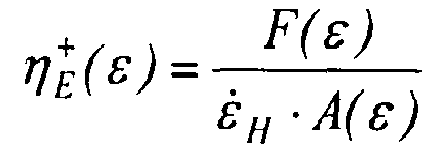


wherein
the Hencky strain rate ε̇ H is defined as for the Hencky strain ε
"F" is the tangential stretching force
"R" is the radius of the equi-dimensional windup drums
"T" is the measured torque signal, related to the tangential stretching force "F"
"A" is the instantaneous cross-sectional area of a stretched molten specimen
"A 0" is the cross-sectional area of the specimen in the solid state (i.e. prior to melting),
"ds" is the solid state density and
"dM" the melt density of the polymer. - When measured on the cable layer, the strain hardening index (SHI@1s-1 ) is preferably at least 0.30, more preferred of at least 0.40, yet more preferred the strain hardening index (SHI@1s-1 ) is of at least 0.50. In a preferred embodiment the strain hardening index (SHI@1s-1) is at least 0.55.
- Another physical parameter which is sensitive to the so-called multi-branching index (MBI) is the attenuation "a" and the strain rate thickening. Thus in the following the multi-branching index (MBI) will be explained in further detail below.
- Similarly to the measurement of SHI@1s-1, a strain hardening index (SHI) can be determined at different strain rates. A strain hardening index (SHI) is defined as the slope of the logarithm to the
basis 10 of the tensile stress growth function ηE + , Ig(ηE + ), as function of the logarithm to thebasis 10 of the Hencky strain ε, Ig(ε), between Hencky strains 1.00 and 3.00 at a at a temperature of 180 °C, where a SHI@0.1 s-1 is determined with a deformation rate ε̇ H of 0.10 s-1, a SHI@0.3 s-1 is determined with a deformation rate ε̇ H of 0.30 s-1, a SHI@3 s-1 is determined with a deformation rate ε̇ H of 3.00 s-1, and a SHI@10 s-1 is determined with a deformation rate ε̇ H of 10.0 s-1. In comparing the strain hardening index (SHI) at those five strain rates ε̇ H of 0.10, 0.30, 1.00, 3.00 and 10.00 s-1, the slope of the strain hardening index (SHI) as function of the logarithm to thebasis 10 of ε̇ H (Ig (ε̇ H )) is a characteristic measure for multi-branching. Therefore, a multi-branching index (MBI) is defined as the slope of the strain hardening index (SHI) as a function of Ig (ε̇ H ), i.e. the slope of a linear fitting curve of the strain hardening index (SHI) versus Ig (ε̇ H ) applying the least square method, preferably the strain hardening index (SHI) is defined at deformation rates ε̇ H between 0.05 s-1 and 20.00 s-1, more preferably between 0.10 s-1 and 10.00 s-1, still more preferably at the deformations rates 0.10, 0.30, 1.00, 3.00 and 10.00 s-1. Yet more preferably the SHI-values determined by the deformations rates 0.10, 0.30, 1.00, 3.00 and 10.00 s-1 are used for the linear fit according to the least square method when establishing the multi-branching index (MBI). - Hence, a further preferred requirement of the invention is that the cable layer and/or the polypropylene of the inventive cable has (have) a multi-branching index (MBI) of more than 0.10, more preferably of at least 0.15, still more preferably of at least 0.20, and yet more preferred of at least 0.25. In a preferred embodiment the multi-branching index (MBI) is of about 0.12.
- It is in particular preferred that the cable layer and/or the polypropylene of the inventive cable has (have) a branching index g' of less than 1.00, a strain hardening index (SHI@1s-1) of at least 0.30 and multi-branching index (MBI) of more than 0.10. Still more preferred the cable layer and/or the polypropylene of the inventive cable has (have) a branching index g' of less than 0.90, a strain hardening index (SHI@1s-1) of at least 0.40 and multi-branching index (MBI) of more than 0.10. In another preferred embodiment the cable layer and/or the polypropylene of the inventive cable has (have) a branching index g' of less than 0.85, a strain hardening index (SHI@1s-1) of at least 0.30 and multi-branching index (MBI) of about 0.12. In still another preferred embodiment the cable layer and/or the polypropylene of the inventive cable has (have) a branching index g' of about 0.80, a strain hardening index (SHI@1s-1) of at least 0.75 and multi-branching index (MBI) of at least 0.11. In yet another preferred embodiment the cable layer and/or the polypropylene of the inventive cable has (have) a branching index g' of about 0.80, a strain hardening index (SHI@1s-1) of at least 0.70 and multi-branching index (MBI) of about 0.12.
- Accordingly, the cable layers and/or the polypropylenes of the inventive cables are in particular characterized by the fact that their strain hardening index (SHI) increases with the deformation rate ε̇ H, i.e. a phenomenon which is not observed in other cable layers and/or polypropylenes. Single branched polymer types (so called Y polymers having a backbone with a single long side-chain and an architecture which resembles a "Y") or H-branched polymer types (two polymer chains coupled with a bridging group and a architecture which resemble an "H") as well as linear or short chain branched polymers do not show such a relationship, i.e. the strain hardening index (SHI) is not influenced by the deformation rate (see Figures 2 and 3). Accordingly, the strain hardening index (SHI) of known polymers, in particular known polypropylenes and polyethylenes, does not increase or increases only negligible with increase of the deformation rate (dε/dt). Industrial conversion processes which imply elongational flow operate at very fast extension rates. Hence the advantage of a material which shows more pronounced strain hardening (measured by the strain hardening index SHI) at high strain rates becomes obvious. The faster the material is stretched, the higher the strain hardening index (SHI) and hence the more stable the material will be in conversion. Especially in the fast extrusion process, like in the coating of conductors, the melt of the multi-branched polypropylenes has a high stability. Moreover the inventive cables, in particular the cable layers, are characterized by a rather high stiffness and low dielectric loss.
- For further information concerning the measuring methods applied to obtain the relevant data for the branching index g', the tensile stress growth function η E +, the Hencky strain rate ε̇ H , the Hencky strain ε and the multi-branching index (MBI) it is referred to the example section.
- As already indicated above, the polymer architecture and structure determines the crystal structure and the crystallization behaviour of the polymer. With regard to the first embodiment, it is preferred that the cable layer and/or the polypropylene comprise(s) a crystalline fraction crystallizing in the temperature range of 200 to 105°C determined by stepwise isothermal segregation technique (SIST), wherein said crystalline fraction comprises a part which during subsequent-melting at a melting rate of 10 °C/min melts at or below 130°C and said part represents at least 20 wt% of said crystalline fraction.
- It has been recognized that a low attenuation "a" for the cable is achievable in case the polymer used for the cable layer comprises rather high amounts of thin lamellae. The attenuation "a" shows the following relationship to tan δ, i.e. the so called dielectric loss- or dissipation factor, and to the dielectric constant ε:

wherein - a
- is the attenuation
- A and B
- are constants
- d
- is the conductor diameter
- 2s
- the distance between two wires
- f
- is the frequency
- tan δ
- is the dielectric loss- or dissipation factor and
- ε
- is the dielectric constant.
- Thus it can be easily deducted form the above stated equation that low values of attenuation "a" are inter alia obtained in case the value(s) of dielectric loss factor tan δ and/or the dielectric constant ε is(are) rather low. Polymers with rather high amounts of thin lamellae influence insofar the attenuation "a" positive as the values of dielectric constant ε are kept low. Hence the attenuation "a" can be positive influenced independently from the amount of impurities present in the polypropylene but from its crystalline properties. The stepwise isothermal segregation technique (SIST) provides a possibility to determine the lamellar thickness distribution. Rather high amounts of polymer fractions crystallizing at lower temperatures indicate a rather high amount of thin lamellae. Thus the inventive cable layer and/or the polypropylene of the layer comprise(s) a crystalline fraction crystallizing in the temperature range of 200 to 105 °C determined by stepwise isothermal segregation technique (SIST), wherein said crystalline fraction comprises a part which during subsequent-melting at a melting rate of 10 °C/min melts at or below 130°C and said part represents at least 20 wt% of said crystalline fraction, more preferably at least 25 wt%. The stepwise isothermal segregation technique (SIST) is explained in further detail in the example section.
- Preferably the cable layer (as defined in the first embodiment of this invention) comprising polypropylene is further characterized in that, said layer and/or said polypropylene comprise(s) a crystalline fraction crystallizing in the temperature range of 200 to 105 °C determined by stepwise isothermal segregation technique (SIST), wherein said crystalline fraction comprises a part which during subsequent melting at a melting rate of 10 °C/min melts at or below the temperature T = Tm - 3 °C, wherein Tm is the melting temperature, and said part represents at least 50 wt-%, more preferably at least 55 wt-%, of said crystalline fraction. The exact definition of Tm is given in the example section.
- In a second embodiment, the present invention is related to a cable comprising a conductor and a cable layer, wherein
- a. said cable layer comprises polypropylene, and
- b. said cable layer and/or said polypropylene has (have) a strain rate thickening which means that the strain hardening increases with extension rates.
- A strain hardening index (SHI) can be determined at different strain rates. A strain hardening index (SHI) is defined as the slope of the tensile stress growth function η E + as function of the Hencky strain ε on a logarithmic scale between 1.00 and 3.00 at a temperature of 180 °C, where a SHI@0.1s-1 is determined with a deformation rate ε̇ H of 0.10 s-1, a SHI@0.3s-1 is determined with a deformation rate ε̇ H of 0.30 s-1, a SHI@3s-1 is determined with a deformation rate ε̇ H of 3.00 s-1, a SHI@10s-1 is determined with a deformation rate ε̇ H of 10.00 s-1. In comparing the strain hardening index at those five strain rates ε̇ H of 0.10, 0.30, 1.0, 3.0 and 10.00s-1, the slope of the strain hardening index (SHI) as function of the logarithm to the
basis 10 of ε̇ H, Ig (ε̇ H ), is a characteristic measure for multi-branching. Therefore, a multi-branching index (MBI) is defined as the slope of the strain hardening index (SHI as a function of Ig (ε̇ H ), i.e. the slope of a linear fitting curve of the strain hardening index (SHI) versus Ig (ε̇ H) applying the least square method, preferably the strain hardening index (SHI) is defined at deformation rates ε̇ H between 0.05 s-1 and 20.0 s-1, more preferably between 0.10 s-1 and 10.0 s-1, still more preferably at the deformations rates 0.10, 0.30, 1.00, 3.00 and 10.0 s-1. Yet more preferably the SHI-values determined by the deformations rates 0.10, 0.30, 1.00, 3.00 and 10.0 s-1 are used for the linear fit according to the least square method when establishing the multi-branching index (MBI). - Hence, in the second embodiment the cable comprises a conductor and a cable layer, wherein
- a. said cable layer comprises polypropylene,
- b. said cable layer and/or said polypropylene has (have) a multi-branching index (MBI) of more than 0.10, wherein the multi-branching index (MBI) is defined as the slope of strain hardening index (SHI) as function of the logarithm to the
basis 10 of the Hencky strain rate (Ig (dε/dt)), wherein
dε/dt is the deformation rate,
ε is the Hencky strain, and
the strain hardening index (SHI) is measured at 180 °C, wherein the strain hardening index (SHI) is defined as the slope of the logarithm to thebasis 10 of the tensile stress growth function (Ig (η E +)) as function of the logarithm to thebasis 10 of the Hencky strain (lg (s)) in the range of Hencky strains between 1 and 3. - Preferably said cable layer is a dielectric layer.
- Preferably the cable layer is free of polyethylene, even more preferred the cable layer comprises a polypropylene as defined above and further defined below as the only polymer component.
- Preferably said polypropylene is produced in the presence of a metallocene catalyst, more preferably in the presence of a metallocene catalyst as further defined below.
- Surprisingly, it has been found that cables with such characteristics have superior properties compared to the cables known in the art. Especially, the melt of the cable layer in the extrusion process has a high stability, i.e. the extrusion line can be operated at high line speeds (see Table 8). In addition the inventive cable, in particular its cable layer, is characterized by a rather high stiffness and a low dielectric loss, i.e. by low attenuation "a" (see Table 7).
- As stated above, one characteristic of the cable layer and/or the polypropylene component of the inventive cable is in particular the extensional melt flow properties. The extensional flow, or deformation that involves the stretching of a viscous material, is the dominant type of deformation in converging and squeezing flows that occur in typical polymer processing operations. Extensional melt flow measurements are particularly useful in polymer characterization because they are very sensitive to the molecular structure of the polymeric system being tested. When the true strain rate of extension, also referred to as the Hencky strain rate, is constant, simple extension is said to be a "strong flow" in the sense that it can generate a much higher degree of molecular orientation and stretching than flows in simple shear. As a consequence, extensional flows are very sensitive to crystallinity and macro-structural effects, such as long-chain branching, and as such can be far more descriptive with regard to polymer characterization than other types of bulk rheological measurement which apply shear flow.
- As stated above, the first requirement according to the second embodiment is that the cable layer and/or the polypropylene of the inventive cable has (have) a multi-branching index (MBI) of more than 0.10, more preferably of at least 0.15, still more preferably of at least 0.20, and yet more preferred of at least 0.25. In a preferred embodiment the multi-branching index (MBI) is of about 0.12.
- As mentioned above, the multi-branching index (MBI) is defined as the slope of the strain hardening index (SHI) as a function of Ig (dε/dt) [d SHI/d Ig (dε/dt)].
- Accordingly, the inventive cable layer and/or the polypropylene of the inventive cable is (are) characterized by the fact that their strain hardening index (SHI) increases with the deformation rate ε̇ H, i.e. a phenomenon which is not observed in other polypropylenes. Single branched polymer types (so called Y polymers having a backbone with a single long side-chain and an architecture which resembles a "Y") or H-branched polymer types (two polymer chains coupled with a bridging group and a architecture which resemble an "H") as well as linear or short chain branched polymers do not show such a relationship, i.e. the strain hardening index (SHI) is not influenced by the deformation rate (see Figures 2 and 3). Accordingly, the strain hardening index (SHI) of known polymers, in particular known polypropylenes and polyethylenes, does not increase or increases only negligibly with increase of the deformation rate (dε/dt). Industrial conversion processes which imply elongational flow operate at very fast extension rates. Hence the advantage of a material which shows more pronounced strain hardening (measured by the strain hardening index (SHI)) at high strain rates becomes obvious. The faster the material is stretched, the higher the strain hardening index (SHI) and hence the more stable the material will be in conversion. Especially in the fast extrusion process, like in the coating of conductors, the melt of the multi-branched polypropylenes has a high stability. Moreover the inventive cables, in particular the cable layers, are characterized by a rather high stiffness and low dielectric loss.
- A further preferred requirement is that the strain hardening index (SHI@1s-1) of the cable layer and/or the polypropylene of the inventive cable shall be at least 0.30, more preferred of at least 0.40, still more preferred of at least 0.50.
- The strain hardening index (SHI) is a measure for the strain hardening behavior of the polymer melt, in particular of the polypropylene melt. In the present invention, the strain hardening index (SHI@1s-1) has been measured by a deformation rate (dε/dt) of 1.00 s-1 at a temperature of 180 °C for determining the strain hardening behavior, wherein the strain hardening index (SHI) is defined as the slope of the tensile stress growth function η E + as a function of the Hencky strain ε on a logarithmic scale between 1.00 and 3.00 (see figure 1). Thereby the Hencky strain ε is defined by the formula ε = ε̇ H · t, wherein
the Hencky strain rate ε̇ H is defined by the formula
with
"L0" is the fixed, unsupported length of the specimen sample being stretched which is equal to the centerline distance between the master and slave drums,
"R" is the radius of the equi-dimensional windup drums, and
"Ω" is a constant drive shaft rotation rate. - In turn the tensile stress growth function ηE+ is defined by the formula


wherein
the Hencky strain rate ε̇ H is defined as for the Hencky strain ε
"F" is the tangential stretching force
"R" is the radius of the equi-dimensional windup drums
"T" is the measured torque signal, related to the tangential stretching force "F"
"A" is the instantaneous cross-sectional area of a stretched molten specimen
"A 0" is the cross-sectional area of the specimen in the solid state (i.e. prior to melting),
"ds" is the solid state density and
"dM" the melt density of the polymer. - In addition, it is preferred that the branching index g' of the inventive polypropylene of the cable shall be less than 1.00, more preferably less than 0.90, still more preferably less than 0.80. In the preferred embodiment, the branching index g' shall be less than 0.85. The branching index g' defines the degree of branching and correlates with the amount of branches of a polymer. The branching index g' is defined as g'=[IV]br/[IV]lin in which g' is the branching index, [IVbr] is the intrinsic viscosity of the branched polypropylene and [IV]lin is the intrinsic viscosity of the linear polypropylene having the same weight average molecular weight (within a range of ±10 %) as the branched polypropylene. Thereby, a low g'-value is an indicator for a high branched polymer. In other words, if the g'-value decreases, the branching of the polypropylene increases. Reference is made in this context to B.H. Zimm and W.H. Stockmeyer, J. Chem. Phys. 17,1301 (1949). This document is herewith included by reference.
- When measured on the cable layer, the branching index g' is preferably of less than 1.00, more preferably less than 0.90, still more preferably less than 0.80. In the preferred embodiment, the branching index g' of the cable layer shall be less than 0.85.
- The intrinsic viscosity needed for determining the branching index g' is measured according to DIN ISO 1628/1, October 1999 (in Decalin at 135 °C).
- For further information concerning the measuring methods applied to obtain the relevant data for the a multi-branching index (MBI), the tensile stress growth function η E +, the Hencky strain rate ε̇ H, the Hencky strain ε and the branching index g it is referred to the example section.
- It is in particular preferred that the cable layer and/or the polypropylene of the inventive cable has (have) a branching index g' of less than 1.00, a strain hardening index (SHI@1s-1) of at least 0.30 and multi-branching index (MBI) of more than 0.10. Still more preferred the cable layer and/or the polypropylene of the inventive cable has (have) a branching index g' of less than 0.90, a strain hardening index (SHI@1s-1) of at least 0.40 and multi-branching index (MBI) of more than 0.10. In another preferred embodiment the cable layer and/or the polypropylene of the inventive cable has (have) a branching index g' of less than 0.85, a strain hardening index (SHI@1s-1) of at least 0.30 and multi-branching index (MBI) of about 0.12. In still another preferred embodiment the cable layer and/or the polypropylene of the inventive cable has (have) a branching index g' of about 0.80, a strain hardening index (SHI@1s-1) of at least 0.75 and multi-branching index (MBI) of at least 0.11. In yet another preferred embodiment the cable layer and/or the polypropylene of the inventive cable has (have) a branching index g' of about 0.80, a strain hardening index (SHI@1s-1) of at least 0.70 and multi-branching index (MBI) of about 0.12.
- As already indicated above, the polymer architecture and structure determines the crystal structure and the crystallization behaviour of the polymer. With regard to the first embodiment, it is preferred that the cable layer and/or the polypropylene comprise(s) a crystalline fraction crystallizing in the temperature range of 200 to 105°C determined by stepwise isothermal segregation technique (SIST), wherein said crystalline fraction comprises a part which during subsequent-melting at a melting rate of 10 °C/min melts at or below 130°C and said part represents at least 20 wt% of said crystalline fraction.
- It has been recognized that a low attenuation "a" for the cable is achievable in case the polymer used for the cable layer comprises rather high amounts of thin lamellae. The attenuation "a" shows the following relationship to tan δ, i.e. the so called dielectric loss- or dissipation factor, and to the dielectric constant ε:

wherein - a
- is the attenuation
- A and B
- are constants
- d
- is the conductor diameter
- 2s
- the distance between two wires
- f
- is the frequency
- tan δ
- is the dielectric loss- or dissipation factor and
- ε
- is the dielectric constant.
- Thus it can be easily deducted form the above stated equation that low values of attenuation "a" are inter alia obtained in case the value(s) of dielectric loss factor tan δ and/or the dielectric constant ε is rather low. Polymers with rather high amounts of thin lamellae influence insofar the attenuation "a" positive as the values of dielectric constant ε are kept low. Hence the attenuation "a" can be positive influenced independently from the amount of impurities present in the polypropylene but from its crystalline properties. The stepwise isothermal segregation technique (SIST) provides a possibility to determine the lamellar thickness distribution. Rather high amounts of polymer fractions crystallizing at lower temperatures indicate a rather high amount of thin lamellae. Thus the inventive cable layer and/or the polypropylene of the layer comprise(s) a crystalline fraction crystallizing in the temperature range of 200 to 105 °C determined by stepwise isothermal segregation technique (SIST), wherein said crystalline fraction comprises a part which during subsequent-melting at a melting rate of 10 °C/min melts at or below 130°C and said part represents of at least 20 wt% of said crystalline fraction, more preferably of at least 25 wt%. The stepwise isothermal segregation technique (SIST) is explained in further detail in the example section.
- Preferably the cable layer (as defined in the second embodiment of this invention) comprising polypropylene is further characterized in that, said layer and/or said polypropylene comprise(s) a crystalline fraction crystallizing in the temperature range of 200 to 105 °C determined by stepwise isothermal segregation technique (SIST), wherein said crystalline fraction comprises a part which during subsequent melting at a melting rate of 10 °C/min melts at or below the temperature T = Tm - 3 °C, wherein Tm is the melting temperature, and said part represents at least 45 wt-%, more preferably at least 50 wt-%, yet more preferably at least 50 wt-%, of said crystalline fraction. Tm is explained in further detail in the example section.
- According to a third embodiment of the present invention, a cable is provided, wherein the cable comprises a conductor and a cable layer, and wherein
- a. said cable layer comprises polypropylene, and
- b. said cable layer and/or said polypropylene comprise(s) a crystalline fraction crystallizing in the temperature range of 200 to 105 °C determined by stepwise isothermal segregation technique (SIST),
- As an alternative of the third embodiment of the present invention, a cable is provided, wherein said cable comprises a conductor and a cable layer, and wherein
- a. said cable layer comprises polypropylene,
- b. said cable layer and/or said polypropylene comprise(s) a crystalline fraction crystallizing in the temperature range of 200 to 105 °C determined by stepwise isothermal segregation technique (SIST), wherein said crystalline fraction comprises a part which during subsequent melting at a melting rate of 10 °C/min melts at or below the temperature T = Tm - 3 °C, wherein Tm is the melting temperature, and said part represents at least 45 wt-% of said crystalline fraction, and
- c. said cable layer and/or said polypropylene is foamable.
- The exact measuring method for Tm is given in the example section.
- Surprisingly, it has been found that cables with such characteristics, i.e. cables according to the third embodiment, have superior properties compared to the cables known in the art. Especially, the melt of the cable layer in the extrusion process has a high stability, i.e. the extrusion line can be operated at high line speeds (see Table 8). In addition the inventive cable, in particular its cable layer, is characterized by a rather high stiffness and a low dielectric loss, i.e. by low attenuation "a" (see Table 7).
- It has been in particular recognized that a low attenuation "a" for the cable is achievable in case the polymer used for the cable layer comprises rather high amounts of thin lamellae. The attenuation "a" shows the following relationship to tan δ, i.e. the so called dielectric loss- or dissipation factor, and to the dielectric constant ε:

wherein - a
- is the attenuation
- A and B
- are constants
- d
- is the conductor diameter
- 2s
- the distance between two wires
- f
- is the frequency
- tan δ
- is the dielectric loss- or dissipation factor and
- ε
- is the dielectric constant.
- Thus it can be easily deducted form the above stated equation that low values of attenuation "a" are inter alia obtained in case the value(s) of dielectric loss factor tan δ and/or the dielectric constant ε is rather low. Polymers with rather high amounts of thin lamellae influence insofar the attenuation "a" positive as the values of dielectric constant ε are kept low. Hence the attenuation "a" can be positive influenced independently from the amount of impurities present in the polypropylene but from its crystalline properties. The stepwise isothermal segregation technique (SIST) provides a possibility to determine the lamellar thickness distribution. Rather high amounts of polymer fractions crystallizing at lower temperatures indicate a rather high amount of thin lamellae. Thus the inventive cable layer and/or the polypropylene of the layer comprise(s) a crystalline fraction crystallizing in the temperature range of 200 to 105 °C determined by stepwise isothermal segregation technique (SIST), wherein said crystalline fraction comprises a part which during subsequent-melting at a melting rate of 10 °C/min melts at or below 130°C and said part represents of at least 20 wt% of said crystalline fraction, more preferably of at least 25 wt%. The stepwise isothermal segregation technique (SIST) is explained in further detail in the example section.
- Preferably said layers of the third embodiment are dielectric layers.
- Preferably the cable layer of the third embodiment is free of polyethylene, even more preferred the cable layer comprises a polypropylene as defined above and further defined below as the only polymer component.
- Preferably said polypropylene is produced in the presence of a metallocene catalyst, more preferably in the presence of a metallocene catalyst as further defined below.
- In addition it is preferred that the inventive cable layer and/or the polypropylene of the inventive cable has (have) a strain rate thickening which means that the strain hardening increases with extension rates. A strain hardening index (SHI) can be determined at different strain rates. A strain hardening index (SHI) is defined as the slope of the tensile stress growth function η E + as function of the Hencky strain ε on a logarithmic scale between 1.00 and 3.00 at a at a temperature of 180 °C, where a SHI@0.1s-1 is determined with a deformation rate ε̇ H of 0.10 s-1, a SHI@0.3s-1 is determined with a deformation rate ε̇ H of 0.30 s-1, a SHI@3s-1 is determined with a deformation rate ε̇ H of 3.00 s-1, a SHI@10s-1 is determined with a deformation rate ε̇ H of 10.0 s-1. In comparing the strain hardening index at those five strain rates ε̇ H of 0.10, 0.30, 1.0, 3.0 and 10.00 s-1, the slope of the strain hardening index (SHI) as function of the logarithm to the
basis 10 of ε̇ H , Ig (ε̇ H ), is a characteristic measure for multi -branching. Therefore, a multi-branching index (MBI) is defined as the slope of the strain hardening index (SHI as a function of Ig (ε̇ H ), i.e. the slope of a linear fitting curve of the strain hardening index (SHI) versus Ig (ε̇H) applying the least square method, preferably the strain hardening index (SHI) is defined at deformation rates ε̇ H between 0.05 s-1 and 20.0 s-1, more preferably between 0.10 s-1 and 10.0 s-1, still more preferably at the deformations rates 0.10, 0.30, 1.00, 3.00 and 10.00 s-1. Yet more preferably the SHI-values determined by the deformations rates 0.10, 0.30, 1.00, 3.00 and 10.00 s-1 are used for the linear fit according to the least square method when establishing the multi-branching index (MBI). - Hence, it is preferred that the cable layer and/or the polypropylene of the inventive cable has (have) a multi-branching index (MBI) of more than 0.10, more preferably of at least 0.15, still more preferably of at least 0.20, and yet more preferred of at least 0.25. In a preferred embodiment the multi-branching index (MBI) is of about 0.12.
- Hence, the cable layer and/or the polypropylene component of the inventive cable according to the present invention is (are) characterized in particular by extensional melt flow properties. The extensional flow, or deformation that involves the stretching of a viscous material, is the dominant type of deformation in converging and squeezing flows that occur in typical polymer processing operations. Extensional melt flow measurements are particularly useful in polymer characterization because they are very sensitive to the molecular structure of the polymeric system being tested. When the true strain rate of extension, also referred to as the Hencky strain rate, is constant, simple extension is said to be a "strong flow" in the sense that it can generate a much higher degree of molecular orientation and stretching than flows in simple shear. As a consequence, extensional flows are very sensitive to crystallinity and macro-structural effects, such as long-chain branching, and as such can be far more descriptive with regard to polymer characterization than other types of bulk rheological measurement which apply shear flow.
- As mentioned above, the multi-branching index (MBI) is defined as the slope of the strain hardening index (SHI) as a function of Ig (dε/dt) [d SHI/d Ig (dε/dt)].
- Accordingly, the cable layer and/or the polypropylene of the inventive cable is (are) preferably characterized by the fact that their strain hardening index (SHI) increases with the deformation rate ε̇ H, i.e. a phenomenon which is not observed in other polypropylenes. Single branched polymer types (so called Y polymers having a backbone with a single long side-chain and an architecture which resembles a "Y") or H-branched polymer types (two polymer chains coupled with a bridging group and a architecture which resemble an "H") as well as linear or short chain branched polymers do not show such a relationship, i.e. the strain hardening index (SHI) is not influenced by the deformation rate (see Figures 2 and 3). Accordingly, the strain hardening index (SHI) of known polymers, in particular known polypropylenes and polyethylenes, does not increase or increases only negligible with increase of the deformation rate (dε/dt). Industrial conversion processes which imply elongational flow operate at very fast extension rates. Hence the advantage of a material which shows more pronounced strain hardening (measured by the strain hardening index (SHI)) at high strain rates becomes obvious. The faster the material is stretched, the higher the strain hardening index (SHI) and hence the more stable the material will be in conversion. Especially in the fast extrusion process, like in the coating of conductors, the melt of the multi-branched polypropylenes has a high stability. Moreover the inventive cables, in particular the cable layers, are characterized by a rather high stiffness and low dielectric loss.
- A further preferred requirement is that the strain hardening index (SHI@1s-1) of the cable layer and/or the polypropylene of the inventive cable shall be at least 0.30, more preferred of at least 0.40, still more preferred of at least 0.50.
- The strain hardening index (SHI) is a measure for the strain hardening behavior of the polymer melt, in particular of the polypropylene melt. In the present invention, the strain hardening index (SHI@1s-1) has been measured by a deformation rate (dε/dt) of 1.00 s-1 at a temperature of 180 °C for determining the strain hardening behavior, wherein the strain hardening index (SHI) is defined as the slope of the tensile stress growth function η E + as a function of the Hencky strain s on a logarithmic scale between 1.00 and 3.00 (see figure 1). Thereby the Hencky strain ε is defined by the formula ε = ε̇ H · t, wherein
the Hencky strain rate ε̇ H is defined by the formula
with
"L0" is the fixed, unsupported length of the specimen sample being stretched which is equal to the centerline distance between the master and slave drums,
"R" is the radius of the equi-dimensional windup drums, and
"Ω" is a constant drive shaft rotation rate. - In turn the tensile stress growth function η E + is defined by the formula


wherein
the Hencky strain rate ε̇ H is defined as for the Hencky strain ε
"F" is the tangential stretching force
"R" is the radius of the equi-dimensional windup drums
"T" is the measured torque signal, related to the tangential stretching force "F"
"A" is the instantaneous cross-sectional area of a stretched molten specimen
"A 0 " is the cross-sectional area of the specimen in the solid state (i.e. prior to melting),
"ds" is the solid state density and
"dM" the melt density of the polymer. - In addition, it is preferred that the branching index g' of the inventive polypropylene of the inventive cable shall be less than 1.00, more preferably less than 0.90, still more preferably less than 0.80. In the preferred embodiment, the branching index g' shall be less than 0.85. The branching index g' defines the degree of branching and correlates with the amount of branches of a polymer. The branching index g' is defined as g'=[IV]br/[IV]lin in which g' is the branching index, [IVbr] is the intrinsic viscosity of the branched polypropylene and [IV]lin is the intrinsic viscosity of the linear polypropylene having the same weight average molecular weight (within a range of ±10 %) as the branched polypropylene. Thereby, a low g'-value is an indicator for a high branched polymer. In other words, if the g'-value decreases, the branching of the polypropylene increases. Reference is made in this context to B.H. Zimm and W.H. Stockmeyer, J. Chem. Phys. 17,1301 (1949). This document is herewith included by reference.
- When measured on the cable layer, the branching index g' is preferably of less than 1.00, more preferably less than 0.90, still more preferably less than 0.80. In the preferred embodiment, the branching index g' of the cable layer shall be less than 0.85.
- The intrinsic viscosity needed for determining the branching index g' is measured according to DIN ISO 1628/1, October 1999 (in Decalin at 135 °C).
- For further information concerning the measuring methods applied to obtain the relevant data for the a multi-branching index (MBI), the tensile stress growth function η E +, the Hencky strain rate ε̇ H , the Hencky strain ε and the branching index g'it is referred to the example section.
- It is in particular preferred that the cable layer and/or the polypropylene of the inventive cable has (have) a branching index g' of less than 1.00, a strain hardening index (SHI@1s-1) of at least 0.30 and multi-branching index (MBI) of more than 0.10. Still more preferred the cable layer and/or the polypropylene of the inventive cable has (have) a branching index g' of less than 0.90, a strain hardening index (SHI@1s-1) of at least 0.40 and multi-branching index (MBI) of more than 0.10. In another preferred embodiment the cable layer and/or the polypropylene of the inventive cable has (have) a branching index g' of less than 0.85, a strain hardening index (SHI@1s-1) of at least 0.30 and multi-branching index (MBI) of about 0.12. In still another preferred embodiment the cable layer and/or the polypropylene of the inventive cable has (have) a branching index g' of about 0.80, a strain hardening index (SHI@1s-1) of at least 0.75 and multi-branching index (MBI) of at least 0.11. In yet another preferred embodiment the cable layer and/or the polypropylene of the inventive cable has (have) a branching index g' of about 0.80, a strain hardening index (SHI@1s-1) of at least 0.70 and multi-branching index (MBI) of about 0.12.
- The further features mentioned below apply to all embodiments described above, i.e. the first, the second and the third embodiment as defined above.
- Preferably the cable layer and/or the polypropylene of the inventive cable is (are) foamable. The term "foamable" according to this invention is the ability of the cable layer and/or the polypropylene that its (their) density can be reduced after its (their) physical and/or chemical expanding. In other words the cable layer and/or the polypropylene must be expandable and thereby reducing its (their) density. More preferably the term "formable" means that the cable layer and/or the polypropylene can be expanded by chemical or physical foaming to a densitiy below 450 kg/m3, more preferably below 400 kg/m3, yet more preferably below 250 kg/m3.
- Preferably the polypropylene used for the cable layer shall be not crosslinked as it can be done to improve the process properties of the polypropylene. However the cross-linking is detrimental in many aspects. Inter alia the manufacture of said products is difficult to obtain and reduces in addition the possibility to expand (to foam) the cable layer and/or the polypropylene.
- In addition, it is preferred that the crystalline fraction which crystallizes between 200 to 105 °C determined by stepwise isothermal segregation technique (SIST) is at least 90 wt.-% of the total cable layer and/or the total polypropylene, more preferably at least 95 wt.-% of the total layer and/or the total polypropylene and yet more preferably 98 wt.-% of the total layer and/or the total polypropylene.
- Preferably the polymer according to this invention can be produced with low levels of impurities, i.e. low levels of aluminium (Al) residue and/or low levels of silicon residue (Si) and/or low levels of boron (B) residue. As stated above, low values of attenuation "a" are dependent on many factors defined by the formula
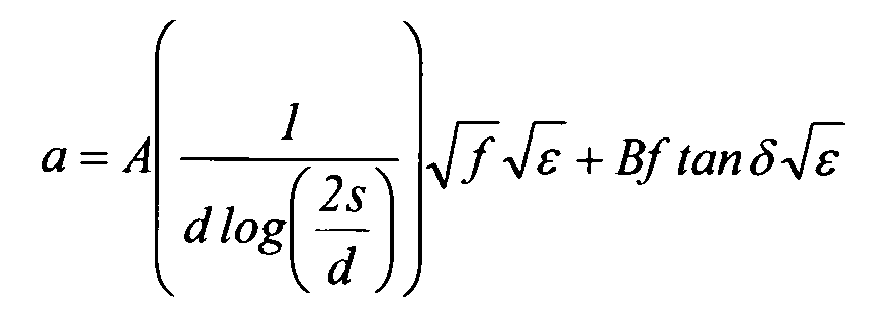
wherein - a
- is the attenuation
- A and B
- are constants
- d
- is the conductor diameter
- 2s
- the distance between two wires
- f
- is the frequency
- tan δ
- is the dielectric loss- or dissipation factor and
- ε
- is the dielectric constant.
- Thus not only low values of the dielectric constant ε influence positively the attenuation "a" but also low values of dielectric loss factor tan δ. This value is inter alia dependent on the purity of the used polypropylene, i.e. polypropylenes with rather high amounts of residues yield to rather high values of tan δ. Hence it is appreciated to have a cable layer and/or a polypropylene characterized by high purity. Even more preferred, because of economical reasons, such a high purity shall be obtained without any additional washing steps.
- Accordingly the aluminium residue content and/or silicon residue content and/or boron residue content of the cable layer and/or of the polypropylene is(are) preferably less than 25.00 ppm (each, i.e. of Al, Si, B). Still more preferably the aluminium residue content and/or silicon residue content and/or boron residue content of the cable layer and/or of the polypropylene is(are) preferably less than 20.00 ppm (each, i.e. of Al, Si, B). Yet more preferably the aluminium residue content and/or silicon residue content and/or boron residue content of the cable layer and/or of the polypropylene is(are) preferably less than 15.00 ppm (each, i.e. of Al, Si, B). In a preferred embodiment no residues of aluminium and/or silicon and/or boron (is) are detectable in the cable layer and/or in the polypropylene.
- Preferably, the cable layer and/or the polypropylene component of the inventive cable of the present invention has a tensile modulus of at least 700 MPa, more preferably of at least 900 MPa, yet more preferably of at least 1000 MPa, measured according to ISO 527-2 at a cross head speed of 1mm/min.
- Furthermore, it is preferred that the polypropylene has a melt flow rate (MFR) given in a specific range. The melt flow rate mainly depends on the average molecular weight. This is due to the fact that long molecules render the material a lower flow tendency than short molecules. An increase in molecular weight means a decrease in the MFR-value. The melt flow rate (MFR) is measured in g/10 min of the polymer discharged through a defined dye under specified temperature and pressure conditions and the measure of viscosity of the polymer which, in turn, for each type of polymer is mainly influenced by its molecular weight but also by its degree of branching. The melt flow rate measured under a load of 2.16 kg at 230 °C (ISO 1133) is denoted as MFR2. Accordingly, it is preferred that in the present invention the polypropylene of the cable has an MFR2 in a range of 0.01 to 100.00 g/10 min, more preferably of 0.01 to 30.00 g/10 min, still more preferred of 0.05 to 20 g/10 min. In a preferred embodiment, the MFR2 is in a range of 1.00 to 11.00 g/10 min. In another preferred embodiment, the MFR2 is in a range of 1.00 to 4.00 g/10 min. In a preferred embodiment the MFR2 is up to 30.00 g/10 min
- The molecular weight distribution (MWD) (also determined herein as polydispersity) is the relation between the numbers of molecules in a polymer and the individual chain length. The molecular weight distribution (MWD) is expressed as the ratio of weight average molecular weight (Mw) and number average molecular weight (Mn). The number average molecular weight (Mn) is an average molecular weight of a polymer expressed as the first moment of a plot of the number of molecules in each molecular weight range against the molecular weight. In effect, this is the total molecular weight of all molecules divided by the number of molecules. In turn, the weight average molecular weight (Mw) is the first moment of a plot of the weight of polymer in each molecular weight range against molecular weight.
- The number average molecular weight (Mn) and the weight average molecular weight (Mw) as well as the molecular weight distribution (MWD) are determined by size exclusion chromatography (SEC) using
Waters Alliance GPCV 2000 instrument with online viscometer. The oven temperature is 140 °C. Trichlorobenzene is used as a solvent (ISO 16014). - It is preferred that the cable layer of the present invention comprises a polypropylene which has a weight average molecular weight (Mw) from 10,000 to 2,000,000 g/mol, more preferably from 20,000 to 1,500,000 g/mol.
- The number average molecular weight (Mn) of the polypropylene is preferably in the range of 5,000 to 1,000,000 g/mol, more preferably from 10,000 to 750,000 g/mol.
- As a broad molecular weight distribution (MWD) improves the processability of the polypropylene the molecular weight distribution (MWD) is preferably up to 20.00, more preferably up to 10.00, still more preferably up to 8.00. However a rather broad molecular weight distribution stimulates surface roughness from pronounced melt relaxation phenomena after the extrusion die and hence deteriorates the quality of the extruded polypropylene layer. Therefore, in an alternative embodiment the molecular weight distribution (MWD) is preferably between 1.00 to 8.00, still more preferably in the range of 1.00 to 6.00, yet more preferably in the range of 1.00 to 4.00.
- More preferably, the polypropylene of the cable layer according to this invention shall have a rather high isotacticity measured by meso pentad concentration (also referred herein as pentad concentration), i.e. higher than 91 %, more preferably higher than 93 %, still more preferably higher than 94 % and most preferably higher than 95 %. On the other hand pentad concentration shall be not higher than 99.5 %. The pentad concentration is an indicator for the narrowness in the steroregularity distribution of the polypropylene and measured by NMR-spectroscopy.
- In addition, it is preferred that the polypropylene of the inventive cable has a melting temperature Tm of higher than 120 °C. It is in particular preferred that the melting temperature is higher than 120 °C if the polypropylene is a polypropylene copolymer as defined below. In turn, in case the polypropylene is a polypropylene homopolymer as defined below, it is preferred, that polypropylene has a melting temperature of higher than 140 °C, more preferred higher than 145 °C.
- Not only the polypropylene itself but also the melting temperature of the cable layer shall preferably exceed a specific temperature. Hence it is preferred that the cable layer has a melting temperature Tm of higher than 120 °C. It is in particular preferred that the melting temperature of the cable layer is higher than 120 °C, more preferably higher than 130 °C, and yet more preferred higher than 135 °C, in case the polypropylene is a propylene copolymer as defined in the present invention. In turn the polypropylene is a propylene homopolymer as defined in the present invention, it is preferred that the melting temperature of the cable layer is higher than 140 °C and more preferably higher than 145 °C.
- Xylene solubles are the part of the polymer soluble in cold xylene determined by dissolution in boiling xylene and letting the insoluble part crystallize from the cooling solution (for the method see below in the experimental part). The xylene solubles fraction contains polymer chains of low stereo-regularity and is an indication for the amount of non-crystalline areas.
- Thus it is preferred that the cable layer and/or the polypropylene of the inventive cable has xylene solubles preferably less than 2.00 wt.-%, more preferably less than 1.00 wt.-% and still more preferably less than 0.80 wt.-%.
- In a preferred embodiment the polypropylene as defined above (and further defined below) is preferably unimodal. In another preferred embodiment the polypropylene as defined above (and further defined below) is preferably multimodal, more preferably bimodal.
- "Multimodal" or "multimodal distribution" describes a distribution that has several relative maxima (contrary to unimodal having only one maximum). In particular, the expression "modality of a polymer" refers to the form of its molecular weight distribution (MWD) curve, i.e. the appearance of the graph of the polymer weight fraction as a function of its molecular weight. If the polymer is produced in the sequential step process, i.e. by utilizing reactors coupled in series, and using different conditions in each reactor, the different polymer fractions produced in the different reactors each have their own molecular weight distribution which may considerably differ from one another. The molecular weight distribution curve of the resulting final polymer can be seen at a superimposing of the molecular weight distribution curves of the polymer fraction which will, accordingly, show a more distinct maxima, or at least be distinctively broadened compared with the curves for individual fractions.
- A polymer showing such molecular weight distribution curve is called bimodal or multimodal, respectively.
- In case the polypropylene of the cable layer is not unimodal it is preferably bimodal.
- The polypropylene of the cable layer according to this invention can be a homopolymer or a copolymer. In case the polypropylene is unimodal the polypropylene is preferably a polypropylene copolymer. In turn in case the polypropylene is multimodal, more preferably bimodal, the polypropylene can be a polypropylene homopolymer as well as a polypropylene copolymer. Furthermore, it is preferred that at least one of the fractions of the multimodal polypropylene is a multi-chain branched polypropylene, preferably a multi-chain branched polypropylene copolymer, as defined herein.
- The expression polypropylene homopolymer as used in this invention relates to a polypropylene that consists substantially, i.e. of at least 97 wt%, preferably of at least 99 wt%, and most preferably of at least 99.8 wt% of propylene units. In a preferred embodiment only propylene units in the polypropylene homopolymer are detectable. The comonomer content can be measured with FT infrared spectroscopy. Further details are provided below in the examples.
- In case the polypropylene used for the preparation of the cable layer is a propylene copolymer, it is preferred that the comonomer is ethylene. However, also other comonomers known in the art, like 1-butene, are suitable. Preferably, the total amount of comonomer, more preferably ethylene, in the propylene copolymer is up to 10 mol%, more preferably up to 8 mol%, and even more preferably up to 6 mol%.
- In a preferred embodiment, the polypropylene is a propylene copolymer comprising a polypropylene matrix and an ethylene-propylene rubber (EPR).
- The polypropylene matrix can be a homopolymer or a copolymer, more preferably multimodal, i.e. bimodal, homopolymer or a multimodal, i.e. bimodal, copolymer. In case the polypropylene matrix is a propylene copolymer, then it is preferred that the comonomer is ethylene or 1-butene. However, also other comonomers known in the art are suitable. The preferred amount of comonomer, more preferably ethylene, in the polypropylene matrix is up to 8.00 Mol%. In case the propylene copolymer matrix has ethylene as the comonomer component, it is in particular preferred that the amount of ethylene in the matrix is up to 8.00 Mol%, more preferably less than 6.00 Mol%. In case the propylene copolymer matrix has butene as the comonomer component, it is in particular preferred that the amount of butene in the matrix is up to 6.00 Mol%, more preferably less than 4.00 Mol%.
- Preferably, the ethylene-propylene rubber (EPR) in the total propylene copolymer is less than or equal 50 wt%, more preferably less than or equal 40 wt%. Yet more preferably the amount of ethylene-propylene rubber (EPR) in the total propylene copolymer is in the range of 10 to 50 wt%, still more preferably in the range of 10 to 40 wt%.
- In addition, it is preferred that the multimodal or bimodal polypropylene copolymer comprises a polypropylene homopolymer matrix being a multi-chain branched polypropylene as defined above and an ethylene-propylene rubber (EPR) with an ethylene-content of up to 50 wt%.
- In addition, it is preferred that the polypropylene as defined above is produced in the presence of the catalyst as defined below. Furthermore, for the production of the polypropylene of the inventive cable as defined above, the process as stated below is preferably used.
- Preferably a metallocene catalyst is used for the polypropylene of the inventive cable. It is in particular preferred that the polypropylene according to this invention is obtainable by a new catalyst system as defined below.
- Moreover, the cable layer as defined in the instant invention can be an insulation layer, preferably a dielectric layer, or a semiconductive layer. In case it is a semiconductive layer, it preferably comprises carbon black. However it is preferred that the cable layer is a dielectric layer. Still more preferred the cable layer is a dielectric layer comprising in addition metal deactivator(s), like Irganox MD 1024 and/or Irganox PS 802 FL.
- The cable as described in the instant invention is preferably a coaxial cable or a pair cable.
- A typical coaxial cable comprises an inner conductor made of copper or aluminium, a dielectric layer made of a polymeric material (in the present invention the dielectric layer is the cable layer as defined herein), and preferably outer conductors made preferably of copper or aluminium. Examples of outer conductors are metallic screens, foils or braids. Furthermore, the coaxial cable may comprise a skin layer between the inner conductor and the dielectric layer to improve adherence between inner conductor and dielectric layer and thus improve mechanical integrity of the cable.
- Even more preferred the cable is a coaxial cable, e.g. a data cable or a radio frequency cable. Still more preferred the cable layer as defined in the instant invention is used as a dielectric layer in the coaxial cable or in the pair cable, e.g. in the data cable and/or in the radio frequency cable.
- Thus in one specific embodiment the present invention provides a cable, e.g. a coaxial or triaxial cable, comprising a dielectric layer which is based, preferably is, the cable layer as defined in the instant invention, More preferably the cable layer being said dielectric layer is expanded, i.e. foamed.
- More preferably the cable, i.e. the coaxial or triaxial cable, has a dielectric loss tangent value (tan δ) of less than 100 x 10-6, still more preferably of less than 90 x 10-6, yet more preferably of less than 80 x 10-6, still yet more preferably of less than 75 x 10-6, determined by a frequency of 1.8 GHz. In a preferred embodiment the preferably the cable, i.e. the coaxial or triaxial cable, has a dielectric loss tangent value (tan δ) of less than 70 determined by a frequency of 1.8 GHz.
- In the following the catalyst and the catalyst system used for the manufacture of the polypropylene of the inventive cable as well as the manufacture of the polypropylene, the cable layer and the cable according to this invention is provided.
- This new catalyst system comprises an asymmetric catalyst, whereby the catalyst system has a porosity of less than 1.40 ml/g, more preferably less than 1.30 ml/g and most preferably less than 1.00 ml/g. The porosity has been measured according to DIN 66135 (N2). In another preferred embodiment the porosity is not detectable when determined with the method applied according to DIN 66135 (N2).
- An asymmetric catalyst according to this invention is a metallocene compound comprising at least two organic ligands which differ in their chemical structure. More preferably the asymmetric catalyst according to this invention is a metallocene compound comprising at least two organic ligands which differ in their chemical structure and the metallocene compound is free of C2-symmetry and/or any higher symmetry. Preferably the asymetric metallocene compound comprises only two different organic ligands, still more preferably comprises only two organic ligands which are different and linked via a bridge.
- Said asymmetric catalyst is preferably a single site catalyst (SSC).
- Due to the use of the catalyst system with a very low porosity comprising an asymmetric catalyst the manufacture of the above defined multi-branched polypropylene is possible.
- Furthermore it is preferred, that the catalyst system has a surface area of less than 25 m2/g, yet more preferred less than 20 m2/g, still more preferred less than 15 m2/g, yet still less than 10 m2/g and most preferred less than 5 m2/g. The surface area according to this invention is measured according to ISO 9277 (N2).
- It is in particular preferred that the catalytic system according to this invention comprises an asymmetric catalyst, i.e. a catalyst as defined below, and has porosity not detectable when applying the method according to DIN 66135 (N2) and has a surface area measured according to ISO 9277 (N2) less than 5 m2/g.
- Preferably the asymmetric catalyst compound, i.e. the asymetric metallocene, has the formula (I):
(Cp)2RzMX2 (I)
wherein
z is 0 or 1,
M is Zr, Hf or Ti, more preferably Zr, and
X is independently a monovalent anionic ligand, such as σ-ligand
R is a bridging group linking the two Cp ligands
Cp is an organic ligand selected from the group consisting of unsubstituted cyclopenadienyl, unsubstituted indenyl, unsubstituted tetrahydroindenyl, unsubstituted fluorenyl, substituted cyclopenadienyl, substituted indenyl, substituted tetrahydroindenyl, and substituted fluorenyl,
with the proviso that both Cp-ligands are selected from the above stated group and both Cp-ligands have a different chemical structure. - The term "σ-ligand" is understood in the whole description in a known manner, i.e. a group bonded to the metal at one or more places via a sigma bond. A preferred monovalent anionic ligand is halogen, in particular chlorine (Cl).
- Preferably, the asymmetric catalyst is of formula (I) indicated above,
wherein
M is Zr and
each X is Cl. - Preferably both identical Cp-ligands are substituted.
- Preferably both Cp-ligands have different residues to obtain an asymmetric structure.
- Preferably, both Cp-ligands are selected from the group consisting of substituted cyclopenadienyl-ring, substituted indenyl-ring, substituted tetrahydroindenyl-ring, and substituted fluorenyl-ring wherein the Cp-ligands differ in the substituents bonded to the rings.
- The optional one or more substituent(s) bonded to cyclopenadienyl, indenyl, tetrahydroindenyl, or fluorenyl may be independently selected from a group including halogen, hydrocarbyl (e.g. C1-C20-alkyl, C2-C20-alkenyl, C2-C20-alkynyl, C3-C12-cycloalkyl, C6-C20-aryl or C7-C20-arylalkyl), C3-C12-cycloalkyl which contains 1, 2, 3 or 4 heteroatom(s) in the ring moiety, C6-C20-heteroaryl, C1-C20-haloalkyl, -SiR"3, -OSiR"3,-SR", -PR"2 and -NR"2, wherein each R" is independently a hydrogen or hydrocarbyl, e.g. C1-C20-alkyl, C2-C20-alkenyl, C2-C20-alkynyl, C3-C12-cycloalkyl or C6-C20-aryl.
- More preferably both Cp-ligands are indenyl moieties wherein each indenyl moiety bear one or two substituents as defined above. More preferably each Cp-ligand is an indenyl moiety bearing two substituents as defined above, with the proviso that the substituents are chosen in such are manner that both Cp-ligands are of different chemical structure, i.e both Cp-ligands differ at least in one substituent bonded to the indenyl moiety, in particular differ in the substituent bonded to the five member ring of the indenyl moiety.
- Still more preferably both Cp are indenyl moieties wherein the indenyl moieties comprise at least at the five membered ring of the indenyl moiety, more preferably at 2-position, a substituent selected from the group consisting of alkyl, such as C1-C6 alkyl, e.g. methyl, ethyl, isopropyl, and trialkyloxysiloxy, wherein each alkyl is independently selected from C1-C6 alkyl, such as methyl or ethyl, with proviso that the indenyl moieties of both Cp must chemically differ from each other, i.e. the indenyl moieties of both Cp comprise different substituents.
- Still more preferred both Cp are indenyl moieties wherein the indenyl moieties comprise at least at the six membered ring of the indenyl moiety, more preferably at 4-position, a substituent selected from the group consisting of a C6-C20 aromatic ring moiety, such as phenyl or naphthyl, preferably phenyl, which is optionally substituted with one or more substitutents, such as C1-C6 alkyl, and a heteroaromatic ring moiety, with proviso that the indenyl moieties of both Cp must chemically differ from each other, i.e. the indenyl moieties of both Cp comprise different substituents.
- Yet more preferably both Cp are indenyl moieties wherein the indenyl moieties comprise at the five membered ring of the indenyl moiety, more preferably at 2-position, a substituent and at the six membered ring of the indenyl moiety, more preferably at 4-position, a further substituent, wherein the substituent of the five membered ring is selected from the group consisting of alkyl, such as C1-C6 alkyl, e.g. methyl, ethyl, isopropyl, and trialkyloxysiloxy, wherein each alkyl is independently selected from C1-C6 alkyl, such as methyl or ethyl, and the further substituent of the six membered ring is selected from the group consisting of a C6-C20 aromatic ring moiety, such as phenyl or naphthyl, preferably phenyl, which is optionally substituted with one or more substituents, such as C1-C6 alkyl, and a heteroaromatic ring moiety, with proviso that the indenyl moieties of both Cp must chemically differ from each other, i.e. the indenyl moieties of both Cp comprise different substituents. It is in particular preferred that both Cp are idenyl rings comprising two substituentes each and differ in the substituents bonded to the five membered ring of the idenyl rings.
- Concerning the moiety "R" it is preferred that "R" has the formula (II)
-Y(R')2- (II)
wherein
Y is C, Si or Ge, and
R' is C1 to C20 alkyl, C6-C12 aryl, or C7-C12 arylalkyl or trimethylsilyl. - In case both Cp-ligands of the asymmetric catalyst as defined above, in particular case of two indenyl moieties, are linked with a bridge member R, the bridge member R is typically placed at 1-position. The bridge member R may contain one or more bridge atoms selected from e.g. C, Si and/or Ge, preferably from C and/or Si. One preferable bridge R is-Si(R')2-, wherein R' is selected independently from one or more of e.g. trimethylsilyl,C1-C10 alkyl, C1-C20 alkyl, such as C6-C12 aryl, or C7-C40, such as C7-C12 arylalkyl, wherein alkyl as such or as part of arylalkyl is preferably C1-C6 alkyl, such as ethyl or methyl, preferably methyl, and aryl is preferably phenyl. The bridge -Si(R')2- is preferably e.g. -Si(C1-C6 alkyl)2-, -Si(phenyl)2- or -Si(C1-C6 alkyl)(phenyl)-, such as-Si(Me)2-.
- In a preferred embodiment the asymmetric catalyst, i.e. the asymetric metallocene, is defined by the formula (III)
(Cp)2R1ZrCl2 (III)
wherein
both Cp coordinate to M and are selected from the group consisting of unsubstituted cyclopenadienyl, unsubstituted indenyl, unsubstituted tetrahydroindenyl, unsubstituted fluorenyl, substituted cyclopenadienyl, substituted indenyl, substituted tetrahydroindenyl, and substituted fluorenyl,
with the proviso that both Cp-ligands are of different chemical structure, and
R is a bridging group linking the two ligands Cp,
wherein R is defined by the formula (II)
-Y(R')2- (II)
wherein
Y is C, Si or Ge, and
R' is C1 to C20 alkyl, C6-C12 aryl, or C7-C12 arylalkyl. - More preferably the asymmetric catalyst is defined by the formula (III), wherein both Cp are selected from the group consisting of substituted cyclopenadienyl, substituted indenyl, substituted tetrahydroindenyl, and substituted fluorenyl.
- Yet more preferably the asymmetric catalyst is defined by the formula (III), wherein both Cp are selected from the group consisting of substituted cyclopenadienyl, substituted indenyl, substituted tetrahydroindenyl, and substituted fluorenyl
with the proviso that both Cp-ligands differ in the substituents, i.e. the subtituents as defined above, bonded to cyclopenadienyl, indenyl, tetrahydroindenyl, or fluorenyl. - Still more preferably the asymmetric catalyst is defined by the formula (III), wherein both Cp are indenyl and both indenyl differ in one substituent, i.e. in a substiuent as defined above bonded to the five member ring of indenyl.
- It is in particular preferred that the asymmetric catalyst is a non-silica supported catalyst as defined above, in particular a metallocene catalyst as defined above.
- In a preferred embodiment the asymmetric catalyst is dimethylsilyl [(2-methyl-(4'-tert.butyl)-4-phenyl-indenyl)(2-isopropyl-(4'-tert.butyl)-4-phenyl-indenyl)]zirkonium dichloride. More preferred said asymmetric catalyst is not silica supported.
- The above described asymmetric catalyst components are prepared according to the methods described in
WO 01/48034 - It is in particular preferred that the asymmetric catalyst system is obtained by the emulsion solidification technology as described in
WO 03/051934 - a) preparing a solution of one or more asymmetric catalyst components;
- b) dispersing said solution in a solvent immiscible therewith to form an emulsion in which said one or more catalyst components are present in the droplets of the dispersed phase,
- c) solidifying said dispersed phase to convert said droplets to solid particles and optionally recovering said particles to obtain said catalyst.
- Preferably a solvent, more preferably an organic solvent, is used to form said solution. Still more preferably the organic solvent is selected from the group consisting of a linear alkane, cyclic alkane, linear alkene, cyclic alkene, aromatic hydrocarbon and halogen-containing hydrocarbon.
- Moreover the immiscible solvent forming the continuous phase is an inert solvent, more preferably the immiscible solvent comprises a fluorinated organic solvent and/or a functionalized derivative thereof, still more preferably the immiscible solvent comprises a semi-, highly- or perfluorinated hydrocarbon and/or a functionalized derivative thereof. It is in particular preferred, that said immiscible solvent comprises a perfluorohydrocarbon or a functionalized derivative thereof, preferably C3-C30 perfluoroalkanes, -alkenes or -cycloalkanes, more preferred C4-C10 perfluoroalkanes, -alkenes or -cycloalkanes, particularly preferred perfluorohexane, perfluoroheptane, perfluorooctane or perfluoro (methylcyclohexane) or a mixture thereof.
- Furthermore it is preferred that the emulsion comprising said continuous phase and said dispersed phase is a bi-or multiphasic system as known in the art. An emulsifier may be used for forming the emulsion. After the formation of the emulsion system, said catalyst is formed in situ from catalyst components in said solution.
- In principle, the emulsifying agent may be any suitable agent which contributes to the formation and/or stabilization of the emulsion and which does not have any adverse effect on the catalytic activity of the catalyst. The emulsifying agent may e.g. be a surfactant based on hydrocarbons optionally interrupted with (a) heteroatom(s), preferably halogenated hydrocarbons optionally having a functional group, preferably semi-, highly- or perfluorinated hydrocarbons as known in the art. Alternatively, the emulsifying agent may be prepared during the emulsion preparation, e.g. by reacting a surfactant precursor with a compound of the catalyst solution. Said surfactant precursor may be a halogenated hydrocarbon with at least one functional group, e.g. a highly fluorinated C1 to C30 alcohol, which reacts e.g. with a cocatalyst component, such as aluminoxane.
- In principle any solidification method can be used for forming the solid particles from the dispersed droplets. According to one preferable embodiment the solidification is effected by a temperature change treatment. Hence the emulsion subjected to gradual temperature change of up to 10 °C/min, preferably 0.5 to 6 °C/min and more preferably 1 to 5 °C/min. Even more preferred the emulsion is subjected to a temperature change of more than 40 °C, preferably more than 50 °C within less than 10 seconds, preferably less than 6 seconds.
- The recovered particles have preferably an average size range of 5 to 200 µm, more preferably 10 to 100 µm.
- Moreover, the form of solidified particles have preferably a spherical shape, a predetermined particles size distribution and a surface area as mentioned above of preferably less than 25 m2/g, still more preferably less than 20 m2/g, yet more preferably less than 15 m2/g, yet still more preferably less than 10 m2/g and most preferably less than 5 m2/g, wherein said particles are obtained by the process as described above.
- For further details, embodiments and examples of the continuous and dispersed phase system, emulsion formation method, emulsifying agent and solidification methods reference is made e.g. to the above cited international patent application
WO 03/051934 - As mentioned above the catalyst system may further comprise an activator as a cocatalyst, as described in
WO 03/051934 - Preferred as cocatalysts for metallocenes and non-metallocenes, if desired, are the aluminoxanes, in particular the C1-C10-alkylaluminoxanes, most particularly methylaluminoxane (MAO). Such aluminoxanes can be used as the sole cocatalyst or together with other cocatalyst(s). Thus besides or in addition to aluminoxanes, other cation complex forming catalysts activators can be used. Said activators are commercially available or can be prepared according to the prior art literature.
- Further aluminoxane cocatalysts are described i.a. in
WO 94/28034 - The use and amounts of such activators are within the skills of an expert in the field. As an example, with the boron activators, 5:1 to 1:5, preferably 2:1 to 1:2, such as 1:1, ratio of the transition metal to boron activator may be used. In case of preferred aluminoxanes, such as methylaluminumoxane (MAO), the amount of Al, provided by aluminoxane, can be chosen to provide a molar ratio of Al:transition metal e.g. in the range of 1 to 10 000, suitably 5 to 8000, preferably 10 to 7000, e.g. 100 to 4000, such as 1000 to 3000. Typically in case of solid (heterogeneous) catalyst the ratio is preferably below 500.
- The quantity of cocatalyst to be employed in the catalyst of the invention is thus variable, and depends on the conditions and the particular transition metal compound chosen in a manner well known to a person skilled in the art.
- Any additional components to be contained in the solution comprising the organotransition compound may be added to said solution before or, alternatively, after the dispersing step.
- Furthermore, the present invention is related to the use of the above-defined catalyst system for the production of polymers, in particular of a polypropylene according to this invention.
- In addition, the present invention is related to the process for producing the inventive polypropylene, whereby the catalyst system as defined above is employed. Furthermore it is preferred that the process temperature is higher than 60 °C. Preferably, the process is a multi-stage process to obtain multimodal polypropylene as defined above.
- Multistage processes include also bulk/gas phase reactors known as multizone gas phase reactors for producing multimodal propylene polymer.
- A preferred multistage process is a "loop-gas phase"-process, such as developed by Borealis A/S, Denmark (known as BORSTAR® technology) described e.g. in patent literature, such as in
EP 0 887 379WO 92/12182 - Multimodal polymers can be produced according to several processes which are described, e.g. in
WO 92/12182 EP 0 887 379WO 97/22633 - A multimodal polypropylene according to this invention is produced preferably in a multi-stage process in a multi-stage reaction sequence as described in
WO 92/12182 - It has previously been known to produce multimodal, in particular bimodal, polypropylene in two or more reactors connected in series, i.e. in different steps (a) and (b).
- According to the present invention, the main polymerization stages are preferably carried out as a combination of a bulk polymerization/gas phase polymerization.
- The bulk polymerizations are preferably performed in a so-called loop reactor.
- In order to produce the multimodal polypropylene according to this invention, a flexible mode is preferred. For this reason, it is preferred that the composition be produced in two main polymerization stages in combination of loop reactor/gas phase reactor.
- Optionally, and preferably, the process may also comprise a prepolymerization step in a manner known in the field and which may precede the polymerization step (a).
- If desired, a further elastomeric comonomer component, so called ethylene-propylene rubber (EPR) component as defined in this invention, may be incorporated into the obtained propylene polymer to form a propylene copolymer as defined above. The ethylene-propylene rubber (EPR) component may preferably be produced after the gas phase polymerization step (b) in a subsequent second or further gas phase polymerizations using one or more gas phase reactors.
- The process is preferably a continuous process.
- Preferably, in the process for producing the propylene polymer as defined above the conditions for the bulk reactor of step (a) may be as follows:
- the temperature is within the range of 40 °C to 110 °C, preferably between 60 °C and 100 °C, 70 to 90 °C,
- the pressure is within the range of 20 bar to 80 bar, preferably between 30 bar to 60 bar,
- hydrogen can be added for controlling the molar mass in a manner known per se.
- Subsequently, the reaction mixture from the bulk (bulk) reactor (step a) is transferred to the gas phase reactor, i.e. to step (b), whereby the conditions in step (b) are preferably as follows:
- the temperature is within the range of 50 °C to 130 °C, preferably between 60 °C and 100 °C,
- the pressure is within the range of 5 bar to 50 bar, preferably between 15 bar to 35 bar,
- hydrogen can be added for controlling the molar mass in a manner known per se.
- The residence time can vary in both reactor zones. In one embodiment of the process for producing the propylene polymer the residence time in bulk reactor, e.g. loop is in the range of 0.5 to 5 hours, e.g. 0.5 to 2 hours and the residence time in gas phase reactor will generally be 1 to 8 hours.
- If desired, the polymerization may be effected in a known manner under supercritical conditions in the bulk, preferably loop reactor, and/or as a condensed mode in the gas phase reactor.
- The process of the invention or any embodiments thereof above enable highly feasible means for producing and further tailoring the propylene polymer composition within the invention, e.g. the properties of the polymer composition can be adjusted or controlled in a known manner e.g. with one or more of the following process parameters: temperature, hydrogen feed, comonomer feed, propylene feed e.g. in the gas phase reactor, catalyst, the type and amount of an external donor (if used), split between components.
- The above process enables very feasible means for obtaining the reactor-made propylene polymer as defined above.
- The cable of the present invention can be prepared by processes known to the skilled person, e.g. by extrusion coating of the conductor. Thereby the polypropylene is preferably extrusion coated, preferably with any other suitable additives like metal deactivator(s), on the conductor.
- The present invention will now be described in further detail by the examples provided below.
- The following definitions of terms and determination methods apply for the above general description of the invention as well as to the below examples unless otherwise defined.
- For the meso pentad concentration analysis, also referred herein as pentad concentration analysis, the assignment analysis is undertaken according to T Hayashi, Pentad concentration, R. Chujo and T. Asakura, Polymer 29 138-43 (1988) and Chujo R, et al., Polymer 35 339 (1994)
- Polymer is melted at T=180 °C and stretched with the SER Universal Testing Platform as described below at deformation rates of dε/dt=0.1 0.3 1.0 3.0 and 10 s-1 in subsequent experiments. The method to acquire the raw data is described in Sentmanat et al., J. Rheol. 2005, Measuring the Transient Elongational Rheology of Polyethylene Melts Using the SER Universal Testing Platform.
- A Paar Physica MCR300, equipped with a TC30 temperature control unit and an oven CTT600 (convection and radiation heating) and a SERVP01-025 extensional device with temperature sensor and a software RHEOPLUS/32 v2.66 is used.
- Stabilized Pellets are compression moulded at 220°C (gel time 3min,
pressure time 3 min,total moulding time 3+3=6min) in a mould at a pressure sufficient to avoid bubbles in the specimen, cooled to room temperature. From such prepared plate of 0.7mm thickness, stripes of a width of 10mm and a length of 18mm are cut. - Because of the low forces acting on samples stretched to thin thicknesses, any essential friction of the device would deteriorate the precision of the results and has to be avoided.
- In order to make sure that the friction of the device less than a threshold of 5x10⁻³ mNm (Milli-Newtonmeter) which is required for precise and correct measurements, following check procedure is performed prior to each measurement:
- The device is set to test temperature (180°C) for minimum 20minutes without sample in presence of the clamps
- A standard test with 0.3s-1 is performed with the device on test temperature (180°C)
- The torque (measured in mNm) is recorded and plotted against time
- The torque must not exceed a value of 5x10⁻³ mNm to make sure that the friction of the device is in an acceptably low range
- The device is heated for min. 20min to the test temperature (180°C measured with the thermocouple attached to the SER device) with clamps but without sample. Subsequently, the sample (0.7x10x18mm), prepared as described above, is clamped into the hot device. The sample is allowed to melt for 2 minutes +/- 20 seconds before the experiment is started.
- During the stretching experiment under inert atmosphere (nitrogen) at constant Hencky strain rate, the torque is recorded as function of time at isothermal conditions (measured and controlled with the thermocouple attached to the SER device).
- After stretching, the device is opened and the stretched film (which is winded on the drums) is inspected. Homogenous extension is required. It can be judged visually from the shape of the stretched film on the drums if the sample stretching has been homogenous or not. The tape must me wound up symmetrically on both drums, but also symmetrically in the upper and lower half of the specimen.
- If symmetrical stretching is confirmed hereby, the transient elongational viscosity calculates from the recorded torque as outlined below.
- For each of the different strain rates dε/dt applied, the resulting tensile stress growth function ηE + (dε/dt, t) is plotted against the total Hencky strain ε to determine the strain hardening behaviour of the melt, see Figure 1.
- In the range of Hencky strains between 1.0 and 3.0, the tensile stress growth function ηE + can be well fitted with a function

where c1 and c2 are fitting variables. Such derived c2 is a measure for the strain hardening behavior of the melt and called Strain Hardening Index SHI. - Dependent on the polymer architecture, SHI can
- be independent of the strain rate (linear materials, Y- or H-structures)
- increase with strain rate (short chain-, hyper- or multi-branched structures).
- This is illustrated in Figure 2.
- For polyethylene, linear (HDPE), short-chain branched (LLDPE) and hyperbranched structures (LDPE) are well known and hence they are used to illustrate the structural analytics based on the results on extensional viscosity. They are compared with a polypropylene with Y and H-structures with regard to their change of the strain-hardening behavior as function of strain rate, see Figure 2 and Table 1.
- To illustrate the determination of SHI at different strain rates as well as the multi-branching index (MBI) four polymers of known chain architecture are examined with the analytical procedure described above.
- The first polymer is a H- and Y-shaped polypropylene homopolymer made according to
EP 879 830 - The second polymer is a commercial hyperbranched LDPE, Borealis "B", made in a high pressure process known in the art. It has a MFR190/2.16 of 4.5 and a density of 923kg/m3.
- The third polymer is a short chain branched LLDPE, Borealis "C", made in a low pressure process known in the art. It has a MFR190/2.16 of 1.2 and a density of 919kg/m3.
- The fourth polymer is a linear HDPE, Borealis "D", made in a low pressure process known in the art. It has a MFR190/2.16 of 4.0 and a density of 954kg/m3.
- The four materials of known chain architecture are investigated by means of measurement of the transient elongational viscosity at 180°C at strain rates of 0.10, 0.30, 1.0, 3.0 and 10s-1. Obtained data (transient elongational viscosity versus Hencky strain) is fitted with a function


- This procedure is done for all five strain rates and hence, SHI@0.1s-1, SHI@0.3s-1, SHI@1.0s-1, SHI@3.0s-1, SHI@10s-1 are determined, see Figure 1 and Table 1.
Table 1: SHI-values dε/dt Ig (dε/dt) Property Y and H branched PP Hyper-branched LDPE short-chain branched LLDPE Linear HDPE A B C D 0,1 -1,0 SHI@0.1s -12,05 - 0,03 0,03 0,3 -0,5 SHI@0.3s-1 - 1,36 0,08 0,03 1 0,0 SHI@1.0s -12,19 1,65 0,12 0,11 3 0,5 SHI@3.0s-1 - 1,82 0,18 0,01 10 1,0 SHI@10s -12,14 2,06 - - - From the strain hardening behaviour measured by the values of the SHI@1s-1 one can already clearly distinguish between two groups of polymers: Linear and short-chain branched have a SHI@1s -1 significantly smaller than 0.30. In contrast, the Y and H-branched as well as hyper-branched materials have a SHI@1s-1 significantly larger than 0.30.
- In comparing the strain hardening index at those five strain rates ε̇ H of 0.10, 0.30, 1.0, 3.0 and 10s-1, the slope of SHI as function of the logarithm of ε̇ H, Ig(ε̇ H) is a characteristic measure for multi -branching. Therefore, a multi-branching index (MBI) is calculated from the slope of a linear fitting curve of SHI versus Ig(ε̇ H ):

- The parameters c3 and MBI are found through plotting the SHI against the logarithm of the Hencky strain rate Ig(ε̇ H) and performing a linear fit of this data applying the least square method. Please confer to Figure 2.
Table 2: Multi-branched-index (MBI) Property Y and H branched PP Hyper-branched LDPE short-chain branched LLDPE Linear HDPE A B C D MBI 0,04 0,45 0,10 0,01 - The multi-branching index MBI allows now to distinguish between Y or H-branched polymers which show a MBI smaller than 0.05 and hyper-branched polymers which show a MBI larger than 0.15. Further, it allows to distinguish between short-chain branched polymers with MBI larger than 0.10 and linear materials which have a MBI smaller than 0.10.
- Similar results can be observed when comparing different polypropylenes, i.e. polypropylenes with rather high branched structures have higher SHI and MBI-values, respectively, compared to their linear counterparts. Similar to the hyper-branched polyethylenes the new developed polypropylenes show a high degree of branching. However the polypropylenes according to the instant invention are clearly distinguished in the SHI and MBI-values when compared to known hyper-branched polyethylenes. Without being bound on this theory, it is believed, that the different SHI and MBI-values are the result of a different branching architecture. For this reason the new found branched polypropylenes according to this invention are designated as multi-branched.
- Combining both, strain hardening index (SHI) and multi-branching index (MBI), the chain architecture can be assessed as indicated in Table 3:
- Table 3: Strain Hardening Index (SHI) and Multi-branching Index (MBI) for various chain architectures
Table 3: SHI and MBI Property Y and H branched Hyperbranched / Multi-branched short-chain branched linear SHI@1.0s-1 >0.30 >0.30 ≤0.30 ≤0.30 MBI ≤0.10 >0.10 ≤0.10 ≤0.10 - The below described elementary analysis is used for determining the content of elementary residues which are mainly originating from the catalyst, especially the Al-, B-, and Si-residues in the polymer. Said Al-, B- and Si-residues can be in any form, e.g. in elementary or ionic form, which can be recovered and detected from polypropylene using the below described ICP-method. The method can also be used for determining the Ti-content of the polymer. It is understood that also other known methods can be used which would result in similar results.
- ICP-instrument: The instrument for determination of Al-, B- and Si-content is
ICP Optima 2000 DV, PSN 620785 (supplier Perkin Elmer Instruments, Belgium) with software of the instrument. - Detection limits are 0.10 ppm (Al), 0.10 ppm (B), 0.10 ppm (Si).
- The polymer sample was first ashed in a known manner, then dissolved in an appropriate acidic solvent. The dilutions of the standards for the calibration curve are dissolved in the same solvent as the sample and the concentrations chosen so that the concentration of the sample would fall within the standard calibration curve.
ppm: means parts per million by weight - Ash content: Ash content is measured according to ISO 3451-1 (1997) standard.
- The ash and the above listed elements, Al and/or Si and/or B can also be calculated form a polypropylene based on the polymerization activity of the catalyst as exemplified in the examples. These values would give the upper limit of the presence of said residues originating from the catalyst.
- Thus the estimate catalyst residue is based on catalyst composition and polymerization productivity, catalyst residues in the polymer can be estimated according to:


(Similar calculations apply also for B, Cl and Si residues) - Chlorine residues content: The content of Cl-residues is measured from samples in the known manner using X-ray fluorescence (XRF) spectrometry. The instrument was X-ray fluorescention Philips PW2400, PSN 620487, (Supplier: Philips, Belgium) software X47. Detection limit for Cl is 1 ppm.
- Particle size distribution: Particle size distribution is measured via
Coulter Counter LS 200 at room temperature with n-heptane as medium. - The 13C-NMR spectra of polypropylenes were recorded on Bruker 400MHz spectrometer at 130 °C from samples dissolved in 1,2,4-trichlorobenzene/benzene-d6 (90/10 w/w). For the pentad analysis the assignment is done according to the methods described in literature: (T. Hayashi, Y. Inoue, R. Chüjö, and T. Asakura, Polymer 29 138-43 (1988).and Chujo R, et al,Polymer 35 339 (1994).
- The NMR-measurement was used for determining the mmmm pentad concentration in a manner well known in the art.
- Number average molecular weight (Mn), weight average molecular weight (Mw) and molecular weight distribution (MWD) are determined by size exclusion chromatography (SEC) using
Waters Alliance GPCV 2000 instrument with online viscometer. The oven temperature is 140 °C. Trichlorobenzene is used as a solvent (ISO 16014). - Melting temperature Tm, crystallization temperature Tc, and the degree of crystallinity: measured with Mettler TA820 differential scanning calorimetry (DSC) on 5-10 mg samples. Both crystallization and melting curves were obtained during 10 °C/min cooling and heating scans between 30 °C and 225 °C. Melting and crystallization temperatures were taken as the peaks of endotherms and exotherms.
- Also the melt- and crystallization enthalpy (Hm and Hc) were measured by the DSC method according to ISO 11357-3. In case more than one melting peak is observed, the melting temperature Tm (as used to interpret the SIST data) is the maximum of the peak at the highest melting temperature with an area under the curve (melting enthalpy) of at least 5% of the total melting enthalpy of the crystalline fraction of the polypropylene.
- Foam Density: The foam density is measured according to the Archimedes principle. A specimen of ca. 10 g is cut out of the foam and weighted (m). The foam is then immersed in water and the volume (V) of the displaced water is measured. The density of the foam calculates from

- MFR2: measured according to ISO 1133 (230°C, 2.16 kg load).
- Comonomer content is measured with Fourier transform infrared spectroscopy (FTIR) calibrated with 13C-NMR. When measuring the ethylene content in polypropylene, a thin film of the sample (thickness about 250 mm) was prepared by hot-pressing. The area of -CH2- absorption peak (800-650 cm-1) was measured with Perkin Elmer FTIR 1600 spectrometer. The method was calibrated by ethylene content data measured by 13C-NMR.
- Stiffness Film TD (transversal direction), Stiffness Film MD (machine direction), Elongation at break TD and Elongation at break MD: these are determined according to ISO527-3 (cross head speed: 1 mm/min).
- Stiffness (tensile modulus) of the injection molded samples is measured according to ISO 527-2. The modulus is measured at a speed of 1 mm/min.
- Haze and transparency: are determined: ASTM D1003-92.
- Intrinsic viscosity: is measured according to DIN ISO 1628/1, October 1999 (in Decalin at 135 °C).
- Porosity: is measured according to DIN 66135.
- Surface area: is measured according to ISO 9277.
- Stepwise Isothermal Segregation Technique (SIST): The isothermal crystallisation for SIST analysis was performed in a Mettler TA820 DSC on 3±0.5 mg samples at decreasing temperatures between 200°C and 105°C.
- (i) The samples were melted at 225 °C for 5 min.,
- (ii) then cooled with 80 °C/min to 145 °C
- (iii) held for 2 hours at 145 °C,
- (iv) then cooled with 80 °C/min to 135 °C
- (v) held for 2 hours at 135 °C,
- (vi) then cooled with 80 °C/min to 125 °C
- (vii) held for 2 hours at 125 °C,
- (viii) then cooled with 80 °C/min to 115 °C
- (ix) held for 2 hours at 115 °C,
- (x) then cooled with 80 °C/min to 105 °C
- (xi) held for 2 hours at 105 °C.
- After the last step the sample was cooled down to ambient temperature, and the melting curve was obtained by heating the cooled sample at a heating rate of 10°C/min up to 200°C. All measurements were performed in a nitrogen atmosphere. The melt enthalpy is recorded as function of temperature and evaluated through measuring the melt enthalpy of fractions melting within temperature intervals as indicated for example I 1 in the table 5 and figures 5, 6 and 7.
- The melting curve of the material crystallised this way can be used for calculating the lamella thickness distribution according to Thomson-Gibbs equation (
Eq 1.).
where T0=457K, ΔH0 =184x106 J/m3, σ =0,049.6 J/m2 and L is the lamella thickness. - Neat polymer powders without any additives have been compression moulded at 200 °C in a frame to yield plates of 4 mm thickness, 80 mm width and 80 mm length. The pressure has been adjusted high enough to obtain a smooth surface of the plates. A visual inspection of the plates showed no inclusions such as trapped air or any other visible contamination.
- For the measurement of the dielectric constant and the tangent delta (tan δ) of the materials, a split-post dielectric resonator has been used. The technique measures the complex permittivity of dielectric laminar specimen (plaques) in the frequency range from 1 - 10 GHz. Its geometry is shown in Figure 4.
- The test is conducted at 23 °C.
- The split-post dielectric resonator (SPDR) was developed by Krupka and his collaborators [see: J Krupka, R G Geyer, J Baker-Jarvis and J Ceremuga, 'Measurements of the complex permittivity of microwave circuit board substrates using a split dielectric resonator and re-entrant cavity techniques', Proceedings of the Conference on Dielectric Materials, Measurements and Applications - DMMA '96, Bath, UK, published by the IEE, London, 1996.] and is one of the easiest and most convenient techniques to use for measuring microwave dielectric properties.
- Two identical dielectric resonators are placed coaxially along the z-axis so that there is a small laminar gap between them into which the specimen can be placed to be measured. By choosing suitable dielectric materials the resonant frequency and Q-factor of the SPDR can be made to be temperature stable. Once a resonator is fully characterized, only three parameters need to be measured to determine the complex permittivity of the specimen: its thickness and the changes in resonant frequency, Δf, and in the Q-factor, ΔQ, obtained when it is placed in the resonator.
- Specimens of 4 mm thickness have been prepared by compression moulding as described above and measured at a high frequency of 1.8 GHz.
- A comprehensive review of the method is found in J Krupka, R N Clarke, O C Rochard and A P Gregory, 'Split-Post Dielectric Resonator technique for precise measurements of laminar dielectric specimens - measurement uncertainties', Proceedings of the XIII Int. Conference MIKON'2000, Wroclaw, Poland, pp 305 - 308, 2000.
- For pair cables the dependence of the attenuation "a on the dielectric loss factor tan δ is outlined:
- The attenuation "a" calculates from constants A and B, from the distance between the wires in a pair 2s, from the conductor diameter d, from the frequency f, the dielectric constant ε and the dielectric loss factor δ according to:

- A foamed insulation layer has a lower dielectric constant. The density of foam is dependent on the density of the pure, unfoamed, solid material and the achieved degree of expansion. The dielectric constant can be derived from the density of the foam (the more expansion, the lower the foam density, thus the lower the dielectric constant).
- The lower the density ρ of the foam, the less the dielectric constant according to

- Inventive materials offer an option to further improve attenuation because, in contrast to linear polypropylenes, they can be foamed. Therefore, the density of the insulation layer can be effectively reduced and thereby, the dielectric constant ε can be reduced, yielding lower attenuation a (at high frequencies).
- Further information on the concept of attenuation can be found in Standard IEC 61156-7 which specifies a calculation method for the attenuation
- Eccentricity (ECC) of the cable insulation is determined from the minimum (Wmin) and the maximum wall thickness (Wmax) of the insulation layer around the core (wire) according to
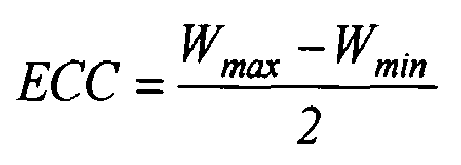
(See also Figure 8) - Ovality (OVA) of the cable is determined from the minimum diameter (dmin) and maximum diameter (dmax) of the cable insulation according to

- A low eccentricity and ovality are essential for the application because of the strict electrical performance requirements (See also Figure 8).
- A polypropylene homopolymer has been prepared using a commercial Z/N catalyst with the Borstar process known in the art to obtain a material described in Table 4, 5 and 6.
- A Z/N catalyst has been prepared as described in example 1 of
WO 03/000754 MFR 10. The polymer obtained is described in Table 4, 5 and 6. - The catalyst was prepared as described in example 5 of
WO 03/051934 - Al- and Zr- content were analyzed via above mentioned method to 36,27 wt.-% Al and 0,42 %-wt. Zr. The average particle diameter (analyzed via Coulter counter) is 20 µm and particle size distribution is shown in Fig. 3.
- A support-free catalyst has been prepared as described in example 5 of
WO 03/051934 - Such catalyst has been used to polymerise a polypropylene copolymer with ethylene of MFR230/2.16 1.8g/10min in the Borstar process, known in the art. The polymer obtained is described in Table 4, 5 and 6.
- Insulation extrusion trials were performed on a Francis Shaw extruder (600mm, 21 UD), a masterbatch based on the respective polymer was added in order to introduce commercially
available additives - In Table 4, the properties of the polypropylene materials prepared as described above are summarized.
Table 4: Properties of polypropylene materials Parameter Method Unit C 1 C 2 I 1 MFR230/2.16 MFR g/10min ~4 ~10 1.8 C2 Wt% 0.0 1.2 4.0 MW GPC kg/mol 450 244 403 MN GPC kg/mol 88 97 130 MWD GPC None 5,1 2,5 3,1 MZ GPC kg/mol 2136 519 1065 Tm1 DSC °C 146,6 139,4 129,8 Tm2 DSC °C 163,3 155,9 141,9 Hm1 DSC J/g 0,13 0,36 67,8 Hm2 DSC J/g 111,2 105,6 31,9 Tc1 DSC °C 112,6 106,9 105,4 Hc1 DSC J/g 102,3 98,5 83,1 IV IV ml/g 249,22 152,71 221,72 Tensile Modulus 527-2 MPa 1730,5 1199,6 1165,6 STRESS AT YIELD 527-2 MPa 37,5 31,5 31,4 STRAIN AT YIELD 527-2 % 8,5 11,9 9,5 TENSILE STRENGTH 527-2 MPa 37,5 31,5 34 STRAIN AT STRENGTH 527-2 % 8,49 11,88 396, 56 STRESS AT BREAK 527-2 MPa 12 17 33,3 STRAIN AT BREAK 527-2 % 61,26 434,73 401,28 Table 5: Results from stepwise isothermal segregation technique (SIST) (See also the Figures 5 to 7) Parameter Method Unit C 1 C 2 I 1 <110 SIST J/g 1,9 2,1 9,7 110-120 SIST J/g 1,9 1,8 6,8 120-130 SIST J/g 3,4 3,7 15,4 130-140 SIST J/g 5,6 10,9 27,6 140-150 SIST J/g 13,6 23,6 32,9 150-160 SIST J/g 38,0 41,4 9,07 160-170 SIST J/g 42,4 30,8 0,14 >170 SIST J/g 31,7 0,3 0,00 Table 6: Rheological Parameters and Polymer chain architecture Parameter Method Unit C 1 C 2 I 1 g' IV - 1 1 0,8 SHI@0.1s-1 SER - - - 0,58 SHI@0.3s-1 SER - - - 0,74 SHI@1.0s-1 SER - - - 0,80 SHI@3.0s-1 SER - - - 0,75 SHI@10s-1 SER - - - n/a MBI SER - - - 0,12 Structure - Linear Linear Multi-branched Table 7: Dielectric properties of the polymers (Influencing Factors for the Attenuation "a") Code Unit C 1 C 2 I 1 Method 1 2 3 Tan delta* x10-6 102 147 58-66 NPL measurement Dielectric constant - 2,25 2,26 2,25 NPL measurement - As can be seen from the Table 7, the inventive material (11) shows (unfoamed, rigid) a very low tan δ, much lower than the purest (hence best) Ziegler-Natta polypropylenes known commercially and from literature. Such behaviour is favourable because it enables the manufacturing of cables w low power loss in the electrical signal.
Table 8: Conversion properties to Cables Francis Shaw Tooling Pressure Die diameter 1,00 mm long Wire guide diameter 0,55 mm Screw type Barrier screw Breaker plate Yes Filter No Core 0,53 mm Cu solid C 1 C 2 I 1 Temperature profile °C) 182 181 180 195 195 195 219 219 219 221 220 220 220 220 221 220 220 221 223 223 223 220 220 221 Pressure (bar) 191 204 209 Line speed (m/min) 1000 975 965 Screw speed (rpm) 75 76 35 Extruder Amps (A) 27 27 26 Capstan Amps (A) 4 5 5 Cable Diameter (mm) 0,930 ± 0,003 0,932 ± 0,003 0,927 ± 0,001 ECC (mm) 0,006 ± 0,001 0,005 ± 0,001 0,009 ± 0,0006 OVA (mm) 0,009 ± 0,004 0,013 ± 0,002 0,008 ± 0,004 Surface appearance Very nice smooth surface Very nice smooth surface Very nice smooth surface
Claims (35)
- Cable comprising a conductor and a cable layer, whereina. said cable layer comprises polypropylene, andb. said cable layer and/or said polypropylene comprise(s) a crystalline fraction crystallizing in the temperature range of 200 to 105 °C determined by stepwise isothermal segregation technique (SIST), wherein said crystalline fraction comprises a part which during subsequent melting at a melting rate of 10 °C/min melts at or below 130 °C and said part represents at least 20 wt-% of said crystalline fraction.
- Cable comprising a conductor and a cable layer, whereina. said cable layer comprises polypropylene,b. said cable layer and/or said polypropylene comprise(s) a crystalline fraction crystallizing in the temperature range of 200 to 105 °C determined by stepwise isothermal segregation technique (SIST), wherein said crystalline fraction comprises a part which during subsequent melting at a melting rate of 10 °C/min melts at or below the temperature T = Tm - 3 °C, wherein Tm is the melting temperature, and said part represents at least 45 wt-% of said crystalline fraction, andc. said cable layer and/or said polypropylene is foamable.
- Cable comprising a conductor and a cable layer, whereina. said cable layer comprises polypropylene,b. said polypropylene is produced in the presence of a metallocene catalyst, andc. said cable layer and/or said polypropylene has (have),aa. a branching index g' of less than 1.00 andbb. a strain hardening index (SHI@1s-1) of at least 0.30 measured by a deformation rate dε/dt of 1.00 s-1 at a temperature of 180 °C, wherein the strain hardening index (SHI) is defined as the slope of the logarithm to the basis 10 of the tensile stress growth function (lg (ηE + )) as function of the logarithm to the basis 10 of the Hencky strain (Ig (s)) in the range of Hencky strains between 1 and 3.
- Cable according to claim 3, wherein said cable layer and/or said polypropylene has (have) a multi-branching index (MBI) of more than 0.10, wherein the multi-branching index (MBI) is defined as the slope of strain hardening index (SHI) as function of the logarithm to the basis 10 of the Hencky strain rate (Ig (dε/dt)).
- Cable comprising a conductor and a cable layer, whereina. said cable layer comprises polypropylene,b. said cable layer and/or said polypropylene has (have) a multi-branching index (MBI) of more than 0.10, wherein the multi-branching index (MBI) is defined as the slope of strain hardening index (SHI) as function of the logarithm to the basis 10 of the Hencky strain rate (Ig (dε/dt)), wherein
dε/dt is the deformation rate,
ε is the Hencky strain, and
the strain hardening index (SHI) is measured at 180 °C, wherein the strain hardening index (SHI) is defined as the slope of the logarithm to the basis 10 of the tensile stress growth function (Ig (η E +)) as function of the logarithm to the basis 10 of the Hencky strain (Ig (s)) in the range of Hencky strains between 1 and 3. - Cable according to claim 5, wherein said cable layer and/or said polypropylene has (have)a. a branching index g' of less than 1.00 and/orb. a strain hardening index (SHI@1s-1) of at least 0.30 measured by a deformation rate (dε/dt) of 1.00 s-1 at a temperature of 180 °C.
- Cable according to claim 1 or 2, wherein said cable layer and/or said polypropylene has (have)a. a branching index g' of less than 1.00 and/orb. a strain hardening index (SHI@1s-1) of at least 0.30 measured by a deformation rate dε/dt of 1.00 s-1 at a temperature of 180 °C, wherein the strain hardening index (SHI) is defined as the slope of the logarithm to the basis 10 of the tensile stress growth function (Ig (η E +)) as function of the logarithm to the basis 10 of the Hencky strain (Ig (s)) in the range of Hencky strains between 1 and 3.
- Cable according to any one of the claims 1, 2 and 7, wherein said cable layer and/or said polypropylene has (have) a multi-branching index (MBI) of more than 0.10, wherein the multi-branching index (MBI) is defined as the slope of strain hardening index (SHI) as function of the logarithm to the basis 10 of the Hencky strain rate (Ig (dε/dt)), wherein
dε/dt is the deformation rate,
ε is the Hencky strain, and
the strain hardening index (SHI) is measured at 180 °C, wherein the strain hardening index (SHI) is defined as the slope of the logarithm to the basis 10 of the tensile stress growth function (Ig (η E +)) as function of the logarithm to the basis 10 of the Hencky strain (Ig (ε)) in the range of Hencky strains between 1 and 3. - Cable according to any one of the preceding claims 3 to 6, wherein said cable layer and/or said polypropylene comprise(s) a crystalline fraction crystallizing in the temperature range of 200 to 105 °C determined by stepwise isothermal segregation technique (SIST), wherein said crystalline fraction comprises a part which during subsequent melting at a melting rate of 10 °C/min melts at or below 130 °C and said part represents at least 20 wt-% of said crystalline fraction.
- Cable according to any one of the preceding claims 3 to 6 and 9, wherein said cable layer and/or said polypropylene comprise(s) a crystalline fraction crystallizing in the temperature range of 200 to 105 °C determined by stepwise isothermal segregation technique (SIST), wherein said crystalline fraction comprises a part which during subsequent melting at a melting rate of 10 °C/min melts at or below the temperature T = Tm - 3 °C, wherein Tm is the melting temperature, and said part represents at least 45 wt-% of said crystalline fraction.
- Cable according to any one of the claims 1, 2, and 7 to 10, wherein said cable layer and/or said polypropylene comprise(s) at least 90 wt-% of said crystalline fraction.
- Cable according to any one of the preceding claims, wherein said cable layer and/or said polypropylene has/have an aluminium residue content of less than 25 ppm and/or a boron residue content less than 25 ppm and/or a silicon residue content of less than 25 ppm.
- Cable according to any one of the preceding claims 1, 3 to 12, wherein said cable layer and/or said polypropylene is expanded, preferably by foaming.
- Cable according any one of the preceding claims, wherein said cable layer has a tensile modules of at least 900 MPa measured according to ISO 527-3 at a cross head speed of 1 mm/min.
- Cable according to any one of the preceding claims, wherein said cable layer and/or the polypropylene has/have a melting point Tm of at least 125 °C.
- Cable according to any one of the preceding claims, wherein said polypropylene is multimodal.
- Cable according to any one of the preceding claims 1 to 15, wherein said polypropylene is unimodal.
- Cable according to any one of the preceding claims, wherein said polypropylene has molecular weight distribution (MWD) measured according to ISO 16014 of not more than 8.00.
- Cable according to any one of the preceding claims, wherein said polypropylene has a melt flow rate MFR2 measured according to ISO 1133 of up to 30 g/10min.
- Cable according to any one of the preceding claims, wherein said polypropylene has a mmmm pentad concentration of higher than 90 % determined by NMR-spectroscopy.
- Cable according to any one of the preceding claims, wherein said polypropylene is a propylene homopolymer.
- Cable according to any one of the preceding claims, wherein said polypropylene is propylene copolymer.
- Cable according to claim 22, wherein the comonomer is ethylene.
- Cable according to claim 21 or 22, wherein the total amount of comonomer in the propylene copolymer is up to 10 mol%.
- Cable according to any one of the claims 21 to 24, wherein the propylene copolymer comprises a polypropylene matrix and an ethylene-propylene rubber (EPR).
- Cable according to claim 25, wherein the ethylene-propylene rubber (EPR) in the propylene copolymer is up to 70 wt%.
- Cable according to claim 25 or 26, wherein the ethylene-propylene rubber (EPR) has an ethylene content of up to 50 wt%.
- Cable according to any one of the preceding claims, wherein the cable has dielectric loss tangent value (tan d) of less than 100 x 10-6 determined by a frequency of 1.8 GHz.
- Cable according to any one of the preceding claims, wherein said cable layer comprises in addition metal deactivator(s).
- Cable according to any one of the preceding claims, wherein said polypropylene has been produced in the presence of a catalyst system comprising an asymmetric catalyst, wherein the catalyst system has a porosity of less than 1.40 ml/g.
- Cable according to claim 30, wherein the asymmetric catalyst is dimethylsilyl [(2-methyl-(4'-tert. butyl)-4-phenyl-indenyl)(2-isopropyl-(4'-tert. butyl)-4-phenyl-indenyl)]zirconium dichloride.
- Cable according to any one of the preceding claims, wherein the cable is a coaxial cable and the cable layer according to any one of the preceding claims 1 to 27 and 29 to 31 is a dielectric layer in said cable.
- A process for the preparation of a cable according to any one of the preceding claims 1 to 32, wherein a polypropylene according to any one of the claims 1 to 12, 15 to 27, and 29 to 30 is formed into a cable layer on the conductor.
- The process according to claim 33, wherein the polypropylene is prepared using a catalyst system of low porosity, the catalyst system comprising a asymmetric catalyst, wherein the catalyst system has a porosity measured according to DIN 66135 of less than 1.40 ml/g.
- The process according to any one of the preceding claims 33 to 34, wherein the asymmetric catalyst is dimethylsilyl [(2-methyl-(4'-tert. butyl)-4-phenyl-indenyl)(2-isopropyl-(4'-tert. butyl)-4-phenyl-indenyl)]zirconium dichloride.
Priority Applications (6)
| Application Number | Priority Date | Filing Date | Title |
|---|---|---|---|
| EP06020007A EP1903579B1 (en) | 2006-09-25 | 2006-09-25 | Coaxial cable |
| DE602006013137T DE602006013137D1 (en) | 2006-09-25 | 2006-09-25 | Coaxial cable |
| AT06020007T ATE462189T1 (en) | 2006-09-25 | 2006-09-25 | COAXIAL CABLE |
| PCT/EP2007/008278 WO2008037407A1 (en) | 2006-09-25 | 2007-09-24 | Coaxial cable |
| CN200780035590XA CN101517659B (en) | 2006-09-25 | 2007-09-24 | Coaxial cable |
| US12/408,248 US8247052B2 (en) | 2006-09-25 | 2009-03-20 | Coaxial cable |
Applications Claiming Priority (1)
| Application Number | Priority Date | Filing Date | Title |
|---|---|---|---|
| EP06020007A EP1903579B1 (en) | 2006-09-25 | 2006-09-25 | Coaxial cable |
Publications (2)
| Publication Number | Publication Date |
|---|---|
| EP1903579A1 true EP1903579A1 (en) | 2008-03-26 |
| EP1903579B1 EP1903579B1 (en) | 2010-03-24 |
Family
ID=37735166
Family Applications (1)
| Application Number | Title | Priority Date | Filing Date |
|---|---|---|---|
| EP06020007A Not-in-force EP1903579B1 (en) | 2006-09-25 | 2006-09-25 | Coaxial cable |
Country Status (6)
| Country | Link |
|---|---|
| US (1) | US8247052B2 (en) |
| EP (1) | EP1903579B1 (en) |
| CN (1) | CN101517659B (en) |
| AT (1) | ATE462189T1 (en) |
| DE (1) | DE602006013137D1 (en) |
| WO (1) | WO2008037407A1 (en) |
Cited By (3)
| Publication number | Priority date | Publication date | Assignee | Title |
|---|---|---|---|---|
| WO2010076231A1 (en) * | 2008-12-29 | 2010-07-08 | Borealis Ag | Cable layer of modified soft polypropylene with improved stress whitening resistance |
| WO2011050963A1 (en) | 2009-10-29 | 2011-05-05 | Borealis Ag | Heterophasic polypropylene resin with long chain branching |
| WO2013030206A1 (en) * | 2011-08-30 | 2013-03-07 | Borealis Ag | Power cable comprising polypropylene |
Families Citing this family (10)
| Publication number | Priority date | Publication date | Assignee | Title |
|---|---|---|---|---|
| JP3761356B2 (en) | 1999-05-25 | 2006-03-29 | 富士通株式会社 | LAN traffic control system and method, and recording medium recording the control program |
| ATE456139T1 (en) * | 2006-07-10 | 2010-02-15 | Borealis Tech Oy | CABLE LAYER BASED ON POLYPROPYLENE WITH HIGH ELECTRICAL FAILURE DIAGRAM STRENGTH |
| US8674235B2 (en) | 2011-06-06 | 2014-03-18 | Intel Corporation | Microelectronic substrate for alternate package functionality |
| US9532739B2 (en) | 2011-06-14 | 2017-01-03 | Gravitas Medical, Inc. | Methods and apparatus for guiding medical care based on detected gastric function |
| US9322114B2 (en) * | 2012-12-03 | 2016-04-26 | Exxonmobil Chemical Patents Inc. | Polypropylene fibers and fabrics |
| JP6522329B2 (en) * | 2014-12-12 | 2019-05-29 | 太陽ホールディングス株式会社 | Measuring jig and measuring device |
| DE112017006391T5 (en) * | 2016-12-21 | 2019-09-05 | Autonetworks Technologies, Ltd. | communication cable |
| CN111546605A (en) * | 2020-04-26 | 2020-08-18 | 天津大学 | A kind of thermoplastic polypropylene cable isothermal crystallization extrusion molding method |
| EP4393969A1 (en) | 2022-12-27 | 2024-07-03 | Borealis AG | Propylene composition |
| CN117630608B (en) * | 2023-12-06 | 2024-08-06 | 西南交通大学 | Vehicle-mounted EPR cable insulation aging evaluation method based on force-electricity coupling parameters |
Citations (5)
| Publication number | Priority date | Publication date | Assignee | Title |
|---|---|---|---|---|
| EP0190889A2 (en) * | 1985-01-31 | 1986-08-13 | Montell North America Inc. | Polypropylene with free-end long chain branching, process for making it, and use thereof |
| EP0690458A2 (en) * | 1994-06-27 | 1996-01-03 | Mitsubishi Cable Industries, Ltd. | Insulating composition and formed article thereof |
| WO2000012572A1 (en) * | 1998-08-26 | 2000-03-09 | Exxon Chemical Patents Inc. | Branched polypropylene compositions |
| EP1295910A1 (en) * | 2001-09-25 | 2003-03-26 | Borealis GmbH | Insulating foam composition |
| EP1429346A1 (en) * | 2002-12-12 | 2004-06-16 | Borealis Technology Oy | Coaxial cable comprising dielectric material |
Family Cites Families (81)
| Publication number | Priority date | Publication date | Assignee | Title |
|---|---|---|---|---|
| JPS55115416A (en) * | 1979-02-27 | 1980-09-05 | Nippon Oil Co Ltd | Manufacture of copolymer |
| DE3070192D1 (en) | 1980-03-20 | 1985-03-28 | Mitsubishi Rayon Co | A method of producing a polypropylene film for electrical appliances |
| JPS6042807B2 (en) * | 1980-04-11 | 1985-09-25 | チッソ株式会社 | Method for producing ethylene propylene α-olefin terpolymer |
| DD203915A1 (en) | 1982-03-09 | 1983-11-09 | Leuna Werke Veb | DISPOSABLE POLYETHYLENE MOLDING |
| JPS61115940A (en) | 1984-11-09 | 1986-06-03 | Mitsubishi Yuka Badische Kk | polypropylene foam particles |
| US4634745A (en) * | 1985-04-01 | 1987-01-06 | United States Steel Corporation | Terpolymer production |
| US4808561A (en) * | 1985-06-21 | 1989-02-28 | Exxon Chemical Patents Inc. | Supported polymerization catalyst |
| US4701432A (en) * | 1985-11-15 | 1987-10-20 | Exxon Chemical Patents Inc. | Supported polymerization catalyst |
| US5047485A (en) | 1989-02-21 | 1991-09-10 | Himont Incorporated | Process for making a propylene polymer with free-end long chain branching and use thereof |
| US5250631A (en) * | 1990-06-13 | 1993-10-05 | Shell Oil Company | Polymer compositions |
| FI86867C (en) | 1990-12-28 | 1992-10-26 | Neste Oy | FLERSTEGSPROCESS FOR FRAMSTAELLNING AV POLYETEN |
| EP0515969B1 (en) * | 1991-05-28 | 1996-09-04 | Hoechst Aktiengesellschaft | Biaxially oriented opaque multilayer sealable polypropylene film, process of preparation and use thereof |
| US5302744A (en) * | 1992-03-27 | 1994-04-12 | Eastman Kodak Company | Phenolic-hydrazide compounds and polyolefin compositions stabilized therewith |
| DE69408989T2 (en) | 1993-05-25 | 1998-11-05 | Exxon Chemical Patents Inc | METALOCENATE CATALYST SYSTEM ON A SUPPORT FOR THE OLEFIN POLYMERIZATION, THEIR PRODUCTION AND USE |
| IT1269914B (en) | 1994-03-24 | 1997-04-16 | Himonty Inc | PAINTABLE COMPOSITIONS OF PROPYLENE CRYSTALLINE COPOLYMERS HAVING LOW WELDABILITY TEMPERATURE |
| NO314475B1 (en) | 1994-03-24 | 2003-03-24 | Nippon Petrochemicals Co Ltd | Electrically insulating polymeric material and its use |
| US5468440B1 (en) | 1994-05-06 | 1997-04-08 | Exxon Chemical Patents Inc | Process of making oriented film or structure |
| EP0747212A1 (en) | 1995-05-31 | 1996-12-11 | Hoechst Aktiengesellschaft | Biaxially oriented polypropylene film with improved barrier properties against water-vapour and oxygen |
| DE59605705D1 (en) * | 1995-05-31 | 2000-09-14 | Hoechst Ag | Biaxially oriented polypropylene film with increased dimensional stability |
| EP0745637A1 (en) | 1995-05-31 | 1996-12-04 | Hoechst Aktiengesellschaft | Biaxially oriented film of polypropylene with high area modules |
| JPH08325327A (en) * | 1995-06-02 | 1996-12-10 | Chisso Corp | High stereoregular polypropylene |
| SE9504539D0 (en) | 1995-12-19 | 1995-12-19 | Borealis As | Procatalyst and process for the preparation of a multimodal ethylene homopolymer and / or ethylene / 1-olefin copolymer by gas-phase polymerization |
| BE1009963A3 (en) * | 1995-12-22 | 1997-11-04 | Solvay | COMPOSITIONS STATISTICS PROPYLENE COPOLYMERS, METHOD OF MAKING, AND CONTAINING SHEETS MULTI-sealable. |
| CN1081652C (en) | 1996-08-09 | 2002-03-27 | 东丽株式会社 | Polypropylene film and capacitor made by using the same as the dielectric |
| KR20000068428A (en) | 1996-09-04 | 2000-11-25 | 엑손 케미칼 패턴츠 인코포레이티드 | Improved propylene polymers for oriented films |
| US6218023B1 (en) | 1997-04-21 | 2001-04-17 | Montell North America, Inc. | Co-extruded laminate comprising at least one propylene graft copolymer layer |
| US6204348B1 (en) | 1997-05-20 | 2001-03-20 | Borealis Gmbh | Modified polypropylenes of improved processability |
| DE69820399T2 (en) | 1997-05-30 | 2004-10-07 | Mitsui Chemicals Inc | Polypropylene resin composition and injection molded article |
| FI104824B (en) | 1997-06-24 | 2000-04-14 | Borealis As | Process for producing propylene polymers |
| FI111848B (en) | 1997-06-24 | 2003-09-30 | Borealis Tech Oy | Process and equipment for the preparation of homopolymers and copolymers of propylene |
| IT1293757B1 (en) | 1997-07-23 | 1999-03-10 | Pirelli Cavi S P A Ora Pirelli | CABLES WITH RECYCLABLE COVERING WITH HOMOGENEOUS DISTRIBUTION |
| EP0942013B1 (en) | 1997-08-05 | 2004-02-04 | Mitsui Chemicals, Inc. | Polypropylene resin composition and use thereof |
| AU747745B2 (en) | 1997-08-15 | 2002-05-23 | Dow Chemical Company, The | Films produced from substantially linear homogeneous olefin polymer compositions |
| FI974175L (en) | 1997-11-07 | 1999-05-08 | Borealis As | Method for producing polypropylene |
| US6197910B1 (en) | 1997-12-10 | 2001-03-06 | Exxon Chemical Patents, Inc. | Propylene polymers incorporating macromers |
| HUP0004538A2 (en) * | 1997-12-19 | 2001-04-28 | Phillips Petroleum Co. | Nickel diimine catalysts with methylalumoxane as cocatalyst, method of polymerization of olefins therewith and polymers produced |
| DE19813399A1 (en) * | 1998-03-26 | 1999-09-30 | Basf Ag | Statistical propylene copolymers |
| DE19827327A1 (en) | 1998-06-19 | 1999-12-30 | Targor Gmbh | Sealable multilayer film with a low sealing temperature and a low content of xylene-soluble material, useful in packaging applications |
| DE19949235A1 (en) | 1998-10-16 | 2000-05-11 | Chisso Corp | Propylene-ethylene-alpha-olefin terpolymer, useful for the production of molded articles and film, contains 85-99.99 mol per cent propylene and has specific elution characteristics in o-dichlorobenzene |
| FI991057A0 (en) | 1999-05-07 | 1999-05-07 | Borealis As | High stiffness propylene polymers and process for their preparation |
| GB9912739D0 (en) | 1999-06-01 | 1999-08-04 | Borealis As | Process |
| ATE286939T1 (en) | 1999-06-24 | 2005-01-15 | Dow Chemical Co | POLYOLEFINE COMPOSITION WITH IMPROVED IMPACT PROPERTIES |
| ATE291041T1 (en) | 1999-10-02 | 2005-04-15 | Borealis Tech Oy | SUPPORTED AND MODIFIED CATALYST FOR THE POLYMERIZATION OF OLEFINS |
| JP2001188431A (en) | 1999-10-22 | 2001-07-10 | Canon Inc | Induction heating fixing device and image forming method |
| CN1590422A (en) * | 1999-12-23 | 2005-03-09 | 巴塞尔聚烯烃有限公司 | Transition metal compounds, ligand systems, catalyst systems and their use in the polymerization and copolymerization of olefins |
| EP1142684A3 (en) * | 2000-04-03 | 2002-06-26 | Sumitomo Chemical Company, Limited | Thermoplastic resin sheet and container |
| JP2001354814A (en) | 2000-06-16 | 2001-12-25 | Chisso Corp | Propylene resin sheet |
| US7125933B2 (en) * | 2000-06-22 | 2006-10-24 | Univation Technologies, Llc | Very low density polyethylene blends |
| EP1325073B1 (en) | 2000-06-22 | 2007-05-09 | ExxonMobil Chemical Patents Inc. | Metallocene-produced very low density polyethylenes |
| DE60137341D1 (en) | 2000-08-22 | 2009-02-26 | Exxonmobil Chem Patents Inc | POLYPROPYLENE FILMS |
| AU2002220722A1 (en) | 2000-11-28 | 2002-06-11 | Borealis Gmbh | Use of propylene terpolymers for the production of films |
| JP2002294010A (en) * | 2001-03-30 | 2002-10-09 | Sumitomo Chem Co Ltd | Polypropylene resin composition for stretched film and stretched film |
| GB0111020D0 (en) | 2001-05-04 | 2001-06-27 | Borealis Tech Oy | Process |
| JP2002363356A (en) | 2001-06-04 | 2002-12-18 | Grand Polymer Co Ltd | Extrusion coating polypropylene resin composition |
| EP1273595B8 (en) | 2001-06-20 | 2006-10-11 | Borealis Technology Oy | Preparation of olefin polymerisation catalyst component |
| EP1302310A1 (en) | 2001-10-15 | 2003-04-16 | Atofina Research S.A. | Adhesion of polyethylene on polypropylene |
| WO2003040233A2 (en) | 2001-11-06 | 2003-05-15 | Dow Global Technologies Inc. | Impact resistant polymer blends of crystalline polypropylene and partially crystalline, low molecular weight impact modifiers |
| JP2003147110A (en) | 2001-11-09 | 2003-05-21 | Mitsui Chemicals Inc | Polyolefin-based polymer composition foam and method for producing the same |
| EP1323747A1 (en) | 2001-12-19 | 2003-07-02 | Borealis Technology Oy | Production of olefin polymerisation catalysts |
| SG113461A1 (en) * | 2002-05-09 | 2005-08-29 | Sumitomo Chemical Co | Polypropylene resin composition and heat-shrinkable film obtained from the same |
| US6756463B2 (en) | 2002-05-16 | 2004-06-29 | Japan Polychem Corporation | Propylene polymer |
| CN100564399C (en) | 2002-08-01 | 2009-12-02 | 巴塞尔聚烯烃意大利有限公司 | Highly stereotactic polypropylene with improved properties |
| CN1681858A (en) | 2002-09-20 | 2005-10-12 | 埃克森美孚化学专利公司 | Supercritical polymerization process and polymers produced therefrom |
| EP1408077A1 (en) | 2002-10-09 | 2004-04-14 | Borealis Technology Oy | Polymer composition comprising nanofillers |
| US20040132935A1 (en) | 2002-10-24 | 2004-07-08 | Palanisamy Arjunan | Branched crystalline polypropylene |
| EP1422250A1 (en) | 2002-11-20 | 2004-05-26 | ATOFINA Research | Branched polypropylene |
| AU2003287683A1 (en) | 2002-12-05 | 2004-06-30 | Exxonmobil Chemical Patents Inc. | High temperature bulk polymerization of branched crystalline polypropylene |
| US8129473B2 (en) | 2003-05-08 | 2012-03-06 | Lummus Novolen Technology Gmbh | Polypropylene resin composition |
| EP1484345A1 (en) | 2003-06-06 | 2004-12-08 | Borealis Technology Oy | Process for the production of polypropylene using a Ziegler-Natta catalyst |
| EP1495861A1 (en) | 2003-07-10 | 2005-01-12 | Total Petrochemicals Research Feluy | High transparency, high impact resistance containers |
| US20050090571A1 (en) * | 2003-10-27 | 2005-04-28 | Mehta Aspy K. | Expanded bead foams from propylene-diene copolymers and their use |
| JP2006022276A (en) | 2004-07-09 | 2006-01-26 | Fujikura Ltd | Insulator composition, high foam insulator using the same, and coaxial cable for high frequency. |
| EP1634699A1 (en) | 2004-09-10 | 2006-03-15 | Syrom 90 S.P.A. | Multilayer metallized film and production method |
| US7138474B1 (en) | 2005-05-03 | 2006-11-21 | Fina Technology, Inc. | End use articles derived from polypropylene homopolymers and random copolymers |
| ATE435243T1 (en) | 2005-05-20 | 2009-07-15 | Borealis Tech Oy | HIGH MELTING FLOW POLYMER WITH IMPROVED RESISTANCE FOR TUBE APPLICATIONS |
| EP1726603A1 (en) | 2005-05-27 | 2006-11-29 | Borealis Technology Oy | Propylene polymer with high crystallinity |
| EP1726602A1 (en) | 2005-05-27 | 2006-11-29 | Borealis Technology Oy | Propylene polymer with high crystallinity |
| EP1847555A1 (en) | 2006-04-18 | 2007-10-24 | Borealis Technology Oy | Multi-branched Polypropylene |
| EP1847552A1 (en) | 2006-04-18 | 2007-10-24 | Borealis Technology Oy | Catalytic system |
| EP1847551A1 (en) | 2006-04-18 | 2007-10-24 | Borealis Technology Oy | Process for the preparation of polypropylene |
| EP1892264A1 (en) | 2006-08-25 | 2008-02-27 | Borealis Technology Oy | Extrusion coated substrate |
-
2006
- 2006-09-25 AT AT06020007T patent/ATE462189T1/en not_active IP Right Cessation
- 2006-09-25 EP EP06020007A patent/EP1903579B1/en not_active Not-in-force
- 2006-09-25 DE DE602006013137T patent/DE602006013137D1/en active Active
-
2007
- 2007-09-24 CN CN200780035590XA patent/CN101517659B/en not_active Expired - Fee Related
- 2007-09-24 WO PCT/EP2007/008278 patent/WO2008037407A1/en not_active Ceased
-
2009
- 2009-03-20 US US12/408,248 patent/US8247052B2/en not_active Expired - Fee Related
Patent Citations (5)
| Publication number | Priority date | Publication date | Assignee | Title |
|---|---|---|---|---|
| EP0190889A2 (en) * | 1985-01-31 | 1986-08-13 | Montell North America Inc. | Polypropylene with free-end long chain branching, process for making it, and use thereof |
| EP0690458A2 (en) * | 1994-06-27 | 1996-01-03 | Mitsubishi Cable Industries, Ltd. | Insulating composition and formed article thereof |
| WO2000012572A1 (en) * | 1998-08-26 | 2000-03-09 | Exxon Chemical Patents Inc. | Branched polypropylene compositions |
| EP1295910A1 (en) * | 2001-09-25 | 2003-03-26 | Borealis GmbH | Insulating foam composition |
| EP1429346A1 (en) * | 2002-12-12 | 2004-06-16 | Borealis Technology Oy | Coaxial cable comprising dielectric material |
Cited By (8)
| Publication number | Priority date | Publication date | Assignee | Title |
|---|---|---|---|---|
| WO2010076231A1 (en) * | 2008-12-29 | 2010-07-08 | Borealis Ag | Cable layer of modified soft polypropylene with improved stress whitening resistance |
| CN102264827A (en) * | 2008-12-29 | 2011-11-30 | 北欧化工公司 | Cable layer of modified soft polypropylene with improved stress whitening resistance |
| CN102264827B (en) * | 2008-12-29 | 2013-11-27 | 北欧化工公司 | Cable layer of modified soft polypropylene with improved stress whitening resistance |
| WO2011050963A1 (en) | 2009-10-29 | 2011-05-05 | Borealis Ag | Heterophasic polypropylene resin with long chain branching |
| EP2319885A1 (en) | 2009-10-29 | 2011-05-11 | Borealis AG | Heterophasic polypropylene resin with long chain branching |
| US8686093B2 (en) | 2009-10-29 | 2014-04-01 | Borealis Ag | Heterophasic polypropylene resin with long chain branching |
| WO2013030206A1 (en) * | 2011-08-30 | 2013-03-07 | Borealis Ag | Power cable comprising polypropylene |
| RU2570793C2 (en) * | 2011-08-30 | 2015-12-10 | Бореалис Аг | Power supply cable with polypropylene |
Also Published As
| Publication number | Publication date |
|---|---|
| ATE462189T1 (en) | 2010-04-15 |
| EP1903579B1 (en) | 2010-03-24 |
| CN101517659A (en) | 2009-08-26 |
| DE602006013137D1 (en) | 2010-05-06 |
| US20090183894A1 (en) | 2009-07-23 |
| US8247052B2 (en) | 2012-08-21 |
| CN101517659B (en) | 2012-02-01 |
| WO2008037407A1 (en) | 2008-04-03 |
Similar Documents
| Publication | Publication Date | Title |
|---|---|---|
| US8247052B2 (en) | Coaxial cable | |
| US7914899B2 (en) | Electrical insulation film | |
| US20090149614A1 (en) | Cable layer on polypropylene basis with high electrical breakdown strength | |
| EP2007823B1 (en) | Multiple -branched polypropylene | |
| EP1990353B1 (en) | Electrical insulation film | |
| US8378047B2 (en) | Biaxially oriented polypropylene film | |
| EP2054464B1 (en) | Blown film of polypropylene | |
| US20110040061A1 (en) | Short-chain branched polypropylene | |
| EP2341086A1 (en) | Bopp-film | |
| EP2341088B1 (en) | BOPP with homogeneous film morphology | |
| EP1900764B1 (en) | Polypropylene foam |
Legal Events
| Date | Code | Title | Description |
|---|---|---|---|
| PUAI | Public reference made under article 153(3) epc to a published international application that has entered the european phase |
Free format text: ORIGINAL CODE: 0009012 |
|
| 17P | Request for examination filed |
Effective date: 20060925 |
|
| AK | Designated contracting states |
Kind code of ref document: A1 Designated state(s): AT BE BG CH CY CZ DE DK EE ES FI FR GB GR HU IE IS IT LI LT LU LV MC NL PL PT RO SE SI SK TR |
|
| AX | Request for extension of the european patent |
Extension state: AL BA HR MK YU |
|
| 17Q | First examination report despatched |
Effective date: 20080424 |
|
| AKX | Designation fees paid |
Designated state(s): AT BE BG CH CY CZ DE DK EE ES FI FR GB GR HU IE IS IT LI LT LU LV MC NL PL PT RO SE SI SK TR |
|
| GRAP | Despatch of communication of intention to grant a patent |
Free format text: ORIGINAL CODE: EPIDOSNIGR1 |
|
| GRAS | Grant fee paid |
Free format text: ORIGINAL CODE: EPIDOSNIGR3 |
|
| GRAA | (expected) grant |
Free format text: ORIGINAL CODE: 0009210 |
|
| AK | Designated contracting states |
Kind code of ref document: B1 Designated state(s): AT BE BG CH CY CZ DE DK EE ES FI FR GB GR HU IE IS IT LI LT LU LV MC NL PL PT RO SE SI SK TR |
|
| REG | Reference to a national code |
Ref country code: GB Ref legal event code: FG4D |
|
| REG | Reference to a national code |
Ref country code: CH Ref legal event code: EP |
|
| REG | Reference to a national code |
Ref country code: IE Ref legal event code: FG4D |
|
| REF | Corresponds to: |
Ref document number: 602006013137 Country of ref document: DE Date of ref document: 20100506 Kind code of ref document: P |
|
| REG | Reference to a national code |
Ref country code: NL Ref legal event code: VDEP Effective date: 20100324 |
|
| PG25 | Lapsed in a contracting state [announced via postgrant information from national office to epo] |
Ref country code: LT Free format text: LAPSE BECAUSE OF FAILURE TO SUBMIT A TRANSLATION OF THE DESCRIPTION OR TO PAY THE FEE WITHIN THE PRESCRIBED TIME-LIMIT Effective date: 20100324 |
|
| LTIE | Lt: invalidation of european patent or patent extension |
Effective date: 20100324 |
|
| PG25 | Lapsed in a contracting state [announced via postgrant information from national office to epo] |
Ref country code: FI Free format text: LAPSE BECAUSE OF FAILURE TO SUBMIT A TRANSLATION OF THE DESCRIPTION OR TO PAY THE FEE WITHIN THE PRESCRIBED TIME-LIMIT Effective date: 20100324 Ref country code: LV Free format text: LAPSE BECAUSE OF FAILURE TO SUBMIT A TRANSLATION OF THE DESCRIPTION OR TO PAY THE FEE WITHIN THE PRESCRIBED TIME-LIMIT Effective date: 20100324 Ref country code: PL Free format text: LAPSE BECAUSE OF FAILURE TO SUBMIT A TRANSLATION OF THE DESCRIPTION OR TO PAY THE FEE WITHIN THE PRESCRIBED TIME-LIMIT Effective date: 20100324 Ref country code: SI Free format text: LAPSE BECAUSE OF FAILURE TO SUBMIT A TRANSLATION OF THE DESCRIPTION OR TO PAY THE FEE WITHIN THE PRESCRIBED TIME-LIMIT Effective date: 20100324 Ref country code: AT Free format text: LAPSE BECAUSE OF FAILURE TO SUBMIT A TRANSLATION OF THE DESCRIPTION OR TO PAY THE FEE WITHIN THE PRESCRIBED TIME-LIMIT Effective date: 20100324 |
|
| PG25 | Lapsed in a contracting state [announced via postgrant information from national office to epo] |
Ref country code: EE Free format text: LAPSE BECAUSE OF FAILURE TO SUBMIT A TRANSLATION OF THE DESCRIPTION OR TO PAY THE FEE WITHIN THE PRESCRIBED TIME-LIMIT Effective date: 20100324 Ref country code: ES Free format text: LAPSE BECAUSE OF FAILURE TO SUBMIT A TRANSLATION OF THE DESCRIPTION OR TO PAY THE FEE WITHIN THE PRESCRIBED TIME-LIMIT Effective date: 20100705 Ref country code: GR Free format text: LAPSE BECAUSE OF FAILURE TO SUBMIT A TRANSLATION OF THE DESCRIPTION OR TO PAY THE FEE WITHIN THE PRESCRIBED TIME-LIMIT Effective date: 20100625 Ref country code: NL Free format text: LAPSE BECAUSE OF FAILURE TO SUBMIT A TRANSLATION OF THE DESCRIPTION OR TO PAY THE FEE WITHIN THE PRESCRIBED TIME-LIMIT Effective date: 20100324 Ref country code: RO Free format text: LAPSE BECAUSE OF FAILURE TO SUBMIT A TRANSLATION OF THE DESCRIPTION OR TO PAY THE FEE WITHIN THE PRESCRIBED TIME-LIMIT Effective date: 20100324 Ref country code: SE Free format text: LAPSE BECAUSE OF FAILURE TO SUBMIT A TRANSLATION OF THE DESCRIPTION OR TO PAY THE FEE WITHIN THE PRESCRIBED TIME-LIMIT Effective date: 20100324 |
|
| PG25 | Lapsed in a contracting state [announced via postgrant information from national office to epo] |
Ref country code: SK Free format text: LAPSE BECAUSE OF FAILURE TO SUBMIT A TRANSLATION OF THE DESCRIPTION OR TO PAY THE FEE WITHIN THE PRESCRIBED TIME-LIMIT Effective date: 20100324 Ref country code: IS Free format text: LAPSE BECAUSE OF FAILURE TO SUBMIT A TRANSLATION OF THE DESCRIPTION OR TO PAY THE FEE WITHIN THE PRESCRIBED TIME-LIMIT Effective date: 20100724 Ref country code: CZ Free format text: LAPSE BECAUSE OF FAILURE TO SUBMIT A TRANSLATION OF THE DESCRIPTION OR TO PAY THE FEE WITHIN THE PRESCRIBED TIME-LIMIT Effective date: 20100324 Ref country code: BG Free format text: LAPSE BECAUSE OF FAILURE TO SUBMIT A TRANSLATION OF THE DESCRIPTION OR TO PAY THE FEE WITHIN THE PRESCRIBED TIME-LIMIT Effective date: 20100624 |
|
| PLBE | No opposition filed within time limit |
Free format text: ORIGINAL CODE: 0009261 |
|
| STAA | Information on the status of an ep patent application or granted ep patent |
Free format text: STATUS: NO OPPOSITION FILED WITHIN TIME LIMIT |
|
| PG25 | Lapsed in a contracting state [announced via postgrant information from national office to epo] |
Ref country code: PT Free format text: LAPSE BECAUSE OF FAILURE TO SUBMIT A TRANSLATION OF THE DESCRIPTION OR TO PAY THE FEE WITHIN THE PRESCRIBED TIME-LIMIT Effective date: 20100726 Ref country code: DK Free format text: LAPSE BECAUSE OF FAILURE TO SUBMIT A TRANSLATION OF THE DESCRIPTION OR TO PAY THE FEE WITHIN THE PRESCRIBED TIME-LIMIT Effective date: 20100324 |
|
| 26N | No opposition filed |
Effective date: 20101228 |
|
| PG25 | Lapsed in a contracting state [announced via postgrant information from national office to epo] |
Ref country code: MC Free format text: LAPSE BECAUSE OF NON-PAYMENT OF DUE FEES Effective date: 20100930 |
|
| REG | Reference to a national code |
Ref country code: CH Ref legal event code: PL |
|
| PG25 | Lapsed in a contracting state [announced via postgrant information from national office to epo] |
Ref country code: CH Free format text: LAPSE BECAUSE OF NON-PAYMENT OF DUE FEES Effective date: 20100930 Ref country code: LI Free format text: LAPSE BECAUSE OF NON-PAYMENT OF DUE FEES Effective date: 20100930 Ref country code: IE Free format text: LAPSE BECAUSE OF NON-PAYMENT OF DUE FEES Effective date: 20100925 |
|
| PG25 | Lapsed in a contracting state [announced via postgrant information from national office to epo] |
Ref country code: CY Free format text: LAPSE BECAUSE OF FAILURE TO SUBMIT A TRANSLATION OF THE DESCRIPTION OR TO PAY THE FEE WITHIN THE PRESCRIBED TIME-LIMIT Effective date: 20100324 |
|
| PG25 | Lapsed in a contracting state [announced via postgrant information from national office to epo] |
Ref country code: LU Free format text: LAPSE BECAUSE OF NON-PAYMENT OF DUE FEES Effective date: 20100925 Ref country code: HU Free format text: LAPSE BECAUSE OF FAILURE TO SUBMIT A TRANSLATION OF THE DESCRIPTION OR TO PAY THE FEE WITHIN THE PRESCRIBED TIME-LIMIT Effective date: 20100925 |
|
| PG25 | Lapsed in a contracting state [announced via postgrant information from national office to epo] |
Ref country code: TR Free format text: LAPSE BECAUSE OF FAILURE TO SUBMIT A TRANSLATION OF THE DESCRIPTION OR TO PAY THE FEE WITHIN THE PRESCRIBED TIME-LIMIT Effective date: 20100324 |
|
| REG | Reference to a national code |
Ref country code: FR Ref legal event code: PLFP Year of fee payment: 11 |
|
| PGFP | Annual fee paid to national office [announced via postgrant information from national office to epo] |
Ref country code: GB Payment date: 20160920 Year of fee payment: 11 Ref country code: DE Payment date: 20160921 Year of fee payment: 11 |
|
| PGFP | Annual fee paid to national office [announced via postgrant information from national office to epo] |
Ref country code: FR Payment date: 20160921 Year of fee payment: 11 |
|
| PGFP | Annual fee paid to national office [announced via postgrant information from national office to epo] |
Ref country code: BE Payment date: 20160920 Year of fee payment: 11 |
|
| PGFP | Annual fee paid to national office [announced via postgrant information from national office to epo] |
Ref country code: IT Payment date: 20160922 Year of fee payment: 11 |
|
| REG | Reference to a national code |
Ref country code: DE Ref legal event code: R119 Ref document number: 602006013137 Country of ref document: DE |
|
| GBPC | Gb: european patent ceased through non-payment of renewal fee |
Effective date: 20170925 |
|
| REG | Reference to a national code |
Ref country code: BE Ref legal event code: MM Effective date: 20170930 |
|
| REG | Reference to a national code |
Ref country code: FR Ref legal event code: ST Effective date: 20180531 |
|
| PG25 | Lapsed in a contracting state [announced via postgrant information from national office to epo] |
Ref country code: DE Free format text: LAPSE BECAUSE OF NON-PAYMENT OF DUE FEES Effective date: 20180404 Ref country code: GB Free format text: LAPSE BECAUSE OF NON-PAYMENT OF DUE FEES Effective date: 20170925 |
|
| PG25 | Lapsed in a contracting state [announced via postgrant information from national office to epo] |
Ref country code: IT Free format text: LAPSE BECAUSE OF NON-PAYMENT OF DUE FEES Effective date: 20170925 Ref country code: FR Free format text: LAPSE BECAUSE OF NON-PAYMENT OF DUE FEES Effective date: 20171002 Ref country code: BE Free format text: LAPSE BECAUSE OF NON-PAYMENT OF DUE FEES Effective date: 20170930 |