EP1899504B1 - Eutektische mischungen auf basis mehrwertiger metallionen - Google Patents
Eutektische mischungen auf basis mehrwertiger metallionen Download PDFInfo
- Publication number
- EP1899504B1 EP1899504B1 EP06755731.4A EP06755731A EP1899504B1 EP 1899504 B1 EP1899504 B1 EP 1899504B1 EP 06755731 A EP06755731 A EP 06755731A EP 1899504 B1 EP1899504 B1 EP 1899504B1
- Authority
- EP
- European Patent Office
- Prior art keywords
- mixture
- metal
- salt
- formula
- complexing agent
- Prior art date
- Legal status (The legal status is an assumption and is not a legal conclusion. Google has not performed a legal analysis and makes no representation as to the accuracy of the status listed.)
- Not-in-force
Links
Images


Classifications
-
- C—CHEMISTRY; METALLURGY
- C25—ELECTROLYTIC OR ELECTROPHORETIC PROCESSES; APPARATUS THEREFOR
- C25D—PROCESSES FOR THE ELECTROLYTIC OR ELECTROPHORETIC PRODUCTION OF COATINGS; ELECTROFORMING; APPARATUS THEREFOR
- C25D3/00—Electroplating: Baths therefor
- C25D3/02—Electroplating: Baths therefor from solutions
-
- C—CHEMISTRY; METALLURGY
- C25—ELECTROLYTIC OR ELECTROPHORETIC PROCESSES; APPARATUS THEREFOR
- C25C—PROCESSES FOR THE ELECTROLYTIC PRODUCTION, RECOVERY OR REFINING OF METALS; APPARATUS THEREFOR
- C25C3/00—Electrolytic production, recovery or refining of metals by electrolysis of melts
-
- C—CHEMISTRY; METALLURGY
- C25—ELECTROLYTIC OR ELECTROPHORETIC PROCESSES; APPARATUS THEREFOR
- C25F—PROCESSES FOR THE ELECTROLYTIC REMOVAL OF MATERIALS FROM OBJECTS; APPARATUS THEREFOR
- C25F3/00—Electrolytic etching or polishing
-
- C—CHEMISTRY; METALLURGY
- C25—ELECTROLYTIC OR ELECTROPHORETIC PROCESSES; APPARATUS THEREFOR
- C25D—PROCESSES FOR THE ELECTROLYTIC OR ELECTROPHORETIC PRODUCTION OF COATINGS; ELECTROFORMING; APPARATUS THEREFOR
- C25D3/00—Electroplating: Baths therefor
- C25D3/02—Electroplating: Baths therefor from solutions
- C25D3/22—Electroplating: Baths therefor from solutions of zinc
-
- C—CHEMISTRY; METALLURGY
- C25—ELECTROLYTIC OR ELECTROPHORETIC PROCESSES; APPARATUS THEREFOR
- C25D—PROCESSES FOR THE ELECTROLYTIC OR ELECTROPHORETIC PRODUCTION OF COATINGS; ELECTROFORMING; APPARATUS THEREFOR
- C25D3/00—Electroplating: Baths therefor
- C25D3/02—Electroplating: Baths therefor from solutions
- C25D3/30—Electroplating: Baths therefor from solutions of tin
-
- H—ELECTRICITY
- H01—ELECTRIC ELEMENTS
- H01M—PROCESSES OR MEANS, e.g. BATTERIES, FOR THE DIRECT CONVERSION OF CHEMICAL ENERGY INTO ELECTRICAL ENERGY
- H01M2300/00—Electrolytes
- H01M2300/0017—Non-aqueous electrolytes
- H01M2300/002—Inorganic electrolyte
- H01M2300/0022—Room temperature molten salts
-
- H—ELECTRICITY
- H01—ELECTRIC ELEMENTS
- H01M—PROCESSES OR MEANS, e.g. BATTERIES, FOR THE DIRECT CONVERSION OF CHEMICAL ENERGY INTO ELECTRICAL ENERGY
- H01M2300/00—Electrolytes
- H01M2300/0017—Non-aqueous electrolytes
- H01M2300/0025—Organic electrolyte
Definitions
- This invention relates to a new mixture that is a low temperature (e.g. ambient temperature or thereabouts) ionic liquid, as well as to uses for and methods of preparation of such mixtures.
- a low temperature e.g. ambient temperature or thereabouts
- Ionic compounds are typically crystalline solids that have a high melting point. These properties of ionic compounds derive from strong electrostatic interactions between ions of opposite charges, which provides a large enthalpic driving force for the formation of ordered lattices (in which lattices the ionic interactions can be maximised).
- ion-based systems that remain in the molten state at relatively low temperatures (e.g. about ambient temperature), and are therefore termed "ionic liquids".
- the fluid state in these systems is typically maintained by the use of cations and/or anions that:
- the large radius of the cation and/or anion decreases the magnitude of the charge-charge interaction between the ions, thereby reducing the driving force for the system to convert to an ordered lattice. Also, in these systems, the cations and anions are almost always mono-charged, so as to further minimise the ionic interactions.
- Ionic liquids have a number of useful and interesting properties. For example, due to their characteristically very low vapour pressure, they represent an attractive alternative to conventional (uncharged) solvent systems, which can produce hazardous vapours. Further, they have particular application as electrolytes or as solvents for ionic compounds (such as metal salts) and thus have utility, for example in electrochemical systems (such as fuel cells, electrochromic devices and photovoltaic devices) and electrochemical processes (such as electrodeposition and electropolishing).
- electrochemical systems such as fuel cells, electrochromic devices and photovoltaic devices
- electrochemical processes such as electrodeposition and electropolishing
- a metal salt that contains a Lewis acidic metal ion can be reacted with an ionic compound that contains a large, organic cation and an anion that can coordinate to the metal ion.
- an ionic compound that contains a large, organic cation and an anion that can coordinate to the metal ion In this way, a fluid system is formed that contains a metal-based anion and the organic cation. Examples of such systems include:
- Another approach is to generate a large anion by utilising a molecule that "solvates” (i.e. hydrogen-bonds to) the anion of a crystalline ionic compound.
- urea which has hydrogen bond donor properties
- ionic liquid as descried, for example, in Thermochim Acta 111, 37-47 (1987 ) and ibid. 127, 223-236 (1988 )
- Such ionic liquids have been utilised in electrochemical processes (e.g. the electroreduction of Co(II) or Ni(II), as described in Rare Metals 19(3), 237-241 (2000 )).
- ionic liquids containing hydrogen bond donors include those described in WO 02/26701 which are formed by reaction between a quaternary ammonium salt and a hydrogen bond donor. The use of such ionic liquids for the dissolution of metal salts and oxides is also described.
- ionic liquids may be formed by mixing a neutral organic molecule such as urea with a metal salt that is weakly ionic and/or that contains a multiply-charged metal ion.
- a mixture having a freezing point of up to 50°C formed by mixing:
- uncharged when used herein in relation to complexing agents, refers to organic molecules (compounds) that do not bear a permanent positive or negative (electrostatic) charge on any atom within the molecule.
- uncharged organic compounds are those that comprise a single, covalently-bonded molecule and that are not separated into cationic and anionic components.
- extracteous solvent refers to an inorganic or organic solvent system that is other than the essential complexing agent (component (B)) or the water molecules that may be present in hydrates of the salt of formula I.
- the freezing point of the mixture is up to 50°C, but may, in certain embodiments of the invention, be up to 45, 40, 35, 30 or, particularly, 25, 20, 15 or 10°C (for example from -35 or, particularly, -30°C to any of the above-mentioned upper limits).
- the freezing point of a mixture is defined as the temperature at which solidification is first observable when the mixture is allowed to cool from a higher temperature.
- Hydrates of the salt of formula I that may be mentioned include:
- M represents more than one (e.g. two) metallic elements selected from the list at (A) above.
- M represents one or more (e.g. two, or in a particular embodiment, one) metallic elements selected from the group consisting of Cr, Mn, Fe, Co, Ni, Cu, Zn and Sn (e.g. Cr, Fe, Ni, Zn and Sn or, particularly, Cr, Zn and Sn).
- M represents one or more (e.g. one) metallic elements selected from Mg and Ca.
- the salt of formula I is preferably provided as a hydrate (e.g. a hexahydrate).
- the melting point of that salt is, in a particular embodiment, 400°C or less (e.g. from 75 to 400°C, such as from 100 to 350°C).
- the melting point of that salt is, in a particular embodiment, 100°C or less (e.g. from 40 to 100°C).
- the anion X - is one or more (e.g. one) anions selected from the group consisting of chloride, nitrate and acetate (e.g. chloride and nitrate).
- the complexing agent consists of one or more compounds (e.g. one compound) of formula II and/or formula III, HO-A-OH III wherein
- alkyl groups as defined herein may be straight-chain or, when there is a sufficient number (i.e. a minimum of three) of carbon atoms be branched-chain, and/or cyclic. Further, when there is a sufficient number (i.e. a minimum of four) of carbon atoms, such alkyl and alkoxy groups may also be part cyclic/acyclic.
- alkylene groups as defined herein may be straight-chain or, when there is a sufficient number (i.e. a minimum of two) of carbon atoms, be branched-chain.
- Compounds of formula II that may be mentioned include those in which R 1 represents H, CH 3 , CF 3 , NH 2 , N(H)CH 3 or N(CH 3 ) 2 .
- particular compounds of formula II that may be mentioned include acetamide and urea.
- Compounds of formula III that may be mentioned include those in which A represents C 2-6 n alkylene or C 3-4 alkylene substituted by one or two OH groups.
- particular compounds of formula III that may be mentioned include 1,2-ethanediol (ethylene glycol), 1,3-propanediol, 1,4-butanediol, 1,5-pentanediol, 1,6-hexanediol and 1,2,3-propanetriol (i.e. glycerol).
- the mixture of the invention is prepared by mixing the metal salt of formula I (component (A)) with the complexing agent (component (B)).
- the components (A) and (B) may be heated together at elevated temperature, such as any temperature from 35 to 200°C (e.g. from 60 to 100°C, such as 80°C).
- the mixture of the invention contains one molar equivalent of the metal salt of formula I (component (A)) and from one to eight molar equivalents of the complexing agent (component (B)).
- the molar ratio of component (A) to component (B) is any value in the range from 2:3 to 1:7 (e.g. any value in the range from 1:2 to 1:5).
- the mixture of the invention if liquid at 25°C, has a viscosity at that temperature (as determined by measuring by torque resistance to an immersed spindle running at constant speed) of below 15,000 cP (e.g. below 12,000, 10,000, 8,000, 6,000, 4,000 or, particularly, 2000 cP, such as in the range from 25, 50 or 100 cP to any of the above-mentioned upper limits).
- component (B) is an amide (e.g. acetamide)
- a particular embodiment relates to a mixture of the invention in which, if liquid at 25°C, the viscosity of the mixture at that temperature is below 1000 cP (e.g. below 500, 300, 200 or, particularly, 100 cP, such as in the range of 25 or 50 cP to any of the above-mentioned upper limits).
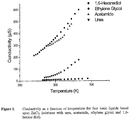
- the conductivity of the mixture of the invention will depend, amongst other things, upon the specific metal salt(s) and complexing agent(s) employed to form the mixture. However, in a particular embodiment, the mixture of the invention, if liquid at 25°C, has a conductivity at that temperature of any value in the range from 1 to 10,000 microsiemens ( ⁇ S).
- additives that maybe mentioned in this respect include those modifying electrochemical properties (e.g. conductivity or redox potentials) or physicochemical properties (e.g. viscosity or colour) of the mixtures of the invention.
- Specific additives therefore include: dilutents (to decrease viscosity) such as water or methyl ethyl ketone; electrolytes (to increase conductivity) such as lithium chloride; and brighteners (to modify the reduction potential of the metal or adsorb at the electrode interface) such as ethylene diamine.
- the mixtures of the invention possess low freezing points (i.e. they are low temperature ionic liquids) due to the unexpected occurrence of a disproportionation process when the metal salt of formula I is contacted with the one to eight molar equivalents of the complexing agent. That is, it is believed that the complexing agent induces the metal salt (M n+ )(X - ) n to disproportionate into species based upon:
- the mixtures according to the invention may be utilised for a wide range of applications, for example those where dissolution of metal salts is desired.
- Specific applications that may be mentioned include the uses of the mixtures of the invention as electrolytes in electrochemical devices (such as batteries or fuel cells), in photovoltaic or electrochromic devices, and as solvents for electrochemical reactions, in particular electrochemical deposition, electropolishing or electro-refining.
- the ability of the mixtures of the invention to dissolve metal-containing ionic compounds e.g. metal salts and metal oxides
- mixtures of the invention include their use as solvent systems for inorganic and organic compounds (thus meaning that the mixtures may be used, for example, as solvent systems in which chemical reactions are performed, or into which compounds are extracted from an immiscible fluid phase).
- those mixtures may (either alone or after the addition of further metal salts) also be employed as catalysts or as chemical reagents.
- mixtures of the invention comprise two or more metals
- those mixtures may be used for the electrodepostion of alloys.
- the mixture of the invention comprises a metallic element that has at least two stable cationic forms (e.g. M n+ and M (n-1)+ )
- using the mixture of the invention to oxidise a metal may result in a mixture in which the oxidised metal and the reduced metallic element (e.g. M (n-1)+ ) both become part of a liquid mixture (i.e. compounds of the resulting ionic liquid).
- the mixture of the invention can be used to "strip" a metal from a surface.
- particular embodiments of the invention relate to:
- metallic elements that may be mentioned in this respect (i.e. elements that can, in a high oxidation form, act as oxidants, thereby being reduced to a cationic form having lower charge) include Fe (which can exist in stable (III) and (II) oxidation states).
- Specific complexing agents that may be employed in oxidising mixtures of the invention include compounds of formula II (e.g. compounds of formula II in which R 1 represents C 1-4 alkyl, such as acetamide).
- Specific metals that may be oxidised by the oxidising mixtures of the invention include those having high reducing potentials, such as Sn, Cr, Al, Ti and Ni.
- stripping metals from surfaces may be applied to the manufacture of printed circuit boards.
- a mixture of the invention containing a metallic element in an oxidising form e.g. a mixture formed from acetamide and FeCl 3
- a metallic element in an oxidising form e.g. a mixture formed from acetamide and FeCl 3
- the overall redox reaction would be as follows: Sn + 2FeCl 3 ⁇ SnCl 2 + 2 FeCl 2 .
- the resulting Fe(II) could be reoxidised to Fe(III) by using inert electrodes and applying a potential such that the Sn is deposited and the iron reoxidised.
- mixtures of the invention that may be mentioned include those comprising a coordinatively labile, Lewis acidic metal ion (such as Cr 3+ , Mn 2+ , Co 2+ , Cd 2+ , Sn 2+ or, particularly, Fe 3+ or Zn 2+ ).
- Reactions that may be catalysed by using such mixtures include those that can be catalysed by Lewis acidic metal ions, such as Diels Alder cycloaddition (coupling of diene to dienophile), Fischer indole synthesis (cyclisation of aryl hydrazones) and Friedel Crafts alkylation or acylation (reaction between aromatic groups and alkyl or acyl halides).
- Mixtures of the invention may have the advantage that, compared to ionic mixtures of the prior art that are liquid at low temperatures, they have a lower freezing point, are less viscous, are more conductive, are less dense and/or have a lower surface tension.
- a particular advantage of mixtures of the invention is that, unlike many ionic liquid systems of the prior art, they include metal-containing species that are cationic (e.g. without wishing to be bound by theory, species based upon [(M n+ )(X - ) n-1 ] + , optionally bound to one to three molecules of complexing agent).
- Such cationic species are considerably easier to reduce (for electrostatic reasons) than are corresponding anionic species (such as those based upon [(M n+ )(X - ) n+1 ] ), and so give rise to improved current efficiencies and diminished energy expenditure in the electrochemical reduction of M n+ to the metallic element (e.g. in an electrodeposition process).
- mixtures of the invention when used in electrodeposition and electropolishing processes, have the advantage that they obviate the need for the use of toxic and corrosive mineral acid electrolytes.
- the mixtures of the invention also provide for greatly improved energy efficiency in electrochemical reduction process (compared to corresponding processes carried out in the in the presence of mineral acid electrolytes).
- the avoidance of hydrogen production also has significant health and safety advantages (as hydrogen is an explosion risk and its production can raise "mists" of toxic and corrosive electrolyte around the electroplating / electropolishing tank), as well as product quality advantages (as hydrogen can cause embrittlement of the deposited metallic layer).
- the complexing agents urea, acetamide and trifluoroacetamide (which were all utilised in >99% purity) were dried under vacuum prior to use. Metal salts and allcylene glycols (again all utilised in >99% purity) were used as received.
- ionic liquids Preparation of ionic liquids was assumed to be complete when a homogeneous liquid (the eutectic mixture) was formed. After being prepared (under heating), the liquids were cooled at a rate of 1°C min -1 and the freezing point was taken as the temperature at which the first solid was observed to form.
- Viscosities were determined using a Brookfield DV-E viscometer fitted with a thermostatted jacket.
- Voltammetry and chronoamperometry were carried out using an Autolab PGSTAT12 potentiostat controlled with GPES software.
- a three-electrode system consisting of a platinum microelectrode (5x10 -4 cm radius), a platinum counter electrode and a chromium wire reference electrode were used.
- the working electrode was polished with 0.3 ⁇ m alumina paste, rinsed and dried prior to all measurements. Electrochemical measurements were performed at 25°C and a potential scan rate of 20 mVs -1 was used in voltammetric experiments unless otherwise stated.
- Zinc chloride was mixed with urea in various molar ratios and heated to 80°C. Upon cooling the mixtures remained liquid at ambient temperature when the molar ratio of urea to ZnCl 2 was between 3 and 4. The eutectic mixture was determined to be 7 urea to 2 ZnCl 2 .
- T f 9°C MS[-FAB]: 171 [ZnCl 3 ] - , 307 [Zn 2 Cl 5 ] - and 442 [Zn 3 Cl 7 ] - .
- Zinc chloride was mixed with acetamide in various molar ratios and heated to 80°C.
- the eutectic mixture was determined to be 4 acetamide to 1 ZnCl 2 .
- T f -16°C
- MS[+FAB] 158 [ZnCl(acetamide)] + , 217 [ZnCl(acetamide) 2 ] + and 276 [ZnCl(acetamide) 3 ] + .
- Zinc chloride was mixed with ethylene glycol in various molar ratios and heated to 80°C.
- the eutectic mixture was determined to be 4 ethylene glycol to 1 ZnCl 2 .
- T f -30°C
- MS[+FAB] 161 [ZnCl(ethylene glycol)] + , 223 [ZnCl(ethylene glycol) 2 ] + .
- Zinc chloride was mixed with 1,6-hexanediol in various molar ratios and heated to 80°C.
- the eutectic mixture was determined to be 3 hexanediol to 1 ZnCl 2 .
- T f -23°C
- MS[+FAB] 473 [Zn 2 Cl 3 (1,6-hexanediol) 2 ] + .
- SnCl 2 and FeCl 3 were found to form room temperature eutectics, in a similar manner to ZnCl 2 , with urea, acetamide, ethylene glycol and 1,6-hexanediol. These eutectic mixtures were prepared using procedures analogous to those described in Examples 1 to 4 above.
- Constant voltage depositions at 3 V and 90°C for 1 hour produced 3 ⁇ m thick, dull metallic deposits which were shown to be pure zinc by EDAX measurements.
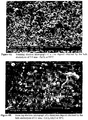
- the morphology of the deposit obtained from the urea-based system is shown in Figure 4A .
- the following cell was constructed: Zn
- the following cell was constructed: Zn
- This cell has the advantage that an ion selective membrane does not have to be used in the cell.
- a eutectic that was liquid at room temperature was formed between chromium(III) chloride hexahydrate and urea, using a method analogous to that described in Example 1 above.
- a eutectic mixture of 7 urea: 2 CrCl 3 .6H 2 O was prepared as described in Example 9 and was found to have voltammetric behaviour indicative of metal deposition. Deposition was found to be possible in mixtures having molar ratios of urea : CrCl 3 .6H 2 O from 2:1 to 5:1. Negligible current for the reoxidation of chromium was observed except when a small ( ⁇ 5 wt %) concentration of LiCl was added to the liquid. Constant voltage deposition at 3 V and 50°C for 2 hours produced a 26 ⁇ m thick, dull metallic deposit which was shown to be pure chromium by EDAX measurements. The morphology of the deposit is shown in Figure 4B .
- a layer of tin (1 micrometer thick) was electrodeposited onto a copper electrode.
- the electrode was dipped in a 2 : 9 FeCl 3 / acetamide eutectic mixture at 80°C. Weight loss of the electrode was monitored over a period of time and it was found that almost all of the tin had been removed from the copper surface in approximately 30 seconds.
Landscapes
- Chemical & Material Sciences (AREA)
- Engineering & Computer Science (AREA)
- Chemical Kinetics & Catalysis (AREA)
- Electrochemistry (AREA)
- Materials Engineering (AREA)
- Metallurgy (AREA)
- Organic Chemistry (AREA)
- Electrolytic Production Of Metals (AREA)
Claims (20)
- Mischung mit einem Gefrierpunkt von bis zu 50 °C, die gebildet wird durch Mischen von:(a) einem molaren Äquivalent eines Salzes mit Formel I
(Mn+)(X-)n
oder einem Hydrat davon;
wobeiM ein oder mehrere metallische(s) Element(e) darstellt, ausgewählt aus der Gruppe bestehend aus Mg, Ca, Cr, Mn, Fe, Co, Ni, Cu, Zn, Ga, Ge, In, Sn, TI, Pb, Cd, Hg und Y,X- ein oder mehrere monovalente(s) Anion(en) ist, ausgewählt aus der Gruppe bestehend aus Halid, Nitrat und Acetat undn 2 oder 3 darstellt; und(b) einem bis acht molaren Äquivalent(en) eines Komplexbildners, wobei das Komplexbildner aus einer oder mehreren Verbindung(en) der Formel II und/oder Formel III besteht,unter der Voraussetzung, dass die Verbindung der Formel III keine C-Atome enthält, die an mehr als ein Atom, ausgewählt aus der Gruppe O, S und N, gebunden sind,
HO-A-OH III,
wobeiR1 H, C1-4-Alkyl (wobei letztere Gruppe wahlweise durch ein oder mehrere F-Atom(e) substituiert ist), oder N(R2)R3 darstellt;R2 und R3 unabhängig H oder C1-4-Alkyl (wobei letztere Gruppe wahlweise durch ein oder mehrere F-Atom(e) substituiert ist) darstellen;A C2-10-Alkylen darstellt, wahlweise(i) substituiert durch einen oder mehrere Substituenten, ausgewählt aus F, OH, SH und N(R4)R5 und/oder(ii) durchbrochen durch eine oder mehrere Gruppe(n), ausgewählt aus O, S und NR6; und R4 bis R6 unabhängig H oder C1-4-Alkyl (wobei letztere Gruppe wahlweise durch einen oder mehrere Substituenten ausgewählt aus F und OH substituiert ist) darstellen;
wobei die Reaktion in der Abwesenheit eines Fremdlösungsmittels durchgeführt wird. - Mischung nach Anspruch 1, die einen Gefrierpunkt von bis 25 °C aufweist.
- Mischung nach einem der vorhergehenden Ansprüche, wobei M ein metallisches Element darstellt, ausgewählt aus der Gruppe bestehend aus Cr, Mn, Fe, Co, Ni, Cu, Zn und Sn.
- Mischung nach einem der vorhergehenden Ansprüche, wobei:(a) wenn das Salz der Formel I wasserfrei ist, der Schmelzpunkt dieses Salzes 400 °C oder weniger beträgt; und(b) wenn das Salz der Formel I in der Form eines Hydrats vorliegt, der Schmelzpunkt dieses Salzes 100 °C oder weniger beträgt.
- Mischung nach einem der vorhergehenden Ansprüche, wobei das Anion X- ein Anion ist, ausgewählt aus der Gruppe bestehend aus Chlorid, Nitrat und Acetat.
- Mischung nach einem der vorhergehenden Ansprüche, wobei das Komplexbildner ein Molekulargewicht von weniger als 200 g/mol aufweist.
- Mischung nach einem der vorhergehenden Ansprüche, wobei R1 H, CH3, CF3, NH2, N(H)CH3 oder N(CH3)2 darstellt.
- Mischung nach einem der Ansprüche 1 bis 6, wobei A C2-6-n-Alkylen oder C3-4-Alkylen substituiert durch eine oder zwei OH-Gruppen darstellt.
- Mischung nach einem der vorhergehenden Ansprüche, wobei das Komplexbildner Acetamid, Harnstoff, Ethylenglycol, 1,2-Propandiol, 1,4-Butandiol, 1,5-Pentandiol, 1,6-Hexandiol oder Glycerol ist.
- Mischung nach einem der vorhergehenden Ansprüche, wobei das molare Verhältnis des Salzes der Formel I oder des Solvats davon (Komponente (A)) zu dem Komplexbildner (Komponente (B)) ein beliebiger Wert in dem Bereich von 1:2 bis 1:5 ist.
- Mischung nach einem der vorhergehenden Ansprüche, wobei die Mischung des Salzes der Formel I oder des Solvats davon (Komponente (A)) und dem Komplexbildner (Komponente (B)) bei 60 °C oder mehr stattfindet.
- Mischung wie in einem der vorhergehenden Ansprüche definiert, ferner umfassend einen Zusatzstoff, wobei der Zusatzstoff eingeführt wird, nachdem sich die in einem der vorhergehenden Ansprüche definierte Mischung gebildet hat.
- Mischung nach Anspruch 12, wobei der Zusatzstoff ausgewählt ist aus der Liste umfassend Verdünner, Elektrolyte und Aufheller.
- Verwendung einer Mischung, wie in einem der vorhergehenden Ansprüche definiert, als ein Lösungsmittel, als ein Elektrolyt, als ein Reagens oder als einen Katalysator.
- Verfahren zum Ausführen einer elektrolytischen Reaktion, wobei das Verfahren das Einsetzen der in einem der Ansprüche 1 bis 13 definierten Mischung als ein Lösungsmittel für die elektrolytische Reaktion umfasst.
- Verfahren nach Anspruch 15, wobei die Reaktion eine galvanische Reaktion oder eine Elektropolierreaktion ist.
- Verfahren zum Bilden einer Lösung einer löslichen Substanz, wobei das Verfahren das Auflösen der löslichen Substanz in der in einem der Ansprüche 1 bis 13 definierten Mischung umfasst.
- Verfahren zur Gewinnung eines Metalls aus einem Metallsalz oder Metalloxid, wobei das Verfahren das Bilden einer Lösung des Metallsalzes oder Metalloxids in der in einem der Ansprüche 1 bis 13 definierten Mischung und das Elektrolysieren der entstandenen Lösung zum Gewinnen des Metalls umfasst.
- Verfahren zur Galvanisierung einer Legierung auf einem leitenden Erzeugnis, wobei das Verfahren das Eintauchen des Erzeugnisses in eine wie in einem der Ansprüche 1 bis 13 definierte Mischung, in welcher M zwei oder mehrere metallische Elemente darstellt, und das Anlegen eines Reduktionspotenzials auf das Erzeugnis umfasst.
- Verfahren zum Oxidieren eines ersten Metalls, wobei das Verfahren das Inberührungbringen des ersten Metalls mit einer wie in einem der Ansprüche 1 bis 13 definierten Mischung umfasst, in welcher M ein oder mehrere metallische Elemente darstellt, einschließlich mindestens eines metallischen Elements, welches, wenn es in der Form Mn+ vorliegt, dazu fähig ist, das erste Metall zu oxidieren.
Applications Claiming Priority (2)
| Application Number | Priority Date | Filing Date | Title |
|---|---|---|---|
| GBGB0513804.5A GB0513804D0 (en) | 2005-07-06 | 2005-07-06 | New mixture |
| PCT/GB2006/002515 WO2007003956A2 (en) | 2005-07-06 | 2006-07-06 | Eutectic mixtures based upon multivalent metal ions |
Publications (2)
| Publication Number | Publication Date |
|---|---|
| EP1899504A2 EP1899504A2 (de) | 2008-03-19 |
| EP1899504B1 true EP1899504B1 (de) | 2018-10-10 |
Family
ID=34856723
Family Applications (1)
| Application Number | Title | Priority Date | Filing Date |
|---|---|---|---|
| EP06755731.4A Not-in-force EP1899504B1 (de) | 2005-07-06 | 2006-07-06 | Eutektische mischungen auf basis mehrwertiger metallionen |
Country Status (4)
| Country | Link |
|---|---|
| US (1) | US8518298B2 (de) |
| EP (1) | EP1899504B1 (de) |
| GB (1) | GB0513804D0 (de) |
| WO (1) | WO2007003956A2 (de) |
Families Citing this family (19)
| Publication number | Priority date | Publication date | Assignee | Title |
|---|---|---|---|---|
| GB0920590D0 (en) * | 2009-11-25 | 2010-01-06 | Univ Leicester | New ionic liquids |
| US20130168825A1 (en) * | 2011-12-30 | 2013-07-04 | Alliance For Sustainable Energy, Llc | Fabrication of ionic liquid electrodeposited cu-sn-zn-s-se thin films and method of making |
| EP3049553A4 (de) * | 2013-09-24 | 2017-03-15 | Ceramatec, Inc | Geschmolzene carboxylatelektrolyten für elektrochemische decarboxylierungsverfahren |
| GB201410093D0 (en) | 2014-06-06 | 2014-07-23 | Univ Leicester | Solder flux |
| US20170182485A1 (en) | 2014-07-11 | 2017-06-29 | Reliance Industries Limited | Ionic liquid-solvent complex, preparation and applications thereof |
| GB2534883A (en) | 2015-02-03 | 2016-08-10 | Univ Leicester | Electrolyte for electroplating |
| JP6631348B2 (ja) * | 2015-03-26 | 2020-01-15 | 三菱マテリアル株式会社 | ホスホニウム塩を用いためっき液 |
| US9920284B2 (en) | 2015-04-22 | 2018-03-20 | S. C. Johnson & Son, Inc. | Cleaning composition with a polypropdxylated 2-(trialkylammonio)ethanol ionic liquid |
| WO2017011224A1 (en) * | 2015-07-10 | 2017-01-19 | Uop Llc | Alkylation processes using liquid lewis acid catalysts |
| US11602737B2 (en) | 2015-11-05 | 2023-03-14 | Reliance Industries Limited | Metal hydroxide based ionic liquid composition |
| WO2017077494A1 (en) * | 2015-11-05 | 2017-05-11 | Reliance Industries Limited | Metal hydroxide based ionic liquid composition |
| WO2017176229A1 (en) * | 2016-04-08 | 2017-10-12 | Itunova Teknoloji A. S. | Preparation of ionic fluid electrolytes comprising transition metal-nitrate salts |
| US9834850B1 (en) | 2016-08-08 | 2017-12-05 | Seagate Technology Llc | Method of forming one or more metal and/or metal alloy layers in processes for making transducers in sliders, and related sliders |
| EP3532586B1 (de) | 2016-10-26 | 2022-05-18 | S.C. Johnson & Son, Inc. | Desinfizierende reinigungszusammensetzung mit quartärem ammoniumhydroxycarboxylatsalz |
| WO2018080835A1 (en) | 2016-10-26 | 2018-05-03 | S. C. Johnson & Son, Inc. | Disinfectant cleaning composition with quaternary amine ionic liquid |
| US10815453B2 (en) | 2016-10-26 | 2020-10-27 | S. C. Johnson & Son, Inc. | Disinfectant cleaning composition with quaternary ammonium hydroxycarboxylate salt and quaternary ammonium antimicrobial |
| US10587009B2 (en) * | 2017-12-22 | 2020-03-10 | Industrial Technology Research Institute | Electrolyte composition and metal-ion battery employing the same |
| US11021803B2 (en) * | 2018-07-05 | 2021-06-01 | Xtalic Corporation | Aluminum alloys and deposition methods |
| CN110270130B (zh) * | 2019-07-21 | 2021-06-25 | 河南师范大学 | 基于利多卡因的疏水性低共熔溶剂及其制备方法和应用 |
Family Cites Families (10)
| Publication number | Priority date | Publication date | Assignee | Title |
|---|---|---|---|---|
| US3616280A (en) * | 1969-03-24 | 1971-10-26 | Atomic Energy Commission | Nonaqueous electroplating solutions and processing |
| US4624755A (en) * | 1985-06-05 | 1986-11-25 | Mcmanis Iii George E | Preparation of ionic liquids for electrodeposition |
| US4624753A (en) * | 1985-06-05 | 1986-11-25 | Mcmanis Iii George E | Method for electrodeposition of metals |
| US4624754A (en) * | 1985-06-05 | 1986-11-25 | Mcmanis Iii George E | Ionic liquid compositions for electrodeposition |
| US5855809A (en) * | 1995-11-13 | 1999-01-05 | Arizona Board Of Regents | Electrochemically stable electrolytes |
| GB0023706D0 (en) * | 2000-09-27 | 2000-11-08 | Scionix Ltd | Ionic liquids |
| GB0023708D0 (en) * | 2000-09-27 | 2000-11-08 | Scionix Ltd | Hydrated salt mixtures |
| US6881321B2 (en) * | 2000-10-20 | 2005-04-19 | The University Of Alabama | Production, refining and recycling of lightweight and reactive metals in ionic liquids |
| US6787019B2 (en) * | 2001-11-21 | 2004-09-07 | E. I. Du Pont De Nemours And Company | Low temperature alkali metal electrolysis |
| US7037559B2 (en) * | 2003-05-01 | 2006-05-02 | International Business Machines Corporation | Immersion plating and plated structures |
-
2005
- 2005-07-06 GB GBGB0513804.5A patent/GB0513804D0/en not_active Ceased
-
2006
- 2006-07-06 US US11/994,382 patent/US8518298B2/en not_active Expired - Fee Related
- 2006-07-06 EP EP06755731.4A patent/EP1899504B1/de not_active Not-in-force
- 2006-07-06 WO PCT/GB2006/002515 patent/WO2007003956A2/en not_active Ceased
Non-Patent Citations (1)
| Title |
|---|
| None * |
Also Published As
| Publication number | Publication date |
|---|---|
| US20090194426A1 (en) | 2009-08-06 |
| WO2007003956A3 (en) | 2007-06-28 |
| US8518298B2 (en) | 2013-08-27 |
| EP1899504A2 (de) | 2008-03-19 |
| GB0513804D0 (en) | 2005-08-10 |
| WO2007003956A2 (en) | 2007-01-11 |
Similar Documents
| Publication | Publication Date | Title |
|---|---|---|
| EP1899504B1 (de) | Eutektische mischungen auf basis mehrwertiger metallionen | |
| EP2504468B1 (de) | Neue ionische flüssigkeiten | |
| Leung et al. | Progress in electrolytes for rechargeable aluminium batteries | |
| Abbott et al. | Electrodeposition of zinc–tin alloys from deep eutectic solvents based on choline chloride | |
| NuLi et al. | Reversible deposition and dissolution of magnesium from BMIMBF4 ionic liquid | |
| AU2001290119B2 (en) | Ionic liquids and their use | |
| Armel et al. | Ionic liquids and organic ionic plastic crystals utilizing small phosphonium cations | |
| Zhu et al. | Electrochemical behavior of Ni (II)/Ni in a hydrophobic amide-type room-temperature ionic liquid | |
| AU2001290119A1 (en) | Ionic liquids and their use | |
| Ali et al. | Electrodeposition of Al–Ni intermetallic compounds from aluminum chloride-N-(n-butyl) pyridinium chloride room temperature molten salt | |
| Zhang et al. | Electrochemical preparation of nanostructured lanthanum using lanthanum chloride as a precursor in 1-butyl-3-methylimidazolium dicyanamide ionic liquid | |
| WO2011109878A1 (en) | Liquid metal salts | |
| Hsiu et al. | Electrodeposition behaviour of cadmium telluride from 1-ethyl-3-methylimidazolium chloride tetrafluoroborate ionic liquid | |
| Giridhar et al. | Electrodeposition of niobium from 1-butyl-1-methylpyrrolidinium bis (trifluoromethylsulfonyl) amide ionic liquid | |
| Rahman et al. | Electrodeposition of indium from a deep eutectic solvent | |
| Zhang et al. | Ionic liquid metallurgy: novel electrolytes for metals extraction and refining technology | |
| ZHANG | Electrochemical behavior of tantalum in ethylene carbonate and aluminum chloride solvate ionic liquid | |
| Tan et al. | Evaluation of N, N, N-Dimethylbutylammonium Methanesulfonate Ionic liquid for electrochemical recovery of lead from lead-acid batteries | |
| CN111108236A (zh) | 用于在水溶液中电化学沉积富金属层的方法和组合物 | |
| Schubert et al. | Electrodeposition of metals | |
| WO2006053362A2 (de) | Verfahren zur abscheidung von schichten aus ionischen flüssigkeiten | |
| Yang et al. | Electrochemical Study of Indium in a Water‐Stable 1‐Ethyl‐3‐Methylimidazolium Chloride/Tetrafluoroborate Room Temperature Ionic Liquid | |
| Zhang et al. | Can metallic lithium be electrochemically extracted from water, the universal solvent? | |
| Caielli | Zn anode shape-change suppression in mildly acidic aqueous zinc-ion battery electrolytes containing quaternary ammonium salts | |
| ZHONG et al. | Electrochemical extraction of lead from urea− 1-ethyl-3-methylimidazolium fluoride system containing PbO at 353 K |
Legal Events
| Date | Code | Title | Description |
|---|---|---|---|
| PUAI | Public reference made under article 153(3) epc to a published international application that has entered the european phase |
Free format text: ORIGINAL CODE: 0009012 |
|
| 17P | Request for examination filed |
Effective date: 20071228 |
|
| AK | Designated contracting states |
Kind code of ref document: A2 Designated state(s): AT BE BG CH CY CZ DE DK EE ES FI FR GB GR HU IE IS IT LI LT LU LV MC NL PL PT RO SE SI SK TR |
|
| DAX | Request for extension of the european patent (deleted) | ||
| DAX | Request for extension of the european patent (deleted) | ||
| 17Q | First examination report despatched |
Effective date: 20161014 |
|
| STAA | Information on the status of an ep patent application or granted ep patent |
Free format text: STATUS: EXAMINATION IS IN PROGRESS |
|
| GRAP | Despatch of communication of intention to grant a patent |
Free format text: ORIGINAL CODE: EPIDOSNIGR1 |
|
| STAA | Information on the status of an ep patent application or granted ep patent |
Free format text: STATUS: GRANT OF PATENT IS INTENDED |
|
| INTG | Intention to grant announced |
Effective date: 20180424 |
|
| GRAS | Grant fee paid |
Free format text: ORIGINAL CODE: EPIDOSNIGR3 |
|
| GRAA | (expected) grant |
Free format text: ORIGINAL CODE: 0009210 |
|
| STAA | Information on the status of an ep patent application or granted ep patent |
Free format text: STATUS: THE PATENT HAS BEEN GRANTED |
|
| AK | Designated contracting states |
Kind code of ref document: B1 Designated state(s): AT BE BG CH CY CZ DE DK EE ES FI FR GB GR HU IE IS IT LI LT LU LV MC NL PL PT RO SE SI SK TR |
|
| REG | Reference to a national code |
Ref country code: GB Ref legal event code: FG4D |
|
| REG | Reference to a national code |
Ref country code: CH Ref legal event code: EP Ref country code: AT Ref legal event code: REF Ref document number: 1051365 Country of ref document: AT Kind code of ref document: T Effective date: 20181015 |
|
| REG | Reference to a national code |
Ref country code: IE Ref legal event code: FG4D |
|
| REG | Reference to a national code |
Ref country code: DE Ref legal event code: R096 Ref document number: 602006056557 Country of ref document: DE |
|
| REG | Reference to a national code |
Ref country code: NL Ref legal event code: MP Effective date: 20181010 |
|
| REG | Reference to a national code |
Ref country code: LT Ref legal event code: MG4D |
|
| REG | Reference to a national code |
Ref country code: AT Ref legal event code: MK05 Ref document number: 1051365 Country of ref document: AT Kind code of ref document: T Effective date: 20181010 |
|
| PG25 | Lapsed in a contracting state [announced via postgrant information from national office to epo] |
Ref country code: NL Free format text: LAPSE BECAUSE OF FAILURE TO SUBMIT A TRANSLATION OF THE DESCRIPTION OR TO PAY THE FEE WITHIN THE PRESCRIBED TIME-LIMIT Effective date: 20181010 |
|
| PG25 | Lapsed in a contracting state [announced via postgrant information from national office to epo] |
Ref country code: LV Free format text: LAPSE BECAUSE OF FAILURE TO SUBMIT A TRANSLATION OF THE DESCRIPTION OR TO PAY THE FEE WITHIN THE PRESCRIBED TIME-LIMIT Effective date: 20181010 Ref country code: ES Free format text: LAPSE BECAUSE OF FAILURE TO SUBMIT A TRANSLATION OF THE DESCRIPTION OR TO PAY THE FEE WITHIN THE PRESCRIBED TIME-LIMIT Effective date: 20181010 Ref country code: PL Free format text: LAPSE BECAUSE OF FAILURE TO SUBMIT A TRANSLATION OF THE DESCRIPTION OR TO PAY THE FEE WITHIN THE PRESCRIBED TIME-LIMIT Effective date: 20181010 Ref country code: BG Free format text: LAPSE BECAUSE OF FAILURE TO SUBMIT A TRANSLATION OF THE DESCRIPTION OR TO PAY THE FEE WITHIN THE PRESCRIBED TIME-LIMIT Effective date: 20190110 Ref country code: LT Free format text: LAPSE BECAUSE OF FAILURE TO SUBMIT A TRANSLATION OF THE DESCRIPTION OR TO PAY THE FEE WITHIN THE PRESCRIBED TIME-LIMIT Effective date: 20181010 Ref country code: FI Free format text: LAPSE BECAUSE OF FAILURE TO SUBMIT A TRANSLATION OF THE DESCRIPTION OR TO PAY THE FEE WITHIN THE PRESCRIBED TIME-LIMIT Effective date: 20181010 Ref country code: IS Free format text: LAPSE BECAUSE OF FAILURE TO SUBMIT A TRANSLATION OF THE DESCRIPTION OR TO PAY THE FEE WITHIN THE PRESCRIBED TIME-LIMIT Effective date: 20190210 Ref country code: AT Free format text: LAPSE BECAUSE OF FAILURE TO SUBMIT A TRANSLATION OF THE DESCRIPTION OR TO PAY THE FEE WITHIN THE PRESCRIBED TIME-LIMIT Effective date: 20181010 |
|
| PG25 | Lapsed in a contracting state [announced via postgrant information from national office to epo] |
Ref country code: SE Free format text: LAPSE BECAUSE OF FAILURE TO SUBMIT A TRANSLATION OF THE DESCRIPTION OR TO PAY THE FEE WITHIN THE PRESCRIBED TIME-LIMIT Effective date: 20181010 Ref country code: GR Free format text: LAPSE BECAUSE OF FAILURE TO SUBMIT A TRANSLATION OF THE DESCRIPTION OR TO PAY THE FEE WITHIN THE PRESCRIBED TIME-LIMIT Effective date: 20190111 Ref country code: PT Free format text: LAPSE BECAUSE OF FAILURE TO SUBMIT A TRANSLATION OF THE DESCRIPTION OR TO PAY THE FEE WITHIN THE PRESCRIBED TIME-LIMIT Effective date: 20190210 |
|
| REG | Reference to a national code |
Ref country code: DE Ref legal event code: R097 Ref document number: 602006056557 Country of ref document: DE |
|
| PG25 | Lapsed in a contracting state [announced via postgrant information from national office to epo] |
Ref country code: DK Free format text: LAPSE BECAUSE OF FAILURE TO SUBMIT A TRANSLATION OF THE DESCRIPTION OR TO PAY THE FEE WITHIN THE PRESCRIBED TIME-LIMIT Effective date: 20181010 Ref country code: IT Free format text: LAPSE BECAUSE OF FAILURE TO SUBMIT A TRANSLATION OF THE DESCRIPTION OR TO PAY THE FEE WITHIN THE PRESCRIBED TIME-LIMIT Effective date: 20181010 Ref country code: CZ Free format text: LAPSE BECAUSE OF FAILURE TO SUBMIT A TRANSLATION OF THE DESCRIPTION OR TO PAY THE FEE WITHIN THE PRESCRIBED TIME-LIMIT Effective date: 20181010 |
|
| PLBE | No opposition filed within time limit |
Free format text: ORIGINAL CODE: 0009261 |
|
| STAA | Information on the status of an ep patent application or granted ep patent |
Free format text: STATUS: NO OPPOSITION FILED WITHIN TIME LIMIT |
|
| PG25 | Lapsed in a contracting state [announced via postgrant information from national office to epo] |
Ref country code: RO Free format text: LAPSE BECAUSE OF FAILURE TO SUBMIT A TRANSLATION OF THE DESCRIPTION OR TO PAY THE FEE WITHIN THE PRESCRIBED TIME-LIMIT Effective date: 20181010 Ref country code: SK Free format text: LAPSE BECAUSE OF FAILURE TO SUBMIT A TRANSLATION OF THE DESCRIPTION OR TO PAY THE FEE WITHIN THE PRESCRIBED TIME-LIMIT Effective date: 20181010 Ref country code: EE Free format text: LAPSE BECAUSE OF FAILURE TO SUBMIT A TRANSLATION OF THE DESCRIPTION OR TO PAY THE FEE WITHIN THE PRESCRIBED TIME-LIMIT Effective date: 20181010 |
|
| 26N | No opposition filed |
Effective date: 20190711 |
|
| PG25 | Lapsed in a contracting state [announced via postgrant information from national office to epo] |
Ref country code: SI Free format text: LAPSE BECAUSE OF FAILURE TO SUBMIT A TRANSLATION OF THE DESCRIPTION OR TO PAY THE FEE WITHIN THE PRESCRIBED TIME-LIMIT Effective date: 20181010 |
|
| REG | Reference to a national code |
Ref country code: DE Ref legal event code: R119 Ref document number: 602006056557 Country of ref document: DE |
|
| PG25 | Lapsed in a contracting state [announced via postgrant information from national office to epo] |
Ref country code: MC Free format text: LAPSE BECAUSE OF FAILURE TO SUBMIT A TRANSLATION OF THE DESCRIPTION OR TO PAY THE FEE WITHIN THE PRESCRIBED TIME-LIMIT Effective date: 20181010 |
|
| REG | Reference to a national code |
Ref country code: CH Ref legal event code: PL |
|
| GBPC | Gb: european patent ceased through non-payment of renewal fee |
Effective date: 20190706 |
|
| PG25 | Lapsed in a contracting state [announced via postgrant information from national office to epo] |
Ref country code: TR Free format text: LAPSE BECAUSE OF FAILURE TO SUBMIT A TRANSLATION OF THE DESCRIPTION OR TO PAY THE FEE WITHIN THE PRESCRIBED TIME-LIMIT Effective date: 20181010 |
|
| REG | Reference to a national code |
Ref country code: BE Ref legal event code: MM Effective date: 20190731 |
|
| PG25 | Lapsed in a contracting state [announced via postgrant information from national office to epo] |
Ref country code: DE Free format text: LAPSE BECAUSE OF NON-PAYMENT OF DUE FEES Effective date: 20200201 Ref country code: GB Free format text: LAPSE BECAUSE OF NON-PAYMENT OF DUE FEES Effective date: 20190706 |
|
| PG25 | Lapsed in a contracting state [announced via postgrant information from national office to epo] |
Ref country code: BE Free format text: LAPSE BECAUSE OF NON-PAYMENT OF DUE FEES Effective date: 20190731 Ref country code: CH Free format text: LAPSE BECAUSE OF NON-PAYMENT OF DUE FEES Effective date: 20190731 Ref country code: LI Free format text: LAPSE BECAUSE OF NON-PAYMENT OF DUE FEES Effective date: 20190731 Ref country code: LU Free format text: LAPSE BECAUSE OF NON-PAYMENT OF DUE FEES Effective date: 20190706 |
|
| PG25 | Lapsed in a contracting state [announced via postgrant information from national office to epo] |
Ref country code: FR Free format text: LAPSE BECAUSE OF NON-PAYMENT OF DUE FEES Effective date: 20190731 |
|
| PG25 | Lapsed in a contracting state [announced via postgrant information from national office to epo] |
Ref country code: IE Free format text: LAPSE BECAUSE OF NON-PAYMENT OF DUE FEES Effective date: 20190706 |
|
| PG25 | Lapsed in a contracting state [announced via postgrant information from national office to epo] |
Ref country code: CY Free format text: LAPSE BECAUSE OF FAILURE TO SUBMIT A TRANSLATION OF THE DESCRIPTION OR TO PAY THE FEE WITHIN THE PRESCRIBED TIME-LIMIT Effective date: 20181010 |
|
| PG25 | Lapsed in a contracting state [announced via postgrant information from national office to epo] |
Ref country code: HU Free format text: LAPSE BECAUSE OF FAILURE TO SUBMIT A TRANSLATION OF THE DESCRIPTION OR TO PAY THE FEE WITHIN THE PRESCRIBED TIME-LIMIT; INVALID AB INITIO Effective date: 20060706 |