EP1898064A1 - Cylinder injection type spark ignition internal combustion engine - Google Patents
Cylinder injection type spark ignition internal combustion engine Download PDFInfo
- Publication number
- EP1898064A1 EP1898064A1 EP06747318A EP06747318A EP1898064A1 EP 1898064 A1 EP1898064 A1 EP 1898064A1 EP 06747318 A EP06747318 A EP 06747318A EP 06747318 A EP06747318 A EP 06747318A EP 1898064 A1 EP1898064 A1 EP 1898064A1
- Authority
- EP
- European Patent Office
- Prior art keywords
- fuel
- cavity
- tumble flow
- internal combustion
- combustion engine
- Prior art date
- Legal status (The legal status is an assumption and is not a legal conclusion. Google has not performed a legal analysis and makes no representation as to the accuracy of the status listed.)
- Granted
Links
Images

Classifications
-
- F—MECHANICAL ENGINEERING; LIGHTING; HEATING; WEAPONS; BLASTING
- F02—COMBUSTION ENGINES; HOT-GAS OR COMBUSTION-PRODUCT ENGINE PLANTS
- F02B—INTERNAL-COMBUSTION PISTON ENGINES; COMBUSTION ENGINES IN GENERAL
- F02B23/00—Other engines characterised by special shape or construction of combustion chambers to improve operation
- F02B23/08—Other engines characterised by special shape or construction of combustion chambers to improve operation with positive ignition
- F02B23/10—Other engines characterised by special shape or construction of combustion chambers to improve operation with positive ignition with separate admission of air and fuel into cylinder
- F02B23/101—Other engines characterised by special shape or construction of combustion chambers to improve operation with positive ignition with separate admission of air and fuel into cylinder the injector being placed on or close to the cylinder centre axis, e.g. with mixture formation using spray guided concepts
-
- F—MECHANICAL ENGINEERING; LIGHTING; HEATING; WEAPONS; BLASTING
- F02—COMBUSTION ENGINES; HOT-GAS OR COMBUSTION-PRODUCT ENGINE PLANTS
- F02B—INTERNAL-COMBUSTION PISTON ENGINES; COMBUSTION ENGINES IN GENERAL
- F02B23/00—Other engines characterised by special shape or construction of combustion chambers to improve operation
- F02B23/08—Other engines characterised by special shape or construction of combustion chambers to improve operation with positive ignition
- F02B23/10—Other engines characterised by special shape or construction of combustion chambers to improve operation with positive ignition with separate admission of air and fuel into cylinder
-
- F—MECHANICAL ENGINEERING; LIGHTING; HEATING; WEAPONS; BLASTING
- F02—COMBUSTION ENGINES; HOT-GAS OR COMBUSTION-PRODUCT ENGINE PLANTS
- F02B—INTERNAL-COMBUSTION PISTON ENGINES; COMBUSTION ENGINES IN GENERAL
- F02B17/00—Engines characterised by means for effecting stratification of charge in cylinders
- F02B17/005—Engines characterised by means for effecting stratification of charge in cylinders having direct injection in the combustion chamber
-
- F—MECHANICAL ENGINEERING; LIGHTING; HEATING; WEAPONS; BLASTING
- F02—COMBUSTION ENGINES; HOT-GAS OR COMBUSTION-PRODUCT ENGINE PLANTS
- F02B—INTERNAL-COMBUSTION PISTON ENGINES; COMBUSTION ENGINES IN GENERAL
- F02B25/00—Engines characterised by using fresh charge for scavenging cylinders
- F02B25/14—Engines characterised by using fresh charge for scavenging cylinders using reverse-flow scavenging, e.g. with both outlet and inlet ports arranged near bottom of piston stroke
- F02B25/18—Engines characterised by using fresh charge for scavenging cylinders using reverse-flow scavenging, e.g. with both outlet and inlet ports arranged near bottom of piston stroke the charge flowing upward essentially along cylinder wall adjacent the inlet ports, e.g. by means of deflection rib on piston
-
- F—MECHANICAL ENGINEERING; LIGHTING; HEATING; WEAPONS; BLASTING
- F02—COMBUSTION ENGINES; HOT-GAS OR COMBUSTION-PRODUCT ENGINE PLANTS
- F02F—CYLINDERS, PISTONS OR CASINGS, FOR COMBUSTION ENGINES; ARRANGEMENTS OF SEALINGS IN COMBUSTION ENGINES
- F02F3/00—Pistons
- F02F3/26—Pistons having combustion chamber in piston head
-
- F—MECHANICAL ENGINEERING; LIGHTING; HEATING; WEAPONS; BLASTING
- F02—COMBUSTION ENGINES; HOT-GAS OR COMBUSTION-PRODUCT ENGINE PLANTS
- F02M—SUPPLYING COMBUSTION ENGINES IN GENERAL WITH COMBUSTIBLE MIXTURES OR CONSTITUENTS THEREOF
- F02M61/00—Fuel-injectors not provided for in groups F02M39/00 - F02M57/00 or F02M67/00
- F02M61/16—Details not provided for in, or of interest apart from, the apparatus of groups F02M61/02 - F02M61/14
- F02M61/18—Injection nozzles, e.g. having valve seats; Details of valve member seated ends, not otherwise provided for
-
- F—MECHANICAL ENGINEERING; LIGHTING; HEATING; WEAPONS; BLASTING
- F02—COMBUSTION ENGINES; HOT-GAS OR COMBUSTION-PRODUCT ENGINE PLANTS
- F02P—IGNITION, OTHER THAN COMPRESSION IGNITION, FOR INTERNAL-COMBUSTION ENGINES; TESTING OF IGNITION TIMING IN COMPRESSION-IGNITION ENGINES
- F02P13/00—Sparking plugs structurally combined with other parts of internal-combustion engines
-
- F—MECHANICAL ENGINEERING; LIGHTING; HEATING; WEAPONS; BLASTING
- F02—COMBUSTION ENGINES; HOT-GAS OR COMBUSTION-PRODUCT ENGINE PLANTS
- F02B—INTERNAL-COMBUSTION PISTON ENGINES; COMBUSTION ENGINES IN GENERAL
- F02B23/00—Other engines characterised by special shape or construction of combustion chambers to improve operation
- F02B23/08—Other engines characterised by special shape or construction of combustion chambers to improve operation with positive ignition
- F02B23/10—Other engines characterised by special shape or construction of combustion chambers to improve operation with positive ignition with separate admission of air and fuel into cylinder
- F02B2023/106—Tumble flow, i.e. the axis of rotation of the main charge flow motion is horizontal
-
- F—MECHANICAL ENGINEERING; LIGHTING; HEATING; WEAPONS; BLASTING
- F02—COMBUSTION ENGINES; HOT-GAS OR COMBUSTION-PRODUCT ENGINE PLANTS
- F02B—INTERNAL-COMBUSTION PISTON ENGINES; COMBUSTION ENGINES IN GENERAL
- F02B23/00—Other engines characterised by special shape or construction of combustion chambers to improve operation
- F02B23/08—Other engines characterised by special shape or construction of combustion chambers to improve operation with positive ignition
- F02B23/10—Other engines characterised by special shape or construction of combustion chambers to improve operation with positive ignition with separate admission of air and fuel into cylinder
- F02B2023/106—Tumble flow, i.e. the axis of rotation of the main charge flow motion is horizontal
- F02B2023/107—Reverse tumble flow, e.g. having substantially vertical intake ports
-
- F—MECHANICAL ENGINEERING; LIGHTING; HEATING; WEAPONS; BLASTING
- F02—COMBUSTION ENGINES; HOT-GAS OR COMBUSTION-PRODUCT ENGINE PLANTS
- F02B—INTERNAL-COMBUSTION PISTON ENGINES; COMBUSTION ENGINES IN GENERAL
- F02B75/00—Other engines
- F02B75/12—Other methods of operation
- F02B2075/125—Direct injection in the combustion chamber for spark ignition engines, i.e. not in pre-combustion chamber
-
- F—MECHANICAL ENGINEERING; LIGHTING; HEATING; WEAPONS; BLASTING
- F02—COMBUSTION ENGINES; HOT-GAS OR COMBUSTION-PRODUCT ENGINE PLANTS
- F02D—CONTROLLING COMBUSTION ENGINES
- F02D41/00—Electrical control of supply of combustible mixture or its constituents
- F02D41/30—Controlling fuel injection
- F02D41/38—Controlling fuel injection of the high pressure type
- F02D2041/389—Controlling fuel injection of the high pressure type for injecting directly into the cylinder
-
- Y—GENERAL TAGGING OF NEW TECHNOLOGICAL DEVELOPMENTS; GENERAL TAGGING OF CROSS-SECTIONAL TECHNOLOGIES SPANNING OVER SEVERAL SECTIONS OF THE IPC; TECHNICAL SUBJECTS COVERED BY FORMER USPC CROSS-REFERENCE ART COLLECTIONS [XRACs] AND DIGESTS
- Y02—TECHNOLOGIES OR APPLICATIONS FOR MITIGATION OR ADAPTATION AGAINST CLIMATE CHANGE
- Y02T—CLIMATE CHANGE MITIGATION TECHNOLOGIES RELATED TO TRANSPORTATION
- Y02T10/00—Road transport of goods or passengers
- Y02T10/10—Internal combustion engine [ICE] based vehicles
- Y02T10/12—Improving ICE efficiencies
Definitions
- the present invention relates to a direct fuel injection-type spark-ignition internal combustion engine.
- the fuel injector injects fuel in a hollow conical shape, but even if just injecting fuel in this way, the injected fuel will not form a good combustible air-fuel mixture sufficiently mixed with intake air during its flight before reaching the piston top face or cylinder bore and good stratified combustion can not be realized as designed.
- an object of the present invention is to provide a direct fuel injection-type spark-ignition internal combustion engine reliably making the fuel injected from the fuel injector a good combustible air-fuel mixture during flight and igniting and burning this combustible air-fuel mixture by a spark plug to enable realization of good stratified combustion.
- the direct fuel injection-type spark-ignition internal combustion engine described in claim 1 of the present invention is provided with a fuel injector for directly injecting fuel into a cylinder, a spark plug positioning a spark gap in a flight path of fuel injected from the fuel injector, and a cavity formed in a piston top face, wherein at the time of stratified combustion, the fuel injector injects substantially all of the fuel in a direction merging with a tumble flow, swirling in a longitudinal direction along the cavity at the compression stroke, along the swirl direction of the tumble flow and uses the spark plug to ignite the fuel while the fuel at the end period of injection is passing through the spark gap.
- the direct fuel injection-type spark-ignition internal combustion engine described in claim 2 of the present invention provides the direct fuel injection-type spark-ignition internal combustion engine as set forth in claim 1 characterized in that the cavity has a chamfer or a fillet at the inflow side of the tumble flow.
- the direct fuel injection-type spark-ignition internal combustion engine described in claim 3 of the present invention provides the direct fuel injection-type spark-ignition internal combustion engine as set forth in claim 1 characterized in that the cavity is biased to the exhaust valve side in the piston top face and in that the tumble flow swirls from the exhaust valve side of the cavity to the intake valve side along the inside wall of the cavity.
- the direct fuel injection-type spark-ignition internal combustion engine described in claim 4 of the present invention provides the direct fuel injection-type spark-ignition internal combustion engine as set forth in claim 1 characterized in that the spark plug is provided with a ground electrode of an L-shaped cross-section having a parallel part substantially parallel to an axial line of the spark plug body and a vertical part substantially vertical to the axial line of the spark plug body and is arranged so that the parallel part of the ground electrode is not positioned facing the tumble flow at the downstream side of the tumble flow.
- the direct fuel injection-type spark-ignition internal combustion engine described in claim 5 of the present invention provides the direct fuel injection-type spark-ignition internal combustion engine as set forth in claim 1 characterized in that the fuel injector injects substantially all of the fuel toward the inside of the cavity.
- the direct fuel injection-type spark-ignition internal combustion engine described in claim 6 of the present invention provides the direct fuel injection-type spark-ignition internal combustion engine as set forth in claim 5 characterized in that the fuel injector injects substantially all of the fuel toward an inside wall of an inflow side of the tumble flow in the cavity.
- the direct fuel injection-type spark-ignition internal combustion engine described in claim 7 of the present invention provides the direct fuel injection-type spark-ignition internal combustion engine as set forth in claim 1 characterized in that the fuel injected from the fuel injector has a cross-sectional shape vertical to the center line in the injection direction of an upwardly bulging broken line or curved line shape.
- the direct fuel injection-type spark-ignition internal combustion engine described in claim 8 of the present invention provides the direct fuel injection-type spark-ignition internal combustion engine as set forth in claim 1 characterized in that the volume of the cavity is selected so that the air-fuel ratio of the air-fuel mixture formed in the cavity will not become richer than a set air-fuel ratio.
- the fuel injector injects substantially all of the fuel in a direction merging with the tumble flow, swirling in a longitudinal direction along the cavity at the compression stroke, along the swirl direction of the tumble flow, so in particular the fuel injected before the end period of injection is sufficiently mixed with the tumble flow and forms a good combustible air-fuel mixture in the cavity.
- the direct fuel injection-type spark-ignition internal combustion engine as set forth in claim 2 of the present invention there is provided the direct fuel injection-type spark-ignition internal combustion engine as set forth in claim 1 wherein the cavity has a chamfer or a fillet at the inflow side of the tumble flow, so it is possible to suppress attenuation of the tumble flow formed at the time of the suction stroke and maintain a relatively strong tumble flow even at the timing of fuel injection at the time of stratified combustion, that is, the compression stroke.
- the mixture of the injected fuel and tumble flow is promoted, so this is advantageous for forming a good combustible air-fuel mixture inside the cavity.
- the direct fuel injection-type spark-ignition internal combustion engine as set forth in claim 3 of the present invention there is provided the direct fuel injection-type spark-ignition internal combustion engine as set forth in claim 1 wherein the cavity is biased to the exhaust valve side at the piston top face and the tumble flow is made a forward tumble flow swirling from the exhaust valve side of the cavity along the intake valve side, so compared with a reverse tumble flow with a reverse swirl direction, a strong tumble flow can be formed more easily.
- the direct fuel injection-type spark-ignition internal combustion engine as set forth in claim 4 of the present invention there is provided the direct fuel injection-type spark-ignition internal combustion engine as set forth in claim 1 wherein the spark plug is provided with a ground electrode of an L-shaped cross-section having a parallel part substantially parallel to an axial line of the spark plug body and a vertical part substantially vertical to the axial line of the spark plug body and is arranged so that the parallel part of the ground electrode is not positioned facing the tumble flow at the downstream side of the tumble flow, so the arc generated at the spark gap is not obstructed by the parallel part of the ground electrode and can extend to the downstream side together with the tumble flow, the fuel can be ignited right after passing through the spark gap, and the ignitability can be improved.
- the direct fuel injection-type spark-ignition internal combustion engine as set forth in claim 5 of the present invention there is provided the direct fuel injection-type spark-ignition internal combustion engine as set forth in claim 1 wherein the fuel injector is designed to inject substantially all of the fuel toward the inside of the cavity. Due to this, it is possible to suppress part of the injected fuel becoming positioned outside the cavity of the piston top face and being exhausted as unburned fuel without contributing to the combustion.
- the direct fuel injection-type spark-ignition internal combustion engine as set forth in claim 6 of the present invention there is provided the direct fuel injection-type spark-ignition internal combustion engine as set forth in claim 5 wherein the fuel injector is designed to inject substantially all of the fuel toward the side wall of the inflow side of the tumble flow of the cavity.
- the direct fuel injection-type spark-ignition internal combustion engine as set forth in claim 7 of the present invention there is provided the direct fuel injection-type spark-ignition internal combustion engine as set forth in claim 1 wherein the fuel injected from the fuel injector has a cross-sectional shape vertical to the center line in the injection direction of an upwardly bulging broken line or curved line shape, so the contact area of the injected fuel and the tumble flow becomes greater and the mixture of the injected fuel and tumble flow becomes good, so even if the spark plug is not that long in length, the air-fuel mixture near the spark plug will not become lean and reliable ignition will be realized.
- the direct fuel injection-type spark-ignition internal combustion engine as set forth in claim 8 of the present invention there is provided the direct fuel injection-type spark-ignition internal combustion engine as set forth in claim 1 wherein the volume of the cavity is selected so that the air-fuel ratio of the air-fuel mixture formed in the cavity will not become richer than a set air-fuel ratio, so it is possible to prevent the generation of unburned fuel due to the over rich state.
- FIG. 1 is a schematic longitudinal cross-sectional view showing an embodiment of a direct fuel injection-type spark-ignition internal combustion engine according to the present invention.
- 1 is a fuel injector arranged at the approximate center of the top of a cylinder for injecting fuel directly into the cylinder
- 2 is a spark plug arranged at the exhaust valve side in the vicinity of the fuel injector 5.
- This direct fuel injection-type spark-ignition internal combustion engine has two intake valves and two exhaust valves.
- FIG. 1 is a cross-sectional view passing between the two intake valves and between the two exhaust valves, so the intake valves and exhaust valves are not shown.
- the left side is the intake valve side.
- the right side is the exhaust valve side.
- the cavity 3 is a piston on whose top face a cavity 3a is formed biased to the exhaust valve side.
- the cavity 3a has a smooth inside wall suited to guiding the tumble flow. It is for guiding the tumble flow formed inside the cylinder in the suction stroke along the inside wall so as to prevent any major attenuation until the end period of the compression stroke.
- the intake air sucked in from an intake port generally forms a tumble flow which swirls in the cylinder in a manner falling at the exhaust valve side and rising at the intake valve side, so by biasing the cavity 3a to the exhaust valve side of the piston top face, the tumble flow easily swirls along the inside wall of the cavity 3a. This is advantageous for suppressing attenuation of the tumble flow.
- the cavity 3a is provided with a fillet 3b or a chamfer at the inflow side of the tumble flow, that is, the exhaust valve side.
- This direct fuel injection-type spark-ignition internal combustion engine when the engine load is a set value or more, uses the fuel injector 1 to inject fuel in the suction stroke and forms a homogeneous air-fuel mixture inside the cylinder as a whole for homogeneous combustion or injects the fuel during the compression stroke divided into several parts for stratified combustion.
- the fuel injector 1 when the engine load is less than the set value, it uses the fuel injector 1 to inject fuel at the latter half of the compression stroke for stratified combustion.
- "Stratified combustion” forms a combustible air-fuel mixture at just part of the inside of the cylinder and ignites and burns this combustible air-fuel mixture.
- the fuel injector of this direct fuel injection-type spark-ignition internal combustion engine is designed to inject substantially all of the fuel F in a direction merging into the tumble flow, swirling in the longitudinal direction along the cavity 3a in the latter half of the compression stroke, along the swirl direction of the tumble flow T. Further, the spark plug 2 is arranged so as to position the spark gap 2a in the flight path of the fuel F injected from the fuel injector in this way.
- the fuel at the end period of injection will be passing through the spark gap 2a of the spark plug 2 positioned inside the flight path of the injected fuel F, so the fuel at the end period of injection can be reliably ignited.
- the fuel injected before the end period of injection connected with the fuel of the end period of injection has been present for a short amount of time after merging with the tumble flow along the swirl direction of the tumble flow, so is sufficiently mixed with the tumble flow resulting in a good combustible air-fuel mixture present inside the cavity 3a.
- the flame of the fuel at the end period of injection is propagated and the fuel is burned well.
- the fuel injected before the end period of injection is merged together with the tumble flow in the cavity 3a of the piston top face as the combustible air-fuel mixture, so will not broadly disperse inside the cylinder and form a lean air-fuel mixture hard to burn.
- This is advantageous for realization of good stratified combustion.
- the cavity 3a is too small in volume, the air-fuel mixture formed inside the cavity 3a becomes richer than the set air-fuel ratio. Due to this over richness, good stratified combustion cannot be realized and a relatively large amount of unburned fuel ends up being produced.
- the volume of the cavity 3a is set, with respect to the maximum amount of fuel injection at the time of stratified combustion, so that the air-fuel ratio of the air-fuel mixture formed inside the cavity 3a by the fuel injected before the end period of injection will not become richer than a set air-fuel ratio.
- the ground electrode of the spark plug 2 generally has a L-shaped cross-section having a parallel part 2b substantially parallel to the axial line of the spark plug body and a vertical part 2c substantially vertical to the axial line of the spark plug body.
- the spark plug 2 is preferably arranged so that the parallel part 2b of the ground electrode is not positioned facing the tumble flow at the downstream side of the tumble flow.
- FIG. 2 is an enlarged view of the vicinity of a spark plug 2.
- the spark plug 2 is arranged so that the parallel part 2b of the ground electrode is positioned at the upstream side of the tumble flow. Due to this, the arc A generated at the spark gap 2a can extend to the downstream side together with the tumble flow since the downstream side of the tumble flow at the spark gap 2a is not closed by the parallel part 2b of the ground electrode, the fuel F can be ignited right after passing through the spark gap 2a, and the ignitability can be improved.
- the spark plug 2 is arranged so that the parallel part 2b of the ground electrode becomes parallel with the tumble flow and, further, the vertical part 2c of the ground electrode becomes vertical to the tumble flow. Even with such an arrangement, the downstream side of the tumble flow at the spark gap 2a will not be closed by the parallel part 2b of the ground electrode, so the arc A generated at the spark gap 2a can extend to the downstream side together with the tumble flow and the fuel F right after passing through the spark gap 2a can also be ignited. Further, the injected fuel F passes through the spark gap 2a of the spark plug 2 from the upstream side of the tumble flow T, so if arranging the ground electrode of the spark plug 2 as shown in FIG.
- the parallel part 2b of the ground electrode positioned at the upstream side of the tumble flow would end up reducing the amount of fuel passing through the spark gap 2a of the spark plug 2. Due to this, the arrangement of the ground electrode of the spark plug 2 in FIG. 1 and the arrangement of the ground electrode rotated 180 degrees about the axial line of the spark plug body are preferable both for extension of the arc A to the downstream side of the tumble flow and the passage through the spark gap 2a of the injected fuel.
- the direction of the fuel injection of the fuel injector 1 is made a direction merging with the tumble flow, swirling in the longitudinal direction along the cavity 3a in the latter half of the compression stroke, along the swirl direction of the tumble flow T, but the extension direction of the fuel injection direction is preferably made within the cavity 3a. Due to this, when, like at the time of low speed operation, the tumble flow formed in the suction stroke is relatively weak and along with this only a weak tumble flow is maintained in the compression stroke and the injected fuel cannot be sufficiently directed inside the cavity 3a, since substantially all of the fuel is injected toward the inside of the cavity 3a, it is possible to suppress part of the injected fuel being positioned outside the cavity 3a of the piston top face and being exhausted as unburned fuel without contributing to the combustion.
- the direction of extension of the fuel injection direction of the fuel injector 1 is more preferably made the side wall at the inflow side of the tumble flow inside the cavity 3a, in the case of the present embodiment, the side wall 3c at the exhaust valve side of the cavity 3a.
- this striking fuel is vaporized utilizing the heat of the cavity 3a and is sufficiently mixed even with a weak tumble flow to enable the formation of a combustible air-fuel mixture inside the cavity 3a.
- the fuel at the end period of injection can be ignited to realize good stratified combustion.
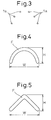
- the fuel injector 1 has a plurality of (six) round injector holes 1a arranged in an upwardly bulging arc as shown in FIG. 3 and is designed so that fuel is injected in a columnar shape from each injector hole 1a.
- the columnar shaped fuel sprays are relatively strong in penetrating force and generate strong frictional force with the intake air (tumble flow) during flight, so are atomized by the frictional force and become combined as a whole.
- the thus combined fuel spray as shown in FIG. 4 , has a cross-sectional shape vertical to the center axis in the injection direction which is an upwardly bulging curved arc shape.
- the fuel spray F having this curved shape or a cross-section of the broken line shape such as shown in FIG. 5 has a large contact area with the tumble flow, so is easily mixed with the tumble flow. Further, if making the top part of the upwardly bulging curved shape or broken line shape fuel spray pass through the spark gap 2a of the spark plug 2, since the other parts of the fuel spray are positioned below the top part, they will not strike the bottom of the cylinder head. When positioning the spark gap 2a in the flight path of the injected fuel F, it is therefore possible to make the length of the spark plug 2 projected from the bottom of the cylinder head relatively small.
- the present embodiment is designed to inject all of the injected fuel F toward the inside of the cavity 3a, preferably toward the exhaust valve side wall 3c of the cavity 3a, but serious problems such as misfires do not occur in the case of the stratified combustion method directing the fuel injected into the cavity to the spark plug direction as a combustible air-fuel mixture, so this is not that absolute. Further, as explained above, the case where it is necessary to inject all of the fuel spray F inside of the cavity 3a or toward the side wall 3c of the exhaust valve side of the cavity 3a is at the time of engine low speed operation where only a weak tumble flow is formed inside the cylinder, so it is also possible to control the fuel injection timing in accordance with the range of piston position just at this time.
- the tumble flow formed in the cylinder was made a forward tumble flow falling at the exhaust valve side and rising at the intake valve side, but it is also possible to provide a mask wall at the exhaust valve side of the part of the intake port opening into the cylinder etc. so as to form inside the cylinder a reverse tumble flow falling at the intake valve side and rising at the exhaust valve side.
- the cavity of the piston top face is biased toward the intake valve side and the inflow side of the tumble flow of the cavity becomes the intake valve side.
- the spark plug is arranged at the intake valve side near the fuel injector.
Landscapes
- Engineering & Computer Science (AREA)
- Chemical & Material Sciences (AREA)
- Combustion & Propulsion (AREA)
- Mechanical Engineering (AREA)
- General Engineering & Computer Science (AREA)
- Combustion Methods Of Internal-Combustion Engines (AREA)
- Ignition Installations For Internal Combustion Engines (AREA)
- Fuel-Injection Apparatus (AREA)
Abstract
Description
- The present invention relates to a direct fuel injection-type spark-ignition internal combustion engine.
- Known in the art is stratified combustion using fuel injected in a compression stroke to form a combustible air-fuel mixture in just part of the inside of the cylinder and igniting and burning this combustible air-fuel mixture by a spark plug so as to enable combustion making the air-fuel ratio of the inside of the cylinder as a whole leaner than the stoichiometric air-fuel ratio. At the time of stratified combustion, it is necessary to position the spark gap of the spark plug inside the combustible air-fuel mixture at the ignition timing. For this, it is proposed to bias the injected fuel for forming the combustible air-fuel mixture in the spark plug direction by a cavity formed in the piston top face, but due to this, the fuel injection timing would be limited by the piston position.
- To enable the fuel injection timing to be set without such a limitation, there has been proposed a direct fuel injection-type spark-ignition internal combustion engine designed to make the fuel injected from a fuel injector arranged at the approximate center of the top of the cylinder form a combustible air-fuel mixture during its flight inside the cylinder and ignite and burn this combustible air-fuel mixture by a spark plug arranged in the flight path of the injected fuel so as to realize good stratified combustion (for example, see
Japanese Patent Publication (A) No. 2005-105877 Japanese Patent Publication (A) No. 9-209762 Japanese Patent Publication (A) No. 11-182247 A) No. 2004-340040 - In the above background art, the fuel injector injects fuel in a hollow conical shape, but even if just injecting fuel in this way, the injected fuel will not form a good combustible air-fuel mixture sufficiently mixed with intake air during its flight before reaching the piston top face or cylinder bore and good stratified combustion can not be realized as designed.
- Therefore, an object of the present invention is to provide a direct fuel injection-type spark-ignition internal combustion engine reliably making the fuel injected from the fuel injector a good combustible air-fuel mixture during flight and igniting and burning this combustible air-fuel mixture by a spark plug to enable realization of good stratified combustion.
- The direct fuel injection-type spark-ignition internal combustion engine described in
claim 1 of the present invention is provided with a fuel injector for directly injecting fuel into a cylinder, a spark plug positioning a spark gap in a flight path of fuel injected from the fuel injector, and a cavity formed in a piston top face, wherein at the time of stratified combustion, the fuel injector injects substantially all of the fuel in a direction merging with a tumble flow, swirling in a longitudinal direction along the cavity at the compression stroke, along the swirl direction of the tumble flow and uses the spark plug to ignite the fuel while the fuel at the end period of injection is passing through the spark gap. - The direct fuel injection-type spark-ignition internal combustion engine described in
claim 2 of the present invention provides the direct fuel injection-type spark-ignition internal combustion engine as set forth inclaim 1 characterized in that the cavity has a chamfer or a fillet at the inflow side of the tumble flow. - The direct fuel injection-type spark-ignition internal combustion engine described in
claim 3 of the present invention provides the direct fuel injection-type spark-ignition internal combustion engine as set forth inclaim 1 characterized in that the cavity is biased to the exhaust valve side in the piston top face and in that the tumble flow swirls from the exhaust valve side of the cavity to the intake valve side along the inside wall of the cavity. - The direct fuel injection-type spark-ignition internal combustion engine described in claim 4 of the present invention provides the direct fuel injection-type spark-ignition internal combustion engine as set forth in
claim 1 characterized in that the spark plug is provided with a ground electrode of an L-shaped cross-section having a parallel part substantially parallel to an axial line of the spark plug body and a vertical part substantially vertical to the axial line of the spark plug body and is arranged so that the parallel part of the ground electrode is not positioned facing the tumble flow at the downstream side of the tumble flow. - The direct fuel injection-type spark-ignition internal combustion engine described in claim 5 of the present invention provides the direct fuel injection-type spark-ignition internal combustion engine as set forth in
claim 1 characterized in that the fuel injector injects substantially all of the fuel toward the inside of the cavity. - The direct fuel injection-type spark-ignition internal combustion engine described in claim 6 of the present invention provides the direct fuel injection-type spark-ignition internal combustion engine as set forth in claim 5 characterized in that the fuel injector injects substantially all of the fuel toward an inside wall of an inflow side of the tumble flow in the cavity.
- The direct fuel injection-type spark-ignition internal combustion engine described in
claim 7 of the present invention provides the direct fuel injection-type spark-ignition internal combustion engine as set forth inclaim 1 characterized in that the fuel injected from the fuel injector has a cross-sectional shape vertical to the center line in the injection direction of an upwardly bulging broken line or curved line shape. - The direct fuel injection-type spark-ignition internal combustion engine described in claim 8 of the present invention provides the direct fuel injection-type spark-ignition internal combustion engine as set forth in
claim 1 characterized in that the volume of the cavity is selected so that the air-fuel ratio of the air-fuel mixture formed in the cavity will not become richer than a set air-fuel ratio. - According to the direct fuel injection-type spark-ignition internal combustion engine as set forth in
claim 1 of the present invention, at the time of stratified combustion, the fuel injector injects substantially all of the fuel in a direction merging with the tumble flow, swirling in a longitudinal direction along the cavity at the compression stroke, along the swirl direction of the tumble flow, so in particular the fuel injected before the end period of injection is sufficiently mixed with the tumble flow and forms a good combustible air-fuel mixture in the cavity. Due to this, if using a spark plug with a spark gap positioned in the flight path of the injected fuel to ignite the fuel while the fuel at the end period of injection is passing through the spark gap, the combustible air-fuel mixture inside the cavity connected with the fuel at the end period of injection can be reliably ignited and burned and good stratified combustion can be realized. - According to the direct fuel injection-type spark-ignition internal combustion engine as set forth in
claim 2 of the present invention, there is provided the direct fuel injection-type spark-ignition internal combustion engine as set forth inclaim 1 wherein the cavity has a chamfer or a fillet at the inflow side of the tumble flow, so it is possible to suppress attenuation of the tumble flow formed at the time of the suction stroke and maintain a relatively strong tumble flow even at the timing of fuel injection at the time of stratified combustion, that is, the compression stroke. The mixture of the injected fuel and tumble flow is promoted, so this is advantageous for forming a good combustible air-fuel mixture inside the cavity. - According to the direct fuel injection-type spark-ignition internal combustion engine as set forth in
claim 3 of the present invention, there is provided the direct fuel injection-type spark-ignition internal combustion engine as set forth inclaim 1 wherein the cavity is biased to the exhaust valve side at the piston top face and the tumble flow is made a forward tumble flow swirling from the exhaust valve side of the cavity along the intake valve side, so compared with a reverse tumble flow with a reverse swirl direction, a strong tumble flow can be formed more easily. - According to the direct fuel injection-type spark-ignition internal combustion engine as set forth in claim 4 of the present invention, there is provided the direct fuel injection-type spark-ignition internal combustion engine as set forth in
claim 1 wherein the spark plug is provided with a ground electrode of an L-shaped cross-section having a parallel part substantially parallel to an axial line of the spark plug body and a vertical part substantially vertical to the axial line of the spark plug body and is arranged so that the parallel part of the ground electrode is not positioned facing the tumble flow at the downstream side of the tumble flow, so the arc generated at the spark gap is not obstructed by the parallel part of the ground electrode and can extend to the downstream side together with the tumble flow, the fuel can be ignited right after passing through the spark gap, and the ignitability can be improved. - According to the direct fuel injection-type spark-ignition internal combustion engine as set forth in claim 5 of the present invention, there is provided the direct fuel injection-type spark-ignition internal combustion engine as set forth in
claim 1 wherein the fuel injector is designed to inject substantially all of the fuel toward the inside of the cavity. Due to this, it is possible to suppress part of the injected fuel becoming positioned outside the cavity of the piston top face and being exhausted as unburned fuel without contributing to the combustion. - According to the direct fuel injection-type spark-ignition internal combustion engine as set forth in claim 6 of the present invention, there is provided the direct fuel injection-type spark-ignition internal combustion engine as set forth in claim 5 wherein the fuel injector is designed to inject substantially all of the fuel toward the side wall of the inflow side of the tumble flow of the cavity. Due to this, like at the time of low speed operation when the tumble flow formed in the suction stroke is relatively weak and along with this only a weak tumble flow can be maintained in the compression stroke, if the mixture of the injected fuel and tumble flow becomes insufficient, part of the injected fuel will strike the side wall at the inflow side of the cavity, but this impacting fuel will vaporize due to the heat received when proceeding along the inside wall of the cavity and be sufficiently mixed even with the weak tumble flow proceeding along the inside wall of the cavity to enable formation of a good combustible air-fuel mixture inside the cavity.
- According to the direct fuel injection-type spark-ignition internal combustion engine as set forth in
claim 7 of the present invention, there is provided the direct fuel injection-type spark-ignition internal combustion engine as set forth inclaim 1 wherein the fuel injected from the fuel injector has a cross-sectional shape vertical to the center line in the injection direction of an upwardly bulging broken line or curved line shape, so the contact area of the injected fuel and the tumble flow becomes greater and the mixture of the injected fuel and tumble flow becomes good, so even if the spark plug is not that long in length, the air-fuel mixture near the spark plug will not become lean and reliable ignition will be realized. - According to the direct fuel injection-type spark-ignition internal combustion engine as set forth in claim 8 of the present invention, there is provided the direct fuel injection-type spark-ignition internal combustion engine as set forth in
claim 1 wherein the volume of the cavity is selected so that the air-fuel ratio of the air-fuel mixture formed in the cavity will not become richer than a set air-fuel ratio, so it is possible to prevent the generation of unburned fuel due to the over rich state. -
-
FIG. 1 is a schematic longitudinal cross-sectional view showing an embodiment of a direct fuel injection-type spark-ignition internal combustion engine according to the present invention. -
FIG. 2 is an enlarged view of the vicinity of a spark plug in the direct fuel injection-type spark-ignition internal combustion engine ofFIG. 1 . -
FIG. 3 is a view showing the arrangement of injector holes of a fuel injector. -
FIG. 4 is a cross-sectional view vertical to the center axis of the injection direction of injected fuel. -
FIG. 5 is another cross-sectional view vertical to the center axis of the injection direction of injected fuel. -
FIG. 1 is a schematic longitudinal cross-sectional view showing an embodiment of a direct fuel injection-type spark-ignition internal combustion engine according to the present invention. In thefigure, 1 is a fuel injector arranged at the approximate center of the top of a cylinder for injecting fuel directly into the cylinder, and 2 is a spark plug arranged at the exhaust valve side in the vicinity of the fuel injector 5. This direct fuel injection-type spark-ignition internal combustion engine has two intake valves and two exhaust valves.FIG. 1 is a cross-sectional view passing between the two intake valves and between the two exhaust valves, so the intake valves and exhaust valves are not shown. InFIG. 1 , the left side is the intake valve side. The right side is the exhaust valve side. - 3 is a piston on whose top face a
cavity 3a is formed biased to the exhaust valve side. Thecavity 3a has a smooth inside wall suited to guiding the tumble flow. It is for guiding the tumble flow formed inside the cylinder in the suction stroke along the inside wall so as to prevent any major attenuation until the end period of the compression stroke. The intake air sucked in from an intake port (not shown) generally forms a tumble flow which swirls in the cylinder in a manner falling at the exhaust valve side and rising at the intake valve side, so by biasing thecavity 3a to the exhaust valve side of the piston top face, the tumble flow easily swirls along the inside wall of thecavity 3a. This is advantageous for suppressing attenuation of the tumble flow. Further, to enable the tumble flow to easily flow into thecavity 3a, thecavity 3a is provided with afillet 3b or a chamfer at the inflow side of the tumble flow, that is, the exhaust valve side. - This direct fuel injection-type spark-ignition internal combustion engine, when the engine load is a set value or more, uses the
fuel injector 1 to inject fuel in the suction stroke and forms a homogeneous air-fuel mixture inside the cylinder as a whole for homogeneous combustion or injects the fuel during the compression stroke divided into several parts for stratified combustion. On the other hand, when the engine load is less than the set value, it uses thefuel injector 1 to inject fuel at the latter half of the compression stroke for stratified combustion. "Stratified combustion" forms a combustible air-fuel mixture at just part of the inside of the cylinder and ignites and burns this combustible air-fuel mixture. Combustion leaner than the stoichiometric air-fuel ratio becomes possible inside the cylinder as a whole. Further, by relatively increasing the throttle valve opening degree or increasing the amount of exhaust gas recirculation, popping loss is reduced. This is advantageous for reducing the fuel consumption. - The fuel injector of this direct fuel injection-type spark-ignition internal combustion engine is designed to inject substantially all of the fuel F in a direction merging into the tumble flow, swirling in the longitudinal direction along the
cavity 3a in the latter half of the compression stroke, along the swirl direction of the tumble flow T. Further, thespark plug 2 is arranged so as to position thespark gap 2a in the flight path of the fuel F injected from the fuel injector in this way. - If igniting the fuel by the
spark plug 2 right after the entire amount of fuel determined by the engine load is injected, at the point of time of the ignition, the fuel at the end period of injection will be passing through thespark gap 2a of thespark plug 2 positioned inside the flight path of the injected fuel F, so the fuel at the end period of injection can be reliably ignited. On the other hand, the fuel injected before the end period of injection connected with the fuel of the end period of injection has been present for a short amount of time after merging with the tumble flow along the swirl direction of the tumble flow, so is sufficiently mixed with the tumble flow resulting in a good combustible air-fuel mixture present inside thecavity 3a. The flame of the fuel at the end period of injection is propagated and the fuel is burned well. In this way, good stratified combustion can be realized. To reliably make the flame of the fuel at the end period of injection propagate to the fuel of the initial period of injection, it is preferable to continuously inject fuel from the fuel injector. However, if an extent not obstructing the flame of the fuel at the end period of injection from being propagated to the fuel of the initial period of injection, it is also possible to inject fuel intermittently by providing one or more intervals in the fuel injection. If intervals are provided in the fuel injection in this way, the timing of start of fuel injection is advanced even for injecting the same amount of fuel and the time from the timing of start of fuel injection to ignition becomes longer, so the mixture of the fuel at the initial period of injection and the tumble flow is further promoted and the stratified combustion can be made better. - In the present embodiment, the fuel injected before the end period of injection is merged together with the tumble flow in the
cavity 3a of the piston top face as the combustible air-fuel mixture, so will not broadly disperse inside the cylinder and form a lean air-fuel mixture hard to burn. This is advantageous for realization of good stratified combustion. Further, if thecavity 3a is too small in volume, the air-fuel mixture formed inside thecavity 3a becomes richer than the set air-fuel ratio. Due to this over richness, good stratified combustion cannot be realized and a relatively large amount of unburned fuel ends up being produced. Due to this, the volume of thecavity 3a is set, with respect to the maximum amount of fuel injection at the time of stratified combustion, so that the air-fuel ratio of the air-fuel mixture formed inside thecavity 3a by the fuel injected before the end period of injection will not become richer than a set air-fuel ratio. - In this regard, the ground electrode of the
spark plug 2 generally has a L-shaped cross-section having aparallel part 2b substantially parallel to the axial line of the spark plug body and avertical part 2c substantially vertical to the axial line of the spark plug body. When positioning thespark gap 2a of thespark plug 2 inside the flight path of the injected fuel F, thespark plug 2 is preferably arranged so that theparallel part 2b of the ground electrode is not positioned facing the tumble flow at the downstream side of the tumble flow. -
FIG. 2 is an enlarged view of the vicinity of aspark plug 2. InFIG. 2 , thespark plug 2 is arranged so that theparallel part 2b of the ground electrode is positioned at the upstream side of the tumble flow. Due to this, the arc A generated at thespark gap 2a can extend to the downstream side together with the tumble flow since the downstream side of the tumble flow at thespark gap 2a is not closed by theparallel part 2b of the ground electrode, the fuel F can be ignited right after passing through thespark gap 2a, and the ignitability can be improved. - In
FIG. 1 , thespark plug 2 is arranged so that theparallel part 2b of the ground electrode becomes parallel with the tumble flow and, further, thevertical part 2c of the ground electrode becomes vertical to the tumble flow. Even with such an arrangement, the downstream side of the tumble flow at thespark gap 2a will not be closed by theparallel part 2b of the ground electrode, so the arc A generated at thespark gap 2a can extend to the downstream side together with the tumble flow and the fuel F right after passing through thespark gap 2a can also be ignited. Further, the injected fuel F passes through thespark gap 2a of thespark plug 2 from the upstream side of the tumble flow T, so if arranging the ground electrode of thespark plug 2 as shown inFIG. 2 , theparallel part 2b of the ground electrode positioned at the upstream side of the tumble flow would end up reducing the amount of fuel passing through thespark gap 2a of thespark plug 2. Due to this, the arrangement of the ground electrode of thespark plug 2 inFIG. 1 and the arrangement of the ground electrode rotated 180 degrees about the axial line of the spark plug body are preferable both for extension of the arc A to the downstream side of the tumble flow and the passage through thespark gap 2a of the injected fuel. - Further, the direction of the fuel injection of the
fuel injector 1 is made a direction merging with the tumble flow, swirling in the longitudinal direction along thecavity 3a in the latter half of the compression stroke, along the swirl direction of the tumble flow T, but the extension direction of the fuel injection direction is preferably made within thecavity 3a. Due to this, when, like at the time of low speed operation, the tumble flow formed in the suction stroke is relatively weak and along with this only a weak tumble flow is maintained in the compression stroke and the injected fuel cannot be sufficiently directed inside thecavity 3a, since substantially all of the fuel is injected toward the inside of thecavity 3a, it is possible to suppress part of the injected fuel being positioned outside thecavity 3a of the piston top face and being exhausted as unburned fuel without contributing to the combustion. - Further, the direction of extension of the fuel injection direction of the
fuel injector 1 is more preferably made the side wall at the inflow side of the tumble flow inside thecavity 3a, in the case of the present embodiment, theside wall 3c at the exhaust valve side of thecavity 3a. By doing this, even when only a weak tumble flow can be maintained at the compression stroke, part of the injected fuel is insufficiently mixed with the tumble flow, strikes the side wall of the exhaust valve side of thecavity 3a due to its own penetrating force, and proceeds in the same direction as the tumble flow along the side wall of thecavity 3a. In this way, this striking fuel is vaporized utilizing the heat of thecavity 3a and is sufficiently mixed even with a weak tumble flow to enable the formation of a combustible air-fuel mixture inside thecavity 3a. In the same way as above, the fuel at the end period of injection can be ignited to realize good stratified combustion. - However, in the present embodiment, the
fuel injector 1 has a plurality of (six)round injector holes 1a arranged in an upwardly bulging arc as shown inFIG. 3 and is designed so that fuel is injected in a columnar shape from eachinjector hole 1a. The columnar shaped fuel sprays are relatively strong in penetrating force and generate strong frictional force with the intake air (tumble flow) during flight, so are atomized by the frictional force and become combined as a whole. The thus combined fuel spray, as shown inFIG. 4 , has a cross-sectional shape vertical to the center axis in the injection direction which is an upwardly bulging curved arc shape. - The fuel spray F having this curved shape or a cross-section of the broken line shape such as shown in
FIG. 5 has a large contact area with the tumble flow, so is easily mixed with the tumble flow. Further, if making the top part of the upwardly bulging curved shape or broken line shape fuel spray pass through thespark gap 2a of thespark plug 2, since the other parts of the fuel spray are positioned below the top part, they will not strike the bottom of the cylinder head. When positioning thespark gap 2a in the flight path of the injected fuel F, it is therefore possible to make the length of thespark plug 2 projected from the bottom of the cylinder head relatively small. - It is possible to realize a similar fuel spray even if using upwardly bulging broken line or curved line slit shaped injector holes instead of the plurality of
round injector holes 1a. In the case of a plurality ofround injector holes 1a, by making theinjector holes 1a face slightly outward and making the overall width W and overall height H of the fuel spray F flare outward, the contact area with the tumble flow further increases and the mixture with the tumble flow can be made better. Of course, even in an outwardly flaring fuel spray F, substantially all of the fuel is injected toward the inside of thecavity 3a, more preferably is injected toward theside wall 3c of the inflow side of the tumble flow of thecavity 3a. - The present embodiment is designed to inject all of the injected fuel F toward the inside of the
cavity 3a, preferably toward the exhaustvalve side wall 3c of thecavity 3a, but serious problems such as misfires do not occur in the case of the stratified combustion method directing the fuel injected into the cavity to the spark plug direction as a combustible air-fuel mixture, so this is not that absolute. Further, as explained above, the case where it is necessary to inject all of the fuel spray F inside of thecavity 3a or toward theside wall 3c of the exhaust valve side of thecavity 3a is at the time of engine low speed operation where only a weak tumble flow is formed inside the cylinder, so it is also possible to control the fuel injection timing in accordance with the range of piston position just at this time. - In the present embodiment, the tumble flow formed in the cylinder was made a forward tumble flow falling at the exhaust valve side and rising at the intake valve side, but it is also possible to provide a mask wall at the exhaust valve side of the part of the intake port opening into the cylinder etc. so as to form inside the cylinder a reverse tumble flow falling at the intake valve side and rising at the exhaust valve side.
- In this case, the cavity of the piston top face is biased toward the intake valve side and the inflow side of the tumble flow of the cavity becomes the intake valve side. Further, the spark plug is arranged at the intake valve side near the fuel injector.
-
- 1...fuel injector
- 2...spark plug
- 3...piston
- 3a...cavity
- T...tumble flow
- F...injected fuel
Claims (8)
- A direct fuel injection-type spark-ignition internal combustion engine provided with a fuel injector for directly injecting fuel into a cylinder, a spark plug positioning a spark gap in a flight path of fuel injected from said fuel injector, and a cavity formed in a piston top face, wherein at the time of stratified combustion, said fuel injector injects substantially all of the fuel in a direction merging with a tumble flow, swirling in a longitudinal direction along said cavity at the compression stroke, along the swirl direction of said tumble flow and uses said spark plug to ignite the fuel while the fuel at the end period of injection is passing through said spark gap.
- A direct fuel injection-type spark-ignition internal combustion engine as set forth in claim 1, characterized in that said cavity has a chamfer or a fillet at the inflow side of said tumble flow.
- A direct fuel injection-type spark-ignition internal combustion engine as set forth in claim 1, characterized in that said cavity is biased to the exhaust valve side in the piston top face and in that said tumble flow swirls from the exhaust valve side of said cavity to the intake valve side along the inside wall of said cavity.
- A direct fuel injection-type spark-ignition internal combustion engine as set forth in claim 1, characterized in that said spark plug is provided with a ground electrode of an L-shaped cross-section having a parallel part substantially parallel to an axial line of the spark plug body and a vertical part substantially vertical to the axial line of the spark plug body and is arranged so that said parallel part of said ground electrode is not positioned facing said tumble flow at the downstream side of said tumble flow.
- A direct fuel injection-type spark-ignition internal combustion engine as set forth in claim 1,
characterized in that said fuel injector injects substantially all of the fuel toward the inside of said cavity. - A direct fuel injection-type spark-ignition internal combustion engine as set forth in claim 5, characterized in that said fuel injector injects substantially all of the fuel toward an inside wall of an inflow side of said tumble flow in said cavity.
- A direct fuel injection-type spark-ignition internal combustion engine as set forth in claim 1, characterized in that the fuel injected from said fuel injector has a cross-sectional shape vertical to the center line in the injection direction of an upwardly bulging broken line or curved line shape.
- A direct fuel injection-type spark-ignition internal combustion engine as set forth in claim 1, characterized in that the volume of said cavity is selected so that the air-fuel ratio of the air-fuel mixture formed in said cavity will not become richer than a set air-fuel ratio.
Applications Claiming Priority (2)
| Application Number | Priority Date | Filing Date | Title |
|---|---|---|---|
| JP2005188182A JP4342481B2 (en) | 2005-06-28 | 2005-06-28 | In-cylinder injection spark ignition internal combustion engine |
| PCT/JP2006/312190 WO2007000907A1 (en) | 2005-06-28 | 2006-06-12 | Cylinder injection type spark ignition internal combustion engine |
Publications (4)
| Publication Number | Publication Date |
|---|---|
| EP1898064A1 true EP1898064A1 (en) | 2008-03-12 |
| EP1898064A4 EP1898064A4 (en) | 2009-06-24 |
| EP1898064B1 EP1898064B1 (en) | 2012-10-24 |
| EP1898064B8 EP1898064B8 (en) | 2012-12-05 |
Family
ID=37595161
Family Applications (1)
| Application Number | Title | Priority Date | Filing Date |
|---|---|---|---|
| EP06747318A Not-in-force EP1898064B8 (en) | 2005-06-28 | 2006-06-12 | Cylinder injection type spark ignition internal combustion engine |
Country Status (7)
| Country | Link |
|---|---|
| US (1) | US7926463B2 (en) |
| EP (1) | EP1898064B8 (en) |
| JP (1) | JP4342481B2 (en) |
| KR (1) | KR100926660B1 (en) |
| CN (1) | CN100513754C (en) |
| ES (1) | ES2398094T3 (en) |
| WO (1) | WO2007000907A1 (en) |
Cited By (2)
| Publication number | Priority date | Publication date | Assignee | Title |
|---|---|---|---|---|
| WO2015092507A1 (en) * | 2013-12-17 | 2015-06-25 | Toyota Jidosha Kabushiki Kaisha | Control system for spark-ignition internal combustion engine |
| EP3779154A4 (en) * | 2018-04-10 | 2021-04-14 | Nissan Motor Co., Ltd. | INTERNAL COMBUSTION ENGINE AND INTERNAL COMBUSTION ENGINE CONTROL PROCEDURE |
Families Citing this family (17)
| Publication number | Priority date | Publication date | Assignee | Title |
|---|---|---|---|---|
| US7048155B2 (en) * | 2001-11-30 | 2006-05-23 | Yoshino Kogyosho Co., Ltd. | Depression head for pump mechanism |
| JP2007297989A (en) * | 2006-05-01 | 2007-11-15 | Toyota Motor Corp | In-cylinder injection spark ignition internal combustion engine |
| JP4306711B2 (en) * | 2006-09-29 | 2009-08-05 | トヨタ自動車株式会社 | In-cylinder injection spark ignition internal combustion engine |
| JP4984976B2 (en) * | 2007-03-06 | 2012-07-25 | トヨタ自動車株式会社 | In-cylinder injection spark ignition internal combustion engine control device |
| JP4840242B2 (en) * | 2007-04-23 | 2011-12-21 | トヨタ自動車株式会社 | In-cylinder injection spark ignition internal combustion engine |
| JP4985077B2 (en) * | 2007-04-23 | 2012-07-25 | トヨタ自動車株式会社 | In-cylinder injection spark ignition internal combustion engine |
| JP5104195B2 (en) * | 2007-10-19 | 2012-12-19 | トヨタ自動車株式会社 | Spark ignition internal combustion engine |
| US20110231316A1 (en) * | 2010-03-09 | 2011-09-22 | Cummins Intellectual Properties, Inc. | Method, system and computer readable media containing a program for identifying whether a product is genuine |
| CN105719149B (en) | 2010-03-09 | 2019-12-10 | 康明斯过滤Ip公司 | apparatus, system, and method for detecting the presence of genuine serviceable product components |
| US8833327B2 (en) | 2011-12-28 | 2014-09-16 | Cummins Intellectual Property, Inc. | Piston and combustion chamber |
| FR2986564B1 (en) * | 2012-02-06 | 2014-02-28 | Vianney Rabhi | SPARK IGNITION DEVICE AND HIGH PRESSURE STRATIFICATION FOR INTERNAL COMBUSTION ENGINE |
| WO2014188598A1 (en) * | 2013-05-24 | 2014-11-27 | トヨタ自動車株式会社 | Fuel injection valve for internal combustion engine |
| JP6088016B1 (en) * | 2015-09-18 | 2017-03-01 | 富士重工業株式会社 | piston |
| JP6337877B2 (en) * | 2015-12-10 | 2018-06-06 | マツダ株式会社 | Combustion chamber structure of internal combustion engine |
| JP6825553B2 (en) * | 2017-12-28 | 2021-02-03 | トヨタ自動車株式会社 | Internal combustion engine control device |
| JP2020007977A (en) * | 2018-07-09 | 2020-01-16 | トヨタ自動車株式会社 | Compression ignition type internal combustion engine |
| JP7589595B2 (en) * | 2021-03-08 | 2024-11-26 | マツダ株式会社 | Engine combustion chamber structure |
Family Cites Families (23)
| Publication number | Priority date | Publication date | Assignee | Title |
|---|---|---|---|---|
| US3318292A (en) * | 1964-12-10 | 1967-05-09 | Ford Motor Co | Internal combustion engine |
| JP3681080B2 (en) | 1996-02-09 | 2005-08-10 | 富士重工業株式会社 | Combustion chamber structure of in-cylinder direct injection spark ignition engine |
| US5960767A (en) * | 1996-02-09 | 1999-10-05 | Fuji Jukogyo Kabushiki Kaisha | Combustion chamber of in-cylinder direct fuel injection engine |
| JP3233039B2 (en) * | 1996-08-28 | 2001-11-26 | 三菱自動車工業株式会社 | Control device for in-cylinder injection spark ignition internal combustion engine |
| JP3741494B2 (en) * | 1996-10-31 | 2006-02-01 | 富士重工業株式会社 | In-cylinder injection engine |
| JPH10299537A (en) * | 1997-04-28 | 1998-11-10 | Mazda Motor Corp | In-cylinder injection spark ignition engine |
| JP3781536B2 (en) | 1997-12-17 | 2006-05-31 | 富士重工業株式会社 | Combustion chamber structure of in-cylinder injection engine |
| JP3733721B2 (en) * | 1997-12-18 | 2006-01-11 | 日産自動車株式会社 | Direct-injection spark ignition internal combustion engine |
| JP3644228B2 (en) * | 1998-01-07 | 2005-04-27 | 日産自動車株式会社 | In-cylinder injection spark ignition engine |
| KR20010074482A (en) * | 1998-04-10 | 2001-08-04 | 추후제출 | Internal combustion engine with controlled ignition and direct injection |
| JP3644249B2 (en) * | 1998-04-22 | 2005-04-27 | 日産自動車株式会社 | In-cylinder internal combustion engine |
| JP3903657B2 (en) * | 1998-12-02 | 2007-04-11 | トヨタ自動車株式会社 | In-cylinder injection spark ignition internal combustion engine |
| JP3671785B2 (en) * | 1999-12-15 | 2005-07-13 | 株式会社日立製作所 | Fuel injection device for in-cylinder injection type internal combustion engine |
| JP2001241329A (en) * | 2000-02-28 | 2001-09-07 | Hitachi Ltd | In-cylinder injection type internal combustion engine |
| JP4415497B2 (en) * | 2000-03-29 | 2010-02-17 | マツダ株式会社 | Spark ignition direct injection engine |
| JP3926989B2 (en) * | 2001-02-01 | 2007-06-06 | 株式会社日立製作所 | In-cylinder injection spark ignition engine control device |
| JP2004245204A (en) * | 2003-02-17 | 2004-09-02 | Mitsubishi Motors Corp | Fuel injection device for internal combustion engine |
| JP2004316568A (en) * | 2003-04-17 | 2004-11-11 | Nissan Motor Co Ltd | In-cylinder direct injection internal combustion engine |
| JP2004353594A (en) * | 2003-05-30 | 2004-12-16 | Nissan Motor Co Ltd | In-cylinder direct injection internal combustion engine |
| JP4161796B2 (en) | 2003-05-16 | 2008-10-08 | 株式会社日立製作所 | Warm-up control method for in-cylinder injection spark ignition engine |
| JP4143843B2 (en) * | 2003-09-29 | 2008-09-03 | 三菱自動車工業株式会社 | In-cylinder injection type spark ignition internal combustion engine |
| DE10354827A1 (en) * | 2003-11-24 | 2005-06-23 | Robert Bosch Gmbh | fuel injection system |
| JP2005264768A (en) * | 2004-03-17 | 2005-09-29 | Nissan Motor Co Ltd | Internal combustion engine |
-
2005
- 2005-06-28 JP JP2005188182A patent/JP4342481B2/en not_active Expired - Fee Related
-
2006
- 2006-06-12 CN CNB2006800115865A patent/CN100513754C/en not_active Expired - Fee Related
- 2006-06-12 WO PCT/JP2006/312190 patent/WO2007000907A1/en not_active Ceased
- 2006-06-12 US US11/915,640 patent/US7926463B2/en not_active Expired - Fee Related
- 2006-06-12 KR KR1020077017356A patent/KR100926660B1/en not_active Expired - Fee Related
- 2006-06-12 ES ES06747318T patent/ES2398094T3/en active Active
- 2006-06-12 EP EP06747318A patent/EP1898064B8/en not_active Not-in-force
Cited By (6)
| Publication number | Priority date | Publication date | Assignee | Title |
|---|---|---|---|---|
| WO2015092507A1 (en) * | 2013-12-17 | 2015-06-25 | Toyota Jidosha Kabushiki Kaisha | Control system for spark-ignition internal combustion engine |
| CN105829691A (en) * | 2013-12-17 | 2016-08-03 | 丰田自动车株式会社 | Control System For Spark-Ignition Internal Combustion Engine |
| US9926838B2 (en) | 2013-12-17 | 2018-03-27 | Toyota Jidosha Kabushiki Kaisha | Control system for spark-ignition internal combustion engine |
| CN105829691B (en) * | 2013-12-17 | 2019-04-26 | 丰田自动车株式会社 | Control System of Spark Ignition Internal Combustion Engine |
| EP3779154A4 (en) * | 2018-04-10 | 2021-04-14 | Nissan Motor Co., Ltd. | INTERNAL COMBUSTION ENGINE AND INTERNAL COMBUSTION ENGINE CONTROL PROCEDURE |
| US11391236B2 (en) | 2018-04-10 | 2022-07-19 | Nissan Motor Co., Ltd. | Control method of internal combustion engine and internal combustion engine |
Also Published As
| Publication number | Publication date |
|---|---|
| CN100513754C (en) | 2009-07-15 |
| US20090194066A1 (en) | 2009-08-06 |
| EP1898064B8 (en) | 2012-12-05 |
| ES2398094T3 (en) | 2013-03-13 |
| KR100926660B1 (en) | 2009-11-17 |
| US7926463B2 (en) | 2011-04-19 |
| WO2007000907A1 (en) | 2007-01-04 |
| KR20070095370A (en) | 2007-09-28 |
| JP4342481B2 (en) | 2009-10-14 |
| JP2007009722A (en) | 2007-01-18 |
| EP1898064A4 (en) | 2009-06-24 |
| EP1898064B1 (en) | 2012-10-24 |
| CN101155982A (en) | 2008-04-02 |
Similar Documents
| Publication | Publication Date | Title |
|---|---|---|
| EP1898064B1 (en) | Cylinder injection type spark ignition internal combustion engine | |
| JP4501950B2 (en) | Combustion control device for internal combustion engine | |
| JP2002122025A (en) | In-cylinder injection spark ignition internal combustion engine | |
| US7597085B2 (en) | Direct fuel injection-type spark ignition internal combustion engine | |
| KR100579065B1 (en) | Internal combustion internal combustion engine and ignition control method thereof | |
| KR100941193B1 (en) | Cylinder injection type spark ignition internal combustion engine | |
| CN109973202A (en) | The control device of internal combustion engine | |
| US20220074366A1 (en) | Piston crown for a combustion system and an associated method thereof | |
| JP2009019502A (en) | In-cylinder injection type spark ignition internal combustion engine | |
| CN100543287C (en) | In-cylinder injection spark ignition internal combustion engine | |
| JP2009121251A (en) | In-cylinder injection spark ignition internal combustion engine | |
| JP2007138780A (en) | Sub-chamber internal combustion engine | |
| JP4582049B2 (en) | In-cylinder injection spark ignition internal combustion engine | |
| JP4428273B2 (en) | In-cylinder direct injection internal combustion engine | |
| JP2008157197A (en) | In-cylinder injection spark ignition internal combustion engine | |
| JP7740516B2 (en) | engine | |
| JP2007162631A (en) | Control device for internal combustion engine | |
| JP2007285205A (en) | In-cylinder injection spark ignition internal combustion engine | |
| JP2007146680A (en) | In-cylinder injection spark ignition internal combustion engine | |
| JP2005155395A (en) | In-cylinder direct injection internal combustion engine | |
| JP2000303844A (en) | In-cylinder injection spark ignition internal combustion engine | |
| JPH0248673Y2 (en) | ||
| JP2009074498A (en) | Fuel injection valve | |
| JPH0510131A (en) | Combustion chamber of direct injection diesel engine | |
| JP2007285198A (en) | Spark ignition internal combustion engine |
Legal Events
| Date | Code | Title | Description |
|---|---|---|---|
| PUAI | Public reference made under article 153(3) epc to a published international application that has entered the european phase |
Free format text: ORIGINAL CODE: 0009012 |
|
| 17P | Request for examination filed |
Effective date: 20071127 |
|
| AK | Designated contracting states |
Kind code of ref document: A1 Designated state(s): DE ES FR GB IT |
|
| DAX | Request for extension of the european patent (deleted) | ||
| RBV | Designated contracting states (corrected) |
Designated state(s): DE ES FR GB IT |
|
| DAX | Request for extension of the european patent (deleted) | ||
| A4 | Supplementary search report drawn up and despatched |
Effective date: 20090526 |
|
| GRAP | Despatch of communication of intention to grant a patent |
Free format text: ORIGINAL CODE: EPIDOSNIGR1 |
|
| GRAS | Grant fee paid |
Free format text: ORIGINAL CODE: EPIDOSNIGR3 |
|
| GRAA | (expected) grant |
Free format text: ORIGINAL CODE: 0009210 |
|
| RIN1 | Information on inventor provided before grant (corrected) |
Inventor name: MATSUMOTO, KEISUKE Inventor name: ASHIZAWA, TAKESHI Inventor name: TOMINO, OSAMU Inventor name: NOMURA, HIROSHI Inventor name: MAEDA, KAORU Inventor name: KUSHIDA, TAKEO |
|
| AK | Designated contracting states |
Kind code of ref document: B1 Designated state(s): DE ES FR GB IT |
|
| REG | Reference to a national code |
Ref country code: GB Ref legal event code: FG4D |
|
| RIN2 | Information on inventor provided after grant (corrected) |
Inventor name: ASHIZAWA, TAKESHI Inventor name: TOMINO, OSAMU Inventor name: KUSHIDA, TAKEO Inventor name: MAEDA, KAORU Inventor name: NOMURA, HIROSHI Inventor name: MATSUMOTO, KEISUKE |
|
| REG | Reference to a national code |
Ref country code: DE Ref legal event code: R096 Ref document number: 602006032655 Country of ref document: DE Effective date: 20121227 |
|
| RAP2 | Party data changed (patent owner data changed or rights of a patent transferred) |
Owner name: BOSCH CORPORATION Owner name: TOYOTA JIDOSHA KABUSHIKI KAISHA |
|
| REG | Reference to a national code |
Ref country code: ES Ref legal event code: FG2A Ref document number: 2398094 Country of ref document: ES Kind code of ref document: T3 Effective date: 20130313 |
|
| PLBE | No opposition filed within time limit |
Free format text: ORIGINAL CODE: 0009261 |
|
| STAA | Information on the status of an ep patent application or granted ep patent |
Free format text: STATUS: NO OPPOSITION FILED WITHIN TIME LIMIT |
|
| 26N | No opposition filed |
Effective date: 20130725 |
|
| REG | Reference to a national code |
Ref country code: DE Ref legal event code: R097 Ref document number: 602006032655 Country of ref document: DE Effective date: 20130725 |
|
| REG | Reference to a national code |
Ref country code: DE Ref legal event code: R084 Ref document number: 602006032655 Country of ref document: DE |
|
| REG | Reference to a national code |
Ref country code: GB Ref legal event code: 746 Effective date: 20160316 |
|
| REG | Reference to a national code |
Ref country code: FR Ref legal event code: PLFP Year of fee payment: 11 |
|
| REG | Reference to a national code |
Ref country code: FR Ref legal event code: PLFP Year of fee payment: 12 |
|
| REG | Reference to a national code |
Ref country code: FR Ref legal event code: PLFP Year of fee payment: 13 |
|
| PGFP | Annual fee paid to national office [announced via postgrant information from national office to epo] |
Ref country code: FR Payment date: 20210513 Year of fee payment: 16 Ref country code: DE Payment date: 20210518 Year of fee payment: 16 Ref country code: IT Payment date: 20210511 Year of fee payment: 16 |
|
| PGFP | Annual fee paid to national office [announced via postgrant information from national office to epo] |
Ref country code: GB Payment date: 20210519 Year of fee payment: 16 |
|
| PGFP | Annual fee paid to national office [announced via postgrant information from national office to epo] |
Ref country code: ES Payment date: 20210705 Year of fee payment: 16 |
|
| REG | Reference to a national code |
Ref country code: DE Ref legal event code: R119 Ref document number: 602006032655 Country of ref document: DE |
|
| GBPC | Gb: european patent ceased through non-payment of renewal fee |
Effective date: 20220612 |
|
| PG25 | Lapsed in a contracting state [announced via postgrant information from national office to epo] |
Ref country code: FR Free format text: LAPSE BECAUSE OF NON-PAYMENT OF DUE FEES Effective date: 20220630 |
|
| PG25 | Lapsed in a contracting state [announced via postgrant information from national office to epo] |
Ref country code: GB Free format text: LAPSE BECAUSE OF NON-PAYMENT OF DUE FEES Effective date: 20220612 Ref country code: DE Free format text: LAPSE BECAUSE OF NON-PAYMENT OF DUE FEES Effective date: 20230103 |
|
| REG | Reference to a national code |
Ref country code: ES Ref legal event code: FD2A Effective date: 20230728 |
|
| PG25 | Lapsed in a contracting state [announced via postgrant information from national office to epo] |
Ref country code: IT Free format text: LAPSE BECAUSE OF NON-PAYMENT OF DUE FEES Effective date: 20220612 |
|
| PG25 | Lapsed in a contracting state [announced via postgrant information from national office to epo] |
Ref country code: ES Free format text: LAPSE BECAUSE OF NON-PAYMENT OF DUE FEES Effective date: 20220613 |