EP1897922B1 - Coating composition for a metal, and metal material having a coating of such coating composition - Google Patents
Coating composition for a metal, and metal material having a coating of such coating composition Download PDFInfo
- Publication number
- EP1897922B1 EP1897922B1 EP20070253579 EP07253579A EP1897922B1 EP 1897922 B1 EP1897922 B1 EP 1897922B1 EP 20070253579 EP20070253579 EP 20070253579 EP 07253579 A EP07253579 A EP 07253579A EP 1897922 B1 EP1897922 B1 EP 1897922B1
- Authority
- EP
- European Patent Office
- Prior art keywords
- weight
- coating composition
- component
- coating
- metal
- Prior art date
- Legal status (The legal status is an assumption and is not a legal conclusion. Google has not performed a legal analysis and makes no representation as to the accuracy of the status listed.)
- Active
Links
Classifications
-
- C—CHEMISTRY; METALLURGY
- C09—DYES; PAINTS; POLISHES; NATURAL RESINS; ADHESIVES; COMPOSITIONS NOT OTHERWISE PROVIDED FOR; APPLICATIONS OF MATERIALS NOT OTHERWISE PROVIDED FOR
- C09D—COATING COMPOSITIONS, e.g. PAINTS, VARNISHES OR LACQUERS; FILLING PASTES; CHEMICAL PAINT OR INK REMOVERS; INKS; CORRECTING FLUIDS; WOODSTAINS; PASTES OR SOLIDS FOR COLOURING OR PRINTING; USE OF MATERIALS THEREFOR
- C09D171/00—Coating compositions based on polyethers obtained by reactions forming an ether link in the main chain; Coating compositions based on derivatives of such polymers
- C09D171/02—Polyalkylene oxides
-
- C—CHEMISTRY; METALLURGY
- C09—DYES; PAINTS; POLISHES; NATURAL RESINS; ADHESIVES; COMPOSITIONS NOT OTHERWISE PROVIDED FOR; APPLICATIONS OF MATERIALS NOT OTHERWISE PROVIDED FOR
- C09D—COATING COMPOSITIONS, e.g. PAINTS, VARNISHES OR LACQUERS; FILLING PASTES; CHEMICAL PAINT OR INK REMOVERS; INKS; CORRECTING FLUIDS; WOODSTAINS; PASTES OR SOLIDS FOR COLOURING OR PRINTING; USE OF MATERIALS THEREFOR
- C09D201/00—Coating compositions based on unspecified macromolecular compounds
-
- B—PERFORMING OPERATIONS; TRANSPORTING
- B05—SPRAYING OR ATOMISING IN GENERAL; APPLYING FLUENT MATERIALS TO SURFACES, IN GENERAL
- B05D—PROCESSES FOR APPLYING FLUENT MATERIALS TO SURFACES, IN GENERAL
- B05D2202/00—Metallic substrate
- B05D2202/10—Metallic substrate based on Fe
- B05D2202/15—Stainless steel
-
- B—PERFORMING OPERATIONS; TRANSPORTING
- B05—SPRAYING OR ATOMISING IN GENERAL; APPLYING FLUENT MATERIALS TO SURFACES, IN GENERAL
- B05D—PROCESSES FOR APPLYING FLUENT MATERIALS TO SURFACES, IN GENERAL
- B05D5/00—Processes for applying liquids or other fluent materials to surfaces to obtain special surface effects, finishes or structures
-
- B—PERFORMING OPERATIONS; TRANSPORTING
- B05—SPRAYING OR ATOMISING IN GENERAL; APPLYING FLUENT MATERIALS TO SURFACES, IN GENERAL
- B05D—PROCESSES FOR APPLYING FLUENT MATERIALS TO SURFACES, IN GENERAL
- B05D7/00—Processes, other than flocking, specially adapted for applying liquids or other fluent materials to particular surfaces or for applying particular liquids or other fluent materials
- B05D7/14—Processes, other than flocking, specially adapted for applying liquids or other fluent materials to particular surfaces or for applying particular liquids or other fluent materials to metal, e.g. car bodies
-
- C—CHEMISTRY; METALLURGY
- C08—ORGANIC MACROMOLECULAR COMPOUNDS; THEIR PREPARATION OR CHEMICAL WORKING-UP; COMPOSITIONS BASED THEREON
- C08L—COMPOSITIONS OF MACROMOLECULAR COMPOUNDS
- C08L63/00—Compositions of epoxy resins; Compositions of derivatives of epoxy resins
-
- C—CHEMISTRY; METALLURGY
- C08—ORGANIC MACROMOLECULAR COMPOUNDS; THEIR PREPARATION OR CHEMICAL WORKING-UP; COMPOSITIONS BASED THEREON
- C08L—COMPOSITIONS OF MACROMOLECULAR COMPOUNDS
- C08L71/00—Compositions of polyethers obtained by reactions forming an ether link in the main chain; Compositions of derivatives of such polymers
- C08L71/02—Polyalkylene oxides
-
- Y—GENERAL TAGGING OF NEW TECHNOLOGICAL DEVELOPMENTS; GENERAL TAGGING OF CROSS-SECTIONAL TECHNOLOGIES SPANNING OVER SEVERAL SECTIONS OF THE IPC; TECHNICAL SUBJECTS COVERED BY FORMER USPC CROSS-REFERENCE ART COLLECTIONS [XRACs] AND DIGESTS
- Y10—TECHNICAL SUBJECTS COVERED BY FORMER USPC
- Y10T—TECHNICAL SUBJECTS COVERED BY FORMER US CLASSIFICATION
- Y10T428/00—Stock material or miscellaneous articles
- Y10T428/12—All metal or with adjacent metals
- Y10T428/12493—Composite; i.e., plural, adjacent, spatially distinct metal components [e.g., layers, joint, etc.]
- Y10T428/12535—Composite; i.e., plural, adjacent, spatially distinct metal components [e.g., layers, joint, etc.] with additional, spatially distinct nonmetal component
- Y10T428/12556—Organic component
- Y10T428/12569—Synthetic resin
-
- Y—GENERAL TAGGING OF NEW TECHNOLOGICAL DEVELOPMENTS; GENERAL TAGGING OF CROSS-SECTIONAL TECHNOLOGIES SPANNING OVER SEVERAL SECTIONS OF THE IPC; TECHNICAL SUBJECTS COVERED BY FORMER USPC CROSS-REFERENCE ART COLLECTIONS [XRACs] AND DIGESTS
- Y10—TECHNICAL SUBJECTS COVERED BY FORMER USPC
- Y10T—TECHNICAL SUBJECTS COVERED BY FORMER US CLASSIFICATION
- Y10T428/00—Stock material or miscellaneous articles
- Y10T428/26—Web or sheet containing structurally defined element or component, the element or component having a specified physical dimension
- Y10T428/263—Coating layer not in excess of 5 mils thick or equivalent
-
- Y—GENERAL TAGGING OF NEW TECHNOLOGICAL DEVELOPMENTS; GENERAL TAGGING OF CROSS-SECTIONAL TECHNOLOGIES SPANNING OVER SEVERAL SECTIONS OF THE IPC; TECHNICAL SUBJECTS COVERED BY FORMER USPC CROSS-REFERENCE ART COLLECTIONS [XRACs] AND DIGESTS
- Y10—TECHNICAL SUBJECTS COVERED BY FORMER USPC
- Y10T—TECHNICAL SUBJECTS COVERED BY FORMER US CLASSIFICATION
- Y10T428/00—Stock material or miscellaneous articles
- Y10T428/31504—Composite [nonstructural laminate]
- Y10T428/31511—Of epoxy ether
- Y10T428/31529—Next to metal
-
- Y—GENERAL TAGGING OF NEW TECHNOLOGICAL DEVELOPMENTS; GENERAL TAGGING OF CROSS-SECTIONAL TECHNOLOGIES SPANNING OVER SEVERAL SECTIONS OF THE IPC; TECHNICAL SUBJECTS COVERED BY FORMER USPC CROSS-REFERENCE ART COLLECTIONS [XRACs] AND DIGESTS
- Y10—TECHNICAL SUBJECTS COVERED BY FORMER USPC
- Y10T—TECHNICAL SUBJECTS COVERED BY FORMER US CLASSIFICATION
- Y10T428/00—Stock material or miscellaneous articles
- Y10T428/31504—Composite [nonstructural laminate]
- Y10T428/31551—Of polyamidoester [polyurethane, polyisocyanate, polycarbamate, etc.]
- Y10T428/31605—Next to free metal
-
- Y—GENERAL TAGGING OF NEW TECHNOLOGICAL DEVELOPMENTS; GENERAL TAGGING OF CROSS-SECTIONAL TECHNOLOGIES SPANNING OVER SEVERAL SECTIONS OF THE IPC; TECHNICAL SUBJECTS COVERED BY FORMER USPC CROSS-REFERENCE ART COLLECTIONS [XRACs] AND DIGESTS
- Y10—TECHNICAL SUBJECTS COVERED BY FORMER USPC
- Y10T—TECHNICAL SUBJECTS COVERED BY FORMER US CLASSIFICATION
- Y10T428/00—Stock material or miscellaneous articles
- Y10T428/31504—Composite [nonstructural laminate]
- Y10T428/31678—Of metal
-
- Y—GENERAL TAGGING OF NEW TECHNOLOGICAL DEVELOPMENTS; GENERAL TAGGING OF CROSS-SECTIONAL TECHNOLOGIES SPANNING OVER SEVERAL SECTIONS OF THE IPC; TECHNICAL SUBJECTS COVERED BY FORMER USPC CROSS-REFERENCE ART COLLECTIONS [XRACs] AND DIGESTS
- Y10—TECHNICAL SUBJECTS COVERED BY FORMER USPC
- Y10T—TECHNICAL SUBJECTS COVERED BY FORMER US CLASSIFICATION
- Y10T428/00—Stock material or miscellaneous articles
- Y10T428/31504—Composite [nonstructural laminate]
- Y10T428/31678—Of metal
- Y10T428/31681—Next to polyester, polyamide or polyimide [e.g., alkyd, glue, or nylon, etc.]
-
- Y—GENERAL TAGGING OF NEW TECHNOLOGICAL DEVELOPMENTS; GENERAL TAGGING OF CROSS-SECTIONAL TECHNOLOGIES SPANNING OVER SEVERAL SECTIONS OF THE IPC; TECHNICAL SUBJECTS COVERED BY FORMER USPC CROSS-REFERENCE ART COLLECTIONS [XRACs] AND DIGESTS
- Y10—TECHNICAL SUBJECTS COVERED BY FORMER USPC
- Y10T—TECHNICAL SUBJECTS COVERED BY FORMER US CLASSIFICATION
- Y10T428/00—Stock material or miscellaneous articles
- Y10T428/31504—Composite [nonstructural laminate]
- Y10T428/31678—Of metal
- Y10T428/31692—Next to addition polymer from unsaturated monomers
Definitions
- This invention relates to a coating composition for a metal which exhibits excellent rust preventive properties simultaneously with improved water resistance and good adhesion to the metal.
- This invention also relates to a metal material having a coating formed by such coating composition.
- Lead salt rust preventive pigments such as minium, lead cyanamide, and calcium metaplumbate
- metal chromate rust preventive pigments such as basic zinc chromate and strontium chromate had once been the main reagent used for preventing the rust. Use of such reagent, however, was gradually restricted in consideration of the health hazard and environmental conservation. Since then, non-polluting, non-toxic rust preventive pigments have been developed.
- Exemplary such rust preventive pigments include metal phosphates such as zinc phosphate, calcium magnesium phosphate, titanium phosphate, and silica phosphate; condensed metal phosphates such as aluminum tripolyphosphate; metal phosphorite such as zinc phosphorite, calcium phosphorite, strontium phosphorite, and aluminum phosphorite; zinc molybdate, calcium molybdate, barium borate, and zinc borate.
- metal phosphates such as zinc phosphate, calcium magnesium phosphate, titanium phosphate, and silica phosphate
- condensed metal phosphates such as aluminum tripolyphosphate
- metal phosphorite such as zinc phosphorite, calcium phosphorite, strontium phosphorite, and aluminum phosphorite
- zinc molybdate calcium molybdate, barium borate, and zinc borate.
- JP-A-5/140491 describes aqueous coating compositions for metal sheets useful for forming fine etched patterns, e.g. in colour picture tubes.
- the composition contains a binder resin, surfactant (such as dialkyl sulfo-succinic acid salts, polyoxyethylene alkylaryl ethers, reactive surfactants or polymer surfactants) and an acetylene alcohol or glycol compound e.g. 2,4,7,9-tetramethyl-5-decyne-4,7-diol.
- surfactant such as dialkyl sulfo-succinic acid salts, polyoxyethylene alkylaryl ethers, reactive surfactants or polymer surfactants
- an acetylene alcohol or glycol compound e.g. 2,4,7,9-tetramethyl-5-decyne-4,7-diol.
- the resin component is uniformly distributed on the metal surface by the use of the surfactant and the acetylene
- JP-A-2000/104015 describes thermosetting rust-preventive coating compositions comprising a water-borne polyurethane resin having thermosetting properties.
- urethane resins are associated with high costs.
- water-soluble surfactant compositions for use in inks or paper coatings (which may contain acryl-type resin emulsions).
- the surfactant is a combination of acetylene glycol and/or acetylene glycol ethoxylate with a polyoxy(ethylene-propylene) block polymer. These may be as described for components (C) in the present disclosure.
- the surfactants are to promote wetting of the paper substrate without foaming, compatible with high-speed printing and coating processes.
- JP-A-2003/049394 discloses a similar surfactant combination, particularly for adding to paper coatings or detergents.
- JP-A-2005/146159 discloses the combination of the acetylene glycol and/or ethylene glycol adduct with a sulfonate surfactant, in an ink additive for high-speed printing and coating.
- JP-A-10/330683 describes acetylene glycols combined with vinyl polymer in an aqueous dispersion, as a mold-release coating agent.
- US-A-2005/0227900 describes the use of ethoxylated acetylenic glycol surfactants, such as ethoxylated 2,4,7,9-tetramethyl-5-decyne-4,7-diol, in an emulsion spray as a cleaning composition for surfaces.
- an aim of the present proposals is to provide new and useful coating compositions for metal which do not need and desirably do not contain rust preventive pigment, notably toxic lead salt or chromium salt rust preventive pigment, and which exhibit excellent water resistance and adhesion to metal.
- Other aspects of the present proposals are methods of making the compositions, methods of using them to form coatings on metal, and metal materials and articles having coatings formed from such compositions.
- the inventors of the present invention made an intensive study to realize the objects as described above in relation to metal coating, and found that a coating composition for a metal prepared by blending the synthetic resin and the filler which constitute the base of the coating composition with a mixture of an acetylene glycol surfactant and a polyoxy(ethylene - propylene) block polymer having a weight average molecular weight of a particular range exhibits an excellent rust preventive properties simultaneously with good or improved water resistance and high adhesion to the metal.
- the present invention has been completed on the basis of such finding.
- this invention provides a coating composition for metal comprising
- coating compositions embodying our proposals can provide a coating on metal which exhibits excellent rust preventive property as well as good or improved water resistance and good adhesion to the metal.
- This invention relates to a coating composition for a metal comprising 100 parts by weight (solids content) of synthetic resin (A); 1 to 200 parts by weight of the filler (B); and 0.01 to 10 parts by weight of the mixture (C) of
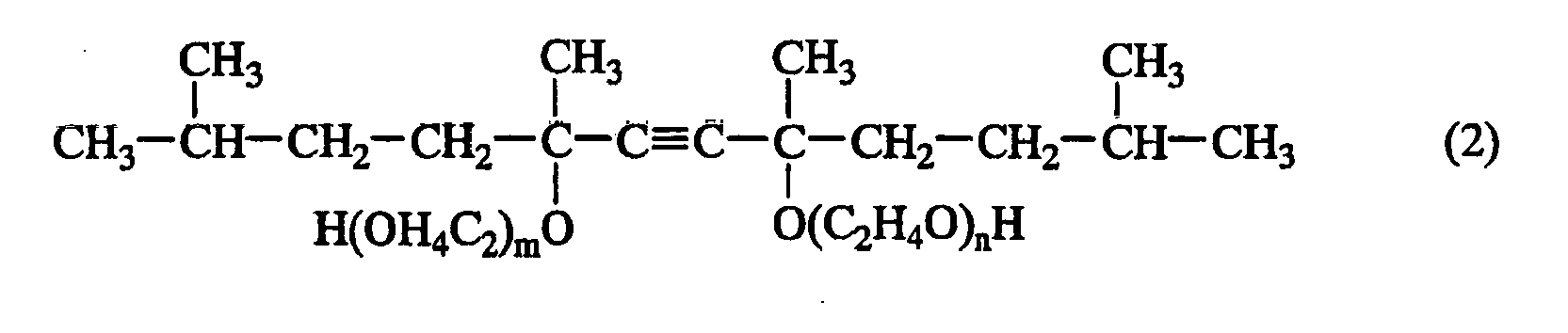
- the component (C-1) is at least one acetylene glycol or its derivative selected from 2,5,8,11-tetramethyl-6-dodecyne-5,8-diol represented by the following general formula (1) and an ethylene oxide derivative of 2,5,8,11-tetramethyl-6-dodecyne-5,8-diol represented by the following general formula (2): wherein m and n are respectively a positive number, and m + n is 2 to 30, and preferably 4 to 12.
- Total molar number of the ethylene oxide added in the ethoxylated derivative represented by the formula (2) is 2 to 30 moles, and preferably 4 to 12 moles. When the molar number of the ethylene oxide added exceeds 30 moles, the coating composition formed may be repelled in the course of coating.
- the component (C-1) may preferably have a sodium content of up to 1,000 ppm (0 to 1,000 ppm). Use of the component (C-1) with the sodium content up to such amount will prevent loss of rust preventive properties and water resistance. In order to enhance such effect, the component (C-1) may preferably have a potassium content of up to 2,000 ppm (0 to 2,000 ppm).
- the sodium content and the potassium content may be controlled to such range, for example, by purification of the acetylene glycol, use of highly purified starting materials, and synthesis of the acetylene glycol in a production environment that will prevent contamination of the metal.
- the coating composition is preferably applied to a metal such as iron, steel, copper, and aluminum, and the surface of the metal used may be preliminarily surface treated.
- the component (C-1) included the mixture has triple bond in its molecule, and this triple bond is postulated to realize the high affinity with the metal such as iron, steel, copper, and aluminum, and formation of the dense metal, and accordingly the coating formed will exhibit excellent adhesion and rust preventive properties.
- the component (C-1) also has a hydrophobic group in its structure, and the composition is less likely to entrain water, and accordingly, the coating exhibits excellent water resistance.
- the acetylene glycol or its derivative [component (C-1)] as described above may be used alone or in combination of two or more, and in preparing the mix incorporated in the coating composition for a metal of the present invention, the component (C-1) may be used at an amount of 10 to 95% by weight, and preferably at 40 to 70% by weight in relation to the total of the components (C-1) and (C-2) and the component (C-3) as described below.
- the effect of bubble removal by gas purging with the liquid may become insufficient to invite defects such as increase in the number of pin holes formed in the resulting coating.
- this amount exceeds 95% by weight, solubility in water may become insufficient when used in preparing an aqueous coating composition.
- the polyoxy(ethylene - propylene) block copolymer of the component (C-2) blended with the acetylene glycol or its derivative of the component (C-1) may be the polyoxyalkylene alkyl ether represented by the following formula (3): HO(C 2 H 4 O) w (C 3 H 6 O) x (C 2 H 4 O) y (C 3 H 6 O) z H (3) (wherein w, x, y, and z are 0 or a positive number with the proviso that w + x + y + z is greater than 0), and examples include:
- the component (C-2) has a weight average molecular weight calculated in terms of polystyrene as measured by gel permeation chromatography (GPC) of 1, 500 to 10,000, and preferably 3,000 to 9,000.
- GPC gel permeation chromatography
- the ethylene oxide content is 35 to 90% by weight, preferably 35 to 85% by weight, and more preferably 40 to 70% by weight.
- the content of less than 35% by weight may invite loss of miscibility in the resin component while the content in excess of 90% by weight may result in the repellency of the resulting coating composition when it is applied on a metal.
- the propylene oxide is 10 to 65% by weight, preferably 15 to 65% by weight, and more preferably 30 to 60% by weight.
- the component (C-2) may be incorporated at an amount of 5 to 90% by weight, and preferably at 30 to 60% by weight in relation to the total of the components (C-1) and (C-2) and the component (C-3) as will be described below.
- content of the component (C-2) is excessively low, solubilization of the component (C-2) will be insufficient, and the resulting composition may include aggregations.
- an excessive content may invite excessive foaming, which may result in the coating defects.
- the component (C-1) and the component (C-2) are preferably used so that the total of the components (C-1) and (C-2) constitutes 100% by weight.
- the coating composition of the present invention may also include pure water; a water soluble organic solvent such as ethyleneglycol, diethylene glycol, triethylene glycol, tetraethylene glycol, polyethylene glycol, propylene glycol, dipropylene glycol, 1,3-propanediol, 1,4-butanediol, or glycerin; or an acetylene glycol or an ethoxylated derivative thereof other than those of the formulae (1) or (2) such as 5,8-dimethyl-6-dodecyne-5,8-diol, 2,4,7,9-tetramethyl-5-decyne-4,7-diol, ethoxylated 2,4,7,9-tetramethyl-5-decyne-4,7-diol (molar number of
- the mixture of the components (C-1), (C-2), and (C-3) is incorporated at 0.01 to 10 parts by weight, preferably at 0.1 to 5 parts by weight, and more preferably at 0.2 to 2 parts by weight in relation to 100 parts by weight of the solid content of the component (A).
- Incorporation of the mixture at an excessively low content may invite a coating failure and the coating composition may be repelled in the course of coating.
- incorporation of the mixture at an excessive amount may also invite coating failure due to increase of the bubbling.
- the main component constituting the coating composition for a metal of the present invention is the component (A), and this component (A) is at least one member selected from (meth)acrylate resin emulsion, styrene - acrylate copolymer emulsion, vinyl acetate resin emulsion, vinyl acetate - (meth)acrylate copolymer emulsion, urethane resin emulsion, ethylene - vinyl acetate copolymer emulsion, polyester resin, and water soluble epoxy resin.
- the preferred in view of versatility and cost are (meth)acrylate resin emulsion, styrene - acrylate copolymer emulsion, vinyl acetate resin emulsion, and vinyl acetate - (meth)acrylate copolymer emulsion.
- the resin may be either the one produced by emulsion polymerization using a known polymerization method or a commercially available product.
- the emulsion used for the component (A) preferably has a solid content of 20 to 60% by weight, and more preferably, a solid content of 30 to 50% by weight.
- the monomer containing an unsaturated group used for the component (A), and in particular, (meth)acrylate resin emulsion, styrene/acrylate copolymer emulsion, vinyl acetate resin emulsion, and vinyl acetate/(meth)acrylate copolymer emulsion is not particularly limited, and exemplary monomers include ethylene, propylene; vinyl carboxylate monomers such as vinyl acetate and vinyl propionate; aromatic vinyl monomers such as styrene and ⁇ -methylstyrene; conjugated diene monomers such as 1,3-butadiene and 2-methyl-1,3-butadiene; ethylenically unsaturated monocarboxylate esters such as methyl acrylate, ethyl acrylate, butyl acrylate, 2-ethylhexyl acrylate, and methyl methacrylate; ethylenically unsaturated dicarboxylate esters such as dimethyl itacon
- the emulsion polymerization may be accomplished by any emulsion polymerization method known in the art.
- the unsaturated group-containing monomer and other polymerization aids such as an emulsifying agent such as alkyl sulfate ester salt, a polymerization initiator such as ammonium sulfate, a pH adjusting agent such as sodium carbonate, and various antifoaming agents
- an emulsifying agent such as alkyl sulfate ester salt
- a polymerization initiator such as ammonium sulfate
- a pH adjusting agent such as sodium carbonate
- various antifoaming agents may be added at once at the initial stage of the reaction; continuously in the course of the reaction; or intermittently or in divided dose during the polymerization.
- the emulsifying agent used in such emulsion polymerization include the surfactants as described in the following (1) to (4), and such surfactant may be used either alone or in combination of two or more.
- Surfactants such as alkyl sulfate ester salt, polyoxyethylene alkyl ether sulfate ester salt, alkyl benzene sulfonate, alkyl diphenyl ether disulfonate, alkyl naphthalene sulfonate, fatty acid salt, dialkyl sulfosuccinates salt, alkyl phosphate ester salt, and polyoxyethylene alkylphenyl phosphate ester salt.
- Surfactant such as polyoxyethylene alkylphenyl ether, polyoxyethylene alkyl ether, polyoxyethylene fatty ester, sorbitan fatty acid ester, polyoxyethylene sorbitan fatty acid ester, polyoxyalkylene alkyl ether, polyoxyethylene derivative, glycerin fatty acid ester, polyoxyethylene hydrogenated castor oil, polyoxyethylene alkylamine, alkyl alkanol amide, or acetylene alcohol, acetylene glycol, and their ethylene oxide adduct.
- Surfactant such as alkyltrimethyl ammonium chloride, dialkyl dimethyl ammonium chloride, alkyl benzyl ammonium chloride, and alkylamine salt.
- Polymerizable surfactant having a radically polymerizable double bond in its molecule for example, alkylallyl sulfosuccinate salt, methacryloyl polyoxyalkylene sulfate salt, and polyoxyethylene nonylpropenylphenyl ether sulfate salt.
- Such surfactant may be used at an amount of 0.3 to 20 parts by weight, and preferably at 0.5 to 10 parts by weight in relation to the unsaturated group-containing monomer.
- the polymerization initiator used in such emulsion polymerization include persulfates such as ammonium persulfate and potassium persulfate; azo compounds such as 2,2'-diamidino-2,2'-azopropane dihydrochloride and azobisisobutyronitrile; and peroxides such as cumene hydroperoxide, benzoyl peroxide, and hydrogen peroxide.
- the polymerization initiator used may also be a known redox initiator, for example, potassium persulfuric and sodium hydrogen sulfite.
- Such polymerization initiator may be used at an amount of 0.1 to 5 parts by weight, and preferably at 0.2 to 2 parts by weight in relation to the unsaturated group-containing monomer.
- the temperature used for the emulsion polymerization is generally 10 to 90° C, and preferably 50 to 80° C.
- the time used for the polymerization is 3 to 20 hours.
- the polymerization is preferably conducted in an inert atmosphere such as nitrogen gas.
- the filler which is component (B) in the coating composition of the present invention is at least one member selected from titanium dioxide, talc, kaolin, bentonite, mica, silica, heavy calcium carbonate, clay, precipitated barium sulfate, barium carbonate, glass beads, and resin beads.
- the component (B) is used at an amount of 1 to 200 parts by weight, preferably 5 to 150 parts by weight, and most preferably 10 to 100 parts by weight in relation to 100 parts by weight of the solid content of the component (A).
- amount of component (B) is less than 1 part by weight, the time required for drying of the coating will be unduly long, while the amount in excess of 200 parts by weight of the component (B) may results in an increased viscosity and poor elongation rate of the coating, and the resulting coating will have a reduced strength.
- the coating composition for a metal of the present invention is produced by mixing the components as described above, for example, by a mixing method known in the art using a propeller blender. If desired, the component which is solid at room temperature may be added after heating.
- the coating composition for a metal of the present invention may have additives incorporated therein to the extent that does not adversely affect the performance of the coating composition.
- the additives may be selected from, for example, humectant, dispersant, antifoaming agent, coating aid, freeze stabilizer, leveling agent, light stabilizer, and antiseptic.
- the coating composition produced as described above may be used by coating on a plate, a molded article, and the like of a metal selected from iron, steel, copper, and aluminum by a method known in the art using a brush, bar coater, roll coater, and like preferably to a dry coating thickness of 1 to 1,000 ⁇ m. If desired, the coated article may be heated to an elevated temperature.
- Amount of the components (C-1), (C-2), and (C-3) blended in the coating composition are shown in Table 1.
- titanium dioxide Teypaque R-780 manufactured by Ishihara Sangyo Kaisha Ltd.
- antifoaming agent Surfynol DF-58 manufactured by Air Products
- pigment dispersant Dispersant BYK-190 manufactured by BYK-Chemie GmbH
- 24.5 parts of ion exchanged water were mixed, and dispersed with Disper to produce the pigment paste.
- the coating composition was applied on a zinc plated steel plate to a dry thickness of 10 ⁇ m, and then dried at 110°C for 10 minutes to thereby produce a test plate for evaluation.
- the viscosity was measured by using a paddle viscometer (23°C).
- the pH was measured according to JIS Z 8802 by using the sample with no further treatment.
- the rust preventive properties were evaluated by salt spray test of the test plate according to JIS K 5600.
- the adhesion was evaluated by crosscut test according to JIS K 5600.
- the coating was observed after applying and peeling an adhesive tape, and the percentage of the non-peeled area is shown in the Table.
- the water resistance was evaluated by immersing the test plate which is the same as the one used for evaluating the adhesion in a warm water of 50° C for 10 days, and evaluating outer appearance of the coating (discoloration, swelling, peeling, etc.) and adhesion.
Landscapes
- Chemical & Material Sciences (AREA)
- Life Sciences & Earth Sciences (AREA)
- Engineering & Computer Science (AREA)
- Materials Engineering (AREA)
- Wood Science & Technology (AREA)
- Organic Chemistry (AREA)
- Chemical Kinetics & Catalysis (AREA)
- Paints Or Removers (AREA)
- Preventing Corrosion Or Incrustation Of Metals (AREA)
- Application Of Or Painting With Fluid Materials (AREA)
Description
- This invention relates to a coating composition for a metal which exhibits excellent rust preventive properties simultaneously with improved water resistance and good adhesion to the metal. This invention also relates to a metal material having a coating formed by such coating composition.
- Lead salt rust preventive pigments such as minium, lead cyanamide, and calcium metaplumbate, and metal chromate rust preventive pigments such as basic zinc chromate and strontium chromate had once been the main reagent used for preventing the rust. Use of such reagent, however, was gradually restricted in consideration of the health hazard and environmental conservation. Since then, non-polluting, non-toxic rust preventive pigments have been developed. Exemplary such rust preventive pigments include metal phosphates such as zinc phosphate, calcium magnesium phosphate, titanium phosphate, and silica phosphate; condensed metal phosphates such as aluminum tripolyphosphate; metal phosphorite such as zinc phosphorite, calcium phosphorite, strontium phosphorite, and aluminum phosphorite; zinc molybdate, calcium molybdate, barium borate, and zinc borate. Use of these non-polluting, non-toxic rust preventive pigments did not bring a major change since rust preventive pigments were still used.
- In the field of metal coatings
JP-A-5/140491 -
JP-A-2000/104015 - In other fields of application our
US-A-2003/078307 describes water-soluble surfactant compositions for use in inks or paper coatings (which may contain acryl-type resin emulsions). The surfactant is a combination of acetylene glycol and/or acetylene glycol ethoxylate with a polyoxy(ethylene-propylene) block polymer. These may be as described for components (C) in the present disclosure. The surfactants are to promote wetting of the paper substrate without foaming, compatible with high-speed printing and coating processes. -
JP-A-2003/049394 JP-A-2005/146159 -
JP-A-10/330683 US-A-2005/0227900 describes the use of ethoxylated acetylenic glycol surfactants, such as ethoxylated 2,4,7,9-tetramethyl-5-decyne-4,7-diol, in an emulsion spray as a cleaning composition for surfaces. - In view of the situation as described above, an aim of the present proposals is to provide new and useful coating compositions for metal which do not need and desirably do not contain rust preventive pigment, notably toxic lead salt or chromium salt rust preventive pigment, and which exhibit excellent water resistance and adhesion to metal. Other aspects of the present proposals are methods of making the compositions, methods of using them to form coatings on metal, and metal materials and articles having coatings formed from such compositions.
- The inventors of the present invention made an intensive study to realize the objects as described above in relation to metal coating, and found that a coating composition for a metal prepared by blending the synthetic resin and the filler which constitute the base of the coating composition with a mixture of an acetylene glycol surfactant and a polyoxy(ethylene - propylene) block polymer having a weight average molecular weight of a particular range exhibits an excellent rust preventive properties simultaneously with good or improved water resistance and high adhesion to the metal. The present invention has been completed on the basis of such finding.
- Accordingly, as specified in claim 1 this invention! provides a coating composition for metal comprising
- (A) 100 parts by weight, solids content, of synthetic resin specified below;
- (B) 1 to 200 parts by weight of filler, specified below, and
- (C) 0.01 to 10 parts by weight of a mixture of (C-1) 10 to 95% by weight of acetylene glycol represented by the following general formula (1):


- (C-2) 5 to 90% by weight of at least one member selected from polyoxy(ethylene - propylene) block polymers represented by the following formula (3):
HO(C2H4O)w(C3H6O)x(C2H4O)y(C3H6O)zH (3)
wherein w, x, y, and z are respectively 0 or a positive number with the proviso that w + x + y + z > 0, the block polymer having a weight average molecular weight of 1,500 to 10,000, an ethylene oxide content of 35 to 90% by weight, and a propylene oxide content of 10 to 65% by weight; and - (C-3) 0 to 25% by weight of at least one member selected from water, a water soluble organic solvent, and an acetylene glycol or ethoxylated derivative thereof other than those of the formulae (1) and (2).
- We find that coating compositions embodying our proposals, despite the absence of rust preventive pigment, can provide a coating on metal which exhibits excellent rust preventive property as well as good or improved water resistance and good adhesion to the metal.
- We also find that coating compositions embodying our proposals can be directly applied to a metal surface without being repelled or causing coating inconsistency, even if an oily substance is present on the metal surface.
- This invention relates to a coating composition for a metal comprising
100 parts by weight (solids content) of synthetic resin (A);
1 to 200 parts by weight of the filler (B); and
0.01 to 10 parts by weight of the mixture (C) of - (C-1) 10 to 95% by weight of acetylene glycol represented by the following general formula (1):

- (C-2) 5 to 90% by weight of at least one member selected from polyoxy(ethylene - propylene) block polymers represented by the following formula (3):
HO(C2H4O)w(C3H6O)x(C2H4O)y(C2H6O)zH (3)
wherein w, x, y, and z are respectively 0 or a positive number with the proviso that w + x + y + z > 0, the block polymer having a weight average molecular weight of 1,500 to 10,000, an ethylene oxide content of 35 to 90% by weight, and a propylene oxide content of 10 to 65% by weight; and - (C-3) 0 to 25% by weight of at least one member selected from water, a water soluble organic solvent, and an acetylene glycol or ethoxylated derivative thereof other than those of the formulae (1) and (2).
- As described above, of the mixture incorporated in the coating composition for a metal of the present invention, the component (C-1) is at least one acetylene glycol or its derivative selected from 2,5,8,11-tetramethyl-6-dodecyne-5,8-diol represented by the following general formula (1) and an ethylene oxide derivative of 2,5,8,11-tetramethyl-6-dodecyne-5,8-diol represented by the following general formula (2):


- Total molar number of the ethylene oxide added in the ethoxylated derivative represented by the formula (2) is 2 to 30 moles, and preferably 4 to 12 moles. When the molar number of the ethylene oxide added exceeds 30 moles, the coating composition formed may be repelled in the course of coating.
- The component (C-1) may preferably have a sodium content of up to 1,000 ppm (0 to 1,000 ppm). Use of the component (C-1) with the sodium content up to such amount will prevent loss of rust preventive properties and water resistance. In order to enhance such effect, the component (C-1) may preferably have a potassium content of up to 2,000 ppm (0 to 2,000 ppm). The sodium content and the potassium content may be controlled to such range, for example, by purification of the acetylene glycol, use of highly purified starting materials, and synthesis of the acetylene glycol in a production environment that will prevent contamination of the metal. The coating composition is preferably applied to a metal such as iron, steel, copper, and aluminum, and the surface of the metal used may be preliminarily surface treated.
- The component (C-1) included the mixture has triple bond in its molecule, and this triple bond is postulated to realize the high affinity with the metal such as iron, steel, copper, and aluminum, and formation of the dense metal, and accordingly the coating formed will exhibit excellent adhesion and rust preventive properties. The component (C-1) also has a hydrophobic group in its structure, and the composition is less likely to entrain water, and accordingly, the coating exhibits excellent water resistance.
- The acetylene glycol or its derivative [component (C-1)] as described above may be used alone or in combination of two or more, and in preparing the mix incorporated in the coating composition for a metal of the present invention, the component (C-1) may be used at an amount of 10 to 95% by weight, and preferably at 40 to 70% by weight in relation to the total of the components (C-1) and (C-2) and the component (C-3) as described below. When used at an amount of less than 10% by weight, the effect of bubble removal by gas purging with the liquid may become insufficient to invite defects such as increase in the number of pin holes formed in the resulting coating. When this amount exceeds 95% by weight, solubility in water may become insufficient when used in preparing an aqueous coating composition.
- The polyoxy(ethylene - propylene) block copolymer of the component (C-2) blended with the acetylene glycol or its derivative of the component (C-1) may be the polyoxyalkylene alkyl ether represented by the following formula (3):
HO(C2H4O)w(C3H6O)x(C2H4O)y(C3H6O)zH (3)
(wherein w, x, y, and z are 0 or a positive number with the proviso that w + x + y + z is greater than 0), and examples include: - HO(C2H4O)w(C3H6O)20(C2H4O)yH (wherein w + y = 27),
- HO(C2H4O)w(C3H6O)30(C2H4O)yH (wherein w + y = 160),
- HO(C2H4O)w(C3H6O)35(C2H4O)yH (wherein w + y = 30),
- HO(C2H4O)w(C3H6O)35(C2H4O)yH (wherein w + y = 48),
- HO(C2H4O)w(C3H6O)20(C2H4O)yH (wherein w + y = 155), and
- HO(C3H6O)x(C3H6O)155(C3H6O)z (wherein x + z = 30),
- The component (C-2) has a weight average molecular weight calculated in terms of polystyrene as measured by gel permeation chromatography (GPC) of 1, 500 to 10,000, and preferably 3,000 to 9,000. When the molecular weight is less than 1,500, solubility in water may become insufficient when used in preparing an aqueous coating composition. The molecular weight in excess of 10,000 may invite inconsistency of the coating formed by the resulting coating composition.
- The ethylene oxide content is 35 to 90% by weight, preferably 35 to 85% by weight, and more preferably 40 to 70% by weight. The content of less than 35% by weight may invite loss of miscibility in the resin component while the content in excess of 90% by weight may result in the repellency of the resulting coating composition when it is applied on a metal.
- The propylene oxide is 10 to 65% by weight, preferably 15 to 65% by weight, and more preferably 30 to 60% by weight.
- The component (C-2) may be incorporated at an amount of 5 to 90% by weight, and preferably at 30 to 60% by weight in relation to the total of the components (C-1) and (C-2) and the component (C-3) as will be described below. When the content of the component (C-2) is excessively low, solubilization of the component (C-2) will be insufficient, and the resulting composition may include aggregations. On the other hand, an excessive content may invite excessive foaming, which may result in the coating defects.
- In present invention, the component (C-1) and the component (C-2) are preferably used so that the total of the components (C-1) and (C-2) constitutes 100% by weight. However, the coating composition of the present invention may also include pure water; a water soluble organic solvent such as ethyleneglycol, diethylene glycol, triethylene glycol, tetraethylene glycol, polyethylene glycol, propylene glycol, dipropylene glycol, 1,3-propanediol, 1,4-butanediol, or glycerin; or an acetylene glycol or an ethoxylated derivative thereof other than those of the formulae (1) or (2) such as 5,8-dimethyl-6-dodecyne-5,8-diol, 2,4,7,9-tetramethyl-5-decyne-4,7-diol, ethoxylated 2,4,7,9-tetramethyl-5-decyne-4,7-diol (molar number of the ethylene oxide added: 4), 2,4,7,9-tetramethyl-5-decyne-4,7-diol (molar number of the ethylene oxide added: 10), ethoxylated 2,4,7,9-tetramethyl-5-decyne-4,7-diol (molar number of the ethylene oxide added: 30), 4,7-dimethyl-5-decyne-4,7-diol, 8-hexadecyne-7,10-diol, 7-tetradecyne-6,9-diol, 2,3,6,7-tetramethyl-4-octyne-3,6-diol, 3,6-diethyl-4-octyne-3,6-diol, 3,6-dimethyl-4-octyne-3,6-diol, or 2,5-dimethyl-3-hexyne-2,5-diol as the component (C-3). This component (C-3) may be used to constitute 0 to 25% by weight, and preferably 5 to 20% by weight as long as such inclusion does not adversely affect the properties of the coating composition for the metal of the present invention.
- As described above, the mixture of the components (C-1), (C-2), and (C-3) is incorporated at 0.01 to 10 parts by weight, preferably at 0.1 to 5 parts by weight, and more preferably at 0.2 to 2 parts by weight in relation to 100 parts by weight of the solid content of the component (A). Incorporation of the mixture at an excessively low content may invite a coating failure and the coating composition may be repelled in the course of coating. On the other hand, incorporation of the mixture at an excessive amount may also invite coating failure due to increase of the bubbling.
- The main component constituting the coating composition for a metal of the present invention is the component (A), and this component (A) is at least one member selected from (meth)acrylate resin emulsion, styrene - acrylate copolymer emulsion, vinyl acetate resin emulsion, vinyl acetate - (meth)acrylate copolymer emulsion, urethane resin emulsion, ethylene - vinyl acetate copolymer emulsion, polyester resin, and water soluble epoxy resin. Among these, the preferred in view of versatility and cost are (meth)acrylate resin emulsion, styrene - acrylate copolymer emulsion, vinyl acetate resin emulsion, and vinyl acetate - (meth)acrylate copolymer emulsion. The resin may be either the one produced by emulsion polymerization using a known polymerization method or a commercially available product. The emulsion used for the component (A) preferably has a solid content of 20 to 60% by weight, and more preferably, a solid content of 30 to 50% by weight.
- The monomer containing an unsaturated group used for the component (A), and in particular, (meth)acrylate resin emulsion, styrene/acrylate copolymer emulsion, vinyl acetate resin emulsion, and vinyl acetate/(meth)acrylate copolymer emulsion is not particularly limited, and exemplary monomers include ethylene, propylene; vinyl carboxylate monomers such as vinyl acetate and vinyl propionate; aromatic vinyl monomers such as styrene and α-methylstyrene; conjugated diene monomers such as 1,3-butadiene and 2-methyl-1,3-butadiene; ethylenically unsaturated monocarboxylate esters such as methyl acrylate, ethyl acrylate, butyl acrylate, 2-ethylhexyl acrylate, and methyl methacrylate; ethylenically unsaturated dicarboxylate esters such as dimethyl itaconate, diethyl maleate, monobutyl maleate, monoethyl fumarate, and dibutyl fumarate; ethylenically unsaturated monocarboxylic acids such as acrylic acid, methacrylic acid, and crotonic acid; ethylenically unsaturated dicarboxylic acids such as itaconic acid, maleic acid, and fumaric acid; epoxy group-containing monomers such as glycidyl methacrylate; alcohol group-containing monomers such as 2-hydroxyethyl methacrylate; alkoxyl group-containing monomers such as methoxyethyl acrylate; nitrile group-containing monomers such as acrylonitrile; amide group-containing monomer such as acrylamide; amino group-containing monomer such as dimethylaminoethyl methacrylate; and a monomer containing two or more ethylenically unsaturated groups such as divinylbenzene and allylmethacrylate. The emulsion polymerization may be conducted by using such monomers.
- The emulsion polymerization may be accomplished by any emulsion polymerization method known in the art. The unsaturated group-containing monomer and other polymerization aids (such as an emulsifying agent such as alkyl sulfate ester salt, a polymerization initiator such as ammonium sulfate, a pH adjusting agent such as sodium carbonate, and various antifoaming agents) may be added at once at the initial stage of the reaction; continuously in the course of the reaction; or intermittently or in divided dose during the polymerization.
- The emulsifying agent used in such emulsion polymerization include the surfactants as described in the following (1) to (4), and such surfactant may be used either alone or in combination of two or more.
- Surfactants such as alkyl sulfate ester salt, polyoxyethylene alkyl ether sulfate ester salt, alkyl benzene sulfonate, alkyl diphenyl ether disulfonate, alkyl naphthalene sulfonate, fatty acid salt, dialkyl sulfosuccinates salt, alkyl phosphate ester salt, and polyoxyethylene alkylphenyl phosphate ester salt.
- Surfactant such as polyoxyethylene alkylphenyl ether, polyoxyethylene alkyl ether, polyoxyethylene fatty ester, sorbitan fatty acid ester, polyoxyethylene sorbitan fatty acid ester, polyoxyalkylene alkyl ether, polyoxyethylene derivative, glycerin fatty acid ester, polyoxyethylene hydrogenated castor oil, polyoxyethylene alkylamine, alkyl alkanol amide, or acetylene alcohol, acetylene glycol, and their ethylene oxide adduct.
- Surfactant such as alkyltrimethyl ammonium chloride, dialkyl dimethyl ammonium chloride, alkyl benzyl ammonium chloride, and alkylamine salt.
- Such surfactant may be used at an amount of 0.3 to 20 parts by weight, and preferably at 0.5 to 10 parts by weight in relation to the unsaturated group-containing monomer.
- The polymerization initiator used in such emulsion polymerization include persulfates such as ammonium persulfate and potassium persulfate; azo compounds such as 2,2'-diamidino-2,2'-azopropane dihydrochloride and azobisisobutyronitrile; and peroxides such as cumene hydroperoxide, benzoyl peroxide, and hydrogen peroxide. The polymerization initiator used may also be a known redox initiator, for example, potassium persulfuric and sodium hydrogen sulfite. Such polymerization initiator may be used at an amount of 0.1 to 5 parts by weight, and preferably at 0.2 to 2 parts by weight in relation to the unsaturated group-containing monomer.
- The temperature used for the emulsion polymerization is generally 10 to 90° C, and preferably 50 to 80° C. The time used for the polymerization is 3 to 20 hours. The polymerization is preferably conducted in an inert atmosphere such as nitrogen gas.
- The filler which is component (B) in the coating composition of the present invention is at least one member selected from titanium dioxide, talc, kaolin, bentonite, mica, silica, heavy calcium carbonate, clay, precipitated barium sulfate, barium carbonate, glass beads, and resin beads.
- The component (B) is used at an amount of 1 to 200 parts by weight, preferably 5 to 150 parts by weight, and most preferably 10 to 100 parts by weight in relation to 100 parts by weight of the solid content of the component (A). When the amount of component (B) is less than 1 part by weight, the time required for drying of the coating will be unduly long, while the amount in excess of 200 parts by weight of the component (B) may results in an increased viscosity and poor elongation rate of the coating, and the resulting coating will have a reduced strength.
- The coating composition for a metal of the present invention is produced by mixing the components as described above, for example, by a mixing method known in the art using a propeller blender. If desired, the component which is solid at room temperature may be added after heating.
- The coating composition for a metal of the present invention may have additives incorporated therein to the extent that does not adversely affect the performance of the coating composition. The additives may be selected from, for example, humectant, dispersant, antifoaming agent, coating aid, freeze stabilizer, leveling agent, light stabilizer, and antiseptic.
- The coating composition produced as described above may be used by coating on a plate, a molded article, and the like of a metal selected from iron, steel, copper, and aluminum by a method known in the art using a brush, bar coater, roll coater, and like preferably to a dry coating thickness of 1 to 1,000 µm. If desired, the coated article may be heated to an elevated temperature.
- Next, the present invention is described in further detail by referring to the Examples and Comparative Examples which by no means limit the scope of the present invention. The parts and % in the Examples indicate parts by weight and % by weight, respectively.
- Amount of the components (C-1), (C-2), and (C-3) blended in the coating composition are shown in Table 1.
-

-
- C-1-1:
- 2,5,8,11-tetramethyl-6-dodecyne-5,8-diol represented by formula (1)
- C-1-2:
- ethoxylated 2,5,8,11-tetramethyl-6-dodecyne-5,8-diol (molar number of the ethylene oxide added: m + n = 6) represented by formula (2)
- C-1-3:
- ethoxylated 2,5,8,11-tetramethyl-6-dodecyne-5,8-diol (molar number of the ethylene oxide added: m + n = 50) represented by formula (2)
- C-1-2':
- a compound having a composition of ethoxylated 2,5,8,11-tetramethyl-6-dodecyne-5,8-diol (molar number of the ethylene oxide added: m + n = 6)
-
- C-2-1:
- Epan 750 (product name of HO(C2H4O)w(C3H6O)35(C2H4O)yH, wherein w + y = 48; manufactured by Dai-ichi Kogyo Seiyaku Co. , Ltd.; weight average molecular weight, 4,000; ethylene oxide content, 51%; propylene oxide content, 49%)
- C-2-2:
- Epan 680 (product name of HO(C2H4O)w(C3H6O)30(C2H4O)yH, wherein w + y = 160; manufactured by Dai-ichi Kogyo Seiyaku Co., Ltd.; weight average molecular weight, 8,800; ethylene oxide content, 80%; propylene oxide content, 20%)
- C-2-3:
- Epan 485 (product name of HO(C2H4O)w(C3H6O)20(C2H4O)yH, wherein w + y = 155; manufactured by Dai-ichi Kogyo Seiyaku Co. , Ltd.; weight average molecular weight, 8,000; ethylene oxide content, 85%; propylene oxide content, 15%)
- C-2-4:
- Pluronic 25R8 (product name of HO(C3H6O)x(C2H4O)155(C3H6O)zH, wherein x + z = 30; manufactured by BASF; weight average molecular weight, 8, 550; ethylene oxide content, 80%; propylene oxide content, 20%)
- C-2-5:
- Epan 410 (product name of HO(C2H4O)w(C3H6O)20(C2H4O)yH, wherein w+y = 2; manufactured by Dai-ichi Kogyo Seiyaku Co., Ltd. ; weight average molecular weight, 1,330: ethylene oxide content, 7%; propylene oxide content, 92%)
- C-2-6:
- Epan 785 (product name of HO(C2H4O)w(C3H6O)35(C2H4O)yH, wherein w + y = 250; manufactured by Dai-ichi Kogyo Seiyaku Co., Ltd. ; weight average molecular weight, 13,000; ethylene oxide content, 84%; propylene oxide content, 16%)
-
- EG:
- ethyleneglycol
- PG:
- propylene glycol
- C-3-1:
- Surfynol 104 (product name of 2,4,7,9-tetramethyl-5-decyne-4,7-diol manufactured by Air Products)
- C-3-2:
- Surfynol 440 (product name of ethoxylated derivative of 2,4,7,9-tetramethyl-5-decyne-4,7-diol, molar number of the ethylene oxide added: 3.5 moles, manufactured by Air Products)
- Na was quantitatively determined by ICP emission spectrophotometer (IRIS Intorepid II XSP).
- 50 parts of Vinyblan 2583 (product name of an acryl emulsion manufactured by Nissin Chemical Industry Co. , Ltd. , solid content, 45%), 30 parts of the filler paste as described below, 15 parts of ion exchanged water, 4 parts of 5% aqueous solution of adipic acid dihydrazide, and 1 part of the mix (M-1 to M-11) were mixed to produce the coating composition for evaluation.
- 70 parts of titanium dioxide (Typaque R-780 manufactured by Ishihara Sangyo Kaisha Ltd.), 0.5 parts of antifoaming agent (Surfynol DF-58 manufactured by Air Products), 5 parts of pigment dispersant (Dispersant BYK-190 manufactured by BYK-Chemie GmbH), and 24.5 parts of ion exchanged water were mixed, and dispersed with Disper to produce the pigment paste.
- The coating composition was applied on a zinc plated steel plate to a dry thickness of 10 µm, and then dried at 110°C for 10 minutes to thereby produce a test plate for evaluation.
- The viscosity was measured by using a paddle viscometer (23°C).
- The pH was measured according to JIS Z 8802 by using the sample with no further treatment.
- After the test, rust generation, adhesion, and appearance of the coating were evaluated by the following criteria:
- The rust preventive properties were evaluated by salt spray test of the test plate according to JIS K 5600.
- ⊚: No rust observed at the cut. Adhesion of 100/100.
- ○: Red rust at the cut of up to 5%.
- Δ: Red rust at the cut of 6 to 20%.
- ×: Red rust at the cut of in excess of 20%.
- The adhesion was evaluated by crosscut test according to JIS K 5600.
- The coating was observed after applying and peeling an adhesive tape, and the percentage of the non-peeled area is shown in the Table.
- The water resistance was evaluated by immersing the test plate which is the same as the one used for evaluating the adhesion in a warm water of 50° C for 10 days, and evaluating outer appearance of the coating (discoloration, swelling, peeling, etc.) and adhesion.
- ⊚: No change in the outer appearance of the coating, with the adhesion of 100/100.
- ○: Swelling at the cuts with the adhesion of 80/100 or higher.
- Δ: Swelling at the cuts with the adhesion of 50/100 or higher.
- ×: Swelling at the cuts with the adhesion of less than 50/100.
- The results are shown in Table 2.
Table 2 Example Comparative Example Blend M-1 M-2 M-3 M-4 M-5 M-6 M-7 M-8 M-9 M-10 M-11 Viscosity (KV) 70 70 70 70 70 72 72 72 72 72 72 PH 9 9 9 9 9 9 9 9 9 9 9 Rust preventive properties ⊚ ⊚ ⊚ ⊚ ⊚ ○ × × × Δ × Water resistance ⊚ ○ ○ ⊚ ⊚ Δ × Δ × Δ × Adhesion 100 100 80 100 100 40 40 60 20 40 20 - In respect of numerical ranges disclosed herein it will of course be understood that in the normal way the technical criterion for the upper limit is different from the technical criterion for the lower limit, i.e. the upper and lower limits are intrinsically distinct proposals.
Claims (14)
- A coating composition for coating metal, comprising(A) 100 parts by weight, solids content, of at least one synthetic resin selected from (meth)acrylate resin emulsion, styrene-acrylate copolymer emulsion, vinyl acetate resin emulsion, vinyl acetate-(meth)acrylate copolymer emulsion, urethane resin emulsion, ethylene-vinyl acetate copolymer emulsion, polyester resin and aqueous epoxy resin;(B) 1 to 200 parts by weight of at least one filler selected from titanium dioxide, talc, kaolin, bentonite, mica, silica, heavy calcium carbonate, clay, precipitated barium sulfate, barium carbonate, glass beads and resin beads;(C) 0.01 to 10 parts by weight of a mixture of (C-1) 10 to 95% by weight of acetylene glycol represented by the following general formula (1):

 (C-2) 5 to 90% by weight of at least one selected from polyoxy(ethylene-propylene) block polymers represented by the following formula (3):
HO(C2H4O)W(C3H6O)X(C2H4O)Y(C3H6O)ZH (3)
wherein w, x, y and z are respectively 0 or a positive number with the proviso that
w + x + y + z > 0, the block polymer having a weight average molecular weight of from 1,500 to 10,000, an ethylene oxide content of 35 to 90% by weight and a propylene oxide content of 10 to 65% by weight;(C-3) 0 to 25% by weight of at least one selected from water, water-soluble organic solvents, and acetylene glycol and ethoxylated derivatives thereof other than those of formulae (1) and (2). - A coating composition according to claim 1 in which the amount of said filler (B) is from 10 to 100 parts by weight.
- A coating composition according to claim 1 or claim 2 wherein the component (C-1) has a sodium content of up to 1,000 ppm.
- A coating composition according to claim 1, 2 or 3 wherein the component (C-1) has a potassium content of up to 2,000 ppm.
- A coating composition according to any one of the preceding claims in which the synthetic resin composite (A) is selected from (meth)acrylate resin emulsion, styrene-acrylate copolymer emulsion, vinyl acetate resin emulsion and vinyl acetate-(meth)acrylate copolymer emulsion.
- A coating composition according to claim 5 in which the emulsion used for component (A) has a solids content of 20 to 60% by weight.
- A coating composition according to any one of the preceding claims in which mixture component (C-1) contains said ethoxylated derivative of formula (2) in which m + n is from 4 to 12.
- A coating composition according to any one of the preceding claims in which in mixture (C), component (C-1) is at from 40 to 70% by weight and component (C-2) is at from 30 to 60% by weight, relative to the total of components (C-1), (C-2) and (C-3).
- A coating composition according to any one of the preceding claims in which mixture (C) is at from 0.1 to 5 parts by weight in relation to said 100 parts by weight solids content of synthetic resin component (A).
- A method of preparing a coating composition according to any one of claims 1 to 9, comprising combining the specified components thereof.
- A method of forming a coating on metal, comprising applying a composition according to any one of claims 1 to 9 to the metal.
- A method of claim 11, the metal being iron, steel, copper or aluminium.
- A method of claim 11 or 12 comprising the use of said coating composition as rust preventive.
- A metal material or article having a coating made from a coating composition of any one of claims 1 to 9, preferably on iron, steel, copper or aluminium.
Applications Claiming Priority (1)
| Application Number | Priority Date | Filing Date | Title |
|---|---|---|---|
| JP2006243762A JP2008063472A (en) | 2006-09-08 | 2006-09-08 | Coating material for metal and metal material provided with coating film of the coating material for metal |
Publications (3)
| Publication Number | Publication Date |
|---|---|
| EP1897922A2 EP1897922A2 (en) | 2008-03-12 |
| EP1897922A3 EP1897922A3 (en) | 2008-10-29 |
| EP1897922B1 true EP1897922B1 (en) | 2014-04-09 |
Family
ID=39033982
Family Applications (1)
| Application Number | Title | Priority Date | Filing Date |
|---|---|---|---|
| EP20070253579 Active EP1897922B1 (en) | 2006-09-08 | 2007-09-10 | Coating composition for a metal, and metal material having a coating of such coating composition |
Country Status (4)
| Country | Link |
|---|---|
| US (1) | US7985486B2 (en) |
| EP (1) | EP1897922B1 (en) |
| JP (1) | JP2008063472A (en) |
| CN (1) | CN101230225B (en) |
Families Citing this family (7)
| Publication number | Priority date | Publication date | Assignee | Title |
|---|---|---|---|---|
| JP2011115686A (en) | 2009-12-01 | 2011-06-16 | Suzuki Motor Corp | Method for forming coating film and coating film |
| JP5549652B2 (en) | 2011-08-18 | 2014-07-16 | 藤倉化成株式会社 | Chromium thin film coating composition |
| WO2014072302A1 (en) * | 2012-11-09 | 2014-05-15 | Basf Se | Composition for inks and coatings with high lamination bond strength |
| CN104341924A (en) * | 2014-11-14 | 2015-02-11 | 无锡伊佩克科技有限公司 | Water-based antirust and rust removing asphalt ship bottom coating and preparation method for same |
| CN105440855A (en) * | 2015-12-23 | 2016-03-30 | 巢湖诺信建材机械装备有限公司 | Intermediate layer connecting paint on plate hammer |
| CN105907203B (en) * | 2016-05-16 | 2017-03-15 | 江苏怡成屏障科技有限公司 | A kind of preparation technology of low-carbon environment-friendly anticorrosive paint |
| ES2970985T3 (en) * | 2018-08-29 | 2024-06-03 | Nissin chemical ind co ltd | Dispersion composition, dispersion and ink composition, and method of producing the same |
Family Cites Families (18)
| Publication number | Priority date | Publication date | Assignee | Title |
|---|---|---|---|---|
| US4172064A (en) * | 1977-08-30 | 1979-10-23 | Claremont Polychemical Corporation | Printing ink copolymers |
| JPS572367A (en) * | 1980-06-07 | 1982-01-07 | Kansai Paint Co Ltd | Water-dispersed thermosetting resin slurry paint composition |
| JPS6384671A (en) | 1986-09-29 | 1988-04-15 | Kawasaki Steel Corp | Insulating film of electrical steel sheet and formation thereof |
| JPH05140491A (en) | 1991-11-22 | 1993-06-08 | Toyo Ink Mfg Co Ltd | Etching-resistant aqueous coating composition for metallic plate |
| US5308389A (en) * | 1992-05-05 | 1994-05-03 | Pennzoil Products Company | Metal appearance composition |
| CA2136373A1 (en) * | 1993-11-29 | 1995-05-30 | Steven W. Medina | Ethoxylated acetylenic glycols having low dynamic surface tension |
| JP3573573B2 (en) | 1995-05-31 | 2004-10-06 | 日本カーバイド工業株式会社 | Acrylic copolymer aqueous coating composition |
| JPH10330683A (en) | 1997-05-29 | 1998-12-15 | Dainippon Ink & Chem Inc | Release coating agent and its coating method |
| JP3299197B2 (en) | 1998-09-30 | 2002-07-08 | 第一工業製薬株式会社 | Rust prevention paint for thermosetting water-based metal |
| JP2002129356A (en) | 2000-10-25 | 2002-05-09 | Nittetsu Corrosion Prevention Co Ltd | Durable hot-dip galvanized steel and coating method therefor |
| JP4386156B2 (en) | 2001-05-30 | 2009-12-16 | 日信化学工業株式会社 | Water-soluble surfactant composition |
| JP4530121B2 (en) | 2001-08-01 | 2010-08-25 | 日信化学工業株式会社 | Paper coating agent |
| JP4206782B2 (en) | 2003-02-28 | 2009-01-14 | 日信化学工業株式会社 | Water-soluble surfactant composition |
| JP4217894B2 (en) | 2003-11-18 | 2009-02-04 | 日信化学工業株式会社 | Ink additive and ink using the same |
| JP2005154912A (en) * | 2003-11-21 | 2005-06-16 | Oji Paper Co Ltd | Coated paper for printing |
| JP2005272619A (en) | 2004-03-24 | 2005-10-06 | Daicel Chem Ind Ltd | Water dispersible resin composition |
| US6969698B2 (en) | 2004-04-13 | 2005-11-29 | S. C. Johnson & Son, Inc. | Aerosol cleaner |
| US7863485B2 (en) * | 2004-12-10 | 2011-01-04 | Omnitech Environmental, Llc | Additive and vehicle for inks, paints, coatings and adhesives |
-
2006
- 2006-09-08 JP JP2006243762A patent/JP2008063472A/en active Pending
-
2007
- 2007-09-07 US US11/898,073 patent/US7985486B2/en active Active
- 2007-09-07 CN CN2007103071738A patent/CN101230225B/en active Active
- 2007-09-10 EP EP20070253579 patent/EP1897922B1/en active Active
Also Published As
| Publication number | Publication date |
|---|---|
| CN101230225B (en) | 2011-11-30 |
| EP1897922A3 (en) | 2008-10-29 |
| US7985486B2 (en) | 2011-07-26 |
| US20080063892A1 (en) | 2008-03-13 |
| JP2008063472A (en) | 2008-03-21 |
| EP1897922A2 (en) | 2008-03-12 |
| CN101230225A (en) | 2008-07-30 |
Similar Documents
| Publication | Publication Date | Title |
|---|---|---|
| US7985486B2 (en) | Coating composition for a metal, and metal material having a coating of such coating composition | |
| RU2462487C2 (en) | Radiation-cured formulations containing silicic acid and dispersant, improving protection of metal substrates from corrosion | |
| KR100939165B1 (en) | A anti-corrosion paint composition and method for manufacturing the same | |
| EP1897924B1 (en) | Protective coating containing acetylene compound | |
| JP7831839B2 (en) | Water-based anticorrosive coating composition | |
| JP2006523265A (en) | VOC-free latex coalescent | |
| EP1897923B1 (en) | Protective coating containing acetylene compound | |
| EP1900783B1 (en) | Coating composition for a metal, and metal material having a coating of such coating composition | |
| JP4411108B2 (en) | Paint finishing method | |
| KR101044781B1 (en) | Water soluble coating composition | |
| JP4540711B2 (en) | Water-based paint composition and coated steel sheet | |
| JP2008195742A (en) | Water-based pigment paste and water-based coating material composition | |
| US8632881B2 (en) | Glass fiber product | |
| US20050014877A1 (en) | VOC free latex coalescent systems | |
| KR102800863B1 (en) | Water-soluble coating composition |
Legal Events
| Date | Code | Title | Description |
|---|---|---|---|
| PUAI | Public reference made under article 153(3) epc to a published international application that has entered the european phase |
Free format text: ORIGINAL CODE: 0009012 |
|
| AK | Designated contracting states |
Kind code of ref document: A2 Designated state(s): AT BE BG CH CY CZ DE DK EE ES FI FR GB GR HU IE IS IT LI LT LU LV MC MT NL PL PT RO SE SI SK TR |
|
| AX | Request for extension of the european patent |
Extension state: AL BA HR MK YU |
|
| PUAL | Search report despatched |
Free format text: ORIGINAL CODE: 0009013 |
|
| AK | Designated contracting states |
Kind code of ref document: A3 Designated state(s): AT BE BG CH CY CZ DE DK EE ES FI FR GB GR HU IE IS IT LI LT LU LV MC MT NL PL PT RO SE SI SK TR |
|
| AX | Request for extension of the european patent |
Extension state: AL BA HR MK RS |
|
| RIC1 | Information provided on ipc code assigned before grant |
Ipc: C09D 201/00 20060101AFI20080201BHEP Ipc: B05D 7/14 20060101ALI20080919BHEP Ipc: C09D 171/02 20060101ALI20080919BHEP |
|
| 17P | Request for examination filed |
Effective date: 20090203 |
|
| 17Q | First examination report despatched |
Effective date: 20090317 |
|
| AKX | Designation fees paid |
Designated state(s): DE FR GB |
|
| GRAP | Despatch of communication of intention to grant a patent |
Free format text: ORIGINAL CODE: EPIDOSNIGR1 |
|
| INTG | Intention to grant announced |
Effective date: 20131114 |
|
| GRAS | Grant fee paid |
Free format text: ORIGINAL CODE: EPIDOSNIGR3 |
|
| GRAA | (expected) grant |
Free format text: ORIGINAL CODE: 0009210 |
|
| AK | Designated contracting states |
Kind code of ref document: B1 Designated state(s): DE FR GB |
|
| REG | Reference to a national code |
Ref country code: GB Ref legal event code: FG4D |
|
| REG | Reference to a national code |
Ref country code: DE Ref legal event code: R096 Ref document number: 602007036002 Country of ref document: DE Effective date: 20140522 |
|
| REG | Reference to a national code |
Ref country code: DE Ref legal event code: R097 Ref document number: 602007036002 Country of ref document: DE |
|
| PLBE | No opposition filed within time limit |
Free format text: ORIGINAL CODE: 0009261 |
|
| STAA | Information on the status of an ep patent application or granted ep patent |
Free format text: STATUS: NO OPPOSITION FILED WITHIN TIME LIMIT |
|
| 26N | No opposition filed |
Effective date: 20150112 |
|
| REG | Reference to a national code |
Ref country code: DE Ref legal event code: R097 Ref document number: 602007036002 Country of ref document: DE Effective date: 20150112 |
|
| REG | Reference to a national code |
Ref country code: FR Ref legal event code: PLFP Year of fee payment: 10 |
|
| PGFP | Annual fee paid to national office [announced via postgrant information from national office to epo] |
Ref country code: GB Payment date: 20160907 Year of fee payment: 10 |
|
| PGFP | Annual fee paid to national office [announced via postgrant information from national office to epo] |
Ref country code: FR Payment date: 20160816 Year of fee payment: 10 |
|
| GBPC | Gb: european patent ceased through non-payment of renewal fee |
Effective date: 20170910 |
|
| REG | Reference to a national code |
Ref country code: FR Ref legal event code: ST Effective date: 20180531 |
|
| PG25 | Lapsed in a contracting state [announced via postgrant information from national office to epo] |
Ref country code: GB Free format text: LAPSE BECAUSE OF NON-PAYMENT OF DUE FEES Effective date: 20170910 |
|
| PG25 | Lapsed in a contracting state [announced via postgrant information from national office to epo] |
Ref country code: FR Free format text: LAPSE BECAUSE OF NON-PAYMENT OF DUE FEES Effective date: 20171002 |
|
| PGFP | Annual fee paid to national office [announced via postgrant information from national office to epo] |
Ref country code: DE Payment date: 20250730 Year of fee payment: 19 |