EP1889900A1 - Detergence article - Google Patents
Detergence article Download PDFInfo
- Publication number
- EP1889900A1 EP1889900A1 EP07113949A EP07113949A EP1889900A1 EP 1889900 A1 EP1889900 A1 EP 1889900A1 EP 07113949 A EP07113949 A EP 07113949A EP 07113949 A EP07113949 A EP 07113949A EP 1889900 A1 EP1889900 A1 EP 1889900A1
- Authority
- EP
- European Patent Office
- Prior art keywords
- component
- carrier
- article according
- additive
- detergent
- Prior art date
- Legal status (The legal status is an assumption and is not a legal conclusion. Google has not performed a legal analysis and makes no representation as to the accuracy of the status listed.)
- Granted
Links
Classifications
-
- C—CHEMISTRY; METALLURGY
- C11—ANIMAL OR VEGETABLE OILS, FATS, FATTY SUBSTANCES OR WAXES; FATTY ACIDS THEREFROM; DETERGENTS; CANDLES
- C11D—DETERGENT COMPOSITIONS; USE OF SINGLE SUBSTANCES AS DETERGENTS; SOAP OR SOAP-MAKING; RESIN SOAPS; RECOVERY OF GLYCEROL
- C11D17/00—Detergent materials or soaps characterised by their shape or physical properties
- C11D17/04—Detergent materials or soaps characterised by their shape or physical properties combined with or containing other objects
- C11D17/049—Cleaning or scouring pads; Wipes
-
- C—CHEMISTRY; METALLURGY
- C11—ANIMAL OR VEGETABLE OILS, FATS, FATTY SUBSTANCES OR WAXES; FATTY ACIDS THEREFROM; DETERGENTS; CANDLES
- C11D—DETERGENT COMPOSITIONS; USE OF SINGLE SUBSTANCES AS DETERGENTS; SOAP OR SOAP-MAKING; RESIN SOAPS; RECOVERY OF GLYCEROL
- C11D1/00—Detergent compositions based essentially on surface-active compounds; Use of these compounds as a detergent
- C11D1/02—Anionic compounds
- C11D1/04—Carboxylic acids or salts thereof
-
- C—CHEMISTRY; METALLURGY
- C11—ANIMAL OR VEGETABLE OILS, FATS, FATTY SUBSTANCES OR WAXES; FATTY ACIDS THEREFROM; DETERGENTS; CANDLES
- C11D—DETERGENT COMPOSITIONS; USE OF SINGLE SUBSTANCES AS DETERGENTS; SOAP OR SOAP-MAKING; RESIN SOAPS; RECOVERY OF GLYCEROL
- C11D1/00—Detergent compositions based essentially on surface-active compounds; Use of these compounds as a detergent
- C11D1/02—Anionic compounds
- C11D1/12—Sulfonic acids or sulfuric acid esters; Salts thereof
- C11D1/22—Sulfonic acids or sulfuric acid esters; Salts thereof derived from aromatic compounds
-
- C—CHEMISTRY; METALLURGY
- C11—ANIMAL OR VEGETABLE OILS, FATS, FATTY SUBSTANCES OR WAXES; FATTY ACIDS THEREFROM; DETERGENTS; CANDLES
- C11D—DETERGENT COMPOSITIONS; USE OF SINGLE SUBSTANCES AS DETERGENTS; SOAP OR SOAP-MAKING; RESIN SOAPS; RECOVERY OF GLYCEROL
- C11D1/00—Detergent compositions based essentially on surface-active compounds; Use of these compounds as a detergent
- C11D1/66—Non-ionic compounds
- C11D1/72—Ethers of polyoxyalkylene glycols
-
- C—CHEMISTRY; METALLURGY
- C11—ANIMAL OR VEGETABLE OILS, FATS, FATTY SUBSTANCES OR WAXES; FATTY ACIDS THEREFROM; DETERGENTS; CANDLES
- C11D—DETERGENT COMPOSITIONS; USE OF SINGLE SUBSTANCES AS DETERGENTS; SOAP OR SOAP-MAKING; RESIN SOAPS; RECOVERY OF GLYCEROL
- C11D10/00—Compositions of detergents, not provided for by one single preceding group
- C11D10/04—Compositions of detergents, not provided for by one single preceding group based on mixtures of surface-active non-soap compounds and soap
-
- C—CHEMISTRY; METALLURGY
- C11—ANIMAL OR VEGETABLE OILS, FATS, FATTY SUBSTANCES OR WAXES; FATTY ACIDS THEREFROM; DETERGENTS; CANDLES
- C11D—DETERGENT COMPOSITIONS; USE OF SINGLE SUBSTANCES AS DETERGENTS; SOAP OR SOAP-MAKING; RESIN SOAPS; RECOVERY OF GLYCEROL
- C11D17/00—Detergent materials or soaps characterised by their shape or physical properties
- C11D17/04—Detergent materials or soaps characterised by their shape or physical properties combined with or containing other objects
- C11D17/041—Compositions releasably affixed on a substrate or incorporated into a dispensing means
-
- C—CHEMISTRY; METALLURGY
- C11—ANIMAL OR VEGETABLE OILS, FATS, FATTY SUBSTANCES OR WAXES; FATTY ACIDS THEREFROM; DETERGENTS; CANDLES
- C11D—DETERGENT COMPOSITIONS; USE OF SINGLE SUBSTANCES AS DETERGENTS; SOAP OR SOAP-MAKING; RESIN SOAPS; RECOVERY OF GLYCEROL
- C11D3/00—Other compounding ingredients of detergent compositions covered in group C11D1/00
- C11D3/0005—Other compounding ingredients characterised by their effect
- C11D3/0021—Dye-stain or dye-transfer inhibiting compositions
-
- C—CHEMISTRY; METALLURGY
- C11—ANIMAL OR VEGETABLE OILS, FATS, FATTY SUBSTANCES OR WAXES; FATTY ACIDS THEREFROM; DETERGENTS; CANDLES
- C11D—DETERGENT COMPOSITIONS; USE OF SINGLE SUBSTANCES AS DETERGENTS; SOAP OR SOAP-MAKING; RESIN SOAPS; RECOVERY OF GLYCEROL
- C11D3/00—Other compounding ingredients of detergent compositions covered in group C11D1/00
- C11D3/16—Organic compounds
- C11D3/26—Organic compounds containing nitrogen
- C11D3/33—Amino carboxylic acids
-
- C—CHEMISTRY; METALLURGY
- C11—ANIMAL OR VEGETABLE OILS, FATS, FATTY SUBSTANCES OR WAXES; FATTY ACIDS THEREFROM; DETERGENTS; CANDLES
- C11D—DETERGENT COMPOSITIONS; USE OF SINGLE SUBSTANCES AS DETERGENTS; SOAP OR SOAP-MAKING; RESIN SOAPS; RECOVERY OF GLYCEROL
- C11D3/00—Other compounding ingredients of detergent compositions covered in group C11D1/00
- C11D3/16—Organic compounds
- C11D3/37—Polymers
- C11D3/3703—Macromolecular compounds obtained otherwise than by reactions only involving carbon-to-carbon unsaturated bonds
- C11D3/3723—Polyamines or polyalkyleneimines
-
- C—CHEMISTRY; METALLURGY
- C11—ANIMAL OR VEGETABLE OILS, FATS, FATTY SUBSTANCES OR WAXES; FATTY ACIDS THEREFROM; DETERGENTS; CANDLES
- C11D—DETERGENT COMPOSITIONS; USE OF SINGLE SUBSTANCES AS DETERGENTS; SOAP OR SOAP-MAKING; RESIN SOAPS; RECOVERY OF GLYCEROL
- C11D3/00—Other compounding ingredients of detergent compositions covered in group C11D1/00
- C11D3/39—Organic or inorganic per-compounds
- C11D3/3902—Organic or inorganic per-compounds combined with specific additives
- C11D3/3905—Bleach activators or bleach catalysts
- C11D3/3907—Organic compounds
- C11D3/3917—Nitrogen-containing compounds
-
- C—CHEMISTRY; METALLURGY
- C11—ANIMAL OR VEGETABLE OILS, FATS, FATTY SUBSTANCES OR WAXES; FATTY ACIDS THEREFROM; DETERGENTS; CANDLES
- C11D—DETERGENT COMPOSITIONS; USE OF SINGLE SUBSTANCES AS DETERGENTS; SOAP OR SOAP-MAKING; RESIN SOAPS; RECOVERY OF GLYCEROL
- C11D3/00—Other compounding ingredients of detergent compositions covered in group C11D1/00
- C11D3/39—Organic or inorganic per-compounds
- C11D3/3902—Organic or inorganic per-compounds combined with specific additives
- C11D3/3905—Bleach activators or bleach catalysts
- C11D3/3932—Inorganic compounds or complexes
-
- C—CHEMISTRY; METALLURGY
- C11—ANIMAL OR VEGETABLE OILS, FATS, FATTY SUBSTANCES OR WAXES; FATTY ACIDS THEREFROM; DETERGENTS; CANDLES
- C11D—DETERGENT COMPOSITIONS; USE OF SINGLE SUBSTANCES AS DETERGENTS; SOAP OR SOAP-MAKING; RESIN SOAPS; RECOVERY OF GLYCEROL
- C11D3/00—Other compounding ingredients of detergent compositions covered in group C11D1/00
- C11D3/39—Organic or inorganic per-compounds
- C11D3/3942—Inorganic per-compounds
Definitions
- the present invention relates to a detergence article.
- Water hardness is the quantity of alkaline-earth metal salts, in particular calcium and magnesium bicarbonates and sulphates, present in solution in the water. Water is defined as being medium-hard if it has a limestone content (calcium carbonate) of 150 to 250 mg/l (15-25 °F), whereas it is considered hard if the limestone content is higher than 250 mg/l (from 25 °F).
- medium-hard or hard water deposits a layer of limestone on the internal surfaces of washing-machines which, if not periodically eliminated, can cause blockage of the water discharge, malfunctioning of the washing-machine components etc., with consequent breakage of the household appliance and/or huge water losses.
- an anticalcareous agent is normally added to the detergent, in the same container, which is usually in the form of a powder or tablet or liquid.
- a first approach consists of the use of carriers in the form of sachets or fabric, impregnated, laminated or covered with a layer of detergent and/or additive, not soluble in water.
- the possibilities of formulation for this type of article also depend on requisites of an aesthetic nature, as the carrier obviously cannot be impregnated over certain values as the end-product must not be wet or sticky.
- the article on the other hand should neither be too hard or fragile, to allow its easy use for the user.
- the second type of approach envisages the use of carriers soluble in water.
- a detergence article which combines both the effect linked to the presence of a dye scavenger agent, and possibly an anticalcareous agent or bleaching agent and also a detergent component, is of particular interest: an article which therefore totally eliminates the colour present in the washing water, but which, at the same time, together with washing the clothes, can also obtain a water-softening action and a bleaching action of the clothes.
- An object of the present invention therefore relates to a detergence article comprising a flexible carrier, non-soluble in water, irreversibly impregnated with a dye scavenger component, and containing at least one component in the form of a powder or gel consisting of a detergent component and/or an additive component, wherein the dye scavenger component is a cationic heterocyclic polymer obtained by the polymerization of epichlorohydrin and imidazole and wherein the detergent component consists of sodium dodecylbenzenesulphonate, polyethoxylated alcohol 7moles E0, and vegetable soaps.
- a further object of the present invention relates to the use of a detergence article comprising a flexible carrier, non-soluble in water, irreversibly impregnated with a dye scavenger component and containing at least one component in the form of a powder or gel, consisting of a detergent component and/or an additive component, wherein the dye scavenger component is a cationic heterocyclic polymer obtained by the polymerization of epichlorohydrin and imidazole and wherein the detergent component consists of sodium dodecylbenzenesulfonate, polyethoxylated alcohol 7moles EO, and vegetable soaps, for washing by hand or in washing-machines.
- the detergence article according to the present invention preferably comprises a flexible carrier, non-soluble in water, also reversibly impregnated with an anticalcareous component.
- the anticalcareous component, or water-softening additive or sequestering additive of calcium and magnesium ions is preferably an EDTA salt (ethylenediaminotetracetic acid).
- the additive or additive component is preferably a bleaching additive selected from TAED-percarbonate and PAP.
- TAED-percarbonate is preferred.
- the carrier exerts the function of carrying the dye scavenger, anticalcareous, detergent component and/or the additive.
- the component when it is in the form of a powder or gel, it comprises both the detergent component and the additive component, the detergent component is present in a quantity ranging from 1 to 50% by weight, preferably from 5 to 40%, even more preferably from 10 to 30%, with respect to the total weight of the component in the form of a powder or gel.
- the detergent component of the article according to the present invention can also comprise enzymes as further detergent agents.
- the enzymes present in the detergent component according to the present invention are selected from amylase, protease, cellulase and mixtures thereof. They are present in the detergent composition in a quantity varying from 0.1 to 4% by weight, preferably from 0.5 to 2% by weight with respect to the total weight of the component in powder- or gel-form.
- the detergent component of the article according to the present invention can also comprise phosphonates, polycarboxylates, cmc, zeolites, optical bleaches, soaps, antifoam agents, perfumes, etc.
- the TAED-percarbonate is preferably used together with a catalyst which has the following chemical formula: a manganese-based oxygen-releasing catalyst (commercialized under the trade-name of Tinocat TRS KB2).
- the bleaching agent i.e. the additive component is present in the article according to the present invention in a quantity ranging from 1 to 60% by weight, more preferably from 5 to 50% by weight, even more preferably from 8 to 40% by weight, with respect to the total weight of the component in the form of a powder or gel.
- the detergent article according to the present invention has a quantity of surface-active agent which is higher than the bleaching agent
- the article according to the present invention is a detergent product to be used directly as sole detergent agent.
- the article according to the present invention is a bleaching product to be used as additive combined with a further detergent product.
- the dye scavenger additive which removes colour is a substance which has a very high affinity for dyes.
- the dye released in the washing water of "coloured” clothes must in fact have a greater affinity for the dye scavenger additive of the present invention than for "white” fabrics.
- the cationic heterocyclic polymer having the formula belongs to the group of cationic heterocyclic polymers produced by the synthesis of epichlorohydrin and imidazole and is identified with the number CAS 68797-57-9.
- the colour-removing additive can be advantageously prepared in solution with a base, preferably a strong base such as NaOH, and water.
- a base preferably a strong base such as NaOH, and water.
- This solution is particularly suitable for the application of the additive with techniques used in the dyeing industry.
- the dye scavenger component is irreversibly impregnated in the article according to the present invention in a quantity ranging from 1 to 6% by weight, more preferably from 2 to 5% by weight, even more preferably from 3 to 4% by weight, with respect to the total weight of the carrier.
- the anticalcareous additive, or water-softening additive or sequestering additive of calcium and magnesium ions is an EDTA salt (ethylenediaminotetracetic acid)
- the sequestering agent for example, is used in a quantity specifically for leaving a weight on the carrier ranging from 5 to 100 g/m 2 referring to the dry carrier, preferably from 7 to 50 g/m 2 , more preferably about 10 g/m 2 .
- the compound also comprises a polyurethane, acrylic or natural thickening agent.
- the thickening agent can also be used in quantities ranging from 5% to 100% with respect to the quantity of sequestering agent, preferably from 20% to 80%, more preferably about 50%.
- the specific quantity and type of thickening agent are obviously selected by experts in the field according to the type of application, the pre-established regulations of the machine and preselected substrate.
- the preferred natural thickening agent is Guaro IDALCA flour of Lamberti SpA.
- a viscous compound is obtained, which is preferably stabilized with a dispersant which is acrylic-based for example.
- the quantity of use of this substance can range from 5% to 50% with respect to the quantity of sequestering product, preferably from 7% to 20%, more preferably about 10%.
- the softening compound can comprise a binder.
- the binder is any substance capable of cohesioning the substrate of non-woven fabric.
- the binder strengthens the substrate to prevent the washing cycles of a washing-machine from ruining the structure of the non-woven fabric.
- modern washing-machines have extremely forced washing cycles, and especially centrifuge cycles. These cause a rapid deterioration of fabrics in general and in particular a spunlaced substrate, a versatile product due to its softness, feel, colour-binding capacity.
- the spunlaced substrate can in fact fray, releasing fibres in the washing water which become attached to the clothes being washed, with imaginable consequences.
- the binder can be a resin such as, for example, an acrylic, vinyl, polyurethane or natural resin.
- the binder can also be a natural or synthetic latex.
- the quantity of use of the cohesion agent can vary from 5% to 100% of the sequestering product, preferably from 7 to 50%, more preferably about 10%.
- the preferred article according to the present invention comprises a flexible carrier, non-soluble in water, in the form of a pocket, sachet or sandwich, irreversibly impregnated with a dye scavenger component consisting of a cationic heterocyclic component obtained by polymerization of epichlorohydrin and imidazole, and optionally reversibly impregnated with an anticalcareous component or sequestering agent of calcium and magnesium ions which is an EDTA salt, and containing a component in the form of a powder or gel, consisting of a detergent component consisting of sodium dodecylbenzenesulphonate, polyethoxylated alcohol 7moles E0, and vegetable soaps, and/or a bleaching additive component consisting of TAED-percarbonate and a catalyst which has the following chemical formula: a manganese-based oxygen-releasing catalyst.
- a dye scavenger component consisting of a cationic heterocyclic component obtained by polymerization of epichloro
- the carrier of the article according to the present invention is flexible, non-soluble in water, solid or substantially solid.
- the carrier can be with a single layer or multilayered, it can have any dimension and preferably has the form of a sachet or pocket.
- It can have a dense or open structure and examples of material suitable for the carrier of the article according to the present invention are porous sheets, sponges, paper, fabric and/or non-woven fabric. Included in the scope of the present invention are substrates characterized by an absorption capacity range, thickness, density of the fibres, which are such as to guarantee the wet carrier a sufficient resistance for maintaining its structural integrity until the complete washing cycle and/or cycle of use has been completed.
- the carrier is preferably a woven fabric or non-woven fabric.
- the woven fabric or non-woven fabric are natural and/or synthetic.
- the carrier can be any carrier of the cellulose type such as paper, a natural material such as cotton or a synthetic material.
- the carrier is preferably a natural and/or synthetic non-woven fabric, more preferably a synthetic non-woven fabric.
- Non-woven fabrics which can be conveniently used are spunlaced, spunbonded, thermobonded, airlaided non-woven fabrics, where said terms spunlaced, spunbonded, thermobonded, airlaided indicate both non-woven fabrics and the techniques used for obtaining them, well-known in the art.
- the fibres preferably used for obtaining these non-woven fabrics are polyester (PE) fibres, polypropylene (PP) fibres, polylactic (PLA) fibres, polyethylenesulfone (PES) fibres, acrylic polymers, regenerated cellulose, polyamide fibres, cotton, viscose or mixtures thereof.
- the carrier can also consist of 100% regenerated cellulose, for example: lyocell ® (i.e. regenerated cellulose fibre, obtained with a dissolution and spinning process in an organic solvent) or tencell ® .
- the carrier preferably has a weight ranging from 150 g/m 2 to 50 g/m 2 , more preferably from 100 g/m 2 to 60 g/m 2 .
- the fibres of the carrier preferably have dimensions ranging from 0.5 dtex to 5 dtex, preferably from 1 dtex to 2 dtex.
- the carrier of the article according to the present invention can be dense or it can have an open cell structure and therefore have a high volume of empty spaces which represent the space of the carrier which is not occupied.
- Substrates consisting of multilayer paper structures comprise layers having protuberances, whose ends are melted and welded.
- This paper structure has empty spaces between the protuberant portions of the folds, as also between the same fibres of the layers of paper.
- a non-woven fabric also has these empty spaces between the fibres.
- the empty spaces in the carrier can be varied by modifying the density of the fibres of the carrier. In general, substrates with a high quantity of empty space have a low fibre density, whereas substrates with a low quantity of empty space have a high fibre density.
- the carrier is selected so as to have a sufficient charge capacity with the components of the detergent article according to the present invention.
- the correct charge can be determined in relation to the dimensions of the final carrier sheet and quantity of components to be released. There are no particular limitations in the dimensions. Non-woven fabrics with high charge capacities generally also have higher costs and consequently this aspect must also be taken into account in selecting the most suitable carrier.
- the dye scavenger additive and/or anticalcareous additive are applied on the substrate of non-woven fabric, irreversibly or reversibly respectively, by means of known application methods such as, for example, impregnation, spreading or printing, as described in detail in patent applications MI2006A000096 and MI2006A000999, whose contents should be considered an integrating part of the present patent application.
- the detergent component in powder- or gel-form and/or the additive, preferably a bleaching agent, in powder- or gel-form, are entrapped between two sandwich-coupled layers of carrier, or the carrier in the form of a pocket or sachet.
- the preferred detergence article according to the present invention comprises a carrier of non-woven fabric in spunlaced regenerated cellulose and at least one thermoweldable polymer, to which the cationic heterocyclic polymer, which has a dye scavenging function is irreversibly fixed and possibly the sequestering agent, i.e. an EDTA salt, which has a water-softening function, is reversibly fixed, said carrier being in the form of a pocket and containing in its interior the detergent component and/or the bleaching additive component in the form of a powder or gel.
- the present invention also relates to a process for the preparation of a detergence article according to the present invention.
- a further object of the present invention therefore relates to a process for the preparation of a detergence article comprising a flexible carrier, non-soluble in water, irreversibly impregnated with a dye scavenger component, and containing at least one detergent component and/or an additive in the form of a powder or gel.
- Said process comprises the following passages:
- Steps b) and d) can be inverted.
- the detergence article according to the present invention is normally inserted in conventional or professional washing-machines before the beginning of the washing cycle.
- the preparation process of the detergence article according to the present invention is extremely rapid as it can be effected in continuous and has a limited number of steps. This leads to a considerable saving of time and energy.
- the final material is in fact obtained in the order of minutes as the "dye scavenger" additive almost instantaneously irreversibly binds itself to the substrate and it is not necessary to leave it to rest for hours (to ensure that the additive is absorbed on the substrate) as in the processes of the known art. All this is made possible by the use of the "dye scavenger” additives of the present invention which have an extremely high affinity for the substrate and are practically instantaneously absorbed in an effective quantity. Furthermore, the subsequent printing and drying steps are also extremely rapid.
- the thickening agent or detergent dissolves in water possibly also releasing the bleaching agent which, dissolved in water, exerts its function of bleaching and whitening, whereas the detergent exerts its detergent function.
- the number of sheets of the detergence article according to the present invention which are used for each washing cycle depends on the weight of the laundry and its dirtiness.
Landscapes
- Chemical & Material Sciences (AREA)
- Wood Science & Technology (AREA)
- Life Sciences & Earth Sciences (AREA)
- Engineering & Computer Science (AREA)
- Chemical Kinetics & Catalysis (AREA)
- Oil, Petroleum & Natural Gas (AREA)
- Organic Chemistry (AREA)
- Inorganic Chemistry (AREA)
- Detergent Compositions (AREA)
- Automobile Manufacture Line, Endless Track Vehicle, Trailer (AREA)
- Manipulator (AREA)
- Steering Controls (AREA)
- Compounds Of Alkaline-Earth Elements, Aluminum Or Rare-Earth Metals (AREA)
- Medicines Containing Plant Substances (AREA)
- Cosmetics (AREA)
Abstract
Description
- The present invention relates to a detergence article.
- In the field of detergence products, the necessity is increasingly felt for using products which are not only effective in removing dirt, but also have, coupled with a cleaning action, a further action which can be, for example, a bleaching action, a dye-scavenging action, an anticalcareous action.
- In other words, the demand has considerably increased for multi-application and/or multi-effect products which are consequently versatile and allow various results to be obtained contemporaneously.
- One of the problems which arises in the washing of "coloured" items, for example, is the release of a certain quantity of colour in the washing water: this leads to the necessity of washing coloured clothes separately from "white" garments to prevent the latter from becoming partially or totally coloured.
- This problem was previously solved by washing "coloured" items separately from "white" garments and/or using low-temperature washing programs. It is not always possible however to avoid a partial or total colouring of the white clothes washed together with coloured items.
- Another particularly important problem, especially in areas in which the water current is particularly hard, is the formation of encrustations of limestone on the internal surfaces of the washing-machine.
- Water hardness is the quantity of alkaline-earth metal salts, in particular calcium and magnesium bicarbonates and sulphates, present in solution in the water. Water is defined as being medium-hard if it has a limestone content (calcium carbonate) of 150 to 250 mg/l (15-25 °F), whereas it is considered hard if the limestone content is higher than 250 mg/l (from 25 °F).
- With time, medium-hard or hard water deposits a layer of limestone on the internal surfaces of washing-machines which, if not periodically eliminated, can cause blockage of the water discharge, malfunctioning of the washing-machine components etc., with consequent breakage of the household appliance and/or huge water losses.
- In addition, over a period of time, the presence of a high quantity of calcium and magnesium salts dissolved in the water causes damage to the washed clothes and to the environment. Calcium and magnesium salts, in fact, partially neutralize the action of detergents, causing an overdose of the detergent itself, a higher cost and greater environmental pollution. The damages caused to the washed clothes is due to the microdeposit of limestone in the fibres which causes a reduction in the softness of the garment, favouring its precocious deterioration.
- In order to avoid the above problems, suitable quantities of an anticalcareous agent are normally added to the detergent, in the same container, which is usually in the form of a powder or tablet or liquid.
- The market is becoming more and more oriented towards supported detergent products and/or additives for detergence, or the like. The presence of a carrier does in fact allow a greater facility of use for the final user, which is linked to a simpler dosage of the product and also a more convenient form of application.
- The use of carriers pre-impregnated and/or containing the detergent avoids problems associated with an excessive or limited dosage, accidental leakages of the product, etc.
- The field of detergence products containing premeasured quantities of detergent and/or other functional washing additives is consequently rapidly developing.
- Attempts have been in the state of the art to obtain this result with different approaches. A first approach consists of the use of carriers in the form of sachets or fabric, impregnated, laminated or covered with a layer of detergent and/or additive, not soluble in water. The possibilities of formulation for this type of article also depend on requisites of an aesthetic nature, as the carrier obviously cannot be impregnated over certain values as the end-product must not be wet or sticky. The article on the other hand should neither be too hard or fragile, to allow its easy use for the user. The second type of approach envisages the use of carriers soluble in water.
- In the range of detergence products, the production of a detergence article which combines both the effect linked to the presence of a dye scavenger agent, and possibly an anticalcareous agent or bleaching agent and also a detergent component, is of particular interest: an article which therefore totally eliminates the colour present in the washing water, but which, at the same time, together with washing the clothes, can also obtain a water-softening action and a bleaching action of the clothes.
- The combination of these components, however, is difficult to obtain for various reasons, the most important of which is that the additive or bleaching agent often tends to make the detergent component inactive, or in any case the various dye-scavenger, anticalcareous, bleaching and/or detergent components can interact with each other during storage before use, making it necessary to adopt particular enzymes or stabilizing systems, due to the oxidizing environment.
- The Applicant has now surprisingly found a detergence article which overcomes the drawbacks of the known art.
- An object of the present invention therefore relates to a detergence article comprising a flexible carrier, non-soluble in water, irreversibly impregnated with a dye scavenger component, and containing at least one component in the form of a powder or gel consisting of a detergent component and/or an additive component, wherein the dye scavenger component is a cationic heterocyclic polymer obtained by the polymerization of epichlorohydrin and imidazole and wherein the detergent component consists of sodium dodecylbenzenesulphonate, polyethoxylated alcohol 7moles E0, and vegetable soaps.
- A further object of the present invention relates to the use of a detergence article comprising a flexible carrier, non-soluble in water, irreversibly impregnated with a dye scavenger component and containing at least one component in the form of a powder or gel, consisting of a detergent component and/or an additive component, wherein the dye scavenger component is a cationic heterocyclic polymer obtained by the polymerization of epichlorohydrin and imidazole and wherein the detergent component consists of sodium dodecylbenzenesulfonate, polyethoxylated alcohol 7moles EO, and vegetable soaps, for washing by hand or in washing-machines.
- The detergence article according to the present invention preferably comprises a flexible carrier, non-soluble in water, also reversibly impregnated with an anticalcareous component. The anticalcareous component, or water-softening additive or sequestering additive of calcium and magnesium ions is preferably an EDTA salt (ethylenediaminotetracetic acid).
- The additive or additive component is preferably a bleaching additive selected from TAED-percarbonate and PAP. TAED-percarbonate is preferred.
- The carrier exerts the function of carrying the dye scavenger, anticalcareous, detergent component and/or the additive.
- In particular, when the component is in the form of a powder or gel, it comprises both the detergent component and the additive component, the detergent component is present in a quantity ranging from 1 to 50% by weight, preferably from 5 to 40%, even more preferably from 10 to 30%, with respect to the total weight of the component in the form of a powder or gel.
- The detergent component of the article according to the present invention can also comprise enzymes as further detergent agents.
- The enzymes present in the detergent component according to the present invention are selected from amylase, protease, cellulase and mixtures thereof. They are present in the detergent composition in a quantity varying from 0.1 to 4% by weight, preferably from 0.5 to 2% by weight with respect to the total weight of the component in powder- or gel-form.
- The detergent component of the article according to the present invention can also comprise phosphonates, polycarboxylates, cmc, zeolites, optical bleaches, soaps, antifoam agents, perfumes, etc.
- The TAED-percarbonate is preferably used together with a catalyst which has the following chemical formula:

- These additives are characterized by exerting an effective bleaching action already at water temperatures ranging from 20°C to 60°C, consequently allowing a considerable energy saving with respect to bleaching additives which require higher temperatures for eliminating various kinds of stains and exerting a bleaching action.
- In particular, when the component in powder- or gel-form comprises both the detergent component and the additive component, the bleaching agent i.e. the additive component is present in the article according to the present invention in a quantity ranging from 1 to 60% by weight, more preferably from 5 to 50% by weight, even more preferably from 8 to 40% by weight, with respect to the total weight of the component in the form of a powder or gel.
- In particular, when the detergent article according to the present invention has a quantity of surface-active agent which is higher than the bleaching agent, the article according to the present invention is a detergent product to be used directly as sole detergent agent.
- When the quantity of bleaching agent is greater than the quantity of surface-active agent, the article according to the present invention is a bleaching product to be used as additive combined with a further detergent product.
- The dye scavenger additive which removes colour is a substance which has a very high affinity for dyes. The dye released in the washing water of "coloured" clothes must in fact have a greater affinity for the dye scavenger additive of the present invention than for "white" fabrics.
- In particular, the cationic heterocyclic polymer having the formula
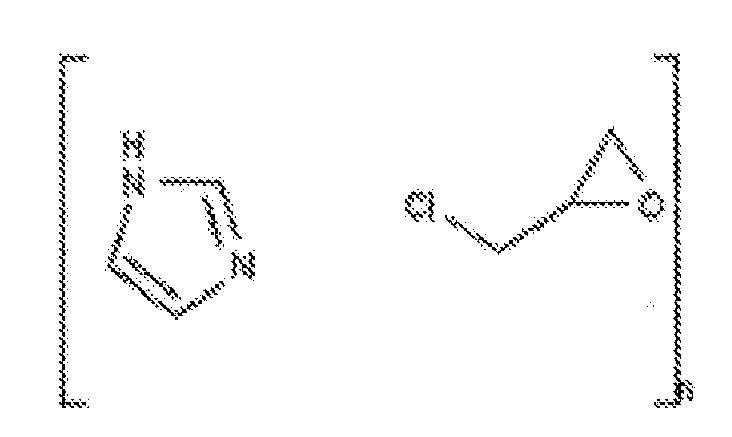
- The colour-removing additive can be advantageously prepared in solution with a base, preferably a strong base such as NaOH, and water. This solution is particularly suitable for the application of the additive with techniques used in the dyeing industry.
- The dye scavenger component is irreversibly impregnated in the article according to the present invention in a quantity ranging from 1 to 6% by weight, more preferably from 2 to 5% by weight, even more preferably from 3 to 4% by weight, with respect to the total weight of the carrier.
- The anticalcareous additive, or water-softening additive or sequestering additive of calcium and magnesium ions is an EDTA salt (ethylenediaminotetracetic acid) The sequestering agent, for example, is used in a quantity specifically for leaving a weight on the carrier ranging from 5 to 100 g/m2 referring to the dry carrier, preferably from 7 to 50 g/m2, more preferably about 10 g/m2.
- In order to allow the sequestering additive to be applied to the substrate made of non-woven fabric, for example by means of a serigraphic process, the compound also comprises a polyurethane, acrylic or natural thickening agent. The thickening agent can also be used in quantities ranging from 5% to 100% with respect to the quantity of sequestering agent, preferably from 20% to 80%, more preferably about 50%. The specific quantity and type of thickening agent are obviously selected by experts in the field according to the type of application, the pre-established regulations of the machine and preselected substrate. The preferred natural thickening agent is Guaro IDALCA flour of Lamberti SpA.
- When the sequestering agent is used in a combination with the thickening agent, as already mentioned, a viscous compound is obtained, which is preferably stabilized with a dispersant which is acrylic-based for example. The quantity of use of this substance can range from 5% to 50% with respect to the quantity of sequestering product, preferably from 7% to 20%, more preferably about 10%.
- In addition, the softening compound can comprise a binder. The binder is any substance capable of cohesioning the substrate of non-woven fabric. In other words, the binder strengthens the substrate to prevent the washing cycles of a washing-machine from ruining the structure of the non-woven fabric. In particular, modern washing-machines have extremely forced washing cycles, and especially centrifuge cycles. These cause a rapid deterioration of fabrics in general and in particular a spunlaced substrate, a versatile product due to its softness, feel, colour-binding capacity. The spunlaced substrate can in fact fray, releasing fibres in the washing water which become attached to the clothes being washed, with imaginable consequences.
- The binder can be a resin such as, for example, an acrylic, vinyl, polyurethane or natural resin. The binder can also be a natural or synthetic latex. The quantity of use of the cohesion agent can vary from 5% to 100% of the sequestering product, preferably from 7 to 50%, more preferably about 10%.
- The preferred article according to the present invention comprises a flexible carrier, non-soluble in water, in the form of a pocket, sachet or sandwich, irreversibly impregnated with a dye scavenger component consisting of a cationic heterocyclic component obtained by polymerization of epichlorohydrin and imidazole, and optionally reversibly impregnated with an anticalcareous component or sequestering agent of calcium and magnesium ions which is an EDTA salt, and containing a component in the form of a powder or gel, consisting of a detergent component consisting of sodium dodecylbenzenesulphonate, polyethoxylated alcohol 7moles E0, and vegetable soaps, and/or a bleaching additive component consisting of TAED-percarbonate and a catalyst which has the following chemical formula:

- In particular, the carrier of the article according to the present invention is flexible, non-soluble in water, solid or substantially solid.
- The carrier can be with a single layer or multilayered, it can have any dimension and preferably has the form of a sachet or pocket.
- It can have a dense or open structure and examples of material suitable for the carrier of the article according to the present invention are porous sheets, sponges, paper, fabric and/or non-woven fabric. Included in the scope of the present invention are substrates characterized by an absorption capacity range, thickness, density of the fibres, which are such as to guarantee the wet carrier a sufficient resistance for maintaining its structural integrity until the complete washing cycle and/or cycle of use has been completed.
- The carrier is preferably a woven fabric or non-woven fabric. The woven fabric or non-woven fabric are natural and/or synthetic. The carrier can be any carrier of the cellulose type such as paper, a natural material such as cotton or a synthetic material.
- The carrier is preferably a natural and/or synthetic non-woven fabric, more preferably a synthetic non-woven fabric.
- Non-woven fabrics which can be conveniently used are spunlaced, spunbonded, thermobonded, airlaided non-woven fabrics, where said terms spunlaced, spunbonded, thermobonded, airlaided indicate both non-woven fabrics and the techniques used for obtaining them, well-known in the art.
- The fibres preferably used for obtaining these non-woven fabrics are polyester (PE) fibres, polypropylene (PP) fibres, polylactic (PLA) fibres, polyethylenesulfone (PES) fibres, acrylic polymers, regenerated cellulose, polyamide fibres, cotton, viscose or mixtures thereof. The carrier can also consist of 100% regenerated cellulose, for example: lyocell® (i.e. regenerated cellulose fibre, obtained with a dissolution and spinning process in an organic solvent) or tencell®.
- The carrier preferably has a weight ranging from 150 g/m2 to 50 g/m2, more preferably from 100 g/m2 to 60 g/m2. The fibres of the carrier preferably have dimensions ranging from 0.5 dtex to 5 dtex, preferably from 1 dtex to 2 dtex.
- As mentioned above, the carrier of the article according to the present invention can be dense or it can have an open cell structure and therefore have a high volume of empty spaces which represent the space of the carrier which is not occupied.
- Substrates consisting of multilayer paper structures, for example, comprise layers having protuberances, whose ends are melted and welded. This paper structure has empty spaces between the protuberant portions of the folds, as also between the same fibres of the layers of paper. A non-woven fabric also has these empty spaces between the fibres. The empty spaces in the carrier can be varied by modifying the density of the fibres of the carrier. In general, substrates with a high quantity of empty space have a low fibre density, whereas substrates with a low quantity of empty space have a high fibre density.
- The carrier is selected so as to have a sufficient charge capacity with the components of the detergent article according to the present invention. The correct charge can be determined in relation to the dimensions of the final carrier sheet and quantity of components to be released. There are no particular limitations in the dimensions. Non-woven fabrics with high charge capacities generally also have higher costs and consequently this aspect must also be taken into account in selecting the most suitable carrier.
- In particular, the dye scavenger additive and/or anticalcareous additive are applied on the substrate of non-woven fabric, irreversibly or reversibly respectively, by means of known application methods such as, for example, impregnation, spreading or printing, as described in detail in patent applications MI2006A000096 and MI2006A000999, whose contents should be considered an integrating part of the present patent application.
- The detergent component in powder- or gel-form and/or the additive, preferably a bleaching agent, in powder- or gel-form, are entrapped between two sandwich-coupled layers of carrier, or the carrier in the form of a pocket or sachet.
- The preferred detergence article according to the present invention comprises a carrier of non-woven fabric in spunlaced regenerated cellulose and at least one thermoweldable polymer, to which the cationic heterocyclic polymer, which has a dye scavenging function is irreversibly fixed and possibly the sequestering agent, i.e. an EDTA salt, which has a water-softening function, is reversibly fixed, said carrier being in the form of a pocket and containing in its interior the detergent component and/or the bleaching additive component in the form of a powder or gel.
- The present invention also relates to a process for the preparation of a detergence article according to the present invention.
- A further object of the present invention therefore relates to a process for the preparation of a detergence article comprising a flexible carrier, non-soluble in water, irreversibly impregnated with a dye scavenger component, and containing at least one detergent component and/or an additive in the form of a powder or gel.
- Said process comprises the following passages:
- a) selecting a carrier comprising one of the following materials: natural and/or synthetic woven fabric, natural and/or synthetic non-woven fabric and paper;
- b) applying at least one dye scavenger additive to the carrier;
- c) drying the semi-processed carrier, if necessary;
- d) optionally applying at least one anticalcareous additive on the semi-processed carrier obtained with passage c);
- e) drying the carrier, if necessary;
- f) inserting the detergent component and/or bleaching additive in the form of a powder or gel, inside the carrier in the form of a pocket or sachet.
- Steps b) and d) can be inverted.
- The detergence article according to the present invention is normally inserted in conventional or professional washing-machines before the beginning of the washing cycle.
- The combined action of the substrate and polymer, which both have a high affinity for pigments, allows the colour present in the washing water to be much more effectively removed than with the known products in the art.
- The double "dye-scavenging" and "anticalcareous" function of the product of the invention is extremely convenient. With a single action, in fact, the double effect is obtained of protecting "white" clothes from the possible colour loss of darker fabrics together with the efficient functioning of the washing-machine with constant use.
- The result of this is a higher practicality of use especially for people who do not have much time to dedicate to household chores and who, in this way, can wash "white" and "coloured" clothes together, without having to worry about or remember to add the anticalcareous additive. It has been experimentally demonstrated, in fact, that the product of the invention, if used regularly, has the same anticalcareous efficacy as conventional additives.
- The preparation process of the detergence article according to the present invention is extremely rapid as it can be effected in continuous and has a limited number of steps. This leads to a considerable saving of time and energy. The final material is in fact obtained in the order of minutes as the "dye scavenger" additive almost instantaneously irreversibly binds itself to the substrate and it is not necessary to leave it to rest for hours (to ensure that the additive is absorbed on the substrate) as in the processes of the known art. All this is made possible by the use of the "dye scavenger" additives of the present invention which have an extremely high affinity for the substrate and are practically instantaneously absorbed in an effective quantity. Furthermore, the subsequent printing and drying steps are also extremely rapid.
- When the washing cycle starts, the thickening agent or detergent dissolves in water possibly also releasing the bleaching agent which, dissolved in water, exerts its function of bleaching and whitening, whereas the detergent exerts its detergent function.
- The number of sheets of the detergence article according to the present invention which are used for each washing cycle depends on the weight of the laundry and its dirtiness.
- "Coloured" and "white" clothes can therefore be washed contemporaneously in washing-machines in the presence of the detergence article according to the present invention which acts as a "dye scavenger", at the same time exerting a softening action of hard water, replacing or being integrated with conventional anticalcareous additives.
Claims (30)
- A detergence article comprising a flexible carrier, non-soluble in water, irreversibly impregnated with a dye scavenger component, and containing at least one component in the form of a powder or gel, consisting of a detergent and/or additive component, wherein the dye scavenger component is a cationic heterocyclic polymer obtained by polymerization of epichlorohydrin and imidazole and wherein the detergent component consists of sodium dodecylbenzenesulphonate, polyethoxylated alcohol 7moles EO, and vegetable soaps.
- The article according to claim 1, characterized in that the carrier is also reversibly impregnated with an anticalcareous component.
- The article according to claim 1, characterized in that the additive component is a bleaching additive.
- The article according to claim 1, characterized in that the detergent component is present in a quantity ranging from 1 to 50% by weight, preferably from 5 to 40%, even more preferably from 10 to 30%, with respect to the total weight of the component in the form of a powder or gel.
- The article according to claim 1, characterized in that it also comprises enzymes as further detergent agents.
- The article according to claim 5, characterized in that the enzyme is selected from amylase, protease, cellulase and mixtures thereof.
- The article according to claim 5, characterized in that the enzyme is present in the detergent component in a quantity ranging from 0.1 to 4% by weight, preferably from 0.5 to 2% by weight with respect to the total weight of the component in powder- or gel-form.
- The article according to claim 1, characterized in that it also comprises phosphonates, polycarboxylates, cmc, zeolites, optical bleaches, soaps, vegetable soaps, antifoam agents, perfumes.
- The article according to claim 1, characterized in that the bleaching additive is a compound selected from TAED-percarbonate (tetra-acetylenediamine) and PAP (phthalimidoperoxyhexanoic acid).
- The article according to claim 9, characterized in that the bleaching additive is TAED-percarbonate.
- The article according to claim 1, characterized in that the additive component or bleaching agent is present in a quantity ranging from 1 to 60% by weight, preferably from 5 to 50% by weight, even more preferably from 8 to 40% by weight, with respect to the total weight of the component in powder- or gel-form.
- The article according to claim 10, characterized in that the TAED-percarbonate is used together with a catalyst which has the following chemical formula:

- The article according to claim 2, characterized in that the anticalcareous component or sequestering agent of calcium and magnesium ions is selected from EDTA salts.
- The article according to claim 13, characterized in that the EDTA salt is present in a quantity ranging from 5 to 100 g/m2 of dry carrier.
- The article according to claim 1, characterized in that the dye scavenger component is present in a quantity ranging from 1 to 6% by weight, more preferably from 2 to 5% by weight, even more preferably from 3 to 4% by weight, with respect to the total weight of the carrier.
- The article according to claim 1, characterized in that the carrier is flexible, non-soluble in water, solid or substantially solid.
- The article according to claim 16, characterized in that the carrier is single-layered or multilayered, in any dimension, in the form of a sachet or pocket.
- The article according to claim 16, characterized in that the carrier is selected from porous sheets, sponges, paper, woven and/or non-woven fabric.
- The article according to claim 16, characterized in that the carrier is a natural and/or synthetic woven or non-woven fabric.
- The article according to claim 16, characterized in that the carrier is a synthetic spunlaced, spunbonded, thermobonded, airlaided non-woven fabric.
- The article according to claim 20, characterized in that the carrier made of a non-woven fabric is based on polyester (PE) fibres, polypropylene (PP) fibres, polylactic (PLA) fibres, polyethylenesulfone (PES) fibres, acrylic polymers, regenerated cellulose, polyamidic fibres, cotton, viscose or mixtures thereof, 100% regenerated cellulose.
- The article according to claim 16, characterized in that the carrier has a weight ranging from 150 g/m2 to 50 g/m2, preferably from 100 g/m2 to 60 g/m2.
- The article according to claim 16, characterized in that the fibres of the carrier have dimensions ranging from 0.5 dtex to 5 dtex, preferably from 1 dtex to 2 dtex.
- The article according to claim 16, characterized in that it comprises a multilayered carrier wherein the detergent component in powder- or gel-form and the bleaching agent in powder- or gel-form are entrapped between two layers of the sandwich-coupled carrier.
- The article according to claim 16, characterized in that it comprises a pocket or sachet containing the detergent component and the additive component.
- The article according to claim 1, characterized in that it comprises a flexible carrier, non-soluble in water, in the form of a pocket, sachet or sandwich, irreversibly impregnated with a dye scavenger component consisting of a cationic heterocyclic component obtained by polymerization from epichlorohydrin and imidazole, and optionally reversibly impregnated with an anticalcareous component or sequestering agent of calcium and magnesium ions which is an EDTA salt, and containing a component in the form of a powder or gel, consisting of a detergent component consisting of sodium dodecylbenzenesulphonate, polyethoxylated alcohol 7moles EO, and vegetable soaps, and/or a bleaching additive component consisting of TAED-percarbonate and a catalyst which has the following chemical formula:

- The article according to claim 1, characterized in that it comprises a carrier of non-woven fabric in spunlaced regenerated cellulose and at least one thermoweldable polymer, to which the cationic heterocyclic polymer is irreversibly fixed and possibly the sequestering agent is reversibly fixed, said carrier being in the form of a pocket and containing in its interior the detergent component and/or the bleaching additive component in the form of a powder or gel.
- A process for the preparation of a detergence article comprising a flexible carrier, non-soluble in water, irreversibly impregnated with a dye scavenger component, and containing at least one component in the form of a powder or gel, consisting of a detergent additive and/or an additive component, characterized in that it comprises the following passages:a) selecting a carrier comprising one of the following materials: natural and/or synthetic woven fabric, natural and/or synthetic non-woven fabric and paper;b) applying at least one dye scavenger additive to the carrier;c) drying the semi-processed carrier, if necessary;d) optionally applying at least one anticalcareous additive on the semi-processed carrier obtained with passage c);e) drying the carrier, if necessary;f) inserting the detergent component and/or bleaching additive in the form of a powder or gel, inside the carrier in the form of a pocket or sachet.
- Use of a detergence article comprising a flexible carrier, non-soluble in water, irreversibly impregnated with a dye scavenger component, and containing at least one component in the form of a powder or gel, consisting of a detergent additive and/or an additive component, wherein the dye scavenger component is a cationic heterocyclic polymer obtained by polymerization of epichlorohydrin and imidazole and wherein the detergent component consists of sodium dodecylbenzenesulphonate, polyethoxylated alcohol 7moles EO, and vegetable soaps, for washing by hand or in washing-machines.
- Use of an article according to any of the claims from 2 to 27 for washing by hand or in washing-machines.
Priority Applications (1)
| Application Number | Priority Date | Filing Date | Title |
|---|---|---|---|
| PL07113949T PL1889900T3 (en) | 2006-08-08 | 2007-08-07 | Detergence article |
Applications Claiming Priority (1)
| Application Number | Priority Date | Filing Date | Title |
|---|---|---|---|
| IT001598A ITMI20061598A1 (en) | 2006-08-08 | 2006-08-08 | ARTICLE PEER CLEANSING |
Publications (2)
| Publication Number | Publication Date |
|---|---|
| EP1889900A1 true EP1889900A1 (en) | 2008-02-20 |
| EP1889900B1 EP1889900B1 (en) | 2012-04-11 |
Family
ID=38617191
Family Applications (1)
| Application Number | Title | Priority Date | Filing Date |
|---|---|---|---|
| EP07113949A Active EP1889900B1 (en) | 2006-08-08 | 2007-08-07 | Detergence article |
Country Status (5)
| Country | Link |
|---|---|
| EP (1) | EP1889900B1 (en) |
| AT (1) | ATE553174T1 (en) |
| ES (1) | ES2385604T3 (en) |
| IT (1) | ITMI20061598A1 (en) |
| PL (1) | PL1889900T3 (en) |
Cited By (16)
| Publication number | Priority date | Publication date | Assignee | Title |
|---|---|---|---|---|
| WO2008138574A1 (en) * | 2007-05-09 | 2008-11-20 | Punch Industries | An article for use in washing textile articles |
| DE102008007759A1 (en) * | 2007-12-04 | 2009-06-18 | Atlantichem Gmbh | Agent, useful for avoiding discoloration and graying during the washing of textiles, comprises a cationized substrate in the form of e.g. cationized cord thread sections and detergent-active and/or textile-maintaining ingredients |
| WO2009143915A1 (en) * | 2008-05-26 | 2009-12-03 | Converting Wet Wipes S.R.L. | Packet of premeasured washing powder for washing machines |
| WO2010010334A1 (en) * | 2008-07-23 | 2010-01-28 | Reckitt Benckiser N.V. | Container |
| WO2010084203A1 (en) * | 2009-01-26 | 2010-07-29 | Henkel Ag & Co. Kgaa | Additional laundry item |
| ITMI20090631A1 (en) * | 2009-04-17 | 2010-10-18 | Orlandi Spa | PRODUCT FOR WASHING WASHING |
| WO2010133837A1 (en) * | 2009-05-20 | 2010-11-25 | Reckitt Benckiser N.V. | Bleaching catalyst admixed with an insoluble support matrix |
| WO2010139689A1 (en) * | 2009-06-01 | 2010-12-09 | Reckitt Benckiser N.V. | Composition |
| WO2011009887A1 (en) * | 2009-07-24 | 2011-01-27 | Henkel Ag & Co. Kgaa | Washing additive cloth comprising bleach |
| ITTO20110091A1 (en) * | 2011-02-04 | 2012-08-05 | Siate S R L | DISPOSABLE DETERGENT PACKAGE |
| WO2012113360A1 (en) * | 2011-02-21 | 2012-08-30 | Atlantichem Gmbh | Compact shaped body that can be unfolded, method for producing same, and use thereof for cleaning purposes and for distributing active ingredients |
| ITMI20120960A1 (en) * | 2012-06-04 | 2013-12-05 | Di Co T Srl | NON-WOVEN LEAFLET TO CAPTURE COLORS |
| EP2835419A1 (en) | 2013-08-09 | 2015-02-11 | Ahlstrom Corporation | Laundry aid and use thereof |
| EP3034594A1 (en) | 2014-12-15 | 2016-06-22 | Ahlstrom Corporation | Laundry aid and use thereof |
| DE102017001453A1 (en) | 2016-05-31 | 2017-11-30 | Atlantichem Gmbh | MEANS AND METHODS OF DETERGENT WASHING WATER |
| EP3444328A1 (en) * | 2017-08-18 | 2019-02-20 | The Procter & Gamble Company | Cleaning agent |
Families Citing this family (3)
| Publication number | Priority date | Publication date | Assignee | Title |
|---|---|---|---|---|
| US10590577B2 (en) | 2016-08-02 | 2020-03-17 | Fitesa Germany Gmbh | System and process for preparing polylactic acid nonwoven fabrics |
| US11441251B2 (en) | 2016-08-16 | 2022-09-13 | Fitesa Germany Gmbh | Nonwoven fabrics comprising polylactic acid having improved strength and toughness |
| DE102021200611A1 (en) | 2021-01-25 | 2022-07-28 | BSH Hausgeräte GmbH | WASHING MACHINE WITH A CLOTH HOLDING DEVICE AND METHOD OF ITS OPERATION |
Citations (4)
| Publication number | Priority date | Publication date | Assignee | Title |
|---|---|---|---|---|
| WO2001032973A1 (en) | 1999-10-29 | 2001-05-10 | The Procter & Gamble Company | Laundry devices for delivering dye transfer inhibiting benefits |
| EP1170356A1 (en) | 2000-07-06 | 2002-01-09 | The Procter & Gamble Company | Laundry additive sachet |
| US20030118730A1 (en) | 2000-10-13 | 2003-06-26 | Aouad Yousef Georges | Method for manufacturing laundry additive article |
| EP1621604A2 (en) | 2004-07-29 | 2006-02-01 | Orlandi S.p.a. | Colour scavenger material |
-
2006
- 2006-08-08 IT IT001598A patent/ITMI20061598A1/en unknown
-
2007
- 2007-08-07 PL PL07113949T patent/PL1889900T3/en unknown
- 2007-08-07 EP EP07113949A patent/EP1889900B1/en active Active
- 2007-08-07 AT AT07113949T patent/ATE553174T1/en active
- 2007-08-07 ES ES07113949T patent/ES2385604T3/en active Active
Patent Citations (4)
| Publication number | Priority date | Publication date | Assignee | Title |
|---|---|---|---|---|
| WO2001032973A1 (en) | 1999-10-29 | 2001-05-10 | The Procter & Gamble Company | Laundry devices for delivering dye transfer inhibiting benefits |
| EP1170356A1 (en) | 2000-07-06 | 2002-01-09 | The Procter & Gamble Company | Laundry additive sachet |
| US20030118730A1 (en) | 2000-10-13 | 2003-06-26 | Aouad Yousef Georges | Method for manufacturing laundry additive article |
| EP1621604A2 (en) | 2004-07-29 | 2006-02-01 | Orlandi S.p.a. | Colour scavenger material |
Cited By (21)
| Publication number | Priority date | Publication date | Assignee | Title |
|---|---|---|---|---|
| WO2008138574A1 (en) * | 2007-05-09 | 2008-11-20 | Punch Industries | An article for use in washing textile articles |
| DE102008007759A1 (en) * | 2007-12-04 | 2009-06-18 | Atlantichem Gmbh | Agent, useful for avoiding discoloration and graying during the washing of textiles, comprises a cationized substrate in the form of e.g. cationized cord thread sections and detergent-active and/or textile-maintaining ingredients |
| DE102008007759B4 (en) * | 2007-12-04 | 2009-09-24 | Atlantichem Gmbh | Agent for preventing discoloration when washing textiles |
| WO2009143915A1 (en) * | 2008-05-26 | 2009-12-03 | Converting Wet Wipes S.R.L. | Packet of premeasured washing powder for washing machines |
| AU2009275368B2 (en) * | 2008-07-23 | 2013-02-21 | Reckitt Benckiser Vanish B.V. | Container |
| WO2010010334A1 (en) * | 2008-07-23 | 2010-01-28 | Reckitt Benckiser N.V. | Container |
| RU2511399C2 (en) * | 2008-07-23 | 2014-04-10 | Рекитт Бенкизер Н.В. | Container |
| CN102099457B (en) * | 2008-07-23 | 2013-06-12 | 雷克特本克斯尔荷兰有限公司 | container |
| WO2010084203A1 (en) * | 2009-01-26 | 2010-07-29 | Henkel Ag & Co. Kgaa | Additional laundry item |
| ITMI20090631A1 (en) * | 2009-04-17 | 2010-10-18 | Orlandi Spa | PRODUCT FOR WASHING WASHING |
| WO2010133837A1 (en) * | 2009-05-20 | 2010-11-25 | Reckitt Benckiser N.V. | Bleaching catalyst admixed with an insoluble support matrix |
| WO2010139689A1 (en) * | 2009-06-01 | 2010-12-09 | Reckitt Benckiser N.V. | Composition |
| WO2011009887A1 (en) * | 2009-07-24 | 2011-01-27 | Henkel Ag & Co. Kgaa | Washing additive cloth comprising bleach |
| ITTO20110091A1 (en) * | 2011-02-04 | 2012-08-05 | Siate S R L | DISPOSABLE DETERGENT PACKAGE |
| WO2012113360A1 (en) * | 2011-02-21 | 2012-08-30 | Atlantichem Gmbh | Compact shaped body that can be unfolded, method for producing same, and use thereof for cleaning purposes and for distributing active ingredients |
| ITMI20120960A1 (en) * | 2012-06-04 | 2013-12-05 | Di Co T Srl | NON-WOVEN LEAFLET TO CAPTURE COLORS |
| EP2835419A1 (en) | 2013-08-09 | 2015-02-11 | Ahlstrom Corporation | Laundry aid and use thereof |
| WO2015018981A1 (en) | 2013-08-09 | 2015-02-12 | Ahlstrom Corporation | Fugitive dye catching material |
| EP3034594A1 (en) | 2014-12-15 | 2016-06-22 | Ahlstrom Corporation | Laundry aid and use thereof |
| DE102017001453A1 (en) | 2016-05-31 | 2017-11-30 | Atlantichem Gmbh | MEANS AND METHODS OF DETERGENT WASHING WATER |
| EP3444328A1 (en) * | 2017-08-18 | 2019-02-20 | The Procter & Gamble Company | Cleaning agent |
Also Published As
| Publication number | Publication date |
|---|---|
| ES2385604T3 (en) | 2012-07-27 |
| ATE553174T1 (en) | 2012-04-15 |
| EP1889900B1 (en) | 2012-04-11 |
| ITMI20061598A1 (en) | 2008-02-09 |
| PL1889900T3 (en) | 2012-09-28 |
Similar Documents
| Publication | Publication Date | Title |
|---|---|---|
| EP1889900B1 (en) | Detergence article | |
| US5547476A (en) | Dry cleaning process | |
| EP0888077B1 (en) | Dual-step stain removal process | |
| KR101259425B1 (en) | Sheet type detergent, detergent composition and preparation method thereof | |
| GB0114850D0 (en) | Water soluble package and liquid contents thereof | |
| US6040286A (en) | Through-the-washer-dryer pouch-type detergent bag and method of use | |
| TW201233868A (en) | Improved cleaning method | |
| EP0843756A1 (en) | Heat resistant dry cleaning bag | |
| NO149070B (en) | UNIFIED CONDITIONING STANDARD FOR DELIVERING CONDITIONING FOR TEXTILE MATERIALS | |
| CA2795874A1 (en) | Cleaning product | |
| EP0833888A1 (en) | Spherical or polyhedral dry cleaning articles | |
| JPS6096700A (en) | One dose containing detergent and/or bleaching agent | |
| JP2010505464A (en) | Rinse washing method with washing machine | |
| US8075635B2 (en) | Dye scavenging and water softening product | |
| EP1860177A1 (en) | Cleaning article | |
| CN102099457B (en) | container | |
| EP2502534B1 (en) | A dry, washable and reusable surface cleaning substrate loaded with cleaning composition | |
| US20110271459A1 (en) | Product | |
| US20030188450A1 (en) | Fabric softener system and method for use in clothes dryer | |
| ITMI20102010A1 (en) | TEXTILE PRODUCT | |
| IT202100002051A1 (en) | PRODUCT FOR THE TREATMENT OF AN APPLIANCE CONFIGURED FOR WASHING | |
| ITMI20090631A1 (en) | PRODUCT FOR WASHING WASHING | |
| JPH11511800A (en) | Phase-stable liquid fabric refresh composition | |
| JP2008535607A5 (en) | ||
| GB2387393A (en) | Fabric treatment device |
Legal Events
| Date | Code | Title | Description |
|---|---|---|---|
| PUAI | Public reference made under article 153(3) epc to a published international application that has entered the european phase |
Free format text: ORIGINAL CODE: 0009012 |
|
| AK | Designated contracting states |
Kind code of ref document: A1 Designated state(s): AT BE BG CH CY CZ DE DK EE ES FI FR GB GR HU IE IS IT LI LT LU LV MC MT NL PL PT RO SE SI SK TR |
|
| AX | Request for extension of the european patent |
Extension state: AL BA HR MK YU |
|
| 17P | Request for examination filed |
Effective date: 20080623 |
|
| 17Q | First examination report despatched |
Effective date: 20080729 |
|
| AKX | Designation fees paid |
Designated state(s): AT BE BG CH CY CZ DE DK EE ES FI FR GB GR HU IE IS IT LI LT LU LV MC MT NL PL PT RO SE SI SK TR |
|
| REG | Reference to a national code |
Ref country code: DE Ref legal event code: R079 Ref document number: 602007021848 Country of ref document: DE Free format text: PREVIOUS MAIN CLASS: C11D0003000000 Ipc: C11D0001040000 |
|
| GRAP | Despatch of communication of intention to grant a patent |
Free format text: ORIGINAL CODE: EPIDOSNIGR1 |
|
| RIC1 | Information provided on ipc code assigned before grant |
Ipc: C11D 3/37 20060101ALI20110921BHEP Ipc: C11D 3/00 20060101ALI20110921BHEP Ipc: C11D 3/33 20060101ALI20110921BHEP Ipc: C11D 17/04 20060101ALI20110921BHEP Ipc: C11D 3/39 20060101ALI20110921BHEP Ipc: C11D 10/04 20060101ALI20110921BHEP Ipc: C11D 1/72 20060101ALI20110921BHEP Ipc: C11D 1/22 20060101ALI20110921BHEP Ipc: C11D 1/04 20060101AFI20110921BHEP |
|
| GRAS | Grant fee paid |
Free format text: ORIGINAL CODE: EPIDOSNIGR3 |
|
| GRAA | (expected) grant |
Free format text: ORIGINAL CODE: 0009210 |
|
| AK | Designated contracting states |
Kind code of ref document: B1 Designated state(s): AT BE BG CH CY CZ DE DK EE ES FI FR GB GR HU IE IS IT LI LT LU LV MC MT NL PL PT RO SE SI SK TR |
|
| REG | Reference to a national code |
Ref country code: GB Ref legal event code: FG4D |
|
| REG | Reference to a national code |
Ref country code: CH Ref legal event code: EP |
|
| REG | Reference to a national code |
Ref country code: AT Ref legal event code: REF Ref document number: 553174 Country of ref document: AT Kind code of ref document: T Effective date: 20120415 |
|
| REG | Reference to a national code |
Ref country code: IE Ref legal event code: FG4D |
|
| REG | Reference to a national code |
Ref country code: DE Ref legal event code: R096 Ref document number: 602007021848 Country of ref document: DE Effective date: 20120606 |
|
| REG | Reference to a national code |
Ref country code: NL Ref legal event code: T3 |
|
| REG | Reference to a national code |
Ref country code: ES Ref legal event code: FG2A Ref document number: 2385604 Country of ref document: ES Kind code of ref document: T3 Effective date: 20120727 |
|
| REG | Reference to a national code |
Ref country code: CH Ref legal event code: NV Representative=s name: BOHEST AG |
|
| REG | Reference to a national code |
Ref country code: AT Ref legal event code: MK05 Ref document number: 553174 Country of ref document: AT Kind code of ref document: T Effective date: 20120411 |
|
| LTIE | Lt: invalidation of european patent or patent extension |
Effective date: 20120411 |
|
| REG | Reference to a national code |
Ref country code: PL Ref legal event code: T3 |
|
| REG | Reference to a national code |
Ref country code: GR Ref legal event code: EP Ref document number: 20120401508 Country of ref document: GR Effective date: 20120903 |
|
| PG25 | Lapsed in a contracting state [announced via postgrant information from national office to epo] |
Ref country code: CY Free format text: LAPSE BECAUSE OF FAILURE TO SUBMIT A TRANSLATION OF THE DESCRIPTION OR TO PAY THE FEE WITHIN THE PRESCRIBED TIME-LIMIT Effective date: 20120411 Ref country code: IS Free format text: LAPSE BECAUSE OF FAILURE TO SUBMIT A TRANSLATION OF THE DESCRIPTION OR TO PAY THE FEE WITHIN THE PRESCRIBED TIME-LIMIT Effective date: 20120811 Ref country code: FI Free format text: LAPSE BECAUSE OF FAILURE TO SUBMIT A TRANSLATION OF THE DESCRIPTION OR TO PAY THE FEE WITHIN THE PRESCRIBED TIME-LIMIT Effective date: 20120411 Ref country code: SE Free format text: LAPSE BECAUSE OF FAILURE TO SUBMIT A TRANSLATION OF THE DESCRIPTION OR TO PAY THE FEE WITHIN THE PRESCRIBED TIME-LIMIT Effective date: 20120411 Ref country code: LT Free format text: LAPSE BECAUSE OF FAILURE TO SUBMIT A TRANSLATION OF THE DESCRIPTION OR TO PAY THE FEE WITHIN THE PRESCRIBED TIME-LIMIT Effective date: 20120411 |
|
| PG25 | Lapsed in a contracting state [announced via postgrant information from national office to epo] |
Ref country code: SI Free format text: LAPSE BECAUSE OF FAILURE TO SUBMIT A TRANSLATION OF THE DESCRIPTION OR TO PAY THE FEE WITHIN THE PRESCRIBED TIME-LIMIT Effective date: 20120411 Ref country code: LV Free format text: LAPSE BECAUSE OF FAILURE TO SUBMIT A TRANSLATION OF THE DESCRIPTION OR TO PAY THE FEE WITHIN THE PRESCRIBED TIME-LIMIT Effective date: 20120411 Ref country code: PT Free format text: LAPSE BECAUSE OF FAILURE TO SUBMIT A TRANSLATION OF THE DESCRIPTION OR TO PAY THE FEE WITHIN THE PRESCRIBED TIME-LIMIT Effective date: 20120813 |
|
| PG25 | Lapsed in a contracting state [announced via postgrant information from national office to epo] |
Ref country code: AT Free format text: LAPSE BECAUSE OF FAILURE TO SUBMIT A TRANSLATION OF THE DESCRIPTION OR TO PAY THE FEE WITHIN THE PRESCRIBED TIME-LIMIT Effective date: 20120411 Ref country code: SK Free format text: LAPSE BECAUSE OF FAILURE TO SUBMIT A TRANSLATION OF THE DESCRIPTION OR TO PAY THE FEE WITHIN THE PRESCRIBED TIME-LIMIT Effective date: 20120411 Ref country code: EE Free format text: LAPSE BECAUSE OF FAILURE TO SUBMIT A TRANSLATION OF THE DESCRIPTION OR TO PAY THE FEE WITHIN THE PRESCRIBED TIME-LIMIT Effective date: 20120411 Ref country code: RO Free format text: LAPSE BECAUSE OF FAILURE TO SUBMIT A TRANSLATION OF THE DESCRIPTION OR TO PAY THE FEE WITHIN THE PRESCRIBED TIME-LIMIT Effective date: 20120411 Ref country code: DK Free format text: LAPSE BECAUSE OF FAILURE TO SUBMIT A TRANSLATION OF THE DESCRIPTION OR TO PAY THE FEE WITHIN THE PRESCRIBED TIME-LIMIT Effective date: 20120411 |
|
| PLBE | No opposition filed within time limit |
Free format text: ORIGINAL CODE: 0009261 |
|
| STAA | Information on the status of an ep patent application or granted ep patent |
Free format text: STATUS: NO OPPOSITION FILED WITHIN TIME LIMIT |
|
| 26N | No opposition filed |
Effective date: 20130114 |
|
| PG25 | Lapsed in a contracting state [announced via postgrant information from national office to epo] |
Ref country code: MC Free format text: LAPSE BECAUSE OF NON-PAYMENT OF DUE FEES Effective date: 20120831 |
|
| REG | Reference to a national code |
Ref country code: DE Ref legal event code: R097 Ref document number: 602007021848 Country of ref document: DE Effective date: 20130114 |
|
| REG | Reference to a national code |
Ref country code: IE Ref legal event code: MM4A |
|
| PG25 | Lapsed in a contracting state [announced via postgrant information from national office to epo] |
Ref country code: BG Free format text: LAPSE BECAUSE OF FAILURE TO SUBMIT A TRANSLATION OF THE DESCRIPTION OR TO PAY THE FEE WITHIN THE PRESCRIBED TIME-LIMIT Effective date: 20120711 Ref country code: IE Free format text: LAPSE BECAUSE OF NON-PAYMENT OF DUE FEES Effective date: 20120807 |
|
| PG25 | Lapsed in a contracting state [announced via postgrant information from national office to epo] |
Ref country code: MT Free format text: LAPSE BECAUSE OF FAILURE TO SUBMIT A TRANSLATION OF THE DESCRIPTION OR TO PAY THE FEE WITHIN THE PRESCRIBED TIME-LIMIT Effective date: 20120411 |
|
| PG25 | Lapsed in a contracting state [announced via postgrant information from national office to epo] |
Ref country code: TR Free format text: LAPSE BECAUSE OF FAILURE TO SUBMIT A TRANSLATION OF THE DESCRIPTION OR TO PAY THE FEE WITHIN THE PRESCRIBED TIME-LIMIT Effective date: 20120411 |
|
| PG25 | Lapsed in a contracting state [announced via postgrant information from national office to epo] |
Ref country code: LU Free format text: LAPSE BECAUSE OF NON-PAYMENT OF DUE FEES Effective date: 20120807 |
|
| PG25 | Lapsed in a contracting state [announced via postgrant information from national office to epo] |
Ref country code: HU Free format text: LAPSE BECAUSE OF FAILURE TO SUBMIT A TRANSLATION OF THE DESCRIPTION OR TO PAY THE FEE WITHIN THE PRESCRIBED TIME-LIMIT Effective date: 20070807 |
|
| REG | Reference to a national code |
Ref country code: CH Ref legal event code: PCAR Free format text: NEW ADDRESS: HOLBEINSTRASSE 36-38, 4051 BASEL (CH) |
|
| REG | Reference to a national code |
Ref country code: FR Ref legal event code: PLFP Year of fee payment: 9 |
|
| REG | Reference to a national code |
Ref country code: FR Ref legal event code: PLFP Year of fee payment: 10 |
|
| REG | Reference to a national code |
Ref country code: FR Ref legal event code: PLFP Year of fee payment: 11 |
|
| REG | Reference to a national code |
Ref country code: FR Ref legal event code: PLFP Year of fee payment: 12 |
|
| PGFP | Annual fee paid to national office [announced via postgrant information from national office to epo] |
Ref country code: DE Payment date: 20190723 Year of fee payment: 13 |
|
| PGFP | Annual fee paid to national office [announced via postgrant information from national office to epo] |
Ref country code: GB Payment date: 20190808 Year of fee payment: 13 |
|
| PGFP | Annual fee paid to national office [announced via postgrant information from national office to epo] |
Ref country code: CH Payment date: 20190819 Year of fee payment: 13 |
|
| REG | Reference to a national code |
Ref country code: DE Ref legal event code: R119 Ref document number: 602007021848 Country of ref document: DE |
|
| REG | Reference to a national code |
Ref country code: CH Ref legal event code: PL |
|
| GBPC | Gb: european patent ceased through non-payment of renewal fee |
Effective date: 20200807 |
|
| PG25 | Lapsed in a contracting state [announced via postgrant information from national office to epo] |
Ref country code: LI Free format text: LAPSE BECAUSE OF NON-PAYMENT OF DUE FEES Effective date: 20200831 Ref country code: CH Free format text: LAPSE BECAUSE OF NON-PAYMENT OF DUE FEES Effective date: 20200831 |
|
| PG25 | Lapsed in a contracting state [announced via postgrant information from national office to epo] |
Ref country code: DE Free format text: LAPSE BECAUSE OF NON-PAYMENT OF DUE FEES Effective date: 20210302 |
|
| PG25 | Lapsed in a contracting state [announced via postgrant information from national office to epo] |
Ref country code: GB Free format text: LAPSE BECAUSE OF NON-PAYMENT OF DUE FEES Effective date: 20200807 |
|
| PGFP | Annual fee paid to national office [announced via postgrant information from national office to epo] |
Ref country code: NL Payment date: 20240826 Year of fee payment: 18 |
|
| PGFP | Annual fee paid to national office [announced via postgrant information from national office to epo] |
Ref country code: GR Payment date: 20240821 Year of fee payment: 18 |
|
| PGFP | Annual fee paid to national office [announced via postgrant information from national office to epo] |
Ref country code: BE Payment date: 20240821 Year of fee payment: 18 |
|
| PGFP | Annual fee paid to national office [announced via postgrant information from national office to epo] |
Ref country code: FR Payment date: 20240830 Year of fee payment: 18 |
|
| PGFP | Annual fee paid to national office [announced via postgrant information from national office to epo] |
Ref country code: ES Payment date: 20240902 Year of fee payment: 18 |
|
| PGFP | Annual fee paid to national office [announced via postgrant information from national office to epo] |
Ref country code: CZ Payment date: 20240731 Year of fee payment: 18 |
|
| PGFP | Annual fee paid to national office [announced via postgrant information from national office to epo] |
Ref country code: PL Payment date: 20240730 Year of fee payment: 18 |
|
| PGFP | Annual fee paid to national office [announced via postgrant information from national office to epo] |
Ref country code: IT Payment date: 20240806 Year of fee payment: 18 |
|
| REG | Reference to a national code |
Ref country code: NL Ref legal event code: MM Effective date: 20250901 |
|
| PG25 | Lapsed in a contracting state [announced via postgrant information from national office to epo] |
Ref country code: CZ Free format text: LAPSE BECAUSE OF NON-PAYMENT OF DUE FEES Effective date: 20250807 |
|
| PG25 | Lapsed in a contracting state [announced via postgrant information from national office to epo] |
Ref country code: GR Free format text: LAPSE BECAUSE OF NON-PAYMENT OF DUE FEES Effective date: 20260309 |