EP1889887A1 - Adhesive sheet, process for producing the same, and method of cutting multilayered ceramic sheet - Google Patents
Adhesive sheet, process for producing the same, and method of cutting multilayered ceramic sheet Download PDFInfo
- Publication number
- EP1889887A1 EP1889887A1 EP20070015793 EP07015793A EP1889887A1 EP 1889887 A1 EP1889887 A1 EP 1889887A1 EP 20070015793 EP20070015793 EP 20070015793 EP 07015793 A EP07015793 A EP 07015793A EP 1889887 A1 EP1889887 A1 EP 1889887A1
- Authority
- EP
- European Patent Office
- Prior art keywords
- adhesive sheet
- adherent layer
- heat
- adhesive
- treatment
- Prior art date
- Legal status (The legal status is an assumption and is not a legal conclusion. Google has not performed a legal analysis and makes no representation as to the accuracy of the status listed.)
- Withdrawn
Links
Images
Classifications
-
- H—ELECTRICITY
- H10—SEMICONDUCTOR DEVICES; ELECTRIC SOLID-STATE DEVICES NOT OTHERWISE PROVIDED FOR
- H10P—GENERIC PROCESSES OR APPARATUS FOR THE MANUFACTURE OR TREATMENT OF DEVICES COVERED BY CLASS H10
- H10P72/00—Handling or holding of wafers, substrates or devices during manufacture or treatment thereof
- H10P72/70—Handling or holding of wafers, substrates or devices during manufacture or treatment thereof for supporting or gripping
- H10P72/74—Handling or holding of wafers, substrates or devices during manufacture or treatment thereof for supporting or gripping using temporarily an auxiliary support
- H10P72/7402—Wafer tapes, e.g. grinding or dicing support tapes
-
- C—CHEMISTRY; METALLURGY
- C08—ORGANIC MACROMOLECULAR COMPOUNDS; THEIR PREPARATION OR CHEMICAL WORKING-UP; COMPOSITIONS BASED THEREON
- C08K—Use of inorganic or non-macromolecular organic substances as compounding ingredients
- C08K7/00—Use of ingredients characterised by shape
- C08K7/22—Expanded, porous or hollow particles
-
- C—CHEMISTRY; METALLURGY
- C09—DYES; PAINTS; POLISHES; NATURAL RESINS; ADHESIVES; COMPOSITIONS NOT OTHERWISE PROVIDED FOR; APPLICATIONS OF MATERIALS NOT OTHERWISE PROVIDED FOR
- C09J—ADHESIVES; NON-MECHANICAL ASPECTS OF ADHESIVE PROCESSES IN GENERAL; ADHESIVE PROCESSES NOT PROVIDED FOR ELSEWHERE; USE OF MATERIALS AS ADHESIVES
- C09J7/00—Adhesives in the form of films or foils
- C09J7/20—Adhesives in the form of films or foils characterised by their carriers
- C09J7/29—Laminated material
-
- C—CHEMISTRY; METALLURGY
- C09—DYES; PAINTS; POLISHES; NATURAL RESINS; ADHESIVES; COMPOSITIONS NOT OTHERWISE PROVIDED FOR; APPLICATIONS OF MATERIALS NOT OTHERWISE PROVIDED FOR
- C09J—ADHESIVES; NON-MECHANICAL ASPECTS OF ADHESIVE PROCESSES IN GENERAL; ADHESIVE PROCESSES NOT PROVIDED FOR ELSEWHERE; USE OF MATERIALS AS ADHESIVES
- C09J7/00—Adhesives in the form of films or foils
- C09J7/30—Adhesives in the form of films or foils characterised by the adhesive composition
- C09J7/38—Pressure-sensitive adhesives [PSA]
- C09J7/381—Pressure-sensitive adhesives [PSA] based on macromolecular compounds obtained by reactions involving only carbon-to-carbon unsaturated bonds
- C09J7/385—Acrylic polymers
-
- H—ELECTRICITY
- H10—SEMICONDUCTOR DEVICES; ELECTRIC SOLID-STATE DEVICES NOT OTHERWISE PROVIDED FOR
- H10P—GENERIC PROCESSES OR APPARATUS FOR THE MANUFACTURE OR TREATMENT OF DEVICES COVERED BY CLASS H10
- H10P72/00—Handling or holding of wafers, substrates or devices during manufacture or treatment thereof
- H10P72/70—Handling or holding of wafers, substrates or devices during manufacture or treatment thereof for supporting or gripping
- H10P72/74—Handling or holding of wafers, substrates or devices during manufacture or treatment thereof for supporting or gripping using temporarily an auxiliary support
-
- H—ELECTRICITY
- H10—SEMICONDUCTOR DEVICES; ELECTRIC SOLID-STATE DEVICES NOT OTHERWISE PROVIDED FOR
- H10P—GENERIC PROCESSES OR APPARATUS FOR THE MANUFACTURE OR TREATMENT OF DEVICES COVERED BY CLASS H10
- H10P72/00—Handling or holding of wafers, substrates or devices during manufacture or treatment thereof
- H10P72/70—Handling or holding of wafers, substrates or devices during manufacture or treatment thereof for supporting or gripping
- H10P72/74—Handling or holding of wafers, substrates or devices during manufacture or treatment thereof for supporting or gripping using temporarily an auxiliary support
- H10P72/7448—Handling or holding of wafers, substrates or devices during manufacture or treatment thereof for supporting or gripping using temporarily an auxiliary support the bond interface between the auxiliary support and the wafer comprising two or more, e.g. multilayer adhesive or adhesive and release layer
-
- C—CHEMISTRY; METALLURGY
- C09—DYES; PAINTS; POLISHES; NATURAL RESINS; ADHESIVES; COMPOSITIONS NOT OTHERWISE PROVIDED FOR; APPLICATIONS OF MATERIALS NOT OTHERWISE PROVIDED FOR
- C09J—ADHESIVES; NON-MECHANICAL ASPECTS OF ADHESIVE PROCESSES IN GENERAL; ADHESIVE PROCESSES NOT PROVIDED FOR ELSEWHERE; USE OF MATERIALS AS ADHESIVES
- C09J2203/00—Applications of adhesives in processes or use of adhesives in the form of films or foils
- C09J2203/326—Applications of adhesives in processes or use of adhesives in the form of films or foils for bonding electronic components such as wafers, chips or semiconductors
-
- C—CHEMISTRY; METALLURGY
- C09—DYES; PAINTS; POLISHES; NATURAL RESINS; ADHESIVES; COMPOSITIONS NOT OTHERWISE PROVIDED FOR; APPLICATIONS OF MATERIALS NOT OTHERWISE PROVIDED FOR
- C09J—ADHESIVES; NON-MECHANICAL ASPECTS OF ADHESIVE PROCESSES IN GENERAL; ADHESIVE PROCESSES NOT PROVIDED FOR ELSEWHERE; USE OF MATERIALS AS ADHESIVES
- C09J2301/00—Additional features of adhesives in the form of films or foils
- C09J2301/10—Additional features of adhesives in the form of films or foils characterized by the structural features of the adhesive tape or sheet
- C09J2301/16—Additional features of adhesives in the form of films or foils characterized by the structural features of the adhesive tape or sheet by the structure of the carrier layer
- C09J2301/162—Additional features of adhesives in the form of films or foils characterized by the structural features of the adhesive tape or sheet by the structure of the carrier layer the carrier being a laminate constituted by plastic layers only
-
- C—CHEMISTRY; METALLURGY
- C09—DYES; PAINTS; POLISHES; NATURAL RESINS; ADHESIVES; COMPOSITIONS NOT OTHERWISE PROVIDED FOR; APPLICATIONS OF MATERIALS NOT OTHERWISE PROVIDED FOR
- C09J—ADHESIVES; NON-MECHANICAL ASPECTS OF ADHESIVE PROCESSES IN GENERAL; ADHESIVE PROCESSES NOT PROVIDED FOR ELSEWHERE; USE OF MATERIALS AS ADHESIVES
- C09J2301/00—Additional features of adhesives in the form of films or foils
- C09J2301/40—Additional features of adhesives in the form of films or foils characterized by the presence of essential components
- C09J2301/41—Additional features of adhesives in the form of films or foils characterized by the presence of essential components additives as essential feature of the carrier layer
-
- C—CHEMISTRY; METALLURGY
- C09—DYES; PAINTS; POLISHES; NATURAL RESINS; ADHESIVES; COMPOSITIONS NOT OTHERWISE PROVIDED FOR; APPLICATIONS OF MATERIALS NOT OTHERWISE PROVIDED FOR
- C09J—ADHESIVES; NON-MECHANICAL ASPECTS OF ADHESIVE PROCESSES IN GENERAL; ADHESIVE PROCESSES NOT PROVIDED FOR ELSEWHERE; USE OF MATERIALS AS ADHESIVES
- C09J2301/00—Additional features of adhesives in the form of films or foils
- C09J2301/40—Additional features of adhesives in the form of films or foils characterized by the presence of essential components
- C09J2301/412—Additional features of adhesives in the form of films or foils characterized by the presence of essential components presence of microspheres
-
- C—CHEMISTRY; METALLURGY
- C09—DYES; PAINTS; POLISHES; NATURAL RESINS; ADHESIVES; COMPOSITIONS NOT OTHERWISE PROVIDED FOR; APPLICATIONS OF MATERIALS NOT OTHERWISE PROVIDED FOR
- C09J—ADHESIVES; NON-MECHANICAL ASPECTS OF ADHESIVE PROCESSES IN GENERAL; ADHESIVE PROCESSES NOT PROVIDED FOR ELSEWHERE; USE OF MATERIALS AS ADHESIVES
- C09J2433/00—Presence of (meth)acrylic polymer
-
- H—ELECTRICITY
- H10—SEMICONDUCTOR DEVICES; ELECTRIC SOLID-STATE DEVICES NOT OTHERWISE PROVIDED FOR
- H10P—GENERIC PROCESSES OR APPARATUS FOR THE MANUFACTURE OR TREATMENT OF DEVICES COVERED BY CLASS H10
- H10P72/00—Handling or holding of wafers, substrates or devices during manufacture or treatment thereof
- H10P72/70—Handling or holding of wafers, substrates or devices during manufacture or treatment thereof for supporting or gripping
- H10P72/74—Handling or holding of wafers, substrates or devices during manufacture or treatment thereof for supporting or gripping using temporarily an auxiliary support
- H10P72/7412—Handling or holding of wafers, substrates or devices during manufacture or treatment thereof for supporting or gripping using temporarily an auxiliary support the auxiliary support including means facilitating the separation of a device or wafer from the auxiliary support
-
- H—ELECTRICITY
- H10—SEMICONDUCTOR DEVICES; ELECTRIC SOLID-STATE DEVICES NOT OTHERWISE PROVIDED FOR
- H10P—GENERIC PROCESSES OR APPARATUS FOR THE MANUFACTURE OR TREATMENT OF DEVICES COVERED BY CLASS H10
- H10P72/00—Handling or holding of wafers, substrates or devices during manufacture or treatment thereof
- H10P72/70—Handling or holding of wafers, substrates or devices during manufacture or treatment thereof for supporting or gripping
- H10P72/74—Handling or holding of wafers, substrates or devices during manufacture or treatment thereof for supporting or gripping using temporarily an auxiliary support
- H10P72/7416—Handling or holding of wafers, substrates or devices during manufacture or treatment thereof for supporting or gripping using temporarily an auxiliary support used during dicing or grinding
-
- Y—GENERAL TAGGING OF NEW TECHNOLOGICAL DEVELOPMENTS; GENERAL TAGGING OF CROSS-SECTIONAL TECHNOLOGIES SPANNING OVER SEVERAL SECTIONS OF THE IPC; TECHNICAL SUBJECTS COVERED BY FORMER USPC CROSS-REFERENCE ART COLLECTIONS [XRACs] AND DIGESTS
- Y10—TECHNICAL SUBJECTS COVERED BY FORMER USPC
- Y10T—TECHNICAL SUBJECTS COVERED BY FORMER US CLASSIFICATION
- Y10T428/00—Stock material or miscellaneous articles
- Y10T428/25—Web or sheet containing structurally defined element or component and including a second component containing structurally defined particles
-
- Y—GENERAL TAGGING OF NEW TECHNOLOGICAL DEVELOPMENTS; GENERAL TAGGING OF CROSS-SECTIONAL TECHNOLOGIES SPANNING OVER SEVERAL SECTIONS OF THE IPC; TECHNICAL SUBJECTS COVERED BY FORMER USPC CROSS-REFERENCE ART COLLECTIONS [XRACs] AND DIGESTS
- Y10—TECHNICAL SUBJECTS COVERED BY FORMER USPC
- Y10T—TECHNICAL SUBJECTS COVERED BY FORMER US CLASSIFICATION
- Y10T83/00—Cutting
- Y10T83/04—Processes
- Y10T83/0405—With preparatory or simultaneous ancillary treatment of work
Definitions
- the present invention relates to a heat-peelable adhesive sheet. More particularly, the invention relates to a heat-peelable adhesive sheet for use in, e.g., a step in the production of ceramic capacitors.
- Adhesive sheets employing an adhesive containing spherical particles dispersed therein for the purposes of improving the cohesiveness of the adhesive, imparting electrical conductivity thereto, etc. have been used in various fields.
- heat-peelable adhesive sheets employing an adhesive containing heat-expandable microspheres dispersed therein are in extensive use in electronic-part processing applications.
- heat-peelable adhesive sheets including a substrate and formed thereon a pressure-sensitive adhesive layer containing a blowing agent or expanding agent such as heat-expandable microspheres are known (see, for example, patent documents 1 to 5).
- the feature of these heat-peelable adhesive sheets resides in that the blowing agent expands upon heating to reduce adhesive force and the adhesive sheets thus become easily peelable from the adherend. Namely, these adhesive sheets combine adhesiveness and peelability after use.
- those heat-peelable adhesive sheets have the following drawback. Since the heat-expandable microspheres contained in the adherent layer include particles having a relatively large particle diameter, it is necessary to regulate the adherent layer so as to be thick in some degree to thereby maintain the surface smoothness of the heat-peelable layer (adherent layer). Because of this, as a result of the recent trend toward weight and thickness reduction and miniaturization in electronic parts, the thickness of the adherent layer has come to pose problems in electronic-part processing required to attain a high degree of processing accuracy. Namely, the thick adherent layer has come to pose problems, for example, that the work to be cut suffers positional shifting and the work is pushed into the adherent layer and is hence cut obliquely.
- An object of the invention is to solve the above-mentioned problems and provide an adhesive sheet which can simultaneously attain heat peelability, surface smoothness, and a reduction in adherent-layer thickness owing to the use of heat-expandable microspheres from which particles having a large diameter have been removed while maintaining a mode diameter.
- the present inventors have made intensive investigations in order to accomplish the object. As a result, they found that by using a filter, large particles can be removed from heat-expandable microspheres without reducing the mode diameter thereof and that a heat-peelable adhesive sheet having satisfactory surface smoothness and having a heat-expandable adherent layer with a reduced thickness can hence be produced. They further found that by subjecting the substrate to a surface treatment, such adhesive sheet in which the adherent layer, although thin, is satisfactorily anchored to the substrate can be obtained. The invention has been thus completed.
- the present invention relates to the following (1) to (24).
- the adhesive sheet of the invention enables a high-accuracy processing in the step of processing an electronic part such as a small ceramic capacitor to thereby greatly improve product characteristics and productivity.
- the adhesive sheet is hence industrially useful.
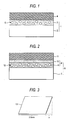
- Fig. 1 is a diagrammatic sectional view illustrating one embodiment of the adhesive sheet of the invention (in the case where the adherent layer is constituted of one layer).
- the adhesive sheet 1 shown in Fig. 1 includes a substrate 2 and, disposed on one side thereof, an adherent layer 3 containing heat-expandable microspheres 5. It is preferred that a separator 4 (release film) be provisionally attached to the adherent layer 3 until the adhesive sheet 1 is used.
- Fig. 2 is a diagrammatic sectional view illustrating another embodiment of the adhesive sheet of the invention (in the case where the adherent layer is constituted of two layers).
- a substrate 7 includes a substrate 7 and, disposed on one side thereof an adherent layer 8 having two-layers composed of a resin layer 9 containing heat-expandable microspheres 12 and an adhesive layer I0. It is preferred that a separator 11 (release film) be provisionally attached to the adhesive layer 10 until the adhesive sheet 6 is used.
- the adhesive sheet of the invention has a structure including a substrate and, disposed on at least one side thereof, an adherent layer containing heat-expandable microspheres.
- the adherent layer may be disposed directly on the substrate without via any layer, or an interlayer may be disposed between the substrate and the adherent layer.
- the surface of the substrate on which the adherent layer is to be disposed may be subjected to a surface treatment in the manner which will be described later. It is preferable to conduct such surface treatment because a satisfactory anchoring effect is obtained without the interposition of a rubbery organic elastic layer or the like. From the standpoint of exhibiting adhesive properties, the adherent layer is preferably disposed as the outermost layer of the adhesive sheet.
- the adherent layer is preferably disposed as the outermost layer after separator removal.
- the adherent layer may be disposed on each side of the substrate.
- an ordinary pressure-sensitive adhesive layer containing no heat-expandable microspheres may be disposed on the side of the substrate which is opposite to the side on which the adherent layer described above is disposed.
- the substrate to be used in the adhesive sheet of the invention is a layer serving as a support, and exerts considerable influences on properties of the adhesive sheet, such as strength and heat shrinkage, sheet handleability, etc.
- plastic films and other various sheet-form materials such as paper, fabrics, nonwoven fabrics, metal foils, plastic laminates of these, and laminates of plastics can, for example, be used. From the standpoints of handleability and cost, plastic films and plastic sheets (hereinafter inclusively referred to as plastic films) are most preferred of those. Materials of the plastic films can be suitably selected according to the necessity from the standpoints of strength, heat resistance, etc.
- Examples thereof include olefin resins obtained from one or more monomer ingredients including an ⁇ -olefin, such as polyethylene (PE), polypropylene (PP), ethylene/propylene copolymers, and ethylene/vinyl acetate copolymer (EVA); polyesters such as poly(ethylene terephthalate) (PET), poly(ethylene naphthalate) (PEN), and poly(butylene terephthalate) (PBT); poly(vinyl chloride) (PVC); poly(phenylene sulfide) (PPS); amide resins such as polyamides (nylons) and wholly aromatic polyamides (aramids); and polyetheretherketones (PEEK), polyimides, polyetherimides, polystyrene, and acrylic resins.
- PE polyethylene
- PP polypropylene
- EVA ethylene/vinyl acetate copolymer
- PET poly(ethylene terephthalate)
- PEN poly(ethylene na
- the plastic film to be used may be any of unstretched film, uniaxially stretched film, and biaxially stretched film. Furthermore, the plastic film may be a laminated film composed of two or more film layers.
- the thickness of the substrate varies according to the intended use, etc., and is not particularly limited. However, it is generally 500 ⁇ m or smaller (e.g., 1 to 500 ⁇ m), preferably 1 to 300 ⁇ m, more preferably 5 to 250 ⁇ m.
- the surface of the substrate on which the adherent layer (adherent layer according to the invention) is to be disposed have been subjected to a surface treatment for improving adhesion between the substrate and the adherent layer.
- the surface treatment enables the adhesive sheet to be equal in properties, such as anchoring, to heat-peelable adhesive sheets conventionally in use even when the adherent layer is directly formed on the substrate without via a rubbery organic elastic layer unlike the adherent layer in the conventional heat-peelable adhesive sheets.
- a rubbery organic elastic layer is not formed, the total thickness of the layers to be formed on the substrate can be reduced. This is preferred because processing accuracy in cutting or other processing can be further improved.
- the surface treatment conventional and common surface treatments can be used. For example, use may be made of a method by which the surface is physically or chemically roughened or a method by which chemical properties of the surface are modified by, e.g., a treatment with a chemical.
- Examples of such surface treatment methods include a mechanical/physical or chemical surface-roughening treatment, a surface treatment with electromagnetic wave irradiation, a chemical surface treatment with a chemical, an ozone exposure treatment, and a flame exposure treatment. Preferred of these are a mechanical/physical surface-roughening treatment, a surface treatment with electromagnetic wave irradiation, and a chemical surface treatment with a chemical.
- the mechanical/physical surface-roughening treatment is a treatment for forming irregularities on the substrate surface. This treatment can improve adhesion of the substrate to the adherent layer based on an anchoring effect.
- Examples of the mechanical/physical surface-roughening treatment include a method in which a substrate is produced which has surface irregularities imparted thereto during the production thereof and a method in which a substrate having a smooth surface is matted.
- embossing herein means a method in which a film is sufficiently heated and then pressed against a heated metallic roll whose surface has been engraved so as to have a pattern suitable for the intended use or a satin finish to thereby transfer the pattern or satin finish to the substrate surface.
- a film is processed by passing it through the nip between a metallic roll having a diameter of about 10 to 30 cm and a paper or rubber roll. Embossing is effective when the substrate is a film which is apt to soften at relatively low temperatures, such as poly(vinyl chloride).
- the method in which a substrate having a smooth surface is matted preferably is a mechanical matting treatment from the standpoint of obtaining sufficient surface roughness.
- a mechanical matting treatment from the standpoint of obtaining sufficient surface roughness.
- examples thereof include: a method in which a surface of a supporting substrate is polished with a buff or sandpaper; and sandblasting in which particles such as glass beads, carborundum, or metal particles are blown against a substrate surface at a high speed together with compressed air to finely mar the surface.
- Sandblasting is preferred because it is easy to regulate the degree of surface roughening by selecting the material of the particles to be blown or changing blowing conditions.
- the arithmetic average roughness Ra of the substrate which has undergone the surface-roughening treatment is preferably 0.1 to 0.7 ⁇ m, and more preferably 0.2 to 0.6 ⁇ m.
- the maximum height Ry thereof is preferably 2 to 9 ⁇ m, and more preferably 3 to 7 ⁇ m.
- the ten-point average roughness Rz is preferably 2 to 9 ⁇ m, and more preferably 3 to 7 ⁇ m.
- the Ra, Ry, or Rz thereof exceeds the upper limit, there are cases where the adherent layer of the adhesive sheet has a rough surface and this adhesive sheet has reduced adhesive properties and is unsuitable for microfabrication.
- the Ra, Ry, or Rz thereof is lower than the lower limit, the effect of improving the anchoring of the adherent layer to the substrate is less apt to be obtained.
- each of the surface treatment with electromagnetic wave irradiation and the chemical surface treatment with a chemical, oxygen-containing functional groups such as hydroxyl groups or carboxyl groups can be incorporated into the substrate surface to thereby improve adhesion to the adherent layer based on the effect of forming hydrogen bonds or the like.
- the surface treatment with electromagnetic wave irradiation include a corona discharge treatment, plasma discharge treatment, sputtering treatment, ultraviolet irradiation treatment, electron beam irradiation treatment, and ozone irradiation treatment. Preferred of these are a corona discharge treatment (corona treatment) and a sputtering treatment.
- Examples of treating liquids usable in the chemical surface treatment with a chemical include potassium dichromate/concentrated sulfuric acid/water, sodium hypochlorite/concentrated hydrochloric acid/water, sodium metal/naphthalene/tetrahydrofuran, sodium p-toluenesulfonate, sodium hydroxide/water, potassium permanganate/concentrated sulfuric acid/water, and ammonium persulfate/water.
- Preferred of these are potassium dichromate/concentrated sulfuric acid/water (referred to as dichromate treatment) and sodium hydroxide/water (referred to as sodium hydroxide treatment).
- the side on which the adherent layer according to the invention is not to be disposed may also have subjected to a surface treatment.
- This treatment also can be conducted by an ordinary surface treatment method.
- a chemical or physical oxidation treatment such as a chromate treatment, ozone exposure, flame exposure, exposure to a high-tension electric shock, or treatment with an ionizing radiation may be conducted for the purpose of imparting adhesion to other layers.
- a coating treatment with a release agent such as a silicone resin or a fluororesin.
- the adherent layer according to the invention can have two embodiments.
- One embodiment is an adherent layer constituted of one layer containing an adhesive substance (adhesive) for imparting adhesive properties and heat-expandable microspheres.
- the other embodiment is an adherent layer constituted of two layers, i.e., a resin layer containing heat-expandable microspheres and, superposed thereon, a layer of an adhesive (adhesive layer) containing substantially no heat-expandable microspheres.
- the adhesive layer is disposed on the side of the resin layer containing heat-expandable microspheres, which is opposite to the side on which the substrate is disposed.
- the adherent layer according to the invention is an adherent layer which is heat-expandable.
- one adherent layer combines two functions, i.e., adhesive properties and heat expansibility.
- the functions are allotted separately to the heat-expandable layer having heat expansibility and the adhesive layer serving to have adhesive properties.
- the adhesive to be used in the adherent layer can be an ordinary adhesive. In general, however, it is preferred to use an adhesive of the water activation or organic-solvent activation type or a pressure-sensitive adhesive.
- the pressure-sensitive adhesive examples include rubber-based pressure-sensitive adhesives, acrylic pressure-sensitive adhesives, styrene/conjugated diene block copolymer pressure-sensitive adhesives, silicone pressure-sensitive adhesives, ultraviolet-curable pressure-sensitive adhesives, and pressure-sensitive adhesives containing a heat-fusible resin with a low melting point (in particular, a melting point of 200°C or lower) and having improved creep characteristics (see, for example, JP-A-56-61483 , JP-A-61-174857 , JP-A-63-17981 , and JP-A-56-13040 ).
- rubber-based pressure-sensitive adhesives examples include pressure-sensitive adhesives employing natural rubber or any of various synthetic rubbers as the base polymer, and pressure-sensitive adhesives employing a silicone rubber represented by dimethylpolysiloxane as the base polymer.
- acrylic pressure-sensitive adhesives include pressure-sensitive adhesives employing, as the base polymer, an acrylic polymer (homopolymer or copolymer) obtained from one or more monomer ingredients selected from alkyl esters of (meth)acrylic acid (e.g., C 1-20 -alkyl esters of (meth)acrylic acid, such as the methyl ester, ethyl ester, propyl ester, isopropyl ester, butyl ester, isobutyl ester, s-butyl ester, t-butyl ester, pentyl ester, hexyl ester, heptyl ester, octyl ester, 2-ethylhexyl ester, isooctyl ester, isodecyl ester, dodecyl ester, tridecyl ester, pentadecyl ester, hexadecyl ester, heptade
- an acrylic pressure-sensitive adhesive use may be made of a pressure-sensitive adhesive employing as the base polymer a copolymer of any of the alkyl esters (or cycloalkyl esters) of (meth)acrylic acid and one or more other monomer ingredients used for the purpose of modifying adhesive properties, etc.
- Such monomer ingredients include carboxyl-containing monomers such as acrylic acid, methacrylic acid, carboxyethyl acrylate, carboxypentyl acrylate, itaconic acid, maleic acid, fumaric acid, and crotonic acid; acid anhydride monomers such as maleic anhydride and itaconic anhydride; hydroxyl-containing monomers such as 2-hydroxyethyl (meth)acrylate, 2-hydroxypropyl (meth)acrylate, and 4-hydroxybutyl (meth)acrylate; sulfo-containing monomers such as styrenesulfonic acid, arylsulfonic acids, 2-(meth)acrylamido-2-methylpropanesulfonic acid, and (meth)acrylamidopropanesulfonic acid; phosphate-group-containing monomers such as 2-hydroxyethyl acryloylphosphate; (N-substituted) amide monomers such as (meth)acryl
- the pressure-sensitive adhesives are especially preferred from the standpoint of ease of application to adherends.
- an adhesive and heat-expandable microspheres are contained in the same layer, i.e., when the adhesive sheet employs the heat-expandable adhesive layer, it is preferred to select and use an adhesive which restrains the foaming and expansion of the heat-expandable microspheres as less as possible.
- adhesives include acrylic adhesives, silicone adhesives, and natural-rubber adhesives.
- the adhesives described above can be used alone or in combination of two or more thereof.
- suitable additives may be incorporated into the adherent layer.
- suitable additives include crosslinking agents (e.g., isocyanate crosslinking agents and epoxy crosslinking agents), tackifiers (e.g., rosin derivative resins, polyterpene resins, petroleum resins, and oil-soluble phenolic resins), plasticizers, fillers, and antioxidants.
- the adherent layer according to the invention is constituted of separately formed two layers, i.e., a resin layer containing heat-expandable microspheres (heat-expandable layer) and an adhesive layer
- the adhesive to be used for forming the adhesive layer can be any of the adhesives described above.
- the heat-expandable layer is constituted of heat-expandable microspheres and a binder.
- the binder is not particularly limited, it preferably is a compound which does not inhibit the heat-expandable microspheres from foaming or expanding.
- a polymeric compound of the rubber type, resin type, or the like is used.
- Specific examples of the binder include epoxy resins and rubber binders.
- the heat-expandable microspheres (microcapsules) to be used in the invention are heat-expandable microspheres having a particle diameter of 0.1 to 38 ⁇ m. Since the adherent layer in the invention contains heat-expandable microspheres, it functions as a heat-expandable adherent layer which decreases efficiently in adhesive force upon heat treatment.
- the adhesive sheet of the invention has the following advantages because it has the heat-expandable adherent layer.
- the processing can be smoothly conducted because the work is tenaciously fixed.
- the heat-expandable adherent layer is heated to expand the heat-expandable microspheres.
- the area of contact between the heat-expandable adherent layer and the adherend decreases and the adhesiveness is thus decreased. Accordingly, the processed work can be easily separated from the adhesive sheet without damaging it.
- the heat-expandable microspheres for use in the invention can be suitably selected from conventional heat-expandable microspheres.
- microspheres obtained by encapsulating a substance which readily gasifies and expands upon heating, such as isobutane, propane, or pentane, in elastic shells.
- the shells are made of a heat-meltable substance or a substance which breaks upon heat expansion.
- shell-forming substances include vinylidene chloride/acrylonitrile copolymers, poly(vinyl alcohol), poly(vinyl butyral), poly(methyl methacrylate), polyacrylonitrile, poly(vinylidene chloride), and polysulfones.
- the heat-expandable microspheres can be produced by an ordinary method such as the coacervation method or interfacial polymerization method.
- Examples of commercial products of the heat-expandable microspheres include trade name "Matsumoto Microsphere", manufactured by Matsumoto Yushi-Seiyaku Co., Ltd.
- the degree of volume expansion (degree of volume expansion at, for example, about 80 to 140°C) of the heat-expandable microspheres for use in the invention is preferably 5 times or higher (e.g., 5 to 12 times), more preferably 7 times or higher (e.g., 7 to 12 times), even more preferably 10 times or higher (e.g., 10 to 12 times), from the standpoint of efficiently reducing the adhesive force of the adherent layer by heat treatment.
- the heat-expandable microspheres should have moderate strength which enables the microspheres not to break until they come to have such a degree of volume expansion. When heat-expandable microspheres which break at a low degree of expansion are used, there are cases where the area of adhesion between the adherent layer and an adherend is not sufficiently reduced and satisfactory peelability is not obtained.
- the maximum particle diameter of the heat-expandable microspheres in the invention is equal to or smaller than the adherent-layer thickness which will be described later, and it is preferably 10 to 30 ⁇ m, and more preferably 10 to 20 ⁇ m. In the case where the maximum particle diameter of the heat-expandable microspheres is larger than the thickness of the adherent layer, the adherent layer has enhanced surface irregularities, resulting in reduced adhesive properties. Such too large maximum particle diameters are hence undesirable.
- the mode diameter of the heat-expandable microspheres in the invention is 5 to 30 ⁇ m, preferably 6 to 25 ⁇ m, and more preferably 7 to 20 ⁇ m.
- the mode diameter of the heat-expandable microspheres is smaller than 5 ⁇ m, sufficient heat peelability cannot be obtained.
- it exceeds 30 ⁇ m surface smoothness becomes poor, resulting in reduced adhesive properties.
- the amount of the heat-expandable microspheres to be incorporated can be suitably regulated according to the desired degree of expansion of the adherent layer and the desired decrease in adhesive properties.
- the amount thereof is preferably 10 to 200 parts by weight, more preferably 25 to 125 parts by weight, based on 100 parts by weight of the base polymer constituting the adherent layer.
- the thickness of the adherent layer in the invention is 10 to 38 ⁇ m, preferably 15 to 35 ⁇ m, and more preferably 15 to 30 ⁇ m.
- the thickness of the adherent layer exceeds 38 ⁇ m, there are cases where the adherent layer deforms during, e.g., the cutting of small electronic parts, resulting in reduced cutting accuracy, or where the adherent layer suffers a cohesive failure after expansion (blowing) to leave an adhesive residue on the adherend.
- the adherent layer has enhanced surface irregularities due to the heat-expandable microspheres, resulting in impaired surface smoothness and reduced adhesive force.
- the thickness of the adherent layer according to the invention should be larger than the maximum particle diameter of the heat-expandable microspheres.
- the term "thickness of the adherent layer” means the total thickness of the resin layer and the adhesive layer.
- the total thickness of the layers including the elastic layer preferably is 38 ⁇ m or smaller. This is because the rubbery organic elastic layer may influence the deformation of the adhesive sheet like the adherent layer according to the invention.
- the adherent layer according to the invention can be formed by an ordinary method.
- it can be formed by a method in which a coating material containing an adhesive and heat-expandable microspheres and optionally containing a solvent and additives is applied to a substrate or a method in which the coating material is applied to an appropriate separator (e.g., release paper) to form an adherent layer and this adherent layer is transferred onto a substrate.
- an appropriate separator e.g., release paper
- the adherent layer according to the invention is constituted of separately formed two layers, i.e., a resin layer containing heat-expandable microspheres (heat-expandable layer) and an adhesive layer
- the resin layer can be formed by applying a coating material containing heat-expandable microspheres and a binder to a substrate.
- the adhesive layer can be formed using an adhesive-containing coating fluid by the same method as for the adherent layer.
- the heat-expandable microspheres to be used in the invention may be filtered through a filter.
- a filter According to the filtration, large particles can be removed to thereby regulate the maximum particle diameter of the microspheres while maintaining a mode diameter in the range specified in the invention
- a filter system for application to high-viscosity adhesives may be used for the filtration.
- Such filter preferably is a cartridge filter for use in the filtration of, in particular, adhesives, coating materials, or the like. Examples thereof include Kanefil (R2410; AION Co., Ltd.) and Chisso Filter (CPII01-S; Chisso Filter Co., Ltd.),
- the mesh size of the filter is not particularly limited so long as it is equal to or smaller than the thickness of the adherent layer. However, it is preferably 5 to 35 ⁇ m, and more preferably 10 to 25 ⁇ m. When the mesh size thereof exceeds 35 ⁇ m, there are cases where large particles having a diameter larger than the thickness of the adherent layer remain. When the mesh size thereof is smaller than 5 ⁇ m, there are cases where the heat-expandable microspheres after the filtration have a reduced mode diameter or productivity decreases.
- the filtration may be conducted only once. However, it is preferred that several (preferably about, e.g., twice to four times) filters arranged serially be used in order to improve filtration accuracy.
- the filtration using a filter may be conducted in the following manner.
- Heat-expandable microspheres are dispersed in water or in an adhesive (or binder) diluted with an organic solvent, and this dispersion is ejected at an appropriate pressure through a housing having a filter disposed therein.
- the ejection pressure can be suitably determined according to the thickness of the adherent layer and coating speed.
- Examples of the housing in which a filter is to be placed include Filter Housing NF-1P (manufactured by Chisso Filter Co., Ltd.). It is preferred that two or more housings arranged serially be used according to the necessity.
- the separator to be used in the invention may be, for example, a base material having a surface coated with a release agent represented by a silicone resin, long-chain-alkyl acrylate resin, or fluororesin; or a lowly adhesive base material made of a nonpolar polymer such as polyethylene or polypropylene.
- a separator is used as a provisional support in transferring an adherent layer or another layer onto a substrate or as a protective material which protects the adherent layer or another layer until the adhesive sheet is practically used.
- a separator is not essential.
- the adhesive sheet of the invention may be used for permanently adhereing an adherend constituted of an appropriate article.
- the adhesive sheet is suitable for use in applications in which an adherend is kept being adhered for a given time period and, after accomplishment of the purpose of adhesion, the adhesion state is required or desired to be eliminated.
- the adhesive sheet is most suitable for use as a provisional fixing material during the processing of electronic parts required to be highly accurately processed or as a provisional fixing material for the cutting of a multilayered ceramic sheet.
- the adherend to which the adhesive sheet of the invention is to be applied is not particularly limited.
- Examples thereof include semiconductor wafers (e.g., silicon wafers) and semiconductor chips for electronic parts or circuit boards, electrical products such as ceramic capacitors and oscillators, display devices such as liquid-crystal cells, thermal heads, solar cells, printed wiring boards (multilayered ceramic sheets), and green sheets for multilayered ceramic capacitors.
- Steps for processing an adherend can be arbitrarily selected and may include a pressurizing step (pressing step).
- Specific examples of the steps for processing an adherend include the step of printing electrodes on a green sheet (e.g., pattern formation step), laminating step, pressurizing step (pressing step), cutting steps (e.g., polishing step and dicing step), and burning step. Examples thereof further include an assembling step.
- the method of cutting a multilayered ceramic sheet includes, for example, the steps of (1) applying the adhesive sheet of the invention to one surface of the multilayered ceramic sheet, (2) cutting the sheet (into chips), and (3) heating the adhesive sheet to reduce the adhesive force of the adherent layer and separating the chips therefrom.
- the cutting be conducted after the adhesive sheet applied is temporarily heated.
- the temperature to which the adhesive sheet is heated is not particularly limited so long as it is equal to or higher than room temperature and is lower than the heat expansion initiation temperature of the heat-expandable microspheres contained in the heat-expandable adherent layer. However, it is desirable to select a temperature in the range of, for example, about 70 to 150°C (preferably 80 to 120°C, and more preferably 90 to 110°C). After the adhesive sheet has been thus heated, cutting may be conducted either at that elevated temperature or after cooling.
- cutting can be conducted at a temperature equal to or lower than that elevated temperature (i.e., at a temperature of from room temperature to that elevated temperature).
- a temperature equal to or lower than that elevated temperature i.e., at a temperature of from room temperature to that elevated temperature.
- use may be made of a method in which the adhesive sheet is temporarily heated and then cooled to room temperature and the work is then cut at room temperature; or a method in which after the temporary heating, the work is subjected to laminating, cutting, or another processing either in the heated state or after cooling to a temperature which is higher than room temperature.
- Conditions under which the adhesive sheet of the invention is heated in order to facilitate stripping thereof from the adherend can be suitably determined according to the degree of decrease in bonding area which is influenced by the surface state of the adherend, kind of the heat-expandable microspheres, etc., heat resistance of the substrate and adherend, and other factors including heating method.
- General heating conditions include a temperature of 100 to 250°C and a period of 1 to 90 seconds (hot plate or the like) or 5 to 15 minutes (hot-air drying oven or the like).
- the heat-expandable microspheres in the adherent layer usually expand and the adherent layer expands/deforms, whereby the adhesive force is reduced or lost.
- the heating may be conducted in an appropriate stage according to the purpose of use. There are cases where an infrared ray lamp or heated water can be used as a heat source.
- the results of the cutting were examined with an optical microscope.
- the adhesive sheets on which the silicon wafer suffered no positional shifting are indicated by good, while those on which positional shifting occurred are indicated by poor.
- the adhesive sheets on which the silicon wafer suffered no oblique cutting are indicated by good, while those on which oblique cutting occurred are indicated by poor.
- the adhesive sheets obtained in Examples 1, and 2 and Comparative Examples 1 and 2 were cut into a strip form having a width of 20 mm to obtain test pieces.
- the adherent-layer side of each test piece was applied to a glass plate with a 2-kg roller (rolling the roller forward and backward once).
- the bonding area on the side applied was determined by examination with an optical microscope,
- test pieces which had a bonding area of 90% or larger are indicated by good, while those which had a bonding area smaller than 90% are indicated by poor,
- Adhesive sheets each applied to a glass plate in the same manner as in (4) above were examined for 180° peel adhesive force (N/20 mm) in peeling from the glass plate in accordance with JIS Z 0237.
- the adhesive sheets which had a 180° peel adhesive force of 1.5 N/20 nun or higher were judged to be good, while those which had a 180° peel adhesive force lower than 1.5 N/20 mm were judged to be poor.
- Adhesive sheets each applied to a glass plate in the same manner as in (4) above were heated at 130°C for 3 minutes with a thermostatic chamber (hot-air drying oven) ("SPH-201" manufactured by Espec Corp.).
- SPH-201 hot-air drying oven
- the adhesive sheets which, after the heating, peeled off the glass plate by themselves are indicated by good, while those which did not peel off by themselves are indicated by poor.
- each adhesive sheet was applied to a multilayered ceramic sheet and the multilayered ceramic sheet was cut. Thereafter, heat treatment was conducted at 130°C for 10 minutes with a thermostatic chamber (hot-air drying oven) ("SPH-201" manufactured by Espec Corp.). After the heating, the chips were visually examined for separation from the adhesive sheet. Each adhesive sheet from which all chips had separated was judged to be good (A), while the adhesive sheet from which not all chips had separated was judged to be poor (B).
- a thermostatic chamber hot-air drying oven
- each adhesive sheet was applied to a multilayered ceramic sheet and cutting and heat treatment were then conducted. Thereafter, the adherent layer was visually examined for "lifting" from the substrate.
- the adhesive sheets in which no "lifting” was observed were judged to be good (A), while that in which "lifting” was observed was judged to be poor (B).
- Heat-expandable microspheres A (trade name "Matsumoto Microsphere F50D”, manufactured by Matsumoto Yushi-Seiyaku Co., Ltd.; expansion initiation temperature, 120°C; mode diameter, 13.4 ⁇ m ; maximum particle diameter, 51.2 ⁇ m) were dispersed in pure water to prepare a 30% aqueous dispersion thereof This dispersion was subjected to three-stage filtration through filters (trade name "CP-10”, manufactured by Chisso Filter Co., Ltd.; nominal filtration accuracy, 10 ⁇ m) (arranged serially) to obtain an aqueous dispersion of heat-expandable microspheres A'. The aqueous dispersion of heat-expandable microspheres A' obtained was examined for particle size distribution, and the results obtained are shown in Table 1.
- a toluene solution containing 100 parts by weight of a 2-ethylhexyl acrylate/ethyl acrylate/methyl methacrylate/2-hydroxyethyl acrylate copolymer pressure-sensitive adhesive (monomer proportion (by weight): 50/50/5/4), 1 part by weight of an isocyanate crosslinking agent (trade name "Coronate L", manufactured by Nippon Polyurethane Co., Ltd.), and 25 parts by weight of the heat-expandable microspheres A' was prepared.
- This solution was applied to a polyester film (trade name "PS 100", manufactured by Teijin DuPont Films Japan Ltd.; thickness, 100 ⁇ m) as a substrate in such an amount as to result in an adherent-layer thickness of 20 ⁇ m.
- the solution applied was dried to form an adherent layer (heat-expandable adherent layer).
- an adhesive sheet heat-peelable adhesive sheet
- An adhesive sheet (heat-peelable adhesive sheet) was obtained in completely the same manner as in Example 1, except that the adherent-layer thickness was changed to 38 ⁇ m.
- An adhesive sheet (heat-peelable adhesive sheet) was obtained in completely the same manner as in Example 1, except that the adherent-layer thickness was changed to 45 ⁇ m.
- Heat-expandable microspheres A" were prepared using a centrifugal classifier without using filtration through filters, in the following manner.
- the heat-expandable microspheres A were classified with a centrifugal classifier ("ATP-50", manufactured by Hosokawa Micron Corp.) so as to result in a mode diameter of 12.7 ⁇ m.
- ATP-50 manufactured by Hosokawa Micron Corp.
- An aqueous dispersion obtained by dispersing the heat-expandable microspheres A" in pure water in a concentration of 30% was examined for particle size distribution. The results obtained are shown in Table 1.
- thermo-peelable adhesive sheet was obtained in the same manner as in Example 2 (adherent-layer thickness, 38 ⁇ m), except that the heat-expandable microspheres A" obtained above were used.
- Table 1 Aqueous dispersion of heat-expandable microspheres A' Aqueous dispersion of heat-expandable microspheres A" Maximum Mode diameter particle diameter Maximum Mode diameter particle diameter ( ⁇ m) ( ⁇ m) ( ⁇ m) ( ⁇ m) ( ⁇ m) Original particles (before filtration/ classification) 13.4 51.2 13.4 51.2 After filtration/ classification 13.1 18.2 12.7 41.9
- a liquid toluene mixture containing 100 parts by weight of a 2-ethylhexyl acrylate/ethyl acrylate/methyl methacrylate/2-hdyroxyethyl acrylate copolymer pressure-sensitive adhesive (monomer proportion (by weight): 30/70/5/4), 2.0 parts by weight of an isocyanate crosslinking agent (trade name "Coronate L", manufactured by Nippon Polyurethane Co., Ltd.), 30 parts by weight of the heat-expandable microspheres A', and 10 parts by weight of a rosin phenol tackifier (trade name "YS Resin PX800", manufactured by Yasuhara Chemical Co., Ltd.) was prepared.
- This liquid mixture was applied to a sandblasted polyester film substrate (trade name "PS 100", manufactured by Teijin DuPont Films Japan Ltd; thickness, 100 ⁇ m; arithmetic average roughness Ra, 0.52 ⁇ m; maximum height Ry, 4.85 ⁇ m; ten-point average roughness Rz, 3.69 ⁇ m) in such an amount as to result in an adherent-layer thickness of 35 ⁇ m.
- the liquid mixture applied was dried to form an adherent layer (heat-expandable adherent layer).
- an adhesive sheet heat-peelable adhesive sheet
- An adhesive sheet (heat-peelable adhesive sheet) was obtained in the same manner as in Example 3, except that a polyester film (thickness, 100 ⁇ m ; arithmetic average roughness Ra, 0.67 ⁇ m ; maximum height Ry, 6.23 ⁇ m ; ten-point average roughness Rz, 4.75 ⁇ m) which had been embossed with a metallic roll heated at 140°C and having a satin finish formed by engraving was used as a substrate.
- polyester film used above is trade name "PS 100", manufactured by Teijin DuPont Films Japan Ltd. The same applies to Examples 5 to 8 below.
- a liquid mixture containing 100 parts by weight of a 2-ethylhexyl acrylate/ethyl acrylate/methyl methacrylate/2-hdyroxyethyl acrylate copolymer pressure-sensitive adhesive (monomer proportion (by weight): 30/70/5/4), 1.5 parts by weight of an isocyanate crosslinking agent (trade name "Coronate L", manufactured by Nippon Polyurethane Co., Ltd.), 30 parts by weight of the heat-expandable microspheres A', and 5 parts by weight of a rosin phenol tackifier (trade name "Tamanol 135", manufactured by Arakawa Chemical Industries, Ltd.) was prepared.
- a polyester film (thickness, 100 ⁇ m) was immersed in a dichromate treating liquid composed of 75 g of potassium dichromate, 150 g of concentrated sulfuric acid, and 120 g of water at 70°C for 10 minutes. Thereafter, the film was washed with water, neutralized, washed with water, and then dried to obtain a substrate which had undergone the dichromate treatment.
- the liquid mixture described above was applied to this substrate in such an amount as to result in an adherent-layer thickness of 35 ⁇ m and dried to form an adherent layer (heat-expandable adherent layer).
- an adhesive sheet heat-peelable adhesive sheet
- a polyester film (thickness, 100 ⁇ m) was immersed in 20% sodium hydroxide solution at 80°C for 5 minutes and washed with water. Thereafter, the film was immersed in a stannous chloride solution (10 g/L) at room temperature for 10 seconds, washed with water, and then dried to obtain a substrate which had undergone the sodium hydroxide treatment.
- An adhesive sheet (heat-peelable adhesive sheet) was obtained in completely the same manner as in Example 5, except that the substrate was replaced by the polyester film which had undergone the sodium hydroxide treatment.
- a liquid mixture containing 100 parts by weight of a 2-ethylhexyl acrylate/ethyl acrylate/methyl methacrylate/2-hdyroxyethyl acrylate copolymer pressure-sensitive adhesive (monomer proportion (by weight): 30/70/5/4), 1.5 parts by weight of an isocyanate crosslinking agent (trade name "Coronate L", manufactured by Nippon Polyurethane Co., Ltd.), 30 parts by weight of the heat-expandable microspheres A', and 5 parts by weight of a rosin phenol tackifier (trade name "Tamanol 135", manufactured by Arakawa Chemical Industries, Ltd.) was prepared.
- This liquid mixture was applied to a polyester film substrate which had undergone corona treatment under the conditions of a corona output of 350 W, electrode spacing of 2 mm, and corona treatment speed of 10 m/min, in such an amount as to result in an adherent-layer thickness of 35 ⁇ m.
- the liquid mixture applied was dried to form an adherent layer (heat-expandable adherent layer).
- an adhesive sheet heat-peelable adhesive sheet
- An adhesive sheet (heat-peetable adhesive sheet) was obtained in completely the same manner as in Example 7, except that the surface treatment of the substrate to which the liquid mixture was to be applied was replaced by sputtering treatment conducted under the conditions of a discharge power of 30 W ⁇ sec/cm 2 , treating gas of O 2 , and gas pressure of 3.1 Pa.
- the adhesive sheets of Examples 3 to 8 were evaluated for multilayered-ceramic-sheet cutting accuracy, heat peelability from multilayered ceramic sheet, and anchoring of the adherent layer to the substrate by the methods described above.
- the results obtained are shown in Table 3.
- Table 3 it was ascertained that when the substrate surface is subjected to surface treatments according to the invention (Examples 3 to 8), a high degree of anchoring is obtained between the substrate and the adherent layer while maintaining excellent cutting accuracy and heat peelability.
- Example 3 Adherent-layer thickness Cutting accuracy Q Heat peelability (ceramic sheet) Anchoring ( ⁇ m) (%) Example 3 35 99.2 A A Example 4 35 98.6 A A Example 5 35 99.4 A A Example 6 35 99.0 A A Example 7 35 99.2 A A Example 8 35 98.6 A A
Landscapes
- Chemical & Material Sciences (AREA)
- Organic Chemistry (AREA)
- Chemical Kinetics & Catalysis (AREA)
- Health & Medical Sciences (AREA)
- Medicinal Chemistry (AREA)
- Polymers & Plastics (AREA)
- Adhesive Tapes (AREA)
- Adhesives Or Adhesive Processes (AREA)
Abstract
Description
- The present invention relates to a heat-peelable adhesive sheet. More particularly, the invention relates to a heat-peelable adhesive sheet for use in, e.g., a step in the production of ceramic capacitors.
- Adhesive sheets employing an adhesive containing spherical particles dispersed therein for the purposes of improving the cohesiveness of the adhesive, imparting electrical conductivity thereto, etc. have been used in various fields. Of these, heat-peelable adhesive sheets employing an adhesive containing heat-expandable microspheres dispersed therein are in extensive use in electronic-part processing applications. For example, heat-peelable adhesive sheets including a substrate and formed thereon a pressure-sensitive adhesive layer containing a blowing agent or expanding agent such as heat-expandable microspheres, are known (see, for example,
patent documents 1 to 5). The feature of these heat-peelable adhesive sheets resides in that the blowing agent expands upon heating to reduce adhesive force and the adhesive sheets thus become easily peelable from the adherend. Namely, these adhesive sheets combine adhesiveness and peelability after use. - However, those heat-peelable adhesive sheets have the following drawback. Since the heat-expandable microspheres contained in the adherent layer include particles having a relatively large particle diameter, it is necessary to regulate the adherent layer so as to be thick in some degree to thereby maintain the surface smoothness of the heat-peelable layer (adherent layer). Because of this, as a result of the recent trend toward weight and thickness reduction and miniaturization in electronic parts, the thickness of the adherent layer has come to pose problems in electronic-part processing required to attain a high degree of processing accuracy. Namely, the thick adherent layer has come to pose problems, for example, that the work to be cut suffers positional shifting and the work is pushed into the adherent layer and is hence cut obliquely. Also in the field of, e.g., ceramic capacitors, miniaturization represented by the 0603 size (0.6 mm × 0.3 mm) and 0402 size (0.4 mm ×0.2 mm) and capacitance increase by superposing more than some hundreds of layers are becoming remarkable with the progress of mounting techniques. Under these circumstances, a heat-peelable adhesive sheet in which the adherent layer on the supporting substrate has a small thickness has come to be desired so as to attain a reduced deformation amount during cutting in a production step.
- In order to overcome the problems described above, it may be considered to remove large particles by centrifugal classification or the like, However, the use of conventional classification techniques results not only in the removal of large particles but in a decrease in mode diameter (particle diameter at which the relative particle amount in a particle diameter-relative particle amount histogram is maximal) and, hence, it becomes unable to obtain sufficient heat peelability.
- Namely, an effective technique which simultaneously attains heat peelability, surface smoothness, and a reduced adherent-layer thickness has not been obtained so far.
- Patent Document 1 :
-
JP-UM-B-50-13878 - Patent Document 2 :
-
JP-B-51-24534 - Patent Document 3 :
-
JP-A-56-61468 - Patent Document 4 :
-
JP-A-56-61469 - Patent Document 5 :
-
JP-A-60-252681 - An object of the invention is to solve the above-mentioned problems and provide an adhesive sheet which can simultaneously attain heat peelability, surface smoothness, and a reduction in adherent-layer thickness owing to the use of heat-expandable microspheres from which particles having a large diameter have been removed while maintaining a mode diameter.
- The present inventors have made intensive investigations in order to accomplish the object. As a result, they found that by using a filter, large particles can be removed from heat-expandable microspheres without reducing the mode diameter thereof and that a heat-peelable adhesive sheet having satisfactory surface smoothness and having a heat-expandable adherent layer with a reduced thickness can hence be produced. They further found that by subjecting the substrate to a surface treatment, such adhesive sheet in which the adherent layer, although thin, is satisfactorily anchored to the substrate can be obtained. The invention has been thus completed.
-
- Fig. 1 is a diagrammatic sectional view illustrating one embodiment of the adhesive sheet of the invention (wherein the adherent layer is constituted of one layer).
- Fig. 2 is a diagrammatic sectional view illustrating another embodiment of the adhesive sheet of the invention (wherein the adherent layer is constituted of two layers).
- Fig. 3 is a diagrammatic sectional view of a chip, the view showing a method of calculating the accuracy of the cutting of a multilayered ceramic sheet.
-
- 1
- adhesive sheet (having adherent layer constituted of one layer)
- 2
- substrate
- 3
- adherent layer (one layer)
- 4
- separator
- 5
- heat-expandable microsphere
- 6
- adhesive sheet (having adherent layer constituted of two layers)
- 7
- substrate
- 8
- adherent layer (two layers)
- 9
- resin layer
- 10
- adhesive layer
- 11
- separator
- 12
- heat-expandable microsphere
- 13
- chip
- Namely, the present invention relates to the following (1) to (24).
- (1) An adhesive sheet comprising:
- a substrate; and,
- an adherent layer containing heat-expandable microspheres, the adherent layer being disposed on at least one side of the substrate,
wherein the heat-expandable microspheres have a maximum particle diameter equal to or smaller than the thickness of the adherent layer and have a mode diameter of 5 to 30 µm. - (2) The adhesive sheet according to (1), wherein the adherent layer is constituted of an acrylic adhesive.
- (3) The adhesive sheet according to (1), wherein a surface of the substrate on which the adherent layer is disposed has been subjected to a surface treatment.
- (4) The adhesive sheet according to (3), wherein the surface treatment is at least one member selected from the group consisting of a surface-roughening treatment, a surface treatment with a chemical, and a surface treatment with electromagnetic wave irradiation.
- (5) The adhesive sheet according to (4), wherein the surface-roughening treatment is at least one member selected from the group consisting of matting, sandblasting, and embossing.
- (6) The adhesive sheet according to (4), wherein the surface treatment with a chemical is a dichromate treatment or a sodium hydroxide treatment.
- (7) The adhesive sheet according to (4), wherein the surface treatment with electromagnetic wave irradiation is a corona treatment or a sputtering treatment.
- (8) The adhesive sheet according to (1), wherein the maximum particle diameter of the heat-expandable microspheres has been regulated so as to be equal to or smaller than the thickness of the adherent layer by filtration using a filter.
- (9) An adhesive sheet comprising: '
- a substrate; and,
- an adherent layer which is disposed on at least one side of the substrate,
- the adherent layer comprising a resin layer containing heat-expandable microspheres and an adhesive layer,
- the adhesive layer being disposed on a side of the resin layer which is opposite to the substrate side of the resin layer,
- wherein the adherent layer has a thickness of 10 to 38 µm, and
- wherein the heat-expandable microspheres have a maximum particle diameter equal to or smaller than the thickness of the adherent layer and have a mode diameter of 5 to 30 µm.
- (10) The adhesive sheet according to (9), wherein the adherent layer is constituted of an acrylic adhesive.
- (11) The adhesive sheet according to (9), wherein a surface of the substrate on which the adherent layer is disposed has been subjected to a surface treatment.
- (12) The adhesive sheet according to (11), wherein the surface treatment is at least one member selected from the group consisting of a surface-roughening treatment, a surface treatment with a chemical, and a surface treatment with electromagnetic wave irradiation.
- (13) The adhesive sheet according to (12), wherein the surface-roughening treatment is at least one member selected from the group consisting of matting, sandblasting, and embossing.
- (14) The adhesive sheet according to (12), wherein the surface treatment with a chemical is a dichromate treatment or a sodium hydroxide treatment.
- (15) The adhesive sheet according to (12), wherein the surface treatment with electromagnetic wave irradiation is a corona treatment or a sputtering treatment.
- (16) The adhesive sheet according to (9), wherein the maximum particle diameter of the heat-expandable microspheres has been regulated so as to be equal to or smaller than the thickness of the adherent layer by filtration using a filter.
- (17) A process for producing an adhesive sheet, which comprises:
- filtering heat-expandable microspheres through a filter to regulate the heat-expandable microspheres so as to have a maximum particle diameter equal to or smaller than a thickness of an adherent layer to be formed and have a mode diameter of 5 to 30 µm; and then
- forming said adherent layer containing the heat-expandable microspheres on a substrate so as to have a thickness of 10 to 38 µm.
- (18) The process for producing an adhesive sheet according to claim (17), wherein a surface of the substrate on which the adherent layer is to be formed is subjected to a surface treatment before the formation of the adherent layer.
- (19) The adhesive sheet according to (1), which is for use in provisional fixing in an electronic-part processing step.
- (20) The adhesive sheet according to (9), which is for use in provisional fixing in an electronic-part processing step.
- (21) The adhesive sheet of according to (1), which is for use in cutting a multilayered ceramic sheet.
- (22) The adhesive sheet of according to (9), which is for use in cutting a multilayered ceramic sheet.
- (23) A method of cutting a multilayered ceramic sheet, which comprises:
- applying the adhesive sheet according to (21) to one surface of the multilayered ceramic sheet;
- cutting the multilayered ceramic sheet into chips; and
- heating the adhesive sheet to reduce the adhesive force of the adherent layer, followed by separating the chips from the adhesive sheet.
- (24) A method of cutting a multilayered ceramic sheet, which comprises:
- applying the adhesive sheet according to (22) to one surface of the multilayered ceramic sheet;
- cutting the multilayered ceramic sheet into chips; and
- heating the adhesive sheet to reduce the adhesive force of the adherent layer, followed by separating the chips from the adhesive sheet.
- The adhesive sheet of the invention enables a high-accuracy processing in the step of processing an electronic part such as a small ceramic capacitor to thereby greatly improve product characteristics and productivity. The adhesive sheet is hence industrially useful.
- Embodiments of the invention are explained below by reference to accompanying drawings. Fig. 1 is a diagrammatic sectional view illustrating one embodiment of the adhesive sheet of the invention (in the case where the adherent layer is constituted of one layer). The
adhesive sheet 1 shown in Fig. 1 includes asubstrate 2 and, disposed on one side thereof, anadherent layer 3 containing heat-expandable microspheres 5. It is preferred that a separator 4 (release film) be provisionally attached to theadherent layer 3 until theadhesive sheet 1 is used. Fig. 2 is a diagrammatic sectional view illustrating another embodiment of the adhesive sheet of the invention (in the case where the adherent layer is constituted of two layers). Theadhesive sheet 6 shown in Fig. 2 includes asubstrate 7 and, disposed on one side thereof anadherent layer 8 having two-layers composed of a resin layer 9 containing heat-expandable microspheres 12 and an adhesive layer I0. It is preferred that a separator 11 (release film) be provisionally attached to theadhesive layer 10 until theadhesive sheet 6 is used. - The adhesive sheet of the invention has a structure including a substrate and, disposed on at least one side thereof, an adherent layer containing heat-expandable microspheres. The adherent layer may be disposed directly on the substrate without via any layer, or an interlayer may be disposed between the substrate and the adherent layer. The surface of the substrate on which the adherent layer is to be disposed may be subjected to a surface treatment in the manner which will be described later. It is preferable to conduct such surface treatment because a satisfactory anchoring effect is obtained without the interposition of a rubbery organic elastic layer or the like. From the standpoint of exhibiting adhesive properties, the adherent layer is preferably disposed as the outermost layer of the adhesive sheet. In the case where the adhesive sheet has a separator, the adherent layer is preferably disposed as the outermost layer after separator removal. The adherent layer may be disposed on each side of the substrate. Alternatively, an ordinary pressure-sensitive adhesive layer containing no heat-expandable microspheres may be disposed on the side of the substrate which is opposite to the side on which the adherent layer described above is disposed.
- The substrate to be used in the adhesive sheet of the invention is a layer serving as a support, and exerts considerable influences on properties of the adhesive sheet, such as strength and heat shrinkage, sheet handleability, etc. As the substrate, plastic films and other various sheet-form materials such as paper, fabrics, nonwoven fabrics, metal foils, plastic laminates of these, and laminates of plastics can, for example, be used. From the standpoints of handleability and cost, plastic films and plastic sheets (hereinafter inclusively referred to as plastic films) are most preferred of those. Materials of the plastic films can be suitably selected according to the necessity from the standpoints of strength, heat resistance, etc. Examples thereof include olefin resins obtained from one or more monomer ingredients including an α-olefin, such as polyethylene (PE), polypropylene (PP), ethylene/propylene copolymers, and ethylene/vinyl acetate copolymer (EVA); polyesters such as poly(ethylene terephthalate) (PET), poly(ethylene naphthalate) (PEN), and poly(butylene terephthalate) (PBT); poly(vinyl chloride) (PVC); poly(phenylene sulfide) (PPS); amide resins such as polyamides (nylons) and wholly aromatic polyamides (aramids); and polyetheretherketones (PEEK), polyimides, polyetherimides, polystyrene, and acrylic resins. These materials can be used alone or in combination of two or more thereof The plastic film to be used may be any of unstretched film, uniaxially stretched film, and biaxially stretched film. Furthermore, the plastic film may be a laminated film composed of two or more film layers.
- The thickness of the substrate varies according to the intended use, etc., and is not particularly limited. However, it is generally 500 µm or smaller (e.g., 1 to 500 µm), preferably 1 to 300 µm, more preferably 5 to 250 µm.
- It is preferred that the surface of the substrate on which the adherent layer (adherent layer according to the invention) is to be disposed have been subjected to a surface treatment for improving adhesion between the substrate and the adherent layer. The surface treatment enables the adhesive sheet to be equal in properties, such as anchoring, to heat-peelable adhesive sheets conventionally in use even when the adherent layer is directly formed on the substrate without via a rubbery organic elastic layer unlike the adherent layer in the conventional heat-peelable adhesive sheets. In the case where a rubbery organic elastic layer is not formed, the total thickness of the layers to be formed on the substrate can be reduced. This is preferred because processing accuracy in cutting or other processing can be further improved.
- As the surface treatment, conventional and common surface treatments can be used. For example, use may be made of a method by which the surface is physically or chemically roughened or a method by which chemical properties of the surface are modified by, e.g., a treatment with a chemical. Examples of such surface treatment methods include a mechanical/physical or chemical surface-roughening treatment, a surface treatment with electromagnetic wave irradiation, a chemical surface treatment with a chemical, an ozone exposure treatment, and a flame exposure treatment. Preferred of these are a mechanical/physical surface-roughening treatment, a surface treatment with electromagnetic wave irradiation, and a chemical surface treatment with a chemical.
- The mechanical/physical surface-roughening treatment is a treatment for forming irregularities on the substrate surface. This treatment can improve adhesion of the substrate to the adherent layer based on an anchoring effect. Examples of the mechanical/physical surface-roughening treatment include a method in which a substrate is produced which has surface irregularities imparted thereto during the production thereof and a method in which a substrate having a smooth surface is matted.
- Typical examples of the method in which surface irregularities are imparted during substrate production include embossing. The term "embossing" herein means a method in which a film is sufficiently heated and then pressed against a heated metallic roll whose surface has been engraved so as to have a pattern suitable for the intended use or a satin finish to thereby transfer the pattern or satin finish to the substrate surface. In general, a film is processed by passing it through the nip between a metallic roll having a diameter of about 10 to 30 cm and a paper or rubber roll. Embossing is effective when the substrate is a film which is apt to soften at relatively low temperatures, such as poly(vinyl chloride).
- On the other hand, the method in which a substrate having a smooth surface is matted preferably is a mechanical matting treatment from the standpoint of obtaining sufficient surface roughness. Examples thereof include: a method in which a surface of a supporting substrate is polished with a buff or sandpaper; and sandblasting in which particles such as glass beads, carborundum, or metal particles are blown against a substrate surface at a high speed together with compressed air to finely mar the surface. Sandblasting is preferred because it is easy to regulate the degree of surface roughening by selecting the material of the particles to be blown or changing blowing conditions.
- The arithmetic average roughness Ra of the substrate which has undergone the surface-roughening treatment is preferably 0.1 to 0.7 µm, and more preferably 0.2 to 0.6 µm. The maximum height Ry thereof is preferably 2 to 9 µm, and more preferably 3 to 7 µm. The ten-point average roughness Rz is preferably 2 to 9 µm, and more preferably 3 to 7 µm. When the Ra, Ry, and Rz of the substrate surface are within those ranges, the surface smoothness of the adherent layer and the anchoring of the adherent layer to the substrate can be reconciled. When the Ra, Ry, or Rz thereof exceeds the upper limit, there are cases where the adherent layer of the adhesive sheet has a rough surface and this adhesive sheet has reduced adhesive properties and is unsuitable for microfabrication. On the other hand, in the case where the Ra, Ry, or Rz thereof is lower than the lower limit, the effect of improving the anchoring of the adherent layer to the substrate is less apt to be obtained.
- According to each of the surface treatment with electromagnetic wave irradiation and the chemical surface treatment with a chemical, oxygen-containing functional groups such as hydroxyl groups or carboxyl groups can be incorporated into the substrate surface to thereby improve adhesion to the adherent layer based on the effect of forming hydrogen bonds or the like. Examples of the surface treatment with electromagnetic wave irradiation include a corona discharge treatment, plasma discharge treatment, sputtering treatment, ultraviolet irradiation treatment, electron beam irradiation treatment, and ozone irradiation treatment. Preferred of these are a corona discharge treatment (corona treatment) and a sputtering treatment. Examples of treating liquids usable in the chemical surface treatment with a chemical include potassium dichromate/concentrated sulfuric acid/water, sodium hypochlorite/concentrated hydrochloric acid/water, sodium metal/naphthalene/tetrahydrofuran, sodium p-toluenesulfonate, sodium hydroxide/water, potassium permanganate/concentrated sulfuric acid/water, and ammonium persulfate/water. Preferred of these are potassium dichromate/concentrated sulfuric acid/water (referred to as dichromate treatment) and sodium hydroxide/water (referred to as sodium hydroxide treatment).
- With regard to the substrate, the side on which the adherent layer according to the invention is not to be disposed may also have subjected to a surface treatment. This treatment also can be conducted by an ordinary surface treatment method. For example, a chemical or physical oxidation treatment such as a chromate treatment, ozone exposure, flame exposure, exposure to a high-tension electric shock, or treatment with an ionizing radiation may be conducted for the purpose of imparting adhesion to other layers. Conversely, in the case of imparting release properties, that side may be subjected to a coating treatment with a release agent such as a silicone resin or a fluororesin.
- The adherent layer according to the invention can have two embodiments. One embodiment is an adherent layer constituted of one layer containing an adhesive substance (adhesive) for imparting adhesive properties and heat-expandable microspheres. The other embodiment is an adherent layer constituted of two layers, i.e., a resin layer containing heat-expandable microspheres and, superposed thereon, a layer of an adhesive (adhesive layer) containing substantially no heat-expandable microspheres. In the adherent layer of the two-layer constitution, the adhesive layer is disposed on the side of the resin layer containing heat-expandable microspheres, which is opposite to the side on which the substrate is disposed. Namely, substrate, resin layer containing heat-expandable microspheres, and adhesive layer are laminated in this order. The adherent layer according to the invention is an adherent layer which is heat-expandable. In the former embodiment, one adherent layer combines two functions, i.e., adhesive properties and heat expansibility. In contrast, in the latter embodiment, the functions are allotted separately to the heat-expandable layer having heat expansibility and the adhesive layer serving to have adhesive properties.
- The adhesive to be used in the adherent layer can be an ordinary adhesive. In general, however, it is preferred to use an adhesive of the water activation or organic-solvent activation type or a pressure-sensitive adhesive.
- Examples of the pressure-sensitive adhesive include rubber-based pressure-sensitive adhesives, acrylic pressure-sensitive adhesives, styrene/conjugated diene block copolymer pressure-sensitive adhesives, silicone pressure-sensitive adhesives, ultraviolet-curable pressure-sensitive adhesives, and pressure-sensitive adhesives containing a heat-fusible resin with a low melting point (in particular, a melting point of 200°C or lower) and having improved creep characteristics (see, for example,
JP-A-56-61483 JP-A-61-174857 JP-A-63-17981 JP-A-56-13040 - Examples of the rubber-based pressure-sensitive adhesives include pressure-sensitive adhesives employing natural rubber or any of various synthetic rubbers as the base polymer, and pressure-sensitive adhesives employing a silicone rubber represented by dimethylpolysiloxane as the base polymer.
- Examples of the acrylic pressure-sensitive adhesives include pressure-sensitive adhesives employing, as the base polymer, an acrylic polymer (homopolymer or copolymer) obtained from one or more monomer ingredients selected from alkyl esters of (meth)acrylic acid (e.g., C1-20-alkyl esters of (meth)acrylic acid, such as the methyl ester, ethyl ester, propyl ester, isopropyl ester, butyl ester, isobutyl ester, s-butyl ester, t-butyl ester, pentyl ester, hexyl ester, heptyl ester, octyl ester, 2-ethylhexyl ester, isooctyl ester, isodecyl ester, dodecyl ester, tridecyl ester, pentadecyl ester, hexadecyl ester, heptadecyl ester, octadecyl ester, nonadecyl ester, and eicosyl ester) and cycloalkyl esters of (meth)acrylic acid (e.g., C3-20-cycloalkyl esters such as the cyclopentyl ester and cyclohexyl ester).
- As an acrylic pressure-sensitive adhesive, use may be made of a pressure-sensitive adhesive employing as the base polymer a copolymer of any of the alkyl esters (or cycloalkyl esters) of (meth)acrylic acid and one or more other monomer ingredients used for the purpose of modifying adhesive properties, etc. Examples of such monomer ingredients (comonomers) include carboxyl-containing monomers such as acrylic acid, methacrylic acid, carboxyethyl acrylate, carboxypentyl acrylate, itaconic acid, maleic acid, fumaric acid, and crotonic acid; acid anhydride monomers such as maleic anhydride and itaconic anhydride; hydroxyl-containing monomers such as 2-hydroxyethyl (meth)acrylate, 2-hydroxypropyl (meth)acrylate, and 4-hydroxybutyl (meth)acrylate; sulfo-containing monomers such as styrenesulfonic acid, arylsulfonic acids, 2-(meth)acrylamido-2-methylpropanesulfonic acid, and (meth)acrylamidopropanesulfonic acid; phosphate-group-containing monomers such as 2-hydroxyethyl acryloylphosphate; (N-substituted) amide monomers such as (meth)acrylamide, N-butyl(meth)acrylamide, N-methylol(meth)acrylamide, and N-methylolpropane(meth)acrylamide; aminoalkyl (meth)acrylate monomers such as aminoethyl (meth)acrylate and N,N-dimethylaminoethyl (meth)acrylate; alkoxyalkyl (meth)acrylate monomers such as methoxyethyl (meth)acrylate and ethoxyethyl (meth)acrylate; maleimide monomers such as N-cyclohexylmaleimide and N-isopropylmaleimide; itaconimide monomers such as N-methylitaconimide and N-ethylitaconimide; succinimide monomers such as N-(meth)acryloyloxymethylenesuccinimide and N-(meth)acryloyl-6-oxyhexamethylenesuccinimide; vinyl monomers such as vinyl acetate, vinyl propionate, N-vinylpyrrolidone, methylvinylpyrrolidone, styrene, and α-methylstyrene; cyanoacrylate monomers such as acrylonitrile and methacrylonitrile; epoxy-group-containing acrylic monomers such as glycidyl (meth)acrylate; glycol acrylic ester monomers such as polyethylene glycol (meth)acrylate and polypropylene glycol (meth)acrylate; acrylic ester monomers having one or more heterocycles, halogen atoms, silicon atoms, or the like, such as tetrahydrofurfuryl (meth)acrylate, fluoro(meth)acrylates, and silicone (meth)acrylates; polyfunctional monomers such as hexanediol (meth)acrylate, (poly)ethylene glycol di(meth)acrylate, (poly)propylene glycol di(meth)acrylate, neopentyl glycol di(meth)acrylate, pentaerythritol di(meth)acrylate, trimethylolpropane tri(meth)acrylate, pentaerythritol tri(meth)acrylate, dipentaerythritol hexa(meth)acrylate, epoxy acrylates, polyester acrylates, and urethane acrylates; olefin monomers such as isoprene, butadiene, and isobutylene; and vinyl ether monomers such as vinyl ether. These monomer ingredients can be used alone or in combination of two or more thereof.
- Of those adhesives, the pressure-sensitive adhesives are especially preferred from the standpoint of ease of application to adherends. In the case where an adhesive and heat-expandable microspheres are contained in the same layer, i.e., when the adhesive sheet employs the heat-expandable adhesive layer, it is preferred to select and use an adhesive which restrains the foaming and expansion of the heat-expandable microspheres as less as possible. Examples of such adhesive include acrylic adhesives, silicone adhesives, and natural-rubber adhesives. The adhesives described above can be used alone or in combination of two or more thereof.
- Besides the above-mentioned adhesive, suitable additives may be incorporated into the adherent layer. Examples of the additives include crosslinking agents (e.g., isocyanate crosslinking agents and epoxy crosslinking agents), tackifiers (e.g., rosin derivative resins, polyterpene resins, petroleum resins, and oil-soluble phenolic resins), plasticizers, fillers, and antioxidants.
- In the case where the adherent layer according to the invention is constituted of separately formed two layers, i.e., a resin layer containing heat-expandable microspheres (heat-expandable layer) and an adhesive layer, the adhesive to be used for forming the adhesive layer can be any of the adhesives described above. The heat-expandable layer is constituted of heat-expandable microspheres and a binder. Although the binder is not particularly limited, it preferably is a compound which does not inhibit the heat-expandable microspheres from foaming or expanding. For example, a polymeric compound of the rubber type, resin type, or the like is used. Specific examples of the binder include epoxy resins and rubber binders.
- The heat-expandable microspheres (microcapsules) to be used in the invention are heat-expandable microspheres having a particle diameter of 0.1 to 38 µm. Since the adherent layer in the invention contains heat-expandable microspheres, it functions as a heat-expandable adherent layer which decreases efficiently in adhesive force upon heat treatment.
- The adhesive sheet of the invention has the following advantages because it has the heat-expandable adherent layer. When the adhesive sheet is applied to an adherend (work) to fix it in preparation for a desired processing, the processing can be smoothly conducted because the work is tenaciously fixed. On the other hand, after the processing, the heat-expandable adherent layer is heated to expand the heat-expandable microspheres. As a result, the area of contact between the heat-expandable adherent layer and the adherend decreases and the adhesiveness is thus decreased. Accordingly, the processed work can be easily separated from the adhesive sheet without damaging it.
- The heat-expandable microspheres for use in the invention can be suitably selected from conventional heat-expandable microspheres. Examples thereof include microspheres obtained by encapsulating a substance which readily gasifies and expands upon heating, such as isobutane, propane, or pentane, in elastic shells. In general, the shells are made of a heat-meltable substance or a substance which breaks upon heat expansion. Examples of such shell-forming substances include vinylidene chloride/acrylonitrile copolymers, poly(vinyl alcohol), poly(vinyl butyral), poly(methyl methacrylate), polyacrylonitrile, poly(vinylidene chloride), and polysulfones. The heat-expandable microspheres can be produced by an ordinary method such as the coacervation method or interfacial polymerization method. Examples of commercial products of the heat-expandable microspheres include trade name "Matsumoto Microsphere", manufactured by Matsumoto Yushi-Seiyaku Co., Ltd.
- The degree of volume expansion (degree of volume expansion at, for example, about 80 to 140°C) of the heat-expandable microspheres for use in the invention is preferably 5 times or higher (e.g., 5 to 12 times), more preferably 7 times or higher (e.g., 7 to 12 times), even more preferably 10 times or higher (e.g., 10 to 12 times), from the standpoint of efficiently reducing the adhesive force of the adherent layer by heat treatment. The heat-expandable microspheres should have moderate strength which enables the microspheres not to break until they come to have such a degree of volume expansion. When heat-expandable microspheres which break at a low degree of expansion are used, there are cases where the area of adhesion between the adherent layer and an adherend is not sufficiently reduced and satisfactory peelability is not obtained.
- The maximum particle diameter of the heat-expandable microspheres in the invention is equal to or smaller than the adherent-layer thickness which will be described later, and it is preferably 10 to 30 µm, and more preferably 10 to 20 µm. In the case where the maximum particle diameter of the heat-expandable microspheres is larger than the thickness of the adherent layer, the adherent layer has enhanced surface irregularities, resulting in reduced adhesive properties. Such too large maximum particle diameters are hence undesirable.
- The mode diameter of the heat-expandable microspheres in the invention is 5 to 30 µm, preferably 6 to 25 µm, and more preferably 7 to 20 µm. In the case where the mode diameter of the heat-expandable microspheres is smaller than 5 µm, sufficient heat peelability cannot be obtained. In the case where it exceeds 30 µm, surface smoothness becomes poor, resulting in reduced adhesive properties.
- According to the invention, the amount of the heat-expandable microspheres to be incorporated can be suitably regulated according to the desired degree of expansion of the adherent layer and the desired decrease in adhesive properties. In general, however, the amount thereof is preferably 10 to 200 parts by weight, more preferably 25 to 125 parts by weight, based on 100 parts by weight of the base polymer constituting the adherent layer.
- The thickness of the adherent layer in the invention is 10 to 38 µm, preferably 15 to 35 µm, and more preferably 15 to 30 µm. When the thickness of the adherent layer exceeds 38 µm, there are cases where the adherent layer deforms during, e.g., the cutting of small electronic parts, resulting in reduced cutting accuracy, or where the adherent layer suffers a cohesive failure after expansion (blowing) to leave an adhesive residue on the adherend. In the case where the thickness of the adherent layer is smaller than 10 µm, the adherent layer has enhanced surface irregularities due to the heat-expandable microspheres, resulting in impaired surface smoothness and reduced adhesive force. From the standpoint of surface smoothness, the thickness of the adherent layer according to the invention should be larger than the maximum particle diameter of the heat-expandable microspheres. In the case where a resin layer containing heat-expandable microspheres (heat-expandable layer) and an adhesive layer are separately formed, the term "thickness of the adherent layer" means the total thickness of the resin layer and the adhesive layer. In the case where a rubbery organic elastic layer (a layer constituted of natural rubber, a synthetic rubber, or a synthetic resin having rubber elasticity which each has a Shore D hardness in accordance with ASTM D-2240 of 50 or lower) has been disposed between the substrate and the adherent layer, the total thickness of the layers including the elastic layer preferably is 38 µm or smaller. This is because the rubbery organic elastic layer may influence the deformation of the adhesive sheet like the adherent layer according to the invention.
- The adherent layer according to the invention can be formed by an ordinary method. For example, it can be formed by a method in which a coating material containing an adhesive and heat-expandable microspheres and optionally containing a solvent and additives is applied to a substrate or a method in which the coating material is applied to an appropriate separator (e.g., release paper) to form an adherent layer and this adherent layer is transferred onto a substrate.
- In the case where the adherent layer according to the invention is constituted of separately formed two layers, i.e., a resin layer containing heat-expandable microspheres (heat-expandable layer) and an adhesive layer, the resin layer can be formed by applying a coating material containing heat-expandable microspheres and a binder to a substrate. The adhesive layer can be formed using an adhesive-containing coating fluid by the same method as for the adherent layer.
- The heat-expandable microspheres to be used in the invention may be filtered through a filter. According to the filtration, large particles can be removed to thereby regulate the maximum particle diameter of the microspheres while maintaining a mode diameter in the range specified in the invention A filter system for application to high-viscosity adhesives may be used for the filtration. Such filter preferably is a cartridge filter for use in the filtration of, in particular, adhesives, coating materials, or the like. Examples thereof include Kanefil (R2410; AION Co., Ltd.) and Chisso Filter (CPII01-S; Chisso Filter Co., Ltd.),
- The mesh size of the filter is not particularly limited so long as it is equal to or smaller than the thickness of the adherent layer. However, it is preferably 5 to 35 µm, and more preferably 10 to 25 µm. When the mesh size thereof exceeds 35 µm, there are cases where large particles having a diameter larger than the thickness of the adherent layer remain. When the mesh size thereof is smaller than 5 µm, there are cases where the heat-expandable microspheres after the filtration have a reduced mode diameter or productivity decreases.
- The filtration may be conducted only once. However, it is preferred that several (preferably about, e.g., twice to four times) filters arranged serially be used in order to improve filtration accuracy.
- The filtration using a filter may be conducted in the following manner. Heat-expandable microspheres are dispersed in water or in an adhesive (or binder) diluted with an organic solvent, and this dispersion is ejected at an appropriate pressure through a housing having a filter disposed therein. The ejection pressure can be suitably determined according to the thickness of the adherent layer and coating speed. Examples of the housing in which a filter is to be placed include Filter Housing NF-1P (manufactured by Chisso Filter Co., Ltd.). It is preferred that two or more housings arranged serially be used according to the necessity.
- The separator to be used in the invention may be, for example, a base material having a surface coated with a release agent represented by a silicone resin, long-chain-alkyl acrylate resin, or fluororesin; or a lowly adhesive base material made of a nonpolar polymer such as polyethylene or polypropylene. As stated hereinabove, a separator is used as a provisional support in transferring an adherent layer or another layer onto a substrate or as a protective material which protects the adherent layer or another layer until the adhesive sheet is practically used. Incidentally, a separator is not essential.
- Because of the advantages described above, the adhesive sheet of the invention may be used for permanently adhereing an adherend constituted of an appropriate article. However, the adhesive sheet is suitable for use in applications in which an adherend is kept being adhered for a given time period and, after accomplishment of the purpose of adhesion, the adhesion state is required or desired to be eliminated. In particular, the adhesive sheet is most suitable for use as a provisional fixing material during the processing of electronic parts required to be highly accurately processed or as a provisional fixing material for the cutting of a multilayered ceramic sheet.
- The adherend to which the adhesive sheet of the invention is to be applied is not particularly limited. Examples thereof include semiconductor wafers (e.g., silicon wafers) and semiconductor chips for electronic parts or circuit boards, electrical products such as ceramic capacitors and oscillators, display devices such as liquid-crystal cells, thermal heads, solar cells, printed wiring boards (multilayered ceramic sheets), and green sheets for multilayered ceramic capacitors.
- An adherend (work) is bonded to the adherent layer in the adhesive sheet of the invention and this adherend is subjected to a processing, whereby the adherend can be processed. Steps for processing an adherend can be arbitrarily selected and may include a pressurizing step (pressing step). Specific examples of the steps for processing an adherend include the step of printing electrodes on a green sheet (e.g., pattern formation step), laminating step, pressurizing step (pressing step), cutting steps (e.g., polishing step and dicing step), and burning step. Examples thereof further include an assembling step.
- The method of cutting a multilayered ceramic sheet includes, for example, the steps of (1) applying the adhesive sheet of the invention to one surface of the multilayered ceramic sheet, (2) cutting the sheet (into chips), and (3) heating the adhesive sheet to reduce the adhesive force of the adherent layer and separating the chips therefrom.
- For enabling the adhesive sheet to exhibit high adhesive properties in the cutting step, it is preferred that the cutting be conducted after the adhesive sheet applied is temporarily heated. The temperature to which the adhesive sheet is heated is not particularly limited so long as it is equal to or higher than room temperature and is lower than the heat expansion initiation temperature of the heat-expandable microspheres contained in the heat-expandable adherent layer. However, it is desirable to select a temperature in the range of, for example, about 70 to 150°C (preferably 80 to 120°C, and more preferably 90 to 110°C). After the adhesive sheet has been thus heated, cutting may be conducted either at that elevated temperature or after cooling. Namely, cutting can be conducted at a temperature equal to or lower than that elevated temperature (i.e., at a temperature of from room temperature to that elevated temperature). Specifically, use may be made of a method in which the adhesive sheet is temporarily heated and then cooled to room temperature and the work is then cut at room temperature; or a method in which after the temporary heating, the work is subjected to laminating, cutting, or another processing either in the heated state or after cooling to a temperature which is higher than room temperature.
- Conditions under which the adhesive sheet of the invention is heated in order to facilitate stripping thereof from the adherend can be suitably determined according to the degree of decrease in bonding area which is influenced by the surface state of the adherend, kind of the heat-expandable microspheres, etc., heat resistance of the substrate and adherend, and other factors including heating method. General heating conditions include a temperature of 100 to 250°C and a period of 1 to 90 seconds (hot plate or the like) or 5 to 15 minutes (hot-air drying oven or the like). Upon heating under such conditions, the heat-expandable microspheres in the adherent layer usually expand and the adherent layer expands/deforms, whereby the adhesive force is reduced or lost. Incidentally, the heating may be conducted in an appropriate stage according to the purpose of use. There are cases where an infrared ray lamp or heated water can be used as a heat source.
- Examination methods and effect evaluation methods used in the invention are shown below as examples.
- Measurement was made with a dial gauge as provided for in JIS B7503.
- Particle size distribution analyzer "SALD-2000J", manufactured by Shimadzu Corp., was used to determine the diameters by the light scattering method.
- The adherent-layer side of each of the adhesive sheets obtained in Examples 1 and 2 and Comparative Examples 1 and 2 was applied to a silicon wafer with "DR-8500II", manufactured by Nitto Seiki Inc., under the conditions of an application temperature of 40°C and a nip pressure of 5 :MPa. Thereafter, the silicon wafer was cut under the following conditions.
- The results of the cutting were examined with an optical microscope. The adhesive sheets on which the silicon wafer suffered no positional shifting are indicated by good, while those on which positional shifting occurred are indicated by poor. Furthermore, the adhesive sheets on which the silicon wafer suffered no oblique cutting are indicated by good, while those on which oblique cutting occurred are indicated by poor.
-
- Dicer: DFD651, manufactured by Disco Corp.
- Dicing speed: 60 mm/sec
- Dicing blade: NBC-ZH2050HEBB, manufactured by Disco Corp.
- Dicing blade rotation speed: 35,000 rpm
- Dicing depth (from adhesive surface): 50 µm
- Substrate cut size: 5 mm × 5 mm
- Cutting mode: down cutting
- The adhesive sheets obtained in Examples 1, and 2 and Comparative Examples 1 and 2 were cut into a strip form having a width of 20 mm to obtain test pieces. The adherent-layer side of each test piece was applied to a glass plate with a 2-kg roller (rolling the roller forward and backward once). The bonding area on the side applied was determined by examination with an optical microscope,
- The test pieces which had a bonding area of 90% or larger are indicated by good, while those which had a bonding area smaller than 90% are indicated by poor,
- Adhesive sheets each applied to a glass plate in the same manner as in (4) above were examined for 180° peel adhesive force (N/20 mm) in peeling from the glass plate in accordance with JIS Z 0237.
- The adhesive sheets which had a 180° peel adhesive force of 1.5 N/20 nun or higher were judged to be good, while those which had a 180° peel adhesive force lower than 1.5 N/20 mm were judged to be poor.
- Adhesive sheets each applied to a glass plate in the same manner as in (4) above were heated at 130°C for 3 minutes with a thermostatic chamber (hot-air drying oven) ("SPH-201" manufactured by Espec Corp.). The adhesive sheets which, after the heating, peeled off the glass plate by themselves are indicated by good, while those which did not peel off by themselves are indicated by poor.
- The adherent-layer side of each of the adhesive sheets obtained in Examples 3 to 8 was applied to a multilayered ceramic sheet on a 40°C hot plate with a rubber roller. Thereafter, the ceramic sheet was cut under the following conditions.
- A section of a chip obtained by the cutting was examined with an optical microscope. The cutting accuracy Q (%) was calculated from an oblique-cutting amount a (mm) in the cut chip shown in Fig. 3 using the following equation.

-
- Ambient temperature: 60°C
- Dicer: DFD651, manufactured by Disco Corp.
- Dicing speed: 30 mm/sec
- Dicing blade: GIA850, manufactured by Disco Corp.
- Dicing blade rotation speed: 30,000 rpm
- Dicing depth: 100 µm
- Cut size: 3.0 mm × 3.0 mm
- Cutting mode: down cutting
- In the same manner as in (7) above, each adhesive sheet was applied to a multilayered ceramic sheet and the multilayered ceramic sheet was cut. Thereafter, heat treatment was conducted at 130°C for 10 minutes with a thermostatic chamber (hot-air drying oven) ("SPH-201" manufactured by Espec Corp.). After the heating, the chips were visually examined for separation from the adhesive sheet. Each adhesive sheet from which all chips had separated was judged to be good (A), while the adhesive sheet from which not all chips had separated was judged to be poor (B).
- In the same manner as in (8) above, each adhesive sheet was applied to a multilayered ceramic sheet and cutting and heat treatment were then conducted. Thereafter, the adherent layer was visually examined for "lifting" from the substrate. The adhesive sheets in which no "lifting" was observed were judged to be good (A), while that in which "lifting" was observed was judged to be poor (B).
- The invention will be explained below in more detail by reference to Examples, but the invention should not be construed as being limited by the following
- Heat-expandable microspheres A (trade name "Matsumoto Microsphere F50D", manufactured by Matsumoto Yushi-Seiyaku Co., Ltd.; expansion initiation temperature, 120°C; mode diameter, 13.4 µm ; maximum particle diameter, 51.2 µm) were dispersed in pure water to prepare a 30% aqueous dispersion thereof This dispersion was subjected to three-stage filtration through filters (trade name "CP-10", manufactured by Chisso Filter Co., Ltd.; nominal filtration accuracy, 10 µm) (arranged serially) to obtain an aqueous dispersion of heat-expandable microspheres A'. The aqueous dispersion of heat-expandable microspheres A' obtained was examined for particle size distribution, and the results obtained are shown in Table 1.
- A toluene solution containing 100 parts by weight of a 2-ethylhexyl acrylate/ethyl acrylate/methyl methacrylate/2-hydroxyethyl acrylate copolymer pressure-sensitive adhesive (monomer proportion (by weight): 50/50/5/4), 1 part by weight of an isocyanate crosslinking agent (trade name "Coronate L", manufactured by Nippon Polyurethane Co., Ltd.), and 25 parts by weight of the heat-expandable microspheres A' was prepared. This solution was applied to a polyester film (trade name "PS 100", manufactured by Teijin DuPont Films Japan Ltd.; thickness, 100 µm) as a substrate in such an amount as to result in an adherent-layer thickness of 20 µm. The solution applied was dried to form an adherent layer (heat-expandable adherent layer). Thus, an adhesive sheet (heat-peelable adhesive sheet) was obtained.
- An adhesive sheet (heat-peelable adhesive sheet) was obtained in completely the same manner as in Example 1, except that the adherent-layer thickness was changed to 38 µm.
- An adhesive sheet (heat-peelable adhesive sheet) was obtained in completely the same manner as in Example 1, except that the adherent-layer thickness was changed to 45 µm.
- Heat-expandable microspheres A" were prepared using a centrifugal classifier without using filtration through filters, in the following manner. The heat-expandable microspheres A were classified with a centrifugal classifier ("ATP-50", manufactured by Hosokawa Micron Corp.) so as to result in a mode diameter of 12.7 µm. Thus, heat-expandable microspheres A" were obtained. An aqueous dispersion obtained by dispersing the heat-expandable microspheres A" in pure water in a concentration of 30% was examined for particle size distribution. The results obtained are shown in Table 1.
- An adhesive sheet (heat-peelable adhesive sheet) was obtained in the same manner as in Example 2 (adherent-layer thickness, 38 µm), except that the heat-expandable microspheres A" obtained above were used.
Table 1 Aqueous dispersion of heat-expandable microspheres A' Aqueous dispersion of heat-expandable microspheres A" Maximum Mode diameter particle diameter Maximum Mode diameter particle diameter (µm) (µm) (µm) (µm) Original particles (before filtration/ classification) 13.4 51.2 13.4 51.2 After filtration/ classification 13.1 18.2 12.7 41.9 - The adhesive sheets of Examples 1 and 2 and Comparative Examples 1 and 2 were evaluated for silicon wafer cutting accuracy, bonding area, adhesive force, and heat peelability from glass plate by the methods described above. The results obtained are shown in Table 2. As shown in Table 2, it was found that when the maximum particle diameter and mode diameter of the heat-expandable microspheres contained and the thickness of the adherent layer satisfy the requirements specified in the invention (Examples 1 and 2), then excellent adhesive sheets are obtained which, when used for silicon wafer cutting, attain high cutting accuracy and which have satisfactory adhesive properties and satisfactory heat peelability. On the other hand, it was found that when the adherent layer has too large a thickness (Comparative Example 1) or heat-expandable microspheres having too large a maximum particle diameter are used (Comparative Example 2), then only an adhesive sheet reduced in cutting accuracy, etc. and having poor performances is obtained.
Table 2 Evaluation Item Unit Example 1 Example 2 Comparative Example 1 Comparative Example 2 Adherent-layer thickness µm 20 38 45 38 Cutting accuracy (silicon wafer) Positional shifting - good good poor poor Oblique cutting - good good poor poor Bonding area % 95: good 94: good 92: good 48: poor Adhesive force N/20mm 2.5: good 2.8: good 2.9: good 0.75: poor Heat peelability (glass plate) - natural peeling: good natural peeling: good natural peeling: good natural peeling: good Comprehensive judgment good good poor poor - A liquid toluene mixture containing 100 parts by weight of a 2-ethylhexyl acrylate/ethyl acrylate/methyl methacrylate/2-hdyroxyethyl acrylate copolymer pressure-sensitive adhesive (monomer proportion (by weight): 30/70/5/4), 2.0 parts by weight of an isocyanate crosslinking agent (trade name "Coronate L", manufactured by Nippon Polyurethane Co., Ltd.), 30 parts by weight of the heat-expandable microspheres A', and 10 parts by weight of a rosin phenol tackifier (trade name "YS Resin PX800", manufactured by Yasuhara Chemical Co., Ltd.) was prepared. This liquid mixture was applied to a sandblasted polyester film substrate (trade name "PS 100", manufactured by Teijin DuPont Films Japan Ltd; thickness, 100 µm; arithmetic average roughness Ra, 0.52 µm; maximum height Ry, 4.85 µm; ten-point average roughness Rz, 3.69 µm) in such an amount as to result in an adherent-layer thickness of 35 µm. The liquid mixture applied was dried to form an adherent layer (heat-expandable adherent layer). Thus, an adhesive sheet (heat-peelable adhesive sheet) was obtained.
- An adhesive sheet (heat-peelable adhesive sheet) was obtained in the same manner as in Example 3, except that a polyester film (thickness, 100 µm ; arithmetic average roughness Ra, 0.67 µm ; maximum height Ry, 6.23 µm ; ten-point average roughness Rz, 4.75 µm) which had been embossed with a metallic roll heated at 140°C and having a satin finish formed by engraving was used as a substrate.
- Incidentally, the polyester film used above is trade name "PS 100", manufactured by Teijin DuPont Films Japan Ltd. The same applies to Examples 5 to 8 below.
- A liquid mixture containing 100 parts by weight of a 2-ethylhexyl acrylate/ethyl acrylate/methyl methacrylate/2-hdyroxyethyl acrylate copolymer pressure-sensitive adhesive (monomer proportion (by weight): 30/70/5/4), 1.5 parts by weight of an isocyanate crosslinking agent (trade name "Coronate L", manufactured by Nippon Polyurethane Co., Ltd.), 30 parts by weight of the heat-expandable microspheres A', and 5 parts by weight of a rosin phenol tackifier (trade name "Tamanol 135", manufactured by Arakawa Chemical Industries, Ltd.) was prepared.
- A polyester film (thickness, 100 µm) was immersed in a dichromate treating liquid composed of 75 g of potassium dichromate, 150 g of concentrated sulfuric acid, and 120 g of water at 70°C for 10 minutes. Thereafter, the film was washed with water, neutralized, washed with water, and then dried to obtain a substrate which had undergone the dichromate treatment. The liquid mixture described above was applied to this substrate in such an amount as to result in an adherent-layer thickness of 35 µm and dried to form an adherent layer (heat-expandable adherent layer). Thus, an adhesive sheet (heat-peelable adhesive sheet) was obtained.
- A polyester film (thickness, 100 µm) was immersed in 20% sodium hydroxide solution at 80°C for 5 minutes and washed with water. Thereafter, the film was immersed in a stannous chloride solution (10 g/L) at room temperature for 10 seconds, washed with water, and then dried to obtain a substrate which had undergone the sodium hydroxide treatment. An adhesive sheet (heat-peelable adhesive sheet) was obtained in completely the same manner as in Example 5, except that the substrate was replaced by the polyester film which had undergone the sodium hydroxide treatment.
- A liquid mixture containing 100 parts by weight of a 2-ethylhexyl acrylate/ethyl acrylate/methyl methacrylate/2-hdyroxyethyl acrylate copolymer pressure-sensitive adhesive (monomer proportion (by weight): 30/70/5/4), 1.5 parts by weight of an isocyanate crosslinking agent (trade name "Coronate L", manufactured by Nippon Polyurethane Co., Ltd.), 30 parts by weight of the heat-expandable microspheres A', and 5 parts by weight of a rosin phenol tackifier (trade name "Tamanol 135", manufactured by Arakawa Chemical Industries, Ltd.) was prepared. This liquid mixture was applied to a polyester film substrate which had undergone corona treatment under the conditions of a corona output of 350 W, electrode spacing of 2 mm, and corona treatment speed of 10 m/min, in such an amount as to result in an adherent-layer thickness of 35 µm. The liquid mixture applied was dried to form an adherent layer (heat-expandable adherent layer). Thus, an adhesive sheet (heat-peelable adhesive sheet) was obtained.
- An adhesive sheet (heat-peetable adhesive sheet) was obtained in completely the same manner as in Example 7, except that the surface treatment of the substrate to which the liquid mixture was to be applied was replaced by sputtering treatment conducted under the conditions of a discharge power of 30 W·sec/cm2, treating gas of O2, and gas pressure of 3.1 Pa.
- The adhesive sheets of Examples 3 to 8 were evaluated for multilayered-ceramic-sheet cutting accuracy, heat peelability from multilayered ceramic sheet, and anchoring of the adherent layer to the substrate by the methods described above. The results obtained are shown in Table 3. As shown in Table 3, it was ascertained that when the substrate surface is subjected to surface treatments according to the invention (Examples 3 to 8), a high degree of anchoring is obtained between the substrate and the adherent layer while maintaining excellent cutting accuracy and heat peelability.
Table 3 Adherent-layer thickness Cutting accuracy Q Heat peelability (ceramic sheet) Anchoring (µm) (%) Example 3 35 99.2 A A Example 4 35 98.6 A A Example 5 35 99.4 A A Example 6 35 99.0 A A Example 7 35 99.2 A A Example 8 35 98.6 A A - While the present invention has been described in detail and with reference to specific embodiments thereof, it will be apparent to one skilled in the art that various changes and modifications can be made therein without departing from the scope thereof.
- This application is based on
Japanese patent application No. 2006-220839 filed August 14, 2006 - Further, all references cited herein are incorporated in their entireties.
Claims (24)
- An adhesive sheet comprising:a substrate; and,an adherent layer containing heat-expandable microspheres, the adherent layer being disposed on at least one side of the substrate,wherein the adherent layer has a thickness of 10 to 38 µm, and
wherein the heat-expandable microspheres have a maximum particle diameter equal to or smaller than the thickness of the adherent layer and have a mode diameter of 5 to 30 µm. - The adhesive sheet according to claim 1, wherein the adherent layer is constituted of an acrylic adhesive.
- The adhesive sheet according to claim 1, wherein a surface of the substrate on which the adherent layer is disposed has been subjected to a surface treatment.
- The adhesive sheet according to claim 3, wherein the surface treatment is at least one member selected from the group consisting of a surface-roughening treatment, a surface treatment with a chemical, and a surface treatment with electromagnetic wave irradiation.
- The adhesive sheet according to claim 4, wherein the surface-roughening treatment is at least one member selected from the group consisting of matting, sandblasting, and embossing.
- The adhesive sheet according to claim 4, wherein the surface treatment with a chemical is a dichromate treatment or a sodium hydroxide treatment.
- The adhesive sheet according to claim 4, wherein the surface treatment with electromagnetic wave irradiation is a corona treatment or a sputtering treatment.
- The adhesive sheet according to claim 1, wherein the maximum particle diameter of the heat-expandable microspheres has been regulated so as to be equal to or smaller than the thickness of the adherent layer by filtration using a filter.
- An adhesive sheet comprising:a substrate; and,an adherent layer which is disposed on at least one side of the substrate,the adherent layer comprising a resin layer containing heat-expandable microspheres and an adhesive layer,the adhesive layer being disposed on a side of the resin layer which is opposite to the substrate side of the resin layer,wherein the adherent layer has a thickness of 10 to 38 µm, and
wherein the heat-expandable microspheres have a maximum particle diameter equal to or smaller than the thickness of the adherent layer and have a mode diameter of 5 to 30 µm. - The adhesive sheet according to claim 9, wherein the adherent layer is constituted of an acrylic adhesive.
- The adhesive sheet according to claim 9, wherein a surface of the substrate on which the adherent layer is disposed has been subjected to a surface treatment.
- The adhesive sheet according to claim 11, wherein the surface treatment is at least one member selected from the group consisting of a surface-roughening treatment, a surface treatment with a chemical, and a surface treatment with electromagnetic wave irradiation.
- The adhesive sheet according to claim 12, wherein the surface-roughening treatment is at least one member selected from the group consisting of matting, sandblasting, and embossing.
- The adhesive sheet according to claim 12, wherein the surface treatment with a chemical is a dichromate treatment or a sodium hydroxide treatment.
- The adhesive sheet according to claim 12, wherein the surface treatment with electromagnetic wave irradiation is a corona treatment or a sputtering treatment.
- The adhesive sheet according to claim 9, wherein the maximum particle diameter of the heat-expandable microspheres has been regulated so as to be equal to or smaller than the thickness of the adherent layer by filtration using a filter,
- A process for producing an adhesive sheet, which comprises:filtering heat-expandable microspheres through a filter to regulate the heat-expandable microspheres so as to have a maximum particle diameter equal to or smaller than a thickness of an adherent layer to be formed and have a mode diameter of 5 to 30 µm; and thenforming said adherent layer containing the heat-expandable microspheres on a substrate so as to have a thickness of 10 to 38 µm,
- The process for producing an adhesive sheet according to claim 17, wherein a surface of the substrate on which the adherent layer is to be formed is subjected to a surface treatment before the formation of the adherent layer.
- The adhesive sheet according to claim 1, which is for use in provisional fixing in an electronic-part processing step.
- The adhesive sheet according to claim 9, which is for use in provisional fixing in an electronic-part processing step.
- The adhesive sheet of according to claim 1, which is for use in cutting a multilayered ceramic sheet.
- The adhesive sheet of according to claim 9, which is for use in cutting a multilayered ceramic sheet.
- A method of cutting a multilayered ceramic sheet, which comprises:applying the adhesive sheet according to claim 21 to one surface of the multilayered ceramic sheet;cutting the multilayered ceramic sheet into chips; andheating the adhesive sheet to reduce the adhesive force of the adherent layer, followed by separating the chips from the adhesive sheet.
- A method of cutting a multilayered ceramic sheet, which comprises:applying the adhesive sheet according to claim 22 to one surface of the multilayered ceramic sheet;cutting the multilayered ceramic sheet into chips; andheating the adhesive sheet to reduce the adhesive force of the adherent layer, followed by separating the chips from the adhesive sheet.
Applications Claiming Priority (1)
| Application Number | Priority Date | Filing Date | Title |
|---|---|---|---|
| JP2006220839A JP4849993B2 (en) | 2006-08-14 | 2006-08-14 | Adhesive sheet, method for producing the same, and method for cutting laminated ceramic sheet |
Publications (1)
| Publication Number | Publication Date |
|---|---|
| EP1889887A1 true EP1889887A1 (en) | 2008-02-20 |
Family
ID=38658166
Family Applications (1)
| Application Number | Title | Priority Date | Filing Date |
|---|---|---|---|
| EP20070015793 Withdrawn EP1889887A1 (en) | 2006-08-14 | 2007-08-10 | Adhesive sheet, process for producing the same, and method of cutting multilayered ceramic sheet |
Country Status (6)
| Country | Link |
|---|---|
| US (2) | US20080038540A1 (en) |
| EP (1) | EP1889887A1 (en) |
| JP (1) | JP4849993B2 (en) |
| KR (1) | KR101304737B1 (en) |
| CN (1) | CN101126001A (en) |
| TW (1) | TW200808935A (en) |
Cited By (5)
| Publication number | Priority date | Publication date | Assignee | Title |
|---|---|---|---|---|
| WO2012007435A1 (en) | 2010-07-15 | 2012-01-19 | S.O.I.Tec Silicon On Insulator Technologies | Temporary substrate, processing method and production method |
| CN102373022A (en) * | 2010-07-29 | 2012-03-14 | 日东电工株式会社 | Thermally releasable sheet-integrated film for semiconductor back surface, method of collecting semiconductor element, and method of producing semiconductor device |
| EP2514794A1 (en) * | 2011-04-20 | 2012-10-24 | Nitto Denko Corporation | Pressure-sensitive adhesive tape for electrochemical device |
| WO2014067667A1 (en) | 2012-11-02 | 2014-05-08 | Nitto Europe N.V. | Thermally debondable tape |
| US9275888B2 (en) | 2010-07-15 | 2016-03-01 | Soitec | Temporary substrate, transfer method and production method |
Families Citing this family (49)
| Publication number | Priority date | Publication date | Assignee | Title |
|---|---|---|---|---|
| JP4107417B2 (en) * | 2002-10-15 | 2008-06-25 | 日東電工株式会社 | Tip workpiece fixing method |
| JP2005150235A (en) * | 2003-11-12 | 2005-06-09 | Three M Innovative Properties Co | Semiconductor surface protective sheet and method |
| US20090017248A1 (en) * | 2007-07-13 | 2009-01-15 | 3M Innovative Properties Company | Layered body and method for manufacturing thin substrate using the layered body |
| DE102008004388A1 (en) * | 2008-01-14 | 2009-07-16 | Tesa Ag | Foamed, in particular pressure-sensitive adhesive, method of production and use thereof |
| JP2010062269A (en) * | 2008-09-02 | 2010-03-18 | Three M Innovative Properties Co | Method and apparatus for manufacturing wafer laminate, wafer laminate manufacturing method, method for exfoliating support layer, and method for manufacturing wafer |
| JP5338519B2 (en) | 2008-09-30 | 2013-11-13 | Tdk株式会社 | Release film and ceramic parts sheet |
| JP5572418B2 (en) | 2009-03-04 | 2014-08-13 | 日東電工株式会社 | Thermally peelable adhesive sheet for cutting laminated ceramic sheets |
| JP5599157B2 (en) * | 2009-04-24 | 2014-10-01 | 株式会社きもと | Adhesive sheet |
| JP2011018669A (en) * | 2009-07-07 | 2011-01-27 | Nitto Denko Corp | Adhesive sheet for dicing semiconductor wafer, and method for dicing semiconductor wafer using the same |
| JP5586928B2 (en) * | 2009-12-01 | 2014-09-10 | 日東電工株式会社 | Surface protection sheet |
| JP2011151163A (en) * | 2010-01-21 | 2011-08-04 | Furukawa Electric Co Ltd:The | Semiconductor wafer surface protective tape and resin-made base material film |
| KR20120082165A (en) * | 2011-01-13 | 2012-07-23 | 삼성전기주식회사 | Green sheet and method of preparing the same |
| JP5168523B2 (en) * | 2011-01-19 | 2013-03-21 | 株式会社スミロン | Heat release type adhesive sheet |
| JP6060597B2 (en) * | 2012-09-28 | 2017-01-18 | 大日本印刷株式会社 | Foamed laminated sheet, laminated sheet and method for producing them |
| JP6212859B2 (en) * | 2012-12-27 | 2017-10-18 | 住友ベークライト株式会社 | Dicing film |
| WO2014142194A1 (en) * | 2013-03-15 | 2014-09-18 | 日東電工株式会社 | Adhesive sheet |
| JP6346170B2 (en) * | 2013-04-05 | 2018-06-20 | ニッタ株式会社 | Double-sided adhesive tape for temporary fixing |
| JP6051302B2 (en) * | 2013-05-29 | 2016-12-27 | 三井化学東セロ株式会社 | Semiconductor wafer protective film and semiconductor device manufacturing method |
| JP5700466B2 (en) * | 2013-07-19 | 2015-04-15 | 日東電工株式会社 | Re-peeling adhesive composition, adhesive sheet and tape |
| JP5778721B2 (en) * | 2013-07-19 | 2015-09-16 | 日東電工株式会社 | Thermally peelable adhesive tape and method for cutting electronic parts |
| US10147630B2 (en) * | 2014-06-11 | 2018-12-04 | John Cleaon Moore | Sectional porous carrier forming a temporary impervious support |
| JP2016112714A (en) * | 2014-12-11 | 2016-06-23 | 三星ダイヤモンド工業株式会社 | Dividing method and dividing device of substrate |
| JP6592260B2 (en) * | 2015-03-20 | 2019-10-16 | 株式会社トッパンインフォメディア | Insulating heat sealing member and method for producing electrochemical device using the insulating heat sealing member |
| JP2016199725A (en) * | 2015-04-14 | 2016-12-01 | ニッタ株式会社 | Temperature-sensitive adhesive sheet for producing ceramic electronic parts and method for producing ceramic electronic parts |
| JP6595216B2 (en) * | 2015-06-04 | 2019-10-23 | ニッタ株式会社 | Temperature sensitive adhesive tape |
| US9856404B2 (en) * | 2015-11-11 | 2018-01-02 | International Business Machines Corporation | Self-heating sealant or adhesive employing multi-compartment microcapsules |
| US9896389B2 (en) | 2015-11-11 | 2018-02-20 | International Business Machines Corporation | Heat-generating multi-compartment microcapsules |
| US10309692B2 (en) | 2015-11-11 | 2019-06-04 | International Business Machines Corporation | Self-heating thermal interface material |
| KR102580602B1 (en) * | 2015-12-25 | 2023-09-20 | 후루카와 덴키 고교 가부시키가이샤 | Tape for semiconductor processing |
| WO2017110203A1 (en) * | 2015-12-25 | 2017-06-29 | 古河電気工業株式会社 | Tape for semiconductor processing |
| WO2017166116A1 (en) * | 2016-03-30 | 2017-10-05 | 宁德新能源科技有限公司 | Structural adhesive tape and manufacturing method thereof |
| US10278284B2 (en) | 2016-08-25 | 2019-04-30 | International Business Machines Corporation | Laminate materials with embedded heat-generating multi-compartment microcapsules |
| US9878039B1 (en) | 2016-09-01 | 2018-01-30 | International Business Machines Corporation | Microcapsule having a microcapsule shell material that is rupturable via a retro-dimerization reaction |
| US10328535B2 (en) | 2016-11-07 | 2019-06-25 | International Business Machines Corporation | Self-heating solder flux material |
| CN107011820A (en) * | 2017-04-28 | 2017-08-04 | 新纶科技(常州)有限公司 | A kind of hot soarfing is from pressure sensitive adhesion sheet and preparation method thereof |
| US10696899B2 (en) | 2017-05-09 | 2020-06-30 | International Business Machines Corporation | Light emitting shell in multi-compartment microcapsules |
| US10357921B2 (en) | 2017-05-24 | 2019-07-23 | International Business Machines Corporation | Light generating microcapsules for photo-curing |
| US10900908B2 (en) | 2017-05-24 | 2021-01-26 | International Business Machines Corporation | Chemiluminescence for tamper event detection |
| US10392452B2 (en) | 2017-06-23 | 2019-08-27 | International Business Machines Corporation | Light generating microcapsules for self-healing polymer applications |
| JP2019149451A (en) * | 2018-02-27 | 2019-09-05 | 株式会社ディスコ | Processing method for plate |
| CN109137537B (en) * | 2018-09-10 | 2020-03-27 | 钟金榜 | Closed porous composite material, thermal insulation material, sound insulation material, and method of making the same |
| CN111117430A (en) * | 2019-12-31 | 2020-05-08 | 东莞市德聚胶接技术有限公司 | Epoxy resin three-proofing paint and preparation method thereof |
| JP7528538B2 (en) * | 2020-05-27 | 2024-08-06 | Toppanホールディングス株式会社 | Dicing Sheet |
| KR20230069910A (en) * | 2020-09-14 | 2023-05-19 | 린텍 가부시키가이샤 | Manufacturing method of adhesive sheet and semiconductor device |
| CN112848337B (en) * | 2020-12-24 | 2022-08-19 | 黑龙江省科学院石油化学研究院 | Synergistic surface treatment method capable of improving adhesive property of polyether-ether-ketone and composite material thereof |
| CN113085282B (en) * | 2021-04-06 | 2023-06-02 | 深圳市仙姿生物科技有限公司 | Synchronous self-adjusting composite film capable of preventing layering tearing |
| CN113174214B (en) * | 2021-04-22 | 2022-03-11 | 广东硕成科技股份有限公司 | Thermal viscosity reduction protective film for wafer cutting and preparation method thereof |
| JP7834433B2 (en) * | 2021-05-31 | 2026-03-24 | 東洋アルミエコープロダクツ株式会社 | filter structure |
| CN121515337A (en) * | 2026-01-16 | 2026-02-13 | 苏州楚亦捷科技有限公司 | A method for machining ceramic materials using a CNC machining center |
Citations (9)
| Publication number | Priority date | Publication date | Assignee | Title |
|---|---|---|---|---|
| EP0612823A1 (en) * | 1993-02-26 | 1994-08-31 | Nitto Denko Corporation | Adhesive sheet |
| EP1097977A2 (en) * | 1999-11-08 | 2001-05-09 | Nitto Denko Corporation | Heat-peelable pressure-sensitive adhesive sheet |
| EP1126001A2 (en) * | 2000-02-16 | 2001-08-22 | Nitto Denko Corporation | Radiation-curable heat-peelable pressure-sensitive adhesive sheet and process for producing cut pieces with the same |
| EP1154002A1 (en) * | 1998-09-30 | 2001-11-14 | Nitto Denko Corporation | Pressure-sensitive adhesive sheet exfoliative with heat |
| EP1156093A2 (en) * | 2000-05-15 | 2001-11-21 | Nitto Denko Corporation | Heat-peelable pressure-sensitive adhesive sheet |
| EP1254938A1 (en) * | 2001-04-25 | 2002-11-06 | Nitto Denko Corporation | Method for thermally releasing adherend and apparatus for thermally releasing adherend |
| EP1354925A1 (en) * | 2002-04-16 | 2003-10-22 | Nitto Denko Corporation | Heat-peelable pressure-sensitive adhesive sheet for electronic part, method of processing electronic part, and electronic part |
| EP1592058A2 (en) * | 2004-04-21 | 2005-11-02 | Nitto Denko Corporation | Method of selective thermal release from a heat peelable sheet and corresponding apparatus |
| JP2006152308A (en) * | 2005-12-28 | 2006-06-15 | Nitto Denko Corp | Cutting method of electronic parts |
Family Cites Families (18)
| Publication number | Priority date | Publication date | Assignee | Title |
|---|---|---|---|---|
| JPH04241993A (en) * | 1991-01-14 | 1992-08-28 | Dainippon Printing Co Ltd | Heat-transfer image-receiving sheet |
| US7083572B2 (en) * | 1993-11-30 | 2006-08-01 | Bristol-Myers Squibb Medical Imaging, Inc. | Therapeutic delivery systems |
| JP4651805B2 (en) * | 2000-11-08 | 2011-03-16 | 日東電工株式会社 | Heat release type adhesive sheet |
| JP2003309088A (en) * | 2002-04-15 | 2003-10-31 | Nitto Denko Corp | Protective sheet for processing semiconductor wafer and method of using the sheet |
| JP4669649B2 (en) * | 2002-11-29 | 2011-04-13 | 積水化学工業株式会社 | Thermally expandable microcapsule and adhesive sheet |
| JP2004300231A (en) * | 2003-03-31 | 2004-10-28 | Nitto Denko Corp | Thermally peelable double-sided pressure-sensitive adhesive sheet, method for processing adherend, and electronic component |
| JP2005019518A (en) * | 2003-06-24 | 2005-01-20 | Nitto Denko Corp | Protective sheet for semiconductor wafer processing and backside grinding method of semiconductor wafer |
| JP2005023286A (en) * | 2003-07-04 | 2005-01-27 | Nitto Denko Corp | Breathable heat-peelable adhesive sheet |
| JP4707940B2 (en) * | 2003-08-28 | 2011-06-22 | 住友化学株式会社 | Polarizing plate and manufacturing method thereof |
| JP2005075884A (en) * | 2003-08-29 | 2005-03-24 | Panac Co Ltd | Removable adhesive film and removable adhesive |
| JPWO2005061227A1 (en) * | 2003-12-24 | 2007-12-13 | 帝人株式会社 | Laminate |
| JP2005200505A (en) * | 2004-01-14 | 2005-07-28 | Nitto Denko Corp | Heat-peelable pressure-sensitive adhesive sheet and method for processing adherend |
| JP2005255829A (en) * | 2004-03-11 | 2005-09-22 | Nitto Denko Corp | Heat-peelable pressure-sensitive adhesive sheet and method for processing adherend |
| JP4588022B2 (en) * | 2004-03-11 | 2010-11-24 | 日東電工株式会社 | Heat-peelable pressure-sensitive adhesive sheet and method for processing an adherend using the heat-peelable pressure-sensitive adhesive sheet |
| JP2005255866A (en) * | 2004-03-12 | 2005-09-22 | Mitsui Chemicals Inc | Method for producing film-like adhesive material and use thereof |
| JP3804805B2 (en) * | 2004-05-17 | 2006-08-02 | 日東電工株式会社 | Heat release type adhesive sheet |
| JP4704017B2 (en) * | 2004-12-09 | 2011-06-15 | 日東電工株式会社 | Heat-peeling method for adherend and heat-peeling apparatus for adherend |
| JP2005314708A (en) * | 2005-06-02 | 2005-11-10 | Nitto Denko Corp | Heat release type adhesive sheet |
-
2006
- 2006-08-14 JP JP2006220839A patent/JP4849993B2/en not_active Expired - Fee Related
-
2007
- 2007-08-10 EP EP20070015793 patent/EP1889887A1/en not_active Withdrawn
- 2007-08-14 US US11/838,261 patent/US20080038540A1/en not_active Abandoned
- 2007-08-14 TW TW96129908A patent/TW200808935A/en unknown
- 2007-08-14 KR KR1020070081769A patent/KR101304737B1/en not_active Expired - Fee Related
- 2007-08-14 CN CNA2007101400923A patent/CN101126001A/en active Pending
-
2011
- 2011-04-26 US US13/093,940 patent/US20110200744A1/en not_active Abandoned
Patent Citations (9)
| Publication number | Priority date | Publication date | Assignee | Title |
|---|---|---|---|---|
| EP0612823A1 (en) * | 1993-02-26 | 1994-08-31 | Nitto Denko Corporation | Adhesive sheet |
| EP1154002A1 (en) * | 1998-09-30 | 2001-11-14 | Nitto Denko Corporation | Pressure-sensitive adhesive sheet exfoliative with heat |
| EP1097977A2 (en) * | 1999-11-08 | 2001-05-09 | Nitto Denko Corporation | Heat-peelable pressure-sensitive adhesive sheet |
| EP1126001A2 (en) * | 2000-02-16 | 2001-08-22 | Nitto Denko Corporation | Radiation-curable heat-peelable pressure-sensitive adhesive sheet and process for producing cut pieces with the same |
| EP1156093A2 (en) * | 2000-05-15 | 2001-11-21 | Nitto Denko Corporation | Heat-peelable pressure-sensitive adhesive sheet |
| EP1254938A1 (en) * | 2001-04-25 | 2002-11-06 | Nitto Denko Corporation | Method for thermally releasing adherend and apparatus for thermally releasing adherend |
| EP1354925A1 (en) * | 2002-04-16 | 2003-10-22 | Nitto Denko Corporation | Heat-peelable pressure-sensitive adhesive sheet for electronic part, method of processing electronic part, and electronic part |
| EP1592058A2 (en) * | 2004-04-21 | 2005-11-02 | Nitto Denko Corporation | Method of selective thermal release from a heat peelable sheet and corresponding apparatus |
| JP2006152308A (en) * | 2005-12-28 | 2006-06-15 | Nitto Denko Corp | Cutting method of electronic parts |
Non-Patent Citations (1)
| Title |
|---|
| DATABASE WPI Week 200641, Derwent World Patents Index; AN 2001-302261, XP002458311 * |
Cited By (8)
| Publication number | Priority date | Publication date | Assignee | Title |
|---|---|---|---|---|
| WO2012007435A1 (en) | 2010-07-15 | 2012-01-19 | S.O.I.Tec Silicon On Insulator Technologies | Temporary substrate, processing method and production method |
| FR2962848A1 (en) * | 2010-07-15 | 2012-01-20 | Soitec Silicon On Insulator | TEMPORARY SUBSTRATE, TRANSFER METHOD, AND MANUFACTURING METHOD |
| US9275888B2 (en) | 2010-07-15 | 2016-03-01 | Soitec | Temporary substrate, transfer method and production method |
| CN102373022A (en) * | 2010-07-29 | 2012-03-14 | 日东电工株式会社 | Thermally releasable sheet-integrated film for semiconductor back surface, method of collecting semiconductor element, and method of producing semiconductor device |
| US8652938B2 (en) | 2010-07-29 | 2014-02-18 | Nitto Denko Corporation | Thermally releasable sheet-integrated film for semiconductor back surface, method of collecting semiconductor element, and method of producing semiconductor device |
| CN102373022B (en) * | 2010-07-29 | 2015-05-13 | 日东电工株式会社 | Thermally releasable sheet-integrated film for semiconductor back surface, method of collecting semiconductor element, and method of producing semiconductor device |
| EP2514794A1 (en) * | 2011-04-20 | 2012-10-24 | Nitto Denko Corporation | Pressure-sensitive adhesive tape for electrochemical device |
| WO2014067667A1 (en) | 2012-11-02 | 2014-05-08 | Nitto Europe N.V. | Thermally debondable tape |
Also Published As
| Publication number | Publication date |
|---|---|
| JP4849993B2 (en) | 2012-01-11 |
| KR20080015375A (en) | 2008-02-19 |
| CN101126001A (en) | 2008-02-20 |
| US20080038540A1 (en) | 2008-02-14 |
| TW200808935A (en) | 2008-02-16 |
| JP2008045011A (en) | 2008-02-28 |
| US20110200744A1 (en) | 2011-08-18 |
| KR101304737B1 (en) | 2013-09-05 |
Similar Documents
| Publication | Publication Date | Title |
|---|---|---|
| EP1889887A1 (en) | Adhesive sheet, process for producing the same, and method of cutting multilayered ceramic sheet | |
| KR101345484B1 (en) | Heat-peelable pressure-sensitive adhesive sheet and method of recovering adherend | |
| EP1328601B1 (en) | Energy-beam-curable thermal-releasable pressure-sensitive adhesive sheet and method for producing cut pieces using the same | |
| JP4588021B2 (en) | Heat-peelable pressure-sensitive adhesive sheet and method for processing an adherend using the heat-peelable pressure-sensitive adhesive sheet | |
| JP4588022B2 (en) | Heat-peelable pressure-sensitive adhesive sheet and method for processing an adherend using the heat-peelable pressure-sensitive adhesive sheet | |
| US7029550B2 (en) | Energy-beam-curable thermal-releasable pressure-sensitive adhesive sheet and method for producing cut pieces using the same | |
| JP4716668B2 (en) | Heat-peeling method for adherend and heat-peeling apparatus | |
| CN104185665B (en) | Electronic unit cut-out heat-peelable pressure-sensitive adhesive sheet and electronic unit processing method | |
| JP4704017B2 (en) | Heat-peeling method for adherend and heat-peeling apparatus for adherend | |
| JP4651805B2 (en) | Heat release type adhesive sheet | |
| JP6000958B2 (en) | Heat-peelable pressure-sensitive adhesive sheet for cutting electronic components and electronic component cutting method | |
| WO2012099121A1 (en) | Double-sided adhesive tape or sheet, and adherend processing method | |
| JP2004253612A (en) | Method for temporarily fixing semiconductor wafer, electronic component, and circuit board | |
| JP2005255829A (en) | Heat-peelable pressure-sensitive adhesive sheet and method for processing adherend | |
| JP2007238789A (en) | Heat-peelable pressure-sensitive adhesive sheet and chip part manufacturing method | |
| JP2005322724A (en) | Heat-peeling method for adherend and heat-peeling apparatus | |
| JP2002332458A (en) | Laminating method of double-sided adhesive sheet |
Legal Events
| Date | Code | Title | Description |
|---|---|---|---|
| PUAI | Public reference made under article 153(3) epc to a published international application that has entered the european phase |
Free format text: ORIGINAL CODE: 0009012 |
|
| AK | Designated contracting states |
Kind code of ref document: A1 Designated state(s): AT BE BG CH CY CZ DE DK EE ES FI FR GB GR HU IE IS IT LI LT LU LV MC MT NL PL PT RO SE SI SK TR |
|
| AX | Request for extension of the european patent |
Extension state: AL BA HR MK YU |
|
| 17P | Request for examination filed |
Effective date: 20080226 |
|
| 17Q | First examination report despatched |
Effective date: 20080325 |
|
| AKX | Designation fees paid |
Designated state(s): AT BE DE FR GB IT NL |
|
| RBV | Designated contracting states (corrected) |
Designated state(s): AT BE BG CH CY CZ DE DK EE ES FI FR GB GR HU IE IS IT LI LT LU LV MC MT NL PL PT RO SE SI SK TR |
|
| STAA | Information on the status of an ep patent application or granted ep patent |
Free format text: STATUS: THE APPLICATION IS DEEMED TO BE WITHDRAWN |
|
| 18D | Application deemed to be withdrawn |
Effective date: 20141216 |