EP1888020B1 - Use of benzotriazole derivatives for photostabilisation - Google Patents
Use of benzotriazole derivatives for photostabilisation Download PDFInfo
- Publication number
- EP1888020B1 EP1888020B1 EP06777204A EP06777204A EP1888020B1 EP 1888020 B1 EP1888020 B1 EP 1888020B1 EP 06777204 A EP06777204 A EP 06777204A EP 06777204 A EP06777204 A EP 06777204A EP 1888020 B1 EP1888020 B1 EP 1888020B1
- Authority
- EP
- European Patent Office
- Prior art keywords
- acid
- derivative
- formula
- cosmetic
- derivatives
- Prior art date
- Legal status (The legal status is an assumption and is not a legal conclusion. Google has not performed a legal analysis and makes no representation as to the accuracy of the status listed.)
- Expired - Lifetime
Links
- 0 Cc(cc1*)cc(-[n]2nc(cccc3)c3n2)c1O Chemical compound Cc(cc1*)cc(-[n]2nc(cccc3)c3n2)c1O 0.000 description 1
- MJFOVRMNLQNDDS-UHFFFAOYSA-N Cc(cc1-[n]2nc(cccc3)c3n2)cc(C)c1O Chemical compound Cc(cc1-[n]2nc(cccc3)c3n2)cc(C)c1O MJFOVRMNLQNDDS-UHFFFAOYSA-N 0.000 description 1
Classifications
-
- A—HUMAN NECESSITIES
- A61—MEDICAL OR VETERINARY SCIENCE; HYGIENE
- A61K—PREPARATIONS FOR MEDICAL, DENTAL OR TOILETRY PURPOSES
- A61K8/00—Cosmetics or similar toiletry preparations
- A61K8/18—Cosmetics or similar toiletry preparations characterised by the composition
- A61K8/30—Cosmetics or similar toiletry preparations characterised by the composition containing organic compounds
- A61K8/49—Cosmetics or similar toiletry preparations characterised by the composition containing organic compounds containing heterocyclic compounds
-
- A—HUMAN NECESSITIES
- A61—MEDICAL OR VETERINARY SCIENCE; HYGIENE
- A61Q—SPECIFIC USE OF COSMETICS OR SIMILAR TOILETRY PREPARATIONS
- A61Q17/00—Barrier preparations; Preparations brought into direct contact with the skin for affording protection against external influences, e.g. sunlight, X-rays or other harmful rays, corrosive materials, bacteria or insect stings
- A61Q17/04—Topical preparations for affording protection against sunlight or other radiation; Topical sun tanning preparations
-
- A—HUMAN NECESSITIES
- A61—MEDICAL OR VETERINARY SCIENCE; HYGIENE
- A61K—PREPARATIONS FOR MEDICAL, DENTAL OR TOILETRY PURPOSES
- A61K8/00—Cosmetics or similar toiletry preparations
- A61K8/18—Cosmetics or similar toiletry preparations characterised by the composition
- A61K8/30—Cosmetics or similar toiletry preparations characterised by the composition containing organic compounds
- A61K8/49—Cosmetics or similar toiletry preparations characterised by the composition containing organic compounds containing heterocyclic compounds
- A61K8/494—Cosmetics or similar toiletry preparations characterised by the composition containing organic compounds containing heterocyclic compounds with more than one nitrogen as the only hetero atom
- A61K8/496—Triazoles or their condensed derivatives, e.g. benzotriazoles
-
- A—HUMAN NECESSITIES
- A61—MEDICAL OR VETERINARY SCIENCE; HYGIENE
- A61P—SPECIFIC THERAPEUTIC ACTIVITY OF CHEMICAL COMPOUNDS OR MEDICINAL PREPARATIONS
- A61P17/00—Drugs for dermatological disorders
-
- A—HUMAN NECESSITIES
- A61—MEDICAL OR VETERINARY SCIENCE; HYGIENE
- A61P—SPECIFIC THERAPEUTIC ACTIVITY OF CHEMICAL COMPOUNDS OR MEDICINAL PREPARATIONS
- A61P17/00—Drugs for dermatological disorders
- A61P17/04—Antipruritics
-
- C—CHEMISTRY; METALLURGY
- C07—ORGANIC CHEMISTRY
- C07D—HETEROCYCLIC COMPOUNDS
- C07D249/00—Heterocyclic compounds containing five-membered rings having three nitrogen atoms as the only ring hetero atoms
- C07D249/16—Heterocyclic compounds containing five-membered rings having three nitrogen atoms as the only ring hetero atoms condensed with carbocyclic rings or ring systems
- C07D249/18—Benzotriazoles
- C07D249/20—Benzotriazoles with aryl radicals directly attached in position 2
-
- A—HUMAN NECESSITIES
- A61—MEDICAL OR VETERINARY SCIENCE; HYGIENE
- A61K—PREPARATIONS FOR MEDICAL, DENTAL OR TOILETRY PURPOSES
- A61K2800/00—Properties of cosmetic compositions or active ingredients thereof or formulation aids used therein and process related aspects
- A61K2800/40—Chemical, physico-chemical or functional or structural properties of particular ingredients
- A61K2800/52—Stabilizers
Definitions
- the present invention relates to the use of specific benzotriazole derivatives for enhancing the photostability of sunscreen compositions.
- sun protection preparations in order to prevent the damaging effects of UV light on human skin, for example sunburn, photo-allergic reactions, premature ageing of the skin and skin cancer.
- Most sun protection preparations now provide good protection against ultraviolet radiation in the wavelength range from 290 to 320 nm (UV-B range).
- UV-A range ultraviolet radiation in the wavelength range from 320 to 400 nm
- SPF sun protection factor
- a UV filter should ideally convert absorbed UV radiation quickly and efficiently into harmless thermal energy without degradation of its protective action and any negative effects in the sunscreen preparations.
- UVA absorbers Although there is a large choice of suitable UVB filters good UVA absorbers are rare because they are mostly of low activity or of inadequate photostability.
- dibenzoylmethane derivatives for example 4-tert-butyl-4'-methoxydibenzoylmethane
- Parsol 1789 the most common UVA filter, which is availabel under the trade name Parsol 1789 are degraded relatively quickly under the action of sunlight and, as a result, lose their protective action ( R. M. Sayre et al., Allured's Cosmetics & Toiletries, 114 (5) : 85-91, 1999 ).
- the photostable UVB filters cinnamic acid esters such as octyl methoxycinnamate which is available under the tradename Parsol MCX are frequently used in combination with dibenzoylmethane derivatives. They may, however, form cycloaddition products with the dibenzoylmethane derivative in a photoreaction processand consequently become destabilised.
- WO 2004/069216 A discloses a method of enhancing the photostability of an encapsulated cinnamate derivative in a topical sunscreen composition by introducing at least one additional non-encapsulated sunscreen.
- Example 2 employs methylene-bis-benzotriazolyl tetramethylbutylphenol for this purpose.
- UV absorber systems comprising further organic UV absorbers like cinnamic acid esters or dibenzolymethan derivatives or combinations thereof.
- the present invention relates to the use of benzotriazole derivatives of formula wherein
- the benzotriazoles used in the present invention are normally liquid or non-crystalline mixtures of benzotriazoles.
- the benzotriazole derivative of formula (1) is present in a cosmetic or dermatological composition which compries at least one further UV absorber in an amount sufficient to photo-stabilize the corresponding UV absorber.
- "Photo-stabilizing" mrans that the benzotriazole derivative is present in an amount to reduce or eliminate the loss of UV-A absorbency of the cosmetic or dermatological composition which compries at least one further UV absorber following exposure to UV radiation.
- benzotriazole derivative of formula (1) is present in an amount sufficient to reduce the loss of UV-A absorbency of the composition by about fifty percent following exposure to 33 J/cm 2 of full spectrum UV radiation.
- benzotriazole derivative of formula (1) is present in an amount from about 0.1% to about 20%, by weight, of the composition.
- the method of the present invention relates to cosmetic or dermatiological compositions, which comprise organic UV absorbers, which are selected from cinnamic acid derivatives and dibenzoylmethane derivatives.
- the cinnamic acid derivatives are selected from isopentyl p-methoxycinnamate, 2-ethylhexyl 4-methoxycinnamate and ethylhexyl methoxycinnamate.
- the dibenzoylmethane derivatives corresponds to formula
- a further object of the present invention refers to a cosmetic or dermatological composition according to claim 1 comprising
- the cosmetic or pharmaceutical preparations can be prepared by physically mixing the UV absorbers with the adjuvant using customary methods, for example by simply stirring together the individual components, especially by making use of the dissolution properties of the cosmetic UV absorbers.
- UV filter substances which can be additionally used with the UV absorbers and the stabilizing benzotriazole derivative according to the present invention p-aminobenzoic acid derivatives, for example 4-dimethylaminobenzoic acid 2-ethylhexyl ester; salicylic acid derivatives, for example salicylic acid 2-ethylhexyl ester; benzophenone derivatives, for example 2-hydroxy-4-methoxybenzophenone and its 5-sulfonic acid derivative; diphenylacrylates, for example 2-ethylhexyl 2-cyano-3,3-diphenylacrylate, and 3-(benzofuranyl) 2-cyanoacrylate; 3-imidazol-4-ylacrylic acid and esters; benzofuran derivatives, especially 2-(p-aminophenyl)benzofuran derivatives, described in EP-A-582
- the primary particle size is an average of 15nm-35nm and the particle size in dispersion is in the range of 100nm - 300nm.
- UV absorbers described in " Sunscreens", Eds. N.J. Lowe, N.A.Shaath, Marcel Dekker, Inc. , New York and Bas le or in Cosmetics & Toiletries (107), 50ff (1992 ) also can be used as additional UV protective substances.
- Table 2 Suitable UV filter substances which can be additionally used with the UV absorbers and the stabilizing benzotriazole derivative according to the present invention (Abbreviations T: table, R: row, Comp: compound, Ex: compound(s) of patent example, p: page); the generic scope of the UV absorbers is described in the left-hand column; specific compounds are indicated in the right-hand column DE 100331804 Tab 1 p 4, tab 2 + 3 p 5 EP 613893 Ex 1-5 + 15, T 1, pp 6-8 EP 1000950 Comp.
- Helioguard 365 from Milbelle AG, isolated mycosporine like amino acids from the red alga porphyra umbilicalis (INCI: Porphyra Umbilicalis) that are encapsulated into liposomes,) 70 alpha-lipoic-acid as described in DE 10229995 71 synthetic organic polymers as described in EP 1371358 , [0033]-[0041] 72 phyllosilicates as described in EP 1371357 [0034]-[0037] 73 silica compounds as described in EP1371356 , [0033]-[0041] 74 inorganic particles as described in DE10138496 [0043]-[0055] 75 latex particles as described in DE10138496 [0027]-[0040] 76 1H-Benzimidazole-4,6-disulfonic acid, 2,2'-(1,4-phenylene)bis-, disodium salt ; Bisimidazylate; Neo Heliopan APC 180898-
- compositions according to the present invention are:
- the cosmetic or pharmaceutical preparations may be, for example, creams, gels, lotions, alcoholic and aqueous/alcoholic solutions, emulsions, wax/fat compositions, stick preparations, powders or ointments.
- the cosmetic or pharmaceutical preparations may contain further adjuvants as described below.
- the preparations contain, for example, from 0.1 to 30 % by weight, preferably from 0.1 to 15 % by weight and especially from 0.5 to 10 % by weight, based on the total weight of the composition, of one or more UV absorbers, from 1 to 60 % by weight, especially from 5 to 50 % by weight and preferably from 10 to 35 % by weight, based on the total weight of the composition, of at least one oil component, from 0 to 30 % by weight, especially from 1 to 30 % by weight und preferably from 4 to 20 % by weight, based on the total weight of the composition, of at least one emulsifier, from 10 to 90 % by weight, especially from 30 to 90 % by weight, based on the total weight of the composition, of water, and from 0 to 88.9 % by weight, especially from 1 to
- compositions/preparations according to the invention may also contain one or one more additional compounds as described below.
- ester oils are isopropylmyristate, isopropylpalmitate, isopropylstearate, isopropyl isostearate, isopropyloleate, n-butylstearate, n-hexyllaurate, n-decyloleate, isooctyl-stearate, iso-nonylstearate, isononyl isononanoate, 2-ethylhexylpalmitate, 2-hexyllaurate, 2-hexyldecylstearate, 2-octyldodecylpalmitate, oleyloleate, oleylerucate, erucyloleate, erucyl-erucate, cetearyl octanoate, cetyl palmitate, cetyl stearate, cetyl oleate, cetyl behenate, cetyl acetate, myrist
- alpha glucosylrutin (CAS No. 130603-71-3), 2-butyloctyl o-hydroxybenzoate (CAS No. 190085-41-7), vitamin E (CAS No. 1406-18-4),, vitamin E acetate (CAS No. 58-95-7), diethylhexyl 2,6- naphthalate, di-n-butyl adipate, di(2-ethylhexyl)-adipate, di(2-ethylhexyl)-succinate and diisotridecylvestat, and also diol esters, such as ethylene glycol dioleate, ethylene glycol diisotridecanoate, propylene glycol di(2-ethylhexanoate), propylene glycol diisostearate, propylene glycol dipelargonate, butanediol diisostearate and neopentyl glycol dicaprylate.
- diol esters such as ethylene glycol
- Natural or synthetic triglycerides including glyceryl esters and derivatives
- Di- or tri-glycerides based on C 6 -C 18 fatty acids, modified by reaction with other alcohols (caprylic/capric triglyceride, wheat germ glycerides, etc.).
- Fatty acid esters of polyglycerin polyglyceryl-n such as polyglyceryl-4 caprate, polyglyceryl-2 isostearate, etc.
- castor oil hydrogenated vegetable oil, sweet almond oil, wheat germ oil, sesame oil, hydrogenated cottonseed oil, coconut oil, avocado oil, corn oil, hydrogenated castor oil, shea butter, cocoa butter, soybean oil, mink oil, sunflower oil, safflower oil, macadamia nut oil, olive oil, hydrogenated tallow, apricot kernel oil, hazelnut oil, borago oil, etc.
- Waxes including esters of long-chain acids and alcohols as well as compounds having wax-like properties, e.g., carnauba wax, beeswax (white or yellow), lanolin wax, candellila wax, ozokerite, japan wax, paraffin wax, microcrystalline wax, ceresin, cetearyl esters wax, synthetic beeswax,etc. Also, hydrophilic waxes as Cetearyl Alcohol or partial glycerides.
- Ikylene glycol esters especially ethylene glycol distearate; fatty acid alkanolamides, especially coco fatty acid diethanolamide; partial glycerides, especially stearic acid monoglyceride; esters of polyvalent, unsubstituted or hydroxy-substituted carboxylic acids with fatty alcohols having from 6 to 22 carbon atoms, especially long-chained esters of tartaric acid; fatty substances, for example fatty alcohols, fatty ketones, fatty aldehydes, fatty ethers and fatty carbonates, which in total have at least 24 carbon atoms, especially laurone and distearyl ether; fatty acids, such as stearic acid, hydroxystearic acid or behenic acid, ring-opening products of olefin epoxides having from 12 to 22 carbon atoms with fatty alcohols having from 12 to 22 carbon atoms and/or polyols having from 2 to 15 carbon atoms and from 2 to 10
- Mineral oil (light or heavy), petrolatum (yellow or white), microcrystalline wax, paraffinic and isoparaffinic compounds, hydrogenated isoparaffinic molecules as polydecenes and polybutene, hydrogenated polyisobutene, squalane, isohexadecane, isododecane and others from plant and animal kingdom.
- simethicones which are mixtures of dimethicones having an average chain length of from 200 to 300 dimethylsiloxane units with hydrogenated silicates.
- a detailed survey by Todd et al. of suitable volatile silicones may in addition be found in Cosm. Toil. 91, 27 (1976 ).
- Perfluorhexane dimethylcyclohexane, ethylcyclopentane, polyperfluoromethylisopropyl ether.
- Emulsifier systems may comprise for example: carboxylic acids and their salts: alkaline soap of sodium, potassium and ammonium, metallic soap of calcium or magnesium, organic basis soap such as Lauric, palmitic, stearic and oleic acid etc... Alkyl phosphates or phosphoric acid esters, acid phosphate, diethanolamine phosphate, potassium cetyl phosphate. Ethoxylated carboxylic acids or polyethyleneglycol esters, PEG-n acylates.
- Linear fatty alcohols having from 8 to 22 carbon atoms, branched from 2 to 30 mol of ethylene oxide and/or from 0 to 5 mol propylene oxide with with fatty acids having from 12 to 22 carbon atoms and with alkylphenols having from 8 to 15 carbon atoms in the alkyl group.
- Fatty alcohol polyglycolether such as laureth-n, ceteareth-n, steareth-n, oleth-n.
- Fatty acid polyglycolether such as PEG-n stearate, PEG-n oleate, PEG-n cocoate.
- Monoglycerides and polyol esters Monoglycerides and polyol esters.
- Fatty acid and polyglycerol ester such as monostearate glycerol, diisostearoyl polyglyceryl-3-diisostearates, polyglyceryl-3-diisostearates, triglyceryl diisostearates, polyglyceryl-2-sesquiisostearates or polyglyceryl dimerates. Mixtures of compounds from a plurality of those substance classes are also suitable.
- Fatty acid polyglycolesters such as monostearate diethylene glycol, fatty acid and polyethylene glycol esters, fatty acid and saccharose esters such as sucro esters, glycerol and saccharose esters such as sucro glycerides.
- Sorbitol and sorbitan sorbitan mono- and di-esters of saturated and unsaturated fatty acids having from 6 to 22 carbon atoms and ethylene oxide addition products.
- Polysorbate-n series, sorbitan esters such as sesquiisostearate, sorbitan, PEG-(6)-isostearate sorbitan, PEG-(10)-sorbitan laurate, PEG-17- dioleate sorbitan.
- Glucose derivatives C8-C22 alkyl-mono and oligo-glycosides and ethoxylated analogues with glucose being preferred as the sugar component.
- O/W emulsifiers such as methyl gluceth-20 sesquistearate, sorbitan stearate/sucrose cocoate, methyl glucose sesquistearate, cetearyl alcohol/cetearyl glucoside.
- W/O emulsifiers such as methyl glucose dioleate/ methyl glucose isostearate.
- Sulfates and sulfonated derivatives dialkylsulfosuccinates, dioctyl succinate, alkyl lauryl sulfonate, linear sulfonated parafins, sulfonated tetraproplyne sulfonate, sodium lauryl sulfates, amonium and ethanolamine lauryl sulfates, lauyl ether sulfates, sodium laureth sulfates, sulfosuccinates, aceyl isothionates, alkanolamide sulfates, taurines, methyl taurines, imidazole sulfates.
- Amine derivatives, amine salts, ethoxylated amines, oxide amine with chains containing an heterocycle such as alkyl imidazolines, pyridine derivatives, isoquinoteines, cetyl pyridinium chlorure, cetyl pyridinium bromide, quaternary ammonium such as cetyltrimethylbroide amonium broide (CTBA), stearylalkonium.
- Amide derivatives alkanolamides such as acylamide DEA, ethoxylated amides such as PEG-n acylamide, oxydeamide.
- Propoxylated or POE-n ethers (Meroxapols), Polaxamers or poly(oxyethylene)m-block-poly(oxypropylene)n-block(oxyethylene).
- Zwitterionic surfactants that carry at least one quaternary ammonium group and at least one carboxylate and/or sulfonate group in the molecule.
- Zwitterionic surfactants that are especially suitable are betaines, such as N-alkyl-N,N-dimethylammonium glycinates, cocoalkyldimethylammonium glycinate, N-acylaminopropyl-N,N-dimethylammonium glycinates, cocoacylaminopropyldimethylammonium glycinate and 2-alkyl-3-carboxymethyl-3-hydroxyethylimidazolines each having from 8 to 18 carbon atoms in the alkyl or acyl group and also cocoacylaminoethylhydroxyethylcarboxymethylglycinate, N-alkylbetaine, N-alkylaminobetaines.
- betaines such as N-alkyl-N,N-dimethylammonium glycinates, cocoalkyldimethylammonium glycinate, N-acylaminopropyl-N,N-dimethylammonium g
- Non ionic emulsifiers such as PEG-6 beeswax (and) PEG-6 stearate (and) polyglyceryl - 2-isostearate [Apifac], glyceryl stearate (and) PEG-100 stearate.
- Anionic emulsifiers such as PEG-2 stearate SE, glyceryl stearate SE [Monelgine, Cutina KD], propylene glycol stearate [Tegin P], cetearyl Alcohol and Sodium cetearyl sulfate [Lanette N, Cutina LE, Crodacol GP], cetearyl alcohol and sodium lauryl sulfate [Lanette W], trilaneth-4 phopshate and glycol stearate and PEG-2 stearate [Sedefos 75], glyceryl stearate and sodium lauryl Sulfate [Teginacid Special].
- Cationic acid bases such as cetearyl alcohol and cetrimonium bromide.
- the emulsifiers may be used in an amount of, for example, from 1 to 30 % by weight, especially from 4 to 20 % by weight and preferably from 5 to 10 % by weight, based on the total weight of the composition.
- the preferably amount of such emulsifier system could represent 5% to 20% of the oil phase.
- the cosmetic / pharmaceutical preparations for example creams, gels, lotions, alcoholic and aqueous/alcoholic solutions, emulsions, wax/fat compositions, stick preparations, powders or ointments, may in addition contain, as further adjuvants and additives, mild surfactants, super-fatting agents, consistency regulators, thickeners, polymers, stabilisers, biogenic active ingredients, deodorising active ingredients, anti-dandruff agents, film formers, swelling agents, further UV light-protective factors, antioxidants, hydrotropic agents, preservatives, insect repellents, self-tanning agents, solubilisers, perfume oils, colourants, bacteria-inhibiting agents and the like.
- mild surfactants for example creams, gels, lotions, alcoholic and aqueous/alcoholic solutions, emulsions, wax/fat compositions, stick preparations, powders or ointments
- biogenic active ingredients for example creams, gels, lotions, alcoholic and aqueous/alcoholic solutions
- Substances suitable for use as super-fatting agents are, for example, lanolin and lecithin and also polyethoxylated or acrylated lanolin and lecithin derivatives, polyol fatty acid esters, monoglycerides and fatty acid alkanolamides, the latter simultaneously acting as foam stabilisers.
- Suitable mild surfactants include fatty alcohol polyglycol ether sulfates, monoglyceride sulfates, mono- and/or di-alkyl sulfosuccinates, fatty acid isethionates, fatty acid sarcosinates, fatty acid taurides, fatty acid glutamates, ⁇ -olefin sulfonates, ethercarboxylic acids, alkyl oligoglucosides, fatty acid glucamides, alkylamidobetaines and/or protein fatty acid condensation products, the latter preferably being based on wheat proteins.
- Silicium dioxide magnesium silicates, aluminium silicates, polysaccharides or derivatives thereof for example hyaluronic acid, xanthan gum, guar-guar, agar-agar, alginates, carraghenan, gellan, pectines, or modified cellulose such as hydroxycellulose, hydroxypropylmethylcellulose.
- polyacrylates or homopolymer of reticulated acrylic acids and polyacrylamides carbomer (carbopol types 980, 981, 1382, ETD 2001, ETD2020, Ultrez 10) or Salcare range such as Salcare SC80(steareth-10 allyl ether/acrylates copolymer), Salcare SC81 (acrylates copolymer), Salcare SC91 and Salcare AST(sodium acrylates copolymer/PPG-1 trideceth-6), sepigel 305(polyacrylamide/laureth-7), Simulgel NS and Simulgel EG (hydroxyethyl acrylate / sodium acryloyldimethyl taurate copolymer), Stabilen 30 (acrylates / vinyl isodecanoate crosspolymer), Pemulen TR-1(acrylates / C10-30 alkyl acrylate crosspolymer), Luvigel EM (sodium acrylates copolymer), Aculyn 28 (acrylates/beheneth-25
- Suitable cationic polymers are, for example, cationic cellulose derivatives, for example a quaternised hydroxymethyl cellulose obtainable under the name Polymer JR 400 from Amerchol, cationic starches, copolymers of diallylammonium salts and acrylamides, quarternised vinylpyrrolidone/vinyl imidazole polymers, for example Luviquat ® (BASF), condensation products of polyglycols and amines, quatemised collagen polypeptides, for example lauryldimonium hydroxypropyl hydrolyzed collagen (Lamequat ® L/Grünau), quaternised wheat polypeptides, polyethyleneimine, cationic silicone polymers, for example amidomethicones, copolymers of adipic acid and dimethylaminohydroxypropyldiethylenetriamine (Cartaretin/Sandoz), copolymers of acrylic acid with dimethyldiallylammonium chloride (Merquat 550
- anionic, zwitterionic, amphoteric and non-ionic polymers there come into consideration, for example, vinyl acetate / crotonic acid copolymers, vinylpyrrolidone / vinyl acrylate copolymers, vinyl acetate / butyl maleate / isobornyl acrylate copolymers, methyl vinyl ether / maleic anhydride copolymers and esters thereof, uncrosslinked polyacrylic acids and polyacrylic acids crosslinked with polyols, acrylamidopropyl-trimethylammonium chloride /acrylate copolymers, octyl acrylamide/methyl methacrylatetert-butylaminoethyl methacrylate/2-hydroxypropyl methacrylate copolymers, polyvinylpyrrolidone, vinylpyrrolidone/vinyl acetate copolymers, vinylpyrrolidone/dimethylaminoethyl methacrylate/vinyl caprol
- Biogenic active ingredients are to be understood as meaning, for example, tocopherol, tocopherol acetate, tocopherol palmitate, ascorbic acid, deoxyribonucleic acid, retinol, bisabolol, allantoin, phytantriol, panthenol, AHA acids, amino acids, ceramides, pseudoceramides, essential oils, plant extracts and vitamin complexes.
- deodorising active ingredients there come into consideration, for example, antiperspirants, for example aluminium chlorohydrates (see J. Soc. Cosm. Chem. 24, 281 (1973)). Under the trade mark Locron ® of Hoechst AG, Frankfurt (FRG), there is available commercially, for example, an aluminium chlorohydrate corresponding to formula Al 2 (OH) 5 Cl x 2.5 H 2 O, the use of which is especially preferred (see J. Pharm. Pharmacol. 26, 531 (1975)). Besides the chlorohydrates, it is also possible to use aluminium hydroxyacetates and acidic aluminium/zirconium salts. Esterase inhibitors may be added as further deodorising active ingredients.
- Such inhibitors are preferably trialkyl citrates, such as trimethyl citrate, tripropyl citrate, triisopropyl citrate, tributyl citrate and especially triethyl citrate (Hydagen CAT, Henkel), which inhibit enzyme activity and hence reduce odour formation.
- trialkyl citrates such as trimethyl citrate, tripropyl citrate, triisopropyl citrate, tributyl citrate and especially triethyl citrate (Hydagen CAT, Henkel), which inhibit enzyme activity and hence reduce odour formation.
- esterase inhibitors are sterol sulfates or phosphates, for example lanosterol, cholesterol, campesterol, stigmasterol and sitosterol sulfate or phosphate, dicarboxylic acids and esters thereof, for example glutaric acid, glutaric acid monoethyl ester, glutaric acid diethyl ester, adipic acid, adipic acid monoethyl ester, adipic acid diethyl ester, malonic acid and malonic acid diethyl ester and hydroxycarboxylic acids and esters thereof, for example citric acid, malic acid, tartaric acid or tartaric acid diethyl ester.
- dicarboxylic acids and esters thereof for example glutaric acid, glutaric acid monoethyl ester, glutaric acid diethyl ester, adipic acid, adipic acid monoethyl ester, adipic acid diethyl ester, malonic acid and malonic
- Antibacterial active ingredients that influence the germ flora and kill or inhibit the growth of sweat-decomposing bacteria can likewise be present in the preparations (especially in stick preparations).
- Examples include chitosan, phenoxyethanol and chlorhexidine gluconate.
- 5-chloro-2-(2,4-dichlorophenoxy)-phenol Triclosan, Irgasan, Ciba Specialty Chemicals Inc. has also proved especially effective.
- Customary film formers include, for example, chitosan, microcrystalline chitosan, quaternised chitosan, polyvinylpyrrolidone, vinylpyrrolidone/vinyl acetate copolymers, polymers of quaternary cellulose derivatives containing a high proportion of acrylic acid, collagen, hyaluronic acid and salts thereof and similar compounds.
- antioxidants are amino acids (e.g. glycine, histidine, tyrosine, tryptophan) and derivatives thereof, imidazoles (e.g. urocanic acid) and derivatives thereof, peptides, such as D,L-carnosine, D-camosine, L-carnosine and derivatives thereof (e.g. anserine), carotinoids, carotenes, lycopene and derivatives thereof, chlorogenic acid and derivatives thereof, lipoic acid and derivatives thereof (e.g.
- thiols e.g. thioredoxin, glutathione, cysteine, cystine, cystamine and the glycosyl, N-acetyl, methyl, ethyl, propyl, amyl, butyl, lauryl, palmitoyl, oleyl, linoleyl, cholesteryl and glyceryl esters thereof
- salts thereof dilauryl thiodipropionate, distearyl thiodipropionate, thiodipropionic acid and derivatives thereof (esters, ethers, peptides, lipids, nucleotides, nucleosides and salts) and also sulfoximine compounds (e.g.
- buthionine sulfoximines homocysteine sulfoximine, buthionine sulfones, penta-, hexa-, hepta-thionine sulfoximine
- metal chelating agents e.g. hydroxy fatty acids, palmitic acid phytic acid, lactoferrin), hydroxy acids (e.g. citric acid, lactic acid, malic acid), humic acid, bile acid, bile extracts, bilirubin, biliverdin, EDTA, EDDS, EGTA and derivatives thereof, unsaturated fatty acids and derivatives thereof (e.g.
- vitamin C and derivatives e.g. ascorbyl palmitate, magnesium ascorbyl phosphate, ascorbyl acetate), tocopherols and derivatives (e.g. vitamin E acetate), vitamin A and derivatives (e.g.
- vitamin A palmitate and also coniferyl benzoate of benzoin resin, rutinic acid and derivatives thereof, glycosylrutin, ferulic acid, furfurylidene glucitol, carnosine, butyl hydroxytoluene, butyl hydroxyanisole, nordihydroguaiaretic acid, trihydroxybutyrophenone, uric acid and derivatives thereof, mannose and derivatives thereof, superoxide dismutase, N-[3-(3,5-di-tert-butyl-4-hydroxyphenyl)propionyl]sulfanilic acid (and salts thereof, for example the disodium salts), zinc and derivatives thereof (e.g.
- ZnO, ZnSO 4 selenium and derivatives thereof (e.g. selenium methionine), stilbene and derivatives thereof (e.g. stilbene oxide, trans-stilbene oxide) and the derivatives suitable according to the invention (salts, esters, ethers, sugars, nucleotides, nucleosides, peptides and lipids) of those mentioned active ingredients.
- HALS "Hindered Amine Light Stabilizers" compounds may also be mentioned.
- Further synthetic and natural antioxidants are listed e.g. in patent WO 0025731 : Structures 1-3 (page 2), structure 4 (page 6), structures 5-6 (page 7) and compounds 7-33 (page 8-14).
- the amount of antioxidants present is usually from 0.001 to 30 % by weight, preferably from 0.01 to 3 % by weight, based on the weight of the UV absorber of formula (1).
- hydrotropic agents for example ethoxylated or non ethoxylated mono-alcohols, diols or polyols with a low number of carbon atoms or their ethers (e.g. ethanol, isopropanol, 1,2-dipropanediol, propyleneglycol, glyerin, ethylene glycol, ethylene glycol monoethylether, ethylene glycol monobutylether, propylene glycol monomethylether, propylene glycol monoethylether, propylene glycol monobutylether, diethylene glycol monomethylether; diethylene glycol monoethylether, diethylene glycol monobutylether and similar products).
- ethers e.g. ethanol, isopropanol, 1,2-dipropanediol, propyleneglycol, glyerin, ethylene glycol, ethylene glycol monoethylether, ethylene glycol monobutylether, propylene glycol
- the polyols that come into consideration for that purpose have preferably from 2 to 15 carbon atoms and at least two hydroxy groups.
- the polyols may also contain further functional groups, especially amino groups, and/or may be modified with nitrogen.
- Typical examples are as follows: glycerol, alkylene glycols, for example ethylene glycol, diethylene glycol, propylene glycol, butylene glycol, hexylene glycol and also polyethylene glycols having an average molecular weight of from 100 to 1000 Dalton; technical oligoglycerol mixtures having an intrinsic degree of condensation of from 1.5 to 10, for example technical diglycerol mixtures having a diglycerol content of from 40 to 50 % by weight; methylol compounds, such as, especially, trimethylolethane, trimethylolpropane, trimethylolbutane, pentaerythritol and dipentaerythritol; lower alkyl-glucosides, especially those having from 1 to 8 carbon
- Suitable preservatives include, for example,Methyl-,Ethyl-, Propyl-, Butyl- parabens, Benzalkonium chloride, 2-Bromo-2-nitro-propane-1,3-diol, Dehydroacetic acid, Diazolidinyl Urea, 2-Dichloro-benzyl alcohol, DMDM hydantoin, Formaldehyde solution, Methyldibromoglutanitrile, Phenoxyethanol, Sodium Hydroxymethylglycinate, Imidazolidinyl Urea, Triclosan and further substance classes listed in the following reference: K.F.DePolo - A short textbook of cosmetology, Chapter 7, Table 7-2, 7-3, 7-4 and 7-5, p210-219.
- bacteria-inhibiting agents are preservatives that have a specific action against gram-positive bacteria, such as 2,4,4'-trichloro-2'-hydroxydiphenyl ether, chlorhexidine (1,6-di(4-chlorophenyl-biguanido)hexane) or TCC (3,4,4'-trichlorocarbanilide).
- gram-positive bacteria such as 2,4,4'-trichloro-2'-hydroxydiphenyl ether, chlorhexidine (1,6-di(4-chlorophenyl-biguanido)hexane) or TCC (3,4,4'-trichlorocarbanilide).
- TCC 3,4,4'-trichlorocarbanilide
- a large number of aromatic substances and ethereal oils also have antimicrobial properties.
- Typical examples are the active ingredients eugenol, menthol and thymol in clove oil, mint oil and thyme oil.
- a natural deodorising agent of interest is the terpene alcohol farnesol (3,7,11-trimethyl-2,6,10-dodecatrien-1-ol), which is present in lime blossom oil.
- Glycerol monolaurate has also proved to be a bacteriostatic agent.
- the amount of the additional bacteria-inhibiting agents present is usually from 0.1 to 2 % by weight, based on the solids content of the preparations.
- Natural aromatic substances are, for example, extracts from blossom (lilies, lavender, roses, jasmine, neroli, ylang-ylang), from stems and leaves (geranium, patchouli, petitgrain), from fruit (aniseed, coriander, carraway, juniper), from fruit peel (bergamot, lemons, oranges), from roots (mace, angelica, celery, cardamom, costus, iris, calmus), from wood (pinewood, sandalwood, guaiacum wood, cedarwood, rosewood), from herbs and grasses (tarragon, lemon grass, sage, thyme), from needles and twigs (spruce, pine, Scots pine, mountain pine), from resins and balsams (galbanum, elemi, benzoin, myrrh, olibanum, opoponax).
- Typical synthetic aromatic substances are, for example, products of the ester, ether, aldehyde, ketone, alcohol or hydrocarbon type.
- Aromatic substance compounds of the ester type are, for example, benzyl acetate, phenoxyethyl isobutyrate, p-tert-butylcyclohexyl acetate, linalyl acetate, dimethylbenzylcarbinyl acetate, phenylethyl acetate, linalyl benzoate, benzyl formate, ethylmethylphenyl glycinate, allylcyclohexyl propionate, styrallyl propionate and benzyl salicylate.
- the ethers include, for example, benzyl ethyl ether;
- the aldehydes include, for example, the linear alkanals having from 8 to 18 hydrocarbon atoms, citral, citronellal, citronellyl oxyacetaldehyde, cyclamen aldehyde, hydroxycitronellal, lilial and bourgeonal;
- the ketones include, for example, the ionones, isomethylionone and methyl cedryl ketone;
- the alcohols include, for example, anethol, citronellol, eugenol, isoeugenol, geraniol, linalool, phenyl ethyl alcohol and terpinol; and
- the hydrocarbons include mainly the terpenes and balsams.
- Ethereal oils of relatively low volatility which are chiefly used as aroma components, are also suitable as perfume oils, e.g. sage oil, camomile oil, clove oil, melissa oil, oil of cinnamon leaves, lime blossom oil, juniper berry oil, vetiver oil, olibanum oil, galbanum oil, labolanum oil and lavandin oil.
- colourants there may be used as colourants the substances that are suitable and permitted for cosmetic purposes, as compiled, for example, in the publication " Kosmetician Anlagenrbesch” of the Farbstoffkommission der Deutschen Deutschen Deutschen Deutschen Anlagenstician, Verlag Chemie, Weinheim, 1984, pages 81 to 106 .
- the colourants are usually used in concentrations of from 0.001 to 0.1 % by weight, based on the total mixture.
- the cosmetic preparations may contain, as adjuvants, anti-foams, such as silicones, structurants , such as maleic acid, solubilisers , such as ethylene glycol, propylene glycol, glycerol or diethylene glycol, opacifiers, such as latex, styrene/PVP or styrene/acrylamide copolymers, complexing agents, such as EDTA, NTA, alaninediacetic acid or phosphonic acids, propellants , such as propane/butane mixtures, N 2 O, dimethyl ether, CO 2 , N 2 or air, so-called coupler and developer components as oxidation dye precursors, reducing agents , such as thioglycolic acid and derivatives thereof, thiolactic acid, cysteamine, thiomalic acid or mercaptoethanesulfonic acid, or oxidising agents, such as hydrogen peroxide, potassium bromate or sodium bromate
- Suitable insect repellents are, for example, N,N-diethyl-m-toluamide, 1,2-pentanediol or insect repellent 3535; suitable self-tanning agents are, for example, dihydroxyacetone and/or erythrulose or dihydroxy acetone and/or dihydroxy acetone precursors as described in WO 01/85124 and/or erythrulose.
- UV-absorbers and UV-absorber combinations listed above, with SPF enhancers, such as non-active ingredients like Styrene/acrylates copolymer, silica beads, spheroidal magnesium silicate, crosslinked Polymethylmethacrylates (PMMA ; Micopearl M305 Seppic), can maximize better the UV protection of the sun products.
- Holosphere additives (Sunspheres® ISP, Silica Shells Kobo.) deflect radiation and the effective path length of the photon is therefore increased.( EP0893119 ).
- Some beads as mentioned previously, provide a soft feel during spreading.
- the optical activity of such beads e.g.Micropearl M305, cans modulate skin shine by eliminating reflection phenomena and indirectly may scatter the UV light.
- Cosmetic or pharmaceutical formulations are contained in a wide variety of cosmetic preparations. There come into consideration, for example, especially the following preparations:
- cosmetic preparations for the skin are light-protective preparations, such as sun milks, lotions, creams, oils, sunblocks or tropicals, pretanning preparations or after-sun preparations, also skin-tanning preparations, for example self-tanning creams.
- light-protective preparations such as sun milks, lotions, creams, oils, sunblocks or tropicals
- pretanning preparations or after-sun preparations also skin-tanning preparations, for example self-tanning creams.
- sun protection creams, sun protection lotions, sun protection milk and sun protection preparations in the form of a spray are particularly interested.
- hair-washing preparations in the form of shampoos, hair conditioners, hair-care preparations, e.g. pretreatment preparations, hair tonics, styling creams, styling gels, pomades, hair rinses, treatment packs, intensive hair treatments, hair-straightening preparations, liquid hair-setting preparations, hair foams and hairsprays.
- hair-washing preparations in the form of shampoos.
- a shampoo has, for example, the following composition: from 0.01 to 5 % by weight of a UV absorber according to the invention, 12.0 % by weight of sodium laureth-2-sulfate, 4.0 % by weight of cocamidopropyl betaine, 3.0 % by weight of sodium chloride, and water ad 100%.
- hair-cosmetic formulations may be used:
- compositions are preservatives, bactericides and bacteriostatic agents, perfumes, dyes, pigments, thickening agents, moisturizing agents, humectants, fats, oils, waxes or other typical ingredients of cosmetic and personal care formulations such as alcohols, poly-alcohols, polymers, electrolytes, organic solvents, silicon derivatives, emollients, emulsifiers or emulsifying surfactants, surfactants, dispersing agents, antioxidants, anti-irritants and anti-inflammatory agents etc.
- O/W systems Ingredients 1 2 3 4 5 6 7 8 Emulsifiers Potassium Cetyl Phosphate 2%-5% X Cetearyl Alcohol/ Dicetyl Phosphate/Ceteth-10 Phosphate 2%-6% X Sodium Stearyl Phtalamate 1%-2% X Cetearyl Alcohol/Behentrimonium Methosulfate 1%-5% X Quaternium-32 1%-5% X Dimethicone copolyol/ Caprylic/Capric Triglyceride (1%-4%) X Steareth-2 /Steareth-21 2%-5% X Polyglyceryl Methyl Glucose Distearate 1%-4% X Lipophilic emollient/dispersant oil 15%-20% X X X X X X X X X Fatty Alcohols and/or Waxes 1%-5% X X X X X X X X X Thicken
- X X X X X UV-absorber as described in table 1-3 0%-30% X X X X Foaming/mousse products Ingredients 1 SD Alcohol 40 0%-8% X Propellant 8%-15% X Nonionic Emulsifier/Surfactant 0.5% - 3% X Corrosion Inhibitor 0% - 1% X Perfume oils 0.1% - 0.5% X Preservatives 0.1%-1% X Miscellaneous 0%-1% X a dibenzoylmethane derivative; a cinnamic acid derivative; and a benzotriazole derivative of formula (1) 0,1%-20%.
- X UV-absorber as described in table 1-3 0%-30% X Stick products Ingredients 1 Waxes 15%-30% X Natural and silicone oils 20%-75% X Lanoline derivatives 5%->50% X Esters of lanolin x Acetylated lanolin x Lanolin oil x Colorants and pigments 10% - 15% X Antioxidants 0.1% - 0.8% X Perfume oils 0.1% - 2% X Preservatives 0.1%-0.7% X a dibenzoylmethane derivative; a cinnamic acid derivative; and a benzotriazole derivative of formula (1) 0,1%-20% X UV-absorber as described in table 1-3 0%-30% X Liquid and compact Ingredients 1 2 Liquid foundation Powder phase 10%-15% X Oil phase 30% - 40%; 75% (only for anhydrous form) X Thickener/suspending agents1%-5% X Film forming polymers 1%-2% X Antioxidants 0.1% - 1% X
- the cosmetic preparation according to the invention is distinguished by excellent protection of human skin against the damaging effect of sunlight.
- Composition A Composition B INCI-Name % w/w (as supplied) Part A compound of formula (101) 2.00 2.00 compound of formula (102) 2.00 2.00 compound of formula (103) 4.00 - Glyceryl Stearate 1.30 1.30 Stearyl Alcohol 0.50 0.50 C12-15 Alkyl Benzoate 1.00 1.00 Glyceryl Stearate Citrate 2.00 2.00 Mineral Oil 2.50 2.50 Stearic Acid 0.40 0.40 Part B Aqua Qs to 100 Qs to 100 Xanthan Gum 0.05 0.05 Carbomer 0.10 0.10 Glycerin 3.00 3.00 Part C Phenoxyethanol (and) Methylparaben (and) Ethylparaben (and) Butylparaben (and) Propylparaben (and) Isobutylparaben 0.70 0.70 Part D Sodium Hydroxide qs qs
- compositions A and B are applied on rough quarz-plates (2 ⁇ l/cm 2 ).
- Irradiation is carried out with an Altas CPS+ sunlight simulator.
- the times of irradiation are:
Landscapes
- Health & Medical Sciences (AREA)
- Life Sciences & Earth Sciences (AREA)
- Veterinary Medicine (AREA)
- Public Health (AREA)
- General Health & Medical Sciences (AREA)
- Animal Behavior & Ethology (AREA)
- Chemical & Material Sciences (AREA)
- Organic Chemistry (AREA)
- Dermatology (AREA)
- Epidemiology (AREA)
- Birds (AREA)
- Chemical Kinetics & Catalysis (AREA)
- Pharmacology & Pharmacy (AREA)
- Nuclear Medicine, Radiotherapy & Molecular Imaging (AREA)
- Medicinal Chemistry (AREA)
- General Chemical & Material Sciences (AREA)
- Bioinformatics & Cheminformatics (AREA)
- Engineering & Computer Science (AREA)
- Cosmetics (AREA)
- Pharmaceuticals Containing Other Organic And Inorganic Compounds (AREA)
- Medicinal Preparation (AREA)
Abstract
Description
- The present invention relates to the use of specific benzotriazole derivatives for enhancing the photostability of sunscreen compositions.
- There is a growing need for effective topical sun protection preparations in order to prevent the damaging effects of UV light on human skin, for example sunburn, photo-allergic reactions, premature ageing of the skin and skin cancer. Most sun protection preparations now provide good protection against ultraviolet radiation in the wavelength range from 290 to 320 nm (UV-B range).
- Numerous studies in recent years have shown that ultraviolet radiation in the wavelength range from 320 to 400 nm (UV-A range) makes a significant contribution to the skin damage caused by sunlight. Therefore an increasing requirement for adequate protection against UVA radiation exists. In addition, the availability of sun protection preparations having a high sun protection factor (hereinafter also referred to as SPF) has led to concerns that users are able to stay in the sun for longer and, as a result, are exposed to an increased amount of UVA radiation.
- A UV filter should ideally convert absorbed UV radiation quickly and efficiently into harmless thermal energy without degradation of its protective action and any negative effects in the sunscreen preparations.
- Although there is a large choice of suitable UVB filters good UVA absorbers are rare because they are mostly of low activity or of inadequate photostability. In particular, dibenzoylmethane derivatives, for example 4-tert-butyl-4'-methoxydibenzoylmethane, the most common UVA filter, which is availabel under the trade name Parsol 1789 are degraded relatively quickly under the action of sunlight and, as a result, lose their protective action (R. M. Sayre et al., Allured's Cosmetics & Toiletries, 114 (5) : 85-91, 1999). In addition, it is known that the photostable UVB filters cinnamic acid esters, such as octyl methoxycinnamate which is available under the tradename Parsol MCX are frequently used in combination with dibenzoylmethane derivatives. They may, however, form cycloaddition products with the dibenzoylmethane derivative in a photoreaction processand consequently become destabilised.
- As a result the photostability of the combination of these UV filters is decreased significantly.
-
WO 2004/069216 A discloses a method of enhancing the photostability of an encapsulated cinnamate derivative in a topical sunscreen composition by introducing at least one additional non-encapsulated sunscreen. Example 2 employs methylene-bis-benzotriazolyl tetramethylbutylphenol for this purpose. - Surprisingly it was found that specific benzotirazole derivatives may enhance the photostability of UV absorber systems comprising further organic UV absorbers like cinnamic acid esters or dibenzolymethan derivatives or combinations thereof.
- Therefore, the present invention relates to the use of benzotriazole derivatives of formula

- R1
- is C1-C30alkyl; and
- R2
- is hydrogen; or C1-C12alkyl.
- Preferred are benzotrizoles of formula

- R1
- is a random statistical mixture of at least three isomeric branched secondary alkyl groups each having 8 to 30 carbon atoms and having the formula

- E1
- is a straight-chain C1-C14alkyl;
- E2
- is a straight-chain C4-C15alkyl; wherein the total number of carbon atoms in E1 plus E2 is from 7 to 29; and
- R2
- is C1-C5alkyl.
- These preferred values for the carbon atom content for R1 determine likewise the preferred and most preferred values for E1 and E2 whose sum in carbon atoms is one less than the total for T2.
- The benzotriazoles used in the present invention are normally liquid or non-crystalline mixtures of benzotriazoles.
- Most preferred are benzotriazoles of formulae (1) to (3), wherein
- R1
- is C8-C16alkyl, especially the benzotriazole of formula
- In a preferred embodiment, the benzotriazole derivative of formula (1) is present in a cosmetic or dermatological composition which compries at least one further UV absorber in an amount sufficient to photo-stabilize the corresponding UV absorber. "Photo-stabilizing" mrans that the benzotriazole derivative is present in an amount to reduce or eliminate the loss of UV-A absorbency of the cosmetic or dermatological composition which compries at least one further UV absorber following exposure to UV radiation.
- In a more preferred embodiment the benzotriazole derivative of formula (1) is present in an amount sufficient to reduce the loss of UV-A absorbency of the composition by about fifty percent following exposure to 33 J/cm2 of full spectrum UV radiation.
- In a most preferred embodiment the benzotriazole derivative of formula (1) is present in an amount from about 0.1% to about 20%, by weight, of the composition.
- Preferably, the method of the present invention relates to cosmetic or dermatiological compositions, which comprise organic UV absorbers, which are selected from cinnamic acid derivatives and dibenzoylmethane derivatives.
- Preferably, the cinnamic acid derivatives are selected from isopentyl p-methoxycinnamate, 2-ethylhexyl 4-methoxycinnamate and ethylhexyl methoxycinnamate.
- The dibenzoylmethane derivatives corresponds to formula

- A further object of the present invention refers to a cosmetic or dermatological composition according to claim 1 comprising
- (a) 0.1 to 5 % b.w. of a dibenzoylmethane derivative;
- (b) 0.1 to 10 % b.w. of a cinnamic acid derivative;
- (c) a benzotriazole derivative in an amount which is sufficient to stabilize components (a) and (b);
- (d) optionally further UV absorbers; and
- The cosmetic or pharmaceutical preparations can be prepared by physically mixing the UV absorbers with the adjuvant using customary methods, for example by simply stirring together the individual components, especially by making use of the dissolution properties of the cosmetic UV absorbers.
- The total amount of UV absorbers in the cosmetic or pharmaceutical preparations is from 0.05-40% by weight, based on the total weight of the composition.
Table 1: Suitable UV filter substances which can be additionally used with the UV absorbers and the stabilizing benzotriazole derivative according to the present invention p-aminobenzoic acid derivatives, for example 4-dimethylaminobenzoic acid 2-ethylhexyl ester; salicylic acid derivatives, for example salicylic acid 2-ethylhexyl ester; benzophenone derivatives, for example 2-hydroxy-4-methoxybenzophenone and its 5-sulfonic acid derivative; diphenylacrylates, for example 2-ethylhexyl 2-cyano-3,3-diphenylacrylate, and 3-(benzofuranyl) 2-cyanoacrylate; 3-imidazol-4-ylacrylic acid and esters; benzofuran derivatives, especially 2-(p-aminophenyl)benzofuran derivatives, described in EP-A-582 189 US-A-5 338 539 ,US-A-5 518 713 andEP-A-613 893 polymeric UV absorbers, for example the benzylidene malonate derivatives described in EP-A-709 080 camphor derivatives, for example 3-(4'-methyl)benzylidene-boman-2-one, 3-benzylidenebornan-2-one, N-[2(and 4)-2-oxyborn-3-ylidene-methyl)-benzyl]acrylamide polymer, 3-(4'-trimethylammonium)-benzylidene-bornan-2-one methyl sulfate, 3,3'-(1,4-phenylenedimethine)-bis(7,7-dimethyl-2-oxo-bicyclo[2.2.1]heptane-1-methanesulfonic acid) and salts, 3-(4'-sulfo)benzylidene-bornan-2-one and salts; camphorbenzalkonium methosulfate; hydroxyphenyltriazine compounds, for example 2-(4'-methoxyphenyl)-4,6-bis(2'-hydroxy-4'-n-octyloxyphenyl)-1,3,5-triazine; 2,4-bis{[4-(3-(2-propyloxy)-2-hydroxy-propyloxy)-2-hydroxy]-phenyl}-6-(4-methoxyphenyl)-1,3,5-triazine; 2,4-bis{[4-(2-ethyl-hexyloxy)-2-hydroxy]-phenyl}-6-[4-(2-methoxyethyl-carboxyl)-phenylamino]-1,3,5-triazine; 2,4-bis{[4-(tris-(trimethylsilyloxy-silylpropyloxy)-2-hydroxy]-phenyl}-6-(4-methoxyphenyl)-1,3,5-triazine; 2,4-bis{[4-(2"-methylpropenyloxy)-2-hydroxy]-phenyl}-6-(4-methoxyphenyl)-1,3,5-triazine; 2,4-bis{[4-(1',1',1',3',5',5',5'-heptamethyltrisilyl-2"-methyl-propyloxy)-2-hydroxy]-phenyl}-6-(4-methoxyphenyl)-1,3,5-triazine; 2,4-bis{[4-(3-(2-propyloxy)-2-hydroxy-propyloxy)-2-hydroxy]-phenyl}-6-[4-ethylcarboxy)-phenylamino]-1,3,5-triazine; benzotriazole compounds, for example 2,2'-methylene-bis(6-(2H-benzotriazol-2-yl)-4-(1,1,3,3-tetramethylbutyl)-phenol; trianilino-s-triazine derivatives, for example 2,4,6-trianiline-(p-carbo-2'-ethyl-1'-oxy)-1,3,5-triazine and the UV absorbers disclosed in US-A-5 332 568 ,EP-A-517 104 EP-A-507 691 WO 93/17002 EP-A-570 838 2-phenylbenzimidazole-5-sulfonic acid and salts thereof; menthyl o-aminobenzoates; physical sunscreens coated or not as titanium dioxide, zinc oxide, iron oxides, mica, MnO, Fe2O3, Ce2O3, Al2O3, ZrO2. (surface coatings: polymethylmethacrylate, methicone (methylhydrogenpolysiloxane as described in CAS 9004-73-3), dimethicone, isopropyl titanium triisostearate (as described in CAS 61417-49-0), metal soaps as magnesium stearate (as described in CAS 4086-70-8), perfluoroalcohol phosphate as C9-15 fluoroalcohol phosphate (as described in CAS 74499-44-8; JP 5-86984 JP 4-330007 aminohydroxy-benzophenone derivatives disclosed in DE 10011317 ,EP 1133980 andEP 1046391 phenyl-benzimidazole derivatives as disclosed in EP 1167358 the UV absorbers described in "Sunscreens", Eds. N.J. Lowe, N.A.Shaath, Marcel Dekker, Inc. , New York and Basle or in Cosmetics & Toiletries (107), 50ff (1992) also can be used as additional UV protective substances. Table 2: Suitable UV filter substances which can be additionally used with the UV absorbers and the stabilizing benzotriazole derivative according to the present invention (Abbreviations T: table, R: row, Comp: compound, Ex: compound(s) of patent example, p: page); the generic scope of the UV absorbers is described in the left-hand column; specific compounds are indicated in the right-hand column DE 100331804 Tab 1 p 4, tab 2 + 3 p 5 EP 613893 Ex 1-5 + 15, T 1, pp 6-8 EP 1000950 Comp. in table 1, pp 18-21 EP 1005855 T 3, p 13 EP 1008586 Ex 1-3, pp 13-15 EP 1008593 Ex 1-8, pp 4-5 EP 1027883 Compound VII, p 3 EP 1027883 Comp I-VI, p 3 EP 1028120 Ex 1-5, pp 5-13 EP 1059082 Ex 1; T 1, pp 9-11 EP 1060734 T 1-3, pp 11-14 EP 1064922 Compounds 1-34, pp 6-14 EP 1081140 Ex 1-9, pp 11-16 EP 1103549 Compounds 1-76, pp 39-51 EP 1108712 4,5-Dimorpholino-3-hydroxypyridazine EP 1123934 T 3, p 10 EP 1129695 Ex 1-7, pp 13-14 EP 1167359 Ex 1 p11 and ex 2 p 12 EP 1258481 Ex 1, pp 7,8 EP 420707 B1 Ex 3, p 13 (CAS Regno 80142-49-0) EP 503338 T 1, pp 9-10 EP 517103 Ex 3,4,9,10 pp 6-7 EP 517104 Ex 1, T 1, pp 4-5; Ex 8, T 2, pp 6-8 EP 626950 all compounds EP 669323 Ex 1-3, p 5 EP 780382 Ex 1-11, pp 5-7 EP 823418 Ex 1-4, pp 7-8 EP 826361 T 1, pp 5-6 EP 832641 Ex 5+6 p 7; t 2, p 8 EP 832642 Ex 22, T 3 pp, 10-15; T 4, p 16 EP 852137 T 2, pp 41-46 EP 858318 T 1, p 6 EP 863145 Ex 1-11, pp 12-18 EP 895776 Comp. in rows 48-58, p 3; R 25+33, p 5 EP 911020 T 2, p 11-12 EP 916335 T 2-4, pp 19-41 EP 924246 T 2, p 9 EP 933376 Ex 1-15, pp 10-21 EP 944624 Ex 1+2, pp13-15 EP 945125 T 3 a+b, pp 14-15 EP 967200 Ex 2; T 3-5, pp 17-20 EP 969004 Ex 5, T 1, pp 6-8 JP 2000319629 CAS Regno. 80142-49-0, 137215-83-9, 307947-82-6 US 5635343 all compounds on pp 5-10 US 5338539 Ex 1-9, pp 3+4 US 5346691 Ex 40, p 7; T 5, p 8 US 5801244 Ex 1-5, pp 6-7 WO 0149686 Ex 1-5, pp 16-21 WO 0168047 Tables on pp 85-96 WO 0181297 Ex 1-3 pp 9-11 WO 0238537 All componds p 3, compounds on rows 1-10 p 4 WO 9217461 Ex 1-22, pp 10-20 WO 9220690 Polymeric comp in examples 3-6 WO 9301164 T 1+2, pp 13-22 WO 9714680 Ex 1-3, p 10 Table 3: Suitable UV filter substances and adjuvants which can be additionally used with the UV absorbers and the stabilizing benzotriazole derivative according to the present invention No. Chemical Name CAS No. 1 (+/-)-1,7,7-trimethyl-3-[(4-methylphenyl)methylene]bicyclo[2.2.1]-heptan-2-one; p-methyl benzylidene camphor 36861-47-9 2 1,7,7-trimethyl-3-(phenylmethylene)bicyclo[2.2.1]heptan-2-one; benzylidene camphor 15087-24-8 3 (2-Hydroxy-4-methoxyphenyl)(4-methylphenyl)methanone 1641-17-4 4 2,4-dihydroxybenzophenone 131-56-6 5 2,2',4,4'-tetrahydroxybenzophenone 131-55-5 6 2-Hydroxy-4-methoxy benzophenone 131-57-7 7 2-Hydroxy-4-methoxy benzophenone-5-sulfonic acid 4065-45-6 8 2,2'-dihydroxy-4,4'-dimethoxybenzophenone 131-54-4 9 2,2'-Dihydroxy-4-methoxybenzophenone 131-53-3 10 Alpha-(2-oxobom-3-ylidene)toluene-4-sulphonic acid and its salts; Mexoryl SL 56039-58-8 11 1-[4-(1,1-dimethylethyl)phenyl]-3-(4-methoxyphenyl)propane-1,3-dione; avobenzone 70356-09-1 12 Methyl N,N,N-trimethyl-4-[(4,7,7-trimethyl-3-oxobicyclo[2,2,1]hept-2-ylidene)methyl]anilinium sulphate; Mexoryl SO 52793-97-2 22 3,3,5-Trimethyl cyclohexyl-2-hydroxy benzoate; homosalate 118-56-9 27 Menthyl-o-aminobenzoate 134-09-8 28 Menthyl salicylate 89-46-3 29 2-Ethylhexyl 2-cyano,3,3-diphenylacrylate; Octocrylene 6197-30-4 30 2- ethylhexyl 4- (dimethylamino)benzoate 21245-02-3 32 2- ethylhexyl salicylate 118-60-5 33 Benzoic acid, 4, 4', 4"- (1, 3, 5- triazine- 2, 4, 6- triyltriimino)tris-, tris(2-ethylhexyl)ester; 2,4,6-Trianilino-(p-carbo-2'-ethylhexyl-1'-oxi)-1,3,5-triazine; octyl triazone 88122-99-0 34 4- aminobenzoic acid 150-13-0 35 Benzoic acid, 4-amino-, ethyl ester, polymer with oxirane 113010-52-9 38 2- phenyl- 1H- benzimidazole- 5- sulphonic acid; phenylbenzimidazolsulfonic acid 27503-81-7 39 2-Propenamide, N-[[4-[(4,7,7-trimethyl-3-oxobicyclo[2.2.1]hept-2-ylidene)methyl]phenyl]methyl]-, homopolymer 147897-12-9 40 Triethanolamine salicylate 2174-16-5 41 3, 3'-(1,4-phenylenedimethylene)bis[7, 7-dimethyl- 2-oxo-bicyclo[2.2.1]heptane-1 methanesulfonic acid]; Cibafast H 90457-82-2 42 Titanium dioxide 13463-67-7 44 Zinc oxide 1314-13-2 45 2,2'-Methylene-bis-[6-(2H-benzotriazol-2-yl)-4-(1,1,3,3-tetramethylbulyl)-phenol]; Tinosorb M 103597-45-1 46 2,4-bis{[4-(2-ethylhexyloxy)-2-hydroxy]-phenyl}-6-(4-methoxyphenyl)-(1,3,5)-triazine; Tinosorb S 187393-00-6 47 1H-Benzimidazole-4,6-disulfonic acid, 2,2'-(1,4-phenylene)bis-, disodium salt 180898-37-7 48 Benzoic acid, 4,4'-[[6-[[4-[[(1,1-dimethylethyl)amino]carbonyl]phenyl]-amino]1,3,5-triazine-2,4-diyl]diimino]bis-, bis(2-ethylhexyl)ester; diethylhexyl butamido triazone; Uvasorb HEB 154702-15-5 49 Phenol, 2-(2H-benzotriazol-2-yl)-4-methyl-6-[2-methyl-3-[1,3,3,3-tetramethyl-1-[(trimethylsilyl)oxy]disiloxanyl]propyl]-; drometrizole trisiloxane; Mexoryl XL 155633-54-8 50 Dimethicodiethylbenzalmalonate; Polysilicone 15; Parsol SLX 207574-74-1 51 Benzenesulfonic acid, 3-(2H-benzotriazol-2-yl)-4-hydroxy-5-(1-methylpropyl)-, monosodium salt ; Tinogard HS 92484-48-5 53 1-Dodecanaminium, N-[3-[[4-(dimethylamino)benzoyl]amino]propyl]-N,N-dimethyl-, salt with 4-methylbenzenesulfonic acid (1:1); Escalol HP610 156679-41-3 54 1-Propanaminium, N,N,N-trimethyl-3-[(1-oxo-3-phenyl-2-propenyl)-amino]-, chloride 177190-98-6 55 1H-Benzimidazole-4,6-disulfonic acid, 2,2'-(1,4-phenylene)bis- 170864-82-1 56 1,3,5-Triazine, 2,4,6-tris(4-methoxyphenyl)- 7753-12-0 57 1,3,5-Triazine, 2,4,6-tris[4-[(2-ethylhexyl)oxy]phenyl]- 208114-14-1 58 1-Propanaminium, 3-[[3-[3-(2H-benzotriazol-2-yl)-5-(1,1-dimethylethyl)-4-hydroxyphenyl]-1-oxopropyl]amino]-N,N-diethyl-N-methyl-, methyl sulfate (salt) 340964-15-0 59 2-Propenoic acid, 3-(1H-imidazol-4-yl)- 104-98-3 60 Benzoic acid, 2-hydroxy-, [4-(1-methylethyl)phenyl]methyl ester 94134-93-7 61 1,2,3-Propanetriol, 1-(4-aminobenzoate); glyceryl PABA 136-44-7 62 Benzeneacetic acid, 3,4-dimethoxy-a-oxo- 4732-70-1 63 2-Propenoic acid, 2-cyano-3,3-diphenyl-, ethyl ester 5232-99-5 64 Anthralinic acid, p-menth-3-yl ester 134-09-8 65 2,2'-bis(1,4-phenylene)-1H-benzimidazole-4,6-disulphonic acid mono sodium salt or Disodium phenyl dibenzimidazole tetrasulfonate or Neoheliopan AP 349580-12-7, 66 1,3,5-Triazine-2,4,6-triamine, N,N'-bis[4-[5-(1,1-dimethylpropyl)-2-benzoxazolyl]phenyl]-N"-(2-ethylhexyl)- or Uvasorb K2A 288254-16-0 67 Merocyanine derivatives as described in WO 2004006878 and in IPCOM000022279D 68 sterols (cholesterol, lanosterol, phytosterols), as described in WO0341675 69 mycosporines and/or mycosporine-like amino acids as described in WO2002039974 , e.g. Helioguard 365 from Milbelle AG, isolated mycosporine like amino acids from the red alga porphyra umbilicalis (INCI: Porphyra Umbilicalis) that are encapsulated into liposomes,)70 alpha-lipoic-acid as described in DE 10229995 71 synthetic organic polymers as described in EP 1371358 , [0033]-[0041]72 phyllosilicates as described in EP 1371357 [0034]-[0037]73 silica compounds as described in EP1371356 , [0033]-[0041]74 inorganic particles as described in DE10138496 [0043]-[0055]75 latex particles as described in DE10138496 [0027]-[0040]76 1H-Benzimidazole-4,6-disulfonic acid, 2,2'-(1,4-phenylene)bis-, disodium salt ; Bisimidazylate; Neo Heliopan APC 180898-37-7 77 
78 2,4,6-tris-biphenyl-4-yl-13,5-triazine - Preferred cosmetic and/or dermatological compositions according to the present invention are:
- 1a. Cosmetic and/or dermatological compositions for the protection from UV radiation comprising a (a) a dibenzoyl methane derivative;(b) a cinnamic acid derivative; and (c) a benzotriazole derivative of formula (1) and powders having a core of at least one siloxane elastomer coated with trimethylsiloxylate and/or its derivatives as described in
DE 101 57 489 from page 2, line 46 to page 4, line 6 and page 4, line 49 - 54. - 1b. Cosmetic and/or dermatological compositions for the protection from UV radiation comprising (a) a dibenzoyl methane derivative;(b) a cinnamic acid derivative; and (c) a benzotriazole derivative of formula (1) and powders having a core of at least one siloxane elastomer coated with trimethylsiloxylate and/or its derivatives and a further UV filter selected from the group of triazines, benzotriazoles, UV filters being liquid at room temperature, sulfonated, water soluble UV filters, oil soluble UV broadband filters and organic and/or anorganic pigments, which are preferably suface-coated as described in
DE 101 57 489 , § [051] -[0079]. - 2. Self-tanning composition comprising a cosmetic acceptable carrier:
- (a) at least a self tanning agent; and
- (a) a dibenzoyl methane derivative;
- (c) a cinnamic acid derivative; and (d) a benzotriazole derivative of formula (1) as described in
EP-A-1,317,920 .
- 3. Cosmetic and/or dermatological composition for topical use comprising in a cosmetic acceptable medium
- (a) 0.1 - 15% b.w. of 1.4-di(3-methylidene-10-comphosulfonic) benzoic acid; as described in
EP-A-1,317,919 ; and - (b) a dibenzoylmethane derivative;(c) a cinnamic acid derivative; and (d) a benzotriazole derivative of formula (1)
- (a) 0.1 - 15% b.w. of 1.4-di(3-methylidene-10-comphosulfonic) benzoic acid; as described in
- 4. Cosmetic and/or dermatological composition for topical use, preferably for the photoprotection of the skin and/or hair comprising in a cosmetic acceptable medium
- (a) at least an insoluble organic UV filter having a particle size from 10 nm to 5 µm as first filter as desribed, for example in
EP-A-1,317,918 § [0025] - [0050]; and - (b) a dibenzoylmethane derivative;(c) a cinnamic acid derivative; and (d) a benzotriazole derivative of formula (1);
- (a) at least an insoluble organic UV filter having a particle size from 10 nm to 5 µm as first filter as desribed, for example in
- 5. Cosmetic and/or dermatological composition for the protection against UV radiation with UV filters selected from a combination of a dibenzoylmethane derivative; a cinnamic acid derivative; a benzotriazole derivative of formula (1); anorganic micro pigments; and at least one siloxane elastomer selected from the group existing of siloxane elastomers obtainable either by the reaction of vinyl-terminal polymethylsiloxane and methylhydrodimenthylsiloxane or by reaction of hydroxy-terminal dimethylpolysiloxane and trimethylsiloxy-terminal methylpolysioxane in form of spheric powder or in form of gels as described in
DE 101 55 865 , § [0009] - [0013], [0020] - [0021] and [0045] - [0050]. - 6. Cosmetic and/or dermatological compositions for the protection against UV radiation comprising
- (a) a dibenzoylmethane derivative;
- (b) a cinnamic acid derivative;
- (c) a benzotriazole derivative of formula (1); and
- (d) at least one triazine- or benzotriazole derivative as described in
WO 03/039507
WO 03/039507 - 7a. Cosmetic and/or dermatological compositions comprising
- (a) a dibenzoylmethane derivative;
- (b) a cinnamic acid derivative; and
- (c) a benzotriazole derivative of formula (1); and
- (d) at least one dialkylnaphthalate of formula

R1 and R2 independently from each other are branched or unbranched C6-C24alkyls as described inWO 03/039,506
- 7b. Cosmetic and/or dermatological compositions comprising
- (a) a dibenzoylmethane derivative;
- (b) a cinnamic acid derivative;
- (c) a benzotriazole derivative of formula (1);
- (d) at least a dialkylnaphthalate of formula

R1 and R2 independently from each other are branched or unbranched C6-C24alkyls; and - (e) a further UV filter selected from the group of triazines, benzotriazoles, liquid UV filters and organic and/or inorganic pigments as described in
WO 03/039506
- 8a. Cosmetic and/or dermatological composition comprising
- (a) a dibenzoylmethane derivative;
- (b) a cinnamic acid derivative;
- (c) a benzotriazole derivative of formula (1); and
- (d) 8-hexadecene-1.16-dicarboxylic acid;
WO 03/039,502 - 8b. Cosmetic and/or dermatological composition comprising
- (a) a dibenzoylmethane derivative;
- (b) a cinnamic acid derivative;
- (c) a benzotriazole derivative of formula (1);
- (d) 8-hexadecene-1.16-dicarboxylic acid; and
- (e) a further UV-A filter and/or broadband filter selected from the group of phenylene-1,4-bis-(2-benzimidazyl)-3,3'-5,5'-tetrasulfonic-bissodium salt, 1,4-di(2-oxo10-sulfo-3-bornylidenemethyl)-benzene and the salts thereof and 2,4-bis-{4-(2-ethyl-hexyloxy)-2-hydroxy]-phenyl}-6-(4-methoxyphenyl)-1,3,5-triazine, wherein the filters may be present as single substances or in any combination of each substance.
- 9. Self-foaming, foaming, after-foaming or foamable cosmetic and/or dermatological compositions comprising
- I. an emulsifier system as described for example in
WO 03/039493 - A. at least one emulsifier A selected from the group of totally partially or not neutralized, branched and/or unbranched, saturated and/or unsaturated C10-C40fatty acids;
- B at least one emulsifier B selected from the group of polyethoxylated C10-C40fatty acid esters having an ethoxylation degree of 5 - 50;
- C at least one co-emulsifier C selected from the group of saturated and/or unsaturated branched and/or unbranched C10-C40fatty alcohols;
and
- II. until 30 % b.w., based on the overall weight of the composition,of a lipid phase comprising
- (a) one or more lipids selected from silicon oils and silicon waxes; and
- (b) one or more lipids selected from inpolar lipids having a polarity ≥ 30 mM/m wherein the ratio (a) : (b) is in the range of 1:3 - 3:1; and
- (c) a dibenzoylmethane derivative;
- (d) a cinnamic acid derivative; and
- (e) a benzotriazole derivative of formula (1).
- I. an emulsifier system as described for example in
- 10. Cosmetic and/or dermatological compositions for the protection against UV radiation comprising
- (a) a dibenzoylmethane derivative;
- (b) a cinnamic acid derivative;
- (c) a benzotriazole derivative of formula (1); and
- (d) potassium-ethylenediaminetetramethlenephosphonate as described in
EP-A-1,310,239 § [0027] - [0028].
- 11. Cosmetic and/or dermatological compositions for the protection against UV radiation comprising
- (a) a dibenzoylmethane derivative;
- (b) a cinnamic acid derivative;
- (c) a benzotriazole derivative of formula (1); and
- (d) at least an acrylamide polymer, acrylamide copolymer, and derivatives thereof and/or an acrylamide polymer, acrylamide copolymer and derivatives thereof;
EP-A-1,310,239 . - 12. Cosmetic and/or dermatological compositions for the protection from UV radiation comprising
- (a) a dibenzoylmethane derivative;
- (b) a cinnamic acid derivative;
- (c) a benzotriazole derivative of formula (1); and
- (d) imidosuccinic acid and/or derivatives thereof as described for example in
EP-A-1,310,236 § [0028] - [0030].
- 13. Pickering emulsions comprising fine disperse systems of W/O or O/W type comprising
- (1) an oil phase
- (2) an aqueous phase,
- (3) at least one type of a micronised particle, which
- (a) have a mean particle size of .<. 200 nm and which
- (b) have hydrophilic and lipophilic properties which have also amphiphilic character and are dispersible in water and in oil as described in
EP-A-1,310,235 ; - (4a) a dibenzoylmethane derivative;
- (4b)a cinnamic acid derivative; and
- (4c) a benzotriazole derivative of formula (1).
- 14. Cosmetic and/or dermatological compositions for the protection against UV radiation producing a permanent and non-covering colaration on the skin natural bronzing comprising in a cosmetical acceptable medium
- (a) at least a susceptible pigment obtained from the extraction with an organic or hydroorganic solvent in a medium of myromydete culture of the type monascus; as described in
EP-A-1,302,199 ; - (b) a dibenzoylmethane derivative;
- (c) a cinnamic acid derivative; and
- (d) a benzotriazole derivative of formula (1).
- (a) at least a susceptible pigment obtained from the extraction with an organic or hydroorganic solvent in a medium of myromydete culture of the type monascus; as described in
- 15. Cosmetic and/or dermatological composition in form of an O/W emulsion comprising
- (a) a dibenzoylmethane derivative;
- (b) a cinnamic acid derivative; and
- (c) a benzotriazole derivative of formula (1).
EP-A-1,291,012 , § [0049] - [0277]. - 16. Cosmetic and/or dermatological composition in form of an W/O emulsion comprising
- (a) a dibenzoylmethane derivative;
- (b) a cinnamic acid derivative; and
- (c) a benzotriazole derivative of formula (1).
EP-A-1,291,009 , § [0047] - [0245]. - 17. Cosmetic and/or dermatological composition representing finedisperse systems of O/W type comprising
- (a) an oil phase,
- (b) an aqueous phase,
- (c) one or more stabilzers as disclosed in
EP-A-1,291,007 § [0022] - [0080]. - (d) at most 2.00 % b.w. of oner or more emulsifiers, and
- (e) a dibenzoylmethane derivative;
- (f) a cinnamic acid derivative; and
- (g) a benzotriazole derivative of formula (1).
EP-A-1,291,007 . - 18. Cosmetics sticks comprising
- (a) a lipid phase comprising at least an oil component and/or at least a wax component as described in EPA-1,290,999 § [0031] - [0058] and
- (b) a dibenzoylmethane derivative;
- (c) a cinnamic acid derivative; and
- (d) a benzotriazole derivative of formula (1).
- 19. Cosmetic and/or dermatological composition comprising in a cosmetic acceptable medium at least a cationic polymerisate as described in
DE-A-101 29 527 , a dibenzoylmethane derivative; a cinnamic acid derivative; and a benzotriazole derivative of formula (1), wherein the cationic polymerisate is obtainable by radical copolymerisation of- (a) 50 to 70 % b.w. of one or more momomers of formula (A)

X is O or NR1; R1 is hydrogen or C1-C8alkyl; and R2 is tert.butyl; - (b) 5 to 45 % b.w. of one or more monomers of the formula B

n is 1 to 3; - (c) 5 to 40 % b.w. of a monethylenic unsaturated monomer having at least an amino containing group
- (a) 50 to 70 % b.w. of one or more momomers of formula (A)
- 20. Cosmetic and/or dermatological composition for topical use, preferably for the photoprotection of the skin and/or hair comprising in a cosmetic acceptable medium
- (a) at least one silicie derivative benzotriazole (first filter) as described in
EP-A-1,323,411 § [0021 - 0036] - (b) a dibenzoylmethane derivative;
- (c) a cinnamic acid derivative; and
- (d) a benzotriazole derivative of formula (1),
- (a) at least one silicie derivative benzotriazole (first filter) as described in
- 21. Cosmetic and/or dermatological composition comprising
- (a) one or more lecithins for increasing the light protection factor and/or UVA protection as described in
EP-A-1,166,759 ; - (b) a dibenzoyl methane derivative;
- (c) a cinnamic acid derivative; and
- (d) a benzotriazole derivative of formula (1),
- (a) one or more lecithins for increasing the light protection factor and/or UVA protection as described in
- 22. Cosmetic and/or dermatological composition comprising
- (a) triglyceride waxes as decribed in
EP-A-1,000,611 to increase the UVA protection factor of cosmetic or dermatological compositions containing conventional UV-A- filters; and/or - (b) a dibenzoyl methane derivative;
- (c) a cinnamic acid derivative; and (d) a benzotriazole derivative of formula (1),
- (a) triglyceride waxes as decribed in
- 23. Cosmetic and/or dermatological composition comprising
- (a) ethylhexyl 2-cyano-3,3-diphenylacrylate (octocrylene) as described in
EP A-1,034,778 ; - (b) a dibenzoylmethane derivative;
- (c) a cinnamic acid derivative; and (
- (d) a benzotriazole derivative of formula (1),
- (a) ethylhexyl 2-cyano-3,3-diphenylacrylate (octocrylene) as described in
- 24. Oil-free cosmetic or dermatological composition comprising
- (a) a dibenzoyl methane derivative;
- (b) a cinnamic acid derivative;
- (c) a benzotriazole derivative of formula (1), and
- (d) at least one UV filter liquid at room temperature as described in
EP-A-1,074,241
- 25. Cosmetic light protection formulation comprising
- (a) one or more amide oils as described in
DE-A-19942714 ; and - (b) a dibenzoylmethane derivative;
- (c) a cinnamic acid derivative; and
- (d) a benzotriazole derivative of formula (1),
- (a) one or more amide oils as described in
- The cosmetic or pharmaceutical preparations may be, for example, creams, gels, lotions, alcoholic and aqueous/alcoholic solutions, emulsions, wax/fat compositions, stick preparations, powders or ointments. In addition to the above mentioned UV filters, the cosmetic or pharmaceutical preparations may contain further adjuvants as described below.
- As water- and oil-containing emulsions (e.g. W/O, O/W, O/W/O and W/O/W emulsions or microemulsions) the preparations contain, for example, from 0.1 to 30 % by weight, preferably from 0.1 to 15 % by weight and especially from 0.5 to 10 % by weight, based on the total weight of the composition, of one or more UV absorbers, from 1 to 60 % by weight, especially from 5 to 50 % by weight and preferably from 10 to 35 % by weight, based on the total weight of the composition, of at least one oil component, from 0 to 30 % by weight, especially from 1 to 30 % by weight und preferably from 4 to 20 % by weight, based on the total weight of the composition, of at least one emulsifier, from 10 to 90 % by weight, especially from 30 to 90 % by weight, based on the total weight of the composition, of water, and from 0 to 88.9 % by weight, especially from 1 to 50 % by weight, of further cosmetically acceptable adjuvants.
- The cosmetic or pharmaceutical compositions/preparations according to the invention may also contain one or one more additional compounds as described below.
- Guerbet alcohols based on fatty alcohols having from 6 to 18, preferably from 8 to 10 carbon atoms including cetyl alcohol, stearyl alcohol, cetearyl alcohol, oleyl alcohol, octyldodecanol, benzoate of C12-C15 alcohols, acetylated lanolin alcohol, etc..
- Esters of linear C6-C24 fatty acids with linear C3-C24 alcohols, esters of branched C6-C13carboxylic acids with linear C6-C24 fatty alcohols, esters of linear C6-C24 fatty acids with branched alcohols, especially 2-ethylhexanol, esters of hydroxycarboxylic acids with linear or branched C6-C22 fatty alcohols, especially dioctyl malates, esters of linear and/or branched fatty acids with polyhydric alcohols (for example propylene glycol, dimer diol or trimer triol) and/or Guerbet alcohols, for example caproic acid, caprylic acid, 2-ethylhexanoic acid, capric acid, lauric acid, isotridecanoic acid, myristic acid, palmitic acid, palmitoleic acid, stearic acid, isostearic acid, oleic acid, elaidic acid, petroselinic acid, linoleic acid, linolenic acid, elaeostearic acid, arachidic acid, gadoleic acid, behenic acid and erucic acid and technical-grade mixtures thereof (obtained, for example, in the pressure removal of natural fats and oils, in the reduction of aldehydes from Roelen's oxosynthesis or in the dimerisation of unsaturated fatty acids) with alcohols, for example, isopropyl alcohol, caproic alcohol, capryl alcohol, 2-ethylhexyl alcohol, capric alcohol, lauryl alcohol, isotridecyl alcohol, myristyl alcohol, cetyl alcohol, palmoleyl alcohol, stearyl alcohol, isostearyl alcohol, oleyl alcohol, elaidyl alcohol, petroselinyl alcohol, linoyl alcohol, linolenyl alcohol, elaeostearyl alcohol, arachidyl alcohol, gadoleyl alcohol, behenyl alcohol, erucyl alcohol and brassidyl alcohol and technical-grade mixtures thereof (obtained, for example, in the high-pressure hydrogenation of technical-grade methyl esters based on fats and oils or aldehydes from Roelen's oxosynthesis and as monomer fractions in the dimerisation of unsaturated fatty alcohols).
- Examples of such ester oils are isopropylmyristate, isopropylpalmitate, isopropylstearate, isopropyl isostearate, isopropyloleate, n-butylstearate, n-hexyllaurate, n-decyloleate, isooctyl-stearate, iso-nonylstearate, isononyl isononanoate, 2-ethylhexylpalmitate, 2-hexyllaurate, 2-hexyldecylstearate, 2-octyldodecylpalmitate, oleyloleate, oleylerucate, erucyloleate, erucyl-erucate, cetearyl octanoate, cetyl palmitate, cetyl stearate, cetyl oleate, cetyl behenate, cetyl acetate, myristyl myristate, myristyl behenate, myristyl oleate, myristyl stearate, myristyl palmitate, myristyl lactate, propylene glycol dicaprylate/caprate, stearyl heptanoate, diisostearyl malate, octyl hydroxystearate, etc..
- alpha glucosylrutin (CAS No. 130603-71-3), 2-butyloctyl o-hydroxybenzoate (CAS No. 190085-41-7), vitamin E (CAS No. 1406-18-4),, vitamin E acetate (CAS No. 58-95-7), diethylhexyl 2,6- naphthalate, di-n-butyl adipate, di(2-ethylhexyl)-adipate, di(2-ethylhexyl)-succinate and diisotridecyl acelaat, and also diol esters, such as ethylene glycol dioleate, ethylene glycol diisotridecanoate, propylene glycol di(2-ethylhexanoate), propylene glycol diisostearate, propylene glycol dipelargonate, butanediol diisostearate and neopentyl glycol dicaprylate. Esters of C6-C24 fatty alcohols and/or Guerbet alcohols with aromatic carboxylic acids, saturated and/or unsaturated, especially benzoic acid, esters of C2-C12dicarboxylic acids with linear or branched alcohols having from 1 to 22 carbon atoms or polyols having from 2 to 10 carbon atoms and from 2 to 6 hydroxy groups, or iminodisuccinic acid and imiondisuccinic acid salts [CAS 7408-20-0] or latex particles, aloe vera, chamomile, ginko biloba, ginseng, coenzyme Q10, laminaria ochroleuca extract, magnolia oborata extract, melalenca altemifolia leaf oil, rubus idaeus seed oil, vaccinium macrocarpon seed oil, pumpkin seed extract, pumpkin seed oil, grape seed extract, carnosine, alpha-arbutin, madecassoside, termino-laside, tetrahydrocurcuminoids (THC), mycosporines, mycosporine like amino acids from the red alga porphyra umbilicalis, mycosporine-like amino acids (as described in
WO2002039974 ), cis-9-octadecenedioic acid, lipoic acid,laurimino dipropiomic acid tocopheryl phosphates (LDTP), microcrystalline cellulose (MCC), polycarbonates as described inWO 0341676 WO0341675 US6616935 - Di- or tri-glycerides, based on C6-C18 fatty acids, modified by reaction with other alcohols (caprylic/capric triglyceride, wheat germ glycerides, etc.). Fatty acid esters of polyglycerin (polyglyceryl-n such as polyglyceryl-4 caprate, polyglyceryl-2 isostearate, etc. or castor oil, hydrogenated vegetable oil, sweet almond oil, wheat germ oil, sesame oil, hydrogenated cottonseed oil, coconut oil, avocado oil, corn oil, hydrogenated castor oil, shea butter, cocoa butter, soybean oil, mink oil, sunflower oil, safflower oil, macadamia nut oil, olive oil, hydrogenated tallow, apricot kernel oil, hazelnut oil, borago oil, etc.
- Waxes including esters of long-chain acids and alcohols as well as compounds having wax-like properties, e.g., carnauba wax, beeswax (white or yellow), lanolin wax, candellila wax, ozokerite, japan wax, paraffin wax, microcrystalline wax, ceresin, cetearyl esters wax, synthetic beeswax,etc. Also, hydrophilic waxes as Cetearyl Alcohol or partial glycerides.
- Ikylene glycol esters, especially ethylene glycol distearate; fatty acid alkanolamides, especially coco fatty acid diethanolamide; partial glycerides, especially stearic acid monoglyceride; esters of polyvalent, unsubstituted or hydroxy-substituted carboxylic acids with fatty alcohols having from 6 to 22 carbon atoms, especially long-chained esters of tartaric acid; fatty substances, for example fatty alcohols, fatty ketones, fatty aldehydes, fatty ethers and fatty carbonates, which in total have at least 24 carbon atoms, especially laurone and distearyl ether; fatty acids, such as stearic acid, hydroxystearic acid or behenic acid, ring-opening products of olefin epoxides having from 12 to 22 carbon atoms with fatty alcohols having from 12 to 22 carbon atoms and/or polyols having from 2 to 15 carbon atoms and from 2 to 10 hydroxy groups, and mixtures thereof.
- Mineral oil (light or heavy), petrolatum (yellow or white), microcrystalline wax, paraffinic and isoparaffinic compounds, hydrogenated isoparaffinic molecules as polydecenes and polybutene, hydrogenated polyisobutene, squalane, isohexadecane, isododecane and others from plant and animal kingdom.
- Dimethylpolysiloxanes, methylphenylpolysiloxanes, cyclic silicones, and also amino-, fatty acid-, alcohol-, polyether-, epoxy-, fluorine-, glycoside- and/or alkyl-modified silicone compounds, which at room temperature may be in either liquid or resinous form. Linear polysiloxanes, dimethicone (Dow Corning 200 fluid, Rhodia Mirasil DM), dimethiconol, cyclic silicone fluids, cyclopentasiloxanes volatiles (Dow Coming 345 fluid), phenyltrimethicone (Dow Coming 556 fluid). Also suitable are simethicones, which are mixtures of dimethicones having an average chain length of from 200 to 300 dimethylsiloxane units with hydrogenated silicates. A detailed survey by Todd et al. of suitable volatile silicones may in addition be found in Cosm. Toil. 91, 27 (1976).
- Perfluorhexane, dimethylcyclohexane, ethylcyclopentane, polyperfluoromethylisopropyl ether.
- Any conventionally usable emulsifier can be used for the compositions. Emulsifier systems may comprise for example: carboxylic acids and their salts: alkaline soap of sodium, potassium and ammonium, metallic soap of calcium or magnesium, organic basis soap such as Lauric, palmitic, stearic and oleic acid etc... Alkyl phosphates or phosphoric acid esters, acid phosphate, diethanolamine phosphate, potassium cetyl phosphate. Ethoxylated carboxylic acids or polyethyleneglycol esters, PEG-n acylates. Linear fatty alcohols having from 8 to 22 carbon atoms, branched from 2 to 30 mol of ethylene oxide and/or from 0 to 5 mol propylene oxide with with fatty acids having from 12 to 22 carbon atoms and with alkylphenols having from 8 to 15 carbon atoms in the alkyl group. Fatty alcohol polyglycolether such as laureth-n, ceteareth-n, steareth-n, oleth-n. Fatty acid polyglycolether such as PEG-n stearate, PEG-n oleate, PEG-n cocoate. Monoglycerides and polyol esters. C12-C22 fatty acid mono- and di-esters of addition products of from 1 to 30 mol of ethylene oxide with polyols. Fatty acid and polyglycerol ester such as monostearate glycerol, diisostearoyl polyglyceryl-3-diisostearates, polyglyceryl-3-diisostearates, triglyceryl diisostearates, polyglyceryl-2-sesquiisostearates or polyglyceryl dimerates. Mixtures of compounds from a plurality of those substance classes are also suitable. Fatty acid polyglycolesters such as monostearate diethylene glycol, fatty acid and polyethylene glycol esters, fatty acid and saccharose esters such as sucro esters, glycerol and saccharose esters such as sucro glycerides. Sorbitol and sorbitan, sorbitan mono- and di-esters of saturated and unsaturated fatty acids having from 6 to 22 carbon atoms and ethylene oxide addition products. Polysorbate-n series, sorbitan esters such as sesquiisostearate, sorbitan, PEG-(6)-isostearate sorbitan, PEG-(10)-sorbitan laurate, PEG-17- dioleate sorbitan. Glucose derivatives, C8-C22 alkyl-mono and oligo-glycosides and ethoxylated analogues with glucose being preferred as the sugar component. O/W emulsifiers such as methyl gluceth-20 sesquistearate, sorbitan stearate/sucrose cocoate, methyl glucose sesquistearate, cetearyl alcohol/cetearyl glucoside. W/O emulsifiers such as methyl glucose dioleate/ methyl glucose isostearate. Sulfates and sulfonated derivatives, dialkylsulfosuccinates, dioctyl succinate, alkyl lauryl sulfonate, linear sulfonated parafins, sulfonated tetraproplyne sulfonate, sodium lauryl sulfates, amonium and ethanolamine lauryl sulfates, lauyl ether sulfates, sodium laureth sulfates, sulfosuccinates, aceyl isothionates, alkanolamide sulfates, taurines, methyl taurines, imidazole sulfates. Amine derivatives, amine salts, ethoxylated amines, oxide amine with chains containing an heterocycle such as alkyl imidazolines, pyridine derivatives, isoquinoteines, cetyl pyridinium chlorure, cetyl pyridinium bromide, quaternary ammonium such as cetyltrimethylbroide amonium broide (CTBA), stearylalkonium. Amide derivatives, alkanolamides such as acylamide DEA, ethoxylated amides such as PEG-n acylamide, oxydeamide. Polysiloxane/polyalkyl/polyether copolymers and derivatives, dimethicone, copolyols, silicone polyethylene oxide copolymer, silicone glycol copolymer. Propoxylated or POE-n ethers (Meroxapols), Polaxamers or poly(oxyethylene)m-block-poly(oxypropylene)n-block(oxyethylene). Zwitterionic surfactants that carry at least one quaternary ammonium group and at least one carboxylate and/or sulfonate group in the molecule. Zwitterionic surfactants that are especially suitable are betaines, such as N-alkyl-N,N-dimethylammonium glycinates, cocoalkyldimethylammonium glycinate, N-acylaminopropyl-N,N-dimethylammonium glycinates, cocoacylaminopropyldimethylammonium glycinate and 2-alkyl-3-carboxymethyl-3-hydroxyethylimidazolines each having from 8 to 18 carbon atoms in the alkyl or acyl group and also cocoacylaminoethylhydroxyethylcarboxymethylglycinate, N-alkylbetaine, N-alkylaminobetaines. Alkylimidazolines, alkylopeptides, lipoaminoacides, self emulsifying bases and the compounds as described in K.F.DePolo, A short textbook of cosmetology, Chapter 8, Table 8-7, p250-251.
- Non ionic emulsifiers such as PEG-6 beeswax (and) PEG-6 stearate (and) polyglyceryl - 2-isostearate [Apifac], glyceryl stearate (and) PEG-100 stearate. [Arlacel 165], PEG-5 glyceryl stearate [arlatone 983 S], sorbitan oleate (and) polyglyceryl-3 ricinoleate.[Arlacel 1689], sorbitan stearate and sucrose cocoate [arlatone 2121], glyceryl stearate and laureth-23 [Cerasynth 945], cetearyl alcohol and ceteth-20 [Cetomacrogol Wax], cetearyl alcohol and colysorbate 60 and PEG-150 and stearate-20[Polawax GP 200, Polawax NF], cetearyl alcohol and cetearyl polyglucoside [Emulgade PL 1618], cetearyl alcohol and ceteareth-20 [Emulgade 1000NI, Cosmowax], cetearyl alcohol and PEG-40 castor oil [Emulgade F Special], cetearyl alcohol and PEG-40 castor oil and sodium cetearyl sulfate [Emulgade F], stearyl alcohol and steareth-7 and steareth-10 [Emulgator E 2155], cetearyl alcohol and szeareth-7 and steareth-10 [Emulsifying wax U.S.N.F], glyceryl stearate and PEG-75 stearate [Gelot 64], propylene glycol ceteth-3 acetate .[Hetester PCS], propylene glycol isoceth-3 acetate [Hetester PHA], cetearyl alcohol and ceteth-12 and oleth-12 [Lanbritol Wax N 21], PEG -6 stearate and PEG-32 stearate [Tefose 1500], PEG-6 stearate and ceteth-20 and steareth-20 [Tefose 2000], PEG-6 stearate and ceteth-20 and glyceryl stearate and steareth-20 [Tefose 2561], glyceryl stearate and ceteareth-20 [Teginacid H, C, X].
- Anionic emulsifiers such as PEG-2 stearate SE, glyceryl stearate SE [Monelgine, Cutina KD], propylene glycol stearate [Tegin P], cetearyl Alcohol and Sodium cetearyl sulfate [Lanette N, Cutina LE, Crodacol GP], cetearyl alcohol and sodium lauryl sulfate [Lanette W], trilaneth-4 phopshate and glycol stearate and PEG-2 stearate [Sedefos 75], glyceryl stearate and sodium lauryl Sulfate [Teginacid Special]. Cationic acid bases such as cetearyl alcohol and cetrimonium bromide.
- The emulsifiers may be used in an amount of, for example, from 1 to 30 % by weight, especially from 4 to 20 % by weight and preferably from 5 to 10 % by weight, based on the total weight of the composition.
- When formulated in O/W emulsions, the preferably amount of such emulsifier system could represent 5% to 20% of the oil phase.
- The cosmetic / pharmaceutical preparations, for example creams, gels, lotions, alcoholic and aqueous/alcoholic solutions, emulsions, wax/fat compositions, stick preparations, powders or ointments, may in addition contain, as further adjuvants and additives, mild surfactants, super-fatting agents, consistency regulators, thickeners, polymers, stabilisers, biogenic active ingredients, deodorising active ingredients, anti-dandruff agents, film formers, swelling agents, further UV light-protective factors, antioxidants, hydrotropic agents, preservatives, insect repellents, self-tanning agents, solubilisers, perfume oils, colourants, bacteria-inhibiting agents and the like.
- Substances suitable for use as super-fatting agents are, for example, lanolin and lecithin and also polyethoxylated or acrylated lanolin and lecithin derivatives, polyol fatty acid esters, monoglycerides and fatty acid alkanolamides, the latter simultaneously acting as foam stabilisers.
- Examples of suitable mild surfactants, that is to say surfactants especially well tolerated by the skin, include fatty alcohol polyglycol ether sulfates, monoglyceride sulfates, mono- and/or di-alkyl sulfosuccinates, fatty acid isethionates, fatty acid sarcosinates, fatty acid taurides, fatty acid glutamates, α-olefin sulfonates, ethercarboxylic acids, alkyl oligoglucosides, fatty acid glucamides, alkylamidobetaines and/or protein fatty acid condensation products, the latter preferably being based on wheat proteins.
- Silicium dioxide, magnesium silicates, aluminium silicates, polysaccharides or derivatives thereof for example hyaluronic acid, xanthan gum, guar-guar, agar-agar, alginates, carraghenan, gellan, pectines, or modified cellulose such as hydroxycellulose, hydroxypropylmethylcellulose. In addition polyacrylates or homopolymer of reticulated acrylic acids and polyacrylamides, carbomer (carbopol types 980, 981, 1382, ETD 2001, ETD2020, Ultrez 10) or Salcare range such as Salcare SC80(steareth-10 allyl ether/acrylates copolymer), Salcare SC81 (acrylates copolymer), Salcare SC91 and Salcare AST(sodium acrylates copolymer/PPG-1 trideceth-6), sepigel 305(polyacrylamide/laureth-7), Simulgel NS and Simulgel EG (hydroxyethyl acrylate / sodium acryloyldimethyl taurate copolymer), Stabilen 30 (acrylates / vinyl isodecanoate crosspolymer), Pemulen TR-1(acrylates / C10-30 alkyl acrylate crosspolymer), Luvigel EM (sodium acrylates copolymer), Aculyn 28 (acrylates/beheneth-25 methacrylate copolymer), etc.
- Suitable cationic polymers are, for example, cationic cellulose derivatives, for example a quaternised hydroxymethyl cellulose obtainable under the name Polymer JR 400 from Amerchol, cationic starches, copolymers of diallylammonium salts and acrylamides, quarternised vinylpyrrolidone/vinyl imidazole polymers, for example Luviquat® (BASF), condensation products of polyglycols and amines, quatemised collagen polypeptides, for example lauryldimonium hydroxypropyl hydrolyzed collagen (Lamequat®L/Grünau), quaternised wheat polypeptides, polyethyleneimine, cationic silicone polymers, for example amidomethicones, copolymers of adipic acid and dimethylaminohydroxypropyldiethylenetriamine (Cartaretin/Sandoz), copolymers of acrylic acid with dimethyldiallylammonium chloride (Merquat 550 / Chemviron), poly-aminopolyamides, as described, for example, in
FR-A-2 252 840 EP 1093796 (pages 3-8, paragraphs 17-68) may be used. - Biogenic active ingredients are to be understood as meaning, for example, tocopherol, tocopherol acetate, tocopherol palmitate, ascorbic acid, deoxyribonucleic acid, retinol, bisabolol, allantoin, phytantriol, panthenol, AHA acids, amino acids, ceramides, pseudoceramides, essential oils, plant extracts and vitamin complexes.
- As deodorising active ingredients there come into consideration, for example, antiperspirants, for example aluminium chlorohydrates (see J. Soc. Cosm. Chem. 24, 281 (1973)). Under the trade mark Locron® of Hoechst AG, Frankfurt (FRG), there is available comercially, for example, an aluminium chlorohydrate corresponding to formula Al2(OH)5Cl x 2.5 H2O, the use of which is especially preferred (see J. Pharm. Pharmacol. 26, 531 (1975)). Besides the chlorohydrates, it is also possible to use aluminium hydroxyacetates and acidic aluminium/zirconium salts. Esterase inhibitors may be added as further deodorising active ingredients. Such inhibitors are preferably trialkyl citrates, such as trimethyl citrate, tripropyl citrate, triisopropyl citrate, tributyl citrate and especially triethyl citrate (Hydagen CAT, Henkel), which inhibit enzyme activity and hence reduce odour formation. Further substances that come into consideration as esterase inhibitors are sterol sulfates or phosphates, for example lanosterol, cholesterol, campesterol, stigmasterol and sitosterol sulfate or phosphate, dicarboxylic acids and esters thereof, for example glutaric acid, glutaric acid monoethyl ester, glutaric acid diethyl ester, adipic acid, adipic acid monoethyl ester, adipic acid diethyl ester, malonic acid and malonic acid diethyl ester and hydroxycarboxylic acids and esters thereof, for example citric acid, malic acid, tartaric acid or tartaric acid diethyl ester. Antibacterial active ingredients that influence the germ flora and kill or inhibit the growth of sweat-decomposing bacteria can likewise be present in the preparations (especially in stick preparations). Examples include chitosan, phenoxyethanol and chlorhexidine gluconate. 5-chloro-2-(2,4-dichlorophenoxy)-phenol (Triclosan, Irgasan, Ciba Specialty Chemicals Inc.) has also proved especially effective.
- As anti-dandruff agents there may be used, for example, climbazole, octopirox and zinc pyrithione. Customary film formers include, for example, chitosan, microcrystalline chitosan, quaternised chitosan, polyvinylpyrrolidone, vinylpyrrolidone/vinyl acetate copolymers, polymers of quaternary cellulose derivatives containing a high proportion of acrylic acid, collagen, hyaluronic acid and salts thereof and similar compounds.
- In addition to the primary light-protective substances it is also possible to use secondary light-protective substances of the antioxidant kind that interrupt the photochemical reaction chain triggered when UV radiation penetrates the skin or hair. Typical examples of such antioxidants are amino acids (e.g. glycine, histidine, tyrosine, tryptophan) and derivatives thereof, imidazoles (e.g. urocanic acid) and derivatives thereof, peptides, such as D,L-carnosine, D-camosine, L-carnosine and derivatives thereof (e.g. anserine), carotinoids, carotenes, lycopene and derivatives thereof, chlorogenic acid and derivatives thereof, lipoic acid and derivatives thereof (e.g. dihydrolipoic acid), aurothioglycose, propylthiouracil and other thiols (e.g. thioredoxin, glutathione, cysteine, cystine, cystamine and the glycosyl, N-acetyl, methyl, ethyl, propyl, amyl, butyl, lauryl, palmitoyl, oleyl, linoleyl, cholesteryl and glyceryl esters thereof) and also salts thereof, dilauryl thiodipropionate, distearyl thiodipropionate, thiodipropionic acid and derivatives thereof (esters, ethers, peptides, lipids, nucleotides, nucleosides and salts) and also sulfoximine compounds (e.g. buthionine sulfoximines, homocysteine sulfoximine, buthionine sulfones, penta-, hexa-, hepta-thionine sulfoximine), also (metal) chelating agents (e.g. hydroxy fatty acids, palmitic acid phytic acid, lactoferrin), hydroxy acids (e.g. citric acid, lactic acid, malic acid), humic acid, bile acid, bile extracts, bilirubin, biliverdin, EDTA, EDDS, EGTA and derivatives thereof, unsaturated fatty acids and derivatives thereof (e.g. linolenic acid, linoleic acid, oleic acid), folic acid and derivatives thereof, ubiquinone and ubiquinol and derivatives thereof, vitamin C and derivatives (e.g. ascorbyl palmitate, magnesium ascorbyl phosphate, ascorbyl acetate), tocopherols and derivatives (e.g. vitamin E acetate), vitamin A and derivatives (e.g. vitamin A palmitate) and also coniferyl benzoate of benzoin resin, rutinic acid and derivatives thereof, glycosylrutin, ferulic acid, furfurylidene glucitol, carnosine, butyl hydroxytoluene, butyl hydroxyanisole, nordihydroguaiaretic acid, trihydroxybutyrophenone, uric acid and derivatives thereof, mannose and derivatives thereof, superoxide dismutase, N-[3-(3,5-di-tert-butyl-4-hydroxyphenyl)propionyl]sulfanilic acid (and salts thereof, for example the disodium salts), zinc and derivatives thereof (e.g. ZnO, ZnSO4), selenium and derivatives thereof (e.g. selenium methionine), stilbene and derivatives thereof (e.g. stilbene oxide, trans-stilbene oxide) and the derivatives suitable according to the invention (salts, esters, ethers, sugars, nucleotides, nucleosides, peptides and lipids) of those mentioned active ingredients. HALS (="Hindered Amine Light Stabilizers") compounds may also be mentioned.
Further synthetic and natural antioxidants are listed e.g. in patentWO 0025731 - The amount of antioxidants present is usually from 0.001 to 30 % by weight, preferably from 0.01 to 3 % by weight, based on the weight of the UV absorber of formula (1).
- To improve the flow behaviour it is also possible to employ hydrotropic agents, for example ethoxylated or non ethoxylated mono-alcohols, diols or polyols with a low number of carbon atoms or their ethers (e.g. ethanol, isopropanol, 1,2-dipropanediol, propyleneglycol, glyerin, ethylene glycol, ethylene glycol monoethylether, ethylene glycol monobutylether, propylene glycol monomethylether, propylene glycol monoethylether, propylene glycol monobutylether, diethylene glycol monomethylether; diethylene glycol monoethylether, diethylene glycol monobutylether and similar products). The polyols that come into consideration for that purpose have preferably from 2 to 15 carbon atoms and at least two hydroxy groups. The polyols may also contain further functional groups, especially amino groups, and/or may be modified with nitrogen. Typical examples are as follows: glycerol, alkylene glycols, for example ethylene glycol, diethylene glycol, propylene glycol, butylene glycol, hexylene glycol and also polyethylene glycols having an average molecular weight of from 100 to 1000 Dalton; technical oligoglycerol mixtures having an intrinsic degree of condensation of from 1.5 to 10, for example technical diglycerol mixtures having a diglycerol content of from 40 to 50 % by weight; methylol compounds, such as, especially, trimethylolethane, trimethylolpropane, trimethylolbutane, pentaerythritol and dipentaerythritol; lower alkyl-glucosides, especially those having from 1 to 8 carbon atoms in the alkyl radical, for example methyl and butyl glucoside; sugar alcohols having from 5 to 12 carbon atoms, for example sorbitol or mannitol; sugars having from 5 to 12 carbon atoms, for example glucose or saccharose; amino sugars, for example glucamine; dialcohol amines, such as diethanolamine or 2-amino-1,3-propanediol.
- Suitable preservatives include, for example,Methyl-,Ethyl-, Propyl-, Butyl- parabens, Benzalkonium chloride, 2-Bromo-2-nitro-propane-1,3-diol, Dehydroacetic acid, Diazolidinyl Urea, 2-Dichloro-benzyl alcohol, DMDM hydantoin, Formaldehyde solution, Methyldibromoglutanitrile, Phenoxyethanol, Sodium Hydroxymethylglycinate, Imidazolidinyl Urea, Triclosan and further substance classes listed in the following reference: K.F.DePolo - A short textbook of cosmetology, Chapter 7, Table 7-2, 7-3, 7-4 and 7-5, p210-219.
- Typical examples of bacteria-inhibiting agents are preservatives that have a specific action against gram-positive bacteria, such as 2,4,4'-trichloro-2'-hydroxydiphenyl ether, chlorhexidine (1,6-di(4-chlorophenyl-biguanido)hexane) or TCC (3,4,4'-trichlorocarbanilide). A large number of aromatic substances and ethereal oils also have antimicrobial properties. Typical examples are the active ingredients eugenol, menthol and thymol in clove oil, mint oil and thyme oil. A natural deodorising agent of interest is the terpene alcohol farnesol (3,7,11-trimethyl-2,6,10-dodecatrien-1-ol), which is present in lime blossom oil. Glycerol monolaurate has also proved to be a bacteriostatic agent. The amount of the additional bacteria-inhibiting agents present is usually from 0.1 to 2 % by weight, based on the solids content of the preparations.
- There may be mentioned as perfume oils mixtures of natural and/or synthetic aromatic substances. Natural aromatic substances are, for example, extracts from blossom (lilies, lavender, roses, jasmine, neroli, ylang-ylang), from stems and leaves (geranium, patchouli, petitgrain), from fruit (aniseed, coriander, carraway, juniper), from fruit peel (bergamot, lemons, oranges), from roots (mace, angelica, celery, cardamom, costus, iris, calmus), from wood (pinewood, sandalwood, guaiacum wood, cedarwood, rosewood), from herbs and grasses (tarragon, lemon grass, sage, thyme), from needles and twigs (spruce, pine, Scots pine, mountain pine), from resins and balsams (galbanum, elemi, benzoin, myrrh, olibanum, opoponax). Animal raw materials also come into consideration, for example civet and castoreum. Typical synthetic aromatic substances are, for example, products of the ester, ether, aldehyde, ketone, alcohol or hydrocarbon type. Aromatic substance compounds of the ester type are, for example, benzyl acetate, phenoxyethyl isobutyrate, p-tert-butylcyclohexyl acetate, linalyl acetate, dimethylbenzylcarbinyl acetate, phenylethyl acetate, linalyl benzoate, benzyl formate, ethylmethylphenyl glycinate, allylcyclohexyl propionate, styrallyl propionate and benzyl salicylate. The ethers include, for example, benzyl ethyl ether; the aldehydes include, for example, the linear alkanals having from 8 to 18 hydrocarbon atoms, citral, citronellal, citronellyl oxyacetaldehyde, cyclamen aldehyde, hydroxycitronellal, lilial and bourgeonal; the ketones include, for example, the ionones, isomethylionone and methyl cedryl ketone; the alcohols include, for example, anethol, citronellol, eugenol, isoeugenol, geraniol, linalool, phenyl ethyl alcohol and terpinol; and the hydrocarbons include mainly the terpenes and balsams. It is preferable, however, to use mixtures of various aromatic substances that together produce an attractive scent. Ethereal oils of relatively low volatility, which are chiefly used as aroma components, are also suitable as perfume oils, e.g. sage oil, camomile oil, clove oil, melissa oil, oil of cinnamon leaves, lime blossom oil, juniper berry oil, vetiver oil, olibanum oil, galbanum oil, labolanum oil and lavandin oil. Preference is given to the use of bergamot oil, dihydromyrcenol, lilial, lyral, citronellol, phenyl ethyl alcohol, hexyl cinnamaldehyde, geraniol, benzyl acetone, cyclamen aldehyde, linalool, boisambrene forte, ambroxan, indole, hedione, sandelice, lemon oil, tangerine oil, orange oil, allyl amyl glycolate, cyclovertal, lavandin oil, muscatel sage oil, damascone, bourbon geranium oil, cyclohexyl salicylate, vertofix coeur, iso-E-Super, Fixolide NP, evernyl, iraldein gamma, phenylacetic acid, geranyl acetate, benzyl acetate, rose oxide, romillat, irotyl and floramat alone or in admixture with one another.
- There may be used as colourants the substances that are suitable and permitted for cosmetic purposes, as compiled, for example, in the publication "Kosmetische Färbemittel" of the Farbstoffkommission der Deutschen Forschungsgemeinschaft, Verlag Chemie, Weinheim, 1984, pages 81 to 106. The colourants are usually used in concentrations of from 0.001 to 0.1 % by weight, based on the total mixture.
- It is furthermore possible for the cosmetic preparations to contain, as adjuvants, anti-foams, such as silicones, structurants, such as maleic acid, solubilisers, such as ethylene glycol, propylene glycol, glycerol or diethylene glycol, opacifiers, such as latex, styrene/PVP or styrene/acrylamide copolymers, complexing agents, such as EDTA, NTA, alaninediacetic acid or phosphonic acids, propellants, such as propane/butane mixtures, N2O, dimethyl ether, CO2, N2 or air, so-called coupler and developer components as oxidation dye precursors, reducing agents, such as thioglycolic acid and derivatives thereof, thiolactic acid, cysteamine, thiomalic acid or mercaptoethanesulfonic acid, or oxidising agents, such as hydrogen peroxide, potassium bromate or sodium bromate.
- Suitable insect repellents are, for example, N,N-diethyl-m-toluamide, 1,2-pentanediol or insect repellent 3535; suitable self-tanning agents are, for example, dihydroxyacetone and/or erythrulose or dihydroxy acetone and/or dihydroxy acetone precursors as described in
WO 01/85124 - The combination of the UV-absorbers and UV-absorber combinations, listed above, with SPF enhancers, such as non-active ingredients like Styrene/acrylates copolymer, silica beads, spheroidal magnesium silicate, crosslinked Polymethylmethacrylates (PMMA ; Micopearl M305 Seppic), can maximize better the UV protection of the sun products. Holosphere additives (Sunspheres® ISP, Silica Shells Kobo.) deflect radiation and the effective path length of the photon is therefore increased.(
EP0893119 ). Some beads, as mentioned previously, provide a soft feel during spreading. Moreover, the optical activity of such beads, e.g.Micropearl M305, cans modulate skin shine by eliminating reflection phenomena and indirectly may scatter the UV light. - Cosmetic or pharmaceutical formulations are contained in a wide variety of cosmetic preparations. There come into consideration, for example, especially the following preparations:
- skin-care preparations, e.g. skin-washing and cleansing preparations in the form of tablet-form or liquid soaps, soapless detergents or washing pastes,
- bath preparations, e.g. liquid (foam baths, milks, shower preparations) or solid bath preparations, e.g. bath cubes and bath salts;
- skin-care preparations, e.g. skin emulsions, multi-emulsions or skin oils;
- cosmetic personal care preparations, e.g. facial make-up in the form of day creams or powder creams, face powder (loose or pressed), rouge or cream make-up, eye-care preparations, e.g. eyeshadow preparations, mascara, eyeliner, eye creams or eye-fix creams; lip-care preparations, e.g. lipsticks, lip gloss, lip contour pencils, nail-care preparations, such as nail varnish, nail varnish removers, nail hardeners or cuticle removers;
- foot-care preparations, e.g. foot baths, foot powders, foot creams or foot balsams, special deodorants and antiperspirants or callus-removing preparations;
- light-protective preparations, such as sun milks, lotions, creams or oils, sunblocks or tropicals, pre-tanning preparations or after-sun preparations;
- skin-tanning preparations, e.g. self-tanning creams;
- depigmenting preparations, e.g. preparations for bleaching the skin or skin-lightening preparations;
- insect-repellents, e.g. insect-repellent oils, lotions, sprays or sticks;
- deodorants, such as deodorant sprays, pump-action sprays, deodorant gels, sticks or roll-ons;
- antiperspirants, e.g. antiperspirant sticks, creams or roll-ons;
- preparations for cleansing and caring for blemished skin, e.g. synthetic detergents (solid or liquid), peeling or scrub preparations or peeling masks;
- hair-removal preparations in chemical form (depilation), e.g. hair-removing powders, liquid hair-removing preparations, cream- or paste-form hair-removing preparations, hair-removing preparations in gel form or aerosol foams;
- shaving preparations, e.g. shaving soap, foaming shaving creams, non-foaming shaving creams, foams and gels, preshave preparations for dry shaving, aftershaves or aftershave lotions;
- fragrance preparations, e.g. fragrances (eau de Cologne, eau de toilette, eau de parfum, parfum de toilette, perfume), perfume oils or perfume creams;
- cosmetic hair-treatment preparations, e.g. hair-washing preparations in the form of shampoos and conditioners, hair-care preparations, e.g. pretreatment preparations, hair tonics, styling creams, styling gels, pomades, hair rinses, treatment packs, intensive hair treatments, hair-structuring preparations, e.g. hair-waving preparations for permanent waves (hot wave, mild wave, cold wave), hair-straightening preparations, liquid hair-setting preparations, hair foams, hairsprays, bleaching preparations, e.g. hydrogen peroxide solutions, lightening shampoos, bleaching creams, bleaching powders, bleaching pastes or oils, temporary, semi-permanent or permanent hair colourants, preparations containing self-oxidising dyes, or natural hair colourants, such as henna or camomile.
- The final formulations listed may exist in a wide variety of presentation forms, for example:
- in the form of liquid preparations as a W/O, O/W, O/W/O, W/O/W or PIT emulsion and all kinds of microemulsions,
- in the form of a gel,
- in the form of an oil, a cream, milk or lotion,
- in the form of a powder, a lacquer, a tablet or make-up,
- in the form of a stick,
- in the form of a spray (spray with propellent gas or pump-action spray) or an aerosol,
- in the form of a foam, or
- in the form of a paste.
- Of special importance as cosmetic preparations for the skin are light-protective preparations, such as sun milks, lotions, creams, oils, sunblocks or tropicals, pretanning preparations or after-sun preparations, also skin-tanning preparations, for example self-tanning creams. Of particular interest are sun protection creams, sun protection lotions, sun protection milk and sun protection preparations in the form of a spray.
- Of special importance as cosmetic preparations for the hair are the above-mentioned preparations for hair treatment, especially hair-washing preparations in the form of shampoos, hair conditioners, hair-care preparations, e.g. pretreatment preparations, hair tonics, styling creams, styling gels, pomades, hair rinses, treatment packs, intensive hair treatments, hair-straightening preparations, liquid hair-setting preparations, hair foams and hairsprays. Of special interest are hair-washing preparations in the form of shampoos.
- A shampoo has, for example, the following composition: from 0.01 to 5 % by weight of a UV absorber according to the invention, 12.0 % by weight of sodium laureth-2-sulfate, 4.0 % by weight of cocamidopropyl betaine, 3.0 % by weight of sodium chloride, and water ad 100%.
- For example, especially the following hair-cosmetic formulations may be used:
- a1) spontaneously emulsifying stock formulation, consisting of the UV absorber according to the invention, PEG-6-C10oxoalcohol and sorbitan sesquioleate, to which water and any desired quaternary ammonium compound, for example 4 % minkamidopropyl dimethyl-2-hydroxyethylammonium chloride or Quaternium 80 is added;
- a2) spontaneously emulsifying stock formulation consisting of the UV absorber according to the invention, tributyl citrate and PEG-20-sorbitan monooleate, to which water and any desired quaternary ammonium compound, for example 4 % minkamidopropyl dimethyl-2-hydroxyethylammonium chloride or Quaternium 80 is added;
- b) quat-doped solutions of the UV absorber according to the invention in butyl triglycol and tributyl citrate;
- c) mixtures or solutions of the UV absorber according to the invention with n-alkylpyrrolidone.
- Other typical ingredients in such formulations are preservatives, bactericides and bacteriostatic agents, perfumes, dyes, pigments, thickening agents, moisturizing agents, humectants, fats, oils, waxes or other typical ingredients of cosmetic and personal care formulations such as alcohols, poly-alcohols, polymers, electrolytes, organic solvents, silicon derivatives, emollients, emulsifiers or emulsifying surfactants, surfactants, dispersing agents, antioxidants, anti-irritants and anti-inflammatory agents etc.
-
O/W systems: Ingredients 1 2 3 4 5 6 7 8 Emulsifiers Potassium Cetyl Phosphate 2%-5% X Cetearyl Alcohol/ Dicetyl Phosphate/Ceteth-10 Phosphate 2%-6% X Sodium Stearyl Phtalamate 1%-2% X Cetearyl Alcohol/Behentrimonium Methosulfate 1%-5% X Quaternium-32 1%-5% X Dimethicone copolyol/ Caprylic/Capric Triglyceride (1%-4%) X Steareth-2 /Steareth-21 2%-5% X Polyglyceryl Methyl Glucose Distearate 1%-4% X Lipophilic emollient/dispersant oil 15%-20% X X X X X X X X Fatty Alcohols and/or Waxes 1%-5% X X X X X X X X Thickeners (water swellable thickeners) 0.5% - 1.5% X X X X X X X X Preservatives 0.5% - 1% X X X X X X X X Chelating agents (such as EDTA) 0%-0.2% X X X X X X X X Antioxidants 0.05% - 0.2% X X X X X X X X Water deionized Qs 100% X X X X X X X X Perfume oils 0.1% - 0.4% X X X X X X X X dibenzoylmethane derivative; a cinnamic acid derivative; and a benzotriazole derivative of formula (1) 0,1 % - 20% X X X X X X X X UV-absorber as described in table 1-3 0% - 30% X X X X X X X X W/O systems Ingredients 1 2 3 4 5 Emulsifiers X X X X X Polyglyceryl-2 Dipolyhydroxystearate 2%-4% X X X X X PEG-30 Dipolyhydroxystearate 2%-4% X Rapeseed Oil Sorbitol Esters 1%-5% X PEG-45/Dodecyl Glycol Copolymer 1%-5% X Sorbitan Oleate / Polycerol-3 ricinoleate 1%-5% X Lipophilic emollient/dispersant oil 10% - 20% X X X X X Fatty Alcohols and/or Waxes 10% - 15% X X X X X Electrolytes (NaCl, MgSO4) 0.5% - 1% X X X X X Polyol phase (Propylene glycol, glycerin) 1% - 8% X X X X X Preservatives 0.3% - 0.8% X X X X X Perfume oils 0.1% - 0.4% X X X X X Chelating agents (such as EDTA) 0% - 0.2% X X X X X Antioxidants 0.05% - 0.2% X X X X X Water deionized Qs 100% X X X X X a dibenzoylmethane derivative; a cinnamic acid derivative; and a benzotriazole derivative of formula (1) X X X X X UV-absorber as described in table 1-3 0% - 30%. X X X X X W/Silicone systems Ingredients 1 2 3 4 Dimethicone Copolyol / Cyclomethicone 5%-10% X X Laurylmethicone Copolyol 5%-10% X X Cyclopentasiloxane 15%-25% X X Dimethicone 15%-25% X X Dimethicone/Vinyldimethicone Crosspolymer 1%-10% X X X X Humectant/polyols (Propylene glycol, glycerin...) 2%-8% X X X X Chelating agents (such as EDTA) 0%-0.2% X X X X Antioxidants 0.05%-0.2% X X X X Preservatives 0.3%-0.8% X X X X Perfume oils 0.1%-0.4% X X X X Water deionized Qs 100% X X X X a dibenzoylmethane derivative; a cinnamic acid derivative; and a benzotriazole derivative of formula (1) 0,1% - 20% X X X X UV-absorber as described in table 1-3 0%-30% X X X X Multiple emulsions Ingredients 1 2 3 4 5 6 7 8 9 10 11 12 PEG-30 Dipolyhydroxystearate (2%-6%) X X X Cetyl Dimethicone Copolyol 1%-3% X X PEG-30 Dipolyhydroxystearate/ Steareth-2/ Steareth-21 4%-6% X X Polyglyceryl-2 Dipolyhydroxy-stearate 1%-3% X X Polyglyceryl-6 Ricinoleate 1%-3% X X X Oil phase 15%-30% Fatty acid esters X X X X X X X Natural and synthetic Triglycerides X X X X X X X Hydrocarbon oils X X X X X X X Silicone oils X X X X X X X Preservatives 0.3% - 0.8% X X X X X X X X X X X X Water Deioniz. qs 100% X X X X X X X X X X X X Sorbitan Stearate/Sucrose Cocoate 3%-7% X X X Sucrose Laurate 3%-7% X X X Poloxamer 407 3%-7% X X X Polyoxyethylene(20)Sorbate Monoleate 3%-5% X X X Primary emulsion W1/O 50% X X X X X X X X X X X X Thickeners (water swellable polymers) 0.3%-1% X X X X X X X X X X X X Water deionized Qs 100% X X X X X X X X X X X X Perfume oils 0.1%-0.4% X X X X X X X X X X X X a dibenzoylmethane derivative; a cinnamic acid derivative; and a benzotriazole derivative of formula (1) 0,1%-20% X X X X X X X X X X X X UV-absorber as described in table 1-3 0% - 30% X X X X X X X X X X X X O1/W/O2 emulsions Ingredients 1 2 3 4 5 6 7 8 Primary emulsion O1/W PEG-60 Hydrogenated Castor Oil 25% X X X X Steareth-25 25% X X X X Oil phase 75% Fatty acid esters X X Natural and synthetic Triglycerides X X Hydrocarbon oils X X Silicone oils X X Preservatives 0.3% - 0.8% X X X X X X X X Water deionized Qs 100% X X X X X X X X Non ionic multifunctional W/O emulsifier 2%-5% X X X X X X X X Waxes 1%-5% X X X X X X X X Oil phase 20%-30% X X X X X X X X Silicone oils Primary emulsion O1/W 15% X X X X X X X X Electrolytes (NaCl, MgSO4) 0.1%-0.5% X X X X X X X X Water deionized Qs 100% X X X X X X X X Perfume oils 0.1%-0.4% X X X X X X X X a dibenzoyl methane derivative; a cinnamic acid derivative; and a benzotriazole derivative of formula (1) 0,1%-20% X X X X X X X X UV-absorber as described in table 1-3 0%-30% X X X X X X X X Microemulsions Ingredients 1 2 3 4 5 6 7 8 9 10 PEG-8 Caprylic/Capric Glycerides 10%-25% X X X X X PPG-5-ceteth-20 10%-25% X X X X X Polyglyceryl-6 Isostearate 5%-15% X X Polyglyceryl-3 Diisostearate 5%-15% X X Polyglyceryl-6 Dioleate 5%-15% X X PPG-10 Cetyl Ether 5%-15% X X Ethoxydiglycol 5%-15% X X Oil phase 10%-80% X X X X X X X X X X Isostearyl Benzoate X X X X X X X X X X Isostearyl Isostearate X X X X X X X X X X PEG-7 Glyceryl Cocoate X X X X X X X X X X Cyclomethicone X X X X X X X X X X Polyalcohols/Humectants 1%-10% X X X X X X X X X X Preservatives 0.3 -0.8% X X X X X X X X X X Perfume oils 0.1%-0.4% X X X X X X X X X X Water Deioniz. qs 100% X X X X X X X X X X a dibenzoylmethane derivative; a cinnamic acid derivative; and a benzotriazole derivative of formula (1) 0,1%-20% X X X X X X X X X X UV-absorber as described in table 1-3 0%-30% X X X X X X X X X X O/W Spray emulsions Ingredients 1 2 3 4 5 6 Alkyl Phosphates 0.1%-5% X X X Glucosidic derivatives 0.1%-5% X X X Solubilisants Ethoxylated Glyceryl ethers 0.1%-1% X X Polysorbates 0.1%-1% X X Ethoxylated Oleyl ethers 0.1%-1% X X PVP/VA Coplymer 1%-10% X X X PVM/MA Copolymer 1%-10% X X X Oil phase 5%-20% X X X X X X Natural oils (Meadowfoam, Jojoba, Macadamia...) X X X X X X Fatty acids esters X X X X X X Mineral oils X X X X X X Silicone oils X X X X X X Alcohol 0%-50% X X X X X X Thickeners 0.1%-0.5% X X X X X X Polyacrylates X X X X X X Aluminium/Magnesium Silicates X X X X X X Gums X X X X X X Neutralizing agents 0%-1% X X X X X X Polyalcohols/Humectants 1%-5% X X X X X X Chelating agents (such as EDTA) 0%-0.2% X X X X X X Antioxidants 0.05%-0.2% X X X X X X Water Deioniz. qs 100% X X X X X X Perfume oils 0.1%-0.5% X X X X X X Preservatives 0.4%-1% X X X X X X a dibenzoylmethane derivative; a cinnamic acid derivative; and a benzotriazole derivative of formula (1) 0,1% - 20% X X X X X X UV-absorber as described in table 1-3 0% - 30% X X X X X X G - Aqueous Ingredients 1 2 3 4 5 6 7 8 9 10 11 12 Thickeners Natural Thickener 1%-5% X X X X Semi-synthetic Thickener 1%-5% X X X X Synthetic Thickener 0.3% - 1.3% X X X X Neutralizing Agents 0.5% - 1.5% X X X X X X X X X X X X Polyols - Humectants 5%-50% X X X X X X X X X X X X Polyquaternium series 1%-5% X X X X X X PVM/MA Copolymer 1%-5% X X X X X X Preservatives 0.5%-1% X X X X X X X X X X X X Chelating Agents (as EDTA) < 0.1% X X X X X X X X X X X X Water Deioniz. qs 100% X X X X X X X X X X X X Perfume oils 0.05%-0.4% X X X X X X X X X X X X Ethoxylated Glyceryl ethers 0.1%-5% X X X Polysorbates 0.1 %-5% X X X Ethoxylated Oleyl ethers 0.1%-5% X X X X X X a dibenzoylmethane derivative; a cinnamic acid derivative; and a benzotriazole derivative of formula (1) 0,1%-20% X X X X X X X X X X X X UV-absorber as described in table 1-3 0%-30% X X X X X X X X X X X X Oleogels Ingredients 1 2 3 4 5 6 7 8 9 10 Hydrogenated Lecithin 1%-10% X X Silica Dimethyl Silylate 1%-10% X X Silica 1%-5% X X C24-28 Alkyl Dimethicone 1%-5% X X Aluminium or Magnesium Stearate 1%-5% X X Polyols - Humectants 5%-70% X X X X X X X X X X Oil phase 20% - 90% Dicaprylyl Ether X X X Phenyl Trimethicone X X Hydrogenated Polyisobutene X Isopropyl Isostearate X X Oleogel basis (Mineral oil and hydrogenated Butylene/Ethylene or Ethylene/Propylene Styrene Copolymer) X X Silicone wax 1%-10% X X X X X X X X X X Dimethiconol Behenate X X X X X X X X X X Dimethiconol Stearate X X X X X X X X X X Perfume oils 0.1%-0.5% X X X X X X X X X X Antioxidants 0.05%-0.2% X X X X X X X X X X a dibenzoylmethane derivative; a cinnamic acid derivative; and a benzotriazole derivative of formula (1) 0,1%-20% X X X X X X X X X X UV-absorber as described in table 1-3 0%-30%) X X X X X X X X X X Light/dry cosmetic oils Ingredients 1 2 3 4 Hydrocarbon oils 30%-70% X X Fatty acid esters branched or not 10%-50% X X Silicones/Siloxanes 0% - 10% X X Perfluorinated oils and Perfluoroethers 0%-10% X X Viscosifying agents 0%-10% X X X X Esters of long chain acids and alcohols 0% - 2% X X X X Antioxidants 0.1%-1% X X X X Solubilisants/dispersing agents 0%-5% X X X X Perfume oils 0.1%-0.5% X X X X a dibenzoylmethane derivative; a cinnamic acid derivative; and a benzotriazole derivative of formula (1) 0,1%-20%. X X X X UV-absorber as described in table 1-3 0%-30% X X X X Foaming/mousse products Ingredients 1 SD Alcohol 40 0%-8% X Propellant 8%-15% X Nonionic Emulsifier/Surfactant 0.5% - 3% X Corrosion Inhibitor 0% - 1% X Perfume oils 0.1% - 0.5% X Preservatives 0.1%-1% X Miscellaneous 0%-1% X a dibenzoylmethane derivative; a cinnamic acid derivative; and a benzotriazole derivative of formula (1) 0,1%-20%. X UV-absorber as described in table 1-3 0%-30% X Stick products Ingredients 1 Waxes 15%-30% X Natural and silicone oils 20%-75% X Lanoline derivatives 5%->50% X Esters of lanolin x Acetylated lanolin x Lanolin oil x Colorants and pigments 10% - 15% X Antioxidants 0.1% - 0.8% X Perfume oils 0.1% - 2% X Preservatives 0.1%-0.7% X a dibenzoylmethane derivative; a cinnamic acid derivative; and a benzotriazole derivative of formula (1) 0,1%-20% X UV-absorber as described in table 1-3 0%-30% X Liquid and compact Ingredients 1 2 Liquid foundation Powder phase 10%-15% X Oil phase 30% - 40%; 75% (only for anhydrous form) X Thickener/suspending agents1%-5% X Film forming polymers 1%-2% X Antioxidants 0.1% - 1% X Perfume oils 0.1% - 0.5% X Preservatives 0.1%-0.8% X Water deionized Qs 100% X Compact powder Powder phase 15%-50% X Oil phase 15% - 50% X Polyol phase 5% - 15% X Antioxidants 0.1%-1% X Perfume oils 0.1% - 0.5% X Preservatives 0.1%-0.8% X For the two product forms a dibenzoylmethane derivative; a cinnamic acid derivative; and a benzotriazole derivative of formula (1) 0,1%-20% X X UV-absorber as described in table 1-3 0%-30% X X Conditioning Shampoos Ingredients 1 Primary surfactants (listed previously) 5%-10% X Secondary surfactants (listed previously) 5%-15% X Foam Stabilizers (listed previously) 0%-5% X Water deionized 40%-70% X Actives 0 -10% X Conditioners x Refatting agents x Moisturizing agents x Thickeners/Rheology mofifiers 0%-3% X Humectants 0 %-2% X PH adjusting agents 0 %-1% X Preservatives 0.05 %-1% X Perfume oils 0.1%-1% X Antioxidants 0.05 %-0.20% X Chelating Agents (EDTA) 0%-0.2% X Opascifying agents 0%-2% X a dibenzoylmethane derivative; a cinnamic acid derivative; and a benzotriazole derivative of formula (1) 0,1%-20% X UV-absorber as described in table 1-3 0%-30% X - The cosmetic preparation according to the invention is distinguished by excellent protection of human skin against the damaging effect of sunlight.
-
Composition A Composition B INCI-Name % w/w (as supplied) Part A compound of formula (101) 2.00 2.00 compound of formula (102) 2.00 2.00 compound of formula (103) 4.00 - Glyceryl Stearate 1.30 1.30 Stearyl Alcohol 0.50 0.50 C12-15 Alkyl Benzoate 1.00 1.00 Glyceryl Stearate Citrate 2.00 2.00 Mineral Oil 2.50 2.50 Stearic Acid 0.40 0.40 Part B Aqua Qs to 100 Qs to 100 Xanthan Gum 0.05 0.05 Carbomer 0.10 0.10 Glycerin 3.00 3.00 Part C Phenoxyethanol (and) Methylparaben (and) Ethylparaben (and) Butylparaben (and) Propylparaben (and) Isobutylparaben 0.70 0.70 Part D Sodium Hydroxide qs qs - Heat part A and B to approximately 80°C. Add part A to part B under stirring and homogenize with an Ultra Turrax for a minute. Let cool down to 30°C and add part C. At room temperature adjust the pH between 6.50 and 7.00 with part D.
INCI Name compound of formula (101) Ethylhexyl methoxycinnamate 
compound of formula (102) Butyl Methoxydibenzoylmethane 
compound of formula (103) Benzotriazolyl Dodecyl p-Cresol 
- Compositions A and B are applied on rough quarz-plates (2 µl/cm2).
- Irradiation is carried out with an Altas CPS+ sunlight simulator. The times of irradiation are:
- 0h (no irradiation),
- 1h (5 MED),
- 2h (10 MED) and
- 4h (20 MED).
- The recovery of the UV-absorber is analyzed via HPLC:
column: Hypersil ODS 5µm, 250mm x 4mm Solvent A: Water + 2g/l TBAHS Solvent B: Acetonitrile / THF 9:1 + 2g/l TBAHS temperature: 35°C wavelength: 354nm (for Detection of the compound of formula (101)) - The results: are listed in Table 2:
Table 2: Irradiation of UV absorber Compositions Irradiation HPLC Recovery of the compound of formula (101)/(102) Composition A
formula (101) / (102)Composition B
formula (101) / (102)No irradiation 100 % / 100% 100 % / 100 % 5 MED 70 % / 53% 40 % /37 % 10 MED 43 % / 37% 16% /16 % 20MED 26% / 22% 5 % / 5 % MED = Minimal Erythema Dose - The results in Table 2 clearly demonstrate the stabilizing effect of the composition A which comprises the compound of formula (103).

After irradiation the samples can be recovered completely with a defined amount (5 ml) of a solvent (tetrahydrofurane).
Claims (9)
- Use of benzotriazole derivatives of formula
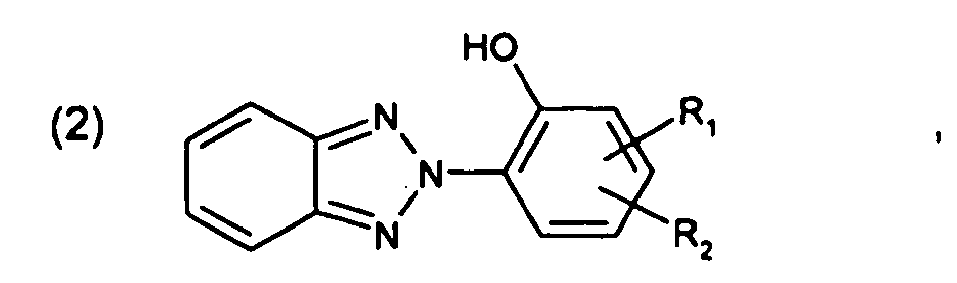 R1 is C1-C30alkyl; andR2 is hydrogen; or C1-C12alkyl,for enhancing the photostability of cosmetic or dermatologic compositons comprising at least one further organic UV absorber.
 - Use according to claim 1, wherein benzotriazoles are of formula
 R1 is a random statistical mixture of at least three isomeric branched secondary alkyl groups each having 8 to 30 carbon atoms and having the formula
 E1 is a straight-chain C1-C14alkyl;E2 is a straight-chain C4-C15alkyl; wherein the total number of carbon atoms in E1 plus E2 is from 7 to 29; andR2 is C1-C5alkyl.
 - Use according to any of claims 1 or 2 , whereinR1 is C8-C16alkyl
- Use according to any of claims 1 to 3, wherein the benzotriazole is of formula

- Use according to any of claims 1 to 4, wherein the benzotriazole derivative is used in amounts from 0.1 to 20 % b.w in the cosmetic or dermatological sun screen formulations.
- Use according to any of claims 1 to 5, wherein the cosmetic or dermatological formulation comprises further organic UV absorbers selected from cinnamic acid derivatives and dibenzoylmethane derivatives.
- Use according to claim 6 wherein the cinnamic acid derivatives are selected from isopentyl p-methoxycinnamate, 2- ethylhexyl 4-methoxycinnamate and ethylhexyl methoxycinnamate.
- Use according to claim 6 wherein the dibenzoylmethane derivative corresponds to formula

- Cosmetic or dermatological composition comprising(a) 0.1 to 5.w. of a dibenzoylmethane derivative;(b) 0.1 to 10 %w. of a cinnamic acid derivative;(c) a benzotriazole derivative as defined in claim 1 in an amount which is sufficient to stabilize components (a) and (b);(d) optionally further UV absorbers; anda cosmetically acceptable carrier.
Priority Applications (1)
| Application Number | Priority Date | Filing Date | Title |
|---|---|---|---|
| EP06777204A EP1888020B1 (en) | 2005-04-28 | 2006-04-20 | Use of benzotriazole derivatives for photostabilisation |
Applications Claiming Priority (3)
| Application Number | Priority Date | Filing Date | Title |
|---|---|---|---|
| EP05103494 | 2005-04-28 | ||
| PCT/EP2006/061686 WO2006114381A1 (en) | 2005-04-28 | 2006-04-20 | Use of benzotriazole derivatives for photostabilisation |
| EP06777204A EP1888020B1 (en) | 2005-04-28 | 2006-04-20 | Use of benzotriazole derivatives for photostabilisation |
Publications (2)
| Publication Number | Publication Date |
|---|---|
| EP1888020A1 EP1888020A1 (en) | 2008-02-20 |
| EP1888020B1 true EP1888020B1 (en) | 2009-12-16 |
Family
ID=35614445
Family Applications (1)
| Application Number | Title | Priority Date | Filing Date |
|---|---|---|---|
| EP06777204A Expired - Lifetime EP1888020B1 (en) | 2005-04-28 | 2006-04-20 | Use of benzotriazole derivatives for photostabilisation |
Country Status (9)
| Country | Link |
|---|---|
| US (1) | US8361446B2 (en) |
| EP (1) | EP1888020B1 (en) |
| JP (1) | JP5107900B2 (en) |
| KR (1) | KR101390273B1 (en) |
| CN (1) | CN101166511B (en) |
| AT (1) | ATE451910T1 (en) |
| BR (1) | BRPI0609905B1 (en) |
| DE (1) | DE602006011154D1 (en) |
| WO (1) | WO2006114381A1 (en) |
Families Citing this family (19)
| Publication number | Priority date | Publication date | Assignee | Title |
|---|---|---|---|---|
| FR2886144B1 (en) * | 2005-05-27 | 2007-06-29 | Oreal | METHOD FOR PHOTOSTABILIZING A DIBENZOYLMETHANE DERIVATIVE WITH A MEROCYANINE SULFONE DERIVATIVE; PHOTOPROTECTIVE COSMETIC COMPOSITIONS CONTAINING THE SAME. |
| ZA200900839B (en) * | 2006-08-24 | 2010-05-26 | Unilever Plc | Photostable cosmetic compositions |
| JP2010536924A (en) * | 2007-08-30 | 2010-12-02 | ビーエーエスエフ ソシエタス・ヨーロピア | Stabilization of cosmetic compositions |
| EP2078521A1 (en) | 2008-01-08 | 2009-07-15 | Stada Arzneimittel Ag | Cosmetic composition containing a derivative of benzotriazol and an AHR antagonist |
| US20120187352A1 (en) * | 2009-03-30 | 2012-07-26 | Isp Investments Inc. | Penetrating UV-Protecting Compositions to Protect Wood and Lignin |
| EP2717829A2 (en) * | 2011-06-08 | 2014-04-16 | DSM IP Assets B.V. | Sunscreens |
| BR112013031538A2 (en) * | 2011-06-08 | 2017-03-21 | Dsm Ip Assets Bv | sunscreens |
| EP2717839A2 (en) * | 2011-06-08 | 2014-04-16 | DSM IP Assets B.V. | Cosmetic compositions |
| WO2016037942A1 (en) * | 2014-09-09 | 2016-03-17 | Basf Se | Mixtures of cosmetic uv absorbers |
| RU2752091C2 (en) * | 2016-06-16 | 2021-07-22 | Джонсон энд Джонсон Консьюмер Инк. | Sunscreen compositions containing combination of linear uv-absorbing polyester and other uv-protecting compounds |
| JP7084924B2 (en) | 2016-12-21 | 2022-06-15 | ユニリーバー・アイピー・ホールディングス・ベスローテン・ヴェンノーツハップ | Personal care composition containing a sparingly soluble compound |
| EA201991185A1 (en) | 2016-12-21 | 2020-01-13 | Юнилевер Н.В. | COMPOSITIONS FOR PERSONAL HYGIENE CONTAINING CYSTINE |
| EP3558255B1 (en) | 2016-12-21 | 2021-10-13 | Unilever IP Holdings B.V. | Topical skin lightening additive and composition with amino acids and nicotinamide compounds |
| CN110121330B (en) | 2016-12-21 | 2022-04-29 | 联合利华知识产权控股有限公司 | Personal care compositions with glutathione precursors comprising 4-substituted resorcinols and amino acids |
| WO2019224048A1 (en) | 2018-05-23 | 2019-11-28 | Unilever Plc | Nanoemulsions and a method for making the same |
| US20210353511A1 (en) * | 2018-10-16 | 2021-11-18 | Calumet Specialty Products Partners, L.P. | Gel stick compositions |
| JP7710990B2 (en) | 2019-03-15 | 2025-07-22 | ベーアーエスエフ・エスエー | Sunscreen composition containing butyl methoxydibenzoylmethane, a triazine derivative and a light stabilizer |
| CN112794827A (en) * | 2020-12-31 | 2021-05-14 | 杭州劲瑞新材料有限公司 | High-weather-resistance and aging-resistance grafted dibenzoxazole stilbene type fluorescent whitening agent and preparation method thereof |
| US20240115478A1 (en) * | 2021-09-08 | 2024-04-11 | Basf Se | Sunscreen or daily care composition comprising bis-ethylhexyloxyphenol methoxyphenyl triazine and inorganic uv filters |
Family Cites Families (13)
| Publication number | Priority date | Publication date | Assignee | Title |
|---|---|---|---|---|
| US6090370A (en) * | 1997-06-27 | 2000-07-18 | Ciba Specialty Chemicals Corporation | Use of selected benzotriazole and triazine derivatives for protecting human hair from the harmful effects of UV radiation |
| GB9715751D0 (en) * | 1997-07-26 | 1997-10-01 | Ciba Geigy Ag | Formulations |
| BRPI9911414B1 (en) * | 1998-06-22 | 2015-12-15 | Ciba Sc Holding Ag | sunscreen formulations |
| ATE472992T1 (en) * | 1998-11-02 | 2010-07-15 | Basf Se | STABILIZATION OF PERSONAL CARE PRODUCTS AND HOUSEHOLD PRODUCTS |
| FR2799966B1 (en) * | 1999-10-22 | 2002-07-26 | Oreal | PROCESS FOR THE PHOTOSTABILIZATION OF SOLAR FILTERS DERIVED FROM DIBENZOYLMETHANE BY AN INSOLUBLE ORGANIC FILTER |
| US6489486B2 (en) * | 2000-02-21 | 2002-12-03 | Roche Vitamins Inc. | 2-hydroxyphenyl benzotriazoles as UV-A/B filters |
| DE10155963A1 (en) * | 2001-11-09 | 2003-05-22 | Beiersdorf Ag | Cosmetic and dermatological light protection formulations containing hydroxybenzophenones, triazine and / or benzotriazole derivatives |
| DE10238649A1 (en) * | 2002-08-23 | 2004-03-11 | Beiersdorf Ag | Low-viscosity cosmetic or dermatological preparations of the oil-in-water type |
| WO2004069261A1 (en) | 2003-02-03 | 2004-08-19 | Arigen, Inc. | Process for producing antiherpesvirus preparation for external use |
| US20060073106A1 (en) * | 2003-02-03 | 2006-04-06 | Dsm Ip Assets B.V. | Novel stabilized cinnamic ester sunscreen compositions |
| BRPI0408994B1 (en) * | 2003-03-24 | 2015-07-14 | Ciba Specialty Chemicals Holding Inc. | Non-therapeutic use of symmetric triazine derivatives, their cosmetic preparation as well as their preparation process |
| JP2005289916A (en) * | 2004-04-01 | 2005-10-20 | Shiseido Co Ltd | Ultraviolet absorber and skin external preparation containing the same |
| JP2010536924A (en) * | 2007-08-30 | 2010-12-02 | ビーエーエスエフ ソシエタス・ヨーロピア | Stabilization of cosmetic compositions |
-
2006
- 2006-04-20 US US11/919,104 patent/US8361446B2/en not_active Expired - Fee Related
- 2006-04-20 DE DE602006011154T patent/DE602006011154D1/en not_active Expired - Lifetime
- 2006-04-20 WO PCT/EP2006/061686 patent/WO2006114381A1/en not_active Ceased
- 2006-04-20 CN CN200680014556XA patent/CN101166511B/en not_active Expired - Lifetime
- 2006-04-20 JP JP2008508196A patent/JP5107900B2/en not_active Expired - Lifetime
- 2006-04-20 AT AT06777204T patent/ATE451910T1/en not_active IP Right Cessation
- 2006-04-20 EP EP06777204A patent/EP1888020B1/en not_active Expired - Lifetime
- 2006-04-20 BR BRPI0609905-0A patent/BRPI0609905B1/en active IP Right Grant
- 2006-04-20 KR KR1020077024677A patent/KR101390273B1/en not_active Expired - Lifetime
Also Published As
| Publication number | Publication date |
|---|---|
| CN101166511B (en) | 2011-09-14 |
| WO2006114381A1 (en) | 2006-11-02 |
| EP1888020A1 (en) | 2008-02-20 |
| KR101390273B1 (en) | 2014-05-19 |
| BRPI0609905A2 (en) | 2010-05-11 |
| JP2008539193A (en) | 2008-11-13 |
| CN101166511A (en) | 2008-04-23 |
| BRPI0609905B1 (en) | 2018-04-03 |
| US20100008873A1 (en) | 2010-01-14 |
| US8361446B2 (en) | 2013-01-29 |
| ATE451910T1 (en) | 2010-01-15 |
| DE602006011154D1 (en) | 2010-01-28 |
| KR20080007336A (en) | 2008-01-18 |
| JP5107900B2 (en) | 2012-12-26 |
Similar Documents
| Publication | Publication Date | Title |
|---|---|---|
| US7311897B2 (en) | Symmetrical triazine derivatives | |
| EP2120854B1 (en) | Stabilization of uv-sensitive active ingredients | |
| EP1469819B1 (en) | Micropigment mixtures | |
| EP2391334B1 (en) | Stabilization of cosmetic compositions | |
| US7344706B2 (en) | UV absorber compositions comprising a hydroxyphenyltriazine compound | |
| EP2180878B1 (en) | Stabilization of cosmetic compositions | |
| EP1585493B1 (en) | Triazine derivatives as uv absorbers | |
| EP3229766B1 (en) | Solubilizing agents for uv filters in cosmetic formulations | |
| US8361446B2 (en) | Use of benzotriazole derivatives for photostabilisation | |
| EP1907484B1 (en) | Naphthalene amidine imides | |
| US20090060853A1 (en) | Aminophenylbenzothiazole compounds | |
| EP3128995B1 (en) | Solublizing agents for uv filters in cosmetic formulations | |
| EP3481365B1 (en) | Solubilizing agents for uv filters in cosmetic formulations | |
| GB2438047A (en) | Triazine derivatives as UV filters for cosmetic compositions | |
| GB2435041A (en) | Silicon-containing benzophenone derivatives | |
| GB2440638A (en) | 2-(2'-Hydroxy-4'-aminophenyl)benzotriazoles as UV protecting agents |
Legal Events
| Date | Code | Title | Description |
|---|---|---|---|
| PUAI | Public reference made under article 153(3) epc to a published international application that has entered the european phase |
Free format text: ORIGINAL CODE: 0009012 |
|
| 17P | Request for examination filed |
Effective date: 20070921 |
|
| AK | Designated contracting states |
Kind code of ref document: A1 Designated state(s): AT BE BG CH CY CZ DE DK EE ES FI FR GB GR HU IE IS IT LI LT LU LV MC NL PL PT RO SE SI SK TR |
|
| RAP1 | Party data changed (applicant data changed or rights of an application transferred) |
Owner name: CIBA HOLDING INC. |
|
| 17Q | First examination report despatched |
Effective date: 20080508 |
|
| DAX | Request for extension of the european patent (deleted) | ||
| GRAP | Despatch of communication of intention to grant a patent |
Free format text: ORIGINAL CODE: EPIDOSNIGR1 |
|
| RAP1 | Party data changed (applicant data changed or rights of an application transferred) |
Owner name: BASF SE |
|
| GRAS | Grant fee paid |
Free format text: ORIGINAL CODE: EPIDOSNIGR3 |
|
| GRAA | (expected) grant |
Free format text: ORIGINAL CODE: 0009210 |
|
| AK | Designated contracting states |
Kind code of ref document: B1 Designated state(s): AT BE BG CH CY CZ DE DK EE ES FI FR GB GR HU IE IS IT LI LT LU LV MC NL PL PT RO SE SI SK TR |
|
| REG | Reference to a national code |
Ref country code: GB Ref legal event code: FG4D |
|
| REG | Reference to a national code |
Ref country code: CH Ref legal event code: EP |
|
| REG | Reference to a national code |
Ref country code: IE Ref legal event code: FG4D |
|
| REF | Corresponds to: |
Ref document number: 602006011154 Country of ref document: DE Date of ref document: 20100128 Kind code of ref document: P |
|
| REG | Reference to a national code |
Ref country code: NL Ref legal event code: VDEP Effective date: 20091216 |
|
| PG25 | Lapsed in a contracting state [announced via postgrant information from national office to epo] |
Ref country code: FI Free format text: LAPSE BECAUSE OF FAILURE TO SUBMIT A TRANSLATION OF THE DESCRIPTION OR TO PAY THE FEE WITHIN THE PRESCRIBED TIME-LIMIT Effective date: 20091216 Ref country code: SE Free format text: LAPSE BECAUSE OF FAILURE TO SUBMIT A TRANSLATION OF THE DESCRIPTION OR TO PAY THE FEE WITHIN THE PRESCRIBED TIME-LIMIT Effective date: 20091216 Ref country code: LT Free format text: LAPSE BECAUSE OF FAILURE TO SUBMIT A TRANSLATION OF THE DESCRIPTION OR TO PAY THE FEE WITHIN THE PRESCRIBED TIME-LIMIT Effective date: 20091216 |
|
| LTIE | Lt: invalidation of european patent or patent extension |
Effective date: 20091216 |
|
| PG25 | Lapsed in a contracting state [announced via postgrant information from national office to epo] |
Ref country code: LV Free format text: LAPSE BECAUSE OF FAILURE TO SUBMIT A TRANSLATION OF THE DESCRIPTION OR TO PAY THE FEE WITHIN THE PRESCRIBED TIME-LIMIT Effective date: 20091216 Ref country code: PL Free format text: LAPSE BECAUSE OF FAILURE TO SUBMIT A TRANSLATION OF THE DESCRIPTION OR TO PAY THE FEE WITHIN THE PRESCRIBED TIME-LIMIT Effective date: 20091216 Ref country code: SI Free format text: LAPSE BECAUSE OF FAILURE TO SUBMIT A TRANSLATION OF THE DESCRIPTION OR TO PAY THE FEE WITHIN THE PRESCRIBED TIME-LIMIT Effective date: 20091216 |
|
| PG25 | Lapsed in a contracting state [announced via postgrant information from national office to epo] |
Ref country code: AT Free format text: LAPSE BECAUSE OF FAILURE TO SUBMIT A TRANSLATION OF THE DESCRIPTION OR TO PAY THE FEE WITHIN THE PRESCRIBED TIME-LIMIT Effective date: 20091216 |
|
| PG25 | Lapsed in a contracting state [announced via postgrant information from national office to epo] |
Ref country code: NL Free format text: LAPSE BECAUSE OF FAILURE TO SUBMIT A TRANSLATION OF THE DESCRIPTION OR TO PAY THE FEE WITHIN THE PRESCRIBED TIME-LIMIT Effective date: 20091216 Ref country code: PT Free format text: LAPSE BECAUSE OF FAILURE TO SUBMIT A TRANSLATION OF THE DESCRIPTION OR TO PAY THE FEE WITHIN THE PRESCRIBED TIME-LIMIT Effective date: 20100416 Ref country code: IS Free format text: LAPSE BECAUSE OF FAILURE TO SUBMIT A TRANSLATION OF THE DESCRIPTION OR TO PAY THE FEE WITHIN THE PRESCRIBED TIME-LIMIT Effective date: 20100416 Ref country code: RO Free format text: LAPSE BECAUSE OF FAILURE TO SUBMIT A TRANSLATION OF THE DESCRIPTION OR TO PAY THE FEE WITHIN THE PRESCRIBED TIME-LIMIT Effective date: 20091216 Ref country code: BG Free format text: LAPSE BECAUSE OF FAILURE TO SUBMIT A TRANSLATION OF THE DESCRIPTION OR TO PAY THE FEE WITHIN THE PRESCRIBED TIME-LIMIT Effective date: 20100316 Ref country code: EE Free format text: LAPSE BECAUSE OF FAILURE TO SUBMIT A TRANSLATION OF THE DESCRIPTION OR TO PAY THE FEE WITHIN THE PRESCRIBED TIME-LIMIT Effective date: 20091216 Ref country code: ES Free format text: LAPSE BECAUSE OF FAILURE TO SUBMIT A TRANSLATION OF THE DESCRIPTION OR TO PAY THE FEE WITHIN THE PRESCRIBED TIME-LIMIT Effective date: 20100327 |
|
| PG25 | Lapsed in a contracting state [announced via postgrant information from national office to epo] |
Ref country code: BE Free format text: LAPSE BECAUSE OF FAILURE TO SUBMIT A TRANSLATION OF THE DESCRIPTION OR TO PAY THE FEE WITHIN THE PRESCRIBED TIME-LIMIT Effective date: 20091216 Ref country code: CZ Free format text: LAPSE BECAUSE OF FAILURE TO SUBMIT A TRANSLATION OF THE DESCRIPTION OR TO PAY THE FEE WITHIN THE PRESCRIBED TIME-LIMIT Effective date: 20091216 Ref country code: SK Free format text: LAPSE BECAUSE OF FAILURE TO SUBMIT A TRANSLATION OF THE DESCRIPTION OR TO PAY THE FEE WITHIN THE PRESCRIBED TIME-LIMIT Effective date: 20091216 |
|
| PLBE | No opposition filed within time limit |
Free format text: ORIGINAL CODE: 0009261 |
|
| STAA | Information on the status of an ep patent application or granted ep patent |
Free format text: STATUS: NO OPPOSITION FILED WITHIN TIME LIMIT |
|
| PG25 | Lapsed in a contracting state [announced via postgrant information from national office to epo] |
Ref country code: CY Free format text: LAPSE BECAUSE OF FAILURE TO SUBMIT A TRANSLATION OF THE DESCRIPTION OR TO PAY THE FEE WITHIN THE PRESCRIBED TIME-LIMIT Effective date: 20091216 Ref country code: GR Free format text: LAPSE BECAUSE OF FAILURE TO SUBMIT A TRANSLATION OF THE DESCRIPTION OR TO PAY THE FEE WITHIN THE PRESCRIBED TIME-LIMIT Effective date: 20100317 |
|
| 26N | No opposition filed |
Effective date: 20100917 |
|
| PG25 | Lapsed in a contracting state [announced via postgrant information from national office to epo] |
Ref country code: MC Free format text: LAPSE BECAUSE OF NON-PAYMENT OF DUE FEES Effective date: 20100430 |
|
| REG | Reference to a national code |
Ref country code: CH Ref legal event code: PL |
|
| PG25 | Lapsed in a contracting state [announced via postgrant information from national office to epo] |
Ref country code: IE Free format text: LAPSE BECAUSE OF NON-PAYMENT OF DUE FEES Effective date: 20100420 Ref country code: DK Free format text: LAPSE BECAUSE OF FAILURE TO SUBMIT A TRANSLATION OF THE DESCRIPTION OR TO PAY THE FEE WITHIN THE PRESCRIBED TIME-LIMIT Effective date: 20091216 |
|
| PG25 | Lapsed in a contracting state [announced via postgrant information from national office to epo] |
Ref country code: CH Free format text: LAPSE BECAUSE OF NON-PAYMENT OF DUE FEES Effective date: 20100430 Ref country code: LI Free format text: LAPSE BECAUSE OF NON-PAYMENT OF DUE FEES Effective date: 20100430 |
|
| PG25 | Lapsed in a contracting state [announced via postgrant information from national office to epo] |
Ref country code: IT Free format text: LAPSE BECAUSE OF FAILURE TO SUBMIT A TRANSLATION OF THE DESCRIPTION OR TO PAY THE FEE WITHIN THE PRESCRIBED TIME-LIMIT Effective date: 20091216 |
|
| PG25 | Lapsed in a contracting state [announced via postgrant information from national office to epo] |
Ref country code: HU Free format text: LAPSE BECAUSE OF FAILURE TO SUBMIT A TRANSLATION OF THE DESCRIPTION OR TO PAY THE FEE WITHIN THE PRESCRIBED TIME-LIMIT Effective date: 20100617 Ref country code: LU Free format text: LAPSE BECAUSE OF NON-PAYMENT OF DUE FEES Effective date: 20100420 |
|
| PG25 | Lapsed in a contracting state [announced via postgrant information from national office to epo] |
Ref country code: TR Free format text: LAPSE BECAUSE OF FAILURE TO SUBMIT A TRANSLATION OF THE DESCRIPTION OR TO PAY THE FEE WITHIN THE PRESCRIBED TIME-LIMIT Effective date: 20091216 |
|
| REG | Reference to a national code |
Ref country code: FR Ref legal event code: PLFP Year of fee payment: 11 |
|
| REG | Reference to a national code |
Ref country code: FR Ref legal event code: PLFP Year of fee payment: 12 |
|
| REG | Reference to a national code |
Ref country code: FR Ref legal event code: PLFP Year of fee payment: 13 |
|
| PGFP | Annual fee paid to national office [announced via postgrant information from national office to epo] |
Ref country code: DE Payment date: 20250428 Year of fee payment: 20 |
|
| PGFP | Annual fee paid to national office [announced via postgrant information from national office to epo] |
Ref country code: GB Payment date: 20250422 Year of fee payment: 20 |
|
| PGFP | Annual fee paid to national office [announced via postgrant information from national office to epo] |
Ref country code: FR Payment date: 20250424 Year of fee payment: 20 |
|
| REG | Reference to a national code |
Ref country code: DE Ref legal event code: R071 Ref document number: 602006011154 Country of ref document: DE |