EP1884131B1 - Separating control and data in wireless networks - Google Patents
Separating control and data in wireless networks Download PDFInfo
- Publication number
- EP1884131B1 EP1884131B1 EP06750333.4A EP06750333A EP1884131B1 EP 1884131 B1 EP1884131 B1 EP 1884131B1 EP 06750333 A EP06750333 A EP 06750333A EP 1884131 B1 EP1884131 B1 EP 1884131B1
- Authority
- EP
- European Patent Office
- Prior art keywords
- data
- sending
- data packets
- channel
- packets
- Prior art date
- Legal status (The legal status is an assumption and is not a legal conclusion. Google has not performed a legal analysis and makes no representation as to the accuracy of the status listed.)
- Expired - Lifetime
Links
Images


Classifications
-
- H—ELECTRICITY
- H04—ELECTRIC COMMUNICATION TECHNIQUE
- H04L—TRANSMISSION OF DIGITAL INFORMATION, e.g. TELEGRAPHIC COMMUNICATION
- H04L12/00—Data switching networks
- H04L12/28—Data switching networks characterised by path configuration, e.g. LAN [Local Area Networks] or WAN [Wide Area Networks]
-
- H—ELECTRICITY
- H04—ELECTRIC COMMUNICATION TECHNIQUE
- H04W—WIRELESS COMMUNICATION NETWORKS
- H04W72/00—Local resource management
- H04W72/20—Control channels or signalling for resource management
Definitions
- the present invention generally relates to wireless networks and more particularly relates to separating control and data in wireless networks.
- the user may talk on a wireless phone, schedule appointments using a personal digital assistant, edit documents on a personal computer (PC), play games on a game console, watch recorded television programming from a digital video recorder, and so on.
- a personal digital assistant may be communicatively coupled to the desktop PC to share a schedule.
- each of these devices may have peripheral devices which further increase the functionality of the device.
- a headset may be utilized with the wireless phone
- a global positioning system (GPS) receiver may be utilized with a personal digital assistant
- a printer may be utilized with the personal computer
- another game console may be attached to the game console so that players can play "head-to-head", and so forth.
- GPS global positioning system
- wireless communication One technique that is gaining popularity in the connection of these devices is wireless communication.
- wireless communication may be utilized such that the devices do not need to be physically connected to communicate.
- the functionality of the devices continues to increase, the amount of information shared between the devices in also increasing, thereby consuming the bandwidth available over the wireless connection.
- the number of devices continues to increase, the amount of overall wireless bandwidth consumed by the devices as a whole is also increasing.
- WO 2005/039225 A1 provides a method for sending and receiving data, wherein first a plurality of multi-receiver frames are exchanged between stations and second, mono-receiver frames are exchanged between the transmitting station and one receiving station, wherein for sending multi-receiver frames omnidirectional antennas are used and for sending mono-receiver frames a directional antenna is used.
- Wireless communication techniques are described in which control and data are separated.
- a method is described which includes sending data packets on one or more wireless channels and sending control data relating to the data packets on at least one other wireless channel having a data rate that is lower than a data rate of the one or more wireless channels.
- the one or more wireless channels may operate at frequencies about 900 MHz while the at least one channel operates at a frequency below 900 MHz.
- a method which includes sending a set of data packets on one or more wireless channels and sending control data on at least one other wireless channel during the sending of the set of data packets.
- the control data is configured to reserve a time on the one or more wireless channels to send another set of data packets.
- a method which includes sending a set of data packets on one or more wireless channels and sending contention control data relating to another set of data packets on at least one other wireless channel simultaneously during sending of the set of data packets.
- Radio spectrum allocated for use in unlicensed wireless networks is typically distributed across non-contiguous frequency bands, hereinafter also referred to as “slices”, “slivers” and “channels”.
- Traditional Medium Access Control (MAC) protocols e.g., IEEE 802.11, however, only operate in contiguous bands, which is inefficient and results in decreased data transfer bandwidth.
- MAC Medium Access Control
- a split-channel protocol is described that improves the capacity of a wireless infrastructure and multi-hop wireless network by utilizing a sliver of unused spectrum in the lower frequency band for control purposes which was previously deemed unsuitable for data transfer.
- the protocol may increase throughput by moving contention resolution overheads to a separate low-rate channel (e.g., at or below 900 MHz) than a data channel which is to be utilized for transfer of data received from a "higher layer", e.g., an application.
- the protocol may incorporate a variety of techniques for separate transfer of control and data. For example, the protocol may allow simultaneous channel contention and data transmission by incorporating "advance reservation" on the control channel and "data aggregation" on the data channel, and so on, further discussion of which may be found in relation to the following sections.
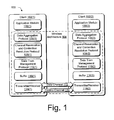
- FIG. 1 is an illustration of an environment 100 in an exemplary implementation that is operable to employ a wireless protocol having split data and control channels.
- the environment includes a first client 102(1) and a second client 102(2) which are communicatively coupled, one to another, using a wireless architecture 104.
- the clients 102(1), 102(2) may be configured in a variety of ways for communicating via the wireless architecture 104.
- one or more of the clients 102(1), 102(2) may be configured as a computing device, such as a desktop computer, a mobile station, an entertainment appliance, a wireless phone, a game console, and so forth.
- one or more of the clients 102(1), 102(2) may be configured as a peripheral device, such as a wireless printer.
- the clients 102(1), 102(2) may range from full resource devices with substantial memory and processor resources (e.g., personal computers, game consoles) to low-resource devices with limited memory and/or processing resources (e.g., peripheral devices).
- the clients 102(1), 102(2) may also be referenced as "nodes" in the wireless architecture 104.
- the wireless architecture 104 is further illustrated as including a plurality of protocol components on each of the clients 102(1), 102(2), respectively, which as illustrated include data aggregation protocols 106(1), 106(2), channel reservation and contention resolution protocols 108(1), 108(2), and data train management protocols 110(1), 110(2).
- Data aggregation protocols 106(1), 106(2) are representative of functionality which is responsible for aggregating packets to a particular destination into a train of packets.
- the data aggregation protocols 106(1), 106(2) for instance, may maintain a separate queue for each neighboring node to support per-destination aggregation.
- Channel reservation and contention resolution protocols 108(1), 108(2) are representative of functionality to resolve contention and reserve time on a data channel 112 for a packet train received from the data aggregation protocols 106(1), 106(2) by exchanging "request-to-send” (RTS) and "clear-to-send” (CTS) packets on a control channel 114.
- RTS request-to-send
- CTS clear-to-send
- Data train management protocols 110(1), 110(2) are representative of functionality in the wireless architecture 104 that manages respective buffers 116(1), 116(2) at the respective clients 102(1), 102(2).
- the buffers 116(1), 116(2) may be utilized to buffer packets which were transmitted or received utilizing a respective transmitter/receiver 118(1), 118(2), e.g., radios.
- the data train management protocol 110(1), 110(2) may also selectively send an acknowledgement packet (ACK) for the received packets in the trains and support retransmission of lost packets.
- ACK acknowledgement packet
- the data aggregation protocols 106(1), 106(2) may be utilized to build a train of packets which has a total size greater than a specified threshold, and transmit the train using a single reservation on the control channel 114.
- the data aggregation protocol 106(1), 106(2) may be configured such that the control channel 114 does not become a bottleneck to performance because each reservation on the control channel 114 may reserve time for relatively "large" packets, e.g., packet trains.
- the RTS-CTS exchange reserves the data channel 112 for communication between a sender and one receiver.
- the packets in the train have a common destination.
- successive packets from a higher layer e.g., the application modules 120(1), 120(2)
- the data aggregation protocol 106(1), 106(2) may be utilized to separately aggregate packets for each destination.
- the data aggregation protocol 106(1), 106(2) may maintain a queue for each known neighbor, e.g., another client. Whenever a packet is received from the higher layer to a destination for which that are no packets pending, the data aggregation protocol 106(1), 106(2) may assemble a new packet train. When the size of the packet train is equal to the threshold (hereinafter referred to as an "aggregation limit"), which is a parameter of the data aggregation protocol 106(1), 106(2), the packet train is transferred to the channel reservation and contention resolution protocol 108(1), 108(2) for scheduling and subsequent transmission.
- the threshold hereinafter referred to as an "aggregation limit”
- the data aggregation protocol 106(1), 106(2) may utilize another parameter called "aggregation timeout", which specifies a maximum time a partially built packet train may wait for a new packet. Thus, even when multiple packets to a single destination are not available, the packet is sent as specified by the aggregation timeout parameter.
- a timer may be associated with each packet train being built, and is reset to the value of aggregation timeout whenever a new packet is added to the train.
- the packet train associated with the timer is "handed off" to channel reservation and contention resolution protocol 108(1), 108(2) for scheduling even if the size of the packet train is less than the aggregation limit. Therefore, the timeout mechanism ensures that there is an upper bound on the maximum delay introduced by the data aggregation protocol 106(1), 106(2).
- the data aggregation protocol 106(1), 106(2) may also be enhanced to use a threshold based on a total size of packets in a packet train, in addition to using a threshold based on a number of packets in a packet train. This extension may be useful when a size of the individual packets varies significantly.
- the average size of data transmitted for each contention resolution attempt is sufficiently large to achieve significant performance improvements be aggregating packets into a train of packets and reserving the data channel for the whole train with the single contention resolution operation.
- the size of the packet train effectively increases the size of the "packets" communicated on the data channel.
- the data aggregation protocols 106(1), 106(2) may be utilized such that the average packet train size is larger than a threshold, such that an improvement in the throughput of the data channel 112 is larger than the data rate of the control channel 114.
- Channel reservation and contention resolution protocol may include two parts, a reservation protocol and a contention protocol.
- the reservation protocol exchanges control packets between a sender and a receiver (e.g., RTS and CTS packets) for reservation of the data channel.
- the reservation protocol has a parameter "reserve ahead limit" that indicates a maximum number of packet trains that may be reserved for transmission at any time, i.e., advance reservation.
- a new reservation is initiated. Otherwise, the packet train is buffered (e.g., via a respective buffer 116(1), 116(2)) until a reservation opportunity arises later.
- Each channel reservation and contention resolution protocol 108(1), 108(2) on the respective clients 102(1), 102(2) may also maintain a reservation table to tracks reservation already scheduled for communication on the data channel 112.
- a sender initiating the reservation first computes a time "T" utilized for transmitting the associated packet train and receiving an acknowledgement (ACK).
- the sender then examines the reservation table for an earliest time "E", starting from an estimated end of the RTS-CTS exchanges, when the data channel is continuously free for T duration.
- the pair (E, T) is sent in the RTS.
- the receiver also examines its reservation table to check if the duration (E, T) is indeed free. If the channel is free during (E, T), then (E, T) is sent back in the CTS.
- E1 a next possible time after E (denoted as "E1") is chosen, for which, the channel is free for duration T and (E1, T) is sent back in the CTS.
- the receiver adds the pair sent in the CTS to its reservation table.
- the sender receives a CTS with some pair (E, T) it checks if this pair conflicts with an entry in the reservation table. If there is no conflict, then the reservation is successful, and (E, T) is added to the reservation table. Otherwise, a new reservation attempt is initiated.
- the reservation protocol may use a retransmission procedure which doubles a contention window when encountering a collision.
- the packet train is scheduled for transmission on the data channel at time E. This protocol will be described in greater detail in the following discussion.
- Advance reservation can be utilized to "hide" variations in contention resolution and data transfer durations.
- advance reservation may provide loose synchronization among nodes through specifying an item in a control packet relative to reception of that packet.
- the reservation interval may be set sufficiently large such that an amount of time utilized to transmit a data train accounts for propagation delay, but is not so long as to encounter clock drift errors.
- the reserve ahead limit may be set to equal a duration utilized to transmit a limited multiple of data packets, and thereby prevent data packet collisions resulting from two transmissions overlapping each other.
- the data train management protocol 110(1), 110(2) may be utilized to transmit a burst of packets during a single transmission opportunity. However, because the underlying data channel may not be error free, some of the packets in a packet train may be lost or corrupted. Therefore, these packets are retransmitted.
- a selective acknowledgment technique is employed in which a single acknowledgement packet (ACK) is utilized at the end of a packet burst.
- the acknowledgement packet for instance, may utilize a bit map to indicate which packets were correctly received. Based on the received acknowledgement packet, the lost and/or corrupted packets of a packet train are assembled into a new packet train and retransmitted after obtaining a reservation from the reservation protocol as previously described. In an instance in which an acknowledgement packet is not received at the end of a packet train transmission, the packet train may be retransmitted.
- each packet train is retransmitted a number of times that is below a specified threshold, which is referred to as a "retransmission threshold".
- a packet train may have a sequence number, and individual packets within the packet train may be identified by a number relative to the packet train.
- the packet train transmission management may be implemented without sending a separate acknowledgement (i.e., ACK) for each individual packet, but rather a single acknowledgement that may be sent which describes a plurality of packets in a packet train.
- the received packets are communicated to a higher layer (e.g., the application modules 120(1), 120(2)) in order.
- a higher layer e.g., the application modules 120(1), 120(2)
- the received packets may be buffered. After the missing packet is received following a retransmission, each of the buffered packets is communicated in order, one to another.
- a timeout may be associated with the buffer to ensure that if one or more packets in a train are never received, then subsequently received packets are transferred to the higher layer out of order after the timeout expires.
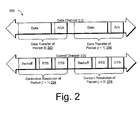
- FIG. 2 is an illustration of data transfer 200 in an exemplary implementation which may be performed using the data channel 112 and the control channel 114 of FIG. 1 .
- the protocol as previously described, provides separate data and control channels 112, 114.
- the protocol may utilize Carrier Sense Multiple Access with Collision Avoidance (CSMA/CA) for controlling access to the channel and using control packets, e.g., request to send (RTS) and clear to send (CTS), for channel reservation.
- CSMA/CA Carrier Sense Multiple Access with Collision Avoidance
- RTS request to send
- CTS clear to send
- contention resolution results in an overhead that uses available bandwidth of the channel without transferring "useful" data, e.g., data useful to a receiving application from a sending application as opposed to control data used for the transfer of that data which resides within the protocol itself. Therefore, the throughput over the high-rate data channel may be improved if the contention resolution phase is moved to the control channel 114 as previously described.
- the contention resolution phase on the control channel 114 is performed in parallel (i.e., simultaneous) with data transfer on the data channel 112, as shown in the exemplary data transfer 200 of FIG. 2 .
- the data transfer may be performed on a relatively high-bandwidth data channel while contention resolution is performed on a relatively low-bandwidth data channel that was not previously utilized for control or data transfer.
- FIG. 3 is an illustration of data transfer 200 in an exemplary implementation which may be performed using the data channel 112 and the control channel 114 of FIG. 1 without an advance reservation technique. If contention resolution for packet "i + 1" on the control channel 114 does not complete by the end of transmission of packet "i" on the data channel, then the data channel 112 may stay idle 302 until completion of contention resolution.
- Contention resolution may take varying amounts of time, as it may depend on the "backoff" values chosen, and RTS and/or CTS collisions, if any.
- data transmission duration depends on the size of the data packet, which may vary from packet to packet.
- the time for contention resolution may depend in part on a data rate of the control channel 114; however, in an implementation the protocol is insensitive to variations in the durations of contention resolution and data packet transmission.
- the control channel may also encounter an idle period 304 which may cause a subsequent idle period for the data channel idle 306.
- an advance reservation technique may be employed to limit and even eliminate idle time of the data channel 112 as well as the control channel 114, further discussion of which may be found in relation to the following figure.
- FIG. 4 is an illustration of data transfer 400 in an exemplary implementation which may be performed using the data channel 112 and the control channel 114 of FIG. 1 in conjunction with an advance reservation technique.
- Advance reservation is a technique which allows each node (e.g., clients 102(1), 102(2)) to "reserve ahead" for "k" packets, where "k” is a protocol parameter. Therefore, a node transmitting packet "i" on the data channel can reserve the data channel for up to "k” additional packets using modified RTS-CTS packets exchanged on the control panel.
- advance reservation may be utilized to decouple contention resolution and data transfer in time through use of the separate channels.
- the data channel 112 when advance reservation is not used, if the contention resolution for packet "i + 2" takes longer than average, then the data channel 112 will be idle until contention resolution for packet "i + 2" is completed.
- the data transfer for packet "i” takes longer than contention resolution for packet "i + 1"
- the idle time on the control channel cannot be utilized unless advance reservation is used as shown in the data transfer 400 of FIG. 4 .
- the advance reservation technique may utilize a carefully chosen value for "k” that ensures that the control channel is not a bottleneck to performance as along as the average duration for contention resolution is smaller than the average duration for data transfer.
- Directional communication may be utilized for improving capacity of a wireless network.
- the protocol may be utilizing with omnidirectional as well as with direction antennas to take advantage of directional communication.
- an omnidirectional RTS-CTS technique may be utilized in which RTS and CTS packets are sent omnidirectionally, and data and acknowledge packets are exchanged directionally.
- directional RTS-CTS technique may be utilized in which RTS and CTS packets are sent directionally.
- the direction to be used for communication may be discovered a priori. When directional RTS and CTS are used, spatial reuse increases.
- directional RTS-CTS may result in poor performance in certain topologies due to a problem know as "deafness", an example of which is described as follows.
- nodes A and B are communicating after a prior directional RTS-CTS exchange.
- Node C wishes to communicate with B and initiates a directional RTS. But B is beam-formed toward A and fails to receive the RTS.
- Node C may misinterpret the absence of CTS as a sign of RTS collision due to congestion, and increase its backoff, and thus degrade throughput. Thus, deafness may arise because the use of directional RTS-CTS results in some nodes in the neighborhood being unaware of ongoing communication.
- omnidirectional transmission is utilized on the control channel 114, while using directional transmission on the data channel 112.
- spatial reuse benefits of directional antennas may be realized without suffering from the deafness problem previously described.
- node C initiates a RTS transmission to node B on the control channel
- node B may respond with a CTS since the data communication with A is proceeding on the data channel.
- the control channel architecture provides a solution for exploiting spatial reuse benefits of direction antennas, while not incurring the performance penalty of deafness. These benefits may be in addition to the benefits of using the control channel approach described earlier.
- the use of an omnidirectional control channel also simplifies the problem of neighbor discovery.
- the range of omnidirectional RTS-CTS of the control channel 114 is at least as large as a range of directional transmission on the data channel 112. It should be noted that when the control channel 114 operates at a lower frequency than the data channel 122 as previously described, the control channel 114 may support a correspondingly greater range. Additionally, if additional range is desired, the transmission power on the control channel may be suitably increased, further discussion of which may be found in relation to the following section.
- the data and control channels 112, 114 are also likely to have different ranges. While the exact difference in the range depends on several factors such as power levels and environmental factors, it is likely that the range of the control channel will be greater than the range of the data channel.
- the control channel is expected to be located in a lower frequency band, and consequently, for fixed transmission power, the control channel experiences a smaller path loss, resulting in reducing the effect of hidden terminals.
- the range up to which transmission may interfere with another transmission i.e., the "interference range"
- the control channel range is close to the interference range of the data channel, each node in the interference region may be notified of an impending transmission, thereby preventing data packet collisions and also permitting maximum spatial use.
- the control channel range is significantly greater than the data channel range, the control channel may reserve an unnecessarily large area, reducing spatial reuse.
- RTS-CTS transmission is performed on a different channel for the DATA-ACK transmission.
- RTS-CTS transmission will not interfere with data transmission on the data channel.
- a control channel with longer range is also beneficial when using directional antennas as previously described.
- FIG. 5 is a flow diagram depicting a procedure 500 in an exemplary implementation in which data and control information are simultaneously communicated on respective data and control channels.
- Data is received at a protocol layer from a higher layer for communication over a wireless network (block 502).
- the wireless architecture 104 may be implemented at the protocol level and the application modules 120(1), 120(2) are not aware of the particulars as to how the data is communicated.
- the data received from the higher layer is formed into one or more packet trains, each having a plurality of packets (block 504).
- the data aggregation protocol may be utilized to form a plurality of packets, and then form those packets into the one or more packet trains as previously described.
- Control data is sent on a control channel to perform advance reservation and contention resolution for the communication of at least one of the packet trains (block 506).
- a sender may send a RTS packet over the control channel which is utilized by a receiver to confirm scheduling of a particular time, during which, the packet train is to be communicated.
- a response is received via the control channel indicating a particular time, during which, the at lease one packet train is to be communicated (block 508).
- the sender may receive a CTS packet over the control channel which confirms the particular time, proposes a different time, and so on.
- the at least one packet train is sent over a data channel at the particular time, the data channel being separate from the control channel (block 510).
- the packet train may be sent on the data channel 112 configured to have a frequency about 900MHz, while the control channel 114 has a frequency below 900 MHz.
- the data channel 112 may have a higher data throughput rate than that of the control channel 114.
- control data is sent on the control channel to perform advance reservation and contention resolution for the communication of another one of the packet trains (block 512).
- the other one of the packet trains may be formed from the data received from the "higher" layers by the protocol layer (block 502).
- the reception of the data which forms the other packet train may be performed before and/or during the sending, receiving, and sending previously described (i.e., blocks 506-510).
- a response is received indicating another particular time, during which, the other packet train is to be communicated (block 514).
- the other packet train is then sent at the other particular time over the data channel (clock 516).
- This procedure 500 may be repeated as additional data is received from the higher layer for transfer over the wireless network.
- any of the functions described herein can be implemented using software, firmware (e.g., fixed logic circuitry), manual processing, or a combination of these implementations.
- the terms “modules,” “functionality,” and “logic” as used herein generally represent software, firmware, or a combination of software and firmware.
- the module, functionality, or logic represents program code that performs specified tasks when executed on a processor (e.g., CPU or CPUs).
- the program code can be stored in one or more computer readable memory devices.
- the protocol splits and IEEE 802.11 protocol be operating a control portion over a low-frequency, low-data rate channel and a data portion over a highfrequency, high-data rate channel. Contention resolution occurs on the lower-rate channel (i.e., the "data channel") is used for exchanging data packets.
- the protocol may also be utilized to perform advance packet reservation and data aggregation to ensure that the control channel does not become a bottleneck to the data channel. Further, the protocol may perform channel arbitration and data transmission simultaneously.
Landscapes
- Engineering & Computer Science (AREA)
- Computer Networks & Wireless Communication (AREA)
- Signal Processing (AREA)
- Mobile Radio Communication Systems (AREA)
- Data Exchanges In Wide-Area Networks (AREA)
Applications Claiming Priority (2)
| Application Number | Priority Date | Filing Date | Title |
|---|---|---|---|
| US11/135,001 US7613138B2 (en) | 2005-05-23 | 2005-05-23 | Separating control and data in wireless networks |
| PCT/US2006/014267 WO2006127176A2 (en) | 2005-05-23 | 2006-04-14 | Separating control and data in wireless networks |
Publications (3)
| Publication Number | Publication Date |
|---|---|
| EP1884131A2 EP1884131A2 (en) | 2008-02-06 |
| EP1884131A4 EP1884131A4 (en) | 2012-04-04 |
| EP1884131B1 true EP1884131B1 (en) | 2014-07-30 |
Family
ID=37448236
Family Applications (1)
| Application Number | Title | Priority Date | Filing Date |
|---|---|---|---|
| EP06750333.4A Expired - Lifetime EP1884131B1 (en) | 2005-05-23 | 2006-04-14 | Separating control and data in wireless networks |
Country Status (6)
| Country | Link |
|---|---|
| US (2) | US7613138B2 (https=) |
| EP (1) | EP1884131B1 (https=) |
| JP (1) | JP2008546275A (https=) |
| KR (1) | KR101213850B1 (https=) |
| CN (1) | CN101502164B (https=) |
| WO (1) | WO2006127176A2 (https=) |
Families Citing this family (30)
| Publication number | Priority date | Publication date | Assignee | Title |
|---|---|---|---|---|
| US7791503B2 (en) * | 1997-10-22 | 2010-09-07 | Intelligent Technologies International, Inc. | Vehicle to infrastructure information conveyance system and method |
| US8369795B2 (en) | 2005-01-12 | 2013-02-05 | Microsoft Corporation | Game console notification system |
| US9289678B2 (en) | 2005-01-12 | 2016-03-22 | Microsoft Technology Licensing, Llc | System for associating a wireless device to a console device |
| US8189517B2 (en) * | 2005-07-29 | 2012-05-29 | Avaya Inc. | Broadcast/multicast data in a wireless network |
| US8036187B2 (en) * | 2005-07-29 | 2011-10-11 | Avaya Inc. | Broadcast/multicast data in a wireless network |
| US20070111796A1 (en) * | 2005-11-16 | 2007-05-17 | Microsoft Corporation | Association of peripherals communicatively attached to a console device |
| US8320244B2 (en) * | 2006-06-30 | 2012-11-27 | Qualcomm Incorporated | Reservation based MAC protocol |
| KR100779105B1 (ko) * | 2006-12-07 | 2007-11-27 | 한국전자통신연구원 | 전파세기가 다른 멀티채널을 이용하는 usn 시스템 및 그구성 방법 |
| US8493955B2 (en) * | 2007-01-05 | 2013-07-23 | Qualcomm Incorporated | Interference mitigation mechanism to enable spatial reuse in UWB networks |
| WO2008134590A1 (en) * | 2007-04-26 | 2008-11-06 | Mushroom Networks | Link aggregation methods and devices |
| US8850073B1 (en) * | 2007-04-30 | 2014-09-30 | Hewlett-Packard Development Company, L. P. | Data mirroring using batch boundaries |
| US8594050B2 (en) * | 2007-12-28 | 2013-11-26 | Intel Corporation | Techniques to control wireless personal area networks |
| CN101911780B (zh) * | 2008-01-09 | 2014-08-13 | 皇家飞利浦电子股份有限公司 | 在使用定向天线的无线网络中进行无线设备发现的方法和系统 |
| US8228911B2 (en) * | 2008-09-19 | 2012-07-24 | Honeywell International Inc. | Enhanced data link communication over iridium |
| US20100135326A1 (en) * | 2008-11-21 | 2010-06-03 | Qualcomm Incorporated | Technique for bundle creation |
| US8233495B2 (en) * | 2009-04-22 | 2012-07-31 | Intel Corporation | Discovery channel and discovery beacon for peer-to-peer devices in wireless communications network |
| US8503359B2 (en) * | 2009-06-26 | 2013-08-06 | Intel Corporation | Use of delayed clear-to-send and denial-to-send in directional wireless networks |
| US8630582B2 (en) * | 2009-09-02 | 2014-01-14 | Sony Corporation | Out-of-band radio link protocol and network architecture for a wireless network composed of wireless terminals with millimetre wave frequency range radio units |
| US20110143665A1 (en) * | 2009-12-15 | 2011-06-16 | Carlos Cordeiro | Method and apparatus for multiple access for directional wireless networks |
| KR101094013B1 (ko) * | 2009-12-30 | 2011-12-15 | 주식회사 팬택 | 사용자 단말기 및 그의 무선자원을 이용한 프레임 송수신 방법, 그리고, 기지국의 무선자원을 이용한 프레임 전송 방법 |
| WO2012106018A1 (en) * | 2011-02-02 | 2012-08-09 | Intel Corporation | Method, apparatus and system of communication over multiple frequency bands |
| US9847889B2 (en) | 2011-07-20 | 2017-12-19 | Cisco Technology, Inc. | Packet trains to improve packet success rate in carrier sense multiple access networks |
| WO2013153233A1 (en) * | 2012-04-13 | 2013-10-17 | Anyfi Networks Ab | End-to-end security in an ieee 802.11 communication system |
| KR101975483B1 (ko) * | 2012-06-20 | 2019-05-07 | 삼성전자주식회사 | 디바이스 간 직접 통신을 수행하는 시스템에서 패킷 전송 방법 및 장치 |
| US9167445B2 (en) | 2012-08-24 | 2015-10-20 | Ascom Network Testing Ab | Systems and methods for measuring available bandwidth in mobile telecommunications networks |
| US9432458B2 (en) | 2013-01-09 | 2016-08-30 | Dell Products, Lp | System and method for enhancing server media throughput in mismatched networks |
| US9485729B2 (en) * | 2013-08-14 | 2016-11-01 | Samsung Electronics Co., Ltd. | Selecting a transmission policy and transmitting information to a wearable device |
| US10411862B2 (en) * | 2015-05-06 | 2019-09-10 | Telefonaktiebolaget Lm Ericsson (Publ) | Inserting and extracting control data using frequency components |
| US10339382B2 (en) * | 2015-05-31 | 2019-07-02 | Fieldbit Ltd. | Feedback based remote maintenance operations |
| US10129870B2 (en) * | 2015-09-01 | 2018-11-13 | Qualcomm Incorporated | Separation of control and data subbands in unlicensed spectrum |
Family Cites Families (26)
| Publication number | Priority date | Publication date | Assignee | Title |
|---|---|---|---|---|
| JPH03214825A (ja) * | 1990-01-19 | 1991-09-20 | Nippon Telegr & Teleph Corp <Ntt> | 予約チャネル分割型チャネル制御方法 |
| US5754961A (en) * | 1994-06-20 | 1998-05-19 | Kabushiki Kaisha Toshiba | Radio communication system including SDL having transmission rate of relatively high speed |
| JP3212238B2 (ja) * | 1995-08-10 | 2001-09-25 | 株式会社日立製作所 | 移動通信システムおよび移動端末装置 |
| US6304914B1 (en) * | 1998-09-22 | 2001-10-16 | Microsoft Corporation | Method and apparatus for pre-compression packaging |
| US6389039B1 (en) * | 1998-10-22 | 2002-05-14 | Telefonaktiebolaget Lm Ericsson (Publ) | Asynchronous transfer on the cellular radio link |
| US6473399B1 (en) * | 1998-11-30 | 2002-10-29 | Telefonaktiebolaget Lm Ericsson (Publ) | Method and apparatus for determining an optimum timeout under varying data rates in an RLC wireless system which uses a PDU counter |
| EP1337075B1 (en) * | 2000-05-17 | 2007-07-11 | Matsushita Electric Industrial Co., Ltd. | Hybrid ARQ system with data and control channel for packet data transmission |
| US7499468B2 (en) | 2001-04-06 | 2009-03-03 | Montgomery Jr Charles Donald | Method of adapting an optical network to provide lightpaths to dynamically assigned higher priority traffic |
| US7106738B2 (en) * | 2001-04-06 | 2006-09-12 | Erlang Technologies, Inc. | Method and apparatus for high speed packet switching using train packet queuing and providing high scalability |
| ATE313900T1 (de) * | 2001-10-08 | 2006-01-15 | Siemens Ag | Kanalzuweisung von kontrolldaten und nutzdaten in drahtlosen kommunikationssystemen |
| JP2003143651A (ja) * | 2001-10-31 | 2003-05-16 | Toshiba Corp | 広帯域移動アクセスシステム及び無線基地局及び無線端末 |
| US7184717B2 (en) * | 2001-12-28 | 2007-02-27 | Intel Corporation | Portable communication device having a MEMS switch and method therefor |
| JP3559268B2 (ja) * | 2002-05-23 | 2004-08-25 | 松下電器産業株式会社 | パス検出装置及び通信端末装置 |
| JP4052060B2 (ja) * | 2002-08-21 | 2008-02-27 | 日本電気株式会社 | Cdma無線装置及びそれに用いる簡易パス推定方法 |
| JP3999605B2 (ja) * | 2002-08-23 | 2007-10-31 | 株式会社エヌ・ティ・ティ・ドコモ | 基地局、移動通信システム及び通信方法 |
| US20040081131A1 (en) * | 2002-10-25 | 2004-04-29 | Walton Jay Rod | OFDM communication system with multiple OFDM symbol sizes |
| US7580394B2 (en) * | 2002-11-27 | 2009-08-25 | Nokia Corporation | System and method for collision-free transmission scheduling in a network |
| JP3886445B2 (ja) * | 2002-11-28 | 2007-02-28 | Necインフロンティア株式会社 | 無線lanアクセスポイント、及びその動作方法 |
| US7239611B2 (en) * | 2003-03-03 | 2007-07-03 | Microsoft Corporation | Controlling admission of data streams onto a network based on end-to-end measurements |
| FI115879B (fi) * | 2003-03-07 | 2005-07-29 | Nokia Corp | Kanavan valinta langattomassa tietoliikennejärjestelmässä |
| US7239894B2 (en) * | 2003-05-30 | 2007-07-03 | Microsoft Corporation | Using directional antennas to enhance throughput in wireless networks |
| KR20050032796A (ko) | 2003-10-02 | 2005-04-08 | 삼성전자주식회사 | 셀룰라 무선 패킷망에서 부하량 제어를 통한 망용량 증대방법 |
| GB2406753B (en) * | 2003-10-03 | 2007-11-14 | Ibm | System and method for providing an indication of the proximity of a moveable device |
| FR2861231A1 (fr) * | 2003-10-20 | 2005-04-22 | Thomson Licensing Sa | Methode de communication dans un reseau de communication sans fil |
| US20080144493A1 (en) * | 2004-06-30 | 2008-06-19 | Chi-Hsiang Yeh | Method of interference management for interference/collision prevention/avoidance and spatial reuse enhancement |
| JP4477437B2 (ja) * | 2004-07-02 | 2010-06-09 | 株式会社日立製作所 | ストレージ装置、そのクラスタ間データ通信方法、及びそのクラスタ通信制御プログラム |
-
2005
- 2005-05-23 US US11/135,001 patent/US7613138B2/en active Active
-
2006
- 2006-04-14 CN CN2006800175724A patent/CN101502164B/zh not_active Expired - Fee Related
- 2006-04-14 JP JP2008513482A patent/JP2008546275A/ja active Pending
- 2006-04-14 KR KR1020077024423A patent/KR101213850B1/ko not_active Expired - Fee Related
- 2006-04-14 WO PCT/US2006/014267 patent/WO2006127176A2/en not_active Ceased
- 2006-04-14 EP EP06750333.4A patent/EP1884131B1/en not_active Expired - Lifetime
-
2008
- 2008-12-29 US US12/345,468 patent/US7974226B2/en not_active Expired - Lifetime
Also Published As
| Publication number | Publication date |
|---|---|
| KR101213850B1 (ko) | 2012-12-18 |
| EP1884131A4 (en) | 2012-04-04 |
| JP2008546275A (ja) | 2008-12-18 |
| KR20080018860A (ko) | 2008-02-28 |
| WO2006127176A2 (en) | 2006-11-30 |
| WO2006127176A3 (en) | 2009-04-30 |
| CN101502164A (zh) | 2009-08-05 |
| US20060262759A1 (en) | 2006-11-23 |
| CN101502164B (zh) | 2012-01-04 |
| US7613138B2 (en) | 2009-11-03 |
| EP1884131A2 (en) | 2008-02-06 |
| US7974226B2 (en) | 2011-07-05 |
| US20090103506A1 (en) | 2009-04-23 |
Similar Documents
| Publication | Publication Date | Title |
|---|---|---|
| US7974226B2 (en) | Separating control and data in wireless networks | |
| TWI782472B (zh) | 同步多鏈路無線傳輸機會程序 | |
| US10447495B2 (en) | System and method for full-duplex media access control using request-to-send signaling | |
| CN104301943B (zh) | 用于实现多个同构无线电设备的共存及其流量管理的方法和设备 | |
| JP4622503B2 (ja) | 無線通信システム、無線通信装置及び無線通信方法、並びにコンピュータ・プログラム | |
| CN102217395B (zh) | 无线通信系统中用于信道预留的装置和方法 | |
| JP3902516B2 (ja) | 干渉低減用通信方法、通信システム及び通信装置 | |
| JP5039679B2 (ja) | 無線メッシュ・ネットワークで隠れ端末のコリジョンを回避するためにランダム遅延を課す方法および装置 | |
| US20050254459A1 (en) | Aggregation scheduler | |
| JP2016522631A (ja) | Ps−pollに対するアクセスポイント応答 | |
| US20090285189A1 (en) | Wlan Combo Access Point Device for Interface With WiMedia UWB Based Wireless USB and Software Layer Structure of Combo Access Point Device | |
| CN102056325B (zh) | 一种基于多输入多输出天线的多址接入方法 | |
| EP1768441B1 (en) | Coordinating adjacent channel transmissions on multiple radio nodes | |
| CN103248436B (zh) | 一种解决水声通信网隐藏终端与暴露终端的方法 | |
| JP2005198307A (ja) | 無線個人領域ネットワークにおける優先順位を適用した無線通信方法 | |
| CN113645155A (zh) | 具有基于定时可预测性的冲突解决方案的智能无线电仲裁器 | |
| WO2005029774A2 (en) | Method of data handling in a wlan | |
| WO2012078490A1 (en) | Proportional resource allocation for multi-rate random access | |
| US11595972B2 (en) | Devices, systems and methods for power optimization using transmission slot availability mask | |
| Ye et al. | A jamming‐based MAC protocol to improve the performance of wireless multihop ad‐hoc networks | |
| Mun et al. | Implementation of CSMA/CA state diagram for swarm drone network | |
| JP4760306B2 (ja) | 通信装置およびデータ削除方法 | |
| JP2006074085A (ja) | データ伝送システム,データ送信装置,データ受信装置,並びに,そのコンピュータプログラムおよび方法。 | |
| KR102260298B1 (ko) | 무선 통신 네트워크에서 tcp 와의 상호 운용성을 고려한 csma 기반 최적 자원 할당 방법 | |
| Gleeson | Strengthening Real-Time Support in Wireless Networks |
Legal Events
| Date | Code | Title | Description |
|---|---|---|---|
| PUAI | Public reference made under article 153(3) epc to a published international application that has entered the european phase |
Free format text: ORIGINAL CODE: 0009012 |
|
| 17P | Request for examination filed |
Effective date: 20071123 |
|
| AK | Designated contracting states |
Kind code of ref document: A2 Designated state(s): AT BE BG CH CY CZ DE DK EE ES FI FR GB GR HU IE IS IT LI LT LU LV MC NL PL PT RO SE SI SK TR |
|
| AX | Request for extension of the european patent |
Extension state: AL BA HR MK YU |
|
| DAX | Request for extension of the european patent (deleted) | ||
| R17D | Deferred search report published (corrected) |
Effective date: 20090430 |
|
| REG | Reference to a national code |
Ref country code: DE Ref legal event code: R079 Ref document number: 602006042493 Country of ref document: DE Free format text: PREVIOUS MAIN CLASS: H04Q0007240000 Ipc: H04W0072040000 |
|
| A4 | Supplementary search report drawn up and despatched |
Effective date: 20120305 |
|
| RIC1 | Information provided on ipc code assigned before grant |
Ipc: H04W 72/04 20090101AFI20120228BHEP |
|
| GRAP | Despatch of communication of intention to grant a patent |
Free format text: ORIGINAL CODE: EPIDOSNIGR1 |
|
| INTG | Intention to grant announced |
Effective date: 20140131 |
|
| GRAS | Grant fee paid |
Free format text: ORIGINAL CODE: EPIDOSNIGR3 |
|
| GRAA | (expected) grant |
Free format text: ORIGINAL CODE: 0009210 |
|
| AK | Designated contracting states |
Kind code of ref document: B1 Designated state(s): AT BE BG CH CY CZ DE DK EE ES FI FR GB GR HU IE IS IT LI LT LU LV MC NL PL PT RO SE SI SK TR |
|
| REG | Reference to a national code |
Ref country code: GB Ref legal event code: FG4D |
|
| REG | Reference to a national code |
Ref country code: CH Ref legal event code: EP |
|
| REG | Reference to a national code |
Ref country code: AT Ref legal event code: REF Ref document number: 680483 Country of ref document: AT Kind code of ref document: T Effective date: 20140815 |
|
| REG | Reference to a national code |
Ref country code: IE Ref legal event code: FG4D |
|
| REG | Reference to a national code |
Ref country code: DE Ref legal event code: R096 Ref document number: 602006042493 Country of ref document: DE Effective date: 20140911 |
|
| REG | Reference to a national code |
Ref country code: NL Ref legal event code: T3 |
|
| REG | Reference to a national code |
Ref country code: AT Ref legal event code: MK05 Ref document number: 680483 Country of ref document: AT Kind code of ref document: T Effective date: 20140730 |
|
| REG | Reference to a national code |
Ref country code: LT Ref legal event code: MG4D |
|
| PG25 | Lapsed in a contracting state [announced via postgrant information from national office to epo] |
Ref country code: FI Free format text: LAPSE BECAUSE OF FAILURE TO SUBMIT A TRANSLATION OF THE DESCRIPTION OR TO PAY THE FEE WITHIN THE PRESCRIBED TIME-LIMIT Effective date: 20140730 Ref country code: BG Free format text: LAPSE BECAUSE OF FAILURE TO SUBMIT A TRANSLATION OF THE DESCRIPTION OR TO PAY THE FEE WITHIN THE PRESCRIBED TIME-LIMIT Effective date: 20141030 Ref country code: ES Free format text: LAPSE BECAUSE OF FAILURE TO SUBMIT A TRANSLATION OF THE DESCRIPTION OR TO PAY THE FEE WITHIN THE PRESCRIBED TIME-LIMIT Effective date: 20140730 Ref country code: LT Free format text: LAPSE BECAUSE OF FAILURE TO SUBMIT A TRANSLATION OF THE DESCRIPTION OR TO PAY THE FEE WITHIN THE PRESCRIBED TIME-LIMIT Effective date: 20140730 Ref country code: GR Free format text: LAPSE BECAUSE OF FAILURE TO SUBMIT A TRANSLATION OF THE DESCRIPTION OR TO PAY THE FEE WITHIN THE PRESCRIBED TIME-LIMIT Effective date: 20141031 Ref country code: SE Free format text: LAPSE BECAUSE OF FAILURE TO SUBMIT A TRANSLATION OF THE DESCRIPTION OR TO PAY THE FEE WITHIN THE PRESCRIBED TIME-LIMIT Effective date: 20140730 Ref country code: PT Free format text: LAPSE BECAUSE OF FAILURE TO SUBMIT A TRANSLATION OF THE DESCRIPTION OR TO PAY THE FEE WITHIN THE PRESCRIBED TIME-LIMIT Effective date: 20141202 |
|
| PG25 | Lapsed in a contracting state [announced via postgrant information from national office to epo] |
Ref country code: IS Free format text: LAPSE BECAUSE OF FAILURE TO SUBMIT A TRANSLATION OF THE DESCRIPTION OR TO PAY THE FEE WITHIN THE PRESCRIBED TIME-LIMIT Effective date: 20141130 Ref country code: LV Free format text: LAPSE BECAUSE OF FAILURE TO SUBMIT A TRANSLATION OF THE DESCRIPTION OR TO PAY THE FEE WITHIN THE PRESCRIBED TIME-LIMIT Effective date: 20140730 Ref country code: AT Free format text: LAPSE BECAUSE OF FAILURE TO SUBMIT A TRANSLATION OF THE DESCRIPTION OR TO PAY THE FEE WITHIN THE PRESCRIBED TIME-LIMIT Effective date: 20140730 Ref country code: CY Free format text: LAPSE BECAUSE OF FAILURE TO SUBMIT A TRANSLATION OF THE DESCRIPTION OR TO PAY THE FEE WITHIN THE PRESCRIBED TIME-LIMIT Effective date: 20140730 Ref country code: PL Free format text: LAPSE BECAUSE OF FAILURE TO SUBMIT A TRANSLATION OF THE DESCRIPTION OR TO PAY THE FEE WITHIN THE PRESCRIBED TIME-LIMIT Effective date: 20140730 |
|
| REG | Reference to a national code |
Ref country code: DE Ref legal event code: R082 Ref document number: 602006042493 Country of ref document: DE Representative=s name: GRUENECKER PATENT- UND RECHTSANWAELTE PARTG MB, DE |
|
| REG | Reference to a national code |
Ref country code: CH Ref legal event code: PUE Owner name: MICROSOFT TECHNOLOGY LICENSING, LLC, US Free format text: FORMER OWNER: MICROSOFT CORPORATION, US |
|
| REG | Reference to a national code |
Ref country code: GB Ref legal event code: 732E Free format text: REGISTERED BETWEEN 20150319 AND 20150325 |
|
| REG | Reference to a national code |
Ref country code: DE Ref legal event code: R081 Ref document number: 602006042493 Country of ref document: DE Owner name: MICROSOFT TECHNOLOGY LICENSING, LLC, REDMOND, US Free format text: FORMER OWNER: MICROSOFT CORP., REDMOND, WASH., US Effective date: 20150310 Ref country code: DE Ref legal event code: R082 Ref document number: 602006042493 Country of ref document: DE Representative=s name: GRUENECKER PATENT- UND RECHTSANWAELTE PARTG MB, DE Effective date: 20150310 |
|
| RAP2 | Party data changed (patent owner data changed or rights of a patent transferred) |
Owner name: MICROSOFT TECHNOLOGY LICENSING, LLC |
|
| PG25 | Lapsed in a contracting state [announced via postgrant information from national office to epo] |
Ref country code: SK Free format text: LAPSE BECAUSE OF FAILURE TO SUBMIT A TRANSLATION OF THE DESCRIPTION OR TO PAY THE FEE WITHIN THE PRESCRIBED TIME-LIMIT Effective date: 20140730 Ref country code: CZ Free format text: LAPSE BECAUSE OF FAILURE TO SUBMIT A TRANSLATION OF THE DESCRIPTION OR TO PAY THE FEE WITHIN THE PRESCRIBED TIME-LIMIT Effective date: 20140730 Ref country code: EE Free format text: LAPSE BECAUSE OF FAILURE TO SUBMIT A TRANSLATION OF THE DESCRIPTION OR TO PAY THE FEE WITHIN THE PRESCRIBED TIME-LIMIT Effective date: 20140730 Ref country code: RO Free format text: LAPSE BECAUSE OF FAILURE TO SUBMIT A TRANSLATION OF THE DESCRIPTION OR TO PAY THE FEE WITHIN THE PRESCRIBED TIME-LIMIT Effective date: 20140730 Ref country code: DK Free format text: LAPSE BECAUSE OF FAILURE TO SUBMIT A TRANSLATION OF THE DESCRIPTION OR TO PAY THE FEE WITHIN THE PRESCRIBED TIME-LIMIT Effective date: 20140730 Ref country code: IT Free format text: LAPSE BECAUSE OF FAILURE TO SUBMIT A TRANSLATION OF THE DESCRIPTION OR TO PAY THE FEE WITHIN THE PRESCRIBED TIME-LIMIT Effective date: 20140730 |
|
| REG | Reference to a national code |
Ref country code: DE Ref legal event code: R097 Ref document number: 602006042493 Country of ref document: DE |
|
| REG | Reference to a national code |
Ref country code: FR Ref legal event code: TP Owner name: MICROSOFT TECHNOLOGY LICENSING, LLC, US Effective date: 20150429 |
|
| PLBE | No opposition filed within time limit |
Free format text: ORIGINAL CODE: 0009261 |
|
| STAA | Information on the status of an ep patent application or granted ep patent |
Free format text: STATUS: NO OPPOSITION FILED WITHIN TIME LIMIT |
|
| 26N | No opposition filed |
Effective date: 20150504 |
|
| REG | Reference to a national code |
Ref country code: NL Ref legal event code: SD Effective date: 20150706 |
|
| PG25 | Lapsed in a contracting state [announced via postgrant information from national office to epo] |
Ref country code: MC Free format text: LAPSE BECAUSE OF FAILURE TO SUBMIT A TRANSLATION OF THE DESCRIPTION OR TO PAY THE FEE WITHIN THE PRESCRIBED TIME-LIMIT Effective date: 20140730 Ref country code: SI Free format text: LAPSE BECAUSE OF FAILURE TO SUBMIT A TRANSLATION OF THE DESCRIPTION OR TO PAY THE FEE WITHIN THE PRESCRIBED TIME-LIMIT Effective date: 20140730 Ref country code: LU Free format text: LAPSE BECAUSE OF FAILURE TO SUBMIT A TRANSLATION OF THE DESCRIPTION OR TO PAY THE FEE WITHIN THE PRESCRIBED TIME-LIMIT Effective date: 20150414 |
|
| REG | Reference to a national code |
Ref country code: CH Ref legal event code: PL |
|
| REG | Reference to a national code |
Ref country code: IE Ref legal event code: MM4A |
|
| PG25 | Lapsed in a contracting state [announced via postgrant information from national office to epo] |
Ref country code: LI Free format text: LAPSE BECAUSE OF NON-PAYMENT OF DUE FEES Effective date: 20150430 Ref country code: CH Free format text: LAPSE BECAUSE OF NON-PAYMENT OF DUE FEES Effective date: 20150430 |
|
| REG | Reference to a national code |
Ref country code: FR Ref legal event code: PLFP Year of fee payment: 11 |
|
| PG25 | Lapsed in a contracting state [announced via postgrant information from national office to epo] |
Ref country code: IE Free format text: LAPSE BECAUSE OF NON-PAYMENT OF DUE FEES Effective date: 20150414 |
|
| PG25 | Lapsed in a contracting state [announced via postgrant information from national office to epo] |
Ref country code: BE Free format text: LAPSE BECAUSE OF FAILURE TO SUBMIT A TRANSLATION OF THE DESCRIPTION OR TO PAY THE FEE WITHIN THE PRESCRIBED TIME-LIMIT Effective date: 20140730 |
|
| REG | Reference to a national code |
Ref country code: FR Ref legal event code: PLFP Year of fee payment: 12 |
|
| PG25 | Lapsed in a contracting state [announced via postgrant information from national office to epo] |
Ref country code: HU Free format text: LAPSE BECAUSE OF FAILURE TO SUBMIT A TRANSLATION OF THE DESCRIPTION OR TO PAY THE FEE WITHIN THE PRESCRIBED TIME-LIMIT; INVALID AB INITIO Effective date: 20060414 |
|
| PG25 | Lapsed in a contracting state [announced via postgrant information from national office to epo] |
Ref country code: TR Free format text: LAPSE BECAUSE OF FAILURE TO SUBMIT A TRANSLATION OF THE DESCRIPTION OR TO PAY THE FEE WITHIN THE PRESCRIBED TIME-LIMIT Effective date: 20140730 |
|
| REG | Reference to a national code |
Ref country code: FR Ref legal event code: PLFP Year of fee payment: 13 |
|
| PGFP | Annual fee paid to national office [announced via postgrant information from national office to epo] |
Ref country code: GB Payment date: 20220303 Year of fee payment: 17 |
|
| PGFP | Annual fee paid to national office [announced via postgrant information from national office to epo] |
Ref country code: NL Payment date: 20220314 Year of fee payment: 17 Ref country code: FR Payment date: 20220308 Year of fee payment: 17 |
|
| PGFP | Annual fee paid to national office [announced via postgrant information from national office to epo] |
Ref country code: DE Payment date: 20220302 Year of fee payment: 17 |
|
| P01 | Opt-out of the competence of the unified patent court (upc) registered |
Effective date: 20230501 |
|
| REG | Reference to a national code |
Ref country code: DE Ref legal event code: R119 Ref document number: 602006042493 Country of ref document: DE |
|
| REG | Reference to a national code |
Ref country code: NL Ref legal event code: MM Effective date: 20230501 |
|
| GBPC | Gb: european patent ceased through non-payment of renewal fee |
Effective date: 20230414 |
|
| PG25 | Lapsed in a contracting state [announced via postgrant information from national office to epo] |
Ref country code: GB Free format text: LAPSE BECAUSE OF NON-PAYMENT OF DUE FEES Effective date: 20230414 |
|
| PG25 | Lapsed in a contracting state [announced via postgrant information from national office to epo] |
Ref country code: NL Free format text: LAPSE BECAUSE OF NON-PAYMENT OF DUE FEES Effective date: 20230501 Ref country code: GB Free format text: LAPSE BECAUSE OF NON-PAYMENT OF DUE FEES Effective date: 20230414 Ref country code: FR Free format text: LAPSE BECAUSE OF NON-PAYMENT OF DUE FEES Effective date: 20230430 Ref country code: DE Free format text: LAPSE BECAUSE OF NON-PAYMENT OF DUE FEES Effective date: 20231103 |