EP1873240B1 - hTERT GENE EXPRESSION REGULATORY GENE - Google Patents
hTERT GENE EXPRESSION REGULATORY GENE Download PDFInfo
- Publication number
- EP1873240B1 EP1873240B1 EP06730286A EP06730286A EP1873240B1 EP 1873240 B1 EP1873240 B1 EP 1873240B1 EP 06730286 A EP06730286 A EP 06730286A EP 06730286 A EP06730286 A EP 06730286A EP 1873240 B1 EP1873240 B1 EP 1873240B1
- Authority
- EP
- European Patent Office
- Prior art keywords
- gene
- rna
- expression
- base sequence
- htert
- Prior art date
- Legal status (The legal status is an assumption and is not a legal conclusion. Google has not performed a legal analysis and makes no representation as to the accuracy of the status listed.)
- Ceased
Links
- 230000014509 gene expression Effects 0.000 title claims abstract description 288
- 108700005075 Regulator Genes Proteins 0.000 title claims description 15
- 230000001105 regulatory effect Effects 0.000 claims abstract description 50
- 239000000126 substance Substances 0.000 claims abstract description 11
- 241000124008 Mammalia Species 0.000 claims abstract description 7
- 108091032973 (ribonucleotides)n+m Proteins 0.000 claims description 189
- 108020004459 Small interfering RNA Proteins 0.000 claims description 104
- 108091027967 Small hairpin RNA Proteins 0.000 claims description 49
- 239000004055 small Interfering RNA Substances 0.000 claims description 49
- 230000001629 suppression Effects 0.000 claims description 38
- 102000040650 (ribonucleotides)n+m Human genes 0.000 claims description 36
- 239000002679 microRNA Substances 0.000 claims description 30
- 230000000295 complement effect Effects 0.000 claims description 23
- 108020004414 DNA Proteins 0.000 claims description 21
- 238000013518 transcription Methods 0.000 claims description 18
- 230000035897 transcription Effects 0.000 claims description 18
- 108091028043 Nucleic acid sequence Proteins 0.000 claims description 17
- 102000053602 DNA Human genes 0.000 claims description 15
- 239000013604 expression vector Substances 0.000 claims description 12
- 102000004190 Enzymes Human genes 0.000 claims description 11
- 108090000790 Enzymes Proteins 0.000 claims description 11
- 108091070501 miRNA Proteins 0.000 claims description 11
- 239000013598 vector Substances 0.000 claims description 10
- 230000035800 maturation Effects 0.000 claims description 7
- 238000010348 incorporation Methods 0.000 claims 1
- 108090000623 proteins and genes Proteins 0.000 abstract description 388
- 108010017842 Telomerase Proteins 0.000 abstract description 103
- 230000007246 mechanism Effects 0.000 abstract description 17
- 239000002773 nucleotide Substances 0.000 abstract description 2
- 230000002401 inhibitory effect Effects 0.000 abstract 1
- 125000003729 nucleotide group Chemical group 0.000 abstract 1
- 210000004027 cell Anatomy 0.000 description 91
- 238000010586 diagram Methods 0.000 description 65
- 238000001962 electrophoresis Methods 0.000 description 44
- 230000000694 effects Effects 0.000 description 37
- 238000012228 RNA interference-mediated gene silencing Methods 0.000 description 36
- 230000009368 gene silencing by RNA Effects 0.000 description 36
- 238000001890 transfection Methods 0.000 description 30
- 108020004999 messenger RNA Proteins 0.000 description 27
- 230000006870 function Effects 0.000 description 25
- 238000000034 method Methods 0.000 description 25
- 206010028980 Neoplasm Diseases 0.000 description 24
- 201000007270 liver cancer Diseases 0.000 description 23
- 208000014018 liver neoplasm Diseases 0.000 description 23
- 238000003757 reverse transcription PCR Methods 0.000 description 23
- 108091081021 Sense strand Proteins 0.000 description 22
- 230000000692 anti-sense effect Effects 0.000 description 22
- 208000005623 Carcinogenesis Diseases 0.000 description 21
- 230000036952 cancer formation Effects 0.000 description 21
- 231100000504 carcinogenesis Toxicity 0.000 description 21
- 102100032938 Telomerase reverse transcriptase Human genes 0.000 description 20
- 201000011510 cancer Diseases 0.000 description 19
- 239000000047 product Substances 0.000 description 19
- 108700011259 MicroRNAs Proteins 0.000 description 17
- 230000004069 differentiation Effects 0.000 description 17
- 238000002474 experimental method Methods 0.000 description 17
- 101150043079 rpl22 gene Proteins 0.000 description 17
- 239000013600 plasmid vector Substances 0.000 description 16
- 102100023387 Endoribonuclease Dicer Human genes 0.000 description 15
- 101000907904 Homo sapiens Endoribonuclease Dicer Proteins 0.000 description 15
- 239000003814 drug Substances 0.000 description 14
- 102100037685 60S ribosomal protein L22 Human genes 0.000 description 13
- 101001097555 Homo sapiens 60S ribosomal protein L22 Proteins 0.000 description 13
- 210000004962 mammalian cell Anatomy 0.000 description 13
- 230000004913 activation Effects 0.000 description 10
- 229940079593 drug Drugs 0.000 description 10
- 210000003917 human chromosome Anatomy 0.000 description 10
- 230000000875 corresponding effect Effects 0.000 description 9
- 108010085238 Actins Proteins 0.000 description 8
- 108020004682 Single-Stranded DNA Proteins 0.000 description 7
- 238000005516 engineering process Methods 0.000 description 7
- 102100031249 H/ACA ribonucleoprotein complex subunit DKC1 Human genes 0.000 description 6
- 101710167047 H/ACA ribonucleoprotein complex subunit DKC1 Proteins 0.000 description 6
- 230000003698 anagen phase Effects 0.000 description 6
- HVYWMOMLDIMFJA-DPAQBDIFSA-N cholesterol Chemical compound C1C=C2C[C@@H](O)CC[C@]2(C)[C@@H]2[C@@H]1[C@@H]1CC[C@H]([C@H](C)CCCC(C)C)[C@@]1(C)CC2 HVYWMOMLDIMFJA-DPAQBDIFSA-N 0.000 description 6
- 230000003247 decreasing effect Effects 0.000 description 6
- 230000002018 overexpression Effects 0.000 description 6
- 238000011160 research Methods 0.000 description 6
- 210000001519 tissue Anatomy 0.000 description 6
- 101000655352 Homo sapiens Telomerase reverse transcriptase Proteins 0.000 description 5
- 101100144701 Mus musculus Drosha gene Proteins 0.000 description 5
- 102100024553 Telomerase protein component 1 Human genes 0.000 description 5
- 101710169579 Telomerase protein component 1 Proteins 0.000 description 5
- 238000013461 design Methods 0.000 description 5
- 238000001514 detection method Methods 0.000 description 5
- 210000003494 hepatocyte Anatomy 0.000 description 5
- 230000001965 increasing effect Effects 0.000 description 5
- 230000008595 infiltration Effects 0.000 description 5
- 238000001764 infiltration Methods 0.000 description 5
- 102000040430 polynucleotide Human genes 0.000 description 5
- 108091033319 polynucleotide Proteins 0.000 description 5
- 239000002157 polynucleotide Substances 0.000 description 5
- 238000011282 treatment Methods 0.000 description 5
- 101100080203 Caenorhabditis elegans nola-3 gene Proteins 0.000 description 4
- 108010081734 Ribonucleoproteins Proteins 0.000 description 4
- 102000004389 Ribonucleoproteins Human genes 0.000 description 4
- 239000003795 chemical substances by application Substances 0.000 description 4
- 210000000349 chromosome Anatomy 0.000 description 4
- 229940000406 drug candidate Drugs 0.000 description 4
- 230000002068 genetic effect Effects 0.000 description 4
- 230000006872 improvement Effects 0.000 description 4
- 238000011835 investigation Methods 0.000 description 4
- 230000035772 mutation Effects 0.000 description 4
- 102000004169 proteins and genes Human genes 0.000 description 4
- 238000013519 translation Methods 0.000 description 4
- 108700024394 Exon Proteins 0.000 description 3
- 206010053759 Growth retardation Diseases 0.000 description 3
- 239000012097 Lipofectamine 2000 Substances 0.000 description 3
- 238000004458 analytical method Methods 0.000 description 3
- 230000001093 anti-cancer Effects 0.000 description 3
- 239000002775 capsule Substances 0.000 description 3
- 235000012000 cholesterol Nutrition 0.000 description 3
- 238000010367 cloning Methods 0.000 description 3
- 239000002299 complementary DNA Substances 0.000 description 3
- 238000011161 development Methods 0.000 description 3
- 230000018109 developmental process Effects 0.000 description 3
- 238000010230 functional analysis Methods 0.000 description 3
- 230000012010 growth Effects 0.000 description 3
- 230000009456 molecular mechanism Effects 0.000 description 3
- 108091027963 non-coding RNA Proteins 0.000 description 3
- 102000042567 non-coding RNA Human genes 0.000 description 3
- 239000013612 plasmid Substances 0.000 description 3
- 230000001737 promoting effect Effects 0.000 description 3
- 241000255581 Drosophila <fruit fly, genus> Species 0.000 description 2
- 238000000692 Student's t-test Methods 0.000 description 2
- 101710137500 T7 RNA polymerase Proteins 0.000 description 2
- 108020004417 Untranslated RNA Proteins 0.000 description 2
- 102000039634 Untranslated RNA Human genes 0.000 description 2
- 230000009471 action Effects 0.000 description 2
- 238000000137 annealing Methods 0.000 description 2
- 239000000427 antigen Substances 0.000 description 2
- 230000008901 benefit Effects 0.000 description 2
- 230000033228 biological regulation Effects 0.000 description 2
- 230000015572 biosynthetic process Effects 0.000 description 2
- 230000030833 cell death Effects 0.000 description 2
- 238000007385 chemical modification Methods 0.000 description 2
- 239000000470 constituent Substances 0.000 description 2
- 238000012258 culturing Methods 0.000 description 2
- 230000009977 dual effect Effects 0.000 description 2
- 230000030279 gene silencing Effects 0.000 description 2
- 210000005260 human cell Anatomy 0.000 description 2
- 238000000338 in vitro Methods 0.000 description 2
- 239000000411 inducer Substances 0.000 description 2
- 150000002605 large molecules Chemical class 0.000 description 2
- 150000002632 lipids Chemical class 0.000 description 2
- 210000004185 liver Anatomy 0.000 description 2
- 210000005229 liver cell Anatomy 0.000 description 2
- 210000005228 liver tissue Anatomy 0.000 description 2
- 229920002521 macromolecule Polymers 0.000 description 2
- 238000002483 medication Methods 0.000 description 2
- 230000037361 pathway Effects 0.000 description 2
- 108091007428 primary miRNA Proteins 0.000 description 2
- 230000008569 process Effects 0.000 description 2
- 108091008146 restriction endonucleases Proteins 0.000 description 2
- 238000012353 t test Methods 0.000 description 2
- 210000003411 telomere Anatomy 0.000 description 2
- 102000055501 telomere Human genes 0.000 description 2
- 108091035539 telomere Proteins 0.000 description 2
- 230000002792 vascular Effects 0.000 description 2
- GMRQFYUYWCNGIN-UHFFFAOYSA-N 1,25-Dihydroxy-vitamin D3' Natural products C1CCC2(C)C(C(CCCC(C)(C)O)C)CCC2C1=CC=C1CC(O)CC(O)C1=C GMRQFYUYWCNGIN-UHFFFAOYSA-N 0.000 description 1
- SHGAZHPCJJPHSC-ZVCIMWCZSA-N 9-cis-retinoic acid Chemical compound OC(=O)/C=C(\C)/C=C/C=C(/C)\C=C\C1=C(C)CCCC1(C)C SHGAZHPCJJPHSC-ZVCIMWCZSA-N 0.000 description 1
- HRPVXLWXLXDGHG-UHFFFAOYSA-N Acrylamide Chemical compound NC(=O)C=C HRPVXLWXLXDGHG-UHFFFAOYSA-N 0.000 description 1
- 102100022900 Actin, cytoplasmic 1 Human genes 0.000 description 1
- 101150102415 Apob gene Proteins 0.000 description 1
- 108091032955 Bacterial small RNA Proteins 0.000 description 1
- 206010006187 Breast cancer Diseases 0.000 description 1
- 208000026310 Breast neoplasm Diseases 0.000 description 1
- 241000588724 Escherichia coli Species 0.000 description 1
- 208000035126 Facies Diseases 0.000 description 1
- 108700039691 Genetic Promoter Regions Proteins 0.000 description 1
- 241000282412 Homo Species 0.000 description 1
- 101000844866 Homo sapiens H/ACA ribonucleoprotein complex subunit DKC1 Proteins 0.000 description 1
- 101000974349 Homo sapiens Nuclear receptor coactivator 6 Proteins 0.000 description 1
- 102000014150 Interferons Human genes 0.000 description 1
- 108010050904 Interferons Proteins 0.000 description 1
- 206010058467 Lung neoplasm malignant Diseases 0.000 description 1
- 238000000134 MTT assay Methods 0.000 description 1
- 231100000002 MTT assay Toxicity 0.000 description 1
- 241001465754 Metazoa Species 0.000 description 1
- 241000244206 Nematoda Species 0.000 description 1
- 102100022929 Nuclear receptor coactivator 6 Human genes 0.000 description 1
- 238000002123 RNA extraction Methods 0.000 description 1
- 108010016790 RNA-Induced Silencing Complex Proteins 0.000 description 1
- 102000000574 RNA-Induced Silencing Complex Human genes 0.000 description 1
- 239000011543 agarose gel Substances 0.000 description 1
- 230000032683 aging Effects 0.000 description 1
- 101150084233 ago2 gene Proteins 0.000 description 1
- 229960001445 alitretinoin Drugs 0.000 description 1
- 230000003466 anti-cipated effect Effects 0.000 description 1
- 238000011394 anticancer treatment Methods 0.000 description 1
- 108091007433 antigens Proteins 0.000 description 1
- 102000036639 antigens Human genes 0.000 description 1
- 239000002246 antineoplastic agent Substances 0.000 description 1
- 229940041181 antineoplastic drug Drugs 0.000 description 1
- 229960005084 calcitriol Drugs 0.000 description 1
- GMRQFYUYWCNGIN-NKMMMXOESA-N calcitriol Chemical compound C1(/[C@@H]2CC[C@@H]([C@]2(CCC1)C)[C@@H](CCCC(C)(C)O)C)=C\C=C1\C[C@@H](O)C[C@H](O)C1=C GMRQFYUYWCNGIN-NKMMMXOESA-N 0.000 description 1
- 230000032677 cell aging Effects 0.000 description 1
- 230000010261 cell growth Effects 0.000 description 1
- 238000001516 cell proliferation assay Methods 0.000 description 1
- 230000001413 cellular effect Effects 0.000 description 1
- 210000002230 centromere Anatomy 0.000 description 1
- 239000007795 chemical reaction product Substances 0.000 description 1
- 239000003153 chemical reaction reagent Substances 0.000 description 1
- 230000000052 comparative effect Effects 0.000 description 1
- 230000001276 controlling effect Effects 0.000 description 1
- 230000002596 correlated effect Effects 0.000 description 1
- 230000003111 delayed effect Effects 0.000 description 1
- RUZYUOTYCVRMRZ-UHFFFAOYSA-N doxazosin Chemical compound C1OC2=CC=CC=C2OC1C(=O)N(CC1)CCN1C1=NC(N)=C(C=C(C(OC)=C2)OC)C2=N1 RUZYUOTYCVRMRZ-UHFFFAOYSA-N 0.000 description 1
- 230000008029 eradication Effects 0.000 description 1
- 210000003527 eukaryotic cell Anatomy 0.000 description 1
- -1 for example Substances 0.000 description 1
- 239000000499 gel Substances 0.000 description 1
- 108020004445 glyceraldehyde-3-phosphate dehydrogenase Proteins 0.000 description 1
- 238000001727 in vivo Methods 0.000 description 1
- 230000002779 inactivation Effects 0.000 description 1
- 230000001939 inductive effect Effects 0.000 description 1
- 229940079322 interferon Drugs 0.000 description 1
- 239000003446 ligand Substances 0.000 description 1
- 201000005202 lung cancer Diseases 0.000 description 1
- 208000020816 lung neoplasm Diseases 0.000 description 1
- 230000036210 malignancy Effects 0.000 description 1
- 210000001161 mammalian embryo Anatomy 0.000 description 1
- 238000004519 manufacturing process Methods 0.000 description 1
- 230000001404 mediated effect Effects 0.000 description 1
- 239000000203 mixture Substances 0.000 description 1
- 230000004660 morphological change Effects 0.000 description 1
- 238000010202 multivariate logistic regression analysis Methods 0.000 description 1
- 231100000350 mutagenesis Toxicity 0.000 description 1
- 210000004940 nucleus Anatomy 0.000 description 1
- 238000007500 overflow downdraw method Methods 0.000 description 1
- 239000002243 precursor Substances 0.000 description 1
- 238000000746 purification Methods 0.000 description 1
- 239000002994 raw material Substances 0.000 description 1
- 239000000018 receptor agonist Substances 0.000 description 1
- 229940044601 receptor agonist Drugs 0.000 description 1
- 108020003175 receptors Proteins 0.000 description 1
- 102000005962 receptors Human genes 0.000 description 1
- 102000037983 regulatory factors Human genes 0.000 description 1
- 108091008025 regulatory factors Proteins 0.000 description 1
- 150000004492 retinoid derivatives Chemical class 0.000 description 1
- 238000010839 reverse transcription Methods 0.000 description 1
- 238000012216 screening Methods 0.000 description 1
- 238000003786 synthesis reaction Methods 0.000 description 1
- 230000008685 targeting Effects 0.000 description 1
- 108010057210 telomerase RNA Proteins 0.000 description 1
- 238000012360 testing method Methods 0.000 description 1
- 239000012096 transfection reagent Substances 0.000 description 1
- 210000004881 tumor cell Anatomy 0.000 description 1
- 230000005909 tumor killing Effects 0.000 description 1
- 239000000439 tumor marker Substances 0.000 description 1
- 238000011144 upstream manufacturing Methods 0.000 description 1
- 108700026220 vif Genes Proteins 0.000 description 1
- 102000009310 vitamin D receptors Human genes 0.000 description 1
- 108050000156 vitamin D receptors Proteins 0.000 description 1
Images














Classifications
-
- A—HUMAN NECESSITIES
- A61—MEDICAL OR VETERINARY SCIENCE; HYGIENE
- A61K—PREPARATIONS FOR MEDICAL, DENTAL OR TOILETRY PURPOSES
- A61K48/00—Medicinal preparations containing genetic material which is inserted into cells of the living body to treat genetic diseases; Gene therapy
-
- A—HUMAN NECESSITIES
- A61—MEDICAL OR VETERINARY SCIENCE; HYGIENE
- A61P—SPECIFIC THERAPEUTIC ACTIVITY OF CHEMICAL COMPOUNDS OR MEDICINAL PREPARATIONS
- A61P35/00—Antineoplastic agents
-
- C—CHEMISTRY; METALLURGY
- C07—ORGANIC CHEMISTRY
- C07K—PEPTIDES
- C07K14/00—Peptides having more than 20 amino acids; Gastrins; Somatostatins; Melanotropins; Derivatives thereof
- C07K14/435—Peptides having more than 20 amino acids; Gastrins; Somatostatins; Melanotropins; Derivatives thereof from animals; from humans
- C07K14/46—Peptides having more than 20 amino acids; Gastrins; Somatostatins; Melanotropins; Derivatives thereof from animals; from humans from vertebrates
- C07K14/47—Peptides having more than 20 amino acids; Gastrins; Somatostatins; Melanotropins; Derivatives thereof from animals; from humans from vertebrates from mammals
- C07K14/4701—Peptides having more than 20 amino acids; Gastrins; Somatostatins; Melanotropins; Derivatives thereof from animals; from humans from vertebrates from mammals not used
- C07K14/4702—Regulators; Modulating activity
Definitions
- the present invention concerns an hTERT expression regulatory gene.
- telomerase reverse transcriptase gene hTERT
- hTR RNA tape
- miRNA small RNA
- RNA genes and the miRNA thereof involved in carcinogenesis is not known for human cells.
- RNA interference has been garnering attention as an efficient technology that blocks the expression of a specific gene.
- RNAi technology researchers can control the expression of genes that they want to study. Whereby, the cell phenotype in a state where this gene is not expressed can be examined, and the gene function can be analyzed.
- RNAi is a powerful method for reducing the expression of a specific gene, by transfecting long double-stranded DNA into invertebrates such as Drosophila and C . elegans.
- eukaryotic cells including mammalian cells can be analyzed utilizing an improved RNAi knockdown method.
- RNAi As a conventional RNAi technology, for example, there is that described in Japanese Unexamined Patent Publication (Kohyo) No. 2002-516062 .
- target gene inactivation is performed with double-stranded RNA comprising RNA with a sequence homologous to the targeted gene and its complementary chain. Further, this document describes that it is necessary for the RNA sequence used to be at least 50 bases long. Additionally, the experimental examples described in this citation use nematodes.
- RNAi technology uses siRNA in order to induce RNAi.
- This document describes (1) structural features of the siRNA, (2) a method for generating siRNA of approximately 21-23 bases in drosophila embryo extract having RNAi activity (using Dicer activity therein), (3) chemical synthesis of siRNA, and (4) transfecting and keeping siRNA in a cell or individual animal.
- RNAi pathway can be made to operate without activation of the interferon pathway.
- RNAi RNAi
- Jurgen Soutschek Akin Akinc
- Birgit Bramlage Klaus Charisse, Rainer Constien, Mary Donoghue, Sayda Elbashir, Anke Geick, Philipp Hadwiger, Jens Harborth, Matthias John, Venkitasamy Kesavan, Gary Lavine, Rajendra K. Pandey, Timothy Racie, Kallanthottathi G.
- telomerase activity there is, for example, that described in Japanese Unexamined Patent Publication (Kokai) No. 2002-104995 .
- This document describes a medicine comprising a combination of a vitamin D receptor agonist such as 1,25-dihydroxyvitamin D3 and a retinoid. X receptor (RXR) ligand such as 9-cis retinoic acid.
- this medicine is a substance that can act directly or indirectly on the human telomerase reverse transcriptase (hTERT) promoter region, and reduce the degree of its expression, and is a medicine that is useful as a telomerase activation suppressor and an anti-cancer drug.
- hTERT human telomerase reverse transcriptase
- telomere reverse transcriptase gene As a conventional art for suppressing telomerase activity, for example, there is that described in Japanese Unexamined Patent Publication (Kokai) No. 2004-350607 .
- This document describes a double stranded polynucleotide showing an RNA interference effect against the human telomerase reverse transcriptase gene. This document describes that this double stranded polynucleotide is designed based upon the human telomerase reverse transcriptase gene sequence, and it inhibits the expression of the human telomerase reverse transcriptase gene.
- telomere activation there is, for example, that described in the specification of U.S. Patent Application No. 2003/0099616 .
- This document describes a dual specificity tumor killing vector driven by the telomerase promoter. Additionally, this document describes that this expression vector that operates due to the telomerase promoter can target tumor cells, and can be used for RNAi.
- the present invention was made in view of the abovementioned circumstances, and has the aim of providing a novel substance that regulates the expression of telomerase reverse transcriptase within a mammalian cell.
- an hTERT expression regulatory gene comprising the base sequence shown in SEQ ID No. 1 is provided.
- telomerase reverse transcriptase is suppressed. Additionally, if this gene comprising the base sequence shown in SEQ ID No. 1 is overexpressed, the expression of telomerase reverse transcriptase is suppressed. Therefore, according to this constitution, the expression of telomerase reverse transcriptase can be regulated.
- products of hTERT expression regulatory RNA comprising the base sequence shown in SEQ ID No. 3 and the like are provided.
- this hTERT expression regulatory RNA comprising the base sequence shown in SEQ ID No. 3
- the expression of telomerase reverse transcriptase is suppressed.
- this hTERT expression regulatory RNA comprising the base sequence shown in SEQ ID No. 3 is overexpressed, the expression of telomerase reverse transcriptase is suppressed.
- the expression of telomerase reverse transcriptase can be regulated.
- Figure 27 is a conceptual diagram summarizing the mutual control relationship predicted for the RGM376 gene (SEQ ID No. 1), the RGM249 gene (SEQ ID No. 2), and the hTERT gene.
- + indicates promotion
- - indicates suppression. That is, as can be seen from the below-described experimental data, the RGM 376 gene (SEQ ID No. 1) promotes the expression of the hTERT gene when at a normal level of expression, but if overexpressed, it suppresses the expression of the hTERT gene. Because of this, the expression of the hTERT gene will be suppressed whether the expression of the RGM376 gene (SEQ ID No.1) is inhibited, or whether it is overexpressed.
- the RGM249 gene (SEQ ID No. 2) promotes the expression of the hTERT gene when at a normal level of expression.
- the RGM249 gene (SEQ ID No. 2), when overexpressed, promotes the expression of the RGM376 gene (SEQ ID No. 1) and makes the RGM376 gene (SEQ ID No. 1) be overexpressed (data not shown). Therefore, it can be supposed that if the RGM249 gene (SEQ ID No. 2) is overexpressed, the expression of the hTERT gene will be suppressed as a result. Therefore, it can be supposed that the expression of the hTERT gene is suppressed whether the expression of the RGM249 gene (SEQ ID No. 2) is inhibited, or whether it is overexpressed.
- a double stranded RNA includes a first base sequence with a length of 15 bases or longer and 30 bases or shorter, that corresponds to one portion of the abovementioned hTERT expression regulatory RNA, and a second base sequence with a length of 15 bases or longer and 30 bases or shorter that is complementary to this first base sequence.
- This double stranded RNA suppresses the expression of the abovementioned hTERT expression regulatory RNA. Additionally, if the expression of the abovementioned hTERT expression regulatory RNA is suppressed, the expression of the telomerase reverse transcriptase gene is suppressed. Whereby, according to this constitution, the expression of the telomerase reverse transcriptase gene can be regulated.
- the first base sequence may have a length of 18 or more bases and 25 or less bases.
- the second base sequence may also have a length of 18 or more bases and 25 or fewer bases. This is because any double-stranded RNA containing a base sequence with a length within this range has its function as siRNA or miRNA improved.
- the present invention also provides single stranded RNA including a first base sequence having a length of 15 or more bases and 30 or fewer bases, corresponding to one portion of the hTERT expression regulatory RNA, and a second base sequence having a length of 15 or more bases and 30 or fewer bases disposed in a direction opposite to that of the first base sequence, and complementary to the first base sequence.
- This single-stranded RNA suppresses the expression of the abovementioned hTERT expression regulatory RNA. Additionally, if the expression of the abovementioned hTERT expression regulatory RNA is suppressed, the expression of the telomerase reverse transcriptase gene is suppressed. Whereby, according to this constitution, the expression of the telomerase reverse transcriptase gene can be regulated.
- the first base sequence can have a length of 18 or more bases and 25 or fewer bases.
- the second base sequence can also have a length of 18 or more bases and 25 or fewer bases. This is because any single-stranded RNA containing a base sequence with a length within this range has its function as shRNA improved.
- the present invention also provides RNA that contains a plurality of types of double stranded RNA that are produced by cleaving, with a micro RNA maturation enzyme, double stranded RNA including the abovementioned hTERT expression regulatory RNA and RNA containing a base sequence complementary to that of this hTERT expression regulatory RNA.
- micro RNA maturation enzymes are enzymes that are involved in the maturation of micro RNA, such as Drosha and Dicer.
- This RNA including a plurality of types of double stranded RNA, suppresses the expression of the abovementioned hTERT expression regulatory RNA. Additionally, if the expression of the abovementioned hTERT expression regulatory RNA is suppressed, the expression of telomerase reverse transcriptase is also suppressed. Whereby, according to this constitution, the expression of telomerase reverse transcriptase can be regulated.
- the present invention discloses an hTERT expression regulatory gene comprising the base sequence shown in SEQ ID No. 2.
- this gene comprising the base sequence shown in this SEQ ID No. 2
- the expression of the telomerase reverse transcriptase gene is suppressed.
- the expression of the telomerase reverse transcriptase gene can be regulated.
- the present invention discloses an hTERT expression regulatory RNA comprising the base sequence shown in SEQ ID No. 4.
- this hTERT expression regulatory gene comprising the base sequence shown in this SEQ ID No. 4
- the expression of the telomerase reverse transcriptase gene is suppressed.
- the expression of the telomerase reverse transcriptase gene can be regulated.
- the present invention discloses a double stranded RNA that includes a first base sequence with a length of 15 bases or longer and 30 bases or shorter, that corresponds to one portion of the abovementioned hTERT expression regulatory RNA, and a second base sequence with a length of 15 bases or longer and 30 bases or shorter that is complementary to this first base sequence.
- This double stranded RNA suppresses the expression of the abovementioned hTERT expression regulatory RNA. Additionally, if the expression of the abovementioned hTERT expression regulatory RNA is suppressed, the expression of the telomerase reverse transcriptase gene is suppressed. Whereby, according to this constitution, the expression of the telomerase reverse transcriptase gene can be regulated.
- the first base sequence can have a length of 18 or more bases and 25 or fewer bases.
- the second base sequence can also have a length of 18 or more bases and 25 or fewer bases. This is because any double stranded RNA containing a base sequence with a length within this range has its function as siRNA or miRNA improved.
- the present invention also discloses single stranded RNA including a first base sequence having a length of 15 or more bases and 30 or fewer bases, corresponding to one portion of the abovementioned hTERT expression regulatory RNA, and a second base sequence having a length of 15 or more bases and 30 or fewer bases disposed in a direction opposite to that of the first base sequence, and complementary to the first base sequence.
- This single stranded RNA suppresses the expression of the abovementioned hTERT expression regulatory RNA. Additionally, if the expression of the abovementioned hTERT expression regulatory RNA is suppressed, the expression of the telomerase reverse transcriptase gene is suppressed. Whereby, according to this constitution, the expression of the telomerase reverse transcriptase gene can be regulated.
- the first base sequence can have a length of 18 or more bases and 25 or fewer bases.
- the second base sequence can also have a length of 18 or more bases and 25 or fewer bases. This is because any single stranded RNA containing a base sequence with a length within this range has its function as shRNA improved.
- RNA that contains a plurality of types of double stranded RNA that are produced by cleaving, with a micro RNA maturation enzyme, double stranded RNA including the abovementioned hTERT expression regulatory RNA and RNA containing a base sequence complementary to that of this hTERT expression regulatory RNA.
- micro RNA maturation enzymes are enzymes that are involved in the maturation of micro RNA, such as Drosha, Dicer, Ago2, and TRBP.
- This RNA including a plurality of types of double stranded RNA suppresses the expression of the abovementioned hTERT expression regulatory RNA. Additionally, if the expression of the abovementioned hTERT expression regulatory RNA is suppressed, the expression of telomerase reverse transcriptase is also suppressed. Whereby, according to this constitution, the expression of telomerase reverse transcriptase can be regulated.
- genes and RNA are not limited to the abovementioned base sequences, but genes and RNA comprising base sequences wherein one or a few of the bases in these base sequences are missing or replaced, or are added to, also have similar effects.
- genes and RNA are not limited to the abovementioned base sequences, and genes and RNA comprising base sequences of mammal-derived polynucleotide molecules that hybridize under stringent conditions to polynucleotide molecules comprising base sequences that are complementary to the polynucleotide molecules comprising these base sequences also have similar effects.
- genes and RNA are one mode of the present invention, and the genes and RNA of the present invention may be arbitrary combinations of the constituent elements given above. Additionally, vectors and complexes of the present invention also have a similar constitution, and have similar effects.
- the expression of the telomerase reverse transcriptase gene within mammalian cells can be regulated because either one of two novel types of genes that regulate the expression of the telomerase reverse transcriptase gene, or substances obtainable based upon these genes are used.
- telomerase an enzyme thought to play an extremely important role in the mechanism of carcinogenesis.
- a functional analysis shall be carried out of two RNA genes that are closely involved in, and control, the expression of telomerase reverse transcriptase (hTERT), which is the primary candidate for carcinogenesis, that is, a cancer antigen.
- hTERT telomerase reverse transcriptase
- Telomerase is an enzyme that is needed for the elongation of the telomere sequences at the ends of chromosomes and the stability of chromosomes, and is deeply involved in escaping from cell aging, and the inducing of canceration.
- telomerase examples include hTERT (human telomerase reverse transcriptase), hTR (human telomerase RNA tape: RNA component), TEP1 (telomerase-associated protein 1), Dyskerin (DKC1), RPL22, Nola3, La-antigen, Staufen, and H/ACA, and the activation and generation of telomerase enzymes is controlled by these molecules.
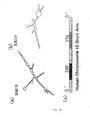
- Figure 1 is a physical map showing the position of gene 1 and gene 2 in the vicinity of band 15.1 on the short arm of human chromosome 10.
- telomere controlling genes are mapped on adjacent positions on approximately 1.5 kb on the genome. Further, in the diagram, on the chromosome shown on the left, the upper direction is the telomere direction, and the lower direction is the centromere direction.
- Gene1 shows the location of gene 1, which the present inventor named RGM376. Additionally, Gene2 shows the location of gene 2, which the present inventor named RGM249. Further, between Gene1 and Gene2 exist DNA markers that are named D10S1728 and D10S1649.
- Gene1, D10S1728, D10S1649, and Gene2 all exist in a common region with a length of 1.5 kb in the genome library, names AL355591.3, AL138774.5, J21, H11, and M6.
- Figure 2 is a conceptual diagram for explaining the procedure for cloning gene 1.
- the present inventor in order to clone the RGM376 gene (gene 1), first performed exon trapping, after having performed the micro nuclear fusion method and BAC screening. Next, for the region narrowed down by exon trapping, the identification of an exon that suppresses telomerase activity and the expression of hTERT mRNA was performed by forced expression.
- the RGM376 gene (gene 1) is an ncRNA that does not synthesize a protein.
- the RGM 249 gene (gene2) is a gene that was identified as an exon within a region of length 1.5 kb that is shared by a plurality of clones obtained during the cloning of the RGM376 gene (gene 1).
- This RGM249 gene (gene 2) was also selected out as a gene that is expressed in cancer cell lines, from 44 exons obtained by exon trapping using a BAC library of the 10p14-15 region of the short arm of human chromosome 10, whereon the existence of a telomerase and cancer-related control gene was suggested, and cDNA was obtained.
- RGM249 gene is an ncRNA that does not encode a protein.
- Figure 3 is a conceptual diagram for explaining the location upon human chromosome 10 and the structure of gene 2.
- the RGM249 gene (gene2) exists at band 15.3 on the short arm of human chromosome 10. Additionally, the length of the RGM249 gene is 249 bp. Further, the RGM249 gene comprises two exons. One exon has a length of 190 bp, while the other exon has a length of 59 bp.
- the RGM376 gene (gene 1) is also similarly located at band 15.3 on the short arm of human chromosome 10. Additionally, the length of the RGM376 gene is 376 bp.
- Figure 4 is a conceptual diagram for explaining the structure and relative position of the RNA that is a transcription product of gene 1 and gene 2.
- Figure 4(a) shows the putative two-dimensional structure of the RNA that is a transcription product of the RGM376 gene.
- figure 4(b) shows the putative two-dimensional structure of the RNA that is a transcription product of the RGM249 gene.
- Figure 4(c) shows the relative position of the RGM376 gene and the RGM249 gene on the short arm of human chromosome 10. From the fact that, in this way, the RGM249 gene is located upstream from the RGM376 gene, a mechanism that integrates and controls these genes can be supposed to exist, and the involvement of both genes in the mechanism of carcinogenesis is suggested.
- RNA genes the RGM376 gene (gene 1), functions to suppress hTERT due to overexpression, and the other RNA gene, the RGM249 gene (gene 2), functions synchronously with hTERT expression.
- RNA genes there are two of these RNA genes, one that is expressed in liver cancer and behaves in unison with the expression of hTERT (gene 2), and one that is expressed in liver cells, and functions suppressively against cancer cells (gene 1), and they have functions that are mutually conflicting. Additionally, as shall be described below, the former (gene 2), after suppressing the telomerase gene with dsRNA, causes the cell death of cancer cells, and the latter (gene 1) acts suppressively against liver cancer, lung cancer, breast cancer, and the like by forced expression.
- miRNA cluster genes that have been cloned from the short arm of human chromosome 10, as telomerase control genes, produce miRNA of 20 mer to 60-70 mer by the action of enzymes such as Drosha and Dicer.
- enzymes such as Drosha and Dicer.
- Figure 5 is a diagram for explaining the sequence of gene 1 and gene 2.
- Figure 5 (a) shows the base sequence of the RGM376 gene (gene 1).
- the RGM376 gene has a length of 376 bases.
- figure 5(b) shows the base sequence of the RGM249 gene (gene 2).
- the RGM249 gene has a length of 249 bases.
- Figure 5(c) shows the base sequence of the RNA that is the transcription product of the RGM 376 gene (gene 1).
- the RNA that is a transcription product of the RGM376 gene has a length of 376 bases.
- figure 5(d) shows the base sequence of the RNA that is a transcription product of the RGM249 gene (gene 2).
- the RNA that is the transcription product of the RGM249 gene has a length of 249 bases.
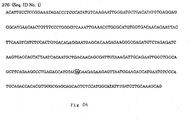
- Figure 6 is a diagram for explaining the sequence of a variant of gene 1.
- a clone having a mutation at one base (A) that corresponds to the 280th base from the 5' end (muta 376-3-1-2) showed weak growth suppression and telomerase expression suppression (suppression of mRNA expression and suppression of telomerase activity).
- telomerase 1 a gene comprising a base sequence of mammal-derived DNA molecules that hybridize under stringent conditions to DNA molecules comprising a base sequence that is complementary to the RGM 376 gene (gene 1), also shows suppression of telomerase expression, similarly to gene 1.
- RGM249 gene (gene 2) also, it is expected that a gene comprising a base sequence wherein one or a plurality of the bases of the base sequence of gene 2 are missing, replaced, or added to, will also function as an hTERT expression regulatory gene that synchronizes with the expression of hTERT, similarly to gene 2.
- a gene comprising a base sequence of mammal-derived DNA molecules that hybridize under stringent conditions to DNA molecules comprising a base sequence that is complementary to gene 2 will also function as an hTERT expression regulatory gene that synchronizes with the expression of hTERT, similarly to gene 2.
- RNA that are transcription products of gene 1 and gene 2 RNA that comprises base sequences wherein one or a plurality of bases are missing, replaced, or added to the original RNA, are expected to have a similar function to the original RNA.
- RNA that is a transcription product of gene 1 or gene 2 also, mammal-derived RNA that hybridizes under stringent conditions to RNA molecules comprising base sequences that are complementary to these original RNA molecules is expected to have a function similar to the original RNA.
- Figure 7 is a diagram for explaining the sequence of siRNA designed based upon gene 1.
- Figure 7(a) , A and B are diagrams that show an example of a double strand (sense strand and antisense strand) of siRNA designed based upon the RGM376 gene (gene 1). As described below, this double-stranded siRNA shown in A and B suppresses the expression of the RNA of the RGM376 gene (gene 1).
- Figure 7(b) is a diagram that shows a plurality of examples of sense strands of siRNA designed by Invitrogen (registered trademark) BLOCK-iT RNAi Designer, manufactured by Invitrogen Corporation, based upon the RGM376 gene (gene 1).
- the sense strand of SEQ ID No. 6 corresponds to Figure 7(a) A .
- Stealth registered trademark
- Figure 7(b) lists, among the results of function prediction using Stealth RNAi Designer, those that have a high predicted value for functioning as an siRNA.
- the details of chemical modification by Stealth RNAi have not been made publicly available, since they are an industrial secret, but they are obtainable upon ordering from Invitrogen Corporation.
- any double stranded siRNA whereof the sense strand is a sequence listed in Figure 7(b) suppresses the expression of the RNA of the RGM376 gene (gene 1), similarly to the siRNA of figure 7(a) , A and B.
- the double stranded siRNA can be Stealth RNAi, but it is not particularly restricted, and can have overhangs with a length of two bases on the 3' end of both the sense strand and the antisense strand.
- these RNA can be not only double stranded siRNA, but also single stranded shRNA wherein a hairpin loop sequence with a length of 4 bases or more is disposed in between a sense sequence (corresponding to the sense strand) and an antisense sequence (corresponding to the antisense strand).
- this hairpin loop sequence there is no particular limit on the length of this hairpin loop sequence, but it can be, for example, 8 bases long. This is because it is expected that any of these will suppress the expression of the RNA of the RGM376 gene (gene 1).
- Figure 7(c) is a diagram showing the location on the entire length of the sequence of the RGM376 gene (gene 1) that corresponds to the sequence of the sense strand of figure 7(a) A and B .
- the underlined portions indicated by the reference letters A and B correspond to the sequences of the sense strands of A and B.
- Figure 8 is a diagram for explaining the sequence of siRNA that is designed based upon gene 2.
- Figure 8(a) (1) (the number is circled in the diagram) and (2) (the number is circled in the diagram) are diagrams that show an example of a double strand (sense strand and antisense strand) of siRNA designed based upon the RGM249 gene (gene 2). As described below, this double stranded siRNA shown in (1) and (2) suppresses the expression of the RNA of the RGM249 gene (gene 2).
- Figure 8(b) is a diagram that shows a plurality of examples of sense strands of siRNA designed by Invitrogen (registered trademark) BLOCK-iT RNAi Designer, manufactured by Invitrogen Corporation, based upon the RGM249 gene (gene 2).
- the sense strand of SEQ ID No. 20 corresponds to Figure 7(a) (1) (the number is circled in the diagram).
- the sense strand of SEQ ID No. 32 corresponds to a sequence (2)' (indicated in the diagram by a circled number), which is a sequence wherein the entire base sequence of the RGM249 gene (gene 2) is shifted one base towards the 5' end.
- figure 8 also, the design of chemically modified siRNA is carried out using Stealth RNAi Designer. That is, figure 8(b) lists, among the results of function prediction using Stealth RNAi Designer, those that have a high predicted value for functioning as an siRNA.
- the details of chemical modification by Stealth RNAi have not been made publicly available, since they are an industrial secret, but they are obtainable upon ordering from Invitrogen Corporation.
- any double stranded siRNA whereof the sense strand is a sequence listed in Figure 8(b) , suppresses the expression of the RNA of the RGM249 gene (gene 2), similarly to the siRNA of figure 8 (a) , (1) and (2).
- the double stranded siRNA can be Stealth RNAi, but it is not particularly restricted, and can have overhangs with a length of two bases on the 3' end of both the sense strand and the antisense strand.
- these RNA can be not only double stranded siRNA, but also single stranded shRNA wherein a hairpin loop sequence with a length of 4 bases or more is disposed in between a sense sequence (corresponding to the sense strand) and an antisense sequence (corresponding to the antisense strand).
- this hairpin loop sequence there is no particular limit on the length of this hairpin loop sequence, but it can be, for example, 8 bases long. This is because it is expected that any of these will suppress the expression of the RNA of the RGM249 gene (gene 2).
- Figure 8(c) is a diagram showing the location on the entire length of the sequence of the RGM249 gene (gene 2) that corresponds to the sequence of the sense strand of figure 8 (a) (1) and (2).
- the underlined portions indicated by the reference numbers (1) and (2) correspond to the sequences of the sense strands of (1) and (2).
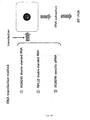
- Figure 9 is a diagram for explaining the method of transfecting the RNA into cells.
- siRNA and the like including the specific double stranded RNA designed based upon (1) the double stranded RNA of the RGM249 gene (gene 2), (2) the double stranded RNA of the RPL22 gene, or the abovedescribed RGM249 gene (gene 2), these RNA must first be transfected into mammalian cells.
- a transfection reagent for example, Lipofectamine 2000 (registered trademark), manufactured by Invitrogen Corporation, may be used.
- these mammalian cells wherein these RNA have been transfected these RNA are extracted from these mammalian cells.
- these RNA are extracted from these mammalian cells.
- the changes in the expression of each of the types of RNA due to transfection with these RNA can be detected.
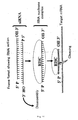
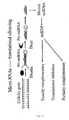
- FIG 10 is a schematic diagram showing the effect of RNAi.
- the siRNA becomes one portion of an RNA-nuclease complex (RNA-induced silencing complex, or RISC) that targets the complementary cellular mRNA.
- RISC RNA-induced silencing complex
- the RNA-nuclease complex that includes the antisense strand of siRNA suppresses the expression of the target mRNA within the cell by recognizing and cleaving target mRNA that is complementary to the antisense strand.
- RNA used in RNAi is not restricted to siRNA having overhangs with a length of two bases on the 3' end of both the sense strand and the antisense strand, but can also be single stranded shRNA wherein a hairpin loop sequence with a length of 4 bases or more is disposed in between a sense sequence (corresponding to the sense strand) and an antisense sequence (corresponding to the antisense strand). Further, there is no particular upper limit on the length of this hairpin loop sequence, but it can be, for example, 8 bases long. This is because for such shRNA, the hairpin loop sequence thereof is cleaved, and changes to siRNA.
- RNA gene of the present invention uses of the RNA gene of the present invention with the RNA gene (SEQ ID NO:4) shall be explained. Since these two RNA genes both have functions of regulating the expression of the telomerase reverse transcriptase gene (hTERT), they can regulate the expression of the telomerase reverse transcriptase gene (hTERT) within mammalian cells.
- hTERT telomerase reverse transcriptase gene
- RNA genes are the key to understanding the molecular mechanism of carcinogenesis, and will prove useful for the development of an anti-cancer treatment using telomerase suppression (molecular targeting treatment).
- telomerase being a large molecule of 4.0 kb, is especially difficult for humans to control
- said genes are molecules of 400 bp or less, so it can be thought that regulation of genetic expression would be easier.
- much anti-cancer research has been carried out, and although the development of fields concerning the administration thereof has been advancing, the discovery of original samples that are to be administered has been slow. Since reports about factors that are related extremely directly to cancer have been few, the investigation of this region, and the fact that this molecule is related to the theme of cancer eradication, can be thought to be innovative and technological.
- the RGM376 gene (gene 1) if the RNA that is a transcription product thereof is overexpressed, the expression of the telomerase reverse transcriptase gene (hTERT) is suppressed.
- hTERT telomerase reverse transcriptase gene
- telomerase activation can be suppressed, and as a result, carcinogenesis can be suppressed.
- the RGM376 gene (gene 1) it can be used as a research tool for investigating the molecular mechanism of carcinogenesis.
- RNA that is a transcription product of the RGM376 gene (gene 1) or the abovementioned expression vector is administered to the human body, the expression of the telomerase reverse transcriptase (hTERT) gene is suppressed.
- this medication suppresses the activation of telomerase, and as a result, is suited for being used as a cancer treating agent that can suppress carcinogenesis.
- RNA RNA cocktail or RNA pool
- RNA RNA cocktail or RNA pool
- RNA RNA cocktail or RNA pool
- RNA RNA cocktail or RNA pool
- RNA RNA cocktail or RNA pool
- RNA RNA cocktail or RNA pool
- RNA RNA cocktail or RNA pool
- RNA RNA cocktail or RNA pool
- RNA RNA cocktail or RNA pool
- RNA RNA cocktail or RNA pool
- RNA RNA cocktail or RNA pool containing a plurality of types of double stranded RNA made by cleaving with Dicer or the like double stranded RNA including RNA that is a transcription product of RGM376 (gene 1) and RNA that includes a base sequence that is complementary to this RNA
- RNA RNA cocktail or RNA pool
- RNA RNA cocktail or RNA pool
- RNA RNA cocktail or RNA pool
- RNA RNA cocktail or RNA pool
- RNA containing a plurality of types of double stranded RNA made by
- a complex comprised by linking various types of RNA such as these siRNA and shRNA with a substance that promotes (induces) uptake into lipids and cells such as cholesterol, as described in Non-Patent Citation 2, suppresses the expression of target mRNA (RGM376 gene (gene 1)) continuously and for a long time within mammalian cells such as in the human body.
- RGM376 gene gene 1
- hTERT telomerase reverse transcriptase
- the complex is a complex that can be obtained by linking an uptake promoter (inducer) to the various types of RNA
- the uptake efficiency into cells will also improve. Therefore, these various types of RNA suppress telomerase activity over a long time, and as a result, can suppress carcinogenesis over a long period of time.
- medications containing various types of RNA such as the abovementioned siRNA and shRNA, as well as the abovementioned RNA-cholesterol complexes, suppress the expression of the telomerase reverse transcriptase gene when administered to the human body.
- these medication suppress telomerase activity, and as a result, can suitably be used as cancer treatment agents that can suppress carcinogenesis.
- medications containing the abovementioned RNA-cholesterol complex have the advantage that the intervals between administration to the human body can be made long, because they suppress carcinogenesis over a long period of time, due to the abovementioned mechanism.
- the RGM249 gene since the expression of RNA that is the transcription product, and the expression of hTERT (canceration of the cell) synchronize, it can be used as a research tool for investigating the molecular mechanism of carcinogenesis.
- RNA such as siRNA and shRNA that are designed based upon the RGM 249 gene (gene 2), suppress the expression of the telomerase reverse transcriptase (hTERT) gene by suppressing the expression of the RGM249 gene (gene 2).
- hTERT telomerase reverse transcriptase
- RNA RNA cocktail or RNA pool
- RNA RNA cocktail or RNA pool
- RNA containing a plurality of types of double stranded RNA made by cleaving with Dicer or the like double stranded RNA including RNA that is a transcription product of RGM249 (gene 2) and RNA that includes a base sequence that is complementary to this RNA
- hTERT telomerase reverse transcriptase
- a complex comprised by linking various types of RNA such as these siRNA and shRNA with a substance that promotes (induces) uptake into lipids and cells such as cholesterol, as described in Non-Patent Citation 2, suppresses the expression of target mRNA (RGM249 gene (gene 2)) continuously and for a long time within mammalian cells such as in the human body.
- RGM249 gene gene 2
- hTERT telomerase reverse transcriptase
- the complex is a complex that can be obtained by linking an uptake promoter (inducer) to the various types of RNA
- the uptake efficiency into cells will also improve. Therefore, these various types of RNA suppress telomerase activity over a long time, and as a result, can suppress carcinogenesis over a long period of time.
- medicines containing the abovementioned various types of RNA such as siRNA and shRNA, or the abovementioned RNA-cholesterol complexes, suppress the expression of the telomerase reverse transcriptase (hTERT) gene when administered to the human body.
- these medicines suppress telomerase activity, and as a result, can optimally be used as cancer treatment agents that can suppress carcinogenesis.
- medicines containing the abovementioned RNA-cholesterol complexes have the advantage of making the interval of administration to the human body longer, because they suppress carcinogenesis over a long period, due to the abovementioned action mechanism.
- an siRNA is used that has, as a sense chain, a sequence that is a portion of the base sequence of the RGM376 gene (gene 1) or the RGM249 gene (gene 2), and is predicted by BLOCK-iT RNAi Designer, but other RNAi design software may also be used, or RNA may be generated randomly and an siRNA that causes RNAi activity can be selected by experiment.
- An siRNA that suppresses the expression of the RGM376 gene (gene 1) or the RGM249 gene (gene 2) can also be obtained in this way.
- Figure 11 is an electrophoresis diagram for explaining the cleaving of two types of mRNA with Dicer.
- the method of experiment was conducted as below. That is, the RGM249 and RGM376 genes were implanted into expression vectors having T7 promoters inside, and using a mass RNA regulation method using T7 RNA polymerase (T7 RiboMAX (registered trademark) Express Large Scale RNA Production System: Promega), RNA of both RGM249 (gene 1 mRNA) and RGM376 (gene 2 mRNA) were generated, and were cleaved with an Rnase III family Dicer (Turbo Dicer: Genlantis). As a result, RNA corresponding to Diced gene 1 and Diced gene 2 were obtained. Thereafter, the reaction products were electrophoresed with a 30% acrylamide gel and visualized.
- a functional analysis was carried out of a gene (RGM376 gene (gene 1)) that suppresses the expression of the mRNA of the telomerase reverse transcriptase gene hTERT.
- Figure 12 is an electrophoresis diagram showing the differentiation specific expression of RGM376 in liver cancer cells.
- Alexander cells undifferentiated
- HepG2 high differentiation
- HLF undifferentiated
- HuH7 high differentiation
- HMc-Li7 high to medium differentiation
- RT-PCR and electrophoresis the level of expression of the mRNA of the RGM376 gene, the hTERT gene, and the ⁇ -actin gene inside cells was examined.
- the experiment was done in the following manner. That is, the expression of the RGM249, the hTERT, and the ⁇ -actin gene in 5 types of liver cancer cell lines was detected by using the RT-PCR method, reacting for 30-35 cycles, and conducting electrophoresis. Primary cultured hepatocytes (KIA) were reacted under the same conditions as the liver cancer cell lines, and the expression of each gene was detected. As the detection method, electrophoresis was done with a 1% agarose gel.
- the results of the electrophoresis were that the expression of the hTERT gene increased, and the expression of the RGM376 gene decreased. On the other hand, in normal cells, the expression of the hTERT gene decreased, and the expression of the RGM376 gene increased. That is, in liver cancer cell lines, differentiation specific expression was recognized. If the differentiation specific expression results in tissue from cancerous portions and noncancerous portions of liver obtained in figure 12 , and the unshown clinical results are summarized, they are as follows.
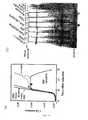
- Figure 13 is a graph and an electrophoresis diagram for explaining the suppression of telomerase activity due to the overexpression of RGM376.
- the horizontal axis shows the number of days of culturing after selection, and the vertical axis shows the number of cells.
- HM indicates the HMc-Li7 line (bought from Clontech)
- THM indicates HM telomerized by pLXIN-hTERT
- VHM indicates HM with only pLXIN (obtained through the courtesy of Dr. Tahara of Hiroshima University Department of Medicine) transfected.
- HM+RGM376 indicates gene transfected cell lines wherein RGM376 is transfected into HMc-Li7 cell lines.
- liver cancer cell line HM cell lines where RGM376 was transfected into HM cell lines, THM cell lines (provided by Hisatoshi Tahara of Hiroshima University) wherein hTERT is forcibly expressed in HM cell lines, and VHM cell lines wherein only the vector is transfected, were used. Further, RGM376 was transfected by implanting into the expression vector pEGFP-C1 (Clontech at the time). Additionally, the telomerase activity in cells wherein RGM376 and the like are transfected was detected using the TRAPeze detection kit (Oncor Inc.). During this detection, the detection was done by using a reagent provided by Oncor and following the indicated protocol.
- Figure 13(b) shows the results of having done RT-PCR and electrophoresis in each of the THM, THM+RGM376, HM, HM+RGM376, VHM, and Revertant cell lines, for both the cases where Rnase treatment was carried out and not carried out. Further, for the HM+RGM376 and Revertant cell lines, samples were taken on the day marked with a black circle in figure 13(a) .
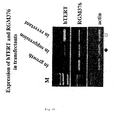
- Figure 14 shows an electrophoresis diagram of the expression of hTERT and RGM376 in transformed cells.
- a growth period in growth
- a suppression period in suppression
- revertants in revertant
- the method of experimentation was as follows. That is, in cells genetically transfected with RGM376 in figure 13 , the expression of each gene was examined by RT-PCR in the growth phase, suppression phase, and revertant phase due to the beginning of the dropping out of the transfected gene, using RNA treated by Dnase. For the RNA purification, the SV total RNA isolation system of Promega was used.
- the amount of expression of the hTERT gene was low, while the amount of expression of the RGM376 gene was high. Additionally, during the suppression phase, the amount of expression of the hTERT gene was low, while the amount of expression of the RGM376 gene was high. However, in the suppression phase, in comparison with the growth phase, the amount of expression of the hTERT gene was high, while the amount of expression of the RGM376 gene was low. On the other hand, in revertant cell lines, the amount of expression of the hTERT gene was high, while the amount of expression of the RGM376 gene was low.
- the RGM376 in highly differentiated cancer in comparison with undifferentiated cancer, the RGM376 is highly expressed. Additionally, it can be seen that the amount of expression of the RGM376 gene is strongly correlated to clinical parameters that relate to the degree of malignancy of cancer (tumor size, tumor number, differentiation, vascular infiltration). Whereby, it is suggested that the expression of the RGM376 gene is related to the degree of differentiation of tumors. That is, it is suggested that the RGM376 gene has a function of suppressing telomerase activity within cells, and suppressing the canceration of cells.
- the overexpression of the RGM376 gene has a function of suppressing the growth of cells that have passed the quiescent phase, and aging cells, and promoting cell death. Additionally, it is suggested that the overexpression of the RGM376 gene has a function of decreasing telomerase activity. Further, it is suggested that the overexpression of the RGM376 gene has a function of decreasing the amount of expression of mRNA of the hTERT gene. That is, it can be presumed that the RGM376 gene is a gene that has a telomerase-mediated (hTERT) cancer suppressing activity.
- hTERT telomerase-mediated
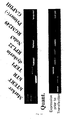
- Figure 15 is an electrophoresis diagram showing the expression of genes in RGM376 siRNA transfected cells.
- Cells not transfected with siRNA were controls, and as an siRNA against the RGM376 gene, the siRNA comprising the abovementioned A and B sequences was used.
- RT-PCR and electrophoresis was done on cells wherein each of these siRNA was transfected, for the RGM376 gene, the hTERT gene and the ⁇ -actin gene. Additionally, the case where A and B were mixed and transfected was also examined.
- the method of experimentation was as follows. That is, the RGM376 siRNA was designed using the Block-it RNAi designer (homepage) of Invitrogen Corporation, and the two types of siRNA synthesized by said company, A and B, were genetically transfected using Lipofectamine 2000, into the liver cancer cell line HLF at a transfection concentration of 25 nM. Further, a mixture of 25 nM each of A and B was also transfected. Further, regarding the expression of each gene, after RNA was purified from the transfected cells by the same method as figure 14 , detection was done by the RT-PCR method.
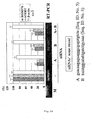
- Figure 16 is an electrophoresis diagram and graph summarizing the hTERT suppression results due to RGM376 siRNA. Additionally, figure 16 also shows the sequence of the sense chain of the siRNA (A and B) used in this experiment.
- the method of experimentation was as follows. That is, the transfection of siRNA shown in figure 15 was attempted 3 times, the degree of suppression of expression of RGM376 was examined by RT-PCR, and at the same time, the strength of expression was measured using a densitometer on an electrophoresis image, and this is shown in a bar graph standardized by the measured values for no siRNA.
- the expression of the RGM376 gene is suppressed by RGM376 siRNA
- the expression of the hTERT gene is also similarly suppressed.
- the suppression effect is best when A alone is used. Additionally, among the RGM376 siRNA, even when B alone is used, an excellent suppression effect was obtained, but the suppression effect was lower than for A. Further, among the RGM376 siRNA, when both A and B were transfected, an excellent suppression effect was obtained, but the suppression effect was lower than for A.
- the expression of the RGM376 gene is suppressed by RGM376 siRNA, the expression of the hTERT gene is also similarly suppressed.
- telomerase activity can be suppressed by RGM376 siRNA, and as a result, the canceration of cells can be suppressed.
- a functional analysis was carried out of a gene (RGM249 gene (gene 2)) that is expressed synchronously with telomerase reverse transcriptase gene hTERT mRNA.
- liver cancer cell lines were examined with RT-PCR
- expression in liver tissue was examined with RT-PCR
- (3) the relation to genes that relate to telomerase formation was examined, and (4) dsRNA derived from genes whose involvement is suggested was expressed, and transfection with siRNA was done, and observations with RT-PCR, Cell proliferation assay, MTT assay, and morphological changes were carried out.
- Figure 17 is an electrophoresis diagram showing differentiation specific expression of RGM249 in liver cancer cells.
- Alexander cells undifferentiated
- HepG2 high differentiation
- HLF undifferentiated
- HuH7 high differentiation
- HMc-Li7 T, N, C
- RT-PCR electrophoresis
- the experiment was done in the following manner. That is, by the same method as in figure 12 , the expression of RGM249, hTERT, RPL22, and ⁇ -actin was examined by the RT-PCR method. Further, in figure 17 , for HMc-Li7, T indicates total RNA, N indicates RNA extracted from nucleus, and C indicates RNA inside cells.
- Figure 18 is an electrophoresis diagram showing the expression of genes due to the transfection of RGM249 dsRNA into HMc-Li7.
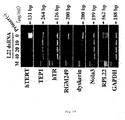
- dsRNA designed to suppress the expression of RGM249 was transfected into HMc-Li7 cells, and RT-PCR and electrophoresis was performed on each of the hTERT, hTR, TEP1, dyskerin, RPL22, Nola3, and RGM249 genes.
- the method of experimentation was as follows. That is, RGM249 dsRNA was implanted into the restriction enzyme portion of a vector, Litmas 28i (New England BioLab), having a T7 promoter in dual directions, and a double stranded RNA was generated with T7 RNA polymerase. After this double stranded RNA was purified, using transformed cells wherein Lipofectamine Plus is transfected into HM, the strength of expression of the telomerase related genes (hTERT, hTR, TEP1, Dyskerin, RPL22, Nola3, RGM249) was measured by a densitometer, and the results shown in figure 18 were obtained.
- hTERT, hTR, TEP1, Dyskerin, RPL22, Nola3, RGM249 was measured by a densitometer, and the results shown in figure 18 were obtained.
- the expression of the hTERT gene and the RPL22 gene were also synchronously suppressed.
- the RGM249 gene has a function of promoting the expression of the hTERT gene and the RPL22 gene.
- Figure 19 is an electrophoresis diagram showing the expression of a gene due to transfection of RPL22 dsRNA into HM.
- dsRNA designed to suppress the expression of RPL22 was transfected into HMc-Li7 cells, and RT-PCR and electrophoresis was performed for each of the hTERT, TEP1, hTR, RGM249, dyskerin, Nola3, RPL22, and GAPDH genes.
- the experimental method was as follows. That is, RPL22 cDNA (TOYOBO) was purchased, and after culturing in an E. coli strain, plasmid DNA was purified, and the RPL22 cDNA was implanted into the restriction enzyme portion of Litamas 28i, and dsRNA of RPL22 was obtained similarly to figure 18 , and was transfected into HM using Lipofectamine Plus (Invitrogen). The abovementioned dsRNA was transfected into transformed cells obtained in this way, at transfection concentrations of 40, 20, 10, and 0 ⁇ g/ml. After this, for each gene, expression was examined using RT-PCR, and electrophoresis was performed.
- the expression of (1) the RGM249 gene, (2) the hTERT gene, and (3) dyskerin were also synchronously suppressed.
- the RPL22 gene has a function of promoting the expression of the RGM249 gene, the hTERT gene, and the dyskerin gene.
- FIG 20 is an electrophoresis diagram showing the expression of genes due to the transfection of RGM249 specific siRNA into HLF.
- a specific siRNA designed to suppress the expression of RGM249 siRNA of the abovementioned (1) (indicated in the figure with a circled number) and (2) (indicated in the figure with a circled number)
- RT-PCR and electrophoresis was done for each of the RGM249, hTERT, RPL22, and the ⁇ -actin genes.
- siRNA (1) indicated in the figure with a circled number
- RT-PCR and electrophoresis was done for each of the RGM249, hTERT, RPL22, and the ⁇ -actin genes.
- the method of experimentation was as follows. That is, similarly with figure 15 , the two types of RGM249 siRNA (1) and (2), designed and synthesized by Block-it RNAi designer, was transfected into the liver cancer cell line HLF using Lipofectamine 2000 (Invitrogen), RNA was extracted from the transfected cells, RT-PCR was performed, and the strength of expression was visualized by electrophoresis and detected.
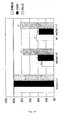
- Figure 21 is a graph summarizing the expression suppression rate of the mRNA of each gene after transfection with RGM249 specific siRNA. As shown in figure 21 , if the expression of the RGM249 gene is suppressed by RGM249 specific siRNA (1) (indicated in the figure with a circled number), the expression of the hTERT gene and the RPL22 gene are also similarly suppressed. Additionally, among the RGM249 specific siRNA, when (2) (indicated in the figure by a circled number) was used alone, and when (1) and (2) were both transfected, the expression suppression effect on the hTERT gene and the RPL22 gene was lower than when (1) was used alone.
- telomerase activity can be suppressed by RGM249 specific siRNA (1), and as a result thereof, the canceration of cells can be suppressed.
- the method of experimentation was as follows. That is, the transfection experiment examined in figure 20 was performed 3 times, the electrophoresis image was image scanned by a densitometer, the measured values were standardized relative to no siRNA, and the degree of suppression of genes due to siRNA was shown with a bar graph.
- the RGM249 gene is uniformly ) expressed in liver cancer cells expressing the hTERT gene. Additionally, there is a possibility that the RGM249 gene is involved in the expression of the hTERT gene and the RPL22 gene. Further, the involvement of the RGM249 gene in carcinogenesis is suggested.
- Figure 22 is an electrophoresis diagram showing the expression of RGM376 due to the transfection of RGM249 siRNA, and the expression of RGM249 due to the transfection of RGM376 siRNA.
- the method of experimentation is as follows. That is, in the transfection experiments performed in figure 21 and figure 15 , (a) for RGM249 transfection, the expression of RGM376, and (b) for RGM376 transfection, the expression of RGM249, was detected by extracting RNA from the transfected cells and performing RT-PCR.
- Figure 22(a) are the results of having observed the influence of transfection with RGM249 siRNA ((1) (indicated within the diagram with a circled number) and (2) (indicated within the diagram with a circled number)), by RT-PCR and electrophoresis.
- RGM249 siRNA (1) (indicated within the diagram with a circled number) and (2) (indicated within the diagram with a circled number)
- RGM249 specific siRNA (1) the expression of the RGM376 gene is similarly suppressed.
- the expression suppression effect of the RGM376 gene was lower than when (1) was used alone.
- Figure 22(b) are the results of having observed the influence of transfection with RGM376 siRNA (A and B) on the expression of RGM249, by RT-PCR and electrophoresis.
- RGM376 siRNA A and B
- FIG. 22(b) are the results of having observed the influence of transfection with RGM376 siRNA (A and B) on the expression of RGM249, by RT-PCR and electrophoresis.
- the RGM249 gene controls the expression of the RGM376 gene.
- the RGM249 gene controls the expression of the RGM376 gene in the form of promotion.
- the RGM376 gene does not control the expression of the RGM249 gene.
- Figure 24 is a conceptual diagram for explaining the mechanism whereby shRNA is generated from plasmids whose purpose is to generate shRNA, and the expression of a target gene is suppressed.
- a plasmid vector was constructed containing a DNA sequence complementary to the region wherein the RNA sequence comprising CGAA is disposed between the sense strand and the antisense strand of the abovementioned RGM249 siRNA. Further, this DNA sequence was placed downstream of the promoter of the plasmid vector.
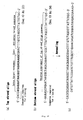
- Figure 28 is a figure for explaining the RGM249 shRNA sequence designed based upon gene 2.
- a single stranded DNA comprising the DNA sequence shown in SEQ ID No. 33
- a single stranded DNA comprising the DNA sequence shown in SEQ ID No. 34
- a vector for expressing the RGM249 shRNA was produced by implanting this double stranded DNA into a plasmid vector as shown above.
- an mt plasmid vector was constructed containing a DNA sequence complementary to the region wherein an RNA sequence comprising CGAA is disposed between the sense strand of the abovementioned RGM249 siRNA and an antisense variant strand wherein one of the 8th T residues from the 5' end of the antisense strand is deleted.
- This DNA sequence was placed downstream of the promoter of the mt plasmid vector.
- Figure 29 is a diagram for explaining the sequence of RGM249 variant shRNA designed based upon gene 2.
- a single stranded DNA comprising the DNA sequence shown in SEQ ID No. 35, wherein one of the 8th T residues from the 5' end of the antisense target sequence of the single stranded DNA comprising the DNA sequence shown in SEQ ID No. 33 is deleted, and a single stranded DNA comprising the DNA sequence shown in SEQ ID No. 36, a double stranded DNA linking these two single stranded DNA complementarily was obtained.
- a vector for expressing RGM249 variant shRNA was produced by implanting this double stranded DNA into a plasmid vector as described above.
- an RGM249 variant shRNA made by disposing an RNA sequence comprising CGAA between the sense strand and an antisense variant strand of the RGM249 siRNA described above, forming a loop at the CGAA portion, and then forming a stem by linking together the sense strand and the antisense strand, was generated. Then, the expression of the RGM249 gene was suppressed by this RGM249 variant shRNA.
- FIG. 25 is an electrophoresis diagram showing the expression of mRNA of each gene after transfection with RGM249 shRNA. Plasmid vectors and mt plasmid vectors that generate specific shRNA and variant shRNA designed to suppress the expression of RGM249 as described above were transfected into HLF cells, and RT-PCR and electrophoresis was performed for each of the RGM249, hTERT, RPL22, and the ⁇ -actin genes. As a result thereof, in HLF cells wherein the expression of the RGM249 gene was suppressed by shRNA and variant shRNA, the expression of the hTERT gene and the RPL22 gene was also synchronously suppressed.
- the experimental method was as follows. That is, similarly to figure 20 , plasmid vectors and mt plasmid vectors that generate specific shRNA and variant shRNA designed to suppress the expression of RGM249, described above, designed and synthesized with Block-it RNAi designer, was transfected into the liver cancer cell line HLF, RNA was extracted from transfected cells expressing the shRNA and variant shRNA, RT-PCR was performed, the strength of expression was visualized by electrophoresis, and detected.
- Figure 26 is a graph summarizing the expression suppression rate of mRNA of each gene after transfection with RGM249 shRNA. As shown in figure 26 , when the expression of the RGM249 gene is suppressed by plasmid vectors and mt plasmid vectors that generate specific shRNA and variant shRNA designed to suppress the expression of RGM249, described above, the expression of the hTERT gene and the RPL22 gene are also similarly suppressed. Additionally, in cases where one of either the plasmid vectors or the mt plasmid vectors is used, the expression suppression effect against the hTERT gene and the RPL22 gene was approximately the same.
- the expression of the RGM249 gene is suppressed by specific shRNA and variant shRNA designed so as to suppress the expression of RGM249, the hTERT gene and the RPL22 gene are also similarly suppressed.
- telomerase activity can be suppressed by specific shRNA and variant shRNA designed so as to suppress the expression of RGM249, and as a result thereof, the canceration of cells can be suppressed.
- the experimental method was as follows. That is, the transfection experiment considered in figure 25 was performed three times, the electrophoresis image was image scanned using a densitometer, the measured values were standardized relative to no siRNA, and the degree of suppression of the siRNA gene was shown in a bar graph.
- siRNA Stealth (registered trademark) RNAi from Invitrogen Corporation was used, but siRNA or shRNA from other manufacturers, having differing structures, may be used. This is because in such cases also, as long as the expression of the target mRNA can be suppressed, a similar effect can be obtained.
- siRNA siRNA obtained by cleaving siRNA with Dicer was explained, but this is not particularly restricted.
- a mechanism is also presumed where, from a precursor miRNA gene, pri-miRNA of less than approximately 70 bp is generated by Drosha, and becomes pre-miRNA by way of Dicer (see conceptual diagram for explaining the presumed mechanism for translation silencing due to the Micro RNAs of figure 23 ).
- a similar effect to that of the abovementioned embodiment can be achieved also by a mechanism whereby miRNA obtained through this pri-miRNA and pre-miRNA becomes miRNA and suppresses the translation of the target mRNA within cells.
- the RNA can also function as RNP.
- An RNP ribonucleoprotein
- RNP ribonucleoprotein
- a mechanism whereby a target is cleaved by forming RNP by these tiny RNA being implanted into RISC can be presumed.
- the hTERT expression regulatory gene since the hTERT expression regulatory gene according to the present invention has the effect of regulating the expression of the telomerase reverse transcriptase gene in mammalian cells, this gene, or specific RNA that suppresses the expression of this gene is useful as a research tool, as a raw material for medicines (cancer treatment agent), and the like.
Landscapes
- Health & Medical Sciences (AREA)
- Life Sciences & Earth Sciences (AREA)
- Chemical & Material Sciences (AREA)
- Medicinal Chemistry (AREA)
- Organic Chemistry (AREA)
- General Health & Medical Sciences (AREA)
- Molecular Biology (AREA)
- Genetics & Genomics (AREA)
- Veterinary Medicine (AREA)
- Animal Behavior & Ethology (AREA)
- Pharmacology & Pharmacy (AREA)
- Public Health (AREA)
- Epidemiology (AREA)
- Biophysics (AREA)
- Biotechnology (AREA)
- Proteomics, Peptides & Aminoacids (AREA)
- Engineering & Computer Science (AREA)
- Biochemistry (AREA)
- Toxicology (AREA)
- Zoology (AREA)
- Gastroenterology & Hepatology (AREA)
- Nuclear Medicine, Radiotherapy & Molecular Imaging (AREA)
- Chemical Kinetics & Catalysis (AREA)
- General Chemical & Material Sciences (AREA)
- Medicines That Contain Protein Lipid Enzymes And Other Medicines (AREA)
- Pharmaceuticals Containing Other Organic And Inorganic Compounds (AREA)
Priority Applications (1)
| Application Number | Priority Date | Filing Date | Title |
|---|---|---|---|
| EP09163298A EP2098593B1 (en) | 2005-04-15 | 2006-03-28 | hTERT expression regulatory gene |
Applications Claiming Priority (2)
| Application Number | Priority Date | Filing Date | Title |
|---|---|---|---|
| JP2005118364 | 2005-04-15 | ||
| PCT/JP2006/306338 WO2006112239A1 (ja) | 2005-04-15 | 2006-03-28 | hTERT発現調節遺伝子 |
Related Child Applications (2)
| Application Number | Title | Priority Date | Filing Date |
|---|---|---|---|
| EP09163298A Division EP2098593B1 (en) | 2005-04-15 | 2006-03-28 | hTERT expression regulatory gene |
| EP09163298.4 Division-Into | 2009-06-19 |
Publications (3)
| Publication Number | Publication Date |
|---|---|
| EP1873240A1 EP1873240A1 (en) | 2008-01-02 |
| EP1873240A4 EP1873240A4 (en) | 2008-09-10 |
| EP1873240B1 true EP1873240B1 (en) | 2011-12-28 |
Family
ID=37114970
Family Applications (2)
| Application Number | Title | Priority Date | Filing Date |
|---|---|---|---|
| EP06730286A Ceased EP1873240B1 (en) | 2005-04-15 | 2006-03-28 | hTERT GENE EXPRESSION REGULATORY GENE |
| EP09163298A Ceased EP2098593B1 (en) | 2005-04-15 | 2006-03-28 | hTERT expression regulatory gene |
Family Applications After (1)
| Application Number | Title | Priority Date | Filing Date |
|---|---|---|---|
| EP09163298A Ceased EP2098593B1 (en) | 2005-04-15 | 2006-03-28 | hTERT expression regulatory gene |
Country Status (4)
| Country | Link |
|---|---|
| US (4) | US7985852B2 (enExample) |
| EP (2) | EP1873240B1 (enExample) |
| JP (2) | JP4982757B2 (enExample) |
| WO (1) | WO2006112239A1 (enExample) |
Families Citing this family (4)
| Publication number | Priority date | Publication date | Assignee | Title |
|---|---|---|---|---|
| JP5781732B2 (ja) * | 2010-01-13 | 2015-09-24 | 国立大学法人鳥取大学 | がん抑制miRNA |
| CN103189511B (zh) * | 2010-07-12 | 2016-10-12 | 国立大学法人鸟取大学 | 利用siRNA导入的新型hiPSC制作法 |
| US10265347B2 (en) | 2013-08-29 | 2019-04-23 | Norimasa Miura | Biomolecular group related to cell anti-aging |
| JP7465656B2 (ja) * | 2019-12-25 | 2024-04-11 | 株式会社Uacj製箔 | グラビア印刷版 |
Family Cites Families (11)
| Publication number | Priority date | Publication date | Assignee | Title |
|---|---|---|---|---|
| US6506559B1 (en) | 1997-12-23 | 2003-01-14 | Carnegie Institute Of Washington | Genetic inhibition by double-stranded RNA |
| ES2336887T5 (es) * | 2000-03-30 | 2019-03-06 | Whitehead Inst Biomedical Res | Mediadores de interferencia por ARN específicos de secuencias de ARN |
| JP2002104995A (ja) | 2000-09-29 | 2002-04-10 | Masahiko Hosaka | テロメラーゼ活性抑制剤 |
| US20050227936A1 (en) * | 2001-05-18 | 2005-10-13 | Sirna Therapeutics, Inc. | RNA interference mediated inhibition of TGF-beta and TGF-beta receptor gene expression using short interfering nucleic acid (siNA) |
| US20030099616A1 (en) | 2001-07-25 | 2003-05-29 | Irving John M. | Dual specificity tumor killing vectors driven by the telomerase promoter |
| GB0130955D0 (en) | 2001-12-24 | 2002-02-13 | Cancer Res Ventures | Expression system |
| EP1432724A4 (en) | 2002-02-20 | 2006-02-01 | Sirna Therapeutics Inc | RNA inhibition mediated inhibition of MAP KINASE GENES |
| AU2003295600A1 (en) * | 2002-11-14 | 2004-06-15 | Dharmacon, Inc. | Functional and hyperfunctional sirna |
| JP3839453B2 (ja) | 2002-11-22 | 2006-11-01 | 株式会社バイオシンクタンク | Rna干渉の標的塩基配列検索方法、rna干渉を生じさせるポリヌクレオチドの塩基配列設計方法、2本鎖ポリヌクレオチドの作製方法、遺伝子の発現抑制方法、塩基配列処理装置、塩基配列処理方法をコンピュータに実行させるプログラム、記録媒体、および、塩基配列処理システム |
| EP2314687B1 (en) * | 2003-01-17 | 2017-12-27 | Max-Planck-Gesellschaft zur Förderung der Wissenschaften e.V. | Inducible small interfering rna (sirna) expression constructs for targeted gene silencing |
| JP2004350607A (ja) | 2003-05-30 | 2004-12-16 | Dai Ichi Seiyaku Co Ltd | テロメレース阻害剤 |
-
2006
- 2006-03-28 EP EP06730286A patent/EP1873240B1/en not_active Ceased
- 2006-03-28 EP EP09163298A patent/EP2098593B1/en not_active Ceased
- 2006-03-28 JP JP2007521154A patent/JP4982757B2/ja not_active Expired - Lifetime
- 2006-03-28 WO PCT/JP2006/306338 patent/WO2006112239A1/ja not_active Ceased
- 2006-03-28 US US11/911,364 patent/US7985852B2/en not_active Expired - Fee Related
-
2010
- 2010-03-31 US US12/751,160 patent/US8148513B2/en not_active Expired - Fee Related
- 2010-03-31 US US12/751,226 patent/US8148514B2/en not_active Expired - Fee Related
- 2010-03-31 US US12/751,105 patent/US8124755B2/en not_active Expired - Fee Related
-
2011
- 2011-11-30 JP JP2011263124A patent/JP5240632B2/ja not_active Expired - Fee Related
Also Published As
| Publication number | Publication date |
|---|---|
| US7985852B2 (en) | 2011-07-26 |
| US8124755B2 (en) | 2012-02-28 |
| WO2006112239A1 (ja) | 2006-10-26 |
| US20100184208A1 (en) | 2010-07-22 |
| EP1873240A1 (en) | 2008-01-02 |
| EP2098593B1 (en) | 2011-12-28 |
| JP5240632B2 (ja) | 2013-07-17 |
| JPWO2006112239A1 (ja) | 2008-12-11 |
| JP4982757B2 (ja) | 2012-07-25 |
| US8148514B2 (en) | 2012-04-03 |
| US20090124794A1 (en) | 2009-05-14 |
| US8148513B2 (en) | 2012-04-03 |
| US20100184216A1 (en) | 2010-07-22 |
| US20100248356A1 (en) | 2010-09-30 |
| EP2098593A1 (en) | 2009-09-09 |
| JP2012085645A (ja) | 2012-05-10 |
| EP1873240A4 (en) | 2008-09-10 |
Similar Documents
| Publication | Publication Date | Title |
|---|---|---|
| Capuozzo et al. | p53: from fundamental biology to clinical applications in cancer | |
| US20180002720A1 (en) | Cell for use in immunotherapy which contains modified nucleic acid construct encoding wilms tumor gene product or fragment thereof, method for producing said cell, and said nucleic acid construct | |
| EP1583832A2 (en) | Inducible small interfering rna (sirna) expression constructs for targeted gene silencing | |
| WO2010006239A2 (en) | Regulation of apoptosis by neural specific splice variants of ig20 | |
| US8124755B2 (en) | hTERT gene expression regulatory gene | |
| Qian et al. | Self-assembled tetrahedral framework nucleic acid mediates tumor-associated macrophage reprogramming and restores antitumor immunity | |
| JP2014530596A (ja) | 原核細胞内の真核pol−2プロモーターからの誘導可能な発現 | |
| CN107541513A (zh) | 用于沉默cd317的小分子干扰rna、重组载体、药物及其应用 | |
| Lee et al. | Alternative splicing variants of IRF-1 lacking exons 7, 8, and 9 in cervical cancer | |
| US20060079471A1 (en) | Snornai-small nucleolar rna degradation by rna interference in trypanosomatids | |
| DE60023891T2 (de) | Peptidverbindung, die von einem verschobenen offenen leserahmen des ice-gens abstammt | |
| CN106350519A (zh) | 一种调节鹿茸软骨快速生长的microRNA及其应用 | |
| JP7153033B2 (ja) | 真核生物におけるrna分子の細胞型特異的な翻訳に関する系及び方法 | |
| CN108338986B (zh) | 一种用于治疗癌症的小分子rna及其应用 | |
| CN113227375A (zh) | 合成的微小rna模拟物 | |
| CN105797170B (zh) | 人rpl34基因的用途及其相关药物 | |
| AU5152899A (en) | Method for triggering apoptosis in cells | |
| WO2026048822A1 (ja) | Mapt rna配列に基づく新規二本鎖rna及びその利用 | |
| WO2025234433A1 (ja) | Semaphorin-3a rna配列に基づく新規二本鎖rna及びその利用 | |
| CN115768893A (zh) | 用于癌症的治疗的rna分子 | |
| CN114177274A (zh) | Tdrd10蛋白及其编码基因在制备肿瘤治疗药物中的应用、及肿瘤治疗药物 | |
| US20090035300A1 (en) | Immunomodulation of dendritic cells | |
| HK40040705A (en) | Apoptotic cell-mediated transfection of mammalian cells with interfering rna | |
| JP2004261026A (ja) | サイクリンb遺伝子の発現抑制作用を有する二本鎖rnaオリゴヌクレオチド | |
| JP2005320298A (ja) | 癌治療のための薬剤 |
Legal Events
| Date | Code | Title | Description |
|---|---|---|---|
| PUAI | Public reference made under article 153(3) epc to a published international application that has entered the european phase |
Free format text: ORIGINAL CODE: 0009012 |
|
| 17P | Request for examination filed |
Effective date: 20071109 |
|
| AK | Designated contracting states |
Kind code of ref document: A1 Designated state(s): DE FR GB |
|
| DAX | Request for extension of the european patent (deleted) | ||
| RBV | Designated contracting states (corrected) |
Designated state(s): DE FR GB |
|
| A4 | Supplementary search report drawn up and despatched |
Effective date: 20080811 |
|
| 17Q | First examination report despatched |
Effective date: 20081103 |
|
| GRAP | Despatch of communication of intention to grant a patent |
Free format text: ORIGINAL CODE: EPIDOSNIGR1 |
|
| GRAS | Grant fee paid |
Free format text: ORIGINAL CODE: EPIDOSNIGR3 |
|
| GRAA | (expected) grant |
Free format text: ORIGINAL CODE: 0009210 |
|
| AK | Designated contracting states |
Kind code of ref document: B1 Designated state(s): DE FR GB |
|
| REG | Reference to a national code |
Ref country code: GB Ref legal event code: FG4D |
|
| REG | Reference to a national code |
Ref country code: DE Ref legal event code: R096 Ref document number: 602006026687 Country of ref document: DE Effective date: 20120308 |
|
| PLBE | No opposition filed within time limit |
Free format text: ORIGINAL CODE: 0009261 |
|
| STAA | Information on the status of an ep patent application or granted ep patent |
Free format text: STATUS: NO OPPOSITION FILED WITHIN TIME LIMIT |
|
| 26N | No opposition filed |
Effective date: 20121001 |
|
| REG | Reference to a national code |
Ref country code: DE Ref legal event code: R097 Ref document number: 602006026687 Country of ref document: DE Effective date: 20121001 |
|
| REG | Reference to a national code |
Ref country code: FR Ref legal event code: PLFP Year of fee payment: 11 |
|
| REG | Reference to a national code |
Ref country code: FR Ref legal event code: PLFP Year of fee payment: 12 |
|
| PGFP | Annual fee paid to national office [announced via postgrant information from national office to epo] |
Ref country code: FR Payment date: 20170323 Year of fee payment: 12 |
|
| PGFP | Annual fee paid to national office [announced via postgrant information from national office to epo] |
Ref country code: GB Payment date: 20170327 Year of fee payment: 12 |
|
| PGFP | Annual fee paid to national office [announced via postgrant information from national office to epo] |
Ref country code: DE Payment date: 20170517 Year of fee payment: 12 |
|
| REG | Reference to a national code |
Ref country code: DE Ref legal event code: R119 Ref document number: 602006026687 Country of ref document: DE |
|
| GBPC | Gb: european patent ceased through non-payment of renewal fee |
Effective date: 20180328 |
|
| PG25 | Lapsed in a contracting state [announced via postgrant information from national office to epo] |
Ref country code: DE Free format text: LAPSE BECAUSE OF NON-PAYMENT OF DUE FEES Effective date: 20181002 |
|
| PG25 | Lapsed in a contracting state [announced via postgrant information from national office to epo] |
Ref country code: GB Free format text: LAPSE BECAUSE OF NON-PAYMENT OF DUE FEES Effective date: 20180328 |
|
| PG25 | Lapsed in a contracting state [announced via postgrant information from national office to epo] |
Ref country code: FR Free format text: LAPSE BECAUSE OF NON-PAYMENT OF DUE FEES Effective date: 20180331 |