EP1870399A1 - Hydroxamate derivatives useful as deacetylase inhibitors - Google Patents
Hydroxamate derivatives useful as deacetylase inhibitors Download PDFInfo
- Publication number
- EP1870399A1 EP1870399A1 EP07115019A EP07115019A EP1870399A1 EP 1870399 A1 EP1870399 A1 EP 1870399A1 EP 07115019 A EP07115019 A EP 07115019A EP 07115019 A EP07115019 A EP 07115019A EP 1870399 A1 EP1870399 A1 EP 1870399A1
- Authority
- EP
- European Patent Office
- Prior art keywords
- aryl
- alkyl
- heteroaryl
- heterocycloalkyl
- cycloalkyl
- Prior art date
- Legal status (The legal status is an assumption and is not a legal conclusion. Google has not performed a legal analysis and makes no representation as to the accuracy of the status listed.)
- Withdrawn
Links
- 0 C*(*)C*(C)C(C)(*)*(C)CN(*)*(C)C*(C)C(C=C1)=CC(C)(*)C=C1C(*)=CC=O Chemical compound C*(*)C*(C)C(C)(*)*(C)CN(*)*(C)C*(C)C(C=C1)=CC(C)(*)C=C1C(*)=CC=O 0.000 description 7
- YEXKZKFHLSDLNZ-FOCLMDBBSA-N C=CCCOCCCCC(N(CCc1c[nH]c2ccccc12)Cc1ccc(/C=C/C(NO)=O)cc1)=O Chemical compound C=CCCOCCCCC(N(CCc1c[nH]c2ccccc12)Cc1ccc(/C=C/C(NO)=O)cc1)=O YEXKZKFHLSDLNZ-FOCLMDBBSA-N 0.000 description 1
- OBWNLXZLIGARLU-OUKQBFOZSA-N CC(C)(C)c1c(CCNCc2ccc(/C=C/C(NO)=O)cc2)c(cccc2)c2[nH]1 Chemical compound CC(C)(C)c1c(CCNCc2ccc(/C=C/C(NO)=O)cc2)c(cccc2)c2[nH]1 OBWNLXZLIGARLU-OUKQBFOZSA-N 0.000 description 1
- JBJVADUPXZGTEL-OUKQBFOZSA-N CC(C)N(CCc1c(C)[nH]c2c1cccc2)Cc1ccc(/C=C/C(NO)=O)cc1 Chemical compound CC(C)N(CCc1c(C)[nH]c2c1cccc2)Cc1ccc(/C=C/C(NO)=O)cc1 JBJVADUPXZGTEL-OUKQBFOZSA-N 0.000 description 1
- CYUGQECYGAXIFD-FOCLMDBBSA-N CC(CC(NCCN(CCc1c[nH]c2ccccc12)Cc1ccc(/C=C/C(NO)=O)cc1)=O)c1ccccc1 Chemical compound CC(CC(NCCN(CCc1c[nH]c2ccccc12)Cc1ccc(/C=C/C(NO)=O)cc1)=O)c1ccccc1 CYUGQECYGAXIFD-FOCLMDBBSA-N 0.000 description 1
- WEMNMGKIDGLHIS-GPLZYVRASA-N CC1C(/C=C/C(NO)=O)=CC=C(CN[C@H](Cc2c[nH]c3c2cccc3)CO)C1 Chemical compound CC1C(/C=C/C(NO)=O)=CC=C(CN[C@H](Cc2c[nH]c3c2cccc3)CO)C1 WEMNMGKIDGLHIS-GPLZYVRASA-N 0.000 description 1
- JOWUTKCKTAMSBD-CCEZHUSRSA-N CCCCCCN(CCc1c[nH]c2c1cccc2)Cc1ccc(/C=C/C(NO)=O)cc1 Chemical compound CCCCCCN(CCc1c[nH]c2c1cccc2)Cc1ccc(/C=C/C(NO)=O)cc1 JOWUTKCKTAMSBD-CCEZHUSRSA-N 0.000 description 1
- VBXPHFSSIFLGQO-VOTSOKGWSA-N CCCCc(ccc(/C=C/C(C)=O)c1)c1N Chemical compound CCCCc(ccc(/C=C/C(C)=O)c1)c1N VBXPHFSSIFLGQO-VOTSOKGWSA-N 0.000 description 1
- WBXDOYUGTWZQBA-UHFFFAOYSA-N CCc1c[nH]c(cc2)c1cc2OC Chemical compound CCc1c[nH]c(cc2)c1cc2OC WBXDOYUGTWZQBA-UHFFFAOYSA-N 0.000 description 1
- WBZRZMHKPXOGRD-FOCLMDBBSA-N CN(CCN(CCc1c[nH]c2c1cccc2)Cc1ccc(/C=C/C(NO)=O)cc1)C(NCCc1ccccc1OC)=O Chemical compound CN(CCN(CCc1c[nH]c2c1cccc2)Cc1ccc(/C=C/C(NO)=O)cc1)C(NCCc1ccccc1OC)=O WBZRZMHKPXOGRD-FOCLMDBBSA-N 0.000 description 1
- BSKHPKMHTQYZBB-UHFFFAOYSA-N Cc1ccccn1 Chemical compound Cc1ccccn1 BSKHPKMHTQYZBB-UHFFFAOYSA-N 0.000 description 1
- OYGMIRMOXJHJFF-UHFFFAOYSA-N NCC[n]1c(cccc2)c2c2ccccc12 Chemical compound NCC[n]1c(cccc2)c2c2ccccc12 OYGMIRMOXJHJFF-UHFFFAOYSA-N 0.000 description 1
- APJYDQYYACXCRM-UHFFFAOYSA-N NCCc1c[nH]c2c1cccc2 Chemical compound NCCc1c[nH]c2c1cccc2 APJYDQYYACXCRM-UHFFFAOYSA-N 0.000 description 1
- DGAGPBOYPGXFNP-JEJOPICUSA-N N[C@@H](Cc1c[nH]c2c1cccc2)C(Nc1ccc(/C=C/C(NO)=O)cc1)=O Chemical compound N[C@@H](Cc1c[nH]c2c1cccc2)C(Nc1ccc(/C=C/C(NO)=O)cc1)=O DGAGPBOYPGXFNP-JEJOPICUSA-N 0.000 description 1
- KMKSEUCQPZQNMF-VMPITWQZSA-N OCCN(CCc1c[nH]c(cc2)c1cc2F)Cc1ccc(/C=C/C(NO)=O)cc1 Chemical compound OCCN(CCc1c[nH]c(cc2)c1cc2F)Cc1ccc(/C=C/C(NO)=O)cc1 KMKSEUCQPZQNMF-VMPITWQZSA-N 0.000 description 1
- FCBNLDVEMDZTDD-JXMROGBWSA-N ONC(/C=C/c(cc1)ccc1C(NCCC1c(cccc2)c2NC1)=O)=O Chemical compound ONC(/C=C/c(cc1)ccc1C(NCCC1c(cccc2)c2NC1)=O)=O FCBNLDVEMDZTDD-JXMROGBWSA-N 0.000 description 1
- HQYZRYJGPWNNKJ-ZHACJKMWSA-N ONC(/C=C/c1ccc(CN(CC2)CCN2c2ccccc2)cc1)=O Chemical compound ONC(/C=C/c1ccc(CN(CC2)CCN2c2ccccc2)cc1)=O HQYZRYJGPWNNKJ-ZHACJKMWSA-N 0.000 description 1
- KACMPIAISPTBCH-ISLYRVAYSA-N ONC(/C=C/c1ccc(CN(CCc2c[nH]c3c2cccc3)CCNC(C2c3ccccc3Oc3ccccc23)=O)cc1)=O Chemical compound ONC(/C=C/c1ccc(CN(CCc2c[nH]c3c2cccc3)CCNC(C2c3ccccc3Oc3ccccc23)=O)cc1)=O KACMPIAISPTBCH-ISLYRVAYSA-N 0.000 description 1
- JTKCXPQCBJLAPK-VAWYXSNFSA-N ONC(/C=C/c1ccc(CN(CCc2c[nH]c3c2cccc3)CCOC(N2CCCC2)=O)cc1)=O Chemical compound ONC(/C=C/c1ccc(CN(CCc2c[nH]c3c2cccc3)CCOC(N2CCCC2)=O)cc1)=O JTKCXPQCBJLAPK-VAWYXSNFSA-N 0.000 description 1
- BGVUDSVCSWMIIZ-CCEZHUSRSA-N ONC(/C=C/c1ccc(CN(CCc2c[nH]c3c2cccc3)CCOC(c2ccccc2)=O)cc1)=O Chemical compound ONC(/C=C/c1ccc(CN(CCc2c[nH]c3c2cccc3)CCOC(c2ccccc2)=O)cc1)=O BGVUDSVCSWMIIZ-CCEZHUSRSA-N 0.000 description 1
- JMNLFXNNPPFULP-CCEZHUSRSA-N ONC(/C=C/c1ccc(CN(CCc2c[nH]c3c2cccc3)S(c2cccc3c2nccc3)(=O)=O)cc1)=O Chemical compound ONC(/C=C/c1ccc(CN(CCc2c[nH]c3c2cccc3)S(c2cccc3c2nccc3)(=O)=O)cc1)=O JMNLFXNNPPFULP-CCEZHUSRSA-N 0.000 description 1
- HDCDZHIEFJMKHW-CCEZHUSRSA-N ONC(/C=C/c1ccc(CN(CCc2c[nH]c3c2cccc3)c2ccccc2)cc1)=O Chemical compound ONC(/C=C/c1ccc(CN(CCc2c[nH]c3c2cccc3)c2ccccc2)cc1)=O HDCDZHIEFJMKHW-CCEZHUSRSA-N 0.000 description 1
- CZYVWHPIVHTDMG-MDZDMXLPSA-N ONC(/C=C/c1ccc(CNCCC2c(cccc3)c3NC2)cc1)=O Chemical compound ONC(/C=C/c1ccc(CNCCC2c(cccc3)c3NC2)cc1)=O CZYVWHPIVHTDMG-MDZDMXLPSA-N 0.000 description 1
- VUJJQKQOQDBDEW-VAWYXSNFSA-N ONC(/C=C/c1ccc(CNCCc2c(-c3ccc[s]3)[nH]c3ccccc23)cc1)=O Chemical compound ONC(/C=C/c1ccc(CNCCc2c(-c3ccc[s]3)[nH]c3ccccc23)cc1)=O VUJJQKQOQDBDEW-VAWYXSNFSA-N 0.000 description 1
- ZLUZDKXBTNQWOL-MDZDMXLPSA-N ONC(/C=C/c1ccc(CNCCc2c[nH]c3c2cccc3)cc1)=O Chemical compound ONC(/C=C/c1ccc(CNCCc2c[nH]c3c2cccc3)cc1)=O ZLUZDKXBTNQWOL-MDZDMXLPSA-N 0.000 description 1
Classifications
-
- C—CHEMISTRY; METALLURGY
- C07—ORGANIC CHEMISTRY
- C07D—HETEROCYCLIC COMPOUNDS
- C07D209/00—Heterocyclic compounds containing five-membered rings, condensed with other rings, with one nitrogen atom as the only ring hetero atom
- C07D209/02—Heterocyclic compounds containing five-membered rings, condensed with other rings, with one nitrogen atom as the only ring hetero atom condensed with one carbocyclic ring
- C07D209/04—Indoles; Hydrogenated indoles
- C07D209/10—Indoles; Hydrogenated indoles with substituted hydrocarbon radicals attached to carbon atoms of the hetero ring
- C07D209/14—Radicals substituted by nitrogen atoms, not forming part of a nitro radical
-
- C—CHEMISTRY; METALLURGY
- C07—ORGANIC CHEMISTRY
- C07D—HETEROCYCLIC COMPOUNDS
- C07D401/00—Heterocyclic compounds containing two or more hetero rings, having nitrogen atoms as the only ring hetero atoms, at least one ring being a six-membered ring with only one nitrogen atom
- C07D401/02—Heterocyclic compounds containing two or more hetero rings, having nitrogen atoms as the only ring hetero atoms, at least one ring being a six-membered ring with only one nitrogen atom containing two hetero rings
- C07D401/12—Heterocyclic compounds containing two or more hetero rings, having nitrogen atoms as the only ring hetero atoms, at least one ring being a six-membered ring with only one nitrogen atom containing two hetero rings linked by a chain containing hetero atoms as chain links
-
- A—HUMAN NECESSITIES
- A61—MEDICAL OR VETERINARY SCIENCE; HYGIENE
- A61P—SPECIFIC THERAPEUTIC ACTIVITY OF CHEMICAL COMPOUNDS OR MEDICINAL PREPARATIONS
- A61P35/00—Antineoplastic agents
-
- A—HUMAN NECESSITIES
- A61—MEDICAL OR VETERINARY SCIENCE; HYGIENE
- A61P—SPECIFIC THERAPEUTIC ACTIVITY OF CHEMICAL COMPOUNDS OR MEDICINAL PREPARATIONS
- A61P43/00—Drugs for specific purposes, not provided for in groups A61P1/00-A61P41/00
-
- C—CHEMISTRY; METALLURGY
- C04—CEMENTS; CONCRETE; ARTIFICIAL STONE; CERAMICS; REFRACTORIES
- C04B—LIME, MAGNESIA; SLAG; CEMENTS; COMPOSITIONS THEREOF, e.g. MORTARS, CONCRETE OR LIKE BUILDING MATERIALS; ARTIFICIAL STONE; CERAMICS; REFRACTORIES; TREATMENT OF NATURAL STONE
- C04B35/00—Shaped ceramic products characterised by their composition; Ceramics compositions; Processing powders of inorganic compounds preparatory to the manufacturing of ceramic products
- C04B35/622—Forming processes; Processing powders of inorganic compounds preparatory to the manufacturing of ceramic products
- C04B35/626—Preparing or treating the powders individually or as batches ; preparing or treating macroscopic reinforcing agents for ceramic products, e.g. fibres; mechanical aspects section B
- C04B35/63—Preparing or treating the powders individually or as batches ; preparing or treating macroscopic reinforcing agents for ceramic products, e.g. fibres; mechanical aspects section B using additives specially adapted for forming the products, e.g.. binder binders
- C04B35/632—Organic additives
-
- C—CHEMISTRY; METALLURGY
- C07—ORGANIC CHEMISTRY
- C07C—ACYCLIC OR CARBOCYCLIC COMPOUNDS
- C07C259/00—Compounds containing carboxyl groups, an oxygen atom of a carboxyl group being replaced by a nitrogen atom, this nitrogen atom being further bound to an oxygen atom and not being part of nitro or nitroso groups
- C07C259/04—Compounds containing carboxyl groups, an oxygen atom of a carboxyl group being replaced by a nitrogen atom, this nitrogen atom being further bound to an oxygen atom and not being part of nitro or nitroso groups without replacement of the other oxygen atom of the carboxyl group, e.g. hydroxamic acids
- C07C259/06—Compounds containing carboxyl groups, an oxygen atom of a carboxyl group being replaced by a nitrogen atom, this nitrogen atom being further bound to an oxygen atom and not being part of nitro or nitroso groups without replacement of the other oxygen atom of the carboxyl group, e.g. hydroxamic acids having carbon atoms of hydroxamic groups bound to hydrogen atoms or to acyclic carbon atoms
-
- C—CHEMISTRY; METALLURGY
- C07—ORGANIC CHEMISTRY
- C07D—HETEROCYCLIC COMPOUNDS
- C07D209/00—Heterocyclic compounds containing five-membered rings, condensed with other rings, with one nitrogen atom as the only ring hetero atom
- C07D209/02—Heterocyclic compounds containing five-membered rings, condensed with other rings, with one nitrogen atom as the only ring hetero atom condensed with one carbocyclic ring
- C07D209/04—Indoles; Hydrogenated indoles
- C07D209/10—Indoles; Hydrogenated indoles with substituted hydrocarbon radicals attached to carbon atoms of the hetero ring
- C07D209/14—Radicals substituted by nitrogen atoms, not forming part of a nitro radical
- C07D209/16—Tryptamines
-
- C—CHEMISTRY; METALLURGY
- C07—ORGANIC CHEMISTRY
- C07D—HETEROCYCLIC COMPOUNDS
- C07D233/00—Heterocyclic compounds containing 1,3-diazole or hydrogenated 1,3-diazole rings, not condensed with other rings
- C07D233/54—Heterocyclic compounds containing 1,3-diazole or hydrogenated 1,3-diazole rings, not condensed with other rings having two double bonds between ring members or between ring members and non-ring members
- C07D233/64—Heterocyclic compounds containing 1,3-diazole or hydrogenated 1,3-diazole rings, not condensed with other rings having two double bonds between ring members or between ring members and non-ring members with substituted hydrocarbon radicals attached to ring carbon atoms, e.g. histidine
-
- C—CHEMISTRY; METALLURGY
- C07—ORGANIC CHEMISTRY
- C07D—HETEROCYCLIC COMPOUNDS
- C07D295/00—Heterocyclic compounds containing polymethylene-imine rings with at least five ring members, 3-azabicyclo [3.2.2] nonane, piperazine, morpholine or thiomorpholine rings, having only hydrogen atoms directly attached to the ring carbon atoms
- C07D295/04—Heterocyclic compounds containing polymethylene-imine rings with at least five ring members, 3-azabicyclo [3.2.2] nonane, piperazine, morpholine or thiomorpholine rings, having only hydrogen atoms directly attached to the ring carbon atoms with substituted hydrocarbon radicals attached to ring nitrogen atoms
- C07D295/14—Heterocyclic compounds containing polymethylene-imine rings with at least five ring members, 3-azabicyclo [3.2.2] nonane, piperazine, morpholine or thiomorpholine rings, having only hydrogen atoms directly attached to the ring carbon atoms with substituted hydrocarbon radicals attached to ring nitrogen atoms substituted by carbon atoms having three bonds to hetero atoms with at the most one bond to halogen, e.g. ester or nitrile radicals
- C07D295/155—Heterocyclic compounds containing polymethylene-imine rings with at least five ring members, 3-azabicyclo [3.2.2] nonane, piperazine, morpholine or thiomorpholine rings, having only hydrogen atoms directly attached to the ring carbon atoms with substituted hydrocarbon radicals attached to ring nitrogen atoms substituted by carbon atoms having three bonds to hetero atoms with at the most one bond to halogen, e.g. ester or nitrile radicals with the ring nitrogen atoms and the carbon atoms with three bonds to hetero atoms separated by carbocyclic rings or by carbon chains interrupted by carbocyclic rings
-
- C—CHEMISTRY; METALLURGY
- C07—ORGANIC CHEMISTRY
- C07D—HETEROCYCLIC COMPOUNDS
- C07D307/00—Heterocyclic compounds containing five-membered rings having one oxygen atom as the only ring hetero atom
- C07D307/77—Heterocyclic compounds containing five-membered rings having one oxygen atom as the only ring hetero atom ortho- or peri-condensed with carbocyclic rings or ring systems
- C07D307/78—Benzo [b] furans; Hydrogenated benzo [b] furans
- C07D307/79—Benzo [b] furans; Hydrogenated benzo [b] furans with only hydrogen atoms, hydrocarbon or substituted hydrocarbon radicals, directly attached to carbon atoms of the hetero ring
- C07D307/81—Radicals substituted by nitrogen atoms not forming part of a nitro radical
-
- C—CHEMISTRY; METALLURGY
- C07—ORGANIC CHEMISTRY
- C07D—HETEROCYCLIC COMPOUNDS
- C07D403/00—Heterocyclic compounds containing two or more hetero rings, having nitrogen atoms as the only ring hetero atoms, not provided for by group C07D401/00
- C07D403/02—Heterocyclic compounds containing two or more hetero rings, having nitrogen atoms as the only ring hetero atoms, not provided for by group C07D401/00 containing two hetero rings
- C07D403/12—Heterocyclic compounds containing two or more hetero rings, having nitrogen atoms as the only ring hetero atoms, not provided for by group C07D401/00 containing two hetero rings linked by a chain containing hetero atoms as chain links
-
- C—CHEMISTRY; METALLURGY
- C07—ORGANIC CHEMISTRY
- C07D—HETEROCYCLIC COMPOUNDS
- C07D405/00—Heterocyclic compounds containing both one or more hetero rings having oxygen atoms as the only ring hetero atoms, and one or more rings having nitrogen as the only ring hetero atom
- C07D405/02—Heterocyclic compounds containing both one or more hetero rings having oxygen atoms as the only ring hetero atoms, and one or more rings having nitrogen as the only ring hetero atom containing two hetero rings
- C07D405/12—Heterocyclic compounds containing both one or more hetero rings having oxygen atoms as the only ring hetero atoms, and one or more rings having nitrogen as the only ring hetero atom containing two hetero rings linked by a chain containing hetero atoms as chain links
-
- C—CHEMISTRY; METALLURGY
- C07—ORGANIC CHEMISTRY
- C07D—HETEROCYCLIC COMPOUNDS
- C07D471/00—Heterocyclic compounds containing nitrogen atoms as the only ring hetero atoms in the condensed system, at least one ring being a six-membered ring with one nitrogen atom, not provided for by groups C07D451/00 - C07D463/00
- C07D471/02—Heterocyclic compounds containing nitrogen atoms as the only ring hetero atoms in the condensed system, at least one ring being a six-membered ring with one nitrogen atom, not provided for by groups C07D451/00 - C07D463/00 in which the condensed system contains two hetero rings
- C07D471/04—Ortho-condensed systems
Definitions
- the present invention relates to hydroxamate compounds which are inhibitors of histone deacetylase.
- the inventive compounds are useful as pharmaceuticals for the treatment of proliferative diseases.
- HDA histone deacetylase
- histone acetyltrasferase together control the level of acetylation of histones to maintain a balance. Inhibition of HDA results in the accumulation of hyperacetylated histones, which results in a variety of cellular responses.
- Inhibitors of HDA have been studied for their therapeutic effects on cancer cells.
- butyric acid and its derivatives including sodium phenylbutyrate, have been reported to induce apoptosis in vitro in human colon carcinoma, leukemia and retinoblastoma cell lines.
- butyric acid and its derivatives are not useful pharmacological agents because they tend to be metabolized rapidly and have a very short half-life in vivo.
- Other inhibitors of HDA that have been widely studied for their anti-cancer activities are trichostatin A and trapoxin.
- Trichostatin A is an antifungal and antibiotic and is a reversible inhibitor of mammalian HDA.
- Trapoxin is a cyclic tetrapeptide, which is an irreversible inhibitor of mammalian HDA. Although trichostatin and trapoxin have been studied for their anti-cancer activities, the in vivo instability of the compounds makes them less suitable as anti-cancer drugs. There remains a need for an active compound that is suitable for treating tumors, including cancerous tumors, that is highly efficacious and stable.
- the present invention provides efficacious deacetylase inhibitor compounds that are useful as pharmaceutical agents having the formula I wherein
- the compounds of the present invention are suitable as active agents in pharmaceutical compositions that are efficacious particularly for treating cellular proliferative ailments.
- the pharmaceutical composition has a pharmaceutically effective amount of the present active agent along with other pharmaceutically acceptable exipients, carriers, fillers, diluents and the like.
- pharmaceutically effective amount as used herein indicates an amount necessary to administer to a host to achieve a therapeutic result, especially an anti-tumor effect, e.g., inhibition of proliferation of malignant cancer cells, benign tumor cells or other proliferative cells.
- the present invention provides hydroxamate compounds, e.g., hydroxamic acids, that are inhibitors of deacetylases, preferably inhibitors of histone deacetylases.
- the hydroxamate compounds are highly suitable for treating tumors, including cancerous tumors.
- the hydroxamate compounds of the present invention have the following structure I wherein
- unsubstituted means that there is no substituent or that the only substituents are hydrogen.
- Halo substituents are selected from fluoro, chloro, bromo and iodo, preferably fluoro or chloro.
- Alkyl substituents include straight and branched C 1 -C 6 alkyl, unless otherwise noted.
- suitable straight and branched C 1 -C 6 alkyl substituents include methyl, ethyl, n-propyl, 2-propyl, n-butyl, sec-butyl, t-butyl, and the like.
- the alkyl substituents include both unsubstituted alkyl groups and alkyl groups that are substituted by one or more suitable substituents, including unsaturation (i.e.
- alkyl groups there are one or more double or triple C-C bonds), acyl, cycloalkyl, halo, oxyalkyl, alkylamino, aminoalkyl, acylamino and OR 15 , for example, alkoxy.
- Preferred substituents for alkyl groups include halo, hydroxy, alkoxy, oxyalkyl, alkylamino, and aminoalkyl.
- Cycloalkyl substituents include C 3 -C 9 cycloalkyl groups, such as cyclopropyl, cyclobutyl, cyclopentyl, cyclohexyl and the like, unless otherwise specified.
- cycloalkyl substituents include both unsubstituted cycloalkyl groups and cycloalkyl groups that are substituted by one or more suitable substituents, including C 1 -C 6 alkyl, halo, hydroxy, aminoalkyl, oxyalkyl, alkylamino, and OR 15 , such as alkoxy.
- Preferred substituents for cycloalkyl groups include halo, hydroxy, alkoxy, oxyalkyl, alkylamino and aminoalkyl.
- alkyl and cycloalkyl substituents also applies to the alkyl portions of other substituents, such as without limitation, alkoxy, alkyl amines, alkyl ketones, arylalkyl, heteroarylalkyl, alkylsulfonyl and alkyl ester substituents and the like.
- Heterocycloalkyl substituents include 3 to 9 membered aliphatic rings, such as 4 to 7 membered aliphatic rings, containing from one to three heteroatoms selected from nitrogen, sulfur and oxygen.
- suitable heterocycloalkyl substituents include pyrrolidyl, tetrahydrofuryl, tetrahydrothiofuranyl, piperidyl, piperazyl, tetrahydropyranyl, morphilino, 1,3-diazapane, 1,4-diazapane, 1,4-oxazepane, and 1,4-oxathiapane.
- the rings are unsubstituted or substuted on the carbon atoms by one or more suitable substituents, including C 1 -C 6 alkyl, C 4 -C 9 cycloalkyl, aryl, heteroaryl, arylalkyl (e.g., benzyl), and heteroarylalkyl (e.g., pyridylmethyl), halo, amino, alkyl amino and OR 15 , for example alkoxy.
- suitable substituents including C 1 -C 6 alkyl, C 4 -C 9 cycloalkyl, aryl, heteroaryl, arylalkyl (e.g., benzyl), and heteroarylalkyl (e.g., pyridylmethyl), halo, amino, alkyl amino and OR 15 , for example alkoxy.
- nitrogen heteroatoms are unsubstituted or substituted by H, C 1 -C 4 alkyl, arylalkyl (e.g., benzyl), and heteroarylalkyl (e.g., pyridylmethyl), acyl, aminoacyl, alkylsulfonyl, and arylsulfonyl.
- Cycloalkylalkyl substituents include compounds of the formula -(CH 2 ) n5 -cycloalkyl wherein n5 is a number from 1-6.
- Suitable cycloalkylalkyl substituents include cyclopentylmethyl-, cyclopentylethyl, cyclohexylmethyl and the like. Such substituents are unsubstituted or substituted in the alkyl portion or in the cycloalkyl portion by a suitable substituent, including those listed above for alkyl and cycloalkyl.
- Aryl substituents include unsubstituted phenyl and phenyl substituted by one or more suitable substituents, including C 1 -C 6 alkyl, cycloalkylalkyl (e.g., cyclopropylmethyl), O(CO)alkyl, oxyalkyl, halo, nitro, amino, alkylamino, aminoalkyl, alkyl ketones, nitrile, carboxyalkyl, alkylsulfonyl, aminosulfonyl, arylsulfonyl, and OR 15 , such as alkoxy.
- suitable substituents including C 1 -C 6 alkyl, cycloalkylalkyl (e.g., cyclopropylmethyl), O(CO)alkyl, oxyalkyl, halo, nitro, amino, alkylamino, aminoalkyl, alkyl ketones, nitrile, carboxyalkyl, alkylsulfon
- Preferred substituents include including C 1 -C 6 alkyl, cycloalkyl (e.g., cyclopropylmethyl), alkoxy, oxyalkyl, halo, nitro, amino, alkylamino, aminoalkyl, alkyl ketones, nitrile, carboxyalkyl, alkylsulfonyl, arylsulfonyl, and aminosulfonyl.
- Suitable aryl groups include C 1 -C 4 alkylphenyl, C 1 -C 4 alkoxyphenyl, trifluoromethylphenyl, methoxyphenyl, hydroxyethylphenyl, dimethylaminophenyl, aminopropylphenyl, carbethoxyphenyl, methanesulfonylphenyl and tolylsulfonylphenyl.
- Aromatic polycycles include naphthyl, and naphthyl substituted by one or more suitable substituents, including C 1 -C 6 alkyl, cycloalkylalkyl (e.g., cyclopropylmethyl), oxyalkyl, halo, nitro, amino, alkylamino, aminoalkyl, alkyl ketones, nitrile, carboxyalkyl, alkylsulfonyl, arylsulfonyl, aminosulfonyl and OR 15 , such as alkoxy.
- suitable substituents including C 1 -C 6 alkyl, cycloalkylalkyl (e.g., cyclopropylmethyl), oxyalkyl, halo, nitro, amino, alkylamino, aminoalkyl, alkyl ketones, nitrile, carboxyalkyl, alkylsulfonyl, arylsulfonyl, aminosulfonyl
- Heteroaryl substituents include compounds with a 5 to 7 member aromatic ring containing one or more heteroatoms, for example from 1 to 4 heteroatoms, selected from N, O and S.
- Typical heteroaryl substituents include furyl, thienyl, pyrrole, pyrazole, triazole, thiazole, oxazole, pyridine, pyrimidine, isoxazolyl, pyrazine and the like.
- heteroaryl substituents are unsubstituted or substituted on a carbon atom by one or more suitable substituents, including alkyl, the alkyl substituents identified above, and another heteroaryl substituent.
- Nitrogen atoms are unsubstituted or substituted, for example by R 13 ; especially useful N substituents include H, C 1 -C 4 alkyl, acyl, aminoacyl, and sulfonyl.
- Arylalkyl substituents include groups of the formula -(CH 2 ) n5 -aryl, -(CH 2 ) n5-1 -(CHaryl)-(CH 2 ) n5 -aryl or -(CH 2 ) n5-1 CH(aryl)(aryl) wherein aryl and n5 are as defined above.
- Such arylalkyl substituents include benzyl, 2-phenylethyl, 1-phenylethyl, tolyl-3-propyl, 2-phenylpropyl, diphenylmethyl, 2-diphenylethyl, 5,5-dimethyl-3-phenylpentyl and the like.
- Arylalkyl substituents are unsubstituted or substituted in the alkyl moiety or the aryl moiety or both as described above for alkyl and aryl substituents.
- Heteroarylalkyl substituents include groups of the formula -(CH 2 ) n5 -heteroaryl wherein heteroaryl and n5 are as defined above and the bridging group is linked to a carbon or a nitrogen of the heteroaryl portion, such as 2-, 3- or 4-pyridylmethyl, imidazolylmethyl, quinolylethyl, and pyrrolylbutyl. Heteroaryl substituents are unsubstituted or substituted as discussed above for heteroaryl and alkyl substituents.
- Amino acyl substituents include groups of the formula -C(O)-(CH 2 ) n -C(H)(NR 13 R 14 )-(CH 2 ) n -R 5 wherein n, R 13 , R 14 and R 5 are described above.
- Suitable aminoacyl substituents include natural and non-natural amino acids such as glycinyl, D-tryptophanyl, L-lysinyl, D- or L-homoserinyl, 4-aminobutryic acyl, ⁇ -3-amin-4-hexenoyl.
- Non-aromatic polycycle substituents include bicyclic and tricyclic fused ring systems where each ring can be 4-9 membered and each ring can contain zero, 1 or more double and/or triple bonds.
- Suitable examples of non-aromatic polycycles include decalin, octahydroindene, perhydrobenzocycloheptene, perhydrobenzo-[ f ]-azulene.
- Such substituents are unsubstituted or substituted as described above for cycloalkyl groups.
- Mixed aryl and non-aryl polycycle substituents include bicyclic and tricyclic fused ring systems where each ring can be 4 - 9 membered and at least one ring is aromatic.
- Suitable examples of mixed aryl and non-aryl polycycles include methylenedioxyphenyl, bis- methylenedioxyphenyl, 1,2,3,4-tetrahydronaphthalene, dibenzosuberane, dihdydroanthracene, 9H-fluorene.
- substituents are unsubstituted or substituted by nitro or as described above for cycloalkyl groups.
- Polyheteroaryl substituents include bicyclic and tricyclic fused ring systems where each ring can independently be 5 or 6 membered and contain one or more heteroatom, for example, 1, 2, 3, or 4 heteroatoms, chosen from O, N or S such that the fused ring system is aromatic.
- Suitable examples of polyheteroaryl ring systems include quinoline, isoquinoline, pyridopyrazine, pyrrolopyridine, furopyridine, indole, benzofuran, benzothiofuran, benzindole, benzoxazole, pyrroloquinoline, and the like.
- Nitrogen atoms are unsubstituted or substituted, for example by R 13 ; especially useful N substituents include H, C 1 - C 4 alkyl, acyl, aminoacyl, and sulfonyl.
- Non-aromatic polyheterocyclic substituents include bicyclic and tricyclic fused ring systems where each ring can be 4- 9 membered, contain one or more heteroatom, for example, 1, 2, 3, or 4 heteroatoms, chosen from O, N or S and contain zero or one or more C-C double or triple bonds.
- non-aromatic polyheterocycles include hexitol, cis-perhydro-cyclohepta[b]pyridinyl, decahydro-benzo[f][1,4]oxazepinyl, 2,8-dioxabicyclo[3.3.0]octane, hexahydro-thieno[3,2-b]thiophene, perhydropyrrolo[3,2-b]pyrrole, perhydronaphthyridine, perhydro-1H-dicyclopenta[b,e]pyran.
- non-aromatic polyheterocyclic substituents are unsubstituted or substituted on a carbon atom by one or more substituents, including alkyl and the alkyl substituents identified above.
- Nitrogen atoms are unsubstituted or substituted, for example, by R 13 ; especially useful N substituents include H, C 1 - C 4 alkyl, acyl, aminoacyl, and sulfonyl.
- Mixed aryl and non-aryl polyheterocycles substituents include bicyclic and tricyclic fused ring systems where each ring can be 4 - 9 membered, contain one or more heteroatom chosen from O, N or S, and at least one of the rings must be aromatic.
- Suitable examples of mixed aryl and non-aryl polyheterocycles include 2,3-dihydroindole, 1,2,3,4-tetrahydroquinoline, 5,11-dihydro-10H-dibenz[b,e][1,4]diazepine, 5H-dibenzo[b,e][1,4]diazepine, 1,2-dihydropyrrolo[3,4-b][1,5]benzodiazepine, 1,5-dihydropyrido[2,3-b][1,4]diazepin-4-one, 1,2,3,4,6,11-hexahydro-benzo[b]pyrido[2,3-e][1,4]diazepin-5-one.
- Nitrogen atoms are unsubstituted or substituted, for example, by R 13 ; especially useful N substituents include H, C 1 - C 4 alkyl, acyl, aminoacyl, and sulfonyl.
- Amino substituents include primary, secondary and tertiary amines and in salt form, quaternary amines.
- Examples of amino substituents include mono- and di-alkylamino, mono- and di-aryl amino, mono- and di-arylalkyl amino, aryl-arylalkylamino, alkyl-arylamino, alkyl-arylalkylamino and the like.
- Sulfonyl substituents include alkylsulfonyl and arylsulfonyl, for example methane sulfonyl, benzene sulfonyl, tosyl and the like.
- Acyl substituents include groups of the formula -C(O)-W, -OC(O)-W, -C(O)-O-W and -C(O)NR 13 R 14 , where W is R 16 , H or cycloalkylalkyl.
- Acylamino substituents include groups of the formula -N(R 12 )C(O)-W, -N(R 12 )C(O)-O-W, and -N(R 12 )C(O)-NHOH and R 12 and W are as defined above.
- Useful compounds of the formula I include those wherein each of R 1 , X, Y, R 3 , and R 4 is H, including those wherein one of n 2 and n 3 is zero and the other is 1, especially those wherein R 2 is H or -CH 2 -CH 2 -OH.
- hydroxamate compounds are those of formula la wherein
- R 2 ' is selected from H, C 1 -C 6 alkyl, C 4 -C 6 cycloalkyl, cycloalkylalkyl (e.g., cyclopropylmethyl), -(CH 2 ) 2-4 OR 21 where R 21 is H, methyl, ethyl, propyl, and i -propyl, and R 5 " is unsubstituted 1 H -indol-3-yl, benzofuran-3-yl or quinolin-3-yl, or substituted 1 H -indol-3-yl, such as 5-fluoro-1 H -indol-3-yl or 5-methoxy-1 H-indol-3-yl, benzofuran-3-yl or quinolin-3-yl, or a pharmaceutically acceptable salt thereof.
- Another interesting genus of hydroxamate compounds are the compounds of formula Ic wherein the ring containing Z 1 is aromatic or non-aromatic, which non-aromatic rings are saturated or unsaturated, Z 1 is O, S or N-R 20 , R 18 is H, halo, C 1 -C 6 alkyl (methyl, ethyl, t-butyl), C 3 -C 7 cycloalkyl, aryl, for example unsubstituted phenyl or phenyl substituted by 4-OCH 3 or 4-CF 3 , or heteroaryl, such as 2-furanyl, 2-thiophenyl or 2-, 3- or 4-pyridyl; R 20 is H, C 1 -C 6 alkyl, C 1 -C 6 alkyl-C 3 -C 9 cycloalkyl (e.g., cyclopropylmethyl), aryl, heteroaryl, arylalkyl (e.g., benzyl), heteroarylal
- R 2 is selected from H, C 1 -C 6 alkyl, C 4 - C 9 cycloalkyl, C 4 - C 9 heterocycloalkyl, cycloalkylalkyl, aryl, heteroaryl, arylalkyl, heteroarylalkyl, -(CH 2 ) n C(O)R 6 , amino acyl and -(CH 2 ) n R 7 ;
- v is 0, 1 or 2
- p is 0-3, and q is 1-5 and r is 0 or q is 0 and r is 1-5, or a pharmaceutically acceptable salt thereof.
- the other variable substituents are as defined above.
- Especially useful compounds of formula Ic are those wherein R 2 is H, or -(CH 2 ) p CH 2 OH, wherein p is 1-3, especially those wherein R 1 is H; such as those wherein R 1 is H and X and Y are each H, and wherein q is 1-3 and r is 0 or wherein q is 0 and r is 1-3, especially those wherein Z 1 is N-R 20 .
- R 2 is preferably H or -CH 2 -CH 2 -OH and the sum of q and r is preferably 1.
- hydroxamate compounds are the compounds of formula Id wherein Z 1 is O, S or N-R 20 , R 18 is H, halo, C 1 -C 6 alkyl (methyl, ethyl, t-butyl), C 3 -C 7 cycloalkyl, aryl, for example, unsubstituted phenyl or phenyl substituted by 4-OCH 3 or 4-CF 3 , or heteroaryl, R 20 is H, C 1 -C 6 alkyl, C 1 -C 6 alkyl-C 3 -C 9 cycloalkyl (e.g., cyclopropylmethyl), aryl, heteroaryl, arylalkyl (e.g., benzyl), heteroarylalkyl (e.g., pyridylmethyl), acyl (acetyl, propionyl, benzoyl) or sulfonyl (methanesulfonyl,
- Especially useful compounds of formula ld are those wherein R 2 is H, or -(CH 2 ) p CH 2 OH, wherein p is 1-3, especially those wherein R 1 is H; such as those wherein R 1 is H and X and Y are each H, and wherein q is 1-3 and r is 0 or wherein q is 0 and r is 1-3.
- R 2 is preferably H or -CH 2 -CH 2 -OH and the sum of q and r is preferably 1.
- the present invention further relates to compounds of the formula le or a pharmaceutically acceptable salt thereof.
- the variable substituents are as defined above.
- Especially useful compounds of formula le are those wherein R 18 is H, fluoro, chloro, bromo, a C 1 -C 4 alkyl group, a substituted C 1 -C 4 alkyl group, a C 3 -C 7 cycloalkyl group, unsubstituted phenyl, phenyl substituted in the para position, or a heteroaryl (e.g., pyridyl) ring.
- R 18 is H, fluoro, chloro, bromo, a C 1 -C 4 alkyl group, a substituted C 1 -C 4 alkyl group, a C 3 -C 7 cycloalkyl group, unsubstituted phenyl, phenyl substituted in the para position, or a heteroaryl (e.g., pyridyl) ring.
- R 2 is H, or -(CH 2 ) p CH 2 OH, wherein p is 1-3, especially those wherein R 1 is H; such as those wherein R 1 is H and X and Y are each H, and wherein q is 1-3 and r is 0 or wherein q is 0 and r is 1-3.
- R 2 is preferably H or -CH 2 -CH 2 -OH and the sum of q and r is preferably 1.
- R 18 is H, methyl, ethyl, t-butyl, trifluoromethyl, cyclohexyl, phenyl, 4-methoxyphenyl, 4-trifluoromethylphenyl, 2-furanyl, 2-thiophenyl, or 2-, 3- or 4-pyridyl wherein the 2-furanyl, 2-thiophenyl and 2-, 3- or 4-pyridyl substituents are unsubstituted or substituted as described above for heteroaryl rings;
- R 2 is H, or -(CH 2 ) p CH 2 OH, wherein p is 1-3; especially those wherein R 1 is H and X and Y are each H, and wherein q is 1-3 and r is 0 or wherein q is 0 and r is 1-3.
- R 2 is preferably H or -CH 2 -CH 2 -OH and the sum of q and r is preferably 1.
- the present invention further relates to the compounds of the formula If or a pharmaceutically acceptable salt thereof.
- the variable substituents are as defined above.
- Useful compounds of formula If are those wherein R 2 is H, or -(CH 2 ) p CH 2 OH, wherein p is 1-3, especially those wherein R 1 is H; such as those wherein R 1 is H and X and Y are each H, and wherein q is 1-3 and r is 0 or wherein q is 0 and r is 1-3.
- R 2 is preferably H or -CH 2 -CH 2 -OH and the sum of q and r is preferably 1.
- N-hydroxy-3-[4-[[[2-(benzofur-3-yl)-ethyl]-amino]methyl]phenyl]-2E-2-propenamide,or a pharmaceutically acceptable salt thereof, is an important compound of formula If.
- Pharmaceutically acceptable salts include, when appropriate, pharmaceutically acceptable base addition salts and acid addition salts, for example, metal salts, such as alkali and alkaline earth metal salts, ammonium salts, organic amine addition salts, and amino acid addition salts, and sulfonate salts.
- Acid addition salts include inorganic acid addition salts such as hydrochloride, sulfate and phosphate, and organic acid addition salts such as alkyl sulfonate, arylsulfonate, acetate, maleate, fumarate, tartrate, citrate and lactate.
- metal salts are alkali metal salts, such as lithium salt, sodium salt and potassium salt, alkaline earth metal salts such as magnesium salt and calcium salt, aluminum salt, and zinc salt.
- ammonium salts are ammonium salt and tetramethylammonium salt.
- organic amine addition salts are salts with morpholine and piperidine.
- amino acid addition salts are salts with glycine, phenylalanine, glutamic acid and lysine.
- Sulfonate salts include mesylate, tosylate and benzene sulfonic acid salts.
- the many of the deacetylase inhibitor compounds of the present invention contain asymmetric carbon atoms. It should be understood, therefore, that the individual stereoisomers are contemplated as being included within the scope of this invention.
- the hydroxamate compounds of the present invention can be produced by known organic synthesis methods.
- the hydroxamate compounds can be produced by reacting methyl 4-formyl cinnamate with tryptamine and then converting the reactant to the hydroxamate compounds.
- methyl 4-formyl cinnamate 2 is prepared by acid catalyzed esterification of 4-formylcinnamic acid 3 ( Bull. Chem. Soc. Jpn. 1995; 68:2355-2362 ).
- An alternate preparation of methyl 4-formyl cinnamate 2 is by a Pd-catalyzed coupling of methyl acrylate 4 with 4-bromobenzaldehyde 5.
- Additional starting materials can be prepared from 4-carboxybenzaldehyde 6, and an exemplary method is illustrated for the preparation of aldehyde 9, shown below.
- the carboxylic acid in 4-carboxybenzaldehyde 6 can be protected as a silyl ester (e.g., the t- butyldimethylsilyl ester) by treatment with a silyl chloride (e.g., t -butyldimethylsilyl chloride) and a base (e.g. triethylamine) in an appropriate solvent (e.g., dichloromethane).
- silyl ester e.g., the t- butyldimethylsilyl ester
- a base e.g. triethylamine
- the resulting silyl ester 7 can undergo an olefination reaction (e.g., a Horner-Emmons olefination) with a phosphonate ester (e.g., triethyl 2-phosphonopropionate) in the presence of a base (e.g., sodium hydride) in an appropriate solvent (e.g., tetrahydrofuran (THF)).
- a base e.g., sodium hydride
- an appropriate solvent e.g., tetrahydrofuran (THF)
- acid e.g., aqueous hydrochloric acid
- the aldehyde starting materials 2 or 9 can be reductively aminated to provide secondary or tertiary amines. This is illustrated by the reaction of methyl 4-formyl cinnamate 2 with tryptamine 10 using sodium triacetoxyborohydride (NaBH(OAc) 3 ) as the reducing agent in dichloroethane (DCE) as solvent to provide amine 11.
- NaBH(OAc) 3 sodium triacetoxyborohydride
- DCE dichloroethane
- Other reducing agents can be used, e.g., sodium borohydride (NaBH 4 ) and sodium cyanoborohydride (NaBH 3 CN), in other solvents or solvent mixtures in the presence or absence of acid catalysts (e.g., acetic acid and trifluoroacetic acid).
- Amine 11 can be converted directly to hydroxamic acid 12 by treatment with 50% aqueous hydroxylamine in a suitable solvent (e.g., THF in the presence of a base, e.g., NaOH).
- a suitable solvent e.g., THF
- a base e.g., NaOH
- Other methods of hydroxamate formation include reaction of an ester with hydroxylamine hydrochloride and a base (e.g., sodium hydroxide or sodium methoxide) in a suitable solvent or solvent mixture (e.g., methanol, ethanol or methanol/THF).
- Aldehyde 2 can be reductively aminated with a variety of amines, exemplified by, but not limited to, those illustrated in Table 1. The resulting esters can be converted to target hydroxamates by the methods listed.
- Table 1 Amine Reducing Conditions Hydroxamate Conditions R NaBH(OAc) 3 HOAc, DCE 2 M HONH 2 in MeOH " " " " " “ “ “ “ “ “ “ “ “ “ “ “ “ “ “ “ “ “ “ “ “ “ “ “ “ “ “ “ “ “ Ph(CH 2 ) 3 NH 2 NaBH 3 CN/MeOH/ HOAc Ph(CH 2 ) 3
- the carboxylic acid can be coupled with a protected hydroxylamine (e.g., O -trityl hydroxylamine) using a dehydrating agent (e.g., 1-(3-dimethylaminopropyl)-3-ethylcarbodiimide hydrochloride (EDCI)) and a catalyst (e.g., 1-hydroxybenzotriazole hydrate (HOBT)) in a suitable solvent (e.g., DMF) to produce 16.
- a strong acid e.g., trifluoroacetic acid (TFA)
- TFA trifluoroacetic acid
- Tertiary amine compounds can be prepared by a number of methods. Reductive amination of 30 with nicotinaldehyde 32 using NaBH 3 CN as the reducing agent in dichloroethane and HOAc as a catalyst provides ester 34. Other reducing agents can be used (e.g., NaBH 4 and NaBH(OAc) 3 ) in other solvents or solvent mixtures in the presence or absence of acid catalysts (e.g., acetic acid, trifluoroacetic acid and the like). Reaction of ester 34 with HONH 2 •HCl, NaOH in MeOH provides hydroxamate 36.
- acid catalysts e.g., acetic acid, trifluoroacetic acid and the like
- An alternate method for preparing tertiary amines is by reacting a secondary amine with an alkylating agent in a suitable solvent in the presence of a base. For example, heating a dimethylsulfoxide (DMSO) solution of amine 11 and bromide 40 in the presence of ( i- Pr) 2 NEt yielded tertiary amine 42. Reaction of the tertiary amine 42 with HONH 2 -HCI, NaOH in MeOH provides hydroxamate 43. The silyl group can be removed by any method known to those skilled in the art. For example, the hydroxamate 43 can be treated with an acid, e.g., trifluoroacetic acid, or fluoride to produce hydroxyethyl compound 44.
- an acid e.g., trifluoroacetic acid, or fluoride
- the hydroxamate compound, or salt thereof is suitable for preparing pharmaceutical compositions, especially pharmaceutical compositions having deacetylase, especially histone deacetylase, inhibiting properties.
- hydroxamate compound causes HDA inhibition and increased histone acetylation in vivo, which triggers changes in gene expression that correlate with tumor growth inhibition.
- the present invention further includes pharmaceutical compositions comprising a pharmaceutically effective amount of one or more of the above-described compounds as active ingredient.
- Pharmaceutical compositions according to the invention are suitable for enteral, such as oral or rectal, and parenteral administration to mammals, including man, for the treatment of tumors, alone or in combination with one or more pharmaceutically acceptable carriers.
- the hydroxamate compound is useful in the manufacture of pharmaceutical compositions having an effective amount the compound in conjunction or admixture with excipients or carriers suitable for either enteral or parenteral application.
- Preferred are tablets and gelatin capsules comprising the active ingredient together with (a) diluents; (b) lubricants, (c) binders (tablets); if desired, (d) disintegrants; and/or (e) absorbents, colorants, flavors and sweeteners.
- Injectable compositions are preferably aqueous isotonic solutions or suspensions, and suppositories are advantageously prepared from fatty emulsions or suspensions.
- compositions may be sterilized and/or contain adjuvants, such as preserving, stabilizing, wetting or emulsifying agents, solution promoters, salts for regulating the osmotic pressure and/or buffers.
- adjuvants such as preserving, stabilizing, wetting or emulsifying agents, solution promoters, salts for regulating the osmotic pressure and/or buffers.
- the compositions may also contain other therapeutically valuable substances.
- the compositions are prepared according to conventional mixing, granulating or coating methods, respectively, and contain preferably about 1 to 50% of the active ingredient.
- Suitable formulations also include formulations for parenteral administration include aqueous and non-aqueous sterile injection solutions which may contain antioxidants, buffers, bacteriostats and solutes which render the formulation isotonic with the blood of the intended recipient; and aqueous and non-aqueous sterile suspensions which may include suspending agents and thickening agents.
- the formulations may be presented in unit-dose or multi-dose containers, for example, sealed ampules and vials, and may be stored in a freeze-dried (lyophilized) condition requiring only the addition of the sterile liquid carrier, for example, water for injections, immediately prior to use.
- Extemporaneous injection solutions and suspensions may be prepared from sterile powders, granules and tablets of the kind previously described.
- a proliferative disease is mainly a tumor disease (or cancer) (and/or any metastases).
- the inventive compounds are particularly useful for treating a tumor which is a breast cancer, genitourinary cancer, lung cancer, gastrointestinal cancer, epidermoid cancer, melanoma, ovarian cancer, pancreas cancer, neuroblastoma, head and/or neck cancer or bladder cancer, or in a broader sense renal, brain or gastric cancer; in particular (i) a breast tumor; an epidermoid tumor, such as an epidermoid head and/or neck tumor or a mouth tumor; a lung tumor, for example a small cell or non-small cell lung tumor; a gastrointestinal tumor, for example, a colorectal tumor; or a genitourinary tumor, for example, a prostate tumor (especially a hormone-refractory prostate tumor); or (ii) a proliferative disease that is refractory to the
- a proliferative disease may furthermore be a hyperproliferative condition such as leukemias, hyperplasias, fibrosis (especially pulmonary, but also other types of fibrosis, such as renal fibrosis), angiogenesis, psoriasis, atherosclerosis and smooth muscle proliferation in the blood vessels, such as stenosis or restenosis following angioplasty.
- a hyperproliferative condition such as leukemias, hyperplasias, fibrosis (especially pulmonary, but also other types of fibrosis, such as renal fibrosis), angiogenesis, psoriasis, atherosclerosis and smooth muscle proliferation in the blood vessels, such as stenosis or restenosis following angioplasty.
- metastasis in the original organ or tissue and/or in any other location are implied alternatively or in addition, whatever the location of the tumor and/or metastasis.
- the compound is selectively toxic or more toxic to rapidly proliferating cells than to normal cells, particularly in human cancer cells, e.g., cancerous tumors, the compound has significant antiproliferative effects and promotes differentiation, e.g., cell cycle arrest and apoptosis.
- the hydroxamate compound induces p21, cyclin-CDK interacting protein, which induces either apoptosis or G1 arrest in a variety of cell lines.
- 4-formylcinnamic acid methylester is produced by adding 4-formylcinnamic acid (25 g, 0.143 mol) in MeOH and HCI (6.7 g, 0.18 mol). The resulting suspension is heated to reflux for 3 hours, cooled and evaporated to dryness. The resulting yellow solid is dissolved in EtOAc, the solution washed with saturated NaHCO 3 , dried (MgSO 4 ) and evaporated to give a pale yellow solid which is used without further purification (25.0 g, 92%).
- the hydroxamic acid (5.0 g, 13.3 mmol) is then dissolved in 95% TFA/H 2 O (59 mL) and heated to 40 - 50 °C for 4 hours. The mixture is evaporated and the residue purified by reverse phase HPLC to produce N -Hydroxy-3-[4-[[(2-hydroxyethyl)[2-(1 H -indol-3-yl)-ethyl]-amino]methyl]phenyl]-2 E -2-propenamide as the trifluoroacetate salt (m/z 380 [MH + ]).
- Methyl 4-formylcinnamate (16.9 g, 88.8 mmol) is added to the solution, followed by NaBH 3 CN (8.4 g) and AcOH (1 equiv.). After 1h the reaction is diluted with NaHCO 3 (aq.) and extracted with EtOAc. The organic extracts are dried (MgSO 4 ), filtered and evaporated. The residue is purified by chromatography to give 3-(4- ⁇ [2-(2-methyl-1 H -indol-3-yl)-ethylamino]-methyl ⁇ -phenyl)-( 2E )-2-propenoic acid methyl ester.
- the compounds of Examples 1-265 show an HDA enzyme IC 50 in the range from about 0.005 to about 0.5 ⁇ M).
- Cell lines H1299 (human lung carcinoma cell) and HCT116 (colon tumor cell) are obtained from the American Type Culture Collection, Rockville, MD.
- the cell lines are free of Mycoplasma contamination (Rapid Detection System by Gen-Probe, Inc., San Diego, CA) and viral contamination (MAP testing by MA BioServices, Inc., Rockville, MD).
- the cell lines are propagated and expanded in RPMI 1640 medium containing 10% heat-inactivated FBS (Life Technologies, Grand Island, NY).
- Cell expansions for implantation are performed in cell factories (NUNC, purchased from Fisher Scientific, Springfield, NJ). Cells are harvested at 50-90% confluency, washed once with HBSS (Hank's Balanced Salt Solution) containing 10% FBS, and suspended in 100% HBSS.
- Cell proliferation is measured with a commercial MTS kit (Promega, Madision, Wis.) assay using an adaptation of published procedures, for example, that disclosed in Feasibility of drug screening with panels of human tumor cell lines using a microculture tetrazolium assay, Alley MC, et al., Cancer Res. 1988; 48:589-601 .
- Cells are plated in 96-well tissue culture dishes, with top and bottom rows left empty.
- H1299 and HCT116 cells are suspended in complete media at a density of 5.3 x 10 3 and 3.6 x 10 3 cell/mL, respectively, and 190 ⁇ l are added per well. Each cell line is added to one half of the plate. Complete medium (200 ⁇ L) is added to the top and bottom rows.
- hydroxamate compounds of the present invention are highly active in inhibition of tumor cell growth.
- the compounds selectively inhibited tumor cells while showing minimal inhibition activities in non-tumorous cells.
- the cells treated with the hydroxamate compounds are also tested for the induction of p21 promoter, which is a key mediator of G1 arrest and differentiation.
- the hydroxamate compounds activate the p21 promoter to a readily detectable level at a concentration within two-fold of their respective IC 50 for monolayer cell growth inhibition in H1299. Without being bound by any particular theory, the correlation appears to demonstrate that HDA inhibition leads to transcriptional activation of genes that inhibit tumor cell proliferation.
- HDA is partially purified from H1299, human non-small cell lung carcinoma cells (obtained from American Type Culture Collection, 12301 Parklawn Drive, Rockville, MD 20852, USA). Cells are grown to 70-80% confluence in RPMI media in the presence of 10% FCS, harvested and lysed by sonication.
- the lysate is centrifuged at 23, 420g for 10-15 min, the supernatant is applied to a Hiload 26/10 High performance Q-sepharose column (Amersham Pharmacia Biotech), and equilibrated with a buffer containing 20 mM Tris pH8.0, 1 mM EDTA, 10 mM NH 4 Cl 2 , 1 mM ⁇ -Mercaptoethanol, 5% glycerol, 2 ⁇ g/mL aprotinin, 1 ⁇ g/mL leupeptin, and 400 mM PMSF.
- Proteins are eluted in 4mL aliquotes with a linear gradient from 0-500 mM NaCl in the above buffer at a flow rate of 2.5 mL/min. Each preparation of partially purified HDA enzyme is titrated to determine the optimal amount needed to obtain a signal to noise ratio of at least 5 to 1. Generally, 20-30 ⁇ l of partially purified HDA (5-10 mg protein/mL) is mixed with 2 ⁇ L of compound solution in DMSO in a deep well titer plate (Beckman). The compounds are serially diluted in DMSO to generate stocks at 20-fold of the assay concentrations.
- Final concentrations of compounds in the assay are 10 ⁇ M , 2 ⁇ M, 400 nM, 80 nM, and 16 nM with the final percentage of DMSO in each enzyme reaction equaling 0.1 %. Each concentration of compound is assayed in duplicate.
- the substrate used in the reaction is a peptide of amino acid sequence, SGRGKGGKGLGKGGAKRHRKVLRD, corresponding to the twenty-four N-terminal amino acids of human histone H4, biotinylated at the N-terminus and penta-acetylated, at each lysine residue with 3 H-acetate.
- the substrate is diluted in 10 ⁇ L of Buffer A (100 mM Tris pH 8.0, 2 mM EDTA), added to the enzyme mixture and collected at the bottom of the deep well plate by centrifugation for 5 minutes at 1500 rpm. Following centrifugation, the mixture is incubated at 37 °C for 1.5 hr. The reaction is stopped by the addition of 20 ⁇ L of the Stop Buffer (0.5N HCI, 0.08M Acetic Acid). At this point, the assay proceeds to the robotic extraction phase or is frozen for several days at -80 °C.
- Buffer A 100 mM Tris pH 8.0, 2 mM EDTA
- the extraction of enzymatically cleaved 3 H-acetate groups from the reaction mixture is achieved with the solvent TBME (t-butyl methyl ether) using the Tomtec Quadra 96 workstation.
- a program is written to add 200 ⁇ L of TBME to a 96 "deep well" plate.
- the workstation is programmed to aspirate 50 ⁇ L of air followed by 200 ⁇ L of TBME and finally another 25 ⁇ L of air, which is dispensed into the each well of the plate.
- the contents of the deep well were mixed thoroughly by pipetting 160 ⁇ L up and down 10 times.
- the solutions are mixed by pipetting and expelling 50 ⁇ L, five times, within the same well.
- the Trilux plate is covered with clear film and read on a 1450 MicroBeta Trilux liquid scintillation and luminescence counter (Wallac) with a color/chemical quench and dpm correction.
- the A549 non-small cell lung human tumor cell line is purchased from the American Type Culture Collection, Rockville, MD.
- the cell line is free of Mycoplasma contamination (Rapid Detection System by Gen-Probe, Inc., San Diego, CA) and viral contamination (MAP testing by MA BioServices, Inc., Rockville, MD).
- the cell line is propagated and expanded in RPMI 1640 medium containing 10% heat-inactivated FBS (Life Technologies, Grand Island, NY). Cell expansions for implantation are performed in cell factories (NUNC, purchased from Fisher Scientific, Springfield, NJ). Cells are harvested at 50-90% confluency, washed once with HBSS containing 10% FBS, and suspended in 100% HBSS.
- Antitumor activity is expressed as % T/C, comparing differences in tumor volumes for treatment group (T) to vehicle control group (C). Regressions are calculated using the formula: (1-T/T 0 ) x 100%, where T is the tumor volume for the treatment group at the end of the experiment, and T 0 is the tumor volume at the beginning of the experiment.
- CMD1 is administered intravenously, once daily 5x/week for three weeks, at doses of 10, 25, 50, or 100 mg/kg.
- the final DMSO concentration is 10%.
- Each test group has eight mice. Tumors are measured, and individual animal body weights recorded. Table B3 shows the results on the 41 st day.
- Example B3 repeated except CMD2 is used.
- Table B4 shows the results.
- Table B4 ⁇ MEAN ⁇ % DOSE TUMOR VOLUME BODY WEIGHT COMPOUND (mg/kg) (mm 3 ⁇ SEM) % T/C (% ⁇ SEM) 10% DMSO/D5W - 135 ⁇ 43 - + 6.7 ⁇ 1.1 CMD2 25 37 ⁇ 16 27 - 4.2 ⁇ 2.5 CMD2 50 29 ⁇ 15 21 - 2.9 ⁇ 1.5
- Example B3 is repeated except the HCT116 colon tumor cell line is used in place of the A549 cell line.
- the HCT116 cell line is also obtained from American Type Culture Collection, Rockville, MD, and the cell line is free of Mycoplasma contamination and viral contamination. The results are recorded on the 34 th day and are shown in Table B5.
- Example B4 is repeated except the HCT116 colon tumor cell line is used in place of the A549 cell line.
- the HCT116 is also obtained from American Type Culture Collection, Rockville, MD, and the cell line is free of Mycoplasma contamination and viral contamination. The results are recorded on the 34 th day and are shown in Table B6.
- Annexin V binding was used as a marker for the early stages of apoptosis.
- A549, HCT116 and Normal Dermal Human Fibroblasts (NDHF) cells are treated separately with four compounds (CMD1, CMD2, CMD3 and CMD4) for 24 or 48 hours, stained with annexin V and compared to cells treated similarly with vehicle (DMSO).
- DMSO vehicle
- Cells are examined by fluorescence microscopy. Those undergoing apoptosis exhibit green fluorescent membrane staining. Viability is assessed by the counterstain, propidium iodide. Cells detected by red fluorescence are not viable.
- a small percentage of A549 and the majority of HCT116 cells exhibit cell surface staining with annexin V after 24 hour exposure to each of the four compounds.
- NDHF cells do not show noticeable annexin V staining after 24 hour exposure and limited annexin V staining with CMD3 after 48 hour. These data show that NDHF cells predominantly underwent non-lethal growth arrest upon compound treatment, consistent with the cell cycle profile.
- the staining results demonstrate that the hydroxamate compounds of the present invention cause tumor cells to die by apoptosis, while causing normal fibroblast to predominantly undergo cell cycle arrest, clearly demonstrating the selective efficacy of the present compounds.
Landscapes
- Chemical & Material Sciences (AREA)
- Organic Chemistry (AREA)
- Engineering & Computer Science (AREA)
- Ceramic Engineering (AREA)
- Manufacturing & Machinery (AREA)
- Health & Medical Sciences (AREA)
- Life Sciences & Earth Sciences (AREA)
- Pharmacology & Pharmacy (AREA)
- Structural Engineering (AREA)
- Animal Behavior & Ethology (AREA)
- General Health & Medical Sciences (AREA)
- Public Health (AREA)
- Veterinary Medicine (AREA)
- Nuclear Medicine, Radiotherapy & Molecular Imaging (AREA)
- Medicinal Chemistry (AREA)
- Inorganic Chemistry (AREA)
- General Chemical & Material Sciences (AREA)
- Chemical Kinetics & Catalysis (AREA)
- Materials Engineering (AREA)
- Bioinformatics & Cheminformatics (AREA)
- Pharmaceuticals Containing Other Organic And Inorganic Compounds (AREA)
- Indole Compounds (AREA)
- Heterocyclic Carbon Compounds Containing A Hetero Ring Having Nitrogen And Oxygen As The Only Ring Hetero Atoms (AREA)
- Nitrogen Condensed Heterocyclic Rings (AREA)
- Acyclic And Carbocyclic Compounds In Medicinal Compositions (AREA)
- Organic Low-Molecular-Weight Compounds And Preparation Thereof (AREA)
- Plural Heterocyclic Compounds (AREA)
- Heterocyclic Compounds That Contain Two Or More Ring Oxygen Atoms (AREA)
- Furan Compounds (AREA)
- Pyrane Compounds (AREA)
- Nitrogen And Oxygen Or Sulfur-Condensed Heterocyclic Ring Systems (AREA)
Abstract
Description
- The present invention relates to hydroxamate compounds which are inhibitors of histone deacetylase. The inventive compounds are useful as pharmaceuticals for the treatment of proliferative diseases.
- Reversible acetylation of histones is a major regulator of gene expression that acts by altering accessibility of transcription factors to DNA. In normal cells, histone deacetylase (HDA) and histone acetyltrasferase together control the level of acetylation of histones to maintain a balance. Inhibition of HDA results in the accumulation of hyperacetylated histones, which results in a variety of cellular responses.
- Inhibitors of HDA have been studied for their therapeutic effects on cancer cells. For example, butyric acid and its derivatives, including sodium phenylbutyrate, have been reported to induce apoptosis in vitro in human colon carcinoma, leukemia and retinoblastoma cell lines. However, butyric acid and its derivatives are not useful pharmacological agents because they tend to be metabolized rapidly and have a very short half-life in vivo. Other inhibitors of HDA that have been widely studied for their anti-cancer activities are trichostatin A and trapoxin. Trichostatin A is an antifungal and antibiotic and is a reversible inhibitor of mammalian HDA. Trapoxin is a cyclic tetrapeptide, which is an irreversible inhibitor of mammalian HDA. Although trichostatin and trapoxin have been studied for their anti-cancer activities, the in vivo instability of the compounds makes them less suitable as anti-cancer drugs. There remains a need for an active compound that is suitable for treating tumors, including cancerous tumors, that is highly efficacious and stable.
- The present invention provides efficacious deacetylase inhibitor compounds that are useful as pharmaceutical agents having the formula I

- R1
- is H, halo, or a straight chain C1-C6 alkyl (especially methyl, ethyl or n-propyl, which methyl, ethyl and n-propyl substituents are unsubstituted or substituted by one or more substituents described below for alkyl substituents);
- R2
- is selected from H, C1-C10 alkyl, (e.g. methyl, ethyl or -CH2CH2-OH), C4 - C9 cycloalkyl, C4 - C9 heterocycloalkyl, C4 - C9 heterocycloalkylalkyl, cycloalkylalkyl (e.g., cyclopropylmethyl), aryl, heteroaryl, arylalkyl (e.g. benzyl), heteroarylalkyl (e.g. pyridylmethyl), -(CH2)nC(O)R6, -(CH2)nOC(O)R6, amino acyl, HON-C(O)-CH=C(R1)-aryl-alkyl- and -(CH2)nR7;
- R3 and R4
- are the same or different and independently H, C1-C6 alkyl, acyl or acylamino, or R3 and R4 together with the carbon to which they are bound represent C=O, C=S, or C=NR8, or R2 together with the nitrogen to which it is bound and R3 together with the carbon to which it is bound can form a C4 - C9 heterocycloalkyl, a heteroaryl, a polyheteroaryl, a non-aromatic polyheterocycle, or a mixed aryl and non-aryl polyheterocycle ring;
- R5
- is selected from H, C1-C6 alkyl, C4 - C9 cycloalkyl, C4 - C9 heterocycloalkyl, acyl, aryl, heteroaryl, arylalkyl (e.g. benzyl), heteroarylalkyl (e.g. pyridylmethyl), aromatic polycycles, non-aromatic polycycles, mixed aryl and non-aryl polycycles, polyheteroaryl, non-aromatic polyheterocycles, and mixed aryl and non-aryl polyheterocycles;
- n, n1, n2 and n3
- are the same or different and independently selected from 0 - 6, when n1 is 1-6, each carbon atom can be optionally and independently substituted with R3 and/or R4;
- X and Y
- are the same or different and independently selected from H, halo, C1-C4 alkyl, such as CH3 and CF3, NO2, C(O)R1, OR9, SR9, CN, and NR10R11;
- R6
- is selected from H, C1-C6 alkyl, C4 - C9 cycloalkyl, C4 - C9 heterocycloalkyl, cycloalkylalkyl (e.g., cyclopropylmethyl), aryl, heteroaryl, arylalkyl (e.g., benzyl, 2-phenylethenyl), heteroarylalkyl (e.g., pyridylmethyl), OR12, and NR13R14;
- R7
- is selected from OR15, SR15, S(O)R16, SO2R17, NR13R14, and NR12SO2R6;
- R8
- is selected from H, OR15, NR13R14, C1-C6 alkyl, C4 - C9 cycloalkyl, C4 - C9 heterocycloalkyl, aryl, heteroaryl, arylalkyl (e.g., benzyl), and heteroarylalkyl (e.g., pyridylmethyl);
- R9
- is selected from C1-C4 alkyl, for example, CH3 and CF3, C(O)-alkyl, for example C(O)CH3, and C(O)CF3;
- R10
- and R11 are the same or different and independently selected from H, C1-C4 alkyl, and -C(O)-alkyl;
- R12
- is selected from H, C1-C6 alkyl, C4 - C9 cycloalkyl, C4 - C9 heterocycloalkyl, C4 - C9 heterocycloalkylalkyl, aryl, mixed aryl and non-aryl polycycle, heteroaryl, arylalkyl (e.g., benzyl), and heteroarylalkyl (e.g., pyridylmethyl);
- R13 and R14
- are the same or different and independently selected from H, C1-C6 alkyl, C4 - C9 cycloalkyl, C4-C9 heterocycloalkyl, aryl, heteroaryl, arylalkyl (e.g., benzyl), heteroarylalkyl (e.g., pyridylmethyl), amino acyl, or R13 and R14 together with the nitrogen to which they are bound are C4-C9 heterocycloalkyl, heteroaryl, polyheteroaryl, non-aromatic polyheterocycle or mixed aryl and non-aryl polyheterocycle;
- R15
- is selected from H, C1-C6 alkyl, C4 - C9 cycloalkyl, C4 - C9 heterocycloalkyl, aryl, heteroaryl, arylalkyl, heteroarylalkyl and (CH2)mZR12;
- R16
- is selected from C1-C6 alkyl, C4 - C9 cycloalkyl, C4 - C9 heterocycloalkyl, aryl, heteroaryl, polyheteroaryl, arylalkyl, heteroarylalkyl and (CH2)mZR12;
- R17
- is selected from C1-C6 alkyl, C4 - C9 cycloalkyl, C4 - C9 heterocycloalkyl, aryl, aromatic polycycles, heteroaryl, arylalkyl, heteroarylalkyl, polyheteroaryl and NR13R14;
- m
- is an integer selected from 0 to 6; and
- Z
- is selected from O, NR13, S and S(O),
- The compounds of the present invention are suitable as active agents in pharmaceutical compositions that are efficacious particularly for treating cellular proliferative ailments. The pharmaceutical composition has a pharmaceutically effective amount of the present active agent along with other pharmaceutically acceptable exipients, carriers, fillers, diluents and the like. The term pharmaceutically effective amount as used herein indicates an amount necessary to administer to a host to achieve a therapeutic result, especially an anti-tumor effect, e.g., inhibition of proliferation of malignant cancer cells, benign tumor cells or other proliferative cells.
- The present invention provides hydroxamate compounds, e.g., hydroxamic acids, that are inhibitors of deacetylases, preferably inhibitors of histone deacetylases. The hydroxamate compounds are highly suitable for treating tumors, including cancerous tumors. The hydroxamate compounds of the present invention have the following structure I

- R1
- is H, halo, or a straight chain C1-C6 alkyl (especially methyl, ethyl or n-propyl, which methyl, ethyl and n-propyl substituents are unsubstituted or substituted by one or more substituents described below for alkyl substituents);
- R2
- is selected from H, C1-C10 alkyl, (preferably C1-C6 alkyl, e.g. methyl, ethyl or CH2CH2-OH), C4 - C9 cycloalkyl, C4 - C9 heterocycloalkyl, C4 - C9 heterocycloalkylalkyl, cycloalkylalkyl (e.g., cyclopropylmethyl), aryl, heteroaryl, arylalkyl (e.g. benzyl), heteroarylalkyl (e.g. pyridylmethyl), -(CH2)nC(O)R6, (CH2)nOC(O)R6, amino acyl, HON-C(O)-CH=C(R1)-aryl-alkyl- and -(CH2)nR7;
- R3 and R4
- are the same or different and independently H, C1-C6 alkyl, acyl or acylamino, or R3 and R4 together with the carbon to which they are bound represent C=O, C=S, or C=NR8, or R2 together with the nitrogen to which it is bound and R3 together with the carbon to which it is bound can form a C4 - Cg heterocycloalkyl, a heteroaryl, a polyheteroaryl, a non-aromatic polyheterocycle, or a mixed aryl and non-aryl polyheterocycle ring;
- R5
- is selected from H, C1-C6 alkyl, C4 - C9 cycloalkyl, C4 - C9 heterocycloalkyl, acyl, aryl, heteroaryl, arylalkyl (e.g. benzyl), heteroarylalkyl (e.g. pyridylmethyl), aromatic polycycles, non-aromatic polycycles, mixed aryl and non-aryl polycycles, polyheteroaryl, non-aromatic polyheterocycles, and mixed aryl and non-aryl polyheterocycles;
- n, n1, n2 and n3
- are the same or different and independently selected from 0-6, when n1 is 1-6, each carbon atom can be optionally and independently substituted with R3 and/or R4;
- X and Y
- are the same or different and independently selected from H, halo, C1-C4 alkyl, such as CH3 and CF3, NO2 C(O)R1, OR9, SR9, CN, and NR10R11;
- R6
- is selected from H, C1-C6 alkyl, C4 - C9 cycloalkyl, C4 - C9 heterocycloalkyl, cycloalkylalkyl (e.g., cyclopropylmethyl), aryl, heteroaryl, arylalkyl (e.g., benzyl, 2-phenylethenyl), heteroarylalkyl (e.g., pyridylmethyl), OR12, and NR13R14;
- R7
- is selected from OR15, SR15, S(O)R16, SO2R17, NR13Rl4, and NR12SO2R6;
- R8
- is selected from H, OR15, NR13R14, C1-C6 alkyl, C4 - C9 cycloalkyl, C4 - C9 heterocycloalkyl, aryl, heteroaryl, arylalkyl (e.g., benzyl), and heteroarylalkyl (e.g., pyridylmethyl);
- R9
- is selected from C1 - C4 alkyl, for example, CH3 and CF3, C(O)-alkyl, for example C(O)CH3, and C(O)CF3;
- R10
- and R11 are the same or different and independently selected from H, C1-C4 alkyl, and -C(O)-alkyl;
- R12
- is selected from H, C1-C6 alkyl, C4 - C9 cycloalkyl, C4 - C9 heterocycloalkyl, C4 - C9 heterocycloalkylalkyl, aryl, mixed aryl and non-aryl polycycle, heteroaryl, arylalkyl (e.g., benzyl), and heteroarylalkyl (e.g., pyridylmethyl);
- R13
- and R14 are the same or different and independently selected from H, C1-C6 alkyl, C4 - C9 cycloalkyl, C4 - C9 heterocycloalkyl, aryl, heteroaryl, arylalkyl (e.g., benzyl), heteroarylalkyl (e.g., pyridylmethyl), amino acyl, or R13 and R14 together with the nitrogen to which they are bound are C4-Cg heterocycloalkyl, heteroaryl, polyheteroaryl, non-aromatic polyheterocycle or mixed aryl and non-aryl polyheterocycle;
- R15
- is selected from H, C1-C6 alkyl, C4 - C9 cycloalkyl, C4 - C9 heterocycloalkyl, aryl, heteroaryl, arylalkyl, heteroarylalkyl and (CH2)mZR12;
- P16
- is selected from C1-C6 alkyl, C4 - C9 cycloalkyl, C4 - C9 heterocycloalkyl, aryl, heteroaryl, polyheteroaryl, arylalkyl, heteroarylalkyl and (CH2)mZR12;
- R17
- is selected from C1-C6 alkyl, C4 - C9 cycloalkyl, C4 - C9 heterocycloalkyl, aryl, aromatic polycycles, heteroaryl, arylalkyl, heteroarylalkyl, polyheteroaryl and NR13R14;
- m
- is an integer selected from 0 to 6; and
- Z
- is selected from O, NR13, S and S(O),
- As appropriate, unsubstituted means that there is no substituent or that the only substituents are hydrogen.
- Halo substituents are selected from fluoro, chloro, bromo and iodo, preferably fluoro or chloro.
- Alkyl substituents include straight and branched C1-C6alkyl, unless otherwise noted. Examples of suitable straight and branched C1-C6alkyl substituents include methyl, ethyl, n-propyl, 2-propyl, n-butyl, sec-butyl, t-butyl, and the like. Unless otherwise noted, the alkyl substituents include both unsubstituted alkyl groups and alkyl groups that are substituted by one or more suitable substituents, including unsaturation (i.e. there are one or more double or triple C-C bonds), acyl, cycloalkyl, halo, oxyalkyl, alkylamino, aminoalkyl, acylamino and OR15, for example, alkoxy. Preferred substituents for alkyl groups include halo, hydroxy, alkoxy, oxyalkyl, alkylamino, and aminoalkyl.
- Cycloalkyl substituents include C3-C9 cycloalkyl groups, such as cyclopropyl, cyclobutyl, cyclopentyl, cyclohexyl and the like, unless otherwise specified. Unless otherwise noted, cycloalkyl substituents include both unsubstituted cycloalkyl groups and cycloalkyl groups that are substituted by one or more suitable substituents, including C1-C6 alkyl, halo, hydroxy, aminoalkyl, oxyalkyl, alkylamino, and OR15, such as alkoxy. Preferred substituents for cycloalkyl groups include halo, hydroxy, alkoxy, oxyalkyl, alkylamino and aminoalkyl.
- The above discussion of alkyl and cycloalkyl substituents also applies to the alkyl portions of other substituents, such as without limitation, alkoxy, alkyl amines, alkyl ketones, arylalkyl, heteroarylalkyl, alkylsulfonyl and alkyl ester substituents and the like.
- Heterocycloalkyl substituents include 3 to 9 membered aliphatic rings, such as 4 to 7 membered aliphatic rings, containing from one to three heteroatoms selected from nitrogen, sulfur and oxygen. Examples of suitable heterocycloalkyl substituents include pyrrolidyl, tetrahydrofuryl, tetrahydrothiofuranyl, piperidyl, piperazyl, tetrahydropyranyl, morphilino, 1,3-diazapane, 1,4-diazapane, 1,4-oxazepane, and 1,4-oxathiapane. Unless otherwise noted, the rings are unsubstituted or substuted on the carbon atoms by one or more suitable substituents, including C1-C6 alkyl, C4-C9 cycloalkyl, aryl, heteroaryl, arylalkyl (e.g., benzyl), and heteroarylalkyl (e.g., pyridylmethyl), halo, amino, alkyl amino and OR15, for example alkoxy. Unless otherwise noted, nitrogen heteroatoms are unsubstituted or substituted by H, C1-C4 alkyl, arylalkyl (e.g., benzyl), and heteroarylalkyl (e.g., pyridylmethyl), acyl, aminoacyl, alkylsulfonyl, and arylsulfonyl.
- Cycloalkylalkyl substituents include compounds of the formula -(CH2)n5-cycloalkyl wherein n5 is a number from 1-6. Suitable cycloalkylalkyl substituents include cyclopentylmethyl-, cyclopentylethyl, cyclohexylmethyl and the like. Such substituents are unsubstituted or substituted in the alkyl portion or in the cycloalkyl portion by a suitable substituent, including those listed above for alkyl and cycloalkyl.
- Aryl substituents include unsubstituted phenyl and phenyl substituted by one or more suitable substituents, including C1-C6 alkyl, cycloalkylalkyl (e.g., cyclopropylmethyl), O(CO)alkyl, oxyalkyl, halo, nitro, amino, alkylamino, aminoalkyl, alkyl ketones, nitrile, carboxyalkyl, alkylsulfonyl, aminosulfonyl, arylsulfonyl, and OR15, such as alkoxy. Preferred substituents include including C1-C6 alkyl, cycloalkyl (e.g., cyclopropylmethyl), alkoxy, oxyalkyl, halo, nitro, amino, alkylamino, aminoalkyl, alkyl ketones, nitrile, carboxyalkyl, alkylsulfonyl, arylsulfonyl, and aminosulfonyl. Examples of suitable aryl groups include C1-C4alkylphenyl, C1-C4alkoxyphenyl, trifluoromethylphenyl, methoxyphenyl, hydroxyethylphenyl, dimethylaminophenyl, aminopropylphenyl, carbethoxyphenyl, methanesulfonylphenyl and tolylsulfonylphenyl.
- Aromatic polycycles include naphthyl, and naphthyl substituted by one or more suitable substituents, including C1-C6 alkyl, cycloalkylalkyl (e.g., cyclopropylmethyl), oxyalkyl, halo, nitro, amino, alkylamino, aminoalkyl, alkyl ketones, nitrile, carboxyalkyl, alkylsulfonyl, arylsulfonyl, aminosulfonyl and OR15, such as alkoxy.
- Heteroaryl substituents include compounds with a 5 to 7 member aromatic ring containing one or more heteroatoms, for example from 1 to 4 heteroatoms, selected from N, O and S. Typical heteroaryl substituents include furyl, thienyl, pyrrole, pyrazole, triazole, thiazole, oxazole, pyridine, pyrimidine, isoxazolyl, pyrazine and the like. Unless otherwise noted, heteroaryl substituents are unsubstituted or substituted on a carbon atom by one or more suitable substituents, including alkyl, the alkyl substituents identified above, and another heteroaryl substituent. Nitrogen atoms are unsubstituted or substituted, for example by R13; especially useful N substituents include H, C1-C4 alkyl, acyl, aminoacyl, and sulfonyl.
- Arylalkyl substituents include groups of the formula -(CH2)n5-aryl, -(CH2)n5-1-(CHaryl)-(CH2)n5-aryl or -(CH2)n5-1CH(aryl)(aryl) wherein aryl and n5 are as defined above. Such arylalkyl substituents include benzyl, 2-phenylethyl, 1-phenylethyl, tolyl-3-propyl, 2-phenylpropyl, diphenylmethyl, 2-diphenylethyl, 5,5-dimethyl-3-phenylpentyl and the like. Arylalkyl substituents are unsubstituted or substituted in the alkyl moiety or the aryl moiety or both as described above for alkyl and aryl substituents.
- Heteroarylalkyl substituents include groups of the formula -(CH2)n5-heteroaryl wherein heteroaryl and n5 are as defined above and the bridging group is linked to a carbon or a nitrogen of the heteroaryl portion, such as 2-, 3- or 4-pyridylmethyl, imidazolylmethyl, quinolylethyl, and pyrrolylbutyl. Heteroaryl substituents are unsubstituted or substituted as discussed above for heteroaryl and alkyl substituents.
- Amino acyl substituents include groups of the formula -C(O)-(CH2)n-C(H)(NR13R14)-(CH2)n-R5 wherein n, R13, R14 and R5 are described above. Suitable aminoacyl substituents include natural and non-natural amino acids such as glycinyl, D-tryptophanyl, L-lysinyl, D- or L-homoserinyl, 4-aminobutryic acyl, ±-3-amin-4-hexenoyl.
- Non-aromatic polycycle substituents include bicyclic and tricyclic fused ring systems where each ring can be 4-9 membered and each ring can contain zero, 1 or more double and/or triple bonds. Suitable examples of non-aromatic polycycles include decalin, octahydroindene, perhydrobenzocycloheptene, perhydrobenzo-[f]-azulene. Such substituents are unsubstituted or substituted as described above for cycloalkyl groups.
- Mixed aryl and non-aryl polycycle substituents include bicyclic and tricyclic fused ring systems where each ring can be 4 - 9 membered and at least one ring is aromatic. Suitable examples of mixed aryl and non-aryl polycycles include methylenedioxyphenyl, bis-methylenedioxyphenyl, 1,2,3,4-tetrahydronaphthalene, dibenzosuberane, dihdydroanthracene, 9H-fluorene. Such substituents are unsubstituted or substituted by nitro or as described above for cycloalkyl groups.
- Polyheteroaryl substituents include bicyclic and tricyclic fused ring systems where each ring can independently be 5 or 6 membered and contain one or more heteroatom, for example, 1, 2, 3, or 4 heteroatoms, chosen from O, N or S such that the fused ring system is aromatic. Suitable examples of polyheteroaryl ring systems include quinoline, isoquinoline, pyridopyrazine, pyrrolopyridine, furopyridine, indole, benzofuran, benzothiofuran, benzindole, benzoxazole, pyrroloquinoline, and the like. Unless otherwise noted, polyheteroaryl substituents are unsubstituted or substituted on a carbon atom by one or more suitable substituents, including alkyl, the alkyl substituents identified above and a substituent of the formula -O-(CH2CH=CH(CH3)(CH2))1-3H. Nitrogen atoms are unsubstituted or substituted, for example by R13; especially useful N substituents include H, C1 - C4 alkyl, acyl, aminoacyl, and sulfonyl.
- Non-aromatic polyheterocyclic substituents include bicyclic and tricyclic fused ring systems where each ring can be 4- 9 membered, contain one or more heteroatom, for example, 1, 2, 3, or 4 heteroatoms, chosen from O, N or S and contain zero or one or more C-C double or triple bonds. Suitable examples of non-aromatic polyheterocycles include hexitol, cis-perhydro-cyclohepta[b]pyridinyl, decahydro-benzo[f][1,4]oxazepinyl, 2,8-dioxabicyclo[3.3.0]octane, hexahydro-thieno[3,2-b]thiophene, perhydropyrrolo[3,2-b]pyrrole, perhydronaphthyridine, perhydro-1H-dicyclopenta[b,e]pyran. Unless otherwise noted, non-aromatic polyheterocyclic substituents are unsubstituted or substituted on a carbon atom by one or more substituents, including alkyl and the alkyl substituents identified above. Nitrogen atoms are unsubstituted or substituted, for example, by R13; especially useful N substituents include H, C1- C4 alkyl, acyl, aminoacyl, and sulfonyl.
- Mixed aryl and non-aryl polyheterocycles substituents include bicyclic and tricyclic fused ring systems where each ring can be 4 - 9 membered, contain one or more heteroatom chosen from O, N or S, and at least one of the rings must be aromatic. Suitable examples of mixed aryl and non-aryl polyheterocycles include 2,3-dihydroindole, 1,2,3,4-tetrahydroquinoline, 5,11-dihydro-10H-dibenz[b,e][1,4]diazepine, 5H-dibenzo[b,e][1,4]diazepine, 1,2-dihydropyrrolo[3,4-b][1,5]benzodiazepine, 1,5-dihydropyrido[2,3-b][1,4]diazepin-4-one, 1,2,3,4,6,11-hexahydro-benzo[b]pyrido[2,3-e][1,4]diazepin-5-one. Unless otherwise noted, mixed aryl and non-aryl polyheterocyclic substituents are unsubstituted or substituted on a carbon atom by one or more suitable substituents, including, -N-OH, =N-OH, alkyl and the alkyl substituents identified above. Nitrogen atoms are unsubstituted or substituted, for example, by R13; especially useful N substituents include H, C1 - C4 alkyl, acyl, aminoacyl, and sulfonyl.
- Amino substituents include primary, secondary and tertiary amines and in salt form, quaternary amines. Examples of amino substituents include mono- and di-alkylamino, mono- and di-aryl amino, mono- and di-arylalkyl amino, aryl-arylalkylamino, alkyl-arylamino, alkyl-arylalkylamino and the like.
- Sulfonyl substituents include alkylsulfonyl and arylsulfonyl, for example methane sulfonyl, benzene sulfonyl, tosyl and the like.
- Acyl substituents include groups of the formula -C(O)-W, -OC(O)-W, -C(O)-O-W and -C(O)NR13R14, where W is R16, H or cycloalkylalkyl.
- Acylamino substituents include groups of the formula -N(R12)C(O)-W, -N(R12)C(O)-O-W, and -N(R12)C(O)-NHOH and R12 and W are as defined above.
- The R2 substituent HON-C(O)-CH=C(R1)-aryl-alkyl- is a group of the formula

- Preferences for each of the substituents include the following:
- R1
- is H, halo, or a straight chain C1-C4 alkyl;
- R2
- is selected from H, C1-C6 alkyl, C4 - C9 cycloalkyl, C4 - C9 heterocycloalkyl, cycloalkylalkyl, aryl, heteroaryl, arylalkyl, heteroarylalkyl, -(CH2)nC(O)R6, amino acyl, and -(CH2)nR7;
- R3 and R4
- are the same or different and independently selected from H, and C1-C6 alkyl, or R3 and R4 together with the carbon to which they are bound represent C=O, C=S, or C=NR8;
- R5
- is selected from H, C1-C6 alkyl, C4 - C9 cycloalkyl, C4 - C9 heterocycloalkyl, aryl, heteroaryl, arylalkyl, heteroarylalkyl, an aromatic polycycle, a non-aromatic polycycle, a mixed aryl and non-aryl polycycle, polyheteroaryl, a non-aromatic polyheterocycle, and a mixed aryl and non-aryl polyheterocycle;
- n, n1, n2 and n3
- are the same or different and independently selected from 0 - 6, when n1 is 1-6, each carbon atom is unsubstituted or independently substituted with R3 and/or R4;
- X and Y
- are the same or different and independently selected from H, halo, C1-C4 alkyl, CF3, NO2, C(O)R1, OR9, SR9, CN, and NR10R11;
- R6
- is selected from H, C1-C6 alkyl, C4 - C9 cycloalkyl, C4 - C9 heterocycloalkyl, cycloalkylalkyl, aryl, heteroaryl, arylalkyl, heteroarylalkyl, OR12, and NR13R14;
- R7
- is selected from OR15, SR15, S(O)R16, SO2R17, NR13R14, and NR12SO2R6;
- R8
- is selected from H, OR15, NR13R14, C1-C6 alkyl, C4 - C9 cycloalkyl, C4 - C9 heterocycloalkyl, aryl, heteroaryl, arylalkyl, and heteroarylalkyl;
- R9
- is selected from C1 - C4 alkyl and C(O)-alkyl;
- R10 and R11
- are the same or different and independently selected from H, C1-C4 alkyl, and -C(O)-alkyl;
- R12
- is selected from H, C1-C6 alkyl, C4 - C9 cycloalkyl, C4 - C9 heterocycloalkyl, aryl, heteroaryl, arylalkyl, and heteroarylalkyl;
- R13 and R14
- are the same or different and independently selected from H, C1-C6 alkyl, C4 - C9 cycloalkyl, C4 - C9 heterocycloalkyl, aryl, heteroaryl, arylalkyl, heteroarylalkyl and amino acyl;
- R15
- is selected from H, C1-C6 alkyl, C4 - C9 cycloalkyl, C4 - C9 heterocycloalkyl, aryl, heteroaryl, arylalkyl, heteroarylalkyl and (CH2)mZR12 ;
- R16
- is selected from C1-C6 alkyl, C4 - C9 cycloalkyl, C4 - C9 heterocycloalkyl, aryl, heteroaryl, arylalkyl, heteroarylalkyl and (CH2)mZR12;
- R17
- is selected from C1-C6 alkyl, C4 - C9 cycloalkyl, C4 - C9 heterocycloalkyl, aryl, heteroaryl, arylalkyl, heteroarylalkyl and NR13R14;
- m
- is an integer selected from 0 to 6; and
- Z
- is selected from O, NR13, S, S(O).
- Useful compounds of the formula I include those wherein each of R1, X, Y, R3, and R4 is H, including those wherein one of n2 and n3 is zero and the other is 1, especially those wherein R2 is H or -CH2-CH2-OH.
- One suitable genus of hydroxamate compounds are those of formula la

- n4
- is 0-3,
- R2
- is selected from H, C1-C6 alkyl, C4 - C9 cycloalkyl, C4 - C9 heterocycloalkyl, cycloalkylalkyl, aryl, heteroaryl, arylalkyl, heteroarylalkyl, -(CH2),C(O)R6, amino acyl and -(CH2)nR7 ;
- R5'
- is heteroaryl, heteroarylalkyl (e.g., pyridylmethyl), aromatic polycycles, non-aromatic polycycles, mixed aryl and non-aryl polycycles, polyheteroaryl, or mixed aryl and non-aryl polyheterocycles,
- Another suitable genus of hydroxamate compounds are those of formula la

- n4
- is 0-3,
- R2
- is selected from H, C1-C6 alkyl, C4 - C9 cycloalkyl, C4 - C9 heterocycloalkyl, cycloalkylalkyl, aryl, heteroaryl, arylalkyl, heteroarylalkyl, -(CH2)nC(O)R6, amino acyl and -(CH2)nR7;
- R5'
- is aryl, arylalkyl, aromatic polycycles, non-aromatic polycycles, and mixed aryl and non-aryl polycycles; especially aryl, such as p-fluorophenyl, p-chlorophenyl, p-O-C1-C4-alkylphenyl, such as p-methoxyphenyl, and p-C1-C4-alkylphenyl; and arylalkyl, such as benzyl, ortho, meta or para-fluorobenzyl, ortho, meta or para-chlorobenzyl, ortho, meta or para-mono, di or tri-O-C1-C4-alkylbenzyl, such as ortho, meta or para-methoxybenzyl, m,p-diethoxybenzyl, o,m,p-triimethoxybenzyl , and ortho, meta or para- mono, di or tri C1-C4-alkylphenyl, such as p-methyl, m,m-diethylphenyl,
- Another interesting genus are the compounds of formula Ib

R2' is selected from H, C1-C6 alkyl, C4-C6 cycloalkyl, cycloalkylalkyl (e.g., cyclopropylmethyl), -(CH2)2-4OR21 where R21 is H, methyl, ethyl, propyl, and i-propyl, and
R5" is unsubstituted 1H-indol-3-yl, benzofuran-3-yl or quinolin-3-yl, or substituted 1H-indol-3-yl, such as 5-fluoro-1H-indol-3-yl or 5-methoxy-1 H-indol-3-yl, benzofuran-3-yl or quinolin-3-yl,
or a pharmaceutically acceptable salt thereof. - Another interesting genus of hydroxamate compounds are the compounds of formula Ic

the ring containing Z1 is aromatic or non-aromatic, which non-aromatic rings are saturated or unsaturated,
Z1 is O, S or N-R20,
R18 is H, halo, C1-C6alkyl (methyl, ethyl, t-butyl), C3-C7cycloalkyl, aryl, for example unsubstituted phenyl or phenyl substituted by 4-OCH3 or 4-CF3, or heteroaryl, such as 2-furanyl, 2-thiophenyl or 2-, 3- or 4-pyridyl;
R20 is H, C1-C6alkyl, C1-C6alkyl-C3-C9cycloalkyl (e.g., cyclopropylmethyl), aryl, heteroaryl, arylalkyl (e.g., benzyl), heteroarylalkyl (e.g., pyridylmethyl), acyl (acetyl, propionyl, benzoyl) or sulfonyl (methanesulfonyl, ethanesulfonyl, benzenesulfonyl, toluenesulfonyl);
A1 is 1, 2 or 3 substituents which are independently H, C1-C-6alkyl, -OR19, halo, alkylamino, aminoalkyl, halo, or heteroarylalkyl (e.g., pyridylmethyl),
R19 is selected from H, C1-C6alkyl, C4-C9cycloalkyl. C4-C9heterocydoalkyl, aryl, heteroaryl, arylalkyl (e.g., benzyl), heteroarylalkyl (e.g., pyridylmethyl) and -(CH2CH=CH(CH3)(CH2))1-3H;
R2 is selected from H, C1-C6 alkyl, C4 - C9 cycloalkyl, C4 - C9 heterocycloalkyl, cycloalkylalkyl, aryl, heteroaryl, arylalkyl, heteroarylalkyl, -(CH2)nC(O)R6, amino acyl and -(CH2)nR7;
v is 0, 1 or 2,
p is 0-3, and
q is 1-5 and r is 0 or
q is 0 and r is 1-5,
or a pharmaceutically acceptable salt thereof. The other variable substituents are as defined above. - Especially useful compounds of formula Ic are those wherein R2 is H, or -(CH2)pCH2OH, wherein p is 1-3, especially those wherein R1 is H; such as those wherein R1 is H and X and Y are each H, and wherein q is 1-3 and r is 0 or wherein q is 0 and r is 1-3, especially those wherein Z1 is N-R20. Among these compounds R2 is preferably H or -CH2-CH2-OH and the sum of q and r is preferably 1.
- Another interesting genus of hydroxamate compounds are the compounds of formula Id

Z1 is O, S or N-R20,
R18 is H, halo, C1-C6alkyl (methyl, ethyl, t-butyl), C3-C7cycloalkyl, aryl, for example, unsubstituted phenyl or phenyl substituted by 4-OCH3 or 4-CF3, or heteroaryl,
R20 is H, C1-C6alkyl, C1-C6alkyl-C3-C9cycloalkyl (e.g., cyclopropylmethyl), aryl, heteroaryl, arylalkyl (e.g., benzyl), heteroarylalkyl (e.g., pyridylmethyl), acyl (acetyl, propionyl, benzoyl) or sulfonyl (methanesulfonyl, ethanesulfonyl, benzenesulfonyl, toluenesulfonyl);
A1 is 1, 2 or 3 substituents which are independently H, C1-C-6alkyl, -OR19, or halo,
R19 is selected from H, C1-C6alkyl, C4-C9cycloalkyl, C4-C9heterocycloalkyl, aryl, heteroaryl, arylalkyl (e.g., benzyl), and heteroarylalkyl (e.g., pyridylmethyl);
p is 0-3, and
q is 1-5 and r is 0 or
q is 0 and r is 1-5,
or a pharmaceutically acceptable salt thereof. The other variable substituents are as defined above. - Especially useful compounds of formula ld are those wherein R2 is H, or -(CH2)pCH2OH, wherein p is 1-3, especially those wherein R1 is H; such as those wherein R1 is H and X and Y are each H, and wherein q is 1-3 and r is 0 or wherein q is 0 and r is 1-3. Among these compounds R2 is preferably H or -CH2-CH2-OH and the sum of q and r is preferably 1.
- The present invention further relates to compounds of the formula le

- Especially useful compounds of formula le are those wherein R18 is H, fluoro, chloro, bromo, a C1-C4alkyl group, a substituted C1-C4alkyl group, a C3-C7cycloalkyl group, unsubstituted phenyl, phenyl substituted in the para position, or a heteroaryl (e.g., pyridyl) ring.
- Another group of useful compounds of formula le are those wherein R2 is H, or -(CH2)pCH2OH, wherein p is 1-3, especially those wherein R1 is H; such as those wherein R1 is H and X and Y are each H, and wherein q is 1-3 and r is 0 or wherein q is 0 and r is 1-3. Among these compounds R2 is preferably H or -CH2-CH2-OH and the sum of q and r is preferably 1.
- Another group of useful compounds of formula le are those wherein R18 is H, methyl, ethyl, t-butyl, trifluoromethyl, cyclohexyl, phenyl, 4-methoxyphenyl, 4-trifluoromethylphenyl, 2-furanyl, 2-thiophenyl, or 2-, 3- or 4-pyridyl wherein the 2-furanyl, 2-thiophenyl and 2-, 3- or 4-pyridyl substituents are unsubstituted or substituted as described above for heteroaryl rings; R2 is H, or -(CH2)pCH2OH, wherein p is 1-3; especially those wherein R1 is H and X and Y are each H, and wherein q is 1-3 and r is 0 or wherein q is 0 and r is 1-3. Among these compounds R2 is preferably H or -CH2-CH2-OH and the sum of q and r is preferably 1.
- Those compounds of formula le wherein R20 is H or C1-C6alkyl, especially H, are important members of each of the subgenuses of compounds of formula le described above.
- N-hydroxy-3-[4-[[(2-hydroxyethyl)[2-(1 H-indol-3-yl)ethyl]-amino]methyl]phenyl]-2E-2-propenamide, N-hydroxy-3-[4-[[[2-(1 H-indol-3-yl)ethyl]-amino]methyl]phenyl]-2E-2-propenamide and N-hydroxy-3-[4-[[[2-(2-methyl-1H-indol-3-yl)-ethyl]-amino]methyl]phenyl]-2E-2-propenamide, or a pharmaceutically acceptable salt thereof, are important compounds of formula le.
- The present invention further relates to the compounds of the formula If

- Useful compounds of formula If are those wherein R2 is H, or -(CH2)pCH2OH, wherein p is 1-3, especially those wherein R1 is H; such as those wherein R1 is H and X and Y are each H, and wherein q is 1-3 and r is 0 or wherein q is 0 and r is 1-3. Among these compounds R2 is preferably H or -CH2-CH2-OH and the sum of q and r is preferably 1.
- N-hydroxy-3-[4-[[[2-(benzofur-3-yl)-ethyl]-amino]methyl]phenyl]-2E-2-propenamide,or a pharmaceutically acceptable salt thereof, is an important compound of formula If.
- The compounds described above are often used in the form of a pharmaceutically acceptable salt. Pharmaceutically acceptable salts include, when appropriate, pharmaceutically acceptable base addition salts and acid addition salts, for example, metal salts, such as alkali and alkaline earth metal salts, ammonium salts, organic amine addition salts, and amino acid addition salts, and sulfonate salts. Acid addition salts include inorganic acid addition salts such as hydrochloride, sulfate and phosphate, and organic acid addition salts such as alkyl sulfonate, arylsulfonate, acetate, maleate, fumarate, tartrate, citrate and lactate. Examples of metal salts are alkali metal salts, such as lithium salt, sodium salt and potassium salt, alkaline earth metal salts such as magnesium salt and calcium salt, aluminum salt, and zinc salt. Examples of ammonium salts are ammonium salt and tetramethylammonium salt. Examples of organic amine addition salts are salts with morpholine and piperidine. Examples of amino acid addition salts are salts with glycine, phenylalanine, glutamic acid and lysine. Sulfonate salts include mesylate, tosylate and benzene sulfonic acid salts.
- As is evident to those skilled in the art, the many of the deacetylase inhibitor compounds of the present invention contain asymmetric carbon atoms. It should be understood, therefore, that the individual stereoisomers are contemplated as being included within the scope of this invention.
- The hydroxamate compounds of the present invention can be produced by known organic synthesis methods. For example, the hydroxamate compounds can be produced by reacting methyl 4-formyl cinnamate with tryptamine and then converting the reactant to the hydroxamate compounds. As an example, methyl 4-formyl cinnamate 2, is prepared by acid catalyzed esterification of 4-formylcinnamic acid 3 (Bull. Chem. Soc. Jpn. 1995; 68:2355-2362). An alternate preparation of methyl 4-formyl cinnamate 2 is by a Pd-catalyzed coupling of methyl acrylate 4 with 4-bromobenzaldehyde 5.

- Additional starting materials can be prepared from 4-carboxybenzaldehyde 6, and an exemplary method is illustrated for the preparation of aldehyde 9, shown below. The carboxylic acid in 4-carboxybenzaldehyde 6 can be protected as a silyl ester (e.g., the t-butyldimethylsilyl ester) by treatment with a silyl chloride (e.g., t-butyldimethylsilyl chloride) and a base (e.g. triethylamine) in an appropriate solvent (e.g., dichloromethane). The resulting silyl ester 7 can undergo an olefination reaction (e.g., a Horner-Emmons olefination) with a phosphonate ester (e.g., triethyl 2-phosphonopropionate) in the presence of a base (e.g., sodium hydride) in an appropriate solvent (e.g., tetrahydrofuran (THF)). Treatment of the resulting diester with acid (e.g., aqueous hydrochloric acid) results in the hydrolysis of the silyl ester providing acid 8. Selective reduction of the carboxylic acid of 8 using, for example, borane-dimethylsuflide complex in a solvent (e.g., THF) provides an intermediate alcohol. This intermediate alcohol could be oxidized to aldehyde 9 by a number of known methods, including, but not limited to, Swern oxidation, Dess-Martin periodinane oxidation, Moffatt oxidation and the like.

- The aldehyde starting materials 2 or 9 can be reductively aminated to provide secondary or tertiary amines. This is illustrated by the reaction of methyl 4-formyl cinnamate 2 with tryptamine 10 using sodium triacetoxyborohydride (NaBH(OAc)3) as the reducing agent in dichloroethane (DCE) as solvent to provide amine 11. Other reducing agents can be used, e.g., sodium borohydride (NaBH4) and sodium cyanoborohydride (NaBH3CN), in other solvents or solvent mixtures in the presence or absence of acid catalysts (e.g., acetic acid and trifluoroacetic acid). Amine 11 can be converted directly to hydroxamic acid 12 by treatment with 50% aqueous hydroxylamine in a suitable solvent (e.g., THF in the presence of a base, e.g., NaOH). Other methods of hydroxamate formation are known and include reaction of an ester with hydroxylamine hydrochloride and a base (e.g., sodium hydroxide or sodium methoxide) in a suitable solvent or solvent mixture (e.g., methanol, ethanol or methanol/THF).

- Aldehyde 2 can be reductively aminated with a variety of amines, exemplified by, but not limited to, those illustrated in Table 1. The resulting esters can be converted to target hydroxamates by the methods listed.
Table 1 
Amine Reducing Conditions Hydroxamate Conditions R 
NaBH(OAc)3 HOAc, DCE 2 M HONH2 in MeOH 

" " 

" " 

" " 

" " 

" " 

" " 

" " 

" " 
Ph(CH2)3NH2 NaBH3CN/MeOH/ HOAc Ph(CH2)3 - An alternate synthesis of the compounds of this invention starts by reductive amination of 4-formyl cinnamic acid 3, illustrated below with 3-phenylpropylamine 13, using, for example, NaBH3CN as the reducing agent in MeOH and HOAc as a catalyst. The basic nitrogen of the resulting amino acid 14 can be protected, for example, as t-butoxycarbamate (BOC) by reaction with di-t-butyldicarbonate to give 15.


- The carboxylic acid can be coupled with a protected hydroxylamine (e.g., O-trityl hydroxylamine) using a dehydrating agent (e.g., 1-(3-dimethylaminopropyl)-3-ethylcarbodiimide hydrochloride (EDCI)) and a catalyst (e.g., 1-hydroxybenzotriazole hydrate (HOBT)) in a suitable solvent (e.g., DMF) to produce 16. Treatment of 16 with a strong acid (e.g., trifluoroacetic acid (TFA)) provides a hydroxamic acid 17 of the present invention. Additional examples of compounds that can be prepared by this method are:

- Tertiary amine compounds can be prepared by a number of methods. Reductive amination of 30 with nicotinaldehyde 32 using NaBH3CN as the reducing agent in dichloroethane and HOAc as a catalyst provides ester 34. Other reducing agents can be used (e.g., NaBH4 and NaBH(OAc)3) in other solvents or solvent mixtures in the presence or absence of acid catalysts (e.g., acetic acid, trifluoroacetic acid and the like). Reaction of ester 34 with HONH2•HCl, NaOH in MeOH provides hydroxamate 36.


- Tertiary amine compounds prepared by this methodology are exemplified, but not limited to, those listed in Table 2.
Table 2 

Reducing Conditions Hydroxamate Conditions 
NaBH(OAc)3 HOAc, DCE HONH2•HCl/NaOMe/ MeOH 
NaBH(OAc)3 HOAc, DCE HONH2•HCl/NaOMe/ MeOH 
NaBH(OAc)3 HOAc, DCE 2 M HONH2 in MeOH 
NaBH3CN/MeOH/ HOAc 2 M HONH2 in MeOH 
NaBH(OAc)3 HOAc, DCE 2 M HONH2 in MeOH - An alternate method for preparing tertiary amines is by reacting a secondary amine with an alkylating agent in a suitable solvent in the presence of a base. For example, heating a dimethylsulfoxide (DMSO) solution of amine 11 and bromide 40 in the presence of (i-Pr)2NEt yielded tertiary amine 42. Reaction of the tertiary amine 42 with HONH2-HCI, NaOH in MeOH provides hydroxamate 43. The silyl group can be removed by any method known to those skilled in the art. For example, the hydroxamate 43 can be treated with an acid, e.g., trifluoroacetic acid, or fluoride to produce hydroxyethyl compound 44.


- The hydroxamate compound, or salt thereof, is suitable for preparing pharmaceutical compositions, especially pharmaceutical compositions having deacetylase, especially histone deacetylase, inhibiting properties. Studies with athymic mice demonstrate that the hydroxamate compound causes HDA inhibition and increased histone acetylation in vivo, which triggers changes in gene expression that correlate with tumor growth inhibition.
- The present invention further includes pharmaceutical compositions comprising a pharmaceutically effective amount of one or more of the above-described compounds as active ingredient. Pharmaceutical compositions according to the invention are suitable for enteral, such as oral or rectal, and parenteral administration to mammals, including man, for the treatment of tumors, alone or in combination with one or more pharmaceutically acceptable carriers.
- The hydroxamate compound is useful in the manufacture of pharmaceutical compositions having an effective amount the compound in conjunction or admixture with excipients or carriers suitable for either enteral or parenteral application. Preferred are tablets and gelatin capsules comprising the active ingredient together with (a) diluents; (b) lubricants, (c) binders (tablets); if desired, (d) disintegrants; and/or (e) absorbents, colorants, flavors and sweeteners. Injectable compositions are preferably aqueous isotonic solutions or suspensions, and suppositories are advantageously prepared from fatty emulsions or suspensions. The compositions may be sterilized and/or contain adjuvants, such as preserving, stabilizing, wetting or emulsifying agents, solution promoters, salts for regulating the osmotic pressure and/or buffers. In addition, the compositions may also contain other therapeutically valuable substances. The compositions are prepared according to conventional mixing, granulating or coating methods, respectively, and contain preferably about 1 to 50% of the active ingredient.
- Suitable formulations also include formulations for parenteral administration include aqueous and non-aqueous sterile injection solutions which may contain antioxidants, buffers, bacteriostats and solutes which render the formulation isotonic with the blood of the intended recipient; and aqueous and non-aqueous sterile suspensions which may include suspending agents and thickening agents. The formulations may be presented in unit-dose or multi-dose containers, for example, sealed ampules and vials, and may be stored in a freeze-dried (lyophilized) condition requiring only the addition of the sterile liquid carrier, for example, water for injections, immediately prior to use. Extemporaneous injection solutions and suspensions may be prepared from sterile powders, granules and tablets of the kind previously described.
- As discussed above, the compounds of the present invention are useful for treating proliferative diseases. A proliferative disease is mainly a tumor disease (or cancer) (and/or any metastases). The inventive compounds are particularly useful for treating a tumor which is a breast cancer, genitourinary cancer, lung cancer, gastrointestinal cancer, epidermoid cancer, melanoma, ovarian cancer, pancreas cancer, neuroblastoma, head and/or neck cancer or bladder cancer, or in a broader sense renal, brain or gastric cancer; in particular (i) a breast tumor; an epidermoid tumor, such as an epidermoid head and/or neck tumor or a mouth tumor; a lung tumor, for example a small cell or non-small cell lung tumor; a gastrointestinal tumor, for example, a colorectal tumor; or a genitourinary tumor, for example, a prostate tumor (especially a hormone-refractory prostate tumor); or (ii) a proliferative disease that is refractory to the treatment with other chemotherapeutics; or (iii) a tumor that is refractory to treatment with other chemotherapeutics due to multidrug resistance.
- In a broader sense of the invention, a proliferative disease may furthermore be a hyperproliferative condition such as leukemias, hyperplasias, fibrosis (especially pulmonary, but also other types of fibrosis, such as renal fibrosis), angiogenesis, psoriasis, atherosclerosis and smooth muscle proliferation in the blood vessels, such as stenosis or restenosis following angioplasty.
- Where a tumor, a tumor disease, a carcinoma or a cancer are mentioned, also metastasis in the original organ or tissue and/or in any other location are implied alternatively or in addition, whatever the location of the tumor and/or metastasis.
- The compound is selectively toxic or more toxic to rapidly proliferating cells than to normal cells, particularly in human cancer cells, e.g., cancerous tumors, the compound has significant antiproliferative effects and promotes differentiation, e.g., cell cycle arrest and apoptosis. In addition, the hydroxamate compound induces p21, cyclin-CDK interacting protein, which induces either apoptosis or G1 arrest in a variety of cell lines.
- The following examples are intended to illustrate the invention and are not to be construed as being limitations thereto.
- 4-formylcinnamic acid methylester is produced by adding 4-formylcinnamic acid (25 g, 0.143 mol) in MeOH and HCI (6.7 g, 0.18 mol). The resulting suspension is heated to reflux for 3 hours, cooled and evaporated to dryness. The resulting yellow solid is dissolved in EtOAc, the solution washed with saturated NaHCO3, dried (MgSO4) and evaporated to give a pale yellow solid which is used without further purification (25.0 g, 92%). To a solution of tryptamine (16.3 g, 100 mmol) and 4-formylcinnamic acid methylester (19 g, 100 mmol) in dichloroethane, NaBH(OAc)3 (21 g, 100 mmol) is added. After 4 hours the mixture is diluted with 10% K2CO3 solution, the organic phase separated and the aqueous solution extracted with CH2Cl2. The combined organic extracts are dried (Na2SO4), evaporated and the residue purified by flash chromatography to produce 3-(4-{[2-(1H-indol-3-yl)-ethylamino]-methyl}-phenyl)-(2E)-2-propenoic acid methyl ester (29 g). A solution of KOH (12.9 g 87%, 0.2 mol) in MeOH (100 mL) is added to a solution of HONH2•HCl (13.9 g, 0.2 mol) in MeOH (200 mL) and a precipitate results. After 15 minutes the mixture is filtered, the filter cake washed with MeOH and the filtrate evaporated under vacuum to approximately 75 mL. The mixture is filtered and the volume adjusted to 100 mL with MeOH. The resulting solution 2M HONH2 is stored under N2 at -20° C for up to 2 weeks. Then 3-(4-{[2-(1H-indol-3-yl)-ethylamino]-methyl}-phenyl)-(2E)-2-propenoic acid methyl ester (2.20 g, 6.50 mmol) is added to 2 M HONH2 in MeOH (30 mL, 60 mmol) followed by a solution of KOH (420 mg, 6.5 mmol) in MeOH (5 mL). After 2 hours dry ice is added to the reaction and the mixture is evaporated to dryness. The residue is dissolved in hot MeOH (20 mL), cooled and stored at -20 °C overnight. The resulting suspension is filtered, the solids washed with ice cold MeOH and dried under vacuum, producing N-Hydroxy-3-[4-[[[2-(1H-indol-3-yl)-ethyl]-amino]methyl]phenyl]-2E-2-propenamide (m/z 336 [MH+]).
- A solution of 3-(4-{[2-(1H-indol-3-yl)-ethylamino]-methyl}-phenyl)-(2E)-2-propenoic acid methyl ester (12.6 g, 37.7 mmol), (2-bromoethoxy)-tert-butyldimethylsilane (12.8 g, 53.6 mmol), (i-Pr)2NEt, (7.42 g, 57.4 mmol) in DMSO (100 mL) is heated to 50° C. After 8 hours the mixture is partitioned with CH2Cl2/H2O. The organic layer is dried (Na2SO4) and evaporated. The residue is chromatographed on silica gel to produce 3-[4-({[2-(tert-butyldimethylsilanyloxy)-ethyl]-[2-(1H-indol-3-yl)-ethyl]-amino}-methyl)-phenyl]-(2E)-2-propenoic acid methyl ester (13.1 g). Following the procedure described for the preparation of the hydroxamate compound in Example P1, 3-[4-({[2-(tert-butyldimethylsilanyloxy)-ethyl]-[2-(1 H-indol-3-yl)-ethyl]-amino}-methyl)-phenyl]-(2E)-2-propenoic acid methyl ester (5.4 g, 11 mmol) is converted to N-hydroxy-3-[4-({[2-(tert-butyldimethylsilanyloxy)-ethyl]-[2-(1H-indol-3-yl)-ethyl]-amino}-methyl)-phenyl]-(2E)-2-propenamide (5.1 g,) and used without further purification. The hydroxamic acid (5.0 g, 13.3 mmol) is then dissolved in 95% TFA/H2O (59 mL) and heated to 40 - 50 °C for 4 hours. The mixture is evaporated and the residue purified by reverse phase HPLC to produce N-Hydroxy-3-[4-[[(2-hydroxyethyl)[2-(1H-indol-3-yl)-ethyl]-amino]methyl]phenyl]-2E-2-propenamide as the trifluoroacetate salt (m/z 380 [MH+]).
- A suspension of LiAIH4 (17 g, 445 mmol) in dry THF (1000 mL) is cooled to 0 °C and 2-methylindole-3-glyoxylamide (30 g, 148 mmol) is added in portions over 30 min. The mixture is stirred at room temperature for 30 min. and then maintained at reflux for 3 h. The reaction is cooled to 0 °C and treated with H2O (17ml), 15% NaOH (aq., 17ml) and H2O (51ml). The mixture is treated with MgSO4, filtered and the filtrate evaporated to give 2-methyltryptamine which is dissolved in MeOH. Methyl 4-formylcinnamate (16.9 g, 88.8 mmol) is added to the solution, followed by NaBH3CN (8.4 g) and AcOH (1 equiv.). After 1h the reaction is diluted with NaHCO3 (aq.) and extracted with EtOAc. The organic extracts are dried (MgSO4), filtered and evaporated. The residue is purified by chromatography to give 3-(4-{[2-(2-methyl-1H-indol-3-yl)-ethylamino]-methyl}-phenyl)-(2E)-2-propenoic acid methyl ester. The ester is dissolved in MeOH, 1.0 M HCI/dioxane (1-1.5 equiv.) is added followed by Et2O The resulting precipitate is filtered and the solid washed with Et2O and dried thoroughly to give 3-(4-{[2-(2-methyl-1H-indol-3-yl)-ethylamino]-methyl}-phenyl)-(2E)-2-propenoic acid methyl ester hydrochloride. 1.0 M NaOH (aq., 85 mL) is added to an ice cold solution of the methyl ester hydrochloride (14.9 g, 38.6 mmol) and HONH2 (50% aq. solution, 24.0 mL, ca. 391.2 mmol). After 6 h, the ice cold solution is diluted with H2O and NH4Cl (aq., 0.86 M, 100 mL). The resulting precipitate is filtered, washed with H2O and dried to afford N-hydroxy-3-[4-[[[2-(2-methyl-1H-indol-3-yl)-ethyl]-amino]methyl]phenyl]-2E-2-propenamide(m/z 350 [MH+]).
- The following compounds are prepared by methods analogous to those disclosed in Examples P1, P2 and P3:
Example STRUCTURE m/z (MH+) 1 
426 2 
3 
4 
325 5 
6 
7 
8 
465 9 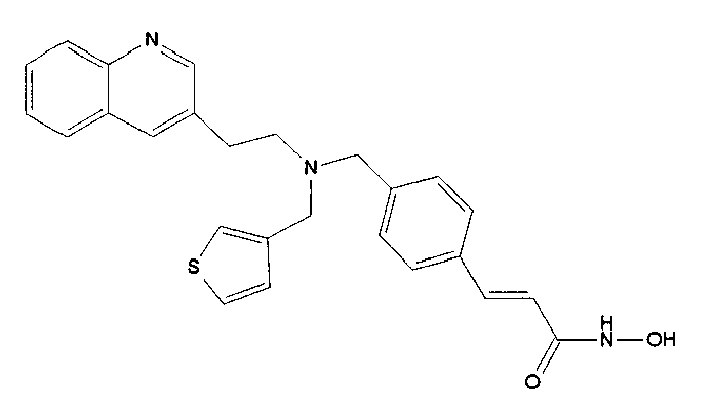
10 
11 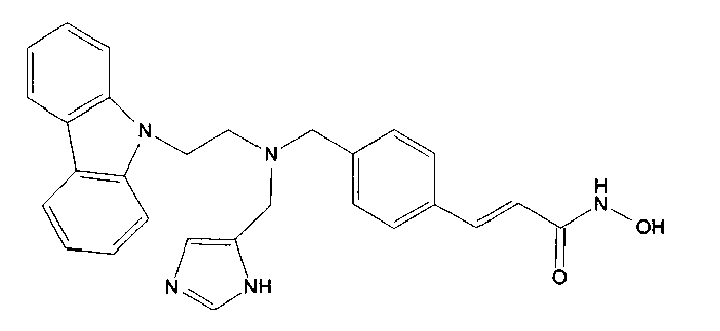
12 
420 13 
420 14 
15 
465 16 
385 17 
550 18 
432 19 
366 20 
350 21 
22 
442 23 
338 24 
464 25 
541 26 
27 
28 
417 29 
30 
31 
380 32 
436 33 
34 
493 35 
477 36 
586 37 
513 38 
378 39 
408 40 
449 41 
438 42 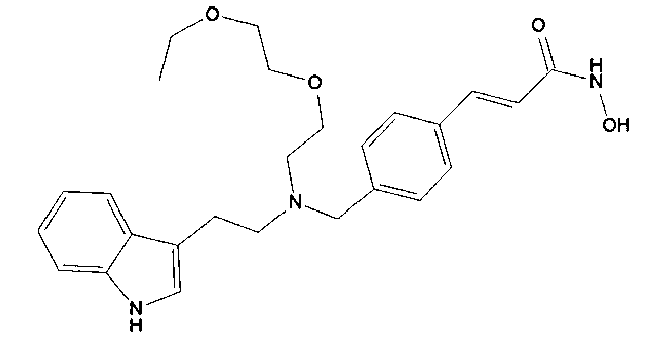
452 43 
507 44 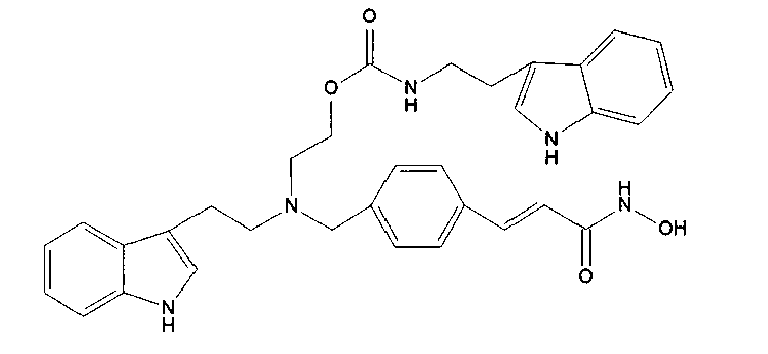
565 45 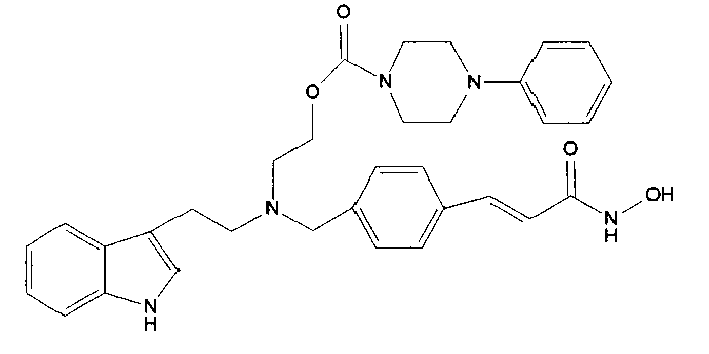
46 
47 
48 
49 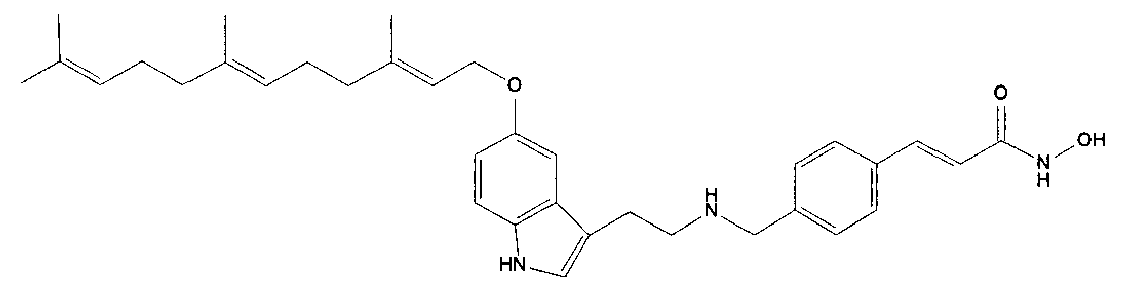
50 
51 
470 52 
53 
548 54 
623 55 
456 56 
478 57 
394 58 
422 59 
479 60 
603 61 
477 62 
539 63 
523 64 
65 
66 
67 
68 
539 69 
495 70 
71 
379 72 
478 73 
462 74 
378 75 
76 
493 77 
503 78 
350 79 
549 80 
471 81 
350 82 
418 83 
486 84 
524 85 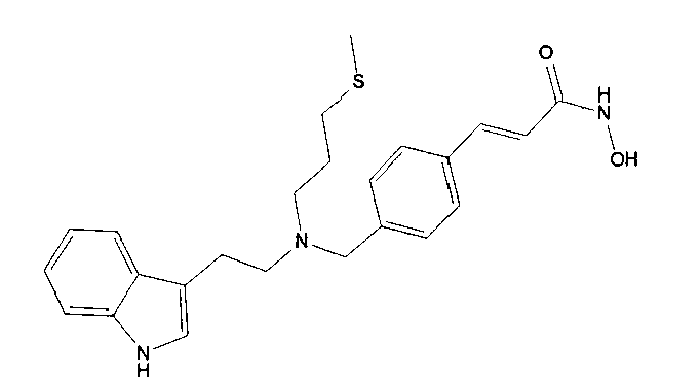
424 86 
364 87 
440 88 
420 89 
390 90 
91 
92 
484 93 
498 94 
490 95 
96 
475 97 
525 98 
422 99 
528 100 
448 101 
437 102 
451 103 
505 104 
519 105 
514 106 
507 107 
626 108 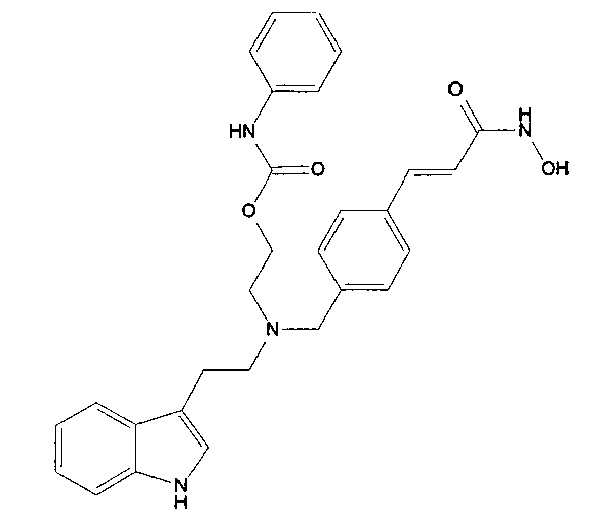
499 109 
110 
111 
429 112 
464 113 
432 114 
422 115 
390 116 
501 117 
484 118 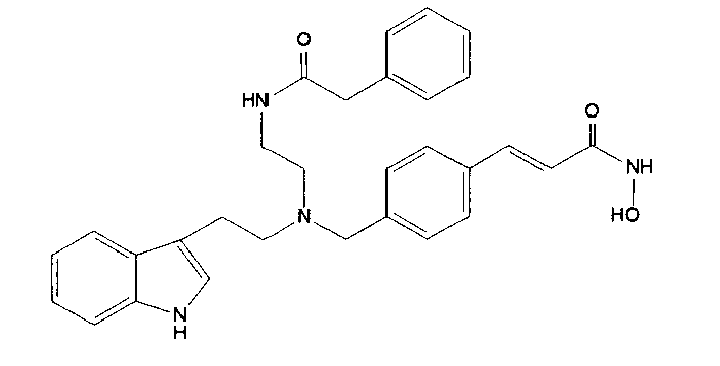
119 
587 120 
602 121 
539 122 
123 
528 124 
487 125 
126 
556 127 
128 
129 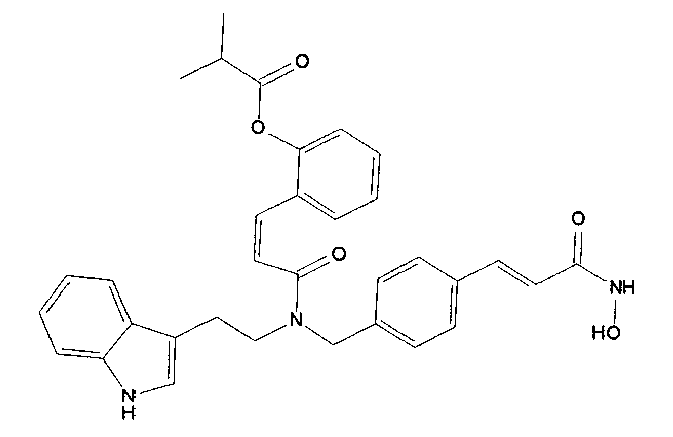
552 130 
519 131 
450 132 
464 133 
558 134 
533 135 
136 
527 137 
381 138 
364 139 
140 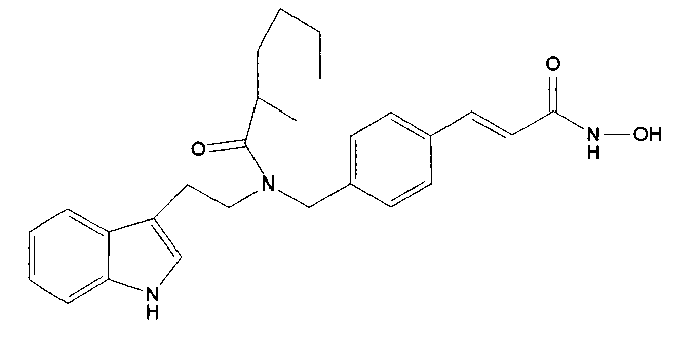
448 141 
558 142 
143 
427 144 
145 
432 146 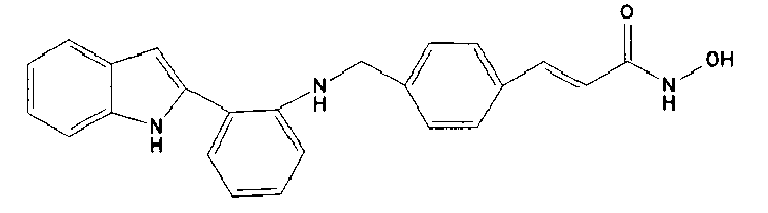
384 147 
354 148 
149 
150 
151 
152 
153 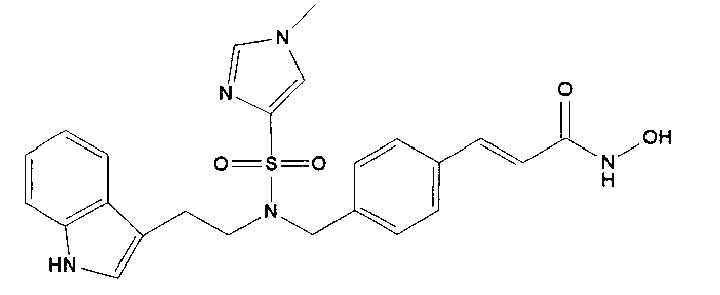
154 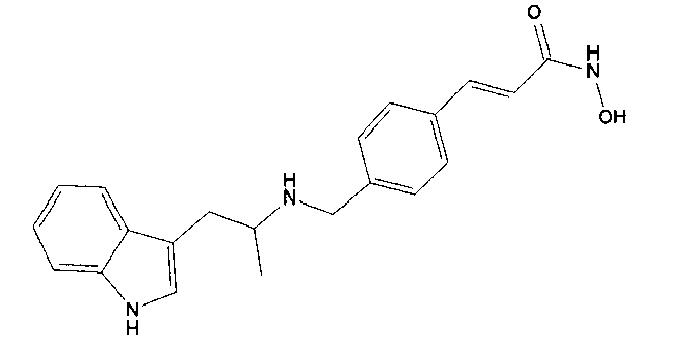
350 155 
366 156 
408 157 
322 158 
364 159 
364 160 
378 161 
350 162 
463 163 
164 
381 165 
463 166 
476 167 
168 
169 
170 
368 171 
493 172 
527 173 
515 174 
323 175 
540 176 
441 177 
276 178 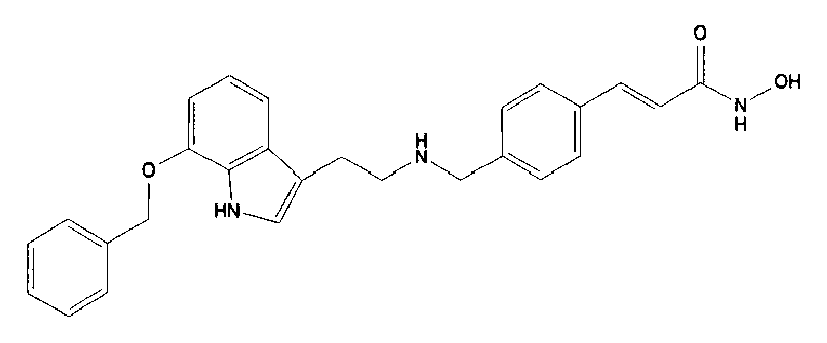
179 
455 180 
181 
336 182 
347 183 
447 184 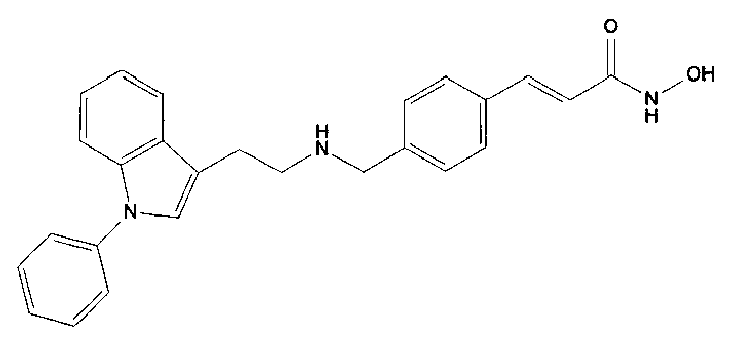
185 
420 186 
424 187 
422 188 
189 
398 190 
418 191 
350 192 
193 
352 194 
499 195 
408 196 
394 197 
499 198 
199 
200 
350 201 
202 
203 
204 
365 205 
465 206 
207 
410 208 
410 209 
210 
366 211 
352 212 
213 
368 214 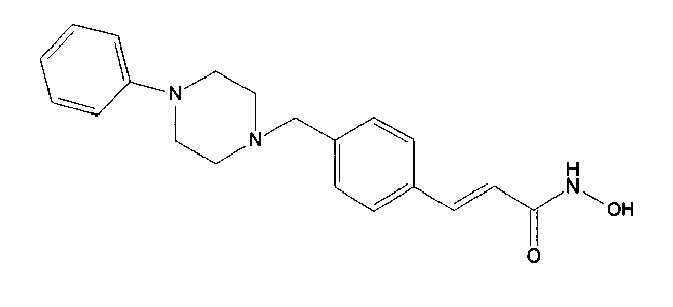
338 215 
356 216 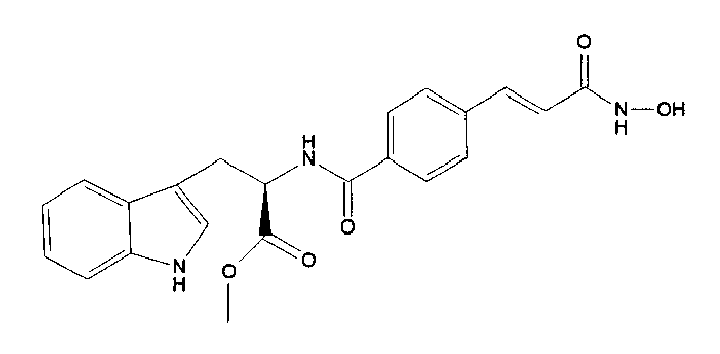
408 217 
368 218 
396 219 
220 
342 221 
392 222 
412 223 
337 224 
337 225 
456 226 
364 227 
481 228 
355 229 
312 230 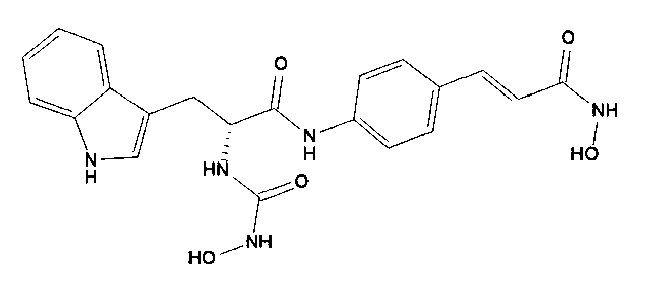
424 231 
232 
351 233 
392 234 
235 
236 
322 237 
238 
366 239 
240 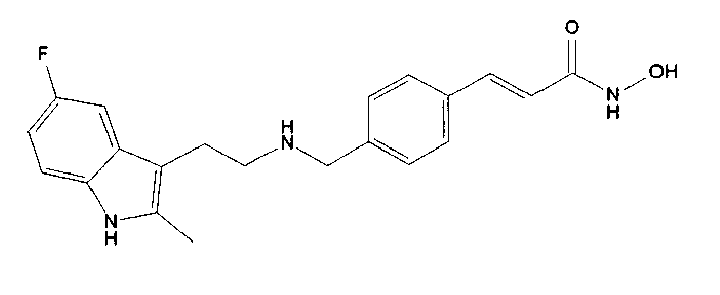
368 241 
242 
406 243 
398 244 
442 245 
350 246 
364 247 
402 248 
418 249 
364 250 
251 
408 252 
253 
254 
413 255 
405 256 
257 
394 258 
390 259 
434 260 
386 261 
368 262 
412 263 
406 264 
265 
378 - The compounds of Examples 1-265 show an HDA enzyme IC50 in the range from about 0.005 to about 0.5 µM).
- Cell lines H1299 (human lung carcinoma cell) and HCT116 (colon tumor cell) are obtained from the American Type Culture Collection, Rockville, MD. The cell lines are free of Mycoplasma contamination (Rapid Detection System by Gen-Probe, Inc., San Diego, CA) and viral contamination (MAP testing by MA BioServices, Inc., Rockville, MD). The cell lines are propagated and expanded in RPMI 1640 medium containing 10% heat-inactivated FBS (Life Technologies, Grand Island, NY). Cell expansions for implantation are performed in cell factories (NUNC, purchased from Fisher Scientific, Springfield, NJ). Cells are harvested at 50-90% confluency, washed once with HBSS (Hank's Balanced Salt Solution) containing 10% FBS, and suspended in 100% HBSS.
- Cell proliferation is measured with a commercial MTS kit (Promega, Madision, Wis.) assay using an adaptation of published procedures, for example, that disclosed in Feasibility of drug screening with panels of human tumor cell lines using a microculture tetrazolium assay, Alley MC, et al., Cancer Res. 1988; 48:589-601. Cells are plated in 96-well tissue culture dishes, with top and bottom rows left empty. H1299 and HCT116 cells are suspended in complete media at a density of 5.3 x 10³ and 3.6 x 10³ cell/mL, respectively, and 190 µl are added per well. Each cell line is added to one half of the plate. Complete medium (200 µL) is added to the top and bottom rows. Twenty-four hours later, 10 µl of MTS solution is added to one of the plates to determine the activity at the time of compound addition (T0). The plate is incubated at 37 °C for 4 hours and the OD490 is measured on a Molecular Devices Thermomax at 490 nm using the Softmax program. The To plate serves as a reference for initial activity at the beginning of the experiment.
- Five serial dilutions (1:4) of each compound are made in a 96-deep well plate with the highest concentrations on the edge of plate. Two cell lines are tested with two compounds per plate. Ten microliters of each of the five dilutions are added in triplicate and complete medium alone is added to columns six and seven. The plates are incubated at 37 °C for 72 hours. The MTS solution is added (as for the To plate) and read four hours later.
- In order to analyze the data, the average background value (media alone) is subtracted from each experimental well; the triplicate values are averaged for each compound dilution. The following formulas are used to calculate percent growth.


in which To = (average value of cell viability at time 0) - background
GC = average value of untreated cells (in triplicate) - background
X = average value of compound treated cells (in triplicate) - background
The "% Growth" is plotted against compound concentration and used to calculate IC50s employing the linear regression techniques between data points to predict the concentration of compounds at 50% inhibition. - Lactate salts of N-hydroxy-3-[4-[[[2-(1H-indol-3-yl)-ethyl]-amino]methyl]phenyl]-2E-2-propenamide (CMD1), N-hydroxy-3-[4-[[(2-hydroxyethyl)[2-(1H-indol-3-yl)-ethyl]-amino]methyl]phenyl]-2E-2-propenamide (CMD2), N-hydroxy-3-[4-[[[2-(5-methoxy-1H-indol-3-yl)-ethyl]-amino]methyl]phenyl]-2E-2-propenamide (CMD3), N-hydroxy-3-[4-[[[2-(5-fluoro-1H-indoi-3-yl)-ethyl]-amino]methyl]phenyl]-2E-2-propenamide (CMD4), N-hydroxy-3-[4-[[[2-(benzofur-3-yl)-ethyl]-amino]methyl]phenyl]-2E-2-propenamide (CMD5) having a purity of higher than 95% are dissolved in pure dimethylsulfoxide (DMSO) to create a stock solution. The stock solution is diluted with 5% dextrose injection, USP, just prior to dosing. In addition, N-(2-aminophenyl)-4-[N-pyridin-3-yl)methoxycarbonylaminomethyl]benzamide is synthesized in accordance with Example 48 of
EP 0 847 992 and used as a control compound (CMDC). Inhibition of cell growth in monolayer for 72 hours of compound treatment is measured in triplicate experiments and used to derive the IC50 by MTS assay. The results are shown in Table B1.Table B1 Compound Monolayer Growth IC50 (µM) H1299 HCT116 CMD1 0.40 0.03 CMD2 0.15 0.01 CMD3 0.58 0.03 CMD4 0.28 0.03 CMD5 0.18 0.03 CMDC 6.8 0.67 - The results show that the hydroxamate compounds of the present invention are highly active in inhibition of tumor cell growth. In addition to the above results, it has been observed that the compounds selectively inhibited tumor cells while showing minimal inhibition activities in non-tumorous cells.
- The cells treated with the hydroxamate compounds are also tested for the induction of p21 promoter, which is a key mediator of G1 arrest and differentiation. The hydroxamate compounds activate the p21 promoter to a readily detectable level at a concentration within two-fold of their respective IC50 for monolayer cell growth inhibition in H1299. Without being bound by any particular theory, the correlation appears to demonstrate that HDA inhibition leads to transcriptional activation of genes that inhibit tumor cell proliferation.
- HDA is partially purified from H1299, human non-small cell lung carcinoma cells (obtained from American Type Culture Collection, 12301 Parklawn Drive, Rockville, MD 20852, USA). Cells are grown to 70-80% confluence in RPMI media in the presence of 10% FCS, harvested and lysed by sonication. The lysate is centrifuged at 23, 420g for 10-15 min, the supernatant is applied to a Hiload 26/10 High performance Q-sepharose column (Amersham Pharmacia Biotech), and equilibrated with a buffer containing 20 mM Tris pH8.0, 1 mM EDTA, 10 mM NH4Cl2, 1 mM β-Mercaptoethanol, 5% glycerol, 2 µg/mL aprotinin, 1 µg/mL leupeptin, and 400 mM PMSF. Proteins are eluted in 4mL aliquotes with a linear gradient from 0-500 mM NaCl in the above buffer at a flow rate of 2.5 mL/min. Each preparation of partially purified HDA enzyme is titrated to determine the optimal amount needed to obtain a signal to noise ratio of at least 5 to 1. Generally, 20-30 µl of partially purified HDA (5-10 mg protein/mL) is mixed with 2 µL of compound solution in DMSO in a deep well titer plate (Beckman). The compounds are serially diluted in DMSO to generate stocks at 20-fold of the assay concentrations. Final concentrations of compounds in the assay are 10 µM , 2 µM, 400 nM, 80 nM, and 16 nM with the final percentage of DMSO in each enzyme reaction equaling 0.1 %. Each concentration of compound is assayed in duplicate. The substrate used in the reaction is a peptide of amino acid sequence, SGRGKGGKGLGKGGAKRHRKVLRD, corresponding to the twenty-four N-terminal amino acids of human histone H4, biotinylated at the N-terminus and penta-acetylated, at each lysine residue with 3H-acetate. To initiate the reaction, the substrate is diluted in 10 µL of Buffer A (100 mM Tris pH 8.0, 2 mM EDTA), added to the enzyme mixture and collected at the bottom of the deep well plate by centrifugation for 5 minutes at 1500 rpm. Following centrifugation, the mixture is incubated at 37 °C for 1.5 hr. The reaction is stopped by the addition of 20 µL of the Stop Buffer (0.5N HCI, 0.08M Acetic Acid). At this point, the assay proceeds to the robotic extraction phase or is frozen for several days at -80 °C.
- The extraction of enzymatically cleaved 3H-acetate groups from the reaction mixture is achieved with the solvent TBME (t-butyl methyl ether) using the Tomtec Quadra 96 workstation. A program is written to add 200 µL of TBME to a 96 "deep well" plate. The workstation is programmed to aspirate 50 µL of air followed by 200 µL of TBME and finally another 25 µL of air, which is dispensed into the each well of the plate. The contents of the deep well were mixed thoroughly by pipetting 160 µL up and down 10 times. Before addition of TBME to the reaction mixture, it is necessary to "pre-wet" the pipette tips with TBME to prevent the solvent from dripping during the transfer to the deep well plate. The organic and aqueous phases in the deep well are separated by centrifugation at 1500 rpm for 5 min. Opti-Phase Supermix liquid scintillation cocktail (200 µL) (Wallac) is added to each well of the 96-well Trilux plate (Wallac). The deep well and Trilux plates are placed back on the workstation programmed to aspirate 25 µL of air into the pipette tips followed by 100 µL of the upper TBME phase and transfer it into the Trilux plate. The solutions are mixed by pipetting and expelling 50 µL, five times, within the same well. The Trilux plate is covered with clear film and read on a 1450 MicroBeta Trilux liquid scintillation and luminescence counter (Wallac) with a color/chemical quench and dpm correction.
- In order to determine the IC50 values, the data are analyzed on a spreadsheet. The analysis requires a correction for the background luminescence that is accomplished by subtracting the dpm values of wells without 3H substrate from the experimental wells. The corrected dpm values along with the concentrations of the compounds are used to calculate IC50 using the user-defined spline function. This function utilizes linear regression techniques between data points to calculate the concentration of compounds that produced 50% inhibition. The results are shown in Table B2.
Table B2 Compound HDA Enzyme Activity IC50 (µM) CMD1 0.032 CMD2 0.063 CMD3 0.014 CMD4 0.014 CMD5 0.016 CMDC > 10 - The A549 non-small cell lung human tumor cell line is purchased from the American Type Culture Collection, Rockville, MD. The cell line is free of Mycoplasma contamination (Rapid Detection System by Gen-Probe, Inc., San Diego, CA) and viral contamination (MAP testing by MA BioServices, Inc., Rockville, MD). The cell line is propagated and expanded in RPMI 1640 medium containing 10% heat-inactivated FBS (Life Technologies, Grand Island, NY). Cell expansions for implantation are performed in cell factories (NUNC, purchased from Fisher Scientific, Springfield, NJ). Cells are harvested at 50-90% confluency, washed once with HBSS containing 10% FBS, and suspended in 100% HBSS.
- Outbred athymic (nu/nu) female mice ("Hsd:Athymic Nude-nu" from Harlan Sprague Dawley, Indianapolis, IN) are anesthetized with Metofane (Mallinckrodt Veterinary, Inc., Mundelein, IL), and 100 µL of the cell suspension containing 1x10⁷ cells is injected subcutaneously into the right axillary (lateral) region of each animal. Tumors are allowed to grow for about 20 days until a volume of ~100 mm3 is achieved. At this point, mice bearing tumors with acceptable morphology and size are sorted into groups of eight for the study. The sorting process produces groups balanced with respect to mean and range of tumor size. Antitumor activity is expressed as % T/C, comparing differences in tumor volumes for treatment group (T) to vehicle control group (C). Regressions are calculated using the formula: (1-T/T0) x 100%, where T is the tumor volume for the treatment group at the end of the experiment, and T0 is the tumor volume at the beginning of the experiment.
- CMD1 is administered intravenously, once daily 5x/week for three weeks, at doses of 10, 25, 50, or 100 mg/kg. The final DMSO concentration is 10%. Each test group has eight mice. Tumors are measured, and individual animal body weights recorded. Table B3 shows the results on the 41st day.
Table B3 Δ MEAN Δ % DOSE TUMOR VOLUME*1 BODY WEIGHT*2 COMPOUND (mg/kg) (mm3 ± SEM*3) % T/C (% ± SEM*3) 10% DMSO/D5W*4 - 376 ± 55 - +11.9 ± 0.2 CMD1 10 121 ± 27 32 + 1.3 ± 0.3 CMD1 25 77 ± 32 20 - 0.9 ± 0.3 CMD1 50 57 ± 10 15 - 0.4 ± 0.3 CMD1 100 28 ± 25 7 +0.4 ± 0.3 Note: *1. Difference in mean tumor volume for a group of animals at the end of the experiment minus mean tumor volume at the beginning.
*2. Difference in body weight for a group of animals at the end of the experiment minus mean tumor volume at the beginning.
*3. Standard error of the mean.
*4.5% dextrose injection, USP. - Example B3 repeated except CMD2 is used. Table B4 shows the results.
Table B4 Δ MEAN Δ% DOSE TUMOR VOLUME BODY WEIGHT COMPOUND (mg/kg) (mm3 ± SEM) % T/C (% ± SEM) 10% DMSO/D5W - 135 ± 43 - + 6.7 ± 1.1 CMD2 25 37 ± 16 27 - 4.2 ± 2.5 CMD2 50 29 ± 15 21 - 2.9 ± 1.5 - Example B3 is repeated except the HCT116 colon tumor cell line is used in place of the A549 cell line. The HCT116 cell line is also obtained from American Type Culture Collection, Rockville, MD, and the cell line is free of Mycoplasma contamination and viral contamination. The results are recorded on the 34th day and are shown in Table B5.
Table B5 Δ MEAN Δ % DOSE TUMOR VOLUME BODY WEIGHT COMPOUND (mg/kg) (mm3 ± SEM) % T/C (% ± SEM) 10%DMSO/D5W - 759 ± 108 - - 0.4 ± 0.4 CMD1 50*10 186 ± 40 25 - 7.4 ± 0.8 CMD1 100 140 ± 38 18 - 3.2 ± 0.4 Note: *10. Seven mice are tested in this group. - Example B4 is repeated except the HCT116 colon tumor cell line is used in place of the A549 cell line. The HCT116 is also obtained from American Type Culture Collection, Rockville, MD, and the cell line is free of Mycoplasma contamination and viral contamination. The results are recorded on the 34th day and are shown in Table B6.
Table B6 Δ MEAN Δ % DOSE TUMOR VOLUME BODY WEIGHT COMPOUND (mg/kg) (mm3 ± SEM) % T/C (% ± SEM) 10% DMSO/D5W - 759 ± 108 - - 0.4 ± 0.4 CMD2 10 422 ± 75 56 - 10.2 ± 0.5 CMD2 25 305 ± 47 40 - 7.0 ± 0.2 CMD2 50 97 ± 30 13 - 7.3 ± 0.3 CMD2 100 132 ± 30 17 - 9.4 ± 0.4 - Annexin V binding was used as a marker for the early stages of apoptosis. A549, HCT116 and Normal Dermal Human Fibroblasts (NDHF) cells are treated separately with four compounds (CMD1, CMD2, CMD3 and CMD4) for 24 or 48 hours, stained with annexin V and compared to cells treated similarly with vehicle (DMSO). Cells are examined by fluorescence microscopy. Those undergoing apoptosis exhibit green fluorescent membrane staining. Viability is assessed by the counterstain, propidium iodide. Cells detected by red fluorescence are not viable. A small percentage of A549 and the majority of HCT116 cells exhibit cell surface staining with annexin V after 24 hour exposure to each of the four compounds. After 48 hour treatment, the majority of the A549 and HCT116 stain with annexin V and/or propidium iodide indicating that the compounds induce apoptotic cell death. In contrast, NDHF cells do not show noticeable annexin V staining after 24 hour exposure and limited annexin V staining with CMD3 after 48 hour. These data show that NDHF cells predominantly underwent non-lethal growth arrest upon compound treatment, consistent with the cell cycle profile.
- The staining results demonstrate that the hydroxamate compounds of the present invention cause tumor cells to die by apoptosis, while causing normal fibroblast to predominantly undergo cell cycle arrest, clearly demonstrating the selective efficacy of the present compounds.
Claims (40)
- A compound of the formula I
 R1 is H, halo, or a straight chain C1-C6 alkyl;R2 is selected from H, C1-C10 alkyl, C4 - C9 cycloalkyl, C4 - C9 heterocycloalkyl, C4 - C9 heterocycloalkylalkyl, cycloalkylalkyl, aryl, heteroaryl, arylalkyl, heteroarylalkyl, -(CH2)nC(O)R6, -(CH2)nOC(O)R6, amino acyl, HON-C(O)-CH=C(R1)-aryl-alkyl- and -(CH2)nR7;R3 and R4 are the same or different and independently H, C1-C6 alkyl, acyl or acylamino, or R3 and R4 together with the carbon to which they are bound represent C=O, C=S, or C=NR8, or R2 together with the nitrogen to which it is bound and R3 together with the carbon to which it is bound can form a C4 - C9 heterocycloalkyl, a heteroaryl, a polyheteroaryl, a non-aromatic polyheterocycle, or a mixed aryl and non-aryl polyheterocycle ring;R5 is selected from H, C1-C6 alkyl, C4- C9 cycloalkyl, C4 - C9 heterocycloalkyl, acyl, aryl, heteroaryl, arylalkyl, heteroarylalkyl, aromatic polycycle, non-aromatic polycycle, mixed aryl and non-aryl polycycle, polyheteroaryl, non-aromatic polyheterocycle, and mixed aryl and non-aryl polyheterocycle;n, n1, n2 and n3 are the same or different and independently selected from 0 - 6, when n1 is 1-6, each carbon atom can be optionally and independently substituted with R3 and/or R4;X and Y are the same or different and independently selected from H, halo, C1-C4 alkyl, NO2 C(O)R1, OR9, SR9, CN, and NR10R11;R6 is selected from H, C1-C6 alkyl, C4 - C9 cycloalkyl, C4 - C9 heterocycloalkyl, cycloalkylalkyl, aryl, heteroaryl, arylalkyl, heteroarylalkyl, OR12, and NR13R14;R7 is selected from OR15, SR15, S(O)R16, SO2R17, NR13R14, and NR12SO2R6;R8 is selected from H, OR15, NR13R14, C1-C6 alkyl, C4 - C9 cycloalkyl, C4- C9 heterocycloalkyl, aryl, heteroaryl, arylalkyl, and heteroarylalkyl;R9 is selected from C1- C4 alkyl and C(O)-alkyl;R10 and R11 are the same or different and independently selected from H, C1-C4 alkyl, and -C(O)-alkyl;R12 is selected from H, C1-C6 alkyl, C4-C9 cycloalkyl, C4-C9 heterocycloalkyl, C4-C9 heterocycloalkylalkyl, aryl, mixed aryl and non-aryl polycycle, heteroaryl, arylalkyl, and heteroarylalkyl;R13 and R14 are the same or different and independently selected from H, C1-C6 alkyl, C4 - C9 cycloalkyl, C4-C9 heterocycloalkyl, aryl, heteroaryl, arylalkyl, heteroarylalkyl, amino acyl, or R13 and R14 together with the nitrogen to which they are bound are C4 - C9 heterocycloalkyl, heteroaryl, polyheteroaryl, non-aromatic polyheterocycle or mixed aryl and non-aryl polyheterocycle;R15 is selected from H, C1-C6 alkyl, C4-C9 cycloalkyl, C4-C9 heterocycloalkyl, aryl, heteroaryl, arylalkyl, heteroarylalkyl and (CH2)mZR12;R16 is selected from C1-C6 alkyl, C4-C9 cycloalkyl, C4-C9 heterocycloalkyl, aryl, heteroaryl, polyheteroaryl, arylalkyl, heteroarylalkyl and (CH2)mZR12;R17 is selected from C1-C6 alkyl, C4-C9 cycloalkyl, C4-C9 heterocycloalkyl, aryl, aromatic polycycle, heteroaryl, arylalkyl, heteroarylalkyl, polyheteroaryl and NR13R14;m is an integer selected from 0 to 6; andZ is selected from O, NR13, S and S(O);or a pharmaceutically acceptable salt thereof.
 - A compound of claim 1 wherein each of R1, X, Y, R3, and R4 is H.
- A compound of claim 2 wherein one of n2 and n3 is zero and the other is 1.
- A compound of claim 3 wherein R2 is H or -CH2-CH2-OH.
- A compound of claim 1 of the formula la
 n4 is 0-3,R2 is selected from H, C1-C6alkyl, C4 - C9 cycloalkyl, C4 - C9 heterocycloalkyl, cycloalkylalkyl, aryl, heteroaryl, arylalkyl, heteroarylalkyl, -(CH2)nC(O)R6, amino acyl and -(CH2)nR7;R5' is heteroaryl, heteroarylalkyl, an aromatic polycycle, a non-aromatic polycycle, a mixed aryl and non-aryl polycycle, polyheteroaryl, or a mixed aryl and non-aryl polyheterocycle,or a pharmaceutically acceptable salt thereof.
 - A compound of claim 1 of the formula la
 n4 is 0-3,R2 is selected from H, C1-C6 alkyl, C4 - C9 cycloalkyl, C4 - C9 heterocycloalkyl, cycloalkylalkyl, aryl, heteroaryl, arylalkyl, heteroarylalkyl, -(CH2)nC(O)R6, amino acyl and -(CH2)nR7;R5' is aryl, arylalkyl, an aromatic polycycle, a non-aromatic polycycle or a mixed aryl and non-aryl polycycle,or a pharmaceutically acceptable salt thereof.
 - A compound of claim 6 wherein R5' is aryl or arylalkyl.
- A compound of claim 7 wherein R5' is p-fluorophenyl, p-chlorophenyl, p-O-C1-C4-alkylphenyl, P-C1-C4-alkylphenyl, benzyl, ortho, meta or para-fluorobenzyl, ortho, meta or para-chlorobenzyl, or ortho, meta or para - mono, di or tri-O-C1-C4-alkylbenzyl.
- A compound of claim 1 of the formula Ib

R2' is selected from H, C1-C6 alkyl, C4-C6 cycloalkyl, cycloalkylalkyl, -(CH2)2-4OR21 where R21 is H, methyl, ethyl, propyl, or isopropyl, and
R5" is unsubstituted or substituted 1H-indol-3-yl, benzofuran-3-yl or quinolin-3-yl,
or a pharmaceutically acceptable salt thereof. - A compound of claim 9 wherein R5" is substituted 1H-indol-3-yl or substituted benzofuran-3-yl.
- A compound of claim 1 of the formula lc

the ring containing Z1 is aromatic or non-aromatic which non-aromatic rings are saturated or unsaturated,
Z1 is O, S or N-R20;
R18 is H, halo, C1-C6alkyl, C3-C7cycloalkyl, aryl, or heteroaryl;
R20 is H, C1-C6alkyl, C1-C6alkyl-C3-C9cycloalkyl, aryl, heteroaryl, arylalkyl, heteroarylalkyl, acyl or sulfonyl;
A1 is 1, 2 or 3 substituents which are independently H, C1-C6alkyl, -OR19, halo, alkylamino, aminoalkyl, halo, or heteroarylalkyl;
R2 is selected from H, C1-C6 alkyl, C4-C9 cycloalkyl, C4-C9 heterocycloalkyl, cycloalkylalkyl, aryl, heteroaryl, arylalkyl, heteroarylalkyl, -(CH2)nC(O)R6, amino acyl and -(CH2)nR7;
R19 is selected from H, C1-C6alkyl, C4-C9cycloalkyl, C4-C9heterocycloalkyl, aryl, heteroaryl, arylalkyl, and heteroarylalkyl;
v is 0, 1 or 2,
p is 0-3, and
q is 1-5 and r is 0 or
q is 0 and r is 1-5,
or a pharmaceutically acceptable salt thereof. - A compound of claim 11 wherein Z1 is N-R20.
- A compound of claim 11 wherein R2 is H or -CH2-CH2-OH and the sum of q and r is 1.
- A compound of claim 1 of the formula ld

Z1 is O, S or N-R20,
R18 is H, halo, C1-C6alkyl, C3-C7cycloalkyl, unsubstituted phenyl, substituted phenyl, or heteroaryl,
R20 is H, C1-C6alkyl, C1-C6alkyl-C3-C9cycloalkyl, aryl, heteroaryl, arylalkyl, heteroarylalkyl, acyl or sulfonyl;
A1 is 1, 2 or 3 substituents which are independently H, C1-C-6alkyl, -OR19, or halo,
R19 is selected from H, C1-C6alkyl, C4-C9cycloalkyl, C4-C9heterocycloalkyl, aryl, heteroaryl, arylalkyl, heteroarylalkyl and -(CH2CH=CH(CH3)(CH2))1-3H;
p is 0-3, and
q is 1-5 and r is 0 or
q is 0 and r is 1-5,
or a pharmaceutically acceptable salt thereof. - A compound of claim 14 wherein R2 is H or -CH2-CH2-OH and the sum of q and r is 1.
- A compound of claim 11 of the formula le

- A compound of claim 16 wherein R18 is H, fluoro, chloro, bromo, C1-C4alkyl, C3-C7cycloalkyl, phenyl or heteroaryl.
- A compound of claim 16 wherein R2 is H, or -(CH2)pCH2OH and wherein p is 1-3.
- A compound of claim 18 wherein R1 is H and X and Y are each H, and wherein q is 1-3 and r is 0 or wherein q is 0 and r is 1-3.
- A compound of claim 16 wherein R18 is H, methyl, ethyl, t-butyl, trifluoromethyl, cyclohexyl, phenyl, 4-methoxyphenyl, 4-trifluoromethylphenyl, 2-furanyl, 2-thiophenyl, or 2-, 3- or 4-pyridyl.
- A compound of claim 20 wherein R2 is H, or -(CH2)pCH2OH.
- A compound of claim 21 wherein p is 1-3.
- A compound of claim 22 wherein R1 is H and X and Y are each H, and wherein q is 1-3 and r is 0 or wherein q is 0 and r is 1-3.
- A compound of claim 23 wherein R2 is H or -CH2-CH2-OH and the sum of q and r is 1.
- A compound of claim 16 wherein R20 is H or C1-C6alkyl.
- A compound of claim 16 selected from the group consisting of N-hydroxy-3-[4-[[(2-hydroxyethyl)[2-(1H-indol-3-yl)ethyl]-amino]methyl]phenyl]-2E-2-propenamide, N-hydroxy-3-[4-[[[2-(1H-indol-3-yl)ethyl]-amino] methyl]phenyl]-2E-2-propenamide and N-hydroxy-3-[4-[[[2-(2-methyl-1H-indol-3-yl)-ethyl]-amino]methyl]phenyl]-2E-2-propenamide, or a pharmaceutically acceptable salt thereof.
- A compound of claim 26 which is N-hydroxy-3-[4-[[(2-hydroxyethyl)[2-(1 H-indol-3-yl)ethyl]-amino]methyl]phenyl]-2E-2-propenamide, or a pharmaceutically acceptable salt thereof.
- A compound of claim 1 of the formula If

- A compound of claim 28 wherein R2 is H or -(CH2)pCH2OH and p is 1-3.
- A compound of claim 29 wherein R1 is H and X and Y are each H, and wherein q is 1-3 and r is 0 or wherein q is 0 and r is 1-3.
- A compound of claim 30 wherein R2 is H or -CH2-CH2-OH and the sum of q and r is 1.
- A compound of claim 28 which is N-hydroxy-3-[4-[[[2-(benzofur-3-yl)-ethyl]-amino]methyl]phenyl]-2E-2-propenamide, or a pharmaceutically acceptable salt thereof.
- A pharmaceutical composition comprising a pharmaceutically effective amount of a compound of formula I
 R1 is H, halo, or a straight chain C1-C6 alkyl;R2 is selected from H, C1-C10 alkyl, C4 - C9 cycloalkyl, C4 - C9 heterocycloalkyl, C4 - C9 heterocycloalkylalkyl, cycloalkylalkyl, aryl, heteroaryl, arylalkyl, heteroarylalkyl, -(CH2)nC(O)R6, -(CH2)nOC(O)R6, amino acyl, HON-C(O)-CH=C(R1)-aryl-alkyl- and -(CH2)nR7;R3 and R4 are the same or different and independently H, C1-C6 alkyl, acyl or acylamino, or R3 and R4 together with the carbon to which they are bound represent C=O, C=S, or C=NR8, or R2 together with the nitrogen to which it is bound and R3 together with the carbon to which it is bound can form a C4 - C9 heterocycloalkyl, a heteroaryl, a polyheteroaryl, a non-aromatic polyheterocycle, or a mixed aryl and non-aryl polyheterocycle ring;R5 is selected from H, C1-C6 alkyl, C4 - C9 cycloalkyl, C4 - C9 heterocycloalkyl, acyl, aryl, heteroaryl, arylalkyl, heteroarylalkyl, aromatic polycycle, non-aromatic polycycle, mixed aryl and non-aryl polycycle, polyheteroaryl, non-aromatic polyheterocycle, and mixed aryl and non-aryl polyheterocycle ;n, n1, n2 and n3 are the same or different and independently selected from 0-6, when n1 is 1-6, each carbon atom can be optionally and independently substituted with R3 and/or R4;X and Y are the same or different and independently selected from H, halo, C1-C4 alkyl, NO2 C(O)R1, OR9, SR9, CN, and NR10R11;R6 is selected from H, C1-C6 alkyl, C4 - C9 cycloalkyl, C4 - C9 heterocycloalkyl, cycloalkylalkyl, aryl, heteroaryl, arylalkyl, heteroarylalkyl, OR12, and NR13R14;R7 is selected from OR15, SR15, S(O)R16, SO2R17, NR13R14, and NR12SO2R6;R8 is selected from H, OR15, NR13R14, C1-C6 alkyl, C4 - C9 cycloalkyl, C4 - C9 heterocycloalkyl, aryl, heteroaryl, arylalkyl, and heteroarylalkyl;R9 is selected from C1-C4 alkyl and C(O)-alkyl;R10 and R11 are the same or different and independently selected from H, C1-C4 alkyl, and -C(O)-alkyl;R12 is selected from H, C1-C6 alkyl, C4 - C9 cycloalkyl, C4 - C9 heterocycloalkyl, C4 - C9 heterocycloalkylalkyl, aryl, mixed aryl and non-aryl polycycle, heteroaryl, arylalkyl, and heteroarylalkyl;R13 and R14 are the same or different and independently selected from H, C1-C6 alkyl, C4 - Cg cycloalkyl, C4-C9 heterocycloalkyl, aryl, heteroaryl, arylalkyl, heteroarylalkyl, amino acyl, or R13 and R14 together with the nitrogen to which they are bound are C4 - Cg heterocycloalkyl, heteroaryl, polyheteroaryl, non-aromatic polyheterocycle or mixed aryl and non-aryl polyheterocycle;R15 is selected from H, C1-C6 alkyl, C4 - C9 cycloalkyl, C4 - C9 heterocycloalkyl, aryl, heteroaryl, arylalkyl, heteroarylalkyl and (CH2)mZR12;R16 is selected from C1-C6 alkyl, C4 - C9 cycloalkyl, C4 - C9 heterocycloalkyl, aryl, heteroaryl, polyheteroaryl, arylalkyl, heteroarylalkyl and (CH2)mZR12;R17 is selected from C1-C6 alkyl, C4 - C9 cycloalkyl, C4 - C9 heterocycloalkyl, aryl, aromatic polycycle, heteroaryl, arylalkyl, heteroarylalkyl, polyheteroaryl and NR13R14;m is an integer selected from 0 to 6; andZ is selected from O, NR13, S and S(O);or a pharmaceutically acceptable salt thereof.
 - A pharmaceutical composition of claim 33 wherein the compound of formula I is selected from the group consisting of N-hydroxy-3-[4-[[(2-hydroxyethyl)[2-(1 H-indol-3-yl)ethyl]-amino]methyl]phenyl]-2E-2-propenamide, N-hydroxy-3-[4-[[[2-(1H-indol-3-yl)ethyl]-amino]methyl]phenyl]-2E-2-propenamide and N-hydroxy-3-[4-[[[2-(2-methyl-1H-indol-3-yl)-ethyl]-amino]methyl]phenyl]-2E-2-propenamide, or a pharmaceutically acceptable salt thereof.
- A pharmaceutical composition of claim 34 wherein the compound of formula I is N-hydroxy-3-[4-([(2-hydroxyethyl)[2-(1H-indol-3-yl)ethyl]-amino]methyl]phenyl]-2E-2-propenamide, or a pharmaceutically acceptable salt thereof.
- A pharmaceutical composition of claim 33 wherein the compound of formula I is N-hydroxy-3-[4-[[[2-(benzofur-3-yl)-ethyl]-amino]methyl]phenyl]-2E-2-propenamide, or a pharmaceutically acceptable salt thereof.
- A method for treating a proliferative disorder in a mammal which comprises administering to said mammal a compound of the formula I
 R1 is H, halo, or a straight chain C1-C6 alkyl;R2 is selected from H, C1-C10 alkyl, C4 - C9 cycloalkyl, C4 - C9 heterocycloalkyl, C4 - C9 heterocycloalkylalkyl, cycloalkylalkyl, aryl, heteroaryl, arylalkyl, heteroarylalkyl, -(CH2)nC(O)R6, -(CH2)nOC(O)R6, amino acyl, HON-C(O)-CH=C(R1)-aryl-alkyl- and -(CHz)nR7;R3 and R4 are the same or different and independently H, C1-C6 alkyl, acyl or acylamino, or R3 and R4 together with the carbon to which they are bound represent C=O, C=S, or C=NR8, or R2 together with the nitrogen to which it is bound and R3 together with the carbon to which it is bound can form a C4 - C9 heterocycloalkyl, a heteroaryl, a polyheteroaryl, a non-aromatic polyheterocycle, or a mixed aryl and non-aryl polyheterocycle ring;R5 is selected from H, C1-C6 alkyl, C4 - C9 cycloalkyl, C4 - C9 heterocycloalkyl, acyl, aryl, heteroaryl, arylalkyl, heteroarylalkyl, aromatic polycycle, non-aromatic polycycle, mixed aryl and non-aryl polycycle, polyheteroaryl, non-aromatic polyheterocycle, and mixed aryl and non-aryl polyheterocycle ;n, n1, n2 and n3 are the same or different and independently selected from 0-6, when n1 is 1-6, each carbon atom can be optionally and independently substituted with R3 and/or R4 ;X and Y are the same or different and independently selected from H, halo, C1-C4 alkyl, NO2, C(O)R1, OR9, SR9, CN, and NR10R11 ;R6 is selected from H, C1-C6 alkyl, C4 - C9 cycloalkyl, C4 - C9 heterocycloalkyl, cycloalkylalkyl, aryl, heteroaryl, arylalkyl, heteroarylalkyl, OR12, and NR13R14 ;R7 is selected from OR15, SR15, S(O)R16, SO2R17, NR13R14, and NR12SO2R6 ;R8 is selected from H, OR15, NR13R14, C1-C6 alkyl, C4 - C9 cycloalkyl, C4 - C9 heterocycloalkyl, aryl, heteroaryl, arylalkyl, and heteroarylalkyl;R9 is selected from C1 - C4 alkyl and C(O)-alkyl;R10 and R11 are the same or different and independently selected from H, C1-C4 alkyl, and -C(O)-alkyl;R12 is selected from H, C1-C6 alkyl, C4 - C9 cycloalkyl, C4 - C9 heterocycloalkyl, C4 - C9 heterocycloalkylalkyl, aryl, mixed aryl and non-aryl polycycle, heteroaryl, arylalkyl, and heteroarylalkyl;R13 and R14 are the same or different and independently selected from H, C1-C6 alkyl, C4 - C9 cycloalkyl, C4-C9 heterocycloalkyl, aryl, heteroaryl, arylalkyl, heteroarylalkyl, amino acyl, or R13 and R14 together with the nitrogen to which they are bound are C4 - C9 heterocycloalkyl, heteroaryl, polyheteroaryl, non-aromatic polyheterocycle or mixed aryl and non-aryl polyheterocycle;R15 is selected from H, C1-C6 alkyl, C4 - C9 cycloalkyl, C4 - C9 heterocycloalkyl, aryl, heteroaryl, arylalkyl, heteroarylalkyl and (CH2)mZR12;R16 is selected from C1-C6 alkyl, C4 - C9 cycloalkyl, C4 - C9 heterocycloalkyl, aryl, heteroaryl, polyheteroaryl, arylalkyl, heteroarylalkyl and (CH2)mZR12;R17 is selected from C1-C6 alkyl, C4 - C9 cycloalkyl, C4 - C9 heterocycloalkyl, aryl, aromatic polycycle, heteroaryl, arylalkyl, heteroarylalkyl, polyheteroaryl and NR13R14;m is an integer selected from 0 to 6; andZ is selected from O, NR13, S and S(O);or a pharmaceutically acceptable salt thereof.
 - A method of claim 37 wherein the compound of formula I is selected from the group consisting of N-hydroxy-3-[4-[[(2-hydroxyethyl)[2-(1H-indol-3-yl)ethyl]-amino]methyl]phenyl]-2E-2-propenamide, N-hydroxy-3-[4-[[[2-(1 H-indol-3-yl)ethyl]-amino]methyl]phenyl]-2E-2-propenamide and N-hydroxy-3-[4-[[[2-(2-methyl-1H-indol-3-yl)-ethyl]-amino]methyl]phenyl]-2E-2-propenamide, or a pharmaceutically acceptable salt thereof.
- A method for regulating p21 promoter which comprises introducing a compound of the formula I
 R1 is H, halo, or a straight chain C1-C6 alkyl;R2 is selected from H, C1-C10 alkyl, C4 - C9 cycloalkyl, C4 - C9 heterocycloalkyl, C4 - C9 heterocycloalkylalkyl, cycloalkylalkyl, aryl, heteroaryl, arylalkyl, heteroarylalkyl, -(CH2)nC(O)R6, -(CH2)nOC(O)R6, amino acyl, HON-C(O)-CH=C(R1)-aryl-alkyl- and -(CH2)nR7;R3 and R4 are the same or different and independently H, C1-C6 alkyl, acyl or acylamino, or R3 and R4 together with the carbon to which they are bound represent C=O, C=S, or C=NR8, or R2 together with the nitrogen to which it is bound and R3 together with the carbon to which it is bound can form a C4-C9 heterocycloalkyl, a heteroaryl, a polyheteroaryl, a non-aromatic polyheterocycle, or a mixed aryl and non-aryl polyheterocycle ring;R5 is selected from H, C1-C6 alkyl, C4 - C9 cycloalkyl, C4 - C9 heterocycloalkyl, acyl, aryl, heteroaryl, arylalkyl, heteroarylalkyl, aromatic polycycle, non-aromatic polycycle, mixed aryl and non-aryl polycycle, polyheteroaryl, non-aromatic polyheterocycle, and mixed aryl and non-aryl polyheterocycle;n, n1, n2 and n3 are the same or different and independently selected from 0 - 6, when n1 is 1-6, each carbon atom can be optionally and independently substituted with R3 and/or R4;X and Y are the same or different and independently selected from H, halo, C1-C4 alkyl, NO2, C(O)R1, OR9, SR9, CN, and NR10R11;R6 is selected from H, C1-C6 alkyl, C4 - C9 cycloalkyl, C4 - C9 heterocycloalkyl, cycloalkylalkyl, aryl, heteroaryl, arylalkyl, heteroarylalkyl, OR12, and NR13R14;R7 is selected from OR15, SR15, S(O)R16, SO2R17, NR13R14, and NR12SO2R6;R8 is selected from H, OR15, NR13R14, C1-C6 alkyl, C4 - C9 cycloalkyl, C4 -C9 heterocycloalkyl, aryl, heteroaryl, arylalkyl, and heteroarylalkyl;R9 is selected from C1-C4 alkyl and C(O)-alkyl;R10 and R11 are the same or different and independently selected from H, C1-C4 alkyl, and -C(O)-alkyl;R12 is selected from H, C1-C6 alkyl, C4 - C9 cycloalkyl, C4 - C9 heterocycloalkyl, C4 - C9 heterocycloalkylalkyl, aryl, mixed aryl and non-aryl polycycle, heteroaryl, arylalkyl, and heteroarylalkyl;R13 and R14 are the same or different and independently selected from H, C1-C6 alkyl, C4 - C9 cycloalkyl, C4 - C9 heterocycloalkyl, aryl, heteroaryl, arylalkyl, heteroarylalkyl, amino acyl, or R13 and R14 together with the nitrogen to which they are bound are C4 - C9 heterocycloalkyl, heteroaryl, polyheteroaryl, non-aromatic polyheterocycle or mixed aryl and non-aryl polyheterocycle;R15 is selected from H, C1-C6 alkyl, C4 - C9 cycloalkyl, C4 - C9 heterocycloalkyl, aryl, heteroaryl, arylalkyl, heteroarylalkyl and (CH2)mZR12;R16 is selected from C1-C6 alkyl, C4 - C9 cycloalkyl, C4 - C9 heterocycloalkyl, aryl, heteroaryl, polyheteroaryl, arylalkyl, heteroarylalkyl and (CH2)mZR12;R17 is selected from C1-C6 alkyl, C4 - C9 cycloalkyl, C4 - C9 heterocycloalkyl, aryl, aromatic polycycle, heteroaryl, arylalkyl, heteroarylalkyl, polyheteroaryl and NR13R14;m is an integer selected from 0 to 6; andZ is selected from O, NR13, S and S(O);or a pharmaceutically acceptable salt thereof,
into the environment of a mammalian cell. - A method of claim 39 wherein the compound of formula I is selected from the group consisting of N-hydroxy-3-[4-[[(2-hydroxyethyl)[2-(1H-indol-3-yl)ethyl]-amino]methyl]phenyl]-2E-2-propenamide, N-hydroxy-3-[4-[[[2-(1H-indol-3-yl)ethyl]-amino]methyl]phenyl]-2E-2-propenamide and N-hydroxy-3-[4-[[[2-(2-methyl-1H-indol-3-yl)-ethyl]-amino]methyl]phenyl]-2E-2-propenamide, or a pharmaceutically acceptable salt thereof.
Applications Claiming Priority (3)
| Application Number | Priority Date | Filing Date | Title |
|---|---|---|---|
| US22994300P | 2000-09-01 | 2000-09-01 | |
| US29223201P | 2001-05-18 | 2001-05-18 | |
| EP01960717A EP1318980B1 (en) | 2000-09-01 | 2001-08-30 | Hydroxamate derivatives useful as deacetylase inhibitors |
Related Parent Applications (1)
| Application Number | Title | Priority Date | Filing Date |
|---|---|---|---|
| EP01960717A Division EP1318980B1 (en) | 2000-09-01 | 2001-08-30 | Hydroxamate derivatives useful as deacetylase inhibitors |
Publications (1)
| Publication Number | Publication Date |
|---|---|
| EP1870399A1 true EP1870399A1 (en) | 2007-12-26 |
Family
ID=26923760
Family Applications (2)
| Application Number | Title | Priority Date | Filing Date |
|---|---|---|---|
| EP01960717A Expired - Lifetime EP1318980B1 (en) | 2000-09-01 | 2001-08-30 | Hydroxamate derivatives useful as deacetylase inhibitors |
| EP07115019A Withdrawn EP1870399A1 (en) | 2000-09-01 | 2001-08-30 | Hydroxamate derivatives useful as deacetylase inhibitors |
Family Applications Before (1)
| Application Number | Title | Priority Date | Filing Date |
|---|---|---|---|
| EP01960717A Expired - Lifetime EP1318980B1 (en) | 2000-09-01 | 2001-08-30 | Hydroxamate derivatives useful as deacetylase inhibitors |
Country Status (35)
| Country | Link |
|---|---|
| US (5) | US6552065B2 (en) |
| EP (2) | EP1318980B1 (en) |
| JP (1) | JP4012819B2 (en) |
| KR (1) | KR100585484B1 (en) |
| CN (1) | CN1300110C (en) |
| AR (1) | AR035057A1 (en) |
| AT (1) | ATE376999T1 (en) |
| AU (2) | AU2001282129B2 (en) |
| BE (1) | BE2015C062I2 (en) |
| BR (1) | BRPI0113669B8 (en) |
| CA (1) | CA2420899C (en) |
| CY (2) | CY1107839T1 (en) |
| CZ (1) | CZ302707B6 (en) |
| DE (1) | DE60131179T2 (en) |
| DK (1) | DK1318980T3 (en) |
| EC (1) | ECSP034492A (en) |
| ES (1) | ES2292610T3 (en) |
| FR (1) | FR15C0086I2 (en) |
| HU (2) | HU229796B1 (en) |
| IL (2) | IL154574A0 (en) |
| LU (1) | LU92890I2 (en) |
| MX (1) | MXPA03001832A (en) |
| MY (1) | MY136892A (en) |
| NL (1) | NL300778I2 (en) |
| NO (2) | NO324942B1 (en) |
| NZ (1) | NZ524365A (en) |
| PE (1) | PE20020354A1 (en) |
| PL (1) | PL221738B1 (en) |
| PT (1) | PT1318980E (en) |
| RU (1) | RU2302408C3 (en) |
| SI (1) | SI1318980T1 (en) |
| SK (1) | SK287609B6 (en) |
| TW (1) | TWI286544B (en) |
| WO (1) | WO2002022577A2 (en) |
| ZA (1) | ZA200301423B (en) |
Cited By (10)
| Publication number | Priority date | Publication date | Assignee | Title |
|---|---|---|---|---|
| WO2016054555A2 (en) | 2014-10-03 | 2016-04-07 | Novartis Ag | Combination therapies |
| US10449211B2 (en) | 2015-03-10 | 2019-10-22 | Aduro Biotech, Inc. | Compositions and methods for activating “stimulator of interferon gene”—dependent signalling |
| US10472419B2 (en) | 2014-01-31 | 2019-11-12 | Novartis Ag | Antibody molecules to TIM-3 and uses thereof |
| US10570204B2 (en) | 2013-09-26 | 2020-02-25 | The Medical College Of Wisconsin, Inc. | Methods for treating hematologic cancers |
| US10752687B2 (en) | 2014-01-24 | 2020-08-25 | Novartis Ag | Antibody molecules to PD-1 and uses thereof |
| US10975114B2 (en) | 2017-04-28 | 2021-04-13 | Chinook Therapeutics, Inc. | Bis 2′-5′-RR-(3′F-A)(3′F-A) cyclic dinucleotide compound and uses thereof |
| US11344620B2 (en) | 2014-09-13 | 2022-05-31 | Novartis Ag | Combination therapies |
| US12252535B2 (en) | 2014-03-14 | 2025-03-18 | Novartis Ag | Antibody molecules to LAG-3 and uses thereof |
| US12600777B2 (en) | 2015-07-29 | 2026-04-14 | Novartis Ag | Combination therapies comprising antibody molecules to LAG-3 |
| US12630633B2 (en) | 2016-12-16 | 2026-05-19 | Novartis Ag | Antibody molecules to PD-1 and uses thereof |
Families Citing this family (462)
| Publication number | Priority date | Publication date | Assignee | Title |
|---|---|---|---|---|
| US6777217B1 (en) | 1996-03-26 | 2004-08-17 | President And Fellows Of Harvard College | Histone deacetylases, and uses related thereto |
| US6822267B1 (en) * | 1997-08-20 | 2004-11-23 | Advantest Corporation | Signal transmission circuit, CMOS semiconductor device, and circuit board |
| CA2391952C (en) | 1999-11-23 | 2012-01-31 | Methylgene Inc. | Inhibitors of histone deacetylase |
| US20030129724A1 (en) | 2000-03-03 | 2003-07-10 | Grozinger Christina M. | Class II human histone deacetylases, and uses related thereto |
| PE20020354A1 (en) | 2000-09-01 | 2002-06-12 | Novartis Ag | HYDROXAMATE COMPOUNDS AS HISTONE-DESACETILASE (HDA) INHIBITORS |
| WO2002026696A1 (en) | 2000-09-29 | 2002-04-04 | Prolifix Limited | Carbamic acid compounds comprising an amide linkage as hdac inhibitors |
| US7312247B2 (en) * | 2001-03-27 | 2007-12-25 | Errant Gene Therapeutics, Llc | Histone deacetylase inhibitors |
| WO2003032921A2 (en) | 2001-10-16 | 2003-04-24 | Sloan-Kettering Institute For Cancer Research | Treatment of neurodegenerative diseases and cancer of the brain |
| NZ544689A (en) * | 2001-11-06 | 2007-08-31 | Novartis Ag | Cyclooxygenase-2 inhibitor/histone deacetylase inhibitor combination |
| NZ550185A (en) | 2002-03-04 | 2008-10-31 | Merck Hdac Res Llc | Methods of inducing terminal differentiation Methods of inducing terminal differentiation |
| US7148257B2 (en) | 2002-03-04 | 2006-12-12 | Merck Hdac Research, Llc | Methods of treating mesothelioma with suberoylanilide hydroxamic acid |
| US7456219B2 (en) | 2002-03-04 | 2008-11-25 | Merck Hdac Research, Llc | Polymorphs of suberoylanilide hydroxamic acid |
| BR0308908A (en) | 2002-04-03 | 2005-01-04 | Topotarget Uk Ltd | Compound, composition, use of a compound, and methods for inhibiting hdac in a cell for the treatment of an hdac-mediated condition, a proliferative condition, cancer, and psoriasis |
| AU2003219595A1 (en) * | 2002-04-11 | 2003-10-27 | In2Gen Co., Ltd. | Alpha,Beta-UNSATURATED HYDROXAMIC ACID DERIVATIVES AND THEIR USE AS HISTONE DEACETYLASE INHIBITORS |
| WO2003088954A1 (en) * | 2002-04-15 | 2003-10-30 | Sloan-Kettering Institute For Cancer Research | Combination therapy for the treatment of cancer |
| BR0311714A (en) * | 2002-06-10 | 2005-03-01 | Novartis Ag | Combinations comprising epothilones and their pharmaceutical uses |
| CA2495354A1 (en) * | 2002-08-20 | 2004-03-04 | Yamanouchi Pharmaceutical Co., Ltd. | An agent for inhibiting articular cartilage extracellular matrix degradation |
| CA2498210C (en) * | 2002-09-13 | 2011-10-18 | Virginia Commonwealth University | Combination of a) n-{5-[4-(4-methyl-piperazino-methyl)-benzoylamido]-2-methylphenyl}-4-(3-pyridyl)-2-pyrimidine-amine and b) a histone deacetylase inhibitor for the treatment of leukemia |
| US7154002B1 (en) | 2002-10-08 | 2006-12-26 | Takeda San Diego, Inc. | Histone deacetylase inhibitors |
| US7250514B1 (en) | 2002-10-21 | 2007-07-31 | Takeda San Diego, Inc. | Histone deacetylase inhibitors |
| AU2003280838A1 (en) * | 2002-11-19 | 2004-06-15 | Takeda Pharmaceutical Company Limited | Indole derivatives as somatostatin agonists or antagonists |
| AU2003296310A1 (en) | 2002-12-06 | 2004-06-30 | University Of South Florida | Histone deacetylase inhibitor enhancement of trail-induced apoptosis |
| TW200418806A (en) * | 2003-01-13 | 2004-10-01 | Fujisawa Pharmaceutical Co | HDAC inhibitor |
| AU2004205372B2 (en) | 2003-01-17 | 2011-02-24 | Topotarget Uk Limited | Hydroxamic acid compounds comprising an ester or ketone linkage as HDAC inhibitors |
| AU2003900608A0 (en) * | 2003-02-11 | 2003-02-27 | Fujisawa Pharmaceutical Co., Ltd. | Hdac inhibitor |
| AU2003900587A0 (en) * | 2003-02-11 | 2003-02-27 | Fujisawa Pharmaceutical Co., Ltd. | Hdac inhibitor |
| WO2004076386A2 (en) | 2003-02-25 | 2004-09-10 | Topotarget Uk Limited | Carbamic acid compounds comprising a bicyclic heteroaryl group as hdac inhibitors |
| KR20050122210A (en) | 2003-03-17 | 2005-12-28 | 다케다 샌디에고, 인코포레이티드 | Histone deacetylase inhibitors |
| MXPA05012464A (en) * | 2003-05-21 | 2006-01-30 | Novartis Ag | Combination of histone deacetylase inhibitors with chemotherapeutic agents. |
| WO2005011598A2 (en) * | 2003-07-31 | 2005-02-10 | University Of South Florida | Leukemia treatment method and composition |
| US20060270730A1 (en) * | 2003-08-07 | 2006-11-30 | Andreas Katopodis | Histone deacetylase inhibitors as immunosuppressants |
| JP2007501774A (en) * | 2003-08-08 | 2007-02-01 | ノバルティス アクチエンゲゼルシャフト | Combinations containing staurosporine |
| EP1663194B1 (en) | 2003-08-26 | 2010-03-31 | Merck HDAC Research, LLC | Use of SAHA for treating mesothelioma |
| JP2007504131A (en) | 2003-08-29 | 2007-03-01 | エートン ファーマ インコーポレーティッド | Combination treatment of cancer |
| CN100455564C (en) * | 2003-09-12 | 2009-01-28 | 深圳微芯生物科技有限责任公司 | Preparation and application of histone deacetylase inhibitor and its pharmaceutical preparation |
| AU2004271730A1 (en) * | 2003-09-18 | 2005-03-24 | Novartis Ag | Combination of a histone deacetylase inhibitor with a death receptor ligand |
| KR101127201B1 (en) | 2003-09-22 | 2012-04-12 | 에스*바이오 피티이 리미티드 | Benzimidazole derivatives: preparation and pharmaceutical applications |
| PL1673349T3 (en) * | 2003-09-22 | 2010-11-30 | Mei Pharma Inc | Benzimidazole derivatives: preparation and pharmaceutical applications |
| US20080085902A1 (en) * | 2003-09-23 | 2008-04-10 | Guido Bold | Combination Of A Vegf Receptor Inhibitor Or With A Chemotherapeutic Agent |
| US20070167499A1 (en) * | 2003-10-27 | 2007-07-19 | A*Bio Pte Ltd. | Biaryl linked hydroxamates: preparation and pharmaceutical applications |
| US9115090B2 (en) | 2003-12-02 | 2015-08-25 | The Ohio State University Research Foundation | Zn2+-chelating motif-tethered short-chain fatty acids as a novel class of histone deacetylase inhibitors |
| EP1541549A1 (en) * | 2003-12-12 | 2005-06-15 | Exonhit Therapeutics S.A. | Tricyclic hydroxamate and benzaminde derivatives, compositions and methods |
| WO2005065681A1 (en) * | 2003-12-19 | 2005-07-21 | Takeda San Diego, Inc. | N- hydroxy-3-(3-(1h-imidazol-2-yl)-phenyl)-acrylamide derivatives and related compounds as histone deacetylase (hdac) inhibitors for the treatment of cancer |
| WO2005066151A2 (en) * | 2003-12-19 | 2005-07-21 | Takeda San Diego, Inc. | Histone deacetylase inhibitors |
| US20050197336A1 (en) * | 2004-03-08 | 2005-09-08 | Miikana Therapeutics Corporation | Inhibitors of histone deacetylase |
| US7345043B2 (en) * | 2004-04-01 | 2008-03-18 | Miikana Therapeutics | Inhibitors of histone deacetylase |
| RS52545B (en) | 2004-04-07 | 2013-04-30 | Novartis Ag | INHIBITORI PROTEIN APOPTOZE (IAP) |
| EP1771167A4 (en) * | 2004-07-19 | 2010-04-21 | Merck Sharp & Dohme | INHIBITORS OF HISTONE DEACETYLASE |
| JP4946861B2 (en) * | 2004-08-09 | 2012-06-06 | アステラス製薬株式会社 | Hydroxamide compound having inhibitory activity of histone deacetylase (HDAC) |
| ITMI20041869A1 (en) * | 2004-10-01 | 2005-01-01 | Dac Srl | NEW INHIBITORS OF DEACETYLASE HISTONS |
| US8242175B2 (en) | 2004-10-01 | 2012-08-14 | Dac S.R.L. | Class of histone deacetylase inhibitors |
| US20070021612A1 (en) * | 2004-11-04 | 2007-01-25 | University Of Notre Dame Du Lac | Processes and compounds for preparing histone deacetylase inhibitors and intermediates thereof |
| US7235688B1 (en) | 2004-11-04 | 2007-06-26 | University Of Notre Dame Du Lac | Process for preparing histone deacetylase inhibitors and intermediates thereof |
| JP2008524246A (en) | 2004-12-16 | 2008-07-10 | タケダ サン ディエゴ インコーポレイテッド | Histone deacetylase inhibitor |
| CA2596015A1 (en) | 2005-02-14 | 2006-08-24 | Sampath K. Anandan | Fused heterocyclic compounds useful as inhibitors of histone deacetylase |
| US7666880B2 (en) * | 2005-03-21 | 2010-02-23 | S*Bio Pte Ltd. | Imidazo[1,2-A]pyridine derivatives: preparation and pharmaceutical applications |
| US8999289B2 (en) | 2005-03-22 | 2015-04-07 | President And Fellows Of Harvard College | Treatment of protein degradation disorders |
| GB0509223D0 (en) * | 2005-05-05 | 2005-06-15 | Chroma Therapeutics Ltd | Enzyme inhibitors |
| GB0509225D0 (en) | 2005-05-05 | 2005-06-15 | Chroma Therapeutics Ltd | Inhibitors of enzymatic activity |
| WO2006122319A2 (en) | 2005-05-11 | 2006-11-16 | Takeda San Diego, Inc. | Histone deacetylase inhibitors |
| GB0510390D0 (en) | 2005-05-20 | 2005-06-29 | Novartis Ag | Organic compounds |
| TWI415603B (en) | 2005-05-20 | 2013-11-21 | Merck Sharp & Dohme | Formulations of suberoylanilide hydroxamic acid and methods for producing same |
| ZA200800901B (en) | 2005-07-14 | 2010-05-26 | Takeda San Diego Inc | Histone deacetylase inhibitors |
| WO2007016532A2 (en) * | 2005-08-02 | 2007-02-08 | Novartis Ag | Mutations and polymorphisms of hdac4 |
| PL1912640T3 (en) | 2005-08-03 | 2015-11-30 | Novartis Ag | Use of the hdac inhibitor panobinostat for the treatment of myeloma |
| MX2008001964A (en) * | 2005-08-10 | 2008-03-26 | Novartis Ag | Method of use of deacetylase inhibitors. |
| JP2009504674A (en) * | 2005-08-11 | 2009-02-05 | ノバルティス アクチエンゲゼルシャフト | Combination of organic compounds |
| EP1940805A4 (en) * | 2005-08-26 | 2009-11-11 | Methylgene Inc | Benzodiazepine and benzopiperazine analog inhibitors of histone deacetylase |
| EP2258359A3 (en) | 2005-08-26 | 2011-04-06 | Braincells, Inc. | Neurogenesis by muscarinic receptor modulation with sabcomelin |
| JP2009506069A (en) | 2005-08-26 | 2009-02-12 | ブレインセルス,インコーポレイティド | Neurogenesis through modulation of muscarinic receptors |
| WO2007030455A2 (en) * | 2005-09-07 | 2007-03-15 | Novartis Ag | Mutations and polymorphisms of hdac10 |
| WO2007030454A2 (en) * | 2005-09-07 | 2007-03-15 | Novartis Ag | Mutations and polymorphisms of hdac9 |
| WO2007038073A2 (en) * | 2005-09-22 | 2007-04-05 | Novartis Ag | Mutations and polymorphisms of hdac11 |
| CA2623034A1 (en) | 2005-09-27 | 2007-04-05 | Novartis Ag | Carboxyamine compounds and their use in the treatment of hdac dependent diseases |
| WO2007047998A2 (en) * | 2005-10-21 | 2007-04-26 | Novartis Ag | Mutations and polymorphisms of hdac2 |
| US7985756B2 (en) | 2005-10-21 | 2011-07-26 | Braincells Inc. | Modulation of neurogenesis by PDE inhibition |
| BRPI0617806A2 (en) * | 2005-10-24 | 2011-08-09 | Novartis Ag | combination of histone deacetylase inhibitors with radiation |
| WO2007053596A1 (en) | 2005-10-31 | 2007-05-10 | Braincells, Inc. | Gaba receptor mediated modulation of neurogenesis |
| WO2007053502A2 (en) * | 2005-11-01 | 2007-05-10 | Novartis Ag | Mutations and polymorphisms of hdac5 |
| WO2007058992A2 (en) * | 2005-11-14 | 2007-05-24 | Novartis Ag | Mutations and polymorphisms of hdac6 |
| EP2275103B1 (en) | 2005-11-21 | 2014-04-23 | Novartis AG | mTOR inhibitors in the treatment of endocrine tumors |
| US20070207950A1 (en) * | 2005-12-21 | 2007-09-06 | Duke University | Methods and compositions for regulating HDAC6 activity |
| WO2007084390A2 (en) * | 2006-01-13 | 2007-07-26 | Takeda San Diego, Inc. | Histone deacetylase inhibitors |
| RU2008135979A (en) | 2006-02-07 | 2010-03-20 | Астеллас Фарма Инк. (Jp) | HYDROXYACRYLAMIDE COMPOUNDS |
| US8222423B2 (en) * | 2006-02-14 | 2012-07-17 | Dana-Farber Cancer Institute, Inc. | Bifunctional histone deacetylase inhibitors |
| US20100216734A1 (en) | 2006-03-08 | 2010-08-26 | Braincells, Inc. | Modulation of neurogenesis by nootropic agents |
| GB0605120D0 (en) | 2006-03-14 | 2006-04-26 | Novartis Ag | Organic Compounds |
| JP2009532503A (en) | 2006-04-05 | 2009-09-10 | ノバルティス アクチエンゲゼルシャフト | Combination of therapeutic agents for treating cancer |
| CN102861338A (en) | 2006-04-05 | 2013-01-09 | 诺瓦提斯公司 | Combinations of comprising a bcr-abl, c-kit and pdgf-r tyrosine kinase inhibitor used for treating cancer |
| US8168383B2 (en) | 2006-04-14 | 2012-05-01 | Cell Signaling Technology, Inc. | Gene defects and mutant ALK kinase in human solid tumors |
| EP2447359B1 (en) | 2006-04-14 | 2015-11-04 | Cell Signaling Technology, Inc. | Gene defects and mutant ALK kinase in human solid tumors |
| CA2649877A1 (en) | 2006-04-24 | 2007-12-21 | Gloucester Pharmaceuticals | Gemcitabine combination therapy |
| US20090018142A9 (en) * | 2006-05-02 | 2009-01-15 | Zhengping Zhuang | Use of phosphatases to treat tumors overexpressing N-CoR |
| WO2007134136A2 (en) | 2006-05-09 | 2007-11-22 | Braincells, Inc. | Neurogenesis by modulating angiotensin |
| US20090317489A1 (en) | 2006-05-09 | 2009-12-24 | Hanspeter Nick | Combination Comprising an Iron Chelator and an Anti-Neoplastic Agent and Use Thereof |
| WO2007134077A2 (en) | 2006-05-09 | 2007-11-22 | Braincells, Inc. | 5 ht receptor mediated neurogenesis |
| WO2007146730A2 (en) | 2006-06-08 | 2007-12-21 | Gloucester Pharmaceuticals | Deacetylase inhibitor therapy |
| KR20090015968A (en) | 2006-06-12 | 2009-02-12 | 노파르티스 아게 | An isomer of N-hydroxy-3- [4-[[[2- (2-methyl-1H-indol-3-yl) ethyl] amino] methyl] phenyl] -2E-2-propenamide |
| HRP20130798T1 (en) * | 2006-06-12 | 2013-09-30 | Novartis Ag | Process for making n-hydroxy-3-[4-[[[2-(2-methyl-1h-indol-3-yl)ethyl]amino]methyl]phenyl]-2e-2-propenamide and starting materials therefor |
| CN101466672B (en) * | 2006-06-12 | 2012-05-16 | 诺瓦提斯公司 | Salt of N-hydroxy-3-[4-[[[2-(2-methyl-1H-indol-3-yl)ethyl]amino]methyl]phenyl]-2E-2-acrylamide |
| MX2008015901A (en) * | 2006-06-12 | 2009-01-12 | Novartis Ag | Salts of n-hydroxy-3-[4-[[[2-(2-methyl-1h-indol-3-yl)ethyl]amino] methyl]phenyl]-2e-2-propenamide. |
| RU2008151724A (en) * | 2006-06-12 | 2010-07-20 | Новартис АГ (CH) | METHOD FOR PRODUCING N-HYDROXY-3- [4 - [[[2- (2-METHYL-1H-INDOL-3-IL) ETHYL] AMINO] METHYL] PHENYL] Phenyl] -2E-2-PROPENAMIDE SALTS |
| BRPI0713013A2 (en) * | 2006-06-26 | 2012-04-03 | Novartis Ag | organic compounds |
| EP2068872A1 (en) | 2006-09-08 | 2009-06-17 | Braincells, Inc. | Combinations containing a 4-acylaminopyridine derivative |
| US20100184806A1 (en) | 2006-09-19 | 2010-07-22 | Braincells, Inc. | Modulation of neurogenesis by ppar agents |
| ES2561835T3 (en) | 2006-09-20 | 2016-03-01 | Mei Pharma, Inc. | Imidazo [1,2-a] pyridine hydroxamate compounds that are histone deacetylase inhibitors |
| CA2663614A1 (en) * | 2006-09-28 | 2008-04-10 | Merck And Co., Inc. | Amine base salts of saha and polymorphs thereof |
| KR20090073121A (en) | 2006-09-29 | 2009-07-02 | 노파르티스 아게 | Pyrazolopyrimidines as PI3 'Lipid Kinase Inhibitors |
| GB0619753D0 (en) | 2006-10-06 | 2006-11-15 | Chroma Therapeutics Ltd | Enzyme inhibitors |
| JP5043120B2 (en) | 2006-10-30 | 2012-10-10 | クロマ セラピューティクス リミテッド | Hydroxamates as inhibitors of histone deacetylase |
| US20080242648A1 (en) * | 2006-11-10 | 2008-10-02 | Syndax Pharmaceuticals, Inc., A California Corporation | COMBINATION OF ERa+ LIGANDS AND HISTONE DEACETYLASE INHIBITORS FOR THE TREATMENT OF CANCER |
| WO2008070011A2 (en) * | 2006-12-04 | 2008-06-12 | Novartis Ag | Combination of an hdac inhibitor and an antimetabolite |
| US20100069388A1 (en) * | 2006-12-15 | 2010-03-18 | Astellas Pharma Inc. | N-hydroxyacrylamide compounds |
| KR20090098920A (en) * | 2007-01-10 | 2009-09-17 | 노파르티스 아게 | Formulations of Deacetylase Inhibitors |
| BRPI0806365B8 (en) | 2007-02-06 | 2021-05-25 | Lixte Biotechnology Holdings Inc | compound, use of compound, pharmaceutical composition and use of pharmaceutical composition |
| EP2491923A3 (en) | 2007-02-15 | 2012-12-26 | Novartis AG | Combinations of therapeutic agents for treating cancer |
| KR20090125209A (en) | 2007-03-28 | 2009-12-03 | 산텐 세이야꾸 가부시키가이샤 | Intraocular pressure lowering agent containing a compound having a histone deacetylase inhibitory effect as an active ingredient |
| JP5746860B2 (en) * | 2007-04-09 | 2015-07-08 | メチルジーン インコーポレイテッド | Histone deacetylase inhibitor |
| AU2008247603A1 (en) * | 2007-05-04 | 2008-11-13 | Novartis Ag | Use of HDAC inhibitors for the treatment of gastrointestinal cancers |
| MX2009012179A (en) * | 2007-05-11 | 2009-12-01 | Novartis Ag | Use of hdac inhibitors for the treatment of melanoma. |
| CA2687274A1 (en) * | 2007-05-30 | 2008-12-11 | Novartis Ag | Use of hdac inhibitors for the treatment of bone destruction |
| US7737175B2 (en) | 2007-06-01 | 2010-06-15 | Duke University | Methods and compositions for regulating HDAC4 activity |
| WO2009020565A1 (en) * | 2007-08-03 | 2009-02-12 | Lixte Biotechnology, Inc. | Use of phosphates to treat neuroblastomas and medullogastomas |
| CL2008002786A1 (en) * | 2007-09-20 | 2009-05-15 | Novartis Ag | Pharmaceutically acceptable cake, formed by lyophilization, comprising: n-hydroxy-3- [4 - [[[2- (2-methyl-1h-indol-3-yl] -ethyl] -amino] -methyl] -phenyl] -2e-2-propenamide or a salt, a selected pH regulator of lactate or lactic acid, phosphate or phosphoric acid or a combination and a bulking agent; manufacturing process. |
| WO2009045440A1 (en) | 2007-10-01 | 2009-04-09 | Lixte Biotechnology Holdings, Inc. | Hdac inhibitors |
| KR20100074288A (en) * | 2007-10-22 | 2010-07-01 | 오키드 리서치 레버라토리즈 리미티드 | Histone deacetylase inhibitors |
| CN101417967A (en) * | 2007-10-26 | 2009-04-29 | 浙江海正药业股份有限公司 | Histone deacetylase inhibitor, compounds thereof and use thereof |
| WO2009067453A1 (en) * | 2007-11-19 | 2009-05-28 | Syndax Pharmaceuticals, Inc. | Combinations of hdac inhibitors and proteasome inhibitors |
| WO2009067808A1 (en) * | 2007-11-27 | 2009-06-04 | Ottawa Health Research Institute | Amplification of cancer-specific oncolytic viral infection by histone deacetylase inhibitors |
| CA2708281A1 (en) | 2007-12-11 | 2009-08-27 | Viamet Pharmaceuticals, Inc. | Metalloenzyme inhibitors using metal binding moieties in combination with targeting moieties |
| ITFI20070288A1 (en) | 2007-12-21 | 2009-06-22 | A I L Firenze Sezione Autonoma | INHIBITORS OF ISTONIC DEACETYLASES |
| EP2100879A1 (en) * | 2008-03-13 | 2009-09-16 | 4Sc Ag | Novel N-substituted tetrahydroisoquinoline/isoindoline hydroxamic acid compounds |
| AU2009228765B2 (en) | 2008-03-24 | 2012-05-31 | Novartis Ag | Arylsulfonamide-based matrix metalloprotease inhibitors |
| PT2260020E (en) | 2008-03-26 | 2014-10-28 | Novartis Ag | Hydroxamate-based inhibitors of deacetylases b |
| EP2306996A1 (en) * | 2008-07-18 | 2011-04-13 | Novartis AG | Use of hdac inhibitors for the treatment of hodgkin's disease |
| US8440716B2 (en) | 2008-07-23 | 2013-05-14 | President And Fellows Of Harvard College | Deacetylase inhibitors and uses thereof |
| US8058268B2 (en) * | 2008-08-01 | 2011-11-15 | Lixte Biotechnology, Inc. | Neuroprotective agents for the prevention and treatment of neurodegenerative diseases |
| CA2730428A1 (en) * | 2008-08-01 | 2010-02-04 | Lixte Biotechnology, Inc. | Methods for regulating cell mitosis by inhibiting serine/threonine phosphatase |
| WO2010147612A1 (en) | 2009-06-18 | 2010-12-23 | Lixte Biotechnology, Inc. | Methods of modulating cell regulation by inhibiting p53 |
| US8227473B2 (en) | 2008-08-01 | 2012-07-24 | Lixte Biotechnology, Inc. | Oxabicycloheptanes and oxabicycloheptenes, their preparation and use |
| WO2010083617A1 (en) | 2009-01-21 | 2010-07-29 | Oncalis Ag | Pyrazolopyrimidines as protein kinase inhibitors |
| PL2391366T3 (en) | 2009-01-29 | 2013-04-30 | Novartis Ag | Substituted benzimidazoles for the treatment of astrocytomas |
| WO2010099217A1 (en) | 2009-02-25 | 2010-09-02 | Braincells, Inc. | Modulation of neurogenesis using d-cycloserine combinations |
| GB0903480D0 (en) * | 2009-02-27 | 2009-04-08 | Chroma Therapeutics Ltd | Enzyme Inhibitors |
| KR101168801B1 (en) | 2009-03-27 | 2012-07-25 | 주식회사종근당 | Novel hydroxamate derivatives, method for the preparation thereof, and pharmaceutical composition containing the same |
| US7994357B2 (en) | 2009-04-03 | 2011-08-09 | Naturewise Biotech & Medicals Corporation | Cinamic compounds and derivatives therefrom for the inhibition of histone deacetylase |
| ES2473792T3 (en) | 2009-04-03 | 2014-07-07 | Naturewise Biotech & Medicals Corporation | Kinematic compounds and derivatives thereof for histone deacetylase inhibition |
| EP2454267A2 (en) | 2009-07-16 | 2012-05-23 | Royal College of Surgeons in Ireland | Metal complexes having dual histone deacetylase inhibitory and dna-binding activity |
| US8389526B2 (en) | 2009-08-07 | 2013-03-05 | Novartis Ag | 3-heteroarylmethyl-imidazo[1,2-b]pyridazin-6-yl derivatives |
| US8716344B2 (en) | 2009-08-11 | 2014-05-06 | President And Fellows Of Harvard College | Class- and isoform-specific HDAC inhibitors and uses thereof |
| EA201200260A1 (en) | 2009-08-12 | 2012-09-28 | Новартис Аг | HETEROCYCLIC HYDRAZONES AND THEIR APPLICATION FOR THE TREATMENT OF CANCER AND INFLAMMATION |
| MY162604A (en) | 2009-08-17 | 2017-06-30 | Intellikine Llc | Heterocyclic compounds and uses thereof |
| MX2012002179A (en) | 2009-08-20 | 2012-03-16 | Novartis Ag | Heterocyclic oxime compounds. |
| AU2010288534A1 (en) | 2009-08-26 | 2012-03-15 | Novartis Ag | Tetra-substituted heteroaryl compounds and their use as MDM2 and/or MDM4 modulators |
| US20110053925A1 (en) * | 2009-08-28 | 2011-03-03 | Novartis Ag | Hydroxamate-Based Inhibitors of Deacetylases |
| AR077975A1 (en) | 2009-08-28 | 2011-10-05 | Irm Llc | PIRAZOL PYRIMIDINE DERIVATIVES AND COMPOSITIONS AS PROTEIN KINASE INHIBITORS |
| MY156209A (en) | 2009-11-04 | 2016-01-29 | Novartis Ag | Heterocyclic sulfonamide derivatives useful mek inhibitors |
| EP2503888A4 (en) | 2009-11-23 | 2015-07-29 | Cerulean Pharma Inc | CYCLODEXTRIN-BASED POLYMERS FOR THERAPEUTIC ADMINISTRATION |
| JP5456908B2 (en) | 2009-12-08 | 2014-04-02 | ノバルティス アーゲー | Heterocyclic sulfonamide derivatives |
| AU2012265844A1 (en) | 2009-12-08 | 2013-05-02 | Novartis Ag | Heterocyclic sulfonamide derivatives |
| US8440693B2 (en) | 2009-12-22 | 2013-05-14 | Novartis Ag | Substituted isoquinolinones and quinazolinones |
| CU24130B1 (en) | 2009-12-22 | 2015-09-29 | Novartis Ag | ISOQUINOLINONES AND REPLACED QUINAZOLINONES |
| US20130040998A1 (en) * | 2010-01-08 | 2013-02-14 | Dana-Farber Cancer Institute, Inc. | Fluorinated hdac inhibitors and uses thereof |
| WO2011088192A1 (en) | 2010-01-13 | 2011-07-21 | Tempero Pharmaceuticals, Inc. | Compounds and methods |
| KR101781663B1 (en) | 2010-01-13 | 2017-09-25 | 템페로 파마슈티칼즈, 인크. | Compounds for inhibiting histone deacetylase enzymes and methods of making the same |
| US20110178287A1 (en) | 2010-01-19 | 2011-07-21 | Cerulean Pharma Inc. | Cyclodextrin-based polymers for therapeutic delivery |
| UY33236A (en) | 2010-02-25 | 2011-09-30 | Novartis Ag | DIMERIC INHIBITORS OF THE IAP |
| WO2011119995A2 (en) | 2010-03-26 | 2011-09-29 | Cerulean Pharma Inc. | Formulations and methods of use |
| US8217079B2 (en) | 2010-03-26 | 2012-07-10 | Italfarmaco Spa | Method for treating Philadelphia-negative myeloproliferative syndromes |
| UA112517C2 (en) | 2010-07-06 | 2016-09-26 | Новартіс Аг | TETRAHYDROPYRIDOPYRIMIDINE DERIVATIVES |
| EP2407164A1 (en) | 2010-07-14 | 2012-01-18 | Dublin Institute of Technology Intellectual Property Ltd | Copper II complexes of phenanthroline and their use in cancer treatment |
| WO2012025701A1 (en) * | 2010-08-25 | 2012-03-01 | Chroma Therapeutics Ltd. | Alpha, alpha - di substituted glycine ester derivatives and their use as hdac inhibitors |
| WO2012025155A1 (en) * | 2010-08-26 | 2012-03-01 | Novartis Ag | Hydroxamate-based inhibitors of deacetylases |
| CN103189353A (en) * | 2010-08-27 | 2013-07-03 | 诺瓦提斯公司 | Hydroxamate-based inhibitors of deacetylases |
| CN103261186A (en) | 2010-12-13 | 2013-08-21 | 诺瓦提斯公司 | Dimeric IAP inhibitors |
| UY33794A (en) | 2010-12-13 | 2012-07-31 | Novartis Ag | DIMERIC INHIBITORS OF THE IAP |
| EP2663312B1 (en) | 2011-01-10 | 2017-10-11 | Nimbus Iris, Inc. | Irak inhibitors and uses thereof |
| TW201245115A (en) | 2011-01-24 | 2012-11-16 | Chdi Foundation Inc | Histone deacetylase inhibitors and compositions and methods of use thereof |
| JP2014505088A (en) | 2011-02-10 | 2014-02-27 | ノバルティス アーゲー | [1,2,4] Triazolo [4,3-b] pyridazine compounds as C-MET tyrosine kinase inhibitors |
| EP2678016B1 (en) | 2011-02-23 | 2016-08-10 | Intellikine, LLC | Heterocyclic compounds and uses thereof |
| JP6130305B2 (en) | 2011-02-23 | 2017-05-17 | インテリカイン, エルエルシー | Combinations of kinase inhibitors and their use |
| ES2842970T3 (en) | 2011-03-09 | 2021-07-15 | Cereno Scient Ab | Compounds and Methods for Ameliorating Altered Endogenous Fibrinolysis Using Histone Deacetylase Inhibitors |
| CA2844407A1 (en) | 2011-06-14 | 2012-12-20 | Novartis Ag | Combination of panobinostat and ruxolitinib in the treatment of cancer such as a myeloproliferative neoplasm |
| US8859535B2 (en) | 2011-06-20 | 2014-10-14 | Novartis Ag | Hydroxy substituted isoquinolinone derivatives |
| EP2721007B1 (en) | 2011-06-20 | 2015-04-29 | Novartis AG | Cyclohexyl isoquinolinone compounds |
| CA2840315A1 (en) | 2011-06-27 | 2013-01-03 | Novartis Ag | Solid forms and salts of tetrahydro-pyrido-pyrimidine derivatives |
| EP2758043A4 (en) | 2011-08-17 | 2016-02-24 | Dennis M Brown | COMPOSITIONS AND METHODS FOR ENHANCING THE THERAPEUTIC BENEFIT OF SUBOPTIMALLY ADMINISTERED CHEMICAL COMPOUNDS, IN PARTICULAR SUBSTITUTED HEXITOLS SUCH AS DIBROMODULCITOL |
| UY34329A (en) | 2011-09-15 | 2013-04-30 | Novartis Ag | TRIAZOLOPIRIDINE COMPOUNDS |
| US11007194B2 (en) | 2011-11-11 | 2021-05-18 | Array Biopharma Inc. | Method of treating a proliferative disease |
| WO2013078264A1 (en) | 2011-11-23 | 2013-05-30 | Novartis Ag | Pharmaceutical formulations |
| CN103130673B (en) * | 2011-11-28 | 2017-05-03 | 重庆医药工业研究院有限责任公司 | Preparation method of agomelatine crystal type I |
| US8969341B2 (en) | 2011-11-29 | 2015-03-03 | Novartis Ag | Pyrazolopyrrolidine compounds |
| US9408885B2 (en) | 2011-12-01 | 2016-08-09 | Vib Vzw | Combinations of therapeutic agents for treating melanoma |
| WO2013093850A1 (en) | 2011-12-22 | 2013-06-27 | Novartis Ag | Quinoline derivatives |
| MY170922A (en) | 2011-12-22 | 2019-09-18 | Novartis Ag | Dihydro-benzo-oxazine and dihydro-pyrido-oxazine derivatives |
| CN104125955A (en) | 2011-12-23 | 2014-10-29 | 诺华股份有限公司 | Compounds for inhibiting interaction of bcl2 with binding partners |
| US20130178520A1 (en) | 2011-12-23 | 2013-07-11 | Duke University | Methods of treatment using arylcyclopropylamine compounds |
| US9126979B2 (en) | 2011-12-23 | 2015-09-08 | Novartis Ag | Compounds for inhibiting the interaction of BCL2 with binding partners |
| CN104125953A (en) | 2011-12-23 | 2014-10-29 | 诺华股份有限公司 | Compounds for inhibiting interaction of bcl2 with binding partners |
| CN104136429A (en) | 2011-12-23 | 2014-11-05 | 诺华股份有限公司 | Compounds for inhibiting the interaction of bcl2 with binding partners |
| AU2012355615A1 (en) | 2011-12-23 | 2014-07-10 | Novartis Ag | Compounds for inhibiting the interaction of BCL2 with binding partners |
| WO2013101600A1 (en) * | 2011-12-29 | 2013-07-04 | Pharmacyclics, Inc. | Cinnamic acid hydroxyamides as inhibitors of histone deacetylase 8 |
| JP2015508414A (en) | 2012-01-12 | 2015-03-19 | イエール ユニバーシティ | Compounds and methods for enhanced degradation of target proteins and other polypeptides by E3 ubiquitin ligase |
| JO3357B1 (en) | 2012-01-26 | 2019-03-13 | Novartis Ag | Imidazopyrrolidinone compounds |
| AR092790A1 (en) | 2012-02-01 | 2015-05-06 | Euro Celtique Sa | BENCIMIDAZOLIC DERIVATIVES OF HYDROXAMIC ACID |
| CN110507654A (en) | 2012-04-03 | 2019-11-29 | 诺华有限公司 | Combination with tyrosine kinase inhibitors and use thereof |
| PT2861579T (en) | 2012-05-15 | 2018-04-27 | Novartis Ag | Benzamide derivatives for inhibiting the activity of abl1, abl2 and bcr-abl1 |
| JP6080947B2 (en) | 2012-05-15 | 2017-02-15 | ノバルティス アーゲー | Compounds and compositions for inhibiting the activity of ABL1, ABL2 and BCR-ABL1 |
| US9278981B2 (en) | 2012-05-15 | 2016-03-08 | Novartis Ag | Compounds and compositions for inhibiting the activity of ABL1, ABL2 and BCR-ABL1 |
| US9340537B2 (en) | 2012-05-15 | 2016-05-17 | Novatis Ag | Benzamide derivatives for inhibiting the activity of ABL1, ABL2 and BCR-ABL1 |
| JP6171003B2 (en) | 2012-05-24 | 2017-07-26 | ノバルティス アーゲー | Pyrrolopyrrolidinone compounds |
| WO2013188763A1 (en) | 2012-06-15 | 2013-12-19 | The Brigham And Women's Hospital, Inc. | Compositions for treating cancer and methods for making the same |
| AR091773A1 (en) | 2012-07-16 | 2015-02-25 | Chdi Foundation Inc | INHIBITORS OF HISTONE DEACETILASE AND COMPOSITIONS AND THEIR METHODS OF USE |
| WO2014025395A1 (en) | 2012-08-06 | 2014-02-13 | Duke University | Compounds and methods for targeting hsp90 |
| BR112015007083A2 (en) | 2012-10-02 | 2017-07-04 | Epitherapeutics Aps | histone demethylase inhibitors |
| SMT202000168T1 (en) | 2012-10-30 | 2020-05-08 | Mei Pharma Inc | Combination therapies to treat chemoresistant cancers |
| CA2888803A1 (en) | 2012-11-05 | 2014-05-08 | Jooeun Bae | Xbp1, cd138, and cs1 peptides, pharmaceutical compositions that include the peptides, and methods of using such peptides and compositions |
| RU2015121367A (en) | 2012-11-08 | 2017-01-10 | Новартис Аг | PHARMACEUTICAL COMBINATION CONTAINING A B-RAF INHIBITOR AND HISTON DEACETHYLASE INHIBITOR, AND ITS APPLICATION FOR TREATMENT OF PROLIFERATIVE DISEASES |
| TW201422625A (en) | 2012-11-26 | 2014-06-16 | Novartis Ag | Solid form of dihydro-pyrido-oxazine derivative |
| US9403827B2 (en) | 2013-01-22 | 2016-08-02 | Novartis Ag | Substituted purinone compounds |
| US9556180B2 (en) | 2013-01-22 | 2017-01-31 | Novartis Ag | Pyrazolo[3,4-d]pyrimidinone compounds as inhibitors of the P53/MDM2 interaction |
| WO2014128612A1 (en) | 2013-02-20 | 2014-08-28 | Novartis Ag | Quinazolin-4-one derivatives |
| PE20151667A1 (en) | 2013-02-27 | 2015-11-27 | Epitherapeutics Aps | HISTONE DESMETILASE INHIBITORS |
| EP2968340A4 (en) | 2013-03-15 | 2016-08-10 | Intellikine Llc | Combination of kinase inhibitors and uses thereof |
| WO2014155268A2 (en) | 2013-03-25 | 2014-10-02 | Novartis Ag | Fgf-r tyrosine kinase activity inhibitors - use in diseases associated with lack of or reduced snf5 activity |
| EP2983674A4 (en) | 2013-04-08 | 2017-05-10 | Dennis M. Brown | Therapeutic benefit of suboptimally administered chemical compounds |
| CA2909160C (en) | 2013-04-09 | 2021-05-25 | Lixte Biotechnology, Inc. | Formulations of oxabicycloheptanes and oxabicycloheptenes |
| HUE041881T2 (en) * | 2013-04-29 | 2019-06-28 | Chong Kun Dang Pharmaceutical Corp | New compounds as selective histone deacetylase inhibitors and pharmaceutical compositions containing them |
| US20150018376A1 (en) | 2013-05-17 | 2015-01-15 | Novartis Ag | Pyrimidin-4-yl)oxy)-1h-indole-1-carboxamide derivatives and use thereof |
| GB201311891D0 (en) | 2013-07-03 | 2013-08-14 | Glaxosmithkline Ip Dev Ltd | Novel compound |
| GB201311888D0 (en) | 2013-07-03 | 2013-08-14 | Glaxosmithkline Ip Dev Ltd | Novel compounds |
| UY35675A (en) | 2013-07-24 | 2015-02-27 | Novartis Ag | SUBSTITUTED DERIVATIVES OF QUINAZOLIN-4-ONA |
| CA2928568A1 (en) | 2013-07-26 | 2015-01-29 | Update Pharma Inc. | Combinatorial methods to improve the therapeutic benefit of bisantrene |
| WO2015022664A1 (en) | 2013-08-14 | 2015-02-19 | Novartis Ag | Compounds and compositions as inhibitors of mek |
| WO2015022663A1 (en) | 2013-08-14 | 2015-02-19 | Novartis Ag | Compounds and compositions as inhibitors of mek |
| US9227969B2 (en) | 2013-08-14 | 2016-01-05 | Novartis Ag | Compounds and compositions as inhibitors of MEK |
| EP3046921A4 (en) | 2013-09-22 | 2017-02-22 | Calitor Sciences, LLC | Substituted aminopyrimidine compounds and methods of use |
| CN103467359B (en) * | 2013-09-27 | 2015-04-22 | 山东大学 | Cinnamon amides histone deacetylase inhibitor with benzpyrole and preparation method and application of same |
| WO2015084804A1 (en) | 2013-12-03 | 2015-06-11 | Novartis Ag | Combination of mdm2 inhibitor and braf inhibitor and their use |
| CN103664734B (en) * | 2013-12-10 | 2015-09-23 | 广州康缔安生物科技有限公司 | Heterocycle hydroximic acid compound and medicinal compositions thereof and application |
| EP3080125B1 (en) | 2013-12-12 | 2018-10-10 | Chong Kun Dang Pharmaceutical Corp. | Novel azaindole derivatives as selective histone deacetylase (hdac) inhibitors and pharmaceutical compositions comprising the same |
| KR101685639B1 (en) | 2014-01-03 | 2016-12-12 | 주식회사 종근당 | Indole Derivatives Compound, and the pharmaceutical composition comprising the same |
| EP4019518A1 (en) | 2014-02-28 | 2022-06-29 | Nimbus Lakshmi, Inc. | Tyk2 inhibitors and uses thereof |
| WO2015148714A1 (en) | 2014-03-25 | 2015-10-01 | Duke University | Heat shock protein 70 (hsp-70) receptor ligands |
| JP6517319B2 (en) | 2014-03-28 | 2019-05-22 | キャリター・サイエンシーズ・リミテッド・ライアビリティ・カンパニーCalitor Sciences, Llc | Substituted heteroaryl compounds and methods of use |
| EP3126345A1 (en) | 2014-03-31 | 2017-02-08 | Gilead Sciences, Inc. | Inhibitors of histone demethylases |
| RU2016140160A (en) | 2014-04-03 | 2018-05-07 | Инвиктус Онколоджи Пвт. Лтд. | SUPRAMOLECULAR COMBINATOR MEDICINES |
| CN119591582A (en) | 2014-04-14 | 2025-03-11 | 阿尔维纳斯运营股份有限公司 | Imide-based proteolytic modulators and related methods of use |
| US20180228907A1 (en) | 2014-04-14 | 2018-08-16 | Arvinas, Inc. | Cereblon ligands and bifunctional compounds comprising the same |
| GB201409485D0 (en) | 2014-05-28 | 2014-07-09 | Euro Celtique Sa | Pharmaceutical composition |
| GB201409488D0 (en) | 2014-05-28 | 2014-07-09 | Euro Celtique Sa | Pharmaceutical composition |
| GB201409471D0 (en) | 2014-05-28 | 2014-07-09 | Euro Celtique Sa | Pharmaceutical composition |
| WO2016011658A1 (en) | 2014-07-25 | 2016-01-28 | Novartis Ag | Combination therapy |
| KR20170036037A (en) | 2014-07-31 | 2017-03-31 | 노파르티스 아게 | Combination therapy |
| US10071164B2 (en) | 2014-08-11 | 2018-09-11 | Yale University | Estrogen-related receptor alpha based protac compounds and associated methods of use |
| CN117164657A (en) | 2014-08-12 | 2023-12-05 | 莫纳什大学 | Prodrugs of directed lymphatics |
| EA201790154A1 (en) | 2014-08-27 | 2017-08-31 | Джилид Сайэнс, Инк. | COMPOUNDS AND METHODS FOR INHIBITING HISTONAL DEMETYLASES |
| EP2995630A1 (en) | 2014-09-09 | 2016-03-16 | Dublin Institute of Technology | Hybrid compounds formed from ionic liquids and uses thereof in ion selective electrodes |
| KR102754019B1 (en) | 2014-10-29 | 2025-01-14 | 바이시클러드 리미티드 | Bicyclic peptide ligands specific for mt1-mmp |
| ES2930585T3 (en) | 2015-02-27 | 2022-12-19 | Nimbus Lakshmi Inc | TYK2 inhibitors and uses thereof |
| EP3932914A1 (en) | 2015-03-13 | 2022-01-05 | Valo Health, Inc. | Alpha-cinnamide compounds and compositions as hdac8 inhibitors |
| JP7269731B2 (en) | 2015-03-18 | 2023-05-09 | アルビナス・オペレーションズ・インコーポレイテッド | Compounds and methods for enhancing target protein degradation |
| CN108026057B (en) | 2015-05-22 | 2021-08-06 | 株式会社钟根堂 | Heterocycloalkyl derivative compounds useful as selective histone deacetylase inhibitors and pharmaceutical compositions containing the same |
| WO2017004133A1 (en) | 2015-06-29 | 2017-01-05 | Nimbus Iris, Inc. | Irak inhibitors and uses thereof |
| WO2017004134A1 (en) | 2015-06-29 | 2017-01-05 | Nimbus Iris, Inc. | Irak inhibitors and uses thereof |
| AU2016301196B2 (en) | 2015-08-06 | 2022-09-08 | Dana-Farber Cancer Institute, Inc. | Tunable endogenous protein degradation |
| WO2017032281A1 (en) * | 2015-08-21 | 2017-03-02 | 苏州晶云药物科技有限公司 | Novel crystal forms of panobinostat lactate |
| JP6802263B2 (en) | 2015-09-02 | 2020-12-16 | ニンバス ラクシュミ, インコーポレイテッド | TYK2 inhibitor and its use |
| EP3347340A4 (en) | 2015-09-08 | 2019-01-23 | Monash University | PROMOTERS TARGETING THE LYMPH |
| EP3347097B1 (en) | 2015-09-11 | 2021-02-24 | Sunshine Lake Pharma Co., Ltd. | Substituted aminopyrimidine derivatives as modulators of the kinases jak, flt3 and aurora |
| AU2016342027B2 (en) | 2015-10-23 | 2021-05-13 | Navitor Pharmaceuticals, Inc. | Modulators of Sestrin-GATOR2 interaction and uses thereof |
| AU2016349781A1 (en) | 2015-11-02 | 2018-05-10 | Yale University | Proteolysis targeting chimera compounds and methods of preparing and using same |
| ITUB20155193A1 (en) | 2015-11-03 | 2017-05-03 | Italfarmaco Spa | Physically and chemically stable oral Givinostat suspensions |
| WO2017106332A1 (en) | 2015-12-14 | 2017-06-22 | X4 Pharmaceuticals, Inc. | Methods for treating cancer |
| ES2907489T3 (en) | 2015-12-14 | 2022-04-25 | X4 Pharmaceuticals Inc | Cancer treatment methods |
| EP3389664A4 (en) | 2015-12-14 | 2020-01-08 | Raze Therapeutics Inc. | MTHFD2 CAFFEIN INHIBITORS AND USES THEREOF |
| HUE060517T2 (en) | 2015-12-22 | 2023-03-28 | X4 Pharmaceuticals Inc | Procedures for the treatment of immunodeficiency disease |
| CN105732467A (en) * | 2016-01-13 | 2016-07-06 | 深圳市康立生生物科技有限公司 | Preparation method of panobinostat |
| EP3426244B1 (en) | 2016-03-09 | 2023-06-07 | Raze Therapeutics, Inc. | 3-phosphoglycerate dehydrogenase inhibitors and uses thereof |
| PT3426243T (en) | 2016-03-09 | 2021-08-19 | Raze Therapeutics Inc | 3-phosphoglycerate dehydrogenase inhibitors and uses thereof |
| ES3057783T3 (en) | 2016-03-15 | 2026-03-04 | Oryzon Genomics Sa | Combinations of lsd1 inhibitors for use in the treatment of neoplastic diseases |
| US11013698B2 (en) | 2016-03-15 | 2021-05-25 | Oryzon Genomics S.A. | Combinations of LSD1 inhibitors for the treatment of hematological malignancies |
| WO2017177230A1 (en) | 2016-04-08 | 2017-10-12 | X4 Pharmaceuticals, Inc. | Methods for treating cancer |
| US11261187B2 (en) | 2016-04-22 | 2022-03-01 | Duke University | Compounds and methods for targeting HSP90 |
| AR108257A1 (en) | 2016-05-02 | 2018-08-01 | Mei Pharma Inc | POLYMORPHIC FORMS OF 3- [2-BUTIL-1- (2-DIETILAMINO-ETIL) -1H-BENCIMIDAZOL-5-IL] -N-HYDROXY-ACRYLAMIDE AND USES OF THE SAME |
| EP3455219A4 (en) | 2016-05-10 | 2019-12-18 | C4 Therapeutics, Inc. | AMINE-LINKED C3-GLUTARIMIDE DEGRONIMERS FOR THE DEGRADATION OF TARGET PROTEINS |
| EP4483875A3 (en) | 2016-05-10 | 2025-04-02 | C4 Therapeutics, Inc. | Spirocyclic degronimers for target protein degradation |
| CN109641874A (en) | 2016-05-10 | 2019-04-16 | C4医药公司 | C for target protein degradation3The glutarimide degron body of carbon connection |
| CN109562107A (en) | 2016-05-10 | 2019-04-02 | C4医药公司 | Heterocycle degron body for target protein degradation |
| JP7054529B2 (en) | 2016-06-21 | 2022-04-14 | エックス4 ファーマシューティカルズ, インコーポレイテッド | CXCR4 inhibitor and its use |
| WO2017223229A1 (en) | 2016-06-21 | 2017-12-28 | X4 Pharmaceuticals, Inc. | Cxcr4 inhibitors and uses thereof |
| CA3027500A1 (en) | 2016-06-21 | 2017-12-28 | X4 Pharmaceuticals, Inc. | Cxcr4 inhibitors and uses thereof |
| EP3484858A4 (en) * | 2016-06-21 | 2020-02-26 | The University of Melbourne | HIV LATENCY ACTIVATORS |
| WO2018015493A1 (en) | 2016-07-20 | 2018-01-25 | Royal College Of Surgeons In Ireland | Metal complexes having therapeutic applications |
| WO2018039203A1 (en) | 2016-08-23 | 2018-03-01 | Oncopep, Inc. | Peptide vaccines and durvalumab for treating multiple myeloma |
| US20190209669A1 (en) | 2016-08-23 | 2019-07-11 | Oncopep, Inc. | Peptide vaccines and durvalumab for treating breast cancer |
| WO2018054960A1 (en) | 2016-09-21 | 2018-03-29 | INSERM (Institut National de la Santé et de la Recherche Médicale) | Methods for predicting and treating resistance to chemotherapy in npm-alk(+) alcl |
| US10207998B2 (en) | 2016-09-29 | 2019-02-19 | Duke University | Substituted benzimidazole and substituted benzothiazole inhibitors of transforming growth factor-β kinase and methods of use thereof |
| US10927083B2 (en) | 2016-09-29 | 2021-02-23 | Duke University | Substituted benzimidazoles as inhibitors of transforming growth factor-β kinase |
| AU2016426574B2 (en) | 2016-10-11 | 2023-07-13 | Euro-Celtique S.A. | Hodgkin lymphoma therapy |
| CN115448916B (en) | 2016-10-14 | 2026-04-28 | 武田药品工业株式会社 | TYK2 inhibitors and their uses |
| JP7082120B2 (en) | 2016-10-21 | 2022-06-07 | ニンバス ラクシュミ, インコーポレイテッド | TYK2 inhibitors and their use |
| WO2018089499A1 (en) | 2016-11-08 | 2018-05-17 | Navitor Pharmaceuticals, Inc. | PHENYL AMINO PIPERIDINE mTORC INHIBITORS AND USES THEREOF |
| AU2017368050A1 (en) | 2016-11-29 | 2019-06-20 | Puretech Lyt, Inc. | Exosomes for delivery of therapeutic agents |
| US11091451B2 (en) | 2016-12-05 | 2021-08-17 | Raze Therapeutics, Inc. | SHMT inhibitors and uses thereof |
| WO2018107004A1 (en) | 2016-12-08 | 2018-06-14 | Lixte Biotechnology, Inc. | Oxabicycloheptanes for modulation of immune response |
| US11730819B2 (en) | 2016-12-23 | 2023-08-22 | Bicycletx Limited | Peptide derivatives having novel linkage structures |
| WO2018127699A1 (en) | 2017-01-06 | 2018-07-12 | Bicyclerd Limited | Compounds for treating cancer |
| EP3577109A4 (en) | 2017-01-31 | 2020-11-18 | Arvinas Operations, Inc. | CEREBLON LIGANDS AND BIFUNCTIONAL CONNECTIONS THEREOF |
| EP3580212A4 (en) | 2017-02-08 | 2021-03-17 | Dana Farber Cancer Institute, Inc. | REGULATION OF CHIMERIC ANTIGEN RECEPTORS |
| TWI868528B (en) | 2017-03-08 | 2025-01-01 | 日商武田藥品工業股份有限公司 | Methods for production of tyk2 inhibitors |
| EP3375778A1 (en) | 2017-03-14 | 2018-09-19 | Artax Biopharma Inc. | Aryl-piperidine derivatives |
| EP3375784A1 (en) | 2017-03-14 | 2018-09-19 | Artax Biopharma Inc. | Aza-dihydro-acridone derivatives |
| WO2018191146A1 (en) | 2017-04-10 | 2018-10-18 | Navitor Pharmaceuticals, Inc. | Heteroaryl rheb inhibitors and uses thereof |
| JOP20180036A1 (en) | 2017-04-18 | 2019-01-30 | Vifor Int Ag | Salts for new fruortin inhibitors |
| US10857196B2 (en) | 2017-04-27 | 2020-12-08 | Bicycletx Limited | Bicyclic peptide ligands and uses thereof |
| CN107141244B (en) * | 2017-05-08 | 2019-11-19 | 潍坊医学院 | Indole butyric acid histone deacetylase inhibitor and its preparation method and application |
| GB201709405D0 (en) | 2017-06-13 | 2017-07-26 | Euro Celtique Sa | Compounds for treating ovarian cancer |
| GB201709402D0 (en) | 2017-06-13 | 2017-07-26 | Euro Celtique Sa | Compounds for treating t-pll |
| GB201709406D0 (en) | 2017-06-13 | 2017-07-26 | Euro-Cletique S A | Compounds for treating TNBC |
| GB201709403D0 (en) | 2017-06-13 | 2017-07-26 | Euro Celtique Sa | Compounds for treating sarcoma |
| EP3641762B1 (en) | 2017-06-20 | 2026-02-18 | C4 Therapeutics, Inc. | N/o-linked degrons and degronimers for protein degradation |
| CN111032678A (en) | 2017-06-26 | 2020-04-17 | 拜西克尔德有限公司 | Bicyclic peptide ligands with detectable moieties and uses thereof |
| WO2019023468A1 (en) | 2017-07-28 | 2019-01-31 | Nimbus Lakshmi, Inc. | Tyk2 inhibitors and uses thereof |
| ES2926195T3 (en) | 2017-08-04 | 2022-10-24 | Bicycletx Ltd | CD137-specific bicyclic peptide ligands |
| KR101977970B1 (en) | 2017-08-04 | 2019-05-14 | 중원대학교 산학협력단 | Novel benzamide derivatives compounds, manufacturing method thereof, and phamaceutical composition for preventing and treating cancer containing the same |
| WO2019034866A1 (en) | 2017-08-14 | 2019-02-21 | Bicyclerd Limited | Bicyclic peptide ligand sting conjugates and uses thereof |
| EP3668550A1 (en) | 2017-08-14 | 2020-06-24 | Bicyclerd Limited | Bicyclic peptide ligand prr-a conjugates and uses thereof |
| US11883497B2 (en) | 2017-08-29 | 2024-01-30 | Puretech Lyt, Inc. | Lymphatic system-directing lipid prodrugs |
| WO2019046491A1 (en) | 2017-08-29 | 2019-03-07 | Ariya Therapeutics, Inc. | Lymphatic system-directing lipid prodrugs |
| JP7366031B2 (en) | 2017-09-22 | 2023-10-20 | カイメラ セラピューティクス, インコーポレイテッド | Proteolytic agents and their use |
| WO2019060693A1 (en) | 2017-09-22 | 2019-03-28 | Kymera Therapeutics, Inc. | Crbn ligands and uses thereof |
| EP3461488A1 (en) | 2017-09-27 | 2019-04-03 | Onxeo | Combination of a dbait molecule and a hdac inhibitor for treating cancer |
| EP3461480A1 (en) | 2017-09-27 | 2019-04-03 | Onxeo | Combination of a dna damage response cell cycle checkpoint inhibitors and belinostat for treating cancer |
| EP3700901A1 (en) | 2017-10-24 | 2020-09-02 | Genentech, Inc. | (4-hydroxypyrrolidin-2-yl)-heterocyclic compounds and methods of use thereof |
| WO2019083960A1 (en) | 2017-10-24 | 2019-05-02 | Oncopep, Inc. | Peptide vaccines and hdac inhibitors for treating multiple myeloma |
| US12059463B2 (en) | 2017-10-24 | 2024-08-13 | Oncopep, Inc. | Peptide vaccines and pembrolizumab for treating breast cancer |
| WO2019084030A1 (en) | 2017-10-24 | 2019-05-02 | Genentech, Inc. | (4-hydroxypyrrolidin-2-yl)-hydroxamate compounds and methods of use thereof |
| WO2019099311A1 (en) | 2017-11-19 | 2019-05-23 | Sunshine Lake Pharma Co., Ltd. | Substituted heteroaryl compounds and methods of use |
| US10537585B2 (en) | 2017-12-18 | 2020-01-21 | Dexcel Pharma Technologies Ltd. | Compositions comprising dexamethasone |
| US11608345B1 (en) | 2017-12-19 | 2023-03-21 | Puretech Lyt, Inc. | Lipid prodrugs of rapamycin and its analogs and uses thereof |
| US11304954B2 (en) | 2017-12-19 | 2022-04-19 | Puretech Lyt, Inc. | Lipid prodrugs of mycophenolic acid and uses thereof |
| AU2017444054B2 (en) | 2017-12-21 | 2021-10-07 | Hefei Institutes Of Physical Science, Chinese Academy Of Sciences | Class of pyrimidine derivative kinase inhibitors |
| IL315310A (en) | 2017-12-26 | 2024-10-01 | Kymera Therapeutics Inc | IRAK joints and used in them |
| EP3737666A4 (en) | 2018-01-12 | 2022-01-05 | Kymera Therapeutics, Inc. | Protein degraders and uses thereof |
| US11512080B2 (en) | 2018-01-12 | 2022-11-29 | Kymera Therapeutics, Inc. | CRBN ligands and uses thereof |
| US10751339B2 (en) | 2018-01-20 | 2020-08-25 | Sunshine Lake Pharma Co., Ltd. | Substituted aminopyrimidine compounds and methods of use |
| EP4616913A3 (en) | 2018-01-29 | 2025-12-10 | Merck Patent GmbH | Gcn2 inhibitors and uses thereof |
| JP7377207B2 (en) | 2018-01-29 | 2023-11-09 | メルク パテント ゲーエムベーハー | GCN2 inhibitors and their uses |
| PL3752182T3 (en) | 2018-02-12 | 2024-11-25 | Inimmune Corporation | Toll-like receptor ligands |
| AU2019224659A1 (en) | 2018-02-23 | 2020-10-15 | Bicycletx Limited | Multimeric bicyclic peptide ligands |
| EP3759086A1 (en) | 2018-02-27 | 2021-01-06 | Artax Biopharma Inc. | Chromene derivatives as inhibitors of tcr-nck interaction |
| WO2019183523A1 (en) | 2018-03-23 | 2019-09-26 | Genentech, Inc. | Hetero-bifunctional degrader compounds and their use as modulators of targeted ubiquination (vhl) |
| EP3774772A1 (en) | 2018-04-13 | 2021-02-17 | Arvinas Operations, Inc. | Cereblon ligands and bifunctional compounds comprising the same |
| WO2019209757A1 (en) | 2018-04-24 | 2019-10-31 | Vertex Pharmaceuticals Incorporated | Pteridinone compounds and uses thereof |
| HUE067936T2 (en) | 2018-04-24 | 2024-11-28 | Merck Patent Gmbh | Antiproliferation compounds and uses thereof |
| WO2019238886A1 (en) | 2018-06-13 | 2019-12-19 | University Of Dundee | Bifunctional molecules for targeting usp14 |
| CN112533918A (en) | 2018-06-13 | 2021-03-19 | 安菲斯塔治疗有限责任公司 | Bifunctional molecules for targeting Rpn11 |
| CA3103205A1 (en) | 2018-06-13 | 2019-12-19 | Amphista Therapeutics Ltd | Bifunctional molecules for targeting uchl5 |
| IL314362A (en) | 2018-06-15 | 2024-09-01 | Janssen Pharmaceutica Nv | Rapamycin analogs and uses thereof |
| US11180531B2 (en) | 2018-06-22 | 2021-11-23 | Bicycletx Limited | Bicyclic peptide ligands specific for Nectin-4 |
| WO2020010177A1 (en) | 2018-07-06 | 2020-01-09 | Kymera Therapeutics, Inc. | Tricyclic crbn ligands and uses thereof |
| EP3817822A4 (en) | 2018-07-06 | 2022-07-27 | Kymera Therapeutics, Inc. | PROTEIN DEGRADING AGENTS AND THEIR USES |
| CN108752255A (en) * | 2018-07-19 | 2018-11-06 | 重庆医科大学 | A kind of preparation method of pabishta and its key intermediate |
| EP3826988A4 (en) | 2018-07-24 | 2023-03-22 | Hygia Pharmaceuticals, LLC | COMPOUNDS, DERIVATIVES AND ANALOGS AGAINST CANCER |
| US10548889B1 (en) | 2018-08-31 | 2020-02-04 | X4 Pharmaceuticals, Inc. | Compositions of CXCR4 inhibitors and methods of preparation and use |
| EP3846793B1 (en) | 2018-09-07 | 2024-01-24 | PIC Therapeutics, Inc. | Eif4e inhibitors and uses thereof |
| CA3115088A1 (en) | 2018-10-15 | 2020-04-23 | Nimbus Lakshmi, Inc. | Tyk2 inhibitors and uses thereof |
| US10919937B2 (en) | 2018-10-23 | 2021-02-16 | Bicycletx Limited | Bicyclic peptide ligands and uses thereof |
| CN109574936B (en) * | 2018-11-23 | 2022-02-22 | 沈阳药科大学 | A kind of hydroxamic acid compound with HDAC6 inhibitory activity and its application |
| CN113271938A (en) | 2018-11-30 | 2021-08-17 | 林伯士拉克许米公司 | TYK2 inhibitors and uses thereof |
| JP7623943B2 (en) | 2018-11-30 | 2025-01-29 | カイメラ セラピューティクス, インコーポレイテッド | IRAK degraders and their uses |
| GB201820295D0 (en) | 2018-12-13 | 2019-01-30 | Bicyclerd Ltd | Bicyclic peptide ligands specific for MT1-MMP |
| GB201820325D0 (en) | 2018-12-13 | 2019-01-30 | Bicyclerd Ltd | Bicyclic peptide ligands specific for psma |
| GB201820288D0 (en) | 2018-12-13 | 2019-01-30 | Bicycle Tx Ltd | Bicycle peptide ligaands specific for MT1-MMP |
| WO2020128913A1 (en) | 2018-12-18 | 2020-06-25 | Mundipharma International Corporation Limited | Compounds for treating multiple myeloma |
| EP3670659A1 (en) | 2018-12-20 | 2020-06-24 | Abivax | Biomarkers, and uses in treatment of viral infections, inflammations, or cancer |
| CN120698983A (en) | 2018-12-20 | 2025-09-26 | C4医药公司 | Targeted protein degradation |
| CN113474045A (en) | 2018-12-21 | 2021-10-01 | 拜斯科技术开发有限公司 | PD-L1 specific bicyclic peptide ligands |
| US12551567B2 (en) | 2018-12-21 | 2026-02-17 | Bicyclerd Limited | Bicyclic peptide ligands specific for PD-L1 |
| AU2020212001A1 (en) | 2019-01-23 | 2021-07-22 | Takeda Pharmaceutical Company Limited | TYK2 inhibitors and uses thereof |
| WO2020165600A1 (en) | 2019-02-14 | 2020-08-20 | Bicycletx Limited | Bicyclic peptide ligand sting conjugates and uses thereof |
| JP2022528887A (en) | 2019-04-02 | 2022-06-16 | バイスクルテクス・リミテッド | Bicycle toxin conjugates and their use |
| US11485750B1 (en) | 2019-04-05 | 2022-11-01 | Kymera Therapeutics, Inc. | STAT degraders and uses thereof |
| WO2020243423A1 (en) | 2019-05-31 | 2020-12-03 | Ikena Oncology, Inc. | Tead inhibitors and uses thereof |
| WO2020251972A1 (en) | 2019-06-10 | 2020-12-17 | Kymera Therapeutics, Inc. | Smarca degraders and uses thereof |
| WO2020251971A1 (en) | 2019-06-10 | 2020-12-17 | Kymera Therapeutics, Inc. | Smarca degraders and uses thereof |
| BR112021026517A2 (en) | 2019-06-28 | 2022-05-10 | Kymera Therapeutics Inc | Irak degraders and uses thereof |
| WO2021011868A1 (en) | 2019-07-17 | 2021-01-21 | Kymera Therapeutics, Inc. | Irak degraders and uses thereof |
| TWI860386B (en) | 2019-07-30 | 2024-11-01 | 英商拜西可泰克斯有限公司 | Heterotandem bicyclic peptide complex |
| GB201913121D0 (en) | 2019-09-11 | 2019-10-23 | Seald As | Compositions and methods for treatment of cholangiocarcinoma |
| CN115038688A (en) | 2019-09-11 | 2022-09-09 | 文森雷生物科学股份有限公司 | USP30 inhibitors and uses thereof |
| GB201913124D0 (en) | 2019-09-11 | 2019-10-23 | Seald As | Compositions and methods for treatment of cholangiocarcinoma |
| GB201913123D0 (en) | 2019-09-11 | 2019-10-23 | Seald As | Compositions and methods for treatment of cholangiocarcinoma |
| GB201913122D0 (en) | 2019-09-11 | 2019-10-23 | Seald As | Compositions and methods for treatment of cholangiocarcinoma |
| PH12022550605A1 (en) | 2019-09-13 | 2023-09-25 | Nimbus Saturn Inc | Hpk1 antagonists and uses thereof |
| US20220340933A1 (en) | 2019-09-25 | 2022-10-27 | University College Dublin | Nanoparticle compositions for gene therapy |
| EP3798250A1 (en) | 2019-09-25 | 2021-03-31 | University College Dublin | Hyperbranched cationic polymers useful as nucleic acid delivery vectors for transfecting |
| WO2021092174A1 (en) * | 2019-11-06 | 2021-05-14 | Dana-Farber Cancer Institute, Inc. | Selective histone deacetylase (hdac) degraders and methods of use thereof |
| BR112022010754A2 (en) | 2019-12-05 | 2022-08-23 | Anakuria Therapeutics Inc | RAPAMICIN ANALOGS AND USES THEREOF |
| EP4072591A4 (en) | 2019-12-10 | 2024-06-05 | Kymera Therapeutics, Inc. | IRAQ DEGRADATION AGENTS AND THEIR USES |
| JP2023509366A (en) | 2019-12-17 | 2023-03-08 | カイメラ セラピューティクス, インコーポレイテッド | IRAK dissolving agents and their uses |
| WO2021127283A2 (en) | 2019-12-17 | 2021-06-24 | Kymera Therapeutics, Inc. | Irak degraders and uses thereof |
| EP4077309A1 (en) | 2019-12-19 | 2022-10-26 | Arvinas Operations, Inc. | Compounds and methods for the targeted degradation of androgen receptor |
| US12569485B2 (en) | 2019-12-23 | 2026-03-10 | Kymera Therapeutics, Inc. | SMARCA inhibitors and uses thereof |
| CN115297931A (en) | 2019-12-23 | 2022-11-04 | 凯麦拉医疗公司 | SMARCA degrading agents and uses thereof |
| WO2021148581A1 (en) | 2020-01-22 | 2021-07-29 | Onxeo | Novel dbait molecule and its use |
| AU2021217172A1 (en) | 2020-02-05 | 2022-09-22 | Monash University | Lipid prodrugs of neurosteroids |
| IT202000004075A1 (en) | 2020-02-27 | 2021-08-27 | Flamma Spa | PROCESS FOR THE PREPARATION OF PANOBINOSTAT |
| MX2022010944A (en) | 2020-03-03 | 2022-11-09 | Pic Therapeutics Inc | Eif4e inhibitors and uses thereof. |
| JP2023517956A (en) | 2020-03-10 | 2023-04-27 | エックス4 ファーマシューティカルズ, インコーポレイテッド | Methods of treating neutropenia |
| WO2021185844A1 (en) | 2020-03-16 | 2021-09-23 | Pvac Medical Technologies Ltd | Use of substance and pharmaceutical composition thereof, and medical treatments or uses thereof |
| WO2021233534A1 (en) | 2020-05-20 | 2021-11-25 | Pvac Medical Technologies Ltd | Use of substance and pharmaceutical composition thereof, and medical treatments or uses thereof |
| IL296451B2 (en) | 2020-03-19 | 2026-05-01 | Kymera Therapeutics Inc | Mdm2 degraders and uses thereof |
| EP4136228A4 (en) | 2020-04-15 | 2024-09-11 | California Institute of Technology | THERMAL CONTROL OF T-CELL IMMUNOTHERAPY BY MOLECULAR AND PHYSICAL ACTIVATION |
| TW202210483A (en) | 2020-06-03 | 2022-03-16 | 美商凱麥拉醫療公司 | Crystalline forms of irak degraders |
| WO2021247897A1 (en) | 2020-06-03 | 2021-12-09 | Kymera Therapeutics, Inc. | Deuterated irak degraders and uses thereof |
| CA3189761A1 (en) | 2020-08-03 | 2022-02-10 | Gemma Mudd | Peptide-based linkers |
| WO2022029220A1 (en) | 2020-08-05 | 2022-02-10 | Ellipses Pharma Ltd | Treatment of cancer using a cyclodextrin-containing polymer-topoisomerase inhibitor conjugate and a parp inhibitor |
| KR20230074721A (en) | 2020-08-17 | 2023-05-31 | 바이사이클티엑스 리미티드 | NECTIN-4 Specific Bicyclic Conjugates and Uses Thereof |
| US11999964B2 (en) | 2020-08-28 | 2024-06-04 | California Institute Of Technology | Synthetic mammalian signaling circuits for robust cell population control |
| JP2023546996A (en) | 2020-10-23 | 2023-11-08 | ニンバス クロソー, インコーポレイテッド | CTPS1 inhibitors and their uses |
| WO2022120353A1 (en) | 2020-12-02 | 2022-06-09 | Ikena Oncology, Inc. | Tead inhibitors and uses thereof |
| IL303376A (en) | 2020-12-02 | 2023-08-01 | Ikena Oncology Inc | TEAD inhibitors and their uses |
| EP4259144A4 (en) | 2020-12-09 | 2025-08-20 | Kymera Therapeutics Inc | SMARCA DECORATORS AND USES THEREOF |
| PE20240545A1 (en) | 2020-12-18 | 2024-03-19 | Amphista Therapeutics Ltd | NOVEL BIFUNCTIONAL MOLECULES FOR DIRECTED PROTEIN DEGRADATION |
| GB202020359D0 (en) | 2020-12-22 | 2021-02-03 | Midatech Pharma Wales Ltd | Pharmaceutical compositions and use thereof in combination therapy for brain cancer |
| WO2022147465A1 (en) | 2020-12-30 | 2022-07-07 | Kymera Therapeutics, Inc. | Irak degraders and uses thereof |
| KR20230153387A (en) | 2021-02-02 | 2023-11-06 | 리미널 바이오사이언시스 리미티드 | GPR84 antagonists and their uses |
| JP2024506858A (en) | 2021-02-02 | 2024-02-15 | リミナル・バイオサイエンシーズ・リミテッド | GPR84 antagonists and their uses |
| TW202245788A (en) | 2021-02-15 | 2022-12-01 | 美商凱麥拉醫療公司 | Irak4 degraders and uses thereof |
| EP4319756A4 (en) | 2021-04-09 | 2025-02-26 | Nimbus Clio, Inc. | CBL-B MODULATORS AND THEIR USES |
| WO2022221866A1 (en) | 2021-04-16 | 2022-10-20 | Ikena Oncology, Inc. | Mek inhibitors and uses thereof |
| AU2022271290A1 (en) | 2021-05-07 | 2023-11-23 | Kymera Therapeutics, Inc. | Cdk2 degraders and uses thereof |
| JP2024532276A (en) | 2021-08-25 | 2024-09-05 | ピク セラピューティクス, インコーポレイテッド | eIF4E inhibitors and uses thereof |
| TW202315621A (en) | 2021-08-25 | 2023-04-16 | 美商皮克醫療公司 | Eif4e inhibitors and uses thereof |
| EP4405680A1 (en) | 2021-09-20 | 2024-07-31 | Institut National de la Santé et de la Recherche Médicale (INSERM) | Methods for improving the efficacy of hdac inhibitor therapy and predicting the response to treatment with hdac inhibitor |
| GB2611043A (en) | 2021-09-22 | 2023-03-29 | Univ Dublin City | A cis-platinum(II)-oligomer hybrid |
| EP4422635A4 (en) | 2021-10-29 | 2025-11-26 | Kymera Therapeutics Inc | IRAQ-4 DEGRADER AND SYNTHESIS OF IT |
| EP4433031A1 (en) | 2021-11-19 | 2024-09-25 | Branca Bunus Limited | A composition comprising a therapeutically active agent packaged within a drug delivery vehicle |
| WO2023114984A1 (en) | 2021-12-17 | 2023-06-22 | Ikena Oncology, Inc. | Tead inhibitors and uses thereof |
| IL314437A (en) | 2022-01-31 | 2024-09-01 | Kymera Therapeutics Inc | Irak degraders and uses thereof |
| WO2023173053A1 (en) | 2022-03-10 | 2023-09-14 | Ikena Oncology, Inc. | Mek inhibitors and uses thereof |
| WO2023173057A1 (en) | 2022-03-10 | 2023-09-14 | Ikena Oncology, Inc. | Mek inhibitors and uses thereof |
| EP4504165A1 (en) | 2022-04-05 | 2025-02-12 | Istituto Nazionale Tumori IRCCS - Fondazione G. Pascale | Combination of hdac inhibitors and statins for use in the treatment of pancreatic cancer |
| GB2617409B (en) | 2022-04-27 | 2024-06-26 | Cancertain Ltd | Method for predicting responsiveness to therapy |
| WO2023211889A1 (en) | 2022-04-25 | 2023-11-02 | Ikena Oncology, Inc. | Polymorphic compounds and uses thereof |
| KR20250040894A (en) | 2022-05-25 | 2025-03-25 | 이케나 온콜로지, 인코포레이티드 | MEK inhibitors and uses thereof |
| JP2025525347A (en) | 2022-06-16 | 2025-08-05 | アンフィスタ セラピューティクス リミテッド | Novel bifunctional molecules for targeted protein degradation |
| JP2025527248A (en) | 2022-08-02 | 2025-08-20 | リミナル・バイオサイエンシーズ・リミテッド | Substituted pyridone gpr84 antagonists and uses thereof |
| JP2025527247A (en) | 2022-08-02 | 2025-08-20 | リミナル・バイオサイエンシーズ・リミテッド | Aryl-triazolyl and related gpr84 antagonists and their uses |
| AU2023317584A1 (en) | 2022-08-02 | 2025-02-13 | Luca Science Inc. | Methods of improving cellular therapy with organelle complexes |
| JP2025527250A (en) | 2022-08-02 | 2025-08-20 | リミナル・バイオサイエンシーズ・リミテッド | Heteroarylcarboxamides and related gpr84 antagonists and their uses |
| EP4577210A1 (en) | 2022-08-26 | 2025-07-02 | Biodexa Ltd. | Combination therapy for brain cancer |
| TW202430148A (en) | 2022-11-22 | 2024-08-01 | 美商皮克醫療公司 | Eif4e inhibitors and uses thereof |
| WO2024184266A1 (en) | 2023-03-03 | 2024-09-12 | Ionctura Sa | Combination of roginolisib and hdac inhibitor in the treatment of haematological malignancy |
| EP4615455A2 (en) | 2023-06-23 | 2025-09-17 | Kymera Therapeutics, Inc. | Irak degraders and uses thereof |
| WO2025026925A1 (en) | 2023-07-28 | 2025-02-06 | Ospedale San Raffaele S.R.L. | Gtf2i inhibitors and uses thereof |
| CN119490449B (en) * | 2023-08-16 | 2025-11-21 | 沈阳药科大学 | Hydroxamic acid compound containing N-benzyl-2- (5-phenylpyridin-2-yl) acetamide and preparation method and application thereof |
| AU2024344754A1 (en) | 2023-09-21 | 2026-04-02 | Takeda Pharmaceutical Company Limited | Tyk2 inhibitors for use in the treatment of inflammatory bowel disease |
| WO2025078542A1 (en) | 2023-10-11 | 2025-04-17 | Technological University Dublin | Coumarin-metal complexes and uses thereof |
| CN118027033A (en) * | 2024-01-26 | 2024-05-14 | 四川大学 | HDAC6 inhibitor, preparation method thereof and application thereof in anti-inflammatory and ulcerative colitis |
Citations (3)
| Publication number | Priority date | Publication date | Assignee | Title |
|---|---|---|---|---|
| WO1995031977A1 (en) * | 1994-05-19 | 1995-11-30 | Sloan-Kettering Institute For Cancer Research | Novel potent inducers of terminal differentiation and methods of use thereof |
| WO1998055449A1 (en) * | 1997-06-06 | 1998-12-10 | The University Of Queensland | Hydroxamic acid compounds having anticancer and anti-parasitic properties |
| WO2001038322A1 (en) * | 1999-11-23 | 2001-05-31 | Methylgene, Inc. | Inhibitors of histone deacetylase |
Family Cites Families (25)
| Publication number | Priority date | Publication date | Assignee | Title |
|---|---|---|---|---|
| EP0570594B1 (en) | 1991-12-10 | 1997-07-30 | Shionogi & Co., Ltd. | Hydroxamic acid derivative based on aromatic sulfonamide |
| GB9215665D0 (en) * | 1992-07-23 | 1992-09-09 | British Bio Technology | Compounds |
| US5569668A (en) * | 1995-03-29 | 1996-10-29 | Webster; John M. | Indole derivatives with antibacterial and antimycotic properties |
| US5722242A (en) * | 1995-12-15 | 1998-03-03 | Borealis Technical Limited | Method and apparatus for improved vacuum diode heat pump |
| US6777217B1 (en) | 1996-03-26 | 2004-08-17 | President And Fellows Of Harvard College | Histone deacetylases, and uses related thereto |
| JPH10182583A (en) | 1996-12-25 | 1998-07-07 | Mitsui Chem Inc | New hydroxamic acid derivative |
| US6127392A (en) | 1997-08-05 | 2000-10-03 | American Home Products Corporation | Anthranilic acid analogs |
| BR9811845A (en) | 1997-08-05 | 2000-08-08 | American Home Prod | Analogs of anthranilic acid |
| ATE275956T1 (en) | 1998-10-19 | 2004-10-15 | Methylgene Inc | ALTERATION OF DNA METHYLTRANSFERASE THROUGH COMBINATION THERAPY |
| US6110922A (en) | 1998-12-29 | 2000-08-29 | Abbott Laboratories | Cell adhesion-inhibiting antiinflammatory and immune-suppressive compounds |
| UA74781C2 (en) | 1999-04-02 | 2006-02-15 | Abbott Lab | Antiinflammatory and immumosuppressive compounds inhibiting cell adhesion |
| MXPA02002505A (en) | 1999-09-08 | 2004-09-10 | Sloan Kettering Inst Cancer | Novel class of cytodifferentiating agents and histone deacetylase inhibitors, and methods of use thereof. |
| GB9922173D0 (en) | 1999-09-21 | 1999-11-17 | Zeneca Ltd | Chemical compounds |
| WO2001042437A2 (en) | 1999-12-08 | 2001-06-14 | Axys Pharmaceuticals, Inc. | Histone deacetylase-8 proteins, nucleic acids, and methods of use |
| TW427572U (en) * | 1999-12-17 | 2001-03-21 | Hon Hai Prec Ind Co Ltd | Electrical connector |
| EP1438404A2 (en) | 2000-03-24 | 2004-07-21 | Methylgene, Inc. | Inhibition of specific histone deacetylase isoforms |
| AU2001248701A1 (en) | 2000-03-24 | 2001-10-03 | Methylgene, Inc. | Inhibitors of histone deacetylase |
| WO2002018326A1 (en) | 2000-08-31 | 2002-03-07 | Wakunaga Pharmaceutical Co., Ltd. | Novel propenohydroxamic acid derivatives |
| PE20020354A1 (en) * | 2000-09-01 | 2002-06-12 | Novartis Ag | HYDROXAMATE COMPOUNDS AS HISTONE-DESACETILASE (HDA) INHIBITORS |
| RU2003112691A (en) | 2000-10-05 | 2004-09-20 | Фудзисава Фармасьютикал Ко.,Лтд. (Jp) | BENZAMIDE COMPOUNDS AS ACO SECRETION INHIBITORS |
| SE0101386D0 (en) | 2001-04-20 | 2001-04-20 | Astrazeneca Ab | New compounds |
| US6905669B2 (en) | 2001-04-24 | 2005-06-14 | Supergen, Inc. | Compositions and methods for reestablishing gene transcription through inhibition of DNA methylation and histone deacetylase |
| CZ2004220A3 (en) | 2001-08-11 | 2004-06-16 | Bristol-Myers Squibb Pharma Company | The title is not available |
| US6706686B2 (en) * | 2001-09-27 | 2004-03-16 | The Regents Of The University Of Colorado | Inhibition of histone deacetylase as a treatment for cardiac hypertrophy |
| DE10152764A1 (en) * | 2001-10-29 | 2003-05-08 | Linde Ag | Valve for cryogenic media |
-
2001
- 2001-08-28 PE PE2001000866A patent/PE20020354A1/en not_active Application Discontinuation
- 2001-08-30 AU AU2001282129A patent/AU2001282129B2/en not_active Ceased
- 2001-08-30 IL IL15457401A patent/IL154574A0/en unknown
- 2001-08-30 PL PL361408A patent/PL221738B1/en unknown
- 2001-08-30 AT AT01960717T patent/ATE376999T1/en active
- 2001-08-30 JP JP2002526830A patent/JP4012819B2/en not_active Expired - Lifetime
- 2001-08-30 EP EP01960717A patent/EP1318980B1/en not_active Expired - Lifetime
- 2001-08-30 KR KR1020037002446A patent/KR100585484B1/en not_active Expired - Fee Related
- 2001-08-30 SI SI200130803T patent/SI1318980T1/en unknown
- 2001-08-30 MY MYPI20014079A patent/MY136892A/en unknown
- 2001-08-30 CN CNB018150675A patent/CN1300110C/en not_active Expired - Lifetime
- 2001-08-30 AU AU8212901A patent/AU8212901A/en active Pending
- 2001-08-30 CA CA2420899A patent/CA2420899C/en not_active Expired - Lifetime
- 2001-08-30 RU RU2003108857A patent/RU2302408C3/en not_active IP Right Cessation
- 2001-08-30 BR BRPI0113669A patent/BRPI0113669B8/en not_active IP Right Cessation
- 2001-08-30 SK SK242-2003A patent/SK287609B6/en not_active IP Right Cessation
- 2001-08-30 WO PCT/EP2001/010037 patent/WO2002022577A2/en not_active Ceased
- 2001-08-30 CZ CZ20030573A patent/CZ302707B6/en not_active IP Right Cessation
- 2001-08-30 ES ES01960717T patent/ES2292610T3/en not_active Expired - Lifetime
- 2001-08-30 NZ NZ524365A patent/NZ524365A/en not_active IP Right Cessation
- 2001-08-30 DK DK01960717T patent/DK1318980T3/en active
- 2001-08-30 HU HU0300880A patent/HU229796B1/en active Protection Beyond IP Right Term
- 2001-08-30 PT PT01960717T patent/PT1318980E/en unknown
- 2001-08-30 MX MXPA03001832A patent/MXPA03001832A/en active IP Right Grant
- 2001-08-30 AR ARP010104140A patent/AR035057A1/en active IP Right Grant
- 2001-08-30 DE DE60131179T patent/DE60131179T2/en not_active Expired - Lifetime
- 2001-08-30 EP EP07115019A patent/EP1870399A1/en not_active Withdrawn
- 2001-08-31 US US09/944,275 patent/US6552065B2/en not_active Expired - Lifetime
- 2001-08-31 TW TW090121617A patent/TWI286544B/en not_active IP Right Cessation
-
2002
- 2002-11-19 US US10/299,518 patent/US6833384B2/en active Active
-
2003
- 2003-02-20 IL IL154574A patent/IL154574A/en active IP Right Grant
- 2003-02-21 ZA ZA200301423A patent/ZA200301423B/en unknown
- 2003-02-25 EC EC2003004492A patent/ECSP034492A/en unknown
- 2003-02-25 NO NO20030867A patent/NO324942B1/en not_active IP Right Cessation
-
2004
- 2004-11-09 US US10/984,501 patent/US7067551B2/en not_active Expired - Lifetime
-
2006
- 2006-04-20 US US11/408,129 patent/US20060189674A1/en not_active Abandoned
-
2007
- 2007-12-19 CY CY20071101619T patent/CY1107839T1/en unknown
-
2008
- 2008-03-11 US US12/045,885 patent/US20080176849A1/en not_active Abandoned
-
2015
- 2015-11-30 NL NL300778C patent/NL300778I2/nl unknown
- 2015-12-01 LU LU92890C patent/LU92890I2/en unknown
- 2015-12-03 BE BE2015C062C patent/BE2015C062I2/fr unknown
- 2015-12-08 FR FR15C0086C patent/FR15C0086I2/en active Active
- 2015-12-10 NO NO2015026C patent/NO2015026I2/en not_active IP Right Cessation
- 2015-12-14 CY CY2015053C patent/CY2015053I1/en unknown
- 2015-12-16 HU HUS1500068C patent/HUS1500068I1/en unknown
Patent Citations (3)
| Publication number | Priority date | Publication date | Assignee | Title |
|---|---|---|---|---|
| WO1995031977A1 (en) * | 1994-05-19 | 1995-11-30 | Sloan-Kettering Institute For Cancer Research | Novel potent inducers of terminal differentiation and methods of use thereof |
| WO1998055449A1 (en) * | 1997-06-06 | 1998-12-10 | The University Of Queensland | Hydroxamic acid compounds having anticancer and anti-parasitic properties |
| WO2001038322A1 (en) * | 1999-11-23 | 2001-05-31 | Methylgene, Inc. | Inhibitors of histone deacetylase |
Non-Patent Citations (1)
| Title |
|---|
| M. YOSHIDA ET AL.: "Histone deacetylase as a new target for cancer chemotherapy", CANCER CHEMOTHER. PHARMACOL., vol. 48, no. Suppl. 1, 1 July 2001 (2001-07-01), pages S20 - S26, XP002188621 * |
Cited By (16)
| Publication number | Priority date | Publication date | Assignee | Title |
|---|---|---|---|---|
| US10570204B2 (en) | 2013-09-26 | 2020-02-25 | The Medical College Of Wisconsin, Inc. | Methods for treating hematologic cancers |
| US11708412B2 (en) | 2013-09-26 | 2023-07-25 | Novartis Ag | Methods for treating hematologic cancers |
| US11827704B2 (en) | 2014-01-24 | 2023-11-28 | Novartis Ag | Antibody molecules to PD-1 and uses thereof |
| US10752687B2 (en) | 2014-01-24 | 2020-08-25 | Novartis Ag | Antibody molecules to PD-1 and uses thereof |
| US11155620B2 (en) | 2014-01-31 | 2021-10-26 | Novartis Ag | Method of detecting TIM-3 using antibody molecules to TIM-3 |
| US10472419B2 (en) | 2014-01-31 | 2019-11-12 | Novartis Ag | Antibody molecules to TIM-3 and uses thereof |
| US10981990B2 (en) | 2014-01-31 | 2021-04-20 | Novartis Ag | Antibody molecules to TIM-3 and uses thereof |
| US12252535B2 (en) | 2014-03-14 | 2025-03-18 | Novartis Ag | Antibody molecules to LAG-3 and uses thereof |
| US11344620B2 (en) | 2014-09-13 | 2022-05-31 | Novartis Ag | Combination therapies |
| EP3662903A2 (en) | 2014-10-03 | 2020-06-10 | Novartis AG | Combination therapies |
| WO2016054555A2 (en) | 2014-10-03 | 2016-04-07 | Novartis Ag | Combination therapies |
| US11040053B2 (en) | 2015-03-10 | 2021-06-22 | Chinook Therapeutics, Inc. | Compositions and methods for activating “stimulator of interferon gene”13 dependent signalling |
| US10449211B2 (en) | 2015-03-10 | 2019-10-22 | Aduro Biotech, Inc. | Compositions and methods for activating “stimulator of interferon gene”—dependent signalling |
| US12600777B2 (en) | 2015-07-29 | 2026-04-14 | Novartis Ag | Combination therapies comprising antibody molecules to LAG-3 |
| US12630633B2 (en) | 2016-12-16 | 2026-05-19 | Novartis Ag | Antibody molecules to PD-1 and uses thereof |
| US10975114B2 (en) | 2017-04-28 | 2021-04-13 | Chinook Therapeutics, Inc. | Bis 2′-5′-RR-(3′F-A)(3′F-A) cyclic dinucleotide compound and uses thereof |
Also Published As
Similar Documents
| Publication | Publication Date | Title |
|---|---|---|
| EP1318980B1 (en) | Hydroxamate derivatives useful as deacetylase inhibitors | |
| AU2001282129A1 (en) | Hydroxamate derivatives useful as deacetylase inhibitors | |
| KR20080035683A (en) | How to Use Deacetylase Inhibitors | |
| CN100546980C (en) | Benzimidazole derivatives, preparation method and medical application thereof | |
| HK1057746B (en) | Hydroxamate derivatives useful as deacetylase inhibitors | |
| AU2008204928B2 (en) | Formulations of deacetylase inhibitors | |
| WO2008137630A1 (en) | Use of hdac inhibitors for the treatment of gastrointestinal cancers | |
| KR20100016376A (en) | Use of hdac inhibitors for the treatment of melanoma |
Legal Events
| Date | Code | Title | Description |
|---|---|---|---|
| PUAI | Public reference made under article 153(3) epc to a published international application that has entered the european phase |
Free format text: ORIGINAL CODE: 0009012 |
|
| AC | Divisional application: reference to earlier application |
Ref document number: 1318980 Country of ref document: EP Kind code of ref document: P |
|
| AK | Designated contracting states |
Kind code of ref document: A1 Designated state(s): AT BE CH CY DE DK ES FI FR GB GR IE IT LI LU MC NL PT SE TR |
|
| AX | Request for extension of the european patent |
Extension state: RO SI |
|
| 17P | Request for examination filed |
Effective date: 20080626 |
|
| 17Q | First examination report despatched |
Effective date: 20080728 |
|
| AKX | Designation fees paid |
Designated state(s): AT BE CH CY DE DK ES FI FR GB GR IE IT LI LU MC NL PT SE TR |
|
| AXX | Extension fees paid |
Extension state: SI Payment date: 20080626 Extension state: RO Payment date: 20080626 |
|
| STAA | Information on the status of an ep patent application or granted ep patent |
Free format text: STATUS: THE APPLICATION IS DEEMED TO BE WITHDRAWN |
|
| 18D | Application deemed to be withdrawn |
Effective date: 20110927 |