EP1869331B1 - Coupling system for rapidly and detachably interconnecting furniture elements requiring little storage space, and corresponding seats - Google Patents
Coupling system for rapidly and detachably interconnecting furniture elements requiring little storage space, and corresponding seats Download PDFInfo
- Publication number
- EP1869331B1 EP1869331B1 EP06742262A EP06742262A EP1869331B1 EP 1869331 B1 EP1869331 B1 EP 1869331B1 EP 06742262 A EP06742262 A EP 06742262A EP 06742262 A EP06742262 A EP 06742262A EP 1869331 B1 EP1869331 B1 EP 1869331B1
- Authority
- EP
- European Patent Office
- Prior art keywords
- region
- section
- edge
- retaining
- coupling system
- Prior art date
- Legal status (The legal status is an assumption and is not a legal conclusion. Google has not performed a legal analysis and makes no representation as to the accuracy of the status listed.)
- Not-in-force
Links
- 230000008878 coupling Effects 0.000 title claims description 66
- 238000010168 coupling process Methods 0.000 title claims description 66
- 238000005859 coupling reaction Methods 0.000 title claims description 66
- 230000007704 transition Effects 0.000 claims description 8
- 238000007373 indentation Methods 0.000 description 52
- 238000003780 insertion Methods 0.000 description 28
- 230000037431 insertion Effects 0.000 description 28
- 239000000969 carrier Substances 0.000 description 8
- 238000006243 chemical reaction Methods 0.000 description 5
- 239000000463 material Substances 0.000 description 5
- 230000003068 static effect Effects 0.000 description 3
- 239000002023 wood Substances 0.000 description 3
- 239000000919 ceramic Substances 0.000 description 2
- 238000010276 construction Methods 0.000 description 2
- 238000004519 manufacturing process Methods 0.000 description 2
- 230000015572 biosynthetic process Effects 0.000 description 1
- 230000015556 catabolic process Effects 0.000 description 1
- 150000001875 compounds Chemical class 0.000 description 1
- 238000005336 cracking Methods 0.000 description 1
- 238000006731 degradation reaction Methods 0.000 description 1
- 238000011161 development Methods 0.000 description 1
- 230000018109 developmental process Effects 0.000 description 1
- 230000001771 impaired effect Effects 0.000 description 1
- 239000000203 mixture Substances 0.000 description 1
- 239000002699 waste material Substances 0.000 description 1
Images






Classifications
-
- A—HUMAN NECESSITIES
- A47—FURNITURE; DOMESTIC ARTICLES OR APPLIANCES; COFFEE MILLS; SPICE MILLS; SUCTION CLEANERS IN GENERAL
- A47C—CHAIRS; SOFAS; BEDS
- A47C4/00—Foldable, collapsible or dismountable chairs
- A47C4/02—Dismountable chairs
- A47C4/021—Dismountable chairs connected by slotted joints
-
- A—HUMAN NECESSITIES
- A47—FURNITURE; DOMESTIC ARTICLES OR APPLIANCES; COFFEE MILLS; SPICE MILLS; SUCTION CLEANERS IN GENERAL
- A47B—TABLES; DESKS; OFFICE FURNITURE; CABINETS; DRAWERS; GENERAL DETAILS OF FURNITURE
- A47B47/00—Cabinets, racks or shelf units, characterised by features related to dismountability or building-up from elements
- A47B47/04—Cabinets, racks or shelf units, characterised by features related to dismountability or building-up from elements made mainly of wood or plastics
- A47B47/042—Panels connected without frames
-
- A—HUMAN NECESSITIES
- A47—FURNITURE; DOMESTIC ARTICLES OR APPLIANCES; COFFEE MILLS; SPICE MILLS; SUCTION CLEANERS IN GENERAL
- A47C—CHAIRS; SOFAS; BEDS
- A47C4/00—Foldable, collapsible or dismountable chairs
- A47C4/02—Dismountable chairs
- A47C4/03—Non-upholstered chairs, e.g. metal, plastic or wooden chairs
-
- F—MECHANICAL ENGINEERING; LIGHTING; HEATING; WEAPONS; BLASTING
- F16—ENGINEERING ELEMENTS AND UNITS; GENERAL MEASURES FOR PRODUCING AND MAINTAINING EFFECTIVE FUNCTIONING OF MACHINES OR INSTALLATIONS; THERMAL INSULATION IN GENERAL
- F16B—DEVICES FOR FASTENING OR SECURING CONSTRUCTIONAL ELEMENTS OR MACHINE PARTS TOGETHER, e.g. NAILS, BOLTS, CIRCLIPS, CLAMPS, CLIPS OR WEDGES; JOINTS OR JOINTING
- F16B12/00—Jointing of furniture or the like, e.g. hidden from exterior
- F16B12/10—Jointing of furniture or the like, e.g. hidden from exterior using pegs, bolts, tenons, clamps, clips, or the like
- F16B12/12—Jointing of furniture or the like, e.g. hidden from exterior using pegs, bolts, tenons, clamps, clips, or the like for non-metal furniture parts, e.g. made of wood, of plastics
- F16B12/125—Jointing of furniture or the like, e.g. hidden from exterior using pegs, bolts, tenons, clamps, clips, or the like for non-metal furniture parts, e.g. made of wood, of plastics using mortise and tenon joints
-
- F—MECHANICAL ENGINEERING; LIGHTING; HEATING; WEAPONS; BLASTING
- F16—ENGINEERING ELEMENTS AND UNITS; GENERAL MEASURES FOR PRODUCING AND MAINTAINING EFFECTIVE FUNCTIONING OF MACHINES OR INSTALLATIONS; THERMAL INSULATION IN GENERAL
- F16B—DEVICES FOR FASTENING OR SECURING CONSTRUCTIONAL ELEMENTS OR MACHINE PARTS TOGETHER, e.g. NAILS, BOLTS, CIRCLIPS, CLAMPS, CLIPS OR WEDGES; JOINTS OR JOINTING
- F16B12/00—Jointing of furniture or the like, e.g. hidden from exterior
- F16B12/10—Jointing of furniture or the like, e.g. hidden from exterior using pegs, bolts, tenons, clamps, clips, or the like
- F16B12/12—Jointing of furniture or the like, e.g. hidden from exterior using pegs, bolts, tenons, clamps, clips, or the like for non-metal furniture parts, e.g. made of wood, of plastics
- F16B12/22—Jointing of furniture or the like, e.g. hidden from exterior using pegs, bolts, tenons, clamps, clips, or the like for non-metal furniture parts, e.g. made of wood, of plastics using keyhole-shaped slots and pins
-
- F—MECHANICAL ENGINEERING; LIGHTING; HEATING; WEAPONS; BLASTING
- F16—ENGINEERING ELEMENTS AND UNITS; GENERAL MEASURES FOR PRODUCING AND MAINTAINING EFFECTIVE FUNCTIONING OF MACHINES OR INSTALLATIONS; THERMAL INSULATION IN GENERAL
- F16B—DEVICES FOR FASTENING OR SECURING CONSTRUCTIONAL ELEMENTS OR MACHINE PARTS TOGETHER, e.g. NAILS, BOLTS, CIRCLIPS, CLAMPS, CLIPS OR WEDGES; JOINTS OR JOINTING
- F16B5/00—Joining sheets or plates, e.g. panels, to one another or to strips or bars parallel to them
- F16B5/10—Joining sheets or plates, e.g. panels, to one another or to strips or bars parallel to them by means of bayonet connections
Definitions
- the invention relates to a coupling system for releasably connecting furniture parts with two connecting elements and furniture, in particular seating furniture pieces whose furniture parts, such as supports, beams, etc., are releasably coupled by means of the coupling system.
- connection system for releasably connecting furniture parts with two connecting elements, wherein the connecting elements are deformable and / or displaceable relative to each other, so that at least one releasable non-positive connection between the furniture parts and / or at least one furniture part can be produced.
- the one connecting element consists essentially of a holding portion, which can be brought into engagement with a recess. This holding portion is formed in the top view substantially T-shaped.
- the transport of the conventional connection system proves to be costly because they occupy a lot of space in the stored state.
- the storage of the Conventional connection system not only requires a lot of storage space but also causes high storage costs because the conventional connection system has to be carefully packaged and set aside.
- the other connecting element consists of a recess.
- the recess comprises an insertion region and a holding region.
- the insertion area is open to one side.
- the conventional connection system is characterized in that the holding section of the one connecting element is inserted laterally through the opening of the insertion area into the insertion area and then moved further into the holding area adjoining the insertion area. As soon as the holding section is located in the holding region, the holding section of the one connecting element is pivoted and thus engages with the edge regions bounding the holding region laterally.
- This conventional connection system shows lack of dimensional stability, because the recess is open at least on one side by the laterally arranged insertion region and just when the furniture parts are made of wood, a deformability in the region of the insertion of the recess is able to occur.
- the conventional connection system is characterized by lack of statics of the other connection element, because a support by superimposed recesses with high force on the two support elements, which are arranged laterally, for example, a piece of seating furniture , is impaired and there is a risk of tilting.
- the conventional coupling system proves to be disadvantageous because limited by the open at least one side recess the load capacity of the connecting elements, which have the recesses.
- the conventional coupling system comprises a rotary member having a front portion of a U-shaped T-head, a cap having an opening, a spring and the two panel boards to be joined, which have openings of different configuration for receiving a T-head of the rotary member.
- the conventional coupling system has the disadvantage that for coupling the panel elements are arranged surface parallel to each other, then the openings of the two panel boards are aligned to each other such that the headpiece is to introduce shape after its alignment in both openings without jamming.
- connection system is not characterized by a sufficient dimensional stability, because the first plate-shaped connection part has a holding portion which is accessible from one side of the first connection part as an insertion region via a recess from the outside. Via the insertion region, a head piece of the second plate-shaped connecting element is inserted and pivoted in the holding region of the first connecting part.
- the insertion of the holding portion of the first connecting part is in the pivoted state of lack of dimensional stability, because the holding area delimiting plate areas are not interconnected, so that these plate portions are movable in the pivoted state of the connection system under load to each other and there is a risk of loosening the interconnected connecting parts ,
- the conventional furniture connection allows in the production of furniture connection a smaller waste and cost-effective production.
- the conventional furniture connection consists of a flat element and an elongated Element.
- the planar element has laterally offset an L-shaped opening with lateral further branches and a laterally accessible insertion region, which is accessible from one side of the planar element and the insertion of the T-shaped elongated element is used.
- connection system couples two panel boards.
- the one panel board comprises a centrally located opening and two side openings opposite the opening.
- the opposite recesses are arranged with the breakthrough along a straight line.
- the other panel board is T-shaped at a free end.
- two laterally arranged pins are integrally formed on the other panel board.
- the other panel board is passed with its tee through the opening.
- the lateral pins of the other panel board are received in the recesses of a panel board.
- the T-shaped head portion protrudes beyond the surface of the one panel board so that the area between the T-shaped head and the undercut portion is engaged by a turntable for wedging to allow an interference fit of the panel boards.
- the object of the invention is to provide a coupling system which ensures sufficient dimensional stability even at high load and only slight deformability allows, if any, even in heavyweight persons, for example when using the coupling system to be provided in seating.
- the coupling system to be provided should enable a permanent positive connection between the two connecting elements to be connected, without the solubility being reduced when the furniture is dismantled and tools or other aids being used.
- the coupling system to be provided should allow a permanent positive connection between the two connecting elements to be connected under load, so that there is no risk of loosening of the interconnected connecting parts.
- the furniture should be quickly and easily decoupled or disassembled and inexpensive to transport.
- furniture parts of the disassembled furniture should take up little space in their storage and have a certain robustness during storage.
- the invention also relates to furniture which, as furniture parts supports, supports and other parts, in particular backrests, comprise, wherein the supports, the support and or other parts of the furniture by the above-mentioned coupling system are releasably connected to each other.
- the supports and the support of the furniture are detachably connected by the coupling system and the supports and / or support formed with the connecting elements, wherein the connecting elements are designed to be displaceable relative to one another and at least one detachable connection between the furniture parts can be produced
- the other connecting element is a breakthrough in a first furniture part and a connecting element is a holding section which can be brought into engagement with the opening and is arranged on a second furniture part
- the holding portion of the one connecting element has a base portion, a portion adjoining the base portion, and a portion adjoining the portion web-like connecting portion which merges at the free end of the holding portion in an undercut head portion
- the head section has at least one undercut region which forms an engagement region for the other connection part with an edge region of the section which is spaced apart from the region, on the retaining section at least two oppositely open engagement regions are formed, the engagement regions are bounded towards the connection section by a base edge, which are characterized in that the portion tap
- the holding section of the one connecting element is guided through the lead-through area such that the guided holding section is pivotable relative to its center longitudinal axis M at least by a predetermined angle, in particular by 90 °, from the executed state into a pivoted state, the holding section in the pivoted state strikes with its connecting portion of the indentations and is not traceable from the holding portion along the cylinder axis A of the holding portion such as the pivoted in the holding area to the stop connection portion is limited by the indentations in the pivoted state only in one direction of rotation pivotally limited.
- the coupling system according to the invention for releasably connecting furniture parts may also comprise two plate-shaped connecting elements, wherein the connecting elements are designed to be displaceable relative to each other and at least one releasable, preferably non-positive, positive and / or frictional, connection between the furniture parts produced, the other Connecting element is a breakthrough in a first furniture part and a connecting element is a breakthrough engageable, arranged on a second furniture part holding portion, wherein the holding portion of a connecting element has a base portion, a portion adjoining the base portion and one to the portion itself subsequent web-like connection section has, which merges at the free end of the holding portion in an undercut head portion, the head section has at least one undercut region which forms an engagement region for the other connection part with an edge region of the section which is spaced apart from the region, on the retaining section at least two oppositely open engagement regions are formed, the portion tapers towards the free end of the holding portion in plan view, the engagement regions are bounded towards the connection section by a base edge
- the furniture according to the invention may include supports, supports and / or other parts, such as backrests, wherein the supports, the supports and / or the other parts of the furniture by the ö.g. Coupling systems are releasably connected to each other.
- the one connecting element has a holding section.
- the one connecting element comprises a base section, which merges into a section.
- the section may be part of the basic section.
- the section extends into a web-shaped connecting section.
- the connecting portion is rectangular in cross section.
- the portion tapers towards the connection portion.
- the connecting section merges into a head section.
- the base portion may also pass without a portion in the web-shaped connecting portion.
- the width B1 of the head portion is larger than the width B2 of the connection portion.
- the width B3 of the section is preferably greater than the width B1 of the head section and / or the B2 of the connection section.
- the width B3 of the section may also correspond to the width B4 of the base section of the one connecting element.
- width B1 also means the distance of the two opposite sides of the head section, which are aligned perpendicular to the sides of the section facing the head section.
- width B2 is also understood to mean the distance between the two opposite sides of the connecting section, which are aligned perpendicular to the sides of the section facing the head section.
- width B3 is also understood to mean the distance of the two opposite sides of the section in its upper region facing the head section, which extend in the direction of the head section.
- width B4 is also understood to mean the distance of the two opposite sides of the base section, which are located below the head section.
- the head portion forms, with the connecting portion and the portion, two engaging portions, which are opposed to each other.
- Each engagement region is bounded by the edge region of the section or the base section and by the region of the head section which lies opposite the edge region of the section or the base section.
- the region and the edge region, or in the plane of the plate, are preferably aligned parallel to one another.
- the border area and the area define a base border.
- the base edge is called the engagement region facing edge of the connecting portion or groove bottom.
- the base edge merges with the formation of an invagination in the section or base section.
- the head portion is formed with the connecting portion T-shaped.
- the engagement region is preferably slot-shaped.
- the one connecting element is plate-shaped and / or one-piece.
- the other connection element comprises a breakthrough.
- the breakthrough has a lead-through area and a holding area.
- the lead-through area is substantially rectangular in plan view, wherein this passes into the arcuate holding area.
- the lead-through area has opposite side walls, which can at least partially limit the lead-through area.
- the other connecting element is plate-shaped and / or one-piece.
- the lead-through area has side walls, which are arranged opposite one another.
- Breakthrough in the context of the invention also means an opening in the other connecting element, which is not accessible from the side.
- the opening comprises the lead-through area and the holding area, wherein the lead-through area transitions centrally into the holding area which is circular in plan view or into a holding area with two approximately semicircular inner spaces.
- the interior of the opening formed by the passage area and the holding area can be delimited in plan view by the edge areas, the edge arches and the side walls.
- the interior of the holding area is cylindrical with a cylinder axis A.
- two indentations are arranged, which can be aligned symmetrically with respect to the cylinder axis A of the holding area.
- the indentations protrude into the hollow cylindrical holding area.
- the indentations are spaced apart.
- the invaginations are preferably in plan view of matching size and / or shape.
- the interior of the holding area comprises two partial areas, which can each be assigned to the marginal arches.
- the two subareas can through a plane rotation, preferably of 180 °, to bring the cylinder axis A of the holding area to coincide.
- the first indentation has a first edge portion which can continue as a side wall of the lead-through area.
- the first edge region may face a second edge region, which may continue as a side wall of the lead-through region.
- the second edge region may be shorter than the first edge region.
- a third edge region of the second indentation may face the first edge region and continue as an opposite side wall of the leadthrough region.
- the third edge region may face a fourth edge region, which may continue as a side wall of the lead-through region.
- the fourth edge area may be the same length as the second edge area and / or the first edge area may be the same length as the third edge area.
- the fourth edge region may be shorter than the third edge region. Perpendicular to the first edge region, the fifth edge region of the first indentation continues.
- the third edge region is spaced from the first edge region and preferably aligned parallel to the first edge region.
- the third edge region continues as the sixth edge region, the sixth edge region being aligned perpendicular to the third edge region in cross-section or top view.
- first edge region Opposite the first edge region is located parallel to this, a second edge region, which is also the side wall of the lead-through area.
- the second edge area is shorter than the first edge area.
- a fourth edge region is also opposite the third edge region, wherein the third edge region and the fourth edge region are aligned parallel to one another.
- the second border area and the fourth border area have matching lengths or distance A4.
- the first edge region and the third edge region have matching lengths or spacing A 3.
- the opening of the other connecting element may have a guide region of rectangular design in plan view, which, preferably in the center, merges into a hollow-cylindrical extended holding region.
- the holding region may have two indentations arranged symmetrically to its cylinder axis A or to the center longitudinal axis A.
- the indentations are preferably spaced from each other and protrude into a hollow cylindrical interior of the holding area. Since the indentations can be made to coincide by a plane rotation about the cylinder axis A, they can be symmetrical, e.g. centrally symmetric.
- the invaginations can bez. be arranged opposite to the cylinder axis A of the holding area.
- the first indentation into the holding region has a first edge region and a fifth edge region.
- the fifth edge region is oriented perpendicular to the first edge region.
- the first edge area is opposite to a second edge area.
- the second edge region merges into an arc-shaped first edge arc, the first edge arc extending around the cylinder axis A.
- the first edge arc extends into a sixth edge region, wherein the sixth edge region merges into a third edge region aligned perpendicular to it.
- the third runs parallel to the first edge area.
- the third edge region is opposite a fourth edge region, which merges into a second arcuate edge arc.
- the fourth edge region is aligned parallel to the second edge region, which second edge arc extends around the cylinder axis A.
- the second edge bend merges into the fifth edge region, which is aligned parallel to the sixth edge region.
- the first edge region, the second edge region, the third edge region and the fourth edge region essentially form the side walls of the lead-through region.
- Coming Side areas as side walls connect the first to the second and the third to the fourth edge area.
- the side areas are aligned as perpendicular to the first edge area aligned side walls.
- the opening of the other connecting element can be bounded laterally both from the first to the sixth edge region and from the edge arcs and the side walls .
- the first edge region and the third edge region can be surface-parallel to each other; likewise, the second edge region and the fourth edge region can be surface-parallel to each other.
- the first edge region and the second edge region can be parallel to each other in the surface and / or for the third edge region and the fourth edge region to be parallel to each other.
- the sixth and fifth edge regions in the plane of the plate may be oriented perpendicular to the longitudinal extent of the feedthrough region and may be e.g. the marginal arches are quarter-circle arch-shaped or more than quarter-circular arc-shaped.
- the guided through the lead-through area along its longitudinal center axis A guided portion is arranged in the lead-in area in the inserted state such that by subsequent pivoting of the holding portion from the inserted state in the pivoted state in a direction towards the invaginations (see arrow) clockwise, the two opposite engaging portions of the holding portion, the first and the second edge bow of the holding portion, preferably form-fitting record.
- the pivoting of the holding section takes place about the center longitudinal axis M or center longitudinal axis A of the lead-through area for the purpose of receiving the first and second edge bow into the engagement area.
- the thickness of the edge arches or their plate thickness may correspond to the distance A5 of the engagement regions or be slightly greater than the distance A5, to prevent tilting during pivoting.
- the first edge bow is located between the second edge region and the sixth edge region and the second edge curve is arranged between the fourth edge region and the fifth edge region.
- the edge arcs are preferably designed in a quarter-circle shape around the center longitudinal axis A of the lead-through area or cylinder axis A of the holding area.
- the holding portion of the one connecting element is passed through the lead-in area with its head section along the center longitudinal axis A of the lead-through area, wherein the center longitudinal axis A of the lead-through area coincides with the center longitudinal axis M of the one connecting element.
- the guided through the lead-through portion holding section can be pivoted with respect to its center longitudinal axis M and the center longitudinal axis A at least by a predetermined angle, in particular by 90 °, from a completed state to a pivoted state.
- the plate-shaped one connecting element with its holding portion is clamped in the pivoted state transversely to the plate-shaped other connecting element and can no longer be out in the pivoted state along the center longitudinal axis M and the center longitudinal axis A of the lead-through area or the cylinder axis A of the holding area. It is first required a return pivoting of the located in the transverse position to the other connecting member holding portion from the transverse position or from the pivoted state in the feasible area, then to allow a return movement of a connecting element with its holding portion along the longitudinal axis A and M respectively.
- the holding section engages with its engagement regions the edge arcs or the plate-shaped edge arcs of the other connecting element, so that the two edge arcs rest positively on the side edges, head section, connecting section and section facing the edge arcs.
- the pivotability of the holding portion and define the pivot angle of the one connecting element, which is preferably 90 °, since the plate-shaped connecting portion with one side to the sixth edge region of the holding portion and with its other side to the fifth edge region of the holding portion in pivoted state rests.
- the swivel angle may depend on the angle enclosed by the first edge region and the sixth edge region, which is preferably 90 °.
- the swivel angle can be greater or less than 90 °.
- the region of the head section and the edge regions of the section and the base edge of the connecting section abut against the three sides of the edge arcs or of the edge arcs of the plate-shaped other connecting element, embrace them so that a sufficient form, frictional and / or force fit is achieved is made possible and the forces acting on the one connecting element in the pivoted state can be uniformly transmitted to the edge arcs or their areas of the holding area.
- the opening and its natural Genevacich be bounded laterally by the side walls, so that in any area of the opening and in the areas surrounding the breakthrough areas of the other connecting element deformations under load, even at high stress of a connecting element caused by high load capacity, in contrast to the prior art occur.
- the two connecting elements are adapted to one another so far that the passage of the holding portion through the lead-through area, the subsequent donation of the holding portion from the lead-in area in the holding area in the pivoted state and possibly the pivoting back of the holding portion from the swung state from the holding area towards feedthrough area without Jamming or tilting can be done.
- the arrangement of the narrowing to the portion of the tapered base portion of the one connecting element supports the tilt-free passage of the holding portion.
- the pivoting of a connecting element in the direction of invaginations is facilitated by the section, because not all of the free end facing side of the base portion is able to rub on the other connecting element.
- the wide support which the section in the pivoted state offers the area around the edge arches, sufficiently ensures a uniform action of the forces under load of the seat piece of furniture connected by coupling systems according to the invention.
- the passage area has a diameter D2, which may correspond to the distance between the two side walls of the lead-through area to one another.
- the lead-through area has a center longitudinal axis A which can coincide with the cylinder axis A of the holding area.
- the fasteners are adapted to each other, the following dimensions include a certain, albeit negligible, tolerance in the dimensional ratios of Parts to each other, so that the passing through and the transfer can be made from the guided in the pivoted state without tilting; in the gifted state, however, a connection of the one with the other connection element caused by, for example, a press fit is made possible.
- the diameter D2 of the lead-through region corresponds to the width B1 of the head section or D2 is slightly larger, because the lead-through region passes through the head section, without it being able to jam or tilt during pivoting.
- the diameter D3 of the holding portion may substantially correspond to the width B 2 of the connecting portion or is slightly larger for the purpose of avoiding jamming.
- the width B2 of the connecting portion corresponds to the distance between the two opposite ground edges of the connecting portion from each other.
- the width B1 of the head portion corresponds to the distance of the opposite sides of the head portion.
- the opposite sides of the head portion are aligned in the plan view perpendicular to the tip of the holding portion facing side or edge portion of the portion.
- the second edge region of the other connecting element has a spacing A4.
- the distance A4 is the distance between the transition region from the second edge region into the first edge arc or from the fourth edge region into the second edge arc and the side walls delimiting the two sides of the lead-through region.
- the distance A1 is the distance of the third edge region from the fourth edge region or the distance of the second edge region from the first edge region.
- the distance A1 corresponds substantially or is slightly larger than the thickness of the plate-shaped holding portion. Slightly larger than the distance A1 may be to pass the holding portion without tilting or jamming through the lead-through area.
- the area distance A1 of the first of the second edge region and the third of the fourth edge region of the width of the passage opening may correspond.
- the area distance A 1 between the first and second edge regions may correspond to the thickness D1 of the holding portion of the one connecting element, or A1 may be slightly larger than D1.
- the area distance A 2 between the fifth and the sixth edge regions corresponds to the thickness D1 of the one connecting element.
- D1 may correspond to the plate thickness of the plate-shaped holding portion.
- the distance A2 is the distance of the plane of the fifth edge portion from that of the sixth edge portion, and may also correspond to the plate thickness of the holding portion.
- the coupling system according to the invention can be used for furniture or pieces of furniture whose furniture parts, such as supports, supports and / or other parts can be releasably coupled by means of the coupling system according to the invention.
- the furniture parts are preferably plate-shaped.
- the furniture parts are made with wood, stone-like materials, ceramics and / or plastic-like materials.
- the seat piece of furniture according to the invention may include supports and straps and other furniture parts.
- the supports and carriers as furniture parts are detachably connected by the coupling systems according to the invention without the aid of tools.
- the one connecting elements may be integrally formed with the holding portions.
- the openings of the other connecting elements may be milled, which are suitable for receiving the holding portions for providing the respective compounds.
- One of the carrier may be formed as a seat plate. Another carrier can be used as a back plate.
- the one connecting elements may be integrally formed with the holding portions for cooperation with the openings of the other connecting elements of the supports.
- the back plate preferably at least one recess is milled out, which is arranged at the height of the seat plate in the assembled unloaded state of the piece of seating furniture.
- the seat plate may taper in its region facing the back plate to a, for example, plate-shaped, tongue portion.
- a tongue portion may be integrally formed or coupled.
- the tongue portion may preferably protrude into the recess of the back plate 93a or be led out through the recess so far that at least a part of the tongue portion protrudes.
- the tongue portion may be centered in the recess of the back plate, so that, for example, in the unloaded state of the tongue portion is not able to abut on the recess bounding sides. It is also possible that the tongue portion in the unloaded state is able to abut against the lower of the recess bounding sides by means of a force application.
- the led out of the recess front part of the tongue portion, which faces away from the seat plate can be secured with a pin connection without the aid of tools.
- Suitable pin connections are pins, dowel pins, grooved pins, etc., which are inserted into an aperture milled in the front led-out portion of the tongue portion.
- the pin connections can be additionally secured releasably with securing elements without hindering the disassembly.
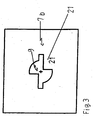
- the pictures Fig. 1 to Fig. 5 show the cross section of the coupling system according to the invention.
- the one connecting element 7a is plate-shaped or part of a plate 22. At the two ends of a connecting element 7a holding portions 26 are formed. Each holding section 26 comprises a head section 1, a connecting section 1a, a section 5 and a base section 6. The base section 6 merges into the section 5, which tapers in the direction of the free end 98. The base portion 6 can pass in a further embodiment without section 5 in the connecting portion 1a.
- the section 5 merges into the connecting section 1 a, which continues as the head section 1.
- the head portion 1 forms, with the connecting portion 1a and the portion 5, the two opposing engaging portions 4.
- the engaging portions 4 are slit-shaped.
- the plate-shaped edge arcs 10, 15 of the holding region 19 of the other connecting element 7b engage in the engagement regions 4.
- the engagement region 4 is bounded laterally by the region 27 of the head section 1 and the edge region 2 of the section 5 as well as by the base edge 3 arranged between the region 27 and the edge region 2.
- the engagement region 4 is open to one side.
- the base edge 3 merges into the edge region 2 of the section 5 or of the base section 6 to form a recess groove 8.
- the Einstülpnut 8 is aligned perpendicular to the longitudinal center axis M of a connecting element 7a.
- the one connecting element 7a is integrally formed with its two holding portions 26 or at least with a holding portion 26.
- the other connecting element 7 b is part of a plate with an opening 9, which is milled out of the plate 22.
- the opening 9 comprises a lead-through area 18 and a holding area 19.
- the lead-through area 18 merges at least partially into a hollow-cylindrical extended holding area 19.
- the lead-through region 18 is rectangular in plan view and is adapted to the holding section 26.
- the passage area 18 allows the passage of the holding portion 26 with its head portion 1 along the center longitudinal axis A of the lead-through area.
- the holding region 19 is hollow cylindrical, in which protrude inwards 31, 32. The indentations can be brought to coincide by a plane rotation, preferably of 180 °, about the cylinder axis A of the holding region 19.
- the connecting portion 1 a of the holding portion 26 pivoted into the holding area 19 can not be pivoted further counterclockwise by the indentations 31, 32, but can only be pivoted back into the lead-through area 18 in the opposite direction, the direction of rotation of the holding portion 26 is determined by FIG Indentations 31, 32 limited.
- the connecting portion 1 a of the holding portion 26 which is pivoted into the holding area 19 as far as the stop the connection provided by the sufficient clamping fit of both connecting elements 7 a, 7 b is provided.
- the pivot axis or rotation axis of the holding region 19 coincides with the center longitudinal axis M of the one connecting element 7a and with the cylinder axis and the center longitudinal axis A of the lead-through region 18 of the holding region 19.
- the lead-through area 18 also has opposite side walls. The opposite offset to each other side walls 12 with 16 and 11 with 17 and 13 with 14 correspond in length.
- the lead-through region 18 has a center longitudinal axis A. Along the center longitudinal axis A, the holding section 26 is passed, so that the marginal arches 10 and 15 are arranged at the level of the engagement areas and the head section 1 is outside the lead-through area.
- the holding portion 19 is circular arc in plan view.
- the holding area 19 is bez. its interior cylindrical and has a center longitudinal axis A, which may correspond to its cylinder axis A.
- the holding area 19 is also limited in plan view by two approximately quarter-circle-arcuate marginal arcs 10, 15.
- the quadrant arcs of the marginal arcs 10 and 15 correspond to each other.
- In the holding area 19 engage two indentations 31, 32 a.
- the two recesses 31, 32 which are offset from one another can be aligned symmetrically with respect to the cylinder axis A or center longitudinal axis A, or they can be aligned with each other center-symmetrically.
- the cylinder axis A coincides with the center longitudinal axis A of the holding region 19 or that of the lead-through region 18.
- the first indentation 31 has a first edge region 12, which continues as a side wall of the lead-through region 18.
- the first edge region 12 is opposite to a second edge region 11.
- the second edge region 11 is aligned parallel to the first edge region 12.
- the first edge region 12 is longer than the second edge region 11.
- the second indentation 32 likewise has a third edge region 16, which continues as a side wall of the leadthrough region 18.
- Opposite the third edge region 16 is a fourth edge region 17, which is aligned parallel to the third edge region 16.
- the fourth edge region 17 has the same length in plan view as the second edge region 11, and the first edge region 12 has the same length in plan view like the third edge area 16.
- the opening comprises the lead-through area 18 and the holding area 19 and is laterally delimited in plan view.
- the interior 41 of the opening 9 of the other connecting part 7b is also delimited by the first to the sixth edge regions 11, 12, 14, 17, 16, 13, formed as side walls, by the edge arches 15, 10 and by the side regions 80 formed as side walls.
- the opening 9 is not open in the plan view laterally.
- the distance A1 between the third edge region 16 and the fourth edge region 17 or between the first edge region 12 and the second edge region 11 corresponds approximately to the thickness or plate thickness of the holding section 26 of the one connecting element 7a.
- the distance A1 may be slightly greater than the plate thickness to facilitate the passage of the holding portion 26 with its head portion 1 through the lead-through area 18 and to avoid tilting.
- the first, the second, third and fourth edge regions are aligned in the plane parallel to the plate and the fifth and the sixth transversely to the longitudinal extent of the lead-through area; the marginal arcs are approximately quarter-circular arc-shaped.
- B2 can also be slightly smaller than D3 to avoid jamming or jamming. Therefore, reference may be made to terms such as "about”, “substantially” when indicating other dimensions and proportions.
- the distance A2 and the distance A1 may coincide with each other and the plate thickness of the holding portion 26 of the plate-shaped one connecting element 7a correspond.
- the holding portion 19 is also characterized both by the two opposite, offset from each other or spaced-apart indentations 31, 32 as well as by the two quarter-circular arc-shaped opposite edge sheets 10, 15; the holding area 19 is supported by its side walls, e.g. from the sixth edge region 13, the fifth edge region, the first edge bend 10 and the second edge bend of the holding region 19.
- the holding region 19 is formed in the plan view of the plate plane at least partially circular, its circle center or cylinder axis A coincides with the center longitudinal axis A of the passage opening 18.
- the holding portion 26 is guided with its head portion 1 through the lead-through area 18, so that the engagement area 4 in height of the plate-shaped indentations 31, 32 is located.
- the other connecting element 7b is also plate-shaped.
- the holding portion 26 is pivoted in the direction of indentations 31, 32 (see arrow) counterclockwise and lies down with its connecting portion 1a to the fifth edge portion 14 and to the sixth edge portion 13 of the two indentations 31, 32 of the holding portion 19 at.
- the two opposite engagement regions 4 receive the two plate-shaped circular arc-shaped edge arches 10, 15, so that each edge arc with the head portion 1 and the region 27 on the one and with the portion 5 and the edge region 2 on the other side in the pivoted state form fit is encompassed, so that a connection caused by a clamping fit between the two connecting elements is made possible.
- the connection is supported by force and friction.
- the base edge 3 of the connecting portion 1a abuts against the side walls 61 of the edge sheets 10, 15.
- the pivoting of the holding portion 26 in the holding area 19 about the center longitudinal axis A is the inward indentations 31, 32 and their fifth and sixth edge areas 14, 13 limited and the angle is 90 °.
- the holding portion 26 in the pivoted state is in transverse position to the other connecting part 7b.
- the one connecting element 7a can not be moved out of the holding region 19 along the center longitudinal axis A, because the marginal arches 10, 15 are firmly engaged in the engaging regions 4.
- the holding section 26, which is swiveled in the holding area 19, allows the fixed location of the connecting elements 7a, 7b coupled to one another.
- connection system according to the invention in the pivoted state not only allows a sufficient positive engagement of the two connecting elements 7a, 7b each other, but also a force and friction.
- the forces on the one Load fastener 7a are transferred to the other connecting element 7b and vice versa, without it occur in certain areas of the coupled furniture parts to deformations, form instabilities or even unintentional release of the interconnected fasteners.
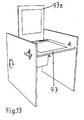
- the side parts 92 designed as supports with the opening 9 of the other connecting element 7b.
- the seat surface or plate 93 as a support is formed with the holding portion 26 of the one connecting member 7a.
- the furniture according to the invention show that the openings 19 in contrast to the recesses conventional Connection systems can be arranged not only in the lateral edge regions of the furniture parts, but rather it may be the convenience and the desire of the user to decide in which places breakthroughs are arranged as another connection element.
- An inventive piece of seating furniture comprises with supports and carriers, wherein the supports 92 and support 93 are detachably connected as furniture parts by the coupling systems according to the invention.
- the supports 92 and support 93 are aligned perpendicular to each other.
- the one connecting elements 7a are integrally formed with the holding portions and the supports 92 have the openings 9 of the other connecting elements 7b, in which the holding portions 26 are receivable to provide the respective connections.
- a carrier 93a is designed as a seat plate and another carrier is designed as a back plate 93a as furniture parts.
- the one connecting element 7a with the holding portions 26 for cooperation with the openings 9 of the other connecting elements 7b of the supports 92 is formed.
- At least one recess 95 which is arranged at the height of the seat plate 93, is milled out of the back plate 93a.
- the seat plate 93 tapers in its region facing the back plate 93a, so that it is formed into a tongue section 96.
- the tongue portion protrudes into the recess 95 of the back plate 93a or is at least partially passed through the recess 95 in another embodiment.
- the tongue portion 96 is centered in the recess 95 of the back plate 93a.
- the front part 96a of the tongue portion 96 guided out of the recess 95 is secured without tools by means of a pin inserted into a cut-out milled in the front part 96a.
- the assembly of the seat piece of furniture according to the invention is carried out in a simple and rapid manner without the aid of tools or other aids, by inserting the holding portions 26 of the back plate 93a in the lead-through areas 18 of the openings 9 of the side parts 92 and transferring the holding portions 26 in the pivoted state by folding up the back plate 93a, so that the holding portions 26a in the holding portions 19 until it stops against the indentations 31, 32 or at the edge regions 13, 15 of the indentations 31, 32 are pivoted in the pivoted state, Inserting the holding portions 26 of the seat plate 93 in the openings 9 of the side parts 92 and Transferring the holding portions 26 of the seat plate 93 in the pivoted state by pivoting down the seat plate 93 with insertion of the tongue portion 96 in the recess 95 of the back plate 93 a, so that the holding portions 26a are pivoted into the holding regions 19 until they abut against the indentations 31, 32 or against the edge regions 13, 15 of the indentations 31, 32 in the pivoted
- the flexibility of assembling the piece of seating furniture according to the invention is also evident in that the steps for assembling can be changed as follows in a further embodiment by inserting the holding portions 26 of the back plate 93a in the lead-through areas 18 of the openings 9 of the side parts 92 and after slightly folding up the same insertion of the holding portions 26 of the seat plate 93 in the openings 9 of the side parts 92, Conversion of the holding portions 26 of the back plate 93a in the pivoted state by folding up the back plate 93a, so that the holding portions 26a in the holding portions 19 until it stops against the indentations 31, 32 and to the edge regions 13, 15 of the indentations 31, 32 in the tilted state to be panned, Transferring the holding portions 26 of the seat plate 93 in the pivoted state by pivoting down the seat plate 93 with insertion of the tongue portion 96 in the recess 95 of the back plate 93 a, so that the holding portions 26a are pivoted into the holding regions 19 until they abut against the indentations
- the tongue portion 96 located in the recess 95 allows increased stability and seat safety of the seat piece of furniture according to the invention even with increased seat load thereof by a user.
- the dimensional stability of the seating furniture piece according to the invention is considerably increased by the tongue portion arranged in the recess, because the springback of the seat plate in the direction of footing due to high, acting on the seat plate forces is limited by the rest of the tongue portion on the lower side of the recess.
- the insertion area which is open towards one side and the orientation of the recess which is arranged laterally as possible in a furniture part is not required.
- the furniture parts coupled to the furniture by means of the coupling system according to the invention do not restrict the overall aesthetic impression, but even promote it and contribute to the balance in appearance, statics and expediency.
- furniture and parts thereof any materials such as wood, stone-like materials, ceramics and / or plastic-like materials and mixtures thereof.
- the furniture according to the invention can be quickly and easily decoupled or dismounted and inexpensively transported.
- furniture parts of the disassembled furniture of the invention require little space in their storage and are characterized by a certain robustness during storage.
- the furniture according to the invention are insensitive to damage provide a rapid assembly of furniture.
- the seat piece of furniture according to the invention is characterized by a stability and seat safety as well -by a high load capacity and sufficient durability of the connections by a sufficient durability of the furniture parts and their fasteners as well as its assembly and its degradation are distinguished through a little time-consuming construction without the aid of tools and other aids such as through very low demands on the skill of the user, and smallest footprint of the furniture parts during storage advantageously from.
Landscapes
- Engineering & Computer Science (AREA)
- General Engineering & Computer Science (AREA)
- Mechanical Engineering (AREA)
- Life Sciences & Earth Sciences (AREA)
- Wood Science & Technology (AREA)
- Connection Of Plates (AREA)
- Furniture Connections (AREA)
- Combinations Of Kitchen Furniture (AREA)
- Cabinets, Racks, Or The Like Of Rigid Construction (AREA)
- Telephone Set Structure (AREA)
Abstract
Description
Die Erfindung betrifft ein Kopplungssystem zum lösbaren Verbinden von Möbelteilen mit zwei Verbindungselementen und Möbel, insbesondere Sitzmöbelstücke, deren Möbelteile, wie Stützen, Träger usw., mit Hilfe des Kopplungssystems lösbar gekoppelt sind.The invention relates to a coupling system for releasably connecting furniture parts with two connecting elements and furniture, in particular seating furniture pieces whose furniture parts, such as supports, beams, etc., are releasably coupled by means of the coupling system.
Im Stand der Technik sind Möbel bekannt, deren Teile einander mit Hilfe von Scharnieren, Beschlägen, Bolzenverbindungen, Zapfenbändem usw. gekoppelt sind. Es zeigt sich jedoch, dass Möbel beispielsweise auf Messebauten oder bei sonstigen Veranstaltungen, wie Kongressen, Sportveranstaltungen, usw., bei deren Gelegenheit rasch beispielsweise Sitzmöbel bereitgestellt werden sollen, nicht nur diese Sitzmöbel rasch zusammengebaut, sondern auch deren Lagerung raumsparend erfolgen sollen.Furniture is known in the art, the parts of which are coupled to each other by means of hinges, fittings, bolt connections, Zapfenbändem and so on. It turns out, however, that furniture, for example, on trade fairs or other events, such as congresses, sporting events, etc., on their occasion, for example, seating should be provided quickly, not only this seating assembled quickly, but also their storage space-saving.
So ist im Stand der Technik ein herkömmliches Verbindungssystem zum wieder lösbaren Verbinden von Möbelteilen mit zwei Verbindungselementen bekannt, wobei die Verbindungselemente verformbar und / oder relativ zueinander verlagerbar ausgebildet sind, so dass zumindest eine wieder lösbare kraftschlüssige Verbindung zwischen den Möbelteilen und / oder mindestens einem Möbelteil herstellbar ist. Das eine Verbindungselement besteht im wesentlichen aus einem Halteabschnitt, welcher mit einer Ausnehmung in Eingriff gebracht werden kann. Dieser Halteabschnitt ist in der Draufsicht im wesentlichen T-förmig ausgebildet.Thus, in the prior art, a conventional connection system for releasably connecting furniture parts with two connecting elements is known, wherein the connecting elements are deformable and / or displaceable relative to each other, so that at least one releasable non-positive connection between the furniture parts and / or at least one furniture part can be produced. The one connecting element consists essentially of a holding portion, which can be brought into engagement with a recess. This holding portion is formed in the top view substantially T-shaped.
Zudem erweist sich der Transport des herkömmlichen Verbindungssystems als kostenintensiv, da diese sehr viel Platz im gelagerten Zustand einnehmen. Auch die Lagerung des herkömmlichen Verbindungssystems macht nicht nur viel Lagerfläche erforderlich sondern verursacht auch hohe Lagerungskosten, weil das herkömmliche Verbindungssystem vorsichtig zu verpacken und beiseite zu legen ist.In addition, the transport of the conventional connection system proves to be costly because they occupy a lot of space in the stored state. Also the storage of the Conventional connection system not only requires a lot of storage space but also causes high storage costs because the conventional connection system has to be carefully packaged and set aside.
Das andere Verbindungselement besteht aus einer Ausnehmung. Die Ausnehmung umfasst einen Einführbereich und einen Haltebereich. Der Einführbereich ist zu einer Seite offen. Das herkömmliche Verbindungssystem ist dadurch gekennzeichnet, dass der Halteabschnitt des einen Verbindungselementes seitlich durch die Öffnung des Einführbereichs in den Einführbereich eingeführt und anschließend in den an den Einführbereich sich anschließenden Haltebereich weiterbewegt wird. Sobald der Halteabschnitt in dem Haltebereich sich befindet, wird der Halteabschnitt des einen Verbindungselementes geschwenkt und gelangt derart mit den den Haltebereich seitlich begrenzenden Randbereichen in Eingriff.The other connecting element consists of a recess. The recess comprises an insertion region and a holding region. The insertion area is open to one side. The conventional connection system is characterized in that the holding section of the one connecting element is inserted laterally through the opening of the insertion area into the insertion area and then moved further into the holding area adjoining the insertion area. As soon as the holding section is located in the holding region, the holding section of the one connecting element is pivoted and thus engages with the edge regions bounding the holding region laterally.
Dieses herkömmliche Verbindungssystem zeigt mangelnde Formstabilität, weil die Ausnehmung zumindest an einer Seite durch den seitlich angeordneten Einführbereich offen ist und gerade dann, wenn die Möbelteile aus Holz bestehen, eine Verformbarkeit im Bereich des Einführbereichs der Ausnehmung aufzutreten vermag.This conventional connection system shows lack of dimensional stability, because the recess is open at least on one side by the laterally arranged insertion region and just when the furniture parts are made of wood, a deformability in the region of the insertion of the recess is able to occur.
Aber nicht nur die mangelnde Formstabilität zeichnet das herkömmliche Verbindungssystem aus, sondern hinzukommend ist das herkömmliche Verbindungssystem von mangelnder Statik des anderen Verbindungselementes geprägt, weil eine Abstützung durch übereinander angeordnete Ausnehmungen bei hoher Krafteinwirkung auf die beiden Stützelemente, welche seitlich angeordnet sind, beispielsweise bei einem Sitzmöbelstück, beeinträchtigen wird und die Gefahr der Verkantung besteht.But not only the lack of dimensional stability distinguishes the conventional connection system, but additionally the conventional connection system is characterized by lack of statics of the other connection element, because a support by superimposed recesses with high force on the two support elements, which are arranged laterally, for example, a piece of seating furniture , is impaired and there is a risk of tilting.
Auch erweist sich das herkömmliche Kopplungssystem von Nachteil, weil bedingt durch die zumindest nach einer Seite offene Ausnehmung die Belastbarkeit der Verbindungselemente, welchc die Ausnehmungen aufweisen, eingeschränkt ist.Also, the conventional coupling system proves to be disadvantageous because limited by the open at least one side recess the load capacity of the connecting elements, which have the recesses.
So wird in
Das in
Die in
Es zeigt sich aber, dass wegen der seitlich versetzt ausgefrästen, und nicht allseits begrenzten Öffnung die den Einführbereich umgebenden gegenüberliegenden Nasen bei Belastung nachgeben und beweglich sind, so dass die Gefahr der Lockerung der einander verbundenen Verbindungsteile besteht.It turns out, however, that because of the laterally offset milled, and not limited on all sides opening surrounding the insertion area opposite lugs yield under load and are movable, so there is a risk of loosening the interconnected connecting parts.
Das in
Es zeigt sich aber wiederum, dass bei Belastung des herkömmlichen Verbindungssystems die Drehscheibe sich lockert, weil deren Sitz nicht gesichert ist, so dass das eine Paneelbrett aus dem anderen herausgleitet.It turns out, however, that under load of the conventional connection system, the hub loosens because its seat is not secured, so that one panel board slides out of the other.
Aufgabe der Erfindung soll es sein, ein Kopplungssystem bereitzustellen, welches eine hinreichende Formstabilität gewährleistet auch bei hoher Belastung und eine lediglich geringfügige Verformbarkeit ermöglicht, wenn überhaupt, auch bei schwergewichtigen Personen, beispielsweise bei Verwendung des bereitzustellenden Kopplungssystems in Sitzmöbeln.The object of the invention is to provide a coupling system which ensures sufficient dimensional stability even at high load and only slight deformability allows, if any, even in heavyweight persons, for example when using the coupling system to be provided in seating.
Hinzukommend soll das bereitzustellende Kopplungssystem einen dauerhaften Formschluss zwischen den beiden zu verbindenden Verbindungselementen ermöglichen, ohne dass die Lösbarkeit bei Abbau der Möbel eingeschränkt wird und Werkzeuge oder sonstige Hilfsmittel verwendet werden.In addition, the coupling system to be provided should enable a permanent positive connection between the two connecting elements to be connected, without the solubility being reduced when the furniture is dismantled and tools or other aids being used.
Zudem soll das bereitzustellende Kopplungssystem einen dauerhaften Formschluss zwischen den beiden zu verbindenden Verbindungselementen bei Belastung ermöglichen, so dass nicht die Gefahr der Lockerung der einander verbundenen Verbindungsteile besteht.In addition, the coupling system to be provided should allow a permanent positive connection between the two connecting elements to be connected under load, so that there is no risk of loosening of the interconnected connecting parts.
Ebenfalls sollen die Möbel rasch und einfach entkoppelbar bzw. auseinander baubar und kostengünstig transportierbar sein.Also, the furniture should be quickly and easily decoupled or disassembled and inexpensive to transport.
Ebenso sollen Möbelteile der auseinander genommenen Möbel wenig Platz bei deren Lagerung einnehmen und eine gewisse Robustheit bei Lagerung aufweisen.Likewise, furniture parts of the disassembled furniture should take up little space in their storage and have a certain robustness during storage.
Hinzutretend sollen die Möbelteile, welche die Verbindungselemente aufweisen, wenig Platz bei Lagerung einnehmen, bei Lagerung geringe Möglichkeit der Beschädigung bieten und rasch den Zusammenbau der Möbelstücke aus Möbelteilen ermöglichen.In addition to the furniture parts, which have the fasteners, take up little space during storage, offer low possibility of damage during storage and quickly allow the assembly of furniture pieces of furniture parts.
Hinzutretend soll sich das bereit zu stellende Sitzmöbelstück durch eine Stand- und Sitzsicherheit und die Dauerhaftigkeit und Belastbarkeit seiner verbundenen Möbelteile auszeichnen sowie
- der Zusammenbau des Sitzmöbelstückes und dessen Abbau
- einen wenig zeitaufwendigen Aufbau
- ohne die Zuhilfenahme von Werkzeugen und sonstiger Hilfsmittel
- sowie
- nur geringe Anforderungen an die Geschicklichkeit des Benutzers,
- und
- lediglich einen geringen Platzbedarf der Möbelteile der Sitzmöbelstücke bei Lagerung ermöglichen.
- the assembly of the piece of seating furniture and its dismantling
- a little time-consuming construction
- without the aid of tools and other aids
- such as
- only low demands on the skill of the user,
- and
- only allow a small footprint of the furniture parts of the seating furniture pieces during storage.
Die Aufgabe wird gelöst durch den Hauptanspruch und dem Nebenanspruch. Die Unteransprüche betreffen bevorzugte Ausgestaltungen und Weiterentwicklungen der Erfindung.The problem is solved by the main claim and the secondary claim. The subclaims relate to preferred embodiments and further developments of the invention.
Die Erfindung betrifft ein Kopplungssystem zum wieder lösbaren Verbinden von Möbelteilen, wobei das Kopplungssystem zwei plattenförmige Verbindungselemente aufweist, wobei
- a. die Verbindungselemente relativ zueinander verlagerbar ausgebildet sind und zumindest eine wieder lösbare Verbindung zwischen den Möbelteilen herstellbar ist, das andere Verbindungselement einen Durchbruch aufweist, mit dem ein erstes Möbelteil ausgestattet werden kann, und das eine Verbindungselement ein mit dem Durchbruch in Eingriff bringbarer, an einem zweiten Möbelteil anordenbarer Halteabschnitt ist,
- b. der Halteabschnitt des einen Verbindungselements einen Grundabschnitt, einen an den Grundabschnitt sich anschließenden Abschnitt und einen an den Abschnitt sich anschließenden stegartigen Verbindungsabschnitt hat, der an dem freien Ende des Halteabschnitts in einen hinterschnittenen Kopfabschnitt übergeht,
- c. der Kopfabschnitt mindestens einen hinterschnittenen Bereich hat, welcher mit einem zu dem hinterschnittenen Bereich beabstandeten Randbereich des Abschnitts Eingriffsbereiche für das andere Verbindungselement bildet, an dem Halteabschnitt mindestens zwei entgegen gesetzt geöffnete Eingriffsbereiche ausgebildet sind,
- d. die Eingriffsbereiche zu dem Verbindungsabschnitt hin von einem Grundrand begrenzt sind,
welches dadurch gekennzeichnet ist, dass - e. der Abschnitt sich in Richtung freien Endes des Halteabschnitts in der Draufsicht verjüngt,
- f. ein Übergangsbereich von dem Grundrand in den Randbereich des Abschnitts unter Bildung einer Einstülpnut eingezogen ist
und - g. die Einstülpnut quer zu einer Mitte-Längsachse M des einen Verbindungselements ausgerichtet ist,
- h. der Durchbruch (9) in der Draufsicht allseitig begrenzt ist, einen Durchführbereich zum Hindurchführen des Halteabschnitts des einen Verbindungselements mit seinem Kopfabschnitt längs der Mitte-Längsachse A des Durchführbereichs und einen Haltebereich zur Aufnahme des Halteabschnitts des einen Verbindungselements im verschwenkten Zustand umfasst,
- i. der Durchführbereich in der Draufsicht rechteckig ist und mittig in den hohlzylinderförmig, erweiterten Haltebereich übergeht, in welchen Einstülpungen hineinragen, die gegenüber liegend und beabstandet voneinander angeordnet sind,
- j. wobei der Halteabschnitt in dem verschwenkten Zustand mit seinem Verbindungsabschnitt an die Einstülpungen anschlägt.
- a. the connecting elements are designed to be displaceable relative to one another and at least one detachable connection between the furniture parts can be produced, the other connecting element has an opening, with which a first furniture part can be equipped, and a connecting element can be brought into engagement with the opening, at a second Furniture part is anordenbarer holding section,
- b. the holding portion of the one connecting element has a base portion, a portion adjoining the base portion, and a land-like connecting portion adjoining the portion, which merges into an undercut head portion at the free end of the holding portion;
- c. the head section has at least one undercut region which forms engagement regions for the other connecting element with an edge region of the section which is at a distance from the undercut region, on the retaining section at least two oppositely open engagement regions are formed,
- d. the engagement regions are bounded towards the connection section by a base edge,
which is characterized in that - e. the portion tapers towards the free end of the holding portion in plan view,
- f. a transition region is drawn from the base edge into the edge region of the section to form an insertion groove
and - G. the Einstülpnut is aligned transversely to a center longitudinal axis M of a connecting element,
- H. the opening (9) is delimited on all sides in the plan view, a feedthrough area for passing the holding section of the one connecting element with its head section along the center longitudinal axis A of the lead-through area and a holding area for receiving the holding section of the one connecting element in the pivoted state,
- i. the lead-through region is rectangular in the plan view and merges centrally into the hollow-cylindrical, extended holding region, in which protrude inwards, which are arranged opposite one another and at a distance from one another,
- j. wherein the holding portion abuts in the pivoted state with its connecting portion of the indentations.
Die Erfindung bezieht sich auch auf Möbel, welche als Möbelteile Stützen, Träger und oder sonstigen Teile, insbesondere Rücklehnen, umfassen, wobei die Stützen, die Träger und oder die sonstigen Teile der Möbel durch das o.g. Kopplungssystem einander lösbar verbunden sind.The invention also relates to furniture which, as furniture parts supports, supports and other parts, in particular backrests, comprise, wherein the supports, the support and or other parts of the furniture by the above-mentioned coupling system are releasably connected to each other.
Bei einer besonderen Ausgestaltung der erfindungsgemäßen Möbel sind die Stützen und die Träger der Möbel durch das Kopplungssystem lösbar verbunden und die Stützen und /oder Träger mit den Verbindungselementen ausgebildet, wobei
die Verbindungselemente relativ zueinander verlagerbar ausgebildet sind und zumindest eine wieder lösbare Verbindung zwischen den Möbelteilen herstellbar ist, das andere Verbindungselement ein Durchbruch in einem ersten Möbelteil ist und das eine Verbindungselement ein mit dem Durchbruch in Eingriff bringbaren, an einem zweiten Möbelteil angeordneter Halteabschnitt ist,
der Halteabschnitt des einen Verbindungselements einen Grundabschnitt, einen an den Grundabschnitt sich anschließenden Abschnitt und einen an den Abschnitt sich anschließenden stegartigen Verbindungsabschnitt hat, der an dem freien Ende des Halteabschnitts in einen hinterschnittenen Kopfabschnitt übergeht,
der Kopfabschnitt mindestens einen hinterschnittenen Bereich hat, welcher mit einem zu dem Bereich beabstandeten Randbereich des Abschnitts einen Eingriffsbereich für das andere Verbindungsteil bildet, an dem Halteabschnitt mindestens zwei entgegen gesetzt geöffnete Eingriffsbereiche ausgebildet sind,
die Eingriffsbereiche zu dem Verbindungsabschnitt hin von einem Grundrand begrenzt sind,
welche dadurch gekennzeichnet sind, dass
der Abschnitt sich in Richtung freien Endes des Halteabschnitts in der Draufsicht verjüngt,
ein Übergangsbereich von dem Grundrand in den Randbereich des Abschnitts unter Bildung einer Einstülpnut eingezogen ist
und
die Einstülpnut quer zu einer Mitte-Längsachse M des einen Verbindungselements (7a) ausgerichtet ist,
der Durchbruch des anderen Verbindungselementes einen in der Draufsicht rechteckig ausgebildeten Durchführbereich hat, der mittig in einen hohlzylinderförmig erweiterten Haltebereich übergeht, der Haltebereich zwei symmetrisch zu seiner Zylinderachse A angeordnete Einstülpungen hat, die Einstülpungen voneinander beabstandet sind und in einen hohlzylinderförmigen Innenraum des Haltebereichs hineinragend angeordnet sind,
der Halteabschnitt des einen Verbindungselements durch den Durchführbereich dergestalt hindurchgeführt ist, dass der hindurchgeführte Halteabschnitt bezüglich seiner Mitte-Längsachse M zumindest um einen vorbestimmten Winkel, insbesondere um 90°, aus dem durchgeführten Zustand in einen verschwenkten Zustand verschwenkbar ist, der Halteabschnitt in dem verschwenkten Zustand mit seinem Verbindungsabschnitt an die Einstülpungen anschlägt und nicht aus dem Haltebereich längs der Zylinderachse A des Haltebereichs rückführbar ist
sowie
der in den Haltebereich bis zum Anschlag verschwenkte Verbindungsabschnitt durch die Einstülpungen im verschwenkten Zustand nur in einer Drehrichtung begrenzt schwenkbar ist.In a particular embodiment of the furniture according to the invention, the supports and the support of the furniture are detachably connected by the coupling system and the supports and / or support formed with the connecting elements, wherein
the connecting elements are designed to be displaceable relative to one another and at least one detachable connection between the furniture parts can be produced, the other connecting element is a breakthrough in a first furniture part and a connecting element is a holding section which can be brought into engagement with the opening and is arranged on a second furniture part,
the holding portion of the one connecting element has a base portion, a portion adjoining the base portion, and a portion adjoining the portion web-like connecting portion which merges at the free end of the holding portion in an undercut head portion,
the head section has at least one undercut region which forms an engagement region for the other connection part with an edge region of the section which is spaced apart from the region, on the retaining section at least two oppositely open engagement regions are formed,
the engagement regions are bounded towards the connection section by a base edge,
which are characterized in that
the portion tapers towards the free end of the holding portion in plan view,
a transition region is drawn from the base edge into the edge region of the section to form an insertion groove
and
the insertion groove is oriented transversely to a center longitudinal axis M of the one connecting element (7a),
the opening of the other connecting element has a rectangularly formed in the top view lead-through area, which merges centrally into a hollow cylindrical extended holding portion, the holding portion has two symmetrically arranged to its cylinder axis A invaginations, the invaginations are spaced apart and are projecting into a hollow cylindrical interior of the holding portion .
the holding section of the one connecting element is guided through the lead-through area such that the guided holding section is pivotable relative to its center longitudinal axis M at least by a predetermined angle, in particular by 90 °, from the executed state into a pivoted state, the holding section in the pivoted state strikes with its connecting portion of the indentations and is not traceable from the holding portion along the cylinder axis A of the holding portion
such as
the pivoted in the holding area to the stop connection portion is limited by the indentations in the pivoted state only in one direction of rotation pivotally limited.
Ein weiterer Gegenstand der Erfindung ist auf ein Sitzmöbelstück, oder auch Sitzmöbel genannt, mit Stützen und Trägern gerichtet, welches dadurch gekennzeichnet ist, dass die Stützen und Träger als Möbelteile durch das erfindungsgemäße Kopplungssystem lösbar verbunden sind, wobei an den Trägern als zweites Möbelteil die einen Verbindungselemente mit den Halteabschnitten angeformt
und
die Stützen als erstes Möbelteil die Durchbrüche der anderen Verbindungselemente aufweisen, in welche die Halteabschnitte zur Bereitstellung der jeweiligen Verbindungen aufnehmbar sein können.
Eine besondere Ausgestaltung eines Sitzmöbelstücks mit Stützen und Trägern kann durch das erfindungsgemäße Kopplungssystem lösbar verbunden sein, welches hergestellt wird durch
- a) durch Einführen der Halteabschnitte der Rückenplatte in die Durchführbereiche der Durchbrüche der Stützen als Seitenteile,
- b) Überführen der Halteabschnitte in den geschwenkten Zustand durch Hochklappen der Rückenplatte bis zum Anschlag der Verbindungsabschnitte der Halteabschnitte an die Einstülpungen oder an die Randbereiche der Einstülpungen,
- c) Einführen der Halteabschnitte der Sitzplatte in die Durchführbereiche der Durchbrüche der Stützen als Seitenteile und
- d) Überführen der Halteabschnitte der Sitzplatte in den geschwenkten Zustand durch Niederschwenken der Sitzplatte mit Einführen des Zungenabschnitts in die Ausnehmung der Rückplatte bis zum Anschlag der Verbindungsabschnitte der Halteabschnitte an die Einstülpungen oder an die Randbereiche der Einstülpungen.
- a. durch Einführen der Halteabschnitte der Rückenplatte in die Durchführbereiche der Durchbrüche der Stützen als Seitenteile,
- b. nach geringfügigem Hochklappen derselben Einführen der Halteabschnitte der Sitzplatte in die Durchführbereiche der Durchbrüche der Stützen als Seitenteile,
- c. Überführen der Halteabschnitte der Rückenplatte in den geschwenkten Zustand durch Hochklappen der Rückenplatte bis zum Anschlag der Verbindungsabschnitte der Halteabschnitte an die Einstülpungen oder an die Randbereiche der Einstülpungen und
- d. Überführen der Halteabschnitte der Sitzplatte in den geschwenkten Zustand durch Niederschwenken der Sitzplatte mit Einführen des Zungenabschnitts in die Ausnehmung der Rückplatte bis zum Anschlag der Verbindungsabschnitte der Halteabschnitte an die Einstülpungen oder an die Randbereiche der Einstülpungen.
and
the supports as the first furniture part having the openings of the other connecting elements, in which the holding portions for providing the respective connections can be accommodated.
A particular embodiment of a piece of seating furniture with supports and supports can be releasably connected by the coupling system according to the invention, which is produced by
- a) by inserting the holding portions of the back plate in the lead-through areas of the openings of the columns as side parts,
- b) transfer of the holding portions in the pivoted state by folding up the back plate until the stop of the connecting portions of the holding portions of the indentations or to the edge regions of the indentations,
- c) introducing the holding portions of the seat plate in the lead-through areas of the openings of the columns as side parts and
- d) transferring the holding portions of the seat plate in the pivoted state by pivoting down the seat plate with insertion of the tongue portion in the recess of the back plate until the stop of the connecting portions of the holding portions of the indentations or to the edge regions of the indentations.
- a. by inserting the holding portions of the back plate in the lead-through areas of the openings of the supports as side parts,
- b. after slightly folding up the same insertion of the holding portions of the seat plate in the lead-through areas of the openings of the columns as side parts,
- c. Conversion of the holding portions of the back plate in the pivoted state by folding up the back plate until the stop of the connecting portions of the holding portions of the indentations or to the edge regions of the indentations and
- d. Conversion of the holding portions of the seat plate in the pivoted state by pivoting down the seat plate with insertion of the tongue portion in the recess of the back plate until the stop of the connecting portions of the holding portions of the indentations or to the edge regions of the indentations.
Das erfindungsgemäße Kopplungssystem zum wieder lösbaren Verbinden von Möbelteilen kann zwei plattenförmigen Verbindungselementen auch umfassen, wobei die Verbindungselemente relativ zueinander verlagerbar ausgebildet sind und zumindest eine wieder lösbare, vorzugsweise kraft-, form- und / oder reibschlüssige, Verbindung zwischen den Möbelteilen herstellbar ist, das andere Verbindungselement ein Durchbruch in einem ersten Möbelteil ist und das eine Verbindungselement ein mit dem Durchbruch in Eingriff bringbaren, an einem zweiten Möbelteil angeordneter Halteabschnitt ist, wobei der Halteabschnitt des einen Verbindungselements einen Grundabschnitt, ein an den Grundabschnitt sich anschließenden Abschnitt und einen an den Abschnitt sich anschließenden stegartigen Verbindungsabschnitt hat, der an dem freien Ende des Halteabschnitts in einen hinterschnittenen Kopfabschnitt übergeht,
der Kopfabschnitt mindestens einen hinterschnittenen Bereich hat, welcher mit einem zu dem Bereich beabstandeten Randbereich des Abschnitts einen Eingriffsbereich für das andere Verbindungsteil bildet, an dem Halteabschnitt mindestens zwei entgegen gesetzt geöffnete Eingriffsbereiche ausgebildet sind,
der Abschnitt sich in Richtung freien Endes des Halteabschnitts in der Draufsicht sich verjüngt,
die Eingriffsbereiche zu dem Verbindungsabschnitt hin von einem Grundrand begrenzt sind,
vorzugsweise ein Übergangsbereich von dem Grundrand in den Randbereich des Abschnitts unter Bildung einer Einstülpnut eingezogen ist, wobei die Einstülpnut quer zu einer Mitte-Längsachse M des einen Verbindungselements ausgerichtet ist.The coupling system according to the invention for releasably connecting furniture parts may also comprise two plate-shaped connecting elements, wherein the connecting elements are designed to be displaceable relative to each other and at least one releasable, preferably non-positive, positive and / or frictional, connection between the furniture parts produced, the other Connecting element is a breakthrough in a first furniture part and a connecting element is a breakthrough engageable, arranged on a second furniture part holding portion, wherein the holding portion of a connecting element has a base portion, a portion adjoining the base portion and one to the portion itself subsequent web-like connection section has, which merges at the free end of the holding portion in an undercut head portion,
the head section has at least one undercut region which forms an engagement region for the other connection part with an edge region of the section which is spaced apart from the region, on the retaining section at least two oppositely open engagement regions are formed,
the portion tapers towards the free end of the holding portion in plan view,
the engagement regions are bounded towards the connection section by a base edge,
Preferably, a transition region is retracted from the base edge in the edge region of the portion to form a Einstülpnut, wherein the Einstülpnut is aligned transversely to a center longitudinal axis M of the one connecting element.
Die erfindungsgemäßen Möbel können Stützen, Träger und / oder sonstigen Teile, wie Rücklehnen, umfassen, wobei die Stützen, die Träger und / oder die sonstige Teile der Möbel durch das ö.g. Kopplungssysteme einander lösbar verbunden sind.The furniture according to the invention may include supports, supports and / or other parts, such as backrests, wherein the supports, the supports and / or the other parts of the furniture by the ö.g. Coupling systems are releasably connected to each other.
Das eine Verbindungselement weist einen Halteabschnitt auf. Das eine Verbindungselement umfasst einen Grundabschnitt, welcher in einen Abschnitt übergeht. Ebenso kann der Abschnitt Teil des Grundabschnitts sein. Der Abschnitt erstreckt sich in einen stegförmigen Verbindungsabschnitt. Vorzugsweise ist der Verbindungsabschnitt im Querschnitt rechteckig. Vorzugsweise verjüngt sich der Abschnitt in Richtung zu dem Verbindungsabschnitt hin. Der Verbindungsabschnitt geht in einen Kopfabschnitt über. Der Grundabschnitt kann auch ohne Abschnitt in den stegförmigen Verbindungsabschnitt übergehen.The one connecting element has a holding section. The one connecting element comprises a base section, which merges into a section. Likewise, the section may be part of the basic section. The section extends into a web-shaped connecting section. Preferably, the connecting portion is rectangular in cross section. Preferably, the portion tapers towards the connection portion. The connecting section merges into a head section. The base portion may also pass without a portion in the web-shaped connecting portion.
Die Breite B1 des Kopfabschnitts ist größer als die Breite B2 des Verbindungsabschnitts. Die Breite B3 des Abschnitts ist vorzugsweise größer als die Breite B1 des Kopfabschnitts und / oder die B2 des Verbindungsabschnitts. Die Breite B3 des Abschnitts kann auch der Breite B4 des Grundabschnitts des einen Verbindungselements entsprechen.The width B1 of the head portion is larger than the width B2 of the connection portion. The width B3 of the section is preferably greater than the width B1 of the head section and / or the B2 of the connection section. The width B3 of the section may also correspond to the width B4 of the base section of the one connecting element.
Im Sinne der Erfindung wird unter Breite B1 auch verstanden, der Abstand der beiden gegenüber liegenden Seiten des Kopfabschnitts, die senkrecht zu den dem Kopfabschnitt zugewandten Seiten des Abschnitts ausgerichtet sind.For the purposes of the invention, width B1 also means the distance of the two opposite sides of the head section, which are aligned perpendicular to the sides of the section facing the head section.
Im Sinne der Erfindung wird unter Breite B2 auch verstanden, der Abstand der beiden gegenüber liegenden Seiten des Verbindungsabschnitts, die senkrecht zu den dem Kopfabschnitt zugewandten Seiten des Abschnitts ausgerichtet sind.For the purposes of the invention, width B2 is also understood to mean the distance between the two opposite sides of the connecting section, which are aligned perpendicular to the sides of the section facing the head section.
Im Sinne der Erfindung wird unter Breite B3 auch verstanden, der Abstand der beiden gegenüber liegenden Seiten des Abschnitts in seinem dem Kopfabschnitt zugewandeten oberen Bereich, die in Richtung Kopfabschnitt hin sich erstrecken.For the purposes of the invention, width B3 is also understood to mean the distance of the two opposite sides of the section in its upper region facing the head section, which extend in the direction of the head section.
Im Sinne der Erfindung wird unter Breite B4 auch verstanden, der Abstand der beiden gegenüber liegenden Seiten des Grundabschnitts, die unterhalb des Kopfabschnitts sich befinden.For the purposes of the invention, width B4 is also understood to mean the distance of the two opposite sides of the base section, which are located below the head section.
Der Kopfabschnitt bildet mit dem Verbindungsabschnitt und dem Abschnitt zwei Eingriffsbereiche, die gegenüber liegend angeordnet sind. Jeder Eingriffsbereich wird begrenzt von dem Randbereich des Abschnitts oder des Grundabschnitts und von dem Bereich des Kopfabschnitts, welcher dem Randbereich des Abschnitts bzw. des Grundabschnitts gegenüber liegt. Der Bereich und der Randbereich, bzw. in Plattenebene, sind vorzugsweise parallel einander ausgerichtet. Der Randbereich und der Bereich begrenzen einen Grundrand. Der Grundrand ist der dem Eingriffsbereich zugewandte Rand des Verbindungsabschnitts oder Nutgrund genannt.The head portion forms, with the connecting portion and the portion, two engaging portions, which are opposed to each other. Each engagement region is bounded by the edge region of the section or the base section and by the region of the head section which lies opposite the edge region of the section or the base section. The region and the edge region, or in the plane of the plate, are preferably aligned parallel to one another. The border area and the area define a base border. The base edge is called the engagement region facing edge of the connecting portion or groove bottom.
Vorzugsweise geht der Grundrand unter Ausbildung von einer Einstülpung in den Abschnitt bzw. Grundabschnitt über. In der Draufsicht ist der Kopfabschnitt mit dem Verbindungsabschnitt T-förmig ausgebildet. Der Eingriffsbereich ist bevorzugterweise schlitzförmig. Vorzugsweise ist das eine Verbindungselement plattenförmig und / oder einstückig.Preferably, the base edge merges with the formation of an invagination in the section or base section. In the plan view, the head portion is formed with the connecting portion T-shaped. The engagement region is preferably slot-shaped. Preferably, the one connecting element is plate-shaped and / or one-piece.
Das andere Verbindungselement umfasst einen Durchbruch. Der Durchbruch hat einen Durchführbereich und einen Haltebereich. Der Durchführbereich ist in der Draufsicht im Wesentlichen rechteckig ausgebildet, wobei dieser in den bogenförmigen Haltebereich übergeht. Der Durchführbereich weist gegenüber liegende Seitenwandungen auf, die den Durchführbereich zumindest teilweise begrenzen können. Vorzugsweise ist das andere Verbindungselement plattenförmig und / oder einstückig. Weiterhin hat der Durchführbereich Seitenwände, die gegenüber liegend angeordnet sind.The other connection element comprises a breakthrough. The breakthrough has a lead-through area and a holding area. The lead-through area is substantially rectangular in plan view, wherein this passes into the arcuate holding area. The lead-through area has opposite side walls, which can at least partially limit the lead-through area. Preferably, the other connecting element is plate-shaped and / or one-piece. Furthermore, the lead-through area has side walls, which are arranged opposite one another.
Unter Durchbruch wird im Sinne der Erfindung auch verstanden, eine Öffnung in dem anderen Verbindungselement, welche nicht seitlich zugänglich ist. Der Durchbruch umfasst den Durchführbereich und den Haltebereich, wobei der Durchführbereich mittig in den in Draufsicht kreisförmigen Haltebereich oder in einen Haltebereich mit zwei annähernd halbkreisförmigen Innenräumen übergeht. Der von dem Durchführbereich und dem Haltebereich ausgestaltete Innenraum des Durchbruchs kann in der Draufsicht von den Randbereichen, den Randbögen und den Seitenwänden begrenzt werden. Der Innenraum des Haltebereichs ist zylinderförmig mit einer Zylinderachse A.Breakthrough in the context of the invention also means an opening in the other connecting element, which is not accessible from the side. The opening comprises the lead-through area and the holding area, wherein the lead-through area transitions centrally into the holding area which is circular in plan view or into a holding area with two approximately semicircular inner spaces. The interior of the opening formed by the passage area and the holding area can be delimited in plan view by the edge areas, the edge arches and the side walls. The interior of the holding area is cylindrical with a cylinder axis A.
In dem Haltebereich sind zwei Einstülpungen angeordnet, die zu der Zylinderachse A des Haltebereichs symmetrisch einander ausgerichtet sein können. Die Einstülpungen ragen in den hohlzylinderförmigen Haltebereich hinein. Die Einstülpungen sind voneinander beabstandet. Die Einstülpungen sind in Draufsicht vorzugsweise von übereinstimmender Größe und / oder Gestalt. Der Innenraum des Haltebereichs umfasst zwei Teilbereiche, die jeweils den Randbögen zugeordnet werden können. Die beiden Teilbereiche können durch eine ebene Drehung, vorzugsweise von 180°, um die Zylinderachse A des Haltebereichs zur Deckung gebracht werden.In the holding area, two indentations are arranged, which can be aligned symmetrically with respect to the cylinder axis A of the holding area. The indentations protrude into the hollow cylindrical holding area. The indentations are spaced apart. The invaginations are preferably in plan view of matching size and / or shape. The interior of the holding area comprises two partial areas, which can each be assigned to the marginal arches. The two subareas can through a plane rotation, preferably of 180 °, to bring the cylinder axis A of the holding area to coincide.
Vorzugsweise hat die erste Einstülpung einen ersten Randbereich, welcher sich als eine Seitenwandung des Durchführbereichs fortsetzen kann. Dem ersten Randbereich kann ein zweiter Randbereich gegenüber liegen, welcher sich als eine Seitenwandung des Durchführbereichs fortsetzen kann. Der zweite Randbereich kann kürzer als der erste Randbereich sein. Ein dritter Randbereich der zweiten Einstülpung kann dem ersten Randbereich gegenüber liegen und sich als gegenüber liegende Seitenwandung des Durchführbereichs fortsetzen. Dem dritten Randbereich kann ein vierter Randbereich gegenüber liegen, welcher sich als eine Seitenwandung des Durchführbereichs fortsetzen kann. Der vierte Randbereich kann mit dem zweiten Randbereich gleich lang und / oder der erste Randbereich kann mit dem dritten Randbereich gleich lang sein. Der vierte Randbereich kann kürzer als der dritte Randbereich sein. Senkrecht zu dem ersten Randbereich setzt sich der fünfte Randbereich der ersten Einstülpung fort.Preferably, the first indentation has a first edge portion which can continue as a side wall of the lead-through area. The first edge region may face a second edge region, which may continue as a side wall of the lead-through region. The second edge region may be shorter than the first edge region. A third edge region of the second indentation may face the first edge region and continue as an opposite side wall of the leadthrough region. The third edge region may face a fourth edge region, which may continue as a side wall of the lead-through region. The fourth edge area may be the same length as the second edge area and / or the first edge area may be the same length as the third edge area. The fourth edge region may be shorter than the third edge region. Perpendicular to the first edge region, the fifth edge region of the first indentation continues.
Gegenüber der ersten Einstülpung befindet sich die zweite Einstülpung mit dem dritten Randbereich. Der dritte Randbereich ist von dem ersten Randbereich beabstandet und parallel zu dem ersten Randbereich vorzugsweise ausgerichtet. Der dritte Randbereich setzt sich als sechster Randbereich fort, wobei im Querschnitt bzw. Draufsicht der sechste Randbereich senkrecht zu dem dritten Randbereich ausgerichtet ist.Opposite the first indentation is the second indentation with the third edge region. The third edge region is spaced from the first edge region and preferably aligned parallel to the first edge region. The third edge region continues as the sixth edge region, the sixth edge region being aligned perpendicular to the third edge region in cross-section or top view.
Gegenüber dem ersten Randbereich befindet sich parallel zu diesem ein zweiter Randbereich, welcher gleichfalls die Seitenwandung des Durchführbereichs ist. Der zweite Randbereich ist kürzer als der erste Randbereich. Auch gegenüber dem dritten Randbereich befindet sich ein vierter Randbereich, wobei der dritte Randbereich und der vierte Randbereich parallel zueinander ausgerichtet sind. Der zweite Randbereich und der vierte Randbereich weisen übereinstimmende Längen bzw. Abstand A4 auf. Der erste Randbereich und der dritte Randbereich weisen übereinstimmende Längen bzw. Abstand A 3 auf.Opposite the first edge region is located parallel to this, a second edge region, which is also the side wall of the lead-through area. The second edge area is shorter than the first edge area. Also opposite the third edge region is a fourth edge region, wherein the third edge region and the fourth edge region are aligned parallel to one another. The second border area and the fourth border area have matching lengths or distance A4. The first edge region and the third edge region have matching lengths or
In einer Ausgestaltung des erfindungsgemäßen Kopplungssystems kann der Durchbruch des anderen Verbindungselementes einen in der Draufsicht rechteckig ausgebildeten Durchführbereich haben, der, vorzugsweise mittig, in einen hohlzylinderförmig erweiterten Haltebereich übergeht. Der Haltebereich kann zwei symmetrisch zu seiner Zylinderachse A oder zu der Mitte-Längsachse A angeordneten Einstülpungen haben. Die Einstülpungen sind bevorzugterweise voneinander beabstandet und ragen in einen hohlzylinderförmigen Innenraum des Haltebereichs hinein. Da die Einstülpungen durch eine ebene Drehung um die Zylinderachse A zur Deckung gebracht werden können, können sie symmetrisch, z.B. zentralsymmetrisch, sein. Die Einstülpungen können bez. der Zylinderachse A des Haltebereichs entgegen gesetzt angeordnet sein.In one embodiment of the coupling system according to the invention, the opening of the other connecting element may have a guide region of rectangular design in plan view, which, preferably in the center, merges into a hollow-cylindrical extended holding region. The holding region may have two indentations arranged symmetrically to its cylinder axis A or to the center longitudinal axis A. The indentations are preferably spaced from each other and protrude into a hollow cylindrical interior of the holding area. Since the indentations can be made to coincide by a plane rotation about the cylinder axis A, they can be symmetrical, e.g. centrally symmetric. The invaginations can bez. be arranged opposite to the cylinder axis A of the holding area.
Die erste Einstülpung in den Haltebereich hat in einer Ausgestaltung einen ersten Randbereich und einen fünften Randbereich. In Draufsicht auf den Durchbruch ist der fünfte Randbereich zu dem ersten Randbereich senkrecht ausgerichtet. Dem ersten Randbereich liegt ein zweiter Randbereich gegenüber. Der zweite Randbereich geht in einen bogenförmigen ersten Randbogen über, wobei der erste Randbogen sich um die Zylinderachse A erstreckt. Der erste Randbogen erstreckt sich in einen sechsten Randbereich, wobei der sechste Randbereich in einen senkrecht zu ihm ausgerichteten dritten Randbereich übergeht. Der dritte verläuft parallel zu dem ersten Randbereich. Dem dritten Randbereich liegt ein vierter Randbereich gegenüber, welcher in einen zweiten bogenförmigen Randbogen übergeht. Der vierte Randbereich ist zu dem zweiten Randbereich parallel ausgerichtet, welcher zweite Randbogen um die Zylinderachse A sich erstreckt. Der zweite Randbogen geht in den fünften Randbereich über, welcher parallel zu dem sechsten Randbereich ausgerichtet ist. Auch der erste Randbereich, der zweite Randbereich, der dritte Randbereich und der vierte Randbereich bilden im Wesentlichen die Seitenwandungen des Durchführbereichs. Hinzukommend verbinden Seitenbereiche als Seitenwände den ersten mit dem zweiten und den dritten mit dem vierten Randbereich. Die Seitenbereiche sind als senkrecht zu dem ersten Randbereich ausgerichtete Seitenwände ausgerichtet.In one embodiment, the first indentation into the holding region has a first edge region and a fifth edge region. In plan view of the aperture, the fifth edge region is oriented perpendicular to the first edge region. The first edge area is opposite to a second edge area. The second edge region merges into an arc-shaped first edge arc, the first edge arc extending around the cylinder axis A. The first edge arc extends into a sixth edge region, wherein the sixth edge region merges into a third edge region aligned perpendicular to it. The third runs parallel to the first edge area. The third edge region is opposite a fourth edge region, which merges into a second arcuate edge arc. The fourth edge region is aligned parallel to the second edge region, which second edge arc extends around the cylinder axis A. The second edge bend merges into the fifth edge region, which is aligned parallel to the sixth edge region. Also, the first edge region, the second edge region, the third edge region and the fourth edge region essentially form the side walls of the lead-through region. In addition Coming Side areas as side walls connect the first to the second and the third to the fourth edge area. The side areas are aligned as perpendicular to the first edge area aligned side walls.
Der Durchbruch des anderen Verbindungselements kann sowohl von dem ersten bis zu dem sechsten Randbereich als auch von den Randbögen und den Seitenwänden seitlich begrenzt sein.The opening of the other connecting element can be bounded laterally both from the first to the sixth edge region and from the edge arcs and the side walls .
Vorzugsweise können der erste Randbereich und der dritte Randbereich einander flächenparallel sein; ebenso können der zweite Randbereich und der vierte Randbereich einander flächenparallel sein. Zudem ist es möglich, der erste Randbereich und der zweite Randbereich einander flächenparallel sind und / oder der dritte Randbereich und der vierte Randbereich einander flächenparallel sind. Vorzugsweise können die sechste und der fünften Randbereiche in Plattenebene senkrecht zu der Längserstreckung des Durchführbereichs ausgerichtet sein und z.B. die Randbögen viertelkreisbogenförmig oder mehr als viertelkreisbogenförmig sein.Preferably, the first edge region and the third edge region can be surface-parallel to each other; likewise, the second edge region and the fourth edge region can be surface-parallel to each other. In addition, it is possible for the first edge region and the second edge region to be parallel to each other in the surface and / or for the third edge region and the fourth edge region to be parallel to each other. Preferably, the sixth and fifth edge regions in the plane of the plate may be oriented perpendicular to the longitudinal extent of the feedthrough region and may be e.g. the marginal arches are quarter-circle arch-shaped or more than quarter-circular arc-shaped.
Der durch den Durchführbereich längs dessen Mitte-Längsachse A hindurch geführte Halteabschnitt ist derart in dem Durchführbereich in dem eingeführten Zustand angeordnet, dass durch anschließendes Verschwenken des Halteabschnitts aus dem eingeführten Zustand in den geschwenkten Zustand in eine Richtung hin zu den Einstülpungen (siehe Pfeil) entgegen des Uhrzeigersinns die beiden gegenüber liegenden Eingriffsbereiche des Halteabschnitts den ersten und den zweiten Randbogen des Haltebereichs, vorzugsweise formschlüssig, aufnehmen. Das Verschwenken des Halteabschnitts erfolgt um die Mitte-Längsachse M bzw. Mitte-Längsachse A des Durchführbereichs zwecks Aufnahme des ersten und zweiten Randbogens in den Eingriffsbereich. Die Dicke der Randbögen bzw. deren Plattendicke kann dem Abstand A5 der Eingriffsbereiche entsprechen oder geringfügig größer als der Abstand A5 sein, um ein Verkantungsvermeidung beim Schwenkung.The guided through the lead-through area along its longitudinal center axis A guided portion is arranged in the lead-in area in the inserted state such that by subsequent pivoting of the holding portion from the inserted state in the pivoted state in a direction towards the invaginations (see arrow) clockwise, the two opposite engaging portions of the holding portion, the first and the second edge bow of the holding portion, preferably form-fitting record. The pivoting of the holding section takes place about the center longitudinal axis M or center longitudinal axis A of the lead-through area for the purpose of receiving the first and second edge bow into the engagement area. The thickness of the edge arches or their plate thickness may correspond to the distance A5 of the engagement regions or be slightly greater than the distance A5, to prevent tilting during pivoting.
Der erste Randbogen befindet sich zwischen dem zweiten Randbereich und dem sechsten Randbereich und der zweite Randbogen ist zwischen dem vierten Randbereich und dem fünften Randbereich angeordnet. Die Randbögen sind vorzugsweise viertelkreisförmig erstreckend um die Mitte-Längsachse A des Durchführbereichs bzw. Zylinderachse A des Haltebereichs ausgestaltet.The first edge bow is located between the second edge region and the sixth edge region and the second edge curve is arranged between the fourth edge region and the fifth edge region. The edge arcs are preferably designed in a quarter-circle shape around the center longitudinal axis A of the lead-through area or cylinder axis A of the holding area.
Der Halteabschnitt des einen Verbindungselementes wird durch den Durchführbereich mit seinem Kopfabschnitt entlang der Mitte-Längsachse A des Durchführbereichs hindurchgeführt, wobei die Mitte-Längsachse A des Durchführbereichs mit der Mitte-Längsachse M des einen Verbindungselements zusammen fällt. Der durch den Durchführbereich der hindurch geführte Halteabschnitt kann bezüglich seiner Mitte-Längsachse M bzw. der Mitte-Längsachse A zumindest um einen vorbestimmten Winkel, insbesondere um 90°, aus einem durchgeführten Zustand in einen verschwenkten Zustand verschwenkt werden. Das plattenförmige eine Verbindungselement mit seinem Halteabschnitt ist im verschwenkten Zustand quer zu dem plattenförmigen anderen Verbindungselements verklemmt und kann im verschwenkten Zustand längs der Mitte-Längsachse M bzw. der Mitte-Längsachse A des Durchführbereichs oder der Zylinderachse A des Haltebereichs nicht mehr heraus geführt werden. Es ist zuerst eine Rückschwenkung des in Querstellung zu dem anderen Verbindungselements befindlichen Halteabschnitts aus der Querstellung bzw. aus dem verschwenkten Zustand in den Durchführbarbereich erforderlich, um anschließend eine Rückbewegung des einen Verbindungselements mit seinem Halteabschnitts längs der Mitte-Längsachse A bzw. M zu ermöglichen.The holding portion of the one connecting element is passed through the lead-in area with its head section along the center longitudinal axis A of the lead-through area, wherein the center longitudinal axis A of the lead-through area coincides with the center longitudinal axis M of the one connecting element. The guided through the lead-through portion holding section can be pivoted with respect to its center longitudinal axis M and the center longitudinal axis A at least by a predetermined angle, in particular by 90 °, from a completed state to a pivoted state. The plate-shaped one connecting element with its holding portion is clamped in the pivoted state transversely to the plate-shaped other connecting element and can no longer be out in the pivoted state along the center longitudinal axis M and the center longitudinal axis A of the lead-through area or the cylinder axis A of the holding area. It is first required a return pivoting of the located in the transverse position to the other connecting member holding portion from the transverse position or from the pivoted state in the feasible area, then to allow a return movement of a connecting element with its holding portion along the longitudinal axis A and M respectively.
Im verschwenkten Zustand umgreift der Halteabschnitt mit seinen Eingriffsbereichen die Randbögen bzw. die plattenförmigen Randbögenbereiche des anderen Verbindungselements, so dass die beiden Randbögen an den den Randbögen zugewandten Seiten von Kopfabschnitt, Verbindungsabschnitt und Abschnitt formschlüssig anliegen. Die beiden Einstülpungen begrenzen mit ihrem fünften und dem sechsten Randbereichen die Schwenkbarkeit des Halteabschnitts und definieren den Schwenkwinkel des einen Verbindungselements, welcher vorzugsweise 90° ist, da der plattenförmige Verbindungsabschnitt mit einer Seite an dem sechsten Randbereich des Haltebereichs und mit seiner anderen Seite an dem fünften Randbereich des Haltebereichs im geschwenkten Zustand anliegt. Der Schwenkwinkel kann abhängen von dem von dem ersten Randbereich und dem sechsten Randbereich umschlossenen Winkel, welcher vorzugsweise 90° beträgt. Der Schwenkwinkel kann größer oder kleiner als 90° sein.In the pivoted state, the holding section engages with its engagement regions the edge arcs or the plate-shaped edge arcs of the other connecting element, so that the two edge arcs rest positively on the side edges, head section, connecting section and section facing the edge arcs. Limit the two indentations with its fifth and sixth edge areas, the pivotability of the holding portion and define the pivot angle of the one connecting element, which is preferably 90 °, since the plate-shaped connecting portion with one side to the sixth edge region of the holding portion and with its other side to the fifth edge region of the holding portion in pivoted state rests. The swivel angle may depend on the angle enclosed by the first edge region and the sixth edge region, which is preferably 90 °. The swivel angle can be greater or less than 90 °.
Im geschwenkten Zustand liegen der Bereich des Kopfabschnitts und die Randbereiche des Abschnitts sowie der Grundrand des Verbindungsabschnitts gegen die drei Seiten der Randbögen bzw. der Randbögenbereiche des plattenförmigen anderen Verbindungselements an, umgreifen diese, so dass ein hinreichender Form-, Reib- und / oder Kraftschluss ermöglicht wird und die auf das eine Verbindungselement einwirkenden Kräfte im geschwenkten Zustand gleichmäßig auf die Randbögen bzw. deren Bereiche des Haltebereichs übertragen werden können.In the pivoted state, the region of the head section and the edge regions of the section and the base edge of the connecting section abut against the three sides of the edge arcs or of the edge arcs of the plate-shaped other connecting element, embrace them so that a sufficient form, frictional and / or force fit is achieved is made possible and the forces acting on the one connecting element in the pivoted state can be uniformly transmitted to the edge arcs or their areas of the holding area.
Die hinreichende Lagesicherung durch den Eingriff des anderen Verbindungselementes mit seinen Randbögen in den Eingriffsbereich des einen Verbindungselementes wird infolge der Führung der Randbögen von beiden Seiten des Verbindungsabschnitts des Eingriffsbereichs unterstützt.The sufficient position assurance by the engagement of the other connecting element with its edge arches in the engagement region of the one connecting element is supported as a result of the guidance of the edge arches from both sides of the connecting portion of the engagement region.
Es erweist sich von Vorteil, dass der Durchbruch und sein Durchführbercich seitlich durch die Seitenwände begrenzt werden, so dass in keinem Bereich des Durchbruchs und in den den Durchbruch umgebenden Bereichen des anderen Verbindungselements Verformungen bei Belastbarkeit, auch bei hoher Beanspruchung des einen Verbindungselementes, bedingt durch hohe Tragkraft, im Gegensatz zum Stand der Technik auftreten.It proves to be advantageous that the opening and its Durchführbercich be bounded laterally by the side walls, so that in any area of the opening and in the areas surrounding the breakthrough areas of the other connecting element deformations under load, even at high stress of a connecting element caused by high load capacity, in contrast to the prior art occur.
Im Gegensatz zum Stand der Technik, bei welchem seitlich durch den Einführbereich das Verbindungselement mit seinem Halteabschnitt umständlicherweise einführbar war, wirkt die in Draufsicht allseitige Begrenzung des Durchbruchs der Verformbarkeit und mangelnder Statik des das andere Verbindungselements aufnehmenden Möbelteils entgegen; ein Ausbrechen oder Rissbildung, wie es im Bereich der Öffnung des Einführbereichs bei Belastung zu beobachten ist, ist bei dem erfindungsgemäßen Kopplungssystem nicht feststellbar.In contrast to the prior art, in which laterally through the insertion of the connecting element with its holding section was cumbersome to insert, counteracts in plan view all-side limitation of the breakthrough deformability and lack of static of the other connecting element receiving furniture part; A breaking or cracking, as can be observed in the region of the opening of the insertion under load, can not be detected in the coupling system according to the invention.
Die beiden Verbindungselemente sind soweit einander angepasst, dass das Hindurchführen des Halteabschnitts durch den Durchführbereich, das anschließende Schenken des Halteabschnitts aus dem Durchführbereich in den Haltebereich in den verschwenkten Zustand und ggf. das Rückschwenken des Halteabschnitts aus dem verschwenkten Zustand aus dem Haltebereich in Richtung Durchführbereich ohne Verklemmen oder Verkanten erfolgen kann. Die Anordnung des zu dem Abschnitt sich verjüngenden, schmaler werdenden Grundabschnitts des einen Verbindungselements unterstützt das verkantenfreie Hindurchführen des Halteabschnitts. Auch das Verschwenken des einen Verbindungselements in Richtung Einstülpungen wird durch den Abschnitt erleichtert, weil nicht die gesamte dem freien Ende zugewandte Seite des Grundabschnitts an dem anderen Verbindungselement zu reiben vermag.The two connecting elements are adapted to one another so far that the passage of the holding portion through the lead-through area, the subsequent donation of the holding portion from the lead-in area in the holding area in the pivoted state and possibly the pivoting back of the holding portion from the swung state from the holding area towards feedthrough area without Jamming or tilting can be done. The arrangement of the narrowing to the portion of the tapered base portion of the one connecting element supports the tilt-free passage of the holding portion. The pivoting of a connecting element in the direction of invaginations is facilitated by the section, because not all of the free end facing side of the base portion is able to rub on the other connecting element.
Die breite Auflage, die der Abschnitt im verschwenkten Zustand dem Bereich um die Randbögen bietet, sichert in hinreichender Weise ein gleichmäßiges Einwirken der Kräfte bei Belastung des durch erfindungsgemäße Kopplungssysteme verbundenen Sitzmöbelstücks.The wide support, which the section in the pivoted state offers the area around the edge arches, sufficiently ensures a uniform action of the forces under load of the seat piece of furniture connected by coupling systems according to the invention.
Der Durchführbereich hat einen Durchmesser D2, der dem Abstand der beiden Seitenwände des Durchführbereichs zueinander entsprechen kann. Der Durchführbereich hat eine Mitte-Längsachse A, die mit der Zylinderachse A des Haltebereichs übereinstimmen kann.The passage area has a diameter D2, which may correspond to the distance between the two side walls of the lead-through area to one another. The lead-through area has a center longitudinal axis A which can coincide with the cylinder axis A of the holding area.
Da die Verbindungselemente einander angepasst sind, schließen die folgenden Maßangaben eine gewisse, wenn auch vernachlässigbare, Toleranz in den Maßverhältnissen der Teile zueinander ein, so dass das Hindurchführen und das Überführen von dem hindurchgeführten in den verschwenkten Zustand verkantungsfrei erfolgen können; in dem verschenkten Zustand wird jedoch eine durch z.B. Klemmsitz hervorgerufene Verbindung des einen mit dem anderen Verbindungselements möglich gemacht. Vorzugsweise entspricht der Durchmesser D2 des Durchführbereichs der Breite B1 des Kopfabschnitts oder D2 ist geringfügig größer, weil durch den Durchführbereich der Kopfabschnitt hindurchgeführt wird, ohne dass dieser sich bei Schwenkung verklemmen oder verkanten kann. Der Durchmesser D3 des Haltebereichs kann im wesentlichen der Breite B 2 des Verbindungsabschnitts entsprechen oder ist geringfügig größer zwecks Verkantungsvermeidung. Die Breite B2 des Verbindungsabschnitts entspricht dem Abstand der beiden gegenüber liegenden Grundränder des Verbindungsabschnitts voneinander. Die Breite B1 des Kopfabschnitts entspricht dem Abstand der gegenüber liegenden Seiten des Kopfabschnitts. Die gegenüber liegenden Seiten des Kopfabschnitts sind in der Draufsicht senkrecht zu der der Spitze des Halteabschnitts zugewandten Seite bzw. Randbereich des Abschnitts ausgerichtet sind.Since the fasteners are adapted to each other, the following dimensions include a certain, albeit negligible, tolerance in the dimensional ratios of Parts to each other, so that the passing through and the transfer can be made from the guided in the pivoted state without tilting; in the gifted state, however, a connection of the one with the other connection element caused by, for example, a press fit is made possible. Preferably, the diameter D2 of the lead-through region corresponds to the width B1 of the head section or D2 is slightly larger, because the lead-through region passes through the head section, without it being able to jam or tilt during pivoting. The diameter D3 of the holding portion may substantially correspond to the
Der zweite Randbereich des anderen Verbindungselements hat einen Abstand A4. Der Abstand A4 ist derjenige Abstand zwischen dem Übergangsbereich von dem zweiten Randbereich in den ersten Randbogen bzw. von dem vierten Randbereich in den zweiten Randbogen und den die beiden Seiten des Durchführbereichs begrenzenden Seitenwänden.The second edge region of the other connecting element has a spacing A4. The distance A4 is the distance between the transition region from the second edge region into the first edge arc or from the fourth edge region into the second edge arc and the side walls delimiting the two sides of the lead-through region.
Der Abstand A1 ist der Abstand des dritten Randbereichs zu dem vierten Randbereich bzw. der Abstand des zweiten Randbereichs zu dem ersten Randbereich. Der Abstand A1 entspricht im wesentlichen oder ist geringfügig größer als die Dicke des plattenförmigen Halteabschnitts. Geringfügig größer kann der Abstand A1 sein, um den Halteabschnitt ohne Verkanten oder Verklemmen durch den Durchführbereich hindurchzuführen. Vorzugsweise kann der Flächenabstand A1 des ersten von dem zweiten Randbereich bzw. des dritten von dem vierten Randbereich der Breite der Durchführöffnung entsprechen.The distance A1 is the distance of the third edge region from the fourth edge region or the distance of the second edge region from the first edge region. The distance A1 corresponds substantially or is slightly larger than the thickness of the plate-shaped holding portion. Slightly larger than the distance A1 may be to pass the holding portion without tilting or jamming through the lead-through area. Preferably, the area distance A1 of the first of the second edge region and the third of the fourth edge region of the width of the passage opening may correspond.
Auch kann der Flächenabstand A 1 zwischen dem ersten und dem zweiten Randbereichen der Dicke D1 des Halteabschnitts des einen Verbindungselements entsprechen oder A1 geringfügig größer als D1 sein. Zudem ist es möglich, dass der Flächenabstand A 2 zwischen dem fünften und dem sechsten Randbereichen der Dicke D1 des einen Verbindungselements entspricht. D1 kann der Plattendicke der plattenförmigen Halteabschnitt entsprechen.Also, the
Der Abstand A2 ist der Abstand der Ebene des fünften Randbereichs von der des sechsten Randbereichs und kann gleichfalls der Plattendicke des Halteabschnitts entsprechen.The distance A2 is the distance of the plane of the fifth edge portion from that of the sixth edge portion, and may also correspond to the plate thickness of the holding portion.
Das erfindungsgemäße Kopplungssystem kann für Möbel bzw. Möbelstücke verwendet werden, deren Möbelteile, wie Träger, Stützen und / oder sonstige Teile mit Hilfe des erfindungsgemäßen Kopplungssystems lösbar gekoppelt werden können. Die Möbelteile sind vorzugsweise plattenförmig ausgebildet. Vorzugsweise sind die Möbelteile mit Holz, steinartigen Materialien, Keramik und / oder kunststoffartigen Materialien hergestellt.The coupling system according to the invention can be used for furniture or pieces of furniture whose furniture parts, such as supports, supports and / or other parts can be releasably coupled by means of the coupling system according to the invention. The furniture parts are preferably plate-shaped. Preferably, the furniture parts are made with wood, stone-like materials, ceramics and / or plastic-like materials.
Das erfindungsgemäße Sitzmöbelstück kann Stützen und Trägern und sonstige Möbelteile umfassen. Die Stützen und Träger als Möbelteile werden durch das erfindungsgemäße Kopplungssysteme lösbar verbunden ohne Zuhilfenahme von Werkzeugen. An den Trägern können die einen Verbindungselemente mit den Halteabschnitten angeformt sein. In die Stützen können die Durchbrüche der anderen Verbindungselemente ausgefräst sein, die zur Aufnahme der Halteabschnitte zur Bereitstellung der jeweiligen Verbindungen geeignet sind. Einer der Träger kann als Sitzplatte ausgebildet sein. Ein weiterer Träger kann als Rückenplatte verwendet werden.The seat piece of furniture according to the invention may include supports and straps and other furniture parts. The supports and carriers as furniture parts are detachably connected by the coupling systems according to the invention without the aid of tools. On the carriers, the one connecting elements may be integrally formed with the holding portions. In the supports, the openings of the other connecting elements may be milled, which are suitable for receiving the holding portions for providing the respective compounds. One of the carrier may be formed as a seat plate. Another carrier can be used as a back plate.
An die Rückenplatte können die einen Verbindungselemente mit den Halteabschnitten zum Zusammenwirken mit den Durchbrüchen der anderen Verbindungselemente der Stützen angeformt sein. Aus der Rückenplatte ist vorzugsweise mindestens eine Ausnehmung herausgefräst, welche in Höhe der Sitzplatte im zusammengebauten unbelasteten Zustand des Sitzmöbelstücks angeordnet ist. Im Sinne der Erfindung wird auch unter unbelastetem Zustand verstanden, dass auf das erfindungsgemäße Sitzmöbelstück nach dessen Zusammenbau keine durch einen sitzenden Benutzer ausgeübte Kraft einwirkt. Die Sitzplatte kann sich in ihrem der Rückenplatte zugewandeten Bereich zu einem, z.B. plattenförmigen, Zungenabschnitt verjüngen. Ebenso kann an der der Rückenplatte zugewandten Seite der Sitzplatte ein Zungenabschnitt angeformt oder gekoppelt sein.To the back plate, the one connecting elements may be integrally formed with the holding portions for cooperation with the openings of the other connecting elements of the supports. From the back plate, preferably at least one recess is milled out, which is arranged at the height of the seat plate in the assembled unloaded state of the piece of seating furniture. For the purposes of the invention, it is understood even under unloaded condition that acts on the seat piece of furniture according to the invention after its assembly no force exerted by a seated user force. The seat plate may taper in its region facing the back plate to a, for example, plate-shaped, tongue portion. Likewise, on the side facing the back plate side of the seat plate, a tongue portion may be integrally formed or coupled.
Der Zungenabschnitt kann vorzugsweise in die Ausnehmung der Rückplatte 93a hineinragen oder durch die Ausnehmung so weit herausgeführt sein, dass zumindest ein Teil des Zungenabschnitts hervorragt. Der Zungenabschnitt kann in der Ausnehmung der Rückenplatte zentriert ausgerichtet sein, so dass zum Beispiel im unbelasteten Zustand der Zungenabschnitt nicht an den die Ausnehmung begrenzenden Seiten anzuliegen vermag. Ebenso ist es möglich, dass der Zungenabschnitt im unbelasteten Zustand gegen die untere der die Ausnehmung begrenzenden Seiten mittels einer Kraftbeaufschlagung anzuliegen vermag.The tongue portion may preferably protrude into the recess of the
In einer weiteren Ausgestaltung kann der aus der Ausnehmung herausgeführte vordere Teil des Zungenabschnitts, welcher der Sitzplatte abgewandt ist, mit einer Stiftverbindung ohne Zuhilfenahme von Werkzeugen gesichert werden. Als Stiftverbindungen eignen sich Stifte, Spannstifte, Kerbstifte, usw., welche in einen Durchbruch eingeführt werden, der in dem vorderen herausgeführten Teil des Zungenabschnitts ausgefräst ist. Die Stiftverbindungen können zusätzlich mit Sicherungselementen lösbar gesichert werden, ohne den Auseinanderbau zu behindern.In a further embodiment, the led out of the recess front part of the tongue portion, which faces away from the seat plate can be secured with a pin connection without the aid of tools. Suitable pin connections are pins, dowel pins, grooved pins, etc., which are inserted into an aperture milled in the front led-out portion of the tongue portion. The pin connections can be additionally secured releasably with securing elements without hindering the disassembly.
Das erfindungsgemäße Sitzmöbelstück mit Stützen und Trägern als Möbelteile ist rasch und ohne Anforderungen an die Geschicklichkeit des Benutzers herstellbar, indem die Stützen und Träger als Möbelteile durch das erfindungsgemäße Kopplungssystem lösbar verbunden werden durch
- a) durch Einführen der Halteabschnitte der Rückenplatte in die Durchführbereiche der Durchbrüche der Seitenteile,
- b) Überführen der Halteabschnitte in den geschwenkten Zustand durch Hochklappen der Rückenplatte bis zum Anschlag der Verbindungsabschnitte der Halteabschnitte an die Einstülpungen oder an die Randbereiche der Einstülpungen,
- c) Einführen der Halteabschnitte der Sitzplatte in die Durchbrüche der Seitenteile,
- d) Überführen der Halteabschnitte der Sitzplatte in den geschwenkten Zustand durch Niederschwenken der Sitzplatte mit Einführen des Zungenabschnitts in die Ausnehmung der Rückplatte bis zum Anschlag der Verbindungsabschnitte der Halteabschnitte an die Einstülpungen oder an die Randbereiche der Einstülpungen.
- a) by inserting the holding portions of the back plate in the lead-through areas of the openings of the side parts,
- b) transfer of the holding portions in the pivoted state by folding up the back plate until the stop of the connecting portions of the holding portions of the indentations or to the edge regions of the indentations,
- c) inserting the holding portions of the seat plate in the openings of the side parts,
- d) transferring the holding portions of the seat plate in the pivoted state by pivoting down the seat plate with insertion of the tongue portion in the recess of the back plate until the stop of the connecting portions of the holding portions of the indentations or to the edge regions of the indentations.
Die Flexibilität des Zusammenbaus des erfindungsgemäßen Sitzmöbelstück zeigt sich auch dadurch, dass zum Zusammenbau die Schritte verändert werden können, so dass das erfindungsgemäße Sitzmöbelstück mit Stützen und Trägern als Möbelteile herstellbar sein kann, indem die Stützen und Träger als Möbelteile durch das erfindungsgemäße Kopplungssystem lösbar verbunden werden durch
- a. durch Einführen der Halteabschnitte der Rückenplatte in die Durchführbereiche der Durchbrüche der Seitenteile,
- b. nach geringfügigem Hochklappen derselben Einführen der Halteabschnitte der Sitzplatte in die Durchbrüche der Seitenteile,
- c. Überführen der Halteabschnitte der Rückenplatte in den geschwenkten Zustand durch Hochklappen der Rückenplatte bis zum Anschlag der Verbindungsabschnitte der Halteabschnitte an die Einstülpungen oder an die Randbereiche der Einstülpungen,
- d. Überführen der Halteabschnitte der Sitzplatte in den geschwenkten Zustand durch Niederschwenken der Sitzplatte mit Einführen des Zungenabschnitts in die Ausnehmung der Rückplatte bis zum Anschlag der Verbindungsabschnitte der Halteabschnitte an die Einstülpungen oder an die Randbereiche der Einstülpungen.
- a. by inserting the holding portions of the back plate in the lead-through areas of the openings of the side parts,
- b. after slightly folding up the same insertion of the holding portions of the seat plate in the openings of the side parts,
- c. Conversion of the holding portions of the back plate in the pivoted state by folding the back plate up to the stop of the connecting portions of the holding portions of the indentations or to the edge regions of the indentations,
- d. Conversion of the holding portions of the seat plate in the pivoted state by pivoting down the seat plate with insertion of the tongue portion in the recess the back plate to the stop of the connecting portions of the holding portions of the indentations or to the edge regions of the indentations.
Die Zeichnungen zeigen weitere vorteilhafte zweckmäßige Ausgestaltungen des Erfindungsgegenstandes aufgrund der zeichnerischen Vereinfachung in schematischer, stark vergrößerter Weise, ohne Anspruch auf eine maßstabsgetreue Wiedergabe in Ausführungsformen ohne Beschränkung auf die Erfindung auf diese in
-
Fig. 1 die Draufsicht bzw. den Querschnitt auf das eine Verbindungselement mit Halteabschnitt, -
Fig. 2 die Draufsicht auf den vergrößerten Halteabschnitt des einen Verbindungselementes, -
Fig. 3 die Draufsicht auf den Durchbruch des anderen Verbindungselementes, -
Fig. 4 die Draufsicht auf den stark vergrößerten Durchbruch des anderen Verbindungselementes, -
Fig. 5 die Draufsicht auf den Durchbruch des anderen Verbindungselementes mit Angaben der Abstände und Durchmesser, -
Fig. 6 die Draufsicht auf das eine Verbindungselement im geschwenkten Zustand im Eingriff des einen Verbindungselementes mit dem anderen Verbindungselement, -
Fig. 7 die vergrößerte Seitenansicht auf ein Seitenteil als Stütze im geschwenkten Zustand, -
Fig. 8 die Seitenansicht auf das Seitenteil mit anderem Verbindungselement im geschwenkten Zustand, -
Fig. 9 die Sicht auf die Sitzfläche eines Möbelstücks mit dem anderen Verbindungselement, -
Fig. 10 die Vorderansicht auf ein Möbelstück, hier einen Stuhl, -
Fig. 11 die Vorderansicht auf ein Möbelstück, -
Fig. 12 Schrägansicht auf eine erfindungsgemäßes Möbelstück, hier einen Stuhl, -
Fig. 13 Seitenansicht auf eine erfindungsgemäßes Möbelstück, hier einen Stuhl, -
Fig. 14 Ansicht auf die mittels des erfindungsgemäßen Kopplungssystems verbundenen Stützen und Träger eines Möbelstücks, -
Fig. 15 Rückansicht auf ein erfindungsgemäßes Sitzmöbelstück mit durch die Ausnehmung der Rückplatte teilweise hindurchgeführtem Zungenabschnitt der Sitzplatte.
und -
Fig. 16 Schrägansicht auf ein erfindungsgemäßes Sitzmöbelstück, hier einen Stuhl, mit Zungenabschnitt der Sitzplatte und mit Ausnehmung der Rückplatte.
-
Fig. 1 the top view or the cross section on the one connecting element with holding section, -
Fig. 2 the top view of the enlarged holding portion of a connecting element, -
Fig. 3 the top view of the breakthrough of the other connecting element, -
Fig. 4 the top view of the greatly enlarged breakthrough of the other connecting element, -
Fig. 5 the top view of the breakthrough of the other connecting element with details of the distances and diameters, -
Fig. 6 the top view of the one connecting element in the pivoted state in engagement of the one connecting element with the other connecting element, -
Fig. 7 the enlarged side view of a side part as a support in the pivoted state, -
Fig. 8 the side view of the side part with another connecting element in the pivoted state, -
Fig. 9 the view of the seat surface of a piece of furniture with the other connecting element, -
Fig. 10 the front view of a piece of furniture, here a chair, -
Fig. 11 the front view on a piece of furniture, -
Fig. 12 An oblique view of an inventive piece of furniture, here a chair, -
Fig. 13 Side view of an inventive piece of furniture, here a chair, -
Fig. 14 View of the supports and supports of a piece of furniture connected by means of the coupling system according to the invention, -
Fig. 15 Rear view of an inventive piece of seating furniture with partially passed through the recess of the back plate tongue portion of the seat plate.
and -
Fig. 16 An oblique view of an inventive piece of seating furniture, here a chair, with tongue portion of the seat plate and with recess of the back plate.
Die Abbildungen
Das eine Verbindungselement 7a ist plattenförmig ausgebildet bzw. Teil einer Platte 22. An den beiden Enden des einen Verbindungselementes 7a sind Halteabschnitte 26 ausgebildet. Jeder Halteabschnitt 26 umfasst einen Kopfabschnitt 1, einen Verbindungsabschnitt 1a, einen Abschnitt 5 und einen Grundabschnitt 6. Der Grundabschnitt 6 geht in den Abschnitt 5 über, welcher sich in Richtung freiem Ende 98 verjüngt. Der Grundabschnitt 6 kann in einem weiteren Ausführungsbeispiel ohne Abschnitt 5 in den Verbindungsabschnitt 1a übergehen.The one connecting element 7a is plate-shaped or part of a
Der Abschnitt 5 geht in den Verbindungsabschnitt 1a über, welcher sich als Kopfabschnitt 1 fortsetzt. Der Kopfabschnitt 1 bildet mit dem Verbindungsabschnitt 1a und dem Abschnitt 5 die beiden gegenüber liegenden Eingriffsbereiche 4. Die Eingriffsbereiche 4 sind schlitzförmig. In die Eingriffsbereiche 4 greifen die plattenförmigen Randbögen 10, 15 des Haltebereichs 19 des anderen Verbindungselementes 7b ein.The
Der Eingriffsbereich 4 wird von dem Bereich 27 des Kopfabschnitts 1 und dem Randbereich 2 des Abschnitts 5 sowie von dem zwischen dem Bereich 27 und dem Randbereich 2 angeordneten Grundrand 3 seitlich begrenzt. Der Eingriffsbereich 4 ist zu einer Seite offen. Der Grundrand 3 geht in den Randbereich 2 des Abschnitts 5 bzw. des Grundabschnitts 6 unter Bildung einer Einstülpnut 8 über. Die Einstülpnut 8 ist senkrecht zu der Mitte-Längsachse M des einen Verbindungselementes 7a ausgerichtet. Das eine Verbindungselement 7a ist mit seinen beiden Halteabschnitte 26 oder zumindest mit einem Halteabschnitt 26 einstückig ausgebildet.The
Durch die Einstülpnut 8 wird das Einreißen des Übergangsbereichs von Grundabschnitt 6 zu dem Verbindungsabschnitt 1a beim Schwenken des Halteabschnitts 26 in dem Haltebereich 19 in den verschwenkten Zustand wirkungsvoll verhindert.By the Einstülpnut 8 the tearing of the transition region from
Das andere Verbindungselement 7b ist als Teil einer Platte mit einem Durchbruch 9, welche aus der Platte 22 ausgefräst ist.The other connecting element 7 b is part of a plate with an opening 9, which is milled out of the
Unter Durchbruch 9 wird im Sinne der Erfindung auch verstanden, eine Öffnung in dem anderen Verbindungselement 7b, welche in der Draufsicht auf das andere Verbindungselement 7b seitlich begrenzt ist, welche Öffnung von der Seite nicht zugänglich sein kann.Under breakthrough 9 is understood in the context of the invention, an opening in the other connecting element 7b, which is laterally limited in the plan view of the other connecting element 7b, which opening from the side can not be accessible.
Der Durchbruch 9 umfasst einen Durchführbereich 18 und einen Haltebereich 19. Der Durchführbereich 18 geht zumindest teilweise in einen hohlzylinderförmig erweiterten Haltebereich 19 über. Der Durchführbereich 18 ist in der Draufsicht rechteckig und ist den Halteabschnitt 26 angepasst. Der Durchführbereich 18 ermöglicht das Hindurchführen des Halteabschnitts 26 mit seinem Kopfabschnitt 1 längs der Mitte-Längsachse A des Durchführbereichs. Der Haltebereich 19 ist hohlzylinderförmig, in welchen Einstülpungen 31, 32 hineinragen. Die Einstülpungen können durch eine ebene Drehung, vorzugsweise von 180°, um die Zylinderachse A des Haltebereichs 19 zur Deckung gebracht werden. Da der in den Haltebereich 19 bis zum Anschlag verschwenkte Verbindungsabschnitt 1a des Halteabschnitts 26 durch die Einstülpungen 31, 32 nicht weiter entgegen des Uhrzeigersinns geschwenkt werden kann, sondern nur in Gegenrichtung zurück in den Durchführbereich 18 schwenkbar ist, wird die Drehrichtung des Halteabschnitts 26 durch die Einstülpungen 31, 32 begrenzt. Durch den in den Haltebereich 19 bis zum Anschlag verschwenkten Verbindungsabschnitt 1a des Halteabschnitts 26 wird die durch den hinreichenden Klemmsitz beider Verbindungselemente 7a, 7b hervorgerufene Verbindung bereitgestellt.The opening 9 comprises a lead-through
Im verschwenkten Zustand in dem Haltebereich 19 liegt der Verbindungsabschnitt 1a an dem fünften Randbereich 14 und einem sechsten Randbereich 13 des Haltebereichs 19 Fläche an Fläche an. Die Schwenkachse oder Drehachse des Haltebereichs 19 stimmt mit der Mitte-Längsachse M des einen Verbindungselements 7a und mit der Zylinderachse und der Mitte-Längsachse A des Durchführbereichs 18 des Haltebereichs 19 überein.In the pivoted state in the holding
Der Durchführbereich 18 hat auch gegenüber liegende Seitenwandungen. Die gegenüber liegenden versetzt zueinander angeordneten Seitenwandungen 12 mit 16 bzw. 11 mit 17 bzw. 13 mit 14 entsprechen in ihrer Länge. Der Durchführbereich 18 hat eine Mitte-Längsachse A. Entlang der Mitte-Längsachse A wird der Halteabschnitt 26 hindurchgeführt, so dass die Randbögen 10 und 15 in Höhe der Eingriffsbereiche angeordnet sind und der Kopfanschnitt 1 sich außerhalb des Durchführbereichs befindet.The lead-through
Der Haltebereich 19 ist in der Draufsicht kreisbogenförmig. Der Haltebereich 19 ist bez. seines Innenraums zylindrisch ausgebildet und hat eine Mitte-Längsachse A, die seiner Zylinderachse A entsprechen kann. Der Haltebereich 19 wird in der Draufsicht auch von zwei annähernd viertelkreisbogenförmigen Randbögen 10, 15 begrenzt. Die Viertelkreisbögen der Randbögen 10 und 15 entsprechen einander. In den Haltebereich 19 greifen zwei Einstülpungen 31, 32 ein. Die beiden voneinander abgesetzten Einstülpungen 31, 32 können zu der Zylinderachse A bzw. Mitte-Längsachse A symmetrisch einander ausgerichtet oder einander zentralsymmetrisch ausgerichtet sein. Die Zylinderachse A stimmt mit der Mitte-Längsachse A des Haltebereichs 19 bzw. der des Durchführbereichs 18 überein.The holding
Die erste Einstülpung 31 hat einen ersten Randbereich 12, welcher sich als eine Seitenwandung des Durchführbereichs 18 fortsetzt. Dem ersten Randbereich 12 liegt ein zweiter Randbereich 11 gegenüber. Der zweite Randbereich 11 ist zu dem ersten Randbereich 12 parallel zueinander ausgerichtet. Der erste Randbereich 12 ist länger als der zweite Randbereich 11. Die zweite Einstülpung 32 weist gleichfalls einen dritten Randbereich 16 auf, der sich als Seitenwandung des Durchführbereichs 18 fortsetzt. Gegenüber dem dritten Randbereich 16 liegt ein vierter Randbereich 17, welcher parallel zu dem dritten Randbereich 16 ausgerichtet ist. Der vierte Randbereich 17 hat in der Draufsicht die gleiche Länge wie der zweite Randbereich 11 und der erste Randbereich 12 hat in der Draufsicht die gleiche Länge wie der dritte Randbereich 16. Der Durchbruch umfasst den Durchführbereich 18 und den Haltebereich 19 und ist in der Draufsicht seitlich begrenzt.The
In der Draufsicht auf den Durchbruch 9 begrenzen seitlich die ersten bis zu den sechsten Randbereichen 11, 12, 14, 17, 16, 13, die Randbögen 10, 15 und die Seitenbereiche 80 den Durchbruch 9. Der Innenraum 41 des Durchbruchs 9 des anderen Verbindungsteils 7b wird auch von den als Seitenwandungen ausgebildeten ersten bis zu den sechsten Randbereichen 11, 12, 14, 17, 16, 13, von den Randbögen 15, 10 und von den als Seitenwände ausgebildeten Seitenbereichen 80 begrenzt. Der Durchbruch 9 ist in der Draufsicht nicht seitlich offen.In the plan view of the opening 9, the first to the
Der Abstand A1 zwischen dem dritten Randbereich 16 und dem vierten Randbereich 17 bzw. zwischen dem ersten Randbereich 12 und dem zweiten Randbereich 11 entspricht in etwa der Dicke oder Plattendicke des Halteabschnitts 26 des einen Verbindungselementes 7a. Der Abstand A1 kann geringfügig größer sein als die Plattendicke, um das Hindurchführen des Halteabschnitts 26 mit seinem Kopfabschnitt 1 durch den Durchführbereich 18 zu erleichtern und Verkantungen zu vermeiden. Die ersten, der zweiten, dritten und vierten Randbereiche sind in Plattenebene parallel sowie der fünfte und der sechste quer zu der Längserstreckung des Durchführbereichs ausgerichtet; die Randbögen sind annähernd viertelkreisbogenförmig ausgebildet.The distance A1 between the
Der Durchmesser D3, welcher dem Abstand der beiden gegenüber liegenden Randbögen 10, 15 entspricht, entspricht im wesentlichen der Breite B2 des Verbindungsabschnitts 1a. B2 kann auch geringfügig kleiner als D3 sein, um Verkantungen oder Verklemmungen vermeiden. Daher kann bei Angaben von sonstigen Maß- und Größenverhältnissen dementsprechend Bezug genommen werden auf Begriffe, wie "etwa", "im Wesentlichen". Der Abstand A2 und der Abstand A1 können einander übereinstimmen und der Plattendicke des Halteabschnitts 26 des plattenförmigen einen Verbindungselements 7a entsprechen.The diameter D3, which corresponds to the distance between the two opposing
Der Haltebereich 19 ist zudem sowohl durch die beiden gegenüber liegenden, versetzt zueinander oder beabstandet voneinander angeordneten Einstülpungen 31, 32 wie auch durch die beiden viertelkreisbogenförmigen gegenüber liegenden Randbögen 10, 15 gekennzeichnet; der Haltebereich 19 wird von seinen Seitenwandungen, z.B. von dem 6. Randbereich 13, dem 5. Randbereich, dem ersten Randbogen 10 und dem zweiten Randbogen des Haltebereichs 19, begrenzt. Der Haltebereich 19 ist in der Draufsicht auf die Plattenebene zumindest teilweise kreisförmig ausgebildet, sein Kreismittelpunkt oder Zylinderachse A fällt mit der Mitte-Längsachse A der Durchführöffnung 18 zusammen.The holding
Zwecks Verbindung beider Verbindungselemente 7a, 7b miteinander werden diese rechtwinklig zueinander ausgerichtet. Der Halteabschnitt 26 wird mit seinem Kopfabschnitt 1 durch den Durchführbereich 18 hindurch geführt, so dass der Eingriffsbereich 4 in Höhe der plattenförmigen Einstülpungen 31, 32 sich befindet. Vorzugsweise ist das andere Verbindungselement 7b gleichfalls plattenförmig ausgebildet. Der Halteabschnitt 26 wird in Richtung Einstülpungen 31, 32 (siehe Pfeil) entgegen des Uhrzeigersinns geschwenkt und legt sich mit seinem Verbindungsabschnitt 1a an den fünften Randbereich 14 und an den sechsten Randbereich 13 der beiden Einstülpungen 31, 32 des Haltebereichs 19 an. Gleichzeitig nehmen die beiden gegenüber liegenden Eingriffsbereiche 4 die beiden plattenförmigen kreisbogenförmigen Randbögen 10, 15 auf, so dass jeder Randbogen mit dem Kopfabschnitt 1 und dessen Bereich 27 auf dessen einen und mit dem Abschnitt 5 und dessen Randbereich 2 auf dessen anderen Seite im verschwenkten Zustand formschlüssig umgriffen ist, so dass eine durch Klemmsitz hervorgerufene Verbindung zwischen beiden Verbindungselementen ermöglicht wird. Die Verbindung wird untersützt durch Kraft und Reibschluss. Der Grundrand 3 des Verbindungsabschnitts 1a liegt an den Seitenwandungen 61 der Randbögen 10, 15 an.In order to connect the two connecting elements 7a, 7b with each other they are aligned at right angles to each other. The holding
Die Schwenkung des Halteabschnitts 26 in dem Haltebereich 19 um die Mitte-Längsachse A wird von den Einstülpungen 31, 32 und deren fünfte und sechste Randbereiche 14, 13 begrenzt und der Winkel beträgt 90°. Der Halteabschnitt 26 im verschwenkten Zustand befindet sich in Querstellung zu dem anderen Verbindungsteil 7b. Im verschwenkten Zustand kann das eine Verbindungselement 7a aus dem Haltebereich 19 entlang der Mitte-Längsachse A nicht bewegt werden, weil die Randbögen 10, 15 im festen Eingriff in den Eingriffsbereichen 4 sich befinden. Der in dem Haltebereich 19 verschwenkte Halteabschnitt 26 ermöglicht den festen Ortssitz der miteinander gekoppelten Verbindungselemente 7a, 7b.The pivoting of the holding
Erst durch das Zurückschwenken des Halteabschnitts 26 (entgegen Pfeilrichtung) in Uhrzeiger um die Mitte-Längsachse A aus dem verschwenkten Zustand aus dem Haltebereich 19 in den eingeführten Zustand in dem Durchführbereich 18 ist ein anschließendes Rückführen des Halteabschnitts 26 längs der Mitte-Längsachse A aus dem Durchführbereich möglich.Only by the pivoting back of the holding portion 26 (opposite to the arrow) in clockwise about the central longitudinal axis A from the pivoted state from the holding
Es zeigt sich, dass gerade das erfindungsgemäße Verbindungssystem im verschwenkten Zustand nicht nur einen hinreichenden Formschluss der beiden Verbindungselemente 7a, 7b einander ermöglicht, sondern auch einen Kraft- und Reibschluss. Durch die Begrenzung des Durchbruchs 9 von den beiden Randbögen 10, 15 , den Randbereichen 14, 12, 13, 16, 11, 17 der Einstülpungen 31, 32 bzw. Seitenwandungen und den Seitenwänden 80 des Durchführbereichs 18 können die Kräfte, die auf dem einen Verbindungselement 7a lasten, auf das andere Verbindungselement 7b und vice versa übertragen werden, ohne dass es in bestimmten Bereichen der einander gekoppelten Möbelteile zu Verformungen, Forminstabilitäten oder gar zum unbeabsichtigten Lösen der einander gekoppelten Verbindungselemente auftreten.It turns out that it is precisely the connection system according to the invention in the pivoted state not only allows a sufficient positive engagement of the two connecting elements 7a, 7b each other, but also a force and friction. By limiting the aperture 9 of the two
Bei Kopplung von Möbel 91 und Möbelteilen mit Hilfe des erfindungsgemäßen Kopplungssystems mit dem einen Verbindungselement 7a und dem anderen Verbindungselement 7b werden zum Beispiel die Seitenteile 92 als Stützen mit dem Durchbruch 9 des anderen Verbindungselements 7b ausgestaltet. Die Sitzfläche oder -platte 93 als Träger ist mit dem Halteabschnitt 26 des einen Verbindungselements 7a ausgebildet. Die erfindungsgemäßen Möbel zeigen, dass die Durchbrüche 19 im Gegensatz zu den Ausnehmungen herkömmlicher Verbindungssysteme nicht nur in den seitlichen Randbereichen der Möbelteile angeordnet werden können, sondern vielmehr es der Zweckmäßigkeit und dem Wunsch des Benutzers vorbehalten bleiben kann, zu entscheiden, in welchen Stellen Durchbrüche als anderes Verbindungselement angeordnet werden.When coupling
Ein erfindungsgemäßes Sitzmöbelstück umfasst mit Stützen und Trägem, wobei die Stützen 92 und Träger 93 als Möbelteile durch das erfindungsgemäße Kopplungssysteme lösbar verbunden sind. Die Stützen 92 und Träger 93 sind senkrecht zueinander ausgerichtet. In einem Ausführungsbeispiel sind an den Trägern 93 die einen Verbindungselemente 7a mit den Halteabschnitten angeformt sind und es weisen die Stützen 92 die Durchbrüche 9 der anderen Verbindungselemente 7b auf, in welche die Halteabschnitte 26 zur Bereitstellung der jeweiligen Verbindungen aufnehmbar sind. Ein Träger 93a ist als Sitzplatte und ein weiterer Träger ist als eine Rückenplatte 93a als Möbelteile aufgestaltet.An inventive piece of seating furniture comprises with supports and carriers, wherein the
An die Rückenplatte 93a ist das eine Verbindungselement 7a mit den Halteabschnitten 26 zum Zusammenwirken mit den Durchbrüchen 9 der anderen Verbindungselemente 7b der Stützen 92 angeformt. Aus der Rückenplatte 93a ist mindestens eine Ausnehmung 95 herausgefräst, welche in Höhe der Sitzplatte 93 angeordnet ist. In der Draufsicht verjüngt sich die Sitzplatte 93 in ihrem der Rückenplatte 93a zugewandeten Bereich, so dass diese zu einem Zungenabschnitt 96 ausgebildet ist. Der Zungenabschnitt ragt in die Ausnehmung 95 der Rückplatte 93a hinein oder ist in einem weiteren Ausführungsbeispiel durch die Ausnehmung 95 zumindest teilweise hindurchgeführt. Der Zungenabschnitt 96 ist in der Ausnehmung 95 der Rückenplatte 93a zentriert ausgerichtet. In einem weiteren Ausführungsbeispiel (nicht gezeigt) wird der aus der Ausnehmung 95 herausgeführte vordere Teil 96a des Zungenabschnitts 96 mit einem in einen in dem vorderen Teil 96a ausgefrästen Durchbruch eingeführten Stift werkzeuglos gesichert.On the
Der Zusammenbau des erfindungsgemäßen Sitzmöbelstücks erfolgt auf einfache und rasche Weise ohne Zuhilfenahme von Werkzeugen oder sonstiger Hilfsmittel,
durch Einführen der Halteabschnitte 26 der Rückenplatte 93a in die Durchführbereiche 18 der Durchbrüche 9 der Seitenteile 92 und Überführen der Halteabschnitte 26 in den geschwenkten Zustand durch Hochklappen der Rückenplatte 93a, so dass die Halteabschnitte 26a in die Haltebereiche 19 bis zum Anschlag an die Einstülpungen 31, 32 bzw. an die Randbereiche 13, 15 der Einstülpungen 31, 32 in den geschwenkten Zustand geschwenkt werden,
Einführen der Halteabschnitte 26 der Sitzplatte 93 in die Durchbrüche 9 der Seitenteile 92 und
Überführen der Halteabschnitte 26 der Sitzplatte 93 in den geschwenkten Zustand durch Niederschwenken der Sitzplatte 93 mit Einführen des Zungenabschnitts 96 in die Ausnehmung 95 der Rückplatte 93a,
so dass die Halteabschnitte 26a in die Haltebereiche 19 bis zum Anschlag an die Einstülpungen 31, 32 bzw. an die Randbereiche 13, 15 der Einstülpungen 31, 32 in den geschwenkten Zustand geschwenkt werden.The assembly of the seat piece of furniture according to the invention is carried out in a simple and rapid manner without the aid of tools or other aids,
by inserting the holding
Inserting the holding
Transferring the holding
so that the holding portions 26a are pivoted into the holding
Die Flexibilität des Zusammenbaus des erfindungsgemäßen Sitzmöbelstücks zeigt sich auch dadurch, dass zum Zusammenbau die Schritte verändert werden können, wie folgt in einem weiteren Ausführungsbeispiel
durch Einführen der Halteabschnitte 26 der Rückenplatte 93a in die Durchführbereiche 18 der Durchbrüche 9 der Seitenteile 92 und nach geringfügigem Hochklappen derselben Einführen der Halteabschnitte 26 der Sitzplatte 93 in die Durchbrüche 9 der Seitenteile 92,
Überführen der Halteabschnitte 26 der Rückenplatte 93a in den geschwenkten Zustand durch Hochklappen der Rückenplatte 93a, so dass die Halteabschnitte 26a in die Haltebereiche 19 bis zum Anschlag an die Einstülpungen 31, 32 bzw. an die Randbereiche 13, 15 der Einstülpungen 31, 32 in den geschwenkten Zustand geschwenkt werden,
Überführen der Halteabschnitte 26 der Sitzplatte 93 in den geschwenkten Zustand durch Niederschwenken der Sitzplatte 93 mit Einführen des Zungenabschnitts 96 in die Ausnehmung 95 der Rückplatte 93a,
so dass die Halteabschnitte 26a in die Haltebereiche 19 bis zum Anschlag an die Einstülpungen 31, 32 bzw. an die Randbereiche 13, 15 der Einstülpungen 31, 32 in den geschwenkten Zustand geschwenkt werden.The flexibility of assembling the piece of seating furniture according to the invention is also evident in that the steps for assembling can be changed as follows in a further embodiment
by inserting the holding
Conversion of the holding
Transferring the holding
so that the holding portions 26a are pivoted into the holding
Der in der Ausnehmung 95 befindliche Zungenabschnitt 96 ermöglicht eine erhöhte Standsicherheit und Sitzsicherheit des erfindungsgemäßen Sitzmöbelstücks auch bei erhöhter Sitzbelastung desselben durch einen Benutzer. Zudem wird die Formstabilität des erfindungsgemäßen Sitzmöbelstücks durch den in der Ausnehmung angeordneten Zungenabschnitt beträchtlich vergrößert, weil das Rückfedern der Sitzplatte in Richtung Standfläche infolge hoher, auf die Sitzplatte einwirkender Kräfte durch das Aufliegen des Zungenabschnitts auf die untere Seite der Ausnehmung begrenzt wird.The
Im Gegensatz zu dem Stand der Technik ist der zu einer Seite hin offene Einführbereich und die damit möglichst seitlich angeordnete Ausrichtung der Ausnehmung in einem Möbelteil nicht erforderlich.In contrast to the prior art, the insertion area which is open towards one side and the orientation of the recess which is arranged laterally as possible in a furniture part is not required.
Auch zeigt sich, dass durch die mit Hilfe des erfindungsgemäßen Kopplungssystems gekoppelten Möbelteile zu Möbel den ästhetischen Gesamteindruck nicht einschränken, sondern gar fördern und zu der Ausgewogenheit in Aussehen, Statik und Zweckmäßigkeit beitragen.It is also found that the furniture parts coupled to the furniture by means of the coupling system according to the invention do not restrict the overall aesthetic impression, but even promote it and contribute to the balance in appearance, statics and expediency.
Hinzukommend wird durch das Hintergreifen der Randbögen 10, 15 durch die Eingriffsbereiche 4 mit Kopfabschnitt 1 und Abschnitt 5 das ungewollte Lösen der so hergestellten Verbindungen vermieden.In addition, the unintentional release of the connections thus produced is prevented by the engagement of the edge curves 10, 15 by the
Zudem eignen sich für die Bereitstellung der mit Hilfe des erfindungsgemäßen Kopplungssystems gekoppelten Möbel und Teile derselben jegliche Materialien, wie Holz, steinartige Materialien, Keramik und / oder kunststoffartigen Materialien und Mischungen derselben.In addition, suitable for the provision of coupled using the coupling system according to the invention furniture and parts thereof any materials such as wood, stone-like materials, ceramics and / or plastic-like materials and mixtures thereof.
Ebenfalls können die erfindungsgemäßen Möbel rasch und einfach entkoppelbar bzw. auseinander baubar und kostengünstig transportiert werden. Ebenso benötigen Möbelteile der auseinander genommenen erfindungsgemäßen Möbel wenig Platz bei deren Lagerung und zeichnen sich durch eine gewisse Robustheit bei Lagerung aus. Auch sind die erfindungsgemäßen Möbel unempfindlich Beschädigungen bieten ermöglichen einen raschen Zusammenbau der Möbelstücke.Likewise, the furniture according to the invention can be quickly and easily decoupled or dismounted and inexpensively transported. Likewise, furniture parts of the disassembled furniture of the invention require little space in their storage and are characterized by a certain robustness during storage. Also, the furniture according to the invention are insensitive to damage provide a rapid assembly of furniture.
Das erfindungsgemäße Sitzmöbelstück zeichnet sich
durch eine Stand- und Sitzsicherheit sowie
-durch eine hohe Belastbarkeit und hinreichende Dauerhaftigkeit der Verbindungen
durch eine zureichende Haltbarkeit der Möbelteile und deren Verbindungselemente als auch dessen Zusammenbau und dessen Abbau zeichnen sich
durch einen wenig zeitaufwendigen Aufbau
ohne die Zuhilfenahme von Werkzeugen und sonstiger Hilfsmittel
sowie
durch sehr geringe Anforderungen an die Geschicklichkeit des Benutzers,
und
geringsten Platzbedarf der Möbelteile bei Lagerung vorteilhafterweise aus.The seat piece of furniture according to the invention is characterized
by a stability and seat safety as well
-by a high load capacity and sufficient durability of the connections
by a sufficient durability of the furniture parts and their fasteners as well as its assembly and its degradation are distinguished
through a little time-consuming construction
without the aid of tools and other aids
such as
through very low demands on the skill of the user,
and
smallest footprint of the furniture parts during storage advantageously from.
Claims (31)
- A coupling system for re-releasably connecting furniture parts, wherein the coupling system has two plate-shaped connection members (7a, 7b), whereina. the connection members (7a, 7b) are configured to be displaceable relative to one another and at least one re-releasable connection can be created between the furniture parts, the other connection member (7b) has an aperture (9), with which a first furniture part can be equipped, and the one connection member (7a) is a retaining section (26) which can be brought into engagement with the aperture (9) and which can be arranged on a second furniture part,b. the retaining section (26) of the one connection member (7a) has a base section (6), a section (5), which joins onto the base section (6), and a bar-like connection section (1a) which joins onto the section (5) and which merges, at the free end of the retaining section (26), into a undercut head section (1),c. the head section (1) has at least one undercut region (27), which, with a section (5) edge region (2) spaced apart from the undercut region (27), forms engagement regions (4) for the other connection member (7b), at least two engagement regions (4), which are open at opposite sides, are configured at the retaining section (26)d. the engagement regions (4) are defined by a base edge (3) towards the connection section (1a),
characterised in thate. the section (5) tapers in the direction of the free end of the retaining section (26) in plan view,f. a transition region from the base edge (3) into the edge region (2) of the section (5) is drawn in, forming a folded-in groove (8)
andg. the turned-in groove (8) is oriented transverse to a middle-longitudinal axis M of the one connection member (7a),h. the aperture (9) is defined on all sides in plan view, includes a guide-through region (18) for the feeding through of the retaining section (26) of the one connection member (7a) by its head section (1) along the middle-longitudinal axis A of the guide-through region (18) and includes a retaining region (19) for receiving the retaining section (26) of the one connection member (7a) in the pivoted state,i. the guide-through region (18) is rectangular in plan view and merges in the centre into the retaining region (19) which is expanded in a hollow cylinder-shaped manner, into which there project turned-in areas (31, 32), which are arranged opposite and spaced apart from one another,j. wherein, in the pivoted state, the retaining section (26) comes to a stop by its connection section (1a) at the turned-in areas (31, 32). - The coupling system according to Claim 1, characterised in that
the pivoting of the retaining section (26), which is fed through the guide-through region along its middle-longitudinal axis A, in the retaining region (19) from the inserted state into the pivoted state into a direction towards the turned-in areas (31, 32) around the middle-longitudinal axis A is limited by the turned-in areas (31, 32) and their fifth edge region (14) and their sixth edge region (13) and
the connection section (1a) of the retaining section (26) is pivoted in the retaining region (19) through the turned-in areas (31, 32) up to the stop, the one connection member (7a), by its retaining section (26), in the pivoted state jams in a transverse position relative to the other connection member (7b), wherein the region (27) of the head section (1) and the edge regions (2) of the section (5), as well as the base edges (3) of the connection sections (1a), rest against the three sides of the edge arcs (10, 15) of the other connection member (7b) and encompass these in order to provide a form fit / friction fit / or force fit. - The coupling system according to Claim 1 or 2, characterised in that the pivoting of the retaining section (26) in the retaining region (19) out of the inserted state into the pivoted state takes place around the middle-longitudinal axis A of the guide-through region (18).
- The coupling system according to one of claims 1 to 3, characterised in that, in order to move back the one connection member (7a) with its retaining section (26) along the middle-longitudinal axis A, the retaining section (26) of the one connection member (7a), which is situated in a transverse position relative to the other connection member (7b), is pivoted back from the transverse position or from the pivoted state into the inserted state around the longitudinal axis A into the guide-through region (18).
- The coupling system according to one of claims 1 to 4, characterised in that a width B3 of the section (5) and / or a width B4 of the base section (6) are larger than a width B1 of the head section 1.
- The coupling system according to one of claims 1 to 5, characterised in that the width B3 of the section (5) is 1.2 to 2.0 times larger than the width B1 of the head section (1).
- The coupling system according to one of claims 1 to 6, characterised in that a width B4 of the base section (6) is larger than the width B3 of the section (5).
- The coupling system according to one of claims 1 to 7, characterised in that the retaining region (19) has two turned-in areas (31, 32) that are arranged symmetrical relative to its cylinder axis A, the turned-in areas (31, 32) are spaced apart from one another and are arranged projecting into a hollow cylinder-shaped inner space (41) of the retaining region (19).
- The coupling system according to one of claims 5 to 8, characterised in that a diameter D3 of the retaining region (19) is smaller than a width B3 of the section (5).
- The coupling system according to Claim 8 or 9, characterised in that the retaining section (26) of the one connection member (7a) is fed through the guide-through region (18) such that the fed-through retaining section (26) can be pivoted, with reference to its middle-longitudinal axis M at least by a predetermined angle, in particular by 90°, out of the guided-through state into a pivoted state, the retaining section (26) in the pivoted state cannot be returned from the retaining region (19) along the cylinder axis A of the retaining region (19).
- The coupling system according to one of claims 1 to 10, characterised in that the connection section (1a) pivoted into the retaining region (19) up to the stop can be pivoted in a limited manner in the pivoted state only in one direction of rotation due to the turned-in areas (31, 32).
- The coupling system according to one of claims 1 to 11, characterised in that, in the pivoted state, the connection section (1a) rests against a fifth edge region (14) and a sixth edge region (13) of the retaining region (19) and the middle-longitudinal axis M in the pivoted state corresponds with the cylinder axis A and / or middle-longitudinal axis A of the guide-through region (18) of the retaining region (19).
- The coupling system according to one of claims 1 to 12, characterised in that the first turned-in area (31) has a first edge region (12) and a fifth edge region (14), the fifth edge region (14) is oriented perpendicular to the first edge region (12), there is situated opposite the first edge region (12) a second edge region (11), the second edge region (11) merges into a curved first edge arc (10), the first edge arc (10) extends around the cylinder axis A, the first edge arc (10) merges into a sixth edge region (13), the sixth edge region (13) merges into a third edge region (16) which is oriented perpendicular to it, the third runs parallel to the first edge region (12), there is situated opposite the third edge region (16) a fourth edge region (17), which merges into a second curved edge arc (15), the fourth edge region (17) is oriented parallel to the second edge region (11), which second edge arc (15) extends around the cylinder axis A, the second edge arc (15) merges into the fifth edge region (14), which is oriented parallel to the sixth edge region (13), the first (12), second (11), third (16) and fourth (17) edge regions are configured as side walls of the guide-through region (18), which guide-through region (18) is laterally defined by side regions as side walls (80) oriented perpendicular to the first edge region (12), wherein the one side wall (80) connects the first (12) with the second (11) and the other side wall (80) connects the third (16) with the fourth edge region (17).
- The coupling system according to one of claims 1 to 13, characterised in that the first edge region (12), the third edge region (16), the second edge region (11) and / or the fourth edge region (17) are surface-parallel to one another.
- The coupling system according to one of claims 1 to 14, characterised in that the edge arcs (10, 15) are in the shape of quarter circular arcs.
- The coupling system according to one of claims 1 to 15, characterised in that, in plan view, the aperture (9) of the other connection member (7b) is laterally defined by the first to the sixth edge regions (12, 11, 16, 17, 14, 13), by the edge arcs (15, 10) and by side walls (80).
- The coupling system according to one of claims 1 to 16, characterised in that the diameter D3 of the retaining region (19) is smaller than the diameter D2 of the guide-through region (18).
- The coupling system according to one of claims 1 to 17, characterised in that the diameter D3 of the retaining region (19) corresponds to the width B2 of the connection section (1a).
- The coupling system according to one of claims 1 to 18, characterised in that the length A4 of the second edge region (11) and / or the length A4 of the fourth edge region (17) correspond to the distance A6 of the engagement region (4).
- The coupling system according to one of claims 1 to 19, characterised in that the thickness of the edge arcs (10, 15) corresponds to the distance A5 of the edge region (2) of the section (5) from the region (27) of the head section (1).
- The coupling system according to one of claims 1 to 20, characterised in that the engagement regions (4) are configured in a slot shape.
- The coupling system according to one of claims 1 to 21, characterised in that the one connection member is configured in one-piece.
- The coupling system according to one of claims 1 to 22, characterised in that the other connection member is configured in one-piece.
- Furniture, which includes, as furniture parts, props, supports and / or other parts, in particular backrests, wherein the props (92), the supports (93) and / or the other parts of the furniture are releasably connected to one another by means of the coupling system according to at least one of the preceding claims.
- The furniture according to Claim 24, characterised in that the furniture parts are configured in a plate-shape.
- The furniture according to Claim 24 or 25, characterised in that the props (92) and / or supports (93) are configured with the connection members (7a, 7b),
the connection members (7a, 7b) are configured displaceably relative to one another and at least one re-releasable connection can be created between the furniture parts, the other connection member (7b) has an aperture (9) in a first furniture part and the one connection member (7a) is a retaining section (26) which can be brought into engagement with the aperture (9) and which is arranged on a second furniture part,
the retaining section (26) of the one connection member (7a) has a base section (6), a section (5), which joins onto the base section (6), and a bar-like connection section (1a) which joins onto the section (5) and which merges, at the free end of the retaining section (26), into an undercut head section (1),
the head section (1) has at least one undercut region (27), which, with a section (5) edge region (2) which is spaced apart from the region (27), forms an engagement region (4) for the other connection member (7b), at least two engagement regions (4), which open at opposite sides, are configured at the retaining section (26)
the engagement regions (4) are defined by a base edge (3) towards the connection section (1a),
the section (5) tapers in the direction of the free end of the retaining sections (26) in plan view,
a transition region from the base edge (3) into the edge region (2) of the section (5) is drawn in, forming a turned-in groove (8)
and
the turned-in groove (8) is oriented transverse to a middle-longitudinal axis M of the one connection member (7a),
the laterally defined aperture (9) of the other connection member (7b) has a guide-through region (18) which is configured rectangularly in plan view and which merges centrally into a retaining region (19) expanded in a hollow cylinder-shaped manner, the retaining region (19) has two turned-in areas (31, 32) arranged symmetric to its cylinder axis A, the turned-in areas (31, 32) are spaced apart from one another and are arranged projecting into a hollow cylinder-shaped inner space (41) of the retaining region (19),
the retaining section (26) of the one connection member (7a) is fed through the guide-through region (18) such that the fed-through retaining section (26) can, in respect of its middle-longitudinal axis M, be pivoted at least by a predetermined angle, in particular by 90°, out of the guided-through state into a pivoted state, the retaining section (26), in the pivoted state, comes to a stop at the turned-in areas (31, 32) by its connection section (1a) and cannot be returned out of the retaining region (19) along the cylinder axis A of the retaining region (19)
and
the connection section (1a) pivoted into the retaining region (19) up to the stop can be pivoted in the pivoted state only in one direction of rotation limited by the turned-in areas (31, 32). - A piece of seating furniture with props (92) and supports (93), characterised in that the props (92) and supports (93) are releasably connected as furniture parts by means of at least one coupling system according to one of claims 1 to 23.
- The piece of seating furniture according to Claim 27, characterised in that
the one connection members (7a) are formed-on with the retaining sections (26) at the supports (93) as a second furniture part
and
the props (92), as a first furniture part, have the apertures (9) of the other connection members (7b), in which the retaining sections (26) are able to be received in order to provide the respective connections. - The piece of seating furniture according to Claim 28, characterised in that
a support (93) is configured as a seat plate,
the piece of seating furniture has a back panel (93a) as a furniture part, at which as a second furniture part, the one connection members (7a) are formed-on with the retaining sections in order to interact with the apertures (9) of the other connection members (7b),
the back panel (93a) has at least one recess (95), which is arranged at the height of the seat plate (93) in the unstressed state, the seat plate (93) tapers in its region facing the back panel (93a) and is configured into at least one tongue section (96), which projects into the recess (95) of the back panel (93a) or is fed at least partly through the recess (95), the tongue section (96) is preferably oriented centrally in the recess of the back panel. - The piece of seating furniture according to Claim 29, characterised in that a front part (96a) of the tongue section (96) guided out of the recess (95) is toollessly secured with a pin inserted into an aperture countersunk in the front part (96a).
- The piece of seating furniture according to Claim 30, characterised in that the pin, as a pin connection, is additionally releasably secured, by securing members.
Applications Claiming Priority (2)
| Application Number | Priority Date | Filing Date | Title |
|---|---|---|---|
| DE102005016998A DE102005016998B4 (en) | 2005-04-13 | 2005-04-13 | Coupling system for quick detachable connection of furniture parts and with a small footprint during storage |
| PCT/DE2006/000719 WO2006108415A1 (en) | 2005-04-13 | 2006-04-12 | Coupling system for rapidly and detachably interconnecting furniture elements requiring little storage space, and corresponding seats |
Publications (2)
| Publication Number | Publication Date |
|---|---|
| EP1869331A1 EP1869331A1 (en) | 2007-12-26 |
| EP1869331B1 true EP1869331B1 (en) | 2010-02-24 |
Family
ID=36694203
Family Applications (1)
| Application Number | Title | Priority Date | Filing Date |
|---|---|---|---|
| EP06742262A Not-in-force EP1869331B1 (en) | 2005-04-13 | 2006-04-12 | Coupling system for rapidly and detachably interconnecting furniture elements requiring little storage space, and corresponding seats |
Country Status (4)
| Country | Link |
|---|---|
| EP (1) | EP1869331B1 (en) |
| AT (1) | ATE458915T1 (en) |
| DE (4) | DE102005016998B4 (en) |
| WO (1) | WO2006108415A1 (en) |
Cited By (1)
| Publication number | Priority date | Publication date | Assignee | Title |
|---|---|---|---|---|
| DE202014104925U1 (en) * | 2014-10-16 | 2016-01-19 | Grass Gmbh | connecting device |
Families Citing this family (5)
| Publication number | Priority date | Publication date | Assignee | Title |
|---|---|---|---|---|
| SE1150145A1 (en) * | 2011-02-22 | 2012-02-28 | Hl Display Ab | Shelf device |
| DE102014101997A1 (en) * | 2014-02-18 | 2015-08-20 | Karl Storz Gmbh & Co. Kg | trolley |
| CN104963922A (en) * | 2015-06-08 | 2015-10-07 | 湖州美胜机械有限公司 | Connecting device for assembling chair |
| CN106901531B (en) * | 2017-04-15 | 2019-11-29 | 诸暨易和项目投资有限公司 | Adjustable flip seat for classroom |
| CN114893478A (en) * | 2022-02-17 | 2022-08-12 | 成都新骏装饰材料有限公司 | A unilateral connector and aluminum alloy sheet cabinet |
Family Cites Families (7)
| Publication number | Priority date | Publication date | Assignee | Title |
|---|---|---|---|---|
| CH483819A (en) * | 1967-12-23 | 1970-01-15 | Efka Werke Kiehn Gmbh Fritz | Node element |
| US4657462A (en) * | 1985-08-08 | 1987-04-14 | Simmons Fastener Corporation | Quarter-turn fastener |
| DE29610533U1 (en) * | 1996-06-15 | 1996-08-29 | Wilhelm Hardeweg GmbH, 46342 Velen | Connection system for connecting furniture parts |
| GB2323652B (en) * | 1997-03-26 | 2000-12-20 | Miles Roland William Bozeat | Means of assembly |
| DE29902857U1 (en) * | 1999-02-18 | 1999-09-02 | Nähring, Ralf, Dipl.-Designer, 48477 Hörstel | Connection of horizontal and vertical board materials of any size, which can be detached again if required |
| DE10327775A1 (en) * | 2003-06-20 | 2005-01-05 | Hellmich, Stefan | furniture connection |
| DE202005005807U1 (en) * | 2005-04-07 | 2005-09-08 | REISS Büromöbel GmbH | Universal furniture item has opposed legs of metal plates with grooves for T-shaped holder parts, clamp element that engages recesses in protruding T-shaped part of holder |
-
2005
- 2005-04-13 DE DE102005016998A patent/DE102005016998B4/en not_active Expired - Fee Related
-
2006
- 2006-04-12 DE DE502006006242T patent/DE502006006242D1/en active Active
- 2006-04-12 EP EP06742262A patent/EP1869331B1/en not_active Not-in-force
- 2006-04-12 DE DE112006001566T patent/DE112006001566A5/en not_active Withdrawn
- 2006-04-12 AT AT06742262T patent/ATE458915T1/en active
- 2006-04-12 DE DE202006006146U patent/DE202006006146U1/en not_active Expired - Lifetime
- 2006-04-12 WO PCT/DE2006/000719 patent/WO2006108415A1/en not_active Ceased
Cited By (1)
| Publication number | Priority date | Publication date | Assignee | Title |
|---|---|---|---|---|
| DE202014104925U1 (en) * | 2014-10-16 | 2016-01-19 | Grass Gmbh | connecting device |
Also Published As
| Publication number | Publication date |
|---|---|
| DE202006006146U1 (en) | 2006-10-05 |
| DE502006006242D1 (en) | 2010-04-08 |
| DE112006001566A5 (en) | 2008-03-27 |
| DE102005016998B4 (en) | 2007-11-15 |
| WO2006108415A1 (en) | 2006-10-19 |
| ATE458915T1 (en) | 2010-03-15 |
| DE102005016998A1 (en) | 2006-10-19 |
| EP1869331A1 (en) | 2007-12-26 |
Similar Documents
| Publication | Publication Date | Title |
|---|---|---|
| EP3862510B1 (en) | Compensation support | |
| DE202015009438U1 (en) | Corner connector for rod-shaped profile elements | |
| EP2014171B1 (en) | Baking tray | |
| EP1869331B1 (en) | Coupling system for rapidly and detachably interconnecting furniture elements requiring little storage space, and corresponding seats | |
| DE69210796T3 (en) | Bracket, especially for fastening radiators | |
| EP3029235B1 (en) | Corner fitting for assembling a door element on a pivot or an axis | |
| EP0287981A2 (en) | Connector for connecting two structural elements | |
| DE202005002790U1 (en) | Assembly system especially for exhibition stand has interlocking wedge shaped grips attached to the supports and to the structures | |
| EP1257185A1 (en) | Connecting element for a piece of furniture, in particular for a table | |
| AT11947U1 (en) | DISABLED AND COMPOSABLE FURNITURE WITH SPRING-NUT CONNECTION | |
| DE3317190A1 (en) | CROSS COUPLING | |
| DE4406212C2 (en) | Support system with support profiles for exhibition stand systems, partition walls, furniture or the like. | |
| WO2000021418A2 (en) | Plug-in connection for a display system | |
| DE60003658T2 (en) | JIG | |
| DE9319660U1 (en) | Partition system | |
| DE3119817C2 (en) | Clamping element | |
| DE102012200315A1 (en) | Mounting frame for installing a hob | |
| DE29610533U1 (en) | Connection system for connecting furniture parts | |
| EP1420211A2 (en) | Wall mounting device for a radiator | |
| DE19920447C2 (en) | rack system | |
| DE2752580A1 (en) | Shelf and cupboard fixture for wall - consists of rectangular tubular uprights having slots to receive clamping foot | |
| DE1654655C3 (en) | Storage rack | |
| DE202023102174U1 (en) | Holding device for attaching an insert part to a shelf post and shelf post for attaching an insert part to this | |
| AT508987B1 (en) | SHELF WITH ONE FLOOR PART AND AT LEAST ONE SIDE PART | |
| AT11949U1 (en) | TOOLABLE AND COMPOSABLE FURNITURE |
Legal Events
| Date | Code | Title | Description |
|---|---|---|---|
| PUAI | Public reference made under article 153(3) epc to a published international application that has entered the european phase |
Free format text: ORIGINAL CODE: 0009012 |
|
| 17P | Request for examination filed |
Effective date: 20071018 |
|
| AK | Designated contracting states |
Kind code of ref document: A1 Designated state(s): AT BE BG CH CY CZ DE DK EE ES FI FR GB GR HU IE IS IT LI LT LU LV MC NL PL PT RO SE SI SK TR |
|
| 17Q | First examination report despatched |
Effective date: 20080509 |
|
| DAX | Request for extension of the european patent (deleted) | ||
| GRAP | Despatch of communication of intention to grant a patent |
Free format text: ORIGINAL CODE: EPIDOSNIGR1 |
|
| GRAS | Grant fee paid |
Free format text: ORIGINAL CODE: EPIDOSNIGR3 |
|
| GRAA | (expected) grant |
Free format text: ORIGINAL CODE: 0009210 |
|
| AK | Designated contracting states |
Kind code of ref document: B1 Designated state(s): AT BE BG CH CY CZ DE DK EE ES FI FR GB GR HU IE IS IT LI LT LU LV MC NL PL PT RO SE SI SK TR |
|
| REG | Reference to a national code |
Ref country code: GB Ref legal event code: FG4D Free format text: NOT ENGLISH |
|
| REG | Reference to a national code |
Ref country code: CH Ref legal event code: EP |
|
| REG | Reference to a national code |
Ref country code: IE Ref legal event code: FG4D Free format text: LANGUAGE OF EP DOCUMENT: GERMAN |
|
| REF | Corresponds to: |
Ref document number: 502006006242 Country of ref document: DE Date of ref document: 20100408 Kind code of ref document: P |
|
| REG | Reference to a national code |
Ref country code: NL Ref legal event code: VDEP Effective date: 20100224 |
|
| LTIE | Lt: invalidation of european patent or patent extension |
Effective date: 20100224 |
|
| PG25 | Lapsed in a contracting state [announced via postgrant information from national office to epo] |
Ref country code: IS Free format text: LAPSE BECAUSE OF FAILURE TO SUBMIT A TRANSLATION OF THE DESCRIPTION OR TO PAY THE FEE WITHIN THE PRESCRIBED TIME-LIMIT Effective date: 20100624 Ref country code: PT Free format text: LAPSE BECAUSE OF FAILURE TO SUBMIT A TRANSLATION OF THE DESCRIPTION OR TO PAY THE FEE WITHIN THE PRESCRIBED TIME-LIMIT Effective date: 20100625 Ref country code: LT Free format text: LAPSE BECAUSE OF FAILURE TO SUBMIT A TRANSLATION OF THE DESCRIPTION OR TO PAY THE FEE WITHIN THE PRESCRIBED TIME-LIMIT Effective date: 20100224 |
|
| PG25 | Lapsed in a contracting state [announced via postgrant information from national office to epo] |
Ref country code: PL Free format text: LAPSE BECAUSE OF FAILURE TO SUBMIT A TRANSLATION OF THE DESCRIPTION OR TO PAY THE FEE WITHIN THE PRESCRIBED TIME-LIMIT Effective date: 20100224 Ref country code: SI Free format text: LAPSE BECAUSE OF FAILURE TO SUBMIT A TRANSLATION OF THE DESCRIPTION OR TO PAY THE FEE WITHIN THE PRESCRIBED TIME-LIMIT Effective date: 20100224 Ref country code: LV Free format text: LAPSE BECAUSE OF FAILURE TO SUBMIT A TRANSLATION OF THE DESCRIPTION OR TO PAY THE FEE WITHIN THE PRESCRIBED TIME-LIMIT Effective date: 20100224 Ref country code: FI Free format text: LAPSE BECAUSE OF FAILURE TO SUBMIT A TRANSLATION OF THE DESCRIPTION OR TO PAY THE FEE WITHIN THE PRESCRIBED TIME-LIMIT Effective date: 20100224 |
|
| REG | Reference to a national code |
Ref country code: IE Ref legal event code: FD4D |
|
| PG25 | Lapsed in a contracting state [announced via postgrant information from national office to epo] |
Ref country code: NL Free format text: LAPSE BECAUSE OF FAILURE TO SUBMIT A TRANSLATION OF THE DESCRIPTION OR TO PAY THE FEE WITHIN THE PRESCRIBED TIME-LIMIT Effective date: 20100224 Ref country code: IE Free format text: LAPSE BECAUSE OF FAILURE TO SUBMIT A TRANSLATION OF THE DESCRIPTION OR TO PAY THE FEE WITHIN THE PRESCRIBED TIME-LIMIT Effective date: 20100224 Ref country code: GR Free format text: LAPSE BECAUSE OF FAILURE TO SUBMIT A TRANSLATION OF THE DESCRIPTION OR TO PAY THE FEE WITHIN THE PRESCRIBED TIME-LIMIT Effective date: 20100525 Ref country code: SE Free format text: LAPSE BECAUSE OF FAILURE TO SUBMIT A TRANSLATION OF THE DESCRIPTION OR TO PAY THE FEE WITHIN THE PRESCRIBED TIME-LIMIT Effective date: 20100224 Ref country code: EE Free format text: LAPSE BECAUSE OF FAILURE TO SUBMIT A TRANSLATION OF THE DESCRIPTION OR TO PAY THE FEE WITHIN THE PRESCRIBED TIME-LIMIT Effective date: 20100224 Ref country code: ES Free format text: LAPSE BECAUSE OF FAILURE TO SUBMIT A TRANSLATION OF THE DESCRIPTION OR TO PAY THE FEE WITHIN THE PRESCRIBED TIME-LIMIT Effective date: 20100604 Ref country code: CY Free format text: LAPSE BECAUSE OF FAILURE TO SUBMIT A TRANSLATION OF THE DESCRIPTION OR TO PAY THE FEE WITHIN THE PRESCRIBED TIME-LIMIT Effective date: 20100224 Ref country code: RO Free format text: LAPSE BECAUSE OF FAILURE TO SUBMIT A TRANSLATION OF THE DESCRIPTION OR TO PAY THE FEE WITHIN THE PRESCRIBED TIME-LIMIT Effective date: 20100224 |
|
| BERE | Be: lapsed |
Owner name: WILHELM HARDEWEG G.M.B.H. & CO. KG Effective date: 20100430 |
|
| PG25 | Lapsed in a contracting state [announced via postgrant information from national office to epo] |
Ref country code: MC Free format text: LAPSE BECAUSE OF NON-PAYMENT OF DUE FEES Effective date: 20100430 Ref country code: CZ Free format text: LAPSE BECAUSE OF FAILURE TO SUBMIT A TRANSLATION OF THE DESCRIPTION OR TO PAY THE FEE WITHIN THE PRESCRIBED TIME-LIMIT Effective date: 20100224 Ref country code: BG Free format text: LAPSE BECAUSE OF FAILURE TO SUBMIT A TRANSLATION OF THE DESCRIPTION OR TO PAY THE FEE WITHIN THE PRESCRIBED TIME-LIMIT Effective date: 20100524 Ref country code: SK Free format text: LAPSE BECAUSE OF FAILURE TO SUBMIT A TRANSLATION OF THE DESCRIPTION OR TO PAY THE FEE WITHIN THE PRESCRIBED TIME-LIMIT Effective date: 20100224 |
|
| REG | Reference to a national code |
Ref country code: CH Ref legal event code: PL |
|
| PLBE | No opposition filed within time limit |
Free format text: ORIGINAL CODE: 0009261 |
|
| STAA | Information on the status of an ep patent application or granted ep patent |
Free format text: STATUS: NO OPPOSITION FILED WITHIN TIME LIMIT |
|
| REG | Reference to a national code |
Ref country code: FR Ref legal event code: ST Effective date: 20101230 |
|
| PG25 | Lapsed in a contracting state [announced via postgrant information from national office to epo] |
Ref country code: DK Free format text: LAPSE BECAUSE OF FAILURE TO SUBMIT A TRANSLATION OF THE DESCRIPTION OR TO PAY THE FEE WITHIN THE PRESCRIBED TIME-LIMIT Effective date: 20100224 |
|
| 26N | No opposition filed |
Effective date: 20101125 |
|
| PG25 | Lapsed in a contracting state [announced via postgrant information from national office to epo] |
Ref country code: CH Free format text: LAPSE BECAUSE OF NON-PAYMENT OF DUE FEES Effective date: 20100430 Ref country code: LI Free format text: LAPSE BECAUSE OF NON-PAYMENT OF DUE FEES Effective date: 20100430 |
|
| PG25 | Lapsed in a contracting state [announced via postgrant information from national office to epo] |
Ref country code: IT Free format text: LAPSE BECAUSE OF FAILURE TO SUBMIT A TRANSLATION OF THE DESCRIPTION OR TO PAY THE FEE WITHIN THE PRESCRIBED TIME-LIMIT Effective date: 20100224 Ref country code: BE Free format text: LAPSE BECAUSE OF NON-PAYMENT OF DUE FEES Effective date: 20100430 |
|
| REG | Reference to a national code |
Ref country code: NL Ref legal event code: RD1H Effective date: 20110407 |
|
| REG | Reference to a national code |
Ref country code: NL Ref legal event code: RD2H Effective date: 20110617 |
|
| REG | Reference to a national code |
Ref country code: NL Ref legal event code: T3 |
|
| PGRI | Patent reinstated in contracting state [announced from national office to epo] |
Ref country code: NL Effective date: 20110715 |
|
| PG25 | Lapsed in a contracting state [announced via postgrant information from national office to epo] |
Ref country code: FR Free format text: LAPSE BECAUSE OF NON-PAYMENT OF DUE FEES Effective date: 20100430 |
|
| PG25 | Lapsed in a contracting state [announced via postgrant information from national office to epo] |
Ref country code: LU Free format text: LAPSE BECAUSE OF NON-PAYMENT OF DUE FEES Effective date: 20100412 Ref country code: HU Free format text: LAPSE BECAUSE OF FAILURE TO SUBMIT A TRANSLATION OF THE DESCRIPTION OR TO PAY THE FEE WITHIN THE PRESCRIBED TIME-LIMIT Effective date: 20100825 |
|
| PG25 | Lapsed in a contracting state [announced via postgrant information from national office to epo] |
Ref country code: TR Free format text: LAPSE BECAUSE OF FAILURE TO SUBMIT A TRANSLATION OF THE DESCRIPTION OR TO PAY THE FEE WITHIN THE PRESCRIBED TIME-LIMIT Effective date: 20100224 |
|
| REG | Reference to a national code |
Ref country code: AT Ref legal event code: MM01 Ref document number: 458915 Country of ref document: AT Kind code of ref document: T Effective date: 20110412 |
|
| PG25 | Lapsed in a contracting state [announced via postgrant information from national office to epo] |
Ref country code: AT Free format text: LAPSE BECAUSE OF NON-PAYMENT OF DUE FEES Effective date: 20110412 |
|
| PGFP | Annual fee paid to national office [announced via postgrant information from national office to epo] |
Ref country code: GB Payment date: 20130415 Year of fee payment: 8 |
|
| PGFP | Annual fee paid to national office [announced via postgrant information from national office to epo] |
Ref country code: NL Payment date: 20130412 Year of fee payment: 8 |
|
| REG | Reference to a national code |
Ref country code: NL Ref legal event code: V1 Effective date: 20141101 |
|
| GBPC | Gb: european patent ceased through non-payment of renewal fee |
Effective date: 20140412 |
|
| PG25 | Lapsed in a contracting state [announced via postgrant information from national office to epo] |
Ref country code: GB Free format text: LAPSE BECAUSE OF NON-PAYMENT OF DUE FEES Effective date: 20140412 |
|
| PG25 | Lapsed in a contracting state [announced via postgrant information from national office to epo] |
Ref country code: NL Free format text: LAPSE BECAUSE OF FAILURE TO SUBMIT A TRANSLATION OF THE DESCRIPTION OR TO PAY THE FEE WITHIN THE PRESCRIBED TIME-LIMIT Effective date: 20141101 |
|
| PGFP | Annual fee paid to national office [announced via postgrant information from national office to epo] |
Ref country code: DE Payment date: 20150416 Year of fee payment: 10 |
|
| REG | Reference to a national code |
Ref country code: DE Ref legal event code: R119 Ref document number: 502006006242 Country of ref document: DE |
|
| PG25 | Lapsed in a contracting state [announced via postgrant information from national office to epo] |
Ref country code: DE Free format text: LAPSE BECAUSE OF NON-PAYMENT OF DUE FEES Effective date: 20161101 |