EP1867987A2 - Verfahren und Vorrichtung zur Bestimmung des Alkoholgehalts in einer Atemprobe - Google Patents
Verfahren und Vorrichtung zur Bestimmung des Alkoholgehalts in einer Atemprobe Download PDFInfo
- Publication number
- EP1867987A2 EP1867987A2 EP06027079A EP06027079A EP1867987A2 EP 1867987 A2 EP1867987 A2 EP 1867987A2 EP 06027079 A EP06027079 A EP 06027079A EP 06027079 A EP06027079 A EP 06027079A EP 1867987 A2 EP1867987 A2 EP 1867987A2
- Authority
- EP
- European Patent Office
- Prior art keywords
- air sample
- electrochemical device
- alcohol content
- uncorrected
- allowing
- Prior art date
- Legal status (The legal status is an assumption and is not a legal conclusion. Google has not performed a legal analysis and makes no representation as to the accuracy of the status listed.)
- Withdrawn
Links
Images




Classifications
-
- G—PHYSICS
- G01—MEASURING; TESTING
- G01N—INVESTIGATING OR ANALYSING MATERIALS BY DETERMINING THEIR CHEMICAL OR PHYSICAL PROPERTIES
- G01N33/00—Investigating or analysing materials by specific methods not covered by groups G01N1/00 - G01N31/00
- G01N33/48—Biological material, e.g. blood, urine; Haemocytometers
- G01N33/483—Physical analysis of biological material
- G01N33/497—Physical analysis of biological material of gaseous biological material, e.g. breath
- G01N33/4972—Determining alcohol content
Definitions
- the present invention relates to alcohol detection methods and apparatus, and more particularly to such detection methods employing fuel cell sensors.
- BAC blood alcohol content
- a micro fuel cell sensor is commonly used to determine the amount of alcohol (ethanol) in the breath sample, and this amount can then be correlated with the amount of alcohol in the blood by known methods.
- a fuel cell sensor is an electrochemical device in which the substance of interest, such as alcohol, undergoes a chemical oxidation reaction at a catalytic electrode surface (for example, platinum) to generate a quantitative electrical response.
- a catalytic electrode surface for example, platinum
- the fuel cell chemistry can be geared to work only with a limited range of fuel substances. This high level of analytical specificity is one of the positive features of the fuel cell sensors.
- Platinum electrochemical fuel cells are recommended as the analytical sensor in instruments intended for both screening and evidential testing applications.
- the alcohol fuel cell 10 consists of a porous, chemically inert layer 12 coated on both sides with finely divided platinum (called platinum black) 14.
- platinum black finely divided platinum
- the manufacturer impregnates the porous layer 12 with an acidic electrolyte solution, and applies platinum wire electrical connections 16, 18 to the platinum black surfaces 14 (connection 16 being the positive lead and connection 18 being the negative lead).
- the manufacturer mounts the entire assembly 10 in a plastic case 20, which also includes a gas inlet 22 that allows a breath sample 24 to be introduced.
- the benefit of fuel cell sensors is that the amount of electrical current generated is proportional to the amount of alcohol (ethanol) that is catalyzed at the surface of the fuel cell membrane.
- the disadvantage is that the fuel cell can quickly saturate so that there is poor correlation between the concentration of alcohol in the breath sample near the fuel cell surface and the amount of ethanol molecules that are catalyzed.
- Fuel cells can become easily saturated, which makes it problematic to perform multiple measurements within a short time period. Breath analyzers of the sort used by police officers generally require 15 minutes or more between samples to generate accurate readings. Intox, PAS, and other manufacturers of alcohol sensing devices have developed methods to attempt to correlate the breath alcohol concentration to the fuel cell current, including peak current detection and current integration.
- a breath testing device that could facilitate multiple users in a relatively brief period of time.
- interest has been mounting in the possibility of a breath testing device designed as a vending machine, which could then be provided to bar or restaurant customers to help them determine their BAC and enable an informed decision as to their own intoxication level.
- a breath testing device designed as a vending machine, which could then be provided to bar or restaurant customers to help them determine their BAC and enable an informed decision as to their own intoxication level.
- Such a device would need to be able to provide multiple readings in a row, without the 15-minute wait necessary with commonly used testing devices.
- the present invention accordingly seeks to provide efficient multiple-use alcohol breath testing means, including a vending apparatus incorporating a novel method and apparatus for achieving same.
- an alcohol content determination apparatus comprising air sample vacuum exhaust means.
- a method for determining alcohol content in a breath sample comprising the step of employing vacuum means to exhaust the breath sample.
- an alcohol content determination apparatus comprising resistance control means.
- a method for determining alcohol content in a breath sample comprising the step of controlling resistance.
- an alcohol content determination apparatus comprising means for calculating a correction factor based on stored breath sample measurements.
- a method for determining alcohol content in a breath sample comprising the step of calculating a correction factor based on stored breath sample measurements.
- Method 1 It was first determined that the lower the resistance in the external electrical circuit connecting the contacts of the fuel cell, the more current flows and the less the fuel cell saturates with successive breath alcohol samples. To address this determination, the fuel cell output is accordingly shorted in the present invention through a relay at all times that measurement is not being performed (which reduces resistance to very close to 0 ohms) and is put through a 5 ohm resistor when measurement is being performed. While fuel cell manufacturers generally recommend 390 ohms, this would result in a very rapid saturation and a substantial amount of time to clear a saturated condition.
- the low 5 ohm resistance requires the voltage across the resistance to be amplified by a factor of 100 - 300, which is accomplished in the exemplary embodiment by a differential operational amplifier.
- Method 2 It has also been determined that the amount of alcohol in a saturated fuel cell decreases over time as the fuel cell rids itself of ions and the uncatalyzed alcohol is desorbed at the surface back into the surrounding air. To minimize the problem of saturation, then, a vacuum pump is used in this second novel method of the present invention to remove excess breath (which may contain alcohol) as soon as the fuel cell measurement is complete.
- Method 3 Finally, it has also been determined that the electrical current produced by the fuel cell is related to not only the-concentration of alcohol at the surface but also to the current saturation state of the fuel cell (that is, the fuel cell has a time-dependent history).
- the electrical current produced by the fuel cell is determined for a known alcohol concentration by performing measurements on successive samples and storing the result for a given fuel cell and fuel cell configuration (supporting components including pneumatic tubing, fuel cell temperature, etc.) until a saturated condition is obtained (at which point measurement of successive samples will yield the same fuel cell current). Subsequent periodic measurements of fuel cell current can then be used to determine how the current changes with saturation level.
- a proportional correction factor for the fuel cell may be determined for any degree of saturation.
- the degree of saturation may be estimated by keeping track of the estimated fuel cell saturation through software. With each breath sample, the estimated degree of saturation is increased in an amount that is proportional to the breath alcohol concentration. After each breath sample, the estimated saturation is decreased with time based on the data collected earlier. At some time after the last breath sample, the estimated fuel cell saturation will reach zero at which point the fuel cell is assumed to be completely unsaturated. It is proper to note that the alcohol saturation and desorption curves are specific to each fuel cell, its configuration, installation, and operating temperature.
- the blood alcohol content is calculated by determining a single statistic or metric V from the 50 sampled data points (presently use average fuel cell current, but can also use peak fuel cell current, integrated fuel cell current, or other statistic).
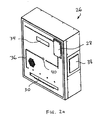
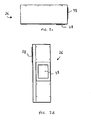
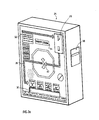
- FIG. 2a to 2d, 3a and 3b there is illustrated the exterior of a vending machine 26 according to the present invention.
- the front of the vending machine 26 contains the coin acceptor 28, the straw dispenser 30, the test instructions 32, the text display 34, indicator lights 36, optional bill acceptor 38, and the straw hole 40 into which a breath sample is blown.
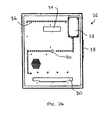
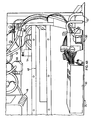
- FIGs 4a to 4c there are illustrated the interior components of the vending machine 26.
- a printed circuit board 42 Inside the vending machine 26 is a printed circuit board 42, a pressure switch 68 (used to detect breath pressure), the coin mechanism 44, optional bill mechanism 46, straw dispenser mechanism 48, coin/bill hopper, pneumatic tubing 58 (connecting the straw sample hole, fuel cell, vacuum pump and exhaust vents), and vacuum pump 50.
- the large, two-part printed circuit board 42 contains the fuel cell alcohol sensor 52, the speaker 54 and volume control 64, the display 56, and all of the electronic circuitry.
- Below the straw dispenser mechanism 48 are the power supply 60, vacuum pump 50, and exhaust ports 62.
- the machine 26 is composed of 16 gauge steel using pressed studs (no external screws) and all access is from the left hand side through a hinged, locking panel.
- the overall size of the unit is 384 wide x 464 high x 152 mm deep.
- the multifunction display is used in two modes: to prompt the user through the test sequence and to display results, and to display parameters such as number of coins collected, coin value, test value, etc.
- Three small pushbutton keys 66 on the left side of the unit interior are used to scroll through parameters and set/change values. When the unit 26 is assembled and the rear hinged left panel is open, these keys 66 are accessible to the user through the left side and can be easily manipulated with the fingers of the left hand, allowing changes to the machine 26 configuration (recalibration, reset coin/bill counters, change test credit value, play, record audio messages). With the hinged left panel closed and locked, the keys 66 are inaccessible and no changes to the machine 26 configuration can be made.
- audio messages are also used. These messages can be recorded or played through the above pushbutton interface when a special mode is entered on power-up (used to avoid accidentally recording over existing messages).
- the front panel incorporates instructions and graphic symbols that prompt the user through the process of inserting money into the machine, inserting a straw into the straw hole, blowing the breath sample, and obtaining the results.
- the static graphics 32 are complimented by a series of discrete LED indicator lights 36 that flash in sequence to prompt the user to the next step.
- the static graphics 32 are also complimented by a bit-mapped, multi-function vacuum fluorescent display 34 that is used to display prompts and results.
- the display 34 shows short messages within the boundary of the screen and longer messages by horizontal scrolling of the message from right to left.
- a user plugs the unit 26 into an AC wall outlet and allows a few minutes to heat up and stabilize the temperature of the internal fuel cell breath alcohol sensor 52.
- a user interface by means of the key switches 66 allows changes to configuration parameters such as the cost of a breath sample test, the legal limit for blood alcohol concentration (BAC), and the coin counter.
- the configuration parameters are stored in non-volatile memory and the vending machine 26 retains their values when the unit is unplugged. Changes to the configuration parameters can only be made by accessing the three push-button switches 66 located inside the unit on the left side. To change any configuration parameters, the user will interact with the three switches 66 in a manner dictated by the instructions and obvious to one skilled in the art.
- Coin Count The number of coins is counted and can be displayed with this configuration parameter. Changing the value will reset the coin counter to zero.
- Bill Count The number of bills is counted and can be displayed with this configuration parameter. Changing the value will reset the bill counter to zero. This configuration parameter has no meaning and can be ignored, if a bill acceptor is not installed.
- Test Credit The cost of a single breath alcohol sample test can be adjusted with this configuration parameter.
- the base credit for a single coin can be adjusted with this configuration parameter. It has been preset at the factory to an appropriate value for the coin acceptor.
- Bill Credit The base credit for a single bill can be adjusted with this configuration parameter. It has been preset at the factory to an appropriate value for the bill acceptor (if one is installed).
- Version The version of software installed in the vending machine 26 is shown with this configuration parameter. It cannot be adjusted.
- Serial Number The serial number of the vending machine 26 is shown with this configuration parameter. It cannot be adjusted.
- Calibrate? Periodically, recalibration of the fuel cell is required. This configuration parameter starts a recalibration sequence when the value is changed to YES. Once the calibration has been performed, the CALIBRATE OK? prompt is displayed and must be changed to YES to accept the new calibration values.
Landscapes
- Life Sciences & Earth Sciences (AREA)
- Health & Medical Sciences (AREA)
- Engineering & Computer Science (AREA)
- Chemical & Material Sciences (AREA)
- Molecular Biology (AREA)
- Physics & Mathematics (AREA)
- Biomedical Technology (AREA)
- Food Science & Technology (AREA)
- Urology & Nephrology (AREA)
- Hematology (AREA)
- Biophysics (AREA)
- Medicinal Chemistry (AREA)
- Analytical Chemistry (AREA)
- Biochemistry (AREA)
- General Health & Medical Sciences (AREA)
- General Physics & Mathematics (AREA)
- Immunology (AREA)
- Pathology (AREA)
- Investigating Or Analysing Biological Materials (AREA)
- Investigating Or Analyzing Materials By The Use Of Fluid Adsorption Or Reactions (AREA)
Applications Claiming Priority (1)
| Application Number | Priority Date | Filing Date | Title |
|---|---|---|---|
| US81298906P | 2006-06-13 | 2006-06-13 |
Publications (2)
| Publication Number | Publication Date |
|---|---|
| EP1867987A2 true EP1867987A2 (de) | 2007-12-19 |
| EP1867987A3 EP1867987A3 (de) | 2007-12-26 |
Family
ID=38442513
Family Applications (1)
| Application Number | Title | Priority Date | Filing Date |
|---|---|---|---|
| EP06027079A Withdrawn EP1867987A3 (de) | 2006-06-13 | 2006-12-29 | Verfahren und Vorrichtung zur Bestimmung des Alkoholgehalts in einer Atemprobe |
Country Status (3)
| Country | Link |
|---|---|
| US (1) | US20070283745A1 (de) |
| EP (1) | EP1867987A3 (de) |
| CA (1) | CA2569212A1 (de) |
Families Citing this family (5)
| Publication number | Priority date | Publication date | Assignee | Title |
|---|---|---|---|---|
| US8418523B2 (en) | 2008-03-03 | 2013-04-16 | Keith Lueck | Calibration and accuracy check system for a breath tester |
| US8466796B1 (en) * | 2010-02-25 | 2013-06-18 | Wilson Mejia | Blood alcohol indicator device |
| US8814804B2 (en) | 2010-12-13 | 2014-08-26 | Iph, Llc | Interactive blood-alcohol content tester |
| JP5767843B2 (ja) * | 2011-04-01 | 2015-08-19 | 株式会社日立製作所 | イオン検出装置 |
| CN115656263B (zh) * | 2022-10-11 | 2025-03-14 | 北京安图生物工程有限公司 | 基于复合材料的人体酒精含量检测方法、装置及设备 |
Family Cites Families (11)
| Publication number | Priority date | Publication date | Assignee | Title |
|---|---|---|---|---|
| US3877291A (en) * | 1972-08-15 | 1975-04-15 | Borg Warner | Portable breath tester |
| FR2577677B1 (fr) * | 1985-02-15 | 1988-04-29 | Legrand Guy | Dispositif analyseur de la teneur en alcool d'un gaz |
| US5055268A (en) * | 1986-12-09 | 1991-10-08 | Easterm Electronics Manufacturing Corp. | Air-borne alcohol sensor |
| US4770026A (en) * | 1987-01-15 | 1988-09-13 | Alcotek, Inc. | Method of and apparatus for testing breath alcohol |
| US4749553A (en) * | 1987-04-08 | 1988-06-07 | Life Loc, Inc. | Breath alcohol detector with improved compensation for environmental variables |
| GB8718744D0 (en) * | 1987-08-07 | 1987-09-16 | Lion Lab Ltd | Fluid sampling systems |
| US5393495A (en) * | 1992-08-17 | 1995-02-28 | Intoximeters, Inc. | Method and apparatus for testing gases, particularly breath alcohol |
| US5303575A (en) * | 1993-06-01 | 1994-04-19 | Alcotech Research Inc. | Apparatus and method for conducting an unsupervised blood alcohol content level test |
| US5515859A (en) * | 1993-08-24 | 1996-05-14 | Colorado Health Care Research Corp. | Myocardial infarction and ischemia detection method and apparatus |
| DE4441205A1 (de) * | 1994-11-19 | 1996-05-23 | Draegerwerk Ag | Verfahren zur Bestimmung des Anteils einer elektrochemisch umsetzbaren Substanz in einer Gasprobe |
| GB9512396D0 (en) * | 1995-06-17 | 1995-08-16 | Lion Lab Plc | Breath testing apparatus |
-
2006
- 2006-11-29 CA CA002569212A patent/CA2569212A1/en not_active Abandoned
- 2006-11-29 US US11/605,417 patent/US20070283745A1/en not_active Abandoned
- 2006-12-29 EP EP06027079A patent/EP1867987A3/de not_active Withdrawn
Also Published As
| Publication number | Publication date |
|---|---|
| US20070283745A1 (en) | 2007-12-13 |
| EP1867987A3 (de) | 2007-12-26 |
| CA2569212A1 (en) | 2007-12-13 |
Similar Documents
| Publication | Publication Date | Title |
|---|---|---|
| US11885795B2 (en) | Method for measuring breath alcohol concentration and apparatus therefor | |
| US9518970B2 (en) | Method for determining analyte type and/or concentration with a diffusion based metal oxide gas sensor | |
| TWI278620B (en) | Analyzer | |
| US5395494A (en) | Dynamic microchamber for measuring formaldehyde emissions | |
| US7640783B2 (en) | Self-calibrating gas detector and method | |
| US9128045B2 (en) | Electrochemical sensor with zero calibration feature and method of calibrating | |
| US20080093228A1 (en) | Method and apparatus for providing a stable voltage to an analytical system | |
| US20140260543A1 (en) | Method and apparatus for detecting moisture in portable electronic devices | |
| WO2017022349A1 (ja) | センサユニット及び気密性検査装置 | |
| JP2011502263A (ja) | 液体サンプル中の被分析物の濃度を測定するテストストリップ及びシステム | |
| JP6448640B2 (ja) | デュアルチャンバ型分析用テストストリップ | |
| CN107490613A (zh) | 电化学气体传感器及其校准方法、空调器 | |
| CN103424465A (zh) | 智能pid传感器模块 | |
| EP2805155A1 (de) | Verfahren zum messen der formaldehydabgabe aus einer oder mehreren proben | |
| JP6268484B2 (ja) | 生体ガス検知装置、方法、及びプログラム | |
| US20070283745A1 (en) | Method and apparatus for determining alcohol content in a breath sample | |
| AU3615493A (en) | Multiple K factor, selectable gas detector | |
| JP2017142235A (ja) | 呼気サンプリング分析装置 | |
| KR101913149B1 (ko) | 재기초화 표준가스 내장형 가스 검출기 | |
| EP1037183A2 (de) | Gasnachweisalarmvorrichtung | |
| CN114486663A (zh) | 一种离子发生器颗粒物净化效果测试装置 | |
| EP1279952B1 (de) | Verfahren zum prüfen eines analysierers | |
| CN224216618U (zh) | 一种无线遥感微型实验动物微环境氨监测仪 | |
| CN223426531U (zh) | 一种具备双重检测功能的食品新鲜程度检测仪 | |
| US12012586B2 (en) | Automated gas control hypoxic chamber for monitoring oxygen concentration |
Legal Events
| Date | Code | Title | Description |
|---|---|---|---|
| PUAI | Public reference made under article 153(3) epc to a published international application that has entered the european phase |
Free format text: ORIGINAL CODE: 0009012 |
|
| PUAL | Search report despatched |
Free format text: ORIGINAL CODE: 0009013 |
|
| 17P | Request for examination filed |
Effective date: 20070126 |
|
| AK | Designated contracting states |
Kind code of ref document: A2 Designated state(s): AT BE BG CH CY CZ DE DK EE ES FI FR GB GR HU IE IS IT LI LT LU LV MC NL PL PT RO SE SI SK TR |
|
| AX | Request for extension of the european patent |
Extension state: AL BA HR MK YU |
|
| AK | Designated contracting states |
Kind code of ref document: A3 Designated state(s): AT BE BG CH CY CZ DE DK EE ES FI FR GB GR HU IE IS IT LI LT LU LV MC NL PL PT RO SE SI SK TR |
|
| AX | Request for extension of the european patent |
Extension state: AL BA HR MK YU |
|
| 17Q | First examination report despatched |
Effective date: 20080721 |
|
| AKX | Designation fees paid |
Designated state(s): AT BE BG CH CY CZ DE DK EE ES FI FR GB GR HU IE IS IT LI LT LU LV MC NL PL PT RO SE SI SK TR |
|
| STAA | Information on the status of an ep patent application or granted ep patent |
Free format text: STATUS: THE APPLICATION IS DEEMED TO BE WITHDRAWN |
|
| 18D | Application deemed to be withdrawn |
Effective date: 20090103 |