EP1867674A1 - Polycarbosilane and method for producing same - Google Patents
Polycarbosilane and method for producing same Download PDFInfo
- Publication number
- EP1867674A1 EP1867674A1 EP06731082A EP06731082A EP1867674A1 EP 1867674 A1 EP1867674 A1 EP 1867674A1 EP 06731082 A EP06731082 A EP 06731082A EP 06731082 A EP06731082 A EP 06731082A EP 1867674 A1 EP1867674 A1 EP 1867674A1
- Authority
- EP
- European Patent Office
- Prior art keywords
- group
- carbon number
- oxetanyl
- polycarbosilane
- formula
- Prior art date
- Legal status (The legal status is an assumption and is not a legal conclusion. Google has not performed a legal analysis and makes no representation as to the accuracy of the status listed.)
- Withdrawn
Links
- 229920003257 polycarbosilane Polymers 0.000 title claims abstract description 54
- 238000004519 manufacturing process Methods 0.000 title claims abstract description 11
- 125000003566 oxetanyl group Chemical group 0.000 claims abstract description 69
- 125000000217 alkyl group Chemical group 0.000 claims abstract description 28
- 125000000962 organic group Chemical group 0.000 claims abstract description 27
- 125000003118 aryl group Chemical group 0.000 claims abstract description 21
- 125000000732 arylene group Chemical group 0.000 claims abstract description 18
- 125000002947 alkylene group Chemical group 0.000 claims abstract description 17
- OKTJSMMVPCPJKN-UHFFFAOYSA-N Carbon Chemical compound [C] OKTJSMMVPCPJKN-UHFFFAOYSA-N 0.000 claims description 67
- 229910052799 carbon Inorganic materials 0.000 claims description 67
- 150000001875 compounds Chemical class 0.000 claims description 23
- RTZKZFJDLAIYFH-UHFFFAOYSA-N ether Substances CCOCC RTZKZFJDLAIYFH-UHFFFAOYSA-N 0.000 claims description 14
- -1 vinyloxetane compound Chemical class 0.000 claims description 11
- 238000006459 hydrosilylation reaction Methods 0.000 claims description 8
- 125000004435 hydrogen atom Chemical group [H]* 0.000 claims description 7
- 238000000034 method Methods 0.000 claims description 7
- 125000003710 aryl alkyl group Chemical group 0.000 claims description 2
- 239000003960 organic solvent Substances 0.000 abstract description 5
- 229920000642 polymer Polymers 0.000 abstract description 2
- 239000002904 solvent Substances 0.000 description 18
- WYURNTSHIVDZCO-UHFFFAOYSA-N Tetrahydrofuran Chemical compound C1CCOC1 WYURNTSHIVDZCO-UHFFFAOYSA-N 0.000 description 16
- YXFVVABEGXRONW-UHFFFAOYSA-N Toluene Chemical compound CC1=CC=CC=C1 YXFVVABEGXRONW-UHFFFAOYSA-N 0.000 description 12
- 238000006243 chemical reaction Methods 0.000 description 9
- YLQBMQCUIZJEEH-UHFFFAOYSA-N tetrahydrofuran Natural products C=1C=COC=1 YLQBMQCUIZJEEH-UHFFFAOYSA-N 0.000 description 8
- IJGRMHOSHXDMSA-UHFFFAOYSA-N Atomic nitrogen Chemical compound N#N IJGRMHOSHXDMSA-UHFFFAOYSA-N 0.000 description 6
- LZCLXQDLBQLTDK-UHFFFAOYSA-N ethyl 2-hydroxypropanoate Chemical compound CCOC(=O)C(C)O LZCLXQDLBQLTDK-UHFFFAOYSA-N 0.000 description 6
- 239000000243 solution Substances 0.000 description 6
- FYYHWMGAXLPEAU-UHFFFAOYSA-N Magnesium Chemical compound [Mg] FYYHWMGAXLPEAU-UHFFFAOYSA-N 0.000 description 5
- 239000003054 catalyst Substances 0.000 description 5
- 238000010438 heat treatment Methods 0.000 description 5
- 239000011777 magnesium Substances 0.000 description 5
- 229910052749 magnesium Inorganic materials 0.000 description 5
- 125000002496 methyl group Chemical group [H]C([H])([H])* 0.000 description 5
- NTIZESTWPVYFNL-UHFFFAOYSA-N Methyl isobutyl ketone Chemical compound CC(C)CC(C)=O NTIZESTWPVYFNL-UHFFFAOYSA-N 0.000 description 4
- UIHCLUNTQKBZGK-UHFFFAOYSA-N Methyl isobutyl ketone Natural products CCC(C)C(C)=O UIHCLUNTQKBZGK-UHFFFAOYSA-N 0.000 description 4
- HEDRZPFGACZZDS-MICDWDOJSA-N Trichloro(2H)methane Chemical compound [2H]C(Cl)(Cl)Cl HEDRZPFGACZZDS-MICDWDOJSA-N 0.000 description 4
- UWGIJJRGSGDBFJ-UHFFFAOYSA-N dichloromethylsilane Chemical compound [SiH3]C(Cl)Cl UWGIJJRGSGDBFJ-UHFFFAOYSA-N 0.000 description 4
- 125000001495 ethyl group Chemical group [H]C([H])([H])C([H])([H])* 0.000 description 4
- CATSNJVOTSVZJV-UHFFFAOYSA-N heptan-2-one Chemical compound CCCCCC(C)=O CATSNJVOTSVZJV-UHFFFAOYSA-N 0.000 description 4
- 229940043265 methyl isobutyl ketone Drugs 0.000 description 4
- BASFCYQUMIYNBI-UHFFFAOYSA-N platinum Substances [Pt] BASFCYQUMIYNBI-UHFFFAOYSA-N 0.000 description 4
- 239000007858 starting material Substances 0.000 description 4
- ZCYVEMRRCGMTRW-UHFFFAOYSA-N 7553-56-2 Chemical group [I] ZCYVEMRRCGMTRW-UHFFFAOYSA-N 0.000 description 3
- XEKOWRVHYACXOJ-UHFFFAOYSA-N Ethyl acetate Chemical compound CCOC(C)=O XEKOWRVHYACXOJ-UHFFFAOYSA-N 0.000 description 3
- DNIAPMSPPWPWGF-UHFFFAOYSA-N Propylene glycol Chemical compound CC(O)CO DNIAPMSPPWPWGF-UHFFFAOYSA-N 0.000 description 3
- 239000012298 atmosphere Substances 0.000 description 3
- 229940116333 ethyl lactate Drugs 0.000 description 3
- 239000003779 heat-resistant material Substances 0.000 description 3
- 125000002887 hydroxy group Chemical group [H]O* 0.000 description 3
- 229910052740 iodine Chemical group 0.000 description 3
- 229910052757 nitrogen Inorganic materials 0.000 description 3
- 239000003921 oil Substances 0.000 description 3
- 125000001997 phenyl group Chemical group [H]C1=C([H])C([H])=C(*)C([H])=C1[H] 0.000 description 3
- 229920000548 poly(silane) polymer Polymers 0.000 description 3
- LLHKCFNBLRBOGN-UHFFFAOYSA-N propylene glycol methyl ether acetate Chemical compound COCC(C)OC(C)=O LLHKCFNBLRBOGN-UHFFFAOYSA-N 0.000 description 3
- 238000010992 reflux Methods 0.000 description 3
- WQONPSCCEXUXTQ-UHFFFAOYSA-N 1,2-dibromobenzene Chemical compound BrC1=CC=CC=C1Br WQONPSCCEXUXTQ-UHFFFAOYSA-N 0.000 description 2
- PAAZPARNPHGIKF-UHFFFAOYSA-N 1,2-dibromoethane Chemical compound BrCCBr PAAZPARNPHGIKF-UHFFFAOYSA-N 0.000 description 2
- SWJPEBQEEAHIGZ-UHFFFAOYSA-N 1,4-dibromobenzene Chemical compound BrC1=CC=C(Br)C=C1 SWJPEBQEEAHIGZ-UHFFFAOYSA-N 0.000 description 2
- 238000005160 1H NMR spectroscopy Methods 0.000 description 2
- QOZLLNFAKXRSQL-UHFFFAOYSA-N 3-ethyl-3-(prop-2-enoxymethyl)oxetane Chemical compound C=CCOCC1(CC)COC1 QOZLLNFAKXRSQL-UHFFFAOYSA-N 0.000 description 2
- CSCPPACGZOOCGX-UHFFFAOYSA-N Acetone Chemical compound CC(C)=O CSCPPACGZOOCGX-UHFFFAOYSA-N 0.000 description 2
- WKBOTKDWSSQWDR-UHFFFAOYSA-N Bromine atom Chemical group [Br] WKBOTKDWSSQWDR-UHFFFAOYSA-N 0.000 description 2
- LCGLNKUTAGEVQW-UHFFFAOYSA-N Dimethyl ether Chemical compound COC LCGLNKUTAGEVQW-UHFFFAOYSA-N 0.000 description 2
- 238000003747 Grignard reaction Methods 0.000 description 2
- CTQNGGLPUBDAKN-UHFFFAOYSA-N O-Xylene Chemical compound CC1=CC=CC=C1C CTQNGGLPUBDAKN-UHFFFAOYSA-N 0.000 description 2
- OFBQJSOFQDEBGM-UHFFFAOYSA-N Pentane Chemical compound CCCCC OFBQJSOFQDEBGM-UHFFFAOYSA-N 0.000 description 2
- PMZURENOXWZQFD-UHFFFAOYSA-L Sodium Sulfate Chemical compound [Na+].[Na+].[O-]S([O-])(=O)=O PMZURENOXWZQFD-UHFFFAOYSA-L 0.000 description 2
- 238000009835 boiling Methods 0.000 description 2
- 239000003795 chemical substances by application Substances 0.000 description 2
- 229910052801 chlorine Inorganic materials 0.000 description 2
- 125000001309 chloro group Chemical group Cl* 0.000 description 2
- 238000004090 dissolution Methods 0.000 description 2
- RCNRJBWHLARWRP-UHFFFAOYSA-N ethenyl-[ethenyl(dimethyl)silyl]oxy-dimethylsilane;platinum Chemical compound [Pt].C=C[Si](C)(C)O[Si](C)(C)C=C RCNRJBWHLARWRP-UHFFFAOYSA-N 0.000 description 2
- 125000000524 functional group Chemical group 0.000 description 2
- 238000005227 gel permeation chromatography Methods 0.000 description 2
- 229910052736 halogen Inorganic materials 0.000 description 2
- 150000002367 halogens Chemical class 0.000 description 2
- 150000002484 inorganic compounds Chemical class 0.000 description 2
- 229910010272 inorganic material Inorganic materials 0.000 description 2
- 239000000463 material Substances 0.000 description 2
- 229910052751 metal Inorganic materials 0.000 description 2
- 239000002184 metal Substances 0.000 description 2
- 239000011259 mixed solution Substances 0.000 description 2
- 239000003607 modifier Substances 0.000 description 2
- VLKZOEOYAKHREP-UHFFFAOYSA-N n-Hexane Chemical compound CCCCCC VLKZOEOYAKHREP-UHFFFAOYSA-N 0.000 description 2
- AHHWIHXENZJRFG-UHFFFAOYSA-N oxetane Chemical compound C1COC1 AHHWIHXENZJRFG-UHFFFAOYSA-N 0.000 description 2
- 229910052697 platinum Inorganic materials 0.000 description 2
- 125000004805 propylene group Chemical group [H]C([H])([H])C([H])([*:1])C([H])([H])[*:2] 0.000 description 2
- 238000000425 proton nuclear magnetic resonance spectrum Methods 0.000 description 2
- 229920005989 resin Polymers 0.000 description 2
- 239000011347 resin Substances 0.000 description 2
- 239000000126 substance Substances 0.000 description 2
- 239000012756 surface treatment agent Substances 0.000 description 2
- XLYOFNOQVPJJNP-UHFFFAOYSA-N water Substances O XLYOFNOQVPJJNP-UHFFFAOYSA-N 0.000 description 2
- 239000008096 xylene Substances 0.000 description 2
- NAWXUBYGYWOOIX-SFHVURJKSA-N (2s)-2-[[4-[2-(2,4-diaminoquinazolin-6-yl)ethyl]benzoyl]amino]-4-methylidenepentanedioic acid Chemical compound C1=CC2=NC(N)=NC(N)=C2C=C1CCC1=CC=C(C(=O)N[C@@H](CC(=C)C(O)=O)C(O)=O)C=C1 NAWXUBYGYWOOIX-SFHVURJKSA-N 0.000 description 1
- LEEANUDEDHYDTG-UHFFFAOYSA-N 1,2-dimethoxypropane Chemical compound COCC(C)OC LEEANUDEDHYDTG-UHFFFAOYSA-N 0.000 description 1
- LDBOYMRNYCBDQK-UHFFFAOYSA-N 3-(ethenoxymethyl)-3-ethyloxetane Chemical compound C=COCC1(CC)COC1 LDBOYMRNYCBDQK-UHFFFAOYSA-N 0.000 description 1
- QJMILNYJDNREGS-UHFFFAOYSA-N 3-(ethenoxymethyl)-3-methyloxetane Chemical compound C=COCC1(C)COC1 QJMILNYJDNREGS-UHFFFAOYSA-N 0.000 description 1
- OGGMJWUWCGYZQN-UHFFFAOYSA-N 3-(ethenoxymethyl)oxetane Chemical compound C=COCC1COC1 OGGMJWUWCGYZQN-UHFFFAOYSA-N 0.000 description 1
- DKPFZGUDAPQIHT-UHFFFAOYSA-N Butyl acetate Natural products CCCCOC(C)=O DKPFZGUDAPQIHT-UHFFFAOYSA-N 0.000 description 1
- XDTMQSROBMDMFD-UHFFFAOYSA-N Cyclohexane Chemical compound C1CCCCC1 XDTMQSROBMDMFD-UHFFFAOYSA-N 0.000 description 1
- ZAFNJMIOTHYJRJ-UHFFFAOYSA-N Diisopropyl ether Chemical compound CC(C)OC(C)C ZAFNJMIOTHYJRJ-UHFFFAOYSA-N 0.000 description 1
- 229910002621 H2PtCl6 Inorganic materials 0.000 description 1
- DSVGQVZAZSZEEX-UHFFFAOYSA-N [C].[Pt] Chemical compound [C].[Pt] DSVGQVZAZSZEEX-UHFFFAOYSA-N 0.000 description 1
- 239000002253 acid Substances 0.000 description 1
- 230000003213 activating effect Effects 0.000 description 1
- 125000000484 butyl group Chemical group [H]C([*])([H])C([H])([H])C([H])([H])C([H])([H])[H] 0.000 description 1
- CREMABGTGYGIQB-UHFFFAOYSA-N carbon carbon Chemical compound C.C CREMABGTGYGIQB-UHFFFAOYSA-N 0.000 description 1
- 239000011203 carbon fibre reinforced carbon Substances 0.000 description 1
- 229910010293 ceramic material Inorganic materials 0.000 description 1
- 150000004696 coordination complex Chemical class 0.000 description 1
- 229910021419 crystalline silicon Inorganic materials 0.000 description 1
- 238000000354 decomposition reaction Methods 0.000 description 1
- 125000002704 decyl group Chemical group [H]C([H])([H])C([H])([H])C([H])([H])C([H])([H])C([H])([H])C([H])([H])C([H])([H])C([H])([H])C([H])([H])C([H])([H])* 0.000 description 1
- 229960004132 diethyl ether Drugs 0.000 description 1
- 125000003438 dodecyl group Chemical group [H]C([H])([H])C([H])([H])C([H])([H])C([H])([H])C([H])([H])C([H])([H])C([H])([H])C([H])([H])C([H])([H])C([H])([H])C([H])([H])C([H])([H])* 0.000 description 1
- 230000000694 effects Effects 0.000 description 1
- 125000003700 epoxy group Chemical group 0.000 description 1
- 239000003759 ester based solvent Substances 0.000 description 1
- 150000002170 ethers Chemical class 0.000 description 1
- 229940052303 ethers for general anesthesia Drugs 0.000 description 1
- 125000000816 ethylene group Chemical group [H]C([H])([*:1])C([H])([H])[*:2] 0.000 description 1
- 238000011156 evaluation Methods 0.000 description 1
- 239000003502 gasoline Substances 0.000 description 1
- 125000005843 halogen group Chemical group 0.000 description 1
- 229920006015 heat resistant resin Polymers 0.000 description 1
- 150000004687 hexahydrates Chemical class 0.000 description 1
- FUZZWVXGSFPDMH-UHFFFAOYSA-N hexanoic acid Chemical compound CCCCCC(O)=O FUZZWVXGSFPDMH-UHFFFAOYSA-N 0.000 description 1
- 125000004051 hexyl group Chemical group [H]C([H])([H])C([H])([H])C([H])([H])C([H])([H])C([H])([H])C([H])([H])* 0.000 description 1
- 229930195733 hydrocarbon Natural products 0.000 description 1
- 150000002430 hydrocarbons Chemical class 0.000 description 1
- 239000011810 insulating material Substances 0.000 description 1
- 239000011630 iodine Substances 0.000 description 1
- 229910052741 iridium Inorganic materials 0.000 description 1
- 125000000959 isobutyl group Chemical group [H]C([H])([H])C([H])(C([H])([H])[H])C([H])([H])* 0.000 description 1
- 125000001449 isopropyl group Chemical group [H]C([H])([H])C([H])(*)C([H])([H])[H] 0.000 description 1
- 239000005453 ketone based solvent Substances 0.000 description 1
- 150000002680 magnesium Chemical class 0.000 description 1
- 159000000003 magnesium salts Chemical class 0.000 description 1
- 229910044991 metal oxide Inorganic materials 0.000 description 1
- 150000004706 metal oxides Chemical class 0.000 description 1
- 125000004108 n-butyl group Chemical group [H]C([H])([H])C([H])([H])C([H])([H])C([H])([H])* 0.000 description 1
- 125000004123 n-propyl group Chemical group [H]C([H])([H])C([H])([H])C([H])([H])* 0.000 description 1
- 229910052759 nickel Inorganic materials 0.000 description 1
- 125000002560 nitrile group Chemical group 0.000 description 1
- 125000002347 octyl group Chemical group [H]C([*])([H])C([H])([H])C([H])([H])C([H])([H])C([H])([H])C([H])([H])C([H])([H])C([H])([H])[H] 0.000 description 1
- GNWXVOQHLPBSSR-UHFFFAOYSA-N oxolane;toluene Chemical compound C1CCOC1.CC1=CC=CC=C1 GNWXVOQHLPBSSR-UHFFFAOYSA-N 0.000 description 1
- 229910052763 palladium Inorganic materials 0.000 description 1
- 239000003208 petroleum Substances 0.000 description 1
- 239000002798 polar solvent Substances 0.000 description 1
- 239000002243 precursor Substances 0.000 description 1
- 125000001436 propyl group Chemical group [H]C([*])([H])C([H])([H])C([H])([H])[H] 0.000 description 1
- 229960004063 propylene glycol Drugs 0.000 description 1
- 235000013772 propylene glycol Nutrition 0.000 description 1
- 238000001226 reprecipitation Methods 0.000 description 1
- 229910052703 rhodium Inorganic materials 0.000 description 1
- 229910052707 ruthenium Inorganic materials 0.000 description 1
- 150000003839 salts Chemical class 0.000 description 1
- 125000002914 sec-butyl group Chemical group [H]C([H])([H])C([H])([H])C([H])(*)C([H])([H])[H] 0.000 description 1
- 150000003377 silicon compounds Chemical class 0.000 description 1
- 125000000999 tert-butyl group Chemical group [H]C([H])([H])C(*)(C([H])([H])[H])C([H])([H])[H] 0.000 description 1
- 125000000383 tetramethylene group Chemical group [H]C([H])([*:1])C([H])([H])C([H])([H])C([H])([H])[*:2] 0.000 description 1
Classifications
-
- C—CHEMISTRY; METALLURGY
- C08—ORGANIC MACROMOLECULAR COMPOUNDS; THEIR PREPARATION OR CHEMICAL WORKING-UP; COMPOSITIONS BASED THEREON
- C08G—MACROMOLECULAR COMPOUNDS OBTAINED OTHERWISE THAN BY REACTIONS ONLY INVOLVING UNSATURATED CARBON-TO-CARBON BONDS
- C08G77/00—Macromolecular compounds obtained by reactions forming a linkage containing silicon with or without sulfur, nitrogen, oxygen or carbon in the main chain of the macromolecule
- C08G77/60—Macromolecular compounds obtained by reactions forming a linkage containing silicon with or without sulfur, nitrogen, oxygen or carbon in the main chain of the macromolecule in which all the silicon atoms are connected by linkages other than oxygen atoms
Definitions
- the present invention relates to a novel polycarbosilane and a method for producing the same. More specifically, it relates to a polycarbosilane having an oxetanyl group in a side chain, and a method for producing the same.
- JP-A 2004-26895 a method for introducing an oxetanyl group into a polysilane is disclosed by reacting a polysilane compound having a halogen group with a compound having an oxetane group and a hydroxyl group.
- the polycarbosilane shows an excellent heat resistance and decomposition resistance, therefore it is used as a precursor for a ceramic material and a heat resistant resin material (refer to JP-A H07-118007 , JP-A H10-069819 and JP-A H09-013278 ).
- the conventional polycarbosilanes indicate inferior solubility in common organic solvents and sometimes limit to a specific solvent capable of dissolving it. Therefore, there has been a problem where use of the polycarbosilane is restricted.
- An objective of the present invention is to provide a polycarbosilane having excellent solubility in common organic solvents and a method for producing the same.
- the present inventors had a keen examination for the purpose of achieving the above objective and synthesized newly a polycarbosilane having an oxetanyl group represented by the following general formula to find out that this compound led to an improved solubility in common organic solvents.
- each R is an alkyl group having carbon number of 2 to 40 and having no oxetanyl group, an aryl group, or an alkyl group having carbon number of 2 to 40 and having an oxetanyl group (an ether bond may be included), at least one R among two Rs is an alkyl group having carbon number of 2 to 40 and having an oxetanyl group (an ether bond may be included), R' is an alkylene group, an arylene group and an aralkylene group all having carbon number of 1 to 20, and n is an integer of 5 to 200.
- the polycarbosilane of the present invention is a compound represented by the following general formula (1).
- R 1 is an alkyl group having carbon number of 1 to 40 and having no oxetanyl group, an aryl group having carbon number of 6 to 40 and having no oxetanyl group, or an organic group having total carbon number of 5 to 40 and having an oxetanyl group
- R 2 is an organic group having total carbon number of 5 to 40 and having an oxetanyl group
- R 3 is an alkylene group having carbon number of 1 to 20, an arylene group or an aralkylene group
- n is an integer of 5 to 200.
- the organic groups R 1 and R 2 preferably have an ether bond.
- the method for producing the polycarbosilane of the present invention is characterized in comprising a process for hydrosilylation reaction of a compound represented by the following general formula (6), and a vinyloxetane compound represented by the following general formula (7).
- R 3 is an alkylene group having carbon number of 1 to 20, an arylene group or an aralkylene group
- R 7 is hydrogen atom, an alkyl group having carbon number of 1 to 40 and having no oxetanyl group, or an aryl group having carbon number of 6 to 40 and having no oxetanyl group
- n is an integer of 5 to 200.
- CH 2 CH-R 8 (7)
- R 8 is an organic group having total carbon number of 3 to 38 and having an oxetanyl group.
- the organic group R 8 preferably has an ether bond.
- the novel polycarbosilane of the present invention inclusion of an oxetanyl group that is a polar functional group leads to an improved affinity with a polar solvent.
- the compound has good solubility in common solvents such as a ketone-based solvent including acetone, methylisobutylketone and methylamylketone, an ester-based solvent including ethyl acetate and butyl acetate, and a propyleneglycol-based solvent such as propyleneglycol dimethylether. Therefore, the polycarbosilane of the present invention is useful as a modifier for resins and a surface-treatment agent for inorganic compounds.
- the present invention can provide a heat resistant material capable of forming a variable shape easily without impairing characteristic of the polycarbosilane.
- the polycarbosilane of the present invention can be safely and efficiently produced by using a comparably and readily available silicon compound as a starting material.
- the polycarbosilane of the present invention is represented by the following general formula (1).
- R 1 is an alkyl group having carbon number of 1 to 40 and having no oxetanyl group, an aryl group having carbon number of 6 to 40 and having no oxetanyl group, or an organic group having total carbon number of 5 to 40 and having an oxetanyl group.
- R 2 is an organic group having total carbon number of 5 to 40 and having an oxetanyl group.
- the group may be linear type or branched type and preferable carbon number is 1 to 30, and more preferably 1 to 20.
- this alkyl group examples include methyl group, ethyl group, n-propyl group, isopropyl group, n-butyl group, isobutyl group, sec-butyl group, tert-butyl group, hexyl group, octyl group, decyl group, dodecyl group, hexadecanyl group and the like.
- methyl group is preferred.
- Bound position of the oxetanyl group in the above organic group R 2 is not particularly limited and may be in the middle or at the terminal of the organic group. In addition, number of the oxetanyl group is not also particularly limited.
- this organic group R 2 is generally a group containing primarily an alkylene group having carbon number of 3 to 37 or an arylene group having carbon number of 6 to 37 and may comprise other functional group and/or other bond.
- the above organic group R 2 preferably comprises an ether bond in addition to -O- bond contained in the oxetanyl group. The position and number thereof are not limited.
- the above R 1 is also the same as the above R 2 in the case where the above R 1 is an organic group having total carbon number of 5 to 40 and having an oxetanyl group.
- the above R 1 and R 2 each may be the same or different.
- R 3 is an alkylene group having carbon number of 1 to 20, an arylene group or an aralkylene group. Carbon numbers of the arylene group and the aralkylene group are usually 6 to 20 and 7 to 20, respectively.
- the above R 3 is preferably an arylene group.
- both terminals are generally a phenyl group or a hydroxyl group.
- n in the above general formula (1) is an integer of 5 to 200, and is preferably 10 to 100. If n exceeds 200, solubility of the polycarbosilane in common solvents may be reduced. On the other hand, if n is less than 5, characteristics as a heat resistant material may not be sufficient.
- the preferable polycarbosilane in the present invention is a compound represented by the following general formula (2).
- R 1 and R 3 in the above general formula (2) are same as R 1 and R 3 in the above general formula (1), respectively and descriptions thereof can be applied.
- R 4 in the above general formula (2) is an alkylene group having carbon number of 2 to 20, an arylene group or an aralkylene group.
- R 4 is an alkylene group, preferable carbon number is 2 to 14.
- This alkylene group may be linear type or have a side chain. Specific examples of this alkylene group include ethylene group, propylene group, butylene group and the like.
- R 4 is an arylene group and an aralkylene group, preferable carbon numbers are 6 to 14 and 7 to 14, respectively.
- the above R 4 is preferably an alkylene group and is particularly propylene group.
- R 5 in the above general formula (2) is hydrogen atom, an alkyl group having carbon number of 1 to 20, an aryl group having carbon number of 6 to 20, or an aralkyl group.
- R 5 is an alkyl group, preferable carbon number is 1 to 12, and is more preferably 1 to 6.
- This alkyl group may be linear type or branched type.
- specific examples of this alkyl group include methyl group, ethyl group, propyl group, butyl group and the like.
- the above R 5 is preferably an alkyl group and is particularly ethyl group.
- n in the above general formula (2) is an integer of 5 to 200, and is preferably 10 to 100, as is the same as n in the above general formula (1).
- R 6 is an alkyl group having carbon number of 1 to 40 and having no oxetanyl group, or an aryl group having carbon number of 6 to 40 and having no oxetanyl group, and n is an integer of 5 to 200.
- R 6 is an alkyl group having carbon number of 1 to 40 and having no oxetanyl group, or an aryl group having carbon number of 6 to 40 and having no oxetanyl group, and n is an integer of 5 to 200.
- R 6 is an alkyl group having carbon number of 1 to 40 and having no oxetanyl group, or an aryl group having carbon number of 6 to 40 and having no oxetanyl group, and n is an integer of 5 to 200.
- polycarbosilanes represented by the general formulas (3) and (4) are particularly preferable.
- the production method for polycarbosilane of the present invention is characterized in comprising a process for hydrosilylation reaction of a compound represented by the following general formula (6), and a vinyloxetane compound represented by the following general formula (7).
- R 3 is an alkylene group having carbon number of 1 to 20, an arylene group or an aralkylene group
- R 7 is hydrogen atom, an alkyl group having carbon number of 1 to 40 and having no oxetanyl group, or an aryl group having carbon number of 6 to 40 and having no oxetanyl group
- n is an integer of 5 to 200.
- CH 2 CH-R 8 (7)
- R 8 is an organic group having total carbon number of 3 to 38 and having an oxetanyl group.
- R 3 is the same as R 3 in the above general formula (1) and description thereof can be applied.
- the preferable R 3 is an arylene group.
- R 7 is one selected from the group of hydrogen atom, an alkyl group and an aryl group that are having specific carbon number. When R 7 is an alkyl group or an aryl group, it is the same as R 1 in the above general formula (1) and description thereof can be applied.
- the preferable R 7 is methyl group from a viewpoint of easy availability as a starting material.
- R 8 in the above general formula (7) is an organic group having total carbon number of 3 to 38 and having an oxetanyl group.
- the bound position of the oxetanyl group is not particularly limited and may be in the middle or at the terminal of the organic group.
- number of the oxetanyl group is not particularly limited.
- a compound that is easy to get as a starting material is a compound where the bound position of the oxetanyl group is in the middle of the organic group and the terminal is ethyl group.
- the above organic group R 8 preferably comprises an ether bond in addition to -O- bond contained in the oxetanyl group. The position and number thereof are not limited.
- the structure of a vinyloxetane compound represented by the above general formula (7) is as follows.
- CH 2 CH-(CH 2 ) m -O-R 8
- R 8' is an organic group having an oxetanyl group and m is an integer of 0 to 12.
- Examples of the vinyloxetane compound represented by the above general formula (7) include 3-ethyl-3-allyloxymethyl oxetane, 3-methyl-3-allyloxymethyl oxetane, 3-allyloxymethyl oxetane, 3-ethyl-3-vinyloxymethyl oxetane, 3-methyl-3-vinyloxymethyl oxetane, 3-vinyloxymethyl oxetane and the like.
- the hydrosilylation reaction between the compound represented by the above general formula (6), and the above vinyloxetane compound (7) is usually conducted in the presence of a catalyst in an organic solvent such as toluene and tetrahydrofuran.
- a catalyst such as toluene and tetrahydrofuran.
- Examples of the above catalyst include an elemental metal from groups VIII - X containing Co, Ni, Ru, Rh, Pd, Ir, Pt and the like, an organic metal complex thereof, a metal salt thereof, a metal oxide thereof and the like.
- a platinum-vinylsiloxane complex such as platinum 1,3-divinyl-1,1,3,3-tetramethyldisiloxane complex; chloroplatinic acid hexahydrate (H 2 PtCl 6 ⁇ 6H 2 O), cis-PtCl 2 (PhCN) 2 , platinum carbon and the like. It is noted Ph means phenyl group.
- the amount of the above catalyst to be used is preferably 0.1 to 1,000 ppm based on the amount of the compound represented by the above general formula (6) to be used.
- reaction temperature depends generally on heating from outside and supplying rate of starting materials.
- the hydrosilylation reaction can be smoothly conducted. If this temperature is lower than 30°C, the hydrosilylation reaction does not proceed smoothly. If the temperature exceeds 120°C, controlling of the molecular weight of a polymer may be hard.
- rinsing, layer-separating, desolventing and the like may be conducted according to known methods to collect the polycarbosilane of the present invention.
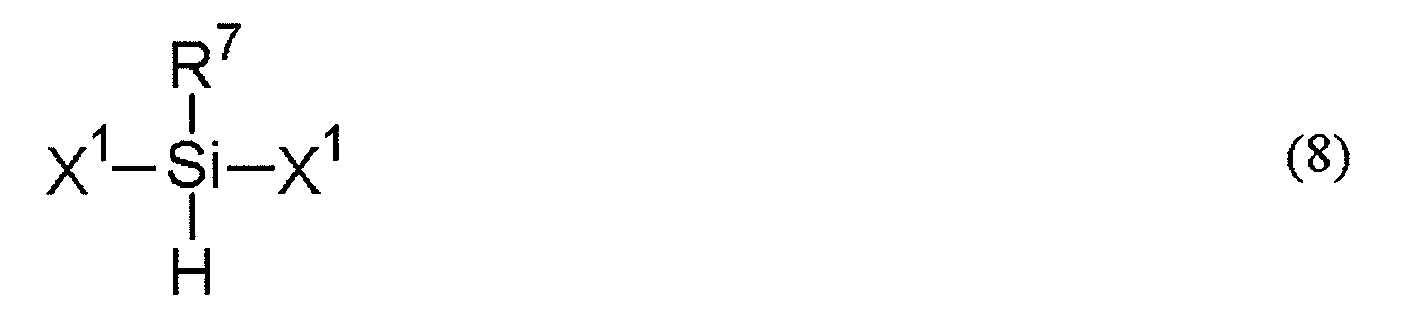
- the compound represented by the above general formula (6) can be easily obtained by Grignard reaction using a dihalogenosilane represented by the following general formula (8) and a dihalogenated compound represented by the following general formula (9).
- X 1 s are the same or different, each a halogen, R 7 is hydrogen atom, an alkyl group having carbon number of 1 to 40 and having no oxetanyl group, or an aryl group having carbon number of 6 to 40 and having no oxetanyl group.
- X 2 -R 3 -X 2 (9) [In the formula, X 2 s are the same or different, each a halogen, R 3 is an alkylene group having carbon number of 1 to 20, an arylene group or an aralkylene group.]
- X 1 is preferably chlorine atom, bromine atom or iodine atom.
- X 2 is preferably chlorine atom, bromine atom or iodine atom.
- the dihalogenated compound represented by the above general formula (9) is preferably a dihalogenated aryl wherein R 3 is an arylene group, and paradibromobenzene is particularly preferable.
- the charging ratio (mole ratio) of the compound (9) to the above compound (8) is preferably 0.5 to 1.5.
- the detailed procedure of the reaction for obtaining the polycarbosilane (10) is that a solvent and an activated agent are added to sufficiently dried magnesium and then a mixed solution of dichloromethylsilane and para dibromobenzene is added dropwise.
- the reaction temperature in this time is suitably selected from a range between ambient temperature and boiling point of the solvent. After adding all, restoring temperature, heating a little or refluxing at a temperature around boiling point is conducted. If the reaction temperature is too high, the resultant polycarbosilane (10) may be high molecular weight.
- Examples of the above solvent include hydrocarbons such as n-pentane, n-hexane, cyclohexane, petroleum ether, toluene, xylene, gasoline and ligroin; ethers such as diethylether, diisopropylether and tetrahydrofuran.
- examples of the above activating agent include 1,2-bromoethane, iodine and the like.
- the obtained polycarbosilane (10) is subjected to hydrosilylation reaction with a vinyloxetane compound represented by the above general formula (7) in the presence of a platinum-based catalyst and a polycarbosilane represented by the following formula (11) can be produced.
- a reactor equipped with a stirrer, a thermometer and a condenser was subjected to an atmosphere of dried nitrogen and 75.1 gram (3.08 mol) of magnesium and 500 milliliter of tetrahydrofuran were charged into this reactor and stirred. After that, 1,2-dibromoethane was added to the reactor to make magnesium activated. Then, a solution obtained by dissolving 323 gram (1.27 mol) of 1,4-dibromobenzene and 125 gram (1.09 mol) of dichloromethylsilane in 500 milliliter of tetrahydrofuran was fed in a dropping funnel and added dropwise to a reaction system.
- a reactor equipped with a stirrer, a thermometer and a condenser was subjected to an atmosphere of dried nitrogen and 45.5 gram (1.87 mol) of magnesium and 550 milliliter of tetrahydrofuran were charged into this reactor and stirred. After that, 1,2-dibromoethane was added to the reactor to make magnesium activated. Then, a solution obtained by dissolving 220.8 gram (937 mmol) of 1,4-dibromobenzene and 92.0 gram (800 mmol) of dichloromethylsilane in 250 milliliter of tetrahydrofuran was fed in a dropping funnel and added dropwise to a reaction system over four hours.
- a reactor equipped with a stirrer, a thermometer and a condenser was subjected to an atmosphere of dried nitrogen and 19.0 gram (257 mmol) of polycarbosilane obtained in Referential example 1, 27.1 gram (173 mmol) of 3-ethyl-3-allyloxymethyloxetane and 400 milliliter of toluene were charged into this reactor and heated using an oil bath.
- Each polycarbosilane was added separately to toluene, tetrahydrofuran (THF), propyleneglycol monomethylether acetate (PGMEA), propyleeglycol dimethylether (PGDM), ethyl lactate (EL), methylisobutylketone (MIBK) and methylamylketone (MAK) so as to prepare concentration of 5% by mass at 25°C, and solubility was observed to show the results in Table 1. When dissolution was observed, “O” was used. And when dissolution was not observed, "X" was used to indicate.
- THF tetrahydrofuran
- PMEA propyleneglycol monomethylether acetate
- PGDM propyleeglycol dimethylether
- EL ethyl lactate
- MIBK methylisobutylketone
- MAK methylamylketone
- the polycarbosilane of the present invention is useful as a modifier for resins, a surface-treatment agent for inorganic compounds and a forming material for heat resistant materials and the like. In particular, it is useful for a heat resistant insulating material.
Landscapes
- Chemical & Material Sciences (AREA)
- Health & Medical Sciences (AREA)
- Chemical Kinetics & Catalysis (AREA)
- Medicinal Chemistry (AREA)
- Polymers & Plastics (AREA)
- Organic Chemistry (AREA)
- Silicon Polymers (AREA)
- Polyethers (AREA)
Abstract
The objective of the present invention is to provide a polycarbosilane having excellent solubility in common organic solvents and a method for production thereof. The polycarbosilane of the present invention is a polymer which is represented by the following general formula (1) and has an oxetanyl group in a side chain. R1 is an alkyl group having no oxetanyl groups, aryl group having no oxetanyl groups, or an organic group having an oxetanyl group, R2 is an organic group having an oxetanyl group, R3 is an alkylene group, an arylene group, or an aralkylene group, and n is an integer of 5 to 200.
Description
- The present invention relates to a novel polycarbosilane and a method for producing the same. More specifically, it relates to a polycarbosilane having an oxetanyl group in a side chain, and a method for producing the same.
- Compounds having an oxetanyl group are known for a polysilane having an oxetanyl group in a side chain (
JP-A 2004-26895 JP-A 2003- 149822
However, a polycarbosilane having an oxetanyl group in a side chain is not known.
InJP-A 2004-26895
The polycarbosilane shows an excellent heat resistance and decomposition resistance, therefore it is used as a precursor for a ceramic material and a heat resistant resin material (refer toJP-A H07-118007 JP-A H10-069819 JP-A H09-013278 - The conventional polycarbosilanes indicate inferior solubility in common organic solvents and sometimes limit to a specific solvent capable of dissolving it. Therefore, there has been a problem where use of the polycarbosilane is restricted.
An objective of the present invention is to provide a polycarbosilane having excellent solubility in common organic solvents and a method for producing the same. - The present inventors had a keen examination for the purpose of achieving the above objective and synthesized newly a polycarbosilane having an oxetanyl group represented by the following general formula to find out that this compound led to an improved solubility in common organic solvents.

- The polycarbosilane of the present invention is a compound represented by the following general formula (1).

In the above formula (1), the organic groups R1 and R2 preferably have an ether bond.
Additionally, the method for producing the polycarbosilane of the present invention is characterized in comprising a process for hydrosilylation reaction of a compound represented by the following general formula (6), and a vinyloxetane compound represented by the following general formula (7).
CH2=CH-R8 (7)
[In the formula, R8 is an organic group having total carbon number of 3 to 38 and having an oxetanyl group.]
In the above formula (7), the organic group R8 preferably has an ether bond. - According to the novel polycarbosilane of the present invention, inclusion of an oxetanyl group that is a polar functional group leads to an improved affinity with a polar solvent. And the compound has good solubility in common solvents such as a ketone-based solvent including acetone, methylisobutylketone and methylamylketone, an ester-based solvent including ethyl acetate and butyl acetate, and a propyleneglycol-based solvent such as propyleneglycol dimethylether.
Therefore, the polycarbosilane of the present invention is useful as a modifier for resins and a surface-treatment agent for inorganic compounds.
The present invention can provide a heat resistant material capable of forming a variable shape easily without impairing characteristic of the polycarbosilane.
The polycarbosilane of the present invention can be safely and efficiently produced by using a comparably and readily available silicon compound as a starting material. - The present invention is explained in detail, hereinafter.
- The polycarbosilane of the present invention is represented by the following general formula (1).

When the above R1 is an alkyl group, the group may be linear type or branched type and preferable carbon number is 1 to 30, and more preferably 1 to 20. Specific examples of this alkyl group include methyl group, ethyl group, n-propyl group, isopropyl group, n-butyl group, isobutyl group, sec-butyl group, tert-butyl group, hexyl group, octyl group, decyl group, dodecyl group, hexadecanyl group and the like. Among these, methyl group is preferred.
Bound position of the oxetanyl group in the above organic group R2 is not particularly limited and may be in the middle or at the terminal of the organic group. In addition, number of the oxetanyl group is not also particularly limited. Further, this organic group R2 is generally a group containing primarily an alkylene group having carbon number of 3 to 37 or an arylene group having carbon number of 6 to 37 and may comprise other functional group and/or other bond. In the present invention, the above organic group R2 preferably comprises an ether bond in addition to -O- bond contained in the oxetanyl group. The position and number thereof are not limited.
The above R1 is also the same as the above R2 in the case where the above R1 is an organic group having total carbon number of 5 to 40 and having an oxetanyl group. In addition, when the above R1 is an organic group having total carbon number of 5 to 40 and having an oxetanyl group, the above R1 and R2 each may be the same or different. - In the above general formula (1), R3 is an alkylene group having carbon number of 1 to 20, an arylene group or an aralkylene group. Carbon numbers of the arylene group and the aralkylene group are usually 6 to 20 and 7 to 20, respectively. The above R3 is preferably an arylene group.
Additionally, in the above general formula (1), both terminals are generally a phenyl group or a hydroxyl group.
Further, n in the above general formula (1) is an integer of 5 to 200, and is preferably 10 to 100. If n exceeds 200, solubility of the polycarbosilane in common solvents may be reduced. On the other hand, if n is less than 5, characteristics as a heat resistant material may not be sufficient. - The preferable polycarbosilane in the present invention is a compound represented by the following general formula (2).

- R4 in the above general formula (2) is an alkylene group having carbon number of 2 to 20, an arylene group or an aralkylene group. When R4 is an alkylene group, preferable carbon number is 2 to 14. This alkylene group may be linear type or have a side chain. Specific examples of this alkylene group include ethylene group, propylene group, butylene group and the like. In addition, when R4 is an arylene group and an aralkylene group, preferable carbon numbers are 6 to 14 and 7 to 14, respectively. The above R4 is preferably an alkylene group and is particularly propylene group.
- R5 in the above general formula (2) is hydrogen atom, an alkyl group having carbon number of 1 to 20, an aryl group having carbon number of 6 to 20, or an aralkyl group. When R5 is an alkyl group, preferable carbon number is 1 to 12, and is more preferably 1 to 6.
This alkyl group may be linear type or branched type. In addition, specific examples of this alkyl group include methyl group, ethyl group, propyl group, butyl group and the like. The above R5 is preferably an alkyl group and is particularly ethyl group.
Further, n in the above general formula (2) is an integer of 5 to 200, and is preferably 10 to 100, as is the same as n in the above general formula (1). - Specific examples of the preferred polycarbosilane of the present invention are as follows.


- The production method for polycarbosilane of the present invention is characterized in comprising a process for hydrosilylation reaction of a compound represented by the following general formula (6), and a vinyloxetane compound represented by the following general formula (7).

CH2=CH-R8 (7)
[In the formula, R8 is an organic group having total carbon number of 3 to 38 and having an oxetanyl group.] - In the above general formula (6), R3 is the same as R3 in the above general formula (1) and description thereof can be applied. The preferable R3 is an arylene group. In addition, R7 is one selected from the group of hydrogen atom, an alkyl group and an aryl group that are having specific carbon number. When R7 is an alkyl group or an aryl group, it is the same as R1 in the above general formula (1) and description thereof can be applied. The preferable R7 is methyl group from a viewpoint of easy availability as a starting material.
- R8 in the above general formula (7) is an organic group having total carbon number of 3 to 38 and having an oxetanyl group. However, the bound position of the oxetanyl group is not particularly limited and may be in the middle or at the terminal of the organic group. In addition, number of the oxetanyl group is not particularly limited. A compound that is easy to get as a starting material is a compound where the bound position of the oxetanyl group is in the middle of the organic group and the terminal is ethyl group.
In the present invention, the above organic group R8 preferably comprises an ether bond in addition to -O- bond contained in the oxetanyl group. The position and number thereof are not limited.
In the case where the above organic R8 has an ether bond, the structure of a vinyloxetane compound represented by the above general formula (7) is as follows.
CH2=CH-(CH2)m-O-R8
[In the formula, R8' is an organic group having an oxetanyl group and m is an integer of 0 to 12.]
Examples of the vinyloxetane compound represented by the above general formula (7) include 3-ethyl-3-allyloxymethyl oxetane, 3-methyl-3-allyloxymethyl oxetane, 3-allyloxymethyl oxetane, 3-ethyl-3-vinyloxymethyl oxetane, 3-methyl-3-vinyloxymethyl oxetane, 3-vinyloxymethyl oxetane and the like. - The hydrosilylation reaction between the compound represented by the above general formula (6), and the above vinyloxetane compound (7) is usually conducted in the presence of a catalyst in an organic solvent such as toluene and tetrahydrofuran.
Regarding the charging ratio of the compound represented by the above general formula (6) and the above vinyloxetane compound (7), the amount of SiH group in the compound represented by the above general formula (6) is preferably 0.1 to 2.0 equivalent and more preferably 1.0 to 2.0 equivalents based on 1 equivalent of carbon-carbon unsaturated group (CH2=CH-) in the above vinyloxetane compound (7). - Examples of the above catalyst include an elemental metal from groups VIII - X containing Co, Ni, Ru, Rh, Pd, Ir, Pt and the like, an organic metal complex thereof, a metal salt thereof, a metal oxide thereof and the like. Among these, a platinum-vinylsiloxane complex such as platinum 1,3-divinyl-1,1,3,3-tetramethyldisiloxane complex; chloroplatinic acid hexahydrate (H2PtCl6·6H2O), cis-PtCl2(PhCN)2, platinum carbon and the like. It is noted Ph means phenyl group.
The amount of the above catalyst to be used is preferably 0.1 to 1,000 ppm based on the amount of the compound represented by the above general formula (6) to be used. - In addition, the above hydrosilylation reaction is usually conducted while heating. Reaction temperature depends generally on heating from outside and supplying rate of starting materials. When the temperature is held in the range from 30°C to 120°C, the hydrosilylation reaction can be smoothly conducted. If this temperature is lower than 30°C, the hydrosilylation reaction does not proceed smoothly. If the temperature exceeds 120°C, controlling of the molecular weight of a polymer may be hard.
After the reaction, rinsing, layer-separating, desolventing and the like may be conducted according to known methods to collect the polycarbosilane of the present invention. - It is noted that the compound represented by the above general formula (6) can be easily obtained by Grignard reaction using a dihalogenosilane represented by the following general formula (8) and a dihalogenated compound represented by the following general formula (9).
X2-R3-X2 (9)
[In the formula, X2s are the same or different, each a halogen, R3 is an alkylene group having carbon number of 1 to 20, an arylene group or an aralkylene group.] - In the dihalogenosilane represented by the above general formula (8), X1 is preferably chlorine atom, bromine atom or iodine atom.
Additionally, in the dihalogenated compound represented by the above general formula (9), X2 is preferably chlorine atom, bromine atom or iodine atom.
The dihalogenated compound represented by the above general formula (9) is preferably a dihalogenated aryl wherein R3 is an arylene group, and paradibromobenzene is particularly preferable. - The charging ratio (mole ratio) of the compound (9) to the above compound (8) is preferably 0.5 to 1.5.
- The production method of the polycarbosilane represented by the following formula (11) in which R6 in the above general formula (3) is methyl group as the present polycarbosilane will be described below.
At first, a mixed solution of dichloromethylsilane and para dibromobenzene is added dropwise to an activated magnesium which is prepared by a known method to conduct Grignard reaction, thereby a polycarbosilane having Si-H group is obtained which is represented by the following formula (10).
- The detailed procedure of the reaction for obtaining the polycarbosilane (10) is that a solvent and an activated agent are added to sufficiently dried magnesium and then a mixed solution of dichloromethylsilane and para dibromobenzene is added dropwise. The reaction temperature in this time is suitably selected from a range between ambient temperature and boiling point of the solvent. After adding all, restoring temperature, heating a little or refluxing at a temperature around boiling point is conducted. If the reaction temperature is too high, the resultant polycarbosilane (10) may be high molecular weight.
Examples of the above solvent include hydrocarbons such as n-pentane, n-hexane, cyclohexane, petroleum ether, toluene, xylene, gasoline and ligroin; ethers such as diethylether, diisopropylether and tetrahydrofuran.
In addition, examples of the above activating agent include 1,2-bromoethane, iodine and the like.
When the reaction is terminated, the solvent and the magnesium salt are removed and reprecipitation is conducted to isolate polycarbosilane. - After that, the obtained polycarbosilane (10) is subjected to hydrosilylation reaction with a vinyloxetane compound represented by the above general formula (7) in the presence of a platinum-based catalyst and a polycarbosilane represented by the following formula (11) can be produced.

- Hereinafter, the present invention is explained concretely with some Referential examples and Examples.
- A reactor equipped with a stirrer, a thermometer and a condenser was subjected to an atmosphere of dried nitrogen and 75.1 gram (3.08 mol) of magnesium and 500 milliliter of tetrahydrofuran were charged into this reactor and stirred. After that, 1,2-dibromoethane was added to the reactor to make magnesium activated.
Then, a solution obtained by dissolving 323 gram (1.27 mol) of 1,4-dibromobenzene and 125 gram (1.09 mol) of dichloromethylsilane in 500 milliliter of tetrahydrofuran was fed in a dropping funnel and added dropwise to a reaction system.
When dropping was terminated, an oil bath was set to conduct a reflux while heating (67°C) for three hours.
Subsequently, a reacted solution was transferred to separatory funnel. An organic extract was rinsed with water and anhydrous sodium sulfate was added to dehydrate. A solvent was removed under vacuum and then a residue was dissolved in a good solvent and a poor solvent was dropped to obtain a polycarbosilane having Si-H group represented by the following formula (12). The yield was 66.8%, average n in the formula (12) was 20, weight-average molecular weight Mw was 2,700 by gel permeation chromatography (GPC), and Mw/Mn was 3.58.
1H NMR (270MHz, solvent;CDCl3)
δ7.57 (s, 4H) [a,b],
δ4.95 (q, J=3.8Hz, 1H) [d],
δ0.64 (d, J=3.8Hz, 3H) [c] - A reactor equipped with a stirrer, a thermometer and a condenser was subjected to an atmosphere of dried nitrogen and 45.5 gram (1.87 mol) of magnesium and 550 milliliter of tetrahydrofuran were charged into this reactor and stirred. After that, 1,2-dibromoethane was added to the reactor to make magnesium activated. Then, a solution obtained by dissolving 220.8 gram (937 mmol) of 1,4-dibromobenzene and 92.0 gram (800 mmol) of dichloromethylsilane in 250 milliliter of tetrahydrofuran was fed in a dropping funnel and added dropwise to a reaction system over four hours.
When dropping was terminated, an oil bath was set to conduct a reflux while heating (67°C) for three hours.
Subsequently, a reacted solution was transferred to separatory funnel and an operation was conducted in the same manner as Referential example 1 to obtain 92.7 gram of a polycarbosilane having Si-H group represented by the above formula (12). The yield was 95%, average n in the formula (12) was 48, weight-average molecular weight Mw was 6,500, and Mw/Mn was 2.58. - A reactor equipped with a stirrer, a thermometer and a condenser was subjected to an atmosphere of dried nitrogen and 19.0 gram (257 mmol) of polycarbosilane obtained in Referential example 1, 27.1 gram (173 mmol) of 3-ethyl-3-allyloxymethyloxetane and 400 milliliter of toluene were charged into this reactor and heated using an oil bath. When internal temperature was reached 80°C, 250 micro liter of 2.1% xylene solution of platinum 1,3-divinyl-1,1,3,3-tetramethyldisiloxane complex catalyst Pt[(C=C-Si(Me)2)2O] was added. And then reaction was conducted at 80°C for three hours.
Subsequently, a reacted solution was transferred to separatory funnel. An organic extract was rinsed with water and anhydrous sodium sulfate was added to dehydrate. A solvent was removed under vacuum and then a residue was dissolved in a good solvent and a poor solvent was dropped to reprecipitate. Then, the solvent was removed under vacuum to obtain a polycarbosilane having an oxetanyl group represented by the following formula (13). The yield was 37.8%, weight-average molecular weight Mw was 6,100, and Mw/Mn was 1.28.
1H NMR (270MHz, solvent;CDCl3)
δ7.49 - 7.57 (m, 4H) [a,b],
δ4.35 - 4.45 (m, 4H) [j,k],
δ3.41 - 3.49 (m, 4H) [g,f]
δ1.61 - 1.77 (m, 4H) [e,h],
δ1.04 - 1.10 (br, 2H) [d],
δ0.80 - 0.90 (m, 3H) [i]
δ0.55 - 0.60 (d, 3H) [c] - Solubility in common solvents described below was examined and compared for the polycarbosilane having Si-H group represented by the above formula (12) according to Referential example 1 and the polycarbosilane having an oxetanyl group represented by the above formula (13) according to Example 1.
Each polycarbosilane was added separately to toluene, tetrahydrofuran (THF), propyleneglycol monomethylether acetate (PGMEA), propyleeglycol dimethylether (PGDM), ethyl lactate (EL), methylisobutylketone (MIBK) and methylamylketone (MAK) so as to prepare concentration of 5% by mass at 25°C, and solubility was observed to show the results in Table 1. When dissolution was observed, "O" was used. And when dissolution was not observed, "X" was used to indicate. -
Table 1 Toluene THF PGMEA PGDM EL MIBK MAK Polycarbosilane by formula (12) × ○ × × × × × Polycarbosilane by formula (13) ○ ○ ○ ○ ○ ○ ○ - The polycarbosilane of the present invention is useful as a modifier for resins, a surface-treatment agent for inorganic compounds and a forming material for heat resistant materials and the like. In particular, it is useful for a heat resistant insulating material.
Claims (6)
- A polycarbosilane characterized in that it is represented by the following general formula (1).

- The polycarbosilane according to Claim 1,
wherein said organic group has an ether bond. - The polycarbosilane according to Claim 2, represented by the following general formula (2).

- The polycarbosilane according to Claim 3, selected from the group consisting of compounds represented by the following general formulas (3), (4) and (5).


- A method for producing the polycarbosilane described in Claim 1, characterized in comprising a process for hydrosilylation reaction of a compound represented by the following general formula (6), and a vinyloxetane compound represented by the following general formula (7).

CH2=CH-R8 (7)
[In the formula, R8 is an organic group having total carbon number of 3 to 38 and having an oxetanyl group.] - The method for producing the polycarbosilane according to Claim 5,
wherein said organic group has an ether bond.
Applications Claiming Priority (2)
| Application Number | Priority Date | Filing Date | Title |
|---|---|---|---|
| JP2005111695 | 2005-04-08 | ||
| PCT/JP2006/307134 WO2006109628A1 (en) | 2005-04-08 | 2006-04-04 | Polycarbosilane and method for producing same |
Publications (1)
| Publication Number | Publication Date |
|---|---|
| EP1867674A1 true EP1867674A1 (en) | 2007-12-19 |
Family
ID=37086907
Family Applications (1)
| Application Number | Title | Priority Date | Filing Date |
|---|---|---|---|
| EP06731082A Withdrawn EP1867674A1 (en) | 2005-04-08 | 2006-04-04 | Polycarbosilane and method for producing same |
Country Status (5)
| Country | Link |
|---|---|
| US (1) | US7838626B2 (en) |
| EP (1) | EP1867674A1 (en) |
| JP (1) | JP5311091B2 (en) |
| TW (1) | TWI393733B (en) |
| WO (1) | WO2006109628A1 (en) |
Families Citing this family (1)
| Publication number | Priority date | Publication date | Assignee | Title |
|---|---|---|---|---|
| CN109354691B (en) * | 2018-11-14 | 2021-03-09 | 中国科学院宁波材料技术与工程研究所 | Preparation method of polycarbosilane with high ceramic yield |
Family Cites Families (19)
| Publication number | Priority date | Publication date | Assignee | Title |
|---|---|---|---|---|
| US3338867A (en) * | 1963-07-24 | 1967-08-29 | Dow Corning | Silanes and siloxanes containing oxetane groups |
| GB2039787B (en) * | 1978-11-13 | 1982-12-08 | Res Inst For Special Inorganic | Producing corrosion resistant articles |
| US4347347A (en) * | 1979-06-28 | 1982-08-31 | Ube Industries, Ltd. | Crosslinked organometallic block copolymers and process for production thereof |
| US4650837A (en) * | 1985-09-30 | 1987-03-17 | Massachusetts Institute Of Technology | Method for converting Si-H containing polycarbosilanes to new and useful preceramic polymers and ceramic materials |
| US4737552A (en) * | 1986-06-30 | 1988-04-12 | Dow Corning Corporation | Ceramic materials from polycarbosilanes |
| JPH04342726A (en) * | 1991-05-20 | 1992-11-30 | Showa Denko Kk | Silicon-containing polymer and production thereof |
| US5463084A (en) * | 1992-02-18 | 1995-10-31 | Rensselaer Polytechnic Institute | Photocurable silicone oxetanes |
| JP3418458B2 (en) | 1993-08-31 | 2003-06-23 | 富士通株式会社 | Method for manufacturing semiconductor device |
| JPH0913278A (en) | 1995-06-23 | 1997-01-14 | Showa Electric Wire & Cable Co Ltd | Heat-resistant fiber and heat-resistant insulated wire using the same |
| JP3350363B2 (en) | 1996-08-29 | 2002-11-25 | 昭和電線電纜株式会社 | Insulation coating paint, inorganic insulated wires and electric coils |
| US6121342A (en) * | 1998-01-13 | 2000-09-19 | Toagosei Co., Ltd. | Photocationically curable compositions and process for producing the same |
| US6630560B2 (en) * | 2000-06-30 | 2003-10-07 | The United States Of America As Represented By The Secretary Of The Navy | Linear and branched chemoselective siloxane polymers and methods for use in analytical and purification applications |
| JP4281305B2 (en) | 2001-07-31 | 2009-06-17 | 住友化学株式会社 | Resin composition for three-layer resist intermediate layer |
| JP4061133B2 (en) | 2002-06-21 | 2008-03-12 | 大阪瓦斯株式会社 | Polysilane compound |
| JPWO2004076534A1 (en) * | 2003-02-27 | 2006-06-01 | 東亞合成株式会社 | Method for producing cationically curable silicon-containing compound |
| EP1746123A4 (en) * | 2004-05-11 | 2012-03-21 | Jsr Corp | PROCESS FOR FORMING ORGANIC SILICA FILM, ORGANIC SILICA FILM, WIRING STRUCTURE, SEMICONDUCTOR DEVICE, AND COMPOSITION FOR FILM FORMATION |
| WO2006009123A1 (en) * | 2004-07-16 | 2006-01-26 | Toagosei Co., Ltd. | Polycarbosilane and method for producing same |
| US7576142B2 (en) * | 2004-08-04 | 2009-08-18 | Toagosei Co., Ltd. | Polyorganosiloxane and curable composition containing same |
| US7358317B2 (en) * | 2004-09-22 | 2008-04-15 | Jsr Corporation | Polycarbosilane and method of producing the same |
-
2006
- 2006-04-04 EP EP06731082A patent/EP1867674A1/en not_active Withdrawn
- 2006-04-04 US US11/817,179 patent/US7838626B2/en not_active Expired - Fee Related
- 2006-04-04 WO PCT/JP2006/307134 patent/WO2006109628A1/en not_active Ceased
- 2006-04-04 JP JP2007512922A patent/JP5311091B2/en not_active Expired - Fee Related
- 2006-04-07 TW TW095112481A patent/TWI393733B/en active
Non-Patent Citations (1)
| Title |
|---|
| See references of WO2006109628A1 * |
Also Published As
| Publication number | Publication date |
|---|---|
| US7838626B2 (en) | 2010-11-23 |
| WO2006109628A1 (en) | 2006-10-19 |
| JP5311091B2 (en) | 2013-10-09 |
| TW200700464A (en) | 2007-01-01 |
| JPWO2006109628A1 (en) | 2008-11-06 |
| TWI393733B (en) | 2013-04-21 |
| US20090163690A1 (en) | 2009-06-25 |
Similar Documents
| Publication | Publication Date | Title |
|---|---|---|
| US6252030B1 (en) | Hydrogenated octasilsesquioxane-vinyl group-containing copolymer and method for manufacture | |
| Moran et al. | Ferrocenyl substituted octakis (dimethylsiloxy) octasilsesquioxanes: a new class of supramolecular organometallic compounds. Synthesis, characterization, and electrochemistry | |
| EP3135679B1 (en) | Use of bis (alkoxysilyl-vinylene) group-containing silicon compounds as a curing agent for room temperature curable organopolysiloxane compositions | |
| JPH11116685A (en) | Curable composition | |
| JP2000265066A (en) | Organic solvent-soluble hydrogenated octasilsesquioxane-vinyl group-containing compound copolymer and insulating material comprising the copolymer | |
| JP2010522804A5 (en) | ||
| JP2009167325A (en) | Silanol group-containing curable cage-type silsesquioxane compound, copolymer using the same, and production method thereof | |
| JP3661810B2 (en) | Method for producing hydroxyl group-containing siloxane compound | |
| US7838626B2 (en) | Polycarbosilane and method for producing same | |
| EP1409570B1 (en) | Methods for making silicone-organic copolymers | |
| US7652118B2 (en) | Polycarbosilane and method for producing same | |
| JP4265117B2 (en) | Method for producing novel silsesquioxane having protected catechol group | |
| WO2018088485A1 (en) | Co-modified silicone | |
| JP6003856B2 (en) | Terminally modified silacyclobutane ring-opening polymer and process for producing the same | |
| JP2008266301A (en) | NOVEL SILICONE COMPOUND AND RAW MATERIAL AND METHOD FOR PRODUCING NOVEL SILICONE COMPOUND | |
| JPH111560A (en) | Organocyclosiloxane and method for producing the same | |
| EP3581607B1 (en) | Novel mesogen-silicon compound (co)polymer and thermoplastic elastomer | |
| JP4276805B2 (en) | Novel silazane compound and method for producing the same, and novel silazane compound polymer and method for producing the same | |
| JP2000264970A (en) | Reactive siloxane compound substituted by polyalkyleneoxy and method for producing the same | |
| JP4674387B2 (en) | Mercaptomethylphenyl group-containing diorganopolysiloxane and process for producing the same | |
| JP2001199989A (en) | Method for producing platinum-vinylsiloxane complex | |
| Li et al. | SYNTHESIS AND CHARACTERIZATION OF A NOVEL REACTIVE LADDER-LIKE POLYSILSESQUIOXANE WITH LATERAL BROMOPHENYL GROUPS. | |
| JP2500539B2 (en) | Method for producing polysilane | |
| JP6801152B2 (en) | Bifunctional poly (alkylene oxide) with aminoalkyl and unsaturated ends and its derivatives | |
| WO2024029352A1 (en) | Fluorene compound having halogen atom and allyl group, and method for producing same |
Legal Events
| Date | Code | Title | Description |
|---|---|---|---|
| PUAI | Public reference made under article 153(3) epc to a published international application that has entered the european phase |
Free format text: ORIGINAL CODE: 0009012 |
|
| 17P | Request for examination filed |
Effective date: 20070816 |
|
| AK | Designated contracting states |
Kind code of ref document: A1 Designated state(s): AT BE BG CH CY CZ DE DK EE ES FI FR GB GR HU IE IS IT LI LT LU LV MC NL PL PT RO SE SI SK TR |
|
| DAX | Request for extension of the european patent (deleted) | ||
| STAA | Information on the status of an ep patent application or granted ep patent |
Free format text: STATUS: THE APPLICATION IS DEEMED TO BE WITHDRAWN |
|
| 18D | Application deemed to be withdrawn |
Effective date: 20101103 |