EP1409570B1 - Methods for making silicone-organic copolymers - Google Patents
Methods for making silicone-organic copolymers Download PDFInfo
- Publication number
- EP1409570B1 EP1409570B1 EP02756309A EP02756309A EP1409570B1 EP 1409570 B1 EP1409570 B1 EP 1409570B1 EP 02756309 A EP02756309 A EP 02756309A EP 02756309 A EP02756309 A EP 02756309A EP 1409570 B1 EP1409570 B1 EP 1409570B1
- Authority
- EP
- European Patent Office
- Prior art keywords
- diamide
- siloxane
- group
- added
- total
- Prior art date
- Legal status (The legal status is an assumption and is not a legal conclusion. Google has not performed a legal analysis and makes no representation as to the accuracy of the status listed.)
- Expired - Lifetime
Links
Classifications
-
- C—CHEMISTRY; METALLURGY
- C08—ORGANIC MACROMOLECULAR COMPOUNDS; THEIR PREPARATION OR CHEMICAL WORKING-UP; COMPOSITIONS BASED THEREON
- C08G—MACROMOLECULAR COMPOUNDS OBTAINED OTHERWISE THAN BY REACTIONS ONLY INVOLVING UNSATURATED CARBON-TO-CARBON BONDS
- C08G69/00—Macromolecular compounds obtained by reactions forming a carboxylic amide link in the main chain of the macromolecule
- C08G69/42—Polyamides containing atoms other than carbon, hydrogen, oxygen, and nitrogen
-
- C—CHEMISTRY; METALLURGY
- C08—ORGANIC MACROMOLECULAR COMPOUNDS; THEIR PREPARATION OR CHEMICAL WORKING-UP; COMPOSITIONS BASED THEREON
- C08G—MACROMOLECULAR COMPOUNDS OBTAINED OTHERWISE THAN BY REACTIONS ONLY INVOLVING UNSATURATED CARBON-TO-CARBON BONDS
- C08G77/00—Macromolecular compounds obtained by reactions forming a linkage containing silicon with or without sulfur, nitrogen, oxygen or carbon in the main chain of the macromolecule
- C08G77/42—Block-or graft-polymers containing polysiloxane sequences
-
- C—CHEMISTRY; METALLURGY
- C08—ORGANIC MACROMOLECULAR COMPOUNDS; THEIR PREPARATION OR CHEMICAL WORKING-UP; COMPOSITIONS BASED THEREON
- C08G—MACROMOLECULAR COMPOUNDS OBTAINED OTHERWISE THAN BY REACTIONS ONLY INVOLVING UNSATURATED CARBON-TO-CARBON BONDS
- C08G77/00—Macromolecular compounds obtained by reactions forming a linkage containing silicon with or without sulfur, nitrogen, oxygen or carbon in the main chain of the macromolecule
- C08G77/42—Block-or graft-polymers containing polysiloxane sequences
- C08G77/452—Block-or graft-polymers containing polysiloxane sequences containing nitrogen-containing sequences
- C08G77/455—Block-or graft-polymers containing polysiloxane sequences containing nitrogen-containing sequences containing polyamide, polyesteramide or polyimide sequences
-
- C—CHEMISTRY; METALLURGY
- C08—ORGANIC MACROMOLECULAR COMPOUNDS; THEIR PREPARATION OR CHEMICAL WORKING-UP; COMPOSITIONS BASED THEREON
- C08G—MACROMOLECULAR COMPOUNDS OBTAINED OTHERWISE THAN BY REACTIONS ONLY INVOLVING UNSATURATED CARBON-TO-CARBON BONDS
- C08G77/00—Macromolecular compounds obtained by reactions forming a linkage containing silicon with or without sulfur, nitrogen, oxygen or carbon in the main chain of the macromolecule
- C08G77/42—Block-or graft-polymers containing polysiloxane sequences
- C08G77/452—Block-or graft-polymers containing polysiloxane sequences containing nitrogen-containing sequences
- C08G77/458—Block-or graft-polymers containing polysiloxane sequences containing nitrogen-containing sequences containing polyurethane sequences
Definitions
- This invention relates to improved methods for making siloxane based polyamides More particularly, the invention relates to methods for making siloxane based polyamides with molecular weight control and without the need for protecting groups on organofunctional silicone intermediates.
- Silicone-organic copolymers are widely used, notably in the preparation of personal care products. Methods currently known in the art for making these copolymers are often cumbersome, time consuming and expensive, if they work at all, as a great deal of care must be taken to insure that the properties of these materials meet the rigid specifications usually required, including high clarity and optimal strength. Industry is constantly seeking new materials in this class and improved ways of preparing them.
- U.S. Patent No. 5,981,680 to Petroff et al. is directed at an improved process to make the polyamides of Barr. Instead of reacting a protected organic acid with a siloxane before forming the amide linkage as in Barr, Petroff calls for forming the amide linkage before any reaction with siloxane, thus eliminating the necessity of using protecting groups.
- EP-A-295 561 discloses silicone-polyimides having improved flexibility that can be obtained by sequentially intercondensing organic diamine, aminoorgano terminated polydiorganosiloxane and aromatic bisanhydride. From EP-A-413170 polysulfonecarbonate-siloxane block copolymers are known that provide ductile resins having high heat distortion temperatures and high glass transition temperatures.
- They invention relates to a method for making siloxane-based polyamides comprising: copolymerizing, in the presence of a catalyst, an SiH containing siloxane and a vinyl containing diamide in a combination in which the molar ratio of total chain terminators selected from carboxylic acids and monoamide added to that of total pure diamide added is 1:99 to 3:97 and the molar ratio of total siloxane SiH added to total diamide vinyl added is 0.9:1 to 1.1:1.
- processing should be understood as comprising, unless specifically indicated otherwise, the manipulation, including the addition and/or removal of impurities or other components that would act as chain terminators in polymerization.
- Chain terminators are typically omega-olefinic carboxylic acids and/or monoamide-monoamines. Omega-olefinic carboxylic acids may in fact facilitate some chain extension via their ability to react via hydrosilylation of their unsaturated functionality and via the silylation of the carboxylic acid portion of the molecule with a SiH group. This would result in a disruption in the intended growing polymer chain by the introduction of a Si-O-C linkage, which is readily hydrolyzable.
- the Si-O-C linkage is being defined as a transient chain extension and is why the omega-olefinic carboxylic acids are included in the above definition of chain terminator.
- molecular weight control could refer to indirect control, direct control or both.
- Indirect control could result by any manipulation of chain terminators (and/or reactant ratio) while direct control involves a more deliberate and precise approach such as one involving a process model. Of course, there can be some overlap.
- Organic component(s) can be synthesized directly by methods known in the art or can be obtained from commercial sources as available. The same is true for the silicone component(s).
- a catalyst be used for the polymerization. Specific examples are discussed at other points in this disclosure.
- solventless means the absence of solvent other than any residual solvent such as that added as part of a catalyst or reactant formulation.
- reaction systems containing less than 1.0 weight percent solvent, regardless of source, will be taken as solventless; for this purpose, catalyst itself and reactants themselves (as opposed to any carriers) are not solvents.
- polymerization can be carried out batchwise or continuously.
- X, Y, DP, and R 1 - R 4 may be the same or different for each unit of the polyamide (which may include variations in values between any of the n subunits of Formula A). Such variation may or may not also exist for the X's within each of the n subunits of Formula A.
- Individual Y's may be aliphatic, aromatic or both.
- siloxane group refers to a group having siloxane units such as: where, R 30 and R 31 are each independently selected from the group consisting of organic moieties, and each of R 30 and R 31 are connected to the silicon by a carbon-silicon bond.
- R 30 and R 31 are each independently selected from the group consisting of organic moieties, and each of R 30 and R 31 are connected to the silicon by a carbon-silicon bond.
- the carbon numbers stated for the X and Y do not include the carbons in the optional segments or substitutions.
- the polyamides must have a siloxane portion in the backbone and optionally may have a siloxane portion in a pendant or branched portion.
- Formula A is representative of a linear homopolymer.
- Acceptable variations of the invention include: (1) polyamides in which multiple values of DP, X, Y, and R 1 - R 4 occur in one polymeric molecule (which may include variations between the n subunits of Formula A and even within for X's), wherein the sequencing of these units may be alternating, random or block; (2) polyamides in which an organic triamine or higher amine such as tris(2-aminoethyl)amine replaces the organic diamine in part, to produce a branched or cross linked molecule; and (3) physical blends of any of (1) and (2) and/or linear homopolymers.
- Suitable examples of amides for incorporation into polyamides (of Formula A, I or others) by the methods of the present invention include those that can be formed from omega-olefinic carboxylic acids and linear alkyl diamines.
- olefinic acids useful for such purpose include acrylic acid, 3-butenoic acid, 4-pentenoic acid and 10-undecylenic acid.
- Useful diamines include ethylene diamine, hexamethylene diamine, decamethylene diamine, and although not an alkyl diamine, phenylene diamine.
- Examples of siloxanes for incorporation into polyamides by the methods of the present invention include dimethylhydrogen end blocked polydimethyl siloxanes.
- a siloxane based polyamide is prepared, the method comprising:
- Chain terminators are residual carboxylic acid (from step (2) above and/or a purchased equivalent) and monoamide.
- Monoamide is defined for this purpose as a material in which only one of the amine groups present in the diamine species has reacted with an omega olefinic acid and resulting in a monovinyl functional monoamine/monoamide). These chain terminators are typically found as impurities in the reaction product of step (2) above or equivalents.
- total chain terminator level is probably more significant than that of any individual terminator.
- total chain terminators in the siloxane-polyamide system most often residual omega-olefinic carboxylic acid and monoamide
- ranges are alternatively expressed in terms of molar ratios of the total chain terminators to total pure diamide in the diamide material used in the polymerization: 1:99 to 3:97, 1.5:98.5 to 2.5:97.5 and 1.8:98.2 to 2.2:97.8.
- the ranges and ratios of the preceding paragraph, relating chain terminators to diamide (as well as the ratios to follow relating SiH to vinyl) should be understood as based on totals of materials added to the system up to the end of copolymerization (loosely referred to perhaps as "during" the copolymerization).
- the situation should be understood as based on total added to the reaction zone during the retention time in this zone. In either case, it is preferable that materials be added in a consistent proportion (especially stoichiometric) and in continuous systems that reactants (and anything else to be added) be added at the front end of the reaction zone and/or the reaction be run at or near a steady state.
- carboxylic acid content for the copolymerization mixture in silicone polyamide synthesis by methods such as the present embodiment is expressed in terms of the "acid number" (gram equivalents of KOH per kilogram of diamide) is 0.03-2.2, with a preferred range being 0.50-1.00 and a more preferred range being 0.60-0.80.
- the levels of monoamide may be determined by Electron Spray Ionization Mass Spectrometry as were those reported herein with an acceptable range being 0.9 to 1.1 mole percent based on the diamide.
- diamide In the formation of the diamide, it is usually preferred to use at least a slight excess of acid as diamines tend to have quite unpleasant smells and are catalysts poisons as previously stated and can carry over into the product polymer.
- siloxane based polyamide synthesis such as illustrated in the present embodiment, it is preferred that a linear siloxane with an SiH group on each end be used as a reactant, although alternatives are often acceptable. Presence of siloxane SiH at least somewhere in the reactants is contemplated (as this polymerization is basically a hydrosilylation). It is of note that a siloxane with an SiH group on only one end (at least before addition of any diamide) is itself partially chain terminated, and it could act as a chain terminator by binding to a vinyl end of a growing polyamide chain. Allowance would have to be made for any non-preferred variations in process modeling.
- the diamide be linear with a terminal vinyl group (carbon-carbon double bond) on each end, although alternatives are sometimes acceptable. Presence of diamide vinyl somewhere in the reactants is contemplated (as this polymerization is basically a hydrosilylation). It is of note that a diamide with a single, vinyl group (at least when terminal) will act as a chain terminator. Polymerizations with catalysts described herein where non-terminal vinyl diamide is used and polymerization without catalyst regardless of vinyl location have been ordinarily noted to proceed extremely slowly if at all. As with the siloxane, allowance would have to be made for any non-preferred variations in process modeling.
- siloxane polyamides of a weight average molecular weight range of 80,000-150,000 atomic mass units are usually preferable, in that those below this range are too brittle, while those above are too viscous for common processing methods to be effective.
- Manipulation of levels of chain terminators and ratio of copolymerization reactants makes rather precise control of molecular weight of the final copolymer possible.
- a catalyst is used in silicone diamide copolymerization.
- any of the catalysts known in the art to be suitable for such reaction can be employed, such as those based on a Group VIII transition metal, a noble metal.
- the platinum based catalysts falling in this class are preferred. Most preferred are platinum-silicone based catalysts of this same class.
- Such noble metal catalysts are described in U.S. Patent No. 3,923,705 , to show such catalysts.
- One preferred platinum catalyst is Karstedt's catalyst that is described in U.S. Patent Nos. 3,715,334 and 3,814,730
- Karstedt's catalyst is a platinum divinyl tetramethyl disiloxane complex typically containing one weight percent platinum in a solvent such as toluene.
- Another preferred platinum catalyst is a reaction product of chloroplatinic acid and an organosilicon compound containing terminal aliphatic unsaturation as described in U.S. Patent No. 3,419,593 ,.
- Most preferred as the catalyst is a neutralized complex of platinous chloride and divinyl tetramethyl disiloxane, for example, as described in U.S. Patent No. 5,175,325 .
- Temperature of the copolymerization is not critical, but it is preferred that it be high enough so that the reactants are melted, will dissolve or are miscible (at least in most siloxane polyamide systems) but not so high that appreciable isomerization of the omega double bond in the acid incorporated into the diamide occurs.
- Solvent may be used but is not absolutely required. At least in siloxane polyamide systems, toluene and xylene have been found to be suitable and virtually interchangeable solvents but must be removed (such as by stripping) when the polymers are to be used in many applications because of odor, health and/or environmental regulations or concerns. Decamethylcyclopentasiloxane and phenyl tris (trimethylsiloxy) silane are possible alternatives in such case, but also generally.
- polypropylene glycol ethers of linear alcohols such as those of myristyl alcohol
- these ethers do appear to inhibit reaction when used in high concentration, they typically do not act as chain terminators as defined herein. Examples of these ethers include PPG-3 myristyl ether and PPG-4 myristyl ether.
- Hydrocarbons and low viscosity silicones are suitable generally.
- Solventless processes are possible. When solvents are omitted, siloxane based polyamides of high molecular weight with nearly clear appearance and low color can be made when there is sufficient mixing during polymerization. Solventless should be understood as including situations wherein residual solvent may be introduced, for example, as part of a catalyst preparation; this may also be referred to as a situation where no additional solvent is present. Definition of solventless systems has been given previously for the general case of silicone organic copolymerization and applies here in the case of siloxane based polyamide synthesis.
- diamide refers to a material made of actual diamide and any impurities carried along with it, which may include chain terminators.
- Poly diamide refers only to the portion of this material that is actually structurally a diamide, but excludes any structural diamide that is also a chain terminator, such as an endcapped diamide (monovinyl) as described previously, or a diamide that is not a chain terminator nor a chain extender such as a diamide without any vinyl group.
- added should be understood to mean placed in the polymerization reaction mixture at any point during which polymerization is taking place (expressed more precisely perhaps as up to the end of polymerization) for batch systems, and correspondingly, that placed in the reaction zone during the retention time of this zone in continuous systems.
- MW molecular weight
- copolymer should not be taken in its most restrictive sense unless so stated; that is, the term should not be taken as limited to a polymer made from only two but rather from at least two distinct monomers (intermediates).
- viscosity measurements given herein are melt viscosities made using a Brookfield Digital Viscometer Model HATDV-II, Brookfield Thermosel, and #27 Spindle at 140 deg C.
- viscosities refer to the silicone based polyamides, unless otherwise indicated.
- chain terminators were taken as free carboxylic acids, monoamides, and where applicable, "endcapped” diamides (monovinyl). Although other chain terminators could be present in such polymerization systems generally, in the examples and comparative examples, materials were controlled such that the presence of other chain terminators would be negligible at most (and those considered limited to coming from the diamide). Free carboxylic acids were determined via titration with KOH. Monoamide content was determined by Electron Spray Ionization Mass Spectroscopy, unless otherwise indicated. End capped diamides were determined indirectly by controlled doping of diamides (using a known excess of unsaturated acid in diamide versus saturated acid), but could be determined by methods known generally in the art relating to such materials.
- siloxane-based polyamides comprising the following structure: where:
- siloxane group refers to a group having siloxane units such as: where, R 30 and R 31 are each independently selected from the group consisting of organic moieties, and each of R 30 and R 31 are connected to the silicon by a carbon-silicon bond. Further, at least in the context of Formula I, the carbon numbers in X and Y do not include the carbons in any optional segments or substitutions. Also, the polyamides must have a siloxane portion in the backbone and optionally may have a siloxane portion in a pendant or branched portion.
- Formula I is representative of a linear homopolymer.
- Acceptable variations of the invention include: (1) polyamides in which multiple values of DP, X, Y, and R 1 - R 4 occur in one polymeric molecule (which may include variation between the n subunits of Formula I and even within for X's), wherein the sequencing of these units may be alternating, random or block; (2) polyamides in which an organic triamine or higher amine such as tris(2-aminoethyl)amine replaces the organic diamine in part, to produce a branched or cross linked molecule; and (3) physical blends of any of (1) and (2) and/or linear homopolymers.
- Suitable examples of diamides for incorporation into polyamides of the present invention include those that can be formed from omega-olefinic carboxylic acids (such as those made up of a 2, 3, 4 or 10 carbon chain, which may be linear, in addition to the carboxyl group) and alkyl diamines (such as those made up of a carbon chain containing 2, 6 or 10 carbons, where such chain may be linear, saturated or both, in addition to two amino groups at various positions).
- omega-olefinic carboxylic acids such as those made up of a 2, 3, 4 or 10 carbon chain, which may be linear, in addition to the carboxyl group
- alkyl diamines such as those made up of a carbon chain containing 2, 6 or 10 carbons, where such chain may be linear, saturated or both, in addition to two amino groups at various positions.
- olefinic acids useful for such diamide formation include acrylic acid, 3-butenoic acid, 4-pentenoic acid and 10-undecylenic acid.
- Useful diamines include ethylene diamine, hexamethylene diamine, and decamethylene diamine; phenylene diamine, although not an alkyl diamine, is also useful.
- Suitable examples of siloxanes for incorporation into the polyamides of the present invention include dimethylhydrogen end blocked polydimethyl siloxanes, especially those with a number average DP of 10-30, notably 12-18 and most notably 15. DP's for end blocked siloxanes should be taken as ignoring end blocking groups, unless otherwise noted.
- the methods of the present invention can be used to prepare silicone organic polymers useful in many applications, notably in personal care products, such as deodorants and antiperspirants. It has been found that among the compositions prepared by the methods of the present invention, those derived from the copolymerization of the diamide formed by reacting 10-undecylenic acid and hexamethylene diamine with a dimethyl end blocked polydimethylsiloxane of DP 10-30, especially 12-18 (and notably 15), such that the resulting polymer has 55-125 (and especially 60-80) diamide siloxane units per molecule on average (n is 55-125, especially 60-80, in Formula I) and a weight average molecular weight of 80,000-150,000 atomic mass units, especially 100,000-130,000 atomic mass units, make gellants with excellent properties for use in stick deodorants and antiperspirants. These polyamides would be based on the structure:
- ranges herein should be taken not only to disclose the range itself but also anything subsumed therein, as well as endpoints.
- disclosure of a range of 1-10 should be understood to disclose not only the range of 1-10, but also 1, 2.7, 9 and 10 individually, as well as any other number subsumed in the range.
- disclosure of a range of C1 to C5 hydrocarbons should be understood to disclose not only C1 to C5 hydrocarbons as a class, but also C1, C2, C3, C4 and C5 hydrocarbons individually.
- HMDA hexamethylene diamine in water
- UDA 10-undecylenic acid
- the mixture in the flask was purged with nitrogen for 5 minutes to sweep out any oxygen in the headspace.
- the reactants were initially immiscible and water clear, but the mixture quickly turned a light yellow color as soon as the mixer was turned on which initiated the reaction.
- the acid and base reacted to form an acid-base salt, and a temperature rise as high as 60°C was observed due to the exothermic nature of the reaction.
- the resulting mixture was then heated to 120°C and maintained at this temperature for 1 hour to slowly remove the water that was originally introduced in the reaction mixture as part of the HMDA solution.
- the slow removal of the water during this step was essential to maintaining the stoichiometric ratio of the raw materials, since they have different vapor liquid equilibrium.
- the material was heated to 160°C, and the diamide (N,N'-Hexamethylenebis (10-undecenamide)) was produced with water as the reaction by-product.
- the reaction was allowed to continue at this temperature for 1 hour or until water was no longer detected in the condenser trap indicating the reaction was completed.
- the materials were then further heated to 240°C and held there for two hours under vacuum with a nitrogen purge to strip out impurities.
- the above reaction mixture was cooled to 150°C and processed into a flake form.
- the flake was cooled to below 30°C in an inert atmosphere to prevent the diamide from darkening from a cream to a brown color that would carry over to any polyamide made from this material.
- the inert atmosphere is theorized (without limitation as to this invention) to prevent the formation of colored oxidative by-products of the diamide material as it cools.
- a 500 ml, three neck, round bottom flask equipped with a temperature probe, an electrical stirrer, and a condenser was charged with 50 grams of the preserved diamide and 100 grams of xylene and heated to 115°C for 15 minutes to dissolve the diamide. Then, 143 grams of an equilibrated dimethylhydrogen end blocked polydimethyl siloxane (having a number average DP of 15, neglecting the end groups) was then added dropwise via an addition funnel.
- the reactants were mixed for 30 minutes to 1 hour allowing the reaction to take place.
- the reactor was then heated to 150°C and a vacuum was applied slowly then gradually increased to below 10 mm Hg to remove the solvent.
- Silicone-diamide copolymers were prepared according to Example 1 with the diamide product stripping conditions given in Table IIA below.
- the acid and base numbers given in this same table indicate what was required to neutralize (at least) residual UDA and residual HMDA (including for this purpose the portion of monoamide monoamine that titrates) in the diamide, respectively, which is indicative of the degree of completion of the reaction forming the diamide. Amounts of monoamide and total chain terminators in the diamide were determined.
- the molecular weight of the corresponding copolymer formed from these diamides (and siloxanes) is also presented in Table IIA.
- Table IIA Summary of Stripping Results Run Stripping Temp(°C), Time (hr) Acid No.
- Siloxane-diamide copolymers were made according to Example 1 (using the same lot of diamide), except that the molar ratio of silicone SiH to diamide vinyl (carbon-carbon double bond), here terminal vinyl, was varied as shown in the table below. Resulting molecular weights of the copolymers are given in the following table. Table V: Results for Example 5 Run Molar Ratio of Silicone SiH:Diamide Vinyl MW of Copolymer S 0.9:1 43,100 T 1.0:1 137,900 U 1.1:1 54,500
- Copolymers were prepared according to Example 1, but the amount of solvent (here xylene) was varied.
- the "solvent level” as stated is the ratio of the mass of solvent to that of diamide in the copolymerization.
- Table VI Summary of Results from Example 6 Run Solvent Level MW of Copolymer Melt Viscosity cP (mPa s) at 140 deg C V 2 135,800 24,200 W 1 163,900 30,500 X 0.5 205,700 60,100 Y 0.5 198,500 56,400 Z 0 82,900 17,500
- a silicone diamide copolymer was prepared as in Example 1, except that in the preparation of the diamide, 222.6 g of UDA, 3.8 g of undecanoic acid (1.7 mole percent of the total carboxylic acid) and 100 g of HMDA were used and the product was stripped for 3 hrs at 240°C.
- the acid and base numbers of the diamide product were 0.11 and 0.073, respectively, the silicone SiH: diamide vinyl molar ratio in the copolymerization was 1.0:1.0 and the copolymer had a MW of 148,300.
- Comparative Example 1 Silicone-diamide copolymer (made using a 15 number average DP silicone intermediate) according to Example 1 of U.S. Patent No.6,051,216 that features protecting groups.
- a 3000 ml three neck flask equipped with a thermometer, electrical stirrer and a condenser was charged with 1427.2 g of dimethylcyclosiloxanes, 172.8 g of tetramethyldihydrogen disiloxane and 1.3 g of trifluoromethane sulfonic acid.
- the flask was heated to 80 degrees C and kept at this temperature for 4 hours. After 4 hours, 25 g of sodium bicarbonate were added and the contents of the flask were mixed at 80 degrees C for another 2 hours.
- the reaction product (15 DP dimethylhydrogen end blocked polydimethyl siloxane with end groups ignored in DP determination) was filtered using a 0.8 micron filter paper.
- the temperature was then raised to 150 degrees C under a vacuum for approximately 1 hour. The vacuum was removed and the reactor was allowed to cool below 60 degrees C. Once below 60 degrees C, 110.0 g of methanol were added to the reactor and the temperature set at 60 degrees C. After 2 hours the temperature was increased to 150 degrees C under vacuum to remove residual methanol and trimethylmethoxysilane.
- Comparative Example 2 Silicone-diamide copolymers (made using a 15 DP silicone intermediate) according to Example 3 of U.S. Patent No. 5,981,680.
- UDA undecylenic acid
- HMDA hexamethylene diamine mixture in water
- the temperature was increased to 120 degrees C, and 65 g of toluene, and 0.5 g of a solution containing platinum in the form of a complex of platinous chloride and divinyl tetramethyl disiloxane were added to the flask.
- the temperature was then increased to 185 degrees C, and 168.72 g of a 15 DP dimethylhydrogen end blocked polydimethylsiloxane (DP determined ignoring the end groups) was added to the flask over a 30 minute period.
- a dean stark trap was used to replace the addition funnel on the flask, and the toluene was removed from the flask. After removal of the toluene, the materials were allowed to react for an additional period of one hour.
- Comparative Example 3 Silicone-diamide copolymer (made using a 15 number average DP silicone intermediate) according to Example 3 of U.S. Patent No. 5,981,680 but with chain terminators measured.
- a silicone-diamide copolymer was made according to the method of Comparative Example 2.
- the total silicone SiH: total diamide vinyl molar ratio in the copolymerization was estimated at 0.84:1.0, and the chain terminators were measured at 9.37 mole percent of the diamide used in the copolymerization.
- the chain terminators were and not modified nor controlled for the copolymerization.
- the resulting polymer had a molecular weight of 26,400.
Landscapes
- Chemical & Material Sciences (AREA)
- Health & Medical Sciences (AREA)
- Chemical Kinetics & Catalysis (AREA)
- Medicinal Chemistry (AREA)
- Polymers & Plastics (AREA)
- Organic Chemistry (AREA)
- Silicon Polymers (AREA)
- Polyamides (AREA)
Abstract
Description
- This invention relates to improved methods for making siloxane based polyamides More particularly, the invention relates to methods for making siloxane based polyamides with molecular weight control and without the need for protecting groups on organofunctional silicone intermediates.
- Silicone-organic copolymers are widely used, notably in the preparation of personal care products. Methods currently known in the art for making these copolymers are often cumbersome, time consuming and expensive, if they work at all, as a great deal of care must be taken to insure that the properties of these materials meet the rigid specifications usually required, including high clarity and optimal strength. Industry is constantly seeking new materials in this class and improved ways of preparing them.
- A recent effort in this regard is disclosed by
Barr et al. in U.S. Patent No. 6,051,216 and in the correspondingPCT Publication No. WO 99/06473 -
U.S. Patent No. 5,981,680 to Petroff et al. is directed at an improved process to make the polyamides of Barr. Instead of reacting a protected organic acid with a siloxane before forming the amide linkage as in Barr, Petroff calls for forming the amide linkage before any reaction with siloxane, thus eliminating the necessity of using protecting groups. - A need still exists, however, for new silicone-organic copolymers and further improved methods of making silicone-organic copolymers. In particular, a need exists for new silicone-organic copolymers that have very specific molecular weights or ranges of Molecular weights and for improved methods of making silicone-organic copolymers with molecular weight control. The present invention is directed to filling these needs.
EP-A-295 561
FromEP-A-413170 - It is an object of this invention to provide methods to make siloxane-based polyamides with molecular weight control.
- They invention relates to a method for making siloxane-based polyamides comprising: copolymerizing, in the presence of a catalyst, an SiH containing siloxane and a vinyl containing diamide in a combination in which the molar ratio of total chain terminators selected from carboxylic acids and monoamide added to that of total pure diamide added is 1:99 to 3:97 and the molar ratio of total siloxane SiH added to total diamide vinyl added is 0.9:1 to 1.1:1.
- In the context of the methods of the present invention, processing should be understood as comprising, unless specifically indicated otherwise, the manipulation, including the addition and/or removal of impurities or other components that would act as chain terminators in polymerization. Chain terminators are typically omega-olefinic carboxylic acids and/or monoamide-monoamines. Omega-olefinic carboxylic acids may in fact facilitate some chain extension via their ability to react via hydrosilylation of their unsaturated functionality and via the silylation of the carboxylic acid portion of the molecule with a SiH group. This would result in a disruption in the intended growing polymer chain by the introduction of a Si-O-C linkage, which is readily hydrolyzable. If hydrolyzed, the Si-O-C linkage would break the polymer strand and result in a reduced and inconsistent molecular weight. The Si-O-C linkage is being defined as a transient chain extension and is why the omega-olefinic carboxylic acids are included in the above definition of chain terminator.
- Surprisingly, it has been found that even small variations in the exact composition of components used to make siloxane-based polyamides (via impurities for the most part), especially the organic component(s), drastically affects the molecular weight of the resulting copolymers. Manipulation of this effect allows for the controlled synthesis of certain types of silicone-organic polymers of very particular molecular weight as was not possible before; this manipulation could include addition and/or removal of particular polymerization chain terminators. The ratio of silicone to organic during polymerization (particularly the molar ratio of silicone SiH to diamide vinyl) may be additionally manipulated to enhance this control.
- For purposes here, it should be understood that molecular weight control could refer to indirect control, direct control or both. Indirect control could result by any manipulation of chain terminators (and/or reactant ratio) while direct control involves a more deliberate and precise approach such as one involving a process model. Of course, there can be some overlap.
- Organic component(s) can be synthesized directly by methods known in the art or can be obtained from commercial sources as available. The same is true for the silicone component(s).
- It has been found that colored species present as contaminants in the organic component(s) (especially) may carry over into the final copolymer. If the copolymer is to be used in applications where such color is undesirable, it has been determined that it is probably easiest to remove these species sooner rather than later. This may mean that organic components(s) are purified before copolymerization or the materials used to make the organics are pre-purified. Such purification may be accomplished by any method known in the art to be suitable such as recrystallization or distillation.
- It is usually preferred that a catalyst be used for the polymerization. Specific examples are discussed at other points in this disclosure.
- Polymerization may be performed in the presence of a solvent or solvents, but solventless systems have been found to produce excellent results. It should be understood that in this disclosure and the claims that follow that "solventless" means the absence of solvent other than any residual solvent such as that added as part of a catalyst or reactant formulation. In any case, reaction systems containing less than 1.0 weight percent solvent, regardless of source, will be taken as solventless; for this purpose, catalyst itself and reactants themselves (as opposed to any carriers) are not solvents.
- Generally, polymerization can be carried out batchwise or continuously.
- Of great practical interest is the application of the methods of the present invention to the making of certain siloxane-based polyamides including the compositions of the present invention and those described in
U.S. Patent No. 6,051,216 to Barr et al. andU.S. Patent No. 5,981,680 to Petroff et al. These polyamides are (at least for the most part) included in the family of polyamides comprising units of the following structure (to which the methods of the present invention apply generally):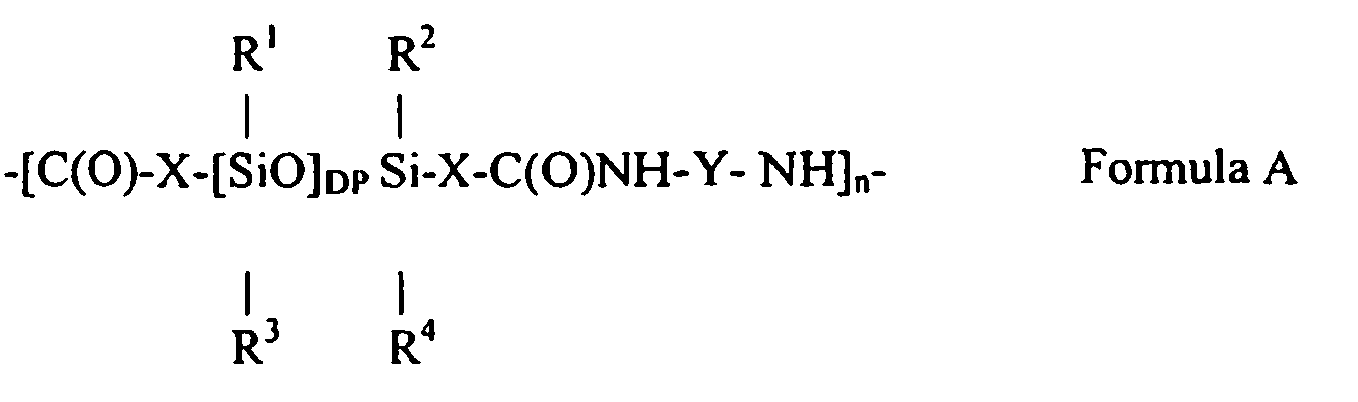
- (1) DP is selected from the group consisting of 1-700, preferably 15-500, and more preferably 15-45. In this context, DP represents an average value for degree of polymerization of the siloxane units as shown in Formula A with this average being a number average based on all the siloxane segments in all units of Formula A in the material considered. Of course, variation in "individual" DP values is still possible.
- (2) n is a number selected from the group consisting of 1-500, particularly 1-100, and more particularly 4-25;
- (3) X is a divalent, aliphatic hydrocarbon group having 1-30 carbons, particularly 3-10 carbons, and more particularly 10 carbons;
- (4) Y is
- (a) a divalent hydrocarbon group having 1-40 carbons, particularly 1-20 carbons, more particularly 2-6 carbons, and especially 6 carbons, wherein
the hydrocarbon group itself may optionally and additionally be substituted by at least one member selected from the group consisting of (i) hydroxy; (ii) a C3-C8 cycloalkyl; (iii) 1-3 members selected independently from the group consisting of C1-C3 alkyls and phenyl optionally substituted by 1-3 members selected independently from the group consisting of C1-C3 alkyls; (iv) a C1 - C3 hydroxy alkyl; and (v) a C1 - C6 alkyl amino, and
the hydrocarbon group may optionally and additionally contain at least one of (i) 1-3 amide linkages; (ii) a C5 or C6 cyclic, divalent, saturated hydrocarbon group; and (iii) a phenylene optionally substituted by 1-3 members selected independently from the group consisting of C 1-C3 alkyls, or - (b) R20T(R21)R22, where R20 and R22 are divalent C1-C10 hydrocarbon groups and R21 is a monovalent or divalent C1-C10 hydrocarbon group, such groups being independent of one another, and T is C(R), where R is selected from hydrogen, R1, R2, R3, R4, or a trivalent N, P or Al; the divalencies and trivalencies herein should be understood and taken to allow for branching, cross linking or the like in certain instances and as appropriate; and
- (a) a divalent hydrocarbon group having 1-40 carbons, particularly 1-20 carbons, more particularly 2-6 carbons, and especially 6 carbons, wherein
- (5) Each of R1 - R4 is independently selected from the group consisting of methyl, ethyl, propyl, isopropyl, a siloxane chain (such as a polydimethylsiloxane or a siloxane based polyamide), and phenyl, wherein the phenyl may optionally be substituted at 1-3 positions by substituents independently selected from the group consisting of methyl and ethyl; more particularly, each of R1 - R4 is selected from methyl and ethyl and especially methyl.
- In this context, in this disclosure and the claims that follow, certain variations should be understood as possible, and in the case of the claims as included, unless otherwise noted. The individual values for X, Y, DP, and R1 - R4 may be the same or different for each unit of the polyamide (which may include variations in values between any of the n subunits of Formula A). Such variation may or may not also exist for the X's within each of the n subunits of Formula A. Individual Y's may be aliphatic, aromatic or both.
- At least when used in reference to Formula A, unless otherwise indicated, the term "siloxane group" refers to a group having siloxane units such as:

- If repeated with no variations in the defined variables, Formula A is representative of a linear homopolymer. Acceptable variations of the invention include: (1) polyamides in which multiple values of DP, X, Y, and R1 - R4 occur in one polymeric molecule (which may include variations between the n subunits of Formula A and even within for X's), wherein the sequencing of these units may be alternating, random or block; (2) polyamides in which an organic triamine or higher amine such as tris(2-aminoethyl)amine replaces the organic diamine in part, to produce a branched or cross linked molecule; and (3) physical blends of any of (1) and (2) and/or linear homopolymers.
- Suitable examples of amides for incorporation into polyamides (of Formula A, I or others) by the methods of the present invention include those that can be formed from omega-olefinic carboxylic acids and linear alkyl diamines. Examples of olefinic acids useful for such purpose include acrylic acid, 3-butenoic acid, 4-pentenoic acid and 10-undecylenic acid. Useful diamines include ethylene diamine, hexamethylene diamine, decamethylene diamine, and although not an alkyl diamine, phenylene diamine. Examples of siloxanes for incorporation into polyamides by the methods of the present invention include dimethylhydrogen end blocked polydimethyl siloxanes.
- Of special interest is the application of the methods of the present invention to form the certain polyamides. A high degree of control is required to produce these polyamides, and the methods of the present invention provide such control and in a cost effective fashion.
- In one particular embodiment of the methods of the present invention, a siloxane based polyamide is prepared, the method comprising:
- (1) optionally purifying an omega-olefinic carboxylic acid by distillation or other suitable method to remove impurities that may include colored species;
- (2) reacting an omega-olefinic carboxylic acid or the product of (1) with a diamine so as to form a vinyl terminated diamide;
- (3) processing the product of (2) to remove, to a set level or below some set level (as determined by experience or a system model as discussed below), species that act as chain terminators in the copolymerization of siloxanes and diamides by using a suitable method such as vacuum distillation;
- (4) optionally storing the product of (3) in an inert atmosphere (such as under nitrogen), at least until the material has cooled to less than 30 degrees C, which is believed to help to prevent oxidation and/or colorization prior to copolymerization; and
- (5) copolymerizing the product of (3) or optionally of (4) with an SiH containing siloxane.
- Of course, it might be possible to start with a purchased version of the organic product of any of steps (1), (2), (3) or (4) or some equivalent and short cut this method. Other possible alternatives include removal of chain terminators at other than step (3), introduction of chain terminators anywhere in the overall process, performing either of these operations at multiple points, or some combination of these.
- Chain terminators are residual carboxylic acid (from step (2) above and/or a purchased equivalent) and monoamide. (Monoamide is defined for this purpose as a material in which only one of the amine groups present in the diamine species has reacted with an omega olefinic acid and resulting in a monovinyl functional monoamine/monoamide). These chain terminators are typically found as impurities in the reaction product of step (2) above or equivalents.
- It has been found that if undecanoic and/or palmitic acid are added during the synthesis of the diamide, a chain terminator is formed from the diamine and either or both of these acids, since these acids act as "endcappers". That is, an end capped diamide (vinyl only on one end) is produced that will act as a chain terminator in silicone polyamide synthesis generally; diamide produced with no vinyl is neither a terminator nor a chain extender and production of it should (usually) be limited by using excess unsaturated acid or other means. Any saturated fatty acid may be used as an endcapper, preferably C10-C16 acids.
- The total chain terminator level is probably more significant than that of any individual terminator. Overall, it is usually preferred that total chain terminators in the siloxane-polyamide system (most often residual omega-olefinic carboxylic acid and monoamide) range from 1.0-3.0, especially 1.5-2.5 and most especially 1.8-2.2 mole percent of the diamide (or based on the diamide) on average as used in the polymerization. These ranges are alternatively expressed in terms of molar ratios of the total chain terminators to total pure diamide in the diamide material used in the polymerization: 1:99 to 3:97, 1.5:98.5 to 2.5:97.5 and 1.8:98.2 to 2.2:97.8.
- In batch systems, the ranges and ratios of the preceding paragraph, relating chain terminators to diamide (as well as the ratios to follow relating SiH to vinyl) should be understood as based on totals of materials added to the system up to the end of copolymerization (loosely referred to perhaps as "during" the copolymerization). For continuous systems, the situation should be understood as based on total added to the reaction zone during the retention time in this zone. In either case, it is preferable that materials be added in a consistent proportion (especially stoichiometric) and in continuous systems that reactants (and anything else to be added) be added at the front end of the reaction zone and/or the reaction be run at or near a steady state.
- An acceptable range for carboxylic acid content for the copolymerization mixture in silicone polyamide synthesis by methods such as the present embodiment is expressed in terms of the "acid number" (gram equivalents of KOH per kilogram of diamide) is 0.03-2.2, with a preferred range being 0.50-1.00 and a more preferred range being 0.60-0.80. The levels of monoamide may be determined by Electron Spray Ionization Mass Spectrometry as were those reported herein with an acceptable range being 0.9 to 1.1 mole percent based on the diamide.
- Although not a chain terminator by the definition used herein, residual diamine may poison or partially inactivate catalysts routinely used, as can even residual monoamide-monoamine (which is a chain terminator). An acceptable range expressed in terms of the "base number" (gram equivalents of HCl per kilogram of diamide added to the polymerization mixture) is 0.0 to 0.2, with a preferred range being 0.0-0.1 and a more preferred range being 0.0-0.05. Higher values may be tolerable in any case. "Base number" values will necessarily include some of the monoamide present, but not all monoamide is detected this way.
- In the formation of the diamide, it is usually preferred to use at least a slight excess of acid as diamines tend to have quite unpleasant smells and are catalysts poisons as previously stated and can carry over into the product polymer.
- For siloxane based polyamide synthesis, such as illustrated in the present embodiment, it is preferred that a linear siloxane with an SiH group on each end be used as a reactant, although alternatives are often acceptable. Presence of siloxane SiH at least somewhere in the reactants is contemplated (as this polymerization is basically a hydrosilylation). It is of note that a siloxane with an SiH group on only one end (at least before addition of any diamide) is itself partially chain terminated, and it could act as a chain terminator by binding to a vinyl end of a growing polyamide chain. Allowance would have to be made for any non-preferred variations in process modeling.
- It is preferred that the diamide be linear with a terminal vinyl group (carbon-carbon double bond) on each end, although alternatives are sometimes acceptable. Presence of diamide vinyl somewhere in the reactants is contemplated (as this polymerization is basically a hydrosilylation). It is of note that a diamide with a single, vinyl group (at least when terminal) will act as a chain terminator. Polymerizations with catalysts described herein where non-terminal vinyl diamide is used and polymerization without catalyst regardless of vinyl location have been ordinarily noted to proceed extremely slowly if at all. As with the siloxane, allowance would have to be made for any non-preferred variations in process modeling.
- It has been found in silicone polyamide synthesis generally that as the molar ratio of the silicone SiH and diamide vinyl approaches 1:1 from either direction, at a set level of chain terminators, the molecular weight of the resulting copolymer increases. It is preferred that this ratio be 0.9:1.1, especially 0.95:1.05 and most especially 0.99 to 1.01.
- For many applications and/or corresponding compounding processes, siloxane polyamides of a weight average molecular weight range of 80,000-150,000 atomic mass units (with subunit siloxane number average DP of 12-18) are usually preferable, in that those below this range are too brittle, while those above are too viscous for common processing methods to be effective. Manipulation of levels of chain terminators and ratio of copolymerization reactants makes rather precise control of molecular weight of the final copolymer possible.
- A catalyst is used in silicone diamide copolymerization. For siloxane diamide copolymerization, any of the catalysts known in the art to be suitable for such reaction can be employed, such as those based on a Group VIII transition metal, a noble metal. The platinum based catalysts falling in this class are preferred. Most preferred are platinum-silicone based catalysts of this same class.
- Such noble metal catalysts are described in
U.S. Patent No. 3,923,705 , to show such catalysts. One preferred platinum catalyst is Karstedt's catalyst that is described inU.S. Patent Nos. 3,715,334 and3,814,730 , Karstedt's catalyst is a platinum divinyl tetramethyl disiloxane complex typically containing one weight percent platinum in a solvent such as toluene. Another preferred platinum catalyst is a reaction product of chloroplatinic acid and an organosilicon compound containing terminal aliphatic unsaturation as described inU.S. Patent No. 3,419,593 ,. Most preferred as the catalyst is a neutralized complex of platinous chloride and divinyl tetramethyl disiloxane, for example, as described inU.S. Patent No. 5,175,325 . - Temperature of the copolymerization is not critical, but it is preferred that it be high enough so that the reactants are melted, will dissolve or are miscible (at least in most siloxane polyamide systems) but not so high that appreciable isomerization of the omega double bond in the acid incorporated into the diamide occurs.
- Solvent may be used but is not absolutely required. At least in siloxane polyamide systems, toluene and xylene have been found to be suitable and virtually interchangeable solvents but must be removed (such as by stripping) when the polymers are to be used in many applications because of odor, health and/or environmental regulations or concerns. Decamethylcyclopentasiloxane and phenyl tris (trimethylsiloxy) silane are possible alternatives in such case, but also generally. Similarly, polypropylene glycol ethers of linear alcohols (such as those of myristyl alcohol) may also be used; although these ethers do appear to inhibit reaction when used in high concentration, they typically do not act as chain terminators as defined herein. Examples of these ethers include PPG-3 myristyl ether and PPG-4 myristyl ether.
- This listing of solvents is not exhaustive. Hydrocarbons and low viscosity silicones (at least those of viscosity less than 50 cSt or 50 mm2/s, as measured conventionally) are suitable generally.
- Solventless processes are possible. When solvents are omitted, siloxane based polyamides of high molecular weight with nearly clear appearance and low color can be made when there is sufficient mixing during polymerization. Solventless should be understood as including situations wherein residual solvent may be introduced, for example, as part of a catalyst preparation; this may also be referred to as a situation where no additional solvent is present. Definition of solventless systems has been given previously for the general case of silicone organic copolymerization and applies here in the case of siloxane based polyamide synthesis.
- Here, as elsewhere in this disclosure and the claims that follow, "diamide" refers to a material made of actual diamide and any impurities carried along with it, which may include chain terminators. "Pure diamide" refers only to the portion of this material that is actually structurally a diamide, but excludes any structural diamide that is also a chain terminator, such as an endcapped diamide (monovinyl) as described previously, or a diamide that is not a chain terminator nor a chain extender such as a diamide without any vinyl group. Also in this context, throughout this disclosure and the claims that follow, "added" should be understood to mean placed in the polymerization reaction mixture at any point during which polymerization is taking place (expressed more precisely perhaps as up to the end of polymerization) for batch systems, and correspondingly, that placed in the reaction zone during the retention time of this zone in continuous systems.
- As it may actually be easier to obtain highly purified intermediates than to measure terminators in individual lots of these compounds, one desiring to practice the methods of the present invention could use the models herein to determine the amount of terminator needed to produce a polymer of a specified molecular weight and simply add this amount of terminator to at least a portion of it to an individual high purity reactant or a mixture of reactants to get the desired result. Of course, it would be possible to blend intermediates of varying purity for similar overall results.
- It would also be possible to gradually add chain terminators as well as other components to the reaction mixture while reaction is taking place, at least in many cases, if allowance is made for the rate of reaction. In the model above and the corresponding claims that follow, component amounts are taken as total added to the reaction system at any time during polymerization (or perhaps more precisely prior to end of polymerization) in batch systems, or total added to the reaction zone during the retention time in that zone in continuous reaction systems. The above model's accuracy depends, at least in part, upon how much error results from assuming that no correction relating to reaction kinetics is required in this system.
- In addition, it is expected that those of ordinary skill in the art could derive enhancements to the models presented based on experience with particular systems. For example, it might be desirable to develop a correction factor for MWn as the excess of one of the intermediates increases so as to obtain a value more reflective of the actual polymers produced.
- Throughout this disclosure and the claims that follow, it should be understood that the term "molecular weight" (MW) refers to the weight average molecular weight, unless stated otherwise. Both weight and number average molecular weights (the latter, MWn) should be taken as expressed in atomic mass units, unless otherwise specified. Those reported herein were, unless otherwise stated, determined by gel permeation chromatography.
- Further, the term "copolymer" should not be taken in its most restrictive sense unless so stated; that is, the term should not be taken as limited to a polymer made from only two but rather from at least two distinct monomers (intermediates).
- In addition, the viscosity measurements given herein, unless otherwise stated or apparent from the units given, are melt viscosities made using a Brookfield Digital Viscometer Model HATDV-II, Brookfield Thermosel, and #27 Spindle at 140 deg C. In the examples and comparative examples, viscosities refer to the silicone based polyamides, unless otherwise indicated.
- As to the examples and comparative examples that follow, chain terminators were taken as free carboxylic acids, monoamides, and where applicable, "endcapped" diamides (monovinyl). Although other chain terminators could be present in such polymerization systems generally, in the examples and comparative examples, materials were controlled such that the presence of other chain terminators would be negligible at most (and those considered limited to coming from the diamide). Free carboxylic acids were determined via titration with KOH. Monoamide content was determined by Electron Spray Ionization Mass Spectroscopy, unless otherwise indicated. End capped diamides were determined indirectly by controlled doping of diamides (using a known excess of unsaturated acid in diamide versus saturated acid), but could be determined by methods known generally in the art relating to such materials.
- The methods of the present invention are useful to prepare siloxane-based polyamides comprising the following structure:

- (1) DP is 10-50, preferably 10-30, more preferably 12-18 and especially 15. In this context throughout this disclosure and the claims that follow, DP represents an average value for degree of polymerization of the siloxane units as shown in Formula I with this average being a number average based on all the siloxane segments in all units of Formula I in the material considered. Of course, variation in "individual" DP values is still possible.
- (2) n is 45 or greater, limited only by the viscosity maximum of the mixer or extruder or other equipment employed to make the polymer. Commonly, this maximum is reached at an n value of 200. Preferably n is 55-125 and more preferably 60-80;
- (3) X is a divalent, aliphatic hydrocarbon group having 1-30 carbons, preferably 3-10 carbons, and more preferably 10 carbons;
- (4) Y is
- (a) a divalent hydrocarbon group having 1-40 carbons, preferably 2-10 carbons, and more preferably 6 carbons, wherein
the hydrocarbon group itself may optionally and additionally be substituted by at least one member selected from the group consisting of (i) hydroxy; (ii) a C3-C8 cycloalkyl; (iii) 1-3 members selected independently from the group consisting of C1-C3 alkyls and phenyl optionally substituted by 1-3 members selected independently from the group consisting of C1-C3 alkyls; (iv) a C1 - C3 hydroxy alkyl; and (v) a C1 - C6 alkyl amino, and
the hydrocarbon group may optionally and additionally contain at least one of (i) 1-3 amide linkages; (ii) a C5 or C6 cyclic, divalent, saturated hydrocarbon group; and (iii) a phenylene optionally substituted by 1-3 members selected independently from the group consisting of C1-C3 alkyls, or - (b) R20 T(R21)R22, where R20 and R22 are divalent C1-C10 hydrocarbon groups and R21 is a monovalent or divalent C1-C10 hydrocarbon group, such groups being independent of one another, and T is C(R), where R is selected from hydrogen, R1, R2, R3, R4, or a trivalent N, P or Al; the divalencies and trivalencies herein should be understood and taken to allow for branching, cross linking or the like in certain instances and as appropriate; and
- (a) a divalent hydrocarbon group having 1-40 carbons, preferably 2-10 carbons, and more preferably 6 carbons, wherein
- (5) Each of R1 - R4 is independently selected from the group consisting of methyl, ethyl, propyl, isopropyl, a siloxane containing chain (such as a polydimethylsiloxane or a siloxane based polyamide), and phenyl, wherein the phenyl may optionally be substituted at 1-3 positions by substituents independently selected from the group consisting of methyl and ethyl; more particularly, each of R1 - R4 is selected from methyl and ethyl and especially methyl.
- In this context, in this disclosure and the claims that follow, certain variations should be understood as possible, and in the case of the claims as included, unless otherwise indicated. The individual values for X, Y, DP, and R1 - R4 may be the same or different for each unit of the polyamide (which may include those between any of the n subunits of Formula I). Such variation may or may not also exist for the X's within each of the n subunits of Formula I. Individual Y's may be aliphatic, aromatic or both.
- At least when used in reference to Formula I, and unless otherwise indicated, the term "siloxane group" refers to a group having siloxane units such as:

- If repeated with no variations in the defined variables, Formula I is representative of a linear homopolymer. Acceptable variations of the invention include: (1) polyamides in which multiple values of DP, X, Y, and R1 - R4 occur in one polymeric molecule (which may include variation between the n subunits of Formula I and even within for X's), wherein the sequencing of these units may be alternating, random or block; (2) polyamides in which an organic triamine or higher amine such as tris(2-aminoethyl)amine replaces the organic diamine in part, to produce a branched or cross linked molecule; and (3) physical blends of any of (1) and (2) and/or linear homopolymers.
- Suitable examples of diamides for incorporation into polyamides of the present invention include those that can be formed from omega-olefinic carboxylic acids (such as those made up of a 2, 3, 4 or 10 carbon chain, which may be linear, in addition to the carboxyl group) and alkyl diamines (such as those made up of a carbon chain containing 2, 6 or 10 carbons, where such chain may be linear, saturated or both, in addition to two amino groups at various positions). These would correspond to X groups of 2, 3, 4 or 10 carbon length that may be linear (such as -(CH2)m-, where m = 2, 3, 4 or 10) and Y groups of 2, 6 or 10 carbons that may be linear, saturated or both (such as -(CH2)m-, where m = 2, 6 or 10), respectively.
- Examples of olefinic acids useful for such diamide formation include acrylic acid, 3-butenoic acid, 4-pentenoic acid and 10-undecylenic acid. Useful diamines include ethylene diamine, hexamethylene diamine, and decamethylene diamine; phenylene diamine, although not an alkyl diamine, is also useful.
- Note that throughout this disclosure and the following claims, reference to carboxylic acids or carboxyl groups should be taken to include corresponding carboxylates as appropriate.
- Suitable examples of siloxanes for incorporation into the polyamides of the present invention include dimethylhydrogen end blocked polydimethyl siloxanes, especially those with a number average DP of 10-30, notably 12-18 and most notably 15. DP's for end blocked siloxanes should be taken as ignoring end blocking groups, unless otherwise noted.
- The methods of the present invention can be used to prepare silicone organic polymers useful in many applications, notably in personal care products, such as deodorants and antiperspirants. It has been found that among the compositions prepared by the methods of the present invention, those derived from the copolymerization of the diamide formed by reacting 10-undecylenic acid and hexamethylene diamine with a dimethyl end blocked polydimethylsiloxane of DP 10-30, especially 12-18 (and notably 15), such that the resulting polymer has 55-125 (and especially 60-80) diamide siloxane units per molecule on average (n is 55-125, especially 60-80, in Formula I) and a weight average molecular weight of 80,000-150,000 atomic mass units, especially 100,000-130,000 atomic mass units, make gellants with excellent properties for use in stick deodorants and antiperspirants. These polyamides would be based on the structure:

- It should be understood that the disclosure of ranges herein should be taken not only to disclose the range itself but also anything subsumed therein, as well as endpoints. For example, disclosure of a range of 1-10 should be understood to disclose not only the range of 1-10, but also 1, 2.7, 9 and 10 individually, as well as any other number subsumed in the range. Similarly, disclosure of a range of C1 to C5 hydrocarbons should be understood to disclose not only C1 to C5 hydrocarbons as a class, but also C1, C2, C3, C4 and C5 hydrocarbons individually.
- Titles given for the examples should not be interpreted as limiting in any way.
- The following is the method that was used to prepare the diamides and copolymers of the examples. Any deviations from this method are noted specially in the specific example that follows as applicable.
- A 1000 ml round bottom flask equipped with a thermometer, electrical stirrer, nitrogen sweep, and a condenser was charged with 153.5 g of 70 weight percent hexamethylene diamine in water ("HMDA") from Dupont and 346.5g of purified 10-undecylenic acid ("UDA"). The purified UDA was the overhead produced by vacuum distillation of UDA from CasChem Corporation at 180-210°C and 10-20 mm Hg vacuum; this initial purification removed color producing impurities that would otherwise carry over into final products.
- With the mixer off, the mixture in the flask was purged with nitrogen for 5 minutes to sweep out any oxygen in the headspace. The reactants were initially immiscible and water clear, but the mixture quickly turned a light yellow color as soon as the mixer was turned on which initiated the reaction. The acid and base reacted to form an acid-base salt, and a temperature rise as high as 60°C was observed due to the exothermic nature of the reaction.
- The resulting mixture was then heated to 120°C and maintained at this temperature for 1 hour to slowly remove the water that was originally introduced in the reaction mixture as part of the HMDA solution. The slow removal of the water during this step was essential to maintaining the stoichiometric ratio of the raw materials, since they have different vapor liquid equilibrium.
- Next, the material was heated to 160°C, and the diamide (N,N'-Hexamethylenebis (10-undecenamide)) was produced with water as the reaction by-product. The reaction was allowed to continue at this temperature for 1 hour or until water was no longer detected in the condenser trap indicating the reaction was completed. The materials were then further heated to 240°C and held there for two hours under vacuum with a nitrogen purge to strip out impurities.
- The above reaction mixture was cooled to 150°C and processed into a flake form. The flake was cooled to below 30°C in an inert atmosphere to prevent the diamide from darkening from a cream to a brown color that would carry over to any polyamide made from this material. The inert atmosphere is theorized (without limitation as to this invention) to prevent the formation of colored oxidative by-products of the diamide material as it cools.
- A 500 ml, three neck, round bottom flask equipped with a temperature probe, an electrical stirrer, and a condenser was charged with 50 grams of the preserved diamide and 100 grams of xylene and heated to 115°C for 15 minutes to dissolve the diamide. Then, 143 grams of an equilibrated dimethylhydrogen end blocked polydimethyl siloxane (having a number average DP of 15, neglecting the end groups) was then added dropwise via an addition funnel.
- After the first 5 grams of the siloxane was added, 0.4 gram of platinum catalyst (1,3-diethenyl-1,1,3,3-tetramethyldisiloxane platinum complex in dimethyl siloxane) was added to the mixture. The siloxane addition was completed and then a further 0.2 gram of catalyst was added. The molar ratio of total silicone (here siloxane) SiH to total diamide vinyl added was 1.0:1.0.
- Following the charging of the flask, the reactants were mixed for 30 minutes to 1 hour allowing the reaction to take place. The reactor was then heated to 150°C and a vacuum was applied slowly then gradually increased to below 10 mm Hg to remove the solvent.
- Silicone-diamide copolymers were prepared according to Example 1 with the diamide product stripping conditions given in Table IIA below. The acid and base numbers given in this same table indicate what was required to neutralize (at least) residual UDA and residual HMDA (including for this purpose the portion of monoamide monoamine that titrates) in the diamide, respectively, which is indicative of the degree of completion of the reaction forming the diamide. Amounts of monoamide and total chain terminators in the diamide were determined. The molecular weight of the corresponding copolymer formed from these diamides (and siloxanes) is also presented in Table IIA.
Table IIA: Summary of Stripping Results Run Stripping Temp(°C), Time (hr) Acid No. (g equiv KOH/kg diamide) Base No. (g equiv HCl/kg diamide) Monoamide (mole% in diamide) Total Chain Terminators (mole% in diamide) MW of Copolymer A 220, 1 2.46 0.146 1.85 3.82 38860 B 220, 2 0.65 0.109 1.80 2.32 80930 C 240, 2 0.45 0.073 1.49 1.82 132700 D 260, 2 0.22 0.073 1.38 1.55 186400 - Other silicone-diamide copolymers were prepared using diamides with varying amounts of residual acid and base. The results are summarized in Table IIB.
Table IIB: Summary of Other Residual Acid/Base Number Results Run Acid No. (g equiv KOH/kg diamide) Base No. (g equiv HCl/kg diamide) MW of Copolymer E 5.59 0.29 14710 F 5.10 0.41 17400 G 3.25 0.26 31480 H 0.22 0.50 193700 I 0.13 0.68 208000 - Diamides characterized by the following monoamide content (as determined by Electron Spray Ionization Mass Spectrometry) were used to make copolymers according to Example 1. The results are summarized in the table that follows. Corresponding acid numbers and total chain terminator compositions are given also.
Table III: Summary of Results from Example 3 Sample Acid No. (g equiv KOH/kg diamide) Monoamide (mole % in diamide) Total Chain Terminators (mole% in diamide) MW Copolymer Viscosity cP (mPa s) at 140 deg C J 1.20 0.67 1.70 225200 40000 K 0.67 1.46 2.00 125100 37200 L 2.24 1.77 3.57 53430 7640 M 6.20 1.86 6.80 50110 7000 N 16.20 3.34 16.10 21990 1000 - Diamides as characterized in the table below were used in making copolymers according to Example 1, except that toluene was used as a solvent. The results are summarized in the following table.
Table IV: Summary of Results from Example 4 Diamide Monoamide (mole % in diamide) Total Chain Terminators (mole% in diamide) MW of Copolymer P 1.05 1.2 above 300000 Q 2.01 3.2 54300 R, blend of 50 weight percent each of P and Q 1.52 2.1 178700 - Siloxane-diamide copolymers were made according to Example 1 (using the same lot of diamide), except that the molar ratio of silicone SiH to diamide vinyl (carbon-carbon double bond), here terminal vinyl, was varied as shown in the table below. Resulting molecular weights of the copolymers are given in the following table.
Table V: Results for Example 5 Run Molar Ratio of Silicone SiH:Diamide Vinyl MW of Copolymer S 0.9:1 43,100 T 1.0:1 137,900 U 1.1:1 54,500 - Copolymers were prepared according to Example 1, but the amount of solvent (here xylene) was varied. The "solvent level" as stated is the ratio of the mass of solvent to that of diamide in the copolymerization. The results are given in the table below.
Table VI: Summary of Results from Example 6 Run Solvent Level MW of Copolymer Melt Viscosity cP (mPa s) at 140 deg C V 2 135,800 24,200 W 1 163,900 30,500 X 0.5 205,700 60,100 Y 0.5 198,500 56,400 Z 0 82,900 17,500 - First, 50 grams of diamide made according to Example 1 and 143 grams of siloxane were loaded into a 500 ml flask and heated to 140°C. Then, 0.6 gram of platinum catalyst (1,3-diethenyl-1,1,3,3-tetramethyldisiloxane platinum complex in dimethyl siloxane) was then added. The reaction mixture was mixed by an electric stirrer (Cole Palmer Series 4401) at 300 rpm for 1 hour, followed by application of vacuum (10 mm Hg) for 5 minutes to remove any bubbles. The final copolymer was opaque and had a MW of 69,320.
- Approximately 14 lbs (6.36 kg) of diamide (nominally N,N'-Hexamethylenebis (10-undecenamide)) flake was loaded into a 10 gallon (37.85 1), model PVM, Ross VersaMix® mixer along with approximately 40 lbs (18.18 kg) of dimethylhydrogen end blocked siloxane with a number average DP of 15 (ignoring end groups). The mixer lid was then closed and nitrogen was used to purge the system and was maintained during the run. Agitation was started while the materials in the mixer were heated to 140°C. At temperature, the material was a creamy yellow, non-homogeneous liquid.
- Next, approximately 25 grams of platinum catalyst (1,3-diethenyl-1,1,3,3-tetramethyldisiloxane platinum complex in dimethyl siloxane) was loaded directly to the mixer through a septum using a syringe. Following the catalyst addition, the temperature of the reaction mixture quickly climbed 30°C due to the exothermic reaction, and the material in the mixer turned from a creamy yellow to an amber brown color and showed visible signs of thickening. Once the batch temperature had cooled back below 150°C (after 1/2 hr), an additional 25 grams of platinum catalyst was added. This resulted in a temperature increase of 7°C. The batch temperature was maintained between 140 and 150°C and held for an additional 2 to 3 hrs. The material was then cooled below 150°C and poured out of the mixer. b. (continued) For the larger than lab scale, low shear (no scraping) run, the blade configuration consisted of only one 3-pitch blade that was located on the central agitator shaft. The pitch blades were run at approximately 35 rpm throughout. The final copolymer produced was cloudy and had a MW of 67,130 and a melt viscosity of 14,500 cP (mPa s) at 140°C. c. (continued) For the larger than lab scale, high shear run, the blade configuration consisted of a low shear anchor-agitator that scraped the sides of the mixer, a small 6-pitch blade, and a high-speed disperser blade each located on a separate agitator shaft. The anchor blade was run between 20 and 30 rpm throughout the process. The cowles and small pitch blades were turned on after the second catalyst addition and remained at approximately 600 rpm for the remainder of the run. A nearly clear copolymer was produced with a molecular weight of 92,450 and a melt viscosity of 45,600 cP (mPa s) at 140°C.
Table VII: Results from Example 7 Run MW of Copolymer Color A 69,320 opaque B 67,130 cloudy C 92,450 nearly clear - First, 50 gram of diamide made according to Example 1 was loaded into a 500 ml flask along with the type and amounts of solvent as given in the Table VIII below. The mixture was then heated to 132 deg C. Then 140.4 grams of a dimethylhydrogen end blocked siloxane having a number average DP of 15 (ignoring end groups), was slowly added to the diamide mixture along with 0.6 gram of platinum catalyst of Example 1. The results are given in Table VIII immediately below. PPG3 is PPG-3 Myristyl Ether (a polypropylene glycol ether of myristyl alcohol) made by Goldschmidt.
- A copolymer prepared under these conditions except with xylene as a solvent (20.8 weight percent of the reaction mixture) had a molecular weight of 133,700. (The polymer made in xylene was stripped of solvent before molecular weight determination, while those made in PPG3 were not; this is not believed to have any significant effect.)
Table VIII: Results from Example 8 Run PPG3 (g) PPG3 weight% of reaction mixture MW of Copolymer DD 25 11.6 135,400 EE 50 20.8 131,000 FF 100 34.4 97,970 - Various copolymers were prepared according to Example 1, except that the copolymerization ratios of the silicone (siloxane) and organic (diamide) intermediates were varied as indicated in the table below; organic intermediate used was from the same lot, so chain terminator level was constant. The number average molecular weight of the copolymers formed was measured via gel permeation chromatography (GPC) and also predicted by Equation (IV). The same procedure was repeated using an organic (diamide) intermediate from a different lot. The results are summarized in the tables immediately following. It is of note that the largest errors occur as the ratio of the intermediates approaches I which is as nexcess approaches zero in the model (Equation (IV)).
Table IXA: Results of Number Average Molecular Weight Prediction (Lot I diamide, n terminator = 2.95 mole % of diamide) Run Moles silicone SiH: Moles diamide vinyl MWn Experimental (+/- 2,000) MWn Predicted MWn /Error/ GG 1.09:1 14,200 14,800 600 HH 0.99:1 15,200 19,800 4,600 II 0.94:1 13,300 12,300 1,000 JJ 0.90:1 11,300 8,700 2,600 KK 0.70:1 6,750 3,600 3,150 Table IXB: Results of Number Average Molecular Weight Prediction (Lot 2 diamide, n terminator = 2.06 mole% of diamide) Run Moles silicone SiH: Moles diamide vinyl MWn Experimental (+/- 2,000) MWn Predicted MWn /Error/ LL 1.09:1 12,700 15,400 2,700 MM 0.99:1 17,900 22,200 4,300 NN 0.94:1 15,300 13,200 2,100 OO 0.90:1 12,900 9,200 3,700 PP 0.70:1 6,800 3,700 3,100 - A silicone diamide copolymer was prepared as in Example 1, except that in the preparation of the diamide, 222.6 g of UDA, 3.8 g of undecanoic acid (1.7 mole percent of the total carboxylic acid) and 100 g of HMDA were used and the product was stripped for 3 hrs at 240°C. The acid and base numbers of the diamide product were 0.11 and 0.073, respectively, the silicone SiH: diamide vinyl molar ratio in the copolymerization was 1.0:1.0 and the copolymer had a MW of 148,300.
- A 3000 ml three neck flask equipped with a thermometer, electrical stirrer and a condenser was charged with 1427.2 g of dimethylcyclosiloxanes, 172.8 g of tetramethyldihydrogen disiloxane and 1.3 g of trifluoromethane sulfonic acid. The flask was heated to 80 degrees C and kept at this temperature for 4 hours. After 4 hours, 25 g of sodium bicarbonate were added and the contents of the flask were mixed at 80 degrees C for another 2 hours. The reaction product (15 DP dimethylhydrogen end blocked polydimethyl siloxane with end groups ignored in DP determination) was filtered using a 0.8 micron filter paper.
- To a 2000 ml flask equipped with a thermometer, electrical stirrer, condenser and nitrogen purge were added 800 g of the above product (15 DP dimethylhydrogen end blocked polydimethyl siloxane) and a sufficient amount of a neutralized complex of platinous chloride and divinyl tetramethyl disiloxane was added to provide a concentration of 5-15 ppm Pt metal based on the total composition. The mixture was heated to 80 degrees C while mixing. In an addition funnel were placed 325.0 g of trimethylsilyl protected undecylenic acid; the material was added dropwise to the reactor and an exotherm was observed. After complete addition the temperature was increased to 110 degrees C and the mixture was allowed to react for an additional hour. The temperature was then raised to 150 degrees C under a vacuum for approximately 1 hour. The vacuum was removed and the reactor was allowed to cool below 60 degrees C. Once below 60 degrees C, 110.0 g of methanol were added to the reactor and the temperature set at 60 degrees C. After 2 hours the temperature was increased to 150 degrees C under vacuum to remove residual methanol and trimethylmethoxysilane.
- To a 500 ml flask equipped with a thermometer, electrical stirrer, condenser, nitrogen purge and a Dean Stark trap were added 100 g of the product (15 DP carboxylic acid end blocked siloxane), 20 g of toluene and 7.19 g of hexamethylenediamine. The reactor temperature was increased to 150 degrees C for 4 hours. During the reaction, water and toluene were periodically removed from the Dean Stark trap. The final silicone polyamide was poured off at approximately 150 degrees C while still in the melt form. This copolymer had a molecular weight of 20,380 (corresponding to a number average molecular weight of 8,900).
- A 500 ml three neck flask equipped with a thermometer, electrical stirrer, nitrogen sweep, and a condenser, was charged with 57.75 g of undecylenic acid (UDA), and 24.77 g of a 70 weight percent hexamethylene diamine mixture in water (HMDA). The flask was immediately heated to 225 degrees C, and kept at this temperature for 2 hours. After 2 hours, a vacuum was applied to the system for 2 hours to remove any unreacted materials. Upon completion of vacuum stripping, the flask was reweighed to obtain the product weight. The temperature was increased to 120 degrees C, and 65 g of toluene, and 0.5 g of a solution containing platinum in the form of a complex of platinous chloride and divinyl tetramethyl disiloxane were added to the flask. The temperature was then increased to 185 degrees C, and 168.72 g of a 15 DP dimethylhydrogen end blocked polydimethylsiloxane (DP determined ignoring the end groups) was added to the flask over a 30 minute period. After complete addition, a dean stark trap was used to replace the addition funnel on the flask, and the toluene was removed from the flask. After removal of the toluene, the materials were allowed to react for an additional period of one hour. Vacuum stripping was applied to the flask for 1 hour to ensure complete removal of any residual solvent. The final siloxane-based polyamide was cooled to 150 °C and poured off while still in the melt form. This copolymer had a molecular weight of 52,660 and a polydispersity of 3.769. The molar ratio of total silicone SiH: total diamide vinyl in the copolymerization was estimated at 0.84:1.0 and chain terminators were not measured, modified nor controlled.
- When this procedure was repeated using UDA and HMDA from various lots, the molecular weight of the copolymers obtained varied from 7,400 to 50,100.
- A silicone-diamide copolymer was made according to the method of Comparative Example 2. The total silicone SiH: total diamide vinyl molar ratio in the copolymerization was estimated at 0.84:1.0, and the chain terminators were measured at 9.37 mole percent of the diamide used in the copolymerization. The chain terminators were and not modified nor controlled for the copolymerization. The resulting polymer had a molecular weight of 26,400.
Claims (7)
- A method for making siloxane-based polyamides comprising:copolymerizing, in the presence of a catalyst, an SiH containing siloxane and a vinyl containing diamide in a combination in which the molar ratio of total chain terminators selected from carboxylic acids andmonoamide added to that of total pure diamide added is 1:99 to 3:97 and the molar ratio of total siloxane SiH added to total diamide vinyl added is 0.9:1 to 1.1:1.
- The method according to claim 1, wherein the diamide, the siloxane and the catalyst are mixed during copolymerization which is carried out solventless.
- The method of claim 1, wherein a solvent comprising toluene, xylene, decamethylcyclopentasiloxane, phenyl tris(trimethylsiloxy) silane, a polypropylene glycol ether of a linear alcohol, or a combination of two or more of these is present during copolymerization.
- The method of claim 1, wherein the molar ratio of total chain terminators added to that of total pure diamide added is 1.5:98.5 to 2.5:97.5 and the molar ratio of total siloxane SiH added to total diamide vinyl added is 0.95:1 to 1.05:1.
- The method of claim 1, wherein the molar ratio of total chain terminators added to that of total pure diamide added is 1.8:98.2 to 2.2:97.8 and the molar ratio of total siloxane SiH added to total diamide vinyl added is 0.99:1 to 1.01:1.
- The method of claim 1, where the SiH containing siloxane and the vinyl containing diamide are such that the siloxane based polyamide resulting comprises:
 (1) DP is 1-700;(2) n is a 1-500;(3) X is a divalent, aliphatic hydrocarbon group having 1-30 carbons;(4) Y is(a) a divalent hydrocarbon group having 1-40 carbons, wherein the hydrocarbon group may optionally and additionally be substituted by at least one member selected from the group consisting of(i) hydroxy;(ii) a C3-C8 cycloalkyl;(iii)1-3 members selected independently from the group consisting of C1-C3 alkyls, and phenyl optionally substituted by 1-3 member selected independently from the members selected independently from the group consisting of C1-C3 alkyls;(iv) a C1 - C3 hydroxy alkyl; and(v) a C1 - C6 alkyl amino, and the hydrocarbon group may optionally and additionally contain at least one of(i) 1-3 amide linkages;(ii) a C5 or C6 cyclic, divalent, saturated hydrocarbon group; and(iii)a phenylene optionally substituted by 1-3 members selected independently from the group consisting of C1-C3 alkyls, or(b) R20T(R21)R22, where R20 and R22 are divalent C1-C10 hydrocarbon groups and R21 is a monovalent or divalent C1-C10 hydrocarbon group, such groups being independent of one another, and T is C(R), where R is selected from hydrogen, R1, R2, R3, R4, or a trivalent N, P or Al; and(5) each of R1, R2, R3 and R4 is independently selected from the group consisting of methyl, ethyl, propyl, isopropyl, a siloxane chain, and phenyl, wherein the phenyl may optionally be substituted at 1-3 positions by substituents independently selected from the group consisting of methyl and ethyl.
 - The method of claim 1, where the SiH containing siloxane and the vinyl containing diamide are such that the siloxane based polyamide resulting comprises:
 (1) DP is 10-50;(2) n is 45 or greater;(3) X is a divalent aliphatic hydrocarbon group having 1-30 carbons;(4) Y is(a) a divalent hydrocarbon group having 1-40 carbons, wherein the hydrocarbon group may be optionally and additionally substituted by at least one member selected from the group consisting of(i) hydroxy;(ii) a C3-C8 cycloalkyl;(iii) 1-3 members selected independently from the group consisting of C1-C3 alkyls and phenyl optionally substituted by 1-3 members selected independently from the group consisting of C1-C3 alkyls;(iv) a C1 - C3 hydroxy alkyl; and(v) a C1 - C6 alkyl amino, and the hydrocarbon group may optionally and additionally contain at least one of(i) 1-3 amide linkages;(ii) a C5 or C6 cyclic, divalent, saturated hydrocarbon group; and(iii) a phenylene optionally substituted by 1-3 members selected independently from the group consisting of C1-C3 alkyls, or(b) R20T(R21)R22, where R20 and R22 are divalent C1-C10 hydrocarbon groups and R21 is a monovalent or divalent C1-C10 hydrocarbon group, such groups being independent of one another, and T is C(R), where R is selected from hydrogen, R1, R2, R3, R4, or a trivalent N, P or Al; and(5) Each of R1, R2, R3, and R4 is independently selected from the group consisting of methyl, ethyl, propyl, isopropyl, a siloxane containing chain, and phenyl, wherein the phenyl may optionally be substituted at 1-3 positions by substituents independently selected from the group consisting of methyl and ethyl.
Applications Claiming Priority (5)
| Application Number | Priority Date | Filing Date | Title |
|---|---|---|---|
| US903920 | 1986-09-04 | ||
| US90392001A | 2001-07-12 | 2001-07-12 | |
| US145311 | 2002-05-15 | ||
| US10/145,311 US6800713B2 (en) | 2001-07-12 | 2002-05-15 | Methods for making silicone-organic copolymers |
| PCT/US2002/020240 WO2003006530A1 (en) | 2001-07-12 | 2002-06-24 | Methods for making silicone-organic copolymers |
Publications (2)
| Publication Number | Publication Date |
|---|---|
| EP1409570A1 EP1409570A1 (en) | 2004-04-21 |
| EP1409570B1 true EP1409570B1 (en) | 2011-09-21 |
Family
ID=26842841
Family Applications (1)
| Application Number | Title | Priority Date | Filing Date |
|---|---|---|---|
| EP02756309A Expired - Lifetime EP1409570B1 (en) | 2001-07-12 | 2002-06-24 | Methods for making silicone-organic copolymers |
Country Status (4)
| Country | Link |
|---|---|
| US (1) | US20040171783A1 (en) |
| EP (1) | EP1409570B1 (en) |
| JP (1) | JP4628672B2 (en) |
| WO (1) | WO2003006530A1 (en) |
Families Citing this family (6)
| Publication number | Priority date | Publication date | Assignee | Title |
|---|---|---|---|---|
| US7754800B2 (en) | 2005-04-06 | 2010-07-13 | Dow Corning Europe Sa | Organosiloxane compositions |
| JP4646152B2 (en) * | 2008-05-27 | 2011-03-09 | 信越化学工業株式会社 | Monomers for ophthalmic device manufacturing |
| GB0905204D0 (en) | 2009-03-26 | 2009-05-13 | Dow Corning | Preparation of organosiloxane polymers |
| GB0905205D0 (en) | 2009-03-26 | 2009-05-13 | Dow Corning | Preparation of organosiloxane polymer |
| WO2020061004A1 (en) | 2018-09-17 | 2020-03-26 | Elevance Renewable Sciences, Inc | Functionalized silicone polymers and methods of making and using the same |
| WO2020061000A1 (en) | 2018-09-17 | 2020-03-26 | Elevance Renewable Sciences, Inc | Segmented silicone polymers and methods of making and using the same |
Family Cites Families (13)
| Publication number | Priority date | Publication date | Assignee | Title |
|---|---|---|---|---|
| GB1433288A (en) * | 1973-05-02 | 1976-04-22 | Hitachi Ltd | Thermally curable compositions and process for curing said compositions |
| US4604442A (en) * | 1985-03-29 | 1986-08-05 | General Electric Company | Organopolysiloxane-polyamide block polymers and method for making |
| ES2110391T3 (en) * | 1986-06-20 | 1998-02-16 | Minnesota Mining & Mfg | BLOCK COPOLYMER, METHOD FOR PREPARING THE SAME, DIAMINE PRECURSORS OF THE SAME METHOD, METHOD FOR PREPARING SUCH DIAMINS AND FINAL PRODUCTS THAT INCLUDE THE BLOCK COPOLYMER. |
| US4808686A (en) * | 1987-06-18 | 1989-02-28 | General Electric Company | Silicone-polyimides, and method for making |
| US5011899A (en) * | 1989-08-15 | 1991-04-30 | General Electric Company | Copoly(aromatic sulfone carbonate - aromatic alkylcarbonate) - polysiloxane block copolymer |
| GB9103191D0 (en) | 1991-02-14 | 1991-04-03 | Dow Corning | Platinum complexes and use thereof |
| US5773561A (en) * | 1996-08-02 | 1998-06-30 | International Business Machines Corporation | Polymer sealants/adhesives and use thereof in electronic package assembly |
| US6225434B1 (en) * | 1997-08-01 | 2001-05-01 | Ppg Industries Ohio, Inc. | Film-forming compositions having improved scratch resistance |
| US6051216A (en) | 1997-08-01 | 2000-04-18 | Colgate-Palmolive Company | Cosmetic composition containing siloxane based polyamides as thickening agents |
| US5863627A (en) * | 1997-08-26 | 1999-01-26 | Cardiotech International, Inc. | Hydrolytically-and proteolytically-stable polycarbonate polyurethane silicone copolymers |
| US5986022A (en) * | 1998-04-01 | 1999-11-16 | Witco Corporation | Continuous manufacture of silicone coploymers |
| US5981680A (en) | 1998-07-13 | 1999-11-09 | Dow Corning Corporation | Method of making siloxane-based polyamides |
| FR2825916B1 (en) * | 2001-06-14 | 2004-07-23 | Oreal | COMPOSITION BASED ON SILICONE OIL STRUCTURED IN RIGID FORM, PARTICULARLY FOR COSMETIC USE |
-
2002
- 2002-06-24 JP JP2003512296A patent/JP4628672B2/en not_active Expired - Fee Related
- 2002-06-24 WO PCT/US2002/020240 patent/WO2003006530A1/en not_active Ceased
- 2002-06-24 EP EP02756309A patent/EP1409570B1/en not_active Expired - Lifetime
-
2004
- 2004-03-02 US US10/791,063 patent/US20040171783A1/en not_active Abandoned
Also Published As
| Publication number | Publication date |
|---|---|
| JP2004534897A (en) | 2004-11-18 |
| EP1409570A1 (en) | 2004-04-21 |
| US20040171783A1 (en) | 2004-09-02 |
| JP4628672B2 (en) | 2011-02-09 |
| WO2003006530A1 (en) | 2003-01-23 |
Similar Documents
| Publication | Publication Date | Title |
|---|---|---|
| USRE38116E1 (en) | Method of making siloxane-based polymides | |
| US6987157B2 (en) | Certain silicone polyethers, methods for making them and uses | |
| JP3086258B2 (en) | Functionalized polyorganosiloxanes and one method of making them | |
| JP2011256388A (en) | Manufacturing method of organosilicon compound | |
| EP1799729B1 (en) | Functional siloxanes and their vinyl co-polymers | |
| AU8809198A (en) | New block copolymers and preparation thereof | |
| WO2016102578A1 (en) | Aminosiloxanes of high purity | |
| JP3311819B2 (en) | Novel synthesis method of silicone-polyether copolymer | |
| US6800713B2 (en) | Methods for making silicone-organic copolymers | |
| JP3661810B2 (en) | Method for producing hydroxyl group-containing siloxane compound | |
| US20040171783A1 (en) | Methods for making silicone-organic copolymers | |
| EP0693520B1 (en) | Method for the preparation of organopolysiloxanes | |
| EP0693521A1 (en) | Method for the preparation of diphenylsiloxane-dimethylsiloxane copolymers | |
| TWI383045B (en) | A surfactant made from highly volatile polyether-modified polysiloxanes | |
| KR100500487B1 (en) | Siloxane dispersion and preparation method thereof | |
| JP3661807B2 (en) | Method for producing hydroxyl group-containing siloxane compound | |
| EP0579460A2 (en) | Curable polyether composition | |
| WO2001032750A1 (en) | Fluoroelastomers for a wide temperature range of applications | |
| JPH0790083A (en) | Method for producing linear organopolysiloxane | |
| JPH0583091B2 (en) | ||
| JP3155547B2 (en) | Diphenylsiloxane / dimethylsiloxane copolymer and method for producing the same | |
| JPH0826158B2 (en) | Polyamine-polysiloxane block copolymer | |
| US20050038277A1 (en) | Use of a catalyst system based on a platinum group metal and a heterocyclic organic compound for hydrosilylation of unsaturated reagents | |
| US4948858A (en) | Preparation of diorganopolysiloxylated diamines | |
| EP1867674A1 (en) | Polycarbosilane and method for producing same |
Legal Events
| Date | Code | Title | Description |
|---|---|---|---|
| PUAI | Public reference made under article 153(3) epc to a published international application that has entered the european phase |
Free format text: ORIGINAL CODE: 0009012 |
|
| 17P | Request for examination filed |
Effective date: 20040205 |
|
| AK | Designated contracting states |
Kind code of ref document: A1 Designated state(s): AT BE CH CY DE DK ES FI FR GB GR IE IT LI LU MC NL PT SE TR |
|
| AX | Request for extension of the european patent |
Extension state: AL LT LV MK RO SI |
|
| 17Q | First examination report despatched |
Effective date: 20090525 |
|
| GRAP | Despatch of communication of intention to grant a patent |
Free format text: ORIGINAL CODE: EPIDOSNIGR1 |
|
| GRAS | Grant fee paid |
Free format text: ORIGINAL CODE: EPIDOSNIGR3 |
|
| GRAA | (expected) grant |
Free format text: ORIGINAL CODE: 0009210 |
|
| AK | Designated contracting states |
Kind code of ref document: B1 Designated state(s): AT BE CH CY DE DK ES FI FR GB GR IE IT LI LU MC NL PT SE TR |
|
| REG | Reference to a national code |
Ref country code: GB Ref legal event code: FG4D |
|
| REG | Reference to a national code |
Ref country code: CH Ref legal event code: EP |
|
| REG | Reference to a national code |
Ref country code: IE Ref legal event code: FG4D |
|
| REG | Reference to a national code |
Ref country code: DE Ref legal event code: R096 Ref document number: 60241102 Country of ref document: DE Effective date: 20111117 |
|
| REG | Reference to a national code |
Ref country code: NL Ref legal event code: VDEP Effective date: 20110921 |
|
| PG25 | Lapsed in a contracting state [announced via postgrant information from national office to epo] |
Ref country code: SE Free format text: LAPSE BECAUSE OF FAILURE TO SUBMIT A TRANSLATION OF THE DESCRIPTION OR TO PAY THE FEE WITHIN THE PRESCRIBED TIME-LIMIT Effective date: 20110921 Ref country code: FI Free format text: LAPSE BECAUSE OF FAILURE TO SUBMIT A TRANSLATION OF THE DESCRIPTION OR TO PAY THE FEE WITHIN THE PRESCRIBED TIME-LIMIT Effective date: 20110921 |
|
| PG25 | Lapsed in a contracting state [announced via postgrant information from national office to epo] |
Ref country code: GR Free format text: LAPSE BECAUSE OF FAILURE TO SUBMIT A TRANSLATION OF THE DESCRIPTION OR TO PAY THE FEE WITHIN THE PRESCRIBED TIME-LIMIT Effective date: 20111222 Ref country code: AT Free format text: LAPSE BECAUSE OF FAILURE TO SUBMIT A TRANSLATION OF THE DESCRIPTION OR TO PAY THE FEE WITHIN THE PRESCRIBED TIME-LIMIT Effective date: 20110921 Ref country code: CY Free format text: LAPSE BECAUSE OF FAILURE TO SUBMIT A TRANSLATION OF THE DESCRIPTION OR TO PAY THE FEE WITHIN THE PRESCRIBED TIME-LIMIT Effective date: 20110921 |
|
| REG | Reference to a national code |
Ref country code: AT Ref legal event code: MK05 Ref document number: 525418 Country of ref document: AT Kind code of ref document: T Effective date: 20110921 |
|
| PG25 | Lapsed in a contracting state [announced via postgrant information from national office to epo] |
Ref country code: BE Free format text: LAPSE BECAUSE OF FAILURE TO SUBMIT A TRANSLATION OF THE DESCRIPTION OR TO PAY THE FEE WITHIN THE PRESCRIBED TIME-LIMIT Effective date: 20110921 |
|
| PG25 | Lapsed in a contracting state [announced via postgrant information from national office to epo] |
Ref country code: PT Free format text: LAPSE BECAUSE OF FAILURE TO SUBMIT A TRANSLATION OF THE DESCRIPTION OR TO PAY THE FEE WITHIN THE PRESCRIBED TIME-LIMIT Effective date: 20120123 Ref country code: NL Free format text: LAPSE BECAUSE OF FAILURE TO SUBMIT A TRANSLATION OF THE DESCRIPTION OR TO PAY THE FEE WITHIN THE PRESCRIBED TIME-LIMIT Effective date: 20110921 Ref country code: IT Free format text: LAPSE BECAUSE OF FAILURE TO SUBMIT A TRANSLATION OF THE DESCRIPTION OR TO PAY THE FEE WITHIN THE PRESCRIBED TIME-LIMIT Effective date: 20110921 |
|
| PLBE | No opposition filed within time limit |
Free format text: ORIGINAL CODE: 0009261 |
|
| STAA | Information on the status of an ep patent application or granted ep patent |
Free format text: STATUS: NO OPPOSITION FILED WITHIN TIME LIMIT |
|
| PG25 | Lapsed in a contracting state [announced via postgrant information from national office to epo] |
Ref country code: DK Free format text: LAPSE BECAUSE OF FAILURE TO SUBMIT A TRANSLATION OF THE DESCRIPTION OR TO PAY THE FEE WITHIN THE PRESCRIBED TIME-LIMIT Effective date: 20110921 |
|
| 26N | No opposition filed |
Effective date: 20120622 |
|
| REG | Reference to a national code |
Ref country code: DE Ref legal event code: R097 Ref document number: 60241102 Country of ref document: DE Effective date: 20120622 |
|
| PG25 | Lapsed in a contracting state [announced via postgrant information from national office to epo] |
Ref country code: MC Free format text: LAPSE BECAUSE OF NON-PAYMENT OF DUE FEES Effective date: 20120630 |
|
| REG | Reference to a national code |
Ref country code: CH Ref legal event code: PL |
|
| REG | Reference to a national code |
Ref country code: CH Ref legal event code: PL |
|
| REG | Reference to a national code |
Ref country code: IE Ref legal event code: MM4A |
|
| PG25 | Lapsed in a contracting state [announced via postgrant information from national office to epo] |
Ref country code: IE Free format text: LAPSE BECAUSE OF NON-PAYMENT OF DUE FEES Effective date: 20120624 Ref country code: CH Free format text: LAPSE BECAUSE OF NON-PAYMENT OF DUE FEES Effective date: 20120630 Ref country code: ES Free format text: LAPSE BECAUSE OF FAILURE TO SUBMIT A TRANSLATION OF THE DESCRIPTION OR TO PAY THE FEE WITHIN THE PRESCRIBED TIME-LIMIT Effective date: 20120101 Ref country code: LI Free format text: LAPSE BECAUSE OF NON-PAYMENT OF DUE FEES Effective date: 20120630 |
|
| REG | Reference to a national code |
Ref country code: DE Ref legal event code: R082 Ref document number: 60241102 Country of ref document: DE Representative=s name: FLEISCHER, ENGELS & PARTNER MBB, PATENTANWAELT, DE |
|
| PG25 | Lapsed in a contracting state [announced via postgrant information from national office to epo] |
Ref country code: TR Free format text: LAPSE BECAUSE OF FAILURE TO SUBMIT A TRANSLATION OF THE DESCRIPTION OR TO PAY THE FEE WITHIN THE PRESCRIBED TIME-LIMIT Effective date: 20110921 |
|
| PG25 | Lapsed in a contracting state [announced via postgrant information from national office to epo] |
Ref country code: LU Free format text: LAPSE BECAUSE OF NON-PAYMENT OF DUE FEES Effective date: 20120624 |
|
| REG | Reference to a national code |
Ref country code: FR Ref legal event code: PLFP Year of fee payment: 15 |
|
| REG | Reference to a national code |
Ref country code: FR Ref legal event code: PLFP Year of fee payment: 16 |
|
| REG | Reference to a national code |
Ref country code: FR Ref legal event code: PLFP Year of fee payment: 17 |
|
| PGFP | Annual fee paid to national office [announced via postgrant information from national office to epo] |
Ref country code: FR Payment date: 20210513 Year of fee payment: 20 Ref country code: DE Payment date: 20210525 Year of fee payment: 20 |
|
| PGFP | Annual fee paid to national office [announced via postgrant information from national office to epo] |
Ref country code: GB Payment date: 20210602 Year of fee payment: 20 |
|
| REG | Reference to a national code |
Ref country code: DE Ref legal event code: R071 Ref document number: 60241102 Country of ref document: DE |
|
| REG | Reference to a national code |
Ref country code: GB Ref legal event code: PE20 Expiry date: 20220623 |
|
| PG25 | Lapsed in a contracting state [announced via postgrant information from national office to epo] |
Ref country code: GB Free format text: LAPSE BECAUSE OF EXPIRATION OF PROTECTION Effective date: 20220623 |