EP1866452B1 - Magnesium alloy - Google Patents
Magnesium alloy Download PDFInfo
- Publication number
- EP1866452B1 EP1866452B1 EP06721329A EP06721329A EP1866452B1 EP 1866452 B1 EP1866452 B1 EP 1866452B1 EP 06721329 A EP06721329 A EP 06721329A EP 06721329 A EP06721329 A EP 06721329A EP 1866452 B1 EP1866452 B1 EP 1866452B1
- Authority
- EP
- European Patent Office
- Prior art keywords
- alloy
- weight
- content
- alloys
- neodymium
- Prior art date
- Legal status (The legal status is an assumption and is not a legal conclusion. Google has not performed a legal analysis and makes no representation as to the accuracy of the status listed.)
- Expired - Lifetime
Links
Images





Classifications
-
- C—CHEMISTRY; METALLURGY
- C22—METALLURGY; FERROUS OR NON-FERROUS ALLOYS; TREATMENT OF ALLOYS OR NON-FERROUS METALS
- C22C—ALLOYS
- C22C23/00—Alloys based on magnesium
- C22C23/06—Alloys based on magnesium with a rare earth metal as the next major constituent
Definitions
- the present invention relates to magnesium alloys and, more particularly, to magnesium alloys which can be cast by high pressure die casting (HPDC).
- HPDC high pressure die casting
- HPDC is a highly productive process for mass production of light alloy components. While the casting integrity of sand casting and low pressure/gravity permanent mould castings is generally higher than HPDC, HPDC is a less expensive technology for higher volume mass production. HPDC is gaining popularity among automobile manufacturers in North America and is the predominant process used for casting aluminium alloy engine blocks in Europe and Asia. In recent years, the search for an elevated temperature magnesium alloy has focused primarily on the HPDC processing route and several alloys have been developed. One such alloy is disclosed for example in the international patent application WO 96/24701 . HPDC is considered to be a good option for achieving high productivity rates and thus reducing the cost of manufacture.
- the invention provides a magnesium-based alloy consisting of, by weight:
- rare earth is to be understood to mean any element or combination of elements with atomic numbers 57 to 71, ie. lanthanum (La) to lutetium (Lu).
- alloys according to the present invention contain at least 95.5% magnesium, more preferably 95.5-97% magnesium, and most preferably about 96.1% magnesium.
- the neodymium content is preferably 1.0-2.5% by weight. In one embodiment, the neodymium content is 1.4-2.1% by weight. In another embodiment, the neodymium content is greater than 1.7%, more preferably greater than 1.8%, more preferably 1.8-2.0% and most preferably about 1.9%. In another embodiment, the neodymium content is 1.7-1.9% by weight.
- the neodymium content may be derived from pure neodymium, neodymium contained within a mixture of rare earths such as a misch metal, or a combination thereof.
- the content of rare earth(s) other than neodymium is 0.5-1.5%, more preferably 0.8-1.2%, more preferably 0.9-1.2%, such as about 1.1%.
- the rare earth(s) other than neodymium are cerium (Ce), lanthanum (La), or a mixture thereof.
- cerium comprises over half the weight of the rare earth elements other than neodymium, more preferably 60-80%, especially about 70% with lanthanum comprising substantially the balance.
- the rare earth(s) other than neodymium may be derived from pure rare earths, a mixture of rare earths such as a misch metal or a combination thereof.
- the rare earths other than neodymium are derived from a cerium misch metal containing cerium, lanthanum, optionally neodymium, a modest amount of praseodymium (Pr) and trace amounts of other rare earths.
- the neodymium, cerium and lanthanum contents are 1.7- 2.1%, more preferably 1.7-1.9% by weight; 0.5-0.7%, more preferably 0.55-0.65% by weight; and 0.3-0.5% by weight respectively.
- the zinc content is 0.3- 0.8% by weight, preferably 0.4-0.7%, more preferably 0.5-0.6%.
- the aluminium content is 0.04-0.08% by weight, preferably 0.05-0.07% by weight. Without wishing to be bound by theory, the inclusion of these small amounts of aluminium in the alloys of the present invention is believed to improve the creep properties of the alloys.
- the beryllium content is 4- 25 ppm, more preferably 4-20 ppm, more preferably 4-15 ppm, more preferably 6-13 ppm, such as 8-12 ppm.
- Beryllium would typically be introduced by way of an aluminium-beryllium master alloy, such as an Al-5% Be alloy.
- an aluminium-beryllium master alloy such as an Al-5% Be alloy.
- the inclusion of beryllium is believed to improve the die castability of the alloy.
- the inclusion of beryllium is also believed to improve the retention of the rare earth element(s) in the alloys against oxidation losses.
- the zirconium contents specified herein are residual zirconium contents.
- zirconium may be incorporated at two different stages. Firstly, on manufacture of the alloy and secondly, following melting of the alloy just prior to casting. Preferably, the zirconium content will be the minimum amount required to achieve satisfactory iron removal. Typically, the zirconium content will be less than 0.1%.
- Manganese is an optional component of the alloy. When present, the manganese content will typically be about 0.1%.
- Calcium (Ca) is an optional component which may be included, especially in circumstances where adequate melt protection through cover gas atmosphere control is not possible. This is particularly the case when the casting process does not involve a closed system.
- Yttrium is an optional component which may be included. Without wishing to be bound by theory, the inclusion of yttrium is believed to beneficial to melt protection, ductility and creep resistance. When present, the yttrium content is preferably 0.1-0.4% by weight, more preferably 0.1-0.3% by weight.
- the incidental impurity content is zero but it is to be appreciated that this is essentially impossible. Accordingly, it is preferred that the incidental impurity content is less than 0.15%, more preferably less than 0.1%, more preferably less than 0.01%, and still more preferably less than 0.001%.
- the present invention provides an engine block for an internal combustion engine produced by high pressure die casting an alloy according to the first or second aspects of the present invention.
- the present invention provides a component of an internal combustion engine formed from an alloy according to the first or second aspects of the present invention.
- the component of an internal combustion engine may be the engine block or a portion thereof such as a shroud.
- alloys of the present invention may find use in other elevated temperature applications such as may be found in automotive powertrains as well as in low temperature applications.
- the rare earths other than neodymium were added as a Ce-based misch metal which contained cerium, lanthanum and some neodymium.
- the extra neodymium and the zinc were added in their elemental forms.
- the zirconium was added through a proprietary Mg-Zr master alloy known as AM-cast.
- Aluminium and beryllium were added through an aluminium-beryllium master alloy which contained 5% by weight of beryllium. Standard melt handling procedures were used throughout preparation of the alloys.
- Alloys A, B and C were high pressure die cast and creep tests were carried out at a constant load of 90MPa and at a temperature of 177°C. An additional creep test at 100MPa and 177°C was carried out for Alloy B. The steady state creep rates are listed in Table 2. Table 2 - Steady State Creep Rates Steady State Creep Rates (s -1 ) 90MPa 177°C 100MPa 177°C Alloy A 2 x 10 -9 - Alloy B 1 x 10 -10 1 x 10 -10 Alloy C x 10 -9 -
- Figure 1 shows the creep results for 177°C and 90MPa for Alloys A, B and C.
- the creep curve for Alloy B at 177°C and 100MPa is also shown. Both Alloy B and Alloy C are superior to Alloy A.
- the insert graph in Figure 1 shows the initial primary behaviour of Alloy B at 177°C and stresses of 90MPa and 100MPa. There is a higher initial response observed at 100MPa but the creep curve levels out to show a very similar steady state creep rate to that at the lower stress.
- the tensile properties were measured in accordance with ASTM E8 at 20, 100, 150 and 177°C in air using an Instron Universal Testing Machine. Samples were held at temperature for 10 minutes prior to testing. The test specimens had a circular cross section (5.6mm diameter), with a gauge length of 25mm.
- Alloys B and C and commercial alloy AZ91D were die cast in a triangular shaped die which had oil heating/cooling in both the fixed and moving halves of the mould. A thermocouple was present in the centre of the moving half.
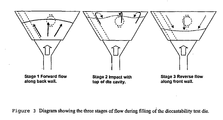
- the die was designed to provide both diverging and converging flow paths (see Figure 3 ). This was achieved by having a fan gate that fed metal along the flat fixed half of the die (diverging), then flowed over the top section and then along the back wall (moving half of the die) back towards the gate (converging). This flow pattern gave an effective flow length of 130mm, ie. twice the height of the casting.
- the large rib that is formed along one side of the cast part, and the boss.
- the rib provides a very thick section parallel to the flow direction intended to reveal problems of channelling, where metal flows preferentially along a thick section.
- the boss is typical of many structural castings and is usually difficult to form. The corners where the boss and the rib meet the casting are sharp so as to maximise any hot or shrinkage cracking that may occur.
- the die had three strips of varying surface finish parallel to the flow direction.
- the surface finishes are full polish, semi-matt and full matt (EDM finish). These strips give an indication of the ease with which an alloy will form these surfaces. Accordingly, the die was designed to rigorously test the performance of any alloy cast in it by HPDC. A part cast from the die is illustrated in Figure 4 .
- AZ91D was cast with a molten metal temperature of 700°C and an estimated die temperature of 200°C; whereas, Alloys B and C were cast with a molten metal temperature of 740°C and an estimated die temperature of 250°C.
- Castings made with both AZ91D and Alloys B and C had a high quality surface finish although the AZ91D castings did have some surface cold shuts which may indicate that the oil temperature, and hence die temperature, should have been slightly higher.
- the molten metal temperature for AZ91D was in the upper region for normal HPDC casting of AZ91D.
- the surface finishes on both sides of the castings from Alloys B and C were good which demonstrated that both alloys can flow reasonable distances.
- the holding time in the die was varied so that some idea of the cracking propensity could be determined.
- the casting has many thick and thin sections with sharp corners at the changes in section thickness, which should have meant that the resultant castings should exhibit cracks.
- In the castings of Alloys B and C there were no signs of cracking while in the AZ91D castings there were some signs of hot tearing in one section of the large rib.
- Alloys B and C have excellent die castability approximately equivalent to AZ91D although the melt temperature and die temperature required for Alloys B and C were higher than that required for AZ91D.
- test specimens were produced by the high pressure die casting (HPDC) of the alloys on a 250 tonne Toshiba cold chamber machine. Two dies were designed with magnesium alloys in mind to cast tensile/creep specimens and bolt load retention bosses.
- the alloy properties that were evaluated included casting quality, as-cast microstructure, tensile strength at room temperature and 177°C, creep behaviour at 150°C and 177°C, and bolt load retention (BLR) behaviour at 150°C and 177°C.
- FIG. 5 A typical example of the microstructure of an alloy (Alloy G) in the as-cast condition, is shown in Figure 5 . Due to the nature of HPDC there is a transition from a fine grain structure, close to the surface of the cast specimen (the “skin”), to a coarser grain structure in the central region (the “core”). Both regions consist of primary magnesium-rich grains or dendrites with a Mg-RE intermetallic phase in the inter-granular and interdendritic regions.
- Table 5 A summary of the tensile test data for various of the alloys is given in Table 5 below and it can be seen that the tensile behaviour of alloys according to the present invention is very good at both of the test temperatures considered.
- Table 5 Tensile properties of various alloys at room temperature and 177°C. Alloy 20°C 177°C 0.2% Proof, (MPa) UTS, (MPa) % Elong. 0.2% Proof, (MPa) UTS, (MPa) % Elong.
- the first group contains those alloys which have an Al content of less than 0.03 wt.% (Alloys D and F) and it can be seen that these compositions display a relatively high secondary creep rate.
- the second group contains those alloys which have an Al content of more than 0.02 wt.% and less than 0.11 wt.% (Alloys E, G, H, I, N, O, R, S, T, U, V and W) and it can be seen that these alloys display secondary creep rates that are very low, in the range of 10 -10 -10 -11 s -1 , and therefore these compositions would be classified as very creep resistant under these test conditions.
Landscapes
- Chemical & Material Sciences (AREA)
- Engineering & Computer Science (AREA)
- Materials Engineering (AREA)
- Mechanical Engineering (AREA)
- Metallurgy (AREA)
- Organic Chemistry (AREA)
- Forging (AREA)
- Continuous Casting (AREA)
- Materials For Medical Uses (AREA)
- Dental Preparations (AREA)
Abstract
Description
- The present invention relates to magnesium alloys and, more particularly, to magnesium alloys which can be cast by high pressure die casting (HPDC).
- With the increasing need to limit fuel consumption and reduce harmful emissions into the atmosphere, automobile manufacturers are seeking to develop more fuel efficient vehicles. Reducing the overall weight of vehicles is a key to achieving this goal. Major contributors to the weight of any vehicle are the engine and other components of the powertrain. The most significant component of the engine is the cylinder block, which makes up 20 - 25% of the total engine weight. In the past significant weight savings were made by introducing aluminium alloy cylinder blocks to replace traditional grey iron blocks, and further weight reductions of the order of 40% could be achieved if a magnesium alloy that could withstand the temperatures and stresses generated during engine operation was used. Development of such an alloy, which combines the desired elevated temperature mechanical properties with a cost effective production process, is necessary before viable magnesium engine block manufacturing can be considered.
- HPDC is a highly productive process for mass production of light alloy components. While the casting integrity of sand casting and low pressure/gravity permanent mould castings is generally higher than HPDC, HPDC is a less expensive technology for higher volume mass production. HPDC is gaining popularity among automobile manufacturers in North America and is the predominant process used for casting aluminium alloy engine blocks in Europe and Asia. In recent years, the search for an elevated temperature magnesium alloy has focused primarily on the HPDC processing route and several alloys have been developed. One such alloy is disclosed for example in the international patent application
WO 96/24701 - In a first aspect the invention provides a magnesium-based alloy consisting of, by weight:
- 1.5-4.0% rare earth element(s),
- 0.3- 0.8% zinc,
- 0.04-0.08 % aluminium,
- 4- 25 ppm beryllium,
- 0-0.2% zirconium,
- 0-0.3% manganese,
- 0-0.5% yttrium,
- 0-0.1% calcium, and
- Throughout this specification the expression "rare earth" is to be understood to mean any element or combination of elements with atomic numbers 57 to 71, ie. lanthanum (La) to lutetium (Lu).
- Preferably, alloys according to the present invention contain at least 95.5% magnesium, more preferably 95.5-97% magnesium, and most preferably about 96.1% magnesium.
- The neodymium content is preferably 1.0-2.5% by weight. In one embodiment, the neodymium content is 1.4-2.1% by weight. In another embodiment, the neodymium content is greater than 1.7%, more preferably greater than 1.8%, more preferably 1.8-2.0% and most preferably about 1.9%. In another embodiment, the neodymium content is 1.7-1.9% by weight. The neodymium content may be derived from pure neodymium, neodymium contained within a mixture of rare earths such as a misch metal, or a combination thereof.
- Preferably, the content of rare earth(s) other than neodymium is 0.5-1.5%, more preferably 0.8-1.2%, more preferably 0.9-1.2%, such as about 1.1%. Preferably, the rare earth(s) other than neodymium are cerium (Ce), lanthanum (La), or a mixture thereof. Preferably, cerium comprises over half the weight of the rare earth elements other than neodymium, more preferably 60-80%, especially about 70% with lanthanum comprising substantially the balance. The rare earth(s) other than neodymium may be derived from pure rare earths, a mixture of rare earths such as a misch metal or a combination thereof. Preferably, the rare earths other than neodymium are derived from a cerium misch metal containing cerium, lanthanum, optionally neodymium, a modest amount of praseodymium (Pr) and trace amounts of other rare earths.
- In a preferred embodiment, the neodymium, cerium and lanthanum contents are 1.7- 2.1%, more preferably 1.7-1.9% by weight; 0.5-0.7%, more preferably 0.55-0.65% by weight; and 0.3-0.5% by weight respectively.
- The zinc content is 0.3- 0.8% by weight, preferably 0.4-0.7%, more preferably 0.5-0.6%.
- The aluminium content is 0.04-0.08% by weight, preferably 0.05-0.07% by weight. Without wishing to be bound by theory, the inclusion of these small amounts of aluminium in the alloys of the present invention is believed to improve the creep properties of the alloys.
- The beryllium content is 4- 25 ppm, more preferably 4-20 ppm, more preferably 4-15 ppm, more preferably 6-13 ppm, such as 8-12 ppm. Beryllium would typically be introduced by way of an aluminium-beryllium master alloy, such as an Al-5% Be alloy. Without wishing to be bound by theory, the inclusion of beryllium is believed to improve the die castability of the alloy. Again, without wishing to be bound by theory, the inclusion of beryllium is also believed to improve the retention of the rare earth element(s) in the alloys against oxidation losses.
- Reduction in iron content can be achieved by addition of zirconium which precipitates iron from the molten alloy. Accordingly, the zirconium contents specified herein are residual zirconium contents. However, it is to be noted that zirconium may be incorporated at two different stages. Firstly, on manufacture of the alloy and secondly, following melting of the alloy just prior to casting. Preferably, the zirconium content will be the minimum amount required to achieve satisfactory iron removal. Typically, the zirconium content will be less than 0.1%.
- Manganese is an optional component of the alloy. When present, the manganese content will typically be about 0.1%.
- Calcium (Ca) is an optional component which may be included, especially in circumstances where adequate melt protection through cover gas atmosphere control is not possible. This is particularly the case when the casting process does not involve a closed system.
- Yttrium is an optional component which may be included. Without wishing to be bound by theory, the inclusion of yttrium is believed to beneficial to melt protection, ductility and creep resistance. When present, the yttrium content is preferably 0.1-0.4% by weight, more preferably 0.1-0.3% by weight.
- Ideally, the incidental impurity content is zero but it is to be appreciated that this is essentially impossible. Accordingly, it is preferred that the incidental impurity content is less than 0.15%, more preferably less than 0.1%, more preferably less than 0.01%, and still more preferably less than 0.001%.
- In a third aspect, the present invention provides an engine block for an internal combustion engine produced by high pressure die casting an alloy according to the first or second aspects of the present invention.
- In a fourth aspect, the present invention provides a component of an internal combustion engine formed from an alloy according to the first or second aspects of the present invention. The component of an internal combustion engine may be the engine block or a portion thereof such as a shroud.
- Specific reference is made above to engine blocks but it is to be noted that alloys of the present invention may find use in other elevated temperature applications such as may be found in automotive powertrains as well as in low temperature applications. Specific reference is also made above to HPDC but it is to be noted that alloys of the present invention may be cast by techniques other than HPDC including thixomoulding, thixocasting, permanent moulding and sand casting.
- Three alloys were prepared and chemical analyses of the alloys are set out in Table 1 below. The rare earths other than neodymium were added as a Ce-based misch metal which contained cerium, lanthanum and some neodymium. The extra neodymium and the zinc were added in their elemental forms. The zirconium was added through a proprietary Mg-Zr master alloy known as AM-cast. Aluminium and beryllium were added through an aluminium-beryllium master alloy which contained 5% by weight of beryllium. Standard melt handling procedures were used throughout preparation of the alloys.
Table 1 - Alloys Prepared Element Alloy A Alloy B Alloy C Nd (wt%) 1.61 1.86 1.85 Ce (wt%) 0.51 0.71 0.71 La (wt%) 0.49 0.48 0.49 Zn (wit%) 0.48 0.68 0.71 Zr (wt%) 0.1 0.06 0.06 Ca (wt%) - <0.01 0.1 Be (ppm) - 6 9 Al (wt%) - 0.04 0.04 Mg (wt%) Balance except for incidental impurities Balance except for incidental impurities Balance except for incidental impurities - Alloys A, B and C were high pressure die cast and creep tests were carried out at a constant load of 90MPa and at a temperature of 177°C. An additional creep test at 100MPa and 177°C was carried out for Alloy B. The steady state creep rates are listed in Table 2.
Table 2 - Steady State Creep Rates Steady State Creep Rates (s-1) 90MPa 177°C 100MPa 177°C Alloy A 2 x 10⁻⁹ - Alloy B 1 x 10⁻¹⁰ 1 x 10⁻¹⁰ Alloy C x 10-9 - -
Figure 1 shows the creep results for 177°C and 90MPa for Alloys A, B and C. The creep curve for Alloy B at 177°C and 100MPa is also shown. Both Alloy B and Alloy C are superior to Alloy A. The insert graph inFigure 1 shows the initial primary behaviour of Alloy B at 177°C and stresses of 90MPa and 100MPa. There is a higher initial response observed at 100MPa but the creep curve levels out to show a very similar steady state creep rate to that at the lower stress. - The stress to give a value of 0.1% creep strain after 100 hours is often quoted when comparing various creep resistant magnesium alloys. Neither Alloy B nor Alloy C had creep strains of this order after 100 hours at 177°C and 90MPa, although creep strains in excess of that were reached at much longer test times. At 177°C Alloy B and Alloy C would be acceptable for most automotive powertrain applications in terms of their creep behaviour.
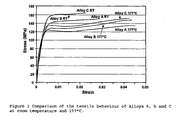
- The tensile properties were measured in accordance with ASTM E8 at 20, 100, 150 and 177°C in air using an Instron Universal Testing Machine. Samples were held at temperature for 10 minutes prior to testing. The test specimens had a circular cross section (5.6mm diameter), with a gauge length of 25mm.
- Tensile test results for Alloys A, B and C are set out in Table 3 and
Figure 2 illustrates typical Stress-Strain curves for the three alloys at room temperature and 177°C.Table 3 - Tensile Test Data Alloy Alloy A Alloy B Alloy C Test Temperature, °C 0.2% Proof MPa UTS MPa % E 0.2% Proof MPa UTS MPa % E 0.2% Proof MPa UTS MPa % E 21 133 ± 5 151.4 ± 12.0 2.7 ± 1.0 139.8 ± 3.9 161.3 ± 4.2 1. 9 ± 0.4 144.8 ± 4.0 165.1 ± 2.3 2.6 ± 0.4 100 - - - 140.7 ± 3.0 156.5 ± 5.9 3.4 ± 0.8 147.3 ± 4.2 155.0 ± 3.0 2.6 ± 0.9 150 - - - 134.5 ± 2.2 154.9 ± 9.4 4.6 ± 1.4 136.5 ± 3.5 150.0 ± 5.5 3.6 ± 0.5 177 118 ± 5 136 ± 5.3 5.5 ± 1.2 131.2 ± 4.3 149.0 ± 7.3 4.8 ± 1.0 134.1 ± 1.2 152.7 ± 3.3 4.4 ± 0.8 - Alloys B and C and commercial alloy AZ91D were die cast in a triangular shaped die which had oil heating/cooling in both the fixed and moving halves of the mould. A thermocouple was present in the centre of the moving half.
- The die was designed to provide both diverging and converging flow paths (see
Figure 3 ). This was achieved by having a fan gate that fed metal along the flat fixed half of the die (diverging), then flowed over the top section and then along the back wall (moving half of the die) back towards the gate (converging). This flow pattern gave an effective flow length of 130mm, ie. twice the height of the casting. - Referring to
Figure 4 , other features of the die are the large rib, that is formed along one side of the cast part, and the boss. The rib provides a very thick section parallel to the flow direction intended to reveal problems of channelling, where metal flows preferentially along a thick section. The boss is typical of many structural castings and is usually difficult to form. The corners where the boss and the rib meet the casting are sharp so as to maximise any hot or shrinkage cracking that may occur. - Finally the die had three strips of varying surface finish parallel to the flow direction. The surface finishes are full polish, semi-matt and full matt (EDM finish). These strips give an indication of the ease with which an alloy will form these surfaces. Accordingly, the die was designed to rigorously test the performance of any alloy cast in it by HPDC. A part cast from the die is illustrated in
Figure 4 . - Particulars of the HPDC conditions for the die are set out below.
Gate Dimensions = 58mm x 1mm Plunger Diameter. = 50 mm High Speed = 2.25 m/s Slow Speed = 0.35 m/s Gate Velocity = Vplunger X Aplunger/ Agate = 76 m/s - AZ91D was cast with a molten metal temperature of 700°C and an estimated die temperature of 200°C; whereas, Alloys B and C were cast with a molten metal temperature of 740°C and an estimated die temperature of 250°C.
- Castings made with both AZ91D and Alloys B and C had a high quality surface finish although the AZ91D castings did have some surface cold shuts which may indicate that the oil temperature, and hence die temperature, should have been slightly higher. The molten metal temperature for AZ91D was in the upper region for normal HPDC casting of AZ91D. The surface finishes on both sides of the castings from Alloys B and C were good which demonstrated that both alloys can flow reasonable distances.
- All alloys cast with equivalent castability although Alloys B and C did have a more rapid reduction in quality at the limit of their operating windows. For example, if insufficient metal was dosed into the shot sleeve, which led to a reduction in the molten metal temperature entering the cavity, then surface quality diminished rapidly.
- For all alloys, the holding time in the die was varied so that some idea of the cracking propensity could be determined. The casting has many thick and thin sections with sharp corners at the changes in section thickness, which should have meant that the resultant castings should exhibit cracks. In the castings of Alloys B and C there were no signs of cracking while in the AZ91D castings there were some signs of hot tearing in one section of the large rib.
- The die casting trial demonstrated that Alloys B and C have excellent die castability approximately equivalent to AZ91D although the melt temperature and die temperature required for Alloys B and C were higher than that required for AZ91D.
- A series of alloys were produced and their compositions are listed in Table 4 below. In each of Alloys D-Y, except for any incidental impurities, the balance of the alloy was magnesium.
Table 4 Chemical compositions of Alloys D-Y Alloy Nd (wt.%) Ce (wt.%) La (wt.%) Zn (wt.%) Be (ppm) Al (wt.%) Fe (ppm) Zr (soluble) (wt.%) Zr (total) (wt.%) *D 1.55 0.50 0.48 0.50 Not Added <0.01 20 - 0.10 E 1.85 0.71 0.48 0.68 6 0.04 - - 0.07 *F 1.84 0.69 0.49 0.62 <1 <0.01 - 0.09 0.16 *G 1.70 0.66 0.49 0.60 <1 0.03 - 0.015 0.05 *H 1.38 0.60 0.47 0.61 <1 0.07 - 0.01 0.03 *I 1.13 0.46 0.33 0.47 <1 0.03 - <0.01 0.015 *J 1.15 0.46 0.34 0.49 7 0.11 - 0.01 0.03 *K 0.82 0.29 1.51 0.59 8 0.09 - <0.005 0.011 L 0.81 0.29 1.80 0.60 9 0.08 - <0.005 0.020 *M 1.55 0.58 0.34 0.59 7 0.09 <5 0.015 0.026 N 1.41 0.55 0.33 0.60 5 0.05 6 0.014 0.030 *O 1.43 0.56 0.33 0.59 13 0.09 5 0.012 0.028 *P 1.45 0.56 0.32 0.60 11 0.12 5 0.010 0.028 *Q 1.46 0.55 0.32 0.57 13 0.23 <5 <0.005 0.012 R 1.71 0.56 0.31 0.59 11 0.05 67 0.003 0.012 S 2.00 0.54 0.31 0.60 8 0.05 69 0.003 0.009 T 1.90 0.55 0.42 0.60 5 0.05 58 <0.005 0.008 U 1.71 0.66 0.51 0.58 4 0.05 58 <0.005 0.005 V 1.66 0.65 0.50 0.61 6 0.06 62 <0.005 0.006 W 1.61 0.64 0.49 0.59 5 0.07 59 <0.005 0.005 *X 1.78 0.65 0.49 0.61 5 0.11 57 <0.005 0.005 Y 1.74 0.56 0.41 0.58 13 0.07 5 0.008 0.036 Are not within the scope of the invention. - For the purposes of mechanical property evaluation, test specimens were produced by the high pressure die casting (HPDC) of the alloys on a 250 tonne Toshiba cold chamber machine. Two dies were designed with magnesium alloys in mind to cast tensile/creep specimens and bolt load retention bosses. The alloy properties that were evaluated included casting quality, as-cast microstructure, tensile strength at room temperature and 177°C, creep behaviour at 150°C and 177°C, and bolt load retention (BLR) behaviour at 150°C and 177°C.
- A typical example of the microstructure of an alloy (Alloy G) in the as-cast condition, is shown in
Figure 5 . Due to the nature of HPDC there is a transition from a fine grain structure, close to the surface of the cast specimen (the "skin"), to a coarser grain structure in the central region (the "core"). Both regions consist of primary magnesium-rich grains or dendrites with a Mg-RE intermetallic phase in the inter-granular and interdendritic regions. - A summary of the tensile test data for various of the alloys is given in Table 5 below and it can be seen that the tensile behaviour of alloys according to the present invention is very good at both of the test temperatures considered.
Table 5 Tensile properties of various alloys at room temperature and 177° C. Alloy 20°C 177°C 0.2% Proof, (MPa) UTS, (MPa) % Elong. 0.2% Proof, (MPa) UTS, (MPa) % Elong. *D 133 ± 5.0 151.4 ± 12.0 2.7 ± 1.0 118 ± 5.0 136 ± 5.3 5.5 ± 1.1 E 139.8 ± 3.9 161.3 ± 4.2 1.9 ± 0.4 131.2 ± 4.3 149.6 ± 7.3 4.8 ± 1.0 *F 148.4 ± 4.1 159.1 ± 8.8 2.0 ± 1.0 127.1 ± 1.7 135.5 ± 7.4 3.5 ± 1.3 *G 143.8 ± 2.5 166.3 ± 3.5 3.0 ± 0.5 128.1 ± 2.6 145.9 ± 11.3 4.7 ± 1.3 *H 130.8 ± 4.2 149.4 ± 12.8 2.0 ± 1.0 115.2 ± 3.1 125.0 ± 6.1 3.9 ± 0.9 *I 122.5 ± 2.1 157.4 ± 7.0 4.5 ± 0.6 109.1 ± 1.7 134.3 ± 4.7 7.1 ± 1.8 *J 112.7 ± 7.4 141.0 ± 2.1 3.0 ± 0.4 105.8 ± 1.1 125.5 ± 5.4 5.7 ± 1.0 *M 129.4 ± 6.8 147.4 ± 6.7 2.3 ± 0.9 109.3 ± 7.7 129.4 ± 3.2 4.1 ± 0.7 N 130.5 ± 1.1 157.3 ± 9.0 3.6 ± 0.8 111.2 ± 6.6 141.2 ± 7.8 6.0 ± 1.2 *O 123.9 ± 3.5 150.9 ± 5.2 3.0 ± 0.6 107.8 ± 8.7 137.9 ± 5.5 5.8 ± 1.1 *P 125.2 ± 2.8 146.7 ± 5.9 2.8 ± 0.3 113.1 ± 2.1 132.6 ± 8.4 4.5 ± 0.8 *Q 124.6 ± 2.4 147.1 ± 3.7 2.7 ± 0.6 108.2 ± 6.8 129.6 ± 1.9 4.3 ± 0.7 R 127.5± 5.0 167.9 ± 6.4 4.3 ± 0.6 117.7 ± 4.1 147.2 ± 2.1 7.0 ± 0.6 S 131.2 ± 4.0 159.2 ± 6.8 3.3 ± 0.7 121.6 ± 1.2 146.2 ± 4.7 5.8 ± 0.6 T 138.7 ± 2.6 166.5 ± 3.5 3.9 ± 0.3 124.4 ± 1.8 150.4 ± 4.0 6.0 ± 0.8 U 136.8 ± 2.9 165.4 ± 6.3 3.7 ± 0.3 124.5 ± 1.6 146.7 ± 3.8 5.3 ± 0.8 V 135.2 ± 1.2 154.3 ± 6.4 2.6 ± 0.8 122.2 ± 2.5 144.9 ± 5.4 5.2 ± 0.7 W 130.0 ± 1.7 154.0 ± 5.7 2.7 ± 0.5 115.9 ± 2.9 138.8 ± 6.0 4.3 ± 0.9 *X 134.2 ± 6.2 156.0 ± 4.3 2.6 ± 0.8 116.6 ± 4.5 138.0 ± 3.6 4.1 ± 0.5 * Are not within the scope of the invention. - A summary of the secondary creep rates under the same conditions of 177°C and 90MPa for various of the alloys are contained in Table 6 below. These test conditions were chosen specifically to provide a stringent test that would identify magnesium alloys with creep properties suitable for demanding automotive powertrain applications.
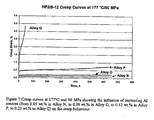
Table 6 Steady-state creep rates of various alloys. Alloy Steady State Creep Rate at 177°C and 90 MPa, (s-1) D 1.9 x 10⁻⁹ E 1.0 x 10⁻¹⁰ F 1.4 x 10⁻⁹ G 3.0 x 10⁻¹¹ H 2.5 x 10⁻¹⁰ I 1.8 x 10⁻¹⁰ J 1.2 x 10⁻⁹ N 3.0 x 10⁻¹¹ O 6.0 x 10⁻¹¹ P 1.0 x 10⁻⁹ Q 6.1 x 10⁻⁸ R 6.4 x 10⁻¹⁰ S 5.5 x 10⁻¹⁰ T 3.3 x 10⁻¹⁰ U 2.2 x 10⁻¹⁰ V 3.1 x 10⁻¹⁰ W 6.9 x 10⁻¹¹ - These results can be divided into three groups depending on the observed creep behaviour and the Al content of the alloy. The first group contains those alloys which have an Al content of less than 0.03 wt.% (Alloys D and F) and it can be seen that these compositions display a relatively high secondary creep rate. The second group contains those alloys which have an Al content of more than 0.02 wt.% and less than 0.11 wt.% (Alloys E, G, H, I, N, O, R, S, T, U, V and W) and it can be seen that these alloys display secondary creep rates that are very low, in the range of 10-10-10-11s-1, and therefore these compositions would be classified as very creep resistant under these test conditions. This is illustrated by the comparison of the creep behaviour, at 177°C and 90MPa, of Alloys E and F in
Figure 6 . The two alloys have very similar base compositions; however, Alloy F with a low Al content (Al <0.01 wt.%) has a vastly inferior creep performance when compared to that of Alloy E (Al 0.04 wt.%). The third group contains those alloys which have an Al content of 0.11 wt.% or greater (Alloys J, P and Q) and it can be seen that these compositions also display relatively high secondary creep rates, as observed for group one and therefore both groups one and three would be classified as not being sufficiently creep resistant under the imposed test conditions. Therefore, these results suggest that under these extreme test conditions (177°C and 90MPa) there is an optimum Al content within which an alloy composition must remain to achieve a creep performance that is suitable for the most demanding powertrain applications. This is most dramatically illustrated by the comparison of the creep behaviour of Alloys N, O, P and Q tested at 177°C and 90MPa as shown inFigure 8 . All of these alloys possess very similar compositions apart from the Al content. The transition in creep behaviour across these four compositions from extremely good for Alloy N to extremely poor for Alloy Q with an increase in Al content from 0.05 wt.% to 0.23 wt.% is clear. - The BLR behaviour for Alloy Y was measured at 150°C and 177°C, with loads of 8 kN and 11 kN. The results are presented in two charts:
- The overall percentage load retained after returning to room temperature (
Figure 8 ), and - The percentage load retained at the test temperature, being the creep component of the overall behaviour (
Figure 9 ).
Claims (15)
- A magnesium-based alloy consisting of, by- weight:1.5-4.0% rare earth element (s),0.3- 0.8% zinc,04-0.08% aluminium,4- 25 ppm beryllium,0-0.2% zirconium, 0-0.3% manganese,0-0.5% yttrium,0-0.1 % calcium, and the remainder being magnesium except for incidental impurities
- An alloy as claimed in claim 1 having a rare earth element (s) content of 2.2-3.3% by weight.
- An alloy as claimed in claim 1 or claim 2 wherein the rare earth element (s) are selected from neodymium, cerium, lanthanum, praseodymium, or any combination thereof.
- An alloy as claimed in claim 1 having a neodymium content of 1.0-2.5% by weight.
- An alloy as claimed in claim 4 having a neodymium content of 1.4-2.1 % by weight.
- An alloy as claimed in claim 4 or claim 5 wherein the content of rare earth element (s) other than neodymium is 0.5-1.5% by weight.
- An alloy as claimed in claim 6 wherein the content of rare earth element (s) other than neodymium is 0.8-1.2% by weight.
- An alloy as claimed in any one of the preceding claims having a zinc content of 0.4-0.7% by weight.
- An alloy as claimed in any of the previous claims containing 0.1-0.4% by weight yttrium.
- An alloy as claimed in any of the previous claims containing 0.1-0.3% by weight yttrium.
- An alloy as claimed in any one of the preceding claims having an aluminium content of 0.05 - 0.07% by weight.
- An alloy as claimed in any one of the preceding claims having a beryllium content of 4-15 ppm.
- An alloy as claimed in any of the previous claims having a beryllium content of 8-12 ppm.
- A component of an internal combustion engine or automotive powertrain formed from an alloy as claimed in any one of the preceding claims.
- An engine block or portion thereof produced by high pressure die casting an alloy as claimed in any one of claims 1-14.
Applications Claiming Priority (2)
| Application Number | Priority Date | Filing Date | Title |
|---|---|---|---|
| AU2005901623A AU2005901623A0 (en) | 2005-04-04 | Magnesium alloy | |
| PCT/AU2006/000447 WO2006105594A1 (en) | 2005-04-04 | 2006-04-04 | Magnesium alloy |
Publications (3)
| Publication Number | Publication Date |
|---|---|
| EP1866452A1 EP1866452A1 (en) | 2007-12-19 |
| EP1866452A4 EP1866452A4 (en) | 2009-07-08 |
| EP1866452B1 true EP1866452B1 (en) | 2012-06-20 |
Family
ID=37073015
Family Applications (1)
| Application Number | Title | Priority Date | Filing Date |
|---|---|---|---|
| EP06721329A Expired - Lifetime EP1866452B1 (en) | 2005-04-04 | 2006-04-04 | Magnesium alloy |
Country Status (7)
| Country | Link |
|---|---|
| US (2) | US7682470B2 (en) |
| EP (1) | EP1866452B1 (en) |
| JP (1) | JP2008536008A (en) |
| CN (1) | CN100567539C (en) |
| CA (1) | CA2603858C (en) |
| TW (1) | TW200641150A (en) |
| WO (1) | WO2006105594A1 (en) |
Cited By (1)
| Publication number | Priority date | Publication date | Assignee | Title |
|---|---|---|---|---|
| EP3097217A4 (en) * | 2014-01-23 | 2017-09-20 | Dead Sea Magnesium Ltd. | High performance creep resistant magnesium alloys |
Families Citing this family (15)
| Publication number | Priority date | Publication date | Assignee | Title |
|---|---|---|---|---|
| WO2009039581A1 (en) * | 2007-09-28 | 2009-04-02 | Cast Crc Limited | Permanent mould cast magnesium alloy |
| JP2011509350A (en) * | 2008-01-09 | 2011-03-24 | キャスト シーアールシー リミテッド | Magnesium alloy |
| DE102009025511A1 (en) * | 2009-06-19 | 2010-12-23 | Qualimed Innovative Medizin-Produkte Gmbh | Implant with a resorbable metallic material |
| US8435444B2 (en) | 2009-08-26 | 2013-05-07 | Techmag Ag | Magnesium alloy |
| TWI481727B (en) * | 2010-03-08 | 2015-04-21 | Sumitomo Electric Industries | Magnesium alloy long member, bolt, nut and washer |
| KR101646267B1 (en) * | 2010-05-28 | 2016-08-05 | 현대자동차주식회사 | HEAT RESISTING Mg ALLOY FOR GRAVITY CATING WITH HIGH CREEP RESISTANCE |
| KR101878212B1 (en) * | 2010-09-08 | 2018-07-16 | 신세스 게엠바하 | Fixation device with magnesium core |
| EP2987875B1 (en) * | 2013-04-15 | 2018-10-10 | National University Corporation Kumamoto University | Fire-resistant magnesium alloy and production method therefor |
| CN105525172A (en) | 2014-11-13 | 2016-04-27 | 比亚迪股份有限公司 | Magnesium alloy as well as preparation method thereof and application thereof |
| KR101889018B1 (en) | 2016-12-23 | 2018-09-20 | 주식회사 포스코 | Magnesium alloy sheet and method for manufacturing the same |
| CN109550936A (en) * | 2018-12-24 | 2019-04-02 | 南通金源智能技术有限公司 | Magnesium alloy powder and preparation method thereof |
| SE543126C2 (en) * | 2019-02-20 | 2020-10-13 | Husqvarna Ab | A magnesium alloy, a piston manufactured by said magnesium alloy and a method for manufacturing said piston |
| GB2583482A (en) | 2019-04-29 | 2020-11-04 | Univ Brunel | A casting magnesium alloy for providing improved thermal conductivity |
| CN110117743B (en) * | 2019-05-24 | 2020-08-11 | 珠海中科先进技术研究院有限公司 | A kind of corrosion-resistant high-strength and tough magnesium alloy pipe and preparation process |
| DK3975942T3 (en) | 2019-06-03 | 2024-09-16 | Fort Wayne Metals Res Products Llc | MAGNESIUM-BASED ABSORBABLE ALLOYS |
Family Cites Families (6)
| Publication number | Priority date | Publication date | Assignee | Title |
|---|---|---|---|---|
| DE1239105B (en) * | 1963-10-26 | 1967-04-20 | Fuchs Fa Otto | Magnesium alloys containing zirconium |
| DE4104680C2 (en) * | 1991-02-15 | 2000-05-18 | Kolbenschmidt Ag | Light alloy pistons for internal combustion engines |
| AU666268B2 (en) * | 1993-12-03 | 1996-02-01 | Toyota Jidosha Kabushiki Kaisha | Heat resistant magnesium alloy |
| GB9502238D0 (en) * | 1995-02-06 | 1995-03-29 | Alcan Int Ltd | Magnesium alloys |
| JP3961147B2 (en) * | 1999-03-15 | 2007-08-22 | 東芝電池株式会社 | Hydrogen storage alloy and secondary battery |
| AUPS311202A0 (en) * | 2002-06-21 | 2002-07-18 | Cast Centre Pty Ltd | Creep resistant magnesium alloy |
-
2006
- 2006-04-04 US US11/910,339 patent/US7682470B2/en not_active Expired - Fee Related
- 2006-04-04 CA CA2603858A patent/CA2603858C/en not_active Expired - Fee Related
- 2006-04-04 TW TW095111956A patent/TW200641150A/en unknown
- 2006-04-04 JP JP2008503325A patent/JP2008536008A/en active Pending
- 2006-04-04 EP EP06721329A patent/EP1866452B1/en not_active Expired - Lifetime
- 2006-04-04 CN CNB2006800197988A patent/CN100567539C/en not_active Expired - Fee Related
- 2006-04-04 WO PCT/AU2006/000447 patent/WO2006105594A1/en not_active Ceased
-
2009
- 2009-08-21 US US12/545,149 patent/US7942986B2/en not_active Expired - Fee Related
Cited By (1)
| Publication number | Priority date | Publication date | Assignee | Title |
|---|---|---|---|---|
| EP3097217A4 (en) * | 2014-01-23 | 2017-09-20 | Dead Sea Magnesium Ltd. | High performance creep resistant magnesium alloys |
Also Published As
| Publication number | Publication date |
|---|---|
| US20100061880A1 (en) | 2010-03-11 |
| WO2006105594A1 (en) | 2006-10-12 |
| US7682470B2 (en) | 2010-03-23 |
| JP2008536008A (en) | 2008-09-04 |
| EP1866452A1 (en) | 2007-12-19 |
| US7942986B2 (en) | 2011-05-17 |
| TW200641150A (en) | 2006-12-01 |
| US20090136380A1 (en) | 2009-05-28 |
| CA2603858C (en) | 2015-10-20 |
| CA2603858A1 (en) | 2006-10-12 |
| EP1866452A4 (en) | 2009-07-08 |
| CN100567539C (en) | 2009-12-09 |
| CN101189354A (en) | 2008-05-28 |
Similar Documents
| Publication | Publication Date | Title |
|---|---|---|
| US7942986B2 (en) | Magnesium alloy | |
| US6921512B2 (en) | Aluminum alloy for engine blocks | |
| US20100310409A1 (en) | Magnesium based alloy | |
| US20080193322A1 (en) | Hpdc Magnesium Alloy | |
| CN1318632C (en) | Creep resistant magnesium alloy | |
| EP0879898A1 (en) | Magnesium alloy having superior elevated-temperature properties and die castability | |
| US11926887B2 (en) | Magnesium alloy, a piston manufactured by said magnesium alloy and a method for manufacturing said piston | |
| EP1897962B1 (en) | Creep resistant magnesium alloy with improved ductility and fracture toughness for gravity casting applications | |
| US5077138A (en) | Fiber reinforced magnesium alloy | |
| Kearney et al. | Aluminum foundry products | |
| US7041179B2 (en) | High strength creep resistant magnesium alloys | |
| JP2002327231A (en) | Cast article of heat-resistant magnesium alloy, and manufacturing method therefor | |
| EP3434797B1 (en) | Advanced cast aluminum alloys for automotive engine application with superior high-temperature properties | |
| JP4285188B2 (en) | Heat-resistant magnesium alloy for casting, casting made of magnesium alloy and method for producing the same | |
| AU2006230799B2 (en) | Magnesium alloy | |
| CN102051510B (en) | Creep-resistance magnesium alloy with improved casting property | |
| JP2024090335A (en) | Magnesium alloy cast structural components |
Legal Events
| Date | Code | Title | Description |
|---|---|---|---|
| PUAI | Public reference made under article 153(3) epc to a published international application that has entered the european phase |
Free format text: ORIGINAL CODE: 0009012 |
|
| 17P | Request for examination filed |
Effective date: 20071003 |
|
| AK | Designated contracting states |
Kind code of ref document: A1 Designated state(s): AT BE BG CH CY CZ DE DK EE ES FI FR GB GR HU IE IS IT LI LT LU LV MC NL PL PT RO SE SI SK TR |
|
| DAX | Request for extension of the european patent (deleted) | ||
| A4 | Supplementary search report drawn up and despatched |
Effective date: 20090608 |
|
| RIC1 | Information provided on ipc code assigned before grant |
Ipc: F02F 7/00 20060101ALI20090602BHEP Ipc: B22D 21/00 20060101ALI20090602BHEP Ipc: B22D 17/00 20060101ALI20090602BHEP Ipc: C22C 23/06 20060101AFI20061025BHEP Ipc: B22D 21/04 20060101ALI20090602BHEP |
|
| 17Q | First examination report despatched |
Effective date: 20090817 |
|
| GRAP | Despatch of communication of intention to grant a patent |
Free format text: ORIGINAL CODE: EPIDOSNIGR1 |
|
| GRAS | Grant fee paid |
Free format text: ORIGINAL CODE: EPIDOSNIGR3 |
|
| GRAA | (expected) grant |
Free format text: ORIGINAL CODE: 0009210 |
|
| AK | Designated contracting states |
Kind code of ref document: B1 Designated state(s): AT BE BG CH CY CZ DE DK EE ES FI FR GB GR HU IE IS IT LI LT LU LV MC NL PL PT RO SE SI SK TR |
|
| REG | Reference to a national code |
Ref country code: GB Ref legal event code: FG4D |
|
| REG | Reference to a national code |
Ref country code: DE Ref legal event code: R081 Ref document number: 602006030303 Country of ref document: DE Owner name: MAGONTEC LIMITED, AU Free format text: FORMER OWNER: CAST CENTRE PTY., LTD., ST. LUCIA, QUEENSLAND, AU |
|
| REG | Reference to a national code |
Ref country code: CH Ref legal event code: EP |
|
| REG | Reference to a national code |
Ref country code: AT Ref legal event code: REF Ref document number: 563125 Country of ref document: AT Kind code of ref document: T Effective date: 20120715 |
|
| REG | Reference to a national code |
Ref country code: IE Ref legal event code: FG4D |
|
| REG | Reference to a national code |
Ref country code: DE Ref legal event code: R096 Ref document number: 602006030303 Country of ref document: DE Effective date: 20120816 |
|
| PG25 | Lapsed in a contracting state [announced via postgrant information from national office to epo] |
Ref country code: LT Free format text: LAPSE BECAUSE OF FAILURE TO SUBMIT A TRANSLATION OF THE DESCRIPTION OR TO PAY THE FEE WITHIN THE PRESCRIBED TIME-LIMIT Effective date: 20120620 Ref country code: SE Free format text: LAPSE BECAUSE OF FAILURE TO SUBMIT A TRANSLATION OF THE DESCRIPTION OR TO PAY THE FEE WITHIN THE PRESCRIBED TIME-LIMIT Effective date: 20120620 Ref country code: FI Free format text: LAPSE BECAUSE OF FAILURE TO SUBMIT A TRANSLATION OF THE DESCRIPTION OR TO PAY THE FEE WITHIN THE PRESCRIBED TIME-LIMIT Effective date: 20120620 |
|
| REG | Reference to a national code |
Ref country code: NL Ref legal event code: VDEP Effective date: 20120620 |
|
| REG | Reference to a national code |
Ref country code: AT Ref legal event code: MK05 Ref document number: 563125 Country of ref document: AT Kind code of ref document: T Effective date: 20120620 |
|
| REG | Reference to a national code |
Ref country code: LT Ref legal event code: MG4D Effective date: 20120620 |
|
| PG25 | Lapsed in a contracting state [announced via postgrant information from national office to epo] |
Ref country code: GR Free format text: LAPSE BECAUSE OF FAILURE TO SUBMIT A TRANSLATION OF THE DESCRIPTION OR TO PAY THE FEE WITHIN THE PRESCRIBED TIME-LIMIT Effective date: 20120921 Ref country code: LV Free format text: LAPSE BECAUSE OF FAILURE TO SUBMIT A TRANSLATION OF THE DESCRIPTION OR TO PAY THE FEE WITHIN THE PRESCRIBED TIME-LIMIT Effective date: 20120620 Ref country code: SI Free format text: LAPSE BECAUSE OF FAILURE TO SUBMIT A TRANSLATION OF THE DESCRIPTION OR TO PAY THE FEE WITHIN THE PRESCRIBED TIME-LIMIT Effective date: 20120620 |
|
| PG25 | Lapsed in a contracting state [announced via postgrant information from national office to epo] |
Ref country code: RO Free format text: LAPSE BECAUSE OF FAILURE TO SUBMIT A TRANSLATION OF THE DESCRIPTION OR TO PAY THE FEE WITHIN THE PRESCRIBED TIME-LIMIT Effective date: 20120620 Ref country code: IS Free format text: LAPSE BECAUSE OF FAILURE TO SUBMIT A TRANSLATION OF THE DESCRIPTION OR TO PAY THE FEE WITHIN THE PRESCRIBED TIME-LIMIT Effective date: 20121020 Ref country code: CY Free format text: LAPSE BECAUSE OF FAILURE TO SUBMIT A TRANSLATION OF THE DESCRIPTION OR TO PAY THE FEE WITHIN THE PRESCRIBED TIME-LIMIT Effective date: 20120620 Ref country code: EE Free format text: LAPSE BECAUSE OF FAILURE TO SUBMIT A TRANSLATION OF THE DESCRIPTION OR TO PAY THE FEE WITHIN THE PRESCRIBED TIME-LIMIT Effective date: 20120620 Ref country code: BE Free format text: LAPSE BECAUSE OF FAILURE TO SUBMIT A TRANSLATION OF THE DESCRIPTION OR TO PAY THE FEE WITHIN THE PRESCRIBED TIME-LIMIT Effective date: 20120620 Ref country code: AT Free format text: LAPSE BECAUSE OF FAILURE TO SUBMIT A TRANSLATION OF THE DESCRIPTION OR TO PAY THE FEE WITHIN THE PRESCRIBED TIME-LIMIT Effective date: 20120620 Ref country code: SK Free format text: LAPSE BECAUSE OF FAILURE TO SUBMIT A TRANSLATION OF THE DESCRIPTION OR TO PAY THE FEE WITHIN THE PRESCRIBED TIME-LIMIT Effective date: 20120620 |
|
| PG25 | Lapsed in a contracting state [announced via postgrant information from national office to epo] |
Ref country code: PL Free format text: LAPSE BECAUSE OF FAILURE TO SUBMIT A TRANSLATION OF THE DESCRIPTION OR TO PAY THE FEE WITHIN THE PRESCRIBED TIME-LIMIT Effective date: 20120620 Ref country code: PT Free format text: LAPSE BECAUSE OF FAILURE TO SUBMIT A TRANSLATION OF THE DESCRIPTION OR TO PAY THE FEE WITHIN THE PRESCRIBED TIME-LIMIT Effective date: 20121022 Ref country code: IT Free format text: LAPSE BECAUSE OF FAILURE TO SUBMIT A TRANSLATION OF THE DESCRIPTION OR TO PAY THE FEE WITHIN THE PRESCRIBED TIME-LIMIT Effective date: 20120620 |
|
| PG25 | Lapsed in a contracting state [announced via postgrant information from national office to epo] |
Ref country code: NL Free format text: LAPSE BECAUSE OF FAILURE TO SUBMIT A TRANSLATION OF THE DESCRIPTION OR TO PAY THE FEE WITHIN THE PRESCRIBED TIME-LIMIT Effective date: 20120620 |
|
| PLBE | No opposition filed within time limit |
Free format text: ORIGINAL CODE: 0009261 |
|
| STAA | Information on the status of an ep patent application or granted ep patent |
Free format text: STATUS: NO OPPOSITION FILED WITHIN TIME LIMIT |
|
| PG25 | Lapsed in a contracting state [announced via postgrant information from national office to epo] |
Ref country code: DK Free format text: LAPSE BECAUSE OF FAILURE TO SUBMIT A TRANSLATION OF THE DESCRIPTION OR TO PAY THE FEE WITHIN THE PRESCRIBED TIME-LIMIT Effective date: 20120620 Ref country code: ES Free format text: LAPSE BECAUSE OF FAILURE TO SUBMIT A TRANSLATION OF THE DESCRIPTION OR TO PAY THE FEE WITHIN THE PRESCRIBED TIME-LIMIT Effective date: 20121001 |
|
| 26N | No opposition filed |
Effective date: 20130321 |
|
| REG | Reference to a national code |
Ref country code: DE Ref legal event code: R097 Ref document number: 602006030303 Country of ref document: DE Effective date: 20130321 |
|
| PG25 | Lapsed in a contracting state [announced via postgrant information from national office to epo] |
Ref country code: BG Free format text: LAPSE BECAUSE OF FAILURE TO SUBMIT A TRANSLATION OF THE DESCRIPTION OR TO PAY THE FEE WITHIN THE PRESCRIBED TIME-LIMIT Effective date: 20120920 |
|
| PG25 | Lapsed in a contracting state [announced via postgrant information from national office to epo] |
Ref country code: CZ Free format text: LAPSE BECAUSE OF NON-PAYMENT OF DUE FEES Effective date: 20130404 |
|
| PG25 | Lapsed in a contracting state [announced via postgrant information from national office to epo] |
Ref country code: MC Free format text: LAPSE BECAUSE OF FAILURE TO SUBMIT A TRANSLATION OF THE DESCRIPTION OR TO PAY THE FEE WITHIN THE PRESCRIBED TIME-LIMIT Effective date: 20120620 |
|
| REG | Reference to a national code |
Ref country code: CH Ref legal event code: PL |
|
| REG | Reference to a national code |
Ref country code: IE Ref legal event code: MM4A |
|
| PG25 | Lapsed in a contracting state [announced via postgrant information from national office to epo] |
Ref country code: CH Free format text: LAPSE BECAUSE OF NON-PAYMENT OF DUE FEES Effective date: 20130430 Ref country code: LI Free format text: LAPSE BECAUSE OF NON-PAYMENT OF DUE FEES Effective date: 20130430 |
|
| REG | Reference to a national code |
Ref country code: FR Ref legal event code: ST Effective date: 20131231 |
|
| PG25 | Lapsed in a contracting state [announced via postgrant information from national office to epo] |
Ref country code: FR Free format text: LAPSE BECAUSE OF NON-PAYMENT OF DUE FEES Effective date: 20130430 |
|
| PG25 | Lapsed in a contracting state [announced via postgrant information from national office to epo] |
Ref country code: IE Free format text: LAPSE BECAUSE OF NON-PAYMENT OF DUE FEES Effective date: 20130404 |
|
| PG25 | Lapsed in a contracting state [announced via postgrant information from national office to epo] |
Ref country code: TR Free format text: LAPSE BECAUSE OF FAILURE TO SUBMIT A TRANSLATION OF THE DESCRIPTION OR TO PAY THE FEE WITHIN THE PRESCRIBED TIME-LIMIT Effective date: 20120620 |
|
| PG25 | Lapsed in a contracting state [announced via postgrant information from national office to epo] |
Ref country code: HU Free format text: LAPSE BECAUSE OF FAILURE TO SUBMIT A TRANSLATION OF THE DESCRIPTION OR TO PAY THE FEE WITHIN THE PRESCRIBED TIME-LIMIT; INVALID AB INITIO Effective date: 20060404 Ref country code: LU Free format text: LAPSE BECAUSE OF NON-PAYMENT OF DUE FEES Effective date: 20130404 |
|
| REG | Reference to a national code |
Ref country code: GB Ref legal event code: 732E Free format text: REGISTERED BETWEEN 20161201 AND 20161207 |
|
| REG | Reference to a national code |
Ref country code: DE Ref legal event code: R082 Ref document number: 602006030303 Country of ref document: DE Representative=s name: MUELLER-BORE & PARTNER PATENTANWAELTE PARTG MB, DE Ref country code: DE Ref legal event code: R081 Ref document number: 602006030303 Country of ref document: DE Owner name: MAGONTEC LIMITED, AU Free format text: FORMER OWNER: CAST CENTRE PTY., LTD., ST. LUCIA, QUEENSLAND, AU |
|
| PGFP | Annual fee paid to national office [announced via postgrant information from national office to epo] |
Ref country code: DE Payment date: 20210420 Year of fee payment: 16 |
|
| PGFP | Annual fee paid to national office [announced via postgrant information from national office to epo] |
Ref country code: GB Payment date: 20210421 Year of fee payment: 16 |
|
| REG | Reference to a national code |
Ref country code: DE Ref legal event code: R119 Ref document number: 602006030303 Country of ref document: DE |
|
| GBPC | Gb: european patent ceased through non-payment of renewal fee |
Effective date: 20220404 |
|
| PG25 | Lapsed in a contracting state [announced via postgrant information from national office to epo] |
Ref country code: GB Free format text: LAPSE BECAUSE OF NON-PAYMENT OF DUE FEES Effective date: 20220404 Ref country code: DE Free format text: LAPSE BECAUSE OF NON-PAYMENT OF DUE FEES Effective date: 20221103 |