EP1864699A1 - Display control program executed in game machine - Google Patents
Display control program executed in game machine Download PDFInfo
- Publication number
- EP1864699A1 EP1864699A1 EP06730476A EP06730476A EP1864699A1 EP 1864699 A1 EP1864699 A1 EP 1864699A1 EP 06730476 A EP06730476 A EP 06730476A EP 06730476 A EP06730476 A EP 06730476A EP 1864699 A1 EP1864699 A1 EP 1864699A1
- Authority
- EP
- European Patent Office
- Prior art keywords
- display screen
- travel
- distance
- program
- display
- Prior art date
- Legal status (The legal status is an assumption and is not a legal conclusion. Google has not performed a legal analysis and makes no representation as to the accuracy of the status listed.)
- Withdrawn
Links
Images




Classifications
-
- A—HUMAN NECESSITIES
- A63—SPORTS; GAMES; AMUSEMENTS
- A63F—CARD, BOARD, OR ROULETTE GAMES; INDOOR GAMES USING SMALL MOVING PLAYING BODIES; VIDEO GAMES; GAMES NOT OTHERWISE PROVIDED FOR
- A63F13/00—Video games, i.e. games using an electronically generated display having two or more dimensions
- A63F13/25—Output arrangements for video game devices
- A63F13/26—Output arrangements for video game devices having at least one additional display device, e.g. on the game controller or outside a game booth
-
- A—HUMAN NECESSITIES
- A63—SPORTS; GAMES; AMUSEMENTS
- A63F—CARD, BOARD, OR ROULETTE GAMES; INDOOR GAMES USING SMALL MOVING PLAYING BODIES; VIDEO GAMES; GAMES NOT OTHERWISE PROVIDED FOR
- A63F13/00—Video games, i.e. games using an electronically generated display having two or more dimensions
- A63F13/55—Controlling game characters or game objects based on the game progress
- A63F13/57—Simulating properties, behaviour or motion of objects in the game world, e.g. computing tyre load in a car race game
- A63F13/573—Simulating properties, behaviour or motion of objects in the game world, e.g. computing tyre load in a car race game using trajectories of game objects, e.g. of a golf ball according to the point of impact
-
- A—HUMAN NECESSITIES
- A63—SPORTS; GAMES; AMUSEMENTS
- A63F—CARD, BOARD, OR ROULETTE GAMES; INDOOR GAMES USING SMALL MOVING PLAYING BODIES; VIDEO GAMES; GAMES NOT OTHERWISE PROVIDED FOR
- A63F13/00—Video games, i.e. games using an electronically generated display having two or more dimensions
- A63F13/90—Constructional details or arrangements of video game devices not provided for in groups A63F13/20 or A63F13/25, e.g. housing, wiring, connections or cabinets
- A63F13/92—Video game devices specially adapted to be hand-held while playing
-
- A—HUMAN NECESSITIES
- A63—SPORTS; GAMES; AMUSEMENTS
- A63F—CARD, BOARD, OR ROULETTE GAMES; INDOOR GAMES USING SMALL MOVING PLAYING BODIES; VIDEO GAMES; GAMES NOT OTHERWISE PROVIDED FOR
- A63F2300/00—Features of games using an electronically generated display having two or more dimensions, e.g. on a television screen, showing representations related to the game
- A63F2300/10—Features of games using an electronically generated display having two or more dimensions, e.g. on a television screen, showing representations related to the game characterized by input arrangements for converting player-generated signals into game device control signals
- A63F2300/1068—Features of games using an electronically generated display having two or more dimensions, e.g. on a television screen, showing representations related to the game characterized by input arrangements for converting player-generated signals into game device control signals being specially adapted to detect the point of contact of the player on a surface, e.g. floor mat, touch pad
- A63F2300/1075—Features of games using an electronically generated display having two or more dimensions, e.g. on a television screen, showing representations related to the game characterized by input arrangements for converting player-generated signals into game device control signals being specially adapted to detect the point of contact of the player on a surface, e.g. floor mat, touch pad using a touch screen
-
- A—HUMAN NECESSITIES
- A63—SPORTS; GAMES; AMUSEMENTS
- A63F—CARD, BOARD, OR ROULETTE GAMES; INDOOR GAMES USING SMALL MOVING PLAYING BODIES; VIDEO GAMES; GAMES NOT OTHERWISE PROVIDED FOR
- A63F2300/00—Features of games using an electronically generated display having two or more dimensions, e.g. on a television screen, showing representations related to the game
- A63F2300/20—Features of games using an electronically generated display having two or more dimensions, e.g. on a television screen, showing representations related to the game characterised by details of the game platform
- A63F2300/204—Features of games using an electronically generated display having two or more dimensions, e.g. on a television screen, showing representations related to the game characterised by details of the game platform the platform being a handheld device
-
- A—HUMAN NECESSITIES
- A63—SPORTS; GAMES; AMUSEMENTS
- A63F—CARD, BOARD, OR ROULETTE GAMES; INDOOR GAMES USING SMALL MOVING PLAYING BODIES; VIDEO GAMES; GAMES NOT OTHERWISE PROVIDED FOR
- A63F2300/00—Features of games using an electronically generated display having two or more dimensions, e.g. on a television screen, showing representations related to the game
- A63F2300/30—Features of games using an electronically generated display having two or more dimensions, e.g. on a television screen, showing representations related to the game characterized by output arrangements for receiving control signals generated by the game device
- A63F2300/301—Features of games using an electronically generated display having two or more dimensions, e.g. on a television screen, showing representations related to the game characterized by output arrangements for receiving control signals generated by the game device using an additional display connected to the game console, e.g. on the controller
-
- A—HUMAN NECESSITIES
- A63—SPORTS; GAMES; AMUSEMENTS
- A63F—CARD, BOARD, OR ROULETTE GAMES; INDOOR GAMES USING SMALL MOVING PLAYING BODIES; VIDEO GAMES; GAMES NOT OTHERWISE PROVIDED FOR
- A63F2300/00—Features of games using an electronically generated display having two or more dimensions, e.g. on a television screen, showing representations related to the game
- A63F2300/60—Methods for processing data by generating or executing the game program
- A63F2300/64—Methods for processing data by generating or executing the game program for computing dynamical parameters of game objects, e.g. motion determination or computation of frictional forces for a virtual car
-
- A—HUMAN NECESSITIES
- A63—SPORTS; GAMES; AMUSEMENTS
- A63F—CARD, BOARD, OR ROULETTE GAMES; INDOOR GAMES USING SMALL MOVING PLAYING BODIES; VIDEO GAMES; GAMES NOT OTHERWISE PROVIDED FOR
- A63F2300/00—Features of games using an electronically generated display having two or more dimensions, e.g. on a television screen, showing representations related to the game
- A63F2300/60—Methods for processing data by generating or executing the game program
- A63F2300/64—Methods for processing data by generating or executing the game program for computing dynamical parameters of game objects, e.g. motion determination or computation of frictional forces for a virtual car
- A63F2300/646—Methods for processing data by generating or executing the game program for computing dynamical parameters of game objects, e.g. motion determination or computation of frictional forces for a virtual car for calculating the trajectory of an object
-
- G—PHYSICS
- G06—COMPUTING OR CALCULATING; COUNTING
- G06F—ELECTRIC DIGITAL DATA PROCESSING
- G06F3/00—Input arrangements for transferring data to be processed into a form capable of being handled by the computer; Output arrangements for transferring data from processing unit to output unit, e.g. interface arrangements
- G06F3/14—Digital output to display device ; Cooperation and interconnection of the display device with other functional units
- G06F3/1423—Digital output to display device ; Cooperation and interconnection of the display device with other functional units controlling a plurality of local displays, e.g. CRT and flat panel display
-
- Y—GENERAL TAGGING OF NEW TECHNOLOGICAL DEVELOPMENTS; GENERAL TAGGING OF CROSS-SECTIONAL TECHNOLOGIES SPANNING OVER SEVERAL SECTIONS OF THE IPC; TECHNICAL SUBJECTS COVERED BY FORMER USPC CROSS-REFERENCE ART COLLECTIONS [XRACs] AND DIGESTS
- Y10—TECHNICAL SUBJECTS COVERED BY FORMER USPC
- Y10S—TECHNICAL SUBJECTS COVERED BY FORMER USPC CROSS-REFERENCE ART COLLECTIONS [XRACs] AND DIGESTS
- Y10S345/00—Computer graphics processing and selective visual display systems
- Y10S345/901—Electronic book with display
Definitions
- the present invention relates to a display control program executed in a game machine, and, more particularly, to a display control program in a game machine having a plurality of display screens.
- Fig. 1 is a diagram of the external configuration of an example of such a portable game machine having two screens.
- the portable game machine includes a first display screen 1, a second display screen 2, an apparatus case 3 carrying the first display screen 1, and an apparatus case 4 carrying the second display screen 2.
- the apparatus cases 3 and 4 can be folded together so that the first and second display screens 1 and 2 face each other.
- the first display screen 1 is used primarily for input operation in executing a game, and the apparatus case 3 having the first display screen 1 is provided with operation buttons 5, a direction key 6, etc.
- a player inputs necessary information or instructions using the first display screen 1 while following the movement of game characters, etc., appearing on the second display screen 2 as the player executes a game.
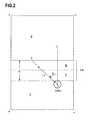
- FIG. 2 A recently suggested technique is shown in Fig. 2, where the first display screen 1 and the second display screen 2 are combined consecutively into a pseudo single display screen encircled with four corners A, B, C, and D to enable execution of a game on a larger display screen.
- Japanese patent No.2,917,770 Referring to Fig. 2 depicting the pseudo single display screen encircled with four corners A, B, C, and D, a case where an object OBJ moves across the boundary between the first display screen 1 and the second display screen 2 is considered.
- a nondisplay area 7A is present between the first and second display screens 1 and 2, which nondisplay area 7A is formed of display frame portion areas 7 and 8 of the apparatus cases 3 and 4 that are adjacent to each other. Between the first and second display screens 1 and 2, therefore, a distance having a physical size d is present.
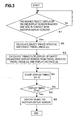
- control of object display in move from the first display screen 1 to the second display screen 2 according to a flow shown in Fig. 3 is assumed in consideration of a time for the object to take to move through the distance having the size d.
- step S1 whether the object OBJ displayed in move on the first display screen 1 has reached an end side of the first display screen 1, which end side is adjacent to the second display screen 2 via the nondisplay area 7A, is determined (step S1).
- the reference point of the object OBJ is determined to be, for example, the central position O of the object OBJ, and when the coordinate position of the reference point of the object OBJ on the first display screen 1 indicates a given size of distance to the side of first display screen 1 that is in contact with the nondisplay area 7A, the object OBJ's reaching the end side of the first display screen 1 is determined (Yes at step S1).
- a travel speed (V) and a travel angle ( ⁇ ) of the object OBJ are calculated (step S2).
- timing T is calculated, in which timing T the object OBJ starts to appear on another display screen, i.e., the second display screen 2 (step 3).
- step S4 counting of display timing is carried out.
- a display timing count value matches the timing T (Yes at step S5)
- an object image is generated to display an image of the object OBJ at a corresponding display position on the second display screen 2, which display position is on an extension line along the travel angle from the first display screen 1, and the generated object image is displayed (step S6).
- the object of the present invention is to provide a program for controlling image display that does not give a player a feeling of oddness or disadvantage in game proceedings even when a nondisplay area having a physical distance is present between different display screen areas.
- An image display control program as a first aspect to achieve the above object of the present invention is a program executed in a game machine having a first display screen and a second display screen adjacent to each other across a nondisplay area and a program executing means, the program operable to drive the program executing means to carry out calculating a travel angle and a travel speed of an object at a display coordinate position on the first display screen when the object is displayed in move from the first display screen to the second display screen; calculating a travel distance of the object's travel through the nondisplay area from the calculated travel angle; reading out information of an additional distance from a memory means, the information being preset in correspondence to the object, to add the additional distance to the calculated travel distance to obtain a virtual travel distance, and calculating a travel time to take to travel through the virtual travel distance from the calculated travel speed and the virtual travel distance; and displaying the object on the second display screen when the calculated travel time has passed after the object has moved to disappear from the first display screen.
- An image display control program as a second aspect to achieve the above object of the present invention is a program executed in a game machine having a first display screen and a second display screen adjacent to each other across a nondisplay area and a program executing means, the program operable to drive the program executing means to carry out calculating a travel angle and a travel speed of an object at a display coordinate position on the first display screen when the object is displayed in move from the first display screen to the second display screen; calculating a travel time for the object to take to travel through the nondisplay area from the calculated travel angle and the travel speed; and adding an additional time to the calculated travel time, the additional time being preset in correspondence to the object, to obtain a virtual travel time, and displaying the object on the second display screen when the virtual travel time has passed.
- An image display control program as a third aspect to achieve the above object of the present invention is a program executed in a game machine having a first display screen and a second display screen adjacent to each other across a nondisplay area and a program executing means, the program operable to drive the program executing means to carry out calculating a travel angle of an object at a display coordinate position on the first display screen when the object is displayed in move from the first display screen to the second display screen; reading out a travel speed and a distance of the nondisplay area, the travel speed and the distance being preset on a table in correspondence to the object; calculating a virtual travel time to take to travel through the distance of the nondisplay area from the read out travel speed and distance of the nondisplay area; and displaying the object on the second display screen when the virtual travel time has passed.
- An image display control program as a fourth aspect to achieve the above object of the present invention is the program of any one of the first to third aspects wherein the display coordinate position of the object is a position at which a given point as a reference point in the object has reached a point of a given distance from a side of the first display screen that is in contact with the nondisplay area.
- An image display control program as a fifth aspect to achieve the above object of the present invention is the program of the first aspect, further comprising calculating the number of pixels forming the object; determining a size of the object from the calculated number of pixels; and obtaining an additional distance corresponding to the determined size from a plurality of additional distances that are preset in correspondence to sizes of the object on a table.
- An image display control program as a sixth aspect to achieve the above object of the present invention is the program of the second aspect, further comprising calculating the number of pixels forming the object; determining a size of the object from the calculated number of pixels; and obtaining an additional time corresponding to the determined size from a plurality of additional times that are preset in correspondence to sizes of the object on a table.
- An image display control program as a seventh aspect to achieve the above object of the present invention is the program of the first aspect, further comprising determining to which one of a plurality of speed references the calculated travel speed of the object is equivalent; and obtaining an additional distance corresponding to the determined speed reference from a plurality of additional distances that are preset in correspondence to the plurality of speed references on a table.
- An image display control program as an eighth aspect to achieve the above object of the present invention is the program of the second aspect, further comprising determining to which one of a plurality of speed references the calculated travel speed of the object is equivalent; and obtaining an additional time corresponding to the determined speed reference from a plurality of additional times that are preset in correspondence to the plurality of speed references on a table.
- display of a character on a first display screen can be changed to display of the character on a second display screen in consideration of a travel angle and a travel speed of the character at a nondisplay area present between display screens adjacent to each other. This allows a player's line of sight to follow the move of the character on display, which does not give the player a feeling of oddness and avoids the player's disadvantage in game proceeding.
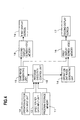
- Fig. 4 is a block diagram of a configurative example of functional units in a case where the present invention applies to such a game machine as shown in the external view of Fig. 1.
- a program execution control unit 10 is usually equivalent to a functional unit including a CPU, and executes and controls a game program read out of a recording medium 11 storing programs, which is such a memory unit as CD-ROM, cassette memory, and memory chip.
- the program execution control unit 10 converts three-dimensional coordinate data, which is read out together with the program, into two-dimensional plane data, and sends the two-dimensional plane data to a game image generating unit 15.
- the program execution control unit 10 sends the data also to an operation unit image generating unit 14, which generates an operation unit background image, such as an operation message to a player.
- the program execution control unit 10 associates these input signal conditions with a condition preset in the program to update image data, and sends the updated image data to the operation unit image generating unit 14 and to the game image generating unit 15.
- the operation unit background image generating unit 14 pastes a texture of an operation message, etc., on the received data as an operation unit background image to generate operation screen data, and writes the operation screen data into a first display screen video memory 16.
- the game image generating unit 15 pastes a texture on a polygon, etc., composing a character to generate game image data, and writes the game image data into a second display screen video memory 18.
- the operation screen data written in the first display screen video memory 16 and the game image data written in the second display screen video memory 18 are output to the corresponding first display screen monitor 17 and the second display screen monitor 19, respectively, to be displayed thereon.
- a display control program will be described for a case where a first display screen 1 and a second display screen 2 are combined into a single screen to display a game image in the configuration of the game machine of Fig. 4.
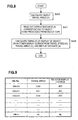
- Fig. 5 is a flowchart of a first embodiment.
- the program execution control unit 10 carries out control of display of the object OBJ in move to the second display screen 2 according to the present invention.
- the given coordinate position in displaying the object OBJ in move to the second display screen 2 is the position at which a reference point, which is determined to be a given position in the object OBJ, reaches a point of a given distance to the side of first display screen 1 that is in contact with a nondisplay area 7A.
- the object OBJ is given as a circle in Fig. 2.
- the reference point of the object OBJ is the central point O of the circle and the given distance is the size of the radius of the circle, therefore, the presence of reference point O of the object OBJ at the given coordinate position is determined when the circumferential edge of the circular object OBJ reaches the side that is in contact with the nondisplay area 7A.
- a travel angle ( ⁇ ) and a travel speed (v) of the object OBJ at a display coordinate position on the first display screen 1 is calculated (step S10), as shown in Fig. 5.
- Fig. 6 depicts an example of a table corresponding to the operation flow of Fig. 5.
- This table is a correspondence table of objects OBJ and additional distances, and is stored and held as a piece of program data in the program storage memory 11.
- a preset additional distance ⁇ corresponding to the object OBJ to be processed is read out (step S11). For example, an additional distance ⁇ 01 is read out for an object represented by an object No. OBJ01.
- timing T of display of the object OBJ on the second display screen is calculated on the basis of the calculated virtual travel distance D, the travel speed (v), and the travel angle ( ⁇ ) relative to a vertical line L extending from the first display screen 1 to the second display screen 2.
- the present invention allows setting of a span of timing for display of the object OBJ in move to the second display screen larger than a span of timing (time) that is calculated from the distance of the nondisplay area 7A only. This allows the player's liner of sight to easily follow the move of the object OBJ on display.
- determining the additional distance ⁇ that is preset in correspondence to the object OBJ Various methods are possible in determining the additional distance ⁇ that is preset in correspondence to the object OBJ. For example, determining the additional distance ⁇ according to the size of the object OBJ is preferable.
- the additional distance ⁇ is determined to be small when the object OBJ is large and that the additional distance ⁇ is determined to be large when the object OBJ is small.
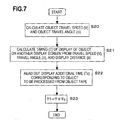
- Fig. 7 is a flowchart of a second embodiment.
- an additional time Tc instead of the additional distance ⁇ is set in the first embodiment shown in Fig. 5.
- a travel angle ( ⁇ ) and a travel speed (v) of the object OBJ at a display coordinate position on the first display screen 1 is calculated (step S20).
- a travel time T for the object OBJ to take to travel through the nondisplay area 7A is calculated from the calculated travel angle ( ⁇ ) and travel speed (V) (step S21).
- the additional time Tc preset in correspondence to the object OBJ is added to the calculated travel time T to obtain a virtual travel time T1 (step S23).
- the object OBJ is displayed on the second display screen.
- Fig. 8 is an operation flowchart of a third embodiment of the present invention.
- objects OBJ, object travel speeds (v), and relative display distances (d) are combined in a corresponding relation on a table shown in Fig. 9.
- the obj ect travel speed (v) is expressed in a unit of (pixel/frame), and the relative display distance (d) is a virtual distance that changes relative to the actual distance d between the first and second display screens 1 and 2 according to the object travel speed (v).
- Present travel speed of each object OBJ is calculated (detected) (step S30), and a relative display distance is read from the table of Fig. 9 on the basis of the detected travel speed (step S31).
- timing T of display of the object OBJ on the second display screen 2 is calculated on the basis of the travel speed (v) and relative display distance (d), which are read out from the table, and a precalculated travel direction, i.e., travel angle ( ⁇ ) of the object OBJ to be displayed (step S32).
- setting of the relative display distance (d) provides setting that allows the player's line of sight to easily follow the speed of move of the object OBJ through the nondisplay area 7A.
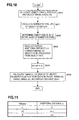
- Fig. 10 is an operation flowchart of a fourth embodiment.
- the size of the object OBJ is classified into L, M, and S, and additional distances corresponding to the sizes L, M, and S are set on a table shown in Fig. 11.
- the sizes L, M, and S are so set as to have the relation: L>d (d is the actual physical distance between the first and second display screens 1 and 2) >M>S.
- Additional distances ⁇ s and ⁇ m are set to have a relation of ⁇ s> ⁇ m, which means an additional distance longer than an additional distance for the object size M is given when the size of the object OBJ is S. This solves the problem that the player is likely to miss a smaller object OBJ.
- the program execution control unit 10 calculates a travel speed (v) and a travel angle ( ⁇ ) of the object OBJ when the object OBJ reaches the given coordinate position on the first display screen 1 (step S40).
- step S41 the number of pixels (P) of the object OBJ is calculated (step S41). Based on the calculated number of pixels (P), which one of sizes L, M, and S the size of the object OBJ corresponds to is determined (step S42).
- timing T of appearance of the object OBJ on the second display screen 2 is calculated (step S45). While object sizes are classified into three classes of L, M, and S on the table of Fig. 11 in the above description, the object sizes may be classified further into subdivided classes. In addition, additional distances on the table of Fig. 11 may be replaced with additional times, as described above in relation to the embodiment of Fig. 5. This case leads to an operation flowchart shown in Fig. 12, and to a table shown in Fig. 13 corresponding to the operation flowchart, where Tm>Tn.
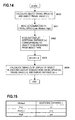
- Fig. 14 is an operation flowchart of a fifth embodiment of the present invention.
- the program execution control unit 10 calculates a travel speed (v) and a travel angle ( ⁇ ) of the object OBJ when the object OBJ reaches the given coordinate position on the first display screen 1 (step S60).
- the travel speed (v) of the object OBJ is classified into three classes of speeds of Low, Medium, and High, and which one of speeds of Low, Medium, and High the calculated travel speed (v) belongs to is determined (step S61).
- a corresponding table listing additional distances ⁇ corresponding to travel speeds of the object OBJ is provided, as shown in Fig. 15.
- step S62 The additional distance ⁇ corresponding to the determined speed is then read out (step S62), and is added to the distance d between the first and second display screens to obtain a travel speed D (step S63).
- timing T of display of the object OBJ on the second display screen 2 is calculated from the travel speed (v), the travel angle ( ⁇ ), and the travel distance D (step S64).
- an additional time Tc may be added in correspondence to each of classified three classes of speeds, instead of determining the additional distance ⁇ as shown in Fig. 15.
- Fig. 16 depicts an operation flowchart including the additional time Tc, in which the additional time Tc is determined in correspondence to the speed of the object (step S72).
- Timing T of display of the object OBJ on the second display screen 2 is thus calculated on the basis of the travel speed (v), the travel angle ( ⁇ ), and the distance between the first and second display screens 1 and 2 (steps S73 and S74).
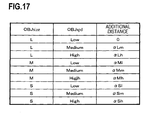
- Fig. 17 is an example of setting of a table in still another embodiment.
- the additional distance ⁇ is determined in correspondence only to the speed of the object in the embodiment of Fig. 14.
- an additional distance is determined in correspondence to a combination of the size and speed of the object OBJ in the embodiment of Fig. 17.
- a slowly moving object OBJ allows the player's line of sight to easily follow the move of the object OBJ.
- a smaller and faster object OBJ makes it difficult for the player's line of sight to follow the move of the object OBJ.
- additional distances subdivided in detail are set in correspondence to the sizes and speeds of the object OBJ on the table of Fig. 17.
- the present invention allows display of an object in move without giving a player a feeling od oddness even when a nondisplay area having a physical distance is present between different display screens.
- the present invention also provides a program for controlling image display that does not give the player a disadvantage in game proceeding. The present invention, therefore, makes a great contribution to the industrial field.
Landscapes
- Engineering & Computer Science (AREA)
- Multimedia (AREA)
- Theoretical Computer Science (AREA)
- Human Computer Interaction (AREA)
- Processing Or Creating Images (AREA)
- User Interface Of Digital Computer (AREA)
Abstract
In a game machine, image display not giving the player a feeling of oddness or disadvantage during game progress even if a non-display at a physical distance is present between different display screen areas. The game machine executes program for controlling image display of first and second display screens on both sides of a non-display area. To move an object from the first to the second display screen and display it there. The movement angle and movement speed are calculated at the display coordinate position of the object displayed on the first display screen, and the movement distance which the object moves through the non-display area from the movement angle is determined. Further, a preset additional distance corresponding to the object to the movement distance is added to use it as a virtual movement distance. The object on the second display screen is displayed when the time required for the object to move the virtual movement distance has elapsed.
Description
- This application is a continuation of International Application No.PCT/
JP2006/306528, filed on March 29, 2006 Japanese Patent Application No. 2005-102227, filed on March 31, 2005 - The present invention relates to a display control program executed in a game machine, and, more particularly, to a display control program in a game machine having a plurality of display screens.
- In recent years, a small-sized game machine that can be carried around (portable game machine) has become widespread, and the contents of executable game programs have become more complicated as processing units come to work at higher speed and memory capacities gets larger. Under such a circumstance, a portable game machine having two display screens has emerged, in which game machine one display screen is used for user operation, and the other display screen is used for displaying a game object, etc.
- Fig. 1 is a diagram of the external configuration of an example of such a portable game machine having two screens.
- The portable game machine includes a
first display screen 1, asecond display screen 2, an apparatus case 3 carrying thefirst display screen 1, and anapparatus case 4 carrying thesecond display screen 2. Theapparatus cases 3 and 4 can be folded together so that the first andsecond display screens - The
first display screen 1 is used primarily for input operation in executing a game, and the apparatus case 3 having thefirst display screen 1 is provided withoperation buttons 5, adirection key 6, etc. - In such case, a player inputs necessary information or instructions using the
first display screen 1 while following the movement of game characters, etc., appearing on thesecond display screen 2 as the player executes a game. - A recently suggested technique is shown in Fig. 2, where the
first display screen 1 and thesecond display screen 2 are combined consecutively into a pseudo single display screen encircled with four corners A, B, C, and D to enable execution of a game on a larger display screen.
(Japanese patent No.2,917,770
Referring to Fig. 2 depicting the pseudo single display screen encircled with four corners A, B, C, and D, a case where an object OBJ moves across the boundary between thefirst display screen 1 and thesecond display screen 2 is considered. - As shown in Fig. 2, a
nondisplay area 7A is present between the first andsecond display screens nondisplay area 7A is formed of displayframe portion areas apparatus cases 3 and 4 that are adjacent to each other. Between the first andsecond display screens - In such a case, control of object display in move from the
first display screen 1 to thesecond display screen 2 according to a flow shown in Fig. 3 is assumed in consideration of a time for the object to take to move through the distance having the size d. - In Fig. 3, whether the object OBJ displayed in move on the
first display screen 1 has reached an end side of thefirst display screen 1, which end side is adjacent to thesecond display screen 2 via thenondisplay area 7A, is determined (step S1). In this determination, the reference point of the object OBJ is determined to be, for example, the central position O of the object OBJ, and when the coordinate position of the reference point of the object OBJ on thefirst display screen 1 indicates a given size of distance to the side offirst display screen 1 that is in contact with thenondisplay area 7A, the object OBJ's reaching the end side of thefirst display screen 1 is determined (Yes at step S1). - Subsequently, a travel speed (V) and a travel angle (θ) of the object OBJ are calculated (step S2).
- Then, based on the calculated travel speed (V) and travel angle (θ) of the object OBJ and the distance d between the first and second display screens, timing T is calculated, in which timing T the object OBJ starts to appear on another display screen, i.e., the second display screen 2 (step 3). This timing T is given by the following equation.

where v is the travel speed of the object OBJ. - At the same time, counting of display timing is carried out (step S4). When a display timing count value matches the timing T (Yes at step S5), an object image is generated to display an image of the object OBJ at a corresponding display position on the
second display screen 2, which display position is on an extension line along the travel angle from thefirst display screen 1, and the generated object image is displayed (step S6). - When the object OBJ on display is moved from the
first display screen 1 to thesecond display screen 2, however, a player's line of sight has difficulty in following the speed of the object OBJ that virtually moves through thenondisplay area 7A between the first and second display areas. This gives the player a feeling of oddness or disadvantage in game proceedings. - The object of the present invention, therefore, is to provide a program for controlling image display that does not give a player a feeling of oddness or disadvantage in game proceedings even when a nondisplay area having a physical distance is present between different display screen areas.
- An image display control program as a first aspect to achieve the above object of the present invention is a program executed in a game machine having a first display screen and a second display screen adjacent to each other across a nondisplay area and a program executing means, the program operable to drive the program executing means to carry out calculating a travel angle and a travel speed of an object at a display coordinate position on the first display screen when the object is displayed in move from the first display screen to the second display screen; calculating a travel distance of the object's travel through the nondisplay area from the calculated travel angle; reading out information of an additional distance from a memory means, the information being preset in correspondence to the object, to add the additional distance to the calculated travel distance to obtain a virtual travel distance, and calculating a travel time to take to travel through the virtual travel distance from the calculated travel speed and the virtual travel distance; and displaying the object on the second display screen when the calculated travel time has passed after the object has moved to disappear from the first display screen.
- An image display control program as a second aspect to achieve the above object of the present invention is a program executed in a game machine having a first display screen and a second display screen adjacent to each other across a nondisplay area and a program executing means, the program operable to drive the program executing means to carry out calculating a travel angle and a travel speed of an object at a display coordinate position on the first display screen when the object is displayed in move from the first display screen to the second display screen; calculating a travel time for the object to take to travel through the nondisplay area from the calculated travel angle and the travel speed; and adding an additional time to the calculated travel time, the additional time being preset in correspondence to the object, to obtain a virtual travel time, and displaying the object on the second display screen when the virtual travel time has passed.
- An image display control program as a third aspect to achieve the above object of the present invention is a program executed in a game machine having a first display screen and a second display screen adjacent to each other across a nondisplay area and a program executing means, the program operable to drive the program executing means to carry out calculating a travel angle of an object at a display coordinate position on the first display screen when the object is displayed in move from the first display screen to the second display screen; reading out a travel speed and a distance of the nondisplay area, the travel speed and the distance being preset on a table in correspondence to the object; calculating a virtual travel time to take to travel through the distance of the nondisplay area from the read out travel speed and distance of the nondisplay area; and displaying the object on the second display screen when the virtual travel time has passed.
- An image display control program as a fourth aspect to achieve the above object of the present invention is the program of any one of the first to third aspects wherein the display coordinate position of the object is a position at which a given point as a reference point in the object has reached a point of a given distance from a side of the first display screen that is in contact with the nondisplay area.
- An image display control program as a fifth aspect to achieve the above object of the present invention is the program of the first aspect, further comprising calculating the number of pixels forming the object; determining a size of the object from the calculated number of pixels; and obtaining an additional distance corresponding to the determined size from a plurality of additional distances that are preset in correspondence to sizes of the object on a table.
- An image display control program as a sixth aspect to achieve the above object of the present invention is the program of the second aspect, further comprising calculating the number of pixels forming the object; determining a size of the object from the calculated number of pixels; and obtaining an additional time corresponding to the determined size from a plurality of additional times that are preset in correspondence to sizes of the object on a table.
- An image display control program as a seventh aspect to achieve the above object of the present invention is the program of the first aspect, further comprising determining to which one of a plurality of speed references the calculated travel speed of the object is equivalent; and obtaining an additional distance corresponding to the determined speed reference from a plurality of additional distances that are preset in correspondence to the plurality of speed references on a table.
- An image display control program as an eighth aspect to achieve the above object of the present invention is the program of the second aspect, further comprising determining to which one of a plurality of speed references the calculated travel speed of the object is equivalent; and obtaining an additional time corresponding to the determined speed reference from a plurality of additional times that are preset in correspondence to the plurality of speed references on a table.
- The features of the present invention will become apparent from the embodiments of the present invention which will hereinafter be described with reference to the accompanying drawings.
- According to the above features of the present invention, display of a character on a first display screen can be changed to display of the character on a second display screen in consideration of a travel angle and a travel speed of the character at a nondisplay area present between display screens adjacent to each other. This allows a player's line of sight to follow the move of the character on display, which does not give the player a feeling of oddness and avoids the player's disadvantage in game proceeding.
-
- Fig. 1 is a diagram of the external configuration of an example of a portable game machine having two screens.
- Fig. 2 is an explanatory view of a game machine that combines two screens into a pseudo single display screen.
- Fig. 3 is an explanatory view of control of display in object move from a first display screen to a second display screen.
- Fig. 4 is a block diagram of a configurative example of functional units in a case where the present invention applies to such a game machine as shown in the external view of Fig. 1.
- Fig. 5 is a flowchart of a first embodiment.
- Fig. 6 is a diagram of an example of a table corresponds to the operation flow of Fig. 5.
- Fig. 7 is a flowchart of a second embodiment.
- Fig. 8 is an operation flowchart of a third embodiment of the present invention.
- Fig. 9 is an example of a table for the embodiment shown in Fig. 8.
- Fig. 10 is an operation flowchart of a fourth embodiment.
- Fig. 11 is an example of a table for the embodiment of Fig. 10.
- Fig. 12 is an operation flowchart of an embodiment in which an additional distance introduced in the embodiment of Fig. 10 is replaced with an additional time.
- Fig. 13 is an example of a table for the embodiment of Fig. 12.
- Fig. 14 is an operation flowchart of a fifth embodiment.
- Fig. 15 is an example of a table for the embodiment of Fig. 14.
- Fig. 16 is an operation flowchart of an embodiment in which an additional distance introduced in the embodiment of Fig. 14 is replaced with an additional time.
- Fig. 17 is an example of a table configuration in an embodiment in which an additional distance corresponding to an object is determined on the basis of a combination of the size and speed of the object.
- Embodiments of the present invention will now be described with reference to the drawings. The embodiments are described to facilitate understanding of the present invention, and do not limit the scope of the present invention.
- Fig. 4 is a block diagram of a configurative example of functional units in a case where the present invention applies to such a game machine as shown in the external view of Fig. 1.
- A program
execution control unit 10 is usually equivalent to a functional unit including a CPU, and executes and controls a game program read out of arecording medium 11 storing programs, which is such a memory unit as CD-ROM, cassette memory, and memory chip. - In the course of execution of a program read out of the
program storage memory 11, the programexecution control unit 10 converts three-dimensional coordinate data, which is read out together with the program, into two-dimensional plane data, and sends the two-dimensional plane data to a gameimage generating unit 15. - In the course of game proceeding, the program
execution control unit 10 sends the data also to an operation unitimage generating unit 14, which generates an operation unit background image, such as an operation message to a player. - To the program
execution control unit 10, data input byoperation buttons 5 is input through an operation buttondata input unit 12, and data input by adirection key 6 is input through a direction keydata input unit 13. The programexecution control unit 10 associates these input signal conditions with a condition preset in the program to update image data, and sends the updated image data to the operation unitimage generating unit 14 and to the gameimage generating unit 15. - Based on the data from the program
execution control unit 10, the operation unit backgroundimage generating unit 14 pastes a texture of an operation message, etc., on the received data as an operation unit background image to generate operation screen data, and writes the operation screen data into a first displayscreen video memory 16. - Meanwhile, based on the data from the program
execution control unit 10, the gameimage generating unit 15 pastes a texture on a polygon, etc., composing a character to generate game image data, and writes the game image data into a second displayscreen video memory 18. - The operation screen data written in the first display
screen video memory 16 and the game image data written in the second displayscreen video memory 18 are output to the corresponding first display screen monitor 17 and the seconddisplay screen monitor 19, respectively, to be displayed thereon. - A display control program according to the feature of the present invention will be described for a case where a
first display screen 1 and asecond display screen 2 are combined into a single screen to display a game image in the configuration of the game machine of Fig. 4. - Fig. 5 is a flowchart of a first embodiment.
- When an object OBJ reaches a given coordinate position on the
first display screen 1, the programexecution control unit 10 carries out control of display of the object OBJ in move to thesecond display screen 2 according to the present invention. - In this embodiment, the given coordinate position in displaying the object OBJ in move to the
second display screen 2 is the position at which a reference point, which is determined to be a given position in the object OBJ, reaches a point of a given distance to the side offirst display screen 1 that is in contact with anondisplay area 7A. - For example, the object OBJ is given as a circle in Fig. 2. When the reference point of the object OBJ is the central point O of the circle and the given distance is the size of the radius of the circle, therefore, the presence of reference point O of the object OBJ at the given coordinate position is determined when the circumferential edge of the circular object OBJ reaches the side that is in contact with the
nondisplay area 7A. - At this time, a travel angle (θ) and a travel speed (v) of the object OBJ at a display coordinate position on the
first display screen 1 is calculated (step S10), as shown in Fig. 5. - Fig. 6 depicts an example of a table corresponding to the operation flow of Fig. 5. This table is a correspondence table of objects OBJ and additional distances, and is stored and held as a piece of program data in the
program storage memory 11. From the correspondence table, a preset additional distance α corresponding to the object OBJ to be processed is read out (step S11). For example, an additional distance α01 is read out for an object represented by an object No. OBJ01. - This additional distance α is added to a travel distance d1(=d/cosθ)through the
nondisplay area 7A, which travel distance d1 is calculated from the calculated travel angle (θ) and travel speed (v) of the object OBJ at the coordinate position, to calculate a virtual travel distance D (step S12). - The virtual travel distance D is given by

where d is the distance between thefirst display screen 1 and the second display screen 2 (see Fig. 2). - Thus, timing T of display of the object OBJ on the second display screen is calculated on the basis of the calculated virtual travel distance D, the travel speed (v), and the travel angle (θ) relative to a vertical line L extending from the
first display screen 1 to thesecond display screen 2. - In this manner, the present invention allows setting of a span of timing for display of the object OBJ in move to the second display screen larger than a span of timing (time) that is calculated from the distance of the nondisplay
area 7A only. This allows the player's liner of sight to easily follow the move of the object OBJ on display. - Various methods are possible in determining the additional distance α that is preset in correspondence to the object OBJ. For example, determining the additional distance α according to the size of the object OBJ is preferable.
- Specifically, such a method may be adopted that the additional distance α is determined to be small when the object OBJ is large and that the additional distance α is determined to be large when the object OBJ is small. The larger the object OBJ is, the easier for the player to visually recognize the object OBJ. In such a case, therefore, the player's line of sight can easily follow the move of the object OBJ even if the travel speed of the object OBJ at the
nondisplay area 7A is increased (travel time is shortened), so that the additional distance α may be reduced. - Fig. 7 is a flowchart of a second embodiment. In this embodiment, an additional time Tc instead of the additional distance α is set in the first embodiment shown in Fig. 5.
- When the object OBJ is displayed in move from the
first display screen 1 to thesecond display screen 2, a travel angle (θ) and a travel speed (v) of the object OBJ at a display coordinate position on thefirst display screen 1 is calculated (step S20). - Then, a travel time T for the object OBJ to take to travel through the
nondisplay area 7A is calculated from the calculated travel angle (θ) and travel speed (V) (step S21). - Subsequently, the additional time Tc preset in correspondence to the object OBJ is added to the calculated travel time T to obtain a virtual travel time T1 (step S23). When the virtual travel time T1 has passed, the object OBJ is displayed on the second display screen.
- In the case of the embodiment of Fig. 7, additional distances α are replaced with additional times Tc on the table of Fig. 6, where each additional time Tc is set for each object.
- Fig. 8 is an operation flowchart of a third embodiment of the present invention. In this embodiment, objects OBJ, object travel speeds (v), and relative display distances (d) are combined in a corresponding relation on a table shown in Fig. 9.
- The obj ect travel speed (v) is expressed in a unit of (pixel/frame), and the relative display distance (d) is a virtual distance that changes relative to the actual distance d between the first and
second display screens - "Present travel speed" of each object OBJ is calculated (detected) (step S30), and a relative display distance is read from the table of Fig. 9 on the basis of the detected travel speed (step S31).
- Then, timing T of display of the object OBJ on the
second display screen 2 is calculated on the basis of the travel speed (v) and relative display distance (d), which are read out from the table, and a precalculated travel direction, i.e., travel angle (θ) of the object OBJ to be displayed (step S32). - In this embodiment, setting of the relative display distance (d) provides setting that allows the player's line of sight to easily follow the speed of move of the object OBJ through the
nondisplay area 7A. - Fig. 10 is an operation flowchart of a fourth embodiment. In this embodiment, the size of the object OBJ is classified into L, M, and S, and additional distances corresponding to the sizes L, M, and S are set on a table shown in Fig. 11.
- The sizes L, M, and S are so set as to have the relation: L>d (d is the actual physical distance between the first and
second display screens 1 and 2) >M>S. When the size of the object OBJ to display is L, an additional distance leads to the deformed appearance of the object OBJ, so that the additional distance for the object size L is determined to be zero. - Additional distances αs and αm are set to have a relation of αs>αm, which means an additional distance longer than an additional distance for the object size M is given when the size of the object OBJ is S. This solves the problem that the player is likely to miss a smaller object OBJ.
- Referring to Fig. 11, the program
execution control unit 10 calculates a travel speed (v) and a travel angle (θ) of the object OBJ when the object OBJ reaches the given coordinate position on the first display screen 1 (step S40). - Then, the number of pixels (P) of the object OBJ is calculated (step S41). Based on the calculated number of pixels (P), which one of sizes L, M, and S the size of the object OBJ corresponds to is determined (step S42).
- The additional distance α corresponding to the determined size of the object OBJ is obtained from the table of Fig. 11, and is added to the distance d between the first and
second display screens nondisplay area 7A by the object OBJ is given by
- Based on the calculated passage distance D, timing T of appearance of the object OBJ on the
second display screen 2 is calculated (step S45). While object sizes are classified into three classes of L, M, and S on the table of Fig. 11 in the above description, the object sizes may be classified further into subdivided classes. In addition, additional distances on the table of Fig. 11 may be replaced with additional times, as described above in relation to the embodiment of Fig. 5. This case leads to an operation flowchart shown in Fig. 12, and to a table shown in Fig. 13 corresponding to the operation flowchart, where Tm>Tn. - Fig. 14 is an operation flowchart of a fifth embodiment of the present invention. In this embodiment, the program
execution control unit 10 calculates a travel speed (v) and a travel angle (θ) of the object OBJ when the object OBJ reaches the given coordinate position on the first display screen 1 (step S60). The travel speed (v) of the object OBJ is classified into three classes of speeds of Low, Medium, and High, and which one of speeds of Low, Medium, and High the calculated travel speed (v) belongs to is determined (step S61). - Then, a corresponding table listing additional distances α corresponding to travel speeds of the object OBJ is provided, as shown in Fig. 15.
- The additional distance α corresponding to the determined speed is then read out (step S62), and is added to the distance d between the first and second display screens to obtain a travel speed D (step S63).
- Thus, timing T of display of the object OBJ on the
second display screen 2 is calculated from the travel speed (v), the travel angle (θ), and the travel distance D (step S64). - In the operation flowchart of Fig. 14, an additional time Tc may be added in correspondence to each of classified three classes of speeds, instead of determining the additional distance α as shown in Fig. 15.
- Fig. 16 depicts an operation flowchart including the additional time Tc, in which the additional time Tc is determined in correspondence to the speed of the object (step S72).
- Timing T of display of the object OBJ on the
second display screen 2 is thus calculated on the basis of the travel speed (v), the travel angle (θ), and the distance between the first andsecond display screens 1 and 2 (steps S73 and S74). - Fig. 17 is an example of setting of a table in still another embodiment. The additional distance α is determined in correspondence only to the speed of the object in the embodiment of Fig. 14. In contrast, an additional distance is determined in correspondence to a combination of the size and speed of the object OBJ in the embodiment of Fig. 17.
- Specifically, a slowly moving object OBJ allows the player's line of sight to easily follow the move of the object OBJ. Contrary to that, a smaller and faster object OBJ makes it difficult for the player's line of sight to follow the move of the object OBJ. For this reason, additional distances subdivided in detail are set in correspondence to the sizes and speeds of the object OBJ on the table of Fig. 17.
- When the object OBJ is small and moves at high speed, a maximum additional distance is added.
- As described above, the present invention allows display of an object in move without giving a player a feeling od oddness even when a nondisplay area having a physical distance is present between different display screens. The present invention also provides a program for controlling image display that does not give the player a disadvantage in game proceeding. The present invention, therefore, makes a great contribution to the industrial field.
Claims (20)
- A program executed in a game machine having a first display screen and a second display screen adjacent to each other across a nondisplay area, when the program is executed the game machine performs the steps of:calculating a travel angle and a travel speed of an object at a display coordinate position on the first display screen when the object is displayed in move from the first display screen to the second display screen;calculating a travel distance of the object's travel through the nondisplay area from the calculated travel angle;reading out information of an additional distance from a memory means, the information being preset in correspondence to the object, to add the additional distance to the calculated travel distance to obtain a virtual travel distance, and calculating a travel time to take to travel through the virtual travel distance from the calculated travel speed and the virtual travel distance; anddisplaying the object on the second display screen when the calculated travel time has passed after the object has moved to disappear from the first display screen.
- A program executed in a game machine having a first display screen and a second display screen adj acent to each other across a nondisplay area, when the program is executed the game machine performs the steps of:calculating a travel angle and a travel speed of an object at a display coordinate position on the first display screen when the object is displayed in move from the first display screen to the second display screen;calculating a travel time for the object to take to travel through the nondisplay area from the calculated travel angle and the travel speed; andadding an additional time to the calculated travel time, the additional time being preset in correspondence to the object, to obtain a virtual travel time, and displaying the object on the second display screen when the virtual travel time has passed.
- A program executed in a game machine having a first display screen and a second display screen adj acent to each other across a nondisplay area, when the program is executed the game machine performs the steps of:calculating a travel angle of an object at a display coordinate position on the first display screen when the object is displayed in move from the first display screen to the second display screen;reading out a travel speed and a distance of the nondisplay area, the travel speed and the distance being preset on a table in correspondence to the object;calculating a virtual travel time to take to travel through the distance of the nondisplay area from the read out travel speed and distance of the nondisplay area; anddisplaying the object on the second display screen when the virtual travel time has passed.
- The program according to claim 1, wherein
the display coordinate position of the object is a position at which a given point as a reference point in the object has reached a point of a given distance from a side of the first display screen that is in contact with the nondisplay area. - The program according to claim 2, wherein
the display coordinate position of the object is a position at which a given point as a reference point in the object has reached a point of a given distance from a side of the first display screen that is in contact with the nondisplay area. - The program according to claim 3, wherein
the display coordinate position of the object is a position at which a given point as a reference point in the object has reached a point of a given distance from a side of the first display screen that is in contact with the nondisplay area. - The program according to claim 1, further comprising the processes of:calculating the number of pixels forming the object;determining a size of the object from the calculated number of pixels; andobtaining an additional distance corresponding to the determined size from a plurality of additional distances that are preset in correspondence to sizes of the object on a table.
- The program according to claim 2, further comprising the processes of:calculating the number of pixels forming the object;determining a size of the object from the calculated number of pixels; andobtaining an additional time corresponding to the determined size from a plurality of additional times that are preset in correspondence to sizes of the object on a table.
- The program according to claim 1, further comprising the processes of:determining to which one of a plurality of speed references the calculated travel speed of the object is equivalent; andobtaining an additional distance corresponding to the determined speed reference from a plurality of additional distances that are preset in correspondence to the plurality of speed references on a table.
- The program according to claim 2, further comprising the processes of:determining to which one of a plurality of speed references the calculated travel speed of the object is equivalent; andobtaining an additional time corresponding to the determined speed reference from a plurality of additional times that are preset in correspondence to the plurality of speed references on a table.
- A recording medium having stored thereon a program executed in a game machine having a first display screen and a second display screen adjacent to each other across a nondisplay area, the program operable to drive an image display control means to carry out the processes of:calculating a travel angle and a travel speed of an object at a display coordinate position on the first display screen when the object is displayed in move from the first display screen to the second display screen;calculating a travel distance of the object's travel through the nondisplay area from the calculated travel angle;reading out information of an additional distance from a memory means, the information being preset in correspondence to the object, to add the additional distance to the calculated travel distance to obtain a virtual travel distance, and calculating a travel time to take to travel through the virtual travel distance from the calculated travel speed and the virtual travel distance; anddisplaying the object on the second display screen when the calculated travel time has passed after the object has moved to disappear from the first display screen.
- A recording medium having stored thereon a program executed in a game machine having a first display screen and a second display screen adjacent to each other across a nondisplay area, the program operable to drive an image display control means to carry out the processes of:calculating a travel angle and a travel speed of an object at a display coordinate position on the first display screen when the object is displayed in move from the first display screen to the second display screen;calculating a travel time for the object to take to travel through the nondisplay area from the calculated travel angle and the travel speed; andadding an additional time to the calculated travel time, the additional time being preset in correspondence to the object, to obtain a virtual travel time, and displaying the object on the second display screen when the virtual travel time has passed.
- A recording medium having stored thereon a program executed in a game machine having a first display screen and a second display screen adjacent to each other across a nondisplay area, the program operable to drive an image display control means to carry out the processes of:calculating a travel angle of an object at a display coordinate position on the first display screen when the object is displayed in move from the first display screen to the second display screen;reading out a travel speed and a distance of the nondisplay area, the travel speed and the distance being preset on a table in correspondence to the object;calculating a virtual travel time to take to travel through the distance of the nondisplay area from the read out travel speed and distance of the nondisplay area; anddisplaying the object on the second display screen when the virtual travel time has passed.
- The recording medium having a program stored thereon of claim 11, wherein
the display coordinate position of the object in the program is a position at which a given point as a reference point in the object has reached a point of a given distance from a side of the first display screen that is in contact with the nondisplay area. - The recording medium having a program stored thereon of claim 12, wherein
the display coordinate position of the object in the program is a position at which a given point as a reference point in the object has reached a point of a given distance from a side of the first display screen that is in contact with the nondisplay area. - The recording medium having a program stored thereon of claim 13, wherein
the display coordinate position of the object in the program is a position at which a given point as a reference point in the object has reached a point of a given distance from a side of the first display screen that is in contact with the nondisplay area. - The recording medium having a program stored thereon of claim 11, the program further comprising the processes of:calculating the number of pixels forming the object;determining a size of the object from the calculated number of pixels; andobtaining an additional distance corresponding to the determined size from a plurality of additional distances that are preset in correspondence to the size of the object on a table.
- The recording medium having a program stored thereon of claim 12, the program further comprising the processes of:calculating the number of pixels forming the object;determining a size of the object from the calculated number of pixels; andobtaining an additional time corresponding to the determined size from a plurality of additional times that are preset in correspondence to the size of the object on a table.
- The recording medium having a program stored thereon of claim 11, the program further comprising the processes of:determining to which one of a plurality of speed references the calculated travel speed of the object is equivalent; andobtaining an additional distance corresponding to the determined speed reference from a plurality of additional distances that are preset in correspondence to the plurality of speed references on a table.
- The recording medium having a program stored thereon of claim 12, the program further comprising the processes of:determining to which one of a plurality of speed references the calculated travel speed of the object is equivalent; andobtaining an additional time corresponding to the determined speed reference from a plurality of additional times that are preset in correspondence to the plurality of speed references on a table.
Applications Claiming Priority (2)
| Application Number | Priority Date | Filing Date | Title |
|---|---|---|---|
| JP2005102227 | 2005-03-31 | ||
| PCT/JP2006/306528 WO2006106765A1 (en) | 2005-03-31 | 2006-03-29 | Display control program executed in game machine |
Publications (2)
| Publication Number | Publication Date |
|---|---|
| EP1864699A1 true EP1864699A1 (en) | 2007-12-12 |
| EP1864699A4 EP1864699A4 (en) | 2009-12-02 |
Family
ID=37073327
Family Applications (1)
| Application Number | Title | Priority Date | Filing Date |
|---|---|---|---|
| EP06730476A Withdrawn EP1864699A4 (en) | 2005-03-31 | 2006-03-29 | Display control program executed in game machine |
Country Status (5)
| Country | Link |
|---|---|
| US (1) | US7948449B2 (en) |
| EP (1) | EP1864699A4 (en) |
| JP (1) | JP4661866B2 (en) |
| TW (1) | TWI309173B (en) |
| WO (1) | WO2006106765A1 (en) |
Cited By (3)
| Publication number | Priority date | Publication date | Assignee | Title |
|---|---|---|---|---|
| EP2214088A2 (en) * | 2009-01-28 | 2010-08-04 | Sony Corporation | Information processing |
| US7948449B2 (en) * | 2005-03-31 | 2011-05-24 | Sega Corporation | Display control program executed in game machine |
| CN102156605A (en) * | 2010-02-12 | 2011-08-17 | 宏碁股份有限公司 | Object moving method, object moving system and electronic device |
Families Citing this family (28)
| Publication number | Priority date | Publication date | Assignee | Title |
|---|---|---|---|---|
| JP2003334382A (en) * | 2002-05-21 | 2003-11-25 | Sega Corp | GAME DEVICE, IMAGE PROCESSING DEVICE, AND IMAGE PROCESSING METHOD |
| US9507930B2 (en) | 2003-04-25 | 2016-11-29 | Z124 | Physical key secure peripheral interconnection |
| US9003426B2 (en) | 2011-12-09 | 2015-04-07 | Z124 | Physical key secure peripheral interconnection |
| US20130198867A1 (en) | 2011-12-09 | 2013-08-01 | Z124 | A Docking Station for Portable Devices Providing Authorized Power Transfer and Facility Access |
| JP5073275B2 (en) * | 2006-11-22 | 2012-11-14 | 株式会社カプコン | Game device, program for realizing the game device, and recording medium |
| US20090309853A1 (en) * | 2008-06-13 | 2009-12-17 | Polyvision Corporation | Electronic whiteboard system and assembly with optical detection elements |
| US8803816B2 (en) | 2008-09-08 | 2014-08-12 | Qualcomm Incorporated | Multi-fold mobile device with configurable interface |
| US8863038B2 (en) | 2008-09-08 | 2014-10-14 | Qualcomm Incorporated | Multi-panel electronic device |
| US8947320B2 (en) * | 2008-09-08 | 2015-02-03 | Qualcomm Incorporated | Method for indicating location and direction of a graphical user interface element |
| US8860632B2 (en) | 2008-09-08 | 2014-10-14 | Qualcomm Incorporated | Multi-panel device with configurable interface |
| US9009984B2 (en) | 2008-09-08 | 2015-04-21 | Qualcomm Incorporated | Multi-panel electronic device |
| US8933874B2 (en) | 2008-09-08 | 2015-01-13 | Patrik N. Lundqvist | Multi-panel electronic device |
| US8860765B2 (en) | 2008-09-08 | 2014-10-14 | Qualcomm Incorporated | Mobile device with an inclinometer |
| US8668565B2 (en) * | 2009-03-12 | 2014-03-11 | Wms Gaming, Inc. | Controlling cross-application wagering game content |
| JP4904375B2 (en) * | 2009-03-31 | 2012-03-28 | 京セラ株式会社 | User interface device and portable terminal device |
| JP4938819B2 (en) | 2009-05-18 | 2012-05-23 | 株式会社スクウェア・エニックス | GAME DEVICE, GAME PROGRAM, AND INFORMATION RECORDING MEDIUM |
| US8930605B2 (en) | 2010-10-01 | 2015-01-06 | Z124 | Systems and methods for docking portable electronic devices |
| EP2622491A4 (en) * | 2010-10-01 | 2015-05-27 | Z124 | SYSTEMS AND METHODS RELATED TO USER INTERFACES FOR HOSTING / CONNECTING PORTABLE ELECTRONIC DEVICES |
| US9244491B2 (en) | 2011-08-31 | 2016-01-26 | Z124 | Smart dock for auxiliary devices |
| US9246353B2 (en) | 2011-08-31 | 2016-01-26 | Z124 | Smart dock charging |
| US9383770B2 (en) | 2011-08-31 | 2016-07-05 | Z124 | Mobile device that docks with multiple types of docks |
| US9351237B2 (en) | 2011-09-27 | 2016-05-24 | Z124 | Displaying of charging status on dual screen device |
| US9454186B2 (en) | 2011-09-30 | 2016-09-27 | Nokia Technologies Oy | User interface |
| US9582236B2 (en) | 2011-09-30 | 2017-02-28 | Nokia Technologies Oy | User interface |
| US9086840B2 (en) | 2011-12-09 | 2015-07-21 | Z124 | RSID proximity peripheral interconnection |
| US11641860B2 (en) * | 2018-11-20 | 2023-05-09 | Gregory A. Piccionelli | Cake decoration system |
| WO2016013712A1 (en) * | 2014-07-22 | 2016-01-28 | Lg Electronics Inc. | Display device and method for controlling the same |
| KR102241074B1 (en) | 2014-07-22 | 2021-04-16 | 엘지전자 주식회사 | The Apparatus and Method for Display Device |
Family Cites Families (12)
| Publication number | Priority date | Publication date | Assignee | Title |
|---|---|---|---|---|
| JP2513180B2 (en) | 1986-01-13 | 1996-07-03 | ソニー株式会社 | Videotex display |
| JPH0817855B2 (en) * | 1991-04-04 | 1996-02-28 | 株式会社ナナオ | Dice display device for computer game machine |
| JPH0644001A (en) * | 1992-07-27 | 1994-02-18 | Toshiba Corp | Display controller and display control method |
| JPH06314181A (en) * | 1993-04-28 | 1994-11-08 | Hitachi Ltd | Interactive control system with multiple displays and its control method |
| JP2917770B2 (en) * | 1993-10-21 | 1999-07-12 | 株式会社セガ・エンタープライゼス | Game equipment |
| US6428411B1 (en) * | 1997-05-02 | 2002-08-06 | Konami Co., Ltd. | Volleyball video game system |
| JP4028708B2 (en) * | 2001-10-19 | 2007-12-26 | 株式会社コナミデジタルエンタテインメント | GAME DEVICE AND GAME SYSTEM |
| JP3842697B2 (en) * | 2002-06-11 | 2006-11-08 | アルゼ株式会社 | Game machine, server and program |
| JP4058715B2 (en) * | 2002-06-12 | 2008-03-12 | コナミゲーミング インコーポレーテッド | game machine |
| JP4268081B2 (en) * | 2004-03-30 | 2009-05-27 | 任天堂株式会社 | Game program |
| JP3734823B1 (en) * | 2005-01-26 | 2006-01-11 | 任天堂株式会社 | GAME PROGRAM AND GAME DEVICE |
| JP4661866B2 (en) * | 2005-03-31 | 2011-03-30 | 株式会社セガ | Display control program executed in game device |
-
2006
- 2006-03-29 JP JP2007512810A patent/JP4661866B2/en not_active Expired - Fee Related
- 2006-03-29 EP EP06730476A patent/EP1864699A4/en not_active Withdrawn
- 2006-03-29 WO PCT/JP2006/306528 patent/WO2006106765A1/en not_active Ceased
- 2006-03-30 TW TW095111190A patent/TWI309173B/en not_active IP Right Cessation
-
2007
- 2007-09-28 US US11/904,738 patent/US7948449B2/en not_active Expired - Fee Related
Cited By (4)
| Publication number | Priority date | Publication date | Assignee | Title |
|---|---|---|---|---|
| US7948449B2 (en) * | 2005-03-31 | 2011-05-24 | Sega Corporation | Display control program executed in game machine |
| EP2214088A2 (en) * | 2009-01-28 | 2010-08-04 | Sony Corporation | Information processing |
| CN102156605A (en) * | 2010-02-12 | 2011-08-17 | 宏碁股份有限公司 | Object moving method, object moving system and electronic device |
| CN102156605B (en) * | 2010-02-12 | 2013-01-09 | 宏碁股份有限公司 | Object moving method, object moving system and electronic device |
Also Published As
| Publication number | Publication date |
|---|---|
| TWI309173B (en) | 2009-05-01 |
| JP4661866B2 (en) | 2011-03-30 |
| EP1864699A4 (en) | 2009-12-02 |
| WO2006106765A1 (en) | 2006-10-12 |
| JPWO2006106765A1 (en) | 2008-09-11 |
| TW200702025A (en) | 2007-01-16 |
| US7948449B2 (en) | 2011-05-24 |
| US20080100531A1 (en) | 2008-05-01 |
Similar Documents
| Publication | Publication Date | Title |
|---|---|---|
| US7948449B2 (en) | Display control program executed in game machine | |
| JP4326568B2 (en) | Information processing apparatus and information processing program | |
| US9250799B2 (en) | Control method for information input device, information input device, program therefor, and information storage medium therefor | |
| EP2218485A1 (en) | Image generation device, image generation program, image generation program recording medium, and image generation method | |
| EP2229985A1 (en) | Game program, game device and game control method | |
| JP2006127158A (en) | Image processing method and image processing apparatus | |
| US8172681B2 (en) | Storage medium having stored therein game program and game device | |
| US20220215607A1 (en) | Method and apparatus for driving interactive object and devices and storage medium | |
| JP5350003B2 (en) | Information processing apparatus, information processing program, information processing system, and information processing method | |
| US7847754B2 (en) | Image processing program and image display device | |
| US8926427B2 (en) | Video game with screen flip and dual sets of collision data | |
| JP2005149315A (en) | Image drawing apparatus and method, program, and recording medium | |
| JP5725519B2 (en) | Information processing program, information processing apparatus, information processing system, and information processing method | |
| US6860813B2 (en) | Game ethod and system for indicating input device orientation relative to game space | |
| JP7381729B2 (en) | Industrial machinery display device | |
| US8363053B2 (en) | Method and apparatus for rendering outline of multimedia character image | |
| JP4143590B2 (en) | 3D image processing apparatus, game apparatus, 3D image processing program, and game program | |
| WO2015146813A1 (en) | Object manipulation method, object manipulation program, and information processing device | |
| JP5738372B2 (en) | Information processing apparatus, information processing program, information processing system, and information processing method | |
| JP5738351B2 (en) | Information processing program, information processing apparatus, information processing system, and information processing method | |
| JP5483654B2 (en) | Information processing program, information processing apparatus, information processing system, and information processing method | |
| JP6030594B2 (en) | Object deformation operation method, object deformation operation program, and information processing apparatus | |
| CN119425070A (en) | Game screen processing method, device and storage medium | |
| JP2001307132A (en) | Three-dimensional shape processing method and storage medium storing program for executing the method |
Legal Events
| Date | Code | Title | Description |
|---|---|---|---|
| PUAI | Public reference made under article 153(3) epc to a published international application that has entered the european phase |
Free format text: ORIGINAL CODE: 0009012 |
|
| 17P | Request for examination filed |
Effective date: 20070928 |
|
| AK | Designated contracting states |
Kind code of ref document: A1 Designated state(s): DE ES FR GB IT |
|
| DAX | Request for extension of the european patent (deleted) | ||
| RBV | Designated contracting states (corrected) |
Designated state(s): DE ES FR GB IT |
|
| A4 | Supplementary search report drawn up and despatched |
Effective date: 20091102 |
|
| 17Q | First examination report despatched |
Effective date: 20110121 |
|
| STAA | Information on the status of an ep patent application or granted ep patent |
Free format text: STATUS: THE APPLICATION IS DEEMED TO BE WITHDRAWN |
|
| 18D | Application deemed to be withdrawn |
Effective date: 20110601 |