EP1863288A2 - Bildkomprimierungsverfahren stützend auf EBCOT - Google Patents
Bildkomprimierungsverfahren stützend auf EBCOT Download PDFInfo
- Publication number
- EP1863288A2 EP1863288A2 EP07010563A EP07010563A EP1863288A2 EP 1863288 A2 EP1863288 A2 EP 1863288A2 EP 07010563 A EP07010563 A EP 07010563A EP 07010563 A EP07010563 A EP 07010563A EP 1863288 A2 EP1863288 A2 EP 1863288A2
- Authority
- EP
- European Patent Office
- Prior art keywords
- coding
- slope
- code
- rate
- frame
- Prior art date
- Legal status (The legal status is an assumption and is not a legal conclusion. Google has not performed a legal analysis and makes no representation as to the accuracy of the status listed.)
- Withdrawn
Links
Images



Classifications
-
- H—ELECTRICITY
- H04—ELECTRIC COMMUNICATION TECHNIQUE
- H04N—PICTORIAL COMMUNICATION, e.g. TELEVISION
- H04N19/00—Methods or arrangements for coding, decoding, compressing or decompressing digital video signals
- H04N19/60—Methods or arrangements for coding, decoding, compressing or decompressing digital video signals using transform coding
- H04N19/63—Methods or arrangements for coding, decoding, compressing or decompressing digital video signals using transform coding using sub-band based transform, e.g. wavelets
- H04N19/64—Methods or arrangements for coding, decoding, compressing or decompressing digital video signals using transform coding using sub-band based transform, e.g. wavelets characterised by ordering of coefficients or of bits for transmission
- H04N19/645—Methods or arrangements for coding, decoding, compressing or decompressing digital video signals using transform coding using sub-band based transform, e.g. wavelets characterised by ordering of coefficients or of bits for transmission by grouping of coefficients into blocks after the transform
-
- H—ELECTRICITY
- H04—ELECTRIC COMMUNICATION TECHNIQUE
- H04N—PICTORIAL COMMUNICATION, e.g. TELEVISION
- H04N19/00—Methods or arrangements for coding, decoding, compressing or decompressing digital video signals
- H04N19/60—Methods or arrangements for coding, decoding, compressing or decompressing digital video signals using transform coding
-
- H—ELECTRICITY
- H04—ELECTRIC COMMUNICATION TECHNIQUE
- H04N—PICTORIAL COMMUNICATION, e.g. TELEVISION
- H04N19/00—Methods or arrangements for coding, decoding, compressing or decompressing digital video signals
- H04N19/10—Methods or arrangements for coding, decoding, compressing or decompressing digital video signals using adaptive coding
- H04N19/134—Methods or arrangements for coding, decoding, compressing or decompressing digital video signals using adaptive coding characterised by the element, parameter or criterion affecting or controlling the adaptive coding
- H04N19/146—Data rate or code amount at the encoder output
- H04N19/147—Data rate or code amount at the encoder output according to rate distortion criteria
-
- H—ELECTRICITY
- H04—ELECTRIC COMMUNICATION TECHNIQUE
- H04N—PICTORIAL COMMUNICATION, e.g. TELEVISION
- H04N19/00—Methods or arrangements for coding, decoding, compressing or decompressing digital video signals
- H04N19/10—Methods or arrangements for coding, decoding, compressing or decompressing digital video signals using adaptive coding
- H04N19/169—Methods or arrangements for coding, decoding, compressing or decompressing digital video signals using adaptive coding characterised by the coding unit, i.e. the structural portion or semantic portion of the video signal being the object or the subject of the adaptive coding
- H04N19/17—Methods or arrangements for coding, decoding, compressing or decompressing digital video signals using adaptive coding characterised by the coding unit, i.e. the structural portion or semantic portion of the video signal being the object or the subject of the adaptive coding the unit being an image region, e.g. an object
- H04N19/176—Methods or arrangements for coding, decoding, compressing or decompressing digital video signals using adaptive coding characterised by the coding unit, i.e. the structural portion or semantic portion of the video signal being the object or the subject of the adaptive coding the unit being an image region, e.g. an object the region being a block, e.g. a macroblock
-
- H—ELECTRICITY
- H04—ELECTRIC COMMUNICATION TECHNIQUE
- H04N—PICTORIAL COMMUNICATION, e.g. TELEVISION
- H04N19/00—Methods or arrangements for coding, decoding, compressing or decompressing digital video signals
- H04N19/10—Methods or arrangements for coding, decoding, compressing or decompressing digital video signals using adaptive coding
- H04N19/169—Methods or arrangements for coding, decoding, compressing or decompressing digital video signals using adaptive coding characterised by the coding unit, i.e. the structural portion or semantic portion of the video signal being the object or the subject of the adaptive coding
- H04N19/184—Methods or arrangements for coding, decoding, compressing or decompressing digital video signals using adaptive coding characterised by the coding unit, i.e. the structural portion or semantic portion of the video signal being the object or the subject of the adaptive coding the unit being bits, e.g. of the compressed video stream
-
- H—ELECTRICITY
- H04—ELECTRIC COMMUNICATION TECHNIQUE
- H04N—PICTORIAL COMMUNICATION, e.g. TELEVISION
- H04N19/00—Methods or arrangements for coding, decoding, compressing or decompressing digital video signals
- H04N19/60—Methods or arrangements for coding, decoding, compressing or decompressing digital video signals using transform coding
- H04N19/63—Methods or arrangements for coding, decoding, compressing or decompressing digital video signals using transform coding using sub-band based transform, e.g. wavelets
-
- H—ELECTRICITY
- H04—ELECTRIC COMMUNICATION TECHNIQUE
- H04N—PICTORIAL COMMUNICATION, e.g. TELEVISION
- H04N19/00—Methods or arrangements for coding, decoding, compressing or decompressing digital video signals
- H04N19/60—Methods or arrangements for coding, decoding, compressing or decompressing digital video signals using transform coding
- H04N19/63—Methods or arrangements for coding, decoding, compressing or decompressing digital video signals using transform coding using sub-band based transform, e.g. wavelets
- H04N19/64—Methods or arrangements for coding, decoding, compressing or decompressing digital video signals using transform coding using sub-band based transform, e.g. wavelets characterised by ordering of coefficients or of bits for transmission
- H04N19/647—Methods or arrangements for coding, decoding, compressing or decompressing digital video signals using transform coding using sub-band based transform, e.g. wavelets characterised by ordering of coefficients or of bits for transmission using significance based coding, e.g. Embedded Zerotrees of Wavelets [EZW] or Set Partitioning in Hierarchical Trees [SPIHT]
-
- H—ELECTRICITY
- H04—ELECTRIC COMMUNICATION TECHNIQUE
- H04N—PICTORIAL COMMUNICATION, e.g. TELEVISION
- H04N19/00—Methods or arrangements for coding, decoding, compressing or decompressing digital video signals
- H04N19/70—Methods or arrangements for coding, decoding, compressing or decompressing digital video signals characterised by syntax aspects related to video coding, e.g. related to compression standards
-
- H—ELECTRICITY
- H04—ELECTRIC COMMUNICATION TECHNIQUE
- H04N—PICTORIAL COMMUNICATION, e.g. TELEVISION
- H04N19/00—Methods or arrangements for coding, decoding, compressing or decompressing digital video signals
- H04N19/10—Methods or arrangements for coding, decoding, compressing or decompressing digital video signals using adaptive coding
- H04N19/102—Methods or arrangements for coding, decoding, compressing or decompressing digital video signals using adaptive coding characterised by the element, parameter or selection affected or controlled by the adaptive coding
- H04N19/115—Selection of the code volume for a coding unit prior to coding
-
- H—ELECTRICITY
- H04—ELECTRIC COMMUNICATION TECHNIQUE
- H04N—PICTORIAL COMMUNICATION, e.g. TELEVISION
- H04N19/00—Methods or arrangements for coding, decoding, compressing or decompressing digital video signals
- H04N19/10—Methods or arrangements for coding, decoding, compressing or decompressing digital video signals using adaptive coding
- H04N19/102—Methods or arrangements for coding, decoding, compressing or decompressing digital video signals using adaptive coding characterised by the element, parameter or selection affected or controlled by the adaptive coding
- H04N19/13—Adaptive entropy coding, e.g. adaptive variable length coding [AVLC] or context adaptive binary arithmetic coding [CABAC]
-
- H—ELECTRICITY
- H04—ELECTRIC COMMUNICATION TECHNIQUE
- H04N—PICTORIAL COMMUNICATION, e.g. TELEVISION
- H04N19/00—Methods or arrangements for coding, decoding, compressing or decompressing digital video signals
- H04N19/10—Methods or arrangements for coding, decoding, compressing or decompressing digital video signals using adaptive coding
- H04N19/134—Methods or arrangements for coding, decoding, compressing or decompressing digital video signals using adaptive coding characterised by the element, parameter or criterion affecting or controlling the adaptive coding
- H04N19/146—Data rate or code amount at the encoder output
Definitions
- the present invention generally relates to an image processing method, and more particularly to a method of compressing an image by using embedded block coding with optimized truncation (EBCOT).
- EBCOT embedded block coding with optimized truncation
- JPEG 2000 is known as a standard compressing method, which uses embedded block coding with optimized truncation (EBCOT).
- EBCOT embedded block coding with optimized truncation
- the JPEG2000 is used for compressing a still image, a moving image and a medical image.
- the compression capability of JPEG2000 is enhanced.
- the JPEG2000 requires a relatively large amount of calculations since it involves a complex compression technique.
- the JPEG2000 adopts EBCOT, which involves an arithmetic coding method of high performance. This obviously makes its implementation very complex.
- the time required for the arithmetic coding occupies about 45% ⁇ 60% of the entire coding time for image compression. As such, there is a problem in that the compression time is undesirably increased.
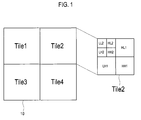
- FIG. 1 is a schematic diagram showing a wavelet transformation process
- FIG. 2 is a schematic diagram showing sub-bands partitioned from a code block
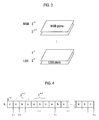
- FIG. 3 is a schematic diagram showing a relationship between a code block and bit planes
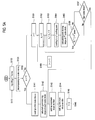
- FIG. 4 is a schematic diagram showing a relationship between a bit plane, coding passes and a truncation point
- FIGS. 5A and 5B are flowcharts illustrating a method of compressing an image in accordance with a first embodiment of the present invention
- FIG. 6 is a flowchart illustrating a method of compressing an image in accordance with a second embodiment of the present invention
- FIG. 7 is a flowchart illustrating a method of compressing an image in accordance with a third embodiment of the present invention.
- FIG. 8 is a flowchart illustrating a method of compressing an image in accordance with a fourth embodiment of the present invention.
- an original image (or frame) constructed with a plurality of pixels is cut into a plurality of tiles, i.e., Tile 1, Tile 2, Tile 3 and Tile 4 (tiling), which do not overlap each other.
- Each tile has a plurality of tile pixels.
- Discrete wavelet transformation (DWT) is applied on each tile to decompose each tile into a plurality of sub-bands, i.e., LL1, HL1, HH1, HL2, LH2 and HH2.
- a first alphabet in symbols representing the sub-bands means a filter type applied to the image in a horizontal direction
- a second alphabet means a filter type applied to the image in a vertical direction.
- a numeral reference in the symbols means a decomposed level, i.e., an order of DWT.
- the order of DWT may vary according to the predetermined setup.
- one of the sub-bands is partitioned into a plurality of code blocks, i.e., Bo-Bn. It is preferable to partition a LL sub-band in accordance with the present invention.
- Pixel values (wavelet coefficients) included in each code block are quantized to enhance compression performance.
- the quantized pixel values x(n) are separated into a sign bit z(n) and m bit data a m -1 , a m -2 ,.., a 1 ,a 0 .
- the sign bit z(n) and m bit data a m-1 ,a m -2 ,..,a 1 ,a 0 can be defined as equations (1) and (2), which are shown below:
- bit data a m -1 in equation (2) represents a coefficient of an m-1 bit plane.
- each code block is decomposed into m bit planes.
- the bit plane is a set of pixel values having bit data corresponding to an identical bit order of the quantized pixel values of each code block.
- a bit plane B n P m-2 among bit planes B n P 0 -B n P m-2 , which are obtained by decomposing a code block B n is a set of pixels having a m -2 bit data.
- FIG. 3 is a schematic diagram showing bit planes from the most significant bit (MSB) plane to the least significant bit (LSB) plane.
- FIG. 4 is a schematic diagram showing a relationship between coding passes, bit planes and truncation points. As shown in FIG. 4, all of the bit planes (except the MSB plane) are coded by one of the consecutive coding passes, i.e., a, b and c. In this case, a, b and c represent a significant propagation pass, a magnitude refinement pass and a clean-up pass, respectively. Bit data at the end of the n i th coding pass may be a candidate for the truncation point Z i , wherein i is a natural number. Coding passes, which lie on the next truncation point, are excluded from the coding process.
- the truncation point Z i is determined according to the rate of code bits R and distortion D.
- a pixel value of an arbitrary pixel included in the coding block B i is S k [ k ] and a pixel value of the corresponding pixel included in the coding block B i , which is reconstructed by coding up to a ni th coding pass, is S ⁇ k n i k
- distortion D i n i up to the ni th coding pass in a i th code block B i can be defined as the following equation (3).
- the distortion D i n i is measured by using a weight with mean square error (MSE).
- W b 2 represents the weight of the basis vectors for the i th code block B i .
- a total distortion D of the code bits can be defined as the following equation (4)
- a bit allocation optimization process is directed to finding a truncation point from each code block, which can minimize the distortion D of a reconstructed image. If a bit rate up to the n i th coding pass in an i th code block B i is denoted by R i n i , then the total rate of code bits R is defined as the following equation (5).
- the distortion D cannot be reduced without increasing the rate of code bits R. That is, if the rate of code bits R is increased, then the distortion D of the image is also increased. Therefore, the distortion must be reduced, while the rate of code bits R is equal to a target bit rate R target , which is previously set.
- An optimal truncation point Z i ( ⁇ optimal ) can be determined from N i of the code block B i with reference to an optimal Lagrange multiplier ⁇ optimal as the following equation (8).
- the truncation point Z i ( ⁇ optimal ) is determined under the condition of S i n i + 1 ⁇ S i n i then the truncation point Z i at the optimal Lagrange multiplier ⁇ optimal is equal to the maximum value of j, which satisfies the equation (8).
- the post compression rate-distortion optimization can be employed.
- a current frame (k th frame, wherein k is a positive integer) is inputted from a plurality of consecutive frames at step S110.
- the k th frame is decomposed into a plurality of different sub-bands.
- each sub-band is divided into a plurality of code blocks, the orders of which are designated at step S120.
- each code block is separated into bit planes, each being configured to have a plurality of coding passes.
- step S130 It is checked whether the input frame is a first frame at step S130. If it is determined that the input frame is the first frame, then the entire bit planes from an MSB plane to an LSB plane are coded at step S141. Thereafter, R-D slopes S i n i at each coding pass of the entire code blocks are calculated according to the equation (7), wherein the calculated R-D slopes S i n i are stored at step S142. A maximum R-D slope S max and a minimum R-D slope S min among the calculated R-D slopes S i n i are stored as Max and Min, respectively, at steps S143 and S144.
- a predetermined number e.g. 32
- the rate of code bits R of the frame is compared with the target bit rate R target at step S157. If R is smaller than R target , then Max is replaced with Mean at step S158a. On the contrary, if R is greater than R target , then the Min is replaced with Mean at step S158b. Steps S143 to S158a or S158b are repeatedly carried out as many as predetermined times, e.g., 32 times to update Max and Min by increasing the variable f by one at step S159. This is so that Mean, which is finally set, is determined as the reference Lagrange multiplier ⁇ optimal k of the corresponding frame at step S160.
- the slopes of the coding passes are calculated until S i n i becomes smaller than ⁇ optimal k , which is determined at a previous frame. That is, the entire R-D slopes S i n i of each coding pass of the entire bit planes are not calculated. Therefore, the number of coding passes, which are to be arithmetically coded, can be reduced so that the time for compressing the image can be reduced.
- the truncation point may be determined by comparing the number of coding passes, which are not coded, of a current frame and a previous frame.
- a bit rate R B i of the coding passes which are not coded in the i th code block B i of a previous frame, is compared with a bit rate R ⁇ B i of coding passes that are not coded in the i th code block B i of a current frame at step S111. If R B i - R ⁇ B i is smaller than or equal to an allowable value ⁇ ( ⁇ ⁇ 0) for terminating the coding pass, then the process goes to step S163. Then, the order of the coding pass n i is increased by one. Even if the second embodiment of the present invention may increase the compression time compared to the first embodiment of the present invention, the PCRD may be maintained similar to the conventional PCRD.
- the truncation point may be determined by comparing the target bit rate with the code bit rate.
- the third embodiment of the present invention for determining the truncation point by comparing the target bit rate with the code bit rate will be described in detail with reference to FIG. 7.
- the i th code block B i is the last code block at step S167, then it is checked whether an absolute value of a difference between the total rate of code bits R and the target bit rate is smaller than or equal to r % of the target bits according to the following equation (9) at step S169.
- the rate of code bits R cannot be equal to the target bit rate R target , with the result being that an error of r % in the reconstructed image may be ignored.
- the error may be 3 % in accordance with one embodiment of the present invention.
- step S143 If it is determined that the difference between the rate of code bits R and the target bit rate R target is smaller than or equal to r %, then the steps next to step S143 are carried out. On the other hand, if it is determined that the difference between the rate of code bits R and the target bit rate R target is greater than r % at step S169, then it is checked whether the rate of code bits R of the i th code block B i is greater than the target bit rate R target at step S170. If R ⁇ R target , i.e., the coding is not carried out up to the target bit rate R target , then the reference value ⁇ optimal k - 1 is decreased at step S181.
- the reference value ⁇ optimal k - 1 may be decreased by multiplying ⁇ , which is smaller than 1, and then the process goes back to step S161. If it is determined that R ⁇ R budget at step S170, then the processes after step S143 are carried out.
- the truncation point may be determined by comparing the number of entire bits of coding passes, which are not coded in the current frame and the previous frame, in the third embodiment.
- the fourth embodiment of the present invention will be described with reference to FIG. 8.
- a rate of code bits R B i of the coding passes which are not coded in the i th code block B i of a previous frame, is compared with a rate of code bits R ⁇ B i of the coding passes that are not coded in the i th code block B i of a current frame at step S191. If R B i -R ⁇ B i is smaller than or equal to an allowable value ⁇ ( ⁇ 0) for terminating the pass, then the process goes to step S163 and then the order of the coding pass is increased by one. On the other hand, if R B i - R ⁇ B i is greater than the allowable value ⁇ , then the processes after S167 are carried out.
- the truncation point is determined by comparing not only the code bit rate and the target bit rate but also the code bit rate of coding passes of the current frame and the previous frame, image compression can be rapidly carried out. Further, the degradation of an image can be efficiently prevented.
- the coding process can be efficiently performed. Accordingly, when the number of target bits is relatively small, the coding time for image compression can be considerably reduced.
- an image compressing method comprises: partitioning a frame into a plurality of code blocks, each code block having consecutive coding passes; sequentially coding the code passes at each code block, wherein said coding at said each code block comprises: a) coding a first coding pass to produce code bits; b) calculating a rate of the code bits and a distortion; c) calculating a slope of the rate and the distortion; d) checking whether the calculated slope is smaller than a predetermined reference value; and e) if it is determined that the calculated slope is not smaller than the predetermined reference value, then coding the next coding pass and repeating step b) to step e).
- an image compressing method comprises: a) partitioning a k th frame among a plurality of consecutive frames into a plurality of code blocks, each code block being configured to have a plurality of consecutive coding passes and k is a positive integer greater than 1; b) sequentially coding the coding passes at each code block to calculate and store slopes of a rate of code bits and a distortion, wherein an order of the coding pass is increased by one until the calculated slope becomes smaller than a predetermined reference value of a (k-1) th frame; c) storing a maximum slope and a minimum slope among the calculated slopes at each coding pass; d) calculating a mean slope of the maximum slope and the minimum slope; e) comparing a slope at each coding pass with the mean slope by sequentially increasing the order of the coding pass until the slope becomes greater than or equal to the mean slope; f) when the slope becomes greater than or equal to the mean slope, determining a truncation
- any reference in this specification to "one embodiment,” “an embodiment,” “example embodiment,” etc. means that a particular feature, structure or characteristic described in connection with the embodiment is included in at least one embodiment of the present invention.
- the appearances of such phrases in various places in the specification are not necessarily all referring to the same embodiment.
Landscapes
- Engineering & Computer Science (AREA)
- Multimedia (AREA)
- Signal Processing (AREA)
- Compression Or Coding Systems Of Tv Signals (AREA)
- Compression, Expansion, Code Conversion, And Decoders (AREA)
- Compression Of Band Width Or Redundancy In Fax (AREA)
Applications Claiming Priority (1)
| Application Number | Priority Date | Filing Date | Title |
|---|---|---|---|
| KR20060048847A KR100918377B1 (ko) | 2006-05-30 | 2006-05-30 | 영상압축 방법 |
Publications (2)
| Publication Number | Publication Date |
|---|---|
| EP1863288A2 true EP1863288A2 (de) | 2007-12-05 |
| EP1863288A3 EP1863288A3 (de) | 2013-01-09 |
Family
ID=38331706
Family Applications (1)
| Application Number | Title | Priority Date | Filing Date |
|---|---|---|---|
| EP20070010563 Withdrawn EP1863288A3 (de) | 2006-05-30 | 2007-05-29 | Bildkomprimierungsverfahren stützend auf EBCOT |
Country Status (4)
| Country | Link |
|---|---|
| US (1) | US7894680B2 (de) |
| EP (1) | EP1863288A3 (de) |
| JP (1) | JP2007325262A (de) |
| KR (1) | KR100918377B1 (de) |
Cited By (2)
| Publication number | Priority date | Publication date | Assignee | Title |
|---|---|---|---|---|
| FR2934748A1 (fr) * | 2008-07-30 | 2010-02-05 | Bouygues Telecom Sa | Procede et systeme d'authentification d'image |
| CN107087173A (zh) * | 2017-04-10 | 2017-08-22 | 电子科技大学 | 一种面向内容分析的视频编码优化方法 |
Families Citing this family (5)
| Publication number | Priority date | Publication date | Assignee | Title |
|---|---|---|---|---|
| CN102378991B (zh) | 2008-06-23 | 2014-12-17 | 辛诺瓦媒体公司 | 用于编码的数据中的压缩增益的压缩域系统和方法 |
| KR101432775B1 (ko) * | 2008-09-08 | 2014-08-22 | 에스케이텔레콤 주식회사 | 서브블록 내 임의 화소를 이용한 영상 부호화/복호화 방법 및 장치 |
| KR20140139640A (ko) | 2013-05-23 | 2014-12-08 | 삼성디스플레이 주식회사 | 데이터 처리 방법 및 이를 이용하는 표시 장치 |
| US12212751B1 (en) | 2017-05-09 | 2025-01-28 | Cinova Media | Video quality improvements system and method for virtual reality |
| JP7128580B2 (ja) | 2017-07-10 | 2022-08-31 | フラウンホーファー-ゲゼルシャフト・ツール・フェルデルング・デル・アンゲヴァンテン・フォルシュング・アインゲトラーゲネル・フェライン | ビットプレーン符号化 |
Family Cites Families (8)
| Publication number | Priority date | Publication date | Assignee | Title |
|---|---|---|---|---|
| US4394774A (en) * | 1978-12-15 | 1983-07-19 | Compression Labs, Inc. | Digital video compression system and methods utilizing scene adaptive coding with rate buffer feedback |
| US4302775A (en) * | 1978-12-15 | 1981-11-24 | Compression Labs, Inc. | Digital video compression system and methods utilizing scene adaptive coding with rate buffer feedback |
| JPH0635373B2 (ja) * | 1991-10-19 | 1994-05-11 | 協和産業株式会社 | 泡沫状エアゾール剤 |
| US5592225A (en) * | 1993-09-30 | 1997-01-07 | Matsushita Electric Industrial Co., Ltd. | Device and method for controlling coding |
| US6067118A (en) * | 1997-12-16 | 2000-05-23 | Philips Electronics North America Corp. | Method of frame-by-frame calculation of quantization matrices |
| US7822281B2 (en) * | 2003-10-31 | 2010-10-26 | Canon Kabushiki Kaisha | Digital video compression |
| AU2004218610B2 (en) * | 2003-10-31 | 2007-11-29 | Canon Kabushiki Kaisha | Digital Video Compression |
| FR2867648A1 (fr) * | 2003-12-10 | 2005-09-16 | France Telecom | Transcodage entre indices de dictionnaires multi-impulsionnels utilises en codage en compression de signaux numeriques |
-
2006
- 2006-05-30 KR KR20060048847A patent/KR100918377B1/ko not_active Expired - Fee Related
-
2007
- 2007-05-29 EP EP20070010563 patent/EP1863288A3/de not_active Withdrawn
- 2007-05-30 US US11/755,476 patent/US7894680B2/en active Active
- 2007-05-30 JP JP2007143813A patent/JP2007325262A/ja active Pending
Cited By (3)
| Publication number | Priority date | Publication date | Assignee | Title |
|---|---|---|---|---|
| FR2934748A1 (fr) * | 2008-07-30 | 2010-02-05 | Bouygues Telecom Sa | Procede et systeme d'authentification d'image |
| CN107087173A (zh) * | 2017-04-10 | 2017-08-22 | 电子科技大学 | 一种面向内容分析的视频编码优化方法 |
| CN107087173B (zh) * | 2017-04-10 | 2019-10-18 | 电子科技大学 | 一种面向内容分析的视频编码优化方法 |
Also Published As
| Publication number | Publication date |
|---|---|
| EP1863288A3 (de) | 2013-01-09 |
| US7894680B2 (en) | 2011-02-22 |
| KR20070115049A (ko) | 2007-12-05 |
| US20070280542A1 (en) | 2007-12-06 |
| KR100918377B1 (ko) | 2009-09-22 |
| JP2007325262A (ja) | 2007-12-13 |
Similar Documents
| Publication | Publication Date | Title |
|---|---|---|
| US11423310B2 (en) | Deep learning based adaptive arithmetic coding and codelength regularization | |
| EP1863288A2 (de) | Bildkomprimierungsverfahren stützend auf EBCOT | |
| US7003039B2 (en) | Dictionary generation method for video and image compression | |
| US10382789B2 (en) | Systems and methods for digital media compression and recompression | |
| CN101640803B (zh) | 一种用于多光谱图像的渐进的分布式编解码方法及装置 | |
| US20100189369A1 (en) | Decoding apparatus, dequantizing method, distribution determining method, and program thereof | |
| US7251375B2 (en) | Tile boundary artifact removal for arbitrary wavelet filters | |
| US7245241B2 (en) | Image coding with scalable context quantization | |
| CN107666472B (zh) | 混合的数字-模拟编解码的方法和设备 | |
| US7486830B2 (en) | Decoding apparatus, decoding method and program product therefor | |
| CN100559878C (zh) | 用于压缩数字图像数据的小波变换方法和设备 | |
| US7778468B2 (en) | Decoding apparatus, dequantizing method, and program thereof | |
| US7474793B2 (en) | Methods for compression using a denoiser | |
| CN115550650A (zh) | 一种有效调节参考帧图像压缩率的方法及装置、电子设备 | |
| CN102695055A (zh) | 高码率下jpeg_ls码率控制方法 | |
| JP4645948B2 (ja) | 復号化装置及びプログラム | |
| US20060215916A1 (en) | Decoding device, distribution estimation method, decoding method and programs thereof | |
| SM | An Image representation using Compressive Sensing and Arithmetic Coding | |
| US20030228068A1 (en) | Progressive transmission and reception of image data using modified hadamard transform | |
| US20040096112A1 (en) | System and method for video encoding according to degree of macroblock distortion | |
| Hakami et al. | Reversible color compression transform for big data system using human visual system | |
| Dansereau et al. | Rényi generalized entropy analysis of images from a progressive wavelet transmission | |
| Mohammed et al. | Performance evaluation of DWT compared to DCT for compression biomedical image |
Legal Events
| Date | Code | Title | Description |
|---|---|---|---|
| PUAI | Public reference made under article 153(3) epc to a published international application that has entered the european phase |
Free format text: ORIGINAL CODE: 0009012 |
|
| AK | Designated contracting states |
Kind code of ref document: A2 Designated state(s): AT BE BG CH CY CZ DE DK EE ES FI FR GB GR HU IE IS IT LI LT LU LV MC MT NL PL PT RO SE SI SK TR |
|
| AX | Request for extension of the european patent |
Extension state: AL BA HR MK YU |
|
| PUAL | Search report despatched |
Free format text: ORIGINAL CODE: 0009013 |
|
| AK | Designated contracting states |
Kind code of ref document: A3 Designated state(s): AT BE BG CH CY CZ DE DK EE ES FI FR GB GR HU IE IS IT LI LT LU LV MC MT NL PL PT RO SE SI SK TR |
|
| AX | Request for extension of the european patent |
Extension state: AL BA HR MK RS |
|
| RIC1 | Information provided on ipc code assigned before grant |
Ipc: H04N 7/26 20060101AFI20121130BHEP |
|
| AKY | No designation fees paid | ||
| REG | Reference to a national code |
Ref country code: DE Ref legal event code: R108 |
|
| REG | Reference to a national code |
Ref country code: DE Ref legal event code: R108 Effective date: 20130911 |
|
| STAA | Information on the status of an ep patent application or granted ep patent |
Free format text: STATUS: THE APPLICATION IS DEEMED TO BE WITHDRAWN |
|
| 18D | Application deemed to be withdrawn |
Effective date: 20130710 |