EP1857877A1 - Photosensitive planographic printing plate material - Google Patents
Photosensitive planographic printing plate material Download PDFInfo
- Publication number
- EP1857877A1 EP1857877A1 EP06713473A EP06713473A EP1857877A1 EP 1857877 A1 EP1857877 A1 EP 1857877A1 EP 06713473 A EP06713473 A EP 06713473A EP 06713473 A EP06713473 A EP 06713473A EP 1857877 A1 EP1857877 A1 EP 1857877A1
- Authority
- EP
- European Patent Office
- Prior art keywords
- light sensitive
- printing plate
- acid
- plate material
- dye
- Prior art date
- Legal status (The legal status is an assumption and is not a legal conclusion. Google has not performed a legal analysis and makes no representation as to the accuracy of the status listed.)
- Withdrawn
Links
- 238000007639 printing Methods 0.000 title claims abstract description 77
- 239000000463 material Substances 0.000 title claims abstract description 64
- 239000010410 layer Substances 0.000 claims abstract description 60
- 150000001875 compounds Chemical class 0.000 claims abstract description 58
- 239000011241 protective layer Substances 0.000 claims abstract description 36
- 239000002243 precursor Substances 0.000 claims abstract description 27
- 238000010438 heat treatment Methods 0.000 claims abstract description 14
- 239000011230 binding agent Substances 0.000 claims abstract description 13
- 238000010521 absorption reaction Methods 0.000 claims abstract description 12
- 239000003999 initiator Substances 0.000 claims abstract description 8
- 239000003795 chemical substances by application Substances 0.000 claims description 22
- 230000035945 sensitivity Effects 0.000 abstract description 13
- 239000000975 dye Substances 0.000 description 56
- -1 titanocene compound Chemical class 0.000 description 56
- 238000000034 method Methods 0.000 description 42
- 239000000243 solution Substances 0.000 description 38
- XLYOFNOQVPJJNP-UHFFFAOYSA-N water Substances O XLYOFNOQVPJJNP-UHFFFAOYSA-N 0.000 description 31
- 229910052782 aluminium Inorganic materials 0.000 description 27
- 238000011282 treatment Methods 0.000 description 27
- 239000000178 monomer Substances 0.000 description 25
- XAGFODPZIPBFFR-UHFFFAOYSA-N aluminium Chemical compound [Al] XAGFODPZIPBFFR-UHFFFAOYSA-N 0.000 description 23
- 239000000049 pigment Substances 0.000 description 22
- 238000000576 coating method Methods 0.000 description 21
- 239000003513 alkali Substances 0.000 description 17
- 239000011248 coating agent Substances 0.000 description 17
- XEEYBQQBJWHFJM-UHFFFAOYSA-N iron Substances [Fe] XEEYBQQBJWHFJM-UHFFFAOYSA-N 0.000 description 16
- HEMHJVSKTPXQMS-UHFFFAOYSA-M Sodium hydroxide Chemical compound [OH-].[Na+] HEMHJVSKTPXQMS-UHFFFAOYSA-M 0.000 description 15
- 238000007788 roughening Methods 0.000 description 15
- 229910052751 metal Inorganic materials 0.000 description 14
- 239000002184 metal Substances 0.000 description 14
- 238000012805 post-processing Methods 0.000 description 14
- NIXOWILDQLNWCW-UHFFFAOYSA-M Acrylate Chemical compound [O-]C(=O)C=C NIXOWILDQLNWCW-UHFFFAOYSA-M 0.000 description 13
- 239000002253 acid Substances 0.000 description 12
- NBIIXXVUZAFLBC-UHFFFAOYSA-N Phosphoric acid Chemical compound OP(O)(O)=O NBIIXXVUZAFLBC-UHFFFAOYSA-N 0.000 description 10
- 125000000058 cyclopentadienyl group Chemical group C1(=CC=CC1)* 0.000 description 9
- ZSWFCLXCOIISFI-UHFFFAOYSA-N endo-cyclopentadiene Natural products C1C=CC=C1 ZSWFCLXCOIISFI-UHFFFAOYSA-N 0.000 description 9
- 125000002887 hydroxy group Chemical group [H]O* 0.000 description 9
- 229910052742 iron Inorganic materials 0.000 description 9
- OKTJSMMVPCPJKN-UHFFFAOYSA-N Carbon Chemical compound [C] OKTJSMMVPCPJKN-UHFFFAOYSA-N 0.000 description 8
- LYCAIKOWRPUZTN-UHFFFAOYSA-N Ethylene glycol Chemical compound OCCO LYCAIKOWRPUZTN-UHFFFAOYSA-N 0.000 description 8
- KFZMGEQAYNKOFK-UHFFFAOYSA-N Isopropanol Chemical compound CC(C)O KFZMGEQAYNKOFK-UHFFFAOYSA-N 0.000 description 8
- 239000007795 chemical reaction product Substances 0.000 description 8
- 239000012141 concentrate Substances 0.000 description 8
- 229920001577 copolymer Polymers 0.000 description 8
- 238000005238 degreasing Methods 0.000 description 8
- 239000004094 surface-active agent Substances 0.000 description 8
- 238000007743 anodising Methods 0.000 description 7
- 230000015572 biosynthetic process Effects 0.000 description 7
- 238000006243 chemical reaction Methods 0.000 description 7
- 150000004775 coumarins Chemical class 0.000 description 7
- 238000011161 development Methods 0.000 description 7
- 239000000203 mixture Substances 0.000 description 7
- 238000006116 polymerization reaction Methods 0.000 description 7
- 229920005989 resin Polymers 0.000 description 7
- 239000011347 resin Substances 0.000 description 7
- 239000000523 sample Substances 0.000 description 7
- 238000005406 washing Methods 0.000 description 7
- WEVYAHXRMPXWCK-UHFFFAOYSA-N Acetonitrile Chemical compound CC#N WEVYAHXRMPXWCK-UHFFFAOYSA-N 0.000 description 6
- LFQSCWFLJHTTHZ-UHFFFAOYSA-N Ethanol Chemical compound CCO LFQSCWFLJHTTHZ-UHFFFAOYSA-N 0.000 description 6
- 229910019142 PO4 Inorganic materials 0.000 description 6
- KWYUFKZDYYNOTN-UHFFFAOYSA-M Potassium hydroxide Chemical compound [OH-].[K+] KWYUFKZDYYNOTN-UHFFFAOYSA-M 0.000 description 6
- QAOWNCQODCNURD-UHFFFAOYSA-N Sulfuric acid Chemical compound OS(O)(=O)=O QAOWNCQODCNURD-UHFFFAOYSA-N 0.000 description 6
- 125000003647 acryloyl group Chemical group O=C([*])C([H])=C([H])[H] 0.000 description 6
- MTHSVFCYNBDYFN-UHFFFAOYSA-N diethylene glycol Chemical compound OCCOCCO MTHSVFCYNBDYFN-UHFFFAOYSA-N 0.000 description 6
- 238000005868 electrolysis reaction Methods 0.000 description 6
- 239000010452 phosphate Substances 0.000 description 6
- 238000007781 pre-processing Methods 0.000 description 6
- 230000001235 sensitizing effect Effects 0.000 description 6
- CERQOIWHTDAKMF-UHFFFAOYSA-N Methacrylic acid Chemical compound CC(=C)C(O)=O CERQOIWHTDAKMF-UHFFFAOYSA-N 0.000 description 5
- 229910000147 aluminium phosphate Inorganic materials 0.000 description 5
- 125000003178 carboxy group Chemical group [H]OC(*)=O 0.000 description 5
- 150000002148 esters Chemical class 0.000 description 5
- 230000008569 process Effects 0.000 description 5
- 235000011121 sodium hydroxide Nutrition 0.000 description 5
- 239000007787 solid Substances 0.000 description 5
- 239000002904 solvent Substances 0.000 description 5
- DZLFLBLQUQXARW-UHFFFAOYSA-N tetrabutylammonium Chemical compound CCCC[N+](CCCC)(CCCC)CCCC DZLFLBLQUQXARW-UHFFFAOYSA-N 0.000 description 5
- VEXZGXHMUGYJMC-UHFFFAOYSA-N Hydrochloric acid Chemical compound Cl VEXZGXHMUGYJMC-UHFFFAOYSA-N 0.000 description 4
- WOBHKFSMXKNTIM-UHFFFAOYSA-N Hydroxyethyl methacrylate Chemical compound CC(=C)C(=O)OCCO WOBHKFSMXKNTIM-UHFFFAOYSA-N 0.000 description 4
- PXHVJJICTQNCMI-UHFFFAOYSA-N Nickel Chemical compound [Ni] PXHVJJICTQNCMI-UHFFFAOYSA-N 0.000 description 4
- GRYLNZFGIOXLOG-UHFFFAOYSA-N Nitric acid Chemical compound O[N+]([O-])=O GRYLNZFGIOXLOG-UHFFFAOYSA-N 0.000 description 4
- OFOBLEOULBTSOW-UHFFFAOYSA-N Propanedioic acid Natural products OC(=O)CC(O)=O OFOBLEOULBTSOW-UHFFFAOYSA-N 0.000 description 4
- PPBRXRYQALVLMV-UHFFFAOYSA-N Styrene Chemical compound C=CC1=CC=CC=C1 PPBRXRYQALVLMV-UHFFFAOYSA-N 0.000 description 4
- GSEJCLTVZPLZKY-UHFFFAOYSA-N Triethanolamine Chemical compound OCCN(CCO)CCO GSEJCLTVZPLZKY-UHFFFAOYSA-N 0.000 description 4
- QVGXLLKOCUKJST-UHFFFAOYSA-N atomic oxygen Chemical compound [O] QVGXLLKOCUKJST-UHFFFAOYSA-N 0.000 description 4
- 239000003086 colorant Substances 0.000 description 4
- 125000005442 diisocyanate group Chemical group 0.000 description 4
- FWQHNLCNFPYBCA-UHFFFAOYSA-N fluoran Chemical class C12=CC=CC=C2OC2=CC=CC=C2C11OC(=O)C2=CC=CC=C21 FWQHNLCNFPYBCA-UHFFFAOYSA-N 0.000 description 4
- VOZRXNHHFUQHIL-UHFFFAOYSA-N glycidyl methacrylate Chemical group CC(=C)C(=O)OCC1CO1 VOZRXNHHFUQHIL-UHFFFAOYSA-N 0.000 description 4
- 150000002366 halogen compounds Chemical class 0.000 description 4
- 239000012948 isocyanate Substances 0.000 description 4
- 150000002513 isocyanates Chemical class 0.000 description 4
- LVHBHZANLOWSRM-UHFFFAOYSA-N itaconic acid Chemical compound OC(=O)CC(=C)C(O)=O LVHBHZANLOWSRM-UHFFFAOYSA-N 0.000 description 4
- VZCYOOQTPOCHFL-UPHRSURJSA-N maleic acid Chemical compound OC(=O)\C=C/C(O)=O VZCYOOQTPOCHFL-UPHRSURJSA-N 0.000 description 4
- 229910017604 nitric acid Inorganic materials 0.000 description 4
- 230000003287 optical effect Effects 0.000 description 4
- 239000001301 oxygen Substances 0.000 description 4
- 229910052760 oxygen Inorganic materials 0.000 description 4
- XNGIFLGASWRNHJ-UHFFFAOYSA-N phthalic acid Chemical compound OC(=O)C1=CC=CC=C1C(O)=O XNGIFLGASWRNHJ-UHFFFAOYSA-N 0.000 description 4
- 239000003505 polymerization initiator Substances 0.000 description 4
- 238000012545 processing Methods 0.000 description 4
- 239000012487 rinsing solution Substances 0.000 description 4
- 150000003839 salts Chemical class 0.000 description 4
- 230000003595 spectral effect Effects 0.000 description 4
- 125000001424 substituent group Chemical group 0.000 description 4
- 150000005846 sugar alcohols Polymers 0.000 description 4
- 125000001302 tertiary amino group Chemical group 0.000 description 4
- VZCYOOQTPOCHFL-UHFFFAOYSA-N trans-butenedioic acid Natural products OC(=O)C=CC(O)=O VZCYOOQTPOCHFL-UHFFFAOYSA-N 0.000 description 4
- 229920002554 vinyl polymer Polymers 0.000 description 4
- SMZOUWXMTYCWNB-UHFFFAOYSA-N 2-(2-methoxy-5-methylphenyl)ethanamine Chemical compound COC1=CC=C(C)C=C1CCN SMZOUWXMTYCWNB-UHFFFAOYSA-N 0.000 description 3
- NIXOWILDQLNWCW-UHFFFAOYSA-N 2-Propenoic acid Natural products OC(=O)C=C NIXOWILDQLNWCW-UHFFFAOYSA-N 0.000 description 3
- TXBCBTDQIULDIA-UHFFFAOYSA-N 2-[[3-hydroxy-2,2-bis(hydroxymethyl)propoxy]methyl]-2-(hydroxymethyl)propane-1,3-diol Chemical compound OCC(CO)(CO)COCC(CO)(CO)CO TXBCBTDQIULDIA-UHFFFAOYSA-N 0.000 description 3
- GVNHOISKXMSMPX-UHFFFAOYSA-N 2-[butyl(2-hydroxyethyl)amino]ethanol Chemical compound CCCCN(CCO)CCO GVNHOISKXMSMPX-UHFFFAOYSA-N 0.000 description 3
- 229940095095 2-hydroxyethyl acrylate Drugs 0.000 description 3
- OMIGHNLMNHATMP-UHFFFAOYSA-N 2-hydroxyethyl prop-2-enoate Chemical compound OCCOC(=O)C=C OMIGHNLMNHATMP-UHFFFAOYSA-N 0.000 description 3
- QTBSBXVTEAMEQO-UHFFFAOYSA-N Acetic acid Chemical compound CC(O)=O QTBSBXVTEAMEQO-UHFFFAOYSA-N 0.000 description 3
- UHOVQNZJYSORNB-UHFFFAOYSA-N Benzene Chemical compound C1=CC=CC=C1 UHOVQNZJYSORNB-UHFFFAOYSA-N 0.000 description 3
- WVDDGKGOMKODPV-UHFFFAOYSA-N Benzyl alcohol Chemical compound OCC1=CC=CC=C1 WVDDGKGOMKODPV-UHFFFAOYSA-N 0.000 description 3
- CERQOIWHTDAKMF-UHFFFAOYSA-M Methacrylate Chemical compound CC(=C)C([O-])=O CERQOIWHTDAKMF-UHFFFAOYSA-M 0.000 description 3
- OKKJLVBELUTLKV-UHFFFAOYSA-N Methanol Chemical compound OC OKKJLVBELUTLKV-UHFFFAOYSA-N 0.000 description 3
- RTAQQCXQSZGOHL-UHFFFAOYSA-N Titanium Chemical compound [Ti] RTAQQCXQSZGOHL-UHFFFAOYSA-N 0.000 description 3
- ZMANZCXQSJIPKH-UHFFFAOYSA-N Triethylamine Chemical compound CCN(CC)CC ZMANZCXQSJIPKH-UHFFFAOYSA-N 0.000 description 3
- HCHKCACWOHOZIP-UHFFFAOYSA-N Zinc Chemical compound [Zn] HCHKCACWOHOZIP-UHFFFAOYSA-N 0.000 description 3
- 125000000217 alkyl group Chemical group 0.000 description 3
- 229910052799 carbon Inorganic materials 0.000 description 3
- 239000011651 chromium Substances 0.000 description 3
- ZYGHJZDHTFUPRJ-UHFFFAOYSA-N coumarin Chemical class C1=CC=C2OC(=O)C=CC2=C1 ZYGHJZDHTFUPRJ-UHFFFAOYSA-N 0.000 description 3
- 125000004386 diacrylate group Chemical group 0.000 description 3
- 235000014113 dietary fatty acids Nutrition 0.000 description 3
- UAOMVDZJSHZZME-UHFFFAOYSA-N diisopropylamine Chemical compound CC(C)NC(C)C UAOMVDZJSHZZME-UHFFFAOYSA-N 0.000 description 3
- 230000005611 electricity Effects 0.000 description 3
- 239000008151 electrolyte solution Substances 0.000 description 3
- 125000003700 epoxy group Chemical group 0.000 description 3
- 239000000194 fatty acid Substances 0.000 description 3
- 229930195729 fatty acid Natural products 0.000 description 3
- 150000004665 fatty acids Chemical class 0.000 description 3
- 229910002804 graphite Inorganic materials 0.000 description 3
- 239000010439 graphite Substances 0.000 description 3
- 125000005843 halogen group Chemical group 0.000 description 3
- RAXXELZNTBOGNW-UHFFFAOYSA-N imidazole Natural products C1=CNC=N1 RAXXELZNTBOGNW-UHFFFAOYSA-N 0.000 description 3
- 239000003112 inhibitor Substances 0.000 description 3
- SZVJSHCCFOBDDC-UHFFFAOYSA-N iron(II,III) oxide Inorganic materials O=[Fe]O[Fe]O[Fe]=O SZVJSHCCFOBDDC-UHFFFAOYSA-N 0.000 description 3
- 229960004592 isopropanol Drugs 0.000 description 3
- 238000004519 manufacturing process Methods 0.000 description 3
- 230000007246 mechanism Effects 0.000 description 3
- 229910044991 metal oxide Inorganic materials 0.000 description 3
- 150000004706 metal oxides Chemical class 0.000 description 3
- 125000002467 phosphate group Chemical group [H]OP(=O)(O[H])O[*] 0.000 description 3
- 238000002360 preparation method Methods 0.000 description 3
- 239000004065 semiconductor Substances 0.000 description 3
- 239000007921 spray Substances 0.000 description 3
- 229910052719 titanium Inorganic materials 0.000 description 3
- 239000010936 titanium Substances 0.000 description 3
- ZIBGPFATKBEMQZ-UHFFFAOYSA-N triethylene glycol Chemical compound OCCOCCOCCO ZIBGPFATKBEMQZ-UHFFFAOYSA-N 0.000 description 3
- 229920006163 vinyl copolymer Polymers 0.000 description 3
- 229910052725 zinc Inorganic materials 0.000 description 3
- 239000011701 zinc Substances 0.000 description 3
- LIZLYZVAYZQVPG-UHFFFAOYSA-N (3-bromo-2-fluorophenyl)methanol Chemical compound OCC1=CC=CC(Br)=C1F LIZLYZVAYZQVPG-UHFFFAOYSA-N 0.000 description 2
- QGKMIGUHVLGJBR-UHFFFAOYSA-M (4z)-1-(3-methylbutyl)-4-[[1-(3-methylbutyl)quinolin-1-ium-4-yl]methylidene]quinoline;iodide Chemical compound [I-].C12=CC=CC=C2N(CCC(C)C)C=CC1=CC1=CC=[N+](CCC(C)C)C2=CC=CC=C12 QGKMIGUHVLGJBR-UHFFFAOYSA-M 0.000 description 2
- UIQCRIFSBWGDTQ-UHFFFAOYSA-N 1,1,2,2,3,3,4,4,5,5,6,6,7,7,10,10,10-heptadecafluorodecyl 2-methylprop-2-enoate Chemical compound CC(=C)C(=O)OC(F)(F)C(F)(F)C(F)(F)C(F)(F)C(F)(F)C(F)(F)C(F)(F)CCC(F)(F)F UIQCRIFSBWGDTQ-UHFFFAOYSA-N 0.000 description 2
- RYHBNJHYFVUHQT-UHFFFAOYSA-N 1,4-Dioxane Chemical compound C1COCCO1 RYHBNJHYFVUHQT-UHFFFAOYSA-N 0.000 description 2
- UZKWTJUDCOPSNM-UHFFFAOYSA-N 1-ethenoxybutane Chemical compound CCCCOC=C UZKWTJUDCOPSNM-UHFFFAOYSA-N 0.000 description 2
- JLIDVCMBCGBIEY-UHFFFAOYSA-N 1-penten-3-one Chemical compound CCC(=O)C=C JLIDVCMBCGBIEY-UHFFFAOYSA-N 0.000 description 2
- XUVKSPPGPPFPQN-UHFFFAOYSA-N 10-Methyl-9(10H)-acridone Chemical compound C1=CC=C2N(C)C3=CC=CC=C3C(=O)C2=C1 XUVKSPPGPPFPQN-UHFFFAOYSA-N 0.000 description 2
- GMIUUCWUOPOETN-UHFFFAOYSA-N 2,4,5-triphenyl-1-(2,4,5-triphenylimidazol-2-yl)imidazole Chemical compound C1=CC=CC=C1C1=NC(N2C(=C(N=C2C=2C=CC=CC=2)C=2C=CC=CC=2)C=2C=CC=CC=2)(C=2C=CC=CC=2)N=C1C1=CC=CC=C1 GMIUUCWUOPOETN-UHFFFAOYSA-N 0.000 description 2
- JAHNSTQSQJOJLO-UHFFFAOYSA-N 2-(3-fluorophenyl)-1h-imidazole Chemical compound FC1=CC=CC(C=2NC=CN=2)=C1 JAHNSTQSQJOJLO-UHFFFAOYSA-N 0.000 description 2
- JKNCOURZONDCGV-UHFFFAOYSA-N 2-(dimethylamino)ethyl 2-methylprop-2-enoate Chemical compound CN(C)CCOC(=O)C(C)=C JKNCOURZONDCGV-UHFFFAOYSA-N 0.000 description 2
- DPBJAVGHACCNRL-UHFFFAOYSA-N 2-(dimethylamino)ethyl prop-2-enoate Chemical compound CN(C)CCOC(=O)C=C DPBJAVGHACCNRL-UHFFFAOYSA-N 0.000 description 2
- INQDDHNZXOAFFD-UHFFFAOYSA-N 2-[2-(2-prop-2-enoyloxyethoxy)ethoxy]ethyl prop-2-enoate Chemical compound C=CC(=O)OCCOCCOCCOC(=O)C=C INQDDHNZXOAFFD-UHFFFAOYSA-N 0.000 description 2
- NJWGQARXZDRHCD-UHFFFAOYSA-N 2-methylanthraquinone Chemical compound C1=CC=C2C(=O)C3=CC(C)=CC=C3C(=O)C2=C1 NJWGQARXZDRHCD-UHFFFAOYSA-N 0.000 description 2
- KUDUQBURMYMBIJ-UHFFFAOYSA-N 2-prop-2-enoyloxyethyl prop-2-enoate Chemical compound C=CC(=O)OCCOC(=O)C=C KUDUQBURMYMBIJ-UHFFFAOYSA-N 0.000 description 2
- NDWUBGAGUCISDV-UHFFFAOYSA-N 4-hydroxybutyl prop-2-enoate Chemical compound OCCCCOC(=O)C=C NDWUBGAGUCISDV-UHFFFAOYSA-N 0.000 description 2
- 244000215068 Acacia senegal Species 0.000 description 2
- HRPVXLWXLXDGHG-UHFFFAOYSA-N Acrylamide Chemical compound NC(=O)C=C HRPVXLWXLXDGHG-UHFFFAOYSA-N 0.000 description 2
- 229910000838 Al alloy Inorganic materials 0.000 description 2
- QGZKDVFQNNGYKY-UHFFFAOYSA-O Ammonium Chemical compound [NH4+] QGZKDVFQNNGYKY-UHFFFAOYSA-O 0.000 description 2
- ATRRKUHOCOJYRX-UHFFFAOYSA-N Ammonium bicarbonate Chemical group [NH4+].OC([O-])=O ATRRKUHOCOJYRX-UHFFFAOYSA-N 0.000 description 2
- KAKZBPTYRLMSJV-UHFFFAOYSA-N Butadiene Chemical compound C=CC=C KAKZBPTYRLMSJV-UHFFFAOYSA-N 0.000 description 2
- SOGAXMICEFXMKE-UHFFFAOYSA-N Butylmethacrylate Chemical compound CCCCOC(=O)C(C)=C SOGAXMICEFXMKE-UHFFFAOYSA-N 0.000 description 2
- VYZAMTAEIAYCRO-UHFFFAOYSA-N Chromium Chemical compound [Cr] VYZAMTAEIAYCRO-UHFFFAOYSA-N 0.000 description 2
- PQMOXTJVIYEOQL-UHFFFAOYSA-N Cumarin Natural products CC(C)=CCC1=C(O)C(C(=O)C(C)CC)=C(O)C2=C1OC(=O)C=C2CCC PQMOXTJVIYEOQL-UHFFFAOYSA-N 0.000 description 2
- RTZKZFJDLAIYFH-UHFFFAOYSA-N Diethyl ether Chemical compound CCOCC RTZKZFJDLAIYFH-UHFFFAOYSA-N 0.000 description 2
- NIQCNGHVCWTJSM-UHFFFAOYSA-N Dimethyl phthalate Chemical compound COC(=O)C1=CC=CC=C1C(=O)OC NIQCNGHVCWTJSM-UHFFFAOYSA-N 0.000 description 2
- ROSDSFDQCJNGOL-UHFFFAOYSA-N Dimethylamine Chemical compound CNC ROSDSFDQCJNGOL-UHFFFAOYSA-N 0.000 description 2
- QUSNBJAOOMFDIB-UHFFFAOYSA-N Ethylamine Chemical compound CCN QUSNBJAOOMFDIB-UHFFFAOYSA-N 0.000 description 2
- KRHYYFGTRYWZRS-UHFFFAOYSA-N Fluorane Chemical compound F KRHYYFGTRYWZRS-UHFFFAOYSA-N 0.000 description 2
- 229920000084 Gum arabic Polymers 0.000 description 2
- QIGBRXMKCJKVMJ-UHFFFAOYSA-N Hydroquinone Chemical compound OC1=CC=C(O)C=C1 QIGBRXMKCJKVMJ-UHFFFAOYSA-N 0.000 description 2
- DGAQECJNVWCQMB-PUAWFVPOSA-M Ilexoside XXIX Chemical compound C[C@@H]1CC[C@@]2(CC[C@@]3(C(=CC[C@H]4[C@]3(CC[C@@H]5[C@@]4(CC[C@@H](C5(C)C)OS(=O)(=O)[O-])C)C)[C@@H]2[C@]1(C)O)C)C(=O)O[C@H]6[C@@H]([C@H]([C@@H]([C@H](O6)CO)O)O)O.[Na+] DGAQECJNVWCQMB-PUAWFVPOSA-M 0.000 description 2
- 235000000177 Indigofera tinctoria Nutrition 0.000 description 2
- UQSXHKLRYXJYBZ-UHFFFAOYSA-N Iron oxide Chemical compound [Fe]=O UQSXHKLRYXJYBZ-UHFFFAOYSA-N 0.000 description 2
- 239000005058 Isophorone diisocyanate Substances 0.000 description 2
- RRHGJUQNOFWUDK-UHFFFAOYSA-N Isoprene Chemical compound CC(=C)C=C RRHGJUQNOFWUDK-UHFFFAOYSA-N 0.000 description 2
- FSOGIJPGPZWNGO-UHFFFAOYSA-N Meomammein Natural products CCC(C)C(=O)C1=C(O)C(CC=C(C)C)=C(O)C2=C1OC(=O)C=C2CCC FSOGIJPGPZWNGO-UHFFFAOYSA-N 0.000 description 2
- BAPJBEWLBFYGME-UHFFFAOYSA-N Methyl acrylate Chemical compound COC(=O)C=C BAPJBEWLBFYGME-UHFFFAOYSA-N 0.000 description 2
- VVQNEPGJFQJSBK-UHFFFAOYSA-N Methyl methacrylate Chemical compound COC(=O)C(C)=C VVQNEPGJFQJSBK-UHFFFAOYSA-N 0.000 description 2
- BAVYZALUXZFZLV-UHFFFAOYSA-N Methylamine Chemical compound NC BAVYZALUXZFZLV-UHFFFAOYSA-N 0.000 description 2
- AKNUHUCEWALCOI-UHFFFAOYSA-N N-ethyldiethanolamine Chemical compound OCCN(CC)CCO AKNUHUCEWALCOI-UHFFFAOYSA-N 0.000 description 2
- 239000002202 Polyethylene glycol Substances 0.000 description 2
- 239000004372 Polyvinyl alcohol Substances 0.000 description 2
- JUJWROOIHBZHMG-UHFFFAOYSA-N Pyridine Chemical compound C1=CC=NC=C1 JUJWROOIHBZHMG-UHFFFAOYSA-N 0.000 description 2
- NRCMAYZCPIVABH-UHFFFAOYSA-N Quinacridone Chemical compound N1C2=CC=CC=C2C(=O)C2=C1C=C1C(=O)C3=CC=CC=C3NC1=C2 NRCMAYZCPIVABH-UHFFFAOYSA-N 0.000 description 2
- CDBYLPFSWZWCQE-UHFFFAOYSA-L Sodium Carbonate Chemical group [Na+].[Na+].[O-]C([O-])=O CDBYLPFSWZWCQE-UHFFFAOYSA-L 0.000 description 2
- 239000004115 Sodium Silicate Substances 0.000 description 2
- UIIMBOGNXHQVGW-UHFFFAOYSA-M Sodium bicarbonate Chemical group [Na+].OC([O-])=O UIIMBOGNXHQVGW-UHFFFAOYSA-M 0.000 description 2
- 229920002125 Sokalan® Polymers 0.000 description 2
- KKEYFWRCBNTPAC-UHFFFAOYSA-N Terephthalic acid Chemical compound OC(=O)C1=CC=C(C(O)=O)C=C1 KKEYFWRCBNTPAC-UHFFFAOYSA-N 0.000 description 2
- UWHCKJMYHZGTIT-UHFFFAOYSA-N Tetraethylene glycol, Natural products OCCOCCOCCOCCO UWHCKJMYHZGTIT-UHFFFAOYSA-N 0.000 description 2
- GWEVSGVZZGPLCZ-UHFFFAOYSA-N Titan oxide Chemical compound O=[Ti]=O GWEVSGVZZGPLCZ-UHFFFAOYSA-N 0.000 description 2
- XLOMVQKBTHCTTD-UHFFFAOYSA-N Zinc monoxide Chemical compound [Zn]=O XLOMVQKBTHCTTD-UHFFFAOYSA-N 0.000 description 2
- 238000002835 absorbance Methods 0.000 description 2
- 238000000862 absorption spectrum Methods 0.000 description 2
- 235000010489 acacia gum Nutrition 0.000 description 2
- 239000000205 acacia gum Substances 0.000 description 2
- DZBUGLKDJFMEHC-UHFFFAOYSA-N acridine Chemical compound C1=CC=CC2=CC3=CC=CC=C3N=C21 DZBUGLKDJFMEHC-UHFFFAOYSA-N 0.000 description 2
- 150000001252 acrylic acid derivatives Chemical class 0.000 description 2
- WNLRTRBMVRJNCN-UHFFFAOYSA-N adipic acid Chemical compound OC(=O)CCCCC(O)=O WNLRTRBMVRJNCN-UHFFFAOYSA-N 0.000 description 2
- 125000005250 alkyl acrylate group Chemical group 0.000 description 2
- 239000001099 ammonium carbonate Chemical group 0.000 description 2
- 239000007864 aqueous solution Substances 0.000 description 2
- 125000003118 aryl group Chemical group 0.000 description 2
- IISBACLAFKSPIT-UHFFFAOYSA-N bisphenol A Chemical compound C=1C=C(O)C=CC=1C(C)(C)C1=CC=C(O)C=C1 IISBACLAFKSPIT-UHFFFAOYSA-N 0.000 description 2
- 239000001055 blue pigment Substances 0.000 description 2
- 238000009835 boiling Methods 0.000 description 2
- 150000001642 boronic acid derivatives Chemical class 0.000 description 2
- BTANRVKWQNVYAZ-UHFFFAOYSA-N butan-2-ol Chemical compound CCC(C)O BTANRVKWQNVYAZ-UHFFFAOYSA-N 0.000 description 2
- WERYXYBDKMZEQL-UHFFFAOYSA-N butane-1,4-diol Chemical compound OCCCCO WERYXYBDKMZEQL-UHFFFAOYSA-N 0.000 description 2
- FUSUHKVFWTUUBE-UHFFFAOYSA-N buten-2-one Chemical compound CC(=O)C=C FUSUHKVFWTUUBE-UHFFFAOYSA-N 0.000 description 2
- KRVSOGSZCMJSLX-UHFFFAOYSA-L chromic acid Substances O[Cr](O)(=O)=O KRVSOGSZCMJSLX-UHFFFAOYSA-L 0.000 description 2
- 229910052804 chromium Inorganic materials 0.000 description 2
- 229940125904 compound 1 Drugs 0.000 description 2
- 238000007796 conventional method Methods 0.000 description 2
- 238000007334 copolymerization reaction Methods 0.000 description 2
- XCJYREBRNVKWGJ-UHFFFAOYSA-N copper(II) phthalocyanine Chemical compound [Cu+2].C12=CC=CC=C2C(N=C2[N-]C(C3=CC=CC=C32)=N2)=NC1=NC([C]1C=CC=CC1=1)=NC=1N=C1[C]3C=CC=CC3=C2[N-]1 XCJYREBRNVKWGJ-UHFFFAOYSA-N 0.000 description 2
- KCDCNGXPPGQERR-UHFFFAOYSA-N coumarin 343 Chemical compound C1CCC2=C(OC(C(C(=O)O)=C3)=O)C3=CC3=C2N1CCC3 KCDCNGXPPGQERR-UHFFFAOYSA-N 0.000 description 2
- LDHQCZJRKDOVOX-NSCUHMNNSA-N crotonic acid Chemical compound C\C=C\C(O)=O LDHQCZJRKDOVOX-NSCUHMNNSA-N 0.000 description 2
- 125000004093 cyano group Chemical group *C#N 0.000 description 2
- JHIVVAPYMSGYDF-UHFFFAOYSA-N cyclohexanone Chemical compound O=C1CCCCC1 JHIVVAPYMSGYDF-UHFFFAOYSA-N 0.000 description 2
- PESYEWKSBIWTAK-UHFFFAOYSA-N cyclopenta-1,3-diene;titanium(2+) Chemical class [Ti+2].C=1C=C[CH-]C=1.C=1C=C[CH-]C=1 PESYEWKSBIWTAK-UHFFFAOYSA-N 0.000 description 2
- 238000001514 detection method Methods 0.000 description 2
- SWXVUIWOUIDPGS-UHFFFAOYSA-N diacetone alcohol Chemical compound CC(=O)CC(C)(C)O SWXVUIWOUIDPGS-UHFFFAOYSA-N 0.000 description 2
- 238000007865 diluting Methods 0.000 description 2
- 238000010790 dilution Methods 0.000 description 2
- 239000012895 dilution Substances 0.000 description 2
- CZZYITDELCSZES-UHFFFAOYSA-N diphenylmethane Chemical compound C=1C=CC=CC=1CC1=CC=CC=C1 CZZYITDELCSZES-UHFFFAOYSA-N 0.000 description 2
- UKMSUNONTOPOIO-UHFFFAOYSA-N docosanoic acid Chemical compound CCCCCCCCCCCCCCCCCCCCCC(O)=O UKMSUNONTOPOIO-UHFFFAOYSA-N 0.000 description 2
- 238000001035 drying Methods 0.000 description 2
- 239000000839 emulsion Substances 0.000 description 2
- 239000003822 epoxy resin Substances 0.000 description 2
- 238000005530 etching Methods 0.000 description 2
- FJKIXWOMBXYWOQ-UHFFFAOYSA-N ethenoxyethane Chemical compound CCOC=C FJKIXWOMBXYWOQ-UHFFFAOYSA-N 0.000 description 2
- LZCLXQDLBQLTDK-UHFFFAOYSA-N ethyl 2-hydroxypropanoate Chemical compound CCOC(=O)C(C)O LZCLXQDLBQLTDK-UHFFFAOYSA-N 0.000 description 2
- 229940093476 ethylene glycol Drugs 0.000 description 2
- AWJWCTOOIBYHON-UHFFFAOYSA-N furo[3,4-b]pyrazine-5,7-dione Chemical compound C1=CN=C2C(=O)OC(=O)C2=N1 AWJWCTOOIBYHON-UHFFFAOYSA-N 0.000 description 2
- 239000008187 granular material Substances 0.000 description 2
- JTHNLKXLWOXOQK-UHFFFAOYSA-N hex-1-en-3-one Chemical compound CCCC(=O)C=C JTHNLKXLWOXOQK-UHFFFAOYSA-N 0.000 description 2
- RRAMGCGOFNQTLD-UHFFFAOYSA-N hexamethylene diisocyanate Chemical compound O=C=NCCCCCCN=C=O RRAMGCGOFNQTLD-UHFFFAOYSA-N 0.000 description 2
- ZSIAUFGUXNUGDI-UHFFFAOYSA-N hexan-1-ol Chemical compound CCCCCCO ZSIAUFGUXNUGDI-UHFFFAOYSA-N 0.000 description 2
- 125000004435 hydrogen atom Chemical group [H]* 0.000 description 2
- 238000010348 incorporation Methods 0.000 description 2
- 235000019239 indanthrene blue RS Nutrition 0.000 description 2
- UHOKSCJSTAHBSO-UHFFFAOYSA-N indanthrone blue Chemical compound C1=CC=C2C(=O)C3=CC=C4NC5=C6C(=O)C7=CC=CC=C7C(=O)C6=CC=C5NC4=C3C(=O)C2=C1 UHOKSCJSTAHBSO-UHFFFAOYSA-N 0.000 description 2
- 229940097275 indigo Drugs 0.000 description 2
- COHYTHOBJLSHDF-UHFFFAOYSA-N indigo powder Natural products N1C2=CC=CC=C2C(=O)C1=C1C(=O)C2=CC=CC=C2N1 COHYTHOBJLSHDF-UHFFFAOYSA-N 0.000 description 2
- ZXEKIIBDNHEJCQ-UHFFFAOYSA-N isobutanol Chemical compound CC(C)CO ZXEKIIBDNHEJCQ-UHFFFAOYSA-N 0.000 description 2
- IQPQWNKOIGAROB-UHFFFAOYSA-N isocyanate group Chemical group [N-]=C=O IQPQWNKOIGAROB-UHFFFAOYSA-N 0.000 description 2
- NIMLQBUJDJZYEJ-UHFFFAOYSA-N isophorone diisocyanate Chemical compound CC1(C)CC(N=C=O)CC(C)(CN=C=O)C1 NIMLQBUJDJZYEJ-UHFFFAOYSA-N 0.000 description 2
- 239000011133 lead Substances 0.000 description 2
- 239000011976 maleic acid Substances 0.000 description 2
- FQPSGWSUVKBHSU-UHFFFAOYSA-N methacrylamide Chemical compound CC(=C)C(N)=O FQPSGWSUVKBHSU-UHFFFAOYSA-N 0.000 description 2
- QPJVMBTYPHYUOC-UHFFFAOYSA-N methyl benzoate Chemical compound COC(=O)C1=CC=CC=C1 QPJVMBTYPHYUOC-UHFFFAOYSA-N 0.000 description 2
- 229910052759 nickel Inorganic materials 0.000 description 2
- 239000012299 nitrogen atmosphere Substances 0.000 description 2
- 239000003921 oil Substances 0.000 description 2
- WCPAKWJPBJAGKN-UHFFFAOYSA-N oxadiazole Chemical group C1=CON=N1 WCPAKWJPBJAGKN-UHFFFAOYSA-N 0.000 description 2
- RPQRDASANLAFCM-UHFFFAOYSA-N oxiran-2-ylmethyl prop-2-enoate Chemical compound C=CC(=O)OCC1CO1 RPQRDASANLAFCM-UHFFFAOYSA-N 0.000 description 2
- 150000002989 phenols Chemical class 0.000 description 2
- 125000001997 phenyl group Chemical group [H]C1=C([H])C([H])=C(*)C([H])=C1[H] 0.000 description 2
- RMVRSNDYEFQCLF-UHFFFAOYSA-N phenyl mercaptan Natural products SC1=CC=CC=C1 RMVRSNDYEFQCLF-UHFFFAOYSA-N 0.000 description 2
- IEQIEDJGQAUEQZ-UHFFFAOYSA-N phthalocyanine Chemical compound N1C(N=C2C3=CC=CC=C3C(N=C3C4=CC=CC=C4C(=N4)N3)=N2)=C(C=CC=C2)C2=C1N=C1C2=CC=CC=C2C4=N1 IEQIEDJGQAUEQZ-UHFFFAOYSA-N 0.000 description 2
- WLJVNTCWHIRURA-UHFFFAOYSA-N pimelic acid Chemical compound OC(=O)CCCCCC(O)=O WLJVNTCWHIRURA-UHFFFAOYSA-N 0.000 description 2
- 229920002037 poly(vinyl butyral) polymer Polymers 0.000 description 2
- 239000004584 polyacrylic acid Substances 0.000 description 2
- 229920000647 polyepoxide Polymers 0.000 description 2
- 229920000728 polyester Polymers 0.000 description 2
- 229920006267 polyester film Polymers 0.000 description 2
- 229920001223 polyethylene glycol Polymers 0.000 description 2
- 229920000642 polymer Polymers 0.000 description 2
- 229920005596 polymer binder Polymers 0.000 description 2
- 239000002491 polymer binding agent Substances 0.000 description 2
- 229920002451 polyvinyl alcohol Polymers 0.000 description 2
- 229920000036 polyvinylpyrrolidone Polymers 0.000 description 2
- 239000001267 polyvinylpyrrolidone Substances 0.000 description 2
- 235000013855 polyvinylpyrrolidone Nutrition 0.000 description 2
- BWHMMNNQKKPAPP-UHFFFAOYSA-L potassium carbonate Chemical group [K+].[K+].[O-]C([O-])=O BWHMMNNQKKPAPP-UHFFFAOYSA-L 0.000 description 2
- CYIDZMCFTVVTJO-UHFFFAOYSA-N pyromellitic acid Chemical compound OC(=O)C1=CC(C(O)=O)=C(C(O)=O)C=C1C(O)=O CYIDZMCFTVVTJO-UHFFFAOYSA-N 0.000 description 2
- 239000010453 quartz Substances 0.000 description 2
- PYWVYCXTNDRMGF-UHFFFAOYSA-N rhodamine B Chemical compound [Cl-].C=12C=CC(=[N+](CC)CC)C=C2OC2=CC(N(CC)CC)=CC=C2C=1C1=CC=CC=C1C(O)=O PYWVYCXTNDRMGF-UHFFFAOYSA-N 0.000 description 2
- YGSDEFSMJLZEOE-UHFFFAOYSA-N salicylic acid Chemical compound OC(=O)C1=CC=CC=C1O YGSDEFSMJLZEOE-UHFFFAOYSA-N 0.000 description 2
- 238000007789 sealing Methods 0.000 description 2
- VYPSYNLAJGMNEJ-UHFFFAOYSA-N silicon dioxide Inorganic materials O=[Si]=O VYPSYNLAJGMNEJ-UHFFFAOYSA-N 0.000 description 2
- 229910052708 sodium Inorganic materials 0.000 description 2
- 239000011734 sodium Substances 0.000 description 2
- NTHWMYGWWRZVTN-UHFFFAOYSA-N sodium silicate Chemical compound [Na+].[Na+].[O-][Si]([O-])=O NTHWMYGWWRZVTN-UHFFFAOYSA-N 0.000 description 2
- 229910052911 sodium silicate Inorganic materials 0.000 description 2
- 238000005507 spraying Methods 0.000 description 2
- 150000003512 tertiary amines Chemical class 0.000 description 2
- HJUGFYREWKUQJT-UHFFFAOYSA-N tetrabromomethane Chemical compound BrC(Br)(Br)Br HJUGFYREWKUQJT-UHFFFAOYSA-N 0.000 description 2
- DVKJHBMWWAPEIU-UHFFFAOYSA-N toluene 2,4-diisocyanate Chemical compound CC1=CC=C(N=C=O)C=C1N=C=O DVKJHBMWWAPEIU-UHFFFAOYSA-N 0.000 description 2
- 229910052723 transition metal Inorganic materials 0.000 description 2
- 150000003624 transition metals Chemical class 0.000 description 2
- ARCGXLSVLAOJQL-UHFFFAOYSA-N trimellitic acid Chemical compound OC(=O)C1=CC=C(C(O)=O)C(C(O)=O)=C1 ARCGXLSVLAOJQL-UHFFFAOYSA-N 0.000 description 2
- GETQZCLCWQTVFV-UHFFFAOYSA-N trimethylamine Chemical compound CN(C)C GETQZCLCWQTVFV-UHFFFAOYSA-N 0.000 description 2
- JNELGWHKGNBSMD-UHFFFAOYSA-N xanthone Chemical compound C1=CC=C2C(=O)C3=CC=CC=C3OC2=C1 JNELGWHKGNBSMD-UHFFFAOYSA-N 0.000 description 2
- PRBBFHSSJFGXJS-UHFFFAOYSA-N (2,2-dimethyl-3-prop-2-enoyloxypropyl) prop-2-enoate;3-hydroxy-2,2-dimethylpropanoic acid Chemical compound OCC(C)(C)C(O)=O.C=CC(=O)OCC(C)(C)COC(=O)C=C PRBBFHSSJFGXJS-UHFFFAOYSA-N 0.000 description 1
- VLTYTTRXESKBKI-UHFFFAOYSA-N (2,4-dichlorophenyl)-phenylmethanone Chemical compound ClC1=CC(Cl)=CC=C1C(=O)C1=CC=CC=C1 VLTYTTRXESKBKI-UHFFFAOYSA-N 0.000 description 1
- JMMVHMOAIMOMOF-UHFFFAOYSA-N (4-prop-2-enoyloxyphenyl) prop-2-enoate Chemical compound C=CC(=O)OC1=CC=C(OC(=O)C=C)C=C1 JMMVHMOAIMOMOF-UHFFFAOYSA-N 0.000 description 1
- IJJHHTWSRXUUPG-UHFFFAOYSA-N (4-sulfamoylphenyl) 2-methylprop-2-enoate Chemical compound CC(=C)C(=O)OC1=CC=C(S(N)(=O)=O)C=C1 IJJHHTWSRXUUPG-UHFFFAOYSA-N 0.000 description 1
- YEBPGJVCOQUTIU-UHFFFAOYSA-N (4-sulfamoylphenyl) prop-2-enoate Chemical compound NS(=O)(=O)C1=CC=C(OC(=O)C=C)C=C1 YEBPGJVCOQUTIU-UHFFFAOYSA-N 0.000 description 1
- ISBHMJZRKAFTGE-ONEGZZNKSA-N (e)-pent-2-enenitrile Chemical compound CC\C=C\C#N ISBHMJZRKAFTGE-ONEGZZNKSA-N 0.000 description 1
- GWYSWOQRJGLJPA-UHFFFAOYSA-N 1,1,2,2-tetrafluoropropyl 2-methylprop-2-enoate Chemical compound CC(=C)C(=O)OC(F)(F)C(C)(F)F GWYSWOQRJGLJPA-UHFFFAOYSA-N 0.000 description 1
- CEXMTZSYTLNAOG-UHFFFAOYSA-N 1,1,2,3,3,3-hexafluoropropyl 2-methylprop-2-enoate Chemical compound CC(=C)C(=O)OC(F)(F)C(F)C(F)(F)F CEXMTZSYTLNAOG-UHFFFAOYSA-N 0.000 description 1
- ZWVMLYRJXORSEP-UHFFFAOYSA-N 1,2,6-Hexanetriol Chemical compound OCCCCC(O)CO ZWVMLYRJXORSEP-UHFFFAOYSA-N 0.000 description 1
- MYWOJODOMFBVCB-UHFFFAOYSA-N 1,2,6-trimethylphenanthrene Chemical compound CC1=CC=C2C3=CC(C)=CC=C3C=CC2=C1C MYWOJODOMFBVCB-UHFFFAOYSA-N 0.000 description 1
- MTZUIIAIAKMWLI-UHFFFAOYSA-N 1,2-diisocyanatobenzene Chemical compound O=C=NC1=CC=CC=C1N=C=O MTZUIIAIAKMWLI-UHFFFAOYSA-N 0.000 description 1
- MSAHTMIQULFMRG-UHFFFAOYSA-N 1,2-diphenyl-2-propan-2-yloxyethanone Chemical compound C=1C=CC=CC=1C(OC(C)C)C(=O)C1=CC=CC=C1 MSAHTMIQULFMRG-UHFFFAOYSA-N 0.000 description 1
- AZYRZNIYJDKRHO-UHFFFAOYSA-N 1,3-bis(2-isocyanatopropan-2-yl)benzene Chemical compound O=C=NC(C)(C)C1=CC=CC(C(C)(C)N=C=O)=C1 AZYRZNIYJDKRHO-UHFFFAOYSA-N 0.000 description 1
- RTTZISZSHSCFRH-UHFFFAOYSA-N 1,3-bis(isocyanatomethyl)benzene Chemical compound O=C=NCC1=CC=CC(CN=C=O)=C1 RTTZISZSHSCFRH-UHFFFAOYSA-N 0.000 description 1
- VGHSXKTVMPXHNG-UHFFFAOYSA-N 1,3-diisocyanatobenzene Chemical compound O=C=NC1=CC=CC(N=C=O)=C1 VGHSXKTVMPXHNG-UHFFFAOYSA-N 0.000 description 1
- WACRZVHHXDZWRU-UHFFFAOYSA-N 1,3-dioxolane;prop-2-enoic acid Chemical compound C1COCO1.OC(=O)C=C WACRZVHHXDZWRU-UHFFFAOYSA-N 0.000 description 1
- DKBHJZFJCDOGOY-UHFFFAOYSA-N 1,4-diisocyanato-2-methylbenzene Chemical compound CC1=CC(N=C=O)=CC=C1N=C=O DKBHJZFJCDOGOY-UHFFFAOYSA-N 0.000 description 1
- ALQLPWJFHRMHIU-UHFFFAOYSA-N 1,4-diisocyanatobenzene Chemical compound O=C=NC1=CC=C(N=C=O)C=C1 ALQLPWJFHRMHIU-UHFFFAOYSA-N 0.000 description 1
- AHBNSOZREBSAMG-UHFFFAOYSA-N 1,5-diisocyanato-2-methylpentane Chemical compound O=C=NCC(C)CCCN=C=O AHBNSOZREBSAMG-UHFFFAOYSA-N 0.000 description 1
- ATOUXIOKEJWULN-UHFFFAOYSA-N 1,6-diisocyanato-2,2,4-trimethylhexane Chemical compound O=C=NCCC(C)CC(C)(C)CN=C=O ATOUXIOKEJWULN-UHFFFAOYSA-N 0.000 description 1
- ZDQNWDNMNKSMHI-UHFFFAOYSA-N 1-[2-(2-prop-2-enoyloxypropoxy)propoxy]propan-2-yl prop-2-enoate Chemical compound C=CC(=O)OC(C)COC(C)COCC(C)OC(=O)C=C ZDQNWDNMNKSMHI-UHFFFAOYSA-N 0.000 description 1
- FKOMNQCOHKHUCP-UHFFFAOYSA-N 1-[n-(2-hydroxypropyl)anilino]propan-2-ol Chemical compound CC(O)CN(CC(C)O)C1=CC=CC=C1 FKOMNQCOHKHUCP-UHFFFAOYSA-N 0.000 description 1
- HXKKHQJGJAFBHI-UHFFFAOYSA-N 1-aminopropan-2-ol Chemical compound CC(O)CN HXKKHQJGJAFBHI-UHFFFAOYSA-N 0.000 description 1
- RWNUSVWFHDHRCJ-UHFFFAOYSA-N 1-butoxypropan-2-ol Chemical compound CCCCOCC(C)O RWNUSVWFHDHRCJ-UHFFFAOYSA-N 0.000 description 1
- XXCVIFJHBFNFBO-UHFFFAOYSA-N 1-ethenoxyoctane Chemical compound CCCCCCCCOC=C XXCVIFJHBFNFBO-UHFFFAOYSA-N 0.000 description 1
- OVGRCEFMXPHEBL-UHFFFAOYSA-N 1-ethenoxypropane Chemical compound CCCOC=C OVGRCEFMXPHEBL-UHFFFAOYSA-N 0.000 description 1
- OZFIGURLAJSLIR-UHFFFAOYSA-N 1-ethenyl-2h-pyridine Chemical compound C=CN1CC=CC=C1 OZFIGURLAJSLIR-UHFFFAOYSA-N 0.000 description 1
- ARXJGSRGQADJSQ-UHFFFAOYSA-N 1-methoxypropan-2-ol Chemical compound COCC(C)O ARXJGSRGQADJSQ-UHFFFAOYSA-N 0.000 description 1
- IXPNQXFRVYWDDI-UHFFFAOYSA-N 1-methyl-2,4-dioxo-1,3-diazinane-5-carboximidamide Chemical compound CN1CC(C(N)=N)C(=O)NC1=O IXPNQXFRVYWDDI-UHFFFAOYSA-N 0.000 description 1
- HIAGSPVAYSSKHL-UHFFFAOYSA-N 1-methyl-9h-carbazole Chemical class N1C2=CC=CC=C2C2=C1C(C)=CC=C2 HIAGSPVAYSSKHL-UHFFFAOYSA-N 0.000 description 1
- RTBFRGCFXZNCOE-UHFFFAOYSA-N 1-methylsulfonylpiperidin-4-one Chemical compound CS(=O)(=O)N1CCC(=O)CC1 RTBFRGCFXZNCOE-UHFFFAOYSA-N 0.000 description 1
- XLPJNCYCZORXHG-UHFFFAOYSA-N 1-morpholin-4-ylprop-2-en-1-one Chemical compound C=CC(=O)N1CCOCC1 XLPJNCYCZORXHG-UHFFFAOYSA-N 0.000 description 1
- JWSWULLEVAMIJK-UHFFFAOYSA-N 1-phenylmethoxynaphthalene Chemical compound C=1C=CC2=CC=CC=C2C=1OCC1=CC=CC=C1 JWSWULLEVAMIJK-UHFFFAOYSA-N 0.000 description 1
- KUIZKZHDMPERHR-UHFFFAOYSA-N 1-phenylprop-2-en-1-one Chemical compound C=CC(=O)C1=CC=CC=C1 KUIZKZHDMPERHR-UHFFFAOYSA-N 0.000 description 1
- VOBUAPTXJKMNCT-UHFFFAOYSA-N 1-prop-2-enoyloxyhexyl prop-2-enoate Chemical compound CCCCCC(OC(=O)C=C)OC(=O)C=C VOBUAPTXJKMNCT-UHFFFAOYSA-N 0.000 description 1
- QFDDZIRGHKFRMR-UHFFFAOYSA-N 10-butylacridin-9-one Chemical compound C1=CC=C2N(CCCC)C3=CC=CC=C3C(=O)C2=C1 QFDDZIRGHKFRMR-UHFFFAOYSA-N 0.000 description 1
- WJFKNYWRSNBZNX-UHFFFAOYSA-N 10H-phenothiazine Chemical compound C1=CC=C2NC3=CC=CC=C3SC2=C1 WJFKNYWRSNBZNX-UHFFFAOYSA-N 0.000 description 1
- XAAILNNJDMIMON-UHFFFAOYSA-N 2'-anilino-6'-(dibutylamino)-3'-methylspiro[2-benzofuran-3,9'-xanthene]-1-one Chemical compound C=1C(N(CCCC)CCCC)=CC=C(C2(C3=CC=CC=C3C(=O)O2)C2=C3)C=1OC2=CC(C)=C3NC1=CC=CC=C1 XAAILNNJDMIMON-UHFFFAOYSA-N 0.000 description 1
- GSCLSACFHWKTQU-UHFFFAOYSA-N 2'-chloro-6'-(diethylamino)spiro[2-benzofuran-3,9'-xanthene]-1-one Chemical compound O1C(=O)C2=CC=CC=C2C21C1=CC(Cl)=CC=C1OC1=CC(N(CC)CC)=CC=C21 GSCLSACFHWKTQU-UHFFFAOYSA-N 0.000 description 1
- ZNJXRXXJPIFFAO-UHFFFAOYSA-N 2,2,3,3,4,4,5,5-octafluoropentyl 2-methylprop-2-enoate Chemical compound CC(=C)C(=O)OCC(F)(F)C(F)(F)C(F)(F)C(F)F ZNJXRXXJPIFFAO-UHFFFAOYSA-N 0.000 description 1
- PIZHFBODNLEQBL-UHFFFAOYSA-N 2,2-diethoxy-1-phenylethanone Chemical compound CCOC(OCC)C(=O)C1=CC=CC=C1 PIZHFBODNLEQBL-UHFFFAOYSA-N 0.000 description 1
- UXTRYFGMEADKEK-UHFFFAOYSA-N 2,2-dimethylpropane-1,3-diol 3-hydroxy-2,2-dimethylpropanoic acid oxepan-2-one Chemical compound OCC(C)(C)CO.OCC(C)(C)C(O)=O.O=C1CCCCCO1 UXTRYFGMEADKEK-UHFFFAOYSA-N 0.000 description 1
- HROBBUFVRGGXBM-UHFFFAOYSA-N 2,2-dimethylpropane-1,3-diol hexanedioic acid prop-2-enoic acid Chemical compound OC(=O)C=C.OC(=O)C=C.OCC(C)(C)CO.OC(=O)CCCCC(O)=O HROBBUFVRGGXBM-UHFFFAOYSA-N 0.000 description 1
- FDUFQLNPPGRIKX-UHFFFAOYSA-N 2,2-dimethylpropane-1,3-diol prop-2-enoic acid Chemical class OC(=O)C=C.OC(=O)C=C.OC(=O)C=C.CC(C)(CO)CO FDUFQLNPPGRIKX-UHFFFAOYSA-N 0.000 description 1
- VEPOHXYIFQMVHW-XOZOLZJESA-N 2,3-dihydroxybutanedioic acid (2S,3S)-3,4-dimethyl-2-phenylmorpholine Chemical compound OC(C(O)C(O)=O)C(O)=O.C[C@H]1[C@@H](OCCN1C)c1ccccc1 VEPOHXYIFQMVHW-XOZOLZJESA-N 0.000 description 1
- OWPUOLBODXJOKH-UHFFFAOYSA-N 2,3-dihydroxypropyl prop-2-enoate Chemical compound OCC(O)COC(=O)C=C OWPUOLBODXJOKH-UHFFFAOYSA-N 0.000 description 1
- QWQNFXDYOCUEER-UHFFFAOYSA-N 2,3-ditert-butyl-4-methylphenol Chemical compound CC1=CC=C(O)C(C(C)(C)C)=C1C(C)(C)C QWQNFXDYOCUEER-UHFFFAOYSA-N 0.000 description 1
- CJWNFAKWHDOUKL-UHFFFAOYSA-N 2-(2-phenylpropan-2-yl)phenol Chemical compound C=1C=CC=C(O)C=1C(C)(C)C1=CC=CC=C1 CJWNFAKWHDOUKL-UHFFFAOYSA-N 0.000 description 1
- SJIXRGNQPBQWMK-UHFFFAOYSA-N 2-(diethylamino)ethyl 2-methylprop-2-enoate Chemical compound CCN(CC)CCOC(=O)C(C)=C SJIXRGNQPBQWMK-UHFFFAOYSA-N 0.000 description 1
- JLZQMKLXOVLQFA-UHFFFAOYSA-N 2-(oxolan-2-ylmethoxy)ethyl prop-2-enoate Chemical compound C=CC(=O)OCCOCC1CCCO1 JLZQMKLXOVLQFA-UHFFFAOYSA-N 0.000 description 1
- HZAXFHJVJLSVMW-UHFFFAOYSA-N 2-Aminoethan-1-ol Chemical compound NCCO HZAXFHJVJLSVMW-UHFFFAOYSA-N 0.000 description 1
- GOXQRTZXKQZDDN-UHFFFAOYSA-N 2-Ethylhexyl acrylate Chemical compound CCCCC(CC)COC(=O)C=C GOXQRTZXKQZDDN-UHFFFAOYSA-N 0.000 description 1
- VTIMKVIDORQQFA-UHFFFAOYSA-N 2-Ethylhexyl-4-hydroxybenzoate Chemical compound CCCCC(CC)COC(=O)C1=CC=C(O)C=C1 VTIMKVIDORQQFA-UHFFFAOYSA-N 0.000 description 1
- WAEVWDZKMBQDEJ-UHFFFAOYSA-N 2-[2-(2-methoxypropoxy)propoxy]propan-1-ol Chemical compound COC(C)COC(C)COC(C)CO WAEVWDZKMBQDEJ-UHFFFAOYSA-N 0.000 description 1
- BDHSRLKBZWCXIL-UHFFFAOYSA-N 2-[3-(2-cyanatopropan-2-yl)phenyl]propan-2-yl cyanate Chemical compound N#COC(C)(C)C1=CC=CC(C(C)(C)OC#N)=C1 BDHSRLKBZWCXIL-UHFFFAOYSA-N 0.000 description 1
- FDSUVTROAWLVJA-UHFFFAOYSA-N 2-[[3-hydroxy-2,2-bis(hydroxymethyl)propoxy]methyl]-2-(hydroxymethyl)propane-1,3-diol;prop-2-enoic acid Chemical compound OC(=O)C=C.OC(=O)C=C.OC(=O)C=C.OC(=O)C=C.OC(=O)C=C.OCC(CO)(CO)COCC(CO)(CO)CO FDSUVTROAWLVJA-UHFFFAOYSA-N 0.000 description 1
- AQQNNAXBGPWALO-UHFFFAOYSA-N 2-[butyl(1,1,2,2,3,3,4,4,5,5,6,6,7,7,8,8,8-heptadecafluorooctylsulfonyl)amino]ethyl prop-2-enoate Chemical compound C=CC(=O)OCCN(CCCC)S(=O)(=O)C(F)(F)C(F)(F)C(F)(F)C(F)(F)C(F)(F)C(F)(F)C(F)(F)C(F)(F)F AQQNNAXBGPWALO-UHFFFAOYSA-N 0.000 description 1
- FPKCTSIVDAWGFA-UHFFFAOYSA-N 2-chloroanthracene-9,10-dione Chemical compound C1=CC=C2C(=O)C3=CC(Cl)=CC=C3C(=O)C2=C1 FPKCTSIVDAWGFA-UHFFFAOYSA-N 0.000 description 1
- GPOGMJLHWQHEGF-UHFFFAOYSA-N 2-chloroethyl 2-methylprop-2-enoate Chemical compound CC(=C)C(=O)OCCCl GPOGMJLHWQHEGF-UHFFFAOYSA-N 0.000 description 1
- WHBAYNMEIXUTJV-UHFFFAOYSA-N 2-chloroethyl prop-2-enoate Chemical compound ClCCOC(=O)C=C WHBAYNMEIXUTJV-UHFFFAOYSA-N 0.000 description 1
- ZCDADJXRUCOCJE-UHFFFAOYSA-N 2-chlorothioxanthen-9-one Chemical compound C1=CC=C2C(=O)C3=CC(Cl)=CC=C3SC2=C1 ZCDADJXRUCOCJE-UHFFFAOYSA-N 0.000 description 1
- AEPWOCLBLLCOGZ-UHFFFAOYSA-N 2-cyanoethyl prop-2-enoate Chemical compound C=CC(=O)OCCC#N AEPWOCLBLLCOGZ-UHFFFAOYSA-N 0.000 description 1
- VUIWJRYTWUGOOF-UHFFFAOYSA-N 2-ethenoxyethanol Chemical compound OCCOC=C VUIWJRYTWUGOOF-UHFFFAOYSA-N 0.000 description 1
- GWZMWHWAWHPNHN-UHFFFAOYSA-N 2-hydroxypropyl prop-2-enoate Chemical compound CC(O)COC(=O)C=C GWZMWHWAWHPNHN-UHFFFAOYSA-N 0.000 description 1
- BQZJOQXSCSZQPS-UHFFFAOYSA-N 2-methoxy-1,2-diphenylethanone Chemical compound C=1C=CC=CC=1C(OC)C(=O)C1=CC=CC=C1 BQZJOQXSCSZQPS-UHFFFAOYSA-N 0.000 description 1
- JITOHJHWLTXNCU-UHFFFAOYSA-N 2-methyl-n-(4-methylphenyl)sulfonylprop-2-enamide Chemical compound CC(=C)C(=O)NS(=O)(=O)C1=CC=C(C)C=C1 JITOHJHWLTXNCU-UHFFFAOYSA-N 0.000 description 1
- NQRAOOGLFRBSHM-UHFFFAOYSA-N 2-methyl-n-(4-sulfamoylphenyl)prop-2-enamide Chemical compound CC(=C)C(=O)NC1=CC=C(S(N)(=O)=O)C=C1 NQRAOOGLFRBSHM-UHFFFAOYSA-N 0.000 description 1
- WBAXCOMEMKANRN-UHFFFAOYSA-N 2-methylbut-3-enenitrile Chemical compound C=CC(C)C#N WBAXCOMEMKANRN-UHFFFAOYSA-N 0.000 description 1
- POTXZUQLERIXIW-UHFFFAOYSA-N 2-phenoxyethyl 2,4-dihydroxybenzoate Chemical compound OC1=CC(O)=CC=C1C(=O)OCCOC1=CC=CC=C1 POTXZUQLERIXIW-UHFFFAOYSA-N 0.000 description 1
- RZVINYQDSSQUKO-UHFFFAOYSA-N 2-phenoxyethyl prop-2-enoate Chemical compound C=CC(=O)OCCOC1=CC=CC=C1 RZVINYQDSSQUKO-UHFFFAOYSA-N 0.000 description 1
- ROPDSOYFYJCSTC-UHFFFAOYSA-N 2-phenoxyundecyl prop-2-enoate Chemical compound CCCCCCCCCC(COC(=O)C=C)OC1=CC=CC=C1 ROPDSOYFYJCSTC-UHFFFAOYSA-N 0.000 description 1
- XLLXMBCBJGATSP-UHFFFAOYSA-N 2-phenylethenol Chemical compound OC=CC1=CC=CC=C1 XLLXMBCBJGATSP-UHFFFAOYSA-N 0.000 description 1
- RUPLDRNWBPRWKO-UHFFFAOYSA-N 2-propylthioxanthen-9-one Chemical compound C1=CC=C2C(=O)C3=CC(CCC)=CC=C3SC2=C1 RUPLDRNWBPRWKO-UHFFFAOYSA-N 0.000 description 1
- RVBUGGBMJDPOST-UHFFFAOYSA-N 2-thiobarbituric acid Chemical class O=C1CC(=O)NC(=S)N1 RVBUGGBMJDPOST-UHFFFAOYSA-N 0.000 description 1
- ABJAMKKUHBSXDS-UHFFFAOYSA-N 3,3-bis(6-amino-1,4-dimethylcyclohexa-2,4-dien-1-yl)-2-benzofuran-1-one Chemical compound C1=CC(C)=CC(N)C1(C)C1(C2(C)C(C=C(C)C=C2)N)C2=CC=CC=C2C(=O)O1 ABJAMKKUHBSXDS-UHFFFAOYSA-N 0.000 description 1
- CSYMXGSXCONTDD-UHFFFAOYSA-N 3,5-diphenylphenol Chemical compound C=1C(O)=CC(C=2C=CC=CC=2)=CC=1C1=CC=CC=C1 CSYMXGSXCONTDD-UHFFFAOYSA-N 0.000 description 1
- ZWQBZEFLFSFEOS-UHFFFAOYSA-N 3,5-ditert-butyl-2-hydroxybenzoic acid Chemical compound CC(C)(C)C1=CC(C(O)=O)=C(O)C(C(C)(C)C)=C1 ZWQBZEFLFSFEOS-UHFFFAOYSA-N 0.000 description 1
- QCAHUFWKIQLBNB-UHFFFAOYSA-N 3-(3-methoxypropoxy)propan-1-ol Chemical compound COCCCOCCCO QCAHUFWKIQLBNB-UHFFFAOYSA-N 0.000 description 1
- LTACQVCHVAUOKN-UHFFFAOYSA-N 3-(diethylamino)propane-1,2-diol Chemical compound CCN(CC)CC(O)CO LTACQVCHVAUOKN-UHFFFAOYSA-N 0.000 description 1
- QCMHUGYTOGXZIW-UHFFFAOYSA-N 3-(dimethylamino)propane-1,2-diol Chemical compound CN(C)CC(O)CO QCMHUGYTOGXZIW-UHFFFAOYSA-N 0.000 description 1
- WUPHOULIZUERAE-UHFFFAOYSA-N 3-(oxolan-2-yl)propanoic acid Chemical compound OC(=O)CCC1CCCO1 WUPHOULIZUERAE-UHFFFAOYSA-N 0.000 description 1
- REEBWSYYNPPSKV-UHFFFAOYSA-N 3-[(4-formylphenoxy)methyl]thiophene-2-carbonitrile Chemical compound C1=CC(C=O)=CC=C1OCC1=C(C#N)SC=C1 REEBWSYYNPPSKV-UHFFFAOYSA-N 0.000 description 1
- MQJTWPAGXWPEKU-UHFFFAOYSA-N 3-[4-(dimethylamino)phenyl]-3-(1,2-dimethylindol-3-yl)-2-benzofuran-1-one Chemical compound C1=CC(N(C)C)=CC=C1C1(C=2C3=CC=CC=C3N(C)C=2C)C2=CC=CC=C2C(=O)O1 MQJTWPAGXWPEKU-UHFFFAOYSA-N 0.000 description 1
- ZKUWHPNJONEJEE-UHFFFAOYSA-N 3-[4-(dimethylamino)phenyl]-3-(2-methyl-1h-indol-3-yl)-2-benzofuran-1-one Chemical compound C1=CC(N(C)C)=CC=C1C1(C=2C3=CC=CC=C3NC=2C)C2=CC=CC=C2C(=O)O1 ZKUWHPNJONEJEE-UHFFFAOYSA-N 0.000 description 1
- WKMGGJIKSXAHAM-UHFFFAOYSA-N 3-[4-(dimethylamino)phenyl]-3-(2-phenyl-1h-indol-3-yl)-2-benzofuran-1-one Chemical compound C1=CC(N(C)C)=CC=C1C1(C=2C3=CC=CC=C3NC=2C=2C=CC=CC=2)C2=CC=CC=C2C(=O)O1 WKMGGJIKSXAHAM-UHFFFAOYSA-N 0.000 description 1
- HGPHYOVGIFFHJB-UHFFFAOYSA-N 3-[benzyl(methyl)amino]propane-1,2-diol Chemical compound OCC(O)CN(C)CC1=CC=CC=C1 HGPHYOVGIFFHJB-UHFFFAOYSA-N 0.000 description 1
- NVMKRLZSODWEKS-UHFFFAOYSA-N 3-hydroxy-2-phenylprop-2-enoic acid Chemical compound OC=C(C(O)=O)C1=CC=CC=C1 NVMKRLZSODWEKS-UHFFFAOYSA-N 0.000 description 1
- OFNISBHGPNMTMS-UHFFFAOYSA-N 3-methylideneoxolane-2,5-dione Chemical compound C=C1CC(=O)OC1=O OFNISBHGPNMTMS-UHFFFAOYSA-N 0.000 description 1
- MTMKZABGIQJAEX-UHFFFAOYSA-N 4,4'-sulfonylbis[2-(prop-2-en-1-yl)phenol] Chemical compound C1=C(CC=C)C(O)=CC=C1S(=O)(=O)C1=CC=C(O)C(CC=C)=C1 MTMKZABGIQJAEX-UHFFFAOYSA-N 0.000 description 1
- VPWNQTHUCYMVMZ-UHFFFAOYSA-N 4,4'-sulfonyldiphenol Chemical compound C1=CC(O)=CC=C1S(=O)(=O)C1=CC=C(O)C=C1 VPWNQTHUCYMVMZ-UHFFFAOYSA-N 0.000 description 1
- JLBJTVDPSNHSKJ-UHFFFAOYSA-N 4-Methylstyrene Chemical compound CC1=CC=C(C=C)C=C1 JLBJTVDPSNHSKJ-UHFFFAOYSA-N 0.000 description 1
- YUZSPLNNPSVJNE-UHFFFAOYSA-N 4-[2-[3-[2-(4-hydroxyphenyl)-1-phenylpropan-2-yl]phenyl]-1-phenylpropan-2-yl]phenol Chemical compound C=1C=C(O)C=CC=1C(C=1C=C(C=CC=1)C(C)(CC=1C=CC=CC=1)C=1C=CC(O)=CC=1)(C)CC1=CC=CC=C1 YUZSPLNNPSVJNE-UHFFFAOYSA-N 0.000 description 1
- SNTUCKQYWGHZPK-UHFFFAOYSA-N 4-ethenylbenzonitrile Chemical compound C=CC1=CC=C(C#N)C=C1 SNTUCKQYWGHZPK-UHFFFAOYSA-N 0.000 description 1
- YKXAYLPDMSGWEV-UHFFFAOYSA-N 4-hydroxybutyl 2-methylprop-2-enoate Chemical compound CC(=C)C(=O)OCCCCO YKXAYLPDMSGWEV-UHFFFAOYSA-N 0.000 description 1
- VGVHNLRUAMRIEW-UHFFFAOYSA-N 4-methylcyclohexan-1-one Chemical compound CC1CCC(=O)CC1 VGVHNLRUAMRIEW-UHFFFAOYSA-N 0.000 description 1
- RNRINRUTVAFUCG-UHFFFAOYSA-N 5-(dimethylamino)-3,3-bis(1,2-dimethylindol-3-yl)-2-benzofuran-1-one Chemical compound C1=CC=C2C(C3(C=4C5=CC=CC=C5N(C)C=4C)OC(=O)C4=CC=C(C=C43)N(C)C)=C(C)N(C)C2=C1 RNRINRUTVAFUCG-UHFFFAOYSA-N 0.000 description 1
- ZKIANJBTYMAVTC-UHFFFAOYSA-N 5-(dimethylamino)-3,3-bis(2-phenyl-1h-indol-3-yl)-2-benzofuran-1-one Chemical compound C12=CC(N(C)C)=CC=C2C(=O)OC1(C=1C2=CC=CC=C2NC=1C=1C=CC=CC=1)C(C1=CC=CC=C1N1)=C1C1=CC=CC=C1 ZKIANJBTYMAVTC-UHFFFAOYSA-N 0.000 description 1
- KJFCMURGEOJJFA-UHFFFAOYSA-N 5-(dimethylamino)-3,3-bis(9-ethylcarbazol-3-yl)-2-benzofuran-1-one Chemical compound C1=CC=C2C3=CC(C4(C5=CC(=CC=C5C(=O)O4)N(C)C)C=4C=C5C6=CC=CC=C6N(C5=CC=4)CC)=CC=C3N(CC)C2=C1 KJFCMURGEOJJFA-UHFFFAOYSA-N 0.000 description 1
- YGTVWCBFJAVSMS-UHFFFAOYSA-N 5-hydroxypentyl 2-methylprop-2-enoate Chemical compound CC(=C)C(=O)OCCCCCO YGTVWCBFJAVSMS-UHFFFAOYSA-N 0.000 description 1
- INRQKLGGIVSJRR-UHFFFAOYSA-N 5-hydroxypentyl prop-2-enoate Chemical compound OCCCCCOC(=O)C=C INRQKLGGIVSJRR-UHFFFAOYSA-N 0.000 description 1
- WYWMJBFBHMNECA-UHFFFAOYSA-N 6-(dimethylamino)-3,3-bis(1,2-dimethylindol-3-yl)-2-benzofuran-1-one Chemical compound C1=CC=C2C(C3(C=4C5=CC=CC=C5N(C)C=4C)OC(=O)C=4C3=CC=C(C=4)N(C)C)=C(C)N(C)C2=C1 WYWMJBFBHMNECA-UHFFFAOYSA-N 0.000 description 1
- XFOFBPRPOAWWPA-UHFFFAOYSA-N 6-hydroxyhexyl 2-methylprop-2-enoate Chemical compound CC(=C)C(=O)OCCCCCCO XFOFBPRPOAWWPA-UHFFFAOYSA-N 0.000 description 1
- OCIFJWVZZUDMRL-UHFFFAOYSA-N 6-hydroxyhexyl prop-2-enoate Chemical compound OCCCCCCOC(=O)C=C OCIFJWVZZUDMRL-UHFFFAOYSA-N 0.000 description 1
- AMIKAFQVXXDUHJ-UHFFFAOYSA-N 6-n,6-n-diethyl-2-n-fluorooctane-2,6-diamine Chemical compound CCN(CC)C(CC)CCCC(C)NF AMIKAFQVXXDUHJ-UHFFFAOYSA-N 0.000 description 1
- RZVHIXYEVGDQDX-UHFFFAOYSA-N 9,10-anthraquinone Chemical compound C1=CC=C2C(=O)C3=CC=CC=C3C(=O)C2=C1 RZVHIXYEVGDQDX-UHFFFAOYSA-N 0.000 description 1
- 239000004925 Acrylic resin Substances 0.000 description 1
- NLHHRLWOUZZQLW-UHFFFAOYSA-N Acrylonitrile Chemical compound C=CC#N NLHHRLWOUZZQLW-UHFFFAOYSA-N 0.000 description 1
- USFZMSVCRYTOJT-UHFFFAOYSA-N Ammonium acetate Chemical compound N.CC(O)=O USFZMSVCRYTOJT-UHFFFAOYSA-N 0.000 description 1
- 239000005695 Ammonium acetate Substances 0.000 description 1
- 229910000013 Ammonium bicarbonate Inorganic materials 0.000 description 1
- VHUUQVKOLVNVRT-UHFFFAOYSA-N Ammonium hydroxide Chemical group [NH4+].[OH-] VHUUQVKOLVNVRT-UHFFFAOYSA-N 0.000 description 1
- 235000021357 Behenic acid Nutrition 0.000 description 1
- MOZDKDIOPSPTBH-UHFFFAOYSA-N Benzyl parahydroxybenzoate Chemical compound C1=CC(O)=CC=C1C(=O)OCC1=CC=CC=C1 MOZDKDIOPSPTBH-UHFFFAOYSA-N 0.000 description 1
- 229930185605 Bisphenol Natural products 0.000 description 1
- LSNNMFCWUKXFEE-UHFFFAOYSA-M Bisulfite Chemical compound OS([O-])=O LSNNMFCWUKXFEE-UHFFFAOYSA-M 0.000 description 1
- MRABAEUHTLLEML-UHFFFAOYSA-N Butyl lactate Chemical compound CCCCOC(=O)C(C)O MRABAEUHTLLEML-UHFFFAOYSA-N 0.000 description 1
- IZTFWOAWFYNUIR-UHFFFAOYSA-N C(C=C)(=O)OCC(COC(C=C)=O)(COCC(COC(C=C)=O)(CO)CO)CO.C(CC)(=O)O Chemical compound C(C=C)(=O)OCC(COC(C=C)=O)(COCC(COC(C=C)=O)(CO)CO)CO.C(CC)(=O)O IZTFWOAWFYNUIR-UHFFFAOYSA-N 0.000 description 1
- CPPOBNXDWJSDEE-UHFFFAOYSA-N C(C=C)(=O)OCC(COC(C=C)=O)(COCC(COC(C=C)=O)(COC(C=C)=O)CO)CO.C(CC)(=O)O Chemical compound C(C=C)(=O)OCC(COC(C=C)=O)(COCC(COC(C=C)=O)(COC(C=C)=O)CO)CO.C(CC)(=O)O CPPOBNXDWJSDEE-UHFFFAOYSA-N 0.000 description 1
- OYPRJOBELJOOCE-UHFFFAOYSA-N Calcium Chemical compound [Ca] OYPRJOBELJOOCE-UHFFFAOYSA-N 0.000 description 1
- 229920002134 Carboxymethyl cellulose Polymers 0.000 description 1
- 108091005944 Cerulean Proteins 0.000 description 1
- RYGMFSIKBFXOCR-UHFFFAOYSA-N Copper Chemical compound [Cu] RYGMFSIKBFXOCR-UHFFFAOYSA-N 0.000 description 1
- IPAJDLMMTVZVPP-UHFFFAOYSA-N Crystal violet lactone Chemical compound C1=CC(N(C)C)=CC=C1C1(C=2C=CC(=CC=2)N(C)C)C2=CC=C(N(C)C)C=C2C(=O)O1 IPAJDLMMTVZVPP-UHFFFAOYSA-N 0.000 description 1
- FBPFZTCFMRRESA-FSIIMWSLSA-N D-Glucitol Natural products OC[C@H](O)[C@H](O)[C@@H](O)[C@H](O)CO FBPFZTCFMRRESA-FSIIMWSLSA-N 0.000 description 1
- FBPFZTCFMRRESA-JGWLITMVSA-N D-glucitol Chemical compound OC[C@H](O)[C@@H](O)[C@H](O)[C@H](O)CO FBPFZTCFMRRESA-JGWLITMVSA-N 0.000 description 1
- MQIUGAXCHLFZKX-UHFFFAOYSA-N Di-n-octyl phthalate Natural products CCCCCCCCOC(=O)C1=CC=CC=C1C(=O)OCCCCCCCC MQIUGAXCHLFZKX-UHFFFAOYSA-N 0.000 description 1
- ORAWFNKFUWGRJG-UHFFFAOYSA-N Docosanamide Chemical compound CCCCCCCCCCCCCCCCCCCCCC(N)=O ORAWFNKFUWGRJG-UHFFFAOYSA-N 0.000 description 1
- JIGUQPWFLRLWPJ-UHFFFAOYSA-N Ethyl acrylate Chemical compound CCOC(=O)C=C JIGUQPWFLRLWPJ-UHFFFAOYSA-N 0.000 description 1
- PIICEJLVQHRZGT-UHFFFAOYSA-N Ethylenediamine Chemical compound NCCN PIICEJLVQHRZGT-UHFFFAOYSA-N 0.000 description 1
- 244000228957 Ferula foetida Species 0.000 description 1
- 108010010803 Gelatin Proteins 0.000 description 1
- 239000004354 Hydroxyethyl cellulose Substances 0.000 description 1
- 229920000663 Hydroxyethyl cellulose Polymers 0.000 description 1
- 229920001612 Hydroxyethyl starch Polymers 0.000 description 1
- FYYHWMGAXLPEAU-UHFFFAOYSA-N Magnesium Chemical compound [Mg] FYYHWMGAXLPEAU-UHFFFAOYSA-N 0.000 description 1
- GYCMBHHDWRMZGG-UHFFFAOYSA-N Methylacrylonitrile Chemical compound CC(=C)C#N GYCMBHHDWRMZGG-UHFFFAOYSA-N 0.000 description 1
- 229920000881 Modified starch Polymers 0.000 description 1
- CNCOEDDPFOAUMB-UHFFFAOYSA-N N-Methylolacrylamide Chemical compound OCNC(=O)C=C CNCOEDDPFOAUMB-UHFFFAOYSA-N 0.000 description 1
- WHNWPMSKXPGLAX-UHFFFAOYSA-N N-Vinyl-2-pyrrolidone Chemical compound C=CN1CCCC1=O WHNWPMSKXPGLAX-UHFFFAOYSA-N 0.000 description 1
- 229930192627 Naphthoquinone Natural products 0.000 description 1
- IOVCWXUNBOPUCH-UHFFFAOYSA-M Nitrite anion Chemical compound [O-]N=O IOVCWXUNBOPUCH-UHFFFAOYSA-M 0.000 description 1
- CQZFUIQNIUJVMD-UHFFFAOYSA-N OC(=O)C=C.OC(=O)C=C.CCC1(CO)COC(C(C)(C)CO)OC1 Chemical compound OC(=O)C=C.OC(=O)C=C.CCC1(CO)COC(C(C)(C)CO)OC1 CQZFUIQNIUJVMD-UHFFFAOYSA-N 0.000 description 1
- PRUBFPHCRXUJFH-UHFFFAOYSA-N OC(=O)C=C.OC(=O)C=C.O=C1NC(=O)NC(=O)N1 Chemical class OC(=O)C=C.OC(=O)C=C.O=C1NC(=O)NC(=O)N1 PRUBFPHCRXUJFH-UHFFFAOYSA-N 0.000 description 1
- QCXXDZUWBAHYPA-UHFFFAOYSA-N OC(=O)C=C.OC(=O)C=C.OC(=O)C=C.O=C1NC(=O)NC(=O)N1 Chemical class OC(=O)C=C.OC(=O)C=C.OC(=O)C=C.O=C1NC(=O)NC(=O)N1 QCXXDZUWBAHYPA-UHFFFAOYSA-N 0.000 description 1
- GWSLDWLOZLIXRC-UHFFFAOYSA-N OOO.OB(O)O Chemical class OOO.OB(O)O GWSLDWLOZLIXRC-UHFFFAOYSA-N 0.000 description 1
- BPQQTUXANYXVAA-UHFFFAOYSA-N Orthosilicate Chemical compound [O-][Si]([O-])([O-])[O-] BPQQTUXANYXVAA-UHFFFAOYSA-N 0.000 description 1
- ALQSHHUCVQOPAS-UHFFFAOYSA-N Pentane-1,5-diol Chemical compound OCCCCCO ALQSHHUCVQOPAS-UHFFFAOYSA-N 0.000 description 1
- PCNDJXKNXGMECE-UHFFFAOYSA-N Phenazine Natural products C1=CC=CC2=NC3=CC=CC=C3N=C21 PCNDJXKNXGMECE-UHFFFAOYSA-N 0.000 description 1
- ABLZXFCXXLZCGV-UHFFFAOYSA-N Phosphorous acid Chemical compound OP(O)=O ABLZXFCXXLZCGV-UHFFFAOYSA-N 0.000 description 1
- 229920003171 Poly (ethylene oxide) Polymers 0.000 description 1
- 239000004952 Polyamide Substances 0.000 description 1
- 239000005062 Polybutadiene Substances 0.000 description 1
- 239000004698 Polyethylene Substances 0.000 description 1
- 229920002873 Polyethylenimine Polymers 0.000 description 1
- 239000004743 Polypropylene Substances 0.000 description 1
- ZLMJMSJWJFRBEC-UHFFFAOYSA-N Potassium Chemical group [K] ZLMJMSJWJFRBEC-UHFFFAOYSA-N 0.000 description 1
- 239000004111 Potassium silicate Substances 0.000 description 1
- GOOHAUXETOMSMM-UHFFFAOYSA-N Propylene oxide Chemical compound CC1CO1 GOOHAUXETOMSMM-UHFFFAOYSA-N 0.000 description 1
- KJTLSVCANCCWHF-UHFFFAOYSA-N Ruthenium Chemical compound [Ru] KJTLSVCANCCWHF-UHFFFAOYSA-N 0.000 description 1
- 229920001800 Shellac Polymers 0.000 description 1
- XUIMIQQOPSSXEZ-UHFFFAOYSA-N Silicon Chemical compound [Si] XUIMIQQOPSSXEZ-UHFFFAOYSA-N 0.000 description 1
- KDYFGRWQOYBRFD-UHFFFAOYSA-N Succinic acid Natural products OC(=O)CCC(O)=O KDYFGRWQOYBRFD-UHFFFAOYSA-N 0.000 description 1
- 229930006000 Sucrose Natural products 0.000 description 1
- CZMRCDWAGMRECN-UGDNZRGBSA-N Sucrose Chemical compound O[C@H]1[C@H](O)[C@@H](CO)O[C@@]1(CO)O[C@@H]1[C@H](O)[C@@H](O)[C@H](O)[C@@H](CO)O1 CZMRCDWAGMRECN-UGDNZRGBSA-N 0.000 description 1
- YSMRWXYRXBRSND-UHFFFAOYSA-N TOTP Chemical compound CC1=CC=CC=C1OP(=O)(OC=1C(=CC=CC=1)C)OC1=CC=CC=C1C YSMRWXYRXBRSND-UHFFFAOYSA-N 0.000 description 1
- ZJCCRDAZUWHFQH-UHFFFAOYSA-N Trimethylolpropane Chemical compound CCC(CO)(CO)CO ZJCCRDAZUWHFQH-UHFFFAOYSA-N 0.000 description 1
- DAKWPKUUDNSNPN-UHFFFAOYSA-N Trimethylolpropane triacrylate Chemical compound C=CC(=O)OCC(CC)(COC(=O)C=C)COC(=O)C=C DAKWPKUUDNSNPN-UHFFFAOYSA-N 0.000 description 1
- XTXRWKRVRITETP-UHFFFAOYSA-N Vinyl acetate Chemical compound CC(=O)OC=C XTXRWKRVRITETP-UHFFFAOYSA-N 0.000 description 1
- QYKIQEUNHZKYBP-UHFFFAOYSA-N Vinyl ether Chemical compound C=COC=C QYKIQEUNHZKYBP-UHFFFAOYSA-N 0.000 description 1
- 235000005811 Viola adunca Nutrition 0.000 description 1
- 240000009038 Viola odorata Species 0.000 description 1
- 235000013487 Viola odorata Nutrition 0.000 description 1
- 235000002254 Viola papilionacea Nutrition 0.000 description 1
- 244000172533 Viola sororia Species 0.000 description 1
- CQHKDHVZYZUZMJ-UHFFFAOYSA-N [2,2-bis(hydroxymethyl)-3-prop-2-enoyloxypropyl] prop-2-enoate Chemical compound C=CC(=O)OCC(CO)(CO)COC(=O)C=C CQHKDHVZYZUZMJ-UHFFFAOYSA-N 0.000 description 1
- HVVWZTWDBSEWIH-UHFFFAOYSA-N [2-(hydroxymethyl)-3-prop-2-enoyloxy-2-(prop-2-enoyloxymethyl)propyl] prop-2-enoate Chemical compound C=CC(=O)OCC(CO)(COC(=O)C=C)COC(=O)C=C HVVWZTWDBSEWIH-UHFFFAOYSA-N 0.000 description 1
- XRMBQHTWUBGQDN-UHFFFAOYSA-N [2-[2,2-bis(prop-2-enoyloxymethyl)butoxymethyl]-2-(prop-2-enoyloxymethyl)butyl] prop-2-enoate Chemical compound C=CC(=O)OCC(COC(=O)C=C)(CC)COCC(CC)(COC(=O)C=C)COC(=O)C=C XRMBQHTWUBGQDN-UHFFFAOYSA-N 0.000 description 1
- HSZUHSXXAOWGQY-UHFFFAOYSA-N [2-methyl-3-prop-2-enoyloxy-2-(prop-2-enoyloxymethyl)propyl] prop-2-enoate Chemical compound C=CC(=O)OCC(C)(COC(=O)C=C)COC(=O)C=C HSZUHSXXAOWGQY-UHFFFAOYSA-N 0.000 description 1
- IORUEKDKNHHQAL-UHFFFAOYSA-N [2-tert-butyl-6-[(3-tert-butyl-2-hydroxy-5-methylphenyl)methyl]-4-methylphenyl] prop-2-enoate Chemical compound CC(C)(C)C1=CC(C)=CC(CC=2C(=C(C=C(C)C=2)C(C)(C)C)OC(=O)C=C)=C1O IORUEKDKNHHQAL-UHFFFAOYSA-N 0.000 description 1
- ZKURGBYDCVNWKH-UHFFFAOYSA-N [3,7-bis(dimethylamino)phenothiazin-10-yl]-phenylmethanone Chemical compound C12=CC=C(N(C)C)C=C2SC2=CC(N(C)C)=CC=C2N1C(=O)C1=CC=CC=C1 ZKURGBYDCVNWKH-UHFFFAOYSA-N 0.000 description 1
- JCDNZBVGSQJAFS-UHFFFAOYSA-N [3-(cyanatomethyl)phenyl]methyl cyanate Chemical compound N#COCC1=CC=CC(COC#N)=C1 JCDNZBVGSQJAFS-UHFFFAOYSA-N 0.000 description 1
- 239000006230 acetylene black Substances 0.000 description 1
- 230000002378 acidificating effect Effects 0.000 description 1
- 150000007513 acids Chemical class 0.000 description 1
- FZEYVTFCMJSGMP-UHFFFAOYSA-N acridone Chemical class C1=CC=C2C(=O)C3=CC=CC=C3NC2=C1 FZEYVTFCMJSGMP-UHFFFAOYSA-N 0.000 description 1
- HFBMWMNUJJDEQZ-UHFFFAOYSA-N acryloyl chloride Chemical group ClC(=O)C=C HFBMWMNUJJDEQZ-UHFFFAOYSA-N 0.000 description 1
- 230000009471 action Effects 0.000 description 1
- 125000002252 acyl group Chemical group 0.000 description 1
- 238000007259 addition reaction Methods 0.000 description 1
- 239000000654 additive Substances 0.000 description 1
- 239000000853 adhesive Substances 0.000 description 1
- 230000001070 adhesive effect Effects 0.000 description 1
- 239000001361 adipic acid Substances 0.000 description 1
- 235000011037 adipic acid Nutrition 0.000 description 1
- 150000001299 aldehydes Chemical class 0.000 description 1
- 125000001931 aliphatic group Chemical group 0.000 description 1
- 150000001336 alkenes Chemical class 0.000 description 1
- 229920000180 alkyd Polymers 0.000 description 1
- 125000005907 alkyl ester group Chemical group 0.000 description 1
- 125000004390 alkyl sulfonyl group Chemical group 0.000 description 1
- 125000002947 alkylene group Chemical group 0.000 description 1
- 229910045601 alloy Inorganic materials 0.000 description 1
- 239000000956 alloy Substances 0.000 description 1
- 150000001412 amines Chemical class 0.000 description 1
- 125000003277 amino group Chemical group 0.000 description 1
- 125000004397 aminosulfonyl group Chemical group NS(=O)(=O)* 0.000 description 1
- 229940043376 ammonium acetate Drugs 0.000 description 1
- 235000019257 ammonium acetate Nutrition 0.000 description 1
- 235000010407 ammonium alginate Nutrition 0.000 description 1
- 239000000728 ammonium alginate Substances 0.000 description 1
- KPGABFJTMYCRHJ-YZOKENDUSA-N ammonium alginate Chemical compound [NH4+].[NH4+].O1[C@@H](C([O-])=O)[C@@H](OC)[C@H](O)[C@H](O)[C@@H]1O[C@@H]1[C@@H](C([O-])=O)O[C@@H](O)[C@@H](O)[C@H]1O KPGABFJTMYCRHJ-YZOKENDUSA-N 0.000 description 1
- 235000012538 ammonium bicarbonate Nutrition 0.000 description 1
- 235000012501 ammonium carbonate Nutrition 0.000 description 1
- 239000000908 ammonium hydroxide Chemical group 0.000 description 1
- 239000002280 amphoteric surfactant Substances 0.000 description 1
- JFCQEDHGNNZCLN-UHFFFAOYSA-N anhydrous glutaric acid Natural products OC(=O)CCCC(O)=O JFCQEDHGNNZCLN-UHFFFAOYSA-N 0.000 description 1
- 239000003945 anionic surfactant Substances 0.000 description 1
- 238000002048 anodisation reaction Methods 0.000 description 1
- PGEHNUUBUQTUJB-UHFFFAOYSA-N anthanthrone Chemical compound C1=CC=C2C(=O)C3=CC=C4C=CC=C5C(=O)C6=CC=C1C2=C6C3=C54 PGEHNUUBUQTUJB-UHFFFAOYSA-N 0.000 description 1
- PYKYMHQGRFAEBM-UHFFFAOYSA-N anthraquinone Natural products CCC(=O)c1c(O)c2C(=O)C3C(C=CC=C3O)C(=O)c2cc1CC(=O)OC PYKYMHQGRFAEBM-UHFFFAOYSA-N 0.000 description 1
- 239000001000 anthraquinone dye Substances 0.000 description 1
- 150000004056 anthraquinones Chemical class 0.000 description 1
- 239000002518 antifoaming agent Substances 0.000 description 1
- 239000004599 antimicrobial Substances 0.000 description 1
- 239000003963 antioxidant agent Substances 0.000 description 1
- 230000003078 antioxidant effect Effects 0.000 description 1
- 235000006708 antioxidants Nutrition 0.000 description 1
- 150000004945 aromatic hydrocarbons Chemical class 0.000 description 1
- 125000004391 aryl sulfonyl group Chemical group 0.000 description 1
- 125000000751 azo group Chemical group [*]N=N[*] 0.000 description 1
- 238000007611 bar coating method Methods 0.000 description 1
- 150000007656 barbituric acids Chemical class 0.000 description 1
- 229910052788 barium Inorganic materials 0.000 description 1
- DSAJWYNOEDNPEQ-UHFFFAOYSA-N barium atom Chemical compound [Ba] DSAJWYNOEDNPEQ-UHFFFAOYSA-N 0.000 description 1
- 239000002585 base Substances 0.000 description 1
- 229940116226 behenic acid Drugs 0.000 description 1
- WURBFLDFSFBTLW-UHFFFAOYSA-N benzil Chemical compound C=1C=CC=CC=1C(=O)C(=O)C1=CC=CC=C1 WURBFLDFSFBTLW-UHFFFAOYSA-N 0.000 description 1
- SQJJLIIRJIYBBO-UHFFFAOYSA-N benzoic acid;2-ethyl-2-(hydroxymethyl)propane-1,3-diol;prop-2-enoic acid Chemical compound OC(=O)C=C.CCC(CO)(CO)CO.OC(=O)C1=CC=CC=C1 SQJJLIIRJIYBBO-UHFFFAOYSA-N 0.000 description 1
- ISAOCJYIOMOJEB-UHFFFAOYSA-N benzoin Chemical class C=1C=CC=CC=1C(O)C(=O)C1=CC=CC=C1 ISAOCJYIOMOJEB-UHFFFAOYSA-N 0.000 description 1
- RWCCWEUUXYIKHB-UHFFFAOYSA-N benzophenone Chemical compound C=1C=CC=CC=1C(=O)C1=CC=CC=C1 RWCCWEUUXYIKHB-UHFFFAOYSA-N 0.000 description 1
- 239000012965 benzophenone Substances 0.000 description 1
- 150000008366 benzophenones Chemical class 0.000 description 1
- IOJUPLGTWVMSFF-UHFFFAOYSA-N benzothiazole Chemical class C1=CC=C2SC=NC2=C1 IOJUPLGTWVMSFF-UHFFFAOYSA-N 0.000 description 1
- MSALVKYEWHLRGS-UHFFFAOYSA-N benzyl 2,2-bis(4-hydroxyphenyl)acetate Chemical compound C1=CC(O)=CC=C1C(C=1C=CC(O)=CC=1)C(=O)OCC1=CC=CC=C1 MSALVKYEWHLRGS-UHFFFAOYSA-N 0.000 description 1
- AOJOEFVRHOZDFN-UHFFFAOYSA-N benzyl 2-methylprop-2-enoate Chemical compound CC(=C)C(=O)OCC1=CC=CC=C1 AOJOEFVRHOZDFN-UHFFFAOYSA-N 0.000 description 1
- 235000019445 benzyl alcohol Nutrition 0.000 description 1
- GCTPMLUUWLLESL-UHFFFAOYSA-N benzyl prop-2-enoate Chemical compound C=CC(=O)OCC1=CC=CC=C1 GCTPMLUUWLLESL-UHFFFAOYSA-N 0.000 description 1
- 230000001588 bifunctional effect Effects 0.000 description 1
- YXVFYQXJAXKLAK-UHFFFAOYSA-N biphenyl-4-ol Chemical compound C1=CC(O)=CC=C1C1=CC=CC=C1 YXVFYQXJAXKLAK-UHFFFAOYSA-N 0.000 description 1
- BJQHLKABXJIVAM-UHFFFAOYSA-N bis(2-ethylhexyl) phthalate Chemical compound CCCCC(CC)COC(=O)C1=CC=CC=C1C(=O)OCC(CC)CCCC BJQHLKABXJIVAM-UHFFFAOYSA-N 0.000 description 1
- 229910052797 bismuth Inorganic materials 0.000 description 1
- JCXGWMGPZLAOME-UHFFFAOYSA-N bismuth atom Chemical compound [Bi] JCXGWMGPZLAOME-UHFFFAOYSA-N 0.000 description 1
- 229910021538 borax Inorganic materials 0.000 description 1
- 239000001058 brown pigment Substances 0.000 description 1
- 230000001680 brushing effect Effects 0.000 description 1
- HQABUPZFAYXKJW-UHFFFAOYSA-N butan-1-amine Chemical compound CCCCN HQABUPZFAYXKJW-UHFFFAOYSA-N 0.000 description 1
- KDYFGRWQOYBRFD-NUQCWPJISA-N butanedioic acid Chemical compound O[14C](=O)CC[14C](O)=O KDYFGRWQOYBRFD-NUQCWPJISA-N 0.000 description 1
- 239000001191 butyl (2R)-2-hydroxypropanoate Substances 0.000 description 1
- CQEYYJKEWSMYFG-UHFFFAOYSA-N butyl acrylate Chemical compound CCCCOC(=O)C=C CQEYYJKEWSMYFG-UHFFFAOYSA-N 0.000 description 1
- 229910052980 cadmium sulfide Inorganic materials 0.000 description 1
- 239000011575 calcium Substances 0.000 description 1
- 229910052791 calcium Inorganic materials 0.000 description 1
- 238000004364 calculation method Methods 0.000 description 1
- 239000006229 carbon black Substances 0.000 description 1
- 150000001728 carbonyl compounds Chemical class 0.000 description 1
- 239000001768 carboxy methyl cellulose Substances 0.000 description 1
- 235000010948 carboxy methyl cellulose Nutrition 0.000 description 1
- 150000001732 carboxylic acid derivatives Chemical class 0.000 description 1
- 239000008112 carboxymethyl-cellulose Substances 0.000 description 1
- 239000005018 casein Substances 0.000 description 1
- BECPQYXYKAMYBN-UHFFFAOYSA-N casein, tech. Chemical compound NCCCCC(C(O)=O)N=C(O)C(CC(O)=O)N=C(O)C(CCC(O)=N)N=C(O)C(CC(C)C)N=C(O)C(CCC(O)=O)N=C(O)C(CC(O)=O)N=C(O)C(CCC(O)=O)N=C(O)C(C(C)O)N=C(O)C(CCC(O)=N)N=C(O)C(CCC(O)=N)N=C(O)C(CCC(O)=N)N=C(O)C(CCC(O)=O)N=C(O)C(CCC(O)=O)N=C(O)C(COP(O)(O)=O)N=C(O)C(CCC(O)=N)N=C(O)C(N)CC1=CC=CC=C1 BECPQYXYKAMYBN-UHFFFAOYSA-N 0.000 description 1
- 235000021240 caseins Nutrition 0.000 description 1
- 230000008859 change Effects 0.000 description 1
- ZCDOYSPFYFSLEW-UHFFFAOYSA-N chromate(2-) Chemical compound [O-][Cr]([O-])(=O)=O ZCDOYSPFYFSLEW-UHFFFAOYSA-N 0.000 description 1
- 229910017052 cobalt Inorganic materials 0.000 description 1
- 239000010941 cobalt Substances 0.000 description 1
- GUTLYIVDDKVIGB-UHFFFAOYSA-N cobalt atom Chemical compound [Co] GUTLYIVDDKVIGB-UHFFFAOYSA-N 0.000 description 1
- 230000000052 comparative effect Effects 0.000 description 1
- 238000013329 compounding Methods 0.000 description 1
- 229910052802 copper Inorganic materials 0.000 description 1
- 239000010949 copper Substances 0.000 description 1
- 239000013078 crystal Substances 0.000 description 1
- 238000007766 curtain coating Methods 0.000 description 1
- IFDVQVHZEKPUSC-UHFFFAOYSA-N cyclohex-3-ene-1,2-dicarboxylic acid Chemical compound OC(=O)C1CCC=CC1C(O)=O IFDVQVHZEKPUSC-UHFFFAOYSA-N 0.000 description 1
- OIWOHHBRDFKZNC-UHFFFAOYSA-N cyclohexyl 2-methylprop-2-enoate Chemical compound CC(=C)C(=O)OC1CCCCC1 OIWOHHBRDFKZNC-UHFFFAOYSA-N 0.000 description 1
- KBLWLMPSVYBVDK-UHFFFAOYSA-N cyclohexyl prop-2-enoate Chemical compound C=CC(=O)OC1CCCCC1 KBLWLMPSVYBVDK-UHFFFAOYSA-N 0.000 description 1
- GTBGXKPAKVYEKJ-UHFFFAOYSA-N decyl 2-methylprop-2-enoate Chemical compound CCCCCCCCCCOC(=O)C(C)=C GTBGXKPAKVYEKJ-UHFFFAOYSA-N 0.000 description 1
- FWLDHHJLVGRRHD-UHFFFAOYSA-N decyl prop-2-enoate Chemical compound CCCCCCCCCCOC(=O)C=C FWLDHHJLVGRRHD-UHFFFAOYSA-N 0.000 description 1
- 150000008049 diazo compounds Chemical class 0.000 description 1
- 150000001989 diazonium salts Chemical class 0.000 description 1
- SOCTUWSJJQCPFX-UHFFFAOYSA-N dichromate(2-) Chemical compound [O-][Cr](=O)(=O)O[Cr]([O-])(=O)=O SOCTUWSJJQCPFX-UHFFFAOYSA-N 0.000 description 1
- ZBCBWPMODOFKDW-UHFFFAOYSA-N diethanolamine Chemical compound OCCNCCO ZBCBWPMODOFKDW-UHFFFAOYSA-N 0.000 description 1
- WYACBZDAHNBPPB-UHFFFAOYSA-N diethyl oxalate Chemical compound CCOC(=O)C(=O)OCC WYACBZDAHNBPPB-UHFFFAOYSA-N 0.000 description 1
- HPNMFZURTQLUMO-UHFFFAOYSA-N diethylamine Chemical compound CCNCC HPNMFZURTQLUMO-UHFFFAOYSA-N 0.000 description 1
- 238000004455 differential thermal analysis Methods 0.000 description 1
- 125000006371 dihalo methyl group Chemical group 0.000 description 1
- LVTYICIALWPMFW-UHFFFAOYSA-N diisopropanolamine Chemical compound CC(O)CNCC(C)O LVTYICIALWPMFW-UHFFFAOYSA-N 0.000 description 1
- 229940043276 diisopropanolamine Drugs 0.000 description 1
- 229940043279 diisopropylamine Drugs 0.000 description 1
- 239000000539 dimer Substances 0.000 description 1
- FBSAITBEAPNWJG-UHFFFAOYSA-N dimethyl phthalate Natural products CC(=O)OC1=CC=CC=C1OC(C)=O FBSAITBEAPNWJG-UHFFFAOYSA-N 0.000 description 1
- 229960001826 dimethylphthalate Drugs 0.000 description 1
- 150000002009 diols Chemical class 0.000 description 1
- 238000003618 dip coating Methods 0.000 description 1
- 238000007599 discharging Methods 0.000 description 1
- 238000004090 dissolution Methods 0.000 description 1
- POULHZVOKOAJMA-UHFFFAOYSA-N dodecanoic acid Chemical compound CCCCCCCCCCCC(O)=O POULHZVOKOAJMA-UHFFFAOYSA-N 0.000 description 1
- GMSCBRSQMRDRCD-UHFFFAOYSA-N dodecyl 2-methylprop-2-enoate Chemical compound CCCCCCCCCCCCOC(=O)C(C)=C GMSCBRSQMRDRCD-UHFFFAOYSA-N 0.000 description 1
- 239000000428 dust Substances 0.000 description 1
- 230000000694 effects Effects 0.000 description 1
- NHOGGUYTANYCGQ-UHFFFAOYSA-N ethenoxybenzene Chemical compound C=COC1=CC=CC=C1 NHOGGUYTANYCGQ-UHFFFAOYSA-N 0.000 description 1
- MEGHWIAOTJPCHQ-UHFFFAOYSA-N ethenyl butanoate Chemical compound CCCC(=O)OC=C MEGHWIAOTJPCHQ-UHFFFAOYSA-N 0.000 description 1
- SUPCQIBBMFXVTL-UHFFFAOYSA-N ethyl 2-methylprop-2-enoate Chemical compound CCOC(=O)C(C)=C SUPCQIBBMFXVTL-UHFFFAOYSA-N 0.000 description 1
- UHESRSKEBRADOO-UHFFFAOYSA-N ethyl carbamate;prop-2-enoic acid Chemical compound OC(=O)C=C.CCOC(N)=O UHESRSKEBRADOO-UHFFFAOYSA-N 0.000 description 1
- 229940116333 ethyl lactate Drugs 0.000 description 1
- 238000001704 evaporation Methods 0.000 description 1
- 230000008020 evaporation Effects 0.000 description 1
- 238000007765 extrusion coating Methods 0.000 description 1
- KTWOOEGAPBSYNW-UHFFFAOYSA-N ferrocene Chemical compound [Fe+2].C=1C=C[CH-]C=1.C=1C=C[CH-]C=1 KTWOOEGAPBSYNW-UHFFFAOYSA-N 0.000 description 1
- KSEBMYQBYZTDHS-HWKANZROSA-N ferulic acid Chemical compound COC1=CC(\C=C\C(O)=O)=CC=C1O KSEBMYQBYZTDHS-HWKANZROSA-N 0.000 description 1
- 239000010419 fine particle Substances 0.000 description 1
- YLQWCDOCJODRMT-UHFFFAOYSA-N fluoren-9-one Chemical compound C1=CC=C2C(=O)C3=CC=CC=C3C2=C1 YLQWCDOCJODRMT-UHFFFAOYSA-N 0.000 description 1
- RMBPEFMHABBEKP-UHFFFAOYSA-N fluorene Chemical compound C1=CC=C2C3=C[CH]C=CC3=CC2=C1 RMBPEFMHABBEKP-UHFFFAOYSA-N 0.000 description 1
- 125000000524 functional group Chemical group 0.000 description 1
- 239000006232 furnace black Substances 0.000 description 1
- 239000007789 gas Substances 0.000 description 1
- 239000000499 gel Substances 0.000 description 1
- 239000008273 gelatin Substances 0.000 description 1
- 229920000159 gelatin Polymers 0.000 description 1
- 235000019322 gelatine Nutrition 0.000 description 1
- 235000011852 gelatine desserts Nutrition 0.000 description 1
- 230000009477 glass transition Effects 0.000 description 1
- 239000003292 glue Substances 0.000 description 1
- 150000004676 glycans Chemical class 0.000 description 1
- PCHJSUWPFVWCPO-UHFFFAOYSA-N gold Chemical compound [Au] PCHJSUWPFVWCPO-UHFFFAOYSA-N 0.000 description 1
- 229910052737 gold Inorganic materials 0.000 description 1
- 239000010931 gold Substances 0.000 description 1
- 238000007756 gravure coating Methods 0.000 description 1
- 239000001056 green pigment Substances 0.000 description 1
- 150000004820 halides Chemical class 0.000 description 1
- MDNFYIAABKQDML-UHFFFAOYSA-N heptyl 2-methylprop-2-enoate Chemical compound CCCCCCCOC(=O)C(C)=C MDNFYIAABKQDML-UHFFFAOYSA-N 0.000 description 1
- SCFQUKBBGYTJNC-UHFFFAOYSA-N heptyl prop-2-enoate Chemical compound CCCCCCCOC(=O)C=C SCFQUKBBGYTJNC-UHFFFAOYSA-N 0.000 description 1
- XXMIOPMDWAUFGU-UHFFFAOYSA-N hexane-1,6-diol Chemical compound OCCCCCCO XXMIOPMDWAUFGU-UHFFFAOYSA-N 0.000 description 1
- LNCPIMCVTKXXOY-UHFFFAOYSA-N hexyl 2-methylprop-2-enoate Chemical compound CCCCCCOC(=O)C(C)=C LNCPIMCVTKXXOY-UHFFFAOYSA-N 0.000 description 1
- LNMQRPPRQDGUDR-UHFFFAOYSA-N hexyl prop-2-enoate Chemical compound CCCCCCOC(=O)C=C LNMQRPPRQDGUDR-UHFFFAOYSA-N 0.000 description 1
- 230000005660 hydrophilic surface Effects 0.000 description 1
- WGCNASOHLSPBMP-UHFFFAOYSA-N hydroxyacetaldehyde Natural products OCC=O WGCNASOHLSPBMP-UHFFFAOYSA-N 0.000 description 1
- 235000019447 hydroxyethyl cellulose Nutrition 0.000 description 1
- 229940050526 hydroxyethylstarch Drugs 0.000 description 1
- 150000002460 imidazoles Chemical class 0.000 description 1
- 150000002484 inorganic compounds Chemical class 0.000 description 1
- 239000011256 inorganic filler Substances 0.000 description 1
- 229910003475 inorganic filler Inorganic materials 0.000 description 1
- 229910010272 inorganic material Inorganic materials 0.000 description 1
- 239000001023 inorganic pigment Substances 0.000 description 1
- 229940079865 intestinal antiinfectives imidazole derivative Drugs 0.000 description 1
- DCYOBGZUOMKFPA-UHFFFAOYSA-N iron(2+);iron(3+);octadecacyanide Chemical compound [Fe+2].[Fe+2].[Fe+2].[Fe+3].[Fe+3].[Fe+3].[Fe+3].N#[C-].N#[C-].N#[C-].N#[C-].N#[C-].N#[C-].N#[C-].N#[C-].N#[C-].N#[C-].N#[C-].N#[C-].N#[C-].N#[C-].N#[C-].N#[C-].N#[C-].N#[C-] DCYOBGZUOMKFPA-UHFFFAOYSA-N 0.000 description 1
- WTFXARWRTYJXII-UHFFFAOYSA-N iron(2+);iron(3+);oxygen(2-) Chemical compound [O-2].[O-2].[O-2].[O-2].[Fe+2].[Fe+3].[Fe+3] WTFXARWRTYJXII-UHFFFAOYSA-N 0.000 description 1
- WARQUFORVQESFF-UHFFFAOYSA-N isocyanatoethene Chemical compound C=CN=C=O WARQUFORVQESFF-UHFFFAOYSA-N 0.000 description 1
- JJWLVOIRVHMVIS-UHFFFAOYSA-N isopropylamine Chemical compound CC(C)N JJWLVOIRVHMVIS-UHFFFAOYSA-N 0.000 description 1
- BSIHWSXXPBAGTC-UHFFFAOYSA-N isoviolanthrone Chemical compound C12=CC=CC=C2C(=O)C2=CC=C3C(C4=C56)=CC=C5C5=CC=CC=C5C(=O)C6=CC=C4C4=C3C2=C1C=C4 BSIHWSXXPBAGTC-UHFFFAOYSA-N 0.000 description 1
- 239000003350 kerosene Substances 0.000 description 1
- 150000002576 ketones Chemical class 0.000 description 1
- PBOSTUDLECTMNL-UHFFFAOYSA-N lauryl acrylate Chemical compound CCCCCCCCCCCCOC(=O)C=C PBOSTUDLECTMNL-UHFFFAOYSA-N 0.000 description 1
- 230000031700 light absorption Effects 0.000 description 1
- 239000007788 liquid Substances 0.000 description 1
- 239000011777 magnesium Substances 0.000 description 1
- 229910052749 magnesium Inorganic materials 0.000 description 1
- FPYJFEHAWHCUMM-UHFFFAOYSA-N maleic anhydride Chemical compound O=C1OC(=O)C=C1 FPYJFEHAWHCUMM-UHFFFAOYSA-N 0.000 description 1
- WPBNNNQJVZRUHP-UHFFFAOYSA-L manganese(2+);methyl n-[[2-(methoxycarbonylcarbamothioylamino)phenyl]carbamothioyl]carbamate;n-[2-(sulfidocarbothioylamino)ethyl]carbamodithioate Chemical compound [Mn+2].[S-]C(=S)NCCNC([S-])=S.COC(=O)NC(=S)NC1=CC=CC=C1NC(=S)NC(=O)OC WPBNNNQJVZRUHP-UHFFFAOYSA-L 0.000 description 1
- 239000006224 matting agent Substances 0.000 description 1
- 238000005259 measurement Methods 0.000 description 1
- DZVCFNFOPIZQKX-LTHRDKTGSA-M merocyanine Chemical compound [Na+].O=C1N(CCCC)C(=O)N(CCCC)C(=O)C1=C\C=C\C=C/1N(CCCS([O-])(=O)=O)C2=CC=CC=C2O\1 DZVCFNFOPIZQKX-LTHRDKTGSA-M 0.000 description 1
- 150000002734 metacrylic acid derivatives Chemical class 0.000 description 1
- 239000002923 metal particle Substances 0.000 description 1
- 150000002739 metals Chemical class 0.000 description 1
- 125000005641 methacryl group Chemical group 0.000 description 1
- 125000005395 methacrylic acid group Chemical group 0.000 description 1
- VHRYZQNGTZXDNX-UHFFFAOYSA-N methacryloyl chloride Chemical group CC(=C)C(Cl)=O VHRYZQNGTZXDNX-UHFFFAOYSA-N 0.000 description 1
- YDKNBNOOCSNPNS-UHFFFAOYSA-N methyl 1,3-benzoxazole-2-carboxylate Chemical compound C1=CC=C2OC(C(=O)OC)=NC2=C1 YDKNBNOOCSNPNS-UHFFFAOYSA-N 0.000 description 1
- 229940095102 methyl benzoate Drugs 0.000 description 1
- 229920000609 methyl cellulose Polymers 0.000 description 1
- CRVGTESFCCXCTH-UHFFFAOYSA-N methyl diethanolamine Chemical compound OCCN(C)CCO CRVGTESFCCXCTH-UHFFFAOYSA-N 0.000 description 1
- 125000002496 methyl group Chemical group [H]C([H])([H])* 0.000 description 1
- 239000001923 methylcellulose Substances 0.000 description 1
- 235000010981 methylcellulose Nutrition 0.000 description 1
- 235000019426 modified starch Nutrition 0.000 description 1
- JESXATFQYMPTNL-UHFFFAOYSA-N mono-hydroxyphenyl-ethylene Natural products OC1=CC=CC=C1C=C JESXATFQYMPTNL-UHFFFAOYSA-N 0.000 description 1
- DFENKTCEEGOWLB-UHFFFAOYSA-N n,n-bis(methylamino)-2-methylidenepentanamide Chemical compound CCCC(=C)C(=O)N(NC)NC DFENKTCEEGOWLB-UHFFFAOYSA-N 0.000 description 1
- OVHHHVAVHBHXAK-UHFFFAOYSA-N n,n-diethylprop-2-enamide Chemical compound CCN(CC)C(=O)C=C OVHHHVAVHBHXAK-UHFFFAOYSA-N 0.000 description 1
- 229940088644 n,n-dimethylacrylamide Drugs 0.000 description 1
- YLGYACDQVQQZSW-UHFFFAOYSA-N n,n-dimethylprop-2-enamide Chemical compound CN(C)C(=O)C=C YLGYACDQVQQZSW-UHFFFAOYSA-N 0.000 description 1
- BSCJIBOZTKGXQP-UHFFFAOYSA-N n-(2-hydroxyethyl)-2-methylprop-2-enamide Chemical compound CC(=C)C(=O)NCCO BSCJIBOZTKGXQP-UHFFFAOYSA-N 0.000 description 1
- UUORTJUPDJJXST-UHFFFAOYSA-N n-(2-hydroxyethyl)prop-2-enamide Chemical compound OCCNC(=O)C=C UUORTJUPDJJXST-UHFFFAOYSA-N 0.000 description 1
- XZSZONUJSGDIFI-UHFFFAOYSA-N n-(4-hydroxyphenyl)-2-methylprop-2-enamide Chemical compound CC(=C)C(=O)NC1=CC=C(O)C=C1 XZSZONUJSGDIFI-UHFFFAOYSA-N 0.000 description 1
- POVITWJTUUJBNK-UHFFFAOYSA-N n-(4-hydroxyphenyl)prop-2-enamide Chemical compound OC1=CC=C(NC(=O)C=C)C=C1 POVITWJTUUJBNK-UHFFFAOYSA-N 0.000 description 1
- MXDDRENDTSVWLG-UHFFFAOYSA-N n-(4-methylphenyl)sulfonylprop-2-enamide Chemical compound CC1=CC=C(S(=O)(=O)NC(=O)C=C)C=C1 MXDDRENDTSVWLG-UHFFFAOYSA-N 0.000 description 1
- RINSWHLCRAFXEY-UHFFFAOYSA-N n-(4-sulfamoylphenyl)prop-2-enamide Chemical compound NS(=O)(=O)C1=CC=C(NC(=O)C=C)C=C1 RINSWHLCRAFXEY-UHFFFAOYSA-N 0.000 description 1
- AJDUTMFFZHIJEM-UHFFFAOYSA-N n-(9,10-dioxoanthracen-1-yl)-4-[4-[[4-[4-[(9,10-dioxoanthracen-1-yl)carbamoyl]phenyl]phenyl]diazenyl]phenyl]benzamide Chemical compound O=C1C2=CC=CC=C2C(=O)C2=C1C=CC=C2NC(=O)C(C=C1)=CC=C1C(C=C1)=CC=C1N=NC(C=C1)=CC=C1C(C=C1)=CC=C1C(=O)NC1=CC=CC2=C1C(=O)C1=CC=CC=C1C2=O AJDUTMFFZHIJEM-UHFFFAOYSA-N 0.000 description 1
- DNTMQTKDNSEIFO-UHFFFAOYSA-N n-(hydroxymethyl)-2-methylprop-2-enamide Chemical compound CC(=C)C(=O)NCO DNTMQTKDNSEIFO-UHFFFAOYSA-N 0.000 description 1
- GKTNLYAAZKKMTQ-UHFFFAOYSA-N n-[bis(dimethylamino)phosphinimyl]-n-methylmethanamine Chemical compound CN(C)P(=N)(N(C)C)N(C)C GKTNLYAAZKKMTQ-UHFFFAOYSA-N 0.000 description 1
- PMJFVKWBSWWAKT-UHFFFAOYSA-N n-cyclohexylprop-2-enamide Chemical compound C=CC(=O)NC1CCCCC1 PMJFVKWBSWWAKT-UHFFFAOYSA-N 0.000 description 1
- BNTUIAFSOCHRHV-UHFFFAOYSA-N n-ethyl-n-phenylprop-2-enamide Chemical compound C=CC(=O)N(CC)C1=CC=CC=C1 BNTUIAFSOCHRHV-UHFFFAOYSA-N 0.000 description 1
- SWPMNMYLORDLJE-UHFFFAOYSA-N n-ethylprop-2-enamide Chemical compound CCNC(=O)C=C SWPMNMYLORDLJE-UHFFFAOYSA-N 0.000 description 1
- GCGQYJSQINRKQL-UHFFFAOYSA-N n-hexylprop-2-enamide Chemical compound CCCCCCNC(=O)C=C GCGQYJSQINRKQL-UHFFFAOYSA-N 0.000 description 1
- DAHPIMYBWVSMKQ-UHFFFAOYSA-N n-hydroxy-n-phenylnitrous amide Chemical compound O=NN(O)C1=CC=CC=C1 DAHPIMYBWVSMKQ-UHFFFAOYSA-N 0.000 description 1
- NXURUGRQBBVNNM-UHFFFAOYSA-N n-nitro-2-phenylprop-2-enamide Chemical compound [O-][N+](=O)NC(=O)C(=C)C1=CC=CC=C1 NXURUGRQBBVNNM-UHFFFAOYSA-N 0.000 description 1
- BPCNEKWROYSOLT-UHFFFAOYSA-N n-phenylprop-2-enamide Chemical compound C=CC(=O)NC1=CC=CC=C1 BPCNEKWROYSOLT-UHFFFAOYSA-N 0.000 description 1
- QNILTEGFHQSKFF-UHFFFAOYSA-N n-propan-2-ylprop-2-enamide Chemical compound CC(C)NC(=O)C=C QNILTEGFHQSKFF-UHFFFAOYSA-N 0.000 description 1
- KKFHAJHLJHVUDM-UHFFFAOYSA-N n-vinylcarbazole Chemical compound C1=CC=C2N(C=C)C3=CC=CC=C3C2=C1 KKFHAJHLJHVUDM-UHFFFAOYSA-N 0.000 description 1
- 150000002791 naphthoquinones Chemical class 0.000 description 1
- 239000000025 natural resin Substances 0.000 description 1
- 238000006386 neutralization reaction Methods 0.000 description 1
- LKEDKQWWISEKSW-UHFFFAOYSA-N nonyl 2-methylprop-2-enoate Chemical compound CCCCCCCCCOC(=O)C(C)=C LKEDKQWWISEKSW-UHFFFAOYSA-N 0.000 description 1
- MDYPDLBFDATSCF-UHFFFAOYSA-N nonyl prop-2-enoate Chemical compound CCCCCCCCCOC(=O)C=C MDYPDLBFDATSCF-UHFFFAOYSA-N 0.000 description 1
- 229920006284 nylon film Polymers 0.000 description 1
- NIHNNTQXNPWCJQ-UHFFFAOYSA-N o-biphenylenemethane Natural products C1=CC=C2CC3=CC=CC=C3C2=C1 NIHNNTQXNPWCJQ-UHFFFAOYSA-N 0.000 description 1
- NZIDBRBFGPQCRY-UHFFFAOYSA-N octyl 2-methylprop-2-enoate Chemical compound CCCCCCCCOC(=O)C(C)=C NZIDBRBFGPQCRY-UHFFFAOYSA-N 0.000 description 1
- 229940065472 octyl acrylate Drugs 0.000 description 1
- ANISOHQJBAQUQP-UHFFFAOYSA-N octyl prop-2-enoate Chemical compound CCCCCCCCOC(=O)C=C ANISOHQJBAQUQP-UHFFFAOYSA-N 0.000 description 1
- 238000007645 offset printing Methods 0.000 description 1
- JRZJOMJEPLMPRA-UHFFFAOYSA-N olefin Natural products CCCCCCCC=C JRZJOMJEPLMPRA-UHFFFAOYSA-N 0.000 description 1
- 150000004010 onium ions Chemical class 0.000 description 1
- 150000007524 organic acids Chemical class 0.000 description 1
- 150000002894 organic compounds Chemical class 0.000 description 1
- 239000012860 organic pigment Substances 0.000 description 1
- 239000003960 organic solvent Substances 0.000 description 1
- 150000002898 organic sulfur compounds Chemical class 0.000 description 1
- 125000002524 organometallic group Chemical group 0.000 description 1
- WMUUHNMRXBHQKI-UHFFFAOYSA-N oxepan-2-one prop-2-enoic acid Chemical compound OC(=O)C=C.OC(=O)C=C.OC(=O)C=C.OC(=O)C=C.OC(=O)C=C.OC(=O)C=C.O=C1CCCCCO1 WMUUHNMRXBHQKI-UHFFFAOYSA-N 0.000 description 1
- RZFODFPMOHAYIR-UHFFFAOYSA-N oxepan-2-one;prop-2-enoic acid Chemical compound OC(=O)C=C.O=C1CCCCCO1 RZFODFPMOHAYIR-UHFFFAOYSA-N 0.000 description 1
- NWVVVBRKAWDGAB-UHFFFAOYSA-N p-methoxyphenol Chemical compound COC1=CC=C(O)C=C1 NWVVVBRKAWDGAB-UHFFFAOYSA-N 0.000 description 1
- 239000003002 pH adjusting agent Substances 0.000 description 1
- FJKROLUGYXJWQN-UHFFFAOYSA-N papa-hydroxy-benzoic acid Natural products OC(=O)C1=CC=C(O)C=C1 FJKROLUGYXJWQN-UHFFFAOYSA-N 0.000 description 1
- 239000002245 particle Substances 0.000 description 1
- UCUUFSAXZMGPGH-UHFFFAOYSA-N penta-1,4-dien-3-one Chemical compound C=CC(=O)C=C UCUUFSAXZMGPGH-UHFFFAOYSA-N 0.000 description 1
- WXZMFSXDPGVJKK-UHFFFAOYSA-N pentaerythritol Chemical compound OCC(CO)(CO)CO WXZMFSXDPGVJKK-UHFFFAOYSA-N 0.000 description 1
- GYDSPAVLTMAXHT-UHFFFAOYSA-N pentyl 2-methylprop-2-enoate Chemical compound CCCCCOC(=O)C(C)=C GYDSPAVLTMAXHT-UHFFFAOYSA-N 0.000 description 1
- ULDDEWDFUNBUCM-UHFFFAOYSA-N pentyl prop-2-enoate Chemical compound CCCCCOC(=O)C=C ULDDEWDFUNBUCM-UHFFFAOYSA-N 0.000 description 1
- PNJWIWWMYCMZRO-UHFFFAOYSA-N pent‐4‐en‐2‐one Natural products CC(=O)CC=C PNJWIWWMYCMZRO-UHFFFAOYSA-N 0.000 description 1
- 150000002978 peroxides Chemical class 0.000 description 1
- 150000004968 peroxymonosulfuric acids Chemical class 0.000 description 1
- 125000002080 perylenyl group Chemical group C1(=CC=C2C=CC=C3C4=CC=CC5=CC=CC(C1=C23)=C45)* 0.000 description 1
- CSHWQDPOILHKBI-UHFFFAOYSA-N peryrene Natural products C1=CC(C2=CC=CC=3C2=C2C=CC=3)=C3C2=CC=CC3=C1 CSHWQDPOILHKBI-UHFFFAOYSA-N 0.000 description 1
- 239000005011 phenolic resin Substances 0.000 description 1
- 229950000688 phenothiazine Drugs 0.000 description 1
- 230000000704 physical effect Effects 0.000 description 1
- 239000002985 plastic film Substances 0.000 description 1
- 229920006255 plastic film Polymers 0.000 description 1
- 239000004014 plasticizer Substances 0.000 description 1
- 229920000172 poly(styrenesulfonic acid) Polymers 0.000 description 1
- 229920002647 polyamide Polymers 0.000 description 1
- 229920006122 polyamide resin Polymers 0.000 description 1
- 229920002857 polybutadiene Polymers 0.000 description 1
- 229920005668 polycarbonate resin Polymers 0.000 description 1
- 239000004431 polycarbonate resin Substances 0.000 description 1
- 229920001225 polyester resin Polymers 0.000 description 1
- 239000004645 polyester resin Substances 0.000 description 1
- 229920000573 polyethylene Polymers 0.000 description 1
- 229920005862 polyol Polymers 0.000 description 1
- 150000003077 polyols Chemical class 0.000 description 1
- 229920001155 polypropylene Polymers 0.000 description 1
- 150000007519 polyprotic acids Polymers 0.000 description 1
- 229920001282 polysaccharide Polymers 0.000 description 1
- 239000005017 polysaccharide Substances 0.000 description 1
- 229920001296 polysiloxane Polymers 0.000 description 1
- 229940005642 polystyrene sulfonic acid Drugs 0.000 description 1
- 229920005749 polyurethane resin Polymers 0.000 description 1
- 239000004800 polyvinyl chloride Substances 0.000 description 1
- 229920000915 polyvinyl chloride Polymers 0.000 description 1
- 150000004032 porphyrins Chemical class 0.000 description 1
- 239000011591 potassium Chemical group 0.000 description 1
- 229910052700 potassium Inorganic materials 0.000 description 1
- 229960003975 potassium Drugs 0.000 description 1
- 239000011736 potassium bicarbonate Chemical group 0.000 description 1
- 235000015497 potassium bicarbonate Nutrition 0.000 description 1
- 229910000028 potassium bicarbonate Inorganic materials 0.000 description 1
- 229910000027 potassium carbonate Inorganic materials 0.000 description 1
- 235000011181 potassium carbonates Nutrition 0.000 description 1
- TYJJADVDDVDEDZ-UHFFFAOYSA-M potassium hydrogencarbonate Chemical group [K+].OC([O-])=O TYJJADVDDVDEDZ-UHFFFAOYSA-M 0.000 description 1
- 229940086066 potassium hydrogencarbonate Drugs 0.000 description 1
- NNHHDJVEYQHLHG-UHFFFAOYSA-N potassium silicate Chemical compound [K+].[K+].[O-][Si]([O-])=O NNHHDJVEYQHLHG-UHFFFAOYSA-N 0.000 description 1
- 229910052913 potassium silicate Inorganic materials 0.000 description 1
- 235000019353 potassium silicate Nutrition 0.000 description 1
- 239000000843 powder Substances 0.000 description 1
- KCTAWXVAICEBSD-UHFFFAOYSA-N prop-2-enoyloxy prop-2-eneperoxoate Chemical compound C=CC(=O)OOOC(=O)C=C KCTAWXVAICEBSD-UHFFFAOYSA-N 0.000 description 1
- NHARPDSAXCBDDR-UHFFFAOYSA-N propyl 2-methylprop-2-enoate Chemical compound CCCOC(=O)C(C)=C NHARPDSAXCBDDR-UHFFFAOYSA-N 0.000 description 1
- PNXMTCDJUBJHQJ-UHFFFAOYSA-N propyl prop-2-enoate Chemical compound CCCOC(=O)C=C PNXMTCDJUBJHQJ-UHFFFAOYSA-N 0.000 description 1
- 230000001681 protective effect Effects 0.000 description 1
- 229960003351 prussian blue Drugs 0.000 description 1
- 239000013225 prussian blue Substances 0.000 description 1
- 239000001057 purple pigment Substances 0.000 description 1
- MCSKRVKAXABJLX-UHFFFAOYSA-N pyrazolo[3,4-d]triazole Chemical class N1=NN=C2N=NC=C21 MCSKRVKAXABJLX-UHFFFAOYSA-N 0.000 description 1
- UMJSCPRVCHMLSP-UHFFFAOYSA-N pyridine Natural products COC1=CC=CN=C1 UMJSCPRVCHMLSP-UHFFFAOYSA-N 0.000 description 1
- WVIICGIFSIBFOG-UHFFFAOYSA-N pyrylium Chemical class C1=CC=[O+]C=C1 WVIICGIFSIBFOG-UHFFFAOYSA-N 0.000 description 1
- 150000003254 radicals Chemical class 0.000 description 1
- 239000011541 reaction mixture Substances 0.000 description 1
- 239000001054 red pigment Substances 0.000 description 1
- 239000013074 reference sample Substances 0.000 description 1
- 239000011342 resin composition Substances 0.000 description 1
- 229960001755 resorcinol Drugs 0.000 description 1
- 238000007763 reverse roll coating Methods 0.000 description 1
- 229940043267 rhodamine b Drugs 0.000 description 1
- 239000010731 rolling oil Substances 0.000 description 1
- 229910052707 ruthenium Inorganic materials 0.000 description 1
- 229960004889 salicylic acid Drugs 0.000 description 1
- 229940058287 salicylic acid derivative anticestodals Drugs 0.000 description 1
- 150000003872 salicylic acid derivatives Chemical class 0.000 description 1
- 239000004208 shellac Substances 0.000 description 1
- ZLGIYFNHBLSMPS-ATJNOEHPSA-N shellac Chemical compound OCCCCCC(O)C(O)CCCCCCCC(O)=O.C1C23[C@H](C(O)=O)CCC2[C@](C)(CO)[C@@H]1C(C(O)=O)=C[C@@H]3O ZLGIYFNHBLSMPS-ATJNOEHPSA-N 0.000 description 1
- 229940113147 shellac Drugs 0.000 description 1
- 235000013874 shellac Nutrition 0.000 description 1
- 229910052710 silicon Inorganic materials 0.000 description 1
- 239000010703 silicon Substances 0.000 description 1
- 229910052709 silver Inorganic materials 0.000 description 1
- 239000004332 silver Substances 0.000 description 1
- 235000010413 sodium alginate Nutrition 0.000 description 1
- 239000000661 sodium alginate Substances 0.000 description 1
- 229940005550 sodium alginate Drugs 0.000 description 1
- 229910000030 sodium bicarbonate Inorganic materials 0.000 description 1
- 235000017557 sodium bicarbonate Nutrition 0.000 description 1
- 229910000029 sodium carbonate Inorganic materials 0.000 description 1
- 235000017550 sodium carbonate Nutrition 0.000 description 1
- 235000010339 sodium tetraborate Nutrition 0.000 description 1
- 239000002689 soil Substances 0.000 description 1
- 239000000600 sorbitol Substances 0.000 description 1
- 241000894007 species Species 0.000 description 1
- 238000001228 spectrum Methods 0.000 description 1
- 150000003413 spiro compounds Chemical class 0.000 description 1
- 229910001220 stainless steel Inorganic materials 0.000 description 1
- 239000010935 stainless steel Substances 0.000 description 1
- 238000003756 stirring Methods 0.000 description 1
- 238000003860 storage Methods 0.000 description 1
- 125000005504 styryl group Chemical group 0.000 description 1
- 125000000547 substituted alkyl group Chemical group 0.000 description 1
- 239000005720 sucrose Substances 0.000 description 1
- 125000005420 sulfonamido group Chemical group S(=O)(=O)(N*)* 0.000 description 1
- XTQHKBHJIVJGKJ-UHFFFAOYSA-N sulfur monoxide Chemical compound S=O XTQHKBHJIVJGKJ-UHFFFAOYSA-N 0.000 description 1
- 230000003746 surface roughness Effects 0.000 description 1
- 238000003786 synthesis reaction Methods 0.000 description 1
- 238000010189 synthetic method Methods 0.000 description 1
- MUTNCGKQJGXKEM-UHFFFAOYSA-N tamibarotene Chemical compound C=1C=C2C(C)(C)CCC(C)(C)C2=CC=1NC(=O)C1=CC=C(C(O)=O)C=C1 MUTNCGKQJGXKEM-UHFFFAOYSA-N 0.000 description 1
- 238000010345 tape casting Methods 0.000 description 1
- UFDHBDMSHIXOKF-UHFFFAOYSA-N tetrahydrophthalic acid Natural products OC(=O)C1=C(C(O)=O)CCCC1 UFDHBDMSHIXOKF-UHFFFAOYSA-N 0.000 description 1
- 229920002803 thermoplastic polyurethane Polymers 0.000 description 1
- JOUDBUYBGJYFFP-FOCLMDBBSA-N thioindigo Chemical compound S\1C2=CC=CC=C2C(=O)C/1=C1/C(=O)C2=CC=CC=C2S1 JOUDBUYBGJYFFP-FOCLMDBBSA-N 0.000 description 1
- OKYDCMQQLGECPI-UHFFFAOYSA-N thiopyrylium Chemical compound C1=CC=[S+]C=C1 OKYDCMQQLGECPI-UHFFFAOYSA-N 0.000 description 1
- 150000003585 thioureas Chemical class 0.000 description 1
- YRHRIQCWCFGUEQ-UHFFFAOYSA-N thioxanthen-9-one Chemical class C1=CC=C2C(=O)C3=CC=CC=C3SC2=C1 YRHRIQCWCFGUEQ-UHFFFAOYSA-N 0.000 description 1
- 239000004408 titanium dioxide Substances 0.000 description 1
- RUELTTOHQODFPA-UHFFFAOYSA-N toluene 2,6-diisocyanate Chemical compound CC1=C(N=C=O)C=CC=C1N=C=O RUELTTOHQODFPA-UHFFFAOYSA-N 0.000 description 1
- OVTCUIZCVUGJHS-VQHVLOKHSA-N trans-dipyrrin Chemical class C=1C=CNC=1/C=C1\C=CC=N1 OVTCUIZCVUGJHS-VQHVLOKHSA-N 0.000 description 1
- 150000003918 triazines Chemical class 0.000 description 1
- ILWRPSCZWQJDMK-UHFFFAOYSA-N triethylazanium;chloride Chemical compound Cl.CCN(CC)CC ILWRPSCZWQJDMK-UHFFFAOYSA-N 0.000 description 1
- AFFZTFNQQHNSEG-UHFFFAOYSA-N trifluoromethyl 2-methylprop-2-enoate Chemical compound CC(=C)C(=O)OC(F)(F)F AFFZTFNQQHNSEG-UHFFFAOYSA-N 0.000 description 1
- ZESXUEKAXSBANL-UHFFFAOYSA-N trifluoromethyl prop-2-enoate Chemical compound FC(F)(F)OC(=O)C=C ZESXUEKAXSBANL-UHFFFAOYSA-N 0.000 description 1
- 125000004953 trihalomethyl group Chemical group 0.000 description 1
- RKBCYCFRFCNLTO-UHFFFAOYSA-N triisopropylamine Chemical compound CC(C)N(C(C)C)C(C)C RKBCYCFRFCNLTO-UHFFFAOYSA-N 0.000 description 1
- RIUWBIIVUYSTCN-UHFFFAOYSA-N trilithium borate Chemical group [Li+].[Li+].[Li+].[O-]B([O-])[O-] RIUWBIIVUYSTCN-UHFFFAOYSA-N 0.000 description 1
- ODHXBMXNKOYIBV-UHFFFAOYSA-N triphenylamine Chemical compound C1=CC=CC=C1N(C=1C=CC=CC=1)C1=CC=CC=C1 ODHXBMXNKOYIBV-UHFFFAOYSA-N 0.000 description 1
- AAAQKTZKLRYKHR-UHFFFAOYSA-N triphenylmethane Chemical compound C1=CC=CC=C1C(C=1C=CC=CC=1)C1=CC=CC=C1 AAAQKTZKLRYKHR-UHFFFAOYSA-N 0.000 description 1
- WUUHFRRPHJEEKV-UHFFFAOYSA-N tripotassium borate Chemical group [K+].[K+].[K+].[O-]B([O-])[O-] WUUHFRRPHJEEKV-UHFFFAOYSA-N 0.000 description 1
- BSVBQGMMJUBVOD-UHFFFAOYSA-N trisodium borate Chemical group [Na+].[Na+].[Na+].[O-]B([O-])[O-] BSVBQGMMJUBVOD-UHFFFAOYSA-N 0.000 description 1
- BIKXLKXABVUSMH-UHFFFAOYSA-N trizinc;diborate Chemical compound [Zn+2].[Zn+2].[Zn+2].[O-]B([O-])[O-].[O-]B([O-])[O-] BIKXLKXABVUSMH-UHFFFAOYSA-N 0.000 description 1
- KRLHYNPADOCLAJ-UHFFFAOYSA-N undecyl 2-methylprop-2-enoate Chemical compound CCCCCCCCCCCOC(=O)C(C)=C KRLHYNPADOCLAJ-UHFFFAOYSA-N 0.000 description 1
- RRLMGCBZYFFRED-UHFFFAOYSA-N undecyl prop-2-enoate Chemical compound CCCCCCCCCCCOC(=O)C=C RRLMGCBZYFFRED-UHFFFAOYSA-N 0.000 description 1
- 239000000984 vat dye Substances 0.000 description 1
- KOZCZZVUFDCZGG-UHFFFAOYSA-N vinyl benzoate Chemical compound C=COC(=O)C1=CC=CC=C1 KOZCZZVUFDCZGG-UHFFFAOYSA-N 0.000 description 1
- 229920001567 vinyl ester resin Polymers 0.000 description 1
- 125000000391 vinyl group Chemical group [H]C([*])=C([H])[H] 0.000 description 1
- 229920003169 water-soluble polymer Polymers 0.000 description 1
- 239000001043 yellow dye Substances 0.000 description 1
- 239000001052 yellow pigment Substances 0.000 description 1
- 239000011787 zinc oxide Substances 0.000 description 1
- 150000007934 α,β-unsaturated carboxylic acids Chemical class 0.000 description 1
Classifications
-
- G—PHYSICS
- G03—PHOTOGRAPHY; CINEMATOGRAPHY; ANALOGOUS TECHNIQUES USING WAVES OTHER THAN OPTICAL WAVES; ELECTROGRAPHY; HOLOGRAPHY
- G03F—PHOTOMECHANICAL PRODUCTION OF TEXTURED OR PATTERNED SURFACES, e.g. FOR PRINTING, FOR PROCESSING OF SEMICONDUCTOR DEVICES; MATERIALS THEREFOR; ORIGINALS THEREFOR; APPARATUS SPECIALLY ADAPTED THEREFOR
- G03F7/00—Photomechanical, e.g. photolithographic, production of textured or patterned surfaces, e.g. printing surfaces; Materials therefor, e.g. comprising photoresists; Apparatus specially adapted therefor
- G03F7/004—Photosensitive materials
- G03F7/09—Photosensitive materials characterised by structural details, e.g. supports, auxiliary layers
- G03F7/091—Photosensitive materials characterised by structural details, e.g. supports, auxiliary layers characterised by antireflection means or light filtering or absorbing means, e.g. anti-halation, contrast enhancement
-
- G—PHYSICS
- G03—PHOTOGRAPHY; CINEMATOGRAPHY; ANALOGOUS TECHNIQUES USING WAVES OTHER THAN OPTICAL WAVES; ELECTROGRAPHY; HOLOGRAPHY
- G03F—PHOTOMECHANICAL PRODUCTION OF TEXTURED OR PATTERNED SURFACES, e.g. FOR PRINTING, FOR PROCESSING OF SEMICONDUCTOR DEVICES; MATERIALS THEREFOR; ORIGINALS THEREFOR; APPARATUS SPECIALLY ADAPTED THEREFOR
- G03F7/00—Photomechanical, e.g. photolithographic, production of textured or patterned surfaces, e.g. printing surfaces; Materials therefor, e.g. comprising photoresists; Apparatus specially adapted therefor
- G03F7/004—Photosensitive materials
- G03F7/09—Photosensitive materials characterised by structural details, e.g. supports, auxiliary layers
- G03F7/092—Photosensitive materials characterised by structural details, e.g. supports, auxiliary layers characterised by backside coating or layers, by lubricating-slip layers or means, by oxygen barrier layers or by stripping-release layers or means
-
- G—PHYSICS
- G03—PHOTOGRAPHY; CINEMATOGRAPHY; ANALOGOUS TECHNIQUES USING WAVES OTHER THAN OPTICAL WAVES; ELECTROGRAPHY; HOLOGRAPHY
- G03F—PHOTOMECHANICAL PRODUCTION OF TEXTURED OR PATTERNED SURFACES, e.g. FOR PRINTING, FOR PROCESSING OF SEMICONDUCTOR DEVICES; MATERIALS THEREFOR; ORIGINALS THEREFOR; APPARATUS SPECIALLY ADAPTED THEREFOR
- G03F7/00—Photomechanical, e.g. photolithographic, production of textured or patterned surfaces, e.g. printing surfaces; Materials therefor, e.g. comprising photoresists; Apparatus specially adapted therefor
- G03F7/004—Photosensitive materials
- G03F7/09—Photosensitive materials characterised by structural details, e.g. supports, auxiliary layers
- G03F7/105—Photosensitive materials characterised by structural details, e.g. supports, auxiliary layers having substances, e.g. indicators, for forming visible images
-
- G—PHYSICS
- G03—PHOTOGRAPHY; CINEMATOGRAPHY; ANALOGOUS TECHNIQUES USING WAVES OTHER THAN OPTICAL WAVES; ELECTROGRAPHY; HOLOGRAPHY
- G03F—PHOTOMECHANICAL PRODUCTION OF TEXTURED OR PATTERNED SURFACES, e.g. FOR PRINTING, FOR PROCESSING OF SEMICONDUCTOR DEVICES; MATERIALS THEREFOR; ORIGINALS THEREFOR; APPARATUS SPECIALLY ADAPTED THEREFOR
- G03F7/00—Photomechanical, e.g. photolithographic, production of textured or patterned surfaces, e.g. printing surfaces; Materials therefor, e.g. comprising photoresists; Apparatus specially adapted therefor
- G03F7/004—Photosensitive materials
- G03F7/09—Photosensitive materials characterised by structural details, e.g. supports, auxiliary layers
- G03F7/11—Photosensitive materials characterised by structural details, e.g. supports, auxiliary layers having cover layers or intermediate layers, e.g. subbing layers
Definitions
- the present invention relates to a light sensitive planographic printing plate material used in a computer-to-plate (hereinafter referred to as CTP) system, and particularly to a light sensitive planographic printing plate material suitable for exposure employing laser light having a wavelength of from 350 to 450 nm.
- CTP computer-to-plate
- a negative working light sensitive planographic printing plate material which comprises a polymerizable light sensitive layer containing a polymerizable compound (see for example, Japanese Patent O.P.I. Publication Nos. 1-105238 and 2-127404 ).
- a light sensitive printing plate material capable of being imagewise exposed with laser having an emission wavelength from 390 to 430 nm is known, which improves safelight property in view of handling.
- a compact blue-violet laser of high output power emitting rays with a wavelength of from 390 to 430 nm can be easily obtained.
- Light sensitive printing plate materials adapted to this laser, which can be processed under room light, have been developed (see for example, Patent Document 1, 2 and 3). These printing plate materials can be processed under a relatively bright safelight, however, they have still problems in that it is difficult to maintain high sensitivity while maintaining good safelight property and to obtain both high sensitivity and good safelight property.
- An object of the invention is to provide a light sensitive planographic printing plate material which is suitable for exposure employing a laser emitting light with an emission wavelength of from 350 to 450 nm, and which exhibits high sensitivity and excellent safelight property.
- the present invention can provide a light sensitive planographic printing plate material which is adapted to exposure employing a laser emitting light with an emission wavelength of from 350 to 450 nm, and which exhibits high sensitivity and excellent safelight property.
- the light sensitive planographic printing plate material of the invention which comprises a support and provided thereon, a light sensitive layer and a protective layer (E), the light sensitive layer containing a photopolymerization initiator (A), a polymerizable ethylenically unsaturated compound (B), a dye (C) having absorption maximum in the wavelength regions of from 350 to 450 nm and a polymeric binder (D), the light sensitive planographic printing plate material is characterized in that the protective layer contains a dye precursor (F) capable of changing to a dye absorbing light with a wavelength of from 350 to 450 nm by heating.
- a dye precursor (F) capable of changing to a dye absorbing light with a wavelength of from 350 to 450 nm by heating.
- the photopolymerization initiator in the invention is a compound which initiates polymerization of an ethylenically unsaturated compound on light exposure.
- a titanocene compound, a monoalkyltriaryl borate compound, an iron arene complex, a polyhalogenated compound or a biimidazole compound is used.
- titanocene compounds there are those described in Japanese Patent O.P.I. Publication Nos. 63-41483 and 2-291.
- Preferred examples of titanocene compounds include bis(cyclopentadienyl)-Ti-di-chloride, bis(cyclopentadienyl)-Ti-bis-phenyl, bis(cyclopentadienyl)-Ti-bis-2,3,4,5,6-pentaflurophenyl, bis(cyclopentadienyl)-Ti-bis-2,3,5,6-tetrafluorophenyl, bis(cyclopentadienyl)-Ti-bis-2,4,6-trifluorophenyl, bis(cyclopentadienyl)-Ti-bis-2,6-difluorophenyl, bis(cyclopentadienyl)-Ti-bis-2,4-difluorophenyl, bis(methylcyclopentadienyl)-
- the monoalkyltriaryl borate compounds there are those described in Japanese Patent O.P.I. Publication Nos. 62-150242 and 62-143044 .
- Preferred examples of the monoalkyltriaryl borate compounds include tetra-n-butyl ammonium n-butyl-trinaphthalene-1-yl-borate, tetra-n-butyl ammonium n-butyl-triphenyl-borate, tetra-n-butyl ammonium n-butyl-tri-(4-tert-butylphenyl)-borate, tetra-n-butyl ammonium n-hexyl-tri-(3-chloro-4-methylphenyl)-borate, and tetra-n-butyl ammonium n-hexyl-tri-(3-fluorophenyl)-borate.
- iron-arene complexes there are those disclosed in Japanese Patent O.P.I. Publication No. 59-219307 .
- iron-arene complex examples include ⁇ -benzene-( ⁇ -cyclopentadienyl)iron hexafluorophosphate, ⁇ -cumene-( ⁇ -cyclopentadienyl)iron hexafluorophosphate, ⁇ -fluorene-( ⁇ -cyclopentadienyl)iron hexafluorophosphate, ⁇ -naphthalene- ⁇ -cyclopentadienyl)iron hexafluorophosphate, ⁇ -xylene- ⁇ -cyclopentadienyl)iron hexafluorophosphate, and ⁇ -benzene- ⁇ -cyclopentadienyl)iron tetrafluorophosphate.
- the polyhalogenated compound is preferably used a compound having a trihalomethyl group, a dihalomethyl group or a dihalomethylene group.
- a halogen compound represented by the following formula (2) is especially preferably used.
- those having a polyhaloacetylamido group are preferably used.
- a compound having in the oxadiazole ring a polyhalomethyl group as the substituent is preferably used.
- An oxadiazole compound disclosed in Japanese Patent O.P.I. Publication Nos. 5-34904 and 8-240909 also is preferably used.
- the biimidazole compounds are imidazole derivatives, and examples thereof those disclosed in for example, Japanese Patent O.P.I. Publication No. 2003-295426 .
- a hexaarylbisimidazole (HABI, a dimer of a triarylimidazole) compound can be preferably used as the biimidazole compound.
- the synthetic method of HABI is disclosed in DE 1470154 , and use thereof in a photopolymerizable composition is disclosed in EP 24629 , EP 107792 , US 4410621 , EP 215453 and DE 321312 .
- Preferred examples of the derivatives include 2,4,5,2',4',5'-hH[DShHnyOELsLPLGD]ROH, 2,2'-ELs(2-FhORURShHnyO)-4,5,4',5'-tHtUDShHnyOELsLPLGD]ROH, 2,2'-ELs(2-EURPRShHnyO)-4,5,4',5'-tHtUDShHnyOELsLPLGD]ROH, 2,2'-ELs(2,4-GLFhORURShHnyO)-4,5,4',5'-tHtUDShHnyOELsLPLGD]ROH, 2,2'-ELs(2-FhORURShHnyO)-4,5,4',5'-tHtUDNLs(3-PHthR[yShHnyO)ELsLPLGD]ROH, 2,2'-ELs(2-FhORURShHnyO)-4,5,4',
- photopolymerization initiator can be used in combination.
- examples thereof include carbonyl compounds, organic sulfur compounds, peroxides, redox compounds, azo or diazo compounds, halides and photo-reducing dyes disclosed in -. .RsDU, "LLJht 6HnsLtLYH 6ystHPs", 3DUDJUDSh 5, DnG thRsH disclosed in British Patent No. 1,459,563 .
- photopolymerization initiator used in combination there are compounds described below.
- a benzoin derivative such as benzoin methyl ether, benzoin i-propyl ether, or a,a-GLPHthR[y-a-phenylacetophenone; a benzophenone derivative such as benzophenone, 2,4-dichlorobenzophenone, o-benzoyl methyl EHn]RDtH, RU 4,4'-ELs (GLPHthyODPLnR) EHn]RShHnRnH; D thioxanthone derivative such as 2-chlorothioxanthone, 2-i-propylthioxanthone; an anthraquinone derivative such as 2-chloroanthraquinone or 2-methylanthraquinone; an acridone derivative such as N-methylacridone or N-butylacridone; a,a-diethoxyacetophenone; benzil; fluorenone; xanthone; an uranyl compound; a tria
- titanocenes disclosed in Japanese Patent O.P.I. Publication Nos. 59-152396 and 61-151197 ; transition metal complexes containing a transition metal such as ruthenium GLsFORsHG Ln " CRRUGLnDtLRn ChHPLstUy 5HYLHw", 9ROXPH 84, S. 85-277 (1988) and Japanese Patent O.P.I. Publication No. 2-182701 ; 2,4,5-triarylimidazol dimmer disclosed in Japanese Patent O.P.I. Publication No. 3-209477 ; carbon tetrabromide; organic halide compounds disclosed in Japanese Patent O.P.I. Publication No. 59-107344 .
- the content of the polymerization initiator (total content of the polymerization initiator used) in the light-sensitive layer is preferably from 0.1 to 20% by weight, and more preferably from 0.5 to 15% by weight, based on the weight of polymerizable ethylenically unsaturated compound used.
- the polymerizable ethylenically unsaturated compound (B) in the invention is a compound having an ethylenic double bond capable of undergoing polymerization due to a photopolymerization initiator contained in the image formation layer imagewise exposed.
- the ethylenically unsaturated compound there are a known monomer such as a conventional radically polymerizable monomer and a polyfunctional monomer or oligomer having two or more of an ethylenic double bond in the molecule generally used in a conventional ultraviolet curable resin composition.
- the monomers are not specifically limited.
- Typical examples thereof include a monofunctional acrylate such as 2-ethylhexyl acrylate, 2-hydroxypropyl acrylate, glycerol acrylate, tetrahydrofurfuryl acrylate, phenoxyethyl acrylate, nonylphenoxyethyl acrylate, tetrahydrofurfuryl-oxyethyl acrylate, tetrahydrofurfuryloxyhexanorideacrylate, an ester of 1,3-dioxane- ⁇ -caprolactone adduct with acrylic acid, or 1,3-dioxolane acrylate; a methacrylate, itaconate, crotonate or maleate alternative of the above acrylate; a bifunctional acrylate such as ethyleneglycol diacrylate, triethyleneglycol diacrylate, pentaerythritol diacrylate, hydroquinone diacrylate, resorcin diacrylate, hexan
- a prepolymer can be used, and examples of the prepolymer include compounds as described later.
- the prepolymer with a photopolymerizable property which is obtained by incorporating acrylic acid or methacrylic in an oligomer with an appropriate molecular weight, can be suitably employed.
- These prepolymers can be used singly, in combination or as their mixture with the above described monomers andLor oligomers.
- the prepolymer examples include polyester (meth)acrylate obtained by incorporating (meth)acrylic acid in a polyester of a polybasic acid such as adipic acid, trimellitic acid, maleic acid, phthalic acid, terephthalic acid, hymic acid, malonic acid, succinic acid, glutaric acid, itaconic acid, pyromellitic acid, fumalic acid, pimelic acid, sebatic acid, dodecanic acid or tetrahydrophthalic acid with a polyol such as ethylene glycol, ethylene glycol, diethylene glycol, propylene oxide, 1,4-butane diol, triethylene glycol, tetraethylene glycol, polyethylene glycol, grycerin, trimethylol propane, pentaerythritol, sorbitol, 1,6-hexanediol or 1,2,6-hexanetriol; an epoxyacrylate such as ELsShHnRO A-HSLFhORU
- the light sensitive layer in the invention may contain a monomer such as a phosphazene monomer, triethylene glycol, an EO modified isocyanuric acid diacrylate, an EO modified isocyanuric acid triacrylate, dimethyloltricyclodecane diacrylate, trimethylolpropane acrylate benzoate, an alkylene glycol acrylate, or a urethane modified acrylate, or an addition polymerizable oligomer or prepolymer having a structural unit derived from the above monomer.
- a monomer such as a phosphazene monomer, triethylene glycol, an EO modified isocyanuric acid diacrylate, an EO modified isocyanuric acid triacrylate, dimethyloltricyclodecane diacrylate, trimethylolpropane acrylate benzoate, an alkylene glycol acrylate, or a urethane modified acrylate, or an addition polymerizable oligomer or prepo
- the ethylenic monomer used in the invention is preferably a phosphate compound having at least one (meth)acryloyl group.
- the phosphate compound is a compound having a (meth)acryloyl group in which at least one hydroxyl group of phosphoric acid is esterified, and the phosphate compound is not limited as long as it has a (meth)acryloyl group.
- the image formation layer in the invention preferably contains an addition polymerizable ethylenically unsaturated compound having a tertiary amino group in the molecule, which is a tertiary amine monomer.
- a tertiary amine monomer Its molecular structure is not limited, but those are preferred in which a tertiary amine having a hydroxyl group is modified with glycidyl methacrylate, methacrylic chloride, or acrylic chloride. Examples thereof include a polymerizable compound disclosed in Japanese Patent O.P.I. Publication Nos. 1-165613 , 1-203413 and 1-197213 .
- a reaction product of a polyhydric alcohol having a tertiary amino group in the molecule, a diisocyanate and a compound having a hydroxyl group and an addition polymerizable ethylenically double bond in the molecule is preferably used in the invention.
- polyhydric alcohol having a tertiary amino group in the molecule examples include triethanolamine, N-methyldiethanolamine, N-ethyldiethanolamine, N-ethyldiethanolamine, N-n-butyldiethanolamine, N-tert-EXtyOGLHthDnRODPLnH, 1,1-GL(hyGUR[yHthyO)DnLOLnH, 1,1, 1', 1'-tHtUD-2-hyGUR[ySURSyOHthyOHnHGLDPLnH, S-tROyOGLHthDnRODPLnH, 1,1, 1', 1'-tHtUD-2-hydroxyethylethylenediamine, N,N-bis(2-hydroxypropyl)aniline, allyldiethanolamine, 3-dimethylamino-1,2-propane diol, 3-diethylamino-1,2-propane diol, N,N-di(n-propyl
- diisocyanate examples include butane-1,4-diisocyanate, hexane-1,6-diisocyanate, 2-methylpentane-1,5-diisocyanate, octane-1,8-diisocyanate, 1,3-diisocyanatomethylcyclohexanone, 2,2,4-trimethylhexane-1,6-diisocyanate, isophorone diisocyanate, 1,2-phenylene diisocyanate, 1,3-phenylene diisocyanate, 1,4-phenylene diisocyanate, tolylene-2,4-diisocyanate, tolylene-2,5-diisocyanate, tolylene-2,6-diisocyanate, 1,3-di(isocyanatomethyl)benzene, and 1,3-bis(1-isocyanato-1-methylethyl)benzene, but the invention is not specifically limited thereto.
- Examples of the compound having a hydroxyl group and an addition polymerizable ethylenically double bond in the molecule include include 2-hydroxyethyl methacrylate (MH-1), 2-hydroxyethyl acrylate (MH-2), 4-hydroxybutyl acrylate (MH-4), 2-hydroxypropylene-1,3-dimethacrylate (MH-7), and 2-hydroxypropylene-1-methacrylate-3-acrylate (MH-8).
- reaction product above can be synthesized according to the same method as a conventional method in which a urethaneacrylate compound is ordinarily synthesized employing an ordinary diol, a diisocyanate and an acrylate having a hydroxyl group.
- reaction product of a polyhydric alcohol having a tertiary amino group in the molecule, a diisocyanate and a compound having a hydroxyl group and an addition polymerizable ethylenically double bond in the molecule will be listed below.
- acrylates or methacrylates disclosed in Japanese Patent O.P.I. Publication Nos. 1-105238 and 2-127404 can be used.
- Dye (C) having absorption maximum in the wavelength regions of from 350 to 450 nm
- the image formation layer in the invention contains a dye (C) having absorption maximum in the wavelength regions of from 350 to 450 nm.
- the method of measuring absorption spectrum of a dye is as follows.
- a spectrophotometer In the spectrophotometer, a general double beam or a single beam is used.
- a quartz cell charged with acetonitrile is used as a reference sample or a sample of determining a base line.
- the dye concentration of the solution is adjusted so that maximum absorbance in the wavelength regions of from 350 to 450 nm is from 0.2 to 2.0. Presence of the absorption maximum in the wavelength regions of from 350 to 450 nm is confirmed from the results of the measurement.
- the dyes include cyanine, merocyanine, oxonol, porphyrin, a spiro compound, ferrocene, fluorene, fulgide, imidazole, perylene, phenazine, phenothiazine, acridine, an azo compound, diphenylmethane, triphenylmethane, triphenylamine, cumarin derivatives, quinacridone, indigo, styryl, pyrylium compounds, pyrromethene compounds, pyrazolotriazole compounds, benzothiazole compounds, barbituric acid derivatives, thiobarbituric acid derivatives, and ketoalcohol borate complexes.
- coumarin derivatives B-1 through B-22 disclosed in Japanese Patent O.P.I. Publication No. 8-129258
- coumarin derivatives D-1 through D-32 disclosed in Japanese Patent O.P.I. Publication No. 2003-12901
- coumarin derivatives 1 through 21 disclosed in Japanese Patent O.P.I. Publication No. 2002-363206
- coumarin derivatives 1 through 40 disclosed in Japanese Patent O.P.I. Publication No. 2002-363207
- coumarin derivatives 1 through 34 disclosed in Japanese Patent O.P.I. Publication No. 2002-363208
- coumarin derivatives 1 through 56 disclosed in Japanese Patent O.P.I. Publication No. 2002-363209 , which are preferably used.
- sensitizing dyes disclosed in Japanese Patent O.P.I. Publication Nos. 2000-98605 , 2000-147763 , 2000-206690 , 2000-258910 , 2000-309724 , 2001-042524 , 2002-202598 , and 2000-221790 .
- the polymeric binder in the invention is one capable of carrying components contained in the image formation layer on a support.
- a polyacrylate resin a polyvinylbutyral resin, a polyurethane resin, a polyamide resin, a polyester resin, an epoxy resin, a phenol resin, a polycarbonate resin, a polyvinyl butyral resin, a polyvinyl formal resin, a shellac resin or another natural resin.
- These resins can be used as an admixture of two or more thereof.
- the polymeric binder used in the invention is preferably a vinyl copolymer obtained by copolymerization of an acryl monomer, and more preferably a copolymer containing (a) a carboxyl group-containing monomer unit and (b) an alkyl methacrylate or alkyl acrylate unit as the copolymerization component.
- carboxyl group-containing monomer examples include an ⁇ , ⁇ -unsaturated carboxylic acid, for example, acrylic acid, methacrylic acid, maleic acid, maleic anhydride, itaconic acid, itaconic anhydride or a carboxylic acid such as a half ester of phthalic acid with 2-hydroxymethacrylic acid.
- an ⁇ , ⁇ -unsaturated carboxylic acid for example, acrylic acid, methacrylic acid, maleic acid, maleic anhydride, itaconic acid, itaconic anhydride or a carboxylic acid such as a half ester of phthalic acid with 2-hydroxymethacrylic acid.
- alkyl methacrylate or alkyl acrylate examples include an unsubstituted alkyl ester such as methylmethacrylate, ethylmethacrylate, propylmethacrylate, butylmethacrylate, amylmethacrylate, hexylmethacrylate, heptylmethacrylate, octylmethacrylate, nonylmethacrylate, decylmethacrylate, undecylmethacrylate, dodecylmethacrylate, methylacrylate, ethylacrylate, propylacrylate, butylacrylate, amylacrylate, hexylacrylate, heptylacrylate, octylacrylate, nonylacrylate, decylacrylate, undecylacrylate, or dodecylacrylate; a cyclic alkyl ester such as cyclohexyl methacrylate or cyclohexyl
- the polymeric binder in the invention can further contain, as another monomer unit, a monomer unit derived from the monomer described in the following items (1) through (14):
- the polymeric binder is preferred which has, in the side chain of the molecule, both carboxyl group and polymerizable double bond.
- an unsaturated bond-containing copolymer is preferred which is obtained by reacting a carboxyl group contained in the above vinyl copolymer molecule with for example, a compound having a (meth)acryloyl group and an epoxy group.
- Examples of the compound having a double bond and an epoxy group in the molecule include glycidyl acrylate, glycidyl methacrylate and an epoxy group-containing unsaturated compound disclosed in Japanese Patent 0. P. I . Publication No. 11-27196 . Further, an unsaturated bond-containing copolymer which is obtained by reacting a hydroxyl group contained in the above vinyl copolymer molecule with for example, a compound having a (meth)acryloyl group and an isocyanate group.
- Examples of the compound having a (meth)acryloyl group and an isocyanate group in the molecule include vinyl isocyanate, (meth)acryl isocyanate, 2-(meth)acroyloxyethyl isocyanate, m- or p-isopropenyl- ⁇ , ⁇ '-dimethylbenzyl isocyanate, and (meth)acryl isocyanate, or 2-(meth)acroyloxyethyl isocyanate is preferred.
- the content of the polymeric binder having in the side chain of the molecule both carboxyl group and polymerizable double bond in the light sensitive layer is preferably from 50 to 100% by weight, and more preferably 100% by weight, based on the total content of the polymeric binder contained in the light sensitive layer.
- the content of the polymeric binder in the light sensitive layer is preferably from 10 to 90% by weight, more preferably from 15 to 70% by weight, and still more preferably from 20 to 50% by weight, in view of sensitivity.
- the light sensitive layer in the invention is preferably added with a polymerization inhibitor, in order to prevent undesired polymerization of the ethylenically unsaturated compound during the manufacture or after storage of light sensitive planographic printing plate material.
- polymerization inhibitor examples include hydroquinone, p-methoxyphenol, di-t-butyl-p-cresol, SyUURJDOORO, t-EXtyOFDtHFhRO, EHn]RTXLnRnH, 4,4'-thLRELs (3-PHthyO-6-t-EXtyOShHnRO), 2,2'-PHthyOHnHELs (4-PHthyO-6-t-butylphenol), N-nitrosophenylhydroxylamine cerous salt, and 2-t-butyl-6-(3-t-butyl-6-hydroxy-5-mrthylbenzyl)-4-methylphenyl acrylate.
- the polymerization inhibitor content is preferably 0.01 to 5% by weight based on the total solid content of the light sensitive layer.
- behenic acid or a higher fatty acid derivative such as behenic amide may be added to the layer.
- the coated layer may be dried so that the higher fatty acid derivative is localized at the vicinity of the surface of the light sensitive layer.
- the content of the higher fatty acid derivative is preferably 0.5 to 10% by weight, based on the total solid content of the light sensitive layer.
- a colo-rant can be also used.
- the colorant can be used known materials including commercially available materials. Examples of the colorant include those described Ln UHYLsHG HGLtLRn "GDnUyR %LnUDn", HGLtHG Ey 1LSSRn GDnUyR GLMXtX .yRXNDL (SXEOLshH Ey 6HLEXnnGRX 6LnNRshD), RU "CRORU ,nGH[ %LnUDn”. 3LJPHnt Ls SUHIHUUHG. hinds of the pigment include black pigment, yellow pigment, red pigment, brown pigment, violet pigment, blue pigment, green pigment, fluorescent pigment, and metal powder pigment.
- the pigment examples include inorganic pigment (such as titanium dioxide, carbon black, graphite, zinc oxide, Prussian blue, cadmium sulfide, iron oxide, or chromate of lead, zinc, barium or calcium); and organic pigment (such as azo pigment, thioindigo pigment, anthraquinone pigment, anthanthrone pigment, triphenedioxazine pigment, vat dye pigment, phthalocyanine pigment or its derivative, or quinacridone pigment).
- inorganic pigment such as titanium dioxide, carbon black, graphite, zinc oxide, Prussian blue, cadmium sulfide, iron oxide, or chromate of lead, zinc, barium or calcium
- organic pigment such as azo pigment, thioindigo pigment, anthraquinone pigment, anthanthrone pigment, triphenedioxazine pigment, vat dye pigment, phthalocyanine pigment or its derivative, or quinacridone pigment.
- pigment is preferably used which does not substantially have absorption in the absorption wavelength regions of a spectral sensitizing dye used according to a laser for exposure.
- the absorption of the pigment used is not more than 0.05, obtained from the reflection spectrum of the pigment measured employing an integrating sphere and employing light with the wavelength of the laser used.
- the pigment content is preferably 0.1 to 10% by weight, and more preferably 0.2 to 5% by weight, based on the total solid content of the photopolymerizable light sensitive layer composition.
- a purple pigment or a blue pigment is preferably utilized in view of absorption of light with the aforesaid photosensitive wavelength region and image visibility after development.
- Such pigments include, for example, Cobalt Blue, cerulean blue, Alkali Blue, Phonatone Blue 6G, sictoria Blue Lake, metal-free Phthalocyanine Blue, Phthalocyanine Fast Sky Blue, Indathrene Blue, indigo, Dioxane siolet, Isoviolanthrone siolet, Indanthrone Blue and Indanthrone BC.
- Phthalocyanine Blue and Dioxane siolet are preferable.
- the light sensitive layer can contain surfactants as a coating improving agent as long as the performance of the invention is not jeopardized.
- surfactants a fluorine-contained surfactant is preferred.
- the layer can contain an inorganic filler or a plasticizer such as dioctyl phthalate, dimethyl phthalate or tricresyl phosphate.
- a plasticizer such as dioctyl phthalate, dimethyl phthalate or tricresyl phosphate.
- the content of such a material is preferably not more than 10% by weight, based on the total solid content of the light sensitive layer.
- the solvents used in the preparation of the coating solution for the light sensitive layer in the invention include an alcohol such as sec-butanol, isobutanol, n-hexanol, or benzyl alcohol; a polyhydric alcohol such as diethylene glycol, triethylene glycol, tetraethylene glycol, or 1,5-pentanediol; an ether such as propylene glycol monobutyl ether, dipropylene glycol monomethyl ether, or tripropylene glycol monomethyl ether; a ketone or aldehyde such as diacetone alcohol, cyclohexanone, or methyl cyclohexanone; and an ester such as ethyl lactate, butyl lactate, diethyl oxalate, or methyl benzoate.
- an alcohol such as sec-butanol, isobutanol, n-hexanol, or benzyl alcohol
- a polyhydric alcohol such as diethylene glyco
- the light sensitive layer in the invention is formed on a support by coating on the support the light sensitive layer coating solution.
- the coating amount of the light sensitive layer is preferably from 0.1 to 10 gLm 2 , and more preferably from 0.5 to 5 gLm 2 .
- the protective layer in the invention is a layer provided on the light sensitive layer in the invention, and contains a dye precursor (F) capable of changing to a dye absorbing light with a wavelength of from 350 to 450 nm by heating.
- a layer provided on the light sensitive layer means one provided on the surface of the light sensitive layer on a support opposite the support.
- the dye precursor capable of changing to a dye absorbing light with a wavelength of from 350 to 450 nm by heating means a precursor capable of changing to a dye absorbing light with a wavelength of from 350 to 450 nm by heating the protective layer after imagewise exposure.
- a method of heating the imagewise exposed planographic printing plate material there are a method in which the planographic printing plate material is brought into contact with gas such as heated air, a method in which one surface or both surfaces of the planographic printing plate material are brought into contact with a heated member such as a heated roller, and a method in which the entire surface of the planographic printing plate material is exposed to infrared rays.
- the heating temperature is preferably from 50 to 200 °C, DnG PRUH SUHIHUDEOy IURP 80 tR 150 °C. 7hH hHDtLnJ period is preferably from 1 to 360 seconds, and more preferably from 5 to 60 seconds.
- the heating is carried out after imagewise exposure and before the plate-making process which follows.
- the dye precursor in the invention there is mentioned a compound forming a dye on reaction with for example, a color-developing agent (G) described later or a compound changing the absorption wavelength regions due to change of steric configuration by action of heat.
- a color-developing agent (G) described later or a compound changing the absorption wavelength regions due to change of steric configuration by action of heat.
- an electron providing dye precursor is preferably used.
- thermosensitive recording sheet As the electron providing dye precursor, known materials used in a thermosensitive recording sheet can be used.
- triarylmethane type compounds represented by crystal violet lactone, diphenylmethane type compounds such as leuoauramines, spiropyran type compounds, fluoran type compounds, rhodamine lactam type compounds, and carbazolylmethane type compounds.
- color-developing agent used in combination with the dye precursors described above, there can be used organic or inorganic compounds, which are known as so-called color-developing agents. Among these are preferred organic electron-accepting color-developing agents.
- organic electron accepting color-developing agents known agents, which are used in a conventional thermal recording paper and disclosed in Japanese Patent O.P.I. Publication Nos. 6-99663 , 7-52551 , and 8-258420 , can be preferably used.
- acidic compounds such as a phenol compound, a thiophenol compound, a thiourea derivative, an organic acid or its metal salt, and oxyesters are preferably used.
- Incorporation of the dye precursor in the protective layer improves safelight property, particularly safelight property in the process from a plate-making step including imagewise exposure and developing till a printing step.
- the dye precursor content of the protective layer is preferably from 0.1 to 20% by weight, and more preferably from 0.5 to 10% by weight, based on the total weight of the protective layer.
- the color-developing agent content of the protective layer is preferably from 0.1 to 20% by weight, and more preferably from 0.5 to 10% by weight, based on the total weight of the protective layer.
- the content ratio of the dye precursor to the color-developing agent is preferably from 0.1 to 10.
- the protective layer can contain a sensitizing agent such as benzyl bisphenol or benzyloxynaphthalene; a pH adjusting agent such as an acid or an alkali; and an anti-oxidant such as hindered phenols.
- a sensitizing agent such as benzyl bisphenol or benzyloxynaphthalene
- a pH adjusting agent such as an acid or an alkali
- an anti-oxidant such as hindered phenols.
- the protective layer in the invention preferably contains a polymer binder capable of carrying the dye precursor.
- polyvinyl alcohol and polyvinyl pyrrolidone are preferably used in preventing oxygen from transmitting or in increasing adhesion between the oxygen shielding layer and the light sensitive layer.
- the oxygen shielding layer may contain a water soluble polymer such as polysaccharide, polyethylene glycol, gelatin, glue, casein, hydroxyethyl cellulose, carboxymethyl cellulose, methyl cellulose, hydroxyethyl starch, gum arabic, sucrose octacetate, ammonium alginate, sodium alginate, polyvinyl amine, polyethylene oxide, polystyrene sulfonic acid, polyacrylic acid, or a water soluble polyamide.
- a water soluble polymer such as polysaccharide, polyethylene glycol, gelatin, glue, casein, hydroxyethyl cellulose, carboxymethyl cellulose, methyl cellulose, hydroxyethyl starch, gum arabic, sucrose octacetate, ammonium alginate, sodium alginate, polyvinyl amine, polyethylene oxide, polystyrene sulfonic acid, polyacrylic acid, or a water soluble polyamide.
- the protective layer is provided on the light sensitive layer so that adhesive strength between the protective layer and the light sensitive layer is preferably not less than 35 mNLmm, more preferably not less than 50 mNLmm, and still more preferably not less than 75 mNLmm.
- the protective layer may further contain a surfactant or a matting agent.
- the protective layer can be formed, coating on the light sensitive layer a coating solution in which the components to be contained in the protective layer are dissolved in a solvent, and drying.
- the main solvent of the coating solution is preferably water or an alcohol solvent such as methanol, ethanol, or iso-propanol.
- the thickness of the protective layer is preferably 0.1 tR 5.0 ⁇ P, DnG PRUH SUHIHUDEOy 0.5 tR 3.0 ⁇ P.
- the protective layer in the invention preferably contains a light-to-heat conversion material when the heating in the invention is carried out employing infrared rays.
- the light-to-heat conversion material there are an infrared absorbing dye and pigment.
- the infrared absorbing dye examples include a cyanine dye, a chloconium dye, a polymethine dye, an azulenium dye, a squalenium dye, a thiopyrylium dye, a naphthoquinone dye or an anthraquinone dye, and an organometallic complex such as a phthalocyanine compound, a naphthalocyanine compound, an azo compound, a thioamide compound, a dithiol compound or an indoaniline compound.
- the light-to-heat conversion materials include those disclosed in Japanese Patent O.P.I. Publication Nos.
- the pigment there are carbon, graphite, a metal and a metal oxide.
- Furnace black and acetylene black is preferably used as the carbon.
- the graininess (d 50 ) thereof is preferably not more than 100 nm, and more preferably not more than 50 nm.
- the graphite is one having a particle size of SUHIHUDEOy nRt PRUH thDn 0.5 ⁇ P, PRUH SUHIHUDEOy nRt PRUH than 100 nm, and most preferably not more than 50 nm.
- any metal can be used as long as the metal is in a form of fine particles having preferably a SDUtLFOH sL]H RI nRt PRUH thDn 0.5 ⁇ P, PRUH SUHIHUDEOy nRt more than 100 nm, and most preferably not more than 50 nm.
- the metal may have any shape such as spherical, flaky and needle-like. Colloidal metal particles such as those of silver or gold are particularly preferred.
- metal oxide materials having black color in the visible regions or materials which are electro-conductive or semi-conductive can be used.
- materials having black color in the visible regions include black iron oxide (Fe 3 O 4 ) and black complex metal oxides containing at least two metals.
- the content of the light-to-heat conversion material in the protective layer is from 0.1 to 50% by weight, preferably from 1 to 30% by weight, and more preferably from 3 to 25% by weight.
- the support used in the invention is a plate or a sheet capable of carrying the light sensitive layer and preferably has a hydrophilic surface on the side on which the light sensitive layer is to be provided.
- a plate of a metal such as aluminum, stainless steel, chromium or nickel, or a plastic film such as a polyester film, a polyethylene film or a polypropylene film, which is deposited or laminated with the above-described metal can be used.
- a polyester film, a polyvinyl chloride film or a nylon film whose surface is subjected to hydrophilization treatment can be used, and the aluminum support is preferably used.
- the aluminum support a pure aluminum plate or an aluminum alloy plate is preferably used.
- the aluminum alloy for the support there can be used various ones including an alloy of aluminum and a metal such as silicon, copper, manganese, magnesium, chromium, zinc, lead, bismuth, nickel, titanium, sodium or iron.
- a metal such as silicon, copper, manganese, magnesium, chromium, zinc, lead, bismuth, nickel, titanium, sodium or iron.
- the surface is roughened for water retention.
- the aluminum plate is subjected to degreasing treatment for removing rolling oil prior to surface roughening (graining).
- the degreasing treatments include degreasing treatment employing solvents such as trichlene and thinner, and an emulsion degreasing treatment employing an emulsion such as kerosene or triethanol. It is also possible to use an aqueous alkali solution such as caustic soda for the degreasing treatment. then an aqueous alkali solution such as caustic soda is used for the degreasing treatment, it is possible to remove soils and an oxidized film which can not be removed by the above-mentioned degreasing treatment alone.
- an aqueous alkali solution such as caustic soda
- the resulting support is preferably subjected to desmut treatment in an aqueous solution of an acid such as phosphoric acid, nitric acid, sulfuric acid, chromic acid, or a mixture thereof, since smut is produced on the surface of the support.
- the surface roughening methods include a mechanical surface roughening method and an electrolytic surface roughening method electrolytically etching the support surface.
- the support After the support has been electrolytically surface roughened, it is preferably dipped in an acid or an aqueous alkali solution in order to remove aluminum dust, etc. produced in the surface of the support.
- the acid include sulfuric acid, persulfuric acid, hydrofluoric acid, phosphoric acid, nitric acid and hydrochloric acid
- the alkali include sodium hydroxide and potassium hydroxide.
- the aqueous alkali solution is preferably used.
- the dissolution amount of aluminum in the support surface is preferably 0.5 to 5 gLm 2 .
- an acid such as phosphoric acid, nitric acid, sulfuric acid and chromic acid, or in a mixed acid thereof, for neutralization.
- the mechanical surface roughening and electrolytic surface roughening may be carried out singly, and the mechanical surface roughening followed by the electrolytic surface roughening may be carried out.
- anodizing treatment may be carried out.
- the anodizing treatment forms an anodization film on the surface of the support.
- the support which has been subjected to anodizing treatment is optionally subjected to sealing treatment.
- sealing treatment it is possible to use known methods using hot water, boiling water, steam, a sodium silicate solution, an aqueous dichromate solution, a nitrite solution and an ammonium acetate solution.
- the support is suitably undercoated with a water soluble resin such as polyvinyl phosphonic acid, a polymer or copolymer having a sulfonic acid in the side chain, or polyacrylic acid; a water soluble metal salt such as zinc borate; a yellow dye; an amine salt; and so on, for hydrophilization treatment.
- a water soluble resin such as polyvinyl phosphonic acid, a polymer or copolymer having a sulfonic acid in the side chain, or polyacrylic acid
- a water soluble metal salt such as zinc borate
- a yellow dye such as a covalent bond
- the above-described light sensitive layer coating solution is coated on the support according to a coating conventional method, and dried to obtain a light sensitive planographic printing plate material.
- Examples of the coating method include an air doctor coating method, a blade coating method, a wire bar coating method, a knife coating method, a dip coating method, a reverse roll coating method, a gravure coating method, a cast coating method, a curtain coating method, and an extrusion coating method.
- a laser with an emission wavelength of from 350 to 450 nm is preferably used.
- Examples of light sources for imagewise exposure of the light sensitive planographic printing plate material include a He-Cd laser (441 nm), a combination of Cr:LiSAF and SHG crystals (430 nm) as a solid laser, and hnbO3, ring resonator (430 nm), AlGaInN (350-350 nm) or AlGaInN semiconductor laser (InGaN type semiconductor laser available on the market, 400-410 nm) as a semiconductor type laser.
- a laser is used for exposure, which can be condensed in the beam form, scanning exposure according to an image can be carried out, and direct writing is possible without using any mask material.
- the laser is employed for imagewise exposure, a highly dissolved image can be obtained, since it is easy to condense its exposure spot in minute size.
- a laser scanning method by means of a laser beam there are a method of scanning on an outer surface of a cylinder, a method of scanning on an inner surface of a cylinder and a method of scanning on a plane.
- laser beam exposure is conducted while a drum around which a recording material is wound is rotated, in which main scanning is represented by the rotation of the drum, while sub-scanning is represented by the movement of the laser beam.
- a recording material is fixed on the inner surface of a drum, a laser beam is emitted from the inside, and main scanning is carried out in the circumferential direction by rotating a part of or an entire part of an optical system, while sub-scanning is carried out in the axial direction by moving straight a part of or an entire part of the optical system in parallel with a shaft of the drum.
- main scanning by means of a laser beam is carried out through a combination of a polygon mirror, a galvano mirror and an F ⁇ lens, and sub-scanning is carried out by moving a recording medium.
- the method of scanning on an outer surface of a cylinder and the method of scanning on an inner surface of a cylinder are suitable for high density image recording, since it is easier to increase accuracy of an optical system.
- imagewise exposure is carried out at a plate surface energy (an exposure energy at the surface of the planographic printing plate material) of from 10 to 500 mJLcm 2 , and more preferably from 10 to 300 mJLcm 2 .
- This exposure energy can be measured, employing a laser power meter PDGDO-3t produced by Ophir Optronics Inc.
- the imagewise exposed light sensitive layer which has been cured at exposed portions, is developed with an alkali developer, whereby the light sensitive layer at exposed portions are removed to form an image.
- a conventional alkali aqueous solution is used.
- an alkali developer containing an inorganic alkali agent such as sodium silicate, potassium silicate, ammonium silicate, sodium secondary phosphate, potassium secondary phosphate, ammonium secondary phosphate; sodium hydrogen carbonate, potassium hydrogen carbonate, ammonium hydrogen carbonate; sodium carbonate, potassium carbonate, ammonium carbonate; sodium borate, potassium borate, lithium borate; sodium hydroxide, potassium hydroxide, and ammonium hydroxide.
- the alkali developer can contain organic alkali agents such as monomethylamine, dimethylamine, trimethylamine, monoethylamine, diethylamine, triethylamine, monoisopropylamine, diisopropylamine, triisopropylamine, n-butylamine, monoethanolamine, diethanolamine, triethanolamine, monoisopropanolamine, diisopropanolamine, ethyleneimirne, ethylenediamine, and pyridine.
- organic alkali agents such as monomethylamine, dimethylamine, trimethylamine, monoethylamine, diethylamine, triethylamine, monoisopropylamine, diisopropylamine, triisopropylamine, n-butylamine, monoethanolamine, diethanolamine, triethanolamine, monoisopropanolamine, diisopropanolamine, ethyleneimirne, ethylenediamine, and pyridine.
- alkali agents can be used singly or as a mixture of two or more thereof.
- the alkali developer can contain an anionic surfactant, an amphoteric surfactant, or an organic solvent such as alcohol.
- the alkali developer can be prepared from a developing composition in the form of tablets or granules or a developer concentrate.
- the developer concentrate may be prepared by forming a developer solution, followed by evaporation to dryness and is preferably prepared in such a manner that plural components are mixed with a small amount of water or without adding any water.
- the developer concentrate can also be prepared in the form of granules or tablets, as described in Japanese Patent O.P.I. Publication Nos. 51-61837 , 2-109042 , 2-109043 , 3-39735 , 5-142786 , 6-266062 and 7-13341 .
- the developer concentrate may be divided into plural parts differing in material species or compounding ratio.
- the developer or developer replenisher in the invention can further contain an antiseptic agent, a coloring agent, a viscosity increasing agent, an antifoaming agent, or a water softener.
- an automatic developing machine is used in the development of a light sensitive planographic printing plate material. It is preferred that the automatic developing machine is equipped with a means for automatically introducing a developer replenisher in a necessary amount into a developing bath, a means for discharging any excessive developer and a means for automatically introducing water in necessary amounts to the developing bath. It is preferred that the automatic developing machine comprises a means for detecting a planographic printing plate material to be transported, a means for calculating the area to be processed of the planographic printing plate material based on the detection, or a means for controlling a replenishing amount of a developer replenisher, a replenishing amount of water to be replenished or replenishing timing based on the detection and calculation.
- the automatic developing machine comprises a means for controlling a temperature of a developer, a means for detecting a pH andLor electric conductivity of a developer, or a means for controlling a replenishing amount of the developer replenisher, a replenishing amount of water to be replenished andLor the replenishing timing based on the detected pH andLor electric conductivity. It is also preferred that the automatic developing machine have a function of diluting a developer concentrate with water and a function of stirring the diluted concentrate. there developing is followed by washing, water used for washing can be reused as a dilution water for diluting the developer concentrate.
- the automatic developing machine used in the invention may be provided with a pre-processing section to allow the plate to be immersed in a pre-processing solution prior to development.
- the pre-processing section is provided preferably with a mechanism of spraying a pre-processing solution onto the plate surface, preferably with a mechanism of controlling the pre-processing solution at a temperature wLthLn thH UDnJH RI 25 tR 55 °C, DnG SUHIHUDEOy wLth D mechanism of rubbing the plate surface with a roller-type brush.
- Common water and the like are employed as the pre-processing solution.
- the developed printing plate material is preferably subjected to post-processing.
- the post-processing step comprises post-processing the developed precursor with a post-processing solution such as washing water, a rinsing solution containing a surfactant, a finisher or a protective gumming solution containing gum arabic or starch derivatives as a main component.
- the post-processing step is carried out employing an appropriate combination of the post-processing solution described above.
- a method is preferred in which a developed planographic printing plate precursor is post-washed with washing water, and then processed with a rinsing solution containing a surfactant, or a developed planographic printing plate precursor is post-washed with washing water, and then processed with a finisher, since it reduces fatigue of the rinsing solution or the finisher. It is preferred that a multi-step countercurrent processing is carried out employing a rinsing solution or a finisher.
- the post-processing is carried out employing an automatic developing machine having a development section and a post-processing section.
- the developed printing plate is sprayed with the post-processing solution from a spray nozzle or is immersed into the post-processing solution in a post-processing tank.
- a method is known in which supplies a small amount of water onto the developed printing plate precursor to wash the precursor, and reuses the water used for washing as dilution water for developer concentrate.
- a method is applied in which each processing solution is replenished with the respective processing replenisher according to the area of the printing plate precursor to have been processed or the operating time of the machine.
- a method use-and-discard method
- the thus obtained planographic printing plate is mounted on a printing press, and printing is carried out.
- the light sensitive planographic printing plate material of the invention can be developed on a printing press during a conventional printing without carrying out without carrying out development or post-processing described above.
- an imagewise exposed and heated planographic printing plate material is mounted on a printing press, and printing is carried out supplying dampening water and printing ink to the planographic printing plate material and feeding a printing sheet, where the oxygen-shielding layer and the light sensitive layer at non-image portions, i.e., unexposed portions are removed by dampening water and printing ink, and transferred to the printing sheet, whereby the planographic printing plate material is developed.
- acryl copolymer 1 The weight average molecular weight of the acryl copolymer 1 was 35,000, measured according to GPC.
- the resulting aluminum plate was washed with water, then subjected to hydrophilization treatment in which the plate was immersed in D 85 °C DTXHRXs 0.4% Ey wHLJht SROyYLnyO ShRsShRnLF DFLG solution for 30 seconds, washed with water, and dried with an infrared heater.
- the aluminum support obtained above had a centerline average surface roughness (Ra) of 0.65 ⁇ m.
- the following photopolymerizable light sensitive layer coating solution was coated on the resulting support through D wLUH EDU, DnG GULHG Dt 95 °C IRU 1.5 PLnXtHs tR JLYH D photopolymerizable light sensitive layer having a dry thickness of 1.5 gLm 2 .
- Ethylenically unsaturated compound (Nh OLIGO U-4HA, produced by Shinnakamura hagaku Co., Ltd) 5.0 parts Ethylenically unsaturated compound (Nh ESTER 4G, produced by Shinnakamura hagaku Co., Ltd) 5.0 parts Ethylenically unsaturated compound (Denacol Acrylate DA314, available from Nagase Chemtex Corporation) 38.0 parts Spectral Sensitizing Dye (Coumarin 343 having absorption maximum of 443 nm) Amount as shown in Table 1 ⁇ -Cumene-( ⁇ -cyclopentadienyl)-iron hexafluorophosphate 3.0 parts Halogen compound 1 3.0 parts Acryl copolymer 1 45.0 parts 2-t-Butyl-6-(3-t-butyl-2-hydroxy-5-methylbenzyl)-4-methylphenylacrylate (Sumirizer GS: produced by Sumitomo 3M Co., Ltd.) 0.5 parts Flu
- Polyvinyl alcohol (GL-05, produced by Nippon Gosei hagaku Co., Ltd.) 74 parts Polyvinyl Pyrrolidone (PsP h-30, available from ISP Japan Ltd.) 10 parts Dye precursor 1 produced by BASF Co., Ltd.) 5 parts Color-developing agent (Bisphenol A) 2 parts Polyethylene imine (Lupasol tF, produced by BASF Co., Ltd.) 5 parts Surfactant (Surfinol 465, produced by Nisshin hagaku hogyo Co., Ltd.) 0.5 parts tater 900 parts
- each of the light sensitive planographic printing plate material samples 1 through 3 obtained above was imagewise exposed at a resolving degree of 2400 dpi under red safelight, wherein exposure energy was changed.
- the exposed sample was subjected to heat tUHDtPHnt Dt 105 °C IRU 30 sHFRnGs XnGHU UHG sDIHOLJht.
- the dye precursor 1 and color-developing agent contained in the protective layer react with each other by heat treatment to form a black dye. It proved that the black dye was a dye absorbing light of all wavelengths including those of from 350 to 450 nm according to the method of measuring absorption spectrum as described previously.
- the developed and heated sample being mounted on a printing press DAIYA 1F-1 (produced by Mitsubishi Jukogyo Co., Ltd.), printing was carried out wherein coated paper sheets, printing ink (Toyo hing Hyeco M Magenta, produced by Toyo Ink Manufacturing Co.), and dampening water (H liquid SG 51 having a concentration of 1.5%, produced by Tokyo Ink Co., Ltd.) were employed.
- the protective layer and the image formation layer at non-image portions ware removed from the sample, and transferred to the prints through the blanket of the printing press, whereby so-called on-press development was carried out.
- Spectral Sensitizing Dye Cumarin 343 Amount Sensitivity ( ⁇ -/Fp 2 ) Safelight Property (Period) 1 3.0 parts 120 3.0 parts 120 Not less than 60 minutes 2 1.5 parts 1.5 parts 200 Not less than 60 minutes 3 1.0 parts 250 Not less than 60 minutes
- Comparative example 1 Light Sensitive Planographic Printing Plate Material Samples 4 through 6)
- Light sensitive planographic printing plate material samples 4 through 6 were prepared in the same manner as in Light sensitive planographic printing plate material samples 1 through 3 above, except that the dye precursor and the color-developing agent were removed from the protective layer coating solution. The resulting sample was evaluated in the same manner as above. The results are shown in Table 2.
- Table 2 Light sensitive planographic printing plate material No. Spectral Sensitizing Dye (Cumarin 343) Amount Sensitivity ( ⁇ -/FP 2 ) Safelight Property (period) 4 3.0 parts 120 G Less than 30 minutes 5 1.5 parts 200 G Less than 30 minutes 6 1.0 parts 250 30 minutes G Stain was produced in non-image portions at the period of 30 minutes.
- inventive planographic printing plate material samples provide both high sensitivity and excellent safelight property.
Landscapes
- Engineering & Computer Science (AREA)
- Architecture (AREA)
- Structural Engineering (AREA)
- Physics & Mathematics (AREA)
- General Physics & Mathematics (AREA)
- Materials For Photolithography (AREA)
- Photosensitive Polymer And Photoresist Processing (AREA)
- Printing Plates And Materials Therefor (AREA)
Abstract
The present invention provides a light sensitive planographic printing plate material which is adapted to exposure employing a laser emitting light with an emission wavelength of from 350 to 450 nm, and which exhibits high sensitivity and excellent safelight property, and a light sensitive planographic printing plate material comprising a support and provided thereon, a light sensitive layer and a protective layer (E), the light sensitive layer containing a photopolymerization initiator (A), a polymerizable ethylenically unsaturated compound (B), a dye (C) having absorption maximum in the wavelength regions of from 350 to 450 nm and a polymeric binder (D), and the light sensitive planographic printing plate material being characterized in that the protective layer contains a dye precursor (F) capable of changing to a dye absorbing light with a wavelength of from 350 to 450 nm by heating.
Description
- The present invention relates to a light sensitive planographic printing plate material used in a computer-to-plate (hereinafter referred to as CTP) system, and particularly to a light sensitive planographic printing plate material suitable for exposure employing laser light having a wavelength of from 350 to 450 nm.
- In recent years, a CTP system has been developed and put into practical use, which directly writes digital image data on a light sensitive planographic printing plate material employing laser light in a process of manufacturing a printing plate for off-set printing.
- In a printing field in which relatively high printing durability is required, a negative working light sensitive planographic printing plate material is known which comprises a polymerizable light sensitive layer containing a polymerizable compound (see for example,
Japanese Patent O.P.I. Publication Nos. 1-105238 2-127404 - A light sensitive printing plate material capable of being imagewise exposed with laser having an emission wavelength from 390 to 430 nm is known, which improves safelight property in view of handling.
- A compact blue-violet laser of high output power emitting rays with a wavelength of from 390 to 430 nm can be easily obtained. Light sensitive printing plate materials adapted to this laser, which can be processed under room light, have been developed (see for example, Patent Document 1, 2 and 3). These printing plate materials can be processed under a relatively bright safelight, however, they have still problems in that it is difficult to maintain high sensitivity while maintaining good safelight property and to obtain both high sensitivity and good safelight property.
- [Patent Document 1]
Japanese Patent O.P.I. Publication No. 2000-35673 - [Patent Document 2]
Japanese Patent O.P.I. Publication No. 2000-98605 - [Patent Document 3]
Japanese Patent O.P.I. Publication No. 2001-264978 - An object of the invention is to provide a light sensitive planographic printing plate material which is suitable for exposure employing a laser emitting light with an emission wavelength of from 350 to 450 nm, and which exhibits high sensitivity and excellent safelight property.
- The above object has been attained by one of the following constitutions:
- 1. A light sensitive planographic printing plate material comprising a support and provided thereon, a light sensitive layer and a protective layer (E), the light sensitive layer containing a photopolymerization initiator (A), a polymerizable ethylenically unsaturated compound (B), a dye (C) having absorption maximum in the wavelength regions of from 350 to 450 nm and a polymeric binder (D), and the light sensitive planographic printing plate material being characterized in that the protective layer contains a dye precursor (F) capable of changing to a dye absorbing light with a wavelength of from 350 to 450 nm by heating.
- 2. The light sensitive planographic printing plate material of item 1 above, wherein the protective layer further contains a color-developing agent (G).
- The present invention can provide a light sensitive planographic printing plate material which is adapted to exposure employing a laser emitting light with an emission wavelength of from 350 to 450 nm, and which exhibits high sensitivity and excellent safelight property.
- The preferred embodiment of the present invention will be explained in detail below, but the invention is not specifically limited thereto.
- In the light sensitive planographic printing plate material of the invention which comprises a support and provided thereon, a light sensitive layer and a protective layer (E), the light sensitive layer containing a photopolymerization initiator (A), a polymerizable ethylenically unsaturated compound (B), a dye (C) having absorption maximum in the wavelength regions of from 350 to 450 nm and a polymeric binder (D), the light sensitive planographic printing plate material is characterized in that the protective layer contains a dye precursor (F) capable of changing to a dye absorbing light with a wavelength of from 350 to 450 nm by heating.
- Incorporation of the dye absorbing light with a wavelength of from 350 to 450 nm by heating in the protective layer provides high sensitivity and excellent safelight property.
- Components contained in the image formation layer in the invention will be explained below.
- The photopolymerization initiator in the invention is a compound which initiates polymerization of an ethylenically unsaturated compound on light exposure. As the polymerization initiator, for example, a titanocene compound, a monoalkyltriaryl borate compound, an iron arene complex, a polyhalogenated compound or a biimidazole compound is used.
- As the titanocene compounds, there are those described in
Japanese Patent O.P.I. Publication Nos. 63-41483 Japanese Patent O.P.I. Publication Nos. 62-150242 62-143044 - As the iron-arene complexes, there are those disclosed in
Japanese Patent O.P.I. Publication No. 59-219307 - Preferred examples of the iron-arene complex include η-benzene-(η-cyclopentadienyl)iron hexafluorophosphate, η-cumene-(η-cyclopentadienyl)iron hexafluorophosphate, η-fluorene-(η-cyclopentadienyl)iron hexafluorophosphate, η-naphthalene-η-cyclopentadienyl)iron hexafluorophosphate, η-xylene-η-cyclopentadienyl)iron hexafluorophosphate, and η-benzene-η-cyclopentadienyl)iron tetrafluorophosphate.
- As the polyhalogenated compound is preferably used a compound having a trihalomethyl group, a dihalomethyl group or a dihalomethylene group. A halogen compound represented by the following formula (1) or a compound having in the oxadiazole ring the group described above as the substituent or is more preferably used.
- Among these, a halogen compound represented by the following formula (2) is especially preferably used.
Formula (1)
R1-CY2 (C=O) -R2
wherein R1 represents a hydrogen atom, a halogen atom, an alkyl group, an aryl group, an acyl group, an alkylsulfonyl group, an arylsulfonyl group, an iminosulfo group or a cyano group; R2 represents a monovalent substituent, provided that R1 and R2 may combine with each other to form a ring; and Y represents a halogen atom.
Formula (2)
CY3-(C=O)-X-R3
wherein R3 represents a monovalent substituent; X represents -2- RU -154- in which R4 represents a hydrogen atom or an alkyl group, provided that R3 and R4 may combine with each other to form a ring; and Y represents a halogen atom. - Among these, those having a polyhaloacetylamido group are preferably used.
- A compound having in the oxadiazole ring a polyhalomethyl group as the substituent is preferably used. An oxadiazole compound disclosed in
Japanese Patent O.P.I. Publication Nos. 5-34904 8-240909 - The biimidazole compounds are imidazole derivatives, and examples thereof those disclosed in for example,
Japanese Patent O.P.I. Publication No. 2003-295426 - In the invention, a hexaarylbisimidazole (HABI, a dimer of a triarylimidazole) compound can be preferably used as the biimidazole compound.
- The synthetic method of HABI is disclosed in
DE 1470154 , and use thereof in a photopolymerizable composition is disclosed inEP 24629 EP 107792 US 4410621 ,EP 215453 DE 321312 . - Preferred examples of the derivatives include 2,4,5,2',4',5'-hH[DShHnyOELsLPLGD]ROH, 2,2'-ELs(2-FhORURShHnyO)-4,5,4',5'-tHtUDShHnyOELsLPLGD]ROH, 2,2'-ELs(2-EURPRShHnyO)-4,5,4',5'-tHtUDShHnyOELsLPLGD]ROH, 2,2'-ELs(2,4-GLFhORURShHnyO)-4,5,4',5'-tHtUDShHnyOELsLPLGD]ROH, 2,2'-ELs(2-FhORURShHnyO)-4,5,4',5'-tHtUDNLs(3-PHthR[yShHnyO)ELsLPLGD]ROH, 2,2'-ELs(2-FhORURShHnyO)-4,5,4',5'-tHtUDNLs(3,4,5-tULPHthR[yShHnyO)ELsLPLGD]ROH, 2,5,2',5'-tHtUDNLs(2-FhORURShHnyO)-4,4'-ELs(3,4-GLPHthR[yShHnyO)ELsLPLGD]ROH, 2,2'-ELs(2,6-GLFhORURShHnyO)-4,5,4',5'-tHtUDShHnyOELsLPLGD]ROH, 2,2'-ELs(2-nLtURShHnyO)-4,5,4',5'-tHtUDShHnyOELsLPLGD]ROH, 2,2'-GL-R-tROyO-4,5,4',5'-tHtUDShHnyOELsLPLGD]ROH, 2,2'-ELs(2-HthR[yShHnyO)-4,5,4',5'-tHtUDShHnyOELsLPLGD]ROH, DnG 2,2'-ELs(2,6-GLIOXRURShHnyO)-4,5,4',5'-tHtUDShHnyOELsLPLGD]ROH.
- Another photopolymerization initiator can be used in combination. Examples thereof include carbonyl compounds, organic sulfur compounds, peroxides, redox compounds, azo or diazo compounds, halides and photo-reducing dyes disclosed in -. .RsDU, "LLJht 6HnsLtLYH 6ystHPs", 3DUDJUDSh 5, DnG thRsH disclosed in
British Patent No. 1,459,563 - As the photopolymerization initiator used in combination, there are compounds described below.
- A benzoin derivative such as benzoin methyl ether, benzoin i-propyl ether, or a,a-GLPHthR[y-a-phenylacetophenone; a benzophenone derivative such as benzophenone, 2,4-dichlorobenzophenone, o-benzoyl methyl EHn]RDtH, RU 4,4'-ELs (GLPHthyODPLnR) EHn]RShHnRnH; D thioxanthone derivative such as 2-chlorothioxanthone, 2-i-propylthioxanthone; an anthraquinone derivative such as 2-chloroanthraquinone or 2-methylanthraquinone; an acridone derivative such as N-methylacridone or N-butylacridone; a,a-diethoxyacetophenone; benzil; fluorenone; xanthone; an uranyl compound; a triazine derivative disclosed in
Japanese Patent Publication Nos. 59-1281 61-9621 Japanese Patent O.P.I. Publication No. 60-60104 Japanese Patent O.P.I. Publication Nos. 59-1504 61-243807 Japanese Patent Publication Nos. 43-23684 44-6413 47-1604 US Patent No. 3,567,453 ; an organic azide compound disclosed inUS Patent Nos. 2,848,328 ,2,852,379 and2,940,853 ; orthoquinondiazide compounds disclosed inJapanese Patent Publication Nos. 36-22062b 37-13109 38-18015 45-9610 Japanese Patent Publication No. 55-39162 Japanese Patent O.P.I. Publication No. 59-14023 Japanese Patent Publication No. 59-142205 Japanese Patent O.P.I. Publication No. 1-54440 European Patent Nos. 109,851 126,712 Japanese Patent O.P.I. Publication Nos. 5-213861 5-255347 Japanese Patent O.P.I. Publication Nos. 59-152396 61-151197 Japanese Patent O.P.I. Publication No. 2-182701 Japanese Patent O.P.I. Publication No. 3-209477 Japanese Patent O.P.I. Publication No. 59-107344 - The content of the polymerization initiator (total content of the polymerization initiator used) in the light-sensitive layer is preferably from 0.1 to 20% by weight, and more preferably from 0.5 to 15% by weight, based on the weight of polymerizable ethylenically unsaturated compound used.
- The polymerizable ethylenically unsaturated compound (B) in the invention is a compound having an ethylenic double bond capable of undergoing polymerization due to a photopolymerization initiator contained in the image formation layer imagewise exposed.
- As the ethylenically unsaturated compound, there are a known monomer such as a conventional radically polymerizable monomer and a polyfunctional monomer or oligomer having two or more of an ethylenic double bond in the molecule generally used in a conventional ultraviolet curable resin composition. The monomers are not specifically limited. Typical examples thereof include a monofunctional acrylate such as 2-ethylhexyl acrylate, 2-hydroxypropyl acrylate, glycerol acrylate, tetrahydrofurfuryl acrylate, phenoxyethyl acrylate, nonylphenoxyethyl acrylate, tetrahydrofurfuryl-oxyethyl acrylate, tetrahydrofurfuryloxyhexanorideacrylate, an ester of 1,3-dioxane-ε-caprolactone adduct with acrylic acid, or 1,3-dioxolane acrylate; a methacrylate, itaconate, crotonate or maleate alternative of the above acrylate; a bifunctional acrylate such as ethyleneglycol diacrylate, triethyleneglycol diacrylate, pentaerythritol diacrylate, hydroquinone diacrylate, resorcin diacrylate, hexanediol diacrylate, neopentyl glycol diacrylate, tripropylene glycol diacrylate, hydroxypivalic acid neopentyl glycol diacrylate, neopentyl glycol adipate diacrylate, diacrylate of hydroxypivalic acid neopentyl glycol-ε-caprolactone adduct, 2-(2-hydroxy-1,1-dimethylethyl)-5-hydroxymethyl-5-ethyl-1,3-dioxane diacrylate, tricyclodecanedimethylol acrylate, tricyclodecanedimethylol acrylate-ε-caprolactone adduct or 1,6-hexanediol diglycidylether diacrylate; a dimethacrylate, diitaconate, dicrotonate or dimaleate alternative of the above diacrylate; a polyfunctional acrylate such as trimethylolpropane triacrylate, ditrimethylolpropane tetraacrylate, trimethylolethane triacrylate, pentaerythritol triacrylate, pentaerythritol tetraacrylate, dipentaerythritol tetraacrylate, dipentaerythritol pentaacrylate, dipentaerythritol hexacrylate, dipentaerythritol hexacrylate-ε-caprolactone adduct, pyrrogallol triacrylate, propionic acid dipentaerythritol triacrylate, propionic acid dipentaerythritol tetraacrylate or hydroxypivalylaldehyde modified dimethylolpropane triacrylate; a methacrylate, itaconate, crotonate or maleate alternative of the above polyfunctional acrylate.
- A prepolymer can be used, and examples of the prepolymer include compounds as described later. The prepolymer with a photopolymerizable property, which is obtained by incorporating acrylic acid or methacrylic in an oligomer with an appropriate molecular weight, can be suitably employed. These prepolymers can be used singly, in combination or as their mixture with the above described monomers andLor oligomers.
- Examples of the prepolymer include polyester (meth)acrylate obtained by incorporating (meth)acrylic acid in a polyester of a polybasic acid such as adipic acid, trimellitic acid, maleic acid, phthalic acid, terephthalic acid, hymic acid, malonic acid, succinic acid, glutaric acid, itaconic acid, pyromellitic acid, fumalic acid, pimelic acid, sebatic acid, dodecanic acid or tetrahydrophthalic acid with a polyol such as ethylene glycol, ethylene glycol, diethylene glycol, propylene oxide, 1,4-butane diol, triethylene glycol, tetraethylene glycol, polyethylene glycol, grycerin, trimethylol propane, pentaerythritol, sorbitol, 1,6-hexanediol or 1,2,6-hexanetriol; an epoxyacrylate such as ELsShHnRO A-HSLFhORUhyGULn-(PHth)DFUyOLF DFLG RU ShHnRO nRYRODN-HSLFhORUhyGULn-(PHth)DFUyOLF DFLG REtDLnHG Ey incorporating (meth)acrylic acid in an epoxy resin; an XUHthDnHDFUyODtH sXFh Ds HthyOHnH JOyFRO·DGLSLF DFLG·tROyOHnHGLLsRFyDnDtH·2-hyGUR[yHthyODFUyODtH, SROyHthyOHnH JOyFRO·tROyOHnHGLLsRFyDnDtH·2-hydroxyethylacrylate, hydroxyethylphthalyl PHthDFUyODtH·[yOHnHGLLsRFyDnDtH, 1,2-SROyEXtDGLHnHJOyFRO·tROyOHnHGLLsRFyDnDtH·2-hyGUR[yHthyODFUyODtH RU tULPHthyOROSURSDnH·SURSyOHnH JOyFRO·tROyOHnHGLLsRFyDnDtH·2-hyGUR[yHthyODFUyODtH, REtDLnHG by incorporating (meth)acrylic acid in an urethane resin; a silicone acrylate such as polysiloxane acrylate, or SROysLOR[DnH·GLLsRFyDnDtH-2-hyGUR[yHthyODFUyODtH; Dn DONyG modified acrylate obtained by incorporating a methacroyl group in an oil modified alkyd resin; and a spiran resin acrylate.
- The light sensitive layer in the invention may contain a monomer such as a phosphazene monomer, triethylene glycol, an EO modified isocyanuric acid diacrylate, an EO modified isocyanuric acid triacrylate, dimethyloltricyclodecane diacrylate, trimethylolpropane acrylate benzoate, an alkylene glycol acrylate, or a urethane modified acrylate, or an addition polymerizable oligomer or prepolymer having a structural unit derived from the above monomer.
- The ethylenic monomer used in the invention is preferably a phosphate compound having at least one (meth)acryloyl group. The phosphate compound is a compound having a (meth)acryloyl group in which at least one hydroxyl group of phosphoric acid is esterified, and the phosphate compound is not limited as long as it has a (meth)acryloyl group.
- Besides the above compounds, compounds disclosed in
Japanese Patent O.P.I. Publication Nos. 58-212994 61-6649 62-46688 62-48589 62-173295 62-187092 63-67189 1-244891 - The image formation layer in the invention preferably contains an addition polymerizable ethylenically unsaturated compound having a tertiary amino group in the molecule, which is a tertiary amine monomer. Its molecular structure is not limited, but those are preferred in which a tertiary amine having a hydroxyl group is modified with glycidyl methacrylate, methacrylic chloride, or acrylic chloride. Examples thereof include a polymerizable compound disclosed in
Japanese Patent O.P.I. Publication Nos. 1-165613 1-203413 1-197213 - A reaction product of a polyhydric alcohol having a tertiary amino group in the molecule, a diisocyanate and a compound having a hydroxyl group and an addition polymerizable ethylenically double bond in the molecule is preferably used in the invention.
- Examples of the polyhydric alcohol having a tertiary amino group in the molecule include triethanolamine, N-methyldiethanolamine, N-ethyldiethanolamine, N-ethyldiethanolamine, N-n-butyldiethanolamine, N-tert-EXtyOGLHthDnRODPLnH, 1,1-GL(hyGUR[yHthyO)DnLOLnH, 1,1, 1', 1'-tHtUD-2-hyGUR[ySURSyOHthyOHnHGLDPLnH, S-tROyOGLHthDnRODPLnH, 1,1, 1', 1'-tHtUD-2-hydroxyethylethylenediamine, N,N-bis(2-hydroxypropyl)aniline, allyldiethanolamine, 3-dimethylamino-1,2-propane diol, 3-diethylamino-1,2-propane diol, N,N-di(n-propylamino)-2,3-propane diol, N,N-di(iso-propylamino)-2,3-propane diol, and 3-(N-methyl-N-benzylamino)-1,2-propane diol, but the invention is not specifically limited thereto.
- Examples of the diisocyanate include butane-1,4-diisocyanate, hexane-1,6-diisocyanate, 2-methylpentane-1,5-diisocyanate, octane-1,8-diisocyanate, 1,3-diisocyanatomethylcyclohexanone, 2,2,4-trimethylhexane-1,6-diisocyanate, isophorone diisocyanate, 1,2-phenylene diisocyanate, 1,3-phenylene diisocyanate, 1,4-phenylene diisocyanate, tolylene-2,4-diisocyanate, tolylene-2,5-diisocyanate, tolylene-2,6-diisocyanate, 1,3-di(isocyanatomethyl)benzene, and 1,3-bis(1-isocyanato-1-methylethyl)benzene, but the invention is not specifically limited thereto.
- Examples of the compound having a hydroxyl group and an addition polymerizable ethylenically double bond in the molecule include include 2-hydroxyethyl methacrylate (MH-1), 2-hydroxyethyl acrylate (MH-2), 4-hydroxybutyl acrylate (MH-4), 2-hydroxypropylene-1,3-dimethacrylate (MH-7), and 2-hydroxypropylene-1-methacrylate-3-acrylate (MH-8).
- The reaction product above can be synthesized according to the same method as a conventional method in which a urethaneacrylate compound is ordinarily synthesized employing an ordinary diol, a diisocyanate and an acrylate having a hydroxyl group.
- Examples of the reaction product of a polyhydric alcohol having a tertiary amino group in the molecule, a diisocyanate and a compound having a hydroxyl group and an addition polymerizable ethylenically double bond in the molecule will be listed below.
- M-1: A reaction product of triethanolamine (1 mole), hexane-1,6-diisocyanate (3 moles), and 2-hydroxyethyl methacrylate (3 moles)
- M-2: A reaction product of triethanolamine (1 mole), isophorone diisocyanate (3 moles), and 2-hydroxyethyl methacrylate (3 moles)
- M-3: A reaction product of N-n-butyldiethanolamine (1 mole), 1,3-bis(1-cyanato-1-methylethyl)benzene (2 moles), and 2-hydroxypropylene-l-methacrylate-3-acrylate (2 moles)
- M-4: A reaction product of N-n-butyldiethanolamine (1 mole), 1,3-di(cyanatomethyl)benzene (2 moles), and 2-hydroxypropylene-l-methacrylate-3-acrylate (2 moles)
- M-5: A reaction product of N-methydiethanolamine (1 mole), tolylene-2,4-diisocyanate (2 moles), and 2-hydroxypropylene-1,3-dimethacrylate (2 moles)
- In addition to the above, acrylates or methacrylates disclosed in
Japanese Patent O.P.I. Publication Nos. 1-105238 2-127404 - The image formation layer in the invention contains a dye (C) having absorption maximum in the wavelength regions of from 350 to 450 nm.
- The method of measuring absorption spectrum of a dye is as follows. A dye solution in which the dye is dissolved in acetonitrile being placed in a quartz cell with an optical path length of 1 cm, absorbance in the wavelength regions of from 300 to 500 nm is measured employing a spectrophotometer. In the spectrophotometer, a general double beam or a single beam is used. As a reference sample or a sample of determining a base line, a quartz cell charged with acetonitrile is used. The dye concentration of the solution is adjusted so that maximum absorbance in the wavelength regions of from 350 to 450 nm is from 0.2 to 2.0. Presence of the absorption maximum in the wavelength regions of from 350 to 450 nm is confirmed from the results of the measurement.
- Examples of the dyes include cyanine, merocyanine, oxonol, porphyrin, a spiro compound, ferrocene, fluorene, fulgide, imidazole, perylene, phenazine, phenothiazine, acridine, an azo compound, diphenylmethane, triphenylmethane, triphenylamine, cumarin derivatives, quinacridone, indigo, styryl, pyrylium compounds, pyrromethene compounds, pyrazolotriazole compounds, benzothiazole compounds, barbituric acid derivatives, thiobarbituric acid derivatives, and ketoalcohol borate complexes.
- As the coumarin derivatives described above, there are, for example, coumarin derivatives B-1 through B-22 disclosed in
Japanese Patent O.P.I. Publication No. 8-129258 Japanese Patent O.P.I. Publication No. 2003-12901 Japanese Patent O.P.I. Publication No. 2002-363206 Japanese Patent O.P.I. Publication No. 2002-363207 Japanese Patent O.P.I. Publication No. 2002-363208 Japanese Patent O.P.I. Publication No. 2002-363209 - As other preferred dyes, there are, for example, sensitizing dyes disclosed in
Japanese Patent O.P.I. Publication Nos. 2000-98605 2000-147763 2000-206690 2000-258910 2000-309724 2001-042524 2002-202598 2000-221790 - The polymeric binder in the invention is one capable of carrying components contained in the image formation layer on a support. As examples thereof, there is a polyacrylate resin, a polyvinylbutyral resin, a polyurethane resin, a polyamide resin, a polyester resin, an epoxy resin, a phenol resin, a polycarbonate resin, a polyvinyl butyral resin, a polyvinyl formal resin, a shellac resin or another natural resin. These resins can be used as an admixture of two or more thereof.
- The polymeric binder used in the invention is preferably a vinyl copolymer obtained by copolymerization of an acryl monomer, and more preferably a copolymer containing (a) a carboxyl group-containing monomer unit and (b) an alkyl methacrylate or alkyl acrylate unit as the copolymerization component.
- Examples of the carboxyl group-containing monomer include an α,β-unsaturated carboxylic acid, for example, acrylic acid, methacrylic acid, maleic acid, maleic anhydride, itaconic acid, itaconic anhydride or a carboxylic acid such as a half ester of phthalic acid with 2-hydroxymethacrylic acid.
- Examples of the alkyl methacrylate or alkyl acrylate include an unsubstituted alkyl ester such as methylmethacrylate, ethylmethacrylate, propylmethacrylate, butylmethacrylate, amylmethacrylate, hexylmethacrylate, heptylmethacrylate, octylmethacrylate, nonylmethacrylate, decylmethacrylate, undecylmethacrylate, dodecylmethacrylate, methylacrylate, ethylacrylate, propylacrylate, butylacrylate, amylacrylate, hexylacrylate, heptylacrylate, octylacrylate, nonylacrylate, decylacrylate, undecylacrylate, or dodecylacrylate; a cyclic alkyl ester such as cyclohexyl methacrylate or cyclohexyl acrylate; and a substituted alkyl ester such as benzyl methacrylate, 2-chloroethyl methacrylate, N,N-dimethylaminoethyl methacrylate, glycidyl methacrylate, benzyl acrylate, 2-chloroethyl acrylate, N,N-dimethylaminoethyl acrylate or glycidyl acrylate.
- The polymeric binder in the invention can further contain, as another monomer unit, a monomer unit derived from the monomer described in the following items (1) through (14):
- (1) A monomer having an aromatic hydroxy group, for example, o-, (p- or m-) hydroxystyrene, or o-, (p- or m-) hydroxyphenylacrylate;
- (2) A monomer having an aliphatic hydroxy group, for example, 2-hydroxyethyl acrylate, 2-hydroxyethyl methacrylate, N-methylolacrylamide, N-methylolmethacrylamide, 4-hydroxybutyl acrylate, 4-hydroxybutyl methacrylate, 5-hydroxypentyl acrylate, 5-hydroxypentyl methacrylate, 6-hydroxyhexyl acrylate, 6-hydroxyhexyl methacrylate, N-(2-hydroxyethyl)acrylamide, N-(2-hydroxyethyl)methacrylamide, or hydroxyethyl vinyl ether;
- (3) A monomer having an aminosulfonyl group, for example, m- or p-aminosulfonylphenyl methacrylate, m- or p-aminosulfonylphenyl acrylate, N-(p-aminosulfonylphenyl) methacrylamide, or N-(p-aminosulfonylphenyl)acrylamide;
- (4) A monomer having a sulfonamido group, for example, N-(p-toluenesulfonyl)acrylamide, or N-(p-toluenesulfonyl)-methacrylamide;
- (5) An acrylamide or methacrylamide, for example, acrylamide, methacrylamide, N-ethylacrylamide, N-hexylacrylamide, N-cyclohexylacrylamide, N-phenylacrylamide, N-nitrophenylacrylamide, N-ethyl-N-phenylacrylamide, N-4-hydroxyphenylacrylamide, or N-4-hydroxyphenylmethacrylamide;
- (6) A monomer having a fluorinated alkyl group, for example, trifluoromethyl acrylate, trifluoromethyl methacrylate, tetrafluoropropyl methacrylate, hexafluoropropyl methacrylate, octafluoropentyl acrylate, octafluoropentyl methacrylate, heptadecafluorodecyl methacrylate, heptadecafluorodecyl methacrylate, or N-butyl-N-(2-acryloxyethyl)heptadecafluorooctylsulfonamide;
- (7) A vinyl ether, for example, ethyl vinyl ether, 2-chloroethyl vinyl ether, propyl vinyl ether, butyl vinyl ether, octyl vinyl ether, or phenyl vinyl ether;
- (8) A vinyl ester, for example, vinyl acetate, vinyl chroloacetate, vinyl butyrate, or vinyl benzoate;
- (9) A styrene, for example, styrene, methylstyrene, or chloromethystyrene;
- (10) A vinyl ketone, for example, methyl vinyl ketone, ethyl vinyl ketone, propyl vinyl ketone, or phenyl vinyl ketone;
- (11) An olefin, for example, ethylene, propylene, isobutylene, butadiene, or isoprene;
- (12) N-vinylpyrrolidone, N-vinylcarbazole, or N-vinylpyridine,
- (13) A monomer having a cyano group, for example, acrylonitrile, methacrylonitrile, 2-pentenenitrile, 2-methyl-3-butene nitrile, 2-cyanoethyl acrylate, or o-, m- or p-cyanostyrene;
- (14) A monomer having an amino group, for example, N,N-diethylaminoethyl methacrylate, N,N-dimethylaminoethyl acrylate, N,N-dimethylaminoethyl methacrylate, polybutadiene urethane acrylate, N,N-dimethylaminopropyl acrylamide, N,N-dimethylacrylamide, acryloylmorpholine, N-isopropylacrylamide, or N,N-diethylacrylamide.
- Further another monomer may be copolymerized with the above monomer.
- The polymeric binder is preferred which has, in the side chain of the molecule, both carboxyl group and polymerizable double bond. For example, an unsaturated bond-containing copolymer is preferred which is obtained by reacting a carboxyl group contained in the above vinyl copolymer molecule with for example, a compound having a (meth)acryloyl group and an epoxy group.
- Examples of the compound having a double bond and an epoxy group in the molecule include glycidyl acrylate, glycidyl methacrylate and an epoxy group-containing unsaturated compound disclosed in
Japanese Patent 0. P. I . Publication No. 11-27196 - The content of the polymeric binder having in the side chain of the molecule both carboxyl group and polymerizable double bond in the light sensitive layer is preferably from 50 to 100% by weight, and more preferably 100% by weight, based on the total content of the polymeric binder contained in the light sensitive layer.
- The content of the polymeric binder in the light sensitive layer is preferably from 10 to 90% by weight, more preferably from 15 to 70% by weight, and still more preferably from 20 to 50% by weight, in view of sensitivity.
- The light sensitive layer in the invention is preferably added with a polymerization inhibitor, in order to prevent undesired polymerization of the ethylenically unsaturated compound during the manufacture or after storage of light sensitive planographic printing plate material.
- Examples of the polymerization inhibitor include hydroquinone, p-methoxyphenol, di-t-butyl-p-cresol, SyUURJDOORO, t-EXtyOFDtHFhRO, EHn]RTXLnRnH, 4,4'-thLRELs (3-PHthyO-6-t-EXtyOShHnRO), 2,2'-PHthyOHnHELs (4-PHthyO-6-t-butylphenol), N-nitrosophenylhydroxylamine cerous salt, and 2-t-butyl-6-(3-t-butyl-6-hydroxy-5-mrthylbenzyl)-4-methylphenyl acrylate.
- The polymerization inhibitor content is preferably 0.01 to 5% by weight based on the total solid content of the light sensitive layer. Further, in order to prevent undesired polymerization induced by oxygen, behenic acid or a higher fatty acid derivative such as behenic amide may be added to the layer. After the light sensitive layer is coated layer, the coated layer may be dried so that the higher fatty acid derivative is localized at the vicinity of the surface of the light sensitive layer. The content of the higher fatty acid derivative is preferably 0.5 to 10% by weight, based on the total solid content of the light sensitive layer.
- A colo-rant can be also used. As the colorant can be used known materials including commercially available materials. Examples of the colorant include those described Ln UHYLsHG HGLtLRn "GDnUyR %LnUDn", HGLtHG Ey 1LSSRn GDnUyR GLMXtX .yRXNDL (SXEOLshH Ey 6HLEXnnGRX 6LnNRshD), RU "CRORU ,nGH[ %LnUDn". 3LJPHnt Ls SUHIHUUHG. hinds of the pigment include black pigment, yellow pigment, red pigment, brown pigment, violet pigment, blue pigment, green pigment, fluorescent pigment, and metal powder pigment. Examples of the pigment include inorganic pigment (such as titanium dioxide, carbon black, graphite, zinc oxide, Prussian blue, cadmium sulfide, iron oxide, or chromate of lead, zinc, barium or calcium); and organic pigment (such as azo pigment, thioindigo pigment, anthraquinone pigment, anthanthrone pigment, triphenedioxazine pigment, vat dye pigment, phthalocyanine pigment or its derivative, or quinacridone pigment).
- Among these pigment, pigment is preferably used which does not substantially have absorption in the absorption wavelength regions of a spectral sensitizing dye used according to a laser for exposure. The absorption of the pigment used is not more than 0.05, obtained from the reflection spectrum of the pigment measured employing an integrating sphere and employing light with the wavelength of the laser used. The pigment content is preferably 0.1 to 10% by weight, and more preferably 0.2 to 5% by weight, based on the total solid content of the photopolymerizable light sensitive layer composition.
- A purple pigment or a blue pigment is preferably utilized in view of absorption of light with the aforesaid photosensitive wavelength region and image visibility after development. Such pigments include, for example, Cobalt Blue, cerulean blue, Alkali Blue, Phonatone Blue 6G, sictoria Blue Lake, metal-free Phthalocyanine Blue, Phthalocyanine Fast Sky Blue, Indathrene Blue, indigo, Dioxane siolet, Isoviolanthrone siolet, Indanthrone Blue and Indanthrone BC. Among them, more preferable are Phthalocyanine Blue and Dioxane siolet.
- The light sensitive layer can contain surfactants as a coating improving agent as long as the performance of the invention is not jeopardized. Among these surfactants, a fluorine-contained surfactant is preferred.
- Further, in order to improve physical properties of the cured light sensitive layer, the layer can contain an inorganic filler or a plasticizer such as dioctyl phthalate, dimethyl phthalate or tricresyl phosphate. The content of such a material is preferably not more than 10% by weight, based on the total solid content of the light sensitive layer.
- The solvents used in the preparation of the coating solution for the light sensitive layer in the invention include an alcohol such as sec-butanol, isobutanol, n-hexanol, or benzyl alcohol; a polyhydric alcohol such as diethylene glycol, triethylene glycol, tetraethylene glycol, or 1,5-pentanediol; an ether such as propylene glycol monobutyl ether, dipropylene glycol monomethyl ether, or tripropylene glycol monomethyl ether; a ketone or aldehyde such as diacetone alcohol, cyclohexanone, or methyl cyclohexanone; and an ester such as ethyl lactate, butyl lactate, diethyl oxalate, or methyl benzoate.
- In the above, explanation of a light sensitive layer coating solution was made. The light sensitive layer in the invention is formed on a support by coating on the support the light sensitive layer coating solution.
- The coating amount of the light sensitive layer is preferably from 0.1 to 10 gLm2, and more preferably from 0.5 to 5 gLm2.
- The protective layer in the invention is a layer provided on the light sensitive layer in the invention, and contains a dye precursor (F) capable of changing to a dye absorbing light with a wavelength of from 350 to 450 nm by heating. A layer provided on the light sensitive layer means one provided on the surface of the light sensitive layer on a support opposite the support.
- The dye precursor capable of changing to a dye absorbing light with a wavelength of from 350 to 450 nm by heating means a precursor capable of changing to a dye absorbing light with a wavelength of from 350 to 450 nm by heating the protective layer after imagewise exposure.
- As a method of heating the imagewise exposed planographic printing plate material, there are a method in which the planographic printing plate material is brought into contact with gas such as heated air, a method in which one surface or both surfaces of the planographic printing plate material are brought into contact with a heated member such as a heated roller, and a method in which the entire surface of the planographic printing plate material is exposed to infrared rays.
- The heating temperature is preferably from 50 to 200 °C, DnG PRUH SUHIHUDEOy IURP 80 tR 150 °C. 7hH hHDtLnJ period is preferably from 1 to 360 seconds, and more preferably from 5 to 60 seconds.
- It is preferred that the heating is carried out after imagewise exposure and before the plate-making process which follows.
- As the dye precursor in the invention, there is mentioned a compound forming a dye on reaction with for example, a color-developing agent (G) described later or a compound changing the absorption wavelength regions due to change of steric configuration by action of heat.
- As the compound as described above forming a dye on reaction with a color-developing agent, an electron providing dye precursor is preferably used.
- As the electron providing dye precursor, known materials used in a thermosensitive recording sheet can be used.
- There are, for example, triarylmethane type compounds represented by crystal violet lactone, diphenylmethane type compounds such as leuoauramines, spiropyran type compounds, fluoran type compounds, rhodamine lactam type compounds, and carbazolylmethane type compounds.
- Compounds represented by formula (1) as disclosed in
Japanese Patent O.P.I. Publication No. 6-210947 - Examples of the dye precursor used in the invention will be listed below.
- (1) Triarylmethane-type compound
3,3-bis(p-dimethylaminophenyl)-6-dimethylaminophthalide (crystal violet lactone), 3,3-bis(p-dimethylaminophenyl)-phthalide, 3-(p-dimethylaminophenyl)-3-(1,2-dimethylindole-3-yl)phthalide, 3-(p-dimethylaminophenyl)-3-(2-methylindole-3-yl)phthalide, 3-(p-dimethylaminophenyl)-3-(2-phenylindole-3-yl)phthalide, 3,3-bis(1,2-dimethylindole-3-yl)-5-dimethylaminophthalide, 3,3-bis(1,2-dimethylindole-3-yl)-6-dimethylaminophthalide, 3,3-bis(9-ethylcarbazole-3-yl)-5-dimethylaminophthalide, 3,3-bis(2-phenylindole-3-yl)-5-dimethylaminophthalide, 3-p-dimethylaminophenyl-3-(1-methylpyrrole-2-yl)-6-dimethylaminophthalide, and the like. - (2) Diphenylmethane-type compound
4,4'-ELs-GLPHthyODPLnRShHnyOEHn]hyGUy OEHn]yO HthHU, 1-halophenyl leucoauramine, 2,4,5-trichlorophenyl leucoauramine, and the like. - (3) Xanthene-type compound
rhodamine B anilinolactam, rhodamine B-p-chloroanilinolactam, 3--diethylamino-7-dibenzylaminofluoran, 3-diethylamino-7-octylaminofluoran, 3-diethylamino-7-phenylfluoran, 3-diethylamino-7-chlorofluoran, 3-diethylamino-6-chloro-7-methylfluoran, 3-diethylamino-7-(3,4-dichloroanilino)fluoran, 3-diethylamino-7-(2-chloroanilino)fluoran, 3-diethylamino-6-methyl-7-anilinofluoran, 3-(N-ethyl-N-tolyl)amino-6-methyl-7-anilinofluoran, 3-piperizino-6-methyl-7-anilinofluoran, 3-(N-ethyl-N-tolyl)amino-6-methyl-7-phenethylfluoran, 3-diethylamino-7-(4-nitroanilino)fluoran, 3-dibutylamino-6-methyl-7-anilinofluoran, 3-(N-methyl-N-propyl)amino-6-methyl-7-anilinofluoran, 3-(N-ethyl-N-isoamyl)amino-6-methyl-7-anilinofluoran, 3-(N-ethyl-N-cyclohexyl)amino-6-methyl-7-anilinofluoran, 3-(N-ethyl-N-tetrahydrofuryl)amino-6-methyl-7-anilinofluoran, and the like. - (4) Thiazine-type compound
benzoyl leuco methylene blue, p-nitrobenzoyl leuco methylene blue, and the like. - (5) Spiro-type compound
3-methylspiro-dinaphthopyran, 3-ethylspiro-GLnDShthRSyUDn, 3,3'-GLFhORURsSLUR-GLnDShthRSyUDn, 3-EHn]yO-spiro-dinaphthopyran, 3-methyl-naphtho-(3-methoxybenzo)spiropyran, 3-propylspiro-benzopyran, and the like. - These may be used singly or as an admixture of two or more kinds thereof.
- As the color-developing agent used in combination with the dye precursors described above, there can be used organic or inorganic compounds, which are known as so-called color-developing agents. Among these are preferred organic electron-accepting color-developing agents.
- As the organic electron accepting color-developing agents, known agents, which are used in a conventional thermal recording paper and disclosed in
Japanese Patent O.P.I. Publication Nos. 6-99663 7-52551 8-258420 - For example, include acidic compounds such as a phenol compound, a thiophenol compound, a thiourea derivative, an organic acid or its metal salt, and oxyesters are preferably used.
- ([DPSOHs thHUHRI LnFOXGH ELsShHnROs sXF Ds 2,2-ELs(4'-hyGUR[yShHnyO)SURSDnH (FDOOHG ELsShHnRO A), 2,2-ELs(4'-hyGUR[yShHnyO)SHntDnH, 2,2-ELs(4'-hyGUR[y-3',5'-GLFhORURShHnyO)SURSDnH, 1,1-ELs(4'-hyGUR[yShHnyO)FyFORhH[DnH, 2,2-ELs(4'-hyGUR[yShHnyO)hH[DnH, 1,1-ELs(4'-hyGUR[yShHnyO)SURSDnH, 1,1-ELs(4'-hyGUR[yShHnyO)EXtDnH, 1,1-ELs(4'-hyGUR[yShHnyO)SHntDnH, 1,1-ELS(4'-hyGUR[yShHnyO)hH[DnH, 1,1-ELs(4'-hyGUR[yShHnyO)hHStDnH, 1,1-ELs(4'-hyGUR[yShHnyO)RFtDnH, 1,1-ELs(4'-hyGUR[yShHnyO)-2-PHthyOSHntDnH, 1,1-ELs(4'-hyGUR[yShHnyO)-2-HthyOhH[DnH, 1,1-ELs(4'-hyGUR[yShHnyO)GRGHFDnH, 1,4-ELs(S-hydroxyphenylcumyl)benzene, 1,3-bis(p-hydroxyphenylcumyl)benzene, bis(p-hydroxyphenyl)sulfone, bis(3-allyl-4-hydroxyphenyl)sulfone, and bis(p-hydroxyphenyl)acetic acid benzyl ester; salicylic acid derivatives such as 3,5-di-a-methylbenzylsalicylic acid, 3,5-di-t-butylsalicylic acid, 3-α,α-dimethylbenzylsalicylic acid, 4-(β-p-dimethoxyphenoxyethoxy)salicylic acid and their polyvalent metal (particularly, zinc, aluminum is preferred) salts; oxybenzoic acid esters such as p-hydroxybenzoic acid benzyl ester, p-hydroxybenzoic acid 2-ethylhexyl ester, and β-resorcylic acid-(2-phenoxyethyl) ester; and phenols such as p-phenylphenol, 3,5-diphenylphenol, cumylphenol, 4-hydroxy-4'-LsRSURSR[y-GLShHnyO sXOIRnH, DnG 4-hyGUR[y-4'-ShHnR[y-diphenyl sulfone, but are not limited thereto.
- Incorporation of the dye precursor in the protective layer improves safelight property, particularly safelight property in the process from a plate-making step including imagewise exposure and developing till a printing step.
- This prevents stain occurrence during printing.
- The dye precursor content of the protective layer is preferably from 0.1 to 20% by weight, and more preferably from 0.5 to 10% by weight, based on the total weight of the protective layer.
- The color-developing agent content of the protective layer is preferably from 0.1 to 20% by weight, and more preferably from 0.5 to 10% by weight, based on the total weight of the protective layer.
- The content ratio of the dye precursor to the color-developing agent (dye precursorL color-developing agent by weight ratio) is preferably from 0.1 to 10.
- In order to accelerate (or restrain) reaction of the dye precursor and the color-developing agent, the protective layer can contain a sensitizing agent such as benzyl bisphenol or benzyloxynaphthalene; a pH adjusting agent such as an acid or an alkali; and an anti-oxidant such as hindered phenols.
- The protective layer in the invention preferably contains a polymer binder capable of carrying the dye precursor.
- As the polymer binder, polyvinyl alcohol and polyvinyl pyrrolidone are preferably used in preventing oxygen from transmitting or in increasing adhesion between the oxygen shielding layer and the light sensitive layer.
- Besides the above two polymers, the oxygen shielding layer may contain a water soluble polymer such as polysaccharide, polyethylene glycol, gelatin, glue, casein, hydroxyethyl cellulose, carboxymethyl cellulose, methyl cellulose, hydroxyethyl starch, gum arabic, sucrose octacetate, ammonium alginate, sodium alginate, polyvinyl amine, polyethylene oxide, polystyrene sulfonic acid, polyacrylic acid, or a water soluble polyamide.
- The protective layer is provided on the light sensitive layer so that adhesive strength between the protective layer and the light sensitive layer is preferably not less than 35 mNLmm, more preferably not less than 50 mNLmm, and still more preferably not less than 75 mNLmm.
- The protective layer may further contain a surfactant or a matting agent. The protective layer can be formed, coating on the light sensitive layer a coating solution in which the components to be contained in the protective layer are dissolved in a solvent, and drying.
- The main solvent of the coating solution is preferably water or an alcohol solvent such as methanol, ethanol, or iso-propanol.
- The thickness of the protective layer is preferably 0.1 tR 5.0 µP, DnG PRUH SUHIHUDEOy 0.5 tR 3.0 µP.
- The protective layer in the invention preferably contains a light-to-heat conversion material when the heating in the invention is carried out employing infrared rays.
- As the light-to-heat conversion material, there are an infrared absorbing dye and pigment.
- Examples of the infrared absorbing dye include a cyanine dye, a chloconium dye, a polymethine dye, an azulenium dye, a squalenium dye, a thiopyrylium dye, a naphthoquinone dye or an anthraquinone dye, and an organometallic complex such as a phthalocyanine compound, a naphthalocyanine compound, an azo compound, a thioamide compound, a dithiol compound or an indoaniline compound. Exemplarily, the light-to-heat conversion materials include those disclosed in
Japanese Patent O.P.I. Publication Nos. 63-139191 64-33547 1-160683 1-280750 1-293342 2-2074 3-26593 3-30991 3-34891 3-36093 3-36094 3-36095 3-42281 3-97589 3-103476 7-43851 7-102179 2001-117201 - As the pigment, there are carbon, graphite, a metal and a metal oxide.
- Furnace black and acetylene black is preferably used as the carbon. The graininess (d50) thereof is preferably not more than 100 nm, and more preferably not more than 50 nm.
- The graphite is one having a particle size of SUHIHUDEOy nRt PRUH thDn 0.5 µP, PRUH SUHIHUDEOy nRt PRUH than 100 nm, and most preferably not more than 50 nm.
- As the metal, any metal can be used as long as the metal is in a form of fine particles having preferably a SDUtLFOH sL]H RI nRt PRUH thDn 0.5 µP, PRUH SUHIHUDEOy nRt more than 100 nm, and most preferably not more than 50 nm. The metal may have any shape such as spherical, flaky and needle-like. Colloidal metal particles such as those of silver or gold are particularly preferred.
- As the metal oxide, materials having black color in the visible regions or materials which are electro-conductive or semi-conductive can be used. Examples of the materials having black color in the visible regions include black iron oxide (Fe3O4) and black complex metal oxides containing at least two metals.
- The content of the light-to-heat conversion material in the protective layer is from 0.1 to 50% by weight, preferably from 1 to 30% by weight, and more preferably from 3 to 25% by weight.
- The support used in the invention is a plate or a sheet capable of carrying the light sensitive layer and preferably has a hydrophilic surface on the side on which the light sensitive layer is to be provided.
- As the supports used in the invention, a plate of a metal such as aluminum, stainless steel, chromium or nickel, or a plastic film such as a polyester film, a polyethylene film or a polypropylene film, which is deposited or laminated with the above-described metal can be used.
- Further, a polyester film, a polyvinyl chloride film or a nylon film whose surface is subjected to hydrophilization treatment can be used, and the aluminum support is preferably used.
- As the aluminum support, a pure aluminum plate or an aluminum alloy plate is preferably used.
- As the aluminum alloy for the support, there can be used various ones including an alloy of aluminum and a metal such as silicon, copper, manganese, magnesium, chromium, zinc, lead, bismuth, nickel, titanium, sodium or iron. In the aluminum plate for the support, the surface is roughened for water retention.
- It is preferable that the aluminum plate is subjected to degreasing treatment for removing rolling oil prior to surface roughening (graining). The degreasing treatments include degreasing treatment employing solvents such as trichlene and thinner, and an emulsion degreasing treatment employing an emulsion such as kerosene or triethanol. It is also possible to use an aqueous alkali solution such as caustic soda for the degreasing treatment. then an aqueous alkali solution such as caustic soda is used for the degreasing treatment, it is possible to remove soils and an oxidized film which can not be removed by the above-mentioned degreasing treatment alone. then an aqueous alkali solution such as caustic soda is used for the degreasing treatment, the resulting support is preferably subjected to desmut treatment in an aqueous solution of an acid such as phosphoric acid, nitric acid, sulfuric acid, chromic acid, or a mixture thereof, since smut is produced on the surface of the support. The surface roughening methods include a mechanical surface roughening method and an electrolytic surface roughening method electrolytically etching the support surface.
- Though there is no restriction for the mechanical surface roughening method, a brushing roughening method and a honing roughening method are preferable.
- Though there is no restriction for the electrolytic surface roughening method, a method, in which the support is electrolytically surface roughened in an acidic electrolytic solution, is preferred.
- After the support has been electrolytically surface roughened, it is preferably dipped in an acid or an aqueous alkali solution in order to remove aluminum dust, etc. produced in the surface of the support. Examples of the acid include sulfuric acid, persulfuric acid, hydrofluoric acid, phosphoric acid, nitric acid and hydrochloric acid, and examples of the alkali include sodium hydroxide and potassium hydroxide. Among those mentioned above, the aqueous alkali solution is preferably used.
- The dissolution amount of aluminum in the support surface is preferably 0.5 to 5 gLm2. After the support has been dipped in the aqueous alkali solution, it is preferable for the support to be dipped in an acid such as phosphoric acid, nitric acid, sulfuric acid and chromic acid, or in a mixed acid thereof, for neutralization.
- The mechanical surface roughening and electrolytic surface roughening may be carried out singly, and the mechanical surface roughening followed by the electrolytic surface roughening may be carried out.
- After the surface roughening, anodizing treatment may be carried out. There is no restriction in particular for the method of anodizing treatment used in the invention, and known methods can be used. The anodizing treatment forms an anodization film on the surface of the support.
- The support which has been subjected to anodizing treatment is optionally subjected to sealing treatment. For the sealing treatment, it is possible to use known methods using hot water, boiling water, steam, a sodium silicate solution, an aqueous dichromate solution, a nitrite solution and an ammonium acetate solution.
- After the above treatment, the support is suitably undercoated with a water soluble resin such as polyvinyl phosphonic acid, a polymer or copolymer having a sulfonic acid in the side chain, or polyacrylic acid; a water soluble metal salt such as zinc borate; a yellow dye; an amine salt; and so on, for hydrophilization treatment. The sol-gel treatment support disclosed in
Japanese Patent O.P.I. Publication No. 5-304358 - In the invention, the above-described light sensitive layer coating solution is coated on the support according to a coating conventional method, and dried to obtain a light sensitive planographic printing plate material.
- Examples of the coating method include an air doctor coating method, a blade coating method, a wire bar coating method, a knife coating method, a dip coating method, a reverse roll coating method, a gravure coating method, a cast coating method, a curtain coating method, and an extrusion coating method.
- A drying temperature of the coated light sensitive ODyHU Ls SUHIHUDEOy IURP 60 tR 160 °C, PRUH SUHIHUDEOy IURP 80 tR 140 °C, DnG stLOO PRUH SUHIHUDEOy IURP 90 tR 120 °C. (Imagewise Exposure)
- As a light source for recording an image on the light sensitive planographic printing plate material of the invention, a laser with an emission wavelength of from 350 to 450 nm is preferably used.
- Examples of light sources for imagewise exposure of the light sensitive planographic printing plate material include a He-Cd laser (441 nm), a combination of Cr:LiSAF and SHG crystals (430 nm) as a solid laser, and hnbO3, ring resonator (430 nm), AlGaInN (350-350 nm) or AlGaInN semiconductor laser (InGaN type semiconductor laser available on the market, 400-410 nm) as a semiconductor type laser.
then a laser is used for exposure, which can be condensed in the beam form, scanning exposure according to an image can be carried out, and direct writing is possible without using any mask material.
then the laser is employed for imagewise exposure, a highly dissolved image can be obtained, since it is easy to condense its exposure spot in minute size. - As a laser scanning method by means of a laser beam, there are a method of scanning on an outer surface of a cylinder, a method of scanning on an inner surface of a cylinder and a method of scanning on a plane. In the method of scanning on an outer surface of a cylinder, laser beam exposure is conducted while a drum around which a recording material is wound is rotated, in which main scanning is represented by the rotation of the drum, while sub-scanning is represented by the movement of the laser beam. In the method of scanning on an inner surface of a cylinder, a recording material is fixed on the inner surface of a drum, a laser beam is emitted from the inside, and main scanning is carried out in the circumferential direction by rotating a part of or an entire part of an optical system, while sub-scanning is carried out in the axial direction by moving straight a part of or an entire part of the optical system in parallel with a shaft of the drum. In the method of scanning on a plane, main scanning by means of a laser beam is carried out through a combination of a polygon mirror, a galvano mirror and an Fθ lens, and sub-scanning is carried out by moving a recording medium. The method of scanning on an outer surface of a cylinder and the method of scanning on an inner surface of a cylinder are suitable for high density image recording, since it is easier to increase accuracy of an optical system.
- In the invention, imagewise exposure is carried out at a plate surface energy (an exposure energy at the surface of the planographic printing plate material) of from 10 to 500 mJLcm2, and more preferably from 10 to 300 mJLcm2. This exposure energy can be measured, employing a laser power meter PDGDO-3t produced by Ophir Optronics Inc.
- In the manufacturing method of the invention of a planographic printing plate, the imagewise exposed light sensitive layer, which has been cured at exposed portions, is developed with an alkali developer, whereby the light sensitive layer at exposed portions are removed to form an image.
- As the developer above, a conventional alkali aqueous solution is used. For example, there is an alkali developer containing an inorganic alkali agent such as sodium silicate, potassium silicate, ammonium silicate, sodium secondary phosphate, potassium secondary phosphate, ammonium secondary phosphate; sodium hydrogen carbonate, potassium hydrogen carbonate, ammonium hydrogen carbonate; sodium carbonate, potassium carbonate, ammonium carbonate; sodium borate, potassium borate, lithium borate; sodium hydroxide, potassium hydroxide, and ammonium hydroxide.
- The alkali developer can contain organic alkali agents such as monomethylamine, dimethylamine, trimethylamine, monoethylamine, diethylamine, triethylamine, monoisopropylamine, diisopropylamine, triisopropylamine, n-butylamine, monoethanolamine, diethanolamine, triethanolamine, monoisopropanolamine, diisopropanolamine, ethyleneimirne, ethylenediamine, and pyridine.
- These alkali agents can be used singly or as a mixture of two or more thereof. The alkali developer can contain an anionic surfactant, an amphoteric surfactant, or an organic solvent such as alcohol.
- The alkali developer can be prepared from a developing composition in the form of tablets or granules or a developer concentrate.
- The developer concentrate may be prepared by forming a developer solution, followed by evaporation to dryness and is preferably prepared in such a manner that plural components are mixed with a small amount of water or without adding any water. The developer concentrate can also be prepared in the form of granules or tablets, as described in
Japanese Patent O.P.I. Publication Nos. 51-61837 2-109042 2-109043 3-39735 5-142786 6-266062 7-13341 - The developer or developer replenisher in the invention can further contain an antiseptic agent, a coloring agent, a viscosity increasing agent, an antifoaming agent, or a water softener.
- It is advantageous that an automatic developing machine is used in the development of a light sensitive planographic printing plate material. It is preferred that the automatic developing machine is equipped with a means for automatically introducing a developer replenisher in a necessary amount into a developing bath, a means for discharging any excessive developer and a means for automatically introducing water in necessary amounts to the developing bath. It is preferred that the automatic developing machine comprises a means for detecting a planographic printing plate material to be transported, a means for calculating the area to be processed of the planographic printing plate material based on the detection, or a means for controlling a replenishing amount of a developer replenisher, a replenishing amount of water to be replenished or replenishing timing based on the detection and calculation. It is also preferred that the automatic developing machine comprises a means for controlling a temperature of a developer, a means for detecting a pH andLor electric conductivity of a developer, or a means for controlling a replenishing amount of the developer replenisher, a replenishing amount of water to be replenished andLor the replenishing timing based on the detected pH andLor electric conductivity. It is also preferred that the automatic developing machine have a function of diluting a developer concentrate with water and a function of stirring the diluted concentrate. there developing is followed by washing, water used for washing can be reused as a dilution water for diluting the developer concentrate.
- The automatic developing machine used in the invention may be provided with a pre-processing section to allow the plate to be immersed in a pre-processing solution prior to development. The pre-processing section is provided preferably with a mechanism of spraying a pre-processing solution onto the plate surface, preferably with a mechanism of controlling the pre-processing solution at a temperature wLthLn thH UDnJH RI 25 tR 55 °C, DnG SUHIHUDEOy wLth D mechanism of rubbing the plate surface with a roller-type brush. Common water and the like are employed as the pre-processing solution.
- The developed printing plate material is preferably subjected to post-processing. The post-processing step comprises post-processing the developed precursor with a post-processing solution such as washing water, a rinsing solution containing a surfactant, a finisher or a protective gumming solution containing gum arabic or starch derivatives as a main component. The post-processing step is carried out employing an appropriate combination of the post-processing solution described above. For example, a method is preferred in which a developed planographic printing plate precursor is post-washed with washing water, and then processed with a rinsing solution containing a surfactant, or a developed planographic printing plate precursor is post-washed with washing water, and then processed with a finisher, since it reduces fatigue of the rinsing solution or the finisher. It is preferred that a multi-step countercurrent processing is carried out employing a rinsing solution or a finisher.
- The post-processing is carried out employing an automatic developing machine having a development section and a post-processing section. In the post-processing step, the developed printing plate is sprayed with the post-processing solution from a spray nozzle or is immersed into the post-processing solution in a post-processing tank. A method is known in which supplies a small amount of water onto the developed printing plate precursor to wash the precursor, and reuses the water used for washing as dilution water for developer concentrate. In the automatic developing machine, a method is applied in which each processing solution is replenished with the respective processing replenisher according to the area of the printing plate precursor to have been processed or the operating time of the machine. A method (use-and-discard method) can be applied in which the developed printing plate material is processed with fresh processing solution and discarded. The thus obtained planographic printing plate is mounted on a printing press, and printing is carried out.
- The light sensitive planographic printing plate material of the invention can be developed on a printing press during a conventional printing without carrying out without carrying out development or post-processing described above.
- That is, an imagewise exposed and heated planographic printing plate material is mounted on a printing press, and printing is carried out supplying dampening water and printing ink to the planographic printing plate material and feeding a printing sheet, where the oxygen-shielding layer and the light sensitive layer at non-image portions, i.e., unexposed portions are removed by dampening water and printing ink, and transferred to the printing sheet, whereby the planographic printing plate material is developed.
- Next, the present invention will be explained in the following examples, but the present invention is not limited thHUHtR. ,n thH H[DPSOHs, "SDUts" UHSUHsHnts "SDUts Ey wHLJht", XnOHss RthHUwLsH sSHFLILHG.
- Seventy parts of methacrylic acid, 30 parts of methyl methacrylate, 500 parts of isopropyl alcohol, and 3 parts of α,α'-D]RELsLsREXtyUR-nLtULOH wHUH SXt Ln D thUHH nHFN IODSN under nitrogen atmosphere, and reacted under nitrogen atmosphere for 6 hours at 80 °C in an oil bath.
- After that, the reaction mixture was refluxed at a boiling point of isopropyl alcohol for one hour, and 3 parts of triethylammonium chloride and 25 parts of glycidyl methacrylate were further added to the mixture, and reacted for additional 3 hours to obtain acryl copolymer 1. The weight average molecular weight of the acryl copolymer 1 was 35,000, measured according to GPC. The glass transition tHPSHUDtXUH 7J RI thH DFUyO FRSROyPHU 1 wDs 105 °C, PHDsXUHG according to DSC (differential thermal analysis).
- A 0.30 mm thick and 1030 mm wide aluminum plate (material JIS A 1050) was successively treated according to the following procedures:
- (a) The aluminum plate was subjected to etching treatment, in which the aluminum plate was sprayed with a 70 °C sROXtLRn hDYLnJ D FDXstLF sRGD FRnFHntUDtLRn RI 2.6 weight% and an aluminum ion concentration of 6.5 weight% to dissolve the aluminum by 0.3 gLm2, and was washed by means of a water spray.
- (b) Desmut treatment was performed by spraying the aluminum plate with an aqueous 1% by weight nitric acid sROXtLRn (FRntDLnLnJ DOXPLnXP LRn RI 0.5 wHLJht%) Dt 30 °C, followed by washing by a water spray.
- (c) The resulting aluminum plate was subjected to continuous electrolytic roughening treatment, utilizing an DOtHUnDtLnJ YROtDJH RI 60 H], Ln D 21 °C HOHFtUROytLF solution containing 1.1% by weight hydrochloric acid, 0.5% by weight of an aluminum ion and 0.5% by weight of acetic acid.
The electrolytic roughening treatment was performed employing a sine wave alternating current at a TP (time taken for current to reach from zero to the peak value) of 2 msec, and employing a carbon electrode as a counter electrode. The current density was 50 ALdm2 in terms of effective value, and the quantity of electricity supplied was 900 CLdm2. Thereafter, the plate was sprayed with water and washed. - (d) The resulting aluminum plate was desmutted for 10 seconds in an aqueous 20% by weight phosphoric acid solution having an aluminum ion concentration of 0.5% by weight at 60 °C, DnG wDshHG wLth wDtHU sSUDy.
- (e) Employing a conventional anodizing treatment apparatus employing a two-step power-supplied electrolysis method (in which a length of each of the first and second electrolysis section is 6 m, the first power supply section is 3 m long, the second power supply section is 3 m long, and a length of each of the first and second power supply electrodes is 2.4 m), anodizing treatment was performed at 38 °C Ln D sROXtLRn hDYLnJ D sXOIXULF DFLG FRnFHntUDtLRn RI 170 gLl (having an aluminum ion concentration of 0.5 weight%) in the electrolysis section. Thereafter, the plate was sprayed with water and washed.
- At this time, in the anodizing treatment apparatus, electric current from power source flowed to the first power supply electrode arranged in the first power supply section, then to the aluminum plate through the electrolytic solution to form an oxidized film on the surface of the aluminum plate in the first electrolysis section, and passed through the electrolysis electrode arranged in the first power supply section to return to the power source.
- On the other hand, electric current from a power source flowed to the second power supply electrode arranged in the second power supply section, then similarly to the aluminum plate through the electrolytic solution to form an oxidized film on the surface of the aluminum plate in the second electrolysis section. The quantity of electricity supplied from a power source to the first power supply section and the quantity of electricity supplied from a power source to the second power supply section were same, and the power supply electric current density on the oxidized film surface at the second power supply section was approximately 25 ALdm2. In the second power supply section, power was supplied from the surface of the oxidized film of 1.35 gLm2. The final amount of the oxidized film was 2.7 gLm2. The resulting aluminum plate was washed with water, then subjected to hydrophilization treatment in which the plate was immersed in D 85 °C DTXHRXs 0.4% Ey wHLJht SROyYLnyO ShRsShRnLF DFLG solution for 30 seconds, washed with water, and dried with an infrared heater. The aluminum support obtained above had a centerline average surface roughness (Ra) of 0.65 µm.
- The following photopolymerizable light sensitive layer coating solution was coated on the resulting support through D wLUH EDU, DnG GULHG Dt 95 °C IRU 1.5 PLnXtHs tR JLYH D photopolymerizable light sensitive layer having a dry thickness of 1.5 gLm2.
- After that, the following protective layer coating solution was coated on the photopolymerizable light sensitive ODyHU XsLnJ D wLUH EDU, DnG GULHG Dt 65 °C IRU 3 PLnXtHs tR give a protective layer with a dry thickness of 3.0 gLm2. Thus, light sensitive planographic printing plate material samples 1 through 3 with a protective layer on the light sensitive layer were prepared.
-
Ethylenically unsaturated compound
(Nh OLIGO U-4HA, produced by Shinnakamura hagaku Co., Ltd)5.0 parts Ethylenically unsaturated compound
(Nh ESTER 4G, produced by Shinnakamura hagaku Co., Ltd)5.0 parts Ethylenically unsaturated compound
(Denacol Acrylate DA314, available from Nagase Chemtex Corporation)38.0 parts Spectral Sensitizing Dye
(Coumarin 343 having absorption maximum of 443 nm)Amount as shown in Table 1 η-Cumene-(η-cyclopentadienyl)-iron hexafluorophosphate 3.0 parts Halogen compound 1 3.0 parts Acryl copolymer 1 45.0 parts 2-t-Butyl-6-(3-t-butyl-2-hydroxy-5-methylbenzyl)-4-methylphenylacrylate (Sumirizer GS: produced by Sumitomo 3M Co., Ltd.) 0.5 parts Fluorine-contained surfactant 0.5 parts (FC-4430: produced by Sumitomo 3M Co., Ltd.) Propylene glycol monomethyl ether 900 parts -

-
Polyvinyl alcohol (GL-05, produced by Nippon Gosei hagaku Co., Ltd.) 74 parts Polyvinyl Pyrrolidone (PsP h-30, available from ISP Japan Ltd.) 10 parts Dye precursor 1 produced by BASF Co., Ltd.) 5 parts Color-developing agent (Bisphenol A) 2 parts Polyethylene imine (Lupasol tF, produced by BASF Co., Ltd.) 5 parts Surfactant (Surfinol 465, produced by Nisshin hagaku hogyo Co., Ltd.) 0.5 parts tater 900 parts -
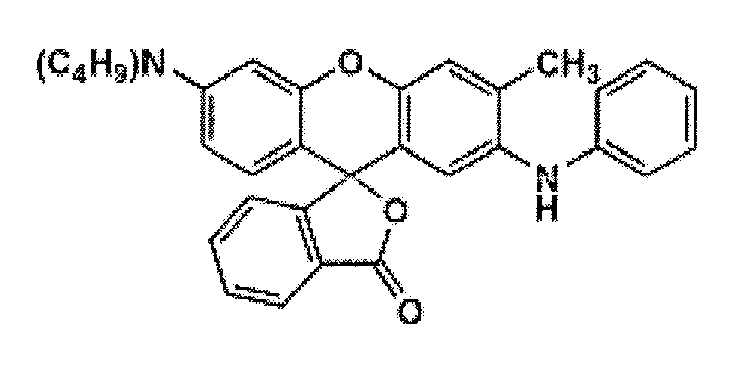
- Employing a plate setter (produced by ECRM Co., Ltd.) installed with a light source emitting a 405 nm light, each of the light sensitive planographic printing plate material samples 1 through 3 obtained above was imagewise exposed at a resolving degree of 2400 dpi under red safelight, wherein exposure energy was changed.
- Subsequently, the exposed sample was subjected to heat tUHDtPHnt Dt 105 °C IRU 30 sHFRnGs XnGHU UHG sDIHOLJht.
- The dye precursor 1 and color-developing agent contained in the protective layer react with each other by heat treatment to form a black dye. It proved that the black dye was a dye absorbing light of all wavelengths including those of from 350 to 450 nm according to the method of measuring absorption spectrum as described previously.
- The developed and heated sample being mounted on a printing press DAIYA 1F-1 (produced by Mitsubishi Jukogyo Co., Ltd.), printing was carried out wherein coated paper sheets, printing ink (Toyo hing Hyeco M Magenta, produced by Toyo Ink Manufacturing Co.), and dampening water (H liquid SG 51 having a concentration of 1.5%, produced by Tokyo Ink Co., Ltd.) were employed. In the process in which 50 sheets of prints was obtained after printing started, the protective layer and the image formation layer at non-image portions ware removed from the sample, and transferred to the prints through the blanket of the printing press, whereby so-called on-press development was carried out.
- In the above printing process, exposure energy at which normal ink receptivity was achieved in the fiftieth print was determined and evaluated as a measure of sensitivity. The less the exposure energy is, the higher the sensitivity.
- Each sample was imagewise exposed and subjected to heat treatment in the same manner as above, and allowed to stand for various periods (as shown in Table 1) under 500 lux white fluorescent lamp. Thereafter, employing the resulting sample, printing was carried out in the same manner as above, and prints were evaluated in the same manner as above. The period during which no stain was produced in non-image portions was determined and evaluated as a measure of safelight property. The longer the period is, the higher the safelight property. The results are shown in Table 1.
Table 1 Light sensitive planographic printing plate material No. Spectral Sensitizing Dye (Cumarin 343) Amount Sensitivity (µ-/Fp2) Safelight Property (Period) 1 3.0 parts 120 3.0 parts 120 Not less than 60 minutes 2 1.5 parts 1.5 parts 200 Not less than 60 minutes 3 1.0 parts 250 Not less than 60 minutes - Light sensitive planographic printing plate material samples 4 through 6 were prepared in the same manner as in Light sensitive planographic printing plate material samples 1 through 3 above, except that the dye precursor and the color-developing agent were removed from the protective layer coating solution. The resulting sample was evaluated in the same manner as above. The results are shown in Table 2.
Table 2 Light sensitive planographic printing plate material No. Spectral Sensitizing Dye (Cumarin 343) Amount Sensitivity (µ-/FP2) Safelight Property (period) 4 3.0 parts 120 G Less than 30 minutes 5 1.5 parts 200 G Less than 30 minutes 6 1.0 parts 250 30 minutes G Stain was produced in non-image portions at the period of 30 minutes. - As is apparent from Tables 1 and 2, inventive planographic printing plate material samples provide both high sensitivity and excellent safelight property.
Claims (2)
- A light sensitive planographic printing plate material comprising a support and provided thereon, a light sensitive layer and a protective layer (E), the light sensitive layer containing a photopolymerization initiator (A), a polymerizable ethylenically unsaturated compound (B), a dye (C) having absorption maximum in the wavelength regions of from 350 to 450 nm and a polymeric binder (D), and the light sensitive planographic printing plate material being characterized in that the protective layer contains a dye precursor (F) capable of changing to a dye absorbing light with a wavelength of from 350 to 450 nm by heating.
- The light sensitive planographic printing plate material of claim 1, wherein the protective layer (E) further contains a color-developing agent (G).
Applications Claiming Priority (2)
| Application Number | Priority Date | Filing Date | Title |
|---|---|---|---|
| JP2005065057 | 2005-03-09 | ||
| PCT/JP2006/302330 WO2006095535A1 (en) | 2005-03-09 | 2006-02-10 | Photosensitive planographic printing plate material |
Publications (1)
| Publication Number | Publication Date |
|---|---|
| EP1857877A1 true EP1857877A1 (en) | 2007-11-21 |
Family
ID=36953137
Family Applications (1)
| Application Number | Title | Priority Date | Filing Date |
|---|---|---|---|
| EP06713473A Withdrawn EP1857877A1 (en) | 2005-03-09 | 2006-02-10 | Photosensitive planographic printing plate material |
Country Status (4)
| Country | Link |
|---|---|
| US (1) | US20090053648A1 (en) |
| EP (1) | EP1857877A1 (en) |
| JP (1) | JPWO2006095535A1 (en) |
| WO (1) | WO2006095535A1 (en) |
Cited By (1)
| Publication number | Priority date | Publication date | Assignee | Title |
|---|---|---|---|---|
| WO2010005488A1 (en) * | 2008-07-09 | 2010-01-14 | Eastman Kodak Company | On-press developable imageable elements |
Families Citing this family (3)
| Publication number | Priority date | Publication date | Assignee | Title |
|---|---|---|---|---|
| EP1602982B1 (en) * | 2004-05-31 | 2013-12-18 | FUJIFILM Corporation | Planographic printing method |
| JP7391767B2 (en) * | 2020-05-29 | 2023-12-05 | 富士フイルム株式会社 | On-press development type lithographic printing plate precursor, method for producing lithographic printing plate, and lithographic printing method |
| JP2021189319A (en) * | 2020-05-29 | 2021-12-13 | 富士フイルム株式会社 | Machine-developed lithographic printing plate original plate, lithographic printing plate manufacturing method, and lithographic printing method |
Family Cites Families (10)
| Publication number | Priority date | Publication date | Assignee | Title |
|---|---|---|---|---|
| US4515877A (en) * | 1982-11-27 | 1985-05-07 | Basf Aktiengesellschaft | Image-recording materials and image-recording carried out using these to produce an optical mask |
| JPH04258950A (en) * | 1991-02-14 | 1992-09-14 | Konica Corp | Photosensitive material having superior safelight property |
| EP1156369A4 (en) * | 1999-12-09 | 2006-12-06 | Toray Industries | Photosensitive resin print plate material and production method for photosensitive resin print plate |
| CN1318774A (en) * | 2000-04-18 | 2001-10-24 | 富士胶片株式会社 | Photosensitive image recording material |
| JP4093449B2 (en) * | 2001-02-05 | 2008-06-04 | 株式会社リコー | Print version |
| JP2003107718A (en) * | 2001-09-28 | 2003-04-09 | Fuji Photo Film Co Ltd | Photopolymerizable image recording material |
| JP2004117669A (en) * | 2002-09-25 | 2004-04-15 | Fuji Photo Film Co Ltd | Photopolymerizable image recording material |
| JP2004252201A (en) * | 2003-02-20 | 2004-09-09 | Fuji Photo Film Co Ltd | Lithographic printing original plate |
| JP2005043724A (en) * | 2003-07-23 | 2005-02-17 | Fuji Photo Film Co Ltd | Photopolymerizable planographic printing plate |
| US7241557B2 (en) * | 2004-07-30 | 2007-07-10 | Agfa Graphics Nv | Photopolymerizable composition |
-
2006
- 2006-02-10 EP EP06713473A patent/EP1857877A1/en not_active Withdrawn
- 2006-02-10 JP JP2007507019A patent/JPWO2006095535A1/en active Pending
- 2006-02-10 US US11/817,733 patent/US20090053648A1/en not_active Abandoned
- 2006-02-10 WO PCT/JP2006/302330 patent/WO2006095535A1/en not_active Ceased
Non-Patent Citations (1)
| Title |
|---|
| See references of WO2006095535A1 * |
Cited By (2)
| Publication number | Priority date | Publication date | Assignee | Title |
|---|---|---|---|---|
| WO2010005488A1 (en) * | 2008-07-09 | 2010-01-14 | Eastman Kodak Company | On-press developable imageable elements |
| US8240943B2 (en) | 2008-07-09 | 2012-08-14 | Eastman Kodak Company | On-press developable imageable elements |
Also Published As
| Publication number | Publication date |
|---|---|
| WO2006095535A1 (en) | 2006-09-14 |
| JPWO2006095535A1 (en) | 2008-08-14 |
| US20090053648A1 (en) | 2009-02-26 |
Similar Documents
| Publication | Publication Date | Title |
|---|---|---|
| US7011928B2 (en) | Image formation method of planographic printing plate material | |
| US7041429B2 (en) | Light sensitive composition and light sensitive planographic printing plate material | |
| US20080160452A1 (en) | Developer for light sensitive planographic printing plate material and manufacturing process of planographic printing plate employing the same | |
| US6749995B2 (en) | Light sensitive composition, light sensitive planographic printing plate recursor, and image formation method | |
| US7332259B2 (en) | Aluminum support for planographic printing plate, its manufacturing process, and planographic printing plate material | |
| US20060210918A1 (en) | Negative working light sensitive planographic printing plate material and planographic printing plate manufacturing process | |
| EP1642745A2 (en) | Aluminum support for planographic printing plate, its manufacturing process, and planographic printing plate material | |
| US20080020323A1 (en) | Light sensitive planographic printing plate material | |
| US7192689B2 (en) | Aluminum support for planographic printing plate, its manufacturing process, and planographic printing plate material | |
| US6890702B2 (en) | Light sensitive composition and light sensitive planographic printing plate precursor | |
| US20090053648A1 (en) | Light sensitive planographic printing plate material | |
| US7252926B2 (en) | Planographic printing plate material and preparing process of planographic printing plate | |
| US20050053866A1 (en) | Planographic printing plate material and planographic printing plate preparing process | |
| US7157209B2 (en) | Manufacturing process of aluminum support for planographic printing plate, aluminum support for planographic printing plate, planographic printing plate material and image formation process | |
| EP1586460B1 (en) | Photosensitive composition, planographic printing plate material, and preparing process of planographic printing plate | |
| EP1627736B1 (en) | Method of manufacturing light sensitive planographic printing plates and method of using the same | |
| US20070207407A1 (en) | Light sensitive planographic printing plate material | |
| EP1688792A1 (en) | Light sensitive planographic printing plate material and planographic printing plate manufacturing method therefrom | |
| US7192690B2 (en) | Process of preparing planographic printing plate | |
| US20090311621A1 (en) | Support for planographic printing plate material, manufacturing method thereof, and planographic printing plate material employing the same | |
| US20050214687A1 (en) | Process of preparing planographic printing plate | |
| JP2003107751A (en) | Method for making up original plate for planographic printing plate and planographic printing plate | |
| US20080166663A1 (en) | Processing method of light sensitive planographic printing plate material | |
| US20080038667A1 (en) | Light sensitive planographic printing plate material | |
| US20080145785A1 (en) | Light sensitive planographic printing plate material |
Legal Events
| Date | Code | Title | Description |
|---|---|---|---|
| PUAI | Public reference made under article 153(3) epc to a published international application that has entered the european phase |
Free format text: ORIGINAL CODE: 0009012 |
|
| 17P | Request for examination filed |
Effective date: 20070830 |
|
| AK | Designated contracting states |
Kind code of ref document: A1 Designated state(s): DE FR GB IT |
|
| RAP1 | Party data changed (applicant data changed or rights of an application transferred) |
Owner name: KONICA MINOLTA MEDICAL & GRAPHIC, INC. |
|
| DAX | Request for extension of the european patent (deleted) | ||
| RBV | Designated contracting states (corrected) |
Designated state(s): DE FR GB IT |
|
| STAA | Information on the status of an ep patent application or granted ep patent |
Free format text: STATUS: THE APPLICATION HAS BEEN WITHDRAWN |
|
| 18W | Application withdrawn |
Effective date: 20080926 |