EP1855268A1 - Midi file playback with low memory need - Google Patents
Midi file playback with low memory need Download PDFInfo
- Publication number
- EP1855268A1 EP1855268A1 EP06009463A EP06009463A EP1855268A1 EP 1855268 A1 EP1855268 A1 EP 1855268A1 EP 06009463 A EP06009463 A EP 06009463A EP 06009463 A EP06009463 A EP 06009463A EP 1855268 A1 EP1855268 A1 EP 1855268A1
- Authority
- EP
- European Patent Office
- Prior art keywords
- midi
- melody
- memory device
- instruments
- synthesizer
- Prior art date
- Legal status (The legal status is an assumption and is not a legal conclusion. Google has not performed a legal analysis and makes no representation as to the accuracy of the status listed.)
- Withdrawn
Links
Images


Classifications
-
- G—PHYSICS
- G10—MUSICAL INSTRUMENTS; ACOUSTICS
- G10H—ELECTROPHONIC MUSICAL INSTRUMENTS; INSTRUMENTS IN WHICH THE TONES ARE GENERATED BY ELECTROMECHANICAL MEANS OR ELECTRONIC GENERATORS, OR IN WHICH THE TONES ARE SYNTHESISED FROM A DATA STORE
- G10H1/00—Details of electrophonic musical instruments
- G10H1/0033—Recording/reproducing or transmission of music for electrophonic musical instruments
- G10H1/0041—Recording/reproducing or transmission of music for electrophonic musical instruments in coded form
- G10H1/0058—Transmission between separate instruments or between individual components of a musical system
- G10H1/0066—Transmission between separate instruments or between individual components of a musical system using a MIDI interface
-
- G—PHYSICS
- G10—MUSICAL INSTRUMENTS; ACOUSTICS
- G10H—ELECTROPHONIC MUSICAL INSTRUMENTS; INSTRUMENTS IN WHICH THE TONES ARE GENERATED BY ELECTROMECHANICAL MEANS OR ELECTRONIC GENERATORS, OR IN WHICH THE TONES ARE SYNTHESISED FROM A DATA STORE
- G10H7/00—Instruments in which the tones are synthesised from a data store, e.g. computer organs
- G10H7/002—Instruments in which the tones are synthesised from a data store, e.g. computer organs using a common processing for different operations or calculations, and a set of microinstructions, e.g. programs, to control the sequence thereof
-
- G—PHYSICS
- G10—MUSICAL INSTRUMENTS; ACOUSTICS
- G10H—ELECTROPHONIC MUSICAL INSTRUMENTS; INSTRUMENTS IN WHICH THE TONES ARE GENERATED BY ELECTROMECHANICAL MEANS OR ELECTRONIC GENERATORS, OR IN WHICH THE TONES ARE SYNTHESISED FROM A DATA STORE
- G10H7/00—Instruments in which the tones are synthesised from a data store, e.g. computer organs
- G10H7/02—Instruments in which the tones are synthesised from a data store, e.g. computer organs in which amplitudes at successive sample points of a tone waveform are stored in one or more memories
-
- G—PHYSICS
- G10—MUSICAL INSTRUMENTS; ACOUSTICS
- G10H—ELECTROPHONIC MUSICAL INSTRUMENTS; INSTRUMENTS IN WHICH THE TONES ARE GENERATED BY ELECTROMECHANICAL MEANS OR ELECTRONIC GENERATORS, OR IN WHICH THE TONES ARE SYNTHESISED FROM A DATA STORE
- G10H2230/00—General physical, ergonomic or hardware implementation of electrophonic musical tools or instruments, e.g. shape or architecture
- G10H2230/005—Device type or category
- G10H2230/021—Mobile ringtone, i.e. generation, transmission, conversion or downloading of ringing tones or other sounds for mobile telephony; Special musical data formats or protocols therefor
-
- G—PHYSICS
- G10—MUSICAL INSTRUMENTS; ACOUSTICS
- G10H—ELECTROPHONIC MUSICAL INSTRUMENTS; INSTRUMENTS IN WHICH THE TONES ARE GENERATED BY ELECTROMECHANICAL MEANS OR ELECTRONIC GENERATORS, OR IN WHICH THE TONES ARE SYNTHESISED FROM A DATA STORE
- G10H2230/00—General physical, ergonomic or hardware implementation of electrophonic musical tools or instruments, e.g. shape or architecture
- G10H2230/025—Computing or signal processing architecture features
- G10H2230/031—Use of cache memory for electrophonic musical instrument processes, e.g. for improving processing capabilities or solving interfacing problems
Definitions
- the present invention relates to a device and method for playing back MIDI melodies, as defined in the preambles of claims 1 and 11, respectively.
- MIDI Musical Instrument Digital Interface
- MP3 digital music technologies
- MIDI messages contain individual instructions for playing each individual note of each individual instrument. With MIDI it is therefore possible to change just one note in a song or to orchestrate an entire song with entirely different instruments. Each instrument in a MIDI performance is separate from the rest, and it is easy to "solo", that is, listen to just one individual instrument and to mute individual instruments in a song.
- a MIDI file thus basically contains a data stream of commands on when to play a certain note and with what instrument to play it with.
- MIDI has lately become popular with its adoption into mobile phones.
- MIDI is for example used to play back the ring tones of MIDI capable phones.
- a synthesizer In order to play a MIDI file a synthesizer is needed that from a given MIDI file can create sound. Since the MIDI file itself does not contain the instrument definitions the MIDI synthesizer has to know how to play the different instruments that may be required by the MIDI file. Stated differently, the synthesizer must, in some way, have access to instrument definitions.
- MIDI synthesizer of a mobile phone
- Typical restrictions put on a MIDI synthesizer of a mobile phone is to limit the number of simultaneously played notes (or voices) and the number of available instruments.
- a telephone tries to play a MIDI file containing instruments that have not been defined, it typically replaces this instrument with another one that is available.
- the instrument set is large enough it will sound quite well even if not all instruments required by the MIDI file are available.
- a device for playback of MIDI melodies comprises a first memory device for storing a MIDI melody.
- the device further comprises an integrated circuit comprising a MIDI synthesizer and a microcontroller.
- the microcontroller is arranged to scan a MIDI melody in order to determine all instruments utilised in the MIDI melody.
- the microcontroller is further arranged to store, in the first memory device, the determined instruments in a MIDI instrument log.
- the innovative instrument log is utilised in order to enable a reduction of the required on-chip memory.
- the instrument log for a MIDI melody most often comprises only a sub-set of all available instruments. The instrument log thus provides a way to load only the instruments actually used in the current MIDI melody to an on-chip memory of an integrated circuit enabling play back of MIDI melodies.
- the integrated circuit of the device further comprises a second memory device.
- the microcontroller is arranged to copy the instruments of the MIDI instrument log to this second memory device when a MIDI melody is to be played back. Thereby, only the instruments of the instrument log are copied to the second, on-chip memory device. This provides the possibility to reduce the on-chip area or to increase the quality of the playback, by utilising part of the on-chip memory to increase the output sample rate or to use an improved instrument definition.
- the second memory device has the size of only a few kilobytes, which is a substantial reduction of size compared to the on-chip memory requirements of prior art portable devices comprising such MIDI playback means.
- the first memory device is a flash memory.
- An readily available memory device can thus be utilised for storing the MIDI melodies and the corresponding MIDI instrument logs.
- the MIDI synthesizer is a software synthesizer, and in an alternative embodiment the MIDI synthesizer is a hardware synthesizer.
- the manufacturer of the device for play back of MIDI melodies is thus provided with the flexibility to implement the synthesizer in a suitable manner.
- the device is a mobile phone. Improved circuitry for enabling playback of MIDI melodies is thus provided suitable for a portable device. The manufacturing costs are reduced, as well as the on-chip area.
- the invention is also related to such method, whereby advantages corresponding to the above are achieved.
- a MIDI file basically contains a data stream of commands on when to play a certain note and with what instrument to play it with.
- the inventor of the present invention has taken advantage of the fact that the MIDI file itself does not contain the instrument definitions in order to provide a polyphonic feature to a mobile phone, or a similar portable device, in an improved way.
- the main improvement consists in the provision of a polyphonic feature with maintained playback quality, but without the large on-chip memory requirements.
- the basic idea of the invention is thus to be able to offer a high-end MIDI playback quality without the requirement of 10-20 kB on-chip memory for instrument definitions.
- FIG. 1 illustrates schematically an integrated circuit 1 comprising the required means for implementing the present invention.
- the integrated circuit 1 comprises a microcontroller 3, for performing the required processing.
- An interface indicated in the figure by reference numeral 5, is required for accessing an off-chip memory, hereinafter called an external memory 6.
- the interface 5 can be of a serial or parallel type.
- the external memory device 6, that is, the off-chip memory device is preferably a flash memory, but any other memory device suitable for the present application is conceivable, for example a programmable read-only memory (PROM), an erasable programmable read-only memory (EPROM) or Electrically EPROM (EEPROM).
- PROM programmable read-only memory
- EPROM erasable programmable read-only memory
- EEPROM Electrically EPROM
- the external memory device 6 may thus be of a slower kind and is utilized for storing the MIDI melodies and their corresponding instrument log files (to be described later).
- the integrated circuit 1 further comprises a MIDI synthesizer 2 for providing the polyphonic features.
- the MIDI synthesizer 2 can be implemented by means of hardware or in software.
- the MIDI synthesizer 2 can thus be a dedicated circuit for producing MIDI melodies from the MIDI data, or, in an alternative, be implemented in software.
- Software synthesizers can be incorporated into the program storage means of the microcontroller 3, e.g. a Read-only memory (ROM).
- ROM Read-only memory
- a software solution consumes a bit more processing power and the synthesis method requires memory storage and there is therefore a slightly larger space requirement.
- the integrated circuit 1 comprises some on-chip memory 4, for example random-access memory (RAM).
- This on-chip memory 4 is utilised for storing the actually used instruments in each melody.
- the remaining instruments are stored in the external memory 6, which can be a relatively slow memory.
- the on-chip memory 6 can be of a smaller size compared to the state of the art required 15-20 kB.
- the on-chip memory 6 needs only be a few kB, for example in the range of 1-5 kB or possibly up to 10 kB, depending on the instrument quality.
- the microcontroller 3 also comprises a MIDI parser arranged to scan the MIDI melodies during download. That is, the MIDI parser or program performs a process of analyzing an input MIDI file. The MIDI parser scans the MIDI melody in order to log all instruments used in that particular MIDI melody. The result is a MIDI instrument log.
- This MIDI instrument log is preferably stored in the external memory device 6, typically in connection with the MIDI melody. For example, the MIDI instrument log is stored right after or before the melody itself, although it is understood that other solutions are possible.
- the MIDI instrument log corresponding to the desired melody is first read by the microcontroller 3 and stored in the on-chip memory 4. Thereby only the instruments needed for this particular melody needs to be copied from the external memory device 6.
- the instruments from the MIDI instrument log are thus copied from the external memory device 6 into the integrated circuit 1 and made available for and accessible by the MIDI synthesizer 2. Only thereafter is the MIDI file sent from the external memory device 6 to the MIDI synthesizer 2.
- the MIDI synthesizer 2 thereafter produces a melody that is played in a loudspeaker in a conventional manner.
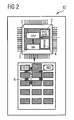
- FIG. 2 illustrates schematically a mobile phone 10 comprising the above-described circuitry for performing the inventive way of accomplishing playback of polyphonic melodies.
- the mobile phone 10 thus comprises an external memory device 6 and an integrated circuit 1 as described above (not shown to scale).
- the inventive way of providing polyphonic melodies is applicable to other devices as well, for example cordless phones such as DECT (Digital Enhanced Cordless telecommunication) or handheld game consoles.
- Other portable electronic devices may also take advantage of the present invention.
- this playback solution is particularly suitable, owing to the reduced on-chip memory requirement provided by the present invention.
- the reduced on-chip memory requirement gives reduced manufacturing costs.
- the size of the integrated circuit 1 enabling the MIDI melody play back may also be reduced.
- FIG. 3 is a summarizing flow chart over the steps included in a method 20 in accordance with the invention.
- the first step 21 is to scan a MIDI melody during downloading. All the instruments of that MIDI melody are thereby logged (step 22).
- the MIDI melody is stored in an external memory, step 23, and the instrument log is also stored in this external memory, step 24.
- FIG. 4 is a summarizing flow chart over the steps included in a method 30 for playing back a MIDI melody.
- the MIDI instrument log corresponding to the melody to be played is read by the microcontroller 3.
- the instruments from the instrument log read in the previous step are copied from the external memory device 6 into the on-chip memory 4 of the integrated circuit 1.
- the relevant instruments are thereby accessible by the MIDI synthesizer 2.
- the MIDI file is sent to the MIDI synthesizer 2, step 33.
- the MIDI synthesizer 2 is now, step 34, able to produce a melody to be played in a loudspeaker.
- the on-chip memory 4 can be utilised for providing a better MIDI playback quality by increasing the produced output sample rate or by using better instrument definitions.
- the present invention provides a way to reduce the on-chip memory requirement of a portable device, thus lowering the costs and enables a size reduction of the portable device.
- This reduction of memory requirements is accomplished by avoiding to load a complete instrument set every time a MIDI file is to be played, and instead only load a sub-set of the instrument set. Further, the load time for downloading a melody to the on-chip memory of a mobile phone can thereby also be reduced.
Landscapes
- Engineering & Computer Science (AREA)
- Physics & Mathematics (AREA)
- Acoustics & Sound (AREA)
- Multimedia (AREA)
- General Engineering & Computer Science (AREA)
- Electrophonic Musical Instruments (AREA)
Abstract
The invention relates to a device for playback of MIDI melodies. The device comprises a first memory device for storing a MIDI melody. The device further comprises an integrated circuit 1 comprising a MIDI synthesizer 2 and a microcontroller 3. The microcontroller 3 is arranged to scan a MIDI melody in order to determine all instruments utilised in the MIDI melody. The microcontroller 3 is further arranged to store, in the first memory device 4, the determined instruments in a MIDI instrument log. The invention also relates to such a method. By means of the invention the on-chip memory required for implementing playback of MIDI melodies can be reduced.
Description
- The present invention relates to a device and method for playing back MIDI melodies, as defined in the preambles of
claims 1 and 11, respectively. - The popularity and number of mobile phones is constantly increasing and the phones also include an increasing number of different features. For example, almost every new mobile telephone sold today is able to play polyphonic melodies. That is, the telephone is able to play more advanced melodies than can be created with a simple pulse-width modulated signal or a tone generator able to synthesize perhaps one, two or up to four simultaneous frequencies.
- Musical Instrument Digital Interface (MIDI) is a technology that represents music in digital form, as is explained on the Internet site www.midi.org. Unlike other digital music technologies such as MP3 or CDs, MIDI messages contain individual instructions for playing each individual note of each individual instrument. With MIDI it is therefore possible to change just one note in a song or to orchestrate an entire song with entirely different instruments. Each instrument in a MIDI performance is separate from the rest, and it is easy to "solo", that is, listen to just one individual instrument and to mute individual instruments in a song.
- A MIDI file thus basically contains a data stream of commands on when to play a certain note and with what instrument to play it with. As mentioned, MIDI has lately become popular with its adoption into mobile phones. MIDI is for example used to play back the ring tones of MIDI capable phones.
- In order to play a MIDI file a synthesizer is needed that from a given MIDI file can create sound. Since the MIDI file itself does not contain the instrument definitions the MIDI synthesizer has to know how to play the different instruments that may be required by the MIDI file. Stated differently, the synthesizer must, in some way, have access to instrument definitions.
- Besides being versatile, mobile phones should be as small as possible to be convenient to bring along, but still large enough for enabling the different functions to be performed. The available memory and amount of available processing power is limited in such mobile phone environment, and therefore most telephones have a limited possibility to play MIDI files.
- Typical restrictions put on a MIDI synthesizer of a mobile phone is to limit the number of simultaneously played notes (or voices) and the number of available instruments. When a telephone tries to play a MIDI file containing instruments that have not been defined, it typically replaces this instrument with another one that is available. As long as the instrument set is large enough it will sound quite well even if not all instruments required by the MIDI file are available. However, it is realised that at some point there will be severe quality degradation of the produced sound when the instrument set becomes too limited.
- For a high-end telephone with very good playback quality something in the range of 150-175 instruments have to be defined in the MIDI synthesizer. A mid-range phone may satisfy with about 80 instruments. A very cheap low-end telephone might have as little as 50 instruments available.
- Since a MIDI synthesizer does not know in advance when a certain instrument is needed it has to have all instruments loaded into an easy accessible memory every time the synthesizer is running. For a high-end phone this translates to a requirement of 10-20 kB on-chip memory. Due to the limited size of mobile phones the chip area as well as the number of components should be minimized.
- From the above it is clear that an improvement in the handling of polyphonic signals or MIDI melodies in mobile phones would be desirable. More specifically, it would be desirable to provide a high play back quality of polyphonic melodies in a mobile phone, preferably with a decreased space requirement for the components needed for implementing such function.
- It is an object of the invention to provide a high-end MIDI melody playback quality in a more space efficient way. In particular, it is an object of the invention to provide such high quality with a reduced on-chip memory requirement compared to the state of the art requirements on 10-20 kB on-chip memory.
- This object, among others, is achieved by a device for playback of MIDI melodies as claimed in
claim 1 and by a method as claimed in claim 11. - In accordance with the invention, a device for playback of MIDI melodies is provided. The device comprises a first memory device for storing a MIDI melody. The device further comprises an integrated circuit comprising a MIDI synthesizer and a microcontroller. The microcontroller is arranged to scan a MIDI melody in order to determine all instruments utilised in the MIDI melody. The microcontroller is further arranged to store, in the first memory device, the determined instruments in a MIDI instrument log. By means of the invention, the innovative instrument log is utilised in order to enable a reduction of the required on-chip memory. The instrument log for a MIDI melody most often comprises only a sub-set of all available instruments. The instrument log thus provides a way to load only the instruments actually used in the current MIDI melody to an on-chip memory of an integrated circuit enabling play back of MIDI melodies.
- In accordance with an embodiment of the invention, the integrated circuit of the device further comprises a second memory device. The microcontroller is arranged to copy the instruments of the MIDI instrument log to this second memory device when a MIDI melody is to be played back. Thereby, only the instruments of the instrument log are copied to the second, on-chip memory device. This provides the possibility to reduce the on-chip area or to increase the quality of the playback, by utilising part of the on-chip memory to increase the output sample rate or to use an improved instrument definition.
- In accordance with another embodiment of the invention, the second memory device has the size of only a few kilobytes, which is a substantial reduction of size compared to the on-chip memory requirements of prior art portable devices comprising such MIDI playback means.
- In accordance with another embodiment of the invention, the first memory device is a flash memory. An readily available memory device can thus be utilised for storing the MIDI melodies and the corresponding MIDI instrument logs.
- In accordance with another embodiment of the invention, the MIDI synthesizer is a software synthesizer, and in an alternative embodiment the MIDI synthesizer is a hardware synthesizer. The manufacturer of the device for play back of MIDI melodies is thus provided with the flexibility to implement the synthesizer in a suitable manner.
- In accordance with yet another embodiment of the invention, the device is a mobile phone. Improved circuitry for enabling playback of MIDI melodies is thus provided suitable for a portable device. The manufacturing costs are reduced, as well as the on-chip area.
- The invention is also related to such method, whereby advantages corresponding to the above are achieved.
- Further characteristics of the invention and advantages thereof will be evident from the detailed description of a preferred embodiment of the present invention given hereinafter and the accompanying figures, which are only given by way of illustration, and thus are not limitative of the present invention.
-
- Figure 1 illustrates components included in a device in accordance with an embodiment of the present invention.
- Figure 2 illustrates schematically an exemplary device comprising the components illustrated in figure 1.
- Figure 3 is a flow chart of the steps included in an embodiment of a method in accordance with the invention.
- Figure 4 is a flow chart summarizing the steps included when a melody is to be played.
- As was explained in the introductory part of the description, a MIDI file basically contains a data stream of commands on when to play a certain note and with what instrument to play it with. The inventor of the present invention has taken advantage of the fact that the MIDI file itself does not contain the instrument definitions in order to provide a polyphonic feature to a mobile phone, or a similar portable device, in an improved way. The main improvement consists in the provision of a polyphonic feature with maintained playback quality, but without the large on-chip memory requirements.
- The basic idea of the invention is thus to be able to offer a high-end MIDI playback quality without the requirement of 10-20 kB on-chip memory for instrument definitions.
- Even if a good quality MIDI synthesizer require more than 150 instruments there is very seldom more than 16 instruments actually used in a single melody. The inventor of the present invention has realized that this fact gives an opening for reducing en on-chip memory usage, provided that a priori information on what instruments are going to be used in a specific melody can be obtained. Only the actually used instruments need to be easily accessible by the MIDI synthesizer. The remaining ones could be placed off-chip in a fairly slow external memory, typically a serial or parallel flash memory.
- Figure 1 illustrates schematically an
integrated circuit 1 comprising the required means for implementing the present invention. Theintegrated circuit 1 comprises amicrocontroller 3, for performing the required processing. An interface, indicated in the figure byreference numeral 5, is required for accessing an off-chip memory, hereinafter called anexternal memory 6. Theinterface 5 can be of a serial or parallel type. Theexternal memory device 6, that is, the off-chip memory device, is preferably a flash memory, but any other memory device suitable for the present application is conceivable, for example a programmable read-only memory (PROM), an erasable programmable read-only memory (EPROM) or Electrically EPROM (EEPROM). Theexternal memory device 6 may thus be of a slower kind and is utilized for storing the MIDI melodies and their corresponding instrument log files (to be described later). - The
integrated circuit 1 further comprises aMIDI synthesizer 2 for providing the polyphonic features. TheMIDI synthesizer 2 can be implemented by means of hardware or in software. TheMIDI synthesizer 2 can thus be a dedicated circuit for producing MIDI melodies from the MIDI data, or, in an alternative, be implemented in software. Software synthesizers can be incorporated into the program storage means of themicrocontroller 3, e.g. a Read-only memory (ROM). However, a software solution consumes a bit more processing power and the synthesis method requires memory storage and there is therefore a slightly larger space requirement. - Finally, the
integrated circuit 1 comprises some on-chip memory 4, for example random-access memory (RAM). This on-chip memory 4 is utilised for storing the actually used instruments in each melody. The remaining instruments are stored in theexternal memory 6, which can be a relatively slow memory. The on-chip memory 6 can be of a smaller size compared to the state of the art required 15-20 kB. In accordance with the invention, the on-chip memory 6 needs only be a few kB, for example in the range of 1-5 kB or possibly up to 10 kB, depending on the instrument quality. - The
microcontroller 3 also comprises a MIDI parser arranged to scan the MIDI melodies during download. That is, the MIDI parser or program performs a process of analyzing an input MIDI file. The MIDI parser scans the MIDI melody in order to log all instruments used in that particular MIDI melody. The result is a MIDI instrument log. This MIDI instrument log is preferably stored in theexternal memory device 6, typically in connection with the MIDI melody. For example, the MIDI instrument log is stored right after or before the melody itself, although it is understood that other solutions are possible. - When a melody is to be played by a portable device comprising the
integrated circuit 1, such as for example a cellular phone, the MIDI instrument log corresponding to the desired melody is first read by themicrocontroller 3 and stored in the on-chip memory 4. Thereby only the instruments needed for this particular melody needs to be copied from theexternal memory device 6. The instruments from the MIDI instrument log are thus copied from theexternal memory device 6 into theintegrated circuit 1 and made available for and accessible by theMIDI synthesizer 2. Only thereafter is the MIDI file sent from theexternal memory device 6 to theMIDI synthesizer 2. TheMIDI synthesizer 2 thereafter produces a melody that is played in a loudspeaker in a conventional manner. - Figure 2 illustrates schematically a
mobile phone 10 comprising the above-described circuitry for performing the inventive way of accomplishing playback of polyphonic melodies. Themobile phone 10 thus comprises anexternal memory device 6 and anintegrated circuit 1 as described above (not shown to scale). It is understood that the inventive way of providing polyphonic melodies is applicable to other devices as well, for example cordless phones such as DECT (Digital Enhanced Cordless telecommunication) or handheld game consoles. Other portable electronic devices may also take advantage of the present invention. In amobile phone 10 this playback solution is particularly suitable, owing to the reduced on-chip memory requirement provided by the present invention. The reduced on-chip memory requirement gives reduced manufacturing costs. The size of theintegrated circuit 1 enabling the MIDI melody play back may also be reduced. - Figure 3 is a summarizing flow chart over the steps included in a
method 20 in accordance with the invention. Thefirst step 21 is to scan a MIDI melody during downloading. All the instruments of that MIDI melody are thereby logged (step 22). The MIDI melody is stored in an external memory,step 23, and the instrument log is also stored in this external memory,step 24. - Figure 4 is a summarizing flow chart over the steps included in a
method 30 for playing back a MIDI melody. In the first step, the MIDI instrument log corresponding to the melody to be played is read by themicrocontroller 3. Thereafter, instep 32, the instruments from the instrument log read in the previous step are copied from theexternal memory device 6 into the on-chip memory 4 of theintegrated circuit 1. The relevant instruments are thereby accessible by theMIDI synthesizer 2. Subsequently, the MIDI file is sent to theMIDI synthesizer 2,step 33. TheMIDI synthesizer 2 is now,step 34, able to produce a melody to be played in a loudspeaker. - In an alternative embodiment, instead of reducing the on-chip memory 4, the on-chip memory 4 can be utilised for providing a better MIDI playback quality by increasing the produced output sample rate or by using better instrument definitions.
- In summary, the present invention provides a way to reduce the on-chip memory requirement of a portable device, thus lowering the costs and enables a size reduction of the portable device. This reduction of memory requirements is accomplished by avoiding to load a complete instrument set every time a MIDI file is to be played, and instead only load a sub-set of the instrument set. Further, the load time for downloading a melody to the on-chip memory of a mobile phone can thereby also be reduced.
- In the preceding detailed description, the invention is described with reference to specific exemplary embodiments thereof. Various modifications and changes may be made thereto without departing from the scope of the invention as set forth in the claims. The specification and drawing are, accordingly, to be regarded in an illustrative rather than in a restrictive sense.
Claims (11)
1. A device for playback of MIDI melodies, said device comprising a first memory device (6) for storing a MIDI melody, characterised in an integrated circuit (1) comprising a MIDI synthesizer (2) and a microcontroller (3), said microcontroller (3) being arranged to scan a MIDI melody in order to determine all instruments utilised in said MIDI melody, said microcontroller (3) further being arranged to store, in said first memory device (6), said determined instruments in a MIDI instrument log.
2. The device as claimed in claim 1, wherein said integrated circuit (1) further comprises a second memory device (4).
3. The device as claimed in claim 3, wherein said microcontroller (3) is arranged to copy the instruments of said MIDI instrument log to said second memory device (4) when said MIDI melody is to be played back by said device.
5. The device as claimed in any of claims 3 or 4, wherein said second memory device (4) has the size of only a few kilobytes, such as in the range of 1-10 kB.
6. The device as claimed in any of the preceding claims, wherein said first memory device (6) is a flash memory.
7. The device as claimed in any of the preceding claims, wherein said MIDI synthesizer (2) is a software synthesizer.
8. The device as claimed in any of the preceding claims, wherein said MIDI synthesizer (2) is a hardware synthesizer.
9. The device as claimed in any of the preceding claims, wherein said device is one of the following: a mobile phone (10), a cordless phone or a handheld game console.
10. The device as claimed in any of the preceding claims, wherein said first memory device (6) is arranged external to said integrated circuit (1).
11. A method for enabling playback of MIDI melodies in a device (10) comprising a first memory device (6) characterised in that the device (10) further comprises an integrated circuit (1) comprising a second memory device (4), a microcontroller (3), and a MIDI synthesizer (2) for use in playback of a MIDI melody, wherein the method comprises the steps of:
- downloading to said first memory device (6) a MIDI melody,
- determining, during said downloading, all instruments used in said MIDI melody,
- storing, in said first memory device (6), said MIDI melody into a MIDI file, and
- storing, in said first memory device (6), a MIDI instrument log obtained in said step of determining, whereby said MIDI instrument log is utilised for determining which instruments to copy from said first memory device (6) to said second memory device (4) of said integrated circuit (1) when playing back said MIDI melody.
12. The method as claimed in claim 11, wherein said step of determining all instruments used in said melody comprises scanning, by a MIDI parser, said MIDI melody during the downloading in order to determine all instruments used in said MIDI melody.
Priority Applications (1)
| Application Number | Priority Date | Filing Date | Title |
|---|---|---|---|
| EP06009463A EP1855268A1 (en) | 2006-05-08 | 2006-05-08 | Midi file playback with low memory need |
Applications Claiming Priority (1)
| Application Number | Priority Date | Filing Date | Title |
|---|---|---|---|
| EP06009463A EP1855268A1 (en) | 2006-05-08 | 2006-05-08 | Midi file playback with low memory need |
Publications (1)
| Publication Number | Publication Date |
|---|---|
| EP1855268A1 true EP1855268A1 (en) | 2007-11-14 |
Family
ID=36927040
Family Applications (1)
| Application Number | Title | Priority Date | Filing Date |
|---|---|---|---|
| EP06009463A Withdrawn EP1855268A1 (en) | 2006-05-08 | 2006-05-08 | Midi file playback with low memory need |
Country Status (1)
| Country | Link |
|---|---|
| EP (1) | EP1855268A1 (en) |
Citations (4)
| Publication number | Priority date | Publication date | Assignee | Title |
|---|---|---|---|---|
| EP0484043A2 (en) * | 1990-11-01 | 1992-05-06 | International Business Machines Corporation | Translation of midi files |
| EP0827133A1 (en) * | 1996-08-30 | 1998-03-04 | Yamaha Corporation | Method and apparatus for generating musical tones, processing and reproducing music data using storage means |
| US6292854B1 (en) * | 1995-04-14 | 2001-09-18 | Nvidia Corporation | Method and apparatus for providing high quality audio in a computer system |
| US20040237758A1 (en) * | 2002-06-07 | 2004-12-02 | Roland Europe S.P.A. | System and methods for changing a musical performance |
-
2006
- 2006-05-08 EP EP06009463A patent/EP1855268A1/en not_active Withdrawn
Patent Citations (4)
| Publication number | Priority date | Publication date | Assignee | Title |
|---|---|---|---|---|
| EP0484043A2 (en) * | 1990-11-01 | 1992-05-06 | International Business Machines Corporation | Translation of midi files |
| US6292854B1 (en) * | 1995-04-14 | 2001-09-18 | Nvidia Corporation | Method and apparatus for providing high quality audio in a computer system |
| EP0827133A1 (en) * | 1996-08-30 | 1998-03-04 | Yamaha Corporation | Method and apparatus for generating musical tones, processing and reproducing music data using storage means |
| US20040237758A1 (en) * | 2002-06-07 | 2004-12-02 | Roland Europe S.P.A. | System and methods for changing a musical performance |
Similar Documents
| Publication | Publication Date | Title |
|---|---|---|
| JP2020030418A (en) | Systems and methods for portable audio synthesis | |
| US20060069572A1 (en) | Apparatus for producing sound in phone and method of doing the same | |
| US8175525B2 (en) | Conversion from note-based audio format to PCM-based audio format | |
| KR20050046719A (en) | Music reproducing apparatus | |
| KR100619826B1 (en) | Apparatus and method for synthesizing music and speech in mobile communication terminal | |
| CN100362567C (en) | Method of synthetic chord ringing of cell phone | |
| US7728217B2 (en) | Sound generator for producing a sound from a new note | |
| EP1855268A1 (en) | Midi file playback with low memory need | |
| KR100506228B1 (en) | Mobile terminal and method for editing and playing music | |
| JP2002169564A (en) | Sound source system | |
| JP2002244654A (en) | Device and system for distribution and play device | |
| KR100605919B1 (en) | Method of providing sound by function and mobile communication terminal for same | |
| CN1251174C (en) | Sound source circuit and telephone terminal using the sound source circuit | |
| KR20060050071A (en) | Music data editing and playback device and portable information terminal | |
| KR100628053B1 (en) | Wireless communication terminal having digital music information automatic generation function and digital music information automatic generation method using same | |
| KR200276055Y1 (en) | Mobile Phone Accessory Providing Multiple Ringing Tune | |
| CA2568117C (en) | Conversion from note-based audio format to pcm-based audio format | |
| KR20030083655A (en) | Composition and Conversion method of Ring tone file and Music file of Mobile Handset | |
| JP4306944B2 (en) | Music playback device | |
| JP2000330557A (en) | Digital signal processor with melody function | |
| WO2004066653A1 (en) | Musical audible alert termination | |
| CN2711999Y (en) | Fixed telephone set capable of unloading music or ringing | |
| KR100665816B1 (en) | Mobile communication terminal device having sound source playback function and sound source playback method | |
| KR100455178B1 (en) | A device and a method of setting ring signal for receiving call with use midi sequencing | |
| JP2004348145A (en) | Terminal device loaded with effector |
Legal Events
| Date | Code | Title | Description |
|---|---|---|---|
| PUAI | Public reference made under article 153(3) epc to a published international application that has entered the european phase |
Free format text: ORIGINAL CODE: 0009012 |
|
| AK | Designated contracting states |
Kind code of ref document: A1 Designated state(s): AT BE BG CH CY CZ DE DK EE ES FI FR GB GR HU IE IS IT LI LT LU LV MC NL PL PT RO SE SI SK TR |
|
| AX | Request for extension of the european patent |
Extension state: AL BA HR MK YU |
|
| AKX | Designation fees paid | ||
| STAA | Information on the status of an ep patent application or granted ep patent |
Free format text: STATUS: THE APPLICATION IS DEEMED TO BE WITHDRAWN |
|
| 18D | Application deemed to be withdrawn |
Effective date: 20080515 |
|
| REG | Reference to a national code |
Ref country code: DE Ref legal event code: 8566 |