EP1848280B1 - Mikrobenbeständiger enthaarungsschläger - Google Patents
Mikrobenbeständiger enthaarungsschläger Download PDFInfo
- Publication number
- EP1848280B1 EP1848280B1 EP05754756A EP05754756A EP1848280B1 EP 1848280 B1 EP1848280 B1 EP 1848280B1 EP 05754756 A EP05754756 A EP 05754756A EP 05754756 A EP05754756 A EP 05754756A EP 1848280 B1 EP1848280 B1 EP 1848280B1
- Authority
- EP
- European Patent Office
- Prior art keywords
- rubber
- hair removal
- inhibitor
- paddle according
- removal paddle
- Prior art date
- Legal status (The legal status is an assumption and is not a legal conclusion. Google has not performed a legal analysis and makes no representation as to the accuracy of the status listed.)
- Expired - Lifetime
Links
Images
Classifications
-
- A—HUMAN NECESSITIES
- A22—BUTCHERING; MEAT TREATMENT; PROCESSING POULTRY OR FISH
- A22B—SLAUGHTERING
- A22B5/00—Accessories for use during or after slaughtering
- A22B5/08—Scalding; Scraping; Dehairing; Singeing
Definitions
- the invention relates to a dehairing beater comprising a body of polymeric material and additional metal components as part of a slaughter line, in particular for the slaughter of pigs, wherein the polymeric material is a vulcanized rubber mixture comprising a rubber component and Mischingingredienzien.
- a generic hair removal beater is described in more detail, for example, in the following publications: US Pat. No. 15,318 . US 2 604 656 . US 4,907,317 and EP 0 665 717 B1 ,
- the elastic body of the depilation racket usually has an embedded strength carrier in the form of fabric or fibers. He can be equipped with or without relief grooves.
- a particularly proven construction is in the patent EP 0 665 717 B1 presented, after which the main body of the depilation racket is provided with an impact stool and relief grooves.
- the metallic additional components are scratches, fasteners and a stop.
- microorganisms bacteria, microbes
- the maximum approval limit of microorganisms is often exceeded. Even if all hygienic and health-relevant measures are taken in a slaughterhouse, the accumulation of microorganisms leads to a destruction of the polymeric material and thus to a failure of the depilation racket.
- the inhibitor is particularly sparingly soluble in water. This will prevent the inhibitor from being washed out.
- the water of crystallization is either fully or partially dehydrated.
- the vacated water crystal sites within the metal-aluminum-silicate lattice are then occupied by loading with the inhibitor. Effective then is the corresponding adduct.
- the carrier may be fibers, such as polyamide, polyester or cellulosic fibers, loaded with the inhibitor to form a fiber / inhibitor adduct.
- the carrier of the respective adduct additionally has reinforcing properties in addition to its loading function, so that it is possible to dispense with the classical reinforcement in the form of a fabric.
- the adduct binds the inhibitor (depot effect), on the other hand it provides a controlled biochemical mechanism of action with a long-term effect.
- the inhibitor or the adduct is uniformly distributed in the polymeric material. Its proportion in relation to the total mass of the polymeric material is in particular 0.5 to 5 wt .-%.
- the proportion of the rubber component or blending component is in particular 30 to 70% by weight.
- the optimal material constellation is given in a proportion of 40 to 55 wt .-%.
- the rubber mixture usually has a filler or a filler system based on carbon black and / or silicic acids and / or silicates and / or chalk.
- a filler system based on carbon black, magnesium silicate and chalk is used.
- crosslinker e.g., sulfur or sulfur donor
- cure activator e.g., zinc oxide
- crosslinker system e.g., processing aids (e.g., stearic acid), and optionally, anti-aging agents and stabilizers.
- processing aids e.g., stearic acid
- anti-aging agents and stabilizers e.g., reference is made to the general state of rubber mixing technology.
- crosslinker system comprising a crosslinker and / or vulcanization activator and accelerator, in particular zinc oxide (vulcanization activator) and zinc N-dibenzyldithiocarbamate (accelerator ZBEC) are used.
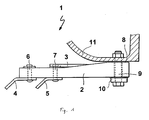
- the Enthaarungsdriver 1 comprises a base body 2 made of polymeric material, which is substantially rectangular.
- the base body is provided within its rear side with a baffle stool 3 , which is formed integrally with the base body.
- a baffle stool 3 which is formed integrally with the base body.
- At its front of the depilation racket with angular scratches 4 and 5 is made of metal, wherein the anchoring takes place in each case by means of a bore and a rivet connection 6 and 7 .
- the main body is further firmly anchored in the Anschraub Scheme 8 by means of a bore and a screw-bolt system 9 and a clamping plate 10 .
- the depilation racket is provided with a stop 11 . Further structural details, in particular in connection with relief grooves, are in the patent EP 0 665 717 B1 mentioned.
Landscapes
- Life Sciences & Earth Sciences (AREA)
- Engineering & Computer Science (AREA)
- Food Science & Technology (AREA)
- Compositions Of Macromolecular Compounds (AREA)
- Cosmetics (AREA)
- Steroid Compounds (AREA)
- Saccharide Compounds (AREA)
Description
- Die Erfindung betrifft einen Enthaarungsschläger, umfassend einen Grundkörper aus polymerem Werkstoff sowie metallische Zusatzbauteile als Teil einer Schlachtlinie, insbesondere für das Schlachten von Schweinen, wobei der polymere Werkstoff eine vulkanisierte Kautschukmischung ist, umfassend eine Kautschukkomponente sowie Mischungsingredienzien.
- Ein gattungsgemäßer Enthaarungsschläger wird beispielsweise in folgenden Druckschriften näher beschrieben:
US 15 318 ,US 2 604 656 ,US 4 907 317 undEP 0 665 717 B1 . - Der elastische Grundkörper des Enthaarungsschlägers weist zumeist einen eingebetteten Festigkeitsträger in Form von Gewebe oder Fasern auf. Er kann dabei mit oder ohne Entlastungsnuten ausgestattet sein. Eine besonders bewährte Konstruktion wird in der Patentschrift
EP 0 665 717 B1 vorgestellt, wonach der Grundkörper des Enthaarungsschlägers mit einem Prallhocker und Entlastungsnuten versehen ist. Die metallischen Zusatzbauteile sind Kratzer, Befestigungselemente und ein Anschlag. - Problem punkt ist die Vermehrung von Mikroorganismen (Bakterien, Mikroben) beim Enthaarungsprozess, zumal das heiße Wasser mehrfach im Umlauf verwendet wird. Das maximale Zulassungslimit an Mikroorganismen wird häufig überschritten. Auch wenn in einem Schlachtbetrieb alle hygienischen und gesundheitsrelevanten Maßnahmen ergriffen werden, führt die Anhäufung von Mikroorganismen zu einer Zerstörung des polymeren Werkstoffes und somit zu einem Ausfall des Enthaarungsschlägers.
- In der Offenlegungsschrift
US 2004/0063806 A1 wird ein Inhibitor, beispielsweise Triclosan, vorgestellt, der im technochemischen Bereich, in der Kosmetik-, Pharma- und Lebensmittelindustrie eingesetzt wird. Der diesbezügliche Einsatz beim Schlachtbetrieb wird in diesem Dokument nicht beschrieben. - Im Hintergrund der oben genannten Problematik beim Schlachtbetrieb zeichnet sich der neue Enthaarungsschläger dadurch aus, dass
- die Kautschukmischung weichmacherfrei ist, wobei in Bezug auf die Gesamtmasse der Kautschukmischung der Anteil der Kautschukkomponente 10 bis 70 Gew.-% beträgt, und dass
- der Kautschukmischung ein aktiver Inhibitor beigemischt ist, der die Vermehrung von Mikroarganismen verhindert, wobei der Inhibitor in der Kautschukmischung gleichmäßig verteilt ist, wobei ferner in Bezug auf die Gesamtmasse der Kautschukmischung der Anteil des Inhibitors 0.1 bis 10 Gew.-% beträgt.
- Der Inhibitor ist insbesondere schwerlöslich in Wasser. Auf diese Weise wird verhindert, dass der Inhibitor heraus gewaschen wird.
- Besonders wirksame Inhibitoren, auch unter dem Aspekt der oben genannten Schwerlöslichkeit, sind:
- 2,4,4'-trichlor-2'-hydroxy-diphenyl-ether (Triclosan);
- N'-tert.butyl-N-cyclopropyl-6-(methylthio)-1,3,5-triazin-2,4-diamin.
- Im Rahmen einer vorteilhaften Variante ist dem polymeren Werkstoff ein Träger beigemischt, der mit dem Inhibitor beladen ist, und zwar unter Bildung eines Träger/Inhibitor-Adduktes. Das Trägermaterial ist insbesondere ein Molekularsieb in Form eines Metall-Aluminium-Silikates der folgenden Formel:
- Men [(AlO2)x· (SiO2)y] mit oder ohne Kristallwasser, insbesondere
- Na86 [(AlO2)86·(SiO2)106] mit oder ohne Kristallwasser
- Ein häufig verwendetes Metall-Aluminium-Silikat ist:
Na88 [(AlO2)88·(SiO2)106]·276 H2O
- Dabei wird das Kristallwasser entweder vollständig oder partiell dehydratisiert. Die frei gewordenen Kristallwasserplätze innerhalb des Metall-Aluminium-Silikat-Gitters werden dann durch Beladung mit dem Inhibitor belegt. Wirksam ist dann das entsprechende Addukt.
- Alternativ hierzu kann der Träger auch aus Fasern, beispielsweise Polyamid-, Polyester- oder Cellulosefasern, bestehen, die mit dem Inhibitor beladen sind, und zwar unter Bildung eines Faser/Inhibitor-Adduktes.
- Der Träger des jeweiligen Adduktes hat neben seiner Beladungsfunktion zusätzlich noch Verstärkungseigenschaften, so dass auf die klassische Verstärkung in Form eines Gewebes verzichtet werden kann. Das Addukt bindet einerseits den Inhibitor (Depotwirkung), andererseits sorgt es für einen kontrollierten biochemischen Wirkmechanismus mit Langzeitwirkung.
- Der Inhibitor bzw. das Addukt ist im polymeren Werkstoff gleichmäßig verteilt. Sein Anteil in Bezug auf die Gesamtmasse des polymeren Werkstoffes beträgt insbesondere 0,5 bis 5 Gew.-%.
- Die Kantschukmischung ist weichmacherfrei, wobei in Verbindung mit der vulkanisierten Kautschukmischung folgende Kautschukkomponenten zum Einsatz gelangen:
- Die Kautschukkomponente ist ein Ethylen-Propylen-Dien-Mischpolymerisat (EPDM) oder Nitrilkautschuk (NBR), insbesondere ein EPDM/NBR-Verschnitt.
- Die Kautschukkomponente ist Silikonkautschuk, Butylkautschuk (IIR), Chlorbutylkautschuk (CIIR) oder Brombutylkautschuk (BIIR), die jeweils unverschnitten sind.
- In Bezug auf die Gesamtmasse der Kautschukmischung beträgt der Anteil der Kautschuk- bzw. Verschnittkomponente insbesondere 30 bis 70 Gew.-%. Die optimale Werkstoffkonstellation ist bei einem Anteil von 40 bis 55 Gew.-% gegeben.
- Die Kautschukmischung weist üblicherweise einen Füllstoff bzw. ein Füllstoffsystem auf der Basis von Ruß und/oder Kieselsäuren und/oder Silikaten und/oder Kreide auf. Insbesondere gelangt ein Füllstoffsystem auf der Basis von Ruß, Magnesiumsilikat und Kreide zum Einsatz.
- Weitere übliche Mischungsingredienzien sind ein Vernetzer (z.B. Schwefel oder Schwefelspender) und/oder Vulkanisationsaktivator (z.B. Zinkoxid) bzw. Vernetzersystem, Verarbeitungshilfsmittel (z.B. Stearinsäure) sowie gegebenenfalls Alterungsschutzmittel und Stabilisatoren. Diesbezüglich wird auf den allgemeinen Stand der Kautschukmischungstechnologie verwiesen. Als Vernetzersystem, umfassend einen Vernetzer und/oder Vulkanisationsaktivator sowie Beschleuniger, wird insbesondere Zinkoxid (Vulkanisationsaktivator) und Zink-N-dibenzyldithiocarbamat (Beschleuniger ZBEC) verwendet.
- Neben den oben genannten üblichen Mischungsingredienzien kommen hier als weitere Mischungsbestandteile die bereits näher vorgestellten Addukte in Frage.
- Die Erfindung wird nun anhand eines Ausführungsbeispiels unter Bezugnahme auf eine schematische Zeichnung näher erläutert.
- Der Enthaarungsschläger 1 umfasst einen Grundkörper 2 aus polymerem Werkstoff, der im Wesentlichen rechteckig ist. Der Grundkörper ist innerhalb seiner Rückseite mit einem Prallhocker 3 versehen, der einstückig mit dem Grundkörper ausgebildet ist. An seiner Vorderseite ist der Enthaarungsschläger mit winkelförmigen Kratzern 4 und 5 aus Metall ausgestattet, wobei deren Verankerung jeweils mittels einer Bohrung und einer Nietverbindung 6 und 7 erfolgt. Der Grundkörper ist ferner in dem Anschraubbereich 8 mittels einer Bohrung und eines Schrauben-Bolzen-Systems 9 sowie einer Klemmplatte 10 fest verankert. Ferner ist der Enthaarungsschläger mit einem Anschlag 11 versehen. Weitere konstruktive Details, insbesondere in Verbindung mit Entlastungsnuten, sind in der Patentschrift
EP 0 665 717 B1 erwähnt. - In den Grundkörper 2 aus polymerem Werkstoff auf der Basis einer vulkanisierten Kautschukmischung (Elastomer) ist ein aktiver Inhibitor eingemischt, der die Vermehrung von Mikroorganismen verhindert. Diesbezüglich werden nun folgende zwei Varianten vorgestellt:
- Der Grundkörper 2 des Enthaarungsschlägers 1 weist einen mittigen Festigkeitsträger in Form eines durchgehenden Gewebes auf, und zwar unter Ausbildung einer Ober- und Unterschicht des Grundkörpers, sowie es bei gewebeverstärkten Fördergurten oder Schläuchen der Fall ist. In die Ober- und Unterschicht ist ohne weiteren Träger der Inhibitor eingemischt, und zwar bei im Wesentlichen gleichmäßiger Verteilung innerhalb jeder Schicht.
- Der Grundkörper 2 ist nicht gewebeverstärkt. Stattdessen ist dieser mit einem Träger/Inhibitor-Addukt versehen, wobei insbesondere das Molekularsieb/Inhibitor-Addukt oder das Faser/Inhibitor-Addukt zur Anwendung gelangen. Das Addukt ist auch hier im Wesentlichen gleichmäßig verteilt. Der Träger übernimmt hier zugleich die Festigkeitsträgerfunktion.
-
- 1
- Enthaarungsschläger
- 2
- Grundkörper
- 3
- Prallhocker
- 4
- Kratzer
- 5
- Kratzer
- 6
- Nietverbindung
- 7
- Nietverbindung
- 8
- Anschraubbereich
- 9
- Schrauben-Bolzen-System
- 10
- Klemmplatte
- 11
- Anschlag
Claims (14)
- Enthaarungsschläger (1), umfassend einen Grundkörper (2) aus polymerem Werkstoff sowie metallische Zusatzbauteile (4, 5, 6, 7, 9, 10, 11) als Teil einer Schlachtlinie, insbesondere für das Schlachten von Schweinen, wobei der polymere Werkstoff eine vulkanisierte Kautschukmischung ist, umfassend eine Kautschukkomponente sowie Mischungsingredienzien, dadurch gekennzeichnet, dass- die Kautschukmischung weichmacherfrei ist, wobei in Bezug auf die Gesamtmasse der Kautschukmischung der Anteil der Kautschukkomponente 10 bis 70 Gew.-% beträgt, und dass- der Kautschukmischung ein aktiver Inhibitor beigemischt ist, der die Vermehrung von Mikroorganismen verhindert, wobei der Inhibitor in der Kautschukmischung gleichmäßig verteilt ist, wobei ferner in Bezug auf die Gesamtmasse der Kautschukmischung der Anteil des Inhibitors 0,1 bis 10 Gew.-% beträgt.
- Enthaarungsschläger nach Anspruch 1, dadurch gekennzeichnet, dass der Inhibitor schwerlöslich in Wasser ist.
- Enthaarungsschläger nach Anspruch 1 oder 2, dadurch gekennzeichnet, dass dem polymeren Werkstoff ein Träger beigemischt ist, der mit dem Inhibitor beladen ist, und zwar unter Bildung eines Träger/Inhibitor-Adduktes.
- Enthaarungsschläger nach Anspruch 3, dadurch gekennzeichnet, dass der Träger ein Molekularsieb ist, insbesondere auf der Basis eines Natrium-Aluminium-Silikates, und zwar unter Bildung eines Molekularsieb/Inhibitor-Adduktes.
- Enthaarungsschläger nach Anspruch 3, dadurch gekennzeichnet, dass der Träger aus Fasern besteht, und zwar unter Bildung eines Faser/Inhibitor-Adduktes.
- Enthaarungsschläger nach einem der Ansprüche 1 bis 5, dadurch gekennzeichnet, dass der Anteil des Inhibitors 0,5 bis 5 Gew.-% beträgt.
- Enthaarungsschläger nach einem der Ansprüche 1 bis 6, dadurch gekennzeichnet, dass die Kautschukkomponente ein Ethylen-Propylen-Dien-Mischpolymerisat (EPDM) oder Nitrilkautschuk (NBR), insbesondere ein EPDM/NBR-Verschnitt, ist.
- Enthaarungsschläger nach einem der Ansprüche 1 bis 6, dadurch gekennzeichnet, dass die Kautschukkomponente Silikonkautschuk ist.
- Enthaarungsschläger nach einem der Ansprüche 1 bis 6, dadurch gekennzeichnet, dass die Kautschukkomponente Butylkautschuk (IIR) ist.
- Enthaarungsschläger nach einem der Ansprüche 1 bis 6, dadurch gekennzeichnet, dass die Kautschukkomponente ein halogenierter Kautschuk ist.
- Enthaarungsschläger nach Anspruch 10, dadurch gekennzeichnet, dass der halogenierte Kautschuk Chlorbutylkautschuk (CIIR) oder Brombutylkautschuk (BIIR) ist.
- Enthaarungsschläger nach einem der Ansprüche 8 bis 11, dadurch gekennzeichnet, dass die Kautschukkomponente unverschnitten ist.
- Enthaarungsschläger nach einem der Ansprüche 1 bis 12, dadurch gekennzeichnet, dass in Bezug auf die Gesamtmasse der Kautschukmischung der Anteil der. Kautschuk- bzw. Verschnittkomponente 30 bis 70 Gew.-% beträgt.
- Enthaarungsschläger nach Anspruch 13, dadurch gekennzeichnet, dass der Anteil der. Kautschuk- bzw. Verschnittkomponente 40 bis 55 Gew.-% beträgt.
Applications Claiming Priority (2)
| Application Number | Priority Date | Filing Date | Title |
|---|---|---|---|
| DE102005004979A DE102005004979A1 (de) | 2005-02-04 | 2005-02-04 | Mikrobenbeständiger Enthaarungsschläger |
| PCT/DE2005/000956 WO2006081782A1 (de) | 2005-02-04 | 2005-05-27 | Mikrobenbeständiger enthaarungsschläger |
Publications (2)
| Publication Number | Publication Date |
|---|---|
| EP1848280A1 EP1848280A1 (de) | 2007-10-31 |
| EP1848280B1 true EP1848280B1 (de) | 2009-07-29 |
Family
ID=34981457
Family Applications (1)
| Application Number | Title | Priority Date | Filing Date |
|---|---|---|---|
| EP05754756A Expired - Lifetime EP1848280B1 (de) | 2005-02-04 | 2005-05-27 | Mikrobenbeständiger enthaarungsschläger |
Country Status (5)
| Country | Link |
|---|---|
| US (1) | US20080318508A1 (de) |
| EP (1) | EP1848280B1 (de) |
| AT (1) | ATE437570T1 (de) |
| DE (2) | DE102005004979A1 (de) |
| WO (1) | WO2006081782A1 (de) |
Cited By (1)
| Publication number | Priority date | Publication date | Assignee | Title |
|---|---|---|---|---|
| DE102010060918A1 (de) | 2010-12-01 | 2012-06-06 | Contitech Vibration Control Gmbh | Enthaarungsschläger als Teil einer Schlachtlinie |
Family Cites Families (10)
| Publication number | Priority date | Publication date | Assignee | Title |
|---|---|---|---|---|
| US15318A (en) * | 1856-07-08 | Henry s | ||
| US2604656A (en) * | 1950-09-29 | 1952-07-29 | Gates Rubber Co | Hog beater paddle |
| US2940118A (en) * | 1958-01-21 | 1960-06-14 | Us Rubber Corp | Carcass scraper |
| US2904118A (en) * | 1958-07-10 | 1959-09-15 | Henry A Simpson | Cutting device |
| US3840938A (en) * | 1969-02-20 | 1974-10-15 | C & C Prod Inc | Poultry picking machines |
| DE3138891A1 (de) * | 1981-09-30 | 1983-04-14 | Gummi-Jäger KG GmbH & Cie, 3000 Hannover | Schlaeger zum enthaaren von schlachttieren |
| US4907317A (en) * | 1988-11-09 | 1990-03-13 | Milorad Radovic | Hog scraper paddle |
| US5049109A (en) * | 1988-11-09 | 1991-09-17 | Milorad Radovic | Hog scraper paddle |
| FI110157B (fi) * | 2000-10-12 | 2002-12-13 | Duraban Oy | Antimikrobinen polyalfaolefiinikoostumus ja sen käyttö, menetelmä styreeni-butadieeni-blokkikopolymerejä sisältävien termoplastisten elastomeerien valmistamiseksi sekä niiden käyttö |
| US7080828B2 (en) * | 2001-12-22 | 2006-07-25 | Phoenix Ag | Clarification basin membrane |
-
2005
- 2005-02-04 DE DE102005004979A patent/DE102005004979A1/de not_active Withdrawn
- 2005-05-27 WO PCT/DE2005/000956 patent/WO2006081782A1/de not_active Ceased
- 2005-05-27 EP EP05754756A patent/EP1848280B1/de not_active Expired - Lifetime
- 2005-05-27 US US10/579,964 patent/US20080318508A1/en not_active Abandoned
- 2005-05-27 AT AT05754756T patent/ATE437570T1/de not_active IP Right Cessation
- 2005-05-27 DE DE502005007815T patent/DE502005007815D1/de not_active Expired - Lifetime
Cited By (1)
| Publication number | Priority date | Publication date | Assignee | Title |
|---|---|---|---|---|
| DE102010060918A1 (de) | 2010-12-01 | 2012-06-06 | Contitech Vibration Control Gmbh | Enthaarungsschläger als Teil einer Schlachtlinie |
Also Published As
| Publication number | Publication date |
|---|---|
| EP1848280A1 (de) | 2007-10-31 |
| WO2006081782A1 (de) | 2006-08-10 |
| DE102005004979A1 (de) | 2006-08-10 |
| DE502005007815D1 (de) | 2009-09-10 |
| US20080318508A1 (en) | 2008-12-25 |
| ATE437570T1 (de) | 2009-08-15 |
Similar Documents
| Publication | Publication Date | Title |
|---|---|---|
| DE69526845T2 (de) | Riemen aus ethylen-alpha-olefin | |
| DE69814222T2 (de) | Kautschukmischung mit hohem Elastizitätsmodul für Riemen und daraus hergestellte Riemen | |
| DE3887870T2 (de) | Verfahren zur Herstellung einer thermoplastischen Kunststoffzusammensetzung. | |
| DE69320782T2 (de) | Verstärkung auf Basis von vernetzter Bakterienzellulose für Elastomere | |
| DE69831750T2 (de) | Biozide und biozide tücher | |
| DE69722231T2 (de) | Hochgesättigter,carboxylierter nitril-copolymer-kautschuk und verfahren zu dessen herstellung | |
| DE2548516A1 (de) | Vulkanisierbare massen und hieraus hergestellte vulkanisierte kautschuke | |
| WO2016149729A1 (de) | Flammgeschützte polymere zusammensetzung | |
| DE3232692A1 (de) | Co-vulkanisierbare kautschukzusammensetzung | |
| DE69302493T2 (de) | Kautschukzusammensetzung | |
| DE60010817T2 (de) | Kautschukzusammensetzung, die ein flüssiges Polymer mit Hydroxylendgruppen enthält und Reifen mit daraus hergestellter Seitenwand | |
| DE112010001497T5 (de) | Vibrationsdämpfende Kautschukzusammensetzung | |
| DE1745390A1 (de) | Als Klebmasse geeigneter halogenierter ungesaettigter Kautschuk | |
| DE1099161B (de) | Formmasse auf Grundlage von Polypropylen | |
| DE60221966T2 (de) | Polypropylenzusammensetzungen | |
| DE69224549T2 (de) | Mit kurzen Fasern verstärkter Gummi | |
| DE1915132A1 (de) | Polybutadien-Mischungen | |
| WO2008000582A1 (de) | Faserverstärkter enthaarungsschläger | |
| DE60028671T2 (de) | Verbesserte Polymerzusammensetzung und Verfahren zur Herstellung von Vulkanisaten damit | |
| DE3113351A1 (de) | Kautschukzusammensetzungen | |
| EP1848280A1 (de) | Mikrobenbeständiger enthaarungsschläger | |
| EP2106511A1 (de) | Antriebsriemen | |
| DE69221229T2 (de) | Covulkanisierbare gummizusammensetzung | |
| DE69601524T2 (de) | Chlorsulphoniertes Äthylen-alpha-Olefin-Copolymerzusammensetzung und daraus hergestellten Dichtungsbalg | |
| AT505514B1 (de) | Silikatischer füllstoff |
Legal Events
| Date | Code | Title | Description |
|---|---|---|---|
| PUAI | Public reference made under article 153(3) epc to a published international application that has entered the european phase |
Free format text: ORIGINAL CODE: 0009012 |
|
| 17P | Request for examination filed |
Effective date: 20060308 |
|
| AK | Designated contracting states |
Kind code of ref document: A1 Designated state(s): AT BE BG CH CY CZ DE DK EE ES FI FR GB GR HU IE IS IT LI LT LU MC NL PL PT RO SE SI SK TR |
|
| 17Q | First examination report despatched |
Effective date: 20080411 |
|
| DAX | Request for extension of the european patent (deleted) | ||
| GRAP | Despatch of communication of intention to grant a patent |
Free format text: ORIGINAL CODE: EPIDOSNIGR1 |
|
| GRAS | Grant fee paid |
Free format text: ORIGINAL CODE: EPIDOSNIGR3 |
|
| RAP1 | Party data changed (applicant data changed or rights of an application transferred) |
Owner name: CONTITECH VIBRATION CONTROL GMBH |
|
| GRAA | (expected) grant |
Free format text: ORIGINAL CODE: 0009210 |
|
| AK | Designated contracting states |
Kind code of ref document: B1 Designated state(s): AT BE BG CH CY CZ DE DK EE ES FI FR GB GR HU IE IS IT LI LT LU MC NL PL PT RO SE SI SK TR |
|
| REG | Reference to a national code |
Ref country code: GB Ref legal event code: FG4D Free format text: NOT ENGLISH |
|
| REG | Reference to a national code |
Ref country code: CH Ref legal event code: EP |
|
| REG | Reference to a national code |
Ref country code: IE Ref legal event code: FG4D |
|
| REF | Corresponds to: |
Ref document number: 502005007815 Country of ref document: DE Date of ref document: 20090910 Kind code of ref document: P |
|
| NLV1 | Nl: lapsed or annulled due to failure to fulfill the requirements of art. 29p and 29m of the patents act | ||
| PG25 | Lapsed in a contracting state [announced via postgrant information from national office to epo] |
Ref country code: SE Free format text: LAPSE BECAUSE OF FAILURE TO SUBMIT A TRANSLATION OF THE DESCRIPTION OR TO PAY THE FEE WITHIN THE PRESCRIBED TIME-LIMIT Effective date: 20090729 Ref country code: LT Free format text: LAPSE BECAUSE OF FAILURE TO SUBMIT A TRANSLATION OF THE DESCRIPTION OR TO PAY THE FEE WITHIN THE PRESCRIBED TIME-LIMIT Effective date: 20090729 Ref country code: FI Free format text: LAPSE BECAUSE OF FAILURE TO SUBMIT A TRANSLATION OF THE DESCRIPTION OR TO PAY THE FEE WITHIN THE PRESCRIBED TIME-LIMIT Effective date: 20090729 Ref country code: ES Free format text: LAPSE BECAUSE OF FAILURE TO SUBMIT A TRANSLATION OF THE DESCRIPTION OR TO PAY THE FEE WITHIN THE PRESCRIBED TIME-LIMIT Effective date: 20091109 Ref country code: IS Free format text: LAPSE BECAUSE OF FAILURE TO SUBMIT A TRANSLATION OF THE DESCRIPTION OR TO PAY THE FEE WITHIN THE PRESCRIBED TIME-LIMIT Effective date: 20091129 |
|
| PG25 | Lapsed in a contracting state [announced via postgrant information from national office to epo] |
Ref country code: SI Free format text: LAPSE BECAUSE OF FAILURE TO SUBMIT A TRANSLATION OF THE DESCRIPTION OR TO PAY THE FEE WITHIN THE PRESCRIBED TIME-LIMIT Effective date: 20090729 Ref country code: NL Free format text: LAPSE BECAUSE OF FAILURE TO SUBMIT A TRANSLATION OF THE DESCRIPTION OR TO PAY THE FEE WITHIN THE PRESCRIBED TIME-LIMIT Effective date: 20090729 Ref country code: PL Free format text: LAPSE BECAUSE OF FAILURE TO SUBMIT A TRANSLATION OF THE DESCRIPTION OR TO PAY THE FEE WITHIN THE PRESCRIBED TIME-LIMIT Effective date: 20090729 |
|
| REG | Reference to a national code |
Ref country code: IE Ref legal event code: FD4D |
|
| PG25 | Lapsed in a contracting state [announced via postgrant information from national office to epo] |
Ref country code: PT Free format text: LAPSE BECAUSE OF FAILURE TO SUBMIT A TRANSLATION OF THE DESCRIPTION OR TO PAY THE FEE WITHIN THE PRESCRIBED TIME-LIMIT Effective date: 20091129 Ref country code: BG Free format text: LAPSE BECAUSE OF FAILURE TO SUBMIT A TRANSLATION OF THE DESCRIPTION OR TO PAY THE FEE WITHIN THE PRESCRIBED TIME-LIMIT Effective date: 20091029 |
|
| PG25 | Lapsed in a contracting state [announced via postgrant information from national office to epo] |
Ref country code: EE Free format text: LAPSE BECAUSE OF FAILURE TO SUBMIT A TRANSLATION OF THE DESCRIPTION OR TO PAY THE FEE WITHIN THE PRESCRIBED TIME-LIMIT Effective date: 20090729 Ref country code: CZ Free format text: LAPSE BECAUSE OF FAILURE TO SUBMIT A TRANSLATION OF THE DESCRIPTION OR TO PAY THE FEE WITHIN THE PRESCRIBED TIME-LIMIT Effective date: 20090729 Ref country code: RO Free format text: LAPSE BECAUSE OF FAILURE TO SUBMIT A TRANSLATION OF THE DESCRIPTION OR TO PAY THE FEE WITHIN THE PRESCRIBED TIME-LIMIT Effective date: 20090729 Ref country code: DK Free format text: LAPSE BECAUSE OF FAILURE TO SUBMIT A TRANSLATION OF THE DESCRIPTION OR TO PAY THE FEE WITHIN THE PRESCRIBED TIME-LIMIT Effective date: 20090729 Ref country code: IE Free format text: LAPSE BECAUSE OF FAILURE TO SUBMIT A TRANSLATION OF THE DESCRIPTION OR TO PAY THE FEE WITHIN THE PRESCRIBED TIME-LIMIT Effective date: 20090729 |
|
| PG25 | Lapsed in a contracting state [announced via postgrant information from national office to epo] |
Ref country code: SK Free format text: LAPSE BECAUSE OF FAILURE TO SUBMIT A TRANSLATION OF THE DESCRIPTION OR TO PAY THE FEE WITHIN THE PRESCRIBED TIME-LIMIT Effective date: 20090729 |
|
| PLBE | No opposition filed within time limit |
Free format text: ORIGINAL CODE: 0009261 |
|
| STAA | Information on the status of an ep patent application or granted ep patent |
Free format text: STATUS: NO OPPOSITION FILED WITHIN TIME LIMIT |
|
| 26N | No opposition filed |
Effective date: 20100503 |
|
| PG25 | Lapsed in a contracting state [announced via postgrant information from national office to epo] |
Ref country code: GR Free format text: LAPSE BECAUSE OF FAILURE TO SUBMIT A TRANSLATION OF THE DESCRIPTION OR TO PAY THE FEE WITHIN THE PRESCRIBED TIME-LIMIT Effective date: 20091030 |
|
| BERE | Be: lapsed |
Owner name: CONTITECH VIBRATION CONTROL G.M.B.H. Effective date: 20100531 |
|
| PG25 | Lapsed in a contracting state [announced via postgrant information from national office to epo] |
Ref country code: MC Free format text: LAPSE BECAUSE OF NON-PAYMENT OF DUE FEES Effective date: 20100531 |
|
| REG | Reference to a national code |
Ref country code: CH Ref legal event code: PL |
|
| GBPC | Gb: european patent ceased through non-payment of renewal fee |
Effective date: 20100527 |
|
| REG | Reference to a national code |
Ref country code: FR Ref legal event code: ST Effective date: 20110131 |
|
| PG25 | Lapsed in a contracting state [announced via postgrant information from national office to epo] |
Ref country code: LI Free format text: LAPSE BECAUSE OF NON-PAYMENT OF DUE FEES Effective date: 20100531 Ref country code: CH Free format text: LAPSE BECAUSE OF NON-PAYMENT OF DUE FEES Effective date: 20100531 |
|
| PG25 | Lapsed in a contracting state [announced via postgrant information from national office to epo] |
Ref country code: BE Free format text: LAPSE BECAUSE OF NON-PAYMENT OF DUE FEES Effective date: 20100531 Ref country code: IT Free format text: LAPSE BECAUSE OF FAILURE TO SUBMIT A TRANSLATION OF THE DESCRIPTION OR TO PAY THE FEE WITHIN THE PRESCRIBED TIME-LIMIT Effective date: 20090729 |
|
| PG25 | Lapsed in a contracting state [announced via postgrant information from national office to epo] |
Ref country code: FR Free format text: LAPSE BECAUSE OF NON-PAYMENT OF DUE FEES Effective date: 20100531 |
|
| PG25 | Lapsed in a contracting state [announced via postgrant information from national office to epo] |
Ref country code: GB Free format text: LAPSE BECAUSE OF NON-PAYMENT OF DUE FEES Effective date: 20100527 |
|
| PG25 | Lapsed in a contracting state [announced via postgrant information from national office to epo] |
Ref country code: AT Free format text: LAPSE BECAUSE OF NON-PAYMENT OF DUE FEES Effective date: 20100527 |
|
| PG25 | Lapsed in a contracting state [announced via postgrant information from national office to epo] |
Ref country code: CY Free format text: LAPSE BECAUSE OF FAILURE TO SUBMIT A TRANSLATION OF THE DESCRIPTION OR TO PAY THE FEE WITHIN THE PRESCRIBED TIME-LIMIT Effective date: 20090729 |
|
| PG25 | Lapsed in a contracting state [announced via postgrant information from national office to epo] |
Ref country code: LU Free format text: LAPSE BECAUSE OF NON-PAYMENT OF DUE FEES Effective date: 20100527 Ref country code: HU Free format text: LAPSE BECAUSE OF FAILURE TO SUBMIT A TRANSLATION OF THE DESCRIPTION OR TO PAY THE FEE WITHIN THE PRESCRIBED TIME-LIMIT Effective date: 20100130 |
|
| PG25 | Lapsed in a contracting state [announced via postgrant information from national office to epo] |
Ref country code: TR Free format text: LAPSE BECAUSE OF FAILURE TO SUBMIT A TRANSLATION OF THE DESCRIPTION OR TO PAY THE FEE WITHIN THE PRESCRIBED TIME-LIMIT Effective date: 20090729 |
|
| PGFP | Annual fee paid to national office [announced via postgrant information from national office to epo] |
Ref country code: DE Payment date: 20220531 Year of fee payment: 18 |
|
| REG | Reference to a national code |
Ref country code: DE Ref legal event code: R119 Ref document number: 502005007815 Country of ref document: DE |
|
| PG25 | Lapsed in a contracting state [announced via postgrant information from national office to epo] |
Ref country code: DE Free format text: LAPSE BECAUSE OF NON-PAYMENT OF DUE FEES Effective date: 20231201 |