EP1847253A1 - Wasserlösliche Polymere und ihre Verwendung in kosmetischen und pharmazeutischen Zubereitungen - Google Patents
Wasserlösliche Polymere und ihre Verwendung in kosmetischen und pharmazeutischen Zubereitungen Download PDFInfo
- Publication number
- EP1847253A1 EP1847253A1 EP07007692A EP07007692A EP1847253A1 EP 1847253 A1 EP1847253 A1 EP 1847253A1 EP 07007692 A EP07007692 A EP 07007692A EP 07007692 A EP07007692 A EP 07007692A EP 1847253 A1 EP1847253 A1 EP 1847253A1
- Authority
- EP
- European Patent Office
- Prior art keywords
- acid
- meth
- formula
- preparation according
- water
- Prior art date
- Legal status (The legal status is an assumption and is not a legal conclusion. Google has not performed a legal analysis and makes no representation as to the accuracy of the status listed.)
- Withdrawn
Links
- 239000002537 cosmetic Substances 0.000 title claims abstract description 26
- 239000000825 pharmaceutical preparation Substances 0.000 title claims description 7
- 229920003169 water-soluble polymer Polymers 0.000 title 1
- 229920001577 copolymer Polymers 0.000 claims abstract description 163
- 239000002562 thickening agent Substances 0.000 claims abstract description 42
- NIXOWILDQLNWCW-UHFFFAOYSA-N acrylic acid group Chemical group C(C=C)(=O)O NIXOWILDQLNWCW-UHFFFAOYSA-N 0.000 claims abstract description 40
- 239000000178 monomer Substances 0.000 claims abstract description 38
- 125000000217 alkyl group Chemical group 0.000 claims abstract description 36
- 229910052739 hydrogen Inorganic materials 0.000 claims abstract description 32
- 229910052708 sodium Inorganic materials 0.000 claims abstract description 20
- 229910052700 potassium Inorganic materials 0.000 claims abstract description 13
- 125000001931 aliphatic group Chemical group 0.000 claims abstract description 12
- 229910052749 magnesium Inorganic materials 0.000 claims abstract description 12
- 125000005208 trialkylammonium group Chemical group 0.000 claims abstract description 12
- 229910052791 calcium Inorganic materials 0.000 claims abstract description 10
- 229910052744 lithium Inorganic materials 0.000 claims abstract description 10
- 125000005207 tetraalkylammonium group Chemical group 0.000 claims abstract description 10
- 238000002360 preparation method Methods 0.000 claims description 119
- -1 monoalkylammonium Chemical group 0.000 claims description 116
- 239000000499 gel Substances 0.000 claims description 73
- 239000002253 acid Substances 0.000 claims description 62
- 229920000642 polymer Polymers 0.000 claims description 62
- 101000623895 Bos taurus Mucin-15 Proteins 0.000 claims description 44
- 239000000203 mixture Substances 0.000 claims description 42
- 150000003839 salts Chemical class 0.000 claims description 38
- 150000002148 esters Chemical class 0.000 claims description 33
- CERQOIWHTDAKMF-UHFFFAOYSA-N Methacrylic acid Chemical compound CC(=C)C(O)=O CERQOIWHTDAKMF-UHFFFAOYSA-N 0.000 claims description 29
- 210000004209 hair Anatomy 0.000 claims description 29
- 239000001257 hydrogen Substances 0.000 claims description 27
- SMZOUWXMTYCWNB-UHFFFAOYSA-N 2-(2-methoxy-5-methylphenyl)ethanamine Chemical compound COC1=CC=C(C)C=C1CCN SMZOUWXMTYCWNB-UHFFFAOYSA-N 0.000 claims description 26
- 229920001519 homopolymer Polymers 0.000 claims description 25
- QGZKDVFQNNGYKY-UHFFFAOYSA-O Ammonium Chemical group [NH4+] QGZKDVFQNNGYKY-UHFFFAOYSA-O 0.000 claims description 22
- UFHFLCQGNIYNRP-UHFFFAOYSA-N Hydrogen Chemical compound [H][H] UFHFLCQGNIYNRP-UHFFFAOYSA-N 0.000 claims description 22
- WHNWPMSKXPGLAX-UHFFFAOYSA-N N-Vinyl-2-pyrrolidone Chemical compound C=CN1CCCC1=O WHNWPMSKXPGLAX-UHFFFAOYSA-N 0.000 claims description 21
- 125000002496 methyl group Chemical group [H]C([H])([H])* 0.000 claims description 20
- HRPVXLWXLXDGHG-UHFFFAOYSA-N Acrylamide Chemical compound NC(=O)C=C HRPVXLWXLXDGHG-UHFFFAOYSA-N 0.000 claims description 19
- 150000007513 acids Chemical class 0.000 claims description 19
- 150000001252 acrylic acid derivatives Chemical class 0.000 claims description 19
- 239000003795 chemical substances by application Substances 0.000 claims description 19
- 239000011734 sodium Chemical group 0.000 claims description 19
- DGAQECJNVWCQMB-PUAWFVPOSA-M Ilexoside XXIX Chemical group C[C@@H]1CC[C@@]2(CC[C@@]3(C(=CC[C@H]4[C@]3(CC[C@@H]5[C@@]4(CC[C@@H](C5(C)C)OS(=O)(=O)[O-])C)C)[C@@H]2[C@]1(C)O)C)C(=O)O[C@H]6[C@@H]([C@H]([C@@H]([C@H](O6)CO)O)O)O.[Na+] DGAQECJNVWCQMB-PUAWFVPOSA-M 0.000 claims description 18
- DAKWPKUUDNSNPN-UHFFFAOYSA-N Trimethylolpropane triacrylate Chemical compound C=CC(=O)OCC(CC)(COC(=O)C=C)COC(=O)C=C DAKWPKUUDNSNPN-UHFFFAOYSA-N 0.000 claims description 17
- 239000004215 Carbon black (E152) Substances 0.000 claims description 16
- 229920006037 cross link polymer Polymers 0.000 claims description 16
- ZLMJMSJWJFRBEC-UHFFFAOYSA-N Potassium Chemical group [K] ZLMJMSJWJFRBEC-UHFFFAOYSA-N 0.000 claims description 15
- 125000004432 carbon atom Chemical group C* 0.000 claims description 15
- 239000003995 emulsifying agent Substances 0.000 claims description 15
- NIXOWILDQLNWCW-UHFFFAOYSA-M Acrylate Chemical compound [O-]C(=O)C=C NIXOWILDQLNWCW-UHFFFAOYSA-M 0.000 claims description 14
- 238000004132 cross linking Methods 0.000 claims description 12
- 239000011591 potassium Chemical group 0.000 claims description 12
- FYYHWMGAXLPEAU-UHFFFAOYSA-N Magnesium Chemical group [Mg] FYYHWMGAXLPEAU-UHFFFAOYSA-N 0.000 claims description 11
- 125000001495 ethyl group Chemical group [H]C([H])([H])C([H])([H])* 0.000 claims description 11
- 229930195733 hydrocarbon Natural products 0.000 claims description 11
- 239000011777 magnesium Chemical group 0.000 claims description 11
- 125000003903 2-propenyl group Chemical group [H]C([*])([H])C([H])=C([H])[H] 0.000 claims description 10
- 239000003963 antioxidant agent Substances 0.000 claims description 10
- ZQXSMRAEXCEDJD-UHFFFAOYSA-N n-ethenylformamide Chemical class C=CNC=O ZQXSMRAEXCEDJD-UHFFFAOYSA-N 0.000 claims description 10
- 229920000036 polyvinylpyrrolidone Polymers 0.000 claims description 10
- 229920006395 saturated elastomer Chemical group 0.000 claims description 10
- OYPRJOBELJOOCE-UHFFFAOYSA-N Calcium Chemical group [Ca] OYPRJOBELJOOCE-UHFFFAOYSA-N 0.000 claims description 9
- WHXSMMKQMYFTQS-UHFFFAOYSA-N Lithium Chemical group [Li] WHXSMMKQMYFTQS-UHFFFAOYSA-N 0.000 claims description 9
- 229920002845 Poly(methacrylic acid) Polymers 0.000 claims description 9
- XTXRWKRVRITETP-UHFFFAOYSA-N Vinyl acetate Chemical compound CC(=O)OC=C XTXRWKRVRITETP-UHFFFAOYSA-N 0.000 claims description 9
- 150000001298 alcohols Chemical class 0.000 claims description 9
- 239000011575 calcium Chemical group 0.000 claims description 9
- 125000005131 dialkylammonium group Chemical group 0.000 claims description 9
- 125000003438 dodecyl group Chemical group [H]C([H])([H])C([H])([H])C([H])([H])C([H])([H])C([H])([H])C([H])([H])C([H])([H])C([H])([H])C([H])([H])C([H])([H])C([H])([H])C([H])([H])* 0.000 claims description 9
- 125000000913 palmityl group Chemical group [H]C([*])([H])C([H])([H])C([H])([H])C([H])([H])C([H])([H])C([H])([H])C([H])([H])C([H])([H])C([H])([H])C([H])([H])C([H])([H])C([H])([H])C([H])([H])C([H])([H])C([H])([H])C([H])([H])[H] 0.000 claims description 9
- 229920000193 polymethacrylate Polymers 0.000 claims description 9
- 235000013855 polyvinylpyrrolidone Nutrition 0.000 claims description 9
- 150000003254 radicals Chemical class 0.000 claims description 9
- 239000004375 Dextrin Chemical class 0.000 claims description 8
- 229920001353 Dextrin Chemical class 0.000 claims description 8
- 235000019425 dextrin Nutrition 0.000 claims description 8
- 125000001421 myristyl group Chemical group [H]C([*])([H])C([H])([H])C([H])([H])C([H])([H])C([H])([H])C([H])([H])C([H])([H])C([H])([H])C([H])([H])C([H])([H])C([H])([H])C([H])([H])C([H])([H])C([H])([H])[H] 0.000 claims description 8
- 229920002959 polymer blend Polymers 0.000 claims description 8
- 125000004079 stearyl group Chemical group [H]C([*])([H])C([H])([H])C([H])([H])C([H])([H])C([H])([H])C([H])([H])C([H])([H])C([H])([H])C([H])([H])C([H])([H])C([H])([H])C([H])([H])C([H])([H])C([H])([H])C([H])([H])C([H])([H])C([H])([H])C([H])([H])[H] 0.000 claims description 8
- CERQOIWHTDAKMF-UHFFFAOYSA-M Methacrylate Chemical compound CC(=C)C([O-])=O CERQOIWHTDAKMF-UHFFFAOYSA-M 0.000 claims description 7
- 125000003118 aryl group Chemical group 0.000 claims description 7
- 229920002678 cellulose Polymers 0.000 claims description 7
- 239000001913 cellulose Substances 0.000 claims description 7
- FPYJFEHAWHCUMM-UHFFFAOYSA-N maleic anhydride Chemical compound O=C1OC(=O)C=C1 FPYJFEHAWHCUMM-UHFFFAOYSA-N 0.000 claims description 7
- 238000006386 neutralization reaction Methods 0.000 claims description 7
- 239000001267 polyvinylpyrrolidone Substances 0.000 claims description 7
- QQONPFPTGQHPMA-UHFFFAOYSA-N propylene Natural products CC=C QQONPFPTGQHPMA-UHFFFAOYSA-N 0.000 claims description 7
- KUDUQBURMYMBIJ-UHFFFAOYSA-N 2-prop-2-enoyloxyethyl prop-2-enoate Chemical compound C=CC(=O)OCCOC(=O)C=C KUDUQBURMYMBIJ-UHFFFAOYSA-N 0.000 claims description 6
- VGGSQFUCUMXWEO-UHFFFAOYSA-N Ethene Chemical compound C=C VGGSQFUCUMXWEO-UHFFFAOYSA-N 0.000 claims description 6
- 239000004354 Hydroxyethyl cellulose Substances 0.000 claims description 6
- 229920000663 Hydroxyethyl cellulose Polymers 0.000 claims description 6
- NBIIXXVUZAFLBC-UHFFFAOYSA-N Phosphoric acid Chemical compound OP(O)(O)=O NBIIXXVUZAFLBC-UHFFFAOYSA-N 0.000 claims description 6
- 229920002472 Starch Polymers 0.000 claims description 6
- OKKRPWIIYQTPQF-UHFFFAOYSA-N Trimethylolpropane trimethacrylate Chemical compound CC(=C)C(=O)OCC(CC)(COC(=O)C(C)=C)COC(=O)C(C)=C OKKRPWIIYQTPQF-UHFFFAOYSA-N 0.000 claims description 6
- 150000003868 ammonium compounds Chemical class 0.000 claims description 6
- NEHMKBQYUWJMIP-UHFFFAOYSA-N chloromethane Chemical compound ClC NEHMKBQYUWJMIP-UHFFFAOYSA-N 0.000 claims description 6
- 238000007046 ethoxylation reaction Methods 0.000 claims description 6
- 125000002768 hydroxyalkyl group Chemical group 0.000 claims description 6
- 235000019447 hydroxyethyl cellulose Nutrition 0.000 claims description 6
- FQPSGWSUVKBHSU-UHFFFAOYSA-N methacrylamide Chemical class CC(=C)C(N)=O FQPSGWSUVKBHSU-UHFFFAOYSA-N 0.000 claims description 6
- 229920005615 natural polymer Polymers 0.000 claims description 6
- 229920002401 polyacrylamide Polymers 0.000 claims description 6
- 229920005862 polyol Polymers 0.000 claims description 6
- 239000008107 starch Substances 0.000 claims description 6
- 235000019698 starch Nutrition 0.000 claims description 6
- 229920002554 vinyl polymer Polymers 0.000 claims description 6
- FEBUJFMRSBAMES-UHFFFAOYSA-N 2-[(2-{[3,5-dihydroxy-2-(hydroxymethyl)-6-phosphanyloxan-4-yl]oxy}-3,5-dihydroxy-6-({[3,4,5-trihydroxy-6-(hydroxymethyl)oxan-2-yl]oxy}methyl)oxan-4-yl)oxy]-3,5-dihydroxy-6-(hydroxymethyl)oxan-4-yl phosphinite Chemical class OC1C(O)C(O)C(CO)OC1OCC1C(O)C(OC2C(C(OP)C(O)C(CO)O2)O)C(O)C(OC2C(C(CO)OC(P)C2O)O)O1 FEBUJFMRSBAMES-UHFFFAOYSA-N 0.000 claims description 5
- GJCOSYZMQJWQCA-UHFFFAOYSA-N 9H-xanthene Chemical compound C1=CC=C2CC3=CC=CC=C3OC2=C1 GJCOSYZMQJWQCA-UHFFFAOYSA-N 0.000 claims description 5
- GAWIXWVDTYZWAW-UHFFFAOYSA-N C[CH]O Chemical group C[CH]O GAWIXWVDTYZWAW-UHFFFAOYSA-N 0.000 claims description 5
- 229920002134 Carboxymethyl cellulose Polymers 0.000 claims description 5
- 229920002305 Schizophyllan Polymers 0.000 claims description 5
- 229910052799 carbon Inorganic materials 0.000 claims description 5
- 239000001768 carboxy methyl cellulose Substances 0.000 claims description 5
- 235000010948 carboxy methyl cellulose Nutrition 0.000 claims description 5
- 239000008112 carboxymethyl-cellulose Substances 0.000 claims description 5
- 229920003086 cellulose ether Polymers 0.000 claims description 5
- 229920000159 gelatin Polymers 0.000 claims description 5
- 235000019322 gelatine Nutrition 0.000 claims description 5
- XJRBAMWJDBPFIM-UHFFFAOYSA-N methyl vinyl ether Chemical compound COC=C XJRBAMWJDBPFIM-UHFFFAOYSA-N 0.000 claims description 5
- 150000003077 polyols Chemical class 0.000 claims description 5
- 229920002451 polyvinyl alcohol Polymers 0.000 claims description 5
- 235000019422 polyvinyl alcohol Nutrition 0.000 claims description 5
- ZTWTYVWXUKTLCP-UHFFFAOYSA-N vinylphosphonic acid Chemical class OP(O)(=O)C=C ZTWTYVWXUKTLCP-UHFFFAOYSA-N 0.000 claims description 5
- 229920001285 xanthan gum Polymers 0.000 claims description 5
- 241000416162 Astragalus gummifer Species 0.000 claims description 4
- 239000005977 Ethylene Substances 0.000 claims description 4
- 108010010803 Gelatin Proteins 0.000 claims description 4
- 229920000881 Modified starch Polymers 0.000 claims description 4
- 229920001615 Tragacanth Chemical class 0.000 claims description 4
- 239000004904 UV filter Substances 0.000 claims description 4
- 125000002511 behenyl group Chemical group [H]C([*])([H])C([H])([H])C([H])([H])C([H])([H])C([H])([H])C([H])([H])C([H])([H])C([H])([H])C([H])([H])C([H])([H])C([H])([H])C([H])([H])C([H])([H])C([H])([H])C([H])([H])C([H])([H])C([H])([H])C([H])([H])C([H])([H])C([H])([H])C([H])([H])C([H])([H])[H] 0.000 claims description 4
- 239000008273 gelatin Substances 0.000 claims description 4
- 235000011852 gelatine desserts Nutrition 0.000 claims description 4
- 150000004676 glycans Chemical class 0.000 claims description 4
- 235000019426 modified starch Nutrition 0.000 claims description 4
- PNLUGRYDUHRLOF-UHFFFAOYSA-N n-ethenyl-n-methylacetamide Chemical compound C=CN(C)C(C)=O PNLUGRYDUHRLOF-UHFFFAOYSA-N 0.000 claims description 4
- 229920000570 polyether Polymers 0.000 claims description 4
- 229920001282 polysaccharide Polymers 0.000 claims description 4
- 239000005017 polysaccharide Substances 0.000 claims description 4
- 235000010413 sodium alginate Nutrition 0.000 claims description 4
- 239000000196 tragacanth Chemical class 0.000 claims description 4
- 235000010487 tragacanth Nutrition 0.000 claims description 4
- 229940116362 tragacanth Drugs 0.000 claims description 4
- VZCYOOQTPOCHFL-UHFFFAOYSA-N trans-butenedioic acid Natural products OC(=O)C=CC(O)=O VZCYOOQTPOCHFL-UHFFFAOYSA-N 0.000 claims description 4
- 125000002948 undecyl group Chemical group [H]C([*])([H])C([H])([H])C([H])([H])C([H])([H])C([H])([H])C([H])([H])C([H])([H])C([H])([H])C([H])([H])C([H])([H])C([H])([H])[H] 0.000 claims description 4
- BJELTSYBAHKXRW-UHFFFAOYSA-N 2,4,6-triallyloxy-1,3,5-triazine Chemical compound C=CCOC1=NC(OCC=C)=NC(OCC=C)=N1 BJELTSYBAHKXRW-UHFFFAOYSA-N 0.000 claims description 3
- TURITJIWSQEMDB-UHFFFAOYSA-N 2-methyl-n-[(2-methylprop-2-enoylamino)methyl]prop-2-enamide Chemical compound CC(=C)C(=O)NCNC(=O)C(C)=C TURITJIWSQEMDB-UHFFFAOYSA-N 0.000 claims description 3
- BXAAQNFGSQKPDZ-UHFFFAOYSA-N 3-[1,2,2-tris(prop-2-enoxy)ethoxy]prop-1-ene Chemical compound C=CCOC(OCC=C)C(OCC=C)OCC=C BXAAQNFGSQKPDZ-UHFFFAOYSA-N 0.000 claims description 3
- 229920003171 Poly (ethylene oxide) Polymers 0.000 claims description 3
- 239000004721 Polyphenylene oxide Substances 0.000 claims description 3
- OFOBLEOULBTSOW-UHFFFAOYSA-N Propanedioic acid Natural products OC(=O)CC(O)=O OFOBLEOULBTSOW-UHFFFAOYSA-N 0.000 claims description 3
- 229910000147 aluminium phosphate Inorganic materials 0.000 claims description 3
- ZPOLOEWJWXZUSP-WAYWQWQTSA-N bis(prop-2-enyl) (z)-but-2-enedioate Chemical group C=CCOC(=O)\C=C/C(=O)OCC=C ZPOLOEWJWXZUSP-WAYWQWQTSA-N 0.000 claims description 3
- CDQSJQSWAWPGKG-UHFFFAOYSA-N butane-1,1-diol Chemical compound CCCC(O)O CDQSJQSWAWPGKG-UHFFFAOYSA-N 0.000 claims description 3
- 125000004386 diacrylate group Chemical group 0.000 claims description 3
- GADGVXXJJXQRSA-UHFFFAOYSA-N ethenyl 8-methylnonanoate Chemical compound CC(C)CCCCCCC(=O)OC=C GADGVXXJJXQRSA-UHFFFAOYSA-N 0.000 claims description 3
- VZCYOOQTPOCHFL-UPHRSURJSA-N maleic acid Chemical compound OC(=O)\C=C/C(O)=O VZCYOOQTPOCHFL-UPHRSURJSA-N 0.000 claims description 3
- 239000011976 maleic acid Substances 0.000 claims description 3
- ZIUHHBKFKCYYJD-UHFFFAOYSA-N n,n'-methylenebisacrylamide Chemical compound C=CC(=O)NCNC(=O)C=C ZIUHHBKFKCYYJD-UHFFFAOYSA-N 0.000 claims description 3
- 229920002432 poly(vinyl methyl ether) polymer Polymers 0.000 claims description 3
- 229920001281 polyalkylene Polymers 0.000 claims description 3
- VPYJNCGUESNPMV-UHFFFAOYSA-N triallylamine Chemical compound C=CCN(CC=C)CC=C VPYJNCGUESNPMV-UHFFFAOYSA-N 0.000 claims description 3
- UZNHKBFIBYXPDV-UHFFFAOYSA-N trimethyl-[3-(2-methylprop-2-enoylamino)propyl]azanium;chloride Chemical compound [Cl-].CC(=C)C(=O)NCCC[N+](C)(C)C UZNHKBFIBYXPDV-UHFFFAOYSA-N 0.000 claims description 3
- JWYVGKFDLWWQJX-UHFFFAOYSA-N 1-ethenylazepan-2-one Chemical compound C=CN1CCCCCC1=O JWYVGKFDLWWQJX-UHFFFAOYSA-N 0.000 claims description 2
- OEPOKWHJYJXUGD-UHFFFAOYSA-N 2-(3-phenylmethoxyphenyl)-1,3-thiazole-4-carbaldehyde Chemical compound O=CC1=CSC(C=2C=C(OCC=3C=CC=CC=3)C=CC=2)=N1 OEPOKWHJYJXUGD-UHFFFAOYSA-N 0.000 claims description 2
- XEEYSDHEOQHCDA-UHFFFAOYSA-N 2-methylprop-2-ene-1-sulfonic acid Chemical compound CC(=C)CS(O)(=O)=O XEEYSDHEOQHCDA-UHFFFAOYSA-N 0.000 claims description 2
- AGBXYHCHUYARJY-UHFFFAOYSA-N 2-phenylethenesulfonic acid Chemical compound OS(=O)(=O)C=CC1=CC=CC=C1 AGBXYHCHUYARJY-UHFFFAOYSA-N 0.000 claims description 2
- KGIGUEBEKRSTEW-UHFFFAOYSA-N 2-vinylpyridine Chemical compound C=CC1=CC=CC=N1 KGIGUEBEKRSTEW-UHFFFAOYSA-N 0.000 claims description 2
- KFDVPJUYSDEJTH-UHFFFAOYSA-N 4-ethenylpyridine Chemical compound C=CC1=CC=NC=C1 KFDVPJUYSDEJTH-UHFFFAOYSA-N 0.000 claims description 2
- NLHHRLWOUZZQLW-UHFFFAOYSA-N Acrylonitrile Chemical compound C=CC#N NLHHRLWOUZZQLW-UHFFFAOYSA-N 0.000 claims description 2
- OKTJSMMVPCPJKN-UHFFFAOYSA-N Carbon Chemical compound [C] OKTJSMMVPCPJKN-UHFFFAOYSA-N 0.000 claims description 2
- BZHJMEDXRYGGRV-UHFFFAOYSA-N Vinyl chloride Chemical compound ClC=C BZHJMEDXRYGGRV-UHFFFAOYSA-N 0.000 claims description 2
- 125000003342 alkenyl group Chemical group 0.000 claims description 2
- 150000001408 amides Chemical class 0.000 claims description 2
- 125000004429 atom Chemical group 0.000 claims description 2
- NEHMKBQYUWJMIP-NJFSPNSNSA-N chloro(114C)methane Chemical compound [14CH3]Cl NEHMKBQYUWJMIP-NJFSPNSNSA-N 0.000 claims description 2
- GQOKIYDTHHZSCJ-UHFFFAOYSA-M dimethyl-bis(prop-2-enyl)azanium;chloride Chemical compound [Cl-].C=CC[N+](C)(C)CC=C GQOKIYDTHHZSCJ-UHFFFAOYSA-M 0.000 claims description 2
- 229940050176 methyl chloride Drugs 0.000 claims description 2
- OVHHHVAVHBHXAK-UHFFFAOYSA-N n,n-diethylprop-2-enamide Chemical compound CCN(CC)C(=O)C=C OVHHHVAVHBHXAK-UHFFFAOYSA-N 0.000 claims description 2
- 229940088644 n,n-dimethylacrylamide Drugs 0.000 claims description 2
- YLGYACDQVQQZSW-UHFFFAOYSA-N n,n-dimethylprop-2-enamide Chemical compound CN(C)C(=O)C=C YLGYACDQVQQZSW-UHFFFAOYSA-N 0.000 claims description 2
- RQAKESSLMFZVMC-UHFFFAOYSA-N n-ethenylacetamide Chemical compound CC(=O)NC=C RQAKESSLMFZVMC-UHFFFAOYSA-N 0.000 claims description 2
- SHIGCAOWAAOWIG-UHFFFAOYSA-N n-prop-2-enylformamide Chemical compound C=CCNC=O SHIGCAOWAAOWIG-UHFFFAOYSA-N 0.000 claims description 2
- 239000008177 pharmaceutical agent Substances 0.000 claims description 2
- UIIIBRHUICCMAI-UHFFFAOYSA-N prop-2-ene-1-sulfonic acid Chemical compound OS(=O)(=O)CC=C UIIIBRHUICCMAI-UHFFFAOYSA-N 0.000 claims description 2
- BFKJFAAPBSQJPD-UHFFFAOYSA-N tetrafluoroethene Chemical group FC(F)=C(F)F BFKJFAAPBSQJPD-UHFFFAOYSA-N 0.000 claims description 2
- NLVXSWCKKBEXTG-UHFFFAOYSA-N vinylsulfonic acid Chemical compound OS(=O)(=O)C=C NLVXSWCKKBEXTG-UHFFFAOYSA-N 0.000 claims description 2
- 125000004435 hydrogen atom Chemical group [H]* 0.000 claims 6
- 244000007835 Cyamopsis tetragonoloba Species 0.000 claims 4
- 229910052760 oxygen Inorganic materials 0.000 abstract description 7
- 229910052717 sulfur Inorganic materials 0.000 abstract description 7
- 125000002947 alkylene group Chemical group 0.000 abstract description 5
- 150000003863 ammonium salts Chemical class 0.000 abstract description 3
- 239000008194 pharmaceutical composition Substances 0.000 abstract description 3
- 101100277337 Arabidopsis thaliana DDM1 gene Proteins 0.000 abstract 1
- 125000002723 alicyclic group Chemical group 0.000 abstract 1
- 101150113676 chr1 gene Proteins 0.000 abstract 1
- 125000001424 substituent group Chemical group 0.000 abstract 1
- 229920001223 polyethylene glycol Polymers 0.000 description 97
- 239000002202 Polyethylene glycol Substances 0.000 description 91
- 235000002639 sodium chloride Nutrition 0.000 description 34
- PEDCQBHIVMGVHV-UHFFFAOYSA-N Glycerine Chemical compound OCC(O)CO PEDCQBHIVMGVHV-UHFFFAOYSA-N 0.000 description 32
- 239000000194 fatty acid Substances 0.000 description 32
- 235000014113 dietary fatty acids Nutrition 0.000 description 31
- 229930195729 fatty acid Natural products 0.000 description 31
- DNIAPMSPPWPWGF-UHFFFAOYSA-N Propylene glycol Chemical compound CC(O)CO DNIAPMSPPWPWGF-UHFFFAOYSA-N 0.000 description 28
- 150000004665 fatty acids Chemical class 0.000 description 26
- LXCFILQKKLGQFO-UHFFFAOYSA-N methylparaben Chemical compound COC(=O)C1=CC=C(O)C=C1 LXCFILQKKLGQFO-UHFFFAOYSA-N 0.000 description 25
- XLYOFNOQVPJJNP-UHFFFAOYSA-N water Substances O XLYOFNOQVPJJNP-UHFFFAOYSA-N 0.000 description 25
- 150000001875 compounds Chemical class 0.000 description 22
- QELSKZZBTMNZEB-UHFFFAOYSA-N propylparaben Chemical compound CCCOC(=O)C1=CC=C(O)C=C1 QELSKZZBTMNZEB-UHFFFAOYSA-N 0.000 description 22
- 239000006071 cream Substances 0.000 description 20
- QFOHBWFCKVYLES-UHFFFAOYSA-N Butylparaben Chemical compound CCCCOC(=O)C1=CC=C(O)C=C1 QFOHBWFCKVYLES-UHFFFAOYSA-N 0.000 description 18
- 229920002125 Sokalan® Polymers 0.000 description 17
- DKGAVHZHDRPRBM-UHFFFAOYSA-N Tert-Butanol Chemical compound CC(C)(C)O DKGAVHZHDRPRBM-UHFFFAOYSA-N 0.000 description 16
- HEMHJVSKTPXQMS-UHFFFAOYSA-M Sodium hydroxide Chemical compound [OH-].[Na+] HEMHJVSKTPXQMS-UHFFFAOYSA-M 0.000 description 15
- 230000000052 comparative effect Effects 0.000 description 15
- 150000002170 ethers Chemical class 0.000 description 15
- 229920001296 polysiloxane Polymers 0.000 description 15
- 239000000047 product Substances 0.000 description 15
- XDOFQFKRPWOURC-UHFFFAOYSA-N 16-methylheptadecanoic acid Chemical compound CC(C)CCCCCCCCCCCCCCC(O)=O XDOFQFKRPWOURC-UHFFFAOYSA-N 0.000 description 14
- LFQSCWFLJHTTHZ-UHFFFAOYSA-N Ethanol Chemical compound CCO LFQSCWFLJHTTHZ-UHFFFAOYSA-N 0.000 description 14
- 241000233803 Nypa Species 0.000 description 14
- 235000005305 Nypa fruticans Nutrition 0.000 description 14
- RTZKZFJDLAIYFH-UHFFFAOYSA-N ether Substances CCOCC RTZKZFJDLAIYFH-UHFFFAOYSA-N 0.000 description 14
- 238000009472 formulation Methods 0.000 description 14
- 239000003921 oil Substances 0.000 description 14
- 235000019198 oils Nutrition 0.000 description 14
- 238000006116 polymerization reaction Methods 0.000 description 14
- XHZPRMZZQOIPDS-UHFFFAOYSA-N 2-Methyl-2-[(1-oxo-2-propenyl)amino]-1-propanesulfonic acid Chemical compound OS(=O)(=O)CC(C)(C)NC(=O)C=C XHZPRMZZQOIPDS-UHFFFAOYSA-N 0.000 description 13
- LYCAIKOWRPUZTN-UHFFFAOYSA-N Ethylene glycol Chemical compound OCCO LYCAIKOWRPUZTN-UHFFFAOYSA-N 0.000 description 13
- 235000011187 glycerol Nutrition 0.000 description 13
- 150000002431 hydrogen Chemical class 0.000 description 13
- 235000010270 methyl p-hydroxybenzoate Nutrition 0.000 description 12
- 239000004292 methyl p-hydroxybenzoate Substances 0.000 description 11
- 229960002216 methylparaben Drugs 0.000 description 11
- QNILTEGFHQSKFF-UHFFFAOYSA-N n-propan-2-ylprop-2-enamide Chemical compound CC(C)NC(=O)C=C QNILTEGFHQSKFF-UHFFFAOYSA-N 0.000 description 11
- 229920000151 polyglycol Polymers 0.000 description 11
- 239000010695 polyglycol Substances 0.000 description 11
- 239000000126 substance Substances 0.000 description 11
- OZAIFHULBGXAKX-UHFFFAOYSA-N 2-(2-cyanopropan-2-yldiazenyl)-2-methylpropanenitrile Chemical compound N#CC(C)(C)N=NC(C)(C)C#N OZAIFHULBGXAKX-UHFFFAOYSA-N 0.000 description 10
- HIXDQWDOVZUNNA-UHFFFAOYSA-N 2-(3,4-dimethoxyphenyl)-5-hydroxy-7-methoxychromen-4-one Chemical compound C=1C(OC)=CC(O)=C(C(C=2)=O)C=1OC=2C1=CC=C(OC)C(OC)=C1 HIXDQWDOVZUNNA-UHFFFAOYSA-N 0.000 description 10
- QCDWFXQBSFUVSP-UHFFFAOYSA-N 2-phenoxyethanol Chemical compound OCCOC1=CC=CC=C1 QCDWFXQBSFUVSP-UHFFFAOYSA-N 0.000 description 10
- 239000004971 Cross linker Substances 0.000 description 10
- ZQPPMHVWECSIRJ-KTKRTIGZSA-N oleic acid Chemical compound CCCCCCCC\C=C/CCCCCCCC(O)=O ZQPPMHVWECSIRJ-KTKRTIGZSA-N 0.000 description 10
- 229960005323 phenoxyethanol Drugs 0.000 description 10
- 235000010232 propyl p-hydroxybenzoate Nutrition 0.000 description 10
- 239000004405 propyl p-hydroxybenzoate Substances 0.000 description 10
- 229960004063 propylene glycol Drugs 0.000 description 10
- 229960003415 propylparaben Drugs 0.000 description 10
- LQXBZWFNAKZUNM-UHFFFAOYSA-N 16-methyl-1-(16-methylheptadecoxy)heptadecane Chemical compound CC(C)CCCCCCCCCCCCCCCOCCCCCCCCCCCCCCCC(C)C LQXBZWFNAKZUNM-UHFFFAOYSA-N 0.000 description 9
- AEMRFAOFKBGASW-UHFFFAOYSA-N Glycolic acid Chemical compound OCC(O)=O AEMRFAOFKBGASW-UHFFFAOYSA-N 0.000 description 9
- 230000003712 anti-aging effect Effects 0.000 description 9
- 235000006708 antioxidants Nutrition 0.000 description 9
- 229940067596 butylparaben Drugs 0.000 description 9
- KRKNYBCHXYNGOX-UHFFFAOYSA-N citric acid Chemical compound OC(=O)CC(O)(C(O)=O)CC(O)=O KRKNYBCHXYNGOX-UHFFFAOYSA-N 0.000 description 9
- 150000002191 fatty alcohols Chemical class 0.000 description 9
- 239000012530 fluid Substances 0.000 description 9
- 238000000034 method Methods 0.000 description 9
- 229940049964 oleate Drugs 0.000 description 9
- 230000000475 sunscreen effect Effects 0.000 description 9
- 239000000516 sunscreening agent Substances 0.000 description 9
- FDCJDKXCCYFOCV-UHFFFAOYSA-N 1-hexadecoxyhexadecane Chemical compound CCCCCCCCCCCCCCCCOCCCCCCCCCCCCCCCC FDCJDKXCCYFOCV-UHFFFAOYSA-N 0.000 description 8
- HBXWUCXDUUJDRB-UHFFFAOYSA-N 1-octadecoxyoctadecane Chemical compound CCCCCCCCCCCCCCCCCCOCCCCCCCCCCCCCCCCCC HBXWUCXDUUJDRB-UHFFFAOYSA-N 0.000 description 8
- DWHIUNMOTRUVPG-UHFFFAOYSA-N 2-[2-[2-[2-[2-[2-(2-dodecoxyethoxy)ethoxy]ethoxy]ethoxy]ethoxy]ethoxy]ethanol Chemical compound CCCCCCCCCCCCOCCOCCOCCOCCOCCOCCOCCO DWHIUNMOTRUVPG-UHFFFAOYSA-N 0.000 description 8
- CIWBSHSKHKDKBQ-JLAZNSOCSA-N Ascorbic acid Chemical compound OC[C@H](O)[C@H]1OC(=O)C(O)=C1O CIWBSHSKHKDKBQ-JLAZNSOCSA-N 0.000 description 8
- FAPWRFPIFSIZLT-UHFFFAOYSA-M Sodium chloride Chemical compound [Na+].[Cl-] FAPWRFPIFSIZLT-UHFFFAOYSA-M 0.000 description 8
- 239000002280 amphoteric surfactant Substances 0.000 description 8
- 125000000129 anionic group Chemical group 0.000 description 8
- 238000007334 copolymerization reaction Methods 0.000 description 8
- 239000000839 emulsion Substances 0.000 description 8
- 239000003205 fragrance Substances 0.000 description 8
- 238000007429 general method Methods 0.000 description 8
- 239000004615 ingredient Substances 0.000 description 8
- 229940031674 laureth-7 Drugs 0.000 description 8
- 238000010992 reflux Methods 0.000 description 8
- 159000000000 sodium salts Chemical class 0.000 description 8
- 239000004094 surface-active agent Substances 0.000 description 8
- 229920001897 terpolymer Polymers 0.000 description 8
- 230000008719 thickening Effects 0.000 description 8
- GVJHHUAWPYXKBD-UHFFFAOYSA-N (±)-α-Tocopherol Chemical compound OC1=C(C)C(C)=C2OC(CCCC(C)CCCC(C)CCCC(C)C)(C)CCC2=C1C GVJHHUAWPYXKBD-UHFFFAOYSA-N 0.000 description 7
- OUUCZGCOAXRCHN-UHFFFAOYSA-N 1-hexadecoxyoctadecane Chemical compound CCCCCCCCCCCCCCCCCCOCCCCCCCCCCCCCCCC OUUCZGCOAXRCHN-UHFFFAOYSA-N 0.000 description 7
- LVDKZNITIUWNER-UHFFFAOYSA-N Bronopol Chemical compound OCC(Br)(CO)[N+]([O-])=O LVDKZNITIUWNER-UHFFFAOYSA-N 0.000 description 7
- 150000001412 amines Chemical group 0.000 description 7
- 238000004519 manufacturing process Methods 0.000 description 7
- QIQXTHQIDYTFRH-UHFFFAOYSA-N octadecanoic acid Chemical compound CCCCCCCCCCCCCCCCCC(O)=O QIQXTHQIDYTFRH-UHFFFAOYSA-N 0.000 description 7
- 239000007921 spray Substances 0.000 description 7
- 238000006243 chemical reaction Methods 0.000 description 6
- LDHQCZJRKDOVOX-NSCUHMNNSA-N crotonic acid Chemical compound C\C=C\C(O)=O LDHQCZJRKDOVOX-NSCUHMNNSA-N 0.000 description 6
- 150000005690 diesters Chemical class 0.000 description 6
- RXKJFZQQPQGTFL-UHFFFAOYSA-N dihydroxyacetone Chemical compound OCC(=O)CO RXKJFZQQPQGTFL-UHFFFAOYSA-N 0.000 description 6
- 230000000694 effects Effects 0.000 description 6
- 229960001617 ethyl hydroxybenzoate Drugs 0.000 description 6
- 235000010228 ethyl p-hydroxybenzoate Nutrition 0.000 description 6
- 239000004403 ethyl p-hydroxybenzoate Substances 0.000 description 6
- NUVBSKCKDOMJSU-UHFFFAOYSA-N ethylparaben Chemical compound CCOC(=O)C1=CC=C(O)C=C1 NUVBSKCKDOMJSU-UHFFFAOYSA-N 0.000 description 6
- 239000003349 gelling agent Substances 0.000 description 6
- 239000003999 initiator Substances 0.000 description 6
- JVTAAEKCZFNVCJ-UHFFFAOYSA-N lactic acid Chemical compound CC(O)C(O)=O JVTAAEKCZFNVCJ-UHFFFAOYSA-N 0.000 description 6
- MYWUZJCMWCOHBA-VIFPVBQESA-N methamphetamine Chemical compound CN[C@@H](C)CC1=CC=CC=C1 MYWUZJCMWCOHBA-VIFPVBQESA-N 0.000 description 6
- 239000002736 nonionic surfactant Substances 0.000 description 6
- 239000011541 reaction mixture Substances 0.000 description 6
- 229940114926 stearate Drugs 0.000 description 6
- 238000012360 testing method Methods 0.000 description 6
- 125000000391 vinyl group Chemical group [H]C([*])=C([H])[H] 0.000 description 6
- MXRGSJAOLKBZLU-UHFFFAOYSA-N 3-ethenylazepan-2-one Chemical compound C=CC1CCCCNC1=O MXRGSJAOLKBZLU-UHFFFAOYSA-N 0.000 description 5
- 244000303965 Cyamopsis psoralioides Species 0.000 description 5
- XPJVKCRENWUEJH-UHFFFAOYSA-N Isobutylparaben Chemical compound CC(C)COC(=O)C1=CC=C(O)C=C1 XPJVKCRENWUEJH-UHFFFAOYSA-N 0.000 description 5
- GWEVSGVZZGPLCZ-UHFFFAOYSA-N Titan oxide Chemical class O=[Ti]=O GWEVSGVZZGPLCZ-UHFFFAOYSA-N 0.000 description 5
- 150000001280 alpha hydroxy acids Chemical class 0.000 description 5
- 125000002091 cationic group Chemical group 0.000 description 5
- 239000003792 electrolyte Substances 0.000 description 5
- 150000002334 glycols Chemical class 0.000 description 5
- BARWIPMJPCRCTP-CLFAGFIQSA-N oleyl oleate Chemical compound CCCCCCCC\C=C/CCCCCCCCOC(=O)CCCCCCC\C=C/CCCCCCCC BARWIPMJPCRCTP-CLFAGFIQSA-N 0.000 description 5
- 239000002304 perfume Substances 0.000 description 5
- 229920000191 poly(N-vinyl pyrrolidone) Polymers 0.000 description 5
- 239000000376 reactant Substances 0.000 description 5
- PESXGULMKCKJCC-UHFFFAOYSA-M sodium;4-methoxycarbonylphenolate Chemical class [Na+].COC(=O)C1=CC=C([O-])C=C1 PESXGULMKCKJCC-UHFFFAOYSA-M 0.000 description 5
- FFJCNSLCJOQHKM-CLFAGFIQSA-N (z)-1-[(z)-octadec-9-enoxy]octadec-9-ene Chemical compound CCCCCCCC\C=C/CCCCCCCCOCCCCCCCC\C=C/CCCCCCCC FFJCNSLCJOQHKM-CLFAGFIQSA-N 0.000 description 4
- VBICKXHEKHSIBG-UHFFFAOYSA-N 1-monostearoylglycerol Chemical compound CCCCCCCCCCCCCCCCCC(=O)OCC(O)CO VBICKXHEKHSIBG-UHFFFAOYSA-N 0.000 description 4
- FPIPGXGPPPQFEQ-UHFFFAOYSA-N 13-cis retinol Natural products OCC=C(C)C=CC=C(C)C=CC1=C(C)CCCC1(C)C FPIPGXGPPPQFEQ-UHFFFAOYSA-N 0.000 description 4
- WSSJONWNBBTCMG-UHFFFAOYSA-N 2-hydroxybenzoic acid (3,3,5-trimethylcyclohexyl) ester Chemical compound C1C(C)(C)CC(C)CC1OC(=O)C1=CC=CC=C1O WSSJONWNBBTCMG-UHFFFAOYSA-N 0.000 description 4
- 241000195940 Bryophyta Species 0.000 description 4
- IAYPIBMASNFSPL-UHFFFAOYSA-N Ethylene oxide Chemical compound C1CO1 IAYPIBMASNFSPL-UHFFFAOYSA-N 0.000 description 4
- KFZMGEQAYNKOFK-UHFFFAOYSA-N Isopropanol Chemical compound CC(C)O KFZMGEQAYNKOFK-UHFFFAOYSA-N 0.000 description 4
- FPIPGXGPPPQFEQ-BOOMUCAASA-N Vitamin A Natural products OC/C=C(/C)\C=C\C=C(\C)/C=C/C1=C(C)CCCC1(C)C FPIPGXGPPPQFEQ-BOOMUCAASA-N 0.000 description 4
- 125000005250 alkyl acrylate group Chemical group 0.000 description 4
- FPIPGXGPPPQFEQ-OVSJKPMPSA-N all-trans-retinol Chemical compound OC\C=C(/C)\C=C\C=C(/C)\C=C\C1=C(C)CCCC1(C)C FPIPGXGPPPQFEQ-OVSJKPMPSA-N 0.000 description 4
- 229940061720 alpha hydroxy acid Drugs 0.000 description 4
- HVYWMOMLDIMFJA-DPAQBDIFSA-N cholesterol group Chemical group [C@@H]1(CC[C@H]2[C@@H]3CC=C4C[C@@H](O)CC[C@]4(C)[C@H]3CC[C@]12C)[C@H](C)CCCC(C)C HVYWMOMLDIMFJA-DPAQBDIFSA-N 0.000 description 4
- 229960004275 glycolic acid Drugs 0.000 description 4
- IPCSVZSSVZVIGE-UHFFFAOYSA-N hexadecanoic acid Chemical compound CCCCCCCCCCCCCCCC(O)=O IPCSVZSSVZVIGE-UHFFFAOYSA-N 0.000 description 4
- 150000002430 hydrocarbons Chemical class 0.000 description 4
- 235000011929 mousse Nutrition 0.000 description 4
- 229910052757 nitrogen Inorganic materials 0.000 description 4
- 239000000049 pigment Substances 0.000 description 4
- 238000000746 purification Methods 0.000 description 4
- 230000001953 sensory effect Effects 0.000 description 4
- 239000011780 sodium chloride Substances 0.000 description 4
- LDHQCZJRKDOVOX-UHFFFAOYSA-N trans-crotonic acid Natural products CC=CC(O)=O LDHQCZJRKDOVOX-UHFFFAOYSA-N 0.000 description 4
- 235000019155 vitamin A Nutrition 0.000 description 4
- 239000011719 vitamin A Substances 0.000 description 4
- 229940045997 vitamin a Drugs 0.000 description 4
- OSSNTDFYBPYIEC-UHFFFAOYSA-N 1-ethenylimidazole Chemical compound C=CN1C=CN=C1 OSSNTDFYBPYIEC-UHFFFAOYSA-N 0.000 description 3
- IIZPXYDJLKNOIY-JXPKJXOSSA-N 1-palmitoyl-2-arachidonoyl-sn-glycero-3-phosphocholine Chemical compound CCCCCCCCCCCCCCCC(=O)OC[C@H](COP([O-])(=O)OCC[N+](C)(C)C)OC(=O)CCC\C=C/C\C=C/C\C=C/C\C=C/CCCCC IIZPXYDJLKNOIY-JXPKJXOSSA-N 0.000 description 3
- IBLKWZIFZMJLFL-UHFFFAOYSA-N 1-phenoxypropan-2-ol Chemical compound CC(O)COC1=CC=CC=C1 IBLKWZIFZMJLFL-UHFFFAOYSA-N 0.000 description 3
- ULQISTXYYBZJSJ-UHFFFAOYSA-N 12-hydroxyoctadecanoic acid Chemical compound CCCCCCC(O)CCCCCCCCCCC(O)=O ULQISTXYYBZJSJ-UHFFFAOYSA-N 0.000 description 3
- 229940099451 3-iodo-2-propynylbutylcarbamate Drugs 0.000 description 3
- WYVVKGNFXHOCQV-UHFFFAOYSA-N 3-iodoprop-2-yn-1-yl butylcarbamate Chemical compound CCCCNC(=O)OCC#CI WYVVKGNFXHOCQV-UHFFFAOYSA-N 0.000 description 3
- QGZKDVFQNNGYKY-UHFFFAOYSA-N Ammonia Chemical compound N QGZKDVFQNNGYKY-UHFFFAOYSA-N 0.000 description 3
- WVDDGKGOMKODPV-UHFFFAOYSA-N Benzyl alcohol Chemical compound OCC1=CC=CC=C1 WVDDGKGOMKODPV-UHFFFAOYSA-N 0.000 description 3
- 239000004166 Lanolin Substances 0.000 description 3
- YIVJZNGAASQVEM-UHFFFAOYSA-N Lauroyl peroxide Chemical compound CCCCCCCCCCCC(=O)OOC(=O)CCCCCCCCCCC YIVJZNGAASQVEM-UHFFFAOYSA-N 0.000 description 3
- CQOVPNPJLQNMDC-UHFFFAOYSA-N N-beta-alanyl-L-histidine Natural products NCCC(=O)NC(C(O)=O)CC1=CN=CN1 CQOVPNPJLQNMDC-UHFFFAOYSA-N 0.000 description 3
- IWYDHOAUDWTVEP-UHFFFAOYSA-N R-2-phenyl-2-hydroxyacetic acid Natural products OC(=O)C(O)C1=CC=CC=C1 IWYDHOAUDWTVEP-UHFFFAOYSA-N 0.000 description 3
- KEAYESYHFKHZAL-UHFFFAOYSA-N Sodium Chemical compound [Na] KEAYESYHFKHZAL-UHFFFAOYSA-N 0.000 description 3
- 229930003427 Vitamin E Natural products 0.000 description 3
- 230000002378 acidificating effect Effects 0.000 description 3
- 239000004480 active ingredient Substances 0.000 description 3
- 239000013543 active substance Substances 0.000 description 3
- 125000002252 acyl group Chemical group 0.000 description 3
- 230000001476 alcoholic effect Effects 0.000 description 3
- 239000003513 alkali Substances 0.000 description 3
- 229920006318 anionic polymer Polymers 0.000 description 3
- 229940110830 beheneth-25 methacrylate Drugs 0.000 description 3
- 229960001631 carbomer Drugs 0.000 description 3
- 235000015165 citric acid Nutrition 0.000 description 3
- 125000004122 cyclic group Chemical group 0.000 description 3
- 239000003599 detergent Substances 0.000 description 3
- 229940120503 dihydroxyacetone Drugs 0.000 description 3
- UVCJGUGAGLDPAA-UHFFFAOYSA-N ensulizole Chemical class N1C2=CC(S(=O)(=O)O)=CC=C2N=C1C1=CC=CC=C1 UVCJGUGAGLDPAA-UHFFFAOYSA-N 0.000 description 3
- 239000006260 foam Substances 0.000 description 3
- WIGCFUFOHFEKBI-UHFFFAOYSA-N gamma-tocopherol Natural products CC(C)CCCC(C)CCCC(C)CCCC1CCC2C(C)C(O)C(C)C(C)C2O1 WIGCFUFOHFEKBI-UHFFFAOYSA-N 0.000 description 3
- WGCNASOHLSPBMP-UHFFFAOYSA-N hydroxyacetaldehyde Natural products OCC=O WGCNASOHLSPBMP-UHFFFAOYSA-N 0.000 description 3
- MTNDZQHUAFNZQY-UHFFFAOYSA-N imidazoline Chemical compound C1CN=CN1 MTNDZQHUAFNZQY-UHFFFAOYSA-N 0.000 description 3
- UQSXHKLRYXJYBZ-UHFFFAOYSA-N iron oxide Inorganic materials [Fe]=O UQSXHKLRYXJYBZ-UHFFFAOYSA-N 0.000 description 3
- 235000014655 lactic acid Nutrition 0.000 description 3
- 239000004310 lactic acid Substances 0.000 description 3
- 235000019388 lanolin Nutrition 0.000 description 3
- PBOSTUDLECTMNL-UHFFFAOYSA-N lauryl acrylate Chemical class CCCCCCCCCCCCOC(=O)C=C PBOSTUDLECTMNL-UHFFFAOYSA-N 0.000 description 3
- 239000007788 liquid Substances 0.000 description 3
- 150000002734 metacrylic acid derivatives Chemical class 0.000 description 3
- 229910052751 metal Inorganic materials 0.000 description 3
- 239000002184 metal Substances 0.000 description 3
- 238000002156 mixing Methods 0.000 description 3
- VLKZOEOYAKHREP-UHFFFAOYSA-N n-Hexane Chemical compound CCCCCC VLKZOEOYAKHREP-UHFFFAOYSA-N 0.000 description 3
- FSAJWMJJORKPKS-UHFFFAOYSA-N octadecyl prop-2-enoate Chemical class CCCCCCCCCCCCCCCCCCOC(=O)C=C FSAJWMJJORKPKS-UHFFFAOYSA-N 0.000 description 3
- 229940106026 phenoxyisopropanol Drugs 0.000 description 3
- 229920000435 poly(dimethylsiloxane) Polymers 0.000 description 3
- 239000004584 polyacrylic acid Substances 0.000 description 3
- 108090000765 processed proteins & peptides Proteins 0.000 description 3
- 102000004196 processed proteins & peptides Human genes 0.000 description 3
- QYNMSPKSYXPZHG-UHFFFAOYSA-M sodium;4-ethoxycarbonylphenolate Chemical compound [Na+].CCOC(=O)C1=CC=C([O-])C=C1 QYNMSPKSYXPZHG-UHFFFAOYSA-M 0.000 description 3
- IXMINYBUNCWGER-UHFFFAOYSA-M sodium;4-propoxycarbonylphenolate Chemical compound [Na+].CCCOC(=O)C1=CC=C([O-])C=C1 IXMINYBUNCWGER-UHFFFAOYSA-M 0.000 description 3
- 229940073743 steareth-20 methacrylate Drugs 0.000 description 3
- 238000003756 stirring Methods 0.000 description 3
- 229920001567 vinyl ester resin Polymers 0.000 description 3
- 235000019165 vitamin E Nutrition 0.000 description 3
- 229940046009 vitamin E Drugs 0.000 description 3
- 239000011709 vitamin E Substances 0.000 description 3
- 239000001993 wax Substances 0.000 description 3
- JNYAEWCLZODPBN-JGWLITMVSA-N (2r,3r,4s)-2-[(1r)-1,2-dihydroxyethyl]oxolane-3,4-diol Chemical compound OC[C@@H](O)[C@H]1OC[C@H](O)[C@H]1O JNYAEWCLZODPBN-JGWLITMVSA-N 0.000 description 2
- BJEPYKJPYRNKOW-REOHCLBHSA-N (S)-malic acid Chemical compound OC(=O)[C@@H](O)CC(O)=O BJEPYKJPYRNKOW-REOHCLBHSA-N 0.000 description 2
- RZRNAYUHWVFMIP-KTKRTIGZSA-N 1-oleoylglycerol Chemical compound CCCCCCCC\C=C/CCCCCCCC(=O)OCC(O)CO RZRNAYUHWVFMIP-KTKRTIGZSA-N 0.000 description 2
- UGAGPNKCDRTDHP-UHFFFAOYSA-N 16-hydroxyhexadecanoic acid Chemical compound OCCCCCCCCCCCCCCCC(O)=O UGAGPNKCDRTDHP-UHFFFAOYSA-N 0.000 description 2
- ASKIVFGGGGIGKH-UHFFFAOYSA-N 2,3-dihydroxypropyl 16-methylheptadecanoate Chemical compound CC(C)CCCCCCCCCCCCCCC(=O)OCC(O)CO ASKIVFGGGGIGKH-UHFFFAOYSA-N 0.000 description 2
- NLMKTBGFQGKQEV-UHFFFAOYSA-N 2-[2-[2-[2-[2-[2-[2-[2-[2-[2-[2-[2-[2-[2-[2-[2-[2-[2-[2-(2-hexadecoxyethoxy)ethoxy]ethoxy]ethoxy]ethoxy]ethoxy]ethoxy]ethoxy]ethoxy]ethoxy]ethoxy]ethoxy]ethoxy]ethoxy]ethoxy]ethoxy]ethoxy]ethoxy]ethoxy]ethanol Chemical compound CCCCCCCCCCCCCCCCOCCOCCOCCOCCOCCOCCOCCOCCOCCOCCOCCOCCOCCOCCOCCOCCOCCOCCOCCOCCO NLMKTBGFQGKQEV-UHFFFAOYSA-N 0.000 description 2
- DHVLDKHFGIVEIP-UHFFFAOYSA-N 2-bromo-2-(bromomethyl)pentanedinitrile Chemical compound BrCC(Br)(C#N)CCC#N DHVLDKHFGIVEIP-UHFFFAOYSA-N 0.000 description 2
- OSCJHTSDLYVCQC-UHFFFAOYSA-N 2-ethylhexyl 4-[[4-[4-(tert-butylcarbamoyl)anilino]-6-[4-(2-ethylhexoxycarbonyl)anilino]-1,3,5-triazin-2-yl]amino]benzoate Chemical compound C1=CC(C(=O)OCC(CC)CCCC)=CC=C1NC1=NC(NC=2C=CC(=CC=2)C(=O)NC(C)(C)C)=NC(NC=2C=CC(=CC=2)C(=O)OCC(CC)CCCC)=N1 OSCJHTSDLYVCQC-UHFFFAOYSA-N 0.000 description 2
- SVTBMSDMJJWYQN-UHFFFAOYSA-N 2-methylpentane-2,4-diol Chemical compound CC(O)CC(C)(C)O SVTBMSDMJJWYQN-UHFFFAOYSA-N 0.000 description 2
- WRMNZCZEMHIOCP-UHFFFAOYSA-N 2-phenylethanol Chemical compound OCCC1=CC=CC=C1 WRMNZCZEMHIOCP-UHFFFAOYSA-N 0.000 description 2
- VOXXWSYKYCBWHO-UHFFFAOYSA-N 3-phenyllactic acid Chemical compound OC(=O)C(O)CC1=CC=CC=C1 VOXXWSYKYCBWHO-UHFFFAOYSA-N 0.000 description 2
- ALYNCZNDIQEVRV-UHFFFAOYSA-N 4-aminobenzoic acid Chemical compound NC1=CC=C(C(O)=O)C=C1 ALYNCZNDIQEVRV-UHFFFAOYSA-N 0.000 description 2
- OSDLLIBGSJNGJE-UHFFFAOYSA-N 4-chloro-3,5-dimethylphenol Chemical compound CC1=CC(O)=CC(C)=C1Cl OSDLLIBGSJNGJE-UHFFFAOYSA-N 0.000 description 2
- XKRFYHLGVUSROY-UHFFFAOYSA-N Argon Chemical compound [Ar] XKRFYHLGVUSROY-UHFFFAOYSA-N 0.000 description 2
- ZCTQGTTXIYCGGC-UHFFFAOYSA-N Benzyl salicylate Chemical compound OC1=CC=CC=C1C(=O)OCC1=CC=CC=C1 ZCTQGTTXIYCGGC-UHFFFAOYSA-N 0.000 description 2
- UYWQUFXKFGHYNT-UHFFFAOYSA-N Benzylformate Chemical compound O=COCC1=CC=CC=C1 UYWQUFXKFGHYNT-UHFFFAOYSA-N 0.000 description 2
- KWIUHFFTVRNATP-UHFFFAOYSA-N Betaine Natural products C[N+](C)(C)CC([O-])=O KWIUHFFTVRNATP-UHFFFAOYSA-N 0.000 description 2
- BPYKTIZUTYGOLE-IFADSCNNSA-N Bilirubin Chemical compound N1C(=O)C(C)=C(C=C)\C1=C\C1=C(C)C(CCC(O)=O)=C(CC2=C(C(C)=C(\C=C/3C(=C(C=C)C(=O)N\3)C)N2)CCC(O)=O)N1 BPYKTIZUTYGOLE-IFADSCNNSA-N 0.000 description 2
- 108010087806 Carnosine Proteins 0.000 description 2
- FBPFZTCFMRRESA-FSIIMWSLSA-N D-Glucitol Natural products OC[C@H](O)[C@H](O)[C@@H](O)[C@H](O)CO FBPFZTCFMRRESA-FSIIMWSLSA-N 0.000 description 2
- ZZZCUOFIHGPKAK-UHFFFAOYSA-N D-erythro-ascorbic acid Natural products OCC1OC(=O)C(O)=C1O ZZZCUOFIHGPKAK-UHFFFAOYSA-N 0.000 description 2
- RGHNJXZEOKUKBD-SQOUGZDYSA-N D-gluconic acid Chemical compound OC[C@@H](O)[C@@H](O)[C@H](O)[C@@H](O)C(O)=O RGHNJXZEOKUKBD-SQOUGZDYSA-N 0.000 description 2
- GHKOFFNLGXMVNJ-UHFFFAOYSA-N Didodecyl thiobispropanoate Chemical compound CCCCCCCCCCCCOC(=O)CCSCCC(=O)OCCCCCCCCCCCC GHKOFFNLGXMVNJ-UHFFFAOYSA-N 0.000 description 2
- 241000196324 Embryophyta Species 0.000 description 2
- IMROMDMJAWUWLK-UHFFFAOYSA-N Ethenol Chemical compound OC=C IMROMDMJAWUWLK-UHFFFAOYSA-N 0.000 description 2
- FPVVYTCTZKCSOJ-UHFFFAOYSA-N Ethylene glycol distearate Chemical compound CCCCCCCCCCCCCCCCCC(=O)OCCOC(=O)CCCCCCCCCCCCCCCCC FPVVYTCTZKCSOJ-UHFFFAOYSA-N 0.000 description 2
- VZCYOOQTPOCHFL-OWOJBTEDSA-N Fumaric acid Chemical compound OC(=O)\C=C\C(O)=O VZCYOOQTPOCHFL-OWOJBTEDSA-N 0.000 description 2
- GLZPCOQZEFWAFX-UHFFFAOYSA-N Geraniol Chemical compound CC(C)=CCCC(C)=CCO GLZPCOQZEFWAFX-UHFFFAOYSA-N 0.000 description 2
- DHMQDGOQFOQNFH-UHFFFAOYSA-N Glycine Chemical compound NCC(O)=O DHMQDGOQFOQNFH-UHFFFAOYSA-N 0.000 description 2
- BTJXBZZBBNNTOV-UHFFFAOYSA-N Linalyl benzoate Chemical compound CC(C)=CCCC(C)(C=C)OC(=O)C1=CC=CC=C1 BTJXBZZBBNNTOV-UHFFFAOYSA-N 0.000 description 2
- BAPJBEWLBFYGME-UHFFFAOYSA-N Methyl acrylate Chemical compound COC(=O)C=C BAPJBEWLBFYGME-UHFFFAOYSA-N 0.000 description 2
- LRHPLDYGYMQRHN-UHFFFAOYSA-N N-Butanol Chemical compound CCCCO LRHPLDYGYMQRHN-UHFFFAOYSA-N 0.000 description 2
- IMNFDUFMRHMDMM-UHFFFAOYSA-N N-Heptane Chemical compound CCCCCCC IMNFDUFMRHMDMM-UHFFFAOYSA-N 0.000 description 2
- 235000021314 Palmitic acid Nutrition 0.000 description 2
- 239000005662 Paraffin oil Substances 0.000 description 2
- OFBQJSOFQDEBGM-UHFFFAOYSA-N Pentane Chemical compound CCCCC OFBQJSOFQDEBGM-UHFFFAOYSA-N 0.000 description 2
- DLRVVLDZNNYCBX-UHFFFAOYSA-N Polydextrose Polymers OC1C(O)C(O)C(CO)OC1OCC1C(O)C(O)C(O)C(O)O1 DLRVVLDZNNYCBX-UHFFFAOYSA-N 0.000 description 2
- 239000004372 Polyvinyl alcohol Substances 0.000 description 2
- KWYUFKZDYYNOTN-UHFFFAOYSA-M Potassium hydroxide Chemical compound [OH-].[K+] KWYUFKZDYYNOTN-UHFFFAOYSA-M 0.000 description 2
- LCTONWCANYUPML-UHFFFAOYSA-N Pyruvic acid Chemical compound CC(=O)C(O)=O LCTONWCANYUPML-UHFFFAOYSA-N 0.000 description 2
- BQCADISMDOOEFD-UHFFFAOYSA-N Silver Chemical compound [Ag] BQCADISMDOOEFD-UHFFFAOYSA-N 0.000 description 2
- CDBYLPFSWZWCQE-UHFFFAOYSA-L Sodium Carbonate Chemical compound [Na+].[Na+].[O-]C([O-])=O CDBYLPFSWZWCQE-UHFFFAOYSA-L 0.000 description 2
- 229930182558 Sterol Natural products 0.000 description 2
- 229930006000 Sucrose Natural products 0.000 description 2
- ULUAUXLGCMPNKK-UHFFFAOYSA-N Sulfobutanedioic acid Chemical class OC(=O)CC(C(O)=O)S(O)(=O)=O ULUAUXLGCMPNKK-UHFFFAOYSA-N 0.000 description 2
- 102000019197 Superoxide Dismutase Human genes 0.000 description 2
- 108010012715 Superoxide dismutase Proteins 0.000 description 2
- XEFQLINVKFYRCS-UHFFFAOYSA-N Triclosan Chemical compound OC1=CC(Cl)=CC=C1OC1=CC=C(Cl)C=C1Cl XEFQLINVKFYRCS-UHFFFAOYSA-N 0.000 description 2
- PHYFQTYBJUILEZ-UHFFFAOYSA-N Trioleoylglycerol Natural products CCCCCCCCC=CCCCCCCCC(=O)OCC(OC(=O)CCCCCCCC=CCCCCCCCC)COC(=O)CCCCCCCC=CCCCCCCCC PHYFQTYBJUILEZ-UHFFFAOYSA-N 0.000 description 2
- CGQCWMIAEPEHNQ-UHFFFAOYSA-N Vanillylmandelic acid Chemical compound COC1=CC(C(O)C(O)=O)=CC=C1O CGQCWMIAEPEHNQ-UHFFFAOYSA-N 0.000 description 2
- 229930003268 Vitamin C Natural products 0.000 description 2
- 150000003926 acrylamides Chemical class 0.000 description 2
- 150000001299 aldehydes Chemical class 0.000 description 2
- 229910052783 alkali metal Inorganic materials 0.000 description 2
- 150000001340 alkali metals Chemical class 0.000 description 2
- ANVAOWXLWRTKGA-XHGAXZNDSA-N all-trans-alpha-carotene Chemical compound CC=1CCCC(C)(C)C=1/C=C/C(/C)=C/C=C/C(/C)=C/C=C/C=C(C)C=CC=C(C)C=CC1C(C)=CCCC1(C)C ANVAOWXLWRTKGA-XHGAXZNDSA-N 0.000 description 2
- POJWUDADGALRAB-UHFFFAOYSA-N allantoin Chemical compound NC(=O)NC1NC(=O)NC1=O POJWUDADGALRAB-UHFFFAOYSA-N 0.000 description 2
- BJEPYKJPYRNKOW-UHFFFAOYSA-N alpha-hydroxysuccinic acid Natural products OC(=O)C(O)CC(O)=O BJEPYKJPYRNKOW-UHFFFAOYSA-N 0.000 description 2
- 239000003945 anionic surfactant Substances 0.000 description 2
- 239000004599 antimicrobial Substances 0.000 description 2
- 230000003078 antioxidant effect Effects 0.000 description 2
- YZXBAPSDXZZRGB-DOFZRALJSA-N arachidonic acid Chemical compound CCCCC\C=C/C\C=C/C\C=C/C\C=C/CCCC(O)=O YZXBAPSDXZZRGB-DOFZRALJSA-N 0.000 description 2
- 235000010323 ascorbic acid Nutrition 0.000 description 2
- 229960005070 ascorbic acid Drugs 0.000 description 2
- 239000011668 ascorbic acid Substances 0.000 description 2
- BQMNFPBUAQPINY-UHFFFAOYSA-N azane;2-methyl-2-(prop-2-enoylamino)propane-1-sulfonic acid Chemical compound [NH4+].[O-]S(=O)(=O)CC(C)(C)NC(=O)C=C BQMNFPBUAQPINY-UHFFFAOYSA-N 0.000 description 2
- WPYMKLBDIGXBTP-UHFFFAOYSA-N benzoic acid Chemical compound OC(=O)C1=CC=CC=C1 WPYMKLBDIGXBTP-UHFFFAOYSA-N 0.000 description 2
- QUKGYYKBILRGFE-UHFFFAOYSA-N benzyl acetate Chemical compound CC(=O)OCC1=CC=CC=C1 QUKGYYKBILRGFE-UHFFFAOYSA-N 0.000 description 2
- 229960003237 betaine Drugs 0.000 description 2
- 125000002057 carboxymethyl group Chemical group [H]OC(=O)C([H])([H])[*] 0.000 description 2
- CQOVPNPJLQNMDC-ZETCQYMHSA-N carnosine Chemical compound [NH3+]CCC(=O)N[C@H](C([O-])=O)CC1=CNC=N1 CQOVPNPJLQNMDC-ZETCQYMHSA-N 0.000 description 2
- 229940044199 carnosine Drugs 0.000 description 2
- 150000001746 carotenes Chemical class 0.000 description 2
- 235000005473 carotenes Nutrition 0.000 description 2
- 239000004359 castor oil Substances 0.000 description 2
- 235000019438 castor oil Nutrition 0.000 description 2
- 229940056318 ceteth-20 Drugs 0.000 description 2
- 229960005443 chloroxylenol Drugs 0.000 description 2
- 235000012000 cholesterol Nutrition 0.000 description 2
- NEHNMFOYXAPHSD-UHFFFAOYSA-N citronellal Chemical compound O=CCC(C)CCC=C(C)C NEHNMFOYXAPHSD-UHFFFAOYSA-N 0.000 description 2
- QMVPMAAFGQKVCJ-UHFFFAOYSA-N citronellol Chemical compound OCCC(C)CCC=C(C)C QMVPMAAFGQKVCJ-UHFFFAOYSA-N 0.000 description 2
- 238000004140 cleaning Methods 0.000 description 2
- DTPCFIHYWYONMD-UHFFFAOYSA-N decaethylene glycol Chemical compound OCCOCCOCCOCCOCCOCCOCCOCCOCCOCCO DTPCFIHYWYONMD-UHFFFAOYSA-N 0.000 description 2
- 125000004985 dialkyl amino alkyl group Chemical group 0.000 description 2
- SOROIESOUPGGFO-UHFFFAOYSA-N diazolidinylurea Chemical compound OCNC(=O)N(CO)C1N(CO)C(=O)N(CO)C1=O SOROIESOUPGGFO-UHFFFAOYSA-N 0.000 description 2
- 229960001083 diazolidinylurea Drugs 0.000 description 2
- 239000004205 dimethyl polysiloxane Substances 0.000 description 2
- 235000013870 dimethyl polysiloxane Nutrition 0.000 description 2
- 239000002270 dispersing agent Substances 0.000 description 2
- 239000006185 dispersion Substances 0.000 description 2
- 238000009826 distribution Methods 0.000 description 2
- WSDISUOETYTPRL-UHFFFAOYSA-N dmdm hydantoin Chemical compound CC1(C)N(CO)C(=O)N(CO)C1=O WSDISUOETYTPRL-UHFFFAOYSA-N 0.000 description 2
- UKMSUNONTOPOIO-UHFFFAOYSA-N docosanoic acid Chemical compound CCCCCCCCCCCCCCCCCCCCCC(O)=O UKMSUNONTOPOIO-UHFFFAOYSA-N 0.000 description 2
- POULHZVOKOAJMA-UHFFFAOYSA-M dodecanoate Chemical compound CCCCCCCCCCCC([O-])=O POULHZVOKOAJMA-UHFFFAOYSA-M 0.000 description 2
- POULHZVOKOAJMA-UHFFFAOYSA-N dodecanoic acid Chemical class CCCCCCCCCCCC(O)=O POULHZVOKOAJMA-UHFFFAOYSA-N 0.000 description 2
- 239000000975 dye Substances 0.000 description 2
- 230000001804 emulsifying effect Effects 0.000 description 2
- 229960000655 ensulizole Drugs 0.000 description 2
- UQPHVQVXLPRNCX-UHFFFAOYSA-N erythrulose Chemical compound OCC(O)C(=O)CO UQPHVQVXLPRNCX-UHFFFAOYSA-N 0.000 description 2
- SFNALCNOMXIBKG-UHFFFAOYSA-N ethylene glycol monododecyl ether Chemical compound CCCCCCCCCCCCOCCO SFNALCNOMXIBKG-UHFFFAOYSA-N 0.000 description 2
- RRAFCDWBNXTKKO-UHFFFAOYSA-N eugenol Chemical compound COC1=CC(CC=C)=CC=C1O RRAFCDWBNXTKKO-UHFFFAOYSA-N 0.000 description 2
- OVBPIULPVIDEAO-LBPRGKRZSA-N folic acid Chemical compound C=1N=C2NC(N)=NC(=O)C2=NC=1CNC1=CC=C(C(=O)N[C@@H](CCC(O)=O)C(O)=O)C=C1 OVBPIULPVIDEAO-LBPRGKRZSA-N 0.000 description 2
- RWSXRVCMGQZWBV-WDSKDSINSA-N glutathione Chemical compound OC(=O)[C@@H](N)CCC(=O)N[C@@H](CS)C(=O)NCC(O)=O RWSXRVCMGQZWBV-WDSKDSINSA-N 0.000 description 2
- ZEMPKEQAKRGZGQ-XOQCFJPHSA-N glycerol triricinoleate Natural products CCCCCC[C@@H](O)CC=CCCCCCCCC(=O)OC[C@@H](COC(=O)CCCCCCCC=CC[C@@H](O)CCCCCC)OC(=O)CCCCCCCC=CC[C@H](O)CCCCCC ZEMPKEQAKRGZGQ-XOQCFJPHSA-N 0.000 description 2
- VOZRXNHHFUQHIL-UHFFFAOYSA-N glycidyl methacrylate Chemical compound CC(=C)C(=O)OCC1CO1 VOZRXNHHFUQHIL-UHFFFAOYSA-N 0.000 description 2
- 229940093915 gynecological organic acid Drugs 0.000 description 2
- 229910001385 heavy metal Inorganic materials 0.000 description 2
- 150000001261 hydroxy acids Chemical class 0.000 description 2
- 235000013980 iron oxide Nutrition 0.000 description 2
- VBMVTYDPPZVILR-UHFFFAOYSA-N iron(2+);oxygen(2-) Chemical class [O-2].[Fe+2] VBMVTYDPPZVILR-UHFFFAOYSA-N 0.000 description 2
- SUMDYPCJJOFFON-UHFFFAOYSA-N isethionic acid Chemical class OCCS(O)(=O)=O SUMDYPCJJOFFON-UHFFFAOYSA-N 0.000 description 2
- 150000002576 ketones Chemical class 0.000 description 2
- 229940039717 lanolin Drugs 0.000 description 2
- 229940070765 laurate Drugs 0.000 description 2
- 229940100556 laureth-23 Drugs 0.000 description 2
- 239000000787 lecithin Substances 0.000 description 2
- 235000010445 lecithin Nutrition 0.000 description 2
- 229940067606 lecithin Drugs 0.000 description 2
- CDOSHBSSFJOMGT-UHFFFAOYSA-N linalool Chemical compound CC(C)=CCCC(C)(O)C=C CDOSHBSSFJOMGT-UHFFFAOYSA-N 0.000 description 2
- UWKAYLJWKGQEPM-LBPRGKRZSA-N linalyl acetate Chemical compound CC(C)=CCC[C@](C)(C=C)OC(C)=O UWKAYLJWKGQEPM-LBPRGKRZSA-N 0.000 description 2
- 150000002632 lipids Chemical class 0.000 description 2
- 239000007791 liquid phase Substances 0.000 description 2
- 239000006210 lotion Substances 0.000 description 2
- 239000001630 malic acid Substances 0.000 description 2
- 235000011090 malic acid Nutrition 0.000 description 2
- YLGXILFCIXHCMC-JHGZEJCSSA-N methyl cellulose Chemical compound COC1C(OC)C(OC)C(COC)O[C@H]1O[C@H]1C(OC)C(OC)C(OC)OC1COC YLGXILFCIXHCMC-JHGZEJCSSA-N 0.000 description 2
- 239000010445 mica Substances 0.000 description 2
- 229910052618 mica group Inorganic materials 0.000 description 2
- 239000002480 mineral oil Substances 0.000 description 2
- 235000010446 mineral oil Nutrition 0.000 description 2
- 230000003020 moisturizing effect Effects 0.000 description 2
- WQEPLUUGTLDZJY-UHFFFAOYSA-N n-Pentadecanoic acid Natural products CCCCCCCCCCCCCCC(O)=O WQEPLUUGTLDZJY-UHFFFAOYSA-N 0.000 description 2
- 230000003472 neutralizing effect Effects 0.000 description 2
- 239000002777 nucleoside Substances 0.000 description 2
- 125000003835 nucleoside group Chemical group 0.000 description 2
- 239000002773 nucleotide Substances 0.000 description 2
- 125000003729 nucleotide group Chemical group 0.000 description 2
- HXQBZGMVGIDZAJ-UHFFFAOYSA-N o-Hydroxyphenyllactic acid Natural products OC(=O)C(O)CC1=CC=CC=C1O HXQBZGMVGIDZAJ-UHFFFAOYSA-N 0.000 description 2
- 150000007524 organic acids Chemical class 0.000 description 2
- 235000005985 organic acids Nutrition 0.000 description 2
- 229940098695 palmitic acid Drugs 0.000 description 2
- MDHYEMXUFSJLGV-UHFFFAOYSA-N phenethyl acetate Chemical compound CC(=O)OCCC1=CC=CC=C1 MDHYEMXUFSJLGV-UHFFFAOYSA-N 0.000 description 2
- WVDDGKGOMKODPV-ZQBYOMGUSA-N phenyl(114C)methanol Chemical compound O[14CH2]C1=CC=CC=C1 WVDDGKGOMKODPV-ZQBYOMGUSA-N 0.000 description 2
- 229920001983 poloxamer Polymers 0.000 description 2
- 238000001556 precipitation Methods 0.000 description 2
- 239000003755 preservative agent Substances 0.000 description 2
- NPCOQXAVBJJZBQ-UHFFFAOYSA-N reduced coenzyme Q9 Natural products COC1=C(O)C(C)=C(CC=C(C)CCC=C(C)CCC=C(C)CCC=C(C)CCC=C(C)CCC=C(C)CCC=C(C)CCC=C(C)CCC=C(C)C)C(O)=C1OC NPCOQXAVBJJZBQ-UHFFFAOYSA-N 0.000 description 2
- 230000000717 retained effect Effects 0.000 description 2
- 229910052701 rubidium Inorganic materials 0.000 description 2
- YGSDEFSMJLZEOE-UHFFFAOYSA-N salicylic acid Chemical compound OC(=O)C1=CC=CC=C1O YGSDEFSMJLZEOE-UHFFFAOYSA-N 0.000 description 2
- 108700004121 sarkosyl Proteins 0.000 description 2
- 238000000926 separation method Methods 0.000 description 2
- 239000005266 side chain polymer Substances 0.000 description 2
- 229910052709 silver Inorganic materials 0.000 description 2
- 239000004332 silver Substances 0.000 description 2
- 239000002884 skin cream Substances 0.000 description 2
- 229940079776 sodium cocoyl isethionate Drugs 0.000 description 2
- 229910001415 sodium ion Inorganic materials 0.000 description 2
- 229940048109 sodium methyl cocoyl taurate Drugs 0.000 description 2
- RYYKJJJTJZKILX-UHFFFAOYSA-M sodium octadecanoate Chemical compound [Na+].CCCCCCCCCCCCCCCCCC([O-])=O RYYKJJJTJZKILX-UHFFFAOYSA-M 0.000 description 2
- 229940045943 sodium salt ethylparaben Drugs 0.000 description 2
- CAVXVRQDZKMZDB-UHFFFAOYSA-M sodium;2-[dodecanoyl(methyl)amino]ethanesulfonate Chemical compound [Na+].CCCCCCCCCCCC(=O)N(C)CCS([O-])(=O)=O CAVXVRQDZKMZDB-UHFFFAOYSA-M 0.000 description 2
- FWFUWXVFYKCSQA-UHFFFAOYSA-M sodium;2-methyl-2-(prop-2-enoylamino)propane-1-sulfonate Chemical compound [Na+].[O-]S(=O)(=O)CC(C)(C)NC(=O)C=C FWFUWXVFYKCSQA-UHFFFAOYSA-M 0.000 description 2
- 239000000243 solution Substances 0.000 description 2
- 239000002904 solvent Substances 0.000 description 2
- 239000000600 sorbitol Substances 0.000 description 2
- 239000003381 stabilizer Substances 0.000 description 2
- 150000003432 sterols Chemical class 0.000 description 2
- 235000003702 sterols Nutrition 0.000 description 2
- 238000003860 storage Methods 0.000 description 2
- 239000005720 sucrose Substances 0.000 description 2
- 150000003871 sulfonates Chemical class 0.000 description 2
- 239000000375 suspending agent Substances 0.000 description 2
- 230000002195 synergetic effect Effects 0.000 description 2
- 239000004408 titanium dioxide Substances 0.000 description 2
- OGIDPMRJRNCKJF-UHFFFAOYSA-N titanium oxide Inorganic materials [Ti]=O OGIDPMRJRNCKJF-UHFFFAOYSA-N 0.000 description 2
- VXUYXOFXAQZZMF-UHFFFAOYSA-N titanium(IV) isopropoxide Chemical compound CC(C)O[Ti](OC(C)C)(OC(C)C)OC(C)C VXUYXOFXAQZZMF-UHFFFAOYSA-N 0.000 description 2
- 229930003799 tocopherol Natural products 0.000 description 2
- 239000011732 tocopherol Substances 0.000 description 2
- JOXIMZWYDAKGHI-UHFFFAOYSA-N toluene-4-sulfonic acid Chemical compound CC1=CC=C(S(O)(=O)=O)C=C1 JOXIMZWYDAKGHI-UHFFFAOYSA-N 0.000 description 2
- RUVINXPYWBROJD-ONEGZZNKSA-N trans-anethole Chemical compound COC1=CC=C(\C=C\C)C=C1 RUVINXPYWBROJD-ONEGZZNKSA-N 0.000 description 2
- 150000003626 triacylglycerols Chemical class 0.000 description 2
- OEIXGLMQZVLOQX-UHFFFAOYSA-N trimethyl-[3-(prop-2-enoylamino)propyl]azanium;chloride Chemical compound [Cl-].C[N+](C)(C)CCCNC(=O)C=C OEIXGLMQZVLOQX-UHFFFAOYSA-N 0.000 description 2
- RSJKGSCJYJTIGS-UHFFFAOYSA-N undecane Chemical compound CCCCCCCCCCC RSJKGSCJYJTIGS-UHFFFAOYSA-N 0.000 description 2
- 235000021122 unsaturated fatty acids Nutrition 0.000 description 2
- 150000004670 unsaturated fatty acids Chemical class 0.000 description 2
- 230000000007 visual effect Effects 0.000 description 2
- 235000019154 vitamin C Nutrition 0.000 description 2
- 239000011718 vitamin C Substances 0.000 description 2
- 150000003722 vitamin derivatives Chemical class 0.000 description 2
- WTVHAMTYZJGJLJ-UHFFFAOYSA-N (+)-(4S,8R)-8-epi-beta-bisabolol Natural products CC(C)=CCCC(C)C1(O)CCC(C)=CC1 WTVHAMTYZJGJLJ-UHFFFAOYSA-N 0.000 description 1
- RGZSQWQPBWRIAQ-CABCVRRESA-N (-)-alpha-Bisabolol Chemical compound CC(C)=CCC[C@](C)(O)[C@H]1CCC(C)=CC1 RGZSQWQPBWRIAQ-CABCVRRESA-N 0.000 description 1
- SQTVAHSLDLVHHX-UHFFFAOYSA-M (2,6-dimethyl-4-phenylheptan-4-yl)-(2-ethoxyethyl)-dimethylazanium chloride Chemical compound [Cl-].CCOCC[N+](C)(C)C(CC(C)C)(CC(C)C)C1=CC=CC=C1 SQTVAHSLDLVHHX-UHFFFAOYSA-M 0.000 description 1
- CRDAMVZIKSXKFV-FBXUGWQNSA-N (2-cis,6-cis)-farnesol Chemical compound CC(C)=CCC\C(C)=C/CC\C(C)=C/CO CRDAMVZIKSXKFV-FBXUGWQNSA-N 0.000 description 1
- 239000000260 (2E,6E)-3,7,11-trimethyldodeca-2,6,10-trien-1-ol Substances 0.000 description 1
- QBYIENPQHBMVBV-HFEGYEGKSA-N (2R)-2-hydroxy-2-phenylacetic acid Chemical compound O[C@@H](C(O)=O)c1ccccc1.O[C@@H](C(O)=O)c1ccccc1 QBYIENPQHBMVBV-HFEGYEGKSA-N 0.000 description 1
- XMAYWYJOQHXEEK-OZXSUGGESA-N (2R,4S)-ketoconazole Chemical compound C1CN(C(=O)C)CCN1C(C=C1)=CC=C1OC[C@@H]1O[C@@](CN2C=NC=C2)(C=2C(=CC(Cl)=CC=2)Cl)OC1 XMAYWYJOQHXEEK-OZXSUGGESA-N 0.000 description 1
- BLSQLHNBWJLIBQ-OZXSUGGESA-N (2R,4S)-terconazole Chemical compound C1CN(C(C)C)CCN1C(C=C1)=CC=C1OC[C@@H]1O[C@@](CN2N=CN=C2)(C=2C(=CC(Cl)=CC=2)Cl)OC1 BLSQLHNBWJLIBQ-OZXSUGGESA-N 0.000 description 1
- DBSABEYSGXPBTA-RXSVEWSESA-N (2r)-2-[(1s)-1,2-dihydroxyethyl]-3,4-dihydroxy-2h-furan-5-one;phosphoric acid Chemical compound OP(O)(O)=O.OC[C@H](O)[C@H]1OC(=O)C(O)=C1O DBSABEYSGXPBTA-RXSVEWSESA-N 0.000 description 1
- PDHSAQOQVUXZGQ-JKSUJKDBSA-N (2r,3s)-2-(3,4-dihydroxyphenyl)-3-methoxy-3,4-dihydro-2h-chromene-5,7-diol Chemical compound C1([C@H]2OC3=CC(O)=CC(O)=C3C[C@@H]2OC)=CC=C(O)C(O)=C1 PDHSAQOQVUXZGQ-JKSUJKDBSA-N 0.000 description 1
- LWEXAPVESMZHFG-NRFANRHFSA-N (2s)-2,6-diamino-n-hexadecylhexanamide Chemical compound CCCCCCCCCCCCCCCCNC(=O)[C@@H](N)CCCCN LWEXAPVESMZHFG-NRFANRHFSA-N 0.000 description 1
- HSINOMROUCMIEA-FGVHQWLLSA-N (2s,4r)-4-[(3r,5s,6r,7r,8s,9s,10s,13r,14s,17r)-6-ethyl-3,7-dihydroxy-10,13-dimethyl-2,3,4,5,6,7,8,9,11,12,14,15,16,17-tetradecahydro-1h-cyclopenta[a]phenanthren-17-yl]-2-methylpentanoic acid Chemical compound C([C@@]12C)C[C@@H](O)C[C@H]1[C@@H](CC)[C@@H](O)[C@@H]1[C@@H]2CC[C@]2(C)[C@@H]([C@H](C)C[C@H](C)C(O)=O)CC[C@H]21 HSINOMROUCMIEA-FGVHQWLLSA-N 0.000 description 1
- OIQXFRANQVWXJF-QBFSEMIESA-N (2z)-2-benzylidene-4,7,7-trimethylbicyclo[2.2.1]heptan-3-one Chemical compound CC1(C)C2CCC1(C)C(=O)\C2=C/C1=CC=CC=C1 OIQXFRANQVWXJF-QBFSEMIESA-N 0.000 description 1
- 239000001490 (3R)-3,7-dimethylocta-1,6-dien-3-ol Substances 0.000 description 1
- OYHQOLUKZRVURQ-NTGFUMLPSA-N (9Z,12Z)-9,10,12,13-tetratritiooctadeca-9,12-dienoic acid Chemical compound C(CCCCCCC\C(=C(/C\C(=C(/CCCCC)\[3H])\[3H])\[3H])\[3H])(=O)O OYHQOLUKZRVURQ-NTGFUMLPSA-N 0.000 description 1
- WRIDQFICGBMAFQ-UHFFFAOYSA-N (E)-8-Octadecenoic acid Natural products CCCCCCCCCC=CCCCCCCC(O)=O WRIDQFICGBMAFQ-UHFFFAOYSA-N 0.000 description 1
- KSEBMYQBYZTDHS-HWKANZROSA-M (E)-Ferulic acid Natural products COC1=CC(\C=C\C([O-])=O)=CC=C1O KSEBMYQBYZTDHS-HWKANZROSA-M 0.000 description 1
- QMVPMAAFGQKVCJ-SNVBAGLBSA-N (R)-(+)-citronellol Natural products OCC[C@H](C)CCC=C(C)C QMVPMAAFGQKVCJ-SNVBAGLBSA-N 0.000 description 1
- IZFHEQBZOYJLPK-SSDOTTSWSA-N (R)-dihydrolipoic acid Chemical compound OC(=O)CCCC[C@@H](S)CCS IZFHEQBZOYJLPK-SSDOTTSWSA-N 0.000 description 1
- MPIPASJGOJYODL-SFHVURJKSA-N (R)-isoconazole Chemical compound ClC1=CC(Cl)=CC=C1[C@@H](OCC=1C(=CC=CC=1Cl)Cl)CN1C=NC=C1 MPIPASJGOJYODL-SFHVURJKSA-N 0.000 description 1
- CDOSHBSSFJOMGT-JTQLQIEISA-N (R)-linalool Natural products CC(C)=CCC[C@@](C)(O)C=C CDOSHBSSFJOMGT-JTQLQIEISA-N 0.000 description 1
- MIOPJNTWMNEORI-GMSGAONNSA-N (S)-camphorsulfonic acid Chemical compound C1C[C@@]2(CS(O)(=O)=O)C(=O)C[C@@H]1C2(C)C MIOPJNTWMNEORI-GMSGAONNSA-N 0.000 description 1
- ODIGIKRIUKFKHP-UHFFFAOYSA-N (n-propan-2-yloxycarbonylanilino) acetate Chemical compound CC(C)OC(=O)N(OC(C)=O)C1=CC=CC=C1 ODIGIKRIUKFKHP-UHFFFAOYSA-N 0.000 description 1
- YYMCVDNIIFNDJK-XFQWXJFMSA-N (z)-1-(3-fluorophenyl)-n-[(z)-(3-fluorophenyl)methylideneamino]methanimine Chemical compound FC1=CC=CC(\C=N/N=C\C=2C=C(F)C=CC=2)=C1 YYMCVDNIIFNDJK-XFQWXJFMSA-N 0.000 description 1
- MTQKMPGBALVEDL-ZPCKWCKBSA-N (z,12r)-12-hydroxy-2-sulfooctadec-9-enoic acid Chemical class CCCCCC[C@@H](O)C\C=C/CCCCCCC(C(O)=O)S(O)(=O)=O MTQKMPGBALVEDL-ZPCKWCKBSA-N 0.000 description 1
- ZORQXIQZAOLNGE-UHFFFAOYSA-N 1,1-difluorocyclohexane Chemical compound FC1(F)CCCCC1 ZORQXIQZAOLNGE-UHFFFAOYSA-N 0.000 description 1
- GHPCICSQWQDZLM-UHFFFAOYSA-N 1-(4-chlorophenyl)sulfonyl-1-methyl-3-propylurea Chemical compound CCCNC(=O)N(C)S(=O)(=O)C1=CC=C(Cl)C=C1 GHPCICSQWQDZLM-UHFFFAOYSA-N 0.000 description 1
- WCIQNYOXLZQQMU-UHFFFAOYSA-N 1-Phenylethyl propanoate Chemical compound CCC(=O)OC(C)C1=CC=CC=C1 WCIQNYOXLZQQMU-UHFFFAOYSA-N 0.000 description 1
- AFNXATANNDIXLG-SFHVURJKSA-N 1-[(2r)-2-[(4-chlorophenyl)methylsulfanyl]-2-(2,4-dichlorophenyl)ethyl]imidazole Chemical compound C1=CC(Cl)=CC=C1CS[C@H](C=1C(=CC(Cl)=CC=1)Cl)CN1C=NC=C1 AFNXATANNDIXLG-SFHVURJKSA-N 0.000 description 1
- ZCJYUTQZBAIHBS-UHFFFAOYSA-N 1-[2-(2,4-dichlorophenyl)-2-{[4-(phenylsulfanyl)benzyl]oxy}ethyl]imidazole Chemical compound ClC1=CC(Cl)=CC=C1C(OCC=1C=CC(SC=2C=CC=CC=2)=CC=1)CN1C=NC=C1 ZCJYUTQZBAIHBS-UHFFFAOYSA-N 0.000 description 1
- PZBPKYOVPCNPJY-UHFFFAOYSA-N 1-[2-(allyloxy)-2-(2,4-dichlorophenyl)ethyl]imidazole Chemical compound ClC1=CC(Cl)=CC=C1C(OCC=C)CN1C=NC=C1 PZBPKYOVPCNPJY-UHFFFAOYSA-N 0.000 description 1
- HMUNWXXNJPVALC-UHFFFAOYSA-N 1-[4-[2-(2,3-dihydro-1H-inden-2-ylamino)pyrimidin-5-yl]piperazin-1-yl]-2-(2,4,6,7-tetrahydrotriazolo[4,5-c]pyridin-5-yl)ethanone Chemical compound C1C(CC2=CC=CC=C12)NC1=NC=C(C=N1)N1CCN(CC1)C(CN1CC2=C(CC1)NN=N2)=O HMUNWXXNJPVALC-UHFFFAOYSA-N 0.000 description 1
- CMCBDXRRFKYBDG-UHFFFAOYSA-N 1-dodecoxydodecane Chemical compound CCCCCCCCCCCCOCCCCCCCCCCCC CMCBDXRRFKYBDG-UHFFFAOYSA-N 0.000 description 1
- LEZWWPYKPKIXLL-UHFFFAOYSA-N 1-{2-(4-chlorobenzyloxy)-2-(2,4-dichlorophenyl)ethyl}imidazole Chemical compound C1=CC(Cl)=CC=C1COC(C=1C(=CC(Cl)=CC=1)Cl)CN1C=NC=C1 LEZWWPYKPKIXLL-UHFFFAOYSA-N 0.000 description 1
- QXHHHPZILQDDPS-UHFFFAOYSA-N 1-{2-[(2-chloro-3-thienyl)methoxy]-2-(2,4-dichlorophenyl)ethyl}imidazole Chemical compound S1C=CC(COC(CN2C=NC=C2)C=2C(=CC(Cl)=CC=2)Cl)=C1Cl QXHHHPZILQDDPS-UHFFFAOYSA-N 0.000 description 1
- 229940114069 12-hydroxystearate Drugs 0.000 description 1
- 229940114072 12-hydroxystearic acid Drugs 0.000 description 1
- RRBZUCWNYQUCTR-UHFFFAOYSA-N 2-(aminoazaniumyl)acetate Chemical class NNCC(O)=O RRBZUCWNYQUCTR-UHFFFAOYSA-N 0.000 description 1
- WBTIFBJEYFLFFW-UHFFFAOYSA-N 2-(hydroxymethylazaniumyl)acetate Chemical compound OCNCC(O)=O WBTIFBJEYFLFFW-UHFFFAOYSA-N 0.000 description 1
- FLUWAIIVLCVEKF-UHFFFAOYSA-N 2-Methyl-1-phenyl-2-propanyl acetate Chemical compound CC(=O)OC(C)(C)CC1=CC=CC=C1 FLUWAIIVLCVEKF-UHFFFAOYSA-N 0.000 description 1
- MJTPMXWJHPOWGH-UHFFFAOYSA-N 2-Phenoxyethyl isobutyrate Chemical compound CC(C)C(=O)OCCOC1=CC=CC=C1 MJTPMXWJHPOWGH-UHFFFAOYSA-N 0.000 description 1
- VHVPQPYKVGDNFY-DFMJLFEVSA-N 2-[(2r)-butan-2-yl]-4-[4-[4-[4-[[(2r,4s)-2-(2,4-dichlorophenyl)-2-(1,2,4-triazol-1-ylmethyl)-1,3-dioxolan-4-yl]methoxy]phenyl]piperazin-1-yl]phenyl]-1,2,4-triazol-3-one Chemical compound O=C1N([C@H](C)CC)N=CN1C1=CC=C(N2CCN(CC2)C=2C=CC(OC[C@@H]3O[C@](CN4N=CN=C4)(OC3)C=3C(=CC(Cl)=CC=3)Cl)=CC=2)C=C1 VHVPQPYKVGDNFY-DFMJLFEVSA-N 0.000 description 1
- NGNBDVOYPDDBFK-UHFFFAOYSA-N 2-[2,4-di(pentan-2-yl)phenoxy]acetyl chloride Chemical compound CCCC(C)C1=CC=C(OCC(Cl)=O)C(C(C)CCC)=C1 NGNBDVOYPDDBFK-UHFFFAOYSA-N 0.000 description 1
- RJFAYQIBOAGBLC-UHFFFAOYSA-N 2-amino-4-methylselanyl-butanoic acid Chemical compound C[Se]CCC(N)C(O)=O RJFAYQIBOAGBLC-UHFFFAOYSA-N 0.000 description 1
- MPNXSZJPSVBLHP-UHFFFAOYSA-N 2-chloro-n-phenylpyridine-3-carboxamide Chemical compound ClC1=NC=CC=C1C(=O)NC1=CC=CC=C1 MPNXSZJPSVBLHP-UHFFFAOYSA-N 0.000 description 1
- VSXIZXFGQGKZQG-UHFFFAOYSA-N 2-cyano-3,3-diphenylprop-2-enoic acid Chemical compound C=1C=CC=CC=1C(=C(C#N)C(=O)O)C1=CC=CC=C1 VSXIZXFGQGKZQG-UHFFFAOYSA-N 0.000 description 1
- KIOWXTOCDZJCBM-UHFFFAOYSA-N 2-docosoxyethyl 2-methylprop-2-enoate Chemical compound CCCCCCCCCCCCCCCCCCCCCCOCCOC(=O)C(C)=C KIOWXTOCDZJCBM-UHFFFAOYSA-N 0.000 description 1
- JGUMTYWKIBJSTN-UHFFFAOYSA-N 2-ethylhexyl 4-[[4,6-bis[4-(2-ethylhexoxycarbonyl)anilino]-1,3,5-triazin-2-yl]amino]benzoate Chemical compound C1=CC(C(=O)OCC(CC)CCCC)=CC=C1NC1=NC(NC=2C=CC(=CC=2)C(=O)OCC(CC)CCCC)=NC(NC=2C=CC(=CC=2)C(=O)OCC(CC)CCCC)=N1 JGUMTYWKIBJSTN-UHFFFAOYSA-N 0.000 description 1
- NPSJHQMIVNJLNN-UHFFFAOYSA-N 2-ethylhexyl 4-nitrobenzoate Chemical compound CCCCC(CC)COC(=O)C1=CC=C([N+]([O-])=O)C=C1 NPSJHQMIVNJLNN-UHFFFAOYSA-N 0.000 description 1
- 239000004808 2-ethylhexylester Substances 0.000 description 1
- PXMUSCHKJYFZFD-UHFFFAOYSA-N 2-hydroxy-2-(3-hydroxy-4-methoxyphenyl)acetic acid Chemical compound COC1=CC=C(C(O)C(O)=O)C=C1O PXMUSCHKJYFZFD-UHFFFAOYSA-N 0.000 description 1
- VYMGQJZBKLYRQM-UHFFFAOYSA-N 2-hydroxy-2-trimethylsilyl-2-trimethylsilyloxyacetic acid Chemical compound C[Si](C)(C)OC(O)(C(O)=O)[Si](C)(C)C VYMGQJZBKLYRQM-UHFFFAOYSA-N 0.000 description 1
- CVOOGIIFDACSJZ-UHFFFAOYSA-N 2-hydroxy-3-trimethylsilyl-2-trimethylsilyloxypropanoic acid Chemical compound C[Si](C)(C)CC(C(=O)O)(O)O[Si](C)(C)C CVOOGIIFDACSJZ-UHFFFAOYSA-N 0.000 description 1
- AFENDNXGAFYKQO-UHFFFAOYSA-N 2-hydroxybutyric acid Chemical compound CCC(O)C(O)=O AFENDNXGAFYKQO-UHFFFAOYSA-N 0.000 description 1
- KIHBGTRZFAVZRV-UHFFFAOYSA-N 2-hydroxyoctadecanoic acid Chemical compound CCCCCCCCCCCCCCCCC(O)C(O)=O KIHBGTRZFAVZRV-UHFFFAOYSA-N 0.000 description 1
- 229940100555 2-methyl-4-isothiazolin-3-one Drugs 0.000 description 1
- LQJBNNIYVWPHFW-UHFFFAOYSA-N 20:1omega9c fatty acid Natural products CCCCCCCCCCC=CCCCCCCCC(O)=O LQJBNNIYVWPHFW-UHFFFAOYSA-N 0.000 description 1
- ODJQKYXPKWQWNK-UHFFFAOYSA-N 3,3'-Thiobispropanoic acid Chemical compound OC(=O)CCSCCC(O)=O ODJQKYXPKWQWNK-UHFFFAOYSA-N 0.000 description 1
- RGHMISIYKIHAJW-UHFFFAOYSA-N 3,4-dihydroxymandelic acid Chemical compound OC(=O)C(O)C1=CC=C(O)C(O)=C1 RGHMISIYKIHAJW-UHFFFAOYSA-N 0.000 description 1
- JVGVDSSUAVXRDY-UHFFFAOYSA-N 3-(4-hydroxyphenyl)lactic acid Chemical compound OC(=O)C(O)CC1=CC=C(O)C=C1 JVGVDSSUAVXRDY-UHFFFAOYSA-N 0.000 description 1
- CWVRJTMFETXNAD-FWCWNIRPSA-N 3-O-Caffeoylquinic acid Natural products O[C@H]1[C@@H](O)C[C@@](O)(C(O)=O)C[C@H]1OC(=O)\C=C\C1=CC=C(O)C(O)=C1 CWVRJTMFETXNAD-FWCWNIRPSA-N 0.000 description 1
- KSLINXQJWRKPET-UHFFFAOYSA-N 3-ethenyloxepan-2-one Chemical group C=CC1CCCCOC1=O KSLINXQJWRKPET-UHFFFAOYSA-N 0.000 description 1
- QJZYHAIUNVAGQP-UHFFFAOYSA-N 3-nitrobicyclo[2.2.1]hept-5-ene-2,3-dicarboxylic acid Chemical compound C1C2C=CC1C(C(=O)O)C2(C(O)=O)[N+]([O-])=O QJZYHAIUNVAGQP-UHFFFAOYSA-N 0.000 description 1
- QADKZAISRJEPCQ-UHFFFAOYSA-N 3-trimethylsilyl-2-trimethylsilylperoxybenzoic acid Chemical compound C[Si](C)(C)OOC1=C(C(O)=O)C=CC=C1[Si](C)(C)C QADKZAISRJEPCQ-UHFFFAOYSA-N 0.000 description 1
- GWXXFGWOWOJEEX-UHFFFAOYSA-N 4,4,4-trihydroxy-1-phenylbutan-1-one Chemical compound OC(CCC(=O)C1=CC=CC=C1)(O)O GWXXFGWOWOJEEX-UHFFFAOYSA-N 0.000 description 1
- UNDXPKDBFOOQFC-UHFFFAOYSA-N 4-[2-nitro-4-(trifluoromethyl)phenyl]morpholine Chemical compound [O-][N+](=O)C1=CC(C(F)(F)F)=CC=C1N1CCOCC1 UNDXPKDBFOOQFC-UHFFFAOYSA-N 0.000 description 1
- YHXHKYRQLYQUIH-UHFFFAOYSA-N 4-hydroxymandelic acid Chemical compound OC(=O)C(O)C1=CC=C(O)C=C1 YHXHKYRQLYQUIH-UHFFFAOYSA-N 0.000 description 1
- MBZRJSQZCBXRGK-UHFFFAOYSA-N 4-tert-Butylcyclohexyl acetate Chemical compound CC(=O)OC1CCC(C(C)(C)C)CC1 MBZRJSQZCBXRGK-UHFFFAOYSA-N 0.000 description 1
- 229940100484 5-chloro-2-methyl-4-isothiazolin-3-one Drugs 0.000 description 1
- XZIIFPSPUDAGJM-UHFFFAOYSA-N 6-chloro-2-n,2-n-diethylpyrimidine-2,4-diamine Chemical compound CCN(CC)C1=NC(N)=CC(Cl)=N1 XZIIFPSPUDAGJM-UHFFFAOYSA-N 0.000 description 1
- NAKFRQULMGLXBT-UHFFFAOYSA-N 6-methoxyquinolin-8-ol Chemical compound N1=CC=CC2=CC(OC)=CC(O)=C21 NAKFRQULMGLXBT-UHFFFAOYSA-N 0.000 description 1
- QSBYPNXLFMSGKH-UHFFFAOYSA-N 9-Heptadecensaeure Natural products CCCCCCCC=CCCCCCCCC(O)=O QSBYPNXLFMSGKH-UHFFFAOYSA-N 0.000 description 1
- 235000007173 Abies balsamea Nutrition 0.000 description 1
- 229920002126 Acrylic acid copolymer Polymers 0.000 description 1
- 229920001817 Agar Polymers 0.000 description 1
- QNAYBMKLOCPYGJ-UHFFFAOYSA-N Alanine Chemical class CC([NH3+])C([O-])=O QNAYBMKLOCPYGJ-UHFFFAOYSA-N 0.000 description 1
- POJWUDADGALRAB-PVQJCKRUSA-N Allantoin Natural products NC(=O)N[C@@H]1NC(=O)NC1=O POJWUDADGALRAB-PVQJCKRUSA-N 0.000 description 1
- 244000144927 Aloe barbadensis Species 0.000 description 1
- 235000002961 Aloe barbadensis Nutrition 0.000 description 1
- 108010085443 Anserine Proteins 0.000 description 1
- XHVAWZZCDCWGBK-WYRLRVFGSA-M Aurothioglucose Chemical compound OC[C@H]1O[C@H](S[Au])[C@H](O)[C@@H](O)[C@@H]1O XHVAWZZCDCWGBK-WYRLRVFGSA-M 0.000 description 1
- 235000021357 Behenic acid Nutrition 0.000 description 1
- 239000005711 Benzoic acid Substances 0.000 description 1
- GWZYPXHJIZCRAJ-UHFFFAOYSA-N Biliverdin Natural products CC1=C(C=C)C(=C/C2=NC(=Cc3[nH]c(C=C/4NC(=O)C(=C4C)C=C)c(C)c3CCC(=O)O)C(=C2C)CCC(=O)O)NC1=O GWZYPXHJIZCRAJ-UHFFFAOYSA-N 0.000 description 1
- RCNSAJSGRJSBKK-NSQVQWHSSA-N Biliverdin IX Chemical compound N1C(=O)C(C)=C(C=C)\C1=C\C1=C(C)C(CCC(O)=O)=C(\C=C/2C(=C(C)C(=C/C=3C(=C(C=C)C(=O)N=3)C)/N\2)CCC(O)=O)N1 RCNSAJSGRJSBKK-NSQVQWHSSA-N 0.000 description 1
- JMGZEFIQIZZSBH-UHFFFAOYSA-N Bioquercetin Natural products CC1OC(OCC(O)C2OC(OC3=C(Oc4cc(O)cc(O)c4C3=O)c5ccc(O)c(O)c5)C(O)C2O)C(O)C(O)C1O JMGZEFIQIZZSBH-UHFFFAOYSA-N 0.000 description 1
- NLZUEZXRPGMBCV-UHFFFAOYSA-N Butylhydroxytoluene Chemical compound CC1=CC(C(C)(C)C)=C(O)C(C(C)(C)C)=C1 NLZUEZXRPGMBCV-UHFFFAOYSA-N 0.000 description 1
- 101100313164 Caenorhabditis elegans sea-1 gene Proteins 0.000 description 1
- PZIRUHCJZBGLDY-UHFFFAOYSA-N Caffeoylquinic acid Natural products CC(CCC(=O)C(C)C1C(=O)CC2C3CC(O)C4CC(O)CCC4(C)C3CCC12C)C(=O)O PZIRUHCJZBGLDY-UHFFFAOYSA-N 0.000 description 1
- 240000007436 Cananga odorata Species 0.000 description 1
- QRYRORQUOLYVBU-VBKZILBWSA-N Carnosic acid Natural products CC([C@@H]1CC2)(C)CCC[C@]1(C(O)=O)C1=C2C=C(C(C)C)C(O)=C1O QRYRORQUOLYVBU-VBKZILBWSA-N 0.000 description 1
- NPBVQXIMTZKSBA-UHFFFAOYSA-N Chavibetol Natural products COC1=CC=C(CC=C)C=C1O NPBVQXIMTZKSBA-UHFFFAOYSA-N 0.000 description 1
- 229920001661 Chitosan Polymers 0.000 description 1
- 244000223760 Cinnamomum zeylanicum Species 0.000 description 1
- WTEVQBCEXWBHNA-UHFFFAOYSA-N Citral Natural products CC(C)=CCCC(C)=CC=O WTEVQBCEXWBHNA-UHFFFAOYSA-N 0.000 description 1
- KRKNYBCHXYNGOX-UHFFFAOYSA-K Citrate Chemical compound [O-]C(=O)CC(O)(CC([O-])=O)C([O-])=O KRKNYBCHXYNGOX-UHFFFAOYSA-K 0.000 description 1
- 241000207199 Citrus Species 0.000 description 1
- 235000008733 Citrus aurantifolia Nutrition 0.000 description 1
- 244000060011 Cocos nucifera Species 0.000 description 1
- 235000013162 Cocos nucifera Nutrition 0.000 description 1
- ACTIUHUUMQJHFO-UHFFFAOYSA-N Coenzym Q10 Natural products COC1=C(OC)C(=O)C(CC=C(C)CCC=C(C)CCC=C(C)CCC=C(C)CCC=C(C)CCC=C(C)CCC=C(C)CCC=C(C)CCC=C(C)CCC=C(C)C)=C(C)C1=O ACTIUHUUMQJHFO-UHFFFAOYSA-N 0.000 description 1
- WHPAGCJNPTUGGD-UHFFFAOYSA-N Croconazole Chemical compound ClC1=CC=CC(COC=2C(=CC=CC=2)C(=C)N2C=NC=C2)=C1 WHPAGCJNPTUGGD-UHFFFAOYSA-N 0.000 description 1
- ZAKOWWREFLAJOT-CEFNRUSXSA-N D-alpha-tocopherylacetate Chemical compound CC(=O)OC1=C(C)C(C)=C2O[C@@](CCC[C@H](C)CCC[C@H](C)CCCC(C)C)(C)CCC2=C1C ZAKOWWREFLAJOT-CEFNRUSXSA-N 0.000 description 1
- RGHNJXZEOKUKBD-UHFFFAOYSA-N D-gluconic acid Natural products OCC(O)C(O)C(O)C(O)C(O)=O RGHNJXZEOKUKBD-UHFFFAOYSA-N 0.000 description 1
- WQZGKKKJIJFFOK-QTVWNMPRSA-N D-mannopyranose Chemical compound OC[C@H]1OC(O)[C@@H](O)[C@@H](O)[C@@H]1O WQZGKKKJIJFFOK-QTVWNMPRSA-N 0.000 description 1
- SNPLKNRPJHDVJA-ZETCQYMHSA-N D-panthenol Chemical compound OCC(C)(C)[C@@H](O)C(=O)NCCCO SNPLKNRPJHDVJA-ZETCQYMHSA-N 0.000 description 1
- FEWJPZIEWOKRBE-JCYAYHJZSA-N Dextrotartaric acid Chemical compound OC(=O)[C@H](O)[C@@H](O)C(O)=O FEWJPZIEWOKRBE-JCYAYHJZSA-N 0.000 description 1
- 239000003508 Dilauryl thiodipropionate Substances 0.000 description 1
- 239000002656 Distearyl thiodipropionate Substances 0.000 description 1
- KCXVZYZYPLLWCC-UHFFFAOYSA-N EDTA Chemical compound OC(=O)CN(CC(O)=O)CCN(CC(O)=O)CC(O)=O KCXVZYZYPLLWCC-UHFFFAOYSA-N 0.000 description 1
- 208000002197 Ehlers-Danlos syndrome Diseases 0.000 description 1
- JIGUQPWFLRLWPJ-UHFFFAOYSA-N Ethyl acrylate Chemical compound CCOC(=O)C=C JIGUQPWFLRLWPJ-UHFFFAOYSA-N 0.000 description 1
- 239000005770 Eugenol Substances 0.000 description 1
- IAJILQKETJEXLJ-UHFFFAOYSA-N Galacturonsaeure Natural products O=CC(O)C(O)C(O)C(O)C(O)=O IAJILQKETJEXLJ-UHFFFAOYSA-N 0.000 description 1
- 239000001828 Gelatine Substances 0.000 description 1
- 241000206672 Gelidium Species 0.000 description 1
- 239000005792 Geraniol Substances 0.000 description 1
- GLZPCOQZEFWAFX-YFHOEESVSA-N Geraniol Natural products CC(C)=CCC\C(C)=C/CO GLZPCOQZEFWAFX-YFHOEESVSA-N 0.000 description 1
- 229920001503 Glucan Polymers 0.000 description 1
- 108010024636 Glutathione Proteins 0.000 description 1
- 239000004471 Glycine Substances 0.000 description 1
- 101000599464 Homo sapiens Protein phosphatase inhibitor 2 Proteins 0.000 description 1
- 229920002153 Hydroxypropyl cellulose Polymers 0.000 description 1
- 239000005795 Imazalil Substances 0.000 description 1
- 244000018716 Impatiens biflora Species 0.000 description 1
- IMQLKJBTEOYOSI-GPIVLXJGSA-N Inositol-hexakisphosphate Chemical compound OP(O)(=O)O[C@H]1[C@H](OP(O)(O)=O)[C@@H](OP(O)(O)=O)[C@H](OP(O)(O)=O)[C@H](OP(O)(O)=O)[C@@H]1OP(O)(O)=O IMQLKJBTEOYOSI-GPIVLXJGSA-N 0.000 description 1
- 235000010254 Jasminum officinale Nutrition 0.000 description 1
- 240000005385 Jasminum sambac Species 0.000 description 1
- 229940124091 Keratolytic Drugs 0.000 description 1
- XUJNEKJLAYXESH-REOHCLBHSA-N L-Cysteine Chemical compound SC[C@H](N)C(O)=O XUJNEKJLAYXESH-REOHCLBHSA-N 0.000 description 1
- SLRNWACWRVGMKD-UHFFFAOYSA-N L-anserine Natural products CN1C=NC(CC(NC(=O)CCN)C(O)=O)=C1 SLRNWACWRVGMKD-UHFFFAOYSA-N 0.000 description 1
- QAQJMLQRFWZOBN-LAUBAEHRSA-N L-ascorbyl-6-palmitate Chemical compound CCCCCCCCCCCCCCCC(=O)OC[C@H](O)[C@H]1OC(=O)C(O)=C1O QAQJMLQRFWZOBN-LAUBAEHRSA-N 0.000 description 1
- 239000011786 L-ascorbyl-6-palmitate Substances 0.000 description 1
- LEVWYRKDKASIDU-IMJSIDKUSA-N L-cystine Chemical compound [O-]C(=O)[C@@H]([NH3+])CSSC[C@H]([NH3+])C([O-])=O LEVWYRKDKASIDU-IMJSIDKUSA-N 0.000 description 1
- HNDVDQJCIGZPNO-YFKPBYRVSA-N L-histidine Chemical compound OC(=O)[C@@H](N)CC1=CN=CN1 HNDVDQJCIGZPNO-YFKPBYRVSA-N 0.000 description 1
- QIVBCDIJIAJPQS-VIFPVBQESA-N L-tryptophane Chemical compound C1=CC=C2C(C[C@H](N)C(O)=O)=CNC2=C1 QIVBCDIJIAJPQS-VIFPVBQESA-N 0.000 description 1
- OUYCCCASQSFEME-QMMMGPOBSA-N L-tyrosine Chemical compound OC(=O)[C@@H](N)CC1=CC=C(O)C=C1 OUYCCCASQSFEME-QMMMGPOBSA-N 0.000 description 1
- 102000010445 Lactoferrin Human genes 0.000 description 1
- 108010063045 Lactoferrin Proteins 0.000 description 1
- 241000234269 Liliales Species 0.000 description 1
- 241000234435 Lilium Species 0.000 description 1
- UPYKUZBSLRQECL-UKMVMLAPSA-N Lycopene Natural products CC(=C/C=C/C=C(C)/C=C/C=C(C)/C=C/C1C(=C)CCCC1(C)C)C=CC=C(/C)C=CC2C(=C)CCCC2(C)C UPYKUZBSLRQECL-UKMVMLAPSA-N 0.000 description 1
- JEVVKJMRZMXFBT-XWDZUXABSA-N Lycophyll Natural products OC/C(=C/CC/C(=C\C=C\C(=C/C=C/C(=C\C=C\C=C(/C=C/C=C(\C=C\C=C(/CC/C=C(/CO)\C)\C)/C)\C)/C)\C)/C)/C JEVVKJMRZMXFBT-XWDZUXABSA-N 0.000 description 1
- 244000062730 Melissa officinalis Species 0.000 description 1
- 235000010654 Melissa officinalis Nutrition 0.000 description 1
- 235000006679 Mentha X verticillata Nutrition 0.000 description 1
- 235000002899 Mentha suaveolens Nutrition 0.000 description 1
- 235000001636 Mentha x rotundifolia Nutrition 0.000 description 1
- BYBLEWFAAKGYCD-UHFFFAOYSA-N Miconazole Chemical compound ClC1=CC(Cl)=CC=C1COC(C=1C(=CC(Cl)=CC=1)Cl)CN1C=NC=C1 BYBLEWFAAKGYCD-UHFFFAOYSA-N 0.000 description 1
- KWIUHFFTVRNATP-UHFFFAOYSA-O N,N,N-trimethylglycinium Chemical compound C[N+](C)(C)CC(O)=O KWIUHFFTVRNATP-UHFFFAOYSA-O 0.000 description 1
- BACYUWVYYTXETD-UHFFFAOYSA-N N-Lauroylsarcosine Chemical compound CCCCCCCCCCCC(=O)N(C)CC(O)=O BACYUWVYYTXETD-UHFFFAOYSA-N 0.000 description 1
- OVBPIULPVIDEAO-UHFFFAOYSA-N N-Pteroyl-L-glutaminsaeure Natural products C=1N=C2NC(N)=NC(=O)C2=NC=1CNC1=CC=C(C(=O)NC(CCC(O)=O)C(O)=O)C=C1 OVBPIULPVIDEAO-UHFFFAOYSA-N 0.000 description 1
- 125000003047 N-acetyl group Chemical group 0.000 description 1
- DYUGTPXLDJQBRB-UHFFFAOYSA-N N-myristoylglycine Chemical compound CCCCCCCCCCCCCC(=O)NCC(O)=O DYUGTPXLDJQBRB-UHFFFAOYSA-N 0.000 description 1
- CWVRJTMFETXNAD-KLZCAUPSSA-N Neochlorogenin-saeure Natural products O[C@H]1C[C@@](O)(C[C@@H](OC(=O)C=Cc2ccc(O)c(O)c2)[C@@H]1O)C(=O)O CWVRJTMFETXNAD-KLZCAUPSSA-N 0.000 description 1
- PKKOWLGKLOFORY-UHFFFAOYSA-N OCC1(NC(=O)NCNC(=O)NC2(CO)NC(=O)NC2=O)NC(=O)NC1=O.OCC1(NC(=O)NCNC(=O)NC2(CO)NC(=O)NC2=O)NC(=O)NC1=O Chemical compound OCC1(NC(=O)NCNC(=O)NC2(CO)NC(=O)NC2=O)NC(=O)NC1=O.OCC1(NC(=O)NCNC(=O)NC2(CO)NC(=O)NC2=O)NC(=O)NC1=O PKKOWLGKLOFORY-UHFFFAOYSA-N 0.000 description 1
- YBGZDTIWKVFICR-JLHYYAGUSA-N Octyl 4-methoxycinnamic acid Chemical compound CCCCC(CC)COC(=O)\C=C\C1=CC=C(OC)C=C1 YBGZDTIWKVFICR-JLHYYAGUSA-N 0.000 description 1
- 239000005642 Oleic acid Substances 0.000 description 1
- ZQPPMHVWECSIRJ-UHFFFAOYSA-N Oleic acid Natural products CCCCCCCCC=CCCCCCCCC(O)=O ZQPPMHVWECSIRJ-UHFFFAOYSA-N 0.000 description 1
- 229910019142 PO4 Inorganic materials 0.000 description 1
- WYWZRNAHINYAEF-UHFFFAOYSA-N Padimate O Chemical compound CCCCC(CC)COC(=O)C1=CC=C(N(C)C)C=C1 WYWZRNAHINYAEF-UHFFFAOYSA-N 0.000 description 1
- ALQSHHUCVQOPAS-UHFFFAOYSA-N Pentane-1,5-diol Chemical compound OCCCCCO ALQSHHUCVQOPAS-UHFFFAOYSA-N 0.000 description 1
- IMQLKJBTEOYOSI-UHFFFAOYSA-N Phytic acid Natural products OP(O)(=O)OC1C(OP(O)(O)=O)C(OP(O)(O)=O)C(OP(O)(O)=O)C(OP(O)(O)=O)C1OP(O)(O)=O IMQLKJBTEOYOSI-UHFFFAOYSA-N 0.000 description 1
- 240000008299 Pinus lambertiana Species 0.000 description 1
- 239000004952 Polyamide Substances 0.000 description 1
- 229920001100 Polydextrose Polymers 0.000 description 1
- 229920000289 Polyquaternium Polymers 0.000 description 1
- 241000210053 Potentilla elegans Species 0.000 description 1
- GOOHAUXETOMSMM-UHFFFAOYSA-N Propylene oxide Chemical compound CC1CO1 GOOHAUXETOMSMM-UHFFFAOYSA-N 0.000 description 1
- KNAHARQHSZJURB-UHFFFAOYSA-N Propylthiouracile Chemical compound CCCC1=CC(=O)NC(=S)N1 KNAHARQHSZJURB-UHFFFAOYSA-N 0.000 description 1
- 102100037976 Protein phosphatase inhibitor 2 Human genes 0.000 description 1
- UVMRYBDEERADNV-UHFFFAOYSA-N Pseudoeugenol Natural products COC1=CC(C(C)=C)=CC=C1O UVMRYBDEERADNV-UHFFFAOYSA-N 0.000 description 1
- 241000220317 Rosa Species 0.000 description 1
- ARCJQKUWGAZPFX-KBPBESRZSA-N S-trans-stilbene oxide Chemical compound C1([C@H]2[C@@H](O2)C=2C=CC=CC=2)=CC=CC=C1 ARCJQKUWGAZPFX-KBPBESRZSA-N 0.000 description 1
- 240000007164 Salvia officinalis Species 0.000 description 1
- BUGBHKTXTAQXES-UHFFFAOYSA-N Selenium Chemical compound [Se] BUGBHKTXTAQXES-UHFFFAOYSA-N 0.000 description 1
- 229920001800 Shellac Polymers 0.000 description 1
- 229910021607 Silver chloride Inorganic materials 0.000 description 1
- FKNQFGJONOIPTF-UHFFFAOYSA-N Sodium cation Chemical compound [Na+] FKNQFGJONOIPTF-UHFFFAOYSA-N 0.000 description 1
- IYFATESGLOUGBX-YVNJGZBMSA-N Sorbitan monopalmitate Chemical compound CCCCCCCCCCCCCCCC(=O)OC[C@@H](O)[C@H]1OC[C@H](O)[C@H]1O IYFATESGLOUGBX-YVNJGZBMSA-N 0.000 description 1
- HVUMOYIDDBPOLL-XWVZOOPGSA-N Sorbitan monostearate Chemical compound CCCCCCCCCCCCCCCCCC(=O)OC[C@@H](O)[C@H]1OC[C@H](O)[C@H]1O HVUMOYIDDBPOLL-XWVZOOPGSA-N 0.000 description 1
- 235000021355 Stearic acid Nutrition 0.000 description 1
- FEWJPZIEWOKRBE-UHFFFAOYSA-N Tartaric acid Natural products [H+].[H+].[O-]C(=O)C(O)C(O)C([O-])=O FEWJPZIEWOKRBE-UHFFFAOYSA-N 0.000 description 1
- 239000003490 Thiodipropionic acid Substances 0.000 description 1
- 102000002933 Thioredoxin Human genes 0.000 description 1
- 235000011941 Tilia x europaea Nutrition 0.000 description 1
- GSEJCLTVZPLZKY-UHFFFAOYSA-N Triethanolamine Chemical class OCCN(CCO)CCO GSEJCLTVZPLZKY-UHFFFAOYSA-N 0.000 description 1
- DOOTYTYQINUNNV-UHFFFAOYSA-N Triethyl citrate Chemical compound CCOC(=O)CC(O)(C(=O)OCC)CC(=O)OCC DOOTYTYQINUNNV-UHFFFAOYSA-N 0.000 description 1
- QIVBCDIJIAJPQS-UHFFFAOYSA-N Tryptophan Natural products C1=CC=C2C(CC(N)C(O)=O)=CNC2=C1 QIVBCDIJIAJPQS-UHFFFAOYSA-N 0.000 description 1
- LEHOTFFKMJEONL-UHFFFAOYSA-N Uric Acid Chemical compound N1C(=O)NC(=O)C2=C1NC(=O)N2 LEHOTFFKMJEONL-UHFFFAOYSA-N 0.000 description 1
- TVWHNULVHGKJHS-UHFFFAOYSA-N Uric acid Natural products N1C(=O)NC(=O)C2NC(=O)NC21 TVWHNULVHGKJHS-UHFFFAOYSA-N 0.000 description 1
- HCHKCACWOHOZIP-UHFFFAOYSA-N Zinc Chemical compound [Zn] HCHKCACWOHOZIP-UHFFFAOYSA-N 0.000 description 1
- NCHJGQKLPRTMAO-XWVZOOPGSA-N [(2R)-2-[(2R,3R,4S)-3,4-dihydroxyoxolan-2-yl]-2-hydroxyethyl] 16-methylheptadecanoate Chemical compound CC(C)CCCCCCCCCCCCCCC(=O)OC[C@@H](O)[C@H]1OC[C@H](O)[C@H]1O NCHJGQKLPRTMAO-XWVZOOPGSA-N 0.000 description 1
- KLENYDNRGAWIAG-ORYMTKCHSA-N [(2s)-1-[[(2r)-1-[[(2s,3r)-1-cyclohexyl-3-hydroxy-4-pyridin-4-yloxybutan-2-yl]amino]-3-methylsulfanyl-1-oxopropan-2-yl]amino]-1-oxo-3-phenylpropan-2-yl] 4-aminopiperidine-1-carboxylate Chemical compound C([C@@H](C(=O)N[C@@H](CSC)C(=O)N[C@@H](CC1CCCCC1)[C@@H](O)COC=1C=CN=CC=1)OC(=O)N1CCC(N)CC1)C1=CC=CC=C1 KLENYDNRGAWIAG-ORYMTKCHSA-N 0.000 description 1
- LMETVDMCIJNNKH-UHFFFAOYSA-N [(3,7-Dimethyl-6-octenyl)oxy]acetaldehyde Chemical compound CC(C)=CCCC(C)CCOCC=O LMETVDMCIJNNKH-UHFFFAOYSA-N 0.000 description 1
- WPIXDZRBNKMSNJ-UHFFFAOYSA-N [K].CCCCCCCCCCCCN(C)CC(O)=O Chemical compound [K].CCCCCCCCCCCCN(C)CC(O)=O WPIXDZRBNKMSNJ-UHFFFAOYSA-N 0.000 description 1
- 229940022663 acetate Drugs 0.000 description 1
- RRUDCFGSUDOHDG-UHFFFAOYSA-N acetohydroxamic acid Chemical class CC(O)=NO RRUDCFGSUDOHDG-UHFFFAOYSA-N 0.000 description 1
- HFBMWMNUJJDEQZ-UHFFFAOYSA-N acryloyl chloride Chemical compound ClC(=O)C=C HFBMWMNUJJDEQZ-UHFFFAOYSA-N 0.000 description 1
- 239000000654 additive Substances 0.000 description 1
- 235000010419 agar Nutrition 0.000 description 1
- 125000003158 alcohol group Chemical group 0.000 description 1
- IAJILQKETJEXLJ-RSJOWCBRSA-N aldehydo-D-galacturonic acid Chemical compound O=C[C@H](O)[C@@H](O)[C@@H](O)[C@H](O)C(O)=O IAJILQKETJEXLJ-RSJOWCBRSA-N 0.000 description 1
- 229910001413 alkali metal ion Inorganic materials 0.000 description 1
- 229910001420 alkaline earth metal ion Chemical group 0.000 description 1
- 125000003545 alkoxy group Chemical group 0.000 description 1
- 125000005210 alkyl ammonium group Chemical group 0.000 description 1
- OENHQHLEOONYIE-UKMVMLAPSA-N all-trans beta-carotene Natural products CC=1CCCC(C)(C)C=1/C=C/C(/C)=C/C=C/C(/C)=C/C=C/C=C(C)C=CC=C(C)C=CC1=C(C)CCCC1(C)C OENHQHLEOONYIE-UKMVMLAPSA-N 0.000 description 1
- SHGAZHPCJJPHSC-YCNIQYBTSA-N all-trans-retinoic acid Chemical compound OC(=O)\C=C(/C)\C=C\C=C(/C)\C=C\C1=C(C)CCCC1(C)C SHGAZHPCJJPHSC-YCNIQYBTSA-N 0.000 description 1
- 150000004347 all-trans-retinol derivatives Chemical class 0.000 description 1
- 229960000458 allantoin Drugs 0.000 description 1
- 235000011399 aloe vera Nutrition 0.000 description 1
- RGZSQWQPBWRIAQ-LSDHHAIUSA-N alpha-Bisabolol Natural products CC(C)=CCC[C@@](C)(O)[C@@H]1CCC(C)=CC1 RGZSQWQPBWRIAQ-LSDHHAIUSA-N 0.000 description 1
- 239000011795 alpha-carotene Substances 0.000 description 1
- 235000003903 alpha-carotene Nutrition 0.000 description 1
- ANVAOWXLWRTKGA-HLLMEWEMSA-N alpha-carotene Natural products C(=C\C=C\C=C(/C=C/C=C(\C=C\C=1C(C)(C)CCCC=1C)/C)\C)(\C=C\C=C(/C=C/[C@H]1C(C)=CCCC1(C)C)\C)/C ANVAOWXLWRTKGA-HLLMEWEMSA-N 0.000 description 1
- QUMXDOLUJCHOAY-UHFFFAOYSA-N alpha-methylbenzyl acetate Natural products CC(=O)OC(C)C1=CC=CC=C1 QUMXDOLUJCHOAY-UHFFFAOYSA-N 0.000 description 1
- WUOACPNHFRMFPN-UHFFFAOYSA-N alpha-terpineol Chemical compound CC1=CCC(C(C)(C)O)CC1 WUOACPNHFRMFPN-UHFFFAOYSA-N 0.000 description 1
- XAGFODPZIPBFFR-UHFFFAOYSA-N aluminium Chemical compound [Al] XAGFODPZIPBFFR-UHFFFAOYSA-N 0.000 description 1
- YAKZEVHORUHNLS-UHFFFAOYSA-K aluminum;sodium;2-hydroxypropanoate;chloride;hydroxide;hydrate Chemical compound O.[OH-].[Na+].[Al+3].[Cl-].CC(O)C([O-])=O YAKZEVHORUHNLS-UHFFFAOYSA-K 0.000 description 1
- 229940024606 amino acid Drugs 0.000 description 1
- 235000001014 amino acid Nutrition 0.000 description 1
- 150000001413 amino acids Chemical class 0.000 description 1
- 125000003277 amino group Chemical group 0.000 description 1
- 229960004050 aminobenzoic acid Drugs 0.000 description 1
- 229940011037 anethole Drugs 0.000 description 1
- 125000002490 anilino group Chemical group [H]N(*)C1=C([H])C([H])=C([H])C([H])=C1[H] 0.000 description 1
- MYYIAHXIVFADCU-QMMMGPOBSA-N anserine Chemical compound CN1C=NC=C1C[C@H](NC(=O)CC[NH3+])C([O-])=O MYYIAHXIVFADCU-QMMMGPOBSA-N 0.000 description 1
- 230000000845 anti-microbial effect Effects 0.000 description 1
- 239000007864 aqueous solution Substances 0.000 description 1
- 235000021342 arachidonic acid Nutrition 0.000 description 1
- 229940114079 arachidonic acid Drugs 0.000 description 1
- 229910052786 argon Inorganic materials 0.000 description 1
- 125000003710 aryl alkyl group Chemical group 0.000 description 1
- 235000010385 ascorbyl palmitate Nutrition 0.000 description 1
- 229940071097 ascorbyl phosphate Drugs 0.000 description 1
- NWCHELUCVWSRRS-UHFFFAOYSA-N atrolactic acid Chemical compound OC(=O)C(O)(C)C1=CC=CC=C1 NWCHELUCVWSRRS-UHFFFAOYSA-N 0.000 description 1
- 229960001799 aurothioglucose Drugs 0.000 description 1
- XNEFYCZVKIDDMS-UHFFFAOYSA-N avobenzone Chemical compound C1=CC(OC)=CC=C1C(=O)CC(=O)C1=CC=C(C(C)(C)C)C=C1 XNEFYCZVKIDDMS-UHFFFAOYSA-N 0.000 description 1
- IRERQBUNZFJFGC-UHFFFAOYSA-L azure blue Chemical class [Na+].[Na+].[Na+].[Na+].[Na+].[Na+].[Na+].[Na+].[Al+3].[Al+3].[Al+3].[Al+3].[Al+3].[Al+3].[S-]S[S-].[O-][Si]([O-])([O-])[O-].[O-][Si]([O-])([O-])[O-].[O-][Si]([O-])([O-])[O-].[O-][Si]([O-])([O-])[O-].[O-][Si]([O-])([O-])[O-].[O-][Si]([O-])([O-])[O-] IRERQBUNZFJFGC-UHFFFAOYSA-L 0.000 description 1
- 235000013871 bee wax Nutrition 0.000 description 1
- 239000012166 beeswax Substances 0.000 description 1
- 229940116226 behenic acid Drugs 0.000 description 1
- UREZNYTWGJKWBI-UHFFFAOYSA-M benzethonium chloride Chemical compound [Cl-].C1=CC(C(C)(C)CC(C)(C)C)=CC=C1OCCOCC[N+](C)(C)CC1=CC=CC=C1 UREZNYTWGJKWBI-UHFFFAOYSA-M 0.000 description 1
- 229960001950 benzethonium chloride Drugs 0.000 description 1
- UKXSKSHDVLQNKG-UHFFFAOYSA-N benzilic acid Chemical compound C=1C=CC=CC=1C(O)(C(=O)O)C1=CC=CC=C1 UKXSKSHDVLQNKG-UHFFFAOYSA-N 0.000 description 1
- BLFLLBZGZJTVJG-UHFFFAOYSA-N benzocaine Chemical class CCOC(=O)C1=CC=C(N)C=C1 BLFLLBZGZJTVJG-UHFFFAOYSA-N 0.000 description 1
- 235000010233 benzoic acid Nutrition 0.000 description 1
- 229940007550 benzyl acetate Drugs 0.000 description 1
- 235000019445 benzyl alcohol Nutrition 0.000 description 1
- 229960004217 benzyl alcohol Drugs 0.000 description 1
- 125000001797 benzyl group Chemical group [H]C1=C([H])C([H])=C(C([H])=C1[H])C([H])([H])* 0.000 description 1
- 150000001277 beta hydroxy acids Chemical class 0.000 description 1
- 235000013734 beta-carotene Nutrition 0.000 description 1
- 239000011648 beta-carotene Substances 0.000 description 1
- TUPZEYHYWIEDIH-WAIFQNFQSA-N beta-carotene Natural products CC(=C/C=C/C=C(C)/C=C/C=C(C)/C=C/C1=C(C)CCCC1(C)C)C=CC=C(/C)C=CC2=CCCCC2(C)C TUPZEYHYWIEDIH-WAIFQNFQSA-N 0.000 description 1
- JGQFVRIQXUFPAH-UHFFFAOYSA-N beta-citronellol Natural products OCCC(C)CCCC(C)=C JGQFVRIQXUFPAH-UHFFFAOYSA-N 0.000 description 1
- 229960002747 betacarotene Drugs 0.000 description 1
- 210000000941 bile Anatomy 0.000 description 1
- 239000003613 bile acid Substances 0.000 description 1
- QBUVFDKTZJNUPP-UHFFFAOYSA-N biliverdin-IXalpha Natural products N1C(=O)C(C)=C(C=C)C1=CC1=C(C)C(CCC(O)=O)=C(C=C2C(=C(C)C(C=C3C(=C(C=C)C(=O)N3)C)=N2)CCC(O)=O)N1 QBUVFDKTZJNUPP-UHFFFAOYSA-N 0.000 description 1
- 229940036350 bisabolol Drugs 0.000 description 1
- HHGZABIIYIWLGA-UHFFFAOYSA-N bisabolol Natural products CC1CCC(C(C)(O)CCC=C(C)C)CC1 HHGZABIIYIWLGA-UHFFFAOYSA-N 0.000 description 1
- FZJUFJKVIYFBSY-UHFFFAOYSA-N bourgeonal Chemical compound CC(C)(C)C1=CC=C(CCC=O)C=C1 FZJUFJKVIYFBSY-UHFFFAOYSA-N 0.000 description 1
- 229910052794 bromium Inorganic materials 0.000 description 1
- 229960003168 bronopol Drugs 0.000 description 1
- 229960005074 butoconazole Drugs 0.000 description 1
- SWLMUYACZKCSHZ-UHFFFAOYSA-N butoconazole Chemical compound C1=CC(Cl)=CC=C1CCC(SC=1C(=CC=CC=1Cl)Cl)CN1C=NC=C1 SWLMUYACZKCSHZ-UHFFFAOYSA-N 0.000 description 1
- 125000000484 butyl group Chemical group [H]C([*])([H])C([H])([H])C([H])([H])C([H])([H])[H] 0.000 description 1
- CZBZUDVBLSSABA-UHFFFAOYSA-N butylated hydroxyanisole Chemical compound COC1=CC=C(O)C(C(C)(C)C)=C1.COC1=CC=C(O)C=C1C(C)(C)C CZBZUDVBLSSABA-UHFFFAOYSA-N 0.000 description 1
- 229960000846 camphor Drugs 0.000 description 1
- YKPUWZUDDOIDPM-SOFGYWHQSA-N capsaicin Chemical compound COC1=CC(CNC(=O)CCCC\C=C\C(C)C)=CC=C1O YKPUWZUDDOIDPM-SOFGYWHQSA-N 0.000 description 1
- 125000003178 carboxy group Chemical group [H]OC(*)=O 0.000 description 1
- 125000002843 carboxylic acid group Chemical group 0.000 description 1
- 150000001735 carboxylic acids Chemical class 0.000 description 1
- MRUAUOIMASANKQ-UHFFFAOYSA-O carboxymethyl-[3-(dodecanoylamino)propyl]-dimethylazanium Chemical compound CCCCCCCCCCCC(=O)NCCC[N+](C)(C)CC(O)=O MRUAUOIMASANKQ-UHFFFAOYSA-O 0.000 description 1
- 235000021466 carotenoid Nutrition 0.000 description 1
- 150000001747 carotenoids Chemical class 0.000 description 1
- 239000012876 carrier material Substances 0.000 description 1
- 239000003054 catalyst Substances 0.000 description 1
- 229940106189 ceramide Drugs 0.000 description 1
- 150000001783 ceramides Chemical class 0.000 description 1
- 229930183167 cerebroside Natural products 0.000 description 1
- 150000001784 cerebrosides Chemical class 0.000 description 1
- 229960001927 cetylpyridinium chloride Drugs 0.000 description 1
- YMKDRGPMQRFJGP-UHFFFAOYSA-M cetylpyridinium chloride Chemical compound [Cl-].CCCCCCCCCCCCCCCC[N+]1=CC=CC=C1 YMKDRGPMQRFJGP-UHFFFAOYSA-M 0.000 description 1
- WOWHHFRSBJGXCM-UHFFFAOYSA-M cetyltrimethylammonium chloride Chemical compound [Cl-].CCCCCCCCCCCCCCCC[N+](C)(C)C WOWHHFRSBJGXCM-UHFFFAOYSA-M 0.000 description 1
- 239000010628 chamomile oil Substances 0.000 description 1
- 235000019480 chamomile oil Nutrition 0.000 description 1
- 239000002738 chelating agent Substances 0.000 description 1
- 229910052801 chlorine Inorganic materials 0.000 description 1
- 229940074393 chlorogenic acid Drugs 0.000 description 1
- CWVRJTMFETXNAD-JUHZACGLSA-N chlorogenic acid Chemical compound O[C@@H]1[C@H](O)C[C@@](O)(C(O)=O)C[C@H]1OC(=O)\C=C\C1=CC=C(O)C(O)=C1 CWVRJTMFETXNAD-JUHZACGLSA-N 0.000 description 1
- 235000001368 chlorogenic acid Nutrition 0.000 description 1
- FFQSDFBBSXGVKF-KHSQJDLVSA-N chlorogenic acid Natural products O[C@@H]1C[C@](O)(C[C@@H](CC(=O)C=Cc2ccc(O)c(O)c2)[C@@H]1O)C(=O)O FFQSDFBBSXGVKF-KHSQJDLVSA-N 0.000 description 1
- DHNRXBZYEKSXIM-UHFFFAOYSA-N chloromethylisothiazolinone Chemical compound CN1SC(Cl)=CC1=O DHNRXBZYEKSXIM-UHFFFAOYSA-N 0.000 description 1
- 235000017803 cinnamon Nutrition 0.000 description 1
- BMRSEYFENKXDIS-KLZCAUPSSA-N cis-3-O-p-coumaroylquinic acid Natural products O[C@H]1C[C@@](O)(C[C@@H](OC(=O)C=Cc2ccc(O)cc2)[C@@H]1O)C(=O)O BMRSEYFENKXDIS-KLZCAUPSSA-N 0.000 description 1
- 229940043350 citral Drugs 0.000 description 1
- 229960004106 citric acid Drugs 0.000 description 1
- 229930003633 citronellal Natural products 0.000 description 1
- 235000000983 citronellal Nutrition 0.000 description 1
- 235000000484 citronellol Nutrition 0.000 description 1
- 235000020971 citrus fruits Nutrition 0.000 description 1
- 239000012459 cleaning agent Substances 0.000 description 1
- 229960004022 clotrimazole Drugs 0.000 description 1
- VNFPBHJOKIVQEB-UHFFFAOYSA-N clotrimazole Chemical compound ClC1=CC=CC=C1C(N1C=NC=C1)(C=1C=CC=CC=1)C1=CC=CC=C1 VNFPBHJOKIVQEB-UHFFFAOYSA-N 0.000 description 1
- 239000010634 clove oil Substances 0.000 description 1
- 239000011248 coating agent Substances 0.000 description 1
- 238000000576 coating method Methods 0.000 description 1
- 229940080421 coco glucoside Drugs 0.000 description 1
- 229940071160 cocoate Drugs 0.000 description 1
- 235000017471 coenzyme Q10 Nutrition 0.000 description 1
- ACTIUHUUMQJHFO-UPTCCGCDSA-N coenzyme Q10 Chemical compound COC1=C(OC)C(=O)C(C\C=C(/C)CC\C=C(/C)CC\C=C(/C)CC\C=C(/C)CC\C=C(/C)CC\C=C(/C)CC\C=C(/C)CC\C=C(/C)CC\C=C(/C)CCC=C(C)C)=C(C)C1=O ACTIUHUUMQJHFO-UPTCCGCDSA-N 0.000 description 1
- 239000007859 condensation product Substances 0.000 description 1
- 230000003750 conditioning effect Effects 0.000 description 1
- 239000004064 cosurfactant Substances 0.000 description 1
- 239000011557 critical solution Substances 0.000 description 1
- 229940019836 cyclamen aldehyde Drugs 0.000 description 1
- OOTFVKOQINZBBF-UHFFFAOYSA-N cystamine Chemical compound CCSSCCN OOTFVKOQINZBBF-UHFFFAOYSA-N 0.000 description 1
- 229940099500 cystamine Drugs 0.000 description 1
- 229960002433 cysteine Drugs 0.000 description 1
- XUJNEKJLAYXESH-UHFFFAOYSA-N cysteine Natural products SCC(N)C(O)=O XUJNEKJLAYXESH-UHFFFAOYSA-N 0.000 description 1
- 235000018417 cysteine Nutrition 0.000 description 1
- 229960003067 cystine Drugs 0.000 description 1
- ZAKOWWREFLAJOT-UHFFFAOYSA-N d-alpha-Tocopheryl acetate Natural products CC(=O)OC1=C(C)C(C)=C2OC(CCCC(C)CCCC(C)CCCC(C)C)(C)CCC2=C1C ZAKOWWREFLAJOT-UHFFFAOYSA-N 0.000 description 1
- DIOQZVSQGTUSAI-NJFSPNSNSA-N decane Chemical compound CCCCCCCCC[14CH3] DIOQZVSQGTUSAI-NJFSPNSNSA-N 0.000 description 1
- GHVNFZFCNZKVNT-UHFFFAOYSA-M decanoate Chemical compound CCCCCCCCCC([O-])=O GHVNFZFCNZKVNT-UHFFFAOYSA-M 0.000 description 1
- SQIFACVGCPWBQZ-UHFFFAOYSA-N delta-terpineol Natural products CC(C)(O)C1CCC(=C)CC1 SQIFACVGCPWBQZ-UHFFFAOYSA-N 0.000 description 1
- BWUPRNSPZFPYEK-UHFFFAOYSA-N dichloro(diethyl)germane Chemical compound CC[Ge](Cl)(Cl)CC BWUPRNSPZFPYEK-UHFFFAOYSA-N 0.000 description 1
- UGMCXQCYOVCMTB-UHFFFAOYSA-K dihydroxy(stearato)aluminium Chemical compound CCCCCCCCCCCCCCCCCC(=O)O[Al](O)O UGMCXQCYOVCMTB-UHFFFAOYSA-K 0.000 description 1
- 235000019304 dilauryl thiodipropionate Nutrition 0.000 description 1
- 229940008099 dimethicone Drugs 0.000 description 1
- 229940095104 dimethyl benzyl carbinyl acetate Drugs 0.000 description 1
- IUNMPGNGSSIWFP-UHFFFAOYSA-N dimethylaminopropylamine Chemical compound CN(C)CCCN IUNMPGNGSSIWFP-UHFFFAOYSA-N 0.000 description 1
- PWWSSIYVTQUJQQ-UHFFFAOYSA-N distearyl thiodipropionate Chemical compound CCCCCCCCCCCCCCCCCCOC(=O)CCSCCC(=O)OCCCCCCCCCCCCCCCCCC PWWSSIYVTQUJQQ-UHFFFAOYSA-N 0.000 description 1
- 235000019305 distearyl thiodipropionate Nutrition 0.000 description 1
- HUVYTMDMDZRHBN-UHFFFAOYSA-N drometrizole trisiloxane Chemical compound C[Si](C)(C)O[Si](C)(O[Si](C)(C)C)CC(C)CC1=CC(C)=CC(N2N=C3C=CC=CC3=N2)=C1O HUVYTMDMDZRHBN-UHFFFAOYSA-N 0.000 description 1
- 229960003913 econazole Drugs 0.000 description 1
- 235000013399 edible fruits Nutrition 0.000 description 1
- 238000005516 engineering process Methods 0.000 description 1
- 229960002125 enilconazole Drugs 0.000 description 1
- UIWXSTHGICQLQT-UHFFFAOYSA-N ethenyl propanoate Chemical compound CCC(=O)OC=C UIWXSTHGICQLQT-UHFFFAOYSA-N 0.000 description 1
- BEFDCLMNVWHSGT-UHFFFAOYSA-N ethenylcyclopentane Chemical compound C=CC1CCCC1 BEFDCLMNVWHSGT-UHFFFAOYSA-N 0.000 description 1
- DEFVIWRASFVYLL-UHFFFAOYSA-N ethylene glycol bis(2-aminoethyl)tetraacetic acid Chemical compound OC(=O)CN(CC(O)=O)CCOCCOCCN(CC(O)=O)CC(O)=O DEFVIWRASFVYLL-UHFFFAOYSA-N 0.000 description 1
- 229960002217 eugenol Drugs 0.000 description 1
- 239000000284 extract Substances 0.000 description 1
- 229940043259 farnesol Drugs 0.000 description 1
- 229930002886 farnesol Natural products 0.000 description 1
- 239000003925 fat Substances 0.000 description 1
- 235000019197 fats Nutrition 0.000 description 1
- 125000005313 fatty acid group Chemical group 0.000 description 1
- 230000002349 favourable effect Effects 0.000 description 1
- 229960001274 fenticonazole Drugs 0.000 description 1
- 239000001148 ferula galbaniflua oil terpeneless Substances 0.000 description 1
- KSEBMYQBYZTDHS-HWKANZROSA-N ferulic acid Chemical compound COC1=CC(\C=C\C(O)=O)=CC=C1O KSEBMYQBYZTDHS-HWKANZROSA-N 0.000 description 1
- 235000001785 ferulic acid Nutrition 0.000 description 1
- 229940114124 ferulic acid Drugs 0.000 description 1
- KSEBMYQBYZTDHS-UHFFFAOYSA-N ferulic acid Natural products COC1=CC(C=CC(O)=O)=CC=C1O KSEBMYQBYZTDHS-UHFFFAOYSA-N 0.000 description 1
- 229960004884 fluconazole Drugs 0.000 description 1
- RFHAOTPXVQNOHP-UHFFFAOYSA-N fluconazole Chemical compound C1=NC=NN1CC(C=1C(=CC(F)=CC=1)F)(O)CN1C=NC=N1 RFHAOTPXVQNOHP-UHFFFAOYSA-N 0.000 description 1
- 229910052731 fluorine Inorganic materials 0.000 description 1
- 229960000304 folic acid Drugs 0.000 description 1
- 235000019152 folic acid Nutrition 0.000 description 1
- 239000011724 folic acid Substances 0.000 description 1
- 125000002485 formyl group Chemical group [H]C(*)=O 0.000 description 1
- 229940068517 fruit extracts Drugs 0.000 description 1
- 239000001530 fumaric acid Substances 0.000 description 1
- 229960002598 fumaric acid Drugs 0.000 description 1
- 125000000524 functional group Chemical group 0.000 description 1
- 230000000855 fungicidal effect Effects 0.000 description 1
- VZCCETWTMQHEPK-UHFFFAOYSA-N gamma-Linolensaeure Natural products CCCCCC=CCC=CCC=CCCCCC(O)=O VZCCETWTMQHEPK-UHFFFAOYSA-N 0.000 description 1
- VZCCETWTMQHEPK-QNEBEIHSSA-N gamma-linolenic acid Chemical compound CCCCC\C=C/C\C=C/C\C=C/CCCCC(O)=O VZCCETWTMQHEPK-QNEBEIHSSA-N 0.000 description 1
- 235000020664 gamma-linolenic acid Nutrition 0.000 description 1
- 229960002733 gamolenic acid Drugs 0.000 description 1
- 239000007789 gas Substances 0.000 description 1
- WTEVQBCEXWBHNA-JXMROGBWSA-N geranial Chemical compound CC(C)=CCC\C(C)=C\C=O WTEVQBCEXWBHNA-JXMROGBWSA-N 0.000 description 1
- 229940113087 geraniol Drugs 0.000 description 1
- 239000000174 gluconic acid Substances 0.000 description 1
- 235000012208 gluconic acid Nutrition 0.000 description 1
- 229960003180 glutathione Drugs 0.000 description 1
- 125000005456 glyceride group Chemical group 0.000 description 1
- 229940080812 glyceryl caprate Drugs 0.000 description 1
- 125000005908 glyceryl ester group Chemical group 0.000 description 1
- 229940074052 glyceryl isostearate Drugs 0.000 description 1
- 229940074046 glyceryl laurate Drugs 0.000 description 1
- 229940075529 glyceryl stearate Drugs 0.000 description 1
- 229940100608 glycol distearate Drugs 0.000 description 1
- 125000003827 glycol group Chemical group 0.000 description 1
- 125000003147 glycosyl group Chemical group 0.000 description 1
- 239000008266 hair spray Substances 0.000 description 1
- 229910052736 halogen Inorganic materials 0.000 description 1
- 150000002398 hexadecan-1-ols Chemical class 0.000 description 1
- XXMIOPMDWAUFGU-UHFFFAOYSA-N hexane-1,6-diol Chemical compound OCCCCCCO XXMIOPMDWAUFGU-UHFFFAOYSA-N 0.000 description 1
- 229940051250 hexylene glycol Drugs 0.000 description 1
- HNDVDQJCIGZPNO-UHFFFAOYSA-N histidine Natural products OC(=O)C(N)CC1=CN=CN1 HNDVDQJCIGZPNO-UHFFFAOYSA-N 0.000 description 1
- 239000004021 humic acid Substances 0.000 description 1
- 230000002209 hydrophobic effect Effects 0.000 description 1
- 239000003752 hydrotrope Substances 0.000 description 1
- WPFVBOQKRVRMJB-UHFFFAOYSA-N hydroxycitronellal Chemical compound O=CCC(C)CCCC(C)(C)O WPFVBOQKRVRMJB-UHFFFAOYSA-N 0.000 description 1
- 229920003063 hydroxymethyl cellulose Polymers 0.000 description 1
- 229940031574 hydroxymethyl cellulose Drugs 0.000 description 1
- 229940071206 hydroxymethylglycinate Drugs 0.000 description 1
- 239000001863 hydroxypropyl cellulose Substances 0.000 description 1
- 235000010977 hydroxypropyl cellulose Nutrition 0.000 description 1
- 150000002460 imidazoles Chemical class 0.000 description 1
- 150000002462 imidazolines Chemical class 0.000 description 1
- ZCTXEAQXZGPWFG-UHFFFAOYSA-N imidurea Chemical compound O=C1NC(=O)N(CO)C1NC(=O)NCNC(=O)NC1C(=O)NC(=O)N1CO ZCTXEAQXZGPWFG-UHFFFAOYSA-N 0.000 description 1
- 150000007529 inorganic bases Chemical class 0.000 description 1
- 229910052500 inorganic mineral Inorganic materials 0.000 description 1
- 229930002839 ionone Natural products 0.000 description 1
- 150000002499 ionone derivatives Chemical class 0.000 description 1
- 150000002500 ions Chemical class 0.000 description 1
- DCYOBGZUOMKFPA-UHFFFAOYSA-N iron(2+);iron(3+);octadecacyanide Chemical compound [Fe+2].[Fe+2].[Fe+2].[Fe+3].[Fe+3].[Fe+3].[Fe+3].N#[C-].N#[C-].N#[C-].N#[C-].N#[C-].N#[C-].N#[C-].N#[C-].N#[C-].N#[C-].N#[C-].N#[C-].N#[C-].N#[C-].N#[C-].N#[C-].N#[C-].N#[C-] DCYOBGZUOMKFPA-UHFFFAOYSA-N 0.000 description 1
- ZXEKIIBDNHEJCQ-UHFFFAOYSA-N isobutanol Chemical compound CC(C)CO ZXEKIIBDNHEJCQ-UHFFFAOYSA-N 0.000 description 1
- 229960004849 isoconazole Drugs 0.000 description 1
- QXJSBBXBKPUZAA-UHFFFAOYSA-N isooleic acid Natural products CCCCCCCC=CCCCCCCCCC(O)=O QXJSBBXBKPUZAA-UHFFFAOYSA-N 0.000 description 1
- XUGNVMKQXJXZCD-UHFFFAOYSA-N isopropyl palmitate Chemical compound CCCCCCCCCCCCCCCC(=O)OC(C)C XUGNVMKQXJXZCD-UHFFFAOYSA-N 0.000 description 1
- 229960004130 itraconazole Drugs 0.000 description 1
- 239000001851 juniperus communis l. berry oil Substances 0.000 description 1
- 230000001530 keratinolytic effect Effects 0.000 description 1
- 229960004125 ketoconazole Drugs 0.000 description 1
- BEJNERDRQOWKJM-UHFFFAOYSA-N kojic acid Chemical compound OCC1=CC(=O)C(O)=CO1 BEJNERDRQOWKJM-UHFFFAOYSA-N 0.000 description 1
- WZNJWVWKTVETCG-UHFFFAOYSA-N kojic acid Natural products OC(=O)C(N)CN1C=CC(=O)C(O)=C1 WZNJWVWKTVETCG-UHFFFAOYSA-N 0.000 description 1
- 229960004705 kojic acid Drugs 0.000 description 1
- CSSYQJWUGATIHM-IKGCZBKSSA-N l-phenylalanyl-l-lysyl-l-cysteinyl-l-arginyl-l-arginyl-l-tryptophyl-l-glutaminyl-l-tryptophyl-l-arginyl-l-methionyl-l-lysyl-l-lysyl-l-leucylglycyl-l-alanyl-l-prolyl-l-seryl-l-isoleucyl-l-threonyl-l-cysteinyl-l-valyl-l-arginyl-l-arginyl-l-alanyl-l-phenylal Chemical compound C([C@H](N)C(=O)N[C@@H](CCCCN)C(=O)N[C@@H](CS)C(=O)N[C@@H](CCCNC(N)=N)C(=O)N[C@@H](CCCNC(N)=N)C(=O)N[C@@H](CC=1C2=CC=CC=C2NC=1)C(=O)N[C@@H](CCC(N)=O)C(=O)N[C@@H](CC=1C2=CC=CC=C2NC=1)C(=O)N[C@@H](CCCNC(N)=N)C(=O)N[C@@H](CCSC)C(=O)N[C@@H](CCCCN)C(=O)N[C@@H](CCCCN)C(=O)N[C@@H](CC(C)C)C(=O)NCC(=O)N[C@@H](C)C(=O)N1CCC[C@H]1C(=O)N[C@@H](CO)C(=O)N[C@@H]([C@@H](C)CC)C(=O)N[C@@H]([C@@H](C)O)C(=O)N[C@@H](CS)C(=O)N[C@@H](C(C)C)C(=O)N[C@@H](CCCNC(N)=N)C(=O)N[C@@H](CCCNC(N)=N)C(=O)N[C@@H](C)C(=O)N[C@@H](CC=1C=CC=CC=1)C(O)=O)C1=CC=CC=C1 CSSYQJWUGATIHM-IKGCZBKSSA-N 0.000 description 1
- 229940078795 lactoferrin Drugs 0.000 description 1
- 235000021242 lactoferrin Nutrition 0.000 description 1
- 229940071190 laureth sulfosuccinate Drugs 0.000 description 1
- SDQFDHOLCGWZPU-UHFFFAOYSA-N lilial Chemical compound O=CC(C)CC1=CC=C(C(C)(C)C)C=C1 SDQFDHOLCGWZPU-UHFFFAOYSA-N 0.000 description 1
- 239000004571 lime Substances 0.000 description 1
- 229930007744 linalool Natural products 0.000 description 1
- UWKAYLJWKGQEPM-UHFFFAOYSA-N linalool acetate Natural products CC(C)=CCCC(C)(C=C)OC(C)=O UWKAYLJWKGQEPM-UHFFFAOYSA-N 0.000 description 1
- 235000019136 lipoic acid Nutrition 0.000 description 1
- AGBQKNBQESQNJD-UHFFFAOYSA-N lipoic acid Chemical compound OC(=O)CCCCC1CCSS1 AGBQKNBQESQNJD-UHFFFAOYSA-N 0.000 description 1
- 230000005923 long-lasting effect Effects 0.000 description 1
- 239000002932 luster Substances 0.000 description 1
- 235000012661 lycopene Nutrition 0.000 description 1
- 229960004999 lycopene Drugs 0.000 description 1
- 239000001751 lycopene Substances 0.000 description 1
- OAIJSZIZWZSQBC-GYZMGTAESA-N lycopene Chemical compound CC(C)=CCC\C(C)=C\C=C\C(\C)=C\C=C\C(\C)=C\C=C\C=C(/C)\C=C\C=C(/C)\C=C\C=C(/C)CCC=C(C)C OAIJSZIZWZSQBC-GYZMGTAESA-N 0.000 description 1
- 229960002510 mandelic acid Drugs 0.000 description 1
- HCZKYJDFEPMADG-TXEJJXNPSA-N masoprocol Chemical compound C([C@H](C)[C@H](C)CC=1C=C(O)C(O)=CC=1)C1=CC=C(O)C(O)=C1 HCZKYJDFEPMADG-TXEJJXNPSA-N 0.000 description 1
- 239000000463 material Substances 0.000 description 1
- 238000005259 measurement Methods 0.000 description 1
- 229910044991 metal oxide Inorganic materials 0.000 description 1
- 150000004706 metal oxides Chemical class 0.000 description 1
- JZMJDSHXVKJFKW-UHFFFAOYSA-M methyl sulfate(1-) Chemical compound COS([O-])(=O)=O JZMJDSHXVKJFKW-UHFFFAOYSA-M 0.000 description 1
- BEGLCMHJXHIJLR-UHFFFAOYSA-N methylisothiazolinone Chemical compound CN1SC=CC1=O BEGLCMHJXHIJLR-UHFFFAOYSA-N 0.000 description 1
- 229960002509 miconazole Drugs 0.000 description 1
- 239000011707 mineral Substances 0.000 description 1
- 238000012986 modification Methods 0.000 description 1
- 230000004048 modification Effects 0.000 description 1
- 238000006011 modification reaction Methods 0.000 description 1
- 125000000896 monocarboxylic acid group Chemical group 0.000 description 1
- LPUQAYUQRXPFSQ-DFWYDOINSA-M monosodium L-glutamate Chemical compound [Na+].[O-]C(=O)[C@@H](N)CCC(O)=O LPUQAYUQRXPFSQ-DFWYDOINSA-M 0.000 description 1
- DIOQZVSQGTUSAI-UHFFFAOYSA-N n-butylhexane Natural products CCCCCCCCCC DIOQZVSQGTUSAI-UHFFFAOYSA-N 0.000 description 1
- 125000000740 n-pentyl group Chemical group [H]C([H])([H])C([H])([H])C([H])([H])C([H])([H])C([H])([H])* 0.000 description 1
- XFHJDMUEHUHAJW-UHFFFAOYSA-N n-tert-butylprop-2-enamide Chemical compound CC(C)(C)NC(=O)C=C XFHJDMUEHUHAJW-UHFFFAOYSA-N 0.000 description 1
- OZGNYLLQHRPOBR-DHZHZOJOSA-N naftifine Chemical compound C=1C=CC2=CC=CC=C2C=1CN(C)C\C=C\C1=CC=CC=C1 OZGNYLLQHRPOBR-DHZHZOJOSA-N 0.000 description 1
- 229960004313 naftifine Drugs 0.000 description 1
- 239000012875 nonionic emulsifier Substances 0.000 description 1
- OQCDKBAXFALNLD-UHFFFAOYSA-N octadecanoic acid Natural products CCCCCCCC(C)CCCCCCCCC(O)=O OQCDKBAXFALNLD-UHFFFAOYSA-N 0.000 description 1
- JRZJOMJEPLMPRA-UHFFFAOYSA-N olefin Natural products CCCCCCCC=C JRZJOMJEPLMPRA-UHFFFAOYSA-N 0.000 description 1
- 235000021313 oleic acid Nutrition 0.000 description 1
- 125000001117 oleyl group Chemical group [H]C([*])([H])C([H])([H])C([H])([H])C([H])([H])C([H])([H])C([H])([H])C([H])([H])C([H])([H])/C([H])=C([H])\C([H])([H])C([H])([H])C([H])([H])C([H])([H])C([H])([H])C([H])([H])C([H])([H])C([H])([H])[H] 0.000 description 1
- 239000003605 opacifier Substances 0.000 description 1
- 229960003483 oxiconazole Drugs 0.000 description 1
- QRJJEGAJXVEBNE-MOHJPFBDSA-N oxiconazole Chemical compound ClC1=CC(Cl)=CC=C1CO\N=C(C=1C(=CC(Cl)=CC=1)Cl)\CN1C=NC=C1 QRJJEGAJXVEBNE-MOHJPFBDSA-N 0.000 description 1
- 230000036542 oxidative stress Effects 0.000 description 1
- DXGLGDHPHMLXJC-UHFFFAOYSA-N oxybenzone Chemical compound OC1=CC(OC)=CC=C1C(=O)C1=CC=CC=C1 DXGLGDHPHMLXJC-UHFFFAOYSA-N 0.000 description 1
- 238000010979 pH adjustment Methods 0.000 description 1
- 125000001312 palmitoyl group Chemical group O=C([*])C([H])([H])C([H])([H])C([H])([H])C([H])([H])C([H])([H])C([H])([H])C([H])([H])C([H])([H])C([H])([H])C([H])([H])C([H])([H])C([H])([H])C([H])([H])C([H])([H])C([H])([H])[H] 0.000 description 1
- 229940101267 panthenol Drugs 0.000 description 1
- 235000020957 pantothenol Nutrition 0.000 description 1
- 239000011619 pantothenol Substances 0.000 description 1
- FJKROLUGYXJWQN-UHFFFAOYSA-N papa-hydroxy-benzoic acid Natural products OC(=O)C1=CC=C(O)C=C1 FJKROLUGYXJWQN-UHFFFAOYSA-N 0.000 description 1
- RUVINXPYWBROJD-UHFFFAOYSA-N para-methoxyphenyl Natural products COC1=CC=C(C=CC)C=C1 RUVINXPYWBROJD-UHFFFAOYSA-N 0.000 description 1
- PNJWIWWMYCMZRO-UHFFFAOYSA-N pent‐4‐en‐2‐one Natural products CC(=O)CC=C PNJWIWWMYCMZRO-UHFFFAOYSA-N 0.000 description 1
- 229940083254 peripheral vasodilators imidazoline derivative Drugs 0.000 description 1
- 229940057874 phenyl trimethicone Drugs 0.000 description 1
- 229940067107 phenylethyl alcohol Drugs 0.000 description 1
- 235000021317 phosphate Nutrition 0.000 description 1
- 150000003904 phospholipids Chemical class 0.000 description 1
- CGIHFIDULQUVJG-UHFFFAOYSA-N phytantriol Chemical compound CC(C)CCCC(C)CCCC(C)CCCC(C)(O)C(O)CO CGIHFIDULQUVJG-UHFFFAOYSA-N 0.000 description 1
- CGIHFIDULQUVJG-VNTMZGSJSA-N phytantriol Natural products CC(C)CCC[C@H](C)CCC[C@H](C)CCC[C@@](C)(O)[C@H](O)CO CGIHFIDULQUVJG-VNTMZGSJSA-N 0.000 description 1
- 229940068041 phytic acid Drugs 0.000 description 1
- 235000002949 phytic acid Nutrition 0.000 description 1
- 239000000467 phytic acid Substances 0.000 description 1
- 229950001046 piroctone Drugs 0.000 description 1
- BTSZTGGZJQFALU-UHFFFAOYSA-N piroctone olamine Chemical compound NCCO.CC(C)(C)CC(C)CC1=CC(C)=CC(=O)N1O BTSZTGGZJQFALU-UHFFFAOYSA-N 0.000 description 1
- 239000000419 plant extract Substances 0.000 description 1
- 229920000058 polyacrylate Polymers 0.000 description 1
- 229920002647 polyamide Polymers 0.000 description 1
- 235000013856 polydextrose Nutrition 0.000 description 1
- 239000001259 polydextrose Substances 0.000 description 1
- 229940035035 polydextrose Drugs 0.000 description 1
- 229920000867 polyelectrolyte Polymers 0.000 description 1
- 229920000728 polyester Polymers 0.000 description 1
- 229920000139 polyethylene terephthalate Polymers 0.000 description 1
- 239000005020 polyethylene terephthalate Substances 0.000 description 1
- 229920000223 polyglycerol Polymers 0.000 description 1
- 229920001451 polypropylene glycol Polymers 0.000 description 1
- 229920002635 polyurethane Polymers 0.000 description 1
- 239000004814 polyurethane Substances 0.000 description 1
- 229920006316 polyvinylpyrrolidine Polymers 0.000 description 1
- 229940114930 potassium stearate Drugs 0.000 description 1
- MQOCIYICOGDBSG-UHFFFAOYSA-M potassium;hexadecanoate Chemical compound [K+].CCCCCCCCCCCCCCCC([O-])=O MQOCIYICOGDBSG-UHFFFAOYSA-M 0.000 description 1
- ANBFRLKBEIFNQU-UHFFFAOYSA-M potassium;octadecanoate Chemical compound [K+].CCCCCCCCCCCCCCCCCC([O-])=O ANBFRLKBEIFNQU-UHFFFAOYSA-M 0.000 description 1
- 125000002924 primary amino group Chemical group [H]N([H])* 0.000 description 1
- 238000012545 processing Methods 0.000 description 1
- BDERNNFJNOPAEC-UHFFFAOYSA-N propan-1-ol Chemical compound CCCO BDERNNFJNOPAEC-UHFFFAOYSA-N 0.000 description 1
- 125000001436 propyl group Chemical group [H]C([*])([H])C([H])([H])C([H])([H])[H] 0.000 description 1
- 235000013772 propylene glycol Nutrition 0.000 description 1
- 125000004805 propylene group Chemical group [H]C([H])([H])C([H])([*:1])C([H])([H])[*:2] 0.000 description 1
- 229960002662 propylthiouracil Drugs 0.000 description 1
- 235000018102 proteins Nutrition 0.000 description 1
- 108090000623 proteins and genes Proteins 0.000 description 1
- 102000004169 proteins and genes Human genes 0.000 description 1
- 229960002026 pyrithione Drugs 0.000 description 1
- 229940107700 pyruvic acid Drugs 0.000 description 1
- LKUNXBRZDFMZOK-UHFFFAOYSA-N rac-1-monodecanoylglycerol Chemical compound CCCCCCCCCC(=O)OCC(O)CO LKUNXBRZDFMZOK-UHFFFAOYSA-N 0.000 description 1
- ARIWANIATODDMH-UHFFFAOYSA-N rac-1-monolauroylglycerol Chemical compound CCCCCCCCCCCC(=O)OCC(O)CO ARIWANIATODDMH-UHFFFAOYSA-N 0.000 description 1
- 230000005855 radiation Effects 0.000 description 1
- 229920005989 resin Polymers 0.000 description 1
- 239000011347 resin Substances 0.000 description 1
- 229930002330 retinoic acid Natural products 0.000 description 1
- 238000000518 rheometry Methods 0.000 description 1
- IKGXIBQEEMLURG-BKUODXTLSA-N rutin Chemical compound O[C@H]1[C@H](O)[C@@H](O)[C@H](C)O[C@@H]1OC[C@H]1[C@H](O)[C@@H](O)[C@H](O)[C@@H](OC=2C(C3=C(O)C=C(O)C=C3OC=2C=2C=C(O)C(O)=CC=2)=O)O1 IKGXIBQEEMLURG-BKUODXTLSA-N 0.000 description 1
- 229960004555 rutoside Drugs 0.000 description 1
- 239000010670 sage oil Substances 0.000 description 1
- 229960004889 salicylic acid Drugs 0.000 description 1
- 150000003902 salicylic acid esters Chemical class 0.000 description 1
- 229940071089 sarcosinate Drugs 0.000 description 1
- 235000003441 saturated fatty acids Nutrition 0.000 description 1
- 150000004671 saturated fatty acids Chemical class 0.000 description 1
- 229910052711 selenium Inorganic materials 0.000 description 1
- 239000011669 selenium Substances 0.000 description 1
- 239000002453 shampoo Substances 0.000 description 1
- 239000004208 shellac Substances 0.000 description 1
- 229940113147 shellac Drugs 0.000 description 1
- ZLGIYFNHBLSMPS-ATJNOEHPSA-N shellac Chemical compound OCCCCCC(O)C(O)CCCCCCCC(O)=O.C1C23[C@H](C(O)=O)CCC2[C@](C)(CO)[C@@H]1C(C(O)=O)=C[C@@H]3O ZLGIYFNHBLSMPS-ATJNOEHPSA-N 0.000 description 1
- 235000013874 shellac Nutrition 0.000 description 1
- HKZLPVFGJNLROG-UHFFFAOYSA-M silver monochloride Chemical compound [Cl-].[Ag+] HKZLPVFGJNLROG-UHFFFAOYSA-M 0.000 description 1
- 239000000344 soap Substances 0.000 description 1
- WXMKPNITSTVMEF-UHFFFAOYSA-M sodium benzoate Chemical class [Na+].[O-]C(=O)C1=CC=CC=C1 WXMKPNITSTVMEF-UHFFFAOYSA-M 0.000 description 1
- 235000010234 sodium benzoate Nutrition 0.000 description 1
- 229910000029 sodium carbonate Inorganic materials 0.000 description 1
- 229940079781 sodium cocoyl glutamate Drugs 0.000 description 1
- APSBXTVYXVQYAB-UHFFFAOYSA-M sodium docusate Chemical compound [Na+].CCCCC(CC)COC(=O)CC(S([O-])(=O)=O)C(=O)OCC(CC)CCCC APSBXTVYXVQYAB-UHFFFAOYSA-M 0.000 description 1
- BTURAGWYSMTVOW-UHFFFAOYSA-M sodium dodecanoate Chemical compound [Na+].CCCCCCCCCCCC([O-])=O BTURAGWYSMTVOW-UHFFFAOYSA-M 0.000 description 1
- 229940082004 sodium laurate Drugs 0.000 description 1
- 229940057950 sodium laureth sulfate Drugs 0.000 description 1
- 235000010268 sodium methyl p-hydroxybenzoate Nutrition 0.000 description 1
- 229940045845 sodium myristate Drugs 0.000 description 1
- 229940045870 sodium palmitate Drugs 0.000 description 1
- 229940080350 sodium stearate Drugs 0.000 description 1
- CITBNDNUEPMTFC-UHFFFAOYSA-M sodium;2-(hydroxymethylamino)acetate Chemical compound [Na+].OCNCC([O-])=O CITBNDNUEPMTFC-UHFFFAOYSA-M 0.000 description 1
- ZUFONQSOSYEWCN-UHFFFAOYSA-M sodium;2-(methylamino)acetate Chemical compound [Na+].CNCC([O-])=O ZUFONQSOSYEWCN-UHFFFAOYSA-M 0.000 description 1
- SXHLENDCVBIJFO-UHFFFAOYSA-M sodium;2-[2-(2-dodecoxyethoxy)ethoxy]ethyl sulfate Chemical compound [Na+].CCCCCCCCCCCCOCCOCCOCCOS([O-])(=O)=O SXHLENDCVBIJFO-UHFFFAOYSA-M 0.000 description 1
- ADWNFGORSPBALY-UHFFFAOYSA-M sodium;2-[dodecyl(methyl)amino]acetate Chemical compound [Na+].CCCCCCCCCCCCN(C)CC([O-])=O ADWNFGORSPBALY-UHFFFAOYSA-M 0.000 description 1
- OGBHACNFHJJTQT-UHFFFAOYSA-M sodium;4-butoxycarbonylphenolate Chemical compound [Na+].CCCCOC(=O)C1=CC=C([O-])C=C1 OGBHACNFHJJTQT-UHFFFAOYSA-M 0.000 description 1
- CVYDEWKUJFCYJO-UHFFFAOYSA-M sodium;docosanoate Chemical compound [Na+].CCCCCCCCCCCCCCCCCCCCCC([O-])=O CVYDEWKUJFCYJO-UHFFFAOYSA-M 0.000 description 1
- GGXKEBACDBNFAF-UHFFFAOYSA-M sodium;hexadecanoate Chemical compound [Na+].CCCCCCCCCCCCCCCC([O-])=O GGXKEBACDBNFAF-UHFFFAOYSA-M 0.000 description 1
- MRQYKJNZWPCFNB-UHFFFAOYSA-M sodium;icosanoate Chemical class [Na+].CCCCCCCCCCCCCCCCCCCC([O-])=O MRQYKJNZWPCFNB-UHFFFAOYSA-M 0.000 description 1
- JUQGWKYSEXPRGL-UHFFFAOYSA-M sodium;tetradecanoate Chemical compound [Na+].CCCCCCCCCCCCCC([O-])=O JUQGWKYSEXPRGL-UHFFFAOYSA-M 0.000 description 1
- 235000010199 sorbic acid Nutrition 0.000 description 1
- 239000004334 sorbic acid Substances 0.000 description 1
- 229940075582 sorbic acid Drugs 0.000 description 1
- 229940035044 sorbitan monolaurate Drugs 0.000 description 1
- 239000001593 sorbitan monooleate Substances 0.000 description 1
- 235000011069 sorbitan monooleate Nutrition 0.000 description 1
- 229940035049 sorbitan monooleate Drugs 0.000 description 1
- 239000001570 sorbitan monopalmitate Substances 0.000 description 1
- 235000011071 sorbitan monopalmitate Nutrition 0.000 description 1
- 229940031953 sorbitan monopalmitate Drugs 0.000 description 1
- 239000001587 sorbitan monostearate Substances 0.000 description 1
- 235000011076 sorbitan monostearate Nutrition 0.000 description 1
- 229940035048 sorbitan monostearate Drugs 0.000 description 1
- 241000894007 species Species 0.000 description 1
- 239000008117 stearic acid Substances 0.000 description 1
- 229960004274 stearic acid Drugs 0.000 description 1
- ARCJQKUWGAZPFX-UHFFFAOYSA-N stilbene oxide Chemical compound O1C(C=2C=CC=CC=2)C1C1=CC=CC=C1 ARCJQKUWGAZPFX-UHFFFAOYSA-N 0.000 description 1
- 235000021286 stilbenes Nutrition 0.000 description 1
- 150000001629 stilbenes Chemical class 0.000 description 1
- 235000000346 sugar Nutrition 0.000 description 1
- 150000005846 sugar alcohols Polymers 0.000 description 1
- 150000008163 sugars Chemical class 0.000 description 1
- 229960002607 sulconazole Drugs 0.000 description 1
- 150000003460 sulfonic acids Chemical class 0.000 description 1
- 125000005555 sulfoximide group Chemical group 0.000 description 1
- CXVGEDCSTKKODG-UHFFFAOYSA-N sulisobenzone Chemical compound C1=C(S(O)(=O)=O)C(OC)=CC(O)=C1C(=O)C1=CC=CC=C1 CXVGEDCSTKKODG-UHFFFAOYSA-N 0.000 description 1
- 229960000368 sulisobenzone Drugs 0.000 description 1
- 239000000725 suspension Substances 0.000 description 1
- 229920001059 synthetic polymer Polymers 0.000 description 1
- 239000011975 tartaric acid Substances 0.000 description 1
- 235000002906 tartaric acid Nutrition 0.000 description 1
- 229960001367 tartaric acid Drugs 0.000 description 1
- DOMXUEMWDBAQBQ-WEVVVXLNSA-N terbinafine Chemical compound C1=CC=C2C(CN(C\C=C\C#CC(C)(C)C)C)=CC=CC2=C1 DOMXUEMWDBAQBQ-WEVVVXLNSA-N 0.000 description 1
- 229960002722 terbinafine Drugs 0.000 description 1
- 229960000580 terconazole Drugs 0.000 description 1
- 150000003505 terpenes Chemical class 0.000 description 1
- 235000007586 terpenes Nutrition 0.000 description 1
- 229940116411 terpineol Drugs 0.000 description 1
- UWHCKJMYHZGTIT-UHFFFAOYSA-N tetraethylene glycol Chemical compound OCCOCCOCCOCCO UWHCKJMYHZGTIT-UHFFFAOYSA-N 0.000 description 1
- 229960002663 thioctic acid Drugs 0.000 description 1
- 235000019303 thiodipropionic acid Nutrition 0.000 description 1
- 150000003573 thiols Chemical class 0.000 description 1
- 229940094937 thioredoxin Drugs 0.000 description 1
- 108060008226 thioredoxin Proteins 0.000 description 1
- 229960004214 tioconazole Drugs 0.000 description 1
- 235000010384 tocopherol Nutrition 0.000 description 1
- 229960001295 tocopherol Drugs 0.000 description 1
- 229940042585 tocopherol acetate Drugs 0.000 description 1
- 125000002640 tocopherol group Chemical class 0.000 description 1
- 235000019149 tocopherols Nutrition 0.000 description 1
- 125000003944 tolyl group Chemical group 0.000 description 1
- 231100000583 toxicological profile Toxicity 0.000 description 1
- CRDAMVZIKSXKFV-UHFFFAOYSA-N trans-Farnesol Natural products CC(C)=CCCC(C)=CCCC(C)=CCO CRDAMVZIKSXKFV-UHFFFAOYSA-N 0.000 description 1
- QURCVMIEKCOAJU-UHFFFAOYSA-N trans-isoferulic acid Natural products COC1=CC=C(C=CC(O)=O)C=C1O QURCVMIEKCOAJU-UHFFFAOYSA-N 0.000 description 1
- ZCIHMQAPACOQHT-ZGMPDRQDSA-N trans-isorenieratene Natural products CC(=C/C=C/C=C(C)/C=C/C=C(C)/C=C/c1c(C)ccc(C)c1C)C=CC=C(/C)C=Cc2c(C)ccc(C)c2C ZCIHMQAPACOQHT-ZGMPDRQDSA-N 0.000 description 1
- LOIYMIARKYCTBW-OWOJBTEDSA-N trans-urocanic acid Chemical compound OC(=O)\C=C\C1=CNC=N1 LOIYMIARKYCTBW-OWOJBTEDSA-N 0.000 description 1
- LOIYMIARKYCTBW-UHFFFAOYSA-N trans-urocanic acid Natural products OC(=O)C=CC1=CNC=N1 LOIYMIARKYCTBW-UHFFFAOYSA-N 0.000 description 1
- 229960001727 tretinoin Drugs 0.000 description 1
- ICUTUKXCWQYESQ-UHFFFAOYSA-N triclocarban Chemical compound C1=CC(Cl)=CC=C1NC(=O)NC1=CC=C(Cl)C(Cl)=C1 ICUTUKXCWQYESQ-UHFFFAOYSA-N 0.000 description 1
- 229960003500 triclosan Drugs 0.000 description 1
- 229940077400 trideceth-12 Drugs 0.000 description 1
- 229940061629 trideceth-9 Drugs 0.000 description 1
- GSEJCLTVZPLZKY-UHFFFAOYSA-O triethanolammonium Chemical compound OCC[NH+](CCO)CCO GSEJCLTVZPLZKY-UHFFFAOYSA-O 0.000 description 1
- 239000001069 triethyl citrate Substances 0.000 description 1
- VMYFZRTXGLUXMZ-UHFFFAOYSA-N triethyl citrate Natural products CCOC(=O)C(O)(C(=O)OCC)C(=O)OCC VMYFZRTXGLUXMZ-UHFFFAOYSA-N 0.000 description 1
- 235000013769 triethyl citrate Nutrition 0.000 description 1
- ZIBGPFATKBEMQZ-UHFFFAOYSA-N triethylene glycol Chemical compound OCCOCCOCCO ZIBGPFATKBEMQZ-UHFFFAOYSA-N 0.000 description 1
- FAGMGMRSURYROS-UHFFFAOYSA-M trihexadecyl(methyl)azanium;chloride Chemical compound [Cl-].CCCCCCCCCCCCCCCC[N+](C)(CCCCCCCCCCCCCCCC)CCCCCCCCCCCCCCCC FAGMGMRSURYROS-UHFFFAOYSA-M 0.000 description 1
- 229940072029 trilaureth-4 phosphate Drugs 0.000 description 1
- LINXHFKHZLOLEI-UHFFFAOYSA-N trimethyl-[phenyl-bis(trimethylsilyloxy)silyl]oxysilane Chemical compound C[Si](C)(C)O[Si](O[Si](C)(C)C)(O[Si](C)(C)C)C1=CC=CC=C1 LINXHFKHZLOLEI-UHFFFAOYSA-N 0.000 description 1
- UNXRWKVEANCORM-UHFFFAOYSA-N triphosphoric acid Chemical class OP(O)(=O)OP(O)(=O)OP(O)(O)=O UNXRWKVEANCORM-UHFFFAOYSA-N 0.000 description 1
- LENZDBCJOHFCAS-UHFFFAOYSA-N tris Chemical compound OCC(N)(CO)CO LENZDBCJOHFCAS-UHFFFAOYSA-N 0.000 description 1
- OUYCCCASQSFEME-UHFFFAOYSA-N tyrosine Natural products OC(=O)C(N)CC1=CC=C(O)C=C1 OUYCCCASQSFEME-UHFFFAOYSA-N 0.000 description 1
- 229940040064 ubiquinol Drugs 0.000 description 1
- QNTNKSLOFHEFPK-UPTCCGCDSA-N ubiquinol-10 Chemical compound COC1=C(O)C(C)=C(C\C=C(/C)CC\C=C(/C)CC\C=C(/C)CC\C=C(/C)CC\C=C(/C)CC\C=C(/C)CC\C=C(/C)CC\C=C(/C)CC\C=C(/C)CCC=C(C)C)C(O)=C1OC QNTNKSLOFHEFPK-UPTCCGCDSA-N 0.000 description 1
- 229940035936 ubiquinone Drugs 0.000 description 1
- 235000013799 ultramarine blue Nutrition 0.000 description 1
- 229940116269 uric acid Drugs 0.000 description 1
- 235000015112 vegetable and seed oil Nutrition 0.000 description 1
- 239000008158 vegetable oil Substances 0.000 description 1
- 239000010679 vetiver oil Substances 0.000 description 1
- 229940088594 vitamin Drugs 0.000 description 1
- 229930003231 vitamin Natural products 0.000 description 1
- 235000013343 vitamin Nutrition 0.000 description 1
- 239000011782 vitamin Substances 0.000 description 1
- 239000000341 volatile oil Substances 0.000 description 1
- ZFNVDHOSLNRHNN-UHFFFAOYSA-N xi-3-(4-Isopropylphenyl)-2-methylpropanal Chemical compound O=CC(C)CC1=CC=C(C(C)C)C=C1 ZFNVDHOSLNRHNN-UHFFFAOYSA-N 0.000 description 1
- 150000003751 zinc Chemical class 0.000 description 1
- 229910052725 zinc Inorganic materials 0.000 description 1
- 239000011701 zinc Substances 0.000 description 1
- 229940043810 zinc pyrithione Drugs 0.000 description 1
- PICXIOQBANWBIZ-UHFFFAOYSA-N zinc;1-oxidopyridine-2-thione Chemical compound [Zn+2].[O-]N1C=CC=CC1=S.[O-]N1C=CC=CC1=S PICXIOQBANWBIZ-UHFFFAOYSA-N 0.000 description 1
- KYNBIEFLVXTQTO-UHFFFAOYSA-L zinc;phenyl sulfate Chemical compound [Zn+2].[O-]S(=O)(=O)OC1=CC=CC=C1.[O-]S(=O)(=O)OC1=CC=CC=C1 KYNBIEFLVXTQTO-UHFFFAOYSA-L 0.000 description 1
- GVJHHUAWPYXKBD-IEOSBIPESA-N α-tocopherol Chemical compound OC1=C(C)C(C)=C2O[C@@](CCC[C@H](C)CCC[C@H](C)CCCC(C)C)(C)CCC2=C1C GVJHHUAWPYXKBD-IEOSBIPESA-N 0.000 description 1
- OENHQHLEOONYIE-JLTXGRSLSA-N β-Carotene Chemical compound CC=1CCCC(C)(C)C=1\C=C\C(\C)=C\C=C\C(\C)=C\C=C\C=C(/C)\C=C\C=C(/C)\C=C\C1=C(C)CCCC1(C)C OENHQHLEOONYIE-JLTXGRSLSA-N 0.000 description 1
Classifications
-
- A—HUMAN NECESSITIES
- A61—MEDICAL OR VETERINARY SCIENCE; HYGIENE
- A61K—PREPARATIONS FOR MEDICAL, DENTAL OR TOILETRY PURPOSES
- A61K8/00—Cosmetics or similar toiletry preparations
- A61K8/18—Cosmetics or similar toiletry preparations characterised by the composition
- A61K8/72—Cosmetics or similar toiletry preparations characterised by the composition containing organic macromolecular compounds
- A61K8/81—Cosmetics or similar toiletry preparations characterised by the composition containing organic macromolecular compounds obtained by reactions involving only carbon-to-carbon unsaturated bonds
- A61K8/8141—Compositions of homopolymers or copolymers of compounds having one or more unsaturated aliphatic radicals, each having only one carbon-to-carbon double bond, and at least one being terminated by only one carboxyl radical, or of salts, anhydrides, esters, amides, imides or nitriles thereof; Compositions of derivatives of such polymers
- A61K8/8158—Homopolymers or copolymers of amides or imides, e.g. (meth) acrylamide; Compositions of derivatives of such polymers
-
- A—HUMAN NECESSITIES
- A61—MEDICAL OR VETERINARY SCIENCE; HYGIENE
- A61K—PREPARATIONS FOR MEDICAL, DENTAL OR TOILETRY PURPOSES
- A61K8/00—Cosmetics or similar toiletry preparations
- A61K8/02—Cosmetics or similar toiletry preparations characterised by special physical form
- A61K8/04—Dispersions; Emulsions
- A61K8/042—Gels
-
- A—HUMAN NECESSITIES
- A61—MEDICAL OR VETERINARY SCIENCE; HYGIENE
- A61K—PREPARATIONS FOR MEDICAL, DENTAL OR TOILETRY PURPOSES
- A61K8/00—Cosmetics or similar toiletry preparations
- A61K8/18—Cosmetics or similar toiletry preparations characterised by the composition
- A61K8/72—Cosmetics or similar toiletry preparations characterised by the composition containing organic macromolecular compounds
- A61K8/81—Cosmetics or similar toiletry preparations characterised by the composition containing organic macromolecular compounds obtained by reactions involving only carbon-to-carbon unsaturated bonds
- A61K8/8141—Compositions of homopolymers or copolymers of compounds having one or more unsaturated aliphatic radicals, each having only one carbon-to-carbon double bond, and at least one being terminated by only one carboxyl radical, or of salts, anhydrides, esters, amides, imides or nitriles thereof; Compositions of derivatives of such polymers
- A61K8/8147—Homopolymers or copolymers of acids; Metal or ammonium salts thereof, e.g. crotonic acid, (meth)acrylic acid; Compositions of derivatives of such polymers
-
- A—HUMAN NECESSITIES
- A61—MEDICAL OR VETERINARY SCIENCE; HYGIENE
- A61K—PREPARATIONS FOR MEDICAL, DENTAL OR TOILETRY PURPOSES
- A61K8/00—Cosmetics or similar toiletry preparations
- A61K8/18—Cosmetics or similar toiletry preparations characterised by the composition
- A61K8/72—Cosmetics or similar toiletry preparations characterised by the composition containing organic macromolecular compounds
- A61K8/81—Cosmetics or similar toiletry preparations characterised by the composition containing organic macromolecular compounds obtained by reactions involving only carbon-to-carbon unsaturated bonds
- A61K8/8141—Compositions of homopolymers or copolymers of compounds having one or more unsaturated aliphatic radicals, each having only one carbon-to-carbon double bond, and at least one being terminated by only one carboxyl radical, or of salts, anhydrides, esters, amides, imides or nitriles thereof; Compositions of derivatives of such polymers
- A61K8/8152—Homopolymers or copolymers of esters, e.g. (meth)acrylic acid esters; Compositions of derivatives of such polymers
-
- A—HUMAN NECESSITIES
- A61—MEDICAL OR VETERINARY SCIENCE; HYGIENE
- A61K—PREPARATIONS FOR MEDICAL, DENTAL OR TOILETRY PURPOSES
- A61K8/00—Cosmetics or similar toiletry preparations
- A61K8/18—Cosmetics or similar toiletry preparations characterised by the composition
- A61K8/72—Cosmetics or similar toiletry preparations characterised by the composition containing organic macromolecular compounds
- A61K8/81—Cosmetics or similar toiletry preparations characterised by the composition containing organic macromolecular compounds obtained by reactions involving only carbon-to-carbon unsaturated bonds
- A61K8/817—Compositions of homopolymers or copolymers of compounds having one or more unsaturated aliphatic radicals, each having only one carbon-to-carbon double bond, and at least one being terminated by a single or double bond to nitrogen or by a heterocyclic ring containing nitrogen; Compositions or derivatives of such polymers, e.g. vinylimidazol, vinylcaprolactame, allylamines (Polyquaternium 6)
- A61K8/8182—Copolymers of vinyl-pyrrolidones. Compositions of derivatives of such polymers
-
- A—HUMAN NECESSITIES
- A61—MEDICAL OR VETERINARY SCIENCE; HYGIENE
- A61Q—SPECIFIC USE OF COSMETICS OR SIMILAR TOILETRY PREPARATIONS
- A61Q19/00—Preparations for care of the skin
-
- A—HUMAN NECESSITIES
- A61—MEDICAL OR VETERINARY SCIENCE; HYGIENE
- A61Q—SPECIFIC USE OF COSMETICS OR SIMILAR TOILETRY PREPARATIONS
- A61Q19/00—Preparations for care of the skin
- A61Q19/10—Washing or bathing preparations
-
- A—HUMAN NECESSITIES
- A61—MEDICAL OR VETERINARY SCIENCE; HYGIENE
- A61Q—SPECIFIC USE OF COSMETICS OR SIMILAR TOILETRY PREPARATIONS
- A61Q5/00—Preparations for care of the hair
- A61Q5/06—Preparations for styling the hair, e.g. by temporary shaping or colouring
-
- C—CHEMISTRY; METALLURGY
- C08—ORGANIC MACROMOLECULAR COMPOUNDS; THEIR PREPARATION OR CHEMICAL WORKING-UP; COMPOSITIONS BASED THEREON
- C08F—MACROMOLECULAR COMPOUNDS OBTAINED BY REACTIONS ONLY INVOLVING CARBON-TO-CARBON UNSATURATED BONDS
- C08F265/00—Macromolecular compounds obtained by polymerising monomers on to polymers of unsaturated monocarboxylic acids or derivatives thereof as defined in group C08F20/00
-
- C—CHEMISTRY; METALLURGY
- C08—ORGANIC MACROMOLECULAR COMPOUNDS; THEIR PREPARATION OR CHEMICAL WORKING-UP; COMPOSITIONS BASED THEREON
- C08F—MACROMOLECULAR COMPOUNDS OBTAINED BY REACTIONS ONLY INVOLVING CARBON-TO-CARBON UNSATURATED BONDS
- C08F290/00—Macromolecular compounds obtained by polymerising monomers on to polymers modified by introduction of aliphatic unsaturated end or side groups
- C08F290/02—Macromolecular compounds obtained by polymerising monomers on to polymers modified by introduction of aliphatic unsaturated end or side groups on to polymers modified by introduction of unsaturated end groups
- C08F290/06—Polymers provided for in subclass C08G
-
- C—CHEMISTRY; METALLURGY
- C08—ORGANIC MACROMOLECULAR COMPOUNDS; THEIR PREPARATION OR CHEMICAL WORKING-UP; COMPOSITIONS BASED THEREON
- C08F—MACROMOLECULAR COMPOUNDS OBTAINED BY REACTIONS ONLY INVOLVING CARBON-TO-CARBON UNSATURATED BONDS
- C08F291/00—Macromolecular compounds obtained by polymerising monomers on to macromolecular compounds according to more than one of the groups C08F251/00 - C08F289/00
-
- C—CHEMISTRY; METALLURGY
- C08—ORGANIC MACROMOLECULAR COMPOUNDS; THEIR PREPARATION OR CHEMICAL WORKING-UP; COMPOSITIONS BASED THEREON
- C08L—COMPOSITIONS OF MACROMOLECULAR COMPOUNDS
- C08L51/00—Compositions of graft polymers in which the grafted component is obtained by reactions only involving carbon-to-carbon unsaturated bonds; Compositions of derivatives of such polymers
- C08L51/003—Compositions of graft polymers in which the grafted component is obtained by reactions only involving carbon-to-carbon unsaturated bonds; Compositions of derivatives of such polymers grafted on to macromolecular compounds obtained by reactions only involving unsaturated carbon-to-carbon bonds
-
- A—HUMAN NECESSITIES
- A61—MEDICAL OR VETERINARY SCIENCE; HYGIENE
- A61K—PREPARATIONS FOR MEDICAL, DENTAL OR TOILETRY PURPOSES
- A61K2800/00—Properties of cosmetic compositions or active ingredients thereof or formulation aids used therein and process related aspects
- A61K2800/40—Chemical, physico-chemical or functional or structural properties of particular ingredients
- A61K2800/59—Mixtures
- A61K2800/594—Mixtures of polymers
-
- A—HUMAN NECESSITIES
- A61—MEDICAL OR VETERINARY SCIENCE; HYGIENE
- A61Q—SPECIFIC USE OF COSMETICS OR SIMILAR TOILETRY PREPARATIONS
- A61Q17/00—Barrier preparations; Preparations brought into direct contact with the skin for affording protection against external influences, e.g. sunlight, X-rays or other harmful rays, corrosive materials, bacteria or insect stings
- A61Q17/04—Topical preparations for affording protection against sunlight or other radiation; Topical sun tanning preparations
-
- A—HUMAN NECESSITIES
- A61—MEDICAL OR VETERINARY SCIENCE; HYGIENE
- A61Q—SPECIFIC USE OF COSMETICS OR SIMILAR TOILETRY PREPARATIONS
- A61Q19/00—Preparations for care of the skin
- A61Q19/08—Anti-ageing preparations
Definitions
- the present invention relates to a mixture of uncrosslinked polymers which have been prepared by copolymerization of macromonomers and comonomers based on acryloyldimethyltaurine acid or salts thereof and at least one further water-soluble or water-swellable polymeric thickener, and the use of the polymer mixture in cosmetic and pharmaceutical compositions.
- a major disadvantage of thickeners based on poly (meth) acrylic acid is the strong pH dependence of the thickening power.
- a sufficiently high viscosity is only built up if the pH of the formulation is adjusted above pH 6, ie the poly (meth) acrylic acid is in neutralized form.
- the corresponding agents are sensitive to UV radiation and also shear and also impart a sticky feeling on the skin.
- the handling of such thickeners is problematic. Since the thickeners are generally in acid form, it is necessary to formulate an additional neutralization step.
- acryloyldimethyltaurate-based thickener systems show outstanding properties in pH ranges below pH 6, ie in a pH range in which conventional poly (meth) acrylate thickeners can no longer be used.
- High UV and shear stability, excellent viscoelastic properties, ease of processing and a favorable toxicological profile of the main monomer make acryloyldimethyltaurate-based thickener systems modern, new agents with high potential for the future.
- hydrophobic modification of the conventional poly (meth) acrylates has given access to polymers which have both thickening and emulsifying / dispersing properties.
- Examples of commercial hydrophobically modified poly (meth) acrylates are Pemulen ® TR-1 and TR-2 from BF Goodrich and Aculyn ® 22 Rohm and Haas. Since these hydrophobically modified polymers are based on (meth) acrylic acid, they also have the above-mentioned disadvantages of the poly (meth) acrylates.
- the object was to provide substances for cosmetic, pharmaceutical and dermatological preparations which have good thickening and restorative properties and at the same time high electrolyte stability, with aqueous systems and with oil systems, as well as with ingredients of cosmetic products, such as surfactants are well tolerated have a clear visual appearance, easy to process and compatible with active substances (eg sunscreen filters), have temperature and storage stability, but are also skin-friendly and toxicologically harmless.
- active substances eg sunscreen filters
- the structural units of formula (1) are preferably structural units derived from macromonomers.
- Macromonomers for the purposes of the present invention are polymerizable chemical compounds which carry at least one olefinic double bond and which in a polymerization reaction lead to structural units of the formula (1), where the variable x in the repeat unit (R 2a -O) x is on average one value greater 1 has.
- (R 2a -O) may also assume different meanings.
- R 2b in the structural unit of the formula (1) is a (C 6 -C 22 ) -hydrocarbon radical, preferably a (C 12 -C 18 ) -hydrocarbon radical.
- This hydrocarbon radical is particularly preferably an alkyl or a mono- or polyunsaturated alkenyl radical, preferably an alkyl radical
- R 2b in the structural unit of the formula (1) is a radical selected from stearyl, lauryl, cocoyl, undecyl, behenyl, cetearyl, cetyl and myristyl and preferably a radical selected from stearyl, lauryl, cetyl and myristyl.
- R 3 is H
- Z is -C (CH 3 ) 2 -CH 2 -
- X is hydrogen, sodium, potassium or ammonium, preferably H or ammonium in which uncrosslinked copolymers may also contain structural units of the formula (2) with different X.
- the degree of neutralization of the structural unit of the formula (2) is 70 to 100 mol%, preferably 80 to 100 mol% and particularly preferably 80 to 99 mol%.
- the molar fractions of the structural unit of the formula (1) and of the structural unit of the formula (2) in the copolymer of component I) are in each case from 0.1 to 99.9 mol%.
- the proportion of the structural unit of the formula (1) in the copolymer of component I) is from 50.1 to 99.9 mol%, preferably from 70 to 95 mol% and particularly preferably from 80 to 90 mol%.
- the proportion of the structural unit of the formula (1) in the copolymer of component I) is from 0.1 to 50 mol%, preferably from 5 to 25 mol% and particularly preferably from 6 to 15 mol -%.
- R 11 is preferably an acrylic or methacrylic radical.
- R 21 is preferably an ethylene or propylene radical.
- x is preferably a number between 3 and 50, more preferably a number between 6 and 30.
- R 31 preferably represents aliphatic or cycloaliphatic hydrocarbons which may be saturated or unsaturated, particularly preferably a (C 6 -C 22 ) -hydrocarbon radical, particularly preferably a (C 12 -C 18 ) hydrocarbon radical. Exceptionally preferably, R 31 is an alkyl or a mono- or polyunsaturated alkenyl radical, of which preferred is again the alkyl radical.
- R 31 is a radical selected from stearyl, lauryl, cocoyl, undecyl, behenyl, cetearyl, cetyl and myristyl, and among these in turn preferably a radical selected from stearyl, lauryl, cetyl and myristyl.
- R 32 is preferably H, Z is preferably -C (CH 3 ) 2 -CH 2 - and X is preferably hydrogen, sodium, potassium or ammonium, more preferably hydrogen or ammonium, where the uncrosslinked Copolymers may also contain structural units of the formula (2a) with different X.
- the degree of neutralization of the structural unit preferably originated from the monomers of the formula (2a) of from 70 to 100 mol%, preferably from 80 to 100 mol% and particularly preferably from 80 to 99 mol%.
- the molar fractions of the structural unit resulting from the macromonomers of the formula (1a) and the structural unit resulting from the monomers of the formula (2a) in the copolymer of component I) in each case from 0.1 to 99.9 mol -%.
- the proportion of the structural unit resulting from the macromonomers of the formula (1a) in the copolymer of component I) is from 50.1 to 99.9 mol%, preferably from 70 to 95 mol%, and particularly preferably from 80 to 90 mol%.
- the proportion of the structural unit resulting from the macromonomers of the formula (1a) in the copolymer of component I) is from 0.1 to 50 mol%, preferably from 5 to 25 mol% and more preferably from 6 to 15 mol%.
- Particularly preferred water-soluble or water-swellable crosslinked or uncrosslinked copolymers or homopolymeric thickeners of component II) are selected from the abovementioned groups a), g), j), m), n), o) and p).
- the proportion by weight of crosslinking comonomers, based on the total mass of the polymers of component II), is from 0 to 20% by weight.
- copolymers of component I) can be prepared by free-radical copolymerization of the monomers of the formulas (1a) and (2a) and the copolymers of component II) can be prepared by free radical copolymerization of the monomers of the formulas (1a ) and (2a) and additionally one or more crosslinkers.
- the crosslinkers of group C) are monomers having two or more double bonds.
- R 11 is preferably an acrylic or methacrylic radical.
- R 21 is preferably an ethylene or propylene radical.
- x is preferably a number between 3 and 50, more preferably a number between 6 and 30.
- R 31 preferably represents aliphatic or cycloaliphatic hydrocarbons which may be saturated or unsaturated, particularly preferably a (C 6 -C 22 ) -hydrocarbon radical, particularly preferably a (C 12 -C 18 ) hydrocarbon radical. Exceptionally preferably, R 31 is an alkyl or a mono- or polyunsaturated alkenyl radical, of which preferred is again the alkyl radical.
- R 31 is a radical selected from stearyl, lauryl, cocoyl, undecyl, behenyl, cetearyl, cetyl and myristyl, and among these in turn preferably a radical selected from stearyl, lauryl, cetyl and myristyl.
- R 32 is preferably H, Z is preferably -C (CH 3 ) 2 -CH 2 - and X is preferably hydrogen, sodium, potassium or ammonium, more preferably hydrogen or ammonium, where the uncrosslinked copolymers of component I) and in the crosslinked copolymers of component II) may also contain structural units of the formula (2a) with different X.
- the degree of neutralization of the structural unit preferably originated from the monomers of the formula (2a) of from 70 to 100 mol%, preferably from 80 to 100 mol% and particularly preferably from 80 to 99 mol%.
- the molar fractions of the structural unit resulting from the macromonomers of the formula (1a) and the structural unit resulting from the monomers of the formula (2a) in the copolymer of component I) in each case from 0.1 to 99.9 mol -%.
- the proportion of the structural unit resulting from the macromonomers of the formula (1a) in the copolymer of component I) is from 50.1 to 99.9 mol%, preferably from 70 to 95 mol% and especially preferably from 80 to 90 mol%.
- the proportion of the structural unit resulting from the macromonomers of the formula (1a) in the copolymer of component II) is from 50.1 to 99.85 mol%, preferably from 70 to 95 mol% and especially preferably from 80 to 90 mol% and the molar fraction of the structural unit resulting from the one or more crosslinkers from 0.05 to 8 mol%.
- the proportion of the structural unit resulting from the macromonomers of the formula (1a) in the copolymer of component I) is from 0.1 to 50 mol%, preferably from 5 to 25 mol% and more preferably from 6 to 15 mol%.
- the proportion of the structural unit resulting from the macromonomers of the formula (1a) in the copolymer of component II) is from 0.1 to 50 mol%, preferably from 5 to 25 mol% and particularly preferably from 6 to 15 mol% and the molar fraction of the structural unit resulting from the one or more crosslinkers from 0.05 to 8 mol%.
- the or are the water-soluble or water-swellable crosslinked or uncrosslinked copolymeric or homopolymeric thickener of component II) selected from crosslinked polymers, the crosslinking structures resulting from methylenebisacrylamide; methylenebismethacrylamide; Esters of unsaturated mono- and polycarboxylic acids with polyols, preferably diacrylates and triacrylates or -methacrylates, more preferably butanediol and ethylene glycol diacrylate or methacrylate, trimethylolpropane triacrylate (TMPTA) and trimethylolpropane trimethacrylate (TMPTMA); Allyl compounds, preferably allyl (meth) acrylate, triallyl cyanurate, maleic acid diallyl esters, polyallyl esters, tetraallyloxyethane, triallylamine, tetraallylethylenediamine; Allyl ester of phosphoric acid; and / or vinyl
- compositions according to the invention contain as component II) one or more crosslinked homopolymers which have been randomly distributed to form 90 to 99.99% by weight of structural units derived from monomers of the formula (2a) and from 0.01 to 10% by weight. from crosslinking structures resulting from monomers having at least two olefinic double bonds.
- Preferred crosslinkers are methylenebisacrylamide; methylenebismethacrylamide; Esters of unsaturated mono- and polycarboxylic acids with polyols, preferably diacrylates and triacrylates or methacrylates, more preferably butanediol and ethylene glycol diacrylate or methacrylate, trimethylolpropane triacrylate (TMPTA) and trimethylolpropane trimethacrylate (TMPTMA); Allyl compounds, preferably allyl (meth) acrylate, triallyl cyanurate, maleic acid diallyl esters, polyallyl esters, tetraallyloxyethane, triallylamine, tetraallylethylenediamine; Allyl ester of phosphoric acid; and / or vinylphosphonic acid derivatives. Especially preferred are the crosslinking structures resulting from trimethylolpropane triacrylate (TMPTA).
- the or the water-soluble or water-swellable crosslinked or uncrosslinked copolymeric or homopolymeric thickeners of component II) are selected from crosslinked polymers which have crosslinking structures resulting from trimethylolpropane triacrylate.
- the one or more water-soluble uncrosslinked copolymers of component I) and / or the one or more water-soluble or water-swellable crosslinked or uncrosslinked copolymeric or homopolymeric thickeners of component II) one or more further structural units derived from one or more monomers selected from olefinically unsaturated acids and their salts with monovalent and divalent counterions, for example styrenesulfonic acid, vinylsulfonic acid, vinylphosphonic acid, Allylsulfonic acid, methallylsulfonic acid, acrylic acid, (meth) acrylic acid, maleic acid or maleic anhydride and their salts; Esters of acrylic and (meth) acrylic acid with aliphatic, aromatic or cyclo-aliphatic alcohols having a carbon number of 1 to 22; Esters of acrylic and (meth) acrylic acid with alkyl ethoxylates, open-chain and cyclic N-vinyl amides (N-vinyl
- Lithium, sodium, potassium, magnesium, calcium, ammonium, monoalkylammonium, dialkylammonium, trialkylammonium or tetraalkylammonium are preferably suitable as counterions for the salts of the olefinically unsaturated acids, the alkyl substituents of the ammonium ions being, independently of one another, (C 1 -C 22 ) -alkyl radicals which may be occupied by 0 to 3 hydroxyalkyl groups whose alkyl chain length may vary in a range of C 2 to C 10 .
- mono- to tri-ethoxylated ammonium compounds having different degrees of ethoxylation.
- Particularly preferred as counterions are sodium and ammonium.
- the degree of neutralization of the olefinically unsaturated acids is preferably 70 to 100 mol%.
- the monomer distribution of the monomers A) and comonomers B) in the polymers of component I) or of component II) can be, for example, alternating, block-like (also multiblock) or else random (also gradient).
- the polymers contained in the preparations according to the invention generally have a number average molecular weight of from 1000 to 20,000,000, preferably from 20,000 to 5,000,000 and more preferably from 100,000 to 1,500,000 g / mol.
- polymers of component I) used in the cosmetic, pharmaceutical and dermatological preparations according to the invention are prepared according to the in EP 1 069 142 prepared method described.
- the weight ratio of the uncrosslinked polymers of component I), preferably of the corresponding uncrosslinked hydrophobically modified polymers of component I), to the one or more water-soluble or water-swellable polymeric thickeners of component II) is in the range from 1 to 99 to 99 to 1, preferably in the range of 10 to 90 to 90 to 10, more preferably in the range of 20 to 80 to 80 to 20, and particularly preferably in the range of 30 to 70 to 70 to 30.
- the preparations according to the invention contain the polymer mixture of components I) and II), preferably in an amount of from 0.1 to 10% by weight.
- the viscosities of the 1% strength by weight aqueous solutions containing at least one polymer of component I) and at least one polymer of component II) are preferably from 500 to 50,000 mPas, in particular from 1,000 to 40,000 mPas, most preferably from 2,000 to 20,000 mPas at 25 ° C (measured by Brookfield).
- the mixture of water-soluble uncrosslinked polymers of component I) and water-soluble crosslinked polymers of component II) contained in the preparations according to the invention is suitable as thickener and dispersant for aqueous preparations, aqueous-alcoholic and aqueous-surfactant preparations and as emulsifiers, suspending agents with thickening action and bodying agent for Emulsions and suspensions.
- the preparations are in the form of a hair treatment, hair care, hairstyling or hair-cleaning agent.
- the preparations are in the form of an aqueous, gel-form cosmetic or pharmaceutical agent.
- compositions according to the invention are rinses, cures, spray cures, lotions, creams, for example styling creams, emulsions, gels, for example aqueous refreshing gels, mild cleansing gels, anti-aging gels, sunscreen gels, foams, mousses, fluids and sprays, in particular hair conditioners , Shampoos, volume spray, styling fluid, hair mousse, hair gel, masquerade, hair spray, mousse, hair oils, hair waxes and lacy fluids.
- the cosmetic and pharmaceutical preparations are surface-active agents, surfactant-free emulsions, gels, sprays, spray foams, mousses or fluids.
- the polymers of components I) and II) are incorporated into sprayable, pumpable and foamable gels and foams, in particular sprayable hair gels and foamable sunscreens, and improve the spray behavior of the agents with optimized droplet size distribution.
- a hair gel composition comprising one or more polymers of component I) and one or more polymers of component II) and at least one hair-setting polymer is advantageous.
- the viscosity of the gels is preferably 100 to 5000 mPa * s, more preferably 200 to 1000 mPa * s, particularly preferably 250 to 800 mPa * s, measured as dynamic viscosity measurement with a Bohlin Rheometer CS, measuring body C25 at a temperature of 25 ° C. and a shear rate of 50 s -1 .
- the polymer mixture of the polymers of components I) and II) is preferably in an amount of 0.1 to 10, particularly preferably from 0.2 to 8 wt .-% and the hair-fixing polymer in an amount of preferably 0.1 to 15, particularly preferably used from 0.5 to 10 wt .-%.
- the hair-setting polymer may be nonionic, anionic, cationic or amphoteric, but is preferably nonionic or anionic. It can be a synthetic or a natural polymer. Natural polymers are also understood to mean chemically modified polymers of natural origin. Particular preference is given to those polymers which have sufficient solubility in water, alcohol or water / alcohol mixtures to be present in completely completely dissolved form in the agent according to the invention. Hair-setting polymers are polymers which, when used in 0.01 to 15% strength by weight aqueous, alcoholic or aqueous-alcoholic solution or dispersion, are capable of achieving a hair-firming effect on the hair.
- Suitable synthetic, nonionic hair-fixing polymers are homo- or copolymers which are composed of at least one of the following monomers: vinylpyrrolidone, vinylimidazole, vinylcaprolactam, vinyl esters such as vinyl acetate, vinyl alcohol, acrylamide, methacrylamide, alkyl and dialkylacrylamide, alkyl and dialkylmethacrylamide, dialkylaminoalkylmethacrylamide , Dialkylaminoalkylacrylamid, alkyl acrylate, alkyl methacrylate, propylene glycol or ethylene glycol, wherein the alkyl groups of these monomers C 1 - to C 18 alkyl groups, preferably C 1 - to C 7 alkyl groups, particularly preferably C 1 - to C 3 alkyl groups.
- Suitable examples are homopolymers of vinylcaprolactam, vinylpyrrolidone or N-vinylformamide.
- Further suitable hair-fixing polymers are, for example, copolymers of vinylpyrrolidone and vinyl acetate, terpolymers of vinylpyrrolidone, vinyl acetate and vinyl propionate, terpolymers of vinylpyrrolidone, vinylcaprolactam and dialkylaminoalkyl (meth) acrylate, terpolymers of vinylpyrrolidone, vinylcaprolactam and dialkylaminoalkyl (meth) acrylamide, terpolymers of vinylpyrrolidone, vinylimidazole and (Meth) acrylamide, polyacrylamide, polyvinyl alcohol, and hair-setting polyethylene glycol / polypropylene glycol copolymers.
- nonionic polymers are polyvinylpyrrolidone and polyvinylpyrrolidone / vinyl acetate copolymers.
- Nonionic vinyllactam homo- and copolymers are preferred.
- Suitable vinyllactams are, for example, vinylcaprolactam and vinylpyrrolidone.
- Particularly preferred are polyvinylpyrrolidone, Polyvinylcaprolactam, terpolymers of vinylpyrrolidone, vinylimidazole and (meth) acrylamide and vinylpyrrolidone / vinyl acetate copolymers.
- Preferred commercial products are Luviskol ® K 30, Luviskol ® K 90, Luviskol ® VA 37, Luviskol ® VA 64 and Luviset ® Clear.
- Suitable anionic hair-fixing polymers may be natural or synthetic homopolymers or copolymers with monomer units containing acid groups, which may be copolymerized with comonomers containing no acid groups.
- the acid groups are preferably selected from -COOH, -SO 3 H, -OSO 3 H, -OPO 2 H and -OPO 3 H 2 , of which the carboxylic acid groups are preferred.
- the acid groups may be unneutralized, partially or completely neutralized. They are preferably present at 50 to 100% in anionic or neutralized form.
- a neutralizing agent the above-mentioned neutralizing agents can be used.
- Suitable monomers are unsaturated, free-radically polymerizable compounds which carry at least one acid group, in particular carboxyvinyl monomers.
- suitable acid group-containing monomers are acrylic acid, methacrylic acid, crotonic acid, maleic acid or maleic anhydride or their monoesters, aldehydocarboxylic acids or ketocarboxylic acids.
- Non-acid substituted comonomers include, for example, acrylamide, methacrylamide, alkyl and dialkylacrylamide, alkyl and dialkylmethacrylamide, alkylacrylate, alkylmethacrylate, vinylcaprolactone, vinylpyrrolidone, vinylester, vinylalcohol, propylene glycol or ethylene glycol, amine substituted vinyl monomers such as dialkylaminoalkylacrylate, dialkylaminoalkylmethacrylate, monoalkylaminoalkylacrylate and monoalkylaminoalkylmethacrylate, wherein the alkyl groups of these monomers are C 1 - to C 18 -alkyl groups, preferably C 1 - to C 7 -alkyl groups, more preferably C 1 - to C 3 -alkyl groups.
- Suitable anionic polymers are, in particular, copolymers of acrylic acid or methacrylic acid with monomers selected from acrylates or methacrylates, acrylamides, methacrylamides and vinylpyrrolidone, homopolymers of crotonic acid, and copolymers of crotonic acid with monomers selected from vinyl esters, acrylates or methacrylates, acrylamides and methacrylamides.
- a suitable natural polymer is, for example, shellac.
- Preferred anionic polymers are crosslinked or uncrosslinked vinyl acetate / crotonic acid copolymers. Likewise preferred are partially esterified copolymers between vinyl methyl ether and maleic anhydride.
- Other suitable anionic polymers are e.g. Terpolymers of acrylic acid, alkyl acrylate and N-alkylacrylamide, in particular acrylic acid / ethyl acrylate / N-t-butylacrylamide terpolymers or terpolymers of vinyl acetate, crotonate and vinyl alkanoate, in particular vinyl acetate / crotonate / vinyl neodecanoate copolymers.
- Suitable film-forming amphoteric polymers are polymers which, in addition to acidic or anionic groups, contain basic or cationic groups, in particular primary, secondary, tertiary or quaternary amine groups, as further functional groups. Examples of these are copolymers formed from alkylacrylamide, alkylaminoalkyl methacrylate and two or more monomers selected from acrylic acid, methacrylic acid or their esters, where the alkyl groups contain 1 to 4 carbon atoms, at least one of the monomers has an acid group.
- suitable hair-setting polymers are copolymers of acrylic acid, methacrylate and methacrylamidopropyltrimethylammonium chloride, copolymers of acrylamidopropyltrimethylammonium chloride and acrylates, copolymers of acrylamide, acrylamidopropyltrimethylammonium chloride, 2-amidopropylacrylamide-sulfonate and dimethylaminopropylamine or chitosans.
- polymers having beta-group bearing monomers such as e.g. Copolymers of methacryloylethylbetaine and two or more monomers of acrylic acid or their simple esters, known by the INCI name methacryloyl ethyl betaine / acrylate copolymer.
- the preparation according to the invention in an aqueous, an alcoholic or in an aqueous-alcoholic medium with preferably at least 10 wt .-%, more preferably at least 50 wt .-% water and preferably at most 40 wt .-% alcohol.
- the lower monoalcohols having 1 to 4 C atoms which are customarily used for cosmetic purposes, such as e.g. Be contained ethanol and isopropanol.
- the preparations according to the invention are in the form of a hair gel and are preferably clear, transparent or translucent, colorless agents.
- the preparations are present in sprayable form. These preparations have particularly positive spray properties.
- the preparations contain one or more film formers.
- they are in this case in the form of hair care and cleaning products.
- preferred film formers are salts of phenylbenzimidazole sulfonic acid, water-soluble polyurethanes, for example C 10 -polycarbamylpolyglyceryl esters, polyvinyl alcohol, polyvinylpyrrolidone copolymers, for example vinylpyrrolidone / vinyl acetate copolymer, water-soluble acrylic acid polymers / copolymers or their esters or salts, for example partial ester copolymers of acrylic / methacrylic acid and polyethylene glycol ethers of fatty alcohols, such as acrylate / steareth-20-methacrylate copolymer, water-soluble cellulose, for example hydroxymethylcellulose, hydroxyethylcellulose, hydroxypropylcellulose, water-soluble quaterniums, polyquaterniums, carboxyvinyl polymers, such as carbomers and their salts, polysaccharides, for example polydextrose and glucan, vinyl
- the hair treatment compositions according to the invention preferably contain 0.01 to 15 wt .-%, particularly preferably 0.1 to 10 wt .-% and particularly preferably 1 to 5 wt .-% of film formers, based on the finished agent.
- the cosmetic, pharmaceutical and dermatological preparations contain one or more UV filters.
- Suitable UV filters are preferably 4-aminobenzoic acid; 3- (4 'trimethylammonio) benzylidene-borane-2-one methyl sulfate; 3,3,5-trimethyl-cyclohexyl salicylate; 2-hydroxy-4-methoxybenzophenone; 2-phenylbenzimidazole-5-sulfonic acid and its potassium, sodium and triethanolamine salts; 3,3 '- (1,4-phenylenedimethine) bis- (7,7-dimethyl-2-oxobicyclo [2.2.1] heptane-1-methanesulfonic acid and its salts; 1- (4-tert-butylphenyl) -3- (4-methoxyphenyl) propane-1,3-dione, 3- (4'-sulfo) -benzyliden-bornan-2-one and its salts; 2-cyano-3,3-diphenyl-acrylic acid (2 ethylhexyl ester); polymer of N-
- the cosmetic, pharmaceutical and dermatological preparations according to the invention preferably contain UV filters in the amounts of from 0.0001 to 5% by weight, more preferably from 0.001 to 2% by weight and especially preferably from 0.01 to 1% by weight. , based on the finished preparations.
- the cosmetic, pharmaceutical and dermatological preparations contain one or more antioxidants.
- the antioxidants are selected from the group consisting of amino acids (eg glycine, histidine, tyrosine, tryptophan) and their derivatives, imidazoles (eg urocanic acid) and their derivatives, peptides such as D, L-carnosine, D-carnosine, L-carnosine and their derivatives (eg anserine), carotenoids, carotenes (eg ⁇ -carotene, ⁇ -carotene, lycopene) and their derivatives, chlorogenic acid and its derivatives, lipoic acid and its derivatives (eg dihydrolipoic acid), aurothioglucose, propylthiouracil and other thiols (eg thioredoxin, Glutathione, cysteine, cystine, cystamine and their glycosyl, N-acetyl, methyl, ethyl, propyl, amyl, butyl and lauryl, palmitol,
- water-soluble antioxidants can be used.
- the antioxidants can protect the hair and skin from oxidative stress.
- Preferred antioxidants are vitamin E and its derivatives as well as vitamin A and its derivatives.
- the amount of antioxidants (one or more compounds) in the preparations according to the invention is preferably from 0.001 to 30% by weight, more preferably from 0.05 to 20% by weight and particularly preferably from 1 to 10% by weight, based on the total weight the preparations.
- vitamin E and / or its derivatives represent the antioxidant (s)
- vitamin A or vitamin A derivatives, or carotenes or derivatives thereof constitute the antioxidant (s)
- their respective concentrations are in the range from 0.001 to 10% by weight, based on the total weight of the preparation , to choose.
- the cosmetic or pharmaceutical preparations contain antioxidants selected from superoxide dismutase, tocopherol (vitamin E) and ascorbic acid (vitamin C).
- the cosmetic, pharmaceutical and dermatological preparations according to the invention contain antimicrobial active ingredients.
- Preferred antimicrobial agents are cetyltrimethylammonium chloride, cetylpyridinium chloride, benzethonium chloride, diisobutylethoxyethyldimethylbenzylammonium chloride, sodium N-laurylsarcosinate, sodium N-palmethyl sarcosinate, lauroylsarcosine, N-myristoylglycine, potassium N-laurylsarcosine, trimethylammonium chloride, sodium aluminum chlorohydroxylactate, triethyl citrate, tricetylmethylammonium chloride, 2,4,4 'Trichloro-2'-hydroxydiphenyl ether (triclosan), phenoxyethanol, 1,5-pentanediol, 1,6-hexanediol, 3,4,4'-trichlorocarbanilide (triclocarban), diaminoalkylamide, for example L-lysine hexadecylamide, citrate heavy
- the preparations according to the invention preferably contain the antimicrobial agents in amounts of up to 50% by weight, more preferably in amounts of from 0.01 to 10% by weight, particularly preferably in amounts of from 0.1 to 10% by weight.
- the water-soluble uncrosslinked and crosslinked polymers of components I) and (II) used in the preparations according to the invention are very well compatible with pearlescing components.
- the hair treatment compositions of the invention may thus advantageously contain pearlescing compounds, for example fatty acid monoalkanolamides, fatty acid dialkanolamides, monoesters or diesters of alkylene glycol, in particular ethylene glycol and / or propylene glycol or its oligomers with higher fatty acids, e.g.
- the hair treatment compositions according to the invention preferably contain 0.1 to 15, particularly preferably 1 to 10 wt .-% of pearlescing compounds.
- Glitter and luster effects of the preparations according to the invention can preferably be produced by adding mica, colored polyacrylic esters and mica, mica-iron oxide, mica-titanium oxide and pigments.
- Suitable pigments are metal oxides, for example iron oxides, titanium oxide, ultramarine blue, and also pigments modified with cationic coating casings, as described in US Pat WO 00/12053 and EP 504,066 described.
- the thickening and consistency-giving effect of the polymers of components I) and II) used in the preparations according to the invention unfolds particularly advantageous in the presence of nonionic and amphoteric surfactants.
- Suitable nonionic surfactants which can be used as detergent substances are preferably fatty alcohol ethoxylates (alkylpolyethylene glycols); Alkylphenolpolyethylenglykole; Alkylmercaptanpolyethylenglykole; Fatty amine ethoxylates (alkylaminopolyethylene glycols); Fatty acid ethoxylates (acyl polyethylene glycols); Polypropylenglykolethoxylate (Pluronics ®); Fettklamidpolyethylenglykole; N-alkoxy polyhydroxy fatty acid amide, in particular fatty acid N-methylglucamide, sucrose ester; Polyglycol ethers, alkylpolyglycosides, phosphoric esters (mono-, di- and triphosphoric esters ethoxylated and non-ethoxylated).
- fatty alcohol ethoxylates alkylpolyethylene glycols
- the proportion by weight of the nonionic surfactants in the preparations according to the invention is preferably in the range from 1 to 20% by weight, more preferably 2 to 10% by weight, particularly preferably 3 to 7% by weight. -% based on the finished preparation.
- amphoteric surfactants are: N- (C 12 -C 18 alkyl) - ⁇ -aminopropionates and N- (C 12 -C 18 alkyl) - ⁇ -iminodipropionates as alkali metal and mono-, di- and trialkylammonium salts; N-acylaminoalkyl-N, N-dimethyl-acetobetaine, preferably N- (C 8 -C 18 -acyl) aminopropyl-N, N-dimethylacetobetaine; C 12 -C 18 alkyl dimethyl sulfopropyl betaine; Amphoteric surfactants based on imidazoline (trade name: Miranol ®, Steinapon® ®), preferably the sodium salt of 1- ( ⁇ -carboxy-methyloxyethyl) -1- (carboxymethyl) -2-lauryl-imidazoliniums; Amine oxides, for example C 12 -C 18 -alkyl
- the proportion by weight of the amphoteric surfactants is preferably 0.5 to 20 wt .-%, particularly preferably 1 to 10 wt .-% based on the finished preparation.
- the preparations according to the invention are oil-in-water emulsions having a water content of from 5 to 95% by weight, preferably from 15 to 75% by weight, particularly preferably from 25 to 85% by weight.
- Preparations according to the invention which are present as emulsions may contain one or more emulsifiers.
- emulsifiers can be selected from the group of nonionic, anionic, cationic or amphoteric emulsifiers.
- Suitable nonionic emulsifier are adducts of 2 to 30 moles of ethylene oxide and / or up to 5 moles of propylene oxide with linear fatty alcohols having 8 to 22 carbon atoms, fatty acids having 12 to 22 carbon atoms and alkylphenols having 8 to 15 carbon atoms in the alkyl group; C 12 -C 18 fatty acid mono- and diesters of addition products of 1 to 30 moles of ethylene oxide with glycerol; Glycerol mono- and diesters and sorbitan mono- and diesters of saturated and unsaturated fatty acids having 6 to 22 carbon atoms and their ethylene oxide addition products; Addition products of 15 to 60 moles of ethylene oxide with castor oil and / or hydrogenated castor oil; Polyol and in particular polyglycerol esters such as Polyglycerinpolyricinoleat and Polyglycerinpoly-12-hydroxystearate. Preferred liquid fatty acid esters are PEG-10 polyglyceryl
- Suitable ionogenic emulsifiers are e.g. anionic emulsifiers such as mono-, di- or tri-phosphoric acid esters, soaps (for example sodium stearate), fatty alcohol sulfates but in particular cationic emulsifiers such as mono-, di- and tri-alkyl quats and their polymeric derivatives.
- anionic emulsifiers such as mono-, di- or tri-phosphoric acid esters, soaps (for example sodium stearate), fatty alcohol sulfates
- cationic emulsifiers such as mono-, di- and tri-alkyl quats and their polymeric derivatives.
- amphoteric emulsifiers are preferably available Alkylaminoalkylcarbonklaren, betaines, sulfobetaines and imidazoline derivatives.
- emulsifiers among which beeswax, wool wax, lecithin and sterols are preferred, can be used.
- fatty alcohol ethoxylates are selected from the group of ethoxylated stearyl alcohols, cetyl alcohols, cetylstearyl alcohols, especially polyethylene glycol (13) stearyl ether, polyethylene glycol (14) stearyl ether, polyethylene glycol (15) stearyl ether, polyethylene glycol (16) stearyl ether, polyethylene glycol (17) stearyl ether, polyethylene glycol (18).
- polyethyl glycol glycerol fatty acid esters from the group consisting of polyethylene glycol (20) glyceryl laurate, polyethylene glycol (6) glyceryl caprate / caprinate, polyethyl glycol (20) glyceryl oleate, polyethylene glycol (20) glyceryl isostearate and polyethylene glycol (18) glyceryl oleate / cocoate.
- sorbitan esters particularly suitable are polyethylene glycol (20) sorbitan monolaurate, polyethylene glycol (20) sorbitan monostearate, polyethylene glycol (20) sorbitan monoisostearate, polyethylene glycol (20) sorbitan monopalmitate, polyethylene glycol (20) sorbitan monooleate.
- the proportion by weight of the emulsifier or emulsifiers contained in the preparations according to the invention is preferably from 0.1 to 20% by weight, more preferably from 0.5 to 15% by weight, particularly preferably from 1 to 10% by weight, based on the finished preparation.
- the proportion by weight of the polymer mixture used containing one or more polymers of component I) and one or more polymers of component II) in the emulsions is preferably 0.05 to 10 wt .-%, particularly preferably 0.1 to 5 wt.% and particularly preferably 0.2 to 3 wt .-%, based on the finished preparations.
- aqueous monohydric or polyhydric alcohols are suitable for the preparations according to the invention on an aqueous-alcoholic or alcoholic basis.
- Alcohols having 1 to 4 carbon atoms such as ethanol, propanol, isopropanol, n-butanol, i-butanol, t-butanol or glycerol and alkylene glycols, in particular propylene, butylene or hexylene glycol, and mixtures of the alcohols mentioned are preferred.
- Further preferred alcohols are polyethylene glycols having a molecular weight below 2000. In particular, an application of Polyethylene glycol having a molecular weight between 200 and 600 and of polyethylene glycol having a molecular weight between 400 and 600 are preferred.
- the proportion by weight of the polymer mixture comprising one or more polymers of component I) and one or more polymers of component II) in aqueous preparations or in aqueous-alcoholic preparations is from 0.05 to 10% by weight, preferably 0.1 to 5 wt .-%, particularly preferably 0.2 to 3 wt .-%, based on the finished preparations.
- compositions based on aqueous surfactants are preparations based on aqueous surfactants.
- anionic, nonionic and amphoteric surfactants Preferred are anionic, nonionic and amphoteric surfactants.
- Preferred anionic detergent substances are: C 10 -C 20 alkyl and alkylene carboxylates, alkyl ether carboxylates, fatty alcohol sulfates, fatty alcohol ether sulfates, alkyl amide sulfates and sulfonates, fatty acid alkylamide polyglycol ether sulfates, alkane sulfate, alkane sulfonates and hydroxyalkanesulfonates, olefin sulfonates, acyl esters of isethionates, ⁇ -sulfofatty acid esters, Alkylbenzenesulfonates, alkylphenol glycol ether sulfonates, sulfosuccinates, sulfosuccinic acid half esters and diesters, fatty alcohol ether
- the proportion by weight of the anionic surfactants is preferably 1 to 30 wt .-%, particularly preferably 5 to 25 wt .-%, particularly preferably 10 to 22 wt .-%, based on the finished preparations.
- Suitable nonionic surfactants which can be used as detergent substances are, for example: fatty alcohol ethoxylates (alkylpolyethylene glycols); Alkylphenolpolyethylenglykole; Alkylmercaptanpolyethylenglykole; Fatty amine ethoxylates (alkylaminopolyethylene glycols); Fatty acid ethoxylates (acyl polyethylene glycols); Polypropylenglykolethoxylate (Pluronics ®); Fatty acid alkylolamides, (fatty acid amide polyethylene glycols); N-alkyl, N-alkoxy polyhydroxy fatty acid amide, sucrose ester; Alkyl polyglucosides (APG ®); sorbitol esters and polyglycol ethers.
- fatty alcohol ethoxylates alkylpolyethylene glycols
- Alkylphenolpolyethylenglykole Alkylmercaptanpol
- the proportion by weight of the nonionic surfactants in the preparations according to the invention is preferably in the range from 1 to 20% by weight, more preferably from 2 to 10% by weight, particularly preferably from 3 to 7% by weight.
- Preferred amphoteric surfactants are: N- (C 12 -C 18 ) -alkyl- ⁇ -aminopropionates and N- (C 12 -C 18 ) -alkyl- ⁇ -iminodipropionates as the alkali metal and mono-, di- and trialkylammonium salts; N-acylaminoalkyl-N, N-dimethyl-acetobetaine, preferably N- (C 8 -C 18 ) -acyl-aminopropyl-N, N-dimethylacetobetaine; (C 12 -C 18 ) alkyldimethylsulfopropylbetaine; Amphoteric surfactants based on imidazoline (trade name: Miranol ®, Steinapon® ®), preferably the sodium salt of 1- ( ⁇ -carboxy-methyloxyethyl) -1- (carboxymethyl) -2-lauryl-imidazoliniums; Amine oxide, for
- the proportion by weight of the amphoteric surfactants in the preparations according to the invention is preferably in the range from 0.5 to 20% by weight, particularly preferably from 1 to 10% by weight.
- foam-enhancing cosurfactants from the group consisting of alkylbetaines, alkylamidobetaines, aminopropionates, aminoglycinates, imidazolinium betaines and sulfobetaines, amine oxides and fatty acid alkanolamides or polyhydroxyamides can be used in the preparations according to the invention.
- Preferred surfactants in the preparations according to the invention are alkylbetaines, in particular cocoamidopropylbetaine, amphoacetates, acylglutamates, in particular sodium cocoylglutamate, alkylethersulfosuccinates, in particular di-sodium laurethsulfosuccinate, coconut fatty acid diethanolamide, sodium cocoyl isethionate, sodium methyl cocoyl taurate and sodium methyl lauroyl taurate.
- the total amount of the surfactants used in the preparations according to the invention is preferably 1 to 70 wt .-%, particularly preferably 5 to 40 wt .-%, particularly preferably 12 to 35 wt .-%, based on the final preparation.
- the proportion by weight of the polymer mixture used containing one or more polymers of component I) and one or more polymers of component II) in aqueous-surfactant formulations is 0.05 to 10 wt .-%, preferably 0.1 to 5 wt.% , Particularly preferably 0.2 to 3 wt .-%, based on the finished preparations.
- the cosmetic, pharmaceutical and dermatological preparations according to the invention may contain as further auxiliaries and gelling agents, superfatting agents, moisturizing agents, silicones, stabilizers, conditioning agents, glycerol, preservatives, dyes, fragrance and perfume oils, solvents, hydrotropes, opacifiers, fatty alcohols, antidandruff agents, Vitamins, bisabolol, allantoin, phytantriol, panthenol, AHA acids, plant extracts, for example aloe vera, self-tanning agents, for example dihydroxyacetone or erythrulose and proteins.
- the desired viscosity of the preparations can be adjusted by adding further thickening agents.
- Cellulose ethers and other cellulose derivatives e.g., carboxymethylcellulose, hydroxyethylcellulose
- gelatin starch and starch derivatives
- sodium alginates fatty acid polyethylene glycol esters
- agar-agar xanthan, guar and guar derivatives
- scleroglucan tragacanth or dextrin derivatives, especially dextrin esters are preferred.
- various materials are used, preferably polyvinyl alcohols, polyacrylamides, polyvinylamides, polysulfonic acids, in particular copolymers based on ammonium salts of acrylamidoalkylsulfonic acids and cyclic N-vinylcarboxamides or cyclic and linear N-vinylcarboxamides or hydrophobically modified acrylamido-alkylsulfonic acid copolymers, polyacrylic acid, polyacrylic acid derivatives, polyacrylic acid esters, polyvinylpyrrolidone, polyvinylmethylether, polyethylene oxides, copolymers of maleic anhydride and vinylmethylether, and various mixtures and copolymers of the abovementioned compounds, including their various salts and esters. These polymers may optionally be crosslinked or uncrosslinked.
- Suitable gelling agents are all surface-active substances which, when dissolved in the liquid phase, form a network structure and thus solidify the liquid phase. Suitable gelling agents are for example in WO 98/58625 called.
- Preferred gelling agents are metal salts of fatty acids, preferably of 12 to 22 carbon atoms, for example sodium stearate, sodium palmitate, sodium laurate, sodium arachidates, sodium behenate, potassium stearate, potassium palmitate, sodium myristate, aluminum monostearate, hydroxyfatty acids, for example 12-hydroxystearic acid, 16-hydroxyhexadecanoic acid; fatty acid amides; fatty acid; Dibenzal sorbitol and alcohol-soluble polyamides and polyacrylamides or mixtures thereof.
- the preparations according to the invention preferably contain 0.01 to 20% by weight, more preferably 0.1 to 10% by weight, particularly preferably 1 to 8% by weight and most preferably 3 to 7% by weight of gelling agents.
- Further additives may be silicone compounds, preferably dimethylpolysiloxane, methylphenyl polysiloxanes, cyclic silicones and amino-, fatty acid-, alcohol-, polyether-, epoxy-, fluorine- and / or alkyl-modified silicone compounds, for example Phenyltrimethicone SilCare ® from Clariant GmbH as 15M30, SilCare ® 15M40, SilCare ® 15M50, SilCare ® 15M60, Caprilyltrimethicone as SilCare ® 31 M30, SilCare ® 31 M40, SilCare ® 31 M 50, SilCare ® 31 M 60, alkylmethicones as SilCare ® Silicone 41M10, SilCare ® Silicone 41 M15, SilCare ® Silicone 41 M20, SilCare ® Silicone 41 M30, SilCare ® 41 M40, SilCare ® 41 M50, SilCare ® 41 M65, SilCare
- the preparations according to the invention may preferably contain the abovementioned silicone compounds in the amounts by weight of from 0.1 to 20% by weight, more preferably from 0.2 to 15% by weight and more preferably from 0.5 to 10% by weight, based on the finished preparations.
- Suitable carrier materials are preferably vegetable oils, natural and hydrogenated oils, waxes, fats, water, alcohols, polyols, glycerol, glycerides, liquid paraffins, liquid fatty alcohols, sterols, polyethylene glycols, cellulose and cellulose derivatives.
- fungicidal active ingredients may preferably ketoconazole, oxiconazole, bifonazoles, butoconazole, cloconazole, clotrimazole, econazole, enilconazole, fenticonazole, isoconazole, miconazole, sulconazole, Tioconazole fluconazole, itraconazole, terconazole, naftifine and terbinafine, Zn-pyrithione and Octopirox ® in the amounts by weight of 0.05 to 5 wt .-%, preferably 0.1 to 3 wt .-%, particularly preferably 0.2 to 2 wt .-%, based on the finished preparations are used.
- the preparations according to the invention may contain organic acids, preferably ⁇ - or ⁇ -hydroxy acids, particularly preferably ⁇ -hydroxy acids.
- R and R 1 independently of one another are H, F, Cl, Br, alkyl, aralkyl or aryl groups having saturated or unsaturated, linear or branched chains, cyclic groups or OH, CHO, COOH or alkoxy groups having 1 to 9 Carbon atoms can stand.
- the acid and / or the corresponding salt can be used with alkali or ammonium counterions.
- Acidic components may be glycolic acid, lactic acid, methyllactonic acid, 2-hydroxybutanoic acid, pentane, hexane, heptane, octanoic, nonanoic, decane, undecane, dodecanoic acid (lauric acid), ⁇ -hydroxymyristylic acid, ⁇ -hydroxypalmitylic acid, ⁇ -hydroxystearic acid, arachidonic acid, 2-phenyl-2-hydroxyethanoic acid, citric acid, tartaric acid, mandelic acid, salicylic acid, ascorbic acid, pyruvic acid, 2,2-diphenyl-2-hydroxyethanoic acid, 3-phenyl-2- Hydroxypropanoic acid, 2-phenyl-2-methyl-2-hydroxyethanoic acid, 2- (4-hydroxyphenyl) -2-hydroxyethanoic acid, 2- (4'-dichlorophenyl) -2-hydroxyethanoic acid, 2- (3'-hydroxy-4'- Methoxyphen
- the preparations contain, based on the total weight of the preparations, 0.01 to 20 wt .-%, preferably 0.5 to 10 wt .-% and particularly preferably 1 to 5 wt .-% of hydroxy acids, preferably ⁇ -hydroxy acids, which may also be present in part as a salt. In a particularly preferred embodiment, these preparations, based on the total weight of the preparations, 0.01 to 10 wt .-% of polymer mixture containing one or more polymers of component I) and one or more polymers of component II).
- the preparations according to the invention particularly preferably contain glycolic acid, lactic acid and / or 2-hydroxyoctanoic acid.
- the hydroxy acid and the corresponding salt are preferably present in a molar ratio in the range of 1000 to 1 to 1 to 1000, more preferably 50 to 1 to 1 to 50.
- the preparations according to the invention can advantageously be blended with conventional ceramides, pseudoceramides, fatty acid N-alkylpolyhydroxyalkylamides, cholesterol, cholesterol fatty acid esters, fatty acids, triglycerides, cerebrosides, phospholipids, substances with keratolytic and keratoplastic action and similar substances.
- isopropyl palmitate, glycerin and / or sorbitol are preferably available, which are preferably used in the amounts by weight of 0.1 to 50%.
- DHA dihydroxyacetone
- erythrulose erythrulose
- Lanolin and lecithin, nonethoxylated and polyethoxylated or acylated lanolin and lecithin derivatives, polyol fatty acid esters, mono-, di- and triglycerides and / or fatty acid alkanolamides may preferably be used as superfatting agents.
- Preferred preservatives are phenoxyethanol, parabens, in particular butylparaben, isobutylparabens, ethylparaben, methylparaben, propylparaben, pentanediolimidazolidinylurea or sorbic acid.
- Nipabutyl butylparaben
- nipagin ethylparaben
- nipagin M methylparaben
- nipasol M propylparaben
- nipabutyl sodium salt butyl paraben, sodium salt
- nipagin A sodium salt ethyl paraben, sodium salt
- Nipagin M sodium salt methyl paraben, sodium salt
- Nipa Biopure 100 imidazolidinyl urea
- Nipa Biopure 200 diazolidinyl urea
- Nipaguard BNPD (2-bromo-2-nitropropane-1,3-diol
- Nipaguard BNPD (2-bromo-2-nitropropane-1,3-diol
- Nipaguard DMDMH DMDM hydantoin
- Nipaguard SMG hydroxymethylglycinate, sodium salt
- phenoxetole phenoxy
- They are preferably used in the amounts by weight of 0.001 to 5 wt .-%, particularly preferably from 0.01 to 3 wt .-%, particularly preferably from 0.1 to 2 wt .-%, based on the finished preparations.
- Dyes which may be used are the substances suitable and approved for cosmetic and pharmaceutical purposes.
- fragrance or perfume oils individual perfume compounds, for example the synthetic products of the ester type, ethers, aldehydes, ketones, alcohols and hydrocarbons can be used.
- Fragrance compounds of the ester type are, for example, benzyl acetate, phenoxyethyl isobutyrate, p-tert-butylcyclohexyl acetate, Linalyl acetate, dimethyl benzyl carbinyl acetate, phenyl ethyl acetate, linalyl benzoate, benzyl formate, ethyl methyl phenyl glycinate, allyl cyclohexyl propionate, styrallyl propionate and benzyl salicylate.
- the ethers include, for example, benzyl ethyl ether, to the aldehydes, for example, the linear alkanals having 8 to 18 carbon atoms, citral, citronellal, citronellyloxyacetaldehyde, cyclamen aldehyde, hydroxycitronellal, lilial and bourgeonal, to the ketones such as the ionone, alphaIsomethylionon and methyl cedrylketone to the alcohols include anethole, citronellol, eugenol, geraniol, linalool, phenylethyl alcohol and terpineol; the hydrocarbons mainly include the terpenes and balsams.
- mixtures of different fragrances are used, which together produce an attractive fragrance.
- Perfume oils may also contain natural fragrance mixtures such as are available from plant or animal sources, e.g. Pine, citrus, jasmine, lily, rose, or ylang-ylang oil. Also, lower volatility volatile oils, which are most commonly used as aroma components, are useful as perfume oils, e.g. Sage oil, chamomile oil, clove oil, lemon balm oil, mint oil, cinnamon leaf oil, lime blossom oil, juniper berry oil, vetiver oil, oliban oil, galbanum oil and ladanum oil.
- perfume oils e.g. Sage oil, chamomile oil, clove oil, lemon balm oil, mint oil, cinnamon leaf oil, lime blossom oil, juniper berry oil, vetiver oil, oliban oil, galbanum oil and ladanum oil.
- acids or alkalis for pH adjustment preferably mineral acids, for example HCl, inorganic bases, for example NaOH, KOH and organic acids, preferably citric acid are used.
- the preparations are preferably adjusted to a pH in the range from 2 to 10, preferably from pH 3 to 8, particularly preferably from 4 to 7.
- the preparations are clearly transparent or translucent.
- the preparations are emulsifier and / or oil-free.
- the preparations are not sticky.
- the preparations are gels and have a long-lasting gel texture on the skin or the hair.
- the preparations impart rich sensor technology.
- the preparations according to the invention provide a pleasant feeling on the skin and hair. They are also distinguished by improved stability, in particular with respect to electrolytes. Furthermore, they also have a very aesthetic appearance.
- the preparations comprise as component II) one or more water-soluble or water-swellable crosslinked copolymeric thickeners containing one or more structural units of the formula (1), one or more structural units of the formula (2) and one or more crosslinking structural units, which arise from monomers having at least two olefinic double bonds.
- Variant 1 Methacrylic acid glycidyl ester
- a one-liter three-necked flask equipped with stirrer, internal thermometer and reflux condenser 600 g Genapol ® T-250 are introduced and mixed with 75 g of glycidyl methacrylate. Subsequently, the reaction mixture is heated for 2 hours at 100 ° C and the excess Methacryl Acidglyzidylester distilled off in vacuo. The resulting macromonomer can be used without further purification in the polymerization.
- Variant 2 free meth / acrylic acid
- a one-liter three-neck flask with stirrer, internal thermometer and reflux condenser 500 g Genapol ® UD-070 are charged and added with 100 g of meth / acrylic acid and p-toluenesulfonic acid as a catalyst. Subsequently, the reaction mixture is refluxed for 2 hours and the excess acid and the resulting reaction water are distilled off in vacuo. The resulting macromonomer can be used without further purification in the polymerization.
- Variant 3 Halogen derivatives of meth / acrylic acid
- a one-liter three-necked flask equipped with stirrer, internal thermometer and reflux condenser 500 g Genapol ® UD-80 are presented with a primary amino end group and treated with 110 g of meth / acrylic acid chloride and 50 g of sodium carbonate. Subsequently, the reaction mixture is boiled under reflux for 2 hours. The cessation of CO 2 evolution indicates the end of the modification reaction. The excess acid chloride is distilled off in vacuo. The resulting macromonomer with a meth / acrylamide end group can be used without further purification in the polymerization.
- Variant 4 esters of meth / acrylic acid
- a one-liter three-necked flask equipped with stirrer, internal thermometer and reflux condenser 500 g Genapol ® LA-070 meth- / methyl acrylate and 20 g of titanium tetraisopropoxide are charged and added with 100 g. Subsequently, the reaction mixture is boiled under reflux for 2 hours. After the resulting alcohol has been distilled off, the remaining ester is distilled off in vacuo. The resulting macromonomer with a meth / acrylic acid end group can be used without further purification in the polymerization.
- Example 4 The macromonomer of Example 4 is analogous to Description 1 was prepared with the difference that 600 g of T-250 Genapol ® LA-070 are used instead of 600 g Genapol ®.
- Example 5 The macromonomer of Example 5 is prepared analogously to Variant 4 with the difference that 500 g Genapol ® T-080 are used instead of 500 g Genapol ® LA-070th reactant Quantity (g) Macromonomer according to variant 4 - Type Genapol ® T-080 18 NH 3 -neutralized acryloyldimethyltaurine acid 80 tert-butanol 300 DLP (initiator) 2
- Example 7 A Carbopol ® 980 0.50% Uncrosslinked copolymer with laureth-7 MA according to Example 3 0.50% water ad 100 NIPA ® BIOPURE 100 0.30% NaOH (10% in water) 1.60%
- Formulations 6, 8 to 28 were prepared analogously to the general preparation method for refreshing gels (see Tables 2a and 2b).
- Formulations 29, 31 to 51 were prepared analogously to the general procedure for hair styling gels (see Tables 3a and 3b).
- Table 3b Continued hair styling gels Comparative example inventive example Inventive example Comparative example Inventive example inventive example inventive example Ingredients / trial number 45 46 47 48 49 50 51 Aristoflex® ® AVC 0.5 0.1 0.5 0.5 0.1 uncrosslinked copolymer according to Ex.
- Mild cleaning gel Composition Example 54 A Aristoflex® ® AVC 0.30% uncrosslinked copolymer with laureth-7 MA according to Example 3 0.70% water ad 100% NIPA ® BIOPURE 100 0.30% B Genapol ® LRO 25.90% Genagen ® CAB 818 10.00%
- Formulations 52, 53 and 55 were prepared analogously to the general preparation procedure for mild cleansing gels (see Table 4).
- Table 4 mild cleansing gels inventive example inventive example inventive example inventive example inventive example Ingredients / test number 52 53 54 55 Aristoflex® AVC 0.3 0.3 Aristoflex® HMB 0.3 0.3 uncrosslinked copolymer according to Ex.
- Formulations 56 to 59 and 61 were prepared analogously to the general preparation procedure for sunscreen gels (see Table 5).
- Table 5 Sunscreen gels Comparative example inventive example inventive example inventive example inventive example inventive example inventive example inventive example inventive example Ingredients / test number 56 57 58 59 60 61 Aristoflex® AVC 0.3 0.7 0.7 Aristoflex® HMB 0.3 0.7 uncrosslinked copolymer according to Ex 1 0.7 0.7 0.3 uncrosslinked copolymer according to Ex.5 0.3 0.3 0.3 0.3 water 97.7 97.7 97.7 97.7 97.7 97.7 97.7 NIPA Biopure® 100 0.3 0.3 0.3 0.3 0.3 0.3 Eusolex® 232 neutralized 1 1 1 1 1 1 1 Viscosity in mPas (at 20 rpm) 4350 2920 1610 945 460 60 Appearance / remarks Threading threads sticks easily in the dry more pleasant texture than 56 more pleasant texture than 56 pleasant on the skin pleasant on the skin pleasant
- styling cream Composition Example 62 A Mineral oil, low viscosity 1.00% Cetiol ® 868 1.00% SilCare® ® 15M50 1.50% Hostaphat ® KL 340 D 1.00% B Aristoflex® ® AVC 1.05% uncrosslinked copolymer with laureth-7 MA according to Example 3 0.45% C water ad 100.00% glycerin 3.00% Phenonip ® 0.40% D Diaformer Z ® 711 N 3.00%
- Formulations 63 to 72 were prepared analogously to the general method of preparation for styling creams (see Table 6).
- Table 6 Styling creams inventive example inventive example inventive example inventive example inventive example Comparative example Comparative example Comparative example Comparative example Comparative example Comparative example Comparative example Comparative example Comparative example Comparative example Comparative example Comparative example Comparative example Comparative example Comparative example Comparative example Comparative example Comparative example Comparative example Comparative example Comparative example Comparative example Comparative example Comparative example Ingredients / test number 62 63 64 65 66 67 68 69 70 71 72 Aristoflex®AVC 1.05 0.45 1.05 1.05 1.05 Aristoflex® HMB uncrosslinked copolymer according to Ex.
- O / W cream Composition Example 74 A Mineral oil, low viscosity 1.00% Cetiol ® 868 1, 00% SilCare® ® 15M50 1.50% Hostaphat ® KL 340 D 1.00% B Aristoflex® ® AVC 1.05% uncrosslinked copolymer with Laureth-7 MA according to Example 3 0.45% C water ad 100.00% glycerin 3.00% Phenonip ® 0.40%
- Formulations 76, 78, 79 were prepared analogously to the general method of preparation for anti-aging gels (see Table 8).
- Table 8 anti-aging gels
- Inventive example Inventive example Inventive example Inventive example Ingredients / test number 76 77 78 79 Aristoflex® ® AVC 0.3 0.3 Aristoflex® ® HMB 0.3 0.3 uncrosslinked copolymer according to Example 3 0.7 0.7 uncrosslinked copolymer according to Example 5 0.7 0.7 water 99.7 99.7 95.4 95.4 NIPA Biopure ® 100 0.3 0.3 0.3 0.3 Glycolic acid, neutralized 3.33 3.33 3.33 3.33 Viscosity in mPas (at 20 rpm) 880 795 190 55 Appearance / remarks stable gel stable gel fluid fluid fluid fluid
Landscapes
- Health & Medical Sciences (AREA)
- Life Sciences & Earth Sciences (AREA)
- Chemical & Material Sciences (AREA)
- Animal Behavior & Ethology (AREA)
- General Health & Medical Sciences (AREA)
- Public Health (AREA)
- Veterinary Medicine (AREA)
- Epidemiology (AREA)
- Birds (AREA)
- Chemical Kinetics & Catalysis (AREA)
- Medicinal Chemistry (AREA)
- Polymers & Plastics (AREA)
- Organic Chemistry (AREA)
- Dermatology (AREA)
- Dispersion Chemistry (AREA)
- Cosmetics (AREA)
Abstract
Description
- Die vorliegende Erfindung betrifft eine Mischung aus unvernetzten Polymeren, die durch Copolymerisation von Makromonomeren und Comonomeren auf Basis von Acryloyldimethyltaurinsäure bzw. deren Salze hergestellt wurden und mindestens einem weiteren wasserlöslichen oder wasserquellbaren polymeren Verdicker, und die Verwendung der Polymermischung in kosmetischen und pharmazeutischen Mitteln.
- Verbraucherwünsche und Rheologie kosmetischer Produkte sind eng miteinander verknüpft. So wird. z.B. das visuelle Erscheinungsbild einer Creme oder Lotion durch die Viskosität beeinflusst. Die sensorischen Eigenschaften, wie Konsistenz oder Verteilbarkeit bestimmen das individuelle Profil eines Kosmetikproduktes. Auch die Effektivität von Wirksubstanzen (z.B. Sonnenschutzfilter) und auch die Lagerstabilität der Formulierung stehen in engem Zusammenhang mit den rheologischen Eigenschaften der Produkte.
- Im kosmetischen Bereich kommt Polyelektrolyten als Verdicker und Gelbildner eine tragende Rolle zu. Stand der Technik sind insbesondere Verdicker auf Basis der Poly(meth)acrylsäure und deren wasserlöslichen Copolymeren. Die Vielfalt der möglichen Strukturen und die damit verbundenen vielfältigen Anwendungsmöglichkeiten drücken sich nicht zuletzt in einer Vielzahl von Patenten aus, die seit Mitte der 70iger Jahre weltweit angemeldet wurden.
- Ein wesentlicher Nachteil der Verdicker auf Basis von Poly(meth)acrylsäure ist die starke pH-Abhängigkeit der Verdickungsleistung. So wird im Allgemeinen eine hinreichend hohe Viskosität nur dann aufgebaut, wenn der pH Wert der Formulierung oberhalb von pH 6 eingestellt ist, d.h. die Poly(meth)acrylsäure in neutralisierter Form vorliegt. Ferner sind die entsprechenden Mittel empfindlich gegenüber UV-Strahlung und auch Scherung und vermitteln zudem auf der Haut ein klebriges Gefühl. Ebenso ist die Handhabung derartiger Verdicker problematisch. Da die Verdicker im Allgemeinen in saurer Form vorliegen, bedarf es bei der Formulierung eines zusätzlichen Neutralisationschrittes.
- In den 90iger Jahren wurden neuartige Verdicker auf Basis vernetzter und neutralisierter Polyacryloyldimethyltaurate in den Markt eingeführt (
EP-B-0 815 828 ,EP-B-0 815 844 ,EP-B-0 815 845 undEP-A-0 850 642 ). Sowohl in Form des vorneutralisierten Homopolymers als auch als korrespondierendes Copolymer (Aristoflex® AVC, Clariant GmbH) sind diese Verdicker den Poly(meth)acrylat-Typen in vieler Hinsicht überlegen. Beispielsweise zeigen Acryloyldimethyltaurat-basierende Verdickersysteme hervorragende Eigenschaften in pH-Bereichen unterhalb von pH 6, also in einem pH-Bereich, in dem mit herkömmlichen Poly(meth)acrylat-Verdickern nicht mehr gearbeitet werden kann. Hohe UV- und Scherstabilität, hervorragende viskoelastische Eigenschaften, leichte Verarbeitbarkeit und ein günstiges toxikologisches Profil des Hauptmonomeren machen Acryloyldimethyltaurat-basierende Verdickersysteme zu modernen, neuen Vertretern mit hohem Potenzial für die Zukunft. - Im Laufe der letzten Jahre etablierte sich ein weiteres Verdickerkonzept auf dem Markt. Hierbei wurde durch hydrophobe Modifikation der konventionellen Poly(meth)acrylate der Zugang zu Polymeren gefunden, die sowohl verdickende als auch emulgierende/dispergierende Eigenschaften aufweisen. Beispiele für kommerzielle hydrophob modifizierte Poly(meth)acrylate sind Pemulen® TR-1 und TR-2 von BF-Goodrich und Aculyn® 22 Rohm und Haas. Da diese hydrophob modifizierten Polymere auf der Basis von (Meth)acrylsäure aufgebaut sind, besitzen sie auch die oben erwähnten Nachteile der Poly(meth)acrylate.
- In
EP 1 069 142 werden hydrophob modifizierte Copolymere auf Basis von Acryloyldimethyltaurinsäure bzw. deren Salze und deren Verwendung als Verdicker, Dispergiermittel, Suspendiermittel, Emulgator, Stabilisator und Konsistenzgeber beschrieben. Während die unvernetzten Copolymere dieser Polymerklasse nur geringes Verdickungsvermögen zeigen und zur Fadenbildung neigen, sind die vernetzten Typen hervorragende Verdicker. Nachteilig ist, dass die Viskosität der mit vernetzten Acryloyldimethyltaurinsäure-Copolymeren verdickten Formulierungen in Gegenwart von Elektrolyten stark abfällt und die Gelstruktur bricht. - Es bestand die Aufgabe, Substanzen für kosmetische, pharmazeutische und dermatologische Zubereitungen zur Verfügung zu stellen, die gute verdickende und konsistenzgebende Eigenschaften und gleichzeitig hohe Elektrolytstabilität zeigen, mit wässrigen Systemen und mit Ölsystemen, sowie mit Inhaltsstoffen kosmetischer Produkte, wie Tensiden gut verträglich sind, ein klares visuelles Erscheinungsbild haben, leicht verarbeitbar und kompatibel mit Wirksubstanzen (z.B. Sonnenschutzfiltern) sind, Temperatur- und Lagerbeständigkeit aufweisen, aber auch hautverträglich und toxikologisch unbedenklich sind.
- Es wurde überraschend gefunden, dass diese Aufgabe gelöst wird durch eine Kombination von unvernetzten Copolymeren auf Basis von Acryloyldimethyltaurinsäure bzw. deren Salze mit mindestens einem weiteren wasserlöslichen oder wasserquellbarem polymeren Verdicker.
- Durch den Einsatz einer Mischung aus unvernetzten Copolymeren auf Basis von Acryloyldimethyltaurinsäure bzw. deren Salze, vorzugsweise aus den entsprechenden unvernetzten hydrophob modifizierten Copolymeren, mit mindestens einem weiteren wasserlöslichen oder wasserquellbarem polymeren Verdicker lassen sich insbesondere in wässrigen Systemen elektrolytstabile Gele mit guter pH-Stabilität, guter Hautsensorik, geringer Klebrigkeit und stabiler Konsistenz herstellen. Die Copolymermischung eignet sich hervorragend als Konsistenzgeber und Verdicker, insbesondere von Hair-Stylingmitteln.
- Gegenstand der Erfindung sind kosmetische oder pharmazeutische Zubereitungen, enthaltend
- I) ein oder mehrere wasserlösliche unvernetzte Copolymere, enthaltend
- A) eine oder mehrere Struktureinheiten der Formel (1)

- Ra
- H oder CH3;
- Rb
- H oder CH3;
- a
- 0 oder 1;
- b
- 0 oder 1;
- Y
- O, S, PH oder NH;
- R2a
- eine lineare oder verweigte (C2-C4)-Alkylengruppe;
- x
- eine ganze Zahl zwischen 1 und 500; und
- R2b
- Wasserstoff oder einen gesättigten oder ein- oder mehrfach ungesättigten linearen oder verzweigten aliphatischen, cycloaliphatischen oder aromatischen (C1-C30)-Kohlenwasserstoffrest bedeuten und
- B) eine oder mehrere Struktureinheiten der Formel (2)

- R3
- für Wasserstoff, Methyl oder Ethyl steht,
- Z
- für (C1-C8)-Alkylen steht, und
- X
- für Wasserstoff, Lithium, Natrium, Kalium, Magnesium, Calcium, Ammonium, Monoalkylammonium, Dialkylammonium, Trialkylammonium oder Tetraalkyl-ammonium, wobei die Alkylsubstituenten der Ammoniumionen unabhängig voneinander (C1-C22)-Alkylreste darstellen, die mit 0 bis 3 Hydroxyalkylgruppen
und
- A) eine oder mehrere Struktureinheiten der Formel (1)
- II) ein oder mehrere wasserlösliche oder wasserquellbare vernetzte oder unvernetzte copolymere oder homopolymere Verdicker.
- Bei den Struktureinheiten der Formel (1) handelt es sich vorzugsweise um Struktureinheiten, die aus Makromonomeren hervorgegangen sind.
- Makromonomere im Sinne der vorliegenden Erfindung sind polymerisierbare chemische Verbindungen, die mindestens eine olefinische Doppelbindung tragen und die in einer Polymerisationsreaktion zu Struktureinheiten der Formel (1) führen, wobei die Variable x in der Wiederholungseinheit (R2a -O)x im Durchschnitt einen Wert größer 1 hat.
- Innerhalb einer Struktureinheit der Formel (1) kann (R2a -O) auch unterschiedliche Bedeutungen annehmen.
- In einer bevorzugten Ausführungsform der Erfindung sind Ra, Rb, a und b in der Struktureinheit der Formel (1) aus folgenden Kombinationen ausgewählt:
- Ra = Rb = H und a = b = 0;
- Ra = Rb = H, a = 0 und b = 1;
- Ra = Rb = H, a = 1 und b = 0; oder
- Ra = H, Rb = CH3, a = 1 und b = 0.
- In einer besonders bevorzugten Ausführungsform der Erfindung sind Ra, Rb, a und b in der Struktureinheit der Formel (1) aus folgenden Kombinationen ausgewählt:
- Ra = Rb = H, a = 1 und b = 0 oder
- Ra = H, Rb = CH3, a = 1 und b = 0.
- In einer weiteren bevorzugten Ausführungsform der Erfindung steht in der Struktureinheit der Formel (1)
- R2a
- für einen Ethylen- oder Propylenrest, vorzugsweise für einen Ethylenrest,
- x
- für eine Zahl zwischen 3 und 50, vorzugsweise zwischen 6 und 30, und
- R2b
- für einen gesättigten oder einen ein- oder mehrfach ungesättigten aliphatischen oder cycloaliphatischen Kohlenwasserstoffrest.
- In einer weiteren bevorzugten Ausführungsform der Erfindung steht R2b in der Struktureinheit der Formel (1) für einen (C6-C22)-Kohlenwasserstoffrest, vorzugsweise für einen (C12-C18)-Kohlenwasserstoffrest. Besonders bevorzugt ist dieser Kohlenwasserstoffrest ein Alkyl- oder ein ein- oder mehrfach ungesättigter Alkenylrest, vorzugsweise ein Alkylrest
- In einer weiteren bevorzugten Ausführungsform der Erfindung steht R2b in der Struktureinheit der Formel (1) für einen Rest ausgewählt aus Stearyl, Lauryl, Cocoyl, Undecyl, Behenyl, Cetearyl, Cetyl und Myristyl und vorzugsweise für einen Rest ausgewählt aus Stearyl, Lauryl, Cetyl und Myristyl.
- In einer weiteren bevorzugten Ausführungsform der Erfindung steht in der Struktureinheit der Formel (2) R3 für H, Z für -C(CH3)2-CH2- und X für Wasserstoff, Natrium, Kalium oder Ammonium, vorzugsweise für H oder Ammonium, wobei in den unvernetzten Copolymeren auch Struktureinheiten der Formel (2) mit unterschiedlichem X enthalten sein können.
- In einer weiteren bevorzugten Ausführungsform der Erfindung beträgt der Neutralisierungsgrad der Struktureinheit der Formel (2) 70 bis 100 mol-%, vorzugsweise 80 bis 100 mol-% und besonders bevorzugt 80 bis 99 mol-%.
- In einer weiteren bevorzugten Ausführungsform der Erfindung betragen die molaren Anteile der Struktureinheit der Formel (1) und der Struktureinheit der Formel (2) im Copolymer der Komponente I) jeweils von 0,1 bis 99,9 mol-%.
- In einer besonders bevorzugten Ausführungsform der Erfindung beträgt der Anteil der Struktureinheit der Formel (1) im Copolymer der Komponente I) von 50,1 bis 99,9 mol-%, bevorzugt von 70 bis 95 mol-% und besonders bevorzugt von 80 bis 90 mol-%.
- In einer anderen besonders bevorzugten Ausführungsform der Erfindung beträgt der Anteil der Struktureinheit der Formel (1) im Copolymer der Komponente I) von 0,1 bis 50 mol-%, bevorzugt von 5 bis 25 mol-% und besonders bevorzugt von 6 bis 15 mol-%.
- Weiterhin bevorzugte erfindungsgemäße kosmetische oder pharmazeutische Zubereitungen sind solche, enthaltend
- I) ein oder mehrere wasserlösliche unvernetzte Copolymere, herstellbar durch radikalische Copolymerisation von
- A) einem oder mehreren Makromonomeren der Formel (1a)
R11-Y-(R21-O)x-R31 (1a)
worin R11 einen Vinyl-, Allyl-, Acryl- oder Methacrylrest; R21 (C2-C4)-Alkylen; x eine ganze Zahl zwischen 1 und 500; Y = O, S, PH oder NH; und R31 Wasserstoff oder einen gesättigten oder ungesättigten linearen oder verzweigten aliphatischen, cycloaliphatischen oder aromatischen (C1-C30)-Kohlenwasserstoffrest bedeuten und - B) einem oder mehreren Monomeren der Formel (2a)
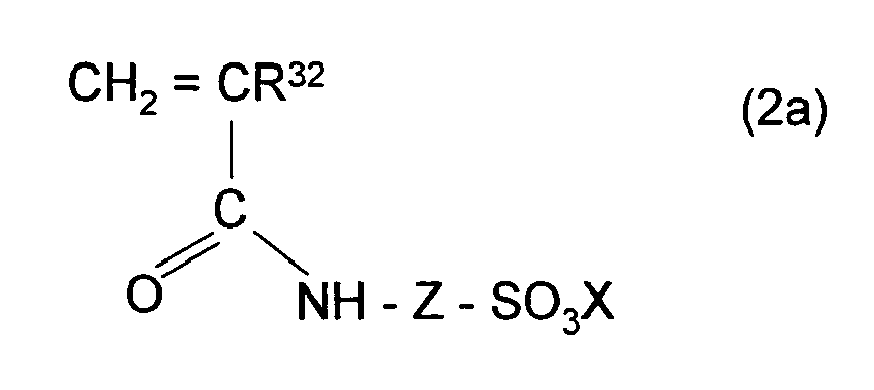
- A) einem oder mehreren Makromonomeren der Formel (1a)
- II) ein oder mehrere wasserlösliche oder wasserquellbare vernetzte oder unvernetzte copolymere oder homopolymere Verdicker.
- In den Verbindungen der Formel (1a) steht R11 bevorzugt für einen Acryl- oder Methacrylrest.
- In den Verbindungen der Formel (1a) steht R21 bevorzugt für einen Ethylen- oder Propylenrest.
- In den Verbindungen der Formel (1a) steht x bevorzugt für eine Zahl zwischen 3 und 50, besonders bevorzugt für eine Zahl zwischen 6 und 30.
- In den Verbindungen der Formel (1a) steht R31 bevorzugt für aliphatische oder cycloaliphatische Kohlenwasserstoffe, die gesättigt oder ungesättigt sein können, besonders bevorzugt für einen (C6-C22)-Kohlenwasserstoffrest, insbesondere bevorzugt für einen (C12-C18)-Kohlenwasserstoffrest. Außerordentlich bevorzugt bedeutet R31 einen Alkyl- oder einen ein- oder mehrfach ungesättigten Alkenylrest, hierunter bevorzugt ist wiederum der Alkylrest. Ganz außerordentlich bevorzugt steht R31 für einen Rest ausgewählt aus Stearyl, Lauryl, Cocoyl, Undecyl, Behenyl, Cetearyl, Cetyl und Myristyl und hierunter bevorzugt wiederum für einen Rest ausgewählt aus Stearyl, Lauryl, Cetyl und Myristyl.
- In den Verbindungen der Formel (2a) steht R32 bevorzugt für H, Z bevorzugt für -C(CH3)2-CH2- und X bevorzugt für Wasserstoff, Natrium, Kalium oder Ammonium, besonders bevorzugt für Wasserstoff oder Ammonium, wobei in den unvernetzten Copolymeren auch Struktureinheiten der Formel (2a) mit unterschiedlichem X enthalten sein können.
- Vorzugsweise ist der Neutralisierungsgrad der Struktureinheit hervorgegangen aus den Monomeren der Formel (2a) von 70 bis 100 mol-%, vorzugsweise von 80 bis 100 mol-% und besonders bevorzugt von 80 bis 99 mol-%.
- In einer weiteren bevorzugten Ausführungsform der Erfindung betragen die molaren Anteile der Struktureinheit hervorgegangen aus den Makromonomeren der Formel (1a) und der Struktureinheit hervorgegangen aus den Monomeren der Formel (2a) im Copolymer der Komponente I) jeweils von 0,1 bis 99,9 mol-%.
- In einer besonders bevorzugten Ausführungsform der Erfindung beträgt der Anteil der Struktureinheit hervorgegangen aus den Makromonomeren der Formel (1a) im Copolymer der Komponente I) von 50,1 bis 99,9 mol-%, bevorzugt von 70 bis 95 mol-% und besonders bevorzugt von 80 bis 90 mol-%.
- In einer anderen besonders bevorzugten Ausführungsform der Erfindung beträgt der Anteil der Struktureinheit hervorgegangen aus den Makromonomeren der Formel (1a) im Copolymer der Komponente I) von 0,1 bis 50 mol-%, bevorzugt von 5 bis 25 mol-% und besonders bevorzugt von 6 bis 15 mol-%.
- Bevorzugte wasserlösliche oder wasserquellbare vernetzte oder unvernetzte copolymere oder homopolymere Verdicker der Komponente II) sind ausgewählt aus
- a) Polymeren auf Basis von Methacrylsäure oder Acrylsäure und modifizierter (Meth)acrylsäure, vorzugsweise vernetzte Polymere der Acrylsäure wie sie unter den Handelsnamen Carbopol 980, 981, 954, 2984 und 5984 (CTFA Name: Carbomer) oder Synthalen M und Synthalen K erhältlich sind, Copolymere aus (Meth)acrylsäure und Polyalkylenpolyether, hydrophob modifizierte Poly(meth)acrylate, beispielsweise die unter Pemulen® TR-1 und TR-2 von BF-Goodrich, Carbopol® ETD 2020 von BF-Goodrich (Acrylate/C10-30 Alkyl Acrylat Polymer), Aculyn® 22 von Rohm und Haas (Acrylates/Steareth-20 Methacrylate Copolymer), Aculyn® 28 von Rohm und Haas (Acrylates/Beheneth-25 Methacrylate Copolymer), Synthalen® W 2000 von 3V Sigma (Acrylate/Palmeth-25 Acrylat Copolymer), Structure® 3001 von National Starch (Acrylates/Ceteth-20 Itaconat Copolymer) erhältlichen Copolymere,
- b) Homopolymeren der Dimethylaminoethyl(meth)acrylate, quaternisiert mit Methylchlorid, wie unter den Handelsnamen Salcare® 95 und Salcare® 96 von Ciba erhältlich,
- c) Copolymeren von Dimethylaminoethyl(meth)acylat, quaternisiert mit Methylchlorid und Acrylamid, wie unter den Handelsnamen Salcare® SC92 oder PAS 5194, erhältlich,
- d) vernetzten Copolymeren von Vinylisodecanoat und (Meth)acrylsäure, wie unter dem Handelsnamen Stabylen® 30 erhältlich,
- e) Polyvinylalkoholen,
- f) Polyvinylmethylethern,
- g) Polyacrylamiden,
- h) Polyvinylamiden,
- i) Polyvinylpyrrolidon,
- j) Poly(meth)acrylsäuren, Poly(meth)acrylsäureestern und weiteren Poly(meth)acrylsäurederivaten,
- k) Polyethylenoxiden,
- l) Copolymeren aus Maleinsäureanhydrid und Vinylmethylether,
- m) Polysulfonsäuren, vorzugsweise Copolymerisaten auf Basis der Acrylamido-alkylsulfonsäure und/oder deren Salzen und einem oder mehreren Comonomeren ausgewählt aus cyclischen N-Vinylcarbonsäureamiden und linearen N-Vinylcarbonsäureamiden oder auch hydrophob modifizierten vernetzten Acrylamido-alkylsulfonsäure-Copolymerisaten (z.B. wie in
DE 10 059 826 beschrieben), - n) vernetzten Homopolymeren der Acrylamido-alkylsulfonsäure und/oder deren Salzen,
- o) Copolymeren aus der Acrylamido-alkylsulfonsäure und/oder deren Salzen und Comonomeren ausgewählt aus Acrylamid, Hydroxyethyl(meth)acrylat und kationisch modifizierte (Meth)acrylate und
- p) natürlichen und modifizierten natürlichen Polymeren auf Basis von Polysacchariden, vorzugsweise Celluloseether, Cellulosederivate, Carboxymethylcellulose, Hydroxyethylcellulose, Gelatine, Stärke und Stärkederivate, Natriumalginate, Xanthan, Guar und Guarderivate, Scleroglucan,Traganth oder Dextrinderivate, insbesondere Dextrinester.
- Besonders bevorzugte wasserlösliche oder wasserquellbare vernetzte oder unvernetzte copolymere oder homopolymere Verdicker der Komponente II) sind ausgewählt aus den obengenannten Gruppen a), g), j), m), n), o) und p).
- In einer weiteren bevorzugten Ausführungsform der Erfindung beträgt der Gewichtsanteil an vernetzenden Comonomeren, bezogen auf die Gesamtmasse der Polymere der Komponente II) von 0 bis 20 Gew.-%.
- In einer weiteren bevorzugten Ausführungsform der Erfindung enthalten die kosmetischen oder pharmazeutischen Zubereitungen ein oder mehrere wasserlösliche unvernetzte Copolymere der Komponente I) auf Basis von Acryloyldimethyltaurinsäure bzw. deren Salzen, vorzugsweise entsprechende unvernetzte hydrophob modifizierte Copolymere der Komponente I), und ein oder mehrere wasserlösliche oder wasserquellbare vernetzte copolymere Verdicker der Komponente II) auf Basis von Acryloyldimethyltaurinsäure bzw. deren Salzen, vorzugsweise entsprechende vernetzte hydrophob modifizierte copolymere Verdicker der Komponente II), wobei die unvernetzten Copolymere der Komponente I) und die vernetzten Copolymere der Komponente II) jeweils herstellbar sind durch radikalische Copolymerisation von
- A) einem oder mehreren Makromonomeren der Formel (1a)
R11-Y- (R21-O)x-R31 (1a)
worin R11 einen Vinyl-, Allyl-, Acryl- oder Methacrylrest; R21 (C2-C4)-Alkylen; x eine ganze Zahl zwischen 1 und 500; Y = O, S, PH oder NH; und R31 Wasserstoff oder einen gesättigten oder ungesättigten linearen oder verzweigten aliphatischen, cycloaliphatischen oder aromatischen (C1-C30)-Kohlenwasserstoffrest bedeuten
und - B) einem oder mehreren Comonomeren der Formel (2a)

und nur im Fall der vernetzten Copolymere der Komponente II) - C) zusätzlich einem oder mehreren Vernetzern.
- Diese Schreibweise bedeutet im Rahmen der vorliegenden Erfindung, dass die Copolymere der Komponente I) herstellbar sind durch radikalische Copolymerisation der Monomere der Formeln (1a) und (2a) und die Copolymere der Komponente II) herstellbar sind durch radikalische Copolymerisation der Monomere der Formeln (1a) und (2a) und zusätzlich einem oder mehreren Vernetzern.
- Bei den Vernetzern der Gruppe C) handelt es sich um Monomere mit zwei oder mehr Doppelbindungen.
- In den Verbindungen der Formel (1a) steht R11 bevorzugt für einen Acryl- oder Methacrylrest.
- In den Verbindungen der Formel (1a) steht R21 bevorzugt für einen Ethylen- oder Propylenrest.
- In den Verbindungen der Formel (1a) steht x bevorzugt für eine Zahl zwischen 3 und 50, besonders bevorzugt für eine Zahl zwischen 6 und 30.
- In den Verbindungen der Formel (1a) steht R31 bevorzugt für aliphatische oder cycloaliphatische Kohlenwasserstoffe, die gesättigt oder ungesättigt sein können, besonders bevorzugt für einen (C6-C22)-Kohlenwasserstoffrest, insbesondere bevorzugt für einen (C12-C18)-Kohlenwasserstoffrest. Außerordentlich bevorzugt bedeutet R31 einen Alkyl- oder einen ein- oder mehrfach ungesättigten Alkenylrest, hierunter bevorzugt ist wiederum der Alkylrest. Ganz außerordentlich bevorzugt steht R31 für einen Rest ausgewählt aus Stearyl, Lauryl, Cocoyl, Undecyl, Behenyl, Cetearyl, Cetyl und Myristyl und hierunter bevorzugt wiederum für einen Rest ausgewählt aus Stearyl, Lauryl, Cetyl und Myristyl.
- In den Verbindungen der Formel (2a) steht R32 bevorzugt für H, Z bevorzugt für -C(CH3)2-CH2- und X bevorzugt für Wasserstoff, Natrium, Kalium oder Ammonium, besonders bevorzugt für Wasserstoff oder Ammonium, wobei in den unvernetzten Copolymeren der Komponente I) und in den vernetzten Copolymeren der Komponente II) auch Struktureinheiten der Formel (2a) mit unterschiedlichem X enthalten sein können.
- Vorzugsweise ist der Neutralisierungsgrad der Struktureinheit hervorgegangen aus den Monomeren der Formel (2a) von 70 bis 100 mol-%, vorzugsweise von 80 bis 100 mol-% und besonders bevorzugt von 80 bis 99 mol-%.
- In einer weiteren bevorzugten Ausführungsform der Erfindung betragen die molaren Anteile der Struktureinheit hervorgegangen aus den Makromonomeren der Formel (1a) und der Struktureinheit hervorgegangen aus den Monomeren der Formel (2a) im Copolymer der Komponente I) jeweils von 0,1 bis 99,9 mol-%.
- In einer weiteren bevorzugten Ausführungsform der Erfindung betragen die molaren Anteile der Struktureinheit hervorgegangen aus den Makromonomeren der Formel (1a) und der Struktureinheit hervorgegangen aus den Monomeren der Formel (2a) im Copolymer der Komponente II) jeweils von 0,1 bis 99,85 mol-% und der molare Anteil der Struktureinheit hervorgegangen aus dem einen oder den mehreren Vernetzern von 0,05 bis 8 mol-%.
- In einer besonders bevorzugten Ausführungsform der Erfindung beträgt der Anteil der Struktureinheit hervorgegangen aus den Makromonomeren der Formel (1 a) im Copolymer der Komponente I) von 50,1 bis 99,9 mol-%, bevorzugt von 70 bis 95 mol-% und besonders bevorzugt von 80 bis 90 mol-%.
- In einer weiteren besonders bevorzugten Ausführungsform der Erfindung beträgt der Anteil der Struktureinheit hervorgegangen aus den Makromonomeren der Formel (1a) im Copolymer der Komponente II) von 50,1 bis 99,85 mol-%, bevorzugt von 70 bis 95 mol-% und besonders bevorzugt von 80 bis 90 mol-% und der molare Anteil der Struktureinheit hervorgegangen aus dem einen oder den mehreren Vernetzern von 0,05 bis 8 mol-%.
- In einer anderen besonders bevorzugten Ausführungsform der Erfindung beträgt der Anteil der Struktureinheit hervorgegangen aus den Makromonomeren der Formel (1a) im Copolymer der Komponente I) von 0,1 bis 50 mol-%, bevorzugt von 5 bis 25 mol-% und besonders bevorzugt von 6 bis 15 mol-%.
- In einer weiteren besonders bevorzugten Ausführungsform der Erfindung beträgt der Anteil der Struktureinheit hervorgegangen aus den Makromonomeren der Formel (1 a) im Copolymer der Komponente II) von 0,1 bis 50 mol-%, bevorzugt von 5 bis 25 mol-% und besonders bevorzugt von 6 bis 15 mol-% und der molare Anteil der Struktureinheit hervorgegangen aus dem einen oder den mehreren Vernetzern von 0,05 bis 8 mol-%.
- Weiterhin bevorzugte erfindungsgemäße Zubereitungen sind solche, worin der oder die wasserlöslichen oder wasserquellbaren vernetzten oder unvernetzten copolymeren oder homopolymeren Verdicker der Komponente II) ausgewählt sind aus Copolymeren, bestehend im Wesentlichen aus
- a1) 1 bis 50 Gew.-% der wiederkehrenden Struktureinheit der Formel (3)

oder - a2) 1 bis 50 Gew.-% der wiederkehrenden Struktureinheit der Formel (4)

bis 20, insbesondere 1 bis 12 C-Atomen, bedeuten
oder - a3) 1 bis 50 Gew.-% einer Mischung der wiederkehrenden Struktureinheit der Formel (3) und der wiederkehrenden Struktureinheit der Formel (4)
und - b) 49,99 bis 98,99 Gew.-% der wiederkehrenden Struktureinheit der Formel (2)

- R3
- für Wasserstoff, Methyl oder Ethyl steht,
- Z
- für (C1-C8)-Alkylen steht, und
- X
- für Wasserstoff, Lithium, Natrium, Kalium, Magnesium, Calcium, Ammonium, Monoalkylammonium, Dialkylammonium, Trialkylammonium oder Tetraalkyl-ammonium, wobei die Alkylsubstituenten der Ammoniumionen unabhängig voneinander (C1-C22)-Alkylreste darstellen, die mit 0 bis 3 Hydroxyalkylgruppen besetzt sein können, deren Alkylkettenlänge in einem Bereich von C2 bis C10 variieren kann, steht oder X auch für ein bis dreifach ethoxylierte Ammoniumverbindungen mit gleichem oder unterschiedlichem Ethoxylierungsgrad steht, und wobei in den Copolymeren auch Struktureinheiten der Formel (2) mit unterschiedlichem X enthalten sein können, und
- c) 0 bis 8 Gew.-% an vernetzenden Strukturen, die aus Monomeren mit mindestens zwei olefinischen Doppelbindungen hervorgehen.
- In einer weiteren bevorzugten Ausführungsform der Erfindung ist der oder sind die wasserlöslichen oder wasserquellbaren vernetzten oder unvernetzten copolymeren oder homopolymeren Verdicker der Komponente II) ausgewählt aus vernetzten Polymeren, die vernetzende Strukturen hervorgegangen aus Methylenbisacrylamid; Methylenbismethacrylamid; Ester ungesättigter Mono- und Polycarbonsäuren mit Polyolen, bevorzugt Diacrylate und Triacrylate bzw. -methacrylate, besonders bevorzugt Butandiol- und Ethylenglykoldiacrylat bzw. -methacrylat, Trimethylolpropantriacrylat (TMPTA) und Trimethylolpropantrimethacrylat (TMPTMA); Allylverbindungen, bevorzugt Allyl(meth)acrylat, Triallylcyanurat, Maleinsäurediallylester, Polyallylester, Tetraallyloxyethan, Triallylamin, Tetraallylethylendiamin; Allylester der Phosphorsäure; und/oder Vinylphosphonsäurederivate, bevorzugt Trimethylolpropantriacrylat (TMPTA), enthalten.
- Weitere bevorzugte erfindungsgemäße Zubereitungen enthalten als Komponente II) ein oder mehrere vernetzte Homopolymere, die in statistischer Verteilung zu 90 bis 99,99 Gew.-% aus Struktureinheiten hervorgegangen aus Monomeren der Formel (2a) und zu 0,01 bis 10 Gew.-% aus vernetzenden Strukturen, die aus Monomeren mit mindestens zwei olefinischen Doppelbindungen hervorgegangen sind, bestehen. Bevorzugte Vernetzer sind dabei Methylenbisacrylamid; Methylenbismethacrylamid; Ester ungesättigter Mono- und Polycarbonsäuren mit Polyolen, bevorzugt Diacrylate und Triacrylate bzw. -methacrylate, besonders bevorzugt Butandiol- und Ethylenglykoldiacrylat bzw. -methacrylat, Trimethylolpropantriacrylat (TMPTA) und Trimethylolpropantrimethacrylat (TMPTMA); Allylverbindungen, bevorzugt Allyl(meth)acrylat, Triallylcyanurat, Maleinsäurediallylester, Polyallylester, Tetraallyloxyethan, Triallylamin, Tetraallylethylendiamin; Allylester der Phosphorsäure; und/oder Vinylphosphonsäurederivate. Insbesondere bevorzugt sind die vernetzenden Strukturen hervorgegangen aus Trimethylolpropantriacrylat (TMPTA).
- In einer besonders bevorzugten Ausführungsform der Erfindung ist der oder sind die wasserlöslichen oder wasserquellbaren vernetzten oder unvernetzten copolymeren oder homopolymeren Verdicker der Komponente II) ausgewählt aus vernetzten Polymeren, die vernetzende Strukturen hervorgegangen aus Trimethylolpropantriacrylat enthalten.
- In einer weiteren bevorzugten Ausführungsform der Erfindung enthalten die kosmetischen, pharmazeutischen oder dermatologischen Zubereitungen ein oder mehrere unvernetzte Copolymere der Komponente I) und ein oder mehrere vernetzte Polymere der Komponente II) jeweils herstellbar durch radikalische Copolymerisation von
- A) einem oder mehreren Makromonomeren der Formel (5)

und - B) einem oder mehreren Comonomeren gemäß der Formel (2a), wobei R32 für Wasserstoff, Z für -C(CH3)2-CH2- und X für ein Wasserstoff-, Ammonium-, Alkali- oder Erdalkaliion, insbesondere für ein Ammonium- oder Natriumion, steht
und nur im Fall der vernetzten Polymere der Komponente II) - C) zusätzlich Trimethylolpropantriacrylat als Vernetzer.
- In einer besonders bevorzugten Ausführungsform der Erfindung enthalten die Zubereitungen ein oder mehrere unvernetzte Copolymere der Komponente I) und ein oder mehrere vernetzte Polymere der Komponente II) jeweils herstellbar durch radikalische Copolymerisation von
- A) einem oder mehreren Makromonomeren, ausgewählt aus Estern der (Meth)acrylsäure mit
(C10-C18)-Fettalkoholpolyglykolether mit 8 EO-Einheiten (Genapol® C-080)
C11-Oxoalkoholpolyglykolether mit 8 EO-Einheiten (Genapol® UD-080)
(C12-C14)-Fettalkoholpolyglykolether mit 7 EO-Einheiten (Genapol® LA-070)
(C12-C14)-Fettalkoholpolyglykolether mit 11 EO-Einheiten (Genapol® LA-110)
(C16-C18)-Fettalkoholpolyglykolether mit 8 EO-Einheiten (Genapol® T-080)
(C16-C18)-Fettalkoholpolyglykolether mit 15 EO-Einheiten (Genapol® T-150)
(C16-C18)-Fettalkoholpolyglykolether mit 11 EO-Einheiten (Genapol® T-110)
(C16-C18)-Fettalkoholpolyglycolether mit 20 EO-Einheiten (Genapol® T-200)
(C16-C18)-Fettalkoholpolyglycolether mit 25 EO-Einheiten (Genapol® T-250)
(C18-C22)-Fettalkoholpolyglycolether mit 25 EO-Einheiten
und/oder iso-(C16-C18)-Fettalkoholpolyglycolether mit 25 EO-Einheiten
und - B) einem oder mehreren Comonomeren ausgewählt aus Acrylamidopropylmethylensulfonsäure und/oder deren Natrium- oder Ammoniumsalz
und nur im Falle der vernetzten Polymere der Komponente II) - C) zusätzlich einem oder mehreren Vernetzern, insbesondere Trimethylolpropantriacrylat.
- Bei den Genapol®-Typen handelt es sich um Produkte der Firma Clariant.
- In einer weiteren besonders bevorzugten Ausführungsform der Erfindung enthalten die erfindungsgemäßen Zubereitungen ein oder mehrere unvernetzte Copolymere der Komponente I) und ein oder mehrere vernetzte Polymere der Komponente II) jeweils herstellbar durch Copolymerisation von
- A) Makromonomeren der Formel (5), wobei p für 0 und n für eine Zahl von 7 bis 25, R27 für Methyl und R29 für eine Alkylgruppe mit 12 bis 14 Kohlenstoffatomen oder 16 bis 18 Kohlenstoffatomen steht,
und - B) einem oder mehreren Comonomeren ausgewählt aus Acrylamidopropylmethylensulfonsäure und/oder deren Salzen mit Natriumionen oder Ammoniumionen
und nur im Falle der vernetzten Polymere der Komponente II) - C) zusätzlich einem oder mehreren Vernetzern, insbesondere Trimethylolpropantriacrylat.
- In einer weiteren bevorzugten Ausführungsform der Erfindung enthalten die ein oder mehreren wasserlöslichen unvernetzten Copolymere der Komponente I) und/oder die ein oder mehreren wasserlöslichen oder wasserquellbaren vernetzten oder unvernetzten copolymeren oder homopolymeren Verdicker der Komponente II) ein oder mehrere weitere Struktureinheiten hervorgegangen aus einem oder mehreren Monomeren ausgewählt aus olefinisch ungesättigten Säuren und deren Salzen mit ein- und zweiwertigen Gegenionen, beispielsweise Styrolsulfonsäure, Vinylsulfonsäure, Vinylphosphonsäure, Allylsulfonsäure, Methallylsulfonsäure, Acrylsäure, (Meth)acrylsäure, Maleinsäure bzw. Maleinsäureanhydrid und deren Salze; Ester der Acryl- und der (Meth)acrylsäure mit aliphatischen, aromatischen oder cyclo-aliphatischen Alkoholen mit einer Kohlenstoffzahl von 1 bis 22; Ester der Acryl- und der (Meth)acrylsäure mit Alkylethoxylaten, offenkettige und cyclische N-Vinylamide (N-Vinyllactame) mit einer Ringgröße von 4 bis 9 Atomen, besonders bevorzugt N-Vinylformamid (NVF), N-Vinylmethylformamid, N-Vinyl-methylacetamid (VIMA), N-Vinylacetamid, N-Vinylpyrrolidon (NVP) und N-Vinylcaprolactam; Amide der Acryl- und der Methacrylsäure, besonders bevorzugt Acrylamid, N,N-Dimethylacrylamid, N,N-Diethylacrylamid, alkoxylierte Acryl- und Methacrylamide, wie z.B. MAPTAC und APTAC; 2-Vinylpyridin; 4-Vinylpyridin; Vinylacetat; Methacrylsäureglycidylester; Acrylnitril; Vinylchlorid; Vinylidenchlorid; Tetrafluorethylen und/oder DADMAC, enthalten.
- Als Gegenionen für die Salze der olefinisch ungesättigten Säuren eignen sich bevorzugt Lithium, Natrium, Kalium, Magnesium, Calcium, Ammonium, Monoalkylammonium, Dialkylammonium, Trialkylammonium oder Tetraalkyl-ammonium, wobei die Alkylsubstituenten der Ammoniumionen unabhängig voneinander (C1-C22)-Alkylreste darstellen, die mit 0 bis 3 Hydroxyalkylgruppen besetzt sein können, deren Alkylkettenlänge in einem Bereich von C2 bis C10 variieren kann. Ebenfalls geeignet sind ein- bis dreifach ethoxylierte Ammoniumverbindungen mit unterschiedlichem Ethoxylierungsgrad. Als Gegenionen besonders bevorzugt sind Natrium und Ammonium. Der Neutralisationsgrad der olefinisch ungesättigten Säuren beträgt bevorzugt 70 bis 100 Mol-%.
- Die Monomerenverteilung der Momeren A) und Comonomeren B) in den Polymeren der Komponente I) bzw. der Komponente II) kann beispielsweise alternierend, blockartig (auch Multiblock) oder auch statistisch (auch Gradient) sein.
- Die in den erfindungsgemäßen Zubereitungen enthaltenen Polymere weisen im allgemeinen ein zahlenmittleres Molekulargewicht von 1000 bis 20.000.000, bevorzugt von 20.000 bis 5.000.000 und insbesondere bevorzugt von 100.000 bis 1.500.000 g/mol auf.
- Die Kombination aus unvernetzten Acryloyldimethyltaurinsäure-Polymeren der Komponente I), vorzugsweise aus den entsprechenden unvernetzten hydrophob modifizierten Polymeren der Komponente I), mit vernetzten wasserlöslichen oder wasserquellbaren Copolymerisaten der Komponente II) auf Basis von Acrylamidoalkylsulfonsäuren und cyclischen N-Vinylcarbonsäureamiden und/oder linearen N-Vinylcarbonsäureamiden zeigt eine verdickende Wirkung in synergistischer Weise (s. Tabelle 1).
Tabelle 1: Viskositäten [mPa*s, 25°C, H2O dest. (Brookfield , 20 U/min)] einzelner Polymere und Polymer-Kombinationen (alle %-Angaben in Tabelle 1 sind Gew.-%) Polymer-Gel Wässriges Gel mit 0,5 % Aristoflex® AVC Wässriges Gel mit 0,5 % Copolymer gemäß Beispiel 3 Wässriges Gel mit 0,5 % Aristoflex® AVC und 0,1 % NaCl Wässriges Gel mit 0,5 % Copolymer gemäß Beispiel 3 und 0,1 % NaCl Wässriges Gel mit 0,5 % Aristoflex® AVC / 0,5% Copolymer gemäß Beispiel 3 Wässriges Gel mit 0,5 % Aristoflex® AVC / 0,5% Copolymer gemäß Beispiel 3 und 0,1 % NaCl Viskosität (mPas) 17017 ca. 20 85 28 2900 5350 - Die Werte der Tabelle 1 belegen eine synergistische Steigerung der Viskositäten nach Elektrolytzugabe in Gegenwart der Polymer-Kombination im Vergleich zu den einzelnen Polymeren.
- Die in den erfindungsgemäßen kosmetischen, pharmazeutischen und dermatologischen Zubereitungen eingesetzten Polymere der Komponente I) werden nach den in
EP 1 069 142 beschriebenen Verfahren hergestellt. - In einer weiteren bevorzugten Ausführungsform der Erfindung liegt das Gewichtsverhältnis der unvernetzten Polymere der Komponente I), vorzugsweise der entsprechenden unvernetzten hydrophob modifizierten Polymere der Komponente I), zu dem einem oder den mehreren wasserlöslichen oder wasserquellbaren polymeren Verdickern der Komponente II) im Bereich von 1 bis 99 zu 99 bis 1, bevorzugt im Bereich von 10 bis 90 zu 90 bis 10, besonders bevorzugt im Bereich von 20 bis 80 zu 80 bis 20, und insbesondere bevorzugt im Bereich von 30 bis 70 zu 70 bis 30.
- Die erfindungsgemäßen Zubereitungen enthalten die Polymer-Mischung der Komponenten I) und II) vorzugsweise in einer Menge von 0,1 bis 10 Gew.-%.
- Bevorzugt betragen die Viskositäten der 1 Gew.-% igen wässrigen Lösungen, enthaltend mindestens ein Polymer der Komponente I) und mindestens ein Polymer der Komponente II) 500 bis 50 000 mPas, insbesondere 1 000 bis 40 000 mPas, außerordentlich bevorzugt 2000 bis 20 000 mPas bei 25°C (gemessen nach Brookfield).
- Solche Polymere zeigen bereits bei Raumtemperatur eine hohe Verdickerleistung, gute Emulgiereigenschaften und gute Dispersionseigenschaften in wässriger, wässrig-alkoholischer und wässrig-tensidischer Lösung oder in Emulsionen. Des Weiteren zeigen Zubereitungen, enthaltend solche Polymere, eine gute Transparenz und eine hohe Elektrolytstabilität.
- Die in den erfindungsgemäßen Zubereitungen enthaltene Mischung aus wasserlöslichen unvernetzten Polymeren der Komponente I) und wasserlöslichen vernetzten Polymeren der Komponente II) eignet sich als Verdicker und Dispergiermittel für wässrige Zubereitungen, wässrig-alkoholische und wässrigetensidische Zubereitungen und als Emulgatoren, Suspendiermittel mit verdickender Wirkung und Konsistenzgeber für Emulsionen und Suspensionen.
- In einer weiteren bevorzugten Ausführungsform der Erfindung liegen die Zubereitungen in Form eines Haarbehandlungs-, Haarpflege-, Haarstyling- oder Haarreinigungsmittels vor.
- In einer weiteren bevorzugten Ausführungsform der Erfindung liegen die Zubereitungen in Form eines wässrigen, gelförmigen kosmetischen oder pharmazeutischen Mittels vor.
- Weitere bevorzugte Ausführungsformen der erfindungsgemäßen Zubereitungen sind Spülungen, Kuren, Sprühkuren, Lotionen, Cremes, beispielsweise Stylingcremes, Emulsionen, Gele, beispielsweise wässrige Refreshing-Gele, milde Reinigungsgele, anti-aging Gele, Sonnenschutzgele, Schäume, Mousse, Fluids und Sprays, insbesondere Haarconditioner, Schampoos, Volumenspray, Styling-Fluid, Haarschaum, Haargel, Festiger, Haarspray, Mousse, Haaröle, Haarwachse und Spitzenfluids.
- In einer weiteren bevorzugten Ausführungsform der Erfindung handelt es sich bei den kosmetischen und pharmazeutischen Zubereitungen um tensidfreie Mittel, um tensidfreie Emulsionen, Gele, Sprays, Sprühschäume, Mousse oder Fluids.
- In einer besonders bevorzugten Ausführungsform der Erfindung werden die Polymere der Komponenten I) und II) in versprühbare, pumpbare und verschäumbare Gele und Schäume, insbesondere in versprühbare Haargele und verschäumbare Sonnenschutzmittel eingearbeitet und bewirken eine Verbesserung des Sprühverhaltens der Mittel mit optimierter Tröpfchengrößenverteilung.
- Vorteilhaft ist eine Haargelzusammensetzung, enthaltend ein oder mehrere Polymere der Komponente I) und ein oder mehrere Polymere der Komponente II) und mindestens ein haarfestigendes Polymer.
- Die Viskosität der Gele beträgt vorzugsweise 100 bis 5000 mPa*s, besonders bevorzugt 200 bis 1000 mPa*s, insbesondere bevorzugt 250 bis 800 mPa*s, gemessen als dynamische Viskositätsmessung mit einem Bohlin Rheometer CS, Messkörper C25 bei einer Temperatur von 25°C und einer Schergeschwindigkeit von 50 s-1.
- Die Polymer-Mischung der Polymere der Komponenten I) und II) wird vorzugsweise in einer Menge von 0,1 bis 10, besonders bevorzugt von 0,2 bis 8 Gew.-% und das haarfestigende Polymer in einer Menge von vorzugsweise 0,1 bis 15, besonders bevorzugt von 0,5 bis 10 Gew.-% eingesetzt.
- Das haarfestigende Polymer kann nichtionisch, anionisch, kationisch oder amphoter sein, ist aber vorzugsweise nichtionisch oder anionisch. Es kann ein synthetisches oder ein natürliches Polymer sein. Unter natürlichen Polymeren werden auch chemisch modifizierte Polymere natürlichen Ursprungs verstanden. Bevorzugt sind insbesondere solche Polymere, die eine ausreichende Löslichkeit in Wasser, Alkohol oder Wasser/Alkohol-Gemischen besitzen, um in dem erfindungsgemäßen Mittel in vollständig gelöster Form vorzuliegen. Unter haarfestigenden Polymeren werden solche Polymere verstanden, die bei Anwendung in 0,01 bis 15 Gew.-%iger wässriger, alkoholischer oder wässrig-alkoholischer Lösung oder Dispersion in der Lage sind, auf dem Haar eine haarfestigende Wirkung zu erzielen.
- Geeignete synthetische, nichtionische haarfestigende Polymere sind Homo- oder Copolymere, die aus mindestens einem der folgenden Monomere aufgebaut sind: Vinylpyrrolidon, Vinylimidazol, Vinylcaprolactam, Vinylester wie z.B. Vinylacetat, Vinylalkohol, Acrylamid, Methacrylamid, Alkyl- und Dialkylacrylamid, Alkyl- und Dialkylmethacrylamid, Dialkylaminoalkylmethacrylamid, Dialkylaminoalkylacrylamid, Alkylacrylat, Alkylmethacrylat, Propylenglycol oder Ethylenglycol, wobei die Alkylgruppen dieser Monomere C1- bis C18-Alkylgruppen, vorzugsweise C1- bis C7-Alkylgruppen, besonders bevorzugt C1- bis C3-Alkylgruppen sind. Geeignet sind z.B. Homopolymere des Vinylcaprolactams, des Vinylpyrrolidons oder des N-Vinylformamids. Weitere geeignete haarfestigende Polymere sind z.B. Copolymerisate aus Vinylpyrrolidon und Vinylacetat, Terpolymere aus Vinylpyrrolidon, Vinylacetat und Vinylpropionat, Terpolymere aus Vinylpyrrolidon, Vinylcaprolactam und Dialkylaminoalkyl(meth)acrylat, Terpolymere aus Vinylpyrrolidon, Vinylcaprolactam und Dialkylaminoalkyl(meth)acrylamid, Terpolymere aus Vinylpyrrolidon, Vinylimidazol und (Meth)acrylamid, Polyacrylamid, Polyvinylalkohol, sowie haarfestigende Polyethylenglycol/Polypropylenglykol Copolymere. Besonders bevorzugte nichtionische Polymere sind Polyvinylpyrrolidon und Polyvinylpyrrolidon/Vinylacetat Copolymere. Bevorzugt sind nichtionische Vinyllactam Homo- und Copolymere. Geeignete Vinyllactame sind z.B. Vinylcaprolactam und Vinylpyrrolidon. Besonders bevorzugt sind Polyvinylpyrrolidon, Polyvinylcaprolactam, Terpolymere aus Vinylpyrrolidon, Vinylimidazol und (Meth)acrylamid und Vinylpyrrolidon/Vinylacetat Copolymere. Bevorzugte Handelsprodukte sind Luviskol® K 30, Luviskol® K 90, Luviskol® VA 37, Luviskol® VA 64 und Luviset® Clear.
- Geeignete anionische haarfestigende Polymere können natürliche oder synthetische Homo- oder Copolymere mit Säuregruppen enthaltenden Monomereinheiten sein, welche gegebenenfalls mit Comonomeren, die keine Säuregruppen enthalten, copolymerisiert sind. Die Säuregruppen sind vorzugsweise ausgewählt aus -COOH, -SO3H, -OSO3H, -OPO2H und -OPO3H2, von denen die Carbonsäuregruppen bevorzugt sind. Die Säuregruppen können unneutralisiert, teilweise oder vollständig neutralisiert vorliegen. Sie liegen vorzugsweise zu 50 bis 100 % in anionischer bzw. neutralisierter Form vor. Als Neutralisationsmittel können die oben genannten Neutralisationsmittel verwendet werden. Geeignete Monomere sind ungesättigte, radikalisch polymerisierbare Verbindungen, welche mindestens eine Säuregruppe tragen, insbesondere Carboxyvinylmonomere. Geeignete Säuregruppen enthaltende Monomere sind beispielsweise Acrylsäure, Methacrylsäure, Crotonsäure, Maleinsäure bzw. Maleinsäureanhydrid oder deren Monoester, Aldehydocarbonsäuren oder Ketocarbonsäuren.
- Nicht mit Säuregruppen substituierte Comonomere sind beispielsweise Acrylamid, Methacrylamid, Alkyl- und Dialkylacrylamid, Alkyl- und Dialkylmethacrylamid, Alkylacrylat, Alkylmethacrylat, Vinylcaprolacton, Vinylpyrrolidon, Vinylester, Vinylalkohol, Propylenglycol oder Ethylenglycol, aminsubstituierte Vinylmonomere wie z.B. Dialkylaminoalkylacrylat, Dialkylaminoalkylmethacrylat, Monoalkylaminoalkylacrylat und Monoalkylaminoalkylmethacrylat, wobei die Alkylgruppen dieser Monomere C1- bis C18-Alkylgruppen, vorzugsweise C1- bis C7-Alkylgruppen, besonders bevorzugt C1- bis C3-Alkylgruppen sind.
- Geeignete anionische Polymere sind insbesondere Copolymere der Acrylsäure oder Methacrylsäure mit Monomeren ausgewählt aus Acrylsäure- oder Methacrylsäureestern, Acrylamiden, Methacrylamiden und Vinylpyrrolidon, Homopolymere der Crotonsäure, sowie Copolymere der Crotonsäure mit Monomeren ausgewählt aus Vinylestern, Acrylsäure- oder Methacrylsäureestern, Acrylamiden und Methacrylamiden. Ein geeignetes natürliches Polymer ist beispielsweise Schellack.
- Bevorzugte anionische Polymere sind vernetzte oder unvernetzte Vinylacetat/Crotonsäure Copolymere. Ebenso bevorzugt sind partial veresterte Copolymere zwischen Vinylmethylether und Maleinsäureanhydrid. Weitere geeignete anionische Polymere sind z.B. Terpolymere aus Acrylsäure, Alkylacrylat und N-Alkylacrylamid, insbesondere Acrylsäure/Ethylacrylat/N-t-Butylacrylamid Terpolymere oder Terpolymere aus Vinylacetat, Crotonat und Vinylalkanoat, insbesondere Vinylacetat/Crotonat/Vinylneodecanoat Copolymere.
- Geeignete filmbildende amphotere Polymere sind Polymere, welche neben sauren oder anionischen Gruppen als weitere funktionelle Gruppen basische oder kationische Gruppen, insbesondere primäre, sekundäre, tertiäre oder quaternäre Amingruppen enthalten. Beispiele hierfür sind Copolymere gebildet aus Alkylacrylamid, Alkylaminoalkylmethacrylat und zwei oder mehr Monomeren ausgewählt aus Acrylsäure, Methacrylsäure oder deren Ester, wobei die Alkylgruppen 1 bis 4 C-Atome enthalten, mindestens eines der Monomere eine Säuregruppe aufweist.
- Weitere Beispiele für geeignete haarfestigende Polymere sind Copolymere von Acrylsäure, Methacrylat und Methacrylamidopropyltrimethylammoniumchlorid, Copolymere aus Acrylamidopropyltrimethylammoniumchlorid und Acrylaten, Copolymere aus Acrylamid, Acrylamidopropyltrimethylammoniumchlorid, 2-Amidopropylacrylamidsulfonat und Dimethylaminopropylamin oder Chitosane. Geeignet sind auch Polymere mit Betaingruppen tragenden Monomeren wie z.B. Copolymere aus Methacryloylethylbetain und zwei oder mehr Monomeren von Acrylsäure oder deren einfachen Estern, bekannt unter der INCI-Bezeichnung Methacryloyl Ethyl Betain/ Acrylat Copolymer.
- In einer bevorzugten Ausführungsform wird die erfindungsgemäße Zubereitung in einem wässrigen, einem alkoholischen oder in einem wässrig-alkoholischen Medium mit vorzugsweise mindestens 10 Gew.-%, besonders bevorzugt mindestens 50 Gew.-% Wasser und vorzugsweise maximal 40 Gew.-% Alkohol konfektioniert.
- Als Alkohole können insbesondere die für kosmetische Zwecke üblicherweise verwendeten niederen Monoalkohole mit 1 bis 4 C-Atomen wie z.B. Ethanol und Isopropanol enthalten sein.
- In einer weiteren bevorzugten Ausführungsform der Erfindung liegen die erfindungsgemäßen Zubereitungen in Form eines Haargels vor und sind vorzugsweise klare, transparente oder durchscheinende, farblose Mittel.
- In einer weiteren bevorzugten Ausführungsform der Erfindung liegen die Zubereitungen in versprühbarer Form vor. Diese Zubereitungen haben besonders positive Sprüheigenschaften.
- In einer besonders bevorzugten Ausführungsform der Erfindung enthalten die Zubereitungen einen oder mehrere Filmbildner. Vorzugsweise liegen sie in diesem Fall in Form von Haarpflege- und Reinigungsmitteln vor.
- Bevorzugte Filmbildner sind je nach Anwendungszweck Salze der Phenylbenzimidazolsulfonsäure, wasserlösliche Polyurethane, beispielsweise C10-Polycarbamylpolyglycerylester, Polyvinylalkohol, Polyvinylpyrrolidoncopolymere, beispielsweise Vinylpyrrolidon/Vinylacetatcopolymer, wasserlösliche Acrylsäurepolymere/Copolymere bzw. deren Ester oder Salze, beispielsweise Partialestercopolymere der Acryl/Methacrylsäure und Polyethylenglykolether von Fettalkoholen, wie Acrylat/Steareth-20-Methacrylat Copolymer, wasserlösliche Cellulose, beispielsweise Hydroxymethylcellulose, Hydroxyethylcellulose, Hydroxypropylcellulose, wasserlösliche Quaterniums, Polyquaterniums, Carboxyvinyl-Polymere, wie Carbomere und deren Salze, Polysaccharide, beispielsweise Polydextrose und Glucan, Vinylacetat/Crotonat, beispielsweise unter dem Handelsnamen Aristoflex® A 60 (Clariant) erhältlich, sowie polymere Aminoxide, beispielsweise unter den Handelsnamen Diaformer® Z-711, 712, 731, 651, 632, 772 (Mitsubishi Chemical) erhältliche Vertreter.
- Die erfindungsgemäßen Haarbehandlungsmittel enthalten vorzugsweise 0,01 bis 15 Gew.-%, besonders bevorzugt 0,1 bis 10 Gew.-% und insbesondere bevorzugt 1 bis 5 Gew.-% an Filmbildnern, bezogen auf die fertigen Mittel.
- In einer weiteren besonders bevorzugten Ausführungsform der Erfindung enthalten die kosmetischen, pharmazeutischen und dermatologischen Zubereitungen einen oder mehrere UV-Filter.
- Als UV-Filter kommen vorzugsweise in Betracht 4-Aminobenzoesäure; 3-(4'-Trimethylammonium)benzyliden-boran-2-on-methylsulfat; 3,3,5-Trimethyl-cyclohexylsalicylat; 2-Hydroxy-4-methoxybenzophenon; 2-Phenylbenzimidazol-5-sulfonsäure und ihre Kalium-, Natrium- und Triethanolaminsalze; 3,3'-(1,4-Phenylendimethin)-bis-(7,7-dimethyl-2-oxobicyclo[2.2.1]-heptan-1-methansulfonsäure und ihre Salze; 1-(4-tert.-Butylphenyl)-3-(4-methoxyphenyl)propan-1,3-dion, 3-(4`-Sulfo)-benzyliden-bornan-2-on und seine Salze; 2-Cyan-3,3-diphenyl-acrylsäure-(2-ethylhexylester); Polymer von N-[2(und 4)-(2-oxoborn-3-ylidenmethyl)benzyl]-acrylamid; 4-Methoxy-zimtsäure-2-ethyl-hexylester; ethoxyliertes Ethyl-4-amino-benzoat; 4-Methoxy-zimtsäureisoamylester; 2,4,6-Tris-[p-(2-ethylhexyloxycarbonyl)anilino]-1,3,5-triazin; 2-(2H-benzotriazol-2-yl)-4-methyl-6-(2-methyl-3-(1,3,3,3-tetramethyl-1-(trimethylsilyloxy)-disiloxanyl)propyl)phenol; 4,4'-[(6-[4-((1,1-dimethylethyl)-amino-carbonyl)phenylamino]-1,3,5-triazin-2,4-yl)diimino]bis-(benzoesäure-2-ethylhexylester); 3-(4'-Methylbenzyliden)-D,L-Campher; 3-Benzyliden-Campher; Salicylsäure-2-ethylhexylester; 4-Dimethylaminobenzoesäure-2-ethylhexylester; Hydroxy-4-methoxy-benzophenon-5-sulfonsäure (Sulisobenzonum) und das Natriumsalz; und/oder 4-Isopropylbenzylsalicylat.
- Die erfindungsgemäßen kosmetischen, pharmazeutischen und dermatologischen Zubereitungen enthalten UV-Filter vorzugsweise in den Mengen von 0,0001 bis 5 Gew.-%, besonders bevorzugt von 0,001 bis 2 Gew.-% und insbesondere bevorzugt von 0,01 bis 1 Gew.-%, bezogen auf die fertigen Zubereitungen.
- In einer weiteren bevorzugten Ausführungsform der Erfindung enthalten die kosmetischen, pharmazeutischen und dermatologischen Zubereitungen ein oder mehrere Antioxidatien.
- Vorteilhaft werden die Antioxidantien gewählt aus der Gruppe bestehend aus Aminosäuren (z.B. Glycin, Histidin, Tyrosin, Tryptophan) und deren Derivate, Imidazole (z.B. Urocaninsäure) und deren Derivate, Peptide wie D,L-Carnosin, D-Carnosin, L-Carnosin und deren Derivate (z.B. Anserin), Carotinoide, Carotine (z.B. α-Carotin, β-Carotin, Lycopin) und deren Derivate, Chlorogensäure und deren Derivate, Liponsäure und deren Derivate (z.B. Dihydroliponsäure), Aurothioglucose, Propylthiouracil und andere Thiole (z.B. Thioredoxin, Glutathion, Cystein, Cystin, Cystamin und deren Glycosyl-, N-Acetyl-, Methyl-, Ethyl-, Propyl-, Amyl-, Butyl- und Lauryl-, Palmitoyl-, Oleyl-, γ-Linoleyl-, Cholesteryl- und Glycerylester) sowie deren Salze, Dilaurylthiodipropionat, Distearylthiodipropionat, Thiodipropionsäure und deren Derivate (Ester, Ether, Peptide, Lipide, Nukleotide, Nukleoside und Salze) sowie Sulfoximinverbindungen (z.B. Buthioninsulfoximine, Homocysteinsulfoximin, Buthioninsulfone, Penta-, Hexa-, Heptathioninsulfoximin) in sehr geringen verträglichen Dosierungen (z.B. pmol/kg), ferner (Metall)-Chelatoren (z.B. α-Hydroxyfettsäuren, Palmitinsäure, Phytinsäure, Lactoferrin), α-Hydroxysäuren (z.B. Citronensäure, Milchsäure, Apfelsäure), Huminsäure, Gallensäure, Gallenextrakte, Bilirubin, Biliverdin, EDTA, EGTA und deren Derivate, ungesättigte Fettsäuren und deren Derivate (z.B. γ-Linolensäure, Linolsäure, Ölsäure), Folsäure und deren Derivate, Ubichinon und Ubichinol und deren Derivate, Vitamin C und Derivate (z.B. Ascorbylpalmitat, Mg-Ascorbylphosphat, Ascorbylacetat), Tocopherole und Derivate (z.B. Vitamin-E-acetat), Vitamin A und Derivate (Vitamin-A-paimitat) sowie Koniferylbenzoat des Benzoeharzes, Rutinsäure und deren Derivate, a-Glycosylrutin, Ferulasäure, Furfurylidenglucitol, Carnosin, Butylhydroxytoluol, Butylhydroxyanisol, Nordihydroguajakharzsäure, Nordihydroguajaretsäure, Trihydroxybutyrophenon, Harnsäure und deren Derivate, Mannose und deren Derivate, Zink und dessen Derivate (z.B. ZnO, ZnSO4) Selen und dessen Derivate (z.B. Selenmethionin), Stilbene und deren Derivate (z.B. Stilbenoxid, Trans-Stilbenoxid), Superoxid-Dismutase und die erfindungsgemäß geeigneten Derivate (Salze, Ester, Ether, Zucker, Nukleotide, Nukleoside, Peptide und Lipide) dieser genannten Stoffe.
- Besonders vorteilhaft im Sinne der vorliegenden Erfindung können wasserlösliche Antioxidantien eingesetzt werden.
- Die Antioxidantien können die Haare und die Haut vor oxidativer Beanspruchung schützen. Bevorzugte Antioxidantien sind dabei Vitamin E und dessen Derivate sowie Vitamin A und dessen Derivate.
- Die Menge der Antioxidantien (eine oder mehrere Verbindungen) in den erfindungsgemäßen Zubereitungen beträgt vorzugsweise 0,001 bis 30 Gew.-%, besonders bevorzugt 0,05 bis 20 Gew.-% und insbesondere bevorzugt 1 bis 10 Gew.-%, bezogen auf das Gesamtgewicht der Zubereitungen.
- Sofern Vitamin E und/oder dessen Derivate das oder die Antioxidantien darstellen, ist es vorteilhaft, deren jeweilige Konzentrationen aus dem Bereich von 0,001 bis 10 Gew.-%, bezogen auf das Gesamtgewicht der fertigen Zubereitung zu wählen.
- Sofern Vitamin A, bzw. Vitamin-A-Derivate, bzw. Carotine bzw. deren Derivate das oder die Antioxidantien darstellen, ist es vorteilhaft, deren jeweilige Konzentrationen aus dem Bereich von 0,001 bis 10 Gew.-%, bezogen auf das Gesamtgewicht der Zubereitung, zu wählen.
- In einer besonders bevorzugten Ausführungsform der Erfindung enthalten die kosmetischen oder pharmazeutischen Zubereitungen Antioxidantien ausgewählt aus Superoxid-Dismutase, Tocopherol (Vitamin E) und Ascorbinsäure (Vitamin C).
- In weiteren erfindungsgemäßen Ausführungsformen enthalten die erfindungsgemäßen kosmetischen, pharmazeutischen und dermatologischen Zubereitungen antimikrobielle Wirkstoffe.
- Bevorzugt geeignet als antimikrobielle Wirkstoffe sind Cetyltrimethylammoniumchlorid, Cetylpyridiniumchlorid, Benzethoniumchlorid, Diisobutylethoxyethyldimethylbenzylammoniumchlorid, Natrium N-Laurylsarcosinat, Natrium-N-Palmethylsarcosinat, Lauroylsarcosin, N-Myristoylglycin, Kalium-N-Laurylsarcosin, Trimethylammoniumchlorid, Natriumaluminiumchlorohydroxylactat, Triethylcitrat, Tricetylmethylammoniumchlorid, 2,4,4'-Trichloro-2'-hydroxydiphenylether (Triclosan), Phenoxyethanol, 1,5-Pentandiol, 1,6-Hexandiol, 3,4,4'-Trichlorocarbanilid (Triclocarban), Diaminoalkylamid, beispielsweise L-Lysinhexadecylamid, Citratschwermetallsälze, Salicylate, Piroctose, insbesondere Zinksalze, Pyrithione und deren Schwermetallsalze, insbesondere Zinkpyrithion, Zinkphenolsulfat, Farnesol und Kombinationen dieser Wirksubstanzen.
- Die erfindungsgemäßen Zubereitungen enthalten die antimikrobiellen Mittel bevorzugt in Mengen bis 50 Gew.-%, besonders bevorzugt in Mengen von 0,01 bis 10 Gew.-%, insbesondere bevorzugt in Mengen von 0,1 bis 10 Gew.-%.
- Die in den erfindungsgemäßen Zubereitungen eingesetzten wasserlöslichen unvernetzten und vernetzten Polymere der Komponenten I) und (II) sind sehr gut kompatibel mit perlglanzgebenden Komponenten. Die erfindungsgemäßen Haarbehandlungsmittel können somit vorteilhafterweise perlglanzgebende Verbindungen enthalten, beispielsweise Fettsäuremonoalkanolamide, Fettsäuredialkanolamide, Monoester oder Diester von Alkylenglycol, insbesondere Ethylenglykol und/oder Propylenglykol oder dessen Oligomere mit höheren Fettsäuren, z.B. Palmitinsäure, Stearinsäure oder Behensäure oder Mischungen davon, Mono- oder Diester von Alkylenglykolen mit Fettsäuren, Fettsäuren und deren Metallsalze, Monoester oder Polyester von Glycerin mit Carbonsäuren und Ketosulfone verschiedener Art, bevorzugt Ethylenglycoldistearat und Polyethylenglycoldistearat mit ca. 3 Glykoleinheiten.
- Die erfindungsgemäßen Haarbehandlungsmittel enthalten bevorzugt 0,1 bis 15, besonders bevorzugt 1 bis 10 Gew.-% an perlglanzgebenden Verbindungen.
- Glitter- und Glanzeffekte der erfindungsgemäßen Zubereitungen lassen sich vorzugsweise durch Zugabe von Glimmer, colorierte Polyacrylester und Glimmer, Glimmer-Eisenoxid, Glimmer-Titanoxid und durch Pigmente erzeugen. Als Pigmente eignen sich Metalloxide, beispielsweise Eisenoxide, Titanoxid, Ultramarinblau, sowie mit kationischen Coatinghüllen modifizierte Pigmente, wie in
WO 00/12053 EP 504 066 - Die verdickende und konsistenzgebende Wirkung der in den erfindungsgemäßen Zubereitungen eingesetzten Polymere der Komponenten I) und II) entfaltet sich besonders vorteilhaft in Gegenwart von nichtionischischen und amphotären Tensiden.
- Als nichtionische Tenside, die als waschaktive Substanzen eingesetzt werden können, kommen vorzugsweise in Betracht Fettalkoholethoxylate (Alkylpolyethylenglykole); Alkylphenolpolyethylenglykole; Alkylmercaptanpolyethylenglykole; Fettaminethoxylate (Alkylaminopolyethylenglykole); Fettsäureethoxylate (Acylpolyethylenglykole); Polypropylenglykolethoxylate (Pluronics®); Fettsäureamidpolyethylenglykole; N-Alkoxypolyhydroxyfettsäureamid, insbesondere Fettsäure-N-methylglucamide, Saccharoseester; Polyglykolether, Alkylpolyglycoside, Phosphorsäureester (Mono-, Di- und Triphosphorsäureester ethoxyliert und nicht-ethoxyliert).
- Der Gewichtsanteil der nichtionischen Tenside in den erfindungsgemäßen Zubereitungen (z.B. im Falle von Rinse-off-Produkten) liegt bevorzugt im Bereich von 1 bis 20 Gew.-%, besonders bevorzugt 2 bis 10 Gew.-%, insbesondere bevorzugt 3 bis 7 Gew.-% bezogen auf die fertige Zubereitung.
- Bevorzugte Amphotenside sind: N-(C12-C18-Alkyl)-β-aminopropionate und N-(C12-C18-Alkyl)-β-iminodipropionate als Alkali- und Mono-, Di- und Trialkylammonium-Salze; N-Acylaminoalkyl-N,N-dimethyl-acetobetain, vorzugsweise N-(C8-C18-Acyl)aminopropyl-N,N-dimethylacetobetain; C12-C18-Alkyl-dimethyl-sulfopropyl-betain; Amphotenside auf Basis Imidazolin (Handelsname: Miranol®, Steinapon®), vorzugsweise das Natrium-Salz des 1-(β-Carboxy-methyloxyethyl)-1-(carboxymethyl)-2-lauryl-imidazoliniums; Aminoxide, z.B. C12-C18-Alkyldimethylaminoxid, Fettsäureamidoalkyl-dimethylaminoxid, Alkyltaurate, insbesondere Natriummethylcocoyltaurat (Hostapon CT, Clariant GmbH) Natriummethyllauroyltaurat, Isethionate, beispielsweise Natriumcocoylisethionat.
- Der Gewichtsanteil der amphoteren Tenside beträgt bevorzugt 0,5 bis 20 Gew.-%, besonders bevorzugt 1 bis 10 Gew.-% bezogen auf die fertige Zubereitung.
- In einer weiteren bevorzugten Ausführungsform sind die erfindungsgemäßen Zubereitungen Öl-in-Wasser Emulsionen mit einem Wasseranteil von 5 bis 95 Gew.-%, bevorzugt 15 bis 75 Gew.-%, besonders bevorzugt 25 bis 85 Gew.-%.
- Erfindungsgemäße als Emulsionen vorliegende Zubereitungen können einen oder mehrere Emulgatoren enthalten. Diese Emulgatoren können gewählt werden aus der Gruppe der nichtionischen, anionischen, kationischen oder amphoteren Emulgatoren.
- Als nichtionischer Emulgator eignen sich Anlagerungsprodukte von 2 bis 30 Mol Ethylenoxid und/oder bis zu 5 Mol Propylenoxid an lineare Fettalkohole mit 8 bis 22 C-Atomen, an Fettsäuren mit 12 bis 22 C-Atomen und an Alkylphenole mit 8 bis 15 C-Atomen in der Alkylgruppe; C12-C18-Fettsäuremono- und -diester von Anlagerungsprodukten von 1 bis 30 Mol Ethylenoxid an Glycerin; Glycerinmono- und -diester und Sorbitanmono- und -diester von gesättigten und ungesättigten Fettsäuren mit 6 bis 22 Kohlenstoffatomen und deren Ethylenoxidanlagerungsprodukten; Anlagerungsprodukte von 15 bis 60 Mol Ethylenoxid an Rizinusöl und/oder gehärtetes Rizinusöl; Polyol- und insbesondere Polyglycerinester wie z.B. Polyglycerinpolyricinoleat und Polyglycerinpoly-12-hydroxystearat. Bevorzugte flüssige Fettsäureester sind PEG-10 Polyglyceryl-2 Laurate und Polyglyceryl-2 Sesquiisostearate.
- Als ionogene Emulgatoren eignen sich z.B. anionische Emulgatoren, wie mono-, di- oder tri-Phosphorsäureester, Seifen (z.B. Natriumstearat), Fettalkoholsulfate aber insbesondere kationische Emulgatoren wie mono-, di- und tri-Alkylquats und deren polymere Derivate.
- An amphoteren Emulgatoren stehen vorzugsweise zur Verfügung Alkylaminoalkylcarbonsäuren, Betaine, Sulfobetaine und Imidazolinderivate.
- Weiterhin können natürlich vorkommende Emulgatoren, unter denen Bienenwachs, Wollwachs, Lecithin und Sterole bevorzugt sind, verwendet werden.
- Vorzugsweise sind Fettalkoholethoxylate gewählt aus der Gruppe der ethoxylierten Stearylalkohole, Cetylalkohole, Cetylstearylalkohole, insbesondere Polyethylenglycol(13)stearylether, Polyethylenglycol(14)stearylether, Polyethylenglycol(15)stearylether, Polyethylenglycol(16)stearylether, Polyethylenglycol(17)stearylether, Polyethylenglycol(18)stearylether, Polyethylenglycol(19)stearylether, Polyethylenglycol(20)stearylether, Polyethylenglycol(12)isostearylether, Polyethylenglycol(13)isostearylether, Polyethylenglycol(14)isostearylether, Polyethylenglycol(15)isostearylether, Polyethylenglycol(16)isostearylether, Polyethylenglycol(17)isostearylether, Polyethylenglycol(18)isostearylether, Polyethylenglycol(19)isostearylether, Polyethylenglycol(20)isostearylether, Polyethylenglycol(13)cetylether, Polyethylenglycol(14)cetylether, Polyethylenglycol(15)cetylether, Polyethylenglycol(16)cetylether, Polyethylenglycol(17)cetylether, Polyethylenglycol(18)cetylether, Polyethylenglycol(19)cetylether, Polyethylenglycol(20)cetylether, Polyethylenglycol(13)isocetylether, Polyethylenglycol(14)isocetylether, Polyethylenglycol(15)isocetylether, Polyethylenglycol(16)isocetylether, Polyethylenglycol(17)isocetylether, Polyethylenglycol(18)isocetylether, Polyethylenglycol(19)isocetylether, Polyethylenglycol(20)isocetylether, Polyethylenglycol(12)oleylether, Polyethylenglycol(13)oleylether, Polyethylenglycol(14)oleylether, Polyethylenglycol(15)oleylether, Polyethylenglycol(12)laurylether, Polyethylenglycol(12)isolaurylether, Polyethylenglycol(13)cetylstearylether, Polyethylenglycol(14)cetylstearylether, Polyethylenglycol(15)cetylstearylether, Polyethylenglycol(16)cetylstearylether, Polyethylenglycol(17)cetylstearylether, Polyethylenglycol(18)cetylstearylether, Polyethylenglycol(19)cetylstearylether, Polyethylenglycol(20)cetylstearylether, Polyethylenglycol(20)stearat, Polyethylenglycol(21)stearat, Polyethylenglycol(22)stearat, Polyethylenglycol(23)stearat, Polyethylenglycol(24)stearat, Polyethylenglycol(25)stearat, Polyethylenglycol(12)isostearat, Polyethylenglycol(13)isostearat, Polyethylenglycol(14)isostearat, Polyethylenglycol(15)isostearat, Polyethylenglycol(16)isostearat, Polyethylenglycol(17)isostearat, Polyethylenglycol(18)isostearat, Polyethylenglycol(19)isostearat, Polyethylenglycol(20)isostearat, Polyethylenglycol(21)isostearat, Polyethylenglycol(22)isostearat, Polyethylenglycol(23)isostearat, Polyethylenglycol(24)isostearat, Polyethylenglycol(25)isostearat, Polyethylenglycol(12)oleat, Polyethylenglycol(13)oleat, Polyethylenglycol(14)oleat, Polyethylenglycol(15)oleat, Polyethylenglycol(16)oleat, Polyethylenglycol(17)oleat, Polyethylenglycol(18)oleat, Polyethylenglycol(19)oleat, Polyethylenglycol(20)oleat.
- Weiterhin ist es von Vorteil, die Polyethylglycolglycerinfettsäureester aus der Gruppe Polyethylenglycol(20)glyceryllaurat, Polyethylenglycol(6)glycerylcaprat/caprinat, Polyethylglycol(20)glyceryloleat, Polyethylenglycol(20)glycerylisostearat und Polyethylenglycol(18)glyceryloleat/cocoat zu wählen.
- Unter den Sorbitanestern eignen sich besonders Polyethylenglykol (20)sorbitanmonolaurat, Polyethylenglycol (20)sorbitanmonostearat, Polyethylenglycol (20)sorbitanmonoisostearat, Polyethylenglycol (20)sorbitanmonopalmitat, Polyethylenglycol (20)sorbitanmonooleat.
- Der Gewichtsanteil des oder der in den erfindungsgemäßen Zubereitungen enthaltenen Emulgators oder Emulgatoren, beträgt vorzugsweise 0,1 bis 20 Gew.-%, besonders bevorzugt 0,5 bis 15 Gew.-%, insbesondere bevorzugt 1 bis 10 Gew.-% bezogen auf die fertige Zubereitung.
- Der Gewichtsanteil der eingesetzten Polymer-Mischung enthaltend ein oder mehrere Polymere der Komponente I) und ein oder mehrere Polymere der Komponente II) in den Emulsionen beträgt vorzugsweise 0,05 bis 10 Gew.-%, besonders bevorzugt 0,1 bis 5 Gew.% und insbesondere bevorzugt 0,2 bis 3 Gew.-%, bezogen auf die fertigen Zubereitungen.
- Für die erfindungsgemäßen Zubereitungen auf wässrig-alkoholischer oder alkoholischer Basis kommen alle ein- oder mehrwertigen Alkohole in Betracht. Bevorzugt werden Alkohole mit 1 bis 4 Kohlenstoffatomen wie Ethanol, Propanol, Isopropanol, n-Butanol, i-Butanol, t-Butanol oder Glycerin sowie Alkylenglykole, insbesondere Propylen-, Butylen- oder Hexylenglykol, und Mischungen aus den genannten Alkoholen. Weitere bevorzugte Alkohole sind Polyethylenglykole mit einer relativen Molekülmasse unter 2000. Insbesondere ist ein Einsatz von Polyethylenglykol mit einer relativen Molekülmasse zwischen 200 und 600 und von Polyethylenglykol mit einer relativen Molekülmasse zwischen 400 und 600 bevorzugt.
- Der Gewichtsanteil der Polymer-Mischung enthaltend ein oder mehrere Polymere der Komponente I) und ein oder mehrere Polymere der Komponente II) in wässrigen Zubereitungen oder in Zubereitungen auf wässrig-alkoholischer Basis beträgt 0,05 bis 10 Gew.-%, bevorzugt 0,1 bis 5 Gew.-%, besonders bevorzugt 0,2 bis 3 Gew.-%, bezogen auf die fertigen Zubereitungen.
- Weitere bevorzugte Ausführungsformen sind Zubereitungen auf wässrig-tensidischer Basis.
- Bevorzugt sind anionische, nichtionische und amphotäre Tenside.
Als anionische waschaktive Substanzen seien vorzugsweise genannt: C10-C20-Alkyl- und Alkylen-carboxylate, Alkylethercarboxylate, Fettalkoholsulfate, Fettalkoholethersulfate, Alkylamidsulfate und -sulfonate, Fettsäurealkylamidpolyglykolethersulfate, Alkansulfat, Alkansulfonate und Hydroxyalkansulfonate, Olefinsulfonate, Acylester von Isethionaten, α-Sulfofettsäureester, Alkylbenzolsulfonate, Alkylphenolglykolethersulfonate, Sulfosuccinate, Sulfobernsteinsäurehalbester und -diester, Fettalkoholetherphosphate, Eiweiß-Fettsäure-Kondensationsprodukte, Alkylmonoglyceridsulfate und -sulfonate, Alkylglyceridethersulfonate, Fettsäuremethyltauride, Fettsäuresarkosinate, Sulforicinoleate, Amphoacetate- oder -glycinate, Acylglutamate, anionisch modifizierte Alkylpolyglukoside. Diese Verbindungen und deren Mischungen werden in Form ihrer wasserlöslichen oder in Wasser dispergierbaren Salze benutzt, beispielsweise der Natrium-, Kalium-, Magnesium-, Ammonium-, Mono-, Di- und Triethanolammonium sowie analogen Alkylammonium-Salze. - Der Gewichtsanteil der anionischen Tenside beträgt bevorzugt 1 bis 30 Gew.-%, besonders bevorzugt 5 bis 25 Gew.-%, insbesondere bevorzugt 10 bis 22 Gew.-%, bezogen auf die fertigen Zubereitungen.
- Als nichtionische Tenside, die als waschaktive Substanzen eingesetzt werden können, kommen beispielsweise in Betracht: Fettalkoholethoxylate (Alkylpolyethylenglykole); Alkylphenolpolyethylenglykole; Alkylmercaptanpolyethylenglykole; Fettaminethoxylate (Alkylaminopolyethylenglykole); Fettsäureethoxylate (Acylpolyethylenglykole); Polypropylenglykolethoxylate (Pluronics®); Fettsäurealkylolamide, (Fettsäureamidpolyethylenglykole); N-Alkyl-, N-Alkoxypolyhydroxyfettsäureamid, Saccharoseester; Alkylpolyglukoside (APG®);Sorbitester und der Polyglykolether.
- Der Gewichtsanteil der nichtionischen Tenside in den erfindungsgemäßen Zubereitungen liegt bevorzugt im Bereich von 1 bis 20 Gew.-%, besonders bevorzugt 2 bis 10 Gew.-%, insbesondere bevorzugt 3 bis 7 Gew.-%.
- Bevorzugte Amphotenside sind: N-(C12-C18)-Alkyl-β-aminopropionate und N-(C12-C18)-Alkyl-β-iminodipropionate als Alkali- und Mono-, Di- und Trialkylammonium-Salze; N-Acylaminoalkyl-N,N-dimethyl-acetobetain, vorzugsweise N-(C8-C18)-Acyl-aminopropyl-N,N-dimethylacetobetain; (C12-C18)-Alkyl-dimethyl-sulfopropyl-betain; Amphotenside auf Basis Imidazolin (Handelsname: Miranol®, Steinapon®), vorzugsweise das Natrium-Salz des 1-(β-Carboxy-methyloxyethyl)-1-(carboxymethyl)-2-lauryl-imidazoliniums; Aminoxid, z.B. (C12-C18)-Alkyl-dimethylaminoxid, Fettsäureamidoalkyl-dimethylaminoxid.
- Der Gewichtsanteil der amphotären Tenside in den erfindungsgemäßen Zubereitungen liegt bevorzugt im Bereich von 0,5 bis 20 Gew.-%, besonders bevorzugt von 1 bis 10 Gew.-%. Des Weiteren können in den erfindungsgemäßen Zubereitungen schaumverstärkende Co-Tenside aus der Gruppe Alkylbetaine, Alkylamidobetaine, Aminopropionate, Aminoglycinate, Imidazoliniumbetaine und Sulfobetaine, Aminoxide und Fettsäurealkanolamide oder Polyhydroxyamide eingesetzt werden.
- Bevorzugte Tenside in den erfindungsgemäßen Zubereitungen sind Alkylbetaine, insbesondere Cocoamidopropylbetain, Amphoacetate, Acylglutamate, insbesondere Natriumcocoylglutamat, Alkylethersulfosuccinate, insbesondere Di-natriumlaurethsulfosuccinat, Cocosfettsäurediethanolamid, Natriumcocoylisethionat, Natriummethylcocoyltaurat und Natriummethyllauroyltaurat.
- Die Gesamtmenge der in den erfindungsgemäßen Zubereitungen eingesetzten Tenside beträgt vorzugsweise 1 bis 70 Gew.-%, besonders bevorzugt 5 bis 40 Gew.-%, insbesondere bevorzugt 12 bis 35 Gew.-%, bezogen auf die fertige Zubereitung.
- Der Gewichtsanteil der eingesetzten Polymer-Mischung enthaltend ein oder mehrere Polymere der Komponente I) und ein oder mehrere Polymere der Komponente II) in wässrigen-tensidischen Zubereitungen beträgt 0,05 bis 10 Gew.-%, bevorzugt 0,1 bis 5 Gew.%, besonders bevorzugt 0,2 bis 3 Gew.-%, bezogen auf die fertigen Zubereitungen.
- Die erfindungsgemäßen kosmetischen, pharmazeutischen und dermatologischen Zubereitungen können können als weitere Hilfs- und Zusatzstoffe Gelierungsmittel, Überfettungsmittel, feuchtigkeitsspendende Mittel, Silikone, Stabilisatoren, Konditioniermittel, Glycerin, Konservierungsmittel, Farbstoffe, Duft- und Parfümöle, Lösungsmittel, Hydrotrope, Trübungsmittel, Fettalkohole, Antischuppenmittel, Vitamine, Bisabolol, Allantoin, Phytantriol, Panthenol, AHA-Säuren, Pflanzenextrakte, beispielsweise Aloe Vera, Selbstbräunungsmittel, beispielsweise Dihydroxyaceton oder Erythrulose und Proteine enthalten.
- Die gewünschte Viskosität der Zubereitungen kann durch Zugabe weiterer Verdickungsmittel eingestellt werden. In Betracht kommen vorzugsweise Celluloseether und andere Cellulosederivate (z.B. Carboxymethylcellulose, Hydroxyethylcellulose), Gelatine, Stärke und Stärkederivate, Natriumalginate, Fettsäurepolyethylenglykolester, Agar-Agar, Xanthan, Guar und Guarderivate, Scleroglucan, Traganth oder Dextrinderivate, insbesondere Dextrinester.
- Als synthetische Polymere kommen verschiedene Materialien zum Einsatz, vorzugsweise Polyvinylalkohole, Polyacrylamide, Polyvinylamide, Polysulfonsäuren, insbesondere Copolymerisate auf Basis von Ammoniumsalzen von Acrylamidoalkylsulfonsäuren und cyclischen N-Vinylcarbonsäureamiden bzw. cyclischen und linearen N-Vinylcarbonsäureamiden oder auch hydrophob modifizierte Acrylamido-alkylsulfonsäure-Copolymerisate, Polyacrylsäure, Polyacrylsäurederivate, Polyacrylsäureester, Polyvinylpyrrolidon, Polyvinylmethylether, Polyethylenoxide, Copolymere aus Maleinsäureanhydrid und Vinylmethylether, sowie diverse Mischungen und Copolymerisate aus den obengenannten Verbindungen, einschließlich ihrer verschiedenen Salze und Ester. Diese Polymere können wahlweise vernetzt oder unvernetzt sein.
- Als Gelierungsmittel eignen sich alle oberflächenaktiven Stoffe, die in der flüssigen Phase gelöst eine Netzwerkstruktur ausbilden und so die flüssige Phase verfestigen. Geeignete Geliermittel sind z.B. in
WO 98/58625 - Bevorzugte Gelierungsmittel sind Metallsalze von Fettsäuren, bevorzugt mit 12 bis 22 C-Atomen, beispielsweise Natriumstearat, Natriumpalmitat, Natriumlaurat, Natriumarachidate, Natriumbehenat, Kaliumstearat, Kaliumpalmitat, Natriummyristat, Aluminiummonostearat, Hydroxyfettsäuren, beispielsweise 12-Hydroxystearinsäure, 16-Hydroxyhexadecanoylsäure; Fettsäureamide; Fettsäurealkanolamide; Dibenzalsorbit und alkohollösliche Polyamide und Polyacrylamide oder Mischungen solcher.
- Bevorzugt enthalten die erfindungsgemäßen Zubereitungen 0,01 bis 20 Gew.-%, besonders bevorzugt 0,1 bis 10 Gew.-%, insbesondere bevorzugt 1 bis 8 Gew.-% und ganz besonders bevorzugt 3 bis 7 Gew.-% an Geliermitteln.
- Weitere Zusatzstoffe können Siliconverbindungen sein, vorzugsweise Dimethylpolysiloxane, Methyl-phenylpolysiloxane, cyclische Silicone sowie amino-, fettsäure-, alkohol-, polyether-, epoyx-, fluor- und/oder alkylmodifizierte Siliconverbindungen, beispielsweise Phenyltrimethicone der Clariant GmbH wie SilCare® 15M30, SilCare® 15M40, SilCare® 15M50, SilCare® 15M60, Caprilyltrimethicone wie SilCare® 31 M30, SilCare® 31 M40, SilCare® 31 M 50, SilCare® 31 M 60, Alkylmethicone wie SilCare® Silicone 41M10, SilCare® Silicone 41 M15, SilCare® Silicone 41 M20, SilCare® Silicone 41 M30, SilCare® 41 M40, SilCare® 41 M50, SilCare® 41 M65, SilCare® 41 M70 oder SilCare® 41M80, SilCare® 41 M90,Trimethylsilyltrimethylsiloxylactat, Trimethylsilyltrimethylsiloxyglycolat, Trimethylsilyltrimethylsiloxysalicylat, Retinoxytrimethylsilan, Polyalkylarylsiloxane und Polyethersiloxan-Copolymere und modifizierte Polyorganosiloxane beispielsweise SilCare® Silicone SEA (Clariant GmbH).
- Die erfindungsgemäßen Zubereitungen können die oben genannten Siliconverbindungen vorzugsweise in den Gewichtsmengen von 0,1 bis 20 Gew.-%, besonders bevorzugt von 0,2 bis 15 Gew.-% und insbesondere bevorzugt 0,5 bis 10 Gew.-% bezogen auf die fertigen Zubereitungen enthalten.
- Als Trägermaterialien in Betracht kommen vorzugsweise pflanzliche Öle, natürliche und gehärtete Öle, Wachse, Fette, Wasser, Alkohole, Polyole, Glycerol, Glyceride, flüssige Paraffine, flüssige Fettalkohole, Sterol, Polyethylenglykole, Cellulose und Cellulose-Derivate.
- Als fungizide Wirkstoffe können vorzugsweise Ketoconazol, Oxiconazol, Bifonazole, Butoconazole, Cloconazole, Clotrimazole, Econazole, Enilconazole, Fenticonazole, Isoconazole, Miconazole, Sulconazole, Tioconazole Fluconazole, Itraconazole, Terconazole, Naftifine und Terbinafine, Zn-Pyrithion und Octopirox® in den Gewichtsmengen von 0,05 bis 5 Gew.-%, bevorzugt 0,1 bis 3 Gew.-%, besonders bevorzugt 0,2 bis 2 Gew.-%, bezogen auf die fertigen Zubereitungen eingesetzt werden.
Die erfindungsgemäßen Zubereitungen können organische Säuren, bevorzugt α-oder β-Hydroxysäuren, besonders bevorzugt α-Hydroxysäuren enthalten. - Insbesondere bevorzugt sind α-Hydroxysäuren der Formel (6),

- An sauren Komponenten in Betracht kommen Glykolsäure, Milchsäure, Methyllactonsäure, 2-Hydroxybutansäure, -pentan-, -hexan-, -heptan-, -octan-, -nonan-, -decan-, -undecan-, -dodecansäure (Laurylsäure), α-Hydroxymyristylsäure, α-Hydroxypalmitylsäure, α-Hydroxystearylsäure, Arachidonsäure, 2-Phenyl-2-hydroxyethansäure, Zitronensäure, Weinsäure, Mandelsäure, Salicylsäure, Ascorbinsäure, Brenztraubensäure, 2,2-Diphenyl-2-hydroxyethansäure, 3-Phenyl-2-Hydroxypropansäure, 2-Phenyl-2-Methyl-2-Hydroxyethansäure, 2-(4-Hydroxyphenyl)-2-Hydroxyethansäure, 2-(4'-Dichlorophenyl)-2-Hydroxyethansäure, 2-(3'-Hydroxy-4'-Methoxyphenyl)-2-Hydroxyethansäure, 2-(4'-Hydroxy-3'-Methoxyphenyl)-2-Hydroxyethansäure, 3-(2'-Hydroxyphenyl)-2-Hydroxypropansäure, 3-(4'-Hydroxyphenyl)-2-Hydroxypropansäure, 2-(3', 4'-Dihydroxyphenyl)-2-Hydroxyethansäure, Fumarsäure, Retinoesäure, aliphatische und organische Sulfonsäuren, Benzoesäure, Kojisäure, Fruchtsäure, Äpfelsäure, Gluconsäure, Galacturonsäure, saure Pflanzen- und/oder Fruchtextrakte und deren Derivate.
- In einer weiteren bevorzugten Ausführungsform enthalten die Zubereitungen, bezogen auf das Gesamtgewicht der Zubereitungen, 0,01 bis 20 Gew.-%, vorzugsweise 0,5 bis 10 Gew.-% und besonders bevorzugt 1 bis 5 Gew.-% an Hydroxysäuren, vorzugsweise α-Hydroxy-säuren, wobei diese auch teilweise als Salz vorliegen können. In einer besonders bevorzugten Ausführungsform enthalten diese Zubereitungen, bezogen auf das Gesamtgewicht der Zubereitungen, 0,01 bis 10 Gew.-% an Polymer-Mischung enthaltend ein oder mehrere Polymere der Komponente I) und ein oder mehrere Polymere der Komponente II).
- Insbesondere bevorzugt enthalten die erfindungsgemäßen Zubereitungen Glykolsäure, Milchsäure und/oder 2-Hydroxyoctansäure.
- Die Hydroxysäure und das entsprechende Salz liegen vorzugsweise in einem molaren Verhältnis im Bereich von 1000 zu 1 bis 1 zu 1000, besonders bevorzugt 50 zu 1 bis 1 zu 50 vor.
- Die erfindungsgemäßen Zubereitungen können vorteilhaft mit konventionellen Ceramiden, Pseudoceramiden, Fettsäure-N-alkylpolyhydroxyalkylamiden, Cholesterin, Cholesterinfettsäureestern, Fettsäuren, Triglyceriden, Cerebrosiden, Phospholipiden, Stoffen mit keratolytischer und keratoplastischer Wirkung und ähnlichen Stoffen, abgemischt werden.
- Als feuchtigkeitsspendende Substanz stehen vorzugsweise Isopropylpalmitat, Glycerin und/oder Sorbitol zur Verfügung, die bevorzugt in den Gewichtsmengen 0,1 bis 50 % eingesetzt werden.
- Als Selbstbräunungsmittel können vorzugsweise Dihydroxyaceton (DHA) und Erythrulose in den Gewichtsmengen 0,1 bis 10 %, bevorzugt 0,2 bis 8% verwendet werden.
- Als Überfettungsmittel können vorzugsweise Lanolin und Lecithin, nicht ethoxylierte und polyethoxylierte oder acylierte Lanolin- und Lecithinderivate, Polyolfettsäureester, Mono-, Di- und Triglyceride und/oder Fettsäurealkanolamide verwendet werden.
- Als Konservierungsmittel in Betracht kommen vorzugsweise Phenoxyethanol, Parabene, insbesondere Butylparaben, Isobutylparabene Ethylparaben, Methylparaben, Propylparaben Pentandiol lmidazolidinylharnstoff oder Sorbinsäure.
- Nipabutyl (Butylparaben), Nipagin (Ethylparaben), Nipagin M (Methylparaben), Nipasol M (Propylparaben), Nipabutyl Natriumsalz (Butylparaben, Natriumsalz), Nipagin A Natriumsalz (Ethylparaben, Natriumsalz), Nipagin M Natriumsalz (Methylparaben, Natriumsalz), Nipa Biopure 100 (Imidazolidinyl Harnstoff), Nipa Biopure 200 (Diazolidinyl Harnstoff), Nipaguard BNPD (2-Bromo-2-Nitropropane-1,3-diol), Nipaguard BNPD (2-Bromo-2-Nitropropane-1,3-diol), Nipaguard DMDMH (DMDM Hydantoin), Nipaguard SMG (Hydroxymethylglycinat, Natriumsalz), Phenoxetol (Phenoxyethanol), Propylene Phenoxetol (Phenoxyisopropanol), Nipasept (Methylparaben, Ethylparaben, Propylparaben), Nipastat (Methylparaben, Butylparaben, Ethylparaben, Propylparaben, lsobutylparaben), Nipasept Sodium (Methylparaben, Natriumsalz, Ethylparaben, Natriumsalz, Propylparaben, Natriumsalz), Nipastat Sodium (Butylparaben, Natriumsalz), Nipacide A (Methylparaben, Butylparaben, Isobutylparaben), Nipacide A Sodium (Methylparaben, Natriumsalz, Butylparaben, Natriumsalz, Isobutylparaben, Natriumsalz), Nipacombin A (Sodium Propylparaben, Sodium Methylparaben, Sodium Ethylparaben, Sodium Benzoates, Nipacombin SK (Sodium Propylparaben, Sodium Butylparaben, Nipaguard BPX (Phenoxyethanol, Methylparaben, Propylparaben, 2-Bromo-2-Nitropropane-1,3-diol), Nipaguard CMB (Triethylene Glycol, Benzyl Alcohol, Propylene Glycol, Methylchloroisothiazolinone and Methylisothiazolinone 3:1), Nipaguard DCB (Phenoxyethanol, Methyldibromo Glutaronitrile), Nipaguard IPF (PEG- 4 Laurate, Iodopropynyl Butylcarbamate), Nipaguard IPP2 (Phenoxyethanol, lodopropynyl Butylcarbamate), Nipaguard MPA (Benzyl Alcohol, Methylparaben, Propylparaben), Nipaguard MPS (Methylparaben, Propylparaben, Propylene Glycol), Nipaguard PBI (Iodopropynyl Butylcarbamate, Phenoxyethanol, Bronopol), Nipaguard PDU (Propylene Glycol, Diazolidinyl Urea, Methylparaben, Propylparaben), Nipaguard TBK (Phenoxyethanol, Methyldibromo Glutaronitrile, 2-Bromo-2-Nitropropane-1,3-diol, Butylparaben, Isobutylparaben), JM ActiCare (Silver Chloride, Titanium Dioxide, Diethylhexyl Sodium Sulfosuccinate, Propylene Glycol), Phenonip (Phenoxyethanol, Methylparaben, Ethylparaben, Butylparaben, Propylparaben, Isobutyiparaben), Phenosept (Chloroxylenol, Phenoxyisopropanol), Phenosept PG (Chloroxylenol, Phenoxyisopropanol, Propylene Glycol).
Sie werden vorzugsweise in den Gewichtsmengen von 0,001 bis 5 Gew.-%, besonders bevorzugt von 0,01 bis 3 Gew.-%, insbesondere bevorzugt von 0,1 bis 2 Gew.-%, bezogen auf die fertigen Zubereitungen eingesetzt. - Als Farbstoffe können die für kosmetische und pharmazeutische Zwecke geeigneten und zugelassenen Substanzen verwendet werden.
- Als Duft- bzw. Parfümöle können einzelne Riechstoffverbindungen, z.B. die synthetischen Produkte vom Typ der Ester, Ether, Aldehyde, Ketone, Alkohole und Kohlenwasserstoffe verwendet werden. Riechstoffverbindungen vom Typ der Ester sind z.B. Benzylacetat, Phenoxyethylisobutyrat, p-tert.-Butylcyclohexylacetat, Linalylacetat, Dimethylbenzylcarbinylacetat, Phenylethylacetat, Linalylbenzoat, Benzylformiat, Ethyl-methylphenylglycinat, Allylcyclohexylpropionat, Styrallylpropionat und Benzylsalicylat. Zu den Ethern zählen beispielsweise Benzylethylether, zu den Aldehyden z.B. die linearen Alkanale mit 8 bis 18 C-Atomen, Citral, Citronellal, Citronellyloxyacetaldehyd, Cyclamenaldehyd, Hydroxycitronellal, Lilial und Bourgeonal, zu den Ketonen z.B. die lonone, alphaIsomethylionon und Methyl-cedrylketon, zu den Alkoholen Anethol, Citronellol, Eugenol, Geraniol, Linalool, Phenylethylalkohol und Terpineol, zu den Kohlenwasserstoffen gehören hauptsächlich die Terpene und Balsame. Bevorzugt werden Mischungen verschiedener Riechstoffe verwendet, die gemeinsam eine ansprechende Duftnote erzeugen.
- Parfümöle können auch natürliche Riechstoffgemische enthalten, wie sie aus pflanzlichen oder tierischen Quellen zugänglich sind, z.B. Pinien-, Citrus-, Jasmin-, Lilien-, Rosen-, oder Ylang-Ylang-Öl. Auch ätherische Öle geringerer Flüchtigkeit, die meist als Aromakomponenten verwendet werden, eignen sich als Parfümöle, z.B. Salbeiöl, Kamillenöl, Nelkenöl, Melissenöl, Minzenöl, Zimtblätteröl, Lindenblütenöl, Wacholderbeerenöl, Vetiveröl, Olibanöl, Galbanumöl und Ladanumöl.
- Als Säuren oder Laugen zur pH-Wert Einstellung werden vorzugsweise Mineralsäuren, beispielsweise HCl, anorganische Basen, beispielsweise NaOH, KOH und organische Säuren, bevorzugt Zitronensäure verwendet.
- Die Zubereitungen sind vorzugsweise auf einen pH Wert im Bereich 2 bis 10, bevorzugt pH 3 bis 8, besonders bevorzugt 4 bis 7 eingestellt.
- In einer weiteren bevorzugten Ausführungsform der Erfindung sind die Zubereitungen klar transparent oder durchscheinend.
- In einer weiteren bevorzugten Ausführungsform der Erfindung sind die Zubereitungen emulgator- und/oder ölfrei.
- In einer weiteren bevorzugten Ausführungsform der Erfindung sind die Zubereitungen nicht klebrig.
- In einer weiteren bevorzugten Ausführungsform der Erfindung stellen die Zubereitungen Gele dar und haben auf der Haut oder dem Haar eine lang anhaltende Geltextur.
- In einer weiteren bevorzugten Ausführungsform der Erfindung vermitteln die Zubereitungen eine reichhaltige Sensorik.
- Die erfindungsgemäßen Zubereitungen vermitteln ein angenehmes Gefühl auf Haut und Haar. Sie zeichnen sich zudem durch eine verbesserte Stabilität, insbesondere gegenüber Elektrolyten, aus. Weiterhin weisen sie auch ein sehr ästhetisches Erscheinungsbild auf.
- In einer weiteren bevorzugten Ausführungsform der Erfindung enthalten die Zubereitungen als Komponente II) eine oder mehrere wasserlösliche oder wasserquellbare vernetzte copolymere Verdicker enthaltend ein oder mehrere Struktureinheiten der Formel (1), ein oder mehrere Struktureinheiten der Formel (2) und ein oder mehrere vernetzende Struktureinheiten, die aus Monomeren mit mindestens zwei olefinischen Doppelbindungen hervorgehen.
- Die nachfolgenden Beispiele und Anwendungen sollen die Erfindung näher erläutern, ohne sie jedoch darauf zu beschränken (bei allen Prozentangaben handelt es sich um Gewichtsprozent).
Beispiele und Anwendungen - In einem ein Liter Dreihalskolben mit Rührer, Innenthermometer und Rückflusskühler werden 600 g Genapol® T-250 vorgelegt und mit 75 g Methacrylsäureglyzidylester versetzt. Anschließend wird die Reaktionsmischung 2 Stunden lang auf 100°C erhitzt und der überschüssige Methacrylsäureglyzidylester im Vakuum abdestilliert. Das entstandene Makromonomere kann ohne weitere Reinigung in die Polymerisation eingesetzt werden.
- In einem ein Liter Dreihaiskolben mit Rührer, Innenthermometer und Rückflusskühler werden 500 g Genapol® UD-070 vorgelegt und mit 100 g Meth-/Acrylsäure und p-Toluolsulfonsäure als Katalysator versetzt. Anschließend wird die Reaktionsmischung 2 Stunden unter Rückfluss gekocht und die überschüssige Säure und das entstehende Reaktionswasser im Vakuum abdestilliert. Das entstandene Makromonomere kann ohne weitere Reinigung in die Polymerisation eingesetzt werden.
- In einem ein Liter Dreihalskolben mit Rührer, Innenthermometer und Rückflusskühler werden 500 g Genapol® UD-80 mit einer primären Aminoendgruppe vorgelegt und mit 110 g Meth-/Acrylsäurechlorid und 50g Natriumcarbonat versetzt. Anschließend wird die Reaktionsmischung 2 Stunden unter Rückfluss gekocht. Das Aufhören der CO2-Entwicklung indiziert das Ende der Modifizierungsreaktion. Das überschüssige Säurechlorid wird im Vakuum abdestilliert. Das entstandene Makromonomere mit einer Meth-/Acrylamidendgruppe kann ohne weitere Reinigung in die Polymerisation eingesetzt werden.
- In einem ein Liter Dreihalskolben mit Rührer, Innenthermometer und Rückflusskühler werden 500 g Genapol® LA-070 vorgelegt und mit 100 g Meth-/Acrylsäuremethylester und 20 g Titantetraisopropylat versetzt. Anschließend wird die Reaktionsmischung 2 Stunden unter Rückfluss gekocht. Nachdem der entstehende Alkohol abdestilliert wurde wird der verbliebene Ester im Vakuum abdestilliert. Das entstandene Makromonomere mit einer Meth-/Acrylsäureendgruppe kann ohne weitere Reinigung in die Polymerisation eingesetzt werden.
- Allgemeine Polymerisationsvorschrift zur Herstellung der in den erfindungsgemäßen Zubereitungen eingesetzten Seitenkettenpolymere nach dem Fällungsverfahren in tert.-Butanol.
- In einem 2-Liter Quickfitkolben mir Rückflusskühler, Gaseinleitung, Innenthermometer und Rührer werden 500 ml tert.-Butanol vorgelegt und mit der berechneten Menge an Acryloyldimethyltaurinsäure versetzt. Anschließend wird durch NH3-Einleitung neutralisiert und die wie unter 1) hergestellten LCST (Lower critical solution temperature)-Seitenarme, d.h. die entsprechenden Makromonomere (auch mehrere unterschiedliche Spezies möglich), in die Reaktionsmischung hinzugegeben. Sollten weitere Comonomere benötigt werden, dann können diese nach der Neutralisation in die Reaktionsmischung hinzugegeben werden. Nach Inertisierung der Mischung mit N2 oder Argon wird bei einer Innentemperatur von 60°C AIBN (Azobisisobutyronitril) als Initiator zugesetzt und die Polymerisationsreaktion eingeleitet. Nach wenigen Minuten kommt es zum Ausfällen des fertigen Polymeren. Die Mischung wird zwei Stunden auf Rückfluss erhitzt und das Polymerisat anschließend über eine Nutsche vom Lösungsmittel befreit und im Vakuum getrocknet. Diese Vorschrift ist allgemein auf alle im Weiteren beschriebenen Polymerisationsreaktionen anwendbar.
-
Reaktand Menge (g) Makromonomer gemäß Variante 1 - Typ Genapol®T-250 20 NH3-neutralisierte Acryloyldimethyltaurinsäure 100 tert.-Butanol 300 AIBN (Initiator) 1 -
Reaktand Menge (g) Makromonomer gemäß Variante 3 - Typ Genapol® UD-80 15 Makromonomer gemäß Variante 1 - Typ Genapol®T-250 15 NH3-neutralisierte Acryloyldimethyltaurinsäure 90 tert.-Butanol 300 AIBN (Initiator) 1 -
Reaktand Menge (g) Makromonomer gemäß Variante 4 - Typ Genapol® LA-070 18 NH3-neutralisierte Acryloyldimethyltaurinsäure 80 tert.-Butanol 300 Dilauroylperoxid (DLP) (Initiator) 2 - Das Makromonomer aus Beispiel 4 wird analog Variante 1 hergestellt mit dem Unterschied, dass anstelle von 600 g Genapol® T-250 600 g Genapol® LA-070 verwendet werden.
Reaktand Menge (g) Makromonomer gemäß Variante 1 - Typ Genapol®LA-070 20 Na-neutralisierte Acryloyldimethyltaurinsäure 75 Acrylamid 50 tert.-Butanol 300 AIBN (Initiator) 1 - Das Makromonomer aus Beispiel 5 wird analog Variante 4 hergestellt mit dem Unterschied, dass anstelle von 500 g Genapol® LA-070 500 g Genapol® T-080 verwendet werden.
Reaktand Menge (g) Makromonomer gemäß Variante 4 - Typ Genapol®T-080 18 NH3-neutralisierte Acryloyldimethyltaurinsäure 80 tert.-Butanol 300 DLP (Initiator) 2 -
- wässrige Refreshing-Gele, Beispiele 6 bis 28
- Allgemeine Herstellweise für Refreshing-Gele
- Zusammensetzung: Beispiel 7
A Carbopol® 980 0,50 % Unvernetztes Copolymer mit Laureth-7 MA gemäß Beispiel 3 0,50 % Wasser ad 100 NIPA® BIOPURE 100 0,30 % NaOH (10 % in Wasser) 1,60% -
- I
- Lösen der Komponenten A
- Die Formulierungen 6, 8 bis 28 wurden analog der allgemeinen Herstellweise für Refreshing-Gele zubereitet (s. Tabellen 2a und 2b).
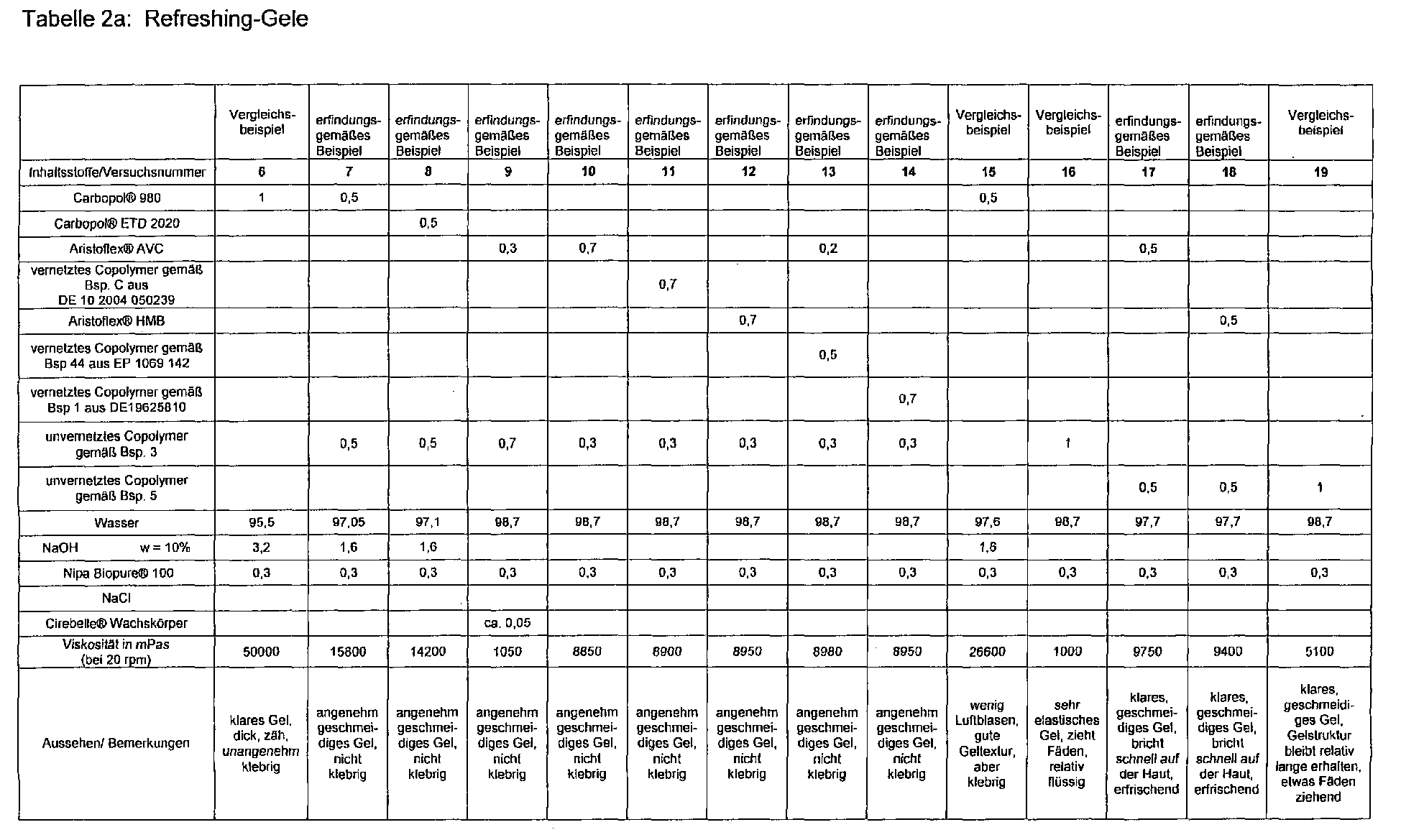
Tabelle 2b: Fortsetzung Refreshing-Gele erfindungs-gemäßes Beispiel erfindungs-gemäßes Beispiel Vergleichs-beispiel erfindungs-gemäßes Beispiel Vergleichs-beispiel Vergleichs-beispiel Vergleichs-beispiel erfindungs-gemäßes Beispiel erfindungs-gemäßes Beispiel Inhaltsstoffe/Versuchsnummer 20 21 22 23 24 25 26 27 28 Carbopol® 980 1 0,5 Carbopol® ETD 2020 Aristoflex® AVC 0,5 0,5 Aristoflex® HMB 1 0,5 unvernetztes Copolymer gemäß Bsp. 3 2 2 0,5 0,5 0,5 unvernetztes Copolymer gemäß Bsp. 5 Wasser ad 100 ad 100 ad 100 ad 100 ad 100 ad 100 ad 100 ad 100 ad 100 NaOH w=10% 3,2 1,6 Nipa Biopure® 100 0,3 0,3 0,3 0,3 0,3 0,3 0,3 NaCl 0,1 0,1 0,1 0,1 0,1 Propylenglykol 2 2 Laureth-23 2 1,8 Fragrance 0,2 EtOH 20 Nipaguard® MPA 0,5 Tylose® H 10000 G4 1 0,5 1 Cirebelle® Wachskörper Viskosität in mPas (bei 20rpm) 7500 1230 700 350 4800 760 39400 12200 1100 Aussehen/ Bemerkungen elastisches Gel, angenehme Geltextur auf der Haut geschmeidiges Gel, weniger elastisch als 20 relativ flüssig, geschmeidiges Gefühl leicht klebrig relativ flüssig, angenehme Geltextur bleibt lange erhalten, bricht etwas schneller auf der Haut als 25 klares Gel, viele Luftblasen, bricht sehr schnell auf der Haut relativ flüssig, geschmeidiges Gefühl, leicht klebrig geschmeidiges Gel, im Vergleich zu 27 klebrig geschmeidiges Gel, viele Luftblasen, klar einige Luftblasen bricht relativ schnell auf der Haut - Allgemeine Herstellweise für Haar-Styling Gele:
Haargel, sprühbar
Zusammensetzung: Beispiel 30A Aristoflex® AVC 0,15 % unvernetztes Copolymer mit Laureth-7 MA gemäß Beispiel 3 0,35 % Wasser ad 100 NIPA® BIOPURE 100 0,30 % B Diaformer® Z-651 N 4,00 % -
- I
- Lösen der Komponenten A
- II
- Zugabe von B zu I.
- Die Formulierungen 29, 31 bis 51 wurden analog der allgemeinen Herstellweise für Haar-Styling Gele zubereitet (s. Tabellen 3a und 3b).

Tabelle 3b: Fortsetzung Haar-Styling Gele Vergleichs-beispiel erfindungs-gemäßes Beispiel erfindungsgemäßes Beispiel Vergleichs-beispiel erfindungsgemäßes Beispiel erfindungs-gemäßes Beispiel erfindungs-gemäßes Beispiel Inhaltsstoffe/Versuchs-nummer 45 46 47 48 49 50 51 Aristoflex® AVC 0,5 0,1 0,5 0,5 0,1 unvernetztes Copolymer gemäß Bsp. 3 1,5 2 2 1,5 2 2 2 Wasser 95,2 70 69,9 94,7 71,92 65,9 60,8 NIPA Biopure® 100 0,3 0,3 Diaformer® Z 651 N VP/VA Copolymer 3 3 3 3 3 Diaformer® Z 712 N 3,5 5 Propylenglykol 2 2 Laureth-23 2 2 2 2 Fragrance 0,2 0,2 0,2 0,2 EtOH 20 20 20 20 20 Nipaguard® MPA 0,5 0,5 0,5 0,5 0,5 Genapol ®LA 070 2 2 Silcare® Silicone SEA 1 1 Pigment: Cloisonne Super Green® ~ 0,04 ~ Glitter (Creasparkles Metallic Silver 700®) ~ 0,04 Abil® EM 90 (Silikonemulgator) 1 1 Viskosität in mPas (bei 20rpm) 370 2850 3840 11700 1390 9550 2120 Aussehen/ Bemerkungen dünnflüssiges Gel, zieht Fäden Gel, zieht Gel, angenehm auf der Haut, Geltextur bleibt lange erhalten festes, elastisches Gel, angenehm auf der Haut, Geltextur bleibt lange erhalten, Schimmereffekt gut erkennbar Gel dünnflüssiges Gel, angenehm auf der Haut, Geltextur bleibt lange erhalten, Glitter erkennbar dünnflüssiges Gel, angenehm auf der Haut, Geltextur bleibt lange erhalten elastisches Gel, angenehm auf der Haut, Geltextur bleibt lange erhalten, Schimmereffekt ist erkennbar - Allgemeine Herstellweise für milde Reinigungsgele:
Mildes Reinigungsgel
Zusammensetzung: Beispiel 54A Aristoflex® AVC 0,30 % unvernetztes Copolymer mit Laureth-7 MA gemäß Beispiel 3 0,70 % Wasser ad 100 % NIPA® BIOPURE 100 0,30 % B Genapol® LRO 25,90 % Genagen® CAB 818 10,00 % -
- I
- Lösen der Komponenten A
- II
- Mischen der Komponenten B
- III
- Zugabe von II zu I
- Die Formulierungen 52, 53 und 55 wurden analog der allgemeinen Herstellweise für milde Reinigungsgele zubereitet (s. Tabelle 4).
Tabelle 4: milde Reinigungsgele erfindungs- gemäßes Beispiel erfindungs-gemäßes Beispiel erfindungs-gemäßes Beispiel erfindungs-gemäßes Beispiel Inhaltsstoffe/Versuchsnummer 52 53 54 55 Aristoflex® AVC 0,3 0,3 Aristoflex® HMB 0,3 0,3 unvernetztes Copolymer gemäß Bsp. 3 0,7 0,7 0,7 0,7 Wasser 92,7 92,7 62,8 62,8 NIPA Biopure® 100 0,3 0,3 0,3 0,3 Alkylpolyglykosid (Plantacare® 818 up) 6 6 Genapol® LRO 25,9 25,9 Genagen® CAB 818 10 10 Viskosität in mPas (bei 20 rpm) 2880 1615 250 1560 Aussehen/ Bemerkungen elastisch, gelartig elastisch, gelartig Gel Gel - Allgemeine Herstellweise für Sonnenschutzgele:
Sonnenschutzgel
Zusammensetzung: Beispiel 60A Eusolex® 232 1,00 % Water ad 100 % NIPA® BIOPURE 100 0,30 % B Aristoflex® AVC 0,70 % Unvernetztes Copolymer mit Steareth-8 MA gemäß Beispiel 5 0,30 % -
- I
- Mischen der Komponenten A und Einstellen auf pH 7,3 mit Tris(hydroxmethyl)aminomethan
- II
- Nacheinander Zugabe der Komponenten B zu I.
- Die Formulierungen 56 bis 59 und 61 wurden analog der allgemeinen Herstellweise für Sonnenschutzgele zubereitet (s. Tabelle 5).
Tabelle 5: Sonnenschutzgele Vergleichs-beispiel erfindungs-gemäßes Beispiel erfindungs-gemäßes Beispiel erfindungs-gemäßes Beispiel erfindungs-gemäßes Beispiel erfindungs-gemäßes Beispiel Inhaltsstoffe/Versuchsnummer 56 57 58 59 60 61 Aristoflex® AVC 0,3 0,7 0,7 Aristoflex® HMB 0,3 0,7 unvernetztes Copolymer gemäß Bsp.3 1 0,7 0,7 0,3 unvernetztes Copolymer gemäß Bsp.5 0,3 0,3 Wasser 97,7 97,7 97,7 97,7 97,7 97,7 NIPA Biopure® 100 0,3 0,3 0,3 0,3 0,3 0,3 Eusolex® 232 neutralisiert 1 1 1 1 1 1 Viskosität in mPas (bei 20 rpm) 4350 2920 1610 945 460 60 Aussehen / Bemerkungen Fäden ziehend, klebt leicht im Trockenen angenehmere Textur als 56 angenehmere Textur als 56 angenehm auf der Haut angenehm auf der Haut angenehm auf der Haut - Allgemeine Herstellweise für Stylingcremes:
Stylingcreme
Zusammensetzung: Beispiel 62A Mineralöl, niedrigviskos 1,00 % Cetiol® 868 1,00 % SilCare® 15M50 1,50 % Hostaphat® KL 340 D 1,00 % B Aristoflex® AVC 1,05 % unvernetztes Copolymer mit Laureth-7 MA gemäß Beispiel 3 0,45 % C Wasser ad 100,00 % Glycerin 3,00 % Phenonip® 0,40 % D Diaformer® Z 711 N 3,00 % -
- I
- Mischen von A und B
- II
- Einrühren von C in I
- III
- Einrühren von D in II
- IV
- Homogenisieren
- Die Formulierungen 63 bis 72 wurden analog der allgemeinen Herstellweise für Stylingcremes zubereitet (s. Tabelle 6).
Tabelle 6: Stylingcremes erfindungs-gemäßes Beispiel erfindungs-gemäßes Beispiel erfindungs-gemäßes Beispiel erfindungs-gemäßes Beispiel Vergleichs-beispiel Vergleichs-beispiel Vergleichs-beispiel Vergleichs-beispiel Vergleichs-beispiel erfindungs-gemäßes Beispiel Vergleichs-beispiel Inhaltsstoffe/Versuchsnummer 62 63 64 65 66 67 68 69 70 71 72 Aristoflex®AVC 1,05 0,45 1,05 1,05 1,05 Aristoflex® HMB unvernetztes Copolymer gemäß Bsp. 3 0,45 1,05 0,45 0,45 1 1 2 1 1 1,05 1,5 Wasser 87,6 87,6 87,6 87,6 88,1 88,1 87,1 88,1 88,1 87,6 86,6 VP/VA Copolymer 3 3 3 3 Paraffinöl 1 1 1 1 1 1 1 1 1 1 1 Cetiol® 868 1 1 1 1 1 1 1 1 1 1 1 Silcare® 15M50 1,5 1,5 1,5 1,5 1,5 1,5 1,5 1,5 1,5 1,5 1,5 Tegin® M 0,3 0,3 1 1 0,3 Hostaphat® KL 340 D 1 1 0,7 0,7 Phenonip® 0,4 0,4 0,4 0,4 0,4 0,4 0,4 0,4 0,4 0,4 0,4 Glycerin 3 3 3 3 3 3 3 3 3 3 3 Diaformer® Z 711 N 3 3 3 3 3 3 3 3 Hostacerin® DGL 0,7 Hostacerin® DGI 1 1 1 2 Aussehen/ Bemerkungen Creme, gute Sensorik auf der Haut angenehme Sensorik, sehr geschmeidig Creme, auf der Haut angenehm Creme, auf der Haut angenehm keine homogene Creme, Feststoffab scheidung keine homogene Creme, Feststoffab scheidung elastische Creme unangenehm elastisch, Fäden ziehend, sehr dünn elastische Creme sehr angenehme Creme, sehr gute Sensorik auf der Haut elastische Creme - Allgemeine Herstellweise für O/W-Cremes:
O/W Creme
Zusammensetzung: Beispiel 74A Mineralöl, niedrigviskos 1,00 % Cetiol® 868 1 ,00 % SilCare® 15M50 1,50 % Hostaphat® KL 340 D 1,00 % B Aristoflex® AVC 1,05 % unvernetztes Copolymer mit Laureth-7 MA gemäß Beispiel 3 0,45 % C Wasser ad 100,00 % Glycerin 3,00 % Phenonip® 0,40 % -
- I
- Mischen von A und B
- II
- Einrühren von C in I
- III
- Homogenisieren
- Die Formulierungen 73 und 75 wurden analog der allgemeinen Herstellweise für O/WCremes zubereitet (s. Tabelle 7).
Tabelle 7: O/W Cremes Vergleichsbeispiel erfindungsgemäßes Beispiel Vergleichsbeispiel Inhaltsstoffe/Versuchsnummer 73 74 75 Aristoflex® AVC 1,05 unvernetztes Copolymer gemäß Beispiel 3 1 0,45 1,5 Wasser 88,1 87,6 86,6 Paraffinöl 1 1 1 Cetiol® 868 1 1 1 Silcare Silicone® 15M50 1,5 1,5 1,5 Tegin® M 0,3 Hostaphat® KL 340 D 0,7 Phenonip® 0,4 0,4 0,4 Glycerin 3 3 3 Hostacerin® CGI 2 Aussehen / Bemerkungen Produkt trennt über Nacht Creme, angenehm auf der Haut, stabil dünnflüssig, trennt über Nacht - Anti-aging Gele, Beispiele 76 bis 79
- Allgemeine Herstellweise für Anti-aging Gele:
- Anti-aging Gel
- Zusammensetzung: Beispiel 77
-
- I
- Lösen der Komponenten A
- II
- Zugabe von B in I
- Die Formulierungen 76, 78, 79 wurden analog der allgemeinen Herstellweise für anti-aging Gele zubereitet (s. Tabelle 8).
Tabelle 8: anti-aging Gele erfindungsgemäßes Beispiel erfindungsgemäßes Beispiel erfindungsgemäßes Beispiel erfindungsgemäßes Beispiel Inhaltsstoffe/Versuchsnummer 76 77 78 79 Aristoflex® AVC 0,3 0,3 Aristoflex® HMB 0,3 0,3 unvernetztes Copolymer gemäß Beispiel 3 0,7 0,7 unvernetztes Copolymer gemäß Beispiel 5 0,7 0,7 Wasser 99,7 99,7 95,4 95,4 NIPA Biopure® 100 0,3 0,3 0,3 0,3 Glykolsäure, neutralisiert 3,33 3,33 3,33 3,33 Viskosität in mPas (bei 20 rpm) 880 795 190 55 Aussehen / Bemerkungen stabiles Gel stabiles Gel Fluid Fluid -
Abil® EM-90 Cetyl PEG/PPG-10/1 Dimethicone Aristoflex® AVC Ammonium Acryloyldimethyltaurat/VP Copolymer Aristoflex® HMB Ammonium Acryloyldimethyltaurat/Beheneth-25 Methacrylat Crosspolymer Carbopol® 980 Carbomer Cetiol® 868 Ethylhexylstearat Cloisonne® Super Green Mica and Titanium Dioxide and Iron Oxides and Ferric Ferrocyanide Creasparkles Metallic Polyethylene Terephthalate and Glycerin and Silver 700® (Glitter) Acrylamide/Ammonium Acrylate Copolymer and Aluminum Powder Diaformer® Z-651 N Acrylates/Lauryl Acrylate/Stearyl Acrylate/Ethylamine Oxide Methacrylate Copolymer Diaformer® Z 711 N Acrylates/Lauryl Acrylate/Stearyl Acrylate/Ethylamine Oxide Methacrylate Copolymer Diaformer® Z 712 N Acrylates/Lauryl Acrylate/Stearyl Acrylate/Ethylamine Oxide Methacrylate Copolymer Eusolex® 232 Phenylbenzimidazole Sulfonic Acid Genagen® CAB 818 Cocamidopropyl Betaine Genapol® LA 070 Laureth-7 Genapol® LRO Sodium Laureth Sulfate Hostacerin® DGI Polyglyceryl-2 Sesquiisostearate Hostacerin® DGL PEG-10 Polyglyceryl-2 Laurate Hostaphat® KL 340 D Trilaureth- 4 Phosphat NIPA Biopure® 100 Imidazolidinyl Urea (Imidazolidinylharnstoff) Nipaguard® MPA Benzyl Alcohol and Methylparaben and Propylparaben Phenonip® Phenoxyethanol and Methylparaben and Ethylparaben and Butylparaben and Propylparaben and Isobutylparaben Plantacare® 818 up Coco-Glucoside Luviskol® PVP K 30 PVP (Polyvinylpyrrolidone) SilCare®® Silicone SEA Trideceth-9 PG-Amodimethicone and Trideceth-12 SilCare® 15M50 Phenyltrimethicone Tegin® M Glyceryl Stearate Tylose® H 10000 G4 Hydroxyethylcellulose
| A | Aristoflex® HMB | 0,30 % |
| Unvernetztes Copolymer mit Laureth-7 MA gemäß Beispiel 3 | 0,70 % | |
| Wasser | ad 100 % | |
| NIPA® BIOPURE 100 | 0,30 % | |
| B | Glycolsäure, (30 % in Wasser)* * neutralisiert mit NaOH auf pH 4 | 3,33 % |
Claims (31)
- Kosmetische oder pharmazeutische Zubereitung, enthaltendI) ein oder mehrere wasserlösliche unvernetzte Copolymere, enthaltendA) eine oder mehrere Struktureinheiten der Formel (1)
 Ra H oder CH3;Rb H oder CH3;a 0 oder 1;b 0 oder 1;Y O, S, PH oder NH;R2a eine lineare oder verweigte (C2-C4)-Alkylengruppe;x eine ganze Zahl zwischen 1 und 500; undR2b Wasserstoff oder einen gesättigten oder ein- oder mehrfach ungesättigten linearen oder verzweigten aliphatischen, cycloaliphatischen oder aromatischen (C1-C30)-Kohlenwasserstoffrest bedeuten undB) eine oder mehrere Struktureinheiten der Formel (2)worin
 R3 für Wasserstoff, Methyl oder Ethyl steht,Z für (C1-C8)-Alkylen steht, undX für Wasserstoff, Lithium, Natrium, Kalium, Magnesium, Calcium, Ammonium, Monoalkylammonium, Dialkylammonium, Trialkylammonium oder Tetraalkyl-ammonium, wobei die Alkylsubstituenten der Ammoniumionen unabhängig voneinander (C1-C22)-Alkylreste darstellen, die mit 0 bis 3 Hydroxyalkylgruppen besetzt sein können, deren Alkylkettenlänge in einem Bereich von C2 bis C10 variieren kann, steht oder X auch für ein bis dreifach ethoxylierte Ammoniumverbindungen mit gleichem oder unterschiedlichem Ethoxylierungsgrad steht, und wobei in den unvernetzten Copolymeren auch Struktureinheiten der Formel (2) mit unterschiedlichem X enthalten sein können,undII) ein oder mehrere wasserlösliche oder wasserquellbare vernetzte oder unvernetzte copolymere oder homopolymere Verdicker.
 - Zubereitung nach Anspruch 1, dadurch gekennzeichnet, dass Ra, Rb, a und b in der Struktureinheit der Formel (1) aus folgenden Kombinationen ausgewählt sind:Ra = Rb = H und a = b = 0;Ra = Rb = H, a = 0 und b = 1;Ra = Rb = H, a = 1 und b = 0; oderRa = H, Rb = CH3, a = 1 und b = 0.
- Zubereitung nach Anspruch 2, dadurch gekennzeichnet, dass Ra, Rb, a und b in der Struktureinheit der Formel (1) aus folgenden Kombinationen ausgewählt sind:Ra = Rb = H, a = 1 und b = 0 oderRa = H, Rb = CH3, a = 1 und b = 0.
- Zubereitung nach einem oder mehreren der Ansprüche 1 bis 3, dadurch gekennzeichnet, dass in der Struktureinheit der Formel (1)R2a für einen Ethylen- oder Propylenrest, vorzugsweise für einen Ethylenrest, steht,x für eine Zahl zwischen 3 und 50, vorzugsweise zwischen 6 und 30, steht, undR2b für einen gesättigten oder einen ein- oder mehrfach ungesättigten aliphatischen oder cycloaliphatischen Kohlenwasserstoffrest steht.
- Zubereitung nach einem oder mehreren der Ansprüche 1 bis 4, dadurch gekennzeichnet, dass R2b in der Struktureinheit der Formel (1) für einen (C6-C22)-Kohlenwasserstoffrest, vorzugsweise für einen (C12-C18)-Kohlenwasserstoffrest, steht.
- Zubereitung nach Anspruch 5, dadurch gekennzeichnet, dass der Kohlenwasserstoffrest ein Alkyl- oder ein ein- oder mehrfach ungesättigter Alkenylrest, vorzugsweise ein Alkylrest, ist.
- Zubereitung nach einem oder mehreren der Ansprüche 1 bis 6, dadurch gekennzeichnet, dass R2b in der Struktureinheit der Formel (1) für einen Rest ausgewählt aus Stearyl, Lauryl, Cocoyl, Undecyl, Behenyl, Cetearyl, Cetyl und Myristyl und vorzugsweise für einen Rest ausgewählt aus Stearyl, Lauryl, Cetyl und Myristyl steht.
- Zubereitung nach einem oder mehreren der Ansprüche 1 bis 7, dadurch gekennzeichnet, dass in der Struktureinheit der Formel (2) R3 für H, Z für -C(CH3)2-CH2- und X für Wasserstoff, Natrium, Kalium oder Ammonium, vorzugsweise für H oder Ammonium, steht und wobei in den unvernetzten Copolymeren auch Struktureinheiten der Formel (2) mit unterschiedlichem X enthalten sein können.
- Zubereitung nach einem oder mehreren der Ansprüche 1 bis 8, dadurch gekennzeichnet, dass der Neutralisierungsgrad der Struktureinheit der Formel (2) 70 bis 100 mol-%, vorzugsweise 80 bis 100 mol-% und besonders bevorzugt 80 bis 99 mol-% beträgt.
- Zubereitung nach einem oder mehreren der Ansprüche 1 bis 9, dadurch gekennzeichnet, dass die molaren Anteile der Struktureinheit der Formel (1) und der Struktureinheit der Formel (2) im Copolymer der Komponente I) jeweils von 0,1 bis 99,9 mol-% betragen.
- Zubereitung nach einem oder mehreren der Ansprüche 1 bis 10, dadurch gekennzeichnet, dass der Anteil der Struktureinheit der Formel (1) im Copolymer der Komponente I) von 50,1 bis 99,9 mol-%, bevorzugt von 70 bis 95 mol-% und besonders bevorzugt von 80 bis 90 mol-% beträgt.
- Zubereitung nach einem oder mehreren der Ansprüche 1 bis 10, dadurch gekennzeichnet, dass der Anteil der Struktureinheit der Formel (1) im Copolymer der Komponente I) von 0,1 bis 50 mol-%, bevorzugt von 5 bis 25 mol-% und besonders bevorzugt von 6 bis 15 mol-% beträgt.
- Zubereitung nach einem oder mehreren der Ansprüche 1 bis 12, dadurch gekennzeichnet, dass der oder die wasserlöslichen oder wasserquellbaren vernetzten oder unvernetzten copolymeren oder homopolymeren Verdicker der Komponente II) ausgewählt sind ausa) Polymeren auf Basis von Methacrylsäure oder Acrylsäure und modifizierter (Meth)acrylsäure, vorzugsweise vernetzten Polymeren der Acrylsäure, Copolymeren aus (Meth)acrylsäure und Polyalkylenpolyether, hydrophob modifizierten Poly(meth)acrylaten,b) Homopolymeren der Dimethylaminoethyl(meth)acrylate, quaternisiert mit Methylchlorid,c) Copolymeren von Dimethylaminoethyl(meth)acrylat, quaternisiert mit Methylchlorid und Acrylamid,d) vernetzten Copolymeren von Vinylisodecanoat und (Meth)acrylsäure,e) Polyvinylalkoholen,f) Polyvinylmethyletherng) Polyacrylamiden,h) Polyvinylamiden,i) Polyvinylpyrrolidon,j) Poly(meth)acrylsäuren, Poly(meth)acrylsäureestern und weiteren Poly(meth)acrylsäurederivaten,k) Polyethylenoxiden,l) Copolymeren aus Maleinsäureanhydrid und Vinylmethylether,m) Polysulfonsäuren, vorzugsweise Copolymerisaten auf Basis der Acrylamido-alkylsulfonsäure und/oder deren Salzen und einem oder mehreren Comonomeren ausgewählt aus cyclischen N-Vinylcarbonsäureamiden und linearen N-Vinylcarbonsäureamiden oder hydrophob modifizierten vernetzten Acrylamido-alkylsulfonsäure-Copolymerisatenn) vernetzten Homopolymeren der Acrylamido-alkylsulfonsäure und/oder deren Salzen,o) Copolymeren aus der Acrylamido-alkylsulfonsäure und/oder deren Salzen und Comonomeren ausgewählt aus Acrylamid, Hydroxyethyl(meth)acrylat und kationisch modifizierte (Meth)acrylate.p) natürlichen und modifizierten natürlichen Polymeren auf Basis von Polysacchariden, vorzugsweise Celluloseether, Cellulosederivate, Carboxymethylcellulose, Hydroxyethylcellulose, Gelatine, Stärke und Stärkederivate, Natriumalginate, Xanthan, Guar und Guarderivate, Scleroglucan,Traganth oder Dextrinderivate, insbesondere Dextrinester.
- Zubereitung nach einem oder mehreren der Ansprüche 1 bis 13, dadurch gekennzeichnet, dass der oder die wasserlöslichen oder wasserquellbaren vernetzten oder unvernetzten copolymeren oder homopolymeren Verdicker der Komponente II) ausgewählt sind ausa) Polymeren auf Basis von Methacrylsäure oder Acrylsäure und modifizierter (Meth)acrylsäure, vorzugsweise vernetzten Polymeren der Acrylsäure, Copolymeren aus (Meth)acrylsäure und Polyalkylenpolyether, hydrophob modifizierten Poly(meth)acrylaten,g) Polyacrylamiden,j) Poly(meth)acrylsäuren, Poly(meth)acrylsäureestern und weiteren Poly(meth)acrylsäurederivaten,m) Polysulfonsäuren, vorzugsweise Copolymerisaten auf Basis der Acrylamido-alkylsulfonsäure und/oder deren Salzen und einem oder mehreren Comonomeren ausgewählt aus cyclischen N-Vinylcarbonsäureamiden und linearen N-Vinylcarbonsäureamiden oder hydrophob modifizierten vernetzten Acrylamido-alkylsulfonsäure-Copolymerisaten,n) Vernetzten Homopolymeren der Acrylamido-alkylsulfonsäure und/oder deren Salzen,o) Copolymeren aus der Acrylamido-alkylsulfonsäure und/oder deren Salzen und Comonomeren ausgewählt aus Acrylamid, Hydroxyethyl(meth)acrylat und kationisch modifizierten (Meth)acrylaten undp) natürlichen und modifizierten natürlichen Polymeren auf Basis von Polysacchariden, vorzugsweise Celluloseether, Cellulosederivate, Carboxymethylcellulose, Hydroxyethylcellulose, Gelatine, Stärke und Stärkederivate, Natriumalginate, Xanthan, Guar und Guarderivate, Scleroglucan,Traganth oder Dextrinderivate, insbesondere Dextrinester.
- Zubereitung nach einem oder mehreren der Ansprüche 1 bis 14, dadurch gekennzeichnet, dass der Gewichtsanteil an vernetzenden Comonomeren, bezogen auf die Gesamtmasse der Polymere der Komponente II) von 0 bis 20 Gew.-% beträgt.
- Zubereitung nach einem oder mehreren der Ansprüche 1 bis 15, dadurch gekennzeichnet, dass der oder die wasserlöslichen oder wasserquellbaren vernetzten oder unvernetzten copolymeren oder homopolymeren Verdicker der Komponente II) ausgewählt sind aus Copolymeren, bestehend im wesentlichen aus a1) 1 bis 50 Gew.-% der wiederkehrenden Struktureinheit der Formel (3)

odera2) 1 bis 50 Gew.-% der wiederkehrenden Struktureinheit der Formel (4)
odera3) 1 bis 50 Gew.-% einer Mischung der wiederkehrenden Struktureinheit der Formel (3) und der wiederkehrenden Struktureinheit der Formel (4)
undb) 49,99 bis 98,99 Gew.-% der wiederkehrenden Struktureinheit der Formel (2) R3 für Wasserstoff, Methyl oder Ethyl steht,Z für (C1-C8)-Alkylen steht, undX für Wasserstoff, Lithium, Natrium, Kalium, Magnesium, Calcium, Ammonium, Monoalkylammonium, Dialkylammonium, Trialkylammonium oder Tetraalkyl-ammonium, wobei die Alkylsubstituenten der Ammoniumionen unabhängig voneinander (C1-C22)-Alkylreste darstellen, die mit 0 bis 3 Hydroxyalkylgruppen besetzt sein können, deren Alkylkettenlänge in einem Bereich von C2 bis C10 variieren kann, steht oder X auch für ein bis dreifach ethoxylierte Ammoniumverbindungen mit gleichem oder unterschiedlichem Ethoxylierungsgrad steht, und wobei in den Copolymeren auch Struktureinheiten der Formel (2) mit unterschiedlichem X enthalten sein können,undc) 0 bis 8 Gew.-% an vernetzenden Strukturen, die aus Monomeren mit mindestens zwei olefinischen Doppelbindungen hervorgehen.
 - Zubereitung nach einem oder mehreren der Ansprüche 1 bis 16, dadurch gekennzeichnet, dass der oder die wasserlöslichen oder wasserquellbaren vernetzten oder unvernetzten copolymeren oder homopolymeren Verdicker der Komponente II) ausgewählt sind aus vernetzten Polymeren, die vernetzende Strukturen hervorgegangen aus Methylenbisacrylamid; Methylenbismethacrylamid; Ester ungesättigter Mono- und Polycarbonsäuren mit Polyolen, bevorzugt Diacrylate und Triacrylate bzw. -methacrylate, besonders bevorzugt Butandiol- und Ethylenglykoldiacrylat bzw. -methacrylat, Trimethylolpropantriacrylat (TMPTA) und Trimethylolpropantrimethacrylat (TMPTMA); Allylverbindungen, bevorzugt Allyl(meth)acrylat, Triallylcyanurat, Maleinsäurediallylester, Polyallylester, Tetraallyloxyethan, Triallylamin, Tetraallylethylendiamin; Allylester der Phosphorsäure; und/oder Vinylphosphonsäurederivate, bevorzugt Trimethylolpropantriacrylat (TMPTA) enthalten.
- Zubereitung nach einem oder mehreren der Ansprüche 1 bis 17, dadurch gekennzeichnet, dass der oder die wasserlöslichen oder wasserquellbaren vernetzten oder unvernetzten copolymeren oder homopolymeren Verdicker der Komponente II) ausgewählt sind aus vernetzten Polymeren, die vernetzende Strukturen hervorgegangen aus Trimethylolpropantriacrylat enthalten.
- Zubereitung nach einem oder mehreren der Ansprüche 1 bis 18, dadurch gekennzeichnet, dass die ein oder mehreren wasserlöslichen unvernetzten Copolymere der Komponente I) und/oder die ein oder mehreren wasserlöslichen oder wasserquellbaren vernetzten oder unvernetzten copolymeren oder homopolymeren Verdicker der Komponente II) ein oder mehrere weitere Struktureinheiten hervorgegangen aus einem oder mehreren Monomeren ausgewählt aus olefinisch ungesättigten Säuren und deren Salzen mit ein- und zweiwertigen Gegenionen, beispielsweise Styrolsulfonsäure, Vinylsulfonsäure, Vinylphosphonsäure, Allylsulfonsäure, Methallylsulfonsäure, Acrylsäure, (Meth)acrylsäure, Maleinsäure bzw. Maleinsäureanhydrid und deren Salze; Ester der Acryl- und der (Meth)acrylsäure mit aliphatischen, aromatischen oder cyclo-aliphatischen Alkoholen mit einer Kohlenstoffzahl von 1 bis 22; Ester der Acryl- und der (Meth)acrylsäure mit Alkylethoxylaten, offenkettige und cyclische N-Vinylamide (N-Vinyllactame) mit einer Ringgröße von 4 bis 9 Atomen, besonders bevorzugt N-Vinylformamid (NVF), N-Vinylmethylformamid, N-Vinyl-methylacetamid (VIMA), N-Vinylacetamid, N-Vinylpyrrolidon (NVP) und N-Vinylcaprolactam; Amide der Acryl- und der Methacrylsäure, besonders bevorzugt Acrylamid, N,N-Dimethylacrylamid, N,N-Diethylacrylamid, alkoxylierte Acryl- und Methacrylamide, wie z.B. MAPTAC und APTAC; 2-Vinylpyridin; 4-Vinylpyridin; Vinylacetat; Methacrylsäureglycidylester; Acrylnitril; Vinylchlorid; Vinylidenchlorid; Tetrafluorethylen und/oder DADMAC, enthalten.
- Zubereitung nach einem oder mehreren der Ansprüche 1 bis 19, dadurch gekennzeichnet, dass das Gewichtsverhältnis der unvernetzten Polymere der Komponente I), vorzugsweise der entsprechenden unvernetzten hydrophob modifizierten Polymere der Komponente I), zu dem einem oder den mehreren wasserlöslichen oder wasserquellbaren polymeren Verdickern der Komponente II) im Bereich von 1 bis 99 zu 99 bis 1, bevorzugt im Bereich von 10 bis 90 zu 90 bis 10, besonders bevorzugt im Bereich von 20 bis 80 zu 80 bis 20, und insbesondere bevorzugt im Bereich von 30 bis 70 zu 70 bis 30 liegt.
- Zubereitung nach einem oder mehreren der Ansprüche 1 bis 20, dadurch gekennzeichnet, dass sie die Polymer-Mischung der Komponenten I) und II) in einer Menge von 0,1 bis 10 Gew.-% enthält.
- Zubereitung nach einem oder mehreren der Ansprüche 1 bis 21, dadurch gekennzeichnet, dass sie in Form eines Haarbehandlungs-, Haarpflege-, Haarstyling- oder Haarreinigungsmittels vorliegt.
- Zubereitung nach einem oder mehreren der Ansprüche 1 bis 22, dadurch gekennzeichnet, dass sie in Form eines wässrigen, gelförmigen kosmetischen oder pharmazeutischen Mittels vorliegt.
- Zubereitung nach einem oder mehreren der Ansprüche 1 bis 23, dadurch gekennzeichnet, dass sie in Form eines Haargels vorliegt und vorzugsweise ein klares, transparentes oder durchscheinendes, farbloses Mittel ist.
- Zubereitung nach einem oder mehreren der Ansprüche 1 bis 24, dadurch gekennzeichnet, dass es in einer versprühbaren Form vorliegt.
- Zubereitung nach einem oder mehreren der Ansprüche 1 bis 25, dadurch gekennzeichnet, dass es einen oder mehrere Filmbildner enthält.
- Zubereitung nach einem oder mehreren der Ansprüche 1 bis 26, dadurch gekennzeichnet, dass sie ein oder mehrere UV-Filter enthält.
- Zubereitung nach einem oder mehreren der Ansprüche 1 bis 27, dadurch gekennzeichnet, dass sie ein oder mehrere Antioxidatien enthält.
- Zubereitung nach einem oder mehreren der Ansprüche 1 bis 28, dadurch gekennzeichnet, dass sie klar transparent oder durchscheinend ist.
- Zubereitung nach einem oder mehreren der Ansprüche 1 bis 29, dadurch gekennzeichnet, dass sie emulgator- und/oder ölfrei ist.
- Zubereitung nach einem oder mehreren der Ansprüche 1 bis 30, dadurch gekennzeichnet, dass sie als Komponente II) eine oder mehrere wasserlösliche oder wasserquellbare vernetzte copolymere Verdicker enthaltend ein oder mehrere Struktureinheiten der Formel (1), ein oder mehrere Struktureinheiten der Formel (2) und ein oder mehrere vernetzende Struktureinheiten, die aus Monomeren mit mindestens zwei olefinischen Doppelbindungen hervorgehen, enthalten.
Applications Claiming Priority (1)
| Application Number | Priority Date | Filing Date | Title |
|---|---|---|---|
| DE102006018523A DE102006018523A1 (de) | 2006-04-21 | 2006-04-21 | Wasserlösliche Polymere und ihre Verwendung in kosmetischen und pharmazeutischen Zubereitungen |
Publications (1)
| Publication Number | Publication Date |
|---|---|
| EP1847253A1 true EP1847253A1 (de) | 2007-10-24 |
Family
ID=38360422
Family Applications (1)
| Application Number | Title | Priority Date | Filing Date |
|---|---|---|---|
| EP07007692A Withdrawn EP1847253A1 (de) | 2006-04-21 | 2007-04-16 | Wasserlösliche Polymere und ihre Verwendung in kosmetischen und pharmazeutischen Zubereitungen |
Country Status (4)
| Country | Link |
|---|---|
| US (1) | US20070248561A1 (de) |
| EP (1) | EP1847253A1 (de) |
| JP (1) | JP2007291103A (de) |
| DE (1) | DE102006018523A1 (de) |
Cited By (2)
| Publication number | Priority date | Publication date | Assignee | Title |
|---|---|---|---|---|
| WO2013045391A3 (de) * | 2011-09-28 | 2013-08-22 | Henkel Ag & Co. Kgaa | Zweikomponenten-mittel mit verbesserter viskositätseinstellung |
| EP2769620A4 (de) * | 2011-10-18 | 2015-08-26 | Osaka Kasei Co Ltd | Wirkstoff zur herbeiführung antibakterieller/antifungaler eigenschaften, faserverarbeitungsmittel und herstellungsverfahren für eine antibakterielle/antifungale faser |
Families Citing this family (13)
| Publication number | Priority date | Publication date | Assignee | Title |
|---|---|---|---|---|
| DE102007061969A1 (de) * | 2007-12-21 | 2008-07-17 | Clariant International Limited | Wasserlösliche oder wasserquellbare Polymere auf Basis von Salzen der Acryloyldimethyltaurinsäure oder ihrer Derivate, deren Herstellung und deren Verwendung als Verdicker, Stabilisator und Konsistenzgeber |
| DE102008008179A1 (de) * | 2008-02-08 | 2009-08-13 | Clariant International Ltd. | Verfahren zur Herstellung von Polymeren durch lonenaustausch |
| NZ590878A (en) * | 2008-08-12 | 2013-01-25 | Novabay Pharmaceuticals Inc | Antimicrobial gel formulations comprising an halogenated amine compound dispersed in a poly(acrylic acid) water-swellable polymer |
| JP5303322B2 (ja) * | 2009-03-13 | 2013-10-02 | ピアス株式会社 | 皮膚外用組成物 |
| US20120058060A1 (en) | 2010-04-13 | 2012-03-08 | Air Products And Chemicals, Inc. | Cationic/Cationogenic Comb Copolymer Compositions and Personal Care Products Containing the Same |
| US8883125B2 (en) * | 2011-04-05 | 2014-11-11 | L'oreal | Cosmetic composition comprising a cucurbic acid compound and a blend of sulfonic and acrylic polymers |
| DE102015225006A1 (de) * | 2015-12-11 | 2017-06-14 | Henkel Ag & Co. Kgaa | Tensid-haltige Reinigungsmittel mit speziellen Konservierungsmittelkombinationen |
| DE102015225004A1 (de) * | 2015-12-11 | 2017-06-14 | Henkel Ag & Co. Kgaa | Tensid-haltige Reinigungsmittel mit mindestens drei unterschiedlichen Konservierungsmitteln |
| WO2019061397A1 (en) | 2017-09-30 | 2019-04-04 | Beiersdorf Daily Chemical (Wuhan) Co., Ltd. | STORAGE COMPOSITION CONTAINING DIMINTHYLAMINOETHYL VINYLCAPROLACTAM / VP / METHACRYLATE COPOLYMER |
| JP7182259B2 (ja) * | 2018-10-31 | 2022-12-02 | 株式会社トキワ | 水系液状化粧料 |
| JP2022011029A (ja) * | 2020-06-29 | 2022-01-17 | 三粧化研株式会社 | 粒形状化粧料及び粒形状化粧料を含有する化粧料 |
| EP4134422A1 (de) * | 2021-08-13 | 2023-02-15 | Clariant International Ltd | (co)polymere und deren verwendung in reinigungszusammensetzungen |
| KR102748582B1 (ko) * | 2023-05-31 | 2025-01-03 | 한국콜마주식회사 | 자외선차단지수가 증진된 자외선차단용 화장료 조성물 |
Citations (4)
| Publication number | Priority date | Publication date | Assignee | Title |
|---|---|---|---|---|
| US6645476B1 (en) * | 1999-07-15 | 2003-11-11 | Clariant Gmbh | Water-soluble polymers and their use in cosmetic and pharmaceutical compositions |
| DE102004002349A1 (de) * | 2004-01-16 | 2005-08-11 | Wella Ag | Mittel zur oxidativen Behandlung, insbesondere in transparenter Gelform |
| FR2875700A1 (fr) * | 2004-09-30 | 2006-03-31 | Oreal | Emulsion huile-dans-eau fine |
| EP1676563A1 (de) * | 2005-01-03 | 2006-07-05 | L'oreal | Ö/W Emulsion enthaltend Ascorbinsäure oder ein Derivat davon |
-
2006
- 2006-04-21 DE DE102006018523A patent/DE102006018523A1/de not_active Withdrawn
-
2007
- 2007-04-16 EP EP07007692A patent/EP1847253A1/de not_active Withdrawn
- 2007-04-20 US US11/788,452 patent/US20070248561A1/en not_active Abandoned
- 2007-04-20 JP JP2007112125A patent/JP2007291103A/ja not_active Withdrawn
Patent Citations (4)
| Publication number | Priority date | Publication date | Assignee | Title |
|---|---|---|---|---|
| US6645476B1 (en) * | 1999-07-15 | 2003-11-11 | Clariant Gmbh | Water-soluble polymers and their use in cosmetic and pharmaceutical compositions |
| DE102004002349A1 (de) * | 2004-01-16 | 2005-08-11 | Wella Ag | Mittel zur oxidativen Behandlung, insbesondere in transparenter Gelform |
| FR2875700A1 (fr) * | 2004-09-30 | 2006-03-31 | Oreal | Emulsion huile-dans-eau fine |
| EP1676563A1 (de) * | 2005-01-03 | 2006-07-05 | L'oreal | Ö/W Emulsion enthaltend Ascorbinsäure oder ein Derivat davon |
Cited By (3)
| Publication number | Priority date | Publication date | Assignee | Title |
|---|---|---|---|---|
| WO2013045391A3 (de) * | 2011-09-28 | 2013-08-22 | Henkel Ag & Co. Kgaa | Zweikomponenten-mittel mit verbesserter viskositätseinstellung |
| EP2769620A4 (de) * | 2011-10-18 | 2015-08-26 | Osaka Kasei Co Ltd | Wirkstoff zur herbeiführung antibakterieller/antifungaler eigenschaften, faserverarbeitungsmittel und herstellungsverfahren für eine antibakterielle/antifungale faser |
| US9839221B2 (en) | 2011-10-18 | 2017-12-12 | Osaka Kasei Co., Ltd. | Agent for imparting anti-bacterial/anti-fungal properties, fiber processing agent, and production method for anti-bacterial/anti-fungal fiber |
Also Published As
| Publication number | Publication date |
|---|---|
| DE102006018523A1 (de) | 2007-10-25 |
| JP2007291103A (ja) | 2007-11-08 |
| US20070248561A1 (en) | 2007-10-25 |
Similar Documents
| Publication | Publication Date | Title |
|---|---|---|
| EP1354000B1 (de) | Verwendung von kammförmigen copolymeren auf basis von acryloyldimethyltaurinsäure in kosmetischen, pharmazeutischen und dermatologischen mitteln | |
| EP2227498B1 (de) | Wasserlösliche oder wasserquellbare polymere auf basis von salzen der acryloyldimethyltaurinsäure oder ihrer derivate, deren herstellung un deren verwendung als verdicker, stabilisator und konsistenzgeber | |
| EP2186836B1 (de) | Kosmetische, pharmazeutische und dermatologische Mittel | |
| EP2186835B1 (de) | Tensidfreie kosmetische, dermatologische und pharmazeutische Mittel | |
| EP1345575B1 (de) | Kosmetische und dermatologische haarbehandlungsmittel | |
| EP1339789B1 (de) | Elektrolythaltige kosmetische, pharmazeutische und dermatologische mittel | |
| EP1069142B1 (de) | Wasserlösliche Polymere und ihre Verwendung in kosmetischen und pharmazeutischen Mitteln | |
| US20070248561A1 (en) | Water-soluble polymers and their use in cosmetic and pharmaceutical preparations | |
| DE10059822A1 (de) | Saure kosmetische, pharmazeutische und dermatologische Mittel | |
| WO2010108634A1 (de) | Polymere auf basis von acryl-, methacryl- oder ethacrylamidoalkylsulfonsäure oder -salzen und carboxyalkylacrylat, -methacrylat oder -ethacrylat oder oligomeren dieser carboxy-verbindungen | |
| EP1581569A2 (de) | Ampholytisches copolymer und dessen verwendung | |
| DE10059819A1 (de) | Tensidhaltige kosmetische, dermatologische und pharmazeutische Mittel | |
| EP1576945A1 (de) | Kosmetische oder pharmazeutische Mittel, enthaltend modifizierte Polyorganosiloxane | |
| DE102007061970A1 (de) | Kosmetische, pharmazeutische oder dermatologische Zusammensetzungen enthaltend einen hohen Gehalt an wasserlöslichen Pflegekomponenten | |
| EP1709093A1 (de) | Acrylat-polymerisate auf basis von tert.-butylacrylat zur verwendung in sprayformulierungen | |
| EP1722745A1 (de) | Verwendung von polymeren auf basis von n-vinylcaprolactam in haarkosmetika | |
| WO2005002532A2 (de) | Kosmetisches mittel enthaltend wenigstens ein wasserlösliches copolymer mit (meth)acrylsäureamideinheiten | |
| WO2007017440A1 (de) | Festigerpolymere auf basis von polyesteracrylaten |
Legal Events
| Date | Code | Title | Description |
|---|---|---|---|
| PUAI | Public reference made under article 153(3) epc to a published international application that has entered the european phase |
Free format text: ORIGINAL CODE: 0009012 |
|
| AK | Designated contracting states |
Kind code of ref document: A1 Designated state(s): AT BE BG CH CY CZ DE DK EE ES FI FR GB GR HU IE IS IT LI LT LU LV MC MT NL PL PT RO SE SI SK TR |
|
| AX | Request for extension of the european patent |
Extension state: AL BA HR MK YU |
|
| RIN1 | Information on inventor provided before grant (corrected) |
Inventor name: MILDNER, CARINA Inventor name: MILBRADT, ROBERT, DR. |
|
| 17P | Request for examination filed |
Effective date: 20080424 |
|
| 17Q | First examination report despatched |
Effective date: 20080526 |
|
| AKX | Designation fees paid |
Designated state(s): DE FR GB IT |
|
| RAP1 | Party data changed (applicant data changed or rights of an application transferred) |
Owner name: CLARIANT FINANCE (BVI) LIMITED |
|
| GRAP | Despatch of communication of intention to grant a patent |
Free format text: ORIGINAL CODE: EPIDOSNIGR1 |
|
| GRAC | Information related to communication of intention to grant a patent modified |
Free format text: ORIGINAL CODE: EPIDOSCIGR1 |
|
| STAA | Information on the status of an ep patent application or granted ep patent |
Free format text: STATUS: THE APPLICATION HAS BEEN WITHDRAWN |
|
| 18W | Application withdrawn |
Effective date: 20090626 |