EP1843089A1 - Vehicle component and sealing member - Google Patents
Vehicle component and sealing member Download PDFInfo
- Publication number
- EP1843089A1 EP1843089A1 EP07006327A EP07006327A EP1843089A1 EP 1843089 A1 EP1843089 A1 EP 1843089A1 EP 07006327 A EP07006327 A EP 07006327A EP 07006327 A EP07006327 A EP 07006327A EP 1843089 A1 EP1843089 A1 EP 1843089A1
- Authority
- EP
- European Patent Office
- Prior art keywords
- sealing member
- vehicle component
- vehicle body
- vehicle
- sealing
- Prior art date
- Legal status (The legal status is an assumption and is not a legal conclusion. Google has not performed a legal analysis and makes no representation as to the accuracy of the status listed.)
- Granted
Links
Images



Classifications
-
- F—MECHANICAL ENGINEERING; LIGHTING; HEATING; WEAPONS; BLASTING
- F21—LIGHTING
- F21V—FUNCTIONAL FEATURES OR DETAILS OF LIGHTING DEVICES OR SYSTEMS THEREOF; STRUCTURAL COMBINATIONS OF LIGHTING DEVICES WITH OTHER ARTICLES, NOT OTHERWISE PROVIDED FOR
- F21V31/00—Gas-tight or water-tight arrangements
-
- B—PERFORMING OPERATIONS; TRANSPORTING
- B60—VEHICLES IN GENERAL
- B60Q—ARRANGEMENT OF SIGNALLING OR LIGHTING DEVICES, THE MOUNTING OR SUPPORTING THEREOF OR CIRCUITS THEREFOR, FOR VEHICLES IN GENERAL
- B60Q1/00—Arrangement of optical signalling or lighting devices, the mounting or supporting thereof or circuits therefor
- B60Q1/02—Arrangement of optical signalling or lighting devices, the mounting or supporting thereof or circuits therefor the devices being primarily intended to illuminate the way ahead or to illuminate other areas of way or environments
- B60Q1/04—Arrangement of optical signalling or lighting devices, the mounting or supporting thereof or circuits therefor the devices being primarily intended to illuminate the way ahead or to illuminate other areas of way or environments the devices being headlights
- B60Q1/0408—Arrangement of optical signalling or lighting devices, the mounting or supporting thereof or circuits therefor the devices being primarily intended to illuminate the way ahead or to illuminate other areas of way or environments the devices being headlights built into the vehicle body, e.g. details concerning the mounting of the headlamps on the vehicle body
- B60Q1/0466—Arrangement of optical signalling or lighting devices, the mounting or supporting thereof or circuits therefor the devices being primarily intended to illuminate the way ahead or to illuminate other areas of way or environments the devices being headlights built into the vehicle body, e.g. details concerning the mounting of the headlamps on the vehicle body with arrangement for sealing the headlamp with respect to the vehicle body, or for concealling gaps between the headlamp and the vehicle body
-
- B—PERFORMING OPERATIONS; TRANSPORTING
- B60—VEHICLES IN GENERAL
- B60Q—ARRANGEMENT OF SIGNALLING OR LIGHTING DEVICES, THE MOUNTING OR SUPPORTING THEREOF OR CIRCUITS THEREFOR, FOR VEHICLES IN GENERAL
- B60Q1/00—Arrangement of optical signalling or lighting devices, the mounting or supporting thereof or circuits therefor
-
- B—PERFORMING OPERATIONS; TRANSPORTING
- B60—VEHICLES IN GENERAL
- B60Q—ARRANGEMENT OF SIGNALLING OR LIGHTING DEVICES, THE MOUNTING OR SUPPORTING THEREOF OR CIRCUITS THEREFOR, FOR VEHICLES IN GENERAL
- B60Q1/00—Arrangement of optical signalling or lighting devices, the mounting or supporting thereof or circuits therefor
- B60Q1/26—Arrangement of optical signalling or lighting devices, the mounting or supporting thereof or circuits therefor the devices being primarily intended to indicate the vehicle, or parts thereof, or to give signals, to other traffic
- B60Q1/2619—Arrangement of optical signalling or lighting devices, the mounting or supporting thereof or circuits therefor the devices being primarily intended to indicate the vehicle, or parts thereof, or to give signals, to other traffic built in the vehicle body
- B60Q1/2623—Details of the fastening means
- B60Q1/2626—Screw-nut fasteners
-
- B—PERFORMING OPERATIONS; TRANSPORTING
- B60—VEHICLES IN GENERAL
- B60Q—ARRANGEMENT OF SIGNALLING OR LIGHTING DEVICES, THE MOUNTING OR SUPPORTING THEREOF OR CIRCUITS THEREFOR, FOR VEHICLES IN GENERAL
- B60Q1/00—Arrangement of optical signalling or lighting devices, the mounting or supporting thereof or circuits therefor
- B60Q1/26—Arrangement of optical signalling or lighting devices, the mounting or supporting thereof or circuits therefor the devices being primarily intended to indicate the vehicle, or parts thereof, or to give signals, to other traffic
- B60Q1/2619—Arrangement of optical signalling or lighting devices, the mounting or supporting thereof or circuits therefor the devices being primarily intended to indicate the vehicle, or parts thereof, or to give signals, to other traffic built in the vehicle body
- B60Q1/2653—Arrangement of optical signalling or lighting devices, the mounting or supporting thereof or circuits therefor the devices being primarily intended to indicate the vehicle, or parts thereof, or to give signals, to other traffic built in the vehicle body with arrangement for sealing the device with respect to the vehicle body, or for concealing gaps between the device and the vehicle body
-
- B—PERFORMING OPERATIONS; TRANSPORTING
- B60—VEHICLES IN GENERAL
- B60R—VEHICLES, VEHICLE FITTINGS, OR VEHICLE PARTS, NOT OTHERWISE PROVIDED FOR
- B60R13/00—Elements for body-finishing, identifying, or decorating; Arrangements or adaptations for advertising purposes
- B60R13/06—Sealing strips
-
- F—MECHANICAL ENGINEERING; LIGHTING; HEATING; WEAPONS; BLASTING
- F21—LIGHTING
- F21V—FUNCTIONAL FEATURES OR DETAILS OF LIGHTING DEVICES OR SYSTEMS THEREOF; STRUCTURAL COMBINATIONS OF LIGHTING DEVICES WITH OTHER ARTICLES, NOT OTHERWISE PROVIDED FOR
- F21V31/00—Gas-tight or water-tight arrangements
- F21V31/005—Sealing arrangements therefor
Definitions
- the present invention relates to a vehicle component and a sealing member that seals a gap between the vehicle component and a vehicle.
- a sealing member In a vehicle component such as a tail lamp, a sealing member is arranged in a gap between the vehicle component and a vehicle to prevent waterlogging.
- a sponge shaped packing is widely used for the sealing member.
- the sealing member In the conventional vehicle component, the sealing member is sandwiched in the gap with strong pressure, which enhances sealing characteristics of the sealing member.
- an annular rib is formed on the back surface of a lamp body, and an elastic sealing member is attached to a tip of the annular rib. At least, part of the annular rib includes multiple ribs.
- a vehicle component includes a sealing member that is located between the vehicle component and a vehicle body to seal a gap between the vehicle component and the vehicle body.
- the sealing member includes a first sealing member that is adhereable to and separable from a wall of the vehicle body, and a second sealing member that is elastically compressible and stacked on the first sealing member. The first sealing member adheres to the wall when the sealing member is present between the vehicle component and the vehicle body.
- a sealing member that is located between a pair of components and seals a gap between the components, includes a first sealing member that is adhereable to and separable from a wall of one of the components, and a second sealing member that is elastically compressible and stacked on the first sealing member. The first sealing member adheres to the wall when the sealing member is present between the components.
- Fig. 1 is a cross section of a vehicle component according to an embodiment of the present invention.
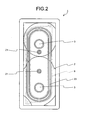
- Fig. 2 is a rear view of the vehicle component.
- Fig. 3 is a plan view of a sealing member of the vehicle component.
- Fig. 4 is a cross section taken from line A-A of Fig. 3.
- Fig. 5 is a schematic for explaining an operation of the sealing member.
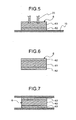
- Fig. 6 is a cross section of a modification of the sealing member.
- Fig. 7 is a schematic for explaining an operation of the modification.
- Fig. 8 is a graph of a result of a performance test of the sealing member.
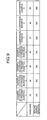
- Fig. 9 is a table of the result of the performance test.
- a vehicle component 1 is applied to a vehicle lamp such as a tail lamp or a vehicle mirror device such as an outside mirror. Application of the vehicle component 1 to the vehicle lamp is explained in the embodiment (see Figs. 1 and 2).
- the vehicle component 1 (vehicle lamp) includes a housing 2, a light source 3, and a lens 4.
- the vehicle component 1 is fitted to a component (vehicle body panel) on the side of a vehicle body 10 (see Fig. 1).
- the housing 2 includes a plurality of fasteners 21, 21 on the back surface.
- the vehicle component 1 is fitted to the vehicle body 10 with the fasteners 21, 21. Due to this, the entire vehicle component 1 is fixed on the vehicle body 10.
- the light source 3 is housed inside the housing 2 and connected from the back surface of the housing 2 to a power source (not shown) of the vehicle body 10.
- the lens 4 is arranged on an anterior surface of the light source 3 and fitted to the housing 2. Further, the lens 4 and the housing 2 partition a lamp chamber 5.
- the vehicle component 1 further includes a sealing member 6 (see Fig. 3).
- the sealing member 6 has an annular structure, and includes fixing holes 61, 61 at both ends.
- the sealing member 6 is arranged along an annular rib 23 on the back surface of the housing 2. Through the fixing holes 61, 61, the sealing member 6 is fixed to the housing 2 by being screwed thereon (see Fig. 2).
- the sealing member 6 includes an adhering/separating member 62 and an elastic compressing member 63 that are stacked (see Fig. 4).
- the adhering/separating member 62 is made of a butyl rubber, an unvulcanized rubber, or a plastic material, and has adhesion properties (adhesiveness or tackability) and separability with respect to a wall of the vehicle body 10.
- the adhering/separating member 62 is made of a material that can adhere to the wall of the vehicle body 10 and can be easily separated from the wall of the vehicle body 10.
- Adhesion properties indicate adhereability to an extent such that if the adhering/separating member 62 is pressed against the wall of the vehicle body 10 by a predetermined pushing pressure, water does not pass through the surface boundary of the sealing member 6 and the wall of the vehicle body 10. Separability indicates separability to an extent such that the adhering/separating member 62 that is adhering to the wall of the vehicle body 10 can be easily separated therefrom manually by an operator. Further, the adhesion properties and the separability can be suitably modified within a range obvious to those skilled in the art. Further, the wall (vehicle body panel) of the vehicle body 10 is formed of a coated steel plate.
- the elastic compressing member 63 is made of a rubber based material, a polyethylene based material, or an elastomeric based material.
- the elastic compressing member 63 has a closed cell structure, a semi-closed cell structure (structure that partially includes a series of cells or foams) or a sponge-type structure. Accordingly, the elastic compressing member 63, which includes an elastically compressible structure, causes repulsion during compression.
- the adhering/separating member 62 and the elastic compressing member 63 are explained in detail later.
- the adhering/separating member 62 and the elastic compressing member 63 are joined using an acrylic adhesive material, an adhesive material or a two-sided tape.
- the sealing member 6 Upon fitting the vehicle component 1 on the vehicle body 10, the sealing member 6 is sandwiched between the vehicle component 1 (the housing 2 and the rib 23) and the vehicle body 10 (vehicle body panel) (see Fig. 1). The sealing member 6 is pressed by the rib 23 of the housing 2 on the wall of the vehicle body 10, and the adhering/separating member 62 adheres to the wall of the vehicle body 10 (see Fig. 5). Due to the pushing pressure of the rib 23, the elastic compressing member 63 is compressed, and, due to the repulsion thereof, the adhering/separating member 62 is pressed and adheres to the wall of the vehicle body 10. Thus, the gap between the vehicle component 1 and the vehicle body 10.
- the sealing member 6 includes the adhering/separating member 62 having adhesion properties that adheres to the wall of the vehicle body 10.
- the sealing member 6 adheres well to the wall of the vehicle body 10 and the surface boundary of the sealing member 6 and the vehicle body 10 is appropriately sealed.
- the gap between the vehicle component 1 and the vehicle body 10 is effectively sealed.
- the sealing member 6 adheres to the wall of the vehicle body 10 due to the adhesion properties of the adhering/separating member 62. Thus, sealing characteristics of the gap between the vehicle component 1 and the vehicle body 10 are appropriately maintained.
- a compression ratio of the sealing member increases, which causes strong repulsion that presses the sealing member strongly against the vehicle body and enhances the sealing characteristics.
- application of strong pushing pressure may cause deformation of the vehicle body.
- securing the sealing characteristics with low pushing pressure is desirable.
- the gap between the vehicle component (rib) and the vehicle body (vehicle body panel) is not uniform, and, when the sealing member is arranged in the gap, the pushing pressure applied to the sealing member is uneven. Due to this, the sealing characteristics are reduced at a position of weak pushing pressure, resulting in occurrence of waterlogging.
- the pushing pressure applied to the sealing member is weak, securing required sealing characteristics of the sealing member is desirable. In other words, it is desirable that the required sealing characteristics be secured while compression ratio (repulsion) of the sealing member is set to low.
- the sealing characteristics are enhanced in the surface boundary of the sealing member 6 and the wall of the vehicle body 10, the necessary sealing characteristics are secured using the weak pushing pressure (see Figs. 8 and 9).
- occurrence of deformation of the vehicle body 10 can be suppressed or rigidity of the vehicle component 1 and the vehicle body 10 can be reduced.
- the compression ratio of the sealing member 6 can be set low, the thin sealing member 6 (elastic compressing member 63) can be used, which reduces the manufacturing cost.
- the vehicle component 1 can be easily mounted on the vehicle body 10.
- the sealing member 6 includes the separable adhering/separating member 62.
- the vehicle component 1 touches the wall of the vehicle body 10 via the adhering/separating member 62. Due to this, the sealing member 6 can be easily separated from the wall of the vehicle body 10 at the time of replacement of the vehicle component 1 with little adverse effect on the vehicle body 10.
- the sealing member 6 includes the adhering/separating member 62 that is adhereable.
- the sealing member 6 touches the wall of the vehicle body 10 due to adhesion instead of stickiness. Thus, sticking of scraps and the like in the contact portion is reduced.
- the adhering/separating member 62 be made of non-vulcanized rubber.
- the adhering/separating member 62 adheres firmly to the wall of the vehicle body 10, thereby enhancing the sealing characteristics of the sealing member 6 in the surface boundary. Due to this, the gap between the vehicle component 1 and the vehicle body 10 is effectively sealed.
- the non-vulcanized rubber is a rubber material that is not vulcanized by heat and is different from the unvulcanized rubber (rubber material before vulcanization).
- the non-vulcanized rubber is widely used in construction material such as waterproofing sheets used for a roof.
- the adhering/separating member 62 be made of a plastic material.
- the adhering/separating member 62 deforms according to the shape of the wall of the vehicle body 10, thereby enhancing the adhesion properties (adhesiveness) of the adhering/separating member 62 with respect to the wall of the vehicle body 10.
- the gap between the vehicle component 1 and the vehicle body 10 is effectively sealed.
- the adhering/separating member 62 be made of a non-permeable material. With this, permeation of water through the adhering/separating member 62 and subsequent waterlogging can be prevented. Thus, the gap between the vehicle component 1 and the vehicle body 10 is effectively sealed.
- non-vulcanized rubber material examples include butyl rubber (isobutylene isoprene rubber (IIR)), ethylene propylene rubber (ethylene propylene diene monomer (EPDM) or ethylene propylene monomer (EPM)), natural rubber (NR), isoprene rubber (IR), styrene butadiene rubber (SBR), butadiene rubber (BR), 1,2-polybutadiene, chloroprene rubber (CR), acrylonitrile-butadiene rubber (nitrile butadiene rubber (NBR), acrylonitrile-isoprene rubber (NIR), or acrylonitrile-isoprene-butadiene rubber (NBIR)), chlorosulphonated polyethylene (CSM), chlorinated polyethylene (CM), acrylic rubber (ACM or ANM), epichlorohydrin rubber (CO or ECO), silicone rubber (Q), fluororubber (F), urethane rubber
- IIR isobutylene isopren
- the adhering/separating member 62 be made of butyl rubber, ethylene-propylene rubber, or a mixture of butyl rubber and ethylene-propylene rubber. With this, the adhering/separating member 62 that is adhereable and separable is realized.
- the adhering/separating member 62 made of butyl rubber, ethylene-propylene rubber, or the mixture of butyl rubber and ethylene-propylene rubber be added with 2 percent to 20 percent of a modified polymer.
- the modified polymer include ethyl vinyl acetate, styrene-butadiene styrene copolymer, styrene-ethylene-butadiene-styrene copolymer, low-density polyethylene, polypropylene, asphalt, fatty acid ester, and wax.
- the elastic compressing member 63 be made of a non-permeable material. With this, permeation of water through the elastic compressing member 63 and subsequent waterlogging is prevented. Thus, the gap between the vehicle component 1 and the vehicle body 10 is effectively sealed.
- a material having a closed cell structure can be used as the non-permeable material.
- JIS Japanese Industrial Standard
- a lower limit of hardness of the adhering/separating member 62 be set greater than or equal to 20. With this, strength and rigidity of the adhering/separating member 62 are secured.
- the sealing member 6 preferably includes a pair of the adhering/separating members 62, 62 that sandwich the elastic compressing member 63 therebetween (see Figs. 6 and 7).
- the adhering/separating members 62, 62 display adhesion properties and separability on both the surfaces of the sealing member 6. Due to this, apart from effectively sealing the gap between the walls, the sealing member 6 is also easily separated from the walls.
- the sealing member 6 is arranged in the gap between the vehicle component 1 and the vehicle body 10. Because the sealing member 6 is easily adhereable and separable, applying the sealing member 6 in such a manner achieves the effects as explained above in the vehicle component 1. However, application of the sealing member 6 is not to be thus limited, and the sealing member 6 can also be applied for other purposes. For example, the sealing member 6 can be sandwiched between a pair of components in the vehicle body 10. With this structure, favorable sealing effect can be achieved by the sealing member 6.
- a performance test related to the sealing characteristics was conducted for the sealing member 6 (example according to the present invention) of the vehicle component 1 of the embodiment and a conventional sealing member (example according to a conventional technology) (see Figs. 8 and 9).
- the sealing member 6 formed of layers of the adhering/separating member 62 made of butyl rubber having a thickness of 0.5 millimeters (mm) and the elastic compressing member 63 made of sponge having a thickness from 2.0 mm to 3.0 mm (see Fig. 3) was used in the example according to the present invention.
- the sealing member (not shown) made only of sponge having a thickness of 4.0 mm to 1.2 mm was used in the example according to the conventional technology.
- each of the sealing members was pressed by using a plate shaped member having a length of 10 mm and a thickness of 2.0 mm (an area of 20 mm 2 ), and a relation between the compression ratio and the repulsion of each of the sealing members was measured. Further, a submersion test was performed on each of the sealing members, and a relation (watertight-guarantee compression-ratio limit) between the compression ratio and a sealable range of the sealing members was measured.
- the sealing members were sandwiched between a ring shaped jig having a height of 2.0 mm and a radius of 100.0 mm and an acrylic plate. The sealing members were submerged while being applied with compression at various ratios. After keeping the sealing members submerged at a water depth of 100 mm for one hour, waterlogging inside the ring of the jig was observed to make evaluation.
- the submersion test was performed on the sealing member 6 according to the embodiment, and a relation between the hardness (type A, JIS K6253) and the sealing characteristics of the adhering/separating member 62 (butyl rubber) was evaluated.
- the compression ratio of the sealing member 6 was set at 10 percent.
- "OK” indicates that waterlogging did not occur, while "NG” indicates that waterlogging occurred.
- appropriate sealing characteristics are secured by setting the hardness of the adhering/separating member 62 to less than or equal to 45 when the compression ratio of the sealing member 6 is less than or equal to 10 percent.
- a sealing member includes an adhering/separating member having adhesion properties that adheres to a wall of a vehicle body.
- the sealing member firmly adheres to the wall, and a surface boundary of the sealing member and the vehicle body is sealed.
- a gap between the vehicle component and the vehicle body is effectively sealed compared to a vehicle component that uses a sealing member made of sponge.
- the adhering/separating member displays adhesion properties and separability on both surfaces of the sealing member. Due to this, apart from effectively sealing the gap between the walls, the sealing member is easily separated from the walls.
- either or both the adhering/separating member and the elastic compressing member are made of a non-permeable material. Thus, permeation of water through the elastic compressing member can be prevented.
Landscapes
- Engineering & Computer Science (AREA)
- Mechanical Engineering (AREA)
- General Engineering & Computer Science (AREA)
- Sealing Material Composition (AREA)
- Gasket Seals (AREA)
- Body Structure For Vehicles (AREA)
- Lighting Device Outwards From Vehicle And Optical Signal (AREA)
- Arrangement Of Elements, Cooling, Sealing, Or The Like Of Lighting Devices (AREA)
- Non-Portable Lighting Devices Or Systems Thereof (AREA)
- Motor Or Generator Frames (AREA)
Abstract
Description
- The present document incorporates by reference the entire contents of
Japanese priority document, 2006-101836 - The present invention relates to a vehicle component and a sealing member that seals a gap between the vehicle component and a vehicle.
- In a vehicle component such as a tail lamp, a sealing member is arranged in a gap between the vehicle component and a vehicle to prevent waterlogging. A sponge shaped packing is widely used for the sealing member. In the conventional vehicle component, the sealing member is sandwiched in the gap with strong pressure, which enhances sealing characteristics of the sealing member.
- As a conventional vehicle component that includes a sealing member, the one disclosed in
Japanese Patent Application Laid-open No. 2000-90725 - It is an object of the present invention to at least partially solve the problems in the conventional technology.
- According to an aspect of the present invention, a vehicle component includes a sealing member that is located between the vehicle component and a vehicle body to seal a gap between the vehicle component and the vehicle body. The sealing member includes a first sealing member that is adhereable to and separable from a wall of the vehicle body, and a second sealing member that is elastically compressible and stacked on the first sealing member. The first sealing member adheres to the wall when the sealing member is present between the vehicle component and the vehicle body.
- According to another aspect of the present invention, a sealing member that is located between a pair of components and seals a gap between the components, includes a first sealing member that is adhereable to and separable from a wall of one of the components, and a second sealing member that is elastically compressible and stacked on the first sealing member. The first sealing member adheres to the wall when the sealing member is present between the components.
- The above and other objects, features, advantages and technical and industrial significance of this invention will be better understood by reading the following detailed description of presently preferred embodiments of the invention, when considered in connection with the accompanying drawings.
-
- Fig. 1 is a cross section of a vehicle component according to an embodiment of the present invention;
- Fig. 2 is a rear view of the vehicle component;
- Fig. 3 is a plan view of a sealing member of the vehicle component;
- Fig. 4 is a cross section taken from line A-A of Fig. 3;
- Fig. 5 is a schematic for explaining an operation of the sealing member;
- Fig. 6 is a cross section of a modification of the sealing member;
- Fig. 7 is a schematic for explaining an operation of the modification of the sealing member;
- Fig. 8 is a graph of a result of a performance test of the sealing member; and
- Fig. 9 is a table of the result of the performance test.
- Exemplary embodiments of the present invention are explained in detail below with reference to the accompanying drawings.
- Fig. 1 is a cross section of a vehicle component according to an embodiment of the present invention. Fig. 2 is a rear view of the vehicle component. Fig. 3 is a plan view of a sealing member of the vehicle component. Fig. 4 is a cross section taken from line A-A of Fig. 3. Fig. 5 is a schematic for explaining an operation of the sealing member. Fig. 6 is a cross section of a modification of the sealing member. Fig. 7 is a schematic for explaining an operation of the modification. Fig. 8 is a graph of a result of a performance test of the sealing member. Fig. 9 is a table of the result of the performance test.
- A
vehicle component 1 is applied to a vehicle lamp such as a tail lamp or a vehicle mirror device such as an outside mirror. Application of thevehicle component 1 to the vehicle lamp is explained in the embodiment (see Figs. 1 and 2). - The vehicle component 1 (vehicle lamp) includes a
housing 2, alight source 3, and alens 4. Thevehicle component 1 is fitted to a component (vehicle body panel) on the side of a vehicle body 10 (see Fig. 1). Thehousing 2 includes a plurality offasteners vehicle component 1 is fitted to thevehicle body 10 with thefasteners entire vehicle component 1 is fixed on thevehicle body 10. Thelight source 3 is housed inside thehousing 2 and connected from the back surface of thehousing 2 to a power source (not shown) of thevehicle body 10. Thelens 4 is arranged on an anterior surface of thelight source 3 and fitted to thehousing 2. Further, thelens 4 and thehousing 2 partition alamp chamber 5. - The
vehicle component 1 further includes a sealing member 6 (see Fig. 3). The sealingmember 6 has an annular structure, and includesfixing holes member 6 is arranged along anannular rib 23 on the back surface of thehousing 2. Through thefixing holes member 6 is fixed to thehousing 2 by being screwed thereon (see Fig. 2). - The sealing
member 6 includes an adhering/separatingmember 62 and an elastic compressingmember 63 that are stacked (see Fig. 4). For example, the adhering/separatingmember 62 is made of a butyl rubber, an unvulcanized rubber, or a plastic material, and has adhesion properties (adhesiveness or tackability) and separability with respect to a wall of thevehicle body 10. In other words, the adhering/separatingmember 62 is made of a material that can adhere to the wall of thevehicle body 10 and can be easily separated from the wall of thevehicle body 10. Adhesion properties indicate adhereability to an extent such that if the adhering/separatingmember 62 is pressed against the wall of thevehicle body 10 by a predetermined pushing pressure, water does not pass through the surface boundary of thesealing member 6 and the wall of thevehicle body 10. Separability indicates separability to an extent such that the adhering/separatingmember 62 that is adhering to the wall of thevehicle body 10 can be easily separated therefrom manually by an operator. Further, the adhesion properties and the separability can be suitably modified within a range obvious to those skilled in the art. Further, the wall (vehicle body panel) of thevehicle body 10 is formed of a coated steel plate. - The elastic compressing
member 63 is made of a rubber based material, a polyethylene based material, or an elastomeric based material. The elastic compressingmember 63 has a closed cell structure, a semi-closed cell structure (structure that partially includes a series of cells or foams) or a sponge-type structure. Accordingly, the elastic compressingmember 63, which includes an elastically compressible structure, causes repulsion during compression. The adhering/separatingmember 62 and the elastic compressingmember 63 are explained in detail later. The adhering/separatingmember 62 and the elastic compressingmember 63 are joined using an acrylic adhesive material, an adhesive material or a two-sided tape. - Upon fitting the
vehicle component 1 on thevehicle body 10, the sealingmember 6 is sandwiched between the vehicle component 1 (thehousing 2 and the rib 23) and the vehicle body 10 (vehicle body panel) (see Fig. 1). The sealingmember 6 is pressed by therib 23 of thehousing 2 on the wall of thevehicle body 10, and the adhering/separatingmember 62 adheres to the wall of the vehicle body 10 (see Fig. 5). Due to the pushing pressure of therib 23, the elastic compressingmember 63 is compressed, and, due to the repulsion thereof, the adhering/separatingmember 62 is pressed and adheres to the wall of thevehicle body 10. Thus, the gap between thevehicle component 1 and thevehicle body 10. - In the
vehicle component 1, the sealingmember 6 includes the adhering/separatingmember 62 having adhesion properties that adheres to the wall of thevehicle body 10. Thus, the sealingmember 6 adheres well to the wall of thevehicle body 10 and the surface boundary of the sealingmember 6 and thevehicle body 10 is appropriately sealed. Thus, as compared to a sealing member made of the sponge, the gap between thevehicle component 1 and thevehicle body 10 is effectively sealed. - In the structure of the
vehicle component 1, even when the repulsion of the elastic compressingmember 63 is reduced due to time degradation, the sealingmember 6 adheres to the wall of thevehicle body 10 due to the adhesion properties of the adhering/separatingmember 62. Thus, sealing characteristics of the gap between thevehicle component 1 and thevehicle body 10 are appropriately maintained. - Generally, if strong pushing pressure is applied to the sealing member, a compression ratio of the sealing member increases, which causes strong repulsion that presses the sealing member strongly against the vehicle body and enhances the sealing characteristics. However, application of strong pushing pressure may cause deformation of the vehicle body. Thus, securing the sealing characteristics with low pushing pressure is desirable. Besides, the gap between the vehicle component (rib) and the vehicle body (vehicle body panel) is not uniform, and, when the sealing member is arranged in the gap, the pushing pressure applied to the sealing member is uneven. Due to this, the sealing characteristics are reduced at a position of weak pushing pressure, resulting in occurrence of waterlogging. Thus, even if the pushing pressure applied to the sealing member is weak, securing required sealing characteristics of the sealing member is desirable. In other words, it is desirable that the required sealing characteristics be secured while compression ratio (repulsion) of the sealing member is set to low.
- In the
vehicle component 1, because the sealing characteristics are enhanced in the surface boundary of the sealingmember 6 and the wall of thevehicle body 10, the necessary sealing characteristics are secured using the weak pushing pressure (see Figs. 8 and 9). Thus, occurrence of deformation of thevehicle body 10 can be suppressed or rigidity of thevehicle component 1 and thevehicle body 10 can be reduced. Further, in the structure of thevehicle component 1, because the compression ratio of the sealingmember 6 can be set low, the thin sealing member 6 (elastic compressing member 63) can be used, which reduces the manufacturing cost. Furthermore, thevehicle component 1 can be easily mounted on thevehicle body 10. - For example, in the structure of a vehicle component in which its sealing member is adhered to a vehicle body with an adhesive, undesirable adhesive marks remain on the vehicle body when the vehicle component needs to be replaced. However, in the
vehicle component 1, the sealingmember 6 includes the separable adhering/separatingmember 62. Thevehicle component 1 touches the wall of thevehicle body 10 via the adhering/separatingmember 62. Due to this, the sealingmember 6 can be easily separated from the wall of thevehicle body 10 at the time of replacement of thevehicle component 1 with little adverse effect on thevehicle body 10. - For example, in the structure that includes a sealing member made of a sticky material, scraps and dust stick to a contact portion of the sealing member and the vehicle body, and such is not desirable. In the
vehicle component 1, the sealingmember 6 includes the adhering/separatingmember 62 that is adhereable. The sealingmember 6 touches the wall of thevehicle body 10 due to adhesion instead of stickiness. Thus, sticking of scraps and the like in the contact portion is reduced. - In the
vehicle component 1, it is desirable that the adhering/separatingmember 62 be made of non-vulcanized rubber. In the structure of thevehicle component 1, the adhering/separatingmember 62 adheres firmly to the wall of thevehicle body 10, thereby enhancing the sealing characteristics of the sealingmember 6 in the surface boundary. Due to this, the gap between thevehicle component 1 and thevehicle body 10 is effectively sealed. The non-vulcanized rubber is a rubber material that is not vulcanized by heat and is different from the unvulcanized rubber (rubber material before vulcanization). The non-vulcanized rubber is widely used in construction material such as waterproofing sheets used for a roof. - In the
vehicle component 1, it is desirable that the adhering/separatingmember 62 be made of a plastic material. In the structure of thevehicle component 1, the adhering/separatingmember 62 deforms according to the shape of the wall of thevehicle body 10, thereby enhancing the adhesion properties (adhesiveness) of the adhering/separatingmember 62 with respect to the wall of thevehicle body 10. Thus, the gap between thevehicle component 1 and thevehicle body 10 is effectively sealed. - In the
vehicle component 1, it is also desirable that the adhering/separatingmember 62 be made of a non-permeable material. With this, permeation of water through the adhering/separatingmember 62 and subsequent waterlogging can be prevented. Thus, the gap between thevehicle component 1 and thevehicle body 10 is effectively sealed. - Examples of the non-vulcanized rubber material, the plastic material or the non-permeable material include butyl rubber (isobutylene isoprene rubber (IIR)), ethylene propylene rubber (ethylene propylene diene monomer (EPDM) or ethylene propylene monomer (EPM)), natural rubber (NR), isoprene rubber (IR), styrene butadiene rubber (SBR), butadiene rubber (BR), 1,2-polybutadiene, chloroprene rubber (CR), acrylonitrile-butadiene rubber (nitrile butadiene rubber (NBR), acrylonitrile-isoprene rubber (NIR), or acrylonitrile-isoprene-butadiene rubber (NBIR)), chlorosulphonated polyethylene (CSM), chlorinated polyethylene (CM), acrylic rubber (ACM or ANM), epichlorohydrin rubber (CO or ECO), silicone rubber (Q), fluororubber (F), urethane rubber (U), polysulfide rubber (OT or EOT), asphalt, styrene-butadiene styrene copolymer (SBS), styrene-ethylene-butadiene-styrene copolymer (SEBS), ethylene vinyl acetate (EVA), polyvinyl chloride (PVC), polyethylene (PE), polypropylene (PP), fatty acid ester, and wax.
- In the
vehicle component 1, it is desirable that the adhering/separatingmember 62 be made of butyl rubber, ethylene-propylene rubber, or a mixture of butyl rubber and ethylene-propylene rubber. With this, the adhering/separatingmember 62 that is adhereable and separable is realized. - Further, in the
vehicle component 1, it is also desirable that the adhering/separatingmember 62 made of butyl rubber, ethylene-propylene rubber, or the mixture of butyl rubber and ethylene-propylene rubber be added with 2 percent to 20 percent of a modified polymer. Examples of the modified polymer include ethyl vinyl acetate, styrene-butadiene styrene copolymer, styrene-ethylene-butadiene-styrene copolymer, low-density polyethylene, polypropylene, asphalt, fatty acid ester, and wax. With this, the adhering/separatingmember 62 having optimum adhesion properties and separability is realized. - Further, in the
vehicle component 1, it is desirable that the elastic compressingmember 63 be made of a non-permeable material. With this, permeation of water through the elastic compressingmember 63 and subsequent waterlogging is prevented. Thus, the gap between thevehicle component 1 and thevehicle body 10 is effectively sealed. A material having a closed cell structure can be used as the non-permeable material. - In the
vehicle component 1, it is desirable that the adhering/separatingmember 62 be made of butyl rubber having a type A hardness according to Japanese Industrial Standard (JIS) K6253 less than or equal to 45, and that the elastic compressingmember 63 have the repulsion larger than or equal to 0.033 [kg/2.0 mm×10.0 mm] (=0.66×10⁻³ [kg/mm2]) at the compression ratio of about 10 percent. With this structure, appropriate sealing characteristics are secured with low pushing pressure (see Figs. 8 and 9). Due to this, a load on thevehicle component 1 and thevehicle body 10 due to the repulsion of the sealingmember 6 is reduced. - Further, in the structure of the
vehicle component 1, it is desirable that a lower limit of hardness of the adhering/separating member 62 (butyl rubber) be set greater than or equal to 20. With this, strength and rigidity of the adhering/separatingmember 62 are secured. - In the
vehicle component 1, the sealingmember 6 preferably includes a pair of the adhering/separatingmembers member 63 therebetween (see Figs. 6 and 7). With this structure, for example, upon the sealingmember 6 being sandwiched in a gap between opposing walls (the wall of thevehicle component 1 and the wall of the vehicle body 10), the adhering/separatingmembers member 6. Due to this, apart from effectively sealing the gap between the walls, the sealingmember 6 is also easily separated from the walls. - In the embodiment, the sealing
member 6 is arranged in the gap between thevehicle component 1 and thevehicle body 10. Because the sealingmember 6 is easily adhereable and separable, applying the sealingmember 6 in such a manner achieves the effects as explained above in thevehicle component 1. However, application of the sealingmember 6 is not to be thus limited, and the sealingmember 6 can also be applied for other purposes. For example, the sealingmember 6 can be sandwiched between a pair of components in thevehicle body 10. With this structure, favorable sealing effect can be achieved by the sealingmember 6. - A performance test related to the sealing characteristics was conducted for the sealing member 6 (example according to the present invention) of the
vehicle component 1 of the embodiment and a conventional sealing member (example according to a conventional technology) (see Figs. 8 and 9). The sealingmember 6 formed of layers of the adhering/separatingmember 62 made of butyl rubber having a thickness of 0.5 millimeters (mm) and the elastic compressingmember 63 made of sponge having a thickness from 2.0 mm to 3.0 mm (see Fig. 3) was used in the example according to the present invention. The sealing member (not shown) made only of sponge having a thickness of 4.0 mm to 1.2 mm was used in the example according to the conventional technology. - In the performance test shown in Fig. 8, each of the sealing members was pressed by using a plate shaped member having a length of 10 mm and a thickness of 2.0 mm (an area of 20 mm2), and a relation between the compression ratio and the repulsion of each of the sealing members was measured. Further, a submersion test was performed on each of the sealing members, and a relation (watertight-guarantee compression-ratio limit) between the compression ratio and a sealable range of the sealing members was measured. In the submersion test, the sealing members were sandwiched between a ring shaped jig having a height of 2.0 mm and a radius of 100.0 mm and an acrylic plate. The sealing members were submerged while being applied with compression at various ratios. After keeping the sealing members submerged at a water depth of 100 mm for one hour, waterlogging inside the ring of the jig was observed to make evaluation.
- As shown in the test result of Fig. 8, with the sealing
member 6 according to the embodiment, a repulsion of about 0.033 [kg/2.0 mmx10.0 mm] was generated at a compression ratio of about 10 percent, and it was found that appropriate sealing characteristics were secured at a compression ratio (repulsion) more than or equal to 10 percent. However, with the conventional sealing member, a repulsion of about 0.182 [kg/2.0 mmx10.0 mm] was generated at a compression ratio of about 30 percent, and it was found that appropriate sealing characteristics were secured at a compression ratio more than or equal to 30 percent. Thus, it is understood that, in the sealingmember 6 according to the embodiment, appropriate sealing characteristics are secured at a lower compression ratio compared to the conventional sealing member. - Further, in the performance test shown in Fig. 9, the submersion test was performed on the sealing
member 6 according to the embodiment, and a relation between the hardness (type A, JIS K6253) and the sealing characteristics of the adhering/separating member 62 (butyl rubber) was evaluated. In the performance test, the compression ratio of the sealingmember 6 was set at 10 percent. In Fig. 9, "OK" indicates that waterlogging did not occur, while "NG" indicates that waterlogging occurred. As can be seen in the test result of Fig. 9, appropriate sealing characteristics are secured by setting the hardness of the adhering/separatingmember 62 to less than or equal to 45 when the compression ratio of the sealingmember 6 is less than or equal to 10 percent. - As set forth hereinabove, according to an embodiment of the present invention, a sealing member includes an adhering/separating member having adhesion properties that adheres to a wall of a vehicle body. The sealing member firmly adheres to the wall, and a surface boundary of the sealing member and the vehicle body is sealed. Thus, a gap between the vehicle component and the vehicle body is effectively sealed compared to a vehicle component that uses a sealing member made of sponge.
- Moreover, upon the sealing member being sandwiched in a gap between opposing walls (the wall of the vehicle component and the wall of the vehicle body), the adhering/separating member displays adhesion properties and separability on both surfaces of the sealing member. Due to this, apart from effectively sealing the gap between the walls, the sealing member is easily separated from the walls.
- Furthermore, either or both the adhering/separating member and the elastic compressing member are made of a non-permeable material. Thus, permeation of water through the elastic compressing member can be prevented.
- Although the invention has been described with respect to a specific embodiment for a complete and clear disclosure, the appended claims are not to be thus limited but are to be construed as embodying all modifications and alternative constructions that may occur to one skilled in the art that fairly fall within the basic teaching herein set forth.
Claims (10)
- A vehicle component (1) comprising:a sealing member (6) that is located between the vehicle component (1) and a vehicle body (10) to seal a gap between the vehicle component (1) and the vehicle body (10), whereinthe sealing member (6) includes a first sealing member (62) that is adhereable to and separable from a wall of the vehicle body (10), and a second sealing member (63) that is elastically compressible and stacked on the first sealing member (62), andthe first sealing member (62) adheres to the wall when the sealing member (6) is present between the vehicle component (1) and the vehicle body (10).
- The vehicle component (1) according to claim 1, wherein the first sealing member (62) is made of non-vulcanized rubber.
- The vehicle component (1) according to claim 1 or 2, wherein the first sealing member (62) is made of a plastic material.
- The vehicle component (1) according to any one of claims 1 to 3, wherein the first sealing member (62) is made of a non-permeable material.
- The vehicle component (1) according to claim 1, wherein the first sealing member (62) is made of any one of butyl rubber, ethylene-propylene rubber, and a mixture of butyl rubber and ethylene-propylene rubber.
- The vehicle component (1) according to claim 1, wherein the first sealing member (62) is made of any one of butyl rubber, ethylene-propylene rubber, and a mixture of butyl rubber and ethylene-propylene rubber, which is added with 2 percent to 20 percent of modified polymer selected from a group including ethyl vinyl acetate, styrene-butadiene styrene copolymer, styrene-ethylene-butadiene-styrene copolymer, styrene-isoprene-styrene copolymer, low-density polyethylene, polypropylene, asphalt, fatty acid ester, and wax.
- The vehicle component (1) according to any one of claims 1 to 6, wherein the second sealing member (63) is made of a non-permeable material.
- The vehicle component (1) according to claim 1 or 7, wherein
the first sealing member (62) is made of butyl rubber with a type A hardness defined by Japanese Industrial Standard K6253 less than or equal to 45, and
the second sealing member (63) has repulsion larger than or equal to about 0.033 [kg/2.0 mmx10.0 mm] at a compression ratio of about 10 percent. - The vehicle component (1) according to any one of claims 1 to 8, wherein the first sealing member (62) includes a pair of the first sealing members (62) that sandwich the second sealing member (63).
- A sealing member (6) that is located between a pair of components and seals a gap between the components, the sealing member (6) comprising:a first sealing member (62) that is adhereable to and separable from a wall of one of the components; anda second sealing member (63) that is elastically compressible and stacked on the first sealing member (62), whereinthe first sealing member (62) adheres to the wall when the sealing member (6) is present between the components.
Applications Claiming Priority (1)
| Application Number | Priority Date | Filing Date | Title |
|---|---|---|---|
| JP2006101836A JP4602280B2 (en) | 2006-04-03 | 2006-04-03 | Vehicle parts and seal members |
Publications (2)
| Publication Number | Publication Date |
|---|---|
| EP1843089A1 true EP1843089A1 (en) | 2007-10-10 |
| EP1843089B1 EP1843089B1 (en) | 2012-06-27 |
Family
ID=38036376
Family Applications (1)
| Application Number | Title | Priority Date | Filing Date |
|---|---|---|---|
| EP07006327A Ceased EP1843089B1 (en) | 2006-04-03 | 2007-03-27 | Vehicle component and sealing member |
Country Status (5)
| Country | Link |
|---|---|
| US (1) | US8720908B2 (en) |
| EP (1) | EP1843089B1 (en) |
| JP (1) | JP4602280B2 (en) |
| KR (1) | KR100982804B1 (en) |
| CN (1) | CN101049807B (en) |
Families Citing this family (6)
| Publication number | Priority date | Publication date | Assignee | Title |
|---|---|---|---|---|
| CN102834443A (en) | 2010-03-09 | 2012-12-19 | 协和化学工业株式会社 | filler for synthetic resin, synthetic resin composition, manufacturing method therefor, and molded object made therefrom |
| CN104654165A (en) * | 2013-11-22 | 2015-05-27 | 丹阳市中远车灯有限公司 | Automobile lamp |
| CN105505258A (en) * | 2015-12-22 | 2016-04-20 | 苏州金双宇光电科技有限公司 | Tail warning projection lamp |
| CN106090777B (en) * | 2016-07-28 | 2018-06-12 | 上海小糸车灯有限公司 | Auto lamp sealing structure |
| CN111349344A (en) * | 2020-03-18 | 2020-06-30 | 云南欣城防水科技有限公司 | Anion styrene-butadiene rubber modified asphalt coiled material |
| CN115111561A (en) * | 2021-03-22 | 2022-09-27 | 北京汽车股份有限公司 | Sealed lamp body, car light and car |
Citations (5)
| Publication number | Priority date | Publication date | Assignee | Title |
|---|---|---|---|---|
| GB2010418A (en) * | 1977-12-16 | 1979-06-27 | Seima | Process for Making a Seal Between Two Components and a Motor Vehicle Headlight and Reflector so Sealed |
| US4900770A (en) * | 1988-02-25 | 1990-02-13 | Aica Kogyo Co., Ltd. | Hot melt type seal agent for a lamp |
| JPH06231603A (en) * | 1993-02-01 | 1994-08-19 | Stanley Electric Co Ltd | Method for bonding vehicle lamp housing and lens |
| EP0892209A2 (en) * | 1997-07-17 | 1999-01-20 | Donnelly Corporation | Vehicular component assembly with hard coated element |
| JP2000090725A (en) | 1998-09-11 | 2000-03-31 | Koito Mfg Co Ltd | Vehicle lighting |
Family Cites Families (14)
| Publication number | Priority date | Publication date | Assignee | Title |
|---|---|---|---|---|
| US3086216A (en) * | 1959-07-21 | 1963-04-23 | Cee Bee Mfg Company Inc | Reinforced protected decorative strip materials |
| US3322433A (en) * | 1964-03-10 | 1967-05-30 | Minnesota Rubber Co | Sealing ring and method of making same |
| JPH0315748U (en) * | 1989-06-30 | 1991-02-18 | ||
| JPH0525445A (en) * | 1991-07-20 | 1993-02-02 | Takeo Kobayashi | Tape for end face sealing such as netted glass and manufacturing method thereof |
| US5730446A (en) * | 1995-06-20 | 1998-03-24 | Minnesota Mining And Manufacturing Company | Sealing strip suitable for sealing a hem flange |
| JPH09125049A (en) * | 1995-10-30 | 1997-05-13 | Nitto Denko Corp | Sealant for opening frame |
| JPH09131822A (en) * | 1995-11-13 | 1997-05-20 | Nitto Denko Corp | Standard seal material |
| US6073938A (en) * | 1997-11-06 | 2000-06-13 | Kokusan Parts Industry Co., Ltd. | Sealing structure |
| JPH11291434A (en) * | 1998-04-10 | 1999-10-26 | Nhk Spring Co Ltd | Urethane foam with adhesive and method for producing the same |
| JP4530122B2 (en) * | 2001-03-09 | 2010-08-25 | Nok株式会社 | gasket |
| US6858290B2 (en) * | 2002-05-29 | 2005-02-22 | 3M Innovative Properties Company | Fluid repellent microporous materials |
| US6755422B2 (en) * | 2002-08-16 | 2004-06-29 | Visteon Global Technologies, Inc. | Low permeation sealing member |
| JP4678123B2 (en) * | 2003-09-02 | 2011-04-27 | Nok株式会社 | gasket |
| CN2750187Y (en) * | 2004-07-15 | 2006-01-04 | 纽福克斯光电科技(上海)有限公司 | Integral threading sealing cover and gas-discharge lamp thereof |
-
2006
- 2006-04-03 JP JP2006101836A patent/JP4602280B2/en not_active Expired - Fee Related
-
2007
- 2007-03-23 KR KR1020070028540A patent/KR100982804B1/en not_active Expired - Fee Related
- 2007-03-23 US US11/727,007 patent/US8720908B2/en not_active Expired - Fee Related
- 2007-03-27 EP EP07006327A patent/EP1843089B1/en not_active Ceased
- 2007-04-02 CN CN2007100922432A patent/CN101049807B/en not_active Expired - Fee Related
Patent Citations (5)
| Publication number | Priority date | Publication date | Assignee | Title |
|---|---|---|---|---|
| GB2010418A (en) * | 1977-12-16 | 1979-06-27 | Seima | Process for Making a Seal Between Two Components and a Motor Vehicle Headlight and Reflector so Sealed |
| US4900770A (en) * | 1988-02-25 | 1990-02-13 | Aica Kogyo Co., Ltd. | Hot melt type seal agent for a lamp |
| JPH06231603A (en) * | 1993-02-01 | 1994-08-19 | Stanley Electric Co Ltd | Method for bonding vehicle lamp housing and lens |
| EP0892209A2 (en) * | 1997-07-17 | 1999-01-20 | Donnelly Corporation | Vehicular component assembly with hard coated element |
| JP2000090725A (en) | 1998-09-11 | 2000-03-31 | Koito Mfg Co Ltd | Vehicle lighting |
Also Published As
| Publication number | Publication date |
|---|---|
| JP2007280632A (en) | 2007-10-25 |
| CN101049807A (en) | 2007-10-10 |
| CN101049807B (en) | 2013-01-02 |
| US20070228758A1 (en) | 2007-10-04 |
| KR20070099425A (en) | 2007-10-09 |
| EP1843089B1 (en) | 2012-06-27 |
| JP4602280B2 (en) | 2010-12-22 |
| KR100982804B1 (en) | 2010-09-16 |
| US8720908B2 (en) | 2014-05-13 |
Similar Documents
| Publication | Publication Date | Title |
|---|---|---|
| EP1843089B1 (en) | Vehicle component and sealing member | |
| CA2442067A1 (en) | Gasket | |
| JP3678024B2 (en) | Carbon material for fuel cells | |
| WO2008045485A3 (en) | Reusable mechanical fastener and vacuum seal combination | |
| JP4076811B2 (en) | Tunnel water leakage prevention structure, its construction method and columnar packing | |
| JP5368952B2 (en) | Sealing material and joint water leakage prevention structure | |
| US20130086865A1 (en) | Window seal extruded weather strip | |
| JP2015058895A (en) | Sealing material for water stop and sealing method using the sealing material for water stop | |
| US20200408304A1 (en) | Gasket | |
| JP2007333126A (en) | Gasket for fuel cell | |
| JP2001348540A (en) | Peelable type noise-proof sheet | |
| JP3487211B2 (en) | Olefin-based thermoplastic elastomer molded product | |
| JP2010118598A (en) | Solar battery module | |
| EP1434692A1 (en) | Resilient product | |
| JP2004063295A (en) | Components for fuel cells | |
| JP2010088148A (en) | Water stop structure | |
| JP2002274285A (en) | Weather strip and its mounting structure | |
| JP2009242624A (en) | Sealing material | |
| CN208410748U (en) | A kind of film sticking apparatus and film-sticking device | |
| JP2015059203A (en) | Water stopping seal material and sealing method using the water stopping seal material | |
| JP4717626B2 (en) | Door weather strip, its mounting structure, and its mounting method | |
| JP2000074289A (en) | Polyethylene coated gasket | |
| JP2009242623A (en) | Sealing material | |
| JP2755515B2 (en) | Electrolytic cell | |
| JP2015058893A (en) | Seal material for cutoff |
Legal Events
| Date | Code | Title | Description |
|---|---|---|---|
| PUAI | Public reference made under article 153(3) epc to a published international application that has entered the european phase |
Free format text: ORIGINAL CODE: 0009012 |
|
| 17P | Request for examination filed |
Effective date: 20070829 |
|
| AK | Designated contracting states |
Kind code of ref document: A1 Designated state(s): AT BE BG CH CY CZ DE DK EE ES FI FR GB GR HU IE IS IT LI LT LU LV MC MT NL PL PT RO SE SI SK TR |
|
| AX | Request for extension of the european patent |
Extension state: AL BA HR MK YU |
|
| 17Q | First examination report despatched |
Effective date: 20071213 |
|
| AKX | Designation fees paid |
Designated state(s): DE FR GB |
|
| GRAP | Despatch of communication of intention to grant a patent |
Free format text: ORIGINAL CODE: EPIDOSNIGR1 |
|
| GRAS | Grant fee paid |
Free format text: ORIGINAL CODE: EPIDOSNIGR3 |
|
| GRAA | (expected) grant |
Free format text: ORIGINAL CODE: 0009210 |
|
| AK | Designated contracting states |
Kind code of ref document: B1 Designated state(s): DE FR GB |
|
| REG | Reference to a national code |
Ref country code: GB Ref legal event code: FG4D |
|
| REG | Reference to a national code |
Ref country code: DE Ref legal event code: R096 Ref document number: 602007023510 Country of ref document: DE Effective date: 20120823 |
|
| PLBE | No opposition filed within time limit |
Free format text: ORIGINAL CODE: 0009261 |
|
| STAA | Information on the status of an ep patent application or granted ep patent |
Free format text: STATUS: NO OPPOSITION FILED WITHIN TIME LIMIT |
|
| 26N | No opposition filed |
Effective date: 20130328 |
|
| REG | Reference to a national code |
Ref country code: DE Ref legal event code: R097 Ref document number: 602007023510 Country of ref document: DE Effective date: 20130328 |
|
| REG | Reference to a national code |
Ref country code: FR Ref legal event code: PLFP Year of fee payment: 10 |
|
| REG | Reference to a national code |
Ref country code: FR Ref legal event code: PLFP Year of fee payment: 11 |
|
| REG | Reference to a national code |
Ref country code: FR Ref legal event code: PLFP Year of fee payment: 12 |
|
| PGFP | Annual fee paid to national office [announced via postgrant information from national office to epo] |
Ref country code: GB Payment date: 20180319 Year of fee payment: 12 |
|
| PGFP | Annual fee paid to national office [announced via postgrant information from national office to epo] |
Ref country code: FR Payment date: 20180319 Year of fee payment: 12 |
|
| PGFP | Annual fee paid to national office [announced via postgrant information from national office to epo] |
Ref country code: DE Payment date: 20180328 Year of fee payment: 12 |
|
| REG | Reference to a national code |
Ref country code: DE Ref legal event code: R119 Ref document number: 602007023510 Country of ref document: DE |
|
| GBPC | Gb: european patent ceased through non-payment of renewal fee |
Effective date: 20190327 |
|
| PG25 | Lapsed in a contracting state [announced via postgrant information from national office to epo] |
Ref country code: DE Free format text: LAPSE BECAUSE OF NON-PAYMENT OF DUE FEES Effective date: 20191001 Ref country code: GB Free format text: LAPSE BECAUSE OF NON-PAYMENT OF DUE FEES Effective date: 20190327 |
|
| PG25 | Lapsed in a contracting state [announced via postgrant information from national office to epo] |
Ref country code: FR Free format text: LAPSE BECAUSE OF NON-PAYMENT OF DUE FEES Effective date: 20190331 |