EP1838833B1 - Tensidhaltiges reinigungsmittel mit speziellen proteinen - Google Patents
Tensidhaltiges reinigungsmittel mit speziellen proteinen Download PDFInfo
- Publication number
- EP1838833B1 EP1838833B1 EP05816287A EP05816287A EP1838833B1 EP 1838833 B1 EP1838833 B1 EP 1838833B1 EP 05816287 A EP05816287 A EP 05816287A EP 05816287 A EP05816287 A EP 05816287A EP 1838833 B1 EP1838833 B1 EP 1838833B1
- Authority
- EP
- European Patent Office
- Prior art keywords
- weight
- surfactant
- und
- acid
- cleaning agent
- Prior art date
- Legal status (The legal status is an assumption and is not a legal conclusion. Google has not performed a legal analysis and makes no representation as to the accuracy of the status listed.)
- Revoked
Links
Classifications
-
- A—HUMAN NECESSITIES
- A61—MEDICAL OR VETERINARY SCIENCE; HYGIENE
- A61Q—SPECIFIC USE OF COSMETICS OR SIMILAR TOILETRY PREPARATIONS
- A61Q19/00—Preparations for care of the skin
- A61Q19/10—Washing or bathing preparations
-
- A—HUMAN NECESSITIES
- A61—MEDICAL OR VETERINARY SCIENCE; HYGIENE
- A61K—PREPARATIONS FOR MEDICAL, DENTAL OR TOILETRY PURPOSES
- A61K8/00—Cosmetics or similar toiletry preparations
- A61K8/18—Cosmetics or similar toiletry preparations characterised by the composition
- A61K8/30—Cosmetics or similar toiletry preparations characterised by the composition containing organic compounds
- A61K8/64—Proteins; Peptides; Derivatives or degradation products thereof
-
- A—HUMAN NECESSITIES
- A61—MEDICAL OR VETERINARY SCIENCE; HYGIENE
- A61K—PREPARATIONS FOR MEDICAL, DENTAL OR TOILETRY PURPOSES
- A61K8/00—Cosmetics or similar toiletry preparations
- A61K8/18—Cosmetics or similar toiletry preparations characterised by the composition
- A61K8/30—Cosmetics or similar toiletry preparations characterised by the composition containing organic compounds
- A61K8/67—Vitamins
-
- A—HUMAN NECESSITIES
- A61—MEDICAL OR VETERINARY SCIENCE; HYGIENE
- A61K—PREPARATIONS FOR MEDICAL, DENTAL OR TOILETRY PURPOSES
- A61K8/00—Cosmetics or similar toiletry preparations
- A61K8/18—Cosmetics or similar toiletry preparations characterised by the composition
- A61K8/30—Cosmetics or similar toiletry preparations characterised by the composition containing organic compounds
- A61K8/67—Vitamins
- A61K8/671—Vitamin A; Derivatives thereof, e.g. ester of vitamin A acid, ester of retinol, retinol, retinal
-
- A—HUMAN NECESSITIES
- A61—MEDICAL OR VETERINARY SCIENCE; HYGIENE
- A61K—PREPARATIONS FOR MEDICAL, DENTAL OR TOILETRY PURPOSES
- A61K8/00—Cosmetics or similar toiletry preparations
- A61K8/18—Cosmetics or similar toiletry preparations characterised by the composition
- A61K8/30—Cosmetics or similar toiletry preparations characterised by the composition containing organic compounds
- A61K8/67—Vitamins
- A61K8/673—Vitamin B group
-
- A—HUMAN NECESSITIES
- A61—MEDICAL OR VETERINARY SCIENCE; HYGIENE
- A61K—PREPARATIONS FOR MEDICAL, DENTAL OR TOILETRY PURPOSES
- A61K8/00—Cosmetics or similar toiletry preparations
- A61K8/18—Cosmetics or similar toiletry preparations characterised by the composition
- A61K8/30—Cosmetics or similar toiletry preparations characterised by the composition containing organic compounds
- A61K8/67—Vitamins
- A61K8/676—Ascorbic acid, i.e. vitamin C
-
- A—HUMAN NECESSITIES
- A61—MEDICAL OR VETERINARY SCIENCE; HYGIENE
- A61K—PREPARATIONS FOR MEDICAL, DENTAL OR TOILETRY PURPOSES
- A61K8/00—Cosmetics or similar toiletry preparations
- A61K8/18—Cosmetics or similar toiletry preparations characterised by the composition
- A61K8/30—Cosmetics or similar toiletry preparations characterised by the composition containing organic compounds
- A61K8/67—Vitamins
- A61K8/678—Tocopherol, i.e. vitamin E
-
- A—HUMAN NECESSITIES
- A61—MEDICAL OR VETERINARY SCIENCE; HYGIENE
- A61K—PREPARATIONS FOR MEDICAL, DENTAL OR TOILETRY PURPOSES
- A61K8/00—Cosmetics or similar toiletry preparations
- A61K8/18—Cosmetics or similar toiletry preparations characterised by the composition
- A61K8/96—Cosmetics or similar toiletry preparations characterised by the composition containing materials, or derivatives thereof of undetermined constitution
- A61K8/97—Cosmetics or similar toiletry preparations characterised by the composition containing materials, or derivatives thereof of undetermined constitution from algae, fungi, lichens or plants; from derivatives thereof
- A61K8/9783—Angiosperms [Magnoliophyta]
- A61K8/9794—Liliopsida [monocotyledons]
-
- A—HUMAN NECESSITIES
- A61—MEDICAL OR VETERINARY SCIENCE; HYGIENE
- A61K—PREPARATIONS FOR MEDICAL, DENTAL OR TOILETRY PURPOSES
- A61K8/00—Cosmetics or similar toiletry preparations
- A61K8/18—Cosmetics or similar toiletry preparations characterised by the composition
- A61K8/96—Cosmetics or similar toiletry preparations characterised by the composition containing materials, or derivatives thereof of undetermined constitution
- A61K8/98—Cosmetics or similar toiletry preparations characterised by the composition containing materials, or derivatives thereof of undetermined constitution of animal origin
- A61K8/981—Cosmetics or similar toiletry preparations characterised by the composition containing materials, or derivatives thereof of undetermined constitution of animal origin of mammals or bird
- A61K8/986—Milk; Derivatives thereof, e.g. butter
-
- A—HUMAN NECESSITIES
- A61—MEDICAL OR VETERINARY SCIENCE; HYGIENE
- A61Q—SPECIFIC USE OF COSMETICS OR SIMILAR TOILETRY PREPARATIONS
- A61Q19/00—Preparations for care of the skin
-
- A—HUMAN NECESSITIES
- A61—MEDICAL OR VETERINARY SCIENCE; HYGIENE
- A61K—PREPARATIONS FOR MEDICAL, DENTAL OR TOILETRY PURPOSES
- A61K2800/00—Properties of cosmetic compositions or active ingredients thereof or formulation aids used therein and process related aspects
- A61K2800/80—Process related aspects concerning the preparation of the cosmetic composition or the storage or application thereof
- A61K2800/85—Products or compounds obtained by fermentation, e.g. yoghurt, beer, wine
Definitions
- the invention relates to surfactant-containing detergents based on a special combination of active ingredients and the use of this combination of active ingredients for smoothing the skin and for regulating the skin moisture.
- Skin and hair cleansers such as those commercially available as liquid soaps, shampoos, shower baths, bubble baths, shower and wash gels, must not only have good detergency, but should also be well tolerated by the skin and mucous membranes as well if used frequently, do not cause excessive defatting or dryness.
- Typical cosmetic cleansing products contain surfactants in amounts of about 10 to 15% by weight in order to achieve a satisfactory cleaning performance.
- the consumer after the application of such a cleaning product, the consumer often finds his skin condition not ideal, which is mainly due to the slightly irritating effect of most surfactants.
- the skin condition after application is perceived as dry, tense and sometimes rough, which is why the subsequent application of creams or lotions is required.
- This has the disadvantage of a higher expenditure of time on the one hand and on the other hand the disadvantage of a higher cost expenditure, since at least two products are needed.
- the EP 518 192 B1 discloses a natural cosmetic skin or hair care composition containing juices of pressed plants or parts, including lemon juice and olive oil, and water, characterized by a content of parsley juice, celery juice from leaves and tubers, dandelion juice from leaves, juice peeled kiwis, yogurt, Juice of pitted green olives and sea salt.
- the agents disclosed herein may also contain yoghurt.
- the EP 315 541 B1 discloses a solid, preservative-free skin treatment agent based on yogurt or kefir, which is mixed with water immediately prior to administration and imparts smoothness and softness to the skin.
- the GB 2,037,160 A discloses a product obtained from skimmed milk by protein hydrolysis under conditions of yoghurt product ion and which can be used as a moisturizer in cosmetic and pharmaceutical compositions.
- the weight ratio of components b) and c) is 7: 1 to 1: 3, preferably 5: 1 to 2: 5, more preferably 5: 1 to 1: 2, particularly preferably 4: 1 to 2: 3 and in particular 3: 1 to 1: 1.
- the surfactant-containing cleaning agent contains the yoghurt protein (s) in an amount of 0.01 to 5 wt .-%, preferably 0.02 to 4 wt .-% and in particular 0.05 to 3 wt. -% - based on the total weight of the product.
- the yoghurt proteins ⁇ -casein and / or lactophorin are particularly preferred.
- Detergents comprising green tea, oak bark, stinging nettle, witch hazel, hops, henna, chamomile, burdock root, horsetail, hawthorn, lime blossom, almond, aloe vera, spruce needle, horse chestnut, sandalwood, juniper, coconut, mango, apricot, are preferred according to the invention.
- Particularly preferred according to the invention are the extracts of green tea, almond, aloe vera, coconut, mango, apricot, lime, wheat, vanilla, kiwi and melon, and particularly preferably the extracts of aloe vera, vanilla and melon.
- extracts are produced by extraction of the whole plant. However, in individual cases it may also be preferred to prepare the extracts exclusively from flowers and / or leaves of the plant.
- alcohols and mixtures thereof can be used as extraction agent for the preparation of said plant extracts water.
- the alcohols are lower alcohols such as ethanol and isopropanol, but especially polyhydric alcohols such as ethylene glycol and propylene glycol, both as sole extractant and in admixture with water, are preferred.
- Plant extracts based on water / propylene glycol in a ratio of 1:10 to 10: 1 have proven to be particularly suitable.
- the plant extracts can be used according to the invention both in pure and in diluted form. If used in diluted form, they contain usually about 2 to 80% by weight of active substance and, as solvent, the extractant or extractant mixture used in their extraction.
- the plant extracts are used in the cleaning agent according to the invention - based on its weight - in an amount of 0.01 to 5 wt .-%, preferably 0.02 to 4 wt .-% and in particular 0.05 to 3 wt .-%.
- compositions according to the invention contain as vegetable milk preferably aloe milk and / or coconut milk, which are present in the tensi-containing cleaners in an amount of 0.01 to 5 wt .-%, preferably 0.02 to 4 wt .-% and in particular 0.05 to 3 wt .-% - based on the total weight of the agent - are used.
- vitamins, provitamins and vitamin precursors and derivatives thereof are those representatives which are usually assigned to the groups A, B, C, E, F and H.
- vitamin A includes retinol (vitamin A 1 ) and 3,4-didehydroretinol (vitamin A 2 ).
- the ⁇ -carotene is the provitamin of retinol.
- vitamin A component according to the invention for example, vitamin A acid and its esters, vitamin A aldehyde and vitamin A alcohol and its esters such as the palmitate and the acetate into consideration.
- the agents according to the invention preferably contain the vitamin A component in amounts of 0.01-1% by weight, based on the total preparation.
- the said compounds of the vitamin B group are preferably contained in the agents according to the invention in amounts of 0.01-2% by weight, based on the total agent. Amounts of 0.03 - 1 wt .-% are particularly preferred.
- Vitamin C (ascorbic acid). Vitamin C is used in the compositions according to the invention preferably in amounts of 0.01 to 3 wt .-%, based on the total agent. Use in the form of palmitic acid ester, glucosides or phosphates may be preferred. The use in combination with tocopherols may also be preferred.
- Vitamin E tocopherols, especially ⁇ -tocopherol.
- Tocopherol and its derivatives which include in particular the esters such as the acetate, the nicotinate, the phosphate and the succinate, are preferably present in the agents used according to the invention in amounts of 0.01-1% by weight, based on the total agent ,
- Vitamin F is usually understood as meaning essential fatty acids, in particular linoleic acid, linolenic acid and arachidonic acid.
- Vitamin H is the compound (3a S , 4 S , 6a R ) -2-oxohexahydrothienol [3,4- d ] imidazole-4-valeric acid, for which, however, the trivial name biotin has meanwhile prevailed.
- Biotin is contained in the agents used according to the invention preferably in amounts of from 0.0001 to 1.0% by weight, in particular in amounts of from 0.001 to 0.01% by weight.
- the preparations used according to the invention preferably contain vitamins, provitamins and vitamin precursors from groups A, E, F and H. Of course, several vitamins and vitamin precursors may also be present at the same time.
- the total amount used of the vitamins, provitamins, vitamin precursors and derivatives thereof in the compositions according to the invention is 0.01 to 5% by weight, preferably 0.02 to 4% by weight and in particular 0, based on the total weight of the composition. From 05 to 3% by weight.
- the Tensldumble detergent of the invention comprises - based on its law, preferably 7 to 20 and in particular 8 to 14 wt .-% surfactants. These are selected from the group of anionic, amphoteric, zwitterionic and nonionic surfactants and mixtures of these classes of surfactants.
- R 13 CO is a linear or branched acyl radical having 6 to 22 carbon atoms
- x, y and z are in total 0 or numbers of 1 to 30, preferably 2 to 10
- X is an alkali or alkaline earth metal.
- monoglyceride (ether) sulfates suitable for the purposes of the invention are the reaction products of lauric acid monoglyceride, coconut fatty acid monoglyceride, palmitic acid monoglyceride, stearic acid monoglyceride, oleic acid monoglyceride and tallow fatty acid monoglyceride and their ethylene oxide adducts with sulfur trioxide or chlorosulfonic acid in the form of their sodium salts.
- R 13 CO is a linear acyl radical having 8 to 18 carbon atoms.
- Preferred anionic surfactants are alkyl sulfates, alkyl polyglycol ether sulfates and ether carboxylic acid salts having from 10 to 18 carbon atoms in the alkyl group and up to 12 glycol ether groups in the molecule and sulfosuccinic acid mono- and dialkyl esters having 8 to 18 carbon atoms in the alkyl group and sulfosuccinic acid monoalkyl polyoxyethyl esters having 8 to 18 C atoms in the alkyl group and 1 to 6 oxyethyl groups.
- Particularly preferred anionic surfactants are the alkali metal or ammonium salts of lauryl ether sulfate having a degree of ethoxylation of 2 to 4 EO.
- Zwitterionic surfactants are surface-active compounds which carry at least one quaternary ammonium group and at least one - COO (-) or -SO 3 (-) group in the molecule.
- Particularly suitable zwitterionic surfactants are the so-called betaines such as N-alkyl-N, N-dimethylammonium glycinates, for example cocoalkyldimethylammonium glycinate, N-acylaminopropyl-N, N-dimethylammonium glycinates, for example cocoacylaminopropyldimethylammonium glycinate, and 2-alkyl-3-carboxymethyl-3 Hydroxyethyl imidazolines each having 8 to 18 carbon atoms in the alkyl or acyl group and Kokosacylaminoethylhydroxyethylcarboxymethylglycinat.
- a preferred zwitterionic surfactant is the fatty acid amide derivative known by the INCI name Coca
- Amphoteric surfactants are to be understood as meaning those surface-active compounds which, apart from a C 8 -C 24 -alkyl or -acyl group in the molecule, contain at least one free amino group and at least one -COOH or -SO 3 H group and are capable of forming internal salts
- suitable ampholytic surfactants are N-alkylglycines, N-alkylpropionic acids, N-alkylaminobutyric acids, N-alkyliminodipropionic acids, N-hydroxyethyl-N-alkylamidopropylglycines, N-alkyltaurines, N-alkylsarcosines, 2-alkylaminopropionic acids and alkylaminoacetic acids each having about 8 to 24 C Atoms in the alkyl group.
- Particularly preferred ampholytic surfactants are N-cocoalkylaminopropionate, cocoacylaminoethylaminopropionate and C 12
- sugar building block Z it is possible to use any desired mono- or oligosaccharides.
- sugars with 5 or 6 carbon atoms and the corresponding oligosaccharides are used.
- Such sugars are, for example, glucose, fructose, galactose, arabinose, ribose, xylose, lyxose, allose, altrose, mannose, gulose, idose, talose and sucrose.
- Preferred sugar building blocks are glucose, fructose, galactose, arabinose and sucrose; Glucose is particularly preferred.
- alkyl polyglycosides which can be used according to the invention contain on average from 1.1 to 5 sugar units. Alkyl polyglycosides having x values of 1.1 to 2.0 are preferred. Very particular preference is given to alkyl glycosides in which x is 1.1 to 1.8.
- alkoxylated homologs of said alkyl polyglycosides can also be used according to the invention. These homologs may contain on average up to 10 ethylene oxide and / or propylene oxide units per alkyl glycoside unit.
- the preferred nonionic surfactants are the alkylene oxide addition products of saturated linear fatty alcohols and fatty acids having in each case 2 to 30 moles of ethylene oxide per mole of fatty alcohol or fatty acid. Preparations having excellent properties are also obtained if they contain fatty acid esters of ethoxylated glycerol as nonionic surfactants.
- the alkyl radical R contains 6 to 22 carbon atoms and may be both linear and branched. Preference is given to primary linear and methyl-branched in the 2-position aliphatic radicals.
- Such alkyl radicals are, for example, 1-octyl, 1-decyl, 1-lauryl, 1-myristyl, 1-cetyl and 1-stearyl. Particularly preferred are 1-octyl, 1-decyl, 1-lauryl, 1-myristyl.
- oxo-alcohols compounds with an odd number of carbon atoms in the alkyl chain predominate.
- the compounds used as surfactant with alkyl groups may each be uniform substances. However, it is usually preferred at the Producing these substances from native plant or animal raw materials, so as to obtain substance mixtures with different, depending on the particular raw material alkyl chain lengths.
- both products with a "normal” homolog distribution and those with a narrow homolog distribution can be used.
- normal homolog distribution are meant mixtures of homologs obtained in the reaction of fatty alcohol and alkylene oxide using alkali metals, alkali metal hydroxides or alkali metal alcoholates as catalysts. Narrowed homolog distributions, on the other hand, are obtained when, for example, hydrotalcites, alkaline earth metal salts of ether carboxylic acids, alkaline earth metal oxides, hydroxides or alcoholates are used as catalysts.
- the use of products with narrow homolog distribution may be preferred.
- the surfactant-containing cleaning agents may further contain cationic surfactants of the quaternary ammonium compound type, the esterquats and the amidoamines.
- Preferred quaternary ammonium compounds are ammonium halides, especially chlorides and bromides, such as alkyltrimethylammonium chlorides, dialkyldimethylammonium chlorides and trialkylmethylammonium chlorides, e.g.
- alkyltrimethylammonium chlorides dialkyldimethylammonium chlorides and trialkylmethylammonium chlorides, e.g.
- cetyltrimethylammonium chloride, stearyltrimethylammonium chloride, distearyldimethylammonium chloride, lauryldimethylammonium chloride, lauryldimethylbenzylammonium chloride and tricetylmethylammonium chloride and the imidazolium compounds known under the INCI names Quaternium-27 and Quaternium-83.
- the long alkyl chains of the above-mentioned surfactants preferably have 10 to 18 carbon atoms.
- Esterquats are known substances which contain both at least one ester function and at least one quaternary ammonium group as a structural element.
- Preferred ester quats are quaternized ester salts of fatty acids with triethanolamine, quaternized ester salts of fatty acids with Diethanolalkylamtnen and quaternized ester salts of fatty acids with 1,2-Dihydroxypropyldlalkylaminen.
- Such products are marketed under the trademarks Stepantax ®, ® and Dehyquart® Armocare® ®.
- the alkylamidoamines are usually prepared by amidation of natural or synthetic fatty acids and fatty acid cuts with dialkylaminoamines.
- An inventively particularly geelgnete compound from this group of substances under the name Tegoamid ® S 18 stearamidopropyl commercially represent,
- the cationic surfactants are preferably contained in the agents according to the invention in amounts of from 0.05 to 10% by weight, based on the total agent. Amounts of 0.1 to 5 wt .-% are particularly preferred.
- the agents according to the invention preferably contain the emulsifiers in amounts of 0.1-25% by weight, in particular 0.5-15% by weight, based on the total agent.
- compositions according to the invention may preferably comprise at least one nonionic emulsifier having an HLB value of 8 to 18, according to the methods described in US Pat Rompp Lexicon Chemistry (ed. J. Falbe, M. Regitz), 10th edition, Georg Thieme Verlag Stuttgart, New York, (1997), page 1764 , listed definitions. nonionic Emulsifiers having an HLB value of 10 to 15 may be particularly preferred according to the invention.
- the surfactant-containing cleaning agents further comprise one or more skin and / or hair conditioning substances.
- skin and / or hair conditioning substances are selected according to the invention from cationic polymers, oil bodies and / or protein hydrolysates.
- Suitable physiologically tolerated counterions X - include, for example, halide ions, sulfate ions, phosphate ions, methosulfate ions and organic ions such as lactate, citrate, tartrate and acetate ions. Preference is given to halide ions, in particular chloride.
- a suitable homopolymer is the, if desired cross-linked, poly (methacryloyloxyethyltrimethylammonium chloride) with the INCI name Polyquaternium-37.
- the crosslinking can be carried out with the aid of poly olefinically unsaturated compounds, for example divinylbenzene, tetraallyloxyethane, methylenebisacrylamide, diallyl ether, polyallylpolyglyceryl ethers, or allyl ethers of sugars or sugar derivatives such as erythritol, pentaerythritol, arabitol, mannitol, sorbitol, sucrose or glucose.
- Methylenebisacrylamide is a preferred crosslinking agent.
- the homopolymer is preferably used in the form of a nonaqueous polymer dispersion which should not have a polymer content of less than 30% by weight.
- Such polymer dispersions are (under the names Salcare ® SC 95 about 50% polymer content, additional components: mineral oil (INCI name: Mineral Oil) and tridecyl-polyoxypropylene-polyoxyethylene-ether (INCI name: PPG-1 trideceth-6) ) and Salcare ® SC 96 (about 50% polymer content, additional components: mixture of diesters of propylene glycol (with a mixture of caprylic and capric acid INCI name: propylene glycol Dicaprylate / Dicaprate) and tridecyl polyoxypropylene polyoxyethylene ether (INCI name : PPG-1-trideceth-6)) are commercially available.
- Copolymers having monomer units of the formula (VI) contain as nonionic monomer units preferably acrylamide, methacrylamide, acrylic acid-C 1-4 -alkyl esters and methacrylic acid-C 1-4 -alkyl esters.
- nonionic monomers preferably acrylamide, methacrylamide, acrylic acid-C 1-4 -alkyl esters and methacrylic acid-C 1-4 -alkyl esters.
- the acrylamide is particularly preferred.
- These copolymers can, as in the case of homopolymers described above, be crosslinked.
- a copolymer preferred according to the invention is the crosslinked acrylamide-methacryloyloxyethyltrimethylammonium chloride copolymer.
- Such copolymers in which the monomers are present in a weight ratio of about 20:80 are commercially available as approximately 50% non-aqueous polymer dispersion 92 under the name Salcare ® SC.
- Can be used as cationic polymers are sold under the names Polyquaternium-24 (commercial product z. B. Quatrisoft ® LM 200), known polymers.
- Gaffix ® VC 713 manufactured by ISP:
- the copolymers of vinylpyrrolidone such as the commercial products Copolymer 845 (ISP manufacturer) are Gafquat ® ASCP 1011, Gafquat ® HS 110, Luviquat ® 8155 and Luviquat ® MS 370 available are.
- cationic polymers are the so-called "temporary cationic" polymers. These polymers usually contain an amino group which, at certain pH values, is present as quaternary ammonium group and thus cationic.
- chitosan and its derivatives are preferred as Hydagen CMF ®, Hydagen HCMF ®, Kytamer ® PC and Chitolam ® NB / 101 are freely available commercially, for example under the trade names.
- Chitosans are deacetylated chitins, which are commercially available in different degrees of deacetylation and different degrees of degradation (molecular weights). Their production is eg in DE 44 40 625 A1 and in DE 1 95 03 465 A1 described.
- Particularly suitable chitosans have a degree of deacetylation of at least 80% and a molecular weight of 5 ⁇ 10 5 to 5 ⁇ 10 6 (g / mol).
- the chitosan must be converted into the salt form. This can be done by dissolving in dilute aqueous acids.
- Suitable acids are both mineral acids such as hydrochloric acid, sulfuric acid and phosphoric acid and organic acids, for example low molecular weight carboxylic acids, polycarboxylic acids and hydroxycarboxylic acids.
- higher molecular weight alkyl sulfonic acids or alkyl sulfuric acids or organophosphoric acids can be used, provided that they have the required physiological compatibility.
- Suitable acids for the conversion of chitosan in the Salt form are, for example, acetic acid, glycolic acid, tartaric acid, malic acid, citric acid, lactic acid, 2-pyrrolidinone-5-carboxylic acid, benzoic acid or salicylic acid. Preference is given to using low molecular weight hydroxycarboxylic acids, for example glycolic acid or lactic acid.
- At least one polymer from the group Polyquaternium-7 (Merquat 550), Polyquaternium-6 or Polyquaternium-10 is contained in the cleaning agents as the cationic polymer.
- the cationic polymers are contained in the agents according to the invention preferably in amounts of 0.1 to 5 wt .-%, based on the total agent. Amounts of from 0.2 to 3, especially from 0.5 to 2 wt .-%, are particularly preferred.
- vegetable, mineral or synthetic oils as well as mixtures of these components, can be used in the cleaning agents according to the invention as a water-insoluble oil component.
- natural (vegetable) oils usually triglycerides and mixtures of triglycerides are used.
- Preferred natural oils according to the invention are coconut oil, (sweet) almond oil, walnut oil, peach kernel oil, avocado oil, tea tree oil, soybean oil, sesame oil, sunflower oil, tsubaki oil, evening primrose oil, rice bran oil, palm kernel oil, mango seed oil, meadowfoam oil, thistle oil, macadamia nut oil, Grapeseed oil, apricot kernel oil, babushu oil, olive oil, wheat germ oil, pumpkin seed oil, mallow oil, hazelnut oil, safflower oil, canola oil, sasanqua oil, jojoba oil and shea butter.
- mineral oils are used in particular mineral oils, paraffin and Isoparaffinöle and synthetic hydrocarbons.
- An inventively employable hydrocarbon is for example that available as a commercial product 1,3-di- (2-ethylhexyl) -cyclohexane (Cetiol ® S).
- Suitable synthetic oils are silicone compounds, in particular dialkyl and alkylaryl silicones, such as, for example, dimethylpolysiloxane and methylphenylpolysiloxane, and their hydroxy-terminated, alkoxylated and quaternized analogs.
- silicones are those sold by Dow Corning under the names DC 190, DC 200, DC 344 and DC 345 (cyclomethicone).
- Silicone compounds preferred according to the invention are linear and cyclic, non-alkoxylated dialkylsiloxanes and alkylaryl siloxanes.
- oil component may further serve a dialkyl ether.
- Dialkyl ethers which can be used according to the invention are, in particular, di-n-alkyl ethers having a total of from 12 to 36 carbon atoms, in particular 12 to 24 carbon atoms, such as, for example, di-n-octyl ether, di-n-decyl ether, di-n-nonyl ether, di-n-alkyl ether.
- n-undecyl ether di-n-dodecyl ether, n-hexyl n-octyl ether, n-octyl n-decyl ether, n-decyl n-undecyl ether, n-undecyl n-dodecyl ether and n-hexyl n-undecyl ether, and Di-tert-butyl ether, di-isopentyl ether, di-3-ethyl decyl ether, tert-butyl n-octyl ether, iso-pentyl n-octyl ether and 2-methylpentyl n-octyl ether.
- di-n-octyl ether which is commercially available under the name Cetiol ® OE.
- the cleaning agents according to the invention preferably contain the water-insoluble oil component in an amount range of from 0.1 to 5% by weight, in particular from 0.5 to 2% by weight, based on the total weight of the composition.
- the effect of the active compound combination according to the invention can be further optimized by further fatty substances.
- Other fatty substances are to be understood fatty acids, fatty alcohols and natural and synthetic waxes, which may be present both in solid form and liquid in aqueous dispersion.
- the fatty acids used can be linear and / or branched, saturated and / or unsaturated fatty acids having 6 to 30 carbon atoms. Preference is given to fatty acids having 10 to 22 carbon atoms. Among these could be mentioned, for example, isostearic as the commercial products Emersol ® 871 and Emersol ® 875, and isopalmitic acids such as the commercial product Edenor ® IP 95, and all other under the Trade names Edenor ® (Cognis) distributed fatty acids.
- fatty acids are caproic, caprylic, 2-ethylhexanoic, capric, lauric, isotridecanoic, myristic, palmitic, palmitoleic, stearic, isostearic, oleic, elaidic, petroselic, linoleic, linolenic as well as their technical mixtures, which are obtained, for example, in the pressure splitting of natural fats and oils, in the oxidation of aldehydes from Roelen's oxosynthesis or the dimerization of unsaturated fatty acids.
- Particularly preferred are usually the fatty acid cuttings obtainable from coconut oil or palm oil; In particular, the use of stearic acid is usually preferred.
- the amount used is 0.1 - 15 wt.%, Based on the total mean. In a preferred embodiment, the amount is 0.5-10% by weight, very particularly preferably amounts of 1-5% by weight.
- fatty alcohols it is possible to use saturated, mono- or polyunsaturated, branched or unbranched fatty alcohols with C 6 -C 30 -, preferably C 10 -C 22 - and very particularly preferably C 12 -C 22 -carbon atoms.
- Decanols, octanols, dodecadienol, decadienol, oleyl alcohol, eruca alcohol, ricinoleic alcohol, stearyl alcohol, isostearyl alcohol, cetyl alcohol, lauryl alcohol, myristyl alcohol, arachidyl alcohol, caprylic alcohol, capric alcohol, linoleyl alcohol, linolenyl alcohol and behenyl alcohol are, for example, decanol, octanolol, dodecadienol, decadienol , as well as their Guerbet alcohols, this list should have exemplary and non-limiting character.
- the fatty alcohols are derived from preferably natural fatty acids, which can usually be based on recovery from the esters of fatty acids by reduction.
- those fatty alcohol cuts which are produced by reducing naturally occurring triglycerides such as beef tallow, palm oil, peanut oil, rapeseed oil, cottonseed oil, soybean oil, sunflower oil and linseed oil or fatty acid esters formed from their transesterification products with corresponding alcohols, and thus represent a mixture of different fatty alcohols.
- Such substances are, for example, under the names Stenol ® such as Stenol ® 1618 or Lanette ® such as Lanette ® O or Lorol ®, for example, Lorol ® C8, Lorol C14 ®, Lorol C18 ®, ® Lorol C8-18, HD-Ocenol ®, Crodacol ®, eg Crodacol ® CS, Novol ®, Eutanol ® G, Guerbitol ® 16, Guerbitol ® 18, Guerbitol ® 20, Isofol ® 12, Isofol ® 16, Isofol ® 24, Isofol ® 36, Isocarb ® 12, Isocarb ® 16 or Isocarb ® 24 for sale.
- wool wax alcohols as are commercially available, for example under the names of Corona ®, White Swan ®, Coronet ® or Fluilan ® can be used according to the invention.
- the fatty alcohols are used in amounts of from 0.1 to 20% by weight, based on the total preparation, preferably in amounts of from 0.1 to 10% by weight.
- the natural or synthetic waxes used according to the invention are solid paraffins or isoparaffins, carnauba waxes, beeswaxes, candelilla waxes, ozokerites, ceresin, spermaceti, sunflower wax, fruit waxes such as apple wax or citrus wax, microwaxes of PE or PP.
- Such waxes are available, for example, from Kahl & Co., Trittau.
- the amount used is 0.1-50 wt.% Based on the total agent, preferably 0.1 to 20 wt.% And particularly preferably 0.1 to 15 wt.% Based on the total agent.
- the total amount of oil and fat components in the compositions according to the invention is usually from 6 to 45% by weight, based on the total agent. Amounts of 10-35% by weight are preferred according to the invention.
- the cleaning agents may further contain one or more representatives from the group of protein hydrolysates or pearlescers.
- Protein hydrolyzates in the context of the invention are understood as meaning protein hydrolysates and / or amino acids and their derivatives (H). Protein hydrolysates are product mixtures obtained by acid, alkaline or enzymatically catalyzed degradation of proteins (proteins). According to the invention, the term protein hydrolyzates also means total hydrolyzates as well as individual amino acids and their derivatives as well as mixtures of different amino acids. Furthermore, according to the invention, polymers made up of amino acids and amino acid derivatives are understood by the term protein hydrolyzates. The latter include, for example, polyalanine, polyasparagine, polyserine, etc.
- L-alanyl-L-proline polyglycine, glycyl-L-glutamine or D / L-methionine-S-methylsulfonium chloride.
- ⁇ -amino acids and their derivatives such as ⁇ -alanine, anthranilic acid or hippuric acid can also be used according to the invention.
- the molecular weight of the protein hydrolysates which can be used according to the invention is between 75, the molecular weight for glycine, and 200,000, preferably the molecular weight is 75 to 50,000 and very particularly preferably 75 to 20,000 daltons.
- protein hydrolysates of both vegetable and animal or marine or synthetic origin can be used.
- Animal protein hydrolysates are, for example, elastin, collagen, keratin, silk and milk protein protein hydrolysates, which may also be present in the form of salts.
- Such products are, for example, under the trademarks Dehylan ® (Cognis), Promois® ® (Interorgana) Collapuron ® (Cognis), Nutrilan® ® (Cognis), Gelita-Sol ® (German Gelatinefabriken Stoess & Co), Lexein ® (Inolex) and kerasol tm ® (Croda) sold.
- Preferred according to the invention is the use of protein hydrolysates of plant origin, eg. Soybean, almond, pea, potato and wheat protein hydrolysates.
- Such products are, for example, under the trademarks Gluadin ® (Cognis), diamine ® (Diamalt) ® (Inolex), Hydrosoy ® (Croda), hydro Lupine ® (Croda), hydro Sesame ® (Croda), Hydro tritium ® (Croda) and Crotein ® (Croda) available.
- Gluadin ® Cognis
- diamine ® Diamalt
- Hydrosoy ® Croda
- hydro Lupine ® Croda
- hydro Sesame ® Hydro tritium ®
- Crotein ® Crotein ®
- derivatives of protein hydrolysates for example in the form of their fatty acid condensation products.
- Such products are sold, for example, under the names Lamepon® ® (Cognis), Lexein ® (Inolex), Crolastin ® (Croda) or crotein ® (Croda).
- the protein hydrolysates or their derivatives are preferably contained in the preparations used according to the invention in amounts of from 0.1 to 10% by weight, based on the total agent. Amounts of 0.1 to 5 wt .-% are particularly preferred.
- the cleaning agents according to the invention are not subject to any restrictions with regard to their formulation form and can be formulated as emulsion, cream, solution, gel or mousse.
- a second subject of the invention is the use of the skin smoothing agent according to the invention.
- a third aspect of the invention is the use of the skin moisturizing agent of the present invention.
Landscapes
- Health & Medical Sciences (AREA)
- Life Sciences & Earth Sciences (AREA)
- Veterinary Medicine (AREA)
- Public Health (AREA)
- General Health & Medical Sciences (AREA)
- Animal Behavior & Ethology (AREA)
- Epidemiology (AREA)
- Birds (AREA)
- Dermatology (AREA)
- Mycology (AREA)
- Microbiology (AREA)
- Botany (AREA)
- Biotechnology (AREA)
- Engineering & Computer Science (AREA)
- Zoology (AREA)
- Cosmetics (AREA)
- Detergent Compositions (AREA)
- Glass Compositions (AREA)
Description
- Die Erfindung betrifft tensidhaltige Reinigungsmittel auf der Basis einer speziellen Wirkstoffkombination sowie die Verwendung dieser Wirkstoffkombination zur Glättung der Haut und zur Regulierung der Hautfeuchtigkeit.
- Reinigungsmittel für Haut und Haar, wie sie beispielsweise als flüssige Seifen, Shampoos, Duschbäder, Schaumbäder, Dusch- und Waschgele im Handel erhältlich sind, müssen nicht nur ein gutes Reinigungsvermögen aufweisen, sondern sollen weiterhin für die Haut und die Schleimhäute gut verträglich sein und auch bei häufiger Anwendung nicht zu starker Entfettung oder Hauttrockenheit führen.
- Übliche kosmetische Reinigungsprodukte enthalten Tenside in Mengen von etwa 10 bis 15 Gew.-%, um eine zufriedenstellende Reinigungsleistung zu erzielen. Nach der Applikation eines solchen Reinigungsprodukts empfindet der Verbraucher seinen Hautzustand jedoch oftmals als nicht ideal, was vorwiegend auf die leicht irritierende Wirkung der meisten Tenside zurückzuführen ist. Der Hautzustand nach der Applikation wird als trocken, gespannt und mitunter als rau empfunden, weshalb die nachträgliche Applikation von Cremes oder Lotionen erforderlich wird. Dies hat zum einen den Nachteil eines höheren Zeitaufwands und zum anderen den Nachteil eines höheren Kostenaufwands, da mindestens zwei Produkte benötigt werden.
- In der Vergangenheit wurden Hautbehandlungsmittel vorgeschlagen, die Joghurt-Derivate als Hautbefeuchtungsmittel umfassen.
- Die
EP 518 192 B1 - Die
EP 315 541 B1 - Die
GB 2,037,160 A - Diese Dokumente offenbaren aber keine tensidhaltigen Reinigungsprodukte, deshalb besteht weiterhin ein Bedarf nach kosmetischen Reinigungsmitteln, die In einem Schritt eine schnelle, unkomplizierte und gute Reinigungslelstung gewährleistet, ohne dass der Hautzustand dadurch beeinträchtigt, und eine nachträgliche Behandlung mit Hautpflegemitteln erforderlich wird.
- Vollkommen überraschend wurde nun ein tensidhaltiges Reinigungsmittel entwickelt, das diese Erfordernisse in idealer Welse vereinigt.
- Gegenstand der Erfindung ist daher ein tensidhaltiges Reinigungsmittel, enthaltend
- a) ein Tensidgemisch aus Alkylsulfaten, Alkylethersulfaten und Betainen
- b) mindestens ein Protein aus Joghurt und
- c) einen oder mehrere Stoffe aus der Gruppe der Pflanzenextrakte und/oder Pflanzenmilchen und/oder Vitamine, Provitamine und Vitaminvorstufen sowie deren Derivate
- Im Gewichtsverhältnis b) : c) 10 : 1 bis 1 : 4 enthält mit der Massgabe, dass der Tensidgehalt in dem Mittelbezogen auf sein Gewicht - 5-30 Gew.% Tenside umfasst.
- Das Gewichtsverhältnls der Komponenten b) und c) beträgt 7 : 1 bis 1 : 3, vorzugsweise 5 : 1 bis 2 : 5, weiter bevorzugt 5 : 1 bis 1 : 2, besonders bevorzugt 4 : 1 bis 2 : 3 und insbesondere 3 : 1 bis 1: 1 beträgt.
- In einer bevorzugten Ausführungsform der Erfindung enthält das tensidhaltige Reinigungsmittel das/die Joghurtprotein(e) in einer Menge von 0,01 bis 5 Gew.-%, vorzugsweise 0,02 bis 4 Gew.-% und insbesondere 0,05 bis 3 Gew.-% - bezogen auf das Gesamtgewicht des Mittels.
- Besonders bevorzugt sind die Joghurtproteine κ-Casein und/oder Lactophorin.
- Erfindungsgemäß bevorzugt sind Reinigungsmittel, die Pflanzenextrakte aus grünem Tee, Eichenrinde, Brennessel, Hamamelis, Hopfen, Henna, Kamille, Klettenwurzel, Schachtelhalm, Weißdorn, Lindenblüten, Mandel, Aloe Vera, Fichtennadel, Roßkastanie, Sandelholz, Wacholder, Kokosnuß, Mango, Aprikose, Limone, Weizen, Kiwi, Melone, Orange, Grapefruit, Salbei, Rosmarin, Birke, Malve, Wiesenschaumkraut, Quendel, Schafgarbe, Thymian, Melisse, Hauhechel, Huflattich, Vanille, Eibisch, Meristem, Ginseng und Ingwerwurzel enthalten.
- Besonders bevorzugt sind erfindungsgemäß die Extrakte aus Grünem Tee, Mandel, Aloe Vera, Kokosnuß, Mango, Aprikose, Limone, Weizen, Vanille, Kiwi und Melone und insbesondere bevorzugt die Extrakte aus Aloe Vera, Vanille und Melone.
- Üblicherweise werden diese Extrakte durch Extraktion der gesamten Pflanze hergestellt. Es kann aber in einzelnen Fällen auch bevorzugt sein, die Extrakte ausschließlich aus Blüten und/oder Blättern der Pflanze herzustellen.
- Als Extraktionsmittel zur Herstellung der genannten Pflanzenextrakte können Wasser, Alkohole sowie deren Mischungen verwendet werden. Unter den Alkoholen sind dabei niedere Alkohole wie Ethanol und Isopropanol, insbesondere aber mehrwertige Alkohole wie Ethylenglykol und Propylenglykol, sowohl als alleiniges Extraktionsmittel als auch in Mischung mit Wasser, bevorzugt. Pflanzenextrakte auf Basis von Wasser/Propylenglykol im Verhältnis 1:10 bis 10:1 haben sich als besonders geeignet erwiesen.
- Die Pflanzenextrakte können erfindungsgemäß sowohl in reiner als auch in verdünnter Form eingesetzt werden. Sofern sie in verdünnter Form eingesetzt werden, enthalten sie üblicherweise ca. 2 - 80 Gew.-% Aktivsubstanz und als Lösungsmittel das bei ihrer Gewinnung eingesetzte Extraktionsmittel oder Extraktionsmittelgemisch.
- Die Pflanzenextrakte werden in dem erfindungsgemäßen Reinigungsmittel - bezogen auf sein Gewicht - in einer Menge von 0,01 bis 5 Gew.-%, vorzugsweise 0,02 bis 4 Gew.-% und insbesondere 0,05 bis 3 Gew.-% eingesetzt.
- Die erfindungsgemäßen Mittel enthalten als Pflanzenmilche bevorzugt Aloe-Milch und/oder Kokosmilch, die in den tensihaltigen Reinigungsmitteln in einer Menge von 0,01 bis 5 Gew.-%, vorzugsweise 0,02 bis 4 Gew.-% und insbesondere 0,05 bis 3 Gew.-% - bezogen auf das Gesamtgewicht des Mittels - eingesetzt werden.
- Unter erfindungsgemäß bevorzugten Vitaminen, Provitaminen und Vitaminvorstufen sowie deren Derivaten sind solche Vertreter zu verstehen, die üblicherweise den Gruppen A, B, C, E, F und H zugeordnet werden.
- Zur Gruppe der als Vitamin A bezeichneten Substanzen gehören das Retinol (Vitamin A1) sowie das 3,4-Didehydroretinol (Vitamin A2). Das β-Carotin ist das Provitamin des Retinols. Als Vitamin A-Komponente kommen erfindungsgemäß beispielsweise Vitamin A-Säure und deren Ester, Vitamin A-Aldehyd und Vitamin A-Alkohol sowie dessen Ester wie das Palmitat und das Acetat in Betracht. Die erfindungsgemäßen Mittel enthalten die Vitamin A-Komponente bevorzugt in Mengen von 0,01-1 Gew.-%, bezogen auf die gesamte Zubereitung.
- Zur Vitamin B-Gruppe oder zu dem Vitamin B-Komplex gehören u. a.
- Vitamin B1 (Thiamin)
- Vitamin B2 (Riboflavin)
- Vitamin B3. Unter dieser Bezeichnung werden häufig die Verbindungen Nicotinsäure und Nicotinsäureamid (Niacinamid) geführt. Erfindungsgemäß bevorzugt ist das Nicotinsäureamid, das in den erfindungsgemäßen Mitteln bevorzugt in Mengen von 0,05 bis 1 Gew.-%, bezogen auf das gesamte Mittel, enthalten ist.
- Vitamin B5 (Pantothensäure, Panthenol und Pantolacton). Im Rahmen dieser Gruppe wird bevorzugt das Panthenol und/oder Pantolacton eingesetzt. Erfindungsgemäß einsetzbare Derivate des Panthenols sind insbesondere die Ester und Ether des Panthenols sowie kationisch derivatisierte Panthenole. Einzelne Vertreter sind beispielsweise das Panthenoltriacetat, der Panthenolmonoethylether und dessen Monoacetat sowie die in der
WO 92/13829 - Vitamin B6 (Pyridoxin sowie Pyridoxamin und Pyridoxal).
- Die genannten Verbindungen der Vitamin B-Gruppe sind in den erfindungsgemäßen Mitteln bevorzugt in Mengen von 0,01 - 2 Gew.-%, bezogen auf das gesamte Mittel, enthalten. Mengen von 0,03 - 1 Gew.-% sind besonders bevorzugt.
- Vitamin C (Ascorbinsäure). Vitamin C wird in den erfindungsgemäß verwendeten Mitteln bevorzugt in Mengen von 0,01 bis 3 Gew.-%, bezogen auf das gesamte Mittel eingesetzt. Die Verwendung in Form des Palmitinsäureesters, der Glucoside oder Phosphate kann bevorzugt sein. Die Verwendung in Kombination mit Tocopherolen kann ebenfalls bevorzugt sein.
- Vitamin E (Tocopherole, insbesondere α-Tocopherol). Tocopherol und seine Derivate, worunter insbesondere die Ester wie das Acetat, das Nicotinat, das Phosphat und das Succinat fallen, sind in den erfindungsgemäß verwendeten Mitteln bevorzugt in Mengen von 0,01-1 Gew.-%, bezogen auf das gesamte Mittel, enthalten.
- Vitamin F. Unter dem Begriff "Vitamin F" werden üblicherweise essentielle Fettsäuren, insbesondere Linolsäure, Linolensäure und Arachidonsäure, verstanden.
- Vitamin H. Als Vitamin H wird die Verbindung (3aS,4S, 6aR)-2-Oxohexahydrothienol[3,4-d]-imidazol-4-valeriansäure bezeichnet, für die sich aber inzwischen der Trivialname Biotin durchgesetzt hat. Biotin ist in den erfindungsgemäß verwendeten Mitteln bevorzugt in Mengen von 0,0001 bis 1,0 Gew.-%, insbesondere in Mengen von 0,001 bis 0,01 Gew.-% enthalten.
- Bevorzugt enthalten die erfindungsgemäß verwendeten Zubereitungen Vitamine, Provitamine und Vitaminvorstufen aus den Gruppen A, E, F und H. Selbstverständlich können auch mehrere Vitamine und Vitaminvorstufen gleichzeitig enthalten sein.
- Die Gesamt-Einsatzmenge der Vitamine, Provitamine, Vitaminvorstufen sowie deren Derivaten in den erfindungsgemäßen Mitteln beträgt - bezogen auf das Gesamtgewicht des Mittels - 0,01 bis 5 Gew.-%, vorzugsweise 0,02 bis 4 Gew.-% und insbesondere 0,05 bis 3 Gew.-%.
- Das tensldhaltige Reinigungsmittel der Erfindung umfasst - bezogen auf sein Gewlcht, vorzugsweise 7 bis 20 und insbesondere 8 bis 14 Gew.-% Tenside. Diese sind ausgewählt aus der Gruppe der anionischen, amphoteren, zwitterionischen und nichtionischen Tenside sowie aus Gemischen dieser Tensidklassen.
- Als anionische Tenside eignen sich in erfindungsgemäßen Zubereitungen alle für die Verwendung am menschlichen Körper geeigneten anionischen oberflächenaktiven Stoffe. Diese sind gekennzeichnet durch eine wasserlöslich machende, anionische Gruppe wie z. B. eine Carboxylat-, Sulfat-, Sulfonat- oder Phosphat-Gruppe und eine lipophile Alkylgruppe mit etwa 8 bis 30 C-Atomen. Zusätzlich können Im Molekül Glykol- oder Polyglykolether-Gruppen, Ester-, Ether- und Amidgruppen sowie Hydroxylgruppen enthalten sein, Beispiele für geeignete anionische Tenside sind, jeweils in Form der Natrium-, Kalium- und Ammonium- sowie der Mono-, Di- und Trialkanolammoniumsalze mit 2 bis 4 C-Atomen In der Alkanolgruppe,
- lineare und verzweigte Fettsäuren mit 8 bis 30 C-Atomen (Seifen),
- Ethercarbonsäuren der Formel R-O-(CH2-CH2O)x-CH2-COOH, in der R eine lineare Alkylgruppe mit 8 bis 30 C-Atomen und x = 0 oder 1 bis 16 ist,
- Acylsarcoside mit 8 bis 24 C-Atomen in der Acylgruppe,
- Acyltauride mit 8 bis 24 C-Atomen in der Acylgruppe,
- Acylisethionate mit 8 bis 24 C-Atomen in der Acylgruppe,
- Sulfobernsteinsäuremono- und -dialkylester mit 8 bis 24 C-Atomen in der Alkylgruppe und Sulfobernsteinsäuremono-alkylpolyoxyethylester mit 8 bis 24 C-Atomen in der Alkylgruppe und 1 bis 6 Oxyethylgruppen,
- lineare Alkansulfonate mit 8 bis 24 C-Atomen,
- lineare Alpha-Olefinsulfonate mit 8 bis 24 C-Atomen,
- Alpha-Sulfofettsäuremethylester von Fettsäuren mit 8 bis 30 C-Atomen,
- Alkylsulfate und Alkylpolyglykolethersulfate der Formel R-O(CH2-CH2O)x-OSO3H, in der R eine bevorzugt lineare Alkylgruppe mit 8 bis 30 C-Atomen und x = 0 oder 1 bis 12 ist,
- Gemische oberflächenaktiver Hydroxysulfonate gemäß
DE-A-37 25 030 , - sulfatierte Hydroxyalkylpolyethylen- und/oder Hydroxyalkylenpropylenglykolether gemäß
DE-A-37 23 354 , - Sulfonate ungesättigter Fettsäuren mit 8 bis 24 C-Atomen und 1 bis 6 Doppelbindungen gemäß
DE-A-39 26 344 , - Ester der Weinsäure und Zitronensäure mit Alkoholen, die Anlagerungsprodukte von etwa 2-15 Molekülen Ethylenoxid und/oder Propylenoxid an Fettalkohole mit 8 bis 22 C-Atomen darstellen,
- Alkyl- und/oder Alkenyletherphosphate der Formel (II),

- sulfatierte Fettsäurealkylenglykolester der Formel (III),
R12CO(AlkO)nSO3M (III)
in der R12CO- für einen linearen oder verzweigten, aliphatischen, gesättigten und/oder ungesättigten Acylrest mit 6 bis 22 C-Atomen, Alk für CH2CH2, CHCH3CH2 und/oder CH2CHCH3, n für Zahlen von 0,5 bis 5 und M für ein Kation steht, wie sie in derDE-OS 197 36 906.5 - Monoglyceridsulfate und Monoglyceridethersulfate der Formel (IV), wie sie beispielsweise in der
EP-B1 0 561 825 , derEP-B1 0 561 999 , derDE-A1 42 04 700 oder von A.K.Biswas et al. in J.Am.Oil.Chem.Soc. 37, 171 (1960) und F.U.Ahmed in J.Am.Oil.Chem.Soc. 67, 8 (1990) beschrieben worden sind, - in der R13CO für einen linearen oder verzweigten Acylrest mit 6 bis 22 Kohlenstoffatomen, x, y und z in Summe für 0 oder für Zahlen von 1 bis 30, vorzugsweise 2 bis 10, und X für ein Alkali- oder Erdalkalimetall steht. Typische Beispiele für im Sinne der Erfindung geeignete Monoglycerid(ether)sulfate sind die Umsetzungsprodukte von Laurinsäuremonoglycerid, Kokosfettsäuremonoglycerid, Palmitinsäuremonoglycerid, Stearinsäuremonoglycerid, Ölsäuremonoglycerid und Talgfettsäuremonoglycerid sowie deren Ethylenoxidaddukte mit Schwefeltrioxid oder Chlorsulfonsäure in Form ihrer Natriumsalze. Vor-zugsweise werden Monoglyceridsulfate der Formel (VIII) eingesetzt, in der R13CO für einen linearen Acylrest mit 8 bis 18 Kohlenstoffatomen steht.
- Bevorzugte anionische Tenside sind Alkylsulfate, Alkylpolyglykolethersulfate und Ethercarbonsäuresalze mit 10 bis 18 C-Atomen in der Alkylgruppe und bis zu 12 Glykolethergruppen im Molekül und Sulfobernsteinsäuremono- und -dialkylester mit 8 bis 18 C-Atomen in der Alkylgruppe und Sulfobernsteinsäuremono-alkylpolyoxyethylester mit 8 bis 18 C-Atomen in der Alkylgruppe und 1 bis 6 Oxyethylgruppen.
Besonders bevorzugte anionische Tenside sind die Alkali- oder Ammoniumsalze des Laurylethersulfates mit einem Ethoxylierungsgrad von 2 bis 4 EO. - Als zwitterionische Tenside werden solche oberflächenaktiven Verbindungen bezeichnet, die im Molekül mindestens eine quartäre Ammoniumgruppe und mindestens eine - COO(-) - oder -SO3 (-) -Gruppe tragen. Besonders geeignete zwitterionische Tenside sind die sogenannten Betaine wie die N-Alkyl-N,N-dimethylammoniumglycinate, beispielsweise das Kokosalkyldimethylammoniumglycinat, N-Acyl-aminopropyl-N,N-dimethylammoniumglycinate, beispielsweise das Kokosacylaminopropyldimethylammoniumglycinat, und 2-Alkyl-3-carboxymethyl-3-hydroxyethyl-imidazoline mit jeweils 8 bis 18 C-Atomen in der Alkyl- oder Acylgruppe sowie das Kokosacylaminoethylhydroxyethylcarboxymethylglycinat. Ein bevorzugtes zwitterionisches Tensid ist das unter der INCI-Bezeichnung Cocamidopropyl Betaine bekannte Fettsäureamid-Derivat.
- Unter amphoteren Tensiden werden solche oberflächenaktiven Verbindungen verstanden, die außer einer C8 - C24 - Alkyl- oder -Acylgruppe im Molekül mindestens eine freie Aminogruppe und mindestens eine -COOH- oder -SO3H-Gruppe enthalten und zur Ausbildung innerer Salze befähigt sind. Beispiele für geeignete ampholytische Tenside sind N-Alkylglycine, N-Alkylpropionsäuren, N-Alkylaminobuttersäuren, N-Alkyliminodipropionsäuren, N-Hydroxyethyl-N-alkylamidopropylglycine, N-Alkyltaurine, N-Alkylsarcosine, 2-Alkylaminopropionsäuren und Alkylaminoessigsäuren mit jeweils etwa 8 bis 24 C-Atomen in der Alkylgruppe. Besonders bevorzugte ampholytische Tenside sind das N-Kokosalkylaminopropionat, das Kokosacylaminoethylaminopropionat und das C12 - C18 - Acylsarcosin.
- Nichtionische Tenside enthalten als hydrophile Gruppe z. B. eine Polyolgruppe, eine Polyalkylenglykolethergruppe oder eine Kombination aus Polyol- und Polyglykolethergruppe. Solche Verbindungen sind beispielsweise
- Anlagerungsprodukte von 2 bis 50 Mol Ethylenoxid und/oder 0 bis 5 Mol Propylenoxid an lineare und verzweigte Fettalkohole mit 8 bis 30 C-Atomen, an Fettsäuren mit 8 bis 30 C-Atomen und an Alkylphenole mit 8 bis 15 C-Atomen in der Alkylgruppe,
- mit einem Methyl- oder C2-C6- Alkylrest endgruppenverschlossene Anlagerungsprodukte von 2 bis 50 Mol Ethylenoxid und/oder 0 bis 5 Mol Propylenoxid an lineare und verzweigte Fettalkohole mit 8 bis 30 C-Atomen, an Fettsäuren mit 8 bis 30 C-Atomen und an Alkylphenole mit 8 bis 15 C-Atomen in der Alkylgruppe, wie beispielsweise die unter den Verkaufsbezeichnungen Dehydol® LS, Dehydol® LT (Cognis) erhältlichen Typen,
- C12-C30-Fettsäuremono- und -diester von Anlagerungsprodukten von 1 bis 30 Mol Ethylenoxid an Glycerin,
- Anlagerungsprodukte von 5 bis 60 Mol Ethylenoxid an Rizinusöl und gehärtetes Rizinusöl, beispielsweise Rizinusöl-hydriert+40 EO, wie es beispielsweise unter dem Handelsnamen Cremophor CO 455 von der Firma SHC im Handel erhältlich ist,
- Polyolfettsäureester, wie beispielsweise das Handelsprodukt Hydagen® HSP (Cognis) oder Sovermol - Typen (Cognis),
- alkoxilierte Triglyceride,
- alkoxilierte Fettsäurealkylester der Formel (V)
R14CO-(OCH2CHR15)wOR16 (V)
in der R14CO für einen linearen oder verzweigten, gesättigten und/oder ungesättigten Acylrest mit 6 bis 22 Kohlenstoffatomen, R15 für Wasserstoff oder Methyl, R16 für lineare oder verzweigte Alkylreste mit 1 bis 4 Kohlenstoffatomen und w für Zahlen von 1 bis 20 steht, - Aminoxide,
- Hydroxymischether, wie sie beispielsweise in der
DE-OS 19738866 - Sorbitanfettsäureester und Anlagerungeprodukte von Ethylenoxid an Sorbitanfettsäureester wie beispielsweise die Polysorbate,
- Zuckerfettsäureester und Anlagerungsprodukte von Ethylenoxid an Zuckerfettsäureester,
- Anlagerungsprodukte von Ethylenoxid an Fettsäurealkanolamide und Fettamine,
- Fettsäure-N-alkylglucamide,
- Alkylpolygykoside entsprechend der allgemeinen Formel RO-(Z)x wobei R für Alkyl, Z für Zucker sowie x für die Anzahl der Zuckereinheiten steht. Die erfindungsgemäß verwendbaren Alkylpolyglykoside können lediglich einen bestimmten Alkylrest R enthalten. Üblicherweise werden diese Verbindungen aber ausgehend von natürlichen Fetten und Ölen oder Mineralölen hergestellt. In diesem Fall liegen als Alkylreste R Mischungen entsprechend den Ausgangsverbindungen bzw. entsprechend der jeweiligen Aufarbeitung dieser Verbindungen vor.
- Besonders bevorzugt sind solche Alkylpolyglykoside, bei denen R
- im wesentlichen aus C8- und C10-Alkylgruppen,
- im wesentlichen aus C12- und C14-Alkylgruppen,
- im wesentlichen aus C8- bis C16-Alkylgruppen oder
- im wesentlichen aus C12- bis C16-Alkylgruppen oder
- im wesentlichen aus C16 bis C18-Alkylgruppen besteht.
- Als Zuckerbaustein Z können beliebige Mono- oder Oligosaccharide eingesetzt werden. Üblicherweise werden Zucker mit 5 bzw. 6 Kohlenstoffatomen sowie die entsprechenden Oligosaccharide eingesetzt. Solche Zucker sind beispielsweise Glucose, Fructose, Galactose, Arabinose, Ribose, Xylose, Lyxose, Allose, Altrose, Mannose, Gulose, Idose, Talose und Sucrose. Bevorzugte Zuckerbausteine sind Glucose, Fructose, Galactose, Arabinose und Sucrose; Glucose ist besonders bevorzugt.
- Die erfindungsgemäß verwendbaren Alkylpolyglykoside enthalten im Schnitt 1,1 bis 5 Zuckereinheiten. Alkylpolyglykoside mit x-Werten von 1,1 bis 2,0 sind bevorzugt. Ganz besonders bevorzugt sind Alkylglykoside, bei denen x 1,1 bis 1,8 beträgt.
- Auch die alkoxylierten Homologen der genannten Alkylpolyglykoside können erfindungsgemäß eingesetzt werden. Diese Homologen können durchschnittlich bis zu 10 Ethylenoxid- und/oder Propylenoxideinheiten pro Alkylglykosideinheit enthalten.
- Als bevorzugte nichtionische Tenside haben sich die Alkylenoxid-Anlagerungsprodukte an gesättigte lineare Fettalkohole und Fettsäuren mit jeweils 2 bis 30 Mol Ethylenoxid pro Mol Fettalkohol bzw. Fettsäure erwiesen. Zubereitungen mit hervorragenden Eigenschaften werden ebenfalls erhalten, wenn sie als nichtionische Tenside Fettsäureester von ethoxyliertem Glycerin enthalten.
- Diese Verbindungen sind durch die folgenden Parameter gekennzeichnet. Der Alkylrest R enthält 6 bis 22 Kohlenstoffatome und kann sowohl linear als auch verzweigt sein. Bevorzugt sind primäre lineare und in 2-Stellung methylverzweigte aliphatische Reste. Solche Alkylreste sind beispielsweise 1-Octyl, 1-Decyl, 1-Lauryl, 1-Myristyl, 1-Cetyl und 1-Stearyl. Besonders bevorzugt sind 1-Octyl, 1-Decyl, 1-Lauryl, 1-Myristyl. Bei Verwendung sogenannter "Oxo-Alkohole" als Ausgangsstoffe überwiegen Verbindungen mit einer ungeraden Anzahl von Kohlenstoffatomen in der Alkylkette.
- Bei den als Tensid eingesetzten Verbindungen mit Alkylgruppen kann es sich jeweils um einheitliche Substanzen handeln. Es ist jedoch in der Regel bevorzugt, bei der Herstellung dieser Stoffe von nativen pflanzlichen oder tierischen Rohstoffen auszugehen, so daß man Substanzgemische mit unterschiedlichen, vom jeweiligen Rohstoff abhängigen Alkylkettenlängen erhält.
- Bei den Tensiden, die Anlagerungsprodukte von Ethylen- und/oder Propylenoxid an Fettalkohole oder Derivate dieser Anlagerungsprodukte darstellen, können sowohl Produkte mit einer "normalen" Homologenverteilung als auch solche mit einer eingeengten Homologenverteilung verwendet werden. Unter "normaler" Homologenverteilung werden dabei Mischungen von Homologen verstanden, die man bei der Umsetzung von Fettalkohol und Alkylenoxid unter Verwendung von Alkalimetallen, Alkalimetallhydroxiden oder Alkalimetallalkoholaten als Katalysatoren erhält. Eingeengte Homologenverteilungen werden dagegen erhalten, wenn beispielsweise Hydrotalcite, Erdalkalimetallsalze von Ethercarbonsäuren, Erdalkalimetalloxide, -hydroxide oder -alkoholate als Katalysatoren verwendet werden. Die Verwendung von Produkten mit eingeengter Homologenverteilung kann bevorzugt sein.
- Gemäß einer weiteren Ausführungsform der Erfindung können die tensidhaltigen Reinigungsmittel weiterhin kationische Tenside vom Typ der quartären Ammoniumverbindungen, der Esterquats und der Amidoamine enthalten.
- Bevorzugte quaternäre Ammoniumverbindungen sind Ammoniumhalogenide, insbesondere Chloride und Bromide, wie Alkyltrimethylammoniumchloride, Dialkyldimethylammoniumchloride und Trialkylmethylammoniumchloride, z. B. Cetyltrimethylammoniumchlorid, Stearyltrimethylammoniumchlorid, Distearyldimethylammoniumchlorid, Lauryldimethylammoniumchlorid, Lauryldimethylbenzylammoniumchlorid und Tricetylmethylammoniumchlorid, sowie die unter den INCI-Bezeichnungen Quaternium-27 und Quaternium-83 bekannten Imidazolium-Verbindungen. Die langen Alkylketten der oben genannten Tenside weisen bevorzugt 10 bis 18 Kohlenstoffatome auf.
- Bei Esterquats handelt es sich um bekannte Stoffe, die sowohl mindestens eine Esterfunktion als auch mindestens eine quartäre Ammoniumgruppe als Strukturelement enthalten. Bevorzugte Esterquats sind quaternierte Estersalze von Fettsäuren mit Triethanolamin, quaternierte Estersalze von Fettsäuren mit Diethanolalkylamtnen und quaternierten Estersalzen von Fettsäuren mit 1,2-Dihydroxypropyldlalkylaminen. Solche Produkte werden beispielsweise unter den Warenzeichen Stepantax®, Dehyquart® und Armocare® vertrieben. Die Produkte Armocare® VGH-70, ein N,N-Bis(2-Palmitoyloxyethyl)dimethylammoniumchlorld, sowie Dehyquart® F-75, Dehyquart® C-4046, Dehyquart® L80 und Dehyquart® AU-35 sind Beispiele für solche Esterquats,
- Die Alkylamidoamine werden üblicherweise durch Amidierung natürlicher oder synthetischer Fettsäuren und Fettsäureschnitte mit Dialkylaminoamlnen hergestellt. Eine erfindungsgemäß besonders geelgnete Verbindung aus dieser Substanzgruppe stellt das unter der Bezeichnung Tegoamid® S 18 im Handel erhältliche Stearamidopropyldimethylamin dar,
- Die kationischen Tenside sind In den erfindungsgemäßen Mitteln bevorzugt in Mengen von 0,05 bis 10 Gew.-%, bezogen auf das gesamte Mittel, enthalten. Mengen von 0,1 bis 5 Gew.-% sind besonders bevorzugt.
- In einer weiteren bevorzugten Ausführungsform kann die Wirkung des erfindungsgemäßen Wirkstoffes durch Emulgatoren gesteigert werden. Solche Emulgatoren sind beispielsweise
- Anlagerungsprodukte von 4 bis 30 Mol Ethylenoxid und/oder 0 bis 5 Mol Propylenoxid an lineare Fettalkohole mit 8 bis 22 C-Atomen, an Fettsäuren mit 12 bis 22 C-Atomen und an Alkylphenole mit 8 bis 15 C-Atomen in der Alkylgruppe,
- C12-C22-Fettsäuremono- und diester von Anlagerungsprodukten von 1 bis 30 Mol Ethylenoxid an Polyole mit 3 bis 6 Kohlenstoffatomen, insbesondere an Glycerin,
- Ethylenoxid- und Polyglycerin-Anlagerungsprodukte an Methylglucosid-Fettsäureester, Fettsäurealkanolamide und Fettsäureglucamide,
- C8-C22-Alkylmono- und oligoglycoside und deren ethoxylierte Analoga, wobei Oligomerisierungsgrade von 1,1 bis 5, insbesondere 1,2 bis 2,0, und Glucose als Zuckerkomponente bevorzugt sind,
- Gemische aus Alkyl-(oligo)-glucosiden und Fettalkoholen zu Beispiel das im Handel erhältliche Produkt Montanov®68,
- Anlagerungsprodukte von 5 bis 60 Mol Ethylenoxid an Rizinusöl und gehärtetes Rizinusöl,
- Partialester von Polyolen mit 3 bis 6 Kohlenstoffatomen mit gesättigten Fettsäuren mit 8 bis 22 C-Atomen,
- Sterine. Als Sterine wird eine Gruppe von Steroiden verstanden, die am C-Atom 3 des Steroid-Gerüsts eine Hydroxylgruppe tragen und sowohl aus tierischem Gewebe (Zoosterine) wie auch aus pflanzlichen Fetten (Phytosterine) isoliert werden. Beispiele für Zoosterine sind das Cholersterin und das Lanosterin. Beispiele geeigneter Phytosterine sind Ergosterin, Stigmasterin und Sitosterin. Auch aus Pilzen und Hefen werden Sterine, die sogenannten Mykosterine, isoliert.
- Phospholipide. Hierunter werden vor allem die Glucose-Phospholipide, die z.B. als Lecithine bzw. Phosphatidylcholine aus z.B. Eidotter oder Pflanzensamen (z.B.
- Sojabohnen) gewonnen werden, verstanden.
- Fettsäureestervon Zuckern und Zuckeralkoholen, wie Sorbit,
- Polyglycerine und Polyglycerinderivate wie beispielsweise Polyglycerinpoly-12-hydroxystearat (Handelsprodukt Dehymuls®PGPH),
- Lineare und verzweigte Fettsäuren mit 8 bis 30 C-Atomen und deren Na-, K-, Ammonium-, Ca-, Mg- und Zn-Salze.
- Die erfindungsgemäßen Mittel enthalten die Emulgatoren bevorzugt in Mengen von 0,1 - 25 Gew.-%, insbesondere 0,5 - 15 Gew.-%, bezogen auf das gesamte Mittel.
- Bevorzugt können die erfindungsgemäßen Zusammensetzungen mindestens einen nichtionogenen Emulgator mit einem HLB-Wert von 8 bis 18, gemäß den im Römpp-Lexikon Chemie (Hrg. J. Falbe, M.Regitz), 10. Auflage, Georg Thieme Verlag Stuttgart, New York, (1997), Seite 1764, aufgeführten Definitionen enthalten. Nichtionogene Emulgatoren mit einem HLB-Wert von 10 - 15 können erfindungsgemäß besonders bevorzugt sein.
- In einer besonders bevorzugten Ausführungsform der Erfindung enthalten die tensidhaltigen Reinigungsmittel weiterhin einen oder mehrere haut- und/oder haarkonditionierende Stoffe.
Diese sind erfindungsgemäß ausgewählt aus kationischen Polymeren, Ölkörpern und/oder Proteinhydrolysaten. - Unter kationischen Polymeren sind Polymere zu verstehen, welche in der Haupt- und/oder Seitenkette Gruppen aufweisen, welche "temporär" oder "permanent" kationisch sein kann. Als "permanent kationisch" werden erfindungsgemäß solche Polymere bezeichnet, die unabhängig vom pH-Wert des Mittels eine kationische Gruppe aufweisen. Dies sind in der Regel Polymere, die ein quartäres Stickstoffatom, beispielsweise in Form einer Ammoniumgruppe, enthalten. Bevorzugte kationische Gruppen sind quartäre Ammoniumgruppen. Insbesondere solche Polymere, bei denen die quartäre Ammoniumgruppe über eine C1-4-Kohlenwasserstoffgruppe an eine aus Acrylsäure, Methacrylsäure oder deren Derivaten aufgebaute Polymerhauptkette gebunden sind, haben sich als besonders geeignet erwiesen. Homopolymere der allgemeinen Formel (IV),

- R17 steht für eine Methylgruppe
- R18, R19 und R20 stehen für Methylgruppen
- m hat den Wert 2.
- Als physiologisch verträgliches Gegenionen X- kommen beispielsweise Halogenidionen, Sulfationen, Phosphationen, Methosulfationen sowie organische Ionen wie Lactat-, Citrat-, Tartrat- und Acetationen in Betracht. Bevorzugt sind Halogenidionen, insbesondere Chlorid.
- Ein geeignetes Homopolymer ist das, gewünschtenfalls vernetzte, Poly(methacryloyloxyethyltrimethylammoniumchlorid) mit der INCI-Bezeichnung Polyquaternium-37. Die Vernetzung kann gewünschtenfalls mit Hilfe mehrfach olefinisch ungesättigter Verbindungen, beispielsweise Divinylbenzol, Tetraallyloxyethan, Methylenbisacrylamid, Diallylether, Polyallylpolyglycerylether, oder Allylethern von Zuckern oder Zuckerderivaten wie Erythritol, Pentaerythritol, Arabitol, Mannitol, Sorbitol, Sucrose oder Glucose erfolgen. Methylenbisacrylamid ist ein bevorzugtes Vernetzungsagens.
- Das Homopolymer wird bevorzugt in Form einer nichtwäßrigen Polymerdispersion, die einen Polymeranteil nicht unter 30 Gew.-% aufweisen sollte, eingesetzt. Solche Polymerdispersionen sind unter den Bezeichnungen Salcare® SC 95 (ca. 50 % Polymeranteil, weitere Komponenten: Mineralöl (INCI-Bezeichnung: Mineral Oil) und Tridecyl-polyoxypropylen-polyoxyethylen-ether (INCI-Bezeichnung: PPG-1-Trideceth-6)) und Salcare® SC 96 (ca. 50 % Polymeranteil, weitere Komponenten: Mischung von Diestern des Propylenglykols mit einer Mischung aus Capryl- und Caprinsäure (INCI-Bezeichnung: Propylene Glycol Dicaprylate/Dicaprate) und Tridecyl-polyoxypropylen-polyoxyethylenether (INCI-Bezeichnung: PPG-1-Trideceth-6)) im Handel erhältlich.
- Copolymere mit Monomereinheiten gemäß Formel (VI) enthalten als nichtionogene Monomereinheiten bevorzugt Acrylamid, Methacrylamid, Acrylsäure-C1-4-alkylester und Methacrylsäure-C1-4-alkylester. Unter diesen nichtionogenen Monomeren ist das Acrylamid besonders bevorzugt. Auch diese Copolymere können, wie im Falle der Homopolymere oben beschrieben, vernetzt sein. Ein erfindungsgemäß bevorzugtes Copolymer ist das vernetzte Acrylamid-Methacryloyloxyethyltrimethylammoniumchlorid-Copolymer. Solche Copolymere, bei denen die Monomere in einem Gewichtsverhältnis von etwa 20:80 vorliegen, sind im Handel als ca. 50 %ige nichtwäßrige Polymerdispersion unter der Bezeichnung Salcare® SC 92 erhältlich.
- Weitere bevorzugte kationische Polymere sind beispielsweise
- quaternisierte Cellulose-Derivate, wie sie unter den Bezeichnungen Celquat® und Polymer JR® im Handel erhältlich sind. Die Verbindungen Celquat® H 100, Celquat® L 200 und Polymer JR®400 sind bevorzugte quaternierte Cellulose-Derivate,
- kationische Alkylpolyglycoside gemäß der
DE-PS 44 13 686 - kationiserter Honig, beispielsweise das Handelsprodukt Honeyquat® 50,
- kationische Guar-Derivate, wie insbesondere die unter den Handelsnamen Cos-media®Guar und Jaguar® vertriebenen Produkte,
- Polysiloxane mit quaternären Gruppen, wie beispielsweise die im Handel erhältlichen erhältlichen Produkte Q2-7224 (Hersteller: Dow Corning; ein stabilisiertes Trimethylsilylamodimethicon), Dow Corning® 929 Emulsion (enthaltend ein hydroxyl-amino-modifiziertes Silicon, das auch als Amodimethicone bezeichnet wird), SM-2059 (Hersteller: General Electric), SLM-55067 (Hersteller: Wacker) sowie Abil®-Quat 3270 und 3272 (Hersteller: Th. Goldschmidt; diquaternäre Polydimethylsiloxane, Quaternium-80),
- polymere Dimethyldiallylammoniumsalze und deren Copolymere mit Estern und Amiden von Acrylsäure und Methacrylsäure. Die unter den Bezeichnungen Merquat®100 (Poly(dimethyldiallylammoniumchlorid)) und Merquat®550 (Dimethyldiallylammoniumchlorid-Acrylamid-Copolymer) im Handel erhältlichen Produkte sind Beispiele für solche kationischen Polymere,
- Copolymere des Vinylpyrrolidons mit quaternierten Derivaten des Dialkylaminoalkylacrylats und -methacrylats, wie beispielsweise mit Diethylsulfat quaternierte Vinylpyrrolidon-Dimethylaminoethylmethacrylat-Copolymere. Solche Verbindungen sind unter den Bezeichnungen Gafquat®734 und Gafquat®755 im Handel erhältlich,
- Vinylpyrrolidon-Vinylimidazoliummethochlorid-Copolymere, wie sie unter den Bezeichnungen Luviquat® FC 370, FC 550, FC 905 und HM 552 angeboten werden,
- quaternierter Polyvinylalkohol,
sowie die unter den Bezeichnungen - Polyquaternium 2,
- Polyquaternium 17,
- Polyquaternium 18 und
- Polyquaternium 27 bekannten Polymeren mit quartären Stickstoffatomen in der Polymerhauptkette.
- Gleichfalls als kationische Polymere eingesetzt werden können die unter den Bezeichnungen Polyquaternium-24 (Handelsprodukt z. B. Quatrisoft® LM 200), bekannten Polymere. Ebenfalls erfindungsgemäß verwendbar sind die Copolymere des Vinylpyrrolidons, wie sie als Handelsprodukte Copolymer 845 (Hersteller: ISP), Gaffix® VC 713 (Hersteller: ISP), Gafquat®ASCP 1011, Gafquat®HS 110, Luviquat®8155 und Luviquat® MS 370 erhältlich sind.
- Weitere erfindungsgemäße kationische Polymere sind die sogenannten "temporär kationischen" Polymere. Diese Polymere enthalten üblicherweise eine Aminogruppe, die bei bestimmten pH-Werten als quartäre Ammoniumgruppe und somit kationisch vorliegt. Bevorzugt sind beispielsweise Chitosan und dessen Derivate, wie sie beispielsweise unter den Handelsbezeichnungen Hydagen® CMF, Hydagen® HCMF, Kytamer® PC und Chitolam® NB/101 im Handel frei verfügbar sind. Chitosane sind deacetylierte Chitine, die in unterschiedlichen Deacetylierungsgraden und unterschiedlichen Abbaugraden (Molekulargewichten) im Handel erhältlich sind. Ihre Herstellung ist z.B. in
DE 44 40 625 A1 und inDE 1 95 03 465 A1 beschrieben. - Besonders gut geeignete Chitosane weisen einen Deacetylierungsgrad von wenigstens 80 % und ein Molekulargewicht von 5 · 105 bis 5 · 106 (g/mol) auf.
- Zur Herstellung erfindungsgemäßer Zubereitungen muß das Chitosan in die Salzform überführt werden. Dies kann durch Auflösen in verdünnten wäßrigen Säuren erfolgen. Als Säuren sind sowohl Mineralsäuren wie z.B. Salzsäure, Schwefelsäure und Phosphorsäure als auch organische Säuren, z.B. niedermolekulare Carbonsäuren, Polycarbonsäuren und Hydroxycarbonsäuren geeignet. Weiterhin können auch höhermolekulare Alkylsulfonsäuren oder Alkylschwefelsäuren oder Organophosphorsäuren verwendet werden, soweit diese die erforderliche physiologische Verträglichkeit aufweisen. Geeignete Säuren zur Überführung des Chitosans in die Salzform sind z.B. Essigsäure, Glycolsäure, Weinsäure, Apfelsäure, Citronensäure, Milchsäure, 2-Pyrrolidinon-5-carbonsäure, Benzoesäure oder Salicylsäure. Bevorzugt werden niedermolekulare Hydroxycarbonsäuren wie z.B. Glycolsäure oder Milchsäure verwendet.
- In einer besonders bevorzugten Ausführungsform der Erfindung ist als kationisches Polymer mindestens ein Polymer aus der Gruppe Polyquaternium-7 (Merquat 550), Polyquaternium-6 oder Polyquaternium-10 in den Reinigungsmitteln enthalten.
- Die kationischen Polymere sind in den erfindungsgemäßen Mitteln bevorzugt in Mengen von 0,1 bis 5 Gew.-%, bezogen auf das gesamte Mittel, enthalten. Mengen von 0,2 bis 3, insbesondere von 0,5 bis 2 Gew.-%, sind besonders bevorzugt.
- Erfindungsgemäß können pflanzliche, mineralische oder synthetische Öle, sowie Gemische dieser Komponenten, in den erfindungsgemäßen Reinigungsmitteln als wasserunlösliche Ölkomponente eingesetzt werden.
- Als natürliche (pflanzliche) Öle werden üblicherweise Triglyceride und Mischungen von Triglyceriden eingesetzt. Bevorzugte natürliche Öle im Sinne der Erfindung sind Kokosnussöl, (süßes) Mandelöl, Walnussöl, Pfirsichkernöl, Avocadoöl, Teebaumöl (Tea Tree Oil), Sojaöl, Sesamöl, Sonnenblumenöl, Tsubakiöl, Nachtkerzenöl, Reiskleieöl, Palmkernöl, Mangokernöl, Wiesenschaumkrautöl, Distelöl, Macadamianussöl, Traubenkernöl, Aprikosenkernöl, Babssuöl, Olivenöl, Weizenkeimöl, Kürbiskernöl, Malvenöl, Haselnussöl, Safloröl, Canolaöl, Sasanquaöl, Jojobaöl und Shea-Butter.
- Als mineralische Öle kommen insbesondere Mineralöle, Paraffin- und Isoparaffinöle sowie synthetische Kohlenwasserstoffe zum Einsatz. Ein erfindungsgemäß einsetzbarer Kohlenwasserstoff ist beispielsweise das als Handelsprodukt erhältliche 1,3-Di-(2-ethylhexyl)-cyclohexan (Cetiol® S).
- Als synthetische Öle kommen Silikonverbindungen, insbesondere Dialkyl- und Alkylarylsilikone, wie beispielsweise Dimethylpolysiloxan und Methylphenylpolysiloxan, sowie deren hydroxy-terminierte, alkoxylierte und quaternierte Analoga in Betracht. Beispiele für solche Silikone sind die von Dow Corning unter den Bezeichnungen DC 190, DC 200, DC 344 und DC 345 (Cyclomethicone) vertriebenen Produkte.
- Erfindungsgemäß bevorzugte Silikonverbindungen sind lineare und cyclische, nichtalkoxylierte Dialkylsiloxane und Alkylarylsiloxane.
- Als Ölkomponente kann weiterhin ein Dialkylether dienen.
- Erfindungsgemäß einsetzbare Dialkylether sind insbesondere Di-n-alkylether mit insgesamt zwischen 12 bis 36 C-Atomen, insbesondere 12 bis 24 C-Atomen, wie beispielsweise Di-n-octylether, Di-n-decylether, Di-n-nonylether, Di-n-undecylether, Di-n-dodecylether, n-Hexyl-n-octylether, n-Octyl-n-decylether, n-Decyl-n-undecylether, n-Undecyl-n-dodecylether und n-Hexyl-n-undecylether sowie Di-tert.-butylether, Di-isopentylether, Di-3-ethyldecylether, tert.-Butyl-n-octylether, iso-Pentyl-n-octylether und 2-Methylpentyl-n-octylether.
- Erfindungsgemäß besonders bevorzugt ist der Di-n-octylether, der im Handel unter der Bezeichnung Cetiol® OE erhältlich ist.
- Die erfindungsgemäßen Reinigungsmittel enthalten die wasserunlösliche Ölkomponente bevorzugt in einem Mengenbereich von 0,1 bis 5 Gew.-%, insbesondere von 0,5 bis 2 Gew.-%, bezogen auf das Gesamtgewicht des Mittels.
- In einer weiteren bevorzugten Ausführungsform der Erfindung kann die Wirkung der erfindungsgemäßen Wirkstoffkombination durch weitere Fettstoffe noch weiter optimiert werden. Unter weiteren Fettstoffen sind zu verstehen Fettsäuren, Fettalkohole sowie natürliche und synthetische Wachse, welche sowohl in fester Form als auch flüssig in wäßriger Dispersion vorliegen können.
- Als Fettsäuren können eingesetzt werden lineare und/oder verzweigte, gesättigte und/oder ungesättigte Fettsäuren mit 6 - 30 Kohlenstoffatomen. Bevorzugt sind Fettsäuren mit 10 - 22 Kohlenstoffatomen. Hierunter wären beispielsweise zu nennen die Isostearinsäuren, wie die Handelsprodukte Emersol® 871 und Emersol® 875, und Isopalmitinsäuren wie das Handelsprodukt Edenor® IP 95, sowie alle weiteren unter den Handelsbezeichnungen Edenor® (Cognis) vertriebenen Fettsäuren. Weitere typische Beispiele für solche Fettsäuren sind Capronsäure, Caprylsäure, 2-Ethylhexansäure, Caprinsäure, Laurinsäure, Isotridecansäure, Myristinsäure, Palmitinsäure, Palmitoleinsäure, Stearinsäure, Isostearinsäure, Ölsäure, Elaidinsäure, Petroselinsäure, Linolsäure, Linolensäure, Elaeostearinsäure, Arachinsäure, Gadoleinsäure, Behensäure und Erucasäure sowie deren technische Mischungen, die z.B. bei der Druckspaltung von natürlichen Fetten und Ölen, bei der Oxidation von Aldehyden aus der Roelen'schen Oxosynthese oder der Dimerisierung von ungesättigten Fettsäuren anfallen. Besonders bevorzugt sind üblicherweise die Fettsäureschnitte, welche aus Cocosöl oder Palmöl erhältlich sind; insbesondere bevorzugt ist in der Regel der Einsatz von Stearinsäure.
- Die Einsatzmenge beträgt dabei 0,1 - 15 Gew.%, bezogen auf das gesamte Mittel. In einer bevorzugten Ausführungsform beträgt die Menge 0,5 - 10 Gew.%, wobei ganz besonders vorteilhaft Mengen von 1 - 5 Gew.% sind.
- Als Fettalkohole können eingesetzt werden gesättigte, ein- oder mehrfach ungesättigte, verzweigte oder unverzweigte Fettalkohole mit C6 - C30-, bevorzugt C10 - C22- und ganz besonders bevorzugt C12 - C22- Kohlenstoffatomen. Einsetzbar im Sinne der Erfindung sind beispielsweise Decanol, Octanol, Octenol, Dodecenol, Decenol, Octadienol, Dodecadienol, Decadienol, Oleylalkohol, Erucaalkohol, Ricinolalkohol, Stearylalkohol, Isostearylalkohol, Cetylalkohol, Laurylalkohol, Myristylalkohol, Arachidylalkohol, Caprylalkohol, Caprinalkohol, Linoleylalkohol, Linolenylalkohol und Behenylalkohol, sowie deren Guerbetalkohole, wobei diese Aufzählung beispielhaften und nicht limitierenden Charakter haben soll. Die Fettalkohole stammen jedoch von bevorzugt natürlichen Fettsäuren ab, wobei üblicherweise von einer Gewinnung aus den Estern der Fettsäuren durch Reduktion ausgegangen werden kann. Erfindungsgemäß einsetzbar sind ebenfalls solche Fettalkoholschnitte, die durch Reduktion natürlich vorkommender Triglyceride wie Rindertalg, Palmöl, Erdnußöl, Rüböl, Baumwollsaatöl, Sojaöl, Sonnenblumenöl und Leinöl oder aus deren Umesterungsprodukten mit entsprechenden Alkoholen entstehenden Fettsäureestern erzeugt werden, und somit ein Gemisch von unterschiedlichen Fettalkoholen darstellen. Solche Substanzen sind beispielsweise unter den Bezeichnungen Stenol®, z.B. Stenol® 1618 oder Lanette®, z.B. Lanette® O oder Lorol®, z.B. Lorol® C8, Lorol® C14, Lorol® C18, Lorol® C8-18, HD-Ocenol®, Crodacol®, z.B. Crodacol® CS, Novol®, Eutanol® G, Guerbitol® 16, Guerbitol® 18, Guerbitol® 20, Isofol® 12, Isofol® 16, Isofol® 24, Isofol® 36, Isocarb® 12, Isocarb® 16 oder Isocarb® 24 käuflich zu erwerben. Selbstverständlich können erfindungsgemäß auch Wollwachsalkohole, wie sie beispielsweise unter den Bezeichnungen Corona®, White Swan®, Coronet® oder Fluilan® käuflich zu erwerben sind, eingesetzt werden.
- Die Fettalkohole werden in Mengen von 0,1 - 20 Gew.-%, bezogen auf die gesamte Zubereitung, bevorzugt in Mengen von 0,1 -10 Gew.-% eingesetzt.
- Als natürliche oder synthetische Wachse können erfindungsgemäß eingesetzt werden feste Paraffine oder Isoparaffine, Carnaubawachse, Bienenwachse, Candelillawachse, Ozokerite, Ceresin, Walrat, Sonnenblumenwachs, Fruchtwachse wie beispielsweise Apfelwachs oder Citruswachs, Microwachse aus PE- oder PP. Derartige Wachse sind beispielsweise erhältlich über die Fa. Kahl & Co., Trittau.
- Weitere Fettstoffe sind beispielsweise
- Esteröle. Unter Esterölen sind zu verstehen die Ester von C6 - C30 - Fettsäuren mit C2 - C30 - Fettalkoholen. Bevorzugt sind die Monoester der Fettsäuren mit Alkoholen mit 2 bis 24 C-Atomen. Beispiele für eingesetzte Fettsäurenanteile in den Estern sind Capronsäure, Caprylsäure, 2-Ethylhexansäure, Caprinsäure, Laurinsäure, Isotridecansäure, Myristinsäure, Palmitinsäure, Palmitoleinsäure, Stearinsäure, Isostearinsäure, Ölsäure, Elaidinsäure, Petroselinsäure, Linolsäure, Linolensäure, Elaeostearinsäure, Arachinsäure, Gadoleinsäure, Behensäure und Erucasäure sowie deren technische Mischungen, die z.B. bei der Druckspaltung von natürlichen Fetten und Ölen, bei der Oxidation von Aldehyden aus der Roelen'schen Oxosynthese oder der Dimerisierung von ungesättigten Fettsäuren anfallen. Beispiele für die Fettalkoholanteile in den Esterölen sind Isopropylalkohol, Capronalkohol, Caprylalkohol, 2-Ethylhexylalkohol, Caprinalkohol, Laurylalkohol, Isotridecylalkohol, Myristylalkohol, Cetylalkohol, Palmoleylalkohol, Stearylalkohol, Isostearylalkohol, Oleylalkohol, Elaidylalkohol, Petroselinylalkohol, Linolylalkohol, Linolenylalkohol, Elaeostearylalkohol, Arachylalkohol, Gadoleylalkohol, Behenylalkohol, Erucylalkohol und Brassidylalkohol sowie deren technische Mischungen, die z.B. bei der Hochdruckhydrierung von technischen Methylestern auf Basis von Fetten und Ölen oder Aldehyden aus der Roelen'schen Oxosynthese sowie als Monomerfraktion bei der Dimerisierung von ungesättigten Fettalkoholen anfallen. Erfindungsgemäß besonders bevorzugt sind Isopropylmyristat (Rilanit® IPM), Isononansäure-C16-18-alkylester (Cetiol® SN), 2-Ethylhexylpalmitat (Cegesoft® 24), Stearinsäure-2-ethylhexylester (Cetiol® 868), Cetyloleat, Glycerintricaprylat, Kokosfettalkoholcaprinat/-caprylat (Cetiol® LC), n-Butylstearat, Oleylerucat (Cetiol® J 600), Isopropylpalmitat (Rilanit® IPP), Oleyl Oleate (Cetiol®), Laurinsäurehexylester (Cetiol® A), Di-n-butyladipat (Cetiol® B), Myristylmyristat (Cetiol® MM), Cetearyl Isononanoate (Cetiol® SN), Ölsäuredecylester (Cetiol® V).
- Dicarbonsäureester wie Di-n-butyladipat, Di-(2-ethylhexyl)-adipat, Di-(2-ethylhexyl)-succinat und Di-isotridecylacelaat sowie Diolester wie Ethylenglykol-dioleat, Ethylenglykol-di-isotridecanoat, Propylenglykol-di(2-ethylhexanoat), Propylenglykol-di-isostearat, Propylenglykol-di-pelargonat, Butandiol-di-isostearat, Neopentylglykoldicaprylat,
- symmetrische, unsymmetrische oder cyclische Ester der Kohlensäure mit Fettalkoholen, beispielsweise beschrieben in der
DE-OS 197 56 454 - ethoxylierte oder nicht ethoxylierte Mono,- Di- und Trifettsäureester von gesättigten und/oder ungesättigten linearen und/oder verzweigten Fettsäuren mit Glycerin, wie beispielsweise Monomuls® 90-018, Monomuls® 90-L12 oder Cutina® MD.
- Die Einsatzmenge beträgt 0,1 - 50 Gew.% bezogen auf das gesamte Mittel, bevorzugt 0,1 - 20 Gew.% und besonders bevorzugt 0,1 - 15 Gew.% bezogen auf das gesamte Mittel.
- Die Gesamtmenge an Öl- und Fettkomponenten in den erfindungsgemäßen Mitteln beträgt üblicherweise 6 - 45 Gew.-%, bezogen auf das gesamte Mittel. Mengen von 10-35 Gew.-% sind erfindungsgemäß bevorzugt.
- In einer weiteren bevorzugten Ausführungsform der Erfindung können die Reinigungsmittel weiterhin einen oder mehrere Vertreter aus der Gruppe der Proteinhydrolysate oder der Perlglanzstoffe enthalten.
- Als Proteinhydrolysate im Sinne der Erfindung werden Proteinhydrolysate und/oder Aminosäuren und deren Derivate (H) verstanden. Proteinhydrolysate sind Produktgemische, die durch sauer, basisch oder enzymatisch katalysierten Abbau von Proteinen (Eiweißen) erhalten werden. Unter dem Begriff Proteinhydrolysate werden erfindungsgemäß auch Totalhydrolysate sowie einzelne Aminosäuren und deren Derivate sowie Gemische aus verschiedenen Aminosäuren verstanden. Weiterhin werden erfindungsgemäß aus Aminosäuren und Aminosäurederivaten aufgebaute Polymere unter dem Begriff Proteinhydrolysate verstanden. Zu letzteren sind beispielsweise Polyalanin, Polyasparagin, Polyserin etc. zu zählen. Weitere Beispiele für erfindungsgemäß einsetzbare Verbindungen sind L-Alanyl-L-prolin, Polyglycin, Glycyl-L-glutamin oder D/L-Methionin-S-Methylsulfoniumchlorid. Selbstverständlich können erfindungsgemäß auch β-Aminosäuren und deren Derivate wie β-Alanin, Anthranilsäure oder Hippursäure eingesetzt werden. Das Molgeweicht der erfindungsgemäß einsetzbaren Proteinhydrolysate liegt zwischen 75, dem Molgewicht für Glycin, und 200000, bevorzugt beträgt das Molgewicht 75 bis 50000 und ganz besonders bevorzugt 75 bis 20000 Dalton.
- Erfindungsgemäß können Proteinhydrolysate sowohl pflanzlichen als auch tierischen oder marinen oder synthetischen Ursprungs eingesetzt werden.
- Tierische Proteinhydrolysate sind beispielsweise Elastin-, Kollagen-, Keratin-, Seiden- und Milcheiweiß-Proteinhydrolysate, die auch in Form von Salzen vorliegen können. Solche Produkte werden beispielsweise unter den Warenzeichen Dehylan® (Cognis), Promois® (Interorgana), Collapuron® (Cognis), Nutrilan® (Cognis), Gelita-Sol® (Deutsche Gelatine Fabriken Stoess & Co), Lexein® (Inolex) und Kerasol® (Croda) vertrieben.
- Erfindungsgemäß bevorzugt ist die Verwendung von Proteinhydrolysaten pflanzlichen Ursprungs, z. B. Soja-, Mandel-, Erbsen-, Kartoffel- und Weizenproteinhydrolysate. Solche Produkte sind beispielsweise unter den Warenzeichen Gluadin® (Cognis), DiaMin® (Diamalt), Lexein® (Inolex), Hydrosoy® (Croda), Hydrolupin® (Croda), Hydrosesame® (Croda), Hydrotritium® (Croda) und Crotein® (Croda) erhältlich. Wenngleich der Einsatz der Proteinhydrolysate als solche bevorzugt ist, können an deren Stelle gegebenenfalls auch anderweitig erhaltene Aminosäuregemische eingesetzt werden. Ebenfalls möglich ist der Einsatz von Derivaten der Proteinhydrolysate, beispielsweise in Form ihrer Fettsäure-Kondensationsprodukte. Solche Produkte werden beispielsweise unter den Bezeichnungen Lamepon® (Cognis), Lexein® (Inolex), Crolastin® (Croda) oder Crotein® (Croda) vertrieben.
- Die Proteinhydrolysate oder deren Derivate sind in den erfindungsgemäß verwendeten Zubereitungen bevorzugt in Mengen von 0,1 bis 10 Gew.-%, bezogen auf das gesamte Mittel, enthalten. Mengen von 0,1 bis 5 Gew.-% sind besonders bevorzugt.
- Weitere Wirk-, Hilfs- und Zusatzstoffe sind beispielsweise
- Verdickungsmittel wie Agar-Agar, Guar-Gum, Alginate, Xanthan-Gum, Gummi arabicum, Karaya-Gummi, Johannisbrotkernmehl, Leinsamengummen, Dextrane, Cellulose-Derivate, z. B. Methylcellulose, Hydroxyalkylcellulose und Carboxymethylcellulose, Stärke-Fraktionen und Derivate wie Amylose, Amylopektin und Dextrine, Tone wie z. B. Bentonit oder vollsynthetische Hydrokolloide wie z. B. Polyvinylalkohol,
- haarkonditionierende Verbindungen wie Phospholipide, beispielsweise Sojalecithin, Ei-Lecitin und Kephaline, sowie Silikonöle,
- Parfümöle, Dimethylisosorbid und Cyclodextrine,
- Lösungsmittel und -vermittler wie Ethanol, Isopropanol, Ethylenglykol, Propylenglykol, Glycerin und Diethylenglykol,
- faserstrukturverbessernde Wirkstoffe, insbesondere Mono-, Di- und Oligosaccharide, wie beispielsweise Glucose, Galactose, Fructose, Fruchtzucker und Lactose,
- Entschäumer wie Silikone,
- Farbstoffe zum Anfärben des Mittels,
- Antischuppenwirkstoffe wie Piroctone Olamine, Zink Omadine und Climbazol,
- Wirkstoffe wie Allantoin und Bisabolol, Cholesterin,
- Konsistenzgeber wie Zuckerester, Polyolester oder Polyolalkylether,
- Fette und Wachse wie Walrat, Bienenwachs, Montanwachs und Paraffine,
- Fettsäurealkanolamide,
- Komplexbildner wie EDTA, NTA, β-Alanindiessigsäure und Phosphonsäuren,
- Quell- und Penetrationsstoffe wie primäre, sekundäre und tertiäre Phosphate,
- Trübungsmittel wie Latex, Styrol/PVP- und Styrol/Acrylamld-Copolymere,
- Perlglanzmittel wie Ethylenglykolmono- und -distearat sowie PEG-3-distearat,
- Pigmente,
- Trelbmittel wie Propan-Butan-Gemische, N2O, Dimethylether, CO2 und Luft,
- Antioxidantlen.
- Bezüglich weiterer fakultativer Komponenten sowie die eingesetzten Mengen dieser Komponenten wird ausdrücklich auf die dem Fachmann bekannten einschlägigen Handbücher, z. B. die Monographie von K. H. Schrader, Grundlagen und Rezepturen der Kosmetika, 2. Auflage, Hüthig Buch Verlag Heidelberg, 1989, verwiesen,
- Die erfindungsgemäßen Reinigungsmittel unterliegen hinsichtlich ihrer Konfektionierungsform keineriel Beschränkungen und können als Emulsion, Creme, Lösung, Gel oder Mousse formuliert werden.
- Ein zweiter Gegenstand der Erfindung ist die Verwendung der erfindungsgemäßen Mittels zur Glättung der Haut.
- Ein dritter Gegenstand der Erfindung ist die Verwendung der erfindungsgemäßen Mittels zur Regulierung, der Hautfeuchtigkelt.
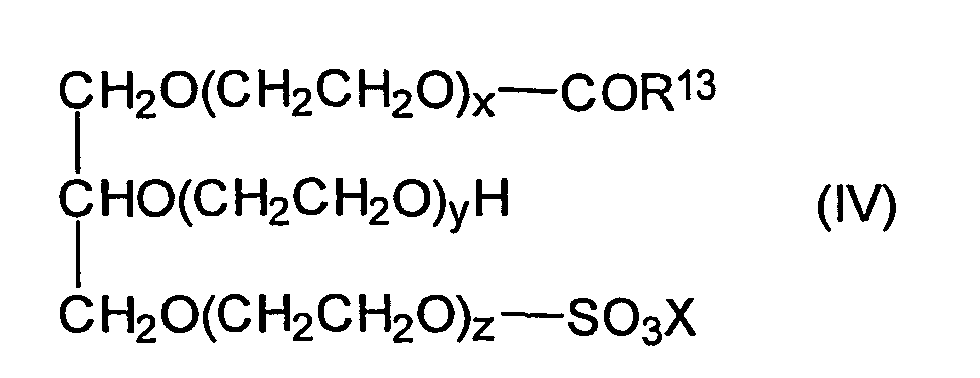
Claims (12)
- Tensidhaltiges Reinigungsmittel, dadurch gekennzeichnet, daß es - bezogen auf sein Gewicht -a) ein Tensidgemisch aus Alkylsulfaten, Alkylethersulfaten und Betainen,b) mindestens ein Protein aus Joghurt undc) einen oder mehrere Stoffe aus der Gruppe der Pflanzenextrakte und/oder Pflanzenmilchen und/oder Vitamine, Provitamine und Vitaminvorstufen sowie deren Derivateim Gewichtsverhältnis, b): c) 10 : 1 bis 1 : 4 enthält,
mit der Maßgabe, dass der Tensidgehalt in dem Mittel - bezogen auf dessen Gewicht - 5 bis 30 Gew.-%, beträgt. - Tensidhaltiges Reinigungsmittel nach Anspruch 1, dadurch gekennzeichnet, daß das Gewichtsverhältnis b) : c) 7 : 1 bis 1 : 3, vorzugsweise 5 : 1 bis 2 : 5, weiter bevorzugt 5 : 1 bis 1 : 2, besonders bevorzugt 4 : 1 bis 2 : 3 und insbesondere 3 : 1 bis 1: 1 beträgt.
- Tensidhaltiges Reinigungsmittel nach einem der Ansprüche 1 oder 2, dadurch gekennzeichnet, daß es einen oder mehrere Pflanzenextrakte aus der Gruppe Aloe-Extrakt, Melonen-Extrakt, Vanille-Extrakt enthält.
- Tensidhaltiges Reinigungsmittel nach einem der Ansprüche 1 bis 3, dadurch gekennzeichnet, daß es eine oder mehrere Pflanzenmilche aus der Gruppe Aloe-Milch, Kokosmilch enthält.
- Tensidhaltiges Reinigungsmittel nach einem der Ansprüche 1 bis 4, dadurch gekennzeichnet, daß es Vitamine, Pro-Vitamine und Vitaminvorstufen enthält, die den Gruppen A, B, C, E, F und H zugeordnet werden.
- Tensidhaltiges Reinigungsmittel nach einem der Ansprüche 1 bis 5, dadurch gekennzeichnet, daß es - bezogen auf sein Gewicht - 0,01 bis 5 Gew.-%, vorzugsweise 0,02 bis 4 Gew.-% und insbesondere 0,05 bis 3 Gew.-% Joghurtprotein(e) enthält.
- Tensidhaltiges Reinigungsmittel nach einem der Ansprüche 1 bis 6, dadurch gekennzeichnet, daß es - bezogen auf sein Gewicht - 0,01 bis 5 Gew.-%, vorzugsweise 0,02 bis 4 Gew.-% und insbesondere 0,05 bis 3 Gew.-% Pflanzenextrakt(e) und/oder Pflanzenmilch(en) und/oder Vitamin(e), Provitamin(e) und Vitaminvorstufe(n) sowie deren Derivate enthält.
- Tensidhaltiges Reinigungsmittel nach einem der Ansprüche 1 bis 7, dadurch gekennzeichnet, daß es als Joghurtprotein(e) κ-Casein und/oder Lactophorin enthält.
- Tensidhaltiges Reinigungsmittel nach einem der Ansprüche 1 bis 8, dadurch gekennzeichnet, daß es - bezogen auf sein Gewicht - vorzugsweise 7 bis 20 und insbesondere 8 bis 14 Gew.-% Tenside, ausgewählt aus der Gruppe der anionischen, amphoteren, zwitterionischen und nichtionischen Tenside sowie Gemischen davon, enthält.
- Tensidhaltiges Reinigungsmittel nach einem dem Ansprüche 1 bis 9, dadurch gekennzeichnet, dass - bezogen auf sein Gewicht - 0,001 bis 6, vorzugsweise 0,01 bis 5 und insbesondere 0,1 bis 3 Gew.-% eines haut- und haarkonditionierenden Mittels enthält.
- Verwendung des tensidhaltigen Reinigungsmittels nach einem der Ansprüche 1 bis 9 zur Glättung der Haut.
- Verwendung des tensidhaltigen Reinigungsmittels nach einem der Ansprüche 1 bis 9 zur Regulierung der Hautfeuchtigkeit.
Priority Applications (1)
| Application Number | Priority Date | Filing Date | Title |
|---|---|---|---|
| PL05816287T PL1838833T3 (pl) | 2005-01-18 | 2005-12-02 | Tenzydonośny środek czyszczący ze specjalnymi proteinami |
Applications Claiming Priority (2)
| Application Number | Priority Date | Filing Date | Title |
|---|---|---|---|
| DE102005002486A DE102005002486A1 (de) | 2005-01-18 | 2005-01-18 | Tensidhaltiges Reinigungsmittel mit speziellen Proteinen |
| PCT/EP2005/012938 WO2006076946A1 (de) | 2005-01-18 | 2005-12-02 | Tensidhaltiges reinigungsmittel mit speziellen proteinen |
Publications (2)
| Publication Number | Publication Date |
|---|---|
| EP1838833A1 EP1838833A1 (de) | 2007-10-03 |
| EP1838833B1 true EP1838833B1 (de) | 2010-09-15 |
Family
ID=35697135
Family Applications (1)
| Application Number | Title | Priority Date | Filing Date |
|---|---|---|---|
| EP05816287A Revoked EP1838833B1 (de) | 2005-01-18 | 2005-12-02 | Tensidhaltiges reinigungsmittel mit speziellen proteinen |
Country Status (8)
| Country | Link |
|---|---|
| US (1) | US20080014167A1 (de) |
| EP (1) | EP1838833B1 (de) |
| AT (1) | ATE481084T1 (de) |
| AU (1) | AU2005325564A1 (de) |
| DE (2) | DE102005002486A1 (de) |
| PL (1) | PL1838833T3 (de) |
| RU (1) | RU2007131366A (de) |
| WO (1) | WO2006076946A1 (de) |
Families Citing this family (11)
| Publication number | Priority date | Publication date | Assignee | Title |
|---|---|---|---|---|
| US20100093599A1 (en) * | 2008-10-10 | 2010-04-15 | Jeffrey Wu | Shine control cleanser |
| ITMI20061650A1 (it) * | 2006-08-29 | 2008-02-29 | Panzeri Diffusion S R L | Preparazione cosmetica estemporanea ad azione protettiva,nutriente e ristrutturante per il trattamento dei capelli e suo uso |
| TR200701489A2 (tr) * | 2007-03-09 | 2008-10-21 | Vai̇zoğlu Orhan | Kozmetik formülasyonlar |
| EP2053119B1 (de) * | 2007-10-26 | 2016-09-07 | The Procter and Gamble Company | Weichspülerzusammensetzungen mit erhöhter Lagerungsstabilität |
| DE102008014760A1 (de) * | 2008-03-18 | 2009-09-24 | Henkel Ag & Co. Kgaa | Imidazolium-Salze als Enzymstabilisatoren |
| DE102008014759A1 (de) * | 2008-03-18 | 2009-09-24 | Henkel Ag & Co. Kgaa | Verwendung von Imidazolium-Salzen in Wasch- und Reinigungsmitteln |
| DE102010063578A1 (de) | 2010-12-20 | 2012-06-21 | Henkel Ag & Co. Kgaa | Kosmetisches Reinigungsmittel |
| DE102011080715A1 (de) * | 2011-08-10 | 2013-02-14 | Henkel Ag & Co. Kgaa | Hautbarrierestärkendes Reinigungsmittel |
| US10400710B2 (en) * | 2013-05-07 | 2019-09-03 | General Electric Company | Secondary nozzle for jet engine |
| DE102015222976A1 (de) * | 2015-11-20 | 2017-05-24 | Henkel Ag & Co. Kgaa | Haarpflegemittel enthaltend Caseinhydrolysat zur Verbesserung der Haarstruktur |
| US20170292393A1 (en) * | 2016-04-08 | 2017-10-12 | United Technologies Corporation | Tangential on-board injectors for gas turbine engines |
Family Cites Families (19)
| Publication number | Priority date | Publication date | Assignee | Title |
|---|---|---|---|---|
| DE2630560A1 (de) * | 1976-07-07 | 1978-01-12 | Bayer Ag | Kosmetische zubereitungen |
| DE3723354A1 (de) * | 1987-07-15 | 1989-01-26 | Henkel Kgaa | Sulfatierte hydroxy-mischether, verfahren zu ihrer herstellung und ihre verwendung |
| DE3725030A1 (de) * | 1987-07-29 | 1989-02-09 | Henkel Kgaa | Oberflaechenaktive hydroxysulfonate |
| DE3926344A1 (de) * | 1989-08-09 | 1991-02-28 | Henkel Kgaa | Verfahren zur herstellung von hellfarbigen oelsaeuresulfonaten |
| DE4038477A1 (de) * | 1990-12-03 | 1992-06-04 | Henkel Kgaa | Verfahren zur kontinuierlichen herstellung von partialglyceridsulfaten |
| DE4038478A1 (de) * | 1990-12-03 | 1992-06-04 | Henkel Kgaa | Verfahren zur herstellung von partialglyceridsulfaten |
| DE4204700A1 (de) * | 1992-02-17 | 1993-08-19 | Henkel Kgaa | Verfahren zur abtrennung anorganischer salze |
| JPH05229915A (ja) * | 1992-02-24 | 1993-09-07 | Kanebo Ltd | 皮膚外用剤 |
| FR2718751B1 (fr) * | 1994-04-15 | 1996-07-12 | World Trust Investment Sa | Préparations à base de lactosérum fermenté et leurs utilisations cosmétiques. |
| DE4413686C2 (de) * | 1994-04-20 | 1996-10-24 | Henkel Kgaa | Kationische Zuckertenside, Verfahren zu ihrer Herstellung und deren Verwendung |
| WO1996003052A1 (en) * | 1994-07-22 | 1996-02-08 | The Good Life Company And Friends Pty Ltd. | Starter culture receptacle and methods using the same |
| DE19736906A1 (de) * | 1997-08-25 | 1999-03-04 | Henkel Kgaa | Verfahren zur Herstellung von sulfatierten Fettsäurealkylenglykolestern |
| DE19738866A1 (de) * | 1997-09-05 | 1999-03-11 | Henkel Kgaa | Schaumarme Tensidmischungen mit Hydroxymischethern |
| FR2770776B1 (fr) * | 1997-11-07 | 2000-03-17 | Lvmh Rech | Utilisations du d-xylose et de ses esters pour ameliorer la fonctionnalite des cellules de l'epiderme |
| DE19927229B4 (de) * | 1999-06-10 | 2004-09-09 | Coty B.V. | Enzymhaltiges Kosmetikum und dessen Verwendung |
| AUPQ878600A0 (en) * | 2000-07-13 | 2000-08-03 | Gropep Pty Ltd | Compositions and methods for the treatment of intact skin |
| DE10042576B4 (de) * | 2000-08-15 | 2004-08-12 | Coty B.V. | Kosmetischer Basiskomplex und dessen Verwendung |
| FR2818547B1 (fr) * | 2000-12-22 | 2006-11-17 | Oreal | Nouveaux derives c-glycosides et utilisation |
| DE60335880D1 (de) * | 2003-12-05 | 2011-03-10 | Kpss Kao Gmbh | Haarkonditionierungs- und Reinigungszusammensetzung |
-
2005
- 2005-01-18 DE DE102005002486A patent/DE102005002486A1/de not_active Withdrawn
- 2005-12-02 RU RU2007131366/15A patent/RU2007131366A/ru not_active Application Discontinuation
- 2005-12-02 AT AT05816287T patent/ATE481084T1/de active
- 2005-12-02 DE DE502005010277T patent/DE502005010277D1/de not_active Expired - Lifetime
- 2005-12-02 WO PCT/EP2005/012938 patent/WO2006076946A1/de not_active Ceased
- 2005-12-02 EP EP05816287A patent/EP1838833B1/de not_active Revoked
- 2005-12-02 PL PL05816287T patent/PL1838833T3/pl unknown
- 2005-12-02 AU AU2005325564A patent/AU2005325564A1/en not_active Abandoned
-
2007
- 2007-07-16 US US11/778,150 patent/US20080014167A1/en not_active Abandoned
Also Published As
| Publication number | Publication date |
|---|---|
| DE502005010277D1 (de) | 2010-10-28 |
| RU2007131366A (ru) | 2009-02-27 |
| AU2005325564A1 (en) | 2006-07-27 |
| EP1838833A1 (de) | 2007-10-03 |
| US20080014167A1 (en) | 2008-01-17 |
| WO2006076946A1 (de) | 2006-07-27 |
| DE102005002486A1 (de) | 2006-07-27 |
| ATE481084T1 (de) | 2010-10-15 |
| PL1838833T3 (pl) | 2011-04-29 |
Similar Documents
| Publication | Publication Date | Title |
|---|---|---|
| EP1594448B1 (de) | Haarbehandlungsmittel mit tensidmischungen | |
| EP2328544B1 (de) | Tensidhaltige zusammensetzung mit spezieller emulgatormischung | |
| DE102005018668A1 (de) | Körperreinigungszusammensetzung mit vermindertem Wassergehalt | |
| US20080014167A1 (en) | Surfactant-containing cleansing composition with special proteins | |
| DE102004024506A1 (de) | Verfahren zur Restrukturierung keratinischer Fasern | |
| EP2459164B1 (de) | Kosmetisches reinigungsmittel | |
| EP3016632B1 (de) | Reinigungszusammensetzung mit hohem fettsäuregehalt | |
| EP2248509A2 (de) | Haar- und kopfhautschonende Shampoos und Conditioner | |
| EP2556823A2 (de) | Hautbarrierestärkendes Reinigungsmittel enthaltend ein auf probiotischen Mikroorganismen-basierendes Ferment | |
| EP1430884B1 (de) | Ölduschbad mit spezieller Tensidkombination | |
| DE102004025287A1 (de) | Haut- und Haarbehandlungsmittel mit verbessertem Leistungsprofil | |
| DE102009045856A1 (de) | Verwendung kationischer Polymere in Haut- und Haarreinigungsmitteln | |
| EP2437853A2 (de) | Tensidhaltiges kosmetisches reinigungsmittel mit gelee royale | |
| EP1634565B1 (de) | Peelingkörper für kosmetische Mittel | |
| DE10309180A1 (de) | Haut- und Haarbehandlungsmittel | |
| DE102010062612A1 (de) | Haarbehandlungsmittel | |
| EP1363586B1 (de) | Verfahren zur dauerhaften verformung keratinischer fasern und mittel | |
| DE102009026899A1 (de) | Kosmetisches Reinigungsmittel mit Deo-Effekt | |
| EP1660622B1 (de) | Mehrphasiges tensidprodukt | |
| DE102009045605A1 (de) | Versprühbares Haarreinigungsmittel | |
| WO2010127918A2 (de) | Kopfhautschonende und kopfhautberuhigende shampoos und conditioner | |
| EP2238966A2 (de) | Kopfhautschonende Shampoos und Conditioner | |
| DE102009028443A1 (de) | Tensidhaltiges kosmetisches Haarreinigungsmittel mit Pentaclethra Macroloba Seed Oil |
Legal Events
| Date | Code | Title | Description |
|---|---|---|---|
| PUAI | Public reference made under article 153(3) epc to a published international application that has entered the european phase |
Free format text: ORIGINAL CODE: 0009012 |
|
| 17P | Request for examination filed |
Effective date: 20070423 |
|
| AK | Designated contracting states |
Kind code of ref document: A1 Designated state(s): AT BE BG CH CY CZ DE DK EE ES FI FR GB GR HU IE IS IT LI LT LU LV MC NL PL PT RO SE SI SK TR |
|
| DAX | Request for extension of the european patent (deleted) | ||
| RAP1 | Party data changed (applicant data changed or rights of an application transferred) |
Owner name: HENKEL AG & CO. KGAA |
|
| 17Q | First examination report despatched |
Effective date: 20080520 |
|
| RIC1 | Information provided on ipc code assigned before grant |
Ipc: C11D 3/384 20060101ALI20100120BHEP Ipc: A61Q 19/10 20060101ALI20100120BHEP Ipc: A61Q 19/00 20060101ALI20100120BHEP Ipc: A61K 8/98 20060101ALI20100120BHEP Ipc: A61K 8/64 20060101ALI20100120BHEP Ipc: A61K 8/67 20060101AFI20100120BHEP |
|
| GRAJ | Information related to disapproval of communication of intention to grant by the applicant or resumption of examination proceedings by the epo deleted |
Free format text: ORIGINAL CODE: EPIDOSDIGR1 |
|
| GRAP | Despatch of communication of intention to grant a patent |
Free format text: ORIGINAL CODE: EPIDOSNIGR1 |
|
| GRAP | Despatch of communication of intention to grant a patent |
Free format text: ORIGINAL CODE: EPIDOSNIGR1 |
|
| RIC1 | Information provided on ipc code assigned before grant |
Ipc: C11D 3/384 20060101ALI20100326BHEP Ipc: A61K 8/64 20060101ALI20100326BHEP Ipc: A61K 8/67 20060101AFI20100326BHEP Ipc: A61Q 19/10 20060101ALI20100326BHEP Ipc: A61Q 19/00 20060101ALI20100326BHEP Ipc: A61K 8/98 20060101ALI20100326BHEP |
|
| GRAS | Grant fee paid |
Free format text: ORIGINAL CODE: EPIDOSNIGR3 |
|
| GRAA | (expected) grant |
Free format text: ORIGINAL CODE: 0009210 |
|
| AK | Designated contracting states |
Kind code of ref document: B1 Designated state(s): AT BE BG CH CY CZ DE DK EE ES FI FR GB GR HU IE IS IT LI LT LU LV MC NL PL PT RO SE SI SK TR |
|
| REG | Reference to a national code |
Ref country code: GB Ref legal event code: FG4D Free format text: NOT ENGLISH Ref country code: CH Ref legal event code: EP |
|
| REG | Reference to a national code |
Ref country code: IE Ref legal event code: FG4D Free format text: LANGUAGE OF EP DOCUMENT: GERMAN |
|
| REF | Corresponds to: |
Ref document number: 502005010277 Country of ref document: DE Date of ref document: 20101028 Kind code of ref document: P |
|
| REG | Reference to a national code |
Ref country code: SE Ref legal event code: TRGR |
|
| REG | Reference to a national code |
Ref country code: NL Ref legal event code: VDEP Effective date: 20100915 |
|
| PG25 | Lapsed in a contracting state [announced via postgrant information from national office to epo] |
Ref country code: FI Free format text: LAPSE BECAUSE OF FAILURE TO SUBMIT A TRANSLATION OF THE DESCRIPTION OR TO PAY THE FEE WITHIN THE PRESCRIBED TIME-LIMIT Effective date: 20100915 Ref country code: LT Free format text: LAPSE BECAUSE OF FAILURE TO SUBMIT A TRANSLATION OF THE DESCRIPTION OR TO PAY THE FEE WITHIN THE PRESCRIBED TIME-LIMIT Effective date: 20100915 |
|
| PGFP | Annual fee paid to national office [announced via postgrant information from national office to epo] |
Ref country code: AT Payment date: 20101129 Year of fee payment: 6 |
|
| LTIE | Lt: invalidation of european patent or patent extension |
Effective date: 20100915 |
|
| PG25 | Lapsed in a contracting state [announced via postgrant information from national office to epo] |
Ref country code: CY Free format text: LAPSE BECAUSE OF FAILURE TO SUBMIT A TRANSLATION OF THE DESCRIPTION OR TO PAY THE FEE WITHIN THE PRESCRIBED TIME-LIMIT Effective date: 20100915 Ref country code: SI Free format text: LAPSE BECAUSE OF FAILURE TO SUBMIT A TRANSLATION OF THE DESCRIPTION OR TO PAY THE FEE WITHIN THE PRESCRIBED TIME-LIMIT Effective date: 20100915 |
|
| PG25 | Lapsed in a contracting state [announced via postgrant information from national office to epo] |
Ref country code: GR Free format text: LAPSE BECAUSE OF FAILURE TO SUBMIT A TRANSLATION OF THE DESCRIPTION OR TO PAY THE FEE WITHIN THE PRESCRIBED TIME-LIMIT Effective date: 20101216 Ref country code: LV Free format text: LAPSE BECAUSE OF FAILURE TO SUBMIT A TRANSLATION OF THE DESCRIPTION OR TO PAY THE FEE WITHIN THE PRESCRIBED TIME-LIMIT Effective date: 20100915 |
|
| PGFP | Annual fee paid to national office [announced via postgrant information from national office to epo] |
Ref country code: GB Payment date: 20101201 Year of fee payment: 6 |
|
| REG | Reference to a national code |
Ref country code: IE Ref legal event code: FD4D |
|
| PG25 | Lapsed in a contracting state [announced via postgrant information from national office to epo] |
Ref country code: IE Free format text: LAPSE BECAUSE OF FAILURE TO SUBMIT A TRANSLATION OF THE DESCRIPTION OR TO PAY THE FEE WITHIN THE PRESCRIBED TIME-LIMIT Effective date: 20100915 |
|
| REG | Reference to a national code |
Ref country code: PL Ref legal event code: T3 |
|
| PG25 | Lapsed in a contracting state [announced via postgrant information from national office to epo] |
Ref country code: CZ Free format text: LAPSE BECAUSE OF FAILURE TO SUBMIT A TRANSLATION OF THE DESCRIPTION OR TO PAY THE FEE WITHIN THE PRESCRIBED TIME-LIMIT Effective date: 20100915 Ref country code: IS Free format text: LAPSE BECAUSE OF FAILURE TO SUBMIT A TRANSLATION OF THE DESCRIPTION OR TO PAY THE FEE WITHIN THE PRESCRIBED TIME-LIMIT Effective date: 20110115 Ref country code: SK Free format text: LAPSE BECAUSE OF FAILURE TO SUBMIT A TRANSLATION OF THE DESCRIPTION OR TO PAY THE FEE WITHIN THE PRESCRIBED TIME-LIMIT Effective date: 20100915 Ref country code: EE Free format text: LAPSE BECAUSE OF FAILURE TO SUBMIT A TRANSLATION OF THE DESCRIPTION OR TO PAY THE FEE WITHIN THE PRESCRIBED TIME-LIMIT Effective date: 20100915 Ref country code: PT Free format text: LAPSE BECAUSE OF FAILURE TO SUBMIT A TRANSLATION OF THE DESCRIPTION OR TO PAY THE FEE WITHIN THE PRESCRIBED TIME-LIMIT Effective date: 20110117 Ref country code: IT Free format text: LAPSE BECAUSE OF FAILURE TO SUBMIT A TRANSLATION OF THE DESCRIPTION OR TO PAY THE FEE WITHIN THE PRESCRIBED TIME-LIMIT Effective date: 20100915 Ref country code: NL Free format text: LAPSE BECAUSE OF FAILURE TO SUBMIT A TRANSLATION OF THE DESCRIPTION OR TO PAY THE FEE WITHIN THE PRESCRIBED TIME-LIMIT Effective date: 20100915 Ref country code: RO Free format text: LAPSE BECAUSE OF FAILURE TO SUBMIT A TRANSLATION OF THE DESCRIPTION OR TO PAY THE FEE WITHIN THE PRESCRIBED TIME-LIMIT Effective date: 20100915 |
|
| PGFP | Annual fee paid to national office [announced via postgrant information from national office to epo] |
Ref country code: DE Payment date: 20101124 Year of fee payment: 6 |
|
| PLBI | Opposition filed |
Free format text: ORIGINAL CODE: 0009260 |
|
| PLBI | Opposition filed |
Free format text: ORIGINAL CODE: 0009260 |
|
| PG25 | Lapsed in a contracting state [announced via postgrant information from national office to epo] |
Ref country code: ES Free format text: LAPSE BECAUSE OF FAILURE TO SUBMIT A TRANSLATION OF THE DESCRIPTION OR TO PAY THE FEE WITHIN THE PRESCRIBED TIME-LIMIT Effective date: 20101226 |
|
| PLAX | Notice of opposition and request to file observation + time limit sent |
Free format text: ORIGINAL CODE: EPIDOSNOBS2 |
|
| 26 | Opposition filed |
Opponent name: KPSS-KAO PROFESSIONAL SALON SERVICES GMBH Effective date: 20110614 |
|
| 26 | Opposition filed |
Opponent name: BEIERSDORF AG Effective date: 20110615 Opponent name: KPSS-KAO PROFESSIONAL SALON SERVICES GMBH Effective date: 20110614 |
|
| PG25 | Lapsed in a contracting state [announced via postgrant information from national office to epo] |
Ref country code: MC Free format text: LAPSE BECAUSE OF NON-PAYMENT OF DUE FEES Effective date: 20101231 |
|
| PG25 | Lapsed in a contracting state [announced via postgrant information from national office to epo] |
Ref country code: DK Free format text: LAPSE BECAUSE OF FAILURE TO SUBMIT A TRANSLATION OF THE DESCRIPTION OR TO PAY THE FEE WITHIN THE PRESCRIBED TIME-LIMIT Effective date: 20100915 |
|
| PGFP | Annual fee paid to national office [announced via postgrant information from national office to epo] |
Ref country code: PL Payment date: 20101117 Year of fee payment: 6 |
|
| REG | Reference to a national code |
Ref country code: DE Ref legal event code: R026 Ref document number: 502005010277 Country of ref document: DE Effective date: 20110614 |
|
| PLAF | Information modified related to communication of a notice of opposition and request to file observations + time limit |
Free format text: ORIGINAL CODE: EPIDOSCOBS2 |
|
| PGFP | Annual fee paid to national office [announced via postgrant information from national office to epo] |
Ref country code: FR Payment date: 20111219 Year of fee payment: 7 Ref country code: CH Payment date: 20111213 Year of fee payment: 7 Ref country code: SE Payment date: 20111213 Year of fee payment: 7 |
|
| PGFP | Annual fee paid to national office [announced via postgrant information from national office to epo] |
Ref country code: BE Payment date: 20111229 Year of fee payment: 7 |
|
| PG25 | Lapsed in a contracting state [announced via postgrant information from national office to epo] |
Ref country code: HU Free format text: LAPSE BECAUSE OF FAILURE TO SUBMIT A TRANSLATION OF THE DESCRIPTION OR TO PAY THE FEE WITHIN THE PRESCRIBED TIME-LIMIT Effective date: 20110316 Ref country code: LU Free format text: LAPSE BECAUSE OF NON-PAYMENT OF DUE FEES Effective date: 20101202 Ref country code: BG Free format text: LAPSE BECAUSE OF FAILURE TO SUBMIT A TRANSLATION OF THE DESCRIPTION OR TO PAY THE FEE WITHIN THE PRESCRIBED TIME-LIMIT Effective date: 20100915 |
|
| RDAF | Communication despatched that patent is revoked |
Free format text: ORIGINAL CODE: EPIDOSNREV1 |
|
| REG | Reference to a national code |
Ref country code: DE Ref legal event code: R103 Ref document number: 502005010277 Country of ref document: DE Ref country code: DE Ref legal event code: R064 Ref document number: 502005010277 Country of ref document: DE |
|
| PGFP | Annual fee paid to national office [announced via postgrant information from national office to epo] |
Ref country code: TR Payment date: 20101202 Year of fee payment: 6 |
|
| RDAG | Patent revoked |
Free format text: ORIGINAL CODE: 0009271 |
|
| STAA | Information on the status of an ep patent application or granted ep patent |
Free format text: STATUS: PATENT REVOKED |
|
| REG | Reference to a national code |
Ref country code: CH Ref legal event code: PL |
|
| 27W | Patent revoked |
Effective date: 20130124 |
|
| GBPR | Gb: patent revoked under art. 102 of the ep convention designating the uk as contracting state |
Effective date: 20130124 |
|
| REG | Reference to a national code |
Ref country code: DE Ref legal event code: R107 Ref document number: 502005010277 Country of ref document: DE Effective date: 20130725 |
|
| PG25 | Lapsed in a contracting state [announced via postgrant information from national office to epo] |
Ref country code: LI Free format text: LAPSE BECAUSE OF THE APPLICANT RENOUNCES Effective date: 20100915 Ref country code: CH Free format text: LAPSE BECAUSE OF THE APPLICANT RENOUNCES Effective date: 20100915 |
|
| REG | Reference to a national code |
Ref country code: AT Ref legal event code: MM01 Ref document number: 481084 Country of ref document: AT Kind code of ref document: T Effective date: 20121202 |
|
| PG25 | Lapsed in a contracting state [announced via postgrant information from national office to epo] |
Ref country code: BG Free format text: LAPSE BECAUSE OF FAILURE TO SUBMIT A TRANSLATION OF THE DESCRIPTION OR TO PAY THE FEE WITHIN THE PRESCRIBED TIME-LIMIT Effective date: 20101215 |
|
| REG | Reference to a national code |
Ref country code: AT Ref legal event code: MA03 Ref document number: 481084 Country of ref document: AT Kind code of ref document: T Effective date: 20130124 |
|
| REG | Reference to a national code |
Ref country code: SE Ref legal event code: ECNC |
|
| REG | Reference to a national code |
Ref country code: SE Ref legal event code: ECNC |
|
| REG | Reference to a national code |
Ref country code: SE Ref legal event code: ECNC |