EP1832881A2 - Acceleration estimation device and vehicle with such a device - Google Patents
Acceleration estimation device and vehicle with such a device Download PDFInfo
- Publication number
- EP1832881A2 EP1832881A2 EP07004453A EP07004453A EP1832881A2 EP 1832881 A2 EP1832881 A2 EP 1832881A2 EP 07004453 A EP07004453 A EP 07004453A EP 07004453 A EP07004453 A EP 07004453A EP 1832881 A2 EP1832881 A2 EP 1832881A2
- Authority
- EP
- European Patent Office
- Prior art keywords
- acceleration
- vehicle
- offset
- acceleration sensor
- pitch angle
- Prior art date
- Legal status (The legal status is an assumption and is not a legal conclusion. Google has not performed a legal analysis and makes no representation as to the accuracy of the status listed.)
- Withdrawn
Links
Images



Classifications
-
- G—PHYSICS
- G01—MEASURING; TESTING
- G01P—MEASURING LINEAR OR ANGULAR SPEED, ACCELERATION, DECELERATION, OR SHOCK; INDICATING PRESENCE, ABSENCE, OR DIRECTION, OF MOVEMENT
- G01P15/00—Measuring acceleration; Measuring deceleration; Measuring shock, i.e. sudden change of acceleration
- G01P15/18—Measuring acceleration; Measuring deceleration; Measuring shock, i.e. sudden change of acceleration in two or more dimensions
-
- B—PERFORMING OPERATIONS; TRANSPORTING
- B60—VEHICLES IN GENERAL
- B60G—VEHICLE SUSPENSION ARRANGEMENTS
- B60G17/00—Resilient suspensions having means for adjusting the spring or vibration-damper characteristics, for regulating the distance between a supporting surface and a sprung part of vehicle or for locking suspension during use to meet varying vehicular or surface conditions, e.g. due to speed or load
- B60G17/015—Resilient suspensions having means for adjusting the spring or vibration-damper characteristics, for regulating the distance between a supporting surface and a sprung part of vehicle or for locking suspension during use to meet varying vehicular or surface conditions, e.g. due to speed or load the regulating means comprising electric or electronic elements
- B60G17/016—Resilient suspensions having means for adjusting the spring or vibration-damper characteristics, for regulating the distance between a supporting surface and a sprung part of vehicle or for locking suspension during use to meet varying vehicular or surface conditions, e.g. due to speed or load the regulating means comprising electric or electronic elements characterised by their responsiveness, when the vehicle is travelling, to specific motion, a specific condition, or driver input
- B60G17/0164—Resilient suspensions having means for adjusting the spring or vibration-damper characteristics, for regulating the distance between a supporting surface and a sprung part of vehicle or for locking suspension during use to meet varying vehicular or surface conditions, e.g. due to speed or load the regulating means comprising electric or electronic elements characterised by their responsiveness, when the vehicle is travelling, to specific motion, a specific condition, or driver input mainly during accelerating or braking
-
- B—PERFORMING OPERATIONS; TRANSPORTING
- B60—VEHICLES IN GENERAL
- B60G—VEHICLE SUSPENSION ARRANGEMENTS
- B60G17/00—Resilient suspensions having means for adjusting the spring or vibration-damper characteristics, for regulating the distance between a supporting surface and a sprung part of vehicle or for locking suspension during use to meet varying vehicular or surface conditions, e.g. due to speed or load
- B60G17/015—Resilient suspensions having means for adjusting the spring or vibration-damper characteristics, for regulating the distance between a supporting surface and a sprung part of vehicle or for locking suspension during use to meet varying vehicular or surface conditions, e.g. due to speed or load the regulating means comprising electric or electronic elements
- B60G17/019—Resilient suspensions having means for adjusting the spring or vibration-damper characteristics, for regulating the distance between a supporting surface and a sprung part of vehicle or for locking suspension during use to meet varying vehicular or surface conditions, e.g. due to speed or load the regulating means comprising electric or electronic elements characterised by the type of sensor or the arrangement thereof
- B60G17/01908—Acceleration or inclination sensors
-
- B—PERFORMING OPERATIONS; TRANSPORTING
- B60—VEHICLES IN GENERAL
- B60T—VEHICLE BRAKE CONTROL SYSTEMS OR PARTS THEREOF; BRAKE CONTROL SYSTEMS OR PARTS THEREOF, IN GENERAL; ARRANGEMENT OF BRAKING ELEMENTS ON VEHICLES IN GENERAL; PORTABLE DEVICES FOR PREVENTING UNWANTED MOVEMENT OF VEHICLES; VEHICLE MODIFICATIONS TO FACILITATE COOLING OF BRAKES
- B60T8/00—Arrangements for adjusting wheel-braking force to meet varying vehicular or ground-surface conditions, e.g. limiting or varying distribution of braking force
- B60T8/17—Using electrical or electronic regulation means to control braking
- B60T8/1701—Braking or traction control means specially adapted for particular types of vehicles
- B60T8/1706—Braking or traction control means specially adapted for particular types of vehicles for single-track vehicles, e.g. motorcycles
-
- B—PERFORMING OPERATIONS; TRANSPORTING
- B60—VEHICLES IN GENERAL
- B60T—VEHICLE BRAKE CONTROL SYSTEMS OR PARTS THEREOF; BRAKE CONTROL SYSTEMS OR PARTS THEREOF, IN GENERAL; ARRANGEMENT OF BRAKING ELEMENTS ON VEHICLES IN GENERAL; PORTABLE DEVICES FOR PREVENTING UNWANTED MOVEMENT OF VEHICLES; VEHICLE MODIFICATIONS TO FACILITATE COOLING OF BRAKES
- B60T8/00—Arrangements for adjusting wheel-braking force to meet varying vehicular or ground-surface conditions, e.g. limiting or varying distribution of braking force
- B60T8/17—Using electrical or electronic regulation means to control braking
- B60T8/172—Determining control parameters used in the regulation, e.g. by calculations involving measured or detected parameters
-
- G—PHYSICS
- G01—MEASURING; TESTING
- G01P—MEASURING LINEAR OR ANGULAR SPEED, ACCELERATION, DECELERATION, OR SHOCK; INDICATING PRESENCE, ABSENCE, OR DIRECTION, OF MOVEMENT
- G01P15/00—Measuring acceleration; Measuring deceleration; Measuring shock, i.e. sudden change of acceleration
-
- B—PERFORMING OPERATIONS; TRANSPORTING
- B60—VEHICLES IN GENERAL
- B60G—VEHICLE SUSPENSION ARRANGEMENTS
- B60G2300/00—Indexing codes relating to the type of vehicle
- B60G2300/12—Cycles; Motorcycles
-
- B—PERFORMING OPERATIONS; TRANSPORTING
- B60—VEHICLES IN GENERAL
- B60G—VEHICLE SUSPENSION ARRANGEMENTS
- B60G2400/00—Indexing codes relating to detected, measured or calculated conditions or factors
- B60G2400/10—Acceleration; Deceleration
- B60G2400/102—Acceleration; Deceleration vertical
-
- B—PERFORMING OPERATIONS; TRANSPORTING
- B60—VEHICLES IN GENERAL
- B60G—VEHICLE SUSPENSION ARRANGEMENTS
- B60G2400/00—Indexing codes relating to detected, measured or calculated conditions or factors
- B60G2400/10—Acceleration; Deceleration
- B60G2400/106—Acceleration; Deceleration longitudinal with regard to vehicle, e.g. braking
-
- B—PERFORMING OPERATIONS; TRANSPORTING
- B60—VEHICLES IN GENERAL
- B60G—VEHICLE SUSPENSION ARRANGEMENTS
- B60G2400/00—Indexing codes relating to detected, measured or calculated conditions or factors
- B60G2400/20—Speed
- B60G2400/204—Vehicle speed
-
- B—PERFORMING OPERATIONS; TRANSPORTING
- B60—VEHICLES IN GENERAL
- B60G—VEHICLE SUSPENSION ARRANGEMENTS
- B60G2400/00—Indexing codes relating to detected, measured or calculated conditions or factors
- B60G2400/20—Speed
- B60G2400/208—Speed of wheel rotation
-
- B—PERFORMING OPERATIONS; TRANSPORTING
- B60—VEHICLES IN GENERAL
- B60G—VEHICLE SUSPENSION ARRANGEMENTS
- B60G2600/00—Indexing codes relating to particular elements, systems or processes used on suspension systems or suspension control systems
- B60G2600/18—Automatic control means
- B60G2600/187—Digital Controller Details and Signal Treatment
- B60G2600/1871—Optimal control; Kalman Filters
-
- B—PERFORMING OPERATIONS; TRANSPORTING
- B60—VEHICLES IN GENERAL
- B60G—VEHICLE SUSPENSION ARRANGEMENTS
- B60G2800/00—Indexing codes relating to the type of movement or to the condition of the vehicle and to the end result to be achieved by the control action
- B60G2800/70—Estimating or calculating vehicle parameters or state variables
- B60G2800/702—Improving accuracy of a sensor signal
Definitions
- the present invention relates to an acceleration estimation device that estimates vehicle acceleration, and a vehicle including the same.
- the traveling speed of a vehicle can be calculated on the basis of the rotational speeds of its wheels.
- the wheels When the vehicle is rapidly accelerated, however, the wheels may be rotated while slipping on a road surface. When the vehicle is rapidly decelerated (braked), the wheels may be caused to slide on the road surface. In such a case, the speed of the vehicle that can be calculated from the rotational speed of the wheels does not coincide with the actual traveling speed of the vehicle.
- the acceleration of the vehicle is detected using an acceleration sensor, and the detected acceleration is integrated to calculate the speed of the vehicle.
- the vehicle body When the vehicle is rapidly accelerated or decelerated, however, the vehicle body is inclined up and down in a traveling direction by pitching of the vehicle body. That is, the front of the vehicle body rises at the time of the rapid acceleration, and lowers at the time of the rapid deceleration.
- the forward-and-backward acceleration of the vehicle that is detected by the acceleration sensor does not accurately coincide with an acceleration in a traveling direction of the vehicle.
- JP 10-104259 A discloses a vehicle longitudinal acceleration estimating device that removes an unnecessary component of an acceleration sensor for detecting a longitudinal acceleration to calculate an estimated value of the longitudinal acceleration.
- the change in an output voltage of the acceleration sensor is frequency-analyzed and is classified into changes due to DC offset, changes due to temperature drift, changes due to road conditions, changes due to acceleration/deceleration of the vehicle, and changes due to pitching of the vehicle body.
- a Karman filter is used to extract only a variable component having a higher frequency than a particular frequency from a detected value of the longitudinal acceleration by the acceleration sensor.
- JP 8-268257 A discloses an actual speed estimator that estimates an actual vehicle speed of a vehicle.
- a coefficient of rolling rigidity and a coefficient of pitching rigidity are defined to correct an output of a crosswise acceleration sensor and an output of a lengthwise acceleration sensor using the coefficient of rolling rigidity and the coefficient of pitching rigidity.
- preferred embodiments of the present invention provide an acceleration estimation device that can accurately estimate an acceleration in a traveling direction of a vehicle, and a vehicle including the same.
- an acceleration estimation device for estimating accelerations of a vehicle includes a first acceleration sensor that is provided in the vehicle and detects the acceleration in the forward-and-backward direction of the vehicle; a second acceleration sensor that is provided in the vehicle and detects the acceleration in the up-and-down direction of the vehicle; a pitch angle estimator that estimates the pitch angle of the vehicle on the basis of the relationship between a detected value in the first acceleration sensor and a detected value in the second acceleration sensor; and an acceleration calculator that calculates the acceleration in a traveling direction of the vehicle that is perpendicular or substantially perpendicular to a direction of gravity, on the basis of an estimated value of the pitch angle obtained by the pitch angle estimator, the detected value in the first acceleration sensor, and the detected value in the second acceleration sensor.
- the first acceleration sensor and the second acceleration sensor are provided in the vehicle.
- the first acceleration sensor detects the acceleration in the forward-and-backward direction of the vehicle
- the second acceleration sensor detects the acceleration in the up-and-down direction of the vehicle.
- the pitch angle estimator estimates the pitch angle of the vehicle on the basis of the relationship between the detected value in the first acceleration sensor and the detected value in the second acceleration sensor.
- the acceleration in the traveling direction of the vehicle is calculated on the basis of the estimated value of the pitch angle, the detected value in the first acceleration sensor, and the detected value in the second acceleration sensor.
- the pitch angle due to arbitrary pitching of the vehicle can be estimated with high accuracy. This allows the acceleration in the traveling direction of the vehicle to be detected with high accuracy.
- the acceleration estimation device may further include a speed calculator that integrates a calculated value of the acceleration in the traveling direction obtained by the acceleration calculator, to calculate a speed in the traveling direction.
- the speed in the traveling direction of the vehicle can be detected with high accuracy.
- the pitch angle estimator may include a first Karman filter that estimates the pitch angle of the vehicle using the relationship among the acceleration in the traveling direction of the vehicle that is perpendicular or substantially perpendicular to the direction of gravity, the acceleration in a vertical direction parallel or substantially parallel to the direction of gravity, the detected value in the first acceleration sensor, and the detected value in the second acceleration sensor, and the pitch angle of the vehicle.
- the first Karman filter estimates the pitch angle of the vehicle. Even when the detected value of the acceleration in the forward-and-backward direction and the detected value of the acceleration in the up-and-down direction of the vehicle are affected by gravity due to pitching having an arbitrary frequency, it is possible to detect the pitch angle of the vehicle with high accuracy.
- the acceleration estimation device may further include an offset estimator that estimates offset in the first acceleration sensor and offset in the second acceleration sensor when the vehicle is at a substantially constant speed, and a corrector that corrects the detected value in the first acceleration sensor and the detected value in the second acceleration sensor on the basis of an estimated value of the offset in the first acceleration sensor and an estimated value of the offset in the second acceleration sensor that are obtained by the offset estimator when the vehicle is accelerated or decelerated, and the pitch angle estimator may estimate the pitch angle of the vehicle on the basis of the relationship between the detected value in the first acceleration sensor and the detected value in the second acceleration sensor that are corrected by the corrector when the vehicle is accelerated or decelerated.
- an offset estimator that estimates offset in the first acceleration sensor and offset in the second acceleration sensor when the vehicle is at a substantially constant speed
- a corrector that corrects the detected value in the first acceleration sensor and the detected value in the second acceleration sensor on the basis of an estimated value of the offset in the first acceleration sensor and an estimated value of the offset in the second acceleration sensor that are obtained by
- the time when the vehicle is at a substantially constant speed refers to the time when the vehicle is stopped and the time when the rate of change in the traveling speed of the vehicle is not more than a predetermined threshold value.
- the threshold value is in a range of about -0.2 m/s 2 to about +0.2 m/s 2 , for example.
- the offset estimator estimates the offset in the first acceleration sensor and the offset in the second acceleration sensor.
- the offset in the first acceleration sensor and the offset in the second acceleration sensor preferably are not changed in a short time period.
- the corrector corrects the detected value in the first acceleration sensor and the detected value in the second acceleration sensor on the basis of the estimated value of the offset in the first acceleration sensor and the estimated value of the offset in the second acceleration sensor that are obtained when the vehicle is at a substantially constant speed.
- the pitch angle of the vehicle is estimated on the basis of the detected value in the first acceleration sensor and the detected value in the second acceleration sensor that are corrected. This allows the pitch angle of the vehicle to be detected with higher accuracy.
- the acceleration estimation device may further include a wheel speed detector that detects a wheel speed of the vehicle
- the offset estimator may include a second Karman filter that estimates the offset in the first acceleration sensor and the offset in the second acceleration sensor using the relationship among the acceleration in the traveling direction, the acceleration in the vertical direction, the detected value in the first acceleration sensor, the detected value in the second acceleration sensor, the speed in the traveling direction, the speed in the vertical direction, the speed of the vehicle obtained from the detected value in the wheel speed detector, and the pitch angle of the vehicle.
- the second Karman filter estimates the offset in the first acceleration sensor and the offset in the second acceleration sensor. Even when the detected value of the acceleration in the forward-and-backward direction and the detected value of the acceleration in the up-and-down direction are affected by gravity due to pitching having an arbitrary frequency, therefore, it is possible to more accurately estimate the offset in the first acceleration sensor and the offset in the second acceleration sensor. As a result, the pitch angle of the vehicle can be detected with higher accuracy.
- An observed disturbance applied to the first acceleration sensor and the second acceleration sensor is removed in the second Karman filter. This prevents a control system controlled on the basis of the acceleration in the traveling direction of the vehicle from being unstable due to the observed disturbance.
- the offset estimator may determine that the vehicle is in a substantially constant speed state when the rate of change in the wheel speed detected by the wheel speed detector is not more than a predetermined threshold value, and the pitch angle estimator may determine that the vehicle is accelerated or decelerated when the rate of change in the wheel speed detected by the wheel speed detector is higher than the threshold value.
- the offset estimator estimates the offset in the first acceleration sensor and the offset in the second acceleration sensor. Further, it is determined that the vehicle is accelerated or decelerated when the rate of change in the wheel speed is higher than the threshold value.
- the pitch angle estimator estimates the pitch angle of the vehicle.
- the offset in the first acceleration sensor and the offset in the second acceleration sensor can be detected with high accuracy.
- the pitch angle of the vehicle can be detected with higher accuracy when the vehicle is accelerated or decelerated.
- a vehicle includes a vehicle body, a wheel provided on the vehicle body, an acceleration estimation device that is provided on the vehicle body, and a controller, wherein the acceleration estimation device includes a first acceleration sensor that is provided on the vehicle and detects the acceleration in the forward-and-backward direction of the vehicle; a second acceleration sensor that is provided on the vehicle and detects the acceleration in the up-and-down direction of the vehicle; a pitch angle estimator that estimates the pitch angle of the vehicle on the basis of the relationship between a detected value in the first acceleration sensor and a detected value in the second acceleration sensor; and an acceleration calculator that calculates the acceleration in a traveling direction of the vehicle that is perpendicular or substantially perpendicular to a direction of gravity on the basis of an estimated value of the pitch angle obtained by the pitch angle estimator, the detected value in the first acceleration sensor, and the detected value in the second acceleration sensor, the controller controls the rotation of the wheel on the basis of the acceleration in the traveling direction obtained by the acceleration estimation device.
- the acceleration estimation device includes a first acceleration sensor that is provided on
- the acceleration estimation device estimates the pitch angle of the vehicle on the basis of the relationship between the detected value in the first acceleration sensor and the detected value in the second acceleration sensor.
- the acceleration in the traveling direction of the vehicle is calculated on the basis of the estimated value of the pitch angle, the detected value in the first acceleration sensor, and the detected value in the second acceleration sensor. This allows the acceleration in the traveling direction of the vehicle to be detected with high accuracy.
- the controller controls the rotation of the wheel on the basis of the acceleration in the traveling direction of the vehicle that is obtained by the acceleration estimation device.
- the pitch angle estimator estimates the pitch angle of the vehicle on the basis of the relationship between the detected value in the first acceleration sensor and the detected value in the second acceleration sensor.
- the acceleration in the traveling direction of the vehicle is calculated on the basis of the estimated value of the pitch angle, the detected value in the first acceleration sensor, and the detected value in the second acceleration sensor.
- the pitch angle due to arbitrary pitching of the vehicle can be estimated with high accuracy. This allows the acceleration in the traveling direction of the vehicle to be detected with high accuracy.
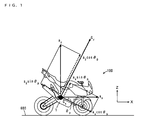
- Fig. 1 is a diagram showing the relationship of accelerations received by an acceleration sensor at the time of deceleration.
- Fig. 2 is a diagram showing the schematic configuration of the overall motorcycle according to a preferred embodiment of the present invention.
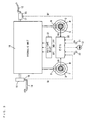
- Fig. 3 is a schematic view showing a hydraulic system and an electrical system of an ABS.
- Fig. 4 is a block diagram showing the configuration of a vehicle speed estimator.
- Fig. 5 is a diagram for explaining the relationship between an operation of estimating x-direction acceleration offset and z-direction acceleration offset in the vehicle speed estimator and the change in wheel speed.
- Fig. 6 is a flow chart showing the operations of the vehicle speed estimator.
- Fig. 7 is a block diagram showing the configuration of an ABS signal processor.
- Fig. 8 is a diagram showing the relationship between an acceleration offset true value and an acceleration offset estimated error.
- Fig. 9 is a diagram showing the change with time of an acceleration offset estimated value in the process of estimating acceleration offset.
- Fig. 10 is a diagram showing the results of estimation of X-direction acceleration.
- Fig. 11 is a diagram showing the results of estimation of a vehicle speed.
- Fig. 1 is a diagram showing the relationship of accelerations received by an acceleration sensor at the time of deceleration.
- a motorcycle 100 when a motorcycle 100 is decelerated by a front-wheel brake, a front suspension contracts, and a rear suspension expands. Therefore, the motorcycle 100 is inclined forward in its traveling direction.
- a coordinate system fixed to the ground below the motorcycle 100 is taken as a ground coordinate system, and a coordinate system fixed to the acceleration sensor attached to the motorcycle 100 is taken as a sensor coordinate system.
- a traveling direction of the motorcycle 100 (a direction perpendicular or substantially perpendicular to gravity) on a horizontal ground surface 600 is defined as an X-direction
- a vertical direction (a direction of gravity) is defined as a Z-direction. Consequently, the X-direction and the Z-direction on the ground coordinate system are not changed irrespective of the posture of the motorcycle 100.
- a direction of the horizontal axis of the motorcycle 100 (a forward-and-backward direction of a vehicle body 1) in a case where the motorcycle 100 is in a horizontal state is defined as an x-direction
- a direction perpendicular or substantially perpendicular to the horizontal axis of the motorcycle 100 (an up-and-down direction of the vehicle body 1) is defined as a z-direction. Consequently, the x-direction and the z-direction on the sensor coordinate system are inclined to the X-direction and the Z-direction on the ground coordinate system by the posture of the motorcycle 100.
- the X-direction on the ground coordinate system is merely referred to as an X-direction or a traveling direction
- the Z-direction on the ground coordinate system is referred to as a Z-direction or a vertical direction.
- an acceleration G x in the x-direction and an acceleration G z in the z-direction on the sensor coordinate system are respectively expressed by the following equations using an acceleration a x in the X-direction and an acceleration a z in the Z-direction on the ground coordinate system:
- G x a x ⁇ cos ⁇ p - a z ⁇ sin ⁇ p
- G z a x ⁇ sin ⁇ p + a z ⁇ cos ⁇ p
- ⁇ P denotes the pitch angle of the vehicle body 1.
- the motorcycle 100 in the present preferred embodiment is provided with an x-direction acceleration sensor for detecting the acceleration G x in the x-direction of the vehicle body 1 and a z-direction acceleration sensor for detecting the acceleration G z in the z-direction.
- the acceleration a x in the X-direction and the acceleration a z in the Z-direction on the ground coordinate system of the motorcycle 100 can be measured by detecting the acceleration G x in the x-direction using the x-direction acceleration sensor, detecting the acceleration G z in the z-direction using the z-direction acceleration sensor, and determining the pitch angle ⁇ P .
- the offset in the acceleration sensor refers to a value obtained by expressing a difference between a nominal value of an output voltage of the acceleration sensor at an acceleration of 0 m/s 2 and a value of an actual output voltage of the acceleration sensor in terms of unit of acceleration (m/s 2 ).
- offset in the x-direction acceleration sensor is referred to as x-direction acceleration offset
- offset in the z-direction acceleration sensor is referred to as z-direction acceleration offset
- the x-direction acceleration offset and the z-direction acceleration offset are estimated using an extended Karman filter, described later, when the motorcycle 100 is at a substantially constant speed.
- the time when the motorcycle 100 is at a substantially constant speed includes the time when the motorcycle 100 is stopped and the time when the rate of change in the traveling speed of the motorcycle 100 is not more than a predetermined threshold value.
- the time when the motorcycle 100 is traveling at a constant speed and the time when the rate of change in the traveling speed is not more than a threshold value are merely referred to as the time when the motorcycle 100 is traveling at a constant speed.
- the acceleration G x in the x-direction and the acceleration G z in the z-direction are corrected on the basis of respective estimated values of the x-direction acceleration offset and the z-direction acceleration offset, and the pitch angle ⁇ P of the vehicle body 1 is estimated on the basis of respective corrected values of the acceleration G x in the x-direction and the acceleration G z in the z-direction.
- the acceleration in the X-direction and the acceleration in the Z-direction of the motorcycle 100 are calculated using an estimated value of the pitch angle ⁇ P .
- the acceleration in the X-direction is integrated to calculate the speed in the X-direction of the motorcycle 100.
- Fig. 2 is a diagram showing the schematic configuration of the motorcycle 100 according to the present preferred embodiment.
- An ABS (Anti-Lock Brake System), described later, is preferably included in the motorcycle 100.
- a front wheel 2 is attached to the front of the vehicle body 1 of the motorcycle 100, and a rear wheel 3 is attached to the rear of the vehicle body 1.
- a sensor rotor 4 that rotates with the front wheel 2 is provided at the center of the front wheel 2.
- a front-wheel speed sensor 5 for detecting the rotational speed of the front wheel 2 is attached to the sensor rotor 4. Further, there is provided a front brake caliper 6 that is brought into contact with a brake disk of the front wheel 2 for braking the front wheel 2.
- a sensor rotor 7 that rotates with the rear wheel 3 is provided at the center of the rear wheel 3.
- a rear-wheel speed sensor 8 for detecting the rotational speed of the rear wheel 3 is attached to the sensor rotor 7. Further, there is provided a rear brake caliper 9 that is brought into contact with a brake disk of the rear wheel 3 for braking the rear wheel 3.
- a handle 11 is arranged so as to be swingable right and left at the top on the front side of the vehicle body 1.
- the handle 11 is provided with a front brake lever 12 and a warning lamp 13.
- a hydraulic unit 10 is provided at the center of the vehicle body 1.
- a rear brake pedal 14 is provided below the center of the vehicle body 1.
- An x-direction acceleration sensor 21 and a z-direction acceleration sensor 22 are attached to a position at the center of gravity of the vehicle body 1.
- a two-axis acceleration sensor or a three-axis acceleration sensor for use in detection of inclination, an impact of air bags, a drop of hard disks, etc. can be used.
- ECU electronice control unit
- fail-safe relay 31 are provided at the rear of the vehicle body 1.
- Fig. 3 is a schematic view showing a hydraulic system and an electrical system of the ABS.
- a master cylinder 15 is connected to the front brake lever 12, and the master cylinder 15 is connected to the hydraulic unit 10.
- the master cylinder 15 is provided with a brake switch 17.
- a master cylinder 16 is connected to the rear brake pedal 14, and the master cylinder 16 is connected to the hydraulic unit 10.
- the master cylinder 16 is provided with a brake switch 18.
- the master cylinder 15 raises the pressure of hydraulic fluid supplied to the front brake caliper 6 from the hydraulic unit 10. This causes the front brake caliper 6 to be driven to brake the front wheel 2.
- the brake switch 17 is turned on so that a front-wheel brake signal Bf is fed to the ECU 30.
- the master cylinder 16 raises the pressure of hydraulic fluid supplied to the rear brake caliper 9 from the hydraulic unit 10. This causes the rear brake caliper 9 to be driven to brake the rear wheel 3.
- the brake switch 18 is turned on so that a rear-wheel brake signal Br is fed to the ECU 30.
- a front-wheel speed signal Rf representing the rotational speed of the front wheel 2 is fed to the ECU 30 from the front-wheel speed sensor 5 provided in the sensor rotor 4 in the front wheel 2.
- a rear-wheel speed signal Rr representing the rotational speed of the rear wheel 3 is fed to the ECU 30 from the rear-wheel speed sensor 8 provided in the sensor rotor 7 in the rear wheel 3.
- the rotational speed of the front wheel 2 is referred to as a front wheel speed
- the rotational speed of the rear wheel 3 is referred to as a rear wheel speed.
- An x-direction acceleration signal Ax representing x-direction acceleration is fed to the ECU 30 from the x-direction acceleration sensor 21.
- a z-direction acceleration signal Az representing z-direction acceleration is fed to the ECU 30 from the z-direction acceleration sensor 22.
- the ECU 30 outputs a motor driving signal MD for driving a motor for a hydraulic pump within the hydraulic unit 10 to the hydraulic unit 10 through the fail-safe relay 31 in response to the front-wheel brake signal Bf or the rear-wheel brake signal Br.
- the ECU 30 outputs a reduced pressure signal FP for the front wheels and a reduced pressure signal RP for the rear wheels to the hydraulic unit 10 through the fail-safe relay 31 on the basis of the front-wheel speed signal Rf, the rear-wheel speed signal Rr, the x-direction acceleration signal Ax, and the z-direction acceleration signal Az.
- the hydraulic unit 10 reduces the pressure of hydraulic fluid supplied to the front brake caliper 6 in response to the reduced pressure signal FP. This causes the braking of the front wheel 2 by the front brake caliper 6 to be released. Further, the motorcycle 100 reduces the pressure of hydraulic fluid supplied to the rear brake caliper 9 in response to the reduced pressure signal RP. This causes the braking of the rear wheel 3 by the rear brake caliper 9 to be released.
- the fail-safe relay 31 switches the operation of the ABS in the hydraulic unit 10 into a normal braking operation when the ABS fails.
- the warning lamp 13 lights up.
- Fig. 4 is a block diagram showing the configuration of a vehicle speed estimator.
- the acceleration estimation device is preferably used for a vehicle speed estimator 300 shown in Fig. 4.
- the vehicle speed estimator 300 includes a speed selector 310, a filter selector 320, a Karman filter 330 for constant speed, a Karman filter 340 for acceleration/deceleration, an offset storage 350, an offset corrector 360, an acceleration corrector 370, and a vehicle speed operation unit 380.
- Each of the constituent elements within the vehicle speed estimator 300 is preferably provided in the ECU 30 shown in Figs. 2 and 3 with an associated program function.
- the front-wheel speed signal Rf and the rear-wheel speed signal Rr are respectively fed to the speed selector 310 from the front-wheel speed sensor 5 and the rear-wheel speed sensor 8, and the x-direction acceleration signal Ax is fed thereto from the x-direction acceleration sensor 21.
- the speed selector 310 selects the front-wheel speed signal Rf as a vehicle speed when the motorcycle 100 is at a substantially constant speed (is stopped and is traveling at constant speed).
- the front wheel speed and the rear wheel speed are compared with each other on the basis of the front-wheel speed signal Rf and the rear-wheel speed signal Rr, to select the smaller one of the front wheel speed and the rear wheel speed as a vehicle speed at the time of the acceleration, while selecting the larger one of the front wheel speed and the rear wheel speed as a vehicle speed at the time of the deceleration.
- a substantially constant speed state or an accelerated/decelerated state is determined on the basis of the rate of change in the vehicle speed selected at the time of the determination.
- the vehicle speed selected by the speed selector 310 is outputted to the vehicle speed operation unit 380.
- the vehicle speed is provided to the Karman filter 330 from the speed selector 310, and the x-direction acceleration signal Ax and the z-direction acceleration signal Az are respectively fed from the x-direction acceleration sensor 21 and the z-direction acceleration sensor 22.
- the Karman filter 330 estimates the x-direction acceleration offset and the z-direction acceleration offset in a method, described later, when the motorcycle 100 is at a substantially constant speed (is stopped and is traveling at a constant speed), to obtain an x-direction acceleration offset estimated value and a z-direction acceleration offset estimated value.
- the offset storage 350 stores the x-direction acceleration offset estimated value and the z-direction acceleration offset estimated value that are obtained by the Karman filter 330.
- the x-direction acceleration signal Ax and the z-direction acceleration signal Az are respectively fed to the offset corrector 360 from the x-direction acceleration sensor 21 and the z-direction acceleration sensor 22, and the x-direction acceleration offset estimated value and the z-direction acceleration offset estimated value are fed thereto from the offset storage 350.
- the offset corrector 360 corrects the x-direction acceleration and the z-direction acceleration on the basis of the x-direction acceleration offset estimated value, the z-direction acceleration offset estimated value, the x-direction acceleration signal Ax, and the z-direction acceleration signal Az when the motorcycle 100 is accelerated and decelerated.
- the Karman filter 340 estimates the pitch angle of the vehicle body 1 on the basis of the wheel speed given from the speed selector 310 and the x-direction acceleration and the z-direction acceleration that are corrected by the offset corrector 360 when the motorcycle 100 is accelerated and decelerated, to obtain a pitch angle estimated value.
- the filter selector 320 operates the Karman filter 330 in the substantially constant speed state or operates the Karman filter 340 as well as the vehicle speed operation unit 380 in the accelerated/decelerated state.
- the acceleration corrector 370 corrects the x-direction acceleration and the z-direction acceleration that are corrected by the offset corrector 360 on the basis of the pitch angle estimated value obtained by the Karman filter 340 to obtain an X-direction acceleration and a Z-direction acceleration.
- the vehicle speed operation unit 380 integrates over time the X-direction acceleration obtained by the acceleration corrector 370 using the vehicle speed obtained from the speed selector 310 as an initial value immediately before the operation to calculate an X-direction speed (vehicle speed) and output a vehicle speed signal VX representing the vehicle speed.
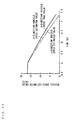
- Fig. 5 is a diagram for explaining the relationship between an operation of estimating the x-direction acceleration offset and the z-direction acceleration offset in the vehicle speed estimator 300 and the change in the wheel speed.
- the vertical axis represents offset and wheel speed
- the horizontal axis represents time.
- a thick solid line indicates the change in the wheel speed
- a thin solid line indicates the respective changes in the x-direction acceleration offset estimated value and the z-direction acceleration offset estimated value.
- the operation of estimating the x-direction acceleration offset and the z-direction acceleration offset is performed in the Karman filter 330 for a constant speed when the motorcycle 100 is stopped and is traveling at a constant speed, while the x-direction acceleration offset estimated value and the z-direction acceleration offset estimated value are held when the motorcycle 100 is accelerated and decelerated.
- Fig. 6 is a flow chart showing the operations of the vehicle speed estimator 300.
- the filter selector 320 in the vehicle speed estimator 300 determines whether or not the rate of change in a wheel speed selected by the speed selector 310 is larger than a predetermined threshold value (step S1).
- the threshold value is about -0.2 m/s 2 to about +0.2 m/s 2 , for example.
- the filter selector 320 When it is determined in the step S1 that the rate of change in the wheel speed is not more than the predetermined threshold value, the filter selector 320 considers that the motorcycle 100 is stopped or is traveling at a constant speed to calculate a vehicle speed from the wheel speed (step S2).
- the vehicle speed corresponds to an X-direction speed observed value, described later.
- the Karman filter 330 then respectively estimates offset in the x-direction acceleration sensor 21 (x-direction acceleration offset) and offset in the z-direction acceleration sensor 22 (z-direction acceleration offset) by a method, described later, to obtain an x-direction acceleration offset estimated value and a z-direction acceleration offset estimated value (step S3).
- a Z-direction speed observed value is taken as zero, for example.
- the procedure is returned to the step S1.
- the filter selector 320 When it is determined in the step S1 that the rate of change in the wheel speed is more than the predetermined threshold value, the filter selector 320 considers that the motorcycle 100 is accelerated or decelerated, and the offset storage 350 stores previous respective values of the x-direction acceleration offset estimated value and the z-direction acceleration offset estimated value (values estimated in the step S3) (step S4).
- the offset corrector 360 then respectively corrects a detected value in the x-direction acceleration sensor 21 and a detected value in the z-direction acceleration sensor 22 by a method, described later, on the basis of the x-direction acceleration offset estimated value and the z-direction acceleration offset estimated value that are stored in the offset storage 350 (step S5).
- the Karman filter 340 for acceleration/deceleration estimates the pitch angle of the vehicle body 1 by a method, described later, on the basis of the detected value in the x-direction acceleration sensor 21 and the detected value in the z-direction acceleration sensor 22 that are corrected by the offset corrector 360 to obtain a pitch angle estimated value (step S6).
- the acceleration corrector 370 then corrects an x-direction acceleration and a z-direction acceleration by a method, described later, using the detected value in the x-direction acceleration sensor 21 and the detected value in the z-direction acceleration sensor 22 that are corrected by the offset corrector 360 and the pitch angle estimated value to calculate an X-direction acceleration and a Y-direction acceleration (step S7).
- the vehicle speed operation unit 380 integrates over time the X-direction acceleration, to calculate a vehicle speed (step S8). Thereafter, the procedure is returned to the step S1.
- Fig. 7 is a block diagram showing the configuration of an ABS signal processor.
- the ABS signal processor shown in Fig. 7 includes the vehicle speed estimator 300, a first signal generator 400, and a second signal generator 500.
- the ABS signal processor shown in Fig. 7 is provided in the ECU 30 shown in Figs. 2 and 3 with an associated program function.
- the first signal generator 400 includes an acceleration operation unit 410, a slip determination unit 420, an acceleration determination unit 430, and a reduced pressure signal generator 440.
- the second signal generator 500 includes an acceleration operation unit 510, a slip determination unit 520, an acceleration determination unit 530, and a reduced pressure signal generator 540.
- the front-wheel speed signal Rf is fed to the slip determination unit 420 in the first signal generator 400 from the front-wheel speed sensor 5, and the vehicle speed signal VX is fed thereto from the vehicle speed estimator 300.
- the front-wheel speed signal Rf is fed to the acceleration operation unit 410 from the front-wheel speed sensor 5.
- the slip determination unit 420 determines whether or not the front wheel 2 is slipping depending on whether or not the difference between the vehicle speed calculated on the basis of the front-wheel speed signal Rf and the vehicle speed represented by the vehicle speed signal VX is larger than a predetermined reference value.
- the acceleration operation unit 410 calculates the acceleration of the front wheel 2 on the basis of the front-wheel speed signal Rf.
- the acceleration determination unit 430 determines whether or not the front wheel 2 is returned from a slipping state depending on whether or not the acceleration calculated by the acceleration operation unit 410 is changed from negative to positive.
- the reduced pressure signal generator 440 feeds a reduced pressure signal FP to the hydraulic unit 10 shown in Fig. 3 when the slip determination unit 420 determines that the front wheel 2 is slipping while releasing the reduced pressure signal FP when the acceleration determination unit 430 determines that the front wheel 2 is returned from a slipping state.
- the rear-wheel speed signal Rr is fed to the slip determination unit 520 in the second signal generator 500 from the rear-wheel speed sensor 8, and the vehicle speed signal VX is fed thereto from the vehicle speed estimator 300.
- the rear-wheel speed signal Rr is fed to the acceleration operation unit 510 from the rear-wheel speed sensor 8.
- the slip determination unit 520 determines whether or not the rear wheel 3 is slipping depending on whether or not the difference between the vehicle speed calculated on the basis of the rear-wheel speed signal Rr and the vehicle speed represented by the vehicle speed signal VX is larger than a predetermined reference value.
- the acceleration operation unit 510 calculates the acceleration of the rear wheel 3 on the basis of the rear-wheel speed signal Rr.
- the acceleration determination unit 530 determines whether or not the rear wheel 3 is returned from a slipping state depending on whether or not the acceleration calculated by the acceleration operation unit 510 is changed from negative to positive.
- the reduced pressure signal generator 540 feeds a reduced pressure signal RP to the hydraulic unit 10 shown in Fig. 3 when the slip determination unit 520 determines that the rear wheel 3 is slipping while releasing the reduced pressure signal RP when the acceleration determination unit 530 determines that the rear wheel 3 is returned from a slipping state.
- An X-direction speed observed value V obx (k) in the foregoing equation (4) is obtained by the front-wheel speed signal Rf fed from the front-wheel speed sensor 5 shown in Fig. 4.
- a Z-direction speed observed value V obz (k) is herein set to 0.0 m/s because it is considered to be almost zero when the motorcycle 100 is stopped and is traveling at a constant speed.
- An x-direction acceleration observed value G obx (k) is obtained by the x-direction acceleration signal Ax from the x-direction acceleration sensor 21, and a z-direction acceleration observed value G obz (k) is obtained by the z-direction acceleration signal Az from the z-direction acceleration sensor 22.
- Values that are actually and empirically valid are respectively set as the observed noise and the process noise.
- the observed noise and the process noise are adjusted by simulation on the basis of the values.
- Equation 6 1 T 0 0 0 0 0 1 0 0 0 0 0 0 1 0 0 0 0 0 1 T 0 0 0 0 0 0 0 1 Equation 7
- x k V x ⁇ k + 1 a x ⁇ k + 1 ⁇ off x ( k + 1 )
- V z ( k + 1 ) a z ( k + 1 ) ⁇ off z ( k + 1 )
- the third term on the right side of the foregoing equation (3) is an external force vector u k in the step k.
- the left side of the foregoing equation (4) is an observation vector y k in the step k.
- Equation 11 B 1 0 0 0 0 0 0 cos ⁇ p k 1 0 - sin ⁇ p k 0 0 0 1 0 0 0 sin ⁇ p k 0 0 cos ⁇ p k 1
- the second term on the right side of the foregoing equation (4) is an observed noise vector v k in the step k.
- the x-direction acceleration offset and the z-direction acceleration offset are estimated by sequential calculation using an extended Karman filter in the following manner with a pitch angle ⁇ P included in quantities of state (elements of a state vector).
- a constant A ax is zero, for example, and a constant A ⁇ P is 1, for example.
- k be an estimated value of the state vector z k in the step k
- k-1 be an estimated value of a state vector z k in a step k-1
- k be an estimated value of a state vector z k+1 in a step k
- a filter equation is expressed by the following equations: Equation 16
- k z Ek
- k f k z Ek
- K k denotes a Karman gain
- y k is expressed by the foregoing equation (10).
- k-1 ) will be described later.
- K k ⁇ k
- k-1 denotes a covariance matrix of an estimated error in the state vector z k in the step k-1
- ⁇ vk denotes a covariance matrix in the observed noise vector v k
- a matrix H k will be described later.
- k of an estimated error in the state vector z k is expressed by the following equation: Equation 19 ⁇ k
- k ⁇ k
- Equation 20 ⁇ k + 1
- k F k ⁇ ⁇ k
- Equation 22 h k ⁇ Z Ek
- k - 1 C k ( ⁇ pEk
- k-1 denotes an estimated value of the state vector x k in the step k-1.
- k-1 denotes an estimated value of a pitch angle ⁇ P (k) in the step k-1.
- I denotes a unit matrix.
- the extended Karman filter allows the pitch angle ⁇ P (k), together with x-direction acceleration offset ⁇ offx (k) and z-direction acceleration offset ⁇ offz (k) at the time when the motorcycle 100 is stopped and is traveling at a constant speed, to be estimated.
- the Karman filter 330 was simulated to estimate the x-direction acceleration offset and the z-direction acceleration offset.
- Fig. 8 is a diagram showing the relationship between an acceleration offset true value and an acceleration offset estimated error.
- the horizontal axis represents respective true values of the x-direction acceleration offset and the z-direction acceleration offset
- the vertical axis represents an estimated error of the acceleration offset.
- the estimated error of the acceleration offset is a difference between an estimated value of the x-direction acceleration offset and the true value of the x-direction acceleration offset and a difference between an estimated value of the z-direction acceleration offset and the true value of the z-direction acceleration offset.
- the estimated error of the z-direction acceleration offset is indicated by a white circle, and the estimated error of the x-direction acceleration offset is indicated by a black triangle. As shown in Fig. 8, the estimated error of the x-direction acceleration offset is within about 0.06 m/s 2 , and the estimated error of the z-direction acceleration offset is within about 0.001 m/s 2 .
- Fig. 9 is a diagram showing the change with time of an acceleration offset estimated value in the process of estimating the acceleration offset.
- the horizontal axis represents time
- the vertical axis represents acceleration offset.
- the true value of the z-direction acceleration offset is indicated by a thin solid line
- the estimated value of the z-direction acceleration offset is indicated by a thick solid line
- the true value of the x-direction acceleration offset is indicated by a thin dotted line
- the estimated value of the x-direction acceleration offset is indicated by a thick dotted line.
- both the estimated value of the x-direction acceleration offset and the estimated value of the z-direction acceleration offset are completely converged in two seconds. This allows the x-direction acceleration offset and the z-direction acceleration offset to be estimated if a constant speed state for two or more seconds exists.
- an x-direction acceleration corrected value G Aobx (k) is an x-direction acceleration corrected by the offset corrector 360 shown in Fig. 4, and is a value obtained by subtracting the x-direction acceleration offset ⁇ offx (k) from the x-direction acceleration observed value G obx (k).
- a z-direction acceleration corrected value G Aobz (k) is a z-direction acceleration corrected by the offset corrector 360 shown in Fig. 4, and is a value obtained by subtracting the z-direction acceleration offset ⁇ offz (k) from the z-direction acceleration observed value G obz (k).
- Values that are actually and empirically valid are respectively set as the observed noise and the process noise.
- the observed noise and the process noise are adjusted by simulation on the basis of the values.
- the left side of the foregoing equation (26) is an observation vector y k in the step k.
- Equation 32 B cos ⁇ p k - sin ⁇ p k sin ⁇ p k cos ⁇ p k
- a pitch angle ⁇ P is estimated using an extended Karman filter in the following manner with the pitch angle ⁇ P included in quantities of state (elements of a state vector).
- a constant A ax is zero, for example, and a constant A ⁇ P is 1, for example.
- k be an estimated value of the state vector z k in the step k
- k-1 be an estimated value of a state vector z k in a step k-1
- k be an estimated value of a state vector z k+1 in a step k
- a filter equation is expressed by the following equations: Equation 37 z Ek
- k z Ek
- k f k z Ek
- K k denotes a Karman gain
- y k is expressed by the foregoing equation (31).
- k-1 ) will be described later.
- K k ⁇ k
- k-1 denotes a covariance matrix of an estimated error in the state vector z k in the step k-1
- ⁇ vk denotes a covariance matrix in the observed noise vector v k
- a matrix H k will be described later.
- k of the estimated error in the state vector z k is expressed by the following equation: Equation 40 ⁇ k
- k ⁇ k
- Equation 41 ⁇ k + 1
- k F k ⁇ ⁇ k
- Equation 43 h k ⁇ Z Ek
- k - 1 C k ( ⁇ pEk
- k-1 denotes an estimated value of the state vector x k in the step k-1.
- k-1 denotes an estimated value of a pitch angle ⁇ P (k) in the step k-1.
- I denotes a unit matrix.
- the extended Karman filter allows the pitch angle ⁇ P (k) at the time when themotorcycle 100 is accelerated and decelerated to be estimated.
- the acceleration corrector 370 corrects the x-direction acceleration and the z-direction acceleration by the following equation using a pitch angle estimated value obtained by the Karman filter 340 for acceleration/deceleration.
- an x-direction acceleration corrected value G Aobx (k) is an x-direction acceleration corrected by the offset corrector 360 shown in Fig. 4, and is a value obtained by subtracting the x-direction acceleration offset ⁇ offx (k) from the x-direction acceleration observed value G obx (k).
- a z-direction acceleration corrected value G Aobz (k) is a z-direction acceleration corrected by the offset corrector 360 shown in Fig. 4, and is a value obtained by subtracting the z-direction acceleration offset ⁇ offz (k) from the z-direction acceleration observed value G obz (k) .
- the foregoing equation (46) allows an x-direction acceleration estimated value a Ex and a Z-direction acceleration estimated value a Ez at the time when the motorcycle 100 is accelerated and decelerated to be calculated.
- the Karman filter 340 and the acceleration corrector 370 were simulated to estimate the X-direction acceleration and the Z-direction acceleration.
- Fig. 10 is a diagram showing the results of the estimation of the X-direction acceleration.
- a true value of the X-direction acceleration is indicated by a dotted line
- the X-direction acceleration estimated value a Ex obtained by the acceleration corrector 370 using a pitch angle estimated value ⁇ Ep obtained by the Karman filter 340 is indicated by a solid line
- an x-direction acceleration corrected value G Aobx (k) obtained by the offset corrector 360 is indicated by a one-dot and dash line.
- the x-direction acceleration corrected value G Aobx (k) is affected by a pitch angle, although the effect of the x-direction acceleration offset is removed therefrom.
- the X-direction acceleration estimated value a Ex is closer to the true value of the X-direction acceleration, as compared with the x-direction acceleration corrected value G Aobx (k) .
- the true value of the X-direction acceleration, the X-direction acceleration estimated value a Ex , and the x-direction acceleration corrected value G Aobx (k) were integrated over time to estimate a vehicle speed.
- Fig. 11 is a diagram showing the results of the estimation of the vehicle speed.
- the horizontal axis represents time
- the vertical axis represents a vehicle speed estimated value.
- a vehicle speed calculated using the true value of the X-direction acceleration is indicated by a dotted line
- an X-direction vehicle speed estimated value calculated using the X-direction acceleration estimated value a Ex is indicated by a solid line
- an x-direction vehicle speed estimated value calculated using the x-direction acceleration corrected value G Aobx (k) is indicated by a one-dot and dash line.
- the X-direction vehicle speed estimated value calculated using the X-direction acceleration estimated value a Ex is closer to the X-direction vehicle speed true value, as compared with the x-direction vehicle speed estimated value calculated using the x-direction acceleration corrected value G Aobx (k).
- the offset in the x-direction acceleration sensor 21 and the offset in the z-direction acceleration sensor 22 are estimated with high accuracy by the Karman filter 330 for a constant speed in the vehicle speed estimator 300 when the motorcycle 100 is stopped and is traveling at a constant speed. Even when the detected value in the x-direction acceleration sensor 21 and the detected value in the z-direction acceleration sensor 22 are affected by gravity due to pitching having an arbitrary frequency, it is possible to accurately estimate the offset in the x-direction acceleration sensor 21 and the offset in the z-direction acceleration sensor 22.
- An observed disturbance given to the x-direction acceleration sensor 21 and the z-direction acceleration sensor 22 are removed in the Karman filter 330. This prevents the ABS controlled by the vehicle speed in the X-direction obtained by the vehicle speed estimator 300 from being unstable due to the observed disturbance.
- the estimated value of the offset in the x-direction acceleration sensor 21 and the estimated value of the offset in the z-direction acceleration sensor 22 that are obtained when the motorcycle 100 is stopped or is traveling at a constant speed are stored in the offset storage 350, while the detected value in the x-direction acceleration sensor 21 and the detected value in the z-direction acceleration sensor 22 are corrected by the offset corrector 360 on the basis of the estimated value of the offset in the x-direction acceleration sensor 21 and the estimated value of the offset in the z-direction acceleration sensor 22 that are stored in the offset storage 350 when the motorcycle 100 is accelerated or decelerated. This allows the x-direction acceleration and the z-direction acceleration of the motorcycle 100 to be detected with high accuracy.
- the pitch angle of the vehicle body 1 is estimated by the Karman filter 340 for acceleration/deceleration when motorcycle 100 is accelerated or decelerated. This allows the pitch angle due to pitching having an arbitrary frequency to be estimated at low cost and with high accuracy without using a high-cost gyro sensor.
- the X-direction acceleration and the Y-direction acceleration of the motorcycle 100 are calculated by the acceleration corrector 370 on the basis of the estimated value of the pitch angle, the detected value in the x-direction acceleration sensor 21, and the detected value in the z-direction acceleration sensor 22. This allows the X-direction acceleration of the motorcycle 100 to be detected with high accuracy.
- the vehicle speed operation unit 380 obtains the vehicle speed in the X-direction from the X-direction acceleration with high accuracy. When both the front wheel 2 and the rear wheel 3 are braked, therefore, it is possible to detect the sliding of the front wheel 2 and the rear wheel 3 as well as to detect the vehicle speed with high accuracy.
- the acceleration estimation device may be applied to another brake control system, a traction control system, or a cruise control system.
- the traction control system refers to a system for obtaining a driving force most suitable for the time of turning, the time of starting, or the time of acceleration by controlling a driving force of a driving wheel or an output of the engine and a braking force.
- the cruise control system refers to a system for automatically controlling a vehicle speed to be constant in the case of long-distance or long-term traveling.
- the acceleration estimation device is also applicable to drivability control by an electronic throttle.
- the drivability control refers to the control for obtaining a comfortable driving performance.
- an error of an acceleration sensor can be reduced. Therefore, the comfortable driving performance can be controlled with high accuracy. As a result, it is possible to provide smooth acceleration characteristics that do not make a driver feel changes and variations in acceleration.
- the acceleration estimation device of the present invention can be utilized for estimating the acceleration of a vehicle when a GPS (Global Positioning System) signal cannot be received in a navigation system.
- GPS Global Positioning System
- each of the constituent elements within the vehicle speed estimator 300 is preferably provided by the ECU 30 and associated program function, the present invention is not limited to this.
- parts or all of the plurality of constituent elements within the vehicle speed estimator 300 may be provided by hardware such as an electronic circuit.
- the offset estimator preferably includes the Karman filter 330 for a constant speed composed of an extended Karman filter
- the present invention is not limited to this.
- the offset estimator may be achieved by another adaptive filtering method.
- an LMS (Least Mean Square) adaptive filter or H ⁇ filtering may be used.
- the pitch angle estimator preferably includes the Karman filter 340 for acceleration/deceleration composed of an extended Karman filter
- the present invention is not limited to this.
- the pitch angle estimator may be achieved by another adaptive filtering method.
- an LMS adaptive filter or H ⁇ filtering may be used.
- the vehicle speed estimator 300 in the preferred embodiments described above is not limited to the motorcycle 100.
- it can be applied to various types of vehicles such asmotorcycles, four-wheeled vehicles, and three-wheeled vehicles, or any other suitable vehicle.
Landscapes
- Engineering & Computer Science (AREA)
- Mechanical Engineering (AREA)
- Physics & Mathematics (AREA)
- General Physics & Mathematics (AREA)
- Transportation (AREA)
- Regulating Braking Force (AREA)
- Traffic Control Systems (AREA)
Abstract
Description
- The present invention relates to an acceleration estimation device that estimates vehicle acceleration, and a vehicle including the same.
- The traveling speed of a vehicle can be calculated on the basis of the rotational speeds of its wheels. When the vehicle is rapidly accelerated, however, the wheels may be rotated while slipping on a road surface. When the vehicle is rapidly decelerated (braked), the wheels may be caused to slide on the road surface. In such a case, the speed of the vehicle that can be calculated from the rotational speed of the wheels does not coincide with the actual traveling speed of the vehicle.
- Therefore, the acceleration of the vehicle is detected using an acceleration sensor, and the detected acceleration is integrated to calculate the speed of the vehicle.
- When the vehicle is rapidly accelerated or decelerated, however, the vehicle body is inclined up and down in a traveling direction by pitching of the vehicle body. That is, the front of the vehicle body rises at the time of the rapid acceleration, and lowers at the time of the rapid deceleration. Thus, the forward-and-backward acceleration of the vehicle that is detected by the acceleration sensor does not accurately coincide with an acceleration in a traveling direction of the vehicle.
-
JP 10-104259 A - In the longitudinal acceleration estimating device disclosed in
JP 10-104259 A - This causes a variable component due to DC offset and a variable component due to temperature drift respectively having low frequencies to be removed from the detected value of the longitudinal acceleration. As a result, the estimated value of the longitudinal acceleration is not affected by changes with time and changes in temperature.
- In the longitudinal acceleration estimating device disclosed in
JP 10-104259 A - However, a variation component due to pitching in a frequency band other than the particular frequency band cannot be removed. Therefore, the longitudinal acceleration of the vehicle cannot be accurately estimated when the vehicle is accelerated and decelerated.
- On the other hand,
JP 8-268257 A - However, the variation in a pitch angle at the time of the acceleration and deceleration of the vehicle is not constant. In the actual speed estimator disclosed in
JP 8-268257 A - In order to overcome the problems described above, preferred embodiments of the present invention provide an acceleration estimation device that can accurately estimate an acceleration in a traveling direction of a vehicle, and a vehicle including the same.
- According to a preferred embodiment of the present invention, an acceleration estimation device for estimating accelerations of a vehicle includes a first acceleration sensor that is provided in the vehicle and detects the acceleration in the forward-and-backward direction of the vehicle; a second acceleration sensor that is provided in the vehicle and detects the acceleration in the up-and-down direction of the vehicle; a pitch angle estimator that estimates the pitch angle of the vehicle on the basis of the relationship between a detected value in the first acceleration sensor and a detected value in the second acceleration sensor; and an acceleration calculator that calculates the acceleration in a traveling direction of the vehicle that is perpendicular or substantially perpendicular to a direction of gravity, on the basis of an estimated value of the pitch angle obtained by the pitch angle estimator, the detected value in the first acceleration sensor, and the detected value in the second acceleration sensor.
- In the acceleration estimation device, the first acceleration sensor and the second acceleration sensor are provided in the vehicle. The first acceleration sensor detects the acceleration in the forward-and-backward direction of the vehicle, and the second acceleration sensor detects the acceleration in the up-and-down direction of the vehicle. The pitch angle estimator estimates the pitch angle of the vehicle on the basis of the relationship between the detected value in the first acceleration sensor and the detected value in the second acceleration sensor. The acceleration in the traveling direction of the vehicle is calculated on the basis of the estimated value of the pitch angle, the detected value in the first acceleration sensor, and the detected value in the second acceleration sensor.
- In such a way, the pitch angle due to arbitrary pitching of the vehicle can be estimated with high accuracy. This allows the acceleration in the traveling direction of the vehicle to be detected with high accuracy.
- The acceleration estimation device may further include a speed calculator that integrates a calculated value of the acceleration in the traveling direction obtained by the acceleration calculator, to calculate a speed in the traveling direction. In this case, the speed in the traveling direction of the vehicle can be detected with high accuracy.
- The pitch angle estimator may include a first Karman filter that estimates the pitch angle of the vehicle using the relationship among the acceleration in the traveling direction of the vehicle that is perpendicular or substantially perpendicular to the direction of gravity, the acceleration in a vertical direction parallel or substantially parallel to the direction of gravity, the detected value in the first acceleration sensor, and the detected value in the second acceleration sensor, and the pitch angle of the vehicle.
- In this case, the first Karman filter estimates the pitch angle of the vehicle. Even when the detected value of the acceleration in the forward-and-backward direction and the detected value of the acceleration in the up-and-down direction of the vehicle are affected by gravity due to pitching having an arbitrary frequency, it is possible to detect the pitch angle of the vehicle with high accuracy.
- The acceleration estimation device may further include an offset estimator that estimates offset in the first acceleration sensor and offset in the second acceleration sensor when the vehicle is at a substantially constant speed, and a corrector that corrects the detected value in the first acceleration sensor and the detected value in the second acceleration sensor on the basis of an estimated value of the offset in the first acceleration sensor and an estimated value of the offset in the second acceleration sensor that are obtained by the offset estimator when the vehicle is accelerated or decelerated, and the pitch angle estimator may estimate the pitch angle of the vehicle on the basis of the relationship between the detected value in the first acceleration sensor and the detected value in the second acceleration sensor that are corrected by the corrector when the vehicle is accelerated or decelerated.
- The time when the vehicle is at a substantially constant speed refers to the time when the vehicle is stopped and the time when the rate of change in the traveling speed of the vehicle is not more than a predetermined threshold value. The threshold value is in a range of about -0.2 m/s2 to about +0.2 m/s2, for example.
- In this case, when the vehicle is at a substantially constant speed, the offset estimator estimates the offset in the first acceleration sensor and the offset in the second acceleration sensor. The offset in the first acceleration sensor and the offset in the second acceleration sensor preferably are not changed in a short time period.
- When the vehicle is accelerated or decelerated, the corrector corrects the detected value in the first acceleration sensor and the detected value in the second acceleration sensor on the basis of the estimated value of the offset in the first acceleration sensor and the estimated value of the offset in the second acceleration sensor that are obtained when the vehicle is at a substantially constant speed. The pitch angle of the vehicle is estimated on the basis of the detected value in the first acceleration sensor and the detected value in the second acceleration sensor that are corrected. This allows the pitch angle of the vehicle to be detected with higher accuracy.
- The acceleration estimation device may further include a wheel speed detector that detects a wheel speed of the vehicle, and the offset estimator may include a second Karman filter that estimates the offset in the first acceleration sensor and the offset in the second acceleration sensor using the relationship among the acceleration in the traveling direction, the acceleration in the vertical direction, the detected value in the first acceleration sensor, the detected value in the second acceleration sensor, the speed in the traveling direction, the speed in the vertical direction, the speed of the vehicle obtained from the detected value in the wheel speed detector, and the pitch angle of the vehicle.
- In this case, the second Karman filter estimates the offset in the first acceleration sensor and the offset in the second acceleration sensor. Even when the detected value of the acceleration in the forward-and-backward direction and the detected value of the acceleration in the up-and-down direction are affected by gravity due to pitching having an arbitrary frequency, therefore, it is possible to more accurately estimate the offset in the first acceleration sensor and the offset in the second acceleration sensor. As a result, the pitch angle of the vehicle can be detected with higher accuracy.
- An observed disturbance applied to the first acceleration sensor and the second acceleration sensor is removed in the second Karman filter. This prevents a control system controlled on the basis of the acceleration in the traveling direction of the vehicle from being unstable due to the observed disturbance.
- The offset estimator may determine that the vehicle is in a substantially constant speed state when the rate of change in the wheel speed detected by the wheel speed detector is not more than a predetermined threshold value, and the pitch angle estimator may determine that the vehicle is accelerated or decelerated when the rate of change in the wheel speed detected by the wheel speed detector is higher than the threshold value.
- In this case, it is determined that the vehicle is in the substantially constant speed state when the rate of change in the wheel speed is not more than the threshold value. The offset estimator estimates the offset in the first acceleration sensor and the offset in the second acceleration sensor. Further, it is determined that the vehicle is accelerated or decelerated when the rate of change in the wheel speed is higher than the threshold value. The pitch angle estimator estimates the pitch angle of the vehicle.
- Even when the vehicle speed is slightly changed, therefore, the offset in the first acceleration sensor and the offset in the second acceleration sensor can be detected with high accuracy. As a result, the pitch angle of the vehicle can be detected with higher accuracy when the vehicle is accelerated or decelerated.
- According to another preferred embodiment of the present invention, a vehicle includes a vehicle body, a wheel provided on the vehicle body, an acceleration estimation device that is provided on the vehicle body, and a controller, wherein the acceleration estimation device includes a first acceleration sensor that is provided on the vehicle and detects the acceleration in the forward-and-backward direction of the vehicle; a second acceleration sensor that is provided on the vehicle and detects the acceleration in the up-and-down direction of the vehicle; a pitch angle estimator that estimates the pitch angle of the vehicle on the basis of the relationship between a detected value in the first acceleration sensor and a detected value in the second acceleration sensor; and an acceleration calculator that calculates the acceleration in a traveling direction of the vehicle that is perpendicular or substantially perpendicular to a direction of gravity on the basis of an estimated value of the pitch angle obtained by the pitch angle estimator, the detected value in the first acceleration sensor, and the detected value in the second acceleration sensor, the controller controls the rotation of the wheel on the basis of the acceleration in the traveling direction obtained by the acceleration estimation device.
- The acceleration estimation device estimates the pitch angle of the vehicle on the basis of the relationship between the detected value in the first acceleration sensor and the detected value in the second acceleration sensor. The acceleration in the traveling direction of the vehicle is calculated on the basis of the estimated value of the pitch angle, the detected value in the first acceleration sensor, and the detected value in the second acceleration sensor. This allows the acceleration in the traveling direction of the vehicle to be detected with high accuracy.
- The controller controls the rotation of the wheel on the basis of the acceleration in the traveling direction of the vehicle that is obtained by the acceleration estimation device.
- According to the present preferred embodiment, the pitch angle estimator estimates the pitch angle of the vehicle on the basis of the relationship between the detected value in the first acceleration sensor and the detected value in the second acceleration sensor. The acceleration in the traveling direction of the vehicle is calculated on the basis of the estimated value of the pitch angle, the detected value in the first acceleration sensor, and the detected value in the second acceleration sensor.
- In such a way, the pitch angle due to arbitrary pitching of the vehicle can be estimated with high accuracy. This allows the acceleration in the traveling direction of the vehicle to be detected with high accuracy.
- Other features, elements, steps, characteristics, and advantages of the present invention will become more apparent from the following description of preferred embodiments of the present invention with reference to the attached drawings.
- Fig. 1 is a diagram showing the relationship of accelerations received by an acceleration sensor at the time of deceleration.
- Fig. 2 is a diagram showing the schematic configuration of the overall motorcycle according to a preferred embodiment of the present invention.
- Fig. 3 is a schematic view showing a hydraulic system and an electrical system of an ABS.
- Fig. 4 is a block diagram showing the configuration of a vehicle speed estimator.
- Fig. 5 is a diagram for explaining the relationship between an operation of estimating x-direction acceleration offset and z-direction acceleration offset in the vehicle speed estimator and the change in wheel speed.
- Fig. 6 is a flow chart showing the operations of the vehicle speed estimator.
- Fig. 7 is a block diagram showing the configuration of an ABS signal processor.
- Fig. 8 is a diagram showing the relationship between an acceleration offset true value and an acceleration offset estimated error.
- Fig. 9 is a diagram showing the change with time of an acceleration offset estimated value in the process of estimating acceleration offset.
- Fig. 10 is a diagram showing the results of estimation of X-direction acceleration.
- Fig. 11 is a diagram showing the results of estimation of a vehicle speed.
- In the following preferred embodiments, description is made of an example in which an acceleration estimation device according to the present invention is applied to a motorcycle.
- First, the relationship of accelerations at the time of deceleration of a motorcycle comprising an acceleration detection device according to the present preferred embodiment will be described.
- Fig. 1 is a diagram showing the relationship of accelerations received by an acceleration sensor at the time of deceleration.
- As shown in Fig. 1, when a
motorcycle 100 is decelerated by a front-wheel brake, a front suspension contracts, and a rear suspension expands. Therefore, themotorcycle 100 is inclined forward in its traveling direction. - A coordinate system fixed to the ground below the
motorcycle 100 is taken as a ground coordinate system, and a coordinate system fixed to the acceleration sensor attached to themotorcycle 100 is taken as a sensor coordinate system. - On the ground coordinate system, a traveling direction of the motorcycle 100 (a direction perpendicular or substantially perpendicular to gravity) on a
horizontal ground surface 600 is defined as an X-direction, and a vertical direction (a direction of gravity) is defined as a Z-direction. Consequently, the X-direction and the Z-direction on the ground coordinate system are not changed irrespective of the posture of themotorcycle 100. - On the sensor coordinate system, a direction of the horizontal axis of the motorcycle 100 (a forward-and-backward direction of a vehicle body 1) in a case where the
motorcycle 100 is in a horizontal state is defined as an x-direction, and a direction perpendicular or substantially perpendicular to the horizontal axis of the motorcycle 100 (an up-and-down direction of the vehicle body 1) is defined as a z-direction. Consequently, the x-direction and the z-direction on the sensor coordinate system are inclined to the X-direction and the Z-direction on the ground coordinate system by the posture of themotorcycle 100. - Hereinafter, the X-direction on the ground coordinate system is merely referred to as an X-direction or a traveling direction, and the Z-direction on the ground coordinate system is referred to as a Z-direction or a vertical direction.
- From Fig. 1, an acceleration Gx in the x-direction and an acceleration Gz in the z-direction on the sensor coordinate system are respectively expressed by the following equations using an acceleration ax in the X-direction and an acceleration az in the Z-direction on the ground coordinate system:


- In the foregoing equations (1) and (2), θP denotes the pitch angle of the
vehicle body 1. - The
motorcycle 100 in the present preferred embodiment is provided with an x-direction acceleration sensor for detecting the acceleration Gx in the x-direction of thevehicle body 1 and a z-direction acceleration sensor for detecting the acceleration Gz in the z-direction. - The acceleration ax in the X-direction and the acceleration az in the Z-direction on the ground coordinate system of the
motorcycle 100 can be measured by detecting the acceleration Gx in the x-direction using the x-direction acceleration sensor, detecting the acceleration Gz in the z-direction using the z-direction acceleration sensor, and determining the pitch angle θP. - Generally, offset exists in the acceleration sensor. Here, the offset in the acceleration sensor refers to a value obtained by expressing a difference between a nominal value of an output voltage of the acceleration sensor at an acceleration of 0 m/s2 and a value of an actual output voltage of the acceleration sensor in terms of unit of acceleration (m/s2).
- Hereinafter, offset in the x-direction acceleration sensor is referred to as x-direction acceleration offset, and offset in the z-direction acceleration sensor is referred to as z-direction acceleration offset.
- In the present preferred embodiment, the x-direction acceleration offset and the z-direction acceleration offset are estimated using an extended Karman filter, described later, when the
motorcycle 100 is at a substantially constant speed. - Here, the time when the
motorcycle 100 is at a substantially constant speed includes the time when themotorcycle 100 is stopped and the time when the rate of change in the traveling speed of themotorcycle 100 is not more than a predetermined threshold value. In the following description, the time when themotorcycle 100 is traveling at a constant speed and the time when the rate of change in the traveling speed is not more than a threshold value are merely referred to as the time when themotorcycle 100 is traveling at a constant speed. - When the
motorcycle 100 is accelerated and decelerated, the acceleration Gx in the x-direction and the acceleration Gz in the z-direction are corrected on the basis of respective estimated values of the x-direction acceleration offset and the z-direction acceleration offset, and the pitch angle θP of thevehicle body 1 is estimated on the basis of respective corrected values of the acceleration Gx in the x-direction and the acceleration Gz in the z-direction. Further, the acceleration in the X-direction and the acceleration in the Z-direction of themotorcycle 100 are calculated using an estimated value of the pitch angle θP. Further, the acceleration in the X-direction is integrated to calculate the speed in the X-direction of themotorcycle 100. - Fig. 2 is a diagram showing the schematic configuration of the
motorcycle 100 according to the present preferred embodiment. An ABS (Anti-Lock Brake System), described later, is preferably included in themotorcycle 100. - As shown in Fig. 2, a
front wheel 2 is attached to the front of thevehicle body 1 of themotorcycle 100, and arear wheel 3 is attached to the rear of thevehicle body 1. - A
sensor rotor 4 that rotates with thefront wheel 2 is provided at the center of thefront wheel 2. A front-wheel speed sensor 5 for detecting the rotational speed of thefront wheel 2 is attached to thesensor rotor 4. Further, there is provided afront brake caliper 6 that is brought into contact with a brake disk of thefront wheel 2 for braking thefront wheel 2. - A
sensor rotor 7 that rotates with therear wheel 3 is provided at the center of therear wheel 3. A rear-wheel speed sensor 8 for detecting the rotational speed of therear wheel 3 is attached to thesensor rotor 7. Further, there is provided arear brake caliper 9 that is brought into contact with a brake disk of therear wheel 3 for braking therear wheel 3. - A
handle 11 is arranged so as to be swingable right and left at the top on the front side of thevehicle body 1. Thehandle 11 is provided with afront brake lever 12 and awarning lamp 13. - A
hydraulic unit 10 is provided at the center of thevehicle body 1. Arear brake pedal 14 is provided below the center of thevehicle body 1. Anx-direction acceleration sensor 21 and a z-direction acceleration sensor 22 are attached to a position at the center of gravity of thevehicle body 1. As thex-direction acceleration sensor 21 and the z-direction acceleration sensor 22, a two-axis acceleration sensor or a three-axis acceleration sensor for use in detection of inclination, an impact of air bags, a drop of hard disks, etc. can be used. - An electronic control unit (hereinafter abbreviated as ECU) 30 and a fail-
safe relay 31 are provided at the rear of thevehicle body 1. - Fig. 3 is a schematic view showing a hydraulic system and an electrical system of the ABS.
- As shown in Fig. 3, a
master cylinder 15 is connected to thefront brake lever 12, and themaster cylinder 15 is connected to thehydraulic unit 10. Themaster cylinder 15 is provided with abrake switch 17. Amaster cylinder 16 is connected to therear brake pedal 14, and themaster cylinder 16 is connected to thehydraulic unit 10. Themaster cylinder 16 is provided with abrake switch 18. - When a driver operates the
front brake lever 12, themaster cylinder 15 raises the pressure of hydraulic fluid supplied to thefront brake caliper 6 from thehydraulic unit 10. This causes thefront brake caliper 6 to be driven to brake thefront wheel 2. At this time, thebrake switch 17 is turned on so that a front-wheel brake signal Bf is fed to theECU 30. - When the driver operates the
rear brake lever 14, themaster cylinder 16 raises the pressure of hydraulic fluid supplied to therear brake caliper 9 from thehydraulic unit 10. This causes therear brake caliper 9 to be driven to brake therear wheel 3. At this time, thebrake switch 18 is turned on so that a rear-wheel brake signal Br is fed to theECU 30. - A front-wheel speed signal Rf representing the rotational speed of the
front wheel 2 is fed to theECU 30 from the front-wheel speed sensor 5 provided in thesensor rotor 4 in thefront wheel 2. A rear-wheel speed signal Rr representing the rotational speed of therear wheel 3 is fed to theECU 30 from the rear-wheel speed sensor 8 provided in thesensor rotor 7 in therear wheel 3. Hereinafter, the rotational speed of thefront wheel 2 is referred to as a front wheel speed, and the rotational speed of therear wheel 3 is referred to as a rear wheel speed. - An x-direction acceleration signal Ax representing x-direction acceleration is fed to the
ECU 30 from thex-direction acceleration sensor 21. A z-direction acceleration signal Az representing z-direction acceleration is fed to theECU 30 from the z-direction acceleration sensor 22. - The
ECU 30 outputs a motor driving signal MD for driving a motor for a hydraulic pump within thehydraulic unit 10 to thehydraulic unit 10 through the fail-safe relay 31 in response to the front-wheel brake signal Bf or the rear-wheel brake signal Br. - The
ECU 30 outputs a reduced pressure signal FP for the front wheels and a reduced pressure signal RP for the rear wheels to thehydraulic unit 10 through the fail-safe relay 31 on the basis of the front-wheel speed signal Rf, the rear-wheel speed signal Rr, the x-direction acceleration signal Ax, and the z-direction acceleration signal Az. - The
hydraulic unit 10 reduces the pressure of hydraulic fluid supplied to thefront brake caliper 6 in response to the reduced pressure signal FP. This causes the braking of thefront wheel 2 by thefront brake caliper 6 to be released. Further, themotorcycle 100 reduces the pressure of hydraulic fluid supplied to therear brake caliper 9 in response to the reduced pressure signal RP. This causes the braking of therear wheel 3 by therear brake caliper 9 to be released. - The fail-
safe relay 31 switches the operation of the ABS in thehydraulic unit 10 into a normal braking operation when the ABS fails. When the ABS fails, the warninglamp 13 lights up. - Fig. 4 is a block diagram showing the configuration of a vehicle speed estimator.
- The acceleration estimation device according to the present preferred embodiment is preferably used for a
vehicle speed estimator 300 shown in Fig. 4. Thevehicle speed estimator 300 includes aspeed selector 310, afilter selector 320, aKarman filter 330 for constant speed, aKarman filter 340 for acceleration/deceleration, an offsetstorage 350, an offsetcorrector 360, anacceleration corrector 370, and a vehiclespeed operation unit 380. Each of the constituent elements within thevehicle speed estimator 300 is preferably provided in theECU 30 shown in Figs. 2 and 3 with an associated program function. - The front-wheel speed signal Rf and the rear-wheel speed signal Rr are respectively fed to the
speed selector 310 from the front-wheel speed sensor 5 and the rear-wheel speed sensor 8, and the x-direction acceleration signal Ax is fed thereto from thex-direction acceleration sensor 21. - The
speed selector 310 selects the front-wheel speed signal Rf as a vehicle speed when themotorcycle 100 is at a substantially constant speed (is stopped and is traveling at constant speed). When themotorcycle 100 is accelerated and decelerated, the front wheel speed and the rear wheel speed are compared with each other on the basis of the front-wheel speed signal Rf and the rear-wheel speed signal Rr, to select the smaller one of the front wheel speed and the rear wheel speed as a vehicle speed at the time of the acceleration, while selecting the larger one of the front wheel speed and the rear wheel speed as a vehicle speed at the time of the deceleration. Note that a substantially constant speed state or an accelerated/decelerated state is determined on the basis of the rate of change in the vehicle speed selected at the time of the determination. The vehicle speed selected by thespeed selector 310 is outputted to the vehiclespeed operation unit 380. - The vehicle speed is provided to the
Karman filter 330 from thespeed selector 310, and the x-direction acceleration signal Ax and the z-direction acceleration signal Az are respectively fed from thex-direction acceleration sensor 21 and the z-direction acceleration sensor 22. TheKarman filter 330 estimates the x-direction acceleration offset and the z-direction acceleration offset in a method, described later, when themotorcycle 100 is at a substantially constant speed (is stopped and is traveling at a constant speed), to obtain an x-direction acceleration offset estimated value and a z-direction acceleration offset estimated value. - The offset
storage 350 stores the x-direction acceleration offset estimated value and the z-direction acceleration offset estimated value that are obtained by theKarman filter 330. - The x-direction acceleration signal Ax and the z-direction acceleration signal Az are respectively fed to the offset
corrector 360 from thex-direction acceleration sensor 21 and the z-direction acceleration sensor 22, and the x-direction acceleration offset estimated value and the z-direction acceleration offset estimated value are fed thereto from the offsetstorage 350. The offsetcorrector 360 corrects the x-direction acceleration and the z-direction acceleration on the basis of the x-direction acceleration offset estimated value, the z-direction acceleration offset estimated value, the x-direction acceleration signal Ax, and the z-direction acceleration signal Az when themotorcycle 100 is accelerated and decelerated. - The
Karman filter 340 estimates the pitch angle of thevehicle body 1 on the basis of the wheel speed given from thespeed selector 310 and the x-direction acceleration and the z-direction acceleration that are corrected by the offsetcorrector 360 when themotorcycle 100 is accelerated and decelerated, to obtain a pitch angle estimated value. - Information representing the results of the determination of the substantially constant speed state or the accelerated/decelerated state is given to the
filter selector 320 from thespeed selector 310. Based on the information representing the results of the determination, thefilter selector 320 operates theKarman filter 330 in the substantially constant speed state or operates theKarman filter 340 as well as the vehiclespeed operation unit 380 in the accelerated/decelerated state. - The
acceleration corrector 370 corrects the x-direction acceleration and the z-direction acceleration that are corrected by the offsetcorrector 360 on the basis of the pitch angle estimated value obtained by theKarman filter 340 to obtain an X-direction acceleration and a Z-direction acceleration. - The vehicle
speed operation unit 380 integrates over time the X-direction acceleration obtained by theacceleration corrector 370 using the vehicle speed obtained from thespeed selector 310 as an initial value immediately before the operation to calculate an X-direction speed (vehicle speed) and output a vehicle speed signal VX representing the vehicle speed. - Fig. 5 is a diagram for explaining the relationship between an operation of estimating the x-direction acceleration offset and the z-direction acceleration offset in the
vehicle speed estimator 300 and the change in the wheel speed. In Fig. 5, the vertical axis represents offset and wheel speed, and the horizontal axis represents time. A thick solid line indicates the change in the wheel speed, and a thin solid line indicates the respective changes in the x-direction acceleration offset estimated value and the z-direction acceleration offset estimated value. - The operation of estimating the x-direction acceleration offset and the z-direction acceleration offset is performed in the
Karman filter 330 for a constant speed when themotorcycle 100 is stopped and is traveling at a constant speed, while the x-direction acceleration offset estimated value and the z-direction acceleration offset estimated value are held when themotorcycle 100 is accelerated and decelerated. - Fig. 6 is a flow chart showing the operations of the
vehicle speed estimator 300. - The
filter selector 320 in thevehicle speed estimator 300 determines whether or not the rate of change in a wheel speed selected by thespeed selector 310 is larger than a predetermined threshold value (step S1). Here, the threshold value is about -0.2 m/s2 to about +0.2 m/s2, for example. - When it is determined in the step S1 that the rate of change in the wheel speed is not more than the predetermined threshold value, the
filter selector 320 considers that themotorcycle 100 is stopped or is traveling at a constant speed to calculate a vehicle speed from the wheel speed (step S2). Here, the vehicle speed corresponds to an X-direction speed observed value, described later. - The
Karman filter 330 then respectively estimates offset in the x-direction acceleration sensor 21 (x-direction acceleration offset) and offset in the z-direction acceleration sensor 22 (z-direction acceleration offset) by a method, described later, to obtain an x-direction acceleration offset estimated value and a z-direction acceleration offset estimated value (step S3). In this case, a Z-direction speed observed value, described later, is taken as zero, for example. Thereafter, the procedure is returned to the step S1. - When it is determined in the step S1 that the rate of change in the wheel speed is more than the predetermined threshold value, the
filter selector 320 considers that themotorcycle 100 is accelerated or decelerated, and the offsetstorage 350 stores previous respective values of the x-direction acceleration offset estimated value and the z-direction acceleration offset estimated value (values estimated in the step S3) (step S4). - The offset
corrector 360 then respectively corrects a detected value in thex-direction acceleration sensor 21 and a detected value in the z-direction acceleration sensor 22 by a method, described later, on the basis of the x-direction acceleration offset estimated value and the z-direction acceleration offset estimated value that are stored in the offset storage 350 (step S5). - The
Karman filter 340 for acceleration/deceleration then estimates the pitch angle of thevehicle body 1 by a method, described later, on the basis of the detected value in thex-direction acceleration sensor 21 and the detected value in the z-direction acceleration sensor 22 that are corrected by the offsetcorrector 360 to obtain a pitch angle estimated value (step S6). - The
acceleration corrector 370 then corrects an x-direction acceleration and a z-direction acceleration by a method, described later, using the detected value in thex-direction acceleration sensor 21 and the detected value in the z-direction acceleration sensor 22 that are corrected by the offsetcorrector 360 and the pitch angle estimated value to calculate an X-direction acceleration and a Y-direction acceleration (step S7). - Furthermore, the vehicle
speed operation unit 380 integrates over time the X-direction acceleration, to calculate a vehicle speed (step S8). Thereafter, the procedure is returned to the step S1. - Fig. 7 is a block diagram showing the configuration of an ABS signal processor.
- The ABS signal processor shown in Fig. 7 includes the
vehicle speed estimator 300, afirst signal generator 400, and asecond signal generator 500. The ABS signal processor shown in Fig. 7 is provided in theECU 30 shown in Figs. 2 and 3 with an associated program function. - The
first signal generator 400 includes anacceleration operation unit 410, aslip determination unit 420, anacceleration determination unit 430, and a reducedpressure signal generator 440. Thesecond signal generator 500 includes anacceleration operation unit 510, aslip determination unit 520, anacceleration determination unit 530, and a reducedpressure signal generator 540. - The front-wheel speed signal Rf is fed to the
slip determination unit 420 in thefirst signal generator 400 from the front-wheel speed sensor 5, and the vehicle speed signal VX is fed thereto from thevehicle speed estimator 300. The front-wheel speed signal Rf is fed to theacceleration operation unit 410 from the front-wheel speed sensor 5. - The
slip determination unit 420 determines whether or not thefront wheel 2 is slipping depending on whether or not the difference between the vehicle speed calculated on the basis of the front-wheel speed signal Rf and the vehicle speed represented by the vehicle speed signal VX is larger than a predetermined reference value. - The
acceleration operation unit 410 calculates the acceleration of thefront wheel 2 on the basis of the front-wheel speed signal Rf. Theacceleration determination unit 430 determines whether or not thefront wheel 2 is returned from a slipping state depending on whether or not the acceleration calculated by theacceleration operation unit 410 is changed from negative to positive. - The reduced
pressure signal generator 440 feeds a reduced pressure signal FP to thehydraulic unit 10 shown in Fig. 3 when theslip determination unit 420 determines that thefront wheel 2 is slipping while releasing the reduced pressure signal FP when theacceleration determination unit 430 determines that thefront wheel 2 is returned from a slipping state. - The rear-wheel speed signal Rr is fed to the
slip determination unit 520 in thesecond signal generator 500 from the rear-wheel speed sensor 8, and the vehicle speed signal VX is fed thereto from thevehicle speed estimator 300. The rear-wheel speed signal Rr is fed to theacceleration operation unit 510 from the rear-wheel speed sensor 8. - The
slip determination unit 520 determines whether or not therear wheel 3 is slipping depending on whether or not the difference between the vehicle speed calculated on the basis of the rear-wheel speed signal Rr and the vehicle speed represented by the vehicle speed signal VX is larger than a predetermined reference value. - The
acceleration operation unit 510 calculates the acceleration of therear wheel 3 on the basis of the rear-wheel speed signal Rr. Theacceleration determination unit 530 determines whether or not therear wheel 3 is returned from a slipping state depending on whether or not the acceleration calculated by theacceleration operation unit 510 is changed from negative to positive. - The reduced
pressure signal generator 540 feeds a reduced pressure signal RP to thehydraulic unit 10 shown in Fig. 3 when theslip determination unit 520 determines that therear wheel 3 is slipping while releasing the reduced pressure signal RP when theacceleration determination unit 530 determines that therear wheel 3 is returned from a slipping state. - A method of estimating x-direction acceleration offset and z-direction acceleration offset by the
Karman filter 330 will now be described. - Considering x-direction acceleration offset, z-direction acceleration offset,observed noise,and processnoise, the following equation of a state is obtained (k is a step in discrete time).

- An observation equation is expressed by the following equation:

- Elements of the matrix in the foregoing equations (3) and (4) are shown in Table 1.
Table 1 Vx (k) X-direction Speed [m/s] Ground Coordinate System Vz (k) Z-direction Speed [m/s] Ground Coordinate System Vobx (k) X-direction Speed Observed Value [m/s] Ground Coordinate System Vobz (k) Z-direction Speed Observed Value [m/s] Ground Coordinate System ax (k) X-direction Acceleration [m/s2] Ground Coordinate System (k) az Z-direction Acceleration [m/s2] Ground Coordinate System Gobx (k) x-direction Acceleration Observed Value [m/s2] Sensor Coordinate System Gobz (k) z-direction Acceleration Observed Value [m/s2] Sensor Coordinate System εoffx (k) x-direction Acceleration Offset [m/s2] Sensor Coordinate System εoffz (k) z-direction Acceleration Offset [m/s2] Sensor Coordinate System θP (k) Pitch Angle of Sensor Coordinate System to Ground Coordinate System [rad] Vnobx (k) Observed Noise at X-direction Speed [m/s] Ground Coordinate System Vnobz (k) Observed Noise at Z-direction Speed [m/s] Ground Coordinate System Gnobx (k) Observed Noise at x-direction Acceleration [m/s2] Sensor Coordinate System Gnobz (k) Observed Noise at z-direction Acceleration [m/s2] Sensor Coordinate System Vnpx (k) Process Noise at X-direction Speed [m/s] Ground Coordinate System Vnpx (k) Vnpz (k) Process Noise at Z-direction Speed [m/s] Ground Coordinate System anpx (k) Process Noise at X-direction Acceleration [m/s2] Ground Coordinate System anpz (k) Process Noise at Z-direction Acceleration [m/s2] Ground Coordinate System εnpoffx (k) Process Noise in X-direction Acceleration Offset [m/s2] Ground Coordinate System εnpoffz (k) Process Noise in Z-direction Acceleration Offset [m/s2] Ground Coordinate System T Sampling Period [s] - An X-direction speed observed value Vobx (k) in the foregoing equation (4) is obtained by the front-wheel speed signal Rf fed from the front-
wheel speed sensor 5 shown in Fig. 4. A Z-direction speed observed value Vobz (k) is herein set to 0.0 m/s because it is considered to be almost zero when themotorcycle 100 is stopped and is traveling at a constant speed. - An x-direction acceleration observed value Gobx (k) is obtained by the x-direction acceleration signal Ax from the
x-direction acceleration sensor 21, and a z-direction acceleration observed value Gobz (k) is obtained by the z-direction acceleration signal Az from the z-direction acceleration sensor 22. - Values that are actually and empirically valid are respectively set as the observed noise and the process noise. The observed noise and the process noise are adjusted by simulation on the basis of the values.
- The left side of the foregoing equation (3) is a state vector xk+1 in a step k+1. The state vector xk+1 is expressed by the following equation:

- The first term on the right side of the foregoing equation (3) is the product of a coefficient vector A and a state vector xk in a step k. The coefficient vector A and the state vector xk are expressed by the following equations:


- The second term on the right side of the foregoing equation (3) is a process noise vector wk in the step k. The process noise vector wk is expressed by the following equation:

- The third term on the right side of the foregoing equation (3) is an external force vector uk in the step k. The external force vector uk is expressed by the following equation:

- The left side of the foregoing equation (4) is an observation vector yk in the step k. The observation vector yk is expressed by the following equation:
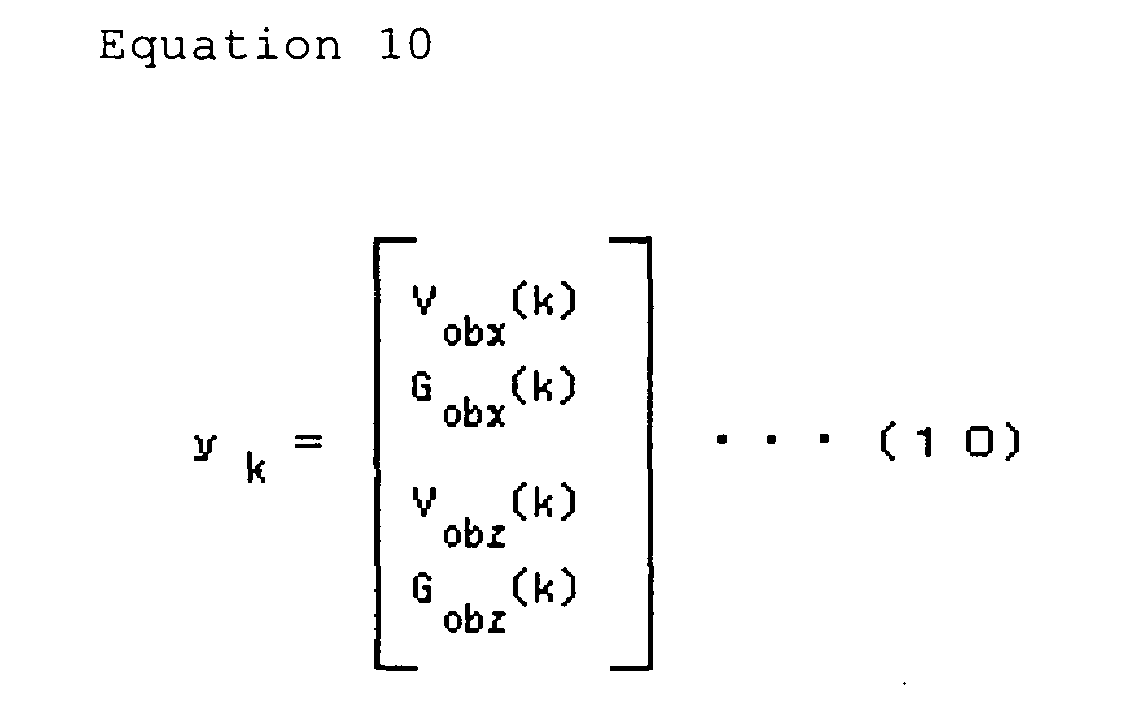
- The first term on the right side of the foregoing equation (4) is the product of a coefficient vector B and the state vector xk in the step k. The coefficient vector B is expressed by the following equation:

- The second term on the right side of the foregoing equation (4) is an observed noise vector vk in the step k. The observed noise vector vk is expressed by the following equation:

- From the foregoing equations (5) to (9), the foregoing equation (3) is expressed by the following equation:

- From the foregoing equations (10) to (12) and (7), the foregoing equation (4) is expressed by the following equation:

- Here, the x-direction acceleration offset and the z-direction acceleration offset are estimated by sequential calculation using an extended Karman filter in the following manner with a pitch angle θP included in quantities of state (elements of a state vector).
- A state vector zk in the step k, including the pitch angle θP, is expressed by the following equation:

- A subscript T denotes a transported matrix. Further, a function fk(zk) is expressed by the following equation:

- In the foregoing equation (14), a coefficient vector Fk is expressed by the following equation:

where, 0 ≤ Aax < 1, 0 < A θp ≤ 1 - A constant Aax is zero, for example, and a constant AθP is 1, for example. Here, letting ZEk|k be an estimated value of the state vector zk in the step k, letting ZEk|k-1 be an estimated value of a state vector zk in a step k-1, and letting ZEk+1|k be an estimated value of a state vector zk+1 in a step k, a filter equation is expressed by the following equations:


- In the foregoing equation (16), Kk denotes a Karman gain, and the observation vector yk is expressed by the foregoing equation (10). A function hk(zEk|k-1) will be described later.
- The Karman gain Kk is expressed by the following equation:

- In the foregoing equation (18), Σk|k-1 denotes a covariance matrix of an estimated error in the state vector zk in the step k-1, and Σvk denotes a covariance matrix in the observed noise vector vk. A matrix Hk will be described later.
- A covariance matrix Σk|k of an estimated error in the state vector zk is expressed by the following equation:

- A covariance matrix equation of the error is expressed by the following equation:

- A matrix Gk will be described later. The matrix Hk in the foregoing equations (18) and (19) is expressed by the following equation:

- The function hk(zEk|k-1) in the foregoing equation (16) is expressed by the following equation:

- In the foregoing equation (22), xEk|k-1 denotes an estimated value of the state vector xk in the step k-1. θpEk|k-1 denotes an estimated value of a pitch angle θP (k) in the step k-1. A matrix Ck is expressed by the following equation:

- A matrix Gk in the foregoing equation (20) is expressed by the following equation:

- The extended Karman filter allows the pitch angle θP (k), together with x-direction acceleration offset εoffx (k) and z-direction acceleration offset εoffz (k) at the time when the
motorcycle 100 is stopped and is traveling at a constant speed, to be estimated. - Here, the
Karman filter 330 was simulated to estimate the x-direction acceleration offset and the z-direction acceleration offset. - Fig. 8 is a diagram showing the relationship between an acceleration offset true value and an acceleration offset estimated error.
- In Fig. 8, the horizontal axis represents respective true values of the x-direction acceleration offset and the z-direction acceleration offset, and the vertical axis represents an estimated error of the acceleration offset. The estimated error of the acceleration offset is a difference between an estimated value of the x-direction acceleration offset and the true value of the x-direction acceleration offset and a difference between an estimated value of the z-direction acceleration offset and the true value of the z-direction acceleration offset.
- In Fig. 8, the estimated error of the z-direction acceleration offset is indicated by a white circle, and the estimated error of the x-direction acceleration offset is indicated by a black triangle. As shown in Fig. 8, the estimated error of the x-direction acceleration offset is within about 0.06 m/s2, and the estimated error of the z-direction acceleration offset is within about 0.001 m/s2.
- Fig. 9 is a diagram showing the change with time of an acceleration offset estimated value in the process of estimating the acceleration offset.
- In Fig. 9, the horizontal axis represents time, and the vertical axis represents acceleration offset. In Fig. 9, the true value of the z-direction acceleration offset is indicated by a thin solid line, the estimated value of the z-direction acceleration offset is indicated by a thick solid line, the true value of the x-direction acceleration offset is indicated by a thin dotted line, and the estimated value of the x-direction acceleration offset is indicated by a thick dotted line.
- As shown in Fig. 9, both the estimated value of the x-direction acceleration offset and the estimated value of the z-direction acceleration offset are completely converged in two seconds. This allows the x-direction acceleration offset and the z-direction acceleration offset to be estimated if a constant speed state for two or more seconds exists.
- A method of estimating a pitch angle by the
Karman filter 340 will now be described. - Considering observed noise and process noise, the following equation of state is obtained (k is a step in discrete time).

- An observation equation is expressed by the following equation.

- Elements of the matrix in the foregoing equations (25) and (26) are shown in Table 2.
Table 2 (k) ax (k) X-direction Acceleration [m/s2] Ground Coordinate System (k) az (k) Z-direction Acceleration [m/s2] Ground Coordinate System GAobx (k) x-direction Acceleration Corrected Value [m/s2] Sensor Coordinate System GAobz (k) z-direction Acceleration Corrected Value [m/s2] Sensor Coordinate System θP (k) Pitch Angle of Sensor Coordinate System to Ground Coordinate System [rad] (k) Gnobx (k) Observed Noise at 1, x-direction Acceleration [m/s2] Sensor System Coordinate System Gnobz (k) Observed Noise at z-direction Acceleration [m/s2] Acceleration Sensor Coordinate System anpx (k) Process Noise at X-direction Acceleration [m/s2] Ground Coordinate System anpz (k) Process Noise at Z-direction Acceleration [m/s2] Ground Coordinate System - Here, an x-direction acceleration corrected value GAobx (k) is an x-direction acceleration corrected by the offset
corrector 360 shown in Fig. 4, and is a value obtained by subtracting the x-direction acceleration offset εoffx (k) from the x-direction acceleration observed value Gobx (k). Further, a z-direction acceleration corrected value GAobz (k) is a z-direction acceleration corrected by the offsetcorrector 360 shown in Fig. 4, and is a value obtained by subtracting the z-direction acceleration offset εoffz (k) from the z-direction acceleration observed value Gobz (k). - Values that are actually and empirically valid are respectively set as the observed noise and the process noise. The observed noise and the process noise are adjusted by simulation on the basis of the values.
- The left side of the foregoing equation (25) is a state vector xk+1 in a step k+1. The state vector xk+1 is expressed by the following equation:

- The first term on the right side of the foregoing equation (25) is the product of a coefficient vector A and a state vector xk in a step k. The coefficient vector A and the state vector xk are expressed by the following equations:


- The second term on the right side of the foregoing equation (25) is a process noise vector wk in the step k. The process noise vector wk is expressed by the following equation:

- The left side of the foregoing equation (26) is an observation vector yk in the step k. The observation vector yk is expressed by the following equation:

- The first term on the right side of the foregoing equation (26) is the product of a coefficient vector B and the state vector xk in the step k. The coefficient vector B is expressed by the following equation:

- The second term on the right side of the foregoing equation (26) is an observed noise vector vk in the step k. The observed noise vector vk is expressed by the following equation:

- From the foregoing equations (27) to (30), the foregoing equation (25) is expressed by the following equation:

- From the foregoing equations (31) to (33) and (29), the foregoing equation (26) is expressed by the following equation:

- Here, a pitch angle θP is estimated using an extended Karman filter in the following manner with the pitch angle θP included in quantities of state (elements of a state vector).
- A state vector zk in the step k, including the pitch angle θP, is expressed by the following equation:

- A subscript T denotes a transported matrix. Further, a function fk(zk) is expressed by the following equation:

- In the foregoing equation (35), a coefficient vector Fk is expressed by the following equation:

- A constant Aax is zero, for example, and a constant AθP is 1, for example. Here, letting zEk|k be an estimated value of the state vector zk in the step k, letting zEk|k-1 be an estimated value of a state vector zk in a step k-1, and letting zEk+1|k be an estimated value of a state vector zk+1 in a step k, a filter equation is expressed by the following equations:


- In the foregoing equation (37), Kk denotes a Karman gain, and the observation vector yk is expressed by the foregoing equation (31). A function hk(zEk|k-1) will be described later.
- The Karman gain Kk is expressed by the following equation.

- In the foregoing equation (39), Σk|k-1 denotes a covariance matrix of an estimated error in the state vector zk in the step k-1, and Σvk denotes a covariance matrix in the observed noise vector vk. A matrix Hk will be described later.
- A covariance matrix Σk|k of the estimated error in the state vector zk is expressed by the following equation:

- A covariance matrix equation of the error is expressed by the following equation:

- A matrix Gk will be described later. The matrix Hk is expressed by the following equation:

- The function hk(zEk|k-1) in the foregoing equation (37) is expressed by the following equation:

- In the foregoing equation (43), xEk|k-1 denotes an estimated value of the state vector xk in the step k-1. θpEk|k-1 denotes an estimated value of a pitch angle θP (k) in the step k-1. A matrix Ck is expressed by the following equation:

- The matrix Gk in the foregoing equation (41) is expressed by the following equation:

- The extended Karman filter allows the pitch angle θP (k) at the time when themotorcycle 100 is accelerated and decelerated to be estimated.
- The
acceleration corrector 370 corrects the x-direction acceleration and the z-direction acceleration by the following equation using a pitch angle estimated value obtained by theKarman filter 340 for acceleration/deceleration. Thus, an X-direction acceleration estimated value and a Z-direction acceleration estimated value are obtained.
- Elements of the matrix in the forgoing equation (46) are shown in Table 3.
Table 3 k) aEx (k) X-direction Acceleration Estimated Value [m/s2] Ground Coordinate System aEz (k) Z-direction Acceleration Estimated Value [m/s2] Ground Coordinate System GAobx (k) x-direction Acceleration Corrected Value [m/s2] Sensor Coordinate System GAobz (k) z-direction Acceleration Corrected Value [m/s2] Sensor Coordinate System θEp (k) Estimated Value of Pitch Angle of Sensor Coordinate System to Ground Coordinate System [rad] - Here, an x-direction acceleration corrected value GAobx (k) is an x-direction acceleration corrected by the offset
corrector 360 shown in Fig. 4, and is a value obtained by subtracting the x-direction acceleration offset εoffx (k) from the x-direction acceleration observed value Gobx (k). Further, a z-direction acceleration corrected value GAobz (k) is a z-direction acceleration corrected by the offsetcorrector 360 shown in Fig. 4, and is a value obtained by subtracting the z-direction acceleration offset εoffz (k) from the z-direction acceleration observed value Gobz (k) . - The foregoing equation (46) allows an x-direction acceleration estimated value aEx and a Z-direction acceleration estimated value aEz at the time when the
motorcycle 100 is accelerated and decelerated to be calculated. - Here, the
Karman filter 340 and theacceleration corrector 370 were simulated to estimate the X-direction acceleration and the Z-direction acceleration. - Fig. 10 is a diagram showing the results of the estimation of the X-direction acceleration.
- In Fig. 10, the horizontal axis represents time, and the vertical axis represents acceleration. In Fig. 10, a true value of the X-direction acceleration is indicated by a dotted line, the X-direction acceleration estimated value aEx obtained by the
acceleration corrector 370 using a pitch angle estimated value θEp obtained by theKarman filter 340 is indicated by a solid line, and an x-direction acceleration corrected value GAobx (k) obtained by the offsetcorrector 360 is indicated by a one-dot and dash line. The x-direction acceleration corrected value GAobx (k) is affected by a pitch angle, although the effect of the x-direction acceleration offset is removed therefrom. - As shown in Fig. 10, the X-direction acceleration estimated value aEx is closer to the true value of the X-direction acceleration, as compared with the x-direction acceleration corrected value GAobx (k) .
- Furthermore, the true value of the X-direction acceleration, the X-direction acceleration estimated value aEx, and the x-direction acceleration corrected value GAobx (k) were integrated over time to estimate a vehicle speed.
- Fig. 11 is a diagram showing the results of the estimation of the vehicle speed. In Fig. 11, the horizontal axis represents time, and the vertical axis represents a vehicle speed estimated value.
- In Fig. 11, a vehicle speed calculated using the true value of the X-direction acceleration (an X-direction vehicle speed true value) is indicated by a dotted line, an X-direction vehicle speed estimated value calculated using the X-direction acceleration estimated value aEx is indicated by a solid line, and an x-direction vehicle speed estimated value calculated using the x-direction acceleration corrected value GAobx (k) is indicated by a one-dot and dash line.
- As shown in Fig. 11, the X-direction vehicle speed estimated value calculated using the X-direction acceleration estimated value aEx is closer to the X-direction vehicle speed true value, as compared with the x-direction vehicle speed estimated value calculated using the x-direction acceleration corrected value GAobx (k).
- In the
motorcycle 100 according to the present preferred embodiment, the offset in thex-direction acceleration sensor 21 and the offset in the z-direction acceleration sensor 22 are estimated with high accuracy by theKarman filter 330 for a constant speed in thevehicle speed estimator 300 when themotorcycle 100 is stopped and is traveling at a constant speed. Even when the detected value in thex-direction acceleration sensor 21 and the detected value in the z-direction acceleration sensor 22 are affected by gravity due to pitching having an arbitrary frequency, it is possible to accurately estimate the offset in thex-direction acceleration sensor 21 and the offset in the z-direction acceleration sensor 22. - An observed disturbance given to the
x-direction acceleration sensor 21 and the z-direction acceleration sensor 22 are removed in theKarman filter 330. This prevents the ABS controlled by the vehicle speed in the X-direction obtained by thevehicle speed estimator 300 from being unstable due to the observed disturbance. - The estimated value of the offset in the
x-direction acceleration sensor 21 and the estimated value of the offset in the z-direction acceleration sensor 22 that are obtained when themotorcycle 100 is stopped or is traveling at a constant speed are stored in the offsetstorage 350, while the detected value in thex-direction acceleration sensor 21 and the detected value in the z-direction acceleration sensor 22 are corrected by the offsetcorrector 360 on the basis of the estimated value of the offset in thex-direction acceleration sensor 21 and the estimated value of the offset in the z-direction acceleration sensor 22 that are stored in the offsetstorage 350 when themotorcycle 100 is accelerated or decelerated. This allows the x-direction acceleration and the z-direction acceleration of themotorcycle 100 to be detected with high accuracy. - The pitch angle of the
vehicle body 1 is estimated by theKarman filter 340 for acceleration/deceleration whenmotorcycle 100 is accelerated or decelerated. This allows the pitch angle due to pitching having an arbitrary frequency to be estimated at low cost and with high accuracy without using a high-cost gyro sensor. - Furthermore, the X-direction acceleration and the Y-direction acceleration of the
motorcycle 100 are calculated by theacceleration corrector 370 on the basis of the estimated value of the pitch angle, the detected value in thex-direction acceleration sensor 21, and the detected value in the z-direction acceleration sensor 22. This allows the X-direction acceleration of themotorcycle 100 to be detected with high accuracy. - The vehicle
speed operation unit 380 obtains the vehicle speed in the X-direction from the X-direction acceleration with high accuracy. When both thefront wheel 2 and therear wheel 3 are braked, therefore, it is possible to detect the sliding of thefront wheel 2 and therear wheel 3 as well as to detect the vehicle speed with high accuracy. - In cases where both the
front wheel 2 and therear wheel 3 slide, for example, a case where thefront wheel 2 is braked during the driving of therear wheel 3, the speed at the center of gravity of thevehicle body 1 cannot be found from the respective wheel speeds of thefront wheel 2 and therear wheel 3. Even in such a case, it is possible to detect the sliding of thefront wheel 2 and therear wheel 3 using thevehicle speed estimator 300 in the present preferred embodiment as well as to detect the vehicle speed with high accuracy. - Although in the preferred embodiments described above, description was made of a case where the acceleration estimation device is applied to the ABS, the present invention is not limited to this. For example, the acceleration estimation device may be applied to another brake control system, a traction control system, or a cruise control system. The traction control system refers to a system for obtaining a driving force most suitable for the time of turning, the time of starting, or the time of acceleration by controlling a driving force of a driving wheel or an output of the engine and a braking force. The cruise control system refers to a system for automatically controlling a vehicle speed to be constant in the case of long-distance or long-term traveling.
- The acceleration estimation device is also applicable to drivability control by an electronic throttle. The drivability control refers to the control for obtaining a comfortable driving performance. When the acceleration estimation device is applied to the drivability control, an error of an acceleration sensor can be reduced. Therefore, the comfortable driving performance can be controlled with high accuracy. As a result, it is possible to provide smooth acceleration characteristics that do not make a driver feel changes and variations in acceleration.
- Moreover, the acceleration estimation device of the present invention can be utilized for estimating the acceleration of a vehicle when a GPS (Global Positioning System) signal cannot be received in a navigation system.
- Although in the preferred embodiments described above, each of the constituent elements within the
vehicle speed estimator 300 is preferably provided by theECU 30 and associated program function, the present invention is not limited to this. For example, parts or all of the plurality of constituent elements within thevehicle speed estimator 300 may be provided by hardware such as an electronic circuit. - Although in the preferred embodiments described above, the offset estimator preferably includes the
Karman filter 330 for a constant speed composed of an extended Karman filter, the present invention is not limited to this. For example, the offset estimator may be achieved by another adaptive filtering method. For example, an LMS (Least Mean Square) adaptive filter or H ∞ filtering may be used. - Although in the preferred embodiments described above, the pitch angle estimator preferably includes the
Karman filter 340 for acceleration/deceleration composed of an extended Karman filter, the present invention is not limited to this. For example, the pitch angle estimator may be achieved by another adaptive filtering method. For example, an LMS adaptive filter or H ∞ filtering may be used. - The
vehicle speed estimator 300 in the preferred embodiments described above is not limited to themotorcycle 100. For example, it can be applied to various types of vehicles such asmotorcycles, four-wheeled vehicles, and three-wheeled vehicles, or any other suitable vehicle. - While preferred embodiments of the present invention have been described above, it is to be understood that variations and modifications will be apparent to those skilled in the art without departing the scope and spirit of the present invention. The scope of the present invention, therefore, is to be determined solely by the following claims.
Claims (7)
- An acceleration estimation device for estimating acceleration of a vehicle, comprising:a first acceleration sensor arranged to detect an acceleration in a forward-and-backward direction of the vehicle;a second acceleration sensor arranged to detect an acceleration in an up-and-down direction of the vehicle;a pitch angle estimator arranged to estimate a pitch angle of the vehicle on the basis of a relationship between a detected value in the first acceleration sensor and a detected value in the second acceleration sensor; andan acceleration calculator arranged to calculate an acceleration in a traveling direction of the vehicle that is substantially perpendicular to a direction of gravity on the basis of an estimated value of the pitch angle obtained by the pitch angle estimator, the detected value in the first acceleration sensor, and the detected value in the second acceleration sensor.
- The acceleration estimation device according to claim 1, further comprising a speed calculator arranged to integrate a calculated value of the acceleration in the traveling direction obtained by the acceleration calculator to calculate a speed in the traveling direction.
- The acceleration estimation device according to claim 1, wherein the pitch angle estimator includes:a first Karman filter arranged to estimate the pitch angle of the vehicle using a relationship among the acceleration in the traveling direction of the vehicle that is substantially perpendicular to the direction of gravity, an acceleration in a vertical direction that is substantially parallel to the direction of gravity, the detected value in the first acceleration sensor, and the detected value in the second acceleration sensor, and the pitch angle of the vehicle.
- The acceleration estimation device according to claim 1, further comprising:an offset estimator arranged to estimate offset in the first acceleration sensor and offset in the second acceleration sensor when the vehicle is at a substantially constant speed; anda corrector arranged to correct the detected value in the first acceleration sensor and the detected value in the second acceleration sensor on the basis of an estimated value of the offset in the first acceleration sensor and an estimated value of the offset in the second acceleration sensor that are obtained by the offset estimator when the vehicle is accelerated or decelerated; whereinthe pitch angle estimator is arranged to estimate the pitch angle of the vehicle on the basis of the relationship between the detected value in the first acceleration sensor and the detected value in the second acceleration sensor that are corrected by the corrector when the vehicle is accelerated or decelerated.
- The acceleration estimation device according to claim 4, further comprising a wheel speed detector arranged to detect a wheel speed of the vehicle, and the offset estimator includes:a second Karman filter arranged to estimate the offset in the first acceleration sensor and the offset in the second acceleration sensor using a relationship among the acceleration in the traveling direction, the acceleration in the vertical direction, the detected value in the first acceleration sensor, the detected value in the second acceleration sensor, the speed in the traveling direction, the speed in the vertical direction, the speed of the vehicle obtained from the detected value in the wheel speed detector, and the pitch angle of the vehicle.
- The acceleration estimation device according to claim 4, wherein:the offset estimator is arranged to determine that the vehicle is in a substantially constant speed state when the rate of change in the wheel speed detected by the wheel speed detector is not more than a predetermined threshold value; andthe pitch angle estimator is arranged to determine that the vehicle is accelerated or decelerated when the rate of change in the wheel speed detected by the wheel speed detector is higher than the threshold value.
- A vehicle comprising:a vehicle body;a wheel provided on the vehicle body;an acceleration estimation device provided on the vehicle body; anda controller; whereinthe acceleration estimation device includes:a first acceleration sensor on the vehicle and arranged to detect an acceleration in a forward-and-backward direction of the vehicle;a second acceleration sensor on the vehicle and arranged to detect an acceleration in an up-and-down direction of the vehicle;a pitch angle estimator arranged to estimate a pitch angle of the vehicle on the basis of a relationship between a detected value in the first acceleration sensor and a detected value in the second acceleration sensor; andan acceleration calculator arranged to calculate an acceleration in a traveling direction of the vehicle that is substantially perpendicular to a direction of gravity on the basis of an estimated value of the pitch angle obtained by the pitch angle estimator, the detected value in the first acceleration sensor, and the detected value in the second acceleration sensor; andthe controller controls the rotation of the wheel on the basis of the acceleration in the traveling direction obtained by the acceleration estimation device.
Applications Claiming Priority (1)
| Application Number | Priority Date | Filing Date | Title |
|---|---|---|---|
| JP2006062980 | 2006-03-08 |
Publications (2)
| Publication Number | Publication Date |
|---|---|
| EP1832881A2 true EP1832881A2 (en) | 2007-09-12 |
| EP1832881A3 EP1832881A3 (en) | 2007-09-26 |
Family
ID=38234902
Family Applications (1)
| Application Number | Title | Priority Date | Filing Date |
|---|---|---|---|
| EP07004453A Withdrawn EP1832881A3 (en) | 2006-03-08 | 2007-03-05 | Acceleration estimation device and vehicle with such a device |
Country Status (2)
| Country | Link |
|---|---|
| US (1) | US7599779B2 (en) |
| EP (1) | EP1832881A3 (en) |
Cited By (11)
| Publication number | Priority date | Publication date | Assignee | Title |
|---|---|---|---|---|
| WO2009060093A1 (en) * | 2007-11-09 | 2009-05-14 | Societe De Technologie Michelin | System or controlling a vehicle with determination of its instantaneous speed relative to the ground |
| US7599779B2 (en) * | 2006-03-08 | 2009-10-06 | Yamaha Hatsudoki Kabushiki Kaisha | Acceleration estimation device and vehicle |
| ITSA20080021A1 (en) * | 2008-08-06 | 2010-02-06 | Gerardo Acocella | METHOD AND APPARATUS FOR CONTROL OF A SEMI-ACTIVE MOTORCYCLE SUSPENSION SYSTEM |
| US8370013B2 (en) | 2007-11-09 | 2013-02-05 | Compagnie Generale Des Establissements Michelin | System for generating an estimation of the ground speed of a vehicle from measures of the rotation speed of at least one wheel |
| WO2013024461A1 (en) * | 2011-08-18 | 2013-02-21 | Koninklijke Philips Electronics N.V. | Estimating velocity in a horizontal or vertical direction from acceleration measurements |
| US8527177B2 (en) | 2007-11-09 | 2013-09-03 | Compagnie Generale Des Etablissements Michelin | System for controlling a vehicle with determination of the speed thereof relative to the ground |
| US8565967B2 (en) | 2011-12-21 | 2013-10-22 | Infineon Technologies Ag | Acceleration detection and angular position determination systems and methods in tire pressure monitoring systems |
| US8593273B2 (en) | 2011-02-07 | 2013-11-26 | Infineon Technologies Ag | Systems and methods for localization of tire pressure monitoring system wheel modules |
| US8700286B2 (en) | 2011-12-21 | 2014-04-15 | Infineon Technologies Ag | Tire localization systems and methods in tire pressure monitoring systems |
| CN115169782A (en) * | 2022-05-16 | 2022-10-11 | 江苏大块头智驾科技有限公司 | Unmanned electric mine card quality estimation method based on robust filtering |
| EP3418137B1 (en) | 2017-06-23 | 2023-02-22 | SNCF Voyageurs | Method for determining the reference speed used by an anti-skid device used by a railway vehicle, and anti-skid device implementing such a method |
Families Citing this family (16)
| Publication number | Priority date | Publication date | Assignee | Title |
|---|---|---|---|---|
| JP5020388B2 (en) | 2009-01-08 | 2012-09-05 | 株式会社小松製作所 | Vehicle speed estimation device and traction control device |
| JP5027933B2 (en) | 2009-01-08 | 2012-09-19 | 株式会社小松製作所 | Traction control device |
| JP5109101B2 (en) * | 2009-09-17 | 2012-12-26 | 日立オートモティブシステムズ株式会社 | Vehicle control device |
| CN102770771B (en) * | 2010-02-10 | 2015-03-11 | 丰田自动车株式会社 | Acceleration and deceleration detection system |
| JP2012185111A (en) * | 2011-03-08 | 2012-09-27 | Seiko Epson Corp | Positioning device and positioning method |
| CN105722735B (en) * | 2013-06-03 | 2018-01-30 | E-Aam 传动系统公司 | Method for determining vehicle speed parameters |
| US9340212B2 (en) * | 2014-04-01 | 2016-05-17 | GM Global Technology Operations LLC | System and method for estimating road grade based on an output of a longitudinal acceleration sensor in a vehicle |
| DE102015111350A1 (en) * | 2015-07-14 | 2017-01-19 | Hella Kgaa Hueck & Co. | Method for determining a slope of a vehicle body |
| JP6582125B2 (en) * | 2016-03-31 | 2019-09-25 | 本田技研工業株式会社 | Brake control device for motorcycle |
| IT201600069021A1 (en) * | 2016-07-04 | 2018-01-04 | Ducati Motor Holding Spa | MOTORCYCLE WITH SUSPENSION CONTROL PERFECTED |
| JP2018024324A (en) * | 2016-08-10 | 2018-02-15 | ローベルト ボッシュ ゲゼルシャフト ミット ベシュレンクテル ハフツング | Control device and control method for braking force generated by brake system of motorcycle |
| CN110077385B (en) * | 2018-01-25 | 2021-09-24 | 株洲中车时代电气股份有限公司 | Vehicle brake control method |
| US11427209B2 (en) | 2020-04-30 | 2022-08-30 | Ford Global Technologies, Llc | Systems and methods for vehicle speedometer calibration |
| EP4183629B1 (en) | 2021-11-23 | 2024-02-14 | C.R.F. Società Consortile per Azioni | System and method for adjusting the emission direction of a motor-vehicle headlight unit |
| IT202200008477A1 (en) | 2022-04-28 | 2023-10-28 | Fiat Ricerche | "System and procedure for regulating the emission direction of a motor vehicle headlamp unit" |
| CN116879579B (en) * | 2023-09-07 | 2023-11-24 | 国汽(北京)智能网联汽车研究院有限公司 | Vehicle acceleration calculation method, device, computer equipment and storage medium |
Family Cites Families (40)
| Publication number | Priority date | Publication date | Assignee | Title |
|---|---|---|---|---|
| JP2669651B2 (en) | 1988-07-06 | 1997-10-29 | 富士通テン株式会社 | Calibration device for automotive acceleration sensor |
| JPH0764175B2 (en) * | 1989-04-14 | 1995-07-12 | トヨタ自動車株式会社 | Fluid pressure active suspension |
| JPH0396468A (en) * | 1989-09-07 | 1991-04-22 | Honda Motor Co Ltd | Estimation method for fore and aft acceleration and deceleration of body |
| JPH0833408B2 (en) * | 1990-03-29 | 1996-03-29 | 株式会社日立製作所 | Angle detection device, translational acceleration detection device, and vehicle control device |
| DE4201146C2 (en) * | 1991-01-18 | 2003-01-30 | Hitachi Ltd | Device for controlling motor vehicle behavior |
| JP3115052B2 (en) | 1991-10-08 | 2000-12-04 | 本田技研工業株式会社 | Body state detection method and apparatus |
| JP3210418B2 (en) | 1992-06-24 | 2001-09-17 | 本田技研工業株式会社 | Estimated vehicle speed calculation device |
| DE69332389T2 (en) * | 1992-06-24 | 2003-02-13 | Honda Giken Kogyo K.K., Tokio/Tokyo | Device for estimating the speed of a vehicle |
| JP2766588B2 (en) | 1992-06-29 | 1998-06-18 | 株式会社日立製作所 | Vehicle yaw angular velocity detection method |
| JP3188323B2 (en) | 1992-09-25 | 2001-07-16 | 株式会社デンソー | Body speed estimation device |
| US5608631A (en) * | 1993-03-16 | 1997-03-04 | Mitsubishi Denki Kabushiki Kaisha | Apparatus and method for detecting acceleration of motor vehicle with high accuracy and anti-skid control apparatus using the same |
| JP2829215B2 (en) | 1993-03-16 | 1998-11-25 | 三菱電機株式会社 | Anti-skid control device |
| JP2829214B2 (en) | 1993-03-16 | 1998-11-25 | 三菱電機株式会社 | Anti-skid control device |
| JPH07228114A (en) | 1994-02-16 | 1995-08-29 | Toyota Motor Corp | Electric control device for shock absorber |
| JPH08268257A (en) * | 1995-03-30 | 1996-10-15 | Isuzu Motors Ltd | Actual vehicle speed estimation device |
| JP3204121B2 (en) | 1996-09-30 | 2001-09-04 | 三菱自動車工業株式会社 | Vehicle longitudinal acceleration estimation device |
| JP3304797B2 (en) | 1996-12-17 | 2002-07-22 | 三菱自動車工業株式会社 | Body speed estimation device |
| US6082666A (en) | 1997-12-03 | 2000-07-04 | Raytheon Company | System for accurately determining missile vertical velocity and altitude |
| US6002974A (en) * | 1998-02-06 | 1999-12-14 | Delco Electronics Corporation | Vehicle rollover sensing using extended kalman filter |
| US6417767B1 (en) * | 2000-03-27 | 2002-07-09 | Craig D. Carlson | Device and system for indicating rapid deceleration in vehicles |
| EP1147929B1 (en) * | 2000-04-17 | 2005-09-21 | Robert Bosch GmbH | Apparatus and method for determining vehicle operating and dynamic parameters |
| EP1147928B1 (en) * | 2000-04-17 | 2005-09-21 | Robert Bosch GmbH | Apparatus and method for determining vehicle operating and dynamic parameters |
| SE0004515D0 (en) | 2000-06-28 | 2000-12-06 | Nira Automotive Ab | Roll angle indicator |
| JP2001074772A (en) | 2000-07-10 | 2001-03-23 | Denso Corp | Body acceleration calculation device |
| JP2002318274A (en) | 2001-02-13 | 2002-10-31 | Mazda Motor Corp | Body movement measurement apparatus, body movement measurement method, and recording medium recording the method |
| JP2003004758A (en) | 2001-06-20 | 2003-01-08 | Railway Technical Res Inst | Vehicle speed measuring device and vehicle speed measuring method |
| US6556908B1 (en) * | 2002-03-04 | 2003-04-29 | Ford Global Technologies, Inc. | Attitude sensing system for an automotive vehicle relative to the road |
| DE10391324D2 (en) * | 2002-03-13 | 2005-04-21 | Daimler Chrysler Ag | Device for providing sizes |
| US6718248B2 (en) * | 2002-06-19 | 2004-04-06 | Ford Global Technologies, Llc | System for detecting surface profile of a driving road |
| JP4242134B2 (en) * | 2002-10-31 | 2009-03-18 | 本田技研工業株式会社 | Vehicle acceleration and angular velocity detection device |
| JP4126239B2 (en) * | 2003-02-04 | 2008-07-30 | パイオニア株式会社 | Angular velocity detector |
| JP4336963B2 (en) | 2003-11-18 | 2009-09-30 | 三菱自動車工業株式会社 | Anti-lock brake device |
| JP2006047146A (en) | 2004-08-05 | 2006-02-16 | Nissin Kogyo Co Ltd | In-vehicle equipment |
| US7599779B2 (en) * | 2006-03-08 | 2009-10-06 | Yamaha Hatsudoki Kabushiki Kaisha | Acceleration estimation device and vehicle |
| JP2007271605A (en) * | 2006-03-08 | 2007-10-18 | Yamaha Motor Co Ltd | Acceleration estimation device and vehicle |
| JP2007271606A (en) * | 2006-03-08 | 2007-10-18 | Yamaha Motor Co Ltd | Acceleration estimation device and vehicle |
| JP2007303298A (en) * | 2006-05-09 | 2007-11-22 | Yamaha Motor Co Ltd | Saddle riding vehicle |
| JP4755048B2 (en) * | 2006-08-10 | 2011-08-24 | ヤマハ発動機株式会社 | Hybrid motorcycle |
| JP5039349B2 (en) * | 2006-09-27 | 2012-10-03 | ヤマハ発動機株式会社 | Saddle-type vehicle attitude detection device, engine control device, and saddle-type vehicle |
| JP4717839B2 (en) * | 2007-02-14 | 2011-07-06 | 株式会社ケーヒン | Engine control device for motorcycle |
-
2007
- 2007-03-05 US US11/682,036 patent/US7599779B2/en not_active Expired - Fee Related
- 2007-03-05 EP EP07004453A patent/EP1832881A3/en not_active Withdrawn
Cited By (20)
| Publication number | Priority date | Publication date | Assignee | Title |
|---|---|---|---|---|
| US7599779B2 (en) * | 2006-03-08 | 2009-10-06 | Yamaha Hatsudoki Kabushiki Kaisha | Acceleration estimation device and vehicle |
| US8527177B2 (en) | 2007-11-09 | 2013-09-03 | Compagnie Generale Des Etablissements Michelin | System for controlling a vehicle with determination of the speed thereof relative to the ground |
| FR2923596A1 (en) * | 2007-11-09 | 2009-05-15 | Michelin Soc Tech | SYSTEM FOR MONITORING THE BEHAVIOR OF THE GROUND OF A VEHICLE COMPRISING A DETERMINATION OF THE SLOPE OF THE BEARING FLOOR 1 |
| CN101855116B (en) * | 2007-11-09 | 2015-05-06 | 米其林企业总公司 | System for controlling a vehicle with determination of its instantaneous speed relative to the ground |
| WO2009060093A1 (en) * | 2007-11-09 | 2009-05-14 | Societe De Technologie Michelin | System or controlling a vehicle with determination of its instantaneous speed relative to the ground |
| CN101855116A (en) * | 2007-11-09 | 2010-10-06 | 米其林技术公司 | A system for controlling a vehicle using the determination of the vehicle's instantaneous velocity relative to the ground |
| US8370013B2 (en) | 2007-11-09 | 2013-02-05 | Compagnie Generale Des Establissements Michelin | System for generating an estimation of the ground speed of a vehicle from measures of the rotation speed of at least one wheel |
| CN102131663B (en) * | 2008-08-06 | 2013-08-14 | 斯伯林奥夫公司 | Method and apparatus for controlling a semi-active suspension system of a motorcycle |
| WO2010022852A1 (en) * | 2008-08-06 | 2010-03-04 | Spring Off S.R.L. | Method and aparratus for controlling a semi-active suspension system for motorcycles |
| ITSA20080021A1 (en) * | 2008-08-06 | 2010-02-06 | Gerardo Acocella | METHOD AND APPARATUS FOR CONTROL OF A SEMI-ACTIVE MOTORCYCLE SUSPENSION SYSTEM |
| US8593273B2 (en) | 2011-02-07 | 2013-11-26 | Infineon Technologies Ag | Systems and methods for localization of tire pressure monitoring system wheel modules |
| WO2013024461A1 (en) * | 2011-08-18 | 2013-02-21 | Koninklijke Philips Electronics N.V. | Estimating velocity in a horizontal or vertical direction from acceleration measurements |
| CN103733078B (en) * | 2011-08-18 | 2017-02-15 | 皇家飞利浦有限公司 | Estimating velocity in a horizontal or vertical direction from acceleration measurements |
| US9835644B2 (en) | 2011-08-18 | 2017-12-05 | Koninklijke Philips N.V. | Estimating velocity in a horizontal or vertical direction from acceleration measurements |
| CN103733078A (en) * | 2011-08-18 | 2014-04-16 | 皇家飞利浦有限公司 | Estimating velocity in a horizontal or vertical direction from acceleration measurements |
| US8565967B2 (en) | 2011-12-21 | 2013-10-22 | Infineon Technologies Ag | Acceleration detection and angular position determination systems and methods in tire pressure monitoring systems |
| US9139052B2 (en) | 2011-12-21 | 2015-09-22 | Infineon Technologies Ag | Tire localization systems and methods in tire pressure monitoring systems |
| US8700286B2 (en) | 2011-12-21 | 2014-04-15 | Infineon Technologies Ag | Tire localization systems and methods in tire pressure monitoring systems |
| EP3418137B1 (en) | 2017-06-23 | 2023-02-22 | SNCF Voyageurs | Method for determining the reference speed used by an anti-skid device used by a railway vehicle, and anti-skid device implementing such a method |
| CN115169782A (en) * | 2022-05-16 | 2022-10-11 | 江苏大块头智驾科技有限公司 | Unmanned electric mine card quality estimation method based on robust filtering |
Also Published As
| Publication number | Publication date |
|---|---|
| EP1832881A3 (en) | 2007-09-26 |
| US7599779B2 (en) | 2009-10-06 |
| US20070213899A1 (en) | 2007-09-13 |
Similar Documents
| Publication | Publication Date | Title |
|---|---|---|
| EP1832881A2 (en) | Acceleration estimation device and vehicle with such a device | |
| US7292925B1 (en) | Acceleration estimation device and vehicle | |
| US6351694B1 (en) | Method for robust estimation of road bank angle | |
| US6816804B1 (en) | System and method for estimating velocity using reliability indexed sensor fusion | |
| JP3539722B2 (en) | Road surface friction coefficient estimation device for vehicles | |
| CN115056617B (en) | A method and system for automatically adjusting vehicle height by air suspension when parking on a slope | |
| US20050154513A1 (en) | Vehicle dynamics behavior reproduction system | |
| KR19990077631A (en) | Device for estimating rolling condition of vehicle body with limits of roll angle and angular speed | |
| CN108819950B (en) | Vehicle speed estimation method and system of vehicle stability control system | |
| EP1844996B1 (en) | Vehicle anti-skid brake control system and its control method | |
| US8340881B2 (en) | Method and system for assessing vehicle movement | |
| JP3236003B1 (en) | Road surface friction coefficient estimation device for vehicles | |
| JP3619388B2 (en) | Estimating and calculating device for height of center of gravity of vehicle | |
| JP2007271605A (en) | Acceleration estimation device and vehicle | |
| JP2007271606A (en) | Acceleration estimation device and vehicle | |
| JP3748334B2 (en) | Vehicle attitude control device | |
| EP1760451A1 (en) | Method and system for road surface friction coefficient estimation | |
| JP2003312512A (en) | Self-aligning torque estimation device and lateral grip degree estimation device | |
| JP2002104158A (en) | Road friction state calculation device, tire type determination device, tire wear determination device, road surface inclination estimation device, and offset correction device for acceleration sensor | |
| US20050125107A1 (en) | Method for estimating the longitudinal inclination of a roadway | |
| JP3271955B2 (en) | Road surface friction coefficient estimation device for vehicles | |
| JP3535358B2 (en) | Road friction coefficient estimation device | |
| JP2000233738A (en) | Vehicle running state determination device | |
| KR100987076B1 (en) | Rough road detection method of vehicle stability control system | |
| KR101365008B1 (en) | Control method for electronic stability control ina vehicle |
Legal Events
| Date | Code | Title | Description |
|---|---|---|---|
| PUAI | Public reference made under article 153(3) epc to a published international application that has entered the european phase |
Free format text: ORIGINAL CODE: 0009012 |
|
| PUAL | Search report despatched |
Free format text: ORIGINAL CODE: 0009013 |
|
| AK | Designated contracting states |
Kind code of ref document: A2 Designated state(s): AT BE BG CH CY CZ DE DK EE ES FI FR GB GR HU IE IS IT LI LT LU LV MC MT NL PL PT RO SE SI SK TR |
|
| AX | Request for extension of the european patent |
Extension state: AL BA HR MK YU |
|
| AK | Designated contracting states |
Kind code of ref document: A3 Designated state(s): AT BE BG CH CY CZ DE DK EE ES FI FR GB GR HU IE IS IT LI LT LU LV MC MT NL PL PT RO SE SI SK TR |
|
| AX | Request for extension of the european patent |
Extension state: AL BA HR MK YU |
|
| 17P | Request for examination filed |
Effective date: 20071122 |
|
| 17Q | First examination report despatched |
Effective date: 20071220 |
|
| AKX | Designation fees paid |
Designated state(s): AT BE BG CH CY CZ DE DK EE ES FI FR GB GR HU IE IS IT LI LT LU LV MC MT NL PL PT RO SE SI SK TR |
|
| GRAP | Despatch of communication of intention to grant a patent |
Free format text: ORIGINAL CODE: EPIDOSNIGR1 |
|
| STAA | Information on the status of an ep patent application or granted ep patent |
Free format text: STATUS: THE APPLICATION IS DEEMED TO BE WITHDRAWN |
|
| 18D | Application deemed to be withdrawn |
Effective date: 20111130 |