EP1832586A1 - Thiazole-piperidine derivatives in treatment of diseases of liver and the pancreas - Google Patents
Thiazole-piperidine derivatives in treatment of diseases of liver and the pancreas Download PDFInfo
- Publication number
- EP1832586A1 EP1832586A1 EP06110952A EP06110952A EP1832586A1 EP 1832586 A1 EP1832586 A1 EP 1832586A1 EP 06110952 A EP06110952 A EP 06110952A EP 06110952 A EP06110952 A EP 06110952A EP 1832586 A1 EP1832586 A1 EP 1832586A1
- Authority
- EP
- European Patent Office
- Prior art keywords
- liver
- optionally substituted
- nitrogen
- hydrogen
- alkyl
- Prior art date
- Legal status (The legal status is an assumption and is not a legal conclusion. Google has not performed a legal analysis and makes no representation as to the accuracy of the status listed.)
- Withdrawn
Links
- 210000004185 liver Anatomy 0.000 title claims abstract description 40
- 210000000496 pancreas Anatomy 0.000 title claims abstract description 40
- 238000011282 treatment Methods 0.000 title claims abstract description 39
- 208000037265 diseases, disorders, signs and symptoms Diseases 0.000 title claims description 43
- 201000010099 disease Diseases 0.000 title claims description 37
- HNQMICUDBUDJBA-UHFFFAOYSA-N piperidine;1,3-thiazole Chemical class C1=CSC=N1.C1CCNCC1 HNQMICUDBUDJBA-UHFFFAOYSA-N 0.000 title description 8
- 150000001875 compounds Chemical class 0.000 claims abstract description 78
- 239000008194 pharmaceutical composition Substances 0.000 claims abstract description 14
- -1 carbonyloxy, carbonylmercapto, carbonylamino Chemical group 0.000 claims description 203
- IJGRMHOSHXDMSA-UHFFFAOYSA-N Atomic nitrogen Chemical compound N#N IJGRMHOSHXDMSA-UHFFFAOYSA-N 0.000 claims description 80
- 229910052757 nitrogen Inorganic materials 0.000 claims description 58
- 125000000217 alkyl group Chemical group 0.000 claims description 57
- 239000001257 hydrogen Substances 0.000 claims description 44
- 229910052739 hydrogen Inorganic materials 0.000 claims description 44
- 125000004435 hydrogen atom Chemical group [H]* 0.000 claims description 44
- 208000019423 liver disease Diseases 0.000 claims description 35
- 229910052799 carbon Inorganic materials 0.000 claims description 30
- 208000014018 liver neoplasm Diseases 0.000 claims description 28
- QJGQUHMNIGDVPM-UHFFFAOYSA-N nitrogen group Chemical group [N] QJGQUHMNIGDVPM-UHFFFAOYSA-N 0.000 claims description 26
- FZWLAAWBMGSTSO-UHFFFAOYSA-N Thiazole Chemical group C1=CSC=N1 FZWLAAWBMGSTSO-UHFFFAOYSA-N 0.000 claims description 22
- 125000002915 carbonyl group Chemical group [*:2]C([*:1])=O 0.000 claims description 22
- 125000001997 phenyl group Chemical group [H]C1=C([H])C([H])=C(*)C([H])=C1[H] 0.000 claims description 20
- 238000000034 method Methods 0.000 claims description 19
- 125000001072 heteroaryl group Chemical group 0.000 claims description 18
- 201000007270 liver cancer Diseases 0.000 claims description 16
- 125000003545 alkoxy group Chemical group 0.000 claims description 14
- 208000019425 cirrhosis of liver Diseases 0.000 claims description 13
- 208000008338 non-alcoholic fatty liver disease Diseases 0.000 claims description 13
- 125000003118 aryl group Chemical group 0.000 claims description 12
- 125000000623 heterocyclic group Chemical group 0.000 claims description 12
- 125000003342 alkenyl group Chemical group 0.000 claims description 11
- 125000000753 cycloalkyl group Chemical group 0.000 claims description 11
- 206010067125 Liver injury Diseases 0.000 claims description 10
- 125000006193 alkinyl group Chemical group 0.000 claims description 10
- 125000003884 phenylalkyl group Chemical group 0.000 claims description 10
- 231100000240 steatosis hepatitis Toxicity 0.000 claims description 10
- 231100000753 hepatic injury Toxicity 0.000 claims description 9
- 125000004446 heteroarylalkyl group Chemical group 0.000 claims description 9
- 125000004193 piperazinyl group Chemical group 0.000 claims description 9
- 125000004076 pyridyl group Chemical group 0.000 claims description 9
- 125000000472 sulfonyl group Chemical group *S(*)(=O)=O 0.000 claims description 9
- 208000022309 Alcoholic Liver disease Diseases 0.000 claims description 8
- 206010061902 Pancreatic neoplasm Diseases 0.000 claims description 8
- 208000024691 pancreas disease Diseases 0.000 claims description 8
- 239000003814 drug Substances 0.000 claims description 7
- 125000001475 halogen functional group Chemical group 0.000 claims description 7
- 230000001404 mediated effect Effects 0.000 claims description 7
- 238000002360 preparation method Methods 0.000 claims description 7
- 238000011321 prophylaxis Methods 0.000 claims description 7
- 230000007863 steatosis Effects 0.000 claims description 7
- 125000001494 2-propynyl group Chemical group [H]C#CC([H])([H])* 0.000 claims description 6
- 125000004217 4-methoxybenzyl group Chemical group [H]C1=C([H])C(=C([H])C([H])=C1OC([H])([H])[H])C([H])([H])* 0.000 claims description 6
- 206010008635 Cholestasis Diseases 0.000 claims description 6
- 231100000359 cholestasis Toxicity 0.000 claims description 6
- 230000007870 cholestasis Effects 0.000 claims description 6
- 125000000113 cyclohexyl group Chemical group [H]C1([H])C([H])([H])C([H])([H])C([H])(*)C([H])([H])C1([H])[H] 0.000 claims description 6
- 208000015181 infectious disease Diseases 0.000 claims description 6
- 230000001613 neoplastic effect Effects 0.000 claims description 6
- 125000002924 primary amino group Chemical group [H]N([H])* 0.000 claims description 6
- 125000003226 pyrazolyl group Chemical group 0.000 claims description 6
- PBMFSQRYOILNGV-UHFFFAOYSA-N pyridazine Chemical group C1=CC=NN=C1 PBMFSQRYOILNGV-UHFFFAOYSA-N 0.000 claims description 6
- 125000000714 pyrimidinyl group Chemical group 0.000 claims description 6
- 125000000547 substituted alkyl group Chemical group 0.000 claims description 6
- 125000001544 thienyl group Chemical group 0.000 claims description 6
- 208000016222 Pancreatic disease Diseases 0.000 claims description 5
- NINIDFKCEFEMDL-UHFFFAOYSA-N Sulfur Chemical group [S] NINIDFKCEFEMDL-UHFFFAOYSA-N 0.000 claims description 5
- 125000004453 alkoxycarbonyl group Chemical group 0.000 claims description 5
- 125000003710 aryl alkyl group Chemical group 0.000 claims description 5
- 125000004129 indan-1-yl group Chemical group [H]C1=C([H])C([H])=C2C(=C1[H])C([H])([H])C([H])([H])C2([H])* 0.000 claims description 5
- 125000003386 piperidinyl group Chemical group 0.000 claims description 5
- 229910052717 sulfur Inorganic materials 0.000 claims description 5
- 239000011593 sulfur Substances 0.000 claims description 5
- 125000000335 thiazolyl group Chemical group 0.000 claims description 5
- 125000000499 benzofuranyl group Chemical group O1C(=CC2=C1C=CC=C2)* 0.000 claims description 4
- 125000004181 carboxyalkyl group Chemical group 0.000 claims description 4
- 125000004663 dialkyl amino group Chemical group 0.000 claims description 4
- 125000002541 furyl group Chemical group 0.000 claims description 4
- 208000015486 malignant pancreatic neoplasm Diseases 0.000 claims description 4
- 125000000449 nitro group Chemical group [O-][N+](*)=O 0.000 claims description 4
- 125000002971 oxazolyl group Chemical group 0.000 claims description 4
- 125000002943 quinolinyl group Chemical group N1=C(C=CC2=CC=CC=C12)* 0.000 claims description 4
- 125000006282 2-chlorobenzyl group Chemical group [H]C1=C([H])C(Cl)=C(C([H])=C1[H])C([H])([H])* 0.000 claims description 3
- 125000004105 2-pyridyl group Chemical group N1=C([*])C([H])=C([H])C([H])=C1[H] 0.000 claims description 3
- 125000004189 3,4-dichlorophenyl group Chemical group [H]C1=C([H])C(Cl)=C(Cl)C([H])=C1* 0.000 claims description 3
- 125000002774 3,4-dimethoxybenzyl group Chemical group [H]C1=C([H])C(=C([H])C(OC([H])([H])[H])=C1OC([H])([H])[H])C([H])([H])* 0.000 claims description 3
- 125000004390 alkyl sulfonyl group Chemical group 0.000 claims description 3
- 208000006682 alpha 1-Antitrypsin Deficiency Diseases 0.000 claims description 3
- 125000000043 benzamido group Chemical group [H]N([*])C(=O)C1=C([H])C([H])=C([H])C([H])=C1[H] 0.000 claims description 3
- 125000001559 cyclopropyl group Chemical group [H]C1([H])C([H])([H])C1([H])* 0.000 claims description 3
- 125000001188 haloalkyl group Chemical group 0.000 claims description 3
- 235000016709 nutrition Nutrition 0.000 claims description 3
- 125000005359 phenoxyalkyl group Chemical group 0.000 claims description 3
- 125000000246 pyrimidin-2-yl group Chemical group [H]C1=NC(*)=NC([H])=C1[H] 0.000 claims description 3
- 230000005855 radiation Effects 0.000 claims description 3
- 231100000331 toxic Toxicity 0.000 claims description 3
- 230000002588 toxic effect Effects 0.000 claims description 3
- 230000003612 virological effect Effects 0.000 claims description 3
- 206010019799 Hepatitis viral Diseases 0.000 claims description 2
- 206010040047 Sepsis Diseases 0.000 claims description 2
- 125000005236 alkanoylamino group Chemical group 0.000 claims description 2
- 125000005036 alkoxyphenyl group Chemical group 0.000 claims description 2
- 125000003282 alkyl amino group Chemical group 0.000 claims description 2
- 125000002947 alkylene group Chemical group 0.000 claims description 2
- 125000005239 aroylamino group Chemical group 0.000 claims description 2
- 125000005160 aryl oxy alkyl group Chemical group 0.000 claims description 2
- 125000005161 aryl oxy carbonyl group Chemical group 0.000 claims description 2
- 230000001363 autoimmune Effects 0.000 claims description 2
- 125000004093 cyano group Chemical group *C#N 0.000 claims description 2
- 229910052736 halogen Inorganic materials 0.000 claims description 2
- 150000002367 halogens Chemical group 0.000 claims description 2
- 125000005241 heteroarylamino group Chemical group 0.000 claims description 2
- 230000035764 nutrition Effects 0.000 claims description 2
- 125000004550 quinolin-6-yl group Chemical group N1=CC=CC2=CC(=CC=C12)* 0.000 claims description 2
- 125000005346 substituted cycloalkyl group Chemical group 0.000 claims description 2
- 125000006296 sulfonyl amino group Chemical group [H]N(*)S(*)(=O)=O 0.000 claims description 2
- 125000000437 thiazol-2-yl group Chemical group [H]C1=C([H])N=C(*)S1 0.000 claims description 2
- 125000002813 thiocarbonyl group Chemical group *C(*)=S 0.000 claims description 2
- 201000001862 viral hepatitis Diseases 0.000 claims description 2
- 150000001721 carbon Chemical group 0.000 claims 10
- 208000003609 Bile Duct Adenoma Diseases 0.000 claims 1
- 208000004057 Focal Nodular Hyperplasia Diseases 0.000 claims 1
- 208000018565 Hemochromatosis Diseases 0.000 claims 1
- 230000002458 infectious effect Effects 0.000 claims 1
- 230000006806 disease prevention Effects 0.000 abstract description 5
- XSHHZEANTJNOHO-UHFFFAOYSA-N 2-piperidin-1-yl-1,3-thiazole Chemical class C1CCCCN1C1=NC=CS1 XSHHZEANTJNOHO-UHFFFAOYSA-N 0.000 abstract 1
- 125000004432 carbon atom Chemical group C* 0.000 description 26
- 206010028980 Neoplasm Diseases 0.000 description 24
- 239000004480 active ingredient Substances 0.000 description 19
- 210000004027 cell Anatomy 0.000 description 19
- RTZKZFJDLAIYFH-UHFFFAOYSA-N Diethyl ether Chemical compound CCOCC RTZKZFJDLAIYFH-UHFFFAOYSA-N 0.000 description 16
- 239000000243 solution Substances 0.000 description 15
- YMWUJEATGCHHMB-UHFFFAOYSA-N Dichloromethane Chemical compound ClCCl YMWUJEATGCHHMB-UHFFFAOYSA-N 0.000 description 12
- 239000000203 mixture Substances 0.000 description 12
- 125000001424 substituent group Chemical group 0.000 description 12
- LFQSCWFLJHTTHZ-UHFFFAOYSA-N Ethanol Chemical compound CCO LFQSCWFLJHTTHZ-UHFFFAOYSA-N 0.000 description 11
- 206010016654 Fibrosis Diseases 0.000 description 10
- 206010019695 Hepatic neoplasm Diseases 0.000 description 10
- 230000001225 therapeutic effect Effects 0.000 description 10
- 238000002054 transplantation Methods 0.000 description 10
- 210000004881 tumor cell Anatomy 0.000 description 10
- 201000011510 cancer Diseases 0.000 description 9
- 230000003463 hyperproliferative effect Effects 0.000 description 9
- 230000035755 proliferation Effects 0.000 description 9
- 150000003839 salts Chemical class 0.000 description 9
- 235000002639 sodium chloride Nutrition 0.000 description 9
- 239000000725 suspension Substances 0.000 description 9
- WEVYAHXRMPXWCK-UHFFFAOYSA-N Acetonitrile Chemical compound CC#N WEVYAHXRMPXWCK-UHFFFAOYSA-N 0.000 description 8
- 208000004930 Fatty Liver Diseases 0.000 description 8
- ZDXPYRJPNDTMRX-UHFFFAOYSA-N Glutamine Chemical compound OC(=O)C(N)CCC(N)=O ZDXPYRJPNDTMRX-UHFFFAOYSA-N 0.000 description 8
- JGFZNNIVVJXRND-UHFFFAOYSA-N N,N-Diisopropylethylamine (DIPEA) Chemical compound CCN(C(C)C)C(C)C JGFZNNIVVJXRND-UHFFFAOYSA-N 0.000 description 8
- 230000005764 inhibitory process Effects 0.000 description 8
- 230000008569 process Effects 0.000 description 8
- 239000002904 solvent Substances 0.000 description 8
- 208000006454 hepatitis Diseases 0.000 description 7
- 206010053219 non-alcoholic steatohepatitis Diseases 0.000 description 7
- 239000000546 pharmaceutical excipient Substances 0.000 description 7
- 238000002560 therapeutic procedure Methods 0.000 description 7
- IAZDPXIOMUYVGZ-UHFFFAOYSA-N Dimethylsulphoxide Chemical compound CS(C)=O IAZDPXIOMUYVGZ-UHFFFAOYSA-N 0.000 description 6
- XEKOWRVHYACXOJ-UHFFFAOYSA-N Ethyl acetate Chemical compound CCOC(C)=O XEKOWRVHYACXOJ-UHFFFAOYSA-N 0.000 description 6
- PEDCQBHIVMGVHV-UHFFFAOYSA-N Glycerine Chemical compound OCC(O)CO PEDCQBHIVMGVHV-UHFFFAOYSA-N 0.000 description 6
- CSNNHWWHGAXBCP-UHFFFAOYSA-L Magnesium sulfate Chemical compound [Mg+2].[O-][S+2]([O-])([O-])[O-] CSNNHWWHGAXBCP-UHFFFAOYSA-L 0.000 description 6
- ZMXDDKWLCZADIW-UHFFFAOYSA-N N,N-Dimethylformamide Chemical compound CN(C)C=O ZMXDDKWLCZADIW-UHFFFAOYSA-N 0.000 description 6
- CDBYLPFSWZWCQE-UHFFFAOYSA-L Sodium Carbonate Chemical compound [Na+].[Na+].[O-]C([O-])=O CDBYLPFSWZWCQE-UHFFFAOYSA-L 0.000 description 6
- ZMANZCXQSJIPKH-UHFFFAOYSA-N Triethylamine Chemical compound CCN(CC)CC ZMANZCXQSJIPKH-UHFFFAOYSA-N 0.000 description 6
- 238000003556 assay Methods 0.000 description 6
- 230000007882 cirrhosis Effects 0.000 description 6
- 235000014113 dietary fatty acids Nutrition 0.000 description 6
- 208000035475 disorder Diseases 0.000 description 6
- 239000000194 fatty acid Substances 0.000 description 6
- 229930195729 fatty acid Natural products 0.000 description 6
- 230000002503 metabolic effect Effects 0.000 description 6
- 239000000047 product Substances 0.000 description 6
- 241000711549 Hepacivirus C Species 0.000 description 5
- 241001465754 Metazoa Species 0.000 description 5
- 241000699670 Mus sp. Species 0.000 description 5
- 230000001154 acute effect Effects 0.000 description 5
- 150000001408 amides Chemical class 0.000 description 5
- 238000012054 celltiter-glo Methods 0.000 description 5
- 238000006243 chemical reaction Methods 0.000 description 5
- 230000000694 effects Effects 0.000 description 5
- 125000004433 nitrogen atom Chemical group N* 0.000 description 5
- 230000007170 pathology Effects 0.000 description 5
- 125000006239 protecting group Chemical group 0.000 description 5
- 238000001228 spectrum Methods 0.000 description 5
- 239000003381 stabilizer Substances 0.000 description 5
- 238000001356 surgical procedure Methods 0.000 description 5
- LTADQRWAAWTFQF-UHFFFAOYSA-N 4-piperidin-1-yl-1,3-thiazole-2-carboxylic acid Chemical compound S1C(C(=O)O)=NC(N2CCCCC2)=C1 LTADQRWAAWTFQF-UHFFFAOYSA-N 0.000 description 4
- 239000006144 Dulbecco’s modified Eagle's medium Substances 0.000 description 4
- LYCAIKOWRPUZTN-UHFFFAOYSA-N Ethylene glycol Chemical compound OCCO LYCAIKOWRPUZTN-UHFFFAOYSA-N 0.000 description 4
- WBNQDOYYEUMPFS-UHFFFAOYSA-N N-nitrosodiethylamine Chemical compound CCN(CC)N=O WBNQDOYYEUMPFS-UHFFFAOYSA-N 0.000 description 4
- 206010033645 Pancreatitis Diseases 0.000 description 4
- NQRYJNQNLNOLGT-UHFFFAOYSA-N Piperidine Chemical compound C1CCNCC1 NQRYJNQNLNOLGT-UHFFFAOYSA-N 0.000 description 4
- 125000004448 alkyl carbonyl group Chemical group 0.000 description 4
- 125000002619 bicyclic group Chemical group 0.000 description 4
- 239000001768 carboxy methyl cellulose Substances 0.000 description 4
- 239000000969 carrier Substances 0.000 description 4
- 230000004663 cell proliferation Effects 0.000 description 4
- 239000003085 diluting agent Substances 0.000 description 4
- 229940079593 drug Drugs 0.000 description 4
- 208000010706 fatty liver disease Diseases 0.000 description 4
- 230000004761 fibrosis Effects 0.000 description 4
- 230000002068 genetic effect Effects 0.000 description 4
- 206010073071 hepatocellular carcinoma Diseases 0.000 description 4
- 210000003494 hepatocyte Anatomy 0.000 description 4
- 230000035987 intoxication Effects 0.000 description 4
- 231100000566 intoxication Toxicity 0.000 description 4
- 239000007788 liquid Substances 0.000 description 4
- 238000012986 modification Methods 0.000 description 4
- 230000004048 modification Effects 0.000 description 4
- 125000002950 monocyclic group Chemical group 0.000 description 4
- 201000002528 pancreatic cancer Diseases 0.000 description 4
- 208000008443 pancreatic carcinoma Diseases 0.000 description 4
- 238000007911 parenteral administration Methods 0.000 description 4
- 230000001575 pathological effect Effects 0.000 description 4
- 239000003208 petroleum Substances 0.000 description 4
- 229920001223 polyethylene glycol Polymers 0.000 description 4
- 235000013855 polyvinylpyrrolidone Nutrition 0.000 description 4
- 239000001267 polyvinylpyrrolidone Substances 0.000 description 4
- 229920000036 polyvinylpyrrolidone Polymers 0.000 description 4
- 230000000069 prophylactic effect Effects 0.000 description 4
- 239000011541 reaction mixture Substances 0.000 description 4
- 238000004809 thin layer chromatography Methods 0.000 description 4
- XLYOFNOQVPJJNP-UHFFFAOYSA-N water Substances O XLYOFNOQVPJJNP-UHFFFAOYSA-N 0.000 description 4
- RZVAJINKPMORJF-UHFFFAOYSA-N Acetaminophen Chemical compound CC(=O)NC1=CC=C(O)C=C1 RZVAJINKPMORJF-UHFFFAOYSA-N 0.000 description 3
- 229930195730 Aflatoxin Natural products 0.000 description 3
- 206010008909 Chronic Hepatitis Diseases 0.000 description 3
- FBPFZTCFMRRESA-FSIIMWSLSA-N D-Glucitol Natural products OC[C@H](O)[C@H](O)[C@@H](O)[C@H](O)CO FBPFZTCFMRRESA-FSIIMWSLSA-N 0.000 description 3
- FBPFZTCFMRRESA-JGWLITMVSA-N D-glucitol Chemical compound OC[C@H](O)[C@@H](O)[C@H](O)[C@H](O)CO FBPFZTCFMRRESA-JGWLITMVSA-N 0.000 description 3
- 108010010803 Gelatin Proteins 0.000 description 3
- 206010019708 Hepatic steatosis Diseases 0.000 description 3
- 241000699666 Mus <mouse, genus> Species 0.000 description 3
- DNIAPMSPPWPWGF-UHFFFAOYSA-N Propylene glycol Chemical compound CC(O)CO DNIAPMSPPWPWGF-UHFFFAOYSA-N 0.000 description 3
- 229920002472 Starch Polymers 0.000 description 3
- DPXJVFZANSGRMM-UHFFFAOYSA-N acetic acid;2,3,4,5,6-pentahydroxyhexanal;sodium Chemical compound [Na].CC(O)=O.OCC(O)C(O)C(O)C(O)C=O DPXJVFZANSGRMM-UHFFFAOYSA-N 0.000 description 3
- 239000002253 acid Substances 0.000 description 3
- 125000002252 acyl group Chemical group 0.000 description 3
- 239000005409 aflatoxin Substances 0.000 description 3
- 239000007864 aqueous solution Substances 0.000 description 3
- QVGXLLKOCUKJST-UHFFFAOYSA-N atomic oxygen Chemical group [O] QVGXLLKOCUKJST-UHFFFAOYSA-N 0.000 description 3
- 210000000481 breast Anatomy 0.000 description 3
- 239000012267 brine Substances 0.000 description 3
- 239000002775 capsule Substances 0.000 description 3
- 239000003795 chemical substances by application Substances 0.000 description 3
- 238000000576 coating method Methods 0.000 description 3
- 210000001072 colon Anatomy 0.000 description 3
- 230000034994 death Effects 0.000 description 3
- 231100000517 death Toxicity 0.000 description 3
- 238000003745 diagnosis Methods 0.000 description 3
- 239000006185 dispersion Substances 0.000 description 3
- 229940000406 drug candidate Drugs 0.000 description 3
- 239000003937 drug carrier Substances 0.000 description 3
- 235000013305 food Nutrition 0.000 description 3
- 229920000159 gelatin Polymers 0.000 description 3
- 235000019322 gelatine Nutrition 0.000 description 3
- 235000011852 gelatine desserts Nutrition 0.000 description 3
- 231100000283 hepatitis Toxicity 0.000 description 3
- 208000002672 hepatitis B Diseases 0.000 description 3
- 125000005842 heteroatom Chemical group 0.000 description 3
- 238000001727 in vivo Methods 0.000 description 3
- SEOVTRFCIGRIMH-UHFFFAOYSA-N indole-3-acetic acid Chemical compound C1=CC=C2C(CC(=O)O)=CNC2=C1 SEOVTRFCIGRIMH-UHFFFAOYSA-N 0.000 description 3
- 239000004615 ingredient Substances 0.000 description 3
- 238000002347 injection Methods 0.000 description 3
- 239000007924 injection Substances 0.000 description 3
- 208000014674 injury Diseases 0.000 description 3
- 206010022498 insulinoma Diseases 0.000 description 3
- 210000005229 liver cell Anatomy 0.000 description 3
- HQKMJHAJHXVSDF-UHFFFAOYSA-L magnesium stearate Substances [Mg+2].CCCCCCCCCCCCCCCCCC([O-])=O.CCCCCCCCCCCCCCCCCC([O-])=O HQKMJHAJHXVSDF-UHFFFAOYSA-L 0.000 description 3
- 229910052943 magnesium sulfate Inorganic materials 0.000 description 3
- 239000003921 oil Substances 0.000 description 3
- 235000019198 oils Nutrition 0.000 description 3
- 239000001301 oxygen Chemical group 0.000 description 3
- 229910052760 oxygen Inorganic materials 0.000 description 3
- 201000002094 pancreatic adenocarcinoma Diseases 0.000 description 3
- 239000000825 pharmaceutical preparation Substances 0.000 description 3
- 125000000719 pyrrolidinyl group Chemical group 0.000 description 3
- 229920006395 saturated elastomer Polymers 0.000 description 3
- 229910000029 sodium carbonate Inorganic materials 0.000 description 3
- 235000019812 sodium carboxymethyl cellulose Nutrition 0.000 description 3
- 229920001027 sodium carboxymethylcellulose Polymers 0.000 description 3
- HPALAKNZSZLMCH-UHFFFAOYSA-M sodium;chloride;hydrate Chemical compound O.[Na+].[Cl-] HPALAKNZSZLMCH-UHFFFAOYSA-M 0.000 description 3
- 239000007787 solid Substances 0.000 description 3
- 239000000600 sorbitol Substances 0.000 description 3
- 235000010356 sorbitol Nutrition 0.000 description 3
- 235000019698 starch Nutrition 0.000 description 3
- 238000007920 subcutaneous administration Methods 0.000 description 3
- 239000000126 substance Substances 0.000 description 3
- 239000000454 talc Substances 0.000 description 3
- 229910052623 talc Inorganic materials 0.000 description 3
- 235000012222 talc Nutrition 0.000 description 3
- 125000005931 tert-butyloxycarbonyl group Chemical group [H]C([H])([H])C(OC(*)=O)(C([H])([H])[H])C([H])([H])[H] 0.000 description 3
- 125000001113 thiadiazolyl group Chemical group 0.000 description 3
- 210000001519 tissue Anatomy 0.000 description 3
- 230000008733 trauma Effects 0.000 description 3
- 230000005740 tumor formation Effects 0.000 description 3
- KIRRXZPLONWSFO-UHFFFAOYSA-N 2-[1-[(2-methylpropan-2-yl)oxycarbonyl]piperidin-4-yl]-1,3-thiazole-4-carboxylic acid Chemical compound C1CN(C(=O)OC(C)(C)C)CCC1C1=NC(C(O)=O)=CS1 KIRRXZPLONWSFO-UHFFFAOYSA-N 0.000 description 2
- 208000003200 Adenoma Diseases 0.000 description 2
- 206010001233 Adenoma benign Diseases 0.000 description 2
- XWIYFDMXXLINPU-UHFFFAOYSA-N Aflatoxin G Chemical compound O=C1OCCC2=C1C(=O)OC1=C2C(OC)=CC2=C1C1C=COC1O2 XWIYFDMXXLINPU-UHFFFAOYSA-N 0.000 description 2
- 208000007848 Alcoholism Diseases 0.000 description 2
- ITPDYQOUSLNIHG-UHFFFAOYSA-N Amiodarone hydrochloride Chemical compound [Cl-].CCCCC=1OC2=CC=CC=C2C=1C(=O)C1=CC(I)=C(OCC[NH+](CC)CC)C(I)=C1 ITPDYQOUSLNIHG-UHFFFAOYSA-N 0.000 description 2
- PAYRUJLWNCNPSJ-UHFFFAOYSA-N Aniline Chemical compound NC1=CC=CC=C1 PAYRUJLWNCNPSJ-UHFFFAOYSA-N 0.000 description 2
- XKRFYHLGVUSROY-UHFFFAOYSA-N Argon Chemical compound [Ar] XKRFYHLGVUSROY-UHFFFAOYSA-N 0.000 description 2
- CIWBSHSKHKDKBQ-JLAZNSOCSA-N Ascorbic acid Chemical compound OC[C@H](O)[C@H]1OC(=O)C(O)=C1O CIWBSHSKHKDKBQ-JLAZNSOCSA-N 0.000 description 2
- BPYKTIZUTYGOLE-IFADSCNNSA-N Bilirubin Chemical compound N1C(=O)C(C)=C(C=C)\C1=C\C1=C(C)C(CCC(O)=O)=C(CC2=C(C(C)=C(\C=C/3C(=C(C=C)C(=O)N\3)C)N2)CCC(O)=O)N1 BPYKTIZUTYGOLE-IFADSCNNSA-N 0.000 description 2
- 206010006187 Breast cancer Diseases 0.000 description 2
- 208000026310 Breast neoplasm Diseases 0.000 description 2
- 208000000668 Chronic Pancreatitis Diseases 0.000 description 2
- 206010009944 Colon cancer Diseases 0.000 description 2
- FBPFZTCFMRRESA-KVTDHHQDSA-N D-Mannitol Chemical compound OC[C@@H](O)[C@@H](O)[C@H](O)[C@H](O)CO FBPFZTCFMRRESA-KVTDHHQDSA-N 0.000 description 2
- 229920002307 Dextran Polymers 0.000 description 2
- 206010019663 Hepatic failure Diseases 0.000 description 2
- 241000700721 Hepatitis B virus Species 0.000 description 2
- 208000005176 Hepatitis C Diseases 0.000 description 2
- 208000009164 Islet Cell Adenoma Diseases 0.000 description 2
- 206010025997 Malignant neoplasm of islets of Langerhans Diseases 0.000 description 2
- 229930195725 Mannitol Natural products 0.000 description 2
- 208000008589 Obesity Diseases 0.000 description 2
- 206010033128 Ovarian cancer Diseases 0.000 description 2
- 206010033649 Pancreatitis chronic Diseases 0.000 description 2
- GLUUGHFHXGJENI-UHFFFAOYSA-N Piperazine Chemical compound C1CNCCN1 GLUUGHFHXGJENI-UHFFFAOYSA-N 0.000 description 2
- 239000002202 Polyethylene glycol Substances 0.000 description 2
- VYPSYNLAJGMNEJ-UHFFFAOYSA-N Silicium dioxide Chemical compound O=[Si]=O VYPSYNLAJGMNEJ-UHFFFAOYSA-N 0.000 description 2
- 239000004098 Tetracycline Substances 0.000 description 2
- GWEVSGVZZGPLCZ-UHFFFAOYSA-N Titan oxide Chemical compound O=[Ti]=O GWEVSGVZZGPLCZ-UHFFFAOYSA-N 0.000 description 2
- 108010073929 Vascular Endothelial Growth Factor A Proteins 0.000 description 2
- 102000005789 Vascular Endothelial Growth Factors Human genes 0.000 description 2
- 108010019530 Vascular Endothelial Growth Factors Proteins 0.000 description 2
- 241000700605 Viruses Species 0.000 description 2
- 201000007930 alcohol dependence Diseases 0.000 description 2
- 208000026594 alcoholic fatty liver disease Diseases 0.000 description 2
- 230000004075 alteration Effects 0.000 description 2
- 210000003484 anatomy Anatomy 0.000 description 2
- 229940053202 antiepileptics carboxamide derivative Drugs 0.000 description 2
- 238000013459 approach Methods 0.000 description 2
- 239000012298 atmosphere Substances 0.000 description 2
- 230000008901 benefit Effects 0.000 description 2
- 125000005605 benzo group Chemical group 0.000 description 2
- WPYMKLBDIGXBTP-UHFFFAOYSA-N benzoic acid Chemical compound OC(=O)C1=CC=CC=C1 WPYMKLBDIGXBTP-UHFFFAOYSA-N 0.000 description 2
- 210000000013 bile duct Anatomy 0.000 description 2
- 239000011230 binding agent Substances 0.000 description 2
- 239000001506 calcium phosphate Substances 0.000 description 2
- 125000003917 carbamoyl group Chemical group [H]N([H])C(*)=O 0.000 description 2
- 231100000504 carcinogenesis Toxicity 0.000 description 2
- 238000001516 cell proliferation assay Methods 0.000 description 2
- 238000003570 cell viability assay Methods 0.000 description 2
- 229920002678 cellulose Polymers 0.000 description 2
- 239000001913 cellulose Substances 0.000 description 2
- 235000010980 cellulose Nutrition 0.000 description 2
- 230000008859 change Effects 0.000 description 2
- 239000003153 chemical reaction reagent Substances 0.000 description 2
- 230000010109 chemoembolization Effects 0.000 description 2
- 239000011248 coating agent Substances 0.000 description 2
- ZPUCINDJVBIVPJ-LJISPDSOSA-N cocaine Chemical compound O([C@H]1C[C@@H]2CC[C@@H](N2C)[C@H]1C(=O)OC)C(=O)C1=CC=CC=C1 ZPUCINDJVBIVPJ-LJISPDSOSA-N 0.000 description 2
- 238000009833 condensation Methods 0.000 description 2
- 230000005494 condensation Effects 0.000 description 2
- 239000006071 cream Substances 0.000 description 2
- 239000012043 crude product Substances 0.000 description 2
- 230000003247 decreasing effect Effects 0.000 description 2
- 230000002950 deficient Effects 0.000 description 2
- 238000011161 development Methods 0.000 description 2
- 230000018109 developmental process Effects 0.000 description 2
- NIJJYAXOARWZEE-UHFFFAOYSA-N di-n-propyl-acetic acid Natural products CCCC(C(O)=O)CCC NIJJYAXOARWZEE-UHFFFAOYSA-N 0.000 description 2
- 239000002552 dosage form Substances 0.000 description 2
- 125000001495 ethyl group Chemical group [H]C([H])([H])C([H])([H])* 0.000 description 2
- 208000021045 exocrine pancreatic carcinoma Diseases 0.000 description 2
- 239000000945 filler Substances 0.000 description 2
- 238000009472 formulation Methods 0.000 description 2
- 125000000524 functional group Chemical group 0.000 description 2
- 239000008273 gelatin Substances 0.000 description 2
- 239000007902 hard capsule Substances 0.000 description 2
- 208000006359 hepatoblastoma Diseases 0.000 description 2
- 210000005260 human cell Anatomy 0.000 description 2
- 235000003642 hunger Nutrition 0.000 description 2
- 206010020718 hyperplasia Diseases 0.000 description 2
- 125000002632 imidazolidinyl group Chemical group 0.000 description 2
- 125000002883 imidazolyl group Chemical group 0.000 description 2
- 230000006872 improvement Effects 0.000 description 2
- 238000011534 incubation Methods 0.000 description 2
- 125000001041 indolyl group Chemical group 0.000 description 2
- 208000027866 inflammatory disease Diseases 0.000 description 2
- 230000002401 inhibitory effect Effects 0.000 description 2
- 238000011081 inoculation Methods 0.000 description 2
- NOESYZHRGYRDHS-UHFFFAOYSA-N insulin Chemical compound N1C(=O)C(NC(=O)C(CCC(N)=O)NC(=O)C(CCC(O)=O)NC(=O)C(C(C)C)NC(=O)C(NC(=O)CN)C(C)CC)CSSCC(C(NC(CO)C(=O)NC(CC(C)C)C(=O)NC(CC=2C=CC(O)=CC=2)C(=O)NC(CCC(N)=O)C(=O)NC(CC(C)C)C(=O)NC(CCC(O)=O)C(=O)NC(CC(N)=O)C(=O)NC(CC=2C=CC(O)=CC=2)C(=O)NC(CSSCC(NC(=O)C(C(C)C)NC(=O)C(CC(C)C)NC(=O)C(CC=2C=CC(O)=CC=2)NC(=O)C(CC(C)C)NC(=O)C(C)NC(=O)C(CCC(O)=O)NC(=O)C(C(C)C)NC(=O)C(CC(C)C)NC(=O)C(CC=2NC=NC=2)NC(=O)C(CO)NC(=O)CNC2=O)C(=O)NCC(=O)NC(CCC(O)=O)C(=O)NC(CCCNC(N)=N)C(=O)NCC(=O)NC(CC=3C=CC=CC=3)C(=O)NC(CC=3C=CC=CC=3)C(=O)NC(CC=3C=CC(O)=CC=3)C(=O)NC(C(C)O)C(=O)N3C(CCC3)C(=O)NC(CCCCN)C(=O)NC(C)C(O)=O)C(=O)NC(CC(N)=O)C(O)=O)=O)NC(=O)C(C(C)CC)NC(=O)C(CO)NC(=O)C(C(C)O)NC(=O)C1CSSCC2NC(=O)C(CC(C)C)NC(=O)C(NC(=O)C(CCC(N)=O)NC(=O)C(CC(N)=O)NC(=O)C(NC(=O)C(N)CC=1C=CC=CC=1)C(C)C)CC1=CN=CN1 NOESYZHRGYRDHS-UHFFFAOYSA-N 0.000 description 2
- 230000003834 intracellular effect Effects 0.000 description 2
- 210000004153 islets of langerhan Anatomy 0.000 description 2
- 208000007903 liver failure Diseases 0.000 description 2
- 231100000835 liver failure Toxicity 0.000 description 2
- 235000019359 magnesium stearate Nutrition 0.000 description 2
- 239000000594 mannitol Substances 0.000 description 2
- 235000010355 mannitol Nutrition 0.000 description 2
- 238000004519 manufacturing process Methods 0.000 description 2
- 208000030159 metabolic disease Diseases 0.000 description 2
- 125000002496 methyl group Chemical group [H]C([H])([H])* 0.000 description 2
- 238000002156 mixing Methods 0.000 description 2
- 125000002757 morpholinyl group Chemical group 0.000 description 2
- APSOYDXQMHROSX-UHFFFAOYSA-N n-piperidin-1-yl-1,3-thiazole-2-carboxamide Chemical compound N=1C=CSC=1C(=O)NN1CCCCC1 APSOYDXQMHROSX-UHFFFAOYSA-N 0.000 description 2
- 230000035407 negative regulation of cell proliferation Effects 0.000 description 2
- 235000020824 obesity Nutrition 0.000 description 2
- 230000002611 ovarian Effects 0.000 description 2
- 125000000160 oxazolidinyl group Chemical group 0.000 description 2
- 208000021255 pancreatic insulinoma Diseases 0.000 description 2
- 229960005489 paracetamol Drugs 0.000 description 2
- DDBREPKUVSBGFI-UHFFFAOYSA-N phenobarbital Chemical compound C=1C=CC=CC=1C1(CC)C(=O)NC(=O)NC1=O DDBREPKUVSBGFI-UHFFFAOYSA-N 0.000 description 2
- 229960002695 phenobarbital Drugs 0.000 description 2
- 230000035479 physiological effects, processes and functions Effects 0.000 description 2
- 235000010482 polyoxyethylene sorbitan monooleate Nutrition 0.000 description 2
- 239000003755 preservative agent Substances 0.000 description 2
- 230000000750 progressive effect Effects 0.000 description 2
- JWCPZKNBPMSYND-UHFFFAOYSA-N propan-2-yl 4-aminobenzoate Chemical compound CC(C)OC(=O)C1=CC=C(N)C=C1 JWCPZKNBPMSYND-UHFFFAOYSA-N 0.000 description 2
- 230000004224 protection Effects 0.000 description 2
- 230000005180 public health Effects 0.000 description 2
- 125000003373 pyrazinyl group Chemical group 0.000 description 2
- 125000003072 pyrazolidinyl group Chemical group 0.000 description 2
- 125000000168 pyrrolyl group Chemical group 0.000 description 2
- 150000003254 radicals Chemical class 0.000 description 2
- 230000009467 reduction Effects 0.000 description 2
- 230000002441 reversible effect Effects 0.000 description 2
- 230000037351 starvation Effects 0.000 description 2
- 235000000346 sugar Nutrition 0.000 description 2
- 239000000829 suppository Substances 0.000 description 2
- 239000002511 suppository base Substances 0.000 description 2
- 230000004083 survival effect Effects 0.000 description 2
- 208000024891 symptom Diseases 0.000 description 2
- VZGDMQKNWNREIO-UHFFFAOYSA-N tetrachloromethane Chemical compound ClC(Cl)(Cl)Cl VZGDMQKNWNREIO-UHFFFAOYSA-N 0.000 description 2
- 229960002180 tetracycline Drugs 0.000 description 2
- 229930101283 tetracycline Natural products 0.000 description 2
- 235000019364 tetracycline Nutrition 0.000 description 2
- 150000003522 tetracyclines Chemical class 0.000 description 2
- 231100001274 therapeutic index Toxicity 0.000 description 2
- 125000001984 thiazolidinyl group Chemical group 0.000 description 2
- 231100000419 toxicity Toxicity 0.000 description 2
- 230000001988 toxicity Effects 0.000 description 2
- 125000001425 triazolyl group Chemical group 0.000 description 2
- QORWJWZARLRLPR-UHFFFAOYSA-H tricalcium bis(phosphate) Chemical class [Ca+2].[Ca+2].[Ca+2].[O-]P([O-])([O-])=O.[O-]P([O-])([O-])=O QORWJWZARLRLPR-UHFFFAOYSA-H 0.000 description 2
- 230000004614 tumor growth Effects 0.000 description 2
- MSRILKIQRXUYCT-UHFFFAOYSA-M valproate semisodium Chemical compound [Na+].CCCC(C(O)=O)CCC.CCCC(C([O-])=O)CCC MSRILKIQRXUYCT-UHFFFAOYSA-M 0.000 description 2
- 229960000604 valproic acid Drugs 0.000 description 2
- 230000006442 vascular tone Effects 0.000 description 2
- LNAZSHAWQACDHT-XIYTZBAFSA-N (2r,3r,4s,5r,6s)-4,5-dimethoxy-2-(methoxymethyl)-3-[(2s,3r,4s,5r,6r)-3,4,5-trimethoxy-6-(methoxymethyl)oxan-2-yl]oxy-6-[(2r,3r,4s,5r,6r)-4,5,6-trimethoxy-2-(methoxymethyl)oxan-3-yl]oxyoxane Chemical compound CO[C@@H]1[C@@H](OC)[C@H](OC)[C@@H](COC)O[C@H]1O[C@H]1[C@H](OC)[C@@H](OC)[C@H](O[C@H]2[C@@H]([C@@H](OC)[C@H](OC)O[C@@H]2COC)OC)O[C@@H]1COC LNAZSHAWQACDHT-XIYTZBAFSA-N 0.000 description 1
- 125000004178 (C1-C4) alkyl group Chemical group 0.000 description 1
- 125000000229 (C1-C4)alkoxy group Chemical group 0.000 description 1
- 125000006701 (C1-C7) alkyl group Chemical group 0.000 description 1
- 125000006570 (C5-C6) heteroaryl group Chemical group 0.000 description 1
- IJVLVRYLIMQVDD-UHFFFAOYSA-N 1,3-thiazole-2-carboxylic acid Chemical compound OC(=O)C1=NC=CS1 IJVLVRYLIMQVDD-UHFFFAOYSA-N 0.000 description 1
- IPVFGAYTKQKGBM-BYPJNBLXSA-N 1-[(2r,3s,4r,5r)-3-fluoro-4-hydroxy-5-(hydroxymethyl)oxolan-2-yl]-5-iodopyrimidine-2,4-dione Chemical compound F[C@H]1[C@H](O)[C@@H](CO)O[C@H]1N1C(=O)NC(=O)C(I)=C1 IPVFGAYTKQKGBM-BYPJNBLXSA-N 0.000 description 1
- 125000004973 1-butenyl group Chemical group C(=CCC)* 0.000 description 1
- IXPNQXFRVYWDDI-UHFFFAOYSA-N 1-methyl-2,4-dioxo-1,3-diazinane-5-carboximidamide Chemical compound CN1CC(C(N)=N)C(=O)NC1=O IXPNQXFRVYWDDI-UHFFFAOYSA-N 0.000 description 1
- 125000001637 1-naphthyl group Chemical group [H]C1=C([H])C([H])=C2C(*)=C([H])C([H])=C([H])C2=C1[H] 0.000 description 1
- 125000006017 1-propenyl group Chemical group 0.000 description 1
- 125000004974 2-butenyl group Chemical group C(C=CC)* 0.000 description 1
- 125000000954 2-hydroxyethyl group Chemical group [H]C([*])([H])C([H])([H])O[H] 0.000 description 1
- 125000001622 2-naphthyl group Chemical group [H]C1=C([H])C([H])=C2C([H])=C(*)C([H])=C([H])C2=C1[H] 0.000 description 1
- 125000003903 2-propenyl group Chemical group [H]C([*])([H])C([H])=C([H])[H] 0.000 description 1
- 125000006479 2-pyridyl methyl group Chemical group [H]C1=C([H])C([H])=C([H])C(=N1)C([H])([H])* 0.000 description 1
- 208000004998 Abdominal Pain Diseases 0.000 description 1
- 244000215068 Acacia senegal Species 0.000 description 1
- 208000007788 Acute Liver Failure Diseases 0.000 description 1
- 206010033646 Acute and chronic pancreatitis Diseases 0.000 description 1
- 206010000804 Acute hepatic failure Diseases 0.000 description 1
- 206010052747 Adenocarcinoma pancreas Diseases 0.000 description 1
- 206010067484 Adverse reaction Diseases 0.000 description 1
- 244000045410 Aegopodium podagraria Species 0.000 description 1
- 235000001674 Agaricus brunnescens Nutrition 0.000 description 1
- 208000007082 Alcoholic Fatty Liver Diseases 0.000 description 1
- 235000019489 Almond oil Nutrition 0.000 description 1
- GUBGYTABKSRVRQ-XLOQQCSPSA-N Alpha-Lactose Chemical compound O[C@@H]1[C@@H](O)[C@@H](O)[C@@H](CO)O[C@H]1O[C@@H]1[C@@H](CO)O[C@H](O)[C@H](O)[C@H]1O GUBGYTABKSRVRQ-XLOQQCSPSA-N 0.000 description 1
- BSYNRYMUTXBXSQ-UHFFFAOYSA-N Aspirin Chemical compound CC(=O)OC1=CC=CC=C1C(O)=O BSYNRYMUTXBXSQ-UHFFFAOYSA-N 0.000 description 1
- 206010003827 Autoimmune hepatitis Diseases 0.000 description 1
- 238000011728 BALB/c nude (JAX™ mouse strain) Methods 0.000 description 1
- 239000005711 Benzoic acid Substances 0.000 description 1
- 0 C*1C(*C(C(*2)=CNC2C(CC2)CC*2C(C2C(*)=CC=CC2N)=O)=O)=CC(c2ccccc2)=*1 Chemical compound C*1C(*C(C(*2)=CNC2C(CC2)CC*2C(C2C(*)=CC=CC2N)=O)=O)=CC(c2ccccc2)=*1 0.000 description 1
- 125000004399 C1-C4 alkenyl group Chemical group 0.000 description 1
- VEQHWPLLFQVCFA-UHFFFAOYSA-N CCOc(cccc1)c1N(CC1)CCN1C(c1c[s]c(C(CC2)CCN2C(CC2c3ccccc3N=C2)=O)n1)=O Chemical compound CCOc(cccc1)c1N(CC1)CCN1C(c1c[s]c(C(CC2)CCN2C(CC2c3ccccc3N=C2)=O)n1)=O VEQHWPLLFQVCFA-UHFFFAOYSA-N 0.000 description 1
- YOSHNSKGBJTDDC-UHFFFAOYSA-N COc(ccc(CNC(c1c[s]c(C(CC2)CCN2C(CC2c3ccccc3N=C2)=O)n1)=O)c1)c1OC Chemical compound COc(ccc(CNC(c1c[s]c(C(CC2)CCN2C(CC2c3ccccc3N=C2)=O)n1)=O)c1)c1OC YOSHNSKGBJTDDC-UHFFFAOYSA-N 0.000 description 1
- YDSXJPXMWYTIPU-UHFFFAOYSA-N C[NH+]1[N-]C(c2ccc[s]2)=CC1NC(c1c[s]c(C(CC2)CCN2C(c2ccccc2C(F)(F)F)=O)n1)=O Chemical compound C[NH+]1[N-]C(c2ccc[s]2)=CC1NC(c1c[s]c(C(CC2)CCN2C(c2ccccc2C(F)(F)F)=O)n1)=O YDSXJPXMWYTIPU-UHFFFAOYSA-N 0.000 description 1
- 229940127291 Calcium channel antagonist Drugs 0.000 description 1
- OKTJSMMVPCPJKN-UHFFFAOYSA-N Carbon Chemical compound [C] OKTJSMMVPCPJKN-UHFFFAOYSA-N 0.000 description 1
- 229920002134 Carboxymethyl cellulose Polymers 0.000 description 1
- 208000005623 Carcinogenesis Diseases 0.000 description 1
- 201000009030 Carcinoma Diseases 0.000 description 1
- YLSGNATVVRNZSC-UHFFFAOYSA-N Cc(c(F)c1)ccc1NC(c1c[s]c(C(CC2)CCN2C(CC2c3ccccc3N=C2)=O)n1)=O Chemical compound Cc(c(F)c1)ccc1NC(c1c[s]c(C(CC2)CCN2C(CC2c3ccccc3N=C2)=O)n1)=O YLSGNATVVRNZSC-UHFFFAOYSA-N 0.000 description 1
- 238000003734 CellTiter-Glo Luminescent Cell Viability Assay Methods 0.000 description 1
- 208000008964 Chemical and Drug Induced Liver Injury Diseases 0.000 description 1
- 208000000419 Chronic Hepatitis B Diseases 0.000 description 1
- 208000006154 Chronic hepatitis C Diseases 0.000 description 1
- RYGMFSIKBFXOCR-UHFFFAOYSA-N Copper Chemical compound [Cu] RYGMFSIKBFXOCR-UHFFFAOYSA-N 0.000 description 1
- 229920002261 Corn starch Polymers 0.000 description 1
- 201000003883 Cystic fibrosis Diseases 0.000 description 1
- 206010072268 Drug-induced liver injury Diseases 0.000 description 1
- 208000034599 Dysbetalipoproteinemia Diseases 0.000 description 1
- 208000010334 End Stage Liver Disease Diseases 0.000 description 1
- 208000001976 Endocrine Gland Neoplasms Diseases 0.000 description 1
- 102000004190 Enzymes Human genes 0.000 description 1
- 108090000790 Enzymes Proteins 0.000 description 1
- VGGSQFUCUMXWEO-UHFFFAOYSA-N Ethene Chemical compound C=C VGGSQFUCUMXWEO-UHFFFAOYSA-N 0.000 description 1
- 241000269820 Euthynnus affinis Species 0.000 description 1
- 108010037362 Extracellular Matrix Proteins Proteins 0.000 description 1
- 102000010834 Extracellular Matrix Proteins Human genes 0.000 description 1
- 208000027472 Galactosemias Diseases 0.000 description 1
- 102000051325 Glucagon Human genes 0.000 description 1
- 108060003199 Glucagon Proteins 0.000 description 1
- 208000008335 Graft Pancreatitis Diseases 0.000 description 1
- 206010018691 Granuloma Diseases 0.000 description 1
- 229920000084 Gum arabic Polymers 0.000 description 1
- 208000002972 Hepatolenticular Degeneration Diseases 0.000 description 1
- 241000282412 Homo Species 0.000 description 1
- 208000037147 Hypercalcaemia Diseases 0.000 description 1
- 208000031226 Hyperlipidaemia Diseases 0.000 description 1
- 201000010252 Hyperlipoproteinemia Type III Diseases 0.000 description 1
- 201000002980 Hyperparathyroidism Diseases 0.000 description 1
- 206010061218 Inflammation Diseases 0.000 description 1
- 102100023915 Insulin Human genes 0.000 description 1
- 108090001061 Insulin Proteins 0.000 description 1
- 102000014150 Interferons Human genes 0.000 description 1
- 108010050904 Interferons Proteins 0.000 description 1
- FBOZXECLQNJBKD-ZDUSSCGKSA-N L-methotrexate Chemical compound C=1N=C2N=C(N)N=C(N)C2=NC=1CN(C)C1=CC=C(C(=O)N[C@@H](CCC(O)=O)C(O)=O)C=C1 FBOZXECLQNJBKD-ZDUSSCGKSA-N 0.000 description 1
- GUBGYTABKSRVRQ-QKKXKWKRSA-N Lactose Natural products OC[C@H]1O[C@@H](O[C@H]2[C@H](O)[C@@H](O)C(O)O[C@@H]2CO)[C@H](O)[C@@H](O)[C@H]1O GUBGYTABKSRVRQ-QKKXKWKRSA-N 0.000 description 1
- 244000073231 Larrea tridentata Species 0.000 description 1
- 235000006173 Larrea tridentata Nutrition 0.000 description 1
- 208000002404 Liver Cell Adenoma Diseases 0.000 description 1
- FYYHWMGAXLPEAU-UHFFFAOYSA-N Magnesium Chemical compound [Mg] FYYHWMGAXLPEAU-UHFFFAOYSA-N 0.000 description 1
- 208000002720 Malnutrition Diseases 0.000 description 1
- 241000124008 Mammalia Species 0.000 description 1
- 206010027476 Metastases Diseases 0.000 description 1
- 208000005647 Mumps Diseases 0.000 description 1
- 241000699660 Mus musculus Species 0.000 description 1
- HSHXDCVZWHOWCS-UHFFFAOYSA-N N'-hexadecylthiophene-2-carbohydrazide Chemical compound CCCCCCCCCCCCCCCCNNC(=O)c1cccs1 HSHXDCVZWHOWCS-UHFFFAOYSA-N 0.000 description 1
- 208000007944 Nodular Nonsuppurative Panniculitis Diseases 0.000 description 1
- 206010053159 Organ failure Diseases 0.000 description 1
- 240000007594 Oryza sativa Species 0.000 description 1
- 235000007164 Oryza sativa Nutrition 0.000 description 1
- 101150053131 PTGER3 gene Proteins 0.000 description 1
- 208000002193 Pain Diseases 0.000 description 1
- 206010033647 Pancreatitis acute Diseases 0.000 description 1
- 239000005662 Paraffin oil Substances 0.000 description 1
- 235000019483 Peanut oil Nutrition 0.000 description 1
- 229920001214 Polysorbate 60 Polymers 0.000 description 1
- 208000003286 Protein-Energy Malnutrition Diseases 0.000 description 1
- 201000007981 Reye syndrome Diseases 0.000 description 1
- 238000011579 SCID mouse model Methods 0.000 description 1
- 241000320380 Silybum Species 0.000 description 1
- 235000010841 Silybum marianum Nutrition 0.000 description 1
- 235000021355 Stearic acid Nutrition 0.000 description 1
- 229930006000 Sucrose Natural products 0.000 description 1
- CZMRCDWAGMRECN-UGDNZRGBSA-N Sucrose Chemical compound O[C@H]1[C@H](O)[C@@H](CO)O[C@@]1(CO)O[C@@H]1[C@H](O)[C@@H](O)[C@H](O)[C@@H](CO)O1 CZMRCDWAGMRECN-UGDNZRGBSA-N 0.000 description 1
- 235000021307 Triticum Nutrition 0.000 description 1
- 244000098338 Triticum aestivum Species 0.000 description 1
- 206010060751 Type III hyperlipidaemia Diseases 0.000 description 1
- 208000036142 Viral infection Diseases 0.000 description 1
- 208000026736 Weber-Christian disease Diseases 0.000 description 1
- 208000018839 Wilson disease Diseases 0.000 description 1
- 240000008042 Zea mays Species 0.000 description 1
- 235000005824 Zea mays ssp. parviglumis Nutrition 0.000 description 1
- 235000002017 Zea mays subsp mays Nutrition 0.000 description 1
- SMEGJBVQLJJKKX-HOTMZDKISA-N [(2R,3S,4S,5R,6R)-5-acetyloxy-3,4,6-trihydroxyoxan-2-yl]methyl acetate Chemical compound CC(=O)OC[C@@H]1[C@H]([C@@H]([C@H]([C@@H](O1)O)OC(=O)C)O)O SMEGJBVQLJJKKX-HOTMZDKISA-N 0.000 description 1
- DGYIJVNZSDYBOE-UHFFFAOYSA-N [CH2]C1=CC=NC=C1 Chemical group [CH2]C1=CC=NC=C1 DGYIJVNZSDYBOE-UHFFFAOYSA-N 0.000 description 1
- 206010000269 abscess Diseases 0.000 description 1
- 235000010489 acacia gum Nutrition 0.000 description 1
- 239000000205 acacia gum Substances 0.000 description 1
- 125000002777 acetyl group Chemical group [H]C([H])([H])C(*)=O 0.000 description 1
- 229940081735 acetylcellulose Drugs 0.000 description 1
- 229960001138 acetylsalicylic acid Drugs 0.000 description 1
- 208000005652 acute fatty liver of pregnancy Diseases 0.000 description 1
- 208000038016 acute inflammation Diseases 0.000 description 1
- 230000006022 acute inflammation Effects 0.000 description 1
- 201000003229 acute pancreatitis Diseases 0.000 description 1
- 208000009956 adenocarcinoma Diseases 0.000 description 1
- 230000006838 adverse reaction Effects 0.000 description 1
- 230000001476 alcoholic effect Effects 0.000 description 1
- 235000010443 alginic acid Nutrition 0.000 description 1
- 239000000783 alginic acid Substances 0.000 description 1
- 229920000615 alginic acid Polymers 0.000 description 1
- 229960001126 alginic acid Drugs 0.000 description 1
- 150000004781 alginic acids Chemical class 0.000 description 1
- 125000005108 alkenylthio group Chemical group 0.000 description 1
- 125000004414 alkyl thio group Chemical group 0.000 description 1
- 208000026935 allergic disease Diseases 0.000 description 1
- 239000008168 almond oil Substances 0.000 description 1
- 150000001412 amines Chemical class 0.000 description 1
- 229960005260 amiodarone Drugs 0.000 description 1
- 238000004458 analytical method Methods 0.000 description 1
- 125000002490 anilino group Chemical group [H]N(*)C1=C([H])C([H])=C([H])C([H])=C1[H] 0.000 description 1
- 238000010171 animal model Methods 0.000 description 1
- 230000001028 anti-proliverative effect Effects 0.000 description 1
- 229940019748 antifibrinolytic proteinase inhibitors Drugs 0.000 description 1
- 239000003963 antioxidant agent Substances 0.000 description 1
- 235000006708 antioxidants Nutrition 0.000 description 1
- 239000003443 antiviral agent Substances 0.000 description 1
- 229910052786 argon Inorganic materials 0.000 description 1
- 125000005129 aryl carbonyl group Chemical group 0.000 description 1
- 235000010323 ascorbic acid Nutrition 0.000 description 1
- 229960005070 ascorbic acid Drugs 0.000 description 1
- 239000011668 ascorbic acid Substances 0.000 description 1
- 125000004429 atom Chemical group 0.000 description 1
- 125000003785 benzimidazolyl group Chemical group N1=C(NC2=C1C=CC=C2)* 0.000 description 1
- 125000004618 benzofuryl group Chemical group O1C(=CC2=C1C=CC=C2)* 0.000 description 1
- 235000010233 benzoic acid Nutrition 0.000 description 1
- 125000001797 benzyl group Chemical group [H]C1=C([H])C([H])=C(C([H])=C1[H])C([H])([H])* 0.000 description 1
- 210000000941 bile Anatomy 0.000 description 1
- 238000001574 biopsy Methods 0.000 description 1
- 230000015572 biosynthetic process Effects 0.000 description 1
- 230000023555 blood coagulation Effects 0.000 description 1
- 230000036770 blood supply Effects 0.000 description 1
- 230000037396 body weight Effects 0.000 description 1
- 238000009835 boiling Methods 0.000 description 1
- 239000000872 buffer Substances 0.000 description 1
- 125000000484 butyl group Chemical group [H]C([*])([H])C([H])([H])C([H])([H])C([H])([H])[H] 0.000 description 1
- 229910052793 cadmium Inorganic materials 0.000 description 1
- BDOSMKKIYDKNTQ-UHFFFAOYSA-N cadmium atom Chemical compound [Cd] BDOSMKKIYDKNTQ-UHFFFAOYSA-N 0.000 description 1
- 239000000480 calcium channel blocker Substances 0.000 description 1
- FUFJGUQYACFECW-UHFFFAOYSA-L calcium hydrogenphosphate Chemical compound [Ca+2].OP([O-])([O-])=O FUFJGUQYACFECW-UHFFFAOYSA-L 0.000 description 1
- 235000011010 calcium phosphates Nutrition 0.000 description 1
- CJZGTCYPCWQAJB-UHFFFAOYSA-L calcium stearate Chemical compound [Ca+2].CCCCCCCCCCCCCCCCCC([O-])=O.CCCCCCCCCCCCCCCCCC([O-])=O CJZGTCYPCWQAJB-UHFFFAOYSA-L 0.000 description 1
- 235000013539 calcium stearate Nutrition 0.000 description 1
- 239000008116 calcium stearate Substances 0.000 description 1
- 230000036952 cancer formation Effects 0.000 description 1
- 235000010948 carboxy methyl cellulose Nutrition 0.000 description 1
- 125000002057 carboxymethyl group Chemical group [H]OC(=O)C([H])([H])[*] 0.000 description 1
- 239000008112 carboxymethyl-cellulose Substances 0.000 description 1
- 239000004359 castor oil Substances 0.000 description 1
- 235000019438 castor oil Nutrition 0.000 description 1
- 239000003054 catalyst Substances 0.000 description 1
- 238000004113 cell culture Methods 0.000 description 1
- 239000006143 cell culture medium Substances 0.000 description 1
- 230000010261 cell growth Effects 0.000 description 1
- 230000001413 cellular effect Effects 0.000 description 1
- 229920002301 cellulose acetate Polymers 0.000 description 1
- 238000002512 chemotherapy Methods 0.000 description 1
- 150000008280 chlorinated hydrocarbons Chemical class 0.000 description 1
- 201000001883 cholelithiasis Diseases 0.000 description 1
- 208000037976 chronic inflammation Diseases 0.000 description 1
- 230000006020 chronic inflammation Effects 0.000 description 1
- 208000011444 chronic liver failure Diseases 0.000 description 1
- 238000005345 coagulation Methods 0.000 description 1
- 229960003920 cocaine Drugs 0.000 description 1
- 238000002648 combination therapy Methods 0.000 description 1
- 238000011284 combination treatment Methods 0.000 description 1
- 238000011109 contamination Methods 0.000 description 1
- 238000011443 conventional therapy Methods 0.000 description 1
- 229910052802 copper Inorganic materials 0.000 description 1
- 239000010949 copper Substances 0.000 description 1
- 229940088540 cordarone Drugs 0.000 description 1
- 235000005822 corn Nutrition 0.000 description 1
- 239000008120 corn starch Substances 0.000 description 1
- 235000012343 cottonseed oil Nutrition 0.000 description 1
- 239000002385 cottonseed oil Substances 0.000 description 1
- 238000000315 cryotherapy Methods 0.000 description 1
- 125000006639 cyclohexyl carbonyl group Chemical group 0.000 description 1
- 125000001511 cyclopentyl group Chemical group [H]C1([H])C([H])([H])C([H])([H])C([H])(*)C1([H])[H] 0.000 description 1
- 230000006378 damage Effects 0.000 description 1
- 230000003412 degenerative effect Effects 0.000 description 1
- 230000001419 dependent effect Effects 0.000 description 1
- 238000010511 deprotection reaction Methods 0.000 description 1
- 239000003599 detergent Substances 0.000 description 1
- 238000001784 detoxification Methods 0.000 description 1
- 206010012601 diabetes mellitus Diseases 0.000 description 1
- 238000002405 diagnostic procedure Methods 0.000 description 1
- 235000019700 dicalcium phosphate Nutrition 0.000 description 1
- 235000013681 dietary sucrose Nutrition 0.000 description 1
- 125000005046 dihydronaphthyl group Chemical group 0.000 description 1
- 125000005879 dioxolanyl group Chemical group 0.000 description 1
- 230000035622 drinking Effects 0.000 description 1
- 239000006196 drop Substances 0.000 description 1
- 231100000594 drug induced liver disease Toxicity 0.000 description 1
- 210000001198 duodenum Anatomy 0.000 description 1
- 239000000975 dye Substances 0.000 description 1
- 239000003995 emulsifying agent Substances 0.000 description 1
- 201000011523 endocrine gland cancer Diseases 0.000 description 1
- 230000002357 endometrial effect Effects 0.000 description 1
- 239000002702 enteric coating Substances 0.000 description 1
- 238000009505 enteric coating Methods 0.000 description 1
- 210000002919 epithelial cell Anatomy 0.000 description 1
- 239000003687 estradiol congener Substances 0.000 description 1
- 229940011871 estrogen Drugs 0.000 description 1
- 239000000262 estrogen Substances 0.000 description 1
- BEFDCLMNVWHSGT-UHFFFAOYSA-N ethenylcyclopentane Chemical compound C=CC1CCCC1 BEFDCLMNVWHSGT-UHFFFAOYSA-N 0.000 description 1
- 238000011156 evaluation Methods 0.000 description 1
- 230000029142 excretion Effects 0.000 description 1
- 150000004665 fatty acids Chemical class 0.000 description 1
- 239000010685 fatty oil Substances 0.000 description 1
- 229950008802 fialuridine Drugs 0.000 description 1
- 238000011049 filling Methods 0.000 description 1
- 239000000706 filtrate Substances 0.000 description 1
- 125000003709 fluoroalkyl group Chemical group 0.000 description 1
- 239000006260 foam Substances 0.000 description 1
- 230000037406 food intake Effects 0.000 description 1
- 208000020694 gallbladder disease Diseases 0.000 description 1
- 208000001130 gallstones Diseases 0.000 description 1
- 238000011902 gastrointestinal surgery Methods 0.000 description 1
- MASNOZXLGMXCHN-ZLPAWPGGSA-N glucagon Chemical compound C([C@@H](C(=O)N[C@H](C(=O)N[C@@H](CCC(N)=O)C(=O)N[C@@H](CC=1C2=CC=CC=C2NC=1)C(=O)N[C@@H](CC(C)C)C(=O)N[C@@H](CCSC)C(=O)N[C@@H](CC(N)=O)C(=O)N[C@@H]([C@@H](C)O)C(O)=O)C(C)C)NC(=O)[C@H](CC(O)=O)NC(=O)[C@H](CCC(N)=O)NC(=O)[C@H](C)NC(=O)[C@H](CCCNC(N)=N)NC(=O)[C@H](CCCNC(N)=N)NC(=O)[C@H](CO)NC(=O)[C@H](CC(O)=O)NC(=O)[C@H](CC(C)C)NC(=O)[C@H](CC=1C=CC(O)=CC=1)NC(=O)[C@H](CCCCN)NC(=O)[C@H](CO)NC(=O)[C@H](CC=1C=CC(O)=CC=1)NC(=O)[C@H](CC(O)=O)NC(=O)[C@H](CO)NC(=O)[C@@H](NC(=O)[C@H](CC=1C=CC=CC=1)NC(=O)[C@@H](NC(=O)CNC(=O)[C@H](CCC(N)=O)NC(=O)[C@H](CO)NC(=O)[C@@H](N)CC=1NC=NC=1)[C@@H](C)O)[C@@H](C)O)C1=CC=CC=C1 MASNOZXLGMXCHN-ZLPAWPGGSA-N 0.000 description 1
- 229960004666 glucagon Drugs 0.000 description 1
- 239000003862 glucocorticoid Substances 0.000 description 1
- ZEMPKEQAKRGZGQ-XOQCFJPHSA-N glycerol triricinoleate Natural products CCCCCC[C@@H](O)CC=CCCCCCCCC(=O)OC[C@@H](COC(=O)CCCCCCCC=CC[C@@H](O)CCCCCC)OC(=O)CCCCCCCC=CC[C@H](O)CCCCCC ZEMPKEQAKRGZGQ-XOQCFJPHSA-N 0.000 description 1
- 208000007345 glycogen storage disease Diseases 0.000 description 1
- 239000008187 granular material Substances 0.000 description 1
- 230000012010 growth Effects 0.000 description 1
- 231100000234 hepatic damage Toxicity 0.000 description 1
- 208000005252 hepatitis A Diseases 0.000 description 1
- 208000010710 hepatitis C virus infection Diseases 0.000 description 1
- 201000002735 hepatocellular adenoma Diseases 0.000 description 1
- 231100000844 hepatocellular carcinoma Toxicity 0.000 description 1
- 125000005223 heteroarylcarbonyl group Chemical group 0.000 description 1
- 239000005556 hormone Substances 0.000 description 1
- 229940088597 hormone Drugs 0.000 description 1
- 229930195733 hydrocarbon Natural products 0.000 description 1
- 150000002430 hydrocarbons Chemical class 0.000 description 1
- 125000004356 hydroxy functional group Chemical group O* 0.000 description 1
- WGCNASOHLSPBMP-UHFFFAOYSA-N hydroxyacetaldehyde Natural products OCC=O WGCNASOHLSPBMP-UHFFFAOYSA-N 0.000 description 1
- 125000002768 hydroxyalkyl group Chemical group 0.000 description 1
- 125000004029 hydroxymethyl group Chemical group [H]OC([H])([H])* 0.000 description 1
- 239000001866 hydroxypropyl methyl cellulose Substances 0.000 description 1
- 235000010979 hydroxypropyl methyl cellulose Nutrition 0.000 description 1
- 229920003088 hydroxypropyl methyl cellulose Polymers 0.000 description 1
- 229920003132 hydroxypropyl methylcellulose phthalate Polymers 0.000 description 1
- 229940031704 hydroxypropyl methylcellulose phthalate Drugs 0.000 description 1
- 230000000148 hypercalcaemia Effects 0.000 description 1
- 208000030915 hypercalcemia disease Diseases 0.000 description 1
- 230000002390 hyperplastic effect Effects 0.000 description 1
- 208000006575 hypertriglyceridemia Diseases 0.000 description 1
- 230000008105 immune reaction Effects 0.000 description 1
- 210000003000 inclusion body Anatomy 0.000 description 1
- 125000003392 indanyl group Chemical group C1(CCC2=CC=CC=C12)* 0.000 description 1
- 230000002757 inflammatory effect Effects 0.000 description 1
- 230000004054 inflammatory process Effects 0.000 description 1
- 239000003978 infusion fluid Substances 0.000 description 1
- 229940125396 insulin Drugs 0.000 description 1
- 229940079322 interferon Drugs 0.000 description 1
- 238000007918 intramuscular administration Methods 0.000 description 1
- 238000001990 intravenous administration Methods 0.000 description 1
- 238000010253 intravenous injection Methods 0.000 description 1
- 230000007794 irritation Effects 0.000 description 1
- 125000000959 isobutyl group Chemical group [H]C([H])([H])C([H])(C([H])([H])[H])C([H])([H])* 0.000 description 1
- QRXWMOHMRWLFEY-UHFFFAOYSA-N isoniazide Chemical compound NNC(=O)C1=CC=NC=C1 QRXWMOHMRWLFEY-UHFFFAOYSA-N 0.000 description 1
- 125000001449 isopropyl group Chemical group [H]C([H])([H])C([H])(*)C([H])([H])[H] 0.000 description 1
- 125000002183 isoquinolinyl group Chemical group C1(=NC=CC2=CC=CC=C12)* 0.000 description 1
- 125000004628 isothiazolidinyl group Chemical group S1N(CCC1)* 0.000 description 1
- 125000001786 isothiazolyl group Chemical group 0.000 description 1
- 125000003965 isoxazolidinyl group Chemical group 0.000 description 1
- 125000000842 isoxazolyl group Chemical group 0.000 description 1
- 239000008101 lactose Substances 0.000 description 1
- 230000003902 lesion Effects 0.000 description 1
- 230000008818 liver damage Effects 0.000 description 1
- 230000003908 liver function Effects 0.000 description 1
- 230000007774 longterm Effects 0.000 description 1
- 239000000314 lubricant Substances 0.000 description 1
- 238000004020 luminiscence type Methods 0.000 description 1
- 229910052749 magnesium Inorganic materials 0.000 description 1
- 230000003211 malignant effect Effects 0.000 description 1
- 239000000463 material Substances 0.000 description 1
- 108010082117 matrigel Proteins 0.000 description 1
- 230000007246 mechanism Effects 0.000 description 1
- 239000002609 medium Substances 0.000 description 1
- 230000004060 metabolic process Effects 0.000 description 1
- 229910052751 metal Inorganic materials 0.000 description 1
- 239000002184 metal Substances 0.000 description 1
- 229960000485 methotrexate Drugs 0.000 description 1
- 229920000609 methyl cellulose Polymers 0.000 description 1
- 239000001923 methylcellulose Substances 0.000 description 1
- 229960002900 methylcellulose Drugs 0.000 description 1
- 235000010981 methylcellulose Nutrition 0.000 description 1
- 230000003641 microbiacidal effect Effects 0.000 description 1
- 229940124561 microbicide Drugs 0.000 description 1
- 230000000394 mitotic effect Effects 0.000 description 1
- 230000000877 morphologic effect Effects 0.000 description 1
- 208000010805 mumps infectious disease Diseases 0.000 description 1
- 230000002632 myometrial effect Effects 0.000 description 1
- FRZJZRVZZNTMAW-UHFFFAOYSA-N n,n-diethyl-3-(hydroxymethyl)benzamide Chemical compound CCN(CC)C(=O)C1=CC=CC(CO)=C1 FRZJZRVZZNTMAW-UHFFFAOYSA-N 0.000 description 1
- SYSQUGFVNFXIIT-UHFFFAOYSA-N n-[4-(1,3-benzoxazol-2-yl)phenyl]-4-nitrobenzenesulfonamide Chemical class C1=CC([N+](=O)[O-])=CC=C1S(=O)(=O)NC1=CC=C(C=2OC3=CC=CC=C3N=2)C=C1 SYSQUGFVNFXIIT-UHFFFAOYSA-N 0.000 description 1
- 125000004108 n-butyl group Chemical group [H]C([H])([H])C([H])([H])C([H])([H])C([H])([H])* 0.000 description 1
- 125000001280 n-hexyl group Chemical group C(CCCCC)* 0.000 description 1
- 125000000740 n-pentyl group Chemical group [H]C([H])([H])C([H])([H])C([H])([H])C([H])([H])C([H])([H])* 0.000 description 1
- 125000004123 n-propyl group Chemical group [H]C([H])([H])C([H])([H])C([H])([H])* 0.000 description 1
- 230000003472 neutralizing effect Effects 0.000 description 1
- 238000011580 nude mouse model Methods 0.000 description 1
- QIQXTHQIDYTFRH-UHFFFAOYSA-N octadecanoic acid Chemical compound CCCCCCCCCCCCCCCCCC(O)=O QIQXTHQIDYTFRH-UHFFFAOYSA-N 0.000 description 1
- OQCDKBAXFALNLD-UHFFFAOYSA-N octadecanoic acid Natural products CCCCCCCC(C)CCCCCCCCC(O)=O OQCDKBAXFALNLD-UHFFFAOYSA-N 0.000 description 1
- 239000002674 ointment Substances 0.000 description 1
- 239000004006 olive oil Substances 0.000 description 1
- 235000008390 olive oil Nutrition 0.000 description 1
- 210000000056 organ Anatomy 0.000 description 1
- 239000012044 organic layer Substances 0.000 description 1
- 239000012074 organic phase Substances 0.000 description 1
- 239000003960 organic solvent Substances 0.000 description 1
- 239000003791 organic solvent mixture Substances 0.000 description 1
- 230000003534 oscillatory effect Effects 0.000 description 1
- 230000003204 osmotic effect Effects 0.000 description 1
- 125000001715 oxadiazolyl group Chemical group 0.000 description 1
- 125000004043 oxo group Chemical group O=* 0.000 description 1
- 210000000277 pancreatic duct Anatomy 0.000 description 1
- 201000002530 pancreatic endocrine carcinoma Diseases 0.000 description 1
- 239000012188 paraffin wax Substances 0.000 description 1
- 239000006072 paste Substances 0.000 description 1
- 244000052769 pathogen Species 0.000 description 1
- 238000010827 pathological analysis Methods 0.000 description 1
- 239000000312 peanut oil Substances 0.000 description 1
- 125000006340 pentafluoro ethyl group Chemical group FC(F)(F)C(F)(F)* 0.000 description 1
- 239000000137 peptide hydrolase inhibitor Substances 0.000 description 1
- 238000010647 peptide synthesis reaction Methods 0.000 description 1
- 230000000144 pharmacologic effect Effects 0.000 description 1
- 239000012071 phase Substances 0.000 description 1
- XNGIFLGASWRNHJ-UHFFFAOYSA-L phthalate(2-) Chemical compound [O-]C(=O)C1=CC=CC=C1C([O-])=O XNGIFLGASWRNHJ-UHFFFAOYSA-L 0.000 description 1
- 239000002504 physiological saline solution Substances 0.000 description 1
- 239000000049 pigment Substances 0.000 description 1
- 239000000902 placebo Substances 0.000 description 1
- 229940068196 placebo Drugs 0.000 description 1
- 239000004014 plasticizer Substances 0.000 description 1
- 229920000053 polysorbate 80 Polymers 0.000 description 1
- 229920001592 potato starch Polymers 0.000 description 1
- 229940116317 potato starch Drugs 0.000 description 1
- 230000002265 prevention Effects 0.000 description 1
- 238000012545 processing Methods 0.000 description 1
- 239000000651 prodrug Substances 0.000 description 1
- 229940002612 prodrug Drugs 0.000 description 1
- 125000001501 propionyl group Chemical group O=C([*])C([H])([H])C([H])([H])[H] 0.000 description 1
- 125000001436 propyl group Chemical group [H]C([*])([H])C([H])([H])C([H])([H])[H] 0.000 description 1
- 125000000561 purinyl group Chemical group N1=C(N=C2N=CNC2=C1)* 0.000 description 1
- 125000002098 pyridazinyl group Chemical group 0.000 description 1
- 125000002294 quinazolinyl group Chemical group N1=C(N=CC2=CC=CC=C12)* 0.000 description 1
- 125000001567 quinoxalinyl group Chemical group N1=C(C=NC2=CC=CC=C12)* 0.000 description 1
- 238000001959 radiotherapy Methods 0.000 description 1
- 239000000376 reactant Substances 0.000 description 1
- 230000002829 reductive effect Effects 0.000 description 1
- 230000001172 regenerating effect Effects 0.000 description 1
- 230000008929 regeneration Effects 0.000 description 1
- 238000011069 regeneration method Methods 0.000 description 1
- 230000001105 regulatory effect Effects 0.000 description 1
- 238000002271 resection Methods 0.000 description 1
- 235000009566 rice Nutrition 0.000 description 1
- 229940100486 rice starch Drugs 0.000 description 1
- 238000007789 sealing Methods 0.000 description 1
- 125000002914 sec-butyl group Chemical group [H]C([H])([H])C([H])([H])C([H])(*)C([H])([H])[H] 0.000 description 1
- 210000002966 serum Anatomy 0.000 description 1
- 239000008159 sesame oil Substances 0.000 description 1
- 235000011803 sesame oil Nutrition 0.000 description 1
- 238000007493 shaping process Methods 0.000 description 1
- RMAQACBXLXPBSY-UHFFFAOYSA-N silicic acid Chemical compound O[Si](O)(O)O RMAQACBXLXPBSY-UHFFFAOYSA-N 0.000 description 1
- 239000000377 silicon dioxide Substances 0.000 description 1
- 235000012239 silicon dioxide Nutrition 0.000 description 1
- 235000010413 sodium alginate Nutrition 0.000 description 1
- 239000000661 sodium alginate Substances 0.000 description 1
- 229940005550 sodium alginate Drugs 0.000 description 1
- AEQFSUDEHCCHBT-UHFFFAOYSA-M sodium valproate Chemical compound [Na+].CCCC(C([O-])=O)CCC AEQFSUDEHCCHBT-UHFFFAOYSA-M 0.000 description 1
- 239000007901 soft capsule Substances 0.000 description 1
- 239000012453 solvate Substances 0.000 description 1
- 235000010199 sorbic acid Nutrition 0.000 description 1
- 239000004334 sorbic acid Substances 0.000 description 1
- 229940075582 sorbic acid Drugs 0.000 description 1
- 239000003549 soybean oil Substances 0.000 description 1
- 235000012424 soybean oil Nutrition 0.000 description 1
- 241000894007 species Species 0.000 description 1
- 239000007921 spray Substances 0.000 description 1
- 238000010561 standard procedure Methods 0.000 description 1
- 239000008107 starch Substances 0.000 description 1
- 239000007858 starting material Substances 0.000 description 1
- 238000007619 statistical method Methods 0.000 description 1
- 239000008117 stearic acid Substances 0.000 description 1
- 210000002784 stomach Anatomy 0.000 description 1
- 125000005017 substituted alkenyl group Chemical group 0.000 description 1
- 125000003107 substituted aryl group Chemical group 0.000 description 1
- 229960004793 sucrose Drugs 0.000 description 1
- 150000008163 sugars Chemical class 0.000 description 1
- 230000002459 sustained effect Effects 0.000 description 1
- 230000008961 swelling Effects 0.000 description 1
- 208000011580 syndromic disease Diseases 0.000 description 1
- 238000003786 synthesis reaction Methods 0.000 description 1
- 229940037128 systemic glucocorticoids Drugs 0.000 description 1
- 239000002700 tablet coating Substances 0.000 description 1
- 238000009492 tablet coating Methods 0.000 description 1
- 125000000999 tert-butyl group Chemical group [H]C([H])([H])C(*)(C([H])([H])[H])C([H])([H])[H] 0.000 description 1
- 238000012360 testing method Methods 0.000 description 1
- 125000001712 tetrahydronaphthyl group Chemical group C1(CCCC2=CC=CC=C12)* 0.000 description 1
- 125000001412 tetrahydropyranyl group Chemical group 0.000 description 1
- 239000004408 titanium dioxide Substances 0.000 description 1
- 238000004448 titration Methods 0.000 description 1
- 235000021476 total parenteral nutrition Nutrition 0.000 description 1
- 230000001052 transient effect Effects 0.000 description 1
- 150000003626 triacylglycerols Chemical class 0.000 description 1
- 229940078499 tricalcium phosphate Drugs 0.000 description 1
- 235000019731 tricalcium phosphate Nutrition 0.000 description 1
- 229910000391 tricalcium phosphate Inorganic materials 0.000 description 1
- 125000002023 trifluoromethyl group Chemical group FC(F)(F)* 0.000 description 1
- 229940102566 valproate Drugs 0.000 description 1
- 231100000216 vascular lesion Toxicity 0.000 description 1
- 235000015112 vegetable and seed oil Nutrition 0.000 description 1
- 239000008158 vegetable oil Substances 0.000 description 1
- 235000013311 vegetables Nutrition 0.000 description 1
- 230000035899 viability Effects 0.000 description 1
- 125000000391 vinyl group Chemical group [H]C([*])=C([H])[H] 0.000 description 1
- 229920002554 vinyl polymer Polymers 0.000 description 1
- 230000009385 viral infection Effects 0.000 description 1
- 230000004580 weight loss Effects 0.000 description 1
- 239000000080 wetting agent Substances 0.000 description 1
- 229940100445 wheat starch Drugs 0.000 description 1
- HBOMLICNUCNMMY-XLPZGREQSA-N zidovudine Chemical compound O=C1NC(=O)C(C)=CN1[C@@H]1O[C@H](CO)[C@@H](N=[N+]=[N-])C1 HBOMLICNUCNMMY-XLPZGREQSA-N 0.000 description 1
- 229960002555 zidovudine Drugs 0.000 description 1
Classifications
-
- C—CHEMISTRY; METALLURGY
- C07—ORGANIC CHEMISTRY
- C07D—HETEROCYCLIC COMPOUNDS
- C07D417/00—Heterocyclic compounds containing two or more hetero rings, at least one ring having nitrogen and sulfur atoms as the only ring hetero atoms, not provided for by group C07D415/00
- C07D417/14—Heterocyclic compounds containing two or more hetero rings, at least one ring having nitrogen and sulfur atoms as the only ring hetero atoms, not provided for by group C07D415/00 containing three or more hetero rings
-
- A—HUMAN NECESSITIES
- A61—MEDICAL OR VETERINARY SCIENCE; HYGIENE
- A61P—SPECIFIC THERAPEUTIC ACTIVITY OF CHEMICAL COMPOUNDS OR MEDICINAL PREPARATIONS
- A61P1/00—Drugs for disorders of the alimentary tract or the digestive system
- A61P1/16—Drugs for disorders of the alimentary tract or the digestive system for liver or gallbladder disorders, e.g. hepatoprotective agents, cholagogues, litholytics
-
- A—HUMAN NECESSITIES
- A61—MEDICAL OR VETERINARY SCIENCE; HYGIENE
- A61P—SPECIFIC THERAPEUTIC ACTIVITY OF CHEMICAL COMPOUNDS OR MEDICINAL PREPARATIONS
- A61P1/00—Drugs for disorders of the alimentary tract or the digestive system
- A61P1/18—Drugs for disorders of the alimentary tract or the digestive system for pancreatic disorders, e.g. pancreatic enzymes
-
- C—CHEMISTRY; METALLURGY
- C07—ORGANIC CHEMISTRY
- C07D—HETEROCYCLIC COMPOUNDS
- C07D211/00—Heterocyclic compounds containing hydrogenated pyridine rings, not condensed with other rings
- C07D211/04—Heterocyclic compounds containing hydrogenated pyridine rings, not condensed with other rings with only hydrogen or carbon atoms directly attached to the ring nitrogen atom
- C07D211/06—Heterocyclic compounds containing hydrogenated pyridine rings, not condensed with other rings with only hydrogen or carbon atoms directly attached to the ring nitrogen atom having no double bonds between ring members or between ring members and non-ring members
- C07D211/08—Heterocyclic compounds containing hydrogenated pyridine rings, not condensed with other rings with only hydrogen or carbon atoms directly attached to the ring nitrogen atom having no double bonds between ring members or between ring members and non-ring members with hydrocarbon or substituted hydrocarbon radicals directly attached to ring carbon atoms
- C07D211/18—Heterocyclic compounds containing hydrogenated pyridine rings, not condensed with other rings with only hydrogen or carbon atoms directly attached to the ring nitrogen atom having no double bonds between ring members or between ring members and non-ring members with hydrocarbon or substituted hydrocarbon radicals directly attached to ring carbon atoms with substituted hydrocarbon radicals attached to ring carbon atoms
- C07D211/30—Heterocyclic compounds containing hydrogenated pyridine rings, not condensed with other rings with only hydrogen or carbon atoms directly attached to the ring nitrogen atom having no double bonds between ring members or between ring members and non-ring members with hydrocarbon or substituted hydrocarbon radicals directly attached to ring carbon atoms with substituted hydrocarbon radicals attached to ring carbon atoms with hydrocarbon radicals, substituted by doubly bound oxygen or sulfur atoms or by two oxygen or sulfur atoms singly bound to the same carbon atom
- C07D211/32—Heterocyclic compounds containing hydrogenated pyridine rings, not condensed with other rings with only hydrogen or carbon atoms directly attached to the ring nitrogen atom having no double bonds between ring members or between ring members and non-ring members with hydrocarbon or substituted hydrocarbon radicals directly attached to ring carbon atoms with substituted hydrocarbon radicals attached to ring carbon atoms with hydrocarbon radicals, substituted by doubly bound oxygen or sulfur atoms or by two oxygen or sulfur atoms singly bound to the same carbon atom by oxygen atoms
-
- C—CHEMISTRY; METALLURGY
- C07—ORGANIC CHEMISTRY
- C07D—HETEROCYCLIC COMPOUNDS
- C07D277/00—Heterocyclic compounds containing 1,3-thiazole or hydrogenated 1,3-thiazole rings
- C07D277/02—Heterocyclic compounds containing 1,3-thiazole or hydrogenated 1,3-thiazole rings not condensed with other rings
- C07D277/08—Heterocyclic compounds containing 1,3-thiazole or hydrogenated 1,3-thiazole rings not condensed with other rings having one double bond between ring members or between a ring member and a non-ring member
- C07D277/10—Heterocyclic compounds containing 1,3-thiazole or hydrogenated 1,3-thiazole rings not condensed with other rings having one double bond between ring members or between a ring member and a non-ring member with only hydrogen atoms, hydrocarbon or substituted hydrocarbon radicals, directly attached to ring carbon atoms
-
- C—CHEMISTRY; METALLURGY
- C07—ORGANIC CHEMISTRY
- C07D—HETEROCYCLIC COMPOUNDS
- C07D417/00—Heterocyclic compounds containing two or more hetero rings, at least one ring having nitrogen and sulfur atoms as the only ring hetero atoms, not provided for by group C07D415/00
- C07D417/02—Heterocyclic compounds containing two or more hetero rings, at least one ring having nitrogen and sulfur atoms as the only ring hetero atoms, not provided for by group C07D415/00 containing two hetero rings
- C07D417/04—Heterocyclic compounds containing two or more hetero rings, at least one ring having nitrogen and sulfur atoms as the only ring hetero atoms, not provided for by group C07D415/00 containing two hetero rings directly linked by a ring-member-to-ring-member bond
-
- C—CHEMISTRY; METALLURGY
- C07—ORGANIC CHEMISTRY
- C07D—HETEROCYCLIC COMPOUNDS
- C07D417/00—Heterocyclic compounds containing two or more hetero rings, at least one ring having nitrogen and sulfur atoms as the only ring hetero atoms, not provided for by group C07D415/00
- C07D417/02—Heterocyclic compounds containing two or more hetero rings, at least one ring having nitrogen and sulfur atoms as the only ring hetero atoms, not provided for by group C07D415/00 containing two hetero rings
- C07D417/06—Heterocyclic compounds containing two or more hetero rings, at least one ring having nitrogen and sulfur atoms as the only ring hetero atoms, not provided for by group C07D415/00 containing two hetero rings linked by a carbon chain containing only aliphatic carbon atoms
Definitions
- the present invention relates to the use of thiazole-piperidine compounds, such as piperidinyl-thiazole carboxylic acid and carboxamide derivatives in the treatment and prevention of diseases of liver and of the pancreas, e.g. liver- and pancreatic cancers.
- liver disease varies from mild and reversible fatty liver to progressive chronic liver disease, which results in the development of the life threatening conditions of liver cancer, liver cirrhosis and liver failure.
- liver cancer is relatively uncommon in the industrialized western world, it is among the leading causes of cancer worldwide. In contrast to many other types of cancer, the number of people who develop and die from liver cancer is increasing. On a global basis, primary liver cancer such as HCC belongs to the most common malignant tumors accounting for about 1 million deaths/ year ( Bruix, J. et al., 2004, Cancer Cell (5): 215-219 ).
- liver cancer such as hepatocarcinoma (HCC) are viruses, alcohol consumption, food contamination with aflatoxin molds and metabolic disorders.
- HCC hepatocarcinoma
- the rates of alcoholism and chronic hepatitis B and C continue to increase. The outlook therefore is for a steady increase in liver cancer rates, underscoring the need for new therapies in this area.
- the major causes of chronic liver disease are infections with hepatitis B or C virus, excessive consumption of alcohol and non-alcoholic fatty liver disease (NAFLD).
- NAFLD non-alcoholic fatty liver disease
- Hepatitis B virus (HBV) infection is a global public health issue. It is the leading cause of liver cirrhosis and HCC worldwide ( Conjeevaram H.S. et al., 2003, Journal of Hepatology, 38: 90-103 ). Hepatitis C virus (HCV), a major cause of liver-related morbidity and mortality worldwide, represents one of the main public health problems ( Alberti A. and Benvegnù L., Journal of Hepatology 2003, 38: 104-118 ). The HCV infection frequently causes chronic hepatitis, which is linked to the development of liver cirrhosis and HCC ( Cyong J.C. et al., 2002, Am J Chin Med, 28: 351-360 ).
- Alcoholic liver disease is the commonest cause of cirrhosis in the Western world, currently one of the ten most common causes of death. In the United States, ALD affects at least 2 million people, or approximately 1 % of the population. The true incidence of ALD, especially in its milder forms, may be substantially greater because many patients are asymptomatic and may never seek medical attention.
- the spectrum of ALD ranges from fatty liver (steatosis), present in most, if not all heavy drinkers, through steatohepatitis, cholestasis (characterised by blocked bile excretion from the liver), fibrosis and ultimately cirrhosis ( Stewart S.F. and Day C.P, 2003, Journal of Hepatology, 38: 2-13 ). Although fatty liver is reversible with abstention, it is a risk factor for progression to fibrosis and cirrhosis in patients who continue drinking, particularly when steatohepatitis is present.
- Non-alcoholic fatty liver disease refers to a wide spectrum of liver damage, ranging from simple steatosis to steatohepatitis, cholestasis, advanced fibrosis and cirrhosis.
- Steatohepatitis represents only a stage within the spectrum of NAFLD ( Anguilo P., 2002, New Engl. J. Med., 346: 1221-1231 ).
- the pathological picture resembles that of alcohol-induced liver injury, but it occurs in patients who do not abuse alcohol.
- NAFLD should be differentiated from steatosis, with or without hepatitis, resulting from secondary causes, because these conditions have distinctly different pathogens and_outcomes.
- These secondary causes of fatty liver disease (steatosis) are nutritional (e.g. protein-calorie malnutrition, starvation, total parenteral nutrition, rapid weight loss, gastrointestinal surgery for obesity), drugs (e.g. glucocorticoids, synthetic estrogens, aspirin, calcium-channel blockers, tetracycline, valproic acid, cocaine, antiviral agents, fialuridine, interferon a, methotrexate, zidovudine), metabolic or genetic (e.g.
- ASH and NASH non-viral chronic liver diseases
- liver cirrhosis liver failure and liver cancer
- HCC liver cancer
- ASH and NASH cannot be distinguished by morphologic evaluation in the diagnostic pathology laboratory.
- Increased fatty disposition accompanied by fibrosis, inflammation and alterations in liver cell (hepatocyte) morphology indicate these more serious conditions.
- Cellular changes in ASH and NASH include increased size (ballooning) and presence of intracellular aggregates (e.g. Mallory bodies), and this spectrum of liver cell pathology is considered to be diagnostic for these conditions.
- there is no proven specific treatment for ASH and NASH having a definitive diagnosis via biopsy is not very likely to affect the management of the disease in a patient.
- pancreatitis representing one of the most frequent diseases of the pancreas can be an acute or chronic inflammation of the pancreas.
- Acute attacks often are characterized by severe abdominal pain that radiates from the upper stomach through to the back and can cause effects ranging from mild pancreas swelling to life-threatening organ failure.
- Chronic pancreatitis is a progressive condition that may involve a series of acute attacks, causing intermittent or constant pain as it permanently damages the pancreas.
- pancreatitis While the exact mechanisms of pancreatitis are not well understood, it is more frequent in men than in women and is known to be linked to and aggravated by alcoholism and gall bladder disease (gallstones that block the bile duct where it runs through the head of the pancreas and meets the pancreatic duct, just as it joins the duodenum). These two conditions are responsible for about 80% of acute pancreatitis attacks and figure prominently in chronic pancreatitis.
- pancreatic cancer drugs such as valproic acid and estrogen, viral infections such as mumps, Epstein-Barr, and hepatitis A and B, hypertriglyceridemia, hyperparathyroidism, or hypercalcemia, cystic fibrosis or Reye's syndrome in children, surgery in the pancreas area (such as bile duct surgery) or trauma (http://www.labtestsonline.org/understanding/conditions/pancreatitis.html).
- drugs such as valproic acid and estrogen
- viral infections such as mumps, Epstein-Barr, and hepatitis A and B
- hypertriglyceridemia hyperparathyroidism
- hypercalcemia cystic fibrosis or Reye's syndrome in children
- surgery in the pancreas area such as bile duct surgery
- trauma http://www.labtestsonline.org/understanding/conditions/pancreatitis.html
- pancreatic cancers are adenocarcinomas that develop in the ducts and sometimes in the enzyme producing cells of the exocrine tissue.
- Endocrine tumors are usually less aggressive than exocrine tumors and are much rarer. They may be benign tumors (those that do not metastasize, such as insulinomas) or malignant (a group of cancers called islet cell cancers). They often are detected earlier than exocrine cancers because they tend to produce excessive amounts of the hormones insulin and glucagon.
- pancreatic cancer is the fourth leading cause of cancer death in the United States, primarily because only about 10% of the cancers are still contained within the pancreas at the time of diagnosis.
- thiazole-piperidine compounds are specific to vascular endothelial growth factor (VEGF) or EP3 receptor, thus useful in treating of VEGF- mediated disorders (particularly endometrosis and acute macular degenerative disorder), and alteration of vascular tone, including myometrial and endometrial vascular tone, respectively (published in WO 2004/058750 and WO 2004/058751 ). These compounds, however, were not disclosed for use in treatment or prophylaxis of diseases of liver and/or pancreas.
- VEGF vascular endothelial growth factor
- EP3 receptor vascular endothelial growth factor
- the invention relates to the use of thiazol-piperidine derivatives, namely piperidinyl-thiazole carboxylic acid and carboxamide derivatives in the treatment of diseases of liver and pancreas.
- the invention provides a compound of formula (1) wherein R 1 is optionally substituted alkyl, alkenyl, cycloalkyl, heterocyclyl, aryl, arylalkyl, heteroaryl, heteroarylalkyl, alkoxy, amino, alkylamino, dialkylamino, alkanoylamino, aroylamino, carboxyalkyl, alkoxycarbonyl, aryloxycarbonyl, or cyano; R 2 is optionally substituted alkyl, alkenyl, alkinyl, cycloalkyl, heterocyclyl, aryl, arylalkyl, aryloxyalkyl, heteroaryl, heteroarylalkyl, or carboxyalkyl; R 3 is hydrogen or forms a ring together with R 1 ; R 4 is hydrogen or alkyl R 5 is alkyl and n is any number from zero to nine; A is a single bond or alkylene; B is a single bond,
- the compounds according to the invention are useful for the treatment of hyperproliferative liver diseases, such as cancers, preferably hepatocarcinoma.
- the compounds according to the invention are useful for the treatment of hyperproliferative diseases of pancreas, such as cancers of pancreas, preferably adenocarcinoma of pancreas.
- the prefix “lower” denotes a radical having up to and including a maximum of 7, especially up to and including a maximum of 4 carbon atoms, the radicals in question being either linear or branched with single or multiple branching.
- Double bonds in principle can have E- or Z-configuration.
- the compounds of this invention may therefore exist as isomeric mixtures or single isomers. If not specified both isomeric forms are intended.
- Any asymmetric carbon atoms may be present in the (R)-, (S)- or (R,S)-configuration, preferably in the (R)- or (S)-configuration.
- the compounds may thus be present as mixtures of isomers or as pure isomers, preferably as enantiomer-pure diastereomers.
- the invention relates also to possible tautomers of the compounds of formula (I).
- Alkyl has from 1 to 12, preferably from 1 to 10 carbon atoms, and is linear or branched. Alkyl is preferably lower alkyl, for example, C 1 -C 7 -alkyl, preferably C 1 -C 4 -alkyl.
- Lower alkyl has 1 to 7 carbon atoms, preferably 1 to 4 carbon atoms, and is e.g. n-hexyl, n-pentyl, butyl, such as n-butyl, sec-butyl, isobutyl or tert-butyl, propyl, such as n-propyl or isopropyl, ethyl or methyl. Most preferably lower alkyl is methyl or ethyl.
- Cycloalkyl has preferably 3 to 7 ring carbon atoms, and may be unsubstitued or substituted, e.g. by lower alkyl or lower alkoxy.
- C 3 -C 7 -cycloalkyl is, for example, cyclopheptyl, cyclohexyl, cyclopentyl, methylcyclopentyl or cyclopropyl.
- Aryl stands for a mono- or bicyclic fused ring aromatic group with 5 to 10 carbon atoms, such as phenyl, 1-naphthyl or 2-naphthyl, or also a partially saturated bicyclic fused ring comprising a phenyl group, such as indanyl, dihydro- or tetrahydronaphthyl.
- aryl is phenyl.
- substituents are preferably lower alkyl, lower alkoxy, lower alkoxy-lower alkoxy, methylenedioxy, ethylenedioxy, halo-lower alkyl, lower alkoxy-lower alkyl, aminocarbonyl, lower alkoxycarbonyl, lower alkylsulfonyl, halo, or nitro.
- Heteroaryl represents an aromatic group containing at least one heteroatom selected from nitrogen, oxygen and sulfur, and is mono- or bicyclic.
- Monocyclic heteroaryl includes 5 or 6 membered heteroaryl groups containing 1, 2, 3 or 4 heteroatoms selected from nitrogen, sulfur and oxygen.
- Bicyclic heteroaryl includes 9 or 10 membered fused-ring heteroaryl groups.
- heteroaryl examples include pyrrolyl, thienyl, furyl, pyrazolyl, imidazolyl, triazolyl, oxazolyl, isoxazolyl, oxadiazolyl, thiazolyl, isothiazolyl, thiadiazolyl, pyridyl, pyridazinyl, pyrimidinyl, pyrazinyl, and benzo fused derivatives of such monocyclic heteroaryl groups, such as indolyl, benzimidazolyl or benzofuryl, quinolinyl, isoquinolinyl, quinazolinyl, quinoxalinyl or purinyl, preferably pyrrolyl, thienyl, furyl, pyrazolyl, imidazolyl, triazolyl, oxazolyl, thiadiazolyl, pyridyl, pyrimidinyl or pyrazinyl.
- substituents are preferably lower alkyl, halo-lower alkyl, lower alkoxy-lower alkyl, cycloalkyl, phenyl, thienyl, lower alkoxy, lower alkoxy-lower alkoxy, lower alkylthio, lower alkenylthio, amino optionally substituted by one or two substituents lower alkyl and one substituent lower alkylcarbonyl, aminocarbonyl, halo, or nitro.
- Alkenyl contains one or more, e.g. two or three, double bonds, and is preferably lower alkenyl, such as C 1 -C 4 -alkenyl, e.g. 1- or 2-butenyl, 1-propenyl, allyl or vinyl.
- Alkinyl is preferably lower alkinyl, such as C 1 -C 4 -alkinyl, e.g. propargyl or acetylenyl.
- substituents are preferably lower alkyl, lower alkoxy, halo or di(lower alkyl)amino, and are connected with a saturated carbon atom of alkenyl or alkinyl or with an unsaturated carbon atom of alkenyl.
- Heterocyclyl designates preferably a saturated, partially saturated or unsaturated, mono- or bicyclic ring containg 4-10 atoms comprising one, two or three heteroatoms selected from nitrogen, oxygen and sulfur, which may, unless otherwise specified, be carbon or nitrogen linked, wherein a ring nitrogen atom may optionally be substituted by a group selected from lower alkyl, amino-lower alkyl, aryl, heteroaryl, aryl-lower alkyl, aryl-lower alkenyl and acyl, and a ring carbon atom may be substituted by lower alkyl, amino-lower alkyl, aryl, aryl-lower alkyl, heteroaryl, lower alkoxy, hydroxy or oxo.
- heterocyclyl examples include pyrrolidinyl, imidazolidinyl, pyrazolidinyl, oxazolidinyl, isoxazolidinyl, thiazolidinyl, isothiazolidinyl, piperidinyl, morpholinyl, piperazinyl, dioxolanyl and tetrahydropyranyl.
- a ring formed by substituent R 3 together with R 1 includes the nitrogen atom, to which R 3 and R 1 are bound, and is preferably a heterocyclic ring as defined hereinbefore comprising at least one nitrogen atom.
- a ring may, for example, be pyrrolidinyl, imidazolidinyl, pyrazolidinyl, oxazolidinyl, thiazolidinyl, piperidinyl, morpholinyl, or piperazinyl, optionally substituted as defined hereinbefore, and is preferably piperazinyl, further substituted at the nitrogen atom in position 4 of piperazine by optionally substituted phenyl, optionally substituted phenylalkyl, optionally substituted phenylalkenyl, optionally substituted pyridyl, or pyrimidinyl.
- Acyl designates, for example, alkylcarbonyl, cyclohexylcarbonyl, arylcarbonyl, aryl-lower alkylcarbonyl, or heteroarylcarbonyl.
- Lower acyl is preferably C 1 -C 4 -alkylcarbonyl, in particular propionyl or acetyl.
- Hydroxyalkyl is especially hydroxy-lower alkyl, preferably hydroxy-C 1 -C 4 -alkyl, e.g. hydroxymethyl, 2-hydroxyethyl or 2-hydroxy-2-propyl.
- Haloalkyl is especially halo-lower alkyl, preferably halo-C 1 -C 4 -alkyl, e.g. fluoroalkyl, especially trifluoromethyl, pentafluoroethyl or 3,3,3-trifluoroethyl.
- Lower alkoxy is especially C 1 -C 4 -alkoxy, e.g. methoxy, ethoxy, isopropyloxy, or tert-butyloxy.
- Arylalkyl includes aryl and alkyl as defined hereinbefore, and is e.g. benzyl, 1-phenethyl or 2-phenethyl.
- Heteroarylalkyl includes heteroaryl and alkyl as defined hereinbefore, and is e.g. 2-pyridyl-methyl, 3-pyridyl-methyl, 4-pyridyl-methyl, 1- or 2-pyrrolyl-methyl, 3-indolyl-methyl, or 1-imidazolyl-methyl.
- the substituents are preferably lower alkyl, cycloalkyl, cycloalkyl-lower alkyl, hydroxy-lower alkyl, lower alkoxy-lower alkyl, hydroxy-lower alkoxy-lower alkyl, lower alkoxy-lower alkoxy-lower alkyl, optionally substituted phenyl, optionally substituted phenyl-lower alkyl, optionally substituted heteroaryl, optionally substituted heteroaryl-lower alkyl or lower alkylcarbonyl, or the two substituents on nitrogen form together with the nitrogen heteroaryl or heterocyclyl.
- substituted amino is C 1 -C 4 -alkylamino, di-C 1 -C 4 -alkylamino, optionally substituted phenylamino or optionally substituted phenyl-C 1 -C 4 -alkylamino.
- Salts are especially the pharmaceutically acceptable salts of compounds of formula (1).
- liver disease refers to and comprises all kinds of disorders that preferably affect the anatomy, physiology, metabolic, and/or genetic activities of the liver, that preferably affect the generation of new liver cells, and/or the regeneration of the liver, as a whole or parts thereof preferably transiently, temporarily, chronically or permanently in a pathological way.
- hyperproliferative diseases of liver such as neoplastic liver diseases (liver tumors).
- hyperproliferative disease of liver includes any liver disease wherein the rate of cell proliferation defined e.g. by mitotic index, is higher than in normal healthy liver.
- liver disease preferably also encompasses liver cancer.
- liver cancer within the meaning of the invention includes carcinomas in the liver, preferably hepatocellular carcinoma (HCC), metastases in liver originated from any organ (e.g. colon, breast), cholangicarcinoma, in which epithelial cell components of the tissue are transformed resulting in a malignant tumor identified according to the standard diagnostic procedures as generally known to a person skilled in the art.
- HCC further comprises subtypes of the mentioned disorders, preferably including liver cancers characterized by intracellular proteinaceous inclusion bodies, HCCs characterized by hepatocyte steatosis, and fibrolamellar HCC.
- precancerous lesions are preferably also included such as those characterized by increased hepatocyte cell size (the "large cell” change), and those characterized by decreased hepatocyte cell size (the “small cell” change) as well as macro regenerative (hyperplastic) nodules ( Anthony, P. in MacSween et al, eds. Pathology of the Liver. 2001, Churchill Livingstone, Edinburgh ).
- Liver disease is further understood to comprise hyperproliferative diseases of liver e.g. benign liver neoplasms such as liver cell adenoma and/or focular nodular hyperplasia (FNH).
- Liver disease further comprises any liver disorders caused by trauma, intoxication, in particular by alcohol, drugs or food intoxication, radiation, infection, cholestasis, immune reactions. Furthermore are included inherited liver diseases and inherited metabolic liver diseases. Preferred examples of liver diseases include cirrhosis, alcoholic and nonalcoholic liver disease, chronic hepatitis, Wilson's Disease, and heamochromatosis.
- liver diseases caused by alcohol e.g. ASH
- non-alcoholic fatty liver changes such as NAFLD including NASH
- nutrition-mediated liver injury for example starvation
- other toxic liver injury such as unspecific hepatitis induced by e.g. drugs such as but not limited to acetaminophen (paracetamol), chlorinated hydrocarbons (e.g. CCl 4 ), amiodarone (cordarone), valproate, tetracycline (only i.v.), isoniacid (Drug-induced liver disease 2004.
- Lazerow SK et.
- Liver disease is further understood to comprise inflammatory liver disease [caused e.g. by hepatitis B virus (HBV) and hepatitis C virus (HCV) infections] and autoimmune-mediated liver disease (e.g. autoimmune hepatitis). Further included is liver injury due to e.g. sepsis.
- HBV hepatitis B virus
- HCV hepatitis C virus
- liver injury due to e.g. sepsis.
- liver disease further comprises genetic liver disorders (such as heamochromatosis and alpha1 antitrypsin deficiency), and other inherited metabolic liver diseases [e.g. metabolic steatohepatitis (MSH)].
- genetic liver disorders such as heamochromatosis and alpha1 antitrypsin deficiency
- other inherited metabolic liver diseases e.g. metabolic steatohepatitis (MSH)].
- Pancreas diseases include all kinds of diseases that preferably affect the anatomy, physiology, metabolic, and/or genetic activities of the pancreas and hyperproliferative diseases of the pancreas.
- the term "hyperproliferative disease of pancreas" includes any disease related to disturbed cellular growth in pancreas. Examples of such diseases represent neoplastic diseases of pancreas, such as tumors (preferably cancer of pancreas), e.g. adenocarcinoma of pancreas, pancreas adenoma, pancreatic islet cell adenoma and pancreatic islet cell carcinoma.
- pancreas diseases there are included non neoplastic diseases of pancreas such as inflammatory diseases of pancreas (e.g. acute and chronic pancreatitis, and abscess), non inflammatory diseases of pancreas (e.g. metabolic disorders of pancreasr related to blood supply and coagulation), or adverse reactions in context of pancreatic transplantations, such as graft pancreatitis and pancreatic trombosis ( Rosai J., Rosai and Ackerman's Surgical Pathology, 9th edition, Volume one, Mosby, Chapter 15, pg: 1061-1115 ).
- inflammatory diseases of pancreas e.g. acute and chronic pancreatitis, and abscess
- non inflammatory diseases of pancreas e.g. metabolic disorders of pancreasr related to blood supply and coagulation
- adverse reactions in context of pancreatic transplantations such as graft pancreatitis and pancreatic trombosis ( Rosai J., Rosai and Acker
- liver diseases to be treated by compounds according to the invention include liver cancers, liver cirrhosis, acute and chronic hepatitis, alcoholic liver disease (ALD), non-alcoholic fatty liver disease (NAFLD), steatosis, cholestasis, heamochromatosis and alpha1 antitrypsin deficiency.
- liver cancers liver cirrhosis, acute and chronic hepatitis, alcoholic liver disease (ALD), non-alcoholic fatty liver disease (NAFLD), steatosis, cholestasis, heamochromatosis and alpha1 antitrypsin deficiency.
- ALD alcoholic liver disease
- NAFLD non-alcoholic fatty liver disease
- steatosis cholestasis
- heamochromatosis alpha1 antitrypsin deficiency.
- Even more preferred embodiment for the use of compounds of formula 1 is the treatment of hyperproliferative diseases of the liver such as liver cancer, in particular hepatocarcinoma (HCC), focal nodular hyperplasis (FNH), viral and non-viral hepatitis and liver cirrhosis.
- HCC hepatocarcinoma
- FNH focal nodular hyperplasis
- viral and non-viral hepatitis and liver cirrhosis is the treatment of hyperproliferative diseases of the liver such as liver cancer, in particular hepatocarcinoma (HCC), focal nodular hyperplasis (FNH), viral and non-viral hepatitis and liver cirrhosis.
- pancreatic adenocarcinoma pancreas adenoma
- pancreatic islet cell adenoma pancreatic islet cell carcinoma
- disease according to invention encompasses diseases of liver and the pancreas as defined above.
- R 1 is optionally substituted alkyl, optionally substituted cycloalkyl, optionally substituted heterocyclyl, optionally substituted phenyl, optionally substituted phenylalkyl, heteroaryl, heteroarylalkyl, optionally further substituted heteroarylamino, or optionally substituted benzoylamino
- R 2 is alkyl, alkenyl, alkinyl, cycloalkyl, heterocyclyl, optionally substituted phenyl, optionally substituted phenylalkyl, optionally substituted phenoxyalkyl, heteroaryl, or heteroarylalkyl
- R 3 is hydrogen or forms a ring together with R 1 ;
- R 4 is hydrogen;
- n is zero;
- A is a single bond;
- B is carbonyl, carbonyloxy, carbonylamino wherein nitrogen is optionally further substitueted by alkyl or is a part of a ring, thiocarbonylamino, or
- R 1 is cycloalkyl, optionally substituted by alkinyl or annulated by benzo, optionally substituted pyrrolidinyl, optionally substituted phenyl, optionally substituted phenylalkyl,optionally substituted thienyl, optionally substituted pyrazolyl, optionally substituted thiazolyl, optionally substituted thiadiazolyl, optionally substituted pyridyl, optionally substituted quinolinyl, optionally substituted benzofuranyl, benzopyrazinyl-alkyl-amino, optionally substituted benzoylamino, or optionally substituted thienylcarbonylamino;
- R 2 is alkinyl, cycloalkyl, optionally substituted phenyl, optionally substituted phenylalkyl, optionally substituted phenoxyalkyl, optionally substituted pyrazolyl, optionally substituted thiazolyl, optionally substituted pyri
- R 1 is 1-acetylenylcyclohexyl, 1-indanyl, N-benzyl-3-pyrrolidinyl, phenyl optionally substituted by alkyl, halo, alkoxycarbonyl, amidocarbonyl, ethylenedioxy, or oxazolyl, phenylalkyl optionally substituted by alkyl, alkoxy, halo, alkylsulfonyl or nitro, alkyl-aminocarbonylthienyl, pyrazolyl optionally substituted by alkyl and cyclopropyl, phenyl, furanyl or thienyl, thiazolyl optionally substituted by alkyl, haloalkyl-thiadiazolyl, alkoxy-pyridyl, quinolinyl optionally substituted by alkyl, alkanoyl-benzofuranyl,oxo-dihydrobenzofuranyl, benzopyr
- R 1 is 1-acetylenylcyclohexyl, 1-indanyl, N-benzyl-3-pyrrolidinyl, 4-fluoro-3-nitrophenyl, 4-methyl-3-fluorophenyl, 3,4-difluorophenyl, 4-methyl-2-fluorophenyl, 4-propoxycarbonylphenyl, 2-methoxy-5-aminocarbonylphenyl, 3,4-ethylenedioxyphenyl, 3-oxazolylphenyl, 3,4-dimethoxybenzyl, 2-(4-fluorophenyl)-1,1-dimethylethyl, 4-methylsulfonylbenzyl, 2-methyl-4-chlorobenzyl, 2-(3-methoxyphenyl)ethyl, 2-nitrobenzyl, 4-methoxybenzyl, 4-methyl-3-aminocarbonyl-2-thienyl, 5-cyclopropyl-3-pyrazolyl , 5-
- R 1 is 1-acetylenylcyclohexyl, 1-indanyl, N-benzyl-3-pyrrolidinyl, 4-fluoro-3-nitrophenyl, 4-methyl-3-fluorophenyl, 3,4-difluorophenyl, 4-methyl-2-fluorophenyl, 4-propoxycarbonylphenyl, 2-methoxy-5-aminocarbonylphenyl, 3,4-ethylenedioxyphenyl, 3-oxazolylphenyl, 3,4-dimethoxybenzyl, 2-(4-fluorophenyl)-1,1-dimethylethyl, 4-methylsulfonylbenzyl, 2-methyl-4-chlorobenzyl, 2-(3-methoxyphenyl)ethyl, 2-nitrobenzyl, 4-methoxybenzyl, 4-methyl-3-aminocarbonyl-2-thienyl, 5-cyclopropyl-3-pyrazolyl, 5-tert-butyl
- R 1 is 4-isopropoxycarbonylphenyl
- R 2 is 3-indolylmethyl
- R 3 is hydrogen
- R 4 is hydrogen
- n is zero
- A is a single bond
- B is carbonyl
- the residue R 1 NR 3 CO is connected to the carbon atom bound to nitrogen of the thiazole ring.
- R 1 is 3,4-difluorophenyl
- R 2 is 3-indolylmethyl
- R 3 is hydrogen
- R 4 is hydrogen
- n is zero
- A is a single bond
- B is carbonyl
- the residue R 1 NR 3 CO is connected to the carbon atom bound to nitrogen of the thiazole ring.
- Another particularly preferred compound is the compound of formula (1) wherein R 1 is thiazol-2-yl, R 2 is 3-indolylmethyl, R 3 is hydrogen, R 4 is hydrogen, n is zero, B is carbonyl, and wherein the residue R 1 NR 3 CO is connected to the carbon atom bound to nitrogen of the thiazole ring.
- R1 is quinolin-6-yl
- R 2 is 3-indolylmethyl
- R 3 is hydrogen
- R 4 is hydrogen
- n is zero
- B is carbonyl
- the residue R 1 NR 3 CO is connected to the carbon atom bound to nitrogen of the thiazole ring.
- Still another particularly preferred compound is the compound of formula (1) wherein R 1 is 3-phenyl-1-methyl-1H-pyrazol-3-yl, R 2 is 2-[allylthio]-pyridin-3-yl, R 3 is hydrogen, R 4 is hydrogen, n is zero, B is carbonyl, and wherein the residue R 1 NR 3 CO is connected to the carbon atom bound to nitrogen of the thiazole ring.
- thiazole-piperidine compounds according to the invention e.g. derivatives of piperidinyl-thiazole carboxylic acid and/or piperidinyl thiazole carboxamide, may be synthesized according to any of the known processes for making those compounds described in e.g. WO 2004/058750 and WO 2004/058751 .
- a compound of the invention may be prepared by processes that, though not applied hitherto for the new compounds of the present invention, are known per se, in particular by the condensation of a thiazolecarboxylic acid of formula (2) wherein the nitrogen atom in the piperidine ring may optionally be protected by a protection group equivalent to the tert-butoxycarbonyl group of formula (2), and wherein the substituents R 4 , R 5 and A have the meanings defined under formula (1), with an amine of formula (3), R 1 -NH-R 3 (3) wherein the substituents R 1 and R 3 have the meanings defined under formula (1), the protective group, e.g.
- All process steps described here can be carried out under known reaction conditions, in the absence of or usually in the presence of solvents or diluents, preferably such as are inert to the reagents used and able to dissolve these, in the absence or presence of catalysts, condensing agents or neutralising agents, depending on the type of reaction and/or reactants at reduced, normal, or elevated temperature, for example in the range from-100 °C to about 190°C, preferably from about -80 °C to about 150 °C, for example at -80 °C to +60 °C, at -20 °C to +40 °C, at room temperature, or at the boiling point of the solvent used, under atmospheric pressure or in a closed vessel, where appropriate under pressure, and/or in an inert atmosphere, for example under argon or nitrogen.
- solvents or diluents preferably such as are inert to the reagents used and able to dissolve these, in the absence or presence of catalysts, condensing agents
- compositions that comprise a compound of formula (1) as active ingredient and that can be used especially in the treatment of the diseases mentioned at the beginning.
- Compositions for enteral administration such as nasal, buccal, rectal or, especially, oral administration, and for parenteral administration, such as intravenous, intramuscular or subcutaneous administration, to warm-blooded animals, especially humans, are especially preferred.
- the compositions comprise the active ingredient alone or, preferably, together with a pharmaceutically acceptable carrier or a diluent, such as, for example, physiological saline solution, demineralized water, stabilizers and/or proteinase inhibitors.
- the dosage of the active ingredient depends upon the disease to be treated and upon the species, its age, weight, and individual condition, the individual pharmacokinetic data, and the mode of administration.
- pharmaceutically acceptable refers to compounds, ingredients, materials, compositions, dosage, forms etc., which are within the scope of sound medical judgment, suitable for use in contact with the tissues of the subject in question (preferably human) without excessive toxicity, irritation, allergic response, or other problem or complication, commensurate with a reasonable benefit/risk ratio.
- Each carrier, diluent, excipient etc. must also be “acceptable” in the sense of being compatible with the other ingredients of the formulation.
- the present invention relates especially to pharmaceutical compositions that comprise a compound of formula (1), a tautomer, a prodrug or a pharmaceutically acceptable salt, or a hydrate or solvate thereof, and at least one pharmaceutically acceptable carrier.
- the invention relates also to pharmaceutical compositions for use in a method for the prophylactic or especially therapeutic management of the human or animal body, in particular in a method of treating of diseases of liver and/or pancreas, especially those mentioned hereinabove.
- the invention relates also to processes and to the use of compounds of formula (1) thereof for the preparation of pharmaceutical preparations which comprise compounds of formula (1) as active component (active ingredient).
- a pharmaceutical composition for the prophylactic or especially therapeutic management of a disease of liver and/or pancreas, of a warm-blooded animal, especially a human or a commercially useful mammal requiring such treatment, comprising a novel compound of formula (1) as active ingredient in a quantity that is prophylactically or especially therapeutically active against the said diseases, is likewise preferred.
- the pharmaceutical compositions comprise from approximately 1% to approximately 95% active ingredient, single-dose administration forms comprising in the preferred embodiment from approximately 20% to approximately 90% active ingredient and forms that are not of single-dose type comprising in the preferred embodiment from approximately 5% to approximately 20% active ingredient.
- Unit dose forms are, for example, coated and uncoated tablets, ampoules, vials, suppositories, or capsules.
- Further dosage forms are, for example, ointments, creams, pastes, foams, tinctures, lip-sticks, drops, sprays, dispersions, etc. Examples are capsules containing from about 0.05 g to about 1.0 g active ingredient.
- compositions of the present invention are prepared in a manner known per se, for example by means of conventional mixing, granulating, coating, dissolving or lyophilizing processes.
- compositions of the active ingredient Preference is given to the use of solutions of the active ingredient, and also suspensions or dispersions, especially isotonic aqueous solutions, dispersions or suspensions which, for example in the case of lyophilized compositions comprising the active ingredient alone or together with a carrier, for example mannitol, can be made up before use.
- the pharmaceutical compositions may be sterilized and/or may comprise excipients, for example preservatives, stabilizers, wetting agents and/or emulsifiers, solubilizers, salts for regulating osmotic pressure and/or buffers and are prepared in a manner known per se, for example by means of conventional dissolving and lyophilizing processes.
- the said solutions or suspensions may comprise viscosity-increasing agents, typically sodium carboxymethylcellulose, carboxymethylcellulose, dextran, polyvinylpyrrolidone, or gelatins, or also solubilizers, e.g. Tween 80 ® (polyoxyethylene(20)sorbitan mono-oleate).
- viscosity-increasing agents typically sodium carboxymethylcellulose, carboxymethylcellulose, dextran, polyvinylpyrrolidone, or gelatins, or also solubilizers, e.g. Tween 80 ® (polyoxyethylene(20)sorbitan mono-oleate).
- Suspensions in oil comprise as the oil component the vegetable, synthetic, or semisynthetic oils customary for injection purposes.
- liquid fatty acid esters that contain as the acid component a long-chained fatty acid having from 8 to 22, especially from 12 to 22, carbon atoms.
- the alcohol component of these fatty acid esters has a maximum of 6 carbon atoms and is a monovalent or polyvalent, for example a mono-, di- or trivalent, alcohol, especially glycol and glycerol.
- vegetable oils such as cottonseed oil, almond oil, olive oil, castor oil, sesame oil, soybean oil and groundnut oil are especially useful.
- injectable preparations are usually carried out under sterile conditions, as is the filling, for example, into ampoules or vials, and the sealing of the containers.
- Suitable carriers are especially fillers, such as sugars, for example lactose, saccharose, mannitol or sorbitol, cellulose preparations, and/or calcium phosphates, for example tricalcium phosphate or calcium hydrogen phosphate, and also binders, such as starches, for example corn, wheat, rice or potato starch, methylcellulose, hydroxypropyl methylcellulose, sodium carboxymethylcellulose, and/or polyvinylpyrrolidone, and/or, if desired, disintegrators, such as the above-mentioned starches, also carboxymethyl starch, crosslinked polyvinylpyrrolidone, alginic acid or a salt thereof, such as sodium alginate.
- Additional excipients are especially flow conditioners and lubricants, for example silicic acid, talc, stearic acid or salts thereof, such as magnesium or calcium stearate, and/or polyethylene glycol, or derivatives thereof.
- Tablet cores can be provided with suitable, optionally enteric, coatings through the use of, inter alia, concentrated sugar solutions which may comprise gum arabic, talc, polyvinylpyrrolidone, polyethylene glycol and/or titanium dioxide, or coating solutions in suitable organic solvents or solvent mixtures, or, for the preparation of enteric coatings, solutions of suitable cellulose preparations, such as acetylcellulose phthalate or hydroxypropylmethylcellulose phthalate. Dyes or pigments may be added to the tablets or tablet coatings, for example for identification purposes or to indicate different doses of active ingredient.
- concentrated sugar solutions which may comprise gum arabic, talc, polyvinylpyrrolidone, polyethylene glycol and/or titanium dioxide
- suitable organic solvents or solvent mixtures or, for the preparation of enteric coatings, solutions of suitable cellulose preparations, such as acetylcellulose phthalate or hydroxypropylmethylcellulose phthalate.
- Dyes or pigments may be added to the tablets or tablet coatings, for example for identification
- compositions for oral administration also include hard capsules consisting of gelatin, and also soft, sealed capsules consisting of gelatin and a plasticizer, such as glycerol or sorbitol.
- the hard capsules may contain the active ingredient in the form of granules, for example in admixture with fillers, such as corn starch, binders, and/or glidants, such as talc or magnesium stearate, and optionally stabilizers.
- the active ingredient is preferably dissolved or suspended in suitable liquid excipients, such as fatty oils, paraffin oil or liquid polyethylene glycols or fatty acid esters of ethylene or propylene glycol, to which stabilizers and detergents, for example of the polyoxyethylene sorbitan fatty acid ester type, may also be added.
- suitable liquid excipients such as fatty oils, paraffin oil or liquid polyethylene glycols or fatty acid esters of ethylene or propylene glycol, to which stabilizers and detergents, for example of the polyoxyethylene sorbitan fatty acid ester type, may also be added.
- compositions suitable for rectal administration are, for example, suppositories that consist of a combination of the active ingredient and a suppository base.
- Suitable suppository bases are, for example, natural or synthetic triglycerides, paraffin hydrocarbons, polyethylene glycols or higher alkanols.
- aqueous solutions of an active ingredient in water-soluble form for example of a water-soluble salt, or aqueous injection suspensions that contain viscosity-increasing substances, for example sodium carboxymethylcellulose, sorbitol and/or dextran, and, if desired, stabilizers, are especially suitable.
- the active ingredient optionally together with excipients, can also be in the form of a lyophilizate and can be made into a solution before parenteral administration by the addition of suitable solvents.
- Solutions such as are used, for example, for parenteral administration can also be employed as infusion solutions.
- Preferred preservatives are, for example, antioxidants, such as ascorbic acid, or microbicides, such as sorbic acid or benzoic acid.
- the invention provides a method of therapy or prophylaxis of a patient suffering from liver disease and/or disease of pancreas which comprises the step of administering to said patient a thiazole-piperidine derivative as defined above.
- treatment within the meaning of the invention refers to a treatment that preferably cures the patient from at least one disease according to the invention and/or that improves the pathological condition of the patient with respect to one or more symptoms associated with the disease, on a transient, short-term (in the order of hours to days), long-term (in the order of weeks, months or years) or permanent basis, wherein the improvement of the pathological condition may be constant, increasing, decreasing, continuously changing or oscillatory in magnitude as long as the overall effect is a significant improvement of the symptoms compared with a control patient.
- treatment in the context of treating liver diseases and/or diseases of the pancreas pertains generally to treatment and therapy of a human or an animal (e.g., in veterinary applications), in which some desired therapeutic effect is achieved, for example the inhibition of the progress of the condition, and includes a reduction in the rate of progress, a halt in the rate of progress, amelioration of the condition, and cure of the condition.
- treatment includes combination treatments and therapies, in which two or more treatments or therapies are combined, for example sequentially or simultaneously.
- Treatment as a prophylactic measure i.e. prophylaxis
- prophylaxis Treatment as a prophylactic measure
- Treatment according to the invention can be carried out in a conventional manner generally known to the person skilled in the art, e.g. by means of oral application or via intravenous injection or via chemoembolization of the pharmaceutical compositions according to the invention.
- Therapeutic efficacy and toxicity may be determined by standard pharmacological procedures in cell cultures or experimental animals.
- the dose ratio between therapeutic and toxic effects is the therapeutic index and may be expressed by the ratio LD 50 /ED 50 .
- Pharmaceutical compositions that exhibit large therapeutic indexes are preferred.
- the dose must be adjusted to the age, weight and condition of the individual patient to be treated, as well as the route of administration, dosage form and regimen, and the result desired, and the exact dosage should of course be determined by the practitioner.
- a suitable dose of the active compound according to invention is in the range of about 0.1 mg to about 250 mg per kilogram body weight of the subject to be treated per day.
- pharmaceutical compositions comprising of from about 0.1 to 500 mg/kg of the active ingredient per individual dose, preferably of from about 0.1 to 100 mg/kg, most preferred from about 0.1 to 10 mg/kg, are suitable for therapeutic treatments.
- the active ingredient may be administered in one or several dosages per day.
- a satisfactory result can, in certain instances, be obtained at a dosage as low as 0.1 mg/kg intravenously (i.v.) and 1 mg/kg perorally (p.o.).
- Preferred ranges are from 0.1 mg/kg/day to about 10 mg/kg /day i.v. and from 1 mg/kg/day to about 100 mg/kg/day p.o.
- the invention relates to the manufacture of medicaments containing the compounds according to invention useful in the treatment and/or prevention of liver and/or pancreatic diseases, using standard procedures known in the prior art of mixing or dissolving the active compound with suitable pharmaceutical carriers.
- Such methods include the step of bringing into association the active compound with a carrier which comprises one or more accessory ingredients.
- the formulations according to invention are prepared by uniformly and intimately bringing into association the active compound with carriers (e.g. liquid carriers, finely divided solid carrier) and then shaping the product, if necessary.
- carriers e.g. liquid carriers, finely divided solid carrier
- Suitable carriers, diluents and excipients used in the present invention can be found in standard pharmaceutical texts (see for example Handbook for Pharmaceutical Additives, 2001, 2nd edition, eds. M. Ash and I. Ash ).
- the inhibition of cell proliferation is determined by using a luminescent cell viability assay (CellTiter-Glo ® ; Promega, Madison, USA).
- CellTiter-Glo ® a luminescent cell viability assay
- the assay is based on the relation that the ATP content is directly proportional to the number of cells present in the culture.
- the CellTiter-Glo ® assay is performed to measure the proliferation rate of human hepatoma (HuH7, PLC/PRF/5, Hep3B, SK-Hep1), human hepatoblastoma (HepG2), human colon carcinoma (CX-2), human breast cancer (SK-Br-3), human ovarian carcinoma (HeLa) and human pancreatic carcinoma (DAN-G) cell lines.
- Compounds according to the invention exhibit EC50 values for the inhibition of HuH7 in a range of 0.36 to 35.6 ⁇ M (see Table 1).
- compounds of the formula (1) show also inhibitory activity against tumor cell lines of the pancreas, colon, ovarian, and breast (see Table 2 in Example 2).
- the EC50 values for inhibition of proliferation of DAN-G and HuH7 are of similar magnitude, indicating a preferred specificity for liver and pancreatic tumors.
- to assess in vivo activity of potential anti-proliferative drug candidates' standard in vivo models of liver tumors e.g. the ectopic (subcutaneous) and orthotopic transplantation of human tumor cells in immune deficient mice like BALB/c nude or SCID mice can be used. Tumor type specificity is generated by the selection of cell lines for transplantation.
- tumor formation can be supported by inoculation of a tumor cells suspension in extra cellular matrix proteins like for example matrigel (10 mg/ml; BD biosciences). Typically tumor formation could be observed after two to four weeks, dependent on the type of tumor cells and support medium used.
- Treatment start could be either (1) a few days (typically 2-5) after tumor cell inoculation, or (2) after a certain tumor size (250 to 450 mm 3 ) has been reached.
- the time point of treatment start allows distinguishing between inhibition of tumor formation (1) and reduction of tumor mass (2).
- Statistical analysis comparing tumor growth curves, tumor mass and tumor volume of serum versus placebo treated groups are finally performed.
- Transplantation of human liver tumor cells into the mouse liver of immune deficient mice or mouse liver tumor cells in immune competent male mouse strains allow not only to compare tumor growth characteristics in treated and non-treated animals but also to compare survival time.
- DEN N-nitroso-di-ethylamin
- C3H/He mice Male C3H/He mice are intoxicated with a single dose of DEN at age 6-8 weeks. Feeding of phenobarbital starts one week after DEN intoxication and is continued for 40 weeks. Huge enlargement of the liver is palpable even earlier. Typically the liver is enlarged around 5 to 6 times compared to non-treated mice, thus liver tumors can be macroscopically and microscopically detectable.
- the method of treatment according to the invention surprisingly provides an improved, sustained and more effective treatment.
- eq Equivalent(s); OMF: Dimethylformamide; RT: Room temperature; TEA: Triethylamine; DCM: Dichloromethane; TFA: Trifluoroacidic acid; MeCN: Acetonitrile; DIPEA: Diisopropylethylamine; HBTU: 2-(1H-benzotriazole-1-yl)-1,1,3,3-tetramethyluronium hexafluorophosphate; TLC: Thin layer chromatography
- This compound corresponds to the compound according to claim 1 of formula (1) wherein R 1 is 4-isopropoxycarbonylphenyl, R 2 is 3-indolylmethyl, R 3 is hydrogen, R 4 is hydrogen, n is zero, A is a single bond, B is carbonyl, and wherein the residue R 1 NR 3 CO is connected to the carbon atom bound to nitrogen of the thiazole ring.
- a luminescent cell viability assay (CellTiter-Glo ® ; Promega, Madison, USA) is implemented. The assay is based on the relation that the ATP content is directly proportional to the number of cells present in the culture (Technical Bulletin No. 228 "CellTiter-Glo® Luminescent Cell viability Assay", Revised 2/04. Promeg, Madison, USA).
- the CellTiter-Glo ® assay is performed to measure the proliferation rate of human hepatoma (HuH7, PLC/PRF/5, Hep3B, SK-Hep1), human hepatoblastoma (HepG2), human colon carcinoma (CX-2), human breast cancer (SK-Br-3), human ovarian carcinoma (HeLa) and human pancreatic carcinoma (DAN-G) cell lines.
- 3000 viable cells (viability ⁇ 90%) are seeded in opaque-walled 96-well plates and incubated for 24 hours in DMEM, supplemented with 2 mM glutamin. Cell proliferation is stimulated by addition of FCS to a final concentration of 10% (v/v).
- the compounds are added in a concentration range of 0 to 20 ⁇ M. Triplicates are measured for each concentration.
- Cells and compounds (see Table 1 and 2) are incubated for a period of 48 hours in a volume of 140 ⁇ l cell culture medium (10% (v/v) FCS, 2 mM Glutamin, DMEM).
- the compounds according to the invention are dissolved in 60% to 100% (v/v) DMSO at a concentration of 2 mM.
- the final DMSO concentration under assay conditions never exceeds 1% (v/v).
- a humidified incubator (95% rH) at 37°C and 5% CO 2 .
- the final cell number is determined after 48 hour of incubation. Therefore 140 ⁇ l CellTiter-Glo ® Reagent is added in each well. The contents are mixed on an orbital shaker for 2 minutes at room temperature. After subsequent incubation for additional 10 minutes at room temperature the luminescence signal is recorded within 30 min. EC50 values are calculated using the four-parametric Hill equation (Sigma Plot). Control values are:
- the compounds of formula (1) exhibit EC50 values in the inhibition of HuH7 in a range of 0.36 to 35.6 ⁇ M (see Table 1).
- the compound no. XI (see Table 1) inhibits proliferation of the human cell lines HepG2 and Hep3B with 10.8 and 3.5 ⁇ M, respectively.
- compounds of the formula (1) show also inhibitory activity against tumor cell lines of the pancreas, colon, ovarian, and breast (see Table 2).
- the EC50 values for inhibition of proliferation of DAN-G and HuH7 are of similar magnitude, indicating a preferred specificity for liver and pancreatic tumors.
- EC50 values for DAN-G cell proliferation of compounds of formula 1 range from 1.99 to 18.3 ⁇ M (see Table 2).
- the EC50 value is above the highest concentration used in the proliferation assay (20 ⁇ M).
- compounds of formula (1) show at least an EC50 of 9.3 ⁇ M for the inhibition of CX-2 proliferation (see Table 2).
- the EC50 of compounds of formula 1 varies between 3.95 and 26.3 ⁇ M.
- Compound of the formula (1) also block proliferation of Sk-Br-3 cells (see Table 2). The observed range lies within 4.7 and 23.8 ⁇ M or higher.
- Table 2 Inhibition of DAN-G, SK-Br-3, HeLa, and CX-2 proliferation by compounds of the invention. (EC50: effective concentration reducing cell proliferation by 50%; >> much greater than).
Landscapes
- Chemical & Material Sciences (AREA)
- Organic Chemistry (AREA)
- Health & Medical Sciences (AREA)
- Medicinal Chemistry (AREA)
- Pharmacology & Pharmacy (AREA)
- Bioinformatics & Cheminformatics (AREA)
- Chemical Kinetics & Catalysis (AREA)
- General Chemical & Material Sciences (AREA)
- Veterinary Medicine (AREA)
- Nuclear Medicine, Radiotherapy & Molecular Imaging (AREA)
- Engineering & Computer Science (AREA)
- Life Sciences & Earth Sciences (AREA)
- Animal Behavior & Ethology (AREA)
- General Health & Medical Sciences (AREA)
- Public Health (AREA)
- Gastroenterology & Hepatology (AREA)
- Pharmaceuticals Containing Other Organic And Inorganic Compounds (AREA)
Abstract
Description
- The present invention relates to the use of thiazole-piperidine compounds, such as piperidinyl-thiazole carboxylic acid and carboxamide derivatives in the treatment and prevention of diseases of liver and of the pancreas, e.g. liver- and pancreatic cancers.
- The spectrum of liver disease varies from mild and reversible fatty liver to progressive chronic liver disease, which results in the development of the life threatening conditions of liver cancer, liver cirrhosis and liver failure.
- Although liver cancer is relatively uncommon in the industrialized western world, it is among the leading causes of cancer worldwide. In contrast to many other types of cancer, the number of people who develop and die from liver cancer is increasing. On a global basis, primary liver cancer such as HCC belongs to the most common malignant tumors accounting for about 1 million deaths/ year (Bruix, J. et al., 2004, Cancer Cell (5): 215-219).
- The principal risk factors for liver cancer, such as hepatocarcinoma (HCC) are viruses, alcohol consumption, food contamination with aflatoxin molds and metabolic disorders. The rates of alcoholism and chronic hepatitis B and C continue to increase. The outlook therefore is for a steady increase in liver cancer rates, underscoring the need for new therapies in this area.
- Primary liver cancer is difficult to treat. Surgical removal of the cancer and liver transplantation is limited to small cancers and not a viable option for most patients since at diagnosis the cancer is often in an advanced stage. Chemotherapy is occasionally used for tumors not suitable for surgery but any benefit is usually short lived. Thus, survival rates for primary liver cancer are particularly low. Conventional therapy has generally not proven effective in the management of liver cancer.
- For HCC for instance, there is no effective therapeutic option except resection and transplantation but these approaches are only applicable in early stages of HCC, limited by the access to donor livers, and associated with severe risks for the patient. In addition, these approaches are extremely expensive. These cancers respond very poorly to chemotherapeutics, most likely due to the normal liver function in detoxification and export of harmful compounds. Several other therapeutic options, such as chemoembolization, cryotherapy and ethanol injection are still in an experimental phase and the efficacy of these is not established. Thus until now no satisfactory therapies have been developed in order to be able to intervene in liver diseases.
- The major causes of chronic liver disease are infections with hepatitis B or C virus, excessive consumption of alcohol and non-alcoholic fatty liver disease (NAFLD).
- Hepatitis B virus (HBV) infection is a global public health issue. It is the leading cause of liver cirrhosis and HCC worldwide (Conjeevaram H.S. et al., 2003, Journal of Hepatology, 38: 90-103). Hepatitis C virus (HCV), a major cause of liver-related morbidity and mortality worldwide, represents one of the main public health problems (Alberti A. and Benvegnù L., Journal of Hepatology 2003, 38: 104-118). The HCV infection frequently causes chronic hepatitis, which is linked to the development of liver cirrhosis and HCC (Cyong J.C. et al., 2002, Am J Chin Med, 28: 351-360).
- Alcoholic liver disease (ALD) is the commonest cause of cirrhosis in the Western world, currently one of the ten most common causes of death. In the United States, ALD affects at least 2 million people, or approximately 1 % of the population. The true incidence of ALD, especially in its milder forms, may be substantially greater because many patients are asymptomatic and may never seek medical attention. The spectrum of ALD ranges from fatty liver (steatosis), present in most, if not all heavy drinkers, through steatohepatitis, cholestasis (characterised by blocked bile excretion from the liver), fibrosis and ultimately cirrhosis (Stewart S.F. and Day C.P, 2003, Journal of Hepatology, 38: 2-13). Although fatty liver is reversible with abstention, it is a risk factor for progression to fibrosis and cirrhosis in patients who continue drinking, particularly when steatohepatitis is present.
- Non-alcoholic fatty liver disease (NAFLD) refers to a wide spectrum of liver damage, ranging from simple steatosis to steatohepatitis, cholestasis, advanced fibrosis and cirrhosis. Steatohepatitis (non-alcoholic steatohepatitis) represents only a stage within the spectrum of NAFLD (Anguilo P., 2002, New Engl. J. Med., 346: 1221-1231). The pathological picture resembles that of alcohol-induced liver injury, but it occurs in patients who do not abuse alcohol. NAFLD should be differentiated from steatosis, with or without hepatitis, resulting from secondary causes, because these conditions have distinctly different pathogens and_outcomes. These secondary causes of fatty liver disease (steatosis) are nutritional (e.g. protein-calorie malnutrition, starvation, total parenteral nutrition, rapid weight loss, gastrointestinal surgery for obesity), drugs (e.g. glucocorticoids, synthetic estrogens, aspirin, calcium-channel blockers, tetracycline, valproic acid, cocaine, antiviral agents, fialuridine, interferon a, methotrexate, zidovudine), metabolic or genetic ( e.g. lipodostrophy, dysbetalipoproteinemia, Weber-Christian disease, galactosaemia, glycogen storage disorders, acute fatty liver of pregnancy) and other, such as diabetes mellitus, obesity or hyperlipidaemia (Anguilo P., 2002, New Engl. J. Med., 346: 1221-1231; MacSween R.N.M. et al., 2002, Pathology of the Liver. Fourth Edition. Churchill Livingstone, Elsevier Science).
- Despite the prevalence of chronic liver diseases effective therapies for most disorders in this category are absent.
- The severest of the non-viral chronic liver diseases, alcoholic steatohepatitis and non-alcoholic steatohepatitis (ASH and NASH) lead with high frequency to liver cirrhosis, liver failure and liver cancer (e.g. HCC). ASH and NASH cannot be distinguished by morphologic evaluation in the diagnostic pathology laboratory. Increased fatty disposition accompanied by fibrosis, inflammation and alterations in liver cell (hepatocyte) morphology, however, indicate these more serious conditions. Cellular changes in ASH and NASH include increased size (ballooning) and presence of intracellular aggregates (e.g. Mallory bodies), and this spectrum of liver cell pathology is considered to be diagnostic for these conditions. Overall, there is no proven specific treatment for ASH and NASH, having a definitive diagnosis via biopsy is not very likely to affect the management of the disease in a patient.
- The pancreatitis representing one of the most frequent diseases of the pancreas can be an acute or chronic inflammation of the pancreas. Acute attacks often are characterized by severe abdominal pain that radiates from the upper stomach through to the back and can cause effects ranging from mild pancreas swelling to life-threatening organ failure. Chronic pancreatitis is a progressive condition that may involve a series of acute attacks, causing intermittent or constant pain as it permanently damages the pancreas. While the exact mechanisms of pancreatitis are not well understood, it is more frequent in men than in women and is known to be linked to and aggravated by alcoholism and gall bladder disease (gallstones that block the bile duct where it runs through the head of the pancreas and meets the pancreatic duct, just as it joins the duodenum). These two conditions are responsible for about 80% of acute pancreatitis attacks and figure prominently in chronic pancreatitis. Another 10% of the time the cause is idiopathic (unknown) and 10% of the time it is due to: pancreatic cancer, drugs such as valproic acid and estrogen, viral infections such as mumps, Epstein-Barr, and hepatitis A and B, hypertriglyceridemia, hyperparathyroidism, or hypercalcemia, cystic fibrosis or Reye's syndrome in children, surgery in the pancreas area (such as bile duct surgery) or trauma (http://www.labtestsonline.org/understanding/conditions/pancreatitis.html).
- Most (95%) pancreatic cancers are adenocarcinomas that develop in the ducts and sometimes in the enzyme producing cells of the exocrine tissue. Endocrine tumors are usually less aggressive than exocrine tumors and are much rarer. They may be benign tumors (those that do not metastasize, such as insulinomas) or malignant (a group of cancers called islet cell cancers). They often are detected earlier than exocrine cancers because they tend to produce excessive amounts of the hormones insulin and glucagon.
- According to the American Cancer Society, the pancreatic cancer is the fourth leading cause of cancer death in the United States, primarily because only about 10% of the cancers are still contained within the pancreas at the time of diagnosis.
- It is already known that thiazole-piperidine compounds are specific to vascular endothelial growth factor (VEGF) or EP3 receptor, thus useful in treating of VEGF- mediated disorders (particularly endometrosis and acute macular degenerative disorder), and alteration of vascular tone, including myometrial and endometrial vascular tone, respectively (published in
WO 2004/058750 andWO 2004/058751 ). These compounds, however, were not disclosed for use in treatment or prophylaxis of diseases of liver and/or pancreas. - The invention relates to the use of thiazol-piperidine derivatives, namely piperidinyl-thiazole carboxylic acid and carboxamide derivatives in the treatment of diseases of liver and pancreas.
- Further it relates to particular compounds useful in the treatment of diseases of liver and pancreas and to pharmaceutical preparations containing them.
- It has now unexpectedly been found that the piperidinyl-thiazole-derivatives disclosed in
WO 2004/058750 andWO 2004/058751 are useful in the treatment and prevention of diseases of liver and the pancreas. - In its broadest aspect, the invention provides a compound of formula (1)

R1 is optionally substituted alkyl, alkenyl, cycloalkyl, heterocyclyl, aryl, arylalkyl, heteroaryl, heteroarylalkyl, alkoxy, amino, alkylamino, dialkylamino, alkanoylamino, aroylamino, carboxyalkyl, alkoxycarbonyl, aryloxycarbonyl, or cyano;
R2 is optionally substituted alkyl, alkenyl, alkinyl, cycloalkyl, heterocyclyl, aryl, arylalkyl, aryloxyalkyl, heteroaryl, heteroarylalkyl, or carboxyalkyl;
R3 is hydrogen or forms a ring together with R1;
R4 is hydrogen or alkyl
R5 is alkyl and n is any number from zero to nine;
A is a single bond or alkylene;
B is a single bond, carbonyl, carbonyloxy, carbonylmercapto, carbonylamino wherein nitrogen is optionally further substituted by alkyl or is part of a ring, thiocarbonyl, thiocarbonyloxy, thiocarbonylmercapto, thiocarbonylamino, sulfonyl, or sulfonylamino;
and wherein the residue R1NR3CO and R4 can be connected either to the carbon atom bound to sulfur or bound to nitrogen of the thiazole ring and the alkyl residues (R5)n may be bound to any carbon atom of the piperidine ring;
for use in the treatment and prevention of diseases of liver and the pancreas.
In particular, the compounds according to the invention are useful for the treatment of hyperproliferative liver diseases, such as cancers, preferably hepatocarcinoma. Furthermore, the compounds according to the invention are useful for the treatment of hyperproliferative diseases of pancreas, such as cancers of pancreas, preferably adenocarcinoma of pancreas. - The general terms used hereinbefore and hereinafter preferably have within the context of this disclosure the following meanings, unless otherwise indicated:
- The prefix "lower" denotes a radical having up to and including a maximum of 7, especially up to and including a maximum of 4 carbon atoms, the radicals in question being either linear or branched with single or multiple branching.
- Where the plural form is used for compounds, salts, and the like, this is taken to mean also a single compound, salt, or the like.
- Double bonds in principle can have E- or Z-configuration. The compounds of this invention may therefore exist as isomeric mixtures or single isomers. If not specified both isomeric forms are intended.
- Any asymmetric carbon atoms may be present in the (R)-, (S)- or (R,S)-configuration, preferably in the (R)- or (S)-configuration. The compounds may thus be present as mixtures of isomers or as pure isomers, preferably as enantiomer-pure diastereomers.
- The invention relates also to possible tautomers of the compounds of formula (I).
- Alkyl has from 1 to 12, preferably from 1 to 10 carbon atoms, and is linear or branched. Alkyl is preferably lower alkyl, for example, C1-C7-alkyl, preferably C1-C4-alkyl.
- Lower alkyl has 1 to 7 carbon atoms, preferably 1 to 4 carbon atoms, and is e.g. n-hexyl, n-pentyl, butyl, such as n-butyl, sec-butyl, isobutyl or tert-butyl, propyl, such as n-propyl or isopropyl, ethyl or methyl. Most preferably lower alkyl is methyl or ethyl.
- Cycloalkyl has preferably 3 to 7 ring carbon atoms, and may be unsubstitued or substituted, e.g. by lower alkyl or lower alkoxy. C3-C7-cycloalkyl is, for example, cyclopheptyl, cyclohexyl, cyclopentyl, methylcyclopentyl or cyclopropyl.
- Aryl stands for a mono- or bicyclic fused ring aromatic group with 5 to 10 carbon atoms, such as phenyl, 1-naphthyl or 2-naphthyl, or also a partially saturated bicyclic fused ring comprising a phenyl group, such as indanyl, dihydro- or tetrahydronaphthyl. Preferably, aryl is phenyl.
- In optionally substituted aryl or phenyl, substituents are preferably lower alkyl, lower alkoxy, lower alkoxy-lower alkoxy, methylenedioxy, ethylenedioxy, halo-lower alkyl, lower alkoxy-lower alkyl, aminocarbonyl, lower alkoxycarbonyl, lower alkylsulfonyl, halo, or nitro.
- Heteroaryl represents an aromatic group containing at least one heteroatom selected from nitrogen, oxygen and sulfur, and is mono- or bicyclic. Monocyclic heteroaryl includes 5 or 6 membered heteroaryl groups containing 1, 2, 3 or 4 heteroatoms selected from nitrogen, sulfur and oxygen. Bicyclic heteroaryl includes 9 or 10 membered fused-ring heteroaryl groups. Examples of heteroaryl include pyrrolyl, thienyl, furyl, pyrazolyl, imidazolyl, triazolyl, oxazolyl, isoxazolyl, oxadiazolyl, thiazolyl, isothiazolyl, thiadiazolyl, pyridyl, pyridazinyl, pyrimidinyl, pyrazinyl, and benzo fused derivatives of such monocyclic heteroaryl groups, such as indolyl, benzimidazolyl or benzofuryl, quinolinyl, isoquinolinyl, quinazolinyl, quinoxalinyl or purinyl, preferably pyrrolyl, thienyl, furyl, pyrazolyl, imidazolyl, triazolyl, oxazolyl, thiadiazolyl, pyridyl, pyrimidinyl or pyrazinyl.
- In optionally substituted heteroaryl, substituents are preferably lower alkyl, halo-lower alkyl, lower alkoxy-lower alkyl, cycloalkyl, phenyl, thienyl, lower alkoxy, lower alkoxy-lower alkoxy, lower alkylthio, lower alkenylthio, amino optionally substituted by one or two substituents lower alkyl and one substituent lower alkylcarbonyl, aminocarbonyl, halo, or nitro.
- If one structure of aryl or heteroaryl is shown by structure in a formula or designated by chemical name, corresponding tautomers are also included.
- Alkenyl contains one or more, e.g. two or three, double bonds, and is preferably lower alkenyl, such as C1-C4-alkenyl, e.g. 1- or 2-butenyl, 1-propenyl, allyl or vinyl.
- Alkinyl is preferably lower alkinyl, such as C1-C4-alkinyl, e.g. propargyl or acetylenyl.
- In optionally substituted alkenyl or alkinyl, substituents are preferably lower alkyl, lower alkoxy, halo or di(lower alkyl)amino, and are connected with a saturated carbon atom of alkenyl or alkinyl or with an unsaturated carbon atom of alkenyl.
- Heterocyclyl designates preferably a saturated, partially saturated or unsaturated, mono- or bicyclic ring containg 4-10 atoms comprising one, two or three heteroatoms selected from nitrogen, oxygen and sulfur, which may, unless otherwise specified, be carbon or nitrogen linked, wherein a ring nitrogen atom may optionally be substituted by a group selected from lower alkyl, amino-lower alkyl, aryl, heteroaryl, aryl-lower alkyl, aryl-lower alkenyl and acyl, and a ring carbon atom may be substituted by lower alkyl, amino-lower alkyl, aryl, aryl-lower alkyl, heteroaryl, lower alkoxy, hydroxy or oxo. Examples of heterocyclyl are pyrrolidinyl, imidazolidinyl, pyrazolidinyl, oxazolidinyl, isoxazolidinyl, thiazolidinyl, isothiazolidinyl, piperidinyl, morpholinyl, piperazinyl, dioxolanyl and tetrahydropyranyl.
- A ring formed by substituent R3 together with R1 includes the nitrogen atom, to which R3 and R1 are bound, and is preferably a heterocyclic ring as defined hereinbefore comprising at least one nitrogen atom. Such a ring may, for example, be pyrrolidinyl, imidazolidinyl, pyrazolidinyl, oxazolidinyl, thiazolidinyl, piperidinyl, morpholinyl, or piperazinyl, optionally substituted as defined hereinbefore, and is preferably piperazinyl, further substituted at the nitrogen atom in position 4 of piperazine by optionally substituted phenyl, optionally substituted phenylalkyl, optionally substituted phenylalkenyl, optionally substituted pyridyl, or pyrimidinyl.
- Acyl designates, for example, alkylcarbonyl, cyclohexylcarbonyl, arylcarbonyl, aryl-lower alkylcarbonyl, or heteroarylcarbonyl. Lower acyl is preferably C1-C4-alkylcarbonyl, in particular propionyl or acetyl.
- Hydroxyalkyl is especially hydroxy-lower alkyl, preferably hydroxy-C1-C4-alkyl, e.g. hydroxymethyl, 2-hydroxyethyl or 2-hydroxy-2-propyl.
- Haloalkyl is especially halo-lower alkyl, preferably halo-C1-C4-alkyl, e.g. fluoroalkyl, especially trifluoromethyl, pentafluoroethyl or 3,3,3-trifluoroethyl.
- Lower alkoxy is especially C1-C4-alkoxy, e.g. methoxy, ethoxy, isopropyloxy, or tert-butyloxy.
- Arylalkyl includes aryl and alkyl as defined hereinbefore, and is e.g. benzyl, 1-phenethyl or 2-phenethyl.
- Heteroarylalkyl includes heteroaryl and alkyl as defined hereinbefore, and is e.g. 2-pyridyl-methyl, 3-pyridyl-methyl, 4-pyridyl-methyl, 1- or 2-pyrrolyl-methyl, 3-indolyl-methyl, or 1-imidazolyl-methyl.
- In substituted amino, the substituents are preferably lower alkyl, cycloalkyl, cycloalkyl-lower alkyl, hydroxy-lower alkyl, lower alkoxy-lower alkyl, hydroxy-lower alkoxy-lower alkyl, lower alkoxy-lower alkoxy-lower alkyl, optionally substituted phenyl, optionally substituted phenyl-lower alkyl, optionally substituted heteroaryl, optionally substituted heteroaryl-lower alkyl or lower alkylcarbonyl, or the two substituents on nitrogen form together with the nitrogen heteroaryl or heterocyclyl. In particular, substituted amino is C1-C4-alkylamino, di-C1-C4-alkylamino, optionally substituted phenylamino or optionally substituted phenyl-C1-C4-alkylamino.
- Salts are especially the pharmaceutically acceptable salts of compounds of formula (1).
- The term "liver disease" refers to and comprises all kinds of disorders that preferably affect the anatomy, physiology, metabolic, and/or genetic activities of the liver, that preferably affect the generation of new liver cells, and/or the regeneration of the liver, as a whole or parts thereof preferably transiently, temporarily, chronically or permanently in a pathological way. Preferably are included hyperproliferative diseases of liver such as neoplastic liver diseases (liver tumors). The term "hyperproliferative disease of liver" includes any liver disease wherein the rate of cell proliferation defined e.g. by mitotic index, is higher than in normal healthy liver.
- Within the meaning of the present invention the term "liver disease" preferably also encompasses liver cancer. The term "liver cancer" within the meaning of the invention includes carcinomas in the liver, preferably hepatocellular carcinoma (HCC), metastases in liver originated from any organ (e.g. colon, breast), cholangicarcinoma, in which epithelial cell components of the tissue are transformed resulting in a malignant tumor identified according to the standard diagnostic procedures as generally known to a person skilled in the art. Preferably HCC further comprises subtypes of the mentioned disorders, preferably including liver cancers characterized by intracellular proteinaceous inclusion bodies, HCCs characterized by hepatocyte steatosis, and fibrolamellar HCC. For example, precancerous lesions are preferably also included such as those characterized by increased hepatocyte cell size (the "large cell" change), and those characterized by decreased hepatocyte cell size (the "small cell" change) as well as macro regenerative (hyperplastic) nodules (Anthony, P. in MacSween et al, eds. Pathology of the Liver. 2001, Churchill Livingstone, Edinburgh). Liver disease is further understood to comprise hyperproliferative diseases of liver e.g. benign liver neoplasms such as liver cell adenoma and/or focular nodular hyperplasia (FNH).
- Liver disease further comprises any liver disorders caused by trauma, intoxication, in particular by alcohol, drugs or food intoxication, radiation, infection, cholestasis, immune reactions. Furthermore are included inherited liver diseases and inherited metabolic liver diseases. Preferred examples of liver diseases include cirrhosis, alcoholic and nonalcoholic liver disease, chronic hepatitis, Wilson's Disease, and heamochromatosis.
- Furthermore, there are included liver diseases caused by alcohol (e.g. ASH), non-alcoholic fatty liver changes (such as NAFLD including NASH), nutrition-mediated liver injury (for example starvation), other toxic liver injury (such as unspecific hepatitis induced by e.g. drugs such as but not limited to acetaminophen (paracetamol), chlorinated hydrocarbons (e.g. CCl4), amiodarone (cordarone), valproate, tetracycline (only i.v.), isoniacid (Drug-induced liver disease 2004. Lazerow SK, et. al., Curr Opin Gastroenterol., 2005, 21 (3): 283-292), or food intoxication resulting in acute or chronic liver failure, e.g. by consumption of mushrooms containing aflatoxins (preferably B1 aflatoxin) or ingestion of certain metal (such as copper or cadmium) or herbal products used in natural medicine (homeopatics such as Milk thistle, Chaparral, Kawa-Kawa), interference of bilirubin metabolism, hepatitis like syndromes, cholestasis, granulomatous lesions, intrahepatic vascular lesions and cirrhosis), trauma and surgery (e.g. Pringle maneuver), radiation-mediated liver injury (such as caused by radiotherapy).
- Liver disease is further understood to comprise inflammatory liver disease [caused e.g. by hepatitis B virus (HBV) and hepatitis C virus (HCV) infections] and autoimmune-mediated liver disease (e.g. autoimmune hepatitis). Further included is liver injury due to e.g. sepsis.
- The term "liver disease" further comprises genetic liver disorders (such as heamochromatosis and alpha1 antitrypsin deficiency), and other inherited metabolic liver diseases [e.g. metabolic steatohepatitis (MSH)].
- Pancreas diseases include all kinds of diseases that preferably affect the anatomy, physiology, metabolic, and/or genetic activities of the pancreas and hyperproliferative diseases of the pancreas. The term "hyperproliferative disease of pancreas" includes any disease related to disturbed cellular growth in pancreas. Examples of such diseases represent neoplastic diseases of pancreas, such as tumors (preferably cancer of pancreas), e.g. adenocarcinoma of pancreas, pancreas adenoma, pancreatic islet cell adenoma and pancreatic islet cell carcinoma. Furthermore, under the term of "pancreas diseases" there are included non neoplastic diseases of pancreas such as inflammatory diseases of pancreas (e.g. acute and chronic pancreatitis, and abscess), non inflammatory diseases of pancreas (e.g. metabolic disorders of pancreasr related to blood supply and coagulation), or adverse reactions in context of pancreatic transplantations, such as graft pancreatitis and pancreatic trombosis (Rosai J., Rosai and Ackerman's Surgical Pathology, 9th edition, Volume one, Mosby, Chapter 15, pg: 1061-1115).
- Preferred examples of liver diseases to be treated by compounds according to the invention include liver cancers, liver cirrhosis, acute and chronic hepatitis, alcoholic liver disease (ALD), non-alcoholic fatty liver disease (NAFLD), steatosis, cholestasis, heamochromatosis and alpha1 antitrypsin deficiency.
- Even more preferred embodiment for the use of compounds of formula 1 is the treatment of hyperproliferative diseases of the liver such as liver cancer, in particular hepatocarcinoma (HCC), focal nodular hyperplasis (FNH), viral and non-viral hepatitis and liver cirrhosis.
- Another preferred embodiment is the treatment of hyperproliferative disorders of the pancreas, in particular pancreatic adenocarcinoma, pancreas adenoma, pancreatic islet cell adenoma and pancreatic islet cell carcinoma by using the compounds according to the invention.
- Within the meaning of the invention the term "disease according to invention" encompasses diseases of liver and the pancreas as defined above.
- Preferred is the use of compounds of formula (1) wherein
R1 is optionally substituted alkyl, optionally substituted cycloalkyl, optionally substituted heterocyclyl, optionally substituted phenyl, optionally substituted phenylalkyl, heteroaryl, heteroarylalkyl, optionally further substituted heteroarylamino, or optionally substituted benzoylamino;
R2 is alkyl, alkenyl, alkinyl, cycloalkyl, heterocyclyl, optionally substituted phenyl, optionally substituted phenylalkyl, optionally substituted phenoxyalkyl, heteroaryl, or heteroarylalkyl;
R3 is hydrogen or forms a ring together with R1;
R4 is hydrogen;
n is zero;
A is a single bond;
B is carbonyl, carbonyloxy, carbonylamino wherein nitrogen is optionally further substitueted by alkyl or is a part of a ring, thiocarbonylamino, or sulfonyl;
and wherein the residue R1NR3CO is connected to the carbon atom bound to nitrogen of the thiazole ring;
for treatment of diseases of liver or pancreas. - In some particularly preferred embodiments,
R1 is cycloalkyl, optionally substituted by alkinyl or annulated by benzo, optionally substituted pyrrolidinyl, optionally substituted phenyl, optionally substituted phenylalkyl,optionally substituted thienyl, optionally substituted pyrazolyl, optionally substituted thiazolyl, optionally substituted thiadiazolyl, optionally substituted pyridyl, optionally substituted quinolinyl, optionally substituted benzofuranyl, benzopyrazinyl-alkyl-amino, optionally substituted benzoylamino, or optionally substituted thienylcarbonylamino;
R2 is alkinyl, cycloalkyl, optionally substituted phenyl, optionally substituted phenylalkyl, optionally substituted phenoxyalkyl, optionally substituted pyrazolyl, optionally substituted thiazolyl, optionally substituted pyridyl, optionally substituted benzofuranyl, optionally substituted indolyl, or indolylalkyl;
R3 is hydrogen or, together with R1, forms a piperazine ring substituted on nitrogen by optionally substituted phenyl, optionally substituted phenylalkyl, optionally substituted phenylalkenyl, optionally substituted pyridyl or pyrimidinyl;
R4 is hydrogen;
n is zero;
A is a single bond;
B is carbonyl, carbonyloxy, carbonylamino wherein nitrogen is optionally a part of a pyridazine ring substituted on nitrogen by pyridyl, thiocarbonylamino, or sulfonyl;
and wherein the residue R1NR3CO is connected to the carbon atom bound to nitrogen of the thiazole ring;
for treatment of diseases of liver or pancreas.
In one particularly preferred embodiment
R1 is 1-acetylenylcyclohexyl, 1-indanyl, N-benzyl-3-pyrrolidinyl, phenyl optionally substituted by alkyl, halo, alkoxycarbonyl, amidocarbonyl, ethylenedioxy, or oxazolyl, phenylalkyl optionally substituted by alkyl, alkoxy, halo, alkylsulfonyl or nitro, alkyl-aminocarbonylthienyl, pyrazolyl optionally substituted by alkyl and cyclopropyl, phenyl, furanyl or thienyl, thiazolyl optionally substituted by alkyl, haloalkyl-thiadiazolyl, alkoxy-pyridyl, quinolinyl optionally substituted by alkyl, alkanoyl-benzofuranyl,oxo-dihydrobenzofuranyl, benzopyrazinyl-alkyl-amino, alkoxy-benzoylamino, or alkylthienylcarbonylamino;
R2 is propargyl, cyclohexyl, phenyl optionally substituted by alkyl, haloalkyl, halogen, alkoxy or dialkylamino, halo-phenylalkyl, dialkylphenoxyalkyl, phenyl-pyrazolyl, dialkyl-thiazolyl, allylmercapto-pyridyl, benzofuranyl, or indolylalkyl;
R3 is hydrogen or, together with R1, forms a piperazine ring substituted on nitrogen by alkoxyphenyl, dihalophenyl,alkoxyphenylalkyl, phenylalkenyl, dihalo-pyridyl or pyrimidinyl;
R4 is hydrogen;
n is zero;
A is a single bond;
B is carbonyl, carbonyloxy, carbonylamino wherein nitrogen is optionally part of a pyridazine ring substituted on nitrogen by pyridyl, thiocarbonylamino, or sulfonyl;
and wherein the residue R1NR3CO is connected to the carbon atom bound to nitrogen of the thiazole ring;
for treatment of diseases of liver or pancreas. - In some particularly preferred embodiments
R1 is 1-acetylenylcyclohexyl, 1-indanyl, N-benzyl-3-pyrrolidinyl, 4-fluoro-3-nitrophenyl, 4-methyl-3-fluorophenyl, 3,4-difluorophenyl, 4-methyl-2-fluorophenyl, 4-propoxycarbonylphenyl, 2-methoxy-5-aminocarbonylphenyl, 3,4-ethylenedioxyphenyl, 3-oxazolylphenyl, 3,4-dimethoxybenzyl, 2-(4-fluorophenyl)-1,1-dimethylethyl, 4-methylsulfonylbenzyl, 2-methyl-4-chlorobenzyl, 2-(3-methoxyphenyl)ethyl, 2-nitrobenzyl, 4-methoxybenzyl, 4-methyl-3-aminocarbonyl-2-thienyl, 5-cyclopropyl-3-pyrazolyl , 5-tert. butyl-3-pyrazolyl, 5-phenyl-3-pyrazolyl, 1(2)-methyl-5-phenyl-3-pyrazolyl, 5-(2-thienyl)-3-pyrazolyl, 1 (2)-methyl-5-(2-thienyl)-3-pyrazolyl, 5-(2-furanyl)-3-pyrazolyl, 5-methyl-4-phenyl-3-pyrazolyl, 2-thiazolyl, 4-methyl-2-thiazolyl, 4,5-dimethyl-2-diazolyl, trifluoromethyl-thiadiazolyl, 6-methoxy-3-pyridyl, 6-quinolinyl, 2-methyl-6-quinolyl, 2-acetyl-6-benzofuranyl, 1-oxo-1,3-dihydro-6-benzo[c]furanyl, benzopyrazinyl-methyl-amino, 3-ethoxy-benzoylamino, or 5-methyl-2-thienylcarbonylamino;
R2 is propargyl, cyclohexyl, 4-methyl-3-chlorophenyl, 4-dimethylaminophenyl, 2-trifluoromethylphenyl, 2,3,4-trimethoxyphenyl, 2,fluoro-5-chlorophenyl, 2-chlorobenzyl, 3,4-dimethylphenoxymethyl,5-phenyl-3-pyrazolyl, 4,5-dimethyl-thiazolyl, 2-allylmercapto-3-pyridyl, 2-benzofuranyl, or 3-indolylmethyl;
R3 is hydrogen or, together with R1, forms a piperazine ring substituted on nitrogen by 2-ethoxyphenyl, 3,4-dichlorophenyl, 4-methoxybenzyl, 2-phenylvinyl, 3,5-dichloro-4-pyridyl or 2-pyrimidinyl;
R4 is hydrogen;
n is zero;
A is a single bond;
B is carbonyl, carbonyloxy, carbonylamino wherein nitrogen is optionally part of a pyridazine ring substituted on nitrogen by 2-pyridyl, thiocarbonylamino, or sulfonyl;
and wherein the residue R1NR3CO is connected to the carbon atom bound to nitrogen of the thiazole ring;
for treatment of diseases of liver or pancreas.

R1 is 1-acetylenylcyclohexyl, 1-indanyl, N-benzyl-3-pyrrolidinyl, 4-fluoro-3-nitrophenyl, 4-methyl-3-fluorophenyl, 3,4-difluorophenyl, 4-methyl-2-fluorophenyl, 4-propoxycarbonylphenyl, 2-methoxy-5-aminocarbonylphenyl, 3,4-ethylenedioxyphenyl, 3-oxazolylphenyl, 3,4-dimethoxybenzyl, 2-(4-fluorophenyl)-1,1-dimethylethyl, 4-methylsulfonylbenzyl, 2-methyl-4-chlorobenzyl, 2-(3-methoxyphenyl)ethyl, 2-nitrobenzyl, 4-methoxybenzyl, 4-methyl-3-aminocarbonyl-2-thienyl, 5-cyclopropyl-3-pyrazolyl, 5-tert-butyl-3-pyrazolyl, 5-phenyl-3-pyrazolyl, 1 (2)-methyl-5-phenyl-3-pyrazolyl, 5-(2-thienyl)-3-pyrazolyl, 1 (2)-methyl-5-(2-thienyl)-3-pyrazolyl, 5-(2-furanyl)-3-pyrazolyl, 5-methyl-4-phenyl-3-pyrazolyl, 2-thiazolyl, 4-methyl-2-thiazolyl, 4,5-dimethyl-2-diazolyl, trifluoromethyl-thiadiazolyl, 6-methoxy-3-pyridyl, 6-quinolinyl, 2-methyl-6-quinolyl, 2-acetyl-6-benzofuranyl, 1-oxo-1,3-dihydro-6-benzo[c]furanyl, benzopyrazinyl-methyl-amino, 3-ethoxy-benzoylamino, or 5-methyl-2-thienylcarbonylamino;
R2 is propargyl, cyclohexyl, 4-methyl-3-chlorophenyl, 4-dimethylaminophenyl, 2-trifluoromethylphenyl, 2,3,4-trimethoxyphenyl, 2,fluoro-5-chlorophenyl, 2-chlorobenzyl, 3,4-dimethylphenoxymethyl,5-phenyl-3-pyrazolyl, 4,5-dimethyl-thiazolyl, 2-allylmercapto-3-pyridyl, 2-benzofuranyl, or 3-indolylmethyl;
R3 is hydrogen or, together with R1, forms a piperazine ring substituted on nitrogen by 2-ethoxyphenyl, 3,4-dichlorophenyl, 4-methoxybenzyl, 2-phenylvinyl, 3,5-dichloro-4-pyridyl or 2-pyrimidinyl;
R4 is hydrogen;
n is zero;
A is a single bond;
B is carbonyl, carbonyloxy, carbonylamino wherein nitrogen is optionally part of a pyridazine ring substituted on nitrogen by 2-pyridyl, thiocarbonylamino, or sulfonyl;
and wherein the residue R1NR3CO is connected to the carbon atom bound to nitrogen of the thiazole ring;
are also an object of the invention as such. These compounds are particularly suitable for use in the treatment of diseases of liver or pancreas. - In particular, the compounds I to LIX listed in Table 1 are an object of the invention:
Compound No. EC50/µM Chemical Structure I 5.35 
II 3.42 
III 1.39 
IV 3.76 
V 4.68 
VI 4.81 
VII 3.38 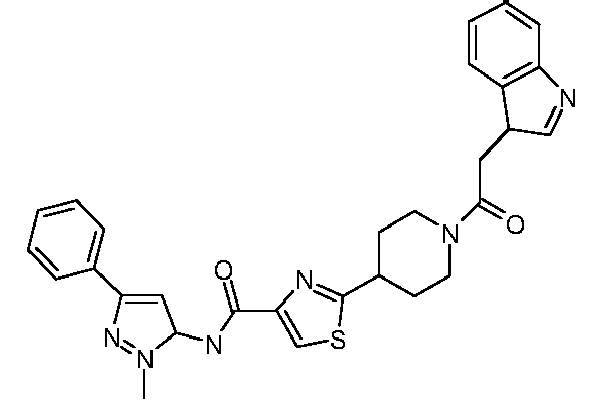
VIII 5.25 
IX 12.1 
X 1.54 
XI 0.36 
XII 13.4 
XIII 5.3 
XIV 12.9 
XV 1.64 
XVI 4.1 
XVI 2.04 
XVIII 13.4 
XIX 8.5 
XX 5.31 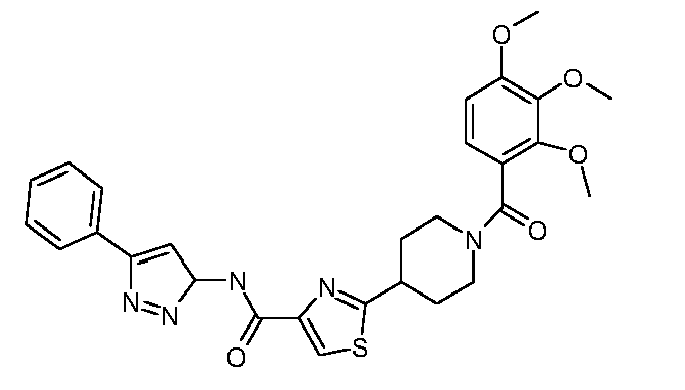
XXI 11 
XXII 5.4 
XXIII 16.7 
XXIV 0.25 
XXV 5.8 
XXVI 1.15 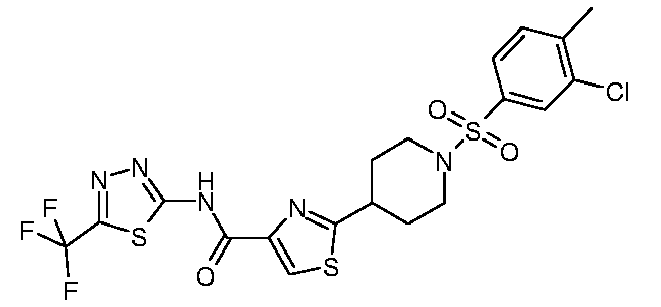
XXVII 35.6 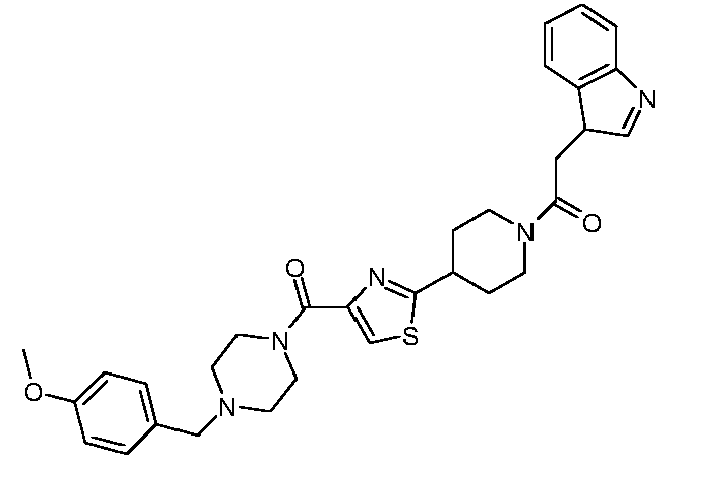
XXVIII 2.27 
XXIX 2.7 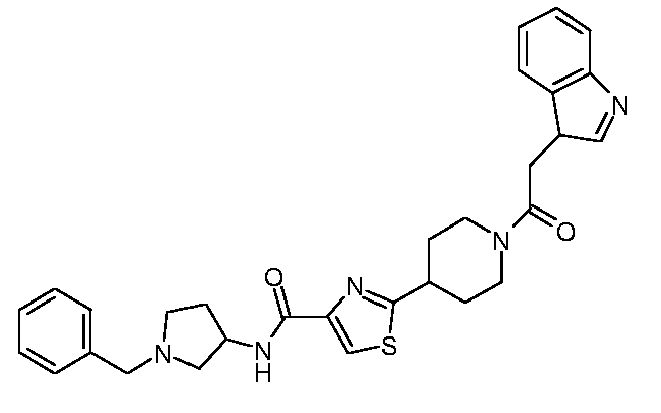
XXX 4.2 
XXXI 0.5 
XXXII 3.08 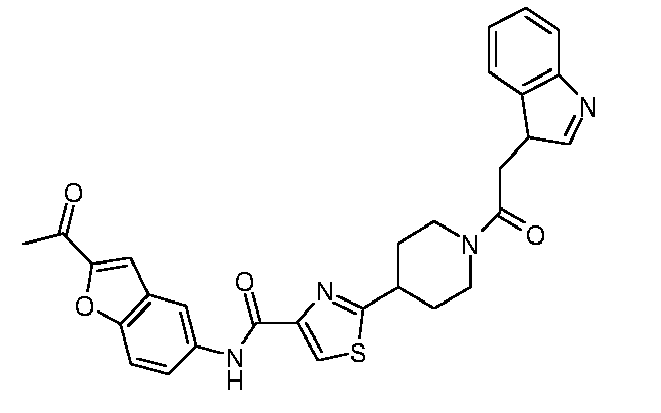
XXXIII 3.23 
XXXIV 4.24 
XXXV 3.5 
XXXVI 3.95 
XXXVII 4.24 
XXXVIII 20.6 
XXXIX 2.19 
XL 2.98 
XLI 5.9 
XLII 2.2 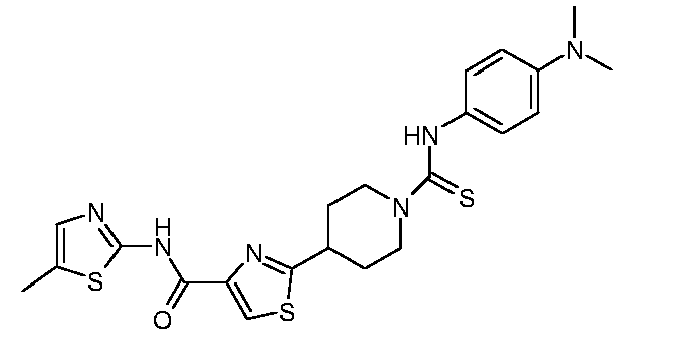
XLIII 4.74 
XLIV 2.53 
XLV 7.56 
XLVI 4 
XLVII 9.15 
XLVIII 13.9 
XLIX 3.03 
L 5.4 
LI 4.9 
LII 19.5 
LIII 1.63 
LIV 5.5 
LV 4.04 
LVI 3.6 
LVII 5.1 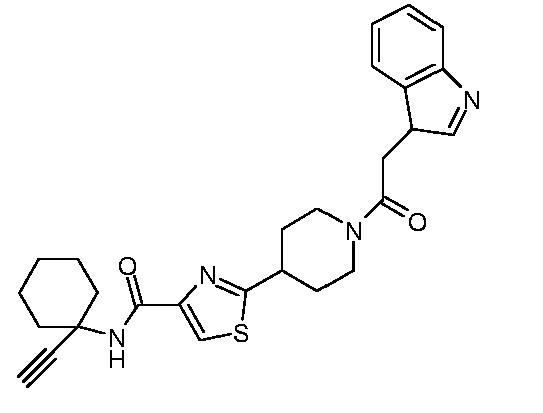
LVIII 4.58 
LIX 7.13 
- Particularly preferred is the compound of formula (1) wherein
R1 is 4-isopropoxycarbonylphenyl, R2 is 3-indolylmethyl, R3 is hydrogen, R4 is hydrogen, n is zero, A is a single bond, B is carbonyl, and wherein the residue R1NR3CO is connected to the carbon atom bound to nitrogen of the thiazole ring. - Also particularly preferred is the compound of formula (1) wherein
R1 is 3,4-difluorophenyl, R2 is 3-indolylmethyl, R3 is hydrogen, R4 is hydrogen, n is zero, A is a single bond, B is carbonyl, and wherein the residue R1NR3CO is connected to the carbon atom bound to nitrogen of the thiazole ring. - Another particularly preferred compound is the compound of formula (1) wherein
R1 is thiazol-2-yl, R2 is 3-indolylmethyl, R3 is hydrogen, R4 is hydrogen, n is zero, B is carbonyl, and wherein the residue R1NR3CO is connected to the carbon atom bound to nitrogen of the thiazole ring. - Further particularly preferred is the compound of formula (1) wherein
R1 is quinolin-6-yl, R2 is 3-indolylmethyl, R3 is hydrogen, R4 is hydrogen, n is zero, B is carbonyl, and wherein the residue R1NR3CO is connected to the carbon atom bound to nitrogen of the thiazole ring. - Still another particularly preferred compound is the compound of formula (1) wherein
R1 is 3-phenyl-1-methyl-1H-pyrazol-3-yl, R2 is 2-[allylthio]-pyridin-3-yl, R3 is hydrogen, R4 is hydrogen, n is zero, B is carbonyl, and wherein the residue R1NR3CO is connected to the carbon atom bound to nitrogen of the thiazole ring. - These particularly preferred embodiments refer to compounds no.: XI, XXIV; X; III and XXXI in Table 1.
- The thiazole-piperidine compounds according to the invention, e.g. derivatives of piperidinyl-thiazole carboxylic acid and/or piperidinyl thiazole carboxamide, may be synthesized according to any of the known processes for making those compounds described in e.g.
WO 2004/058750 andWO 2004/058751 . - In particular, a compound of the invention may be prepared by processes that, though not applied hitherto for the new compounds of the present invention, are known per se, in particular by the condensation of a thiazolecarboxylic acid of formula (2)

R1-NH-R3 (3)
wherein the substituents R1 and R3 have the meanings defined under formula (1), the protective group, e.g. tert-butoxycarbonyl, cleaved from the obtained product and the free piperidine condensed with a compound of formula (4),
HO-B-R2 (4)
wherein the substituents R2 and B have the meanings defined under formula (1), optionally deprotecting protected functional groups and optionally further processing substituents R1 and R2 to the desired structure. The starting compounds of formula (2), (3) and (4) are known or can be synthesized in analogy to known processes. Reaction conditions for the condensation are well known in the art, e.g. as used in peptide synthesis. - The protection of functional groups by protecting groups, the protecting groups themselves, and their removal reactions are described, for example, in standard reference books on protective groups such as T.W. Greene and P.G.M. Wuts, "Protective Groups in Organic Synthesis", Wiley, 3rd edition 1999.
- All process steps described here can be carried out under known reaction conditions, in the absence of or usually in the presence of solvents or diluents, preferably such as are inert to the reagents used and able to dissolve these, in the absence or presence of catalysts, condensing agents or neutralising agents, depending on the type of reaction and/or reactants at reduced, normal, or elevated temperature, for example in the range from-100 °C to about 190°C, preferably from about -80 °C to about 150 °C, for example at -80 °C to +60 °C, at -20 °C to +40 °C, at room temperature, or at the boiling point of the solvent used, under atmospheric pressure or in a closed vessel, where appropriate under pressure, and/or in an inert atmosphere, for example under argon or nitrogen.
- The present invention relates also to pharmaceutical compositions that comprise a compound of formula (1) as active ingredient and that can be used especially in the treatment of the diseases mentioned at the beginning. Compositions for enteral administration, such as nasal, buccal, rectal or, especially, oral administration, and for parenteral administration, such as intravenous, intramuscular or subcutaneous administration, to warm-blooded animals, especially humans, are especially preferred. The compositions comprise the active ingredient alone or, preferably, together with a pharmaceutically acceptable carrier or a diluent, such as, for example, physiological saline solution, demineralized water, stabilizers and/or proteinase inhibitors. The dosage of the active ingredient depends upon the disease to be treated and upon the species, its age, weight, and individual condition, the individual pharmacokinetic data, and the mode of administration.
- The term "pharmaceutically acceptable" as used herein pertains to compounds, ingredients, materials, compositions, dosage, forms etc., which are within the scope of sound medical judgment, suitable for use in contact with the tissues of the subject in question (preferably human) without excessive toxicity, irritation, allergic response, or other problem or complication, commensurate with a reasonable benefit/risk ratio. Each carrier, diluent, excipient etc. must also be "acceptable" in the sense of being compatible with the other ingredients of the formulation.
- The present invention relates especially to pharmaceutical compositions that comprise a compound of formula (1), a tautomer, a prodrug or a pharmaceutically acceptable salt, or a hydrate or solvate thereof, and at least one pharmaceutically acceptable carrier.
- The invention relates also to pharmaceutical compositions for use in a method for the prophylactic or especially therapeutic management of the human or animal body, in particular in a method of treating of diseases of liver and/or pancreas, especially those mentioned hereinabove.
- The invention relates also to processes and to the use of compounds of formula (1) thereof for the preparation of pharmaceutical preparations which comprise compounds of formula (1) as active component (active ingredient).
- A pharmaceutical composition for the prophylactic or especially therapeutic management of a disease of liver and/or pancreas, of a warm-blooded animal, especially a human or a commercially useful mammal requiring such treatment, comprising a novel compound of formula (1) as active ingredient in a quantity that is prophylactically or especially therapeutically active against the said diseases, is likewise preferred.
- The pharmaceutical compositions comprise from approximately 1% to approximately 95% active ingredient, single-dose administration forms comprising in the preferred embodiment from approximately 20% to approximately 90% active ingredient and forms that are not of single-dose type comprising in the preferred embodiment from approximately 5% to approximately 20% active ingredient. Unit dose forms are, for example, coated and uncoated tablets, ampoules, vials, suppositories, or capsules. Further dosage forms are, for example, ointments, creams, pastes, foams, tinctures, lip-sticks, drops, sprays, dispersions, etc. Examples are capsules containing from about 0.05 g to about 1.0 g active ingredient.
- The pharmaceutical compositions of the present invention are prepared in a manner known per se, for example by means of conventional mixing, granulating, coating, dissolving or lyophilizing processes.
- Preference is given to the use of solutions of the active ingredient, and also suspensions or dispersions, especially isotonic aqueous solutions, dispersions or suspensions which, for example in the case of lyophilized compositions comprising the active ingredient alone or together with a carrier, for example mannitol, can be made up before use. The pharmaceutical compositions may be sterilized and/or may comprise excipients, for example preservatives, stabilizers, wetting agents and/or emulsifiers, solubilizers, salts for regulating osmotic pressure and/or buffers and are prepared in a manner known per se, for example by means of conventional dissolving and lyophilizing processes. The said solutions or suspensions may comprise viscosity-increasing agents, typically sodium carboxymethylcellulose, carboxymethylcellulose, dextran, polyvinylpyrrolidone, or gelatins, or also solubilizers, e.g. Tween 80® (polyoxyethylene(20)sorbitan mono-oleate).
- Suspensions in oil comprise as the oil component the vegetable, synthetic, or semisynthetic oils customary for injection purposes. In respect of such, special mention may be made of liquid fatty acid esters that contain as the acid component a long-chained fatty acid having from 8 to 22, especially from 12 to 22, carbon atoms. The alcohol component of these fatty acid esters has a maximum of 6 carbon atoms and is a monovalent or polyvalent, for example a mono-, di- or trivalent, alcohol, especially glycol and glycerol. As mixtures of fatty acid esters, vegetable oils such as cottonseed oil, almond oil, olive oil, castor oil, sesame oil, soybean oil and groundnut oil are especially useful.
- The manufacture of injectable preparations is usually carried out under sterile conditions, as is the filling, for example, into ampoules or vials, and the sealing of the containers.
- Suitable carriers are especially fillers, such as sugars, for example lactose, saccharose, mannitol or sorbitol, cellulose preparations, and/or calcium phosphates, for example tricalcium phosphate or calcium hydrogen phosphate, and also binders, such as starches, for example corn, wheat, rice or potato starch, methylcellulose, hydroxypropyl methylcellulose, sodium carboxymethylcellulose, and/or polyvinylpyrrolidone, and/or, if desired, disintegrators, such as the above-mentioned starches, also carboxymethyl starch, crosslinked polyvinylpyrrolidone, alginic acid or a salt thereof, such as sodium alginate. Additional excipients are especially flow conditioners and lubricants, for example silicic acid, talc, stearic acid or salts thereof, such as magnesium or calcium stearate, and/or polyethylene glycol, or derivatives thereof.
- Tablet cores can be provided with suitable, optionally enteric, coatings through the use of, inter alia, concentrated sugar solutions which may comprise gum arabic, talc, polyvinylpyrrolidone, polyethylene glycol and/or titanium dioxide, or coating solutions in suitable organic solvents or solvent mixtures, or, for the preparation of enteric coatings, solutions of suitable cellulose preparations, such as acetylcellulose phthalate or hydroxypropylmethylcellulose phthalate. Dyes or pigments may be added to the tablets or tablet coatings, for example for identification purposes or to indicate different doses of active ingredient.
- Pharmaceutical compositions for oral administration also include hard capsules consisting of gelatin, and also soft, sealed capsules consisting of gelatin and a plasticizer, such as glycerol or sorbitol. The hard capsules may contain the active ingredient in the form of granules, for example in admixture with fillers, such as corn starch, binders, and/or glidants, such as talc or magnesium stearate, and optionally stabilizers. In soft capsules, the active ingredient is preferably dissolved or suspended in suitable liquid excipients, such as fatty oils, paraffin oil or liquid polyethylene glycols or fatty acid esters of ethylene or propylene glycol, to which stabilizers and detergents, for example of the polyoxyethylene sorbitan fatty acid ester type, may also be added.
- Pharmaceutical compositions suitable for rectal administration are, for example, suppositories that consist of a combination of the active ingredient and a suppository base. Suitable suppository bases are, for example, natural or synthetic triglycerides, paraffin hydrocarbons, polyethylene glycols or higher alkanols.
- For parenteral administration, aqueous solutions of an active ingredient in water-soluble form, for example of a water-soluble salt, or aqueous injection suspensions that contain viscosity-increasing substances, for example sodium carboxymethylcellulose, sorbitol and/or dextran, and, if desired, stabilizers, are especially suitable. The active ingredient, optionally together with excipients, can also be in the form of a lyophilizate and can be made into a solution before parenteral administration by the addition of suitable solvents.
- Solutions such as are used, for example, for parenteral administration can also be employed as infusion solutions.
- Preferred preservatives are, for example, antioxidants, such as ascorbic acid, or microbicides, such as sorbic acid or benzoic acid.
- In still a further aspect, the invention provides a method of therapy or prophylaxis of a patient suffering from liver disease and/or disease of pancreas which comprises the step of administering to said patient a thiazole-piperidine derivative as defined above.
- The term "treatment" within the meaning of the invention refers to a treatment that preferably cures the patient from at least one disease according to the invention and/or that improves the pathological condition of the patient with respect to one or more symptoms associated with the disease, on a transient, short-term (in the order of hours to days), long-term (in the order of weeks, months or years) or permanent basis, wherein the improvement of the pathological condition may be constant, increasing, decreasing, continuously changing or oscillatory in magnitude as long as the overall effect is a significant improvement of the symptoms compared with a control patient.
- Further, the term "treatment" as used herein in the context of treating liver diseases and/or diseases of the pancreas pertains generally to treatment and therapy of a human or an animal (e.g., in veterinary applications), in which some desired therapeutic effect is achieved, for example the inhibition of the progress of the condition, and includes a reduction in the rate of progress, a halt in the rate of progress, amelioration of the condition, and cure of the condition.
- The term "treatment" according the invention includes combination treatments and therapies, in which two or more treatments or therapies are combined, for example sequentially or simultaneously. Treatment as a prophylactic measure (i.e. prophylaxis) is also included.
- Treatment according to the invention can be carried out in a conventional manner generally known to the person skilled in the art, e.g. by means of oral application or via intravenous injection or via chemoembolization of the pharmaceutical compositions according to the invention.
- Therapeutic efficacy and toxicity, e.g. ED50 and LD50, may be determined by standard pharmacological procedures in cell cultures or experimental animals. The dose ratio between therapeutic and toxic effects is the therapeutic index and may be expressed by the ratio LD50/ED50. Pharmaceutical compositions that exhibit large therapeutic indexes are preferred. The dose must be adjusted to the age, weight and condition of the individual patient to be treated, as well as the route of administration, dosage form and regimen, and the result desired, and the exact dosage should of course be determined by the practitioner.
- The actual dosage depends on the nature and severity of the disease being treated, and is within the discretion of the physician, and may be varied by titration of the dosage to the particular circumstances of this invention to produce the desired therapeutic effect. In general, a suitable dose of the active compound according to invention is in the range of about 0.1 mg to about 250 mg per kilogram body weight of the subject to be treated per day. However, it is presently contemplated, that pharmaceutical compositions comprising of from about 0.1 to 500 mg/kg of the active ingredient per individual dose, preferably of from about 0.1 to 100 mg/kg, most preferred from about 0.1 to 10 mg/kg, are suitable for therapeutic treatments.
- The active ingredient may be administered in one or several dosages per day. A satisfactory result can, in certain instances, be obtained at a dosage as low as 0.1 mg/kg intravenously (i.v.) and 1 mg/kg perorally (p.o.). Preferred ranges are from 0.1 mg/kg/day to about 10 mg/kg /day i.v. and from 1 mg/kg/day to about 100 mg/kg/day p.o.
- Furthermore the invention relates to the manufacture of medicaments containing the compounds according to invention useful in the treatment and/or prevention of liver and/or pancreatic diseases, using standard procedures known in the prior art of mixing or dissolving the active compound with suitable pharmaceutical carriers. Such methods include the step of bringing into association the active compound with a carrier which comprises one or more accessory ingredients. In general the formulations according to invention are prepared by uniformly and intimately bringing into association the active compound with carriers (e.g. liquid carriers, finely divided solid carrier) and then shaping the product, if necessary. Suitable carriers, diluents and excipients used in the present invention can be found in standard pharmaceutical texts (see for example Handbook for Pharmaceutical Additives, 2001, 2nd edition, eds. M. Ash and I. Ash).
- It will be apparent to those skilled in the art that various modifications can be made to the compositions, methods and processes of this invention. Thus, it is intended that the present invention cover such modifications and variations, provided they come within the scope of the appended claims and their equivalents. All publications cited herein are incorporated in their entireties by reference.
- To practically assess the impact of the thiazole-piperidine derivatives, e.g. derivatives of piperidinyl-thiazole carboxylic acid and/or piperidinyl thiazole carboxamide, in the treatment and/or prevention of diseases according to the invention, the inhibition of cell proliferation is determined by using a luminescent cell viability assay (CellTiter-Glo®; Promega, Madison, USA). The assay is based on the relation that the ATP content is directly proportional to the number of cells present in the culture. The CellTiter-Glo® assay is performed to measure the proliferation rate of human hepatoma (HuH7, PLC/PRF/5, Hep3B, SK-Hep1), human hepatoblastoma (HepG2), human colon carcinoma (CX-2), human breast cancer (SK-Br-3), human ovarian carcinoma (HeLa) and human pancreatic carcinoma (DAN-G) cell lines. Compounds according to the invention exhibit EC50 values for the inhibition of HuH7 in a range of 0.36 to 35.6 µM (see Table 1). In particular, the compound according to formula (1) wherein R1 is 4-isopropoxycarbonylphenyl, R2 is 3-indolylmethyl, R3 is hydrogen, R4 is hydrogen, n is zero, A is a single bond, B is carbonyl, and wherein the residue R1NR3CO is connected to the carbon atom bound to nitrogen of the thiazole ring (compound no. XI in Table 1) inhibits proliferation of the human cell lines HepG2 and Hep3B with 10.8 and 3.5 µM, respectively.
- In addition compounds of the formula (1) show also inhibitory activity against tumor cell lines of the pancreas, colon, ovarian, and breast (see Table 2 in Example 2). Typically the EC50 values for inhibition of proliferation of DAN-G and HuH7 are of similar magnitude, indicating a preferred specificity for liver and pancreatic tumors. Furthermore, to assess in vivo activity of potential anti-proliferative drug candidates' standard in vivo models of liver tumors, e.g. the ectopic (subcutaneous) and orthotopic transplantation of human tumor cells in immune deficient mice like BALB/c nude or SCID mice can be used. Tumor type specificity is generated by the selection of cell lines for transplantation. In general the subcutaneously transplantation of human tumor cell lines is a general model to assess the in vivo activity of potential anti-prolerative drug candidates. Further, orthotopic transplantation models offer the ability to analyse the tumor in its typical micro environment (Armengol, C. et al., Clin. Can. Res. 2004, 10: 2150-2157).
- For the subcutaneous transplantation (ectopic transplantation) of human liver tumor cells (i.e. HuH7, PLC/PRF/5, Hep3B, SK-Hep1 and HepG2) 1 to 5 million cells are subcutaneously inoculated in to the left flank of male BALC/nude mice (Yeo, E-J., et al., J. Natl. Cancer Inst. 2003, 95: 516-525). Tumor formation can be supported by inoculation of a tumor cells suspension in extra cellular matrix proteins like for example matrigel (10 mg/ml; BD biosciences). Typically tumor formation could be observed after two to four weeks, dependent on the type of tumor cells and support medium used. Treatment start could be either (1) a few days (typically 2-5) after tumor cell inoculation, or (2) after a certain tumor size (250 to 450 mm3) has been reached. The time point of treatment start allows distinguishing between inhibition of tumor formation (1) and reduction of tumor mass (2). Statistical analysis comparing tumor growth curves, tumor mass and tumor volume of serum versus placebo treated groups are finally performed.
- Transplantation of human liver tumor cells into the mouse liver of immune deficient mice or mouse liver tumor cells in immune competent male mouse strains allow not only to compare tumor growth characteristics in treated and non-treated animals but also to compare survival time.
- Further the DEN (N-nitroso-di-ethylamin) induced growth of liver tumors, supported by the administration of phenobarbital in C3H/He mice could be used to test the activity of potential drug candidates against e.g. liver tumors (Kemp, C. et al., Proc. Natl. Acad. Sci. USA 1989, 86: 7505-7509 and Shiota, G. et al., Carcinogenesis 1999, 20: 59-63). Male C3H/He mice are intoxicated with a single dose of DEN at age 6-8 weeks. Feeding of phenobarbital starts one week after DEN intoxication and is continued for 40 weeks. Huge enlargement of the liver is palpable even earlier. Typically the liver is enlarged around 5 to 6 times compared to non-treated mice, thus liver tumors can be macroscopically and microscopically detectable.
- Treatment and/or prophylaxis of human patients with diseases according to the invention with these thiazole-piperidine compounds significantly reduce liver and/or pancreas pathology and thereby provide therapeutic and/or prophylactic efficacy as a treatment for these diseases.
- When compared to the state of the art of therapy or prophylaxis of diseases of liver and pancreas the method of treatment according to the invention surprisingly provides an improved, sustained and more effective treatment.
- The invention will be further illustrated below with the aid of the examples, representing preferred embodiments and features of the invention without the invention being restricted hereto.
- It will be apparent to those skilled in the art that various modifications can be made to the compositions and processes of this invention. Thus, it is intended that the present invention cover such modifications and variations, provided they come within the scope of the appended claims and their equivalents. All publications cited herein are incorporated in their entireties by reference.
- Abbreviations: eq: Equivalent(s); OMF: Dimethylformamide; RT: Room temperature; TEA: Triethylamine; DCM: Dichloromethane; TFA: Trifluoroacidic acid; MeCN: Acetonitrile; DIPEA: Diisopropylethylamine; HBTU: 2-(1H-benzotriazole-1-yl)-1,1,3,3-tetramethyluronium hexafluorophosphate; TLC: Thin layer chromatography
- This compound corresponds to the compound according to claim 1 of formula (1) wherein R1 is 4-isopropoxycarbonylphenyl, R2 is 3-indolylmethyl, R3 is hydrogen, R4 is hydrogen, n is zero, A is a single bond, B is carbonyl, and wherein the residue R1NR3CO is connected to the carbon atom bound to nitrogen of the thiazole ring.

-

- To a suspension of 2-[1-(tert-butoxycarbonyl)-4-piperidinyl]-1,3-thiazole-4-carboxylic acid (5) (1 eq.) (obtainable from Key Organics Ltd., 10R-14209), isopropyl 4-aminobenzoate (6) (0.95 eq) and HBTU (1 eq.) in acetonitile (22 ml/g) under nitrogen at room temperature DIPEA (3 eq.) is added dropwise over 30 min. Once the addition is finished, the reaction mixture is stirred over night at room temperature. TLC (ether/petroleum ether = 7:3) suggested a small amount of aniline in reaction mixture. The solvent is concentrated to obtain an oily residue. It is dissolved in ether, washed with sat. sodium carbonate solution, water and brine, dried over MgSO4, and the solution concentrated to an oily residue. The crude product is dissolved in petroleum ether and a small (minimum) amount of ether to form a clear solution. This solution is filtered through thin silica to remove base line inpurities.
The solvent is removed from the filtrate, and the oily residue is triturated with petroleum ether to form a heavy suspension, filtered, washed well with petroleum ether, collected and dried to afford the desired product of formula (7) in 80% yield. - The process is carried out under an atmosphere of nitrogen. To a solution of tert-butoxycarbonyl protected piperidine (1 eq.) of formula (7) in DCM (10 vol. eq.) at 0°C TFA (10 vol eq.) is added dropwise. The solution is left at 0°C for 10 minutes. The mixture is allowed to warm to room temperature and stirred over night. The reaction mixture is poured in to a 2 M sodium carbonate solution, and ice is added to keep the temperature at about 10°C. The organic phase is separated, and the basic aqueous solution extracted 3 times with DCM. Organic layers are combined, washed with water and brine, dried over MgSO4, and concentrated to form a pale cream solid. The compound of formula (8) is collected and dried, yield 98%.
-
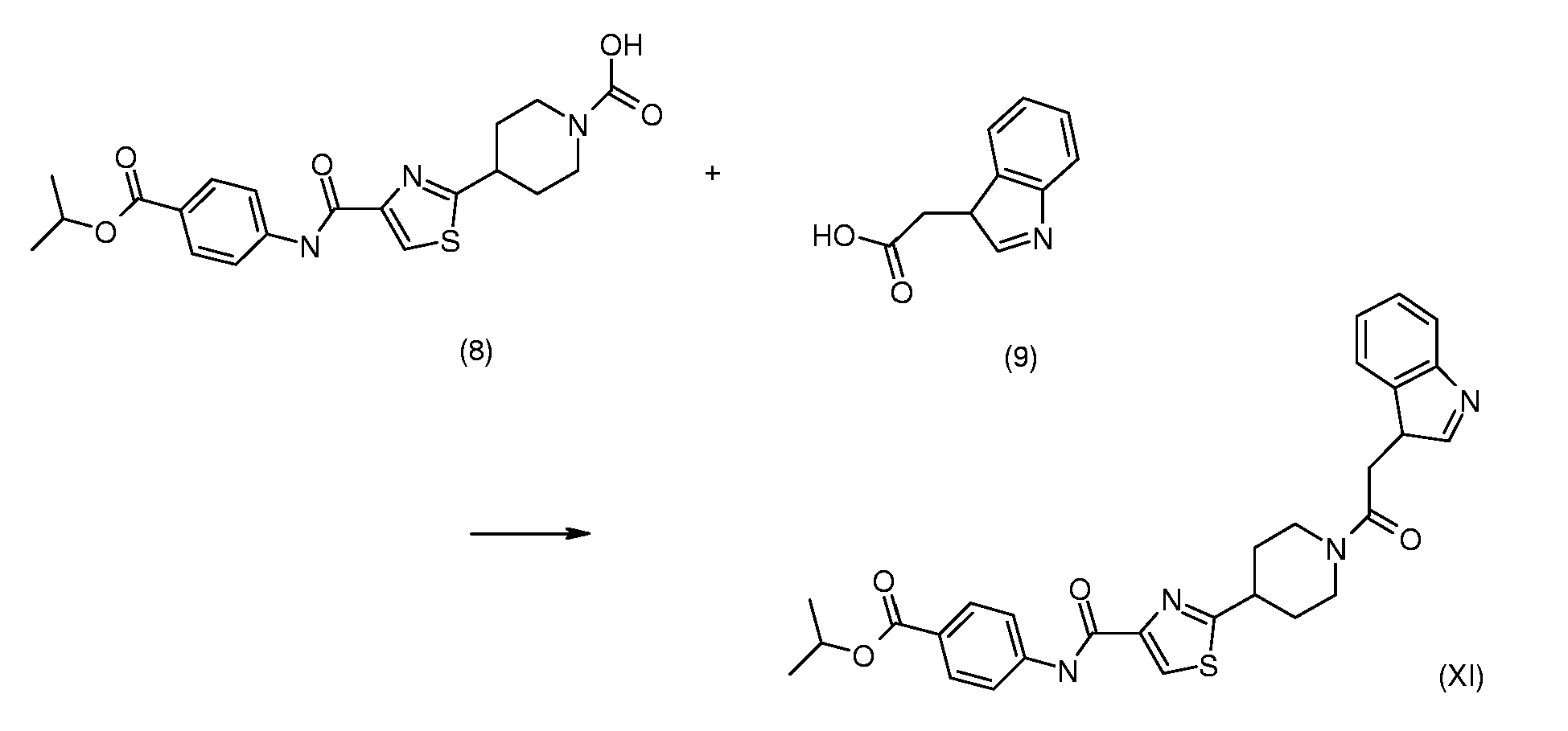
- To a suspension of compound (8) (1 eq.), 1 H-indole-3-acetic acid (9) (0.95 eq.) and HBTU (1 eq.) in acetonitile (22 ml/g) under nitrogen at room temperature DIPEA (3 eq.) is added dropwise over 30 min. Once the addition is finished, the reaction mixture is stirred over night at room temperature. TLC (ethyl acetate) suggests the reaction is completed. The solvent is removed to obtain an oily residue. It is dissolved in ethyl acetate, and then washed with sat. sodium carbonate solution, water and brine, dried over MgSO4, and concentrated to an oily residue. The crude product is purified using column chromatopgraphy, eluted with ether. Fractions containing pure product are combined, concentrated to obtain a white solid, which is collected and dried to afford the desired product, compound XI, in 60% yield.
- To determine the inhibition of cell proliferation a luminescent cell viability assay (CellTiter-Glo®; Promega, Madison, USA) is implemented. The assay is based on the relation that the ATP content is directly proportional to the number of cells present in the culture (Technical Bulletin No. 228 "CellTiter-Glo® Luminescent Cell viability Assay", Revised 2/04. Promeg, Madison, USA). The CellTiter-Glo® assay is performed to measure the proliferation rate of human hepatoma (HuH7, PLC/PRF/5, Hep3B, SK-Hep1), human hepatoblastoma (HepG2), human colon carcinoma (CX-2), human breast cancer (SK-Br-3), human ovarian carcinoma (HeLa) and human pancreatic carcinoma (DAN-G) cell lines. 3000 viable cells (viability ≥ 90%) are seeded in opaque-walled 96-well plates and incubated for 24 hours in DMEM, supplemented with 2 mM glutamin. Cell proliferation is stimulated by addition of FCS to a final concentration of 10% (v/v). Simultaneously the compounds (see Table 1 and 2) are added in a concentration range of 0 to 20 µM. Triplicates are measured for each concentration. Cells and compounds (see Table 1 and 2) are incubated for a period of 48 hours in a volume of 140 µl cell culture medium (10% (v/v) FCS, 2 mM Glutamin, DMEM). The compounds according to the invention are dissolved in 60% to 100% (v/v) DMSO at a concentration of 2 mM. The final DMSO concentration under assay conditions never exceeds 1% (v/v). Throughout the assay cells are kept in a humidified incubator (95% rH) at 37°C and 5% CO2.
- The final cell number is determined after 48 hour of incubation. Therefore 140 µl CellTiter-Glo®Reagent is added in each well. The contents are mixed on an orbital shaker for 2 minutes at room temperature. After subsequent incubation for additional 10 minutes at room temperature the luminescence signal is recorded within 30 min. EC50 values are calculated using the four-parametric Hill equation (Sigma Plot).
Control values are: - 1) 10% (v/v) FCS, 2 mM glutamin, DMEM -> maximum cell number
- 2) 2 mM glutamin, DMEM -> initial cell number
- The compounds of formula (1) exhibit EC50 values in the inhibition of HuH7 in a range of 0.36 to 35.6 µM (see Table 1). In particular, the compound no. XI (see Table 1) inhibits proliferation of the human cell lines HepG2 and Hep3B with 10.8 and 3.5 µM, respectively.
- In addition compounds of the formula (1) show also inhibitory activity against tumor cell lines of the pancreas, colon, ovarian, and breast (see Table 2). Typically the EC50 values for inhibition of proliferation of DAN-G and HuH7 are of similar magnitude, indicating a preferred specificity for liver and pancreatic tumors. EC50 values for DAN-G cell proliferation of compounds of formula 1 range from 1.99 to 18.3 µM (see Table 2). For most of the compounds according to the invention the EC50 value is above the highest concentration used in the proliferation assay (20 µM). However compounds of formula (1) show at least an EC50 of 9.3 µM for the inhibition of CX-2 proliferation (see Table 2). For HeLa cell the EC50 of compounds of formula 1 varies between 3.95 and 26.3 µM. Compound of the formula (1) also block proliferation of Sk-Br-3 cells (see Table 2). The observed range lies within 4.7 and 23.8 µM or higher.
Table 2: Inhibition of DAN-G, SK-Br-3, HeLa, and CX-2 proliferation by compounds of the invention. (EC50: effective concentration reducing cell proliferation by 50%; >> much greater than). Cell line DAN-G CX-2 Hela Sk-Br-3 Compound No. EC50/µM EC50/µM EC50/µM EC50/µM II 3.16 >>20 12.1 10.4 III 1.99 9.3 3.95 7.07 IV 7.52 >>20 10,3 >>20 V 6.9 >>20 8.79 10.84 VI 11.2 19.2 13.5 10.4 VII 7.1 >>20 12.5 10.8 VIII 7.65 10.1 9.33 4.7 X 2.53 >>20 17.99 18.9 XI 7.63 22.3 26.3 10.2 XIII 8.9 >>20 10.05 12.3 XV 3.81 10.9 17.2 10.8 XVI 7.99 >>20 10.5 >>20 XVII 5.59 >>20 23.5 18.9 XX 7.8 >>20 10.33 19.7 XXIV 2.55 10.3 8.91 16.6 XXVI 13.5 20.2 11.1 19.3 XXXI 3.58 10.4 20.5 10.2 XXXIII 13.84 >>20 11.6 >>20 XL 9.01 14.9 22.9 23.8 XLVII 9.7 19.9 13.6 11.2 LIII 18.2 >>20 23.6 19.5 LVI 16.95 >>20 10.5 >>20
Claims (13)
- Use of a compund of formula (1)

R1 is optionally substituted alkyl, alkenyl, cycloalkyl, heterocyclyl, aryl, arylalkyl, heteroaryl, heteroarylalkyl, alkoxy, amino, alkylamino, dialkylamino, alkanoylamino, aroylamino, carboxyalkyl, alkoxycarbonyl, aryloxycarbonyl, or cyano;
R2 is optionally substituted alkyl, alkenyl, alkinyl, cycloalkyl, heterocyclyl, aryl, arylalkyl, aryloxyalkyl, heteroaryl, heteroarylalkyl, or carboxyalkyl;
R3 is hydrogen or forms a ring together with R1;
R4 is hydrogen or alkyl,
R5 is alkyl and n is any number from zero to nine;
A is a single bond or alkylene;
B is a single bond, carbonyl, carbonyloxy, carbonylmercapto, carbonylamino wherein nitrogen is optionally further substitueted by alkyl or being part of a ring, thiocarbonyl, thiocarbonyloxy, thiocarbonylmercapto, thiocarbonylamino, sulfonyl,or sulfonylamino;
and wherein the residue R1NR3CO and R4 can be connected either to the carbon atom bound to sulfur or bound to nitrogen of the thiazole ring and the alkyl residues (R5)n may be bound to any carbon atom of the piperidine ring;
for the preparation of a medicament for the treatment or prophylaxis of diseases of liver or pancreas. - The use according to claim 1 of a compound of formula (1) wherein
R1 is optionally substituted alkyl, optionally substituted cycloalkyl, optionally substituted heterocyclyl, optionally substituted phenyl, optionally substituted phenylalkyl, heteroaryl, heteroarylalkyl, optionally further substituted heteroarylamino, or optionally substituted benzoylamino;
R2 is alkyl, alkenyl, alkinyl, cycloalkyl, heterocyclyl, optionally substituted phenyl, optionally substituted phenylalkyl, optionally substituted phenoxyalkyl, heteroaryl, or heteroarylalkyl;
R3 is hydrogen or forms a ring together with R1;
R4 is hydrogen;
n is zero;
A is a single bond;
B is carbonyl, carbonyloxy, carbonylamino wherein nitrogen is optionally further substitueted by alkyl or being part of a ring, thiocarbonylamino, or sulfonyl;
and wherein the residue R1NR3CO is connected to the carbon atom bound to nitrogen of the thiazole ring. - The use according to claim 1 of a compound of formula (1) wherein
R1 is 1-acetylenylcyclohexyl, 1-indanyl, N-benzyl-3-pyrrolidinyl, phenyl optionally substituted by alkyl, halo, alkoxycarbonyl, amidocarbonyl, ethylenedioxy, or oxazolyl, phenylalkyl optionally substituted by alkyl, alkoxy, halo, alkylsulfonyl or nitro, alkyl-aminocarbonylthienyl, pyrazolyl optionally substituted by alkyl and cyclopropyl, phenyl, furanyl or thienyl, thiazolyl optionally substituted by alkyl, haloalkyl-thiadiazolyl, alkoxy-pyridyl, quinolinyl optionally substituted by alkyl, alkanoyl-benzofuranyl,oxo-dihydrobenzofuranyl, benzopyrazinyl-alkyl-amino, alkoxy-benzoylamino, or alkylthienylcarbonylamino;
R2 is propargyl, cyclohexyl, phenyl optionally substituted by alkyl, haloalkyl, halogen, alkoxy or dialkylamino, halo-phenylalkyl, dialkylphenoxyalkyl, phenyl-pyrazolyl, dialkyl-thiazolyl, allylmercapto-pyridyl, benzofuranyl, or indolylalkyl;
R3 is hydrogen or, together with R1, forms a piperazine ring substituted on nitrogen by alkoxyphenyl, dihalophenyl, alkoxyphenylalkyl, phenylalkenyl, dihalo-pyridyl or pyrimidinyl;
R4 is hydrogen;
n is zero;
A is a single bond;
B is carbonyl, carbonyloxy, carbonylamino wherein nitrogen is optionally being part of a pyridazine ring substituted on nitrogen by pyridyl, thiocarbonylamino, or sulfonyl;
and wherein the residue R1NR3CO is connected to the carbon atom bound to nitrogen of the thiazole ring. - A compound of formula (1),

R1 is 1-acetylenylcyclohexyl, 1-indanyl, N-benzyl-3-pyrrolidinyl, 4-fluoro-3-nitrophenyl, 4-methyl-3-fluorophenyl, 3,4-difluorophenyl, 4-methyl-2-fluorophenyl, 4-propoxycarbonylphenyl, 2-methoxy-5-aminocarbonylphenyl, 3,4-ethylenedioxyphenyl, 3-oxazolylphenyl, 3,4-dimethoxybenzyl, 2-(4-fluorophenyl)-1,1-dimethylethyl, 4-methylsulfonylbenzyl, 2-methyl-4-chlorobenzyl, 2-(3-methoxyphenyl)ethyl, 2-nitrobenzyl, 4-methoxybenzyl, 4-methyl-3-aminocarbonyl-2-thienyl, 5-cyclopropyl-3-pyrazolyl , 5-tert. butyl-3-pyrazolyl, 5-phenyl-3-pyrazolyl, 1 (2)-methyl-5-phenyl-3-pyrazolyl, 5-(2-thienyl)-3-pyrazolyl, 1 (2)-methyl-5-(2-thienyl)-3-pyrazolyl, 5-(2-furanyl)-3-pyrazolyl, 5-methyl-4-phenyl-3-pyrazolyl, 2-thiazolyl, 4-methyl-2-thiazolyl, 4,5-dimethyl-2-diazolyl, trifluoromethyl-thiadiazolyl, 6-methoxy-3-pyridyl, 6-quinolinyl, 2-methyl-6-quinolyl, 2-acetyl-6-benzofuranyl, 1-oxo-1,3-dihydro-6-benzo[c]furanyl, benzopyrazinyl-methyl-amino, 3-ethoxy-benzoylamino, or 5-methyl-2-thienylcarbonylamino;
R2 is propargyl, cyclohexyl, 4-methyl-3-chlorophenyl, 4-dimethylaminophenyl, 2-trifluoromethylphenyl, 2,3,4-trimethoxyphenyl, 2,fluoro-5-chlorophenyl, 2-chlorobenzyl, 3,4-dimethylphenoxymethyl,5-phenyl-3-pyrazolyl, 4,5-dimethyl-thiazolyl, 2-allylmercapto-3-pyridyl, 2-benzofuranyl, or 3-indolylmethyl;
R3 is hydrogen or, together with R1, forms a piperazine ring substituted on nitrogen by 2-ethoxyphenyl, 3,4-dichlorophenyl, 4-methoxybenzyl, 2-phenylvinyl, 3,5-dichloro-4-pyridyl or 2-pyrimidinyl;
R4 is hydrogen;
n is zero;
A is a single bond;
B is carbonyl, carbonyloxy, carbonylamino wherein nitrogen is optionally being part of a pyridazine ring substituted on nitrogen by 2-pyridyl, thiocarbonylamino, or sulfonyl;
and wherein the residue R1NR3CO is connected to the carbon atom bound to nitrogen of the thiazole ring. - A compound selected from the group consisting of
the compound according to claim 4 of formula (1) wherein
R1 is 4-isopropoxycarbonylphenyl, R2 is 3-indolylmethyl, R3 is hydrogen, R4 is hydrogen, n is zero, A is a single bond, B is carbonyl, and wherein the residue R1NR3CO is connected to the carbon atom bound to nitrogen of the thiazole ring;
the compound according to claim 4 of formula (1) wherein
R1 is 3,4-difluorophenyl, R2 is 3-indolylmethyl, R3 is hydrogen, R4 is hydrogen, n is zero, A is a single bond, B is carbonyl, and wherein the residue R1NR3CO is connected to the carbon atom bound to nitrogen of the thiazole ring:
the compound according to claim 4 of formula (1), wherein
R1 is thiazol-2-yl, R2 is 3-indolylmethyl, R3 is hydrogen, R4 is hydrogen, n is zero, B is carbonyl, and wherein the residue R1NR3CO is connected to the carbon atom bound to nitrogen of the thiazole ring;
the compound according to claim 4 of formula (1), wherein
R1 is quinolin-6-yl, R2 is 3-indolylmethyl, R3 is hydrogen, R4 is hydrogen, n is zero, B is carbonyl, and wherein the residue R1NR3CO is connected to the carbon atom bound to nitrogen of the thiazole ring; and
the compound according to claim 4 of formula (1), wherein
R1 is 3-phenyl-1-methyl-1 H-pyrazol-5-yl, R2 is 2-[allylthio]-pyridin-3-yl, R3 is hydrogen, R4 is hydrogen, n is zero, B is carbonyl, and wherein the residue R1NR3CO is connected to the carbon atom bound to nitrogen of the thiazole ring. - A pharmaceutical composition comprising a compound of claim 4.
- The use according to any of claim 1 to 3, wherein the liver disease is a disease selected from the group consisting of liver cancer, the intrahepatic cholangioma, benign liver neoplasms and focal nodular hyperplasia, viral and non-viral hepatitis, liver cirrhosis, alcoholic liver disease, non-alcoholic fatty liver disease, steatosis, cholestasis, nutrition-mediated liver injury, toxic liver injury, infectious liver disease, liver injury in sepsis, autoimmune-mediated liver disease, hemochromatosis, alpha1 antitrypsin deficiency, radiation-mediated liver injury.
- The use according to claim 7, wherein the liver disease is a liver cancer.
- The use according to claim 8, wherein the liver cancer is hepatocarcinoma.
- The use according to any of claims 1 to 3, wherein the disease of pancreas is a disease selected from the group consisting of neoplastic diseases and non neoplastic diseases of pancreas.
- The use according to claim 10, wherein the neoplastic disease of pancreas is a cancer of pancreas.
- Use of a compound according to claim 4 or 5 for treatment or prophylaxis of diseases of liver or pancreas according to one of claims 7 to 11.
- A method of treating patients with diseases of liver or pancreas which comprises administering to the patient in need thereof a therapeutically effective amount of a compound according to one of claims 1 to 5.
Priority Applications (1)
| Application Number | Priority Date | Filing Date | Title |
|---|---|---|---|
| EP06110952A EP1832586A1 (en) | 2006-03-10 | 2006-03-10 | Thiazole-piperidine derivatives in treatment of diseases of liver and the pancreas |
Applications Claiming Priority (1)
| Application Number | Priority Date | Filing Date | Title |
|---|---|---|---|
| EP06110952A EP1832586A1 (en) | 2006-03-10 | 2006-03-10 | Thiazole-piperidine derivatives in treatment of diseases of liver and the pancreas |
Publications (1)
| Publication Number | Publication Date |
|---|---|
| EP1832586A1 true EP1832586A1 (en) | 2007-09-12 |
Family
ID=36778085
Family Applications (1)
| Application Number | Title | Priority Date | Filing Date |
|---|---|---|---|
| EP06110952A Withdrawn EP1832586A1 (en) | 2006-03-10 | 2006-03-10 | Thiazole-piperidine derivatives in treatment of diseases of liver and the pancreas |
Country Status (1)
| Country | Link |
|---|---|
| EP (1) | EP1832586A1 (en) |
Cited By (8)
| Publication number | Priority date | Publication date | Assignee | Title |
|---|---|---|---|---|
| WO2007115805A3 (en) * | 2006-04-05 | 2008-06-05 | European Molecular Biology Lab Embl | Aurora kinase inhibitors |
| EP2070924A1 (en) * | 2007-12-10 | 2009-06-17 | Bayer Schering Pharma Aktiengesellschaft | New 2 hetarylthiazol-4-carboxylic acid derivatives, their manufacture and use as medicine |
| EP2070925A1 (en) * | 2007-12-10 | 2009-06-17 | Bayer Schering Pharma Aktiengesellschaft | New 2-substituted tiazol-4-carboxylic acid derivatives, their manufacture and use as medicine |
| WO2009046842A3 (en) * | 2007-10-05 | 2009-06-25 | Merck Patent Gmbh | Thiazol derivatives for treating cancer |
| JP2011506362A (en) * | 2007-12-10 | 2011-03-03 | バイエル・シエーリング・ファーマ アクチエンゲゼルシャフト | 2-Arylthiazole-4-carboxamide derivatives, their preparation and use as medicaments |
| US7943774B2 (en) | 2008-10-01 | 2011-05-17 | Bayer Cropscience Ag | Heterocyclyl-substituted thiazoles as crop protection agents |
| JP2016521762A (en) * | 2013-06-18 | 2016-07-25 | 4エスツェー ディスカバリー ゲゼルシャフト ミット ベシュレンクテル ハフツング | 2,3-Dihydrobenzofuran-5-yl compounds as DYRK kinase inhibitors |
| CN113227057A (en) * | 2018-12-14 | 2021-08-06 | Z 因子有限公司 | Compounds and their use for the treatment of alpha 1-antitrypsin deficiency |
Citations (3)
| Publication number | Priority date | Publication date | Assignee | Title |
|---|---|---|---|---|
| WO2004058750A1 (en) * | 2002-12-24 | 2004-07-15 | Metris Therapeutics Limited | Piperidinyl-thiazole carboxylic acid derivatives as angiogenesis inhibitors |
| WO2005003128A1 (en) * | 2003-06-25 | 2005-01-13 | Merck Patent Gmbh | Thiazolylpiperidine derivatives as mtp inhibitors |
| WO2006032322A1 (en) * | 2004-09-20 | 2006-03-30 | 4Sc Ag | NOVEL HETEROCYCLIC NF-κB INHIBITORS |
-
2006
- 2006-03-10 EP EP06110952A patent/EP1832586A1/en not_active Withdrawn
Patent Citations (3)
| Publication number | Priority date | Publication date | Assignee | Title |
|---|---|---|---|---|
| WO2004058750A1 (en) * | 2002-12-24 | 2004-07-15 | Metris Therapeutics Limited | Piperidinyl-thiazole carboxylic acid derivatives as angiogenesis inhibitors |
| WO2005003128A1 (en) * | 2003-06-25 | 2005-01-13 | Merck Patent Gmbh | Thiazolylpiperidine derivatives as mtp inhibitors |
| WO2006032322A1 (en) * | 2004-09-20 | 2006-03-30 | 4Sc Ag | NOVEL HETEROCYCLIC NF-κB INHIBITORS |
Cited By (19)
| Publication number | Priority date | Publication date | Assignee | Title |
|---|---|---|---|---|
| WO2007115805A3 (en) * | 2006-04-05 | 2008-06-05 | European Molecular Biology Lab Embl | Aurora kinase inhibitors |
| JP2010540580A (en) * | 2007-10-05 | 2010-12-24 | メルク パテント ゲゼルシャフト ミット ベシュレンクテル ハフツング | Thiazole derivative |
| JP2014240392A (en) * | 2007-10-05 | 2014-12-25 | メルク パテント ゲゼルシャフト ミット ベシュレンクテル ハフツングMerck Patent Gesellschaft mit beschraenkter Haftung | Thiazole derivative |
| AU2008310068B2 (en) * | 2007-10-05 | 2014-05-01 | Merck Patent Gmbh | Thiazol derivatives for treating cancer |
| US8557824B2 (en) | 2007-10-05 | 2013-10-15 | Merck Patent Gmbh | Thiazole derivatives |
| WO2009046842A3 (en) * | 2007-10-05 | 2009-06-25 | Merck Patent Gmbh | Thiazol derivatives for treating cancer |
| JP2011506362A (en) * | 2007-12-10 | 2011-03-03 | バイエル・シエーリング・ファーマ アクチエンゲゼルシャフト | 2-Arylthiazole-4-carboxamide derivatives, their preparation and use as medicaments |
| US7897626B2 (en) | 2007-12-10 | 2011-03-01 | Bayer Schering Pharma Ag | 2-substituted thiazole-4-carboxamide derivatives, their preparation and use as pharmaceuticals |
| WO2009074246A1 (en) * | 2007-12-10 | 2009-06-18 | Bayer Schering Pharma Aktiengesellschaft | Novel 2-hetaryl thiazole-4-carboxamide derivatives, production thereof, and use thereof as a medicament |
| JP2011506358A (en) * | 2007-12-10 | 2011-03-03 | バイエル・シエーリング・ファーマ アクチエンゲゼルシャフト | Novel 2-substituted thiazole-4-carboxamide derivatives, their preparation and use as pharmaceuticals |
| JP2011506361A (en) * | 2007-12-10 | 2011-03-03 | バイエル・シエーリング・ファーマ アクチエンゲゼルシャフト | Novel 2-hetarylthiazole-4-carboxamide derivatives, their preparation and use as pharmaceuticals |
| US8148411B2 (en) | 2007-12-10 | 2012-04-03 | Bayer Pharma Aktiengesellschaft | 2-hetarylthiazole-4-carboxamide derivatives, their preparation and use as pharmaceuticals |
| WO2009074234A1 (en) * | 2007-12-10 | 2009-06-18 | Bayer Schering Pharma Aktiengesellschaft | Novel 2-substituted thiazole-4-carboxamide derivatives, production thereof, and use thereof as a medicament |
| EP2070925A1 (en) * | 2007-12-10 | 2009-06-17 | Bayer Schering Pharma Aktiengesellschaft | New 2-substituted tiazol-4-carboxylic acid derivatives, their manufacture and use as medicine |
| EP2070924A1 (en) * | 2007-12-10 | 2009-06-17 | Bayer Schering Pharma Aktiengesellschaft | New 2 hetarylthiazol-4-carboxylic acid derivatives, their manufacture and use as medicine |
| US7943774B2 (en) | 2008-10-01 | 2011-05-17 | Bayer Cropscience Ag | Heterocyclyl-substituted thiazoles as crop protection agents |
| JP2016521762A (en) * | 2013-06-18 | 2016-07-25 | 4エスツェー ディスカバリー ゲゼルシャフト ミット ベシュレンクテル ハフツング | 2,3-Dihydrobenzofuran-5-yl compounds as DYRK kinase inhibitors |
| CN113227057A (en) * | 2018-12-14 | 2021-08-06 | Z 因子有限公司 | Compounds and their use for the treatment of alpha 1-antitrypsin deficiency |
| US12221422B2 (en) | 2018-12-14 | 2025-02-11 | Centessa Pharmaceuticals (Uk) Limited | Compounds and their use for the treatment of alpha1-antitrypsin deficiency |
Similar Documents
| Publication | Publication Date | Title |
|---|---|---|
| US7951955B2 (en) | Antiviral agents | |
| JP5775452B2 (en) | Compositions and methods of small molecule modulators of hepatocyte growth factor (dispersion factor) activity | |
| US20160332996A1 (en) | Hepatitis B Antiviral Agents | |
| CN113166154B (en) | Deuterated dihydropyrimidine compound and application thereof in medicines | |
| US12162857B2 (en) | Antiviral compounds | |
| TW201117812A (en) | Macrocyclic serine protease inhibitors | |
| US20200231576A1 (en) | Vinylheterocycles as rho-associated coiled-coil kinase (rock) inhibitors | |
| CN111825676A (en) | Dihydropyrimidines and their application in medicine | |
| CN117083064A (en) | Pyridinylpyridone derivatives as VPS34 inhibitors for the treatment of viral infections | |
| EP1832586A1 (en) | Thiazole-piperidine derivatives in treatment of diseases of liver and the pancreas | |
| CN107793409B (en) | Dihydropyrimidine compound and application thereof in medicine | |
| CN111848627B (en) | Dihydropyrimidines and their application in medicine | |
| CN111249283A (en) | Pyrimidine derivatives having anticancer effect | |
| CN113521082A (en) | Application of triptolide in preparing medicine for preventing and/or treating liver disease | |
| WO2022143610A1 (en) | Novel amide pyrrole compounds and use thereof in medicaments | |
| WO2022156758A1 (en) | Novel amide pyrrole compound and use thereof in drugs | |
| EP1832585A1 (en) | Thiazole-piperidine derivatives for treatment of hyperproliferative diseases | |
| WO2009018844A1 (en) | Thiazole-piperidine derivatives for treatment of hyperproliferative diseases | |
| CN112707910A (en) | Dihydropyrimidine compound and application thereof in medicine | |
| KR20150135110A (en) | PHARMACEUTICAL COMPOSITION COMPRISING p-GLYCOPROTEIN INHIBITOR AND p-GLYCOPROTEIN SUBSTRATE DRUG | |
| US11760755B2 (en) | Hepatitis B antiviral agents | |
| US20130095068A1 (en) | Agent for treating hcv infection | |
| HK1183666A (en) | Agent for treating hcv infection | |
| HK1156608A (en) | Heterocyclic compounds as antiviral agents |
Legal Events
| Date | Code | Title | Description |
|---|---|---|---|
| PUAI | Public reference made under article 153(3) epc to a published international application that has entered the european phase |
Free format text: ORIGINAL CODE: 0009012 |
|
| AK | Designated contracting states |
Kind code of ref document: A1 Designated state(s): AT BE BG CH CY CZ DE DK EE ES FI FR GB GR HU IE IS IT LI LT LU LV MC NL PL PT RO SE SI SK TR |
|
| AX | Request for extension of the european patent |
Extension state: AL BA HR MK YU |
|
| 17P | Request for examination filed |
Effective date: 20080205 |
|
| 17Q | First examination report despatched |
Effective date: 20080313 |
|
| AKX | Designation fees paid |
Designated state(s): AT BE BG CH CY CZ DE DK EE ES FI FR GB GR HU IE IS IT LI LT LU LV MC NL PL PT RO SE SI SK TR |
|
| STAA | Information on the status of an ep patent application or granted ep patent |
Free format text: STATUS: THE APPLICATION IS DEEMED TO BE WITHDRAWN |
|
| 18D | Application deemed to be withdrawn |
Effective date: 20091001 |