EP1829611A1 - Alkalistabile hydrophile Sorbentien für die Ionenaustauschchromatographie - Google Patents
Alkalistabile hydrophile Sorbentien für die Ionenaustauschchromatographie Download PDFInfo
- Publication number
- EP1829611A1 EP1829611A1 EP07011235A EP07011235A EP1829611A1 EP 1829611 A1 EP1829611 A1 EP 1829611A1 EP 07011235 A EP07011235 A EP 07011235A EP 07011235 A EP07011235 A EP 07011235A EP 1829611 A1 EP1829611 A1 EP 1829611A1
- Authority
- EP
- European Patent Office
- Prior art keywords
- base material
- concentration
- acrylamide
- alkali
- group
- Prior art date
- Legal status (The legal status is an assumption and is not a legal conclusion. Google has not performed a legal analysis and makes no representation as to the accuracy of the status listed.)
- Ceased
Links
- 239000002594 sorbent Substances 0.000 title claims abstract description 34
- 238000004255 ion exchange chromatography Methods 0.000 title claims abstract description 17
- 239000000463 material Substances 0.000 claims abstract description 53
- 239000000178 monomer Substances 0.000 claims abstract description 51
- 125000003010 ionic group Chemical group 0.000 claims abstract description 21
- 238000000034 method Methods 0.000 claims abstract description 21
- 238000002360 preparation method Methods 0.000 claims abstract description 21
- 150000002009 diols Chemical group 0.000 claims abstract description 14
- 238000006116 polymerization reaction Methods 0.000 claims abstract description 11
- 239000000725 suspension Substances 0.000 claims abstract description 11
- 239000002243 precursor Chemical group 0.000 claims abstract description 9
- 239000003112 inhibitor Substances 0.000 claims abstract description 8
- 239000007858 starting material Substances 0.000 claims abstract description 6
- 239000007864 aqueous solution Substances 0.000 claims abstract description 5
- 238000006243 chemical reaction Methods 0.000 claims description 9
- 229920000642 polymer Polymers 0.000 claims description 8
- HRPVXLWXLXDGHG-UHFFFAOYSA-N Acrylamide Chemical compound NC(=O)C=C HRPVXLWXLXDGHG-UHFFFAOYSA-N 0.000 claims description 7
- -1 cerium (IV) ions Chemical class 0.000 claims description 7
- 239000011324 bead Substances 0.000 claims description 5
- 229920001577 copolymer Polymers 0.000 claims description 5
- 239000003999 initiator Substances 0.000 claims description 5
- SMZOUWXMTYCWNB-UHFFFAOYSA-N 2-(2-methoxy-5-methylphenyl)ethanamine Chemical compound COC1=CC=C(C)C=C1CCN SMZOUWXMTYCWNB-UHFFFAOYSA-N 0.000 claims description 4
- XHZPRMZZQOIPDS-UHFFFAOYSA-N 2-Methyl-2-[(1-oxo-2-propenyl)amino]-1-propanesulfonic acid Chemical compound OS(=O)(=O)CC(C)(C)NC(=O)C=C XHZPRMZZQOIPDS-UHFFFAOYSA-N 0.000 claims description 4
- NIXOWILDQLNWCW-UHFFFAOYSA-N 2-Propenoic acid Natural products OC(=O)C=C NIXOWILDQLNWCW-UHFFFAOYSA-N 0.000 claims description 4
- PAKCOSURAUIXFG-UHFFFAOYSA-N 3-prop-2-enoxypropane-1,2-diol Chemical compound OCC(O)COCC=C PAKCOSURAUIXFG-UHFFFAOYSA-N 0.000 claims description 4
- NLHHRLWOUZZQLW-UHFFFAOYSA-N Acrylonitrile Chemical compound C=CC#N NLHHRLWOUZZQLW-UHFFFAOYSA-N 0.000 claims description 4
- 239000011837 N,N-methylenebisacrylamide Substances 0.000 claims description 4
- ZIUHHBKFKCYYJD-UHFFFAOYSA-N n,n'-methylenebisacrylamide Chemical compound C=CC(=O)NCNC(=O)C=C ZIUHHBKFKCYYJD-UHFFFAOYSA-N 0.000 claims description 4
- UVDYBBRVDUKNFV-UHFFFAOYSA-N 2-(prop-2-enoylamino)ethanesulfonic acid Chemical compound OS(=O)(=O)CCNC(=O)C=C UVDYBBRVDUKNFV-UHFFFAOYSA-N 0.000 claims description 3
- YLGYACDQVQQZSW-UHFFFAOYSA-N n,n-dimethylprop-2-enamide Chemical compound CN(C)C(=O)C=C YLGYACDQVQQZSW-UHFFFAOYSA-N 0.000 claims description 3
- CXSANWNPQKKNJO-UHFFFAOYSA-N n-[2-(diethylamino)ethyl]prop-2-enamide Chemical compound CCN(CC)CCNC(=O)C=C CXSANWNPQKKNJO-UHFFFAOYSA-N 0.000 claims description 3
- WDQKICIMIPUDBL-UHFFFAOYSA-N n-[2-(dimethylamino)ethyl]prop-2-enamide Chemical compound CN(C)CCNC(=O)C=C WDQKICIMIPUDBL-UHFFFAOYSA-N 0.000 claims description 3
- FJWSMXKFXFFEPV-UHFFFAOYSA-N prop-2-enamide;hydrochloride Chemical compound Cl.NC(=O)C=C FJWSMXKFXFFEPV-UHFFFAOYSA-N 0.000 claims description 3
- 230000035484 reaction time Effects 0.000 claims description 3
- 238000004519 manufacturing process Methods 0.000 claims description 2
- YLQHOUDDHYMERA-UHFFFAOYSA-N n-(2-ethoxyethyl)prop-2-enamide Chemical compound CCOCCNC(=O)C=C YLQHOUDDHYMERA-UHFFFAOYSA-N 0.000 claims description 2
- KAWFXTFGLXUYLC-UHFFFAOYSA-N N-(2-methoxypropyl)prop-2-enamide Chemical compound COC(C)CNC(=O)C=C KAWFXTFGLXUYLC-UHFFFAOYSA-N 0.000 claims 1
- 230000007935 neutral effect Effects 0.000 claims 1
- 239000002585 base Substances 0.000 abstract description 34
- 229920002554 vinyl polymer Polymers 0.000 abstract description 7
- 150000002500 ions Chemical class 0.000 abstract description 6
- 239000003513 alkali Substances 0.000 abstract description 5
- ITZXULOAYIAYNU-UHFFFAOYSA-N cerium(4+) Chemical compound [Ce+4] ITZXULOAYIAYNU-UHFFFAOYSA-N 0.000 abstract description 5
- 238000010559 graft polymerization reaction Methods 0.000 abstract description 4
- 125000005521 carbonamide group Chemical group 0.000 abstract description 3
- 125000000391 vinyl group Chemical group [H]C([*])=C([H])[H] 0.000 abstract description 3
- HEMHJVSKTPXQMS-UHFFFAOYSA-M Sodium hydroxide Chemical compound [OH-].[Na+] HEMHJVSKTPXQMS-UHFFFAOYSA-M 0.000 description 15
- 239000000243 solution Substances 0.000 description 11
- 239000000126 substance Substances 0.000 description 8
- XLYOFNOQVPJJNP-UHFFFAOYSA-N water Substances O XLYOFNOQVPJJNP-UHFFFAOYSA-N 0.000 description 8
- 229920000578 graft copolymer Polymers 0.000 description 7
- IUVCFHHAEHNCFT-INIZCTEOSA-N 2-[(1s)-1-[4-amino-3-(3-fluoro-4-propan-2-yloxyphenyl)pyrazolo[3,4-d]pyrimidin-1-yl]ethyl]-6-fluoro-3-(3-fluorophenyl)chromen-4-one Chemical compound C1=C(F)C(OC(C)C)=CC=C1C(C1=C(N)N=CN=C11)=NN1[C@@H](C)C1=C(C=2C=C(F)C=CC=2)C(=O)C2=CC(F)=CC=C2O1 IUVCFHHAEHNCFT-INIZCTEOSA-N 0.000 description 6
- 239000000499 gel Substances 0.000 description 6
- 239000000203 mixture Substances 0.000 description 6
- 125000002887 hydroxy group Chemical group [H]O* 0.000 description 5
- 238000005342 ion exchange Methods 0.000 description 5
- IJGRMHOSHXDMSA-UHFFFAOYSA-N Atomic nitrogen Chemical compound N#N IJGRMHOSHXDMSA-UHFFFAOYSA-N 0.000 description 4
- 102000016943 Muramidase Human genes 0.000 description 4
- 108010014251 Muramidase Proteins 0.000 description 4
- 108010062010 N-Acetylmuramoyl-L-alanine Amidase Proteins 0.000 description 4
- 230000015572 biosynthetic process Effects 0.000 description 4
- 239000000872 buffer Substances 0.000 description 4
- 235000010335 lysozyme Nutrition 0.000 description 4
- 239000004325 lysozyme Substances 0.000 description 4
- 229960000274 lysozyme Drugs 0.000 description 4
- 102000004169 proteins and genes Human genes 0.000 description 4
- 108090000623 proteins and genes Proteins 0.000 description 4
- 238000000926 separation method Methods 0.000 description 4
- NINIDFKCEFEMDL-UHFFFAOYSA-N Sulfur Chemical compound [S] NINIDFKCEFEMDL-UHFFFAOYSA-N 0.000 description 3
- 239000012670 alkaline solution Substances 0.000 description 3
- 229920006037 cross link polymer Polymers 0.000 description 3
- 238000004132 cross linking Methods 0.000 description 3
- 229910052757 nitrogen Inorganic materials 0.000 description 3
- GEHJYWRUCIMESM-UHFFFAOYSA-L sodium sulfite Chemical compound [Na+].[Na+].[O-]S([O-])=O GEHJYWRUCIMESM-UHFFFAOYSA-L 0.000 description 3
- 229910052717 sulfur Inorganic materials 0.000 description 3
- 239000011593 sulfur Substances 0.000 description 3
- PUPZLCDOIYMWBV-UHFFFAOYSA-N (+/-)-1,3-Butanediol Chemical group CC(O)CCO PUPZLCDOIYMWBV-UHFFFAOYSA-N 0.000 description 2
- BFSVOASYOCHEOV-UHFFFAOYSA-N 2-diethylaminoethanol Chemical compound CCN(CC)CCO BFSVOASYOCHEOV-UHFFFAOYSA-N 0.000 description 2
- CSCPPACGZOOCGX-UHFFFAOYSA-N Acetone Chemical compound CC(C)=O CSCPPACGZOOCGX-UHFFFAOYSA-N 0.000 description 2
- CIWBSHSKHKDKBQ-JLAZNSOCSA-N Ascorbic acid Chemical compound OC[C@H](O)[C@H]1OC(=O)C(O)=C1O CIWBSHSKHKDKBQ-JLAZNSOCSA-N 0.000 description 2
- 108091003079 Bovine Serum Albumin Proteins 0.000 description 2
- OKTJSMMVPCPJKN-UHFFFAOYSA-N Carbon Chemical compound [C] OKTJSMMVPCPJKN-UHFFFAOYSA-N 0.000 description 2
- RTZKZFJDLAIYFH-UHFFFAOYSA-N Diethyl ether Chemical group CCOCC RTZKZFJDLAIYFH-UHFFFAOYSA-N 0.000 description 2
- LFQSCWFLJHTTHZ-UHFFFAOYSA-N Ethanol Chemical compound CCO LFQSCWFLJHTTHZ-UHFFFAOYSA-N 0.000 description 2
- GRYLNZFGIOXLOG-UHFFFAOYSA-N Nitric acid Chemical compound O[N+]([O-])=O GRYLNZFGIOXLOG-UHFFFAOYSA-N 0.000 description 2
- QAOWNCQODCNURD-UHFFFAOYSA-N Sulfuric acid Chemical compound OS(O)(=O)=O QAOWNCQODCNURD-UHFFFAOYSA-N 0.000 description 2
- WYURNTSHIVDZCO-UHFFFAOYSA-N Tetrahydrofuran Chemical compound C1CCOC1 WYURNTSHIVDZCO-UHFFFAOYSA-N 0.000 description 2
- 241000700605 Viruses Species 0.000 description 2
- HFBMWMNUJJDEQZ-UHFFFAOYSA-N acryloyl chloride Chemical compound ClC(=O)C=C HFBMWMNUJJDEQZ-UHFFFAOYSA-N 0.000 description 2
- 125000001931 aliphatic group Chemical group 0.000 description 2
- 150000001408 amides Chemical group 0.000 description 2
- 238000004458 analytical method Methods 0.000 description 2
- 229940098773 bovine serum albumin Drugs 0.000 description 2
- 125000003178 carboxy group Chemical group [H]OC(*)=O 0.000 description 2
- 238000013375 chromatographic separation Methods 0.000 description 2
- 238000004140 cleaning Methods 0.000 description 2
- 150000001875 compounds Chemical class 0.000 description 2
- 150000004696 coordination complex Chemical class 0.000 description 2
- 238000010586 diagram Methods 0.000 description 2
- 238000009792 diffusion process Methods 0.000 description 2
- 238000010828 elution Methods 0.000 description 2
- 238000002474 experimental method Methods 0.000 description 2
- 125000002485 formyl group Chemical class [H]C(*)=O 0.000 description 2
- 125000000524 functional group Chemical group 0.000 description 2
- 239000011521 glass Substances 0.000 description 2
- 229910052751 metal Inorganic materials 0.000 description 2
- 239000002184 metal Substances 0.000 description 2
- 229910017604 nitric acid Inorganic materials 0.000 description 2
- 102000039446 nucleic acids Human genes 0.000 description 2
- 108020004707 nucleic acids Proteins 0.000 description 2
- 150000007523 nucleic acids Chemical class 0.000 description 2
- 239000003960 organic solvent Substances 0.000 description 2
- 238000005375 photometry Methods 0.000 description 2
- 239000002861 polymer material Substances 0.000 description 2
- 102000004196 processed proteins & peptides Human genes 0.000 description 2
- 108090000765 processed proteins & peptides Proteins 0.000 description 2
- 239000000047 product Substances 0.000 description 2
- 239000011541 reaction mixture Substances 0.000 description 2
- 239000002904 solvent Substances 0.000 description 2
- 238000003756 stirring Methods 0.000 description 2
- RYHBNJHYFVUHQT-UHFFFAOYSA-N 1,4-Dioxane Chemical compound C1COCCO1 RYHBNJHYFVUHQT-UHFFFAOYSA-N 0.000 description 1
- AZQWKYJCGOJGHM-UHFFFAOYSA-N 1,4-benzoquinone Chemical compound O=C1C=CC(=O)C=C1 AZQWKYJCGOJGHM-UHFFFAOYSA-N 0.000 description 1
- 150000005208 1,4-dihydroxybenzenes Chemical class 0.000 description 1
- 241001136792 Alle Species 0.000 description 1
- OUPSBQNLENMZPL-UHFFFAOYSA-N C(C=C)(=O)NCCOC.C(C=C)(=O)N Chemical compound C(C=C)(=O)NCCOC.C(C=C)(=O)N OUPSBQNLENMZPL-UHFFFAOYSA-N 0.000 description 1
- 150000000703 Cerium Chemical class 0.000 description 1
- 240000001980 Cucurbita pepo Species 0.000 description 1
- VEXZGXHMUGYJMC-UHFFFAOYSA-N Hydrochloric acid Chemical compound Cl VEXZGXHMUGYJMC-UHFFFAOYSA-N 0.000 description 1
- QIGBRXMKCJKVMJ-UHFFFAOYSA-N Hydroquinone Chemical compound OC1=CC=C(O)C=C1 QIGBRXMKCJKVMJ-UHFFFAOYSA-N 0.000 description 1
- AGPKZVBTJJNPAG-UHNVWZDZSA-N L-allo-Isoleucine Chemical compound CC[C@@H](C)[C@H](N)C(O)=O AGPKZVBTJJNPAG-UHNVWZDZSA-N 0.000 description 1
- CERQOIWHTDAKMF-UHFFFAOYSA-N Methacrylic acid Chemical class CC(=C)C(O)=O CERQOIWHTDAKMF-UHFFFAOYSA-N 0.000 description 1
- 102000007474 Multiprotein Complexes Human genes 0.000 description 1
- 108010085220 Multiprotein Complexes Proteins 0.000 description 1
- 229910002651 NO3 Inorganic materials 0.000 description 1
- NHNBFGGVMKEFGY-UHFFFAOYSA-N Nitrate Chemical compound [O-][N+]([O-])=O NHNBFGGVMKEFGY-UHFFFAOYSA-N 0.000 description 1
- VYPSYNLAJGMNEJ-UHFFFAOYSA-N Silicium dioxide Chemical class O=[Si]=O VYPSYNLAJGMNEJ-UHFFFAOYSA-N 0.000 description 1
- FAPWRFPIFSIZLT-UHFFFAOYSA-M Sodium chloride Chemical compound [Na+].[Cl-] FAPWRFPIFSIZLT-UHFFFAOYSA-M 0.000 description 1
- 239000007983 Tris buffer Substances 0.000 description 1
- 238000002479 acid--base titration Methods 0.000 description 1
- 230000002378 acidificating effect Effects 0.000 description 1
- 239000013543 active substance Substances 0.000 description 1
- 150000001412 amines Chemical class 0.000 description 1
- 150000001450 anions Chemical class 0.000 description 1
- 239000007900 aqueous suspension Substances 0.000 description 1
- 235000010323 ascorbic acid Nutrition 0.000 description 1
- 229960005070 ascorbic acid Drugs 0.000 description 1
- 239000011668 ascorbic acid Substances 0.000 description 1
- QVGXLLKOCUKJST-UHFFFAOYSA-N atomic oxygen Chemical compound [O] QVGXLLKOCUKJST-UHFFFAOYSA-N 0.000 description 1
- 229920001222 biopolymer Polymers 0.000 description 1
- 238000009835 boiling Methods 0.000 description 1
- 150000001768 cations Chemical class 0.000 description 1
- 239000000470 constituent Substances 0.000 description 1
- 238000001212 derivatisation Methods 0.000 description 1
- 238000001514 detection method Methods 0.000 description 1
- 238000000921 elemental analysis Methods 0.000 description 1
- 210000003527 eukaryotic cell Anatomy 0.000 description 1
- 239000004744 fabric Substances 0.000 description 1
- 239000012467 final product Substances 0.000 description 1
- 229920001519 homopolymer Polymers 0.000 description 1
- 230000007062 hydrolysis Effects 0.000 description 1
- 238000006460 hydrolysis reaction Methods 0.000 description 1
- 230000001771 impaired effect Effects 0.000 description 1
- 230000002427 irreversible effect Effects 0.000 description 1
- 238000002844 melting Methods 0.000 description 1
- 230000008018 melting Effects 0.000 description 1
- 239000012528 membrane Substances 0.000 description 1
- 238000000465 moulding Methods 0.000 description 1
- 210000003463 organelle Anatomy 0.000 description 1
- 230000003647 oxidation Effects 0.000 description 1
- 238000007254 oxidation reaction Methods 0.000 description 1
- 229910052760 oxygen Inorganic materials 0.000 description 1
- 239000001301 oxygen Substances 0.000 description 1
- 239000008363 phosphate buffer Substances 0.000 description 1
- 239000011148 porous material Substances 0.000 description 1
- 238000010944 pre-mature reactiony Methods 0.000 description 1
- 230000002028 premature Effects 0.000 description 1
- 210000001236 prokaryotic cell Anatomy 0.000 description 1
- 238000000746 purification Methods 0.000 description 1
- 150000004053 quinones Chemical class 0.000 description 1
- 238000010526 radical polymerization reaction Methods 0.000 description 1
- 239000000376 reactant Substances 0.000 description 1
- 150000003839 salts Chemical class 0.000 description 1
- 230000035945 sensitivity Effects 0.000 description 1
- 235000010265 sodium sulphite Nutrition 0.000 description 1
- 230000003068 static effect Effects 0.000 description 1
- 125000001424 substituent group Chemical group 0.000 description 1
- 239000013076 target substance Substances 0.000 description 1
- YLQBMQCUIZJEEH-UHFFFAOYSA-N tetrahydrofuran Natural products C=1C=COC=1 YLQBMQCUIZJEEH-UHFFFAOYSA-N 0.000 description 1
- YWYZEGXAUVWDED-UHFFFAOYSA-N triammonium citrate Chemical compound [NH4+].[NH4+].[NH4+].[O-]C(=O)CC(O)(CC([O-])=O)C([O-])=O YWYZEGXAUVWDED-UHFFFAOYSA-N 0.000 description 1
- LENZDBCJOHFCAS-UHFFFAOYSA-N tris Chemical compound OCC(N)(CO)CO LENZDBCJOHFCAS-UHFFFAOYSA-N 0.000 description 1
Images

Classifications
-
- B—PERFORMING OPERATIONS; TRANSPORTING
- B01—PHYSICAL OR CHEMICAL PROCESSES OR APPARATUS IN GENERAL
- B01J—CHEMICAL OR PHYSICAL PROCESSES, e.g. CATALYSIS OR COLLOID CHEMISTRY; THEIR RELEVANT APPARATUS
- B01J41/00—Anion exchange; Use of material as anion exchangers; Treatment of material for improving the anion exchange properties
- B01J41/20—Anion exchangers for chromatographic processes
-
- B—PERFORMING OPERATIONS; TRANSPORTING
- B01—PHYSICAL OR CHEMICAL PROCESSES OR APPARATUS IN GENERAL
- B01J—CHEMICAL OR PHYSICAL PROCESSES, e.g. CATALYSIS OR COLLOID CHEMISTRY; THEIR RELEVANT APPARATUS
- B01J20/00—Solid sorbent compositions or filter aid compositions; Sorbents for chromatography; Processes for preparing, regenerating or reactivating thereof
- B01J20/30—Processes for preparing, regenerating, or reactivating
- B01J20/32—Impregnating or coating ; Solid sorbent compositions obtained from processes involving impregnating or coating
- B01J20/3202—Impregnating or coating ; Solid sorbent compositions obtained from processes involving impregnating or coating characterised by the carrier, support or substrate used for impregnation or coating
- B01J20/3206—Organic carriers, supports or substrates
- B01J20/3208—Polymeric carriers, supports or substrates
- B01J20/321—Polymeric carriers, supports or substrates consisting of a polymer obtained by reactions involving only carbon to carbon unsaturated bonds
-
- B—PERFORMING OPERATIONS; TRANSPORTING
- B01—PHYSICAL OR CHEMICAL PROCESSES OR APPARATUS IN GENERAL
- B01J—CHEMICAL OR PHYSICAL PROCESSES, e.g. CATALYSIS OR COLLOID CHEMISTRY; THEIR RELEVANT APPARATUS
- B01J20/00—Solid sorbent compositions or filter aid compositions; Sorbents for chromatography; Processes for preparing, regenerating or reactivating thereof
- B01J20/30—Processes for preparing, regenerating, or reactivating
- B01J20/32—Impregnating or coating ; Solid sorbent compositions obtained from processes involving impregnating or coating
- B01J20/3231—Impregnating or coating ; Solid sorbent compositions obtained from processes involving impregnating or coating characterised by the coating or impregnating layer
- B01J20/3242—Layers with a functional group, e.g. an affinity material, a ligand, a reactant or a complexing group
- B01J20/3268—Macromolecular compounds
- B01J20/3272—Polymers obtained by reactions otherwise than involving only carbon to carbon unsaturated bonds
-
- B—PERFORMING OPERATIONS; TRANSPORTING
- B01—PHYSICAL OR CHEMICAL PROCESSES OR APPARATUS IN GENERAL
- B01J—CHEMICAL OR PHYSICAL PROCESSES, e.g. CATALYSIS OR COLLOID CHEMISTRY; THEIR RELEVANT APPARATUS
- B01J20/00—Solid sorbent compositions or filter aid compositions; Sorbents for chromatography; Processes for preparing, regenerating or reactivating thereof
- B01J20/30—Processes for preparing, regenerating, or reactivating
- B01J20/32—Impregnating or coating ; Solid sorbent compositions obtained from processes involving impregnating or coating
- B01J20/3231—Impregnating or coating ; Solid sorbent compositions obtained from processes involving impregnating or coating characterised by the coating or impregnating layer
- B01J20/3242—Layers with a functional group, e.g. an affinity material, a ligand, a reactant or a complexing group
- B01J20/3268—Macromolecular compounds
- B01J20/3278—Polymers being grafted on the carrier
-
- B—PERFORMING OPERATIONS; TRANSPORTING
- B01—PHYSICAL OR CHEMICAL PROCESSES OR APPARATUS IN GENERAL
- B01J—CHEMICAL OR PHYSICAL PROCESSES, e.g. CATALYSIS OR COLLOID CHEMISTRY; THEIR RELEVANT APPARATUS
- B01J39/00—Cation exchange; Use of material as cation exchangers; Treatment of material for improving the cation exchange properties
- B01J39/08—Use of material as cation exchangers; Treatment of material for improving the cation exchange properties
- B01J39/16—Organic material
- B01J39/18—Macromolecular compounds
- B01J39/20—Macromolecular compounds obtained by reactions only involving unsaturated carbon-to-carbon bonds
-
- B—PERFORMING OPERATIONS; TRANSPORTING
- B01—PHYSICAL OR CHEMICAL PROCESSES OR APPARATUS IN GENERAL
- B01J—CHEMICAL OR PHYSICAL PROCESSES, e.g. CATALYSIS OR COLLOID CHEMISTRY; THEIR RELEVANT APPARATUS
- B01J39/00—Cation exchange; Use of material as cation exchangers; Treatment of material for improving the cation exchange properties
- B01J39/26—Cation exchangers for chromatographic processes
-
- B—PERFORMING OPERATIONS; TRANSPORTING
- B01—PHYSICAL OR CHEMICAL PROCESSES OR APPARATUS IN GENERAL
- B01J—CHEMICAL OR PHYSICAL PROCESSES, e.g. CATALYSIS OR COLLOID CHEMISTRY; THEIR RELEVANT APPARATUS
- B01J41/00—Anion exchange; Use of material as anion exchangers; Treatment of material for improving the anion exchange properties
- B01J41/08—Use of material as anion exchangers; Treatment of material for improving the anion exchange properties
- B01J41/12—Macromolecular compounds
- B01J41/14—Macromolecular compounds obtained by reactions only involving unsaturated carbon-to-carbon bonds
Definitions
- the invention relates to sorbents for ion exchange chromatography which are particularly suitable for chromatographic separations of biological substances (e.g., proteins, peptides or nucleic acids, as well as viruses).
- biological substances e.g., proteins, peptides or nucleic acids, as well as viruses.
- the sorbents In the chromatographic separation of biological substances, especially in preparative processes, the sorbents must have several properties; These include firstly a good resistance to alkaline solutions, as they are customary for cleaning of cleaning devices (CIP), as well as sufficient mechanical stability, so that high flow rates can be achieved, and also a sufficient hydrophilicity, thus irreversible binding of the substances to be purified to the sorbent is avoided. Furthermore, a high binding capacity is necessary so that the separation processes can be managed economically. The binding capacity should be substantially maintained even at high flow rates, ie not only the static but also the dynamic binding capacity should be high. Insofar as the sorbents consist of derivatized, eg grafted, materials, essential properties of the base material must not be impaired by the derivatization.
- the object thus arises of providing sorbents having improved properties, in particular improved alkali stability, and good dynamic binding capacity for ion exchange chromatography.
- the invention relates to processes for the preparation of alkali-stable, hydrophilic sorbents for ion exchange chromatography with the abovementioned process steps, and to the use of the sorbents obtainable in this way for the separation of at least two substances.
- Figure 1 shows the protein binding capacity of a DEAE ion exchanger prepared according to Example A1 as a function of the linear flow rate; experimental details can be found in Application Example B1. Even at a linear flow rate of 1500 cm / h, about 70% of the maximum binding capacity is still measured.
- the sorbents according to the invention are thus outstandingly suitable for enrichment of the target substance ("capturing").
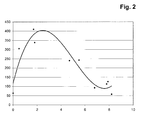
- FIG. 2 shows the protein binding capacity of an SO 3 ion exchanger prepared according to Example A2 as a function of the degree of grafting; experimental details can be found in application example B2.
- the binding capacity runs through a curve with a clear maximum at about 0.6 mM per gram of dry matter (corresponding to 2% sulfur). In this case, a binding capacity of about 400 mg lysozyme per g gel is achieved.
- ion exchangers having significantly improved properties are obtainable when base materials containing diol groups of more than 1 mmol per gram of base material (dry weight) are used and the reaction procedure in the graft polymerization is such that a grafting degree of 0.5 to 2 mmol per gram of base material (dry weight) is achieved.
- Suitable base material are hydrophilic, macroporous, highly crosslinked polymer materials, in particular crosslinked vinyl polymers of diol-containing vinyl monomers and crosslinking monomers whose polymerisable groups are linked by chains containing carbonamide groups. These contain more than 1 mmol of diol groups per gram of base material, in particular from 2 to 6 mmol diol groups / g.
- porous bead copolymers of N, N-methylene-bis-acrylamide and 3-allyloxy-1,2-propanediol (1: 0.6) are used.
- the base material are polymers having amidic or ethereal crosslinking and ether or amide bonded aliphatic hydroxyl groups on the surface or those groups which can be chemically converted to the latter.
- the hydroxyl groups preferably in the form of aliphatic diol groups in sufficient concentration at the surface of the The base material.
- all functional radicals of the monofunctional monomer component of the polymeric base material should be represented by aliphatic diol groups. However, there are also proportions of at least 50% of these groups in the form of diol groups in question. Methods for the determination of diol groups are known to the person skilled in the art. Particularly suitable base materials are in EP 0 482 339 disclosed.
- the base materials used according to the invention are present in particular as (macro) -porous bead polymers; however, nonporous bead polymers or polymers in other forms, e.g. porous cylinder or or differently shaped moldings, or membranes, threads or fabric are used.
- Monomers are grafted onto these base materials, the graft polymerization being controlled so as to obtain degrees of grafting of from 0.5 to 2 mmoles per gram of base material, as further explained below. If the upper limit of grafting is significantly exceeded, the resulting sorbent often has degraded mechanical properties. According to the invention, ion exchangers are obtained which have improved properties, in particular an improved dynamic binding capacity, and very good alkali stability.
- the grafting with cerium (IV) ions is started ( G.Mino and S.Kaizerman (1958) J. Polymer Science 31, 242-243 ; G.Mino et al. (1959) J. Polymer Science 38, 393-401 ). Further details are in EP 0 337 144 disclosed.
- the reaction with cerium (IV) salts in strongly acidic aqueous solution generates radicals on the base material, with diol groups apparently reacting faster than aliphatic hydroxyl groups.
- the radical generated in this reaction starts a radical chain reaction, with the added monomers being incorporated into the chain. This chain is thus linear and linked with a monomer unit with the aliphatic radical of the base material.
- the polymerization is terminated by termination reactions involving the cerium salts. Therefore, the (average) chain length can be influenced by the concentration ratios of the base material, the initiator and the monomers. Details regarding this are described below. Furthermore, uniform monomers or also mixtures of different monomers are used; in the latter case, grafted copolymers are formed.
- the reaction with cerium (IV) salts is also possible if the solvents used are mixtures which contain organic solvents in addition to water, these solvents being miscible with water and containing no hydroxyl groups. Dioxane or tetrahydrofuran are particularly preferred.
- the proportion of the organic solvent in the reaction mixture is typically 5-80% by volume, in particular 20-50% by volume. This process variant allows the grafting with monomers which are only slightly soluble in water.
- the following monomers are particularly preferred for the graft polymers of the invention: N- (2-diethylaminoethyl) acrylamide, N- (2-dimethylaminoethyl) acrylamide, N- (2-trimethylammoniumethyl) acrylamide hydrochloride, N- (3-trimethylammoniumpropyl) -acrylamide Hydrochloride, 2-acrylamido-2-methyl-1-propanesulfonic acid, Acrylic acid, acrylonitrile, as well as 2-acrylamido-ethanesulfonic acid, acrylamide and acrylic acid dimethylamide.
- N-substituted acrylamides are generally suitable for the graft polymers of the present invention besides acrylic acid and acrylamide insofar as the amide nitrogen does not bear substituents containing cerium (IV) oxidizable functional groups (e.g., hydroxyl or carboxy groups).
- these monomers should contain ionic groups or groups which can be converted into ionic groups.
- Graft polymers containing, for example, acrylonitrile or acrylamide can be converted by polymer-analogous hydrolysis into ion exchangers with carboxy groups.
- comonomers which do not contain any ionic groups to regulate the charge density.
- comonomers for example, in addition to acrylamide N- (2-methoxyethyl) acrylamide or N- (2-ethoxyethyl) acrylamide suitable.
- the corresponding methacrylic acid derivatives are also suitable.
- the sorbents of the invention have over the sorbents, as in EP 0 337 144 disclosed significantly increased dynamic binding capacities. This became possible because the connection between binding capacity and grafting, which leads to a pronounced optimum, was not recognized in the prior art. Furthermore, the sorbents according to the invention have a significantly improved alkali stability.
- the sorbents according to the invention can be used advantageously instead of previously known sorbents, for example instead of sorbents, as they are known in EP 337 144 are disclosed.
- the sorbents according to the invention can be used for the separation of biopolymers, such as peptides, proteins or nucleic acids, but also for the separation and purification of viruses, cell organelles, prokaryotic or eukaryotic cells, as well as protein complexes.
- weight data for base materials refer to the dry weight, to the determination of which the material is washed five times with an excess of acetone and then dried in vacuo at 50 ° C to constant weight.
- Room temperature means 15 to 30 ° C.
- the monomer solution is obtained by acrylating 127 g (1.09 mol) of N, N-diethylenediamine dissolved in 1.2 liters of water at 0-5 ° C. For this purpose, 95 g (1.05 mol) of acrylic acid chloride are added to the amine solution with stirring so that the specified temperature range is maintained during the reaction. It is left after the addition of the Reacting acrylic acid chloride for 30 minutes and then adjust the solution with 65% nitric acid to pH 2.0.
- the mixture of base material and monomer solution is stirred to suspension, supplemented with water so that a total volume of 3 liters is obtained. Subsequently, the suspension is heated to 42 ° C and after inerting with nitrogen with further stirring with a solution of 16.44 g ammonium citrate (IV) nitrate (30 mmol) in 60 ml of 0.5 M nitric acid.
- the suspension is filtered off or centrifuged and washed the remaining gel several times and successively with water, a mixture of 0.2 M ascorbic acid / 0.5 M sulfuric acid, then washed again with water and with 1 M NaOH and water again, until all soluble constituents of the reaction mixture have been removed from the gel to the limits of detection sensitivity of conventional analytical methods.
- the final product is suspended in suspension with saline solution containing 20% ethanol or e.g. in 0.1 M NaOH at R.T. stored.
- the binding capacity for BSA is about 500 mg / g (based on the dry weight of the gel).
- the degree of grafting is about 1 mmol / g (in monomer units based on dry matter), measured by acid / base titration of the immobilized DEAE groups.
- the cation exchanger with SO 3 groups is prepared in analogy to the description of preparation example A1 by using 2-acrylamido-2-methyl-1-propanesulfonic acid as monomer instead of the monomer mentioned there.
- the preparation is repeated with different variants, with different preparations exchangers are obtained with different graft levels.
- the degree of grafting is determined by elemental analysis of the sulfur content.
- the anion exchanger with TMAE groups is prepared in analogy to the description of preparation example A1 by using hydrochloride as the monomer instead of the monomer mentioned therein N- (2-trimethylammoniumethyl) acrylamide.
- the ion exchange material prepared according to Example A1 is filled into a SuperFormance® glass column (150 ⁇ 16 mm, 125 mm height of the sorbent bed) and equilibrated with the application buffer (50 mM TRIS buffer, pH 8.3).
- a solution of bovine serum albumin (5 mg / ml) in this buffer is continuously applied (linear flow: 100 cm / h) and the elution diagram measured by photometry at 280 nm. From the breakthrough curve (10%) the capacity (125 mg / ml gel) is determined.
- the ion exchange material prepared according to Example A2 is filled into a SuperFormance® glass column (150 ⁇ 16 mm, 100 mm height of the sorbent bed) and equilibrated with the application buffer (20 mM phosphate buffer, pH 7.0).
- a solution of lysozyme (5 mg / ml) in this buffer is continuously applied (linear flow: 100 cm / h) and the elution diagram measured by photometry at 280 nm. From the breakthrough curve (10%), the capacity (110 mg lysozyme / ml gel) is determined.
- Example of use B3 Shelf life of the sorbents in alkaline solution
- DEAE-ion exchanger prepared according to Example A1 is stored in aqueous NaOH solution (1 or 5 mol / L) at room temperature. After one year, the binding capacity was reduced by 5% (in 1 mol / L NaOH), or 10% (in 5 mol / L NaOH).
Landscapes
- Chemical & Material Sciences (AREA)
- Organic Chemistry (AREA)
- Chemical Kinetics & Catalysis (AREA)
- Analytical Chemistry (AREA)
- Graft Or Block Polymers (AREA)
- Treatment Of Liquids With Adsorbents In General (AREA)
- Solid-Sorbent Or Filter-Aiding Compositions (AREA)
Abstract
Description
- Die Erfindung betrifft Sorbentien für die lonenaustauschchromatographie, die insbesondere geeignet sind für chromatographische Trennungen von biologischen Substanzen (z.B. Proteinen, Peptiden oder Nukleinsäuren, sowie Viren).
- Bei der chromatographischen Trennung von biologischen Substanzen, insbesondere bei präparativen Prozessen, müssen die Sorbentien mehrere Eigenschaften aufweisen; dazu gehören zunächst eine gute Beständigkeit gegen alkalische Lösungen, wie sie zur Reinigung von Trenneinrichtungen (cleaning in place: CIP) üblich sind, sowie eine ausreichende mechanische Stabilität, damit hohe Flußraten erreichbar sind, und auch eine ausreichende Hydrophilie, damit irreversible Bindung der aufzureinigenden Substanzen an das Sorbens vermieden wird. Weiterhin ist auch eine hohe Bindungskapazität notwendig, damit die Trennprozesse wirtschaftlich geführt werden können.
Die Bindungskapazität sollte auch bei hoher Flußrate im wesentlichen erhalten sein, d.h. nicht nur die statische, sondern auch die dynamische Bindungskapazität sollte hoch sein. Soweit die Sorbentien aus derivatisierten, z.B. gepfropften Materialien bestehen, dürfen wesentliche Eigenschaften des Basismaterials nicht durch die Derivatisierung verschlechtert werden. - In
EP 0 337 144 werden Sorbentien für die lonenaustauschchromatographie offenbart. Nach der Lehre vonEP 0 337 144 werden derivatisierte Acrylamidmonomere auf diolsubstituierte Basismaterialien wie (meth)acrylatvernetzte Polymere oder Kieselgelderivate aufgepfropft. Die derartig erhältlichen Ionenaustauscher zeigen zwar gute Trenneigenschaften, sowie eine gute Druckstabilität, weisen aber nur eine beschränkte Stabilität gegen alkalische Lösungen auf. - Es ergibt sich also die Aufgabe, für die lonenaustauschchromatographie Sorbentien mit verbesserten Eigenschaften, insbesondere verbesserte Alkalistabilität, sowie guter dynamischer Bindungskapazität bereitzustellen.
- Gegenstand der Erfindung sind alkalistabile, hydrophile Sorbentien für die lonenaustauschchromatographie erhältlich durch folgende Verfahrensschritte:
- a) Bereitstellen eines Basismaterials, wobei es sich bei besagtem Basismaterial um ein vernetztes Vinylpolymer aus diolgruppenhaltigen Vinylmonomeren und vernetzenden Monomeren, deren polymerisierbare Gruppen durch Carbonamidgruppen enthaltene Ketten verbunden sind, handelt, und wobei dieses Basismaterial mehr als 1 mMol Diolgruppen pro Gramm enthält;
- b) Hinzufügen des Basismaterials zu einer wäßrigen Lösung des zu pfropfenden Monomers oder der zu pfropfenden Monomeren, wobei ein Monomer eine ionische Gruppe oder eine Vorläufergruppe für eine ionische Gruppe enthält;
- c) Pfropfung der Monomeren auf das Basismaterial, wobei die Pfropfungspolymerisation mit Cer-(IV)-Ionen gestartet wird, und wobei die Verfahrensparameter Suspensionsdichte (Konzentration des Basismaterials), Monomerkonzentration, Starterkonzentration, pH-Wert, Zeit, Temperatur und Zusatz von Polymerisationsinhibitoren so gewählt werden, daß ein Pfropfgrad von 0,5 bis 2 mMol pro Gramm Träger (Trockenmasse) erreicht wird;
- d) und schließlich gegebenenfalls die in Schritt b) eingeführten Vorläufergruppen für ionische Gruppen in ionische Gruppen überführt werden.
- Gegenstand der Erfindung sind Verfahren zur Herstellung von alkalistabilen, hydrophilen Sorbentien für die lonenaustauschchromatographie mit den oben genannten Verfahrensschritten, sowie die Verwendung der solchermaßen erhältlichen Sorbentien zur Trennung mindestens zweier Substanzen.
- Figur 1 zeigt die Proteinbindungskapazität eines DEAE-Ionenaustauschers, hergestellt nach Beispiel A1 in Abhängigkeit von der linearen Flußrate; experimentelle Einzelheiten finden sich in Anwendungsbeispiel B1. Dabei werden selbst bei einer linearen Flußrate von 1500 cm/h noch ca. 70 % der maximalen Bindungskapazität gemessen. Die erfindungsgemäßen Sorbentien sind somit hervorragend zur Anreicherung von Zielsubstanz ("capturing") geeignet.
- Figur 2 zeigt die Proteinbindungskapazität eines SO3-lonenaustauschers, hergestellt nach Beispiel A2 in Abhängigkeit von dem Pfropfgrad; experimentelle Einzelheiten finden sich in Anwendungsbeispiel B2. Die Bindungskapazität durchläuft in Abhängigkeit vom Pfropfgrad eine Kurve mit einem deutlichen Maximum bei ca. 0,6 mM pro Gramm Trockenmasse (entsprechend 2 % Schwefel). Dabei wird eine Bindungskapazität von ca. 400 mg Lysozym pro g Gel erreicht.
- Es wurde gefunden, daß Ionenaustauscher mit erheblich verbesserten Eigenschaften erhältlich sind, wenn Basismaterialien mit einem Gehalt an Diolgruppen von mehr als 1 mMol pro Gramm Basismaterial (Trockenmasse) verwendet werden und die Reaktionsführung bei der Pfropfpolymerisation so gestaltet wird, daß ein Pfropfgrad von 0,5 bis 2 mMol pro Gramm Basismaterial (Trockenmasse) erreicht wird. Als geeignetes Basismaterial kommen hydrophile, makroporöse, hochvernetzte Polymermaterialien in Frage, dabei handelt es sich insbesondere um vernetzte Vinylpolymere aus diolgruppenhaltigen Vinylmonomeren und vernetzenden Monomeren, deren polymerisierbare Gruppen durch Carbonamidgruppen enthaltene Ketten verbunden sind. Diese enthalten mehr als 1 mMol Diolgruppen pro Gramm Basismaterial, insbesondere von 2 bis 6 mMol Diolgruppen/g. Vorzugsweise werden poröse Perlcopolymerisate aus N,N-Methylen-bis-acrylamid und 3-Allyloxy-1,2-propandiol (1:0.6) (Hersteller Degussa/Röhm, Darmstadt) verwendet. Verwendbar als Basismaterial sind auch Polymere mit amidischer oder etherischer Vernetzung und etherisch oder amidisch gebundenen aliphatischen Hydroxylgruppen an der Oberfläche oder solchen Gruppen, die in letztere chemisch umgewandelt werden können. Wichtig ist die Anwesenheit der Hydroxylgruppen, bevorzugt in Form von aliphatischen Diolgruppen in ausreichender Konzentration an der Oberfläche des Basismaterials. Im Idealfall sollen sämtliche funktionellen Reste der monofunktionellen Monomerkomponente des polymeren Basismaterials durch aliphatische Diolgruppen repräsentiert sein. Es kommen jedoch auch Anteile von wenigstens 50% dieser Gruppen in Form von Diolgruppen in Frage. Methoden zur Bestimmung von Diolgruppen sind dem Fachmann bekannt. Besonders geeignete Basismaterialien sind in
EP 0 482 339 offenbart. - Die erfindungsgemäß verwendeten Basismaterialien liegen insbesondere als (makro)-poröse Perlpolymerisate vor; es können jedoch auch unporöse Perlpolymerisate oder Polymerisate in anderer Form, z.B. poröse Zylinder oder oder anders gestaltete Formkörper, oder auch Membranen, Fäden oder Gewebe eingesetzt werden.
- Auf diese Basismaterialien werden Monomere aufgepfropft, wobei wie im folgenden näher erläutert, die Pfropfpolymerisation so gesteuert wird, daß Pfropfungsgrade von 0,5 bis 2 mMol pro Gramm Basismaterial erhalten werden. Wird die Obergrenze des Pfropfgrades wesentlich überschritten, so weist das resultierende Sorbens häufig verschlechterte mechanische Eigenschaften auf. Erfindungsgemäß werden lonenaustauscher erhalten, die verbesserte Eigenschaften, insbesondere eine verbesserte dynamische Bindungskapazität, sowie eine sehr gute Alkalistabilität aufweisen..
- Erfindungsgemäß wird die Pfropfung mit Cer(IV)-Ionen gestartet (G.Mino und S.Kaizerman (1958) J.Polymer Science 31, 242-243; G.Mino et al. (1959) J.Polymer Science 38, 393-401). Weitere Einzelheiten sind in
EP 0 337 144 offenbart. Durch die Reaktion mit Cer-(IV)-Salzen in stark saurer wäßriger Lösung werden an dem Basismaterial Radikale erzeugt, wobei Diolgruppen offenbar schneller als aliphatische Hydroxylgruppen reagieren. An den bei dieser Reaktion entstehenden Radikalen setzt eine Radikalkettenreaktion ein, wobei die zugesetzten Monomeren in die Kette eingebaut werden. Diese Kette ist somit linear und mit einer Monomereinheit mit dem aliphatischen Rest des Basismaterials verknüpft. Die Polymerisation wird durch Abbruchsreaktionen unter Beteilung der Cer-Salze beendet. Deswegen ist die (mittlere) Kettenlänge durch die Konzentrationsverhältnisse des Basismaterials, des Initiators und der Monomeren beeinflußbar. Diesbezügliche Einzelheiten sind im folgenden beschrieben. Weiterhin können einheitliche Monomere oder auch Gemische verschiedener Monomere eingesetzt werden; im letzteren Fall entstehen gepfropfte Copolymerisate. - Die Umsetzung mit Cer(IV)-salzen ist auch möglich, wenn als Lösungsmittel Mischungen benutzt werden, die neben Wasser organische Lösungsmittel enthalten, wobei diese Lösungsmittel mit Wasser mischbar sind und keine Hydroxylgruppen enthalten. Besonders bevorzugt sind dabei Dioxan oder Tetrahydrofuran. Der Anteil des organischen Lösungsmittels im Reaktionsansatz beträgt typischerweise 5-80 Volumen-%, insbesondere 20-50 Volumen-%. Diese Verfahrensvariante ermöglicht die Pfropfung mit Monomeren, die nur geringfügig in Wasser löslich sind.
- Um den erfindungsmäßig bevorzugten Pfropfgrad von von 0,5 bis 2 mMol pro Gramm Basismaterial zu erreichen, werden die Verfahrensparameter Konzentration des Basismaterials (Suspensionsdichte), Monomerkonzentration, Starterkonzentration, pH-Wert, Zeit, Temperatur und Zusatz von Polymerisationsinhibitoren variiert. Bei gegebener Suspensionsdichte des zu bepfropfenden Basismaterials und somit definierter reaktiver Oberfläche sowie zugänglicher Anzahl der durch das Cer-(IV)-Salz oxidierbaren funktionellen Gruppen kann der Pfropfgrad hauptsächlich durch die Variation folgender Parameter im Sinne des erfindungsgemäßen Pfropfprodukts eingestellt werden:
- a) Monomerkonzentration (0.05 - 2 Mol/L, vorzugsweise 0.2 - 0.8 Mol/L): Erhöhung führt zu gesteigerter Bildung von Pfropfpolymer.
- b) pH Wert (0-6, vorzugsweise 1-2): Erhöhung des pH Werts führt zu verminderter Bildung von Pfropfpolymer.
- c) Starterkonzentration (10-6 bis 10-1 Mol/L; vorzugsweise 10-3 - 10-2 Mol/L): Erhöhung der Starterkonzentration führt zu einer größeren Zahl von Startpunkten und damit gebildeter Ketten von Pfropfpolymer. Jedoch ergibt sich bei zu hoher Starterkonzentration auch ein vorzeitiger Kettenabbruch durch Beteiligung des Metallkomplexes an der Terminationsreaktion. Im Ergebnis ist dann die Pfropfdichte erhöht, jedoch auf Kosten des erzielten mittleren Polymerisationsgrades, so dass der Pfropfgrad auch wieder verringert sein kann.
- d) Zeit: Verlängerung der Reaktionsdauer bewirkt gesteigerte Bildung an Pfropfpolymer; die maximale Menge wird in typischerweise asymptotischer Annäherung nach etwa 20 h erreicht. Die optimale Reaktionszeit liegt zwischen 0.5 und 5 h.
- e) Temperatur: spielt nur eine untergeordnete Rolle im Hinblick auf die Stabilität des Metallkomplexes in der Mischung sowie bezüglich der Diffusion der löslichen Reaktionsteilnehmer in dem Porensystem des Trägermaterials. Bevorzugte Temperaturen sind zwischen 10 und 60°C. Maxima und Minima sind durch Schmelz- bzw. Siedepunkt der wässrigen Suspension gegeben.
- f) Inhibitoren: Die dem Fachmann geläufigen Inhibitoren radikalischer Polymerisationsreaktionen können grundsätzlich als Moderatoren oder zum vorzeitigen Reaktionsabbruch verwendet werden, um ganz bestimmte Pfropfgrade zu erzielen.
Zu den Inhibitoren zählen u.a. redoxaktive Substanzen wie Chinone/Hydrochinone, Natriumsulfit, alle leicht oxidierbaren Metallsalze und Metallkomplexe; Aldehyde und dergleichen leicht oxidierbare organische Substanzen. Weniger gut geeignet sind Verbindungen mit Monohydroxy- oder vicinalen Dihydroxyfunktionen oder Polyhydroxyverbindungen und verwandte Stoffe, deren primäre Oxidationsprodukte mit den anwesenden Monomeren zur Bildung von Homopolymeren Anlass geben, welche teilweise schwierig aus dem pfropfpolymerisierten Trägermaterial zu entfernen sind. Auch ist Luftsauerstoff geeignet, die Polymerisationsreaktion zu verlangsamen. - Für die erfindungsgemäßen Pfropfpolymeren sind insbesondere folgende Monomeren bevorzugt: N-(2-Diethylaminoethyl)-acrylamid, N-(2-Dimethylaminoethyl)-acrylamid, N-(2-Trimethylammoniumethyl)-acrylamid Hydrochlorid, N-(3-Trimethylammoniumpropyl)-acrylamid Hydrochlorid, 2-Acrylamido-2-methyl-1-propansulfonsäure, Acrylsäure, Acrylnitril, sowie auch 2-Acrylamido-ethansulfonsäure, Acrylamid und Acrylsäuredimethylamid.
- Grundsätzlich sind für die erfindungsgemäßen Pfropfpolymeren neben Acrylsäure und Acrylamid allgemein N-substituierte Acrylamide geeignet, soweit der Amidstickstoff keine Substituenten trägt, die durch Cer(IV) oxidierbare funktionelle Gruppen (z.B. Hydroxyl- oder Carboxygruppen) enthalten. Weiterhin sollten diese Monomeren ionische Gruppen oder Gruppen, die sich in ionische Gruppen überführen lassen, enthalten.
- Pfropfpolymerisate, die beispielsweise Acrylnitril oder Acrylamid enthalten, lassen sich durch polymeranaloge Hydrolyse in Ionenaustauscher mit Carboxygruppen umwandeln.
- Es kann aber auch sinnvoll sein, zur Regulierung der Ladungsdichte Comonomere zuzufügen, die keine ionischen Gruppen enthalten. Dazu sind beispielsweise neben Acrylamid N-(2-Methoxyethyl)-acrylamid oder N-(2-Ethoxyethyl)-acrylamid geeignet.
- Die entsprechenden Methacrylsäurederivate sind ebenfalls geeignet.
- Es hat sich gezeigt, daß Amidbindungen, insbesondere N-Alkyl-amidbindungen gegen Alkali sehr stabil sind.
- Die erfindungsgemäßen Sorbentien weisen gegenüber den Sorbentien, wie sie in
EP 0 337 144 offenbart werden, wesentlich erhöhte dynamische Bindungskapazitäten auf. Dies wurde möglich, da der Zusammenhang zwischen Bindungskapazität und Pfropfgrad, der zu einem ausgeprägten Optimum führt, im Stand der Technik nicht erkannt wurde. Ferner weisen die erfindungsgemäßen Sorbentien eine wesentlich verbesserte Alkalistabilität auf. - Die erfindungsgemäßen Sorbentien lassen sich vorteilhaft anstelle bisher bekannter Sorbentien verwenden, z.B. anstelle von Sorbentien, wie sie in
EP 337 144 - Auch ohne weitere Ausführungen wird davon ausgegangen, daß ein Fachmann die obige Beschreibung im weitesten Umfang nutzen kann. Die bevorzugten Ausführungsformen und Beispiele sind deswegen lediglich als beschreibende, keineswegs als in irgendeiner Weise limitierende Offenbarung aufzufassen.
- Die vollständige Offenbarung aller vor- und nachstehend aufgeführten Anmeldungen, Patente und Veröffentlichungen, sowie der korrespondierenden Anmeldung
DE 101 49 256.1 , eingereicht am 05.10.2001, sind durch Bezugnahme in diese Anmeldung eingeführt. - Soweit nicht anders angegeben, beziehen sich Gewichtsangaben für Basismaterialien auf das Trockengewicht, zu dessen Bestimmung das Material fünfmal mit einem Überschuß von Aceton gewaschen und anschließend im Vakuum bei 50 °C bis zur Gewichtskonstanz getrocknet wird.
- Raumtemperatur (R.T.) bedeutet 15 bis 30 °C.
- Die Monomerlösung wird durch Acrylierung von 127 g (1.09 Mol) N,N-Diethylendiamin, gelöst in 1.2 Liter Wasser, bei 0-5°C, erhalten. Hierzu werden 95 g (1.05 Mol) Acrylsäurechlorid zu der Aminlösung so unter Rühren zugegeben, dass der angegebene Temperaturbereich während der Umsetzung eingehalten wird. Man lässt nach beendeter Zugabe des Acrylsäurechlorids noch 30 Minuten nachreagieren und stellt die Lösung danach mit 65%iger Salpetersäure auf pH 2.0 ein.
- In einem temperierbaren Rührreaktor wird eine Mischung aus 1 kg (Feuchtmasse) des Basismaterials (hydrophiles, makroporöses, hochvernetztes Polymermaterial, Copolymerisat aus N,N-Methylen-bis-acrylamid und 3-Allyloxy-1,2-propandiol (1:0,6); Hersteller: Degussa/Röhm, Darmstadt, Deutschland) zur frisch hergestellten Monomerlösung gegeben.
- Die Mischung aus Basismaterial und Monomerlösung wird zur Suspension aufgerührt, mit Wasser so ergänzt, dass ein Gesamtvolumen von 3 Liter erhalten wird. Anschließend wird die Suspension auf 42°C aufgeheizt und nach Inertisieren mit Stickstoff unter weiterem Rühren mit einer Lösung aus 16.44 g Ammoniumcer(IV)nitrat (30 mMol) in 60 ml 0.5 M Salpetersäure versetzt.
- Nach 12-18 h bei 42°C wird die Suspension abfiltriert oder abgeschleudert und das zurückbleibende Gel mehrmals und sukzessive mit Wasser, einer Mischung aus 0.2 M Ascorbinsäure/ 0.5 M Schwefelsäure, dann wieder mit Wasser sowie mit 1 M NaOH und nochmals Wasser gewaschen, bis sämtliche lösliche Bestandteile der Reaktionsmischung bis zu den Grenzen der Nachweisempfindlichkeit gängiger analytischer Methoden aus dem Gel entfernt sind.
- Das fertige Produkt wird in Suspension mit 20% Ethanol enthaltender Salzlösung oder z.B. in 0.1 M NaOH bei R.T. gelagert.
- Die Bindungskapazität für BSA beträgt etwa 500 mg/g (bezogen auf Trockenmasse des Gels).
- Der Pfropfgrad beträgt etwa 1 mmol/g (in Monomereinheiten bezogen auf Trockenmasse), gemessen durch Säure/Base Titration der immobilisierten DEAE-Gruppen.
- Der Kationenaustauscher mit SO3-Gruppen wird in Analogie zu der Beschreibung von Herstellbeispiel A1 hergestellt, indem man anstelle des dort genannten Monomers 2-Acrylamido-2-methyl-1-propansulfonsäure als Monomer einsetzt.
- Die Herstellung wird mit verschiedenen Varianten wiederholt, wobei verschiedene Präparationen Austauscher mit unterschiedlichen Pfropfgraden erhalten werden. Der jeweilige Pfropfgrad wird durch Elementaranalyse des Schwefelgehaltes bestimmt.
- Der Anionenaustauscher mit TMAE-Gruppen wird in Analogie zu der Beschreibung von Herstellbeispiel A1 hergestellt, indem man anstelle des dort genannten Monomers N-(2-Trimethylammoniumethyl)-acrylamid Hydrochlorid als Monomer einsetzt.
- lonenaustauschermaterial, hergestellt nach Beispiel A1, wird in eine SuperFormance® Glassäule (150 x 16 mm; 125 mm Höhe des Sorbensbettes) gefüllt und mit dem Auftragepuffer (50 mM TRIS-Puffer, pH 8,3) äquilibriert. Eine Lösung von Rinderserumalbumin (5 mg/ml) in diesem Puffer wird kontinuierlich aufgetragen (linearer Fluß: 100 cm/h) und das Elutionsdiagramm durch Photometrie bei 280 nm gemessen. Aus der Durchbruchskurve (10 %) wird die Kapazität (125 mg/ ml Gel) bestimmt.
- Der Versuch wird mit höheren Flußraten wiederholt. Die Ergebnisse sind in Figur 1 zusammengefaßt. Selbst bei einer linearen Flußrate von 1500 cm/h werden noch ca. 70 % der maximalen Bindungskapazität gemessen.
- lonenaustauschermaterial, hergestellt nach Beispiel A2, wird in eine SuperFormance® Glassäule (150 x 16 mm; 100 mm Höhe des Sorbensbettes) gefüllt und mit dem Auftragepuffer (20 mM Phosphat-Puffer, pH 7,0) äquilibriert. Eine Lösung von Lysozym (5 mg/ml) in diesem Puffer wird kontinuierlich aufgetragen (linearer Fluß: 100 cm/h) und das Elutionsdiagramm durch Photometrie bei 280 nm gemessen. Aus der Durchbruchskurve (10 %) wird die Kapazität ( 110 mg Lysozym/ ml Gel) bestimmt.
- Der Versuch wird mit den verschiedenen Präparationen (unterschiedlicher Pfropfgrad) wiederholt. Die Ergebnisse sind in Figur 2 zusammengefaßt. Die Bindungskapazität durchläuft in Abhängigkeit vom Pfropfgrad eine Kurve mit einem deutlichen Maximum bei ca. 0,6 mM pro Gramm Trockenmasse (entsprechend 2 % Schwefel).
- DEAE-lonenaustauscher hergestellt nach Beispiel A1 wird in wäßriger NaOH-Lösung (1 bzw. 5 Mol/L) bei Raumtemperatur gelagert. Nach einem Jahr war die Bindungskapazität um 5 % (in 1 Mol/L NaOH), beziehungsweise 10 % (in 5 Mol/L NaOH) verringert.
Claims (10)
- Alkalistabiles, hydrophiles Sorbens für die lonenaustauschchromatographie erhältlich durch folgende Verfahrensschritte:a) Bereitstellen eines vernetzten Copolymers als Basismaterial in Form von porösen Perlpolymerisaten, zu deren Herstellung N,N-Methylen-bis-acrylamid und 3-Allyloxy-1,2-propandiol verwendet werden, und welches mehr als 1 mMol Diolgruppen pro Gramm enthält,b) Hinzufügen des Basismaterials zu einer wäßrigen Lösung des zu pfropfenden Monomers, welches in einer Konzentration von 0,05 bis 2 mol/l vorliegt und welches eine ionische Gruppe oder eine Vorläufergruppe für eine ionische Gruppe enthält,c) Pfropfung der Monomeren auf das Basismaterial, wobei die Monomeren ausgewählt sind aus der Gruppe N-(2-Diethylaminoethyl)-acrylamid, N-(2-Dimethylaminoethyl)-acrylamid, N-(2-Trimethylammoniumethyl)-acrylamid Hydrochlorid, N-(3-Trimethylammoniumpropyl)-acrylamid Hydrochlorid, 2-Acrylamido-2-methyl-1-propansulfonsäure, Acrylsäure und Acrylnitril, oder aus der Gruppe 2-Acrylamido-ethansulfonsäure, Acrylamid und Acrylsäuredimethylamid und in einer Konzentration von 0,05 - 2 Mol/L vorgelegt werden,
und wobei die
Pfropfungspolymerisation mit Cer-(IV)-lonen gestartet wird, und die Verfahrensparameter Suspensionsdichte (Konzentration des Basismaterials), Monomerkonzentration, Starterkonzentration, pH-Wert, Zeit, Temperatur und Zusatz von Polymerisationsinhibitoren so gewählt werden, daß ein Pfropfgrad von 0,5 bis 2 mMol pro Gramm Träger (Trockenmasse) erreicht wird,d) und schließlich gegebenenfalls die in Schritt b) eingeführten Vorläufergruppen für ionische Gruppen in ionische Gruppen überführt werden. - Verfahren zur Herstellung eines alkalistabilen, hydrophilen Sorbens für die lonenaustauschchromatographie, gekennzeichnet durch folgende Verfahrensschritte:a) Bereitstellen eines vernetzten Copolymers als Basismaterial in Form von porösen Perlpolymerisaten, zu deren Herstellung N,N-Methylen-bis-acrylamid und 3-Allyloxy-1,2-propandiol verwendet werden, und welches mehr als 1 mMol Diolgruppen pro Gramm enthält,b) Hinzufügen des Basismaterials zu einer wäßrigen Lösung des zu pfropfenden Monomers, welches in einer Konzentration von 0,05 bis 2 mol/l vorliegt und welches eine ionische Gruppe oder eine Vorläufergruppe für eine ionische Gruppe enthält,c) Pfropfung der Monomeren auf das Basismaterial, wobei die Monomeren ausgewählt sind aus der Gruppe N-(2-Diethylaminoethyl)-acrylamid, N-(2-Dimethylaminoethyl)-acrylamid, N-(2-Trimethylammoniumethyl)-acrylamid Hydrochlorid, N-(3-Trimethylammoniumpropyl)-acrylamid Hydrochlorid, 2-Acrylamido-2-methyl-1-propansulfonsäure, Acrylsäure und Acrylnitril, oder aus der Gruppe 2-Acrylamido-ethansulfonsäure, Acrylamid und Acrylsäuredimethylamid und in einer Konzentration von 0,05 - 2 Mol/L vorgelegt werden,
und wobei die
Pfropfungspolymerisation mit Cer-(IV)-Ionen gestartet wird, und die Verfahrensparameter Suspensionsdichte (Konzentration des Basismaterials), Monomerkonzentration, Starterkonzentration, pH-Wert, Zeit, Temperatur und Zusatz von Polymerisationsinhibitoren so gewählt werden, daß ein Pfropfgrad von 0,5 bis 2 mMol pro Gramm Träger (Trockenmasse) erreicht wird,d) und schließlich gegebenenfalls die in Schritt b) eingeführten Vorläufergruppen für ionische Gruppen in ionische Gruppen überführt werden. - Verfahren zur Herstellung eines alkalistabilen, hydrophilen Sorbens für die lonenaustauschchromatographie gemäß Anspruch 2, wobei in Schritt b) das Monomer in einer Konzentration von 0,2 - 0,8 Mol/L vorgelegt wird.
- Verfahren zur Herstellung eines alkalistabilen, hydrophilen Sorbens für die lonenaustauschchromatographie nach einem oder mehreren der Ansprüche 2 - 3, wobei in Schritt b) außer dem Monomer, das eine ionische Gruppe oder eine Vorläufergruppe für eine ionische Gruppe enthält, N-(2-Mehtylmethoxyethyl)acrylamid oder N-(2-ethoxyethyl)acrylamid als zusätzliches neutrales Monomer zugesetzt wird.
- Verfahren zur Herstellung eines alkalistabilen, hydrophilen Sorbens für die lonenaustauschchromatographie nach einem oder mehreren der Ansprüche 2-4, dadurch gekennzeichnet, dass der pH- Wert in Schritt c) im Bereich zwischen 0-6 eingestellt wird.
- Verfahren zur Herstellung eines alkalistabilen, hydrophilen Sorbens für die lonenaustauschchromatographie nach einem oder mehreren der Ansprüche 2 - 5, dadurch gekennzeichnet, dass der pH- Wert in Schritt c) im Bereich zwischen 1 - 2 eingestellt wird.
- Verfahren zur Herstellung eines alkalistabilen, hydrophilen Sorbens für die lonenaustauschchromatographie nach einem oder mehreren der Ansprüche 2 - 6, dadurch gekennzeichnet, dass die Starterkonzentration in Schritt c) 10-6 bis 10-1 Mol/L beträgt.
- Verfahren zur Herstellung eines alkalistabilen, hydrophilen Sorbens für die lonenaustauschchromatographie nach einem oder mehreren der Ansprüche 2 - 7, dadurch gekennzeichnet, dass die Starterkonzentration in Schritt c) 10-3 bis 10-2 Mol/L beträgt.
- Verfahren zur Herstellung eines alkalistabilen, hydrophilen Sorbens für die lonenaustauschchromatographie nach einem oder mehreren der Ansprüche 2 - 8, dadurch gekennzeichnet, dass die Reaktionszeit 0,5 - 5 h beträgt.
- Verfahren zur Herstellung eines alkalistabilen, hydrophilen Sorbens für die lonenaustauschchromatographie nach einem oder mehreren der Ansprüche 2-9, dadurch gekennzeichnet, dass die Reaktionstemperatur zwischen 10 und 60 °C liegt.
Applications Claiming Priority (2)
| Application Number | Priority Date | Filing Date | Title |
|---|---|---|---|
| DE10149256A DE10149256A1 (de) | 2001-10-05 | 2001-10-05 | Alkalistabile hydrophile Sorbentien für die Ionenaustauschchromatographie |
| EP02779324A EP1432513B1 (de) | 2001-10-05 | 2002-09-09 | Alkalistabile hydrophile sorbentien für die ionenaustauschchromatographie |
Related Parent Applications (1)
| Application Number | Title | Priority Date | Filing Date |
|---|---|---|---|
| EP02779324A Division EP1432513B1 (de) | 2001-10-05 | 2002-09-09 | Alkalistabile hydrophile sorbentien für die ionenaustauschchromatographie |
Publications (1)
| Publication Number | Publication Date |
|---|---|
| EP1829611A1 true EP1829611A1 (de) | 2007-09-05 |
Family
ID=7701570
Family Applications (2)
| Application Number | Title | Priority Date | Filing Date |
|---|---|---|---|
| EP02779324A Expired - Lifetime EP1432513B1 (de) | 2001-10-05 | 2002-09-09 | Alkalistabile hydrophile sorbentien für die ionenaustauschchromatographie |
| EP07011235A Ceased EP1829611A1 (de) | 2001-10-05 | 2002-09-09 | Alkalistabile hydrophile Sorbentien für die Ionenaustauschchromatographie |
Family Applications Before (1)
| Application Number | Title | Priority Date | Filing Date |
|---|---|---|---|
| EP02779324A Expired - Lifetime EP1432513B1 (de) | 2001-10-05 | 2002-09-09 | Alkalistabile hydrophile sorbentien für die ionenaustauschchromatographie |
Country Status (6)
| Country | Link |
|---|---|
| US (1) | US7015281B2 (de) |
| EP (2) | EP1432513B1 (de) |
| JP (1) | JP4024209B2 (de) |
| AT (1) | ATE367862T1 (de) |
| DE (2) | DE10149256A1 (de) |
| WO (1) | WO2003031062A1 (de) |
Cited By (1)
| Publication number | Priority date | Publication date | Assignee | Title |
|---|---|---|---|---|
| WO2009143953A1 (de) * | 2008-05-30 | 2009-12-03 | Merck Patent Gmbh | Ce(iv) initiierte pfropfpolymerisation auf nicht hydroxylgruppenhaltigen polymeren |
Families Citing this family (9)
| Publication number | Priority date | Publication date | Assignee | Title |
|---|---|---|---|---|
| US20040127648A1 (en) * | 2002-12-31 | 2004-07-01 | Ciphergen Biosystems, Inc. | Sorbent and method for the separation of plasmid DNA |
| CN101678318B (zh) * | 2007-05-25 | 2013-09-25 | 默克专利股份公司 | 用于阳离子交换色谱法的接枝共聚物 |
| JP2011016036A (ja) * | 2007-11-26 | 2011-01-27 | Asahi Kasei Chemicals Corp | タンパク吸着材料およびその製造方法 |
| EP2153877A1 (de) * | 2008-07-30 | 2010-02-17 | MERCK PATENT GmbH | Mischpfropfpolymere für die Ionenaustauschchromatographie |
| MY178616A (en) | 2012-09-17 | 2020-10-19 | Grace W R & Co | Chromatography media and devices |
| JP6914189B2 (ja) | 2014-05-02 | 2021-08-04 | ダブリュー・アール・グレース・アンド・カンパニー−コーンW R Grace & Co−Conn | 官能化担体材料並びに官能化担体材料を作製及び使用する方法 |
| CN107921407B (zh) | 2015-06-05 | 2022-07-05 | 格雷斯公司 | 生物处理吸附澄清剂及其制备和使用方法 |
| US11835501B2 (en) | 2015-07-13 | 2023-12-05 | Sartorius Stedim Chromatography Systems Ltd. | Optimizing operating binding capacity for a multiple column chromatography process |
| US12643077B2 (en) | 2023-08-28 | 2026-06-02 | Cytiva Us Llc | Diethylamino ethyl polymers and methods of use |
Citations (4)
| Publication number | Priority date | Publication date | Assignee | Title |
|---|---|---|---|---|
| EP0337144A1 (de) * | 1988-03-31 | 1989-10-18 | MERCK PATENT GmbH | Trennmaterialien |
| EP0482339A1 (de) * | 1990-09-15 | 1992-04-29 | Röhm Gmbh | Hochvernetztes, perlförmiges, aktivierbares, hydrophiles Trägermaterial |
| DE4316136A1 (de) * | 1993-05-13 | 1994-11-17 | Merck Patent Gmbh | Verfahren und Träger für die Gelpermeationschromatographie |
| WO1996014151A1 (de) * | 1994-11-04 | 1996-05-17 | Merck Patent Gmbh | Trennmaterialien und verfahren zu ihrer herstellung |
-
2001
- 2001-10-05 DE DE10149256A patent/DE10149256A1/de not_active Withdrawn
-
2002
- 2002-09-09 US US10/491,543 patent/US7015281B2/en not_active Expired - Fee Related
- 2002-09-09 EP EP02779324A patent/EP1432513B1/de not_active Expired - Lifetime
- 2002-09-09 EP EP07011235A patent/EP1829611A1/de not_active Ceased
- 2002-09-09 WO PCT/EP2002/010072 patent/WO2003031062A1/de not_active Ceased
- 2002-09-09 DE DE50210563T patent/DE50210563D1/de not_active Expired - Fee Related
- 2002-09-09 AT AT02779324T patent/ATE367862T1/de not_active IP Right Cessation
- 2002-09-09 JP JP2003534083A patent/JP4024209B2/ja not_active Expired - Fee Related
Patent Citations (4)
| Publication number | Priority date | Publication date | Assignee | Title |
|---|---|---|---|---|
| EP0337144A1 (de) * | 1988-03-31 | 1989-10-18 | MERCK PATENT GmbH | Trennmaterialien |
| EP0482339A1 (de) * | 1990-09-15 | 1992-04-29 | Röhm Gmbh | Hochvernetztes, perlförmiges, aktivierbares, hydrophiles Trägermaterial |
| DE4316136A1 (de) * | 1993-05-13 | 1994-11-17 | Merck Patent Gmbh | Verfahren und Träger für die Gelpermeationschromatographie |
| WO1996014151A1 (de) * | 1994-11-04 | 1996-05-17 | Merck Patent Gmbh | Trennmaterialien und verfahren zu ihrer herstellung |
Cited By (2)
| Publication number | Priority date | Publication date | Assignee | Title |
|---|---|---|---|---|
| WO2009143953A1 (de) * | 2008-05-30 | 2009-12-03 | Merck Patent Gmbh | Ce(iv) initiierte pfropfpolymerisation auf nicht hydroxylgruppenhaltigen polymeren |
| US9303098B2 (en) | 2008-05-30 | 2016-04-05 | Merck Patent Gmbh | Ce(IV)-initiated graft polymerisation on polymers containing no hydroxyl groups |
Also Published As
| Publication number | Publication date |
|---|---|
| DE10149256A1 (de) | 2003-04-17 |
| EP1432513B1 (de) | 2007-07-25 |
| DE50210563D1 (de) | 2007-09-06 |
| EP1432513A1 (de) | 2004-06-30 |
| JP4024209B2 (ja) | 2007-12-19 |
| WO2003031062A1 (de) | 2003-04-17 |
| US7015281B2 (en) | 2006-03-21 |
| JP2005504973A (ja) | 2005-02-17 |
| ATE367862T1 (de) | 2007-08-15 |
| US20040266896A1 (en) | 2004-12-30 |
Similar Documents
| Publication | Publication Date | Title |
|---|---|---|
| DE69520042T2 (de) | Porösesverbundmembran und verfahren | |
| DE69317154T2 (de) | Verfahren zur Herstellung vernetzter Copolymere von Methacrylsäureanhydrid | |
| DE60035603T2 (de) | Neue molekular geprägte und auf einen festen träger gepfropfte polymere | |
| DE69932944T2 (de) | Chromatographisches verfahren und für das verfahren geeignetes säulenmaterial | |
| DE2503774A1 (de) | Verfahren zur herstellung von ionenaustauschern aus hydrophilen polymeren gelen | |
| EP2310104B1 (de) | Mischpfropfpolymere für die ionenaustauschchromatographie | |
| DE2505870C2 (de) | ||
| DE60008380T2 (de) | Verfahren zur herstellung von fluorinierten absorbierenden polymerpartikeln | |
| EP0804494B1 (de) | Polymerisationsfähige derivate von polyamiden | |
| EP1432513B1 (de) | Alkalistabile hydrophile sorbentien für die ionenaustauschchromatographie | |
| DE69433303T2 (de) | Trennungsverfahren und synthetische polymere, die als trennungsmedien für dieses verfahren anwendbar sind | |
| DE3407814A1 (de) | Phasentraeger fuer die verteilungschromatographie von makromolekuelen, verfahren zu ihrer herstellung und ihre verwendung | |
| EP3347125A1 (de) | Adsorptionsmedium, verfahren zu dessen herstellung, sowie verwendung desselben zur aufreinigung von biomolekülen | |
| WO2018137975A1 (de) | Chromatographiemedium mit gebundenen mikroglobuli und verfahren zu dessen herstellung | |
| DE60304184T2 (de) | Oberflächenpfropfmodifizierte harze und deren herstellung | |
| DE2504031C2 (de) | ||
| EP1234029B1 (de) | Verfahren zur herstellung oberflächenmodifizierte trägermaterialien zur bindung biologischer materialien | |
| DE69410763T2 (de) | Microsphäre und Verfahren zu deren Herstellung | |
| DE1918399A1 (de) | Verfahren zur Herstellung eines poroesen,vernetzten Mischpolymers,insbesondere zur Verwendung als Ionenaustauscherharz | |
| WO1996031549A1 (de) | Dendrimere pfropfpolymerisate | |
| EP0722361B1 (de) | Epoxy-derivate von polyacrylamiden | |
| EP0697905B1 (de) | Verfahren und träger für die gelpermeationschromatographie | |
| EP0789620B1 (de) | Trennmaterialien und verfahren zu ihrer herstellung | |
| DE3886110T2 (de) | Hydrophiles erzeugnis und verfahren zur herstellung. | |
| WO1996014151A9 (de) | Trennmaterialien und verfahren zu ihrer herstellung |
Legal Events
| Date | Code | Title | Description |
|---|---|---|---|
| PUAI | Public reference made under article 153(3) epc to a published international application that has entered the european phase |
Free format text: ORIGINAL CODE: 0009012 |
|
| 17P | Request for examination filed |
Effective date: 20070608 |
|
| AC | Divisional application: reference to earlier application |
Ref document number: 1432513 Country of ref document: EP Kind code of ref document: P |
|
| AK | Designated contracting states |
Kind code of ref document: A1 Designated state(s): AT BE BG CH CY CZ DE DK EE ES FI FR GB GR IE IT LI LU MC NL PT SE SK TR |
|
| 17Q | First examination report despatched |
Effective date: 20071102 |
|
| AKX | Designation fees paid |
Designated state(s): AT BE BG CH CY CZ DE DK EE ES FI FR GB GR IE IT LI LU MC NL PT SE SK TR |
|
| STAA | Information on the status of an ep patent application or granted ep patent |
Free format text: STATUS: THE APPLICATION HAS BEEN REFUSED |
|
| 18R | Application refused |
Effective date: 20090426 |