EP1826076A2 - Sperrvorrichtung für ein bewegliches Element - Google Patents
Sperrvorrichtung für ein bewegliches Element Download PDFInfo
- Publication number
- EP1826076A2 EP1826076A2 EP07002243A EP07002243A EP1826076A2 EP 1826076 A2 EP1826076 A2 EP 1826076A2 EP 07002243 A EP07002243 A EP 07002243A EP 07002243 A EP07002243 A EP 07002243A EP 1826076 A2 EP1826076 A2 EP 1826076A2
- Authority
- EP
- European Patent Office
- Prior art keywords
- locking
- transmitter
- receiving element
- movable
- movement
- Prior art date
- Legal status (The legal status is an assumption and is not a legal conclusion. Google has not performed a legal analysis and makes no representation as to the accuracy of the status listed.)
- Granted
Links
- 230000003993 interaction Effects 0.000 claims abstract description 39
- 230000000903 blocking effect Effects 0.000 claims abstract description 24
- 238000001514 detection method Methods 0.000 claims description 2
- 238000012545 processing Methods 0.000 claims description 2
- 230000000694 effects Effects 0.000 description 5
- 230000001427 coherent effect Effects 0.000 description 2
- 238000000034 method Methods 0.000 description 2
- 230000009471 action Effects 0.000 description 1
- 230000008901 benefit Effects 0.000 description 1
- 230000000295 complement effect Effects 0.000 description 1
- 230000001419 dependent effect Effects 0.000 description 1
- 238000013461 design Methods 0.000 description 1
- 238000002474 experimental method Methods 0.000 description 1
- 230000008569 process Effects 0.000 description 1
Images



Classifications
-
- B—PERFORMING OPERATIONS; TRANSPORTING
- B60—VEHICLES IN GENERAL
- B60R—VEHICLES, VEHICLE FITTINGS, OR VEHICLE PARTS, NOT OTHERWISE PROVIDED FOR
- B60R25/00—Fittings or systems for preventing or indicating unauthorised use or theft of vehicles
- B60R25/01—Fittings or systems for preventing or indicating unauthorised use or theft of vehicles operating on vehicle systems or fittings, e.g. on doors, seats or windscreens
- B60R25/04—Fittings or systems for preventing or indicating unauthorised use or theft of vehicles operating on vehicle systems or fittings, e.g. on doors, seats or windscreens operating on the propulsion system, e.g. engine or drive motor
-
- B—PERFORMING OPERATIONS; TRANSPORTING
- B60—VEHICLES IN GENERAL
- B60R—VEHICLES, VEHICLE FITTINGS, OR VEHICLE PARTS, NOT OTHERWISE PROVIDED FOR
- B60R25/00—Fittings or systems for preventing or indicating unauthorised use or theft of vehicles
- B60R25/20—Means to switch the anti-theft system on or off
- B60R25/2063—Ignition switch geometry
-
- B—PERFORMING OPERATIONS; TRANSPORTING
- B60—VEHICLES IN GENERAL
- B60R—VEHICLES, VEHICLE FITTINGS, OR VEHICLE PARTS, NOT OTHERWISE PROVIDED FOR
- B60R25/00—Fittings or systems for preventing or indicating unauthorised use or theft of vehicles
- B60R25/20—Means to switch the anti-theft system on or off
- B60R25/24—Means to switch the anti-theft system on or off using electronic identifiers containing a code not memorised by the user
- B60R25/248—Electronic key extraction prevention
Definitions
- the invention relates to a locking device for a movable element, in particular a locking device for an ID transmitter receiving carriage of a preferably electronic ignition lock as Zünd whylabzugssperre and an electronic ignition lock with such a locking device.
- Ignition locks are known in the prior art, in which an ID transmitter is introduced. If the ID transmitter has a first affiliation with a receiving element of the ignition lock, the receiving element can be moved with the ID transmitter from a basic position into a deflected position.
- the first affiliation is usually formed as a mechanical affiliation. This means that the ID transmitter fits mechanically to the receiving element. In the deflected position, the ID transmitter is locked in the receiving element.
- the ID transmitter or the receiving element when it is deflected out of the basic position, can be moved into different switching positions at which switching contacts are closed or opened. The switching positions are designated according to a terminal or a contact which is closed or is in a movement in the respective switching position.
- That the opening or closing is actually carried out can still be made dependent on a second membership of the ID transmitter to the ignition lock or the receiving element.
- a coded identifier is usually read from the ID transmitter and processed electronically.
- the switch positions include the positions S-contact, terminal 15, terminal 50 and the position terminal 15 ride.
- the S-contact is closed, so that electrical consumers in the vehicle, such as a radio, are supplied with electrical energy.
- the terminal 15 is activated, the ignition of the motor vehicle is activated. Legislation requires that removal of the ID transmitter from the ignition lock be blocked from this point in time. Therefore, a locking device is activated at the latest when the receiving element is moved with the ID transmitter from the position S-contact in the position terminal 15.
- the locking device comprises a locking bar which is movable between a non-locking and a locking position.
- the direction of movement between the blocking and the non-blocking position preferably runs perpendicular to the direction of movement, in which the receiving element is moved from the deflected position to the basic position.
- the locking bar can be biased by means of a biasing element, for example a spring, either in the blocking position or the non-blocking position.
- the locking device can also be designed so that the locking latch remains in the locking and the non-locking position, unless it is moved by an actuator, such as a magnet.
- the locking bolt has an interaction surface which interacts in the blocking position of the locking bolt with the receiving element, in particular a locking cam of the receiving element, so that a movement of the receiving element is locked from the deflected position to the normal position.
- the interaction surface of the locking bar on a projection which forms a mechanically coherent connection when locking with the locking cam of the receiving element. This means that the locking cam engages around the projection when locking. A movement of the locking bar in the non-locking position is not possible.
- ignition locks of this type are designed so that the receiving element is moved by means of a spring at the end of an operating operation in the position S-contact.
- a force must be exerted on the ID transmitter in the direction of the basic position of the receiving element.
- the locking device is designed so that the locking bolt is moved from the blocking position already in the non-locking position by means of an actuator as soon as the terminal 15 drops and further legal requirements (eg gear selector lever in position "P") are met.
- the locking cam on the locking latch forms a mechanically consistent connection, so not on. That is, the locking bolt is already in the non-locking position, before the force is applied to return the receiving element in the home position on the ID transmitter and thus on the receiving element.
- the Switching time for this is about 130-150 ms.
- the locking device usually sends only a limited number of control pulses to the actuator, which moves the locking bar, to effect unlocking. If, during this time, a force is continuously exerted in the direction of the basic position of the receiving element on the ID transmitter and thus on the receiving element itself, the unlocking fails and the ID transmitter can not be removed from the ignition lock.
- the ignition lock system can also be braced in such a state so that a removal of the key without professional assistance by a workshop is no longer possible.
- the invention is therefore based on the technical object to provide a locking device for a movable element, in particular a receiving element of a preferably electronic ignition, and an ignition with such a locking device that allow unlocking even when a force on a locking bolt when the force in a direction (reverse direction) acts in which a movement of the movable element is locked.
- a movable member locking device movable between a home position and a deflected position comprising a locking latch movable between a non-locking and a locking position and interacting with a locking cam of the movable member in the locking position of the locking bar, so that a movement of the movable member is locked from the deflected position to the basic position
- the locking bar comprises an interaction surface which interacts in the blocking position with the locking cam and is designed so that a movement into the basic position causing Force on the movable element when locking neglecting a surface friction between the interaction surface and the locking cam causes a force on the locking bolt, which causes a movement in the non-locking position of the locking bolt supported.
- the locking device according to the invention is reliable and ensures that the locking bolt can be unlocked in any case.
- an ignition lock according to the invention with an ID transmitter receiving element which is preferably designed as a slide, which can receive an ID transmitter in the normal position and in a membership of the first type of ID transmitter to the ID transmitter receiving element with the recorded ID -Geber is movable into a deflected position, wherein the ID transmitter-receiving element does not release the ID transmitter in the deflected position
- a locking device according to the invention is provided as an ID transmitter trigger lock, wherein the ID transmitter-receiving element is the movable element ,
- This ignition lock has the advantage that a tension of the receiving element, as occurred in the ignition locks according to the prior art, can no longer occur.
- a return of the ID transmitter receiving element to the basic position is always guaranteed. As a result, it is always possible to remove the ID transmitter from the ignition lock, which is ensured when the ID transmitter receiving element returns to the basic position.
- the locking cam in the sense used here must not be an independent component of the ID transmitter receiving element. Any part of the ID transmitter receiving member that interacts with the interaction surface of the locking bar when locking is considered as a locking cam as defined herein.
- the interaction surface is formed so that due to the surface friction with the locking cam when locking the movement causing a movement in the basic position force on the movable member causes no resultant force on the locking bolt, which movement of the Locking bar causes from the blocking position to the non-locking position.
- the interaction surface is designed so that a so-called self-locking occurs. This means that upon a force action along the locking direction on the movable member due to frictional forces that occur in an interaction of the locking cam with the interaction surface, no resultant force acts on the locking bar, which causes a movement in the non-locking position.
- the frictional forces are thus greater than the force which, due to the geometrical configuration of the interaction surface, is "transferred" from the locking cam to the locking bar, neglecting the effects of friction during locking. This ensures safe locking at all times.
- the locking bolt is configured according to a preferred embodiment, to perform a linear lifting movement between the locking position and the non-locking position.
- a lifting movement here is a movement that is performed perpendicular or nearly perpendicular to a plane in which the movable element is movable.
- the actuator for moving the locking bolt must apply in this embodiment, no forces or withstand forces that correspond to the maximum forces acting on the locking forces. Thus, actuators that provide a lower maximum force can be used.
- the locking bolt and its guide can be designed so that they absorb the forces acting during locking completely or at least for the most part.
- the locking device according to this embodiment can be performed mechanically particularly compact and stable at the same time.
- the locking bar comprises a locking bar, wherein a side surface of the locking bar comprises the interaction surface which is flat and whose surface normal forms an angle of less than 90 ° with respect to a direction of movement, at least initially, the locking bolt in a movement out of the locking position in the non-locking position follows.
- the locking bolt executes a lifting movement perpendicular to the locking direction
- the locking bolt in this embodiment comprises a locking bar which is preferably cuboidal.
- a side surface comprises or, in a preferred embodiment, the interaction surface that is chamfered. The side surface or the part of the side surface is thus bevelled with respect to the Hubgolsraum. If the trajectory following the locking bar during a movement from the blocking to the non-blocking position is not a straight line, then the initial direction of movement, i. H. the direction of movement, which is defined by a tangent to the trajectory in the blocking position.
- a self-locking is obtained in a locking device according to the invention, when the surface normal of the interaction surface with respect to the direction of movement, which follows the locking bar at least initially on movement from the locking position to the non-locking position, an angle of greater than 84 °, preferably an angle of 85 ° forms.
- a locking device can be advantageously used in ignition locks of motor vehicles.
- a preferred embodiment is configured such that the movable element is an ID transmitter receiving element which, in the basic position, is an ID transmitter can receive and in a membership of the first type of ID transmitter is moved to the ID transmitter-receiving element with the recorded ID transmitter in the deflected position, wherein the ID transmitter-receiving element does not release the ID transmitter in the deflected position.
- the ID transmitter receiving element is preferably designed as a carriage.
- the locking cam of the ID transmitter receiving element in a preferred embodiment of an ignition lock according to the invention, provision is made for the locking cam of the ID transmitter receiving element to have a flat cam surface, which rests flat against the interaction surface of the locking bolt when locking. Stiction between the cam surface and the interaction surface of the locking bar is maximum in such an embodiment.
- the angle between the initial direction of movement of the locking bar during unlocking and the interaction surface can thus be chosen to be particularly low. A probability of jamming or distortion of the ID transmitter receiving element occurring in the event of improper use is thus further reduced.
- An embodiment of an ignition lock according to the invention is designed such that the ID transmitter receiving element in the deflected position in different switching positions is movable and open in the presence of a second type belonging to the switching positions switching contacts and / or closable.
- an ignition lock In order to check the affiliation of the second type, in one embodiment of an ignition lock according to the invention a detection unit for detecting an identifier of the ID transmitter and an electronic processing unit is provided, with which the identifier for checking the affiliation of the second type can be evaluated.
- Electronic identifiers are usually integrated into the ID transmitter in the form of codes.
- Several different identifiers can in this case have an affiliation of the second kind to the ignition lock.
- different users ID-Gebef possess different identifiers, but all of which can operate the ignition.
- the different identifiers can be used, for example, to offer certain functions of the vehicle individually tailored to the different users.
- a lower housing shell 1 of an electronic ignition lock is shown in a bottom 2 of the housing shell 1.
- a guide contour 3 is formed as a recess or breakthrough.
- a guide groove 4 is also present in the housing shell 1, an ID transmitter receiving element can be added.
- a further housing shell 5 is shown similar to that of Fig. 1. Same technical features are provided with identical reference numerals.
- an ID transmitter receiving element designed as an ID transmitter receiving carriage 6 is accommodated, which is guided by means of a guide groove 4.
- a stopper 7 is formed at one end of the guide groove 4.
- a right-handed coordinate system 8 is shown to facilitate a description. If the ID transmitter receiving carriage 6 is moved along a direction predetermined by an x-axis 9 of the coordinate system 8 as far as the stop 7, then the ID-encoder receiving carriage 6 is in a basic position, which is also referred to as a pre-locking position. In this position, locking slide 11 can escape into recesses 12 of side walls 13 of the further lower housing shell 5, so as to accommodate an ID transmitter, similar to an ID transmitter 14 according to FIG. 3.
- FIG. 3 a portion of an ID transmitter 14 is shown schematically.
- the ID transmitter 14 according to FIG. 3 has a front part 15, a middle part 16 and a rear part 17.
- the middle part 16 is tapered with respect to the front part 15 and the rear part 17.
- the middle part 16 has a contour 18 which is complementary to contour sections which are formed in the locking slides 11. If the ID transmitter 16 is inserted into the ID-encoder receiving carriage 6 in the negative x-direction in the pre-locking position, then the locking slides 11 are forced into the recesses 12 of the side walls 13 along or against a direction predetermined by a y-axis 10 , Fit the contour portions of the locking slide 11 to the contour 18 of the ID transmitter 14, the locking slide 11 return to its original position.
- the ID transmitter 14 In this initial position of the locking slide 11, the ID transmitter 14 is locked in the ID transmitter-receiving carriage 6 when the ID transmitter 14 has a first type of membership to the ignition lock or the ID transmitter-receiving carriage 6. If the ID transmitter 14 is moved further in the negative x direction, the ID transmitter receiving carriage 6 is moved from the basic position into a deflected position. In the deflected position, the locking slides 11 are prevented by the side walls 13 from dodging and release the ID transmitter 13.
- a pin (not shown) is fixed, which engages in the guide contour 3 in the bottom 2 of the lower housing shell 2 and along the y-direction in the ID transmitter-receiving carriage 6 relative to this is movably mounted.
- the pin is biased to a center position along the y-direction. The interaction of the pin with the guide contour 3 determines which positions can be taken in sequence along the x-direction of the ID transmitter receiving plates 6.
- Fig. 1 the corresponding positions are shown on the guide contour 3.
- S-contact is closed. In this position, for example, a steering column lock is unlocked. If the ID transmitter 14 moves deeper into the ignition lock in the negative x direction, the ID transmitter receiving carriage 6 moves to the position terminal 15, ie, the terminal 15 is closed. This means that an ignition of the motor vehicle is activated. Shortly before the position terminal 15 is reached, the locking device is activated, which will be described below. In the position terminal 15 of the ID transmitter-receiving carriage 6 is held by means of a small leaf spring 19 in the guide contour 3.
- the ID transmitter-receiving carriage 6 can be retracted to the position S-contact or moved to the position terminal 50, in which a drive system of the motor vehicle is activated.
- a spring (not shown) is the ID transmitter receiving carriage 6 after releasing the ID transmitter 14 in the position terminal 15 drive moves.
- a central part 20 of the guide contour 3 prevents, in cooperation with the pin, that the ID transmitter receiving carriage 6 can be moved to another position.
- the ID transmitter 14 is moved back with the ID transmitter-receiving carriage 6 by means of the spring after releasing the ID transmitter 14 in the position S-contact. From this position, the ID transmitter receiving carriage 6 can be moved back to the basic position only by means of a tensile force along the positive x direction on the ID transmitter 14.
- Fig. 4 is a detail of the lower housing shell 5 and the ID transmitter receiving carriage 6 shown in FIG. 2 together with a locking latch 30 according to the prior art in a blocking position.
- the prior art ID transmitter receiving carriage 6 includes a locking cam 31 having a notch 32 therein. If a force is exerted on the ID transmitter receiving carriage 6 along the x-direction, which is indicated by an arrow 33 and represents a blocking direction, then the locking cam 31 engages around a projection 34 which bears against a blocking bar 35 of the locking bar 30 State of the art is formed, which is shown in Fig. 5.
- an actuator 36 of the locking device 37 is actuated, which is preferably designed as a magnetic actuator to move the locking bolt along a z-direction (indicated by a further arrow 38) in a non-locking position, so prevents the positive engagement hooking of the locking cam 31 a Unlock the locking device 37th
- a preferred embodiment of the locking device has a locking bar 40, as shown in Fig. 6.
- a locking bar 41 has a cuboid shape.
- recesses or openings 42 are provided in a top 43.
- a side surface 44 is formed as an interaction surface 45.
- the interaction surface 45 is flat and has an inclination relative to a shaft 46 of the locking bar 40, which defines a direction of movement 47, along which the locking latch the locking is moved to a non-locking position.
- a surface normal 48 of the interaction surface 45 has an angle of less than 90 °, preferably of 85 ° with respect to the direction of movement 47.
- a locking cam is adapted to the interaction surface 45 of the locking bar 40 so that a cam surface is flush against the interaction surface 45. Locking the unlocking is no longer possible. Neglecting frictional effects, it turns out that a reverse force even transfers a force in the direction of the locking bar in which the locking bar moves from the locking to the non-locking position.
- the interaction surface is to be designed so that taking into account friction effects no net force acts in unlocking the locking device.
- the interaction surface is designed such that the force acting in the unlatching direction, neglecting frictional effects and transmitted to the locking latch by a reverse force, is less than frictional forces that must be overcome to disengage the locking latch from the locking to the non-locking To move position.
- An angle ⁇ by which the surface normal of the interaction surface of 90 ° may deviate from the (initial) unlocking direction to satisfy the self-locking condition can be determined by a method described below.
- FIG. 7 the interaction surface 45 is shown together with the forces acting on the locking forces, a withdrawal force 50 in the reverse direction and a lifting force 51 in the unlocking.
- An angle of 85 ° has proved to be optimal to a to ensure safe unlocking without distortion of the ID transmitter-receiving carriage 6 and at the same time to achieve a reliable self-locking.
- a suitable value for the angle ⁇ can also be determined empirically based on experiments, without carrying out a calculation.
- the locking cam is formed as a projecting part of the ID transmitter receiving carriage.
- the interaction surface of the locking bar can interact with any surface of the ID transmitter receiving carriage or the movable member, which is considered as a locking cam or cam surface in the sense of here.
- the cam surface is preferably designed plan and bevelled so that it rests flush when locking on the interaction surface of the locking bolt.
Landscapes
- Engineering & Computer Science (AREA)
- Mechanical Engineering (AREA)
- Lock And Its Accessories (AREA)
- Input Circuits Of Receivers And Coupling Of Receivers And Audio Equipment (AREA)
- Control Of Vending Devices And Auxiliary Devices For Vending Devices (AREA)
Abstract
Description
- Die Erfindung betrifft eine Sperrvorrichtung für ein bewegliches Element, insbesondere eine Sperrvorrichtung für einen ID-Geber-Aufnahmeschlitten eines vorzugsweise elektronischen Zündschlosses als Zündschlüsselabzugssperre und ein elektronisches Zündschloss mit einer solchen Sperrvorrichtung.
- Im Stand der Technik sind Zündschlösser bekannt, in die ein ID-Geber eingeführt wird. Weist der ID-Geber eine erste Zugehörigkeit zu einem Aufnahmeelement des Zündschlosses auf, so kann das Aufnahmeelement mit dem ID-Geber aus einer Grundstellung in eine ausgelenkte Stellung bewegt werden. Die erste Zugehörigkeit ist meist als mechanische Zugehörigkeit ausgebildet. Dieses bedeutet, dass der ID-Geber mechanisch zu dem Aufnahmeelement passt. In der ausgelenkten Stellung ist der ID-Geber in dem Aufnahmeelement verriegelt. Ferner kann der ID-Geber beziehungsweise das Aufnahmeelement, wenn es aus der Grundstellung ausgelenkt ist, in unterschiedliche Schaltstellungen bewegt werden, an denen Schaltkontakte geschlossen oder geöffnet werden. Die Schaltstellungen werden entsprechend einer Klemme oder eines Kontakts bezeichnet, der bei einer Bewegung in der jeweiligen Schaltstellung geschlossen wird oder ist. Dass das Öffnen oder Schließen tatsächlich ausgeführt wird, kann noch von einer zweiten Zugehörigkeit des ID-Gebers zu dem Zündschloss oder dem Aufnahmeelement abhängig gemacht werden. Hierzu wird in der Regel eine codierte Kennung aus dem ID-Geber ausgelesen und elektronisch verarbeitet. Diese Vorgänge sind dem Fachmann bekannt und werden hier daher nicht näher erläutert.
- Bei einem Kraftfahrzeug umfassen die Schaltstellungen die Stellungen S-Kontakt, Klemme 15, Klemme 50 und die Stellung Klemme 15 Fahrt. Zunächst wird der S-Kontakt geschlossen, so dass elektrische Verbraucher im Fahrzeug, beispielsweise ein Radio, mit elektrischer Energie versorgt werden. Ist die Klemme 15 aktiviert, so wird die Zündung des Kraftfahrzeugs aktiviert. Der Gesetzgeber verlangt, dass ab diesem Zeitpunkt eine Entnahme des ID-Gebers aus dem Zündschloss gesperrt ist. Daher wird eine Sperrvorrichtung spätestens aktiviert, wenn das Aufnahmeelement mit dem ID-Geber aus der Stellung S-Kontakt in die Stellung Klemme 15 bewegt wird.
- Die Sperrvorrichtung umfasst einen Sperrriegel, der zwischen einer nicht sperrenden und einer sperrenden Stellung bewegbar ist. Die Bewegungsrichtung zwischen der sperrenden und der nicht sperrenden Stellung verläuft vorzugsweise senkrecht zu der Bewegungsrichtung, in der das Aufnahmeelement von der ausgelenkten Stellung in die Grundstellung bewegt wird. Der Sperrriegel kann mittels eines Vorspannelements, beispielsvireise einer Feder, entweder in die sperrende Stellung oder die nicht sperrende Stellung vorgespannt sein. Der Sperrvorrichtung kann auch so ausgebildet sein, dass der Sperrriegel in der sperrenden und der nicht sperrenden Stellung verharrt, sofern er nicht von einem Aktor, beispielsweise einem Magneten bewegt wird.
- Der Sperrriegel weist eine Wechselwirkungsfläche auf, die in der sperrenden Stellung des Sperrriegels mit dem Aufnahmeelement, insbesondere einem Sperrnocken des Aufnahmeelements, wechselwirkt, so dass eine Bewegung des Aufnahmeelements von der ausgelenkten Stellung in die Grundstellung gesperrt ist. Hierzu weist die Wechselwirkungsfläche des Sperrriegels ein Vorsprung auf, der beim Sperren mit dem Sperrnocken des Aufnahmeelements eine mechanisch schlüssige Verbindung ausbildet. Dies bedeutet, dass der Sperrnocken beim Sperren den Vorsprung umgreift. Eine Bewegung des Sperrriegels in die nicht sperrende Stellung ist nicht möglich.
- In der Regel sind Zündschlösser dieser Art so ausgebildet, dass das Aufnahmeelement mittels einer Feder am Ende eines Bedienvorgangs in die Stellung S-Kontakt bewegt wird. Um das Aufnahmeelement anschließend in die Grundstellung zu bewegen, in der der ID-Geber wieder aus dem Aufnahmeelement entnehmbar ist, muss eine Kraft in Richtung auf die Grundstellung des Aufnahmeelements auf den ID-Geber ausgeübt werden. Die Sperrvorrichtung ist so ausgestaltet, dass der Sperrriegel aus der sperrenden Stellung bereits in die nicht sperrende Stellung mittels eines Aktors bewegt wird, sobald die Klemme 15 abfällt und weiter gesetzliche Vorgaben (beispielsweise Gangwahlhebel in Position "P") erfüllt sind. Im normalen Gebrauch tritt die Situation, dass der Sperrnocken an dem Sperrriegel eine mechanisch schlüssige Verbindung ausbildet, somit nicht auf. Das heißt, der Sperrriegel befindet sich bereits in der nicht sperrenden Stellung, bevor die Kraft zur Zurückführung des Aufnahmeelements in die Grundstellung auf den ID-Geber und somit auf das Aufnahmeelement ausgeübt wird.
- Zerrt ein Nutzer jedoch an dem ID-Geber, so kann das Aufnahmeelement sich so schnell bewegen, dass sich eine mechanisch schlüssige Verbindung zwischen dem Sperrnocken und dem Sperrriegel ausbildet, bevor der Sperrriegel in die nicht sperrende Stellung bewegt ist. Die Schaltzeit hierfür beträgt etwa 130-150 ms. Solange an dem ID-Geber kontinuierlich in Richtung auf die Grundstellung gezogen wird, ist eine Entsperrung unmöglich. Die Sperrvorrichtung sendet an den Aktor, der den Sperrriegel bewegt, in der Regel nur eine begrenzte Anzahl von Steuerpulsen, um eine Entriegelung zu bewirken. Wird während dieser Zeit kontinuierlich eine Kraft in Richtung der Grundstellung des Aufnahmeelements auf den ID-Geber und somit auf das Aufnahmeelement selbst ausgeübt, so misslingt die Entsperrung und der ID-Geber kann dem Zündschloss nicht entnommen werden. Das Zündschlosssystem kann in einem solchen Zustand ferner so verspannt werden, dass eine Entnahme des Schlüssels ohne eine professionelle Hilfe durch eine Werkstatt gar nicht mehr möglich ist.
- Auch wenn dieser Zustand nur bei nicht sachgerechtem Gebrauch eintritt, besteht ein Bedarf eine verbesserte Sperrvorrichtung und ein verbessertes, vorzugsweise elektronisches Zündschloss zu schaffen, die die oben erwähnten Probleme nicht aufweisen.
- Der Erfindung liegt somit die technische Aufgabe zugrunde, eine Sperrvorrichtung für ein bewegliches Element, insbesondere ein Aufnahmeelement eines vorzugsweise elektronischen Zündschlosses, und ein Zündschloss mit einer derartigen Sperrvorrichtung zu schaffen, die ein Entsperren auch bei einer Krafteinwirkung auf einen Sperrriegel ermöglichen, wenn die Krafteinwirkung in einer Richtung (Sperrrichtung) wirkt, in der eine Bewegung des beweglichen Elements gesperrt wird.
- Die Aufgabe wird erfindungsgemäß durch eine Sperrvorrichtung mit den Merkmalen des Patentanspruchs 1 und ein Zündschloss mit den Merkmalen des Patentanspruchs 7 gelöst. Vorteilhafte Ausführungsformen sind in den Uriterarisprüchen angegeben.
- Bei einer Sperrvorrichtung für ein bewegliches Element, das zwischen einer Grundstellung und einer ausgelenkten Stellung bewegbar ist, die einen Sperrriegel umfasst, der zwischen einer nicht sperrenden und einer sperrenden Stellung bewegbar ist und in der sperrenden Stellung des Sperrriegels mit einem Sperrnocken des beweglichen Elements wechselwirkt, so dass eine Bewegung des beweglichen Elements von der ausgelenkten Stellung in die Grundstellung gesperrt ist, ist erfindungsgemäß vorgesehen, dass der Sperrriegel eine Wechselwirkungsfläche umfasst, die in der sperrenden Stellung mit dem Sperrnocken wechselwirkt und so ausgebildet ist, dass eine eine Bewegung in die Grundstellung bewirkende Kraft auf das bewegliche Element beim Sperren unter Vernachlässigung einer Oberflächenreibung zwischen der Wechselwirkungsfläche und dem Sperrnocken eine Kraft auf den Sperrriegel bewirkt, die eine Bewegung in die nicht sperrende Stellung des Sperrriegels unterstützt. Hierdurch ist es selbst bei einer Berücksichtigung einer Oberflächenreibung möglich, eine Entsperrung unter Krafteinwirkung entlang der Sperrrichtung zu erreichen. Somit ist die erfindungsgemäße Sperrvorrichtung zuverlässig und sorgt dafür, dass der Sperrriegel in jedem Fall entsperrt werden kann. Bei einem erfindungsgemäßen Zündschloss mit einem ID-Geber-Aufnahmeelement, das vorzugsweise als Schlitten ausgebildet ist, das in der Grundstellung einen ID-Geber aufnehmen kann und bei einer Zugehörigkeit erster Art des ID-Gebers zu dem ID-Geber-Aufnahmeelement mit dem aufgenommenen ID-Geber in eine ausgelenkte Stellung bewegbar ist, wobei das ID-Geber-Aufnahmeelement den ID-Geber in der ausgelenkten Stellung nicht freigibt, ist eine erfindungsgemäße Sperrvorrichtung als ID-Geber-Abzugsperre vorgesehen, wobei das ID-Geber-Aufnahmeelement das bewegliche Element ist. Dieses Zündschloss weist den Vorteil auf, dass eine Verspannung des Aufnahmeelements, wie sie bei den Zündschlössern gemäß dem Stand der Technik auftrat, nicht mehr vorkommen kann. Eine Rückkehr des ID-Geber-Aufnahmeelements in die Grundstellung ist immer gewährleistet. Hierdurch ist auch immer eine Entnahme des ID-Gebers aus dem Zündschloss möglich, die bei einer Rückkehr des ID-Geber-Aufnahmeelements in die Grundstellung gewährleistet ist. Der Sperrnocken muss in dem hier verwendeten Sinne kein eigenständiges Bauteil des ID-Geber-Aufnahmeelements sein. Jeder beliebige Teil des ID-Geber-Aufnahmeelements, der mit der Wechselwirkungsoberfläche des Sperrriegels beim Sperren wechselwirkt wird als Sperrnocken in Sinne des hier Ausgeführten betrachtet.
- Bei einer bevorzugten Weiterbildung der erfindungsgemäßen Sperrvorrichtung ist vorgesehen, dass die Wechselwirkungsfläche so ausgebildet ist, dass aufgrund der Oberflächenreibung mit dem Sperrnocken beim Sperren die eine Bewegung in die Grundstellung bewirkende Kraft auf das bewegliche Element keine resultierende Kraft auf den Sperrriegel bewirkt, die eine Bewegung des Sperrriegels aus der sperrenden Stellung in die nicht sperrende Stellung bewirkt. Die Wechselwirkungsfläche wird so gestaltet, dass eine so genannte Selbsthemmung auftritt. Dies bedeutet, dass bei einer Krafteinwirkung entlang der Sperrrichtung auf das bewegliche Element aufgrund von Reibungskräften, die bei einer Wechselwirkung des Sperrnockens mit der Wechselwirkungsfläche auftreten, keine resultierende Kraft auf den Sperrriegel wirkt, die eine Bewegung in die nicht sperrende Stellung bewirkt. Die Reibungskräfte sind somit größer als die Kraft, die aufgrund der geometrischen Gestaltung der Wechselwirkungsfläche unter Vernachlässigung von Reibungseinflüssen beim Sperren von dem Sperrnocken auf den Sperrriegel "übertragen" wird. Hierdurch ist jederzeit ein sicheres Sperren gewährleistet.
- Der Sperrriegel ist gemäß einer bevorzugten Ausführungsform ausgestaltet, eine lineare Hubbewegung zwischen der sperrenden Stellung und der nicht sperrenden Stellung auszuführen. Eine Hubbewegung ist hierbei eine Bewegung, die senkrecht oder nahezu senkrecht zu einer Ebene ausgeführt wird, in der das bewegliche Element bewegbar ist. Der Aktor zum Bewegen des Sperrriegels muss bei dieser Ausführungsform keine Kräfte aufbringen bzw. keinen Kräften standhalten, die den maximal beim Sperren einwirkenden Kräften entsprechen. Somit können Aktoren, die eine geringere Maximalkraft bereitstellen verwendet werden. Der Sperrriegel und dessen Führung können so ausgestaltet werden, dass diese die beim Sperren einwirkenden Kräfte vollständig oder zumindest größtenteils aufnehmen. Die Sperrvorrichtung gemäß dieser Ausführungsform kann, mechanisch besonders kompakt und zugleich stabil ausgeführt werden.
- Bei einer Ausführungsform der Erfindung ist vorgesehen, dass der Sperrriegel einen Sperrbalken umfasst, wobei eine Seitenfläche des Sperrbalkens die Wechselwirkungsfläche umfasst, die eben ist und deren Flächennormale einen Winkel kleiner 90° bezüglich einer Bewegungsrichtung bildet, der der Sperrriegel zumindest anfänglich bei einer Bewegung aus der sperrenden Stellung in die nicht sperrende Stellung folgt. Führt der Sperrriegel beispielsweise eine Hubbewegung senkrecht zur Sperrrichtung aus, so umfasst der Sperrriegel in dieser Ausführungsform einen Sperrbalken, der vorzugsweise quaderförmig ausgebildet ist. Eine Seitenfläche umfasst oder ist in einer bevorzugten Weiterbildung die Wechselwirkungsoberfläche, die angefast ist. Die Seitenfläche oder der Teil der Seitenflache ist somit gegenüber der Hubbewegungsrichtung angeschrägt. Stellt die Bahnkurve, der der Sperrriegel bei einer Bewegung von der sperrenden in die nicht sperrende Stellung folgt, keine Gerade dar, so ist die anfängliche Bewegungsrichtung, d. h. die Bewegungsrichtung maßgeblich, die durch eine Tangente an die Bahnkurve in der sperrenden Stellung festgelegt ist.
- Eine Selbsthemmung erhält man bei einer erfindungsgemäßen Sperrvorrichtung, wenn die Flächennormale der Wechselwirkungsfläche bezüglich der Bewegungsrichtung, der der Sperrriegel zumindest anfänglich bei einer Bewegung aus der sperrenden Stellung in die nicht sperrende Stellung folgt, einen Winkel von größer 84°, vorzugsweise einen Winkel von 85° bildet.
- Eine erfindungsgemäße Sperrvorrichtung kann vorteilhafterweise in Zündschlössern von Kraftfahrzeugen eingesetzt werden. Eine bevorzugte Ausführungsform ist so ausgestaltet, dass das bewegliche Element ein ID-Geber-Aufnahmeelement ist, das in der Grundstellung einen ID-Geber aufnehmen kann und bei einer Zugehörigkeit erster Art des ID-Gebers zu dem ID-Geber-Aufnahmeelement mit dem aufgenommenen ID-Geber in die ausgelenkte Stellung bewegbar ist, wobei das ID-Geber-Aufnahmeelement den ID-Geber in der ausgelenkten Stellung nicht freigibt. Das ID-Geber-Aufnahmeelement ist vorzugsweise als Schlitten ausgebildet.
- Bei einer bevorzugten Ausführungsform eines erfindungsgemäßen Zündschlosses ist vorgesehen, dass der Sperrnocken des ID-Geber-Aufnahmeelements eine ebene Nockenoberfläche aufweist, die beim Sperren plan an der Wechselwirkungsfläche des Sperrriegels anliegt. Eine Haftreibung zwischen der Nockenoberfläche und der Wechselwirkungsfläche des Sperrriegels ist bei einer solchen Ausführungsform maximal. Der Winkel zwischen der anfänglichen Bewegungsrichtung des Sperrriegels beim Entsperren und der Wechselwirkungsoberfläche kann so besonders niedrig gewählt werden Eine Wahrscheinlichkeit, dass ein Verkanten oder ein Verspannen des ID-Geber-Aufnahmeelements bei unsachgemäßem Gebrauch auftritt wird so weiter verringert.
- Eine Ausführungsform eines erfindungsgemäßen Zündschlosses ist so ausgestaltet, dass das ID-Geber-Aufnahmeelement in der ausgelenkten Stellung in unterschiedliche Schaltpositionen bewegbar ist und bei Vorliegen einer Zugehörigkeit zweiter Art an den Schaltpositionen Schaltkontakte öffen- und/oder schließbar sind.
- Um die Zugehörigkeit zweiter Art zu überprüfen, ist bei einer Ausführungsform eines erfindungsgemäßen Zündschlosses eine Erfassungseinheit zum Erfassen einer Kennung des ID-Gebers und eine elektronische Verarbeitungseinheit vorgesehen, mit der die Kennung zur Überprüfung der Zugehörigkeit zweiter Art auswertbar ist. Hierdurch erhält man ein elektronisches Zündschloss mit einer bevorzugten Sperrvorrichtung. Elektronische Kennungen sind in der Regel in Form von Codierungen in den ID-Geber integriert. Mehrere unterschiedliche Kennungen können hierbei eine Zugehörigkeit zweiter Art zu dem Zündschloss aufweisen. So können beispielsweise unterschiedliche Nutzer ID-Gebef mit unterschiedlichen Kennungen besitzen, die jedoch alle das Zündschloss bedienen können. Die unterschiedlichen Kennungen können beispielsweise verwendet werden, um bestimmte Funktionen des Fahrzeugs individuell abgestimmt auf die unterschiedlichen Nutzer anzubieten.
- Die Erfindung wird nachfolgend anhand bevorzugter Ausführungsbeispiele unter Bezugnahme auf eine Zeichnung näher erläutert. Die Figuren zeigen:
- Fig. 1
- eine untere Gehäuseschale eines elektronischen Zündschlosses;
- Fig. 2
- eine andere untere Gehäuseschale eines elektronischen Zündschlosses und ein darin aufgenommenes als ID-Geber-Aufnahmeschlitten ausgebildetes ID-Geber-Aufnahmeelement nach dem Stand der Technik;
- Fig. 3
- eine schematische Darstellung eines ID-Gebers;
- Fig. 4
- einen Ausschnitt der Gehäuseschale und des ID-Geber-Aufnahmeschlittens nach Fig. 2 gemeinsam mit einem Sperrriegel nach dem Stand der Technik in einer sperrenden Stellung;
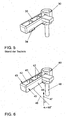
- Fig. 5
- einen Sperrriegel nach dem Stand der Technik;
- Fig. 6
- eine Ausführungsform eines bevorzugten Sperrriegels; und
- Fig. 7
- eine schematische Darstellung der beim Sperren auftretenden Kräfte.
- In Fig. 1 ist eine untere Gehäuseschale 1 eines elektronischen Zündschlosses dargestellt. In einem Boden 2 der Gehäuseschale 1 ist eine Führungskontur 3 als Vertiefung oder Durchbruch ausgebildet. In dem Boden 2 ist ferner eine Führungsnut 4 vorhanden. In der Gehäuseschale 1 kann ein ID-Geber-Aufnahmeelement aufgenommen werden.
- In Fig. 2 ist eine weitere Gehäuseschale 5 ähnlich zu der von Fig. 1 dargestellt. Gleiche technische Merkmale sind mit identischen Bezugszeichen versehen. In der weiteren Gehäuseschale 5 ist ein als ID-Geber-Aufnahmeschlitten 6 ausgebildetes ID-Geber-Aufnahmeelement aufgenommen, das mittels einer Führungsnut 4 geführt wird. Ein Anschlag 7 ist ein einem Ende der Führungsnut 4 gebildet. An dem Anschlag 7 ist ein rechtshändiges Koordinatensystem 8 abgebildet, um eine Beschreibung zu erleichtern. Wird der ID-Geber-Aufnahmeschlitten 6 entlang einer durch eine x-Achse 9 des Koordinatensystems 8 vorgegebene Richtung bis an den Anschlag 7 bewegt, so befindet sich der ID-Geber-Aufnahmeschlitten 6 in einer Grundstellung, die auch als Vorraststellung bezeichnet wird. In dieser Stellung können Rastschieber 11 in Aussparungen 12 von Seitenwänden 13 der weiteren unteren Gehäuseschale 5 ausweichen, um so einen ID-Geber, ähnlich zu einem ID-Geber 14 gemäß Fig. 3, aufzunehmen.
- In Fig. 3 ist ein Abschnitt eines ID-Gebers 14 schematisch dargestellt. Der ID-Geber 14 gemäß Fig. 3. weist einen vorderen Teil 15, einen mittleren Teil 16 und einen hinteren Teil 17 auf. Der mittlere Teil 16 ist gegenüber dem vorderen Teil 15 und dem hinteren Teil 17 verjüngt. Der mittlere Teil 16 weist eine Kontur 18 auf, die komplementär zu Konturabschnitten ist, die in den Rastschiebern 11 ausgebildet sind. Wir der ID-Geber 16 in den in der Vorraststellung befindlichen ID-Geber-Aufnahmeschlitten 6 in negativer x-Richtung eingeführt, so werden die Rastschieber 11 entlang oder entgegen einer durch eine y-Achse 10 vorgegebenen Richtung in die Aussparungen 12 der Seitenwände 13 gedrängt. Passen die Konturabschnitte der Rastschieber 11 zu der Kontur 18 des ID-Gebers 14, so kehren die Rastschieber 11 in ihre Ausgangsstellung zurück. In dieser Ausgangsstellung der Rastschieber 11 ist der ID-Geber 14 in dem ID-Geber-Aufnahmeschlitten 6 verrastet, wenn der ID-Geber 14 eine Zugehörigkeit erster Art zu dem Zündschloss bzw. dem ID-Geber-Aufnahmeschlitten 6 aufweist. Wird der ID-Geber 14 weiter in negativer x-Richtung bewegt, so wird der ID-Geber-Aufnahmeschlitten 6 aus der Grundstellung in eine ausgelenkte Stellung bewegt. In der ausgelenkten Stellung werden die Rastschieber 11 durch die Seitenwände 13 daran gehindert, auseinander zu weichen und den ID-Geber 13 freizugeben.
- An der nicht sichtbaren Unterseite des ID-Geber-Aufnahmeschlittens 6 ist ein Stift (nicht dargestellt) befestigt, der in die Führungskontur 3 im Boden 2 der unteren Gehäuseschale 2 eingreift und entlang der y-Richtung im ID-Geber-Aufnahmeschlitten 6 relativ zu diesem beweglich gelagert ist. Der Stift ist auf eine Mittelposition entlang der y-Richtung vorgespannt. Die Wechselwirkung des Stifts mit der Führungskontur 3 legt fest, welche Stellungen entlang der x-Richtung der ID-Geber-Aufnahmeschlitfen 6 in Abfolge einnehmen kann.
- In Fig. 1 sind an der Führungskontur 3 die entsprechenden Stellungen eingezeichnet. Zunächst wird der so genannte S-Kontakt geschlossen. In dieser Stellung wird beispielsweise eine Lenksäulenverriegelung entriegelt. Wird der ID-Geber 14 tiefer in das Zündschloss in negativer x-Richtung bewegt, gelangt der ID-Geber-Aufnahmeschlitten 6 in die Stellung Klemme 15, d.h., die Klemme 15 wird geschlossen. Dieses bedeutet, dass eine Zündung des Kraftfahrzeugs aktiviert wird. Kurz bevor die Stellung Klemme 15 erreicht wird, wird die Sperrvorrichtung aktiviert, die weiter unten beschrieben wird. In der Stellung Klemme 15 wird der ID-Geber-Aufnahmeschlitten 6 mittels einer kleinen Blattfeder 19 in der Führungskontur 3 gehalten. Aus der Stellung Klemme 15 kann der ID-Geber-Aufnahmeschlitten 6 in die Stellung S-Kontakt zurückgezogen werden oder in die Stellung Klemme 50 bewegt werden, in der ein Antriebssystem des Kraftfahrzeugs aktiviert wird. Mittels einer Feder (nicht dargestellt) wird der ID-Geber-Aufnahmeschlitten 6 nach dem Loslassen des ID-Gebers 14 in die Stellung Klemme 15 Fahrt bewegt. Ein Zentralteil 20 der Führungskontur 3 verhindert im Zusammenwirken mit dem Stift, dass der ID-Geber-Aufnahmeschlitten 6 in eine andere Stellung bewegt werden kann.
- Wird der ID-Geber erneut mit einem Kraftimpuls in negativer x-Richtung in das Zündschloss gedrückt, so verhindert eine Nase 21 im Zusammenwirken mit dem Stift, dass die Stellung Klemme 50 erneut erreicht wird. Stattdessen wird der ID-Geber 14 mit dem ID-Geber-Aufnahmeschlitten 6 mittels der Feder nach dem Loslassen des ID-Gebers 14 in die Stellung S-Kontakt zurückbewegt. Aus dieser Stellung kann der ID-Geber-Aufnahmeschlitten 6 nur mittels einer Zugkraft entlang der positiven x-Richtung an dem ID-Geber 14 in die Grundstellung zurückbewegt werden.
- Diese Bewegung ist jedoch nur möglich, sofern die oben erwähnte Sperrvorrichtung nicht aktiv ist, das heißt, ein Sperrriegel der Sperrvorrichtung sich nicht in der sperrenden Stellung befindet.
- In Fig. 4 ist einen Ausschnitt der unteren Gehäuseschale 5 und des ID-Geber-Aufnahmeschlittens 6 nach Fig. 2 gemeinsam mit einem Sperrriegel 30 nach dem Stand der Technik in einer sperrenden Stellung dargestellt. Der ID-Geber-Aufnahmeschlitten 6 nach dem Stand der Technik umfasst einen Sperrnocken 31, der eine Kerbe 32 aufweist. Wird auf den ID-Geber-Aufnahmeschlitten 6 entlang der x-Richtung, die mittels eines Pfeils 33 angezeigt ist und eine Sperrrichtung darstellt, eine Kraft ausgeübt, so umgreift der Sperrnocken 31 einen Vorsprung 34, der an einem Sperrbalken 35 des Sperrriegels 30 nach dem Stand der Technik ausgebildet ist, der in Fig. 5 dargestellt ist.
- Wird ein Aktor 36 der Sperrvorrichtung 37 betätigt, der vorzugsweise als magnetischer Aktor ausgebildet ist, um den Sperrriegel entlang einer z-Richtung (angedeutet durch einen weiteren Pfeil 38) in eine nicht sperrende Stellung zu bewegen, so verhindert das formschlüssige Hinterhaken des Sperrnockens 31 ein Entriegeln der Sperrvorrichtung 37.
- Eine bevorzugte Ausführungsform der Sperrvorrichtung weist hingegen einen Sperrriegel 40 auf, wie er in Fig. 6 dargestellt ist. Ein Sperrbalken 41 weist eine quaderförmige Gestalt auf. Um eine leichte Bauform zu erhalten, sind Vertiefungen oder Durchbrüche 42 in einer Oberseite 43 vorgesehen. Eine Seitenfläche 44 ist als Wechselwirkungsfläche 45 ausgebildet. Die Wechselwirkungsfläche 45 ist eben und weist eine Neigung gegenüber einem Schaft 46 des Sperrriegels 40 auf, der eine Bewegungsrichtung 47 vorgibt, entlang derer der Sperrriegel aus der sperrenden in eine nicht sperrende Stellung bewegt wird. Eine Flächennormale 48 der Wechselwirkungsfläche 45 weist einen Winkel kleiner 90°, bevorzugt von 85° gegenüber der Bewegungsrichtung 47 auf.
- Bei einer bevorzugten Ausführungsform eines Zündschlosses ist ein Sperrnocken an die Wechselwirkungsfläche 45 des Sperrriegels 40 so angepasst, dass eine Nockenoberfläche plan an der Wechselwirkungsfläche 45 anliegt. Ein Sperren der Entriegelung ist nicht mehr möglich. Vernachlässigt man Reibungseffekte, so ergibt es sich, dass eine Kraft in Sperrrichtung sogar eine Kraft in der Richtung auf den Sperrriegel überträgt, in der sich der Sperrriegel von der sperrenden in die nicht sperrende Stellung bewegt.
- Um eine Selbsthemmung zu erhalten, d.h. zu erreichen, dass die in Sperrrichtung auf den ID-Geber wirkende Kraft, die auch als Abzugskraft bezeichnet wird, nicht selbst ein Entriegeln der Sperrvorrichtung bewirkt, ist der Wechselwirkungsfläche so zu gestalten, dass unter Berücksichtigung von Reibungseffekten keine Nettokraft in Entriegelungsrichtung der Sperrvorrichtung wirkt. Die Wechselwirkungsoberfläche wird so gestaltet, dass die unter Vernachlässigung von Reibungseffekten in Entriegelungsrichtung wirkende Kraft, die durch eine in Sperrrichtung wirkende Kraft auf den Sperrriegel übertragen wird, kleiner ist als Reibungskräfte, die überwunden werden müssen, um den Sperrriegel aus der sperrenden in die nicht sperrende Stellung zu bewegen.
- Ein Winkel α, um den die Flächennormale der Wechselwirkungsfläche von 90° gegenüber der (anfänglichen) Entriegelungsrichtung abweichen kann, um die Selbsthemmungsbedingung zu erfüllen, kann mit Hilfe eines nachfolgend beschriebenen Verfahrens ermittelt werden.
- In Fig. 7 ist die Wechselwirkungsfläche 45 gemeinsam mit den beim Sperren wirkenden Kräften, einer Abzugskraft 50 in Sperrrichtung und eine Hubkraft 51 in Entriegelungsrichtung, dargestellt.
- Ohne Reibung zwischen der Wechselwirkungsfläche 45 und der Nockenoberfläche gilt: FHub=FAbzug·tan(α). Mit Reibung gilt: FHub=FAbzug·tan(α-ρ). Um eine Selbsthemmung zu erhalten, muss gelten: FHub ≤ 0. Somit muss gelten α-ρ=0. ρ ist durch den Reibungskoeffizienten µ folgendermaßen festgelegt: ρ=arctan(µ). Für typische Kunststoffmaterialien, die im Kraftfahrzeugbau verwendet werden, gilt etwa µ=0,1. Hieraus folgt: ρ=5,7°. Somit sollte die Flächennormale der Wechselwirkungsfläche 45 maximal 5,7° von 90° gegenüber der Entriegelungsrichtung abweichen. Ein Winkel von 85° hat sich als optimal erwiesen, um eine sichere Entriegelung ohne Verspannung des ID-Geber-Aufnahmeschlittens 6 zu gewährleisten und zugleich eine zuverlässige Selbsthemmung zu erreichen. Ein geeigneter Wert für den Winkel α kann, ohne eine Berechnung auszuführen, auch einfach anhand von Versuchen empirisch ermittelt werden.
- Bei den beschriebenen Ausführungsformen ist der Sperrnocken als vorspringendes Teil des ID-Geber-Aufnahmeschlittens ausgebildet. Die Wechselwirkungsfläche des Sperrriegels kann jedoch mit jeder beliebigen Oberfläche des ID-Geber-Aufnahmeschlittens bzw. des beweglichen Elements wechselwirken, die im Sinne des hier Ausgeführten als Sperrnocken bzw. Nockenoberfläche betrachtet wird.
- Die Nockenoberfläche ist bevorzugt plan ausgeführt und so angeschrägt, dass sie beim Sperren plan an der Wechselwirkungsfläche des Sperrriegels anliegt.
-
- 1
- Gehäuseschale
- 2
- Boden
- 3
- Führungskontur
- 4
- Führungsnut
- 5
- weitere Gehäuseschale
- 6
- ID-Geber-Aufnahmeschlitten
- 7
- Anschlag
- 8
- Koordinatensystem
- 9
- x-Achse
- 10
- y-Achse
- 11
- Rastschieber
- 12
- Aussparung
- 13
- Seitenwände
- 14
- ID-Geber
- 15
- vorderes Teil des ID-Gebers
- 16
- mittleres Teil des ID-Gebers
- 17
- hinteres Teil des ID-Gebers
- 18
- Kontur des ID-Gebers
- 19
- Blattfeder
- 20
- Zentralteil der Führungskontur
- 21
- Nase
- 30
- Sperrriegel
- 31
- Sperrnocken
- 32
- Kerbe
- 33
- Pfeil, der die x-Richtung angibt
- 34
- Vorsprung
- 35
- Sperrbalken
- 36
- Aktor
- 37
- Sperrvorrichtung
- 38
- weiterer Pfeil, der die z-Richtung angibt
- 40
- Sperrriegel
- 41
- Sperrbalken
- 42
- Durchbrüche
- 43
- Oberseite
- 44
- Seitenfläche
- 45
- Wechselwirkungsfläche
- 46
- Schaft
- 47
- Bewegungsrichtung
- 48
- Flächennormale
- 50
- Abzugskraft
- 51
- Hubkraft
Claims (10)
- Sperrvorrichtung für ein bewegliches Element, das zwischen einer Grundstellung und einer ausgelenkten Stellung bewegbar ist, umfassenda. einen Sperrriegel (40), deri. zwischen einer nicht sperrenden und einer sperrenden Stellung bewegbar istii. und in der sperrenden Stellung des Sperrriegels (40) mit einem Sperrnocken des beweglichen Elements wechselwirkt, so dass eine Bewegung des beweglichen Elements von der ausgelenkten Stellung in die Grundstellung gesperrt ist,dadurch gekennzeichnet, dassb. der Sperrriegel (40) eine Wechselwirkungsfläche (45) umfasst, die in der sperrenden Stellung mit dem Sperrnocken wechselwirkt und so ausgebildet ist, dass eine eine Bewegung in die Grundstellung bewirkende Kraft auf das bewegliche Element beim Sperren unter Vernachlässigung einer Oberflächenreibung zwischen der Wechselwirkungsfläche und dem Sperrnocken eine Kraft auf den Sperrriegel bewirkt, die eine Bewegung in die nicht sperrende Stellung des Sperrriegels (40) unterstützt.
- Sperrvorrichtung nach Anspruch 1, dadurch gekennzeichnet, dass die Wechselwirkungsfläche (45) so ausgebildet ist, dass aufgrund der Oberflächenreibung mit dem Sperrnocken beim Sperren die eine Bewegung in die Grundstellung bewirkende Kraft auf das bewegliche Element beim Sperren keine resultierende Kraft auf den Sperrriegel (40) bewirkt, die eine Bewegung des Sperrriegels (40) aus der sperrenden Stellung in die nicht sperrende Stellung bewirkt.
- Sperrvorrichtung nach Anspruch 1 oder 2, dass der Sperrriegel (40) ausgestaltet ist, eine lineare Hubbewegung zwischen der sperrenden Stellung und der nicht sperrenden Stellung auszuführen.
- Sperrvorrichtung nach einem der Ansprüche 1 bis 3, dadurch gekennzeichnet, dass der Sperrriegel (40) einen Sperrbalken (41) umfasst, wobei die Wechselwirkungsfläche (45) eine ebene Seitenfläche (44) des Sperrbalkens (41) ist, deren Flächennormale einen Winkel kleiner 90° bezüglich einer Bewegungsrichtung (47) bildet, der der Sperrriegel (40) zumindest anfänglich bei einer Bewegung aus der sperrenden Stellung in die nicht sperrende Stellung folgt.
- Sperrvorrichtung nach einem der Ansprüche 1 bis 4, dadurch gekennzeichnet, dass die Flächennormale (48) der Wechselwirkungsfläche (45) bezüglich der Bewegungsrichtung (47), der der Sperrriegel zumindest anfänglich bei einer Bewegung aus der sperrenden Stellung in die nicht sperrende Stellung folgt, einen Winkel von größer 84°, vorzugsweise einen Winkel von 85° bildet.
- Sperrvorrichtung nach einem der vorangehenden Ansprüche, dadurch gekennzeichnet, dass das bewegliche Element ein ID-Geber-Aufnahmeelement ist, das in der Grundstellung einen ID-Geber (14) aufnehmen kann und bei einer Zugehörigkeit erster Art des ID-Gebers (14) zu dem ID-Geber-Aufnahmeelement mit dem aufgenommenen ID-Geber (14) in die ausgelenkte Stellung bewegbar ist, wobei das ID-Geber-Aufnahmeelement den ID-Geber in der ausgelenkten Stellung nicht freigibt.
- Zündschloss mit einem ID-Geber-Aufnahmeelement, das in der Grundstellung einen ID-Geber (14) aufnehmen kann und bei einer Zugehörigkeit erster Art des ID-Gebers (14) zu dem ID-Geber-Aufnahmeelement mit dem aufgenommenen ID-Geber (14) in die ausgelenkte Stellung bewegbar ist, wobei das ID-Geber-Aufnahmeelement den ID-Geber in der ausgelenkten Stellung nicht freigibt,
gekennzeichnet durch eine Sperrvorrichtung nach einem der Ansprüche 1 bis 5, wobei das ID-Geber-Aufnahmeelement das bewegliche Element darstellt. - Zündschloss nach Anspruch 7, dadurch gekennzeichnet, dass der Sperrnocken des ID-Geber-Aufnahmeelements eine ebene Nockenoberfläche aufweist, die beim Sperren plan an der Wechselwirkungsfläche (45) des Sperrriegels (40) anliegt.
- Zündschloss nach einem der Ansprüche 7 oder 8, dadurch gekennzeichnet, dass das ID-Geber-Aufnahmeelement in der ausgelenkten Stellung in unterschiedliche Schaltpositionen bewegbar ist und bei Vorliegen einer Zugehörigkeit zweiter Art an den Schaltpositionen Schaltkontakte öffen- und/oder schließbar sind.
- Zündschloss nach einem der Ansprüche 7 bis 9, gekennzeichnet durch eine Erfassungseinheit zum Erfassen einer Kennung des ID-Gebers und eine elektronische Verarbeitungseinheit, mit der die Kennung zur Überprüfung der Zugehörigkeit zweiter Art auswertbar ist.
Applications Claiming Priority (1)
| Application Number | Priority Date | Filing Date | Title |
|---|---|---|---|
| DE102006008624A DE102006008624A1 (de) | 2006-02-24 | 2006-02-24 | Sperrvorrichtung für ein bewegliches Element |
Publications (3)
| Publication Number | Publication Date |
|---|---|
| EP1826076A2 true EP1826076A2 (de) | 2007-08-29 |
| EP1826076A3 EP1826076A3 (de) | 2008-08-13 |
| EP1826076B1 EP1826076B1 (de) | 2011-04-27 |
Family
ID=38198314
Family Applications (1)
| Application Number | Title | Priority Date | Filing Date |
|---|---|---|---|
| EP07002243A Not-in-force EP1826076B1 (de) | 2006-02-24 | 2007-02-02 | Sperrvorrichtung für ein bewegliches Element |
Country Status (3)
| Country | Link |
|---|---|
| EP (1) | EP1826076B1 (de) |
| AT (1) | ATE507120T1 (de) |
| DE (2) | DE102006008624A1 (de) |
Family Cites Families (4)
| Publication number | Priority date | Publication date | Assignee | Title |
|---|---|---|---|---|
| DE19801752C1 (de) * | 1998-01-20 | 1999-05-12 | Dorma Gmbh & Co Kg | Verriegelungseinrichtung für Notausgangstüren |
| DE19939733C2 (de) * | 1999-08-21 | 2001-10-11 | Huf Huelsbeck & Fuerst Gmbh | Vorrichtung zum Starten eines Fahrzeugmotors mittels eines elektronischen Schlüssels |
| DE10353195A1 (de) * | 2002-11-16 | 2004-08-12 | Marquardt Gmbh | Zündschloßsystem für ein Kraftfahrzeug |
| DE102004019919B3 (de) * | 2004-04-21 | 2006-02-02 | Huf Hülsbeck & Fürst Gmbh & Co. Kg | Vorrichtung zum Starten eines Fahrzeugmotors mittels eines elektronischen Schlüssels und ein dazu zu verwendener Schlüssel |
-
2006
- 2006-02-24 DE DE102006008624A patent/DE102006008624A1/de not_active Withdrawn
-
2007
- 2007-02-02 DE DE502007007035T patent/DE502007007035D1/de active Active
- 2007-02-02 EP EP07002243A patent/EP1826076B1/de not_active Not-in-force
- 2007-02-02 AT AT07002243T patent/ATE507120T1/de active
Also Published As
| Publication number | Publication date |
|---|---|
| EP1826076B1 (de) | 2011-04-27 |
| EP1826076A3 (de) | 2008-08-13 |
| DE502007007035D1 (de) | 2011-06-09 |
| ATE507120T1 (de) | 2011-05-15 |
| DE102006008624A1 (de) | 2007-08-30 |
Similar Documents
| Publication | Publication Date | Title |
|---|---|---|
| EP3870786B1 (de) | Schloss für ein kraftfahrzeug, insbesondere ein elektrisch betätigbares kraftfahrzeugschloss | |
| EP2673439B1 (de) | Kraftfahrzeugtürverschluss | |
| EP3999406B1 (de) | Schlossanordnung | |
| EP2545235A1 (de) | Kraftfahrzeugtürverschluss | |
| WO2013143522A2 (de) | Kraftfahrzeugtürverschluss | |
| EP3947872B1 (de) | Schloss für ein kraftfahrzeug | |
| DE19821899A1 (de) | Drehschalter, insbesondere Zündanlaßschalter | |
| DE10130260A1 (de) | Kraftfahrzeugtürverschluss | |
| EP1241305A1 (de) | Kraftfahrzeugtürverschluss | |
| WO2015181400A1 (de) | Schliesszylinder mit rückstellsperre | |
| DE19957046A1 (de) | Schließsystem, insbesondere für Kraftfahrzeuge | |
| DE102021109993B3 (de) | Sicherheitsschalter mit Zuhaltung | |
| EP3208159B1 (de) | Vorrichtung zur verlagerung eines sperrelementes | |
| EP2811855B1 (de) | Gurtschloss mit freigabesperre | |
| EP2080857A2 (de) | Türaußengriffanordnung für Fahrzeuge | |
| EP3243980B1 (de) | Verriegelungssystem | |
| EP1826076B1 (de) | Sperrvorrichtung für ein bewegliches Element | |
| DE102006012196B3 (de) | Schließzylinderanordnung | |
| EP1735182B1 (de) | Vorrichtung zur verriegelung und/oder zur entriegelung einer komponente, insbesondere in oder an einem fahrzeug, und verfahren | |
| DE102017127386A1 (de) | Kraftfahrzeugschloss | |
| EP3117057B1 (de) | Kraftfahrzeugtürverschluss | |
| EP2144792B1 (de) | Vorrichtung zur aufnahme eines elektronischen schlüssels | |
| EP4399377A1 (de) | Kraftfahrzeugschloss | |
| WO2018086647A1 (de) | Schloss für ein kraftfahrzeug | |
| DE102016209608A1 (de) | Schließvorrichtung für ein Kraftfahrzeug mit Verriegelung im Crashfall |
Legal Events
| Date | Code | Title | Description |
|---|---|---|---|
| PUAI | Public reference made under article 153(3) epc to a published international application that has entered the european phase |
Free format text: ORIGINAL CODE: 0009012 |
|
| AK | Designated contracting states |
Kind code of ref document: A2 Designated state(s): AT BE BG CH CY CZ DE DK EE ES FI FR GB GR HU IE IS IT LI LT LU LV MC NL PL PT RO SE SI SK TR |
|
| AX | Request for extension of the european patent |
Extension state: AL BA HR MK YU |
|
| PUAL | Search report despatched |
Free format text: ORIGINAL CODE: 0009013 |
|
| AK | Designated contracting states |
Kind code of ref document: A3 Designated state(s): AT BE BG CH CY CZ DE DK EE ES FI FR GB GR HU IE IS IT LI LT LU LV MC NL PL PT RO SE SI SK TR |
|
| AX | Request for extension of the european patent |
Extension state: AL BA HR MK RS |
|
| 17P | Request for examination filed |
Effective date: 20090213 |
|
| AKX | Designation fees paid |
Designated state(s): AT BE BG CH CY CZ DE DK EE ES FI FR GB GR HU IE IS IT LI LT LU LV MC NL PL PT RO SE SI SK TR |
|
| 17Q | First examination report despatched |
Effective date: 20090402 |
|
| GRAP | Despatch of communication of intention to grant a patent |
Free format text: ORIGINAL CODE: EPIDOSNIGR1 |
|
| GRAS | Grant fee paid |
Free format text: ORIGINAL CODE: EPIDOSNIGR3 |
|
| GRAA | (expected) grant |
Free format text: ORIGINAL CODE: 0009210 |
|
| AK | Designated contracting states |
Kind code of ref document: B1 Designated state(s): AT BE BG CH CY CZ DE DK EE ES FI FR GB GR HU IE IS IT LI LT LU LV MC NL PL PT RO SE SI SK TR |
|
| REG | Reference to a national code |
Ref country code: GB Ref legal event code: FG4D Free format text: NOT ENGLISH |
|
| REG | Reference to a national code |
Ref country code: CH Ref legal event code: EP |
|
| REG | Reference to a national code |
Ref country code: IE Ref legal event code: FG4D Free format text: LANGUAGE OF EP DOCUMENT: GERMAN |
|
| REF | Corresponds to: |
Ref document number: 502007007035 Country of ref document: DE Date of ref document: 20110609 Kind code of ref document: P |
|
| REG | Reference to a national code |
Ref country code: DE Ref legal event code: R096 Ref document number: 502007007035 Country of ref document: DE Effective date: 20110609 |
|
| REG | Reference to a national code |
Ref country code: GB Ref legal event code: 732E Free format text: REGISTERED BETWEEN 20110623 AND 20110629 |
|
| REG | Reference to a national code |
Ref country code: NL Ref legal event code: VDEP Effective date: 20110427 |
|
| LTIE | Lt: invalidation of european patent or patent extension |
Effective date: 20110427 |
|
| PG25 | Lapsed in a contracting state [announced via postgrant information from national office to epo] |
Ref country code: LT Free format text: LAPSE BECAUSE OF FAILURE TO SUBMIT A TRANSLATION OF THE DESCRIPTION OR TO PAY THE FEE WITHIN THE PRESCRIBED TIME-LIMIT Effective date: 20110427 Ref country code: SE Free format text: LAPSE BECAUSE OF FAILURE TO SUBMIT A TRANSLATION OF THE DESCRIPTION OR TO PAY THE FEE WITHIN THE PRESCRIBED TIME-LIMIT Effective date: 20110427 Ref country code: PT Free format text: LAPSE BECAUSE OF FAILURE TO SUBMIT A TRANSLATION OF THE DESCRIPTION OR TO PAY THE FEE WITHIN THE PRESCRIBED TIME-LIMIT Effective date: 20110829 |
|
| REG | Reference to a national code |
Ref country code: IE Ref legal event code: FD4D |
|
| PG25 | Lapsed in a contracting state [announced via postgrant information from national office to epo] |
Ref country code: SI Free format text: LAPSE BECAUSE OF FAILURE TO SUBMIT A TRANSLATION OF THE DESCRIPTION OR TO PAY THE FEE WITHIN THE PRESCRIBED TIME-LIMIT Effective date: 20110427 Ref country code: ES Free format text: LAPSE BECAUSE OF FAILURE TO SUBMIT A TRANSLATION OF THE DESCRIPTION OR TO PAY THE FEE WITHIN THE PRESCRIBED TIME-LIMIT Effective date: 20110807 Ref country code: GR Free format text: LAPSE BECAUSE OF FAILURE TO SUBMIT A TRANSLATION OF THE DESCRIPTION OR TO PAY THE FEE WITHIN THE PRESCRIBED TIME-LIMIT Effective date: 20110728 Ref country code: LV Free format text: LAPSE BECAUSE OF FAILURE TO SUBMIT A TRANSLATION OF THE DESCRIPTION OR TO PAY THE FEE WITHIN THE PRESCRIBED TIME-LIMIT Effective date: 20110427 Ref country code: FI Free format text: LAPSE BECAUSE OF FAILURE TO SUBMIT A TRANSLATION OF THE DESCRIPTION OR TO PAY THE FEE WITHIN THE PRESCRIBED TIME-LIMIT Effective date: 20110427 Ref country code: IS Free format text: LAPSE BECAUSE OF FAILURE TO SUBMIT A TRANSLATION OF THE DESCRIPTION OR TO PAY THE FEE WITHIN THE PRESCRIBED TIME-LIMIT Effective date: 20110827 Ref country code: CY Free format text: LAPSE BECAUSE OF FAILURE TO SUBMIT A TRANSLATION OF THE DESCRIPTION OR TO PAY THE FEE WITHIN THE PRESCRIBED TIME-LIMIT Effective date: 20110427 |
|
| PG25 | Lapsed in a contracting state [announced via postgrant information from national office to epo] |
Ref country code: NL Free format text: LAPSE BECAUSE OF FAILURE TO SUBMIT A TRANSLATION OF THE DESCRIPTION OR TO PAY THE FEE WITHIN THE PRESCRIBED TIME-LIMIT Effective date: 20110427 |
|
| PG25 | Lapsed in a contracting state [announced via postgrant information from national office to epo] |
Ref country code: CZ Free format text: LAPSE BECAUSE OF FAILURE TO SUBMIT A TRANSLATION OF THE DESCRIPTION OR TO PAY THE FEE WITHIN THE PRESCRIBED TIME-LIMIT Effective date: 20110427 Ref country code: IE Free format text: LAPSE BECAUSE OF FAILURE TO SUBMIT A TRANSLATION OF THE DESCRIPTION OR TO PAY THE FEE WITHIN THE PRESCRIBED TIME-LIMIT Effective date: 20110427 Ref country code: EE Free format text: LAPSE BECAUSE OF FAILURE TO SUBMIT A TRANSLATION OF THE DESCRIPTION OR TO PAY THE FEE WITHIN THE PRESCRIBED TIME-LIMIT Effective date: 20110427 |
|
| PG25 | Lapsed in a contracting state [announced via postgrant information from national office to epo] |
Ref country code: RO Free format text: LAPSE BECAUSE OF FAILURE TO SUBMIT A TRANSLATION OF THE DESCRIPTION OR TO PAY THE FEE WITHIN THE PRESCRIBED TIME-LIMIT Effective date: 20110427 Ref country code: PL Free format text: LAPSE BECAUSE OF FAILURE TO SUBMIT A TRANSLATION OF THE DESCRIPTION OR TO PAY THE FEE WITHIN THE PRESCRIBED TIME-LIMIT Effective date: 20110427 Ref country code: SK Free format text: LAPSE BECAUSE OF FAILURE TO SUBMIT A TRANSLATION OF THE DESCRIPTION OR TO PAY THE FEE WITHIN THE PRESCRIBED TIME-LIMIT Effective date: 20110427 Ref country code: DK Free format text: LAPSE BECAUSE OF FAILURE TO SUBMIT A TRANSLATION OF THE DESCRIPTION OR TO PAY THE FEE WITHIN THE PRESCRIBED TIME-LIMIT Effective date: 20110427 |
|
| PLBE | No opposition filed within time limit |
Free format text: ORIGINAL CODE: 0009261 |
|
| STAA | Information on the status of an ep patent application or granted ep patent |
Free format text: STATUS: NO OPPOSITION FILED WITHIN TIME LIMIT |
|
| 26N | No opposition filed |
Effective date: 20120130 |
|
| REG | Reference to a national code |
Ref country code: DE Ref legal event code: R097 Ref document number: 502007007035 Country of ref document: DE Effective date: 20120130 |
|
| PG25 | Lapsed in a contracting state [announced via postgrant information from national office to epo] |
Ref country code: IT Free format text: LAPSE BECAUSE OF FAILURE TO SUBMIT A TRANSLATION OF THE DESCRIPTION OR TO PAY THE FEE WITHIN THE PRESCRIBED TIME-LIMIT Effective date: 20110427 |
|
| BERE | Be: lapsed |
Owner name: MARQUARDT G.M.B.H. Effective date: 20120228 Owner name: VOLKSWAGEN A.G. Effective date: 20120228 |
|
| PG25 | Lapsed in a contracting state [announced via postgrant information from national office to epo] |
Ref country code: MC Free format text: LAPSE BECAUSE OF NON-PAYMENT OF DUE FEES Effective date: 20120229 |
|
| REG | Reference to a national code |
Ref country code: CH Ref legal event code: PL |
|
| PG25 | Lapsed in a contracting state [announced via postgrant information from national office to epo] |
Ref country code: LI Free format text: LAPSE BECAUSE OF NON-PAYMENT OF DUE FEES Effective date: 20120229 Ref country code: CH Free format text: LAPSE BECAUSE OF NON-PAYMENT OF DUE FEES Effective date: 20120229 |
|
| REG | Reference to a national code |
Ref country code: FR Ref legal event code: ST Effective date: 20121031 |
|
| PG25 | Lapsed in a contracting state [announced via postgrant information from national office to epo] |
Ref country code: BE Free format text: LAPSE BECAUSE OF NON-PAYMENT OF DUE FEES Effective date: 20120228 |
|
| PG25 | Lapsed in a contracting state [announced via postgrant information from national office to epo] |
Ref country code: FR Free format text: LAPSE BECAUSE OF NON-PAYMENT OF DUE FEES Effective date: 20120229 |
|
| REG | Reference to a national code |
Ref country code: AT Ref legal event code: MM01 Ref document number: 507120 Country of ref document: AT Kind code of ref document: T Effective date: 20120202 |
|
| PG25 | Lapsed in a contracting state [announced via postgrant information from national office to epo] |
Ref country code: BG Free format text: LAPSE BECAUSE OF FAILURE TO SUBMIT A TRANSLATION OF THE DESCRIPTION OR TO PAY THE FEE WITHIN THE PRESCRIBED TIME-LIMIT Effective date: 20110727 Ref country code: AT Free format text: LAPSE BECAUSE OF NON-PAYMENT OF DUE FEES Effective date: 20120202 |
|
| PG25 | Lapsed in a contracting state [announced via postgrant information from national office to epo] |
Ref country code: TR Free format text: LAPSE BECAUSE OF FAILURE TO SUBMIT A TRANSLATION OF THE DESCRIPTION OR TO PAY THE FEE WITHIN THE PRESCRIBED TIME-LIMIT Effective date: 20110427 |
|
| PG25 | Lapsed in a contracting state [announced via postgrant information from national office to epo] |
Ref country code: LU Free format text: LAPSE BECAUSE OF NON-PAYMENT OF DUE FEES Effective date: 20120202 |
|
| PG25 | Lapsed in a contracting state [announced via postgrant information from national office to epo] |
Ref country code: HU Free format text: LAPSE BECAUSE OF FAILURE TO SUBMIT A TRANSLATION OF THE DESCRIPTION OR TO PAY THE FEE WITHIN THE PRESCRIBED TIME-LIMIT Effective date: 20070202 |
|
| REG | Reference to a national code |
Ref country code: DE Ref legal event code: R081 Ref document number: 502007007035 Country of ref document: DE Owner name: MARQUARDT GMBH, DE Free format text: FORMER OWNERS: MARQUARDT GMBH, 78604 RIETHEIM-WEILHEIM, DE; VOLKSWAGEN AG, 38440 WOLFSBURG, DE |
|
| REG | Reference to a national code |
Ref country code: DE Ref legal event code: R082 Ref document number: 502007007035 Country of ref document: DE Representative=s name: JOSTARNDT PATENTANWALTS-AG, DE |
|
| PGFP | Annual fee paid to national office [announced via postgrant information from national office to epo] |
Ref country code: GB Payment date: 20220223 Year of fee payment: 16 Ref country code: DE Payment date: 20220228 Year of fee payment: 16 |
|
| REG | Reference to a national code |
Ref country code: DE Ref legal event code: R119 Ref document number: 502007007035 Country of ref document: DE |
|
| GBPC | Gb: european patent ceased through non-payment of renewal fee |
Effective date: 20230202 |
|
| PG25 | Lapsed in a contracting state [announced via postgrant information from national office to epo] |
Ref country code: GB Free format text: LAPSE BECAUSE OF NON-PAYMENT OF DUE FEES Effective date: 20230202 |
|
| PG25 | Lapsed in a contracting state [announced via postgrant information from national office to epo] |
Ref country code: GB Free format text: LAPSE BECAUSE OF NON-PAYMENT OF DUE FEES Effective date: 20230202 Ref country code: DE Free format text: LAPSE BECAUSE OF NON-PAYMENT OF DUE FEES Effective date: 20230901 |