EP1808466A1 - Ink composition, inkjet recording method, printed material, process for producing lithographic printing plate, and lithographic printing plate - Google Patents
Ink composition, inkjet recording method, printed material, process for producing lithographic printing plate, and lithographic printing plate Download PDFInfo
- Publication number
- EP1808466A1 EP1808466A1 EP07000499A EP07000499A EP1808466A1 EP 1808466 A1 EP1808466 A1 EP 1808466A1 EP 07000499 A EP07000499 A EP 07000499A EP 07000499 A EP07000499 A EP 07000499A EP 1808466 A1 EP1808466 A1 EP 1808466A1
- Authority
- EP
- European Patent Office
- Prior art keywords
- group
- ink composition
- ink
- magenta
- compound
- Prior art date
- Legal status (The legal status is an assumption and is not a legal conclusion. Google has not performed a legal analysis and makes no representation as to the accuracy of the status listed.)
- Granted
Links
- 239000000203 mixture Substances 0.000 title claims abstract description 149
- 238000000034 method Methods 0.000 title claims description 91
- 238000007639 printing Methods 0.000 title claims description 39
- 239000000463 material Substances 0.000 title claims description 20
- 230000008569 process Effects 0.000 title claims description 19
- 150000001875 compounds Chemical class 0.000 claims abstract description 179
- 125000003118 aryl group Chemical group 0.000 claims abstract description 82
- 150000001450 anions Chemical class 0.000 claims abstract description 42
- 239000003086 colorant Substances 0.000 claims abstract description 32
- 125000004435 hydrogen atom Chemical group [H]* 0.000 claims abstract description 28
- 125000005010 perfluoroalkyl group Chemical group 0.000 claims abstract description 26
- 125000000962 organic group Chemical group 0.000 claims abstract description 22
- 125000001153 fluoro group Chemical group F* 0.000 claims abstract description 18
- 229910052731 fluorine Inorganic materials 0.000 claims abstract description 17
- 230000005855 radiation Effects 0.000 claims description 52
- 238000007599 discharging Methods 0.000 claims description 12
- 230000001678 irradiating effect Effects 0.000 claims description 10
- 230000002209 hydrophobic effect Effects 0.000 claims description 6
- 238000005286 illumination Methods 0.000 claims description 6
- 239000000976 ink Substances 0.000 description 321
- -1 3,5-bistrifluoromethylphenyl group Chemical group 0.000 description 122
- 239000000975 dye Substances 0.000 description 79
- 125000001424 substituent group Chemical group 0.000 description 75
- 125000000217 alkyl group Chemical group 0.000 description 54
- 239000000049 pigment Substances 0.000 description 50
- 239000000178 monomer Substances 0.000 description 47
- 239000006185 dispersion Substances 0.000 description 41
- 238000011282 treatment Methods 0.000 description 40
- 230000035945 sensitivity Effects 0.000 description 37
- 125000000623 heterocyclic group Chemical group 0.000 description 35
- 238000001723 curing Methods 0.000 description 30
- FNYWFRSQRHGKJT-UHFFFAOYSA-N 3-ethyl-3-[(3-ethyloxetan-3-yl)methoxymethyl]oxetane Chemical compound C1OCC1(CC)COCC1(CC)COC1 FNYWFRSQRHGKJT-UHFFFAOYSA-N 0.000 description 29
- 125000003342 alkenyl group Chemical group 0.000 description 29
- 125000000304 alkynyl group Chemical group 0.000 description 25
- 229910052782 aluminium Inorganic materials 0.000 description 25
- XAGFODPZIPBFFR-UHFFFAOYSA-N aluminium Chemical compound [Al] XAGFODPZIPBFFR-UHFFFAOYSA-N 0.000 description 25
- 239000000460 chlorine Substances 0.000 description 25
- 125000000753 cycloalkyl group Chemical group 0.000 description 25
- 238000006116 polymerization reaction Methods 0.000 description 20
- 230000003647 oxidation Effects 0.000 description 18
- 238000007254 oxidation reaction Methods 0.000 description 18
- 238000007789 sealing Methods 0.000 description 18
- MKNOYISMZFDLQP-UHFFFAOYSA-N 3-[1-[2-(oxetan-3-yl)butoxy]butan-2-yl]oxetane Chemical compound C1OCC1C(CC)COCC(CC)C1COC1 MKNOYISMZFDLQP-UHFFFAOYSA-N 0.000 description 17
- YXALYBMHAYZKAP-UHFFFAOYSA-N 7-oxabicyclo[4.1.0]heptan-4-ylmethyl 7-oxabicyclo[4.1.0]heptane-4-carboxylate Chemical compound C1CC2OC2CC1C(=O)OCC1CC2OC2CC1 YXALYBMHAYZKAP-UHFFFAOYSA-N 0.000 description 17
- QYKIQEUNHZKYBP-UHFFFAOYSA-N Vinyl ether Chemical class C=COC=C QYKIQEUNHZKYBP-UHFFFAOYSA-N 0.000 description 17
- 125000003545 alkoxy group Chemical group 0.000 description 17
- 125000003710 aryl alkyl group Chemical group 0.000 description 17
- 229920000642 polymer Polymers 0.000 description 17
- 239000004094 surface-active agent Substances 0.000 description 17
- 125000004104 aryloxy group Chemical group 0.000 description 16
- 125000004093 cyano group Chemical group *C#N 0.000 description 16
- 239000002270 dispersing agent Substances 0.000 description 16
- 125000002947 alkylene group Chemical group 0.000 description 15
- 239000007864 aqueous solution Substances 0.000 description 15
- 239000002585 base Substances 0.000 description 15
- 125000005843 halogen group Chemical group 0.000 description 15
- 239000000523 sample Substances 0.000 description 15
- 239000002253 acid Substances 0.000 description 14
- 230000000052 comparative effect Effects 0.000 description 14
- 239000010408 film Substances 0.000 description 14
- 239000002904 solvent Substances 0.000 description 14
- XLYOFNOQVPJJNP-UHFFFAOYSA-N water Substances O XLYOFNOQVPJJNP-UHFFFAOYSA-N 0.000 description 14
- 229940126062 Compound A Drugs 0.000 description 13
- NLDMNSXOCDLTTB-UHFFFAOYSA-N Heterophylliin A Natural products O1C2COC(=O)C3=CC(O)=C(O)C(O)=C3C3=C(O)C(O)=C(O)C=C3C(=O)OC2C(OC(=O)C=2C=C(O)C(O)=C(O)C=2)C(O)C1OC(=O)C1=CC(O)=C(O)C(O)=C1 NLDMNSXOCDLTTB-UHFFFAOYSA-N 0.000 description 13
- 150000001768 cations Chemical class 0.000 description 13
- 238000011156 evaluation Methods 0.000 description 13
- 239000003505 polymerization initiator Substances 0.000 description 13
- 125000002252 acyl group Chemical group 0.000 description 12
- 125000001931 aliphatic group Chemical group 0.000 description 12
- 125000005842 heteroatom Chemical group 0.000 description 12
- XEEYBQQBJWHFJM-UHFFFAOYSA-N iron Substances [Fe] XEEYBQQBJWHFJM-UHFFFAOYSA-N 0.000 description 12
- 150000003839 salts Chemical class 0.000 description 12
- 238000003860 storage Methods 0.000 description 12
- 125000004453 alkoxycarbonyl group Chemical group 0.000 description 11
- LYCAIKOWRPUZTN-UHFFFAOYSA-N ethylene glycol Natural products OCCO LYCAIKOWRPUZTN-UHFFFAOYSA-N 0.000 description 11
- 150000002222 fluorine compounds Chemical class 0.000 description 11
- 150000004010 onium ions Chemical class 0.000 description 11
- 239000002245 particle Substances 0.000 description 11
- 238000007788 roughening Methods 0.000 description 11
- 239000000126 substance Substances 0.000 description 11
- HIXDQWDOVZUNNA-UHFFFAOYSA-N 2-(3,4-dimethoxyphenyl)-5-hydroxy-7-methoxychromen-4-one Chemical compound C=1C(OC)=CC(O)=C(C(C=2)=O)C=1OC=2C1=CC=C(OC)C(OC)=C1 HIXDQWDOVZUNNA-UHFFFAOYSA-N 0.000 description 10
- 238000011101 absolute filtration Methods 0.000 description 10
- 238000010538 cationic polymerization reaction Methods 0.000 description 10
- 125000001309 chloro group Chemical group Cl* 0.000 description 10
- GYZLOYUZLJXAJU-UHFFFAOYSA-N diglycidyl ether Chemical class C1OC1COCC1CO1 GYZLOYUZLJXAJU-UHFFFAOYSA-N 0.000 description 10
- RTZKZFJDLAIYFH-UHFFFAOYSA-N ether Substances CCOCC RTZKZFJDLAIYFH-UHFFFAOYSA-N 0.000 description 10
- 230000000977 initiatory effect Effects 0.000 description 10
- 125000000449 nitro group Chemical group [O-][N+](*)=O 0.000 description 10
- 238000012546 transfer Methods 0.000 description 10
- 229960000834 vinyl ether Drugs 0.000 description 10
- 239000004593 Epoxy Substances 0.000 description 9
- 229910019142 PO4 Inorganic materials 0.000 description 9
- 239000010949 copper Substances 0.000 description 9
- 125000001997 phenyl group Chemical group [H]C1=C([H])C([H])=C(*)C([H])=C1[H] 0.000 description 9
- 235000021317 phosphate Nutrition 0.000 description 9
- 125000005409 triarylsulfonium group Chemical group 0.000 description 9
- 125000003917 carbamoyl group Chemical group [H]N([H])C(*)=O 0.000 description 8
- 125000003566 oxetanyl group Chemical group 0.000 description 8
- 239000010452 phosphate Substances 0.000 description 8
- 239000002244 precipitate Substances 0.000 description 8
- 229910052708 sodium Inorganic materials 0.000 description 8
- 241000894007 species Species 0.000 description 8
- 238000012360 testing method Methods 0.000 description 8
- 125000004390 alkyl sulfonyl group Chemical group 0.000 description 7
- 125000004391 aryl sulfonyl group Chemical group 0.000 description 7
- 239000003792 electrolyte Substances 0.000 description 7
- 229910052751 metal Inorganic materials 0.000 description 7
- 239000002184 metal Substances 0.000 description 7
- 239000003921 oil Substances 0.000 description 7
- 239000007870 radical polymerization initiator Substances 0.000 description 7
- 239000011734 sodium Substances 0.000 description 7
- KSMGAOMUPSQGTB-UHFFFAOYSA-N 9,10-dibutoxyanthracene Chemical compound C1=CC=C2C(OCCCC)=C(C=CC=C3)C3=C(OCCCC)C2=C1 KSMGAOMUPSQGTB-UHFFFAOYSA-N 0.000 description 6
- PAYRUJLWNCNPSJ-UHFFFAOYSA-N Aniline Chemical compound NC1=CC=CC=C1 PAYRUJLWNCNPSJ-UHFFFAOYSA-N 0.000 description 6
- IAYPIBMASNFSPL-UHFFFAOYSA-N Ethylene oxide Chemical compound C1CO1 IAYPIBMASNFSPL-UHFFFAOYSA-N 0.000 description 6
- DGAQECJNVWCQMB-PUAWFVPOSA-M Ilexoside XXIX Chemical compound C[C@@H]1CC[C@@]2(CC[C@@]3(C(=CC[C@H]4[C@]3(CC[C@@H]5[C@@]4(CC[C@@H](C5(C)C)OS(=O)(=O)[O-])C)C)[C@@H]2[C@]1(C)O)C)C(=O)O[C@H]6[C@@H]([C@H]([C@@H]([C@H](O6)CO)O)O)O.[Na+] DGAQECJNVWCQMB-PUAWFVPOSA-M 0.000 description 6
- GOOHAUXETOMSMM-UHFFFAOYSA-N Propylene oxide Chemical compound CC1CO1 GOOHAUXETOMSMM-UHFFFAOYSA-N 0.000 description 6
- 125000004644 alkyl sulfinyl group Chemical group 0.000 description 6
- 125000003368 amide group Chemical group 0.000 description 6
- 125000005135 aryl sulfinyl group Chemical group 0.000 description 6
- 125000003178 carboxy group Chemical group [H]OC(*)=O 0.000 description 6
- 238000006243 chemical reaction Methods 0.000 description 6
- 230000008878 coupling Effects 0.000 description 6
- 238000010168 coupling process Methods 0.000 description 6
- 238000005859 coupling reaction Methods 0.000 description 6
- 230000000694 effects Effects 0.000 description 6
- 125000002887 hydroxy group Chemical group [H]O* 0.000 description 6
- 239000003112 inhibitor Substances 0.000 description 6
- 229910001507 metal halide Inorganic materials 0.000 description 6
- 150000005309 metal halides Chemical class 0.000 description 6
- 239000003960 organic solvent Substances 0.000 description 6
- 238000002360 preparation method Methods 0.000 description 6
- 230000009467 reduction Effects 0.000 description 6
- 229920005989 resin Polymers 0.000 description 6
- 239000011347 resin Substances 0.000 description 6
- 125000003107 substituted aryl group Chemical group 0.000 description 6
- 229910052717 sulfur Inorganic materials 0.000 description 6
- 125000002023 trifluoromethyl group Chemical group FC(F)(F)* 0.000 description 6
- AZQWKYJCGOJGHM-UHFFFAOYSA-N 1,4-benzoquinone Chemical compound O=C1C=CC(=O)C=C1 AZQWKYJCGOJGHM-UHFFFAOYSA-N 0.000 description 5
- QGZKDVFQNNGYKY-UHFFFAOYSA-O Ammonium Chemical compound [NH4+] QGZKDVFQNNGYKY-UHFFFAOYSA-O 0.000 description 5
- 0 CC1**CCC1 Chemical compound CC1**CCC1 0.000 description 5
- OKTJSMMVPCPJKN-UHFFFAOYSA-N Carbon Chemical group [C] OKTJSMMVPCPJKN-UHFFFAOYSA-N 0.000 description 5
- CWYNVVGOOAEACU-UHFFFAOYSA-N Fe2+ Chemical compound [Fe+2] CWYNVVGOOAEACU-UHFFFAOYSA-N 0.000 description 5
- 239000004793 Polystyrene Substances 0.000 description 5
- 125000004423 acyloxy group Chemical group 0.000 description 5
- 125000004466 alkoxycarbonylamino group Chemical group 0.000 description 5
- 125000004397 aminosulfonyl group Chemical group NS(=O)(=O)* 0.000 description 5
- 125000001951 carbamoylamino group Chemical group C(N)(=O)N* 0.000 description 5
- 239000011248 coating agent Substances 0.000 description 5
- 238000000576 coating method Methods 0.000 description 5
- 238000011109 contamination Methods 0.000 description 5
- 238000005516 engineering process Methods 0.000 description 5
- 150000002170 ethers Chemical class 0.000 description 5
- 229940052303 ethers for general anesthesia Drugs 0.000 description 5
- 238000001914 filtration Methods 0.000 description 5
- 238000010438 heat treatment Methods 0.000 description 5
- 238000007654 immersion Methods 0.000 description 5
- 239000003999 initiator Substances 0.000 description 5
- 229910052757 nitrogen Inorganic materials 0.000 description 5
- 125000004433 nitrogen atom Chemical group N* 0.000 description 5
- 150000002921 oxetanes Chemical class 0.000 description 5
- 125000004430 oxygen atom Chemical group O* 0.000 description 5
- 125000004434 sulfur atom Chemical group 0.000 description 5
- 239000012463 white pigment Substances 0.000 description 5
- 239000001052 yellow pigment Substances 0.000 description 5
- CZAVRNDQSIORTH-UHFFFAOYSA-N 1-ethenoxy-2,2-bis(ethenoxymethyl)butane Chemical compound C=COCC(CC)(COC=C)COC=C CZAVRNDQSIORTH-UHFFFAOYSA-N 0.000 description 4
- TXBCBTDQIULDIA-UHFFFAOYSA-N 2-[[3-hydroxy-2,2-bis(hydroxymethyl)propoxy]methyl]-2-(hydroxymethyl)propane-1,3-diol Chemical compound OCC(CO)(CO)COCC(CO)(CO)CO TXBCBTDQIULDIA-UHFFFAOYSA-N 0.000 description 4
- UJOBWOGCFQCDNV-UHFFFAOYSA-N 9H-carbazole Chemical compound C1=CC=C2C3=CC=CC=C3NC2=C1 UJOBWOGCFQCDNV-UHFFFAOYSA-N 0.000 description 4
- WKBOTKDWSSQWDR-UHFFFAOYSA-N Bromine atom Chemical group [Br] WKBOTKDWSSQWDR-UHFFFAOYSA-N 0.000 description 4
- OBBUOJMTKIZYEZ-UHFFFAOYSA-N Clc(cc1)ccc1S(c(cc1)ccc1Cl)c(cc1)ccc1Cl Chemical compound Clc(cc1)ccc1S(c(cc1)ccc1Cl)c(cc1)ccc1Cl OBBUOJMTKIZYEZ-UHFFFAOYSA-N 0.000 description 4
- VEXZGXHMUGYJMC-UHFFFAOYSA-N Hydrochloric acid Chemical compound Cl VEXZGXHMUGYJMC-UHFFFAOYSA-N 0.000 description 4
- QIGBRXMKCJKVMJ-UHFFFAOYSA-N Hydroquinone Chemical compound OC1=CC=C(O)C=C1 QIGBRXMKCJKVMJ-UHFFFAOYSA-N 0.000 description 4
- CERQOIWHTDAKMF-UHFFFAOYSA-N Methacrylic acid Chemical compound CC(=C)C(O)=O CERQOIWHTDAKMF-UHFFFAOYSA-N 0.000 description 4
- ISWSIDIOOBJBQZ-UHFFFAOYSA-N Phenol Chemical compound OC1=CC=CC=C1 ISWSIDIOOBJBQZ-UHFFFAOYSA-N 0.000 description 4
- 239000002202 Polyethylene glycol Substances 0.000 description 4
- 239000004743 Polypropylene Substances 0.000 description 4
- 238000010521 absorption reaction Methods 0.000 description 4
- 125000004414 alkyl thio group Chemical group 0.000 description 4
- 125000003277 amino group Chemical group 0.000 description 4
- 238000007743 anodising Methods 0.000 description 4
- MWPLVEDNUUSJAV-UHFFFAOYSA-N anthracene Chemical compound C1=CC=CC2=CC3=CC=CC=C3C=C21 MWPLVEDNUUSJAV-UHFFFAOYSA-N 0.000 description 4
- 150000001491 aromatic compounds Chemical class 0.000 description 4
- 125000005162 aryl oxy carbonyl amino group Chemical group 0.000 description 4
- 125000005161 aryl oxy carbonyl group Chemical group 0.000 description 4
- 125000005110 aryl thio group Chemical group 0.000 description 4
- 150000007514 bases Chemical class 0.000 description 4
- IISBACLAFKSPIT-UHFFFAOYSA-N bisphenol A Chemical compound C=1C=C(O)C=CC=1C(C)(C)C1=CC=C(O)C=C1 IISBACLAFKSPIT-UHFFFAOYSA-N 0.000 description 4
- 125000001246 bromo group Chemical group Br* 0.000 description 4
- 125000002915 carbonyl group Chemical group [*:2]C([*:1])=O 0.000 description 4
- 125000002091 cationic group Chemical group 0.000 description 4
- 229910052801 chlorine Inorganic materials 0.000 description 4
- 239000012954 diazonium Substances 0.000 description 4
- 238000010894 electron beam technology Methods 0.000 description 4
- 125000004185 ester group Chemical group 0.000 description 4
- FJKIXWOMBXYWOQ-UHFFFAOYSA-N ethenoxyethane Chemical compound CCOC=C FJKIXWOMBXYWOQ-UHFFFAOYSA-N 0.000 description 4
- 125000001495 ethyl group Chemical group [H]C([H])([H])C([H])([H])* 0.000 description 4
- 238000000227 grinding Methods 0.000 description 4
- 150000002430 hydrocarbons Chemical group 0.000 description 4
- 230000006872 improvement Effects 0.000 description 4
- 230000010354 integration Effects 0.000 description 4
- 239000003446 ligand Substances 0.000 description 4
- 239000007788 liquid Substances 0.000 description 4
- 229920002521 macromolecule Polymers 0.000 description 4
- 125000002496 methyl group Chemical group [H]C([H])([H])* 0.000 description 4
- PXHVJJICTQNCMI-UHFFFAOYSA-N nickel Substances [Ni] PXHVJJICTQNCMI-UHFFFAOYSA-N 0.000 description 4
- 230000035515 penetration Effects 0.000 description 4
- YNPNZTXNASCQKK-UHFFFAOYSA-N phenanthrene Chemical compound C1=CC=C2C3=CC=CC=C3C=CC2=C1 YNPNZTXNASCQKK-UHFFFAOYSA-N 0.000 description 4
- 238000000016 photochemical curing Methods 0.000 description 4
- 229920001223 polyethylene glycol Polymers 0.000 description 4
- 229920001155 polypropylene Polymers 0.000 description 4
- 125000001436 propyl group Chemical group [H]C([*])([H])C([H])([H])C([H])([H])[H] 0.000 description 4
- BBEAQIROQSPTKN-UHFFFAOYSA-N pyrene Chemical compound C1=CC=C2C=CC3=CC=CC4=CC=C1C2=C43 BBEAQIROQSPTKN-UHFFFAOYSA-N 0.000 description 4
- 238000003847 radiation curing Methods 0.000 description 4
- PUZPDOWCWNUUKD-UHFFFAOYSA-M sodium fluoride Chemical compound [F-].[Na+] PUZPDOWCWNUUKD-UHFFFAOYSA-M 0.000 description 4
- 238000003892 spreading Methods 0.000 description 4
- 230000007480 spreading Effects 0.000 description 4
- 125000000547 substituted alkyl group Chemical group 0.000 description 4
- 125000000565 sulfonamide group Chemical group 0.000 description 4
- 239000012855 volatile organic compound Substances 0.000 description 4
- XDWRKTULOHXYGN-UHFFFAOYSA-N 1,3-bis(ethenoxy)-2,2-bis(ethenoxymethyl)propane Chemical compound C=COCC(COC=C)(COC=C)COC=C XDWRKTULOHXYGN-UHFFFAOYSA-N 0.000 description 3
- KJCVRFUGPWSIIH-UHFFFAOYSA-N 1-naphthol Chemical compound C1=CC=C2C(O)=CC=CC2=C1 KJCVRFUGPWSIIH-UHFFFAOYSA-N 0.000 description 3
- WMYINDVYGQKYMI-UHFFFAOYSA-N 2-[2,2-bis(hydroxymethyl)butoxymethyl]-2-ethylpropane-1,3-diol Chemical compound CCC(CO)(CO)COCC(CC)(CO)CO WMYINDVYGQKYMI-UHFFFAOYSA-N 0.000 description 3
- VPWNQTHUCYMVMZ-UHFFFAOYSA-N 4,4'-sulfonyldiphenol Chemical compound C1=CC(O)=CC=C1S(=O)(=O)C1=CC=C(O)C=C1 VPWNQTHUCYMVMZ-UHFFFAOYSA-N 0.000 description 3
- ZCYVEMRRCGMTRW-UHFFFAOYSA-N 7553-56-2 Chemical group [I] ZCYVEMRRCGMTRW-UHFFFAOYSA-N 0.000 description 3
- WEVYAHXRMPXWCK-UHFFFAOYSA-N Acetonitrile Chemical compound CC#N WEVYAHXRMPXWCK-UHFFFAOYSA-N 0.000 description 3
- LCFVJGUPQDGYKZ-UHFFFAOYSA-N Bisphenol A diglycidyl ether Chemical compound C=1C=C(OCC2OC2)C=CC=1C(C)(C)C(C=C1)=CC=C1OCC1CO1 LCFVJGUPQDGYKZ-UHFFFAOYSA-N 0.000 description 3
- PEDCQBHIVMGVHV-UHFFFAOYSA-N Glycerine Chemical compound OCC(O)CO PEDCQBHIVMGVHV-UHFFFAOYSA-N 0.000 description 3
- ZMXDDKWLCZADIW-UHFFFAOYSA-N N,N-Dimethylformamide Chemical compound CN(C)C=O ZMXDDKWLCZADIW-UHFFFAOYSA-N 0.000 description 3
- 125000005118 N-alkylcarbamoyl group Chemical group 0.000 description 3
- MUBZPKHOEPUJKR-UHFFFAOYSA-N Oxalic acid Chemical compound OC(=O)C(O)=O MUBZPKHOEPUJKR-UHFFFAOYSA-N 0.000 description 3
- KWYUFKZDYYNOTN-UHFFFAOYSA-M Potassium hydroxide Chemical compound [OH-].[K+] KWYUFKZDYYNOTN-UHFFFAOYSA-M 0.000 description 3
- DNIAPMSPPWPWGF-UHFFFAOYSA-N Propylene glycol Chemical compound CC(O)CO DNIAPMSPPWPWGF-UHFFFAOYSA-N 0.000 description 3
- JUJWROOIHBZHMG-UHFFFAOYSA-N Pyridine Chemical group C1=CC=NC=C1 JUJWROOIHBZHMG-UHFFFAOYSA-N 0.000 description 3
- HEMHJVSKTPXQMS-UHFFFAOYSA-M Sodium hydroxide Chemical compound [OH-].[Na+] HEMHJVSKTPXQMS-UHFFFAOYSA-M 0.000 description 3
- GWEVSGVZZGPLCZ-UHFFFAOYSA-N Titan oxide Chemical compound O=[Ti]=O GWEVSGVZZGPLCZ-UHFFFAOYSA-N 0.000 description 3
- 229910052783 alkali metal Inorganic materials 0.000 description 3
- 150000001340 alkali metals Chemical group 0.000 description 3
- 150000001336 alkenes Chemical class 0.000 description 3
- 125000005332 alkyl sulfoxy group Chemical group 0.000 description 3
- 150000001412 amines Chemical class 0.000 description 3
- 150000004056 anthraquinones Chemical class 0.000 description 3
- 239000000987 azo dye Substances 0.000 description 3
- 125000000751 azo group Chemical group [*]N=N[*] 0.000 description 3
- 230000008901 benefit Effects 0.000 description 3
- XUCHXOAWJMEFLF-UHFFFAOYSA-N bisphenol F diglycidyl ether Chemical compound C1OC1COC(C=C1)=CC=C1CC(C=C1)=CC=C1OCC1CO1 XUCHXOAWJMEFLF-UHFFFAOYSA-N 0.000 description 3
- 125000000484 butyl group Chemical group [H]C([*])([H])C([H])([H])C([H])([H])C([H])([H])[H] 0.000 description 3
- 229910052799 carbon Inorganic materials 0.000 description 3
- 125000004432 carbon atom Chemical group C* 0.000 description 3
- 229910052804 chromium Inorganic materials 0.000 description 3
- 239000011651 chromium Substances 0.000 description 3
- 238000004040 coloring Methods 0.000 description 3
- CZZYITDELCSZES-UHFFFAOYSA-N diphenylmethane Chemical compound C=1C=CC=CC=1CC1=CC=CC=C1 CZZYITDELCSZES-UHFFFAOYSA-N 0.000 description 3
- 238000002848 electrochemical method Methods 0.000 description 3
- 125000006575 electron-withdrawing group Chemical group 0.000 description 3
- ZSWFCLXCOIISFI-UHFFFAOYSA-N endo-cyclopentadiene Natural products C1C=CC=C1 ZSWFCLXCOIISFI-UHFFFAOYSA-N 0.000 description 3
- 230000007613 environmental effect Effects 0.000 description 3
- 150000002148 esters Chemical class 0.000 description 3
- WGCNASOHLSPBMP-UHFFFAOYSA-N hydroxyacetaldehyde Natural products OCC=O WGCNASOHLSPBMP-UHFFFAOYSA-N 0.000 description 3
- 125000002883 imidazolyl group Chemical group 0.000 description 3
- 230000001976 improved effect Effects 0.000 description 3
- 229910052740 iodine Inorganic materials 0.000 description 3
- 229910052742 iron Inorganic materials 0.000 description 3
- 229910052748 manganese Inorganic materials 0.000 description 3
- 239000011572 manganese Substances 0.000 description 3
- 238000004519 manufacturing process Methods 0.000 description 3
- 238000005259 measurement Methods 0.000 description 3
- QSHDDOUJBYECFT-UHFFFAOYSA-N mercury Chemical compound [Hg] QSHDDOUJBYECFT-UHFFFAOYSA-N 0.000 description 3
- 229910052753 mercury Inorganic materials 0.000 description 3
- DZVCFNFOPIZQKX-LTHRDKTGSA-M merocyanine Chemical compound [Na+].O=C1N(CCCC)C(=O)N(CCCC)C(=O)C1=C\C=C\C=C/1N(CCCS([O-])(=O)=O)C2=CC=CC=C2O\1 DZVCFNFOPIZQKX-LTHRDKTGSA-M 0.000 description 3
- 229910052987 metal hydride Inorganic materials 0.000 description 3
- 150000004681 metal hydrides Chemical class 0.000 description 3
- 235000019799 monosodium phosphate Nutrition 0.000 description 3
- 229910000403 monosodium phosphate Inorganic materials 0.000 description 3
- JRZJOMJEPLMPRA-UHFFFAOYSA-N olefin Natural products CCCCCCCC=C JRZJOMJEPLMPRA-UHFFFAOYSA-N 0.000 description 3
- 229910052760 oxygen Inorganic materials 0.000 description 3
- 125000006551 perfluoro alkylene group Chemical group 0.000 description 3
- BASFCYQUMIYNBI-UHFFFAOYSA-N platinum Substances [Pt] BASFCYQUMIYNBI-UHFFFAOYSA-N 0.000 description 3
- 229920000139 polyethylene terephthalate Polymers 0.000 description 3
- 239000005020 polyethylene terephthalate Substances 0.000 description 3
- 229920002223 polystyrene Polymers 0.000 description 3
- AJPJDKMHJJGVTQ-UHFFFAOYSA-M sodium dihydrogen phosphate Chemical compound [Na+].OP(O)([O-])=O AJPJDKMHJJGVTQ-UHFFFAOYSA-M 0.000 description 3
- 239000007787 solid Substances 0.000 description 3
- 239000000758 substrate Substances 0.000 description 3
- 125000000020 sulfo group Chemical group O=S(=O)([*])O[H] 0.000 description 3
- RWSOTUBLDIXVET-UHFFFAOYSA-O sulfonium Chemical compound [SH3+] RWSOTUBLDIXVET-UHFFFAOYSA-O 0.000 description 3
- 125000000472 sulfonyl group Chemical group *S(*)(=O)=O 0.000 description 3
- 238000004381 surface treatment Methods 0.000 description 3
- AAAQKTZKLRYKHR-UHFFFAOYSA-N triphenylmethane Chemical compound C1=CC=CC=C1C(C=1C=CC=CC=1)C1=CC=CC=C1 AAAQKTZKLRYKHR-UHFFFAOYSA-N 0.000 description 3
- UNMJLQGKEDTEKJ-UHFFFAOYSA-N (3-ethyloxetan-3-yl)methanol Chemical compound CCC1(CO)COC1 UNMJLQGKEDTEKJ-UHFFFAOYSA-N 0.000 description 2
- GPHWXFINOWXMDN-UHFFFAOYSA-N 1,1-bis(ethenoxy)hexane Chemical compound CCCCCC(OC=C)OC=C GPHWXFINOWXMDN-UHFFFAOYSA-N 0.000 description 2
- SKYXLDSRLNRAPS-UHFFFAOYSA-N 1,2,4-trifluoro-5-methoxybenzene Chemical compound COC1=CC(F)=C(F)C=C1F SKYXLDSRLNRAPS-UHFFFAOYSA-N 0.000 description 2
- ZXHDVRATSGZISC-UHFFFAOYSA-N 1,2-bis(ethenoxy)ethane Chemical compound C=COCCOC=C ZXHDVRATSGZISC-UHFFFAOYSA-N 0.000 description 2
- LXSVCBDMOGLGFA-UHFFFAOYSA-N 1,2-bis(ethenoxy)propane Chemical compound C=COC(C)COC=C LXSVCBDMOGLGFA-UHFFFAOYSA-N 0.000 description 2
- NGQSLSMAEVWNPU-YTEMWHBBSA-N 1,2-bis[(e)-2-phenylethenyl]benzene Chemical compound C=1C=CC=CC=1/C=C/C1=CC=CC=C1\C=C\C1=CC=CC=C1 NGQSLSMAEVWNPU-YTEMWHBBSA-N 0.000 description 2
- YXIWHUQXZSMYRE-UHFFFAOYSA-N 1,3-benzothiazole-2-thiol Chemical compound C1=CC=C2SC(S)=NC2=C1 YXIWHUQXZSMYRE-UHFFFAOYSA-N 0.000 description 2
- 125000000355 1,3-benzoxazolyl group Chemical group O1C(=NC2=C1C=CC=C2)* 0.000 description 2
- MWZJGRDWJVHRDV-UHFFFAOYSA-N 1,4-bis(ethenoxy)butane Chemical compound C=COCCCCOC=C MWZJGRDWJVHRDV-UHFFFAOYSA-N 0.000 description 2
- SAMJGBVVQUEMGC-UHFFFAOYSA-N 1-ethenoxy-2-(2-ethenoxyethoxy)ethane Chemical compound C=COCCOCCOC=C SAMJGBVVQUEMGC-UHFFFAOYSA-N 0.000 description 2
- UZKWTJUDCOPSNM-UHFFFAOYSA-N 1-ethenoxybutane Chemical compound CCCCOC=C UZKWTJUDCOPSNM-UHFFFAOYSA-N 0.000 description 2
- LAYAKLSFVAPMEL-UHFFFAOYSA-N 1-ethenoxydodecane Chemical compound CCCCCCCCCCCCOC=C LAYAKLSFVAPMEL-UHFFFAOYSA-N 0.000 description 2
- OVGRCEFMXPHEBL-UHFFFAOYSA-N 1-ethenoxypropane Chemical compound CCCOC=C OVGRCEFMXPHEBL-UHFFFAOYSA-N 0.000 description 2
- STMDPCBYJCIZOD-UHFFFAOYSA-N 2-(2,4-dinitroanilino)-4-methylpentanoic acid Chemical compound CC(C)CC(C(O)=O)NC1=CC=C([N+]([O-])=O)C=C1[N+]([O-])=O STMDPCBYJCIZOD-UHFFFAOYSA-N 0.000 description 2
- WULAHPYSGCVQHM-UHFFFAOYSA-N 2-(2-ethenoxyethoxy)ethanol Chemical compound OCCOCCOC=C WULAHPYSGCVQHM-UHFFFAOYSA-N 0.000 description 2
- AOBIOSPNXBMOAT-UHFFFAOYSA-N 2-[2-(oxiran-2-ylmethoxy)ethoxymethyl]oxirane Chemical compound C1OC1COCCOCC1CO1 AOBIOSPNXBMOAT-UHFFFAOYSA-N 0.000 description 2
- 125000003903 2-propenyl group Chemical group [H]C([*])([H])C([H])=C([H])[H] 0.000 description 2
- 125000004211 3,5-difluorophenyl group Chemical group [H]C1=C(F)C([H])=C(*)C([H])=C1F 0.000 description 2
- DSSAWHFZNWVJEC-UHFFFAOYSA-N 3-(ethenoxymethyl)heptane Chemical compound CCCCC(CC)COC=C DSSAWHFZNWVJEC-UHFFFAOYSA-N 0.000 description 2
- BIDWUUDRRVHZLQ-UHFFFAOYSA-N 3-ethyl-3-(2-ethylhexoxymethyl)oxetane Chemical compound CCCCC(CC)COCC1(CC)COC1 BIDWUUDRRVHZLQ-UHFFFAOYSA-N 0.000 description 2
- JUXZNIDKDPLYBY-UHFFFAOYSA-N 3-ethyl-3-(phenoxymethyl)oxetane Chemical compound C=1C=CC=CC=1OCC1(CC)COC1 JUXZNIDKDPLYBY-UHFFFAOYSA-N 0.000 description 2
- LMIOYAVXLAOXJI-UHFFFAOYSA-N 3-ethyl-3-[[4-[(3-ethyloxetan-3-yl)methoxymethyl]phenyl]methoxymethyl]oxetane Chemical compound C=1C=C(COCC2(CC)COC2)C=CC=1COCC1(CC)COC1 LMIOYAVXLAOXJI-UHFFFAOYSA-N 0.000 description 2
- FWTBRYBHCBCJEQ-UHFFFAOYSA-N 4-[(4-phenyldiazenylnaphthalen-1-yl)diazenyl]phenol Chemical compound C1=CC(O)=CC=C1N=NC(C1=CC=CC=C11)=CC=C1N=NC1=CC=CC=C1 FWTBRYBHCBCJEQ-UHFFFAOYSA-N 0.000 description 2
- HMBNQNDUEFFFNZ-UHFFFAOYSA-N 4-ethenoxybutan-1-ol Chemical compound OCCCCOC=C HMBNQNDUEFFFNZ-UHFFFAOYSA-N 0.000 description 2
- FIHBHSQYSYVZQE-UHFFFAOYSA-N 6-prop-2-enoyloxyhexyl prop-2-enoate Chemical compound C=CC(=O)OCCCCCCOC(=O)C=C FIHBHSQYSYVZQE-UHFFFAOYSA-N 0.000 description 2
- 229910000838 Al alloy Inorganic materials 0.000 description 2
- SOGAXMICEFXMKE-UHFFFAOYSA-N Butylmethacrylate Chemical compound CCCCOC(=O)C(C)=C SOGAXMICEFXMKE-UHFFFAOYSA-N 0.000 description 2
- RYGMFSIKBFXOCR-UHFFFAOYSA-N Copper Chemical compound [Cu] RYGMFSIKBFXOCR-UHFFFAOYSA-N 0.000 description 2
- RWSOTUBLDIXVET-UHFFFAOYSA-N Dihydrogen sulfide Chemical class S RWSOTUBLDIXVET-UHFFFAOYSA-N 0.000 description 2
- BRLQWZUYTZBJKN-UHFFFAOYSA-N Epichlorohydrin Chemical compound ClCC1CO1 BRLQWZUYTZBJKN-UHFFFAOYSA-N 0.000 description 2
- LFQSCWFLJHTTHZ-UHFFFAOYSA-N Ethanol Chemical compound CCO LFQSCWFLJHTTHZ-UHFFFAOYSA-N 0.000 description 2
- 206010073306 Exposure to radiation Diseases 0.000 description 2
- MHAJPDPJQMAIIY-UHFFFAOYSA-N Hydrogen peroxide Chemical compound OO MHAJPDPJQMAIIY-UHFFFAOYSA-N 0.000 description 2
- 235000000177 Indigofera tinctoria Nutrition 0.000 description 2
- 229930192627 Naphthoquinone Natural products 0.000 description 2
- CTQNGGLPUBDAKN-UHFFFAOYSA-N O-Xylene Chemical group CC1=CC=CC=C1C CTQNGGLPUBDAKN-UHFFFAOYSA-N 0.000 description 2
- 229910018830 PO3H Inorganic materials 0.000 description 2
- XYFCBTPGUUZFHI-UHFFFAOYSA-N Phosphine Chemical compound P XYFCBTPGUUZFHI-UHFFFAOYSA-N 0.000 description 2
- 239000004698 Polyethylene Substances 0.000 description 2
- XUIMIQQOPSSXEZ-UHFFFAOYSA-N Silicon Chemical compound [Si] XUIMIQQOPSSXEZ-UHFFFAOYSA-N 0.000 description 2
- PPBRXRYQALVLMV-UHFFFAOYSA-N Styrene Chemical compound C=CC1=CC=CC=C1 PPBRXRYQALVLMV-UHFFFAOYSA-N 0.000 description 2
- QAOWNCQODCNURD-UHFFFAOYSA-N Sulfuric acid Chemical compound OS(O)(=O)=O QAOWNCQODCNURD-UHFFFAOYSA-N 0.000 description 2
- SLGBZMMZGDRARJ-UHFFFAOYSA-N Triphenylene Natural products C1=CC=C2C3=CC=CC=C3C3=CC=CC=C3C2=C1 SLGBZMMZGDRARJ-UHFFFAOYSA-N 0.000 description 2
- BZHJMEDXRYGGRV-UHFFFAOYSA-N Vinyl chloride Chemical compound ClC=C BZHJMEDXRYGGRV-UHFFFAOYSA-N 0.000 description 2
- 239000011954 Ziegler–Natta catalyst Substances 0.000 description 2
- HCHKCACWOHOZIP-UHFFFAOYSA-N Zinc Chemical compound [Zn] HCHKCACWOHOZIP-UHFFFAOYSA-N 0.000 description 2
- DPKHZNPWBDQZCN-UHFFFAOYSA-N acridine orange free base Chemical compound C1=CC(N(C)C)=CC2=NC3=CC(N(C)C)=CC=C3C=C21 DPKHZNPWBDQZCN-UHFFFAOYSA-N 0.000 description 2
- DZBUGLKDJFMEHC-UHFFFAOYSA-O acridine;hydron Chemical compound C1=CC=CC2=CC3=CC=CC=C3[NH+]=C21 DZBUGLKDJFMEHC-UHFFFAOYSA-O 0.000 description 2
- 239000002671 adjuvant Substances 0.000 description 2
- 125000004448 alkyl carbonyl group Chemical group 0.000 description 2
- 229910045601 alloy Inorganic materials 0.000 description 2
- 239000000956 alloy Substances 0.000 description 2
- HSFWRNGVRCDJHI-UHFFFAOYSA-N alpha-acetylene Natural products C#C HSFWRNGVRCDJHI-UHFFFAOYSA-N 0.000 description 2
- 150000003863 ammonium salts Chemical class 0.000 description 2
- 125000000129 anionic group Chemical group 0.000 description 2
- 239000001000 anthraquinone dye Substances 0.000 description 2
- VUEDNLCYHKSELL-UHFFFAOYSA-N arsonium Chemical compound [AsH4+] VUEDNLCYHKSELL-UHFFFAOYSA-N 0.000 description 2
- 125000004429 atom Chemical group 0.000 description 2
- QVGXLLKOCUKJST-UHFFFAOYSA-N atomic oxygen Chemical compound [O] QVGXLLKOCUKJST-UHFFFAOYSA-N 0.000 description 2
- DZBUGLKDJFMEHC-UHFFFAOYSA-N benzoquinolinylidene Natural products C1=CC=CC2=CC3=CC=CC=C3N=C21 DZBUGLKDJFMEHC-UHFFFAOYSA-N 0.000 description 2
- IOJUPLGTWVMSFF-UHFFFAOYSA-N benzothiazole Chemical group C1=CC=C2SC=NC2=C1 IOJUPLGTWVMSFF-UHFFFAOYSA-N 0.000 description 2
- 230000015572 biosynthetic process Effects 0.000 description 2
- 229910000389 calcium phosphate Inorganic materials 0.000 description 2
- 150000001721 carbon Chemical group 0.000 description 2
- 125000005626 carbonium group Chemical group 0.000 description 2
- 239000003054 catalyst Substances 0.000 description 2
- 230000008859 change Effects 0.000 description 2
- 239000003795 chemical substances by application Substances 0.000 description 2
- 230000001143 conditioned effect Effects 0.000 description 2
- 229910052802 copper Inorganic materials 0.000 description 2
- XCJYREBRNVKWGJ-UHFFFAOYSA-N copper(II) phthalocyanine Chemical compound [Cu+2].C12=CC=CC=C2C(N=C2[N-]C(C3=CC=CC=C32)=N2)=NC1=NC([C]1C=CC=CC1=1)=NC=1N=C1[C]3C=CC=CC3=C2[N-]1 XCJYREBRNVKWGJ-UHFFFAOYSA-N 0.000 description 2
- 125000000596 cyclohexenyl group Chemical group C1(=CCCCC1)* 0.000 description 2
- 125000000058 cyclopentadienyl group Chemical group C1(=CC=CC1)* 0.000 description 2
- 230000007423 decrease Effects 0.000 description 2
- MNNHAPBLZZVQHP-UHFFFAOYSA-N diammonium hydrogen phosphate Chemical compound [NH4+].[NH4+].OP([O-])([O-])=O MNNHAPBLZZVQHP-UHFFFAOYSA-N 0.000 description 2
- IJGRMHOSHXDMSA-UHFFFAOYSA-O diazynium Chemical compound [NH+]#N IJGRMHOSHXDMSA-UHFFFAOYSA-O 0.000 description 2
- ZPWVASYFFYYZEW-UHFFFAOYSA-L dipotassium hydrogen phosphate Chemical compound [K+].[K+].OP([O-])([O-])=O ZPWVASYFFYYZEW-UHFFFAOYSA-L 0.000 description 2
- 235000019797 dipotassium phosphate Nutrition 0.000 description 2
- 229910000396 dipotassium phosphate Inorganic materials 0.000 description 2
- BJZIJOLEWHWTJO-UHFFFAOYSA-H dipotassium;hexafluorozirconium(2-) Chemical compound [F-].[F-].[F-].[F-].[F-].[F-].[K+].[K+].[Zr+4] BJZIJOLEWHWTJO-UHFFFAOYSA-H 0.000 description 2
- RXCBCUJUGULOGC-UHFFFAOYSA-H dipotassium;tetrafluorotitanium;difluoride Chemical compound [F-].[F-].[F-].[F-].[F-].[F-].[K+].[K+].[Ti+4] RXCBCUJUGULOGC-UHFFFAOYSA-H 0.000 description 2
- BNIILDVGGAEEIG-UHFFFAOYSA-L disodium hydrogen phosphate Chemical compound [Na+].[Na+].OP([O-])([O-])=O BNIILDVGGAEEIG-UHFFFAOYSA-L 0.000 description 2
- 229910000397 disodium phosphate Inorganic materials 0.000 description 2
- 235000019800 disodium phosphate Nutrition 0.000 description 2
- 239000000986 disperse dye Substances 0.000 description 2
- 238000005868 electrolysis reaction Methods 0.000 description 2
- 229940021013 electrolyte solution Drugs 0.000 description 2
- 239000008151 electrolyte solution Substances 0.000 description 2
- 238000001227 electron beam curing Methods 0.000 description 2
- 125000005677 ethinylene group Chemical group [*:2]C#C[*:1] 0.000 description 2
- GVEPBJHOBDJJJI-UHFFFAOYSA-N fluoranthrene Natural products C1=CC(C2=CC=CC=C22)=C3C2=CC=CC3=C1 GVEPBJHOBDJJJI-UHFFFAOYSA-N 0.000 description 2
- 125000003709 fluoroalkyl group Chemical group 0.000 description 2
- 125000000524 functional group Chemical group 0.000 description 2
- 125000001188 haloalkyl group Chemical group 0.000 description 2
- MBAKFIZHTUAVJN-UHFFFAOYSA-I hexafluoroantimony(1-);hydron Chemical compound F.F[Sb](F)(F)(F)F MBAKFIZHTUAVJN-UHFFFAOYSA-I 0.000 description 2
- 229910052739 hydrogen Inorganic materials 0.000 description 2
- SMWDFEZZVXVKRB-UHFFFAOYSA-O hydron;quinoline Chemical compound [NH+]1=CC=CC2=CC=CC=C21 SMWDFEZZVXVKRB-UHFFFAOYSA-O 0.000 description 2
- 230000001965 increasing effect Effects 0.000 description 2
- 229940097275 indigo Drugs 0.000 description 2
- COHYTHOBJLSHDF-UHFFFAOYSA-N indigo powder Natural products N1C2=CC=CC=C2C(=O)C1=C1C(=O)C2=CC=CC=C2N1 COHYTHOBJLSHDF-UHFFFAOYSA-N 0.000 description 2
- 230000005764 inhibitory process Effects 0.000 description 2
- 229910017053 inorganic salt Inorganic materials 0.000 description 2
- MGFYSGNNHQQTJW-UHFFFAOYSA-N iodonium Chemical compound [IH2+] MGFYSGNNHQQTJW-UHFFFAOYSA-N 0.000 description 2
- KWGKDLIKAYFUFQ-UHFFFAOYSA-M lithium chloride Chemical compound [Li+].[Cl-] KWGKDLIKAYFUFQ-UHFFFAOYSA-M 0.000 description 2
- 230000007246 mechanism Effects 0.000 description 2
- AUHZEENZYGFFBQ-UHFFFAOYSA-N mesitylene Substances CC1=CC(C)=CC(C)=C1 AUHZEENZYGFFBQ-UHFFFAOYSA-N 0.000 description 2
- 125000001434 methanylylidene group Chemical group [H]C#[*] 0.000 description 2
- 229910052750 molybdenum Inorganic materials 0.000 description 2
- 229910000402 monopotassium phosphate Inorganic materials 0.000 description 2
- 235000019796 monopotassium phosphate Nutrition 0.000 description 2
- 150000002791 naphthoquinones Chemical class 0.000 description 2
- 125000001624 naphthyl group Chemical group 0.000 description 2
- 230000007935 neutral effect Effects 0.000 description 2
- 229910052755 nonmetal Inorganic materials 0.000 description 2
- 229920003986 novolac Polymers 0.000 description 2
- 125000004043 oxo group Chemical group O=* 0.000 description 2
- 239000001301 oxygen Substances 0.000 description 2
- 229910052763 palladium Inorganic materials 0.000 description 2
- KDLHZDBZIXYQEI-UHFFFAOYSA-N palladium Substances [Pd] KDLHZDBZIXYQEI-UHFFFAOYSA-N 0.000 description 2
- 125000002080 perylenyl group Chemical group C1(=CC=C2C=CC=C3C4=CC=CC5=CC=CC(C1=C23)=C45)* 0.000 description 2
- CSHWQDPOILHKBI-UHFFFAOYSA-N peryrene Natural products C1=CC(C2=CC=CC=3C2=C2C=CC=3)=C3C2=CC=CC3=C1 CSHWQDPOILHKBI-UHFFFAOYSA-N 0.000 description 2
- XYFCBTPGUUZFHI-UHFFFAOYSA-O phosphonium Chemical compound [PH4+] XYFCBTPGUUZFHI-UHFFFAOYSA-O 0.000 description 2
- 125000001476 phosphono group Chemical group [H]OP(*)(=O)O[H] 0.000 description 2
- PJNZPQUBCPKICU-UHFFFAOYSA-N phosphoric acid;potassium Chemical compound [K].OP(O)(O)=O PJNZPQUBCPKICU-UHFFFAOYSA-N 0.000 description 2
- 229920003023 plastic Polymers 0.000 description 2
- 239000004033 plastic Substances 0.000 description 2
- 239000002985 plastic film Substances 0.000 description 2
- 229920006255 plastic film Polymers 0.000 description 2
- 229910052697 platinum Inorganic materials 0.000 description 2
- 229920001225 polyester resin Polymers 0.000 description 2
- 239000004645 polyester resin Substances 0.000 description 2
- 229920000573 polyethylene Polymers 0.000 description 2
- 229920000098 polyolefin Polymers 0.000 description 2
- 229920001451 polypropylene glycol Polymers 0.000 description 2
- NROKBHXJSPEDAR-UHFFFAOYSA-M potassium fluoride Chemical compound [F-].[K+] NROKBHXJSPEDAR-UHFFFAOYSA-M 0.000 description 2
- JEXVQSWXXUJEMA-UHFFFAOYSA-N pyrazol-3-one Chemical compound O=C1C=CN=N1 JEXVQSWXXUJEMA-UHFFFAOYSA-N 0.000 description 2
- MCSKRVKAXABJLX-UHFFFAOYSA-N pyrazolo[3,4-d]triazole Chemical compound N1=NN=C2N=NC=C21 MCSKRVKAXABJLX-UHFFFAOYSA-N 0.000 description 2
- JUJWROOIHBZHMG-UHFFFAOYSA-O pyridinium Chemical compound C1=CC=[NH+]C=C1 JUJWROOIHBZHMG-UHFFFAOYSA-O 0.000 description 2
- 125000000714 pyrimidinyl group Chemical group 0.000 description 2
- QEIQICVPDMCDHG-UHFFFAOYSA-N pyrrolo[2,3-d]triazole Chemical compound N1=NC2=CC=NC2=N1 QEIQICVPDMCDHG-UHFFFAOYSA-N 0.000 description 2
- 238000010526 radical polymerization reaction Methods 0.000 description 2
- 238000011160 research Methods 0.000 description 2
- 230000027756 respiratory electron transport chain Effects 0.000 description 2
- 229910052707 ruthenium Inorganic materials 0.000 description 2
- 229920006395 saturated elastomer Polymers 0.000 description 2
- SPVXKVOXSXTJOY-UHFFFAOYSA-O selenonium Chemical compound [SeH3+] SPVXKVOXSXTJOY-UHFFFAOYSA-O 0.000 description 2
- 230000001235 sensitizing effect Effects 0.000 description 2
- 229910052710 silicon Inorganic materials 0.000 description 2
- 239000010703 silicon Substances 0.000 description 2
- 239000011775 sodium fluoride Substances 0.000 description 2
- 235000013024 sodium fluoride Nutrition 0.000 description 2
- PNGLEYLFMHGIQO-UHFFFAOYSA-M sodium;3-(n-ethyl-3-methoxyanilino)-2-hydroxypropane-1-sulfonate;dihydrate Chemical compound O.O.[Na+].[O-]S(=O)(=O)CC(O)CN(CC)C1=CC=CC(OC)=C1 PNGLEYLFMHGIQO-UHFFFAOYSA-M 0.000 description 2
- 239000007858 starting material Substances 0.000 description 2
- 238000003756 stirring Methods 0.000 description 2
- 125000005504 styryl group Chemical group 0.000 description 2
- 125000005017 substituted alkenyl group Chemical group 0.000 description 2
- 125000004426 substituted alkynyl group Chemical group 0.000 description 2
- 150000005846 sugar alcohols Polymers 0.000 description 2
- 125000003375 sulfoxide group Chemical group 0.000 description 2
- 238000005979 thermal decomposition reaction Methods 0.000 description 2
- 238000012719 thermal polymerization Methods 0.000 description 2
- 125000003396 thiol group Chemical group [H]S* 0.000 description 2
- ANRHNWWPFJCPAZ-UHFFFAOYSA-M thionine Chemical compound [Cl-].C1=CC(N)=CC2=[S+]C3=CC(N)=CC=C3N=C21 ANRHNWWPFJCPAZ-UHFFFAOYSA-M 0.000 description 2
- OGIDPMRJRNCKJF-UHFFFAOYSA-N titanium oxide Inorganic materials [Ti]=O OGIDPMRJRNCKJF-UHFFFAOYSA-N 0.000 description 2
- LDHQCZJRKDOVOX-UHFFFAOYSA-N trans-crotonic acid Natural products CC=CC(O)=O LDHQCZJRKDOVOX-UHFFFAOYSA-N 0.000 description 2
- 125000005580 triphenylene group Chemical group 0.000 description 2
- 229910052721 tungsten Inorganic materials 0.000 description 2
- 229930195735 unsaturated hydrocarbon Natural products 0.000 description 2
- JOYRKODLDBILNP-UHFFFAOYSA-N urethane group Chemical group NC(=O)OCC JOYRKODLDBILNP-UHFFFAOYSA-N 0.000 description 2
- 229920002554 vinyl polymer Polymers 0.000 description 2
- 239000001018 xanthene dye Substances 0.000 description 2
- 229910052725 zinc Inorganic materials 0.000 description 2
- 239000011701 zinc Substances 0.000 description 2
- UUGXDEDGRPYWHG-UHFFFAOYSA-N (dimethylamino)methyl 2-methylprop-2-enoate Chemical compound CN(C)COC(=O)C(C)=C UUGXDEDGRPYWHG-UHFFFAOYSA-N 0.000 description 1
- HIYIGPVBMDKPCR-UHFFFAOYSA-N 1,1-bis(ethenoxymethyl)cyclohexane Chemical compound C=COCC1(COC=C)CCCCC1 HIYIGPVBMDKPCR-UHFFFAOYSA-N 0.000 description 1
- SQECYPINZNWUTE-UHFFFAOYSA-N 1,2,3,5,6,7,8,8a-octahydroindolizine-1,2-diol Chemical compound C1CCCC2C(O)C(O)CN21 SQECYPINZNWUTE-UHFFFAOYSA-N 0.000 description 1
- UGUHFDPGDQDVGX-UHFFFAOYSA-N 1,2,3-thiadiazole Chemical group C1=CSN=N1 UGUHFDPGDQDVGX-UHFFFAOYSA-N 0.000 description 1
- JYEUMXHLPRZUAT-UHFFFAOYSA-N 1,2,3-triazine Chemical group C1=CN=NN=C1 JYEUMXHLPRZUAT-UHFFFAOYSA-N 0.000 description 1
- CGXVUIBINWTLNT-UHFFFAOYSA-N 1,2,3-tris(ethenoxy)propane Chemical compound C=COCC(OC=C)COC=C CGXVUIBINWTLNT-UHFFFAOYSA-N 0.000 description 1
- BVOMRRWJQOJMPA-UHFFFAOYSA-N 1,2,3-trithiane Chemical compound C1CSSSC1 BVOMRRWJQOJMPA-UHFFFAOYSA-N 0.000 description 1
- 125000001376 1,2,4-triazolyl group Chemical group N1N=C(N=C1)* 0.000 description 1
- USGYMDAUQBQWFU-UHFFFAOYSA-N 1,2,5,6-diepoxycyclooctane Chemical compound C1CC2OC2CCC2OC12 USGYMDAUQBQWFU-UHFFFAOYSA-N 0.000 description 1
- RBACIKXCRWGCBB-UHFFFAOYSA-N 1,2-Epoxybutane Chemical compound CCC1CO1 RBACIKXCRWGCBB-UHFFFAOYSA-N 0.000 description 1
- CSNIZNHTOVFARY-UHFFFAOYSA-N 1,2-benzothiazole Chemical group C1=CC=C2C=NSC2=C1 CSNIZNHTOVFARY-UHFFFAOYSA-N 0.000 description 1
- CYIGRWUIQAVBFG-UHFFFAOYSA-N 1,2-bis(2-ethenoxyethoxy)ethane Chemical compound C=COCCOCCOCCOC=C CYIGRWUIQAVBFG-UHFFFAOYSA-N 0.000 description 1
- GJZFGDYLJLCGHT-UHFFFAOYSA-N 1,2-diethylthioxanthen-9-one Chemical compound C1=CC=C2C(=O)C3=C(CC)C(CC)=CC=C3SC2=C1 GJZFGDYLJLCGHT-UHFFFAOYSA-N 0.000 description 1
- LFKLPJRVSHJZPL-UHFFFAOYSA-N 1,2:7,8-diepoxyoctane Chemical compound C1OC1CCCCC1CO1 LFKLPJRVSHJZPL-UHFFFAOYSA-N 0.000 description 1
- YHMYGUUIMTVXNW-UHFFFAOYSA-N 1,3-dihydrobenzimidazole-2-thione Chemical compound C1=CC=C2NC(S)=NC2=C1 YHMYGUUIMTVXNW-UHFFFAOYSA-N 0.000 description 1
- DYUWIMGIHNMKSD-UHFFFAOYSA-N 1-(2-chloroethoxy)-2-ethenoxyethane Chemical compound ClCCOCCOC=C DYUWIMGIHNMKSD-UHFFFAOYSA-N 0.000 description 1
- AYMDJPGTQFHDSA-UHFFFAOYSA-N 1-(2-ethenoxyethoxy)-2-ethoxyethane Chemical compound CCOCCOCCOC=C AYMDJPGTQFHDSA-UHFFFAOYSA-N 0.000 description 1
- UNMYKPSSIFZORM-UHFFFAOYSA-N 1-(2-ethenoxyethoxy)butane Chemical compound CCCCOCCOC=C UNMYKPSSIFZORM-UHFFFAOYSA-N 0.000 description 1
- KLWGMEDURRDUPO-UHFFFAOYSA-N 1-(ethenoxymethyl)-4-methylcyclohexane Chemical compound CC1CCC(COC=C)CC1 KLWGMEDURRDUPO-UHFFFAOYSA-N 0.000 description 1
- 125000004973 1-butenyl group Chemical group C(=CCC)* 0.000 description 1
- DNJRKFKAFWSXSE-UHFFFAOYSA-N 1-chloro-2-ethenoxyethane Chemical compound ClCCOC=C DNJRKFKAFWSXSE-UHFFFAOYSA-N 0.000 description 1
- PNEWSCXZLUPKET-UHFFFAOYSA-N 1-chloro-4-ethenoxybutane Chemical compound ClCCCCOC=C PNEWSCXZLUPKET-UHFFFAOYSA-N 0.000 description 1
- YNSNJGRCQCDRDM-UHFFFAOYSA-N 1-chlorothioxanthen-9-one Chemical compound S1C2=CC=CC=C2C(=O)C2=C1C=CC=C2Cl YNSNJGRCQCDRDM-UHFFFAOYSA-N 0.000 description 1
- RQJCIXUNHZZFMB-UHFFFAOYSA-N 1-ethenoxy-2-(2-ethenoxypropoxy)propane Chemical compound C=COCC(C)OCC(C)OC=C RQJCIXUNHZZFMB-UHFFFAOYSA-N 0.000 description 1
- HWCLMKDWXUGDKL-UHFFFAOYSA-N 1-ethenoxy-2-ethoxyethane Chemical compound CCOCCOC=C HWCLMKDWXUGDKL-UHFFFAOYSA-N 0.000 description 1
- GXZPMXGRNUXGHN-UHFFFAOYSA-N 1-ethenoxy-2-methoxyethane Chemical compound COCCOC=C GXZPMXGRNUXGHN-UHFFFAOYSA-N 0.000 description 1
- OZCMOJQQLBXBKI-UHFFFAOYSA-N 1-ethenoxy-2-methylpropane Chemical compound CC(C)COC=C OZCMOJQQLBXBKI-UHFFFAOYSA-N 0.000 description 1
- MIMKRVLJPMYKID-UHFFFAOYSA-N 1-ethenoxynonane Chemical compound CCCCCCCCCOC=C MIMKRVLJPMYKID-UHFFFAOYSA-N 0.000 description 1
- QJJDJWUCRAPCOL-UHFFFAOYSA-N 1-ethenoxyoctadecane Chemical compound CCCCCCCCCCCCCCCCCCOC=C QJJDJWUCRAPCOL-UHFFFAOYSA-N 0.000 description 1
- HAVHPQLVZUALTL-UHFFFAOYSA-N 1-ethenoxypropan-2-ol Chemical compound CC(O)COC=C HAVHPQLVZUALTL-UHFFFAOYSA-N 0.000 description 1
- GUPMCMZMDAGSPF-UHFFFAOYSA-N 1-phenylbuta-1,3-dienylbenzene Chemical compound C=1C=CC=CC=1[C](C=C[CH2])C1=CC=CC=C1 GUPMCMZMDAGSPF-UHFFFAOYSA-N 0.000 description 1
- YIKSHDNOAYSSPX-UHFFFAOYSA-N 1-propan-2-ylthioxanthen-9-one Chemical compound S1C2=CC=CC=C2C(=O)C2=C1C=CC=C2C(C)C YIKSHDNOAYSSPX-UHFFFAOYSA-N 0.000 description 1
- 125000006017 1-propenyl group Chemical group 0.000 description 1
- HYZJCKYKOHLVJF-UHFFFAOYSA-N 1H-benzimidazole Chemical group C1=CC=C2NC=NC2=C1 HYZJCKYKOHLVJF-UHFFFAOYSA-N 0.000 description 1
- LRMSQVBRUNSOJL-UHFFFAOYSA-N 2,2,3,3,3-pentafluoropropanoic acid Chemical compound OC(=O)C(F)(F)C(F)(F)F LRMSQVBRUNSOJL-UHFFFAOYSA-N 0.000 description 1
- 125000001917 2,4-dinitrophenyl group Chemical group [H]C1=C([H])C(=C([H])C(=C1*)[N+]([O-])=O)[N+]([O-])=O 0.000 description 1
- FTALTLPZDVFJSS-UHFFFAOYSA-N 2-(2-ethoxyethoxy)ethyl prop-2-enoate Chemical compound CCOCCOCCOC(=O)C=C FTALTLPZDVFJSS-UHFFFAOYSA-N 0.000 description 1
- BBBUAWSVILPJLL-UHFFFAOYSA-N 2-(2-ethylhexoxymethyl)oxirane Chemical compound CCCCC(CC)COCC1CO1 BBBUAWSVILPJLL-UHFFFAOYSA-N 0.000 description 1
- SMZOUWXMTYCWNB-UHFFFAOYSA-N 2-(2-methoxy-5-methylphenyl)ethanamine Chemical compound COC1=CC=C(C)C=C1CCN SMZOUWXMTYCWNB-UHFFFAOYSA-N 0.000 description 1
- JAHNSTQSQJOJLO-UHFFFAOYSA-N 2-(3-fluorophenyl)-1h-imidazole Chemical compound FC1=CC=CC(C=2NC=CN=2)=C1 JAHNSTQSQJOJLO-UHFFFAOYSA-N 0.000 description 1
- GHTVHGGJFHMYBA-UHFFFAOYSA-N 2-(7-oxabicyclo[4.1.0]heptane-4-carbonyloxy)ethyl 7-oxabicyclo[4.1.0]heptane-4-carboxylate Chemical compound C1CC2OC2CC1C(=O)OCCOC(=O)C1CC2OC2CC1 GHTVHGGJFHMYBA-UHFFFAOYSA-N 0.000 description 1
- YSUQLAYJZDEMOT-UHFFFAOYSA-N 2-(butoxymethyl)oxirane Chemical compound CCCCOCC1CO1 YSUQLAYJZDEMOT-UHFFFAOYSA-N 0.000 description 1
- UIUSRIAANRCPGF-UHFFFAOYSA-N 2-(ethenoxymethyl)oxolane Chemical compound C=COCC1CCCO1 UIUSRIAANRCPGF-UHFFFAOYSA-N 0.000 description 1
- GOXQRTZXKQZDDN-UHFFFAOYSA-N 2-Ethylhexyl acrylate Chemical compound CCCCC(CC)COC(=O)C=C GOXQRTZXKQZDDN-UHFFFAOYSA-N 0.000 description 1
- RFCQDOVPMUSZMN-UHFFFAOYSA-N 2-Naphthalenethiol Chemical compound C1=CC=CC2=CC(S)=CC=C21 RFCQDOVPMUSZMN-UHFFFAOYSA-N 0.000 description 1
- NIXOWILDQLNWCW-UHFFFAOYSA-N 2-Propenoic acid Natural products OC(=O)C=C NIXOWILDQLNWCW-UHFFFAOYSA-N 0.000 description 1
- HHRACYLRBOUBKM-UHFFFAOYSA-N 2-[(4-tert-butylphenoxy)methyl]oxirane Chemical compound C1=CC(C(C)(C)C)=CC=C1OCC1OC1 HHRACYLRBOUBKM-UHFFFAOYSA-N 0.000 description 1
- SYEWHONLFGZGLK-UHFFFAOYSA-N 2-[1,3-bis(oxiran-2-ylmethoxy)propan-2-yloxymethyl]oxirane Chemical compound C1OC1COCC(OCC1OC1)COCC1CO1 SYEWHONLFGZGLK-UHFFFAOYSA-N 0.000 description 1
- GMOUFZQRQCICEI-UHFFFAOYSA-N 2-[10-(oxiran-2-yl)decyl]oxirane Chemical compound C1OC1CCCCCCCCCCC1CO1 GMOUFZQRQCICEI-UHFFFAOYSA-N 0.000 description 1
- SHKUUQIDMUMQQK-UHFFFAOYSA-N 2-[4-(oxiran-2-ylmethoxy)butoxymethyl]oxirane Chemical compound C1OC1COCCCCOCC1CO1 SHKUUQIDMUMQQK-UHFFFAOYSA-N 0.000 description 1
- WTYYGFLRBWMFRY-UHFFFAOYSA-N 2-[6-(oxiran-2-ylmethoxy)hexoxymethyl]oxirane Chemical compound C1OC1COCCCCCCOCC1CO1 WTYYGFLRBWMFRY-UHFFFAOYSA-N 0.000 description 1
- YAOMDDRLRVOOIC-UHFFFAOYSA-N 2-[n-(2-acetyloxyethyl)-4-[(2-cyano-4-nitrophenyl)diazenyl]-3-methylanilino]ethyl acetate Chemical compound CC1=CC(N(CCOC(C)=O)CCOC(=O)C)=CC=C1N=NC1=CC=C([N+]([O-])=O)C=C1C#N YAOMDDRLRVOOIC-UHFFFAOYSA-N 0.000 description 1
- 125000004974 2-butenyl group Chemical group C(C=CC)* 0.000 description 1
- PTJDGKYFJYEAOK-UHFFFAOYSA-N 2-butoxyethyl prop-2-enoate Chemical compound CCCCOCCOC(=O)C=C PTJDGKYFJYEAOK-UHFFFAOYSA-N 0.000 description 1
- MPGABYXKKCLIRW-UHFFFAOYSA-N 2-decyloxirane Chemical compound CCCCCCCCCCC1CO1 MPGABYXKKCLIRW-UHFFFAOYSA-N 0.000 description 1
- IELQNQLDZIHBPK-UHFFFAOYSA-N 2-ethenoxy-1-ethoxy-1-methoxyethane Chemical compound CCOC(OC)COC=C IELQNQLDZIHBPK-UHFFFAOYSA-N 0.000 description 1
- PGYJSURPYAAOMM-UHFFFAOYSA-N 2-ethenoxy-2-methylpropane Chemical compound CC(C)(C)OC=C PGYJSURPYAAOMM-UHFFFAOYSA-N 0.000 description 1
- VUIWJRYTWUGOOF-UHFFFAOYSA-N 2-ethenoxyethanol Chemical compound OCCOC=C VUIWJRYTWUGOOF-UHFFFAOYSA-N 0.000 description 1
- OUELSYYMNDBLHV-UHFFFAOYSA-N 2-ethenoxyethylbenzene Chemical compound C=COCCC1=CC=CC=C1 OUELSYYMNDBLHV-UHFFFAOYSA-N 0.000 description 1
- GNUGVECARVKIPH-UHFFFAOYSA-N 2-ethenoxypropane Chemical compound CC(C)OC=C GNUGVECARVKIPH-UHFFFAOYSA-N 0.000 description 1
- TZLVUWBGUNVFES-UHFFFAOYSA-N 2-ethyl-5-methylpyrazol-3-amine Chemical compound CCN1N=C(C)C=C1N TZLVUWBGUNVFES-UHFFFAOYSA-N 0.000 description 1
- WDQMWEYDKDCEHT-UHFFFAOYSA-N 2-ethylhexyl 2-methylprop-2-enoate Chemical compound CCCCC(CC)COC(=O)C(C)=C WDQMWEYDKDCEHT-UHFFFAOYSA-N 0.000 description 1
- OMIGHNLMNHATMP-UHFFFAOYSA-N 2-hydroxyethyl prop-2-enoate Chemical compound OCCOC(=O)C=C OMIGHNLMNHATMP-UHFFFAOYSA-N 0.000 description 1
- FLFWJIBUZQARMD-UHFFFAOYSA-N 2-mercapto-1,3-benzoxazole Chemical compound C1=CC=C2OC(S)=NC2=C1 FLFWJIBUZQARMD-UHFFFAOYSA-N 0.000 description 1
- 125000006020 2-methyl-1-propenyl group Chemical group 0.000 description 1
- 125000006022 2-methyl-2-propenyl group Chemical group 0.000 description 1
- AAMHBRRZYSORSH-UHFFFAOYSA-N 2-octyloxirane Chemical compound CCCCCCCCC1CO1 AAMHBRRZYSORSH-UHFFFAOYSA-N 0.000 description 1
- RVBUGGBMJDPOST-UHFFFAOYSA-N 2-thiobarbituric acid Chemical class O=C1CC(=O)NC(=S)N1 RVBUGGBMJDPOST-UHFFFAOYSA-N 0.000 description 1
- IPFDTWHBEBJTLE-UHFFFAOYSA-N 2h-acridin-1-one Chemical compound C1=CC=C2C=C3C(=O)CC=CC3=NC2=C1 IPFDTWHBEBJTLE-UHFFFAOYSA-N 0.000 description 1
- XBNVWXKPFORCRI-UHFFFAOYSA-N 2h-naphtho[2,3-f]quinolin-1-one Chemical class C1=CC=CC2=CC3=C4C(=O)CC=NC4=CC=C3C=C21 XBNVWXKPFORCRI-UHFFFAOYSA-N 0.000 description 1
- 125000004975 3-butenyl group Chemical group C(CC=C)* 0.000 description 1
- MECNWXGGNCJFQJ-UHFFFAOYSA-N 3-piperidin-1-ylpropane-1,2-diol Chemical compound OCC(O)CN1CCCCC1 MECNWXGGNCJFQJ-UHFFFAOYSA-N 0.000 description 1
- IICCLYANAQEHCI-UHFFFAOYSA-N 4,5,6,7-tetrachloro-3',6'-dihydroxy-2',4',5',7'-tetraiodospiro[2-benzofuran-3,9'-xanthene]-1-one Chemical compound O1C(=O)C(C(=C(Cl)C(Cl)=C2Cl)Cl)=C2C21C1=CC(I)=C(O)C(I)=C1OC1=C(I)C(O)=C(I)C=C21 IICCLYANAQEHCI-UHFFFAOYSA-N 0.000 description 1
- RRXFVFZYPPCDAW-UHFFFAOYSA-N 4-(7-oxabicyclo[4.1.0]heptan-4-ylmethoxymethyl)-7-oxabicyclo[4.1.0]heptane Chemical compound C1CC2OC2CC1COCC1CC2OC2CC1 RRXFVFZYPPCDAW-UHFFFAOYSA-N 0.000 description 1
- HYYPKCMPDGCDHE-UHFFFAOYSA-N 4-(7-oxabicyclo[4.1.0]heptan-4-ylmethyl)-7-oxabicyclo[4.1.0]heptane Chemical compound C1CC2OC2CC1CC1CC2OC2CC1 HYYPKCMPDGCDHE-UHFFFAOYSA-N 0.000 description 1
- BGNGWHSBYQYVRX-UHFFFAOYSA-N 4-(dimethylamino)benzaldehyde Chemical compound CN(C)C1=CC=C(C=O)C=C1 BGNGWHSBYQYVRX-UHFFFAOYSA-N 0.000 description 1
- XXSLVBDPACXUDO-UHFFFAOYSA-N 4-hydroxy-1-methyl-3-[(3-nitrophenyl)diazenyl]quinolin-2-one Chemical compound CN1C(=O)C(N=NC2=CC(=CC=C2)[N+]([O-])=O)=C(O)C2=CC=CC=C12 XXSLVBDPACXUDO-UHFFFAOYSA-N 0.000 description 1
- CDSULTPOCMWJCM-UHFFFAOYSA-N 4h-chromene-2,3-dione Chemical compound C1=CC=C2OC(=O)C(=O)CC2=C1 CDSULTPOCMWJCM-UHFFFAOYSA-N 0.000 description 1
- FDWQGNULGGFFDP-UHFFFAOYSA-N 5-ethenyl-7-oxabicyclo[4.1.0]heptane Chemical compound C=CC1CCCC2OC12 FDWQGNULGGFFDP-UHFFFAOYSA-N 0.000 description 1
- AIXZBGVLNVRQSS-UHFFFAOYSA-N 5-tert-butyl-2-[5-(5-tert-butyl-1,3-benzoxazol-2-yl)thiophen-2-yl]-1,3-benzoxazole Chemical compound CC(C)(C)C1=CC=C2OC(C3=CC=C(S3)C=3OC4=CC=C(C=C4N=3)C(C)(C)C)=NC2=C1 AIXZBGVLNVRQSS-UHFFFAOYSA-N 0.000 description 1
- RBHIUNHSNSQJNG-UHFFFAOYSA-N 6-methyl-3-(2-methyloxiran-2-yl)-7-oxabicyclo[4.1.0]heptane Chemical compound C1CC2(C)OC2CC1C1(C)CO1 RBHIUNHSNSQJNG-UHFFFAOYSA-N 0.000 description 1
- CAKHDJPNOKXIED-UHFFFAOYSA-N 7-oxabicyclo[4.1.0]heptan-5-ylmethyl 2-methylprop-2-enoate Chemical compound CC(=C)C(=O)OCC1CCCC2OC12 CAKHDJPNOKXIED-UHFFFAOYSA-N 0.000 description 1
- ISRHJUURKPOCPC-UHFFFAOYSA-N 7-oxabicyclo[4.1.0]heptan-5-ylmethyl prop-2-enoate Chemical compound C=CC(=O)OCC1CCCC2OC12 ISRHJUURKPOCPC-UHFFFAOYSA-N 0.000 description 1
- LSMXYINDHJLFFO-UHFFFAOYSA-N 7-oxabicyclo[4.1.0]heptane;6-oxabicyclo[3.1.0]hexane Chemical compound C1CCC2OC21.C1CCCC2OC21 LSMXYINDHJLFFO-UHFFFAOYSA-N 0.000 description 1
- RZVAJINKPMORJF-UHFFFAOYSA-N Acetaminophen Chemical compound CC(=O)NC1=CC=C(O)C=C1 RZVAJINKPMORJF-UHFFFAOYSA-N 0.000 description 1
- QTBSBXVTEAMEQO-UHFFFAOYSA-M Acetate Chemical compound CC([O-])=O QTBSBXVTEAMEQO-UHFFFAOYSA-M 0.000 description 1
- 229920000178 Acrylic resin Polymers 0.000 description 1
- 239000004925 Acrylic resin Substances 0.000 description 1
- NLHHRLWOUZZQLW-UHFFFAOYSA-N Acrylonitrile Chemical compound C=CC#N NLHHRLWOUZZQLW-UHFFFAOYSA-N 0.000 description 1
- 239000004254 Ammonium phosphate Substances 0.000 description 1
- IJGRMHOSHXDMSA-UHFFFAOYSA-N Atomic nitrogen Chemical compound N#N IJGRMHOSHXDMSA-UHFFFAOYSA-N 0.000 description 1
- WVDDGKGOMKODPV-UHFFFAOYSA-N Benzyl alcohol Chemical compound OCC1=CC=CC=C1 WVDDGKGOMKODPV-UHFFFAOYSA-N 0.000 description 1
- PXKLMJQFEQBVLD-UHFFFAOYSA-N Bisphenol F Natural products C1=CC(O)=CC=C1CC1=CC=C(O)C=C1 PXKLMJQFEQBVLD-UHFFFAOYSA-N 0.000 description 1
- BOSWFKUXYHBQSU-UHFFFAOYSA-N C1(OOCC(C)O1)=O.C(=C)OC(=C)C Chemical compound C1(OOCC(C)O1)=O.C(=C)OC(=C)C BOSWFKUXYHBQSU-UHFFFAOYSA-N 0.000 description 1
- SGJYUVBJFIFKBT-ZUEIMRROSA-N CC1SC(CC=CC2)[C@@H]2N1 Chemical compound CC1SC(CC=CC2)[C@@H]2N1 SGJYUVBJFIFKBT-ZUEIMRROSA-N 0.000 description 1
- ADQDTIAWIXUACV-UHFFFAOYSA-N CCCc1ccc(CC)cc1 Chemical compound CCCc1ccc(CC)cc1 ADQDTIAWIXUACV-UHFFFAOYSA-N 0.000 description 1
- HPRZQBQDLNQRSG-UHFFFAOYSA-N CCc(cc1)c(C(C)(C)C)cc1N Chemical compound CCc(cc1)c(C(C)(C)C)cc1N HPRZQBQDLNQRSG-UHFFFAOYSA-N 0.000 description 1
- LIYLJFQKOQALOL-UHFFFAOYSA-N CS(c(cc1)ccc1Cl)(c(cc1)ccc1Cl)c(cc1)ccc1Cl Chemical compound CS(c(cc1)ccc1Cl)(c(cc1)ccc1Cl)c(cc1)ccc1Cl LIYLJFQKOQALOL-UHFFFAOYSA-N 0.000 description 1
- HTNGPSIODIUHPF-PADOGSBGSA-N C[C@H](C(S(c(c(F)c(c(F)c1F)F)c1F)=O)[Tc](c(c(C)c(c(F)c1F)F)c1F)=O)S(c(c(F)c(c(F)c1F)F)c1F)(=O)=O Chemical compound C[C@H](C(S(c(c(F)c(c(F)c1F)F)c1F)=O)[Tc](c(c(C)c(c(F)c1F)F)c1F)=O)S(c(c(F)c(c(F)c1F)F)c1F)(=O)=O HTNGPSIODIUHPF-PADOGSBGSA-N 0.000 description 1
- VTYYLEPIZMXCLO-UHFFFAOYSA-L Calcium carbonate Chemical compound [Ca+2].[O-]C([O-])=O VTYYLEPIZMXCLO-UHFFFAOYSA-L 0.000 description 1
- CURLTUGMZLYLDI-UHFFFAOYSA-N Carbon dioxide Chemical compound O=C=O CURLTUGMZLYLDI-UHFFFAOYSA-N 0.000 description 1
- 229920001747 Cellulose diacetate Polymers 0.000 description 1
- DQEFEBPAPFSJLV-UHFFFAOYSA-N Cellulose propionate Chemical compound CCC(=O)OCC1OC(OC(=O)CC)C(OC(=O)CC)C(OC(=O)CC)C1OC1C(OC(=O)CC)C(OC(=O)CC)C(OC(=O)CC)C(COC(=O)CC)O1 DQEFEBPAPFSJLV-UHFFFAOYSA-N 0.000 description 1
- 229920002284 Cellulose triacetate Polymers 0.000 description 1
- VYZAMTAEIAYCRO-UHFFFAOYSA-N Chromium Chemical compound [Cr] VYZAMTAEIAYCRO-UHFFFAOYSA-N 0.000 description 1
- GXBYFVGCMPJVJX-UHFFFAOYSA-N Epoxybutene Chemical compound C=CC1CO1 GXBYFVGCMPJVJX-UHFFFAOYSA-N 0.000 description 1
- 239000005955 Ferric phosphate Substances 0.000 description 1
- YCKRFDGAMUMZLT-UHFFFAOYSA-N Fluorine atom Chemical compound [F] YCKRFDGAMUMZLT-UHFFFAOYSA-N 0.000 description 1
- UFHFLCQGNIYNRP-UHFFFAOYSA-N Hydrogen Chemical compound [H][H] UFHFLCQGNIYNRP-UHFFFAOYSA-N 0.000 description 1
- FYYHWMGAXLPEAU-UHFFFAOYSA-N Magnesium Chemical compound [Mg] FYYHWMGAXLPEAU-UHFFFAOYSA-N 0.000 description 1
- VVQNEPGJFQJSBK-UHFFFAOYSA-N Methyl methacrylate Chemical compound COC(=O)C(C)=C VVQNEPGJFQJSBK-UHFFFAOYSA-N 0.000 description 1
- NPKSPKHJBVJUKB-UHFFFAOYSA-N N-phenylglycine Chemical compound OC(=O)CNC1=CC=CC=C1 NPKSPKHJBVJUKB-UHFFFAOYSA-N 0.000 description 1
- KUROWMDPXCRSAD-UHFFFAOYSA-O NS(C(C(C(F)(F)[S+](=O)=O)(F)F)(F)F)(O)=O Chemical compound NS(C(C(C(F)(F)[S+](=O)=O)(F)F)(F)F)(O)=O KUROWMDPXCRSAD-UHFFFAOYSA-O 0.000 description 1
- GRYLNZFGIOXLOG-UHFFFAOYSA-N Nitric acid Chemical compound O[N+]([O-])=O GRYLNZFGIOXLOG-UHFFFAOYSA-N 0.000 description 1
- KEJOCWOXCDWNID-UHFFFAOYSA-N Nitrilooxonium Chemical compound [O+]#N KEJOCWOXCDWNID-UHFFFAOYSA-N 0.000 description 1
- 239000000020 Nitrocellulose Substances 0.000 description 1
- MSBOKIQJDZHKRO-UHFFFAOYSA-N O=C(C(S(C(F)(F)F)(=O)=O)S(C(F)(F)F)(=O)=O)C(F)(F)F Chemical compound O=C(C(S(C(F)(F)F)(=O)=O)S(C(F)(F)F)(=O)=O)C(F)(F)F MSBOKIQJDZHKRO-UHFFFAOYSA-N 0.000 description 1
- DONMSBZURJHQTG-UHFFFAOYSA-N O=S(C(S(c1cc(C(F)(F)F)cc(C(F)(F)F)c1)(=O)=O)S(c1cc(C(F)(F)F)cc(C(F)(F)F)c1)(=O)=O)(c1cc(C(F)(F)F)cc(C(F)(F)F)c1)=O Chemical compound O=S(C(S(c1cc(C(F)(F)F)cc(C(F)(F)F)c1)(=O)=O)S(c1cc(C(F)(F)F)cc(C(F)(F)F)c1)(=O)=O)(c1cc(C(F)(F)F)cc(C(F)(F)F)c1)=O DONMSBZURJHQTG-UHFFFAOYSA-N 0.000 description 1
- OVQABVAKPIYHIG-UHFFFAOYSA-N O=S(c1ccccc1)(NS(c1ccccc1)(=O)=O)=O Chemical compound O=S(c1ccccc1)(NS(c1ccccc1)(=O)=O)=O OVQABVAKPIYHIG-UHFFFAOYSA-N 0.000 description 1
- FQYUMYWMJTYZTK-UHFFFAOYSA-N Phenyl glycidyl ether Chemical compound C1OC1COC1=CC=CC=C1 FQYUMYWMJTYZTK-UHFFFAOYSA-N 0.000 description 1
- ABLZXFCXXLZCGV-UHFFFAOYSA-N Phosphorous acid Chemical compound OP(O)=O ABLZXFCXXLZCGV-UHFFFAOYSA-N 0.000 description 1
- 239000004952 Polyamide Substances 0.000 description 1
- ZLMJMSJWJFRBEC-UHFFFAOYSA-N Potassium Chemical group [K] ZLMJMSJWJFRBEC-UHFFFAOYSA-N 0.000 description 1
- OFOBLEOULBTSOW-UHFFFAOYSA-N Propanedioic acid Natural products OC(=O)CC(O)=O OFOBLEOULBTSOW-UHFFFAOYSA-N 0.000 description 1
- NRCMAYZCPIVABH-UHFFFAOYSA-N Quinacridone Chemical compound N1C2=CC=CC=C2C(=O)C2=C1C=C1C(=O)C3=CC=CC=C3NC1=C2 NRCMAYZCPIVABH-UHFFFAOYSA-N 0.000 description 1
- SMWDFEZZVXVKRB-UHFFFAOYSA-N Quinoline Chemical class N1=CC=CC2=CC=CC=C21 SMWDFEZZVXVKRB-UHFFFAOYSA-N 0.000 description 1
- 229910006069 SO3H Inorganic materials 0.000 description 1
- 229910007157 Si(OH)3 Inorganic materials 0.000 description 1
- 239000004115 Sodium Silicate Substances 0.000 description 1
- AWMVMTVKBNGEAK-UHFFFAOYSA-N Styrene oxide Chemical compound C1OC1C1=CC=CC=C1 AWMVMTVKBNGEAK-UHFFFAOYSA-N 0.000 description 1
- YCUVUDODLRLVIC-UHFFFAOYSA-N Sudan black B Chemical compound C1=CC(=C23)NC(C)(C)NC2=CC=CC3=C1N=NC(C1=CC=CC=C11)=CC=C1N=NC1=CC=CC=C1 YCUVUDODLRLVIC-UHFFFAOYSA-N 0.000 description 1
- DHXVGJBLRPWPCS-UHFFFAOYSA-N Tetrahydropyran Chemical group C1CCOCC1 DHXVGJBLRPWPCS-UHFFFAOYSA-N 0.000 description 1
- YPWFISCTZQNZAU-UHFFFAOYSA-N Thiane Chemical group C1CCSCC1 YPWFISCTZQNZAU-UHFFFAOYSA-N 0.000 description 1
- FZWLAAWBMGSTSO-UHFFFAOYSA-N Thiazole Chemical group C1=CSC=N1 FZWLAAWBMGSTSO-UHFFFAOYSA-N 0.000 description 1
- YTPLMLYBLZKORZ-UHFFFAOYSA-N Thiophene Chemical group C=1C=CSC=1 YTPLMLYBLZKORZ-UHFFFAOYSA-N 0.000 description 1
- RTAQQCXQSZGOHL-UHFFFAOYSA-N Titanium Chemical compound [Ti] RTAQQCXQSZGOHL-UHFFFAOYSA-N 0.000 description 1
- GSEJCLTVZPLZKY-UHFFFAOYSA-N Triethanolamine Chemical compound OCCN(CCO)CCO GSEJCLTVZPLZKY-UHFFFAOYSA-N 0.000 description 1
- NNLVGZFZQQXQNW-ADJNRHBOSA-N [(2r,3r,4s,5r,6s)-4,5-diacetyloxy-3-[(2s,3r,4s,5r,6r)-3,4,5-triacetyloxy-6-(acetyloxymethyl)oxan-2-yl]oxy-6-[(2r,3r,4s,5r,6s)-4,5,6-triacetyloxy-2-(acetyloxymethyl)oxan-3-yl]oxyoxan-2-yl]methyl acetate Chemical compound O([C@@H]1O[C@@H]([C@H]([C@H](OC(C)=O)[C@H]1OC(C)=O)O[C@H]1[C@@H]([C@@H](OC(C)=O)[C@H](OC(C)=O)[C@@H](COC(C)=O)O1)OC(C)=O)COC(=O)C)[C@@H]1[C@@H](COC(C)=O)O[C@@H](OC(C)=O)[C@H](OC(C)=O)[C@H]1OC(C)=O NNLVGZFZQQXQNW-ADJNRHBOSA-N 0.000 description 1
- FJWGYAHXMCUOOM-QHOUIDNNSA-N [(2s,3r,4s,5r,6r)-2-[(2r,3r,4s,5r,6s)-4,5-dinitrooxy-2-(nitrooxymethyl)-6-[(2r,3r,4s,5r,6s)-4,5,6-trinitrooxy-2-(nitrooxymethyl)oxan-3-yl]oxyoxan-3-yl]oxy-3,5-dinitrooxy-6-(nitrooxymethyl)oxan-4-yl] nitrate Chemical compound O([C@@H]1O[C@@H]([C@H]([C@H](O[N+]([O-])=O)[C@H]1O[N+]([O-])=O)O[C@H]1[C@@H]([C@@H](O[N+]([O-])=O)[C@H](O[N+]([O-])=O)[C@@H](CO[N+]([O-])=O)O1)O[N+]([O-])=O)CO[N+](=O)[O-])[C@@H]1[C@@H](CO[N+]([O-])=O)O[C@@H](O[N+]([O-])=O)[C@H](O[N+]([O-])=O)[C@H]1O[N+]([O-])=O FJWGYAHXMCUOOM-QHOUIDNNSA-N 0.000 description 1
- MOOIXEMFUKBQLJ-UHFFFAOYSA-N [1-(ethenoxymethyl)cyclohexyl]methanol Chemical compound C=COCC1(CO)CCCCC1 MOOIXEMFUKBQLJ-UHFFFAOYSA-N 0.000 description 1
- 238000005299 abrasion Methods 0.000 description 1
- DHKHKXVYLBGOIT-UHFFFAOYSA-N acetaldehyde Diethyl Acetal Natural products CCOC(C)OCC DHKHKXVYLBGOIT-UHFFFAOYSA-N 0.000 description 1
- 150000001241 acetals Chemical class 0.000 description 1
- 125000002777 acetyl group Chemical group [H]C([H])([H])C(*)=O 0.000 description 1
- 125000003668 acetyloxy group Chemical group [H]C([H])([H])C(=O)O[*] 0.000 description 1
- 239000000999 acridine dye Substances 0.000 description 1
- PEJLNXHANOHNSU-UHFFFAOYSA-N acridine-3,6-diamine;10-methylacridin-10-ium-3,6-diamine;chloride Chemical compound [Cl-].C1=CC(N)=CC2=NC3=CC(N)=CC=C3C=C21.C1=C(N)C=C2[N+](C)=C(C=C(N)C=C3)C3=CC2=C1 PEJLNXHANOHNSU-UHFFFAOYSA-N 0.000 description 1
- 150000001251 acridines Chemical class 0.000 description 1
- 150000001252 acrylic acid derivatives Chemical class 0.000 description 1
- 125000004442 acylamino group Chemical group 0.000 description 1
- 125000005035 acylthio group Chemical group 0.000 description 1
- 239000000654 additive Substances 0.000 description 1
- 230000000996 additive effect Effects 0.000 description 1
- 125000002723 alicyclic group Chemical group 0.000 description 1
- 239000003513 alkali Substances 0.000 description 1
- 229910052910 alkali metal silicate Inorganic materials 0.000 description 1
- 229910052784 alkaline earth metal Inorganic materials 0.000 description 1
- 150000001342 alkaline earth metals Chemical class 0.000 description 1
- 239000012670 alkaline solution Substances 0.000 description 1
- 150000001345 alkine derivatives Chemical class 0.000 description 1
- 125000005370 alkoxysilyl group Chemical group 0.000 description 1
- 125000005138 alkoxysulfonyl group Chemical group 0.000 description 1
- 125000003282 alkyl amino group Chemical group 0.000 description 1
- 125000005157 alkyl carboxy group Chemical group 0.000 description 1
- 125000005600 alkyl phosphonate group Chemical group 0.000 description 1
- ILRRQNADMUWWFW-UHFFFAOYSA-K aluminium phosphate Chemical compound O1[Al]2OP1(=O)O2 ILRRQNADMUWWFW-UHFFFAOYSA-K 0.000 description 1
- LFVGISIMTYGQHF-UHFFFAOYSA-N ammonium dihydrogen phosphate Chemical compound [NH4+].OP(O)([O-])=O LFVGISIMTYGQHF-UHFFFAOYSA-N 0.000 description 1
- 229910000387 ammonium dihydrogen phosphate Inorganic materials 0.000 description 1
- 229910000148 ammonium phosphate Inorganic materials 0.000 description 1
- 235000019289 ammonium phosphates Nutrition 0.000 description 1
- 150000008064 anhydrides Chemical class 0.000 description 1
- PYKYMHQGRFAEBM-UHFFFAOYSA-N anthraquinone Natural products CCC(=O)c1c(O)c2C(=O)C3C(C=CC=C3O)C(=O)c2cc1CC(=O)OC PYKYMHQGRFAEBM-UHFFFAOYSA-N 0.000 description 1
- 229910052787 antimony Inorganic materials 0.000 description 1
- WATWJIUSRGPENY-UHFFFAOYSA-N antimony atom Chemical compound [Sb] WATWJIUSRGPENY-UHFFFAOYSA-N 0.000 description 1
- 125000006615 aromatic heterocyclic group Chemical group 0.000 description 1
- 150000008365 aromatic ketones Chemical class 0.000 description 1
- 229910052785 arsenic Inorganic materials 0.000 description 1
- RQNWIZPPADIBDY-UHFFFAOYSA-N arsenic atom Chemical compound [As] RQNWIZPPADIBDY-UHFFFAOYSA-N 0.000 description 1
- 125000001769 aryl amino group Chemical group 0.000 description 1
- 125000005142 aryl oxy sulfonyl group Chemical group 0.000 description 1
- 150000004646 arylidenes Chemical group 0.000 description 1
- 125000005235 azinium group Chemical group 0.000 description 1
- 150000007656 barbituric acids Chemical class 0.000 description 1
- 238000005452 bending Methods 0.000 description 1
- ZYGHJZDHTFUPRJ-UHFFFAOYSA-N benzo-alpha-pyrone Natural products C1=CC=C2OC(=O)C=CC2=C1 ZYGHJZDHTFUPRJ-UHFFFAOYSA-N 0.000 description 1
- AOJOEFVRHOZDFN-UHFFFAOYSA-N benzyl 2-methylprop-2-enoate Chemical compound CC(=C)C(=O)OCC1=CC=CC=C1 AOJOEFVRHOZDFN-UHFFFAOYSA-N 0.000 description 1
- 125000001797 benzyl group Chemical group [H]C1=C([H])C([H])=C(C([H])=C1[H])C([H])([H])* 0.000 description 1
- GCTPMLUUWLLESL-UHFFFAOYSA-N benzyl prop-2-enoate Chemical compound C=CC(=O)OCC1=CC=CC=C1 GCTPMLUUWLLESL-UHFFFAOYSA-N 0.000 description 1
- 125000000649 benzylidene group Chemical group [H]C(=[*])C1=C([H])C([H])=C([H])C([H])=C1[H] 0.000 description 1
- DJUWPHRCMMMSCV-UHFFFAOYSA-N bis(7-oxabicyclo[4.1.0]heptan-4-ylmethyl) hexanedioate Chemical compound C1CC2OC2CC1COC(=O)CCCCC(=O)OCC1CC2OC2CC1 DJUWPHRCMMMSCV-UHFFFAOYSA-N 0.000 description 1
- HUTDDBSSHVOYJR-UHFFFAOYSA-H bis[(2-oxo-1,3,2$l^{5},4$l^{2}-dioxaphosphaplumbetan-2-yl)oxy]lead Chemical compound [Pb+2].[Pb+2].[Pb+2].[O-]P([O-])([O-])=O.[O-]P([O-])([O-])=O HUTDDBSSHVOYJR-UHFFFAOYSA-H 0.000 description 1
- LMMDJMWIHPEQSJ-UHFFFAOYSA-N bis[(3-methyl-7-oxabicyclo[4.1.0]heptan-4-yl)methyl] hexanedioate Chemical compound C1C2OC2CC(C)C1COC(=O)CCCCC(=O)OCC1CC2OC2CC1C LMMDJMWIHPEQSJ-UHFFFAOYSA-N 0.000 description 1
- 229910052797 bismuth Inorganic materials 0.000 description 1
- JCXGWMGPZLAOME-UHFFFAOYSA-N bismuth atom Chemical compound [Bi] JCXGWMGPZLAOME-UHFFFAOYSA-N 0.000 description 1
- 230000000903 blocking effect Effects 0.000 description 1
- 150000001642 boronic acid derivatives Chemical class 0.000 description 1
- 244000309464 bull Species 0.000 description 1
- 125000005569 butenylene group Chemical group 0.000 description 1
- 125000006251 butylcarbonyl group Chemical group 0.000 description 1
- 125000004744 butyloxycarbonyl group Chemical group 0.000 description 1
- YYRMJZQKEFZXMX-UHFFFAOYSA-L calcium bis(dihydrogenphosphate) Chemical compound [Ca+2].OP(O)([O-])=O.OP(O)([O-])=O YYRMJZQKEFZXMX-UHFFFAOYSA-L 0.000 description 1
- WUKWITHWXAAZEY-UHFFFAOYSA-L calcium difluoride Chemical compound [F-].[F-].[Ca+2] WUKWITHWXAAZEY-UHFFFAOYSA-L 0.000 description 1
- 229940062672 calcium dihydrogen phosphate Drugs 0.000 description 1
- 229910001634 calcium fluoride Inorganic materials 0.000 description 1
- 239000001506 calcium phosphate Substances 0.000 description 1
- 229960001714 calcium phosphate Drugs 0.000 description 1
- 235000011010 calcium phosphates Nutrition 0.000 description 1
- 150000001716 carbazoles Chemical class 0.000 description 1
- 239000011203 carbon fibre reinforced carbon Substances 0.000 description 1
- 229910002090 carbon oxide Inorganic materials 0.000 description 1
- 150000007942 carboxylates Chemical class 0.000 description 1
- 150000001735 carboxylic acids Chemical class 0.000 description 1
- 150000001767 cationic compounds Chemical class 0.000 description 1
- 229920006217 cellulose acetate butyrate Polymers 0.000 description 1
- 229920001727 cellulose butyrate Polymers 0.000 description 1
- 229920006218 cellulose propionate Polymers 0.000 description 1
- MRQIXHXHHPWVIL-UHFFFAOYSA-N chembl1397023 Chemical compound OC1=CC=C2C=CC=CC2=C1N=NC1=CC=CC=C1 MRQIXHXHHPWVIL-UHFFFAOYSA-N 0.000 description 1
- BQFCCCIRTOLPEF-UHFFFAOYSA-N chembl1976978 Chemical compound CC1=CC=CC=C1N=NC1=C(O)C=CC2=CC=CC=C12 BQFCCCIRTOLPEF-UHFFFAOYSA-N 0.000 description 1
- ALLOLPOYFRLCCX-UHFFFAOYSA-N chembl1986529 Chemical compound COC1=CC=CC=C1N=NC1=C(O)C=CC2=CC=CC=C12 ALLOLPOYFRLCCX-UHFFFAOYSA-N 0.000 description 1
- KRVSOGSZCMJSLX-UHFFFAOYSA-L chromic acid Substances O[Cr](O)(=O)=O KRVSOGSZCMJSLX-UHFFFAOYSA-L 0.000 description 1
- 230000001427 coherent effect Effects 0.000 description 1
- JNGZXGGOCLZBFB-IVCQMTBJSA-N compound E Chemical compound N([C@@H](C)C(=O)N[C@@H]1C(N(C)C2=CC=CC=C2C(C=2C=CC=CC=2)=N1)=O)C(=O)CC1=CC(F)=CC(F)=C1 JNGZXGGOCLZBFB-IVCQMTBJSA-N 0.000 description 1
- 238000009833 condensation Methods 0.000 description 1
- 230000005494 condensation Effects 0.000 description 1
- 239000000470 constituent Substances 0.000 description 1
- 239000012967 coordination catalyst Substances 0.000 description 1
- 238000012718 coordination polymerization Methods 0.000 description 1
- 229920001577 copolymer Polymers 0.000 description 1
- 235000001671 coumarin Nutrition 0.000 description 1
- AFYCEAFSNDLKSX-UHFFFAOYSA-N coumarin 460 Chemical compound CC1=CC(=O)OC2=CC(N(CC)CC)=CC=C21 AFYCEAFSNDLKSX-UHFFFAOYSA-N 0.000 description 1
- 150000004775 coumarins Chemical class 0.000 description 1
- 238000004132 cross linking Methods 0.000 description 1
- 239000003431 cross linking reagent Substances 0.000 description 1
- LDHQCZJRKDOVOX-NSCUHMNNSA-N crotonic acid Chemical compound C\C=C\C(O)=O LDHQCZJRKDOVOX-NSCUHMNNSA-N 0.000 description 1
- GDEBSAWXIHEMNF-UHFFFAOYSA-O cupferron Chemical compound [NH4+].O=NN([O-])C1=CC=CC=C1 GDEBSAWXIHEMNF-UHFFFAOYSA-O 0.000 description 1
- 125000004122 cyclic group Chemical group 0.000 description 1
- 238000002484 cyclic voltammetry Methods 0.000 description 1
- 150000001925 cycloalkenes Chemical group 0.000 description 1
- CHVJITGCYZJHLR-UHFFFAOYSA-N cyclohepta-1,3,5-triene Chemical compound C1C=CC=CC=C1 CHVJITGCYZJHLR-UHFFFAOYSA-N 0.000 description 1
- 125000002188 cycloheptatrienyl group Chemical group C1(=CC=CC=CC1)* 0.000 description 1
- 125000000582 cycloheptyl group Chemical group [H]C1([H])C([H])([H])C([H])([H])C([H])([H])C([H])(*)C([H])([H])C1([H])[H] 0.000 description 1
- 125000003678 cyclohexadienyl group Chemical group C1(=CC=CCC1)* 0.000 description 1
- ZWAJLVLEBYIOTI-UHFFFAOYSA-N cyclohexene oxide Chemical compound C1CCCC2OC21 ZWAJLVLEBYIOTI-UHFFFAOYSA-N 0.000 description 1
- FWFSEYBSWVRWGL-UHFFFAOYSA-N cyclohexene oxide Natural products O=C1CCCC=C1 FWFSEYBSWVRWGL-UHFFFAOYSA-N 0.000 description 1
- 125000000113 cyclohexyl group Chemical group [H]C1([H])C([H])([H])C([H])([H])C([H])(*)C([H])([H])C1([H])[H] 0.000 description 1
- KBLWLMPSVYBVDK-UHFFFAOYSA-N cyclohexyl prop-2-enoate Chemical compound C=CC(=O)OC1CCCCC1 KBLWLMPSVYBVDK-UHFFFAOYSA-N 0.000 description 1
- KDUIUFJBNGTBMD-VXMYFEMYSA-N cyclooctatetraene Chemical compound C1=C\C=C/C=C\C=C1 KDUIUFJBNGTBMD-VXMYFEMYSA-N 0.000 description 1
- 125000000640 cyclooctyl group Chemical group [H]C1([H])C([H])([H])C([H])([H])C([H])([H])C([H])(*)C([H])([H])C([H])([H])C1([H])[H] 0.000 description 1
- 125000002433 cyclopentenyl group Chemical group C1(=CCCC1)* 0.000 description 1
- 125000001511 cyclopentyl group Chemical group [H]C1([H])C([H])([H])C([H])([H])C([H])(*)C1([H])[H] 0.000 description 1
- 238000000354 decomposition reaction Methods 0.000 description 1
- 238000005238 degreasing Methods 0.000 description 1
- 229910000388 diammonium phosphate Inorganic materials 0.000 description 1
- 235000019838 diammonium phosphate Nutrition 0.000 description 1
- SAEOCANGOMBQSP-UHFFFAOYSA-N diazanium;fluoro-dioxido-oxo-$l^{5}-phosphane Chemical compound [NH4+].[NH4+].[O-]P([O-])(F)=O SAEOCANGOMBQSP-UHFFFAOYSA-N 0.000 description 1
- 150000001989 diazonium salts Chemical class 0.000 description 1
- LXCYSACZTOKNNS-UHFFFAOYSA-N diethoxy(oxo)phosphanium Chemical compound CCO[P+](=O)OCC LXCYSACZTOKNNS-UHFFFAOYSA-N 0.000 description 1
- MHJAJDCZWVHCPF-UHFFFAOYSA-L dimagnesium phosphate Chemical compound [Mg+2].OP([O-])([O-])=O MHJAJDCZWVHCPF-UHFFFAOYSA-L 0.000 description 1
- 229910000395 dimagnesium phosphate Inorganic materials 0.000 description 1
- ZOMNIUBKTOKEHS-UHFFFAOYSA-L dimercury dichloride Chemical class Cl[Hg][Hg]Cl ZOMNIUBKTOKEHS-UHFFFAOYSA-L 0.000 description 1
- IPZJQDSFZGZEOY-UHFFFAOYSA-N dimethylmethylene Chemical compound C[C]C IPZJQDSFZGZEOY-UHFFFAOYSA-N 0.000 description 1
- 229910001873 dinitrogen Inorganic materials 0.000 description 1
- PPSZHCXTGRHULJ-UHFFFAOYSA-N dioxazine Chemical compound O1ON=CC=C1 PPSZHCXTGRHULJ-UHFFFAOYSA-N 0.000 description 1
- 150000002019 disulfides Chemical class 0.000 description 1
- GMSCBRSQMRDRCD-UHFFFAOYSA-N dodecyl 2-methylprop-2-enoate Chemical compound CCCCCCCCCCCCOC(=O)C(C)=C GMSCBRSQMRDRCD-UHFFFAOYSA-N 0.000 description 1
- KWKXNDCHNDYVRT-UHFFFAOYSA-N dodecylbenzene Chemical compound CCCCCCCCCCCCC1=CC=CC=C1 KWKXNDCHNDYVRT-UHFFFAOYSA-N 0.000 description 1
- 229920001971 elastomer Polymers 0.000 description 1
- 230000005518 electrochemistry Effects 0.000 description 1
- 238000000295 emission spectrum Methods 0.000 description 1
- 230000002708 enhancing effect Effects 0.000 description 1
- YQGOJNYOYNNSMM-UHFFFAOYSA-N eosin Chemical compound [Na+].OC(=O)C1=CC=CC=C1C1=C2C=C(Br)C(=O)C(Br)=C2OC2=C(Br)C(O)=C(Br)C=C21 YQGOJNYOYNNSMM-UHFFFAOYSA-N 0.000 description 1
- 239000003822 epoxy resin Substances 0.000 description 1
- IINNWAYUJNWZRM-UHFFFAOYSA-L erythrosin B Chemical compound [Na+].[Na+].[O-]C(=O)C1=CC=CC=C1C1=C2C=C(I)C(=O)C(I)=C2OC2=C(I)C([O-])=C(I)C=C21 IINNWAYUJNWZRM-UHFFFAOYSA-L 0.000 description 1
- 235000012732 erythrosine Nutrition 0.000 description 1
- 229940011411 erythrosine Drugs 0.000 description 1
- 239000004174 erythrosine Substances 0.000 description 1
- 238000005530 etching Methods 0.000 description 1
- AZDCYKCDXXPQIK-UHFFFAOYSA-N ethenoxymethylbenzene Chemical compound C=COCC1=CC=CC=C1 AZDCYKCDXXPQIK-UHFFFAOYSA-N 0.000 description 1
- BIUZXWXXSCLGNK-UHFFFAOYSA-N ethenoxymethylcyclohexane Chemical compound C=COCC1CCCCC1 BIUZXWXXSCLGNK-UHFFFAOYSA-N 0.000 description 1
- 125000003754 ethoxycarbonyl group Chemical group C(=O)(OCC)* 0.000 description 1
- 125000004672 ethylcarbonyl group Chemical group [H]C([H])([H])C([H])([H])C(*)=O 0.000 description 1
- 125000000816 ethylene group Chemical group [H]C([H])([*:1])C([H])([H])[*:2] 0.000 description 1
- 230000005281 excited state Effects 0.000 description 1
- 229940032958 ferric phosphate Drugs 0.000 description 1
- 229940116007 ferrous phosphate Drugs 0.000 description 1
- GNBHRKFJIUUOQI-UHFFFAOYSA-N fluorescein Chemical compound O1C(=O)C2=CC=CC=C2C21C1=CC=C(O)C=C1OC1=CC(O)=CC=C21 GNBHRKFJIUUOQI-UHFFFAOYSA-N 0.000 description 1
- 239000006081 fluorescent whitening agent Substances 0.000 description 1
- 239000011737 fluorine Substances 0.000 description 1
- 125000004175 fluorobenzyl group Chemical group 0.000 description 1
- 125000002485 formyl group Chemical group [H]C(*)=O 0.000 description 1
- AWJWCTOOIBYHON-UHFFFAOYSA-N furo[3,4-b]pyrazine-5,7-dione Chemical compound C1=CN=C2C(=O)OC(=O)C2=N1 AWJWCTOOIBYHON-UHFFFAOYSA-N 0.000 description 1
- 125000002541 furyl group Chemical group 0.000 description 1
- 239000007789 gas Substances 0.000 description 1
- FVIZARNDLVOMSU-UHFFFAOYSA-N ginsenoside K Natural products C1CC(C2(CCC3C(C)(C)C(O)CCC3(C)C2CC2O)C)(C)C2C1C(C)(CCC=C(C)C)OC1OC(CO)C(O)C(O)C1O FVIZARNDLVOMSU-UHFFFAOYSA-N 0.000 description 1
- ZTQSADJAYQOCDD-UHFFFAOYSA-N ginsenoside-Rd2 Natural products C1CC(C2(CCC3C(C)(C)C(OC4C(C(O)C(O)C(CO)O4)O)CCC3(C)C2CC2O)C)(C)C2C1C(C)(CCC=C(C)C)OC(C(C(O)C1O)O)OC1COC1OCC(O)C(O)C1O ZTQSADJAYQOCDD-UHFFFAOYSA-N 0.000 description 1
- VOZRXNHHFUQHIL-UHFFFAOYSA-N glycidyl methacrylate Chemical compound CC(=C)C(=O)OCC1CO1 VOZRXNHHFUQHIL-UHFFFAOYSA-N 0.000 description 1
- 239000001056 green pigment Substances 0.000 description 1
- 150000004820 halides Chemical class 0.000 description 1
- 125000004438 haloalkoxy group Chemical group 0.000 description 1
- 125000004995 haloalkylthio group Chemical group 0.000 description 1
- 125000004996 haloaryloxy group Chemical group 0.000 description 1
- 229910052736 halogen Inorganic materials 0.000 description 1
- LNEPOXFFQSENCJ-UHFFFAOYSA-N haloperidol Chemical compound C1CC(O)(C=2C=CC(Cl)=CC=2)CCN1CCCC(=O)C1=CC=C(F)C=C1 LNEPOXFFQSENCJ-UHFFFAOYSA-N 0.000 description 1
- 230000020169 heat generation Effects 0.000 description 1
- 150000002391 heterocyclic compounds Chemical class 0.000 description 1
- 125000004470 heterocyclooxy group Chemical group 0.000 description 1
- HCDGVLDPFQMKDK-UHFFFAOYSA-N hexafluoropropylene Chemical group FC(F)=C(F)C(F)(F)F HCDGVLDPFQMKDK-UHFFFAOYSA-N 0.000 description 1
- XXMIOPMDWAUFGU-UHFFFAOYSA-N hexane-1,6-diol Chemical compound OCCCCCCO XXMIOPMDWAUFGU-UHFFFAOYSA-N 0.000 description 1
- 239000001257 hydrogen Substances 0.000 description 1
- XMBWDFGMSWQBCA-UHFFFAOYSA-N hydrogen iodide Chemical class I XMBWDFGMSWQBCA-UHFFFAOYSA-N 0.000 description 1
- 150000002433 hydrophilic molecules Chemical class 0.000 description 1
- 230000005660 hydrophilic surface Effects 0.000 description 1
- 125000005462 imide group Chemical group 0.000 description 1
- 239000001013 indophenol dye Substances 0.000 description 1
- 229910001411 inorganic cation Inorganic materials 0.000 description 1
- 150000002484 inorganic compounds Chemical class 0.000 description 1
- 229910010272 inorganic material Inorganic materials 0.000 description 1
- 239000001023 inorganic pigment Substances 0.000 description 1
- 238000009413 insulation Methods 0.000 description 1
- 229910052741 iridium Inorganic materials 0.000 description 1
- WBJZTOZJJYAKHQ-UHFFFAOYSA-K iron(3+) phosphate Chemical compound [Fe+3].[O-]P([O-])([O-])=O WBJZTOZJJYAKHQ-UHFFFAOYSA-K 0.000 description 1
- 229910000155 iron(II) phosphate Inorganic materials 0.000 description 1
- 229910000399 iron(III) phosphate Inorganic materials 0.000 description 1
- SDEKDNPYZOERBP-UHFFFAOYSA-H iron(ii) phosphate Chemical compound [Fe+2].[Fe+2].[Fe+2].[O-]P([O-])([O-])=O.[O-]P([O-])([O-])=O SDEKDNPYZOERBP-UHFFFAOYSA-H 0.000 description 1
- SHXXPRJOPFJRHA-UHFFFAOYSA-K iron(iii) fluoride Chemical compound F[Fe](F)F SHXXPRJOPFJRHA-UHFFFAOYSA-K 0.000 description 1
- 230000001788 irregular Effects 0.000 description 1
- LDHQCZJRKDOVOX-IHWYPQMZSA-N isocrotonic acid Chemical compound C\C=C/C(O)=O LDHQCZJRKDOVOX-IHWYPQMZSA-N 0.000 description 1
- 150000002527 isonitriles Chemical class 0.000 description 1
- ZLTPDFXIESTBQG-UHFFFAOYSA-N isothiazole Chemical group C=1C=NSC=1 ZLTPDFXIESTBQG-UHFFFAOYSA-N 0.000 description 1
- 150000002576 ketones Chemical class 0.000 description 1
- 125000005647 linker group Chemical group 0.000 description 1
- 229910052744 lithium Inorganic materials 0.000 description 1
- 150000002641 lithium Chemical group 0.000 description 1
- 229910001386 lithium phosphate Inorganic materials 0.000 description 1
- 229910052749 magnesium Inorganic materials 0.000 description 1
- 239000011777 magnesium Substances 0.000 description 1
- ORUIBWPALBXDOA-UHFFFAOYSA-L magnesium fluoride Chemical compound [F-].[F-].[Mg+2] ORUIBWPALBXDOA-UHFFFAOYSA-L 0.000 description 1
- 229910001635 magnesium fluoride Inorganic materials 0.000 description 1
- GVALZJMUIHGIMD-UHFFFAOYSA-H magnesium phosphate Chemical compound [Mg+2].[Mg+2].[Mg+2].[O-]P([O-])([O-])=O.[O-]P([O-])([O-])=O GVALZJMUIHGIMD-UHFFFAOYSA-H 0.000 description 1
- 239000004137 magnesium phosphate Substances 0.000 description 1
- 229910000157 magnesium phosphate Inorganic materials 0.000 description 1
- 229960002261 magnesium phosphate Drugs 0.000 description 1
- 235000010994 magnesium phosphates Nutrition 0.000 description 1
- VZCYOOQTPOCHFL-UPHRSURJSA-N maleic acid Chemical compound OC(=O)\C=C/C(O)=O VZCYOOQTPOCHFL-UPHRSURJSA-N 0.000 description 1
- 239000011976 maleic acid Substances 0.000 description 1
- WPBNNNQJVZRUHP-UHFFFAOYSA-L manganese(2+);methyl n-[[2-(methoxycarbonylcarbamothioylamino)phenyl]carbamothioyl]carbamate;n-[2-(sulfidocarbothioylamino)ethyl]carbamodithioate Chemical compound [Mn+2].[S-]C(=S)NCCNC([S-])=S.COC(=O)NC(=S)NC1=CC=CC=C1NC(=S)NC(=O)OC WPBNNNQJVZRUHP-UHFFFAOYSA-L 0.000 description 1
- 239000006224 matting agent Substances 0.000 description 1
- 229910001512 metal fluoride Inorganic materials 0.000 description 1
- 229910000000 metal hydroxide Inorganic materials 0.000 description 1
- 150000004692 metal hydroxides Chemical class 0.000 description 1
- 229910044991 metal oxide Inorganic materials 0.000 description 1
- 150000004706 metal oxides Chemical class 0.000 description 1
- LVWZTYCIRDMTEY-UHFFFAOYSA-N metamizole Chemical compound O=C1C(N(CS(O)(=O)=O)C)=C(C)N(C)N1C1=CC=CC=C1 LVWZTYCIRDMTEY-UHFFFAOYSA-N 0.000 description 1
- 125000005395 methacrylic acid group Chemical group 0.000 description 1
- XJRBAMWJDBPFIM-UHFFFAOYSA-N methyl vinyl ether Chemical compound COC=C XJRBAMWJDBPFIM-UHFFFAOYSA-N 0.000 description 1
- GDOPTJXRTPNYNR-UHFFFAOYSA-N methyl-cyclopentane Natural products CC1CCCC1 GDOPTJXRTPNYNR-UHFFFAOYSA-N 0.000 description 1
- CXKWCBBOMKCUKX-UHFFFAOYSA-M methylene blue Chemical compound [Cl-].C1=CC(N(C)C)=CC2=[S+]C3=CC(N(C)C)=CC=C3N=C21 CXKWCBBOMKCUKX-UHFFFAOYSA-M 0.000 description 1
- 125000001570 methylene group Chemical group [H]C([H])([*:1])[*:2] 0.000 description 1
- LVHBHZANLOWSRM-UHFFFAOYSA-N methylenebutanedioic acid Natural products OC(=O)CC(=C)C(O)=O LVHBHZANLOWSRM-UHFFFAOYSA-N 0.000 description 1
- 125000004170 methylsulfonyl group Chemical group [H]C([H])([H])S(*)(=O)=O 0.000 description 1
- 229960000907 methylthioninium chloride Drugs 0.000 description 1
- CUXQLKLUPGTTKL-UHFFFAOYSA-M microcosmic salt Chemical compound [NH4+].[Na+].OP([O-])([O-])=O CUXQLKLUPGTTKL-UHFFFAOYSA-M 0.000 description 1
- 235000019837 monoammonium phosphate Nutrition 0.000 description 1
- 235000019691 monocalcium phosphate Nutrition 0.000 description 1
- BZFWSDQZPYVFHP-UHFFFAOYSA-N n,n-dimethyl-4-methylsulfanylaniline Chemical compound CSC1=CC=C(N(C)C)C=C1 BZFWSDQZPYVFHP-UHFFFAOYSA-N 0.000 description 1
- OMNKZBIFPJNNIO-UHFFFAOYSA-N n-(2-methyl-4-oxopentan-2-yl)prop-2-enamide Chemical compound CC(=O)CC(C)(C)NC(=O)C=C OMNKZBIFPJNNIO-UHFFFAOYSA-N 0.000 description 1
- RHFUXPCCELGMFC-UHFFFAOYSA-N n-(6-cyano-3-hydroxy-2,2-dimethyl-3,4-dihydrochromen-4-yl)-n-phenylmethoxyacetamide Chemical compound OC1C(C)(C)OC2=CC=C(C#N)C=C2C1N(C(=O)C)OCC1=CC=CC=C1 RHFUXPCCELGMFC-UHFFFAOYSA-N 0.000 description 1
- AJDUTMFFZHIJEM-UHFFFAOYSA-N n-(9,10-dioxoanthracen-1-yl)-4-[4-[[4-[4-[(9,10-dioxoanthracen-1-yl)carbamoyl]phenyl]phenyl]diazenyl]phenyl]benzamide Chemical compound O=C1C2=CC=CC=C2C(=O)C2=C1C=CC=C2NC(=O)C(C=C1)=CC=C1C(C=C1)=CC=C1N=NC(C=C1)=CC=C1C(C=C1)=CC=C1C(=O)NC1=CC=CC2=C1C(=O)C1=CC=CC=C1C2=O AJDUTMFFZHIJEM-UHFFFAOYSA-N 0.000 description 1
- 125000006093 n-propyl sulfinyl group Chemical group 0.000 description 1
- 238000006386 neutralization reaction Methods 0.000 description 1
- 229910052759 nickel Inorganic materials 0.000 description 1
- DBJLJFTWODWSOF-UHFFFAOYSA-L nickel(ii) fluoride Chemical compound F[Ni]F DBJLJFTWODWSOF-UHFFFAOYSA-L 0.000 description 1
- 229910017604 nitric acid Inorganic materials 0.000 description 1
- 239000001005 nitro dye Substances 0.000 description 1
- 229920001220 nitrocellulos Polymers 0.000 description 1
- 239000001006 nitroso dye Substances 0.000 description 1
- 150000002843 nonmetals Chemical group 0.000 description 1
- 230000003287 optical effect Effects 0.000 description 1
- 239000013307 optical fiber Substances 0.000 description 1
- 150000002892 organic cations Chemical class 0.000 description 1
- 150000002894 organic compounds Chemical class 0.000 description 1
- 150000001451 organic peroxides Chemical class 0.000 description 1
- 239000012860 organic pigment Substances 0.000 description 1
- 150000002902 organometallic compounds Chemical class 0.000 description 1
- 125000002524 organometallic group Chemical group 0.000 description 1
- 229910052762 osmium Inorganic materials 0.000 description 1
- 235000006408 oxalic acid Nutrition 0.000 description 1
- 125000002971 oxazolyl group Chemical group 0.000 description 1
- 239000007800 oxidant agent Substances 0.000 description 1
- XLYOFNOQVPJJNP-UHFFFAOYSA-O oxonium Chemical compound [OH3+] XLYOFNOQVPJJNP-UHFFFAOYSA-O 0.000 description 1
- NWVVVBRKAWDGAB-UHFFFAOYSA-N p-methoxyphenol Chemical compound COC1=CC=C(O)C=C1 NWVVVBRKAWDGAB-UHFFFAOYSA-N 0.000 description 1
- 239000003973 paint Substances 0.000 description 1
- FZUGPQWGEGAKET-UHFFFAOYSA-N parbenate Chemical compound CCOC(=O)C1=CC=C(N(C)C)C=C1 FZUGPQWGEGAKET-UHFFFAOYSA-N 0.000 description 1
- VLTRZXGMWDSKGL-UHFFFAOYSA-M perchlorate Inorganic materials [O-]Cl(=O)(=O)=O VLTRZXGMWDSKGL-UHFFFAOYSA-M 0.000 description 1
- VLTRZXGMWDSKGL-UHFFFAOYSA-N perchloric acid Chemical compound OCl(=O)(=O)=O VLTRZXGMWDSKGL-UHFFFAOYSA-N 0.000 description 1
- 150000004965 peroxy acids Chemical class 0.000 description 1
- 150000002988 phenazines Chemical class 0.000 description 1
- 125000001484 phenothiazinyl group Chemical class C1(=CC=CC=2SC3=CC=CC=C3NC12)* 0.000 description 1
- 125000003170 phenylsulfonyl group Chemical group C1(=CC=CC=C1)S(=O)(=O)* 0.000 description 1
- NBIIXXVUZAFLBC-UHFFFAOYSA-K phosphate Chemical compound [O-]P([O-])([O-])=O NBIIXXVUZAFLBC-UHFFFAOYSA-K 0.000 description 1
- 125000002467 phosphate group Chemical group [H]OP(=O)(O[H])O[*] 0.000 description 1
- UEZVMMHDMIWARA-UHFFFAOYSA-M phosphonate Chemical group [O-]P(=O)=O UEZVMMHDMIWARA-UHFFFAOYSA-M 0.000 description 1
- 150000004714 phosphonium salts Chemical class 0.000 description 1
- 150000003013 phosphoric acid derivatives Chemical class 0.000 description 1
- IYDGMDWEHDFVQI-UHFFFAOYSA-N phosphoric acid;trioxotungsten Chemical compound O=[W](=O)=O.O=[W](=O)=O.O=[W](=O)=O.O=[W](=O)=O.O=[W](=O)=O.O=[W](=O)=O.O=[W](=O)=O.O=[W](=O)=O.O=[W](=O)=O.O=[W](=O)=O.O=[W](=O)=O.O=[W](=O)=O.OP(O)(O)=O IYDGMDWEHDFVQI-UHFFFAOYSA-N 0.000 description 1
- 150000003018 phosphorus compounds Chemical class 0.000 description 1
- 229910000073 phosphorus hydride Inorganic materials 0.000 description 1
- 239000001007 phthalocyanine dye Substances 0.000 description 1
- 230000000704 physical effect Effects 0.000 description 1
- 229940110337 pigment blue 1 Drugs 0.000 description 1
- 229920003251 poly(α-methylstyrene) Polymers 0.000 description 1
- 229920001515 polyalkylene glycol Polymers 0.000 description 1
- 229920002647 polyamide Polymers 0.000 description 1
- 229920000515 polycarbonate Polymers 0.000 description 1
- 239000004417 polycarbonate Substances 0.000 description 1
- 125000003367 polycyclic group Chemical group 0.000 description 1
- 229920000647 polyepoxide Polymers 0.000 description 1
- 229920006267 polyester film Polymers 0.000 description 1
- 229920000570 polyether Polymers 0.000 description 1
- 229920005749 polyurethane resin Polymers 0.000 description 1
- 150000004032 porphyrins Chemical class 0.000 description 1
- 239000011698 potassium fluoride Substances 0.000 description 1
- 235000003270 potassium fluoride Nutrition 0.000 description 1
- 230000002265 prevention Effects 0.000 description 1
- 238000012545 processing Methods 0.000 description 1
- 239000000047 product Substances 0.000 description 1
- 230000001737 promoting effect Effects 0.000 description 1
- KCTAWXVAICEBSD-UHFFFAOYSA-N prop-2-enoyloxy prop-2-eneperoxoate Chemical compound C=CC(=O)OOOC(=O)C=C KCTAWXVAICEBSD-UHFFFAOYSA-N 0.000 description 1
- FBCQUCJYYPMKRO-UHFFFAOYSA-N prop-2-enyl 2-methylprop-2-enoate Chemical compound CC(=C)C(=O)OCC=C FBCQUCJYYPMKRO-UHFFFAOYSA-N 0.000 description 1
- 125000006410 propenylene group Chemical group 0.000 description 1
- 125000004673 propylcarbonyl group Chemical group 0.000 description 1
- 125000004805 propylene group Chemical group [H]C([H])([H])C([H])([*:1])C([H])([H])[*:2] 0.000 description 1
- 125000004742 propyloxycarbonyl group Chemical group 0.000 description 1
- LVTJOONKWUXEFR-FZRMHRINSA-N protoneodioscin Natural products O(C[C@@H](CC[C@]1(O)[C@H](C)[C@@H]2[C@]3(C)[C@H]([C@H]4[C@@H]([C@]5(C)C(=CC4)C[C@@H](O[C@@H]4[C@H](O[C@H]6[C@@H](O)[C@@H](O)[C@@H](O)[C@H](C)O6)[C@@H](O)[C@H](O[C@H]6[C@@H](O)[C@@H](O)[C@@H](O)[C@H](C)O6)[C@H](CO)O4)CC5)CC3)C[C@@H]2O1)C)[C@H]1[C@H](O)[C@H](O)[C@H](O)[C@@H](CO)O1 LVTJOONKWUXEFR-FZRMHRINSA-N 0.000 description 1
- KXXXUIKPSVVSAW-UHFFFAOYSA-K pyranine Chemical compound [Na+].[Na+].[Na+].C1=C2C(O)=CC(S([O-])(=O)=O)=C(C=C3)C2=C2C3=C(S([O-])(=O)=O)C=C(S([O-])(=O)=O)C2=C1 KXXXUIKPSVVSAW-UHFFFAOYSA-K 0.000 description 1
- 125000003373 pyrazinyl group Chemical group 0.000 description 1
- 125000003226 pyrazolyl group Chemical group 0.000 description 1
- PBMFSQRYOILNGV-UHFFFAOYSA-N pyridazine Chemical group C1=CC=NN=C1 PBMFSQRYOILNGV-UHFFFAOYSA-N 0.000 description 1
- WVIICGIFSIBFOG-UHFFFAOYSA-N pyrylium Chemical class C1=CC=[O+]C=C1 WVIICGIFSIBFOG-UHFFFAOYSA-N 0.000 description 1
- 125000001453 quaternary ammonium group Chemical group 0.000 description 1
- 150000003242 quaternary ammonium salts Chemical class 0.000 description 1
- TVRGPOFMYCMNRB-UHFFFAOYSA-N quinizarine green ss Chemical compound C1=CC(C)=CC=C1NC(C=1C(=O)C2=CC=CC=C2C(=O)C=11)=CC=C1NC1=CC=C(C)C=C1 TVRGPOFMYCMNRB-UHFFFAOYSA-N 0.000 description 1
- IZMJMCDDWKSTTK-UHFFFAOYSA-N quinoline yellow Chemical compound C1=CC=CC2=NC(C3C(C4=CC=CC=C4C3=O)=O)=CC=C21 IZMJMCDDWKSTTK-UHFFFAOYSA-N 0.000 description 1
- 125000002943 quinolinyl group Chemical group N1=C(C=CC2=CC=CC=C12)* 0.000 description 1
- 150000003254 radicals Chemical class 0.000 description 1
- 238000007670 refining Methods 0.000 description 1
- 239000013557 residual solvent Substances 0.000 description 1
- 229910052702 rhenium Inorganic materials 0.000 description 1
- PYWVYCXTNDRMGF-UHFFFAOYSA-N rhodamine B Chemical compound [Cl-].C=12C=CC(=[N+](CC)CC)C=C2OC2=CC(N(CC)CC)=CC=C2C=1C1=CC=CC=C1C(O)=O PYWVYCXTNDRMGF-UHFFFAOYSA-N 0.000 description 1
- 229940043267 rhodamine b Drugs 0.000 description 1
- 229910052703 rhodium Inorganic materials 0.000 description 1
- 239000010731 rolling oil Substances 0.000 description 1
- 238000005096 rolling process Methods 0.000 description 1
- 229940081623 rose bengal Drugs 0.000 description 1
- 229930187593 rose bengal Natural products 0.000 description 1
- STRXNPAVPKGJQR-UHFFFAOYSA-N rose bengal A Natural products O1C(=O)C(C(=CC=C2Cl)Cl)=C2C21C1=CC(I)=C(O)C(I)=C1OC1=C(I)C(O)=C(I)C=C21 STRXNPAVPKGJQR-UHFFFAOYSA-N 0.000 description 1
- 239000005060 rubber Substances 0.000 description 1
- 239000012488 sample solution Substances 0.000 description 1
- 239000004576 sand Substances 0.000 description 1
- 239000004065 semiconductor Substances 0.000 description 1
- 125000004469 siloxy group Chemical group [SiH3]O* 0.000 description 1
- 125000003808 silyl group Chemical group [H][Si]([H])([H])[*] 0.000 description 1
- 125000004436 sodium atom Chemical group 0.000 description 1
- FQENQNTWSFEDLI-UHFFFAOYSA-J sodium diphosphate Chemical compound [Na+].[Na+].[Na+].[Na+].[O-]P([O-])(=O)OP([O-])([O-])=O FQENQNTWSFEDLI-UHFFFAOYSA-J 0.000 description 1
- APSBXTVYXVQYAB-UHFFFAOYSA-M sodium docusate Chemical group [Na+].CCCCC(CC)COC(=O)CC(S([O-])(=O)=O)C(=O)OCC(CC)CCCC APSBXTVYXVQYAB-UHFFFAOYSA-M 0.000 description 1
- BAZAXWOYCMUHIX-UHFFFAOYSA-M sodium perchlorate Chemical compound [Na+].[O-]Cl(=O)(=O)=O BAZAXWOYCMUHIX-UHFFFAOYSA-M 0.000 description 1
- 229910001488 sodium perchlorate Inorganic materials 0.000 description 1
- 239000001488 sodium phosphate Substances 0.000 description 1
- 229910000162 sodium phosphate Inorganic materials 0.000 description 1
- 235000011008 sodium phosphates Nutrition 0.000 description 1
- 229940048086 sodium pyrophosphate Drugs 0.000 description 1
- NTHWMYGWWRZVTN-UHFFFAOYSA-N sodium silicate Chemical compound [Na+].[Na+].[O-][Si]([O-])=O NTHWMYGWWRZVTN-UHFFFAOYSA-N 0.000 description 1
- 229910052911 sodium silicate Inorganic materials 0.000 description 1
- 235000019832 sodium triphosphate Nutrition 0.000 description 1
- 239000000243 solution Substances 0.000 description 1
- 150000003413 spiro compounds Chemical class 0.000 description 1
- 239000007921 spray Substances 0.000 description 1
- 229920003048 styrene butadiene rubber Polymers 0.000 description 1
- 238000000859 sublimation Methods 0.000 description 1
- 230000008022 sublimation Effects 0.000 description 1
- 238000006467 substitution reaction Methods 0.000 description 1
- 125000000446 sulfanediyl group Chemical group *S* 0.000 description 1
- 125000000475 sulfinyl group Chemical group [*:2]S([*:1])=O 0.000 description 1
- HXJUTPCZVOIRIF-UHFFFAOYSA-N sulfolane Chemical group O=S1(=O)CCCC1 HXJUTPCZVOIRIF-UHFFFAOYSA-N 0.000 description 1
- BDHFUVZGWQCTTF-UHFFFAOYSA-M sulfonate Chemical compound [O-]S(=O)=O BDHFUVZGWQCTTF-UHFFFAOYSA-M 0.000 description 1
- 125000001273 sulfonato group Chemical group [O-]S(*)(=O)=O 0.000 description 1
- 150000003464 sulfur compounds Chemical class 0.000 description 1
- 239000003115 supporting electrolyte Substances 0.000 description 1
- 238000010408 sweeping Methods 0.000 description 1
- MUTNCGKQJGXKEM-UHFFFAOYSA-N tamibarotene Chemical compound C=1C=C2C(C)(C)CCC(C)(C)C2=CC=1NC(=O)C1=CC=C(C(O)=O)C=C1 MUTNCGKQJGXKEM-UHFFFAOYSA-N 0.000 description 1
- 125000000383 tetramethylene group Chemical group [H]C([H])([*:1])C([H])([H])C([H])([H])C([H])([H])[*:2] 0.000 description 1
- 235000019818 tetrasodium diphosphate Nutrition 0.000 description 1
- 239000001577 tetrasodium phosphonato phosphate Substances 0.000 description 1
- 125000003831 tetrazolyl group Chemical group 0.000 description 1
- 150000004897 thiazines Chemical class 0.000 description 1
- 125000001544 thienyl group Chemical group 0.000 description 1
- 239000010409 thin film Substances 0.000 description 1
- 150000003568 thioethers Chemical class 0.000 description 1
- JOUDBUYBGJYFFP-FOCLMDBBSA-N thioindigo Chemical compound S\1C2=CC=CC=C2C(=O)C/1=C1/C(=O)C2=CC=CC=C2S1 JOUDBUYBGJYFFP-FOCLMDBBSA-N 0.000 description 1
- 150000003573 thiols Chemical class 0.000 description 1
- YRHRIQCWCFGUEQ-UHFFFAOYSA-N thioxanthen-9-one Chemical compound C1=CC=C2C(=O)C3=CC=CC=C3SC2=C1 YRHRIQCWCFGUEQ-UHFFFAOYSA-N 0.000 description 1
- 229910052719 titanium Inorganic materials 0.000 description 1
- 239000010936 titanium Substances 0.000 description 1
- 235000010215 titanium dioxide Nutrition 0.000 description 1
- 229950003937 tolonium Drugs 0.000 description 1
- HNONEKILPDHFOL-UHFFFAOYSA-M tolonium chloride Chemical compound [Cl-].C1=C(C)C(N)=CC2=[S+]C3=CC(N(C)C)=CC=C3N=C21 HNONEKILPDHFOL-UHFFFAOYSA-M 0.000 description 1
- YXFVVABEGXRONW-UHFFFAOYSA-N toluene Substances CC1=CC=CC=C1 YXFVVABEGXRONW-UHFFFAOYSA-N 0.000 description 1
- VZCYOOQTPOCHFL-UHFFFAOYSA-N trans-butenedioic acid Natural products OC(=O)C=CC(O)=O VZCYOOQTPOCHFL-UHFFFAOYSA-N 0.000 description 1
- OVTCUIZCVUGJHS-VQHVLOKHSA-N trans-dipyrrin Chemical class C=1C=CNC=1/C=C1\C=CC=N1 OVTCUIZCVUGJHS-VQHVLOKHSA-N 0.000 description 1
- 150000003624 transition metals Chemical group 0.000 description 1
- 125000004665 trialkylsilyl group Chemical group 0.000 description 1
- RIAJLMJRHLGNMZ-UHFFFAOYSA-N triazanium;trioxomolybdenum;phosphate Chemical compound [NH4+].[NH4+].[NH4+].O=[Mo](=O)=O.O=[Mo](=O)=O.O=[Mo](=O)=O.O=[Mo](=O)=O.O=[Mo](=O)=O.O=[Mo](=O)=O.O=[Mo](=O)=O.O=[Mo](=O)=O.O=[Mo](=O)=O.O=[Mo](=O)=O.O=[Mo](=O)=O.O=[Mo](=O)=O.[O-]P([O-])([O-])=O RIAJLMJRHLGNMZ-UHFFFAOYSA-N 0.000 description 1
- 125000001425 triazolyl group Chemical group 0.000 description 1
- PWBHRVGYSMBMIO-UHFFFAOYSA-M tributylstannanylium;acetate Chemical compound CCCC[Sn](CCCC)(CCCC)OC(C)=O PWBHRVGYSMBMIO-UHFFFAOYSA-M 0.000 description 1
- QORWJWZARLRLPR-UHFFFAOYSA-H tricalcium bis(phosphate) Chemical compound [Ca+2].[Ca+2].[Ca+2].[O-]P([O-])([O-])=O.[O-]P([O-])([O-])=O QORWJWZARLRLPR-UHFFFAOYSA-H 0.000 description 1
- ZZJNLOGMYQURDL-UHFFFAOYSA-M trifluoromethanesulfonate;tris(4-methylphenyl)sulfanium Chemical compound [O-]S(=O)(=O)C(F)(F)F.C1=CC(C)=CC=C1[S+](C=1C=CC(C)=CC=1)C1=CC=C(C)C=C1 ZZJNLOGMYQURDL-UHFFFAOYSA-M 0.000 description 1
- 125000000876 trifluoromethoxy group Chemical group FC(F)(F)O* 0.000 description 1
- TWQULNDIKKJZPH-UHFFFAOYSA-K trilithium;phosphate Chemical compound [Li+].[Li+].[Li+].[O-]P([O-])([O-])=O TWQULNDIKKJZPH-UHFFFAOYSA-K 0.000 description 1
- QXJQHYBHAIHNGG-UHFFFAOYSA-N trimethylolethane Chemical compound OCC(C)(CO)CO QXJQHYBHAIHNGG-UHFFFAOYSA-N 0.000 description 1
- RYFMWSXOAZQYPI-UHFFFAOYSA-K trisodium phosphate Chemical compound [Na+].[Na+].[Na+].[O-]P([O-])([O-])=O RYFMWSXOAZQYPI-UHFFFAOYSA-K 0.000 description 1
- NCPXQVVMIXIKTN-UHFFFAOYSA-N trisodium;phosphite Chemical compound [Na+].[Na+].[Na+].[O-]P([O-])[O-] NCPXQVVMIXIKTN-UHFFFAOYSA-N 0.000 description 1
- 229920006305 unsaturated polyester Polymers 0.000 description 1
- 150000003673 urethanes Chemical class 0.000 description 1
- 125000000391 vinyl group Chemical group [H]C([*])=C([H])[H] 0.000 description 1
- 239000003039 volatile agent Substances 0.000 description 1
- 239000002699 waste material Substances 0.000 description 1
- 150000003732 xanthenes Chemical class 0.000 description 1
- 239000001043 yellow dye Substances 0.000 description 1
- LRXTYHSAJDENHV-UHFFFAOYSA-H zinc phosphate Chemical compound [Zn+2].[Zn+2].[Zn+2].[O-]P([O-])([O-])=O.[O-]P([O-])([O-])=O LRXTYHSAJDENHV-UHFFFAOYSA-H 0.000 description 1
- 229910000165 zinc phosphate Inorganic materials 0.000 description 1
- INRGAWUQFOBNKL-UHFFFAOYSA-N {4-[(Vinyloxy)methyl]cyclohexyl}methanol Chemical compound OCC1CCC(COC=C)CC1 INRGAWUQFOBNKL-UHFFFAOYSA-N 0.000 description 1
Classifications
-
- C—CHEMISTRY; METALLURGY
- C09—DYES; PAINTS; POLISHES; NATURAL RESINS; ADHESIVES; COMPOSITIONS NOT OTHERWISE PROVIDED FOR; APPLICATIONS OF MATERIALS NOT OTHERWISE PROVIDED FOR
- C09D—COATING COMPOSITIONS, e.g. PAINTS, VARNISHES OR LACQUERS; FILLING PASTES; CHEMICAL PAINT OR INK REMOVERS; INKS; CORRECTING FLUIDS; WOODSTAINS; PASTES OR SOLIDS FOR COLOURING OR PRINTING; USE OF MATERIALS THEREFOR
- C09D11/00—Inks
- C09D11/02—Printing inks
- C09D11/10—Printing inks based on artificial resins
- C09D11/101—Inks specially adapted for printing processes involving curing by wave energy or particle radiation, e.g. with UV-curing following the printing
-
- Y—GENERAL TAGGING OF NEW TECHNOLOGICAL DEVELOPMENTS; GENERAL TAGGING OF CROSS-SECTIONAL TECHNOLOGIES SPANNING OVER SEVERAL SECTIONS OF THE IPC; TECHNICAL SUBJECTS COVERED BY FORMER USPC CROSS-REFERENCE ART COLLECTIONS [XRACs] AND DIGESTS
- Y10—TECHNICAL SUBJECTS COVERED BY FORMER USPC
- Y10T—TECHNICAL SUBJECTS COVERED BY FORMER US CLASSIFICATION
- Y10T428/00—Stock material or miscellaneous articles
- Y10T428/24—Structurally defined web or sheet [e.g., overall dimension, etc.]
- Y10T428/24802—Discontinuous or differential coating, impregnation or bond [e.g., artwork, printing, retouched photograph, etc.]
Definitions
- the present invention relates to an ink composition suitably used for inkjet recording, an inkjet recording method, and a printed material employing same; furthermore, it relates to a lithographic printing plate obtained using the ink composition, and a process for producing a lithographic printing plate. More particularly, it relates to an ink composition suitable for inkjet recording that cures with high sensitivity upon exposure to radiation, can form a high quality image, and has good storage stability, an inkjet recording method, a printed material employing same, a lithographic printing plate obtained using the ink composition, and a process for producing a lithographic printing plate.
- an image recording method for forming an image on a recording medium such as paper based on an image data signal
- an electrophotographic system there are an electrophotographic system, sublimation type and melt type thermal transfer systems, an inkjet system, etc.
- the electrophotographic system a process of forming an electrostatic latent image on a photosensitive drum by electrically charging and exposing is required, and the system is complicated; as a result, there is the problem that the production cost is high.
- the thermal transfer system although the equipment is inexpensive, due to the use of an ink ribbon there is the problem that the running cost is high and waste material is generated.
- the equipment is inexpensive and, since an image is formed directly on a recording medium by discharging an ink only on a required image area, the ink can be used efficiently and the running cost is low. Furthermore, there is little noise and it is excellent as an image recording system.
- An ink composition that can be cured by exposure to radiation such as ultraviolet rays and, in particular, an inkjet recording ink (radiation curing type inkjet recording ink) are required to have sufficiently high sensitivity and provide a high image quality.
- radiation curing type inkjet recording ink radiation curing type inkjet recording ink
- a large number of benefits are provided, such as high curability toward radiation, a reduction in power consumption, longer lifetime due to a decrease in the load on a radiation generator, and prevention of formation of low molecular weight material originating from insufficient curing.
- higher sensitivity particularly improves the cure strength of an image formed using the ink composition and, in particular, the inkjet recording ink, particularly for the formation of a lithographic printing plate, and high plate life can be obtained.
- JP-A-6-184170 compounds disclosed by inventions described in, for example, JP-A-6-184170 , JP-A-9-202873 , and JP-A-9-221652 (JP-A denotes a Japanese unexamined patent application publication) can be cited, and there is a desire for an ink composition in which a cationically polymerizable compound has higher polymerization efficiency and the ink composition has excellent sensitivity toward radiation.
- an ink composition that cures with high sensitivity when exposed to actinic radiation and has excellent thermal stability, and an inkjet recording method employing the ink composition.
- a printed material obtained using the ink composition capable of curing with high sensitivity when exposed to actinic radiation and having excellent thermal stability has high image quality and excellent strength for an image area.
- the ink composition of the present invention there is exhibited the effect that a lithographic printing plate having a long plate life and high image quality can be produced based on digital data.
- the ink composition of the present invention (hereinafter, also simply called an 'ink') comprises (A) an acid-generating compound having an anion represented by any one of Formulae (I) to (XI) (hereinafter, also simply called an 'acid-generating compound'), (B) a cationically polymerizable compound, and (C) a colorant.
- R 1 to R 3 independently denote a monovalent organic group
- Rb 1 to Rb 3 , Rf 1 , and Rf 2 independently denote a perfluoroalkyl group, a perfluoroaryl group, or an aryl group substituted with at least one fluorine atom or perfluoroalkyl group
- X 1 to X 3 independently denote a monovalent organic group
- Y 1 denotes a hydrogen atom or a monovalent organic group.
- the acid-generating compound (A) having an anion represented by any one of Formulae (I) to (XI) that can be used in the present invention is preferable since it generates an acid having a very low pKa, high acid strength, and high cationic polymerization initiation ability. Furthermore, the acid-generating compound (A) having an anion represented by any one of Formulae (I) to (XI) is preferable since its counteranion species has very low nucleophilicity, a cationic polymerization growth reaction is not inhibited, and high sensitivity can be achieved. Moreover, it is preferable to use this counteranion species since the thermal decomposition temperature of the initiator is increased and the stability over time can be improved.
- the acid-generating compound (A) having an anion represented by any one of Formulae (I) to (XI) has a high solubility compared with hexafluorophosphoric acid, hexafluoroantimonic acid, etc., which are known to give high cationic polymerizability.
- the ink composition of the present invention is radiation-curable, comprises (A) an acid-generating compound having an anion represented by any one of Formulae (I) to (XI) above, (B) a cationically polymerizable compound, and (C) a colorant, and may comprise as necessary (D) a sensitizer, (E) a co-sensitizer, (F) another polymerizable compound, (G) another polymerization initiator, and (H) another component.
- the 'radiation' referred to in the present invention is not particularly limited as long as it is actinic radiation that can provide energy that enables an initiating species to be generated in the ink composition when irradiated, and broadly includes ⁇ rays, ⁇ rays, X rays, ultraviolet rays, visible light, and an electron beam; among these, ultraviolet rays and an electron beam are preferable from the viewpoint of curing sensitivity and the availability of equipment, and ultraviolet rays are particularly preferable.
- the ink composition of the present invention is therefore preferably an ink composition that can be cured by exposure to ultraviolet rays as radiation.
- the 'acid-generating compound' referred to in the present invention means a compound that can generate a cationic polymerization initiating species such as an acid or a cation by irradiation with radiation.
- the ink composition of the present invention can not only give a high quality printed material by forming an image having high image quality and excellent strength when used in normal printing, but can also be used suitably for production of a resist, a color filter, or an optical disk, and is useful as a stereolithographic material or a holographic material.
- the ink composition of the present invention can be used suitably for production of a lithographic printing plate, in particular, a large area lithographic printing plate equal to or larger than A2 size, and the lithographic printing plate thus obtained has excellent plate life.
- Rb 1 to Rb 3 in the anion represented by Formula (I) or (II) independently denote a perfluoroalkyl group, a perfluoroaryl group, or an aryl group substituted with at least one fluorine atom or perfluoroalkyl group. It is also possible for at least two of Rb 1 to Rb 3 to be bonded to form a ring.
- the aryl group substituted with at least one fluorine atom or perfluoroalkyl group may be a group having at least one fluorine atom or perfluoroalkyl group on the aryl ring, and preferred examples thereof include a 3,5-bistrifluoromethylphenyl group and a 3,5-difluorophenyl group.
- Preferred examples of the group formed by at least two of Rb 1 to Rb 3 being bonded include a perfluoroalkylene group and a perfluoroarylene group; a perfluoroalkylene group having 2 to 4 carbons is more preferable, and a perfluoropropylene group is yet more preferable.
- Rb 1 to Rb 3 are preferably a perfluoroalkyl group or a perfluoroaryl group, more preferably a perfluoroalkyl group having 1 to 8 carbons, and yet more preferably a perfluoroalkyl group having 1 to 4 carbons.
- R 1 to R 3 in the anion represented by any one of Formulae (III) to (XI) independently denote a monovalent organic group. It is also possible for at least two of R 1 to R 3 to be bonded to form a ring.
- Examples of the monovalent organic group include an alkyl group having 1 to 20 carbons, an alkenyl group having 2 to 20 carbons, an alkynyl group having 2 to 20 carbons, an aryl group having 6 to 20 carbons, an arylalkyl group having 7 to 21 carbons, a cyclic hydrocarbon group having 3 to 20 carbons, and a heterocyclic group having 4 to 20 carbons.
- the alkyl group denoted by R 1 to R 3 preferably has 1 to 18 carbons, and particularly preferably 1 to 12 carbons, may be a straight chain, and may have a substituent.
- the alkenyl group denoted by R 1 to R 3 preferably has 2 to 18 carbons, and particularly preferably 2 to 12 carbons, and may further have a substituent.
- the alkynyl group denoted by R 1 to R 3 preferably has 2 to 18 carbons, and particularly preferably 2 to 12 carbons, and may further have a substituent.
- the aryl group denoted by R 1 to R 3 preferably has 6 to 14 carbons, and particularly preferably 6 to 10 carbons, and may further have a substituent.
- the arylalkyl group denoted by R 1 to R 3 preferably has 7 to 15 carbons, and particularly preferably 7 to 11 carbons, and may further have a substituent.
- the cyclic hydrocarbon group denoted by R 1 to R 3 is a cyclic hydrocarbon group other than the above-mentioned aryl group, and preferably a substituted or unsubstituted cyclic hydrocarbon group having 3 to 14 carbons.
- the heterocyclic group denoted by R 1 to R 3 is preferably a substituted or unsubstituted heterocyclic group having 3 to 13 carbons, and the hetero atom contained in the heterocyclic group is preferably a nitrogen atom, an oxygen atom, or a sulfur atom.
- Examples of the substituent that the alkyl group, the alkenyl group, the alkynyl group, the aryl group, the arylalkyl group, the cyclic hydrocarbon group, and the heterocyclic group denoted by R 1 to R 3 may have include the substituent groups below.
- a halogen atom (a chlorine atom, a bromine atom, an iodine atom), an alkyl group, an alkenyl group, an alkynyl group, an aryl group, an arylalkyl group, an acyl group, an alkoxycarbonyl group, a cyclic hydrocarbon group, a heterocyclic group, a hydroxy group, an alkoxy group, an aryloxy group, an N,N-dialkylamino group, an N,N-diarylamino group, an N-alkyl-N-arylamino group, an alkylsulfoxy group, an arylsulfoxy group, an N-alkylacylamino group, an N-arylacylamino group, an alkoxycarbonylamino group, an aryloxycarbonylamino group, an N -alkyl-N-alkoxycarbonylamino group, an N-alkyl-N-aryloxycarbony
- substituents may be further substituted with these substituents, and they may be bonded to each other to form a ring if this is possible.
- Rf 1 and Rf 2 in the anion represented by any one of Formulae (III) to (XI) independently denote a perfluoroalkyl group, a perfluoroaryl group, or an aryl group substituted with at least one fluorine atom or perfluoroalkyl group. It is also possible for Rf 1 and Rf 2 to be bonded to form a ring.
- the aryl group substituted with at least one fluorine atom or perfluoroalkyl group may be a group having at least one fluorine atom or perfluoroalkyl group on the aryl ring, and preferred examples thereof include a 3,5-bistrifluoromethylphenyl group and a 3,5-difluorophenyl group.
- Preferred examples of the group formed by Rf 1 and Rf 2 being bonded include a perfluoroalkylene group and a perfluoroarylene group.
- Rf 1 and Rf 2 are preferably a perfluoroalkyl group or a perfluoroaryl group, more preferably a perfluoroalkyl group having 1 to 8 carbons, and yet more preferably a perfluoroalkyl group having 1 to 4 carbons.
- X 1 to X 3 in the anion represented by any one of Formulae (III) to (XI) independently denote a monovalent organic group. It is also possible for at least two of X 1 to X 3 to be bonded to form a ring.
- Examples of the monovalent organic group include an alkyl group having 1 to 20 carbons, an alkenyl group having 2 to 20 carbons, an alkynyl group having 2 to 20 carbons, an aryl group having 6 to 20 carbons, an arylalkyl group having 6 to 21 carbons, a cyclic hydrocarbon group having 3 to 20 carbons, a heterocyclic group having 4 to 20 carbons, an acyl group having 2 to 20 carbons, an alkylsulfinyl group having 1 to 20 carbons, an arylsulfinyl group having 6 to 20 carbons, and a cyano group.
- the alkyl group denoted by X 1 to X 3 preferably has 1 to 18 carbons, and particularly preferably 1 to 12 carbons, may be a straight chain, and may have a substituent.
- the alkenyl group denoted by X 1 to X 3 preferably has 2 to 18 carbons, and particularly preferably 2 to 12 carbons, and may further have a substituent.
- the alkynyl group denoted by X 1 to X 3 preferably has 2 to 18 carbons, and particularly preferably 2 to 12 carbons, and may further have a substituent.
- the aryl group denoted by X 1 to X 3 preferably has 6 to 14 carbons, and particularly preferably 6 to 10 carbons, and may further have a substituent.
- the arylalkyl group denoted by X 1 to X 3 preferably has 7 to 15 carbons, and particularly preferably 7 to 11 carbons, and may further have a substituent.
- the cyclic hydrocarbon group denoted by X 1 to X 3 is a cyclic hydrocarbon group other than the above-mentioned aryl group, and is preferably a substituted or unsubstituted cyclic hydrocarbon group having 3 to 14 carbons.
- the heterocyclic group denoted by X 1 to X 3 is preferably a substituted or unsubstituted heterocyclic group having 3 to 13 carbons, and the hetero atom contained in the heterocyclic group is preferably a nitrogen atom, an oxygen atom, or a sulfur atom.
- the acyl group denoted by X 1 to X 3 preferably has 2 to 18 carbons, and particularly preferably 2 to 12 carbons, and may further have a substituent.
- the alkylsulfinyl group denoted by X 1 to X 3 preferably has 2 to 18 carbons, and particularly preferably 2 to 12 carbons, and may further have a substituent.
- the arylsulfinyl group having 6 to 20 carbons denoted by X 1 to X 3 preferably has 6 to 18 carbons, and particularly preferably 7 to 12 carbons, and may further have a substituent.
- Examples of the substituent that the alkyl group, the alkenyl group, the alkynyl group, the aryl group, the arylalkyl group, the cyclic hydrocarbon group, and the heterocyclic group denoted by X 1 to X 3 may have include the substituent groups below.
- a halogen atom (a fluorine atom, a chlorine atom, a bromine atom, an iodine atom), an alkyl group, an alkenyl group, an alkynyl group, an aryl group, an arylalkyl group, an acyl group, an alkoxycarbonyl group, a cyclic hydrocarbon group, a heterocyclic group, a hydroxy group, an alkoxy group, an aryloxy group, an N,N-dialkylamino group, an N,N-diarylamino group, an N-alkyl-N-arylamino group, an alkylsulfoxy group, an arylsulfoxy group, an N-alkylacylamino group, an N-arylacylamino group, an alkoxycarbonylamino group, an aryloxycarbonylamino group, an N -alkyl- N -alkoxycarbonylamino group, an N -al
- substituents may be further substituted with these substituents, and they may be bonded to each other to form a ring if this is possible.
- X 1 to X 3 are preferably a perfluoroalkyl group having 1 to 8 carbons or a substituted aryl group having 6 to 12 carbons substituted with at least one electron-withdrawing group such as a halogen atom, a cyano group, a nitro group, a perfluoroalkyl group, an alkylsulfonyl group, an arylsulfonyl group, an alkoxycarbonyl group, or an aryloxycarbonyl group, and more preferably a perfluoroalkyl group having 1 to 8 carbons or a perfluoroaryl group having 6 to 12 carbons.
- a perfluoroalkyl group having 1 to 8 carbons or a perfluoroaryl group having 6 to 12 carbons such as a halogen atom, a cyano group, a nitro group, a perfluoroalkyl group, an alkylsulfonyl group, an arylsul
- Y 1 in the anion represented by Formula (X) denotes a hydrogen atom or a monovalent organic group, and is preferably a hydrogen atom, an alkyl group, or an aryl group, and more preferably a hydrogen atom.
- the monovalent organic group denoted by Y 1 has the same meaning as that of the monovalent organic group denoted by X 1 to X 3 , and preferred ranges are also the same. It is also possible for Y 1 to be bonded to X 1 and/or X 2 to form a ring.
- a compound having an anion represented by Formula (III) or Formula (XI) is preferable, a compound having an anion represented by Formula (IV) or Formula (VIII) is more preferable, and among them it is most preferable for X 1 to X 3 to be a perfluoroalkyl group having 1 to 8 carbons or a perfluoroaryl group having 6 to 12 carbons from the viewpoint of reduction of the nucleophilicity of the anion. Furthermore, it is most preferable for Y 1 to be a hydrogen atom from the viewpoint of synthetic suitability of the compound and reduction of the nucleophilicity of the anion.
- a compound having an anion represented by Formula (I), Formula (II), Formula (III), Formula (VI), or Formula (X) is preferable, and a compound having an anion represented by Formula (VI) or Formula (X) is more preferable.
- a cation that pairs with the anion represented by any one of Formulae (I) to (XI) may be an onium ion of a known onium salt or an organometallic cation, and may be a monovalent cation or a polyvalent cation.
- Examples of the onium ion include onium ions such as iodonium, sulfonium, phosphonium, diazonium, ammonium, pyridinium, quinolinium, acridinium, oxonium, selenonium, and arsonium, and among these, onium ions such as iodonium, sulfonium, phosphonium, diazonium, quinolinium, and acridinium are preferable.
- onium ions such as iodonium, sulfonium, phosphonium, diazonium, quinolinium, and acridinium are preferable.
- Examples of the onium ion include cations such as onium ions of onium salts of group 15 to 17 elements described in JP-A-6-184170 , etc., diazonium ions of diazonium salts described in S.I. Schlesinger, Photogr. Sci. Eng., 18, 387 (1974 ), T.S. Bal et al., Polymer, 21, 423 (1980 ), etc., ammonium ions of ammonium salts described in US Pat. Nos. 4,069,055 , 4,069,056 , and Re 27,992 , JP-A-3-140140 , etc., phosphonium ions of phosphonium salts described in D.C.
- preferred examples of the onium ion in the acid-generating compound (A) include cations having structures represented by Formulae (Ca-I) to (Ca-VI) below.
- R 1 to R 3 independently denote an aryl group
- R 4 to R 6 independently denote an alkyl group, an alkenyl group, an alkynyl group, an aryl group, a cyclic hydrocarbon group, or a heterocyclic group
- R 7 to R 11 independently denote an alkyl group, an alkenyl group, an alkynyl group, an aryl group, a cyclic hydrocarbon group, a heterocyclic group, an alkoxy group, or an aryloxy group
- R 12 to R 17 independently denote a hydrogen atom, a halogen atom, or a monovalent organic group.
- the alkyl group denoted by R 4 to R 11 preferably has 1 to 30 carbons, more preferably 1 to 20 carbons, and particularly preferably 1 to 8 carbons, may be a straight chain, and may have a substituent.
- the alkenyl group denoted by R 4 to R 11 preferably has 2 to 30 carbons, more preferably 2 to 20 carbons, and particularly preferably 2 to 8 carbons, and may further have a substituent.
- the alkynyl group denoted by R 4 to R 11 preferably has 2 to 30 carbons, more preferably 2 to 20 carbons, and particularly preferably 2 to 8 carbons, and may further have a substituent.
- the aryl group denoted by R 1 to R 11 preferably has 6 to 30 carbons, more preferably 6 to 20 carbons, and particularly preferably 6 to 10 carbons, and may further have a substituent.
- the cyclic hydrocarbon group denoted by R 4 to R 11 preferably has 3 to 30 carbons, more preferably 3 to 20 carbons, and particularly preferably 3 to 10 carbons, and may further have a substituent.
- the heterocyclic group denoted by R 4 to R 11 preferably has 4 to 30 carbons, more preferably 4 to 20 carbons, and particularly preferably 4 to 10 carbons, and may further have a substituent. Furthermore, the hetero atom contained in the heterocyclic group is preferably a nitrogen atom, an oxygen atom, or a sulfur atom.
- the alkoxy group denoted by R 7 to R 11 preferably has 1 to 30 carbons, more preferably 1 to 20 carbons, and particularly preferably 1 to 8 carbons. Furthermore, the alkoxy group may have a substituent described below, and the alkyl moiety of the alkoxy group may be an alkenyl group, an alkynyl group, a cyclic hydrocarbon group, or a heterocyclic group other than an aromatic group.
- the aryloxy group denoted by R 7 to R 11 preferably has 6 to 30 carbons, more preferably 6 to 20 carbons, and particularly preferably 6 to 10 carbons. Furthermore, the aryloxy group may have a substituent described below, and the aryl moiety of the aryloxy group may be an aromatic heterocyclic group.
- R 2 and R 3 may be bonded to each other to form a ring if this is possible.
- R 4 to R 6 may be bonded to each other to form a ring if this is possible.
- R 7 to R 10 may be bonded to each other to form a ring if this is possible.
- R 11 to R 14 may be bonded to each other to form a ring if this is possible.
- R 15 to R 17 may be bonded to each other to form a ring if this is possible.
- a monovalent non-metallic atomic group other than hydrogen is used, and preferred examples thereof include a halogen atom (-F, -Br, -Cl, -I), a hydroxyl group, an alkyl group, an aryl group, an alkenyl group, an alkynyl group, an alkoxy group, an aryloxy group, a mercapto group, an alkylthio group, an arylthio group, an alkyldithio group, an aryldithio group, an amino group, an N-alkylamino group, an N,N-dialkylamino group, an N-arylamino group, an N,N-diarylamino group, an N-alky
- R 12 to R 17 independently denote a hydrogen atom, a halogen atom, or a monovalent organic group.
- halogen atom denoted by R 12 to R 17 examples include a fluorine atom, a chlorine atom, a bromine atom, and an iodine atom, and a fluorine atom, a chlorine atom, or a bromine atom is preferable.
- Examples of the monovalent organic group denoted by R 12 to R 17 include a hydroxyl group, an alkyl group, an alkenyl group, an alkynyl group, an aryl group, a cyclic hydrocarbon group, a heterocyclic group, an alkoxy group, an aryloxy group, an acyl group, an alkoxycarbonyl group, an acyloxy group, -SO 3 -R a , -NR b R c , a cyano group, -SiR d R e R f , -SOR g , -SO 2 R g , and a nitro group;
- R a denotes a hydrogen atom, an alkyl group, an alkenyl group, an alkynyl group, an aryl group, an arylalkyl group, an alkali metal atom, or quaternary ammonium
- R b , R c , and R g independently denote
- alkyl group, alkenyl group, alkynyl group, aryl group, cyclic hydrocarbon group, heterocyclic group, alkoxy group, and aryloxy group denoted by R 12 to R 17 have the same meanings as those denoted by R 7 to R 11 above, and preferred ranges are also the same. Furthermore, these groups may have the above-mentioned substituent.
- the acyl group and the alkoxycarbonyl group denoted by R 12 to R 17 preferably have 1 to 30 carbons in the carbon chain side, and particularly preferably 1 to 12 carbons, may be a straight chain, and may have the above-mentioned substituent.
- the acyloxy group denoted by R 12 to R 17 preferably has 1 to 30 carbons, and particularly preferably 1 to 12 carbons, may be a straight chain, and may have the above-mentioned substituent.
- R a in -SO 3 -R a denoted by R 12 to R 17 is preferably a hydrogen atom, the above-mentioned alkyl group, which may have a substituent, the above-mentioned aryl group, which may have a substituent, a lithium atom, a sodium atom, or a potassium atom.
- alkyl group, alkenyl group, alkynyl group, aryl group, cyclic hydrocarbon group, and heterocyclic group denoted by R b and R c in -NR b R c have the same meanings as those denoted by R 7 to R 11 above, and preferred ranges are also the same. Furthermore, these groups may have the above-mentioned substituent.
- alkyl group, alkenyl group, alkynyl group, aryl group, cyclic hydrocarbon group, heterocyclic group, alkoxy group, and aryloxy group denoted by R d to R f in -SiR d R e R f have the same meanings as those denoted by R 7 to R 11 above, and preferred ranges are also the same. Furthermore, these groups may have the above-mentioned substituent.
- alkyl group, alkenyl group, alkynyl group, aryl group, cyclic hydrocarbon group, and heterocyclic group denoted by R 9 in -SOR g or -SO 2 R g have the same meanings as those denoted by R 7 to R 11 above, and preferred ranges are also the same. Furthermore, these groups may have the above-mentioned substituent.
- Preferred specific examples of the onium ion in the acid-generating compound (A) include countercations having the structures denoted by Ca-1 to Ca-45 below.
- the organometallic cation of the acid-generating compound (A) is a cation containing a transition metal atom and a substituted or unsubstituted aromatic compound having an arene- or cyclopentadienyl-based ligand; it is an organometallic complex cation substantially not containing any metal hydride or any metal alkyl functional group selected from compounds described in US Pat. No. 4,985,340 , and is represented by the formula below. [(L 1 )(L 2 )M] q+
- M denotes Cr, Mo, W, Mn, Re, Fe, Ru, Os, Co, Rh, Ir, Pd, Pt, or Ni; preferably Cr, Mo, W, Mn, Fe, Ru, Co, Pd, or Ni; and most preferably Mn or Fe
- L 1 denotes one or two cyclic polyunsaturated ligands, which may be identical or different, selected from the group consisting of substituted and unsubstituted cyclopentadienyl, cyclohexadienyl, cycloheptatrienyl, cycloheptatriene, cyclooctatetraene, a heterocyclic compound, an aromatic compound (selected from substituted and unsubstituted arene compounds), a compound having 2 to 4 condensed rings, and a polymer constituent unit [e.g.
- a phenyl group such as polystyrene, poly(styrene-co-butadiene), poly(styrene-co-methyl methacrylate), or poly( ⁇ -methylstyrene); a cyclopentadiene group such as poly(vinylcyclopentadiene); a pyridine group such as poly(vinylpyridine), etc.], each ligand being capable of donating 3 to 8 electrons to the valence shell of M;
- L 2 may be absent, or denotes 1 to 3 non-anionic ligands, which may be identical or different, that donate an even number of electrons, selected from the group consisting of carbon oxide, a ketone, an olefin, an ether, nitrosonium, a phosphine, a phosphite, an arsenic or antimony-related derivative, an organonitrile, an amine, an alkyne, isonitrile, and dinitrogen, provided
- the organometallic cation that can be used in the present invention is generally not useful as a catalyst for Ziegler-Natta or coordination polymerization of an olefin or an acetylene. This is because such polymerization needs a metal hydride or a metal-alkyl functional group, which is not present in a catalyst salt or an initiator salt useful in the present invention.
- the acid-generating compound having an organometallic cation that can be used in the present invention does not need a metal hydride or a metal alkyl cocatalyst, which is normally used in a Ziegler-Natta or coordination catalyst for polymerization of an olefin or an acetylene.
- the acid-generating compound having an organometallic cation that can be used in the present invention is generally stable and active under external conditions that include normal levels of oxygen and water in the air.
- organometallic cation examples include bis( ⁇ 5 -cyclopentadienyl)iron (1+) , ( ⁇ 5 -isopropylcyclopentadienyl)( ⁇ 5 -cyclopentadienyl)iron (1+) , ( ⁇ 5 -cyclopentadienyl)( ⁇ 6 -xylene)iron (1+) , ( ⁇ 5 -cyclopentadienyl)( ⁇ 6 -toluene)iron (1+) , ( ⁇ 5 -cyclopentadienyl)( ⁇ 6 -mesitylene)iron (1+) , ( ⁇ 5 -cyclopentad ienyl)( ⁇ 6 -pyrene)iron (1+) , ( ⁇ 5 -cyclopentadienyl)( ⁇ 6 -naphthalene)iron (1+) , ( ⁇ 5 -cyclopentadienyl)( ⁇ 6 -dodecylphenyl)iron
- the onium ion used in the present invention is preferably a triarylsulfonium salt from the viewpoint of sensitivity and thermal stability, is preferably a triarylsulfonium salt substituted with at least one electron-withdrawing group such as a trifluoromethyl group, a halogen atom, an ester group, a sulfoxide group, a cyano group, an amide group, a carboxyl group, or a carbonyl group from the viewpoint of improvement of sensitivity, and is more preferably a triarylsulfonium salt substituted with at least one of a fluoro group (-F), a trifluoromethyl group (-CF 3 ), a chloro group (-Cl), and a bromo group (-Br), yet more preferably a sulfonium salt in which each aryl skeleton is substituted with a halogen atom, and most preferably a sulfonium salt substituted with three chloro groups.
- the ink composition of the present invention generates an acid having an anion represented by any one of Formulae (I) to (XI) with a very low pKa, the composition having a high acid strength and therefore a high ability to initiate cationic polymerization. Furthermore, since the nucleophilicity of the counteranion species is very low, a growth reaction of the cationic polymerization is not inhibited, thus giving high sensitivity. Moreover, employing this counteranion makes the thermal decomposition temperature of the initiator high and improves the stability over time.
- An onium salt having an anion represented by any one of Formulae (I) to (XI) may be synthesized by salt exchange between a metal salt or an ammonium salt of an anion represented by any one of Formula (I) to (XI) and an onium salt compound (a halide, an acetate, a tetrafluoroborate, a sulfonate, a perchlorate, etc.).
- the above-mentioned acid-generating compound having an anion represented by any one of Formulae (I) to (XI) is preferably a compound formed by combining a cation (Ca-1 to 45 or specific examples of the organometallic cation) and an anion that are described above as specific examples, and is more preferably a compound illustrated below.
- the onium ion used in the present invention is preferably a triarylsulfonium from the viewpoint of sensitivity and thermal stability, is preferably a triarylsulfonium salt substituted with at least one electron-withdrawing group such as a trifluoromethyl group, a halogen atom, an ester group, a sulfoxide group, a cyano group, an amide group, a carboxyl group, or a carbonyl group from the viewpoint of improvement of sensitivity, and more preferably a triarylsulfonium salt substituted with at least one of a trifluoromethyl group, a fluoro group, a chloro group, and a bromo group.
- a triarylsulfonium from the viewpoint of sensitivity and thermal stability
- each aryl group is substituted with at least one halogen atom, and most preferably a triarylsulfonium salt in which each aryl group is substituted with one chloro group.
- the acid-generating compound having an anion represented by any one of Formulae (I) to (XI) may be added to the ink composition at a proportion of 0.1 to 50 wt % relative to the ink composition, more preferably 0.5 to 30 wt %, and particularly preferably 1 to 20 wt %. It is preferable for the amount added to be in the above-mentioned range since the sensitivity is good and a non-image area is not stained during printing.
- Such an onium-based polymerization initiator may be used singly or in a combination of two or more types.
- the ink composition of the present invention comprises a cationically polymerizable compound.
- the cationically polymerizable compound that can be used in the present invention is not particularly limited as long as it is a compound that undergoes a polymerization reaction by virtue of a cationic polymerization initiating species generated by a cationic polymerization initiator, which will be described later, and is cured, and various known types of cationically polymerizable monomers known as cationically photopolymerizable monomers may be used.
- Examples of the cationically polymerizable monomer include, for example, epoxy compounds, vinyl ether compounds, and oxetane compounds described in JP-A-6-9714 , JP-A-2001-31892 , JP-A-2001-40068 , JP-A-2001-55507 , JP-A-2001-310938 , JP-A-2001-310937 , JP-A-2001-220526 , etc.
- a cationically polymerizable type photocuring resin As the cationically polymerizable compound, for example, a cationically polymerizable type photocuring resin is known, and in recent years cationically photopolymerizable type photocuring resins sensitized to a visible light wavelength region of 400 nm or longer have been disclosed in, for example, JP-A-6-43633 and JP-A-8-324137 .
- Examples of the epoxy compounds include aromatic epoxides, alicyclic epoxides, and aliphatic epoxides
- examples of the aromatic epoxide include di- or polyglycidyl ethers produced by a reaction between epichlorohydrin and a polyhydric phenol having at least one aromatic nucleus or an alkylene oxide adduct thereof; specific examples include di- or polyglycidyl ethers of bisphenol A or an alkylene oxide adduct thereof, di- or polyglycidyl ethers of hydrogenated bisphenol A or an alkylene oxide adduct thereof, and novolac type epoxy resins.
- alkylene oxide above include ethylene oxide and propylene oxide.
- alicyclic epoxides examples include cyclohexene oxide- and cyclopentene oxide-containing compounds obtained by epoxidizing a compound having at least one cycloalkene ring such as a cyclohexene ring or a cyclopentene ring with an appropriate oxidizing agent such as hydrogen peroxide or a peracid.
- Examples of the aliphatic epoxides include di- or polyglycidyl ethers of an aliphatic polyhydric alcohol or an alkylene oxide adduct thereof, and representative examples thereof include diglycidyl ethers of an alkylene glycol such as the diglycidyl ether of ethylene glycol, the diglycidyl ether of propylene glycol, and the diglycidyl ether of 1,6-hexanediol, polyglycidyl ethers of a polyhydric alcohol such as the di- or triglycidyl ether of glycerol or an alkylene oxide adduct thereof, and diglycidyl ethers of a polyalkylene glycol such as the diglycidyl ether of polyethylene glycol or an alkylene oxide adduct thereof and the diglycidyl ether of polypropylene glycol or an alkylene oxide adduct thereof.
- Examples of the alkylene oxide above include
- Examples of monofunctional epoxy compounds used in the present invention include phenyl glycidyl ether, p-tert-butylphenyl glycidyl ether, butyl glycidyl ether, 2-ethylhexyl glycidyl ether, allyl glycidyl ether, 1,2-butylene oxide, 1,3-butadiene monooxide, 1,2-epoxydodecane, epichlorohydrin, 1,2-epoxydecane, styrene oxide, cyclohexene oxide, 3-methacryloyloxymethylcyclohexene oxide, 3-acryloyloxymethylcyclohexene oxide, and 3-vinylcyclohexene oxide.
- examples of polyfunctional epoxy compounds include bisphenol A diglycidyl ether, bisphenol F diglycidyl ether, bisphenol S diglycidyl ether, brominated bisphenol A diglycidyl ether, brominated bisphenol F diglycidyl ether, brominated bisphenol S diglycidyl ether, epoxy novolac resins, hydrogenated bisphenol A diglycidyl ether, hydrogenated bisphenol F diglycidyl ether, hydrogenated bisphenol S diglycidyl ether, 2-(3,4-epoxycyclohexyl-5,5-spiro-3,4-epoxy)cyclohexane-meta-dioxane, bis(3,4-epoxycyclohexylmethyl) adipate, bis(3,4-epoxy-6-methylcyclohexylmethyl) adipate, 3,4-epoxy-6-methylcyclohexenyl 3',4'-epoxy-6'-methylcyclohexen
- the aromatic epoxides and the alicyclic epoxides are preferable from the viewpoint of excellent curing speed, and the alicyclic epoxides are particularly preferable.
- vinyl ether compounds include di- or tri-vinyl ether compounds such as ethylene glycol divinyl ether, diethylene glycol divinyl ether, triethylene glycol divinyl ether, propylene glycol divinyl ether, dipropylene glycol divinyl ether, butanediol divinyl ether, hexanediol divinyl ether, cyclohexanedimethanol divinyl ether, and trimethylolpropane trivinyl ether, and monovinyl ether compounds such as ethyl vinyl ether, n-butyl vinyl ether, isobutyl vinyl ether, octadecyl vinyl ether, cyclohexyl vinyl ether, hydroxybutyl vinyl ether, 2-ethylhexyl vinyl ether, cyclohexanedimethanol monovinyl ether, n-propyl vinyl ether, isopropyl vinyl ether, isopropy
- monofunctional vinyl ethers include methyl vinyl ether, ethyl vinyl ether, propyl vinyl ether, n-butyl vinyl ether, t-butyl vinyl ether, 2-ethylhexyl vinyl ether, n-nonyl vinyl ether, lauryl vinyl ether, cyclohexyl vinyl ether, cyclohexylmethyl vinyl ether, 4-methylcyclohexylmethyl vinyl ether, benzyl vinyl ether, dicyclopentenyl vinyl ether, 2-dicyclopentenoxyethyl vinyl ether, methoxyethyl vinyl ether, ethoxyethyl vinyl ether, butoxyethyl vinyl ether, methoxyethoxyethyl vinyl ether, ethoxyethoxyethyl vinyl ether, methoxypolyethylene glycol vinyl ether, tetrahydrofurfuryl vinyl ether, 2-hydroxyethyl vinyl ether, 2-hydroxypropyl
- polyfunctional vinyl ethers include divinyl ethers such as ethylene glycol divinyl ether, diethylene glycol divinyl ether, polyethylene glycol divinyl ether, propylene glycol divinyl ether, butylene glycol divinyl ether, hexanediol divinyl ether, bisphenol A alkylene oxide divinyl ether, and bisphenol F alkylene oxide divinyl ether; and polyfunctional vinyl ethers such as trimethylolethane trivinyl ether, trimethylolpropane trivinyl ether, ditrimethylolpropane tetravinyl ether, glycerol trivinyl ether, pentaerythritol tetravinyl ether, dipentaerythritol pentavinyl ether, dipentaerythritol hexavinyl ether, an ethylene oxide adduct of trimethylolpropane trivinyl
- the vinyl ether compound the di- or tri-vinyl ether compounds are preferable from the viewpoint of curability, adhesion to a recording medium, surface hardness of the image formed, etc., and the divinyl ether compounds are particularly preferable.
- the oxetane compound in the present invention means a compound having at least one oxetane ring, and may be selected freely from known oxetane compounds such as those described in JP-A-2001-220526 , JP-A-2001-310937 , and JP-A-2003-341217 .
- the compound having an oxetane ring that can be used in the ink composition of the present invention a compound having 1 to 4 oxetane rings in the structure is preferable. In accordance with use of such a compound, it becomes easy to maintain the viscosity of the ink composition in a range that gives good handling properties and, furthermore, the cured ink can be given high adhesion to the recording medium, which is preferable.
- Examples of compounds having 1 to 2 oxetane rings in the molecule include compounds represented by Formulae (1) to (3) below.
- R a1 denotes a hydrogen atom, an alkyl group having 1 to 6 carbons, a fluoroalkyl group having 1 to 6 carbons, an allyl group, an aryl group, a furyl group, or a thienyl group. When there are two R a1 in the molecule, they may be identical to or different from each other.
- alkyl group examples include a methyl group, an ethyl group, a propyl group, and a butyl group
- fluoroalkyl group examples include those obtained by substituting any of the hydrogen atoms of the above alkyl groups with a fluorine atom.
- R a2 denotes a hydrogen atom, an alkyl group having 1 to 6 carbons, an alkenyl group having 2 to 6 carbons, a group having an aromatic ring, an alkylcarbonyl group having 2 to 6 carbons, an alkoxycarbonyl group having 2 to 6 carbons, or an N-alkylcarbamoyl group having 2 to 6 carbons.
- Examples of the alkyl group include a methyl group, an ethyl group, a propyl group, and a butyl group
- examples of the alkenyl group include a 1-propenyl group, a 2-propenyl group, a 2-methyl-1-propenyl group, a 2-methyl-2-propenyl group, a 1-butenyl group, a 2-butenyl group, and a 3-butenyl group
- examples of the group having an aromatic ring include a phenyl group, a benzyl group, a fluorobenzyl group, a methoxybenzyl group, and a phenoxyethyl group.
- alkylcarbonyl group examples include an ethylcarbonyl group, a propylcarbonyl group, and a butylcarbonyl group
- examples of the alkoxycarbonyl group include an ethoxycarbonyl group, a propoxycarbonyl group, and a butoxycarbonyl group
- examples of the N-alkylcarbamoyl group include an ethylcarbamoyl group, a propylcarbamoyl group, a butylcarbamoyl group, and a pentylcarbamoyl group.
- R 2 it is possible for R 2 to have a subsituent, and the examples of the substituent include alkyl group, having 1 to 6 carbons and fluorine atom
- R a3 denotes a linear or branched alkylene group, a linear or branched poly(alkyleneoxy) group, a linear or branched unsaturated hydrocarbon group, a carbonyl group, a carbonyl group-containing alkylene group, a carboxyl group-containing alkylene group, a carbamoyl group-containing alkylene group, or a group shown below.
- the alkylene group include an ethylene group, a propylene group, and a butylene group
- examples of the poly(alkyleneoxy) group include a poly(ethyleneoxy) group and a poly(propyleneoxy) group.
- the unsaturated hydrocarbon group include a propenylene group, a methylpropenylene group, and a butenylene group.
- R a4 denotes a hydrogen atom, an alkyl group having 1 to 4 carbons, an alkoxy group having 1 to 4 carbons, a halogen atom, a nitro group, a cyano group, a mercapto group, a lower alkylcarboxyl group, a carboxyl group, or a carbamoyl group.
- R a5 denotes an oxygen atom, a sulfur atom, a methylene group, NH, SO, SO 2 , C(CF 3 ) 2 , or, C(CH 3 ) 2 .
- R a6 denotes an alkyl group having 1 to 4 carbons or an aryl group, and n is an integer of 0 to 2,000.
- R a7 denotes an alkyl group having 1 to 4 carbons, an aryl group, or a monovalent group having the structure below.
- R a8 denotes an alkyl group having 1 to 4 carbons or an aryl group, and m is an integer of 0 to 100.
- Examples of the compound represented by Formula (1) include 3-ethyl-3-hydroxymethyloxetane (OXT-101: manufactured by Toagosei Co., Ltd.), 3-ethyl-3-(2-ethylhexyloxymethyl)oxetane (OXT-212: manufactured by Toagosei Co., Ltd.), and 3-ethyl-3-phenoxymethyloxetane (OXT-211: manufactured by Toagosei Co., Ltd.).
- Examples of the compound represented by Formula (2) include 1,4-bis[(3-ethyl-3-oxetanylmethoxy)methyl]benzene (OXT-121: Toagosei Co., Ltd.).
- Examples of the compound represented by Formula (3) include bis(3-ethyl-3-oxetanylmethyl) ether (OXT-221: Toagosei Co., Ltd.).
- Examples of the compound having 3 to 4 oxetane rings in the molecule include compounds represented by Formula (4) below.
- R a1 denotes the same as in Formula (1) above.
- examples of R a9 which is a polyvalent linking group, include a branched alkylene group having 1 to 12 carbons such as a group represented by A to C below, a branched poly(alkyleneoxy) group such as a group represented by D below, and a branched polysiloxane group such as a group represented by E below.
- j is 3 or 4.
- R a10 denotes a methyl group, an ethyl group, or a propyl group. Furthermore, in the above D, p is an integer of 1 to 10.
- oxetane compound that can be suitably used in the present invention, a compound having an oxetane ring on a side chain, represented by Formula (5) below, can be cited.
- R a1 and R a8 denote the same as in the above-mentioned formulae.
- R a11 is an alkyl group having 1 to 4 carbons such as a methyl group, an ethyl group, a propyl group, or a butyl group, or a trialkylsilyl group, and r is 1 to 4.
- JP-A-2004-91556 The oxetane compounds described in JP-A-2004-91556 can be used in the present invention. The details are described in paragraph Nos. (0022) to (0058).
- oxetane compounds used in the present invention from the viewpoint of ink composition viscosity and tackiness, it is preferable to use a compound having one oxetane ring.
- the ink composition of the present invention may comprise only one type of cationically polymerizable compound or two or more types thereof in combination, but from the viewpoint of suppressing effectively shrinkage during ink curing, it is preferable to use a combination of a vinyl ether compound and at least one type of compound selected from the oxetane compounds and the epoxy compounds.
- the content of (B) the cationically polymerizable compound in the ink composition is suitably in the range of 10 to 95 wt % relative to the total solids content of the composition, preferably 30 to 93 wt %, and more preferably 50 to 90 wt %.
- the solids content means the composition that obtained by eliminating the volatile compound such as solvent, which will be described later, from the ink composition.
- the colorant that can be used in the present invention is not particularly limited, but a pigment and an oil-soluble dye that have excellent weather resistance and rich color reproduction are preferable, and it may be selected from any known colorant such as a soluble dye. It is preferable that the colorant that can be suitably used in the ink composition or the inkjet recording ink composition of the present invention does not function as a polymerization inhibitor in a polymerization reaction, which is a curing reaction. This is because the sensitivity of the curing reaction by actinic radiation should not be degraded.
- the pigment that can be used in the present invention is not particularly limited and, for example, organic and inorganic pigments having the numbers below described in the Color Index may be used.
- Pigment Red 3 As a red or magenta pigment, Pigment Red 3, 5, 19, 22, 31, 38, 43, 48:1, 48:2, 48:3, 48:4, 48:5, 49:1, 53:1, 57:1, 57:2, 58:4, 63:1, 81, 81:1, 81:2, 81:3, 81:4, 88, 104, 108, 112, 122, 123, 144, 146, 149, 166, 168, 169, 170, 177, 178, 179, 184, 185, 208, 216, 226, or 257, Pigment Violet 3, 19, 23, 29, 30, 37, 50, or 88, and Pigment Orange 13, 16, 20, or 36; as a blue or cyan pigment, Pigment Blue 1, 15, 15:1, 15:2, 15:3, 15:4, 15:6, 16, 17-1, 22, 27, 28, 29, 36, or 60; as a green pigment, Pigment Green 7, 26, 36, or 50; as a yellow pigment, Pigment Yellow 1, 3, 12, 13, 14, 17, 34, 35, 37, 55,
- oil-soluble dye that can be used in the present invention is explained below.
- the oil-soluble dye that can be used in the present invention means a dye that is substantially insoluble in water.
- the solubility in water at 25°C (the mass of dye that can be dissolved in 100 g of water) is no greater than 1 g, preferably no greater than 0.5 g, and more preferably no greater than 0.1 g. Therefore, the oil-soluble dye means a so-called water-insoluble pigment or an oil-soluble dye, and among these the oil-soluble dye is preferable.
- the oil-soluble dye may be used singly or in a combination of two or more types.
- another colorant such as a water-soluble dye, a disperse dye, or a pigment may be contained as necessary in a range that does not interfere with the effects of the present invention.
- any may be used.
- examples thereof include aryl or heteryl azo dyes having a coupling component such as a phenol, a naphthol, an aniline, a pyrazolone, a pyridone, or an open-chain active methylene compound; azomethine dyes having a coupling component such as an open-chain active methylene compound; methine dyes such as benzylidene dyes and monomethineoxonol dyes; quinone dyes such as naphthoquinone dyes and anthraquinone dyes; and other dye species such as quinophthalone dyes, nitro/nitroso dyes, acridine dyes, and acridinone dyes.
- any may be used as a magenta dye.
- aryl or heteryl azo dyes having a coupling component such as a phenol, a naphthol, or an aniline
- azomethine dyes having a coupling component such as a pyrazolone or a pyrazolotriazole
- methine dyes such as arylidene dyes, styryl dyes, merocyanine dyes, and oxonol dyes
- carbonium dyes such as diphenylmethane dyes, triphenylmethane dyes, and xanthene dyes
- quinone dyes such as naphthoquinones, anthraquinones, or anthrapyridones
- condensed polycyclic dyes such as dioxazine dyes.
- oil-soluble dyes that can be used in the present invention, as a cyan dye, any may be used.
- examples thereof include indoaniline dyes, indophenol dyes, and azomethine dyes having a coupling component such as a pyrrolotriazole; polymethine dyes such as cyanine dyes, oxonol dyes, and merocyanine dyes; carbonium dyes such as diphenylmethane dyes, triphenylmethane dyes, and xanthene dyes; phthalocyanine dyes; anthraquinone dyes; aryl or heteryl azo dyes having a coupling component such as a phenol, a naphthol, or an aniline; and indigo/thioindigo dyes.
- the above-mentioned dyes may be dyes that exhibit respective colors of yellow, magenta, and cyan only after a part of the chromophore dissociates, and in that case the counter cation may be an inorganic cation such as an alkali metal or ammonium, may be an organic cation such as pyridinium or a quaternary ammonium salt, or may be a polymer cation having the above cation as a partial structure.
- Cl Solvent Black 3, 7, 27, 29, and 34 Cl Solvent Yellow 14, 16, 19, 29, 30, 56, 82, 93, and 162; Cl Solvent Red 1, 3, 8, 18, 24, 27, 43, 49, 51, 72, 73, 109, 122, 132, and 218; Cl Solvent Violet 3; Cl Solvent Blue 2, 11, 25, 35, 38, 67, and 70; Cl Solvent Green 3 and 7; and Cl Solvent Orange 2.
- Particularly preferred examples thereof include Nubian Black PC-0850, Oil Black HBB, Oil Yellow 129, Oil Yellow 105, Oil Pink 312, Oil Red 5B, Oil Scarlet 308, Vali Fast Blue 2606, Oil Blue BOS (manufactured by Orient Chemical Industries, Ltd.), Aizen Spilon Blue GNH (manufactured by Hodogaya Chemical Co., Ltd.), Neopen Yellow 075, Neopen Magenta SE1378, Neopen Blue 808, Neopen Blue FF4012, and Neopen Cyan FF4238 (manufactured by BASF).
- a disperse dye may be used in a range that enables it to be dissolved in a water-immiscible organic solvent.
- Specific preferred examples thereof include Cl Disperse Yellow 5, 42, 54, 64, 79, 82, 83, 93, 99, 100, 119, 122, 124, 126, 160, 184: 1, 186, 198, 199, 201, 204, 224, and 237; Cl Disperse Orange 13, 29, 31:1, 33, 49, 54, 55, 66, 73, 118, 119, and 163; Cl Disperse Red 54, 60, 72, 73, 86, 88, 91, 92, 93, 111, 126, 127, 134, 135, 143, 145, 152, 153, 154, 159, 164, 167:1, 177, 181, 204, 206, 207, 221, 239, 240, 258, 277, 278, 283, 311, 323, 343, 348, 35
- oil-soluble dye examples include azo and azomethine dyes represented by Formulae (1) and (2) below.
- Dyes represented by Formula (2) below are known, in the photographic material area, as dyes that are generated from a coupler and a developing agent by oxidation.
- R 1 , R 2 , R 3 and R 4 independently denote a hydrogen atom, a halogen atom, an aliphatic group, an aromatic group, a heterocyclic group, a cyano group, a hydroxyl group, a nitro group, an amino group, an alkylamino group, an alkoxy group, an aryloxy group, an amide group, an arylamino group, a ureido group, a sulfamoylamino group, an alkylthio group, an arylthio group, an alkoxycarbonylamino group, a sulfonamide group, a carbamoyl group, a sulfamoyl group, a sulfonyl group, an alkoxycarbonyl group, a heterocyclooxy group, an azo group, an acyloxy group, a carbamoyloxy group, a silyloxy group, an azo group, an acyl
- R 2 is preferably, among the above-mentioned substituents, a hydrogen atom, a halogen atom, an aliphatic group, an alkoxy group, an aryloxy group, an amide group, a ureido group, a sulfamoylamino group, an alkoxycarbonylamino, or a sulfonamide group.
- the aliphatic group denotes an alkyl group, a substituted alkyl group, an alkenyl group, a substituted alkenyl group, an alkynyl group, a substituted alkynyl group, an aralkyl group, or a substituted aralkyl group.
- the aliphatic group may have a branch or form a ring.
- the number of carbon atoms of the aliphatic group is preferably 1 to 20, and more preferably 1 to 18.
- the aryl moiety of the aralkyl group and the substituted aralkyl group is preferably phenyl or naphthyl, and particularly preferably phenyl.
- Examples of the substituents of the alkyl moieties of the substituted alkyl group, the substituted alkenyl group, the substituted alkynyl group, and the substituted aralkyl group include the substituents cited for explanation of R 1 to R 4 .
- Examples of the substituents of the aryl moiety of the substituted aralkyl group are the same as those of the substituent of the substituted aryl group below.
- the aromatic group means an aryl group and a substituted aryl group.
- the aryl group is preferably phenyl or naphthyl, and particularly preferably phenyl.
- the aryl moiety of the substituted aryl group is the same as that of the above-mentioned aryl group. Examples of the substituent of the substituted aryl group include substituents cited for explanation of R 1 to R 4
- A denotes -NR 5 R 6 or a hydroxyl group
- R 5 and R 6 independently denote a hydrogen atom, an aliphatic group, an aromatic group, or a heterocyclic group.
- A is preferably -NR 5 R 6 .
- R 5 and R 6 may be bonded together to form a ring.
- R 5 and R 6 preferably each denote a hydrogen atom, an alkyl group, a substituted alkyl group, an aryl group, or a substituted aryl group, and most preferably a hydrogen atom, an alkyl group having 1 to 18 carbon atoms, or a substituted alkyl group having 1 to 18 carbon atoms.
- Y denotes an unsaturated heterocyclic group.
- Y is preferably a five-membered or six-membered unsaturated hetero ring.
- the hetero ring may be condensed with an aliphatic ring, an aromatic ring, or another hetero ring. Examples of the hetero atom of the hetero ring include N, O, and S.
- Preferred examples of the above-mentioned unsaturated hetero ring include a pyrazole ring, an imidazole ring, a thiazole ring, an isothiazole ring, a thiadiazole ring, a thiophene ring, a benzothiazole ring, a benzoxazole ring, a benzoisothiazole ring, a pyrimidine ring, a pyridine ring, and a quinoline ring. It is also possible for the unsaturated heterocyclic group to have a substituent cited above as R 1 to R 4 .
- X denotes a color photographic coupler residue.
- Preferred examples of the color photographic coupler residue are as follows.
- Couplers represented by Formula (I) of Claim 1 in EP Pat. No. 568,037A couplers represented by Formula (I) of lines 45 to 55 in Column 1 in US Pat. No. 5,066,576 ; couplers represented by Formula (I) in Paragraph 0008 in JP-A-4-274425 ; couplers of Claim 1 on page 40 in EP Pat. No. 498,381A1 (in particular, D-35 on page 18); couplers represented by Formula (Y) on page 4 in EP Pat. No.
- Magenta couplers US Pat. Nos. 4,310,619 and 4,351,897 , EP Pat. No. 73,636 , US Pat. Nos. 3,061,432 and 3,725,067 , Research Disclosure No. 24220 (June, 1984) and No. 24230 (June, 1984), JP-A-60-33552 , JP-A-60-43659 , JP-A-61-72238 , JP-A-60-35730 , JP-A-55-118034 , JP-A-60-185951 , US Pat. Nos.
- Cyan coupler US Pat. Nos. 4,052,212 , 4,146,396 , 4,228,233 , and 4,296,200 , EP Pat. No. 73,636 , JP-A-4-204843 , CX-1, 3, 4, 5, 11, 12, 14, 15 (pp. 14 to 16); JP-A-4-43345 C-7, 10 (p. 35), 34, 35 (p. 37), (I-1), (I-17) (pp. 42 to 43); and couplers represented by Formula (Ia) or (Ib) of Claim 1 in JP-A-6-67385 .
- couplers described in JP-A-62-215272 p. 91
- JP-A-2-33144 p. 3 and 30
- EP 355,660A p. 4, 5, 45 and 47
- magenta dyes particularly preferably used are dyes represented by Formula (3) below.
- Z 1 denotes an electron-attracting group having a Hammett substituent constant ⁇ p value of equal to or greater than 0.20.
- Z 1 is preferably an electron-attracting group having a ⁇ p value of at least 0.30 but no greater than 1.0.
- Preferred specific examples of the substituent include electron-attracting substituents that are described later, and among them an acyl group having 2 to 12 carbons, an alkyloxy carbonyl group having 2 to 12 carbons, a nitro group, a cyano group, an alkylsulfonyl group having 1 to 12 carbons, an arylsulfonyl group having 6 to 18 carbons, a carbamoyl group having 1 to 12 carbons, and a haloalkyl group having 1 to 12 carbons are preferable.
- a cyano group, an alkylsulfonyl group having 1 to 12 carbons, and an arylsulfonyl group having 6 to 18 carbons are particularly preferable, and a cyano group is most preferable.
- Z 2 denotes a hydrogen atom, an aliphatic group, or an aromatic group.
- R 1 to R 6 are the same as the corresponding ones of Formula (1) above.
- Q denotes a hydrogen atom, an aliphatic group, an aromatic group, or a heterocyclic group.
- Q is preferably a group formed from a group of non-metal atoms necessary to form a 5- to 8-membered ring.
- an aromatic group and a heterocyclic group are particularly preferable.
- the 5- to 8-membered ring may be substituted, may be a saturated ring, or may have an unsaturated bond.
- Preferred examples of the non-metal atom include a nitrogen atom, an oxygen atom, a sulfur atom, and a carbon atom.
- ring structures include a benzene ring, a cyclopentane ring, a cyclohexane ring, a cycloheptane ring, a cyclooctane ring, a cyclohexene ring, a pyridine ring, a pyrimidine ring, a pyrazine ring, a pyridazine ring, a triazine ring, an imidazole ring, a benzoimidazole ring, an oxazole ring, a benzoxazole ring, an oxane ring, a sulfolane ring, and a thiane ring, and in a case where these rings have a further substituent, examples of the substituent include groups cited as examples of substituents R 1 to R 4 in Formula (1) above.
- magenta dye particularly preferably employs a dye represented by Formula (4) below.
- G denotes a hydrogen atom, an aliphatic group, an aromatic group, a heterocyclic group, a cyano group, an alkoxy group, an aryloxy group, an alkylthio group, an arylthio group, an ester group, an amino group, a carbamoyl group, a sulfonyl group, a sulfamoyl group, a ureido group, a urethane group, an acyl group, an amide group, or a sulfonamide group.
- R 1 , R 2 , A, B 1 , and B 2 are the same as the corresponding ones of Formula (2) above, and preferred ranges are also the same.
- L denotes an atomic group forming a five-membered or six-membered nitrogen-containing hetero ring, which may be substituted with at least one of an aliphatic group, an aromatic group, a heterocyclic group, a cyano group, an alkoxy group, an aryloxy group, an alkylthio group, an arylthio group, an ester group, an amino group, a carbamoyl group, a sulfonyl group, a sulfamoyl group, a ureido group, a urethane group, an acyl group, an amide group, and a sulfonamide group, and this hetero ring may further form a condensed ring with another ring.
- A is preferably -NR 5 R 6
- L preferably forms a five-membered nitrogen-containing hetero ring; examples of the five-membered nitrogen-containing hetero ring include an imidazole ring, a triazole ring, and a tetrazole ring.
- M-0, M-4, M-6, or a-21 may be preferably used, and M-4, M-6, or a-21 may be particularly preferably used.
- Table 1 Dye R 1 R 2 R 3 R 4 a-21 A A a-22 A a-23 B a-24 a-25 C C 8 H 17 (t)
- colorant examples include those described in JP-A-2001-240763 , 2001-181549 , and JP-A-2001-335714 , but the present invention should not be construed as being limited thereto.
- the compound represented by Formula (3) above may be synthesized by reference to a method described in, for example, JP-A-2001-335714 or JP-A-55-161856 .
- the compound represented by Formula (4) above may be synthesized by reference to a method described in, for example, JP-A-4-126772 , JP-B-7-94180 , or JP-A-2001-240763 .
- a cyan dye a pyrrolotriazole azomethine dye represented by Formula (5) below is particularly preferably used.
- A, R 1 , R 2 , B 1 , and B 2 are the same as the corresponding ones of Formula (2) above, and preferred ranges thereof are also the same.
- Z 3 and Z 4 are independently the same as G in Formula (4) above.
- Z 3 and Z 4 may be bonded together to form a ring structure.
- Z 3 is an electron-attracting group having a Hammett substituent constant ⁇ p value of equal to or greater than 0.30 exhibits a sharp absorption and is more preferable.
- Z 3 is an electron-attracting group having a Hammett substituent constant ⁇ p value of equal to or greater than 0.45 is more preferable, and an electron-attracting group having a Hammett substituent constant ⁇ p value of equal to or greater than 0.60 is most preferable.
- the sum of the Hammett substituent constant ⁇ p values of Z 3 and Z 4 is equal to or greater than 0.70 exhibits excellent hue of a cyancolor, and is more preferable.
- M is an atomic group forming a 1,2,4-triazole ring that is condensed with the 5-membered ring of Formula (5) above; either one of the two atoms B 3 and B 4 at the sites of condensation with the 5-membered ring is a nitrogen atom, and the other is a carbon atom.
- the compound represented by Formula (5) above is preferably used as a cyan dye, but it may be used as a magenta dye by changing a substituent.
- the Hammett substituent constant ⁇ p value used in the present specification is now explained.
- the Hammett rule is an empirical rule proposed by L. P. Hammett in 1935 in order to quantitatively deal with the influence of a substituent on a reaction or equilibrium of a benzene derivative, and the validity thereof is currently widely recognized.
- a ⁇ p value and a ⁇ m value are required for the substituent constant in the Hammett rule, and details of these values can be referred to in many general books, for example, 'Lange's Handbook of Chemistry', Ed. by J. A. Dean, 12th edition, 1979 (Mc Graw-Hill ) or 'Kagakuno Ryouiki' (Journal of Japanese Chemistry), special issue, 122, pp.
- the substituents are limited or explained using the Hammett substituent constant ⁇ p, but this does not mean that they are limited to substituents whose values are described in published references, and a substituent whose value is not published in the references but is included in the range if it is measured in accordance with the Hammett rule is of course included.
- the ⁇ p value is used as a scale showing the electronic effect of the substituent, irrespective of the position of substitution.
- the ⁇ p value in the present invention is used with the above-mentioned meaning.
- Examples of electron-attracting groups having a Hammett substituent constant ⁇ p value of equal to or greater than 0.60 include a cyano group, a nitro group, an alkylsulfonyl group (e.g. a methanesulfonyl group), and an arylsulfonyl group (e.g. a benzenesulfonyl group).
- Examples of electron-attracting groups having a Hammett ⁇ p value of equal to or greater than 0.45 include, in addition to the above, an acyl group (e.g. an acetyl group), an alkoxycarbonyl group (e.g. a dodecyloxycarbonyl group), an aryloxycarbonyl group (e.g.
- an alkylsulfinyl group e.g. n-propylsulfinyl
- an arylsulfinyl group e.g. phenylsulfinyl
- a sulfamoyl group e.g. N-ethylsulfamoyl, N,N-dimethylsulfamoyl
- a haloalkyl group e.g. trifluoromethyl
- Examples of electron-attracting groups having a Hammett substituent constant ⁇ p value of equal to or greater than 0.30 include, in addition to the above, an acyloxy group (e.g. acetoxy), a carbamoyl group (e.g. N-ethylcarbamoyl, N,N-dibutylcarbamoyl), a haloalkoxy group (e.g. trifluoromethyloxy), a haloaryloxy group (e.g. pentafluorophenyloxy), a sulfonyloxy group (e.g. a methylsulfonyloxy group), a haloalkylthio group (e.g.
- an acyloxy group e.g. acetoxy
- a carbamoyl group e.g. N-ethylcarbamoyl, N,N-dibutylcarbamoyl
- an aryl group substituted with two or more electron-attracting groups having a ⁇ p value of equal to or greater than 0.15 e.g. 2,4-dinitrophenyl, pentachlorophenyl
- a hetero ring e.g. 2-benzooxazolyl, 2-benzothiazolyl, 1-phenyl-2-benzimidazolyl.
- electron-attracting groups having a ⁇ p value of equal to or greater than 0.20 include, in addition to the above, a halogen atom.
- an oil-soluble dye represented by Formula (A-I) below can be used preferably.
- X 1 , X 2 , X 3 , and X 4 independently denote a group selected from -SO-Z, -SO 2 -Z, -SO 2 NR 1 R 2 , -CONR 1 R 2 , -CO 2 R,, and a sulfo group.
- Z denotes a substituted or unsubstituted alkyl group, a substituted or unsubstituted cycloalkyl group, a substituted or unsubstituted alkenyl group, a substituted or unsubstituted aralkyl group, a substituted or unsubstituted aryl group, or a substituted or unsubstituted heterocyclic group.
- R 1 and R 2 independently denote a hydrogen atom, a substituted or unsubstituted alkyl group, a substituted or unsubstituted cycloalkyl group, a substituted or unsubstituted alkenyl group, a substituted or unsubstituted aralkyl group, a substituted or unsubstituted aryl group, or a substituted or unsubstituted heterocyclic group, provided that R 1 and R 2 are not both hydrogen atoms.
- M denotes a hydrogen atom, a metal element, a metal oxide, a metal hydroxide, or a metal halide.
- Y 1 , Y 2 , Y 3 , and Y 4 independently denote a hydrogen atom or a monovalent substituent.
- a 1 to a 4 and b 1 to b 4 denote the numbers of X 1 to X 4 and Y 1 to Y 4 , and independently denote an integer of 0 to 4, provided that the sum total of a 1 to a 4 is equal to or greater than 2.
- oil-soluble dyes represented by Formula (A-I) above an oil-soluble dye represented by Formula (A-II) below may particularly preferably be used.
- X 11 to X 14 , Y 11 to Y 18 , and M are the same as X 1 to X 4 , Y 1 to Y 4 , and M in Formula (A-I) respectively.
- a 11 to a 14 independently denote an integer of 1 or 2.
- an oil-soluble dye having an oxidation potential that is more noble than 1.0 V (SCE).
- SCE 1.0 V
- the oxidation potential value (Eox) can be easily measured by one skilled in the art and a method therefor is described in, for example, P. Delahay, 'New Instrumental Methods in Electrochemistry', Interscience Publishers (1954 ), A. J. Bard et al., 'Electrochemical Methods', John Wiley & Sons (1980 ), and Akira Fujishima et al., 'Denkikagaku Sokuteihou' (Electrochemical Measurement Methods), Gihodo Shuppan Sha (1984 ).
- a test sample is dissolved to give a concentration of 1 x 10 -4 to 1 x 10 -6 mol/L in a solvent such as dimethylformamide or acetonitrile containing a supporting electrolyte such as sodium perchlorate or tetrapropylammonium perchlorate, an oxidation wave when sweeping toward the oxidation side (noble side) using carbon (GC) as a working electrode and a rotating platinum electrode as the counter electrode using cyclic voltammetry or direct current polarographic equipment is approximated to a straight line, and the oxidation potential of the midpoint of a line segment formed between an intersection point of the straight line and a residual current/potential straight line and an intersection point of the straight line and a saturated current straight line (or an intersection point with a straight line parallel to the ordinate passing through the potential peak value) is measured as a value relative to the SCE (saturated calomel electrode).
- a solvent such as dimethylformamide or acetonitrile
- the support electrolyte and solvent used may be selected appropriately according to the oxidation potential and the solubility of the test sample.
- the support electrolyte and solvent that can be used here may be referred to in Akira Fujishima et al., 'Denkikagaku Sokuteihou' (Electrochemical Measurement Methods), Gihodo Shuppan Sha (1984), pp. 101 to 118 .
- the oxidation potential of a disassociated state is measured.
- Eox represents the ease of electron transfer from a sample to an electrode; the larger the value (the more noble the oxidation potential), the more difficult it is for electrons to transfer from the sample to the electrode, in other words, the more difficult it is to oxidize.
- the colorant that can be used in the present invention is preferably added to the ink composition or the inkjet recording ink composition of the present invention and then dispersed in the ink to an appropriate degree.
- a dispersing machine such as a ball mill, a sand mill, an attritor, a roll mill, an agitator, a Henschel mixer, a colloidal mill, an ultrasonic homogenizer, a pearl mill, a wet type jet mill, or a paint shaker may be used.
- a dispersant When carrying out dispersion of the colorant, a dispersant may be added.
- the type of dispersant is not particularly limited, but it is preferable to use a polymeric dispersant, and examples of the polymeric dispersant include the Solsperse series manufactured by Avecia.
- a dispersion adjuvant it is also possible to use a synergist, according to the various types of pigment.
- the dispersant and dispersion adjuvant are preferably added at 1 to 50 parts by weight relative to 100 parts by weight of the pigment.
- the colorant may be added directly to the ink composition of the present invention, but in order to improve dispersibility it may be added in advance to a solvent or a dispersing medium such as a polymerizable compound used in the present invention.
- a solvent or a dispersing medium such as a polymerizable compound used in the present invention.
- the colorant in order to avoid the problem of the solvent resistance being degraded when the solvent remains in the cured image and the VOC (Volatile Organic Compound) problem of the residual solvent, it is preferable to add the colorant to a polymerizable compound.
- a polymerizable compound used it is preferable in terms of dispersion suitability to select a monomer having the lowest viscosity.
- the average particle size of the colorant particles is in the range of 0.005 to 0.5 ⁇ m, more preferably 0.01 to 0.45 ⁇ m, and yet more preferably, 0.015 to 0.3 ⁇ m.
- the maximum particle size of the colorant is preferably 0.3 to 10 ⁇ m, and more preferably 0.3 to 3 ⁇ m.
- the colorant, the dispersant, and the dispersing medium are selected, and dispersion conditions and filtration conditions are set. By such control of particle size, clogging of a head nozzle can be suppressed, and the ink storage stability, the ink transparency, and the curing sensitivity can be maintained.
- the colorant is preferably added to the ink composition at 1 to 20 wt % of the total weight of the ink composition, and more preferably 2 to 15 wt %.
- the ink composition of the present invention may comprise (D) a sensitizer for the purpose of improving the acid-generating efficiency of the acid-generating compound and increasing the wavelength at which it exhibits sensitivity.
- the sensitizer that can be used in the present invention is preferably one that sensitizes the acid-generating compound by virtue of an electron transfer mechanism or an energy transfer mechanism.
- Examples of the sensitizer that can be used in the present invention include those belonging to the types of compounds listed below and having an absorption wavelength in the wavelength region of 300 nm to 450 nm.
- Preferred examples of the sensitizer include those belonging to the types of compounds below and having an absorption wavelength at 350 nm to 450 nm.
- Examples include polynuclear aromatic compounds (e.g. phenanthrene, anthracene, pyrene, perylene, triphenylene, a 9,10-dialkoxyanthracene), xanthenes (e.g. fluorescein, eosin, erythrosine, rhodamine B, rose bengal), thioxanthones (e.g. isopropylthioxanthone, diethylthioxanthone, chlorothioxanthone), cyanines (e.g. thiacarbocyanine, oxacarbocyanine), merocyanines (e.g.
- polynuclear aromatic compounds e.g. phenanthrene, anthracene, pyrene, perylene, triphenylene, a 9,10-dialkoxyanthracene
- xanthenes e.g. fluorescein, eosin, ery
- merocyanine carbomerocyanine
- phthalocyanines thiazines (e.g. thionine, methylene blue, toluidine blue), acridines (e.g. acridine orange, chloroflavin, acriflavin), anthraquinones (e.g. anthraquinone), squariums (e.g. squarium), acridine orange, coumarins (e.g.
- the acid-generating compound of the present invention is preferably combined with a polynuclear aromatic compound (e.g. phenanthrene, anthracene, pyrene, perylene, triphenylene, a 9,10-dialkoxyanthracene), a thioxanthone, a distyrylbenzene, a styrylbenzene, or a carbazole from the viewpoint of initiation efficiency, and most preferably with a distyrylbenzene, a styrylbenzene, a diphenylbutadiene, or a carbazole.
- a polynuclear aromatic compound e.g. phenanthrene, anthracene, pyrene, perylene, triphenylene, a 9,10-dialkoxyanthracene
- a thioxanthone e.g. phenanthrene, anthracene, pyrene, perylene, triphenylene,
- Preferred specific examples of the sensitizer that can be used in the present invention include the compounds below.
- the content of the sensitizer (D) in the ink composition of the present invention is preferably 0.01 to 20 wt % relative to the entire weight of the ink composition, more preferably 0.1 to 15 wt %, and yet more preferably 0.5 to 10 wt %.
- the sensitizer (D) may be used singly or in a combination of two or more types.
- the ink composition of the present invention preferably comprises a cosensitizer.
- the cosensitizer has the function of further improving the sensitivity of the sensitizing dye to actinic radiation or the function of suppressing inhibition by oxygen of polymerization of a polymerizable compound, etc.
- Examples of such a cosensitizer include amines such as compounds described in M. R. Sander et al., 'Journal of Polymer Society', Vol. 10, p. 3173 (1972 ), JP-B-44-20189 , JP-A-51-82102 , JP-A-52-134692 , JP-A-59-138205 , JP-A-60-84305 , JP-A-62-18537 , JP-A-64-33104 , and Research Disclosure No. 33825, and specific examples thereof include triethanolamine, ethyl p-dimethylaminobenzoate, p-formyldimethylaniline, and p-methylthiodimethylaniline.
- cosensitizer examples include thiols and sulfides such as thiol compounds described in JP-A-53-702 , JP-B-55-500806 , and JP-A-5-142772 , and disulfide compounds of JP-A-56-75643 , and specific examples thereof include 2-mercaptobenzothiazole, 2-mercaptobenzoxazole, 2-mercaptobenzimidazole, 2-mercapto-4(3H)-quinazoline, and ⁇ -mercaptonaphthalene.
- cosensitizer examples include amino acid compounds (e.g. N-phenylglycine, etc.), organometallic compounds described in JP-B-48-42965 (e.g. tributyltin acetate, etc.), hydrogen-donating compounds described in JP-B-55-34414 , sulfur compounds described in JP-A-6-308727 (e.g. trithiane, etc.), phosphorus compounds described in JP-A-6-250387 (diethylphosphite, etc.), and Si-H or Ge-H compounds described in JP-A-8-54735 .
- amino acid compounds e.g. N-phenylglycine, etc.
- organometallic compounds described in JP-B-48-42965 e.g. tributyltin acetate, etc.
- hydrogen-donating compounds described in JP-B-55-34414 examples include sulfur compounds described in JP-A-6-308727 (e.g. trithiane, etc.
- the ink composition of the present invention may employ the cationically polymerizable compound (B) and another polymerizable compound in combination.
- polymerizable compounds that can be used in combination in the present invention include radically polymerizable compounds.
- radically polymerizable compounds photocurable materials employing a photopolymerizable composition described in JP-A-7-159983 , JP-B-7-31399 , JP-A-8-224982 , JP-A-10-863 , JP-A-9-80675 , etc. are known (JP-B denotes a Japanese examined patent application publication).
- the radically polymerizable compounds that can be used in the present invention are compounds having at least one radically polymerizable carbon-carbon double bond (ethylenically unsaturated bond), may be any compound as long as it has one radically polymerizable ethylenically unsaturated bond in the molecule, and include chemical configurations such as monomer, oligomer, and polymer.
- the radically polymerizable compounds may be used singly or may be used in a combination of two or more types at any ratio in order to improve desired properties.
- Examples of the polymerizable compound having a radically polymerizable ethylenically unsaturated bond include unsaturated carboxylic acids such as acrylic acid, methacrylic acid, itaconic acid, crotonic acid, isocrotonic acid, and maleic acid, and salts thereof, anhydrides having an ethylenically unsaturated group, acrylonitrile, styrene, and various types of radically polymerizable compounds such as unsaturated polyesters, unsaturated polyethers, unsaturated polyamides, and unsaturated urethanes.
- unsaturated carboxylic acids such as acrylic acid, methacrylic acid, itaconic acid, crotonic acid, isocrotonic acid, and maleic acid, and salts thereof, anhydrides having an ethylenically unsaturated group, acrylonitrile, styrene, and various types of radically polymerizable compounds such as unsaturated polyesters, unsaturated polyethers,
- acrylic acid derivatives such as 2-ethylhexyl acrylate, 2-hydroxyethyl acrylate, butoxyethyl acrylate, carbitol acrylate, cyclohexyl acrylate, tetrahydrofurfuryl acrylate, benzyl acrylate, diacetone acrylamide, and an epoxyacrylate
- methacrylic derivatives such as methyl methacrylate, n -butyl methacrylate, 2-ethylhexyl methacrylate, lauryl methacrylate, allyl methacrylate, glycidyl methacrylate, benzyl methacrylate, and dimethylaminomethyl methacrylate
- allyl compound derivatives such as allyl glycidyl ether.
- radically polymerizable compound and the cationically polymerizable compound in combination since, due to high sensitivity characteristic of radical polymerization and low volume shrinkage characteristic of cationic polymerization, a printed material or a lithographic printing plate having both high sensitivity and adhesion is obtained.
- the ink composition of the present invention may employ (G) another polymerization initiator in combination.
- said other polymerization initiator that can be used in the present invention known radical polymerization initiators can be used in combination. These polymerization initiators may be used singly or in a combination of two or more types.
- the radical polymerization initiator that can be used in the ink composition of the present invention is a compound that forms a polymerization initiating species by absorbing external energy.
- the external energy used for initiating polymerization can be broadly divided into heat and actinic radiation, and a thermal polymerization initiator and a photopolymerization initiator are used respectively.
- the actinic radiation include ⁇ rays, ⁇ rays, an electron beam, UV rays, visible light, and IR rays.
- radical polymerization initiator examples include (a) aromatic ketones, (b) aromatic onium salt compounds, (c) organic peroxides, (d) thio compounds, (e) hexaarylbiimidazole compounds, (f) ketoxime ester compounds, (g) borate compounds, (h) azinium compounds, (i) metallocene compounds, (j) active ester compounds, (k) compounds having a carbon-halogen bond, and (I) alkylamine compounds.
- These radical polymerization initiators may be used singly or in a combination of the above-mentioned compounds (a) to (I).
- the radical polymerization initiators of the present invention are suitably used singly or in a combination of two or more types.
- the ink composition of the present invention may comprise other components as necessary.
- the other components include basic compounds, polymerization inhibitors, and solvents.
- the basic compound it is preferable to add the basic compound from the viewpoint of improving the storage stability of the ink composition.
- a known basic compound may be used and, for example, a basic inorganic compound such as an inorganic salt or a basic organic compound such as an amine is preferably used.
- the polymerization inhibitor is added from the viewpoint of enhancing the storage stability.
- the ink composition of the present invention is used as an inkjet recording ink composition, it is preferably heated in the range of 40°C to 80°C to thus make it less viscous and then discharged, and in order to prevent clogging of a head due to thermal polymerization it is preferable to add a polymerization inhibitor.
- the polymerization inhibitor is preferably added at 200 to 20,000 ppm relative to the total amount of the ink composition of the present invention.
- the polymerization inhibitor include hydroquinone, benzoquinone, p -methoxyphenol, TEMPO, TEMPOL, and Al cupferron.
- the ink composition and the inkjet recording ink composition of the present invention being radiation curing type ink compositions, it is preferable for them not to contain any solvent so that the ink compositions can react quickly and be cured immediately after landing.
- a specified solvent may be added.
- an organic solvent or water may be used as a solvent.
- the organic solvent may be added in order to improve the adhesion to a recording medium (a support such as paper). Adding an organic solvent is effective since the problem with Volatile Organic Compound (VOC) can be avoided.
- the amount of organic solvent is preferably 0.1 to 5 wt % relative to the total amount of the ink composition of the present invention, and more preferably 0.1 to 3 wt %.
- a combination of a cationically polymerizable compound and a cationic polymerization initiator, a combination of a radically polymerizable compound and a radical polymerization initiator, or a radical/cationic hybrid curing ink combining a polymerizable compound and a polymerization initiator may be employed.
- the ink composition of the present invention may contain a known compound as necessary.
- a surfactant cationic, anionic, nonionic, fluorine-based, silicon-based
- a leveling additive cationic, anionic, nonionic, fluorine-based, silicon-based
- a matting agent e.g., a tackifier that does not inhibit polymerization
- a tackifier include high molecular weight tacky polymers described on pp. 5 and 6 of JP-A-2001-49200 (e.g.
- the ink composition of the present invention comprises as described above (A) a compound represented by any one of Formulae (I) to (XI), (B) a cationically polymerizable compound, and (C) a colorant, etc.
- the compound (A) represented by any one of Formulae (I) to (XI) is preferably 0.01 to 20 parts by weight, and more preferably 0.5 to 10 parts by weight
- the cationically polymerizable compound (B) is preferably 10 to 95 wt %, more preferably 30 to 93 wt %, and yet more preferably 50 to 90 wt %
- the colorant (C) is preferably 1 to 10 wt %, and more preferably 2 to 8 wt %, and each component is contained so that the total of the components, expressed as wt %, desirably becomes 100 wt %.
- the ink composition of the present invention may comprise any one of Formulae (I) to (XI), (B) a c
- the viscosity of the ink composition at the discharge temperature is preferably 7 to 30 mPa ⁇ s, and more preferably 7 to 20 mPa ⁇ s.
- the ink composition of the present invention has a viscosity at room temperature (25°C to 30°C) of preferably 35 to 500 mPa ⁇ s, and more preferably 35 to 200 mPa ⁇ s.
- it is preferable that its component ratio is appropriately adjusted so that the viscosity is in the above-mentioned range.
- the viscosity at room temperature is set to be high, even when a porous recording medium is used, penetration of the ink into the recording medium can be prevented, uncured monomer can be reduced, and the odor can be reduced. Furthermore, ink spreading when ink droplets have landed can be suppressed, and as a result there is the advantage that the image quality is improved.
- the viscosity at room temperature is set to be low, since it is unnecessary to heat the ink when discharging or it is possible to set the heating temperature at a relatively low temperature, there are the advantages that the load on inkjet equipment becomes small and the choice of inkjet heads that can be used is widened.
- the surface tension of the ink composition of the present invention is preferably 20 to 30 mN/m, and yet more preferably 23 to 28 mN/m.
- recording medium such as polyolefin, PET, coated paper, and uncoated paper, from the viewpoint of spread and penetration, it is preferably at least 20 mN/m, and from the viewpoint of wettability it is preferably not more than 30 mN/m.
- the ink composition of the present invention is preferably used for inkjet recording.
- the present invention provides a method for forming an image by discharging the above-mentioned ink composition onto a recording medium (support, recording material, etc.) and curing the ink composition by irradiating the ink composition so discharged onto the recording medium with actinic radiation. That is, the present invention relates to an inkjet recording method comprising:
- the cured ink composition forms an image on the recording medium.
- the peak wavelength of the actinic radiation is preferably 200 to 600 nm, more preferably 300 to 450 nm, and yet more preferably 350 to 420 nm.
- the output of the actinic radiation is preferably no greater than 2,000 mJ/cm 2 , and is more preferably 10 to 2,000 mJ/cm 2 , yet more preferably 20 to 1,000 mJ/cm 2 , and particularly preferably 50 to 800 mJ/cm 2 .
- the inkjet recording method of the present invention is explained by taking as an example a process for producing a lithographic printing plate, the process comprising discharging an ink composition onto the lithographic printing plate so as to form an image.
- a process for producing a lithographic printing plate of the present invention comprises:
- the lithographic printing plate comprises a support and an image formed on the support.
- a so-called PS plate in which an oleophilic photosensitive resin layer is provided on a hydrophilic support has been widely used.
- a process for producing this PS plate normally, after a mask exposure (surface exposure) is carried out via a lith film, non-exposed areas are dissolved and removed to give a desired printing plate.
- a technique of digitizing image information using a computer by electronically processing, storing, and outputting the information has become widespread, and a new image output system that can be used for the above technique has been desired.
- a computer to plate (CTP) technique in which a printing plate is directly produced by scanning according to digitized image information with highly coherent light such as laser light without using a lith film has been developed.
- a process for directly producing a lithographic printing plate using an ink composition or an inkjet recording ink composition involves obtaining a printing plate having a desired image (preferably a hydrophobic image) by discharging an ink onto a support, and preferably a hydrophilic support, using an inkjet system, etc., and exposing this to actinic radiation so as to expose an area with the ink composition or the inkjet recording ink to light.
- the ink composition or the inkjet recording ink suitable for such a system is the ink composition or the inkjet recording ink of the present invention.
- the support (recording medium) onto which the ink composition or the inkjet recording ink composition of the present invention is discharged is not particularly limited, and a dimensionally stable sheet-form support may be used.
- the support is preferably a hydrophilic support.
- the support used in the lithographic printing plate of the present invention is not particularly limited, and a dimensionally stable sheet-form support may be used. It is preferable that a material forming the support has a hydrophilic surface. Examples of materials forming the support include paper, paper laminated with a plastic (e.g. polyethylene, polypropylene, polystyrene, etc.), a metal sheet (e.g. aluminum, zinc, copper, etc.), a plastic film (e.g.
- Preferred examples of the support include a polyester film and aluminum sheet. Among these, aluminum sheet is particularly preferable since the dimensional stability is good and it is relatively inexpensive.
- the aluminum sheet is a pure aluminum sheet, an alloy sheet containing aluminum as a main component and a small amount of a different element, or a thin film of aluminum or an aluminum alloy laminated with a plastic.
- the different element contained in the aluminum alloy include silicon, iron, manganese, copper, magnesium, chromium, zinc, bismuth, nickel, and titanium.
- the content of the different element in the alloy is preferably equal to or less than 10 wt %.
- a pure aluminum sheet is preferable, but since it is difficult to produce completely pure aluminum because of the refining technique, a trace amount of a different element may be contained.
- the composition of the aluminum sheet is not specified, and a known generally used material may be utilized as appropriate.
- the support preferably has a thickness of 0.1 to 0.6 mm, and more preferably 0.15 to 0.4 mm.
- a surface treatment such as a surface roughening treatment or an anodizing treatment.
- Surface treatment makes it easy to improve the hydrophilicity and ensure that there is good adhesion between an image recording layer and the support.
- a degreasing treatment using a surfactant, an organic solvent, an aqueous alkaline solution, etc. in order to remove rolling oil on the surface.
- the surface roughening treatment for the aluminum sheet surface may be carried out by various types of methods, and examples thereof include a mechanical surface roughening treatment, an electrochemical surface roughening treatment (a surface roughening treatment involving dissolving the surface electrochemically), and a chemical surface roughening treatment (a surface roughening treatment involving selectively dissolving the surface chemically).
- a known method such as a ball grinding method, a brush grinding method, a blast grinding method, or a buff grinding method may be used. It is also possible to use a transfer method in which an irregular shape is transferred using a roller provided with irregularities in an aluminum rolling stage.
- a method for the electrochemical surface roughening treatment for example, a method in which alternating current or direct current is applied in an electrolyte solution containing an acid such as hydrochloric acid or nitric acid can be cited. It is also possible to employ a method as described in JP-A-54-63902 in which a mixed acid is used.
- the aluminum sheet subjected to a surface roughening treatment is subjected as necessary to an alkali etching treatment using an aqueous solution of potassium hydroxide, sodium hydroxide, etc.; furthermore, after neutralization, it may be subjected to an anodizing treatment as desired in order to improve the abrasion resistance.
- electrolyte that may be used for the anodizing treatment of the aluminum sheet
- various types of electrolytes that form a porous oxide film may be used.
- sulfuric acid, hydrochloric acid, oxalic acid, chromic acid, or a mixed acid thereof may be used.
- concentration of the electrolyte may be determined as appropriate according to the type of electrolyte.
- Conditions for the anodizing treatment depend on the type of electrolyte used and cannot be specified, but in general the electrolyte solution concentration is 1 to 80 wt %, the solution temperature is 5°C to 70°C, the current density is 5 to 60 A/dm 2 , the voltage is 1 to 100V, and the electrolysis time is 10 sec. to 5 min.
- the amount of anodized film formed is preferably 1.0 to 5.0 g/m 2 , and more preferably 1.5 to 4.0 g/m 2 . It is preferable for it to be in this range since good plate life and good scratch resistance of a non-image area of a lithographic printing plate can be obtained.
- a substrate that has been subjected to the above-mentioned surface treatment and has an anodized film may be used as it is, but in order to further improve the adhesion to an upper layer, and the hydrophilicity, the contamination resistance, the thermal insulation, etc., the substrate may appropriately be subjected as necessary to a treatment for enlarging micropores of the anodized film, a sealing treatment, or a surface hydrophilization treatment involving immersion in an aqueous solution containing a hydrophilic compound, which are described in JP-A-2001-253181 or JP-A-2001-322365 .
- These enlarging and sealing treatments are not limited to those described therein, and any conventionally known methods may be employed.
- the sealing treatment may be vapor sealing, a treatment with an aqueous solution containing an inorganic fluorine compound such as a single treatment with fluorozirconic acid or a treatment with sodium fluoride, vapor sealing with added lithium chloride, or a sealing treatment with hot water.
- an inorganic fluorine compound such as a single treatment with fluorozirconic acid or a treatment with sodium fluoride
- vapor sealing with added lithium chloride or a sealing treatment with hot water.
- the sealing treatment with an aqueous solution containing an inorganic fluorine compound, the sealing treatment with vapor, and the sealing treatment with hot water are preferable. Each thereof is explained below.
- a metal fluoride can suitably be used as the inorganic fluorine compound.
- Specific examples thereof include sodium fluoride, potassium fluoride, calcium fluoride, magnesium fluoride, sodium fluorozirconate, potassium fluorozirconate, sodium fluorotitanate, potassium fluorotitanate, ammonium fluorozirconate, ammonium fluorotitanate, potassium fluorotitanate, fluorozirconic acid, fluorotitanic acid, hexafluorosilicic acid, nickel fluoride, iron fluoride, fluorophosphoric acid, and ammonium fluorophosphate.
- sodium fluorozirconate, sodium fluorotitanate, fluorozirconic acid, and fluorotitanic acid are preferable.
- the concentration of the inorganic fluorine compound in the aqueous solution is preferably at least 0.01 wt % from the viewpoint of sealing of micropores on an anodized coating being carried out sufficiently, and more preferably at least 0.05 wt %, and it is preferably no greater than 1 wt % from the viewpoint of contamination resistance, and more preferably no greater than 0.5 wt %.
- the aqueous solution containing an inorganic fluorine compound preferably further contains a phosphate compound. It is preferable for a phosphate compound to be contained since the hydrophilicity of the surface of the anodized coating improves and the machine developability and the contamination resistance can be improved.
- Preferred examples of the phosphate compound include phosphates of a metal such as an alkali metal or an alkaline earth metal.
- Specific examples thereof include zinc phosphate, aluminum phosphate, ammonium phosphate, ammonium phosphate dibasic, ammonium dihydrogen phosphate, potassium dihydrogen phosphate, potassium phosphate dibasic, calcium phosphate, ammonium sodium hydrogen phosphate, magnesium hydrogen phosphate, magnesium phosphate, ferrous phosphate, ferric phosphate, sodium dihydrogen phosphate, sodium phosphate, sodium phosphate dibasic, lead phosphate, calcium dihydrogen phosphate, lithium phosphate, phosphotungstic acid, ammonium phosphotungstate, sodium phosphotungstate, ammonium phosphomolybdate, sodium phosphomolybdate, sodium phosphite, sodium tripolyphosphate, and sodium pyrophosphate.
- sodium dihydrogen phosphate, sodium phosphate dibasic, potassium dihydrogen phosphate, and potassium phosphate dibasic are preferable.
- the combination of the inorganic fluorine compound and the phosphate compound is not particularly limited, but the aqueous solution preferably comprises at least sodium fluorozirconate as the inorganic fluorine compound and at least sodium dihydrogen phosphate as the phosphate compound.
- the concentration of the phosphate compound in the aqueous solution is preferably at least 0.01 wt % from the viewpoint of improving machine developability and contamination resistance, and more preferably at least 0.1 wt %, and it is preferably no greater than 20 wt % from the viewpoint of solubility, and more preferably no greater than 5 wt %.
- the proportion of each compound in the aqueous solution is not particularly limited, but the ratio by weight of the inorganic fluorine compound and the phosphate compound is preferably 1/200 to 10/1, and more preferably 1/30 to 2/1.
- the temperature of the aqueous solution is preferably at least 20°C, and more preferably at least 40°C, and it is preferably no higher than 100°C, and more preferably no higher than 80°C.
- the pH of the aqueous solution is preferably at least 1, and more preferably at least 2, and it is preferably no greater than 11, and more preferably no greater than 5.
- a method for the sealing treatment with the aqueous solution containing an inorganic fluorine compound is not particularly limited and, for example, an immersion method and a spray method may be used. They may be employed once or a plurality of times, or in a combination of two or more types.
- the immersion method is preferable.
- the treatment time is preferably at least 1 sec., and more preferably at least 3 sec., and it is preferably no greater than 100 sec., and more preferably no greater than 20 sec.
- the temperature of the steam is preferably at least 80°C, and more preferably at least 95°C, and it is preferably no greater than 105°C.
- the pressure of the steam is preferably in the range of (atmospheric pressure - 50 mmAq) to (atmospheric pressure + 300 mmAq) (1.008 x 10 5 to 1.043 x 10 5 Pa).
- the time for which the coating is contacted with steam is preferably at least 1 sec., and more preferably at least 3 sec., and it is preferably no greater than 100 sec., and more preferably no greater than 20 sec.
- the hot water may contain an inorganic salt (e.g. a phosphate) or an organic salt.
- an inorganic salt e.g. a phosphate
- organic salt e.g. a phosphate
- the temperature of the hot water is preferably at least 80°C, and more preferably at least 95°C, and it is preferably no greater than 100°C.
- the time for which immersion in hot water is carried out is preferably at least 1 sec., and more preferably at least 3 sec., and it is preferably no greater than 100 sec., and more preferably no greater than 20 sec.
- hydrophilization treatment there is an alkali metal silicate method, as disclosed in US Pat. Nos. 2,714,066 , 3,181,461 , 3,280,734 , and 3,902,734 .
- a support is immersed in an aqueous solution of sodium silicate, etc., or subjected to electrolysis.
- a support is treated with potassium fluorozirconate, as described in JP-B-36-22063
- a method in which a support is treated with polyvinylphosphonic acid as described in UP Pat. Nos. 3,276,868 , 4,153,461 , and 4,689,272 .
- the support it is preferable for the support to have a center line average roughness of 0.10 to 1.2 ⁇ m. It is preferable for it to be in this range since good adhesion to an image recording layer, good plate life, and good contamination resistance can be obtained.
- the ink composition or the inkjet recording ink composition of the present invention is discharged onto the surface of the above-mentioned hydrophilic support
- the ink composition or the inkjet recording ink composition is preferably discharged after being heated to preferably 25°C to 80°C, and more preferably 25°C to 30°C, so as to reduce the viscosity of the ink composition to preferably 7 to 30 mPa ⁇ s, and more preferably 7 to 20 mPa ⁇ s.
- the radiation curing type ink composition such as the ink composition of the present invention generally has a viscosity that is higher than that of a normal ink composition or a water-based ink used for an inkjet recording ink, and variation in viscosity due to a change in temperature at the time of discharge is large. Viscosity variation in the ink has a large effect on changes in liquid droplet size and changes in liquid droplet discharge speed and, consequently, causes the image quality to be degraded. It is therefore necessary to maintain the ink discharge temperature as constant as possible.
- the control range for the temperature is desirably ⁇ 5°C of a set temperature, preferably ⁇ 2°C of the set temperature, and more preferably ⁇ 1°C of the set temperature.
- the ink composition discharged onto the surface of the hydrophilic support is cured by irradiating with actinic radiation.
- the actinic radiation used in this process may include ⁇ rays, ⁇ rays, an electron beam, X rays, UV rays, visible light, and IR rays. Although it depends on the absorption characteristics of the sensitizer, the peak wavelength of the actinic radiation is, for example, 200 to 600 nm, preferably 300 to 450 nm, and more preferably 350 to 450 nm. Furthermore, in the present invention, the polymerization initiation system has sufficient sensitivity for low output actinic radiation.
- the output of the actinic radiation as irradiation energy is preferably 2,000 mJ/cm 2 or less, more preferably 10 to 2,000 mJ/cm 2 , yet more preferably 20 to 1,000 mJ/cm 2 , and particularly preferably 50 to 800 mJ/cm 2 .
- the actinic radiation is applied so that the illumination intensity on the exposed surface is, for example, 10 to 2,000 mW/cm 2 , and preferably 20 to 1,000 mW/cm 2 .
- the ink composition of the present invention is desirably exposed to such actinic radiation for, for example, 0.01 to 120 sec., and preferably 0.1 to 90 sec.
- Irradiation conditions and a basic method for irradiation with actinic radiation are disclosed in JP-A-60-132767 .
- a light source is provided on either side of a head unit that includes an ink discharge device, and the head unit and the light source are made to scan by a so-called shuttle system.
- Irradiation with actinic radiation is carried out after a certain time (e.g. 0.01 to 0.5 sec., preferably 0.01 to 0.3 sec., and more preferably 0.01 to 0.15 sec.) has elapsed from when the ink has landed.
- WO99/54415 discloses, as an irradiation method, a method employing an optical fiber and a method in which a collimated light source is incident on a mirror surface provided on a head unit side face, and a recorded area is irradiated with UV light.
- the above-mentioned ink composition of the present invention is cured by irradiation with actinic radiation to thus form a hydrophobic image on the surface of the hydrophilic support.
- the inkjet recording device used in the present invention is not particularly restricted, and a commercial inkjet recording device may be used. That is, in the present invention, recording on a recording medium may be carried out using a commercial inkjet recording device.
- the inkjet recording device that can be used in the present invention is equipped with, for example, an ink supply system, a temperature sensor, and an actinic radiation source.
- the ink supply comprises, for example, a main tank containing the ink composition of the present invention, a supply pipe, an ink supply tank immediately before an inkjet head, a filter, and a piezo system inkjet head.
- the piezo system inkjet head may be driven so as to discharge a multisize dot of preferably 1 to 100 pL, more preferably 8 to 30 pL, at a resolution of preferably 320 x 320 to 4,000 x 4,000dpi, more preferably 400 x 400 to 1,600 x 1,600dpi, and yet more preferably 720 x 720 dpi.
- dpi referred to in the present invention means the number of dots per 2.54 cm.
- a section from the ink supply tank to the inkjet head is thermally insulated and heated.
- a method of controlling temperature is not particularly limited, but it is preferable to provide, for example, temperature sensors at a plurality of pipe section positions, and control heating according to the ink flow rate and the temperature of the surroundings.
- the temperature sensors may be provided on the ink supply tank and in the vicinity of the inkjet head nozzle.
- the head unit that is to be heated is preferably thermally shielded or insulated so that the device main body is not influenced by the temperature of the outside air. In order to reduce the printer start-up time required for heating, or in order to reduce the thermal energy loss, it is preferable to thermally insulate the head unit from other sections and also to reduce the heat capacity of the entire heated unit.
- UV photocuring inkjet As an actinic radiation source, a mercury lamp, a gas/solid laser, etc. are mainly used, and for UV photocuring inkjet a mercury lamp and a metal halide lamp are widely known.
- a mercury lamp and a metal halide lamp are widely known.
- LEDs (UV-LED) and LDs (UV-LD) have small dimensions, long life, high efficiency, and low cost, there is moreover little damage to a substrate by heat generation, and their use as a photocuring inkjet light source can therefore be expected.
- light-emitting diodes and laser diodes (LD) may be used as a source of actinic radiation.
- a UV ray source when a UV ray source is needed, a UV-LED or a UV-LD may be used.
- Nichia Corporation has marketed a violet LED having a main emission spectrum wavelength of between 365 nm and 420 nm.
- US Pat. No. 6,084,250 discloses an LED that can emit actinic radiation whose wavelength is centered between 300 nm and 370 nm.
- another violet LED is available, and irradiation can be carried out with radiation of a different UV bandwidth.
- the actinic radiation source particularly preferable in the present invention is a UV-LED, and a UV-LED having a peak wavelength at 350 to 420 nm is particularly preferable.
- the maximum illumination intensity of the LED on a recording medium is preferably 10 to 2,000 mW/cm 2 , more preferably 20 to 1,000 mW/cm 2 , and particularly preferably 50 to 800 mJ/cm 2 .
- Pigment dispersions 1 of each of yellow, magenta, cyan, black, and white were prepared according to the method below. Dispersion conditions were appropriately adjusted using a known dispersing device so that the average particle size of the pigment particles in each case was in the range of 0.2 to 0.3 ⁇ m, and subsequently they were filtered using a filter while heating.
- Inks 1 of each color prepared above were filtered using a filter having an absolute filtration accuracy of 2 ⁇ m to give Inks 1 of each color.
- the ink supply system comprised a main tank, a supply pipe, an ink supply tank immediately before an inkjet head, a filter, and a piezo system inkjet head, and a section from the ink supply tank to the inkjet head was thermally insulated and heated. Temperature sensors were provided on the ink supply tank and in the vicinity of the nozzle of the inkjet head, and the temperature was controlled so that the nozzle section was always at 70°C ⁇ 2°C.
- the piezo system inkjet head was driven so as to discharge multisize dots of 8 to 30 pL at a resolution of 720 x 720 dpi.
- the exposure system, the main scanning speed, and the discharge frequency were adjusted so that, after landing, UV light was focused to give an exposure area illumination intensity of 100 mW/cm 2 , and irradiation started 0.1 sec. after the ink landed on the recording medium. Furthermore, the exposure time was made variable, and exposure energy was applied.
- dpi referred to in the present invention denotes the number of dots per 2.54 cm.
- the inks of each color prepared above were discharged at an environmental temperature of 25°C in the order black ⁇ cyan ⁇ magenta ⁇ yellow ⁇ white, and irradiation with ultraviolet rays was carried out using a VZero 085 metal halide lamp manufactured by Integration Technology after each color was discharged.
- the total exposure energy per color was 50 mJ/cm 2 for all the colors.
- Magenta inks 2 to 11 were prepared in accordance with the methods described below.
- Magenta ink 2 was prepared in the same manner as for Magenta ink 1 except that Acid-generating compound B below was used instead of Acid-generating compound A above.
- Magenta ink 3 was prepared in the same manner as for Magenta ink 1 except that Acid-generating compound C below was used instead of Acid-generating compound A above.
- Magenta ink 4 was prepared in the same manner as for Magenta ink 1 except that Acid-generating compound D below was used instead of Acid-generating compound A above.
- Magenta ink 5 was prepared in the same manner as for Magenta ink 1 except that Acid-generating compound E below was used instead of Acid-generating compound A above.
- Magenta ink 6 was prepared in the same manner as for Magenta ink 1 except that Acid-generating compound F below was used instead of Acid-generating compound A above.
- Magenta ink 7 was prepared in the same manner as for Magenta ink 1 except that Acid-generating compound G below was used instead of Acid-generating compound A above.
- Magenta ink 8 was prepared in the same manner as for Magenta ink 1 except that Acid-generating compound H below was used instead of Acid-generating compound A above.
- Magenta ink 9 was prepared in the same manner as for Magenta ink 1 except that 3 parts by weight of 9,10-dibutoxyanthracene was added to Magenta ink 1.
- Magenta pigment dispersion 1 (containing (C)) 5 parts by weight
- B) Polymerizable compounds Cationically polymerizable monomer: 3,4-epoxycyclohexylmethyl-3',4'-epoxycyclohexanecarboxylate (Celloxide 2021A: manufactured by Daicel-UCB Co., Ltd.) 30 parts by weight
- Radically polymerizable monomer 1,6-hexanediol diacrylate 10 parts by weight
- Magenta pigment dispersion 1 (containing (C)) 5 parts by weight UVI-6992 (manufactured by The Dow Chemical Company) 6 parts by weight (B) Polymerizable compounds Monomer: 3,4-epoxycyclohexylmethyl-3',4'-epoxycyclohexanecarboxylate (Celloxide 2021A: manufactured by Daicel-UCB Co., Ltd.) 40 parts by weight Monomer: 3,7-bis(3-oxetanyl)-5-oxanonane (OXT-221: manufactured by Toagosei Co., Ltd.) 48 parts by weight Surfactant: BYK307 (manufactured by BYK Chemie) 1 part by weight
- Magenta pigment dispersion 1 (containing (C)) 5 parts by weight Tri- p -tolylsulfonium hexafluorophosphate (manufactured by Tokyo Chemical Industry Co., Ltd.) 6 parts by weight (B) Polymerizable compounds Monomer: 3,4-epoxycyclohexylmethyl-3',4'-epoxycyclohexanecarboxylate (Celloxide 2021A: manufactured by Daicel-UCB Co., Ltd.) 40 parts by weight Monomer: 3,7-bis(3-oxetanyl)-5-oxanonane (OXT-221: manufactured by Toagosei Co., Ltd.) 48 parts by weight Surfactant: BYK307 (manufactured by BYK Chemie) 1 part by weight
- Magenta ink 13 was prepared in the same manner as for Magenta ink 11 except that Irgacure 250 (manufactured by Ciba Specialty Chemicals) was used instead of the initiator UVI-6992 (manufactured by The Dow Chemical Company).
- Magenta ink 14 was prepared in the same manner as for Magenta ink 11 except that 3 parts by weight of 9,10-dibutoxyanthracene was added to Magenta ink 11.
- Magenta ink 15 was prepared in the same manner as for magenta ink 1 except that instead of Cl pigment red 57:1 Compound M-1 below (oxidation potential +1.37 V) was used as an oil-soluble dye, and filtration was carried out using a filter having an absolute filtration accuracy of 2 ⁇ m.
- Magenta ink 16 was prepared in the same manner as for magenta ink 1 except that instead of Cl pigment red 57:1 Compound M-2 below (oxidation potential +0.94 V) was used as an oil-soluble dye, and filtration was carried out using a filter having an absolute filtration accuracy of 2 ⁇ m.
- a magenta image was printed by the same method as described in Example 1 using the magenta inks 2 to 16 prepared above.
- a magenta image was formed using Magenta ink 9 by the same method as in Example 1 except that a UV light-emitting diode (UV-LED) was used instead of the VZero 085 metal halide lamp manufactured by Integration Technology.
- UV-LED UV light-emitting diode
- an NCCU033 manufactured by Nichia Corporation was used as the UV-LED.
- the LED emits UV light at a wavelength of 365 nm from 1 chip, and by applying a current of about 500 mA, light of about 100 mW is emitted from the chip.
- a plurality thereof were aligned at intervals of 7 mm to give a power of 0.3 W/cm 2 on the surface of a recording medium (hereinafter, also called a medium).
- the time from landing to irradiation and the exposure time can be varied by the transport speed of the medium and the distance between a head and the LED in the transport direction. In this embodiment, irradiation was carried out about 0.5 sec. after landing.
- the exposure energy on the medium was adjustable in the range of 0.01 to 15 J/cm 2 by setting the distance from the medium and the transport speed.
- a magenta image was formed in the same manner as in Example 13 using Magenta ink 14.
- High quality paper was superimposed on a printed sample immediately after exposure, they were passed through pressure rollers (50 kg/cm 2 ), transfer of coloring material onto the high quality paper was evaluated, and the exposure energy intensity (mJ/cm 2 ) when transfer did not occur was defined as the curing sensitivity. The smaller the value, the higher the sensitivity.
- the ink viscosity at the discharge temperature was measured, and an increase in the ink viscosity was expressed as a viscosity ratio (after storage/before storage).
- a viscosity ratio (after storage/before storage).
- An ink comprising the above-mentioned ink composition without the pigment dispersion was conditioned by stirring for 30 minutes and filtered using a filter having an absolute filtration accuracy of 2 ⁇ m; the presence or absence of a precipitate was evaluated as follows, and the solubility was evaluated.
- An image printed on a grained aluminum support prepared above was used as a printing plate, printing was carried out using a Heidel KOR-D machine, and a relative comparison of the number of prints completed was used as an index for the plate life (the number obtained for Example 1 was defined as 100). The larger the number, the longer the plate life, which is preferable.
- the ink composition of the present invention that comprises an acid-generating compound having an anion represented by Formula (I) or (II), (B) a cationically polymerizable compound, and (C) a colorant is highly sensitive to irradiation with radiation and has good thermal stability.
- the starting materials below were converted to anions using a base (ref. a method described in Sold State lonics, 60, (1993), 87-92 , etc.), and then subjected to salt exchange (ref. a method described in JP-A-2004-315430 , etc.), thus giving various types of onium salt.
- Pigment dispersions 2 of each of yellow, magenta, cyan, black, and white were prepared according to the method below. Dispersion conditions were appropriately adjusted using a known dispersing device so that the average particle size of the pigment particles in each case was in the range of 0.2 to 0.3 ⁇ m, and subsequently they were filtered using a filter while heating.
- Cyan pigment dispersion 2 5 parts by weight
- (B) Polymerizable compounds Monomer: 3,4-epoxycyclohexylmethyl-3',4'-epoxycyclohexanecarboxylate (Celloxide 2021A: manufactured by Daicel-UCB Co., Ltd.) 40 parts by weight
- Black pigment dispersion 2 5 parts by weight
- Yellow ink 2, Magenta ink 17, Cyan ink 2, Black ink 2, and White ink 2 prepared above were filtered using a filter having an absolute filtration accuracy of 2 ⁇ m to give Inks of each color.
- the ink supply system comprised a main tank, a supply pipe, an ink supply tank immediately before an inkjet head, a filter, and a piezo system inkjet head, and a section from the ink supply tank to the inkjet head was thermally insulated and heated. Temperature sensors were provided on the ink supply tank and in the vicinity of the nozzle of the inkjet head, and the temperature was controlled so that the nozzle section was always at 70°C ⁇ 2°C.
- the piezo system inkjet head was driven so as to discharge multisize dots of 8 to 30 pL at a resolution of 720 x 720 dpi.
- the exposure system, the main scanning speed, and the discharge frequency were adjusted so that, after landing, UV light was focused to give an exposure area illumination intensity of 100 mW/cm 2 , and irradiation started 0.1 sec. after the ink landed on the recording medium. Furthermore, the exposure time was made variable, and exposure energy was applied.
- dpi referred to in the present invention denotes the number of dots per 2.54 cm.
- the inks of each color prepared above were discharged at an environmental temperature of 25°C in the order black ⁇ cyan ⁇ magenta ⁇ yellow ⁇ white, and irradiation with ultraviolet rays was carried out using a VZero 085 metal halide lamp manufactured by Integration Technology after each color was discharged.
- the total exposure energy per color was 200 mJ/cm 2 for all the colors.
- Magenta inks 18 to 32 were prepared in accordance with the method described below.
- Magenta ink 18 was prepared in the same manner as for Magenta ink 17 except that Acid-generating compound J below was used instead of Acid-generating compound I above.
- Magenta ink 19 was prepared in the same manner as for Magenta ink 17 except that Acid-generating compound K below was used instead of Acid-generating compound I above.
- Magenta ink 20 was prepared in the same manner as for Magenta ink 17 except that Acid-generating compound L below was used instead of Acid-generating compound I above.
- Magenta ink 21 was prepared in the same manner as for Magenta ink 17 except that Acid-generating compound M below was used instead of Acid-generating compound I above.
- Magenta ink 22 was prepared in the same manner as for Magenta ink 17 except that Acid-generating compound N below was used instead of Acid-generating compound I above.
- Magenta ink 23 was prepared in the same manner as for Magenta ink 17 except that Acid-generating compound O below was used instead of Acid-generating compound I above.
- Magenta ink 24 was prepared in the same manner as for Magenta ink 17 except that Acid-generating compound P below was used instead of Acid-generating compound I above.
- Magenta ink 22 was prepared in the same manner as for Magenta ink 17 except that 3 parts by weight of 9,10-dibutoxyanthracene was added to Magenta ink 17.
- Magenta pigment dispersion 2 5 parts by weight Triarylsulfonium tetrafluoroborate (manufactured by Tokyo Chemical Industry Co., Ltd.) 6 parts by weight (B) Polymerizable compounds Monomer: 3,4-epoxycyclohexylmethyl-3',4'-epoxycyclohexanecarboxylate (Celloxide 2021A: manufactured by Daicel-UCB Co., Ltd.) 40 parts by weight Monomer: 3,7-bis(3-oxetanyl)-5-oxanonane (OXT-221: manufactured by Toagosei Co., Ltd.) 48 parts by weight Surfactant: BYK307 (manufactured by BYK Chemie) 1 part by weight
- Magenta pigment dispersion 2 5 parts by weight Tri- p -tolylsulfonium trifluoromethanesulfonate (manufactured by Tokyo Chemical Industry Co., Ltd.) 6 parts by weight (B) Polymerizable compounds Monomer: 3,4-epoxycyclohexylmethyl-3',4'-epoxycyclohexanecarboxylate (Celloxide 2021A: manufactured by Daicel-UCB Co., Ltd.) 40 parts by weight Monomer: 3,7-bis(3-oxetanyl)-5-oxanonane (OXT-221: manufactured by Toagosei Co., Ltd.) 48 parts by weight Surfactant: BYK307 (manufactured by BYK Chemie) 1 part by weight
- Magenta pigment dispersion 2 5 parts by weight Tri-p-tolylsulfonium hexafluorophosphate (manufactured by Tokyo Chemical Industry Co., Ltd.) 6 parts by weight (B) Polymerizable compounds Monomer: 3,4-epoxycyclohexylmethyl-3',4'-epoxycyclohexanecarboxylate (Celloxide 2021A: manufactured by Daicel-UCB Co., Ltd.) 40 parts by weight Monomer: 3,7-bis(3-oxetanyl)-5-oxanonane (OXT-221: manufactured by Toagosei Co., Ltd.) 48 parts by weight Surfactant: BYK307 (manufactured by BYK Chemie) 1 part by weight
- Magenta ink 30 was prepared in the same manner as for Magenta ink 27 except that 3 parts by weight of 9,10-dibutoxyanthracene was added to Magenta ink 27.
- Magenta ink 31 was prepared in the same manner as for magenta ink 17 except that instead of Cl pigment red 57:1 Compound M-1 below (oxidation potential +1.37 V) was used as an oil-soluble dye, and filtration was carried out using a filter having an absolute filtration accuracy of 2 ⁇ m.
- Magenta ink 32 was prepared in the same manner as for magenta ink 17 except that instead of Cl pigment red 57:1 Compound M-2 below (oxidation potential +0.94 V) was used as an oil-soluble dye, and filtration was carried out using a filter having an absolute filtration accuracy of 2 ⁇ m.
- a magenta image was printed by the same method as described in Example 14 using the magenta inks 18 to 32 prepared above.
- a magenta image was formed using Magenta ink 25 by the same method as in Example 14 except that a UV light-emitting diode (UV-LED) was used instead of the VZero 085 metal halide lamp manufactured by Integration Technology.
- UV-LED UV light-emitting diode
- an NCCU033 manufactured by Nichia Corporation was used as the UV-LED.
- the LED emits UV light at a wavelength of 365 nm from 1 chip, and by applying a current of about 500 mA, light of about 100 mW is emitted from the chip.
- a plurality thereof were aligned at intervals of 7 mm to give a power of 0.3 W/cm 2 on the surface of a recording medium (hereinafter, also called a medium).
- the time from landing to irradiation and the exposure time can be varied by the transport speed of the medium and the distance between a head and the LED in the transport direction. In this embodiment, irradiation was carried out about 0.5 sec. after landing.
- the exposure energy on the medium was adjustable in the range of 0.01 to 15 J/cm 2 by setting the distance from the medium and the transport speed.
- a magenta image was formed in the same manner as in Example 26 using Magenta ink 30.
- High quality paper was superimposed on a printed sample immediately after exposure, they were passed through pressure rollers (50 kg/cm 2 ), transfer of coloring material onto the high quality paper was evaluated, and the exposure energy intensity (mJ/cm 2 ) when transfer did not occur was defined as the curing sensitivity. The smaller the value, the higher the sensitivity.
- the ink viscosity at the discharge temperature was measured, and an increase in the ink viscosity was expressed as a viscosity ratio (after storage/before storage).
- a viscosity ratio (after storage/before storage).
- An ink comprising the above-mentioned ink composition without the pigment dispersion was conditioned by stirring for 30 minutes and filtered using a filter having an absolute filtration accuracy of 2 ⁇ m; the presence or absence of a precipitate was evaluated as follows, and the solubility was evaluated.
- Example 14 An image printed on a grained aluminum support prepared above was used as a printing plate, printing was carried out using a Heidel KOR-D machine, and a relative comparison of the number of prints completed was used as an index for the plate life (the number obtained for Example 14 was defined as 100). The larger the number, the longer the plate life, which is preferable. (Table 3) Example Ink No. Curing sensitivity (mJ/cm 2 ) Thermal stability Solubility Adhesion Plate life Ex. 14 Magenta 17 200 1.1 Good Good 100 Ex. 15 Magenta 18 150 1.1 Good Good 120 Ex. 16 Magenta 19 300 1.1 Good Good Good 80 Ex. 17 Magenta 20 300 1.1 Good Good Good 80 Ex. 18 Magenta 21 250 1.1 Good Good 90 Ex.
- the ink composition of the present invention that comprises an acid-generating compound having an anion represented by any one of Formulae (III) to (XI), (B) a cationically polymerizable compound, and (C) a colorant is highly sensitive to irradiation with radiation and has good thermal stability and excellent adhesion and plate life.
Landscapes
- Chemical & Material Sciences (AREA)
- Life Sciences & Earth Sciences (AREA)
- Engineering & Computer Science (AREA)
- Materials Engineering (AREA)
- Wood Science & Technology (AREA)
- Organic Chemistry (AREA)
- Inks, Pencil-Leads, Or Crayons (AREA)
- Ink Jet Recording Methods And Recording Media Thereof (AREA)
Abstract


Description
- The present invention relates to an ink composition suitably used for inkjet recording, an inkjet recording method, and a printed material employing same; furthermore, it relates to a lithographic printing plate obtained using the ink composition, and a process for producing a lithographic printing plate. More particularly, it relates to an ink composition suitable for inkjet recording that cures with high sensitivity upon exposure to radiation, can form a high quality image, and has good storage stability, an inkjet recording method, a printed material employing same, a lithographic printing plate obtained using the ink composition, and a process for producing a lithographic printing plate.
- With regard to an image recording method for forming an image on a recording medium such as paper based on an image data signal, there are an electrophotographic system, sublimation type and melt type thermal transfer systems, an inkjet system, etc. In the electrophotographic system, a process of forming an electrostatic latent image on a photosensitive drum by electrically charging and exposing is required, and the system is complicated; as a result, there is the problem that the production cost is high. With regard to the thermal transfer system, although the equipment is inexpensive, due to the use of an ink ribbon there is the problem that the running cost is high and waste material is generated. On the other hand, with regard to the inkjet system, the equipment is inexpensive and, since an image is formed directly on a recording medium by discharging an ink only on a required image area, the ink can be used efficiently and the running cost is low. Furthermore, there is little noise and it is excellent as an image recording system.
- An ink composition that can be cured by exposure to radiation such as ultraviolet rays and, in particular, an inkjet recording ink (radiation curing type inkjet recording ink) are required to have sufficiently high sensitivity and provide a high image quality. By achieving higher sensitivity, a large number of benefits are provided, such as high curability toward radiation, a reduction in power consumption, longer lifetime due to a decrease in the load on a radiation generator, and prevention of formation of low molecular weight material originating from insufficient curing. Furthermore, higher sensitivity particularly improves the cure strength of an image formed using the ink composition and, in particular, the inkjet recording ink, particularly for the formation of a lithographic printing plate, and high plate life can be obtained.
- As a cationic polymerization initiator, compounds disclosed by inventions described in, for example,
JP-A-6-184170 JP-A-9-202873 JP-A-9-221652 - It is an object of the present invention, which has been accomplished under the above-mentioned circumstances, to provide an ink composition that cures with high sensitivity upon exposure to actinic radiation and has excellent thermal stability, and an inkjet recording method employing the ink composition.
- Furthermore, it is another object of the present invention to provide a printed material and a lithographic printing plate obtained using an ink composition that can be cured with high sensitivity upon exposure to actinic radiation and has excellent thermal stability, and a process for producing a lithographic printing plate.
- The above-mentioned objects have been accomplished by (1), (6), or (8) to (10). They are described below together with (2) to (5), and (7), which are preferred embodiments.
- (1) An ink composition comprising (A) an acid-generating compound having an anion represented by any one of Formulae (I) to (XI), (B) a cationically polymerizable compound, and (C) a colorant,


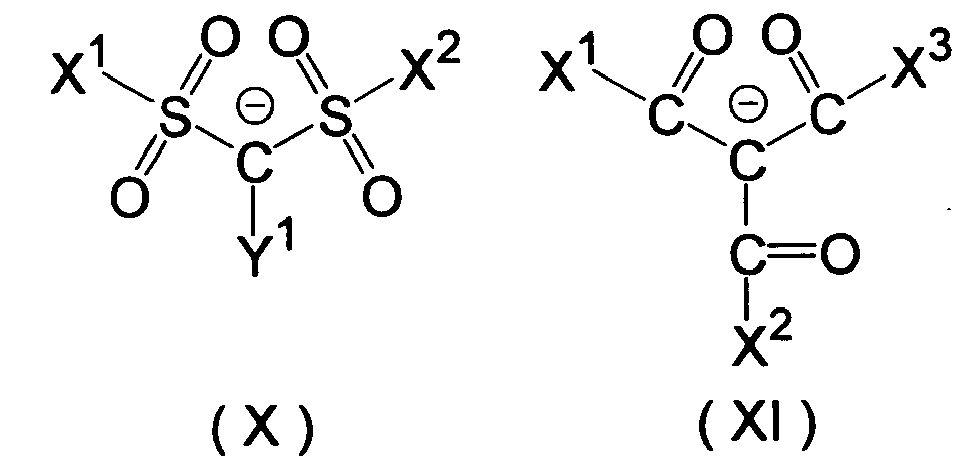
- (2) the ink composition according to (1) above, wherein the acid-generating compound has an anion represented by either Formula (I) or (II),
- (3) the ink composition according to (1) above, wherein the acid-generating compound has an anion represented by any one of Formulae (III) to (XI),
- (4) the ink composition according to (3) above, wherein the acid-generating compound has an anion represented by either Formula (VI) or (X),
- (5) the ink composition according to any one of (1) to (4) above, wherein it is for inkjet recording use,
- (6) an inkjet recording method comprising a step (A') of discharging an ink composition onto a recording medium, and a step (B') of irradiating the discharged ink composition with actinic radiation so as to cure the ink composition, the ink composition being the ink composition according to any one of (1) to (5) above,
- (7) the inkjet recording method according to (6) above, wherein the actinic radiation is ultraviolet radiation emitted by a light emitting diode that has a light emission peak wavelength in the range of 350 to 420 nm and generates ultraviolet radiation whose maximum illumination intensity on the surface of a recording medium is 10 to 2,000 mW/cm2,
- (8) a printed material recorded by the inkjet recording method according to (6) or (7) above,
- (9) a process for producing a lithographic printing plate, the process comprising a step (A") of discharging the ink composition according to any one of (1) to (5) above onto a hydrophilic support, and a step (B") of irradiating the discharged ink composition with actinic radiation so as to cure the ink composition, thus forming a hydrophobic image on the hydrophilic support by curing the ink composition, and
- (10) a lithographic printing plate produced by the process for producing a lithographic printing plate according to (9) above.
- In accordance with the present invention, it is possible to provide an ink composition that cures with high sensitivity when exposed to actinic radiation and has excellent thermal stability, and an inkjet recording method employing the ink composition.
- Furthermore, a printed material obtained using the ink composition capable of curing with high sensitivity when exposed to actinic radiation and having excellent thermal stability has high image quality and excellent strength for an image area. Similarly, in accordance with use of the ink composition of the present invention, there is exhibited the effect that a lithographic printing plate having a long plate life and high image quality can be produced based on digital data.
- The ink composition of the present invention (hereinafter, also simply called an 'ink') comprises (A) an acid-generating compound having an anion represented by any one of Formulae (I) to (XI) (hereinafter, also simply called an 'acid-generating compound'), (B) a cationically polymerizable compound, and (C) a colorant.


- The acid-generating compound (A) having an anion represented by any one of Formulae (I) to (XI) that can be used in the present invention is preferable since it generates an acid having a very low pKa, high acid strength, and high cationic polymerization initiation ability. Furthermore, the acid-generating compound (A) having an anion represented by any one of Formulae (I) to (XI) is preferable since its counteranion species has very low nucleophilicity, a cationic polymerization growth reaction is not inhibited, and high sensitivity can be achieved. Moreover, it is preferable to use this counteranion species since the thermal decomposition temperature of the initiator is increased and the stability over time can be improved. Furthermore, the acid-generating compound (A) having an anion represented by any one of Formulae (I) to (XI) has a high solubility compared with hexafluorophosphoric acid, hexafluoroantimonic acid, etc., which are known to give high cationic polymerizability.
- The present invention is explained in detail below.
- The ink composition of the present invention is radiation-curable, comprises (A) an acid-generating compound having an anion represented by any one of Formulae (I) to (XI) above, (B) a cationically polymerizable compound, and (C) a colorant, and may comprise as necessary (D) a sensitizer, (E) a co-sensitizer, (F) another polymerizable compound, (G) another polymerization initiator, and (H) another component.
- The 'radiation' referred to in the present invention is not particularly limited as long as it is actinic radiation that can provide energy that enables an initiating species to be generated in the ink composition when irradiated, and broadly includes α rays, γ rays, X rays, ultraviolet rays, visible light, and an electron beam; among these, ultraviolet rays and an electron beam are preferable from the viewpoint of curing sensitivity and the availability of equipment, and ultraviolet rays are particularly preferable. The ink composition of the present invention is therefore preferably an ink composition that can be cured by exposure to ultraviolet rays as radiation.
- Furthermore, the 'acid-generating compound' referred to in the present invention means a compound that can generate a cationic polymerization initiating species such as an acid or a cation by irradiation with radiation.
- The ink composition of the present invention can not only give a high quality printed material by forming an image having high image quality and excellent strength when used in normal printing, but can also be used suitably for production of a resist, a color filter, or an optical disk, and is useful as a stereolithographic material or a holographic material.
- Furthermore, by employing an inkjet recording method, since by curing with high sensitivity an image area having high strength can be formed directly on a non-absorbing recording medium based on digital data, the ink composition of the present invention can be used suitably for production of a lithographic printing plate, in particular, a large area lithographic printing plate equal to or larger than A2 size, and the lithographic printing plate thus obtained has excellent plate life.
- Rb1 to Rb3 in the anion represented by Formula (I) or (II) independently denote a perfluoroalkyl group, a perfluoroaryl group, or an aryl group substituted with at least one fluorine atom or perfluoroalkyl group. It is also possible for at least two of Rb1 to Rb3 to be bonded to form a ring.
- The aryl group substituted with at least one fluorine atom or perfluoroalkyl group may be a group having at least one fluorine atom or perfluoroalkyl group on the aryl ring, and preferred examples thereof include a 3,5-bistrifluoromethylphenyl group and a 3,5-difluorophenyl group.
- Preferred examples of the group formed by at least two of Rb1 to Rb3 being bonded include a perfluoroalkylene group and a perfluoroarylene group; a perfluoroalkylene group having 2 to 4 carbons is more preferable, and a perfluoropropylene group is yet more preferable.
- Rb1 to Rb3 are preferably a perfluoroalkyl group or a perfluoroaryl group, more preferably a perfluoroalkyl group having 1 to 8 carbons, and yet more preferably a perfluoroalkyl group having 1 to 4 carbons.
- R1 to R3 in the anion represented by any one of Formulae (III) to (XI) independently denote a monovalent organic group. It is also possible for at least two of R1 to R3 to be bonded to form a ring.
- Examples of the monovalent organic group include an alkyl group having 1 to 20 carbons, an alkenyl group having 2 to 20 carbons, an alkynyl group having 2 to 20 carbons, an aryl group having 6 to 20 carbons, an arylalkyl group having 7 to 21 carbons, a cyclic hydrocarbon group having 3 to 20 carbons, and a heterocyclic group having 4 to 20 carbons.
- The alkyl group denoted by R1 to R3 preferably has 1 to 18 carbons, and particularly preferably 1 to 12 carbons, may be a straight chain, and may have a substituent.
- The alkenyl group denoted by R1 to R3 preferably has 2 to 18 carbons, and particularly preferably 2 to 12 carbons, and may further have a substituent.
- The alkynyl group denoted by R1 to R3 preferably has 2 to 18 carbons, and particularly preferably 2 to 12 carbons, and may further have a substituent.
- The aryl group denoted by R1 to R3 preferably has 6 to 14 carbons, and particularly preferably 6 to 10 carbons, and may further have a substituent.
- The arylalkyl group denoted by R1 to R3 preferably has 7 to 15 carbons, and particularly preferably 7 to 11 carbons, and may further have a substituent.
- The cyclic hydrocarbon group denoted by R1 to R3 is a cyclic hydrocarbon group other than the above-mentioned aryl group, and preferably a substituted or unsubstituted cyclic hydrocarbon group having 3 to 14 carbons.
- The heterocyclic group denoted by R1 to R3 is preferably a substituted or unsubstituted heterocyclic group having 3 to 13 carbons, and the hetero atom contained in the heterocyclic group is preferably a nitrogen atom, an oxygen atom, or a sulfur atom.
- Examples of the substituent that the alkyl group, the alkenyl group, the alkynyl group, the aryl group, the arylalkyl group, the cyclic hydrocarbon group, and the heterocyclic group denoted by R1 to R3 may have include the substituent groups below.
- A halogen atom (a chlorine atom, a bromine atom, an iodine atom), an alkyl group, an alkenyl group, an alkynyl group, an aryl group, an arylalkyl group, an acyl group, an alkoxycarbonyl group, a cyclic hydrocarbon group, a heterocyclic group, a hydroxy group, an alkoxy group, an aryloxy group, an N,N-dialkylamino group, an N,N-diarylamino group, an N-alkyl-N-arylamino group, an alkylsulfoxy group, an arylsulfoxy group, an N-alkylacylamino group, an N-arylacylamino group, an alkoxycarbonylamino group, an aryloxycarbonylamino group, an N-alkyl-N-alkoxycarbonylamino group, an N-alkyl-N-aryloxycarbonylamino group, an N-aryl-N-alkoxycarbonylamino group, an N,N-dialkylcarbamoyl group, an N-arylcarbamoyl group, an N,N-diarylcarbamoyl group, an N-alkyl-N-arylcarbamoyl group, an alkylsulfinyl group, an arylsulfinyl group, an alkylsulfonyl group, an arylsulfonyl group, an N,N-dialkylsulfinamoyl group, an N,N-diarylsulfinamoyl group, an N-alkyl-N-arylsulfinamoyl group, an N,N-dialkylsulfamoyl group, an N,N-diarylsulfamoyl group, an N-alkyl-N-arylsulfamoyl group, a dialkylphosphono group (-PO3(alkyl)2), a diarylphosphono group (-PO3(aryl)2), an alkylarylphosphono group (-PO3(alkyl)(aryl)), a dialkylphosphonooxy group (-OPO3(alkyl)2), a diarylphosphonooxy group (-OPO3(aryl)2), an alkylarylphosphonooxy group (-OPO3(alkyl)(aryl)), a cyano group, a nitro group, an alkenyl group, an alkynyl group, and an oxo group.
- These substituents may be further substituted with these substituents, and they may be bonded to each other to form a ring if this is possible.
- When a fluorine atom is contained as a substituent, the group corresponding to Rf1 or Rf2, which will be described later, is not included as R1 to R3.
- Rf1 and Rf2 in the anion represented by any one of Formulae (III) to (XI) independently denote a perfluoroalkyl group, a perfluoroaryl group, or an aryl group substituted with at least one fluorine atom or perfluoroalkyl group. It is also possible for Rf1 and Rf2 to be bonded to form a ring.
- The aryl group substituted with at least one fluorine atom or perfluoroalkyl group may be a group having at least one fluorine atom or perfluoroalkyl group on the aryl ring, and preferred examples thereof include a 3,5-bistrifluoromethylphenyl group and a 3,5-difluorophenyl group.
- Preferred examples of the group formed by Rf1 and Rf2 being bonded include a perfluoroalkylene group and a perfluoroarylene group.
- Rf1 and Rf2 are preferably a perfluoroalkyl group or a perfluoroaryl group, more preferably a perfluoroalkyl group having 1 to 8 carbons, and yet more preferably a perfluoroalkyl group having 1 to 4 carbons.
- X1 to X3 in the anion represented by any one of Formulae (III) to (XI) independently denote a monovalent organic group. It is also possible for at least two of X1 to X3 to be bonded to form a ring.
- Examples of the monovalent organic group include an alkyl group having 1 to 20 carbons, an alkenyl group having 2 to 20 carbons, an alkynyl group having 2 to 20 carbons, an aryl group having 6 to 20 carbons, an arylalkyl group having 6 to 21 carbons, a cyclic hydrocarbon group having 3 to 20 carbons, a heterocyclic group having 4 to 20 carbons, an acyl group having 2 to 20 carbons, an alkylsulfinyl group having 1 to 20 carbons, an arylsulfinyl group having 6 to 20 carbons, and a cyano group.
- The alkyl group denoted by X1 to X3 preferably has 1 to 18 carbons, and particularly preferably 1 to 12 carbons, may be a straight chain, and may have a substituent.
- The alkenyl group denoted by X1 to X3 preferably has 2 to 18 carbons, and particularly preferably 2 to 12 carbons, and may further have a substituent.
- The alkynyl group denoted by X1 to X3 preferably has 2 to 18 carbons, and particularly preferably 2 to 12 carbons, and may further have a substituent.
- The aryl group denoted by X1 to X3 preferably has 6 to 14 carbons, and particularly preferably 6 to 10 carbons, and may further have a substituent.
- The arylalkyl group denoted by X1 to X3 preferably has 7 to 15 carbons, and particularly preferably 7 to 11 carbons, and may further have a substituent.
- The cyclic hydrocarbon group denoted by X1 to X3 is a cyclic hydrocarbon group other than the above-mentioned aryl group, and is preferably a substituted or unsubstituted cyclic hydrocarbon group having 3 to 14 carbons.
- The heterocyclic group denoted by X1 to X3 is preferably a substituted or unsubstituted heterocyclic group having 3 to 13 carbons, and the hetero atom contained in the heterocyclic group is preferably a nitrogen atom, an oxygen atom, or a sulfur atom.
- The acyl group denoted by X1 to X3 preferably has 2 to 18 carbons, and particularly preferably 2 to 12 carbons, and may further have a substituent.
- The alkylsulfinyl group denoted by X1 to X3 preferably has 2 to 18 carbons, and particularly preferably 2 to 12 carbons, and may further have a substituent.
- The arylsulfinyl group having 6 to 20 carbons denoted by X1 to X3 preferably has 6 to 18 carbons, and particularly preferably 7 to 12 carbons, and may further have a substituent.
- Examples of the substituent that the alkyl group, the alkenyl group, the alkynyl group, the aryl group, the arylalkyl group, the cyclic hydrocarbon group, and the heterocyclic group denoted by X1 to X3 may have include the substituent groups below.
- A halogen atom (a fluorine atom, a chlorine atom, a bromine atom, an iodine atom), an alkyl group, an alkenyl group, an alkynyl group, an aryl group, an arylalkyl group, an acyl group, an alkoxycarbonyl group, a cyclic hydrocarbon group, a heterocyclic group, a hydroxy group, an alkoxy group, an aryloxy group, an N,N-dialkylamino group, an N,N-diarylamino group, an N-alkyl-N-arylamino group, an alkylsulfoxy group, an arylsulfoxy group, an N-alkylacylamino group, an N-arylacylamino group, an alkoxycarbonylamino group, an aryloxycarbonylamino group, an N-alkyl-N-alkoxycarbonylamino group, an N-alkyl-N-aryloxycarbonylamino group, an N-aryl-N-alkoxycarbonylamino group, an N,N-dialkylcarbamoyl group, an N-arylcarbamoyl group, an N,N-diarylcarbamoyl group, an N-alkyl-N-arylcarbamoyl group, an alkylsulfinyl group, an arylsulfinyl group, an alkylsulfonyl group, an arylsulfonyl group, an N,N-dialkylsulfinamoyl group, an N,N-diarylsulfinamoyl group, an N-alkyl-N-arylsulfinamoyl group, an N,N-dialkylsulfamoyl group, an N,N-diarylsulfamoyl group, an N-alkyl-N-arylsulfamoyl group, a dialkylphosphono group (-PO3(alkyl)2), a diarylphosphono group (-PO3(aryl)2), an alkylarylphosphono group (-PO3(alkyl)(aryl)), a dialkylphosphonooxy group (-OPO3(alkyl)2), a diarylphosphonooxy group (-OPO3(aryl)2), an alkylarylphosphonooxy group (-OPO3(alkyl)(aryl)), a cyano group, a nitro group, an alkenyl group, an alkynyl group, and an oxo group.
- These substituents may be further substituted with these substituents, and they may be bonded to each other to form a ring if this is possible.
- From the viewpoint of reduction of the nucleophilicity of the anion, X1 to X3 are preferably a perfluoroalkyl group having 1 to 8 carbons or a substituted aryl group having 6 to 12 carbons substituted with at least one electron-withdrawing group such as a halogen atom, a cyano group, a nitro group, a perfluoroalkyl group, an alkylsulfonyl group, an arylsulfonyl group, an alkoxycarbonyl group, or an aryloxycarbonyl group, and more preferably a perfluoroalkyl group having 1 to 8 carbons or a perfluoroaryl group having 6 to 12 carbons.
- Y1 in the anion represented by Formula (X) denotes a hydrogen atom or a monovalent organic group, and is preferably a hydrogen atom, an alkyl group, or an aryl group, and more preferably a hydrogen atom. The monovalent organic group denoted by Y1 has the same meaning as that of the monovalent organic group denoted by X1 to X3, and preferred ranges are also the same. It is also possible for Y1 to be bonded to X1 and/or X2 to form a ring.
- Furthermore, from the viewpoint of the synthetic suitability of the compound and reduction of the nucleophilicity of the anion, a compound having an anion represented by Formula (III) or Formula (XI) is preferable, a compound having an anion represented by Formula (IV) or Formula (VIII) is more preferable, and among them it is most preferable for X1 to X3 to be a perfluoroalkyl group having 1 to 8 carbons or a perfluoroaryl group having 6 to 12 carbons from the viewpoint of reduction of the nucleophilicity of the anion. Furthermore, it is most preferable for Y1 to be a hydrogen atom from the viewpoint of synthetic suitability of the compound and reduction of the nucleophilicity of the anion.
- Moreover, from the viewpoint of reduction of the nucleophilicity of the anion, a compound having an anion represented by Formula (I), Formula (II), Formula (III), Formula (VI), or Formula (X) is preferable, and a compound having an anion represented by Formula (VI) or Formula (X) is more preferable.
- Preferred specific examples of the anion represented by Formula (I) are illustrated below.




- Furthermore, preferred specific examples of the anion represented by Formula (II) are illustrated below.


- Preferred specific examples of the anion represented by any one of Formulae (III) to (XI) are illustrated below. In the present invention, the chemical formula is expressed in the form of a simplified structure formula, and a solid line without an explicit element or substituent group denotes a hydrocarbon group.


- A cation that pairs with the anion represented by any one of Formulae (I) to (XI) may be an onium ion of a known onium salt or an organometallic cation, and may be a monovalent cation or a polyvalent cation.
- Examples of the onium ion include onium ions such as iodonium, sulfonium, phosphonium, diazonium, ammonium, pyridinium, quinolinium, acridinium, oxonium, selenonium, and arsonium, and among these, onium ions such as iodonium, sulfonium, phosphonium, diazonium, quinolinium, and acridinium are preferable.
- Examples of the onium ion include cations such as onium ions of onium salts of group 15 to 17 elements described in
JP-A-6-184170 US Pat. Nos. 4,069,055 ,4,069,056 , andRe 27,992 ,JP-A-3-140140 US Pat. Nos. 4,069,055 and4,069,056 ,JP-A-9-202873 European Patent Nos. 104,143 339,049 410,201 JP-A-2-150848 JP-A-2-296514 European Patent Nos. 370,693 161,811 410,201 339,049 233,567 297,443 297,442 US Pat. Nos. 3,902,114 ,4,933,377 ,4,760,013 ,4,734,444 , and2,833,827 ,German Patent Nos. 2,904,626 ,3,604,580 , and3,604,581 ,JP-A-7-28237 JP-A-8-27102 JP-A-9-221652 - Furthermore, preferred examples of the onium ion in the acid-generating compound (A) include cations having structures represented by Formulae (Ca-I) to (Ca-VI) below.


- In Formulae (Ca-I) to (Ca-VI) above, R1 to R3 independently denote an aryl group, R4 to R6 independently denote an alkyl group, an alkenyl group, an alkynyl group, an aryl group, a cyclic hydrocarbon group, or a heterocyclic group, R7 to R11 independently denote an alkyl group, an alkenyl group, an alkynyl group, an aryl group, a cyclic hydrocarbon group, a heterocyclic group, an alkoxy group, or an aryloxy group, and R12 to R17 independently denote a hydrogen atom, a halogen atom, or a monovalent organic group.
- The alkyl group denoted by R4 to R11 preferably has 1 to 30 carbons, more preferably 1 to 20 carbons, and particularly preferably 1 to 8 carbons, may be a straight chain, and may have a substituent.
- The alkenyl group denoted by R4 to R11 preferably has 2 to 30 carbons, more preferably 2 to 20 carbons, and particularly preferably 2 to 8 carbons, and may further have a substituent.
- The alkynyl group denoted by R4 to R11 preferably has 2 to 30 carbons, more preferably 2 to 20 carbons, and particularly preferably 2 to 8 carbons, and may further have a substituent.
- The aryl group denoted by R1 to R11 preferably has 6 to 30 carbons, more preferably 6 to 20 carbons, and particularly preferably 6 to 10 carbons, and may further have a substituent.
- The cyclic hydrocarbon group denoted by R4 to R11 preferably has 3 to 30 carbons, more preferably 3 to 20 carbons, and particularly preferably 3 to 10 carbons, and may further have a substituent.
- The heterocyclic group denoted by R4 to R11 preferably has 4 to 30 carbons, more preferably 4 to 20 carbons, and particularly preferably 4 to 10 carbons, and may further have a substituent. Furthermore, the hetero atom contained in the heterocyclic group is preferably a nitrogen atom, an oxygen atom, or a sulfur atom.
- The alkoxy group denoted by R7 to R11 preferably has 1 to 30 carbons, more preferably 1 to 20 carbons, and particularly preferably 1 to 8 carbons. Furthermore, the alkoxy group may have a substituent described below, and the alkyl moiety of the alkoxy group may be an alkenyl group, an alkynyl group, a cyclic hydrocarbon group, or a heterocyclic group other than an aromatic group.
- The aryloxy group denoted by R7 to R11 preferably has 6 to 30 carbons, more preferably 6 to 20 carbons, and particularly preferably 6 to 10 carbons. Furthermore, the aryloxy group may have a substituent described below, and the aryl moiety of the aryloxy group may be an aromatic heterocyclic group.
- In Formula (Ca-II), R2 and R3 may be bonded to each other to form a ring if this is possible.
- In Formula (Ca-III), two or more of R4 to R6 may be bonded to each other to form a ring if this is possible.
- In Formula (Ca-IV), two or more of R7 to R10 may be bonded to each other to form a ring if this is possible.
- In Formula (Ca-V), two or more of R11 to R14 may be bonded to each other to form a ring if this is possible.
- In Formula (Ca-VI), two or more of R15 to R17 may be bonded to each other to form a ring if this is possible.
- With regard to the substituent that may be possessed by the alkyl group, the alkenyl group, the alkynyl group, the aryl group, the hydrocarbon group, the heterocyclic group, the alkoxy group, or the aryloxy group, a monovalent non-metallic atomic group other than hydrogen is used, and preferred examples thereof include a halogen atom (-F, -Br, -Cl, -I), a hydroxyl group, an alkyl group, an aryl group, an alkenyl group, an alkynyl group, an alkoxy group, an aryloxy group, a mercapto group, an alkylthio group, an arylthio group, an alkyldithio group, an aryldithio group, an amino group, an N-alkylamino group, an N,N-dialkylamino group, an N-arylamino group, an N,N-diarylamino group, an N-alkyl-N-arylamino group, an acyloxy group, a carbamoyloxy group, an N-alkylcarbamoyloxy group, an N-arylcarbamoyloxy group, an N,N-dialkylcarbamoyloxy group, an N,N-diarylcarbamoyloxy group, an N-alkyl-N-arylcarbamoyloxy group, an alkylsulfoxy group, an arylsulfoxy group, an acylthio group,
an acylamino group, an N-alkylacylamino group, an N-arylacylamino group, a ureido group, an N'-alkylureido group, an N',N'-dialkylureido group, an N'-arylureido group, an N',N'-diarylureido group, an N'-alkyl-N'-arylureido group, an N-alkylureido group, an N-arylureido group, an N'-alkyl-N-alkylureido group, an N'-alkyl-N-arylureido group, an N',N'-dialkyl-N-alkylureido group, an N',N'-dialkyl-N-arylureido group, an N'-aryl-N-alkylureido group, an N'-aryl-N-arylureido group, an N',N'-diaryl-N-alkylureido group, an N',N'-diaryl-N-arylureido group, an N'-alkyl-N'-aryl-N-alkylureido group, an N'-alkyl-N'-aryl-N-arylureido group, an alkoxycarbonylamino group, an aryloxycarbonylamino group, an N-alkyl-N-alkoxycarbonylamino group, an N-alkyl-N-aryloxycarbonylamino group, an N-aryl-N-alkoxycarbonylamino group, an N-aryl-N-aryloxycarbonylamino group,
a formyl group, an acyl group, a carboxyl group and conjugate base group thereof (hereinafter, called a carboxylate), an alkoxycarbonyl group, an aryloxycarbonyl group, a carbamoyl group, an N-alkylcarbamoyl group, an N,N-dialkylcarbamoyl group, an N-arylcarbamoyl group, an N,N-diarylcarbamoyl group, an N-alkyl-N-arylcarbamoyl group, an alkylsulfinyl group, an arylsulfinyl group, an alkylsulfonyl group, an arylsulfonyl group, a sulfo group (-SO3H) and conjugate base group thereof (hereinafter, called a sulfonate group), an alkoxysulfonyl group, an aryloxysulfonyl group, a sulfinamoyl group, an N-alkylsulfinamoyl group, an N,N-dialkylsulfinamoyl group, an N-arylsulfinamoyl group, an N,N-diarylsulfinamoyl group, an N-alkyl-N-arylsulfinamoyl group, a sulfamoyl group, an N-alkylsulfamoyl group, an N,N-dialkylsulfamoyl group, an N-arylsulfamoyl group, an N,N-diarylsulfamoyl group, an N-alkyl-N-arylsulfamoyl group, an N-acylsulfamoyl group and conjugate base group thereof, an N-alkylsulfonylsulfamoyl group (-SO2NHSO2(alkyl)) and conjugate base group thereof, an N-arylsulfonylsulfamoyl group (-SO2NHSO2(aryl)) and conjugate base group thereof, an N-alkylsulfonylcarbamoyl group (-CONHSO2(alkyl)) and conjugate base group thereof, an N-arylsulfonylcarbamoyl group (-CONHSO2(aryl)) and conjugate base group thereof,
a silyl group, an alkoxysilyl group (-Si(O-alkyl)3), an aryloxysilyl group (-Si(O-aryl)3), a hydroxysilyl group (-Si(OH)3) and conjugate base group thereof, a phosphono group (-PO3H2) and conjugate base group thereof (hereinafter, called a phosphonate group), a dialkylphosphono group (-PO3(alkyl)2), a diarylphosphono group (-PO3(aryl)2), an alkylarylphosphono group (-PO3(alkyl)(aryl)), a monoalkylphosphono group (-PO3H(alkyl)) and conjugate base group thereof (hereinafter, called an alkylphosphonate group), a monoarylphosphono group (-PO3H(aryl)) and conjugate base group thereof (hereinafter, called an arylphosphonate group), a phosphonooxy group (-OPO3H2) and conjugate base group thereof (hereinafter, called a phosphonatooxy group), a dialkylphosphonooxy group (-OPO3(alkyl)2), a diarylphosphonooxy group (-OPO3(aryl)2), an alkylarylphosphonooxy group (-OPO3(alkyl)(aryl)), a monoalkylphosphonooxy group (-OPO3H(alkyl)) and conjugate base group thereof (hereinafter, called an alkylphosphonatooxy group), a monoarylphosphonooxy group (-OPO3H(aryl)) and conjugate base group thereof (hereinafter, called an arylphosphonatooxy group), a cyano group, and a nitro group. These substituents may be further substituted with the above-mentioned substituent, and may form a ring if this is possible. - R12 to R17 independently denote a hydrogen atom, a halogen atom, or a monovalent organic group.
- Examples of the halogen atom denoted by R12 to R17 include a fluorine atom, a chlorine atom, a bromine atom, and an iodine atom, and a fluorine atom, a chlorine atom, or a bromine atom is preferable.
- Examples of the monovalent organic group denoted by R12 to R17 include a hydroxyl group, an alkyl group, an alkenyl group, an alkynyl group, an aryl group, a cyclic hydrocarbon group, a heterocyclic group, an alkoxy group, an aryloxy group, an acyl group, an alkoxycarbonyl group, an acyloxy group, -SO3-Ra, -NRbRc, a cyano group, -SiRdReRf, -SORg, -SO2Rg, and a nitro group; Ra denotes a hydrogen atom, an alkyl group, an alkenyl group, an alkynyl group, an aryl group, an arylalkyl group, an alkali metal atom, or quaternary ammonium, Rb, Rc, and Rg independently denote an alkyl group, an alkenyl group, an alkynyl group, an aryl group, a cyclic hydrocarbon group, or a heterocyclic group, and Rd to Rf independently denote an alkyl group, an alkenyl group, an alkynyl group, an aryl group, a cyclic hydrocarbon group, a heterocyclic group, an alkoxy group, or an aryloxy group.
- The alkyl group, alkenyl group, alkynyl group, aryl group, cyclic hydrocarbon group, heterocyclic group, alkoxy group, and aryloxy group denoted by R12 to R17 have the same meanings as those denoted by R7 to R11 above, and preferred ranges are also the same. Furthermore, these groups may have the above-mentioned substituent.
- The acyl group and the alkoxycarbonyl group denoted by R12 to R17 preferably have 1 to 30 carbons in the carbon chain side, and particularly preferably 1 to 12 carbons, may be a straight chain, and may have the above-mentioned substituent.
- The acyloxy group denoted by R12 to R17 preferably has 1 to 30 carbons, and particularly preferably 1 to 12 carbons, may be a straight chain, and may have the above-mentioned substituent.
- Ra in -SO3-Ra denoted by R12 to R17 is preferably a hydrogen atom, the above-mentioned alkyl group, which may have a substituent, the above-mentioned aryl group, which may have a substituent, a lithium atom, a sodium atom, or a potassium atom.
- The above-mentioned alkyl group, alkenyl group, alkynyl group, aryl group, cyclic hydrocarbon group, and heterocyclic group denoted by Rb and Rc in -NRbRc have the same meanings as those denoted by R7 to R11 above, and preferred ranges are also the same. Furthermore, these groups may have the above-mentioned substituent.
- The alkyl group, alkenyl group, alkynyl group, aryl group, cyclic hydrocarbon group, heterocyclic group, alkoxy group, and aryloxy group denoted by Rd to Rf in -SiRdReRf have the same meanings as those denoted by R7 to R11 above, and preferred ranges are also the same. Furthermore, these groups may have the above-mentioned substituent.
- The alkyl group, alkenyl group, alkynyl group, aryl group, cyclic hydrocarbon group, and heterocyclic group denoted by R9 in -SORg or -SO2Rg have the same meanings as those denoted by R7 to R11 above, and preferred ranges are also the same. Furthermore, these groups may have the above-mentioned substituent.
- Preferred specific examples of the onium ion in the acid-generating compound (A) include countercations having the structures denoted by Ca-1 to Ca-45 below.


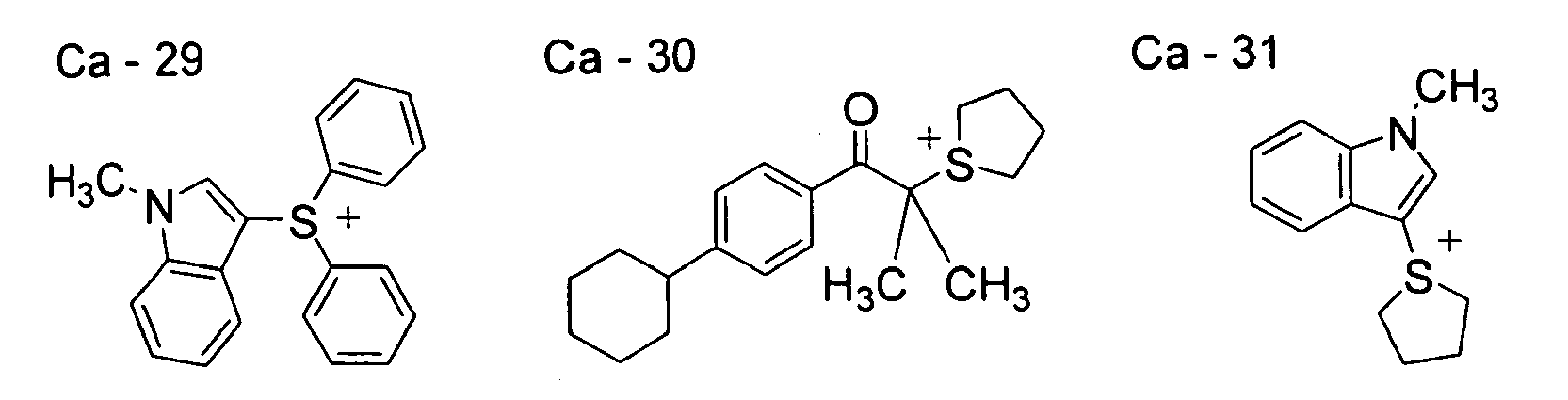


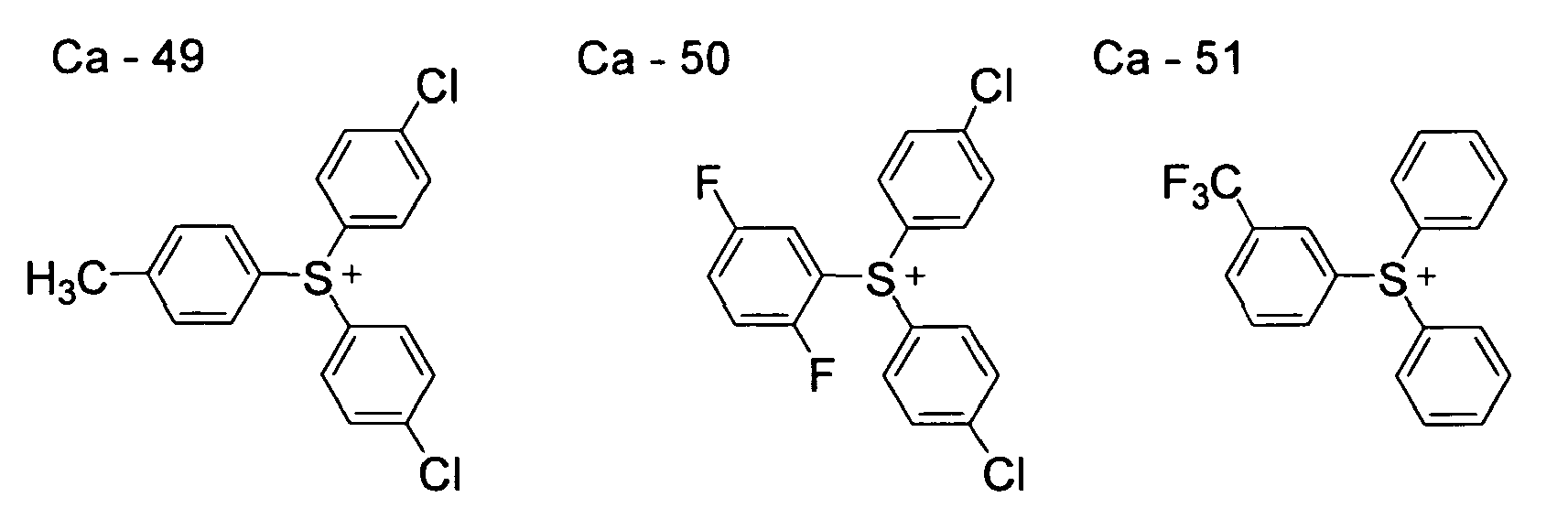

- The organometallic cation of the acid-generating compound (A) is a cation containing a transition metal atom and a substituted or unsubstituted aromatic compound having an arene- or cyclopentadienyl-based ligand; it is an organometallic complex cation substantially not containing any metal hydride or any metal alkyl functional group selected from compounds described in
US Pat. No. 4,985,340 , and is represented by the formula below.
[(L1)(L2)M] q+
- In the formula, M denotes Cr, Mo, W, Mn, Re, Fe, Ru, Os, Co, Rh, Ir, Pd, Pt, or Ni; preferably Cr, Mo, W, Mn, Fe, Ru, Co, Pd, or Ni; and most preferably Mn or Fe, L1 denotes one or two cyclic polyunsaturated ligands, which may be identical or different, selected from the group consisting of substituted and unsubstituted cyclopentadienyl, cyclohexadienyl, cycloheptatrienyl, cycloheptatriene, cyclooctatetraene, a heterocyclic compound, an aromatic compound (selected from substituted and unsubstituted arene compounds), a compound having 2 to 4 condensed rings, and a polymer constituent unit [e.g. a phenyl group such as polystyrene, poly(styrene-co-butadiene), poly(styrene-co-methyl methacrylate), or poly(α-methylstyrene); a cyclopentadiene group such as poly(vinylcyclopentadiene); a pyridine group such as poly(vinylpyridine), etc.], each ligand being capable of donating 3 to 8 electrons to the valence shell of M; L2 may be absent, or denotes 1 to 3 non-anionic ligands, which may be identical or different, that donate an even number of electrons, selected from the group consisting of carbon oxide, a ketone, an olefin, an ether, nitrosonium, a phosphine, a phosphite, an arsenic or antimony-related derivative, an organonitrile, an amine, an alkyne, isonitrile, and dinitrogen, provided that the total electric charge donated to M generates a net residual positive charge q for said complex. q is an integer of 1 or 2, and denotes the residual charge of said complex cation.
- With regard to a process for producing the acid-generating compound having an organometallic cation, methods described in
EPO No. 094,914 US Pat. Nos. 5,089,536 ,4,868,288 , and5,073,476 can be cited as examples. The organometallic cation that can be used in the present invention is generally not useful as a catalyst for Ziegler-Natta or coordination polymerization of an olefin or an acetylene. This is because such polymerization needs a metal hydride or a metal-alkyl functional group, which is not present in a catalyst salt or an initiator salt useful in the present invention. Furthermore, the acid-generating compound having an organometallic cation that can be used in the present invention does not need a metal hydride or a metal alkyl cocatalyst, which is normally used in a Ziegler-Natta or coordination catalyst for polymerization of an olefin or an acetylene. In contrast to the Ziegler-Natta catalyst, the acid-generating compound having an organometallic cation that can be used in the present invention is generally stable and active under external conditions that include normal levels of oxygen and water in the air. - Preferred specific examples of the organometallic cation include bis(η5-cyclopentadienyl)iron(1+), (η5-isopropylcyclopentadienyl)(η5-cyclopentadienyl)iron(1+), (η5-cyclopentadienyl)(η6-xylene)iron(1+), (η5-cyclopentadienyl)(η6-toluene)iron(1+), (η5-cyclopentadienyl)(η6-mesitylene)iron(1+), (η5-cyclopentad ienyl)(η6-pyrene)iron(1+), (η5-cyclopentadienyl)(η6-naphthalene)iron(1+), (η5-cyclopentadienyl)(η6-dodecylphenyl)iron(1+), bis(η6-xylene)iron(2+), bis(η6-mesitylene)iron(2+), bis(η6-durene)iron(2+), bis(η6-pentamethylbenzene)iron(2+), and bis(η6-dodecylbenzene)iron(2+).
- The onium ion used in the present invention is preferably a triarylsulfonium salt from the viewpoint of sensitivity and thermal stability, is preferably a triarylsulfonium salt substituted with at least one electron-withdrawing group such as a trifluoromethyl group, a halogen atom, an ester group, a sulfoxide group, a cyano group, an amide group, a carboxyl group, or a carbonyl group from the viewpoint of improvement of sensitivity, and is more preferably a triarylsulfonium salt substituted with at least one of a fluoro group (-F), a trifluoromethyl group (-CF3), a chloro group (-Cl), and a bromo group (-Br), yet more preferably a sulfonium salt in which each aryl skeleton is substituted with a halogen atom, and most preferably a sulfonium salt substituted with three chloro groups.
- The ink composition of the present invention generates an acid having an anion represented by any one of Formulae (I) to (XI) with a very low pKa, the composition having a high acid strength and therefore a high ability to initiate cationic polymerization. Furthermore, since the nucleophilicity of the counteranion species is very low, a growth reaction of the cationic polymerization is not inhibited, thus giving high sensitivity. Moreover, employing this counteranion makes the thermal decomposition temperature of the initiator high and improves the stability over time. Furthermore, it has high solubility compared with a known acid-generating agent such as an onium salt that generates hexafluorophosphoric acid or hexafluoroantimonic acid, which is known to give high cationic polymerizability.
- An onium salt having an anion represented by any one of Formulae (I) to (XI) may be synthesized by salt exchange between a metal salt or an ammonium salt of an anion represented by any one of Formula (I) to (XI) and an onium salt compound (a halide, an acetate, a tetrafluoroborate, a sulfonate, a perchlorate, etc.).
- The above-mentioned acid-generating compound having an anion represented by any one of Formulae (I) to (XI) is preferably a compound formed by combining a cation (Ca-1 to 45 or specific examples of the organometallic cation) and an anion that are described above as specific examples, and is more preferably a compound illustrated below.


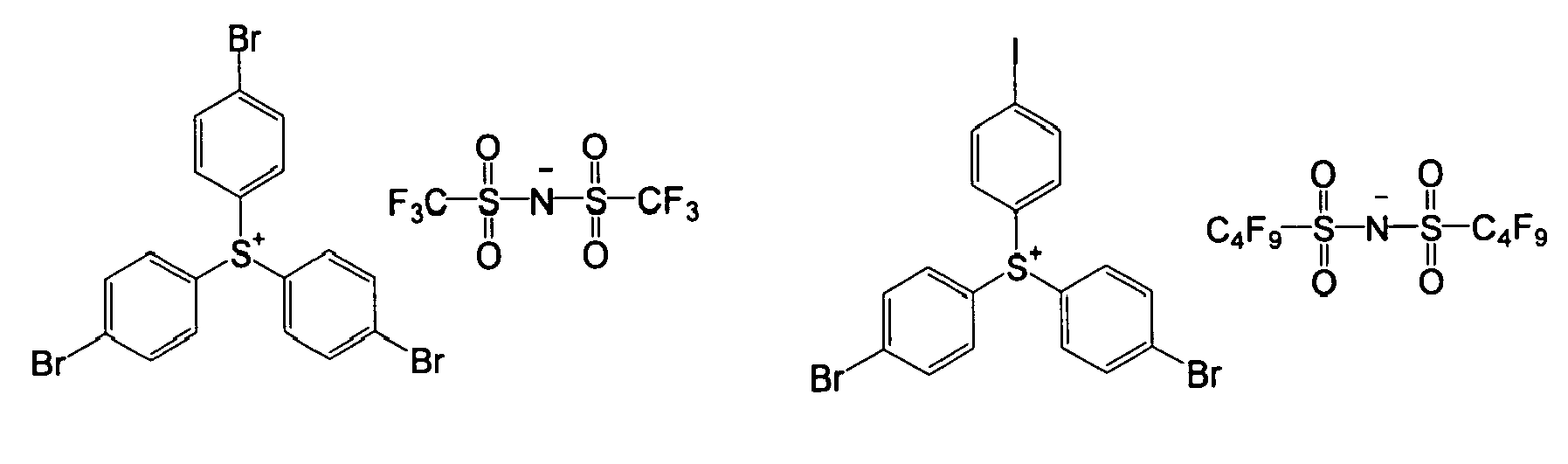








- The onium ion used in the present invention is preferably a triarylsulfonium from the viewpoint of sensitivity and thermal stability, is preferably a triarylsulfonium salt substituted with at least one electron-withdrawing group such as a trifluoromethyl group, a halogen atom, an ester group, a sulfoxide group, a cyano group, an amide group, a carboxyl group, or a carbonyl group from the viewpoint of improvement of sensitivity, and more preferably a triarylsulfonium salt substituted with at least one of a trifluoromethyl group, a fluoro group, a chloro group, and a bromo group. It is preferably a triarylsulfonium salt in which each aryl group is substituted with at least one halogen atom, and most preferably a triarylsulfonium salt in which each aryl group is substituted with one chloro group.
- The acid-generating compound having an anion represented by any one of Formulae (I) to (XI) may be added to the ink composition at a proportion of 0.1 to 50 wt % relative to the ink composition, more preferably 0.5 to 30 wt %, and particularly preferably 1 to 20 wt %. It is preferable for the amount added to be in the above-mentioned range since the sensitivity is good and a non-image area is not stained during printing. Such an onium-based polymerization initiator may be used singly or in a combination of two or more types.
- The ink composition of the present invention comprises a cationically polymerizable compound.
- The cationically polymerizable compound that can be used in the present invention is not particularly limited as long as it is a compound that undergoes a polymerization reaction by virtue of a cationic polymerization initiating species generated by a cationic polymerization initiator, which will be described later, and is cured, and various known types of cationically polymerizable monomers known as cationically photopolymerizable monomers may be used. Examples of the cationically polymerizable monomer include, for example, epoxy compounds, vinyl ether compounds, and oxetane compounds described in
JP-A-6-9714 JP-A-2001-31892 JP-A-2001-40068 JP-A-2001-55507 JP-A-2001-310938 JP-A-2001-310937 JP-A-2001-220526 JP-A-6-43633 JP-A-8-324137 - Examples of the epoxy compounds include aromatic epoxides, alicyclic epoxides, and aliphatic epoxides, and examples of the aromatic epoxide include di- or polyglycidyl ethers produced by a reaction between epichlorohydrin and a polyhydric phenol having at least one aromatic nucleus or an alkylene oxide adduct thereof; specific examples include di- or polyglycidyl ethers of bisphenol A or an alkylene oxide adduct thereof, di- or polyglycidyl ethers of hydrogenated bisphenol A or an alkylene oxide adduct thereof, and novolac type epoxy resins. Examples of the alkylene oxide above include ethylene oxide and propylene oxide.
- Examples of the alicyclic epoxides include cyclohexene oxide- and cyclopentene oxide-containing compounds obtained by epoxidizing a compound having at least one cycloalkene ring such as a cyclohexene ring or a cyclopentene ring with an appropriate oxidizing agent such as hydrogen peroxide or a peracid.
- Examples of the aliphatic epoxides include di- or polyglycidyl ethers of an aliphatic polyhydric alcohol or an alkylene oxide adduct thereof, and representative examples thereof include diglycidyl ethers of an alkylene glycol such as the diglycidyl ether of ethylene glycol, the diglycidyl ether of propylene glycol, and the diglycidyl ether of 1,6-hexanediol, polyglycidyl ethers of a polyhydric alcohol such as the di- or triglycidyl ether of glycerol or an alkylene oxide adduct thereof, and diglycidyl ethers of a polyalkylene glycol such as the diglycidyl ether of polyethylene glycol or an alkylene oxide adduct thereof and the diglycidyl ether of polypropylene glycol or an alkylene oxide adduct thereof. Examples of the alkylene oxide above include ethylene oxide and propylene oxide.
- Detailed examples of monofunctional and polyfunctional epoxy compounds that can be used in the present invention are now given.
- Examples of monofunctional epoxy compounds used in the present invention include phenyl glycidyl ether, p-tert-butylphenyl glycidyl ether, butyl glycidyl ether, 2-ethylhexyl glycidyl ether, allyl glycidyl ether, 1,2-butylene oxide, 1,3-butadiene monooxide, 1,2-epoxydodecane, epichlorohydrin, 1,2-epoxydecane, styrene oxide, cyclohexene oxide, 3-methacryloyloxymethylcyclohexene oxide, 3-acryloyloxymethylcyclohexene oxide, and 3-vinylcyclohexene oxide.
- Furthermore, examples of polyfunctional epoxy compounds include bisphenol A diglycidyl ether, bisphenol F diglycidyl ether, bisphenol S diglycidyl ether, brominated bisphenol A diglycidyl ether, brominated bisphenol F diglycidyl ether, brominated bisphenol S diglycidyl ether, epoxy novolac resins, hydrogenated bisphenol A diglycidyl ether, hydrogenated bisphenol F diglycidyl ether, hydrogenated bisphenol S diglycidyl ether, 2-(3,4-epoxycyclohexyl-5,5-spiro-3,4-epoxy)cyclohexane-meta-dioxane, bis(3,4-epoxycyclohexylmethyl) adipate, bis(3,4-epoxy-6-methylcyclohexylmethyl) adipate, 3,4-epoxy-6-methylcyclohexenyl 3',4'-epoxy-6'-methylcyclohexenecarboxylate, methylenebis(3,4-epoxycyclohexane), dicyclopentadiene diepoxide, the di(3,4-epoxycyclohexylmethyl) ether of ethylene glycol, ethylene bis(3,4-epoxycyclohexanecarboxylate), dioctyl epoxyhexahydrophthalate, di-2-ethylhexyl epoxyhexahydrophthalate, 1,4-butanediol diglycidyl ether, 1,6-hexanediol diglycidyl ether, glycerol triglycidyl ether, trimethylolpropane triglycidyl ether, polyethylene glycol diglycidyl ether, polypropylene glycol diglycidyl ether, 1,13-tetradecadiene dioxide, limonene dioxide, 1,2,7,8-diepoxyoctane, and 1,2,5,6-diepoxycyclooctane.
- Among these epoxy compounds, the aromatic epoxides and the alicyclic epoxides are preferable from the viewpoint of excellent curing speed, and the alicyclic epoxides are particularly preferable.
- Examples of the vinyl ether compounds include di- or tri-vinyl ether compounds such as ethylene glycol divinyl ether, diethylene glycol divinyl ether, triethylene glycol divinyl ether, propylene glycol divinyl ether, dipropylene glycol divinyl ether, butanediol divinyl ether, hexanediol divinyl ether, cyclohexanedimethanol divinyl ether, and trimethylolpropane trivinyl ether, and monovinyl ether compounds such as ethyl vinyl ether, n-butyl vinyl ether, isobutyl vinyl ether, octadecyl vinyl ether, cyclohexyl vinyl ether, hydroxybutyl vinyl ether, 2-ethylhexyl vinyl ether, cyclohexanedimethanol monovinyl ether, n-propyl vinyl ether, isopropyl vinyl ether, isopropenyl vinyl ether-O-propylene carbonate, dodecyl vinyl ether, and diethylene glycol monovinyl ether.
- Detailed examples of monofunctional vinyl ethers and polyfunctional vinyl ethers are given below.
- Specific examples of monofunctional vinyl ethers include methyl vinyl ether, ethyl vinyl ether, propyl vinyl ether, n-butyl vinyl ether, t-butyl vinyl ether, 2-ethylhexyl vinyl ether, n-nonyl vinyl ether, lauryl vinyl ether, cyclohexyl vinyl ether, cyclohexylmethyl vinyl ether, 4-methylcyclohexylmethyl vinyl ether, benzyl vinyl ether, dicyclopentenyl vinyl ether, 2-dicyclopentenoxyethyl vinyl ether, methoxyethyl vinyl ether, ethoxyethyl vinyl ether, butoxyethyl vinyl ether, methoxyethoxyethyl vinyl ether, ethoxyethoxyethyl vinyl ether, methoxypolyethylene glycol vinyl ether, tetrahydrofurfuryl vinyl ether, 2-hydroxyethyl vinyl ether, 2-hydroxypropyl vinyl ether, 4-hydroxybutyl vinyl ether, 4-hydroxymethylcyclohexylmethyl vinyl ether, diethylene glycol monovinyl ether, polyethylene glycol vinyl ether, chloroethyl vinyl ether, chlorobutyl vinyl ether, chloroethoxyethyl vinyl ether, phenylethyl vinyl ether, and phenoxypolyethylene glycol vinyl ether.
- Furthermore, examples of polyfunctional vinyl ethers include divinyl ethers such as ethylene glycol divinyl ether, diethylene glycol divinyl ether, polyethylene glycol divinyl ether, propylene glycol divinyl ether, butylene glycol divinyl ether, hexanediol divinyl ether, bisphenol A alkylene oxide divinyl ether, and bisphenol F alkylene oxide divinyl ether; and polyfunctional vinyl ethers such as trimethylolethane trivinyl ether, trimethylolpropane trivinyl ether, ditrimethylolpropane tetravinyl ether, glycerol trivinyl ether, pentaerythritol tetravinyl ether, dipentaerythritol pentavinyl ether, dipentaerythritol hexavinyl ether, an ethylene oxide adduct of trimethylolpropane trivinyl ether, a propylene oxide adduct of trimethylolpropane trivinyl ether, an ethylene oxide adduct of ditrimethylolpropane tetravinyl ether, a propylene oxide adduct of ditrimethylolpropane tetravinyl ether, an ethylene oxide adduct of pentaerythritol tetravinyl ether, a propylene oxide adduct of pentaerythritol tetravinyl ether, an ethylene oxide adduct of dipentaerythritol hexavinyl ether, and a propylene oxide adduct of dipentaerythritol hexavinyl ether.
- As the vinyl ether compound, the di- or tri-vinyl ether compounds are preferable from the viewpoint of curability, adhesion to a recording medium, surface hardness of the image formed, etc., and the divinyl ether compounds are particularly preferable.
- The oxetane compound in the present invention means a compound having at least one oxetane ring, and may be selected freely from known oxetane compounds such as those described in
JP-A-2001-220526 JP-A-2001-310937 JP-A-2003-341217 - As the compound having an oxetane ring that can be used in the ink composition of the present invention, a compound having 1 to 4 oxetane rings in the structure is preferable. In accordance with use of such a compound, it becomes easy to maintain the viscosity of the ink composition in a range that gives good handling properties and, furthermore, the cured ink can be given high adhesion to the recording medium, which is preferable.
- Examples of compounds having 1 to 2 oxetane rings in the molecule include compounds represented by Formulae (1) to (3) below.


- Ra1 denotes a hydrogen atom, an alkyl group having 1 to 6 carbons, a fluoroalkyl group having 1 to 6 carbons, an allyl group, an aryl group, a furyl group, or a thienyl group. When there are two Ra1 in the molecule, they may be identical to or different from each other.
- Examples of the alkyl group include a methyl group, an ethyl group, a propyl group, and a butyl group, and preferred examples of the fluoroalkyl group include those obtained by substituting any of the hydrogen atoms of the above alkyl groups with a fluorine atom.
- Ra2 denotes a hydrogen atom, an alkyl group having 1 to 6 carbons, an alkenyl group having 2 to 6 carbons, a group having an aromatic ring, an alkylcarbonyl group having 2 to 6 carbons, an alkoxycarbonyl group having 2 to 6 carbons, or an N-alkylcarbamoyl group having 2 to 6 carbons. Examples of the alkyl group include a methyl group, an ethyl group, a propyl group, and a butyl group, examples of the alkenyl group include a 1-propenyl group, a 2-propenyl group, a 2-methyl-1-propenyl group, a 2-methyl-2-propenyl group, a 1-butenyl group, a 2-butenyl group, and a 3-butenyl group, and examples of the group having an aromatic ring include a phenyl group, a benzyl group, a fluorobenzyl group, a methoxybenzyl group, and a phenoxyethyl group. Examples of the alkylcarbonyl group include an ethylcarbonyl group, a propylcarbonyl group, and a butylcarbonyl group, examples of the alkoxycarbonyl group include an ethoxycarbonyl group, a propoxycarbonyl group, and a butoxycarbonyl group, and examples of the N-alkylcarbamoyl group include an ethylcarbamoyl group, a propylcarbamoyl group, a butylcarbamoyl group, and a pentylcarbamoyl group. Furthermore, it is possible for R2 to have a subsituent, and the examples of the substituent include alkyl group, having 1 to 6 carbons and fluorine atom
- Ra3 denotes a linear or branched alkylene group, a linear or branched poly(alkyleneoxy) group, a linear or branched unsaturated hydrocarbon group, a carbonyl group, a carbonyl group-containing alkylene group, a carboxyl group-containing alkylene group, a carbamoyl group-containing alkylene group, or a group shown below. Examples of the alkylene group include an ethylene group, a propylene group, and a butylene group, and examples of the poly(alkyleneoxy) group include a poly(ethyleneoxy) group and a poly(propyleneoxy) group. Examples of the unsaturated hydrocarbon group include a propenylene group, a methylpropenylene group, and a butenylene group.


- When Ra3 is the above-mentioned polyvalent group, Ra4 denotes a hydrogen atom, an alkyl group having 1 to 4 carbons, an alkoxy group having 1 to 4 carbons, a halogen atom, a nitro group, a cyano group, a mercapto group, a lower alkylcarboxyl group, a carboxyl group, or a carbamoyl group.
- Ra5 denotes an oxygen atom, a sulfur atom, a methylene group, NH, SO, SO2, C(CF3)2, or, C(CH3)2.
- Ra6 denotes an alkyl group having 1 to 4 carbons or an aryl group, and n is an integer of 0 to 2,000. Ra7 denotes an alkyl group having 1 to 4 carbons, an aryl group, or a monovalent group having the structure below. In the formula, Ra8 denotes an alkyl group having 1 to 4 carbons or an aryl group, and m is an integer of 0 to 100.

- Examples of the compound represented by Formula (1) include 3-ethyl-3-hydroxymethyloxetane (OXT-101: manufactured by Toagosei Co., Ltd.), 3-ethyl-3-(2-ethylhexyloxymethyl)oxetane (OXT-212: manufactured by Toagosei Co., Ltd.), and 3-ethyl-3-phenoxymethyloxetane (OXT-211: manufactured by Toagosei Co., Ltd.). Examples of the compound represented by Formula (2) include 1,4-bis[(3-ethyl-3-oxetanylmethoxy)methyl]benzene (OXT-121: Toagosei Co., Ltd.). Examples of the compound represented by Formula (3) include bis(3-ethyl-3-oxetanylmethyl) ether (OXT-221: Toagosei Co., Ltd.).
- Examples of the compound having 3 to 4 oxetane rings in the molecule include compounds represented by Formula (4) below.

- In Formula (4), Ra1 denotes the same as in Formula (1) above. Furthermore, examples of Ra9, which is a polyvalent linking group, include a branched alkylene group having 1 to 12 carbons such as a group represented by A to C below, a branched poly(alkyleneoxy) group such as a group represented by D below, and a branched polysiloxane group such as a group represented by E below. j is 3 or 4.


- In the above A, Ra10 denotes a methyl group, an ethyl group, or a propyl group. Furthermore, in the above D, p is an integer of 1 to 10.
- Moreover, as another embodiment of the oxetane compound that can be suitably used in the present invention, a compound having an oxetane ring on a side chain, represented by Formula (5) below, can be cited.

- In Formula (5), Ra1 and Ra8 denote the same as in the above-mentioned formulae. Ra11 is an alkyl group having 1 to 4 carbons such as a methyl group, an ethyl group, a propyl group, or a butyl group, or a trialkylsilyl group, and r is 1 to 4.
- Such compounds having an oxetane ring are described in detail in paragraph Nos. (0021) to (0084) of
JP-A-2003-341217 - The oxetane compounds described in
JP-A-2004-91556 - Among the oxetane compounds used in the present invention, from the viewpoint of ink composition viscosity and tackiness, it is preferable to use a compound having one oxetane ring.
- The ink composition of the present invention may comprise only one type of cationically polymerizable compound or two or more types thereof in combination, but from the viewpoint of suppressing effectively shrinkage during ink curing, it is preferable to use a combination of a vinyl ether compound and at least one type of compound selected from the oxetane compounds and the epoxy compounds.
- The content of (B) the cationically polymerizable compound in the ink composition is suitably in the range of 10 to 95 wt % relative to the total solids content of the composition, preferably 30 to 93 wt %, and more preferably 50 to 90 wt %. In the present invention, the solids content means the composition that obtained by eliminating the volatile compound such as solvent, which will be described later, from the ink composition.
- The colorant that can be used in the present invention is not particularly limited, but a pigment and an oil-soluble dye that have excellent weather resistance and rich color reproduction are preferable, and it may be selected from any known colorant such as a soluble dye. It is preferable that the colorant that can be suitably used in the ink composition or the inkjet recording ink composition of the present invention does not function as a polymerization inhibitor in a polymerization reaction, which is a curing reaction. This is because the sensitivity of the curing reaction by actinic radiation should not be degraded.
- The pigment that can be used in the present invention is not particularly limited and, for example, organic and inorganic pigments having the numbers below described in the Color Index may be used.
- That is, as a red or magenta pigment, Pigment Red 3, 5, 19, 22, 31, 38, 43, 48:1, 48:2, 48:3, 48:4, 48:5, 49:1, 53:1, 57:1, 57:2, 58:4, 63:1, 81, 81:1, 81:2, 81:3, 81:4, 88, 104, 108, 112, 122, 123, 144, 146, 149, 166, 168, 169, 170, 177, 178, 179, 184, 185, 208, 216, 226, or 257, Pigment Violet 3, 19, 23, 29, 30, 37, 50, or 88, and Pigment Orange 13, 16, 20, or 36; as a blue or cyan pigment, Pigment Blue 1, 15, 15:1, 15:2, 15:3, 15:4, 15:6, 16, 17-1, 22, 27, 28, 29, 36, or 60; as a green pigment, Pigment Green 7, 26, 36, or 50; as a yellow pigment, Pigment Yellow 1, 3, 12, 13, 14, 17, 34, 35, 37, 55, 74, 81, 83, 93, 94, 95, 97, 108, 109, 110, 137, 138, 139, 153, 154, 155, 157, 166, 167, 168, 180, 185, or 193; as a black pigment, Pigment Black 7, 28, or 26; as a white pigment, Pigment White 6, 18, or 21, etc. may be used according to the intended application.
- The oil-soluble dye that can be used in the present invention is explained below.
- The oil-soluble dye that can be used in the present invention means a dye that is substantially insoluble in water. Specifically, the solubility in water at 25°C (the mass of dye that can be dissolved in 100 g of water) is no greater than 1 g, preferably no greater than 0.5 g, and more preferably no greater than 0.1 g. Therefore, the oil-soluble dye means a so-called water-insoluble pigment or an oil-soluble dye, and among these the oil-soluble dye is preferable.
- In the present invention, the oil-soluble dye may be used singly or in a combination of two or more types. Furthermore, another colorant such as a water-soluble dye, a disperse dye, or a pigment may be contained as necessary in a range that does not interfere with the effects of the present invention.
- Among the oil-soluble dyes that can be used in the present invention, as a yellow dye, any may be used. Examples thereof include aryl or heteryl azo dyes having a coupling component such as a phenol, a naphthol, an aniline, a pyrazolone, a pyridone, or an open-chain active methylene compound; azomethine dyes having a coupling component such as an open-chain active methylene compound; methine dyes such as benzylidene dyes and monomethineoxonol dyes; quinone dyes such as naphthoquinone dyes and anthraquinone dyes; and other dye species such as quinophthalone dyes, nitro/nitroso dyes, acridine dyes, and acridinone dyes.
- Among the above-mentioned oil-soluble dyes that can be used in the present invention, as a magenta dye, any may be used. Examples thereof include aryl or heteryl azo dyes having a coupling component such as a phenol, a naphthol, or an aniline; azomethine dyes having a coupling component such as a pyrazolone or a pyrazolotriazole; methine dyes such as arylidene dyes, styryl dyes, merocyanine dyes, and oxonol dyes; carbonium dyes such as diphenylmethane dyes, triphenylmethane dyes, and xanthene dyes; quinone dyes such as naphthoquinones, anthraquinones, or anthrapyridones; and condensed polycyclic dyes such as dioxazine dyes.
- Among the oil-soluble dyes that can be used in the present invention, as a cyan dye, any may be used. Examples thereof include indoaniline dyes, indophenol dyes, and azomethine dyes having a coupling component such as a pyrrolotriazole; polymethine dyes such as cyanine dyes, oxonol dyes, and merocyanine dyes; carbonium dyes such as diphenylmethane dyes, triphenylmethane dyes, and xanthene dyes; phthalocyanine dyes; anthraquinone dyes; aryl or heteryl azo dyes having a coupling component such as a phenol, a naphthol, or an aniline; and indigo/thioindigo dyes.
- The above-mentioned dyes may be dyes that exhibit respective colors of yellow, magenta, and cyan only after a part of the chromophore dissociates, and in that case the counter cation may be an inorganic cation such as an alkali metal or ammonium, may be an organic cation such as pyridinium or a quaternary ammonium salt, or may be a polymer cation having the above cation as a partial structure.
- Although not limited to the following, preferred specific examples thereof include Cl Solvent Black 3, 7, 27, 29, and 34; Cl Solvent Yellow 14, 16, 19, 29, 30, 56, 82, 93, and 162; Cl Solvent Red 1, 3, 8, 18, 24, 27, 43, 49, 51, 72, 73, 109, 122, 132, and 218; Cl Solvent Violet 3; Cl Solvent Blue 2, 11, 25, 35, 38, 67, and 70; Cl Solvent Green 3 and 7; and Cl Solvent Orange 2. Particularly preferred examples thereof include Nubian Black PC-0850, Oil Black HBB, Oil Yellow 129, Oil Yellow 105, Oil Pink 312, Oil Red 5B, Oil Scarlet 308, Vali Fast Blue 2606, Oil Blue BOS (manufactured by Orient Chemical Industries, Ltd.), Aizen Spilon Blue GNH (manufactured by Hodogaya Chemical Co., Ltd.), Neopen Yellow 075, Neopen Magenta SE1378, Neopen Blue 808, Neopen Blue FF4012, and Neopen Cyan FF4238 (manufactured by BASF).
- In the present invention, a disperse dye may be used in a range that enables it to be dissolved in a water-immiscible organic solvent. Specific preferred examples thereof include Cl Disperse Yellow 5, 42, 54, 64, 79, 82, 83, 93, 99, 100, 119, 122, 124, 126, 160, 184: 1, 186, 198, 199, 201, 204, 224, and 237; Cl Disperse Orange 13, 29, 31:1, 33, 49, 54, 55, 66, 73, 118, 119, and 163; Cl Disperse Red 54, 60, 72, 73, 86, 88, 91, 92, 93, 111, 126, 127, 134, 135, 143, 145, 152, 153, 154, 159, 164, 167:1, 177, 181, 204, 206, 207, 221, 239, 240, 258, 277, 278, 283, 311, 323, 343, 348, 356, and 362; Cl Disperse Violet 33; Cl Disperse Blue 56, 60, 73, 87, 113, 128, 143, 148, 154, 158, 165, 165:1, 165:2, 176, 183, 185, 197, 198, 201, 214, 224, 225, 257, 266, 267, 287, 354, 358, 365, and 368; and Cl Disperse Green 6:1 and 9.
- Particularly preferred examples of the oil-soluble dye include azo and azomethine dyes represented by Formulae (1) and (2) below. Dyes represented by Formula (2) below are known, in the photographic material area, as dyes that are generated from a coupler and a developing agent by oxidation.

- In Formulae (1) and (2) above, R1, R2, R3 and R4 independently denote a hydrogen atom, a halogen atom, an aliphatic group, an aromatic group, a heterocyclic group, a cyano group, a hydroxyl group, a nitro group, an amino group, an alkylamino group, an alkoxy group, an aryloxy group, an amide group, an arylamino group, a ureido group, a sulfamoylamino group, an alkylthio group, an arylthio group, an alkoxycarbonylamino group, a sulfonamide group, a carbamoyl group, a sulfamoyl group, a sulfonyl group, an alkoxycarbonyl group, a heterocyclooxy group, an azo group, an acyloxy group, a carbamoyloxy group, a silyloxy group, an aryloxycarbonyl group, an aryloxycarbonylamino group, an imide group, a heterocyclothio group, a sulfinyl group, a phosphoryl group, an acyl group, a carboxyl group, or a sulfo group.
- In Formulae (1) and (2) above, in particular, R2 is preferably, among the above-mentioned substituents, a hydrogen atom, a halogen atom, an aliphatic group, an alkoxy group, an aryloxy group, an amide group, a ureido group, a sulfamoylamino group, an alkoxycarbonylamino, or a sulfonamide group.
- In the present specification, the aliphatic group denotes an alkyl group, a substituted alkyl group, an alkenyl group, a substituted alkenyl group, an alkynyl group, a substituted alkynyl group, an aralkyl group, or a substituted aralkyl group. The aliphatic group may have a branch or form a ring. The number of carbon atoms of the aliphatic group is preferably 1 to 20, and more preferably 1 to 18. The aryl moiety of the aralkyl group and the substituted aralkyl group is preferably phenyl or naphthyl, and particularly preferably phenyl. Examples of the substituents of the alkyl moieties of the substituted alkyl group, the substituted alkenyl group, the substituted alkynyl group, and the substituted aralkyl group include the substituents cited for explanation of R1 to R4. Examples of the substituents of the aryl moiety of the substituted aralkyl group are the same as those of the substituent of the substituted aryl group below.
- In the present specification, the aromatic group means an aryl group and a substituted aryl group. The aryl group is preferably phenyl or naphthyl, and particularly preferably phenyl. The aryl moiety of the substituted aryl group is the same as that of the above-mentioned aryl group. Examples of the substituent of the substituted aryl group include substituents cited for explanation of R1 to R 4
- In Formulae (1) and (2) above, A denotes -NR5R6 or a hydroxyl group, and R5 and R6 independently denote a hydrogen atom, an aliphatic group, an aromatic group, or a heterocyclic group. A is preferably -NR5R6. R5 and R6 may be bonded together to form a ring. R5 and R6 preferably each denote a hydrogen atom, an alkyl group, a substituted alkyl group, an aryl group, or a substituted aryl group, and most preferably a hydrogen atom, an alkyl group having 1 to 18 carbon atoms, or a substituted alkyl group having 1 to 18 carbon atoms.
- In Formula (2) above, B1 denotes =C(R3)- or =N-, and B2 denotes -C(R4)= or -N=. It is preferable that B1 and B2 are not -N= at the same time, and it is more preferable that B1 is =C(R3)- and B2 is -C(R4)=. Any of R1 and R5, R3 and R6, and R1 and R2 may be bonded together to form an aromatic ring or a hetero ring.
- In Formula (1) above, Y denotes an unsaturated heterocyclic group. Y is preferably a five-membered or six-membered unsaturated hetero ring. The hetero ring may be condensed with an aliphatic ring, an aromatic ring, or another hetero ring. Examples of the hetero atom of the hetero ring include N, O, and S.
- Preferred examples of the above-mentioned unsaturated hetero ring include a pyrazole ring, an imidazole ring, a thiazole ring, an isothiazole ring, a thiadiazole ring, a thiophene ring, a benzothiazole ring, a benzoxazole ring, a benzoisothiazole ring, a pyrimidine ring, a pyridine ring, and a quinoline ring. It is also possible for the unsaturated heterocyclic group to have a substituent cited above as R1 to R4.
- In Formula (2) above, X denotes a color photographic coupler residue. Preferred examples of the color photographic coupler residue are as follows.
- Yellow couplers:
US Pat. Nos. 3,933,501 ,4,022,620 ,4,326,024 , and4,401,752 ,4,428,961 ,JP-B-58-10739 GB Pat. Nos. 1,425,020 1,476,760 US. Pat. Nos. 3,973,968 ,4,314,023 , and4,511,649 , andEP Pat. No. 249,473A US Pat. No. 502,424A ; couplers represented by Formulae (1) and (2) inEP Pat. No. 513,496A EP Pat. No. 568,037A US Pat. No. 5,066,576 ; couplers represented by Formula (I) in Paragraph 0008 inJP-A-4-274425 EP Pat. No. 498,381A1 EP Pat. No. 447,969A1 US Pat. No. 4,476,219 (in particular, II-17 and 19 (Column 17), and II-24 (Column 19)). - Magenta couplers:
US Pat. Nos. 4,310,619 and4,351,897 ,EP Pat. No. 73,636 US Pat. Nos. 3,061,432 and3,725,067 , Research Disclosure No. 24220 (June, 1984) and No. 24230 (June, 1984),JP-A-60-33552 JP-A-60-43659 JP-A-61-72238 JP-A-60-35730 JP-A-55-118034 JP-A-60-185951 US Pat. Nos. 4,500,630 ,4,540,654 , and4,556,630 ,WO88/04795 JP-A-3-39737 EP Pat. No. 456,257 EP Pat. No. 486,965 EP Pat. No. 571,959A JP-A-5-204106 JP-A-4-362631 US Pat. Nos. 3,061,432 and3,725,067 . - Cyan coupler:
US Pat. Nos. 4,052,212 ,4,146,396 ,4,228,233 , and4,296,200 ,EP Pat. No. 73,636 JP-A-4-204843 JP-A-4-43345 JP-A-6-67385 - Furthermore, couplers described in
JP-A-62-215272 JP-A-2-33144 EP 355,660A - Among the oil-soluble dyes represented by Formula (1) above, the magenta dyes particularly preferably used are dyes represented by Formula (3) below.

- In Formula (3) above, Z1 denotes an electron-attracting group having a Hammett substituent constant σp value of equal to or greater than 0.20. Z1 is preferably an electron-attracting group having a σp value of at least 0.30 but no greater than 1.0. Preferred specific examples of the substituent include electron-attracting substituents that are described later, and among them an acyl group having 2 to 12 carbons, an alkyloxy carbonyl group having 2 to 12 carbons, a nitro group, a cyano group, an alkylsulfonyl group having 1 to 12 carbons, an arylsulfonyl group having 6 to 18 carbons, a carbamoyl group having 1 to 12 carbons, and a haloalkyl group having 1 to 12 carbons are preferable. A cyano group, an alkylsulfonyl group having 1 to 12 carbons, and an arylsulfonyl group having 6 to 18 carbons are particularly preferable, and a cyano group is most preferable.
- In Formula (3) above, Z2 denotes a hydrogen atom, an aliphatic group, or an aromatic group.
- In Formula (3) above, R1 to R6 are the same as the corresponding ones of Formula (1) above.
- In Formula (3) above, Q denotes a hydrogen atom, an aliphatic group, an aromatic group, or a heterocyclic group. Among them, Q is preferably a group formed from a group of non-metal atoms necessary to form a 5- to 8-membered ring. Among them an aromatic group and a heterocyclic group are particularly preferable. The 5- to 8-membered ring may be substituted, may be a saturated ring, or may have an unsaturated bond. Preferred examples of the non-metal atom include a nitrogen atom, an oxygen atom, a sulfur atom, and a carbon atom. Specific examples of such ring structures include a benzene ring, a cyclopentane ring, a cyclohexane ring, a cycloheptane ring, a cyclooctane ring, a cyclohexene ring, a pyridine ring, a pyrimidine ring, a pyrazine ring, a pyridazine ring, a triazine ring, an imidazole ring, a benzoimidazole ring, an oxazole ring, a benzoxazole ring, an oxane ring, a sulfolane ring, and a thiane ring, and in a case where these rings have a further substituent, examples of the substituent include groups cited as examples of substituents R1 to R4 in Formula (1) above.
- Preferred structures of the compounds represented by Formula (3) above are described in
JP-A-2001-335714 - Among the dyes represented by Formula (2) above, the magenta dye particularly preferably employs a dye represented by Formula (4) below.

- In Formula (4) above, G denotes a hydrogen atom, an aliphatic group, an aromatic group, a heterocyclic group, a cyano group, an alkoxy group, an aryloxy group, an alkylthio group, an arylthio group, an ester group, an amino group, a carbamoyl group, a sulfonyl group, a sulfamoyl group, a ureido group, a urethane group, an acyl group, an amide group, or a sulfonamide group.
- In Formula (4) above, R1, R2, A, B1, and B2 are the same as the corresponding ones of Formula (2) above, and preferred ranges are also the same.
- In Formula (4) above, L denotes an atomic group forming a five-membered or six-membered nitrogen-containing hetero ring, which may be substituted with at least one of an aliphatic group, an aromatic group, a heterocyclic group, a cyano group, an alkoxy group, an aryloxy group, an alkylthio group, an arylthio group, an ester group, an amino group, a carbamoyl group, a sulfonyl group, a sulfamoyl group, a ureido group, a urethane group, an acyl group, an amide group, and a sulfonamide group, and this hetero ring may further form a condensed ring with another ring.
- With regard to compounds represented by Formula (4) above, A is preferably -NR5R6, and L preferably forms a five-membered nitrogen-containing hetero ring; examples of the five-membered nitrogen-containing hetero ring include an imidazole ring, a triazole ring, and a tetrazole ring.
- Among the dyes represented by Formula (1) and Formula (2) above, compound examples (M-0, M-1 to 6, a-21 to 25) for a magenta dye are shown below, but these are only for explaining the present invention in detail, and the present invention should not be construed as being limited thereto.
- In the present invention, M-0, M-4, M-6, or a-21 may be preferably used, and M-4, M-6, or a-21 may be particularly preferably used.


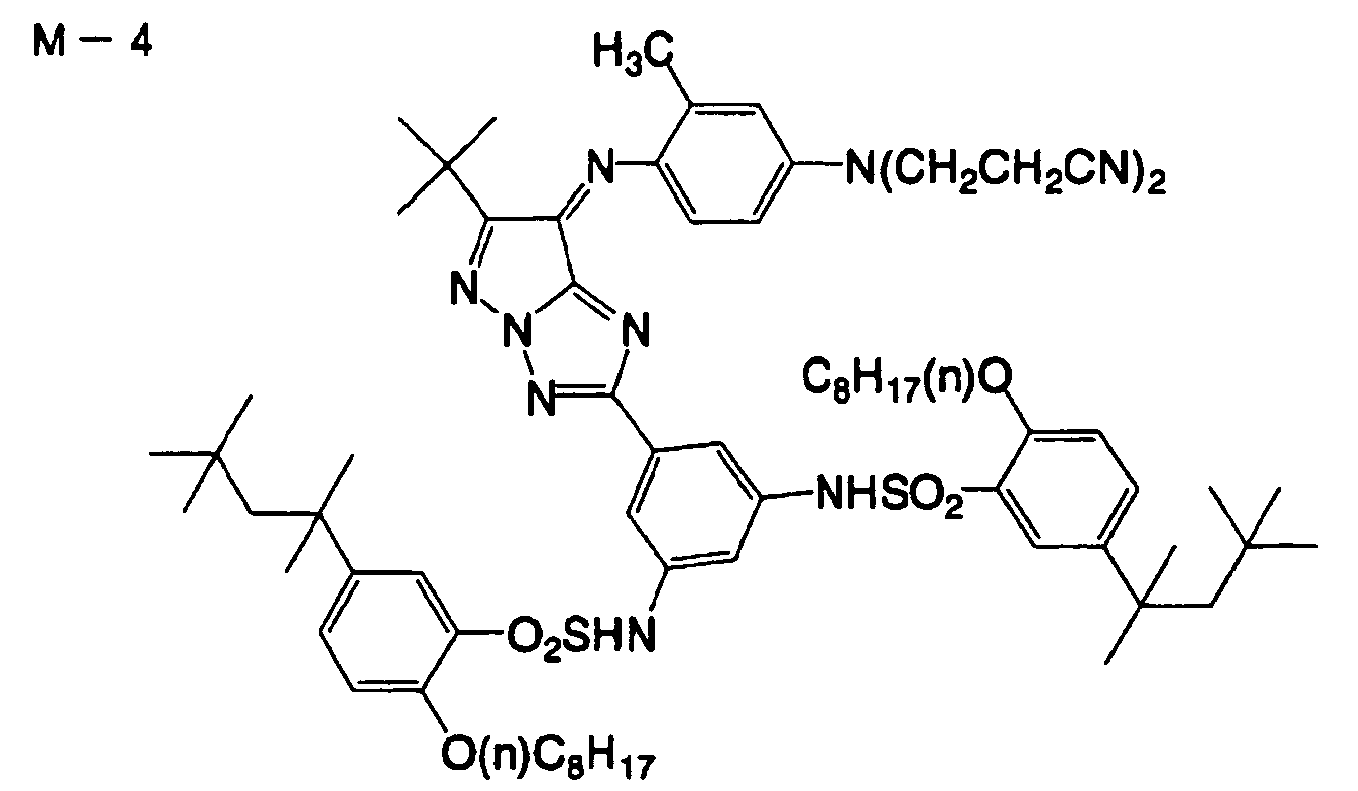


(Table 1) 
Dye R1 R2 R3 R4 a-21 A A 

a-22 
A 

a-23 
B 

a-24 


a-25 
C 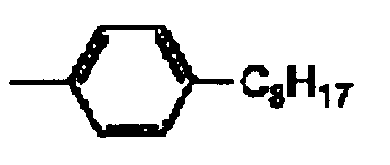
C8H17(t) 


- Other compound examples of the colorant that can be used in the present invention include those described in
JP-A-2001-240763 2001-181549 JP-A-2001-335714 - The compound represented by Formula (3) above may be synthesized by reference to a method described in, for example,
JP-A-2001-335714 JP-A-55-161856 JP-A-4-126772 JP-B-7-94180 JP-A-2001-240763 - Among the dyes represented by Formula (2) above, as a cyan dye a pyrrolotriazole azomethine dye represented by Formula (5) below is particularly preferably used.
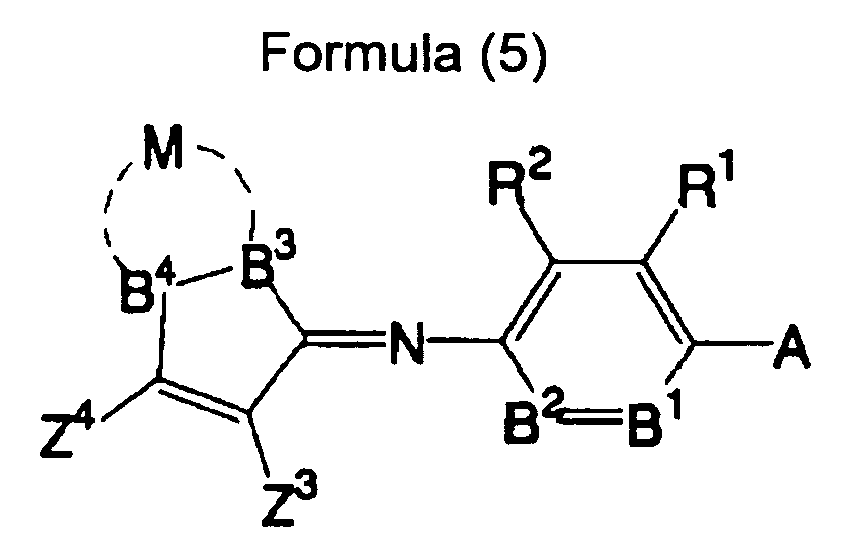
- In Formula (5) above, A, R1, R2, B1, and B2 are the same as the corresponding ones of Formula (2) above, and preferred ranges thereof are also the same.
- In Formula (5) above, Z3 and Z4 are independently the same as G in Formula (4) above. Z3 and Z4 may be bonded together to form a ring structure. One in which Z3 is an electron-attracting group having a Hammett substituent constant σp value of equal to or greater than 0.30 exhibits a sharp absorption and is more preferable. Moreover, one in which Z3 is an electron-attracting group having a Hammett substituent constant σp value of equal to or greater than 0.45 is more preferable, and an electron-attracting group having a Hammett substituent constant σp value of equal to or greater than 0.60 is most preferable. Furthermore, one in which the sum of the Hammett substituent constant σp values of Z3 and Z4 is equal to or greater than 0.70 exhibits excellent hue of a cyancolor, and is more preferable.
- In Formula (5) above, M is an atomic group forming a 1,2,4-triazole ring that is condensed with the 5-membered ring of Formula (5) above; either one of the two atoms B3 and B4 at the sites of condensation with the 5-membered ring is a nitrogen atom, and the other is a carbon atom.
- The compound represented by Formula (5) above is preferably used as a cyan dye, but it may be used as a magenta dye by changing a substituent.
- The Hammett substituent constant σp value used in the present specification is now explained. The Hammett rule is an empirical rule proposed by L. P. Hammett in 1935 in order to quantitatively deal with the influence of a substituent on a reaction or equilibrium of a benzene derivative, and the validity thereof is currently widely recognized. A σp value and a σm value are required for the substituent constant in the Hammett rule, and details of these values can be referred to in many general books, for example, 'Lange's Handbook of Chemistry', Ed. by J. A. Dean, 12th edition, 1979 (Mc Graw-Hill) or 'Kagakuno Ryouiki' (Journal of Japanese Chemistry), special issue, 122, pp. 96 to 103, 1979 (Nankodo Co., Ltd.). In the present invention, the substituents are limited or explained using the Hammett substituent constant σp, but this does not mean that they are limited to substituents whose values are described in published references, and a substituent whose value is not published in the references but is included in the range if it is measured in accordance with the Hammett rule is of course included. Among Formulae (1) to (5) above, those that are not benzene derivatives are also included, but the σp value is used as a scale showing the electronic effect of the substituent, irrespective of the position of substitution. The σp value in the present invention is used with the above-mentioned meaning.
- Examples of electron-attracting groups having a Hammett substituent constant σp value of equal to or greater than 0.60 include a cyano group, a nitro group, an alkylsulfonyl group (e.g. a methanesulfonyl group), and an arylsulfonyl group (e.g. a benzenesulfonyl group). Examples of electron-attracting groups having a Hammett σp value of equal to or greater than 0.45 include, in addition to the above, an acyl group (e.g. an acetyl group), an alkoxycarbonyl group (e.g. a dodecyloxycarbonyl group), an aryloxycarbonyl group (e.g. m-chlorophenoxycarbonyl), an alkylsulfinyl group (e.g. n-propylsulfinyl), an arylsulfinyl group (e.g. phenylsulfinyl), a sulfamoyl group (e.g. N-ethylsulfamoyl, N,N-dimethylsulfamoyl), and a haloalkyl group (e.g. trifluoromethyl).
- Examples of electron-attracting groups having a Hammett substituent constant σp value of equal to or greater than 0.30 include, in addition to the above, an acyloxy group (e.g. acetoxy), a carbamoyl group (e.g. N-ethylcarbamoyl, N,N-dibutylcarbamoyl), a haloalkoxy group (e.g. trifluoromethyloxy), a haloaryloxy group (e.g. pentafluorophenyloxy), a sulfonyloxy group (e.g. a methylsulfonyloxy group), a haloalkylthio group (e.g. difluoromethylthio), an aryl group substituted with two or more electron-attracting groups having a σp value of equal to or greater than 0.15 (e.g. 2,4-dinitrophenyl, pentachlorophenyl), and a hetero ring (e.g. 2-benzooxazolyl, 2-benzothiazolyl, 1-phenyl-2-benzimidazolyl). Specific examples of electron-attracting groups having a σp value of equal to or greater than 0.20 include, in addition to the above, a halogen atom.
- Furthermore, in the present invention, an oil-soluble dye represented by Formula (A-I) below can be used preferably.

- In Formula (A-I): X1, X2, X3, and X4 independently denote a group selected from -SO-Z, -SO2-Z, -SO2NR1R2, -CONR1R2, -CO2R,, and a sulfo group. Here, Z denotes a substituted or unsubstituted alkyl group, a substituted or unsubstituted cycloalkyl group, a substituted or unsubstituted alkenyl group, a substituted or unsubstituted aralkyl group, a substituted or unsubstituted aryl group, or a substituted or unsubstituted heterocyclic group. R1 and R2 independently denote a hydrogen atom, a substituted or unsubstituted alkyl group, a substituted or unsubstituted cycloalkyl group, a substituted or unsubstituted alkenyl group, a substituted or unsubstituted aralkyl group, a substituted or unsubstituted aryl group, or a substituted or unsubstituted heterocyclic group, provided that R1 and R2 are not both hydrogen atoms. M denotes a hydrogen atom, a metal element, a metal oxide, a metal hydroxide, or a metal halide. Y1, Y2, Y3, and Y4 independently denote a hydrogen atom or a monovalent substituent. a1 to a4 and b1 to b4 denote the numbers of X1 to X4 and Y1 to Y4, and independently denote an integer of 0 to 4, provided that the sum total of a1 to a4 is equal to or greater than 2.
- Among the oil-soluble dyes represented by Formula (A-I) above, an oil-soluble dye represented by Formula (A-II) below may particularly preferably be used.

- In Formula (A-II): X11 to X14, Y11 to Y18, and M are the same as X1 to X4, Y1 to Y4, and M in Formula (A-I) respectively. a11 to a14 independently denote an integer of 1 or 2.
- As a specific example of Formula (A-II) above, a compound example (All-17) is cited, but this is for explaining the present invention in detail, and the present invention should not be construed as being limited thereto.

Compound No. M X a AII-17 Cu 
1 AII-18 Cu 
1 AII-19 Cu 
1 AII-20 Cu 
1 AII-21 Cu 
1 AII-22 Cu 
1 AII-23 Cu 
1 - In the present invention, it is preferable to use an oil-soluble dye having an oxidation potential that is more noble than 1.0 V (SCE). The more noble the oxidation potential, the more preferable it is; it is more preferable to use one having an oxidation potential more noble than 1.1 V (SCE), and it is most preferable to use one having an oxidation potential more noble than 1.2 V (SCE).
- The oxidation potential value (Eox) can be easily measured by one skilled in the art and a method therefor is described in, for example, P. Delahay, 'New Instrumental Methods in Electrochemistry', Interscience Publishers (1954), A. J. Bard et al., 'Electrochemical Methods', John Wiley & Sons (1980), and Akira Fujishima et al., 'Denkikagaku Sokuteihou' (Electrochemical Measurement Methods), Gihodo Shuppan Sha (1984).
- More specifically, a test sample is dissolved to give a concentration of 1 x 10⁻⁴ to 1 x 10⁻⁶ mol/L in a solvent such as dimethylformamide or acetonitrile containing a supporting electrolyte such as sodium perchlorate or tetrapropylammonium perchlorate, an oxidation wave when sweeping toward the oxidation side (noble side) using carbon (GC) as a working electrode and a rotating platinum electrode as the counter electrode using cyclic voltammetry or direct current polarographic equipment is approximated to a straight line, and the oxidation potential of the midpoint of a line segment formed between an intersection point of the straight line and a residual current/potential straight line and an intersection point of the straight line and a saturated current straight line (or an intersection point with a straight line parallel to the ordinate passing through the potential peak value) is measured as a value relative to the SCE (saturated calomel electrode). This value sometimes deviates by on the order of tens of millivolts due to the effect of a liquid junction potential, the liquid resistance of the sample solution, or the like, but the reproducibility of the potential can be guaranteed by adding a standard sample (for example, hydroquinone). The support electrolyte and solvent used may be selected appropriately according to the oxidation potential and the solubility of the test sample. The support electrolyte and solvent that can be used here may be referred to in Akira Fujishima et al., 'Denkikagaku Sokuteihou' (Electrochemical Measurement Methods), Gihodo Shuppan Sha (1984), pp. 101 to 118.
- In the concentration range of the above-mentioned measurement solvent and a phthalocyanine compound sample, the oxidation potential of a disassociated state is measured.
- The value of Eox represents the ease of electron transfer from a sample to an electrode; the larger the value (the more noble the oxidation potential), the more difficult it is for electrons to transfer from the sample to the electrode, in other words, the more difficult it is to oxidize.
- If a dye having a low oxidation potential is used, polymerization is greatly inhibited by the dye, and the curability is degraded. When a dye having a noble oxidation potential is used, there is hardly any inhibition of polymerization.
- The colorant that can be used in the present invention is preferably added to the ink composition or the inkjet recording ink composition of the present invention and then dispersed in the ink to an appropriate degree. For dispersion of the colorant, for example, a dispersing machine such as a ball mill, a sand mill, an attritor, a roll mill, an agitator, a Henschel mixer, a colloidal mill, an ultrasonic homogenizer, a pearl mill, a wet type jet mill, or a paint shaker may be used.
- When carrying out dispersion of the colorant, a dispersant may be added. The type of dispersant is not particularly limited, but it is preferable to use a polymeric dispersant, and examples of the polymeric dispersant include the Solsperse series manufactured by Avecia. Furthermore, as a dispersion adjuvant, it is also possible to use a synergist, according to the various types of pigment. In the present invention, the dispersant and dispersion adjuvant are preferably added at 1 to 50 parts by weight relative to 100 parts by weight of the pigment.
- The colorant may be added directly to the ink composition of the present invention, but in order to improve dispersibility it may be added in advance to a solvent or a dispersing medium such as a polymerizable compound used in the present invention. In the present invention, in order to avoid the problem of the solvent resistance being degraded when the solvent remains in the cured image and the VOC (Volatile Organic Compound) problem of the residual solvent, it is preferable to add the colorant to a polymerizable compound. As a polymerizable compound used, it is preferable in terms of dispersion suitability to select a monomer having the lowest viscosity.
- In the present invention, it is preferable for the average particle size of the colorant particles to be in the range of 0.005 to 0.5 µm, more preferably 0.01 to 0.45 µm, and yet more preferably, 0.015 to 0.3 µm. Furthermore, the maximum particle size of the colorant is preferably 0.3 to 10 µm, and more preferably 0.3 to 3 µm. In order to make the maximum particle size of the colorant be in the above-mentioned range, the colorant, the dispersant, and the dispersing medium are selected, and dispersion conditions and filtration conditions are set. By such control of particle size, clogging of a head nozzle can be suppressed, and the ink storage stability, the ink transparency, and the curing sensitivity can be maintained.
- The colorant is preferably added to the ink composition at 1 to 20 wt % of the total weight of the ink composition, and more preferably 2 to 15 wt %.
- The ink composition of the present invention may comprise (D) a sensitizer for the purpose of improving the acid-generating efficiency of the acid-generating compound and increasing the wavelength at which it exhibits sensitivity. The sensitizer that can be used in the present invention is preferably one that sensitizes the acid-generating compound by virtue of an electron transfer mechanism or an energy transfer mechanism.
- Examples of the sensitizer that can be used in the present invention include those belonging to the types of compounds listed below and having an absorption wavelength in the wavelength region of 300 nm to 450 nm.
- Preferred examples of the sensitizer include those belonging to the types of compounds below and having an absorption wavelength at 350 nm to 450 nm.
- Examples include polynuclear aromatic compounds (e.g. phenanthrene, anthracene, pyrene, perylene, triphenylene, a 9,10-dialkoxyanthracene), xanthenes (e.g. fluorescein, eosin, erythrosine, rhodamine B, rose bengal), thioxanthones (e.g. isopropylthioxanthone, diethylthioxanthone, chlorothioxanthone), cyanines (e.g. thiacarbocyanine, oxacarbocyanine), merocyanines (e.g. merocyanine, carbomerocyanine), phthalocyanines, thiazines (e.g. thionine, methylene blue, toluidine blue), acridines (e.g. acridine orange, chloroflavin, acriflavin), anthraquinones (e.g. anthraquinone), squariums (e.g. squarium), acridine orange, coumarins (e.g. 7-diethylamino-4-methylcoumarin), ketocoumarin, phenothiazines, phenazines, styrylbenzenes, azo compounds, diphenylmethane, triphenylmethane, distyrylbenzenes, carbazoles, porphyrin, spiro compounds, quinacridone, indigo, styryl, pyrylium compounds, pyrromethene compounds, pyrazolotriazole compounds, benzothiazole compounds, barbituric acid derivatives, thiobarbituric acid derivatives, and compounds described in
EP No. 568,993 US Pat. Nos. 4,508,811 and5,227,227 ,JP-A-2001-125255 JP-A-11-271969 - Among them, the acid-generating compound of the present invention is preferably combined with a polynuclear aromatic compound (e.g. phenanthrene, anthracene, pyrene, perylene, triphenylene, a 9,10-dialkoxyanthracene), a thioxanthone, a distyrylbenzene, a styrylbenzene, or a carbazole from the viewpoint of initiation efficiency, and most preferably with a distyrylbenzene, a styrylbenzene, a diphenylbutadiene, or a carbazole.
- Furthermore, preferred examples of the sensitizer that can be used in the present invention include compounds having any one of the skeletons below.

- Preferred specific examples of the sensitizer that can be used in the present invention include the compounds below.


- From the viewpoint of the coloring properties of the ink, the content of the sensitizer (D) in the ink composition of the present invention is preferably 0.01 to 20 wt % relative to the entire weight of the ink composition, more preferably 0.1 to 15 wt %, and yet more preferably 0.5 to 10 wt %.
- The sensitizer (D) may be used singly or in a combination of two or more types.
- Furthermore, from the viewpoint of improvement in the decomposition ratio of the acid-generating compound and transparency to irradiating light, the ratio of the acid-generating compound (A) to the sensitizer (D) contained in the ink composition is preferably A/D = 100 to 0.05 as a ratio by weight, more preferably A/D = 50 to 0.1, and yet more preferably A/D = 10 to 0.5.
- The ink composition of the present invention preferably comprises a cosensitizer. In the present invention, the cosensitizer has the function of further improving the sensitivity of the sensitizing dye to actinic radiation or the function of suppressing inhibition by oxygen of polymerization of a polymerizable compound, etc.
- Examples of such a cosensitizer include amines such as compounds described in M. R. Sander et al., 'Journal of Polymer Society', Vol. 10, p. 3173 (1972),
JP-B-44-20189 JP-A-51-82102 JP-A-52-134692 JP-A-59-138205 JP-A-60-84305 JP-A-62-18537 JP-A-64-33104 - Other examples of the cosensitizer include thiols and sulfides such as thiol compounds described in
JP-A-53-702 JP-B-55-500806 JP-A-5-142772 JP-A-56-75643 - Yet other examples of the cosensitizer include amino acid compounds (e.g. N-phenylglycine, etc.), organometallic compounds described in
JP-B-48-42965 JP-B-55-34414 JP-A-6-308727 JP-A-6-250387 JP-A-8-54735 - The ink composition of the present invention may employ the cationically polymerizable compound (B) and another polymerizable compound in combination. Examples of polymerizable compounds that can be used in combination in the present invention include radically polymerizable compounds. As the radically polymerizable compounds, photocurable materials employing a photopolymerizable composition described in
JP-A-7-159983 JP-B-7-31399 JP-A-8-224982 JP-A-10-863 JP-A-9-80675 - The radically polymerizable compounds that can be used in the present invention are compounds having at least one radically polymerizable carbon-carbon double bond (ethylenically unsaturated bond), may be any compound as long as it has one radically polymerizable ethylenically unsaturated bond in the molecule, and include chemical configurations such as monomer, oligomer, and polymer. The radically polymerizable compounds may be used singly or may be used in a combination of two or more types at any ratio in order to improve desired properties.
- Examples of the polymerizable compound having a radically polymerizable ethylenically unsaturated bond include unsaturated carboxylic acids such as acrylic acid, methacrylic acid, itaconic acid, crotonic acid, isocrotonic acid, and maleic acid, and salts thereof, anhydrides having an ethylenically unsaturated group, acrylonitrile, styrene, and various types of radically polymerizable compounds such as unsaturated polyesters, unsaturated polyethers, unsaturated polyamides, and unsaturated urethanes.
- Specific examples thereof include acrylic acid derivatives such as 2-ethylhexyl acrylate, 2-hydroxyethyl acrylate, butoxyethyl acrylate, carbitol acrylate, cyclohexyl acrylate, tetrahydrofurfuryl acrylate, benzyl acrylate, diacetone acrylamide, and an epoxyacrylate; methacrylic derivatives such as methyl methacrylate, n-butyl methacrylate, 2-ethylhexyl methacrylate, lauryl methacrylate, allyl methacrylate, glycidyl methacrylate, benzyl methacrylate, and dimethylaminomethyl methacrylate; and allyl compound derivatives such as allyl glycidyl ether. More specifically, commercial products, radically polymerizable or crosslinking monomers, oligomers, and polymers known in the art such as those described in 'Kakyozai Handobukku' (Crosslinking Agent Handbook), Ed. S. Yamashita (Taiseisha, 1981); 'UV·EB Koka Handobukku' (UV·EB Curing Handbook (Starting Materials) Ed. K. Kato (Kobunshi Kankoukai, 1985); 'UV·EB Koka Gijutsu no Oyo to Shijyo' (Application and Market of UV·EB Curing Technology', p. 79, Ed. Rad Tech (CMC, 1989); and E. Takiyama 'Poriesuteru Jushi Handobukku' (Polyester Resin Handbook), (The Nikkan Kogyo Shimbun Ltd., 1988) can be used.
- It is preferable to use the radically polymerizable compound and the cationically polymerizable compound in combination since, due to high sensitivity characteristic of radical polymerization and low volume shrinkage characteristic of cationic polymerization, a printed material or a lithographic printing plate having both high sensitivity and adhesion is obtained.
- The ink composition of the present invention may employ (G) another polymerization initiator in combination. As said other polymerization initiator that can be used in the present invention, known radical polymerization initiators can be used in combination. These polymerization initiators may be used singly or in a combination of two or more types.
- The radical polymerization initiator that can be used in the ink composition of the present invention is a compound that forms a polymerization initiating species by absorbing external energy. The external energy used for initiating polymerization can be broadly divided into heat and actinic radiation, and a thermal polymerization initiator and a photopolymerization initiator are used respectively. Examples of the actinic radiation include γ rays, β rays, an electron beam, UV rays, visible light, and IR rays.
- Examples of the radical polymerization initiator that can be used in the present invention include (a) aromatic ketones, (b) aromatic onium salt compounds, (c) organic peroxides, (d) thio compounds, (e) hexaarylbiimidazole compounds, (f) ketoxime ester compounds, (g) borate compounds, (h) azinium compounds, (i) metallocene compounds, (j) active ester compounds, (k) compounds having a carbon-halogen bond, and (I) alkylamine compounds. These radical polymerization initiators may be used singly or in a combination of the above-mentioned compounds (a) to (I). The radical polymerization initiators of the present invention are suitably used singly or in a combination of two or more types.
- The ink composition of the present invention may comprise other components as necessary. Examples of the other components include basic compounds, polymerization inhibitors, and solvents.
- It is preferable to add the basic compound from the viewpoint of improving the storage stability of the ink composition. As the basic compound that can be used in the present invention, a known basic compound may be used and, for example, a basic inorganic compound such as an inorganic salt or a basic organic compound such as an amine is preferably used.
- It is preferable to add the polymerization inhibitor from the viewpoint of enhancing the storage stability. When the ink composition of the present invention is used as an inkjet recording ink composition, it is preferably heated in the range of 40°C to 80°C to thus make it less viscous and then discharged, and in order to prevent clogging of a head due to thermal polymerization it is preferable to add a polymerization inhibitor. The polymerization inhibitor is preferably added at 200 to 20,000 ppm relative to the total amount of the ink composition of the present invention. Examples of the polymerization inhibitor include hydroquinone, benzoquinone, p-methoxyphenol, TEMPO, TEMPOL, and Al cupferron.
- While taking into consideration the ink composition and the inkjet recording ink composition of the present invention being radiation curing type ink compositions, it is preferable for them not to contain any solvent so that the ink compositions can react quickly and be cured immediately after landing. However, as long as the curing speed, etc. of the ink composition is not affected, a specified solvent may be added. In the present invention, as a solvent, an organic solvent or water may be used. In particular, the organic solvent may be added in order to improve the adhesion to a recording medium (a support such as paper). Adding an organic solvent is effective since the problem with Volatile Organic Compound (VOC) can be avoided. The amount of organic solvent is preferably 0.1 to 5 wt % relative to the total amount of the ink composition of the present invention, and more preferably 0.1 to 3 wt %.
- As means for preventing the sensitivity from being degraded by a light blocking effect of the colorant, which may be added to the ink composition, a combination of a cationically polymerizable compound and a cationic polymerization initiator, a combination of a radically polymerizable compound and a radical polymerization initiator, or a radical/cationic hybrid curing ink combining a polymerizable compound and a polymerization initiator may be employed.
- In addition to the above, the ink composition of the present invention may contain a known compound as necessary. Examples thereof include a surfactant (cationic, anionic, nonionic, fluorine-based, silicon-based), a leveling additive, a matting agent and, for adjusting film physical properties, a polyester resin, polyurethane resin, vinyl resin, acrylic resin, rubber resin, or wax, which may be appropriately selected and added. Furthermore, in order to improve the adhesion to a recording medium such as a polyolefin or PET, a tackifier that does not inhibit polymerization is preferably added. Specific examples of the tackifier include high molecular weight tacky polymers described on pp. 5 and 6 of
JP-A-2001-49200 - The ink composition of the present invention comprises as described above (A) a compound represented by any one of Formulae (I) to (XI), (B) a cationically polymerizable compound, and (C) a colorant, etc. With regard to the content of these components relative to the total weight of the ink composition, the compound (A) represented by any one of Formulae (I) to (XI) is preferably 0.01 to 20 parts by weight, and more preferably 0.5 to 10 parts by weight, the cationically polymerizable compound (B) is preferably 10 to 95 wt %, more preferably 30 to 93 wt %, and yet more preferably 50 to 90 wt %, the colorant (C) is preferably 1 to 10 wt %, and more preferably 2 to 8 wt %, and each component is contained so that the total of the components, expressed as wt %, desirably becomes 100 wt %. Furthermore, needless to say, the ink composition of the present invention may comprise any component such as the sensitizer (D).
- When the ink composition thus obtained is used for inkjet recording, while taking into consideration dischargability, the viscosity of the ink composition at the discharge temperature (e.g. 25°C to 80°C, and preferably 25°C to 30°C) is preferably 7 to 30 mPa·s, and more preferably 7 to 20 mPa·s. For example, the ink composition of the present invention has a viscosity at room temperature (25°C to 30°C) of preferably 35 to 500 mPa·s, and more preferably 35 to 200 mPa·s. With regard to the ink composition of the present invention, it is preferable that its component ratio is appropriately adjusted so that the viscosity is in the above-mentioned range. When the viscosity at room temperature is set to be high, even when a porous recording medium is used, penetration of the ink into the recording medium can be prevented, uncured monomer can be reduced, and the odor can be reduced. Furthermore, ink spreading when ink droplets have landed can be suppressed, and as a result there is the advantage that the image quality is improved. When the viscosity at room temperature is set to be low, since it is unnecessary to heat the ink when discharging or it is possible to set the heating temperature at a relatively low temperature, there are the advantages that the load on inkjet equipment becomes small and the choice of inkjet heads that can be used is widened.
- The surface tension of the ink composition of the present invention is preferably 20 to 30 mN/m, and yet more preferably 23 to 28 mN/m. When recording is carried out on various types of recording medium such as polyolefin, PET, coated paper, and uncoated paper, from the viewpoint of spread and penetration, it is preferably at least 20 mN/m, and from the viewpoint of wettability it is preferably not more than 30 mN/m.
- The ink composition of the present invention is preferably used for inkjet recording.
- An inkjet recording method that can be suitably employed in the present invention is explained below.
- The present invention provides a method for forming an image by discharging the above-mentioned ink composition onto a recording medium (support, recording material, etc.) and curing the ink composition by irradiating the ink composition so discharged onto the recording medium with actinic radiation. That is, the present invention relates to an inkjet recording method comprising:
- (A') a step of discharging an ink composition onto a recording medium; and
- (B') a step of curing the ink composition by irradiating the ink composition so discharged with actinic radiation,
- The cured ink composition forms an image on the recording medium.
- The peak wavelength of the actinic radiation is preferably 200 to 600 nm, more preferably 300 to 450 nm, and yet more preferably 350 to 420 nm. The output of the actinic radiation is preferably no greater than 2,000 mJ/cm2, and is more preferably 10 to 2,000 mJ/cm2, yet more preferably 20 to 1,000 mJ/cm2, and particularly preferably 50 to 800 mJ/cm2.
- The inkjet recording method of the present invention is explained by taking as an example a process for producing a lithographic printing plate, the process comprising discharging an ink composition onto the lithographic printing plate so as to form an image.
- A process for producing a lithographic printing plate of the present invention comprises:
- (A") a step of discharging the ink composition of the present invention onto a hydrophilic support, and
- (B") a step of irradiating the discharged ink composition with radiation so as to cure the ink composition, thus forming a hydrophobic image on the hydrophilic support by curing the ink composition.
- The lithographic printing plate comprises a support and an image formed on the support.
- Conventionally, as the lithographic printing plate, a so-called PS plate in which an oleophilic photosensitive resin layer is provided on a hydrophilic support has been widely used. In a process for producing this PS plate, normally, after a mask exposure (surface exposure) is carried out via a lith film, non-exposed areas are dissolved and removed to give a desired printing plate. However, in recent years, a technique of digitizing image information using a computer by electronically processing, storing, and outputting the information has become widespread, and a new image output system that can be used for the above technique has been desired. In particular, a computer to plate (CTP) technique in which a printing plate is directly produced by scanning according to digitized image information with highly coherent light such as laser light without using a lith film has been developed.
- As a system for obtaining a lithographic printing plate that makes possible the above scanning exposure, a process for directly producing a lithographic printing plate using an ink composition or an inkjet recording ink composition can be cited. This process involves obtaining a printing plate having a desired image (preferably a hydrophobic image) by discharging an ink onto a support, and preferably a hydrophilic support, using an inkjet system, etc., and exposing this to actinic radiation so as to expose an area with the ink composition or the inkjet recording ink to light. The ink composition or the inkjet recording ink suitable for such a system is the ink composition or the inkjet recording ink of the present invention.
- The support (recording medium) onto which the ink composition or the inkjet recording ink composition of the present invention is discharged is not particularly limited, and a dimensionally stable sheet-form support may be used. The support is preferably a hydrophilic support. The support used in the lithographic printing plate of the present invention is not particularly limited, and a dimensionally stable sheet-form support may be used. It is preferable that a material forming the support has a hydrophilic surface. Examples of materials forming the support include paper, paper laminated with a plastic (e.g. polyethylene, polypropylene, polystyrene, etc.), a metal sheet (e.g. aluminum, zinc, copper, etc.), a plastic film (e.g. cellulose diacetate, cellulose triacetate, cellulose propionate, cellulose butyrate, cellulose acetate butyrate, cellulose nitrate, polyethylene terephthalate, polyethylene, polystyrene, polypropylene, polycarbonate, polyvinyl acetal, etc.), and paper or plastic film on which the above-mentioned metal is laminated or vapor-deposited. Preferred examples of the support include a polyester film and aluminum sheet. Among these, aluminum sheet is particularly preferable since the dimensional stability is good and it is relatively inexpensive.
- The aluminum sheet is a pure aluminum sheet, an alloy sheet containing aluminum as a main component and a small amount of a different element, or a thin film of aluminum or an aluminum alloy laminated with a plastic. Examples of the different element contained in the aluminum alloy include silicon, iron, manganese, copper, magnesium, chromium, zinc, bismuth, nickel, and titanium. The content of the different element in the alloy is preferably equal to or less than 10 wt %. In the present invention, a pure aluminum sheet is preferable, but since it is difficult to produce completely pure aluminum because of the refining technique, a trace amount of a different element may be contained. The composition of the aluminum sheet is not specified, and a known generally used material may be utilized as appropriate.
- The support preferably has a thickness of 0.1 to 0.6 mm, and more preferably 0.15 to 0.4 mm.
- Prior to the aluminum sheet being used, it is preferably subjected to a surface treatment such as a surface roughening treatment or an anodizing treatment. Surface treatment makes it easy to improve the hydrophilicity and ensure that there is good adhesion between an image recording layer and the support. Prior to the aluminum sheet being subjected to the surface roughening treatment, it may be subjected as desired to a degreasing treatment using a surfactant, an organic solvent, an aqueous alkaline solution, etc. in order to remove rolling oil on the surface.
- The surface roughening treatment for the aluminum sheet surface may be carried out by various types of methods, and examples thereof include a mechanical surface roughening treatment, an electrochemical surface roughening treatment (a surface roughening treatment involving dissolving the surface electrochemically), and a chemical surface roughening treatment (a surface roughening treatment involving selectively dissolving the surface chemically).
- As a method for the mechanical surface roughening treatment, a known method such as a ball grinding method, a brush grinding method, a blast grinding method, or a buff grinding method may be used. It is also possible to use a transfer method in which an irregular shape is transferred using a roller provided with irregularities in an aluminum rolling stage.
- As a method for the electrochemical surface roughening treatment, for example, a method in which alternating current or direct current is applied in an electrolyte solution containing an acid such as hydrochloric acid or nitric acid can be cited. It is also possible to employ a method as described in
JP-A-54-63902 - The aluminum sheet subjected to a surface roughening treatment is subjected as necessary to an alkali etching treatment using an aqueous solution of potassium hydroxide, sodium hydroxide, etc.; furthermore, after neutralization, it may be subjected to an anodizing treatment as desired in order to improve the abrasion resistance.
- As an electrolyte that may be used for the anodizing treatment of the aluminum sheet, various types of electrolytes that form a porous oxide film may be used. In general, sulfuric acid, hydrochloric acid, oxalic acid, chromic acid, or a mixed acid thereof may be used. The concentration of the electrolyte may be determined as appropriate according to the type of electrolyte.
- Conditions for the anodizing treatment depend on the type of electrolyte used and cannot be specified, but in general the electrolyte solution concentration is 1 to 80 wt %, the solution temperature is 5°C to 70°C, the current density is 5 to 60 A/dm2, the voltage is 1 to 100V, and the electrolysis time is 10 sec. to 5 min. The amount of anodized film formed is preferably 1.0 to 5.0 g/m2, and more preferably 1.5 to 4.0 g/m2. It is preferable for it to be in this range since good plate life and good scratch resistance of a non-image area of a lithographic printing plate can be obtained.
- As the support that can be used in the present invention, a substrate that has been subjected to the above-mentioned surface treatment and has an anodized film may be used as it is, but in order to further improve the adhesion to an upper layer, and the hydrophilicity, the contamination resistance, the thermal insulation, etc., the substrate may appropriately be subjected as necessary to a treatment for enlarging micropores of the anodized film, a sealing treatment, or a surface hydrophilization treatment involving immersion in an aqueous solution containing a hydrophilic compound, which are described in
JP-A-2001-253181 JP-A-2001-322365 - The sealing treatment may be vapor sealing, a treatment with an aqueous solution containing an inorganic fluorine compound such as a single treatment with fluorozirconic acid or a treatment with sodium fluoride, vapor sealing with added lithium chloride, or a sealing treatment with hot water.
- Among these, the sealing treatment with an aqueous solution containing an inorganic fluorine compound, the sealing treatment with vapor, and the sealing treatment with hot water are preferable. Each thereof is explained below.
- In the sealing treatment with an aqueous solution containing an inorganic fluorine compound, a metal fluoride can suitably be used as the inorganic fluorine compound.
- Specific examples thereof include sodium fluoride, potassium fluoride, calcium fluoride, magnesium fluoride, sodium fluorozirconate, potassium fluorozirconate, sodium fluorotitanate, potassium fluorotitanate, ammonium fluorozirconate, ammonium fluorotitanate, potassium fluorotitanate, fluorozirconic acid, fluorotitanic acid, hexafluorosilicic acid, nickel fluoride, iron fluoride, fluorophosphoric acid, and ammonium fluorophosphate. Among them, sodium fluorozirconate, sodium fluorotitanate, fluorozirconic acid, and fluorotitanic acid are preferable.
- The concentration of the inorganic fluorine compound in the aqueous solution is preferably at least 0.01 wt % from the viewpoint of sealing of micropores on an anodized coating being carried out sufficiently, and more preferably at least 0.05 wt %, and it is preferably no greater than 1 wt % from the viewpoint of contamination resistance, and more preferably no greater than 0.5 wt %.
- The aqueous solution containing an inorganic fluorine compound preferably further contains a phosphate compound. It is preferable for a phosphate compound to be contained since the hydrophilicity of the surface of the anodized coating improves and the machine developability and the contamination resistance can be improved.
- Preferred examples of the phosphate compound include phosphates of a metal such as an alkali metal or an alkaline earth metal.
- Specific examples thereof include zinc phosphate, aluminum phosphate, ammonium phosphate, ammonium phosphate dibasic, ammonium dihydrogen phosphate, potassium dihydrogen phosphate, potassium phosphate dibasic, calcium phosphate, ammonium sodium hydrogen phosphate, magnesium hydrogen phosphate, magnesium phosphate, ferrous phosphate, ferric phosphate, sodium dihydrogen phosphate, sodium phosphate, sodium phosphate dibasic, lead phosphate, calcium dihydrogen phosphate, lithium phosphate, phosphotungstic acid, ammonium phosphotungstate, sodium phosphotungstate, ammonium phosphomolybdate, sodium phosphomolybdate, sodium phosphite, sodium tripolyphosphate, and sodium pyrophosphate. Among these, sodium dihydrogen phosphate, sodium phosphate dibasic, potassium dihydrogen phosphate, and potassium phosphate dibasic are preferable.
- The combination of the inorganic fluorine compound and the phosphate compound is not particularly limited, but the aqueous solution preferably comprises at least sodium fluorozirconate as the inorganic fluorine compound and at least sodium dihydrogen phosphate as the phosphate compound.
- The concentration of the phosphate compound in the aqueous solution is preferably at least 0.01 wt % from the viewpoint of improving machine developability and contamination resistance, and more preferably at least 0.1 wt %, and it is preferably no greater than 20 wt % from the viewpoint of solubility, and more preferably no greater than 5 wt %.
- The proportion of each compound in the aqueous solution is not particularly limited, but the ratio by weight of the inorganic fluorine compound and the phosphate compound is preferably 1/200 to 10/1, and more preferably 1/30 to 2/1.
- Furthermore, the temperature of the aqueous solution is preferably at least 20°C, and more preferably at least 40°C, and it is preferably no higher than 100°C, and more preferably no higher than 80°C.
- Moreover, the pH of the aqueous solution is preferably at least 1, and more preferably at least 2, and it is preferably no greater than 11, and more preferably no greater than 5.
- A method for the sealing treatment with the aqueous solution containing an inorganic fluorine compound is not particularly limited and, for example, an immersion method and a spray method may be used. They may be employed once or a plurality of times, or in a combination of two or more types.
- Among these, the immersion method is preferable. When the treatment is carried out by the immersion method, the treatment time is preferably at least 1 sec., and more preferably at least 3 sec., and it is preferably no greater than 100 sec., and more preferably no greater than 20 sec.
- With regard to the sealing treatment with steam, for example, a method in which an anodized coating is contacted with steam at high pressure or normal pressure continuously or discontinuously can be cited.
- The temperature of the steam is preferably at least 80°C, and more preferably at least 95°C, and it is preferably no greater than 105°C.
- The pressure of the steam is preferably in the range of (atmospheric pressure - 50 mmAq) to (atmospheric pressure + 300 mmAq) (1.008 x 10⁵ to 1.043 x 10⁵ Pa).
- Furthermore, the time for which the coating is contacted with steam is preferably at least 1 sec., and more preferably at least 3 sec., and it is preferably no greater than 100 sec., and more preferably no greater than 20 sec.
- With regard to the sealing treatment with hot water, for example, a method in which an aluminum plate having an anodized coating formed thereon is immersed in hot water can be cited.
- The hot water may contain an inorganic salt (e.g. a phosphate) or an organic salt.
- The temperature of the hot water is preferably at least 80°C, and more preferably at least 95°C, and it is preferably no greater than 100°C.
- Furthermore, the time for which immersion in hot water is carried out is preferably at least 1 sec., and more preferably at least 3 sec., and it is preferably no greater than 100 sec., and more preferably no greater than 20 sec.
- With regard to a hydrophilization treatment that is used in the present invention, there is an alkali metal silicate method, as disclosed in
US Pat. Nos. 2,714,066 ,3,181,461 ,3,280,734 , and3,902,734 . In this method, a support is immersed in an aqueous solution of sodium silicate, etc., or subjected to electrolysis. In addition, there is a method in which a support is treated with potassium fluorozirconate, as described inJP-B-36-22063 Nos. 3,276,868 ,4,153,461 , and4,689,272 . - In the present invention, it is preferable for the support to have a center line average roughness of 0.10 to 1.2 µm. It is preferable for it to be in this range since good adhesion to an image recording layer, good plate life, and good contamination resistance can be obtained.
- When the ink composition or the inkjet recording ink composition of the present invention is discharged onto the surface of the above-mentioned hydrophilic support, the ink composition or the inkjet recording ink composition is preferably discharged after being heated to preferably 25°C to 80°C, and more preferably 25°C to 30°C, so as to reduce the viscosity of the ink composition to preferably 7 to 30 mPa·s, and more preferably 7 to 20 mPa·s. In particular, it is preferable to use the ink composition having an ink viscosity at 25°C of 35 to 500 mPa·s since a large effect can be obtained. By employing this method, high discharge stability can be realized. The radiation curing type ink composition such as the ink composition of the present invention generally has a viscosity that is higher than that of a normal ink composition or a water-based ink used for an inkjet recording ink, and variation in viscosity due to a change in temperature at the time of discharge is large. Viscosity variation in the ink has a large effect on changes in liquid droplet size and changes in liquid droplet discharge speed and, consequently, causes the image quality to be degraded. It is therefore necessary to maintain the ink discharge temperature as constant as possible. In the present invention, the control range for the temperature is desirably ±5°C of a set temperature, preferably ±2°C of the set temperature, and more preferably ±1°C of the set temperature.
- The ink composition discharged onto the surface of the hydrophilic support is cured by irradiating with actinic radiation. This results from a sensitizer in a polymerization initiation system contained in the above-mentioned ink composition of the present invention absorbing actinic radiation, attaining an excited state, and coming into contact with a polymerization initiator in the polymerization initiation system to thus decompose the polymerization initiator, and a polymerizable compound undergoing radical polymerization and being cured.
- The actinic radiation used in this process may include α rays, γ rays, an electron beam, X rays, UV rays, visible light, and IR rays. Although it depends on the absorption characteristics of the sensitizer, the peak wavelength of the actinic radiation is, for example, 200 to 600 nm, preferably 300 to 450 nm, and more preferably 350 to 450 nm. Furthermore, in the present invention, the polymerization initiation system has sufficient sensitivity for low output actinic radiation. The output of the actinic radiation as irradiation energy is preferably 2,000 mJ/cm2 or less, more preferably 10 to 2,000 mJ/cm2, yet more preferably 20 to 1,000 mJ/cm2, and particularly preferably 50 to 800 mJ/cm2. Moreover, the actinic radiation is applied so that the illumination intensity on the exposed surface is, for example, 10 to 2,000 mW/cm2, and preferably 20 to 1,000 mW/cm2.
- The ink composition of the present invention is desirably exposed to such actinic radiation for, for example, 0.01 to 120 sec., and preferably 0.1 to 90 sec.
- Irradiation conditions and a basic method for irradiation with actinic radiation are disclosed in
JP-A-60-132767 - Furthermore, curing may be completed using another light source that is not driven.
WO99/54415 - By employing such a recording method, it is possible to maintain a uniform dot diameter for landed ink even for various types of recording media having different surface wettability, thereby improving the image quality. In order to obtain a color image, it is preferable to superimpose colors in order from those with a low lightness. By superimposing inks in order from one with low lightness, it is easy for radiation to reach a lower ink, the curing sensitivity is good, the amount of residual monomer decreases, and an improvement in adhesion can be expected. Furthermore, although it is possible to discharge all colors and then expose them at the same time, it is preferable to expose one color at a time from the viewpoint of promoting curing.
- In this way, the above-mentioned ink composition of the present invention is cured by irradiation with actinic radiation to thus form a hydrophobic image on the surface of the hydrophilic support.
- The inkjet recording device used in the present invention is not particularly restricted, and a commercial inkjet recording device may be used. That is, in the present invention, recording on a recording medium may be carried out using a commercial inkjet recording device.
- The inkjet recording device that can be used in the present invention is equipped with, for example, an ink supply system, a temperature sensor, and an actinic radiation source.
- The ink supply comprises, for example, a main tank containing the ink composition of the present invention, a supply pipe, an ink supply tank immediately before an inkjet head, a filter, and a piezo system inkjet head. The piezo system inkjet head may be driven so as to discharge a multisize dot of preferably 1 to 100 pL, more preferably 8 to 30 pL, at a resolution of preferably 320 x 320 to 4,000 x 4,000dpi, more preferably 400 x 400 to 1,600 x 1,600dpi, and yet more preferably 720 x 720 dpi. Here, dpi referred to in the present invention means the number of dots per 2.54 cm.
- As described above, since it is desirable for the radiation curing type ink to be discharged at a constant temperature, a section from the ink supply tank to the inkjet head is thermally insulated and heated. A method of controlling temperature is not particularly limited, but it is preferable to provide, for example, temperature sensors at a plurality of pipe section positions, and control heating according to the ink flow rate and the temperature of the surroundings. The temperature sensors may be provided on the ink supply tank and in the vicinity of the inkjet head nozzle. Furthermore, the head unit that is to be heated is preferably thermally shielded or insulated so that the device main body is not influenced by the temperature of the outside air. In order to reduce the printer start-up time required for heating, or in order to reduce the thermal energy loss, it is preferable to thermally insulate the head unit from other sections and also to reduce the heat capacity of the entire heated unit.
- As an actinic radiation source, a mercury lamp, a gas/solid laser, etc. are mainly used, and for UV photocuring inkjet a mercury lamp and a metal halide lamp are widely known. However, from the viewpoint of protection of the environment, there has recently been a strong desire for mercury not to be used, and replacement by a GaN semiconductor UV light emitting device is very useful from industrial and environmental viewpoints. Furthermore, LEDs (UV-LED) and LDs (UV-LD) have small dimensions, long life, high efficiency, and low cost, there is moreover little damage to a substrate by heat generation, and their use as a photocuring inkjet light source can therefore be expected.
- Furthermore, light-emitting diodes (LED) and laser diodes (LD) may be used as a source of actinic radiation. In particular, when a UV ray source is needed, a UV-LED or a UV-LD may be used. For example, Nichia Corporation has marketed a violet LED having a main emission spectrum wavelength of between 365 nm and 420 nm. Furthermore, when a shorter wavelength is needed,
US Pat. No. 6,084,250 discloses an LED that can emit actinic radiation whose wavelength is centered between 300 nm and 370 nm. Furthermore, another violet LED is available, and irradiation can be carried out with radiation of a different UV bandwidth. The actinic radiation source particularly preferable in the present invention is a UV-LED, and a UV-LED having a peak wavelength at 350 to 420 nm is particularly preferable. - The maximum illumination intensity of the LED on a recording medium is preferably 10 to 2,000 mW/cm2, more preferably 20 to 1,000 mW/cm2, and particularly preferably 50 to 800 mJ/cm2.
- The present invention is explained in further detail by reference to Examples and Comparative Examples. However, the present invention should not be construed as being limited to these Examples.
- Pigment dispersions 1 of each of yellow, magenta, cyan, black, and white were prepared according to the method below. Dispersion conditions were appropriately adjusted using a known dispersing device so that the average particle size of the pigment particles in each case was in the range of 0.2 to 0.3 µm, and subsequently they were filtered using a filter while heating.
Yellow pigment dispersion 1 (C) Cl Pigment Yellow 13 20 parts by weight Polymeric dispersant (Solsperse series, manufactured by Zeneca) 20 parts by weight (B) OXT-221 (manufactured by Toagosei Co., Ltd.) 60 parts by weight Magenta pigment dispersion 1 (C) Cl Pigment Red 57:1 20 parts by weight Polymeric dispersant (Solsperse series, manufactured by Zeneca) 20 parts by weight (B) OXT-221 (manufactured by Toagosei Co., Ltd.) 60 parts by weight Cyan pigment dispersion 1 (C) Cl Pigment Blue 15:3 20 parts by weight Polymeric dispersant (Solsperse series, manufactured by Zeneca) 20 parts by weight (B) OXT-221 (manufactured by Toagosei Co., Ltd.) 60 parts by weight Black pigment dispersion 1 (C) Cl Pigment Black 7 20 parts by weight Polymeric dispersant (Solsperse series, manufactured by Zeneca) 20 parts by weight (B) OXT-221 (manufactured by Toagosei Co., Ltd.) 60 parts by weight White pigment dispersion 1 (C) Titanium oxide (average particle size 0.15 µm, refractive index 2.52) 25.00 parts by weight Neutral polymer dispersant PB822 (manufactured by Ajinomoto-Fine-Techno Co. Inc.) 14 parts by weight Fluorescent whitening agent Uvitex-OB (manufactured by Ciba) 1.00 part by weight (B) OXT-221 (manufactured by Toagosei Co., Ltd.) 60 parts by weight -
Yellow ink 1 Yellow pigment dispersion 1 (containing (C)) 5 parts by weight (A) Acid-generating compound A below 6 parts by weight (D) Sensitizer: 9,10-dibutoxyanthracene 3 parts by weight (B) Polymerizable compounds Monomer: 3,4-epoxycyclohexylmethyl-3',4'-epoxycyclohexanecarboxylate (Celloxide 2021A: manufactured by Daicel-UCB Co., Ltd.) 40 parts by weight Monomer: 3,7-bis(3-oxetanyl)-5-oxanonane (OXT-221: manufactured by Toagosei Co., Ltd.) 45 parts by weight Surfactant: BYK307 (manufactured by BYK Chemie) 1 part by weight 
Magenta ink 1 Magenta pigment dispersion 1 (containing (C)) 5 parts by weight (A) Acid-generating compound A above 6 parts by weight (B) Polymerizable compounds Monomer: 3,4-epoxycyclohexylmethyl-3',4'-epoxycyclohexanecarboxylate (Celloxide 2021A: manufactured by Daicel-UCB Co., Ltd.) 40 parts by weight Monomer: 3,7-bis(3-oxetanyl)-5-oxanonane (OXT-221: manufactured by Toagosei Co., Ltd.) 48 parts by weight Surfactant: BYK307 (manufactured by BYK Chemie) 1 part by weight Cyan ink 1 Cyan pigment dispersion 1 (containing (C)) 5 parts by weight (A) Acid-generating compound A above 6 parts by weight (B) Polymerizable compounds Monomer: 3,4-epoxycyclohexylmethyl-3',4'-epoxycyclohexanecarboxylate (Celloxide 2021A: manufactured by Daicel-UCB Co., Ltd.) 40 parts by weight Monomer: 3,7-bis(3-oxetanyl)-5-oxanonane (OXT-221: manufactured by Toagosei Co., Ltd.) 48 parts by weight Surfactant: BYK307 (manufactured by BYK Chemie) 1 part by weight Black ink 1 Black pigment dispersion 1 (containing (C)) 5 parts by weight (A) Acid-generating compound A above 6 parts by weight (B) Polymerizable compounds Monomer: 3,4-epoxycyclohexylmethyl-3',4'-epoxycyclohexanecarboxylate (Celloxide 2021A: manufactured by Daicel-UCB Co., Ltd.) 40 parts by weight Monomer: 3,7-bis(3-oxetanyl)-5-oxanonane (OXT-221: manufactured by Toagosei Co., Ltd.) 48 parts by weight Surfactant: BYK307 (manufactured by BYK Chemie) 1 part by weight White ink 1 White pigment dispersion 1 (containing (C)) 5 parts by weight (A) Acid-generating compound A above 6 parts by weight (B) Polymerizable compounds Monomer: 3,4-epoxycyclohexylmethyl-3',4'-epoxycyclohexanecarboxylate (Celloxide 2021A: manufactured by Daicel-UCB Co., Ltd.) 40 parts by weight Monomer: 3,7-bis(3-oxetanyl)-5-oxanonane (OXT-221: manufactured by Toagosei Co., Ltd.) 48 parts by weight Surfactant: BYK307 (manufactured by BYK Chemie) 1 part by weight - Inks 1 of each color prepared above were filtered using a filter having an absolute filtration accuracy of 2 µm to give Inks 1 of each color.
- Subsequently, recording was carried out on a recording medium using a commercial inkjet recording device having a piezo system inkjet nozzle. The ink supply system comprised a main tank, a supply pipe, an ink supply tank immediately before an inkjet head, a filter, and a piezo system inkjet head, and a section from the ink supply tank to the inkjet head was thermally insulated and heated. Temperature sensors were provided on the ink supply tank and in the vicinity of the nozzle of the inkjet head, and the temperature was controlled so that the nozzle section was always at 70°C ±2°C. The piezo system inkjet head was driven so as to discharge multisize dots of 8 to 30 pL at a resolution of 720 x 720 dpi. The exposure system, the main scanning speed, and the discharge frequency were adjusted so that, after landing, UV light was focused to give an exposure area illumination intensity of 100 mW/cm2, and irradiation started 0.1 sec. after the ink landed on the recording medium. Furthermore, the exposure time was made variable, and exposure energy was applied. Here, dpi referred to in the present invention denotes the number of dots per 2.54 cm.
- The inks of each color prepared above were discharged at an environmental temperature of 25°C in the order black → cyan → magenta → yellow → white, and irradiation with ultraviolet rays was carried out using a VZero 085 metal halide lamp manufactured by Integration Technology after each color was discharged. As an energy level that could completely cure the inks so that tackiness disappeared when touched by hand, the total exposure energy per color was 50 mJ/cm2 for all the colors. As recording media, a grained aluminum support, a transparent biaxially stretched polypropylene film whose surface had been treated so as to impart printability, a soft vinyl chloride sheet, a cast coat paper, and a commercial recycled paper were used, each color image was recorded, and an image having high resolution without dot spreading was obtained in all cases. Furthermore, for high quality paper, the ink did not penetrate to the reverse side, the ink was sufficiently cured, and there was hardly any odor of unreacted monomer. Moreover, the ink recorded on the film had sufficient flexibility, the ink did not crack when bent, and there was no problem in an adhesion test involving peeling with Sellotape (trademark).
- Magenta inks 2 to 11 were prepared in accordance with the methods described below.
- Magenta ink 2 was prepared in the same manner as for Magenta ink 1 except that Acid-generating compound B below was used instead of Acid-generating compound A above.

- Magenta ink 3 was prepared in the same manner as for Magenta ink 1 except that Acid-generating compound C below was used instead of Acid-generating compound A above.

- Magenta ink 4 was prepared in the same manner as for Magenta ink 1 except that Acid-generating compound D below was used instead of Acid-generating compound A above.
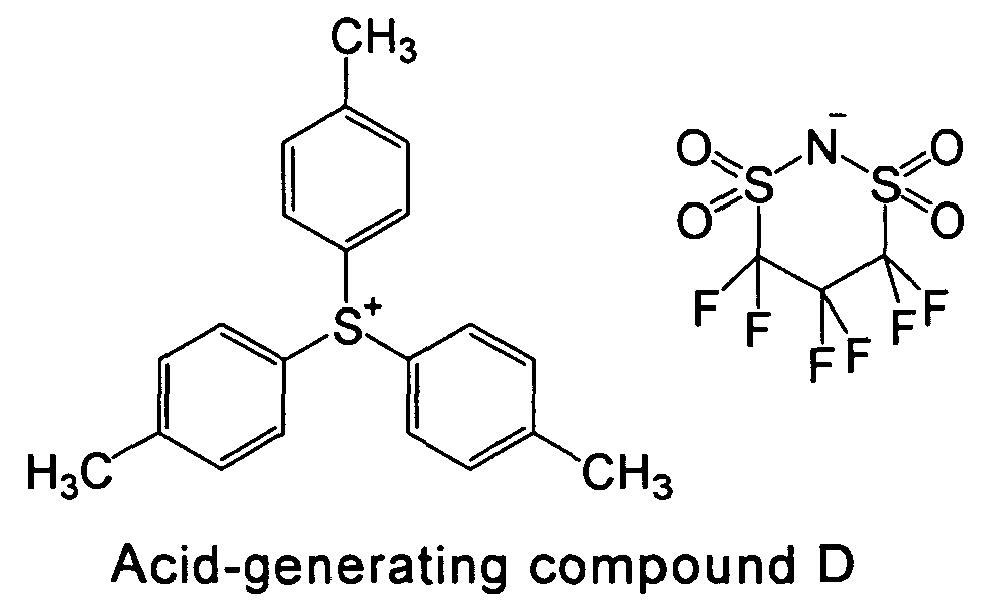
- Magenta ink 5 was prepared in the same manner as for Magenta ink 1 except that Acid-generating compound E below was used instead of Acid-generating compound A above.

- Magenta ink 6 was prepared in the same manner as for Magenta ink 1 except that Acid-generating compound F below was used instead of Acid-generating compound A above.

- Magenta ink 7 was prepared in the same manner as for Magenta ink 1 except that Acid-generating compound G below was used instead of Acid-generating compound A above.

- Magenta ink 8 was prepared in the same manner as for Magenta ink 1 except that Acid-generating compound H below was used instead of Acid-generating compound A above.

- Magenta ink 9 was prepared in the same manner as for Magenta ink 1 except that 3 parts by weight of 9,10-dibutoxyanthracene was added to Magenta ink 1.
-
Magenta pigment dispersion 1 (containing (C)) 5 parts by weight (A) Acid-generating compound A above 6 parts by weight (B) Polymerizable compounds Cationically polymerizable monomer: 3,4-epoxycyclohexylmethyl-3',4'-epoxycyclohexanecarboxylate (Celloxide 2021A: manufactured by Daicel-UCB Co., Ltd.) 30 parts by weight Cationically polymerizable monomer: 3,7-bis(3-oxetanyl)-5-oxanonane (OXT-221: manufactured by Toagosei Co., Ltd.) 48 parts by weight Radically polymerizable monomer: 1,6-hexanediol diacrylate 10 parts by weight -
Magenta pigment dispersion 1 (containing (C)) 5 parts by weight UVI-6992 (manufactured by The Dow Chemical Company) 6 parts by weight (B) Polymerizable compounds Monomer: 3,4-epoxycyclohexylmethyl-3',4'-epoxycyclohexanecarboxylate (Celloxide 2021A: manufactured by Daicel-UCB Co., Ltd.) 40 parts by weight Monomer: 3,7-bis(3-oxetanyl)-5-oxanonane (OXT-221: manufactured by Toagosei Co., Ltd.) 48 parts by weight Surfactant: BYK307 (manufactured by BYK Chemie) 1 part by weight 
-
Magenta pigment dispersion 1 (containing (C)) 5 parts by weight Tri-p-tolylsulfonium hexafluorophosphate (manufactured by Tokyo Chemical Industry Co., Ltd.) 6 parts by weight (B) Polymerizable compounds Monomer: 3,4-epoxycyclohexylmethyl-3',4'-epoxycyclohexanecarboxylate (Celloxide 2021A: manufactured by Daicel-UCB Co., Ltd.) 40 parts by weight Monomer: 3,7-bis(3-oxetanyl)-5-oxanonane (OXT-221: manufactured by Toagosei Co., Ltd.) 48 parts by weight Surfactant: BYK307 (manufactured by BYK Chemie) 1 part by weight - Magenta ink 13 was prepared in the same manner as for Magenta ink 11 except that Irgacure 250 (manufactured by Ciba Specialty Chemicals) was used instead of the initiator UVI-6992 (manufactured by The Dow Chemical Company).

- Magenta ink 14 was prepared in the same manner as for Magenta ink 11 except that 3 parts by weight of 9,10-dibutoxyanthracene was added to Magenta ink 11.
- Crude magenta inks 2 to 14 prepared as described above were filtered using a filter having an absolute filtration accuracy of 2 µm to give Magenta inks 2 to 14.
- Magenta ink 15 was prepared in the same manner as for magenta ink 1 except that instead of Cl pigment red 57:1 Compound M-1 below (oxidation potential +1.37 V) was used as an oil-soluble dye, and filtration was carried out using a filter having an absolute filtration accuracy of 2 µm.

- Magenta ink 16 was prepared in the same manner as for magenta ink 1 except that instead of Cl pigment red 57:1 Compound M-2 below (oxidation potential +0.94 V) was used as an oil-soluble dye, and filtration was carried out using a filter having an absolute filtration accuracy of 2 µm.

- A magenta image was printed by the same method as described in Example 1 using the magenta inks 2 to 16 prepared above.
- A magenta image was formed using Magenta ink 9 by the same method as in Example 1 except that a UV light-emitting diode (UV-LED) was used instead of the VZero 085 metal halide lamp manufactured by Integration Technology.
- In this embodiment, an NCCU033 manufactured by Nichia Corporation was used as the UV-LED. The LED emits UV light at a wavelength of 365 nm from 1 chip, and by applying a current of about 500 mA, light of about 100 mW is emitted from the chip. A plurality thereof were aligned at intervals of 7 mm to give a power of 0.3 W/cm2 on the surface of a recording medium (hereinafter, also called a medium). The time from landing to irradiation and the exposure time can be varied by the transport speed of the medium and the distance between a head and the LED in the transport direction. In this embodiment, irradiation was carried out about 0.5 sec. after landing.
- The exposure energy on the medium was adjustable in the range of 0.01 to 15 J/cm2 by setting the distance from the medium and the transport speed.
- A magenta image was formed in the same manner as in Example 13 using Magenta ink 14.
- Subsequently, with regard to each of the images thus formed, the sensitivity required for curing, penetration into commercial recycled paper, ink spread on a grained aluminum support, adhesion, plate life, and storage stability were evaluated in accordance with the methods described below.
- High quality paper was superimposed on a printed sample immediately after exposure, they were passed through pressure rollers (50 kg/cm2), transfer of coloring material onto the high quality paper was evaluated, and the exposure energy intensity (mJ/cm2) when transfer did not occur was defined as the curing sensitivity. The smaller the value, the higher the sensitivity.
- After storing the prepared ink at 75%RH and 60°C for 3 days, the ink viscosity at the discharge temperature was measured, and an increase in the ink viscosity was expressed as a viscosity ratio (after storage/before storage). When the viscosity was unchanged and the ratio was close to 1.0, the storage stability was good, and if the ratio exceeded 1.5, clogging might undesirably be caused during discharge.
- A sample printed at the lowest energy that caused no transfer for each ink was stored at 23°C for 1 day and then bent through 180°, and the presence or absence of cracks in the cured film was examined and evaluated as follows. The evaluation results are given in Table 2.
- Good: no change
- Fair: small cracks occurred in the bent portion.
- Poor: cured film peeled off in the bent portion.
- An ink comprising the above-mentioned ink composition without the pigment dispersion was conditioned by stirring for 30 minutes and filtered using a filter having an absolute filtration accuracy of 2 µm; the presence or absence of a precipitate was evaluated as follows, and the solubility was evaluated.
- Good: no precipitate
- Fair: small amount of precipitate
- Poor: some precipitate
- With regard to the printed images formed above, a completely undamaged sample and a sample whose printed surface was crosshatched with 11 cuts in both lengthwise and widthwise directions at intervals of 1 mm in accordance with JIS K 5400 to give 100 1 mm squares were prepared, Sellotape (trademark) was affixed to the surface of each sample and peeled off quickly at an angle of 90 degrees, and the condition of the remaining printed image that had not been peeled off was evaluated in accordance with the criteria below.
- Good: printed image was not peeled off at all in the crosshatch test.
- Fair: the ink was slightly peeled off in the crosshatch test, but unless the ink surface was damaged little was peeled off.
- Poor: easily peeled off by Sellotape (trademark) under both conditions.
- An image printed on a grained aluminum support prepared above was used as a printing plate, printing was carried out using a Heidel KOR-D machine, and a relative comparison of the number of prints completed was used as an index for the plate life (the number obtained for Example 1 was defined as 100). The larger the number, the longer the plate life, which is preferable.
- Evaluation results for magenta images formed in Examples 1 to 13 and Comparative Examples 1 to 5 are given in Table 2 below.
(Table 2) Example Ink No. Curing sensitivity (mJ/cm2) Thermal stability Solubility Adhesion Plate life Ex. 1 Magenta 1 50 1.1 Good Good 100 Ex. 2 Magenta 2 40 1.1 Good Good 120 Ex. 3 Magenta 3 40 1.1 Good Good 120 Ex. 4 Magenta 4 60 1.1 Good Good 90 Ex. 5 Magenta 5 40 1.1 Good Good 120 Ex. 6 Magenta 6 40 1.1 Good Good 120 Ex. 7 Magenta 7 40 1.3 Good Good 120 Ex. 8 Magenta 8 60 1.3 Good Good 90 Ex. 9 Magenta 9 30 1.2 Good Good 150 Ex. 10 Magenta 10 30 1.2 Good Good 150 Ex. 11 Magenta 15 40 1.2 Good Good 120 Ex. 12 Magenta 16 30 1.2 Good Good 150 Ex. 13 Magenta 9 30 1.2 Good Good 150 Comp. Ex. 1 Magenta 11 100 1.3 Fair Fair 50 Comp. Ex. 2 Magenta 12 120 1.3 Poor Fair 40 Comp. Ex. 3 Magenta 13 80 1.5 Fair Fair 70 Comp. Ex. 4 Magenta 14 80 1.5 Fair Fair 70 Comp. Ex. 5 Magenta 14 80 1.5 Fair Fair 70 - It can be seen from Table 2 that the ink composition of the present invention that comprises an acid-generating compound having an anion represented by Formula (I) or (II), (B) a cationically polymerizable compound, and (C) a colorant is highly sensitive to irradiation with radiation and has good thermal stability.
- With regard to the onium compounds, the starting materials below were converted to anions using a base (ref. a method described in Sold State lonics, 60, (1993), 87-92, etc.), and then subjected to salt exchange (ref. a method described in
JP-A-2004-315430 


- Pigment dispersions 2 of each of yellow, magenta, cyan, black, and white were prepared according to the method below. Dispersion conditions were appropriately adjusted using a known dispersing device so that the average particle size of the pigment particles in each case was in the range of 0.2 to 0.3 µm, and subsequently they were filtered using a filter while heating.
-
(C) Cl Pigment Yellow 13 20 parts by weight Polymeric dispersant (Solsperse series, manufactured by Zeneca) 20 parts by weight (B) OXT-221 (manufactured by Toagosei Co., Ltd.) 60 parts by weight -
(C) Cl Pigment Red 57:1 20 parts by weight Polymeric dispersant (Solsperse series, manufactured by Zeneca) 20 parts by weight (B) OXT-221 (manufactured by Toagosei Co., Ltd.) 60 parts by weight -
(C) Cl Pigment Blue 15:3 20 parts by weight Polymeric dispersant (Solsperse series, manufactured by Zeneca) 20 parts by weight (B) OXT-221 (manufactured by Toagosei Co., Ltd.) 60 parts by weight -
(C) Cl Pigment Black 7 20 parts by weight Polymeric dispersant (Solsperse series, manufactured by Zeneca) 20 parts by weight (B) OXT-221 (manufactured by Toagosei Co., Ltd.) 60 parts by weight -
(C) Titanium oxide (average particle size 0.15 µm, refractive index 2.52) 25.00 parts by weight Neutral polymer dispersant PB822 (manufactured by Ajinomoto-Fine-Techno Co., Inc.) 14 parts by weight (B) OXT-221 (manufactured by Toagosei Co., Ltd.) 60 parts by weight -
Yellow pigment dispersion 2 5 parts by weight (A) Acid-generating compound I below 6 parts by weight (D) Sensitizing colorant: 9,10-dibutoxyanthracene 3 parts by weight (B) Polymerizable compounds Monomer: 3,4-epoxycyclohexylmethyl-3',4'-epoxycyclohexanecarboxylate (Celloxide 2021A: manufactured by Daicel-UCB Co., Ltd.) 40 parts by weight Monomer: 3,7-bis(3-oxetanyl)-5-oxanonane (OXT-221: manufactured by Toagosei Co., Ltd.) 45 parts by weight Surfactant: BYK307 (manufactured by BYK Chemie) 1 part by weight 
-
Magenta pigment dispersion 2 5 parts by weight (A) Acid-generating compound I above 6 parts by weight (B) Polymerizable compounds Monomer: 3,4-epoxycyclohexylmethyl-3',4'-epoxycyclohexanecarboxylate (Celloxide 2021A: manufactured by Daicel-UCB Co., Ltd.) 40 parts by weight Monomer: 3,7-bis(3-oxetanyl)-5-oxanonane (OXT-221: manufactured by Toagosei Co., Ltd.) 48 parts by weight Surfactant: BYK307 (manufactured by BYK Chemie) 1 part by weight -
Cyan pigment dispersion 2 5 parts by weight (A) Acid-generating compound I above 6 parts by weight (B) Polymerizable compounds Monomer: 3,4-epoxycyclohexylmethyl-3',4'-epoxycyclohexanecarboxylate (Celloxide 2021A: manufactured by Daicel-UCB Co., Ltd.) 40 parts by weight Monomer: 3,7-bis(3-oxetanyl)-5-oxanonane (OXT-221: manufactured by Toagosei Co., Ltd.) 48 parts by weight Surfactant: BYK307 (manufactured by BYK Chemie) 1 part by weight -
Black pigment dispersion 2 5 parts by weight (A) Acid-generating compound I above 6 parts by weight (B) Polymerizable compounds Monomer: ,3,4-epoxycyclohexylmethyl-3',4'-epoxycyclohexanecarboxylate (Celloxide 2021A: manufactured by Daicel-UCB Co., Ltd.) 40 parts by weight Monomer: 3,7-bis(3-oxetanyl)-5-oxanonane (OXT-221: manufactured by Toagosei Co., Ltd.) 48 parts by weight Surfactant: BYK307 (manufactured by BYK Chemie) 1 part by weight -
White pigment dispersion 2 5 parts by weight (A) Acid-generating compound I above 6 parts by weight (B) Polymerizable compounds Monomer: 3,4-epoxycyclohexylmethyl-3',4'-epoxycyclohexanecarboxylate (Celloxide 2021A: manufactured by Daicel-UCB Co., Ltd.) 40 parts by weight Monomer: 3,7-bis(3-oxetanyl)-5-oxanonane (OXT-221.: manufactured by Toagosei Co., Ltd.) 48 parts by weight Surfactant: BYK307 (manufactured by BYK Chemie) 1 part by weight - Yellow ink 2, Magenta ink 17, Cyan ink 2, Black ink 2, and White ink 2 prepared above were filtered using a filter having an absolute filtration accuracy of 2 µm to give Inks of each color.
- Subsequently, recording was carried out on a recording medium using a commercial inkjet recording device having a piezo system inkjet nozzle. The ink supply system comprised a main tank, a supply pipe, an ink supply tank immediately before an inkjet head, a filter, and a piezo system inkjet head, and a section from the ink supply tank to the inkjet head was thermally insulated and heated. Temperature sensors were provided on the ink supply tank and in the vicinity of the nozzle of the inkjet head, and the temperature was controlled so that the nozzle section was always at 70°C ±2°C. The piezo system inkjet head was driven so as to discharge multisize dots of 8 to 30 pL at a resolution of 720 x 720 dpi. The exposure system, the main scanning speed, and the discharge frequency were adjusted so that, after landing, UV light was focused to give an exposure area illumination intensity of 100 mW/cm2, and irradiation started 0.1 sec. after the ink landed on the recording medium. Furthermore, the exposure time was made variable, and exposure energy was applied. Here, dpi referred to in the present invention denotes the number of dots per 2.54 cm.
- The inks of each color prepared above were discharged at an environmental temperature of 25°C in the order black → cyan → magenta → yellow → white, and irradiation with ultraviolet rays was carried out using a VZero 085 metal halide lamp manufactured by Integration Technology after each color was discharged. As an energy level that could completely cure the inks so that tackiness disappeared when touched by hand, the total exposure energy per color was 200 mJ/cm2 for all the colors. As recording media, a grained aluminum support, a transparent biaxially stretched polypropylene film whose surface had been treated so as to impart printability, a soft vinyl chloride sheet, a cast coat paper, and a commercial recycled paper were used, each color image was recorded, and an image having high resolution without dot spreading was obtained in all cases. Furthermore, for high quality paper, the ink did not penetrate to the reverse side, the ink was sufficiently cured, and there was hardly any odor of unreacted monomer. Moreover, the ink recorded on the film had sufficient flexibility, the ink did not crack when bent, and there was no problem in an adhesion test involving peeling with Sellotape (trademark).
- Magenta inks 18 to 32 were prepared in accordance with the method described below.
- Magenta ink 18 was prepared in the same manner as for Magenta ink 17 except that Acid-generating compound J below was used instead of Acid-generating compound I above.

- Magenta ink 19 was prepared in the same manner as for Magenta ink 17 except that Acid-generating compound K below was used instead of Acid-generating compound I above.

- Magenta ink 20 was prepared in the same manner as for Magenta ink 17 except that Acid-generating compound L below was used instead of Acid-generating compound I above.

- Magenta ink 21 was prepared in the same manner as for Magenta ink 17 except that Acid-generating compound M below was used instead of Acid-generating compound I above.

- Magenta ink 22 was prepared in the same manner as for Magenta ink 17 except that Acid-generating compound N below was used instead of Acid-generating compound I above.

- Magenta ink 23 was prepared in the same manner as for Magenta ink 17 except that Acid-generating compound O below was used instead of Acid-generating compound I above.

- Magenta ink 24 was prepared in the same manner as for Magenta ink 17 except that Acid-generating compound P below was used instead of Acid-generating compound I above.
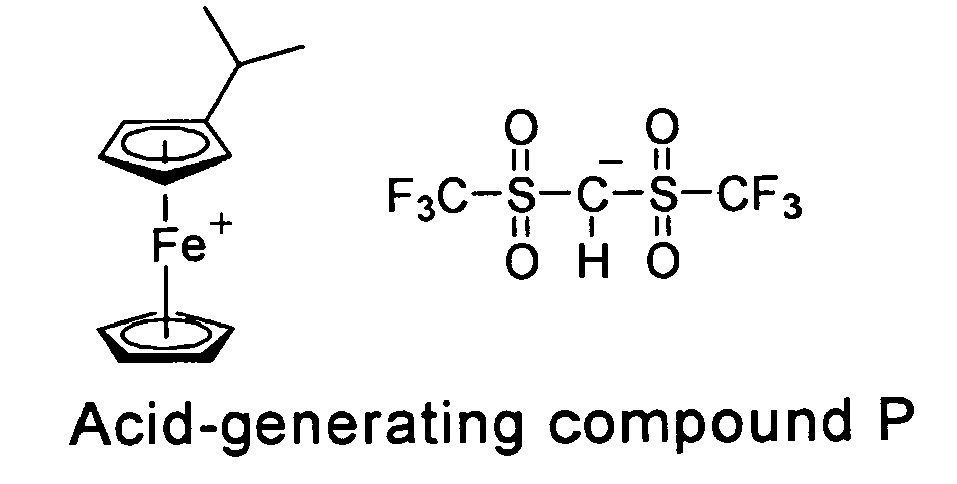
- Magenta ink 22 was prepared in the same manner as for Magenta ink 17 except that 3 parts by weight of 9,10-dibutoxyanthracene was added to Magenta ink 17.
-
Magenta pigment dispersion 2 5 parts by weight (A) Acid-generating compound I above 6 parts by weight (B) Polymerizable compounds Cationically polymerizable monomer: 3,4-epoxycyclohexylmethyl-3',4'-epoxycyclohexanecarboxylate (Celloxide 2021A: manufactured by Daicel-UCB Co., Ltd.) 30 parts by weight Cationically polymerizable monomer: 3,7-bis(3-oxetanyl)-5-oxanonane (OXT-221: manufactured by Toagosei Co., Ltd.) 48 parts by weight Radically polymerizable monomer: 1,6-hexanediol diacrylate 10 parts by weight -
Magenta pigment dispersion 2 5 parts by weight Triarylsulfonium tetrafluoroborate (manufactured by Tokyo Chemical Industry Co., Ltd.) 6 parts by weight (B) Polymerizable compounds Monomer: 3,4-epoxycyclohexylmethyl-3',4'-epoxycyclohexanecarboxylate (Celloxide 2021A: manufactured by Daicel-UCB Co., Ltd.) 40 parts by weight Monomer: 3,7-bis(3-oxetanyl)-5-oxanonane (OXT-221: manufactured by Toagosei Co., Ltd.) 48 parts by weight Surfactant: BYK307 (manufactured by BYK Chemie) 1 part by weight -
Magenta pigment dispersion 2 5 parts by weight Tri-p-tolylsulfonium trifluoromethanesulfonate (manufactured by Tokyo Chemical Industry Co., Ltd.) 6 parts by weight (B) Polymerizable compounds Monomer: 3,4-epoxycyclohexylmethyl-3',4'-epoxycyclohexanecarboxylate (Celloxide 2021A: manufactured by Daicel-UCB Co., Ltd.) 40 parts by weight Monomer: 3,7-bis(3-oxetanyl)-5-oxanonane (OXT-221: manufactured by Toagosei Co., Ltd.) 48 parts by weight Surfactant: BYK307 (manufactured by BYK Chemie) 1 part by weight -
Magenta pigment dispersion 2 5 parts by weight Tri-p-tolylsulfonium hexafluorophosphate (manufactured by Tokyo Chemical Industry Co., Ltd.) 6 parts by weight (B) Polymerizable compounds Monomer: 3,4-epoxycyclohexylmethyl-3',4'-epoxycyclohexanecarboxylate (Celloxide 2021A: manufactured by Daicel-UCB Co., Ltd.) 40 parts by weight Monomer: 3,7-bis(3-oxetanyl)-5-oxanonane (OXT-221: manufactured by Toagosei Co., Ltd.) 48 parts by weight Surfactant: BYK307 (manufactured by BYK Chemie) 1 part by weight - Magenta ink 30 was prepared in the same manner as for Magenta ink 27 except that 3 parts by weight of 9,10-dibutoxyanthracene was added to Magenta ink 27.
- Crude magenta inks 18 to 30 prepared as described above were filtered using a filter having an absolute filtration accuracy of 2 µm to give Magenta inks 18 to 30.
- Magenta ink 31 was prepared in the same manner as for magenta ink 17 except that instead of Cl pigment red 57:1 Compound M-1 below (oxidation potential +1.37 V) was used as an oil-soluble dye, and filtration was carried out using a filter having an absolute filtration accuracy of 2 µm.

- Magenta ink 32 was prepared in the same manner as for magenta ink 17 except that instead of Cl pigment red 57:1 Compound M-2 below (oxidation potential +0.94 V) was used as an oil-soluble dye, and filtration was carried out using a filter having an absolute filtration accuracy of 2 µm.

- A magenta image was printed by the same method as described in Example 14 using the magenta inks 18 to 32 prepared above.
- A magenta image was formed using Magenta ink 25 by the same method as in Example 14 except that a UV light-emitting diode (UV-LED) was used instead of the VZero 085 metal halide lamp manufactured by Integration Technology.
- In this embodiment, an NCCU033 manufactured by Nichia Corporation was used as the UV-LED. The LED emits UV light at a wavelength of 365 nm from 1 chip, and by applying a current of about 500 mA, light of about 100 mW is emitted from the chip. A plurality thereof were aligned at intervals of 7 mm to give a power of 0.3 W/cm2 on the surface of a recording medium (hereinafter, also called a medium). The time from landing to irradiation and the exposure time can be varied by the transport speed of the medium and the distance between a head and the LED in the transport direction. In this embodiment, irradiation was carried out about 0.5 sec. after landing.
- The exposure energy on the medium was adjustable in the range of 0.01 to 15 J/cm2 by setting the distance from the medium and the transport speed.
- A magenta image was formed in the same manner as in Example 26 using Magenta ink 30.
- Subsequently, with regard to each of the images thus formed, the sensitivity required for curing, penetration into commercial recycled paper, ink spread on a grained aluminum support, adhesion, plate life, and storage stability were evaluated in accordance with the methods described below.
- High quality paper was superimposed on a printed sample immediately after exposure, they were passed through pressure rollers (50 kg/cm2), transfer of coloring material onto the high quality paper was evaluated, and the exposure energy intensity (mJ/cm2) when transfer did not occur was defined as the curing sensitivity. The smaller the value, the higher the sensitivity.
- After storing the prepared ink at 75%RH and 60°C for 3 days, the ink viscosity at the discharge temperature was measured, and an increase in the ink viscosity was expressed as a viscosity ratio (after storage/before storage). When the viscosity was unchanged and the ratio was close to 1.0, the storage stability was good, and if the ratio exceeded 1.5, clogging might undesirably be caused during discharge.
- An ink comprising the above-mentioned ink composition without the pigment dispersion was conditioned by stirring for 30 minutes and filtered using a filter having an absolute filtration accuracy of 2 µm; the presence or absence of a precipitate was evaluated as follows, and the solubility was evaluated.
- Good: no precipitate
- Fair: small amount of precipitate
- Poor: some precipitate
- With regard to the printed images formed above, a completely undamaged sample and a sample whose printed surface was crosshatched with 11 cuts in both lengthwise and widthwise directions at intervals of 1 mm in accordance with JIS K 5400 to give 100 1 mm squares were prepared, Sellotape (trademark) was affixed to the surface of each sample and peeled off quickly at an angle of 90 degrees, and the condition of the remaining printed image that had not been peeled off was evaluated in accordance with the criteria below.
- Good: printed image was not peeled off at all in the crosshatch test.
- Fair: the ink was slightly peeled off in the crosshatch test, but unless the ink surface was damaged little was peeled off.
- Poor: easily peeled off by Sellotape (trademark) under both conditions.
- An image printed on a grained aluminum support prepared above was used as a printing plate, printing was carried out using a Heidel KOR-D machine, and a relative comparison of the number of prints completed was used as an index for the plate life (the number obtained for Example 14 was defined as 100). The larger the number, the longer the plate life, which is preferable.
(Table 3) Example Ink No. Curing sensitivity (mJ/cm2) Thermal stability Solubility Adhesion Plate life Ex. 14 Magenta 17 200 1.1 Good Good 100 Ex. 15 Magenta 18 150 1.1 Good Good 120 Ex. 16 Magenta 19 300 1.1 Good Good 80 Ex. 17 Magenta 20 300 1.1 Good Good 80 Ex. 18 Magenta 21 250 1.1 Good Good 90 Ex. 19 Magenta 22 300 1.1 Good Good 80 Ex. 20 Magenta 23 150 1.3 Good Good 120 Ex. 21 Magenta 24 220 1.3 Good Good 95 Ex. 22 Magenta 25 100 1.2 Good Good 150 Ex. 23 Magenta 26 150 1.2 Good Good 120 Ex. 24 Magenta 31 180 1.1 Good Good 110 Ex. 25 Magenta 32 150 1.1 Good Good 120 Ex. 26 Magenta 25 100 1.2 Good Good 150 Comp. Ex. 6 Magenta 27 500 1.3 Poor Fair 50 Comp. Ex. 7 Magenta 28 1000 1.3 Good Fair 20 Comp. Ex. 8 Magenta 29 400 1.5 Fair Fair 60 Comp. Ex. 9 Magenta 30 200 1.3 Poor Fair 100 Comp. Ex. 10 Magenta 30 400 1.5 Fair Fair 60 - It can be seen from Table 3 that the ink composition of the present invention that comprises an acid-generating compound having an anion represented by any one of Formulae (III) to (XI), (B) a cationically polymerizable compound, and (C) a colorant is highly sensitive to irradiation with radiation and has good thermal stability and excellent adhesion and plate life.
Claims (10)
- An ink composition comprising:(A) an acid-generating compound having an anion represented by any one of Formulae (I) to (XI);(B) a cationically polymerizable compound; and(C) a colorant,wherein R1 to R3 independently denote a monovalent organic group, Rb1 to Rb3, Rf1, and Rf2 independently denote a perfluoroalkyl group, a perfluoroaryl group, or an aryl group substituted with at least one fluorine atom or perfluoroalkyl group, X1 to X3 independently denote a monovalent organic group, and Y1 denotes a hydrogen atom or a monovalent organic group.


- The ink composition according to Claim 1, wherein the acid-generating compound has an anion represented by either Formula (I) or (II).
- The ink composition according to Claim 1, wherein the acid-generating compound has an anion represented by any one of Formulae (III) to (XI).
- The ink composition according to Claim 3, wherein the acid-generating compound has an anion represented by either Formula (VI) or (X).
- The ink composition according to any one of Claim 1 to Claim 4, wherein it is for inkjet recording use.
- An inkjet recording method comprising:a step (A') of discharging an ink composition onto a recording medium; anda step (B') of irradiating the discharged ink composition with actinic radiation so as to cure the ink composition,the ink composition being the ink composition according to any one of Claim 1 to Claim 5.
- The inkjet recording method according to Claim 6, wherein the actinic radiation is ultraviolet radiation emitted by a light emitting diode that has a light emission peak wavelength in the range of 350 to 420 nm and generates ultraviolet radiation whose maximum illumination intensity on the surface of a recording medium is 10 to 2,000 mW/cm2.
- A printed material recorded by the inkjet recording method according to either Claim 6 or Claim 7.
- A process for producing a lithographic printing plate, the process comprising:a step (A") of discharging the ink composition according to any one of Claim 1 to Claim 5 onto a hydrophilic support; anda step (B") of irradiating the discharged ink composition with actinic radiation so as to cure the ink composition, thus forming a hydrophobic image on the hydrophilic support by curing the ink composition.
- A lithographic printing plate produced by the process for producing a lithographic printing plate according to Claim 9.
Applications Claiming Priority (2)
| Application Number | Priority Date | Filing Date | Title |
|---|---|---|---|
| JP2006004729A JP2007186566A (en) | 2006-01-12 | 2006-01-12 | Ink composition, inkjet recording method, printed matter, planographic printing plate manufacturing method, and planographic printing plate |
| JP2006063475A JP4907200B2 (en) | 2006-03-09 | 2006-03-09 | Ink composition, inkjet recording method, printed matter, planographic printing plate manufacturing method, and planographic printing plate |
Publications (2)
| Publication Number | Publication Date |
|---|---|
| EP1808466A1 true EP1808466A1 (en) | 2007-07-18 |
| EP1808466B1 EP1808466B1 (en) | 2009-12-02 |
Family
ID=37963771
Family Applications (1)
| Application Number | Title | Priority Date | Filing Date |
|---|---|---|---|
| EP07000499A Not-in-force EP1808466B1 (en) | 2006-01-12 | 2007-01-11 | Ink composition, inkjet recording method, printed material, process for producing lithographic printing plate, and lithographic printing plate |
Country Status (4)
| Country | Link |
|---|---|
| US (1) | US7618683B2 (en) |
| EP (1) | EP1808466B1 (en) |
| AT (1) | ATE450583T1 (en) |
| DE (1) | DE602007003482D1 (en) |
Cited By (2)
| Publication number | Priority date | Publication date | Assignee | Title |
|---|---|---|---|---|
| EP2454335A4 (en) * | 2009-07-14 | 2015-03-11 | Ricoh Co Ltd | Inkjet recording ink, ink cartridge and inkjet recording apparatus |
| EP3590975A4 (en) * | 2017-02-28 | 2020-04-01 | FUJIFILM Corporation | CURABLE COMPOSITION, ORIGINAL PLATE FOR LITHOGRAPHIC PRINTING PLATE, METHOD FOR MANUFACTURING LITHOGRAPHIC PRINTING PLATE, AND COMPOUND |
Families Citing this family (8)
| Publication number | Priority date | Publication date | Assignee | Title |
|---|---|---|---|---|
| US8456586B2 (en) * | 2009-06-11 | 2013-06-04 | Apple Inc. | Portable computer display structures |
| US8743309B2 (en) | 2009-11-10 | 2014-06-03 | Apple Inc. | Methods for fabricating display structures |
| KR101537654B1 (en) * | 2010-04-22 | 2015-07-17 | 히타치가세이가부시끼가이샤 | Organic electronic material, polymerization initiator and thermal polymerization initiator, ink composition, organic thin film and production method for same, organic electronic element, organic electroluminescent element, lighting device, display element, and display device |
| US10907056B2 (en) | 2015-03-20 | 2021-02-02 | Blue Cube Ip Llc | Curable compositions |
| US11632448B2 (en) | 2019-12-03 | 2023-04-18 | Apple Inc. | Handheld electronic device |
| US11637919B2 (en) | 2019-12-03 | 2023-04-25 | Apple Inc. | Handheld electronic device |
| US12003657B2 (en) | 2021-03-02 | 2024-06-04 | Apple Inc. | Handheld electronic device |
| US12267449B2 (en) | 2022-03-03 | 2025-04-01 | Apple Inc. | Handheld electronic device |
Citations (4)
| Publication number | Priority date | Publication date | Assignee | Title |
|---|---|---|---|---|
| US20030032549A1 (en) * | 2001-07-23 | 2003-02-13 | Alexander Vogel | Salts of lewis acid/acid adducts and catalyst activators therefrom |
| JP2003342254A (en) * | 2002-05-23 | 2003-12-03 | Toyo Gosei Kogyo Kk | New sulfonium salt compound and method for producing the same |
| US20040087690A1 (en) * | 2002-11-01 | 2004-05-06 | 3M Innovative Properties Company | Ionic photoacid generators with segmented hydrocarbon-fluorocarbon sulfonate anions |
| JP2004325654A (en) * | 2003-04-23 | 2004-11-18 | Fuji Photo Film Co Ltd | Lithographic printing original plate |
Family Cites Families (9)
| Publication number | Priority date | Publication date | Assignee | Title |
|---|---|---|---|---|
| FR2688783A1 (en) | 1992-03-23 | 1993-09-24 | Rhone Poulenc Chimie | NOVEL BORONES OF ONIUM OR ORGANOMETALLIC COMPLEX CATIONIC PRIMERS FOR POLYMERIZATION. |
| JPH09202873A (en) | 1996-01-29 | 1997-08-05 | Toyo Ink Mfg Co Ltd | Energy-sensitive ray acid generator, energy-sensitive ray acid generator composition, curable composition and cured product thereof |
| JP3924801B2 (en) | 1996-02-19 | 2007-06-06 | 東洋インキ製造株式会社 | Energy-sensitive linear acid generator, energy-sensitive linear acid generator composition, curable composition, and cured product thereof |
| TWI300516B (en) * | 2001-07-24 | 2008-09-01 | Jsr Corp | |
| JP4382364B2 (en) * | 2002-04-24 | 2009-12-09 | 株式会社東芝 | Liquid ink |
| US7056559B2 (en) * | 2002-08-30 | 2006-06-06 | Konica Corporation | Ink-jet image forming method |
| US20060204732A1 (en) | 2005-03-08 | 2006-09-14 | Fuji Photo Film Co., Ltd. | Ink composition, inkjet recording method, printed material, method of producing planographic printing plate, and planographic printing plate |
| JP2006257248A (en) | 2005-03-17 | 2006-09-28 | Fuji Photo Film Co Ltd | Ink composition, inkjet recording method, printed matter, manufacturing method of lithographic printing plate, and lithographic printing plate |
| JP4757574B2 (en) | 2005-09-07 | 2011-08-24 | 富士フイルム株式会社 | Ink composition, inkjet recording method, printed matter, planographic printing plate manufacturing method, and planographic printing plate |
-
2007
- 2007-01-05 US US11/649,808 patent/US7618683B2/en not_active Expired - Fee Related
- 2007-01-11 DE DE602007003482T patent/DE602007003482D1/en active Active
- 2007-01-11 EP EP07000499A patent/EP1808466B1/en not_active Not-in-force
- 2007-01-11 AT AT07000499T patent/ATE450583T1/en not_active IP Right Cessation
Patent Citations (4)
| Publication number | Priority date | Publication date | Assignee | Title |
|---|---|---|---|---|
| US20030032549A1 (en) * | 2001-07-23 | 2003-02-13 | Alexander Vogel | Salts of lewis acid/acid adducts and catalyst activators therefrom |
| JP2003342254A (en) * | 2002-05-23 | 2003-12-03 | Toyo Gosei Kogyo Kk | New sulfonium salt compound and method for producing the same |
| US20040087690A1 (en) * | 2002-11-01 | 2004-05-06 | 3M Innovative Properties Company | Ionic photoacid generators with segmented hydrocarbon-fluorocarbon sulfonate anions |
| JP2004325654A (en) * | 2003-04-23 | 2004-11-18 | Fuji Photo Film Co Ltd | Lithographic printing original plate |
Non-Patent Citations (1)
| Title |
|---|
| DATABASE WPI Week 200501, Derwent World Patents Index; AN 2005-002237, XP002431819 * |
Cited By (3)
| Publication number | Priority date | Publication date | Assignee | Title |
|---|---|---|---|---|
| EP2454335A4 (en) * | 2009-07-14 | 2015-03-11 | Ricoh Co Ltd | Inkjet recording ink, ink cartridge and inkjet recording apparatus |
| EP3590975A4 (en) * | 2017-02-28 | 2020-04-01 | FUJIFILM Corporation | CURABLE COMPOSITION, ORIGINAL PLATE FOR LITHOGRAPHIC PRINTING PLATE, METHOD FOR MANUFACTURING LITHOGRAPHIC PRINTING PLATE, AND COMPOUND |
| US11333977B2 (en) | 2017-02-28 | 2022-05-17 | Fujifilm Corporation | Curable composition, lithographic printing plate precursor, method for producing lithographic printing plate, and compound |
Also Published As
| Publication number | Publication date |
|---|---|
| US20070160815A1 (en) | 2007-07-12 |
| US7618683B2 (en) | 2009-11-17 |
| DE602007003482D1 (en) | 2010-01-14 |
| ATE450583T1 (en) | 2009-12-15 |
| EP1808466B1 (en) | 2009-12-02 |
Similar Documents
| Publication | Publication Date | Title |
|---|---|---|
| EP1826206B1 (en) | Sulfonium salt, curable composition, ink composition, inkjet recording method, printed material, process for producing lithographic printing plate, and lithographic printing plate | |
| EP1808466B1 (en) | Ink composition, inkjet recording method, printed material, process for producing lithographic printing plate, and lithographic printing plate | |
| EP1721943B1 (en) | Ink composition, inkjet recording method, printed material, process for producing lithographic printing plate, and lithographic printing plate | |
| JP2006241435A (en) | Ink composition, inkjet recording method, printed article, method for producing planographic printing plate and planographic printing plate | |
| EP1724315B1 (en) | Ink composition, inkjet recording method and process for producing lithographic printing plate | |
| EP1847576B1 (en) | Ink composition, inkjet recording method, printed material, process for producing lithographic printing plate, and lithographic printing plate | |
| EP1754758B1 (en) | Ink composition comprising an onium salt and a cationically polymerisable compound, inkjet recording method, printed material | |
| JP4907200B2 (en) | Ink composition, inkjet recording method, printed matter, planographic printing plate manufacturing method, and planographic printing plate | |
| EP1760121B1 (en) | Radiation curable ink comprising a condensed polycyclic aromatic photosensitizer | |
| JP2006241383A (en) | Ink composition, inkjet recording method, printed article, planographic printing plate and method for producing the same | |
| JP2007186566A (en) | Ink composition, inkjet recording method, printed matter, planographic printing plate manufacturing method, and planographic printing plate | |
| JP2006241384A (en) | Ink composition, inkjet recording method, printed article, planographic printing plate and method for producing the same | |
| JP4757572B2 (en) | Ink composition, inkjet recording method, printed matter, planographic printing plate manufacturing method, and planographic printing plate | |
| JP2006307031A (en) | Ink composition, ink jet recording method, printed matter, manufacturing method of lithographic printing plate and lithographic printing plate | |
| JP2006241406A (en) | Ink composition, inkjet recording method, printed article, method for producing planographic printing plate and planographic printing plate | |
| JP2008081516A (en) | Radiation curable ink composition for inkjet, inkjet recording method, method for producing lithographic printing plate, and lithographic printing plate | |
| JP2007091806A (en) | Ink composition, inkjet recording method, printed matter, planographic printing plate manufacturing method, and planographic printing plate | |
| JP4955220B2 (en) | Ink composition, inkjet recording method, printed matter, planographic printing plate manufacturing method, and planographic printing plate | |
| JP2007063419A (en) | Ink composition, inkjet recording method, printed matter, planographic printing plate manufacturing method, and planographic printing plate | |
| JP2007023151A (en) | Ink composition, inkjet recording method, printed article, method for producing planographic printing plate and planographic printing plate | |
| JP2007091827A (en) | Ink composition, inkjet recording method, printed matter, planographic printing plate manufacturing method, and planographic printing plate | |
| JP2007070526A (en) | Ink composition, inkjet recording method, printed matter, planographic printing plate manufacturing method, and planographic printing plate | |
| JP2006321823A (en) | Ink composition, manufacturing method of ink composition, inkjet recording method, printed matter, manufacturing method of lithographic printing plate, and lithographic printing plate | |
| JP2007084594A (en) | Ink composition, inkjet recording method, printed matter, planographic printing plate manufacturing method, and planographic printing plate | |
| JP2007169489A (en) | Ink composition, inkjet recording method, printed matter, planographic printing plate manufacturing method, and planographic printing plate |
Legal Events
| Date | Code | Title | Description |
|---|---|---|---|
| PUAI | Public reference made under article 153(3) epc to a published international application that has entered the european phase |
Free format text: ORIGINAL CODE: 0009012 |
|
| AK | Designated contracting states |
Kind code of ref document: A1 Designated state(s): AT BE BG CH CY CZ DE DK EE ES FI FR GB GR HU IE IS IT LI LT LU LV MC NL PL PT RO SE SI SK TR |
|
| AX | Request for extension of the european patent |
Extension state: AL BA HR MK YU |
|
| 17P | Request for examination filed |
Effective date: 20080118 |
|
| AKX | Designation fees paid |
Designated state(s): AT BE BG CH CY CZ DE DK EE ES FI FR GB GR HU IE IS IT LI LT LU LV MC NL PL PT RO SE SI SK TR |
|
| 17Q | First examination report despatched |
Effective date: 20080806 |
|
| GRAP | Despatch of communication of intention to grant a patent |
Free format text: ORIGINAL CODE: EPIDOSNIGR1 |
|
| GRAS | Grant fee paid |
Free format text: ORIGINAL CODE: EPIDOSNIGR3 |
|
| GRAA | (expected) grant |
Free format text: ORIGINAL CODE: 0009210 |
|
| AK | Designated contracting states |
Kind code of ref document: B1 Designated state(s): AT BE BG CH CY CZ DE DK EE ES FI FR GB GR HU IE IS IT LI LT LU LV MC NL PL PT RO SE SI SK TR |
|
| REG | Reference to a national code |
Ref country code: GB Ref legal event code: FG4D |
|
| REG | Reference to a national code |
Ref country code: CH Ref legal event code: EP |
|
| REG | Reference to a national code |
Ref country code: IE Ref legal event code: FG4D |
|
| REF | Corresponds to: |
Ref document number: 602007003482 Country of ref document: DE Date of ref document: 20100114 Kind code of ref document: P |
|
| REG | Reference to a national code |
Ref country code: NL Ref legal event code: VDEP Effective date: 20091202 |
|
| PG25 | Lapsed in a contracting state [announced via postgrant information from national office to epo] |
Ref country code: SE Free format text: LAPSE BECAUSE OF FAILURE TO SUBMIT A TRANSLATION OF THE DESCRIPTION OR TO PAY THE FEE WITHIN THE PRESCRIBED TIME-LIMIT Effective date: 20091202 Ref country code: LT Free format text: LAPSE BECAUSE OF FAILURE TO SUBMIT A TRANSLATION OF THE DESCRIPTION OR TO PAY THE FEE WITHIN THE PRESCRIBED TIME-LIMIT Effective date: 20091202 Ref country code: FI Free format text: LAPSE BECAUSE OF FAILURE TO SUBMIT A TRANSLATION OF THE DESCRIPTION OR TO PAY THE FEE WITHIN THE PRESCRIBED TIME-LIMIT Effective date: 20091202 |
|
| LTIE | Lt: invalidation of european patent or patent extension |
Effective date: 20091202 |
|
| PG25 | Lapsed in a contracting state [announced via postgrant information from national office to epo] |
Ref country code: CY Free format text: LAPSE BECAUSE OF FAILURE TO SUBMIT A TRANSLATION OF THE DESCRIPTION OR TO PAY THE FEE WITHIN THE PRESCRIBED TIME-LIMIT Effective date: 20091202 Ref country code: SI Free format text: LAPSE BECAUSE OF FAILURE TO SUBMIT A TRANSLATION OF THE DESCRIPTION OR TO PAY THE FEE WITHIN THE PRESCRIBED TIME-LIMIT Effective date: 20091202 Ref country code: PL Free format text: LAPSE BECAUSE OF FAILURE TO SUBMIT A TRANSLATION OF THE DESCRIPTION OR TO PAY THE FEE WITHIN THE PRESCRIBED TIME-LIMIT Effective date: 20091202 Ref country code: LV Free format text: LAPSE BECAUSE OF FAILURE TO SUBMIT A TRANSLATION OF THE DESCRIPTION OR TO PAY THE FEE WITHIN THE PRESCRIBED TIME-LIMIT Effective date: 20091202 |
|
| PG25 | Lapsed in a contracting state [announced via postgrant information from national office to epo] |
Ref country code: AT Free format text: LAPSE BECAUSE OF FAILURE TO SUBMIT A TRANSLATION OF THE DESCRIPTION OR TO PAY THE FEE WITHIN THE PRESCRIBED TIME-LIMIT Effective date: 20091202 |
|
| PG25 | Lapsed in a contracting state [announced via postgrant information from national office to epo] |
Ref country code: IS Free format text: LAPSE BECAUSE OF FAILURE TO SUBMIT A TRANSLATION OF THE DESCRIPTION OR TO PAY THE FEE WITHIN THE PRESCRIBED TIME-LIMIT Effective date: 20100402 Ref country code: EE Free format text: LAPSE BECAUSE OF FAILURE TO SUBMIT A TRANSLATION OF THE DESCRIPTION OR TO PAY THE FEE WITHIN THE PRESCRIBED TIME-LIMIT Effective date: 20091202 Ref country code: ES Free format text: LAPSE BECAUSE OF FAILURE TO SUBMIT A TRANSLATION OF THE DESCRIPTION OR TO PAY THE FEE WITHIN THE PRESCRIBED TIME-LIMIT Effective date: 20100313 Ref country code: NL Free format text: LAPSE BECAUSE OF FAILURE TO SUBMIT A TRANSLATION OF THE DESCRIPTION OR TO PAY THE FEE WITHIN THE PRESCRIBED TIME-LIMIT Effective date: 20091202 Ref country code: PT Free format text: LAPSE BECAUSE OF FAILURE TO SUBMIT A TRANSLATION OF THE DESCRIPTION OR TO PAY THE FEE WITHIN THE PRESCRIBED TIME-LIMIT Effective date: 20100402 Ref country code: BG Free format text: LAPSE BECAUSE OF FAILURE TO SUBMIT A TRANSLATION OF THE DESCRIPTION OR TO PAY THE FEE WITHIN THE PRESCRIBED TIME-LIMIT Effective date: 20100302 Ref country code: RO Free format text: LAPSE BECAUSE OF FAILURE TO SUBMIT A TRANSLATION OF THE DESCRIPTION OR TO PAY THE FEE WITHIN THE PRESCRIBED TIME-LIMIT Effective date: 20091202 |
|
| PG25 | Lapsed in a contracting state [announced via postgrant information from national office to epo] |
Ref country code: SK Free format text: LAPSE BECAUSE OF FAILURE TO SUBMIT A TRANSLATION OF THE DESCRIPTION OR TO PAY THE FEE WITHIN THE PRESCRIBED TIME-LIMIT Effective date: 20091202 Ref country code: MC Free format text: LAPSE BECAUSE OF NON-PAYMENT OF DUE FEES Effective date: 20100131 Ref country code: CZ Free format text: LAPSE BECAUSE OF FAILURE TO SUBMIT A TRANSLATION OF THE DESCRIPTION OR TO PAY THE FEE WITHIN THE PRESCRIBED TIME-LIMIT Effective date: 20091202 Ref country code: BE Free format text: LAPSE BECAUSE OF FAILURE TO SUBMIT A TRANSLATION OF THE DESCRIPTION OR TO PAY THE FEE WITHIN THE PRESCRIBED TIME-LIMIT Effective date: 20091202 |
|
| PLBE | No opposition filed within time limit |
Free format text: ORIGINAL CODE: 0009261 |
|
| STAA | Information on the status of an ep patent application or granted ep patent |
Free format text: STATUS: NO OPPOSITION FILED WITHIN TIME LIMIT |
|
| REG | Reference to a national code |
Ref country code: FR Ref legal event code: ST Effective date: 20100930 |
|
| PG25 | Lapsed in a contracting state [announced via postgrant information from national office to epo] |
Ref country code: FR Free format text: LAPSE BECAUSE OF NON-PAYMENT OF DUE FEES Effective date: 20100202 Ref country code: GR Free format text: LAPSE BECAUSE OF FAILURE TO SUBMIT A TRANSLATION OF THE DESCRIPTION OR TO PAY THE FEE WITHIN THE PRESCRIBED TIME-LIMIT Effective date: 20100303 |
|
| 26N | No opposition filed |
Effective date: 20100903 |
|
| PG25 | Lapsed in a contracting state [announced via postgrant information from national office to epo] |
Ref country code: DK Free format text: LAPSE BECAUSE OF FAILURE TO SUBMIT A TRANSLATION OF THE DESCRIPTION OR TO PAY THE FEE WITHIN THE PRESCRIBED TIME-LIMIT Effective date: 20091202 Ref country code: IE Free format text: LAPSE BECAUSE OF NON-PAYMENT OF DUE FEES Effective date: 20100111 |
|
| PG25 | Lapsed in a contracting state [announced via postgrant information from national office to epo] |
Ref country code: IT Free format text: LAPSE BECAUSE OF FAILURE TO SUBMIT A TRANSLATION OF THE DESCRIPTION OR TO PAY THE FEE WITHIN THE PRESCRIBED TIME-LIMIT Effective date: 20091202 |
|
| REG | Reference to a national code |
Ref country code: CH Ref legal event code: PL |
|
| PG25 | Lapsed in a contracting state [announced via postgrant information from national office to epo] |
Ref country code: LI Free format text: LAPSE BECAUSE OF NON-PAYMENT OF DUE FEES Effective date: 20110131 Ref country code: CH Free format text: LAPSE BECAUSE OF NON-PAYMENT OF DUE FEES Effective date: 20110131 |
|
| PG25 | Lapsed in a contracting state [announced via postgrant information from national office to epo] |
Ref country code: HU Free format text: LAPSE BECAUSE OF FAILURE TO SUBMIT A TRANSLATION OF THE DESCRIPTION OR TO PAY THE FEE WITHIN THE PRESCRIBED TIME-LIMIT Effective date: 20100603 Ref country code: LU Free format text: LAPSE BECAUSE OF NON-PAYMENT OF DUE FEES Effective date: 20100111 |
|
| PG25 | Lapsed in a contracting state [announced via postgrant information from national office to epo] |
Ref country code: TR Free format text: LAPSE BECAUSE OF FAILURE TO SUBMIT A TRANSLATION OF THE DESCRIPTION OR TO PAY THE FEE WITHIN THE PRESCRIBED TIME-LIMIT Effective date: 20091202 |
|
| PGFP | Annual fee paid to national office [announced via postgrant information from national office to epo] |
Ref country code: DE Payment date: 20130109 Year of fee payment: 7 Ref country code: GB Payment date: 20130109 Year of fee payment: 7 |
|
| REG | Reference to a national code |
Ref country code: DE Ref legal event code: R119 Ref document number: 602007003482 Country of ref document: DE |
|
| GBPC | Gb: european patent ceased through non-payment of renewal fee |
Effective date: 20140111 |
|
| REG | Reference to a national code |
Ref country code: DE Ref legal event code: R119 Ref document number: 602007003482 Country of ref document: DE Effective date: 20140801 |
|
| PG25 | Lapsed in a contracting state [announced via postgrant information from national office to epo] |
Ref country code: DE Free format text: LAPSE BECAUSE OF NON-PAYMENT OF DUE FEES Effective date: 20140801 |
|
| PG25 | Lapsed in a contracting state [announced via postgrant information from national office to epo] |
Ref country code: GB Free format text: LAPSE BECAUSE OF NON-PAYMENT OF DUE FEES Effective date: 20140111 |